Should we fear God?The Torah, prophets, and Wisdom literature relentlessly command fear of YHWH — Deuteronomy 6:13, Ecclesiastes 12:13, Proverbs 9:10, Matthew 10:28, and Hebrews…
Psalms 111:10(v10)The fear of Yahweh is the beginning of wisdom. All those who do his work have a good understanding. His praise endures forever!
Job 28:28(v10)To man he said, ‘Behold, the fear of the Lord, that is wisdom. To depart from evil is understanding.’ ”
Proverbs 1:7(v10)The fear of Yahweh is the beginning of knowledge; but the foolish despise wisdom and instruction.
Ecclesiastes 12:13(v10)This is the end of the matter. All has been heard. Fear God and keep his commandments; for this is the whole duty of man.
Proverbs 2:5(v10)then you will understand the fear of Yahweh, and find the knowledge of God.
Show all 29 cross-references
John 17:3(v10)This is eternal life, that they should know you, the only true God, and him whom you sent, Jesus Christ.
Proverbs 10:27(v11)The fear of Yahweh prolongs days, but the years of the wicked shall be shortened.
1 John 5:20(v10)We know that the Son of God has come, and has given us an understanding, that we know him who is true, and we are in him who is true, in…
1 Chronicles 28:9(v10)You, Solomon my son, know the God of your father, and serve him with a perfect heart and with a willing mind; for Yahweh searches all…
Proverbs 3:2(v11)for they will add to you length of days, years of life, and peace.
Proverbs 3:16(v11)Length of days is in her right hand. In her left hand are riches and honor.
Proverbs 1:5(v9)that the wise man may hear, and increase in learning; that the man of understanding may attain to sound counsel:
Deuteronomy 6:2(v11)that you might fear Yahweh your God, to keep all his statutes and his commandments, which I command you—you, your son, and your son’s son,…
Proverbs 30:3(v10)I have not learned wisdom, neither do I have the knowledge of the Holy One.
Matthew 13:11-12(v9)He answered them, “To you it is given to know the mysteries of the Kingdom of Heaven, but it is not given to them. For whoever has, to him…
1 John 5:13(v9)These things I have written to you who believe in the name of the Son of God, that you may know that you have eternal life, and that you…
Job 22:2-3(v12)“Can a man be profitable to God? Surely he who is wise is profitable to himself. Is it any pleasure to the Almighty that you are righteous?…
Proverbs 25:12(v9)As an earring of gold, and an ornament of fine gold, so is a wise reprover to an obedient ear.
Ezekiel 18:20(v12)The soul who sins, he shall die. The son shall not bear the iniquity of the father, neither shall the father bear the iniquity of the son.…
Matthew 11:27(v10)All things have been delivered to me by my Father. No one knows the Son, except the Father; neither does anyone know the Father, except the…
2 Peter 3:3-4(v12)knowing this first, that in the last days mockers will come, walking after their own lusts and saying, “Where is the promise of his coming?…
1 John 2:20-21(v9)You have an anointing from the Holy One, and you all have knowledge. I have not written to you because you don’t know the truth, but…
Job 22:21(v12)“Acquaint yourself with him, now, and be at peace. By it, good will come to you.
Hosea 6:3(v9)Let’s acknowledge Yahweh. Let’s press on to know Yahweh. As surely as the sun rises, Yahweh will appear. He will come to us like the rain,…
Proverbs 16:26(v12)The appetite of the laboring man labors for him; for his mouth urges him on.
2 Peter 3:18(v9)But grow in the grace and knowledge of our Lord and Savior Jesus Christ. To him be the glory both now and forever. Amen.
Job 35:6-7(v12)If you have sinned, what effect do you have against him? If your transgressions are multiplied, what do you do to him? If you are…
Isaiah 28:22(v12)Now therefore don’t be scoffers, lest your bonds be made strong; for I have heard a decree of destruction from the Lord, Yahweh of Armies,…
2 Peter 3:16(v12)as also in all of his letters, speaking in them of these things. In those, there are some things that are hard to understand, which the…
Cross-references from openbible.info (CC BY 4.0)
Explain this passage (19 sources)
Historical commentary, presented as a primary source — not an endorsement.
Geneva Bible translators1599 · Public DomainOn vv10, 12He showeth what true understanding is, to know the…
He showeth what true understanding is, to know the will of God in his word which is meant by holy things.
Geneva Bible (1599) marginal notes — public domain.
John Trapp1656 · Public DomainOn vv9–12Pro 9:9 Give [instruction] to a wise [man], and…
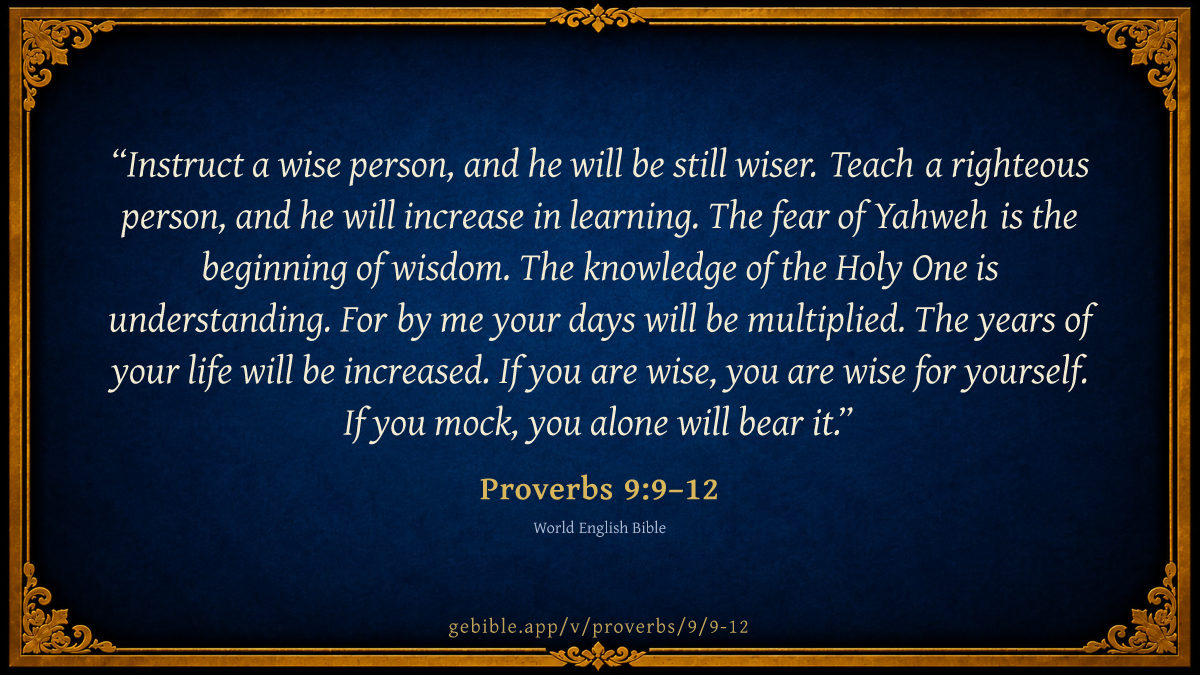
Pro 9:9 Give [instruction] to a wise [man], and he will be yet wiser: teach a just [man], and he will increase in learning.
Ver. 9. Give admonition to a wise man.] This is an alms that the poorest may give, and be never the poorer, but the better. For by instructing another, a man engageth himself, lest he hear, "Physician heal thyself." Turpe est doctori, cum culpa redarguit ipsum. See my "Common Place of Admonition."
John Trapp, A Commentary or Exposition upon All the Books of the Old and New Testament (1647–1656) — public domain. Text from a community e-Sword module.
Matthew Poole1685 · Public DomainOn vv9, 10, 12Give instruction: in the Hebrew it is only give;…
Give instruction: in the Hebrew it is only give; for as receiving is put for learning, Pro 1:3, so giving is put for teaching, both in Scripture and in other authors; of which see my Latin Synopsis.
A just man; called a wise man in the former branch, to intimate that good men are the only wise men.
Matthew Poole's English Annotations on the Holy Bible (1683–1685) — public domain. Text from a community e-Sword/MySword module.
John Gill1763 · Public DomainOn vv9–12Give instruction to a wise man,.... In the Hebrew…
Give instruction to a wise man,.... In the Hebrew text it is only "give to a wise man"; give him reproof, correction, chastisement, doctrine, or instruction, be it what it will, he will be the better for it. The Septuagint, Vulgate Latin, Syriac, and Arabic versions, render it, "give occasion"; to him of showing his wisdom and of improving in it:
and he will be yet wiser; he will learn something by every him that is given him, whether it be by way of rebuke, or by way of instruction;
Read full note →
teach a just man; one that is truly so, that has seen the insufficiency of his own righteousness, and has renounced that, and does not trust in it; and who has learned Christ, as the Lord his righteousness; has seen the glory, fulness, and suitableness of his righteousness, and trusts unto it and depends upon it; and in consequence of this lives soberly, righteously, and godly; teach such a man the doctrines of the Gospel, and every lesson of obedience and duty,
and he will increase in learning; he will grow in grace, and in the knowledge of Christ and all divine things; see Mat 13:12.
John Gill's Exposition of the Whole Bible (1746–1763) — public domain (CC PDM 1.0). Text via the HelloAO Bible API.
John Wesley1765 · Public DomainOn v12For thyself - Thou dost not profit me but…
For thyself - Thou dost not profit me but thyself.
John Wesley, Explanatory Notes Upon the Whole Bible (1754–1765) — public domain. Text via the GEBible commentary corpus.
Adam Clarke1810 · Public DomainOn vv9–12Verse 9. Give instruction to a wise man] Literally…
Verse 9. Give instruction to a wise man] Literally give to the wise, and he will be wise. Whatever you give to such, they reap profit from it. They are like the bee, they extract honey from every flower.
Adam Clarke's Commentary on the Bible (1810–1826) — public domain. Text from a community e-Sword/MySword module.
Joseph Benson1811 · Public DomainOn v10Pro 9:10-12. The fear of the Lord, &c. —…
Pro 9:10-12. The fear of the Lord, &c. — The very first, and, indeed, the principal thing which is to be instilled into all men’s minds, (without which they will make no progress in true wisdom,) is a serious sense of the Divine Majesty, and an awful regard toward him. And next, that no knowledge deserves the name of understanding but that which disposes us to devote ourselves, in holy obedience, to God; or the knowledge and practice of true religion, and the duties of it: see notes on Job 28:28; Psa 111:10; Pro 1:7. If thou be wise, thou shalt be wise for thyself —
Thou dost not profit me, but thyself by thy wisdom. I advise thee for thine own good. But if thou scornest — If thou despisest and deridest the advice which I give thee, thou alone shalt bear it — The blame and mischief of it will fall wholly upon thee, not upon me, or my word, or ministers, who have warned thee.
Joseph Benson's Commentary on the Old and New Testaments (1811–1818) — public domain. Text from a community e-Sword module.
Albert Barnes1834 · Public DomainOn vv10, 12The holy - The word in the Hebrew is…
The holy - The word in the Hebrew is plural, agreeing, probably, with אלהים 'elohı̂ym understood (so in Pro 30:3). The knowledge of the Most Holy One stands as the counterpart to the fear of Yahweh.
Albert Barnes' Notes on the Bible (1834–1885) — public domain. Text from a community e-Sword/MySword module.
Charles Bridges1846 · Public DomainOn vv10, 12The repetition of this weighty sentence (Pro 1:7 .…
The repetition of this weighty sentence (Pro 1:7 . Job 28:28 . Psa 111:10 ) deepens our estimate of its importance. The fear of the LORD was a lovely grace in the perfect humanity of Jesus. (Isa 11:2-3 .) Let it be the test of our "predestination to be conformed to his image." (Rom 8:29 .) It is the genuine spirit of adoption. The child of God has only one dread — to offend his Father; only one desire — to please and delight in him. Thus is the fear of the LORD connected with his love. ’The heart that is touched with the loadstone of Divine love, trembles still with godly fear.’†1 If this temper is the beginning, it is also (as the word imports) the head — of wisdom — not only its first rudiment, but its matured exercise. It is obviously combined with the knowledge of the Holy One.†2 For if men did but know his holiness — "who would not fear thee, O Lord?" (Rev 15:4 .) Days multiplied were the Old Testament reward. (Pro 3:2, Pro 3:16 ; Pro 4:10 ; Pro 10:27 .) And truly the value of life is only realized in the knowledge and service of God. Inconceivably joyous to us is the prospect of years of life increased into a boundless eternity — infinite desires; fully satisfied, yet excited unceasingly to more full and heavenly enjoyment.
Footnotes:
Read full note →
†1 Leighton on 1Pe 2:17 .
†2 The parallelism with the former clause seems to demand this meaning. The application of the plural number to the sacred name is elsewhere used by Solomon (Pro 1:1-20 . Ecc 12:1 ) as well as by others of the inspired Writers. Gen 1:26 . Job 35:10 . Isa 54:5 . Compare the Hebrew of Hos 12:1 . Jos 24:19 . Bishop Horsley remarks — ’God is the only Being, to whom the same name in the singular and in the plural may be indiscriminately applied. And this change from the one number to the other, without any thing in the principles of language to account for it, is frequent in speaking of God in the Hebrew tongue, but unexampled in the case of any other Being.’ Sermon 29 on the Watchers. The reason of this peculiar usage — we may add — is obvious to any one, who receives with implicit and reverential faith the Scriptural revelation of the Divine Essence.
Charles Bridges, An Exposition of the Book of Proverbs (1846) — public domain. Text from a community e-Sword module.
Haydock's Catholic Bible Commentary1859 · Public DomainOn vv9–10Occasion. This word is found in Septuagint, Syriac, and…
Occasion. This word is found in Septuagint, Syriac, and Arabic. We might supply instruction, (Calmet) with Protestants.
George Leo Haydock (1774–1849), Haydock's Catholic Family Bible and Commentary, 1859 edition — public domain. Excludes Psalms (Douay-Rheims chapter numbering differs from Protestant) and Deuterocanonical books (Catholic canon only).
Robert Jamieson, A. R. Fausset & David Brown1871 · Public DomainOn vv9–12The more a wise man learns, the more he…
The more a wise man learns, the more he loves wisdom.
Jamieson, Fausset & Brown — Commentary Critical and Explanatory on the Whole Bible (1871) — public domain (CC PDM 1.0). Text via the HelloAO Bible API.
Daniel D. Whedon1874 · Public DomainOn vv9–129. Give — The word instruction being supplied. A…
9. Give — The word instruction being supplied. A noun, which is the complement of a verb, is often omitted, when it may be readily supplied from the context.
Instruction — Perhaps admonition, or admonitory counsel, would be suggested by the connexion. The sentiment of the verse may be thus expressed: A man disposed to learn will grow wiser even by admonition; and instruction given to a good man will make him better. It is too often the reverse with scoffers and the wicked. “Every thing blesses the wise man.” — Miller.
Daniel D. Whedon (gen. ed.), Commentary on the Old and New Testaments (1874–1909) — public domain. Text from a community e-Sword module.
The Cambridge Bible for Schools and Colleges1878 · Public DomainOn vv9, 10, 129. Comp. Pro_1:5, Pro_18:15.
9. Comp. Pro_1:5, Pro_18:15.
The Cambridge Bible for Schools and Colleges (gen. ed. J. J. S. Perowne; Cambridge University Press, 1878–1918) — public domain. Text from a community e-Sword module.
Ellicott's Commentary for English Readers1878 · Public DomainOn vv9–12(9) Give instruction to a wise man.—Comp. Mat_13:12; Mat_25:29.
(9) Give instruction to a wise man.—Comp. Mat_13:12; Mat_25:29.
A Bible Commentary for English Readers, edited by Charles John Ellicott (1878–1897) — public domain. Text from a community e-Sword module.
The Pulpit Commentary1880 · Public DomainOn vv9–12Give instruction to a wise man, and he will…
Give instruction to a wise man, and he will be yet wiser. The Hebrew is merely "give to the wise," with no object mentioned; but the context suggests "instruction," even though, as in ver. 8, it takes the form of rebuke. Vulgate and Septuagint, "Give an opportunity to a wise man, and he will be wiser". (comp. Mat_13:12 Mat_25:29) To make the best use of all occasions of learning duty, whether they present themselves in a winning or a forbidden shape, is the part of one who is wise unto salvation. (see Pro_1:5, and note there) Teach a just man, and he will increase in learning. Wisdom being a moral and not merely an intellectual, quality. there is a natural interchange of "wise" and "just," referring to the same individual, in the two clauses. Vulgate, festinabit accipere; Septuagint, "Instruct a wise man, and he shall have more given him." The wise are thus rewarded with larger measures of wisdom, because they are simple, humble, and willing to learn, having that childlike spirit which Christ commends. (Mat_18:3)
An open mind.
Read full note →
There are two classes of minds that seem to be armour proof against the invasion of new light. One contains those people who, to use the phraseology of the Roman Catholic Church, are in a state of "invincible ignorance." The other contains the much more numerous people who know just enough to feel s pride of superiority to their fellows, and who wrap themselves up in the infallibility of self-conceit. To these persons Pope"s often misapplied maxim may be fairly appropriated- "A little knowledge is a dangerous thing; Drink deep, or taste not the Pierian spring.
The truly wise man will be the first to see the limits of his knowledge and the infinite night of ignorance with which the little spot of light that he has as yet gained is surrounded. Having drunk of the wells of truth, he will have found his thirst not slaked, but stimulated; he will be a philosopher, a lover of wisdom. Such a man will have an open mind.
I CONSIDER THE CHARACTERISTICS OF AN OPEN MIND.
1. It is not an empty mind. A man may be prepared to receive fresh light without abandoning the light he already possesses. The seeker after truth need not be a sceptic. There may be many things clearly seen and firmly grasped in the mind of one who is ready to welcome all new truth.
2. It is not a weak mind. If a man is not a bigot, he need not be like a shuttle cock, driven about by every wind of doctrine. He will sift truth. He will consider new ideas calmly, impartially, judicially.
3. An open mind is willing to receive truth from any quarter. It may come from a despised teacher, from. rival, from an enemy. The open mind will not exclaim, "Can any good thing come out of Nazareth?
4. An open mind is ready to receive unpleasant truth. The new light may threaten to interfere with the vested interests of ancient beliefs, it may expose the folly of long cherished crotchets, it may unsettle much of one"s established convictions, it may reveal truths which are themselves unpalatable, or it may wound our pride by exposing our errors. Still, the open mind will receive it on one condition that it is genuine truth.
5. Such characteristics must be based on wisdom and justice. It is the wise man and the just who is ready to receive instruction. No small amount of practical wisdom is requisite for the discernment of truth amidst the distractions of prejudice. Justice is a more important characteristic. Indeed, it is one of the fundamental conditions of truth seeking. Science and philosophy would progress more rapidly, and theology would be less confused by the conflicts of bitter sectaries, if men could but learn to be fair to other inquirers, and to take no exaggerated views of the importance of their own notions.
II THE ADVANTAGES OF AN OPEN MIND.
1. The open mind will attain most truth. Truth is practically infinite. But our knowledge of it varies according as we are able to attain to a large and yet a discriminating receptivity. To the nut its shell is its universe. The man who locks himself up in the dungeon of prejudice will never see anything but his own prison walls.
2. Every attainment in knowledge prepares the way for receiving more knowledge. It intensifies the desire of possessing truth. Thus the inquirer may say"The wish to know that endless thirst, Which ev"n by quenching is awak"d, And which becomes or blest or curst As is the fount whereat "tis slak"d Still urged me onward, with desire Insatiate, to explore, inquire.
But not only is the thirst thus stimulated. Future knowledge grows upon past experience. Knowledge is not an endless level plain, to reach one district of which we must leave another. It is more like a great building, and as we rise from story to story, we gain new treasures by mounting on those previously possessed. The more we know, the easier is it to increase knowledge. This applies to religious as well as to secular things. Prophets and devout people were the first to welcome the advent of the Light of the world. (see Luk_2:25-38) The more the Christian knows, the more wilt he be able to see of new spiritual truths. Thus he will come to welcome instruction with thankfulness.
The Pulpit Commentary (1880–1919), ed. H.D.M. Spence-Jones & Joseph S. Exell — public domain. Text from a community e-Sword module.
The Biblical Illustrator1887 · Public DomainOn vv9–11Give instruction to a wise man, and he will…
Pro_9:9
Give instruction to a wise man, and he will be yet wiser.
Read full note →
The wise man rendered wiser by instruction
It is an infallible mark of true wisdom, to profit by instruction.
I. Take a more accurate view of the wise man; and inquire who it is that may be taken for such.
1. He who proposes to himself some end in what he does, and pursues that end in a rational and dexterous manner.
2. A truly wise man is the same as a good man.
3. He who to his resolution to make the attainment of moral goodness the great object of his existence adds a fixed and unalterable determination to pursue this according to Divine direction.
II. Instruction may be given even to the advantage of the wise.
1. No truly wise man will account it impossible to make accessions to his wisdom.
2. Every wise man, whatever be the nature of his wisdom, will wish it to be increased as much as possible.
3. Whenever instruction is given to him which is adapted to his character and circumstances he will account himself happy in having it, and will be the better for it.
III. When instruction is given to a wise man, he will yet be wiser.
1. He will endeavour to find out the motive of the person giving it.
2. He will consider the nature and tendency of the instruction or advise given.
3. He will pray that God may give him to see what is most valuable, and that He may influence his heart to profit by what is good. (Sketches of Four Hundred Sermons.)
The wise are willing to learn from any one
President Lincoln once said that he was willing to learn from any one who could teach him anything. Dore seems to have had a like spirit. Some years ago, a clever young Englishwoman--something more than an amateur artist--was brought one day by some friends to Dores studio. Unlike most Englishwomen, this was a very impulsive and irrepressible young person; and she offered the frankest criticism of all the works around. The picture on which Dore was then engaged occupied her attention particularly; and not content with recommending various improvements, she suddenly caught the brush from the artists hand, and saying coolly, Dont you think, Mr. Dore, that a touch of this kind would be an improvement there? she actually altered the artists work with her own audacious fingers. Her friends were rather astonished, and one of them afterwards took occasion to apologise to him for her impulsiveness. Dore seemed only surprised to find that any apology or explanation should be considered necessary. He thought there was some justice in the suggestion thus practically made, and it seemed to him quite natural that one artist should help another. It did not seem to have occurred to him that there was anything presumptuous in the volunteer effort of the young beginner to lend a helping hand to one of the most celebrated and successful artists of the day.
The Biblical Illustrator, edited by Joseph S. Exell (c. 1880s–1900s) — public domain. Text from a community e-Sword module.
C. I. Scofield1917 · Public DomainOn v10(See Scofield "Psa 19:9")
fear
(See Scofield "Psa 19:9")
The Scofield Reference Bible (1917 edition), notes by C. I. Scofield — public domain. Text from a community e-Sword module.
unfoldingWord translationNotes2017 · CC BY-SA 4.0On v10General Information:
General Information:
These verses finish the message of Wisdom.
Read full note →
The fear of Yahweh
See how you translated this phrase in Proverbs 1:7.
through me your days will be multiplied
This may be put into active form. AT: "I will multiply your days" or "I will cause you to live many more days" (See: Active or Passive)
through me
Wisdom, personified as a woman, continues to speak here. (See: Personification)
your days will be multiplied, and years of life will be added to you
These two phrases basically mean the same thing and are used to emphasize the great benefits wisdom has. (See: Parallelism)
years of life will be added to you
Wisdom speaks of years of life as if they were physical objects. This can be stated in active form. AT: "I will add years of life to you" or "I will add years to your life" or "I will enable you to live longer" (See: Metaphor and Active or Passive)
If you are wise ... and if you mock
These two statements seem to mean that wise people gain advantages for themselves because of their wisdom, and mockers suffer because of their behavior.
you will carry it
This speaks of the consequence of one's bad behavior as if it were a heavy load that one had to carry on his back. (See: Metaphor)

Geneva Bible translators 1599 · Public Domain On vv10, 12 He showeth what true understanding is, to know the…
He showeth what true understanding is, to know the will of God in his word which is meant by holy things.
Geneva Bible (1599) marginal notes — public domain.
John Trapp 1656 · Public Domain On vv9–12 Pro 9:9 Give [instruction] to a wise [man], and…
Pro 9:9 Give [instruction] to a wise [man], and he will be yet wiser: teach a just [man], and he will increase in learning.
Ver. 9. Give admonition to a wise man.] This is an alms that the poorest may give, and be never the poorer, but the better. For by instructing another, a man engageth himself, lest he hear, "Physician heal thyself." Turpe est doctori, cum culpa redarguit ipsum. See my "Common Place of Admonition."
John Trapp, A Commentary or Exposition upon All the Books of the Old and New Testament (1647–1656) — public domain. Text from a community e-Sword module.
Matthew Poole 1685 · Public Domain On vv9, 10, 12 Give instruction: in the Hebrew it is only give;…
Give instruction: in the Hebrew it is only give; for as receiving is put for learning, Pro 1:3, so giving is put for teaching, both in Scripture and in other authors; of which see my Latin Synopsis.
A just man; called a wise man in the former branch, to intimate that good men are the only wise men.
Matthew Poole's English Annotations on the Holy Bible (1683–1685) — public domain. Text from a community e-Sword/MySword module.
John Gill 1763 · Public Domain On vv9–12 Give instruction to a wise man,.... In the Hebrew…
Give instruction to a wise man,.... In the Hebrew text it is only "give to a wise man"; give him reproof, correction, chastisement, doctrine, or instruction, be it what it will, he will be the better for it. The Septuagint, Vulgate Latin, Syriac, and Arabic versions, render it, "give occasion"; to him of showing his wisdom and of improving in it:
and he will be yet wiser; he will learn something by every him that is given him, whether it be by way of rebuke, or by way of instruction;
Read full note →
teach a just man; one that is truly so, that has seen the insufficiency of his own righteousness, and has renounced that, and does not trust in it; and who has learned Christ, as the Lord his righteousness; has seen the glory, fulness, and suitableness of his righteousness, and trusts unto it and depends upon it; and in consequence of this lives soberly, righteously, and godly; teach such a man the doctrines of the Gospel, and every lesson of obedience and duty,
and he will increase in learning; he will grow in grace, and in the knowledge of Christ and all divine things; see Mat 13:12.
John Gill's Exposition of the Whole Bible (1746–1763) — public domain (CC PDM 1.0). Text via the HelloAO Bible API.
John Wesley 1765 · Public Domain On v12 For thyself - Thou dost not profit me but…
For thyself - Thou dost not profit me but thyself.
John Wesley, Explanatory Notes Upon the Whole Bible (1754–1765) — public domain. Text via the GEBible commentary corpus.
Adam Clarke 1810 · Public Domain On vv9–12 Verse 9. Give instruction to a wise man] Literally…
Verse 9. Give instruction to a wise man] Literally give to the wise, and he will be wise. Whatever you give to such, they reap profit from it. They are like the bee, they extract honey from every flower.
Adam Clarke's Commentary on the Bible (1810–1826) — public domain. Text from a community e-Sword/MySword module.
Joseph Benson 1811 · Public Domain On v10 Pro 9:10-12. The fear of the Lord, &c. —…
Pro 9:10-12. The fear of the Lord, &c. — The very first, and, indeed, the principal thing which is to be instilled into all men’s minds, (without which they will make no progress in true wisdom,) is a serious sense of the Divine Majesty, and an awful regard toward him. And next, that no knowledge deserves the name of understanding but that which disposes us to devote ourselves, in holy obedience, to God; or the knowledge and practice of true religion, and the duties of it: see notes on Job 28:28; Psa 111:10; Pro 1:7. If thou be wise, thou shalt be wise for thyself —
Thou dost not profit me, but thyself by thy wisdom. I advise thee for thine own good. But if thou scornest — If thou despisest and deridest the advice which I give thee, thou alone shalt bear it — The blame and mischief of it will fall wholly upon thee, not upon me, or my word, or ministers, who have warned thee.
Joseph Benson's Commentary on the Old and New Testaments (1811–1818) — public domain. Text from a community e-Sword module.
Albert Barnes 1834 · Public Domain On vv10, 12 The holy - The word in the Hebrew is…
The holy - The word in the Hebrew is plural, agreeing, probably, with אלהים 'elohı̂ym understood (so in Pro 30:3). The knowledge of the Most Holy One stands as the counterpart to the fear of Yahweh.
Albert Barnes' Notes on the Bible (1834–1885) — public domain. Text from a community e-Sword/MySword module.
Charles Bridges 1846 · Public Domain On vv10, 12 The repetition of this weighty sentence (Pro 1:7 .…
The repetition of this weighty sentence (Pro 1:7 . Job 28:28 . Psa 111:10 ) deepens our estimate of its importance. The fear of the LORD was a lovely grace in the perfect humanity of Jesus. (Isa 11:2-3 .) Let it be the test of our "predestination to be conformed to his image." (Rom 8:29 .) It is the genuine spirit of adoption. The child of God has only one dread — to offend his Father; only one desire — to please and delight in him. Thus is the fear of the LORD connected with his love. ’The heart that is touched with the loadstone of Divine love, trembles still with godly fear.’†1 If this temper is the beginning, it is also (as the word imports) the head — of wisdom — not only its first rudiment, but its matured exercise. It is obviously combined with the knowledge of the Holy One.†2 For if men did but know his holiness — "who would not fear thee, O Lord?" (Rev 15:4 .) Days multiplied were the Old Testament reward. (Pro 3:2, Pro 3:16 ; Pro 4:10 ; Pro 10:27 .) And truly the value of life is only realized in the knowledge and service of God. Inconceivably joyous to us is the prospect of years of life increased into a boundless eternity — infinite desires; fully satisfied, yet excited unceasingly to more full and heavenly enjoyment.
Footnotes:
Read full note →
†1 Leighton on 1Pe 2:17 .
†2 The parallelism with the former clause seems to demand this meaning. The application of the plural number to the sacred name is elsewhere used by Solomon (Pro 1:1-20 . Ecc 12:1 ) as well as by others of the inspired Writers. Gen 1:26 . Job 35:10 . Isa 54:5 . Compare the Hebrew of Hos 12:1 . Jos 24:19 . Bishop Horsley remarks — ’God is the only Being, to whom the same name in the singular and in the plural may be indiscriminately applied. And this change from the one number to the other, without any thing in the principles of language to account for it, is frequent in speaking of God in the Hebrew tongue, but unexampled in the case of any other Being.’ Sermon 29 on the Watchers. The reason of this peculiar usage — we may add — is obvious to any one, who receives with implicit and reverential faith the Scriptural revelation of the Divine Essence.
Charles Bridges, An Exposition of the Book of Proverbs (1846) — public domain. Text from a community e-Sword module.
Haydock's Catholic Bible Commentary 1859 · Public Domain On vv9–10 Occasion. This word is found in Septuagint, Syriac, and…
Occasion. This word is found in Septuagint, Syriac, and Arabic. We might supply instruction, (Calmet) with Protestants.
George Leo Haydock (1774–1849), Haydock's Catholic Family Bible and Commentary, 1859 edition — public domain. Excludes Psalms (Douay-Rheims chapter numbering differs from Protestant) and Deuterocanonical books (Catholic canon only).
Robert Jamieson, A. R. Fausset & David Brown 1871 · Public Domain On vv9–12 The more a wise man learns, the more he…
The more a wise man learns, the more he loves wisdom.
Jamieson, Fausset & Brown — Commentary Critical and Explanatory on the Whole Bible (1871) — public domain (CC PDM 1.0). Text via the HelloAO Bible API.
Daniel D. Whedon 1874 · Public Domain On vv9–12 9. Give — The word instruction being supplied. A…
9. Give — The word instruction being supplied. A noun, which is the complement of a verb, is often omitted, when it may be readily supplied from the context.
Instruction — Perhaps admonition, or admonitory counsel, would be suggested by the connexion. The sentiment of the verse may be thus expressed: A man disposed to learn will grow wiser even by admonition; and instruction given to a good man will make him better. It is too often the reverse with scoffers and the wicked. “Every thing blesses the wise man.” — Miller.
Daniel D. Whedon (gen. ed.), Commentary on the Old and New Testaments (1874–1909) — public domain. Text from a community e-Sword module.
The Cambridge Bible for Schools and Colleges 1878 · Public Domain On vv9, 10, 12 9. Comp. Pro_1:5, Pro_18:15.
9. Comp. Pro_1:5, Pro_18:15.
The Cambridge Bible for Schools and Colleges (gen. ed. J. J. S. Perowne; Cambridge University Press, 1878–1918) — public domain. Text from a community e-Sword module.
Ellicott's Commentary for English Readers 1878 · Public Domain On vv9–12 (9) Give instruction to a wise man.—Comp. Mat_13:12; Mat_25:29.
(9) Give instruction to a wise man.—Comp. Mat_13:12; Mat_25:29.
A Bible Commentary for English Readers, edited by Charles John Ellicott (1878–1897) — public domain. Text from a community e-Sword module.
The Pulpit Commentary 1880 · Public Domain On vv9–12 Give instruction to a wise man, and he will…
Give instruction to a wise man, and he will be yet wiser. The Hebrew is merely "give to the wise," with no object mentioned; but the context suggests "instruction," even though, as in ver. 8, it takes the form of rebuke. Vulgate and Septuagint, "Give an opportunity to a wise man, and he will be wiser". (comp. Mat_13:12 Mat_25:29) To make the best use of all occasions of learning duty, whether they present themselves in a winning or a forbidden shape, is the part of one who is wise unto salvation. (see Pro_1:5, and note there) Teach a just man, and he will increase in learning. Wisdom being a moral and not merely an intellectual, quality. there is a natural interchange of "wise" and "just," referring to the same individual, in the two clauses. Vulgate, festinabit accipere; Septuagint, "Instruct a wise man, and he shall have more given him." The wise are thus rewarded with larger measures of wisdom, because they are simple, humble, and willing to learn, having that childlike spirit which Christ commends. (Mat_18:3)
An open mind.
Read full note →
There are two classes of minds that seem to be armour proof against the invasion of new light. One contains those people who, to use the phraseology of the Roman Catholic Church, are in a state of "invincible ignorance." The other contains the much more numerous people who know just enough to feel s pride of superiority to their fellows, and who wrap themselves up in the infallibility of self-conceit. To these persons Pope"s often misapplied maxim may be fairly appropriated- "A little knowledge is a dangerous thing; Drink deep, or taste not the Pierian spring.
The truly wise man will be the first to see the limits of his knowledge and the infinite night of ignorance with which the little spot of light that he has as yet gained is surrounded. Having drunk of the wells of truth, he will have found his thirst not slaked, but stimulated; he will be a philosopher, a lover of wisdom. Such a man will have an open mind.
I CONSIDER THE CHARACTERISTICS OF AN OPEN MIND.
1. It is not an empty mind. A man may be prepared to receive fresh light without abandoning the light he already possesses. The seeker after truth need not be a sceptic. There may be many things clearly seen and firmly grasped in the mind of one who is ready to welcome all new truth.
2. It is not a weak mind. If a man is not a bigot, he need not be like a shuttle cock, driven about by every wind of doctrine. He will sift truth. He will consider new ideas calmly, impartially, judicially.
3. An open mind is willing to receive truth from any quarter. It may come from a despised teacher, from. rival, from an enemy. The open mind will not exclaim, "Can any good thing come out of Nazareth?
4. An open mind is ready to receive unpleasant truth. The new light may threaten to interfere with the vested interests of ancient beliefs, it may expose the folly of long cherished crotchets, it may unsettle much of one"s established convictions, it may reveal truths which are themselves unpalatable, or it may wound our pride by exposing our errors. Still, the open mind will receive it on one condition that it is genuine truth.
5. Such characteristics must be based on wisdom and justice. It is the wise man and the just who is ready to receive instruction. No small amount of practical wisdom is requisite for the discernment of truth amidst the distractions of prejudice. Justice is a more important characteristic. Indeed, it is one of the fundamental conditions of truth seeking. Science and philosophy would progress more rapidly, and theology would be less confused by the conflicts of bitter sectaries, if men could but learn to be fair to other inquirers, and to take no exaggerated views of the importance of their own notions.
II THE ADVANTAGES OF AN OPEN MIND.
1. The open mind will attain most truth. Truth is practically infinite. But our knowledge of it varies according as we are able to attain to a large and yet a discriminating receptivity. To the nut its shell is its universe. The man who locks himself up in the dungeon of prejudice will never see anything but his own prison walls.
2. Every attainment in knowledge prepares the way for receiving more knowledge. It intensifies the desire of possessing truth. Thus the inquirer may say"The wish to know that endless thirst, Which ev"n by quenching is awak"d, And which becomes or blest or curst As is the fount whereat "tis slak"d Still urged me onward, with desire Insatiate, to explore, inquire.
But not only is the thirst thus stimulated. Future knowledge grows upon past experience. Knowledge is not an endless level plain, to reach one district of which we must leave another. It is more like a great building, and as we rise from story to story, we gain new treasures by mounting on those previously possessed. The more we know, the easier is it to increase knowledge. This applies to religious as well as to secular things. Prophets and devout people were the first to welcome the advent of the Light of the world. (see Luk_2:25-38) The more the Christian knows, the more wilt he be able to see of new spiritual truths. Thus he will come to welcome instruction with thankfulness.
The Pulpit Commentary (1880–1919), ed. H.D.M. Spence-Jones & Joseph S. Exell — public domain. Text from a community e-Sword module.
The Biblical Illustrator 1887 · Public Domain On vv9–11 Give instruction to a wise man, and he will…
Pro_9:9
Give instruction to a wise man, and he will be yet wiser.
Read full note →
The wise man rendered wiser by instruction
It is an infallible mark of true wisdom, to profit by instruction.
I. Take a more accurate view of the wise man; and inquire who it is that may be taken for such.
1. He who proposes to himself some end in what he does, and pursues that end in a rational and dexterous manner.
2. A truly wise man is the same as a good man.
3. He who to his resolution to make the attainment of moral goodness the great object of his existence adds a fixed and unalterable determination to pursue this according to Divine direction.
II. Instruction may be given even to the advantage of the wise.
1. No truly wise man will account it impossible to make accessions to his wisdom.
2. Every wise man, whatever be the nature of his wisdom, will wish it to be increased as much as possible.
3. Whenever instruction is given to him which is adapted to his character and circumstances he will account himself happy in having it, and will be the better for it.
III. When instruction is given to a wise man, he will yet be wiser.
1. He will endeavour to find out the motive of the person giving it.
2. He will consider the nature and tendency of the instruction or advise given.
3. He will pray that God may give him to see what is most valuable, and that He may influence his heart to profit by what is good. (Sketches of Four Hundred Sermons.)
The wise are willing to learn from any one
President Lincoln once said that he was willing to learn from any one who could teach him anything. Dore seems to have had a like spirit. Some years ago, a clever young Englishwoman--something more than an amateur artist--was brought one day by some friends to Dores studio. Unlike most Englishwomen, this was a very impulsive and irrepressible young person; and she offered the frankest criticism of all the works around. The picture on which Dore was then engaged occupied her attention particularly; and not content with recommending various improvements, she suddenly caught the brush from the artists hand, and saying coolly, Dont you think, Mr. Dore, that a touch of this kind would be an improvement there? she actually altered the artists work with her own audacious fingers. Her friends were rather astonished, and one of them afterwards took occasion to apologise to him for her impulsiveness. Dore seemed only surprised to find that any apology or explanation should be considered necessary. He thought there was some justice in the suggestion thus practically made, and it seemed to him quite natural that one artist should help another. It did not seem to have occurred to him that there was anything presumptuous in the volunteer effort of the young beginner to lend a helping hand to one of the most celebrated and successful artists of the day.
The Biblical Illustrator, edited by Joseph S. Exell (c. 1880s–1900s) — public domain. Text from a community e-Sword module.
C. I. Scofield 1917 · Public Domain On v10 (See Scofield "Psa 19:9")
fear
(See Scofield "Psa 19:9")
The Scofield Reference Bible (1917 edition), notes by C. I. Scofield — public domain. Text from a community e-Sword module.
unfoldingWord translationNotes 2017 · CC BY-SA 4.0 On v10 General Information:
General Information:
These verses finish the message of Wisdom.
Read full note →
The fear of Yahweh
See how you translated this phrase in Proverbs 1:7.
through me your days will be multiplied
This may be put into active form. AT: "I will multiply your days" or "I will cause you to live many more days" (See: Active or Passive)
through me
Wisdom, personified as a woman, continues to speak here. (See: Personification)
your days will be multiplied, and years of life will be added to you
These two phrases basically mean the same thing and are used to emphasize the great benefits wisdom has. (See: Parallelism)
years of life will be added to you
Wisdom speaks of years of life as if they were physical objects. This can be stated in active form. AT: "I will add years of life to you" or "I will add years to your life" or "I will enable you to live longer" (See: Metaphor and Active or Passive)
If you are wise ... and if you mock
These two statements seem to mean that wise people gain advantages for themselves because of their wisdom, and mockers suffer because of their behavior.
you will carry it
This speaks of the consequence of one's bad behavior as if it were a heavy load that one had to carry on his back. (See: Metaphor)
translationWords
fear
Yahweh
wise
know
Holy One
life
mock
unfoldingWord translationNotes — © Distant Shores Media and the Door43 World Missions Community, licensed CC BY-SA 4.0. Source: git.door43.org/Door43/en_tn.
Tyndale Open Study Notes 2022 · CC BY-SA 4.0 On v10 9:10-12 Fear of the Lord: See study note on…
9:10-12 Fear of the Lord: See study note on 1:7.
Tyndale Open Study Notes — © Tyndale Open Resources, licensed CC BY-SA 4.0. Text via the HelloAO Bible API.