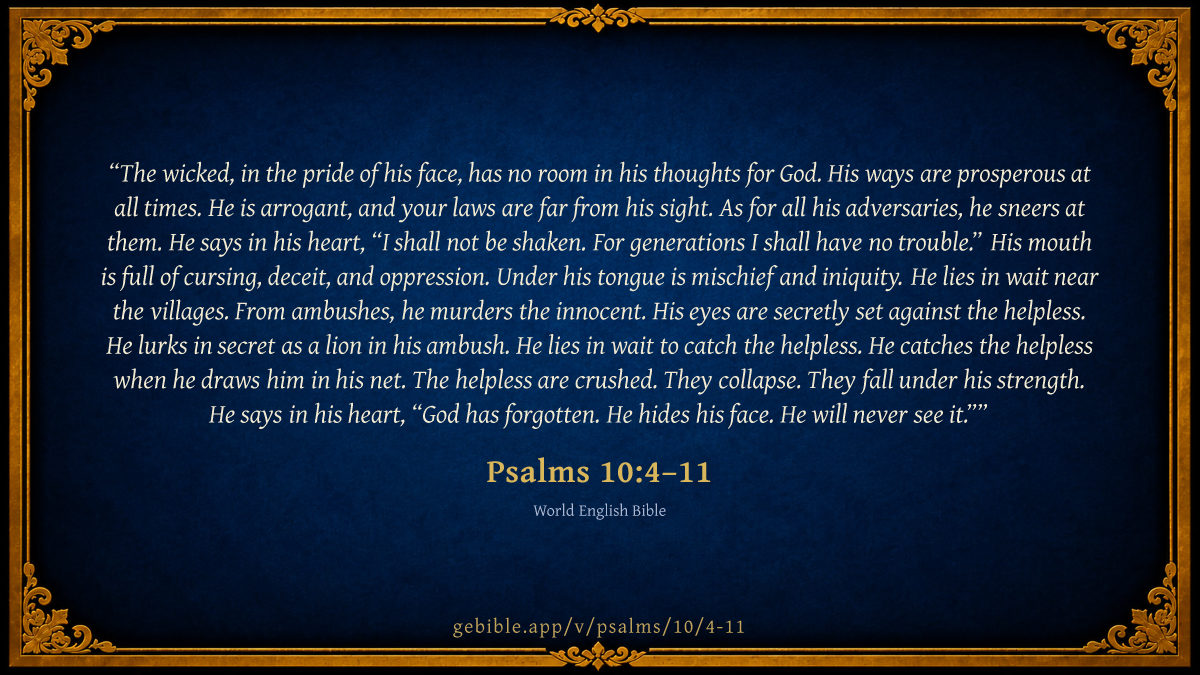
4 The wicked, in the pride of his face, has no room in his thoughts for God.
5 His ways are prosperous at all times. He is arrogant, and your laws are far from his sight. As for all his adversaries, he sneers at them.
6 He says in his heart, “I shall not be shaken. For generations I shall have no trouble.”
7 His mouth is full of cursing, deceit, and oppression. Under his tongue is mischief and iniquity.
8 He lies in wait near the villages. From ambushes, he murders the innocent. His eyes are secretly set against the helpless.
9 He lurks in secret as a lion in his ambush. He lies in wait to catch the helpless. He catches the helpless when he draws him in his net.
10 The helpless are crushed. They collapse. They fall under his strength.
11 He says in his heart, “God has forgotten. He hides his face. He will never see it.”
KJVKing James Version
4 The wicked, through the pride of his countenance, will not seek after God: God is not in all his thoughts.
5 His ways are always grievous; thy judgments are far above out of his sight: as for all his enemies, he puffeth at them.
6 He hath said in his heart, I shall not be moved: for I shall never be in adversity.
7 His mouth is full of cursing and deceit and fraud: under his tongue is mischief and vanity.
8 He sitteth in the lurking places of the villages: in the secret places doth he murder the innocent: his eyes are privily set against the poor.
9 He lieth in wait secretly as a lion in his den: he lieth in wait to catch the poor: he doth catch the poor, when he draweth him into his net.
10 He croucheth, and humbleth himself, that the poor may fall by his strong ones.
11 He hath said in his heart, God hath forgotten: he hideth his face; he will never see it.
Show all 3 translations
JPSJPS Tanakh (1917)
4 The wicked, in the pride of his countenance, saith: 'He will not require'; all his thoughts are: 'There is no God.'
5 His ways prosper at all times; Thy judgments are far above out of his sight; as for all his adversaries, he puffeth at them.
6 He saith in his heart: 'I shall not be moved, I who to all generations shall not be in adversity.'
7 His mouth is full of cursing and deceit and oppression; under his tongue is mischief and iniquity.
8 He sitteth in the lurking-places of the villages; in secret places doth he slay the innocent; his eyes are on the watch for the helpless.
9 He lieth in wait in a secret place as a lion in his lair, he lieth in wait to catch the poor; he doth catch the poor, when he draweth him up in his net.
10 He croucheth, he boweth down, and the helpless fall into his mighty claws.
11 He hath said in his heart: 'God hath forgotten; He hideth His face; He will never see.'
Psalms 14:1-2(v4)The fool has said in his heart, “There is no God.” They are corrupt. They have done abominable deeds. There is no one who does good. Yahweh…
Psalms 17:12(v9)He is like a lion that is greedy of his prey, as it were a young lion lurking in secret places.
Psalms 7:14(v7)Behold, he travails with iniquity. Yes, he has conceived mischief, and brought out falsehood.
Ezekiel 8:12(v11)Then he said to me, “Son of man, have you seen what the elders of the house of Israel do in the dark, every man in his rooms of imagery?…
Acts 8:22(v4)Repent therefore of this, your wickedness, and ask God if perhaps the thought of your heart may be forgiven you.
Show all 100 cross-references
Romans 1:28(v4)Even as they refused to have God in their knowledge, God gave them up to a reprobate mind, to do those things which are not fitting;
Genesis 6:5(v4)Yahweh saw that the wickedness of man was great in the earth, and that every imagination of the thoughts of man’s heart was continually…
1 Samuel 18:21-26(v10)Saul said, I will give her to him, that she may be a snare to him, and that the hand of the Philistines may be against him. Therefore Saul…
Psalms 59:3(v9)For, behold, they lie in wait for my soul. The mighty gather themselves together against me, not for my disobedience, nor for my sin,…
Psalms 94:7(v11)They say, “Yah will not see, neither will Jacob’s God consider.”
Isaiah 26:11(v5)Yahweh, your hand is lifted up, yet they don’t see; but they will see your zeal for the people, and be disappointed. Yes, fire will consume…
Ecclesiastes 8:11(vv6, 11)Because sentence against an evil work is not executed speedily, therefore the heart of the sons of men is fully set in them to do evil.
Habakkuk 3:14(vv8–9)You pierced the heads of his warriors with their own spears. They came as a whirlwind to scatter me, gloating as if to devour the wretched…
1 Samuel 23:21-22(v10)Saul said, “You are blessed by Yahweh; for you have had compassion on me. Please go make yet more sure, and know and see his place where…
Psalms 10:6(v11)He says in his heart, “I shall not be shaken. For generations I shall have no trouble.”
Psalms 73:11(v11)They say, “How does God know? Is there knowledge in the Most High?”
Psalms 140:9(v7)As for the head of those who surround me, let the mischief of their own lips cover them.
Isaiah 56:12(v6)“Come,” say they, “I will get wine, and we will fill ourselves with strong drink; and tomorrow will be as today, great beyond measure.”
Micah 7:2(v9)The godly man has perished out of the earth, and there is no one upright among men. They all lie in wait for blood; every man hunts his…
Matthew 24:48(v6)But if that evil servant should say in his heart, ‘My lord is delaying his coming,’
Romans 1:21(v4)Because knowing God, they didn’t glorify him as God, and didn’t give thanks, but became vain in their reasoning, and their senseless heart…
Psalms 12:5(vv5, 9)“Because of the oppression of the weak and because of the groaning of the needy, I will now arise,” says Yahweh; “I will set him in safety…
Exodus 5:2(v4)Pharaoh said, “Who is Yahweh, that I should listen to his voice to let Israel go? I don’t know Yahweh, and moreover I will not let Israel…
Deuteronomy 8:14(v4)then your heart might be lifted up, and you forget Yahweh your God, who brought you out of the land of Egypt, out of the house of bondage;
1 Samuel 2:36(v10)It will happen that everyone who is left in your house will come and bow down to him for a piece of silver and a loaf of bread, and will…
1 Samuel 22:18(v8)The king said to Doeg, “Turn and attack the priests!” Doeg the Edomite turned, and he attacked the priests, and he killed on that day…
2 Samuel 15:5(v10)It was so, that when any man came near to bow down to him, he stretched out his hand, and took hold of him, and kissed him.
Job 20:12(v7)“Though wickedness is sweet in his mouth, though he hide it under his tongue,
Job 22:17(v4)who said to God, ‘Depart from us;’ and, ‘What can the Almighty do for us?’
Psalms 11:1(v6)In Yahweh, I take refuge. How can you say to my soul, “Flee as a bird to your mountain”?
Psalms 14:1(v6)The fool has said in his heart, “There is no God.” They are corrupt. They have done abominable deeds. There is no one who does good.
Psalms 15:5(v6)he who doesn’t lend out his money for usury, nor take a bribe against the innocent. He who does these things shall never be shaken.
Psalms 35:10(v9)All my bones shall say, “Yahweh, who is like you, who delivers the poor from him who is too strong for him; yes, the poor and the needy…
Psalms 36:3(v7)The words of his mouth are iniquity and deceit. He has ceased to be wise and to do good.
Psalms 52:4(v7)You love all devouring words, you deceitful tongue.
Psalms 53:1(v4)The fool has said in his heart, “There is no God.” They are corrupt, and have done abominable iniquity. There is no one who does good.
Psalms 59:12(v7)For the sin of their mouth, and the words of their lips, let them be caught in their pride, for the curses and lies which they utter.
Psalms 64:3(v7)who sharpen their tongue like a sword, and aim their arrows, deadly words,
Psalms 64:5(v11)They encourage themselves in evil plans. They talk about laying snares secretly. They say, “Who will see them?”
Psalms 73:8(v7)They scoff and speak with malice. In arrogance, they threaten oppression.
Psalms 92:5-6(v5)How great are your works, Yahweh! Your thoughts are very deep. A senseless man doesn’t know, neither does a fool understand this:
Psalms 140:3(v7)They have sharpened their tongues like a serpent. Viper’s poison is under their lips.
Psalms 144:11(v7)Rescue me, and deliver me out of the hands of foreigners, whose mouths speak deceit, whose right hand is a right hand of falsehood.
Isaiah 65:2(v4)I have spread out my hands all day to a rebellious people, who walk in a way that is not good, after their own thoughts;
Jeremiah 9:3(v7)“They bend their tongue, as their bow, for falsehood. They have grown strong in the land, but not for truth; for they proceed from evil to…
Jeremiah 22:17(v8)But your eyes and your heart are only for your covetousness, for shedding innocent blood, for oppression, and for doing violence.”
Ezekiel 9:9(v11)Then he said to me, “The iniquity of the house of Israel and Judah is exceedingly great, and the land is full of blood, and the city full…
Hosea 14:9(v5)Who is wise, that he may understand these things? Who is prudent, that he may know them? For the ways of Yahweh are right, and the…
Nahum 1:10(v6)For entangled like thorns, and drunken as with their drink, they are consumed utterly like dry stubble.
1 Thessalonians 5:3(v6)For when they are saying, “Peace and safety,” then sudden destruction will come on them, like birth pains on a pregnant woman. Then they…
James 3:6-8(v7)And the tongue is a fire. The world of iniquity among our members is the tongue, which defiles the whole body, and sets on fire the course…
Revelation 18:7(v6)However much she glorified herself, and grew wanton, so much give her of torment and mourning. For she says in her heart, ‘I sit a queen,…
Judges 9:27(v5)They went out into the field, harvested their vineyards, trod the grapes, celebrated, and went into the house of their god and ate and…
Judges 9:38(v5)Then Zebul said to him, “Now where is your mouth, that you said, ‘Who is Abimelech, that we should serve him?’ Isn’t this the people that…
1 Samuel 23:23(v8)See therefore, and take knowledge of all the lurking places where he hides himself, and come again to me with certainty, and I will go with…
2 Samuel 5:6(v5)The king and his men went to Jerusalem against the Jebusites, the inhabitants of the land, who spoke to David, saying, “The blind and the…
1 Kings 20:10-11(v5)Ben Hadad sent to him, and said, “The gods do so to me, and more also, if the dust of Samaria will be enough for handfuls for all the…
1 Kings 20:13(v5)Behold, a prophet came near to Ahab king of Israel, and said, “Yahweh says, ‘Have you seen all this great multitude? Behold, I will deliver…
2 Kings 21:16(v8)Moreover Manasseh shed innocent blood very much, until he had filled Jerusalem from one end to another; in addition to his sin with which…
Job 5:15-16(v9)But he saves from the sword of their mouth, even the needy from the hand of the mighty. So the poor has hope, and injustice shuts her mouth.
Job 15:35(v7)They conceive mischief, and produce iniquity. Their heart prepares deceit.”
Job 22:13-14(v11)You say, ‘What does God know? Can he judge through the thick darkness? Thick clouds are a covering to him, so that he doesn’t see. He walks…
Psalms 5:9(v7)For there is no faithfulness in their mouth. Their heart is destruction. Their throat is an open tomb. They flatter with their tongue.
Psalms 12:2(v7)Everyone lies to his neighbor. They speak with flattering lips, and with a double heart.
Psalms 17:11(v8)They have now surrounded us in our steps. They set their eyes to cast us down to the earth.
Psalms 18:27(v4)For you will save the afflicted people, but the arrogant eyes you will bring down.
Psalms 27:8(v4)When you said, “Seek my face,” my heart said to you, “I will seek your face, Yahweh.”
Psalms 30:6(v6)As for me, I said in my prosperity, “I shall never be moved.”
Psalms 36:1(v4)A revelation is within my heart about the disobedience of the wicked: “There is no fear of God before his eyes.”
Psalms 41:6(v7)If he comes to see me, he speaks falsehood. His heart gathers iniquity to itself. When he goes abroad, he tells it.
Psalms 55:21(v7)His mouth was smooth as butter, but his heart was war. His words were softer than oil, yet they were drawn swords.
Psalms 58:3(v7)The wicked go astray from the womb. They are wayward as soon as they are born, speaking lies.
Psalms 62:4(v7)They fully intend to throw him down from his lofty place. They delight in lies. They bless with their mouth, but they curse inwardly.
Psalms 94:6(v8)They kill the widow and the alien, and murder the fatherless.
Psalms 101:5(v4)I will silence whoever secretly slanders his neighbor. I won’t tolerate one who is arrogant and conceited.
Psalms 140:5(v9)The proud have hidden a snare for me, they have spread the cords of a net by the path. They have set traps for me.
Psalms 144:8(v7)whose mouths speak deceit, whose right hand is a right hand of falsehood.
Proverbs 1:11-12(v8)If they say, “Come with us. Let’s lay in wait for blood. Let’s lurk secretly for the innocent without cause. Let’s swallow them up alive…
Proverbs 1:19(v5)So are the ways of everyone who is greedy for gain. It takes away the life of its owners.
Proverbs 2:13(v5)who forsake the paths of uprightness, to walk in the ways of darkness,
Proverbs 2:15(v5)who are crooked in their ways, and wayward in their paths,
Proverbs 6:12-13(v8)A worthless person, a man of iniquity, is he who walks with a perverse mouth, who winks with his eyes, who signals with his feet, who…
Proverbs 6:17(v4)arrogant eyes, a lying tongue, hands that shed innocent blood,
Proverbs 14:31(v9)He who oppresses the poor shows contempt for his Maker, but he who is kind to the needy honors him.
Proverbs 15:24(v5)The path of life leads upward for the wise, to keep him from going downward to Sheol.
Proverbs 21:4(v4)A high look and a proud heart, the lamp of the wicked, is sin.
Proverbs 21:6(v7)Getting treasures by a lying tongue is a fleeting vapor for those who seek death.
Proverbs 22:16(v9)Whoever oppresses the poor for his own increase and whoever gives to the rich, both come to poverty.
Proverbs 24:1(v5)Don’t be envious of evil men, neither desire to be with them;
Proverbs 28:15(v9)As a roaring lion or a charging bear, so is a wicked ruler over helpless people.
Proverbs 30:8(v7)Remove far from me falsehood and lies. Give me neither poverty nor riches. Feed me with the food that is needful for me,
Proverbs 30:9(v4)lest I be full, deny you, and say, ‘Who is Yahweh?’ or lest I be poor, and steal, and so dishonor the name of my God.
Proverbs 30:13(v4)There is a generation, oh how lofty are their eyes! Their eyelids are lifted up.
Isaiah 2:11(v4)The lofty looks of man will be brought low, the arrogance of men will be bowed down, and Yahweh alone will be exalted in that day.
Isaiah 3:9(v4)The look of their faces testify against them. They parade their sin like Sodom. They don’t hide it. Woe to their soul! For they have…
Isaiah 3:15(v9)What do you mean that you crush my people, and grind the face of the poor?” says the Lord, Yahweh of Armies.
Isaiah 5:12(v5)The harp, lyre, tambourine, and flute, with wine, are at their feasts; but they don’t respect the work of Yahweh, neither have they…
Isaiah 10:1(v5)Woe to those who decree unrighteous decrees, and to the writers who write oppressive decrees;
Isaiah 28:15(v5)“Because you have said, ‘We have made a covenant with death, and we are in agreement with Sheol. When the overflowing scourge passes…
Isaiah 32:7(v9)The ways of the scoundrel are evil. He devises wicked plans to destroy the humble with lying words, even when the needy speaks right.
100 distinct cross-references across this passage (136 total citations).
Cross-references from openbible.info (CC BY 4.0)
Explain this passage (19 sources)
Historical commentary, presented as a primary source — not an endorsement.
John Calvin1540 · Public DomainOn vv4–114. The ungodly, in the pride of his countenance,…
4. The ungodly, in the pride of his countenance, etc Others translate the words, The ungodly man, by reason of the violence of his anger, or, in the pride which he displays, does not inquire after God. But this partly perverts the meaning, and partly weakens the force of what David intended to express. In the first place, the word inquire, which is here put absolutely, that is, without any noun which it governs, is, according to this translation, improperly limited to God. David simply means, that the ungodly, without examination, permit themselves to do any thing, or do not distinguish between what is lawful and unlawful, because their own lust is their law, yea, rather, as if superior to all laws, they fancy that it is lawful for them to do whatever they please. The beginning of well-doing in a man’s life is inquiry; in other words, we can only begin to do well when we keep ourselves from following, without choice and discrimination, the dictates of our own fancy, and from being carried away by the wayward propensities of our flesh. But the exercise of inquiring proceeds from humility, when we assign to God, as is reasonable, the place of judge and ruler over us. The prophet, therefore, very properly says, that the reason why the ungodly, without any regard or consideration, presume to do whatever they desire, is because, being lifted up with pride, they leave to God nothing whatever of the prerogative of a judge. The Hebrew word פף, aph, which we have translated countenance, I have no doubt is here taken in its proper and natural signification, and not metaphorically for anger; because haughty persons show their effrontery even by their countenance.
In the second clause, the prophet more severely, or, at least, more openly, accuses them, declaring that all their wicked imaginations show that they have no God. All his devices say, There is no God The sentence in the Hebrew text is elliptical, and hence it has been variously translated. Literally it is, “No God all his thoughts.” The Syriac version renders it, “There is no God in all his thoughts.” The Septuagint reads, Οὐκ ἔστιν ὁ θεὸς ἐνώπιον αὐτου, “God is not before him.” Mudge renders it, “No God is all his wicked politics;” Horsley, “No God is the whole of his philosophy.” and Fry, “There is no Elohim is all his thought.”
Read full note →
“Qui nous le fait avoir en reverence et nous tient le subjets.” — Fr.
“Pour meschantes et malicieuses pensees.” — Fr. “Wicked and malicious thoughts.”
John Calvin's Commentaries (1540-1563) — public domain. Text from the Calvin Translation Society English edition (1840s-50s) via the Christian Classics Ethereal Library (ccel.org). Calvin's coverage is partial (roughly two-thirds of the Bible); uncommented books and verses are honest gaps, never fabricated. The 19th-century editor's footnotes and remarks are omitted so the notes are faithfully Calvin's own voice.
Geneva Bible (1599) marginal notes — public domain.
John Trapp1656 · Public DomainOn vv4–11Psa 10:4 The wicked, through the pride of his…
Psa 10:4 The wicked, through the pride of his countenance, will not seek [after God]: God [is] not in all his thoughts.
Ver. 4. The wicked, through the pride of his countenance] That is, of his heart, appearing in his countenance, as a master pock in his forehead. For pride buddeth, Eze 7:10; the pride of Israel testifieth to his face, Hos 5:5; the thoughts are oft seen in the countenance; and the heart is printed upon the face, Isa 3:9. It is a hard thing, saith one, to have a brazen face and a broken heart.
Read full note →
Will not seek] He thinks it not necessary or worth the while; and his practice is agreeable, that is, naught all over. Pride in the soul is like a great swelling in the body, which, besides that it is a dangerous symptom, unfits it for any good service; and is apt to putrefy and to break, and to run with loathsome and foul matter. So doth pride disable the soul from doing duty, and at last breaketh forth into odious deeds, abominable to God and men. It is observed, that the ground whereon the peacock useth to sit is by that occasion made exceeding barren; so where pride roosteth and reigneth, no good groweth.
God is not in all his thoughts] God is neither in his head, as here, nor in his heart, Psa 14:1, nor in his words, Psa 12:4, nor in his ways, Tit 1:16; he is wholly without God in the world, Eph 2:1-3, he studies atheism, and all his thoughts are, There is no God, so this text may be read, he would fain so persuade himself.
John Trapp, A Commentary or Exposition upon All the Books of the Old and New Testament (1647–1656) — public domain. Text from a community e-Sword module.
Matthew Poole1685 · Public DomainOn vv4–11Through the pride; by which he scorns to stoop…
Through the pride; by which he scorns to stoop to God, or to own any superior, and makes himself and his own lusts his only rule, and his last end, and is full of self-confidence, and a conceit of his own self-sufficiency and unchangeable felicity, as is hated, Psa 10:6.
Of his countenance; so called, because though pride be properly seated in the heart; whence it is called pride, or loftiness of heart, or spirit, as Psa 131:1; Pro 16:18; Ecc 7:8, &c.; yet it is manifested in the countenance, and therefore is oft described by lofty looks, as Psa 101:5; 131:1; Pro 6:17; 21:4; 30:13, &c.; which possibly was done purposely to meet with the excuses of proud persons, who when they are charged with pride for their looks, or gestures, or apparel, or the like, use to make this apology for themselves, that pride lies in the heart, and not in these outward things.
Read full note →
Will not seek after God, i.e. not seek or inquire into the mind and will of God, to order his life by it so as to please God, nor seek to him by prayer for his favour and blessing. But the words
after God are not in the Hebrew, and it is thought by some too great boldness to add them here. And therefore others omit it, and render the Hebrew words, will not search, or consider, to wit, his actions, which seems to be a more natural and, easy supplement: he will not trouble himself to inquire whether his actions be just or unjust, pleasing or offensive to God; but without any care or consideration rusheth into sin, and doth whatsoever seemeth right in his own eyes. But these and the former words are and may be, and that very agreeably to the Hebrew, thus rendered without any supplement,
The wicked, through his pride, ( for so this Hebrew word by itself signifies, Isa 5:16; 10:33) will not seek his (i.e. God’s, which is plain both from the foregoing and following words) face, which is a usual phrase in Scripture, as 2Ch 7:14; Psa 24:6; 27:8; 105:4, &c.
God is not in all his thoughts; he hath no serious thoughts of nor regard unto God, or his word, which ought to command him; or his threats and judgments, which should keep him in awe. Or,
all his thoughts are, There is no God, to wit, no such God as minds the affairs of the world, and the actions of men, and punisheth sinners. He was a deist, and owned a God, at least in words, but denied his providence.
Matthew Poole's English Annotations on the Holy Bible (1683–1685) — public domain. Text from a community e-Sword/MySword module.
John Gill1763 · Public DomainOn vv4–11The wicked, through the pride of his countenance, will…
The wicked, through the pride of his countenance, will not seek after God,.... We supply it, "after God"; as do the Targum and Kimchi on the place: the sense is, he will not seek to God for counsel or assistance, he will not pray unto him; which is the character of every unregenerate man, Rom 3:11; or, he will not inquire into the will of God, to know what is right or what is wrong, but will do what seems best in his own eyes: and this arises from the pride of his heart, which shows itself in his countenance, in his proud and haughty look. It is said of the little horn, who is antichrist, that he has a look more stout than his fellows, Dan 7:20. The words may be rendered, "the wicked inquires not into the height of his anger"; so Ainsworth observes; that is, of God's anger; he is not concerned about it; he neither fears God nor regards men. Jarchi's sense of the words is,
"all his thoughts say unto him, God will not inquire into everything that I shall do, for there is no judgment.''
Read full note →
God is not in all his thoughts; nor in any of them, for they are evil continually; and if he does at any time think of him, his thoughts of him are wrong; he thinks he is altogether such an one as himself: or, "all his thoughts are, there is no God" (z): though he does not choose to say so, he thinks so; at least, he wishes it may be so; and he works himself into such impiety and atheism as to deny the providence of God, and thinks that he does not govern the world, nor concern himself with what is done below; that he takes no notice of men's actions, nor will call them to an account for them; and that there will be no future state or judgment, in which secret as well as open things will be made manifest: or, as the Chaldee paraphrase glosses it, "that all his thoughts are not manifest before the Lord".
(z) "non Deus, omnes cogitationes ejus", Montanus, Vatablus, Muis; "nullum esse Deum hae sunt omnes cogitationes ejus", Junius & Tremellius, Piscator, Ainsworth.
John Gill's Exposition of the Whole Bible (1746–1763) — public domain (CC PDM 1.0). Text via the HelloAO Bible API.
John Wesley1765 · Public DomainOn vv4, 5, 7, 8, 10Countenance - So called, because though pride be properly…
Countenance - So called, because though pride be properly seated in the heart, yet it is manifest in the countenance.
John Wesley, Explanatory Notes Upon the Whole Bible (1754–1765) — public domain. Text via the GEBible commentary corpus.
Adam Clarke1810 · Public DomainOn vv4, 5, 6, 7, 8, 10, 11Verse 4. Will not seek after God] He is…
Verse 4. Will not seek after God] He is too proud to bend his knee before his Judge; he is too haughty to put on sackcloth, and lay himself in the dust, though without deep repentance and humiliation he must without doubt perish everlastingly.
Adam Clarke's Commentary on the Bible (1810–1826) — public domain. Text from a community e-Sword/MySword module.
Joseph Benson1811 · Public DomainOn vv4, 5, 6, 7, 8, 10, 11Psa 10:4. The wicked, through the pride of his…
Psa 10:4. The wicked, through the pride of his countenance — By which he scorns to stoop to God, or to own any superior, but makes himself his last end, and his own will and lust his only rule; and is full of self-confidence and a conceit of his own self-sufficiency and permanent felicity. He says the pride of his countenance, because, though pride be properly seated in the heart, yet it is manifested in the countenance; will not seek after God —
Will not seek and inquire into the mind and will of God, that he may order his life according thereto, so as to please God; nor will he seek to him by prayer for his favour and blessing. The words, after God, however, are not in the Hebrew, and may be omitted, and then the sense will be, He will not search, or consider, namely, his actions; will not trouble himself to inquire whether they be just or unjust, pleasing or offensive to God; but, without any care or consideration, rushes into sin, and does whatever seems right in his own eyes. God is not in all his thoughts — He hath no serious thought of, nor regard to, God, or his word, which ought to govern him, nor his threats or judgments, which should keep him in awe. Or, as the Hebrew may be rendered, All his thoughts are, There is no God, namely, no such God as minds the affairs of the world and the actions of men, or that punishes sinners. “The psalmist hath here given us the true character of an ungodly man. By a long disuse of devotion, and open neglect of divine worship, he gradually forgets every duty he owes his Maker; and when he has for some time habituated himself to live without God in the world, he then begins to doubt his very existence; he then begins to forget that in him we live, and move, and have our being.” See Dodd and Delaney.
Joseph Benson's Commentary on the Old and New Testaments (1811–1818) — public domain. Text from a community e-Sword module.
Albert Barnes1834 · Public DomainOn vv4–11The wicked, through the pride of his countenance -…
The wicked, through the pride of his countenance - In consequence of his pride; or, his pride is the reason of what is here stated. The “pride of his countenance” is a phrase that is used because pride shows itself mainly in the countenance, or in a lofty air and manner. The design is to state the influence of pride in producing the effect here specified.
Will not seek after God - The phrase “after God,” is supplied by our translators. Something clearly is to be supplied, and it is plainly something relating to God - either that the wicked man will not seek after God in prayer, or that he will not inquire after the proofs of his existence and attributes; or that he will not seek after his favor, or that he will not endeavor to know the divine will. All this would be implied in seeking after God, and this is undoubtedly the state of mind that is referred to here. The sinner is unwilling, in any appropriate way, to acknowledge God.
Read full note →
God is not in all his thoughts - Margin, “Or, all his thoughts are, There is no God,” Psa 14:1. The literal translation is: “No God (are) all his thoughts.” The margin has undoubtedly expressed the meaning better than the translation in the text, since the spirit of the passage is not that the sinner had no thought of God, but that he thought wrong. The fact that he would not seek God, and that he had said that God had forgotten Psa 10:11, shows that he had some thoughts of God. The language here is properly expressive of belief or desire; either that all his thoughts were that there is no God, i. e, that such was the result of all his meditations and reasonings on the subject; or that he wished that it might be found to be so. The language will admit of either construction, and in either sense it would express the thoughts of the wicked. Its both a matter of practical belief, and as a matter of desire, the language of the wicked is, “No God.” The wicked wish that there were none; he practically believes that there is none. The entire verse, then, expresses the prevailing feelings of a sinner about God:
(a) That he wishes there were none, and practically believes that there is none; and
(b) that the reason or ground of these feelings is pride. Pride will prevent him from seeking God in the following ways:
(1) It makes him unwilling to recognize his dependence upon any being;
(2) it makes him unwilling to confess that he is a sinner;
(3) it makes him unwilling to pray;
(4) it makes him unwilling to seek aid of anyone, even God, in the business of life, in the prosecution of his plans, or in sickness and affliction;
(5) it makes him unwilling to accede to the terms of reconciliation and salvation proposed by God, unwilling to repent, to believe, to submit to His sovereignty, to acknowledge his indebtedness to mere grace for the hope of eternal life.
Pride is at the root of all the atheism, theoretical or practical, on the earth; at the root of all the reluctance which there is to seek the favor of God; at the root, therefore, of the misery and wretchedness of the world.
Albert Barnes' Notes on the Bible (1834–1885) — public domain. Text from a community e-Sword/MySword module.
Robert Jamieson, A. R. Fausset & David Brown1871 · Public DomainOn vv4, 5, 7, 8, 10, 11The face expresses the self-conceit, whose fruit is practical…
The face expresses the self-conceit, whose fruit is practical atheism (Psa 14:1).
Jamieson, Fausset & Brown — Commentary Critical and Explanatory on the Whole Bible (1871) — public domain (CC PDM 1.0). Text via the HelloAO Bible API.
Daniel D. Whedon1874 · Public DomainOn vv4–114. Will not seek—He takes no pains to inquire…
4. Will not seek—He takes no pains to inquire if there be a God, or a moral government which holds men accountable.
Thoughts—Devices, schemes. In all his plans he makes no account or recognition of God.
Daniel D. Whedon (gen. ed.), Commentary on the Old and New Testaments (1874–1909) — public domain. Text from a community e-Sword module.
The Cambridge Bible for Schools and Colleges1878 · Public DomainOn vv4–114. The A.V. follows the Ancient Versions in rendering,…
4. The A.V. follows the Ancient Versions in rendering, ‘the wicked … will not seek after God:’ but a comparison of Psa_10:13, which clearly recapitulates Psa_10:3-4, is decisive in favour of rendering as follows:
As for the wicked, according to the loftiness of his looks, he saith, He will not make requisition:
Read full note →
There is no God, is the sum of his devices.
The construction is abrupt and forcible. The wicked man’s scornful countenance is the index of his character (Psa_101:5); all his devices (as Psa_10:2) are planned on the assumption that God does not regard and punish (Psa_9:12); upon a virtual atheism, for such an epicurean deity, “careless of mankind,” would be no ‘living and true God.’ Cp. Psa_14:1.
The Cambridge Bible for Schools and Colleges (gen. ed. J. J. S. Perowne; Cambridge University Press, 1878–1918) — public domain. Text from a community e-Sword module.
Ellicott's Commentary for English Readers1878 · Public DomainOn vv4–11(4) The wicked.—The Authorised Version has quite missed the…
(4) The wicked.—The Authorised Version has quite missed the meaning of this verse. Translate, the wicked in his haughtiness (literally, height of his nostril. Comp. the common expression, ‘to turn up one’s nose at a person’) saith He will not requite it (i.e., punish; comp. Psa_10:13). There is no God in all his thought. (Comp. Psa_14:1; Psa_53:1.)
A Bible Commentary for English Readers, edited by Charles John Ellicott (1878–1897) — public domain. Text from a community e-Sword module.
The Pulpit Commentary1880 · Public DomainOn vv4–11The wicked, through the pride of his countenance, will…
The wicked, through the pride of his countenance, will not seek after God: God is not in all his thoughts. The construction is concise to abruptness, and it is hard to determine the ellipses. The passage in the original runs thus: "The wicked, in the height of his scorn will not require no God all his thoughts." Of the various attempts to supply the ellipses, and obtain a satisfactory sense, the following (that of the "Speaker"s Commentary") is probably the best: "As for the wicked in the height of his scorn will not require is no God such are all his thoughts." (Compare the Revised Version, which is not very different.) The general sense is that his pride conducts the wicked man to absolute atheism, or at least to practiced atheism (comp. vers. 11, 13).
Man"s thoughts.
Read full note →
I MAN HAS THOUGHTS. He can direct his mind to the past, the present, the future. He can speculate as to the manifold things that come before him and affect his interests. It is his glory that he can think; it is his shame that he so often thinks foolishly.
II MAN"S THOUGHTS DEPEND UPON HIS MORAL CONDITION. We are creatures of feeling. What is uppermost in our hearts will be uppermost in our thoughts. The good man has good thoughts, the evil man evil thoughts. Change the character of the heart, and you change the character of the thoughts. (Pro_12:5 Pro_15:26 Mat_12:33)
III WHEN THE MORAL DISPOSITION IS CORRUPT, THE TENDENCY IS TO EXCLUDE GOD FROM THE THOUGHTS. The plan, the labours, the enjoyments of life are too often without God. (Luk_12:19, 20 Jam_4:13) This is irrational, criminal, and ruinous. W.F. (Psa_146:4)
The Pulpit Commentary (1880–1919), ed. H.D.M. Spence-Jones & Joseph S. Exell — public domain. Text from a community e-Sword module.
Charles H. Spurgeon1885 · Public DomainOn vv4–11Ver. 4. The proud boastings and lewd blessings of…
Ver. 4. The proud boastings and lewd blessings of the wicked have been received in evidence against him, and now his own face confirms the accusation, and his empty closet cries aloud against him.
The wicked, through the pride of his countenance, will not seek after God. Proud hearts breed proud looks and stiff knees. It is an admirable arrangement that the heart is often written on the countenance, just as the motion of the wheels of a clock find their record on its face. A brazen face and a broken heart never go together. We are not quite sure that the Athenians were wise when they ordained that men should be tried in the dark lest their countenances should weigh with the judges; for there is much more to be learned from the motions of the muscles of the face than from the words of the lips. Honesty shines in the face, but villainy peeps out at the eyes. See the effect of pride; it kept the man from seeking God. It is hard to pray with a stiff neck and an unbending knee.
Read full note →
God is not in all his thoughts: he thought much, but he had no thoughts for God. Amid heaps of chaff there was not a grain of wheat. The only place where God is not is in the thoughts of the wicked. This is a damning accusation; for where the God of heaven is not, the Lord of hell is reigning and raging; and if God be not in our thoughts, our thoughts will bring us to perdition.
Ver. 4. The wicked, through the pride of his countenance, will not seek after God. He is judged a proud man (without a jury sitting on him), who when condemned will not submit, will not stoop so low as to accept of a pardon. I must indeed correct myself, men are willing to be justified, but they would have their duties to purchase their peace and the favour of God. Thousands will die and be damned rather than they will have a pardon upon the sole account of Christ's merits and obedience. Oh, the cursed pride of the heart! When will men cease to be wiser than God? To limit God? When will men be contented with God's way of saving them by the blood of the everlasting covenant? How dare men thus to prescribe to the infinitely wise God? Is it not enough for thee that thy destruction is of thyself? But must thy salvation be of thyself too? Is it not enough that thou hast wounded thyself, but wilt thou die for ever, rather than be beholden to a plaister of free grace? Wilt be damned unless thou mayest be thine own Saviour? God is willing ("God so loved the world that he gave his only Son"), art thou so proud as that thou wilt not be beholden to God? Thou wilt deserve, or have nothing. What shall I say? Poor thou art, and yet proud; thou hast nothing but wretchedness and misery, and yet thou art talking of a purchase. This is a provocation. "God resisteth the proud, "especially the spiritually proud. He that is proud of his clothes and parentage, is not so contemptible in God's eyes as he that is proud of his abilities, and so scorns to submit to God's methods for his salvation by Christ, and by his righteousness alone. Lewis Stuckley.
Ver. 4. The wicked, through the pride of his countenance, will not seek after God. The pride of the wicked is the principal reason why they will not seek after the knowledge of God. This knowledge it prevents them from seeking in various ways. In the first place, it renders God a disagreeable object of contemplation to the wicked, and a knowledge of him as undesirable. Pride consists in an unduly exalted opinion of one's self. It is, therefore, impatient of a rival, hates a superior, and cannot endure a master. In proportion as it prevails in the heart, it makes us wish to see nothing above us, to acknowledge no law but our own wills, to follow no rule but our own inclinations. Thus it led Satan to rebel against his Creator, and our first parents to desire to be as gods. Since such are the effects of pride, it is evident that nothing can be more painful to a proud heart than the thoughts of such a being as God; one who is infinitely powerful, just, and holy; who can neither be resisted, deceived, nor deluded; who disposes, according to his own sovereign pleasure, of all creatures and events; and who, in an especial manner, hates pride, and is determined to abase and punish it. Such a being pride can contemplate only with feelings of dread, aversion, and abhorrence. It must look upon him as its natural enemy, the great enemy, whom it has to fear. But the knowledge of God directly tends to bring this infinite, irresistible, irreconcilable enemy full to the view of the proud man. It teaches him that he has a superior, a master, from whose authority he cannot escape, whose power he cannot resist, and whose will he must obey, or be crushed before him, and be rendered miserable for ever. It shows him what he hates to see, that, in despite of his opposition, God's counsel shall stand, that he will do all his pleasure, and that in all things wherein men deal proudly, God is above them. These truths torture the proud unhumbled hearts of the wicked, and hence they hate that knowledge of God which teaches these truths, and will not seek it. On the contrary, they wish to remain ignorant of such a being, and to banish all thoughts of him from their minds. With this view, they neglect, pervert, or explain away those passages of revelation which describe God's true character, and endeavour to believe that he is altogether such a one as themselves. How foolish, how absurd, how ruinous, how blindly destructive of its own object, does pride appear! By attempting to soar, it only plunges itself in the mire, and while endeavouring to erect for itself a throne, it undermines the ground on which it stands and digs its own grave. It plunged Satan from heaven into hell; it banished our first parents from paradise; and it will, in a similar manner, ruin all who indulge in it. It keeps us in ignorance of God, shuts us out from his favour, prevents us from resembling him, deprives us in this world of all the honour and happiness which communion with him would confer; and in the next, unless previously hated, repented of, and renounced, will bar for ever against us the door of heaven, and close upon us the gates of hell. O then, my friends, beware, above all things, beware of pride! Beware, lest you indulge it imperceptibly, for it is perhaps, of all sins, the most secret, subtle, and insinuating. Edward Payson, D.D., 1783-1827.
Ver. 4. David speaks in Ps 10:1-18 of great and potent oppressors and politicians, who see none on earth greater than themselves, none higher than they, and think therefore that they may impune prey upon the smaller, as beasts use to do; and in the fourth verse this is made the root and ground of all, that God is not in all his thoughts. The wicked, through the pride of his countenance, will not seek after God: God is not in all his thoughts. The words are diversely read, and all make for this sense. Some read it, "No God in all his crafty presumptuous purposes; " others, "All his thoughts are, there is no God." The meaning whereof is not only that among the swarm and crowd of thoughts that fill his mind, the thought of God is seldom to be found, and comes not in among the rest, which yet is enough for the purpose in hand; but further, that in all his projects and plots, and consultations of his heart (the first reading of the words intends), whereby he contrives and lays the plot, form, and draught of all his actions, he never takes God or his will into consideration or consultation, to square and frame all accordingly, but proceeds and goes on in all, and carries on all as if there were no God to be consulted with. He takes not him along with him, no more than if he were no God; the thoughts of him and his will sway him not. As you use to say, when a combination of men leave out someone they should advise with, that such a one is not of their counsel, is not in the plot; so nor is God in their purposes and advisings, they do all without him. But this is not all the meaning, but farther, all their thought is, that there is no God. This is there made the bottom, the foundation, the groundwork and reason of all their wicked plots and injurious projects, and deceitful carriages and proceedings, that seeing there is no God or power above them to take notice of it, to regard or requite them, therefore they may be bold to go on. Thomas Goodwin.
Ver. 4. Of his countenance. Which pride he carrieth engraven in his very countenance and forehead, and makes it known in all his carriages and gestures. Will not seek, namely, he contemneth all divine and human laws, he feareth not, respecteth not God's judgments; he careth for nothing, so he may fulfil his desires; enquires after, nor examines nothing; all things are indifferent to him. John Diodati.
Ver. 4. All his thoughts are, there is no God; thus some read the passage. Seneca says, there are no atheists, though there would be some; if any say there is no God, they lie; though they say it in the daytime, yet in the night when they are alone they deny it; howsoever some desperately harden themselves, yet if God doth but show himself terrible to them, they confess him. Many of the heathens and others have denied that there is a God, yet when they were in distress, they did fall down and confess him, as Diagoras, that grand atheist, when he was troubled with the strangullion, acknowledged a deity which he had denied. These kind of atheists I leave to the tender mercies of God, of which I doubt it whether there be any for them. Richard Stock.
Ver. 4. God is not in all his thoughts. It is the black work of an ungodly man or an atheist, that God is not in all his thoughts. What comfort can be had in the being of God without thinking of him with reverence and delight? A God forgotten is as good as no God to us. Stephen Charnock.
Ver. 4. Trifles possess us, but God is not in all our thoughts, seldom the sole object of them. We have durable thoughts of transitory things, and flitting thoughts of a durable and eternal good. The covenant of grace engages the whole heart to God, and bars anything else from engrossing it; but what strangers are God and the souls of most men! Though we have the knowledge of him by creation, yet he is for the most part an unknown God in the relations wherein he stands to us, because a God undelighted in. Hence it is, as one observes, that because we observe not the ways of God's wisdom, conceive not of him in his vast perfections, nor are stricken with an admiration of his goodness, that we have fewer good sacred poems than of any other kind. The wits of men hang the wing when they come to exercise their reasons and fancies about God. Parts and strength are given us, as well as corn and wine to the Israelites, for the service of God, but those are consecrated to some cursed Baal, Ho 2:8, like Venus in the poet, we forsake heaven to follow after some Adonis. Stephen Charnock.
Ver. 4-5. The world hath a spiritual fascination and witchcraft, by which, where it hath once prevailed, men are enchanted to an utter forgetfulness of themselves and God, and being drunk with pleasures, they are easily engaged to a madness and height of folly. Some, like foolish children, are made to keep a great stir in the world for very trifles, for a vain show; they think themselves great, honourable, excellent, and for this make a great bustle, when the world hath not added one cubic to their stature of real worth. Others are by this Circe transformed into savage creatures, and act the part of lions and tigers. Others, like swine, wallow in the lusts of uncleanness. Others are unmanned, putting off all natural affections, care not who they ride over, so they may rule over or be made great. Others are taken with ridiculous frenzies, so that a man that stands in the cool shade of a sedate composure would judge them out of their wits. It would make a man admire to read of the frisks of Caius Caligula, Xerxes, Alexander, and many others, who because they were above many men, thought themselves above human nature. They forgot they were born and must die, and did such things as would have made them, but that their greatness overawed it, a laughing stock and common scorn to children. Neither must we think that these were but some few or rare instances of worldly intoxication, when the Scripture notes it as a general distemper of all that bow down to worship this idol. They live "without God in the world, "saith the apostle, that is, they so carry it as if there were no God to take notice of them to check them for their madness. God is not in all his thoughts. Ps 10:4. The judgments of God are far above out of his sight; he puffs at his enemies (Ps 10:5), and saith in his heart, he shall never be moved, Ps 10:6. The whole Psalm describes the worldling as a man that hath lost all his understanding, and is acting the part of a frantic bedlam. What then can be a more fit engine for the devil to work with than the pleasures of the world? Richard Gilpin.
Ver. 4. Pride the barrier in the way of conversion.
Ver. 4. (last clause). Thoughts in which God is not, weighed and condemned.
Ver. 4-5. See Psalms on "Ps 10:4" for further information.
Charles H. Spurgeon's The Treasury of David (1869–1885) — public domain. Psalms only. Text from a community e-Sword/MySword module.
The Biblical Illustrator1887 · Public DomainOn vv4–7The wicked, through the pride of his countenance, will…
Psa_10:4
The wicked, through the pride of his countenance, will not seek after God.
Read full note →
The wicked, from pride, refuse to seek God
In this Psalm we have a full-length portrait of a careless, unawakened sinner, drawn by the unerring pencil of truth. Two of the features which compose this portrait are delineated in our text.
1. An unwillingness to seek after God.
2. Pride, which causes that unwillingness.
I. The wicked will not seek after God. They do not, because they will not. To this purpose they obstinately and unalterably adhere, unless their wills are subdued by Divine grace.
1. The wicked will not seek after the knowledge of God. This is evident from Scripture statement, and from the experience of all ages. The wicked will not pray for the knowledge of God, nor improve their opportunities for acquiring the knowledge of God.
2. The wicked will not seek the favour of God. Knowing nothing experimentally of His excellence and perfections, and ignorant of their entire dependence on Him for happiness, they cannot of course realise that the favour of God is life, and His loving kindness is better than life.
3. The wicked will not seek after the likeness of God. That they do not at all resemble Him is certain. They do not wish or endeavour to resemble Him. There is, indeed, in their view, no reason why they should. There are but two motives which can make any being wish to resemble another. A wish to obtain the approbation of the person imitated; or admiration of something in his character, and a consequent desire to inscribe it into our own. But the wicked can be influenced by neither of these motives to seek after conformity to God.
4. The wicked will not seek after communion with God. Communion supposes some degree of resemblance to the being whose communion is sought, and a participation of the same nature, views, and feelings.
II. The reason why the wicked will not seek God.
1. Pride renders God a disagreeable object of contemplation to the wicked, and a knowledge of Him as undesirable. Pride consists in an unduly exalted opinion of ones self. It is therefore impatient of a rival, hates a superior, and cannot endure a master.
2. The pride of the wicked prevents them from seeking the knowledge of God, by rendering them unwilling to be taught. Pride is almost as impatient of a teacher as of a master.
3. Pride renders the wicked unwilling to use the means by which alone the knowledge of God can be acquired. It renders them unwilling to study the Bible in a proper manner. Pride also renders the man unwilling to pray. And it prevents him from improving public and private opportunities for acquiring religious instruction. The pride of the wicked will not allow them to seek after the favour or the likeness of God. It makes them unwilling to seek after communion with God.
Reflections--
1. How evident it is that salvation is wholly of grace, and that all the wicked, if left to themselves, will certainly perish.
2. How depraved, how infatuated, how unreasonable do the wicked appear!
3. How foolish, absurd, ruinous, blindly destructive of its own object does pride appear! The subject may be applied for purposes of self-examination. (E. Payson, D. D.)
The pride of man restrains seeking after God
Christianity made but few converts amongst the disciples of Zeno. Why should it have been so? With their simple and self-denying habits, why were they not attracted by the purer morals of the Gospel? and with their superiority to the surrounding superstitions, why did they not hail that unknown God whom Cleanthus had sung, and whom Paul now preached? The answer we fear is to be found in that little word pride--that little word which is still so great a hindrance to many wise men after the flesh. Amongst the Greeks and Romans the Stoics occupied the same place as the Pharisees amongst the Jews. The very foundation of their theory was to make the virtuous man self-sufficing, and usually they got so far as to make him self-sufficient. In cutting off all other vices the Stoic, like the cynic before him, fostered to enormous magnitude pride or self-complacency, and, as Archer Butler says in his Ancient Philosophy, sought not so much to please the Deity as to be His equal. (J. Hamilton, D. D.)
God is not in all his thoughts.
The sinfulness of forgetting God
A characteristic mark of the ungodly man. Forgetfulness of God is the concealed spring from which the evil and bitter streams of outward wickedness derive their origin.
I. What is intended by having God in all our thoughts. It is not meant that we should have our meditations constantly and invariably fixed upon God. Nor that the most pious and spiritual state of mind will disqualify a man for transacting the proper business of his station. We are here reminded of the necessity of an abiding and habitual impression of our obligations and accountableness to God. The text implies that we should take God as our portion, and expect our highest and best happiness from Him. Whatever it be from which a man expects his chief good, to that his thoughts naturally revert whenever he is not compelled to fix them upon some other object. It will be the favourite topic of his meditations.
II. The consequence of the want of this principle. The man described here is one who lives in a state of habitual forgetfulness of God; acts without an abiding sense of his obligation and accountableness to Him; lives to please himself, rather than Him who made him. This state of mind is the very thing that leads to every act of gross outward sin. Conclusion:
1. Learn not to be satisfied with ourselves, because men approve of us. They cannot at all look at our motives.
2. If, in order to our being approved of God, it is necessary that we should have such a constant regard to Him, is it not clear that the retrospect of our lives will show us that we have been lamentably defective in His sight? Our subject may remind us of our exceeding sinfulness, and of our need of the mercy and grace of God as revealed in the Gospel of His Son. (T. Scott, MA.)
Who are the wicked
The text says that God is not in their thoughts.
1. This is because of practical atheism. God is put out of the way by various theories. One makes the world ten thousand years old, and another ten million. The Bible is sneered at as an old, antiquated book.
2. Ignorance of Gods character is another reason why God is not in mens thoughts. We, as sinful and blinded creatures, cannot justly comprehend a holy God. Even Christs disciples but poorly comprehended Gods character as revealed in Christ. Much more in the case of the sinner is it true that God is not in his thoughts on account of the blindness of sin. Justice and holiness are obscured.
3. A misconception of their own moral condition follows. They lose sight of God because they are not awake to their own ill-desert.
4. Another reason why God is not in the wicked mans thought is because of absorption in the things of the world. The demands of business should be met, but those of God are not to be forgotten. Men know that there is a future life, though some may argue against it. The Sabbath is given as one preparative. (J. H. Hamilton, M. D.)
The place where God is not
God is everywhere, and yet the verse tells us where He is not--in the thoughts of wicked men. This is--
1. A notorious fact. Millions live day by day as if God were not.
2. An astounding fact. It is unnatural, impious, calamitous. Why, then, is God not in their thoughts?
I. Negatively.
1. It is not because there can be any doubt as to the importance of thinking of God.
2. Nor because there is any lack of means to remind men of Him. All things are full of Him.
3. Nor because of the unbroken regularity of the material world. In heaven, where there is the same regularity, their minds ever delight in Him.
4. Nor because man has no consciousness of restraint in action. But all holy souls are equally free.
II. Positively. The cause is in the heart.
1. Fear--the guilty conscience.
2. Dislike; hence men exclude God from their thoughts. Learn, the appalling wickedness of man, and his need of Christ. (D. Thomas, D. D.)
A searching description of the wicked
The heart of the wicked is the only place in the creation of God whence, if we may so speak, the Creator is banished. Inquire--
I. Into the causes of such a state of mind. They penetrate deeper than may at first sight appear. It is nothing temporary or accidental that causes the forgetfulness of which the Psalmist complains; the evil is general and radical. It has its source in our original apostasy; it extends to us all by nature; no man is free from its influence. Subordinate to this primary and leading cause there are individual causes which, though but results of the former, become in their turn new and fruitful causes of the same effect. The constant pressure of worldly concerns, even when lawful, tends to banish God from our thoughts. But mere inattention is not the whole cause why God is not more in the hearts of men. They wilfully and deliberately banish Him from their thoughts. They are anxious to forget Him. And the reason is that they do not truly love God. What we love is always welcome to our thoughts.
II. Into the evils resulting therefrom. In fact, all the vice that exists among mankind arises from their not having God in their thoughts. Did men seriously think upon God they would not dare to sin as they too often do.
III. Into the method of overcoming this unhappy state of character.
1. Learn to contemplate the Almighty in the magnitude of His terrors,
2. Let us view God in the abundance of His love. (Christian Observer.)
A discourse on habitual devotion
It is characteristic of a good man that he sets the Lord always before him, whereas it is said of the wicked, God is not in all their thoughts. This seems to furnish a pretty good test of the state of a mans mind with respect to virtue and vice. The wicked man is a practical atheist. The good man sees God in everything, and everything in God. An habitual regard of God is the most effectual means of advancing us from the more imperfect to the more perfect state. Recommend this duty by an enumeration of its happy effects.
1. An habitual regard to God in our actions tends greatly to keep us firm in our adherence to our duty. It has pleased Divine Providence to place man in a state of trial and probation. This world is strictly such. God has placed us under laws. We are certainly less liable to forget these laws, and our obligation to observe them, when we keep up an habitual regard to our great Lawgiver and Judge, when we consider Him as present with us.
2. An habitual regard to God promotes an uniform cheerfulness of mind. It tends to dissipate melancholy and anxiety.
3. Fits a man for the business of this life, giving a peculiar presence and intrepidity of mind, and is therefore the best support in difficult enterprises of any kind. Consider the most proper and effectual methods of promoting this temper of mind.
(1) Endeavour to divest your minds of too great a multiplicity of the cares of this world;
(2) Do not omit stated times of worshipping God by prayer, public and private;
(3) Omit no opportunity of turning your thoughts to God;
(4) Never fail to have recourse to God upon every occasion of strong emotion of mind;
(5) Labour to free your minds of all consciousness of guilt and self-reproach;
(6) Cultivate in your minds just ideas of God. (J. Priestley, LL. D.)
The Biblical Illustrator, edited by Joseph S. Exell (c. 1880s–1900s) — public domain. Text from a community e-Sword module.
Alexander MacLaren1905 · Public DomainOn v6Psa 10:6. - Psa 16:8. - Psa 30:6.
Psalms
ONE SAYING FROM THREE MEN
Read full note →
Psa 10:6. - Psa 16:8. - Psa 30:6.
How differently the same things sound when said by different men! Here are three people giving utterance to almost the same sentiment of confidence. A wicked man says it, and it is insane presumption and defiance. A good man says it, having been lulled into false security by easy times, and it is a mistake that needs chastisement. A humble believing soul says it, and it is the expression of a certain and blessed truth. ‘The wicked saith in his heart, I shall not be moved.’ A good man, led astray by his prosperity, said, ‘I shall not be moved,’ and the last of the three put a little clause in which makes all the difference, ‘because He is at my right hand, I shall never be moved.’ So, then, we have the mad arrogance of godless confidence, the mistake of a good man that needs correction, and the warranted confidence of a believing soul.
I. The mad arrogance of godless confidence.
The ‘wicked’ man, in the psalm from which our first text comes, said a good many wrong things ‘in his heart.’ The tacit assumptions on which a life is based, though they may never come to consciousness, and still less to utterance, are the really important things. I dare say this ‘wicked man’ was a good Jew with his lips, and said his prayers all properly, but in his heart he had two working beliefs. One is thus expressed: ‘As for all his enemies, he puffeth at them. He hath said in his heart, I shall not be moved.’ The other is put into words thus: ‘He hath said in his heart, God hath forgotten, He hideth His face. He will never see it.’
That is to say, the only explanation of a godless life, unless the man is an idiot, is that there lie beneath it, as formative principles and unspoken assumptions, guiding and shaping it, one or both of these two thoughts: either ‘There is no God,’ or ‘He does not care what I do, and I am safe to go on for evermore in the present fashion.’ It might seem as if a man with the facts of human life before him, could not, even in the insanest arrogance, say, ‘I shall not be moved, for I shall never be in adversity.’ But we have an awful power-and the fact that we exercise, and choose to exercise, it is one of the strange riddles of our enigmatical existence and characters-of ignoring unwelcome facts, and going cheerily on as though we had annihilated them, because we do not reflect upon them. So this man, in the midst of a world in which there is no stay, and whilst he saw all round him the most startling and tragical instances of sudden change and complete collapse, stands quietly and says, ‘Ah! I shall never be moved’; ‘God doth not require it.’
That absurdity is the basis of every life that is not a life of consecration and devotion-so far as it has a basis of conviction at all. The ‘wicked’ man’s true faith is this, absurd as it may sound when you drag it out into clear, distinct utterance, whatever may be his professions. I wonder if there are any of us whose life can only be acquitted of being utterly unreasonable and ridiculous by the assumption, ‘I shall never be moved’?
Have you a lease of your goods? Do you think you are tenants at will or owners? Which? Is there any reason why any of us should escape, as some of us live as if we believed we should escape, the certain fate of all others? If there is not, what about the sanity of the man whose whole life is built upon a blunder? He is convicted of the grossest folly, unless he be assured that either there is no God, or that He does not care one rush about what we do, and that consequently we are certain of a continuance in our present state.
Do you say in your heart, ‘I shall never be moved’? Then you must be strong enough to resist every tempest that beats against you. Is that so? ‘I shall never be moved’-then nothing that contributes to your well-being will ever slip from your grasp, but you will be able to hold it tight. Is that so? ‘I shall never be moved’-then there is no grave waiting for you. Is that so? Unless these three assumptions be warranted, every godless man is making a hideous blunder, and his character is the sentence pronounced by the loving lips of Incarnate Truth on the rich man who thought that he had ‘much goods laid up for many years,’ and had only to be merry-’Thou fool! Thou fool!’ If an engineer builds a bridge across a river without due calculation of the force of the winds that blow down the gorge, the bridge will be at the bottom of the stream some stormy night, and the train piled on the fragments of it in hideous ruin. And with equal certainty the end of the first utterer of this speech can be calculated, and is foretold in the psalm, ‘The Lord is King for ever and ever. . . . The godless are perished out of the land.’
II. We have in our second text the mistake of a good man who has been lulled into false confidence.
The Psalmist admits his error by the acknowledgment that he spoke ‘in my prosperity’; or, as the word might be rendered, ‘in my security.’ This suggests to us the mistake into which even good men, lulled by the quiet continuance of peaceful days, are certain to fall, unless there be continual watchfulness exercised by them.
It is a very significant fact that the word which is translated in our Authorised Version ‘prosperity’ is often rendered ‘security,’ meaning thereby, not safety, but a belief that I am safe. A man who is prosperous, or at ease, is sure to drop into the notion that ‘to-morrow will be as this day, and much more abundant,’ unless he keeps up unslumbering watchfulness against the insidious illusion of permanence. If he yields to the temptation, in his foolish security, forgetting how fragile are its foundations, and what a host of enemies surround him threatening it, then there is nothing for it but that the merciful discipline, which this Psalmist goes on to tell us he had to pass through by reason of his fall, shall be brought to bear upon him. The writer gives us a page of his own autobiography. ‘In my security I said, I shall never be moved.’ ‘Lord! by Thy favour Thou hast made my mountain to stand strong. Thou didst hide Thy face.’ What about the security then? What about ‘I shall never be moved’ then? ‘I was troubled. I cried to Thee, O Lord!’-and then it was all right, his prayer was heard, and he was in ‘security’-that is, safety-far more really when he was ‘troubled’ and sore beset than when he had been, as he fancied, sure of not being moved.
Long peace rusts the cannon, and is apt to make it unfit for war. Our lack of imagination, and our present sense of comfort and well-being, tend to make us fancy that we shall go on for ever in the quiet jog-trot of settled life without any very great calamities or changes. But there was once a village at the bottom of the crater of Vesuvius, and great trees, that had grown undisturbed there for a hundred years, and green pastures, and happy homes and flocks. And then, one day, a rumble and a rush, and what became of the village? It went up in smoke-clouds. The quiescence of the volcano is no sign of its extinction. And as surely as we live, so sure is it that there will come a ‘to-morrow’ to us all which shall not be as this day. No man has any right to calculate upon anything beyond the present moment, and there is no basis whatever, either for the philosophical assertion that the order of nature is fixed, and that therefore there are no miracles, or for the practical translation of the assertion into our daily lives, that we may reasonably expect to go on as we are without changes or calamities. There is no reason capable of being put into logical shape for believing that, because the sun has risen ever since the beginning of things, it will rise to-morrow, for there will come a to-morrow when it will not rise. In like manner, the longest possession of our mercies is no reason for forgetting the precarious tenure on which we hold them all.
So, Christian men and women! let us try to keep vivid that consciousness which is so apt to get dull, that nothing continueth in one stay, and that we shall be moved, as far as the outward life and its circumstances are concerned. If we forget it, we shall need, and we shall get, the loving Fatherly discipline, which my second text tells us followed the false security of this good man. The sea is kept from putrefying by storms. Wine poured from vessel to vessel is purified thereby. It is an old truth and a wholesome one, to be always remembered, ‘because they have no changes therefore they fear not God .’
III. Lastly, we have the same thing said by another man in another key.
‘Because He is at my right hand, I shall not be moved.’ The prelude to the assertion makes all the difference. Here is the warranted confidence of a simple faith.
The man who clasps God’s hand, and has Him standing by his side, as his Ally, his Companion, his Guide, his Defence-that man does not need to fear change. For all the things which convict the arrogant or mistaken confidences of the other men as being insanity or a lapse from faith prove the confidence of the trustful soul to be the very perfection of reason and common sense.
We may be confident of our power to resist anything that can come against us, if He be at our side. The man that stands with his back against an oak-tree is held firm, not because of his own strength, but because of that on which he leans. There is a beautiful story of some heathen convert who said to a missionary’s wife, who had felt faint and asked that she might lean for a space on her stronger arm, ‘If you love me, lean hard.’ That is what God says to us, ‘If you love Me, lean hard.’ And if you do, because He is at your right hand, you will not be moved. It is not insanity; it is not arrogance; it is simple faith, to look our enemies in the eyes, and to feel sure that they cannot touch us, ‘Trust in Jehovah; so shall ye be established.’ Rest on the Lord, and ye shall rest indeed.
In like manner the man who has God at his right hand may be sure of the unalterable continuance of all his proper good. Outward things may come or go, as it pleases Him, but that which makes the life of our life will never depart from us as long as He stands there. And whilst He is there, if only our hearts are knit to Him, we can say, ‘My heart and my flesh faileth, but God is the strength of my heart, and my portion for ever. I shall not be moved. Though all that can go goes, He abides; and in Him I have all riches.’ Trust not in the uncertainty of outward good, but in the living God, who giveth us richly all things to enjoy.
The wicked man was defiantly arrogant, and the forgetful good man was criminally self-confident, when they each said, ‘I shall not be moved.’ We are only taking up the privileges that belong to us if, exercising faith in Him, we venture to say, ‘Take what Thou wilt; leave me Thyself; I have enough.’ And the man who says, ‘Because God is at my right hand, I shall not be moved,’ has the right to anticipate an unbroken continuance of personal being, and an unchanged continuance of the very life of his life. That which breaks off all other lives abruptly is no breach in the continuity, either of the consciousness or of the avocations of a devout man. For, on the other side of the flood, he does what he does on this side, only more perfectly and more continually. ‘He that doeth the will of God abideth for ever,’ and it makes comparatively little difference to him whether his place be on this or on the other side of Jordan. We ‘shall not be moved,’ even when we change our station from earth to heaven, and the sublime fulfilment of the warranted confidence of the trustful soul comes when the ‘to-morrow’ of the skies is as the ‘to-day’ of earth, only ‘much more abundant.’
Alexander MacLaren, Expositions of Holy Scripture (1904–1910) — public domain. Text from a community e-Sword module.
unfoldingWord translationNotes2017 · CC BY-SA 4.0On vv4, 6, 8, 11The wicked man
The wicked man
This refers here to wicked people in general. AT: "the wicked person" (See: Generic Noun Phrases)
Read full note →
has a raised face
A raised face represents pride or arrogance. AT: "has an arrogant attitude" or "is proud" (See: Metaphor)
he does not seek God
Seeking God represents either 1) asking God for help or 2) thinking about God and obeying him. AT: "he does not ask God for help" or "he does not think about God" (See: Metaphor)
He is secure at all times
"He is safe at all times." He is not really safe, but he thinks that he is.
your righteous decrees are too high for him
Something that is hard to understand is spoken of as if it were too high to reach. AT: "he cannot understand your righteous decrees" (See: Metaphor)
he snorts at all his enemies
People snort at their enemies when they think that their enemies are weak and worthless. AT: "he thinks that all his enemies are weak and worthless" or "he sneers at all his enemies" (See: Symbolic Action)
he snorts
This means that he blows air out noisily through his nose.
John Calvin 1540 · Public Domain On vv4–11 4. The ungodly, in the pride of his countenance,…
4. The ungodly, in the pride of his countenance, etc Others translate the words, The ungodly man, by reason of the violence of his anger, or, in the pride which he displays, does not inquire after God. But this partly perverts the meaning, and partly weakens the force of what David intended to express. In the first place, the word inquire, which is here put absolutely, that is, without any noun which it governs, is, according to this translation, improperly limited to God. David simply means, that the ungodly, without examination, permit themselves to do any thing, or do not distinguish between what is lawful and unlawful, because their own lust is their law, yea, rather, as if superior to all laws, they fancy that it is lawful for them to do whatever they please. The beginning of well-doing in a man’s life is inquiry; in other words, we can only begin to do well when we keep ourselves from following, without choice and discrimination, the dictates of our own fancy, and from being carried away by the wayward propensities of our flesh. But the exercise of inquiring proceeds from humility, when we assign to God, as is reasonable, the place of judge and ruler over us. The prophet, therefore, very properly says, that the reason why the ungodly, without any regard or consideration, presume to do whatever they desire, is because, being lifted up with pride, they leave to God nothing whatever of the prerogative of a judge. The Hebrew word פף, aph, which we have translated countenance, I have no doubt is here taken in its proper and natural signification, and not metaphorically for anger; because haughty persons show their effrontery even by their countenance.
In the second clause, the prophet more severely, or, at least, more openly, accuses them, declaring that all their wicked imaginations show that they have no God. All his devices say, There is no God The sentence in the Hebrew text is elliptical, and hence it has been variously translated. Literally it is, “No God all his thoughts.” The Syriac version renders it, “There is no God in all his thoughts.” The Septuagint reads, Οὐκ ἔστιν ὁ θεὸς ἐνώπιον αὐτου, “God is not before him.” Mudge renders it, “No God is all his wicked politics;” Horsley, “No God is the whole of his philosophy.” and Fry, “There is no Elohim is all his thought.”
Read full note →
“Qui nous le fait avoir en reverence et nous tient le subjets.” — Fr.
“Pour meschantes et malicieuses pensees.” — Fr. “Wicked and malicious thoughts.”
John Calvin's Commentaries (1540-1563) — public domain. Text from the Calvin Translation Society English edition (1840s-50s) via the Christian Classics Ethereal Library (ccel.org). Calvin's coverage is partial (roughly two-thirds of the Bible); uncommented books and verses are honest gaps, never fabricated. The 19th-century editor's footnotes and remarks are omitted so the notes are faithfully Calvin's own voice.
Geneva Bible translators 1599 · Public Domain On vv5, 6, 8, 10 Or, snuffeth at.
Or, snuffeth at.
Geneva Bible (1599) marginal notes — public domain.
John Trapp 1656 · Public Domain On vv4–11 Psa 10:4 The wicked, through the pride of his…
Psa 10:4 The wicked, through the pride of his countenance, will not seek [after God]: God [is] not in all his thoughts.
Ver. 4. The wicked, through the pride of his countenance] That is, of his heart, appearing in his countenance, as a master pock in his forehead. For pride buddeth, Eze 7:10; the pride of Israel testifieth to his face, Hos 5:5; the thoughts are oft seen in the countenance; and the heart is printed upon the face, Isa 3:9. It is a hard thing, saith one, to have a brazen face and a broken heart.
Read full note →
Will not seek] He thinks it not necessary or worth the while; and his practice is agreeable, that is, naught all over. Pride in the soul is like a great swelling in the body, which, besides that it is a dangerous symptom, unfits it for any good service; and is apt to putrefy and to break, and to run with loathsome and foul matter. So doth pride disable the soul from doing duty, and at last breaketh forth into odious deeds, abominable to God and men. It is observed, that the ground whereon the peacock useth to sit is by that occasion made exceeding barren; so where pride roosteth and reigneth, no good groweth.
God is not in all his thoughts] God is neither in his head, as here, nor in his heart, Psa 14:1, nor in his words, Psa 12:4, nor in his ways, Tit 1:16; he is wholly without God in the world, Eph 2:1-3, he studies atheism, and all his thoughts are, There is no God, so this text may be read, he would fain so persuade himself.
John Trapp, A Commentary or Exposition upon All the Books of the Old and New Testament (1647–1656) — public domain. Text from a community e-Sword module.
Matthew Poole 1685 · Public Domain On vv4–11 Through the pride; by which he scorns to stoop…
Through the pride; by which he scorns to stoop to God, or to own any superior, and makes himself and his own lusts his only rule, and his last end, and is full of self-confidence, and a conceit of his own self-sufficiency and unchangeable felicity, as is hated, Psa 10:6.
Of his countenance; so called, because though pride be properly seated in the heart; whence it is called pride, or loftiness of heart, or spirit, as Psa 131:1; Pro 16:18; Ecc 7:8, &c.; yet it is manifested in the countenance, and therefore is oft described by lofty looks, as Psa 101:5; 131:1; Pro 6:17; 21:4; 30:13, &c.; which possibly was done purposely to meet with the excuses of proud persons, who when they are charged with pride for their looks, or gestures, or apparel, or the like, use to make this apology for themselves, that pride lies in the heart, and not in these outward things.
Read full note →
Will not seek after God, i.e. not seek or inquire into the mind and will of God, to order his life by it so as to please God, nor seek to him by prayer for his favour and blessing. But the words
after God are not in the Hebrew, and it is thought by some too great boldness to add them here. And therefore others omit it, and render the Hebrew words, will not search, or consider, to wit, his actions, which seems to be a more natural and, easy supplement: he will not trouble himself to inquire whether his actions be just or unjust, pleasing or offensive to God; but without any care or consideration rusheth into sin, and doth whatsoever seemeth right in his own eyes. But these and the former words are and may be, and that very agreeably to the Hebrew, thus rendered without any supplement,
The wicked, through his pride, ( for so this Hebrew word by itself signifies, Isa 5:16; 10:33) will not seek his (i.e. God’s, which is plain both from the foregoing and following words) face, which is a usual phrase in Scripture, as 2Ch 7:14; Psa 24:6; 27:8; 105:4, &c.
God is not in all his thoughts; he hath no serious thoughts of nor regard unto God, or his word, which ought to command him; or his threats and judgments, which should keep him in awe. Or,
all his thoughts are, There is no God, to wit, no such God as minds the affairs of the world, and the actions of men, and punisheth sinners. He was a deist, and owned a God, at least in words, but denied his providence.
Matthew Poole's English Annotations on the Holy Bible (1683–1685) — public domain. Text from a community e-Sword/MySword module.
John Gill 1763 · Public Domain On vv4–11 The wicked, through the pride of his countenance, will…
The wicked, through the pride of his countenance, will not seek after God,.... We supply it, "after God"; as do the Targum and Kimchi on the place: the sense is, he will not seek to God for counsel or assistance, he will not pray unto him; which is the character of every unregenerate man, Rom 3:11; or, he will not inquire into the will of God, to know what is right or what is wrong, but will do what seems best in his own eyes: and this arises from the pride of his heart, which shows itself in his countenance, in his proud and haughty look. It is said of the little horn, who is antichrist, that he has a look more stout than his fellows, Dan 7:20. The words may be rendered, "the wicked inquires not into the height of his anger"; so Ainsworth observes; that is, of God's anger; he is not concerned about it; he neither fears God nor regards men. Jarchi's sense of the words is,
"all his thoughts say unto him, God will not inquire into everything that I shall do, for there is no judgment.''
Read full note →
God is not in all his thoughts; nor in any of them, for they are evil continually; and if he does at any time think of him, his thoughts of him are wrong; he thinks he is altogether such an one as himself: or, "all his thoughts are, there is no God" (z): though he does not choose to say so, he thinks so; at least, he wishes it may be so; and he works himself into such impiety and atheism as to deny the providence of God, and thinks that he does not govern the world, nor concern himself with what is done below; that he takes no notice of men's actions, nor will call them to an account for them; and that there will be no future state or judgment, in which secret as well as open things will be made manifest: or, as the Chaldee paraphrase glosses it, "that all his thoughts are not manifest before the Lord".
(z) "non Deus, omnes cogitationes ejus", Montanus, Vatablus, Muis; "nullum esse Deum hae sunt omnes cogitationes ejus", Junius & Tremellius, Piscator, Ainsworth.
John Gill's Exposition of the Whole Bible (1746–1763) — public domain (CC PDM 1.0). Text via the HelloAO Bible API.
John Wesley 1765 · Public Domain On vv4, 5, 7, 8, 10 Countenance - So called, because though pride be properly…
Countenance - So called, because though pride be properly seated in the heart, yet it is manifest in the countenance.
John Wesley, Explanatory Notes Upon the Whole Bible (1754–1765) — public domain. Text via the GEBible commentary corpus.
Adam Clarke 1810 · Public Domain On vv4, 5, 6, 7, 8, 10, 11 Verse 4. Will not seek after God] He is…
Verse 4. Will not seek after God] He is too proud to bend his knee before his Judge; he is too haughty to put on sackcloth, and lay himself in the dust, though without deep repentance and humiliation he must without doubt perish everlastingly.
Adam Clarke's Commentary on the Bible (1810–1826) — public domain. Text from a community e-Sword/MySword module.
Joseph Benson 1811 · Public Domain On vv4, 5, 6, 7, 8, 10, 11 Psa 10:4. The wicked, through the pride of his…
Psa 10:4. The wicked, through the pride of his countenance — By which he scorns to stoop to God, or to own any superior, but makes himself his last end, and his own will and lust his only rule; and is full of self-confidence and a conceit of his own self-sufficiency and permanent felicity. He says the pride of his countenance, because, though pride be properly seated in the heart, yet it is manifested in the countenance; will not seek after God —
Will not seek and inquire into the mind and will of God, that he may order his life according thereto, so as to please God; nor will he seek to him by prayer for his favour and blessing. The words, after God, however, are not in the Hebrew, and may be omitted, and then the sense will be, He will not search, or consider, namely, his actions; will not trouble himself to inquire whether they be just or unjust, pleasing or offensive to God; but, without any care or consideration, rushes into sin, and does whatever seems right in his own eyes. God is not in all his thoughts — He hath no serious thought of, nor regard to, God, or his word, which ought to govern him, nor his threats or judgments, which should keep him in awe. Or, as the Hebrew may be rendered, All his thoughts are, There is no God, namely, no such God as minds the affairs of the world and the actions of men, or that punishes sinners. “The psalmist hath here given us the true character of an ungodly man. By a long disuse of devotion, and open neglect of divine worship, he gradually forgets every duty he owes his Maker; and when he has for some time habituated himself to live without God in the world, he then begins to doubt his very existence; he then begins to forget that in him we live, and move, and have our being.” See Dodd and Delaney.
Joseph Benson's Commentary on the Old and New Testaments (1811–1818) — public domain. Text from a community e-Sword module.
Albert Barnes 1834 · Public Domain On vv4–11 The wicked, through the pride of his countenance -…
The wicked, through the pride of his countenance - In consequence of his pride; or, his pride is the reason of what is here stated. The “pride of his countenance” is a phrase that is used because pride shows itself mainly in the countenance, or in a lofty air and manner. The design is to state the influence of pride in producing the effect here specified.
Will not seek after God - The phrase “after God,” is supplied by our translators. Something clearly is to be supplied, and it is plainly something relating to God - either that the wicked man will not seek after God in prayer, or that he will not inquire after the proofs of his existence and attributes; or that he will not seek after his favor, or that he will not endeavor to know the divine will. All this would be implied in seeking after God, and this is undoubtedly the state of mind that is referred to here. The sinner is unwilling, in any appropriate way, to acknowledge God.
Read full note →
God is not in all his thoughts - Margin, “Or, all his thoughts are, There is no God,” Psa 14:1. The literal translation is: “No God (are) all his thoughts.” The margin has undoubtedly expressed the meaning better than the translation in the text, since the spirit of the passage is not that the sinner had no thought of God, but that he thought wrong. The fact that he would not seek God, and that he had said that God had forgotten Psa 10:11, shows that he had some thoughts of God. The language here is properly expressive of belief or desire; either that all his thoughts were that there is no God, i. e, that such was the result of all his meditations and reasonings on the subject; or that he wished that it might be found to be so. The language will admit of either construction, and in either sense it would express the thoughts of the wicked. Its both a matter of practical belief, and as a matter of desire, the language of the wicked is, “No God.” The wicked wish that there were none; he practically believes that there is none. The entire verse, then, expresses the prevailing feelings of a sinner about God:
(a) That he wishes there were none, and practically believes that there is none; and
(b) that the reason or ground of these feelings is pride. Pride will prevent him from seeking God in the following ways:
(1) It makes him unwilling to recognize his dependence upon any being;
(2) it makes him unwilling to confess that he is a sinner;
(3) it makes him unwilling to pray;
(4) it makes him unwilling to seek aid of anyone, even God, in the business of life, in the prosecution of his plans, or in sickness and affliction;
(5) it makes him unwilling to accede to the terms of reconciliation and salvation proposed by God, unwilling to repent, to believe, to submit to His sovereignty, to acknowledge his indebtedness to mere grace for the hope of eternal life.
Pride is at the root of all the atheism, theoretical or practical, on the earth; at the root of all the reluctance which there is to seek the favor of God; at the root, therefore, of the misery and wretchedness of the world.
Albert Barnes' Notes on the Bible (1834–1885) — public domain. Text from a community e-Sword/MySword module.
Robert Jamieson, A. R. Fausset & David Brown 1871 · Public Domain On vv4, 5, 7, 8, 10, 11 The face expresses the self-conceit, whose fruit is practical…
The face expresses the self-conceit, whose fruit is practical atheism (Psa 14:1).
Jamieson, Fausset & Brown — Commentary Critical and Explanatory on the Whole Bible (1871) — public domain (CC PDM 1.0). Text via the HelloAO Bible API.
Daniel D. Whedon 1874 · Public Domain On vv4–11 4. Will not seek—He takes no pains to inquire…
4. Will not seek—He takes no pains to inquire if there be a God, or a moral government which holds men accountable.
Thoughts—Devices, schemes. In all his plans he makes no account or recognition of God.
Daniel D. Whedon (gen. ed.), Commentary on the Old and New Testaments (1874–1909) — public domain. Text from a community e-Sword module.
The Cambridge Bible for Schools and Colleges 1878 · Public Domain On vv4–11 4. The A.V. follows the Ancient Versions in rendering,…
4. The A.V. follows the Ancient Versions in rendering, ‘the wicked … will not seek after God:’ but a comparison of Psa_10:13, which clearly recapitulates Psa_10:3-4, is decisive in favour of rendering as follows:
As for the wicked, according to the loftiness of his looks, he saith, He will not make requisition:
Read full note →
There is no God, is the sum of his devices.
The construction is abrupt and forcible. The wicked man’s scornful countenance is the index of his character (Psa_101:5); all his devices (as Psa_10:2) are planned on the assumption that God does not regard and punish (Psa_9:12); upon a virtual atheism, for such an epicurean deity, “careless of mankind,” would be no ‘living and true God.’ Cp. Psa_14:1.
The Cambridge Bible for Schools and Colleges (gen. ed. J. J. S. Perowne; Cambridge University Press, 1878–1918) — public domain. Text from a community e-Sword module.
Ellicott's Commentary for English Readers 1878 · Public Domain On vv4–11 (4) The wicked.—The Authorised Version has quite missed the…
(4) The wicked.—The Authorised Version has quite missed the meaning of this verse. Translate, the wicked in his haughtiness (literally, height of his nostril. Comp. the common expression, ‘to turn up one’s nose at a person’) saith He will not requite it (i.e., punish; comp. Psa_10:13). There is no God in all his thought. (Comp. Psa_14:1; Psa_53:1.)
A Bible Commentary for English Readers, edited by Charles John Ellicott (1878–1897) — public domain. Text from a community e-Sword module.
The Pulpit Commentary 1880 · Public Domain On vv4–11 The wicked, through the pride of his countenance, will…
The wicked, through the pride of his countenance, will not seek after God: God is not in all his thoughts. The construction is concise to abruptness, and it is hard to determine the ellipses. The passage in the original runs thus: "The wicked, in the height of his scorn will not require no God all his thoughts." Of the various attempts to supply the ellipses, and obtain a satisfactory sense, the following (that of the "Speaker"s Commentary") is probably the best: "As for the wicked in the height of his scorn will not require is no God such are all his thoughts." (Compare the Revised Version, which is not very different.) The general sense is that his pride conducts the wicked man to absolute atheism, or at least to practiced atheism (comp. vers. 11, 13).
Man"s thoughts.
Read full note →
I MAN HAS THOUGHTS. He can direct his mind to the past, the present, the future. He can speculate as to the manifold things that come before him and affect his interests. It is his glory that he can think; it is his shame that he so often thinks foolishly.
II MAN"S THOUGHTS DEPEND UPON HIS MORAL CONDITION. We are creatures of feeling. What is uppermost in our hearts will be uppermost in our thoughts. The good man has good thoughts, the evil man evil thoughts. Change the character of the heart, and you change the character of the thoughts. (Pro_12:5 Pro_15:26 Mat_12:33)
III WHEN THE MORAL DISPOSITION IS CORRUPT, THE TENDENCY IS TO EXCLUDE GOD FROM THE THOUGHTS. The plan, the labours, the enjoyments of life are too often without God. (Luk_12:19, 20 Jam_4:13) This is irrational, criminal, and ruinous. W.F. (Psa_146:4)
The Pulpit Commentary (1880–1919), ed. H.D.M. Spence-Jones & Joseph S. Exell — public domain. Text from a community e-Sword module.
Charles H. Spurgeon 1885 · Public Domain On vv4–11 Ver. 4. The proud boastings and lewd blessings of…
Ver. 4. The proud boastings and lewd blessings of the wicked have been received in evidence against him, and now his own face confirms the accusation, and his empty closet cries aloud against him.
The wicked, through the pride of his countenance, will not seek after God. Proud hearts breed proud looks and stiff knees. It is an admirable arrangement that the heart is often written on the countenance, just as the motion of the wheels of a clock find their record on its face. A brazen face and a broken heart never go together. We are not quite sure that the Athenians were wise when they ordained that men should be tried in the dark lest their countenances should weigh with the judges; for there is much more to be learned from the motions of the muscles of the face than from the words of the lips. Honesty shines in the face, but villainy peeps out at the eyes. See the effect of pride; it kept the man from seeking God. It is hard to pray with a stiff neck and an unbending knee.
Read full note →
God is not in all his thoughts: he thought much, but he had no thoughts for God. Amid heaps of chaff there was not a grain of wheat. The only place where God is not is in the thoughts of the wicked. This is a damning accusation; for where the God of heaven is not, the Lord of hell is reigning and raging; and if God be not in our thoughts, our thoughts will bring us to perdition.
Ver. 4. The wicked, through the pride of his countenance, will not seek after God. He is judged a proud man (without a jury sitting on him), who when condemned will not submit, will not stoop so low as to accept of a pardon. I must indeed correct myself, men are willing to be justified, but they would have their duties to purchase their peace and the favour of God. Thousands will die and be damned rather than they will have a pardon upon the sole account of Christ's merits and obedience. Oh, the cursed pride of the heart! When will men cease to be wiser than God? To limit God? When will men be contented with God's way of saving them by the blood of the everlasting covenant? How dare men thus to prescribe to the infinitely wise God? Is it not enough for thee that thy destruction is of thyself? But must thy salvation be of thyself too? Is it not enough that thou hast wounded thyself, but wilt thou die for ever, rather than be beholden to a plaister of free grace? Wilt be damned unless thou mayest be thine own Saviour? God is willing ("God so loved the world that he gave his only Son"), art thou so proud as that thou wilt not be beholden to God? Thou wilt deserve, or have nothing. What shall I say? Poor thou art, and yet proud; thou hast nothing but wretchedness and misery, and yet thou art talking of a purchase. This is a provocation. "God resisteth the proud, "especially the spiritually proud. He that is proud of his clothes and parentage, is not so contemptible in God's eyes as he that is proud of his abilities, and so scorns to submit to God's methods for his salvation by Christ, and by his righteousness alone. Lewis Stuckley.
Ver. 4. The wicked, through the pride of his countenance, will not seek after God. The pride of the wicked is the principal reason why they will not seek after the knowledge of God. This knowledge it prevents them from seeking in various ways. In the first place, it renders God a disagreeable object of contemplation to the wicked, and a knowledge of him as undesirable. Pride consists in an unduly exalted opinion of one's self. It is, therefore, impatient of a rival, hates a superior, and cannot endure a master. In proportion as it prevails in the heart, it makes us wish to see nothing above us, to acknowledge no law but our own wills, to follow no rule but our own inclinations. Thus it led Satan to rebel against his Creator, and our first parents to desire to be as gods. Since such are the effects of pride, it is evident that nothing can be more painful to a proud heart than the thoughts of such a being as God; one who is infinitely powerful, just, and holy; who can neither be resisted, deceived, nor deluded; who disposes, according to his own sovereign pleasure, of all creatures and events; and who, in an especial manner, hates pride, and is determined to abase and punish it. Such a being pride can contemplate only with feelings of dread, aversion, and abhorrence. It must look upon him as its natural enemy, the great enemy, whom it has to fear. But the knowledge of God directly tends to bring this infinite, irresistible, irreconcilable enemy full to the view of the proud man. It teaches him that he has a superior, a master, from whose authority he cannot escape, whose power he cannot resist, and whose will he must obey, or be crushed before him, and be rendered miserable for ever. It shows him what he hates to see, that, in despite of his opposition, God's counsel shall stand, that he will do all his pleasure, and that in all things wherein men deal proudly, God is above them. These truths torture the proud unhumbled hearts of the wicked, and hence they hate that knowledge of God which teaches these truths, and will not seek it. On the contrary, they wish to remain ignorant of such a being, and to banish all thoughts of him from their minds. With this view, they neglect, pervert, or explain away those passages of revelation which describe God's true character, and endeavour to believe that he is altogether such a one as themselves. How foolish, how absurd, how ruinous, how blindly destructive of its own object, does pride appear! By attempting to soar, it only plunges itself in the mire, and while endeavouring to erect for itself a throne, it undermines the ground on which it stands and digs its own grave. It plunged Satan from heaven into hell; it banished our first parents from paradise; and it will, in a similar manner, ruin all who indulge in it. It keeps us in ignorance of God, shuts us out from his favour, prevents us from resembling him, deprives us in this world of all the honour and happiness which communion with him would confer; and in the next, unless previously hated, repented of, and renounced, will bar for ever against us the door of heaven, and close upon us the gates of hell. O then, my friends, beware, above all things, beware of pride! Beware, lest you indulge it imperceptibly, for it is perhaps, of all sins, the most secret, subtle, and insinuating. Edward Payson, D.D., 1783-1827.
Ver. 4. David speaks in Ps 10:1-18 of great and potent oppressors and politicians, who see none on earth greater than themselves, none higher than they, and think therefore that they may impune prey upon the smaller, as beasts use to do; and in the fourth verse this is made the root and ground of all, that God is not in all his thoughts. The wicked, through the pride of his countenance, will not seek after God: God is not in all his thoughts. The words are diversely read, and all make for this sense. Some read it, "No God in all his crafty presumptuous purposes; " others, "All his thoughts are, there is no God." The meaning whereof is not only that among the swarm and crowd of thoughts that fill his mind, the thought of God is seldom to be found, and comes not in among the rest, which yet is enough for the purpose in hand; but further, that in all his projects and plots, and consultations of his heart (the first reading of the words intends), whereby he contrives and lays the plot, form, and draught of all his actions, he never takes God or his will into consideration or consultation, to square and frame all accordingly, but proceeds and goes on in all, and carries on all as if there were no God to be consulted with. He takes not him along with him, no more than if he were no God; the thoughts of him and his will sway him not. As you use to say, when a combination of men leave out someone they should advise with, that such a one is not of their counsel, is not in the plot; so nor is God in their purposes and advisings, they do all without him. But this is not all the meaning, but farther, all their thought is, that there is no God. This is there made the bottom, the foundation, the groundwork and reason of all their wicked plots and injurious projects, and deceitful carriages and proceedings, that seeing there is no God or power above them to take notice of it, to regard or requite them, therefore they may be bold to go on. Thomas Goodwin.
Ver. 4. Of his countenance. Which pride he carrieth engraven in his very countenance and forehead, and makes it known in all his carriages and gestures. Will not seek, namely, he contemneth all divine and human laws, he feareth not, respecteth not God's judgments; he careth for nothing, so he may fulfil his desires; enquires after, nor examines nothing; all things are indifferent to him. John Diodati.
Ver. 4. All his thoughts are, there is no God; thus some read the passage. Seneca says, there are no atheists, though there would be some; if any say there is no God, they lie; though they say it in the daytime, yet in the night when they are alone they deny it; howsoever some desperately harden themselves, yet if God doth but show himself terrible to them, they confess him. Many of the heathens and others have denied that there is a God, yet when they were in distress, they did fall down and confess him, as Diagoras, that grand atheist, when he was troubled with the strangullion, acknowledged a deity which he had denied. These kind of atheists I leave to the tender mercies of God, of which I doubt it whether there be any for them. Richard Stock.
Ver. 4. God is not in all his thoughts. It is the black work of an ungodly man or an atheist, that God is not in all his thoughts. What comfort can be had in the being of God without thinking of him with reverence and delight? A God forgotten is as good as no God to us. Stephen Charnock.
Ver. 4. Trifles possess us, but God is not in all our thoughts, seldom the sole object of them. We have durable thoughts of transitory things, and flitting thoughts of a durable and eternal good. The covenant of grace engages the whole heart to God, and bars anything else from engrossing it; but what strangers are God and the souls of most men! Though we have the knowledge of him by creation, yet he is for the most part an unknown God in the relations wherein he stands to us, because a God undelighted in. Hence it is, as one observes, that because we observe not the ways of God's wisdom, conceive not of him in his vast perfections, nor are stricken with an admiration of his goodness, that we have fewer good sacred poems than of any other kind. The wits of men hang the wing when they come to exercise their reasons and fancies about God. Parts and strength are given us, as well as corn and wine to the Israelites, for the service of God, but those are consecrated to some cursed Baal, Ho 2:8, like Venus in the poet, we forsake heaven to follow after some Adonis. Stephen Charnock.
Ver. 4-5. The world hath a spiritual fascination and witchcraft, by which, where it hath once prevailed, men are enchanted to an utter forgetfulness of themselves and God, and being drunk with pleasures, they are easily engaged to a madness and height of folly. Some, like foolish children, are made to keep a great stir in the world for very trifles, for a vain show; they think themselves great, honourable, excellent, and for this make a great bustle, when the world hath not added one cubic to their stature of real worth. Others are by this Circe transformed into savage creatures, and act the part of lions and tigers. Others, like swine, wallow in the lusts of uncleanness. Others are unmanned, putting off all natural affections, care not who they ride over, so they may rule over or be made great. Others are taken with ridiculous frenzies, so that a man that stands in the cool shade of a sedate composure would judge them out of their wits. It would make a man admire to read of the frisks of Caius Caligula, Xerxes, Alexander, and many others, who because they were above many men, thought themselves above human nature. They forgot they were born and must die, and did such things as would have made them, but that their greatness overawed it, a laughing stock and common scorn to children. Neither must we think that these were but some few or rare instances of worldly intoxication, when the Scripture notes it as a general distemper of all that bow down to worship this idol. They live "without God in the world, "saith the apostle, that is, they so carry it as if there were no God to take notice of them to check them for their madness. God is not in all his thoughts. Ps 10:4. The judgments of God are far above out of his sight; he puffs at his enemies (Ps 10:5), and saith in his heart, he shall never be moved, Ps 10:6. The whole Psalm describes the worldling as a man that hath lost all his understanding, and is acting the part of a frantic bedlam. What then can be a more fit engine for the devil to work with than the pleasures of the world? Richard Gilpin.
Ver. 4. Pride the barrier in the way of conversion.
Ver. 4. (last clause). Thoughts in which God is not, weighed and condemned.
Ver. 4-5. See Psalms on "Ps 10:4" for further information.
Charles H. Spurgeon's The Treasury of David (1869–1885) — public domain. Psalms only. Text from a community e-Sword/MySword module.
The Biblical Illustrator 1887 · Public Domain On vv4–7 The wicked, through the pride of his countenance, will…
Psa_10:4
The wicked, through the pride of his countenance, will not seek after God.
Read full note →
The wicked, from pride, refuse to seek God
In this Psalm we have a full-length portrait of a careless, unawakened sinner, drawn by the unerring pencil of truth. Two of the features which compose this portrait are delineated in our text.
1. An unwillingness to seek after God.
2. Pride, which causes that unwillingness.
I. The wicked will not seek after God. They do not, because they will not. To this purpose they obstinately and unalterably adhere, unless their wills are subdued by Divine grace.
1. The wicked will not seek after the knowledge of God. This is evident from Scripture statement, and from the experience of all ages. The wicked will not pray for the knowledge of God, nor improve their opportunities for acquiring the knowledge of God.
2. The wicked will not seek the favour of God. Knowing nothing experimentally of His excellence and perfections, and ignorant of their entire dependence on Him for happiness, they cannot of course realise that the favour of God is life, and His loving kindness is better than life.
3. The wicked will not seek after the likeness of God. That they do not at all resemble Him is certain. They do not wish or endeavour to resemble Him. There is, indeed, in their view, no reason why they should. There are but two motives which can make any being wish to resemble another. A wish to obtain the approbation of the person imitated; or admiration of something in his character, and a consequent desire to inscribe it into our own. But the wicked can be influenced by neither of these motives to seek after conformity to God.
4. The wicked will not seek after communion with God. Communion supposes some degree of resemblance to the being whose communion is sought, and a participation of the same nature, views, and feelings.
II. The reason why the wicked will not seek God.
1. Pride renders God a disagreeable object of contemplation to the wicked, and a knowledge of Him as undesirable. Pride consists in an unduly exalted opinion of ones self. It is therefore impatient of a rival, hates a superior, and cannot endure a master.
2. The pride of the wicked prevents them from seeking the knowledge of God, by rendering them unwilling to be taught. Pride is almost as impatient of a teacher as of a master.
3. Pride renders the wicked unwilling to use the means by which alone the knowledge of God can be acquired. It renders them unwilling to study the Bible in a proper manner. Pride also renders the man unwilling to pray. And it prevents him from improving public and private opportunities for acquiring religious instruction. The pride of the wicked will not allow them to seek after the favour or the likeness of God. It makes them unwilling to seek after communion with God.
Reflections--
1. How evident it is that salvation is wholly of grace, and that all the wicked, if left to themselves, will certainly perish.
2. How depraved, how infatuated, how unreasonable do the wicked appear!
3. How foolish, absurd, ruinous, blindly destructive of its own object does pride appear! The subject may be applied for purposes of self-examination. (E. Payson, D. D.)
The pride of man restrains seeking after God
Christianity made but few converts amongst the disciples of Zeno. Why should it have been so? With their simple and self-denying habits, why were they not attracted by the purer morals of the Gospel? and with their superiority to the surrounding superstitions, why did they not hail that unknown God whom Cleanthus had sung, and whom Paul now preached? The answer we fear is to be found in that little word pride--that little word which is still so great a hindrance to many wise men after the flesh. Amongst the Greeks and Romans the Stoics occupied the same place as the Pharisees amongst the Jews. The very foundation of their theory was to make the virtuous man self-sufficing, and usually they got so far as to make him self-sufficient. In cutting off all other vices the Stoic, like the cynic before him, fostered to enormous magnitude pride or self-complacency, and, as Archer Butler says in his Ancient Philosophy, sought not so much to please the Deity as to be His equal. (J. Hamilton, D. D.)
God is not in all his thoughts.
The sinfulness of forgetting God
A characteristic mark of the ungodly man. Forgetfulness of God is the concealed spring from which the evil and bitter streams of outward wickedness derive their origin.
I. What is intended by having God in all our thoughts. It is not meant that we should have our meditations constantly and invariably fixed upon God. Nor that the most pious and spiritual state of mind will disqualify a man for transacting the proper business of his station. We are here reminded of the necessity of an abiding and habitual impression of our obligations and accountableness to God. The text implies that we should take God as our portion, and expect our highest and best happiness from Him. Whatever it be from which a man expects his chief good, to that his thoughts naturally revert whenever he is not compelled to fix them upon some other object. It will be the favourite topic of his meditations.
II. The consequence of the want of this principle. The man described here is one who lives in a state of habitual forgetfulness of God; acts without an abiding sense of his obligation and accountableness to Him; lives to please himself, rather than Him who made him. This state of mind is the very thing that leads to every act of gross outward sin. Conclusion:
1. Learn not to be satisfied with ourselves, because men approve of us. They cannot at all look at our motives.
2. If, in order to our being approved of God, it is necessary that we should have such a constant regard to Him, is it not clear that the retrospect of our lives will show us that we have been lamentably defective in His sight? Our subject may remind us of our exceeding sinfulness, and of our need of the mercy and grace of God as revealed in the Gospel of His Son. (T. Scott, MA.)
Who are the wicked
The text says that God is not in their thoughts.
1. This is because of practical atheism. God is put out of the way by various theories. One makes the world ten thousand years old, and another ten million. The Bible is sneered at as an old, antiquated book.
2. Ignorance of Gods character is another reason why God is not in mens thoughts. We, as sinful and blinded creatures, cannot justly comprehend a holy God. Even Christs disciples but poorly comprehended Gods character as revealed in Christ. Much more in the case of the sinner is it true that God is not in his thoughts on account of the blindness of sin. Justice and holiness are obscured.
3. A misconception of their own moral condition follows. They lose sight of God because they are not awake to their own ill-desert.
4. Another reason why God is not in the wicked mans thought is because of absorption in the things of the world. The demands of business should be met, but those of God are not to be forgotten. Men know that there is a future life, though some may argue against it. The Sabbath is given as one preparative. (J. H. Hamilton, M. D.)
The place where God is not
God is everywhere, and yet the verse tells us where He is not--in the thoughts of wicked men. This is--
1. A notorious fact. Millions live day by day as if God were not.
2. An astounding fact. It is unnatural, impious, calamitous. Why, then, is God not in their thoughts?
I. Negatively.
1. It is not because there can be any doubt as to the importance of thinking of God.
2. Nor because there is any lack of means to remind men of Him. All things are full of Him.
3. Nor because of the unbroken regularity of the material world. In heaven, where there is the same regularity, their minds ever delight in Him.
4. Nor because man has no consciousness of restraint in action. But all holy souls are equally free.
II. Positively. The cause is in the heart.
1. Fear--the guilty conscience.
2. Dislike; hence men exclude God from their thoughts. Learn, the appalling wickedness of man, and his need of Christ. (D. Thomas, D. D.)
A searching description of the wicked
The heart of the wicked is the only place in the creation of God whence, if we may so speak, the Creator is banished. Inquire--
I. Into the causes of such a state of mind. They penetrate deeper than may at first sight appear. It is nothing temporary or accidental that causes the forgetfulness of which the Psalmist complains; the evil is general and radical. It has its source in our original apostasy; it extends to us all by nature; no man is free from its influence. Subordinate to this primary and leading cause there are individual causes which, though but results of the former, become in their turn new and fruitful causes of the same effect. The constant pressure of worldly concerns, even when lawful, tends to banish God from our thoughts. But mere inattention is not the whole cause why God is not more in the hearts of men. They wilfully and deliberately banish Him from their thoughts. They are anxious to forget Him. And the reason is that they do not truly love God. What we love is always welcome to our thoughts.
II. Into the evils resulting therefrom. In fact, all the vice that exists among mankind arises from their not having God in their thoughts. Did men seriously think upon God they would not dare to sin as they too often do.
III. Into the method of overcoming this unhappy state of character.
1. Learn to contemplate the Almighty in the magnitude of His terrors,
2. Let us view God in the abundance of His love. (Christian Observer.)
A discourse on habitual devotion
It is characteristic of a good man that he sets the Lord always before him, whereas it is said of the wicked, God is not in all their thoughts. This seems to furnish a pretty good test of the state of a mans mind with respect to virtue and vice. The wicked man is a practical atheist. The good man sees God in everything, and everything in God. An habitual regard of God is the most effectual means of advancing us from the more imperfect to the more perfect state. Recommend this duty by an enumeration of its happy effects.
1. An habitual regard to God in our actions tends greatly to keep us firm in our adherence to our duty. It has pleased Divine Providence to place man in a state of trial and probation. This world is strictly such. God has placed us under laws. We are certainly less liable to forget these laws, and our obligation to observe them, when we keep up an habitual regard to our great Lawgiver and Judge, when we consider Him as present with us.
2. An habitual regard to God promotes an uniform cheerfulness of mind. It tends to dissipate melancholy and anxiety.
3. Fits a man for the business of this life, giving a peculiar presence and intrepidity of mind, and is therefore the best support in difficult enterprises of any kind. Consider the most proper and effectual methods of promoting this temper of mind.
(1) Endeavour to divest your minds of too great a multiplicity of the cares of this world;
(2) Do not omit stated times of worshipping God by prayer, public and private;
(3) Omit no opportunity of turning your thoughts to God;
(4) Never fail to have recourse to God upon every occasion of strong emotion of mind;
(5) Labour to free your minds of all consciousness of guilt and self-reproach;
(6) Cultivate in your minds just ideas of God. (J. Priestley, LL. D.)
The Biblical Illustrator, edited by Joseph S. Exell (c. 1880s–1900s) — public domain. Text from a community e-Sword module.
Alexander MacLaren 1905 · Public Domain On v6 Psa 10:6. - Psa 16:8. - Psa 30:6.
Psalms
ONE SAYING FROM THREE MEN
Read full note →
Psa 10:6. - Psa 16:8. - Psa 30:6.
How differently the same things sound when said by different men! Here are three people giving utterance to almost the same sentiment of confidence. A wicked man says it, and it is insane presumption and defiance. A good man says it, having been lulled into false security by easy times, and it is a mistake that needs chastisement. A humble believing soul says it, and it is the expression of a certain and blessed truth. ‘The wicked saith in his heart, I shall not be moved.’ A good man, led astray by his prosperity, said, ‘I shall not be moved,’ and the last of the three put a little clause in which makes all the difference, ‘because He is at my right hand, I shall never be moved.’ So, then, we have the mad arrogance of godless confidence, the mistake of a good man that needs correction, and the warranted confidence of a believing soul.
I. The mad arrogance of godless confidence.
The ‘wicked’ man, in the psalm from which our first text comes, said a good many wrong things ‘in his heart.’ The tacit assumptions on which a life is based, though they may never come to consciousness, and still less to utterance, are the really important things. I dare say this ‘wicked man’ was a good Jew with his lips, and said his prayers all properly, but in his heart he had two working beliefs. One is thus expressed: ‘As for all his enemies, he puffeth at them. He hath said in his heart, I shall not be moved.’ The other is put into words thus: ‘He hath said in his heart, God hath forgotten, He hideth His face. He will never see it.’
That is to say, the only explanation of a godless life, unless the man is an idiot, is that there lie beneath it, as formative principles and unspoken assumptions, guiding and shaping it, one or both of these two thoughts: either ‘There is no God,’ or ‘He does not care what I do, and I am safe to go on for evermore in the present fashion.’ It might seem as if a man with the facts of human life before him, could not, even in the insanest arrogance, say, ‘I shall not be moved, for I shall never be in adversity.’ But we have an awful power-and the fact that we exercise, and choose to exercise, it is one of the strange riddles of our enigmatical existence and characters-of ignoring unwelcome facts, and going cheerily on as though we had annihilated them, because we do not reflect upon them. So this man, in the midst of a world in which there is no stay, and whilst he saw all round him the most startling and tragical instances of sudden change and complete collapse, stands quietly and says, ‘Ah! I shall never be moved’; ‘God doth not require it.’
That absurdity is the basis of every life that is not a life of consecration and devotion-so far as it has a basis of conviction at all. The ‘wicked’ man’s true faith is this, absurd as it may sound when you drag it out into clear, distinct utterance, whatever may be his professions. I wonder if there are any of us whose life can only be acquitted of being utterly unreasonable and ridiculous by the assumption, ‘I shall never be moved’?
Have you a lease of your goods? Do you think you are tenants at will or owners? Which? Is there any reason why any of us should escape, as some of us live as if we believed we should escape, the certain fate of all others? If there is not, what about the sanity of the man whose whole life is built upon a blunder? He is convicted of the grossest folly, unless he be assured that either there is no God, or that He does not care one rush about what we do, and that consequently we are certain of a continuance in our present state.
Do you say in your heart, ‘I shall never be moved’? Then you must be strong enough to resist every tempest that beats against you. Is that so? ‘I shall never be moved’-then nothing that contributes to your well-being will ever slip from your grasp, but you will be able to hold it tight. Is that so? ‘I shall never be moved’-then there is no grave waiting for you. Is that so? Unless these three assumptions be warranted, every godless man is making a hideous blunder, and his character is the sentence pronounced by the loving lips of Incarnate Truth on the rich man who thought that he had ‘much goods laid up for many years,’ and had only to be merry-’Thou fool! Thou fool!’ If an engineer builds a bridge across a river without due calculation of the force of the winds that blow down the gorge, the bridge will be at the bottom of the stream some stormy night, and the train piled on the fragments of it in hideous ruin. And with equal certainty the end of the first utterer of this speech can be calculated, and is foretold in the psalm, ‘The Lord is King for ever and ever. . . . The godless are perished out of the land.’
II. We have in our second text the mistake of a good man who has been lulled into false confidence.
The Psalmist admits his error by the acknowledgment that he spoke ‘in my prosperity’; or, as the word might be rendered, ‘in my security.’ This suggests to us the mistake into which even good men, lulled by the quiet continuance of peaceful days, are certain to fall, unless there be continual watchfulness exercised by them.
It is a very significant fact that the word which is translated in our Authorised Version ‘prosperity’ is often rendered ‘security,’ meaning thereby, not safety, but a belief that I am safe. A man who is prosperous, or at ease, is sure to drop into the notion that ‘to-morrow will be as this day, and much more abundant,’ unless he keeps up unslumbering watchfulness against the insidious illusion of permanence. If he yields to the temptation, in his foolish security, forgetting how fragile are its foundations, and what a host of enemies surround him threatening it, then there is nothing for it but that the merciful discipline, which this Psalmist goes on to tell us he had to pass through by reason of his fall, shall be brought to bear upon him. The writer gives us a page of his own autobiography. ‘In my security I said, I shall never be moved.’ ‘Lord! by Thy favour Thou hast made my mountain to stand strong. Thou didst hide Thy face.’ What about the security then? What about ‘I shall never be moved’ then? ‘I was troubled. I cried to Thee, O Lord!’-and then it was all right, his prayer was heard, and he was in ‘security’-that is, safety-far more really when he was ‘troubled’ and sore beset than when he had been, as he fancied, sure of not being moved.
Long peace rusts the cannon, and is apt to make it unfit for war. Our lack of imagination, and our present sense of comfort and well-being, tend to make us fancy that we shall go on for ever in the quiet jog-trot of settled life without any very great calamities or changes. But there was once a village at the bottom of the crater of Vesuvius, and great trees, that had grown undisturbed there for a hundred years, and green pastures, and happy homes and flocks. And then, one day, a rumble and a rush, and what became of the village? It went up in smoke-clouds. The quiescence of the volcano is no sign of its extinction. And as surely as we live, so sure is it that there will come a ‘to-morrow’ to us all which shall not be as this day. No man has any right to calculate upon anything beyond the present moment, and there is no basis whatever, either for the philosophical assertion that the order of nature is fixed, and that therefore there are no miracles, or for the practical translation of the assertion into our daily lives, that we may reasonably expect to go on as we are without changes or calamities. There is no reason capable of being put into logical shape for believing that, because the sun has risen ever since the beginning of things, it will rise to-morrow, for there will come a to-morrow when it will not rise. In like manner, the longest possession of our mercies is no reason for forgetting the precarious tenure on which we hold them all.
So, Christian men and women! let us try to keep vivid that consciousness which is so apt to get dull, that nothing continueth in one stay, and that we shall be moved, as far as the outward life and its circumstances are concerned. If we forget it, we shall need, and we shall get, the loving Fatherly discipline, which my second text tells us followed the false security of this good man. The sea is kept from putrefying by storms. Wine poured from vessel to vessel is purified thereby. It is an old truth and a wholesome one, to be always remembered, ‘because they have no changes therefore they fear not God .’
III. Lastly, we have the same thing said by another man in another key.
‘Because He is at my right hand, I shall not be moved.’ The prelude to the assertion makes all the difference. Here is the warranted confidence of a simple faith.
The man who clasps God’s hand, and has Him standing by his side, as his Ally, his Companion, his Guide, his Defence-that man does not need to fear change. For all the things which convict the arrogant or mistaken confidences of the other men as being insanity or a lapse from faith prove the confidence of the trustful soul to be the very perfection of reason and common sense.
We may be confident of our power to resist anything that can come against us, if He be at our side. The man that stands with his back against an oak-tree is held firm, not because of his own strength, but because of that on which he leans. There is a beautiful story of some heathen convert who said to a missionary’s wife, who had felt faint and asked that she might lean for a space on her stronger arm, ‘If you love me, lean hard.’ That is what God says to us, ‘If you love Me, lean hard.’ And if you do, because He is at your right hand, you will not be moved. It is not insanity; it is not arrogance; it is simple faith, to look our enemies in the eyes, and to feel sure that they cannot touch us, ‘Trust in Jehovah; so shall ye be established.’ Rest on the Lord, and ye shall rest indeed.
In like manner the man who has God at his right hand may be sure of the unalterable continuance of all his proper good. Outward things may come or go, as it pleases Him, but that which makes the life of our life will never depart from us as long as He stands there. And whilst He is there, if only our hearts are knit to Him, we can say, ‘My heart and my flesh faileth, but God is the strength of my heart, and my portion for ever. I shall not be moved. Though all that can go goes, He abides; and in Him I have all riches.’ Trust not in the uncertainty of outward good, but in the living God, who giveth us richly all things to enjoy.
The wicked man was defiantly arrogant, and the forgetful good man was criminally self-confident, when they each said, ‘I shall not be moved.’ We are only taking up the privileges that belong to us if, exercising faith in Him, we venture to say, ‘Take what Thou wilt; leave me Thyself; I have enough.’ And the man who says, ‘Because God is at my right hand, I shall not be moved,’ has the right to anticipate an unbroken continuance of personal being, and an unchanged continuance of the very life of his life. That which breaks off all other lives abruptly is no breach in the continuity, either of the consciousness or of the avocations of a devout man. For, on the other side of the flood, he does what he does on this side, only more perfectly and more continually. ‘He that doeth the will of God abideth for ever,’ and it makes comparatively little difference to him whether his place be on this or on the other side of Jordan. We ‘shall not be moved,’ even when we change our station from earth to heaven, and the sublime fulfilment of the warranted confidence of the trustful soul comes when the ‘to-morrow’ of the skies is as the ‘to-day’ of earth, only ‘much more abundant.’
Alexander MacLaren, Expositions of Holy Scripture (1904–1910) — public domain. Text from a community e-Sword module.
unfoldingWord translationNotes 2017 · CC BY-SA 4.0 On vv4, 6, 8, 11 The wicked man
The wicked man
This refers here to wicked people in general. AT: "the wicked person" (See: Generic Noun Phrases)
Read full note →
has a raised face
A raised face represents pride or arrogance. AT: "has an arrogant attitude" or "is proud" (See: Metaphor)
he does not seek God
Seeking God represents either 1) asking God for help or 2) thinking about God and obeying him. AT: "he does not ask God for help" or "he does not think about God" (See: Metaphor)
He is secure at all times
"He is safe at all times." He is not really safe, but he thinks that he is.
your righteous decrees are too high for him
Something that is hard to understand is spoken of as if it were too high to reach. AT: "he cannot understand your righteous decrees" (See: Metaphor)
he snorts at all his enemies
People snort at their enemies when they think that their enemies are weak and worthless. AT: "he thinks that all his enemies are weak and worthless" or "he sneers at all his enemies" (See: Symbolic Action)
he snorts
This means that he blows air out noisily through his nose.
translationWords
God
righteous
decree
adversary
unfoldingWord translationNotes — © Distant Shores Media and the Door43 World Missions Community, licensed CC BY-SA 4.0. Source: git.door43.org/Door43/en_tn.
Tyndale Open Study Notes 2022 · CC BY-SA 4.0 On vv4, 6, 8 10:4 God is dead: See 10:11; 14:1.
10:4 God is dead: See 10:11; 14:1.
Tyndale Open Study Notes — © Tyndale Open Resources, licensed CC BY-SA 4.0. Text via the HelloAO Bible API.