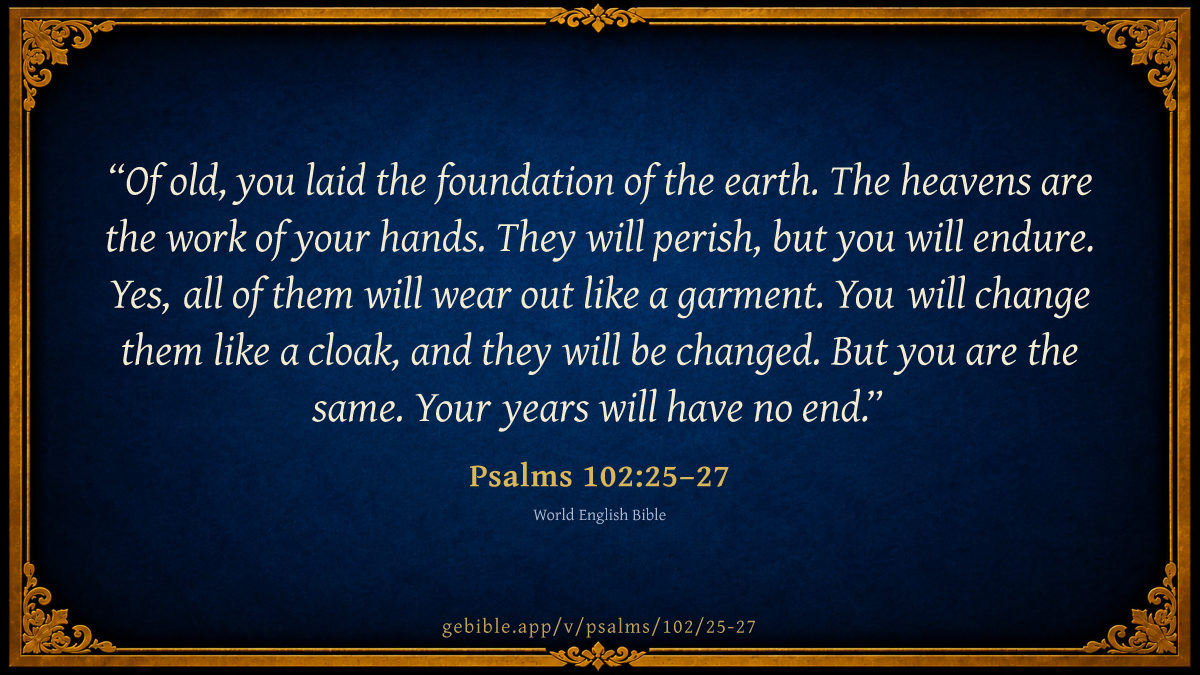
25 Of old, you laid the foundation of the earth. The heavens are the work of your hands.
26 They will perish, but you will endure. Yes, all of them will wear out like a garment. You will change them like a cloak, and they will be changed.
27 But you are the same. Your years will have no end.
KJVKing James Version
25 Of old hast thou laid the foundation of the earth: and the heavens are the work of thy hands.
26 They shall perish, but thou shalt endure: yea, all of them shall wax old like a garment; as a vesture shalt thou change them, and they shall be changed:
27 But thou art the same, and thy years shall have no end.
Show all 3 translations
JPSJPS Tanakh (1917)
25 (102-26) Of old Thou didst lay the foundation of the earth; and the heavens are the work of Thy hands.
26 (102-27) They shall perish, but Thou shalt endure; yea, all of them shall wax old like a garment; as a vesture shalt Thou change them, and they shall pass away;
27 (102-28) But Thou art the selfsame, and Thy years shall have no end.
Questions where the Bible appears to say two different things, with the passages on each side set together.
Will the earth last forever?Deuteronomy 4:40, Psalm 37:29, Psalm 78:69, Psalm 104:5, and Ecclesiastes 1:4 all assert that the earth abides forever — Psalm 104:5 specifically says it 'shou…
Genesis 1:1(v25)In the beginning, God created the heavens and the earth.
Isaiah 51:6(v26)Lift up your eyes to the heavens, and look at the earth beneath; for the heavens will vanish away like smoke, and the earth will wear out…
Exodus 20:11(v25)for in six days Yahweh made heaven and earth, the sea, and all that is in them, and rested the seventh day; therefore Yahweh blessed the…
Matthew 24:35(v26)Heaven and earth will pass away, but my words will not pass away.
Hebrews 1:10-12(v25)And, “You, Lord, in the beginning, laid the foundation of the earth. The heavens are the works of your hands. They will perish, but you…
Show all 29 cross-references
Hebrews 13:8(v27)Jesus Christ is the same yesterday, today, and forever.
Jeremiah 32:17(v25)“Ah Lord Yahweh! Behold, you have made the heavens and the earth by your great power and by your outstretched arm. There is nothing too…
Malachi 3:6(v27)“For I, Yahweh, don’t change; therefore you, sons of Jacob, are not consumed.
James 1:17(v27)Every good gift and every perfect gift is from above, coming down from the Father of lights, with whom can be no variation, nor turning…
Luke 21:33(v26)Heaven and earth will pass away, but my words will by no means pass away.
Revelation 1:8(v27)“I am the Alpha and the Omega,” says the Lord God, “who is and who was and who is to come, the Almighty.”
Isaiah 34:4(v26)All of the army of the sky will be dissolved. The sky will be rolled up like a scroll, and all its armies will fade away, as a leaf fades…
Job 36:26(v27)Behold, God is great, and we don’t know him. The number of his years is unsearchable.
Psalms 90:4(v27)For a thousand years in your sight are just like yesterday when it is past, like a watch in the night.
Hebrews 3:3-4(v25)For he has been counted worthy of more glory than Moses, because he who built the house has more honor than the house. For every house is…
Revelation 1:17-18(v27)When I saw him, I fell at his feet like a dead man. He laid his right hand on me, saying, “Don’t be afraid. I am the first and the last,…
Genesis 2:1(v25)The heavens, the earth, and all their vast array were finished.
John 8:58(v27)Jesus said to them, “Most certainly, I tell you, before Abraham came into existence, I AM.”
Revelation 20:11(v26)I saw a great white throne, and him who sat on it, from whose face the earth and the heaven fled away. There was found no place for them.
Job 38:4-7(v25)“Where were you when I laid the foundations of the earth? Declare, if you have understanding. Who determined its measures, if you know? Or…
Psalms 96:5(v25)For all the gods of the peoples are idols, but Yahweh made the heavens.
Proverbs 8:23-36(v25)I was set up from everlasting, from the beginning, before the earth existed. When there were no depths, I was born, when there were no…
Psalms 102:12(v26)But you, Yahweh, will remain forever; your renown endures to all generations.
Isaiah 66:22(v26)“For as the new heavens and the new earth, which I will make, shall remain before me,” says Yahweh, “so your offspring and your name shall…
Romans 8:20(v26)For the creation was subjected to vanity, not of its own will, but because of him who subjected it, in hope
Revelation 21:1(v26)I saw a new heaven and a new earth: for the first heaven and the first earth have passed away, and the sea is no more.
Isaiah 65:17(v26)“For, behold, I create new heavens and a new earth; and the former things will not be remembered, nor come into mind.
2 Peter 3:7-12(v26)But the heavens that exist now and the earth, by the same word have been stored up for fire, being reserved against the day of judgment and…
Exodus 3:14(v26)God said to Moses, “I AM WHO I AM,” and he said, “You shall tell the children of Israel this: ‘I AM has sent me to you.’ ”
Cross-references from openbible.info (CC BY 4.0)
Explain this passage (17 sources)
Historical commentary, presented as a primary source — not an endorsement.
John Calvin1540 · Public DomainOn v2525 Thou hast aforetime founded the earth Here the…
25 Thou hast aforetime founded the earth Here the sacred writer amplifies what he had previously stated, declaring, that compared with God the whole world is a form which quickly vanishes away; and yet a little after he represents the Church as exempted from this the common lot of all sublunary things, because she has for her foundation the word of God, while her safety is secured by the same word. Two subjects are therefore here brought under our consideration. The first is, that since the heavens themselves are in the sight of God almost as evanescent as smoke, the frailty of the whole human race is such as may well excite his compassion; and the second is, that although there is no stability in the heavens and the earth, yet the Church shall continue steadfast for ever, because she is upheld by the eternal truth of God. By the first of these positions, true believers are taught to consider with all humility, when they come into the divine presence, how frail and transitory their condition is, that they may bring nothing with them but their own emptiness. Such self-abasement is the first step to our obtaining favor in the sight of God, even as He also affirms that he is moved by the sight of our miseries to be merciful to us. The comparison taken from the heavens is a very happy illustration; for how long have they continued to exist, when contrasted with the brief span of human life, which passes or rather flies away so swiftly? How many generations of men have passed away since the creation, while the heavens still continue as they were amidst this continual fluctuation? Again, so beautiful is their arrangement, and so excellent their frame-work, that the whole fabric proclaims itself to be the product of God’s hands And yet neither the long period during which the heavens have existed, nor their fair embellishment, will exempt them from perishing. What then shall become of us poor mortals, who die when we are as yet scarcely born? for there is no part of our life which does not rapidly hasten to death.
Interpreters, however, do not all explain these words, The heavens shall perish, in the same way. Some understand them as expressing simply the change they shall undergo, which will be a species of destruction; for although they are not to be reduced to nothing, yet this change of their nature, as it may be termed, will destroy what is mortal and corruptible in them, so that they shall become, in a manner, different and new heavens. Others explain the words conditionally, and make the supplement, “If it so please God,” regarding it as a thing absurd to say that the heavens are subject to corruption. But first, there is no necessity for introducing these supplementary words, which obscure the sense instead of making it plainer. In the next place, these expositors improperly attribute an immortal state to the heavens, of which Paul declares that they “groan and travail in pain,” like the earth and the other creatures, until the day of redemption, (Romans 8:22) because they are subject to corruption; not indeed willingly, or in their own nature, but because man, by precipitating himself headlong into destruction, has drawn the whole world into a participation of the same ruin. Two things are to be here attended to; first, that the heavens are actually subject to corruption in consequence of the fall of man; and, secondly, that they shall be so renewed as to warrant the prophet to say that they shall perish; for this renovation will be so complete that they shall not be the same but other heavens. The amount is, that to whatever quarter we turn our eyes, we will see everywhere nothing but ground for despair till we come to God. What is there in us but rottenness and corruption? and what else are we but a mirror of death? Again, what are the changes which the whole world undergoes but a kind of presage, yea a prelude of destruction? If the whole frame-work of the world is hastening to its end, what will become of the human race? If all nations are doomed to perish, what stability will there be in men individually considered? We ought therefore to seek stability no where else but in God.
John Calvin's Commentaries (1540-1563) — public domain. Text from the Calvin Translation Society English edition (1840s-50s) via the Christian Classics Ethereal Library (ccel.org). Calvin's coverage is partial (roughly two-thirds of the Bible); uncommented books and verses are honest gaps, never fabricated. The 19th-century editor's footnotes and remarks are omitted so the notes are faithfully Calvin's own voice.
Geneva Bible translators1599 · Public DomainOn v26If heaven and earth perish, much more man shall…
If heaven and earth perish, much more man shall perish: but the Church by reason of God’s promise endureth forever.
Geneva Bible (1599) marginal notes — public domain.
John Trapp1656 · Public DomainOn vv25–27Psa 102:25 Of old hast thou laid the foundation…
Psa 102:25 Of old hast thou laid the foundation of the earth: and the heavens [are] the work of thy hands.
Ver. 25. Of old thou hast laid the foundation, &c.] Here is a clear proof of Christ’s eternity, Heb 1:10, because he was before the creation of the world, and shall continue after the consummation thereof, Psa 102:26-27. So the saints a parte post. 1Jn 2:17, "The world passeth away, and the lusts thereof; but he that doeth the will of God abideth for ever."
John Trapp, A Commentary or Exposition upon All the Books of the Old and New Testament (1647–1656) — public domain. Text from a community e-Sword module.
Matthew Poole1685 · Public DomainOn vv25–26The eternity of God looks both backward and forward,…
The eternity of God looks both backward and forward, it is both without beginning and without end. The former is affirmed and illustrated Psa 102:24,26,27, the latter is clearly implied in this verse. Thou hadst a being before the creation of the world, when there was nothing but eternity, but the earth and heavens had a beginning given them by thy almighty power.
Matthew Poole's English Annotations on the Holy Bible (1683–1685) — public domain. Text from a community e-Sword/MySword module.
John Gill1763 · Public DomainOn vv25–27They shall perish,.... Both the heavens and the earth,…
They shall perish,.... Both the heavens and the earth, though so well founded, and so firmly made; they shall be dissolved, melt, and pass away; not as to the substance, but as to the quality of them: or, as R. Judah Ben David says, whom Aben Ezra on the place cites, and calls the first grammarian in the west, not as to generals, but as to particulars:
but thou shalt endure; as the eternal God, from everlasting to everlasting; and, even as man, he will die no more; and, as Mediator, will ever remain; he will be King for ever; his throne is for ever and ever; his kingdom is an everlasting one; he is a priest for ever, after the order of Melchizedek; his sacrifice is of an eternal efficacy, and he ever lives to make intercession for his people; he will always continue, as the Prophet, in his church, to teach by his Spirit, word, and ordinances, in the present state; and hereafter will be the light of the New Jerusalem, and of his saints, for ever:
Read full note →
yea, all of them shall wax old like a garment: not only the heavens, which are as a curtain and garment about the earth, but the earth itself, Isa 51:6, will lose their beauty and glory, and become useless, as to the present form of them:
as a vesture shall thou change them, and they shall be changed; as to their form, as a garment that is turned or folded up, and laid aside, as to present use: this seems to favour the above sense given, that the earth and heavens will not perish, as to the substance of them; but as to their form, figure, fashion, and scheme; and as to the qualities of them, all noxious ones being purged away by fire, the curse removed, and new heavens and new earth arise out of them.
John Gill's Exposition of the Whole Bible (1746–1763) — public domain (CC PDM 1.0). Text via the HelloAO Bible API.
John Wesley1765 · Public DomainOn v26Perish - As to their present nature and use.
Perish - As to their present nature and use.
John Wesley, Explanatory Notes Upon the Whole Bible (1754–1765) — public domain. Text via the GEBible commentary corpus.
Adam Clarke1810 · Public DomainOn vv25–27Verse 25. Of old hast thou laid the foundation]…
Verse 25. Of old hast thou laid the foundation] None taught of God ever imagined the world to have been eternal. Of old, לפנים lephanim, before there were any faces or appearances, thou didst lay the foundations of the earth. It was created by thee; it did not grow by accretion or aggregation from a pre-existent nucleus. There was nothing; and thou didst produce being - substance or matter. Out of that created matter thou didst make the earth and the heavens.
Adam Clarke's Commentary on the Bible (1810–1826) — public domain. Text from a community e-Sword/MySword module.
Joseph Benson1811 · Public DomainOn vv25–27Psa 102:25. Of old hast thou laid the foundation…
Psa 102:25. Of old hast thou laid the foundation of the earth — The eternity of God looks both backward and forward: it is both without beginning and without end. The latter is affirmed and illustrated Psa 102:24; Psa 102:26-27, the former is implied in this verse. Thou hadst a being before the creation of the world, when there was nothing but eternity, but the earth and heaven had a beginning given them by thy almighty power.
Joseph Benson's Commentary on the Old and New Testaments (1811–1818) — public domain. Text from a community e-Sword module.
Albert Barnes1834 · Public DomainOn v25Of old - See this passage fully explained in…
Of old - See this passage fully explained in the notes at Heb 1:10-12. In the beginning; at the first. The phrase used here means literally “to the face;” then, “before” in the order of time. It means here, long ago; of olden time; at the beginning. The meaning is, that the years of God had stretched through all the generations of people, and all the changes which had occurred upon the earth; that at the very beginning he existed, and that he would continue to exist to the very close, unchangeably the same.
Albert Barnes' Notes on the Bible (1834–1885) — public domain. Text from a community e-Sword/MySword module.
Daniel D. Whedon1874 · Public DomainOn vv25–2725. Of old hast thou laid the foundations of…
25. Of old hast thou laid the foundations of the earth—What is here affirmed of God, is, in the New Testament, quoted and affirmed of Christ.
Heb_1:10. This is repeatedly done. Compare Jer_17:10; Rev_2:23. We are thus taught the personality and unity of the Father and the Son: “That all men should honour the Son, even as they honour the Father.” Joh_5:23. “For what things soever the Father doeth, these also doeth the son likewise.” Joh_5:19
Daniel D. Whedon (gen. ed.), Commentary on the Old and New Testaments (1874–1909) — public domain. Text from a community e-Sword module.
The Cambridge Bible for Schools and Colleges1878 · Public DomainOn vv26–2726. Compared with man’s brief span of life the…
26. Compared with man’s brief span of life the natural world is an emblem of permanence; compared with God’s eternity, it is seen to be transitory. He existed from all eternity before it, and called it into being: He will exist unchanged when it has passed away.
they shall be changed] Or, pass away. The Psalmist’s thought here is rather of the transitoriness of heaven and earth contrasted with the eternity of God than of the new heavens and new earth, Isa_65:17; Isa_66:22.
The Cambridge Bible for Schools and Colleges (gen. ed. J. J. S. Perowne; Cambridge University Press, 1878–1918) — public domain. Text from a community e-Sword module.
Ellicott's Commentary for English Readers1878 · Public DomainOn vv25–26(25) Comp. Isa_44:24; Isa_48:13.
(25) Comp. Isa_44:24; Isa_48:13.
A Bible Commentary for English Readers, edited by Charles John Ellicott (1878–1897) — public domain. Text from a community e-Sword module.
The Pulpit Commentary1880 · Public DomainOn vv25–27Of old hast thou laid the foundation of the…
Of old hast thou laid the foundation of the earth. (comp. Isa_48:13) And the heavens are the work of thy hands. (see Gen_1:1, 7 2:4 Psa_89:11 Heb_1:10)
The Pulpit Commentary (1880–1919), ed. H.D.M. Spence-Jones & Joseph S. Exell — public domain. Text from a community e-Sword module.
Charles H. Spurgeon1885 · Public DomainOn vv25–27Ver. 25. Of old hast thou laid the foundation…
Ver. 25. Of old hast thou laid the foundation of the earth. Creation is no new work with God, and therefore to "create Jerusalem a praise in the earth" will not be difficult to him. Long ere the holy city was laid in ruins the Lord made a world out of nothing, and it will be no labour to him to raise the walls from their heaps and replace the stones in their courses. We can neither continue our own existence nor give being to others; but the Lord not only is, but he is the Maker of all things that are; hence, when our affairs are at the very lowest ebb we are not at all despairing, because the Almighty and Eternal Lord can yet restore us.
And the heavens are the work of thine hands. Thou canst therefore not merely lay the foundations of Zion, but complete its roof, even as thou hast arched in the world with its ceiling of blue; the loftiest stories of thine earthly palace shall be piled on high without difficulty when thou dost undertake the building thereof, since thou art architect of the stars, and the spheres in which they move. When a great labour is to be performed it is eminently reassuring to contemplate the power of him who has undertaken to accomplish it; and when our own strength is exhausted it is supremely cheering to see the unfailing energy which is still engaged on our behalf.
Read full note →
Ver. 25. Earth. Heavens. He names here the most stable parts of the world, and the most beautiful parts of the creation, those that are freest from corruptibility and change, to illustrate thereby the immutability of God, that though the heavens and earth have a prerogative of fixedness above other parts of the world, and the creatures that reside below, the heavens remain the same as they were created, and the centre of the earth retains its fixedness, and are as beautiful and fresh in their age as they were in their youth many years ago, notwithstanding the change of the elements, fire and water being often turned into air, so that there may remain but little of that air which was first created, by reason of the continual transmutation; yet this firmness of the earth and heavens is not to be regarded in comparison of the unmoveableness and fixedness of the being of God. As their beauty comes short of the glory of his being, so doth their firmness come short of his stability. Stephen Charnock.
Ver. 25-27.
1. The unchangeableness of God amidst past changes: "of old, "etc. (a) He was the same before as after he had laid the foundations of the earth. (b) He was the same after as before.
2. The unchangeableness of God amidst future changes. "They shall perish, "etc. (a) The same before they perish as after. (b) After as before.
3. The unchangeableness of God in the past and the future. "Thou art the same, "etc. G. R.
Psalms 102:26*
Charles H. Spurgeon's The Treasury of David (1869–1885) — public domain. Psalms only. Text from a community e-Sword/MySword module.
The Biblical Illustrator1887 · Public DomainOn vv26–27They shall perish, but Thou shalt endure.
Psa_102:26-28
They shall perish, but Thou shalt endure.
Read full note →
A perishing world and an immutable God
The great practical lesson which we are being daily taught is this, to withdraw our hearts from a changing and decaying world; and fix our hopes, and seek our happiness, in an unchanging and eternal God. This is the secret of real and permanent happiness to the soul of man.
I. The description which the text gives of the material world--the heavens and the earth. They are described as--
1. The effect of Divine operation. The contemplation of Gods creative wisdom and power, as displayed in the works of His hands, should deepen the feeling of awe and reverence, with which we regard His sacred majesty.
2. Mutable, perishable, and destined to destruction.
II. The contrast which it presents in the perfections of the worlds Creator and mans Redeemer. Thus the shifting scenes and dissolving frame of nature may be improved by the children of God to their own comfort, by giving the force of a most advantageous contrast to the perfections of God their Saviour.
III. The conclusion which it draws from this view of the Divine character. God our Redeemer will maintain His cause in this mutable world, as long as the world shall continue. Conclusion:--
1. How utterly unsuitable the world and the things of the world are to be the chief objects of mans solicitude and pursuit.
2. How preeminently secure and blest are they, whose dependence and hopes are fixed in the eternal God. (Essex Remembrancer.)
Things which grow not old
1. The love and mercy of God as shown in our creation, preservation, and all the blessings of this life, never grow old or wear out.
2. The salvation of Jesus has not grown old.
3. The sympathy of Jesus never grows old or worn out.
4. Heaven never changes nor wears out. And yet how old Heaven is! (H. J. Wilmot Buxton, M.A.)
The Biblical Illustrator, edited by Joseph S. Exell (c. 1880s–1900s) — public domain. Text from a community e-Sword module.
unfoldingWord translationNotes2017 · CC BY-SA 4.0On v25they will all grow old
they will all grow old
The word "they" refers to "the earth" and "the heavens."
Read full note →
your years will have no end
Here David describes the length of time that God is alive as his "years." This can be written in positive form. AT: "you will live forever" (See: Metaphor and Double Negatives)
Tyndale Open Study Notes2022 · CC BY-SA 4.0On v25102:25-27 In contrast with the permanence of the Creator,…
102:25-27 In contrast with the permanence of the Creator, the created order will wear out like a piece of clothing (see Isa 40:28). • The writer to the Hebrews describes this passage as having been addressed to Jesus, the Son (Heb 1:10-12).

John Calvin 1540 · Public Domain On v25 25 Thou hast aforetime founded the earth Here the…
25 Thou hast aforetime founded the earth Here the sacred writer amplifies what he had previously stated, declaring, that compared with God the whole world is a form which quickly vanishes away; and yet a little after he represents the Church as exempted from this the common lot of all sublunary things, because she has for her foundation the word of God, while her safety is secured by the same word. Two subjects are therefore here brought under our consideration. The first is, that since the heavens themselves are in the sight of God almost as evanescent as smoke, the frailty of the whole human race is such as may well excite his compassion; and the second is, that although there is no stability in the heavens and the earth, yet the Church shall continue steadfast for ever, because she is upheld by the eternal truth of God. By the first of these positions, true believers are taught to consider with all humility, when they come into the divine presence, how frail and transitory their condition is, that they may bring nothing with them but their own emptiness. Such self-abasement is the first step to our obtaining favor in the sight of God, even as He also affirms that he is moved by the sight of our miseries to be merciful to us. The comparison taken from the heavens is a very happy illustration; for how long have they continued to exist, when contrasted with the brief span of human life, which passes or rather flies away so swiftly? How many generations of men have passed away since the creation, while the heavens still continue as they were amidst this continual fluctuation? Again, so beautiful is their arrangement, and so excellent their frame-work, that the whole fabric proclaims itself to be the product of God’s hands And yet neither the long period during which the heavens have existed, nor their fair embellishment, will exempt them from perishing. What then shall become of us poor mortals, who die when we are as yet scarcely born? for there is no part of our life which does not rapidly hasten to death.
Interpreters, however, do not all explain these words, The heavens shall perish, in the same way. Some understand them as expressing simply the change they shall undergo, which will be a species of destruction; for although they are not to be reduced to nothing, yet this change of their nature, as it may be termed, will destroy what is mortal and corruptible in them, so that they shall become, in a manner, different and new heavens. Others explain the words conditionally, and make the supplement, “If it so please God,” regarding it as a thing absurd to say that the heavens are subject to corruption. But first, there is no necessity for introducing these supplementary words, which obscure the sense instead of making it plainer. In the next place, these expositors improperly attribute an immortal state to the heavens, of which Paul declares that they “groan and travail in pain,” like the earth and the other creatures, until the day of redemption, (Romans 8:22) because they are subject to corruption; not indeed willingly, or in their own nature, but because man, by precipitating himself headlong into destruction, has drawn the whole world into a participation of the same ruin. Two things are to be here attended to; first, that the heavens are actually subject to corruption in consequence of the fall of man; and, secondly, that they shall be so renewed as to warrant the prophet to say that they shall perish; for this renovation will be so complete that they shall not be the same but other heavens. The amount is, that to whatever quarter we turn our eyes, we will see everywhere nothing but ground for despair till we come to God. What is there in us but rottenness and corruption? and what else are we but a mirror of death? Again, what are the changes which the whole world undergoes but a kind of presage, yea a prelude of destruction? If the whole frame-work of the world is hastening to its end, what will become of the human race? If all nations are doomed to perish, what stability will there be in men individually considered? We ought therefore to seek stability no where else but in God.
John Calvin's Commentaries (1540-1563) — public domain. Text from the Calvin Translation Society English edition (1840s-50s) via the Christian Classics Ethereal Library (ccel.org). Calvin's coverage is partial (roughly two-thirds of the Bible); uncommented books and verses are honest gaps, never fabricated. The 19th-century editor's footnotes and remarks are omitted so the notes are faithfully Calvin's own voice.
Geneva Bible translators 1599 · Public Domain On v26 If heaven and earth perish, much more man shall…
If heaven and earth perish, much more man shall perish: but the Church by reason of God’s promise endureth forever.
Geneva Bible (1599) marginal notes — public domain.
John Trapp 1656 · Public Domain On vv25–27 Psa 102:25 Of old hast thou laid the foundation…
Psa 102:25 Of old hast thou laid the foundation of the earth: and the heavens [are] the work of thy hands.
Ver. 25. Of old thou hast laid the foundation, &c.] Here is a clear proof of Christ’s eternity, Heb 1:10, because he was before the creation of the world, and shall continue after the consummation thereof, Psa 102:26-27. So the saints a parte post. 1Jn 2:17, "The world passeth away, and the lusts thereof; but he that doeth the will of God abideth for ever."
John Trapp, A Commentary or Exposition upon All the Books of the Old and New Testament (1647–1656) — public domain. Text from a community e-Sword module.
Matthew Poole 1685 · Public Domain On vv25–26 The eternity of God looks both backward and forward,…
The eternity of God looks both backward and forward, it is both without beginning and without end. The former is affirmed and illustrated Psa 102:24,26,27, the latter is clearly implied in this verse. Thou hadst a being before the creation of the world, when there was nothing but eternity, but the earth and heavens had a beginning given them by thy almighty power.
Matthew Poole's English Annotations on the Holy Bible (1683–1685) — public domain. Text from a community e-Sword/MySword module.
John Gill 1763 · Public Domain On vv25–27 They shall perish,.... Both the heavens and the earth,…
They shall perish,.... Both the heavens and the earth, though so well founded, and so firmly made; they shall be dissolved, melt, and pass away; not as to the substance, but as to the quality of them: or, as R. Judah Ben David says, whom Aben Ezra on the place cites, and calls the first grammarian in the west, not as to generals, but as to particulars:
but thou shalt endure; as the eternal God, from everlasting to everlasting; and, even as man, he will die no more; and, as Mediator, will ever remain; he will be King for ever; his throne is for ever and ever; his kingdom is an everlasting one; he is a priest for ever, after the order of Melchizedek; his sacrifice is of an eternal efficacy, and he ever lives to make intercession for his people; he will always continue, as the Prophet, in his church, to teach by his Spirit, word, and ordinances, in the present state; and hereafter will be the light of the New Jerusalem, and of his saints, for ever:
Read full note →
yea, all of them shall wax old like a garment: not only the heavens, which are as a curtain and garment about the earth, but the earth itself, Isa 51:6, will lose their beauty and glory, and become useless, as to the present form of them:
as a vesture shall thou change them, and they shall be changed; as to their form, as a garment that is turned or folded up, and laid aside, as to present use: this seems to favour the above sense given, that the earth and heavens will not perish, as to the substance of them; but as to their form, figure, fashion, and scheme; and as to the qualities of them, all noxious ones being purged away by fire, the curse removed, and new heavens and new earth arise out of them.
John Gill's Exposition of the Whole Bible (1746–1763) — public domain (CC PDM 1.0). Text via the HelloAO Bible API.
John Wesley 1765 · Public Domain On v26 Perish - As to their present nature and use.
Perish - As to their present nature and use.
John Wesley, Explanatory Notes Upon the Whole Bible (1754–1765) — public domain. Text via the GEBible commentary corpus.
Adam Clarke 1810 · Public Domain On vv25–27 Verse 25. Of old hast thou laid the foundation]…
Verse 25. Of old hast thou laid the foundation] None taught of God ever imagined the world to have been eternal. Of old, לפנים lephanim, before there were any faces or appearances, thou didst lay the foundations of the earth. It was created by thee; it did not grow by accretion or aggregation from a pre-existent nucleus. There was nothing; and thou didst produce being - substance or matter. Out of that created matter thou didst make the earth and the heavens.
Adam Clarke's Commentary on the Bible (1810–1826) — public domain. Text from a community e-Sword/MySword module.
Joseph Benson 1811 · Public Domain On vv25–27 Psa 102:25. Of old hast thou laid the foundation…
Psa 102:25. Of old hast thou laid the foundation of the earth — The eternity of God looks both backward and forward: it is both without beginning and without end. The latter is affirmed and illustrated Psa 102:24; Psa 102:26-27, the former is implied in this verse. Thou hadst a being before the creation of the world, when there was nothing but eternity, but the earth and heaven had a beginning given them by thy almighty power.
Joseph Benson's Commentary on the Old and New Testaments (1811–1818) — public domain. Text from a community e-Sword module.
Albert Barnes 1834 · Public Domain On v25 Of old - See this passage fully explained in…
Of old - See this passage fully explained in the notes at Heb 1:10-12. In the beginning; at the first. The phrase used here means literally “to the face;” then, “before” in the order of time. It means here, long ago; of olden time; at the beginning. The meaning is, that the years of God had stretched through all the generations of people, and all the changes which had occurred upon the earth; that at the very beginning he existed, and that he would continue to exist to the very close, unchangeably the same.
Albert Barnes' Notes on the Bible (1834–1885) — public domain. Text from a community e-Sword/MySword module.
Daniel D. Whedon 1874 · Public Domain On vv25–27 25. Of old hast thou laid the foundations of…
25. Of old hast thou laid the foundations of the earth—What is here affirmed of God, is, in the New Testament, quoted and affirmed of Christ.
Heb_1:10. This is repeatedly done. Compare Jer_17:10; Rev_2:23. We are thus taught the personality and unity of the Father and the Son: “That all men should honour the Son, even as they honour the Father.” Joh_5:23. “For what things soever the Father doeth, these also doeth the son likewise.” Joh_5:19
Daniel D. Whedon (gen. ed.), Commentary on the Old and New Testaments (1874–1909) — public domain. Text from a community e-Sword module.
The Cambridge Bible for Schools and Colleges 1878 · Public Domain On vv26–27 26. Compared with man’s brief span of life the…
26. Compared with man’s brief span of life the natural world is an emblem of permanence; compared with God’s eternity, it is seen to be transitory. He existed from all eternity before it, and called it into being: He will exist unchanged when it has passed away.
they shall be changed] Or, pass away. The Psalmist’s thought here is rather of the transitoriness of heaven and earth contrasted with the eternity of God than of the new heavens and new earth, Isa_65:17; Isa_66:22.
The Cambridge Bible for Schools and Colleges (gen. ed. J. J. S. Perowne; Cambridge University Press, 1878–1918) — public domain. Text from a community e-Sword module.
Ellicott's Commentary for English Readers 1878 · Public Domain On vv25–26 (25) Comp. Isa_44:24; Isa_48:13.
(25) Comp. Isa_44:24; Isa_48:13.
A Bible Commentary for English Readers, edited by Charles John Ellicott (1878–1897) — public domain. Text from a community e-Sword module.
The Pulpit Commentary 1880 · Public Domain On vv25–27 Of old hast thou laid the foundation of the…
Of old hast thou laid the foundation of the earth. (comp. Isa_48:13) And the heavens are the work of thy hands. (see Gen_1:1, 7 2:4 Psa_89:11 Heb_1:10)
The Pulpit Commentary (1880–1919), ed. H.D.M. Spence-Jones & Joseph S. Exell — public domain. Text from a community e-Sword module.
Charles H. Spurgeon 1885 · Public Domain On vv25–27 Ver. 25. Of old hast thou laid the foundation…
Ver. 25. Of old hast thou laid the foundation of the earth. Creation is no new work with God, and therefore to "create Jerusalem a praise in the earth" will not be difficult to him. Long ere the holy city was laid in ruins the Lord made a world out of nothing, and it will be no labour to him to raise the walls from their heaps and replace the stones in their courses. We can neither continue our own existence nor give being to others; but the Lord not only is, but he is the Maker of all things that are; hence, when our affairs are at the very lowest ebb we are not at all despairing, because the Almighty and Eternal Lord can yet restore us.
And the heavens are the work of thine hands. Thou canst therefore not merely lay the foundations of Zion, but complete its roof, even as thou hast arched in the world with its ceiling of blue; the loftiest stories of thine earthly palace shall be piled on high without difficulty when thou dost undertake the building thereof, since thou art architect of the stars, and the spheres in which they move. When a great labour is to be performed it is eminently reassuring to contemplate the power of him who has undertaken to accomplish it; and when our own strength is exhausted it is supremely cheering to see the unfailing energy which is still engaged on our behalf.
Read full note →
Ver. 25. Earth. Heavens. He names here the most stable parts of the world, and the most beautiful parts of the creation, those that are freest from corruptibility and change, to illustrate thereby the immutability of God, that though the heavens and earth have a prerogative of fixedness above other parts of the world, and the creatures that reside below, the heavens remain the same as they were created, and the centre of the earth retains its fixedness, and are as beautiful and fresh in their age as they were in their youth many years ago, notwithstanding the change of the elements, fire and water being often turned into air, so that there may remain but little of that air which was first created, by reason of the continual transmutation; yet this firmness of the earth and heavens is not to be regarded in comparison of the unmoveableness and fixedness of the being of God. As their beauty comes short of the glory of his being, so doth their firmness come short of his stability. Stephen Charnock.
Ver. 25-27.
1. The unchangeableness of God amidst past changes: "of old, "etc. (a) He was the same before as after he had laid the foundations of the earth. (b) He was the same after as before.
2. The unchangeableness of God amidst future changes. "They shall perish, "etc. (a) The same before they perish as after. (b) After as before.
3. The unchangeableness of God in the past and the future. "Thou art the same, "etc. G. R.
Psalms 102:26*
Charles H. Spurgeon's The Treasury of David (1869–1885) — public domain. Psalms only. Text from a community e-Sword/MySword module.
The Biblical Illustrator 1887 · Public Domain On vv26–27 They shall perish, but Thou shalt endure.
Psa_102:26-28
They shall perish, but Thou shalt endure.
Read full note →
A perishing world and an immutable God
The great practical lesson which we are being daily taught is this, to withdraw our hearts from a changing and decaying world; and fix our hopes, and seek our happiness, in an unchanging and eternal God. This is the secret of real and permanent happiness to the soul of man.
I. The description which the text gives of the material world--the heavens and the earth. They are described as--
1. The effect of Divine operation. The contemplation of Gods creative wisdom and power, as displayed in the works of His hands, should deepen the feeling of awe and reverence, with which we regard His sacred majesty.
2. Mutable, perishable, and destined to destruction.
II. The contrast which it presents in the perfections of the worlds Creator and mans Redeemer. Thus the shifting scenes and dissolving frame of nature may be improved by the children of God to their own comfort, by giving the force of a most advantageous contrast to the perfections of God their Saviour.
III. The conclusion which it draws from this view of the Divine character. God our Redeemer will maintain His cause in this mutable world, as long as the world shall continue. Conclusion:--
1. How utterly unsuitable the world and the things of the world are to be the chief objects of mans solicitude and pursuit.
2. How preeminently secure and blest are they, whose dependence and hopes are fixed in the eternal God. (Essex Remembrancer.)
Things which grow not old
1. The love and mercy of God as shown in our creation, preservation, and all the blessings of this life, never grow old or wear out.
2. The salvation of Jesus has not grown old.
3. The sympathy of Jesus never grows old or worn out.
4. Heaven never changes nor wears out. And yet how old Heaven is! (H. J. Wilmot Buxton, M.A.)
The Biblical Illustrator, edited by Joseph S. Exell (c. 1880s–1900s) — public domain. Text from a community e-Sword module.
unfoldingWord translationNotes 2017 · CC BY-SA 4.0 On v25 they will all grow old
they will all grow old
The word "they" refers to "the earth" and "the heavens."
Read full note →
your years will have no end
Here David describes the length of time that God is alive as his "years." This can be written in positive form. AT: "you will live forever" (See: Metaphor and Double Negatives)
translationWords
time
works
hand
perish
year
unfoldingWord translationNotes — © Distant Shores Media and the Door43 World Missions Community, licensed CC BY-SA 4.0. Source: git.door43.org/Door43/en_tn.
Tyndale Open Study Notes 2022 · CC BY-SA 4.0 On v25 102:25-27 In contrast with the permanence of the Creator,…
102:25-27 In contrast with the permanence of the Creator, the created order will wear out like a piece of clothing (see Isa 40:28). • The writer to the Hebrews describes this passage as having been addressed to Jesus, the Son (Heb 1:10-12).
Tyndale Open Study Notes — © Tyndale Open Resources, licensed CC BY-SA 4.0. Text via the HelloAO Bible API.