Questions where the Bible appears to say two different things, with the passages on each side set together.
Will the earth last forever?Deuteronomy 4:40, Psalm 37:29, Psalm 78:69, Psalm 104:5, and Ecclesiastes 1:4 all assert that the earth abides forever — Psalm 104:5 specifically says it 'shou…
Job 26:7(v5)He stretches out the north over empty space, and hangs the earth on nothing.
Psalms 24:2(v5)For he has founded it on the seas, and established it on the floods.
Genesis 7:19(v6)The waters rose very high on the earth. All the high mountains that were under the whole sky were covered.
Job 38:10-11(v9)marked out for it my bound, set bars and doors, and said, ‘You may come here, but no further. Your proud waves shall be stopped here?’
Psalms 33:9(v5)For he spoke, and it was done. He commanded, and it stood firm.
Show all 53 cross-references
Isaiah 41:18(v10)I will open rivers on the bare heights, and springs in the middle of the valleys. I will make the wilderness a pool of water, and the dry…
Psalms 96:10(v5)Say among the nations, “Yahweh reigns.” The world is also established. It can’t be moved. He will judge the peoples with equity.
Psalms 147:8(v13)who covers the sky with clouds, who prepares rain for the earth, who makes grass grow on the mountains.
Genesis 9:11-15(v9)I will establish my covenant with you: All flesh will not be cut off any more by the waters of the flood. There will never again be a flood…
Psalms 18:15(v7)Then the channels of waters appeared. The foundations of the world were laid bare at your rebuke, Yahweh, at the blast of the breath of…
Psalms 107:35(v10)He turns a desert into a pool of water, and a dry land into water springs.
Jeremiah 10:13(v13)When he utters his voice, the waters in the heavens roar, and he causes the vapors to ascend from the ends of the earth. He makes…
Psalms 145:16(v11)You open your hand, and satisfy the desire of every living thing.
Isaiah 35:7(v10)The burning sand will become a pool, and the thirsty ground springs of water. Grass with reeds and rushes will be in the habitation of…
Jeremiah 14:22(v13)Are there any among the vanities of the nations that can cause rain? Or can the sky give showers? Aren’t you he, Yahweh our God? Therefore…
Revelation 20:11(v5)I saw a great white throne, and him who sat on it, from whose face the earth and the heaven fled away. There was found no place for them.
Genesis 8:1(v7)God remembered Noah, all the animals, and all the livestock that were with him in the ship; and God made a wind to pass over the earth. The…
Deuteronomy 11:11(v13)but the land that you go over to possess is a land of hills and valleys which drinks water from the rain of the sky,
Job 26:10(v9)He has described a boundary on the surface of the waters, and to the confines of light and darkness.
Psalms 93:1(v5)Yahweh reigns! He is clothed with majesty! Yahweh is armed with strength. The world also is established. It can’t be moved.
Psalms 136:6(v5)to him who spread out the earth above the waters; for his loving kindness endures forever:
Ecclesiastes 1:4(v5)One generation goes, and another generation comes; but the earth remains forever.
Isaiah 54:9(v9)“For this is like the waters of Noah to me; for as I have sworn that the waters of Noah will no more go over the earth, so I have sworn…
Jeremiah 5:22(v9)Don’t you fear me?’ says Yahweh ‘Won’t you tremble at my presence, who have placed the sand for the bound of the sea, by a perpetual…
Mark 4:39(v7)He awoke, and rebuked the wind, and said to the sea, “Peace! Be still!” The wind ceased, and there was a great calm.
2 Peter 3:10(v5)But the day of the Lord will come as a thief in the night; in which the heavens will pass away with a great noise, and the elements will be…
Genesis 8:5(v8)The waters receded continually until the tenth month. In the tenth month, on the first day of the month, the tops of the mountains were…
Job 38:4-7(v5)“Where were you when I laid the foundations of the earth? Declare, if you have understanding. Who determined its measures, if you know? Or…
Job 38:25-28(v13)Who has cut a channel for the flood water, or the path for the thunder storm, to cause it to rain on a land where there is no man, on the…
Job 38:37(v13)Who can count the clouds by wisdom? Or who can pour out the containers of the sky,
Psalms 50:11(v12)I know all the birds of the mountains. The wild animals of the field are mine.
Psalms 65:9-13(v13)You visit the earth, and water it. You greatly enrich it. The river of God is full of water. You provide them grain, for so you have…
Psalms 106:9(v7)He rebuked the Red Sea also, and it was dried up; so he led them through the depths, as through a desert.
Psalms 114:3-7(v7)The sea saw it, and fled. The Jordan was driven back. The mountains skipped like rams, the little hills like lambs. What was it, you sea,…
Proverbs 8:28(v7)when he established the clouds above, when the springs of the deep became strong,
2 Peter 3:5(v6)For this they willfully forget that there were heavens from of old, and an earth formed out of water and amid water by the word of God,
Revelation 6:14(v5)The sky was removed like a scroll when it is rolled up. Every mountain and island were moved out of their places.
Psalms 33:7(vv8–9)He gathers the waters of the sea together as a heap. He lays up the deeps in storehouses.
Genesis 1:2-10(v6)The earth was formless and empty. Darkness was on the surface of the deep and God’s Spirit was hovering over the surface of the waters. God…
Deuteronomy 8:7(v10)For Yahweh your God brings you into a good land, a land of brooks of water, of springs, and underground water flowing into valleys and…
Job 39:5-8(v11)“Who has set the wild donkey free? Or who has loosened the bonds of the swift donkey, whose home I have made the wilderness, and the salt…
Psalms 77:18(v7)The voice of your thunder was in the whirlwind. The lightnings lit up the world. The earth trembled and shook.
Psalms 104:3(v13)He lays the beams of his rooms in the waters. He makes the clouds his chariot. He walks on the wings of the wind.
Psalms 148:10(v12)wild animals and all livestock; small creatures and flying birds;
Amos 9:6(v13)It is he who builds his rooms in the heavens, and has founded his vault on the earth; he who calls for the waters of the sea, and pours…
Matthew 5:45(v13)that you may be children of your Father who is in heaven. For he makes his sun to rise on the evil and the good, and sends rain on the just…
Acts 14:17(v13)Yet he didn’t leave himself without witness, in that he did good and gave you rains from the sky and fruitful seasons, filling our hearts…
Psalms 84:3(v12)Yes, the sparrow has found a home, and the swallow a nest for herself, where she may have her young, near your altars, Yahweh of Armies, my…
Psalms 104:13(v11)He waters the mountains from his rooms. The earth is filled with the fruit of your works.
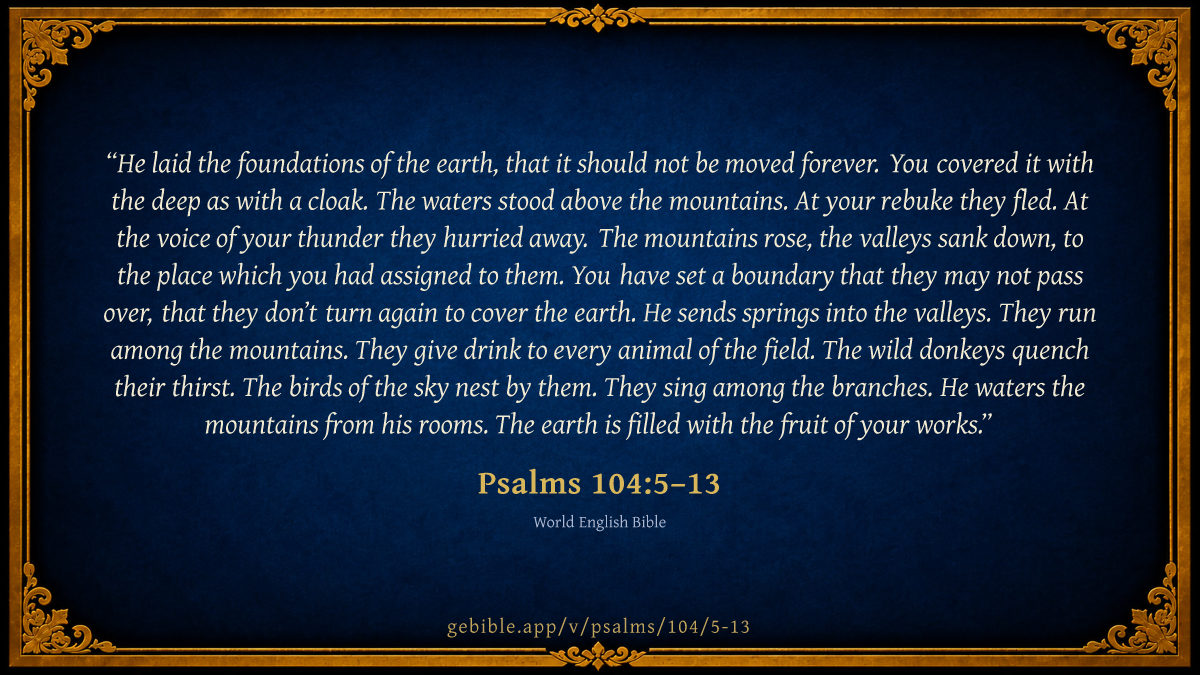
Psalms 104:16-17(v12)Yahweh’s trees are well watered, the cedars of Lebanon, which he has planted; where the birds make their nests. The stork makes its home in…
Psalms 147:9(v12)He provides food for the livestock, and for the young ravens when they call.
Matthew 6:26(v12)See the birds of the sky, that they don’t sow, neither do they reap, nor gather into barns. Your heavenly Father feeds them. Aren’t you of…
Matthew 8:20(v12)Jesus said to him, “The foxes have holes, and the birds of the sky have nests, but the Son of Man has nowhere to lay his head.”
53 distinct cross-references across this passage (54 total citations).
Cross-references from openbible.info (CC BY 4.0)
Explain this passage (18 sources)
Historical commentary, presented as a primary source — not an endorsement.
John Calvin1540 · Public DomainOn vv5, 6, 9, 10, 135 He hath founded the earth upon its foundations…
5 He hath founded the earth upon its foundations Here the prophet celebrates the glory of God, as manifested in the stability of the earth. Since it is suspended in the midst of the air, and is supported only by pillars of water, how does it keep its place so steadfastly that it cannot be moved? This I indeed grant may be explained on natural principles; for the earth, as it occupies the lowest place, being the center of the world, naturally settles down there. But even in this contrivance there shines forth the wonderful power of God. Again, if the waters are higher than the earth, because they are lighter, why do they not cover the whole earth round about? Certainly the only answer which philosophers can give to this is, that the tendency of the waters to do so is counteracted by the providence of God, that a dwelling-place might be provided for man. If they do not admit that the waters are restrained by the determinate appointment of God, they betray not only their depravity and unthankfulness, but also their ignorance, and are altogether barbarous. The prophet, therefore, not without reason, recounts among the miracles of God, that which would be to us wholly incredible, did not even experience show its truth. We are very base indeed if, taught by such undoubted a proof, we do not learn that nothing in the world is stable except in as far as it is sustained by the hand of God. The world did not originate from itself, consequently, the whole order of nature depends on nothing else than his appointment, by which each element has its own peculiar property. Nor is the language of the prophet to be viewed merely as an exhortation to give thanks to God; it is also intended to strengthen our confidence in regard to the future, that we may not live in the world in a state of constant fear and anxiety, as we must have done had not God testified that he has given the earth for a habitation to men. It is a singular blessing, which he bestows upon us, in his causing us to dwell upon the earth with undisturbed minds, by giving us the assurance that he has established it upon everlasting pillars. Although cities often perish by earthquakes, yet the body of the earth itself remains. Yea, all the agitations which befall it more fully confirm to us the truth, that the earth would be swallowed up every moment were it not preserved by the secret power of God.
John Calvin's Commentaries (1540-1563) — public domain. Text from the Calvin Translation Society English edition (1840s-50s) via the Christian Classics Ethereal Library (ccel.org). Calvin's coverage is partial (roughly two-thirds of the Bible); uncommented books and verses are honest gaps, never fabricated. The 19th-century editor's footnotes and remarks are omitted so the notes are faithfully Calvin's own voice.
Geneva Bible translators1599 · Public DomainOn vv6, 11, 12, 13Thou makest the sea to be an ornament unto…
Thou makest the sea to be an ornament unto the earth.
If by thy power thou didst not bridle the rage of the waters, it were not possible, but the whole world should be destroyed.
Geneva Bible (1599) marginal notes — public domain.
John Trapp1656 · Public DomainOn vv5–13Psa 104:5 [Who] laid the foundations of the earth,…
Psa 104:5 [Who] laid the foundations of the earth, [that] it should not be removed for ever.
Ver. 5. Who laid the foundations of the earth] Heb. He hath founded the earth upon her bases. See Psa 24:2 Job 38:4; Job 38:6. {See Trapp on "Psa 24:2"} {See Trapp on "Job 38:4"} {See Trapp on "Job 38:6"}
Read full note →
That it should not be removed for ever] Neither can it be, by reason of its own weightiness whereby it remaineth immovable in the centre of the universe. Say it should move any way, it must move towards heaven, and so ascend, which is utterly against the nature of heavy bodies.
John Trapp, A Commentary or Exposition upon All the Books of the Old and New Testament (1647–1656) — public domain. Text from a community e-Sword module.
Matthew Poole1685 · Public DomainOn vv5–13He hath founded or established the earth upon its…
He hath founded or established the earth upon its own basis or foundations, i.e. upon itself, or its own weight, whereby it stands as fast and unmovable, as if it were built upon the strongest foundations imaginable; which is a stupendous work of Divine power and wisdom. That it should not be removed out of its proper place, which is the lowest part of the world.
For ever; as long as the world continues.
Matthew Poole's English Annotations on the Holy Bible (1683–1685) — public domain. Text from a community e-Sword/MySword module.
Matthew Henry1710 · Public DomainOn v10Having given glory to God as the powerful protector…
Having given glory to God as the powerful protector of this earth, in saving it from being deluged, here he comes to acknowledge him as its bountiful benefactor, who provides conveniences for all the creatures.
I. He provides fresh water for their drink: He sends the springs into the valleys, Psa 104:10. There is water enough indeed in the sea, that is, enough to drown us, but not one drop to refresh us, be we ever so thirsty - it is all so salt; and therefore God has graciously provided water fit to drink. Naturalists dispute about the origin of fountains; but, whatever are their second causes, here is their first cause; it is God that sends the springs into the brooks, which walk by easy steps between the hills, and receive increase from the rain-water that descends from them. These give drink, not only to man, and those creatures that are immediately useful to him, but to every beast of the field (Psa 104:11); for where God has given life he provides a livelihood and takes care of all the creatures. Even the wild asses, though untameable and therefore of no use to man, are welcome to quench their thirst; and we have no reason to grudge it them, for we are better provided for, though born like the wild ass's colt. We have reason to thank God for the plenty of fair water with which he has provided the habitable part of his earth, which otherwise would not be habitable. That ought to be reckoned a great mercy the want of which would be a great affliction; and the more common it is the greater mercy it is. Usus communis aquarum - water is common for all.
Read full note →
II. He provides food convenient for them, both for man and beast: The heavens drop fatness; they hear the earth, but God hears them, Hos 2:21. He waters the hills from his chambers (Psa 104:13), from those chambers spoken of (Psa 104:3), the beams of which he lays in the waters, those store-chambers, the clouds that distil fruitful showers. The hills that are not watered by the rivers, as Egypt was by the Nile, are watered by the rain from heaven, which is called the river of God (Psa 65:9), as Canaan was, Deu 11:11, Deu 11:12. Thus the earth is satisfied with the fruit of his works, either with the rain it drinks in (the earth knows when it has enough; it is a pity that any man should not) or with the products it brings forth. It is a satisfaction to the earth to bear the fruit of God's works for the benefit of man, for thus it answers the end of its creation. The food which God brings forth out of the earth (Psa 104:14) is the fruit of his works, which the earth is satisfied with. Observe how various and how valuable its products are.
1. For the cattle there is grass, and the beasts of prey, that live not on grass, feed on those that do; for man there is herb, a better sort of grass (and a dinner of herbs and roots is not to be despised); nay, he is furnished with wine, and oil, and bread, Psa 104:15. We may observe here, concerning our food, that which will help to make us both humble and thankful. (1.) To make us humble let us consider that we have a necessary dependence upon God for all the supports of this life (we live upon alms; we are at his finding, for our own hands are not sufficient for us), - that our food comes all out of the earth, to remind us whence we ourselves were taken and whither we must return, - and that therefore we must not think to live by bread alone, for that will feed the body only, but must look into the word of God for the meat that endures to eternal life. Let us also consider that we are in this respect fellow-commoners with the beasts; the same earth, the same spot of ground, that brings grass for the cattle, brings corn for man. (2.) To make us thankful let us consider, [1.] That God not only provides for us, but for our servants. The cattle that are of use to man are particularly taken care of; grass is made to grow in great abundance for them, when the young lions, that are not for the service of man, often lack and suffer hunger. [2.] That our food is nigh us, and ready to us. Having our habitation on the earth, there we have our storehouse, and depend not on the merchant-ships that bring food from afar, Pro 31:14. [3.] That we have even from the products of the earth, not only for necessity, but for ornament and delight, so good a Master do we serve. First, Does nature call for something to support it, and repair its daily decays? Here is bread, which strengthens man's heart, and is therefore called the staff of life; let none who have that complain of want. Secondly, Does nature go further, and covet something pleasant? Here is wine, that makes glad the heart, refreshes the spirits, and exhilarates them, when it is soberly and moderately used, that we may not only go through our business, but go through it cheerfully. It is a pity that that should be abused to overcharge the heart, and unfit men for their duty, which was given to revive their heart and quicken them in their duty. Thirdly, Is nature yet more humoursome, and does it crave something for ornament too? Here is that also out of the earth - oil to make the face to shine, that the countenance may not only be cheerful but beautiful, and we may be the more acceptable to one another.
2. Nay, the divine providence not only furnishes animals with their proper food, but vegetables also with theirs (Psa 104:16): The trees of the Lord are full of sap, not only men's trees, which they take care of and have an eye to, in their orchards, and parks, and other enclosures, but God's trees, which grow in the wildernesses, and are taken care of only by his providence; they are full of sap and want no nourishment. Even the cedars of Lebanon, an open forest, though they are high and bulky, and require a great deal of sap to feed them, have enough from the earth; they are trees which he has planted, and which therefore he will protect and provide for. We may apply this to the trees of righteousness, which are the planting of the Lord, planted in his vineyard; these are full of sap, for what God plants he will water, and those that are planted in the house of the Lord shall flourish in the courts of our God, Psa 92:13.
III. He takes care that they shall have suitable habitations to dwell in. To men God has given discretion to build for themselves and for the cattle that are serviceable to them; but there are some creatures which God more immediately provides a settlement for. 1. The birds. Some birds, by instinct, make their nests in the bushes near rivers (Psa 104:12): By the springs that run among the hills some of the fowls of heaven have their habitation, which sing among the branches. They sing, according to their capacity, to the honour of their Creator and benefactor, and their singing may shame our silence. Our heavenly Father feeds them (Mat 6:26), and therefore they are easy and cheerful, and take no thought for the morrow. The birds being made to fly above the earth (as we find, Gen 1:20), they make their nests on high, in the tops of trees (Psa 104:17); it should seem as if nature had an eye to this in planting the cedars of Lebanon, that they might be receptacles for the birds. Those that fly heavenward shall not want resting-places. The stork is particularly mentioned; the fir-trees, which are very high, are her house, her castle. 2. The smaller sort of beasts (Psa 104:18): The wild goats, having neither strength nor swiftness to secure themselves, are guided by instinct to the high hills, which are a refuge to them; and the rabbits, which are also helpless animals, find shelter in the rocks, where they can set the beasts of prey at defiance. Does God provide thus for the inferior creatures; and will he not himself be a refuge and dwelling-place to his own people?
Matthew Henry's Commentary on the Whole Bible (1708–1710) — public domain (CC PDM 1.0). Text via the HelloAO Bible API.
John Gill1763 · Public DomainOn vv5–13Who laid the foundations of the earth,.... Or "founded…
Who laid the foundations of the earth,.... Or "founded the earth upon its bases" (l); which some take to be the waters, according to Psa 24:2, others the centre of gravity in it; others the mountains; others the circumambient air, by which it is poised; rather the almighty power of God, by which it subsists; this is the work of Christ the Almighty; see Heb 1:3.
That it should not be removed for ever: for though it may be shaken by earthquakes, yet not removed; nor will it be until the dissolution of all things, when it shall flee away before the face of the Judge, and a new earth shall succeed, Rev 20:11.
Read full note →
(l) "super bases ejus", Montanus, Musculus, Junius & Tremellius, Piscator; so the Tigurine version, Gejerus, Michaelis.
John Gill's Exposition of the Whole Bible (1746–1763) — public domain (CC PDM 1.0). Text via the HelloAO Bible API.
John Wesley1765 · Public DomainOn vv5, 6, 7, 8, 9, 11, 13Who laid - Hebrew. he hath established the earth…
Who laid - Hebrew. he hath established the earth upon its own basis, whereby it stands as fast and unmoveable, as if it were built upon the strongest foundations. Forever - As long as the world continues. God has fixt so strange a place for the earth, that being an heavy body, one would think it should fall every moment. And yet which way so ever we would imagine it to stir, it must, contrary to the nature of such a body, fall upwards, and so can have no possible ruin, but by tumbling into heaven.
John Wesley, Explanatory Notes Upon the Whole Bible (1754–1765) — public domain. Text via the GEBible commentary corpus.
Adam Clarke1810 · Public DomainOn vv5–13Verse 5. יסד ארץ על מכוניה yasad erets al…
Verse 5. יסד ארץ על מכוניה yasad erets al mechonepha,
בל תמוט עולם ועד bal tammot olam vaed.
Read full note →
"Laying the earth upon its foundations,
That it should not be shaken for evermore."
This image Bishop Lowth thinks evidently taken from the tabernacle, which was so laid upon its foundations that nothing could move it, and the dispensation to which it was attached, till the end purposed by the secret counsel of God was accomplished: and thus the earth is established, till the end of its creation shall be fully answered; and then it and its works shall be burnt up. On the above ground, the stability of the sanctuary and the stability of the earth are sometimes mentioned in the same words.
Adam Clarke's Commentary on the Bible (1810–1826) — public domain. Text from a community e-Sword/MySword module.
Joseph Benson1811 · Public DomainOn vv5, 6, 8, 9, 10, 12, 13Psa 104:5. Who laid the foundations of the earth…
Psa 104:5. Who laid the foundations of the earth — Hebrew, יסד ארצ על מכוניה, jasad eretz gnal mechoneah, who hath founded the earth upon its own bases, or foundations, that is, upon itself, or its own centre of gravity, by which it is self-balanced, and by which it stands as fast and immoveable as if it were built upon the strongest foundation imaginable, which is a most stupendous work of divine wisdom and power; that it should not be removed — Out of its proper place; for ever — Or, till the end of time, when it must give way to the new earth. “God,” says Dr. Hammond, “has fixed so strange a place for the earth, that, being a heavy body, one would think it should fall every moment: and yet, which way so- ever we should imagine it to stir, it must, contrary to the nature of such a body, fall upward, and so can have no possible ruin, but by tumbling into heaven,” namely, which surrounds it on all sides.
Joseph Benson's Commentary on the Old and New Testaments (1811–1818) — public domain. Text from a community e-Sword module.
Albert Barnes1834 · Public DomainOn vv5–13Who laid the foundations of the earth - Referring…
Who laid the foundations of the earth - Referring still to the creation of the earth. The margin is, “He hath founded the earth upon her bases.” The Hebrew word rendered in the margin “her bases” means properly a place; then a basis or foundation. The idea is, that there wes something, as it were, placed under the earth to support it. The idea is not uncommon in the Scriptures. Compare the notes at Job 38:4.
That it should not be removed for ever - So that it cannot be shaken out of its place. That is, It is fixed, permanent, solid. Its foundations do not give way, as edifices reared by man. but it abides the same from age to age - the most fixed and stable object of which we have any knowledge. Compare the notes at Psa 78:69.
Albert Barnes' Notes on the Bible (1834–1885) — public domain. Text from a community e-Sword/MySword module.
Daniel D. Whedon1874 · Public DomainOn vv5–135. Laid the foundations of the earth—Literally, founded the…
5. Laid the foundations of the earth—Literally, founded the earth upon its foundations, a poetical figure for a firm placing of the “earth” in its proper sphere. See Psa_119:89-91. Compare Job_26:7; Job_38:4; Job_38:6. Its place is fixed by an almighty fiat, not by chance, or evolutionary laws.
For ever—Literally, for ever and ever.
Daniel D. Whedon (gen. ed.), Commentary on the Old and New Testaments (1874–1909) — public domain. Text from a community e-Sword module.
The Cambridge Bible for Schools and Colleges1878 · Public DomainOn vv5–135. He founded the earth on its bases,
5. He founded the earth on its bases,
That it should not be moved for ever.
Read full note →
The earth is compared to a building erected upon solid foundations. Cp. Job_38:6; Pro_8:29.
5–9. The formation of the earth, and the separation of land and water: the work of the third day, Gen_1:9-10; cp. Job_38:8-11.
The Cambridge Bible for Schools and Colleges (gen. ed. J. J. S. Perowne; Cambridge University Press, 1878–1918) — public domain. Text from a community e-Sword module.
Ellicott's Commentary for English Readers1878 · Public DomainOn vv5, 6, 8, 9, 10, 11, 12, 13(5) Who laid . . .—Better, He fixed the…
(5) Who laid . . .—Better, He fixed the earth on its foundations. (Comp. Job_38:4-6; Pro_8:29.)
The inconsistency of this with Job_26:7, “He laid the earth upon nothing,” need not cause difficulty. Both treatments are poetical, not scientific. The word foundations implies stability and endurance (comp. Psa_82:5), as in Shakespeare’s
Read full note →
“The frame and huge foundation of the earth.”
The verse has a historical interest from having supplied the Inquisition with an argument against Galileo.
(5–18) The work of the third day of Creation in its two great divisions. (1) The separation of the land and water (Psa_104:5-9); (2) the clothing of the earth with grass, herbs, and trees (Psa_104:10-18). The poet, however, ranges beyond the Mosaic account, and already peoples the earth with the living creatures of the fifth day. “It is not a picture of still life like that of Genesis, but a living, moving, animated scene” (Perowne).
A Bible Commentary for English Readers, edited by Charles John Ellicott (1878–1897) — public domain. Text from a community e-Sword module.
The Pulpit Commentary1880 · Public DomainOn vv5–13Who laid the foundations of the earth; rather, as…
Who laid the foundations of the earth; rather, as in the margin, who founded the earth upon her bases; i.e. fixed the earth in its place, on bases not necessarily material bases which keep it steadily where it is. (comp. Job_26:7) That it should not be removed forever. (comp. Psa_93:1)
Vers. 5-18. The psalm of creation: the third day.
Read full note →
On all this the preacher will compare Milton"s magnificent lines ("Paradise Lost"). The opening verse of this section was laid hold of by those who opposed Galileo, as with equal reasonableness or unreasonableness like verses are laid hold of in like controversies now as utterly contradicting the conclusions to which his investigations had led him. Ever since there has been a clearer perception that the poetry of the Bible is poetry, and is to be judged by its appropriate laws. In the former homily we traced suggestions of the law of self-surrender to God; in this there are yet others on the same theme. The verses of this section tell of the separation of the land, the other part of the created earth, from the waters, and the fruitfulness that then followed. The deep mountains were still beneath the waters: "Above the mountains did the waters stand." There has been already an uplifting of the waters by means of the creation of the atmosphere, and their glorification in consequence. How we are to see another aspect of the law of self-surrender in the blessed service of the waters, in the ministry they fulfil. In this section, therefore, as in the corresponding one in Genesis, which tells of the creation work of the third day, we have the twofold command.
I TO THE WATERS.
1. They were to be gathered together into one place. " Here, in the psalm, this is poetically described as the result of the Divine rebuke. The terrible volcanic action by which the mountains were uplifted and the deep valleys hollowed out, and the consequent down rush of the waters, is told of as if it were the thunder voice of God bidding them haste away. "Immediately the mountains huge appear Emergent, and their broad, bare backs upheave Into the clouds, their tops ascend the sky; So high as heav"d the tumid hills, so low Down sunk a hollow bottom, broad and deep, Capacious bed of waters," etc. So Milton renders ver. 7. "The mountains rose, the valleys sank down into," etc. Thus by this emergence of the dry land the waters of the wild seas, hitherto flowing everywhere, are appointed their bounds, over which they may not pass. Straitened, shut in, subdued, and beaten back are they, as they never were before, for such is their Creator"s will. The life of the ocean wave seems a poor affair compared with what it was. But is it so?
2. See, now, the ministry of the waters. It is told of in ver. 10 onwards. On the wings of the air the waters send up of their strength, and they thus mount on high, and in the form of snow, and dew, and rain they fall on mountain, valley, hill, and plain; and then, by means of moss and glacier and tree (see Hugh Macmillan"s beautiful sermon on "Mountain Springs"), God sendeth forth the springs along the valleys. Thus he "watereth the earth from his chambers: and the earth is satisfied with the fruit of his work" (ver. 13). Thither come the beasts of the field, and from the branches of the trees, which love to dwell where the springs are, the birds fly down, and alike quench their thirst. And grass and herb, corn, vine, and olive, and the noblest trees, are sustained, and myriad creatures of God are blessed; and even the barren rocks, the steep precipices, and the high mountains, are for the good of some the wild goats and the conies make these their home. Is it not all a parable? The waters, at the command of God, give up their strength, and they become the glorious heavens, the visible palace of God. And this is not all. They now render unspeakable service; life, and beauty, and strength, and joy spring into existence as the result of their ministry, and this psalm is the song thereof.
3. And so also is it with the surrendered soul. Yield it up to God in loving self-sacrifice, and he will glorify that soul and use it for the blessings of others far and wide.
II TO THE LAND. Take it, as so often has been done, as a type of, or rather as suggestive of, man regenerate. See God"s will for him as pictured here.
1. He is to live a separate life. Hitherto earth and sea had been mingled together, as man in the world, but now God"s will is this separation.
2. And this separation is to be evident. "Let the dry land appear. " There must be no hiding away, but open confession of God.
3. And fruitful of good. The earth was to yield "grass," the common excellences of the renewed nature, and not these only, but those more precious, and yet more precious still (see vers. 14-16). But all this:
4. Is the work of God. What God commands he is able to secure. Be but passive to his will, and all will be brought to pass.
5. The old life will seek to regain its power. (Ver. 9) But will not be able; for:
1. The new life will be sustained and kept satisfied in God. (Ver. 13) S.C.
The King is the Creator.
"Who laid the foundations of the earth." Having filled his soul with adoring thoughts of God, by considering his palace, his surroundings, and his attendants, the psalmist goes out into the kingdom of this eternal King, to see what he can learn of him from the provisions, and order, and adaptations, and rule of his dominions. And then an introductory thought comes to him. This eternal King not only founded this kingdom, he actually made everything in it. "The sea is his, and he made it, and his hands formed the dry land." High honour is given to the man who founds a kingdom. What honour is due to him who absolutely originates the great, mysterious, complex, nature kingdom? Bible writers see in the psalm a sketch of creation. Browne calls it "a bright and living picture of God"s creative power, pouring life and gladness throughout the universe." But the reference to creation is only a brief, passing, introductory one; and what the psalmist fully dwells on is the marvel of the Divine order and rule in the earth sphere as created.
I THE SHAPING OF THINGS IS THE ETERNAL KING"S IDEA. Take but the infinite varieties of form for material things a crystal, a tree, a mountain, a weed; or for animated things a bacillus, a mammoth, a dragonfly, an albatross, a worm, a man; and our minds are overwhelmed by the effort to imagine the ideas of all forms fashioned in one intellect. There is no form of being that was not first of all a thought of God. He is the Foundation of all. If original forms modify and change, it is only according to God"s ordered laws.
II THE POWER OF THINGS IS THE ETERNAL KING"S ENDUEMENT. For there is nothing made that can really be called dead. Everything has a possibility of doing something. Even a stone can hold moisture on its under side. Metals have their chemical properties, and the very dust can at least combine. In higher ranges of being each creature has its power and its mission. And the power in things is ordered, not just developed. What must he be who is Source of power in everything?
III THE RELATION OF THINGS IS THE ETERNAL KING"S ARRANGEMENT. Everything is connected with everything else. Nothing in the world is isolated. Everywhere there is flux and reflux. Everything is touching something, and influencing it by the touch. What must he be who devised all relations and all their consequences? R.T.
The Pulpit Commentary (1880–1919), ed. H.D.M. Spence-Jones & Joseph S. Exell — public domain. Text from a community e-Sword module.
Charles H. Spurgeon1885 · Public DomainOn vv5–13Ver. 5. Who laid the foundations of the earth.…
Ver. 5. Who laid the foundations of the earth. Thus the commencement of creation is described, in almost the very words employed by the Lord himself in Job 38:4. "Where wast thou when I laid the foundations of the earth? Whereupon are the foundations thereof fastened, and who laid the corner stone thereof?" And the words are found in the same connection too, for the Lord proceeds to say, "When the morning stars sang together and all the sons of God shouted for joy."
That it should not be removed forever. The language is, of course, poetical, but the fact is none the less wonderful: the earth is so placed in space that it remains as stable as if it were a fixture. The several motions of our planet are carried on so noiselessly and evenly that, as far as we are concerned, all things are as permanent and peaceful as if the old notion of its resting upon pillars were literally true. With what delicacy has the great Artificer poised our globe! What power must there be in that hand which has caused so vast a body to know its orbit, and to move so smoothly in it! What engineer can save every part of his machinery from an occasional jar, jerk, or friction? yet to our great world in its complicated motions no such thing has ever occurred. "O Lord, my God, thou art very great."
Read full note →
Ver. 5.Not be removed for ever. The stability of the earth is of God, as much as the being and existence of it. There have been many earthquakes or movings of the earth in several parts of it, but the whole body of the earth was never removed so much as one hair's breadth out of its place, since the foundations thereof were laid. Archimedes, the great mathematician, said, "If you will give me a place to set my engine on, I will remove the earth." It was a great brag; but the Lord hath laid it too fast for man's removing. Himself can make it quake and shake, he can move it when he pleaseth; but he never hath nor will remove it. He hath laid the foundations of the earth that it shall not be removed, nor can it be at all moved, but at his pleasure; and when it moves at any time, it is to mind the sons of men that they by their sins have moved him to displeasure. Joseph Caryl.
Ver. 5. The philosophical mode of stating this truth may be seen in Amédée Guillemin's work entitled "THE HEAVENS." "How is it that though we are carried along with a vast rapidity by the motion of the earth, we do not ourselves perceive our movement? It is because the entire bulk of the earth, atmosphere, and clouds, participate in the movement. This constant velocity, with which all bodies situated on the surface of the earth are animated, would be the cause of the most terrible and general catastrophe that could be imagined, if, by any possibility, the rotation of the earth were abruptly to cease. Such an event would be the precursor of a most sweeping destruction of all organized beings. But the constancy of the laws of nature permits us to contemplate such a catastrophe without fear. It is demonstrated that the position of the poles of rotation on the surface of the earth is invariable. It has also been asked whether the velocity of the earth's rotation has changed, or, which comes to the same thing, if the length of the sidereal day and that of the solar day deduced from it have varied within the historical period? Laplace has replied to this question, and his demonstration shows that it has not varied the one hundredth of a second during the last two thousand years."
Ver. 5.
God of the earth and sea, Thou hast laid earth's foundations:
Because thy hand sustains,
It ever firm remaineth.
Once didst thou open its deep, hidden fountains,
And soon the rising waters stood above the mountains.
At thy rebuke they fled at the voice of thy thunder,
The flood thy mandate heeded,
And hastily receded:
The waters keep the place Thou has assigned them,
And in the hills and vales a channel Thou dost find them.
A limit Thou hast set, which they may not pass over;
The deep within bound inclosing,
Strong barriers interposing,
That its proud waves no more bring desolation,
And sweep away from earth each human habitation.
John Barton, in "The Book of Psalms in English Verse: a New Testament Paraphrase, "1871.
Psalms 104:6*
Charles H. Spurgeon's The Treasury of David (1869–1885) — public domain. Psalms only. Text from a community e-Sword/MySword module.
The Biblical Illustrator1887 · Public DomainOn vv5, 10Who laid the foundations of the earth, that it…
Psa_104:5-9
Who laid the foundations of the earth, that it should not he removed for ever.
Read full note →
Stability of Nature essential to prosperity
Earthquakes alone are sufficient to destroy the prosperity of any country. If beneath England the now inert subterranean forces should exert those powers which most assuredly in former geological ages they have exerted, how completely would the entire condition of the country be changed! What would become of the lofty houses, thickly packed cities, great manufactories, the beautiful public and private edifices? If the new period of disturbance were first to commence by some great earthquake in the dead of the night, how terrific would be the carnage! England would at once be bankrupt; all papers, records, and accounts would from that moment be lost. Government being unable to collect the taxes, and failing to maintain its authority, the hand of violence and rapine would remain uncontrolled. In every large town famine would go forth, pestilence and death following in its train. (Charles Darwin.)
The stability of the earth
The stability of the earth is of God as much as the being and existence of it. There have been many earthquakes or movings of the earth in several parts of it, but the whole body of the earth was never removed so much as one hairs breadth out of its place, since the foundations thereof were laid. Archimedes, the great mathematician, said, If you will give me a place to set my engine on, I will remove the earth. It was a great brag, but the Lord hath laid it too fast for mans removing. He hath laid the foundations of the earth that it shall not be removed, nor can it be at all moved, but at His pleasure; and when it moves at any time, it is to mind the sons of men, that they by their sins have moved Him to displeasure. (Joseph Caryl.)
The waters stood above the mountains.--
Land from beneath the waters
It results from the simplest methods of interpretation that, leaving out of view certain patches of metamorphosed rocks and certain volcanic products, all that is now dry land has once been at the bottom of the waters. It is perfectly certain that at a comparatively recent period of the worlds history--the Cretaceous epoch--none of the great physical features which at present mark the surface of the globe existed. It is certain that the Rocky Mountains were not. It is certain that the Himalaya Mountains were not. It is certain that the Alps and the Pyrenees had no existence. The evidence is of the plainest possible character, and is simply this: We find raised up on the flanks of these mountains, elevated by the forces of upheaval which have given rise to them, masses of cretaceous rock which formed the bottom of the sea before those mountains existed. It is therefore clear that the elevatory forces which gave rise to the mountains operated subsequently to the Cretaceous epoch, and that the mountains themselves are largely made up of the materials deposited in the sea which once occupied their place. (Huxley.)
Geology the Divine record
To me it seems that to look on the first land that was ever lifted above the waste of waters, to follow the shore where the earliest animals and plants were created when the thought of God first expressed itself in organic forms, to hold in ones hand a bit of stone from an old sea-beach, hardened into rock thousands of centuries ago, and studded with the beings that once crept upon its surface or were stranded there by some retreating wave, is even of deeper interest to men than the relics of their own race, for these things tell more directly of the thoughts and creative acts of God. (Agassiz.)
At Thy rebuke they fled.--
Gods command over the elements
The famous description of Virgil comes to mind, who introduces Neptune as sternly rebuking the winds for daring without his consent to embroil earth and heaven, and raise such huge mountain waves: then, swifter than the word is spoken, he calms the swollen seas, scatters the gathered clouds, and brings back the sun. (Lorinus.)
Thou hast set a bound that they may not pass over.--
Restraint imposed upon the sea
The Baltic Sea, in our own time, inundated large tracts of land, and did great damage to the Flemish people and other neighbouring nations. By an instance of this kind we are warned what would be the consequences were the restraint imposed upon the sea by the hand of God removed. Although the natural tendency of the waters is to cover the earth, yet this will not happen, because God has established, by His Word, a counteracting law, and as His truth is eternal, this law must remain steadfast. (J. Calvin.)
The Biblical Illustrator, edited by Joseph S. Exell (c. 1880s–1900s) — public domain. Text from a community e-Sword module.
unfoldingWord translationNotes2017 · CC BY-SA 4.0On vv6, 8, 10, 13You covered the earth with water like a garment
You covered the earth with water like a garment
Here the water that covered the earth is being compared to how a large garment is able to completely cover something. AT: "You completely covered the earth with water" (See: Simile)
Read full note →
Your rebuke made the waters ... they fled
These two phrases have basically the same meaning and are used together to emphasize how God spoke and the waters went away. (See: Parallelism)
recede
move back, go down
they fled
Here the psalmist speaks about the waters receding as if they fled like an animal after hearing Yahweh's voice. The word "fled" means to run away quickly. AT: "rushed away" (See: Personification)
John Calvin 1540 · Public Domain On vv5, 6, 9, 10, 13 5 He hath founded the earth upon its foundations…
5 He hath founded the earth upon its foundations Here the prophet celebrates the glory of God, as manifested in the stability of the earth. Since it is suspended in the midst of the air, and is supported only by pillars of water, how does it keep its place so steadfastly that it cannot be moved? This I indeed grant may be explained on natural principles; for the earth, as it occupies the lowest place, being the center of the world, naturally settles down there. But even in this contrivance there shines forth the wonderful power of God. Again, if the waters are higher than the earth, because they are lighter, why do they not cover the whole earth round about? Certainly the only answer which philosophers can give to this is, that the tendency of the waters to do so is counteracted by the providence of God, that a dwelling-place might be provided for man. If they do not admit that the waters are restrained by the determinate appointment of God, they betray not only their depravity and unthankfulness, but also their ignorance, and are altogether barbarous. The prophet, therefore, not without reason, recounts among the miracles of God, that which would be to us wholly incredible, did not even experience show its truth. We are very base indeed if, taught by such undoubted a proof, we do not learn that nothing in the world is stable except in as far as it is sustained by the hand of God. The world did not originate from itself, consequently, the whole order of nature depends on nothing else than his appointment, by which each element has its own peculiar property. Nor is the language of the prophet to be viewed merely as an exhortation to give thanks to God; it is also intended to strengthen our confidence in regard to the future, that we may not live in the world in a state of constant fear and anxiety, as we must have done had not God testified that he has given the earth for a habitation to men. It is a singular blessing, which he bestows upon us, in his causing us to dwell upon the earth with undisturbed minds, by giving us the assurance that he has established it upon everlasting pillars. Although cities often perish by earthquakes, yet the body of the earth itself remains. Yea, all the agitations which befall it more fully confirm to us the truth, that the earth would be swallowed up every moment were it not preserved by the secret power of God.
John Calvin's Commentaries (1540-1563) — public domain. Text from the Calvin Translation Society English edition (1840s-50s) via the Christian Classics Ethereal Library (ccel.org). Calvin's coverage is partial (roughly two-thirds of the Bible); uncommented books and verses are honest gaps, never fabricated. The 19th-century editor's footnotes and remarks are omitted so the notes are faithfully Calvin's own voice.
Geneva Bible translators 1599 · Public Domain On vv6, 11, 12, 13 Thou makest the sea to be an ornament unto…
Thou makest the sea to be an ornament unto the earth.
If by thy power thou didst not bridle the rage of the waters, it were not possible, but the whole world should be destroyed.
Geneva Bible (1599) marginal notes — public domain.
John Trapp 1656 · Public Domain On vv5–13 Psa 104:5 [Who] laid the foundations of the earth,…
Psa 104:5 [Who] laid the foundations of the earth, [that] it should not be removed for ever.
Ver. 5. Who laid the foundations of the earth] Heb. He hath founded the earth upon her bases. See Psa 24:2 Job 38:4; Job 38:6. {See Trapp on "Psa 24:2"} {See Trapp on "Job 38:4"} {See Trapp on "Job 38:6"}
Read full note →
That it should not be removed for ever] Neither can it be, by reason of its own weightiness whereby it remaineth immovable in the centre of the universe. Say it should move any way, it must move towards heaven, and so ascend, which is utterly against the nature of heavy bodies.
John Trapp, A Commentary or Exposition upon All the Books of the Old and New Testament (1647–1656) — public domain. Text from a community e-Sword module.
Matthew Poole 1685 · Public Domain On vv5–13 He hath founded or established the earth upon its…
He hath founded or established the earth upon its own basis or foundations, i.e. upon itself, or its own weight, whereby it stands as fast and unmovable, as if it were built upon the strongest foundations imaginable; which is a stupendous work of Divine power and wisdom. That it should not be removed out of its proper place, which is the lowest part of the world.
For ever; as long as the world continues.
Matthew Poole's English Annotations on the Holy Bible (1683–1685) — public domain. Text from a community e-Sword/MySword module.
Matthew Henry 1710 · Public Domain On v10 Having given glory to God as the powerful protector…
Having given glory to God as the powerful protector of this earth, in saving it from being deluged, here he comes to acknowledge him as its bountiful benefactor, who provides conveniences for all the creatures.
I. He provides fresh water for their drink: He sends the springs into the valleys, Psa 104:10. There is water enough indeed in the sea, that is, enough to drown us, but not one drop to refresh us, be we ever so thirsty - it is all so salt; and therefore God has graciously provided water fit to drink. Naturalists dispute about the origin of fountains; but, whatever are their second causes, here is their first cause; it is God that sends the springs into the brooks, which walk by easy steps between the hills, and receive increase from the rain-water that descends from them. These give drink, not only to man, and those creatures that are immediately useful to him, but to every beast of the field (Psa 104:11); for where God has given life he provides a livelihood and takes care of all the creatures. Even the wild asses, though untameable and therefore of no use to man, are welcome to quench their thirst; and we have no reason to grudge it them, for we are better provided for, though born like the wild ass's colt. We have reason to thank God for the plenty of fair water with which he has provided the habitable part of his earth, which otherwise would not be habitable. That ought to be reckoned a great mercy the want of which would be a great affliction; and the more common it is the greater mercy it is. Usus communis aquarum - water is common for all.
Read full note →
II. He provides food convenient for them, both for man and beast: The heavens drop fatness; they hear the earth, but God hears them, Hos 2:21. He waters the hills from his chambers (Psa 104:13), from those chambers spoken of (Psa 104:3), the beams of which he lays in the waters, those store-chambers, the clouds that distil fruitful showers. The hills that are not watered by the rivers, as Egypt was by the Nile, are watered by the rain from heaven, which is called the river of God (Psa 65:9), as Canaan was, Deu 11:11, Deu 11:12. Thus the earth is satisfied with the fruit of his works, either with the rain it drinks in (the earth knows when it has enough; it is a pity that any man should not) or with the products it brings forth. It is a satisfaction to the earth to bear the fruit of God's works for the benefit of man, for thus it answers the end of its creation. The food which God brings forth out of the earth (Psa 104:14) is the fruit of his works, which the earth is satisfied with. Observe how various and how valuable its products are.
1. For the cattle there is grass, and the beasts of prey, that live not on grass, feed on those that do; for man there is herb, a better sort of grass (and a dinner of herbs and roots is not to be despised); nay, he is furnished with wine, and oil, and bread, Psa 104:15. We may observe here, concerning our food, that which will help to make us both humble and thankful. (1.) To make us humble let us consider that we have a necessary dependence upon God for all the supports of this life (we live upon alms; we are at his finding, for our own hands are not sufficient for us), - that our food comes all out of the earth, to remind us whence we ourselves were taken and whither we must return, - and that therefore we must not think to live by bread alone, for that will feed the body only, but must look into the word of God for the meat that endures to eternal life. Let us also consider that we are in this respect fellow-commoners with the beasts; the same earth, the same spot of ground, that brings grass for the cattle, brings corn for man. (2.) To make us thankful let us consider, [1.] That God not only provides for us, but for our servants. The cattle that are of use to man are particularly taken care of; grass is made to grow in great abundance for them, when the young lions, that are not for the service of man, often lack and suffer hunger. [2.] That our food is nigh us, and ready to us. Having our habitation on the earth, there we have our storehouse, and depend not on the merchant-ships that bring food from afar, Pro 31:14. [3.] That we have even from the products of the earth, not only for necessity, but for ornament and delight, so good a Master do we serve. First, Does nature call for something to support it, and repair its daily decays? Here is bread, which strengthens man's heart, and is therefore called the staff of life; let none who have that complain of want. Secondly, Does nature go further, and covet something pleasant? Here is wine, that makes glad the heart, refreshes the spirits, and exhilarates them, when it is soberly and moderately used, that we may not only go through our business, but go through it cheerfully. It is a pity that that should be abused to overcharge the heart, and unfit men for their duty, which was given to revive their heart and quicken them in their duty. Thirdly, Is nature yet more humoursome, and does it crave something for ornament too? Here is that also out of the earth - oil to make the face to shine, that the countenance may not only be cheerful but beautiful, and we may be the more acceptable to one another.
2. Nay, the divine providence not only furnishes animals with their proper food, but vegetables also with theirs (Psa 104:16): The trees of the Lord are full of sap, not only men's trees, which they take care of and have an eye to, in their orchards, and parks, and other enclosures, but God's trees, which grow in the wildernesses, and are taken care of only by his providence; they are full of sap and want no nourishment. Even the cedars of Lebanon, an open forest, though they are high and bulky, and require a great deal of sap to feed them, have enough from the earth; they are trees which he has planted, and which therefore he will protect and provide for. We may apply this to the trees of righteousness, which are the planting of the Lord, planted in his vineyard; these are full of sap, for what God plants he will water, and those that are planted in the house of the Lord shall flourish in the courts of our God, Psa 92:13.
III. He takes care that they shall have suitable habitations to dwell in. To men God has given discretion to build for themselves and for the cattle that are serviceable to them; but there are some creatures which God more immediately provides a settlement for. 1. The birds. Some birds, by instinct, make their nests in the bushes near rivers (Psa 104:12): By the springs that run among the hills some of the fowls of heaven have their habitation, which sing among the branches. They sing, according to their capacity, to the honour of their Creator and benefactor, and their singing may shame our silence. Our heavenly Father feeds them (Mat 6:26), and therefore they are easy and cheerful, and take no thought for the morrow. The birds being made to fly above the earth (as we find, Gen 1:20), they make their nests on high, in the tops of trees (Psa 104:17); it should seem as if nature had an eye to this in planting the cedars of Lebanon, that they might be receptacles for the birds. Those that fly heavenward shall not want resting-places. The stork is particularly mentioned; the fir-trees, which are very high, are her house, her castle. 2. The smaller sort of beasts (Psa 104:18): The wild goats, having neither strength nor swiftness to secure themselves, are guided by instinct to the high hills, which are a refuge to them; and the rabbits, which are also helpless animals, find shelter in the rocks, where they can set the beasts of prey at defiance. Does God provide thus for the inferior creatures; and will he not himself be a refuge and dwelling-place to his own people?
Matthew Henry's Commentary on the Whole Bible (1708–1710) — public domain (CC PDM 1.0). Text via the HelloAO Bible API.
John Gill 1763 · Public Domain On vv5–13 Who laid the foundations of the earth,.... Or "founded…
Who laid the foundations of the earth,.... Or "founded the earth upon its bases" (l); which some take to be the waters, according to Psa 24:2, others the centre of gravity in it; others the mountains; others the circumambient air, by which it is poised; rather the almighty power of God, by which it subsists; this is the work of Christ the Almighty; see Heb 1:3.
That it should not be removed for ever: for though it may be shaken by earthquakes, yet not removed; nor will it be until the dissolution of all things, when it shall flee away before the face of the Judge, and a new earth shall succeed, Rev 20:11.
Read full note →
(l) "super bases ejus", Montanus, Musculus, Junius & Tremellius, Piscator; so the Tigurine version, Gejerus, Michaelis.
John Gill's Exposition of the Whole Bible (1746–1763) — public domain (CC PDM 1.0). Text via the HelloAO Bible API.
John Wesley 1765 · Public Domain On vv5, 6, 7, 8, 9, 11, 13 Who laid - Hebrew. he hath established the earth…
Who laid - Hebrew. he hath established the earth upon its own basis, whereby it stands as fast and unmoveable, as if it were built upon the strongest foundations. Forever - As long as the world continues. God has fixt so strange a place for the earth, that being an heavy body, one would think it should fall every moment. And yet which way so ever we would imagine it to stir, it must, contrary to the nature of such a body, fall upwards, and so can have no possible ruin, but by tumbling into heaven.
John Wesley, Explanatory Notes Upon the Whole Bible (1754–1765) — public domain. Text via the GEBible commentary corpus.
Adam Clarke 1810 · Public Domain On vv5–13 Verse 5. יסד ארץ על מכוניה yasad erets al…
Verse 5. יסד ארץ על מכוניה yasad erets al mechonepha,
בל תמוט עולם ועד bal tammot olam vaed.
Read full note →
"Laying the earth upon its foundations,
That it should not be shaken for evermore."
This image Bishop Lowth thinks evidently taken from the tabernacle, which was so laid upon its foundations that nothing could move it, and the dispensation to which it was attached, till the end purposed by the secret counsel of God was accomplished: and thus the earth is established, till the end of its creation shall be fully answered; and then it and its works shall be burnt up. On the above ground, the stability of the sanctuary and the stability of the earth are sometimes mentioned in the same words.
Adam Clarke's Commentary on the Bible (1810–1826) — public domain. Text from a community e-Sword/MySword module.
Joseph Benson 1811 · Public Domain On vv5, 6, 8, 9, 10, 12, 13 Psa 104:5. Who laid the foundations of the earth…
Psa 104:5. Who laid the foundations of the earth — Hebrew, יסד ארצ על מכוניה, jasad eretz gnal mechoneah, who hath founded the earth upon its own bases, or foundations, that is, upon itself, or its own centre of gravity, by which it is self-balanced, and by which it stands as fast and immoveable as if it were built upon the strongest foundation imaginable, which is a most stupendous work of divine wisdom and power; that it should not be removed — Out of its proper place; for ever — Or, till the end of time, when it must give way to the new earth. “God,” says Dr. Hammond, “has fixed so strange a place for the earth, that, being a heavy body, one would think it should fall every moment: and yet, which way so- ever we should imagine it to stir, it must, contrary to the nature of such a body, fall upward, and so can have no possible ruin, but by tumbling into heaven,” namely, which surrounds it on all sides.
Joseph Benson's Commentary on the Old and New Testaments (1811–1818) — public domain. Text from a community e-Sword module.
Albert Barnes 1834 · Public Domain On vv5–13 Who laid the foundations of the earth - Referring…
Who laid the foundations of the earth - Referring still to the creation of the earth. The margin is, “He hath founded the earth upon her bases.” The Hebrew word rendered in the margin “her bases” means properly a place; then a basis or foundation. The idea is, that there wes something, as it were, placed under the earth to support it. The idea is not uncommon in the Scriptures. Compare the notes at Job 38:4.
That it should not be removed for ever - So that it cannot be shaken out of its place. That is, It is fixed, permanent, solid. Its foundations do not give way, as edifices reared by man. but it abides the same from age to age - the most fixed and stable object of which we have any knowledge. Compare the notes at Psa 78:69.
Albert Barnes' Notes on the Bible (1834–1885) — public domain. Text from a community e-Sword/MySword module.
Daniel D. Whedon 1874 · Public Domain On vv5–13 5. Laid the foundations of the earth—Literally, founded the…
5. Laid the foundations of the earth—Literally, founded the earth upon its foundations, a poetical figure for a firm placing of the “earth” in its proper sphere. See Psa_119:89-91. Compare Job_26:7; Job_38:4; Job_38:6. Its place is fixed by an almighty fiat, not by chance, or evolutionary laws.
For ever—Literally, for ever and ever.
Daniel D. Whedon (gen. ed.), Commentary on the Old and New Testaments (1874–1909) — public domain. Text from a community e-Sword module.
The Cambridge Bible for Schools and Colleges 1878 · Public Domain On vv5–13 5. He founded the earth on its bases,
5. He founded the earth on its bases,
That it should not be moved for ever.
Read full note →
The earth is compared to a building erected upon solid foundations. Cp. Job_38:6; Pro_8:29.
5–9. The formation of the earth, and the separation of land and water: the work of the third day, Gen_1:9-10; cp. Job_38:8-11.
The Cambridge Bible for Schools and Colleges (gen. ed. J. J. S. Perowne; Cambridge University Press, 1878–1918) — public domain. Text from a community e-Sword module.
Ellicott's Commentary for English Readers 1878 · Public Domain On vv5, 6, 8, 9, 10, 11, 12, 13 (5) Who laid . . .—Better, He fixed the…
(5) Who laid . . .—Better, He fixed the earth on its foundations. (Comp. Job_38:4-6; Pro_8:29.)
The inconsistency of this with Job_26:7, “He laid the earth upon nothing,” need not cause difficulty. Both treatments are poetical, not scientific. The word foundations implies stability and endurance (comp. Psa_82:5), as in Shakespeare’s
Read full note →
“The frame and huge foundation of the earth.”
The verse has a historical interest from having supplied the Inquisition with an argument against Galileo.
(5–18) The work of the third day of Creation in its two great divisions. (1) The separation of the land and water (Psa_104:5-9); (2) the clothing of the earth with grass, herbs, and trees (Psa_104:10-18). The poet, however, ranges beyond the Mosaic account, and already peoples the earth with the living creatures of the fifth day. “It is not a picture of still life like that of Genesis, but a living, moving, animated scene” (Perowne).
A Bible Commentary for English Readers, edited by Charles John Ellicott (1878–1897) — public domain. Text from a community e-Sword module.
The Pulpit Commentary 1880 · Public Domain On vv5–13 Who laid the foundations of the earth; rather, as…
Who laid the foundations of the earth; rather, as in the margin, who founded the earth upon her bases; i.e. fixed the earth in its place, on bases not necessarily material bases which keep it steadily where it is. (comp. Job_26:7) That it should not be removed forever. (comp. Psa_93:1)
Vers. 5-18. The psalm of creation: the third day.
Read full note →
On all this the preacher will compare Milton"s magnificent lines ("Paradise Lost"). The opening verse of this section was laid hold of by those who opposed Galileo, as with equal reasonableness or unreasonableness like verses are laid hold of in like controversies now as utterly contradicting the conclusions to which his investigations had led him. Ever since there has been a clearer perception that the poetry of the Bible is poetry, and is to be judged by its appropriate laws. In the former homily we traced suggestions of the law of self-surrender to God; in this there are yet others on the same theme. The verses of this section tell of the separation of the land, the other part of the created earth, from the waters, and the fruitfulness that then followed. The deep mountains were still beneath the waters: "Above the mountains did the waters stand." There has been already an uplifting of the waters by means of the creation of the atmosphere, and their glorification in consequence. How we are to see another aspect of the law of self-surrender in the blessed service of the waters, in the ministry they fulfil. In this section, therefore, as in the corresponding one in Genesis, which tells of the creation work of the third day, we have the twofold command.
I TO THE WATERS.
1. They were to be gathered together into one place. " Here, in the psalm, this is poetically described as the result of the Divine rebuke. The terrible volcanic action by which the mountains were uplifted and the deep valleys hollowed out, and the consequent down rush of the waters, is told of as if it were the thunder voice of God bidding them haste away. "Immediately the mountains huge appear Emergent, and their broad, bare backs upheave Into the clouds, their tops ascend the sky; So high as heav"d the tumid hills, so low Down sunk a hollow bottom, broad and deep, Capacious bed of waters," etc. So Milton renders ver. 7. "The mountains rose, the valleys sank down into," etc. Thus by this emergence of the dry land the waters of the wild seas, hitherto flowing everywhere, are appointed their bounds, over which they may not pass. Straitened, shut in, subdued, and beaten back are they, as they never were before, for such is their Creator"s will. The life of the ocean wave seems a poor affair compared with what it was. But is it so?
2. See, now, the ministry of the waters. It is told of in ver. 10 onwards. On the wings of the air the waters send up of their strength, and they thus mount on high, and in the form of snow, and dew, and rain they fall on mountain, valley, hill, and plain; and then, by means of moss and glacier and tree (see Hugh Macmillan"s beautiful sermon on "Mountain Springs"), God sendeth forth the springs along the valleys. Thus he "watereth the earth from his chambers: and the earth is satisfied with the fruit of his work" (ver. 13). Thither come the beasts of the field, and from the branches of the trees, which love to dwell where the springs are, the birds fly down, and alike quench their thirst. And grass and herb, corn, vine, and olive, and the noblest trees, are sustained, and myriad creatures of God are blessed; and even the barren rocks, the steep precipices, and the high mountains, are for the good of some the wild goats and the conies make these their home. Is it not all a parable? The waters, at the command of God, give up their strength, and they become the glorious heavens, the visible palace of God. And this is not all. They now render unspeakable service; life, and beauty, and strength, and joy spring into existence as the result of their ministry, and this psalm is the song thereof.
3. And so also is it with the surrendered soul. Yield it up to God in loving self-sacrifice, and he will glorify that soul and use it for the blessings of others far and wide.
II TO THE LAND. Take it, as so often has been done, as a type of, or rather as suggestive of, man regenerate. See God"s will for him as pictured here.
1. He is to live a separate life. Hitherto earth and sea had been mingled together, as man in the world, but now God"s will is this separation.
2. And this separation is to be evident. "Let the dry land appear. " There must be no hiding away, but open confession of God.
3. And fruitful of good. The earth was to yield "grass," the common excellences of the renewed nature, and not these only, but those more precious, and yet more precious still (see vers. 14-16). But all this:
4. Is the work of God. What God commands he is able to secure. Be but passive to his will, and all will be brought to pass.
5. The old life will seek to regain its power. (Ver. 9) But will not be able; for:
1. The new life will be sustained and kept satisfied in God. (Ver. 13) S.C.
The King is the Creator.
"Who laid the foundations of the earth." Having filled his soul with adoring thoughts of God, by considering his palace, his surroundings, and his attendants, the psalmist goes out into the kingdom of this eternal King, to see what he can learn of him from the provisions, and order, and adaptations, and rule of his dominions. And then an introductory thought comes to him. This eternal King not only founded this kingdom, he actually made everything in it. "The sea is his, and he made it, and his hands formed the dry land." High honour is given to the man who founds a kingdom. What honour is due to him who absolutely originates the great, mysterious, complex, nature kingdom? Bible writers see in the psalm a sketch of creation. Browne calls it "a bright and living picture of God"s creative power, pouring life and gladness throughout the universe." But the reference to creation is only a brief, passing, introductory one; and what the psalmist fully dwells on is the marvel of the Divine order and rule in the earth sphere as created.
I THE SHAPING OF THINGS IS THE ETERNAL KING"S IDEA. Take but the infinite varieties of form for material things a crystal, a tree, a mountain, a weed; or for animated things a bacillus, a mammoth, a dragonfly, an albatross, a worm, a man; and our minds are overwhelmed by the effort to imagine the ideas of all forms fashioned in one intellect. There is no form of being that was not first of all a thought of God. He is the Foundation of all. If original forms modify and change, it is only according to God"s ordered laws.
II THE POWER OF THINGS IS THE ETERNAL KING"S ENDUEMENT. For there is nothing made that can really be called dead. Everything has a possibility of doing something. Even a stone can hold moisture on its under side. Metals have their chemical properties, and the very dust can at least combine. In higher ranges of being each creature has its power and its mission. And the power in things is ordered, not just developed. What must he be who is Source of power in everything?
III THE RELATION OF THINGS IS THE ETERNAL KING"S ARRANGEMENT. Everything is connected with everything else. Nothing in the world is isolated. Everywhere there is flux and reflux. Everything is touching something, and influencing it by the touch. What must he be who devised all relations and all their consequences? R.T.
The Pulpit Commentary (1880–1919), ed. H.D.M. Spence-Jones & Joseph S. Exell — public domain. Text from a community e-Sword module.
Charles H. Spurgeon 1885 · Public Domain On vv5–13 Ver. 5. Who laid the foundations of the earth.…
Ver. 5. Who laid the foundations of the earth. Thus the commencement of creation is described, in almost the very words employed by the Lord himself in Job 38:4. "Where wast thou when I laid the foundations of the earth? Whereupon are the foundations thereof fastened, and who laid the corner stone thereof?" And the words are found in the same connection too, for the Lord proceeds to say, "When the morning stars sang together and all the sons of God shouted for joy."
That it should not be removed forever. The language is, of course, poetical, but the fact is none the less wonderful: the earth is so placed in space that it remains as stable as if it were a fixture. The several motions of our planet are carried on so noiselessly and evenly that, as far as we are concerned, all things are as permanent and peaceful as if the old notion of its resting upon pillars were literally true. With what delicacy has the great Artificer poised our globe! What power must there be in that hand which has caused so vast a body to know its orbit, and to move so smoothly in it! What engineer can save every part of his machinery from an occasional jar, jerk, or friction? yet to our great world in its complicated motions no such thing has ever occurred. "O Lord, my God, thou art very great."
Read full note →
Ver. 5.Not be removed for ever. The stability of the earth is of God, as much as the being and existence of it. There have been many earthquakes or movings of the earth in several parts of it, but the whole body of the earth was never removed so much as one hair's breadth out of its place, since the foundations thereof were laid. Archimedes, the great mathematician, said, "If you will give me a place to set my engine on, I will remove the earth." It was a great brag; but the Lord hath laid it too fast for man's removing. Himself can make it quake and shake, he can move it when he pleaseth; but he never hath nor will remove it. He hath laid the foundations of the earth that it shall not be removed, nor can it be at all moved, but at his pleasure; and when it moves at any time, it is to mind the sons of men that they by their sins have moved him to displeasure. Joseph Caryl.
Ver. 5. The philosophical mode of stating this truth may be seen in Amédée Guillemin's work entitled "THE HEAVENS." "How is it that though we are carried along with a vast rapidity by the motion of the earth, we do not ourselves perceive our movement? It is because the entire bulk of the earth, atmosphere, and clouds, participate in the movement. This constant velocity, with which all bodies situated on the surface of the earth are animated, would be the cause of the most terrible and general catastrophe that could be imagined, if, by any possibility, the rotation of the earth were abruptly to cease. Such an event would be the precursor of a most sweeping destruction of all organized beings. But the constancy of the laws of nature permits us to contemplate such a catastrophe without fear. It is demonstrated that the position of the poles of rotation on the surface of the earth is invariable. It has also been asked whether the velocity of the earth's rotation has changed, or, which comes to the same thing, if the length of the sidereal day and that of the solar day deduced from it have varied within the historical period? Laplace has replied to this question, and his demonstration shows that it has not varied the one hundredth of a second during the last two thousand years."
Ver. 5.
God of the earth and sea, Thou hast laid earth's foundations:
Because thy hand sustains,
It ever firm remaineth.
Once didst thou open its deep, hidden fountains,
And soon the rising waters stood above the mountains.
At thy rebuke they fled at the voice of thy thunder,
The flood thy mandate heeded,
And hastily receded:
The waters keep the place Thou has assigned them,
And in the hills and vales a channel Thou dost find them.
A limit Thou hast set, which they may not pass over;
The deep within bound inclosing,
Strong barriers interposing,
That its proud waves no more bring desolation,
And sweep away from earth each human habitation.
John Barton, in "The Book of Psalms in English Verse: a New Testament Paraphrase, "1871.
Psalms 104:6*
Charles H. Spurgeon's The Treasury of David (1869–1885) — public domain. Psalms only. Text from a community e-Sword/MySword module.
The Biblical Illustrator 1887 · Public Domain On vv5, 10 Who laid the foundations of the earth, that it…
Psa_104:5-9
Who laid the foundations of the earth, that it should not he removed for ever.
Read full note →
Stability of Nature essential to prosperity
Earthquakes alone are sufficient to destroy the prosperity of any country. If beneath England the now inert subterranean forces should exert those powers which most assuredly in former geological ages they have exerted, how completely would the entire condition of the country be changed! What would become of the lofty houses, thickly packed cities, great manufactories, the beautiful public and private edifices? If the new period of disturbance were first to commence by some great earthquake in the dead of the night, how terrific would be the carnage! England would at once be bankrupt; all papers, records, and accounts would from that moment be lost. Government being unable to collect the taxes, and failing to maintain its authority, the hand of violence and rapine would remain uncontrolled. In every large town famine would go forth, pestilence and death following in its train. (Charles Darwin.)
The stability of the earth
The stability of the earth is of God as much as the being and existence of it. There have been many earthquakes or movings of the earth in several parts of it, but the whole body of the earth was never removed so much as one hairs breadth out of its place, since the foundations thereof were laid. Archimedes, the great mathematician, said, If you will give me a place to set my engine on, I will remove the earth. It was a great brag, but the Lord hath laid it too fast for mans removing. He hath laid the foundations of the earth that it shall not be removed, nor can it be at all moved, but at His pleasure; and when it moves at any time, it is to mind the sons of men, that they by their sins have moved Him to displeasure. (Joseph Caryl.)
The waters stood above the mountains.--
Land from beneath the waters
It results from the simplest methods of interpretation that, leaving out of view certain patches of metamorphosed rocks and certain volcanic products, all that is now dry land has once been at the bottom of the waters. It is perfectly certain that at a comparatively recent period of the worlds history--the Cretaceous epoch--none of the great physical features which at present mark the surface of the globe existed. It is certain that the Rocky Mountains were not. It is certain that the Himalaya Mountains were not. It is certain that the Alps and the Pyrenees had no existence. The evidence is of the plainest possible character, and is simply this: We find raised up on the flanks of these mountains, elevated by the forces of upheaval which have given rise to them, masses of cretaceous rock which formed the bottom of the sea before those mountains existed. It is therefore clear that the elevatory forces which gave rise to the mountains operated subsequently to the Cretaceous epoch, and that the mountains themselves are largely made up of the materials deposited in the sea which once occupied their place. (Huxley.)
Geology the Divine record
To me it seems that to look on the first land that was ever lifted above the waste of waters, to follow the shore where the earliest animals and plants were created when the thought of God first expressed itself in organic forms, to hold in ones hand a bit of stone from an old sea-beach, hardened into rock thousands of centuries ago, and studded with the beings that once crept upon its surface or were stranded there by some retreating wave, is even of deeper interest to men than the relics of their own race, for these things tell more directly of the thoughts and creative acts of God. (Agassiz.)
At Thy rebuke they fled.--
Gods command over the elements
The famous description of Virgil comes to mind, who introduces Neptune as sternly rebuking the winds for daring without his consent to embroil earth and heaven, and raise such huge mountain waves: then, swifter than the word is spoken, he calms the swollen seas, scatters the gathered clouds, and brings back the sun. (Lorinus.)
Thou hast set a bound that they may not pass over.--
Restraint imposed upon the sea
The Baltic Sea, in our own time, inundated large tracts of land, and did great damage to the Flemish people and other neighbouring nations. By an instance of this kind we are warned what would be the consequences were the restraint imposed upon the sea by the hand of God removed. Although the natural tendency of the waters is to cover the earth, yet this will not happen, because God has established, by His Word, a counteracting law, and as His truth is eternal, this law must remain steadfast. (J. Calvin.)
The Biblical Illustrator, edited by Joseph S. Exell (c. 1880s–1900s) — public domain. Text from a community e-Sword module.
unfoldingWord translationNotes 2017 · CC BY-SA 4.0 On vv6, 8, 10, 13 You covered the earth with water like a garment
You covered the earth with water like a garment
Here the water that covered the earth is being compared to how a large garment is able to completely cover something. AT: "You completely covered the earth with water" (See: Simile)
Read full note →
Your rebuke made the waters ... they fled
These two phrases have basically the same meaning and are used together to emphasize how God spoke and the waters went away. (See: Parallelism)
recede
move back, go down
they fled
Here the psalmist speaks about the waters receding as if they fled like an animal after hearing Yahweh's voice. The word "fled" means to run away quickly. AT: "rushed away" (See: Personification)
translationWords
rebuke
water
voice
unfoldingWord translationNotes — © Distant Shores Media and the Door43 World Missions Community, licensed CC BY-SA 4.0. Source: git.door43.org/Door43/en_tn.
Tyndale Open Study Notes 2022 · CC BY-SA 4.0 On vv6, 7, 8, 9, 11 104:6 At first, water covered the earth.
104:6 At first, water covered the earth.
Tyndale Open Study Notes — © Tyndale Open Resources, licensed CC BY-SA 4.0. Text via the HelloAO Bible API.