Matthew 8:8(v20)The centurion answered, “Lord, I’m not worthy for you to come under my roof. Just say the word, and my servant will be healed.
Psalms 103:3-4(v20)who forgives all your sins, who heals all your diseases, who redeems your life from destruction, who crowns you with loving kindness and…
Psalms 147:15(v20)He sends out his commandment to the earth. His word runs very swiftly.
Psalms 147:3(v20)He heals the broken in heart, and binds up their wounds.
2 Kings 20:4-5(v20)Before Isaiah had gone out into the middle part of the city, Yahweh’s word came to him, saying, “Turn back, and tell Hezekiah the prince of…
Show all 82 cross-references
Job 33:28-30(v20)He has redeemed my soul from going into the pit. My life will see the light.’ “Behold, God does all these things, twice, yes three times,…
Psalms 56:13(v20)For you have delivered my soul from death, and prevented my feet from falling, that I may walk before God in the light of the living.
Psalms 147:18-19(v20)He sends out his word, and melts them. He causes his wind to blow, and the waters flow. He shows his word to Jacob, his statutes and his…
Job 33:23-26(v20)“If there is beside him an angel, an interpreter, one among a thousand, to show to man what is right for him; then God is gracious to him,…
Psalms 30:2-3(v20)Yahweh my God, I cried to you, and you have healed me. Yahweh, you have brought up my soul from Sheol. You have kept me alive, that I…
Psalms 49:15(v20)But God will redeem my soul from the power of Sheol, for he will receive me.
Numbers 21:8-9(v20)Yahweh said to Moses, “Make a venomous snake, and set it on a pole. It shall happen that everyone who is bitten, when he sees it, shall…
Isaiah 42:16(v14)I will bring the blind by a way that they don’t know. I will lead them in paths that they don’t know. I will make darkness light before…
Psalms 116:16(v14)Yahweh, truly I am your servant. I am your servant, the son of your servant girl. You have freed me from my chains.
Psalms 107:28(vv13, 19)Then they cry to Yahweh in their trouble, and he brings them out of their distress.
Ephesians 5:8(v14)For you were once darkness, but are now light in the Lord. Walk as children of light,
Psalms 107:6(vv13, 19)Then they cried to Yahweh in their trouble, and he delivered them out of their distresses,
Zechariah 9:11-12(v14)As for you also, because of the blood of your covenant, I have set free your prisoners from the pit in which is no water. Turn to the…
1 Peter 2:9(v14)But you are a chosen race, a royal priesthood, a holy nation, a people for God’s own possession, that you may proclaim the excellence of…
Judges 4:3(v13)The children of Israel cried to Yahweh, for he had nine hundred chariots of iron; and he mightily oppressed the children of Israel for…
Judges 6:6-10(v13)Israel was brought very low because of Midian; and the children of Israel cried to Yahweh. When the children of Israel cried to Yahweh…
2 Chronicles 33:12-13(v13)When he was in distress, he begged Yahweh his God, and humbled himself greatly before the God of his fathers. He prayed to him; and he was…
Psalms 18:6(v13)In my distress I called on Yahweh, and cried to my God. He heard my voice out of his temple. My cry before him came into his ears.
Psalms 107:10(v14)Some sat in darkness and in the shadow of death, being bound in affliction and iron,
Isaiah 45:1-2(v16)Yahweh says to his anointed, to Cyrus, whose right hand I have held, to subdue nations before him, and strip kings of their armor; to open…
Exodus 3:7-8(v13)Yahweh said, “I have surely seen the affliction of my people who are in Egypt, and have heard their cry because of their taskmasters, for I…
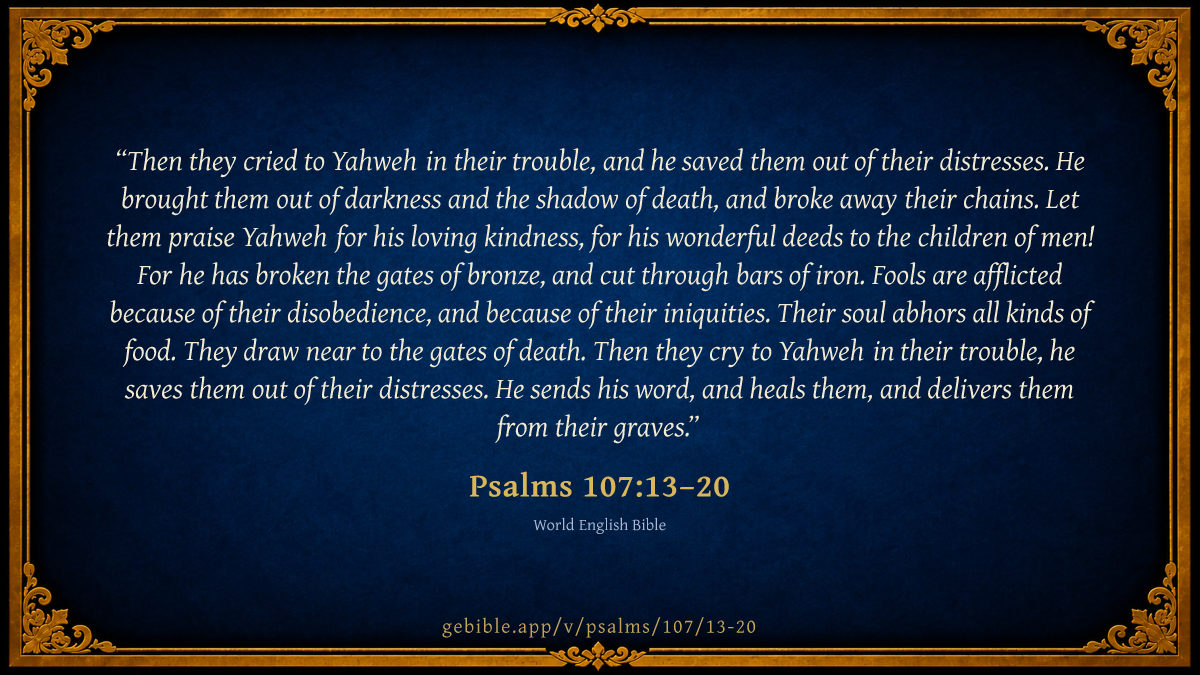
Psalms 107:19(v13)Then they cry to Yahweh in their trouble, he saves them out of their distresses.
Psalms 116:3-6(v13)The cords of death surrounded me, the pains of Sheol got a hold of me. I found trouble and sorrow. Then I called on Yahweh’s name: “Yahweh,…
Isaiah 61:1(v14)The Lord Yahweh’s Spirit is on me, because Yahweh has anointed me to preach good news to the humble. He has sent me to bind up the broken…
Jeremiah 52:31-34(v14)In the thirty-seventh year of the captivity of Jehoiachin king of Judah, in the twelfth month, in the twenty-fifth day of the month,…
Judges 10:10-18(v13)The children of Israel cried to Yahweh, saying, “We have sinned against you, even because we have forsaken our God, and have served the…
2 Chronicles 33:18-19(v13)Now the rest of the acts of Manasseh, and his prayer to his God, and the words of the seers who spoke to him in the name of Yahweh, the God…
Jeremiah 31:18-20(v13)“I have surely heard Ephraim grieving thus, ‘You have chastised me, and I was chastised, as an untrained calf. Turn me, and I will be…
Acts 5:19(v14)But an angel of the Lord opened the prison doors by night, and brought them out and said,
Job 36:8(v14)If they are bound in fetters, and are taken in the cords of afflictions,
Job 42:10-12(v14)Yahweh turned the captivity of Job, when he prayed for his friends. Yahweh gave Job twice as much as he had before. Then came there to him…
Psalms 68:6(v14)God sets the lonely in families. He brings out the prisoners with singing, but the rebellious dwell in a sun-scorched land.
Psalms 102:20(v14)to hear the groans of the prisoner; to free those who are condemned to death;
Psalms 105:19-20(v14)until the time that his word happened, and Yahweh’s word proved him true. The king sent and freed him, even the ruler of peoples, and let…
Luke 13:16(v14)Ought not this woman, being a daughter of Abraham whom Satan had bound eighteen long years, be freed from this bondage on the Sabbath day?”
Acts 5:25(v14)One came and told them, “Behold, the men whom you put in prison are in the temple, standing and teaching the people.”
Judges 16:3(v16)Samson lay until midnight, then arose at midnight and took hold of the doors of the gate of the city, with the two posts, and plucked them…
Job 3:5(v14)Let darkness and the shadow of death claim it for their own. Let a cloud dwell on it. Let all that makes black the day terrify it.
Job 10:21-22(v14)before I go where I will not return from, to the land of darkness and of the shadow of death; the land dark as midnight, of the shadow of…
Job 33:30(v14)to bring back his soul from the pit, that he may be enlightened with the light of the living.
Psalms 9:13(v18)Have mercy on me, Yahweh. See my affliction by those who hate me, and lift me up from the gates of death,
Psalms 78:34-35(v19)When he killed them, then they inquired after him. They returned and sought God earnestly. They remembered that God was their rock, the…
Psalms 88:3(v18)For my soul is full of troubles. My life draws near to Sheol.
Psalms 146:7(v14)who executes justice for the oppressed; who gives food to the hungry. Yahweh frees the prisoners.
Isaiah 49:9(v14)saying to those who are bound, ‘Come out!’; to those who are in darkness, ‘Show yourselves!’ “They shall feed along the paths, and their…
Isaiah 60:1-3(v14)“Arise, shine; for your light has come, and Yahweh’s glory has risen on you. For, behold, darkness will cover the earth, and thick darkness…
Lamentations 3:39(v17)Why does a living man complain, a man for the punishment of his sins?
Acts 12:7-10(v14)And behold, an angel of the Lord stood by him, and a light shone in the cell. He struck Peter on the side, and woke him up, saying, “Stand…
Acts 16:26-40(v14)Suddenly there was a great earthquake, so that the foundations of the prison were shaken; and immediately all the doors were opened, and…
Job 15:30(v14)He will not depart out of darkness. The flame will dry up his branches. He will go away by the breath of God’s mouth.
Job 19:8(v14)He has walled up my way so that I can’t pass, and has set darkness in my paths.
Job 33:19-22(v18)He is chastened also with pain on his bed, with continual strife in his bones, so that his life abhors bread, and his soul dainty food. His…
Psalms 34:4-6(v19)I sought Yahweh, and he answered me, and delivered me from all my fears. They looked to him, and were radiant. Their faces shall never be…
Psalms 107:21(v15)Let them praise Yahweh for his loving kindness, for his wonderful deeds to the children of men!
Micah 2:13(v16)He who breaks open the way goes up before them. They break through the gate, and go out. And their king passes on before them, with Yahweh…
Psalms 30:8-12(v19)I cried to you, Yahweh. I made supplication to the Lord: “What profit is there in my destruction, if I go down to the pit? Shall the dust…
Psalms 107:8(v15)Let them praise Yahweh for his loving kindness, for his wonderful deeds to the children of men!
Psalms 107:13(v19)Then they cried to Yahweh in their trouble, and he saved them out of their distresses.
Psalms 107:31(v15)Let them praise Yahweh for his loving kindness, for his wonderful deeds for the children of men!
Psalms 116:4-8(v19)Then I called on Yahweh’s name: “Yahweh, I beg you, deliver my soul.” Yahweh is Gracious and righteous. Yes, our God is merciful. Yahweh…
Proverbs 1:22(v17)“How long, you simple ones, will you love simplicity? How long will mockers delight themselves in mockery, and fools hate knowledge?
Isaiah 38:10(v18)I said, “In the middle of my life I go into the gates of Sheol. I am deprived of the residue of my years.”
Numbers 11:33-34(v17)While the meat was still between their teeth, before it was chewed, Yahweh’s anger burned against the people, and Yahweh struck the people…
Numbers 21:5-9(v17)The people spoke against God and against Moses: “Why have you brought us up out of Egypt to die in the wilderness? For there is no bread,…
Job 38:17(v18)Have the gates of death been revealed to you? Or have you seen the gates of the shadow of death?
Psalms 14:1(v17)The fool has said in his heart, “There is no God.” They are corrupt. They have done abominable deeds. There is no one who does good.
Psalms 38:1-8(v17)Yahweh, don’t rebuke me in your wrath, neither chasten me in your hot displeasure. For your arrows have pierced me, your hand presses hard…
Psalms 92:6(v17)A senseless man doesn’t know, neither does a fool understand this:
Psalms 116:17-19(v15)I will offer to you the sacrifice of thanksgiving, and will call on Yahweh’s name. I will pay my vows to Yahweh, yes, in the presence of…
Proverbs 7:7(v17)I saw among the simple ones. I discerned among the youths a young man void of understanding,
Isaiah 57:17-18(v17)I was angry because of the iniquity of his covetousness and struck him. I hid myself and was angry; and he went on backsliding in the way…
Isaiah 65:6-7(v17)“Behold, it is written before me: I will not keep silence, but will repay, yes, I will repay into their bosom, your own iniquities, and the…
Jeremiah 2:19(v17)“Your own wickedness will correct you, and your backsliding will rebuke you. Know therefore and see that it is an evil and bitter thing,…
Jeremiah 33:3(v19)‘Call to me, and I will answer you, and will show you great and difficult things, which you don’t know.’
Numbers 12:10-13(v17)The cloud departed from over the Tent; and behold, Miriam was leprous, as white as snow. Aaron looked at Miriam, and behold, she was…
Job 15:22(v14)He doesn’t believe that he will return out of darkness. He is waited for by the sword.
Proverbs 7:22(v17)He followed her immediately, as an ox goes to the slaughter, as a fool stepping into a noose.
82 distinct cross-references across this passage (84 total citations).
Cross-references from openbible.info (CC BY 4.0)
Explain this passage (19 sources)
Historical commentary, presented as a primary source — not an endorsement.
John Calvin1540 · Public DomainOn vv17, 2017 Fools are afflicted on account of the way…
17 Fools are afflicted on account of the way of their transgression. He comes to another species of chastisement. For as he observed above, that those were given over to captivity who refused to yield obedience to God, so now he teaches that others have been visited by God with disease, as the fruit of their transgressions. And when the transgressor shall find that it is God who is administering correction to him, this will pave the way for his arriving at the knowledge of his grace.
He denominates those fools, who, thoughtlessly giving themselves up to sensuality, bring destruction upon themselves. The sin which they commit is not the result of ignorance and error only, but of their carnal affections, which depriving them of proper understanding, cause them to devise things detrimental to themselves. The maxim, that the fear of God is wisdom, must never be lost sight of. Hence it plainly follows, that they who shake off the yoke of God, and surrender themselves to Satan and sin, are the victims of their own folly and fury. And as constituting a principal ingredient of this madness, the prophet employs the term deletion or transgression; and subsequently he adds iniquities; because it happens that when once a man departs from God, from that moment he loses all self-control, and falls from one sin into another. But it is not of the distempers which commonly prevail in the world to which a reference is made in this passage, but to those which are deemed fatal, and in which all hope of life is abandoned, so that the grace of God becomes the more conspicuous when deliverance from them is obtained. When a man recovers from a slight indisposition, he does not so plainly discern the effects of God’s power, as when it is put forth in a wonderful and notable manner to bring back some from the gates of death, and restores them to their wonted health and rigour. He says, therefore, that they are preserved from many corruptions, which is equivalent to his saying, that they are delivered from as many deaths. To this purport are the following words of the prophet, in which he says, that they approach the gates of death, and that they loathe all food We have already adverted to their calling upon God, namely, that when men are reduced to the greatest straits, they, by thus calling upon God for aid, acknowledge that they would be undone unless he wonderfully interposed for their deliverance.
John Calvin's Commentaries (1540-1563) — public domain. Text from the Calvin Translation Society English edition (1840s-50s) via the Christian Classics Ethereal Library (ccel.org). Calvin's coverage is partial (roughly two-thirds of the Bible); uncommented books and verses are honest gaps, never fabricated. The 19th-century editor's footnotes and remarks are omitted so the notes are faithfully Calvin's own voice.
Geneva Bible translators1599 · Public DomainOn vv13, 16, 17, 20He showeth that the cause why God doth punish…
He showeth that the cause why God doth punish us extremely, is because we can be brought unto him by none other means.
Geneva Bible (1599) marginal notes — public domain.
John Trapp1656 · Public DomainOn vv13–20Psa 107:13 Then they cried unto the LORD in…
Psa 107:13 Then they cried unto the LORD in their trouble, [and] he saved them out of their distresses.
Ver. 13. Then they cried unto the Lord] See Psa 107:6.
Read full note →
And he saved them, &c.] This is comfort to the greatest sinners; if they can but find a praying heart, God will find a pitying heart, and rebels shall be received with all sweetness, if at length they return, though brought in by the cross.
John Trapp, A Commentary or Exposition upon All the Books of the Old and New Testament (1647–1656) — public domain. Text from a community e-Sword module.
Matthew Poole1685 · Public DomainOn vv16, 17, 18, 20He restored them to liberty in spite of all…
He restored them to liberty in spite of all impediments and oppositions.
Matthew Poole's English Annotations on the Holy Bible (1683–1685) — public domain. Text from a community e-Sword/MySword module.
Matthew Henry1710 · Public DomainOn v17Bodily sickness is another of the calamities of this…
Bodily sickness is another of the calamities of this life which gives us an opportunity of experiencing the goodness of God in recovering us, and of that the psalmist speaks in these verses, where we may observe,
I. That we, by our sins, bring sickness upon ourselves and then it is our duty to pray, Psa 107:17-19. 1. It is the sin of the soul that is the cause of sickness; we bring it upon ourselves both meritoriously and efficiently: Fools, because of their transgression, are thus afflicted; they are thus corrected for the sins they have committed and thus cured of their evil inclinations to sin. If we knew no sin, we should know no sickness; but the transgression of our life, and the iniquity of our heart, make it necessary. Sinners are fools; they wrong themselves, and all against their own interest, not only their spiritual, but their secular interest. They prejudice their bodily health by intemperance and endanger their lives by indulging their appetites. This their way is their folly, and they need the rod of correction to drive out the foolishness that is bound up in their hearts. 2. The weakness of the body is the effect of sickness, Psa 107:18. When people are sick their soul abhors all manner of meat; they not only have no desire to eat nor power to digest it, but they nauseate it, and their stomach is turned against it. And here they may read their sin in their punishment: those that doted most on the meat that perishes, when they come to be sick are sick of it, and the dainties they loved are loathed; what they took too much of now they can take nothing of, which commonly follows upon the overcharging of the heart with surfeiting and drunkenness. And when the appetite is gone the life is as good as gone: They draw near unto the gates of death; they are, in their own apprehension and in the apprehension of all about them, at the brink of the grave, as ready to be turned to destruction. 3. Then is a proper time for prayer: Then they cry unto the Lord, Psa 107:19. Is any sick? Let him pray; let him be prayed for. Prayer is a salve for every sore.
Read full note →
II. That it is by the power and mercy of God that we are recovered from sickness, and then it is our duty to be thankful. Compare with this Job 33:18, Job 33:28. 1. When those that are sick call upon God he returns them an answer of peace. They cry unto him and he saves them out of their distresses (Psa 107:19); he removes their griefs and prevents their fears. (1.) He does it easily: He sent his word and healed them, Psa 107:20. This may be applied to the miraculous cures which Christ wrought when he was upon earth, by a word's speaking; he said, Be clean, Be whole, and the work was done. It may also be applied to the spiritual cures which the Spirit of grace works in regeneration; he sends his word, and heals souls, convinces, converts, sanctifies them, and all by the word. In the common instances of recovery from sickness God in his providence does but speak, and it is done. (2.) He does it effectually: He delivereth them out of their destructions, that they shall neither be destroyed nor distressed with the fear of being so. Nothing is too hard for that God to do who kills and makes alive again, brings down to the grave and raises up, who turneth man almost to destruction, and yet saith, Return. 2. When those that have been sick are restored they must return to God an answer of praise (Psa 107:21, Psa 107:22): Let all men praise the Lord for his goodness, and let those, particularly, to whom God has thus granted a new life, spend it in his service; let them sacrifice with thanksgiving, not only bring a thank-offering to the altar, but a thankful heart to God. Thanksgivings are the best thank-offerings, and shall please the Lord better than an ox or bullock. And let them declare his works with rejoicing, to his honour and for the encouragement of others. The living, the living, they shall praise him.
Matthew Henry's Commentary on the Whole Bible (1708–1710) — public domain (CC PDM 1.0). Text via the HelloAO Bible API.
John Gill1763 · Public DomainOn vv13–20O that men would praise the Lord for his…
O that men would praise the Lord for his goodness,.... Or, "confess to the Lord his goodness or grace", or "mercy" (g); own and acknowledge it, in delivering them from such a state of darkness and death, of thraldom and captivity; see Rom 6:17.
And for his wonderful works to the children of men! or, "confess" them before them; relate and declare them to them, what wonderful things he has done for them; that they may be affected with them, and that they may praise his name together; See Gill on Psa 107:9.
Read full note →
(g) So Pagninus, Montanus, Cocceius, Michaelis.
John Gill's Exposition of the Whole Bible (1746–1763) — public domain (CC PDM 1.0). Text via the HelloAO Bible API.
John Wesley1765 · Public DomainOn vv17, 20Afflicted - With sickness.
Afflicted - With sickness.
John Wesley, Explanatory Notes Upon the Whole Bible (1754–1765) — public domain. Text via the GEBible commentary corpus.
Adam Clarke1810 · Public DomainOn vv13–20Verse 13. Then they cried unto the Lord in…
Verse 13. Then they cried unto the Lord in their trouble] This was the salutary effect which their afflictions produced: they began to cry to God for mercy and help; and God mercifully heard their prayer, and reversed their state; for,
Adam Clarke's Commentary on the Bible (1810–1826) — public domain. Text from a community e-Sword/MySword module.
Joseph Benson1811 · Public DomainOn v17Psa 107:17-22. Fools — That is, wicked men whom…
Psa 107:17-22. Fools — That is, wicked men whom he calls fools, because through their own sin and folly they wrong themselves, and act against their own interest; not only their spiritual, but their secular interest; they often even prejudice their bodily health by their intemperance, and endanger their lives by indulging their appetites and fleshly lusts, as well as bring upon themselves many other evils and miseries: because of their transgressions — Hebrew, מדרךְ פשׁעם, because of the way of their transgressions, that is, their custom and course of sinning, as the word way is often used; are afflicted — With wasting sickness, as appears from Psa 107:18; Psa 107:20. Their soul abhorreth all manner of meat — They not only have no desire for it, nor power to digest it, but they nauseate it; nay, they loathe and detest the very sight and smell of that which should nourish and support them; in which case, if not relieved, they must waste away, and soon draw near to the gates of death. But from those dreadful gates the power of God can snatch them, when they are just about to enter them. “To an infirm and emaciated body he can restore health; strength, and beauty; for diseases are his ministers and messengers; they visit us at his command, and at his command they retire, and we recover again. Now here, namely, in the recovery of men from sickness, we have a third image of the benefits conferred on our nature by the Redeemer. “The mind of man,” we must remember, “by reason of sin, is not less subject to infirmities than his body; these infirmities reduce him to a state of languor and listlessness; he finds himself incapable of action, indisposed for the reception of divine truths, without taste for knowledge, or inclination for virtue; he even nauseates the book of God, and the bread of heaven; and the life of faith is in great danger. But the case is not desperate, while there is breath enough left to call in, by prayer, the Physician of spirits. The most inveterate malady gives place to his efficacious medicines; appetite revives, health returns, and the believer is reinstated in the vigour and beauty of holiness. Let all, who have been thus healed and saved from destruction, either of body or soul, acknowledge to Jehovah his mercy, and his wonders wrought for the children of Adam; let them sacrifice the sacrifices of thanksgiving, and declare his works with rejoicing.” — Horne.
Joseph Benson's Commentary on the Old and New Testaments (1811–1818) — public domain. Text from a community e-Sword module.
Albert Barnes1834 · Public DomainOn vv13–20Then they cried unto the Lord in their trouble…
Then they cried unto the Lord in their trouble - Compare Dan. 9. This is repeated in the psalm in Psa 107:6, Psa 107:13, Psa 107:19, Psa 107:28 - in all the divisions of the psalm except the last. See the notes at Psa 107:6.
Albert Barnes' Notes on the Bible (1834–1885) — public domain. Text from a community e-Sword/MySword module.
Daniel D. Whedon1874 · Public DomainOn vv13, 14, 16, 17, 18, 2013. Then they cried unto the Lord—Their repentance comes…
13. Then they cried unto the Lord—Their repentance comes in their extremity. See Luk_15:17, and note on Psa_78:34
Daniel D. Whedon (gen. ed.), Commentary on the Old and New Testaments (1874–1909) — public domain. Text from a community e-Sword module.
The Cambridge Bible for Schools and Colleges1878 · Public DomainOn vv15, 16, 17, 18, 2015. Let them give thanks to Jehovah for his…
15. Let them give thanks to Jehovah for his lovingkindness,
And for his wonderful works to the sons of men.
The Cambridge Bible for Schools and Colleges (gen. ed. J. J. S. Perowne; Cambridge University Press, 1878–1918) — public domain. Text from a community e-Sword module.
Ellicott's Commentary for English Readers1878 · Public DomainOn vv14, 15, 16, 17, 18, 20(14) Break their bands in sunder.—See Psa_2:3.
(14) Break their bands in sunder.—See Psa_2:3.
A Bible Commentary for English Readers, edited by Charles John Ellicott (1878–1897) — public domain. Text from a community e-Sword module.
The Pulpit Commentary1880 · Public DomainOn vv13–20Then they cried unto the Lord in their trouble,…
Then they cried unto the Lord in their trouble, and he saved them out of their distresses (comp. ver. 6, and see also vers. 19 and 28).
Prayer for temporal good.
Read full note →
The trouble was trouble in their outward circumstances. The cry was a prayer. The answer was a gracious Divine dealing with these troublous circumstances. Whatever may be urged against its reasonableness, the fact cannot be gainsaid that Bible men and women did pray to God about their material needs, and did find those needs supplied after prayer. The philosophy may be beyond us; the fact is plain. "This psalm teaches us not only that God"s providence watches over men, but that his ear is open to their prayers. It teaches us that prayer may be put up for temporal deliverance, and that such prayer is answered. It teaches us that it is right to acknowledge with thanksgiving such answers to our petitions. This was the simple faith of the Hebrew poet.
I PRAYER FOR TEMPORAL GOOD IS NATURAL. It is a natural impulse which every one feels; even the atheist feels it in the time of shipwreck. It is natural to man
(1) as a creature, having creature-wants for which it cannot itself secure the supply;
(2) as a child, who has a stronger impression of material than of spiritual need. All natural impulses have a sound basis. There is that in God which responds to them.
II PRAYER FOR TEMPORAL GOOD IS REASONABLE. Because we can see that forces are continually acting upon and modifying forces (as when I raise my arm, and make vital force counteract the natural force of gravitation); and no man has any right to say that prayer is not a higher force, which can modify, or lead to the modifying, of both vital and physical forces. Prayer may set moving the Divine forces which control and readjust the working of the material forces. It is often said that natural law never changes; but it needs to be seen that natural laws are always cross-working, and even preverting, each other"s working It cannot be unreasonable to conceive of the Divine will as a controlling law, working in material spheres.
III PRAYER FOR TEMPORAL GOOD IS ACCEPTABLE. This may be shown by several considerations.
1. God, in every age, has asked it of man. Referable to outward needs, he says, "For all this will I be inquired of by the house of Israel, to do it for them.
2. Man, in every age, has prayed about such things. Illustrate by instances taken from each period of Bible history. There are supreme cases in which men have even given up working, prayed and waited for God to act. It is unfair to give such cases no consideration.
3. God has, in every age, interfered in men"s lives, in order to answer their prayers. "This poor man cried, and the Lord heard, and saved him out of all his troubles. R.T.
The Pulpit Commentary (1880–1919), ed. H.D.M. Spence-Jones & Joseph S. Exell — public domain. Text from a community e-Sword module.
Charles H. Spurgeon1885 · Public DomainOn vv13–20Ver. 13. Then they cried unto the Lord in…
Ver. 13. Then they cried unto the Lord in their trouble. Not a prayer till then. While there was any to help below they would not look above. No cries till their hearts were brought down and their hopes were all deadthen they cried, but not before. So many a man offers what he calls prayer when he is in good case and thinks well of himself, but in very deed the only real cry to God is that which is forced out of him by a sense of utter helplessness and misery. We pray best when we are fallen on our faces in painful helplessness.
And he saved them out of their distresses. Speedily and willingly he sent relief. They were long before they cried, but he was not long before he saved. They had applied everywhere else before they came to him, but when they did address themselves to him, they were welcome at once. He who saved men in the open wilderness can also save in the close prison: bolts and bars cannot shut him out, nor long shut in his redeemed ones.
Read full note →
Ver. 13. Man's work and God's work. They cried and He saved.
Psalms 107:14*
Charles H. Spurgeon's The Treasury of David (1869–1885) — public domain. Psalms only. Text from a community e-Sword/MySword module.
The Biblical Illustrator1887 · Public DomainOn vv14, 17, 20He brought them out of darkness and the shadow…
Psa_107:14-16
He brought them out of darkness and the shadow of death.
Read full note →
Song for the free, and hope for the bound
The deliverance here intended is one which is brought to us by redemption, and comes by the way of the great sacrifice upon Calvary.
I. Who are these favoured men?
1. Guilty men (verse 11). Hear this, ye sinful ones, and take heart! God has wrought great wonders for a people whom it seemed impossible for Him to notice. If they came into prison through rebellion, you would expect Him to leave them there. Yet rebels are set free by an act of immeasurable grace. The Redeemer has received gifts for men, yea, for the rebellious also.
2. Doomed men (verse 10). It is your condemned condition which needs free mercy; and, behold, the Lord meets your need in His boundless grace!
3. Bound men (verse 10). You long to be delivered, but you are unable to cut the cords which hold you. Jesus Christ has come on purpose that He might proclaim the opening of the prisons to them that are bound.
4. Weary men (verse 12). Come unto Me, etc.
5. Downcast men (verse 12). The Lord Jesus delights to lift up those that lie at His feet.
6. Helpless men. What a word that is--None to help! The proverb says, God helps those that help themselves. There is a sort of truth in it; but I venture to cover it with a far greater truth: God helps those that cannot help themselves. When there is none to help thee, then God will help thee.
7. They did at last take to praying (verse 13). There is that about prayer which makes it a token for good, a pledge of blessings on the road, a door of hope in dark hours. Where is the man that cries? Where is the man that prays? That is the man of whom it shall be said, and of others like him, The Lord brought them out of darkness and the shadow of death, etc.
II. How has this deliverance been wrought?
1. By the Lord Himself. There is no salvation worth the having which has not the hand of the Godhead in it. None but the Trinity can deliver a captive soul from the chains of sin, and death, and hell.
2. Next, the Lord did it alone He hath broken the gates of brass. Nobody else was there to aid in liberating the prisoner. When our Lord Jesus trod the winepress, He was alone. When the Spirit of God came to work in us eternal life, He wrought alone.
3. By the Lords own goodness. He gives the alms of His grace only to the undeserving.
4. Most completely--light, life, and liberty.
5. Everlastingly. O child of God, you were once shut up as with gates of brass, and bars of iron, and the devil thinks that one of these days he will get you behind those gates again! But he never will, for the Lord hath broken the gates of brass. The means of our captivity are no longer available.
III. What is to be done about this?
1. If the Lord has set any of you free--record it. Say, The Lord hath done great things for us.
2. When you have recorded it, then praise God with all your heart, every one of you, every day. When you have praised God yourselves, then entreat others to join with you. The oratorio of Gods praise needs a full choir. (C. H. Spurgeon.)
The Biblical Illustrator, edited by Joseph S. Exell (c. 1880s–1900s) — public domain. Text from a community e-Sword module.
Paul E. Kretzmann1924 · Public DomainOn v17The next section treats of those who foolishly bring…
The next section treats of those who foolishly bring misery upon themselves by willful indulgence in sin.
v. 17. Fools because of their transgression, men devoid of proper mentality, as they prove themselves to be by indulging in sins which invariably carry their own punishment with them, like immorality and intemperance, and because of their iniquities, are affiliated. A person yielding to every sensual and sensuous desire, setting aside all sanity and deliberately ruining his health and risking his reputation, will find himself subject to many burdens of punishment, even in this world.
Read full note →
v. 18. Their soul abhorreth all manner of meat, foods which they formerly delighted in now fill their souls with disgust and loathing; and they draw near unto the gates of death.
v. 19. Then they cry unto the Lord in their trouble, having been brought to the knowledge of their sin by the severity of the punishment which struck them, and He saveth them out of their distresses, delivering them out of the tight place into which their foolishness wedged them.
v. 20. He sent His Word and healed them, the healing of the soul through the application of the Word being the chief step in the great Physician’s treatment, and delivered them from their destructions, permitting them to escape out of the pits which their own lack of sense had dug for them.
v. 21. Oh, that men, such as have had experiences of this kind, would praise the Lord for His goodness and for His wonderful works to the children of men! v. 8.
v. 22. And let them sacrifice the sacrifices of thanksgiving, in seeking most earnestly to be united with Jehovah in the fellowship of faith and love, and declare His works with rejoicing, proclaiming the fact of their deliverance from the misery into which their own fault had plunged them. This attitude is all the more necessary in the case of such people, since their shame is usually known in a community, and they are obliged to live down their past.
Paul E. Kretzmann, Popular Commentary of the Bible (1921–1924) — public domain. Text from a community e-Sword module.
unfoldingWord translationNotes2017 · CC BY-SA 4.0On vv14, 17, 20He brought them
He brought them
"Yahweh brought those in prison"
Read full note →
darkness and gloom
Both "darkness" and "gloom" have basically the same meaning and are used to emphasize how dark the prison was. See how you translated this in Psalms 107:10. AT: "complete darkness" (See: Doublet)
Oh that people would praise Yahweh for his covenant faithfulness
Here the word "Oh" is used to convey a strong desire for people to praise Yahweh. The abstract noun "faithfulness" can be translated with an adjective. See how you translated this in Psalms 107:8. AT: "Let people praise Yahweh because he is faithful to his covenant" or "People should praise Yahweh because he is faithful to his covenant" (See: Exclamations and Abstract Nouns)
For he
"because he"
For he has broken the gates of bronze and cut through the bars of iron
Both of these phrases describe Yahweh freeing his people from prison and are used to emphasize that Yahweh truly freed them. AT: "He freed his people from prison" (See: Parallelism and Assumed Knowledge and Implicit Information)
John Calvin 1540 · Public Domain On vv17, 20 17 Fools are afflicted on account of the way…
17 Fools are afflicted on account of the way of their transgression. He comes to another species of chastisement. For as he observed above, that those were given over to captivity who refused to yield obedience to God, so now he teaches that others have been visited by God with disease, as the fruit of their transgressions. And when the transgressor shall find that it is God who is administering correction to him, this will pave the way for his arriving at the knowledge of his grace.
He denominates those fools, who, thoughtlessly giving themselves up to sensuality, bring destruction upon themselves. The sin which they commit is not the result of ignorance and error only, but of their carnal affections, which depriving them of proper understanding, cause them to devise things detrimental to themselves. The maxim, that the fear of God is wisdom, must never be lost sight of. Hence it plainly follows, that they who shake off the yoke of God, and surrender themselves to Satan and sin, are the victims of their own folly and fury. And as constituting a principal ingredient of this madness, the prophet employs the term deletion or transgression; and subsequently he adds iniquities; because it happens that when once a man departs from God, from that moment he loses all self-control, and falls from one sin into another. But it is not of the distempers which commonly prevail in the world to which a reference is made in this passage, but to those which are deemed fatal, and in which all hope of life is abandoned, so that the grace of God becomes the more conspicuous when deliverance from them is obtained. When a man recovers from a slight indisposition, he does not so plainly discern the effects of God’s power, as when it is put forth in a wonderful and notable manner to bring back some from the gates of death, and restores them to their wonted health and rigour. He says, therefore, that they are preserved from many corruptions, which is equivalent to his saying, that they are delivered from as many deaths. To this purport are the following words of the prophet, in which he says, that they approach the gates of death, and that they loathe all food We have already adverted to their calling upon God, namely, that when men are reduced to the greatest straits, they, by thus calling upon God for aid, acknowledge that they would be undone unless he wonderfully interposed for their deliverance.
John Calvin's Commentaries (1540-1563) — public domain. Text from the Calvin Translation Society English edition (1840s-50s) via the Christian Classics Ethereal Library (ccel.org). Calvin's coverage is partial (roughly two-thirds of the Bible); uncommented books and verses are honest gaps, never fabricated. The 19th-century editor's footnotes and remarks are omitted so the notes are faithfully Calvin's own voice.
Geneva Bible translators 1599 · Public Domain On vv13, 16, 17, 20 He showeth that the cause why God doth punish…
He showeth that the cause why God doth punish us extremely, is because we can be brought unto him by none other means.
Geneva Bible (1599) marginal notes — public domain.
John Trapp 1656 · Public Domain On vv13–20 Psa 107:13 Then they cried unto the LORD in…
Psa 107:13 Then they cried unto the LORD in their trouble, [and] he saved them out of their distresses.
Ver. 13. Then they cried unto the Lord] See Psa 107:6.
Read full note →
And he saved them, &c.] This is comfort to the greatest sinners; if they can but find a praying heart, God will find a pitying heart, and rebels shall be received with all sweetness, if at length they return, though brought in by the cross.
John Trapp, A Commentary or Exposition upon All the Books of the Old and New Testament (1647–1656) — public domain. Text from a community e-Sword module.
Matthew Poole 1685 · Public Domain On vv16, 17, 18, 20 He restored them to liberty in spite of all…
He restored them to liberty in spite of all impediments and oppositions.
Matthew Poole's English Annotations on the Holy Bible (1683–1685) — public domain. Text from a community e-Sword/MySword module.
Matthew Henry 1710 · Public Domain On v17 Bodily sickness is another of the calamities of this…
Bodily sickness is another of the calamities of this life which gives us an opportunity of experiencing the goodness of God in recovering us, and of that the psalmist speaks in these verses, where we may observe,
I. That we, by our sins, bring sickness upon ourselves and then it is our duty to pray, Psa 107:17-19. 1. It is the sin of the soul that is the cause of sickness; we bring it upon ourselves both meritoriously and efficiently: Fools, because of their transgression, are thus afflicted; they are thus corrected for the sins they have committed and thus cured of their evil inclinations to sin. If we knew no sin, we should know no sickness; but the transgression of our life, and the iniquity of our heart, make it necessary. Sinners are fools; they wrong themselves, and all against their own interest, not only their spiritual, but their secular interest. They prejudice their bodily health by intemperance and endanger their lives by indulging their appetites. This their way is their folly, and they need the rod of correction to drive out the foolishness that is bound up in their hearts. 2. The weakness of the body is the effect of sickness, Psa 107:18. When people are sick their soul abhors all manner of meat; they not only have no desire to eat nor power to digest it, but they nauseate it, and their stomach is turned against it. And here they may read their sin in their punishment: those that doted most on the meat that perishes, when they come to be sick are sick of it, and the dainties they loved are loathed; what they took too much of now they can take nothing of, which commonly follows upon the overcharging of the heart with surfeiting and drunkenness. And when the appetite is gone the life is as good as gone: They draw near unto the gates of death; they are, in their own apprehension and in the apprehension of all about them, at the brink of the grave, as ready to be turned to destruction. 3. Then is a proper time for prayer: Then they cry unto the Lord, Psa 107:19. Is any sick? Let him pray; let him be prayed for. Prayer is a salve for every sore.
Read full note →
II. That it is by the power and mercy of God that we are recovered from sickness, and then it is our duty to be thankful. Compare with this Job 33:18, Job 33:28. 1. When those that are sick call upon God he returns them an answer of peace. They cry unto him and he saves them out of their distresses (Psa 107:19); he removes their griefs and prevents their fears. (1.) He does it easily: He sent his word and healed them, Psa 107:20. This may be applied to the miraculous cures which Christ wrought when he was upon earth, by a word's speaking; he said, Be clean, Be whole, and the work was done. It may also be applied to the spiritual cures which the Spirit of grace works in regeneration; he sends his word, and heals souls, convinces, converts, sanctifies them, and all by the word. In the common instances of recovery from sickness God in his providence does but speak, and it is done. (2.) He does it effectually: He delivereth them out of their destructions, that they shall neither be destroyed nor distressed with the fear of being so. Nothing is too hard for that God to do who kills and makes alive again, brings down to the grave and raises up, who turneth man almost to destruction, and yet saith, Return. 2. When those that have been sick are restored they must return to God an answer of praise (Psa 107:21, Psa 107:22): Let all men praise the Lord for his goodness, and let those, particularly, to whom God has thus granted a new life, spend it in his service; let them sacrifice with thanksgiving, not only bring a thank-offering to the altar, but a thankful heart to God. Thanksgivings are the best thank-offerings, and shall please the Lord better than an ox or bullock. And let them declare his works with rejoicing, to his honour and for the encouragement of others. The living, the living, they shall praise him.
Matthew Henry's Commentary on the Whole Bible (1708–1710) — public domain (CC PDM 1.0). Text via the HelloAO Bible API.
John Gill 1763 · Public Domain On vv13–20 O that men would praise the Lord for his…
O that men would praise the Lord for his goodness,.... Or, "confess to the Lord his goodness or grace", or "mercy" (g); own and acknowledge it, in delivering them from such a state of darkness and death, of thraldom and captivity; see Rom 6:17.
And for his wonderful works to the children of men! or, "confess" them before them; relate and declare them to them, what wonderful things he has done for them; that they may be affected with them, and that they may praise his name together; See Gill on Psa 107:9.
Read full note →
(g) So Pagninus, Montanus, Cocceius, Michaelis.
John Gill's Exposition of the Whole Bible (1746–1763) — public domain (CC PDM 1.0). Text via the HelloAO Bible API.
John Wesley 1765 · Public Domain On vv17, 20 Afflicted - With sickness.
Afflicted - With sickness.
John Wesley, Explanatory Notes Upon the Whole Bible (1754–1765) — public domain. Text via the GEBible commentary corpus.
Adam Clarke 1810 · Public Domain On vv13–20 Verse 13. Then they cried unto the Lord in…
Verse 13. Then they cried unto the Lord in their trouble] This was the salutary effect which their afflictions produced: they began to cry to God for mercy and help; and God mercifully heard their prayer, and reversed their state; for,
Adam Clarke's Commentary on the Bible (1810–1826) — public domain. Text from a community e-Sword/MySword module.
Joseph Benson 1811 · Public Domain On v17 Psa 107:17-22. Fools — That is, wicked men whom…
Psa 107:17-22. Fools — That is, wicked men whom he calls fools, because through their own sin and folly they wrong themselves, and act against their own interest; not only their spiritual, but their secular interest; they often even prejudice their bodily health by their intemperance, and endanger their lives by indulging their appetites and fleshly lusts, as well as bring upon themselves many other evils and miseries: because of their transgressions — Hebrew, מדרךְ פשׁעם, because of the way of their transgressions, that is, their custom and course of sinning, as the word way is often used; are afflicted — With wasting sickness, as appears from Psa 107:18; Psa 107:20. Their soul abhorreth all manner of meat — They not only have no desire for it, nor power to digest it, but they nauseate it; nay, they loathe and detest the very sight and smell of that which should nourish and support them; in which case, if not relieved, they must waste away, and soon draw near to the gates of death. But from those dreadful gates the power of God can snatch them, when they are just about to enter them. “To an infirm and emaciated body he can restore health; strength, and beauty; for diseases are his ministers and messengers; they visit us at his command, and at his command they retire, and we recover again. Now here, namely, in the recovery of men from sickness, we have a third image of the benefits conferred on our nature by the Redeemer. “The mind of man,” we must remember, “by reason of sin, is not less subject to infirmities than his body; these infirmities reduce him to a state of languor and listlessness; he finds himself incapable of action, indisposed for the reception of divine truths, without taste for knowledge, or inclination for virtue; he even nauseates the book of God, and the bread of heaven; and the life of faith is in great danger. But the case is not desperate, while there is breath enough left to call in, by prayer, the Physician of spirits. The most inveterate malady gives place to his efficacious medicines; appetite revives, health returns, and the believer is reinstated in the vigour and beauty of holiness. Let all, who have been thus healed and saved from destruction, either of body or soul, acknowledge to Jehovah his mercy, and his wonders wrought for the children of Adam; let them sacrifice the sacrifices of thanksgiving, and declare his works with rejoicing.” — Horne.
Joseph Benson's Commentary on the Old and New Testaments (1811–1818) — public domain. Text from a community e-Sword module.
Albert Barnes 1834 · Public Domain On vv13–20 Then they cried unto the Lord in their trouble…
Then they cried unto the Lord in their trouble - Compare Dan. 9. This is repeated in the psalm in Psa 107:6, Psa 107:13, Psa 107:19, Psa 107:28 - in all the divisions of the psalm except the last. See the notes at Psa 107:6.
Albert Barnes' Notes on the Bible (1834–1885) — public domain. Text from a community e-Sword/MySword module.
Daniel D. Whedon 1874 · Public Domain On vv13, 14, 16, 17, 18, 20 13. Then they cried unto the Lord—Their repentance comes…
13. Then they cried unto the Lord—Their repentance comes in their extremity. See Luk_15:17, and note on Psa_78:34
Daniel D. Whedon (gen. ed.), Commentary on the Old and New Testaments (1874–1909) — public domain. Text from a community e-Sword module.
The Cambridge Bible for Schools and Colleges 1878 · Public Domain On vv15, 16, 17, 18, 20 15. Let them give thanks to Jehovah for his…
15. Let them give thanks to Jehovah for his lovingkindness,
And for his wonderful works to the sons of men.
The Cambridge Bible for Schools and Colleges (gen. ed. J. J. S. Perowne; Cambridge University Press, 1878–1918) — public domain. Text from a community e-Sword module.
Ellicott's Commentary for English Readers 1878 · Public Domain On vv14, 15, 16, 17, 18, 20 (14) Break their bands in sunder.—See Psa_2:3.
(14) Break their bands in sunder.—See Psa_2:3.
A Bible Commentary for English Readers, edited by Charles John Ellicott (1878–1897) — public domain. Text from a community e-Sword module.
The Pulpit Commentary 1880 · Public Domain On vv13–20 Then they cried unto the Lord in their trouble,…
Then they cried unto the Lord in their trouble, and he saved them out of their distresses (comp. ver. 6, and see also vers. 19 and 28).
Prayer for temporal good.
Read full note →
The trouble was trouble in their outward circumstances. The cry was a prayer. The answer was a gracious Divine dealing with these troublous circumstances. Whatever may be urged against its reasonableness, the fact cannot be gainsaid that Bible men and women did pray to God about their material needs, and did find those needs supplied after prayer. The philosophy may be beyond us; the fact is plain. "This psalm teaches us not only that God"s providence watches over men, but that his ear is open to their prayers. It teaches us that prayer may be put up for temporal deliverance, and that such prayer is answered. It teaches us that it is right to acknowledge with thanksgiving such answers to our petitions. This was the simple faith of the Hebrew poet.
I PRAYER FOR TEMPORAL GOOD IS NATURAL. It is a natural impulse which every one feels; even the atheist feels it in the time of shipwreck. It is natural to man
(1) as a creature, having creature-wants for which it cannot itself secure the supply;
(2) as a child, who has a stronger impression of material than of spiritual need. All natural impulses have a sound basis. There is that in God which responds to them.
II PRAYER FOR TEMPORAL GOOD IS REASONABLE. Because we can see that forces are continually acting upon and modifying forces (as when I raise my arm, and make vital force counteract the natural force of gravitation); and no man has any right to say that prayer is not a higher force, which can modify, or lead to the modifying, of both vital and physical forces. Prayer may set moving the Divine forces which control and readjust the working of the material forces. It is often said that natural law never changes; but it needs to be seen that natural laws are always cross-working, and even preverting, each other"s working It cannot be unreasonable to conceive of the Divine will as a controlling law, working in material spheres.
III PRAYER FOR TEMPORAL GOOD IS ACCEPTABLE. This may be shown by several considerations.
1. God, in every age, has asked it of man. Referable to outward needs, he says, "For all this will I be inquired of by the house of Israel, to do it for them.
2. Man, in every age, has prayed about such things. Illustrate by instances taken from each period of Bible history. There are supreme cases in which men have even given up working, prayed and waited for God to act. It is unfair to give such cases no consideration.
3. God has, in every age, interfered in men"s lives, in order to answer their prayers. "This poor man cried, and the Lord heard, and saved him out of all his troubles. R.T.
The Pulpit Commentary (1880–1919), ed. H.D.M. Spence-Jones & Joseph S. Exell — public domain. Text from a community e-Sword module.
Charles H. Spurgeon 1885 · Public Domain On vv13–20 Ver. 13. Then they cried unto the Lord in…
Ver. 13. Then they cried unto the Lord in their trouble. Not a prayer till then. While there was any to help below they would not look above. No cries till their hearts were brought down and their hopes were all deadthen they cried, but not before. So many a man offers what he calls prayer when he is in good case and thinks well of himself, but in very deed the only real cry to God is that which is forced out of him by a sense of utter helplessness and misery. We pray best when we are fallen on our faces in painful helplessness.
And he saved them out of their distresses. Speedily and willingly he sent relief. They were long before they cried, but he was not long before he saved. They had applied everywhere else before they came to him, but when they did address themselves to him, they were welcome at once. He who saved men in the open wilderness can also save in the close prison: bolts and bars cannot shut him out, nor long shut in his redeemed ones.
Read full note →
Ver. 13. Man's work and God's work. They cried and He saved.
Psalms 107:14*
Charles H. Spurgeon's The Treasury of David (1869–1885) — public domain. Psalms only. Text from a community e-Sword/MySword module.
The Biblical Illustrator 1887 · Public Domain On vv14, 17, 20 He brought them out of darkness and the shadow…
Psa_107:14-16
He brought them out of darkness and the shadow of death.
Read full note →
Song for the free, and hope for the bound
The deliverance here intended is one which is brought to us by redemption, and comes by the way of the great sacrifice upon Calvary.
I. Who are these favoured men?
1. Guilty men (verse 11). Hear this, ye sinful ones, and take heart! God has wrought great wonders for a people whom it seemed impossible for Him to notice. If they came into prison through rebellion, you would expect Him to leave them there. Yet rebels are set free by an act of immeasurable grace. The Redeemer has received gifts for men, yea, for the rebellious also.
2. Doomed men (verse 10). It is your condemned condition which needs free mercy; and, behold, the Lord meets your need in His boundless grace!
3. Bound men (verse 10). You long to be delivered, but you are unable to cut the cords which hold you. Jesus Christ has come on purpose that He might proclaim the opening of the prisons to them that are bound.
4. Weary men (verse 12). Come unto Me, etc.
5. Downcast men (verse 12). The Lord Jesus delights to lift up those that lie at His feet.
6. Helpless men. What a word that is--None to help! The proverb says, God helps those that help themselves. There is a sort of truth in it; but I venture to cover it with a far greater truth: God helps those that cannot help themselves. When there is none to help thee, then God will help thee.
7. They did at last take to praying (verse 13). There is that about prayer which makes it a token for good, a pledge of blessings on the road, a door of hope in dark hours. Where is the man that cries? Where is the man that prays? That is the man of whom it shall be said, and of others like him, The Lord brought them out of darkness and the shadow of death, etc.
II. How has this deliverance been wrought?
1. By the Lord Himself. There is no salvation worth the having which has not the hand of the Godhead in it. None but the Trinity can deliver a captive soul from the chains of sin, and death, and hell.
2. Next, the Lord did it alone He hath broken the gates of brass. Nobody else was there to aid in liberating the prisoner. When our Lord Jesus trod the winepress, He was alone. When the Spirit of God came to work in us eternal life, He wrought alone.
3. By the Lords own goodness. He gives the alms of His grace only to the undeserving.
4. Most completely--light, life, and liberty.
5. Everlastingly. O child of God, you were once shut up as with gates of brass, and bars of iron, and the devil thinks that one of these days he will get you behind those gates again! But he never will, for the Lord hath broken the gates of brass. The means of our captivity are no longer available.
III. What is to be done about this?
1. If the Lord has set any of you free--record it. Say, The Lord hath done great things for us.
2. When you have recorded it, then praise God with all your heart, every one of you, every day. When you have praised God yourselves, then entreat others to join with you. The oratorio of Gods praise needs a full choir. (C. H. Spurgeon.)
The Biblical Illustrator, edited by Joseph S. Exell (c. 1880s–1900s) — public domain. Text from a community e-Sword module.
Paul E. Kretzmann 1924 · Public Domain On v17 The next section treats of those who foolishly bring…
The next section treats of those who foolishly bring misery upon themselves by willful indulgence in sin.
v. 17. Fools because of their transgression, men devoid of proper mentality, as they prove themselves to be by indulging in sins which invariably carry their own punishment with them, like immorality and intemperance, and because of their iniquities, are affiliated. A person yielding to every sensual and sensuous desire, setting aside all sanity and deliberately ruining his health and risking his reputation, will find himself subject to many burdens of punishment, even in this world.
Read full note →
v. 18. Their soul abhorreth all manner of meat, foods which they formerly delighted in now fill their souls with disgust and loathing; and they draw near unto the gates of death.
v. 19. Then they cry unto the Lord in their trouble, having been brought to the knowledge of their sin by the severity of the punishment which struck them, and He saveth them out of their distresses, delivering them out of the tight place into which their foolishness wedged them.
v. 20. He sent His Word and healed them, the healing of the soul through the application of the Word being the chief step in the great Physician’s treatment, and delivered them from their destructions, permitting them to escape out of the pits which their own lack of sense had dug for them.
v. 21. Oh, that men, such as have had experiences of this kind, would praise the Lord for His goodness and for His wonderful works to the children of men! v. 8.
v. 22. And let them sacrifice the sacrifices of thanksgiving, in seeking most earnestly to be united with Jehovah in the fellowship of faith and love, and declare His works with rejoicing, proclaiming the fact of their deliverance from the misery into which their own fault had plunged them. This attitude is all the more necessary in the case of such people, since their shame is usually known in a community, and they are obliged to live down their past.
Paul E. Kretzmann, Popular Commentary of the Bible (1921–1924) — public domain. Text from a community e-Sword module.
unfoldingWord translationNotes 2017 · CC BY-SA 4.0 On vv14, 17, 20 He brought them
He brought them
"Yahweh brought those in prison"
Read full note →
darkness and gloom
Both "darkness" and "gloom" have basically the same meaning and are used to emphasize how dark the prison was. See how you translated this in Psalms 107:10. AT: "complete darkness" (See: Doublet)
Oh that people would praise Yahweh for his covenant faithfulness
Here the word "Oh" is used to convey a strong desire for people to praise Yahweh. The abstract noun "faithfulness" can be translated with an adjective. See how you translated this in Psalms 107:8. AT: "Let people praise Yahweh because he is faithful to his covenant" or "People should praise Yahweh because he is faithful to his covenant" (See: Exclamations and Abstract Nouns)
For he
"because he"
For he has broken the gates of bronze and cut through the bars of iron
Both of these phrases describe Yahweh freeing his people from prison and are used to emphasize that Yahweh truly freed them. AT: "He freed his people from prison" (See: Parallelism and Assumed Knowledge and Implicit Information)
translationWords
darkness
bind
covenant faithfulness
amazed
gate
bronze
unfoldingWord translationNotes — © Distant Shores Media and the Door43 World Missions Community, licensed CC BY-SA 4.0. Source: git.door43.org/Door43/en_tn.
Tyndale Open Study Notes 2022 · CC BY-SA 4.0 On vv17, 20 107:17-22 Fools who received what they deserved but were…
107:17-22 Fools who received what they deserved but were rescued from death offer thanksgiving to the Lord.
Tyndale Open Study Notes — © Tyndale Open Resources, licensed CC BY-SA 4.0. Text via the HelloAO Bible API.