Matthew 8:8(v20)The centurion answered, “Lord, I’m not worthy for you to come under my roof. Just say the word, and my servant will be healed.
Psalms 103:3-4(v20)who forgives all your sins, who heals all your diseases, who redeems your life from destruction, who crowns you with loving kindness and…
Psalms 147:15(v20)He sends out his commandment to the earth. His word runs very swiftly.
Psalms 147:3(v20)He heals the broken in heart, and binds up their wounds.
2 Kings 20:4-5(v20)Before Isaiah had gone out into the middle part of the city, Yahweh’s word came to him, saying, “Turn back, and tell Hezekiah the prince of…
Show all 25 cross-references
Job 33:28-30(v20)He has redeemed my soul from going into the pit. My life will see the light.’ “Behold, God does all these things, twice, yes three times,…
Psalms 56:13(v20)For you have delivered my soul from death, and prevented my feet from falling, that I may walk before God in the light of the living.
Psalms 147:18-19(v20)He sends out his word, and melts them. He causes his wind to blow, and the waters flow. He shows his word to Jacob, his statutes and his…
Job 33:23-26(v20)“If there is beside him an angel, an interpreter, one among a thousand, to show to man what is right for him; then God is gracious to him,…
Psalms 30:2-3(v20)Yahweh my God, I cried to you, and you have healed me. Yahweh, you have brought up my soul from Sheol. You have kept me alive, that I…
Psalms 49:15(v20)But God will redeem my soul from the power of Sheol, for he will receive me.
Numbers 21:8-9(v20)Yahweh said to Moses, “Make a venomous snake, and set it on a pole. It shall happen that everyone who is bitten, when he sees it, shall…
Psalms 9:13(v18)Have mercy on me, Yahweh. See my affliction by those who hate me, and lift me up from the gates of death,
Psalms 78:34-35(v19)When he killed them, then they inquired after him. They returned and sought God earnestly. They remembered that God was their rock, the…
Psalms 88:3(v18)For my soul is full of troubles. My life draws near to Sheol.
Job 33:19-22(v18)He is chastened also with pain on his bed, with continual strife in his bones, so that his life abhors bread, and his soul dainty food. His…
Psalms 34:4-6(v19)I sought Yahweh, and he answered me, and delivered me from all my fears. They looked to him, and were radiant. Their faces shall never be…
Psalms 30:8-12(v19)I cried to you, Yahweh. I made supplication to the Lord: “What profit is there in my destruction, if I go down to the pit? Shall the dust…
Psalms 107:6(v19)Then they cried to Yahweh in their trouble, and he delivered them out of their distresses,
Psalms 107:13(v19)Then they cried to Yahweh in their trouble, and he saved them out of their distresses.
Psalms 116:4-8(v19)Then I called on Yahweh’s name: “Yahweh, I beg you, deliver my soul.” Yahweh is Gracious and righteous. Yes, our God is merciful. Yahweh…
Isaiah 38:10(v18)I said, “In the middle of my life I go into the gates of Sheol. I am deprived of the residue of my years.”
Job 38:17(v18)Have the gates of death been revealed to you? Or have you seen the gates of the shadow of death?
Psalms 107:28(v19)Then they cry to Yahweh in their trouble, and he brings them out of their distress.
Jeremiah 33:3(v19)‘Call to me, and I will answer you, and will show you great and difficult things, which you don’t know.’
Cross-references from openbible.info (CC BY 4.0)
Explain this passage (16 sources)
Historical commentary, presented as a primary source — not an endorsement.
John Calvin1540 · Public DomainOn v2020 He sendeth his word. Again, in saying that…
20 He sendeth his word. Again, in saying that they are delivered from destruction, the prophet shows that he is here alluding to those diseases which, in the opinion of men, are incurable, and from which few are delivered. Besides, he contrasts God’s assistance with all the remedies which are in the power of man to apply; as if he should say, that their disease having baffled the skill of earthly physicians, their recovery has been entirely owing to the exertion of God’s power. It is proper also to notice the manner in which their recovery is effected; God has but to will it, or to speak the word, and instantly all diseases, and even death itself, are expelled. I do not regard this as exclusively referring to the faithful, as many expositors do. I own, indeed, that it is of comparatively little consequence to us to be the subjects of bodily care, if our souls still remain unsanctified by the word of God; and hence it is the intention of the prophet that we consider the mercy of God as extending to the evil and unthankful. The meaning of the passage, therefore, is, that diseases neither come upon us by chance, nor are to be ascribed to natural causes alone, but are to be viewed as God’s messengers executing his commands; so that we must believe that the same person that sent them can easily remove them, and for this purpose he has only to speak the word. And since we now perceive the drift of the passage, we ought to attend to the very appropriate analogy contained in it. Corporeal maladies are not removed except by the word or command of God, much less are men’s souls restored to the enjoyment of spiritual life, except this word be apprehended by faith.
John Calvin's Commentaries (1540-1563) — public domain. Text from the Calvin Translation Society English edition (1840s-50s) via the Christian Classics Ethereal Library (ccel.org). Calvin's coverage is partial (roughly two-thirds of the Bible); uncommented books and verses are honest gaps, never fabricated. The 19th-century editor's footnotes and remarks are omitted so the notes are faithfully Calvin's own voice.
Geneva Bible translators1599 · Public DomainOn v20Meaning, their diseases, which had almost brought them to…
Meaning, their diseases, which had almost brought them to the grave and corruption.
By healing them he declareth his good will toward them.
Geneva Bible (1599) marginal notes — public domain.
John Trapp1656 · Public DomainOn vv18–20Psa 107:18 Their soul abhorreth all manner of meat;…
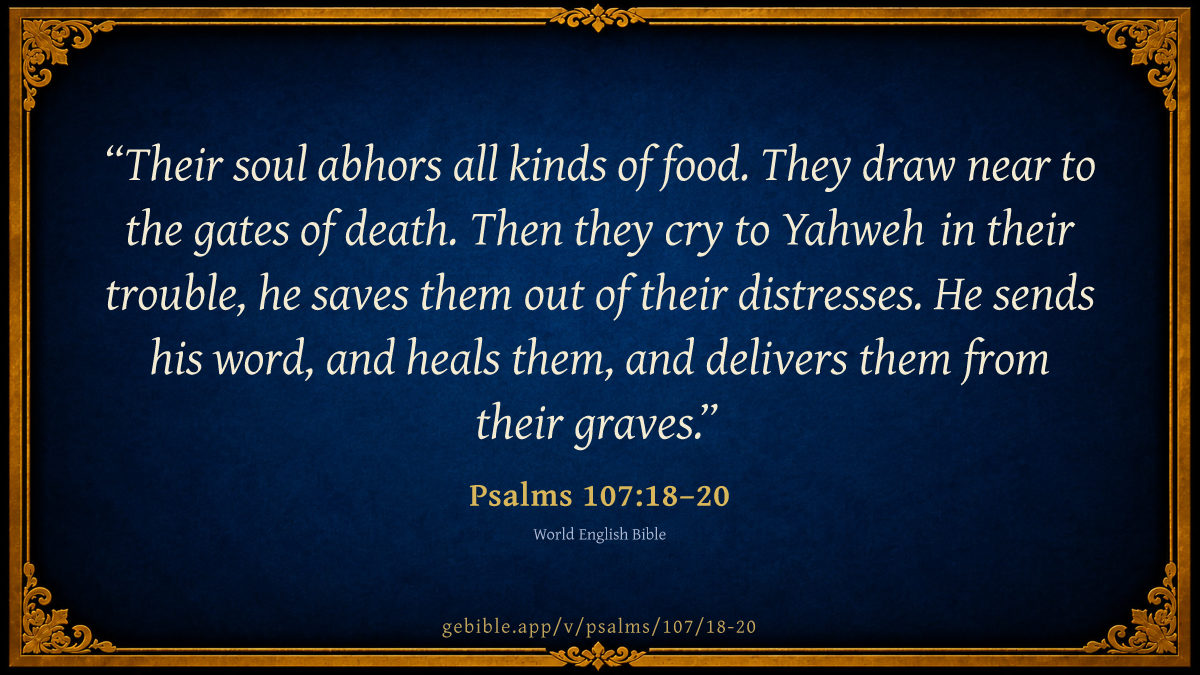
Psa 107:18 Their soul abhorreth all manner of meat; and they draw near unto the gates of death.
Ver. 18. Their soul abhorreth] That is, their stomach loatheth it as unsavoury, though it be never so dainty: an appetite to our meat is an inconconceivable mercy, and, as we say, a sign of health.
Read full note →
And they draw near unto the gates of death] Iam ipsum mortis limen pulsant; as till then little sense of sin or fear of the wrath to come. See Job 30:19-23. {See Trapp on "Job 30:19"} {See Trapp on "Job 30:20"} {See Trapp on "Job 30:21"} {See Trapp on "Job 30:22"} {See Trapp on "Job 30:23"}
John Trapp, A Commentary or Exposition upon All the Books of the Old and New Testament (1647–1656) — public domain. Text from a community e-Sword module.
Matthew Poole1685 · Public DomainOn vv18, 20Their soul; either themselves with all their soul; or…
Their soul; either themselves with all their soul; or their appetite, as the soul is taken, Job 33:20; Isa 29:8. Abhorreth all manner of meat; which is a Usual effect of great sickness. They draw near unto the gates of death; they are sick well nigh unto death.
Matthew Poole's English Annotations on the Holy Bible (1683–1685) — public domain. Text from a community e-Sword/MySword module.
John Gill1763 · Public DomainOn vv18–20Oh that men would praise the Lord for his…
Oh that men would praise the Lord for his goodness,.... Both in restoring to bodily health, which is an instance of divine goodness; and in healing the diseases of the soul, or in the pardon of sin, which is according to the multitude of his mercies, and the riches of his grace.
And for his wonderful works to the children of men; bodily health is sometimes restored in a wonderful manner, when all means used are without success, and the prescriptions of doctors fail; and pardon of sin is a wonder of grace now, and will be to all eternity; and for these things praise ought to be given to the Lord, and they should be declared to men for his glory.
John Gill's Exposition of the Whole Bible (1746–1763) — public domain (CC PDM 1.0). Text via the HelloAO Bible API.
John Wesley1765 · Public DomainOn v20Word - His command, or blessing.
Word - His command, or blessing.
John Wesley, Explanatory Notes Upon the Whole Bible (1754–1765) — public domain. Text via the GEBible commentary corpus.
Adam Clarke1810 · Public DomainOn vv18–20Verse 18. Their soul abhorreth all manner of meat]…
Verse 18. Their soul abhorreth all manner of meat] A natural description of a sick man: appetite is gone, and all desire for food fails; nutriment is no longer necessary, for death has seized upon the whole frame. See a similar image, Job 33:20.
Adam Clarke's Commentary on the Bible (1810–1826) — public domain. Text from a community e-Sword/MySword module.
Albert Barnes1834 · Public DomainOn vv18–20Their soul abhorreth all manner of meat - All…
Their soul abhorreth all manner of meat - All food; all that is to be eaten. The word rendered “abhorreth” is a word which is used with reference to anything that is abominable or loathsome; that from which we turn away with disgust. The language is expressive of sickness, when we loathe all food.
And they draw near unto the gates of death - They are sick, and are ready to die. The reference is to the under world - the world where the dead are supposed to dwell. This is represented here as a city which is entered through gates. See the notes at Psa 9:13.
Albert Barnes' Notes on the Bible (1834–1885) — public domain. Text from a community e-Sword/MySword module.
Daniel D. Whedon1874 · Public DomainOn vv18, 2018. Abhorreth all manner of meat—This description of sickness…
18. Abhorreth all manner of meat—This description of sickness is borrowed from Job_33:20; Job_33:22. Sickness was often regarded as a judgment of God for sin. Psa_38:5.
Gates of death—See Psa_9:13
Daniel D. Whedon (gen. ed.), Commentary on the Old and New Testaments (1874–1909) — public domain. Text from a community e-Sword module.
The Cambridge Bible for Schools and Colleges1878 · Public DomainOn vv18, 2018. Their soul loatheth all manner of food,
18. Their soul loatheth all manner of food,
And they draw nigh unto the gates of death.
Read full note →
Cp. Psa_9:13; Psa_88:3.
For the archaism of P.B.V. ‘hard at death’s door,’ cp. note on Psa_63:8.
The Cambridge Bible for Schools and Colleges (gen. ed. J. J. S. Perowne; Cambridge University Press, 1878–1918) — public domain. Text from a community e-Sword module.
Ellicott's Commentary for English Readers1878 · Public DomainOn vv18, 20(18) Soul.—The Hebrew word for soul is very commonly…
(18) Soul.—The Hebrew word for soul is very commonly used for strong appetite (see Psa_107:9), so that we might paraphrase,” their appetite is turned to loathing.” Comp. this verse with Job_33:20.
A Bible Commentary for English Readers, edited by Charles John Ellicott (1878–1897) — public domain. Text from a community e-Sword module.
The Pulpit Commentary1880 · Public DomainOn vv18–20Their soul abhorreth all manner of meat. (comp. Job_33:20…
Their soul abhorreth all manner of meat. (comp. Job_33:20 Psa_102:4) And they draw near unto the gates of death. See Psa_9:13; and compare Hkw nekrwn keuymwna kai skotou pulav lipwn (Eurip., "Hec.," 1)
The Pulpit Commentary (1880–1919), ed. H.D.M. Spence-Jones & Joseph S. Exell — public domain. Text from a community e-Sword module.
Charles H. Spurgeon1885 · Public DomainOn vv18–20Ver. 18. Their soul abhorreth all manner of meat.…
Ver. 18. Their soul abhorreth all manner of meat. Appetite departs from men when they are sick: the best of food is nauseous to them, their stomach turns against it.
And they draw near unto the gates of death. From want of food, and from the destructive power of their malady, they slide gradually down till they lie at the door of the grave; neither does the skill of the physician suffice to stay their downward progress. As they cannot eat there is no support given to the system, and as the disease rages their little strength is spent in pain and misery. Thus it is with souls afflicted with a sense of sin, they cannot find comfort in the choicest promises, but turn away with loathing even from the gospel, so that they gradually decay into the grave of despair. The mercy is that though near the gates of death they are not yet inside the sepulchre.
Read full note →
Ver. 18. Their soul abhorreth all manner of meat. Nor is it without emphasis that it is not the sick man who is said to spurn food, but his soul...The Hebrew word vpn which properly means a breath, hence a panting appetite, is applied to a very vehement appetite for food. When, therefore, the soul is said to abhor food, it is equivalent to saying for the vehement appetite for food abhors food: that is, in the place of an appetite for food, they are oppressed with a loathing; when they ought to be moved with a sharp desire of food, that their exhausted powers might be refreshed, appetite itself becomes a loathing of food, which is a most vivid description of the utmost loathing, and utter prostration of all desire. Venema.
Ver. 18. Their soul abhorreth all manner of meat. The best of creature comforts are but vain comforts. What can dainty meat do a man good, when he is sick and ready to die? Then gold and silver, lands and houses, which are the dainty meat of a covetous man, are loathsome to him. When a man is sick to death, his very riches are sapless and tasteless to him; wife and children, friends and acquaintance, can yield but little comfort in that dark hour, yea, they often prove miserable comforters: when we have most need of comfort, these things administer least or no comfort at all to us. Is it not our wisdom, then, to get a stock of such comforts, as will hold and abide fresh with us, when all worldly comforts either leave us, or become tasteless to us? Is it not good to get a store of that food, which how sick soever we are, our stomachs will never loathe? yea, the sicker we are, our stomachs will the more like, hunger after, and feed the more heartily upon. The flesh of Christ is meat indeed (Joh 6:55). Feed upon him by faith, in health and sickness, ye will never loathe him. His flesh is the true meat of desires, such meat as will fill and fatten us, but never cloy us. A hungry craving appetite after Christ, and sweet satisfaction in him, are inseparable, and still the stronger is our appetite, the greater is our satisfaction. And (which is yet a greater happiness) our souls will have the strongest appetite, the most sharp set stomach after Christ, when, through bodily sickness, our stomachs cannot take down, but loathe the very scent and sight of the most pleasant perishing meat, and delicious earthly dainties. Look, that ye provide somewhat to eat, that will go down upon a sick bed; your sick bed meat is Christ; all other dainty food may be an abhorring to you. Joseph Caryl.
Ver. 18. Their soul abhorreth all manner of meat. The case is then growing desperate, and there seems to be no hope left, when it comes to the last stage here described, viz., to loathe and "abhor all manner of meat." The stomach turns at the sight of it, and the man has this loathing and abhorrence of "all manner of meat." What he most loved, and had the best appetite for, is now become so very offensive, that at the smell of it he grows sick and faints away. Nature cannot support itself long under this disorder. If this loss of appetite, and loathing even the smell of the most simple food continue, it must wear the patient out. Indeed, it is not always a mortal distemper; there may be an entire loathing of food, and even fainting away at the smell of it, and the patient may sometimes recover; but in the present case the distemper had continued so long, and was grown so inveterate that there were no hopes, for they draw nigh, the Psalmist says, to the gates of death. Those gates of brass and bars of iron with which death locks up his prisoners in the grave; and you may judge how great must be the strength of these gates and bars, since only one person was ever able to break through them, and if he had not been more than man, he could never have broken these gates of brass, nor cut these bars of iron in sunder. William Romaine.
Ver. 18. They draw near unto the gates of death. Death is a great commander, a great tyrant, and hath gates to sit in, as judges and magistrates used to `sit in the gates.' There are three things implied in this phrase.
1. First, "They draw near unto the gates of death", that is, they were "near to death"; as he that draws near the gates of a city is near the city, because the gates enter into the city.
2. Secondly, gates are applied to death for authority. They were almost in death's jurisdiction. Death is a great tyrant. He rules over all the men in the world, over kings and potentates, and over mean men; and the greatest men fear death most. He is "the king of fears", as Job calls him, Job 18:14; aye, and the fear of kings ...Therefore it is called "the gate of death." It rules and overrules all mankind. Therefore it is said "to reign", Ro 5:21. Death and sin came in together. Sin was the gate that let in death, and ever since death reigned, and will, till Christ perfectly triumph over it, who is the King of that lord and commander, and hath "the key of hell and death", Re 1:18. To wicked men, I say, he is a tyrant, and hath a gate; and when they go through the "gate of death", they go to a worse, to a lower place, to hell. It is the trap door to hell.
3. Thirdly. By the "gate of death", is meant not only the authority, but the power of death; as in the gospel, "The gates of hell shall not prevail against it", Mt 16:18; that is, the power and strength of hell. So here it implies the strength of death, which is very great, for it subdues all. It is the executioner of God's justice. Richard Sibbes.
Ver. 18. The sin sick soul without appetite for invitations, encouragements, or promises, however presented. Milk too simple, strong meat too heavy, wine too heating, manna too light, etc.
Ver. 18. Teacheth us, that even appetite to our meat is a good gift of the Lord; also that when men are in greatest extremity, then is God most commonly nigh unto them. T. Wilcocks.
Psalms 107:19*
Charles H. Spurgeon's The Treasury of David (1869–1885) — public domain. Psalms only. Text from a community e-Sword/MySword module.
The Biblical Illustrator1887 · Public DomainOn v20He sent Him word, and healed them.
Psa_107:20
He sent Him word, and healed them.
Read full note →
The healing influence of Gods Word
Those who do not enjoy Divine revelation are in a very miserable state: they sit in darkness and in the shadow of death. Their habitations are full of darkness; their lives are full of sin and misery, and they have no hope in their death; for, where there is no vision the people perish. He sends his word and heals them, and delivers them from their destructions.
I. Some observations concerning the written word of god.
1. It was Divinely inspired.
2. It is necessary to discover unto us most important truths.
3. It is most profitable unto men, for the doctrines which it teaches, for the precious effects which it produces on the hearts of men, and for the reformation which it is calculated to accomplish in the world.
4. The written Word of God may be considered as a sacred trust committed to Christians, to be improved by themselves, and conveyed unto others.
II. The manner in which the Word of God, written and preached, has been sent to man, and how it ought to be sent by us to the heathen, that they may be healed, and delivered from their destructions.
1. The Word of God, written and preached, was sent to man by God Himself.
2. The Lord sends His written and preached Word by the ministers of the Gospel.
3. The Lord sends His Word accompanied with the Divine Spirit, who renders it effectual to salvation.
4. The Word of God should be sent unto the heathen, accompanied with much fervent prayer for its success.
III. Obstructions which the Word of God is calculated to remove. The Word of God is excellently adapted to--
1. Remove out of the world, and from the hearts of men, darkness, ignorance, and superstition.
2. Heal division, and to promote the peace and happiness of civil and religious society.
3. Heal the soul of those injuries which, by sin, it sustains.
4. Produce hope in the soul. (W. Gould.)
Delivered them from their destructions.--
Delivered from destructions
What! Are there many destructions to a man? Oh yes, a great many! I have known one man destroyed by his shop, another by his wife, another by his children. Many a woman is destroyed by her clothes; many a man is destroyed by his eating; millions are destroyed by their drinking. Everything about us will destroy us unless God saves us. There are a thousand gates to hell, though there is only one road to heaven One man may perish by debauchery; another may perish by respectability. One man may be lost in the ale-house; another man may be lost through his teetotalism, if he makes a god of it. One man may go down to hell by his want of common decency, and another by his pride, and prudery, and self-righteousness. Do not deceive yourself--the way to ruin is easy, and many crowd it. A little matter of neglect will land you in hell. But it is not a little matter of thought that will bring you to heaven; there must be a stirring up of the entire soul--an awakening of the whole man to seek after God in Christ Jesus; or else you shall perish. Surrounded, then, with destructions--snares about your bed, snares about your table, snares in your solitude, snares in the street, snares in your shop, snares at dawn of day, and snares at set of sun--you are in awful, terrible danger; and yet persons surrounded with destructions have been saved, and why should not you? They have cried to God in their trouble, and He has delivered them out of their destructions; will He not do the same at your cry? (C. H. Spurgeon.)
The Biblical Illustrator, edited by Joseph S. Exell (c. 1880s–1900s) — public domain. Text from a community e-Sword module.
unfoldingWord translationNotes2017 · CC BY-SA 4.0On v20He sent his word and healed them
He sent his word and healed them
Here David describes Yahweh speaking as sending his words as if they were a messenger. Possible meanings are 1) "He commanded for them to be healed and they were healed" or 2) "He encouraged them and healed them" (See: Personification)
Read full note →
Oh that people would praise Yahweh for his covenant faithfulness
Here the word "Oh" is used to convey a strong desire for people to praise Yahweh. The abstract noun "faithfulness" can be translated with an adjective. See how you translated this in Psalms 107:8. AT: "Let people praise Yahweh because he is faithful to his covenant" or "People should praise Yahweh because he is faithful to his covenant" (See: Exclamations and Abstract Nouns)
Tyndale Open Study Notes2022 · CC BY-SA 4.0On v20107:20 The Lord creates (Gen 1:3) and sustains the…
107:20 The Lord creates (Gen 1:3) and sustains the universe (Heb 1:3) simply by speaking (Ps 147:18); when he speaks, people are also healed (Matt 8:8).
 GEBible — Godless Engineer's Bible App
John Calvin 1540 · Public Domain On v20 20 He sendeth his word. Again, in saying that…
20 He sendeth his word. Again, in saying that they are delivered from destruction, the prophet shows that he is here alluding to those diseases which, in the opinion of men, are incurable, and from which few are delivered. Besides, he contrasts God’s assistance with all the remedies which are in the power of man to apply; as if he should say, that their disease having baffled the skill of earthly physicians, their recovery has been entirely owing to the exertion of God’s power. It is proper also to notice the manner in which their recovery is effected; God has but to will it, or to speak the word, and instantly all diseases, and even death itself, are expelled. I do not regard this as exclusively referring to the faithful, as many expositors do. I own, indeed, that it is of comparatively little consequence to us to be the subjects of bodily care, if our souls still remain unsanctified by the word of God; and hence it is the intention of the prophet that we consider the mercy of God as extending to the evil and unthankful. The meaning of the passage, therefore, is, that diseases neither come upon us by chance, nor are to be ascribed to natural causes alone, but are to be viewed as God’s messengers executing his commands; so that we must believe that the same person that sent them can easily remove them, and for this purpose he has only to speak the word. And since we now perceive the drift of the passage, we ought to attend to the very appropriate analogy contained in it. Corporeal maladies are not removed except by the word or command of God, much less are men’s souls restored to the enjoyment of spiritual life, except this word be apprehended by faith.
John Calvin's Commentaries (1540-1563) — public domain. Text from the Calvin Translation Society English edition (1840s-50s) via the Christian Classics Ethereal Library (ccel.org). Calvin's coverage is partial (roughly two-thirds of the Bible); uncommented books and verses are honest gaps, never fabricated. The 19th-century editor's footnotes and remarks are omitted so the notes are faithfully Calvin's own voice.
Geneva Bible translators 1599 · Public Domain On v20 Meaning, their diseases, which had almost brought them to…
Meaning, their diseases, which had almost brought them to the grave and corruption.
By healing them he declareth his good will toward them.
Geneva Bible (1599) marginal notes — public domain.
John Trapp 1656 · Public Domain On vv18–20 Psa 107:18 Their soul abhorreth all manner of meat;…
Psa 107:18 Their soul abhorreth all manner of meat; and they draw near unto the gates of death.
Ver. 18. Their soul abhorreth] That is, their stomach loatheth it as unsavoury, though it be never so dainty: an appetite to our meat is an inconconceivable mercy, and, as we say, a sign of health.
Read full note →
And they draw near unto the gates of death] Iam ipsum mortis limen pulsant; as till then little sense of sin or fear of the wrath to come. See Job 30:19-23. {See Trapp on "Job 30:19"} {See Trapp on "Job 30:20"} {See Trapp on "Job 30:21"} {See Trapp on "Job 30:22"} {See Trapp on "Job 30:23"}
John Trapp, A Commentary or Exposition upon All the Books of the Old and New Testament (1647–1656) — public domain. Text from a community e-Sword module.
Matthew Poole 1685 · Public Domain On vv18, 20 Their soul; either themselves with all their soul; or…
Their soul; either themselves with all their soul; or their appetite, as the soul is taken, Job 33:20; Isa 29:8. Abhorreth all manner of meat; which is a Usual effect of great sickness. They draw near unto the gates of death; they are sick well nigh unto death.
Matthew Poole's English Annotations on the Holy Bible (1683–1685) — public domain. Text from a community e-Sword/MySword module.
John Gill 1763 · Public Domain On vv18–20 Oh that men would praise the Lord for his…
Oh that men would praise the Lord for his goodness,.... Both in restoring to bodily health, which is an instance of divine goodness; and in healing the diseases of the soul, or in the pardon of sin, which is according to the multitude of his mercies, and the riches of his grace.
And for his wonderful works to the children of men; bodily health is sometimes restored in a wonderful manner, when all means used are without success, and the prescriptions of doctors fail; and pardon of sin is a wonder of grace now, and will be to all eternity; and for these things praise ought to be given to the Lord, and they should be declared to men for his glory.
John Gill's Exposition of the Whole Bible (1746–1763) — public domain (CC PDM 1.0). Text via the HelloAO Bible API.
John Wesley 1765 · Public Domain On v20 Word - His command, or blessing.
Word - His command, or blessing.
John Wesley, Explanatory Notes Upon the Whole Bible (1754–1765) — public domain. Text via the GEBible commentary corpus.
Adam Clarke 1810 · Public Domain On vv18–20 Verse 18. Their soul abhorreth all manner of meat]…
Verse 18. Their soul abhorreth all manner of meat] A natural description of a sick man: appetite is gone, and all desire for food fails; nutriment is no longer necessary, for death has seized upon the whole frame. See a similar image, Job 33:20.
Adam Clarke's Commentary on the Bible (1810–1826) — public domain. Text from a community e-Sword/MySword module.
Albert Barnes 1834 · Public Domain On vv18–20 Their soul abhorreth all manner of meat - All…
Their soul abhorreth all manner of meat - All food; all that is to be eaten. The word rendered “abhorreth” is a word which is used with reference to anything that is abominable or loathsome; that from which we turn away with disgust. The language is expressive of sickness, when we loathe all food.
And they draw near unto the gates of death - They are sick, and are ready to die. The reference is to the under world - the world where the dead are supposed to dwell. This is represented here as a city which is entered through gates. See the notes at Psa 9:13.
Albert Barnes' Notes on the Bible (1834–1885) — public domain. Text from a community e-Sword/MySword module.
Daniel D. Whedon 1874 · Public Domain On vv18, 20 18. Abhorreth all manner of meat—This description of sickness…
18. Abhorreth all manner of meat—This description of sickness is borrowed from Job_33:20; Job_33:22. Sickness was often regarded as a judgment of God for sin. Psa_38:5.
Gates of death—See Psa_9:13
Daniel D. Whedon (gen. ed.), Commentary on the Old and New Testaments (1874–1909) — public domain. Text from a community e-Sword module.
The Cambridge Bible for Schools and Colleges 1878 · Public Domain On vv18, 20 18. Their soul loatheth all manner of food,
18. Their soul loatheth all manner of food,
And they draw nigh unto the gates of death.
Read full note →
Cp. Psa_9:13; Psa_88:3.
For the archaism of P.B.V. ‘hard at death’s door,’ cp. note on Psa_63:8.
The Cambridge Bible for Schools and Colleges (gen. ed. J. J. S. Perowne; Cambridge University Press, 1878–1918) — public domain. Text from a community e-Sword module.
Ellicott's Commentary for English Readers 1878 · Public Domain On vv18, 20 (18) Soul.—The Hebrew word for soul is very commonly…
(18) Soul.—The Hebrew word for soul is very commonly used for strong appetite (see Psa_107:9), so that we might paraphrase,” their appetite is turned to loathing.” Comp. this verse with Job_33:20.
A Bible Commentary for English Readers, edited by Charles John Ellicott (1878–1897) — public domain. Text from a community e-Sword module.
The Pulpit Commentary 1880 · Public Domain On vv18–20 Their soul abhorreth all manner of meat. (comp. Job_33:20…
Their soul abhorreth all manner of meat. (comp. Job_33:20 Psa_102:4) And they draw near unto the gates of death. See Psa_9:13; and compare Hkw nekrwn keuymwna kai skotou pulav lipwn (Eurip., "Hec.," 1)
The Pulpit Commentary (1880–1919), ed. H.D.M. Spence-Jones & Joseph S. Exell — public domain. Text from a community e-Sword module.
Charles H. Spurgeon 1885 · Public Domain On vv18–20 Ver. 18. Their soul abhorreth all manner of meat.…
Ver. 18. Their soul abhorreth all manner of meat. Appetite departs from men when they are sick: the best of food is nauseous to them, their stomach turns against it.
And they draw near unto the gates of death. From want of food, and from the destructive power of their malady, they slide gradually down till they lie at the door of the grave; neither does the skill of the physician suffice to stay their downward progress. As they cannot eat there is no support given to the system, and as the disease rages their little strength is spent in pain and misery. Thus it is with souls afflicted with a sense of sin, they cannot find comfort in the choicest promises, but turn away with loathing even from the gospel, so that they gradually decay into the grave of despair. The mercy is that though near the gates of death they are not yet inside the sepulchre.
Read full note →
Ver. 18. Their soul abhorreth all manner of meat. Nor is it without emphasis that it is not the sick man who is said to spurn food, but his soul...The Hebrew word vpn which properly means a breath, hence a panting appetite, is applied to a very vehement appetite for food. When, therefore, the soul is said to abhor food, it is equivalent to saying for the vehement appetite for food abhors food: that is, in the place of an appetite for food, they are oppressed with a loathing; when they ought to be moved with a sharp desire of food, that their exhausted powers might be refreshed, appetite itself becomes a loathing of food, which is a most vivid description of the utmost loathing, and utter prostration of all desire. Venema.
Ver. 18. Their soul abhorreth all manner of meat. The best of creature comforts are but vain comforts. What can dainty meat do a man good, when he is sick and ready to die? Then gold and silver, lands and houses, which are the dainty meat of a covetous man, are loathsome to him. When a man is sick to death, his very riches are sapless and tasteless to him; wife and children, friends and acquaintance, can yield but little comfort in that dark hour, yea, they often prove miserable comforters: when we have most need of comfort, these things administer least or no comfort at all to us. Is it not our wisdom, then, to get a stock of such comforts, as will hold and abide fresh with us, when all worldly comforts either leave us, or become tasteless to us? Is it not good to get a store of that food, which how sick soever we are, our stomachs will never loathe? yea, the sicker we are, our stomachs will the more like, hunger after, and feed the more heartily upon. The flesh of Christ is meat indeed (Joh 6:55). Feed upon him by faith, in health and sickness, ye will never loathe him. His flesh is the true meat of desires, such meat as will fill and fatten us, but never cloy us. A hungry craving appetite after Christ, and sweet satisfaction in him, are inseparable, and still the stronger is our appetite, the greater is our satisfaction. And (which is yet a greater happiness) our souls will have the strongest appetite, the most sharp set stomach after Christ, when, through bodily sickness, our stomachs cannot take down, but loathe the very scent and sight of the most pleasant perishing meat, and delicious earthly dainties. Look, that ye provide somewhat to eat, that will go down upon a sick bed; your sick bed meat is Christ; all other dainty food may be an abhorring to you. Joseph Caryl.
Ver. 18. Their soul abhorreth all manner of meat. The case is then growing desperate, and there seems to be no hope left, when it comes to the last stage here described, viz., to loathe and "abhor all manner of meat." The stomach turns at the sight of it, and the man has this loathing and abhorrence of "all manner of meat." What he most loved, and had the best appetite for, is now become so very offensive, that at the smell of it he grows sick and faints away. Nature cannot support itself long under this disorder. If this loss of appetite, and loathing even the smell of the most simple food continue, it must wear the patient out. Indeed, it is not always a mortal distemper; there may be an entire loathing of food, and even fainting away at the smell of it, and the patient may sometimes recover; but in the present case the distemper had continued so long, and was grown so inveterate that there were no hopes, for they draw nigh, the Psalmist says, to the gates of death. Those gates of brass and bars of iron with which death locks up his prisoners in the grave; and you may judge how great must be the strength of these gates and bars, since only one person was ever able to break through them, and if he had not been more than man, he could never have broken these gates of brass, nor cut these bars of iron in sunder. William Romaine.
Ver. 18. They draw near unto the gates of death. Death is a great commander, a great tyrant, and hath gates to sit in, as judges and magistrates used to `sit in the gates.' There are three things implied in this phrase.
1. First, "They draw near unto the gates of death", that is, they were "near to death"; as he that draws near the gates of a city is near the city, because the gates enter into the city.
2. Secondly, gates are applied to death for authority. They were almost in death's jurisdiction. Death is a great tyrant. He rules over all the men in the world, over kings and potentates, and over mean men; and the greatest men fear death most. He is "the king of fears", as Job calls him, Job 18:14; aye, and the fear of kings ...Therefore it is called "the gate of death." It rules and overrules all mankind. Therefore it is said "to reign", Ro 5:21. Death and sin came in together. Sin was the gate that let in death, and ever since death reigned, and will, till Christ perfectly triumph over it, who is the King of that lord and commander, and hath "the key of hell and death", Re 1:18. To wicked men, I say, he is a tyrant, and hath a gate; and when they go through the "gate of death", they go to a worse, to a lower place, to hell. It is the trap door to hell.
3. Thirdly. By the "gate of death", is meant not only the authority, but the power of death; as in the gospel, "The gates of hell shall not prevail against it", Mt 16:18; that is, the power and strength of hell. So here it implies the strength of death, which is very great, for it subdues all. It is the executioner of God's justice. Richard Sibbes.
Ver. 18. The sin sick soul without appetite for invitations, encouragements, or promises, however presented. Milk too simple, strong meat too heavy, wine too heating, manna too light, etc.
Ver. 18. Teacheth us, that even appetite to our meat is a good gift of the Lord; also that when men are in greatest extremity, then is God most commonly nigh unto them. T. Wilcocks.
Psalms 107:19*
Charles H. Spurgeon's The Treasury of David (1869–1885) — public domain. Psalms only. Text from a community e-Sword/MySword module.
The Biblical Illustrator 1887 · Public Domain On v20 He sent Him word, and healed them.
Psa_107:20
He sent Him word, and healed them.
Read full note →
The healing influence of Gods Word
Those who do not enjoy Divine revelation are in a very miserable state: they sit in darkness and in the shadow of death. Their habitations are full of darkness; their lives are full of sin and misery, and they have no hope in their death; for, where there is no vision the people perish. He sends his word and heals them, and delivers them from their destructions.
I. Some observations concerning the written word of god.
1. It was Divinely inspired.
2. It is necessary to discover unto us most important truths.
3. It is most profitable unto men, for the doctrines which it teaches, for the precious effects which it produces on the hearts of men, and for the reformation which it is calculated to accomplish in the world.
4. The written Word of God may be considered as a sacred trust committed to Christians, to be improved by themselves, and conveyed unto others.
II. The manner in which the Word of God, written and preached, has been sent to man, and how it ought to be sent by us to the heathen, that they may be healed, and delivered from their destructions.
1. The Word of God, written and preached, was sent to man by God Himself.
2. The Lord sends His written and preached Word by the ministers of the Gospel.
3. The Lord sends His Word accompanied with the Divine Spirit, who renders it effectual to salvation.
4. The Word of God should be sent unto the heathen, accompanied with much fervent prayer for its success.
III. Obstructions which the Word of God is calculated to remove. The Word of God is excellently adapted to--
1. Remove out of the world, and from the hearts of men, darkness, ignorance, and superstition.
2. Heal division, and to promote the peace and happiness of civil and religious society.
3. Heal the soul of those injuries which, by sin, it sustains.
4. Produce hope in the soul. (W. Gould.)
Delivered them from their destructions.--
Delivered from destructions
What! Are there many destructions to a man? Oh yes, a great many! I have known one man destroyed by his shop, another by his wife, another by his children. Many a woman is destroyed by her clothes; many a man is destroyed by his eating; millions are destroyed by their drinking. Everything about us will destroy us unless God saves us. There are a thousand gates to hell, though there is only one road to heaven One man may perish by debauchery; another may perish by respectability. One man may be lost in the ale-house; another man may be lost through his teetotalism, if he makes a god of it. One man may go down to hell by his want of common decency, and another by his pride, and prudery, and self-righteousness. Do not deceive yourself--the way to ruin is easy, and many crowd it. A little matter of neglect will land you in hell. But it is not a little matter of thought that will bring you to heaven; there must be a stirring up of the entire soul--an awakening of the whole man to seek after God in Christ Jesus; or else you shall perish. Surrounded, then, with destructions--snares about your bed, snares about your table, snares in your solitude, snares in the street, snares in your shop, snares at dawn of day, and snares at set of sun--you are in awful, terrible danger; and yet persons surrounded with destructions have been saved, and why should not you? They have cried to God in their trouble, and He has delivered them out of their destructions; will He not do the same at your cry? (C. H. Spurgeon.)
The Biblical Illustrator, edited by Joseph S. Exell (c. 1880s–1900s) — public domain. Text from a community e-Sword module.
unfoldingWord translationNotes 2017 · CC BY-SA 4.0 On v20 He sent his word and healed them
He sent his word and healed them
Here David describes Yahweh speaking as sending his words as if they were a messenger. Possible meanings are 1) "He commanded for them to be healed and they were healed" or 2) "He encouraged them and healed them" (See: Personification)
Read full note →
Oh that people would praise Yahweh for his covenant faithfulness
Here the word "Oh" is used to convey a strong desire for people to praise Yahweh. The abstract noun "faithfulness" can be translated with an adjective. See how you translated this in Psalms 107:8. AT: "Let people praise Yahweh because he is faithful to his covenant" or "People should praise Yahweh because he is faithful to his covenant" (See: Exclamations and Abstract Nouns)
of thanksgiving
"that show that they are thankful"
in singing
"by singing about them"
translationWords
send
word of God
cure
sacrifice
preach
works
unfoldingWord translationNotes — © Distant Shores Media and the Door43 World Missions Community, licensed CC BY-SA 4.0. Source: git.door43.org/Door43/en_tn.
Tyndale Open Study Notes 2022 · CC BY-SA 4.0 On v20 107:20 The Lord creates (Gen 1:3) and sustains the…
107:20 The Lord creates (Gen 1:3) and sustains the universe (Heb 1:3) simply by speaking (Ps 147:18); when he speaks, people are also healed (Matt 8:8).
Tyndale Open Study Notes — © Tyndale Open Resources, licensed CC BY-SA 4.0. Text via the HelloAO Bible API.