
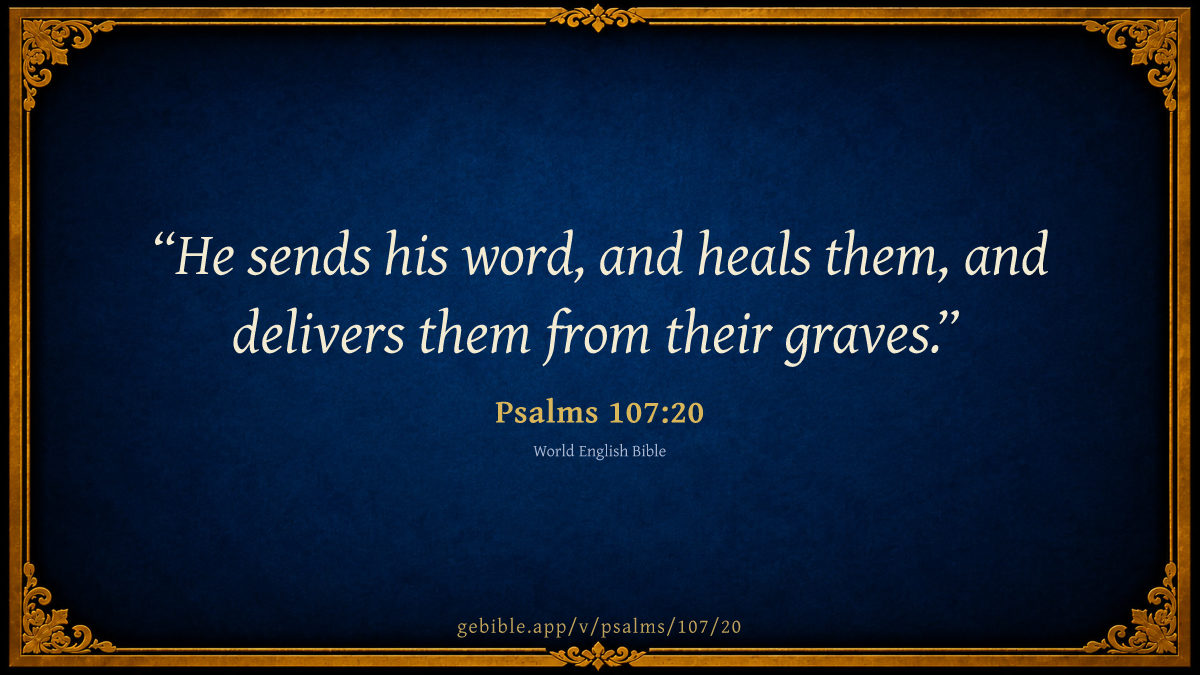
He sends his word, and heals them, and delivers them from their graves.
Parallel Translations
-
He sends his word, and heals them, and delivers them from their graves.
-
He sent his word, and healed them, and delivered them from their destructions.
-
He sent His word, and healed them, and delivered them from their graves.
Cross-references (12)
Passages linked to Psalms 107:20 in the Treasury of Scripture Knowledge, ordered by reader-vote popularity; verse text shown in World English Bible.
- Matthew 8:8 The centurion answered, “Lord, I’m not worthy for you to come under my roof. Just say the word, and my servant will be healed.
- Psalms 103:3-4 who forgives all your sins, who heals all your diseases, who redeems your life from destruction, who crowns you with loving kindness and tender mercies,
- Psalms 147:15 He sends out his commandment to the earth. His word runs very swiftly.
- Psalms 147:3 He heals the broken in heart, and binds up their wounds.
- 2 Kings 20:4-5 Before Isaiah had gone out into the middle part of the city, Yahweh’s word came to him, saying, “Turn back, and tell Hezekiah the prince of my people, ‘Yahweh, the God of David your father, says, “I have heard your prayer. I have seen your tears. Behold, I will heal you. On the third day, you will go up to Yahweh’s house.
- Job 33:28-30 He has redeemed my soul from going into the pit. My life will see the light.’ “Behold, God does all these things, twice, yes three times, with a man, to bring back his soul from the pit, that he may be enlightened with the light of the living.
- Psalms 56:13 For you have delivered my soul from death, and prevented my feet from falling, that I may walk before God in the light of the living.
- Psalms 147:18-19 He sends out his word, and melts them. He causes his wind to blow, and the waters flow. He shows his word to Jacob, his statutes and his ordinances to Israel.
- Job 33:23-26 “If there is beside him an angel, an interpreter, one among a thousand, to show to man what is right for him; then God is gracious to him, and says, ‘Deliver him from going down to the pit, I have found a ransom.’ His flesh will be fresher than a child’s. He returns to the days of his youth. He prays to God, and he is favorable to him, so that he sees his face with joy. He restores to man his righteousness.
- Psalms 30:2-3 Yahweh my God, I cried to you, and you have healed me. Yahweh, you have brought up my soul from Sheol. You have kept me alive, that I should not go down to the pit.
- Psalms 49:15 But God will redeem my soul from the power of Sheol, for he will receive me.
- Numbers 21:8-9 Yahweh said to Moses, “Make a venomous snake, and set it on a pole. It shall happen that everyone who is bitten, when he sees it, shall live.” Moses made a serpent of bronze, and set it on the pole. If a serpent had bitten any man, when he looked at the serpent of bronze, he lived.
Cross-references from openbible.info (CC BY 4.0)
Explain this verse (16 sources)
Historical commentary, presented as a primary source — not an endorsement.
Private notes
Saved on this device only — never synced or sent anywhere.
John Calvin 1540 · Public Domain 20 He sendeth his word. Again, in saying that…
20 He sendeth his word. Again, in saying that they are delivered from destruction, the prophet shows that he is here alluding to those diseases which, in the opinion of men, are incurable, and from which few are delivered. Besides, he contrasts God’s assistance with all the remedies which are in the power of man to apply; as if he should say, that their disease having baffled the skill of earthly physicians, their recovery has been entirely owing to the exertion of God’s power. It is proper also to notice the manner in which their recovery is effected; God has but to will it, or to speak the word, and instantly all diseases, and even death itself, are expelled. I do not regard this as exclusively referring to the faithful, as many expositors do. I own, indeed, that it is of comparatively little consequence to us to be the subjects of bodily care, if our souls still remain unsanctified by the word of God; and hence it is the intention of the prophet that we consider the mercy of God as extending to the evil and unthankful. The meaning of the passage, therefore, is, that diseases neither come upon us by chance, nor are to be ascribed to natural causes alone, but are to be viewed as God’s messengers executing his commands; so that we must believe that the same person that sent them can easily remove them, and for this purpose he has only to speak the word. And since we now perceive the drift of the passage, we ought to attend to the very appropriate analogy contained in it. Corporeal maladies are not removed except by the word or command of God, much less are men’s souls restored to the enjoyment of spiritual life, except this word be apprehended by faith.
John Calvin's Commentaries (1540-1563) — public domain. Text from the Calvin Translation Society English edition (1840s-50s) via the Christian Classics Ethereal Library (ccel.org). Calvin's coverage is partial (roughly two-thirds of the Bible); uncommented books and verses are honest gaps, never fabricated. The 19th-century editor's footnotes and remarks are omitted so the notes are faithfully Calvin's own voice.
Geneva Bible translators 1599 · Public Domain Meaning, their diseases, which had almost brought them to…
Meaning, their diseases, which had almost brought them to the grave and corruption.
By healing them he declareth his good will toward them.
Geneva Bible (1599) marginal notes — public domain.
John Trapp 1656 · Public Domain Psa 107:20 He sent his word, and healed them,…
Psa 107:20 He sent his word, and healed them, and delivered [them] from their destructions.
Ver. 20. He sent his word, and healed them] He commanded deliverance, and it was done; unless there he an allusion to the essential Word, who was afterwards to take flesh, and to heal the diseased.
Read full note →
And delivered them from their destructions] Heb. from their corrupting pits or graves, which do now even gape for them. And he calleth them theirs, quia per peccatum foderunt eas, saith Kimchi, because by their sin themselves have digged them.
John Trapp, A Commentary or Exposition upon All the Books of the Old and New Testament (1647–1656) — public domain. Text from a community e-Sword module.
Matthew Poole 1685 · Public Domain His word; his command, or his blessing, which came…
His word; his command, or his blessing, which came with power.
Matthew Poole's English Annotations on the Holy Bible (1683–1685) — public domain. Text from a community e-Sword/MySword module.
John Gill 1763 · Public Domain They that go down to the sea in ships,....…
They that go down to the sea in ships,.... This is the fourth instance of persons in distress crying to the Lord for help, and, having it, are laid under obligation to praise him; the case of seafaring men: so the Targum introduces it,
"mariners that go down to the sea in ships;''
Read full note →
the same form of expression as here is used in Isa 42:10. Some affirm the sea to be higher than the earth, but by this it should be lower; besides the earth is said to be founded on the seas, which suggests superiority; and all the rivers run into the sea, which supposes a declivity; but, be it so that it is higher than the earth, yet this phrase is to be justified by the shores being higher than the sea, from whence men go down to take shipping, as Kimchi observes; though Kimchi's father is of opinion that it respects persons going down into the ship, which is deep, as Jonah is said to do, Jon 1:3.
That do business in great waters: which refers either to the steering and working of the ship, and everything relating to the management of the ropes and sails, and other affairs; and in a storm much business is done, all hands are employed: or else to the business they go to sea about, as catching fish, curing them, and carrying them to market; or else to traffic and merchandise of goods, they convey from place to place. The phrase is much like that, "as many as trade by sea", Rev 18:17.
John Gill's Exposition of the Whole Bible (1746–1763) — public domain (CC PDM 1.0). Text via the HelloAO Bible API.
John Wesley 1765 · Public Domain Word - His command, or blessing.
Word - His command, or blessing.
John Wesley, Explanatory Notes Upon the Whole Bible (1754–1765) — public domain. Text via the GEBible commentary corpus.
Adam Clarke 1810 · Public Domain Verse 20. He sent his word, and healed them]…
Verse 20. He sent his word, and healed them] He spoke: "Be thou clean, be thou whole;" and immediately the disease departed; and thus they were delivered from the destructions that awaited them.
Adam Clarke's Commentary on the Bible (1810–1826) — public domain. Text from a community e-Sword/MySword module.
Albert Barnes 1834 · Public Domain He sent his word, and healed them - He…
He sent his word, and healed them - He did it by a word; it was necessary for him merely to give a command, and the disease left them. So it was in the life of the Saviour, who often healed the sick by a “word” Mat 8:8; Luk 7:7; and so now restoration from disease often seems to be accomplished as if some word had been spoken by one who had power, commanding the disease to depart. In all cases, also, whatever means may be used, healing power comes from God, and is under his control. Compare Psa 30:2.
And delivered them from their destructions - From what would have destroyed them, if it had not been checked and removed.
Albert Barnes' Notes on the Bible (1834–1885) — public domain. Text from a community e-Sword/MySword module.
Daniel D. Whedon 1874 · Public Domain 20. He sent his word, and healed them— “We…
20. He sent his word, and healed them— “We detect in such passages the first glimmering of St. John’s doctrine of the agency of the personal Word.”—Perowne. See Psa_147:15; Psa_147:18; Isa_55:11 : specially, Job_33:23, where, instead of messenger… interpreter, read an angel… a mediator.
Destructions—The word means pits for catching wild animals or men, as Lam_4:20. But according to Psa_107:18 it here denotes graves, grave-pits.
Daniel D. Whedon (gen. ed.), Commentary on the Old and New Testaments (1874–1909) — public domain. Text from a community e-Sword module.
The Cambridge Bible for Schools and Colleges 1878 · Public Domain 20. He sent &c.] R.V. sendeth … healeth ……
20. He sent &c.] R.V. sendeth … healeth … delivereth. Jehovah’s word is here almost personified as a delivering angel. It is His messenger (Psa_147:15; Psa_147:18), which performs His will (Isa_55:11; cp. Psa_9:8). It is His instrument in His dealings with men (Psa_105:19) as well as in the work of creation (Psa_33:6). Such passages prepare the way for the use in the Targums of the periphrasis ‘the Word of Jehovah’ (Mçmrâ or Dibbûrâ) for Jehovah in His intercourse with men; and for the fuller revelation of the personal Word, the Logos (Joh_1:1). In connexion with this thought, it should be noted that in Job_33:23 the restoration of the sick man to health of mind and body is attributed to the intervention of “an angel, an interpreter” (or mediator).
from their destructions] Lit. pitfalls (Lam_4:20); the graves into which they had all but fallen. Cp. Job_33:18; Job_33:22; Job_33:24; Job_33:28; Psa_103:4.
The Cambridge Bible for Schools and Colleges (gen. ed. J. J. S. Perowne; Cambridge University Press, 1878–1918) — public domain. Text from a community e-Sword module.
Ellicott's Commentary for English Readers 1878 · Public Domain (20) He sent His word.—In history (see Psa_105:19), as…
(20) He sent His word.—In history (see Psa_105:19), as in the natural world (Psa_147:18), God’s word is His messenger. (Comp. Isa_55:10-11.)
Destructions.—This follows the LXX., who derive as in Psa_103:4. A better derivation, however, gives “pits,” either with metaphorical allusion to the “depths” of suffering, or literally, of the “graves” to which the sufferers had drawn near.
A Bible Commentary for English Readers, edited by Charles John Ellicott (1878–1897) — public domain. Text from a community e-Sword module.
The Pulpit Commentary 1880 · Public Domain He sent his word. and healed them; rather, he…
He sent his word. and healed them; rather, he sends Ms word, and heals them (see the Revised Version). The "word" intended may be a message sent by a human messenger, like the "word" sent to Hezekiah in. his sickness; (2Ki_20:4 Isa_38:4) or it may be a thought suggested to the mind either directly by God, or by an angel, like that spoken of in Job_33:23, Job_33:24; or, lastly, it may be the actual Word of God, (Joh_1:1) the Son, sent by the Father. But this last sense can scarcely have been in the writer"s mind. And delivered them from their destructions; or, "from their grave-pits" (Kay, Cheyne). The word used occurs only here and in Lam_4:20, where it is translated pits."
The Pulpit Commentary (1880–1919), ed. H.D.M. Spence-Jones & Joseph S. Exell — public domain. Text from a community e-Sword module.
Charles H. Spurgeon 1885 · Public Domain Ver. 20. He sent his word and healed them.…
Ver. 20. He sent his word and healed them. Man is not healed by medicine alone, but by the word which proceedeth out of the mouth of God is man restored from going down to the grave. A word will do it, a word has done it thousands of times.
And delivered them from their destructions. They escape though dangers had surrounded them, dangers many and deadly. The word of the Lord has a great delivering power; he has but to speak and the armies of death flee in an instant. Sin sick souls should remember the power of the Word, and be much in hearing it and meditating upon it.
Read full note →
Spiritually considered, these verses describe a sin sick soul: foolish but yet aroused to a sense of guilt, it refuses comfort from any and every quarter, and a lethargy of despair utterly paralyses it. To its own apprehension nothing remains but utter destruction in many forms: the gates of death stand open before it, and it is, in its own apprehension, hurried in that direction. Then is the soul driven to cry in the bitterness of its grief unto the Lord, and Christ, the eternal Word, comes with healing power in the direst extremity, saving to the uttermost.
Ver. 20. When George Wishart arrived at Dundee, where the plague was raging (1545), he caused intimation to be made that he would preach; and for that purpose chose his station upon the head of the East gate, the infected persons standing without, and those that were whole within. His text was Ps 107:20, He sent his word and healed them, etc., wherein he treated of the profit and comfort of God's word, the punishment that comes by contempt of it, the readiness of God's mercy to such as truly turn to him, and the happiness of those whom God takes from this misery, etc. By which sermon he so raised up the hearts of those that heard him, that they regarded not death, but judged them more happy that should then depart, rather than such as should remain behind, considering that they knew not whether they should have such a comforter with them. Samuel Clarke (1599-1682), in "A General Martyrologie."
Ver. 20. He sent his word. The same expression occurs in Ps 147:15, 18; compare Isa 55:11. We detect in such passages the first glimmering of St. John's doctrine of the agency of the personal Word. The Word by which the heavens were made, Ps 33:6, is seen to be not merely the expression of God's will, but his messenger mediating between himself and his creatures. It is interesting to compare with this the language of Elihu in the parallel passage of Job 33:23, where what is here ascribed to the agency of the Word is ascribed to that of the "mediating angel, or messenger." J.J. Stewart Perowne.
Ver. 20. His word who healed them was his essential Word, even the second person in the Godhead, our Lord Jesus Christ, the word who was made flesh and dwelt among us: of this divine Word it was foretold in the Old Testament, that he should arise with the glory of the morning sun, bringing healing in his wings for all our maladies; and accordingly the New Testament relates, that Jesus went about all Galilee, preaching the gospel of the kingdom, and healing ALL manner of sickness, and ALL manner of disease among the people. He healed the bodily disease miraculously, to prove that he was the Almighty Physician of the soul. And it is remarkable that he never rejected any person who applied to him for an outward cure, to demonstrate to us, that he would never cast out any person who should apply to him for a spiritual cure. William Romaine.
Ver. 20. And delivered them from their destructions. From their pits: or, From their sepulchres. That is, from the deaths to which they were near. Others render, From their nets or snares, Others, their destructions, the diseases in which they were miserable prisoners. Franciscus Vatablus.
Ver. 20. And delivered them from their destructions. From the destruction of the body, of the beauty and strength of it by diseases; restoring to health is a redeeming of the life from destruction; from the grave, the pit of corruption and destruction, so called because in it bodies corrupt, putrefy, and are destroyed by worms; and such who are savingly convinced of sin, and blessed with pardoning grace and mercy, are delivered from the everlasting destruction of body and soul in hell. John Gill.
Ver. 20. Recovery from sickness must be ascribed to the Lord, and gratitude should flow forth because of it. But the text describes spiritual and mental sickness. Notice,
1. The Patient in his extremity.
(a) He is a fool: by nature inclined to evil.
(b) He has played the fool (see Ps 107:17),
"transgression", "iniquities."
(c) He now has lost all appetite and is past all cure.
(d) He is at death's door.
(e) But he has begun to pray.
2. The Cure in its simplicity.
(a) Christ the Word is the essential cure. He heals the
guilt, habit, depression, and evil results of sin.
For every form of malady Christ has healing; hence
preachers should preach him much, and all meditate
much upon him.
(b) The word in the Book is the instrumental cure: its
teachings, doctrines, precepts, promises,
encouragements, invitations, examples.
(c) The word of the Lord by the Holy Spirit is the
applying cure. He leads us to believe. He is to be
sought by the sick soul. He is to be relied upon by
those who would bring others to the Great Physician.
Psalms 107:21*
Charles H. Spurgeon's The Treasury of David (1869–1885) — public domain. Psalms only. Text from a community e-Sword/MySword module.
The Biblical Illustrator 1887 · Public Domain He sent Him word, and healed them.
Psa_107:20
He sent Him word, and healed them.
Read full note →
The healing influence of Gods Word
Those who do not enjoy Divine revelation are in a very miserable state: they sit in darkness and in the shadow of death. Their habitations are full of darkness; their lives are full of sin and misery, and they have no hope in their death; for, where there is no vision the people perish. He sends his word and heals them, and delivers them from their destructions.
I. Some observations concerning the written word of god.
1. It was Divinely inspired.
2. It is necessary to discover unto us most important truths.
3. It is most profitable unto men, for the doctrines which it teaches, for the precious effects which it produces on the hearts of men, and for the reformation which it is calculated to accomplish in the world.
4. The written Word of God may be considered as a sacred trust committed to Christians, to be improved by themselves, and conveyed unto others.
II. The manner in which the Word of God, written and preached, has been sent to man, and how it ought to be sent by us to the heathen, that they may be healed, and delivered from their destructions.
1. The Word of God, written and preached, was sent to man by God Himself.
2. The Lord sends His written and preached Word by the ministers of the Gospel.
3. The Lord sends His Word accompanied with the Divine Spirit, who renders it effectual to salvation.
4. The Word of God should be sent unto the heathen, accompanied with much fervent prayer for its success.
III. Obstructions which the Word of God is calculated to remove. The Word of God is excellently adapted to--
1. Remove out of the world, and from the hearts of men, darkness, ignorance, and superstition.
2. Heal division, and to promote the peace and happiness of civil and religious society.
3. Heal the soul of those injuries which, by sin, it sustains.
4. Produce hope in the soul. (W. Gould.)
Delivered them from their destructions.--
Delivered from destructions
What! Are there many destructions to a man? Oh yes, a great many! I have known one man destroyed by his shop, another by his wife, another by his children. Many a woman is destroyed by her clothes; many a man is destroyed by his eating; millions are destroyed by their drinking. Everything about us will destroy us unless God saves us. There are a thousand gates to hell, though there is only one road to heaven One man may perish by debauchery; another may perish by respectability. One man may be lost in the ale-house; another man may be lost through his teetotalism, if he makes a god of it. One man may go down to hell by his want of common decency, and another by his pride, and prudery, and self-righteousness. Do not deceive yourself--the way to ruin is easy, and many crowd it. A little matter of neglect will land you in hell. But it is not a little matter of thought that will bring you to heaven; there must be a stirring up of the entire soul--an awakening of the whole man to seek after God in Christ Jesus; or else you shall perish. Surrounded, then, with destructions--snares about your bed, snares about your table, snares in your solitude, snares in the street, snares in your shop, snares at dawn of day, and snares at set of sun--you are in awful, terrible danger; and yet persons surrounded with destructions have been saved, and why should not you? They have cried to God in their trouble, and He has delivered them out of their destructions; will He not do the same at your cry? (C. H. Spurgeon.)
The Biblical Illustrator, edited by Joseph S. Exell (c. 1880s–1900s) — public domain. Text from a community e-Sword module.
unfoldingWord translationNotes 2017 · CC BY-SA 4.0 He sent his word and healed them
He sent his word and healed them
Here David describes Yahweh speaking as sending his words as if they were a messenger. Possible meanings are 1) "He commanded for them to be healed and they were healed" or 2) "He encouraged them and healed them" (See: Personification)
Read full note →
Oh that people would praise Yahweh for his covenant faithfulness
Here the word "Oh" is used to convey a strong desire for people to praise Yahweh. The abstract noun "faithfulness" can be translated with an adjective. See how you translated this in Psalms 107:8. AT: "Let people praise Yahweh because he is faithful to his covenant" or "People should praise Yahweh because he is faithful to his covenant" (See: Exclamations and Abstract Nouns)
of thanksgiving
"that show that they are thankful"
in singing
"by singing about them"
translationWords
send
word of God
cure
sacrifice
preach
works
unfoldingWord translationNotes — © Distant Shores Media and the Door43 World Missions Community, licensed CC BY-SA 4.0. Source: git.door43.org/Door43/en_tn.
Tyndale Open Study Notes 2022 · CC BY-SA 4.0 107:20 The Lord creates (Gen 1:3) and sustains the…
107:20 The Lord creates (Gen 1:3) and sustains the universe (Heb 1:3) simply by speaking (Ps 147:18); when he speaks, people are also healed (Matt 8:8).
Tyndale Open Study Notes — © Tyndale Open Resources, licensed CC BY-SA 4.0. Text via the HelloAO Bible API.