Psalms 50:15(v6)Call on me in the day of trouble. I will deliver you, and you will honor me.”
Psalms 91:15(v6)He will call on me, and I will answer him. I will be with him in trouble. I will deliver him, and honor him.
Psalms 107:31(v8)Let them praise Yahweh for his loving kindness, for his wonderful deeds for the children of men!
Psalms 147:1(v8)Praise Yah, for it is good to sing praises to our God; for it is pleasant and fitting to praise him.
Jeremiah 29:12-14(v6)You shall call on me, and you shall go and pray to me, and I will listen to you. You shall seek me, and find me, when you search for me…
Show all 52 cross-references
Daniel 4:2-3(v8)It has seemed good to me to show the signs and wonders that the Most High God has worked toward me. How great are his signs! How mighty are…
Hebrews 4:15-16(v6)For we don’t have a high priest who can’t be touched with the feeling of our infirmities, but one who has been in all points tempted like…
Psalms 78:4(v8)We will not hide them from their children, telling to the generation to come the praises of Yahweh, his strength, and his wondrous deeds…
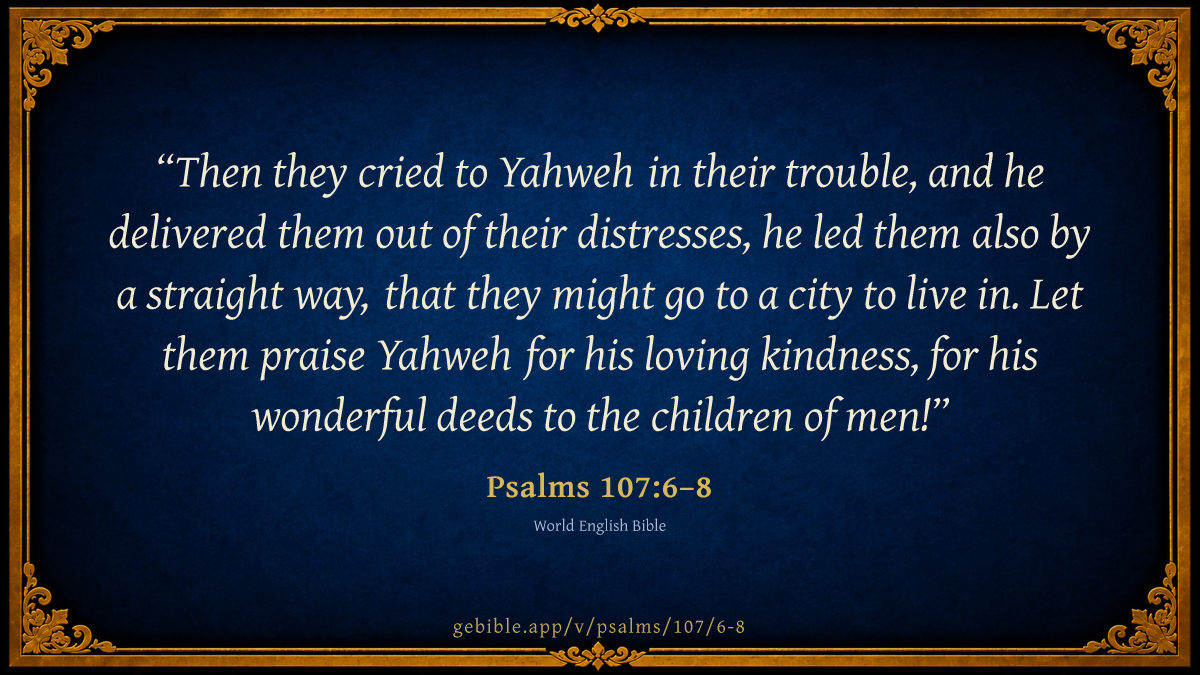
Psalms 107:13(v6)Then they cried to Yahweh in their trouble, and he saved them out of their distresses.
Psalms 107:15(v8)Let them praise Yahweh for his loving kindness, for his wonderful deeds to the children of men!
Psalms 107:19(v6)Then they cry to Yahweh in their trouble, he saves them out of their distresses.
Psalms 107:21(v8)Let them praise Yahweh for his loving kindness, for his wonderful deeds to the children of men!
Psalms 107:28(v6)Then they cry to Yahweh in their trouble, and he brings them out of their distress.
Daniel 6:27(v8)He delivers and rescues. He works signs and wonders in heaven and in earth, who has delivered Daniel from the power of the lions.”
2 Corinthians 1:8-10(v6)For we don’t desire to have you uninformed, brothers, concerning our affliction which happened to us in Asia, that we were weighed down…
Hosea 5:15(v6)I will go and return to my place, until they acknowledge their offense, and seek my face. In their affliction they will seek me earnestly.”
2 Timothy 3:11(v6)persecutions, and sufferings: those things that happened to me at Antioch, Iconium, and Lystra. I endured those persecutions. The Lord…
Deuteronomy 32:29(v8)Oh that they were wise, that they understood this, that they would consider their latter end!
Psalms 34:3(v8)Oh magnify Yahweh with me. Let’s exalt his name together.
Psalms 92:1-2(v8)It is a good thing to give thanks to Yahweh, to sing praises to your name, Most High, to proclaim your loving kindness in the morning, and…
Psalms 111:4(v8)He has caused his wonderful works to be remembered. Yahweh is gracious and merciful.
Jeremiah 31:9(v7)They will come with weeping. I will lead them with petitions. I will cause them to walk by rivers of waters, in a straight way in which…
2 Corinthians 12:8-10(v6)Concerning this thing, I begged the Lord three times that it might depart from me. He has said to me, “My grace is sufficient for you, for…
Ezra 8:21-23(v7)Then I proclaimed a fast there, at the river Ahava, that we might humble ourselves before our God, to seek from him a straight way for us,…
Psalms 77:20(v7)You led your people like a flock, by the hand of Moses and Aaron.
Psalms 81:13-16(v8)Oh that my people would listen to me, that Israel would walk in my ways! I would soon subdue their enemies, and turn my hand against their…
Isaiah 41:17-18(v6)The poor and needy seek water, and there is none. Their tongue fails for thirst. I, Yahweh, will answer them. I, the God of Israel, will…
Isaiah 48:18(v8)Oh that you had listened to my commandments! Then your peace would have been like a river and your righteousness like the waves of the sea.
Isaiah 63:7(v8)I will tell of the loving kindnesses of Yahweh and the praises of Yahweh, according to all that Yahweh has given to us, and the great…
Hebrews 11:9-10(v7)By faith, he lived as an alien in the land of promise, as in a land not his own, dwelling in tents with Isaac and Jacob, the heirs with him…
Hebrews 12:22(v7)But you have come to Mount Zion, and to the city of the living God, the heavenly Jerusalem, and to innumerable multitudes of angels,
Deuteronomy 5:29(v8)Oh that there were such a heart in them that they would fear me and keep all my commandments always, that it might be well with them and…
Nehemiah 11:3(v7)Now these are the chiefs of the province who lived in Jerusalem; but in the cities of Judah everyone lived in his possession in their…
Psalms 40:5(v8)Many, Yahweh, my God, are the wonderful works which you have done, and your thoughts which are toward us. They can’t be declared back to…
Psalms 78:52(v7)But he led out his own people like sheep, and guided them in the wilderness like a flock.
Psalms 107:4(v7)They wandered in the wilderness in a desert way. They found no city to live in.
Psalms 107:36(v7)There he makes the hungry live, that they may prepare a city to live in,
Isaiah 30:21(v7)and when you turn to the right hand, and when you turn to the left, your ears will hear a voice behind you, saying, “This is the way. Walk…
Isaiah 49:8-11(v7)Yahweh says, “I have answered you in an acceptable time. I have helped you in a day of salvation. I will preserve you and give you for a…
Jeremiah 33:10-13(v7)Yahweh says: “Yet again there will be heard in this place, about which you say, ‘It is waste, without man and without animal, even in the…
Hebrews 11:16(v7)But now they desire a better country, that is, a heavenly one. Therefore God is not ashamed of them, to be called their God, for he has…
2 Peter 2:15(v7)forsaking the right way, they went astray, having followed the way of Balaam the son of Beor, who loved the wages of wrongdoing;
Isaiah 48:17(v7)Yahweh, your Redeemer, the Holy One of Israel says: “I am Yahweh your God, who teaches you to profit, who leads you by the way that you…
Isaiah 63:13-14(v7)Who led them through the depths, like a horse in the wilderness, so that they didn’t stumble? As the livestock that go down into the…
Jeremiah 6:16(v7)Yahweh says, “Stand in the ways and see, and ask for the old paths, ‘Where is the good way?’ and walk in it, and you will find rest for…
Jeremiah 31:24(v7)Judah and all its cities will dwell therein together, the farmers, and those who go about with flocks.
Jeremiah 31:38-40(v7)“Behold, the days come,” says Yahweh, “that the city will be built to Yahweh from the tower of Hananel to the gate of the corner. The…
2 Peter 2:21(v7)For it would be better for them not to have known the way of righteousness, than after knowing it, to turn back from the holy commandment…
Revelation 21:2-4(v7)I saw the holy city, New Jerusalem, coming down out of heaven from God, prepared like a bride adorned for her husband. I heard a loud voice…
Revelation 21:10-27(v7)He carried me away in the Spirit to a great and high mountain, and showed me the holy city, Jerusalem, coming down out of heaven from God,…
Psalms 136:16(v7)to him who led his people through the wilderness; for his loving kindness endures forever:
Isaiah 35:8-10(v7)A highway will be there, a road, and it will be called “The Holy Way”. The unclean shall not pass over it, but it will be for those who…
Cross-references from openbible.info (CC BY 4.0)
Explain this passage (16 sources)
Historical commentary, presented as a primary source — not an endorsement.
John Calvin1540 · Public DomainOn v66 In their straits they called upon Jehovah The…
6 In their straits they called upon Jehovah The verbs are here in the past tense, and according to grammarians, represent a continued action. The meaning therefore is, that those who are wandering in desert places are often pinched with hunger and thirst in consequence of finding no place in which to lodge; and who, when all hope of deliverance fails them, then cry unto God. Doubtless, God grants deliverance to many when in straits, even though they do not present their supplications to Him for aid; and hence it was not so much the design of the prophet in this passage to extol the faith of the pious, who call upon God with all their heart, as to describe the common feelings of humanity. There may be not a few whose hope does not center on God, who, nevertheless, are constrained, by some invisible disposition of mind, to come to Him, when under the pressure of dire necessity. And this is the plan which God sometimes pursues, in order to extort from such persons the acknowledgement that deliverance is to be sought for from no other quarter than from Himself alone; and even the ungodly, who, while living voluptuously, scoff at Him, he constrains, in spite of themselves, to invoke his name. It has been customary in all ages for heathens, who look upon religion as a fable, when compelled by stern necessity, to call upon God for help. Did they do so in jest? By no means; it was by a secret natural instinct that they were led to reverence God’s name, which formerly they held in derision. The Spirit of God, therefore, in my opinion, here narrates what frequently takes place, namely, that persons destitute of piety and faith, and who have no desire to have any thing to do with God, if placed in perilous circumstances, are constrained by natural instinct, and without any proper conception of what they are doing, to call on the name of God. Since it is only in dubious and desperate cases that they betake themselves to God, this acknowledgement which they make of their helplessness is a palpable proof of their stupidity, that in the season of peace and tranquillity they neglect him, so much are they then under the intoxicating influence of their own prosperity; and notwithstanding that the germ of piety is planted in their hearts, they nevertheless never dream of learning wisdom, unless when driven by the dint of adversity; I mean, to learn the wisdom of acknowledging that there is a God in heaven who directs every event. It is unnecessary to allude here to the sarcastic retort of the ancient buffoon, who, on entering a temple, and beholding a number of tablets which several merchants had suspended there as memorials of their having escaped shipwreck, through the kind interposition of the gods, smartly and facetiously remarked, “But the deaths of those who have been drowned are not enumerated, the number of which is innumerable.” Perhaps he might have some just cause for scoffing in this manner at such idols. But even if a hundredfold more were drowned in the sea than safely reach the harbour, this does not in the least degree detract from the glory of the goodness of God, who, while he is merciful, is at the same time also just, so that the dispensing of the one does not interfere with the exercise of the other. The same observation applies to travelers that stray from the path, and wander up and down in the desert. If many of them perish for hunger and thirst, if many are devoured by wild animals, if many die from cold, these are nothing else than so many tokens of the judgments of God, which he designs for our consideration. From which we infer that the same thing would happen to all men, were it not the will of God to save a portion of them; and thus interposing as a judge between them, he preserves some for the sake of showing his mercy, and pours out his judgments upon others to declare his justice. The prophet, therefore, very properly adds, that by the hand of God they were led into the right way, where they may find a suitable place for lodging; and consequently he exhorts them to render thanks to God for this manifestation of his goodness. And with the view of enhancing the loving-kindness of God, he connects his wondrous works with his mercy; as if he should say, in this kind interposition, God’s grace is too manifest, either to be unperceived or unacknowledged by all; and for those who have been the subjects of such a remarkable deliverance, to remain silent regarding it, would be nothing less than an impious attempt to suppress the wonderful doings of God, an attempt equally vain with that of endeavoring to trample under their feet the light of the sun. For what else can be said of us, seeing that our natural instinct drives us to God for help, when we are in perplexity and peril; and when, after being rescued, we forthwith forget him, who will deny that his glory is, as it were, obscured by our wickedness and ingratitude?
John Calvin's Commentaries (1540-1563) — public domain. Text from the Calvin Translation Society English edition (1840s-50s) via the Christian Classics Ethereal Library (ccel.org). Calvin's coverage is partial (roughly two-thirds of the Bible); uncommented books and verses are honest gaps, never fabricated. The 19th-century editor's footnotes and remarks are omitted so the notes are faithfully Calvin's own voice.
John Trapp1656 · Public DomainOn vv6–8Psa 107:6 Then they cried unto the LORD in…
Psa 107:6 Then they cried unto the LORD in their trouble, [and] he delivered them out of their distresses.
Ver. 6. Then they cried unto the Lord] Though under a wrong name, it may be, as of Jupiter, Mercury, &c.; and, in an uncertain way, as Hecuba did with her, O Iupiter quicquid es sive caelum hoc, sive mens, quae vehitur in coelo, &c.; and as those mariners in Jon 1:5, who cried every man to his god, and, lest they might all mistake the true God, they awaken Jonah, to call upon his God.
Read full note →
And he delivered them out of their distresses] Out of his general goodness and compassion to the poor creature; like as he heareth the young ravens that cry unto him, no otherwise than by implication only, and out of mere necessity. God is the Saviour of all men, but especially of those that believe.
John Trapp, A Commentary or Exposition upon All the Books of the Old and New Testament (1647–1656) — public domain. Text from a community e-Sword module.
Matthew Poole1685 · Public DomainOn vv6–8Unto the Lord, Heb. unto Jehovah, to the true…
Unto the Lord, Heb. unto Jehovah, to the true God. For the heathens, of whom he speaks, had many of them some knowledge of the true God, and did in their manner worship him with and in their idols; and especially in their distresses, when they discovered the impotency of their idols, they did direct their prayer immediately to the true God, of which there are many instances of heathen writers.
He delivered them out of their distresses, in answer to their prayers, which he did not because their prayers were acceptable to him, but partly, out of the benignity and compassionateness of his nature to all his creatures; partly, to encourage and preserve the use of prayer and religion among the Gentiles, and to oblige them to a more diligent search after the knowledge of the true God, and of his worship; and partly, to give his own people assurance of his great readiness to hear and answer all those prayers which with upright hearts they offered to him according to his word.
Matthew Poole's English Annotations on the Holy Bible (1683–1685) — public domain. Text from a community e-Sword/MySword module.
John Gill1763 · Public DomainOn vv6–8And he led them forth by the right way,....…
And he led them forth by the right way,.... Thus God by his providence directs travellers that have lost their way, and puts them into the right way. There is no doubt a very great concern of Providence in such a case, and which ought to be acknowledged with thankfulness. And thus the Lord leads awakened and inquiring souls to the right way of salvation; to Christ, who is the way, the truth, and the life; and directs and enables them to believe in him, to walk by faith, and to continue to walk in him, as they have received him; and which is a plain and straight way, in which they shall not stumble; yea, in which men, though fools, shall not err, wander, or lose themselves: and though this way is attended with many afflictions and tribulations, and so may be said to be a narrow and a rough way; yet it is a right one, and a safe one, it brings at last to eternal life: the Syriac version renders it, "by the way of truth".
That they might go to a city of habitation; a city to dwell in; the Targum is,
Read full note →
"to Jerusalem, a city to dwell in:''
but any city nearest for travellers is here meant; and in a spiritual sense may be intended, either Christ, the city of refuge, where awakened sinners are directed to flee to, and where they find safety and plenty of provisions; or the church of God, the strong city, about which salvation is as walls and bulwarks; and to which they come when effectually called, and become citizens of it; or the New Jerusalem church state, in which the tabernacle of God will be, and he will dwell with men, and they with him; or the ultimate glory and happiness of the saints in heaven, that city which has foundations, whose builder and maker is God; in which are everlasting habitations, and mansions of peace and rest for the people of God to dwell in, after they have gone through their troublesome passage in this wilderness.
John Gill's Exposition of the Whole Bible (1746–1763) — public domain (CC PDM 1.0). Text via the HelloAO Bible API.
John Wesley1765 · Public DomainOn vv6–7The Lord - Hebrew. Unto Jehovah, to the true…
The Lord - Hebrew. Unto Jehovah, to the true God. For the Heathens had, many of them, some knowledge of the true God.
John Wesley, Explanatory Notes Upon the Whole Bible (1754–1765) — public domain. Text via the GEBible commentary corpus.
Adam Clarke1810 · Public DomainOn vv6–8Verse 6. Then they cried unto the Lord] When…
Verse 6. Then they cried unto the Lord] When the Israelites began to pray heartily, and the eyes of all the tribes were as the eyes of one man turned unto the Lord, then he delivered them out of their distresses.
Adam Clarke's Commentary on the Bible (1810–1826) — public domain. Text from a community e-Sword/MySword module.
Joseph Benson1811 · Public DomainOn v8Psa 107:8-9. O that men would praise — Hebrew,…
Psa 107:8-9. O that men would praise — Hebrew, let them praise, or, they shall praise, that is, they are highly obliged to praise. It is meant chiefly of those whom God has graciously relieved. The Lord for his goodness — To them in particular; and for his wonderful works to the children of men — To others, as well as to themselves; and to the children of men, as well as to the children of God. For he satisfieth the longing soul — The needy, who, being sensible of their wants, temporal or spiritual, earnestly desire to have them supplied; and filleth the hungry with goodness — With the fruits of his goodness, with good things, Psa 103:5; with that good which they wanted and desired. Observe, reader, God’s works of mercy are wonderful works, works of wonderful power, considering the weakness, and of wonderful grace, considering the unworthiness of those to whom he shows mercy: and those who share in his works of mercy are in duty bound to return him praise for them. Dr. Hammond remarks very properly, that “this is a Psalm of answering, or of parts, to be sung alternately; having a double burden, or intercalary verse, oft recurring:” see Psa 107:6; Psa 107:13, &c. This, indeed, is apparent upon the most transient view of it. We may suppose one side of the choir to have begun with the first of the parts, and then the other side to have taken the second, and so on. The 9th verse evidently belongs to the first part, for the 10th begins quite another subject.
Joseph Benson's Commentary on the Old and New Testaments (1811–1818) — public domain. Text from a community e-Sword module.
Albert Barnes1834 · Public DomainOn vv6–8Then they cried unto the Lord in their trouble…
Then they cried unto the Lord in their trouble - The language in this verse is repeated in this psalm in Psa 107:13, Psa 107:19, Psa 107:28 - as if this were the main subject of the psalm, that when the people of God in different circumstances, or under various forms of trouble, call upon God, he hears them and delivers them.
And he delivered them out of their distresses - The verb from which the noun used here is derived has the idea of being “narrow, straitened, compressed.” Hence, the word comes to be used in the sense of distress of any kind - as if one were pressed down, or compressed painfully in a narrow space.
Albert Barnes' Notes on the Bible (1834–1885) — public domain. Text from a community e-Sword/MySword module.
Daniel D. Whedon1874 · Public DomainOn vv7–87. He led them forth by the right way—See…
7. He led them forth by the right way—See Ezr_8:21-23; Ezr_8:31-32.
City of habitation—A city of permanent abode, as opposed to their life of wandering.
Daniel D. Whedon (gen. ed.), Commentary on the Old and New Testaments (1874–1909) — public domain. Text from a community e-Sword module.
The Cambridge Bible for Schools and Colleges1878 · Public DomainOn vv6–86. The words for trouble (better, strait) and distresses…
6. The words for trouble (better, strait) and distresses are coupled together in Job_15:24.
The Cambridge Bible for Schools and Colleges (gen. ed. J. J. S. Perowne; Cambridge University Press, 1878–1918) — public domain. Text from a community e-Sword module.
Ellicott's Commentary for English Readers1878 · Public DomainOn vv7–8(7) By the right way.—Better, in a straight way.…
(7) By the right way.—Better, in a straight way. Even in the pathless wilderness “there is a hand that guides.”
A Bible Commentary for English Readers, edited by Charles John Ellicott (1878–1897) — public domain. Text from a community e-Sword module.
The Pulpit Commentary1880 · Public DomainOn vv6–8Then they cried unto the Lord in their trouble.…
Then they cried unto the Lord in their trouble. (comp. Psa_106:44, and the comment ad loc.) And he delivered them out of their distresses. "Distresses" may be a plural of amplification, or it may point to the triple suffering hunger, thirst, faintness.
The Pulpit Commentary (1880–1919), ed. H.D.M. Spence-Jones & Joseph S. Exell — public domain. Text from a community e-Sword module.
Charles H. Spurgeon1885 · Public DomainOn vv6–8Ver. 6. Then they cried unto the LORD in…
Ver. 6. Then they cried unto the LORD in their trouble. Not till they were in extremities did they pray, but the mercy is that they prayed then, and prayed in the right manner, with a cry, and to the right person, even to the Lord. Nothing else remained for them to do; they could not help themselves, or find help in others, and therefore they cried to God. Supplications which are forced out of us by stern necessity are none the less acceptable with God; but, indeed, they have all the more prevalence, since they are evidently sincere, and make a powerful appeal to the divine pity. Some men will never pray till they are half starved, and for their best interests it is far better for them to be empty and faint than to be full and stouthearted. If hunger brings us to our knees it is more useful to us than feasting; if thirst drives us to the fountain it is better than the deepest draughts of worldly joys; and if fainting leads to crying it is better than the strength of the mighty,
And he delivered them out of their distresses. Deliverance follows prayer most surely. The cry must have been very feeble, for they were faint, and their faith was as weak as their cry; but yet they were heard, and heard at once. A little delay would have been their death: but there was none, for the Lord was ready to save them. The Lord delights to come in when no one else can be of the slightest avail. The case was hopeless till Jehovah interposed, and then all was changed immediately; the people were shut up, straitened, and almost pressed to death, but enlargement came to them at once when they began to remember their God, and look to him in prayer. Those deserve to die of hunger who will not so much as ask for bread, and he who being lost in a desert will not beg the aid of a guide cannot be pitied even if he perish in the wilds and feed the vultures with his flesh.
Read full note →
Ver. 6. Then they cried, etc. In these words we find three things remarkable; first, the condition of God's church and people, trouble and distress: Secondly, the practice and the exercise of God's people in this state: "Then they cried unto the Lord": Thirdly, their success, and the good issue of this practice: "And he delivered them", etc. Peter Smith, in a Sermon preached before the House of Commons, 1644.
Ver. 6. Then they cried. The root qeu has here a peculiar force: it denotes a cry of that kind into which any one, when shaken with a violent tempest of emotion, in the extremity of his grief and anxiety, breaks with a crash and with complaining, as the heavens send forth thunder and lightning. The original idea of the word being a crash, it indicates such complaints and cries as they send forth, who are oppressed by others, or are held fast in straits, in imploring public protection and help. See De 22:24 1Ki 20:39 Isa 19:20. Venema.
Ver. 6. In their trouble. observe the words, "Then they cried unto the Lord in their trouble." Not before, nor after, but in it. When they were in the midst of it; when trouble was wrapped round their head, as the weeds were wrapped round the head of Jonah; when they were surrounded by it, and could see no way out of it; when, like a person in a mist, they saw no way of escape before or behind; when nothing but a dark cloud of trouble surrounded their souls, and they did not know that ever that cloud would be dispersed; then it was that they cried. J.C. Philpot.
Ver. 6. "Trouble." "Distresses." The condition of the Church, or its most usual lot, is to be under sorrows and afflictions. I say, most usual: "For I will not contend for ever, neither will I be always wroth: for the spirit should fail before me, and the souls which I have made", Isa 57:16. But as we say of the several callings and trades of life, this man professes such a calling, and that man another; and as the poet said of Hermogenes, Though he hold his peace (peradventure being asleep) yet he's a good singer, and a musician by profession: so say I of the people of God, their trade of life is suffering: and as Julian told the Christians, when they complained of his cruelty, It is your profession to endure tribulation. Peter Smith.
Psalms 107:7*
Charles H. Spurgeon's The Treasury of David (1869–1885) — public domain. Psalms only. Text from a community e-Sword/MySword module.
The Biblical Illustrator1887 · Public DomainOn vv6–8And He delivered them out of their distresses.
Psa_107:6
And He delivered them out of their distresses.
Read full note →
The way out
This psalm is an Old Testament lovefeast. In the first three verses the redeemed are exhorted to speak out their experience of the goodness of God. In response, four representative testimonies are given. Travellers who had lost their way tell how they were found and led to a city of habitation. Captives who had been brought out of dungeons repeat the story of their deliverance. Sick ones who had been restored from the gates of death speak to the praise of their Healer; and others who had been in peril on the sea declare the wonders of the Lord upon the great deep. Each recital is followed with an exhortation to praise the Lord for His goodness, and for His wonderful works to the children of men. There are many ways into trouble. All the people in this psalm came to distress by various ways, and the different ways led to different sorts of trouble. The travellers got lost. They strayed in the wilderness, not wilfully, but from lack of knowledge. They could find no place of habitation. Their food and water were exhausted, and they sank, in faintness and despair, a helpless prey to all the perils of the desert. Then they cried unto the Lord in their trouble, and He came to their help. He led them by a straight way, that they might go to a city of habitation. They ought not to have started without a guide, but inexperience is often self-confident and apt to despise the counsels of the wise. The second class came into trouble through disobedience. They rebelled against the word of God. They held God in contempt, despised His authority, and ignored His law. It is in mans power to defy God. He rules in each life by each mans consent, and when men say they will not have Him to rule over them, He leaves them free to follow their own course. No man can break the least of His commandments without penalty and loss. To throw off the yoke of righteousness is the surest way to bondage. The third class is spoken of as fools. In the Scriptures this term is used not of mental deficiency so much as of moral perversity. According to the Old Testament method, sickness is attributed to moral delinquency; a doctrine that is considerably modified in the New. There is a close connection between iniquity and affliction. A life of sin is ruinous to health. If we would be sound in body we must be pure in heart. They that sow to the flesh, of the flesh reap corruption. The fourth class come into trouble in the course of duty. For He commandeth and raiseth the stormy wind. Most of our trouble is of our own making. It is often due to our ignorance and vanity, sometimes to our downright badness, and not infrequently to our folly. But trouble comes to the best as well as the worst. It meets us not only in the ways of sin, but in the path of duty. There are forces in life over which we have no control, and for which we have neither wisdom nor strength. Winds and storms, hurricanes, and disaster make no moral distinctions, and adversity and tribulation come to the upright as well as to the disobedient. Inexperience leads to wandering and hunger. Rebellion is the way to the dungeon, with its darkness and chains. Wrong-heartedness brings the soul to the gates of death. Even duty leads us into conditions which soon find the end of our wits. How helpless we are in trouble! Lost! Captive! Sick! Storm-tossed! What can we do? We must cry to another for deliverance. There are many ways into trouble, but there is only one way out. The lost could not find themselves, the bound had no way of escape, the dying had no healing power, and men at their wits end could never save the ship. In their extremity they all cried unto the Lord. If they had consulted Him sooner most of them would never have needed to cry. It is good to cry when lost, but it is better to be sure of the way before the start is made. Herein is the mercy of God made manifest, that He bids us call on Him in the day of trouble. He makes no exceptions, and imposes no conditions. Need, not merit, is our passport to God. He does not stop to inquire how we got into trouble, nor ask for a certificate of character before He helps us out. Peril is a great, leveller. Distinctions of rank and worth disappear in the presence of danger. He makes haste to help. If you are in trouble, cry! No matter how you got in, cry! It is your only chance, cry aloud! If you are lost, cry! He seeks the lost. If you are in bondage, cry! He came to open the prison doors to them that are bound. If you are sick unto death, cry! In Him is the life of men. If you are in peril, cry! Even the winds and the waves obey Him. It shall come to pass that whosoever shall call upon the name of the Lord shall be saved. The Lord our Deliverer. When there is none to help, the Lord is our Helper. In Him is deliverance for all. (F. Wiseman.)
The Biblical Illustrator, edited by Joseph S. Exell (c. 1880s–1900s) — public domain. Text from a community e-Sword module.
unfoldingWord translationNotes2017 · CC BY-SA 4.0On v8Oh that people would praise Yahweh for his covenant…
Oh that people would praise Yahweh for his covenant faithfulness
Here the word "Oh" is used to convey a strong desire for people to praise Yahweh. The abstract noun "faithfulness" can be translated with an adjective. AT: "Let people praise Yahweh because he is faithful to his covenant" or "People should praise Yahweh because he is faithful to his covenant" (See: Exclamations and Abstract Nouns)
Read full note →
for humanity
"for all people"
For he satisfies the longings of those who are thirsty
"For he gives water to those who desire it—to those who are thirsty"
the desires of those who are hungry he fills up with good things
"to those who are very hungry and desire food, he give them good things to eat"
Some sat
It is implied that these are people that Yahweh has rescued. AT: "Yahweh also rescued people who sat" (See: Assumed Knowledge and Implicit Information)
in darkness and in gloom
Both "darkness" and "gloom" have basically the same meaning and are used to emphasize how dark the prison was. AT: "in complete darkness" (See: Doublet)
Tyndale Open Study Notes2022 · CC BY-SA 4.0On vv6–7107:6 The psalmist does not specify the occasion of…
107:6 The psalmist does not specify the occasion of his trouble and distress. The generic nature of the adversity permits readers in a variety of circumstances to identify with the laments.

John Calvin 1540 · Public Domain On v6 6 In their straits they called upon Jehovah The…
6 In their straits they called upon Jehovah The verbs are here in the past tense, and according to grammarians, represent a continued action. The meaning therefore is, that those who are wandering in desert places are often pinched with hunger and thirst in consequence of finding no place in which to lodge; and who, when all hope of deliverance fails them, then cry unto God. Doubtless, God grants deliverance to many when in straits, even though they do not present their supplications to Him for aid; and hence it was not so much the design of the prophet in this passage to extol the faith of the pious, who call upon God with all their heart, as to describe the common feelings of humanity. There may be not a few whose hope does not center on God, who, nevertheless, are constrained, by some invisible disposition of mind, to come to Him, when under the pressure of dire necessity. And this is the plan which God sometimes pursues, in order to extort from such persons the acknowledgement that deliverance is to be sought for from no other quarter than from Himself alone; and even the ungodly, who, while living voluptuously, scoff at Him, he constrains, in spite of themselves, to invoke his name. It has been customary in all ages for heathens, who look upon religion as a fable, when compelled by stern necessity, to call upon God for help. Did they do so in jest? By no means; it was by a secret natural instinct that they were led to reverence God’s name, which formerly they held in derision. The Spirit of God, therefore, in my opinion, here narrates what frequently takes place, namely, that persons destitute of piety and faith, and who have no desire to have any thing to do with God, if placed in perilous circumstances, are constrained by natural instinct, and without any proper conception of what they are doing, to call on the name of God. Since it is only in dubious and desperate cases that they betake themselves to God, this acknowledgement which they make of their helplessness is a palpable proof of their stupidity, that in the season of peace and tranquillity they neglect him, so much are they then under the intoxicating influence of their own prosperity; and notwithstanding that the germ of piety is planted in their hearts, they nevertheless never dream of learning wisdom, unless when driven by the dint of adversity; I mean, to learn the wisdom of acknowledging that there is a God in heaven who directs every event. It is unnecessary to allude here to the sarcastic retort of the ancient buffoon, who, on entering a temple, and beholding a number of tablets which several merchants had suspended there as memorials of their having escaped shipwreck, through the kind interposition of the gods, smartly and facetiously remarked, “But the deaths of those who have been drowned are not enumerated, the number of which is innumerable.” Perhaps he might have some just cause for scoffing in this manner at such idols. But even if a hundredfold more were drowned in the sea than safely reach the harbour, this does not in the least degree detract from the glory of the goodness of God, who, while he is merciful, is at the same time also just, so that the dispensing of the one does not interfere with the exercise of the other. The same observation applies to travelers that stray from the path, and wander up and down in the desert. If many of them perish for hunger and thirst, if many are devoured by wild animals, if many die from cold, these are nothing else than so many tokens of the judgments of God, which he designs for our consideration. From which we infer that the same thing would happen to all men, were it not the will of God to save a portion of them; and thus interposing as a judge between them, he preserves some for the sake of showing his mercy, and pours out his judgments upon others to declare his justice. The prophet, therefore, very properly adds, that by the hand of God they were led into the right way, where they may find a suitable place for lodging; and consequently he exhorts them to render thanks to God for this manifestation of his goodness. And with the view of enhancing the loving-kindness of God, he connects his wondrous works with his mercy; as if he should say, in this kind interposition, God’s grace is too manifest, either to be unperceived or unacknowledged by all; and for those who have been the subjects of such a remarkable deliverance, to remain silent regarding it, would be nothing less than an impious attempt to suppress the wonderful doings of God, an attempt equally vain with that of endeavoring to trample under their feet the light of the sun. For what else can be said of us, seeing that our natural instinct drives us to God for help, when we are in perplexity and peril; and when, after being rescued, we forthwith forget him, who will deny that his glory is, as it were, obscured by our wickedness and ingratitude?
John Calvin's Commentaries (1540-1563) — public domain. Text from the Calvin Translation Society English edition (1840s-50s) via the Christian Classics Ethereal Library (ccel.org). Calvin's coverage is partial (roughly two-thirds of the Bible); uncommented books and verses are honest gaps, never fabricated. The 19th-century editor's footnotes and remarks are omitted so the notes are faithfully Calvin's own voice.
John Trapp 1656 · Public Domain On vv6–8 Psa 107:6 Then they cried unto the LORD in…
Psa 107:6 Then they cried unto the LORD in their trouble, [and] he delivered them out of their distresses.
Ver. 6. Then they cried unto the Lord] Though under a wrong name, it may be, as of Jupiter, Mercury, &c.; and, in an uncertain way, as Hecuba did with her, O Iupiter quicquid es sive caelum hoc, sive mens, quae vehitur in coelo, &c.; and as those mariners in Jon 1:5, who cried every man to his god, and, lest they might all mistake the true God, they awaken Jonah, to call upon his God.
Read full note →
And he delivered them out of their distresses] Out of his general goodness and compassion to the poor creature; like as he heareth the young ravens that cry unto him, no otherwise than by implication only, and out of mere necessity. God is the Saviour of all men, but especially of those that believe.
John Trapp, A Commentary or Exposition upon All the Books of the Old and New Testament (1647–1656) — public domain. Text from a community e-Sword module.
Matthew Poole 1685 · Public Domain On vv6–8 Unto the Lord, Heb. unto Jehovah, to the true…
Unto the Lord, Heb. unto Jehovah, to the true God. For the heathens, of whom he speaks, had many of them some knowledge of the true God, and did in their manner worship him with and in their idols; and especially in their distresses, when they discovered the impotency of their idols, they did direct their prayer immediately to the true God, of which there are many instances of heathen writers.
He delivered them out of their distresses, in answer to their prayers, which he did not because their prayers were acceptable to him, but partly, out of the benignity and compassionateness of his nature to all his creatures; partly, to encourage and preserve the use of prayer and religion among the Gentiles, and to oblige them to a more diligent search after the knowledge of the true God, and of his worship; and partly, to give his own people assurance of his great readiness to hear and answer all those prayers which with upright hearts they offered to him according to his word.
Matthew Poole's English Annotations on the Holy Bible (1683–1685) — public domain. Text from a community e-Sword/MySword module.
John Gill 1763 · Public Domain On vv6–8 And he led them forth by the right way,....…
And he led them forth by the right way,.... Thus God by his providence directs travellers that have lost their way, and puts them into the right way. There is no doubt a very great concern of Providence in such a case, and which ought to be acknowledged with thankfulness. And thus the Lord leads awakened and inquiring souls to the right way of salvation; to Christ, who is the way, the truth, and the life; and directs and enables them to believe in him, to walk by faith, and to continue to walk in him, as they have received him; and which is a plain and straight way, in which they shall not stumble; yea, in which men, though fools, shall not err, wander, or lose themselves: and though this way is attended with many afflictions and tribulations, and so may be said to be a narrow and a rough way; yet it is a right one, and a safe one, it brings at last to eternal life: the Syriac version renders it, "by the way of truth".
That they might go to a city of habitation; a city to dwell in; the Targum is,
Read full note →
"to Jerusalem, a city to dwell in:''
but any city nearest for travellers is here meant; and in a spiritual sense may be intended, either Christ, the city of refuge, where awakened sinners are directed to flee to, and where they find safety and plenty of provisions; or the church of God, the strong city, about which salvation is as walls and bulwarks; and to which they come when effectually called, and become citizens of it; or the New Jerusalem church state, in which the tabernacle of God will be, and he will dwell with men, and they with him; or the ultimate glory and happiness of the saints in heaven, that city which has foundations, whose builder and maker is God; in which are everlasting habitations, and mansions of peace and rest for the people of God to dwell in, after they have gone through their troublesome passage in this wilderness.
John Gill's Exposition of the Whole Bible (1746–1763) — public domain (CC PDM 1.0). Text via the HelloAO Bible API.
John Wesley 1765 · Public Domain On vv6–7 The Lord - Hebrew. Unto Jehovah, to the true…
The Lord - Hebrew. Unto Jehovah, to the true God. For the Heathens had, many of them, some knowledge of the true God.
John Wesley, Explanatory Notes Upon the Whole Bible (1754–1765) — public domain. Text via the GEBible commentary corpus.
Adam Clarke 1810 · Public Domain On vv6–8 Verse 6. Then they cried unto the Lord] When…
Verse 6. Then they cried unto the Lord] When the Israelites began to pray heartily, and the eyes of all the tribes were as the eyes of one man turned unto the Lord, then he delivered them out of their distresses.
Adam Clarke's Commentary on the Bible (1810–1826) — public domain. Text from a community e-Sword/MySword module.
Joseph Benson 1811 · Public Domain On v8 Psa 107:8-9. O that men would praise — Hebrew,…
Psa 107:8-9. O that men would praise — Hebrew, let them praise, or, they shall praise, that is, they are highly obliged to praise. It is meant chiefly of those whom God has graciously relieved. The Lord for his goodness — To them in particular; and for his wonderful works to the children of men — To others, as well as to themselves; and to the children of men, as well as to the children of God. For he satisfieth the longing soul — The needy, who, being sensible of their wants, temporal or spiritual, earnestly desire to have them supplied; and filleth the hungry with goodness — With the fruits of his goodness, with good things, Psa 103:5; with that good which they wanted and desired. Observe, reader, God’s works of mercy are wonderful works, works of wonderful power, considering the weakness, and of wonderful grace, considering the unworthiness of those to whom he shows mercy: and those who share in his works of mercy are in duty bound to return him praise for them. Dr. Hammond remarks very properly, that “this is a Psalm of answering, or of parts, to be sung alternately; having a double burden, or intercalary verse, oft recurring:” see Psa 107:6; Psa 107:13, &c. This, indeed, is apparent upon the most transient view of it. We may suppose one side of the choir to have begun with the first of the parts, and then the other side to have taken the second, and so on. The 9th verse evidently belongs to the first part, for the 10th begins quite another subject.
Joseph Benson's Commentary on the Old and New Testaments (1811–1818) — public domain. Text from a community e-Sword module.
Albert Barnes 1834 · Public Domain On vv6–8 Then they cried unto the Lord in their trouble…
Then they cried unto the Lord in their trouble - The language in this verse is repeated in this psalm in Psa 107:13, Psa 107:19, Psa 107:28 - as if this were the main subject of the psalm, that when the people of God in different circumstances, or under various forms of trouble, call upon God, he hears them and delivers them.
And he delivered them out of their distresses - The verb from which the noun used here is derived has the idea of being “narrow, straitened, compressed.” Hence, the word comes to be used in the sense of distress of any kind - as if one were pressed down, or compressed painfully in a narrow space.
Albert Barnes' Notes on the Bible (1834–1885) — public domain. Text from a community e-Sword/MySword module.
Daniel D. Whedon 1874 · Public Domain On vv7–8 7. He led them forth by the right way—See…
7. He led them forth by the right way—See Ezr_8:21-23; Ezr_8:31-32.
City of habitation—A city of permanent abode, as opposed to their life of wandering.
Daniel D. Whedon (gen. ed.), Commentary on the Old and New Testaments (1874–1909) — public domain. Text from a community e-Sword module.
The Cambridge Bible for Schools and Colleges 1878 · Public Domain On vv6–8 6. The words for trouble (better, strait) and distresses…
6. The words for trouble (better, strait) and distresses are coupled together in Job_15:24.
The Cambridge Bible for Schools and Colleges (gen. ed. J. J. S. Perowne; Cambridge University Press, 1878–1918) — public domain. Text from a community e-Sword module.
Ellicott's Commentary for English Readers 1878 · Public Domain On vv7–8 (7) By the right way.—Better, in a straight way.…
(7) By the right way.—Better, in a straight way. Even in the pathless wilderness “there is a hand that guides.”
A Bible Commentary for English Readers, edited by Charles John Ellicott (1878–1897) — public domain. Text from a community e-Sword module.
The Pulpit Commentary 1880 · Public Domain On vv6–8 Then they cried unto the Lord in their trouble.…
Then they cried unto the Lord in their trouble. (comp. Psa_106:44, and the comment ad loc.) And he delivered them out of their distresses. "Distresses" may be a plural of amplification, or it may point to the triple suffering hunger, thirst, faintness.
The Pulpit Commentary (1880–1919), ed. H.D.M. Spence-Jones & Joseph S. Exell — public domain. Text from a community e-Sword module.
Charles H. Spurgeon 1885 · Public Domain On vv6–8 Ver. 6. Then they cried unto the LORD in…
Ver. 6. Then they cried unto the LORD in their trouble. Not till they were in extremities did they pray, but the mercy is that they prayed then, and prayed in the right manner, with a cry, and to the right person, even to the Lord. Nothing else remained for them to do; they could not help themselves, or find help in others, and therefore they cried to God. Supplications which are forced out of us by stern necessity are none the less acceptable with God; but, indeed, they have all the more prevalence, since they are evidently sincere, and make a powerful appeal to the divine pity. Some men will never pray till they are half starved, and for their best interests it is far better for them to be empty and faint than to be full and stouthearted. If hunger brings us to our knees it is more useful to us than feasting; if thirst drives us to the fountain it is better than the deepest draughts of worldly joys; and if fainting leads to crying it is better than the strength of the mighty,
And he delivered them out of their distresses. Deliverance follows prayer most surely. The cry must have been very feeble, for they were faint, and their faith was as weak as their cry; but yet they were heard, and heard at once. A little delay would have been their death: but there was none, for the Lord was ready to save them. The Lord delights to come in when no one else can be of the slightest avail. The case was hopeless till Jehovah interposed, and then all was changed immediately; the people were shut up, straitened, and almost pressed to death, but enlargement came to them at once when they began to remember their God, and look to him in prayer. Those deserve to die of hunger who will not so much as ask for bread, and he who being lost in a desert will not beg the aid of a guide cannot be pitied even if he perish in the wilds and feed the vultures with his flesh.
Read full note →
Ver. 6. Then they cried, etc. In these words we find three things remarkable; first, the condition of God's church and people, trouble and distress: Secondly, the practice and the exercise of God's people in this state: "Then they cried unto the Lord": Thirdly, their success, and the good issue of this practice: "And he delivered them", etc. Peter Smith, in a Sermon preached before the House of Commons, 1644.
Ver. 6. Then they cried. The root qeu has here a peculiar force: it denotes a cry of that kind into which any one, when shaken with a violent tempest of emotion, in the extremity of his grief and anxiety, breaks with a crash and with complaining, as the heavens send forth thunder and lightning. The original idea of the word being a crash, it indicates such complaints and cries as they send forth, who are oppressed by others, or are held fast in straits, in imploring public protection and help. See De 22:24 1Ki 20:39 Isa 19:20. Venema.
Ver. 6. In their trouble. observe the words, "Then they cried unto the Lord in their trouble." Not before, nor after, but in it. When they were in the midst of it; when trouble was wrapped round their head, as the weeds were wrapped round the head of Jonah; when they were surrounded by it, and could see no way out of it; when, like a person in a mist, they saw no way of escape before or behind; when nothing but a dark cloud of trouble surrounded their souls, and they did not know that ever that cloud would be dispersed; then it was that they cried. J.C. Philpot.
Ver. 6. "Trouble." "Distresses." The condition of the Church, or its most usual lot, is to be under sorrows and afflictions. I say, most usual: "For I will not contend for ever, neither will I be always wroth: for the spirit should fail before me, and the souls which I have made", Isa 57:16. But as we say of the several callings and trades of life, this man professes such a calling, and that man another; and as the poet said of Hermogenes, Though he hold his peace (peradventure being asleep) yet he's a good singer, and a musician by profession: so say I of the people of God, their trade of life is suffering: and as Julian told the Christians, when they complained of his cruelty, It is your profession to endure tribulation. Peter Smith.
Psalms 107:7*
Charles H. Spurgeon's The Treasury of David (1869–1885) — public domain. Psalms only. Text from a community e-Sword/MySword module.
The Biblical Illustrator 1887 · Public Domain On vv6–8 And He delivered them out of their distresses.
Psa_107:6
And He delivered them out of their distresses.
Read full note →
The way out
This psalm is an Old Testament lovefeast. In the first three verses the redeemed are exhorted to speak out their experience of the goodness of God. In response, four representative testimonies are given. Travellers who had lost their way tell how they were found and led to a city of habitation. Captives who had been brought out of dungeons repeat the story of their deliverance. Sick ones who had been restored from the gates of death speak to the praise of their Healer; and others who had been in peril on the sea declare the wonders of the Lord upon the great deep. Each recital is followed with an exhortation to praise the Lord for His goodness, and for His wonderful works to the children of men. There are many ways into trouble. All the people in this psalm came to distress by various ways, and the different ways led to different sorts of trouble. The travellers got lost. They strayed in the wilderness, not wilfully, but from lack of knowledge. They could find no place of habitation. Their food and water were exhausted, and they sank, in faintness and despair, a helpless prey to all the perils of the desert. Then they cried unto the Lord in their trouble, and He came to their help. He led them by a straight way, that they might go to a city of habitation. They ought not to have started without a guide, but inexperience is often self-confident and apt to despise the counsels of the wise. The second class came into trouble through disobedience. They rebelled against the word of God. They held God in contempt, despised His authority, and ignored His law. It is in mans power to defy God. He rules in each life by each mans consent, and when men say they will not have Him to rule over them, He leaves them free to follow their own course. No man can break the least of His commandments without penalty and loss. To throw off the yoke of righteousness is the surest way to bondage. The third class is spoken of as fools. In the Scriptures this term is used not of mental deficiency so much as of moral perversity. According to the Old Testament method, sickness is attributed to moral delinquency; a doctrine that is considerably modified in the New. There is a close connection between iniquity and affliction. A life of sin is ruinous to health. If we would be sound in body we must be pure in heart. They that sow to the flesh, of the flesh reap corruption. The fourth class come into trouble in the course of duty. For He commandeth and raiseth the stormy wind. Most of our trouble is of our own making. It is often due to our ignorance and vanity, sometimes to our downright badness, and not infrequently to our folly. But trouble comes to the best as well as the worst. It meets us not only in the ways of sin, but in the path of duty. There are forces in life over which we have no control, and for which we have neither wisdom nor strength. Winds and storms, hurricanes, and disaster make no moral distinctions, and adversity and tribulation come to the upright as well as to the disobedient. Inexperience leads to wandering and hunger. Rebellion is the way to the dungeon, with its darkness and chains. Wrong-heartedness brings the soul to the gates of death. Even duty leads us into conditions which soon find the end of our wits. How helpless we are in trouble! Lost! Captive! Sick! Storm-tossed! What can we do? We must cry to another for deliverance. There are many ways into trouble, but there is only one way out. The lost could not find themselves, the bound had no way of escape, the dying had no healing power, and men at their wits end could never save the ship. In their extremity they all cried unto the Lord. If they had consulted Him sooner most of them would never have needed to cry. It is good to cry when lost, but it is better to be sure of the way before the start is made. Herein is the mercy of God made manifest, that He bids us call on Him in the day of trouble. He makes no exceptions, and imposes no conditions. Need, not merit, is our passport to God. He does not stop to inquire how we got into trouble, nor ask for a certificate of character before He helps us out. Peril is a great, leveller. Distinctions of rank and worth disappear in the presence of danger. He makes haste to help. If you are in trouble, cry! No matter how you got in, cry! It is your only chance, cry aloud! If you are lost, cry! He seeks the lost. If you are in bondage, cry! He came to open the prison doors to them that are bound. If you are sick unto death, cry! In Him is the life of men. If you are in peril, cry! Even the winds and the waves obey Him. It shall come to pass that whosoever shall call upon the name of the Lord shall be saved. The Lord our Deliverer. When there is none to help, the Lord is our Helper. In Him is deliverance for all. (F. Wiseman.)
The Biblical Illustrator, edited by Joseph S. Exell (c. 1880s–1900s) — public domain. Text from a community e-Sword module.
unfoldingWord translationNotes 2017 · CC BY-SA 4.0 On v8 Oh that people would praise Yahweh for his covenant…
Oh that people would praise Yahweh for his covenant faithfulness
Here the word "Oh" is used to convey a strong desire for people to praise Yahweh. The abstract noun "faithfulness" can be translated with an adjective. AT: "Let people praise Yahweh because he is faithful to his covenant" or "People should praise Yahweh because he is faithful to his covenant" (See: Exclamations and Abstract Nouns)
Read full note →
for humanity
"for all people"
For he satisfies the longings of those who are thirsty
"For he gives water to those who desire it—to those who are thirsty"
the desires of those who are hungry he fills up with good things
"to those who are very hungry and desire food, he give them good things to eat"
Some sat
It is implied that these are people that Yahweh has rescued. AT: "Yahweh also rescued people who sat" (See: Assumed Knowledge and Implicit Information)
in darkness and in gloom
Both "darkness" and "gloom" have basically the same meaning and are used to emphasize how dark the prison was. AT: "in complete darkness" (See: Doublet)
translationWords
praise
covenant faithfulness
amazed
darkness
prison
afflicted
unfoldingWord translationNotes — © Distant Shores Media and the Door43 World Missions Community, licensed CC BY-SA 4.0. Source: git.door43.org/Door43/en_tn.
Tyndale Open Study Notes 2022 · CC BY-SA 4.0 On vv6–7 107:6 The psalmist does not specify the occasion of…
107:6 The psalmist does not specify the occasion of his trouble and distress. The generic nature of the adversity permits readers in a variety of circumstances to identify with the laments.
Tyndale Open Study Notes — © Tyndale Open Resources, licensed CC BY-SA 4.0. Text via the HelloAO Bible API.