Psalms 118:6-13(v13)Yahweh is on my side. I will not be afraid. What can man do to me? Yahweh is on my side among those who help me. Therefore I will look in…
2 Chronicles 13:12(v11)Behold, God is with us at our head, and his priests with the trumpets of alarm to sound an alarm against you. Children of Israel, don’t…
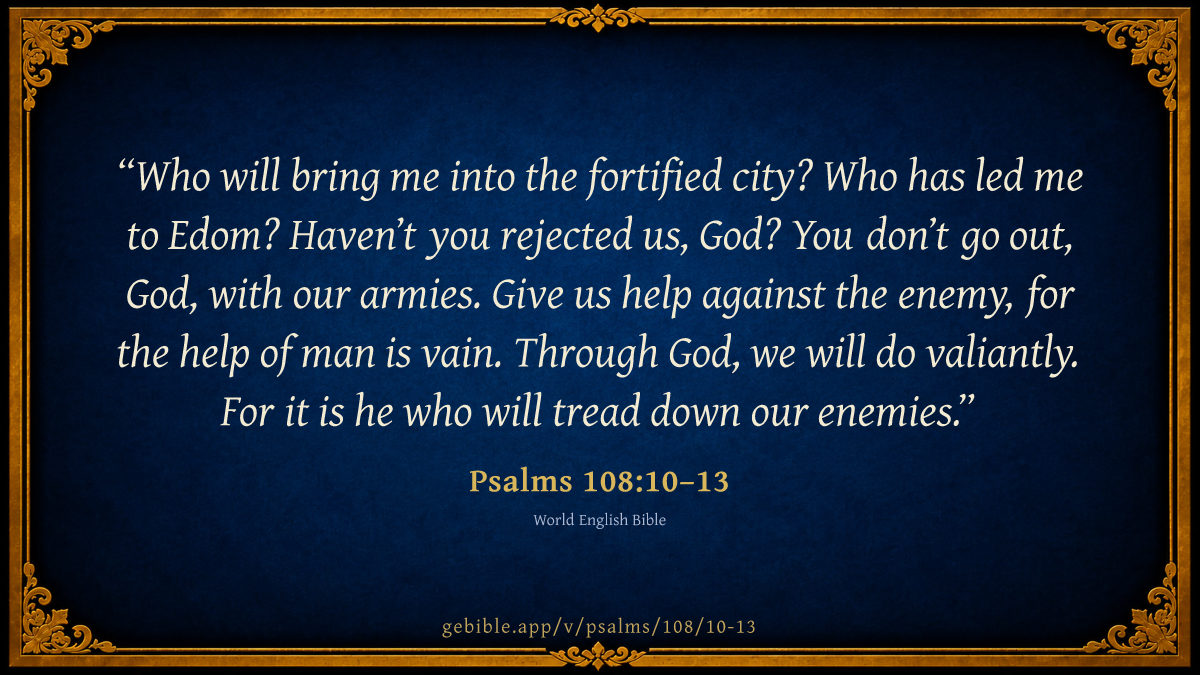
Psalms 60:12(v13)Through God we will do valiantly, for it is he who will tread down our adversaries.
Jeremiah 17:5-8(v12)Yahweh says: “Cursed is the man who trusts in man, relies on strength of flesh, and whose heart departs from Yahweh. For he will be like a…
Romans 16:20(v13)And the God of peace will quickly crush Satan under your feet. The grace of our Lord Jesus Christ be with you.
Show all 36 cross-references
Psalms 18:29-34(v13)For by you, I advance through a troop. By my God, I leap over a wall. As for God, his way is perfect. Yahweh’s word is tried. He is a…
Psalms 44:9(v11)But now you rejected us, and brought us to dishonor, and don’t go out with our armies.
Psalms 146:3-5(v12)Don’t put your trust in princes, in a son of man in whom there is no help. His spirit departs, and he returns to the earth. In that very…
Isaiah 31:3(v12)Now the Egyptians are men, and not God; and their horses flesh, and not spirit. When Yahweh stretches out his hand, both he who helps shall…
Isaiah 63:1-6(v10)Who is this who comes from Edom, with dyed garments from Bozrah? Who is this who is glorious in his clothing, marching in the greatness of…
Isaiah 63:3(v13)“I have trodden the wine press alone. Of the peoples, no one was with me. Yes, I trod them in my anger and trampled them in my wrath. Their…
Lamentations 4:17(v12)Our eyes still fail, looking in vain for our help. In our watching we have watched for a nation that could not save.
2 Corinthians 2:14(v13)Now thanks be to God, who always leads us in triumph in Christ, and reveals through us the sweet aroma of his knowledge in every place.
1 Samuel 17:36(v11)Your servant struck both the lion and the bear. This uncircumcised Philistine shall be as one of them, since he has defied the armies of…
1 Samuel 29:1-11(v11)Now the Philistines gathered together all their armies to Aphek; and the Israelites encamped by the spring which is in Jezreel. The lords…
2 Chronicles 20:15(v11)and he said, “Listen, all Judah, and you inhabitants of Jerusalem, and you, king Jehoshaphat. Yahweh says to you, ‘Don’t be afraid, and…
Psalms 18:42(v13)Then I beat them small as the dust before the wind. I cast them out as the mire of the streets.
Psalms 20:1-9(v12)May Yahweh answer you in the day of trouble. May the name of the God of Jacob set you up on high, send you help from the sanctuary, grant…
Isaiah 2:22(v12)Stop trusting in man, whose breath is in his nostrils; for of what account is he?
Isaiah 30:3-5(v12)Therefore the strength of Pharaoh will be your shame, and the refuge in the shadow of Egypt your confusion. For their princes are at Zoan,…
Numbers 10:9(v11)When you go to war in your land against the adversary who oppresses you, then you shall sound an alarm with the trumpets. Then you will be…
Deuteronomy 20:3-4(v11)and shall tell them, “Hear, Israel, you draw near today to battle against your enemies. Don’t let your heart faint! Don’t be afraid, nor…
Judges 15:8(v13)He struck them hip and thigh with a great slaughter; and he went down and lived in the cave in Etam’s rock.
1 Samuel 17:26(v11)David spoke to the men who stood by him, saying, “What shall be done to the man who kills this Philistine, and takes away the reproach from…
2 Chronicles 14:11(v11)Asa cried to Yahweh his God, and said, “Yahweh, there is no one besides you to help, between the mighty and him who has no strength. Help…
2 Chronicles 20:12(v13)Our God, will you not judge them? For we have no might against this great company that comes against us. We don’t know what to do, but our…
Job 16:2(v12)“I have heard many such things. You are all miserable comforters!
Psalms 20:6-8(v10)Now I know that Yahweh saves his anointed. He will answer him from his holy heaven, with the saving strength of his right hand. Some trust…
Psalms 144:1(v13)Blessed be Yahweh, my rock, who teaches my hands to war, and my fingers to battle:
Isaiah 25:10(v13)For Yahweh’s hand will rest in this mountain. Moab will be trodden down in his place, even like straw is trodden down in the water of the…
Obadiah 1:3-4(v10)The pride of your heart has deceived you, you who dwell in the clefts of the rock, whose habitation is high, who says in his heart, ‘Who…
1 Corinthians 15:10(v13)But by the grace of God I am what I am. His grace which was given to me was not futile, but I worked more than all of them; yet not I, but…
Ephesians 6:10-18(v13)Finally, be strong in the Lord, and in the strength of his might. Put on the whole armor of God, that you may be able to stand against the…
Job 9:13(v12)“God will not withdraw his anger. The helpers of Rahab stoop under him.
Psalms 60:1(v10)God, you have rejected us. You have broken us down. You have been angry. Restore us, again.
Jeremiah 49:7-16(v10)Of Edom, Yahweh of Armies says: “Is wisdom no more in Teman? Has counsel perished from the prudent? Has their wisdom vanished? Flee! Turn…
Cross-references from openbible.info (CC BY 4.0)
Explain this passage (9 sources)
Historical commentary, presented as a primary source — not an endorsement.
Geneva Bible translators1599 · Public DomainOn v11From the sixth verse of this Psalm unto the…
From the sixth verse of this Psalm unto the last, read the exposition of Ps. 60:5.
Geneva Bible (1599) marginal notes — public domain.
Matthew Poole1685 · Public DomainOn v10This he repeats in this place, either because, though…
This he repeats in this place, either because, though the enemies were defeated and subdued, yet there was some strong city or cities which were not yet taken; or in way of thankful commemoration of God’s goodness in answering his former requests, as if he had said, I remember this day, to thy glory and my own comfort, my former straits and dangers, which made mile cry out, Who will bring me, &c.?
Matthew Poole's English Annotations on the Holy Bible (1683–1685) — public domain. Text from a community e-Sword/MySword module.
Adam Clarke1810 · Public DomainOn vv10, 13Verse 10. The strong city] The possession of the…
Verse 10. The strong city] The possession of the metropolis is a sure proof of the subjugation of the country.
Adam Clarke's Commentary on the Bible (1810–1826) — public domain. Text from a community e-Sword/MySword module.
Albert Barnes1834 · Public DomainOn vv10–13Who will bring me ... - This is taken,…
Who will bring me ... - This is taken, without alteration, from Psa 60:9.
Albert Barnes' Notes on the Bible (1834–1885) — public domain. Text from a community e-Sword/MySword module.
The Cambridge Bible for Schools and Colleges1878 · Public DomainOn vv10–1310. into the strong city] Into the fortified city,…
10. into the strong city] Into the fortified city, a different word from that in Psa_60:9, though with similar meaning. Probably Sela or Petra, the capital of Edom, famous for its inaccessibility (Oba_1:3), was meant in the original Psalm.
who will lead me into Edom?] The verb is in the perfect tense, and the R.V. renders, Who hath led me into Edom? But such a reference to some previous successful invasion does not suit the context. The Ancient Versions all render by the future, and the perfect is sometimes used in questions in Hebrew to express difficulty or hopelessness. ‘Who,’ it implies, ‘could lead me right into (the preposition is emphatic) Edom? The obstacles are apparently insuperable.’ See Driver, Tenses, § 19.
The Cambridge Bible for Schools and Colleges (gen. ed. J. J. S. Perowne; Cambridge University Press, 1878–1918) — public domain. Text from a community e-Sword module.
The Pulpit Commentary1880 · Public DomainOn vv10–13Who will bring me into the strong city? A…
Who will bring me into the strong city? A slight change occurs here, rxbm taking the place of rwxm, but there is no difference in the sense. Who will lead me into Edom? Identical with the last clause of Psa_60:9.
The Pulpit Commentary (1880–1919), ed. H.D.M. Spence-Jones & Joseph S. Exell — public domain. Text from a community e-Sword module.
Charles H. Spurgeon1885 · Public DomainOn vv10–13Ver. 10. Faith leads on to strong desire for…
Ver. 10. Faith leads on to strong desire for the realization of the promise, and hence the practical question,
Who will bring me into the strong city? who will lead me into Edom? The difficulty is plainly perceived. Petra is strong and hard to enter: the Psalmist warrior knows that he cannot enter the city by his own power, and he therefore asks who is to help him. He asks of the right person, even of his Lord, who has all men at his beck, and can say to this man, "show my servant the road", and he will show it, or to this band, "cut your way into the rock city", and they will assuredly do it. Of Edom it is written by Obadiah", The pride of thine heart hath deceived thee, thou that dwellest in the clefts of the rock, whose habitation is high; that saith in his heart, who shall bring me down to the ground? Though thou exalt thyself as the eagle, and though thou set thy nest among the stars, thence will I bring thee down, saith the Lord." David looked for his conquest to Jehovah's infinite power and he looked not in vain.
Read full note →
Ver. 10. The strong city built on the rock, even man's hardened heart, stronger and more stony than the tomb, he had conquered and overcome; and in him and his might are his people to carry on his warfare, and to cast down all the strongholds of human pride, and human stubbornness, and human unrepentance. Plain Commentary.
Ver. 10-11. It is not conclusive evidence that we are not called to undertake a given work or perform a certain duty, because it is very difficult, or even impossible for us to succeed without special help from God. If God calls David to take Petra, he shall take Petra. William S. Plumer.
Psalms 108:11*
Charles H. Spurgeon's The Treasury of David (1869–1885) — public domain. Psalms only. Text from a community e-Sword/MySword module.
The Biblical Illustrator1887 · Public DomainOn vv12–13Give us help from trouble: for vain is the…
Psa_108:12
Give us help from trouble: for vain is the help of man.
Read full note →
Help in trouble
I. A very common experience. Trouble.
1. Bodily.
2. Family.
3. Church.
4. Heath.
II. A very certain resource. Betaking ourselves to God in prayer.
1. The resource itself. God. He knows all our troubles. He is ever graciously disposed to help and comfort His people.
2. How the resource is available. By prayer. It may be very short--a mere fragment. But it must be the prayer of conscious need, and of believing supplication.
III. A very evident truth. For vain is the help of man. Good men may give us wise counsel, and they may sympathize sincerely and tenderly, and they may pray for us, and thus be instrumental of good to our souls; but they can neither sustain us in trouble, nor sanctify our sorrows, nor deliver us out of our afflictions.
1. They cannot control our circumstances. But God can; He alone disposes of the conditions of men--raiseth up, or casteth down--enriches, or impoverishes--sends prosperity, or adversity--joy, or grief.
2. They cannot drive back our enemies. Either those in the world, or our spiritual ones; but God can; He can enable us effectually to resist both, and to triumph over them.
3. They cannot turn our afflictions into a blessing. But God can; He is able out of the eater to bring forth meat, and out of the strong to bring forth sweetness.
4. They cannot deliver us from our troubles. Look at Abraham on the mount with Isaac! Jacob meeting Esau! Israelites on way to Red Seal Daniel in den of lions! Hebrews in the fiery furnace! Peter in prison--Paul in the stocks! In all these cases vain would have been the skill and power of man; but God did deliver each and all of them; and He will deliver those who pub their trust in Him. (J. Burns, D. D.)
Human help is of no avail
About twenty years ago a fisherman on the way to his boat met his little boy, who pleaded with him to be taken on the little voyage across to the neighbouring island. The fisherman looked at the waves; they had begun to pub on their white caps of wrath, and the swell of the sea had commenced, and he hesitated; but at last he allowed his boy to go. All seemed well in the smack, till half way across a sudden squall caught the canvas and flung the father and his assistant into the deep. They caught hold of the rope that attached the little boat behind the smack, and climbed in and were saved. Looking back, they saw the smack on her beam end, filling rapidly, and a pale, white little face, the face of the little boy at the cabin window. He had been sent down below when the squall had come. The father, in desperation, flung himself on the sinking smack. One blow of his strong fist shattered the window, and the little face there still looked out, but he cannot escape: what could the father do? The window is too small. The man was nearly demented; he tried to tear the beams from the sinking vessel, but they were too strong; and the little boy, in his homely Scotch, said, Daddy, save me, help me. Deeper and deeper, the smack turned on her side; and the tears streamed down the little white face, and down the face of the despairing father. At last he cried, God help thee, my laddie, I canna. Down went the smack, with a gurgle and a foaming bubble, and that was all. That father never went to sea again. Twenty years passed, and on his death-bed it was the same cry, God help thee, my laddie, I canna. Dear soul, you are in greater danger than that little fisher-lad. Youre sinking! God help you, you immortal soul, youre sinking; and I cannot help you, your father cant, your mother cant. God help thee (J. Robertson.)
.
The Biblical Illustrator, edited by Joseph S. Exell (c. 1880s–1900s) — public domain. Text from a community e-Sword module.
unfoldingWord translationNotes2017 · CC BY-SA 4.0On v11General Information:
General Information:
These verses are the same as those in Psalms 60:10-12, but notice that Psa 108:11 does not have the phrase "But you," like the beginning of Psa 60:10.
Read full note →
God, have you not rejected us?
The psalmist uses this question to express his sadness that it seems that God has rejected them. AT: "It seems like you have rejected us!" or "God, you seem to have abandoned us!" (See: Rhetorical Question)
You do not go into battle with our army
The psalmist speaks of God helping their army as if God were to go and fight with them. AT: "you do not help our army when we go into battle" (See: Metaphor)
is futile
"is worthless"
will triumph
"will defeat our enemies"
he will trample down our enemies
The psalmist speaks of God helping their army defeat their enemies as if God were to trample down the enemies. AT: "he will enable us to trample down our enemies" or "he will make us able to defeat our enemies. (See: Metaphor)

Geneva Bible translators 1599 · Public Domain On v11 From the sixth verse of this Psalm unto the…
From the sixth verse of this Psalm unto the last, read the exposition of Ps. 60:5.
Geneva Bible (1599) marginal notes — public domain.
Matthew Poole 1685 · Public Domain On v10 This he repeats in this place, either because, though…
This he repeats in this place, either because, though the enemies were defeated and subdued, yet there was some strong city or cities which were not yet taken; or in way of thankful commemoration of God’s goodness in answering his former requests, as if he had said, I remember this day, to thy glory and my own comfort, my former straits and dangers, which made mile cry out, Who will bring me, &c.?
Matthew Poole's English Annotations on the Holy Bible (1683–1685) — public domain. Text from a community e-Sword/MySword module.
Adam Clarke 1810 · Public Domain On vv10, 13 Verse 10. The strong city] The possession of the…
Verse 10. The strong city] The possession of the metropolis is a sure proof of the subjugation of the country.
Adam Clarke's Commentary on the Bible (1810–1826) — public domain. Text from a community e-Sword/MySword module.
Albert Barnes 1834 · Public Domain On vv10–13 Who will bring me ... - This is taken,…
Who will bring me ... - This is taken, without alteration, from Psa 60:9.
Albert Barnes' Notes on the Bible (1834–1885) — public domain. Text from a community e-Sword/MySword module.
The Cambridge Bible for Schools and Colleges 1878 · Public Domain On vv10–13 10. into the strong city] Into the fortified city,…
10. into the strong city] Into the fortified city, a different word from that in Psa_60:9, though with similar meaning. Probably Sela or Petra, the capital of Edom, famous for its inaccessibility (Oba_1:3), was meant in the original Psalm.
who will lead me into Edom?] The verb is in the perfect tense, and the R.V. renders, Who hath led me into Edom? But such a reference to some previous successful invasion does not suit the context. The Ancient Versions all render by the future, and the perfect is sometimes used in questions in Hebrew to express difficulty or hopelessness. ‘Who,’ it implies, ‘could lead me right into (the preposition is emphatic) Edom? The obstacles are apparently insuperable.’ See Driver, Tenses, § 19.
The Cambridge Bible for Schools and Colleges (gen. ed. J. J. S. Perowne; Cambridge University Press, 1878–1918) — public domain. Text from a community e-Sword module.
The Pulpit Commentary 1880 · Public Domain On vv10–13 Who will bring me into the strong city? A…
Who will bring me into the strong city? A slight change occurs here, rxbm taking the place of rwxm, but there is no difference in the sense. Who will lead me into Edom? Identical with the last clause of Psa_60:9.
The Pulpit Commentary (1880–1919), ed. H.D.M. Spence-Jones & Joseph S. Exell — public domain. Text from a community e-Sword module.
Charles H. Spurgeon 1885 · Public Domain On vv10–13 Ver. 10. Faith leads on to strong desire for…
Ver. 10. Faith leads on to strong desire for the realization of the promise, and hence the practical question,
Who will bring me into the strong city? who will lead me into Edom? The difficulty is plainly perceived. Petra is strong and hard to enter: the Psalmist warrior knows that he cannot enter the city by his own power, and he therefore asks who is to help him. He asks of the right person, even of his Lord, who has all men at his beck, and can say to this man, "show my servant the road", and he will show it, or to this band, "cut your way into the rock city", and they will assuredly do it. Of Edom it is written by Obadiah", The pride of thine heart hath deceived thee, thou that dwellest in the clefts of the rock, whose habitation is high; that saith in his heart, who shall bring me down to the ground? Though thou exalt thyself as the eagle, and though thou set thy nest among the stars, thence will I bring thee down, saith the Lord." David looked for his conquest to Jehovah's infinite power and he looked not in vain.
Read full note →
Ver. 10. The strong city built on the rock, even man's hardened heart, stronger and more stony than the tomb, he had conquered and overcome; and in him and his might are his people to carry on his warfare, and to cast down all the strongholds of human pride, and human stubbornness, and human unrepentance. Plain Commentary.
Ver. 10-11. It is not conclusive evidence that we are not called to undertake a given work or perform a certain duty, because it is very difficult, or even impossible for us to succeed without special help from God. If God calls David to take Petra, he shall take Petra. William S. Plumer.
Psalms 108:11*
Charles H. Spurgeon's The Treasury of David (1869–1885) — public domain. Psalms only. Text from a community e-Sword/MySword module.
The Biblical Illustrator 1887 · Public Domain On vv12–13 Give us help from trouble: for vain is the…
Psa_108:12
Give us help from trouble: for vain is the help of man.
Read full note →
Help in trouble
I. A very common experience. Trouble.
1. Bodily.
2. Family.
3. Church.
4. Heath.
II. A very certain resource. Betaking ourselves to God in prayer.
1. The resource itself. God. He knows all our troubles. He is ever graciously disposed to help and comfort His people.
2. How the resource is available. By prayer. It may be very short--a mere fragment. But it must be the prayer of conscious need, and of believing supplication.
III. A very evident truth. For vain is the help of man. Good men may give us wise counsel, and they may sympathize sincerely and tenderly, and they may pray for us, and thus be instrumental of good to our souls; but they can neither sustain us in trouble, nor sanctify our sorrows, nor deliver us out of our afflictions.
1. They cannot control our circumstances. But God can; He alone disposes of the conditions of men--raiseth up, or casteth down--enriches, or impoverishes--sends prosperity, or adversity--joy, or grief.
2. They cannot drive back our enemies. Either those in the world, or our spiritual ones; but God can; He can enable us effectually to resist both, and to triumph over them.
3. They cannot turn our afflictions into a blessing. But God can; He is able out of the eater to bring forth meat, and out of the strong to bring forth sweetness.
4. They cannot deliver us from our troubles. Look at Abraham on the mount with Isaac! Jacob meeting Esau! Israelites on way to Red Seal Daniel in den of lions! Hebrews in the fiery furnace! Peter in prison--Paul in the stocks! In all these cases vain would have been the skill and power of man; but God did deliver each and all of them; and He will deliver those who pub their trust in Him. (J. Burns, D. D.)
Human help is of no avail
About twenty years ago a fisherman on the way to his boat met his little boy, who pleaded with him to be taken on the little voyage across to the neighbouring island. The fisherman looked at the waves; they had begun to pub on their white caps of wrath, and the swell of the sea had commenced, and he hesitated; but at last he allowed his boy to go. All seemed well in the smack, till half way across a sudden squall caught the canvas and flung the father and his assistant into the deep. They caught hold of the rope that attached the little boat behind the smack, and climbed in and were saved. Looking back, they saw the smack on her beam end, filling rapidly, and a pale, white little face, the face of the little boy at the cabin window. He had been sent down below when the squall had come. The father, in desperation, flung himself on the sinking smack. One blow of his strong fist shattered the window, and the little face there still looked out, but he cannot escape: what could the father do? The window is too small. The man was nearly demented; he tried to tear the beams from the sinking vessel, but they were too strong; and the little boy, in his homely Scotch, said, Daddy, save me, help me. Deeper and deeper, the smack turned on her side; and the tears streamed down the little white face, and down the face of the despairing father. At last he cried, God help thee, my laddie, I canna. Down went the smack, with a gurgle and a foaming bubble, and that was all. That father never went to sea again. Twenty years passed, and on his death-bed it was the same cry, God help thee, my laddie, I canna. Dear soul, you are in greater danger than that little fisher-lad. Youre sinking! God help you, you immortal soul, youre sinking; and I cannot help you, your father cant, your mother cant. God help thee (J. Robertson.)
.
The Biblical Illustrator, edited by Joseph S. Exell (c. 1880s–1900s) — public domain. Text from a community e-Sword module.
unfoldingWord translationNotes 2017 · CC BY-SA 4.0 On v11 General Information:
General Information:
These verses are the same as those in Psalms 60:10-12, but notice that Psa 108:11 does not have the phrase "But you," like the beginning of Psa 60:10.
Read full note →
God, have you not rejected us?
The psalmist uses this question to express his sadness that it seems that God has rejected them. AT: "It seems like you have rejected us!" or "God, you seem to have abandoned us!" (See: Rhetorical Question)
You do not go into battle with our army
The psalmist speaks of God helping their army as if God were to go and fight with them. AT: "you do not help our army when we go into battle" (See: Metaphor)
is futile
"is worthless"
will triumph
"will defeat our enemies"
he will trample down our enemies
The psalmist speaks of God helping their army defeat their enemies as if God were to trample down the enemies. AT: "he will enable us to trample down our enemies" or "he will make us able to defeat our enemies. (See: Metaphor)
translationWords
God
reject
adversary
unfoldingWord translationNotes — © Distant Shores Media and the Door43 World Missions Community, licensed CC BY-SA 4.0. Source: git.door43.org/Door43/en_tn.