Matthew 7:2(v17)For with whatever judgment you judge, you will be judged; and with whatever measure you measure, it will be measured to you.
Psalms 73:6(v18)Therefore pride is like a chain around their neck. Violence covers them like a garment.
Proverbs 14:14(v17)The unfaithful will be repaid for his own ways; likewise a good man will be rewarded for his ways.
Numbers 5:22(v18)and this water that brings a curse will go into your bowels, and make your body swell, and your thigh fall away.” The woman shall say,…
Psalms 52:4-5(v17)You love all devouring words, you deceitful tongue. God will likewise destroy you forever. He will take you up, and pluck you out of your…
Show all 36 cross-references
Psalms 59:12-13(v17)For the sin of their mouth, and the words of their lips, let them be caught in their pride, for the curses and lies which they utter.…
Ezekiel 35:6(v17)therefore, as I live,” says the Lord Yahweh, “I will prepare you for blood, and blood will pursue you. Since you have not hated blood,…
Psalms 34:18(v16)Yahweh is near to those who have a broken heart, and saves those who have a crushed spirit.
2 Thessalonians 2:10-11(v17)and with all deception of wickedness for those who are being lost, because they didn’t receive the love of the truth, that they might be…
Psalms 37:14(v16)The wicked have drawn out the sword, and have bent their bow, to cast down the poor and needy, to kill those who are upright on the path.
Matthew 18:33-35(v16)Shouldn’t you also have had mercy on your fellow servant, even as I had mercy on you?’ His lord was angry, and delivered him to the…
Matthew 27:3-5(v18)Then Judas, who betrayed him, when he saw that Jesus was condemned, felt remorse, and brought back the thirty pieces of silver to the chief…
Colossians 3:12(v18)Put on therefore, as God’s chosen ones, holy and beloved, a heart of compassion, kindness, lowliness, humility, and perseverance;
James 2:13(v16)For judgment is without mercy to him who has shown no mercy. Mercy triumphs over judgment.
Revelation 16:6(v17)For they poured out the blood of saints and prophets, and you have given them blood to drink. They deserve this.”
Genesis 42:21(v16)They said to one another, “We are certainly guilty concerning our brother, in that we saw the distress of his soul, when he begged us, and…
Numbers 5:27(v18)When he has made her drink the water, then it shall happen, if she is defiled and has committed a trespass against her husband, that the…
2 Samuel 16:11-12(v16)David said to Abishai, and to all his servants, “Behold, my son, who came out of my bowels, seeks my life. How much more this Benjamite,…
2 Samuel 17:1-2(v16)Moreover Ahithophel said to Absalom, “Let me now choose twelve thousand men, and I will arise and pursue after David tonight. I will come…
Job 19:2-3(v16)“How long will you torment me, and crush me with words? You have reproached me ten times. You aren’t ashamed that you attack me.
Job 19:21-22(v16)“Have pity on me. Have pity on me, you my friends; for the hand of God has touched me. Why do you persecute me as God, and are not…
Job 20:12-16(v18)“Though wickedness is sweet in his mouth, though he hide it under his tongue, though he spare it, and will not let it go, but keep it still…
Job 20:20-23(v18)“Because he knew no quietness within him, he will not save anything of that in which he delights. There was nothing left that he didn’t…
Job 29:14(v18)I put on righteousness, and it clothed me. My justice was as a robe and a diadem.
Psalms 10:2(v16)In arrogance, the wicked hunt down the weak. They are caught in the schemes that they devise.
Psalms 10:14(v16)But you do see trouble and grief. You consider it to take it into your hand. You help the victim and the fatherless.
Psalms 37:32(v16)The wicked watch the righteous, and seek to kill him.
Psalms 69:20-29(v16)Reproach has broken my heart, and I am full of heaviness. I looked for some to take pity, but there was none; for comforters, but I found…
Matthew 5:7(v16)Blessed are the merciful, for they shall obtain mercy.
Matthew 26:24(v18)The Son of Man goes, even as it is written of him, but woe to that man through whom the Son of Man is betrayed! It would be better for that…
Matthew 27:35-46(v16)When they had crucified him, they divided his clothing among them, casting lots, and they sat and watched him there. They set up over his…
Mark 14:34-36(v16)He said to them, “My soul is exceedingly sorrowful, even to death. Stay here, and watch.” He went forward a little, and fell on the ground,…
Acts 1:18(v18)Now this man obtained a field with the reward for his wickedness, and falling headlong, his body burst open, and all his intestines gushed…
Acts 1:25(v18)to take part in this ministry and apostleship from which Judas fell away, that he might go to his own place.”
Colossians 3:8(v18)but now you also put them all away: anger, wrath, malice, slander, and shameful speaking out of your mouth.
1 Peter 5:5(v18)Likewise, you younger ones, be subject to the elder. Yes, all of you clothe yourselves with humility, to subject yourselves to one another;…
Cross-references from openbible.info (CC BY 4.0)
Explain this passage (16 sources)
Historical commentary, presented as a primary source — not an endorsement.
John Calvin1540 · Public DomainOn vv16–1816. Because he forgot to show mercy The prophet…
16. Because he forgot to show mercy The prophet comes now to show that he had good reason for desiring such awful and direful calamities to be inflicted upon his enemies, whose thirst for cruelty was insatiable, and who were transported with rage, no less cruel than obstinate, against the afflicted and poor man, persecuting him with as little scruple as if they were attacking a dead dog. Even philosophers look upon cruelty, directed against the helpless and miserable, as an act worthy only of a cowardly and grovelling nature; for it is between equals that envy is cherished. For this reason the prophet represents the malignity of his enemies as being bitter in persecuting him when he was in affliction and poverty. The expression, the sorrowful in heart, is still more emphatic. For there are persons who, notwithstanding of their afflictions, are puffed up with pride; and as this conduct is unreasonable and unnatural, these individuals incur the displeasure of the powerful. On the other hand, it would be a sign of desperate cruelty to treat with contempt the lowly and dejected in heart. Would not this be to fight with a shadow? This insatiable cruelty is still farther pointed out by the phrase, forgetting to show mercy; the meaning of which is, that the calamities, with which he beheld this guiltless and miserable man struggling, fail to excite his pity, so that, out of regard to the common lot of humanity, he should lay aside his savage disposition. In this passage, therefore, the contrast is equally balanced on the one side between such obstinate pride, and on the other, the strict and irrevocable judgment of God. And as David spoke only as he was moved by the Holy Spirit, this imprecation must be received as if God himself should thunder from his celestial throne. Thus, in the one case, by denouncing vengeance against the ungodly, he subdues and restrains our perverse inclinations, which might lead us to injure a fellow-creature; and on the other, by imparting comfort to us, he mitigates and moderates our sorrow, so that we patiently endure the ills which they inflict upon us. The wicked may for a time revel with impunity in the gratification of their lusts; but this threatening shows that it is no vain protection which God vouchsafes to the afflicted. But let the faithful conduct themselves meekly, that their humility and contrition of spirit may come up before God with acceptance. And as we cannot distinguish between the elect and the reprobate, it is our duty to pray for all who trouble us; to desire the salvation of all men; and even to be careful for the welfare of every individual. At the same time, if our hearts are pure and peaceful, this will not prevent us from freely appealing to God’s judgment, that he may cut off the finally impenitent.
John Calvin's Commentaries (1540-1563) — public domain. Text from the Calvin Translation Society English edition (1840s-50s) via the Christian Classics Ethereal Library (ccel.org). Calvin's coverage is partial (roughly two-thirds of the Bible); uncommented books and verses are honest gaps, never fabricated. The 19th-century editor's footnotes and remarks are omitted so the notes are faithfully Calvin's own voice.
Geneva Bible translators1599 · Public DomainOn vv16–17He showeth that God accustometh to plague them after…
He showeth that God accustometh to plague them after a strange sort that show themselves cruel toward others.
Geneva Bible (1599) marginal notes — public domain.
John Trapp1656 · Public DomainOn vv16–18Psa 109:16 Because that he remembered not to shew…
Psa 109:16 Because that he remembered not to shew mercy, but persecuted the poor and needy man, that he might even slay the broken in heart.
Ver. 16. Because that he remembered not to show mercy] Here the prophet beginneth to show why he useth such doleful imprecations against his enemies, viz. not out of a spirit of revenge, or a false zeal, but as truly seeking God’s glory, and his Church’s safety, which could not otherwise be procured, unless these merciless men were devoted to destruction. He remembered not, that is, de industria oblitus est et omisit, he forgot and neglected it on purpose.
John Trapp, A Commentary or Exposition upon All the Books of the Old and New Testament (1647–1656) — public domain. Text from a community e-Sword module.
Matthew Poole1685 · Public DomainOn vv16–18Remembered not his duty to God, and his obligation…
Remembered not his duty to God, and his obligation to me my former kindness, expressed Psa 109:4,5.
The poor and needy man; myself, who was desolate and miserable, whose required pity, and not additions of cruelty.
Read full note →
The broken in heart; whose spirit was grieved, and even broken the burden of his calamities.
Matthew Poole's English Annotations on the Holy Bible (1683–1685) — public domain. Text from a community e-Sword/MySword module.
John Gill1763 · Public DomainOn vv16–18As he loved cursing, so let it come unto…
As he loved cursing, so let it come unto him,.... Judas loved that which brought a curse upon him, sin; and so he may be said to love the curse; just as sinners are said to love death, Pro 8:36. He was desirous of and sought after it, to bring Christ to an accursed death; and which he accomplished and pleased himself with; and therefore it was a just retaliation upon him that the curse should light on him, and he himself come to a shameful and ignominious death. The Jews loved the cursing law, the flying roll, called the curse in Zac 5:2, which curses every transgressor of it: they boasted of it, rested in it, and sought for righteousness by it; and submitted not unto, but despised, the righteousness of Christ; and therefore it was but just they should come under the curse of the law: they imprecated the curse on them and their children, saying, "His blood be upon us and them", Mat 27:25 and which accordingly came upon them, and remains to this day.
As he delighted not in blessing, so let it be far from him; Judas delighted not in the good will and good wishes of any to Christ, as appears from his dislike of the ointment being poured on his head by the poor woman, in Joh 12:4, and so the Jews were displeased at the children, and at the disciples in the temple, blessing Christ, pronouncing him blessed, and wishing blessings to him, Mat 21:15, yea, they delighted not in their own blessedness, or in that which only could give it to them; they delighted not in Christ, who was sent to bless them, but despised and rejected him; nor in the Gospel, which is full of blessings; and particularly not in the doctrine of justification by Christ's righteousness, which commonly makes a man blessed: yea, in a sense, they judged themselves unworthy of everlasting life; and therefore it was but a righteous thing that blessing should be far from Judas and the Jews, as it was; even temporal, spiritual, and eternal blessings: yet there have been a sort of heretics (e), that have highly praised and commended Judas, as doing a brave and noble action in betraying Christ, whereby the work of salvation was hastened.
Read full note →
(e) Epiphan. contra Haeres. l. 1. Haer. 38.
John Gill's Exposition of the Whole Bible (1746–1763) — public domain (CC PDM 1.0). Text via the HelloAO Bible API.
John Wesley1765 · Public DomainOn vv17–18Delighted not - In desiring and promoting the welfare…
Delighted not - In desiring and promoting the welfare of others.
John Wesley, Explanatory Notes Upon the Whole Bible (1754–1765) — public domain. Text via the GEBible commentary corpus.
Adam Clarke1810 · Public DomainOn vv16–18Verse 16. Persecuted the poor and needy man] In…
Verse 16. Persecuted the poor and needy man] In the case of Jesus Christ all the dictates of justice and mercy were destroyed, and they persecuted this poor man unto death. They acted from a diabolical malice. On common principles, their opposition to Christ cannot be accounted for.
Adam Clarke's Commentary on the Bible (1810–1826) — public domain. Text from a community e-Sword/MySword module.
Joseph Benson1811 · Public DomainOn vv16–17Psa 109:16. Because he remembered not — “The crime…
Psa 109:16. Because he remembered not — “The crime which brought upon its perpetrators all the above-mentioned judgments and calamities, is here pointed out too plainly to be mistaken. They remembered not to show mercy — To him who showed it to all the world; they persecuted him who for our sakes became poor; they betrayed and murdered the lowly and afflicted Jesus, whose heart was broken with sorrow for their sins, and with a sense of the punishment due to them.”
Joseph Benson's Commentary on the Old and New Testaments (1811–1818) — public domain. Text from a community e-Sword module.
Albert Barnes1834 · Public DomainOn vv16–18Because that he remembered not to show mercy -…
Because that he remembered not to show mercy - He had no compassion; he was severe, harsh, unjust, unfeeling.
But persecuted the poor and needy man - The man that was destitute of friends; that was a wanderer and a beggar. There were times in the life of David when this would be strictly and literally applicable to him.
Read full note →
That he might even slay the broken in heart - The man whose heart was crushed by sorrow - that he might put “the finishing stroke” to all, and send him to the grave. Whatever might have been the “feeling” which prompted to this prayer, or however difficult it may be to vindicate the psalmist’s expression of feeling, there can be no doubt as to the propriety of inflicting punishment on such a man. The sufferings invoked are none too severe to be inflicted on a man who persecutes the poor and needy, and seeks so to multiply sorrows that the man already crushed and broken in heart shall sink to the grave.
Albert Barnes' Notes on the Bible (1834–1885) — public domain. Text from a community e-Sword/MySword module.
Daniel D. Whedon1874 · Public DomainOn vv16–1816. Because… he remembered not—He remembered not to show…
16. Because… he remembered not—He remembered not to show mercy, and therefore God will remember to punish his iniquity. Here begin the reasons for the foregoing judgments. The judgments predicted or invoked should always be considered in connexion with the assigned moral causes.
Persecuted the poor and needy man—The description is of one afflicted—in straits and broken hearted—his enemy eagerly pursuing to slay him. Such are the special objects of divine pity and care. Psa_34:6; Psa_34:18
Daniel D. Whedon (gen. ed.), Commentary on the Old and New Testaments (1874–1909) — public domain. Text from a community e-Sword module.
The Cambridge Bible for Schools and Colleges1878 · Public DomainOn vv16–1816. Because he remembered not to do lovingkindness,
16. Because he remembered not to do lovingkindness,
But persecuted the afflicted and needy man,
Read full note →
And him that was cowed in heart, to do them to death.
He took no thought of the constant teaching of prophets (Hos_6:6; Mic_6:8) and wise men (Pro_11:17). The poor and downhearted and spiritless, men such as the Psalmist represents himself to be (Psa_109:22), were his victims.
16–20. This curse is deserved: it is the just retribution for his deliberate choice of evil.
The Cambridge Bible for Schools and Colleges (gen. ed. J. J. S. Perowne; Cambridge University Press, 1878–1918) — public domain. Text from a community e-Sword module.
Ellicott's Commentary for English Readers1878 · Public DomainOn vv16–17(16) Poor.—The Hebrew word thus rendered, viz., ‘anî, has…
(16) Poor.—The Hebrew word thus rendered, viz., ‘anî, has suggested a reference to the murder of the high priest Onias (2Ma_4:34-36).
A Bible Commentary for English Readers, edited by Charles John Ellicott (1878–1897) — public domain. Text from a community e-Sword module.
The Pulpit Commentary1880 · Public DomainOn vv16–18Vers. 16-20. A portraiture of the wicked man, who…
Vers. 16-20. A portraiture of the wicked man, who was David"s chief adversary at the time, is now given, in explanation, and perhaps in justification, of the numerous and severe anathemas. He was merciless (ver. 16), a persecutor of the poor (ver. 16), given to cursing (vers. 17, 18), and one who spoke evil against the innocent (ver. 20).
Because that he remembered not to show mercy. Saul certainly was a persecutor of this kind implacable; one whom compassion never touched; who, after he had once become David"s enemy, never under any circumstances showed him mercy. But otherwise the description scarcely seems to point to Saul. But persecuted the poor and needy man. (see 1Sa_18:10 1Sa_19:1, 1Sa_19:10, 11 20:31 23:8, 14, 25 24:2 26:2-20 27:1, etc.) That he might even slay the broken in heart; literally, and the broken in heart (or, yea, the broken in heart) to slay him. It was certainly Saul"s object to slay David. (1Sa_18:11 1Sa_19:1, 10 20:1, etc.) It was probably also Ahithophel"s. (2Sa_17:2)
The Pulpit Commentary (1880–1919), ed. H.D.M. Spence-Jones & Joseph S. Exell — public domain. Text from a community e-Sword module.
Charles H. Spurgeon1885 · Public DomainOn vv16–18Ver. 16. Because that he remembered not to shew…
Ver. 16. Because that he remembered not to shew mercy. Because he had no memory to show mercy the Judge of all will have a strong memory of his sins. So little mercy had he ever shown that he had forgotten how to do it, he was without common humanity, devoid of compassion, and therefore only worthy to be dealt with after the bare rule of justice.
But persecuted the poor and needy man. He looked on poor men as a nuisance upon the earth, he ground their faces, oppressed them in their wages, and treated them as the mire of the streets. Should he not be punished, and in his turn laid low? All who know him are indignant at his brutalities, and will glory to see him overthrown.
Read full note →
That he might even slay the broken in heart. He had malice in his heart towards one who was already sufficiently sorrowful, whom it was a superfluity of malignity to attack. Yet no grief excited sympathy in him, no poverty ever moved him to relent. No, he would kill the heart broken and rob their orphans of their patrimony. To him groans were music, and tears were wine, and drops of blood precious rubies. Would any man spare such a monster? Will it not be serving the ends of humanity if we wish him gone, gone to the throne of God to receive his reward? If he will turn and repent, well: but if not, such a up as tree ought to be felled and cast into the fire. As men kill mad dogs if they can, and justly too, so may we lawfully wish that cruel oppressors of the poor were removed from their place and office, and, as an example to others, made to smart for their barbarities.
Ver. 16. Because. Why, what is the crime? Because that he remembered not to shew mercy, etc. See what a long vial full of the plagues of God is poured out upon the unmerciful man! Thomas Watson.
Ver. 16. But persecuted the poor. If any man will practise subtraction against the poor, God will use it against him, and take his name out of the book of life. If he be damned that gives not his own, what shall become of him that takes away another man's? (Augustine.) If judgment without mercy shall be to him that shows no mercy (Jas 2:13) where shall subtraction and rapine appear? Let the extortioner catch all that he hath; and let strangers spoil his labour, Ps 109:11: there is one subtraction, his estate. Let his posterity be cut off; and in the generation following let their name be blotted out, Ps 109:13: there is another subtraction, his memory. Let there be none to extend mercy unto him: neither let there be any to favour his fatherless children, Ps 109:12: there is another subtraction, a denial of all pity to him and his, Let him be condemned: and let his prayer become sin, Ps 109:7: there is another subtraction, no audience from heaven. Let another take his office; there is a subtraction of his place: let his days be few, Ps 109:8: there is a subtraction of his life. Let him be blotted out of the book of the living, and not be written with the righteous, Ps 69:28; there is the last, the subtraction of his soul. This is a fearful arithmetic: if the wicked add sins, God will add plagues. If they subtract from others their rights, God shall subtract from them his mercies. Thomas Adams.
Psalms 109:17*
Charles H. Spurgeon's The Treasury of David (1869–1885) — public domain. Psalms only. Text from a community e-Sword/MySword module.
unfoldingWord translationNotes2017 · CC BY-SA 4.0On v17may it come back upon him
may it come back upon him
"may his curses come upon him"
Read full note →
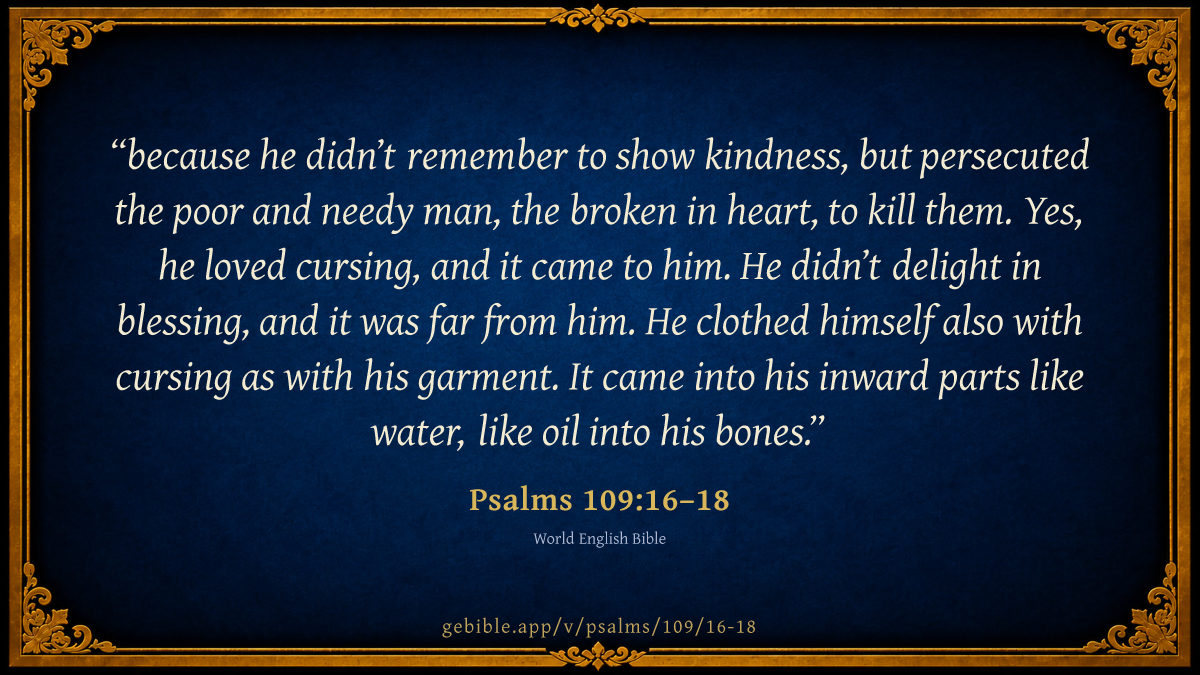
He clothed himself with cursing as his garment
David speaks of the wicked person's behavior as if it were his clothing. AT: "He cursed other people as often as he wore clothing" or "He cursed people all the time" (See: Metaphor)
as his garment
"as if they were his clothing"
his curse came into his inner being like water, like oil into his bones
Possible meanings are: 1) He spoke curses so often that they became a part of his identity. "the curses that he speaks are part of who he is" or 2) the curse that he spoke happened to him. "his whole being was cursed by the curse he spoke" (See: Metaphor)
like water
This refers to how a person drinks water. AT: "like water a person drinks" (See: Assumed Knowledge and Implicit Information)
like oil into his bones
This refers to how oil soaks into bones when rubbed on the skin. AT: "like olive oil soaks into a person's bones when it is rubbed on his skin" (See: Assumed Knowledge and Implicit Information)

John Calvin 1540 · Public Domain On vv16–18 16. Because he forgot to show mercy The prophet…
16. Because he forgot to show mercy The prophet comes now to show that he had good reason for desiring such awful and direful calamities to be inflicted upon his enemies, whose thirst for cruelty was insatiable, and who were transported with rage, no less cruel than obstinate, against the afflicted and poor man, persecuting him with as little scruple as if they were attacking a dead dog. Even philosophers look upon cruelty, directed against the helpless and miserable, as an act worthy only of a cowardly and grovelling nature; for it is between equals that envy is cherished. For this reason the prophet represents the malignity of his enemies as being bitter in persecuting him when he was in affliction and poverty. The expression, the sorrowful in heart, is still more emphatic. For there are persons who, notwithstanding of their afflictions, are puffed up with pride; and as this conduct is unreasonable and unnatural, these individuals incur the displeasure of the powerful. On the other hand, it would be a sign of desperate cruelty to treat with contempt the lowly and dejected in heart. Would not this be to fight with a shadow? This insatiable cruelty is still farther pointed out by the phrase, forgetting to show mercy; the meaning of which is, that the calamities, with which he beheld this guiltless and miserable man struggling, fail to excite his pity, so that, out of regard to the common lot of humanity, he should lay aside his savage disposition. In this passage, therefore, the contrast is equally balanced on the one side between such obstinate pride, and on the other, the strict and irrevocable judgment of God. And as David spoke only as he was moved by the Holy Spirit, this imprecation must be received as if God himself should thunder from his celestial throne. Thus, in the one case, by denouncing vengeance against the ungodly, he subdues and restrains our perverse inclinations, which might lead us to injure a fellow-creature; and on the other, by imparting comfort to us, he mitigates and moderates our sorrow, so that we patiently endure the ills which they inflict upon us. The wicked may for a time revel with impunity in the gratification of their lusts; but this threatening shows that it is no vain protection which God vouchsafes to the afflicted. But let the faithful conduct themselves meekly, that their humility and contrition of spirit may come up before God with acceptance. And as we cannot distinguish between the elect and the reprobate, it is our duty to pray for all who trouble us; to desire the salvation of all men; and even to be careful for the welfare of every individual. At the same time, if our hearts are pure and peaceful, this will not prevent us from freely appealing to God’s judgment, that he may cut off the finally impenitent.
John Calvin's Commentaries (1540-1563) — public domain. Text from the Calvin Translation Society English edition (1840s-50s) via the Christian Classics Ethereal Library (ccel.org). Calvin's coverage is partial (roughly two-thirds of the Bible); uncommented books and verses are honest gaps, never fabricated. The 19th-century editor's footnotes and remarks are omitted so the notes are faithfully Calvin's own voice.
Geneva Bible translators 1599 · Public Domain On vv16–17 He showeth that God accustometh to plague them after…
He showeth that God accustometh to plague them after a strange sort that show themselves cruel toward others.
Geneva Bible (1599) marginal notes — public domain.
John Trapp 1656 · Public Domain On vv16–18 Psa 109:16 Because that he remembered not to shew…
Psa 109:16 Because that he remembered not to shew mercy, but persecuted the poor and needy man, that he might even slay the broken in heart.
Ver. 16. Because that he remembered not to show mercy] Here the prophet beginneth to show why he useth such doleful imprecations against his enemies, viz. not out of a spirit of revenge, or a false zeal, but as truly seeking God’s glory, and his Church’s safety, which could not otherwise be procured, unless these merciless men were devoted to destruction. He remembered not, that is, de industria oblitus est et omisit, he forgot and neglected it on purpose.
John Trapp, A Commentary or Exposition upon All the Books of the Old and New Testament (1647–1656) — public domain. Text from a community e-Sword module.
Matthew Poole 1685 · Public Domain On vv16–18 Remembered not his duty to God, and his obligation…
Remembered not his duty to God, and his obligation to me my former kindness, expressed Psa 109:4,5.
The poor and needy man; myself, who was desolate and miserable, whose required pity, and not additions of cruelty.
Read full note →
The broken in heart; whose spirit was grieved, and even broken the burden of his calamities.
Matthew Poole's English Annotations on the Holy Bible (1683–1685) — public domain. Text from a community e-Sword/MySword module.
John Gill 1763 · Public Domain On vv16–18 As he loved cursing, so let it come unto…
As he loved cursing, so let it come unto him,.... Judas loved that which brought a curse upon him, sin; and so he may be said to love the curse; just as sinners are said to love death, Pro 8:36. He was desirous of and sought after it, to bring Christ to an accursed death; and which he accomplished and pleased himself with; and therefore it was a just retaliation upon him that the curse should light on him, and he himself come to a shameful and ignominious death. The Jews loved the cursing law, the flying roll, called the curse in Zac 5:2, which curses every transgressor of it: they boasted of it, rested in it, and sought for righteousness by it; and submitted not unto, but despised, the righteousness of Christ; and therefore it was but just they should come under the curse of the law: they imprecated the curse on them and their children, saying, "His blood be upon us and them", Mat 27:25 and which accordingly came upon them, and remains to this day.
As he delighted not in blessing, so let it be far from him; Judas delighted not in the good will and good wishes of any to Christ, as appears from his dislike of the ointment being poured on his head by the poor woman, in Joh 12:4, and so the Jews were displeased at the children, and at the disciples in the temple, blessing Christ, pronouncing him blessed, and wishing blessings to him, Mat 21:15, yea, they delighted not in their own blessedness, or in that which only could give it to them; they delighted not in Christ, who was sent to bless them, but despised and rejected him; nor in the Gospel, which is full of blessings; and particularly not in the doctrine of justification by Christ's righteousness, which commonly makes a man blessed: yea, in a sense, they judged themselves unworthy of everlasting life; and therefore it was but a righteous thing that blessing should be far from Judas and the Jews, as it was; even temporal, spiritual, and eternal blessings: yet there have been a sort of heretics (e), that have highly praised and commended Judas, as doing a brave and noble action in betraying Christ, whereby the work of salvation was hastened.
Read full note →
(e) Epiphan. contra Haeres. l. 1. Haer. 38.
John Gill's Exposition of the Whole Bible (1746–1763) — public domain (CC PDM 1.0). Text via the HelloAO Bible API.
John Wesley 1765 · Public Domain On vv17–18 Delighted not - In desiring and promoting the welfare…
Delighted not - In desiring and promoting the welfare of others.
John Wesley, Explanatory Notes Upon the Whole Bible (1754–1765) — public domain. Text via the GEBible commentary corpus.
Adam Clarke 1810 · Public Domain On vv16–18 Verse 16. Persecuted the poor and needy man] In…
Verse 16. Persecuted the poor and needy man] In the case of Jesus Christ all the dictates of justice and mercy were destroyed, and they persecuted this poor man unto death. They acted from a diabolical malice. On common principles, their opposition to Christ cannot be accounted for.
Adam Clarke's Commentary on the Bible (1810–1826) — public domain. Text from a community e-Sword/MySword module.
Joseph Benson 1811 · Public Domain On vv16–17 Psa 109:16. Because he remembered not — “The crime…
Psa 109:16. Because he remembered not — “The crime which brought upon its perpetrators all the above-mentioned judgments and calamities, is here pointed out too plainly to be mistaken. They remembered not to show mercy — To him who showed it to all the world; they persecuted him who for our sakes became poor; they betrayed and murdered the lowly and afflicted Jesus, whose heart was broken with sorrow for their sins, and with a sense of the punishment due to them.”
Joseph Benson's Commentary on the Old and New Testaments (1811–1818) — public domain. Text from a community e-Sword module.
Albert Barnes 1834 · Public Domain On vv16–18 Because that he remembered not to show mercy -…
Because that he remembered not to show mercy - He had no compassion; he was severe, harsh, unjust, unfeeling.
But persecuted the poor and needy man - The man that was destitute of friends; that was a wanderer and a beggar. There were times in the life of David when this would be strictly and literally applicable to him.
Read full note →
That he might even slay the broken in heart - The man whose heart was crushed by sorrow - that he might put “the finishing stroke” to all, and send him to the grave. Whatever might have been the “feeling” which prompted to this prayer, or however difficult it may be to vindicate the psalmist’s expression of feeling, there can be no doubt as to the propriety of inflicting punishment on such a man. The sufferings invoked are none too severe to be inflicted on a man who persecutes the poor and needy, and seeks so to multiply sorrows that the man already crushed and broken in heart shall sink to the grave.
Albert Barnes' Notes on the Bible (1834–1885) — public domain. Text from a community e-Sword/MySword module.
Daniel D. Whedon 1874 · Public Domain On vv16–18 16. Because… he remembered not—He remembered not to show…
16. Because… he remembered not—He remembered not to show mercy, and therefore God will remember to punish his iniquity. Here begin the reasons for the foregoing judgments. The judgments predicted or invoked should always be considered in connexion with the assigned moral causes.
Persecuted the poor and needy man—The description is of one afflicted—in straits and broken hearted—his enemy eagerly pursuing to slay him. Such are the special objects of divine pity and care. Psa_34:6; Psa_34:18
Daniel D. Whedon (gen. ed.), Commentary on the Old and New Testaments (1874–1909) — public domain. Text from a community e-Sword module.
The Cambridge Bible for Schools and Colleges 1878 · Public Domain On vv16–18 16. Because he remembered not to do lovingkindness,
16. Because he remembered not to do lovingkindness,
But persecuted the afflicted and needy man,
Read full note →
And him that was cowed in heart, to do them to death.
He took no thought of the constant teaching of prophets (Hos_6:6; Mic_6:8) and wise men (Pro_11:17). The poor and downhearted and spiritless, men such as the Psalmist represents himself to be (Psa_109:22), were his victims.
16–20. This curse is deserved: it is the just retribution for his deliberate choice of evil.
The Cambridge Bible for Schools and Colleges (gen. ed. J. J. S. Perowne; Cambridge University Press, 1878–1918) — public domain. Text from a community e-Sword module.
Ellicott's Commentary for English Readers 1878 · Public Domain On vv16–17 (16) Poor.—The Hebrew word thus rendered, viz., ‘anî, has…
(16) Poor.—The Hebrew word thus rendered, viz., ‘anî, has suggested a reference to the murder of the high priest Onias (2Ma_4:34-36).
A Bible Commentary for English Readers, edited by Charles John Ellicott (1878–1897) — public domain. Text from a community e-Sword module.
The Pulpit Commentary 1880 · Public Domain On vv16–18 Vers. 16-20. A portraiture of the wicked man, who…
Vers. 16-20. A portraiture of the wicked man, who was David"s chief adversary at the time, is now given, in explanation, and perhaps in justification, of the numerous and severe anathemas. He was merciless (ver. 16), a persecutor of the poor (ver. 16), given to cursing (vers. 17, 18), and one who spoke evil against the innocent (ver. 20).
Because that he remembered not to show mercy. Saul certainly was a persecutor of this kind implacable; one whom compassion never touched; who, after he had once become David"s enemy, never under any circumstances showed him mercy. But otherwise the description scarcely seems to point to Saul. But persecuted the poor and needy man. (see 1Sa_18:10 1Sa_19:1, 1Sa_19:10, 11 20:31 23:8, 14, 25 24:2 26:2-20 27:1, etc.) That he might even slay the broken in heart; literally, and the broken in heart (or, yea, the broken in heart) to slay him. It was certainly Saul"s object to slay David. (1Sa_18:11 1Sa_19:1, 10 20:1, etc.) It was probably also Ahithophel"s. (2Sa_17:2)
The Pulpit Commentary (1880–1919), ed. H.D.M. Spence-Jones & Joseph S. Exell — public domain. Text from a community e-Sword module.
Charles H. Spurgeon 1885 · Public Domain On vv16–18 Ver. 16. Because that he remembered not to shew…
Ver. 16. Because that he remembered not to shew mercy. Because he had no memory to show mercy the Judge of all will have a strong memory of his sins. So little mercy had he ever shown that he had forgotten how to do it, he was without common humanity, devoid of compassion, and therefore only worthy to be dealt with after the bare rule of justice.
But persecuted the poor and needy man. He looked on poor men as a nuisance upon the earth, he ground their faces, oppressed them in their wages, and treated them as the mire of the streets. Should he not be punished, and in his turn laid low? All who know him are indignant at his brutalities, and will glory to see him overthrown.
Read full note →
That he might even slay the broken in heart. He had malice in his heart towards one who was already sufficiently sorrowful, whom it was a superfluity of malignity to attack. Yet no grief excited sympathy in him, no poverty ever moved him to relent. No, he would kill the heart broken and rob their orphans of their patrimony. To him groans were music, and tears were wine, and drops of blood precious rubies. Would any man spare such a monster? Will it not be serving the ends of humanity if we wish him gone, gone to the throne of God to receive his reward? If he will turn and repent, well: but if not, such a up as tree ought to be felled and cast into the fire. As men kill mad dogs if they can, and justly too, so may we lawfully wish that cruel oppressors of the poor were removed from their place and office, and, as an example to others, made to smart for their barbarities.
Ver. 16. Because. Why, what is the crime? Because that he remembered not to shew mercy, etc. See what a long vial full of the plagues of God is poured out upon the unmerciful man! Thomas Watson.
Ver. 16. But persecuted the poor. If any man will practise subtraction against the poor, God will use it against him, and take his name out of the book of life. If he be damned that gives not his own, what shall become of him that takes away another man's? (Augustine.) If judgment without mercy shall be to him that shows no mercy (Jas 2:13) where shall subtraction and rapine appear? Let the extortioner catch all that he hath; and let strangers spoil his labour, Ps 109:11: there is one subtraction, his estate. Let his posterity be cut off; and in the generation following let their name be blotted out, Ps 109:13: there is another subtraction, his memory. Let there be none to extend mercy unto him: neither let there be any to favour his fatherless children, Ps 109:12: there is another subtraction, a denial of all pity to him and his, Let him be condemned: and let his prayer become sin, Ps 109:7: there is another subtraction, no audience from heaven. Let another take his office; there is a subtraction of his place: let his days be few, Ps 109:8: there is a subtraction of his life. Let him be blotted out of the book of the living, and not be written with the righteous, Ps 69:28; there is the last, the subtraction of his soul. This is a fearful arithmetic: if the wicked add sins, God will add plagues. If they subtract from others their rights, God shall subtract from them his mercies. Thomas Adams.
Psalms 109:17*
Charles H. Spurgeon's The Treasury of David (1869–1885) — public domain. Psalms only. Text from a community e-Sword/MySword module.
unfoldingWord translationNotes 2017 · CC BY-SA 4.0 On v17 may it come back upon him
may it come back upon him
"may his curses come upon him"
Read full note →
He clothed himself with cursing as his garment
David speaks of the wicked person's behavior as if it were his clothing. AT: "He cursed other people as often as he wore clothing" or "He cursed people all the time" (See: Metaphor)
as his garment
"as if they were his clothing"
his curse came into his inner being like water, like oil into his bones
Possible meanings are: 1) He spoke curses so often that they became a part of his identity. "the curses that he speaks are part of who he is" or 2) the curse that he spoke happened to him. "his whole being was cursed by the curse he spoke" (See: Metaphor)
like water
This refers to how a person drinks water. AT: "like water a person drinks" (See: Assumed Knowledge and Implicit Information)
like oil into his bones
This refers to how oil soaks into bones when rubbed on the skin. AT: "like olive oil soaks into a person's bones when it is rubbed on his skin" (See: Assumed Knowledge and Implicit Information)
translationWords
curse
bless
clothe
oil
unfoldingWord translationNotes — © Distant Shores Media and the Door43 World Missions Community, licensed CC BY-SA 4.0. Source: git.door43.org/Door43/en_tn.
Tyndale Open Study Notes 2022 · CC BY-SA 4.0 On vv16, 18 109:16 The defendant committed capital crimes and did not…
109:16 The defendant committed capital crimes and did not exercise even basic decency.
Tyndale Open Study Notes — © Tyndale Open Resources, licensed CC BY-SA 4.0. Text via the HelloAO Bible API.