Judges 5:4-5(v4)“Yahweh, when you went out of Seir, when you marched out of the field of Edom, the earth trembled, the sky also dropped. Yes, the clouds…
Exodus 19:18(v4)All of Mount Sinai smoked, because Yahweh descended on it in fire; and its smoke ascended like the smoke of a furnace, and the whole…
Jeremiah 5:22(v7)Don’t you fear me?’ says Yahweh ‘Won’t you tremble at my presence, who have placed the sand for the bound of the sea, by a perpetual…
Exodus 20:18(v4)All the people perceived the thunderings, the lightnings, the sound of the trumpet, and the mountain smoking. When the people saw it, they…
Job 26:11(v7)The pillars of heaven tremble and are astonished at his rebuke.
Show all 24 cross-references
Psalms 104:32(v7)He looks at the earth, and it trembles. He touches the mountains, and they smoke.
Isaiah 64:1-3(v7)Oh that you would tear the heavens, that you would come down, that the mountains might quake at your presence. As when fire kindles the…
Habakkuk 3:6(v4)He stood, and shook the earth. He looked, and made the nations tremble. The ancient mountains were crumbled. The age-old hills collapsed.…
Psalms 96:9(v7)Worship Yahweh in holy array. Tremble before him, all the earth.
Psalms 97:4-5(v7)His lightning lights up the world. The earth sees, and trembles. The mountains melt like wax at the presence of Yahweh, at the presence of…
Jeremiah 4:23-24(v4)I saw the earth, and, behold, it was waste and void, and the heavens, and they had no light. I saw the mountains, and behold, they…
Micah 6:1-2(v7)Listen now to what Yahweh says: “Arise, plead your case before the mountains, and let the hills hear what you have to say. Hear, you…
Job 9:6(v7)He shakes the earth out of its place. Its pillars tremble.
Psalms 77:18(v7)The voice of your thunder was in the whirlwind. The lightnings lit up the world. The earth trembled and shook.
Habakkuk 3:8(vv4–5)Was Yahweh displeased with the rivers? Was your anger against the rivers, or your wrath against the sea, that you rode on your horses, on…
2 Peter 3:7-11(v4)But the heavens that exist now and the earth, by the same word have been stored up for fire, being reserved against the day of judgment and…
Revelation 20:11(v4)I saw a great white throne, and him who sat on it, from whose face the earth and the heaven fled away. There was found no place for them.
Psalms 29:6(vv4, 6)He makes them also to skip like a calf; Lebanon and Sirion like a young, wild ox.
Psalms 18:7(v4)Then the earth shook and trembled. The foundations also of the mountains quaked and were shaken, because he was angry.
Micah 1:3-4(v4)For, behold, Yahweh comes out of his place, and will come down and tread on the high places of the earth. The mountains melt under him, and…
Nahum 1:5(v4)The mountains quake before him, and the hills melt away. The earth trembles at his presence, yes, the world, and all who dwell in it.
Psalms 68:16(v4)Why do you look in envy, you rugged mountains, at the mountain where God chooses to reign? Yes, Yahweh will dwell there forever.
Jeremiah 47:6-7(v5)“ ‘You sword of Yahweh, how long will it be before you are quiet? Put yourself back into your scabbard; rest, and be still.’ “How can you…
Psalms 39:6(v4)“Surely every man walks like a shadow. Surely they busy themselves in vain. He heaps up, and doesn’t know who shall gather.
24 distinct cross-references across this passage (26 total citations).
Cross-references from openbible.info (CC BY 4.0)
Explain this passage (15 sources)
Historical commentary, presented as a primary source — not an endorsement.
John Calvin1540 · Public DomainOn vv5, 75 What ailed thee, O sea! The prophet interrogates…
5 What ailed thee, O sea! The prophet interrogates the sea, Jordan, and the mountains, in a familiar and poetical strain, as lately he ascribed to them a sense and reverence for God’s power. And, by these similitudes, he very sharply reproves the insensibility of those persons, who do not employ the intelligence which God has given them in the contemplation of his works. The appearance which he tells us the sea assumed, is more than sufficient to condemn their blindness. It could not be dried up, the river Jordan could not roll back its waters, had not God, by his invisible agency, constrained them to render obedience to his command. The words are indeed directed to the sea, the Jordan, and the mountains, but they are more immediately addressed to us, that every one of us, on self-reflection, may carefully and attentively weigh this matter. And, therefore, as often as we meet with these words, let each of us reiterate the sentiment, — “Such a change cannot be attributed to nature, and to subordinate causes, but the hand of God is manifest here.” The figure drawn from the lambs and rams would appear to be inferior to the magnitude of the subject. But it was the prophet’s intention to express in the homeliest way the incredible manner in which God, on these occasions, displayed his power. The stability of the earth being, as it were, founded on the mountains, what connection can they have with rams and lambs, that they should be agitated, skipping hither and thither? In speaking in this homely style, he does not mean to detract from the greatness of the miracle, but more forcibly to engrave these extraordinary tokens of God’s power on the illiterate.
John Calvin's Commentaries (1540-1563) — public domain. Text from the Calvin Translation Society English edition (1840s-50s) via the Christian Classics Ethereal Library (ccel.org). Calvin's coverage is partial (roughly two-thirds of the Bible); uncommented books and verses are honest gaps, never fabricated. The 19th-century editor's footnotes and remarks are omitted so the notes are faithfully Calvin's own voice.
Geneva Bible translators1599 · Public DomainOn vv4, 7Seeing that these dead creatures felt God’s power, and…
Seeing that these dead creatures felt God’s power, and after a sort saw it, much more his people ought to consider it, and glorify him for the same.
Geneva Bible (1599) marginal notes — public domain.
John Trapp1656 · Public DomainOn vv4–7Psa 114:4 The mountains skipped like rams, [and] the…
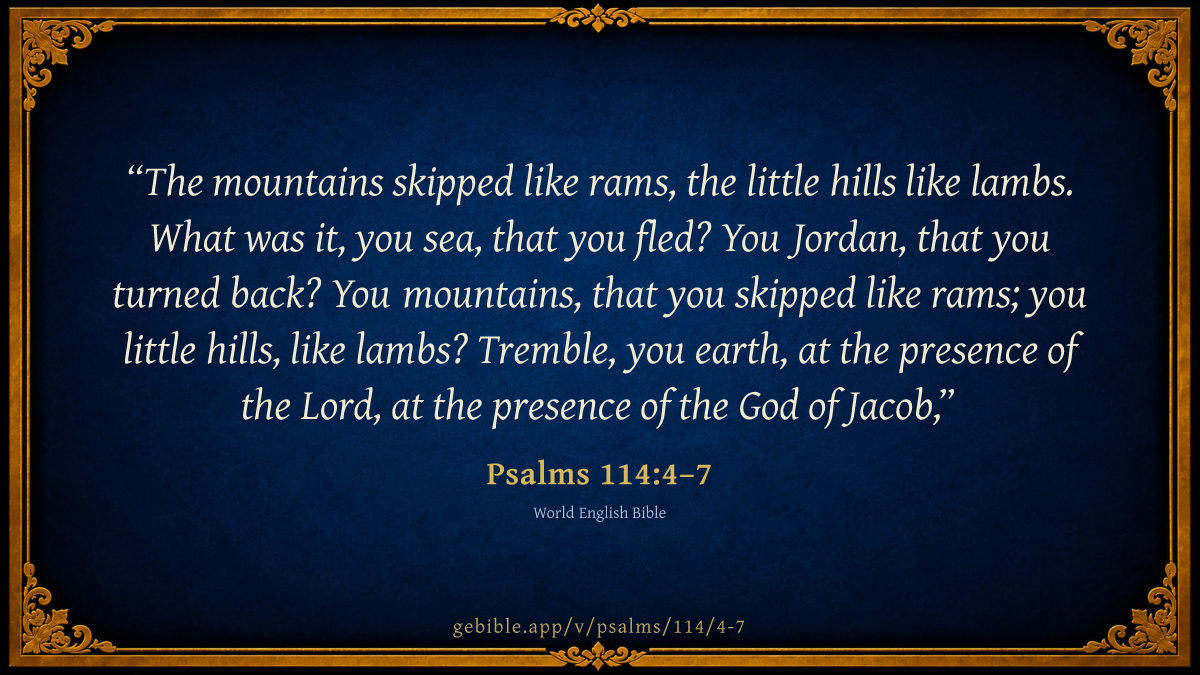
Psa 114:4 The mountains skipped like rams, [and] the little hills like lambs.
Ver. 4. The mountains skipped like rams] sc. At the giving of the law, Exo 19:18, which also causeth heartquakes in believers; but the unjust knoweth no shame, Zep 3:5; is past feeling, Eph 4:19.
John Trapp, A Commentary or Exposition upon All the Books of the Old and New Testament (1647–1656) — public domain. Text from a community e-Sword module.
Matthew Poole1685 · Public DomainOn vv4, 5, 7Horeb and Sinai, two tops of one mountain, and…
Horeb and Sinai, two tops of one mountain, and other neighbouring hills or mountains. Compare Exo 19:18; Psa 68:8; Hab 3:6,10.
Matthew Poole's English Annotations on the Holy Bible (1683–1685) — public domain. Text from a community e-Sword/MySword module.
John Gill1763 · Public DomainOn vv4–7The mountains skipped like rams,.... The mountains of Sinai…
The mountains skipped like rams,.... The mountains of Sinai and Horeb quaked and moved at the presence of the Lord, when he descended thereon to give the law; these saw his glory and trembled, Exo 19:18.
And the little hills like lambs; very beautiful are the larger mountains of Sinai and Horeb compared to rams, and the motion of them to their skipping; and the little hills adjacent to them to lambs: these may represent the greater and lesser governors in the Roman empire at the time when such large conversions were made in it as before observed; and which skipped, and trembled, and fled, and were moved out of their places at the downfall of Paganism and progress of Christianity, Rev 6:14 and also may be an emblem of the difficulties which lie like mountains and hills in the way of a sinner's conversion and effectual calling, which yet give way to and are surmounted by the efficacious grace of God; all mountains become a plain before him, and when he works none can let.
John Gill's Exposition of the Whole Bible (1746–1763) — public domain (CC PDM 1.0). Text via the HelloAO Bible API.
John Wesley1765 · Public DomainOn vv4, 7The mountains - Horeb and Sinai, two tops of…
The mountains - Horeb and Sinai, two tops of one mountain, and other neighbouring mountains.
John Wesley, Explanatory Notes Upon the Whole Bible (1754–1765) — public domain. Text via the GEBible commentary corpus.
Adam Clarke1810 · Public DomainOn v5Verse 5. What ailed thee, O thou sea] The…
Verse 5. What ailed thee, O thou sea] The original is very abrupt; and the prosopopoeia, or personification very fine and expressive: -
What to thee, O sea, that thou fleddest away!
Read full note →
O Jordan, that thou didst roll back!
Ye mountains, that ye leaped like rams!
And ye hills, like the young of the fold!
After these very sublime interrogations, God appears; and the psalmist proceeds as if answering his own questions: -
At the appearance of the Lord, O earth, thou
didst tremble;
At the appearance of the strong God of Jacob.
Converting the rock into a pool of waters;
The granite into water springs.
I know the present Hebrew text reads חולי chuli, "tremble thou," in the imperative; but almost all the Versions understood the word in past tense, and read as if the psalmist was answering his own questions, as stated in the translation above. "Tremble thou, O earth." As if he had said, Thou mayest well tremble, O earth, at the presence of the Lord, at the presence of the God of Jacob.
Adam Clarke's Commentary on the Bible (1810–1826) — public domain. Text from a community e-Sword/MySword module.
Joseph Benson1811 · Public DomainOn v7Psa 114:7-8. Tremble, thou earth, at the presence of…
Psa 114:7-8. Tremble, thou earth, at the presence of the Lord — But why do I ask these questions? Ye mountains and hills were no further moved than was quite just and proper, at the approach and presence of the great Jehovah. Yea, the whole earth had reason to tremble and quake on such an occasion. Which turned the rock into a standing water, &c. — For what cannot he do, who performs such an astonishing wonder as to turn rocks into streams and rivers, and flints into fountains of water? Well may we stand in awe of this God of almighty power, and well may we put our trust in this Being of boundless goodness, who, rather than his people should want what is necessary for their sustenance, will bring substantial bread out of the airy clouds, and refreshing waters out of the dry and flinty rocks!
Joseph Benson's Commentary on the Old and New Testaments (1811–1818) — public domain. Text from a community e-Sword module.
Albert Barnes1834 · Public DomainOn vv4, 5, 7The mountains skipped like rams - As flocks in…
The mountains skipped like rams - As flocks in their gambols. They seemed to move from place to place; everything seemed to be unsettled, and acknowledged the presence of the Omnipotent One. The word rendered “skipped” means to leap for joy; to dance. See the notes at Psa 29:6. The reference here is to the agitations and commotions of the peaks of Sinai, when God came down to deliver the law. Exo 19:16-18.
And the little hills like lambs - Hebrew, Like the sons of the flock. The reference here is to the less prominent eminences of Sinai. The lofty hills, and the smaller hills surrounding, seemed to be all in a state of commotion.
Albert Barnes' Notes on the Bible (1834–1885) — public domain. Text from a community e-Sword/MySword module.
Daniel D. Whedon1874 · Public DomainOn vv4, 5, 74. Mountains skipped—That is, Horeb and Sinai moved to…
4. Mountains skipped—That is, Horeb and Sinai moved to and fro. The word rendered skip, here, indicates a hasty, undulating motion, a coming and retiring, as from fright. In Exo_19:18 it is said, “The whole mount quaked greatly.” See the same figure, Psa_29:6; Hab_3:8. The phenomenon is that of a violent earthquake.
Daniel D. Whedon (gen. ed.), Commentary on the Old and New Testaments (1874–1909) — public domain. Text from a community e-Sword module.
The Cambridge Bible for Schools and Colleges1878 · Public DomainOn vv4, 5, 74. A poetical description of the earthquake which accompanied…
4. A poetical description of the earthquake which accompanied the giving of the Law at Sinai (Exo_19:18; cp. Jdg_5:4; Psa_68:8). For the figure cp. Psa_29:6.
The Cambridge Bible for Schools and Colleges (gen. ed. J. J. S. Perowne; Cambridge University Press, 1878–1918) — public domain. Text from a community e-Sword module.
Ellicott's Commentary for English Readers1878 · Public DomainOn vv4, 7(4) Skipped.—The Hebrew word thus rendered is translated “dance”…
(4) Skipped.—The Hebrew word thus rendered is translated “dance” in Ecc_3:4. (See Psa_18:7.) Exo_19:18 was no doubt in the poet’s thought, but the leaping of the hills formed part of every theophany.
A Bible Commentary for English Readers, edited by Charles John Ellicott (1878–1897) — public domain. Text from a community e-Sword module.
The Pulpit Commentary1880 · Public DomainOn vv4, 5, 7The mountains skipped like rams, and the little hills…
The mountains skipped like rams, and the little hills like lambs. The poet sees in the earthquake that shook Sinai (Exo_19:18) a general commotion of the entire region, in which both the greater and the lesser elevations take part. (comp. Psa_29:6 Psa_68:8, Psa_68:16)
The Pulpit Commentary (1880–1919), ed. H.D.M. Spence-Jones & Joseph S. Exell — public domain. Text from a community e-Sword module.
Charles H. Spurgeon1885 · Public DomainOn vv4–7Ver. 4. The mountains skipped like rams, and the…
Ver. 4. The mountains skipped like rams, and the little hills like lambs. At the coming of the Lord to Mount Sinai, the hills moved; either leaping for joy in the presence of their Creator like young lambs; or, if you will, springing from their places in affright at the terrible majesty of Jehovah, and flying like a flock of sheep when alarmed. Men fear the mountains, but the mountains tremble before the Lord. Sheep and lambs move lightly in the meadows; but the hills, which we are wont to call eternal, were as readily made to move as the most active creatures. Rams in their strength, and lambs in their play, are not more stirred than were the solid hills when Jehovah marched by. Nothing is immovable but God himself: the mountains shall depart, and the hills be removed, but the covenant of his grace abideth fast for ever and ever. Even thus do mountains of sin and hills of trouble move when the Lord comes forth to lead his people to their eternal Canaan. Let us never fear, but rather let our faith say unto this mountain, "Be thou removed hence and cast into the sea, "and it shall be done.
Ver. 4. The mountains skipped like rams, etc. The figure drawn from the lambs and rams would appear to be inferior to the magnitude of the subject. But it was the prophet's intention to express in the homeliest way the incredible manner in which God, on these occasions, displayed his power. The stability of the earth being, as it were, founded on the mountains, what connection can they have with rams and lambs, that they should be agitated, skipping hither and thither? In speaking in this homely style, he does not mean to detract from the greatness of the miracle, but more forcibly to engrave these extraordinary tokens of God's power on the illiterate. John Calvin.
Read full note →
Ver. 4. Skipped. A poetic description of the concussion caused by the thunder and lightning that accompanied the divine presence. James G. Murphy.
Ver. 4. At the giving of the law at Sinai, Horeb and the mountains around, both great and small, shook with a sudden and mighty earthquake, like rams leaping in a grassy plain, with the young sheep frisking round them. Plain Commentary.
Ver. 4-6. When Christ descends upon the soul in the work of conversion, what strength doth he put forth! The strongholds of sin are battered down, every high thing that exalts itself against the knowledge of Christ is brought into captivity to the obedience of his sceptre, 2Co 10:4-5. Devils are cast out of the possession which they have kept for many years without the least disturbance. Strong lusts are mortified and the very constitution of the soul is changed. What ailed thee, O thou sea, that thou fleddest? thou Jordan, that thou wast driven back? ye mountains, that ye skipped like rams?, etc. The prophet speaks those words of the powerful entrance of the children of Israel into Canaan. The like is done by Christ in the conversion of a sinner. Jordan is driven back, the whole course of the soul is altered, the mountains skip like rams. There are many mountains in the soul of a sinner, as pride, unbelief, self conceitedness, atheism, profaneness, etc. These mountains are plucked up by the roots in a moment when Christ begins the work of conversion. Ralph Robinson.
Ver. 4. The movableness of things which appear to be fixed and settled. God's power of creating a stir in lethargic minds, among ancient systems, and prejudiced persons of the highest rank.
Psalms 114:5*
Charles H. Spurgeon's The Treasury of David (1869–1885) — public domain. Psalms only. Text from a community e-Sword/MySword module.
unfoldingWord translationNotes2017 · CC BY-SA 4.0On v5General Information:
General Information:
Verses 5-6 contain four rhetorical questions. The expected answer to each question is found in verse 7, "because of the presence of the Lord." (See: Rhetorical Question)
Read full note →
skip like rams ... skip like lambs
The writer speaks of the mountains and hills as if they are alive. He is probably speaking of an earthquake when he describes their fear at the presence of Yahweh as if they were jumping like rams and lambs. See how you translated similar phrases in Psalms 114:3-4. AT: "shake like jumping rams ... shake like jumping lambs" (See: Personification and Metaphor)
Tremble, earth, before the Lord, at the presence of the God of Jacob
The last two phrases are parallel. The verb may be supplied in the second line. AT: "Tremble, earth, before the Lord, tremble at the presence of the God of Jacob" (See: Parallelism and Ellipsis)
Tremble, earth
Possible meanings are 1) the writer is speaking to the earth as if it were a person and commands it to tremble with fear before God or 2) the word "earth" is a metonym for those who live on the earth. AT: "Tremble, everyone one earth" (See: Personification and Metonymy)

John Calvin 1540 · Public Domain On vv5, 7 5 What ailed thee, O sea! The prophet interrogates…
5 What ailed thee, O sea! The prophet interrogates the sea, Jordan, and the mountains, in a familiar and poetical strain, as lately he ascribed to them a sense and reverence for God’s power. And, by these similitudes, he very sharply reproves the insensibility of those persons, who do not employ the intelligence which God has given them in the contemplation of his works. The appearance which he tells us the sea assumed, is more than sufficient to condemn their blindness. It could not be dried up, the river Jordan could not roll back its waters, had not God, by his invisible agency, constrained them to render obedience to his command. The words are indeed directed to the sea, the Jordan, and the mountains, but they are more immediately addressed to us, that every one of us, on self-reflection, may carefully and attentively weigh this matter. And, therefore, as often as we meet with these words, let each of us reiterate the sentiment, — “Such a change cannot be attributed to nature, and to subordinate causes, but the hand of God is manifest here.” The figure drawn from the lambs and rams would appear to be inferior to the magnitude of the subject. But it was the prophet’s intention to express in the homeliest way the incredible manner in which God, on these occasions, displayed his power. The stability of the earth being, as it were, founded on the mountains, what connection can they have with rams and lambs, that they should be agitated, skipping hither and thither? In speaking in this homely style, he does not mean to detract from the greatness of the miracle, but more forcibly to engrave these extraordinary tokens of God’s power on the illiterate.
John Calvin's Commentaries (1540-1563) — public domain. Text from the Calvin Translation Society English edition (1840s-50s) via the Christian Classics Ethereal Library (ccel.org). Calvin's coverage is partial (roughly two-thirds of the Bible); uncommented books and verses are honest gaps, never fabricated. The 19th-century editor's footnotes and remarks are omitted so the notes are faithfully Calvin's own voice.
Geneva Bible translators 1599 · Public Domain On vv4, 7 Seeing that these dead creatures felt God’s power, and…
Seeing that these dead creatures felt God’s power, and after a sort saw it, much more his people ought to consider it, and glorify him for the same.
Geneva Bible (1599) marginal notes — public domain.
John Trapp 1656 · Public Domain On vv4–7 Psa 114:4 The mountains skipped like rams, [and] the…
Psa 114:4 The mountains skipped like rams, [and] the little hills like lambs.
Ver. 4. The mountains skipped like rams] sc. At the giving of the law, Exo 19:18, which also causeth heartquakes in believers; but the unjust knoweth no shame, Zep 3:5; is past feeling, Eph 4:19.
John Trapp, A Commentary or Exposition upon All the Books of the Old and New Testament (1647–1656) — public domain. Text from a community e-Sword module.
Matthew Poole 1685 · Public Domain On vv4, 5, 7 Horeb and Sinai, two tops of one mountain, and…
Horeb and Sinai, two tops of one mountain, and other neighbouring hills or mountains. Compare Exo 19:18; Psa 68:8; Hab 3:6,10.
Matthew Poole's English Annotations on the Holy Bible (1683–1685) — public domain. Text from a community e-Sword/MySword module.
John Gill 1763 · Public Domain On vv4–7 The mountains skipped like rams,.... The mountains of Sinai…
The mountains skipped like rams,.... The mountains of Sinai and Horeb quaked and moved at the presence of the Lord, when he descended thereon to give the law; these saw his glory and trembled, Exo 19:18.
And the little hills like lambs; very beautiful are the larger mountains of Sinai and Horeb compared to rams, and the motion of them to their skipping; and the little hills adjacent to them to lambs: these may represent the greater and lesser governors in the Roman empire at the time when such large conversions were made in it as before observed; and which skipped, and trembled, and fled, and were moved out of their places at the downfall of Paganism and progress of Christianity, Rev 6:14 and also may be an emblem of the difficulties which lie like mountains and hills in the way of a sinner's conversion and effectual calling, which yet give way to and are surmounted by the efficacious grace of God; all mountains become a plain before him, and when he works none can let.
John Gill's Exposition of the Whole Bible (1746–1763) — public domain (CC PDM 1.0). Text via the HelloAO Bible API.
John Wesley 1765 · Public Domain On vv4, 7 The mountains - Horeb and Sinai, two tops of…
The mountains - Horeb and Sinai, two tops of one mountain, and other neighbouring mountains.
John Wesley, Explanatory Notes Upon the Whole Bible (1754–1765) — public domain. Text via the GEBible commentary corpus.
Adam Clarke 1810 · Public Domain On v5 Verse 5. What ailed thee, O thou sea] The…
Verse 5. What ailed thee, O thou sea] The original is very abrupt; and the prosopopoeia, or personification very fine and expressive: -
What to thee, O sea, that thou fleddest away!
Read full note →
O Jordan, that thou didst roll back!
Ye mountains, that ye leaped like rams!
And ye hills, like the young of the fold!
After these very sublime interrogations, God appears; and the psalmist proceeds as if answering his own questions: -
At the appearance of the Lord, O earth, thou
didst tremble;
At the appearance of the strong God of Jacob.
Converting the rock into a pool of waters;
The granite into water springs.
I know the present Hebrew text reads חולי chuli, "tremble thou," in the imperative; but almost all the Versions understood the word in past tense, and read as if the psalmist was answering his own questions, as stated in the translation above. "Tremble thou, O earth." As if he had said, Thou mayest well tremble, O earth, at the presence of the Lord, at the presence of the God of Jacob.
Adam Clarke's Commentary on the Bible (1810–1826) — public domain. Text from a community e-Sword/MySword module.
Joseph Benson 1811 · Public Domain On v7 Psa 114:7-8. Tremble, thou earth, at the presence of…
Psa 114:7-8. Tremble, thou earth, at the presence of the Lord — But why do I ask these questions? Ye mountains and hills were no further moved than was quite just and proper, at the approach and presence of the great Jehovah. Yea, the whole earth had reason to tremble and quake on such an occasion. Which turned the rock into a standing water, &c. — For what cannot he do, who performs such an astonishing wonder as to turn rocks into streams and rivers, and flints into fountains of water? Well may we stand in awe of this God of almighty power, and well may we put our trust in this Being of boundless goodness, who, rather than his people should want what is necessary for their sustenance, will bring substantial bread out of the airy clouds, and refreshing waters out of the dry and flinty rocks!
Joseph Benson's Commentary on the Old and New Testaments (1811–1818) — public domain. Text from a community e-Sword module.
Albert Barnes 1834 · Public Domain On vv4, 5, 7 The mountains skipped like rams - As flocks in…
The mountains skipped like rams - As flocks in their gambols. They seemed to move from place to place; everything seemed to be unsettled, and acknowledged the presence of the Omnipotent One. The word rendered “skipped” means to leap for joy; to dance. See the notes at Psa 29:6. The reference here is to the agitations and commotions of the peaks of Sinai, when God came down to deliver the law. Exo 19:16-18.
And the little hills like lambs - Hebrew, Like the sons of the flock. The reference here is to the less prominent eminences of Sinai. The lofty hills, and the smaller hills surrounding, seemed to be all in a state of commotion.
Albert Barnes' Notes on the Bible (1834–1885) — public domain. Text from a community e-Sword/MySword module.
Daniel D. Whedon 1874 · Public Domain On vv4, 5, 7 4. Mountains skipped—That is, Horeb and Sinai moved to…
4. Mountains skipped—That is, Horeb and Sinai moved to and fro. The word rendered skip, here, indicates a hasty, undulating motion, a coming and retiring, as from fright. In Exo_19:18 it is said, “The whole mount quaked greatly.” See the same figure, Psa_29:6; Hab_3:8. The phenomenon is that of a violent earthquake.
Daniel D. Whedon (gen. ed.), Commentary on the Old and New Testaments (1874–1909) — public domain. Text from a community e-Sword module.
The Cambridge Bible for Schools and Colleges 1878 · Public Domain On vv4, 5, 7 4. A poetical description of the earthquake which accompanied…
4. A poetical description of the earthquake which accompanied the giving of the Law at Sinai (Exo_19:18; cp. Jdg_5:4; Psa_68:8). For the figure cp. Psa_29:6.
The Cambridge Bible for Schools and Colleges (gen. ed. J. J. S. Perowne; Cambridge University Press, 1878–1918) — public domain. Text from a community e-Sword module.
Ellicott's Commentary for English Readers 1878 · Public Domain On vv4, 7 (4) Skipped.—The Hebrew word thus rendered is translated “dance”…
(4) Skipped.—The Hebrew word thus rendered is translated “dance” in Ecc_3:4. (See Psa_18:7.) Exo_19:18 was no doubt in the poet’s thought, but the leaping of the hills formed part of every theophany.
A Bible Commentary for English Readers, edited by Charles John Ellicott (1878–1897) — public domain. Text from a community e-Sword module.
The Pulpit Commentary 1880 · Public Domain On vv4, 5, 7 The mountains skipped like rams, and the little hills…
The mountains skipped like rams, and the little hills like lambs. The poet sees in the earthquake that shook Sinai (Exo_19:18) a general commotion of the entire region, in which both the greater and the lesser elevations take part. (comp. Psa_29:6 Psa_68:8, Psa_68:16)
The Pulpit Commentary (1880–1919), ed. H.D.M. Spence-Jones & Joseph S. Exell — public domain. Text from a community e-Sword module.
Charles H. Spurgeon 1885 · Public Domain On vv4–7 Ver. 4. The mountains skipped like rams, and the…
Ver. 4. The mountains skipped like rams, and the little hills like lambs. At the coming of the Lord to Mount Sinai, the hills moved; either leaping for joy in the presence of their Creator like young lambs; or, if you will, springing from their places in affright at the terrible majesty of Jehovah, and flying like a flock of sheep when alarmed. Men fear the mountains, but the mountains tremble before the Lord. Sheep and lambs move lightly in the meadows; but the hills, which we are wont to call eternal, were as readily made to move as the most active creatures. Rams in their strength, and lambs in their play, are not more stirred than were the solid hills when Jehovah marched by. Nothing is immovable but God himself: the mountains shall depart, and the hills be removed, but the covenant of his grace abideth fast for ever and ever. Even thus do mountains of sin and hills of trouble move when the Lord comes forth to lead his people to their eternal Canaan. Let us never fear, but rather let our faith say unto this mountain, "Be thou removed hence and cast into the sea, "and it shall be done.
Ver. 4. The mountains skipped like rams, etc. The figure drawn from the lambs and rams would appear to be inferior to the magnitude of the subject. But it was the prophet's intention to express in the homeliest way the incredible manner in which God, on these occasions, displayed his power. The stability of the earth being, as it were, founded on the mountains, what connection can they have with rams and lambs, that they should be agitated, skipping hither and thither? In speaking in this homely style, he does not mean to detract from the greatness of the miracle, but more forcibly to engrave these extraordinary tokens of God's power on the illiterate. John Calvin.
Read full note →
Ver. 4. Skipped. A poetic description of the concussion caused by the thunder and lightning that accompanied the divine presence. James G. Murphy.
Ver. 4. At the giving of the law at Sinai, Horeb and the mountains around, both great and small, shook with a sudden and mighty earthquake, like rams leaping in a grassy plain, with the young sheep frisking round them. Plain Commentary.
Ver. 4-6. When Christ descends upon the soul in the work of conversion, what strength doth he put forth! The strongholds of sin are battered down, every high thing that exalts itself against the knowledge of Christ is brought into captivity to the obedience of his sceptre, 2Co 10:4-5. Devils are cast out of the possession which they have kept for many years without the least disturbance. Strong lusts are mortified and the very constitution of the soul is changed. What ailed thee, O thou sea, that thou fleddest? thou Jordan, that thou wast driven back? ye mountains, that ye skipped like rams?, etc. The prophet speaks those words of the powerful entrance of the children of Israel into Canaan. The like is done by Christ in the conversion of a sinner. Jordan is driven back, the whole course of the soul is altered, the mountains skip like rams. There are many mountains in the soul of a sinner, as pride, unbelief, self conceitedness, atheism, profaneness, etc. These mountains are plucked up by the roots in a moment when Christ begins the work of conversion. Ralph Robinson.
Ver. 4. The movableness of things which appear to be fixed and settled. God's power of creating a stir in lethargic minds, among ancient systems, and prejudiced persons of the highest rank.
Psalms 114:5*
Charles H. Spurgeon's The Treasury of David (1869–1885) — public domain. Psalms only. Text from a community e-Sword/MySword module.
unfoldingWord translationNotes 2017 · CC BY-SA 4.0 On v5 General Information:
General Information:
Verses 5-6 contain four rhetorical questions. The expected answer to each question is found in verse 7, "because of the presence of the Lord." (See: Rhetorical Question)
Read full note →
skip like rams ... skip like lambs
The writer speaks of the mountains and hills as if they are alive. He is probably speaking of an earthquake when he describes their fear at the presence of Yahweh as if they were jumping like rams and lambs. See how you translated similar phrases in Psalms 114:3-4. AT: "shake like jumping rams ... shake like jumping lambs" (See: Personification and Metaphor)
Tremble, earth, before the Lord, at the presence of the God of Jacob
The last two phrases are parallel. The verb may be supplied in the second line. AT: "Tremble, earth, before the Lord, tremble at the presence of the God of Jacob" (See: Parallelism and Ellipsis)
Tremble, earth
Possible meanings are 1) the writer is speaking to the earth as if it were a person and commands it to tremble with fear before God or 2) the word "earth" is a metonym for those who live on the earth. AT: "Tremble, everyone one earth" (See: Personification and Metonymy)
translationWords
earth
lord
God
Jacob
unfoldingWord translationNotes — © Distant Shores Media and the Door43 World Missions Community, licensed CC BY-SA 4.0. Source: git.door43.org/Door43/en_tn.