Psalms 103:2(v12)Praise Yahweh, my soul, and don’t forget all his benefits,
1 Corinthians 6:20(v12)for you were bought with a price. Therefore glorify God in your body and in your spirit, which are God’s.
2 Corinthians 5:14-15(v12)For the love of Christ constrains us; because we judge thus, that one died for all, therefore all died. He died for all, that those who…
2 Chronicles 32:25(v12)But Hezekiah didn’t reciprocate appropriate to the benefit done for him, because his heart was lifted up. Therefore there was wrath on him,…
Romans 12:1(v12)Therefore I urge you, brothers, by the mercies of God, to present your bodies a living sacrifice, holy, acceptable to God, which is your…
Show all 27 cross-references
Psalms 16:5(v13)Yahweh assigned my portion and my cup. You made my lot secure.
Psalms 51:12-14(v12)Restore to me the joy of your salvation. Uphold me with a willing spirit. Then I will teach transgressors your ways. Sinners will be…
Psalms 105:1(v13)Give thanks to Yahweh! Call on his name! Make his doings known among the peoples.
Psalms 116:2(v13)Because he has turned his ear to me, therefore I will call on him as long as I live.
Psalms 80:18(v13)So we will not turn away from you. Revive us, and we will call on your name.
Isaiah 6:5-8(v12)Then I said, “Woe is me! For I am undone, because I am a man of unclean lips, and I dwell among a people of unclean lips: for my eyes have…
1 Corinthians 10:21(v13)You can’t both drink the cup of the Lord and the cup of demons. You can’t both partake of the table of the Lord and of the table of demons.
Psalms 22:25(v14)My praise of you comes in the great assembly. I will pay my vows before those who fear him.
Psalms 116:17(v13)I will offer to you the sacrifice of thanksgiving, and will call on Yahweh’s name.
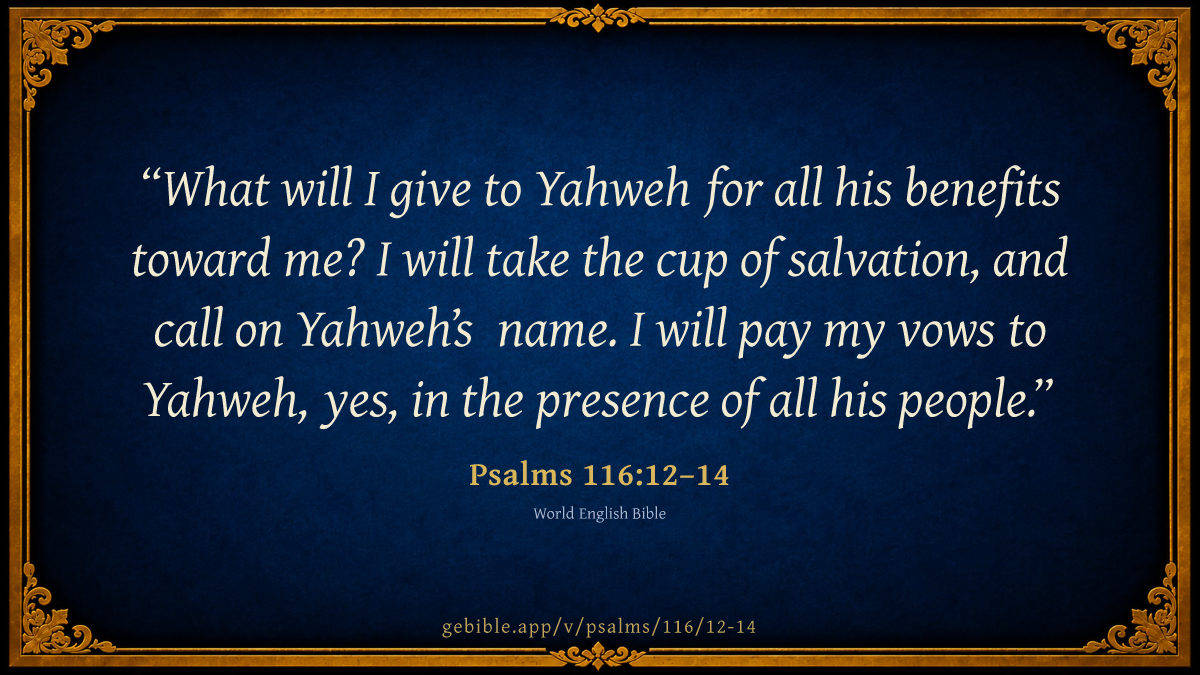
Psalms 116:18(v14)I will pay my vows to Yahweh, yes, in the presence of all his people,
Isaiah 12:4(v13)In that day you will say, “Give thanks to Yahweh! Call on his name. Declare his doings among the peoples. Proclaim that his name is exalted!
Jonah 2:9(v14)But I will sacrifice to you with the voice of thanksgiving. I will pay that which I have vowed. Salvation belongs to Yahweh.”
Luke 22:20(v13)Likewise, he took the cup after supper, saying, “This cup is the new covenant in my blood, which is poured out for you.
1 Corinthians 10:16(v13)The cup of blessing which we bless, isn’t it a sharing of the blood of Christ? The bread which we break, isn’t it a sharing of the body of…
1 Corinthians 11:25-27(v13)In the same way he also took the cup, after supper, saying, “This cup is the new covenant in my blood. Do this, as often as you drink, in…
Psalms 50:14(v14)Offer to God the sacrifice of thanksgiving. Pay your vows to the Most High.
Psalms 66:13-15(v14)I will come into your temple with burnt offerings. I will pay my vows to you, which my lips promised, and my mouth spoke, when I was in…
Luke 22:17-18(v13)He received a cup, and when he had given thanks, he said, “Take this, and share it among yourselves, for I tell you, I will not drink at…
Psalms 56:12(v14)Your vows are on me, God. I will give thank offerings to you.
Matthew 5:33(v14)“Again you have heard that it was said to the ancient ones, ‘You shall not make false vows, but shall perform to the Lord your vows,’
Jonah 1:16(v14)Then the men feared Yahweh exceedingly; and they offered a sacrifice to Yahweh, and made vows.
Nahum 1:15(v14)Behold, on the mountains the feet of him who brings good news, who publishes peace! Keep your feasts, Judah! Perform your vows, for the…
Cross-references from openbible.info (CC BY 4.0)
Explain this passage (17 sources)
Historical commentary, presented as a primary source — not an endorsement.
John Calvin1540 · Public DomainOn vv12–1412. What shall I render unto Jehovah? He now…
12. What shall I render unto Jehovah? He now exclaims with devout admiration, that the multitude of God’s benefits was greater than he could find language to give expression to the grateful emotions of his heart. The question is emphatic, What shall I render? and imports, that it was not the desire, but the means, of which he was destitute, to enable him to render thanks to God. Acknowledging his inability, he adopts the only means in his power, by extolling the grace of God as highly as he could. “I am exceedingly wishful to discharge my duty, but when I look around me, I find nothing which will prove an adequate recompense.” Some understand the phrase, upon me, to intimate, that David had the recollection of all the benefits which God bestowed on him deeply engraven upon his mind. Others, along with the LXX., supply the particle for, What shall I render unto Jehovah for all his benefits towards me? But it is much better to make the first clause of the verse a complete sentence, by putting a period after Jehovah. Because, after confessing his incompetency, or rather his having nothing to offer to God as a sufficient compensation for his benefits, he at the same time adds in confirmation of it, that he was laid under such obligations, not by one series of benefits only, but by a variety of innumerable benefits. “There is no benefit on account of which God has not made me a debtor to him, how should I have means of repaying him for them?” All recompense failing him, he has recourse to an expression of thanksgiving as the only return which he knows will be acceptable to God. David’s example in this instance teaches us not to treat God’s benefits lightly or carelessly, for if we estimate them according to their value, the very thought of them ought to fill us with admiration. There is not one of us who has not God’s benefits heaped upon us. But our pride, which carries us away into extravagant theories, causes us to forget this very doctrine, which ought nevertheless to engage our unremitting attention. And God’s bounty towards us merits the more praise, that he expects no recompense from us, nor can receive any, for he stands in need of nothing, and we are poor and destitute of all things.
John Calvin's Commentaries (1540-1563) — public domain. Text from the Calvin Translation Society English edition (1840s-50s) via the Christian Classics Ethereal Library (ccel.org). Calvin's coverage is partial (roughly two-thirds of the Bible); uncommented books and verses are honest gaps, never fabricated. The 19th-century editor's footnotes and remarks are omitted so the notes are faithfully Calvin's own voice.
Geneva Bible translators1599 · Public DomainOn v13In the Law they used to make a banquet…
In the Law they used to make a banquet when they gave solemn thanks to God, and to take the cup and drink in sign of thanksgiving.
Geneva Bible (1599) marginal notes — public domain.
John Trapp1656 · Public DomainOn vv12–14Psa 116:12 What shall I render unto the LORD…
Psa 116:12 What shall I render unto the LORD [for] all his benefits toward me?
Ver. 12. What shall I render unto the Lord] This he speaketh as one in an ecstasy ( Amor Dei est ecstaticus), or in a deep demur what to do best for so good a God. Such self-deliberations are very useful and acceptable, and thereunto are requisite, 1. Recognition of God’s favours. 2. Estimation. 3. Retribution, as here.
John Trapp, A Commentary or Exposition upon All the Books of the Old and New Testament (1647–1656) — public domain. Text from a community e-Sword module.
Matthew Poole1685 · Public DomainOn vv12–14Yet notwithstanding all my dangers and my distrust of…
Yet notwithstanding all my dangers and my distrust of God too, God hath conferred so many and great blessings upon me, that I can never make sufficient returns to him for them.
Matthew Poole's English Annotations on the Holy Bible (1683–1685) — public domain. Text from a community e-Sword/MySword module.
John Gill1763 · Public DomainOn vv12–14I will take the cup of salvation,.... Or "salvations"…
I will take the cup of salvation,.... Or "salvations" (n); not the eucharistic cup, or the cup in the Lord's supper, which the apostle calls "the cup of blessing", Co1 10:16; though some so think, and that the psalmist represents the saints under the Gospel dispensation; nor the cup of afflictions or martyrdom for the sake of Christ; being willing, under a sense of mercies received, to bear or suffer anything for his sake he should call him to; as knowing it would be a token to him of salvation, and work for his good: but rather an offering of praise for temporal salvation, and for spiritual and eternal salvation; in allusion to a master of a family, who at the close of a feast or meal, used to take up a cup in his hands, and give thanks; see Mat 26:27;
and call upon the name of the Lord; invocation of the name of the Lord takes in all worship and service of him, public and private, external and internal; and particularly prayer, which is calling upon the Lord in the name of Christ, with faith and fervency, in sincerity and truth: and the sense of the psalmist is, that he would not only give thanks for the mercies he had received, but continue to pray to God for more; and this was all the return he was capable of making.
John Gill's Exposition of the Whole Bible (1746–1763) — public domain (CC PDM 1.0). Text via the HelloAO Bible API.
Adam Clarke1810 · Public DomainOn vv12–14Verse 12. What shall I render] מה אשיב mah…
Verse 12. What shall I render] מה אשיב mah ashib, "What shall I return?"
For his benefits] תגמולוהי tagmulohi, "His retributions," the returns he had made to my prayers and faith.
Adam Clarke's Commentary on the Bible (1810–1826) — public domain. Text from a community e-Sword/MySword module.
Joseph Benson1811 · Public DomainOn v12Psa 116:12-14. What shall I render unto the Lord…
Psa 116:12-14. What shall I render unto the Lord — Yet, notwithstanding all my dangers, and my distrust of God also, he hath conferred so many and great blessings upon me, that I can never make sufficient returns to him for them. I will take the cup of salvation — Or of deliverance, as Bishop Patrick renders ישׁועות, thus interpreting the clause: “I will call my friends together to rejoice with me, and taking the cup, which we call the cup of deliverance, (because, when blessed and set apart, we are thus wont to commemorate the blessings we have received,) I will magnify the power, goodness, and faithfulness of God my Saviour before all the company.” The phrase is doubtless taken from the common practice of the Jews in their thank-offerings, in which a feast was made of the remainder of the sacrifices, and the offerers, together with the priests, did eat and drink before the Lord; and among other rites, the master of the feast took a cup of wine into his hand, and solemnly blessed God for it, and for the mercy which was then acknowledged, and then gave it to all the guests, who drank successively of it. According to Dr. Hammond, this cup, among the Jews, was two-fold; one offered in a more solemn manner in the temple, Num 28:7, the other more private in families, called the cup of thanksgiving, or commemoration of any deliverance received. This the master of the family was wont to begin, and was followed by all his guests. On festival days it was attended with a suitable hymn, such as that sung by our Lord and his disciples on the night when he advanced that cup into the sacrament of his blood, which hath ever since been to Christians the cup of salvation; and which all penitents should now receive in the church of Christ, with invocation, thanksgiving, and payment of their vows made in time of trouble.
Joseph Benson's Commentary on the Old and New Testaments (1811–1818) — public domain. Text from a community e-Sword module.
Albert Barnes1834 · Public DomainOn vv12–14What shall I render unto the Lord for all…
What shall I render unto the Lord for all his benefits toward me? - All his “recompences,” - the same word which in Psa 116:7 is rendered “hath dealt bountifully.” The question here has reference to that. What return can be equal to his bounties; what will be a proper acknowledgment of them; with what can I repay him for them all? The question is a natural and a proper question. It is one which we naturally ask when we have received a favor from our fellowmortals; how much more proper is it in view of the favors which we receive from God - especially in view of the mercy of God in the gift of a Saviour; the love manifested in the redemption of the soul! What can be an adequate return for love like that - for mercies so great, so undeserved?
Albert Barnes' Notes on the Bible (1834–1885) — public domain. Text from a community e-Sword/MySword module.
Daniel D. Whedon1874 · Public DomainOn vv12–1412. What shall I render—From the memories of human…
12. What shall I render—From the memories of human faithlessness, which, if dwelt upon, would have awakened only censoriousness and bitterness, the psalmist turns to the deliverance wrought by his faithful God, and to his duty of love and praise.
Daniel D. Whedon (gen. ed.), Commentary on the Old and New Testaments (1874–1909) — public domain. Text from a community e-Sword module.
The Cambridge Bible for Schools and Colleges1878 · Public DomainOn vv12–1412. ‘Quid retribuam Domino pro omnibus quae retribuit mihi?’…
12. ‘Quid retribuam Domino pro omnibus quae retribuit mihi?’ was the question which Richard of Bury, bishop of Durham 1334–1345, the most learned man of his country and age, asked himself repeatedly, and answered by making provision for a band of poor scholars to serve God and His Church. See Lightfoot’s Leaders of the Northern Church, p. 105.
The Cambridge Bible for Schools and Colleges (gen. ed. J. J. S. Perowne; Cambridge University Press, 1878–1918) — public domain. Text from a community e-Sword module.
Ellicott's Commentary for English Readers1878 · Public DomainOn v13(13) I will take.—Or, lift up.
(13) I will take.—Or, lift up.
Cup of salvation.—The drink offering or oblation which accompanied festival celebrations (Num_29:19, &c). Others think of the Passover cup mentioned Mat_26:27, when this psalm as part of the Hallel was sung. Others, again, take the figurative sense of cup—i.e., portion, lot, as in Psa_16:5.
A Bible Commentary for English Readers, edited by Charles John Ellicott (1878–1897) — public domain. Text from a community e-Sword module.
The Pulpit Commentary1880 · Public DomainOn vv12–14Vers. 12-19. The psalm closes with a thanksgiving for…
Vers. 12-19. The psalm closes with a thanksgiving for the deliverance vouchsafed. What return can the psalmist make? First, he will accept the blessing joyfully; next, he will ever continue to call upon God (ver. 13; comp. vers. 4, 17); thirdly, he will pay his vows openly in the temple, in the presence of the whole congregation (vers. 14, 18); fourthly, he will offer continually the sacrifice of thanksgiving (ver. 17) for the benefits vouchsafed him. The enumeration of his pious intentions is itself a song of praise to the Almighty.
What shall I render unto the Lord for all his benefits toward me? Natural piety suggests a return for favors received. What shall this be? the psalmist asks, and then proceeds to give the answer.
Read full note →
The inquiry of the grateful heart.
Many are the blessed spirits that worship God penitence, faith, reverence, hope, and others. But none are more acceptable than the spirit of gratitude. It is that spirit which speaks here in our text. The following verses contain the answer which the same spirit gives. The inquiry before us implies remembrance of
I THE BENEFITS WHICH THE LORD HATH CONFERRED UPON US.
1. It is difficult because of their number, character, variety; and because of Satan"s never-ceasing endeavor to hinder us herein.
2. But is full of advantage. More glory comes to God. Our own soul is blessed. We become able to help others.
3. It is a habit which we should cultivate.
II THE RESPONSE WHICH THESE BENEFITS DEMAND. That of a grateful heart, first and chief of all. God is ever seeking to make up this response; and the devil is ever seeking to prevent it.
III THE LORD WHO PROMPTS THE INQUIRY WILL ENABLE US TO GIVE THE RESPONSE. S.C.
The Pulpit Commentary (1880–1919), ed. H.D.M. Spence-Jones & Joseph S. Exell — public domain. Text from a community e-Sword module.
Charles H. Spurgeon1885 · Public DomainOn vv12–14Ver. 12. What shall I render unto the LORD…
Ver. 12. What shall I render unto the LORD for all his benefits toward me? He wisely leaves off fretting about man's falsehood and his own ill humour, and directs himself to his God. It is of little use to be harping on the string of man's imperfection and deceitfulness; it is infinitely better to praise the perfection and faithfulness of God. The question of the verse is a very proper one: the Lord has rendered so much mercy to us that we ought to look about us, and look within us, and see what can be done by us to manifest our gratitude. We ought not only to do what is plainly before us, but also with holy ingenuity to search out various ways by which we may render fresh praises unto our God. His benefits are so many that we cannot number them, and our ways of acknowledging his bestowments ought to be varied and numerous in proportion. Each person should have his own peculiar mode of expressing gratitude. The Lord sends each one a special benefit, let each one enquire, "What shall I render? What form of service would be most becoming in me?"
Ver. 12. What shall I render unto the LORD? Rendering to the true God, in a true and right manner, is the sum of true religion. This notion is consonant to the scriptures: thus: "Render unto God the things that are God's." Mt 22:21. As true loyalty is a giving to Caesar the things that are Caesar's, so true piety is the giving to God the things that are God's. And so, in that parable of the vineyard let out to husbandmen, all we owe to God is expressed by the rendering the fruit of the vineyard; Mt 21:41. Particular acts of religion are so expressed in the Scriptures, Ps 56:12; Ho 14:2 2Ch 34:31. Let this, then, be the import of David's xwhyl kyva xm, "What shall I render unto the LORD?" "In what things, and by what means, shall I promote religion in the exercise thereof? How shall I show myself duly religious towards him who hath been constantly and abundantly munificent in his benefits towards me?" Henry Hurst.
Read full note →
Ver. 12. All his benefits toward me. What reward shall we give unto the Lord, for all the benefits he hath bestowed? From the cheerless gloom of nonexistence he waked us into being; he ennobled us with understanding; he taught us arts to promote the means of life; he commanded the prolific earth to yield its nurture; he bade the animals to own us as their lords. For us the rains descend; for us the sun sheddeth abroad its creative beams; the mountains rise, the valleys bloom, affording us grateful habitation and a sheltering retreat. For us the rivers flow; for us the fountains murmur; the sea opens its bosom to admit our commerce; the earth exhausts its stores; each new object presents a new enjoyment; all nature pouring her treasures at our feet, through the bounteous grace of him who wills that all be ours. Basil, 326-379.
Ver. 12. All his benefits. As partial obedience is not good, so partial thanks is worthless: not that any saint is able to keep all the commands, or reckon up all the mercies of God, much less return particular acknowledgment for every single mercy; but as he "hath respect unto all the commandments" (Ps 119:6), so he desires to value highly every mercy, and to his utmost power give God the praise of all. An honest soul would not conceal any debt he owes to God, but calls upon itself to give an account for all his benefits. The skipping over one note in a lesson may spoil the grace of the music; unthankfulness for one mercy disparages our thanks for the rest. William Gurnall.
Ver. 12. Overwhelming obligations.
1. A sum in arithmetic"all his benefits."
2. A calculation of indebtedness"What shall I render?"
3. A problem for personal solution"What shall I?" See Spurgeon's Sermon, No. 910.
Ver. 12, 14. Whether well composed religious vows do not exceedingly promote religion. Sermon by Henry Hurst, A.M., in "The Morning Exercises."
Psalms 116:13*
Charles H. Spurgeon's The Treasury of David (1869–1885) — public domain. Psalms only. Text from a community e-Sword/MySword module.
The Biblical Illustrator1887 · Public DomainOn vv12, 14What shall I render unto the Lord for all…
Psa_116:12-14
What shall I render unto the Lord for all His benefits toward me?
Read full note →
Giving thanks by taking more
There is a wonderful ministry of contrast in this varied psalm. A diamond resting upon black plush or velvet shines with a more dazzling lustre. And so it is with the bright patches in this psalm, they are lifted into a still whiter radiance by their surroundings. Take this bit of black environment: The sorrows of death compassed me, and the pains of hell gat hold upon me: I found trouble and sorrow. And now take this gracious bit of light lying just upon the very fringe of the dark country: Gracious is the Lord and righteous; yea, our God is merciful! The Lord preserveth the simple. And here, again, is a similar contrast: I was greatly afflicted; I said in my haste, All men are liars. How sweet is the music that follows! What shall I render unto the Lord for all His benefits toward me? My text is therefore born of the brighter season, when the storm is dying and rumbling away in the distance, and the sun is out again. We find him overwhelmed in the contemplation of Divine benefits. All His benefits toward me. He is amazed at the richness and the multitude of the favours which surround him. He is engirt by the vast crowd of Divine guests! Into whatever room of his house he enters, the guests are there. In highway and byway they throng his steps! Now, here is a very matured attainment of the spiritual man. To perceive and appreciate our benefits necessitates a very refined soul. That is so upon the merely human plane. There are some men who cannot appreciate kindness. They either never see them or they misconstrue them. They are the victims either of dulness or pride, and both these foul spirits make this kind of appreciation impossible. But this spiritual numbness is even more apparent in our relationship to the Divine. We receive multitudes of benefits, but we do not see the Divine mark upon their foreheads. We take them in, but they are not revealed to us as the Kings bounty. It is amazing how fine is the perception of other souls! They never open their eyes without seeing the presence of the hosts of God. The mountains are full of horses and chariots. Having nothing, they yet possess all things. Now, this is a fine perception which can be cultivated by continual exercise. We can have our senses exercised to discern. It is amazing how we can cultivate even a bodily perception. We can train it so as to discover even more minute distinctions. And it is the same with the senses by which we realize the presence of the Divine. But the exercise must be deliberate. We must set about in dead-set purpose to discern the mercies of the Lord. We must just be on the look-out for them as a botanist is on the look-out for wild flowers as he walks the country lanes. You must sit down to-night, for instance, and range over your life to-day, and seek out with eager eyes the mercies which have been about your path. Get hold of Frances Ridley Havergals Journal of Mercies, and she will help you in the cultivation of the finer sight. And then the happy issue is this, that what begins in deliberate exercise becomes an instinctive habit. Our souls can become habituated to the perception. Day after day your life would appear more and more filled with the bountiful guests of the Lord. What is the issue of such contemplation? The fountains of desire are unsealed. Love awakes, and yearns to make some return unto the Lord who has poured His benefits upon us. What shall I render unto the Lord? Have I ever used that word? If such phrase has never leapt to my lips it is because I have never gazed upon the mercies of the King. What return can I make? Now, mark this; the first answer which comes from a soul that has attained to fine spiritual perception is this--I will take the cup of salvation. How exceedingly strange it all is! He asks what he can render, and he answers that he will further take! And this is the very essence of true gratitude. The best return we can make for a gift of God is to take a higher gift. Have you thanked Him for your daily bread? Then the best return you can make is to take the bread of life. Have you thanked Him for your sleep? Then the best return you can make is to take His gift of rest and peace. Have you thanked Him for your health? Then the best return you can make is to seek His gift of holiness. I will take the cup of salvation. I will take the finest thing upon the Lords table! He has given me this gift, now I will take a bigger gift! But that is not the only return the psalmist makes. I will pay my vows unto the Lord now. When the cords of death compassed him he had made a strong and secret vow. He said to himself, If I get over this I will live a more pronounced life unto the Lord! If I get my strength back, I will use it for the King. If I get out of this darkness, I will take a lamp and light the feet of other men! And now he is better again, and he sets about to redeem his vow. The midnight vow was redeemed in the morning! As soon as he was out of the peril he remembered his covenant. Now! There must be no delay. In this sphere delays are attended with infinite peril. Aye, and he will surround the redemption of his vow with publicity. In the presence of all His people. He will do something publicly which will strongly proclaim him on Gods side, and tell to all men that he has given his devotion to Him. And that must be our way. The vow we made in secret must be performed openly. We must do something to indicate that we have passed through a great experience, and that we are remembering the benefits of the Lord. We can speak His name to another. We can write some gracious letter to a friend. We can attach ourselves publicly to the Masters Church. We can commit ourselves openly and outwardly as professed followers of the King. (J. H. Jowett, M.A.)
Awake, sweet gratitude
I. A very suitable inquiry. It contains--
1. A remembrance of all His benefits.
2. A recognition of the Lords consequent claim.
3. A desire appropriately to acknowledge these benefits.
4. An overwhelming sense of inability to acknowledge Gods mercy.
II. A truly remarkable reply.
1. Thank God for the cup of communion, and the cup of consolation. The best way to praise Him for mercies past is to accept mercies present, and to anticipate the mercies that are still in store.
2. True prayer is worship, homage. As a sickly flower pent within the cottage window turns itself towards the sun, and by drinking in its beams worships it, so you who have nothing to give to the collection, so you who have no talents for Sunday school teaching, so you whose lives seem to be one dull round, one common task, do worship God in most spiritual fashion by just breathing His air, imbibing His beams, meditating on His mercy, and asking still for more.
3. Praise and prayer are acceptable to God, and better sacrifices could hardly be, but with praising and praying the psalmist links paying. Do not divorce one from the other. Do not rob God. Have you never read of one who, being brought to the place of martyrdom, kneeled down in the mire at Smithfield, and, lifting up his eyes to heaven, said, I will pay my vows now in the midst of thee, O Smithfield? The place was red with the blood of saints, and brown with the burning of fires! Ah me! the lines are fallen to us in pleasant places; we have a goodly heritage. Will you pay your vows unto the Lord in the basement of the tabernacle? Smithfields fires are out, thank God. It should be easier for us to be consecrated, and devoted, and whole-hearted here and now. (C. H. Spurgeon.)
Harvest Thanksgiving
The importance of gratitude in the heart of man cannot be over-estimated. This is true, even viewing it as an item in the economy of human things. But the sin and the shame of not possessing it are surely greatest when men are found unthankful to their God. What shall I render unto the Lord for all His benefits? It is a practical question, for God does not expect any reward from us which we cannot give.
1. And, first, might we not have a full appreciation of Gods goodness? This would please Him. There are times certainly when we should practise abstinence, but to say this is very far from teaching that it is sinful to appreciate and use to the full the means of sustenance and enjoyment which God has given. A full appreciation of the beauty of the world in which we live,--of the warmth of its sunshine and the fragrance of its flowers, of the strength and healing in its kindly fruits,--is one of the least rewards God merits and expects. A lack of due appreciation is one of the seeds of ingratitude.
2. And then, too, let us be patient in all the circumstances of our life. This also will please God. There may be some who are in want. What shall we say to such as these? Shall we be content to tell them of a better land? Let us tell them of that country, and lead them thither, but let us also tell them to be patient here. Tell them that Jesus, who laid their burden upon them, will help them to bear its weight. Sweet are the uses of adversity if it leads us to trust more in Him. I once heard of a man who was rich, and happy in his wealth. Suddenly a reverse in fortune came, and he lost all. Yet, even in misfortune, he was still happy. On being asked the reason why he was happy in all circumstances of life, he answered, When I was rich, I saw God in all things. Now that I am poor, I have all things in God. Brethren, in your patience possess ye your souls.
3. And God expects us to be kind. That will surely please Him, for He has said, Inasmuch as ye have done it unto the least of these my brethren, ye have done it unto Me. The very existence of the poor (and we have them with us always) is an opportunity for good works. May all of us in time learn the luxury of doing good. We have kept the grandest lesson of harvest till the last.
4. It leads our thoughts on from carnal food to Jesus, who is the Bread of Life. As food is necessary for the sustenance of the body, so is Jesus necessary for the life of the soul. Therefore, like David, let us take the cup of salvation, and call on the name of the Lord. (F. St. John Corbett.)
How may each Christian best glorify God?
I. The benefits which we Have received from God. The catalogue is endless. It stretches into eternity. Converting mercy--pardoning mercy--renewing mercy--justifying mercy--restoring mercy--supporting mercy;--where shall I close the enumeration?
II. The return of gratitude and love which God requires at your hand.
1. There are methods of glorifying God common to every Christian. Every Christian must dedicate his body to God as His temple. Surrender to Him the key of every apartment. Lay open to Him every chamber of your heart. Let your spirit bow before Him as He enters in, and hail Him Lord of all that it contains.
2. By employing your talents in His service. If you are the property of God, then all the powers of the mind, as well as the members of the body, are individually his right. (T. Raffles, D. D.)
What shall I give to Him?
I. The desire that prompts the question.
1. It seems to be a law of nature that some return should be made for benefits received.
2. Gratitude can only be shown by making some return.
3. Thanksgiving is the peculiar privilege of the saint.
4. How may we know when we are truly thankful?
(1) When we are quick to see and slow to forget our mercies.
(2) When our heart is in our praises.
(3) When there is an absence of all thought of human merit.
II. Some thoughts suggested by the question.
1. The possessions of God.
2. Our own poverty.
III. The only answer that can be given. The hearts gratitude is all the saint can give in return for mercies that are fresh with every hour, and as numerous as the seconds in the day. Do not niggardly withhold the only thing you can render. Praise Him, it costs nothing, it is all that you can do, and it is just what He is willing to accept. Not to do so is disloyalty to heavens throne. But if thanksgiving be good, remember thanksliving is better, therefore let thy whole life join in the harmony. (A. G. Brown.)
What will you do
The text is the language of a man who sees religion in its true light.
I. The benefits received.
1. The benefit of answered prayer. The ancient Romans had many gods, some of which they regarded as their especial deities; but they were so much afraid of some other nation stealing or enticing their gods away that they never mentioned their names; and in one instance the marble image of a god was actually chained in the temple, to prevent his leaving them or being spirited away to some other place. Being fickle themselves, they believed their gods were also fickle. The blessedness of true religion, based upon Divine revelation, is that is clearly shows that our God will never leave us. He has promised, I will never leave thee nor forsake thee. God careth for us because He is our Creator and our Redeemer. He is a prayer-hearing and prayer-answering God.
2. The Lord had redeemed his soul from death. Then, because He has redeemed your soul from death on the cross, what will you render unto the Lord? Will you not take the cup of salvation? Will you not be the Lords servant and pay your vows in the presence of His people?
II. The return made for these benefits. I will take the cup of salvation. Jesus spoke of His body as bread and of His blood as wine; and when He told His disciples that they must eat His flesh and drink His blood, it is evident He meant that we must get our spiritual nourishment from believing in the truth and love of His Gospel, and our strength from practising that truth and love in our lives. It is considered doubly treacherous to injure or betray a man of whose bread and wine you have partaken. The Arabs say that if you eat bread with them or taste their salt, they can never injure you; everlastingly they are your friends. Now, when you take the cup at what is called the Lords Supper, it means, likewise, that you publicly testify that you are a friend of Jesus who died for you; and when you eat the bread, you mean that you earnestly desire to receive the truth, which the bread represents. Partaking of this cup also means that we trust our Lord. Alexander of Greece was warned by a friend that his physician was seeking an opportunity of poisoning him; but, when the physician next time presented the cup, Alexander looked in his face steadfastly, and then, taking it in his hand, said, I drink to show my trust in thee! (W. Birch.)
I will take the cup of salvation.--
Taking from God the best giving to God
It is a most natural thing, as all languages show, to talk of a mans lot, either of sorrow or of joy, as the cup which he has to drink; and there are plenty of instances of the metaphor in the psalms, such as Thou art the portion of mine inheritance and of my cup, Thou maintainest my lot. My cup runneth over. That familiar emblem is all that is wanted here. The cup of salvation expresses, by its plural form, the fulness and variety of the manifold and multiform deliverances which God had wrought and was working for the psalmist His whole lot in life appears to him as a cup-full of tender goodness, loving faithfulness, delivering grace. It runs over with Divine acts of help and sustenance. As his grateful heart thinks of all Gods benefits to him, he feels at once the impulse to requite and the impossibility of doing it. The great thought, then, which lies here is that we best requite God by thankfully taking what He gives.
I. Now, I note how deep that thought goes into the heart of God. Why is it that we honour God most by taking, not by giving? The first answer that occurs to you, no doubt, is--because of His all-sufficiency and our emptiness. No doubt that is quite true; and, rightly understood, that is a strengthening and a glad truth. But is that all which can be said in explanation of this principle? The principle of our text reposes at last on God is love and wishes our hearts, and not merely on God has all and does not need our gifts. He delights in no recompense, but only in the payment of a heart won to His love and melted by His mercies.
II. But now let us look at the elements which make up this requital of God in which He delights. And, first, let us be sure that we recognize the real contents of our cup. It is a cup of salvation, however hard it is sometimes to believe it. How much blessing and happiness we all rob ourselves of by our slowness to feel that! Then, again, another of the elements of this requital of God is--be sure that you take what God gives. There can be no greater slight and dishonour to a giver than to have his gifts neglected. Do not complain of your thirsty lips till you are sure that you have emptied the cup of salvation which God gives. One more element of this requital of God has still to be named--the thankful recognition of Him in all our feasting,--call on the name of the Lord. Without this, the preceding precept would be a piece of pure selfish epicureanism--and without this it would be impossible. Only he who enjoys life in God enjoys it worthily. Only he who enjoys life in God enjoys it at all. This is the true infusion which gives sweetness to whatever of bitter, and more of sweetness to whatever of sweet, the cup may contain, when the name of the Lord is pronounced above it. If we carried that spirit with us into all our small duties, sorrows, and gladnesses, how different they would all seem! We should not then find that Gods gifts hid Him from us. Nothing would be too great for us to attempt, nothing too small for us to put our strength into. There is an old legend of an enchanted cup filled with poison, and put treacherously into a kings hand. He signed the sign of the cross and named the name of God over it--and it shivered in his grasp. Do you take this name of the Lord as a test. Name Him over many a cup which you are eager to drink of, and the glittering fragments will lie at your feet, and the poison be spilled on the ground. What you cannot lift before His pure eyes and think of Him while you enjoy, is not for you. Friendships, schemes, plans, ambitions, amusements, speculations, studies, loves, businesses--can you call on the name of the Lord while you put these cups to your lips? If not, fling them behind you--for they are full of poison which, for all its sugared sweetness, at the last will bite like a serpent and sting like an adder. (A. Maclaren, D. D.)
Taking in giving
What shall I render? Take! Why, the whole essence of Christianity is in that antithesis, if you think about it. For what does the doctrine that a man is saved by faith mean, if it does not mean that the one thing that we all have to do is to accept what God bestows? And the same attitude of reception which we have to assume at the beginning of our Christian life must be maintained all through it. Depend upon it, we shall make far more progress in the Divine life if we learn that each step of it must begin with the acceptance of a gift from God, than if we toil, and moil, and wear ourselves with vain efforts in our own strength. I do not mean that a Christian man is not to put forth such efforts, but I do mean that the basis of all profitable discipline, and self-control, and reaching out towards higher attainments, either in knowledge or in practical conformity to Jesus Christ, which he puts forth, must be laid in fuller acceptance of Gods gift, on which must follow building on the foundation, by resolute efforts to work Gods gift into our characters, and to work it out in our lives. All around you, Christian men, there lie infinite possibilities. God does not wait to be asked to give; He has given once for all; and continuously as the result of that once-for-all giving, just as preservation is but the prolongation of the act of creation. He has given, once for all, and continuously, all that every man, and all men, need, for their being made perfectly like Himself. We hear people praying for larger bestowments of grace. Let them take the bestowments that they have, and they will find them enough for their need. God communicated His whole fulness to the Church for ever when He sent His Son, and when His Son sent His Spirit. Open thy mouth wide and I will fill it. Take what you have and you will find that you have all that you need. (A. Maclaren, D. D.)
Receiving and rendering
The two component parts of true religion are receiving and rendering. As to the first disciples, so to each one of us, according to the several providential gifts and spiritual graces bestowed upon each, the Master still says, Freely ye have received, freely give. And I doubt not many a financial loss that has overtaken wealthy or well-to-do members of the Church has been visited upon them because while they received they failed to render. The true record of the bankruptcy of many a Christian merchant might be written thus:--First, he failed to render to his God; then, and therefore, he failed to receive from God (for God could no longer give where no adequate return was made), and then, lastly and consequently, he failed to pay his fellows. But whether or not such retribution overtakes the unjust steward in this life, there can be no doubt that when the Lord returns He will require the balance-sheet to be presented--a balance-sheet in which the receiving and the rendering alike will he faithfully chronicled; and then the Lord will render unto every man according to his work.
I. The psalmist refers to the great benefit of personal salvation (verse 16). It is true that as you were not redeemed with such corruptible things as silver and gold, so such things as silver and gold can never make adequate repayment to your Redeemer. He claims your love, your life; not yours, but you. And yet shall we refuse these corruptible things when by them we may bring honour to our Saviour and help to extend His kingdom?
II. The psalmist refers, again, to the great benefit of pious parentage. The son of Thine handmaid--how great a blessing is acknowledged in those simple words! Through this small loophole we can see the inestimable advantages of a religious home. The psalmist makes no reference to his father, but his mothers pre-eminent piety stands before him still, and he recognizes it as one of his choicest blessings when he says, I am Thy servant and the son of Thine handmaid. How many of us have to thank God for this priceless benefit--the benefit of a pious parentage and religious training!
III. The psalmist also refers--and, as it is the occasion of the psalm, refers at length--to the benefit of restored health and prolonged life. Through pain and weakness he had been brought low. Disease held him fast in its fierce grip, so that he found trouble and sorrow. The sorrows of death compassed him--came crowding round him on every side, till there seemed to be no escape; and the pains of hell--the mysteries of the unseen world and the darkness of the grave--got hold upon him. Then in his pain and misery he cried unto the Lord, and God heard his voice and his supplication. Precious in the sight of the Lord was the death of His saint; i.e. it was not lightly regarded by God that His servant should perish. He rebuked the destroyer, made Death ungrasp his fainting prey. He delivered his soul from death, his eyes from tears, his feet from falling. And now, with health restored and life prolonged, the psalmist cries, What shall I render unto the Lord for all His benefits towards me? And he answers, I will walk before God in the land of the living; I will pay my vows unto the Lord; I will offer to Thee the sacrifice of thanksgiving. (J. H. Grooves.)
The cup of salvation
In the Bible the cup is used to represent the condition of a man, his circumstances, and his portion (Psa_11:6; Psa_16:5; Psa_23:5; Psa_60:3; Psa_75:8). The cup of salvation is the condition of deliverance, which this psalm celebrates, not the drink-offering appointed by the law, not the cup of blessing. Noahs deliverance was a cup of salvation. To call upon the name of the Lord is a phrase of greater power than to call upon the Lord. There is a reference, in the use of the word name, to the manifestations of God, to historical Divine manifestations (Exo_3:13-15).
I. God giving.
1. A personal God.
2. Something which the personal God has provided and arranged, held out to His creatures.
3. A recognition of a relation with us upon Gods part, and of dependence upon our part.
4. Kindness shown. The cup of blessing is a revelation of love.
II. Man taking. Here it may be said, Will he not invariably take? Must he not take? The taking here is not a simple laying hold of that which God gives, but the use and enjoyment of what God bestows. To take the cup of salvation is to receive a blessing in all its fulness, to the utmost limit of our receptive capacity, and of our power to accept and to enjoy.
III. Gods servant seeing God in what he takes. There is a name of God on every cup and in each act of offering a cup. The words, God of Abraham, Isaac, and Jacob, represent the God who is to be seen in the lives of these men. But God is as really in the lives of Robinson, and Smith, and Jones, as in the lives of the patriarchs. God is in health and in healing, in wealth and in extrication from poverty, in prosperity and in lifting up out of adversity. In His giving and working and ministering and protecting, God is ever writing His name. One point of difference between the godly and ungodly is that the former see God in connection with their cup, and that the latter see Him not. As far as a landscape without sunshine is inferior to a landscape upon which the sun sheds his rays, is the appearance of blessings when separated from God, to the same blessings when regarded as the gift of His hand.
IV. Worship, the fruit of what we receive and see. And will call upon the name of the Lord. Past and present gifts on the part of God should encourage us in three things--prayer, praise, and thanksgiving. (S. Martin.)
Taking all God offers
How much more happy we should all be, if we only received all that God offers and accepted more cordially that which we do take! A writer in The Reader, in an admirable article on Thermo-electrical Science, observes, Like windmills, thermo-electric batteries might be erected over the country, and entrap, finally converting into mechanical motion, and thus into money, gleams of sunshine, which would be as wind to the sails of the mill. What stores of fabulous wealth are, as far as our earth is concerned, constantly wasted by the non-retention of solar rays poured on the desert of Sahara. Nature here refuses to use her wonderful radiation net, for we cannot cover the desert sands with trees, and man is left alone to try his skill in retaining solar energy. Hitherto helpless, we need not be so much longer, and the force of a Sahara sun may be carried through wires to Cairo, and thence irrigate the desert, or possibly, if need be, it could pulsate under our streets, and be made to burn in Greenland. Take up your neglected mercies, my brethren. Take the cup which you have overlooked and despised. Take the cup entirely, which you have taken but partially, and with the taking of every cup call upon the name of the Lord. (S. Martin.)
The cup of life
The whole lot in life of the psalmist appears to him like a cup full of tender, good, loving faithfulness and delivering grace. And why is it that the best return for Gods goodness is by further taking, not by giving? The principle upon which this text rests ultimately is that God is love, and wants our hearts, and not merely that God has everything and does not need our gifts. Take the illustration of our own case. Do we not feel that all the bloom and beauty are gone from a gift if the giver hopes to receive anything in return? Love gives because it delights to give. It gives to express itself, and to bless the giver. If there be any thought of return, it is only the return of love. And that is how God gives. As St. James expresses it, He is the giving God. I will take the cup of salvation and call upon the name of the Lord. The Jewish father at the head of his family on the old Passover day, at a certain period in the family feast, solemnly lifted the wine cup and breathed a thanksgiving to God, and then drank of it with all around him. This word here I will take we may fairly translate as I will raise. Perhaps it is intended that there should be preserved for us within the sacred word that old picture as emblematic of the consecration that should rest upon all our happiness and upon all our life--the remembrance of God, the calling upon the name of the Lord. Christ gave us not merely the ritual of an ordinance, but the pattern of all our life, when He took the cup and gave thanks. And so common joys become sacraments, and enjoyments in our homes and in our innocent pleasures become worship, and the cup of mingled bitter and sweet that is provided for each of us by our loving Father becomes a cup of blessing and of salvation over which and by reason of which we can come more fully to recognize and praise the goodness of God. (M. Hartley.)
The cup of salvation
This cup of salvation is standing on the table of infinite love, filled to the brim with the wine of the Kingdom; all heaven is there in solution, all joy, peace, comfort, security, for the word salvation covers all. How came it there? Ages back man was tempted and drank of a forbidden cup; it wrought madness in the brain, enmity in the heart, and the poison spread into all parts of his being, and as the result of the first draught he had to drink of another, the cup of sorrow. But over and beyond there is a third cup of Gods holy anger against sin, deep and filled with wormwood and gall. The Man Christ Jesus comes in a body like our own, He looks on the cup of Divine anger, He takes and begins, to drink, and finds it a cup of trembling and amazement, but never a moments pause or hesitation till He came to the dregs, and His anguished soul cried, My God, My God, why hast Thou forsaken Me? and He puts it down and says, It is finished. He rises again; and now the cup which He had drained is as full of blessing as it was of woe. It is the cup of Gods salvation. Take the cup of salvation, not make. So many are wanting to tread out grapes of their own good works and put them into the cup, but that is filled with the wine which comes from Jesus Himself, having been trodden in the winepress. Take, not admire and wonder. Take, not only hold it in a trembling hand, but drink, put it to thy lips and say, I will take the cup of salvation and call on the name of the Lord. All believers may take a fresh and a deeper draught, and the more you drink of this wine the more sober you become, and the deeper and sweeter, for there is more in Christ than was ever dreamed of, and a delight in Gods salvation that could never be thought possible. (A. G. Brown.)
The Biblical Illustrator, edited by Joseph S. Exell (c. 1880s–1900s) — public domain. Text from a community e-Sword module.
Alexander MacLaren1905 · Public DomainOn v12Psa 116:12 - Psa 116:13.
Psalms
REQUITING GOD
Read full note →
Psa 116:12 - Psa 116:13.
There may possibly be a reference here to a part of the Passover ritual. It seems to have become the custom in later times to lift high the wine cup at that feast and drink it with solemn invocation and glad thanksgiving. So we find our Lord taking the cup-the ‘cup of blessing’ as Paul calls it-and giving thanks. But as there is no record of the introduction of that addition to the original Paschal celebration, we do not know but that it was later than the date of this psalm. Nor is there any need to suppose such an allusion in order either to explain or to give picturesque force to the words. It is a most natural thing, as all languages show, to talk of a man’s lot, either of sorrow or joy, as the cup which he has to drink; and there are numerous instances of the metaphor in the Psalms, such as ‘Thou art the Portion of mine inheritance and of my cup, Thou maintainest my lot.’ ‘My cup runneth over.’ That familiar emblem is all that is wanted here.
Then one other point in reference to the mere words of the text may be noticed. ‘Salvation’ can scarcely be taken in its highest meaning here, both because the whole tone of the psalm fixes its reference to lower blessings, and because it is in the plural in the Hebrew. ‘The cup of salvation’ expresses, by that plural form, the fulness and variety of the manifold and multiform deliverances which God had wrought and was working for the Psalmist. His whole lot in life appears to him as a cup full of tender goodness, loving faithfulness, delivering grace. It runs over with divine acts of help and sustenance. As his grateful heart thinks of all God’s benefits to him, he feels at once the impulse to requite and the impossibility of doing so. With a kind of glad despair he asks the question that ever springs to thankful lips, and having nothing to give, recognises the only possible return to God to be the acceptance of the brimming chalice which His goodness commends to his thirst.
The great thought, then, which lies here is that we best requite God by thankfully taking what He gives.
Now I note to begin with-how deep that thought goes into the heart of God.
Why is it that we honour God most by taking, not by giving? The first answer that occurs to you, no doubt, is-because of His all-sufficiency and our emptiness. Man receives all. God needs nothing. We have all to say, after all our service, ‘Of Thine own have we given Thee.’ No doubt that is quite true; and rightly understood that is a strengthening and a glad truth. But is that all which can be said in explanation of this principle? Surely not. ‘If I were hungry I would not tell thee; for the world is mine and the fulness thereof,’ is a grand word, but it does not give all the truth. When Paul stood on Mars Hill, and, within sight of the fair images of the Parthenon, shattered the intellectual basis of idolatry, by proclaiming a God ‘not worshipped with men’s hands as though He needed anything, seeing He giveth to all men all things,’ that truth, mighty as it is, is not all. We requite God by taking rather than by giving, not merely because He needs nothing, and we have nothing which is not His. If that were all, it might be as true of an almighty tyrant, and might be so used as to forbid all worship before the gloomy presence, to give reverence and love to whom were as impertinent as the grossest offerings of savage idolaters. But the motive of His giving to us is the deepest reason why our best recompense to Him is our thankful reception of His mercies. The principle of our text reposes at last on ‘God is love and wishes our hearts,’ and not merely on ‘God has all and does not need our gifts.’
Take the illustration from our own love and gifts. Do we not feel that all the beauty and bloom of a gift is gone if the giver hopes to receive as much again? Do we not feel that it is all gone if the receiver thinks of repaying it in any coin but that of the heart? Love gives because it delights in giving. It gives that it may express itself and may bless the recipient. If there be any thought of return it is only the return of love. And that is how God gives. As James puts it, He is ‘the giving God,-who gives,’ not as our version inadequately renders, ‘liberally,’ but ‘simply’-that is, I suppose, with a single eye, without any ulterior view to personal advantage, from the impulse of love alone, and having no end but our good. Therefore it is, because of that pure, perfect love, that He delights in no recompense, but only in the payment of a heart won to His love and melted by His mercies. Therefore it is that His hand is outstretched, ‘hoping for nothing again.’ His Almighty all-sufficiency needs nought from us, and to all heathen notions of worship and tribute puts the question: ‘Do ye requite the Lord, O foolish people and unwise?’ But His deep heart of love desires and delights in the echo of its own tones that is evoked among the rocky hardnesses of our hearts, and is glad when we take the full cup of His blessings and, as we raise it to our lips, call on the name of the Lord. Is not that a great and a gracious thought of our God and of His great purpose in His mercies?
But now let us look for a moment at the elements which make up this requital of God in which He delights. And, first I put a very simple and obvious one, let us be sure that we recognise the real contents of our cup. It is a cup of salvations, however hard it is sometimes to believe it. Of how much blessing and happiness we all rob ourselves by our slowness to feel that! Some of us by reason of natural temperament; some of us by reason of the pressure of anxieties, and the aching of sorrows, and the bleeding of wounds; some of us by reason of mere blindness to the true character of our present, have little joyous sense of the real brightness of our days. It seems as if joys must have passed and be seen in the transfiguring light of memory, before we can discern their fairness; and then, when their place is empty, we know that we were entertaining angels unawares. Many men and women live in the gloom of a lifelong regret for the loss of some gift which, when they had it, seemed nothing very extraordinary, and could not keep them from annoyance with trifles. Common sense and reasonable regard for our own happiness and religious duty unite, as they always do, in bidding us take care that we know our blessings. Do not let custom blind you to them. Do not let tears so fill your eyes that you cannot see the goodness of the Lord. Do not let thunderclouds, however heavy their lurid piles, shut out from you the blue that is in your sky. Do not let the empty cup be your first teacher of the blessings you had when it was full. Do not let a hard place here and there in the bed destroy your rest. Seek, as a plain duty, to cultivate a buoyant, joyous sense of the crowded kindnesses of God in your daily life. Take full account of all the pains, all the bitter ingredients, remembering that for us weak and sinful men the bitter is needful. If still the cup seem charged with distasteful draught, remember whose lip has touched its rim, leaving its sacred kiss there, and whose hand holds it out to you while He says, ‘Do this in remembrance of Me.’ The cup which my Saviour giveth me, can it be anything but a cup of salvations?
Then, again, another of the elements of this requital of God is-be sure that you take what God gives.
There can be no greater slight and dishonour to a giver than to have his gifts neglected. You give something that has, perhaps, cost you much, or which at any rate has your heart in it, to your child, or other dear one; would it not wound you if a day or two after you found it tossing about among a heap of unregarded trifles? Suppose that some of those Rajahs who received presents on a royal visit to India had gone out from the durbar and flung them into the kennel, that would have been insult and disaffection, would it not? But these illustrations are trivial by the side of our treatment of the ‘giving God.’ Surely of all the follies and crimes of our foolish and criminal race, there is none to match this-that we will not take and make our own the things that are freely given to us of God. This is the height of all madness; this is the lowest depth of all sin. He spares not His own Son, the Son spares not Himself, the Father gives up His Son for us all because He loves, the Son loves us, and gives Himself to us and for us, and we stand with our hands folded on our breasts, will not condescend so much as to stretch them out, or hold our blessings with so slack a grasp that at any time we may let them slip through our careless fingers. He prays us with much entreaty to receive the gift, and neglect and stolid indifference are His requital. Is there anything worse than that? Surely Scripture is right when it makes the sin of sins that unbelief, which is at bottom nothing else than a refusal to take the cup of salvation. Surely no sharper grief can be inflicted on the Spirit of God than when we leave His gifts neglected and unappropriated.
In the highest region of all, how many of these there are which we treat so! A Saviour and His pardoning blood; a Spirit and His quickening energies; that eternal life which might spring in our souls a fountain of living waters-all these are ours. Are we as strong as we might be if we used the strength which we have? How comes it that with the fulness of God at our sides we are empty; that with the word of God in our hands we know so little; that with the Spirit of God in our hearts we are so fleshly; that with the joy of our God for our portion we are so troubled; that with the heart of God for our hiding-place we are so defenceless? ‘We have all and abound,’ and yet we are poor and needy, like some infatuated beggar, in rags and wretchedness, to whom wealth had been given which he would not use.
In the lower region of daily life and common mercies the same strange slowness to take what we have is found. There are very few men who really make the best of their circumstances. Most of us are far less happy than we might be, if we had learned the divine art of wringing the last drop of good out of everything. After our rude attempts at smelting there is a great deal of valuable metal left in the dross, which a wiser system would extract. One wonders when one gets a glimpse of how much of the raw material of happiness goes to waste in the manufacture in all our lives. There is so little to spare, and yet so much is flung away. It needs a great deal of practical wisdom, and a great deal of strong, manly Christian principle, to make the most of what God gives us. Watchfulness, self-restraint, the power of suppressing anxieties and taking no thought for the morrow, and most of all, the habitual temper of fellowship with God, which is the most potent agent in the chemistry that extracts its healing virtue from everything-all these are wanted. The lesson is worth learning, lest we should wound that most tender Love, and lest we should impoverish and hurt ourselves. Do not complain of your thirsty lips till you are sure that you have emptied the cup of salvation which God gives.
One more element of this requital of God has still to be named, the thankful recognition of Him in all our feasting-’call on the name of the Lord.’ Without this the preceding precept would be a piece of pure selfish Epicureanism-and without this it would be impossible. Only he who enjoys life in God enjoys it worthily. Only he who enjoys life in God enjoys it at all. This is the true infusion which gives sweetness to whatever of bitter, and more of sweetness to whatever of sweet, the cup may contain, when the name of the Lord is pronounced above it. The Jewish father at the Passover feast solemnly lifted the wine cup above his head, and drank with thanksgiving. The meal became a sacrament. So here the word rendered ‘take’ might be translated ‘raise,’ and we may be intended to have the picture as emblematical of our consecration to all our blessings by a like offering of them before God and a like invoking of the Giver.
Christ gave us not only the ritual of an ordinance, but the pattern for our lives, when He ‘took the cup and gave thanks.’ So common joys become sacraments, enjoyment becomes worship, and the cup which holds the bitter or the sweet skilfully mingled for our lives becomes the cup of blessing and salvation drank in remembrance of Him. If we carried that spirit with us into all our small duties, sorrows, and gladnesses, how different they would all seem! We should then drink for strength, not for drunkenness. We should not then find that God’s gifts hid Him from us. We should neither leave any of them unused nor so greedily grasp them that we let His hand go. Nothing would be too great for us to attempt, nothing too small for us to put our strength into. There would be no discord between earthly gladness and heavenly desires, nor any repugnance at what He held to our lips. We should drink of the cup of His benefits, and all would be sweet-until we drew nearer and slaked our thirst at the river of His pleasures and the Fountain-head itself.
One more word. There is an old legend of an enchanted cup filled with poison, and put treacherously into a king’s hand. He signed the sign of the Cross and named the name of God over it, and it shivered in his grasp. Do you take that name of the Lord as a test. Name Him over many a cup of which you are eager to drink, and the glittering fragments will lie at your feet, and the poison be spilled on the ground. What you cannot lift before His pure eyes and think of Him while you enjoy is not for you. Friendships, schemes, plans, ambitions, amusements, speculations, studies, loves, businesses-can you call on the name of the Lord while you put these cups to your lips? If not, fling them behind you-for they are full of poison which, for all its sugared sweetness, at the last will ‘bite like a serpent and sting like an adder.’
Alexander MacLaren, Expositions of Holy Scripture (1904–1910) — public domain. Text from a community e-Sword module.
unfoldingWord translationNotes2017 · CC BY-SA 4.0On v12General Information:
General Information:
The person who made this song continues to speak.
Read full note →
How can I repay Yahweh ... to me?
The writer asks this leading question to introduce how he will respond to what Yahweh has done for him. This question can be translated as a statement. AT: "This is how I will repay Yahweh ... to me." (See: Rhetorical Question)
I will raise the cup of salvation
This is probably a reference to a drink offering, which was a sacrifice that involved pouring wine on the altar, and which the writer will offer in response to Yahweh saving him. The full meaning of this statement can be made explicit. AT: "I will present a drink offering to Yahweh because he saved me" (See: Assumed Knowledge and Implicit Information)
call on the name of Yahweh
Here the word "name" represents Yahweh himself. AT: "call on Yahweh" (See: Metonymy)
Precious in the sight of Yahweh is the death of his saints
The word "Precious" here does not imply that Yahweh values the death of his saints, but that the death of his saints is costly to him and grieves him. Here sight represents judgment or evaluation. AT: "Yahweh considers the death of his saints to be a costly thing" (See: Assumed Knowledge and Implicit Information and Metaphor)
Tyndale Open Study Notes2022 · CC BY-SA 4.0On v12116:12-14 The Lord’s gracious gifts are so great that…
116:12-14 The Lord’s gracious gifts are so great that the psalmist can do nothing to repay his debt. Keeping his promises publicly demonstrates his gratitude. • All he has done for the psalmist includes answers to prayer, rescue, and life. • The cup of salvation overflows with God’s blessings (23:5), unlike the cup of judgment (75:8). • The psalmist makes promises (“vows,” 116:18) to praise the Lord publicly (116:17-18).
 GEBible — Godless Engineer's Bible App
John Calvin 1540 · Public Domain On vv12–14 12. What shall I render unto Jehovah? He now…
12. What shall I render unto Jehovah? He now exclaims with devout admiration, that the multitude of God’s benefits was greater than he could find language to give expression to the grateful emotions of his heart. The question is emphatic, What shall I render? and imports, that it was not the desire, but the means, of which he was destitute, to enable him to render thanks to God. Acknowledging his inability, he adopts the only means in his power, by extolling the grace of God as highly as he could. “I am exceedingly wishful to discharge my duty, but when I look around me, I find nothing which will prove an adequate recompense.” Some understand the phrase, upon me, to intimate, that David had the recollection of all the benefits which God bestowed on him deeply engraven upon his mind. Others, along with the LXX., supply the particle for, What shall I render unto Jehovah for all his benefits towards me? But it is much better to make the first clause of the verse a complete sentence, by putting a period after Jehovah. Because, after confessing his incompetency, or rather his having nothing to offer to God as a sufficient compensation for his benefits, he at the same time adds in confirmation of it, that he was laid under such obligations, not by one series of benefits only, but by a variety of innumerable benefits. “There is no benefit on account of which God has not made me a debtor to him, how should I have means of repaying him for them?” All recompense failing him, he has recourse to an expression of thanksgiving as the only return which he knows will be acceptable to God. David’s example in this instance teaches us not to treat God’s benefits lightly or carelessly, for if we estimate them according to their value, the very thought of them ought to fill us with admiration. There is not one of us who has not God’s benefits heaped upon us. But our pride, which carries us away into extravagant theories, causes us to forget this very doctrine, which ought nevertheless to engage our unremitting attention. And God’s bounty towards us merits the more praise, that he expects no recompense from us, nor can receive any, for he stands in need of nothing, and we are poor and destitute of all things.
John Calvin's Commentaries (1540-1563) — public domain. Text from the Calvin Translation Society English edition (1840s-50s) via the Christian Classics Ethereal Library (ccel.org). Calvin's coverage is partial (roughly two-thirds of the Bible); uncommented books and verses are honest gaps, never fabricated. The 19th-century editor's footnotes and remarks are omitted so the notes are faithfully Calvin's own voice.
Geneva Bible translators 1599 · Public Domain On v13 In the Law they used to make a banquet…
In the Law they used to make a banquet when they gave solemn thanks to God, and to take the cup and drink in sign of thanksgiving.
Geneva Bible (1599) marginal notes — public domain.
John Trapp 1656 · Public Domain On vv12–14 Psa 116:12 What shall I render unto the LORD…
Psa 116:12 What shall I render unto the LORD [for] all his benefits toward me?
Ver. 12. What shall I render unto the Lord] This he speaketh as one in an ecstasy ( Amor Dei est ecstaticus), or in a deep demur what to do best for so good a God. Such self-deliberations are very useful and acceptable, and thereunto are requisite, 1. Recognition of God’s favours. 2. Estimation. 3. Retribution, as here.
John Trapp, A Commentary or Exposition upon All the Books of the Old and New Testament (1647–1656) — public domain. Text from a community e-Sword module.
Matthew Poole 1685 · Public Domain On vv12–14 Yet notwithstanding all my dangers and my distrust of…
Yet notwithstanding all my dangers and my distrust of God too, God hath conferred so many and great blessings upon me, that I can never make sufficient returns to him for them.
Matthew Poole's English Annotations on the Holy Bible (1683–1685) — public domain. Text from a community e-Sword/MySword module.
John Gill 1763 · Public Domain On vv12–14 I will take the cup of salvation,.... Or "salvations"…
I will take the cup of salvation,.... Or "salvations" (n); not the eucharistic cup, or the cup in the Lord's supper, which the apostle calls "the cup of blessing", Co1 10:16; though some so think, and that the psalmist represents the saints under the Gospel dispensation; nor the cup of afflictions or martyrdom for the sake of Christ; being willing, under a sense of mercies received, to bear or suffer anything for his sake he should call him to; as knowing it would be a token to him of salvation, and work for his good: but rather an offering of praise for temporal salvation, and for spiritual and eternal salvation; in allusion to a master of a family, who at the close of a feast or meal, used to take up a cup in his hands, and give thanks; see Mat 26:27;
and call upon the name of the Lord; invocation of the name of the Lord takes in all worship and service of him, public and private, external and internal; and particularly prayer, which is calling upon the Lord in the name of Christ, with faith and fervency, in sincerity and truth: and the sense of the psalmist is, that he would not only give thanks for the mercies he had received, but continue to pray to God for more; and this was all the return he was capable of making.
Read full note →
(n) "salutum", Pagninus, Montanus, Vatablus, Gejerus, Michaelis; "salvationum", Musculus.
John Gill's Exposition of the Whole Bible (1746–1763) — public domain (CC PDM 1.0). Text via the HelloAO Bible API.
Adam Clarke 1810 · Public Domain On vv12–14 Verse 12. What shall I render] מה אשיב mah…
Verse 12. What shall I render] מה אשיב mah ashib, "What shall I return?"
For his benefits] תגמולוהי tagmulohi, "His retributions," the returns he had made to my prayers and faith.
Adam Clarke's Commentary on the Bible (1810–1826) — public domain. Text from a community e-Sword/MySword module.
Joseph Benson 1811 · Public Domain On v12 Psa 116:12-14. What shall I render unto the Lord…
Psa 116:12-14. What shall I render unto the Lord — Yet, notwithstanding all my dangers, and my distrust of God also, he hath conferred so many and great blessings upon me, that I can never make sufficient returns to him for them. I will take the cup of salvation — Or of deliverance, as Bishop Patrick renders ישׁועות, thus interpreting the clause: “I will call my friends together to rejoice with me, and taking the cup, which we call the cup of deliverance, (because, when blessed and set apart, we are thus wont to commemorate the blessings we have received,) I will magnify the power, goodness, and faithfulness of God my Saviour before all the company.” The phrase is doubtless taken from the common practice of the Jews in their thank-offerings, in which a feast was made of the remainder of the sacrifices, and the offerers, together with the priests, did eat and drink before the Lord; and among other rites, the master of the feast took a cup of wine into his hand, and solemnly blessed God for it, and for the mercy which was then acknowledged, and then gave it to all the guests, who drank successively of it. According to Dr. Hammond, this cup, among the Jews, was two-fold; one offered in a more solemn manner in the temple, Num 28:7, the other more private in families, called the cup of thanksgiving, or commemoration of any deliverance received. This the master of the family was wont to begin, and was followed by all his guests. On festival days it was attended with a suitable hymn, such as that sung by our Lord and his disciples on the night when he advanced that cup into the sacrament of his blood, which hath ever since been to Christians the cup of salvation; and which all penitents should now receive in the church of Christ, with invocation, thanksgiving, and payment of their vows made in time of trouble.
Joseph Benson's Commentary on the Old and New Testaments (1811–1818) — public domain. Text from a community e-Sword module.
Albert Barnes 1834 · Public Domain On vv12–14 What shall I render unto the Lord for all…
What shall I render unto the Lord for all his benefits toward me? - All his “recompences,” - the same word which in Psa 116:7 is rendered “hath dealt bountifully.” The question here has reference to that. What return can be equal to his bounties; what will be a proper acknowledgment of them; with what can I repay him for them all? The question is a natural and a proper question. It is one which we naturally ask when we have received a favor from our fellowmortals; how much more proper is it in view of the favors which we receive from God - especially in view of the mercy of God in the gift of a Saviour; the love manifested in the redemption of the soul! What can be an adequate return for love like that - for mercies so great, so undeserved?
Albert Barnes' Notes on the Bible (1834–1885) — public domain. Text from a community e-Sword/MySword module.
Daniel D. Whedon 1874 · Public Domain On vv12–14 12. What shall I render—From the memories of human…
12. What shall I render—From the memories of human faithlessness, which, if dwelt upon, would have awakened only censoriousness and bitterness, the psalmist turns to the deliverance wrought by his faithful God, and to his duty of love and praise.
Daniel D. Whedon (gen. ed.), Commentary on the Old and New Testaments (1874–1909) — public domain. Text from a community e-Sword module.
The Cambridge Bible for Schools and Colleges 1878 · Public Domain On vv12–14 12. ‘Quid retribuam Domino pro omnibus quae retribuit mihi?’…
12. ‘Quid retribuam Domino pro omnibus quae retribuit mihi?’ was the question which Richard of Bury, bishop of Durham 1334–1345, the most learned man of his country and age, asked himself repeatedly, and answered by making provision for a band of poor scholars to serve God and His Church. See Lightfoot’s Leaders of the Northern Church, p. 105.
The Cambridge Bible for Schools and Colleges (gen. ed. J. J. S. Perowne; Cambridge University Press, 1878–1918) — public domain. Text from a community e-Sword module.
Ellicott's Commentary for English Readers 1878 · Public Domain On v13 (13) I will take.—Or, lift up.
(13) I will take.—Or, lift up.
Cup of salvation.—The drink offering or oblation which accompanied festival celebrations (Num_29:19, &c). Others think of the Passover cup mentioned Mat_26:27, when this psalm as part of the Hallel was sung. Others, again, take the figurative sense of cup—i.e., portion, lot, as in Psa_16:5.
A Bible Commentary for English Readers, edited by Charles John Ellicott (1878–1897) — public domain. Text from a community e-Sword module.
The Pulpit Commentary 1880 · Public Domain On vv12–14 Vers. 12-19. The psalm closes with a thanksgiving for…
Vers. 12-19. The psalm closes with a thanksgiving for the deliverance vouchsafed. What return can the psalmist make? First, he will accept the blessing joyfully; next, he will ever continue to call upon God (ver. 13; comp. vers. 4, 17); thirdly, he will pay his vows openly in the temple, in the presence of the whole congregation (vers. 14, 18); fourthly, he will offer continually the sacrifice of thanksgiving (ver. 17) for the benefits vouchsafed him. The enumeration of his pious intentions is itself a song of praise to the Almighty.
What shall I render unto the Lord for all his benefits toward me? Natural piety suggests a return for favors received. What shall this be? the psalmist asks, and then proceeds to give the answer.
Read full note →
The inquiry of the grateful heart.
Many are the blessed spirits that worship God penitence, faith, reverence, hope, and others. But none are more acceptable than the spirit of gratitude. It is that spirit which speaks here in our text. The following verses contain the answer which the same spirit gives. The inquiry before us implies remembrance of
I THE BENEFITS WHICH THE LORD HATH CONFERRED UPON US.
1. It is difficult because of their number, character, variety; and because of Satan"s never-ceasing endeavor to hinder us herein.
2. But is full of advantage. More glory comes to God. Our own soul is blessed. We become able to help others.
3. It is a habit which we should cultivate.
II THE RESPONSE WHICH THESE BENEFITS DEMAND. That of a grateful heart, first and chief of all. God is ever seeking to make up this response; and the devil is ever seeking to prevent it.
III THE LORD WHO PROMPTS THE INQUIRY WILL ENABLE US TO GIVE THE RESPONSE. S.C.
The Pulpit Commentary (1880–1919), ed. H.D.M. Spence-Jones & Joseph S. Exell — public domain. Text from a community e-Sword module.
Charles H. Spurgeon 1885 · Public Domain On vv12–14 Ver. 12. What shall I render unto the LORD…
Ver. 12. What shall I render unto the LORD for all his benefits toward me? He wisely leaves off fretting about man's falsehood and his own ill humour, and directs himself to his God. It is of little use to be harping on the string of man's imperfection and deceitfulness; it is infinitely better to praise the perfection and faithfulness of God. The question of the verse is a very proper one: the Lord has rendered so much mercy to us that we ought to look about us, and look within us, and see what can be done by us to manifest our gratitude. We ought not only to do what is plainly before us, but also with holy ingenuity to search out various ways by which we may render fresh praises unto our God. His benefits are so many that we cannot number them, and our ways of acknowledging his bestowments ought to be varied and numerous in proportion. Each person should have his own peculiar mode of expressing gratitude. The Lord sends each one a special benefit, let each one enquire, "What shall I render? What form of service would be most becoming in me?"
Ver. 12. What shall I render unto the LORD? Rendering to the true God, in a true and right manner, is the sum of true religion. This notion is consonant to the scriptures: thus: "Render unto God the things that are God's." Mt 22:21. As true loyalty is a giving to Caesar the things that are Caesar's, so true piety is the giving to God the things that are God's. And so, in that parable of the vineyard let out to husbandmen, all we owe to God is expressed by the rendering the fruit of the vineyard; Mt 21:41. Particular acts of religion are so expressed in the Scriptures, Ps 56:12; Ho 14:2 2Ch 34:31. Let this, then, be the import of David's xwhyl kyva xm, "What shall I render unto the LORD?" "In what things, and by what means, shall I promote religion in the exercise thereof? How shall I show myself duly religious towards him who hath been constantly and abundantly munificent in his benefits towards me?" Henry Hurst.
Read full note →
Ver. 12. All his benefits toward me. What reward shall we give unto the Lord, for all the benefits he hath bestowed? From the cheerless gloom of nonexistence he waked us into being; he ennobled us with understanding; he taught us arts to promote the means of life; he commanded the prolific earth to yield its nurture; he bade the animals to own us as their lords. For us the rains descend; for us the sun sheddeth abroad its creative beams; the mountains rise, the valleys bloom, affording us grateful habitation and a sheltering retreat. For us the rivers flow; for us the fountains murmur; the sea opens its bosom to admit our commerce; the earth exhausts its stores; each new object presents a new enjoyment; all nature pouring her treasures at our feet, through the bounteous grace of him who wills that all be ours. Basil, 326-379.
Ver. 12. All his benefits. As partial obedience is not good, so partial thanks is worthless: not that any saint is able to keep all the commands, or reckon up all the mercies of God, much less return particular acknowledgment for every single mercy; but as he "hath respect unto all the commandments" (Ps 119:6), so he desires to value highly every mercy, and to his utmost power give God the praise of all. An honest soul would not conceal any debt he owes to God, but calls upon itself to give an account for all his benefits. The skipping over one note in a lesson may spoil the grace of the music; unthankfulness for one mercy disparages our thanks for the rest. William Gurnall.
Ver. 12. Overwhelming obligations.
1. A sum in arithmetic"all his benefits."
2. A calculation of indebtedness"What shall I render?"
3. A problem for personal solution"What shall I?" See Spurgeon's Sermon, No. 910.
Ver. 12, 14. Whether well composed religious vows do not exceedingly promote religion. Sermon by Henry Hurst, A.M., in "The Morning Exercises."
Psalms 116:13*
Charles H. Spurgeon's The Treasury of David (1869–1885) — public domain. Psalms only. Text from a community e-Sword/MySword module.
The Biblical Illustrator 1887 · Public Domain On vv12, 14 What shall I render unto the Lord for all…
Psa_116:12-14
What shall I render unto the Lord for all His benefits toward me?
Read full note →
Giving thanks by taking more
There is a wonderful ministry of contrast in this varied psalm. A diamond resting upon black plush or velvet shines with a more dazzling lustre. And so it is with the bright patches in this psalm, they are lifted into a still whiter radiance by their surroundings. Take this bit of black environment: The sorrows of death compassed me, and the pains of hell gat hold upon me: I found trouble and sorrow. And now take this gracious bit of light lying just upon the very fringe of the dark country: Gracious is the Lord and righteous; yea, our God is merciful! The Lord preserveth the simple. And here, again, is a similar contrast: I was greatly afflicted; I said in my haste, All men are liars. How sweet is the music that follows! What shall I render unto the Lord for all His benefits toward me? My text is therefore born of the brighter season, when the storm is dying and rumbling away in the distance, and the sun is out again. We find him overwhelmed in the contemplation of Divine benefits. All His benefits toward me. He is amazed at the richness and the multitude of the favours which surround him. He is engirt by the vast crowd of Divine guests! Into whatever room of his house he enters, the guests are there. In highway and byway they throng his steps! Now, here is a very matured attainment of the spiritual man. To perceive and appreciate our benefits necessitates a very refined soul. That is so upon the merely human plane. There are some men who cannot appreciate kindness. They either never see them or they misconstrue them. They are the victims either of dulness or pride, and both these foul spirits make this kind of appreciation impossible. But this spiritual numbness is even more apparent in our relationship to the Divine. We receive multitudes of benefits, but we do not see the Divine mark upon their foreheads. We take them in, but they are not revealed to us as the Kings bounty. It is amazing how fine is the perception of other souls! They never open their eyes without seeing the presence of the hosts of God. The mountains are full of horses and chariots. Having nothing, they yet possess all things. Now, this is a fine perception which can be cultivated by continual exercise. We can have our senses exercised to discern. It is amazing how we can cultivate even a bodily perception. We can train it so as to discover even more minute distinctions. And it is the same with the senses by which we realize the presence of the Divine. But the exercise must be deliberate. We must set about in dead-set purpose to discern the mercies of the Lord. We must just be on the look-out for them as a botanist is on the look-out for wild flowers as he walks the country lanes. You must sit down to-night, for instance, and range over your life to-day, and seek out with eager eyes the mercies which have been about your path. Get hold of Frances Ridley Havergals Journal of Mercies, and she will help you in the cultivation of the finer sight. And then the happy issue is this, that what begins in deliberate exercise becomes an instinctive habit. Our souls can become habituated to the perception. Day after day your life would appear more and more filled with the bountiful guests of the Lord. What is the issue of such contemplation? The fountains of desire are unsealed. Love awakes, and yearns to make some return unto the Lord who has poured His benefits upon us. What shall I render unto the Lord? Have I ever used that word? If such phrase has never leapt to my lips it is because I have never gazed upon the mercies of the King. What return can I make? Now, mark this; the first answer which comes from a soul that has attained to fine spiritual perception is this--I will take the cup of salvation. How exceedingly strange it all is! He asks what he can render, and he answers that he will further take! And this is the very essence of true gratitude. The best return we can make for a gift of God is to take a higher gift. Have you thanked Him for your daily bread? Then the best return you can make is to take the bread of life. Have you thanked Him for your sleep? Then the best return you can make is to take His gift of rest and peace. Have you thanked Him for your health? Then the best return you can make is to seek His gift of holiness. I will take the cup of salvation. I will take the finest thing upon the Lords table! He has given me this gift, now I will take a bigger gift! But that is not the only return the psalmist makes. I will pay my vows unto the Lord now. When the cords of death compassed him he had made a strong and secret vow. He said to himself, If I get over this I will live a more pronounced life unto the Lord! If I get my strength back, I will use it for the King. If I get out of this darkness, I will take a lamp and light the feet of other men! And now he is better again, and he sets about to redeem his vow. The midnight vow was redeemed in the morning! As soon as he was out of the peril he remembered his covenant. Now! There must be no delay. In this sphere delays are attended with infinite peril. Aye, and he will surround the redemption of his vow with publicity. In the presence of all His people. He will do something publicly which will strongly proclaim him on Gods side, and tell to all men that he has given his devotion to Him. And that must be our way. The vow we made in secret must be performed openly. We must do something to indicate that we have passed through a great experience, and that we are remembering the benefits of the Lord. We can speak His name to another. We can write some gracious letter to a friend. We can attach ourselves publicly to the Masters Church. We can commit ourselves openly and outwardly as professed followers of the King. (J. H. Jowett, M.A.)
Awake, sweet gratitude
I. A very suitable inquiry. It contains--
1. A remembrance of all His benefits.
2. A recognition of the Lords consequent claim.
3. A desire appropriately to acknowledge these benefits.
4. An overwhelming sense of inability to acknowledge Gods mercy.
II. A truly remarkable reply.
1. Thank God for the cup of communion, and the cup of consolation. The best way to praise Him for mercies past is to accept mercies present, and to anticipate the mercies that are still in store.
2. True prayer is worship, homage. As a sickly flower pent within the cottage window turns itself towards the sun, and by drinking in its beams worships it, so you who have nothing to give to the collection, so you who have no talents for Sunday school teaching, so you whose lives seem to be one dull round, one common task, do worship God in most spiritual fashion by just breathing His air, imbibing His beams, meditating on His mercy, and asking still for more.
3. Praise and prayer are acceptable to God, and better sacrifices could hardly be, but with praising and praying the psalmist links paying. Do not divorce one from the other. Do not rob God. Have you never read of one who, being brought to the place of martyrdom, kneeled down in the mire at Smithfield, and, lifting up his eyes to heaven, said, I will pay my vows now in the midst of thee, O Smithfield? The place was red with the blood of saints, and brown with the burning of fires! Ah me! the lines are fallen to us in pleasant places; we have a goodly heritage. Will you pay your vows unto the Lord in the basement of the tabernacle? Smithfields fires are out, thank God. It should be easier for us to be consecrated, and devoted, and whole-hearted here and now. (C. H. Spurgeon.)
Harvest Thanksgiving
The importance of gratitude in the heart of man cannot be over-estimated. This is true, even viewing it as an item in the economy of human things. But the sin and the shame of not possessing it are surely greatest when men are found unthankful to their God. What shall I render unto the Lord for all His benefits? It is a practical question, for God does not expect any reward from us which we cannot give.
1. And, first, might we not have a full appreciation of Gods goodness? This would please Him. There are times certainly when we should practise abstinence, but to say this is very far from teaching that it is sinful to appreciate and use to the full the means of sustenance and enjoyment which God has given. A full appreciation of the beauty of the world in which we live,--of the warmth of its sunshine and the fragrance of its flowers, of the strength and healing in its kindly fruits,--is one of the least rewards God merits and expects. A lack of due appreciation is one of the seeds of ingratitude.
2. And then, too, let us be patient in all the circumstances of our life. This also will please God. There may be some who are in want. What shall we say to such as these? Shall we be content to tell them of a better land? Let us tell them of that country, and lead them thither, but let us also tell them to be patient here. Tell them that Jesus, who laid their burden upon them, will help them to bear its weight. Sweet are the uses of adversity if it leads us to trust more in Him. I once heard of a man who was rich, and happy in his wealth. Suddenly a reverse in fortune came, and he lost all. Yet, even in misfortune, he was still happy. On being asked the reason why he was happy in all circumstances of life, he answered, When I was rich, I saw God in all things. Now that I am poor, I have all things in God. Brethren, in your patience possess ye your souls.
3. And God expects us to be kind. That will surely please Him, for He has said, Inasmuch as ye have done it unto the least of these my brethren, ye have done it unto Me. The very existence of the poor (and we have them with us always) is an opportunity for good works. May all of us in time learn the luxury of doing good. We have kept the grandest lesson of harvest till the last.
4. It leads our thoughts on from carnal food to Jesus, who is the Bread of Life. As food is necessary for the sustenance of the body, so is Jesus necessary for the life of the soul. Therefore, like David, let us take the cup of salvation, and call on the name of the Lord. (F. St. John Corbett.)
How may each Christian best glorify God?
I. The benefits which we Have received from God. The catalogue is endless. It stretches into eternity. Converting mercy--pardoning mercy--renewing mercy--justifying mercy--restoring mercy--supporting mercy;--where shall I close the enumeration?
II. The return of gratitude and love which God requires at your hand.
1. There are methods of glorifying God common to every Christian. Every Christian must dedicate his body to God as His temple. Surrender to Him the key of every apartment. Lay open to Him every chamber of your heart. Let your spirit bow before Him as He enters in, and hail Him Lord of all that it contains.
2. By employing your talents in His service. If you are the property of God, then all the powers of the mind, as well as the members of the body, are individually his right. (T. Raffles, D. D.)
What shall I give to Him?
I. The desire that prompts the question.
1. It seems to be a law of nature that some return should be made for benefits received.
2. Gratitude can only be shown by making some return.
3. Thanksgiving is the peculiar privilege of the saint.
4. How may we know when we are truly thankful?
(1) When we are quick to see and slow to forget our mercies.
(2) When our heart is in our praises.
(3) When there is an absence of all thought of human merit.
II. Some thoughts suggested by the question.
1. The possessions of God.
2. Our own poverty.
III. The only answer that can be given. The hearts gratitude is all the saint can give in return for mercies that are fresh with every hour, and as numerous as the seconds in the day. Do not niggardly withhold the only thing you can render. Praise Him, it costs nothing, it is all that you can do, and it is just what He is willing to accept. Not to do so is disloyalty to heavens throne. But if thanksgiving be good, remember thanksliving is better, therefore let thy whole life join in the harmony. (A. G. Brown.)
What will you do
The text is the language of a man who sees religion in its true light.
I. The benefits received.
1. The benefit of answered prayer. The ancient Romans had many gods, some of which they regarded as their especial deities; but they were so much afraid of some other nation stealing or enticing their gods away that they never mentioned their names; and in one instance the marble image of a god was actually chained in the temple, to prevent his leaving them or being spirited away to some other place. Being fickle themselves, they believed their gods were also fickle. The blessedness of true religion, based upon Divine revelation, is that is clearly shows that our God will never leave us. He has promised, I will never leave thee nor forsake thee. God careth for us because He is our Creator and our Redeemer. He is a prayer-hearing and prayer-answering God.
2. The Lord had redeemed his soul from death. Then, because He has redeemed your soul from death on the cross, what will you render unto the Lord? Will you not take the cup of salvation? Will you not be the Lords servant and pay your vows in the presence of His people?
II. The return made for these benefits. I will take the cup of salvation. Jesus spoke of His body as bread and of His blood as wine; and when He told His disciples that they must eat His flesh and drink His blood, it is evident He meant that we must get our spiritual nourishment from believing in the truth and love of His Gospel, and our strength from practising that truth and love in our lives. It is considered doubly treacherous to injure or betray a man of whose bread and wine you have partaken. The Arabs say that if you eat bread with them or taste their salt, they can never injure you; everlastingly they are your friends. Now, when you take the cup at what is called the Lords Supper, it means, likewise, that you publicly testify that you are a friend of Jesus who died for you; and when you eat the bread, you mean that you earnestly desire to receive the truth, which the bread represents. Partaking of this cup also means that we trust our Lord. Alexander of Greece was warned by a friend that his physician was seeking an opportunity of poisoning him; but, when the physician next time presented the cup, Alexander looked in his face steadfastly, and then, taking it in his hand, said, I drink to show my trust in thee! (W. Birch.)
I will take the cup of salvation.--
Taking from God the best giving to God
It is a most natural thing, as all languages show, to talk of a mans lot, either of sorrow or of joy, as the cup which he has to drink; and there are plenty of instances of the metaphor in the psalms, such as Thou art the portion of mine inheritance and of my cup, Thou maintainest my lot. My cup runneth over. That familiar emblem is all that is wanted here. The cup of salvation expresses, by its plural form, the fulness and variety of the manifold and multiform deliverances which God had wrought and was working for the psalmist His whole lot in life appears to him as a cup-full of tender goodness, loving faithfulness, delivering grace. It runs over with Divine acts of help and sustenance. As his grateful heart thinks of all Gods benefits to him, he feels at once the impulse to requite and the impossibility of doing it. The great thought, then, which lies here is that we best requite God by thankfully taking what He gives.
I. Now, I note how deep that thought goes into the heart of God. Why is it that we honour God most by taking, not by giving? The first answer that occurs to you, no doubt, is--because of His all-sufficiency and our emptiness. No doubt that is quite true; and, rightly understood, that is a strengthening and a glad truth. But is that all which can be said in explanation of this principle? The principle of our text reposes at last on God is love and wishes our hearts, and not merely on God has all and does not need our gifts. He delights in no recompense, but only in the payment of a heart won to His love and melted by His mercies.
II. But now let us look at the elements which make up this requital of God in which He delights. And, first, let us be sure that we recognize the real contents of our cup. It is a cup of salvation, however hard it is sometimes to believe it. How much blessing and happiness we all rob ourselves of by our slowness to feel that! Then, again, another of the elements of this requital of God is--be sure that you take what God gives. There can be no greater slight and dishonour to a giver than to have his gifts neglected. Do not complain of your thirsty lips till you are sure that you have emptied the cup of salvation which God gives. One more element of this requital of God has still to be named--the thankful recognition of Him in all our feasting,--call on the name of the Lord. Without this, the preceding precept would be a piece of pure selfish epicureanism--and without this it would be impossible. Only he who enjoys life in God enjoys it worthily. Only he who enjoys life in God enjoys it at all. This is the true infusion which gives sweetness to whatever of bitter, and more of sweetness to whatever of sweet, the cup may contain, when the name of the Lord is pronounced above it. If we carried that spirit with us into all our small duties, sorrows, and gladnesses, how different they would all seem! We should not then find that Gods gifts hid Him from us. Nothing would be too great for us to attempt, nothing too small for us to put our strength into. There is an old legend of an enchanted cup filled with poison, and put treacherously into a kings hand. He signed the sign of the cross and named the name of God over it--and it shivered in his grasp. Do you take this name of the Lord as a test. Name Him over many a cup which you are eager to drink of, and the glittering fragments will lie at your feet, and the poison be spilled on the ground. What you cannot lift before His pure eyes and think of Him while you enjoy, is not for you. Friendships, schemes, plans, ambitions, amusements, speculations, studies, loves, businesses--can you call on the name of the Lord while you put these cups to your lips? If not, fling them behind you--for they are full of poison which, for all its sugared sweetness, at the last will bite like a serpent and sting like an adder. (A. Maclaren, D. D.)
Taking in giving
What shall I render? Take! Why, the whole essence of Christianity is in that antithesis, if you think about it. For what does the doctrine that a man is saved by faith mean, if it does not mean that the one thing that we all have to do is to accept what God bestows? And the same attitude of reception which we have to assume at the beginning of our Christian life must be maintained all through it. Depend upon it, we shall make far more progress in the Divine life if we learn that each step of it must begin with the acceptance of a gift from God, than if we toil, and moil, and wear ourselves with vain efforts in our own strength. I do not mean that a Christian man is not to put forth such efforts, but I do mean that the basis of all profitable discipline, and self-control, and reaching out towards higher attainments, either in knowledge or in practical conformity to Jesus Christ, which he puts forth, must be laid in fuller acceptance of Gods gift, on which must follow building on the foundation, by resolute efforts to work Gods gift into our characters, and to work it out in our lives. All around you, Christian men, there lie infinite possibilities. God does not wait to be asked to give; He has given once for all; and continuously as the result of that once-for-all giving, just as preservation is but the prolongation of the act of creation. He has given, once for all, and continuously, all that every man, and all men, need, for their being made perfectly like Himself. We hear people praying for larger bestowments of grace. Let them take the bestowments that they have, and they will find them enough for their need. God communicated His whole fulness to the Church for ever when He sent His Son, and when His Son sent His Spirit. Open thy mouth wide and I will fill it. Take what you have and you will find that you have all that you need. (A. Maclaren, D. D.)
Receiving and rendering
The two component parts of true religion are receiving and rendering. As to the first disciples, so to each one of us, according to the several providential gifts and spiritual graces bestowed upon each, the Master still says, Freely ye have received, freely give. And I doubt not many a financial loss that has overtaken wealthy or well-to-do members of the Church has been visited upon them because while they received they failed to render. The true record of the bankruptcy of many a Christian merchant might be written thus:--First, he failed to render to his God; then, and therefore, he failed to receive from God (for God could no longer give where no adequate return was made), and then, lastly and consequently, he failed to pay his fellows. But whether or not such retribution overtakes the unjust steward in this life, there can be no doubt that when the Lord returns He will require the balance-sheet to be presented--a balance-sheet in which the receiving and the rendering alike will he faithfully chronicled; and then the Lord will render unto every man according to his work.
I. The psalmist refers to the great benefit of personal salvation (verse 16). It is true that as you were not redeemed with such corruptible things as silver and gold, so such things as silver and gold can never make adequate repayment to your Redeemer. He claims your love, your life; not yours, but you. And yet shall we refuse these corruptible things when by them we may bring honour to our Saviour and help to extend His kingdom?
II. The psalmist refers, again, to the great benefit of pious parentage. The son of Thine handmaid--how great a blessing is acknowledged in those simple words! Through this small loophole we can see the inestimable advantages of a religious home. The psalmist makes no reference to his father, but his mothers pre-eminent piety stands before him still, and he recognizes it as one of his choicest blessings when he says, I am Thy servant and the son of Thine handmaid. How many of us have to thank God for this priceless benefit--the benefit of a pious parentage and religious training!
III. The psalmist also refers--and, as it is the occasion of the psalm, refers at length--to the benefit of restored health and prolonged life. Through pain and weakness he had been brought low. Disease held him fast in its fierce grip, so that he found trouble and sorrow. The sorrows of death compassed him--came crowding round him on every side, till there seemed to be no escape; and the pains of hell--the mysteries of the unseen world and the darkness of the grave--got hold upon him. Then in his pain and misery he cried unto the Lord, and God heard his voice and his supplication. Precious in the sight of the Lord was the death of His saint; i.e. it was not lightly regarded by God that His servant should perish. He rebuked the destroyer, made Death ungrasp his fainting prey. He delivered his soul from death, his eyes from tears, his feet from falling. And now, with health restored and life prolonged, the psalmist cries, What shall I render unto the Lord for all His benefits towards me? And he answers, I will walk before God in the land of the living; I will pay my vows unto the Lord; I will offer to Thee the sacrifice of thanksgiving. (J. H. Grooves.)
The cup of salvation
In the Bible the cup is used to represent the condition of a man, his circumstances, and his portion (Psa_11:6; Psa_16:5; Psa_23:5; Psa_60:3; Psa_75:8). The cup of salvation is the condition of deliverance, which this psalm celebrates, not the drink-offering appointed by the law, not the cup of blessing. Noahs deliverance was a cup of salvation. To call upon the name of the Lord is a phrase of greater power than to call upon the Lord. There is a reference, in the use of the word name, to the manifestations of God, to historical Divine manifestations (Exo_3:13-15).
I. God giving.
1. A personal God.
2. Something which the personal God has provided and arranged, held out to His creatures.
3. A recognition of a relation with us upon Gods part, and of dependence upon our part.
4. Kindness shown. The cup of blessing is a revelation of love.
II. Man taking. Here it may be said, Will he not invariably take? Must he not take? The taking here is not a simple laying hold of that which God gives, but the use and enjoyment of what God bestows. To take the cup of salvation is to receive a blessing in all its fulness, to the utmost limit of our receptive capacity, and of our power to accept and to enjoy.
III. Gods servant seeing God in what he takes. There is a name of God on every cup and in each act of offering a cup. The words, God of Abraham, Isaac, and Jacob, represent the God who is to be seen in the lives of these men. But God is as really in the lives of Robinson, and Smith, and Jones, as in the lives of the patriarchs. God is in health and in healing, in wealth and in extrication from poverty, in prosperity and in lifting up out of adversity. In His giving and working and ministering and protecting, God is ever writing His name. One point of difference between the godly and ungodly is that the former see God in connection with their cup, and that the latter see Him not. As far as a landscape without sunshine is inferior to a landscape upon which the sun sheds his rays, is the appearance of blessings when separated from God, to the same blessings when regarded as the gift of His hand.
IV. Worship, the fruit of what we receive and see. And will call upon the name of the Lord. Past and present gifts on the part of God should encourage us in three things--prayer, praise, and thanksgiving. (S. Martin.)
Taking all God offers
How much more happy we should all be, if we only received all that God offers and accepted more cordially that which we do take! A writer in The Reader, in an admirable article on Thermo-electrical Science, observes, Like windmills, thermo-electric batteries might be erected over the country, and entrap, finally converting into mechanical motion, and thus into money, gleams of sunshine, which would be as wind to the sails of the mill. What stores of fabulous wealth are, as far as our earth is concerned, constantly wasted by the non-retention of solar rays poured on the desert of Sahara. Nature here refuses to use her wonderful radiation net, for we cannot cover the desert sands with trees, and man is left alone to try his skill in retaining solar energy. Hitherto helpless, we need not be so much longer, and the force of a Sahara sun may be carried through wires to Cairo, and thence irrigate the desert, or possibly, if need be, it could pulsate under our streets, and be made to burn in Greenland. Take up your neglected mercies, my brethren. Take the cup which you have overlooked and despised. Take the cup entirely, which you have taken but partially, and with the taking of every cup call upon the name of the Lord. (S. Martin.)
The cup of life
The whole lot in life of the psalmist appears to him like a cup full of tender, good, loving faithfulness and delivering grace. And why is it that the best return for Gods goodness is by further taking, not by giving? The principle upon which this text rests ultimately is that God is love, and wants our hearts, and not merely that God has everything and does not need our gifts. Take the illustration of our own case. Do we not feel that all the bloom and beauty are gone from a gift if the giver hopes to receive anything in return? Love gives because it delights to give. It gives to express itself, and to bless the giver. If there be any thought of return, it is only the return of love. And that is how God gives. As St. James expresses it, He is the giving God. I will take the cup of salvation and call upon the name of the Lord. The Jewish father at the head of his family on the old Passover day, at a certain period in the family feast, solemnly lifted the wine cup and breathed a thanksgiving to God, and then drank of it with all around him. This word here I will take we may fairly translate as I will raise. Perhaps it is intended that there should be preserved for us within the sacred word that old picture as emblematic of the consecration that should rest upon all our happiness and upon all our life--the remembrance of God, the calling upon the name of the Lord. Christ gave us not merely the ritual of an ordinance, but the pattern of all our life, when He took the cup and gave thanks. And so common joys become sacraments, and enjoyments in our homes and in our innocent pleasures become worship, and the cup of mingled bitter and sweet that is provided for each of us by our loving Father becomes a cup of blessing and of salvation over which and by reason of which we can come more fully to recognize and praise the goodness of God. (M. Hartley.)
The cup of salvation
This cup of salvation is standing on the table of infinite love, filled to the brim with the wine of the Kingdom; all heaven is there in solution, all joy, peace, comfort, security, for the word salvation covers all. How came it there? Ages back man was tempted and drank of a forbidden cup; it wrought madness in the brain, enmity in the heart, and the poison spread into all parts of his being, and as the result of the first draught he had to drink of another, the cup of sorrow. But over and beyond there is a third cup of Gods holy anger against sin, deep and filled with wormwood and gall. The Man Christ Jesus comes in a body like our own, He looks on the cup of Divine anger, He takes and begins, to drink, and finds it a cup of trembling and amazement, but never a moments pause or hesitation till He came to the dregs, and His anguished soul cried, My God, My God, why hast Thou forsaken Me? and He puts it down and says, It is finished. He rises again; and now the cup which He had drained is as full of blessing as it was of woe. It is the cup of Gods salvation. Take the cup of salvation, not make. So many are wanting to tread out grapes of their own good works and put them into the cup, but that is filled with the wine which comes from Jesus Himself, having been trodden in the winepress. Take, not admire and wonder. Take, not only hold it in a trembling hand, but drink, put it to thy lips and say, I will take the cup of salvation and call on the name of the Lord. All believers may take a fresh and a deeper draught, and the more you drink of this wine the more sober you become, and the deeper and sweeter, for there is more in Christ than was ever dreamed of, and a delight in Gods salvation that could never be thought possible. (A. G. Brown.)
The Biblical Illustrator, edited by Joseph S. Exell (c. 1880s–1900s) — public domain. Text from a community e-Sword module.
Alexander MacLaren 1905 · Public Domain On v12 Psa 116:12 - Psa 116:13.
Psalms
REQUITING GOD
Read full note →
Psa 116:12 - Psa 116:13.
There may possibly be a reference here to a part of the Passover ritual. It seems to have become the custom in later times to lift high the wine cup at that feast and drink it with solemn invocation and glad thanksgiving. So we find our Lord taking the cup-the ‘cup of blessing’ as Paul calls it-and giving thanks. But as there is no record of the introduction of that addition to the original Paschal celebration, we do not know but that it was later than the date of this psalm. Nor is there any need to suppose such an allusion in order either to explain or to give picturesque force to the words. It is a most natural thing, as all languages show, to talk of a man’s lot, either of sorrow or joy, as the cup which he has to drink; and there are numerous instances of the metaphor in the Psalms, such as ‘Thou art the Portion of mine inheritance and of my cup, Thou maintainest my lot.’ ‘My cup runneth over.’ That familiar emblem is all that is wanted here.
Then one other point in reference to the mere words of the text may be noticed. ‘Salvation’ can scarcely be taken in its highest meaning here, both because the whole tone of the psalm fixes its reference to lower blessings, and because it is in the plural in the Hebrew. ‘The cup of salvation’ expresses, by that plural form, the fulness and variety of the manifold and multiform deliverances which God had wrought and was working for the Psalmist. His whole lot in life appears to him as a cup full of tender goodness, loving faithfulness, delivering grace. It runs over with divine acts of help and sustenance. As his grateful heart thinks of all God’s benefits to him, he feels at once the impulse to requite and the impossibility of doing so. With a kind of glad despair he asks the question that ever springs to thankful lips, and having nothing to give, recognises the only possible return to God to be the acceptance of the brimming chalice which His goodness commends to his thirst.
The great thought, then, which lies here is that we best requite God by thankfully taking what He gives.
Now I note to begin with-how deep that thought goes into the heart of God.
Why is it that we honour God most by taking, not by giving? The first answer that occurs to you, no doubt, is-because of His all-sufficiency and our emptiness. Man receives all. God needs nothing. We have all to say, after all our service, ‘Of Thine own have we given Thee.’ No doubt that is quite true; and rightly understood that is a strengthening and a glad truth. But is that all which can be said in explanation of this principle? Surely not. ‘If I were hungry I would not tell thee; for the world is mine and the fulness thereof,’ is a grand word, but it does not give all the truth. When Paul stood on Mars Hill, and, within sight of the fair images of the Parthenon, shattered the intellectual basis of idolatry, by proclaiming a God ‘not worshipped with men’s hands as though He needed anything, seeing He giveth to all men all things,’ that truth, mighty as it is, is not all. We requite God by taking rather than by giving, not merely because He needs nothing, and we have nothing which is not His. If that were all, it might be as true of an almighty tyrant, and might be so used as to forbid all worship before the gloomy presence, to give reverence and love to whom were as impertinent as the grossest offerings of savage idolaters. But the motive of His giving to us is the deepest reason why our best recompense to Him is our thankful reception of His mercies. The principle of our text reposes at last on ‘God is love and wishes our hearts,’ and not merely on ‘God has all and does not need our gifts.’
Take the illustration from our own love and gifts. Do we not feel that all the beauty and bloom of a gift is gone if the giver hopes to receive as much again? Do we not feel that it is all gone if the receiver thinks of repaying it in any coin but that of the heart? Love gives because it delights in giving. It gives that it may express itself and may bless the recipient. If there be any thought of return it is only the return of love. And that is how God gives. As James puts it, He is ‘the giving God,-who gives,’ not as our version inadequately renders, ‘liberally,’ but ‘simply’-that is, I suppose, with a single eye, without any ulterior view to personal advantage, from the impulse of love alone, and having no end but our good. Therefore it is, because of that pure, perfect love, that He delights in no recompense, but only in the payment of a heart won to His love and melted by His mercies. Therefore it is that His hand is outstretched, ‘hoping for nothing again.’ His Almighty all-sufficiency needs nought from us, and to all heathen notions of worship and tribute puts the question: ‘Do ye requite the Lord, O foolish people and unwise?’ But His deep heart of love desires and delights in the echo of its own tones that is evoked among the rocky hardnesses of our hearts, and is glad when we take the full cup of His blessings and, as we raise it to our lips, call on the name of the Lord. Is not that a great and a gracious thought of our God and of His great purpose in His mercies?
But now let us look for a moment at the elements which make up this requital of God in which He delights. And, first I put a very simple and obvious one, let us be sure that we recognise the real contents of our cup. It is a cup of salvations, however hard it is sometimes to believe it. Of how much blessing and happiness we all rob ourselves by our slowness to feel that! Some of us by reason of natural temperament; some of us by reason of the pressure of anxieties, and the aching of sorrows, and the bleeding of wounds; some of us by reason of mere blindness to the true character of our present, have little joyous sense of the real brightness of our days. It seems as if joys must have passed and be seen in the transfiguring light of memory, before we can discern their fairness; and then, when their place is empty, we know that we were entertaining angels unawares. Many men and women live in the gloom of a lifelong regret for the loss of some gift which, when they had it, seemed nothing very extraordinary, and could not keep them from annoyance with trifles. Common sense and reasonable regard for our own happiness and religious duty unite, as they always do, in bidding us take care that we know our blessings. Do not let custom blind you to them. Do not let tears so fill your eyes that you cannot see the goodness of the Lord. Do not let thunderclouds, however heavy their lurid piles, shut out from you the blue that is in your sky. Do not let the empty cup be your first teacher of the blessings you had when it was full. Do not let a hard place here and there in the bed destroy your rest. Seek, as a plain duty, to cultivate a buoyant, joyous sense of the crowded kindnesses of God in your daily life. Take full account of all the pains, all the bitter ingredients, remembering that for us weak and sinful men the bitter is needful. If still the cup seem charged with distasteful draught, remember whose lip has touched its rim, leaving its sacred kiss there, and whose hand holds it out to you while He says, ‘Do this in remembrance of Me.’ The cup which my Saviour giveth me, can it be anything but a cup of salvations?
Then, again, another of the elements of this requital of God is-be sure that you take what God gives.
There can be no greater slight and dishonour to a giver than to have his gifts neglected. You give something that has, perhaps, cost you much, or which at any rate has your heart in it, to your child, or other dear one; would it not wound you if a day or two after you found it tossing about among a heap of unregarded trifles? Suppose that some of those Rajahs who received presents on a royal visit to India had gone out from the durbar and flung them into the kennel, that would have been insult and disaffection, would it not? But these illustrations are trivial by the side of our treatment of the ‘giving God.’ Surely of all the follies and crimes of our foolish and criminal race, there is none to match this-that we will not take and make our own the things that are freely given to us of God. This is the height of all madness; this is the lowest depth of all sin. He spares not His own Son, the Son spares not Himself, the Father gives up His Son for us all because He loves, the Son loves us, and gives Himself to us and for us, and we stand with our hands folded on our breasts, will not condescend so much as to stretch them out, or hold our blessings with so slack a grasp that at any time we may let them slip through our careless fingers. He prays us with much entreaty to receive the gift, and neglect and stolid indifference are His requital. Is there anything worse than that? Surely Scripture is right when it makes the sin of sins that unbelief, which is at bottom nothing else than a refusal to take the cup of salvation. Surely no sharper grief can be inflicted on the Spirit of God than when we leave His gifts neglected and unappropriated.
In the highest region of all, how many of these there are which we treat so! A Saviour and His pardoning blood; a Spirit and His quickening energies; that eternal life which might spring in our souls a fountain of living waters-all these are ours. Are we as strong as we might be if we used the strength which we have? How comes it that with the fulness of God at our sides we are empty; that with the word of God in our hands we know so little; that with the Spirit of God in our hearts we are so fleshly; that with the joy of our God for our portion we are so troubled; that with the heart of God for our hiding-place we are so defenceless? ‘We have all and abound,’ and yet we are poor and needy, like some infatuated beggar, in rags and wretchedness, to whom wealth had been given which he would not use.
In the lower region of daily life and common mercies the same strange slowness to take what we have is found. There are very few men who really make the best of their circumstances. Most of us are far less happy than we might be, if we had learned the divine art of wringing the last drop of good out of everything. After our rude attempts at smelting there is a great deal of valuable metal left in the dross, which a wiser system would extract. One wonders when one gets a glimpse of how much of the raw material of happiness goes to waste in the manufacture in all our lives. There is so little to spare, and yet so much is flung away. It needs a great deal of practical wisdom, and a great deal of strong, manly Christian principle, to make the most of what God gives us. Watchfulness, self-restraint, the power of suppressing anxieties and taking no thought for the morrow, and most of all, the habitual temper of fellowship with God, which is the most potent agent in the chemistry that extracts its healing virtue from everything-all these are wanted. The lesson is worth learning, lest we should wound that most tender Love, and lest we should impoverish and hurt ourselves. Do not complain of your thirsty lips till you are sure that you have emptied the cup of salvation which God gives.
One more element of this requital of God has still to be named, the thankful recognition of Him in all our feasting-’call on the name of the Lord.’ Without this the preceding precept would be a piece of pure selfish Epicureanism-and without this it would be impossible. Only he who enjoys life in God enjoys it worthily. Only he who enjoys life in God enjoys it at all. This is the true infusion which gives sweetness to whatever of bitter, and more of sweetness to whatever of sweet, the cup may contain, when the name of the Lord is pronounced above it. The Jewish father at the Passover feast solemnly lifted the wine cup above his head, and drank with thanksgiving. The meal became a sacrament. So here the word rendered ‘take’ might be translated ‘raise,’ and we may be intended to have the picture as emblematical of our consecration to all our blessings by a like offering of them before God and a like invoking of the Giver.
Christ gave us not only the ritual of an ordinance, but the pattern for our lives, when He ‘took the cup and gave thanks.’ So common joys become sacraments, enjoyment becomes worship, and the cup which holds the bitter or the sweet skilfully mingled for our lives becomes the cup of blessing and salvation drank in remembrance of Him. If we carried that spirit with us into all our small duties, sorrows, and gladnesses, how different they would all seem! We should then drink for strength, not for drunkenness. We should not then find that God’s gifts hid Him from us. We should neither leave any of them unused nor so greedily grasp them that we let His hand go. Nothing would be too great for us to attempt, nothing too small for us to put our strength into. There would be no discord between earthly gladness and heavenly desires, nor any repugnance at what He held to our lips. We should drink of the cup of His benefits, and all would be sweet-until we drew nearer and slaked our thirst at the river of His pleasures and the Fountain-head itself.
One more word. There is an old legend of an enchanted cup filled with poison, and put treacherously into a king’s hand. He signed the sign of the Cross and named the name of God over it, and it shivered in his grasp. Do you take that name of the Lord as a test. Name Him over many a cup of which you are eager to drink, and the glittering fragments will lie at your feet, and the poison be spilled on the ground. What you cannot lift before His pure eyes and think of Him while you enjoy is not for you. Friendships, schemes, plans, ambitions, amusements, speculations, studies, loves, businesses-can you call on the name of the Lord while you put these cups to your lips? If not, fling them behind you-for they are full of poison which, for all its sugared sweetness, at the last will ‘bite like a serpent and sting like an adder.’
Alexander MacLaren, Expositions of Holy Scripture (1904–1910) — public domain. Text from a community e-Sword module.
unfoldingWord translationNotes 2017 · CC BY-SA 4.0 On v12 General Information:
General Information:
The person who made this song continues to speak.
Read full note →
How can I repay Yahweh ... to me?
The writer asks this leading question to introduce how he will respond to what Yahweh has done for him. This question can be translated as a statement. AT: "This is how I will repay Yahweh ... to me." (See: Rhetorical Question)
I will raise the cup of salvation
This is probably a reference to a drink offering, which was a sacrifice that involved pouring wine on the altar, and which the writer will offer in response to Yahweh saving him. The full meaning of this statement can be made explicit. AT: "I will present a drink offering to Yahweh because he saved me" (See: Assumed Knowledge and Implicit Information)
call on the name of Yahweh
Here the word "name" represents Yahweh himself. AT: "call on Yahweh" (See: Metonymy)
Precious in the sight of Yahweh is the death of his saints
The word "Precious" here does not imply that Yahweh values the death of his saints, but that the death of his saints is costly to him and grieves him. Here sight represents judgment or evaluation. AT: "Yahweh considers the death of his saints to be a costly thing" (See: Assumed Knowledge and Implicit Information and Metaphor)
translationWords
raise
save
fulfill
vow
people of God
precious
die
saint
unfoldingWord translationNotes — © Distant Shores Media and the Door43 World Missions Community, licensed CC BY-SA 4.0. Source: git.door43.org/Door43/en_tn.
Tyndale Open Study Notes 2022 · CC BY-SA 4.0 On v12 116:12-14 The Lord’s gracious gifts are so great that…
116:12-14 The Lord’s gracious gifts are so great that the psalmist can do nothing to repay his debt. Keeping his promises publicly demonstrates his gratitude. • All he has done for the psalmist includes answers to prayer, rescue, and life. • The cup of salvation overflows with God’s blessings (23:5), unlike the cup of judgment (75:8). • The psalmist makes promises (“vows,” 116:18) to praise the Lord publicly (116:17-18).
Tyndale Open Study Notes — © Tyndale Open Resources, licensed CC BY-SA 4.0. Text via the HelloAO Bible API.