Psalms 72:14(v15)He will redeem their soul from oppression and violence. Their blood will be precious in his sight.
Psalms 86:16(v16)Turn to me, and have mercy on me! Give your strength to your servant. Save the son of your servant.
1 Samuel 25:29(v15)Though men may rise up to pursue you, and to seek your soul, yet the soul of my lord will be bound in the bundle of life with Yahweh your…
Psalms 37:32-33(v15)The wicked watch the righteous, and seek to kill him. Yahweh will not leave him in his hand, nor condemn him when he is judged.
Luke 16:22(v15)The beggar died, and he was carried away by the angels to Abraham’s bosom. The rich man also died, and was buried.
Show all 40 cross-references
Revelation 14:3(v15)They sing a new song before the throne, and before the four living creatures and the elders. No one could learn the song except the one…
Psalms 50:14(vv14, 17)Offer to God the sacrifice of thanksgiving. Pay your vows to the Most High.
Psalms 143:12(v16)In your loving kindness, cut off my enemies, and destroy all those who afflict my soul, For I am your servant.
Psalms 22:25(vv14, 18)My praise of you comes in the great assembly. I will pay my vows before those who fear him.
Leviticus 7:12(v17)If he offers it for a thanksgiving, then he shall offer with the sacrifice of thanksgiving unleavened cakes mixed with oil, and unleavened…
Psalms 119:125(v16)I am your servant. Give me understanding, that I may know your testimonies.
Revelation 1:18(v15)and the Living one. I was dead, and behold, I am alive forever and ever. Amen. I have the keys of Death and of Hades.
Psalms 96:8(v19)Ascribe to Yahweh the glory due to his name. Bring an offering, and come into his courts.
Psalms 107:22(v17)Let them offer the sacrifices of thanksgiving, and declare his deeds with singing.
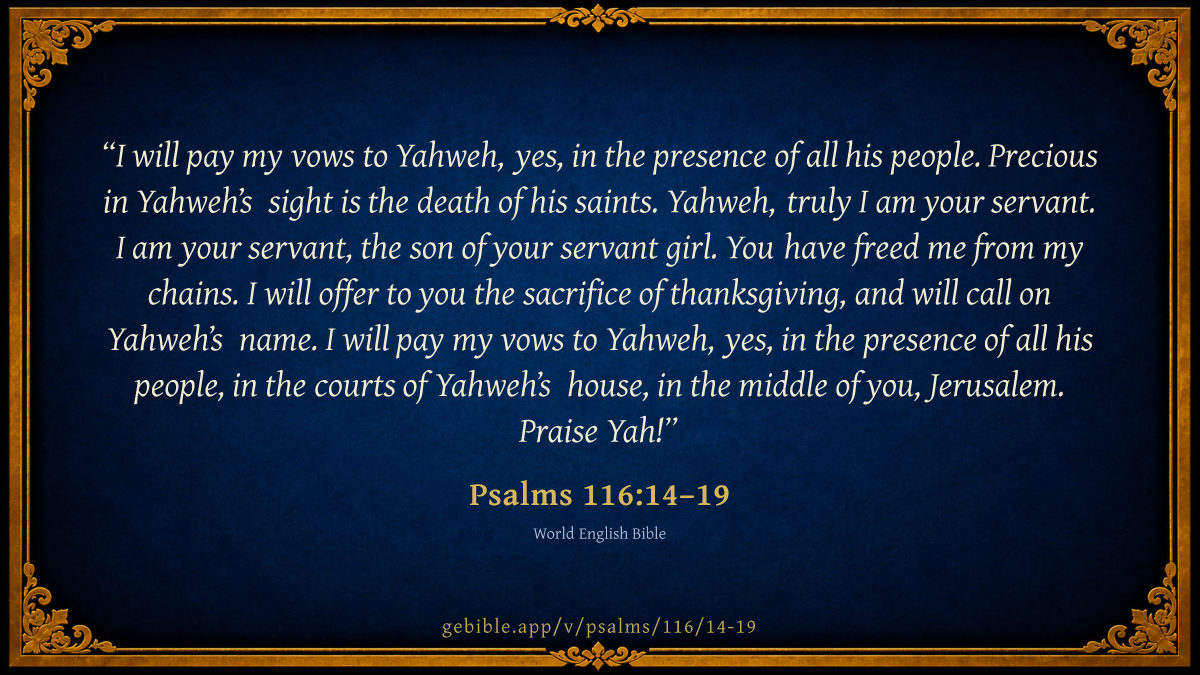
Psalms 116:14(v18)I will pay my vows to Yahweh, yes, in the presence of all his people.
Psalms 116:18(v14)I will pay my vows to Yahweh, yes, in the presence of all his people,
Psalms 135:2(v19)you who stand in Yahweh’s house, in the courts of our God’s house.
Jonah 2:9(v14)But I will sacrifice to you with the voice of thanksgiving. I will pay that which I have vowed. Salvation belongs to Yahweh.”
Psalms 66:13-15(v14)I will come into your temple with burnt offerings. I will pay my vows to you, which my lips promised, and my mouth spoke, when I was in…
Hebrews 13:15(v17)Through him, then, let’s offer up a sacrifice of praise to God continually, that is, the fruit of lips which proclaim allegiance to his…
Psalms 56:12(v14)Your vows are on me, God. I will give thank offerings to you.
Psalms 76:11(v18)Make vows to Yahweh your God, and fulfill them! Let all of his neighbors bring presents to him who is to be feared.
Psalms 116:13(v17)I will take the cup of salvation, and call on Yahweh’s name.
Matthew 5:33(v14)“Again you have heard that it was said to the ancient ones, ‘You shall not make false vows, but shall perform to the Lord your vows,’
James 1:1(v16)James, a servant of God and of the Lord Jesus Christ, to the twelve tribes which are in the Dispersion: Greetings.
2 Chronicles 6:6(v19)but now I have chosen Jerusalem, that my name might be there; and I have chosen David to be over my people Israel.’
2 Chronicles 33:11-13(v16)Therefore Yahweh brought on them the captains of the army of the king of Assyria, who took Manasseh in chains, bound him with fetters, and…
Job 5:26(v15)You will come to your grave in a full age, like a shock of grain comes in its season.
Psalms 100:4(v19)Enter into his gates with thanksgiving, and into his courts with praise. Give thanks to him, and bless his name.
Psalms 107:14-16(v16)He brought them out of darkness and the shadow of death, and broke away their chains. Let them praise Yahweh for his loving kindness, for…
Psalms 118:19-20(v19)Open to me the gates of righteousness. I will enter into them. I will give thanks to Yah. This is the gate of Yahweh; the righteous will…
Psalms 122:3-4(v19)Jerusalem, that is built as a city that is compact together, where the tribes go up, even Yah’s tribes, according to an ordinance for…
Isaiah 61:1(v16)The Lord Yahweh’s Spirit is on me, because Yahweh has anointed me to preach good news to the humble. He has sent me to bind up the broken…
Jonah 1:16(v14)Then the men feared Yahweh exceedingly; and they offered a sacrifice to Yahweh, and made vows.
Nahum 1:15(v14)Behold, on the mountains the feet of him who brings good news, who publishes peace! Keep your feasts, Judah! Perform your vows, for the…
John 12:26(v16)If anyone serves me, let him follow me. Where I am, there my servant will also be. If anyone serves me, the Father will honor him.
Acts 2:42(v17)They continued steadfastly in the apostles’ teaching and fellowship, in the breaking of bread, and prayer.
Acts 27:23(v16)For there stood by me this night an angel, belonging to the God whose I am and whom I serve,
Romans 6:22(v16)But now, being made free from sin and having become servants of God, you have your fruit of sanctification and the result of eternal life.
Ecclesiastes 5:5(v18)It is better that you should not vow, than that you should vow and not pay.
40 distinct cross-references across this passage (42 total citations).
Cross-references from openbible.info (CC BY 4.0)
Explain this passage (16 sources)
Historical commentary, presented as a primary source — not an endorsement.
John Calvin1540 · Public DomainOn vv14–1714 I will pay my vows unto Jehovah The…
14 I will pay my vows unto Jehovah The steadfastness of his piety shines forth in this, that, in the midst of his dangers, he had vowed unto God. And now he proves that he by no means forgot these engagements, as most men do, who, when the hand of God lies heavy upon them, implore his help for a short time, but soon bury in oblivion the deliverance which they have received. The Holy Spirit, speaking of the true worship of God, very properly connects, by an indissoluble bond, these two parts of worship, “Call upon me in the day of trouble;” and, “after thy deliverance glorify me,” Psalm 50:15. If any regard it as an absurdity for the faithful to enter into covenant with God by making vows to him, to procure his approbation, my reply is, that they do not promise the sacrifice of praise, to soothe him by their flatteries, as if he were a mortal like themselves, or to bind him to them by proposing some reward, for David had previously protested that he would not offer any recompense. The design, then, and the use of vows is, first, That the children of God may have their hearts strengthened with the confidence of obtaining whatever they ask; and, secondly, That they may be stimulated the more to offer up their tribute of gratitude to God for his mercies. To aid the children of God in their infirmity, the privilege of vowing may surely be conceded to them, for by this means their most merciful Father condescends to allow them to enter into familiar converse with him, provided they make their vows for the object I have stated. Happen what may, nothing must be attempted without his permission. And hence the Papists appear the more ridiculous, who, under pretext of what is advanced in this place, defend all sorts of vows, however foolish and absurd and rashly made; as if drunkenness were lawful, because God permits us to eat.
John Calvin's Commentaries (1540-1563) — public domain. Text from the Calvin Translation Society English edition (1840s-50s) via the Christian Classics Ethereal Library (ccel.org). Calvin's coverage is partial (roughly two-thirds of the Bible); uncommented books and verses are honest gaps, never fabricated. The 19th-century editor's footnotes and remarks are omitted so the notes are faithfully Calvin's own voice.
Geneva Bible translators1599 · Public DomainOn vv15, 18I perceive that God hath a care over his,…
I perceive that God hath a care over his, so that he both disposeth their death, and taketh an account.
Geneva Bible (1599) marginal notes — public domain.
John Trapp1656 · Public DomainOn vv14–19Psa 116:14 I will pay my vows unto the…
Psa 116:14 I will pay my vows unto the LORD now in the presence of all his people.
Ver. 14. I will pay my vows] This word "pay" importeth that vows lawfully made are due debt; and debt, till paid, is a disquieting thing to an honest mind, Rom 13:8. The saints, in distress especially, used to make their prayers with vows. Hence prayer is in Greek called προσευχη, a service with vows. Mr Philpot, martyr, first coming into Smithfield to suffer, kneeled down, and said, I will pay my vows in thee, O Smithfield (Acts & Mon.).
John Trapp, A Commentary or Exposition upon All the Books of the Old and New Testament (1647–1656) — public domain. Text from a community e-Sword module.
Matthew Poole1685 · Public DomainOn vv14, 15, 16, 18My vows; the praises and sacrifices which I vowed…
My vows; the praises and sacrifices which I vowed to God in the time of my distress.
In the presence of all his people; that they who heard my vows, or understood them by the report of others, might be witnesses of my payment of them, and not be scandalized by my unfaithfulness in that matter.
Matthew Poole's English Annotations on the Holy Bible (1683–1685) — public domain. Text from a community e-Sword/MySword module.
John Gill1763 · Public DomainOn vv14–17O Lord, truly I am thy servant, I am…
O Lord, truly I am thy servant, I am thy servant,.... Not merely by creation, and as obliged by providential favours; but by the grace of God, which made him a willing one: and he was so, not nominally only, but in reality; not as those who say Lord, Lord, but do not the will of God; whereas he served the Lord cheerfully and willingly, in righteousness and true holiness: and this he repeats for the confirmation of it, and to show his heartiness in the Lord's service, and his zealous attachment to him; and which he mentions, not as though he thought his service meritorious of anything at the hand of God; but that his being in this character was an obligation upon him to serve the Lord, and him only, and might expect his protection in it;
and the son of thy handmaid; his mother was also a servant of the Lord; and had trained him up in his infancy in the nurture and admonition of the Lord; so that he was inured to it early, and could not easily depart from it;
Read full note →
thou hast loosed my bonds; the bonds of affliction and death in which he was held; these were loosed, being delivered from them, Psa 116:3; and the bonds of sin, and Satan, and the law, in whose service he had been, which was no other than a bondage; but now was freed from the servitude and dominion of sin, from the captivity of Satan, and the bondage of the law; and therefore, though a servant, yet the Lord's free man.
John Gill's Exposition of the Whole Bible (1746–1763) — public domain (CC PDM 1.0). Text via the HelloAO Bible API.
Adam Clarke1810 · Public DomainOn vv14, 15, 16, 17, 19Verse 14. I will pay my vows unto the…
Verse 14. I will pay my vows unto the Lord now in the presence of all his people.] He was probably now bringing his offering to the temple. These words are repeated, Ps 116:18.
Adam Clarke's Commentary on the Bible (1810–1826) — public domain. Text from a community e-Sword/MySword module.
Joseph Benson1811 · Public DomainOn vv15–16Psa 116:15. Precious, &c., is the death of his…
Psa 116:15. Precious, &c., is the death of his saints — He sets a high price upon it: he will not easily grant it to the will of their enemies. If any son of violence procure it, he will make him pay very dearly for it. And when the saints suffer it for God’s sake, as they frequently do, it is a most acceptable sacrifice to him, and highly esteemed by him. Thus the blood of God’s people is said to be precious in his sight, Psa 72:14. And in the same sense the life of a man is said to be precious in the eyes of him who spares and preserves it, 1Sa 26:21; 2Ki 1:13. God’s people are precious in his eyes both living and dying, for, whether they live, they live unto the Lord, or whether they die, they die unto the Lord, Rom 14:8.
Joseph Benson's Commentary on the Old and New Testaments (1811–1818) — public domain. Text from a community e-Sword module.
Albert Barnes1834 · Public DomainOn vv14–19I will pay my vows ... - I will…
I will pay my vows ... - I will perform or execute. The word vows here refers probably to the solemn promise which he had made in his sickness - the promise to devote himself to God, should he be restored to health. Compare the notes at Isa 38:15, notes at Isa 38:20. Such promises are commonly made in sickness, and, alas! almost as commonly disregarded and forgotten on a restoration to health. Yet such vows should be sacredly observed, for
(a) They are right and proper;
Read full note →
(b) they are made in most solemn circumstances;
(c) they are usually sincere;
(d) they are of the nature of a covenant with God;
(e) they are made when we are in the best position to take just views of life - of this life, and of the life to come;
(f) the subsequent life would be happier and better if they were faithfully carried out.
Compare Psa 22:25, note; Psa 66:13-14, notes.
In the presence of all his people - Publicly. The vows were made in private; on the sick bed; when alone; in the silence of the night-watches; when no eye was upon him who made them but the eye of God. There is a propriety, however, that the expression of thanksgiving should be public. Compare Isa 38:20. Indeed, nothing is more proper than public thanks for a restoration from sickness; and as in our public assemblies prayer is often specially offered for the sick at their own request, so it would be equally proper that, at their request, public thanks should be rendered for their recovery.
Albert Barnes' Notes on the Bible (1834–1885) — public domain. Text from a community e-Sword/MySword module.
Daniel D. Whedon1874 · Public DomainOn vv14, 15, 16, 17, 1914. In the presence of all his people—The occasion…
14. In the presence of all his people—The occasion was one of public sacrifice: see Psa_116:13, and introductory note.
Daniel D. Whedon (gen. ed.), Commentary on the Old and New Testaments (1874–1909) — public domain. Text from a community e-Sword module.
The Cambridge Bible for Schools and Colleges1878 · Public DomainOn vv14–1914. This verse which is repeated as Psa_116:18 is…
14. This verse which is repeated as Psa_116:18 is omitted in the best MSS of the LXX, and may have been inserted here by mistake. Its omission would make the stanza Psa_116:10-13 agree in length with the corresponding stanza Psa_116:1-4; still, the repeated resolution of thanksgiving is not out of place.
The Cambridge Bible for Schools and Colleges (gen. ed. J. J. S. Perowne; Cambridge University Press, 1878–1918) — public domain. Text from a community e-Sword module.
Ellicott's Commentary for English Readers1878 · Public DomainOn vv15–16(15) Precious . . .—This is only another form…
(15) Precious . . .—This is only another form of the statement in Psa_72:14. But again we have to ask why the thought of death should intrude upon the psalmist at this moment. (See Note, Psa_115:17.) The answer is that, as in Psa_116:8, a recent deliverance from death is spoken of. It is natural to take this psalm as a thanksgiving song for the safety, perhaps victory, of the survivors in some battle, but then the grateful community naturally and dutifully remember the dead.
A Bible Commentary for English Readers, edited by Charles John Ellicott (1878–1897) — public domain. Text from a community e-Sword module.
The Pulpit Commentary1880 · Public DomainOn vv14–19I will pay my vows unto the Lord now…
I will pay my vows unto the Lord now in the presence of all his people (comp. vers. 18, 19, where the thought is repeated, and lengthened out). We are not told in Isaiah or 2 Kings that Hezekiah made any vows when he lay on his sick bed, but he may probably have done so. He certainly intended, as soon as his cure was complete, to "go up to the house of the Lord". (2Ki_20:8 Isa_38:22)
Vow-making and vow-paying.
Read full note →
An important duty of Christian life is keeping ever fresh and vivid the memory of God"s saving mercies to us. Constantly throughout their history the Israelites were reminded of their deliverance from thee house of bondage, and of the vows and pledges involved in that deliverance. The effect of every quickened memory should be a new examination of our vows, that we may discover what of them we are failing to pay or to keep. God does expect a return from us for all his mercies towards us. That return is put in three forms.
I "I WILL TAKE THE CUP OF SALVATION." It honors God for us cheerfully to accept the blessings which he sends. It may be proper to refuse gifts offered by our fellow-men. It is never a true and worthy humility that hesitates to act upon God"s promises or to accept what God offers. And yet that we find beginners in the Christian life, and even experienced Christians, often do, especially when what God provides is not just "according to their mind." Note also how the very freeness of God"s gifts makes them unacceptable to human pride. We like to have things on our conditions, and at our price.
II "I WILL CALL UPON THE NAME OF THE LORD." That is, in the spirit and act of thankfulness. Thankfulness should be regarded
(1) as an important Christian obligation;
(2) as an enjoined Christian duty; and
(3) as a most real help to the brightness, the joyfulness, and the steadiness of the Christian life.
The utterance of thankfulness is a public testimony of our recognized and happy dependence on God. "I have set the Lord always before me.
III "I WILL PAY MY VOWS UNTO THE LORD." Give some account of Jewish vow-making in times of special thankfulness; as when recovering from a serious sickness.
1. Sincere and right-intentioned, vow-making is acceptable and pleasing to God.
2. The earnest endeavor at vow-paying is much more acceptable. Our resolves match the ancient vows; and our lives have witnessed many resolves made and few resolves carried out. Illust.; resolves in times of conversion, of success, of sickness, of trouble, of rescue from peril. Try to think what unpaid vows or resolves of yours God has on his record. Vow, but be sure to "pay your vows unto the Lord. R.T.
The Pulpit Commentary (1880–1919), ed. H.D.M. Spence-Jones & Joseph S. Exell — public domain. Text from a community e-Sword module.
Charles H. Spurgeon1885 · Public DomainOn vv14–19Ver. 14. I will pay my vows unto the…
Ver. 14. I will pay my vows unto the Lord now in the presence of all his people. The Psalmist has already stated his third resolution, to devote himself to the worship of God evermore, and here he commences the performance of that resolve. The vows which he had made in anguish, he now determines to fulfil:
"I will pay my vows unto the Lord." He does so at once, "now, "and that publicly, "in the presence of all his people." Good resolutions cannot be carried out too speedily; vows become debts, and debts should be paid. It is well to have witnesses to the payment of just debts, and we need not be ashamed to have witnesses to the fulfilling of holy vows, for this will show that we are not ashamed of our Lord, and it may be a great benefit to those who look on and hear us publicly sounding forth the praises of our prayer hearing God. How can those do this who have never with their mouth confessed their Saviour? O secret disciples, what say you to this verse! Be encouraged to come into the light and own your Redeemer. If, indeed, you have been saved, come forward and declare it in his own appointed way.
Read full note →
Ver. 14. A man that would have his credit as to the truth of his word kept up, would choose those to be witnesses of his performing who were witnesses of his promising. I think David took this heed in his rendering and paying his vows: "I will do it, "saith he, "now in the presence of all his people." The people were witnesses to his straits, prayers, and vows; and he will honour religion by performing in their sight what he sealed, signed, and delivered as his vow to the Lord. Seek not more witnesses than providence makes conscious of thy vows, lest this be interpreted ostentation and vain self glorying: take so many, lest the good example be lost, or thou suspected of falsifying thy vow.
Briefly and plainly: Didst thou on a sick bed make thy vow before thy family, and before the neighbourhood? Be careful to perform it before them; let them see thou art what thou vowedst to be. This care in thy vow will be a means to make it most to the advantage of religion, whilst all that heard or knew thy vow bear thee testimony that thou art thankful, and thus thou givest others occasion to glorify thy Father who is in heaven. Henry Hurst (1690) in "The Morning Exercises."
Ver. 14. I will pay my vows, etc. Foxe, in his Acts and Monuments, relates the following concerning the martyr, John Philpot: "He went with the sheriffs to the place of execution; and when he was entering into Smithfield the way was foul, and two officers took him up to bear him to the stake. Then he said merrily, What, will ye make me a pope? I am content to go to my journey's end on foot. But first coming into Smithfield, he kneeled down there, saying these words, I will pay my vows in thee, O Smithfield."
Ver. 14. Vow. Or the excellence of time present.
Psalms 116:15*
Charles H. Spurgeon's The Treasury of David (1869–1885) — public domain. Psalms only. Text from a community e-Sword/MySword module.
The Biblical Illustrator1887 · Public DomainOn vv14, 15, 16, 18I will pay my vows unto the Lord now…
Psa_116:14
I will pay my vows unto the Lord now in the presence of all His people.
Read full note →
Whether well-composed religious vows do not exceedingly promote religion
Whoso doth engage himself by a well-ordered vow, doth set his religion in the whole, or in some particular part of it, in very good forwardness. Religion is a gainer by this bargain well made; the bond is to God, but religion receives the interest at least: well-composed vows are religions engines, able to move the weightier burdens and loads, and fit to be only employed in them.
I. What a vow is.
1. A promise.
2. Voluntary.
3. Made to God alone.
II. Whether it be lawful, in any case, for us now to make a vow.
1. What is not evil in itself, nor evil by accident, unless made evil by the undue ordering of it through our fault, may lawfully be done by us.
2. Vows may be lawfully made now by us Christians, because what was lawful to the Jew on moral considerations, and not on any ceremonial considerations, that is also lawful now unto us Christians.
3. Vows may lawfully be made by us Christians; for it is a kind of thankfulness and acknowledgment made to God, with the universal approbation and consent of men.
4. Unless such vows may be accounted lawful to us, I cannot see how we have any way of making free, voluntary, and extraordinary acknowledgments unto God.
5. But that is lawful to us Christians which doth most certainly ensure our duty to God, yet doth not ensnare us in the ensuring of it.
III. When vows are well-composed, and so consequently for the advantage on religion.
1. If you would duly and well compose your vows, you must wait a fit season; not vow on every occasion.
2. When the extraordinary case warrants thee to this extraordinary obliging of thyself, then be sure to proceed deliberately, and with advice. Consider what thou doest: every one condemns rash vows; and, I am sure, inconsiderate vows are rash ones. Here Jephthah failed. Consider--
(1) Whether that thou vowest to do be lawful.
(2) Whether acceptable to God.
(3) Whether that thing which thou vowest bear a proportion to that thou didst expect and pray for when thou vowedst, or to that thou hadst received, for which thou dost now make thy vow.
3. Thou must vow cheerfully, and with a ready mind.
4. Vow sincerely and uprightly.
IV. How well-composed vows promote religion.
1. Religion hath its concernment in the credit and reputation which it hath in the world. Religion hath a name to look after, so well as you or I; and it loseth or gaineth, as it is either honoured or reproached by the professors of it. Now, when times of extraordinary danger drive us to our prayers and vows to the true God, and we resolve to have mercy from Him, or to choose to fall into His hand, this sets the credit and honour of religion, that it can have recourse to God, who, we know, can deliver us. This is somewhat; but the making a vow doth not so much honour religion as the performing of it doth, when it is hereby declared to the world,--that religion is the thing that makes men the same in their mercies which they were in their distresses; that the God whom they worship is the true God, able to require their vows, if they should neglect to pay them.
2. By setting forward the growth of religions in the midst of those who profess it.
3. Vows well made, and kept well, very much improve And promote religion in the heart and life of him who so voweth and keepeth his vow.
V. Whence these well-composed vows have such influence on religion, what have they in them more than ordinary thus to promote it? To this I will answer as briefly as I may: There is in such vows a most notable awakening and quickening power, which sets all a mans care, wisdom, truth, and strength on work, to do the things whereby religion is so much promoted.
VI. Application.
1. If well-composed vows do indeed much promote religion, it will teach us how careful we should be in making our vows to the greatest advantage of religion.
2. Do well advised and composed vows so much promote religion when well and faithfully kept? Are they also such sacred and inviolable bonds? Then look what vows you are under, look how you have performed them. (H. Hurst, M.A.)
Religious decision
I. The elements of which religious decision consists.
1. A settled faith in the principles of Christian truth.
2. A self-denying conformity to the precepts of Christian holiness.
3. A public dedication to the interests of the Christian cause.
II. The arguments by which religious decision is commended.
1. It is a due and proper return for the mercies you have received.
2. It must greatly elevate your own character.
1. It is the source of the purest and highest happiness.
III. The practical result which our contemplation of religious decision and the arguments commending it ought invariably and universally to answer.
1. It is that you should thus be decided and devoted for yourselves.
2. Resolve upon it without delay.
(1) By hesitation you lose time.
(2) By hesitation you diminish the probabilities of devotedness at a future time.
(3) By hesitation you presume guiltily upon the probabilities of future life. (J. Parsons.)
The sanctity of vows
I. A vow is a distinct and conscious assertion of our religious nature. It is made with the most perfect consciousness of personal responsibility, in the presence and under the authority of that august Being to whom all obedience and worship are due. And it is void of all significance and solemnity if the whole religiousness of mans nature does not find expression in it.
II. A vow Is the acknowledgment of moral responsibility, and a confession of guilt before God. In this vow it is confessed that God holds man responsible for what he does. There is no significance in the vow if it is not based upon the recognition of his individual responsibility before the law. And as this springs from a conscience under the pressure of guilt, it is a confession of judgment identical in character with that which will be made by the sinner at the bar of God in the last day.
III. The vow is a voluntary act of the will, and is, therefore, of the nature of a covenant with Almighty God. It cannot be broken, therefore, without the guilt of perjury.
IV. Every proper vow is in the direction of original duty, as well as in the direction of offered grace. A vow is, therefore, doubly binding. It has absorbed into itself an obligation that existed before. It has embodied a duty which was in itself binding, and by its form ratifies, endorses and strengthens that obligation under the sanction of an oath. A voluntary pledge to perform that which is in itself a duty, rivets the obligation upon the conscience, and leaves no loophole for escape. But the vow is also in the direction of offered grace. Being made to Almighty God, with entire reliance upon Divine aid in its fulfilment, it is clearly in the line of the grace which is offered to man.
V. The vow is made under the sanction of the eternal world. For a moment the spiritual eye has been opened to catch a partial glimpse of all that is blessed in heaven, of all that is dreadful in hell, of all that is awful in the judgment-day, of all that is sublime in the vastness of the silent eternity to which we are hastening. How solemn the obligation becomes under the pressure of such a sanction as this! (B. M. Palmer, D. D.)
The Biblical Illustrator, edited by Joseph S. Exell (c. 1880s–1900s) — public domain. Text from a community e-Sword module.
unfoldingWord translationNotes2017 · CC BY-SA 4.0On vv16, 18General Information:
General Information:
The person who composed this psalm continues to speak.
Read full note →
the son of your servant woman
This is likely a reference to the writer's mother and indicates that she faithfully worshiped Yahweh. The full meaning of this can be made clear. AT: "as my mother was" (See: Assumed Knowledge and Implicit Information)
you have taken away my bonds
The writer speaks of being in danger of dying as if he had been chained in prison. AT: "you have saved me from death" (See: Metaphor)
the sacrifice of thanksgiving
"a sacrifice to express my thankfulness"
will call on the name of Yahweh
Here the word "name" represents Yahweh himself. AT: "will call on Yahweh" (See: Metonymy)
Tyndale Open Study Notes2022 · CC BY-SA 4.0On v15116:15-19 No one lives or dies outside of God’s…
116:15-19 No one lives or dies outside of God’s will. Having been given a second chance at life, the poet readily commits himself to the Lord with renewed acts of public devotion.
John Calvin 1540 · Public Domain On vv14–17 14 I will pay my vows unto Jehovah The…
14 I will pay my vows unto Jehovah The steadfastness of his piety shines forth in this, that, in the midst of his dangers, he had vowed unto God. And now he proves that he by no means forgot these engagements, as most men do, who, when the hand of God lies heavy upon them, implore his help for a short time, but soon bury in oblivion the deliverance which they have received. The Holy Spirit, speaking of the true worship of God, very properly connects, by an indissoluble bond, these two parts of worship, “Call upon me in the day of trouble;” and, “after thy deliverance glorify me,” Psalm 50:15. If any regard it as an absurdity for the faithful to enter into covenant with God by making vows to him, to procure his approbation, my reply is, that they do not promise the sacrifice of praise, to soothe him by their flatteries, as if he were a mortal like themselves, or to bind him to them by proposing some reward, for David had previously protested that he would not offer any recompense. The design, then, and the use of vows is, first, That the children of God may have their hearts strengthened with the confidence of obtaining whatever they ask; and, secondly, That they may be stimulated the more to offer up their tribute of gratitude to God for his mercies. To aid the children of God in their infirmity, the privilege of vowing may surely be conceded to them, for by this means their most merciful Father condescends to allow them to enter into familiar converse with him, provided they make their vows for the object I have stated. Happen what may, nothing must be attempted without his permission. And hence the Papists appear the more ridiculous, who, under pretext of what is advanced in this place, defend all sorts of vows, however foolish and absurd and rashly made; as if drunkenness were lawful, because God permits us to eat.
John Calvin's Commentaries (1540-1563) — public domain. Text from the Calvin Translation Society English edition (1840s-50s) via the Christian Classics Ethereal Library (ccel.org). Calvin's coverage is partial (roughly two-thirds of the Bible); uncommented books and verses are honest gaps, never fabricated. The 19th-century editor's footnotes and remarks are omitted so the notes are faithfully Calvin's own voice.
Geneva Bible translators 1599 · Public Domain On vv15, 18 I perceive that God hath a care over his,…
I perceive that God hath a care over his, so that he both disposeth their death, and taketh an account.
Geneva Bible (1599) marginal notes — public domain.
John Trapp 1656 · Public Domain On vv14–19 Psa 116:14 I will pay my vows unto the…
Psa 116:14 I will pay my vows unto the LORD now in the presence of all his people.
Ver. 14. I will pay my vows] This word "pay" importeth that vows lawfully made are due debt; and debt, till paid, is a disquieting thing to an honest mind, Rom 13:8. The saints, in distress especially, used to make their prayers with vows. Hence prayer is in Greek called προσευχη, a service with vows. Mr Philpot, martyr, first coming into Smithfield to suffer, kneeled down, and said, I will pay my vows in thee, O Smithfield (Acts & Mon.).
John Trapp, A Commentary or Exposition upon All the Books of the Old and New Testament (1647–1656) — public domain. Text from a community e-Sword module.
Matthew Poole 1685 · Public Domain On vv14, 15, 16, 18 My vows; the praises and sacrifices which I vowed…
My vows; the praises and sacrifices which I vowed to God in the time of my distress.
In the presence of all his people; that they who heard my vows, or understood them by the report of others, might be witnesses of my payment of them, and not be scandalized by my unfaithfulness in that matter.
Matthew Poole's English Annotations on the Holy Bible (1683–1685) — public domain. Text from a community e-Sword/MySword module.
John Gill 1763 · Public Domain On vv14–17 O Lord, truly I am thy servant, I am…
O Lord, truly I am thy servant, I am thy servant,.... Not merely by creation, and as obliged by providential favours; but by the grace of God, which made him a willing one: and he was so, not nominally only, but in reality; not as those who say Lord, Lord, but do not the will of God; whereas he served the Lord cheerfully and willingly, in righteousness and true holiness: and this he repeats for the confirmation of it, and to show his heartiness in the Lord's service, and his zealous attachment to him; and which he mentions, not as though he thought his service meritorious of anything at the hand of God; but that his being in this character was an obligation upon him to serve the Lord, and him only, and might expect his protection in it;
and the son of thy handmaid; his mother was also a servant of the Lord; and had trained him up in his infancy in the nurture and admonition of the Lord; so that he was inured to it early, and could not easily depart from it;
Read full note →
thou hast loosed my bonds; the bonds of affliction and death in which he was held; these were loosed, being delivered from them, Psa 116:3; and the bonds of sin, and Satan, and the law, in whose service he had been, which was no other than a bondage; but now was freed from the servitude and dominion of sin, from the captivity of Satan, and the bondage of the law; and therefore, though a servant, yet the Lord's free man.
John Gill's Exposition of the Whole Bible (1746–1763) — public domain (CC PDM 1.0). Text via the HelloAO Bible API.
Adam Clarke 1810 · Public Domain On vv14, 15, 16, 17, 19 Verse 14. I will pay my vows unto the…
Verse 14. I will pay my vows unto the Lord now in the presence of all his people.] He was probably now bringing his offering to the temple. These words are repeated, Ps 116:18.
Adam Clarke's Commentary on the Bible (1810–1826) — public domain. Text from a community e-Sword/MySword module.
Joseph Benson 1811 · Public Domain On vv15–16 Psa 116:15. Precious, &c., is the death of his…
Psa 116:15. Precious, &c., is the death of his saints — He sets a high price upon it: he will not easily grant it to the will of their enemies. If any son of violence procure it, he will make him pay very dearly for it. And when the saints suffer it for God’s sake, as they frequently do, it is a most acceptable sacrifice to him, and highly esteemed by him. Thus the blood of God’s people is said to be precious in his sight, Psa 72:14. And in the same sense the life of a man is said to be precious in the eyes of him who spares and preserves it, 1Sa 26:21; 2Ki 1:13. God’s people are precious in his eyes both living and dying, for, whether they live, they live unto the Lord, or whether they die, they die unto the Lord, Rom 14:8.
Joseph Benson's Commentary on the Old and New Testaments (1811–1818) — public domain. Text from a community e-Sword module.
Albert Barnes 1834 · Public Domain On vv14–19 I will pay my vows ... - I will…
I will pay my vows ... - I will perform or execute. The word vows here refers probably to the solemn promise which he had made in his sickness - the promise to devote himself to God, should he be restored to health. Compare the notes at Isa 38:15, notes at Isa 38:20. Such promises are commonly made in sickness, and, alas! almost as commonly disregarded and forgotten on a restoration to health. Yet such vows should be sacredly observed, for
(a) They are right and proper;
Read full note →
(b) they are made in most solemn circumstances;
(c) they are usually sincere;
(d) they are of the nature of a covenant with God;
(e) they are made when we are in the best position to take just views of life - of this life, and of the life to come;
(f) the subsequent life would be happier and better if they were faithfully carried out.
Compare Psa 22:25, note; Psa 66:13-14, notes.
In the presence of all his people - Publicly. The vows were made in private; on the sick bed; when alone; in the silence of the night-watches; when no eye was upon him who made them but the eye of God. There is a propriety, however, that the expression of thanksgiving should be public. Compare Isa 38:20. Indeed, nothing is more proper than public thanks for a restoration from sickness; and as in our public assemblies prayer is often specially offered for the sick at their own request, so it would be equally proper that, at their request, public thanks should be rendered for their recovery.
Albert Barnes' Notes on the Bible (1834–1885) — public domain. Text from a community e-Sword/MySword module.
Daniel D. Whedon 1874 · Public Domain On vv14, 15, 16, 17, 19 14. In the presence of all his people—The occasion…
14. In the presence of all his people—The occasion was one of public sacrifice: see Psa_116:13, and introductory note.
Daniel D. Whedon (gen. ed.), Commentary on the Old and New Testaments (1874–1909) — public domain. Text from a community e-Sword module.
The Cambridge Bible for Schools and Colleges 1878 · Public Domain On vv14–19 14. This verse which is repeated as Psa_116:18 is…
14. This verse which is repeated as Psa_116:18 is omitted in the best MSS of the LXX, and may have been inserted here by mistake. Its omission would make the stanza Psa_116:10-13 agree in length with the corresponding stanza Psa_116:1-4; still, the repeated resolution of thanksgiving is not out of place.
The Cambridge Bible for Schools and Colleges (gen. ed. J. J. S. Perowne; Cambridge University Press, 1878–1918) — public domain. Text from a community e-Sword module.
Ellicott's Commentary for English Readers 1878 · Public Domain On vv15–16 (15) Precious . . .—This is only another form…
(15) Precious . . .—This is only another form of the statement in Psa_72:14. But again we have to ask why the thought of death should intrude upon the psalmist at this moment. (See Note, Psa_115:17.) The answer is that, as in Psa_116:8, a recent deliverance from death is spoken of. It is natural to take this psalm as a thanksgiving song for the safety, perhaps victory, of the survivors in some battle, but then the grateful community naturally and dutifully remember the dead.
A Bible Commentary for English Readers, edited by Charles John Ellicott (1878–1897) — public domain. Text from a community e-Sword module.
The Pulpit Commentary 1880 · Public Domain On vv14–19 I will pay my vows unto the Lord now…
I will pay my vows unto the Lord now in the presence of all his people (comp. vers. 18, 19, where the thought is repeated, and lengthened out). We are not told in Isaiah or 2 Kings that Hezekiah made any vows when he lay on his sick bed, but he may probably have done so. He certainly intended, as soon as his cure was complete, to "go up to the house of the Lord". (2Ki_20:8 Isa_38:22)
Vow-making and vow-paying.
Read full note →
An important duty of Christian life is keeping ever fresh and vivid the memory of God"s saving mercies to us. Constantly throughout their history the Israelites were reminded of their deliverance from thee house of bondage, and of the vows and pledges involved in that deliverance. The effect of every quickened memory should be a new examination of our vows, that we may discover what of them we are failing to pay or to keep. God does expect a return from us for all his mercies towards us. That return is put in three forms.
I "I WILL TAKE THE CUP OF SALVATION." It honors God for us cheerfully to accept the blessings which he sends. It may be proper to refuse gifts offered by our fellow-men. It is never a true and worthy humility that hesitates to act upon God"s promises or to accept what God offers. And yet that we find beginners in the Christian life, and even experienced Christians, often do, especially when what God provides is not just "according to their mind." Note also how the very freeness of God"s gifts makes them unacceptable to human pride. We like to have things on our conditions, and at our price.
II "I WILL CALL UPON THE NAME OF THE LORD." That is, in the spirit and act of thankfulness. Thankfulness should be regarded
(1) as an important Christian obligation;
(2) as an enjoined Christian duty; and
(3) as a most real help to the brightness, the joyfulness, and the steadiness of the Christian life.
The utterance of thankfulness is a public testimony of our recognized and happy dependence on God. "I have set the Lord always before me.
III "I WILL PAY MY VOWS UNTO THE LORD." Give some account of Jewish vow-making in times of special thankfulness; as when recovering from a serious sickness.
1. Sincere and right-intentioned, vow-making is acceptable and pleasing to God.
2. The earnest endeavor at vow-paying is much more acceptable. Our resolves match the ancient vows; and our lives have witnessed many resolves made and few resolves carried out. Illust.; resolves in times of conversion, of success, of sickness, of trouble, of rescue from peril. Try to think what unpaid vows or resolves of yours God has on his record. Vow, but be sure to "pay your vows unto the Lord. R.T.
The Pulpit Commentary (1880–1919), ed. H.D.M. Spence-Jones & Joseph S. Exell — public domain. Text from a community e-Sword module.
Charles H. Spurgeon 1885 · Public Domain On vv14–19 Ver. 14. I will pay my vows unto the…
Ver. 14. I will pay my vows unto the Lord now in the presence of all his people. The Psalmist has already stated his third resolution, to devote himself to the worship of God evermore, and here he commences the performance of that resolve. The vows which he had made in anguish, he now determines to fulfil:
"I will pay my vows unto the Lord." He does so at once, "now, "and that publicly, "in the presence of all his people." Good resolutions cannot be carried out too speedily; vows become debts, and debts should be paid. It is well to have witnesses to the payment of just debts, and we need not be ashamed to have witnesses to the fulfilling of holy vows, for this will show that we are not ashamed of our Lord, and it may be a great benefit to those who look on and hear us publicly sounding forth the praises of our prayer hearing God. How can those do this who have never with their mouth confessed their Saviour? O secret disciples, what say you to this verse! Be encouraged to come into the light and own your Redeemer. If, indeed, you have been saved, come forward and declare it in his own appointed way.
Read full note →
Ver. 14. A man that would have his credit as to the truth of his word kept up, would choose those to be witnesses of his performing who were witnesses of his promising. I think David took this heed in his rendering and paying his vows: "I will do it, "saith he, "now in the presence of all his people." The people were witnesses to his straits, prayers, and vows; and he will honour religion by performing in their sight what he sealed, signed, and delivered as his vow to the Lord. Seek not more witnesses than providence makes conscious of thy vows, lest this be interpreted ostentation and vain self glorying: take so many, lest the good example be lost, or thou suspected of falsifying thy vow.
Briefly and plainly: Didst thou on a sick bed make thy vow before thy family, and before the neighbourhood? Be careful to perform it before them; let them see thou art what thou vowedst to be. This care in thy vow will be a means to make it most to the advantage of religion, whilst all that heard or knew thy vow bear thee testimony that thou art thankful, and thus thou givest others occasion to glorify thy Father who is in heaven. Henry Hurst (1690) in "The Morning Exercises."
Ver. 14. I will pay my vows, etc. Foxe, in his Acts and Monuments, relates the following concerning the martyr, John Philpot: "He went with the sheriffs to the place of execution; and when he was entering into Smithfield the way was foul, and two officers took him up to bear him to the stake. Then he said merrily, What, will ye make me a pope? I am content to go to my journey's end on foot. But first coming into Smithfield, he kneeled down there, saying these words, I will pay my vows in thee, O Smithfield."
Ver. 14. Vow. Or the excellence of time present.
Psalms 116:15*
Charles H. Spurgeon's The Treasury of David (1869–1885) — public domain. Psalms only. Text from a community e-Sword/MySword module.
The Biblical Illustrator 1887 · Public Domain On vv14, 15, 16, 18 I will pay my vows unto the Lord now…
Psa_116:14
I will pay my vows unto the Lord now in the presence of all His people.
Read full note →
Whether well-composed religious vows do not exceedingly promote religion
Whoso doth engage himself by a well-ordered vow, doth set his religion in the whole, or in some particular part of it, in very good forwardness. Religion is a gainer by this bargain well made; the bond is to God, but religion receives the interest at least: well-composed vows are religions engines, able to move the weightier burdens and loads, and fit to be only employed in them.
I. What a vow is.
1. A promise.
2. Voluntary.
3. Made to God alone.
II. Whether it be lawful, in any case, for us now to make a vow.
1. What is not evil in itself, nor evil by accident, unless made evil by the undue ordering of it through our fault, may lawfully be done by us.
2. Vows may be lawfully made now by us Christians, because what was lawful to the Jew on moral considerations, and not on any ceremonial considerations, that is also lawful now unto us Christians.
3. Vows may lawfully be made by us Christians; for it is a kind of thankfulness and acknowledgment made to God, with the universal approbation and consent of men.
4. Unless such vows may be accounted lawful to us, I cannot see how we have any way of making free, voluntary, and extraordinary acknowledgments unto God.
5. But that is lawful to us Christians which doth most certainly ensure our duty to God, yet doth not ensnare us in the ensuring of it.
III. When vows are well-composed, and so consequently for the advantage on religion.
1. If you would duly and well compose your vows, you must wait a fit season; not vow on every occasion.
2. When the extraordinary case warrants thee to this extraordinary obliging of thyself, then be sure to proceed deliberately, and with advice. Consider what thou doest: every one condemns rash vows; and, I am sure, inconsiderate vows are rash ones. Here Jephthah failed. Consider--
(1) Whether that thou vowest to do be lawful.
(2) Whether acceptable to God.
(3) Whether that thing which thou vowest bear a proportion to that thou didst expect and pray for when thou vowedst, or to that thou hadst received, for which thou dost now make thy vow.
3. Thou must vow cheerfully, and with a ready mind.
4. Vow sincerely and uprightly.
IV. How well-composed vows promote religion.
1. Religion hath its concernment in the credit and reputation which it hath in the world. Religion hath a name to look after, so well as you or I; and it loseth or gaineth, as it is either honoured or reproached by the professors of it. Now, when times of extraordinary danger drive us to our prayers and vows to the true God, and we resolve to have mercy from Him, or to choose to fall into His hand, this sets the credit and honour of religion, that it can have recourse to God, who, we know, can deliver us. This is somewhat; but the making a vow doth not so much honour religion as the performing of it doth, when it is hereby declared to the world,--that religion is the thing that makes men the same in their mercies which they were in their distresses; that the God whom they worship is the true God, able to require their vows, if they should neglect to pay them.
2. By setting forward the growth of religions in the midst of those who profess it.
3. Vows well made, and kept well, very much improve And promote religion in the heart and life of him who so voweth and keepeth his vow.
V. Whence these well-composed vows have such influence on religion, what have they in them more than ordinary thus to promote it? To this I will answer as briefly as I may: There is in such vows a most notable awakening and quickening power, which sets all a mans care, wisdom, truth, and strength on work, to do the things whereby religion is so much promoted.
VI. Application.
1. If well-composed vows do indeed much promote religion, it will teach us how careful we should be in making our vows to the greatest advantage of religion.
2. Do well advised and composed vows so much promote religion when well and faithfully kept? Are they also such sacred and inviolable bonds? Then look what vows you are under, look how you have performed them. (H. Hurst, M.A.)
Religious decision
I. The elements of which religious decision consists.
1. A settled faith in the principles of Christian truth.
2. A self-denying conformity to the precepts of Christian holiness.
3. A public dedication to the interests of the Christian cause.
II. The arguments by which religious decision is commended.
1. It is a due and proper return for the mercies you have received.
2. It must greatly elevate your own character.
1. It is the source of the purest and highest happiness.
III. The practical result which our contemplation of religious decision and the arguments commending it ought invariably and universally to answer.
1. It is that you should thus be decided and devoted for yourselves.
2. Resolve upon it without delay.
(1) By hesitation you lose time.
(2) By hesitation you diminish the probabilities of devotedness at a future time.
(3) By hesitation you presume guiltily upon the probabilities of future life. (J. Parsons.)
The sanctity of vows
I. A vow is a distinct and conscious assertion of our religious nature. It is made with the most perfect consciousness of personal responsibility, in the presence and under the authority of that august Being to whom all obedience and worship are due. And it is void of all significance and solemnity if the whole religiousness of mans nature does not find expression in it.
II. A vow Is the acknowledgment of moral responsibility, and a confession of guilt before God. In this vow it is confessed that God holds man responsible for what he does. There is no significance in the vow if it is not based upon the recognition of his individual responsibility before the law. And as this springs from a conscience under the pressure of guilt, it is a confession of judgment identical in character with that which will be made by the sinner at the bar of God in the last day.
III. The vow is a voluntary act of the will, and is, therefore, of the nature of a covenant with Almighty God. It cannot be broken, therefore, without the guilt of perjury.
IV. Every proper vow is in the direction of original duty, as well as in the direction of offered grace. A vow is, therefore, doubly binding. It has absorbed into itself an obligation that existed before. It has embodied a duty which was in itself binding, and by its form ratifies, endorses and strengthens that obligation under the sanction of an oath. A voluntary pledge to perform that which is in itself a duty, rivets the obligation upon the conscience, and leaves no loophole for escape. But the vow is also in the direction of offered grace. Being made to Almighty God, with entire reliance upon Divine aid in its fulfilment, it is clearly in the line of the grace which is offered to man.
V. The vow is made under the sanction of the eternal world. For a moment the spiritual eye has been opened to catch a partial glimpse of all that is blessed in heaven, of all that is dreadful in hell, of all that is awful in the judgment-day, of all that is sublime in the vastness of the silent eternity to which we are hastening. How solemn the obligation becomes under the pressure of such a sanction as this! (B. M. Palmer, D. D.)
The Biblical Illustrator, edited by Joseph S. Exell (c. 1880s–1900s) — public domain. Text from a community e-Sword module.
unfoldingWord translationNotes 2017 · CC BY-SA 4.0 On vv16, 18 General Information:
General Information:
The person who composed this psalm continues to speak.
Read full note →
the son of your servant woman
This is likely a reference to the writer's mother and indicates that she faithfully worshiped Yahweh. The full meaning of this can be made clear. AT: "as my mother was" (See: Assumed Knowledge and Implicit Information)
you have taken away my bonds
The writer speaks of being in danger of dying as if he had been chained in prison. AT: "you have saved me from death" (See: Metaphor)
the sacrifice of thanksgiving
"a sacrifice to express my thankfulness"
will call on the name of Yahweh
Here the word "name" represents Yahweh himself. AT: "will call on Yahweh" (See: Metonymy)
translationWords
Yahweh
servant
bind
sacrifice
call
name
unfoldingWord translationNotes — © Distant Shores Media and the Door43 World Missions Community, licensed CC BY-SA 4.0. Source: git.door43.org/Door43/en_tn.
Tyndale Open Study Notes 2022 · CC BY-SA 4.0 On v15 116:15-19 No one lives or dies outside of God’s…
116:15-19 No one lives or dies outside of God’s will. Having been given a second chance at life, the poet readily commits himself to the Lord with renewed acts of public devotion.
Tyndale Open Study Notes — © Tyndale Open Resources, licensed CC BY-SA 4.0. Text via the HelloAO Bible API.