Psalms 86:16(v16)Turn to me, and have mercy on me! Give your strength to your servant. Save the son of your servant.
Psalms 50:14(v17)Offer to God the sacrifice of thanksgiving. Pay your vows to the Most High.
Psalms 143:12(v16)In your loving kindness, cut off my enemies, and destroy all those who afflict my soul, For I am your servant.
Leviticus 7:12(v17)If he offers it for a thanksgiving, then he shall offer with the sacrifice of thanksgiving unleavened cakes mixed with oil, and unleavened…
Psalms 119:125(v16)I am your servant. Give me understanding, that I may know your testimonies.
Show all 26 cross-references
Psalms 96:8(v19)Ascribe to Yahweh the glory due to his name. Bring an offering, and come into his courts.
Psalms 107:22(v17)Let them offer the sacrifices of thanksgiving, and declare his deeds with singing.
Psalms 116:14(v18)I will pay my vows to Yahweh, yes, in the presence of all his people.
Psalms 135:2(v19)you who stand in Yahweh’s house, in the courts of our God’s house.
Psalms 22:25(v18)My praise of you comes in the great assembly. I will pay my vows before those who fear him.
Hebrews 13:15(v17)Through him, then, let’s offer up a sacrifice of praise to God continually, that is, the fruit of lips which proclaim allegiance to his…
Psalms 76:11(v18)Make vows to Yahweh your God, and fulfill them! Let all of his neighbors bring presents to him who is to be feared.
Psalms 116:13(v17)I will take the cup of salvation, and call on Yahweh’s name.
James 1:1(v16)James, a servant of God and of the Lord Jesus Christ, to the twelve tribes which are in the Dispersion: Greetings.
2 Chronicles 6:6(v19)but now I have chosen Jerusalem, that my name might be there; and I have chosen David to be over my people Israel.’
2 Chronicles 33:11-13(v16)Therefore Yahweh brought on them the captains of the army of the king of Assyria, who took Manasseh in chains, bound him with fetters, and…
Psalms 100:4(v19)Enter into his gates with thanksgiving, and into his courts with praise. Give thanks to him, and bless his name.
Psalms 107:14-16(v16)He brought them out of darkness and the shadow of death, and broke away their chains. Let them praise Yahweh for his loving kindness, for…
Psalms 118:19-20(v19)Open to me the gates of righteousness. I will enter into them. I will give thanks to Yah. This is the gate of Yahweh; the righteous will…
Psalms 122:3-4(v19)Jerusalem, that is built as a city that is compact together, where the tribes go up, even Yah’s tribes, according to an ordinance for…
Isaiah 61:1(v16)The Lord Yahweh’s Spirit is on me, because Yahweh has anointed me to preach good news to the humble. He has sent me to bind up the broken…
John 12:26(v16)If anyone serves me, let him follow me. Where I am, there my servant will also be. If anyone serves me, the Father will honor him.
Acts 2:42(v17)They continued steadfastly in the apostles’ teaching and fellowship, in the breaking of bread, and prayer.
Acts 27:23(v16)For there stood by me this night an angel, belonging to the God whose I am and whom I serve,
Romans 6:22(v16)But now, being made free from sin and having become servants of God, you have your fruit of sanctification and the result of eternal life.
Ecclesiastes 5:5(v18)It is better that you should not vow, than that you should vow and not pay.
Cross-references from openbible.info (CC BY 4.0)
Explain this passage (15 sources)
Historical commentary, presented as a primary source — not an endorsement.
John Calvin1540 · Public DomainOn vv16–1716 Come, O Jehovah! because I am thy servant.…
16 Come, O Jehovah! because I am thy servant. As, in the former verse, he gloried that in him God had given an example of the paternal regard which he has for the faithful, so here he applies, in an especial manner, to himself the general doctrine, by declaring that his fetters had been broken, in consequence of his being included among the number of God’s servants. He employs the term fetters, as if one, with hands and feet bound, were dragged by the executioner. In assigning, as the reason of his deliverance, that he was God’s servant, he by no means vaunts of his services, but rather refers to God’s unconditional election; for we cannot make ourselves his servants, that being an honor conferred upon us solely by his adoption. Hence David affirms, that he was not God’s servant merely, but the son of his handmaid. “From the womb of my mother, even before I was born, was this honor conferred upon me.” He therefore presents himself as a common example to all who shall dedicate themselves to the service of God, and place themselves under his protection, that they may be under no apprehension for their safety while they have him for their defense.
John Calvin's Commentaries (1540-1563) — public domain. Text from the Calvin Translation Society English edition (1840s-50s) via the Christian Classics Ethereal Library (ccel.org). Calvin's coverage is partial (roughly two-thirds of the Bible); uncommented books and verses are honest gaps, never fabricated. The 19th-century editor's footnotes and remarks are omitted so the notes are faithfully Calvin's own voice.
Geneva Bible translators1599 · Public DomainOn v18I will thank him for his benefits, for that…
I will thank him for his benefits, for that is a just payment, to confess that we owe all to God.
Geneva Bible (1599) marginal notes — public domain.
John Trapp1656 · Public DomainOn vv16–19Psa 116:16 O LORD, truly I [am] thy servant;…
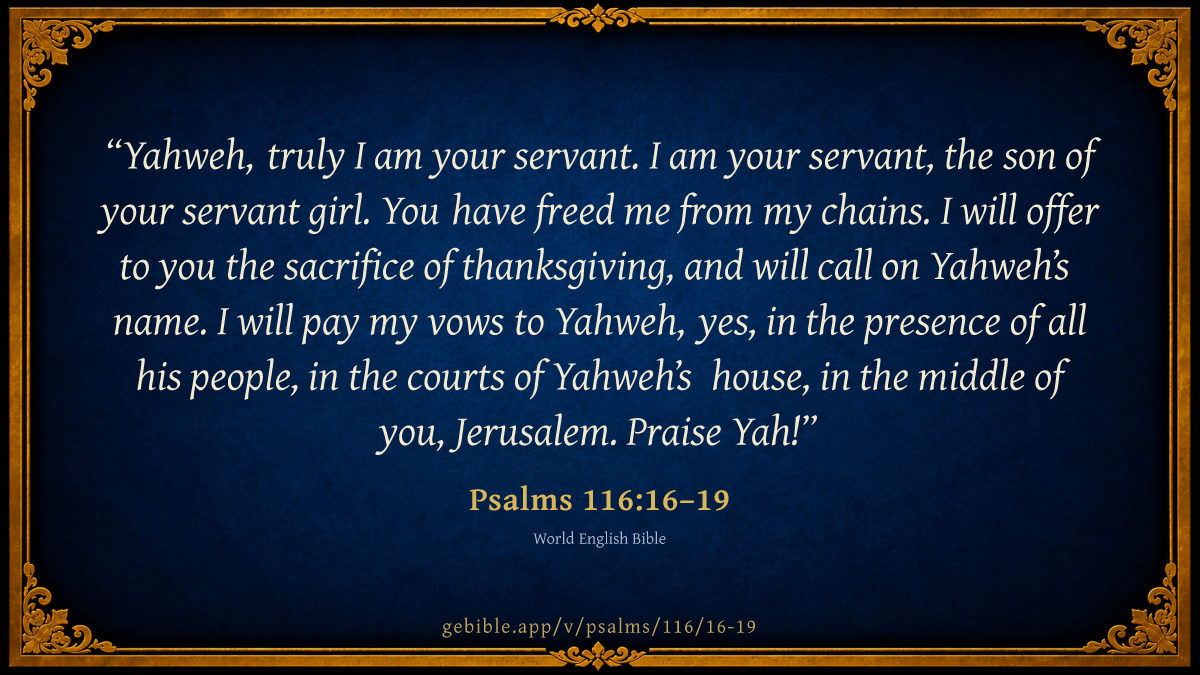
Psa 116:16 O LORD, truly I [am] thy servant; I [am] thy servant, [and] the son of thine handmaid: thou hast loosed my bonds.
Ver. 16. O Lord, truly I am thy servant; I am thy servant] Euge, O Iehovah, &c., by a real and a heavenly compliment; thus he insinuateth, and, therefore, promiseth praise to God, Psa 116:17, and safety to himself, according to that, Psa 119:94, "I am thine, save me."
Read full note →
And the son of thine handmaid] That is, of Ruth, say the Rabbis; or rather of his immediate mother, a good woman, and haply better than his father, Quia religiosior patre (Genebrard); as Manoah’s wife had a stronger faith than himself; and Priscilla is named before her husband Aquila.
And the son of thine handmaid] Not born abroad, and bought or brought into thy family; but tuus quasi vernaeulus, et a ventre ad serviendum dispositus, born and bred up to thy service, of a child little.
Thou hast loosed my bonds] Of affliction, of corruption, and made me Christ’s freeman, brought me into the glorious liberty of thine own children.
John Trapp, A Commentary or Exposition upon All the Books of the Old and New Testament (1647–1656) — public domain. Text from a community e-Sword module.
Matthew Poole1685 · Public DomainOn vv16, 18I am thy servant: this is either,
I am thy servant: this is either,
1. An argument used in prayer, It becometh thee to protect and save thy own servants, as every good master doth; or rather,
Read full note →
2. A thankful acknowledgment of his great obligations to God, whereby he was in duty bound to be the Lord’s faithful and perpetual servant. For this suits best with the context.
The son of thine handmaid; either,
1. The son of a mother who was devoted and did devote me to thy service. Or,
2. Like one born in thy house of one of thy servants, and so thine by a most strict and double obligation.
Thou hast loosed my bonds; thou hast rescued me from mine enemies, whose captive and vassal I was, and therefore hast a just right and title to me and to my service.
Matthew Poole's English Annotations on the Holy Bible (1683–1685) — public domain. Text from a community e-Sword/MySword module.
John Gill1763 · Public DomainOn vv16–17I will pay my vows unto the Lord,.... See…
I will pay my vows unto the Lord,.... See Gill on Psa 116:14. And the Targum here, as there, paraphrases the latter clause,
now in the presence of all his people, thus;
Read full note →
"I will then declare his signs (or wonders) to all his people;''
the marvellous things he had done for him.
John Gill's Exposition of the Whole Bible (1746–1763) — public domain (CC PDM 1.0). Text via the HelloAO Bible API.
Adam Clarke1810 · Public DomainOn vv16, 17, 19Verse 16. I am thy servant] Thou hast preserved…
Verse 16. I am thy servant] Thou hast preserved me alive. I live with, for, and to THEE. I am thy willing domestic, the son of thine handmaid - like one born in thy house of a woman already thy property. I am a servant, son of thy servant, made free by thy kindness; but, refusing to go out, I have had my ear bored to thy door-post, and am to continue by free choice in thy house for ever. He alludes here to the case of the servant who, in the year of jubilee being entitled to his liberty, refused to leave his master's house; and suffered his ear to be bored to the door-post, as a proof that by his own consent he agreed to continue in his master's house for ever.
Adam Clarke's Commentary on the Bible (1810–1826) — public domain. Text from a community e-Sword/MySword module.
Joseph Benson1811 · Public DomainOn v16Psa 116:16. O Lord, truly I am thy servant…
Psa 116:16. O Lord, truly I am thy servant — This is a thankful acknowledgment of his great obligations to God, whereby he was in duty bound to be his perpetual servant. The son of thy handmaid — The son of a mother who was devoted, and did devote me to thy service. Thou hast loosed my bonds — Thou hast rescued me from my enemies, whose captive and vassal I was, and therefore hast a just right to me and to my service.
Joseph Benson's Commentary on the Old and New Testaments (1811–1818) — public domain. Text from a community e-Sword module.
Albert Barnes1834 · Public DomainOn vv16–19O Lord, truly I am thy servant - In…
O Lord, truly I am thy servant - In view of thy mercy in delivering me from death, I feel the obligation to give myself to thee. I see in the fact that thou hast thus delivered me, evidence that I am thy servant - that I am so regarded by thee; and I recognize the obligation to live as becomes one who has had this proof of favor and mercy.
The son of thine handmaid - Of a pious mother. I see now the result of my training. I call to my recollection the piety of a mother. I rememberer how she served thee; how she trained me up for thee; I see now the evidence that her prayers were heard, and that her efforts were blessed in endeavoring to train me up for thee. The psalmist saw now that, under God, he owed all this to the pious efforts of a mother, and that God had been pleased to bless those efforts in making him his child, and in so guiding him that it was not improper for him to speak. of himself as possessing and carrying out the principles of a sainted mother. It is not uncommon - and in such cases it is proper - that all the evidence which we may have that we are pious - that we are living as we ought to live, that we are receiving special favors from God - recalls to our minds the instructions of early years, the counsels and prayers of a holy father or mother.
Read full note →
Thou hast loosed my bonds - The bonds of disease; the fetters which seemed to have made me a prisoner to Death. I am now free again. I walk at large. I am no longer the captive - the prisoner - of disease and pain.
Albert Barnes' Notes on the Bible (1834–1885) — public domain. Text from a community e-Sword/MySword module.
Daniel D. Whedon1874 · Public DomainOn vv16, 17, 1916. The son of thine handmaid—A form of speech…
16. The son of thine handmaid—A form of speech describing a servant “born in the house,” and, therefore, perpetual, as distinguished from a hireling, or a servant bought with money. It is the language of endearment and of humility. See Gen_14:14; Gen_17:23; Psa_86:16.
Thou hast loosed my bonds—Emancipated me; set me free. The figure perfectly suits the condition of the newly-returned exiles. God had claimed them as servants born in his own house, and had now redeemed them from their bondage to the heathen. Compare Psa_107:14. But the spiritual sense also belongs here. The psalm is highly spiritual. In this application, compare Rom_6:16-22; Joh_8:34-35
Daniel D. Whedon (gen. ed.), Commentary on the Old and New Testaments (1874–1909) — public domain. Text from a community e-Sword module.
The Cambridge Bible for Schools and Colleges1878 · Public DomainOn vv16–1916. Lit. I beseech thee, Jehovah, for I am…
16. Lit. I beseech thee, Jehovah, for I am thy servant. The precative interjection would naturally be followed by an imperative, as in Psa_116:4 b, hear me, or the like; but the Psalmist breaks off into thanksgiving.
thy servant, [omit and] the son of thy handmaid] So Psa_86:16. ‘The son of thy handmaid’ is a synonym for ‘thy servant,’ but denoting a closer relationship, for servants ‘born in the house’ (Gen_14:14) were the most trusted dependents. Cp. ‘of the household of God,’ Eph_2:19. It is hardly, as Delitzsch thinks, an allusion to the piety of the Psalmist’s mother.
Read full note →
loosed my bonds] He had been like a prisoner condemned to death, Psa_116:3. Cp. Psa_107:10; Psa_107:14.
The Cambridge Bible for Schools and Colleges (gen. ed. J. J. S. Perowne; Cambridge University Press, 1878–1918) — public domain. Text from a community e-Sword module.
Ellicott's Commentary for English Readers1878 · Public DomainOn v16(16) Thy servant, and the son of Thine handmaid.—Comp.…
(16) Thy servant, and the son of Thine handmaid.—Comp. Psa_86:16. Not only himself but his family were in the covenant, and, as very commonly in the East, the mother is selected for mention instead of the father.
A Bible Commentary for English Readers, edited by Charles John Ellicott (1878–1897) — public domain. Text from a community e-Sword module.
The Pulpit Commentary1880 · Public DomainOn vv16–19O Lord, truly I am thy servant; rather, even…
O Lord, truly I am thy servant; rather, even so, O Lord, for I am thy servant. Entitled, therefore, to thy care and consideration. I am thy servant, and the son of thine handmaid. (comp. Psa_86:16) "Thine handmaid the Church; or, if the writer is Hezekiah, "thy handmaid, Abiyah, the daughter of Zechariah," who "had under standing in the vision of God". (2Ch_26:5 2Ch_29:1) Thou hast loosed my bonds. The "cords of death" (ver. 3) are probably intended.
The Lord"s service commended.
Read full note →
It is so
I BY SCRIPTURE. (See text) The one trouble of the psalmist seems to be lest he should not be owned by the Lord as his servant. Hence:
1. He asserts with emphasis, "Truly I am thy servant." Here is not a mere make-believe, as so many professed servants of the Lord are.
2. And he reasserts it. "I am thy servant," not was, or will be, but I am, here and now, this day, thine.
3. And he cites a fact which unanswerably proves his assertion. I am "the son of thine handmaid." Slaves born in the house, home-born of another slave, were regarded as the property of their master, even more than those gained by purchase or taken captive in war. The meaning, therefore, is, "I am thy very own." Thus completely and altogether does the psalmist dedicate himself to God.
4. And he brings forward the mighty motive which had led him thus to do. "Thou hast loosed my bonds." He was speaking, probably, of the bonds of death, from the very gates of which he had been delivered (ver. 8). In his over whelming gratitude for this deliverance, he yields himself entirely to God. What a contrast does the psalmist present to the ordinary run of men! They care nothing for God"s service. If they begin it, they soon forsake it; or if perchance they seem to continue in it, with what sloth and slackness is it pursued! But the psalmist feels that no service he can render is too great; his one desire is to be confessed as the servant of the Lord.
II AND RIGHT REASON ENDORSES THIS COMMENDATION.
1. We cannot escape service of some sort; some lord will have rule over us. Where is one whose rule is righteous and reasonable as is that of the Lord?
2. Has he not all claim? He is our Creator, Preserver, our Redeemer, and daily Benefactor, our heavenly Father.
3. The noblest of mankind have been the first to confess this.
III So ALSO DOES EXPERIENCE. Who ever repented of having served the Lord too well, or thought he had done so sufficiently? The best of his servants are eager to have all those they love, and all whom they can influence, in his service. It brings here and now such rich recompense of reward, and promises eternal reward by-and-by. Our happiest hours are those spent in serving him. "He has loosed my bends, and I must and will serve him. S.C.
The Pulpit Commentary (1880–1919), ed. H.D.M. Spence-Jones & Joseph S. Exell — public domain. Text from a community e-Sword module.
Charles H. Spurgeon1885 · Public DomainOn vv16–19Ver. 16. The man of God in paying his…
Ver. 16. The man of God in paying his vows rededicates himself unto God; the offering which he brings is himself, as he cries, O LORD, truly I am thy servant, rightfully, really, heartily, constantly, I own that I am thine, for thou hast delivered and redeemed me.
I am thy servant, and the son of thine handmaid, a servant born in thy house, born of a servant and so born a servant, and therefore doubly thine. My mother was thine handmaid, and I, her son, confess that I am altogether thine by claims arising out of my birth. O that children of godly parents would thus judge; but, alas, there are many who are the sons of the Lord's handmaids, but they are not themselves his servants. They give sad proof that grace does not run in the blood. David's mother was evidently a gracious woman, and he is glad to remember that fact, and to see in it a fresh obligation to devote himself to God.
Read full note →
Thou hast loosed my bonds, freedom from bondage binds me to thy service. He who is loosed from the bonds of sin, death, and hell should rejoice to wear the easy yoke of the great Deliverer. Note how the sweet singer delights to dwell upon his belonging to the Lord; it is evidently his glory, a thing of which he is proud, a matter which causes him intense satisfaction. Verily, it ought to create rapture in our souls if we are able to call Jesus Master, and are acknowledged by him as his servants.
Ver. 16. O Lord, truly I am thy servant. Thou hast made me free, and I am impatient to be bound again. Thou hast broken the bonds of sin; now, Lord, bind me with the cords of love. Thou hast delivered me from the tyranny of Satan, make me as one of thy hired servants. I owe my liberty, my life, and all that I have, or hope, to thy generous rescue: and now, O my gracious, my Divine Friend and Redeemer, I lay myself and my all at thy feet. Samuel Lavington, 1728-1807.
Ver. 16. I am thy servant. The saints have ever had a holy pride in being God's servants; there cannot be a greater honour than to serve such a Master as commands heaven, earth, and hell. Do not think thou dost honour God in serving him; but this is how God honours thee, in vouchsafing then to be his servant. David could not study to give himself a greater style than"O Lord, or, truly I am thy servant, and the son of thy handmaid, "and this he spake, not in the phrase of a human compliment, but in the humble confession of a believer. Yea, so doth the apostle commend this excellency, that he sets the title of servant before that of an apostle; first servant, then apostle. Great was his office in being an apostle, greater his blessing in being a servant of Jesus Christ; the one is an outward calling, the other an inward grace. There was an apostle condemned, never any servant of God. Thomas Adams.
Ver. 16. I am thy servant. This expression of the king of Israel implies
(1). A humble sense of his distance from God and his dependence upon him. This is the first view which a penitent hath of himself when he returns to God. It is the first view which a good man hath of himself in his approaches to, or communion with God. And, indeed, it is what ought to be inseparable from the exercise of every other pious affection. To have, as it were, high and honourable thoughts of the majesty and greatness of the living God, and a deep and awful impression of the immediate and continual presence of the heart searching God, this naturally produces the greatest self abasement, and the most unfeigned subjection of spirit before our Maker. It leads to a confession of him as Lord over all, and having the most absolute right, not only to the obedience, but to the disposal of all his creatures. I cannot help thinking this is conveyed to us in the language of the Psalmist, when he says, O LORD, truly I am thy servant. He was a prince among his subjects, and had many other honourable distinctions, both natural and acquired, among men; but he was sensible of his being a servant and subject of the King of kings; and the force of his expression, "Truly, I am thy servant, " not only signifies the certainty of the thing, but how deeply and strongly he felt a conviction of its truth.
This declaration of the Psalmist implies (2) a confession of his being bound by particular covenant and consent unto God, and a repetition of the same by a new adherence. This, as it was certainly true with regard to him, having often dedicated himself to God, so I take it to be confirmed by the reiteration of the expression here, O LORD, truly I am thy servant; I am thy servant. As if he had said, "O Lord, it is undeniable; it is impossible to recede from it. I am thine by many ties. I am by nature thy subject and thy creature; and I have many times confessed thy right and promised my own duty." I need not mention to you, either the example in the Psalmist's writings, or the occasions in his history, on which he solemnly surrendered himself to God. It is sufficient to say, that it was very proper that he should frequently call this to mind, and confess it before God, for though it could not make his Creator's right any stronger, it would certainly make the guilt of his own violation of it so much the greater.
This declaration of the Psalmist is (3) an expression of his peculiar and special relation to God. I am thy servant, and the son of thine handmaid. There is another passage of his writings where the same expression occurs: Ps 86:16. "O turn unto me, and have mercy upon me; give thy strength unto thy servant, and save the son of thine handmaid." There is some variation among interpreters in the way of illustrating this phrase. Some take it for a figurative way of affirming, that he was bound in the strongest manner to God, as those children who were born of a maidservant, and born in his own house, were in the most absolute manner their master's property. Others take it to signify his being not only brought up in the visible church of God, but in a pious family, and educated in his fear; and others would have it to signify still more especially that the Psalmist's mother was an eminently pious woman. And indeed I do not think that was a circumstance, if true, either unworthy of him to remember, or of the Spirit of God to put upon record. John Witherspoon, 1722-1797.
Ver. 16. O Lord, I am thy servant, by a double right; (and, oh, that I could do thee double service;)as thou art the Lord of my life, and I am the son of thy handmaid: not of Hagar, but of Sarah; not of the bondwoman, but of the free; and therefore I serve thee not in fear, but in love; or therefore in fear, because in love: and then is service best done when it is done in love. In love indeed I am bound to serve thee, for, Thou hast loosed my bonds; the bonds of death which compassed me about, by delivering me from a dangerous sickness, and restoring me to health: or in a higher kind; thou hast loosed my bonds by freeing me from being a captive to be a servant; and which is more, from being a servant to be a son: and more than this, from being a son of thy handmaid, to be a son of thyself. Sir Richard Baker.
Ver. 16. Bless God for the privilege of being the children of godly parents. Better be the child of a godly than of a wealthy parent. I hope none of you are of so vile a spirit as to condemn your parents because of their piety. Certainly it is a great privilege when you can go to God, and plead your Father's covenant: LORD, truly I am thy servant; I am thy servant, and the son of thy handmaid. So did Solomon, 1Ki 8:25-26, "Lord, make good thy word to thy servant David, my father." That you are not born of infidels, nor of papists, nor of upholders of superstition and formality, but in a strict, serious, godly family, it is a great advantage that you have. It is better to be the sons of faithful ministers than of nobles. Thomas Manton, in, a Sermon preached before the Sons of the Clergy.
Ver. 16. Thou hast loosed my bonds. Mercies are given to encourage us in God's service, and should be remembered to that end. Rain descends upon the earth, not that it might be more barren, but more fertile. We are but stewards; the mercies we enjoy are not our own, but to be improved for our Master's service. Great mercies should engage to great obedience. God begins the Decalogue with a memorial of his mercy in bringing the Israelites out of Egypt, "I am the Lord thy God, which brought thee out of the land of Egypt." How affectionately doth the Psalmist own his relation to God as his servant, when he considers how God had loosed his bonds: O LORD, truly I am thy servant; thou hast loosed my bonds! the remembrance of thy mercy shall make me know no relation but that of a servant to thee. When we remember what wages we have from God, we must withal remember that we owe more service, and more liveliness in service, to him. Duty is but the ingenuous consequent of mercy. It is irrational to encourage ourselves in our way to hell by a remembrance of heaven, to foster a liberty in sin by a consideration of God's bounty. When we remember that all we have or are is the gift of God's liberality, we should think ourselves obliged to honour him with all that we have, for he is to have honour from all his gifts. It is a sign we aimed at God's glory in begging mercy, when we also aim at God's glory in enjoying it. It is a sign that love breathed the remembrance of mercy into our hearts, when at the same time it breathes a resolution into us to improve it. It is not our tongues, but our lives must praise him. Mercies are not given to one member, but to the whole man. Stephen Charnock.
Ver. 16. Holy Service.
1. Emphatically avowed.
2. Honestly rendered"truly."
3. Logically defended"son of thine handmaid."
4. Consistent with conscious liberty.
Psalms 116:17*
Charles H. Spurgeon's The Treasury of David (1869–1885) — public domain. Psalms only. Text from a community e-Sword/MySword module.
The Biblical Illustrator1887 · Public DomainOn vv16, 18O Lord, truly I am Thy servant.
Psa_116:16
O Lord, truly I am Thy servant.
Read full note →
Gods service
This, with the following verses, may be thus paraphrased: Blessed Lord, from the sense of what Thou hast done for me, I cannot but declare myself infinitely obliged to Thee; no servant bought with a price, or born in a house, can be more engaged to his Master than I am to Thee, who by Thy providence hast rescued me from the utmost dangers; what remains but that I should return the humblest offerings of praise and prayer, that I should spend my whole life as a vowed oblation to Thy service, and render Thee all possible praise in the public assembly, in the most solemn manner? I will own and endeavour to approve myself Thy servant.
I. Reasons why such a service should be chosen by us.
1. It is a just service.
(1) He has a right of creation, for He hath made us, and not we ourselves (Isa_44:1).
(2) He has a right of redemption. We are His by purchase (Exo_12:44; 1Pe_1:18; 1Co_6:20).
(3) He has a right to us by conquest (Luk_7:54).
2. It is a most necessary service.
(1) Because we are born to serve.
(2) If we withdraw our service from Him, we perish in our rebellion (Isa_60:12).
(3) It is necessary by our own voluntary act. For we bound ourselves by a solemn promise and vow, in the face of the congregation at our baptism, to continue Christs faithful servants and soldiers to our lives end.
3. Gods service is easy. What He commands us to do, He helps us to perform, so that His commandments are not grievous.
4. Gods service is the most honourable. No man ever truly served God that did not gain incredibly by it. These things the servants of God may depend upon as the certain perquisites and benefits of His service, protection, maintenance and reward.
II. How we should demean ourselves in Gods service.
1. With reverence. This is accompanied with--
(1) Humility.
(2) Fear of offending (Mal_1:6; Psa_2:11; Heb_12:28).
(3) A care of desire and pleasure (Col_1:10).
2. With obedience.
(1) Active obedience to God consisteth in keeping His commandments and doing His will.
(2) Passive obedience consists in contenting ourselves with the allowances of our supreme Master, and submitting ourselves to His corrections.
3. Fidelity. This is shown in--
(1) The sincerity and heartiness of our service.
(2) Zeal in His behalf.
(3) Diligence. (E. Lake, D.D.)
The delight of Gods service
(to young men):--
I. I commend the service of God to you.
1. I have never regretted that I entered it. All sorts of enticement have assailed me, and siren voices have often tried to lure me; but never since the day in which I enlisted in Christs service have I said to myself, I am sorry that I am a Christian; I am vexed that I serve the Lord. I think that I may, therefore, honestly, heartily, and experimentally recommend to you the service which I have found so good. I have been a bad enough servant, but never had a servant so lovable a Master or so blessed a service.
2. I have great delight in seeing my children in the same service. When a man finds that a business is a bad one, you will not find him bringing up his boys to it. Now, the greatest desire of my heart for my sons was that they might become the servants of God. I never wished for them that they might be great or rich, but, oh, if they would but give their young hearts to Jesus!
3. So blessed is the service of God, that I would like to die in it. David Brainerd, when he was very old and could not preach to the Indians, was found sitting up in bed, teaching a little Indian boy his letters, that he might read the Bible, and he said, If I cannot serve God one way, I will another; I will never leave off this blessed service.
(1) To serve God is the most reasonable thing in the world. It was He that made you. Should not our Creator have our service?
(2) This is the most honourable service that ever can be.
(3) This service is full of beneficence. It is good for yourself, and it is good for your fellow-men; for what does God ask in His service but that we should love Him with all our heart, and that we love our neighbour as ourselves? He who does this is truly serving God by the help of His Spirit, and he is also greatly blessing men.
(4) It is the most remunerative work under heaven. A quiet conscience is better than gold. To wear in your button-hole that little flower called hearts-ease, and to have the jewel of contentment in your bosom--this is heaven begun below: godliness is great gain to him that hath it.
II. A word of caution. David said, O Lord, truly I am Thy servant. Truly.
1. If you become the servant of God, become the servant of God truly. God is not mocked. It is the curse of our Churches that we have so many merely nominal Christians in them. It is the plague of this age that so many put on Christs livery, and yet never do Him a hands turn. Oh, if you serve God, mean it!
2. If you would be Gods servant, then count the cost. You must leave all others. Ye cannot serve God and mammon. Ye cannot serve Christ and Belial. He is not Gods who is not Gods only.
3. You must enter upon Gods service also for life; not to be sometimes Gods servant and sometimes not--off and on.
III. I want now to offer counsel in the matter of distinct confession if you become the servant of Christ. I am Thy servant, says David, and I want every young man here who is a Christian to say so, that there may not be one among us who follows the Lord Jesus in a kind of mean, sneaking way. It has become a custom with some to try to be Christians and never say anything about it; but I urge the true servants of Christ to out with it, and never to be ashamed, because, if ever the declaration was required, it is required now.
IV. I close by congratulating some of you who are Gods servants upon your freedom, for that is the last part of the text. Thou hast loosed my bonds. (C. H. Spurgeon.)
Devotedness to God
I. The import of the psalmists declaration and purpose.
1. A very humble sense of his distance from, and dependence upon, God as His creature.
2. A confession of it is being bound by particular covenant and consent unto God, and a repetition of the same by a new adherence.
3. An expression of his peculiar and special relation to God.
4. A sense of gratitude for signal mercies.
5. A solemn dedication and surrender of himself to God and His service for the time to come.
II. Practical improvement.
1. Plead with every one the right of his Maker to his service.
2. Warp such as are living in open and avowed profanity. They are so far from being the servants of God that they are His enemies, his confederated enemies, and the enemies of everything that stands in a visible relation to Him. (J. Witherspoon, D.D.)
The divine servant
I. The Divine servant. He should be--
1. A voluntary one, willing in every sense of the word to do the bidding of his Master, even when it is opposed to the wishes of men.
2. Earnest.
3. Unselfish.
4. Humble.
5. Inspired by the Holy Spirit, who dwells within him.
II. Divine service. Cathedrals and chapels may be likened to spiritual stables, where divine servants are born and fed and rested; but our workshops, our families, our school-rooms, our editorial chairs are the places where we should do our divine service. (W. Birch.)
The Lords servant
A servant is one who obeys the will of another. The will of a person may be obeyed consciously or unconsciously. Hence servants are of two kinds ,--those that obey consciously, and those that obey unconsciously. The latter--such as obey unconsciously--may be called instruments of the masters will; and the former--such as obey consciously--may be called agents of it. All believers are Gods servants in the best and noblest sense of the word. They do His will because they know it, and because it is their delight; they obey His law, because they know it, and because they have it within their heart. They are not the blind instruments of His power; they are the conscious and willing agents of a service in which they glory.
I. How the believer becomes a servant of the Lord.
1. By birth. It must not be confounded with that birth which the believer has experienced in common with all the race, and which brought him into a world of sin, and sorrow, and death. This is his second birth. This is his new birth. It is a birth which is peculiar to the believer. He is born of water, figuratively, symbolically; of the Word, instrumentally; of the Spirit, efficiently.
2. By purchase. Christ gave Himself for you, that He might redeem you from all iniquity, and purify unto Himself a peculiar people, zealous of good works.
3. By conquest.
4. By voluntary engagement. He will have nothing more to do with his old master. He desires that his ears may be bored, and that he may be the servant of Christ for ever.
II. The state of mind which the believer, as a servant of God, should cultivate.
1. He ought to remember that he is a servant of God. It will be easy to do this in heaven. The difficulty would be to forget it for an instant amid the fellowships of that glorious place. But there are strong temptations to forget it here. The service of God is unpopular. It is unfashionable. And it is inconsistent with many practices which are pleasant to the flesh.
2. He should remember how he became the Lords servant.
3. He should keep his duty as a servant of God always in view. We conjoin these two--the obeying of Gods commandments with the doing of Gods work--because it is not enough, and does not come up to the full idea of what a servant should be, that he be zealous in his masters cause, and devote himself to his masters interests; for it is necessary also that he be guided implicitly by the masters will, and that he do Gods work in Gods way. (A. Gray.)
Self-dedication to God
I. The old bonds loosed. No sooner is a man united to the Crucified One by living faith, than the sentence, borne by the Surety, falls from off him (as it is written, Christ hath redeemed us from the curse of the law, being made a curse for us), and, with that sentence, all the other bonds together--sin, Satan, the world.
II. The new bonds which have come in place of the old for ever.
1. The nature of the new bonds. As they consist in the service of God, so that service is, as to the character of it, first, true; second, entire; and third, hearty and free.
2. The spring and source of the new bonds. It is taught here as to this, that it is the loosing of the old bonds which is the source and spring of the new.
(1) The loosing of the old bonds is the source and spring of the new, in that it is indispensable to the whole formation of them. So long as the old are not loosed, the new cannot exist.
(2) The loosing of the old bonds is the source and spring of the new, inasmuch as it fixes the new, many ways, sweetly and strongly on the soul,--enhances many ways the obligation of Gods service on the soul.
(3) The loosing of the old bonds is the source and spring of the new, in that Gods express purpose and design in the loosing of the old was to fix the new for ever upon the soul,--to set the soul free in order to its serving and glorifying Him for ever.
(4) The loosing of the old bonds is the source and spring of the new, in that it brings into the soul a Divine power and strength,--the power of the Holy Ghost, effectually to persuade, enable, constrain, the soul to the service of God.
(5) The loosing of the old bonds is the source and spring of the new, in that, besides the power, it brings into the soul all manner of inducements, persuasives, motives, to the service of God; and specially among these, the motive of an overpowering gratitude and love, under whose blessed influence it comes to pass that, whereas we could not serve God before, now we cannot but serve Him, as David sings in this psalm, What shall I render unto the Lord, etc. (C. J. Brown, D. D.)
Personal service
The religion of Jesus is the religion of liberty. The true believer can say, when his soul is in a healthy state, Thou hast loosed my bonds. The penal fetters with which my soul was once bound are all dashed to shivers; I am free! There is now no condemnation to them that are in Christ Jesus, etc. The burdensome bonds of ceremonials are all cast to the winds. Henceforth the beggarly elements are trodden under foot; shadows have yielded to substance, and the type and the symbol cease to oppress; the true light now shineth, and the torches are quenched. Thou hast loosed my bonds--that is to say, Thou hast not only saved me from the penal consequences of my sin and from the heavy burden of the old Mosaic ceremonial law, but Thou hast moreover delivered me from the spirit of bondage which once led me to serve Thee with the fear of an unwilling slave. Thou hast made me Thy freedman. No more do I crouch at Thy feet or go to Thy footstool cowering like a slave; but I come to Thee with privilege of access, up to Thy very throne. By the Spirit of adoption I cry, Abba, Father. Thou dost own the kindred. For by the selfsame Spirit I am sealed to the day of redemption. Thus, O Lord, Thou hast loosed my bonds. Nor, if religion has had its full sway in us, is this all. Thou hast loosed me from the bonds of worldly maxims; Thou hast delivered me from the fear of man; Thou hast rescued me from the stooping and fawning which made me once the slave of every tyrant who laid claim to my allegiance, and Thou hast made me now the servant of but one Master, whose service is perfect liberty.
I. The nature of personal service. Let me explain it by a contrast. The service of God among us has grown more and more a service by proxy. Do we not observe, even in the outward worship of God, at times a great attempt towards worship by proxy? Do we not often hear singing the praises of God confined to some five or six or more trained men and women who are to praise God for us? Do we not sometimes have the dreary thought when we are in our churches and chapels that even the prayer is said and prayed by the minister for us? We shall never see great things in the world till we have all roused ourselves to our personal responsibilities. God will not give the honour of saving the world to His ministers. He meant it for His Church; and until His Church is prepared to grasp it, God will withhold the crown which He has prepared for her brow, and for hers alone, and which none but she can ever win.
II. Its reasonableness. Heir of heaven, blood-bought and blood-washed, Jesus did not save thee by another. But, again, have you not a personal religion? You live, if you be a true Christian--you live upon the personal realization of your interest in the covenant of grace. What more reasonable than that you should give personal service? Further, this personal service is reasonable from the fact that personal service is the only kind of service at all available. I scarcely know whether you can serve God except by individual consecration.
III. Its excellence. This excellence is manifold. Among the first of its charms, personal service is the main argument of the Christian religion against the sceptic. Let every private man have his mission; let every man and woman begin to build nearest to their own house, and from that day scepticism begins to lose, at least, one of its arguments; and, with it, it loses one of its most formidable elements--one of its deadliest weapons with which it has attacked the Church. But, further, I am persuaded that while it would be a grand argument against sceptics, it would be one of the greatest means of deciding that class of waverers who, although they are not sceptical, are negligent of the things of the Kingdom. There is no way to make another man earnest like being earnest oneself. But, further, excellency of personal service, it strikes me, is not confined to the good we do, but should be argued from the good we get. We have in our Churches men and women who are always looking for an opportunity for finding fault. They are never consistent in anything but in their inconsistent grumbling. The mightiest cure for the Church is to set them to work. (C. H. Spurgeon.)
Gods servants
It would ofttimes help us to bear our trials were we to reflect we are all Gods servants rather than His guests. This does not degrade us, for the work of all the world is carried forward by underlings. No monarch saves a state, no commander wins a battle, no captain sails a ship, no trader amasses a fortune, but by the fidelity of his servants. To be Gods servants, if faithful, is to be the worlds co-redeemers. (Christian Weekly.)
Joyful Servitude
It is told of Socrates and his servant, that the servant gave himself to his master on his birthday, and that the master loaded his faithful servant with presents, and said, Now I give thee thyself back richer than before. Then the servant replied, But now, my master, I am more than ever thy servant still. (Quiver.)
The Biblical Illustrator, edited by Joseph S. Exell (c. 1880s–1900s) — public domain. Text from a community e-Sword module.
unfoldingWord translationNotes2017 · CC BY-SA 4.0On vv16, 18General Information:
General Information:
The person who composed this psalm continues to speak.
Read full note →
the son of your servant woman
This is likely a reference to the writer's mother and indicates that she faithfully worshiped Yahweh. The full meaning of this can be made clear. AT: "as my mother was" (See: Assumed Knowledge and Implicit Information)
you have taken away my bonds
The writer speaks of being in danger of dying as if he had been chained in prison. AT: "you have saved me from death" (See: Metaphor)
the sacrifice of thanksgiving
"a sacrifice to express my thankfulness"
will call on the name of Yahweh
Here the word "name" represents Yahweh himself. AT: "will call on Yahweh" (See: Metonymy)

John Calvin 1540 · Public Domain On vv16–17 16 Come, O Jehovah! because I am thy servant.…
16 Come, O Jehovah! because I am thy servant. As, in the former verse, he gloried that in him God had given an example of the paternal regard which he has for the faithful, so here he applies, in an especial manner, to himself the general doctrine, by declaring that his fetters had been broken, in consequence of his being included among the number of God’s servants. He employs the term fetters, as if one, with hands and feet bound, were dragged by the executioner. In assigning, as the reason of his deliverance, that he was God’s servant, he by no means vaunts of his services, but rather refers to God’s unconditional election; for we cannot make ourselves his servants, that being an honor conferred upon us solely by his adoption. Hence David affirms, that he was not God’s servant merely, but the son of his handmaid. “From the womb of my mother, even before I was born, was this honor conferred upon me.” He therefore presents himself as a common example to all who shall dedicate themselves to the service of God, and place themselves under his protection, that they may be under no apprehension for their safety while they have him for their defense.
John Calvin's Commentaries (1540-1563) — public domain. Text from the Calvin Translation Society English edition (1840s-50s) via the Christian Classics Ethereal Library (ccel.org). Calvin's coverage is partial (roughly two-thirds of the Bible); uncommented books and verses are honest gaps, never fabricated. The 19th-century editor's footnotes and remarks are omitted so the notes are faithfully Calvin's own voice.
Geneva Bible translators 1599 · Public Domain On v18 I will thank him for his benefits, for that…
I will thank him for his benefits, for that is a just payment, to confess that we owe all to God.
Geneva Bible (1599) marginal notes — public domain.
John Trapp 1656 · Public Domain On vv16–19 Psa 116:16 O LORD, truly I [am] thy servant;…
Psa 116:16 O LORD, truly I [am] thy servant; I [am] thy servant, [and] the son of thine handmaid: thou hast loosed my bonds.
Ver. 16. O Lord, truly I am thy servant; I am thy servant] Euge, O Iehovah, &c., by a real and a heavenly compliment; thus he insinuateth, and, therefore, promiseth praise to God, Psa 116:17, and safety to himself, according to that, Psa 119:94, "I am thine, save me."
Read full note →
And the son of thine handmaid] That is, of Ruth, say the Rabbis; or rather of his immediate mother, a good woman, and haply better than his father, Quia religiosior patre (Genebrard); as Manoah’s wife had a stronger faith than himself; and Priscilla is named before her husband Aquila.
And the son of thine handmaid] Not born abroad, and bought or brought into thy family; but tuus quasi vernaeulus, et a ventre ad serviendum dispositus, born and bred up to thy service, of a child little.
Thou hast loosed my bonds] Of affliction, of corruption, and made me Christ’s freeman, brought me into the glorious liberty of thine own children.
John Trapp, A Commentary or Exposition upon All the Books of the Old and New Testament (1647–1656) — public domain. Text from a community e-Sword module.
Matthew Poole 1685 · Public Domain On vv16, 18 I am thy servant: this is either,
I am thy servant: this is either,
1. An argument used in prayer, It becometh thee to protect and save thy own servants, as every good master doth; or rather,
Read full note →
2. A thankful acknowledgment of his great obligations to God, whereby he was in duty bound to be the Lord’s faithful and perpetual servant. For this suits best with the context.
The son of thine handmaid; either,
1. The son of a mother who was devoted and did devote me to thy service. Or,
2. Like one born in thy house of one of thy servants, and so thine by a most strict and double obligation.
Thou hast loosed my bonds; thou hast rescued me from mine enemies, whose captive and vassal I was, and therefore hast a just right and title to me and to my service.
Matthew Poole's English Annotations on the Holy Bible (1683–1685) — public domain. Text from a community e-Sword/MySword module.
John Gill 1763 · Public Domain On vv16–17 I will pay my vows unto the Lord,.... See…
I will pay my vows unto the Lord,.... See Gill on Psa 116:14. And the Targum here, as there, paraphrases the latter clause,
now in the presence of all his people, thus;
Read full note →
"I will then declare his signs (or wonders) to all his people;''
the marvellous things he had done for him.
John Gill's Exposition of the Whole Bible (1746–1763) — public domain (CC PDM 1.0). Text via the HelloAO Bible API.
Adam Clarke 1810 · Public Domain On vv16, 17, 19 Verse 16. I am thy servant] Thou hast preserved…
Verse 16. I am thy servant] Thou hast preserved me alive. I live with, for, and to THEE. I am thy willing domestic, the son of thine handmaid - like one born in thy house of a woman already thy property. I am a servant, son of thy servant, made free by thy kindness; but, refusing to go out, I have had my ear bored to thy door-post, and am to continue by free choice in thy house for ever. He alludes here to the case of the servant who, in the year of jubilee being entitled to his liberty, refused to leave his master's house; and suffered his ear to be bored to the door-post, as a proof that by his own consent he agreed to continue in his master's house for ever.
Adam Clarke's Commentary on the Bible (1810–1826) — public domain. Text from a community e-Sword/MySword module.
Joseph Benson 1811 · Public Domain On v16 Psa 116:16. O Lord, truly I am thy servant…
Psa 116:16. O Lord, truly I am thy servant — This is a thankful acknowledgment of his great obligations to God, whereby he was in duty bound to be his perpetual servant. The son of thy handmaid — The son of a mother who was devoted, and did devote me to thy service. Thou hast loosed my bonds — Thou hast rescued me from my enemies, whose captive and vassal I was, and therefore hast a just right to me and to my service.
Joseph Benson's Commentary on the Old and New Testaments (1811–1818) — public domain. Text from a community e-Sword module.
Albert Barnes 1834 · Public Domain On vv16–19 O Lord, truly I am thy servant - In…
O Lord, truly I am thy servant - In view of thy mercy in delivering me from death, I feel the obligation to give myself to thee. I see in the fact that thou hast thus delivered me, evidence that I am thy servant - that I am so regarded by thee; and I recognize the obligation to live as becomes one who has had this proof of favor and mercy.
The son of thine handmaid - Of a pious mother. I see now the result of my training. I call to my recollection the piety of a mother. I rememberer how she served thee; how she trained me up for thee; I see now the evidence that her prayers were heard, and that her efforts were blessed in endeavoring to train me up for thee. The psalmist saw now that, under God, he owed all this to the pious efforts of a mother, and that God had been pleased to bless those efforts in making him his child, and in so guiding him that it was not improper for him to speak. of himself as possessing and carrying out the principles of a sainted mother. It is not uncommon - and in such cases it is proper - that all the evidence which we may have that we are pious - that we are living as we ought to live, that we are receiving special favors from God - recalls to our minds the instructions of early years, the counsels and prayers of a holy father or mother.
Read full note →
Thou hast loosed my bonds - The bonds of disease; the fetters which seemed to have made me a prisoner to Death. I am now free again. I walk at large. I am no longer the captive - the prisoner - of disease and pain.
Albert Barnes' Notes on the Bible (1834–1885) — public domain. Text from a community e-Sword/MySword module.
Daniel D. Whedon 1874 · Public Domain On vv16, 17, 19 16. The son of thine handmaid—A form of speech…
16. The son of thine handmaid—A form of speech describing a servant “born in the house,” and, therefore, perpetual, as distinguished from a hireling, or a servant bought with money. It is the language of endearment and of humility. See Gen_14:14; Gen_17:23; Psa_86:16.
Thou hast loosed my bonds—Emancipated me; set me free. The figure perfectly suits the condition of the newly-returned exiles. God had claimed them as servants born in his own house, and had now redeemed them from their bondage to the heathen. Compare Psa_107:14. But the spiritual sense also belongs here. The psalm is highly spiritual. In this application, compare Rom_6:16-22; Joh_8:34-35
Daniel D. Whedon (gen. ed.), Commentary on the Old and New Testaments (1874–1909) — public domain. Text from a community e-Sword module.
The Cambridge Bible for Schools and Colleges 1878 · Public Domain On vv16–19 16. Lit. I beseech thee, Jehovah, for I am…
16. Lit. I beseech thee, Jehovah, for I am thy servant. The precative interjection would naturally be followed by an imperative, as in Psa_116:4 b, hear me, or the like; but the Psalmist breaks off into thanksgiving.
thy servant, [omit and] the son of thy handmaid] So Psa_86:16. ‘The son of thy handmaid’ is a synonym for ‘thy servant,’ but denoting a closer relationship, for servants ‘born in the house’ (Gen_14:14) were the most trusted dependents. Cp. ‘of the household of God,’ Eph_2:19. It is hardly, as Delitzsch thinks, an allusion to the piety of the Psalmist’s mother.
Read full note →
loosed my bonds] He had been like a prisoner condemned to death, Psa_116:3. Cp. Psa_107:10; Psa_107:14.
The Cambridge Bible for Schools and Colleges (gen. ed. J. J. S. Perowne; Cambridge University Press, 1878–1918) — public domain. Text from a community e-Sword module.
Ellicott's Commentary for English Readers 1878 · Public Domain On v16 (16) Thy servant, and the son of Thine handmaid.—Comp.…
(16) Thy servant, and the son of Thine handmaid.—Comp. Psa_86:16. Not only himself but his family were in the covenant, and, as very commonly in the East, the mother is selected for mention instead of the father.
A Bible Commentary for English Readers, edited by Charles John Ellicott (1878–1897) — public domain. Text from a community e-Sword module.
The Pulpit Commentary 1880 · Public Domain On vv16–19 O Lord, truly I am thy servant; rather, even…
O Lord, truly I am thy servant; rather, even so, O Lord, for I am thy servant. Entitled, therefore, to thy care and consideration. I am thy servant, and the son of thine handmaid. (comp. Psa_86:16) "Thine handmaid the Church; or, if the writer is Hezekiah, "thy handmaid, Abiyah, the daughter of Zechariah," who "had under standing in the vision of God". (2Ch_26:5 2Ch_29:1) Thou hast loosed my bonds. The "cords of death" (ver. 3) are probably intended.
The Lord"s service commended.
Read full note →
It is so
I BY SCRIPTURE. (See text) The one trouble of the psalmist seems to be lest he should not be owned by the Lord as his servant. Hence:
1. He asserts with emphasis, "Truly I am thy servant." Here is not a mere make-believe, as so many professed servants of the Lord are.
2. And he reasserts it. "I am thy servant," not was, or will be, but I am, here and now, this day, thine.
3. And he cites a fact which unanswerably proves his assertion. I am "the son of thine handmaid." Slaves born in the house, home-born of another slave, were regarded as the property of their master, even more than those gained by purchase or taken captive in war. The meaning, therefore, is, "I am thy very own." Thus completely and altogether does the psalmist dedicate himself to God.
4. And he brings forward the mighty motive which had led him thus to do. "Thou hast loosed my bonds." He was speaking, probably, of the bonds of death, from the very gates of which he had been delivered (ver. 8). In his over whelming gratitude for this deliverance, he yields himself entirely to God. What a contrast does the psalmist present to the ordinary run of men! They care nothing for God"s service. If they begin it, they soon forsake it; or if perchance they seem to continue in it, with what sloth and slackness is it pursued! But the psalmist feels that no service he can render is too great; his one desire is to be confessed as the servant of the Lord.
II AND RIGHT REASON ENDORSES THIS COMMENDATION.
1. We cannot escape service of some sort; some lord will have rule over us. Where is one whose rule is righteous and reasonable as is that of the Lord?
2. Has he not all claim? He is our Creator, Preserver, our Redeemer, and daily Benefactor, our heavenly Father.
3. The noblest of mankind have been the first to confess this.
III So ALSO DOES EXPERIENCE. Who ever repented of having served the Lord too well, or thought he had done so sufficiently? The best of his servants are eager to have all those they love, and all whom they can influence, in his service. It brings here and now such rich recompense of reward, and promises eternal reward by-and-by. Our happiest hours are those spent in serving him. "He has loosed my bends, and I must and will serve him. S.C.
The Pulpit Commentary (1880–1919), ed. H.D.M. Spence-Jones & Joseph S. Exell — public domain. Text from a community e-Sword module.
Charles H. Spurgeon 1885 · Public Domain On vv16–19 Ver. 16. The man of God in paying his…
Ver. 16. The man of God in paying his vows rededicates himself unto God; the offering which he brings is himself, as he cries, O LORD, truly I am thy servant, rightfully, really, heartily, constantly, I own that I am thine, for thou hast delivered and redeemed me.
I am thy servant, and the son of thine handmaid, a servant born in thy house, born of a servant and so born a servant, and therefore doubly thine. My mother was thine handmaid, and I, her son, confess that I am altogether thine by claims arising out of my birth. O that children of godly parents would thus judge; but, alas, there are many who are the sons of the Lord's handmaids, but they are not themselves his servants. They give sad proof that grace does not run in the blood. David's mother was evidently a gracious woman, and he is glad to remember that fact, and to see in it a fresh obligation to devote himself to God.
Read full note →
Thou hast loosed my bonds, freedom from bondage binds me to thy service. He who is loosed from the bonds of sin, death, and hell should rejoice to wear the easy yoke of the great Deliverer. Note how the sweet singer delights to dwell upon his belonging to the Lord; it is evidently his glory, a thing of which he is proud, a matter which causes him intense satisfaction. Verily, it ought to create rapture in our souls if we are able to call Jesus Master, and are acknowledged by him as his servants.
Ver. 16. O Lord, truly I am thy servant. Thou hast made me free, and I am impatient to be bound again. Thou hast broken the bonds of sin; now, Lord, bind me with the cords of love. Thou hast delivered me from the tyranny of Satan, make me as one of thy hired servants. I owe my liberty, my life, and all that I have, or hope, to thy generous rescue: and now, O my gracious, my Divine Friend and Redeemer, I lay myself and my all at thy feet. Samuel Lavington, 1728-1807.
Ver. 16. I am thy servant. The saints have ever had a holy pride in being God's servants; there cannot be a greater honour than to serve such a Master as commands heaven, earth, and hell. Do not think thou dost honour God in serving him; but this is how God honours thee, in vouchsafing then to be his servant. David could not study to give himself a greater style than"O Lord, or, truly I am thy servant, and the son of thy handmaid, "and this he spake, not in the phrase of a human compliment, but in the humble confession of a believer. Yea, so doth the apostle commend this excellency, that he sets the title of servant before that of an apostle; first servant, then apostle. Great was his office in being an apostle, greater his blessing in being a servant of Jesus Christ; the one is an outward calling, the other an inward grace. There was an apostle condemned, never any servant of God. Thomas Adams.
Ver. 16. I am thy servant. This expression of the king of Israel implies
(1). A humble sense of his distance from God and his dependence upon him. This is the first view which a penitent hath of himself when he returns to God. It is the first view which a good man hath of himself in his approaches to, or communion with God. And, indeed, it is what ought to be inseparable from the exercise of every other pious affection. To have, as it were, high and honourable thoughts of the majesty and greatness of the living God, and a deep and awful impression of the immediate and continual presence of the heart searching God, this naturally produces the greatest self abasement, and the most unfeigned subjection of spirit before our Maker. It leads to a confession of him as Lord over all, and having the most absolute right, not only to the obedience, but to the disposal of all his creatures. I cannot help thinking this is conveyed to us in the language of the Psalmist, when he says, O LORD, truly I am thy servant. He was a prince among his subjects, and had many other honourable distinctions, both natural and acquired, among men; but he was sensible of his being a servant and subject of the King of kings; and the force of his expression, "Truly, I am thy servant, " not only signifies the certainty of the thing, but how deeply and strongly he felt a conviction of its truth.
This declaration of the Psalmist implies (2) a confession of his being bound by particular covenant and consent unto God, and a repetition of the same by a new adherence. This, as it was certainly true with regard to him, having often dedicated himself to God, so I take it to be confirmed by the reiteration of the expression here, O LORD, truly I am thy servant; I am thy servant. As if he had said, "O Lord, it is undeniable; it is impossible to recede from it. I am thine by many ties. I am by nature thy subject and thy creature; and I have many times confessed thy right and promised my own duty." I need not mention to you, either the example in the Psalmist's writings, or the occasions in his history, on which he solemnly surrendered himself to God. It is sufficient to say, that it was very proper that he should frequently call this to mind, and confess it before God, for though it could not make his Creator's right any stronger, it would certainly make the guilt of his own violation of it so much the greater.
This declaration of the Psalmist is (3) an expression of his peculiar and special relation to God. I am thy servant, and the son of thine handmaid. There is another passage of his writings where the same expression occurs: Ps 86:16. "O turn unto me, and have mercy upon me; give thy strength unto thy servant, and save the son of thine handmaid." There is some variation among interpreters in the way of illustrating this phrase. Some take it for a figurative way of affirming, that he was bound in the strongest manner to God, as those children who were born of a maidservant, and born in his own house, were in the most absolute manner their master's property. Others take it to signify his being not only brought up in the visible church of God, but in a pious family, and educated in his fear; and others would have it to signify still more especially that the Psalmist's mother was an eminently pious woman. And indeed I do not think that was a circumstance, if true, either unworthy of him to remember, or of the Spirit of God to put upon record. John Witherspoon, 1722-1797.
Ver. 16. O Lord, I am thy servant, by a double right; (and, oh, that I could do thee double service;)as thou art the Lord of my life, and I am the son of thy handmaid: not of Hagar, but of Sarah; not of the bondwoman, but of the free; and therefore I serve thee not in fear, but in love; or therefore in fear, because in love: and then is service best done when it is done in love. In love indeed I am bound to serve thee, for, Thou hast loosed my bonds; the bonds of death which compassed me about, by delivering me from a dangerous sickness, and restoring me to health: or in a higher kind; thou hast loosed my bonds by freeing me from being a captive to be a servant; and which is more, from being a servant to be a son: and more than this, from being a son of thy handmaid, to be a son of thyself. Sir Richard Baker.
Ver. 16. Bless God for the privilege of being the children of godly parents. Better be the child of a godly than of a wealthy parent. I hope none of you are of so vile a spirit as to condemn your parents because of their piety. Certainly it is a great privilege when you can go to God, and plead your Father's covenant: LORD, truly I am thy servant; I am thy servant, and the son of thy handmaid. So did Solomon, 1Ki 8:25-26, "Lord, make good thy word to thy servant David, my father." That you are not born of infidels, nor of papists, nor of upholders of superstition and formality, but in a strict, serious, godly family, it is a great advantage that you have. It is better to be the sons of faithful ministers than of nobles. Thomas Manton, in, a Sermon preached before the Sons of the Clergy.
Ver. 16. Thou hast loosed my bonds. Mercies are given to encourage us in God's service, and should be remembered to that end. Rain descends upon the earth, not that it might be more barren, but more fertile. We are but stewards; the mercies we enjoy are not our own, but to be improved for our Master's service. Great mercies should engage to great obedience. God begins the Decalogue with a memorial of his mercy in bringing the Israelites out of Egypt, "I am the Lord thy God, which brought thee out of the land of Egypt." How affectionately doth the Psalmist own his relation to God as his servant, when he considers how God had loosed his bonds: O LORD, truly I am thy servant; thou hast loosed my bonds! the remembrance of thy mercy shall make me know no relation but that of a servant to thee. When we remember what wages we have from God, we must withal remember that we owe more service, and more liveliness in service, to him. Duty is but the ingenuous consequent of mercy. It is irrational to encourage ourselves in our way to hell by a remembrance of heaven, to foster a liberty in sin by a consideration of God's bounty. When we remember that all we have or are is the gift of God's liberality, we should think ourselves obliged to honour him with all that we have, for he is to have honour from all his gifts. It is a sign we aimed at God's glory in begging mercy, when we also aim at God's glory in enjoying it. It is a sign that love breathed the remembrance of mercy into our hearts, when at the same time it breathes a resolution into us to improve it. It is not our tongues, but our lives must praise him. Mercies are not given to one member, but to the whole man. Stephen Charnock.
Ver. 16. Holy Service.
1. Emphatically avowed.
2. Honestly rendered"truly."
3. Logically defended"son of thine handmaid."
4. Consistent with conscious liberty.
Psalms 116:17*
Charles H. Spurgeon's The Treasury of David (1869–1885) — public domain. Psalms only. Text from a community e-Sword/MySword module.
The Biblical Illustrator 1887 · Public Domain On vv16, 18 O Lord, truly I am Thy servant.
Psa_116:16
O Lord, truly I am Thy servant.
Read full note →
Gods service
This, with the following verses, may be thus paraphrased: Blessed Lord, from the sense of what Thou hast done for me, I cannot but declare myself infinitely obliged to Thee; no servant bought with a price, or born in a house, can be more engaged to his Master than I am to Thee, who by Thy providence hast rescued me from the utmost dangers; what remains but that I should return the humblest offerings of praise and prayer, that I should spend my whole life as a vowed oblation to Thy service, and render Thee all possible praise in the public assembly, in the most solemn manner? I will own and endeavour to approve myself Thy servant.
I. Reasons why such a service should be chosen by us.
1. It is a just service.
(1) He has a right of creation, for He hath made us, and not we ourselves (Isa_44:1).
(2) He has a right of redemption. We are His by purchase (Exo_12:44; 1Pe_1:18; 1Co_6:20).
(3) He has a right to us by conquest (Luk_7:54).
2. It is a most necessary service.
(1) Because we are born to serve.
(2) If we withdraw our service from Him, we perish in our rebellion (Isa_60:12).
(3) It is necessary by our own voluntary act. For we bound ourselves by a solemn promise and vow, in the face of the congregation at our baptism, to continue Christs faithful servants and soldiers to our lives end.
3. Gods service is easy. What He commands us to do, He helps us to perform, so that His commandments are not grievous.
4. Gods service is the most honourable. No man ever truly served God that did not gain incredibly by it. These things the servants of God may depend upon as the certain perquisites and benefits of His service, protection, maintenance and reward.
II. How we should demean ourselves in Gods service.
1. With reverence. This is accompanied with--
(1) Humility.
(2) Fear of offending (Mal_1:6; Psa_2:11; Heb_12:28).
(3) A care of desire and pleasure (Col_1:10).
2. With obedience.
(1) Active obedience to God consisteth in keeping His commandments and doing His will.
(2) Passive obedience consists in contenting ourselves with the allowances of our supreme Master, and submitting ourselves to His corrections.
3. Fidelity. This is shown in--
(1) The sincerity and heartiness of our service.
(2) Zeal in His behalf.
(3) Diligence. (E. Lake, D.D.)
The delight of Gods service
(to young men):--
I. I commend the service of God to you.
1. I have never regretted that I entered it. All sorts of enticement have assailed me, and siren voices have often tried to lure me; but never since the day in which I enlisted in Christs service have I said to myself, I am sorry that I am a Christian; I am vexed that I serve the Lord. I think that I may, therefore, honestly, heartily, and experimentally recommend to you the service which I have found so good. I have been a bad enough servant, but never had a servant so lovable a Master or so blessed a service.
2. I have great delight in seeing my children in the same service. When a man finds that a business is a bad one, you will not find him bringing up his boys to it. Now, the greatest desire of my heart for my sons was that they might become the servants of God. I never wished for them that they might be great or rich, but, oh, if they would but give their young hearts to Jesus!
3. So blessed is the service of God, that I would like to die in it. David Brainerd, when he was very old and could not preach to the Indians, was found sitting up in bed, teaching a little Indian boy his letters, that he might read the Bible, and he said, If I cannot serve God one way, I will another; I will never leave off this blessed service.
(1) To serve God is the most reasonable thing in the world. It was He that made you. Should not our Creator have our service?
(2) This is the most honourable service that ever can be.
(3) This service is full of beneficence. It is good for yourself, and it is good for your fellow-men; for what does God ask in His service but that we should love Him with all our heart, and that we love our neighbour as ourselves? He who does this is truly serving God by the help of His Spirit, and he is also greatly blessing men.
(4) It is the most remunerative work under heaven. A quiet conscience is better than gold. To wear in your button-hole that little flower called hearts-ease, and to have the jewel of contentment in your bosom--this is heaven begun below: godliness is great gain to him that hath it.
II. A word of caution. David said, O Lord, truly I am Thy servant. Truly.
1. If you become the servant of God, become the servant of God truly. God is not mocked. It is the curse of our Churches that we have so many merely nominal Christians in them. It is the plague of this age that so many put on Christs livery, and yet never do Him a hands turn. Oh, if you serve God, mean it!
2. If you would be Gods servant, then count the cost. You must leave all others. Ye cannot serve God and mammon. Ye cannot serve Christ and Belial. He is not Gods who is not Gods only.
3. You must enter upon Gods service also for life; not to be sometimes Gods servant and sometimes not--off and on.
III. I want now to offer counsel in the matter of distinct confession if you become the servant of Christ. I am Thy servant, says David, and I want every young man here who is a Christian to say so, that there may not be one among us who follows the Lord Jesus in a kind of mean, sneaking way. It has become a custom with some to try to be Christians and never say anything about it; but I urge the true servants of Christ to out with it, and never to be ashamed, because, if ever the declaration was required, it is required now.
IV. I close by congratulating some of you who are Gods servants upon your freedom, for that is the last part of the text. Thou hast loosed my bonds. (C. H. Spurgeon.)
Devotedness to God
I. The import of the psalmists declaration and purpose.
1. A very humble sense of his distance from, and dependence upon, God as His creature.
2. A confession of it is being bound by particular covenant and consent unto God, and a repetition of the same by a new adherence.
3. An expression of his peculiar and special relation to God.
4. A sense of gratitude for signal mercies.
5. A solemn dedication and surrender of himself to God and His service for the time to come.
II. Practical improvement.
1. Plead with every one the right of his Maker to his service.
2. Warp such as are living in open and avowed profanity. They are so far from being the servants of God that they are His enemies, his confederated enemies, and the enemies of everything that stands in a visible relation to Him. (J. Witherspoon, D.D.)
The divine servant
I. The Divine servant. He should be--
1. A voluntary one, willing in every sense of the word to do the bidding of his Master, even when it is opposed to the wishes of men.
2. Earnest.
3. Unselfish.
4. Humble.
5. Inspired by the Holy Spirit, who dwells within him.
II. Divine service. Cathedrals and chapels may be likened to spiritual stables, where divine servants are born and fed and rested; but our workshops, our families, our school-rooms, our editorial chairs are the places where we should do our divine service. (W. Birch.)
The Lords servant
A servant is one who obeys the will of another. The will of a person may be obeyed consciously or unconsciously. Hence servants are of two kinds ,--those that obey consciously, and those that obey unconsciously. The latter--such as obey unconsciously--may be called instruments of the masters will; and the former--such as obey consciously--may be called agents of it. All believers are Gods servants in the best and noblest sense of the word. They do His will because they know it, and because it is their delight; they obey His law, because they know it, and because they have it within their heart. They are not the blind instruments of His power; they are the conscious and willing agents of a service in which they glory.
I. How the believer becomes a servant of the Lord.
1. By birth. It must not be confounded with that birth which the believer has experienced in common with all the race, and which brought him into a world of sin, and sorrow, and death. This is his second birth. This is his new birth. It is a birth which is peculiar to the believer. He is born of water, figuratively, symbolically; of the Word, instrumentally; of the Spirit, efficiently.
2. By purchase. Christ gave Himself for you, that He might redeem you from all iniquity, and purify unto Himself a peculiar people, zealous of good works.
3. By conquest.
4. By voluntary engagement. He will have nothing more to do with his old master. He desires that his ears may be bored, and that he may be the servant of Christ for ever.
II. The state of mind which the believer, as a servant of God, should cultivate.
1. He ought to remember that he is a servant of God. It will be easy to do this in heaven. The difficulty would be to forget it for an instant amid the fellowships of that glorious place. But there are strong temptations to forget it here. The service of God is unpopular. It is unfashionable. And it is inconsistent with many practices which are pleasant to the flesh.
2. He should remember how he became the Lords servant.
3. He should keep his duty as a servant of God always in view. We conjoin these two--the obeying of Gods commandments with the doing of Gods work--because it is not enough, and does not come up to the full idea of what a servant should be, that he be zealous in his masters cause, and devote himself to his masters interests; for it is necessary also that he be guided implicitly by the masters will, and that he do Gods work in Gods way. (A. Gray.)
Self-dedication to God
I. The old bonds loosed. No sooner is a man united to the Crucified One by living faith, than the sentence, borne by the Surety, falls from off him (as it is written, Christ hath redeemed us from the curse of the law, being made a curse for us), and, with that sentence, all the other bonds together--sin, Satan, the world.
II. The new bonds which have come in place of the old for ever.
1. The nature of the new bonds. As they consist in the service of God, so that service is, as to the character of it, first, true; second, entire; and third, hearty and free.
2. The spring and source of the new bonds. It is taught here as to this, that it is the loosing of the old bonds which is the source and spring of the new.
(1) The loosing of the old bonds is the source and spring of the new, in that it is indispensable to the whole formation of them. So long as the old are not loosed, the new cannot exist.
(2) The loosing of the old bonds is the source and spring of the new, inasmuch as it fixes the new, many ways, sweetly and strongly on the soul,--enhances many ways the obligation of Gods service on the soul.
(3) The loosing of the old bonds is the source and spring of the new, in that Gods express purpose and design in the loosing of the old was to fix the new for ever upon the soul,--to set the soul free in order to its serving and glorifying Him for ever.
(4) The loosing of the old bonds is the source and spring of the new, in that it brings into the soul a Divine power and strength,--the power of the Holy Ghost, effectually to persuade, enable, constrain, the soul to the service of God.
(5) The loosing of the old bonds is the source and spring of the new, in that, besides the power, it brings into the soul all manner of inducements, persuasives, motives, to the service of God; and specially among these, the motive of an overpowering gratitude and love, under whose blessed influence it comes to pass that, whereas we could not serve God before, now we cannot but serve Him, as David sings in this psalm, What shall I render unto the Lord, etc. (C. J. Brown, D. D.)
Personal service
The religion of Jesus is the religion of liberty. The true believer can say, when his soul is in a healthy state, Thou hast loosed my bonds. The penal fetters with which my soul was once bound are all dashed to shivers; I am free! There is now no condemnation to them that are in Christ Jesus, etc. The burdensome bonds of ceremonials are all cast to the winds. Henceforth the beggarly elements are trodden under foot; shadows have yielded to substance, and the type and the symbol cease to oppress; the true light now shineth, and the torches are quenched. Thou hast loosed my bonds--that is to say, Thou hast not only saved me from the penal consequences of my sin and from the heavy burden of the old Mosaic ceremonial law, but Thou hast moreover delivered me from the spirit of bondage which once led me to serve Thee with the fear of an unwilling slave. Thou hast made me Thy freedman. No more do I crouch at Thy feet or go to Thy footstool cowering like a slave; but I come to Thee with privilege of access, up to Thy very throne. By the Spirit of adoption I cry, Abba, Father. Thou dost own the kindred. For by the selfsame Spirit I am sealed to the day of redemption. Thus, O Lord, Thou hast loosed my bonds. Nor, if religion has had its full sway in us, is this all. Thou hast loosed me from the bonds of worldly maxims; Thou hast delivered me from the fear of man; Thou hast rescued me from the stooping and fawning which made me once the slave of every tyrant who laid claim to my allegiance, and Thou hast made me now the servant of but one Master, whose service is perfect liberty.
I. The nature of personal service. Let me explain it by a contrast. The service of God among us has grown more and more a service by proxy. Do we not observe, even in the outward worship of God, at times a great attempt towards worship by proxy? Do we not often hear singing the praises of God confined to some five or six or more trained men and women who are to praise God for us? Do we not sometimes have the dreary thought when we are in our churches and chapels that even the prayer is said and prayed by the minister for us? We shall never see great things in the world till we have all roused ourselves to our personal responsibilities. God will not give the honour of saving the world to His ministers. He meant it for His Church; and until His Church is prepared to grasp it, God will withhold the crown which He has prepared for her brow, and for hers alone, and which none but she can ever win.
II. Its reasonableness. Heir of heaven, blood-bought and blood-washed, Jesus did not save thee by another. But, again, have you not a personal religion? You live, if you be a true Christian--you live upon the personal realization of your interest in the covenant of grace. What more reasonable than that you should give personal service? Further, this personal service is reasonable from the fact that personal service is the only kind of service at all available. I scarcely know whether you can serve God except by individual consecration.
III. Its excellence. This excellence is manifold. Among the first of its charms, personal service is the main argument of the Christian religion against the sceptic. Let every private man have his mission; let every man and woman begin to build nearest to their own house, and from that day scepticism begins to lose, at least, one of its arguments; and, with it, it loses one of its most formidable elements--one of its deadliest weapons with which it has attacked the Church. But, further, I am persuaded that while it would be a grand argument against sceptics, it would be one of the greatest means of deciding that class of waverers who, although they are not sceptical, are negligent of the things of the Kingdom. There is no way to make another man earnest like being earnest oneself. But, further, excellency of personal service, it strikes me, is not confined to the good we do, but should be argued from the good we get. We have in our Churches men and women who are always looking for an opportunity for finding fault. They are never consistent in anything but in their inconsistent grumbling. The mightiest cure for the Church is to set them to work. (C. H. Spurgeon.)
Gods servants
It would ofttimes help us to bear our trials were we to reflect we are all Gods servants rather than His guests. This does not degrade us, for the work of all the world is carried forward by underlings. No monarch saves a state, no commander wins a battle, no captain sails a ship, no trader amasses a fortune, but by the fidelity of his servants. To be Gods servants, if faithful, is to be the worlds co-redeemers. (Christian Weekly.)
Joyful Servitude
It is told of Socrates and his servant, that the servant gave himself to his master on his birthday, and that the master loaded his faithful servant with presents, and said, Now I give thee thyself back richer than before. Then the servant replied, But now, my master, I am more than ever thy servant still. (Quiver.)
The Biblical Illustrator, edited by Joseph S. Exell (c. 1880s–1900s) — public domain. Text from a community e-Sword module.
unfoldingWord translationNotes 2017 · CC BY-SA 4.0 On vv16, 18 General Information:
General Information:
The person who composed this psalm continues to speak.
Read full note →
the son of your servant woman
This is likely a reference to the writer's mother and indicates that she faithfully worshiped Yahweh. The full meaning of this can be made clear. AT: "as my mother was" (See: Assumed Knowledge and Implicit Information)
you have taken away my bonds
The writer speaks of being in danger of dying as if he had been chained in prison. AT: "you have saved me from death" (See: Metaphor)
the sacrifice of thanksgiving
"a sacrifice to express my thankfulness"
will call on the name of Yahweh
Here the word "name" represents Yahweh himself. AT: "will call on Yahweh" (See: Metonymy)
translationWords
Yahweh
servant
bind
sacrifice
call
name
unfoldingWord translationNotes — © Distant Shores Media and the Door43 World Missions Community, licensed CC BY-SA 4.0. Source: git.door43.org/Door43/en_tn.