Psalms 50:14(v17)Offer to God the sacrifice of thanksgiving. Pay your vows to the Most High.
Leviticus 7:12(v17)If he offers it for a thanksgiving, then he shall offer with the sacrifice of thanksgiving unleavened cakes mixed with oil, and unleavened…
Psalms 96:8(v19)Ascribe to Yahweh the glory due to his name. Bring an offering, and come into his courts.
Psalms 107:22(v17)Let them offer the sacrifices of thanksgiving, and declare his deeds with singing.
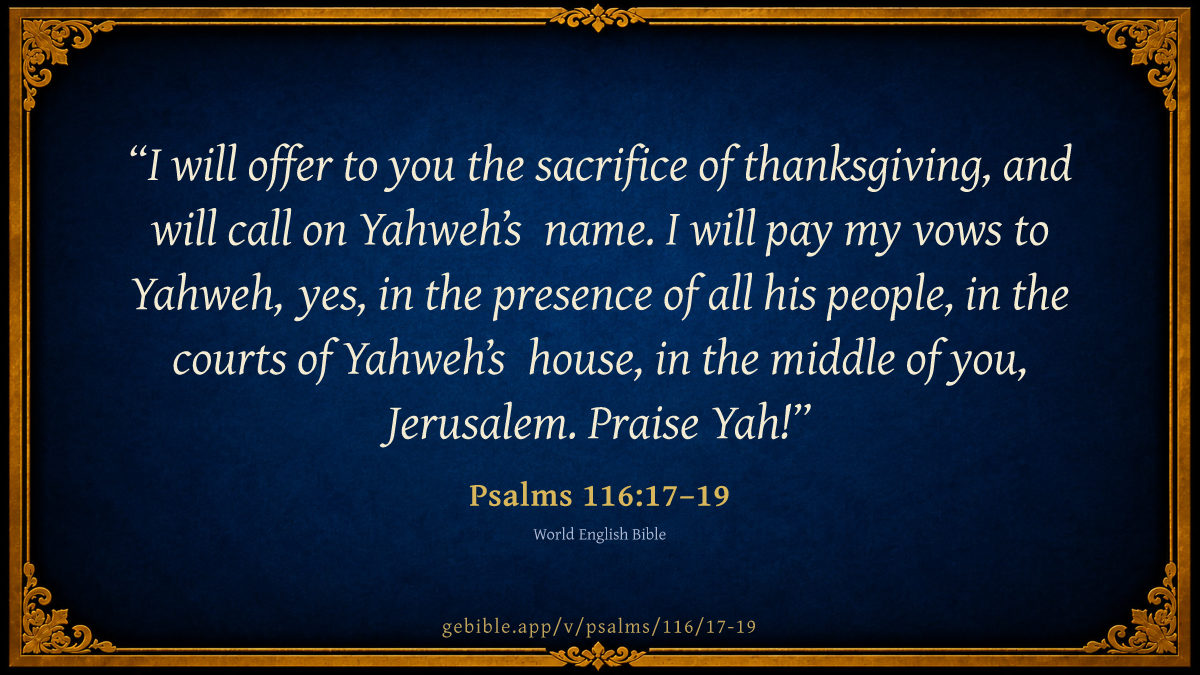
Psalms 116:14(v18)I will pay my vows to Yahweh, yes, in the presence of all his people.
Show all 16 cross-references
Psalms 135:2(v19)you who stand in Yahweh’s house, in the courts of our God’s house.
Psalms 22:25(v18)My praise of you comes in the great assembly. I will pay my vows before those who fear him.
Hebrews 13:15(v17)Through him, then, let’s offer up a sacrifice of praise to God continually, that is, the fruit of lips which proclaim allegiance to his…
Psalms 76:11(v18)Make vows to Yahweh your God, and fulfill them! Let all of his neighbors bring presents to him who is to be feared.
Psalms 116:13(v17)I will take the cup of salvation, and call on Yahweh’s name.
2 Chronicles 6:6(v19)but now I have chosen Jerusalem, that my name might be there; and I have chosen David to be over my people Israel.’
Psalms 100:4(v19)Enter into his gates with thanksgiving, and into his courts with praise. Give thanks to him, and bless his name.
Psalms 118:19-20(v19)Open to me the gates of righteousness. I will enter into them. I will give thanks to Yah. This is the gate of Yahweh; the righteous will…
Psalms 122:3-4(v19)Jerusalem, that is built as a city that is compact together, where the tribes go up, even Yah’s tribes, according to an ordinance for…
Acts 2:42(v17)They continued steadfastly in the apostles’ teaching and fellowship, in the breaking of bread, and prayer.
Ecclesiastes 5:5(v18)It is better that you should not vow, than that you should vow and not pay.
Cross-references from openbible.info (CC BY 4.0)
Explain this passage (13 sources)
Historical commentary, presented as a primary source — not an endorsement.
John Calvin1540 · Public DomainOn v1717. I will sacrifice the sacrifices of praise to…
17. I will sacrifice the sacrifices of praise to thee. He once more repeats what he had said about gratitude, and that publicly; for we must manifest our piety, not only by our secret affection before God, but also by an open profession in the sight of men. David, along with the people, observed the rites of the law, knowing that these, at that time, were not unmeaning services; but while he did this, he had a particular reference to the purpose for which they were appointed, and offered principally the sacrifices of praise and the calves of his lips. He speaks of the courts of God’s house, because at that time there was but one altar from which it was unlawful to depart, and it was the will of God that the holy assemblies should be held there, that the faithful might mutually stimulate one another to the cultivation of godliness.
John Calvin's Commentaries (1540-1563) — public domain. Text from the Calvin Translation Society English edition (1840s-50s) via the Christian Classics Ethereal Library (ccel.org). Calvin's coverage is partial (roughly two-thirds of the Bible); uncommented books and verses are honest gaps, never fabricated. The 19th-century editor's footnotes and remarks are omitted so the notes are faithfully Calvin's own voice.
Geneva Bible translators1599 · Public DomainOn v18I will thank him for his benefits, for that…
I will thank him for his benefits, for that is a just payment, to confess that we owe all to God.
Geneva Bible (1599) marginal notes — public domain.
John Trapp1656 · Public DomainOn vv17–19Psa 116:17 I will offer to thee the sacrifice…
Psa 116:17 I will offer to thee the sacrifice of thanksgiving, and will call upon the name of the LORD.
Ver. 17. I will offer to thee, &c.] I will perform to thee not ceremonial service only, but moral and spiritual; such as thou shalt accept through Christ, Col 3:17.
Read full note →
And will call, &c.] See Psa 116:13.
John Trapp, A Commentary or Exposition upon All the Books of the Old and New Testament (1647–1656) — public domain. Text from a community e-Sword module.
Matthew Poole1685 · Public DomainOn v18And as I said before, so I now repeat…
And as I said before, so I now repeat my promise, for the greater assurance, and to lay the stricter obligation upon myself.
Matthew Poole's English Annotations on the Holy Bible (1683–1685) — public domain. Text from a community e-Sword/MySword module.
John Gill1763 · Public DomainOn v17In the courts of the Lord's house,.... This is…
In the courts of the Lord's house,.... This is added by way of explanation of Psa 116:18, what he meant by "the presence of all his people"; the assembly of the saints met together in the house of the Lord, at the door of the tabernacle, in the courts of it, where the people got together to worship God;
in the midst of thee, O Jerusalem; the Lord's house or tabernacle; for as yet the temple was not built, and the courts of it were in the midst of the city of Jerusalem. And this shows, as some interpreters have observed, that this psalm must have been written after David came to the kingdom, and had got this city into his hands, whither he brought the ark of the Lord. The whole signifies that he would praise the Lord publicly, as well as privately; and he concludes the psalm thus,
Read full note →
Praise ye the Lord; calling upon the Lord's people, in his house and courts, to join with him in this work of praise.
Next: Psalms Chapter 117
John Gill's Exposition of the Whole Bible (1746–1763) — public domain (CC PDM 1.0). Text via the HelloAO Bible API.
Adam Clarke1810 · Public DomainOn vv17, 19Verse 17. I will offer to thee] As it…
Verse 17. I will offer to thee] As it is most probable that this Psalm celebrates the deliverance from Babylon, it is no wonder that we find the psalmist so intent on performing the rites of his religion in the temple at Jerusalem, which had been burnt with fire, and was now reviving out of its ruins, the temple service having been wholly interrupted for nearly four-score years.
Adam Clarke's Commentary on the Bible (1810–1826) — public domain. Text from a community e-Sword/MySword module.
Albert Barnes1834 · Public DomainOn vv17–19I will offer to thee the sacrifice of thanksgiving…
I will offer to thee the sacrifice of thanksgiving - I will publicly thank and praise thee. See the notes at Psa 107:22.
And will call upon the name of the Lord - Will worship and praise the Lord.
Albert Barnes' Notes on the Bible (1834–1885) — public domain. Text from a community e-Sword/MySword module.
Daniel D. Whedon1874 · Public DomainOn vv17, 1917, 18. These verses clearly show that the occasion…
17, 18. These verses clearly show that the occasion of the psalm was one of public thanksgiving and sacrifice after a great deliverance. Psa_116:14; Psa_116:18, seem like a refrain, and their repetition indicates how sacredly the people hold their vows after so great a mercy.
Daniel D. Whedon (gen. ed.), Commentary on the Old and New Testaments (1874–1909) — public domain. Text from a community e-Sword module.
The Cambridge Bible for Schools and Colleges1878 · Public DomainOn vv17–1917. Unto thee will I offer … and proclaim…
17. Unto thee will I offer … and proclaim the name of Jehovah, as Psa_116:13.
sacrifice of thanksgiving] See Lev_7:11 ff.
The Cambridge Bible for Schools and Colleges (gen. ed. J. J. S. Perowne; Cambridge University Press, 1878–1918) — public domain. Text from a community e-Sword module.
The Pulpit Commentary1880 · Public DomainOn vv17–19I will offer to thee the sacrifice of thanksgiving.…
I will offer to thee the sacrifice of thanksgiving. Scarcely an actual sacrifice. Rather, simple thanksgiving, which, from a sincere heart, is the best sacrifice. (see Ps 1 Ps 14 and Hos_14:2) And will call upon the Name of the Lord (comp. vers. 4 and 13).
Spiritual sacrifices.
Read full note →
"Sacrifice of thanksgiving." Acceptable to God, the great Spirit, not as thanksgiving, which may be as much a formality as a sacrifice, but as the sign of the thankful, loving heart, which gives itself to God in the thanks giving. The story of Cain and Abel, in the earliest age, stamps this truth. They did not merely bring their offerings as expressions of their thankfulness for temporal prosperity. The story clearly indicates that they looked for the Divine acceptance of themselves, in some sense, for the sake of their gift. Abel"s humble, earnest, grateful, trusting heart can receive God"s favor; from Cain"s formalities God"s favor must be withheld. Religion is not acts, but it can express itself in acts. Religion is heart-feeling. It is the devotion of a man"s self to God. Formal sacrifices are but the representation of the spiritual sacrifices for which God calls; and their value depends on the spiritual sacrifice being offered through them. "They that worship the Father must worship him in spirit and in truth." "Not sacrifices, not temples, not services, not prayers, not good deeds, not steadfast morality, not generous giving, can of them selves ever gain Divine favor. The Spirit-God asks for spirit-worship. Because man is a spirit, it is beneath his dignity to offer, and it is beneath the dignity of God to accept, other than spirit-worship.
I SPIRITUAL SACRIFICES AS THANKSGIVINGS. The formality of thanksgiving was strikingly illustrated in the great national services held when the Prince of Wales was restored to health. It was an appropriate national act; and to many devout souls it was also a spiritual sacrifice. The worship of the Church is a sacred duty to be formally done; but it only rises to its highest when the souls of the worshippers are fully in the praise. The spiritual element in formal worship is an unceasing care to all devout souls. God asks to hear men"s souls sing when their voices raise the psalm.
II SPIRITUAL SACRIFICES AS ADORATIONS. Calling upon the "Name." There is a feature in the early Jewish ritual which it is difficult to retain in the Christian. The Jew had sublime, reverent, oppressive views of the majesty and holiness of God. So there was an element of adoration in the worship, and an element of adoration in the psalms. The truth of the Divine Fatherhood is misapprehended if it is allowed to lighten the soul"s august impressions of the Divine glory.
III SPIRITUAL SACRIFICES AS PRAYERS. Our Lord spoke against "vain repetitions." Prayer is soul-dependence and soul-desire. It may be spoken out, but it may not. God reads hearts. R.T.
The Pulpit Commentary (1880–1919), ed. H.D.M. Spence-Jones & Joseph S. Exell — public domain. Text from a community e-Sword module.
Charles H. Spurgeon1885 · Public DomainOn vv17–19Ver. 17. I will offer to thee the sacrifice…
Ver. 17. I will offer to thee the sacrifice of thanksgiving. Being thy servant, I am bound to sacrifice to thee, and having received spiritual blessings at thy hands I will not bring bullock or goat, but I will bring that which is more suitable, namely, the thanksgiving of my heart. My inmost soul shall adore thee in gratitude.
And will call upon the name of the Lord, that is to say, I will bow before thee reverently, lift up my heart in love to thee, think upon thy character, and adore thee as thou dost reveal thyself. He is fond of this occupation, and several times in this Psalm declares that "he will call upon the name of the Lord, "while at the same time he rejoices that he had done so many a time before. Good feelings and actions bear repeating: the more of hearty callings upon God the better.
Read full note →
Ver. 17. The sacrifice of thanksgiving.
"When all the heart is pure, each warm desire
Sublimed by holy love's ethereal fire.
On winged words our breathing thoughts may rise,
And soar to heaven, a grateful sacrifice." James Scott.
Ver. 17. This is due to our God, good for ourselves, and encouraging to others.
Ver. 17. The sacrifice of thanksgiving.
1. How it may be rendered. In secret love, in conversation, in sacred song, in public testimony, in special gifts and works.
2. Why we should render it. For answered prayers (Ps 116:1-2), memorable deliverances (Ps 116:3), choice preservation (Ps 116:6); remarkable restoration (Ps 116:7-8), and for the fact of our being his servants (Ps 116:16).
3. When should we render it. Now, while the mercy is on the memory, and as often as fresh mercies come to us.
Psalms 116:18*
Charles H. Spurgeon's The Treasury of David (1869–1885) — public domain. Psalms only. Text from a community e-Sword/MySword module.
The Biblical Illustrator1887 · Public DomainOn v18In the courts of the Lords house.
Psa_116:18-19
In the courts of the Lords house.
Read full note →
The duty and blessing of public worship
I. An urgent duty. That God should receive the adoration of His creatures is the first dictate of all theology. We are told, in the earliest periods of sacred history, of altars erected and sacrifices offered. It was not until natural religion degenerated into idolatry that the manner of their service was specially revealed. The light of nature had led them together into Gods presence. The throne of grace, the song of praise, the Word of God--by means like these His people find Him, and they can come even to His seat. They are to us the patriarchs ladder, connecting earth and heaven; and if ours is the true spirit of devotion, we too shall be encompassed with messages of Divine approval, and shall leave its scenes of gracious manifestation, exclaiming, It was none other than the house of God; it was the gate of heaven.
II. An invaluable privilege. The truth, that all duty is privilege, applies here with special force. The holy city drew forth the desires of the pious Hebrew, because it was the place of the visible presence of the Most High, where His favour was to be obtained. Within the gates of Jerusalem He was to be found; and the psalmist therefore longed, yea, even fainted for the courts of the Lord. Surely the Christian cannot lag behind the Jew, when he reckons up the benefits that flow from united approach to the place where prayer is wont to be made. What are all the ordinances of Christian faith, its simple sacraments, the Sabbath institution, the house of God, our perpetual access to the Throne--what are all these but our Jerusalem?
III. A scene of hallowed enjoyment. It is impossible to read this psalm without being struck with its cheerful, happy tone. It expresses feelings very unlike the repulsive gloom with which some have invested the sanctuary and its services. Gods worship inspired those who of old engaged in it with most enviable dispositions, if one may judge of them by their record here. How comprehensive its sympathies! How tender its affections! Love to God and man, to His Word, and to His people, breathes through every verse; and whenever God is worshipped in truth, the same experience is realized. Our feet stand on holy ground. Far hence be banished all profane thoughts and ungenial tempers, with the dark crowd of lusts that war against the soul. Here contrition mourns over sin; humility owns unworthiness; trustfulness casts herself on sovereign mercy; and love awakens love, as devotion enkindles her sacred fires. Let such feelings be in our hearts on one day of the week, and every other will own their influence; while the communion of saints is deepened in the place where the rich and poor meet together, and the Lord is the Maker of them all. Let it be something to us to belong to the company of those who worship God. Let our brethren be to us co-heirs of the grace of life, with whose joys and sorrows we seek to sympathize; and let our fellow-worshippers have a place in our kind regards and unfailing prayers. Let the very church we worship in be dear to us as the scene of sacred fellowship. (A. MacEwen, D.D.)
.
Psa_117:1-2
The Biblical Illustrator, edited by Joseph S. Exell (c. 1880s–1900s) — public domain. Text from a community e-Sword module.
unfoldingWord translationNotes2017 · CC BY-SA 4.0On v18General Information:
General Information:
The person who made this song continues to speak.
Read full note →
I will fulfill ... all his people
See how you translated Psalms 116:14.
in the courts of Yahweh's house
The word "house" refers to Yahweh's temple. AT: "in the courtyards of Yahweh's temple" (See: Metonymy)
in your midst, Jerusalem
The writer speaks to Jerusalem as though it were a person. AT: "in Jerusalem" (See: Personification and Apostrophe)
 GEBible — Godless Engineer's Bible App
John Calvin 1540 · Public Domain On v17 17. I will sacrifice the sacrifices of praise to…
17. I will sacrifice the sacrifices of praise to thee. He once more repeats what he had said about gratitude, and that publicly; for we must manifest our piety, not only by our secret affection before God, but also by an open profession in the sight of men. David, along with the people, observed the rites of the law, knowing that these, at that time, were not unmeaning services; but while he did this, he had a particular reference to the purpose for which they were appointed, and offered principally the sacrifices of praise and the calves of his lips. He speaks of the courts of God’s house, because at that time there was but one altar from which it was unlawful to depart, and it was the will of God that the holy assemblies should be held there, that the faithful might mutually stimulate one another to the cultivation of godliness.
John Calvin's Commentaries (1540-1563) — public domain. Text from the Calvin Translation Society English edition (1840s-50s) via the Christian Classics Ethereal Library (ccel.org). Calvin's coverage is partial (roughly two-thirds of the Bible); uncommented books and verses are honest gaps, never fabricated. The 19th-century editor's footnotes and remarks are omitted so the notes are faithfully Calvin's own voice.
Geneva Bible translators 1599 · Public Domain On v18 I will thank him for his benefits, for that…
I will thank him for his benefits, for that is a just payment, to confess that we owe all to God.
Geneva Bible (1599) marginal notes — public domain.
John Trapp 1656 · Public Domain On vv17–19 Psa 116:17 I will offer to thee the sacrifice…
Psa 116:17 I will offer to thee the sacrifice of thanksgiving, and will call upon the name of the LORD.
Ver. 17. I will offer to thee, &c.] I will perform to thee not ceremonial service only, but moral and spiritual; such as thou shalt accept through Christ, Col 3:17.
Read full note →
And will call, &c.] See Psa 116:13.
John Trapp, A Commentary or Exposition upon All the Books of the Old and New Testament (1647–1656) — public domain. Text from a community e-Sword module.
Matthew Poole 1685 · Public Domain On v18 And as I said before, so I now repeat…
And as I said before, so I now repeat my promise, for the greater assurance, and to lay the stricter obligation upon myself.
Matthew Poole's English Annotations on the Holy Bible (1683–1685) — public domain. Text from a community e-Sword/MySword module.
John Gill 1763 · Public Domain On v17 In the courts of the Lord's house,.... This is…
In the courts of the Lord's house,.... This is added by way of explanation of Psa 116:18, what he meant by "the presence of all his people"; the assembly of the saints met together in the house of the Lord, at the door of the tabernacle, in the courts of it, where the people got together to worship God;
in the midst of thee, O Jerusalem; the Lord's house or tabernacle; for as yet the temple was not built, and the courts of it were in the midst of the city of Jerusalem. And this shows, as some interpreters have observed, that this psalm must have been written after David came to the kingdom, and had got this city into his hands, whither he brought the ark of the Lord. The whole signifies that he would praise the Lord publicly, as well as privately; and he concludes the psalm thus,
Read full note →
Praise ye the Lord; calling upon the Lord's people, in his house and courts, to join with him in this work of praise.
Next: Psalms Chapter 117
John Gill's Exposition of the Whole Bible (1746–1763) — public domain (CC PDM 1.0). Text via the HelloAO Bible API.
Adam Clarke 1810 · Public Domain On vv17, 19 Verse 17. I will offer to thee] As it…
Verse 17. I will offer to thee] As it is most probable that this Psalm celebrates the deliverance from Babylon, it is no wonder that we find the psalmist so intent on performing the rites of his religion in the temple at Jerusalem, which had been burnt with fire, and was now reviving out of its ruins, the temple service having been wholly interrupted for nearly four-score years.
Adam Clarke's Commentary on the Bible (1810–1826) — public domain. Text from a community e-Sword/MySword module.
Albert Barnes 1834 · Public Domain On vv17–19 I will offer to thee the sacrifice of thanksgiving…
I will offer to thee the sacrifice of thanksgiving - I will publicly thank and praise thee. See the notes at Psa 107:22.
And will call upon the name of the Lord - Will worship and praise the Lord.
Albert Barnes' Notes on the Bible (1834–1885) — public domain. Text from a community e-Sword/MySword module.
Daniel D. Whedon 1874 · Public Domain On vv17, 19 17, 18. These verses clearly show that the occasion…
17, 18. These verses clearly show that the occasion of the psalm was one of public thanksgiving and sacrifice after a great deliverance. Psa_116:14; Psa_116:18, seem like a refrain, and their repetition indicates how sacredly the people hold their vows after so great a mercy.
Daniel D. Whedon (gen. ed.), Commentary on the Old and New Testaments (1874–1909) — public domain. Text from a community e-Sword module.
The Cambridge Bible for Schools and Colleges 1878 · Public Domain On vv17–19 17. Unto thee will I offer … and proclaim…
17. Unto thee will I offer … and proclaim the name of Jehovah, as Psa_116:13.
sacrifice of thanksgiving] See Lev_7:11 ff.
The Cambridge Bible for Schools and Colleges (gen. ed. J. J. S. Perowne; Cambridge University Press, 1878–1918) — public domain. Text from a community e-Sword module.
The Pulpit Commentary 1880 · Public Domain On vv17–19 I will offer to thee the sacrifice of thanksgiving.…
I will offer to thee the sacrifice of thanksgiving. Scarcely an actual sacrifice. Rather, simple thanksgiving, which, from a sincere heart, is the best sacrifice. (see Ps 1 Ps 14 and Hos_14:2) And will call upon the Name of the Lord (comp. vers. 4 and 13).
Spiritual sacrifices.
Read full note →
"Sacrifice of thanksgiving." Acceptable to God, the great Spirit, not as thanksgiving, which may be as much a formality as a sacrifice, but as the sign of the thankful, loving heart, which gives itself to God in the thanks giving. The story of Cain and Abel, in the earliest age, stamps this truth. They did not merely bring their offerings as expressions of their thankfulness for temporal prosperity. The story clearly indicates that they looked for the Divine acceptance of themselves, in some sense, for the sake of their gift. Abel"s humble, earnest, grateful, trusting heart can receive God"s favor; from Cain"s formalities God"s favor must be withheld. Religion is not acts, but it can express itself in acts. Religion is heart-feeling. It is the devotion of a man"s self to God. Formal sacrifices are but the representation of the spiritual sacrifices for which God calls; and their value depends on the spiritual sacrifice being offered through them. "They that worship the Father must worship him in spirit and in truth." "Not sacrifices, not temples, not services, not prayers, not good deeds, not steadfast morality, not generous giving, can of them selves ever gain Divine favor. The Spirit-God asks for spirit-worship. Because man is a spirit, it is beneath his dignity to offer, and it is beneath the dignity of God to accept, other than spirit-worship.
I SPIRITUAL SACRIFICES AS THANKSGIVINGS. The formality of thanksgiving was strikingly illustrated in the great national services held when the Prince of Wales was restored to health. It was an appropriate national act; and to many devout souls it was also a spiritual sacrifice. The worship of the Church is a sacred duty to be formally done; but it only rises to its highest when the souls of the worshippers are fully in the praise. The spiritual element in formal worship is an unceasing care to all devout souls. God asks to hear men"s souls sing when their voices raise the psalm.
II SPIRITUAL SACRIFICES AS ADORATIONS. Calling upon the "Name." There is a feature in the early Jewish ritual which it is difficult to retain in the Christian. The Jew had sublime, reverent, oppressive views of the majesty and holiness of God. So there was an element of adoration in the worship, and an element of adoration in the psalms. The truth of the Divine Fatherhood is misapprehended if it is allowed to lighten the soul"s august impressions of the Divine glory.
III SPIRITUAL SACRIFICES AS PRAYERS. Our Lord spoke against "vain repetitions." Prayer is soul-dependence and soul-desire. It may be spoken out, but it may not. God reads hearts. R.T.
The Pulpit Commentary (1880–1919), ed. H.D.M. Spence-Jones & Joseph S. Exell — public domain. Text from a community e-Sword module.
Charles H. Spurgeon 1885 · Public Domain On vv17–19 Ver. 17. I will offer to thee the sacrifice…
Ver. 17. I will offer to thee the sacrifice of thanksgiving. Being thy servant, I am bound to sacrifice to thee, and having received spiritual blessings at thy hands I will not bring bullock or goat, but I will bring that which is more suitable, namely, the thanksgiving of my heart. My inmost soul shall adore thee in gratitude.
And will call upon the name of the Lord, that is to say, I will bow before thee reverently, lift up my heart in love to thee, think upon thy character, and adore thee as thou dost reveal thyself. He is fond of this occupation, and several times in this Psalm declares that "he will call upon the name of the Lord, "while at the same time he rejoices that he had done so many a time before. Good feelings and actions bear repeating: the more of hearty callings upon God the better.
Read full note →
Ver. 17. The sacrifice of thanksgiving.
"When all the heart is pure, each warm desire
Sublimed by holy love's ethereal fire.
On winged words our breathing thoughts may rise,
And soar to heaven, a grateful sacrifice." James Scott.
Ver. 17. This is due to our God, good for ourselves, and encouraging to others.
Ver. 17. The sacrifice of thanksgiving.
1. How it may be rendered. In secret love, in conversation, in sacred song, in public testimony, in special gifts and works.
2. Why we should render it. For answered prayers (Ps 116:1-2), memorable deliverances (Ps 116:3), choice preservation (Ps 116:6); remarkable restoration (Ps 116:7-8), and for the fact of our being his servants (Ps 116:16).
3. When should we render it. Now, while the mercy is on the memory, and as often as fresh mercies come to us.
Psalms 116:18*
Charles H. Spurgeon's The Treasury of David (1869–1885) — public domain. Psalms only. Text from a community e-Sword/MySword module.
The Biblical Illustrator 1887 · Public Domain On v18 In the courts of the Lords house.
Psa_116:18-19
In the courts of the Lords house.
Read full note →
The duty and blessing of public worship
I. An urgent duty. That God should receive the adoration of His creatures is the first dictate of all theology. We are told, in the earliest periods of sacred history, of altars erected and sacrifices offered. It was not until natural religion degenerated into idolatry that the manner of their service was specially revealed. The light of nature had led them together into Gods presence. The throne of grace, the song of praise, the Word of God--by means like these His people find Him, and they can come even to His seat. They are to us the patriarchs ladder, connecting earth and heaven; and if ours is the true spirit of devotion, we too shall be encompassed with messages of Divine approval, and shall leave its scenes of gracious manifestation, exclaiming, It was none other than the house of God; it was the gate of heaven.
II. An invaluable privilege. The truth, that all duty is privilege, applies here with special force. The holy city drew forth the desires of the pious Hebrew, because it was the place of the visible presence of the Most High, where His favour was to be obtained. Within the gates of Jerusalem He was to be found; and the psalmist therefore longed, yea, even fainted for the courts of the Lord. Surely the Christian cannot lag behind the Jew, when he reckons up the benefits that flow from united approach to the place where prayer is wont to be made. What are all the ordinances of Christian faith, its simple sacraments, the Sabbath institution, the house of God, our perpetual access to the Throne--what are all these but our Jerusalem?
III. A scene of hallowed enjoyment. It is impossible to read this psalm without being struck with its cheerful, happy tone. It expresses feelings very unlike the repulsive gloom with which some have invested the sanctuary and its services. Gods worship inspired those who of old engaged in it with most enviable dispositions, if one may judge of them by their record here. How comprehensive its sympathies! How tender its affections! Love to God and man, to His Word, and to His people, breathes through every verse; and whenever God is worshipped in truth, the same experience is realized. Our feet stand on holy ground. Far hence be banished all profane thoughts and ungenial tempers, with the dark crowd of lusts that war against the soul. Here contrition mourns over sin; humility owns unworthiness; trustfulness casts herself on sovereign mercy; and love awakens love, as devotion enkindles her sacred fires. Let such feelings be in our hearts on one day of the week, and every other will own their influence; while the communion of saints is deepened in the place where the rich and poor meet together, and the Lord is the Maker of them all. Let it be something to us to belong to the company of those who worship God. Let our brethren be to us co-heirs of the grace of life, with whose joys and sorrows we seek to sympathize; and let our fellow-worshippers have a place in our kind regards and unfailing prayers. Let the very church we worship in be dear to us as the scene of sacred fellowship. (A. MacEwen, D.D.)
.
Psa_117:1-2
The Biblical Illustrator, edited by Joseph S. Exell (c. 1880s–1900s) — public domain. Text from a community e-Sword module.
unfoldingWord translationNotes 2017 · CC BY-SA 4.0 On v18 General Information:
General Information:
The person who made this song continues to speak.
Read full note →
I will fulfill ... all his people
See how you translated Psalms 116:14.
in the courts of Yahweh's house
The word "house" refers to Yahweh's temple. AT: "in the courtyards of Yahweh's temple" (See: Metonymy)
in your midst, Jerusalem
The writer speaks to Jerusalem as though it were a person. AT: "in Jerusalem" (See: Personification and Apostrophe)
translationWords
court
house
Jerusalem
praise
unfoldingWord translationNotes — © Distant Shores Media and the Door43 World Missions Community, licensed CC BY-SA 4.0. Source: git.door43.org/Door43/en_tn.