Luke 20:17(v22)But he looked at them and said, “Then what is this that is written, ‘The stone which the builders rejected was made the chief cornerstone?’
Matthew 21:42(v22)Jesus said to them, “Did you never read in the Scriptures, ‘The stone which the builders rejected was made the head of the corner. This was…
1 Peter 2:4-8(v22)coming to him, a living stone, rejected indeed by men, but chosen by God, precious. You also, as living stones, are built up as a spiritual…
Acts 4:11(v22)He is ‘the stone which was regarded as worthless by you, the builders, which has become the head of the corner.’
Mark 12:10-11(v22)Haven’t you even read this Scripture: ‘The stone which the builders rejected was made the head of the corner. This was from the Lord. It is…
Show all 14 cross-references
Ephesians 2:20-22(v22)being built on the foundation of the apostles and prophets, Christ Jesus himself being the chief cornerstone; in whom the whole building,…
Zechariah 4:7(v22)Who are you, great mountain? Before Zerubbabel you are a plain; and he will bring out the capstone with shouts of ‘Grace, grace, to it!’ ”
Job 5:9(v23)who does great things that can’t be fathomed, marvelous things without number;
Acts 13:41(v23)‘Behold, you scoffers, and wonder, and perish; for I work a work in your days, a work which you will in no way believe, if one declares it…
Ephesians 1:19-22(v23)and what is the exceeding greatness of his power toward us who believe, according to that working of the strength of his might which he…
Acts 4:13(v23)Now when they saw the boldness of Peter and John, and had perceived that they were unlearned and ignorant men, they marveled. They…
Acts 5:31-32(v23)God exalted him with his right hand to be a Prince and a Savior, to give repentance to Israel, and remission of sins. We are his witnesses…
Acts 2:32-36(v23)This Jesus God raised up, to which we all are witnesses. Being therefore exalted by the right hand of God, and having received from the…
Acts 3:14-15(v23)But you denied the Holy and Righteous One and asked for a murderer to be granted to you, and killed the Prince of life, whom God raised…
Cross-references from openbible.info (CC BY 4.0)
Explain this passage (18 sources)
Historical commentary, presented as a primary source — not an endorsement.
John Calvin1540 · Public DomainOn vv22–2322 The stone which the builders rejected In these…
22 The stone which the builders rejected In these words David boldly pours contempt on the calumnies with which he was unjustly and undeservedly assailed. As there was something ominous in his being condemned by the entire assemblage of the nobles, and all those who were invested with authority, and as the opinion was prevalent, that he was a wicked and rejected man; this error he deliberately refutes, and vindicates his innocence in the face of the principal men among them. “It is of little importance to me that I am abandoned by the chief men, seeing I have been visibly chosen by the judgment of God to be king over Israel.” The similitude which he employs is appropriate, comparing himself to a stone, and the principal rulers of the Church to master-builders It might, indeed, appear most irrational on his part to assert that the heads of the realm, to whom the government of the Church was intrusted, should be deprived of the Spirit of God, and divested of a sound judgment. Hence, in opposition to their perverse and erroneous judgment, he places the grace of God, declaring that he was placed by the purpose and power of God to sustain the whole building. In a word, he shows that splendid titles and high rank, in which his enemies glory, are no obstruction to him, because, relying upon the call of God, he possesses a glory superior to the verdict of the whole world. It being a difficult matter to persuade them of the truth of this, he magnifies and enlarges upon the grace of God, in order that its authority might suppress all evil speaking and clamorous surmises.
John Calvin's Commentaries (1540-1563) — public domain. Text from the Calvin Translation Society English edition (1840s-50s) via the Christian Classics Ethereal Library (ccel.org). Calvin's coverage is partial (roughly two-thirds of the Bible); uncommented books and verses are honest gaps, never fabricated. The 19th-century editor's footnotes and remarks are omitted so the notes are faithfully Calvin's own voice.
Geneva Bible translators1599 · Public DomainOn v22Though Saul and the chief powers refused me to…
Though Saul and the chief powers refused me to be King, yet God hath preferred me above them all.
Geneva Bible (1599) marginal notes — public domain.
John Trapp1656 · Public DomainOn vv22–23Psa 118:22 The stone [which] the builders refused is…
Psa 118:22 The stone [which] the builders refused is become the head [stone] of the corner.
Ver. 22. The stone which the builders refused] David, and the Son of David were by those, who seemed to be somewhat laid aside, and slighted as abjects and refuse ones; but wisdom was ever justified of her children.
Read full note →
Is become the head stone of the corner] Lapis diatonus sive frontatus, whereby the Church is supported, as the sides and weight of a building are by a principal binding cornerstone, against all blasts.
John Trapp, A Commentary or Exposition upon All the Books of the Old and New Testament (1647–1656) — public domain. Text from a community e-Sword module.
Matthew Poole1685 · Public DomainOn vv22–23The commonwealth of Israel and the church of God…
The commonwealth of Israel and the church of God are here and elsewhere in Scripture compared to a building, wherein as the people are the stones and the matter, so the princes and rulers are the builders, whose office it was to erect, and support, and improve the building, and to use their wisdom and power in choosing fit materials for the several parts and purposes of the building, and in the rejection of what was unprofitable and inconvenient. And these master-builders rejected David as an obscure, and treacherous, and rebellious person, fit to be not only laid aside and thrown away, but also to be crushed to pieces. And so their successors rejected Christ as an enemy to Moses, a friend to sinners, and a blasphemer against God, and therefore deserving death and damnation.
The head stone of the corner; the chief stone in the whole building, by which the several parts of the building are upheld and firmly united and kept together. Thus David united all the tribes and families of Israel, who had been miserably distracted and divided by the civil wars between the houses of Saul and David. And thus Christ united Jews and Gentiles together, as is observed, Eph 2:14, &c. And although David alludeth to himself and his own condition, yet it is not to be doubted but that having the prophetical Spirit, by which he foresaw the coming of Christ, and his ill usage from the Jews, of which he speaks very particularly Psa 22, and elsewhere; and having his thoughts much taken up with Christ and the event of his kingdom, of which he speaks in divers of his Psalms, he had his eye principally fixed upon him in these and the following expressions. And therefore this place is justly expounded of Christ in the New Testament, as Mar 12:10; Act 4:11; Rom 9:32; Eph 2:20; 1Pe 2:6, compared with Isa 28:16. And to him indeed the words agree much more properly and fully than to David.
Matthew Poole's English Annotations on the Holy Bible (1683–1685) — public domain. Text from a community e-Sword/MySword module.
John Gill1763 · Public DomainOn vv22–23Save now, I beseech thee, O Lord,.... Or, "we…
Save now, I beseech thee, O Lord,.... Or, "we beseech thee"; for they are the words of the people, wishing all health and happiness to their king; and it is as if they had said, "vivat rex", that is, "let the king live", or, "God save the King": and no doubt these words were used by the people, when all the tribes united and made David king over all Israel, and when he became the head of the corner; which was attended with the shouts and acclamations of the people, expressing themselves after this manner, And certain it is that these words were used by the followers of Christ, and applied to him, when he made his public entry into Jerusalem, crying, "hosanna" to the son of David. The word "hosanna" is the same with "save now"; and is compounded of the two words in the text thus translated, Mat 21:9;
O Lord, I beseech thee, send now prosperity; to our King: give him success in all his undertakings, and victory over all his enemies; may the pleasure of the Lord prosper in his hands; may his Gospel run and be glorified, and be spread all over the world, and multitudes bow to the sceptre of his kingdom; may his kingdom be enlarged, and his dominion be from sea to sea; and may this spiritual building rise, and be brought to perfection, of which he is the foundation and chief corner stone. The allusion may be to the shouts usually made at the laying of the foundation or corner stone of any considerable edifice, and at the bringing in the head stone of it; see Ezr 3:11.
John Gill's Exposition of the Whole Bible (1746–1763) — public domain (CC PDM 1.0). Text via the HelloAO Bible API.
John Wesley1765 · Public DomainOn v22The builders - The commonwealth of Israel and the…
The builders - The commonwealth of Israel and the church of God are here and elsewhere compared to a building, wherein, as the people are the stones, so the princes and rulers are the builders. And as these master-builders rejected David, so their successors rejected Christ. Head stone - The chief stone in the whole building, by which the several parts of the building are upheld and firmly united together. Thus David united all the tribes and families of Israel: and thus Christ united Jews and Gentiles together. And therefore this place is justly expounded of Christ, Mark xii, 10 Acts iv, 11 Rom. ix, 32 Eph. ii, 20. And to him the words agree more properly than to David.
John Wesley, Explanatory Notes Upon the Whole Bible (1754–1765) — public domain. Text via the GEBible commentary corpus.
Adam Clarke1810 · Public DomainOn vv22–23Verse 22. - 23. The stone which the builders…
Verse 22. - 23. The stone which the builders refused] See a full elucidation of these two verses in Clarke's notes on "Mt 21:42".
Adam Clarke's Commentary on the Bible (1810–1826) — public domain. Text from a community e-Sword/MySword module.
Joseph Benson1811 · Public DomainOn v23Psa 118:23. This is the Lord’s doing — This…
Psa 118:23. This is the Lord’s doing — This strange event is the work of God, a peculiar effect of his omnipotent wisdom, performed not only without the help, but against all the artifices and forces of man. This and the preceding verse are thus read by Dr. Waterland: The stone, &c., is made the head of the corner; by the Lord is it so made, and it is marvellous, &c. Mudge renders the latter verse, this is from the Lord; it was impossible in our eyes. “It was the Lord’s doing, they said; in their eyes it was a thing beyond all possibility of belief:” which is the force of the original. The exaltation of David from a sheepfold to a throne was wonderful, especially considering the opposition made against it by the princes and rulers of Judah and Israel: but much more astonishing was the exaltation of Christ. For “what can be more truly marvellous, than that a person, put to death as a malefactor, and laid in the grave, should from thence arise immortal, and become the head of an immortal society; should ascend into heaven, being vested with unlimited power, and crowned with ineffable glory; and should prepare a way for the sons of Adam to follow him into those mansions of eternal bliss?”
Joseph Benson's Commentary on the Old and New Testaments (1811–1818) — public domain. Text from a community e-Sword module.
Albert Barnes1834 · Public DomainOn vv22–23The stone which the builders refused - See the…
The stone which the builders refused - See the notes at Mat 21:42-43. Compare Mar 12:10-11; Act 4:11; 1Pe 2:7. This is an allusion to a building, as if a stone should be cast away by workmen as unfit to be worked into the edifice. The figure would then be applicable to anyone who, for any purpose, was rejected. Thus it might have been applied many a time to David; so, doubtless, to others who urged claims to authority and power; and so, eminently, to the Lord Jesus Christ. We are not to suppose that this had original reference to the Messiah, but the language was applicable to him; and it is used in the passages above referred to, in addresses to the Jews, merely to show them how the principle was found in their own writings, that one who was rejected, like a stone regarded as unfit to be worked into any part of a building, might be in reality so important that it would be laid yet at the very corner, and become the most valuable stone in the edifice - that on which the whole superstructure would rest.
Is become the head stone of the corner - The principal stone placed at the corner of the edifice. This is usually one of the largest, the most solid, and the most carefully constructed of any in the edifice. Of course one would be needed at each corner of the building to constitute a firm support, but usually there is one placed at one corner of an edifice larger and more carefully made than the others, often laid with imposing ceremonies, and prepared to contain whatever it may be thought necessary to deposit in the foundation of the building to be transmitted to future times as preserving the names of the builders, or expressing the design of the edifice. Such a position he who had been rejected was to occupy in the civil polity of his country; such a position eminently the Lord Jesus occupies in relation to the church. Eph 2:20.
Albert Barnes' Notes on the Bible (1834–1885) — public domain. Text from a community e-Sword/MySword module.
Daniel D. Whedon1874 · Public DomainOn v2323. This is the Lord’s doing—The restoration of the…
23. This is the Lord’s doing—The restoration of the Jews to their nationality was so marked as a divine interposition, that the heathen said, “Jehovah hath done great things for them.” See Psa_126:1-2. But the language is Messianic. Christ, the Stone which the builders disallowed, was exalted to be the “headstone of the corner” by the resurrection from the dead and the public investiture of the mediatorial government.
Daniel D. Whedon (gen. ed.), Commentary on the Old and New Testaments (1874–1909) — public domain. Text from a community e-Sword module.
The Cambridge Bible for Schools and Colleges1878 · Public DomainOn vv22–2322. The stone which the builders rejected
22. The stone which the builders rejected
Is become the head of the corner.
Read full note →
A metaphor from building. The ‘corner-stone’ bonding the walls together was a most important part of the structure. A large and strong stone was needed for the purpose. It is mentioned along with the foundation (Jer_51:26; Job_38:6) of which it formed part (Isa_28:16); and so possibly the meaning here is ‘the chief cornerstone’ of the foundation. But ‘the head of the corner’ is more naturally explained to be the top-stone (Zec_4:7), not only bonding the walls together, but completing the building. Israel is the ‘head corner-stone.’ The powers of the world flung it aside as useless, but God destined it for the most honourable and important place in the building of His kingdom in the world. The words express Israel’s consciousness of its mission and destiny in the purpose of God. The perfect “is become” is a perfect of certainty. With the eye of faith the Psalmist sees the Divine purpose already realised.
Our Lord applies the passage to Himself in His solemn warning to the Pharisees of the consequences of rejecting Him (Mat_21:42; Mar_12:10-11; Luk_20:17). St Peter also quotes it (Act_4:11; 1Pe_2:7). Comp. also Eph_2:20. The principle underlying this use of the words originally spoken of Israel is that Christ was the true representative of Israel, Who undertook and fulfilled the mission in which Israel had failed.
The Cambridge Bible for Schools and Colleges (gen. ed. J. J. S. Perowne; Cambridge University Press, 1878–1918) — public domain. Text from a community e-Sword module.
Ellicott's Commentary for English Readers1878 · Public DomainOn vv22–23(22) The stone.—Better, a stone. There is no article.…
(22) The stone.—Better, a stone. There is no article. Israel is, of course, this stone, rejected as of no account in the political plans of those who were trying to shape the destinies of the Eastern nations at their own pleasure, but in the purpose of God destined to a chief place in the building up of history. The image is developed by Isa_28:16-17, and prepared, by the Messianic hope poured into it, for the use of Christ Himself and the repeated applications of it to Him by the apostles (Mat_21:42-44; Act_4:11; 1Pe_2:7; Eph_2:20; see New Testament Commentary).
A Bible Commentary for English Readers, edited by Charles John Ellicott (1878–1897) — public domain. Text from a community e-Sword module.
The Pulpit Commentary1880 · Public DomainOn vv22–23The stone which the builders refused is become the…
The stone which the builders refused is become the head stone of the corner. The primary and literal meaning seems to be Israel, which the great of the world, those who think to arrange the world ac cording to their own ideas, have rejected and would fain have cast aside, has, nevertheless, despite their rejection, attained to eminence, and been advanced, by the course of events, into such a position, that it may be regarded as the head corner-stone the most important of all the nations of the world." Any Messianic reference is secondary and subordinate.
Vers. 22-29. The great reversal.
Read full note →
To whomsoever these words (vers. 22, 23) primarily referred, we have the highest authority for applying them to our Lord himself. In his case we have
I THE GREAT REVERSAL. (Vers. 22, 23) No reversal of fortune in human affairs can be comparable to his experience. Consider:
1. His course on earth the circumstances of his birth, of his youth, and of his manhood; his claims disowned, his truth rejected, himself insulted, ill-treated, condemned, smitten, crucified!
2. The nature of his position now as the Divine Head of the Church. He may be said to be both the Foundation-stone and also the Corner or Top-stone (the "epistyle"); for his Church is built upon his truth and, still more truly, upon himself; and, at the same time, it looks up to him as the most conspicuous One on whom its eyes rest with reverence and love.
3. The exaltation he enjoys in the heavenly world. (see Php_2:9-12 Rev_5:13)
II THE LONG BRIGHT DAY OF GRACE AND GLADNESS. (Ver. 24) The position of Jesus Christ as "Prince and Savior, giving redemption and remission of sins," is a long, bright day, succeeding the darkness of heathendom or the twilight of "the Law;" it is a day which "the Lord has made" for the nations of the earth. We may well "rejoice and be glad in it;" not thinking and speaking and singing of it as if it were a dispensation of dreariness and gloom, but realizing that it is one of close fellowship with God, of holy and happy service, of ever-brightening, hope. (see Php_3:1 4:4 Eph_2:6 Eph_3:19 Rev_1:6) "The joy of the Lord" is that which becomes us; it is our duty and it is our strength." Yet is there
III THE NEED FOR EARNEST PRAYER. (Ver. 25)
1. That the individual soul may be "saved," strengthened, comforted, sanctified.
2. That the Church, the society, the institution, may be "prospered;" that its officers may be inspired and directed; that its action may be pure in motive and high in aim; that its efforts may be crowned with true and lasting success.
IV THE PLACE OF SACRIFICE. (Ver. 27) Jehovah, through his prophets, so enlightened his people that they brought to his altar the acceptable sacrifice. The great Teacher has so enlightened us by his Divine truth, that we have reached the place of purest and most well-pleasing sacrifice the dedication of the entire nature, the mind, the affections, the will, and of the whole life, at home, in business, in society, to the service of the Lord.
V THE SOUL"S DELIGHT IN GOD. The contemplation of God"s goodness, and especially of his grace to us, may well lead us into an atmosphere of exultation, and call forth from us the language of fervent praise.
The stone in the corner.
"The stone which the builders rejected is become the head of the corner." This may be the rejoicing of the leader of the procession, when it is admitted within the gates of the new temple, and advances towards the great altar. We must remember that we have here poetical figure, and we must not endeavor to force the language, as if it were descriptive fact. The figure is a very familiar one. God constantly makes the "weak things of this world confound the things that are mighty" Israel, as a nation, was like a despised stone in Babylon; now that it had again its sacred temple, it might easily be thought of as having become the corner-stone of the temple of religion for humanity. "This saying was true of David, the despised one among the sons of Jesse, but raised to be the ruler of Israel and the progenitor of Christ. It was true of his descendant Zerubbabel, the head of the returning Israelites after the Captivity, whose person and work were despised, (Zec_4:10) but who began and finished the building, and who " brought forth the head-stone with shoutings, crying, Grace, grace unto it!". (Zec_4:7) But it was to be fulfilled in the largest sense by Messiah, as the Jews themselves acknowledge." "Israel is this stone, rejected as of no account in the political plans of those who were trying to shape the destinies of the Eastern nations at their own pleasure, but in the purpose of God destined to a chief place in the building up of history." "The emblem applies with the fullest meaning to our Lord Jesus Christ, who, though rejected by the Jewish authorities, was nevertheless destined to unite both Jews and Gentiles in one vast and glorious spiritual building.
I THE ELEVATIONS AND BENEDICTIONS OF GOD ARE ALWAYS A SURPRISE TO THE MODEST AND HUMBLE SOUL. Their natural feeling leads them to wonder why God has dealt so graciously with them. They contrast their insignificancy in themselves with the dignities to which God lifts them; and feel the surprise of Divine grace.
II MODEST AND HUMBLE SOULS ARE THE ONES BEST FITTED TO RECEIVE DIVINE ELEVATIONS AND BENEDICTIONS. The man who glories in what he attains, as if he had obtained it himself, is proved unworthy of the elevation, and is not likely to make the best of it.
The David-mood is always more hopeful than the Solomonic. In what mood do we regard the triumphs of Divine grace in our lives? R.T.
The Pulpit Commentary (1880–1919), ed. H.D.M. Spence-Jones & Joseph S. Exell — public domain. Text from a community e-Sword module.
Charles H. Spurgeon1885 · Public DomainOn vv22–23Ver. 22. The stone which the builders refused is…
Ver. 22. The stone which the builders refused is become the head stone of the corner. Here the people magnify God for bringing his chosen servant into the honourable office, which had been allotted to him by divine decree. A wise king and valiant leader is a stone by which the national fabric is built up. David had been rejected by those in authority, but God had placed him in a position of the highest honour and the greatest usefulness, making him the chief cornerstone of the state. In the case of many others whose early life has been spent in conflict, the Lord has been pleased to accomplish his divine purposes in like manner; but to none is this text so applicable as to the Lord Jesus himself: he is the living stone, the tried stone, elect, precious, which God himself appointed from of old. The Jewish builders, scribe, priest, Pharisee, and Herodian, rejected him with disdain. They could see no excellence in him that they should build upon him; he could not be made to fit in with their ideal of a national church, he was a stone of another quarry from themselves, and not after their mind nor according to their taste; therefore they cast him away and poured contempt upon him, even as Peter said, "This is the stone which was set at nought of you builders"; they reckoned him to be as nothing, though he is Lord of all. In raising him from the dead the Lord God exalted him to be the head of his church, the very pinnacle of her glory and beauty. Since then he has become the confidence of the Gentiles, even of them that are afar off upon the sea, and thus he has joined the two walls of Jew and Gentile into one stately temple, and is seen to be the binding cornerstone, making both one. This is a delightful subject for contemplation.
Jesus in all things hath the preeminence, he is the principal stone of the whole house of God. We are accustomed to lay some one stone of a public building with solemn ceremony, and to deposit in it any precious things which may have been selected as a memorial of the occasion: henceforth that cornerstone is looked upon as peculiarly honourable, and joyful memories are associated with it. All this is in a very emphatic sense true of our blessed Lord, "The Shepherd, the Stone of Israel." God himself laid him where he is, and hid within him all the precious things of the eternal covenant; and there he shall for ever remain, the foundation of all our hopes, the glory of all our joys, the united bond of all our fellowship. He is "the head over all things to the church, "and by him the church is fitly framed together, and groweth unto a holy temple in the Lord. Still do the builders refuse him: even to this day the professional teachers of the gospel are far too apt to fly to any and every new philosophy sooner than maintain the simple gospel, which is the essence of Christ: nevertheless, he holds his true position amongst his people, and the foolish builders shall see to their utter confusion that his truth shall be exalted over all. Those who reject the chosen stone will stumble against him to their own hurt, and ere long will come his second advent, when he will fall upon them from the heights of heaven, and grind them to powder.
Read full note →
Ver. 22. The stone. The head stone of the corner. Christ Jesus is a stone: no firmness, but in him. A fundamental stone: no building, but on him. A corner stone: no piecing nor reconciliation, but in him. James Ford, 1856.
Ver. 22. The stone which the builders rejected, etc. To apply it to Christ, "The Stone" is the ground of all. Two things befall it; two things as contrary as may be, 1. Refused, cast away; then, called for again, and made head of the building. So, two parts there are to the eye. 1. The refusing;2. The raising;which are his two estates, his humiliation, and his exaltation. In either of these you may observe two degrees, a quibus, and quosque, by whom and how far. By whom refused? We weigh the word, aeificantes:not by men unskilful, but by workmen, professed builders;it is so much the worse. How far? We weigh the word, reprobaverunt; usque ad reprobari, even to a reprobation. It is not improbaverunt, disliked, as not fit for some eminent place; but reprobaverunt, utterly reprobate, for any place at all.
Again, exalted, by whom? The next words are a Domino, by God, as good a builder, nay, better than the best of them; which makes amends for the former. And How far? Placed by him, not in any part of the building;but in the part most in the eye (the corner), and in the highest place of it, the very head.
So, rejected, and that by the builders, and to the lowest estate: and from the lowest estate exalted in caput anguli, to the chiefest place of all; and that by God himself. Lancelot Andrewes.
Ver. 22. The stone which the builders refused, etc. We need not wonder, that not only the powers of the world are usually enemies to Christ, and that the contrivers of policies, those builders, leave out Christ in their building, but that the pretended builders of the church of God, though they use the name of Christ, and serve their turn with that, yet reject himself, and oppose the power of his spiritual kingdom. There may be wit and learning, and much knowledge of the Scriptures, amongst those that are haters of the Lord Jesus Christ, and of the power of godliness, and corrupters of the worship of God. It is the spirit of humility and obedience, and saving faith, that teach men to esteem Christ, and build upon him. The vanity and folly of these builders' opinion appears in this, that they are overpowered by the great Architect of the church: his purpose stands. Notwithstanding their rejection of Christ, he is still made the head corner stone. They cast him away by their reproaches, and by giving him up to be crucified and then cast into the grave, causing a stone to be rolled upon this stone which they had so rejected, that it might appear no more, and so thought themselves sure. But even from thence did he arise, and became the head of the corner. Robert Leighton.
Ver. 22. The stone which the builders refused, etc. That is to say, God sent a living, precious, chosen stone on earth; but the Jews, who then had the building of the church, rejected that stone, and said of it, "This man, who observeth not the Sabbath, is not of God and, "We have no king but Caesar, "and, That seducer said, I will rise after three days"; and many similar things beside. But this stone, so rejected by the builders as unfit for raising the spiritual edifice, is become the head of the corner; has been made by God, the principal architect, the bond to connect the two walls and keep them together; that is to say, has been made the head of the whole church, composed of Jews and Gentiles; and such a head, that whoever is not under him cannot be saved; and whoever is built under him, the living stone, will certainly be saved. Now all this is the Lord's doing, done by his election and design, without any intervention on the part of man, and therefore, it is wonderful in our eyes. For who is there that must not look upon it as a wonderful thing, to find a man crucified, dead and buried, rising, after three days, from the dead, immortal, with unbounded power, and declared Prince of men and angels, and a way opened through him for mortal man, to the kingdom of heaven, to the society of the angels, to a happy immortality? Robert Bellarmine.
Ver. 22. The stone which the builders refused. Here we behold with how strong and impregnable a shield the Holy Ghost furnishes us against the empty vaunting of the Papal clergy. Be it so, that they possess the name, "chief builders"; but if they disown Christ, does it necessarily follow that we must disown him also? Let us rather contemn and trample under our feet all their decrees, and let us reverence this precious stone upon which our salvation rests. By the expression, is become the head of the corner, we are to understand the real foundation of the church, which sustains the whole weight of the edifice; it being requisite that the corners should form the main strength of buildings. John Calvin.
Ver. 22. The stone, etc. That is, I, whom the great men and rulers of the people rejected (1Sa 26:19), as the builders of a house reject a stone unfit to be employed in it, am now become king over Israel and Judah; and a type of that glorious King who shall hereafter be in like manner refused (Lu 19:14 Lu 20:17), and then be by God exalted to be Lord of all the world, and the foundation of all men's happiness. Thomas Fellton.
Ver. 22 The stone. The author of Historia Scholastica mentions it as a tradition that at the building of the second temple there was a particular stone of which that was literally true, which is here parabolically rehearsed, viz., that it had the hap to be often taken up by the builders, and as oft rejected, and at last was found to be perfectly fit for the most honourable place, that of the chief cornerstone, which coupled the sides of the walls together, the extraordinariness whereof occasioned the speech here following: This is the Lord's doing; it is marvellous in our eyes. Henry Hammond.
Ver. 22. The head stone of the corner. How of the "corner"? The corner is the place where two walls meet: and there be many twos in this building:the two walls of nations. Jews and Gentiles;the two of conditions, bond and free;the two of sex, male and female:the great two (which this Easter day we celebrate) of the quick and the dead;above all, the greatest two of all, heaven and earth. Lancelot Andrewes.
Ver. 22. Is become the head stone of the corner.
Higher yet and ever higher, passeth he those ranks above,
Where the seraphs are enkindled with the flame of endless
love;
Passeth them, for not even seraphs ever loved so well as he
Who hath borne for his beloved, stripes, and thorns, and
shameful tree;
Ever further, ever onward, where no angel's foot may tread,
Where the twenty-four elders prostrate fall in mystic
dread:
Where the four strange living creatures sing their hymn
before the throne,
The Despised One and rejected passeth, in his might alone;
Passeth through the dazzling rainbow, till upon the
father's right
He is seated, his Co-Equal, God of God, anti Light of
Light. R. F. Littledale.
Ver. 22. Head stone of the corner. It is now clear to all by divine grace whom Holy Scripture calls the cornerstone. Him in truth who, taking unto himself from one side the Jewish, and from the other the Gentile people, unites, as it were, two walls in the one fabric of the Church; them of whom it is written, "He hath made both one"; who exhibited himself as the Cornerstone, not only in things below, but in things above, because he united on earth the nations of the Gentiles to the people of Israel, and both together to angels. For at his birth the angels exclaimed, "On earth peace, good will toward men." Gregory, quoted by Henry Newland, 1860.
Ver. 22. The corner. By Bede it is rendered as a reason why the Jewish builders refused our Saviour Christ for the head place, Quia in uno pariete, stare amabant. They could endure no corner;they must stand alone upon their own single wall; be of themselves, not join with Gentiles or Samaritans. And Christ they endured not, because they thought if he had been heard he would have inclined that way. Alias oves oportet me adducere (Joh 10:16). Alias they could not abide. But sure, a purpose there must be, alias oves adducendi, of bringing in others, of joining a corner, or else we do not facere secundum exemplar, build not according to Christ's pattern; our fashion of fabric is not like his. Lancelot Andrewes.
Ver. 22-27. By the consent of all expositors, in this Psalm is typed the coming of Christ, and his kingdom of the gospel. This is manifested by an exaltation, by an exultation, by a petition, by a benediction. The exaltation: Ps 118:22, The stone which the builders refused is become the head stone of the corner. The Jews refused this stone, but God hath built his church upon it.
The exultation: Ps 118:24, This is the day which the Lord hath made; we will rejoice and be glad in it. A more blessed day than that day was wherein he made man, when he had done making the world; "Rejoice we, and be glad in it."
The petition: Ps 118:25, Save now, I beseech thee, O LORD: O LORD, I beseech thee, send now prosperity. Thy justice would not suffer thee to save without the Messiah; he is come, "Save now, O LORD, I beseech thee." Our Saviour is come, let mercy and salvation come along with him.
The benediction makes all clear: Ps 118:26, Blessed be he that cometh in the name of the LORD. For what David here prophesied, the people after accomplished: Mt 21:9, "Blessed is he that cometh in the name of the Lord." The corollary or sum is in my text: Ps 118:27, God is the LORD, which hath shewed us light: bind the sacrifice with cords, even unto the horns of the altar. Thomas Adams.
Ver. 22. In these words we may notice the following particulars.
1. The metaphorical view in which the church is here represented, namely, that of a house or building.
2. The character that our Immanuel bears with respect to this building; he is the stone in a way of eminence, without whom there can be no building, no house for God to dwell in among the children of men.
3. The character of the workmen employed in this spiritual structure; they are called builders.
4. A fatal error they are charged with in building the house of God; they refuse the stone of God's choosing; they do not allow him a place in his own house.
5. Notice the place that Christ should and shall have in this building, let the builders do their worst: he is made the head stone of the corner. The words immediately following declare how this is effected, and how the saints are affected with the news of his exaltation, notwithstanding the malice of hell and earth: "This is the Lord's doing, and it is wonderful in our eyes." Ebenezer Erskine.
Ver. 22-23.
1. The mystery stated. (a) That which is least esteemed by men as a means of salvation is most esteemed by God. (b) That which is most esteemed by God when made known is least esteemed by man.
2. The mystery explained. The way of salvation is the Lord's doing, therefore marvellous in our eyes. G.R.
Ver. 22-25.
1. Christ rejected.
2. Christ exalted.
3. His exaltation is due to God alone.
4. His exaltation commences a new era.
5. His exaltation suggests a new prayer. See Spurgeon's Sermon, no. 1,420.
Psalms 118:23*
Charles H. Spurgeon's The Treasury of David (1869–1885) — public domain. Psalms only. Text from a community e-Sword/MySword module.
The Biblical Illustrator1887 · Public DomainOn vv22–23The stone which the builders refused is become the…
Psa_118:22
The stone which the builders refused is become the head stone of the corner.
Read full note →
Christ, the head stone of the corner
The ode seems to have been sung in a solemn procession to the temple; and by the Levitical band in responsive chorus. The stone, styled the head of the corner, was not placed on the top of the wall, but in some important and conspicuous position. Now, when the temple was built, a stone, intended by the original designers for this purpose, seems to have been rejected by the builders, and cast away as useless among the rubbish: but as no other stone could be found to supply its place, either from necessity, or from Divine warning, the despised stone was sought for, and built into that honourable station to which by the heavenly Architect it had been destined. And when the gates of the temple were opened, and the procession was arranged in its courts, its massive buildings and golden ornaments are left out of view,--though the most prominent beauties of the wonderful fabric ,--and by the Spirit of God this truly wonderful event is commemorated, as being the most notable in the history of the erection of the sanctuary, as proving the minute and surprising care which God exercised over His house, and as being typical of future erections no less strange and worthy of celebration. The verse may now be illustrated by a reference to Christ as Prophet, as Priest, as King.
I. As prophet. The important office of teacher or interpreter of the will of God has been exercised by the Son of God ever since revelations have been made to the world. As Logos, or Oracle, the Son bears such a relation to the Father as speech does to thought. This mysterious personage was the Jehovah of the Hebrew nation, who gave the law from Sinai, and was worshipped on Sion, and came at length to His temple, which He had consecrated and inhabited. But when Messiah appeared in human form, and began his prophetical career, proclaiming the spirituality and extent of the law of God,--affording evidence of His divine mission by miracles so decisive, so public, so frequent, so peculiar,--then was the indignation of the builders excited. And as the stone despised by the builders might be cast away among the rubbish, and be at length buried and out of sight, so was Jesus slain, and committed to the sepulchre, and hid from view in its depth and darkness; yet, though rejected, has He become the head of the corner. To prove Himself the faithful and true Witness He rose from the dead; if by His own power, then He was God, and as God could neither deceive nor betray His creatures; if by His Fathers power, then Jehovah would not accredit an impostor. Now Jesus is exalted as the great Prophet of the Church, though He was once despised; and now, what with the descent of His Spirit to guide into all truth; what with the commission, Go ye into all the world, and the varied qualifications for that lofty enterprise; and what with the living ministry which He has founded, and perpetuated, and blessed to preach the Word; may we not perceive the truth of the psalmists declaration, and may we not add in adoring wonder and gratitude, This is the doing of the Lord!
II. As priest. The priesthood of Jesus is of eternal ordination. In virtue of His priesthood did He act with men as a prophet. It was necessary that He should assume our nature, that He might have somewhat to offer; yet, alas! how few recognized His sacerdotal dignity. Nor were they without warning from the typical language of their priesthood and sacrifices; yet, through prejudice, they would not recognize a priest in Jesus, for He wore not the sacred vestments, and was not sprung from Aaron,--nor an atonement in the death of Him who died on Calvary amidst the scorn and execrations of the multitude. This His noblest office was unseen, unvalued; and, in His decease, men saw nothing but the merited end of treason and blasphemy. Hoping to effect the extinction of His pretensions by His death, they assisted only in unfolding His designs. Immortal life to a dying world has flown from His blood,--yet, though the manner of His death combined the stigma of slavery with the degradation of crime, that death was a true and proper sacrifice, vicarious, perfect, accepted, successful. And now in heaven the great High Priest in the heavenly temple has become the head of the corner. Now does He pursue the great work of intercession in the realms of repose and glory; by His own blood He entered in once into the holy place, having obtained eternal redemption for us.
III. As king. The incarnate Jesus had been often depicted by the prophets as a monarch, on the throne of His father David,--yet when He came to His own, His own received Him not. Was not He who died on Calvary condemned for His treasonable aspirations to the throne of Judea? And who could fancy Him a king who wore no diadem and waved no banner, lived in obscurity and privation, and died in desertion and ignominy? But the stone, though disallowed of men, is chosen of God and precious. God hath raised Him from the dead, and placed Him at His own right hand, and endowed Him with universal government. The sceptre of all worlds is swayed by a human arm. So that if you consider what contempt was poured upon Jesus as a King,--how they crowned Him with thorns, and put a reed in His hand, and arrayed Him in garments of mock royalty, and bowed the knee before Him in contemptuous obeisance, and placed a tablet over His cross, and inscribed on it as His accusation, This is Jesus, the King of the Jews; and then again consider His present exaltation to the throne of the universe, angels obeying His word, and the countless armies of heaven rejoicing to execute His mandates, and the work of the last judgment committed to His hand; you cannot fail to perceive how truly the symbol has been verified: The stone which the builders despised is become the head of the corner. (John Eadie, D.D.)
The stone rejected by the builders exalted as the head atone of the corner
I. View the Church as a house or building (Isa_2:2-3; 1Co_3:9).
II. The character given to Christ with relation to this building. He is the Stone in a way of eminence and excellency. He is the matchless and incomparable Stone, for He is the chief Stone of the corner; the brightness of His Fathers glory is in Him, and the express image of His Person.
III. The workmen employed in rearing this spiritual building or fabric of the Church here called builders.
IV. The fatal errors of these builders spoken of in my text. They reject the Stone, without which their whole building was nothing but a medley of confusion, however glorious it might appear in their own eyes.
1. This fatal error of theirs proceeded from their ignorance of Christ, in the excellency of His person, and of the glorious mystery of redemption and salvation through Him (Act_3:17; 1Co_2:7-8).
2. Mistaken notions of the nature of the Messiahs kingdom was another cause of their rejecting this precious stone. What a dangerous thing it is not to have right conceptions of the spiritual nature of Christs kingdom.
V. Inquire what may be implied in Christs being made the Head Stone of the corner, notwithstanding the attempts of the builders to jostle Him out of His place.
1. It implies Christs exaltation and victory over all His enemies and opposers.
2. It implies that God has a great regard for the glory of His Son, as the Head and King of His Church.
3. It implies that the whole spiritual fabric or building of the Church hangs upon Him, as the superstructure leans upon the foundation and chief corner stone.
4. It implies that He alone is the centre of unity in the Church.
5. It implies that Christ is the beauty and ornament of His Church, for much of the beauty and ornament of the building lies in the corner stone.
6. It implies that they who would build the Church of Christ must still have Him in their eye, and that the whole of their conduct and administration in the house of God must be regulated with a view to His glory and honour.
7. It implies that God and corrupt builders are driving quite different measures and designs.
VI. Application.
1. Let us beware of the fatal errors before mentioned, whereby the Jewish builders ruined their once glorious fabric, and buried themselves in the ruins thereof.
2. Let us seek the builders word from the great Master-builder; for there is a word which Christ gives to His faithful ministers, whereby the art of building is much conveyed (Joh_17:14).
3. Let us take care that every stone of the building corresponds with the foundation and corner stone. In order to which, let us examine our own and others doctrines and conversation by the plumb-line and infallible rule of the word (Isa_8:20). (E. Erskine.)
The crone refused by the builders
I. Notice the views here given to the rejection of the messiah.
1. The ignominy with which they treated His Person.
2. The opposition with which they met His doctrine.
II. notice the subsequent exaltation of the Lord Jesus Christ.
1. His Person has become highly exalted.
2. The victory gained by His doctrine, in rapidly subduing the hearts of men, and nations of men, to the faith.
III. Consider this change in the fortunes of the stone as the doing of the Lord, and not the doing of man; not the work of angels, not the achievement of angels, but the doing of the Lord.
1. It is the doing of all the persons in the Trinity.
2. It is the doing of all the attributes of the Godhead.
3. It is the doing of all the dispensations of Providence.
IV. The claim which this magnificent event--the exaltation of Christ--has upon the attention and admiration of men.
1. The exaltation of the Saviours mediatorial person is marvellous in our eyes.
2. The victory gained by the doctrines of Christ. It is marvellous in our eyes. There is a sevenfold marvel; whether you consider the doctrine which won the victory, the instruments employed, the weapons that were wielded by those instruments while they were propagating the doctrine, the opposition over which it triumphed, the number of those on whom it took hold, and over whom it prevailed, or the supernatural effects on all those of whom it took hold--whether you consider the one or the other, it is marvellous in our eyes. (J. Beaumont.)
The rejected stone
I. The fact. We have Christs authority for applying this spiritually to Him. The rejection of Christ foreknown. Rejection by man no proof of worthlessness: the rejected may be of God. Men reject the greater for the lesser; the moral for the sensual, all self-indulgent men risk their moral in gratifying their sensual; the spiritual for the natural, God has ordained us to life by faith, because that life is higher and nobler than the life of sense or appearance; the enduring for the sake of the temporal: all this in rejecting Christ. Hostility to Him worse than useless--ruinous.
II. The cause. This is the Lords doing. God works by man: through man as an agent: over man as the sovereign fjord. God works by the wrath of mum the childs rebellion and anger will not frustrate the fathers purpose. That may be the Lords doing which looks very unlike it. Evil a mystery, but Gods doing through it, clear in the Gospel, though nowhere else.
III. The result. It is marvellous in our eyes. The scheme of salvation, marvellous in conception, unlike and beyond all human thought. All that God does should be marvellous to us, would be if we were His little children. Wonder plays an important part m our history and religion. (Homilist.)
The head stone of the corner
I. Christ rejected.
1. He was clearly placed before the Jewish people as the stone which God would lay in Zion as the foundation of their hopes, but they persistently refused Him. Alas, for the blindness of mens hearts.
2. His rejection was rendered the more remarkable and the more sorrowful because He was rejected by the builders or leaders of the nation.
3. It was a violent and indignant rejection. They were not content to say, He is not the Messiah, but they turned their hottest malice against film; they were furious at the sight of Him.
4. This rejection was most unreasonable; they did violence to truth and justice by their evil deed.
II. Christ exalted.
1. At this moment Christ has the chief place of honour in the building of God.
2. Nor is He alone eminent for His position of honour, but for His surpassing usefulness. He is the head stone of the corner, that stone which joins two walls together, and is the bond of the building. Jew and Gentile are now one in Christ Jesus. Wondrous corner stone Thou dost bind all of us together who are in Thee, so that by love of Thee we are builded together for a temple of the Holy Ghost. Thou art the perfect bond, the eternal holdfast, the Divine cement which holds the universe in one. Is it not written, By Him all things consist?
3. Our Lord Jesus Christ then is brought up from all rejection and shame go which His enemies put Him to be by usefulness and by honour the grandest personage upon the face of the earth; and all this none the less, but all the more, because He was rejected. He lost nothing by His enemies. They scourged His back, but they did not rob Him of that imperial purple which now adorns Him; they crowned Him with thorns, but those thorns have increased the brilliance of His diadem of light; they pierced His hands, and thereby prepared them to sway an irresistible sceptic of love over mens hearts; they crucified Him, but His crucifixion led Him to His greater honour.
III. The exaltation of Christ is due to God alone (verse 23). Jesus Christs name and work were at length had in honour in the world, but this was due to no mans wisdom, eloquence, or power, but entirely to the Lord, who is wonderful in counsel and great in might. When I consider how hostile is human nature to the Gospel, the very existence of a true Church in the world is to me a miracle. Just think of it. Why, at this very day, we have all the wisdom, and power, and eloquence, and skill of the superstition of the world arrayed against the simple Gospel of Jesus. Though they are agreed in nothing else, they all unite against Christ.
IV. The exaltation of the rejected Christ commences a new era (verse 24). We date from our Lords resurrection even as the Jews of old counted from the night wherein they went out of Egypt. What is this day which the Lord hath made? I reply first, it is the day of the Gospel. Through our Lords exaltation pardon for the guilty is freely preached among all nations, and whosoever believeth in Him hath everlasting life. What day is this which the Lord hath made? Why, in the next place, it is a Sabbath day, the beginning of a long line of Sabbaths. The day in which our Lord Jesus rose from the dead is now sacred to rest and holy joy. Let us keep it with reverent love, and bless God for making it. Again, This is the day which the Lord hath made. The resurrection of Christ commences an era of triumph. We have spoken of the Gospel day, and the Sabbatic day, but it is also a day of victories. As Jesus Christ rose from the dead, so will His truth continually rise from the sepulchre into which men may east it. As he triumphed over the powers of death and darkness, so will His Gospel triumph over all opposition.
V. The exaltation of Christ suggests a prayer (verse 25).
1. A prayer for salvation. Put it in the present tense. Ask for a display of the present saving power of our exalted Head.
2. The other half of the prayer is for prosperity. O Lord, send now prosperity. (C. H. Spurgeon.)
Christ the head stone of the corner
The corner is the place where two walls meet, and the corner stone is that by which they are connected or combined. Hence the idea suggested by a corner stone is mainly that of union; and it is as uniting what was separated or detached that Christ is specially presented to us under such an emblem. And verily He was the Corner Stone. In His Person were combined the Divine nature and the human; and it was this combination, His being the Corner Stone between God and man, which alone fitted Him for the vast office He had undertaken to discharge. Did He not, moreover, unite Jew and Gentile, making both one, by removing all ceremonial distinctions, and founding a Church which threw open its gates to every nation under heaven? Nay, did He not unite God and man in another sense by becoming, in His own person, a Corner Stone? He reconciled the world to its Maker--He restored harmony where sin had wrought a fearful separation. Yes, He was, and He is, the Corner Stone between earth and heaven. But it is evident from the manner in which St. Peter has quoted the prophecy in our text, that it had especial reference to the resurrection of Christ. It was by and through the Resurrection that the rejected Stone was exalted to the head of the corner; and forasmuch as the alleged marvel lies evidently in the transition from the rejection to the exaltation, we are bound to conclude that the process through which the transition took place had much to do with the wonder expressed by the psalmist. And never ought the Resurrection of the Redeemer to appear to us other than a fact as amazing as it is consolatory; for there is a respect in which the resurrection of Christ differs immeasurably from every other recorded case of the quickening of the dead. Others were raised by Christ, or by men acting in the name and with the authority of Christ; but Christ raised Himself. He rose from the grave--rose by His own act. Destroy this temple, said He, and in three days I will raise it up; the evangelist adding, as a comment, He spake of the temple of His body. Marvel of marvels! that which we believe will not cease to be marvellous when eternity has been given to its contemplation--is that the Word was made flesh and dwelt amongst us; but the marvel seems immeasurably heightened when the dead Christ, as well as the living, may be defined as actually a person of the Godhead. Divinity in the gravel--this is a stupendous thing. But Divinity was in the grave--Divinity was proved to have been in the grave, when the rejected Stone, by the exercise of its own power, came forth from the grave. Verily, we must exclaim with the psalmist--This is the Lords doing. The resurrection of Christ, effected through His own power, supersedes all necessity for any other miracle in evidence of the Divine origin of Christianity. How could that being be less than Deity itself, who, even when dead in human nature, was mighty enough to quicken that nature--who, by the strangest of all combinations, must have been dead and alive at once, and who was able, in that respect in which He was alive, to reanimate Himself in that respect in which He was dead? Need we ask whether this excites your amazement? Oh! which of you, when he thinks how, in rising from the dead, the Redeemer destroyed the curse and provided that the creature itself also should be delivered from the bondage of corruption--which of you can refuse to join in the exclamation--This is the Lords doing, and it is marvellous in our eyes? But amazement or admiration is not only the feeling which the fact before us should excite. The battle, the narrative of which is so surprising, was fought in our behalf, and the landscape, which awakens such lofty emotions, includes within its sweep whatever is most precious to ourselves. A Redeemer detained in the grave, would have necessarily been a Redeemer unable to redeem; a stone not exalted to the head of the corner, would have been one which failed to combine earth and heaven. We, then, who can rejoice, because there has arisen a Mediator between us and God, must therefore rejoice in the exaltation of the rejected Stone. It was in the rising to the head of the corner that this Stone swept down the obstacles to the forgiveness of man, and opened to him the pathway to heaven and immortality. And there is more to be said than this. The resurrection of our own bodies is intimately connected with the resurrection of Christ--connected, as an effect with a cause; for since by man came death, by man came also the resurrection from the dead: for as in Adam all die, even so in Christ shall all be made alive. Therefore, if it be any cause for joy that our bodies are to rise, it is cause for joy that the Stone rejected by the builders was exalted of God to the head of the corner. And the resurrection of the body is a cause for joy. The body, indeed, is to be a spiritual body, and therefore will renovated materialism assume a more spiritual character, congenial to that of the celestial inhabitants; but a material system there surely shall be--a material world, with material loveliness, and an over-arching sky, in which, when the present constellations shall be quenched, their places shall be filled with others, more beautifully, more eloquently bright. If such, then, be the resurrection, and such our personal interest in the rising of the rejected Stone to be the head of the corner, it is not amazement only with which you will hear the record or look upon the landscape. The record is that of a stupendous victory, but a victory which secured you the means of grace and the hope of glory. Oh! then, delight must be added to amazement. If you have already exclaimed with a tongue of wonder, This is the Lords doing; it is marvellous in our eyes, will you not now add with a tongue of exultation, This is the day which the Lord hath made; we will rejoice and be glad in it? (H. Melvill, B.D.)
The Biblical Illustrator, edited by Joseph S. Exell (c. 1880s–1900s) — public domain. Text from a community e-Sword module.
C. I. Scofield1917 · Public DomainOn v22The stone which the builders refused
The stone which the builders refused
See "Christ (as Stone)," See Scofield "Exo 17:6". See Scofield "1Pe 2:8".
Read full note →
Psalms 118 looks beyond the rejection of the Stone (Christ) to His final exaltation in the kingdom (Psa 118:22).
See Psalms 2, first of the Messianic Psalms.
The Scofield Reference Bible (1917 edition), notes by C. I. Scofield — public domain. Text from a community e-Sword module.
unfoldingWord translationNotes2017 · CC BY-SA 4.0On v22The stone that the builders rejected has become the…
The stone that the builders rejected has become the cornerstone
This is likely a proverb that the writer has used to describe either the king or the nation of Israel. That which others have considered worthless, Yahweh has made to be the most important. (See: Proverbs)
Read full note →
it is marvelous in our eyes
Possible meanings are 1) "it is a marvelous thing for us to see" or 2) "we consider it to be a marvelous thing." (See: Idiom)
Tyndale Open Study Notes2022 · CC BY-SA 4.0On v22118:22-24 The psalmist sees his own salvation as the…
118:22-24 The psalmist sees his own salvation as the beginning of a new day in which the Lord will do great things.
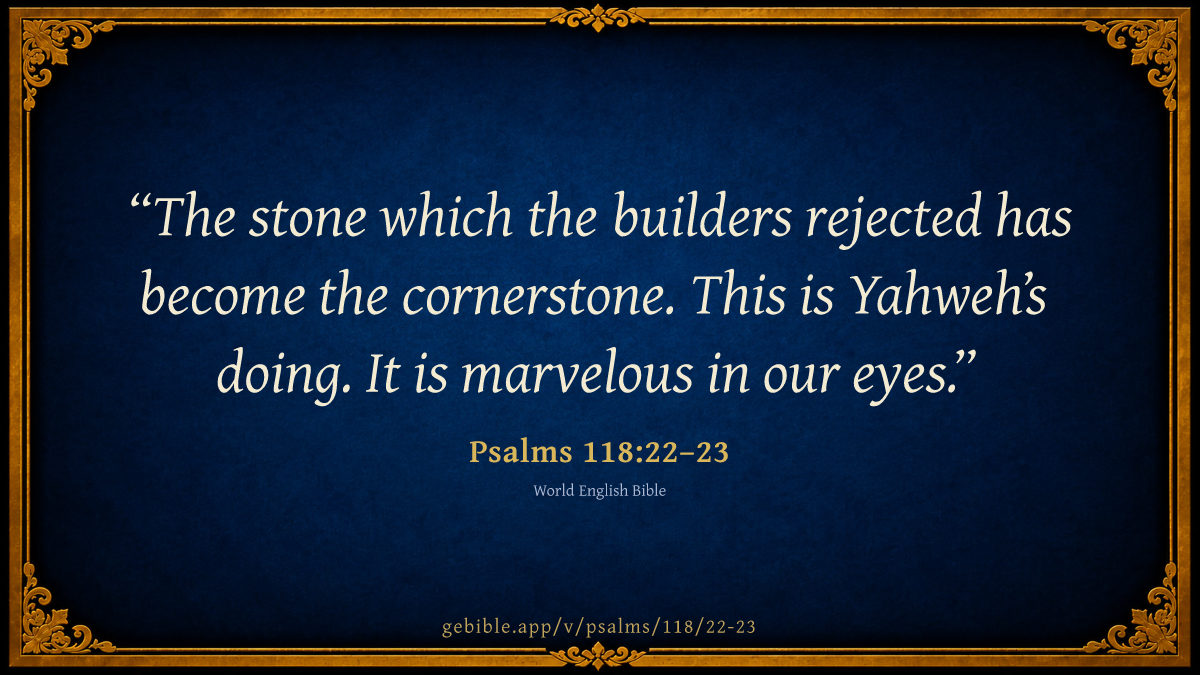
118:22 The cornerstone (or keystone) of a building or an arch gives the structure its shape and foundation. It is the most important of all the stones. The Lord chooses and places this stone for his sanctuary (Isa 28:16). Jesus referred to himself as this cornerstone (Matt 21:42; Mark 12:10-11; Luke 20:17; see Acts 4:11; Eph 2:20; 1 Pet 2:6-7).
 GEBible — Godless Engineer's Bible App
John Calvin 1540 · Public Domain On vv22–23 22 The stone which the builders rejected In these…
22 The stone which the builders rejected In these words David boldly pours contempt on the calumnies with which he was unjustly and undeservedly assailed. As there was something ominous in his being condemned by the entire assemblage of the nobles, and all those who were invested with authority, and as the opinion was prevalent, that he was a wicked and rejected man; this error he deliberately refutes, and vindicates his innocence in the face of the principal men among them. “It is of little importance to me that I am abandoned by the chief men, seeing I have been visibly chosen by the judgment of God to be king over Israel.” The similitude which he employs is appropriate, comparing himself to a stone, and the principal rulers of the Church to master-builders It might, indeed, appear most irrational on his part to assert that the heads of the realm, to whom the government of the Church was intrusted, should be deprived of the Spirit of God, and divested of a sound judgment. Hence, in opposition to their perverse and erroneous judgment, he places the grace of God, declaring that he was placed by the purpose and power of God to sustain the whole building. In a word, he shows that splendid titles and high rank, in which his enemies glory, are no obstruction to him, because, relying upon the call of God, he possesses a glory superior to the verdict of the whole world. It being a difficult matter to persuade them of the truth of this, he magnifies and enlarges upon the grace of God, in order that its authority might suppress all evil speaking and clamorous surmises.
John Calvin's Commentaries (1540-1563) — public domain. Text from the Calvin Translation Society English edition (1840s-50s) via the Christian Classics Ethereal Library (ccel.org). Calvin's coverage is partial (roughly two-thirds of the Bible); uncommented books and verses are honest gaps, never fabricated. The 19th-century editor's footnotes and remarks are omitted so the notes are faithfully Calvin's own voice.
Geneva Bible translators 1599 · Public Domain On v22 Though Saul and the chief powers refused me to…
Though Saul and the chief powers refused me to be King, yet God hath preferred me above them all.
Geneva Bible (1599) marginal notes — public domain.
John Trapp 1656 · Public Domain On vv22–23 Psa 118:22 The stone [which] the builders refused is…
Psa 118:22 The stone [which] the builders refused is become the head [stone] of the corner.
Ver. 22. The stone which the builders refused] David, and the Son of David were by those, who seemed to be somewhat laid aside, and slighted as abjects and refuse ones; but wisdom was ever justified of her children.
Read full note →
Is become the head stone of the corner] Lapis diatonus sive frontatus, whereby the Church is supported, as the sides and weight of a building are by a principal binding cornerstone, against all blasts.
John Trapp, A Commentary or Exposition upon All the Books of the Old and New Testament (1647–1656) — public domain. Text from a community e-Sword module.
Matthew Poole 1685 · Public Domain On vv22–23 The commonwealth of Israel and the church of God…
The commonwealth of Israel and the church of God are here and elsewhere in Scripture compared to a building, wherein as the people are the stones and the matter, so the princes and rulers are the builders, whose office it was to erect, and support, and improve the building, and to use their wisdom and power in choosing fit materials for the several parts and purposes of the building, and in the rejection of what was unprofitable and inconvenient. And these master-builders rejected David as an obscure, and treacherous, and rebellious person, fit to be not only laid aside and thrown away, but also to be crushed to pieces. And so their successors rejected Christ as an enemy to Moses, a friend to sinners, and a blasphemer against God, and therefore deserving death and damnation.
The head stone of the corner; the chief stone in the whole building, by which the several parts of the building are upheld and firmly united and kept together. Thus David united all the tribes and families of Israel, who had been miserably distracted and divided by the civil wars between the houses of Saul and David. And thus Christ united Jews and Gentiles together, as is observed, Eph 2:14, &c. And although David alludeth to himself and his own condition, yet it is not to be doubted but that having the prophetical Spirit, by which he foresaw the coming of Christ, and his ill usage from the Jews, of which he speaks very particularly Psa 22, and elsewhere; and having his thoughts much taken up with Christ and the event of his kingdom, of which he speaks in divers of his Psalms, he had his eye principally fixed upon him in these and the following expressions. And therefore this place is justly expounded of Christ in the New Testament, as Mar 12:10; Act 4:11; Rom 9:32; Eph 2:20; 1Pe 2:6, compared with Isa 28:16. And to him indeed the words agree much more properly and fully than to David.
Matthew Poole's English Annotations on the Holy Bible (1683–1685) — public domain. Text from a community e-Sword/MySword module.
John Gill 1763 · Public Domain On vv22–23 Save now, I beseech thee, O Lord,.... Or, "we…
Save now, I beseech thee, O Lord,.... Or, "we beseech thee"; for they are the words of the people, wishing all health and happiness to their king; and it is as if they had said, "vivat rex", that is, "let the king live", or, "God save the King": and no doubt these words were used by the people, when all the tribes united and made David king over all Israel, and when he became the head of the corner; which was attended with the shouts and acclamations of the people, expressing themselves after this manner, And certain it is that these words were used by the followers of Christ, and applied to him, when he made his public entry into Jerusalem, crying, "hosanna" to the son of David. The word "hosanna" is the same with "save now"; and is compounded of the two words in the text thus translated, Mat 21:9;
O Lord, I beseech thee, send now prosperity; to our King: give him success in all his undertakings, and victory over all his enemies; may the pleasure of the Lord prosper in his hands; may his Gospel run and be glorified, and be spread all over the world, and multitudes bow to the sceptre of his kingdom; may his kingdom be enlarged, and his dominion be from sea to sea; and may this spiritual building rise, and be brought to perfection, of which he is the foundation and chief corner stone. The allusion may be to the shouts usually made at the laying of the foundation or corner stone of any considerable edifice, and at the bringing in the head stone of it; see Ezr 3:11.
John Gill's Exposition of the Whole Bible (1746–1763) — public domain (CC PDM 1.0). Text via the HelloAO Bible API.
John Wesley 1765 · Public Domain On v22 The builders - The commonwealth of Israel and the…
The builders - The commonwealth of Israel and the church of God are here and elsewhere compared to a building, wherein, as the people are the stones, so the princes and rulers are the builders. And as these master-builders rejected David, so their successors rejected Christ. Head stone - The chief stone in the whole building, by which the several parts of the building are upheld and firmly united together. Thus David united all the tribes and families of Israel: and thus Christ united Jews and Gentiles together. And therefore this place is justly expounded of Christ, Mark xii, 10 Acts iv, 11 Rom. ix, 32 Eph. ii, 20. And to him the words agree more properly than to David.
John Wesley, Explanatory Notes Upon the Whole Bible (1754–1765) — public domain. Text via the GEBible commentary corpus.
Adam Clarke 1810 · Public Domain On vv22–23 Verse 22. - 23. The stone which the builders…
Verse 22. - 23. The stone which the builders refused] See a full elucidation of these two verses in Clarke's notes on "Mt 21:42".
Adam Clarke's Commentary on the Bible (1810–1826) — public domain. Text from a community e-Sword/MySword module.
Joseph Benson 1811 · Public Domain On v23 Psa 118:23. This is the Lord’s doing — This…
Psa 118:23. This is the Lord’s doing — This strange event is the work of God, a peculiar effect of his omnipotent wisdom, performed not only without the help, but against all the artifices and forces of man. This and the preceding verse are thus read by Dr. Waterland: The stone, &c., is made the head of the corner; by the Lord is it so made, and it is marvellous, &c. Mudge renders the latter verse, this is from the Lord; it was impossible in our eyes. “It was the Lord’s doing, they said; in their eyes it was a thing beyond all possibility of belief:” which is the force of the original. The exaltation of David from a sheepfold to a throne was wonderful, especially considering the opposition made against it by the princes and rulers of Judah and Israel: but much more astonishing was the exaltation of Christ. For “what can be more truly marvellous, than that a person, put to death as a malefactor, and laid in the grave, should from thence arise immortal, and become the head of an immortal society; should ascend into heaven, being vested with unlimited power, and crowned with ineffable glory; and should prepare a way for the sons of Adam to follow him into those mansions of eternal bliss?”
Joseph Benson's Commentary on the Old and New Testaments (1811–1818) — public domain. Text from a community e-Sword module.
Albert Barnes 1834 · Public Domain On vv22–23 The stone which the builders refused - See the…
The stone which the builders refused - See the notes at Mat 21:42-43. Compare Mar 12:10-11; Act 4:11; 1Pe 2:7. This is an allusion to a building, as if a stone should be cast away by workmen as unfit to be worked into the edifice. The figure would then be applicable to anyone who, for any purpose, was rejected. Thus it might have been applied many a time to David; so, doubtless, to others who urged claims to authority and power; and so, eminently, to the Lord Jesus Christ. We are not to suppose that this had original reference to the Messiah, but the language was applicable to him; and it is used in the passages above referred to, in addresses to the Jews, merely to show them how the principle was found in their own writings, that one who was rejected, like a stone regarded as unfit to be worked into any part of a building, might be in reality so important that it would be laid yet at the very corner, and become the most valuable stone in the edifice - that on which the whole superstructure would rest.
Is become the head stone of the corner - The principal stone placed at the corner of the edifice. This is usually one of the largest, the most solid, and the most carefully constructed of any in the edifice. Of course one would be needed at each corner of the building to constitute a firm support, but usually there is one placed at one corner of an edifice larger and more carefully made than the others, often laid with imposing ceremonies, and prepared to contain whatever it may be thought necessary to deposit in the foundation of the building to be transmitted to future times as preserving the names of the builders, or expressing the design of the edifice. Such a position he who had been rejected was to occupy in the civil polity of his country; such a position eminently the Lord Jesus occupies in relation to the church. Eph 2:20.
Albert Barnes' Notes on the Bible (1834–1885) — public domain. Text from a community e-Sword/MySword module.
Daniel D. Whedon 1874 · Public Domain On v23 23. This is the Lord’s doing—The restoration of the…
23. This is the Lord’s doing—The restoration of the Jews to their nationality was so marked as a divine interposition, that the heathen said, “Jehovah hath done great things for them.” See Psa_126:1-2. But the language is Messianic. Christ, the Stone which the builders disallowed, was exalted to be the “headstone of the corner” by the resurrection from the dead and the public investiture of the mediatorial government.
Daniel D. Whedon (gen. ed.), Commentary on the Old and New Testaments (1874–1909) — public domain. Text from a community e-Sword module.
The Cambridge Bible for Schools and Colleges 1878 · Public Domain On vv22–23 22. The stone which the builders rejected
22. The stone which the builders rejected
Is become the head of the corner.
Read full note →
A metaphor from building. The ‘corner-stone’ bonding the walls together was a most important part of the structure. A large and strong stone was needed for the purpose. It is mentioned along with the foundation (Jer_51:26; Job_38:6) of which it formed part (Isa_28:16); and so possibly the meaning here is ‘the chief cornerstone’ of the foundation. But ‘the head of the corner’ is more naturally explained to be the top-stone (Zec_4:7), not only bonding the walls together, but completing the building. Israel is the ‘head corner-stone.’ The powers of the world flung it aside as useless, but God destined it for the most honourable and important place in the building of His kingdom in the world. The words express Israel’s consciousness of its mission and destiny in the purpose of God. The perfect “is become” is a perfect of certainty. With the eye of faith the Psalmist sees the Divine purpose already realised.
Our Lord applies the passage to Himself in His solemn warning to the Pharisees of the consequences of rejecting Him (Mat_21:42; Mar_12:10-11; Luk_20:17). St Peter also quotes it (Act_4:11; 1Pe_2:7). Comp. also Eph_2:20. The principle underlying this use of the words originally spoken of Israel is that Christ was the true representative of Israel, Who undertook and fulfilled the mission in which Israel had failed.
The Cambridge Bible for Schools and Colleges (gen. ed. J. J. S. Perowne; Cambridge University Press, 1878–1918) — public domain. Text from a community e-Sword module.
Ellicott's Commentary for English Readers 1878 · Public Domain On vv22–23 (22) The stone.—Better, a stone. There is no article.…
(22) The stone.—Better, a stone. There is no article. Israel is, of course, this stone, rejected as of no account in the political plans of those who were trying to shape the destinies of the Eastern nations at their own pleasure, but in the purpose of God destined to a chief place in the building up of history. The image is developed by Isa_28:16-17, and prepared, by the Messianic hope poured into it, for the use of Christ Himself and the repeated applications of it to Him by the apostles (Mat_21:42-44; Act_4:11; 1Pe_2:7; Eph_2:20; see New Testament Commentary).
A Bible Commentary for English Readers, edited by Charles John Ellicott (1878–1897) — public domain. Text from a community e-Sword module.
The Pulpit Commentary 1880 · Public Domain On vv22–23 The stone which the builders refused is become the…
The stone which the builders refused is become the head stone of the corner. The primary and literal meaning seems to be Israel, which the great of the world, those who think to arrange the world ac cording to their own ideas, have rejected and would fain have cast aside, has, nevertheless, despite their rejection, attained to eminence, and been advanced, by the course of events, into such a position, that it may be regarded as the head corner-stone the most important of all the nations of the world." Any Messianic reference is secondary and subordinate.
Vers. 22-29. The great reversal.
Read full note →
To whomsoever these words (vers. 22, 23) primarily referred, we have the highest authority for applying them to our Lord himself. In his case we have
I THE GREAT REVERSAL. (Vers. 22, 23) No reversal of fortune in human affairs can be comparable to his experience. Consider:
1. His course on earth the circumstances of his birth, of his youth, and of his manhood; his claims disowned, his truth rejected, himself insulted, ill-treated, condemned, smitten, crucified!
2. The nature of his position now as the Divine Head of the Church. He may be said to be both the Foundation-stone and also the Corner or Top-stone (the "epistyle"); for his Church is built upon his truth and, still more truly, upon himself; and, at the same time, it looks up to him as the most conspicuous One on whom its eyes rest with reverence and love.
3. The exaltation he enjoys in the heavenly world. (see Php_2:9-12 Rev_5:13)
II THE LONG BRIGHT DAY OF GRACE AND GLADNESS. (Ver. 24) The position of Jesus Christ as "Prince and Savior, giving redemption and remission of sins," is a long, bright day, succeeding the darkness of heathendom or the twilight of "the Law;" it is a day which "the Lord has made" for the nations of the earth. We may well "rejoice and be glad in it;" not thinking and speaking and singing of it as if it were a dispensation of dreariness and gloom, but realizing that it is one of close fellowship with God, of holy and happy service, of ever-brightening, hope. (see Php_3:1 4:4 Eph_2:6 Eph_3:19 Rev_1:6) "The joy of the Lord" is that which becomes us; it is our duty and it is our strength." Yet is there
III THE NEED FOR EARNEST PRAYER. (Ver. 25)
1. That the individual soul may be "saved," strengthened, comforted, sanctified.
2. That the Church, the society, the institution, may be "prospered;" that its officers may be inspired and directed; that its action may be pure in motive and high in aim; that its efforts may be crowned with true and lasting success.
IV THE PLACE OF SACRIFICE. (Ver. 27) Jehovah, through his prophets, so enlightened his people that they brought to his altar the acceptable sacrifice. The great Teacher has so enlightened us by his Divine truth, that we have reached the place of purest and most well-pleasing sacrifice the dedication of the entire nature, the mind, the affections, the will, and of the whole life, at home, in business, in society, to the service of the Lord.
V THE SOUL"S DELIGHT IN GOD. The contemplation of God"s goodness, and especially of his grace to us, may well lead us into an atmosphere of exultation, and call forth from us the language of fervent praise.
The stone in the corner.
"The stone which the builders rejected is become the head of the corner." This may be the rejoicing of the leader of the procession, when it is admitted within the gates of the new temple, and advances towards the great altar. We must remember that we have here poetical figure, and we must not endeavor to force the language, as if it were descriptive fact. The figure is a very familiar one. God constantly makes the "weak things of this world confound the things that are mighty" Israel, as a nation, was like a despised stone in Babylon; now that it had again its sacred temple, it might easily be thought of as having become the corner-stone of the temple of religion for humanity. "This saying was true of David, the despised one among the sons of Jesse, but raised to be the ruler of Israel and the progenitor of Christ. It was true of his descendant Zerubbabel, the head of the returning Israelites after the Captivity, whose person and work were despised, (Zec_4:10) but who began and finished the building, and who " brought forth the head-stone with shoutings, crying, Grace, grace unto it!". (Zec_4:7) But it was to be fulfilled in the largest sense by Messiah, as the Jews themselves acknowledge." "Israel is this stone, rejected as of no account in the political plans of those who were trying to shape the destinies of the Eastern nations at their own pleasure, but in the purpose of God destined to a chief place in the building up of history." "The emblem applies with the fullest meaning to our Lord Jesus Christ, who, though rejected by the Jewish authorities, was nevertheless destined to unite both Jews and Gentiles in one vast and glorious spiritual building.
I THE ELEVATIONS AND BENEDICTIONS OF GOD ARE ALWAYS A SURPRISE TO THE MODEST AND HUMBLE SOUL. Their natural feeling leads them to wonder why God has dealt so graciously with them. They contrast their insignificancy in themselves with the dignities to which God lifts them; and feel the surprise of Divine grace.
II MODEST AND HUMBLE SOULS ARE THE ONES BEST FITTED TO RECEIVE DIVINE ELEVATIONS AND BENEDICTIONS. The man who glories in what he attains, as if he had obtained it himself, is proved unworthy of the elevation, and is not likely to make the best of it.
The David-mood is always more hopeful than the Solomonic. In what mood do we regard the triumphs of Divine grace in our lives? R.T.
The Pulpit Commentary (1880–1919), ed. H.D.M. Spence-Jones & Joseph S. Exell — public domain. Text from a community e-Sword module.
Charles H. Spurgeon 1885 · Public Domain On vv22–23 Ver. 22. The stone which the builders refused is…
Ver. 22. The stone which the builders refused is become the head stone of the corner. Here the people magnify God for bringing his chosen servant into the honourable office, which had been allotted to him by divine decree. A wise king and valiant leader is a stone by which the national fabric is built up. David had been rejected by those in authority, but God had placed him in a position of the highest honour and the greatest usefulness, making him the chief cornerstone of the state. In the case of many others whose early life has been spent in conflict, the Lord has been pleased to accomplish his divine purposes in like manner; but to none is this text so applicable as to the Lord Jesus himself: he is the living stone, the tried stone, elect, precious, which God himself appointed from of old. The Jewish builders, scribe, priest, Pharisee, and Herodian, rejected him with disdain. They could see no excellence in him that they should build upon him; he could not be made to fit in with their ideal of a national church, he was a stone of another quarry from themselves, and not after their mind nor according to their taste; therefore they cast him away and poured contempt upon him, even as Peter said, "This is the stone which was set at nought of you builders"; they reckoned him to be as nothing, though he is Lord of all. In raising him from the dead the Lord God exalted him to be the head of his church, the very pinnacle of her glory and beauty. Since then he has become the confidence of the Gentiles, even of them that are afar off upon the sea, and thus he has joined the two walls of Jew and Gentile into one stately temple, and is seen to be the binding cornerstone, making both one. This is a delightful subject for contemplation.
Jesus in all things hath the preeminence, he is the principal stone of the whole house of God. We are accustomed to lay some one stone of a public building with solemn ceremony, and to deposit in it any precious things which may have been selected as a memorial of the occasion: henceforth that cornerstone is looked upon as peculiarly honourable, and joyful memories are associated with it. All this is in a very emphatic sense true of our blessed Lord, "The Shepherd, the Stone of Israel." God himself laid him where he is, and hid within him all the precious things of the eternal covenant; and there he shall for ever remain, the foundation of all our hopes, the glory of all our joys, the united bond of all our fellowship. He is "the head over all things to the church, "and by him the church is fitly framed together, and groweth unto a holy temple in the Lord. Still do the builders refuse him: even to this day the professional teachers of the gospel are far too apt to fly to any and every new philosophy sooner than maintain the simple gospel, which is the essence of Christ: nevertheless, he holds his true position amongst his people, and the foolish builders shall see to their utter confusion that his truth shall be exalted over all. Those who reject the chosen stone will stumble against him to their own hurt, and ere long will come his second advent, when he will fall upon them from the heights of heaven, and grind them to powder.
Read full note →
Ver. 22. The stone. The head stone of the corner. Christ Jesus is a stone: no firmness, but in him. A fundamental stone: no building, but on him. A corner stone: no piecing nor reconciliation, but in him. James Ford, 1856.
Ver. 22. The stone which the builders rejected, etc. To apply it to Christ, "The Stone" is the ground of all. Two things befall it; two things as contrary as may be, 1. Refused, cast away; then, called for again, and made head of the building. So, two parts there are to the eye. 1. The refusing;2. The raising;which are his two estates, his humiliation, and his exaltation. In either of these you may observe two degrees, a quibus, and quosque, by whom and how far. By whom refused? We weigh the word, aeificantes:not by men unskilful, but by workmen, professed builders;it is so much the worse. How far? We weigh the word, reprobaverunt; usque ad reprobari, even to a reprobation. It is not improbaverunt, disliked, as not fit for some eminent place; but reprobaverunt, utterly reprobate, for any place at all.
Again, exalted, by whom? The next words are a Domino, by God, as good a builder, nay, better than the best of them; which makes amends for the former. And How far? Placed by him, not in any part of the building;but in the part most in the eye (the corner), and in the highest place of it, the very head.
So, rejected, and that by the builders, and to the lowest estate: and from the lowest estate exalted in caput anguli, to the chiefest place of all; and that by God himself. Lancelot Andrewes.
Ver. 22. The stone which the builders refused, etc. We need not wonder, that not only the powers of the world are usually enemies to Christ, and that the contrivers of policies, those builders, leave out Christ in their building, but that the pretended builders of the church of God, though they use the name of Christ, and serve their turn with that, yet reject himself, and oppose the power of his spiritual kingdom. There may be wit and learning, and much knowledge of the Scriptures, amongst those that are haters of the Lord Jesus Christ, and of the power of godliness, and corrupters of the worship of God. It is the spirit of humility and obedience, and saving faith, that teach men to esteem Christ, and build upon him. The vanity and folly of these builders' opinion appears in this, that they are overpowered by the great Architect of the church: his purpose stands. Notwithstanding their rejection of Christ, he is still made the head corner stone. They cast him away by their reproaches, and by giving him up to be crucified and then cast into the grave, causing a stone to be rolled upon this stone which they had so rejected, that it might appear no more, and so thought themselves sure. But even from thence did he arise, and became the head of the corner. Robert Leighton.
Ver. 22. The stone which the builders refused, etc. That is to say, God sent a living, precious, chosen stone on earth; but the Jews, who then had the building of the church, rejected that stone, and said of it, "This man, who observeth not the Sabbath, is not of God and, "We have no king but Caesar, "and, That seducer said, I will rise after three days"; and many similar things beside. But this stone, so rejected by the builders as unfit for raising the spiritual edifice, is become the head of the corner; has been made by God, the principal architect, the bond to connect the two walls and keep them together; that is to say, has been made the head of the whole church, composed of Jews and Gentiles; and such a head, that whoever is not under him cannot be saved; and whoever is built under him, the living stone, will certainly be saved. Now all this is the Lord's doing, done by his election and design, without any intervention on the part of man, and therefore, it is wonderful in our eyes. For who is there that must not look upon it as a wonderful thing, to find a man crucified, dead and buried, rising, after three days, from the dead, immortal, with unbounded power, and declared Prince of men and angels, and a way opened through him for mortal man, to the kingdom of heaven, to the society of the angels, to a happy immortality? Robert Bellarmine.
Ver. 22. The stone which the builders refused. Here we behold with how strong and impregnable a shield the Holy Ghost furnishes us against the empty vaunting of the Papal clergy. Be it so, that they possess the name, "chief builders"; but if they disown Christ, does it necessarily follow that we must disown him also? Let us rather contemn and trample under our feet all their decrees, and let us reverence this precious stone upon which our salvation rests. By the expression, is become the head of the corner, we are to understand the real foundation of the church, which sustains the whole weight of the edifice; it being requisite that the corners should form the main strength of buildings. John Calvin.
Ver. 22. The stone, etc. That is, I, whom the great men and rulers of the people rejected (1Sa 26:19), as the builders of a house reject a stone unfit to be employed in it, am now become king over Israel and Judah; and a type of that glorious King who shall hereafter be in like manner refused (Lu 19:14 Lu 20:17), and then be by God exalted to be Lord of all the world, and the foundation of all men's happiness. Thomas Fellton.
Ver. 22 The stone. The author of Historia Scholastica mentions it as a tradition that at the building of the second temple there was a particular stone of which that was literally true, which is here parabolically rehearsed, viz., that it had the hap to be often taken up by the builders, and as oft rejected, and at last was found to be perfectly fit for the most honourable place, that of the chief cornerstone, which coupled the sides of the walls together, the extraordinariness whereof occasioned the speech here following: This is the Lord's doing; it is marvellous in our eyes. Henry Hammond.
Ver. 22. The head stone of the corner. How of the "corner"? The corner is the place where two walls meet: and there be many twos in this building:the two walls of nations. Jews and Gentiles;the two of conditions, bond and free;the two of sex, male and female:the great two (which this Easter day we celebrate) of the quick and the dead;above all, the greatest two of all, heaven and earth. Lancelot Andrewes.
Ver. 22. Is become the head stone of the corner.
Higher yet and ever higher, passeth he those ranks above,
Where the seraphs are enkindled with the flame of endless
love;
Passeth them, for not even seraphs ever loved so well as he
Who hath borne for his beloved, stripes, and thorns, and
shameful tree;
Ever further, ever onward, where no angel's foot may tread,
Where the twenty-four elders prostrate fall in mystic
dread:
Where the four strange living creatures sing their hymn
before the throne,
The Despised One and rejected passeth, in his might alone;
Passeth through the dazzling rainbow, till upon the
father's right
He is seated, his Co-Equal, God of God, anti Light of
Light. R. F. Littledale.
Ver. 22. Head stone of the corner. It is now clear to all by divine grace whom Holy Scripture calls the cornerstone. Him in truth who, taking unto himself from one side the Jewish, and from the other the Gentile people, unites, as it were, two walls in the one fabric of the Church; them of whom it is written, "He hath made both one"; who exhibited himself as the Cornerstone, not only in things below, but in things above, because he united on earth the nations of the Gentiles to the people of Israel, and both together to angels. For at his birth the angels exclaimed, "On earth peace, good will toward men." Gregory, quoted by Henry Newland, 1860.
Ver. 22. The corner. By Bede it is rendered as a reason why the Jewish builders refused our Saviour Christ for the head place, Quia in uno pariete, stare amabant. They could endure no corner;they must stand alone upon their own single wall; be of themselves, not join with Gentiles or Samaritans. And Christ they endured not, because they thought if he had been heard he would have inclined that way. Alias oves oportet me adducere (Joh 10:16). Alias they could not abide. But sure, a purpose there must be, alias oves adducendi, of bringing in others, of joining a corner, or else we do not facere secundum exemplar, build not according to Christ's pattern; our fashion of fabric is not like his. Lancelot Andrewes.
Ver. 22-27. By the consent of all expositors, in this Psalm is typed the coming of Christ, and his kingdom of the gospel. This is manifested by an exaltation, by an exultation, by a petition, by a benediction. The exaltation: Ps 118:22, The stone which the builders refused is become the head stone of the corner. The Jews refused this stone, but God hath built his church upon it.
The exultation: Ps 118:24, This is the day which the Lord hath made; we will rejoice and be glad in it. A more blessed day than that day was wherein he made man, when he had done making the world; "Rejoice we, and be glad in it."
The petition: Ps 118:25, Save now, I beseech thee, O LORD: O LORD, I beseech thee, send now prosperity. Thy justice would not suffer thee to save without the Messiah; he is come, "Save now, O LORD, I beseech thee." Our Saviour is come, let mercy and salvation come along with him.
The benediction makes all clear: Ps 118:26, Blessed be he that cometh in the name of the LORD. For what David here prophesied, the people after accomplished: Mt 21:9, "Blessed is he that cometh in the name of the Lord." The corollary or sum is in my text: Ps 118:27, God is the LORD, which hath shewed us light: bind the sacrifice with cords, even unto the horns of the altar. Thomas Adams.
Ver. 22. In these words we may notice the following particulars.
1. The metaphorical view in which the church is here represented, namely, that of a house or building.
2. The character that our Immanuel bears with respect to this building; he is the stone in a way of eminence, without whom there can be no building, no house for God to dwell in among the children of men.
3. The character of the workmen employed in this spiritual structure; they are called builders.
4. A fatal error they are charged with in building the house of God; they refuse the stone of God's choosing; they do not allow him a place in his own house.
5. Notice the place that Christ should and shall have in this building, let the builders do their worst: he is made the head stone of the corner. The words immediately following declare how this is effected, and how the saints are affected with the news of his exaltation, notwithstanding the malice of hell and earth: "This is the Lord's doing, and it is wonderful in our eyes." Ebenezer Erskine.
Ver. 22-23.
1. The mystery stated. (a) That which is least esteemed by men as a means of salvation is most esteemed by God. (b) That which is most esteemed by God when made known is least esteemed by man.
2. The mystery explained. The way of salvation is the Lord's doing, therefore marvellous in our eyes. G.R.
Ver. 22-25.
1. Christ rejected.
2. Christ exalted.
3. His exaltation is due to God alone.
4. His exaltation commences a new era.
5. His exaltation suggests a new prayer. See Spurgeon's Sermon, no. 1,420.
Psalms 118:23*
Charles H. Spurgeon's The Treasury of David (1869–1885) — public domain. Psalms only. Text from a community e-Sword/MySword module.
The Biblical Illustrator 1887 · Public Domain On vv22–23 The stone which the builders refused is become the…
Psa_118:22
The stone which the builders refused is become the head stone of the corner.
Read full note →
Christ, the head stone of the corner
The ode seems to have been sung in a solemn procession to the temple; and by the Levitical band in responsive chorus. The stone, styled the head of the corner, was not placed on the top of the wall, but in some important and conspicuous position. Now, when the temple was built, a stone, intended by the original designers for this purpose, seems to have been rejected by the builders, and cast away as useless among the rubbish: but as no other stone could be found to supply its place, either from necessity, or from Divine warning, the despised stone was sought for, and built into that honourable station to which by the heavenly Architect it had been destined. And when the gates of the temple were opened, and the procession was arranged in its courts, its massive buildings and golden ornaments are left out of view,--though the most prominent beauties of the wonderful fabric ,--and by the Spirit of God this truly wonderful event is commemorated, as being the most notable in the history of the erection of the sanctuary, as proving the minute and surprising care which God exercised over His house, and as being typical of future erections no less strange and worthy of celebration. The verse may now be illustrated by a reference to Christ as Prophet, as Priest, as King.
I. As prophet. The important office of teacher or interpreter of the will of God has been exercised by the Son of God ever since revelations have been made to the world. As Logos, or Oracle, the Son bears such a relation to the Father as speech does to thought. This mysterious personage was the Jehovah of the Hebrew nation, who gave the law from Sinai, and was worshipped on Sion, and came at length to His temple, which He had consecrated and inhabited. But when Messiah appeared in human form, and began his prophetical career, proclaiming the spirituality and extent of the law of God,--affording evidence of His divine mission by miracles so decisive, so public, so frequent, so peculiar,--then was the indignation of the builders excited. And as the stone despised by the builders might be cast away among the rubbish, and be at length buried and out of sight, so was Jesus slain, and committed to the sepulchre, and hid from view in its depth and darkness; yet, though rejected, has He become the head of the corner. To prove Himself the faithful and true Witness He rose from the dead; if by His own power, then He was God, and as God could neither deceive nor betray His creatures; if by His Fathers power, then Jehovah would not accredit an impostor. Now Jesus is exalted as the great Prophet of the Church, though He was once despised; and now, what with the descent of His Spirit to guide into all truth; what with the commission, Go ye into all the world, and the varied qualifications for that lofty enterprise; and what with the living ministry which He has founded, and perpetuated, and blessed to preach the Word; may we not perceive the truth of the psalmists declaration, and may we not add in adoring wonder and gratitude, This is the doing of the Lord!
II. As priest. The priesthood of Jesus is of eternal ordination. In virtue of His priesthood did He act with men as a prophet. It was necessary that He should assume our nature, that He might have somewhat to offer; yet, alas! how few recognized His sacerdotal dignity. Nor were they without warning from the typical language of their priesthood and sacrifices; yet, through prejudice, they would not recognize a priest in Jesus, for He wore not the sacred vestments, and was not sprung from Aaron,--nor an atonement in the death of Him who died on Calvary amidst the scorn and execrations of the multitude. This His noblest office was unseen, unvalued; and, in His decease, men saw nothing but the merited end of treason and blasphemy. Hoping to effect the extinction of His pretensions by His death, they assisted only in unfolding His designs. Immortal life to a dying world has flown from His blood,--yet, though the manner of His death combined the stigma of slavery with the degradation of crime, that death was a true and proper sacrifice, vicarious, perfect, accepted, successful. And now in heaven the great High Priest in the heavenly temple has become the head of the corner. Now does He pursue the great work of intercession in the realms of repose and glory; by His own blood He entered in once into the holy place, having obtained eternal redemption for us.
III. As king. The incarnate Jesus had been often depicted by the prophets as a monarch, on the throne of His father David,--yet when He came to His own, His own received Him not. Was not He who died on Calvary condemned for His treasonable aspirations to the throne of Judea? And who could fancy Him a king who wore no diadem and waved no banner, lived in obscurity and privation, and died in desertion and ignominy? But the stone, though disallowed of men, is chosen of God and precious. God hath raised Him from the dead, and placed Him at His own right hand, and endowed Him with universal government. The sceptre of all worlds is swayed by a human arm. So that if you consider what contempt was poured upon Jesus as a King,--how they crowned Him with thorns, and put a reed in His hand, and arrayed Him in garments of mock royalty, and bowed the knee before Him in contemptuous obeisance, and placed a tablet over His cross, and inscribed on it as His accusation, This is Jesus, the King of the Jews; and then again consider His present exaltation to the throne of the universe, angels obeying His word, and the countless armies of heaven rejoicing to execute His mandates, and the work of the last judgment committed to His hand; you cannot fail to perceive how truly the symbol has been verified: The stone which the builders despised is become the head of the corner. (John Eadie, D.D.)
The stone rejected by the builders exalted as the head atone of the corner
I. View the Church as a house or building (Isa_2:2-3; 1Co_3:9).
II. The character given to Christ with relation to this building. He is the Stone in a way of eminence and excellency. He is the matchless and incomparable Stone, for He is the chief Stone of the corner; the brightness of His Fathers glory is in Him, and the express image of His Person.
III. The workmen employed in rearing this spiritual building or fabric of the Church here called builders.
IV. The fatal errors of these builders spoken of in my text. They reject the Stone, without which their whole building was nothing but a medley of confusion, however glorious it might appear in their own eyes.
1. This fatal error of theirs proceeded from their ignorance of Christ, in the excellency of His person, and of the glorious mystery of redemption and salvation through Him (Act_3:17; 1Co_2:7-8).
2. Mistaken notions of the nature of the Messiahs kingdom was another cause of their rejecting this precious stone. What a dangerous thing it is not to have right conceptions of the spiritual nature of Christs kingdom.
V. Inquire what may be implied in Christs being made the Head Stone of the corner, notwithstanding the attempts of the builders to jostle Him out of His place.
1. It implies Christs exaltation and victory over all His enemies and opposers.
2. It implies that God has a great regard for the glory of His Son, as the Head and King of His Church.
3. It implies that the whole spiritual fabric or building of the Church hangs upon Him, as the superstructure leans upon the foundation and chief corner stone.
4. It implies that He alone is the centre of unity in the Church.
5. It implies that Christ is the beauty and ornament of His Church, for much of the beauty and ornament of the building lies in the corner stone.
6. It implies that they who would build the Church of Christ must still have Him in their eye, and that the whole of their conduct and administration in the house of God must be regulated with a view to His glory and honour.
7. It implies that God and corrupt builders are driving quite different measures and designs.
VI. Application.
1. Let us beware of the fatal errors before mentioned, whereby the Jewish builders ruined their once glorious fabric, and buried themselves in the ruins thereof.
2. Let us seek the builders word from the great Master-builder; for there is a word which Christ gives to His faithful ministers, whereby the art of building is much conveyed (Joh_17:14).
3. Let us take care that every stone of the building corresponds with the foundation and corner stone. In order to which, let us examine our own and others doctrines and conversation by the plumb-line and infallible rule of the word (Isa_8:20). (E. Erskine.)
The crone refused by the builders
I. Notice the views here given to the rejection of the messiah.
1. The ignominy with which they treated His Person.
2. The opposition with which they met His doctrine.
II. notice the subsequent exaltation of the Lord Jesus Christ.
1. His Person has become highly exalted.
2. The victory gained by His doctrine, in rapidly subduing the hearts of men, and nations of men, to the faith.
III. Consider this change in the fortunes of the stone as the doing of the Lord, and not the doing of man; not the work of angels, not the achievement of angels, but the doing of the Lord.
1. It is the doing of all the persons in the Trinity.
2. It is the doing of all the attributes of the Godhead.
3. It is the doing of all the dispensations of Providence.
IV. The claim which this magnificent event--the exaltation of Christ--has upon the attention and admiration of men.
1. The exaltation of the Saviours mediatorial person is marvellous in our eyes.
2. The victory gained by the doctrines of Christ. It is marvellous in our eyes. There is a sevenfold marvel; whether you consider the doctrine which won the victory, the instruments employed, the weapons that were wielded by those instruments while they were propagating the doctrine, the opposition over which it triumphed, the number of those on whom it took hold, and over whom it prevailed, or the supernatural effects on all those of whom it took hold--whether you consider the one or the other, it is marvellous in our eyes. (J. Beaumont.)
The rejected stone
I. The fact. We have Christs authority for applying this spiritually to Him. The rejection of Christ foreknown. Rejection by man no proof of worthlessness: the rejected may be of God. Men reject the greater for the lesser; the moral for the sensual, all self-indulgent men risk their moral in gratifying their sensual; the spiritual for the natural, God has ordained us to life by faith, because that life is higher and nobler than the life of sense or appearance; the enduring for the sake of the temporal: all this in rejecting Christ. Hostility to Him worse than useless--ruinous.
II. The cause. This is the Lords doing. God works by man: through man as an agent: over man as the sovereign fjord. God works by the wrath of mum the childs rebellion and anger will not frustrate the fathers purpose. That may be the Lords doing which looks very unlike it. Evil a mystery, but Gods doing through it, clear in the Gospel, though nowhere else.
III. The result. It is marvellous in our eyes. The scheme of salvation, marvellous in conception, unlike and beyond all human thought. All that God does should be marvellous to us, would be if we were His little children. Wonder plays an important part m our history and religion. (Homilist.)
The head stone of the corner
I. Christ rejected.
1. He was clearly placed before the Jewish people as the stone which God would lay in Zion as the foundation of their hopes, but they persistently refused Him. Alas, for the blindness of mens hearts.
2. His rejection was rendered the more remarkable and the more sorrowful because He was rejected by the builders or leaders of the nation.
3. It was a violent and indignant rejection. They were not content to say, He is not the Messiah, but they turned their hottest malice against film; they were furious at the sight of Him.
4. This rejection was most unreasonable; they did violence to truth and justice by their evil deed.
II. Christ exalted.
1. At this moment Christ has the chief place of honour in the building of God.
2. Nor is He alone eminent for His position of honour, but for His surpassing usefulness. He is the head stone of the corner, that stone which joins two walls together, and is the bond of the building. Jew and Gentile are now one in Christ Jesus. Wondrous corner stone Thou dost bind all of us together who are in Thee, so that by love of Thee we are builded together for a temple of the Holy Ghost. Thou art the perfect bond, the eternal holdfast, the Divine cement which holds the universe in one. Is it not written, By Him all things consist?
3. Our Lord Jesus Christ then is brought up from all rejection and shame go which His enemies put Him to be by usefulness and by honour the grandest personage upon the face of the earth; and all this none the less, but all the more, because He was rejected. He lost nothing by His enemies. They scourged His back, but they did not rob Him of that imperial purple which now adorns Him; they crowned Him with thorns, but those thorns have increased the brilliance of His diadem of light; they pierced His hands, and thereby prepared them to sway an irresistible sceptic of love over mens hearts; they crucified Him, but His crucifixion led Him to His greater honour.
III. The exaltation of Christ is due to God alone (verse 23). Jesus Christs name and work were at length had in honour in the world, but this was due to no mans wisdom, eloquence, or power, but entirely to the Lord, who is wonderful in counsel and great in might. When I consider how hostile is human nature to the Gospel, the very existence of a true Church in the world is to me a miracle. Just think of it. Why, at this very day, we have all the wisdom, and power, and eloquence, and skill of the superstition of the world arrayed against the simple Gospel of Jesus. Though they are agreed in nothing else, they all unite against Christ.
IV. The exaltation of the rejected Christ commences a new era (verse 24). We date from our Lords resurrection even as the Jews of old counted from the night wherein they went out of Egypt. What is this day which the Lord hath made? I reply first, it is the day of the Gospel. Through our Lords exaltation pardon for the guilty is freely preached among all nations, and whosoever believeth in Him hath everlasting life. What day is this which the Lord hath made? Why, in the next place, it is a Sabbath day, the beginning of a long line of Sabbaths. The day in which our Lord Jesus rose from the dead is now sacred to rest and holy joy. Let us keep it with reverent love, and bless God for making it. Again, This is the day which the Lord hath made. The resurrection of Christ commences an era of triumph. We have spoken of the Gospel day, and the Sabbatic day, but it is also a day of victories. As Jesus Christ rose from the dead, so will His truth continually rise from the sepulchre into which men may east it. As he triumphed over the powers of death and darkness, so will His Gospel triumph over all opposition.
V. The exaltation of Christ suggests a prayer (verse 25).
1. A prayer for salvation. Put it in the present tense. Ask for a display of the present saving power of our exalted Head.
2. The other half of the prayer is for prosperity. O Lord, send now prosperity. (C. H. Spurgeon.)
Christ the head stone of the corner
The corner is the place where two walls meet, and the corner stone is that by which they are connected or combined. Hence the idea suggested by a corner stone is mainly that of union; and it is as uniting what was separated or detached that Christ is specially presented to us under such an emblem. And verily He was the Corner Stone. In His Person were combined the Divine nature and the human; and it was this combination, His being the Corner Stone between God and man, which alone fitted Him for the vast office He had undertaken to discharge. Did He not, moreover, unite Jew and Gentile, making both one, by removing all ceremonial distinctions, and founding a Church which threw open its gates to every nation under heaven? Nay, did He not unite God and man in another sense by becoming, in His own person, a Corner Stone? He reconciled the world to its Maker--He restored harmony where sin had wrought a fearful separation. Yes, He was, and He is, the Corner Stone between earth and heaven. But it is evident from the manner in which St. Peter has quoted the prophecy in our text, that it had especial reference to the resurrection of Christ. It was by and through the Resurrection that the rejected Stone was exalted to the head of the corner; and forasmuch as the alleged marvel lies evidently in the transition from the rejection to the exaltation, we are bound to conclude that the process through which the transition took place had much to do with the wonder expressed by the psalmist. And never ought the Resurrection of the Redeemer to appear to us other than a fact as amazing as it is consolatory; for there is a respect in which the resurrection of Christ differs immeasurably from every other recorded case of the quickening of the dead. Others were raised by Christ, or by men acting in the name and with the authority of Christ; but Christ raised Himself. He rose from the grave--rose by His own act. Destroy this temple, said He, and in three days I will raise it up; the evangelist adding, as a comment, He spake of the temple of His body. Marvel of marvels! that which we believe will not cease to be marvellous when eternity has been given to its contemplation--is that the Word was made flesh and dwelt amongst us; but the marvel seems immeasurably heightened when the dead Christ, as well as the living, may be defined as actually a person of the Godhead. Divinity in the gravel--this is a stupendous thing. But Divinity was in the grave--Divinity was proved to have been in the grave, when the rejected Stone, by the exercise of its own power, came forth from the grave. Verily, we must exclaim with the psalmist--This is the Lords doing. The resurrection of Christ, effected through His own power, supersedes all necessity for any other miracle in evidence of the Divine origin of Christianity. How could that being be less than Deity itself, who, even when dead in human nature, was mighty enough to quicken that nature--who, by the strangest of all combinations, must have been dead and alive at once, and who was able, in that respect in which He was alive, to reanimate Himself in that respect in which He was dead? Need we ask whether this excites your amazement? Oh! which of you, when he thinks how, in rising from the dead, the Redeemer destroyed the curse and provided that the creature itself also should be delivered from the bondage of corruption--which of you can refuse to join in the exclamation--This is the Lords doing, and it is marvellous in our eyes? But amazement or admiration is not only the feeling which the fact before us should excite. The battle, the narrative of which is so surprising, was fought in our behalf, and the landscape, which awakens such lofty emotions, includes within its sweep whatever is most precious to ourselves. A Redeemer detained in the grave, would have necessarily been a Redeemer unable to redeem; a stone not exalted to the head of the corner, would have been one which failed to combine earth and heaven. We, then, who can rejoice, because there has arisen a Mediator between us and God, must therefore rejoice in the exaltation of the rejected Stone. It was in the rising to the head of the corner that this Stone swept down the obstacles to the forgiveness of man, and opened to him the pathway to heaven and immortality. And there is more to be said than this. The resurrection of our own bodies is intimately connected with the resurrection of Christ--connected, as an effect with a cause; for since by man came death, by man came also the resurrection from the dead: for as in Adam all die, even so in Christ shall all be made alive. Therefore, if it be any cause for joy that our bodies are to rise, it is cause for joy that the Stone rejected by the builders was exalted of God to the head of the corner. And the resurrection of the body is a cause for joy. The body, indeed, is to be a spiritual body, and therefore will renovated materialism assume a more spiritual character, congenial to that of the celestial inhabitants; but a material system there surely shall be--a material world, with material loveliness, and an over-arching sky, in which, when the present constellations shall be quenched, their places shall be filled with others, more beautifully, more eloquently bright. If such, then, be the resurrection, and such our personal interest in the rising of the rejected Stone to be the head of the corner, it is not amazement only with which you will hear the record or look upon the landscape. The record is that of a stupendous victory, but a victory which secured you the means of grace and the hope of glory. Oh! then, delight must be added to amazement. If you have already exclaimed with a tongue of wonder, This is the Lords doing; it is marvellous in our eyes, will you not now add with a tongue of exultation, This is the day which the Lord hath made; we will rejoice and be glad in it? (H. Melvill, B.D.)
The Biblical Illustrator, edited by Joseph S. Exell (c. 1880s–1900s) — public domain. Text from a community e-Sword module.
C. I. Scofield 1917 · Public Domain On v22 The stone which the builders refused
The stone which the builders refused
See "Christ (as Stone)," See Scofield "Exo 17:6". See Scofield "1Pe 2:8".
Read full note →
Psalms 118 looks beyond the rejection of the Stone (Christ) to His final exaltation in the kingdom (Psa 118:22).
See Psalms 2, first of the Messianic Psalms.
The Scofield Reference Bible (1917 edition), notes by C. I. Scofield — public domain. Text from a community e-Sword module.
unfoldingWord translationNotes 2017 · CC BY-SA 4.0 On v22 The stone that the builders rejected has become the…
The stone that the builders rejected has become the cornerstone
This is likely a proverb that the writer has used to describe either the king or the nation of Israel. That which others have considered worthless, Yahweh has made to be the most important. (See: Proverbs)
Read full note →
it is marvelous in our eyes
Possible meanings are 1) "it is a marvelous thing for us to see" or 2) "we consider it to be a marvelous thing." (See: Idiom)
translationWords
reject
cornerstone
amazed
unfoldingWord translationNotes — © Distant Shores Media and the Door43 World Missions Community, licensed CC BY-SA 4.0. Source: git.door43.org/Door43/en_tn.
Tyndale Open Study Notes 2022 · CC BY-SA 4.0 On v22 118:22-24 The psalmist sees his own salvation as the…
118:22-24 The psalmist sees his own salvation as the beginning of a new day in which the Lord will do great things.
118:22 The cornerstone (or keystone) of a building or an arch gives the structure its shape and foundation. It is the most important of all the stones. The Lord chooses and places this stone for his sanctuary (Isa 28:16). Jesus referred to himself as this cornerstone (Matt 21:42; Mark 12:10-11; Luke 20:17; see Acts 4:11; Eph 2:20; 1 Pet 2:6-7).
Tyndale Open Study Notes — © Tyndale Open Resources, licensed CC BY-SA 4.0. Text via the HelloAO Bible API.