
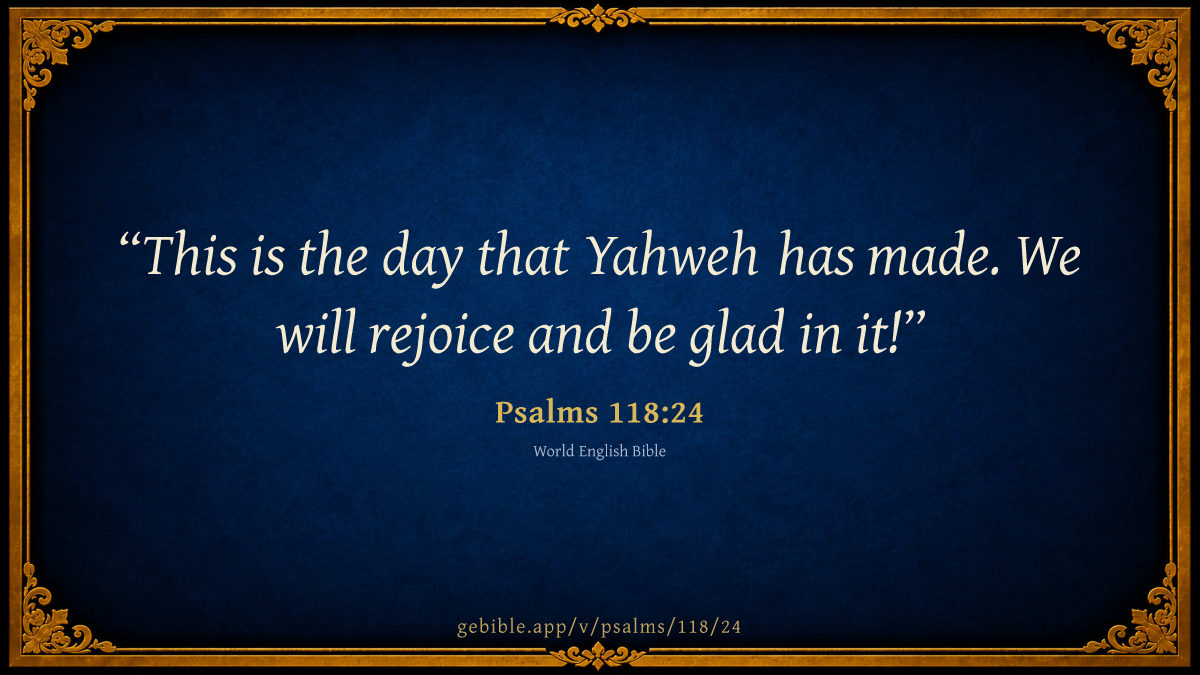
This is the day that Yahweh has made. We will rejoice and be glad in it!
Parallel Translations
-
This is the day that Yahweh has made. We will rejoice and be glad in it!
-
This is the day which the LORD hath made; we will rejoice and be glad in it.
-
This is the day which the LORD hath made; we will rejoice and be glad in it.
Cross-references (10)
Passages linked to Psalms 118:24 in the Treasury of Scripture Knowledge, ordered by reader-vote popularity; verse text shown in World English Bible.
- Psalms 84:10 For a day in your courts is better than a thousand. I would rather be a doorkeeper in the house of my God, than to dwell in the tents of wickedness.
- Isaiah 58:13 “If you turn away your foot from the Sabbath, from doing your pleasure on my holy day; and call the Sabbath a delight, and the holy of Yahweh honorable; and honor it, not doing your own ways, nor finding your own pleasure, nor speaking your own words,
- Nehemiah 8:10 Then he said to them, “Go your way. Eat the fat, drink the sweet, and send portions to him for whom nothing is prepared, for today is holy to our Lord. Don’t be grieved, for the joy of Yahweh is your strength.”
- 2 Chronicles 20:26-28 On the fourth day, they assembled themselves in Beracah Valley, for there they blessed Yahweh. Therefore the name of that place was called “Beracah Valley” to this day. Then they returned, every man of Judah and Jerusalem, with Jehoshaphat in front of them, to go again to Jerusalem with joy; for Yahweh had made them to rejoice over their enemies. They came to Jerusalem with stringed instruments, harps, and trumpets to Yahweh’s house.
- 1 Kings 8:66 On the eighth day he sent the people away; and they blessed the king, and went to their tents joyful and glad in their hearts for all the goodness that Yahweh had shown to David his servant, and to Israel his people.
- Revelation 1:10 I was in the Spirit on the Lord’s day, and I heard behind me a loud voice, like a trumpet
- Acts 20:7 On the first day of the week, when the disciples were gathered together to break bread, Paul talked with them, intending to depart on the next day, and continued his speech until midnight.
- John 20:19-20 When therefore it was evening on that day, the first day of the week, and when the doors were locked where the disciples were assembled, for fear of the Jews, Jesus came and stood in the middle, and said to them, “Peace be to you.” When he had said this, he showed them his hands and his side. The disciples therefore were glad when they saw the Lord.
- Matthew 28:1-8 Now after the Sabbath, as it began to dawn on the first day of the week, Mary Magdalene and the other Mary came to see the tomb. Behold, there was a great earthquake, for an angel of the Lord descended from the sky, and came and rolled away the stone from the door, and sat on it. His appearance was like lightning, and his clothing white as snow. For fear of him, the guards shook, and became like dead men. The angel answered the women, “Don’t be afraid, for I know that you seek Jesus, who has been crucified. He is not here, for he has risen, just like he said. Come, see the place where the Lord was lying. Go quickly and tell his disciples, ‘He has risen from the dead, and behold, he goes before you into Galilee; there you will see him.’ Behold, I have told you.” They departed quickly from the tomb with fear and great joy, and ran to bring his disciples word.
- Zechariah 3:9 For, behold, the stone that I have set before Joshua; on one stone are seven eyes: behold, I will engrave its engraving,’ says Yahweh of Armies, ‘and I will remove the iniquity of that land in one day.
Cross-references from openbible.info (CC BY 4.0)
Explain this verse (16 sources)
Historical commentary, presented as a primary source — not an endorsement.
Private notes
Saved on this device only — never synced or sent anywhere.
John Calvin 1540 · Public Domain 24. This is the day which Jehovah made He…
24. This is the day which Jehovah made He now speaks of that as a happy and pleasant day, on which he was at last established king over Israel, and the anointing of him by Samuel ratified by this event. Doubtless, all days were created alike by God, nevertheless David, by way of eminence, calls that the day of God which, after a long period of darkness, had dawned for the weal of the Church, because it was signalized by a notable event, deserving of being remembered by succeeding generations; and because the Church had thus emerged from a state of deep obscurity, he exhorts the faithful to mirth and joy, and that, too, by reason of the ignorance which many still displayed of the grace of God, or of their treating it with contempt, and of others being so lettered by their perverse attachment to Saul, that they could scarcely be brought to yield allegiance to David.
John Calvin's Commentaries (1540-1563) — public domain. Text from the Calvin Translation Society English edition (1840s-50s) via the Christian Classics Ethereal Library (ccel.org). Calvin's coverage is partial (roughly two-thirds of the Bible); uncommented books and verses are honest gaps, never fabricated. The 19th-century editor's footnotes and remarks are omitted so the notes are faithfully Calvin's own voice.
Geneva Bible translators 1599 · Public Domain Wherein God hath showeth chiefly his mercy, by appointing…
Wherein God hath showeth chiefly his mercy, by appointing me king and delivering his Church.
Geneva Bible (1599) marginal notes — public domain.
John Trapp 1656 · Public Domain Psa 118:24 This [is] the day [which] the LORD…
Psa 118:24 This [is] the day [which] the LORD hath made; we will rejoice and be glad in it.
Ver. 24. This is the day which the Lord hath made] The queen of days, as the Jews call the sabbath. Arnobius interpreteth this text of the Christian sabbath; others, of the day of salvation by Christ exalted to be the head cornerstone; in opposition to that dismal day of man’s fall.
Read full note →
We will rejoice] Or, let us rejoice. Dull we are, and heavy to spiritual joy; and are therefore excited thereto.
John Trapp, A Commentary or Exposition upon All the Books of the Old and New Testament (1647–1656) — public domain. Text from a community e-Sword module.
Matthew Poole 1685 · Public Domain Made; either created, or exalted and glorified, as this…
Made; either created, or exalted and glorified, as this word is used, 1Sa 12:6, or sanctified by his glorious presence and work, and by his appointment, as a time or season never to be forgotten, but to be observed with great thankfulness and rejoicing, as it follows.
Matthew Poole's English Annotations on the Holy Bible (1683–1685) — public domain. Text from a community e-Sword/MySword module.
John Gill 1763 · Public Domain God is the Lord, which hath showed us light,....…
God is the Lord, which hath showed us light,.... These are the words of the people, acknowledging divine favours; particularly that the Lord had caused his face to shine upon them, as the priest wished for, Num 6:25. The Lord might be said to show them light, by sending the Messiah to them, who came a light into the world; by making a Gospel day, for which they expressed their gladness, Psa 118:24; by causing the light of his glorious Gospel to shine into their hearts; by making them who were darkness light, the darkness of ignorance and unbelief to pass away, and the true light to shine; by lifting up the light of his countenance upon them, and giving them hopes of the light of glory and happiness, and making them meet to be partakers of the inheritance with the saints in light; for all which they are thankful, and call for sacrifices;
bind the sacrifice with cords, even unto the horns of the altar; that is, the lamb, as the Targum and Aben Ezra. Take a lamb for sacrifice, and bind it with cords; and being bound, lead it to the altar; there slay it, and then pour the blood upon the horns of it; which were the usual rites in sacrifice. Or bring a large number of sacrifices bound, as many as will fill the court, even up to the horns of the altar, upon this joyful occasion: for the sacrifice was not bound to the horns of the altar; but it denotes here such a number of sacrifices as would fill the court, and reach thither; so Gussetius (h) interprets it very rightly. But we are not to think of slain beasts, but of holy and living sacrifices, even the persons of God's people; their bodies and souls, and their sacrifices of praise and thanksgiving; since this refers to Gospel times; whose hearts in such service are to be united to fear the Lord, and fixed trusting in him; and are to be drawn to it with the cords of love, which are more than all whole burnt offerings; and which sacrifices are to be brought to the altar, Christ; which is most holy, and sanctifies gifts and persons, and renders them acceptable to God; and which is to be compassed about with songs of deliverance and salvation, by persons from every quarter, the four corners of the earth. Luther renders it,
Read full note →
"adorn the feast with leaves;''
and others,
"bind on the feast day branches,''
of trees, as was usual on the feast of tabernacles; see Lev 23:40; and it was usual with the Heathens to strew their altars with green herbs and flowers (i), particularly vervain, put for all other sweet herbs (k): hence Ovid (l) calls them "herbosas aras"; which the Septuagint and Vulgate Latin versions seem to countenance.
(h) Comment. Ebr. p. 87. (i) Martial. l. 3. Ep. 24. "virides aras". Vid. Ovid. de Trist. l. 3. Eleg. 13. "Ramis tegerem ut frondentibus aras", Virgil. Aeneid. 3. v. 25. (k) Terent. Andria, 4. 2. (l) Metamorph. l. 15. Fab. 49.
John Gill's Exposition of the Whole Bible (1746–1763) — public domain (CC PDM 1.0). Text via the HelloAO Bible API.
John Wesley 1765 · Public Domain Made - Or sanctified as a season never to…
Made - Or sanctified as a season never to be forgotten.
John Wesley, Explanatory Notes Upon the Whole Bible (1754–1765) — public domain. Text via the GEBible commentary corpus.
Adam Clarke 1810 · Public Domain Verse 24. This is the day which the Lord…
Verse 24. This is the day which the Lord hath made] As the Lord hath called me to triumph, this is the day which he hath appointed for that purpose. This is a gracious opportunity; I will improve it to his glory.
Adam Clarke's Commentary on the Bible (1810–1826) — public domain. Text from a community e-Sword/MySword module.
Joseph Benson 1811 · Public Domain Psa 118:24-25. This is the day which the Lord…
Psa 118:24-25. This is the day which the Lord hath made — Or, sanctified, as a season never to be forgotten. “Of the day on which Christ arose from the dead, it may, with more propriety than of any other day, be affirmed, this is the day which Jehovah hath made. Then it was that the rejected stone became the head of the corner. A morning then dawned, which is to be followed by no evening; a brighter sun arose upon the world, which is to set no more; a day began which will never end; and night and darkness departed to return not again. Easter-day is, in a peculiar manner, consecrated to him who, by his resurrection, triumphed over death and hell. On that day, through faith, we triumph with him, we rejoice and are glad in his salvation.” — Horne. Save now, I beseech thee — Or, we beseech thee; for the clause may be rendered either way: and these may be either considered as the words of David, or, as some rather think, those of the Levites, or porters, to whom he spake, Psa 118:19; or of the people, using these joyful acclamations or prayers to God, for the preservation of their king and kingdom. This also is interpreted of, and was applied to, Christ, even by the Jews themselves, Mar 11:9; Joh 12:13.
Joseph Benson's Commentary on the Old and New Testaments (1811–1818) — public domain. Text from a community e-Sword module.
Albert Barnes 1834 · Public Domain This is the day which the Lord hath made…
This is the day which the Lord hath made - As if it were a new day, made for this very occasion; a day which the writer of the psalm did not expect to see, and which seemed therefore to have been created out of the ordinary course, and added to the other days. He was in danger of death; his days were likely to be cut off and ended, so that he should see no more. But God had spared him, and added this joyous day to his life; and it was meet that for this he should be praised. It was so full of joy, so unexpected, so bright, so cheerful, that it appeared to be a new day coming fresh from the hand of the Almighty, unlike the other days of the year. So the Sabbath - the day that commemorates the resurrection of the Redeemer - is God’s day. He claims it. He seems to have made it anew for man. Amidst the other days of the week - in a world where the ordinary days are filled up with so much of earth, so much toil, trouble, care, vexation, vanity, wickedness - it seems like one of the days that God made when he first made the world; before sin and sorrow entered; when all was calm, serene, happy. The Sabbath is so calm, so bright, so cheerful, so benign in its influence; it is so full of pleasant and holy associations and reminiscences, that it seems to be a day fresh from the hand of God, unlike the other days of the week, and made especially, as if by a new act of creation, for the good of mankind. So when a man is raised up from sickness - from the borders of the grave - it seems to be a new life given to him. Each day, week, month, year that he may live, is so much added to his life, as if it were created anew for this very purpose. He should, therefore, regard it not as his own, but as so much given to him by the special mercy and providence of God - as if added on to his life. Compare Isa 38:5.
We will rejoice and be glad in it - The psalmist, and all who united with him in his thanksgivings. So the Christian Sabbath. It is a day of joy - all joy, and no sorrow. It is a day to be happy in; a day of rest; a day, when the cares and toils of life are suspended; a day, when we are no longer harassed with those things which vex us in the worldliness of the week; a day, when we think of God, of redemption, of hope, of heaven. The Sabbath should be a day of joy, and not of gloom; it would be the happiest of all days to weary and jaded people everywhere, if they observed it aright. In a world of toil and sorrow, it is among the richest of God’s blessings to people; it strengthens, refreshes, and cheers the heart of burdened and sorrowful man here; it lifts the soul to joyous contemplation of that eternal Sabbath where wearisome toll and sorrow shall be no more.
Albert Barnes' Notes on the Bible (1834–1885) — public domain. Text from a community e-Sword/MySword module.
The Cambridge Bible for Schools and Colleges 1878 · Public Domain 24. To Jehovah alone we owe this day of…
24. To Jehovah alone we owe this day of national rejoicing. Cp. Isa_25:9. “There was exceeding great gladness” is the description of the festival in Neh_8:17.
in it] Or, in Him. Cp. Psa_32:11.
The Cambridge Bible for Schools and Colleges (gen. ed. J. J. S. Perowne; Cambridge University Press, 1878–1918) — public domain. Text from a community e-Sword module.
Ellicott's Commentary for English Readers 1878 · Public Domain (24) This is the day.—Either the festival for which…
(24) This is the day.—Either the festival for which the psalm was composed (Feast of Tabernacles?) or more generally the day of triumph won by Jehovah, as in preceding verse.
A Bible Commentary for English Readers, edited by Charles John Ellicott (1878–1897) — public domain. Text from a community e-Sword module.
The Pulpit Commentary 1880 · Public Domain This is the day which the Lord hath made.…
This is the day which the Lord hath made. The thanksgiving day is one which has been fore-ordained of God, and brought into existence by him for a special purpose. We will therefore carry out God"s purpose, and rejoice and be glad in it.
The day the Lord hath made.
Read full note →
The words primarily point to that joyful dedication day of the new temple. Perhaps Israel had been directed specially to observe the day; or, more likely still, the psalmist meant the day of joy and gladness of revived national and religious life. "This is the day the Lord," etc.
I WE MAY APPLY IT TO OUR LORD"S RESURRECTION-DAY. That has been called the day of days, as indeed it was and is to the Church of Christ. That first Easter Day was "the day in his life which he made his own beyond all others. Not his birthday; for that meant his entrance on a life of sorrows. Not his ascension day; for that was the closing scene of a triumph already achieved. Not his transfiguration-day; for that was a momentary flash of glory in a career of pain. Not the day of his crucifixion; that was a great day for a ruined world, but for him it marked the lowest stage of humiliation and woe. The day of days in the life of Christ was the day of his resurrection." And to the first disciples especially, and to the believing Church still:
1. This day has the joy of deliverance from a great dread. They thought they had but their Lord, and that the redemption of Israel was now but an unfulfilled and impossible dream. But that dread departed, driven forth by the joy of the day of resurrection.
2. And the day brings also the joy of full conviction as to the gospel we believe. Our Lord and his apostles base all belief of that gospel on the Resurrection; they held it, as do we, as an infallible proof.
3. The joy of renewed and radiant hope. "Christ ever liveth:" what now is not possible? For all such reasons the words of the text may be fitly applied to the Easter joy.
II TO THE LORD"S DAY THE SABBATH. Who can over-estimate to man"s body, mind, heart, and soul what the blessed Sunday brings? Fools and blind are they who, for any reason or by any means, would rob weary-hearted men of this priceless boon.
III TO THE DAY OF OUR CONVERSION. It is not all that can, nor is it indispensable for any to remember the exact day when that great spiritual change passed upon them. But some have vivid recollection of it; they can tell the time, place, circum stances, and all connected with the day on which they were born again and passed from death unto life. And it may be they are to be envied who can do this, which assuredly many cannot. But they will not hesitate to take such words as these in our text, and apply them to this by them never-to-be-forgotten day.
IV TO THE DAY OF REVIVAL AND RELIGIOUS PROSPERITY, How blessed such seasons are! God gives them to his Church from time to time. Spring-tide seasons, when there is an energy and quickening and force in the general life of the Church, such as has long been unknown. It was so for Israel when this psalm was first sung, and it has been so many times since. And let no one wait for the whole Church to be thus revived; the blessed time may come will come, if really longed for to the individual soul. And that will be a time of joy. S.C.
The God-made day.
Jesus, rejected by the whole Hebrew nation, and put to death, but raised from the grave, may be taken as the subject of these verses. In our variable climate we often have a cold and dark day followed by one full of sunshine and warmth. Such was the last sabbath of the old dispensation, when Jesus was in his grave. Suddenly the clouds disappeared, and God made another day the first day of the week a holy and joyful sabbath to all Christians. The first sabbath was desecrated by the Crucifixion; the Lord"s day was hallowed by the Resurrection.
I THE LORD"S DAY IS COMMEMORATIVE OF THE GREAT VICTORY OF JESUS OVER HIS ENEMIES. Apparently everything had succeeded that aimed at ending the life and career of Jesus. The Cornerstone was rejected by the chief builders of the day. Jesus was in his grave; the disciples were disheartened; and Jerusalem was exulting over the temporary triumph of Friday. The contest, however, was not decided; on the morning of the first day of the week, Jesus rose from the dead; his disciples sprang to their feet, and the Resurrection sealed every word that he had uttered, and every deed that he had accomplished. It was the confirmation of his life.
1. It was a victory over calumny and misrepresentation. He came forth the Son of God.
2. It was a victory over the weakness and faithlessness of his disciples. The Crucifixion made them cowards; the Resurrection made them heroes.
3. It was a victory over death and the grave. He who rose has "the keys of Hades and of death.
II IN THE LORD"S DAY WE HAVE THE CONSUMMATION OF ALL GREAT DAYS. The day of creation here finds its consummation. Had not the Lord made this day, we might think that God had made all things in vain. The sabbath at the end of creation was only a symbol of the Lord"s day. God then rested from all his works; but that rest was disturbed by the entrance of sin. The day Israel was delivered from Egyptian bondage; the day the tabernacle of Moses was consecrated; the day the promised land was reached; the day Solomon"s temple was dedicated; the Day of Atonement; the birthday of Jesus; and even the day of final judgment, point to, and derive their significance from, the Lord"s day.
1. Here we realize the end of created things.
2. Here we find the bond of union between time and eternity.
3. The significance of all religious festivals is found in this day.
III THE LORD"S DAY IS THE CHRISTIAN FESTIVAL. Not only is it a sabbath of rest from manual labor; it is also the token of spiritual peace and blessing.
1. A day of communion with God.
2. A day of association with the saints.
3. A day of fellowship in the home circle.
IV THE LORD"S DAY IS THE PORCH OF IMMORTALITY. The light shines from the tomb.
1. The day that promises the absence of all mental darkness. The Sunday disperses the gloom and doubt of the week. A little while ago we had snow and sleet for several days; but one bright warm day came, and swept away the snow.
2. The day whose light dies into the light of immortality. The sabbath of time dissolves into the peace of heaven.
3. The day that will bring everlasting praise to the Name of Jesus. (From Weekly Pulpit.) R.T.
The Pulpit Commentary (1880–1919), ed. H.D.M. Spence-Jones & Joseph S. Exell — public domain. Text from a community e-Sword module.
Charles H. Spurgeon 1885 · Public Domain Ver. 24. This is the day which the LORD…
Ver. 24. This is the day which the LORD hath made. A new era has commenced. The day of David's enthronement was the beginning of better times for Israel; and in a far higher sense the day of our Lord's resurrection is a new day of God's own making, for it is the dawn of a blessed dispensation. No doubt the Israelitish nation celebrated the victory of its champion with a day of feasting, music and song; and surely it is but meet that we should reverently keep the feast of the triumph of the Son of David. We observe the Lord's day as henceforth our true Sabbath, a day made and ordained of God, for the perpetual remembrance of the achievements of our Redeemer. Whenever the soft Sabbath light of the first day of the week breaks upon the earth, let us sing,
"This is the day the Lord hath made,
Read full note →
He calls the hours his own;
Let heaven rejoice, let earth be glad,
And praise surround the throne."
We by no means wish to confine the reference of the passage to the Sabbath, for the whole gospel day is the day of God's making, and its blessings come to us through our Lord's being placed as the head of the corner.
We will rejoice and be glad in it. What else can we do? Having obtained so great a deliverance through our illustrious leader, and having seen the eternal mercy of God so brilliantly displayed, it would ill become us to mourn and murmur. Rather will we exhibit a double joy, rejoice in heart and be glad in face, rejoice in secret and be glad in public, for we have more than a double reason for being glad in the Lord. We ought to be specially joyous on the Sabbath: it is the queen of days, and its hours should be clad in royal apparel of delight. George Herbert says of it:
"Thou art a day of mirth,
And where the weekdays trail on ground,
Thy flight is higher as thy birth."
Entering into the midst of the church of God, and beholding the Lord Jesus as all in all in the assemblies of his people, we are bound to overflow with joy. Is it not written, "then were the disciples glad when they saw the Lord"? When the King makes the house of prayer to be a banqueting house, and we have grace to enjoy fellowship with him, both in his sufferings and in his triumphs, we feel an intense delight, and we are glad to express it with the rest of his people.
Ver. 24. This is the day which the LORD hath made. 1. Here is the doctrine of the Christian sabbath: "it is the day which the Lord hath made, "has made remarkable, made holy, has distinguished it from other days; he has made it for man: it is therefore called the Lord's day, for it bears his image and superscription. 2. The duty of the Sabbath, "we will rejoice and be glad in it"; not only in the institution of the day, that there is such a day appointed, but in the occasion of it, Christ's becoming "the head of the corner." This we ought to rejoice in, both as his honour and our advantage. Sabbath days must be rejoicing days, and then they are to us as the days of heaven. See what a good Master we serve, who having instituted a day for his service, appoints it to be spent in holy joy. Matthew Henry.
Ver. 24. This is the day, etc. The "queen of days, "as the Jews call the Sabbath. Arnobius interprets this text of the Christian Sabbath; others, of the day of salvation by Christ exalted to be the head cornerstone; in opposition to that dismal day of man's fall. John Trapp.
Ver. 24. Because believers have ever cause for comfort, therefore they are commanded always to rejoice, Php 3:1 4:4. Whether their sins or sufferings come into their hearts, they must not sorrow as they that have no hope. In their saddest conditions, they have the Spirit of consolation. There is seed of joy sown within them when it is turned under the clods, and appears not above ground. But there are special times when God calls for this grain to spring up. They have some red letters, some holy days in the calendar of their lives, wherein this joy, as wine at a wedding, is most seasonable; but among all those days it never relishes so well, it never tasteth so pleasantly, as on a Lord's day. Joy suits no person so much as a saint, and it becomes no season so well as a Sabbath.
Joy in God on other days is like the birds chirping in winter, which is pleasing; but joy on the Lord's day is like their warbling times and pretty notes in spring, when all other things look with a suitable delightful aspect. This is the day which the LORD hath made, (he that made all days, so especially this day, but what follows?) we will rejoice and be glad in it. In which words we have the church's solace, or joy, and the season, or day of it. Her solace was great: "We will rejoice and be glad." Those expressions are not needless repetitions, but shew the exuberance or high degree of their joy. The season of it: "This is the day which the LORD hath made." Compare this place with Mt 11:22-23, and Ac 4:11, and you will find that the precedent verses are a prophetical prediction of Christ's resurrection, and so this verse foretells the church's joy upon that memorable and glorious day. And, indeed, if "a feast be made for laughter, "Ec 10:19, then that day wherein Christ feasts his saints with the choicest mercies may well command their greatest spiritual mirth. A thanksgiving day hath a double precedence of a fast day. On a fast day we eye God's anger; on a thanksgiving day we look to God's favour. In the former we specially mind our corruptions; in the latter, God's compassions; therefore a fast day calls for sorrow, a thanksgiving day for joy. But the Lord's day is the highest thanksgiving day, and deserveth much more than the Jewish Purim, to be a day of feasting and gladness, and a good day. George Spinnock.
Ver. 24. Day which the LORD hath made. As the sun in heaven makes the natural day by his light, so does Christ the Sun of Righteousness make ours a spiritual day. Starke.
Ver. 24. Day which the LORD hath made. Adam introduced a day of sadness, but another day is made by Christ: Abraham saw his day from afar, and was glad; we will walk even now in his light. Johann David Friesch, 1731.
Ver. 24.
1. What is spoken of.
(a) The gospel day.
(b) The sabbath day.
2. What is said of it.
(a) It is given by God.
(b) To be joyfully received by man. G.R.
Psalms 118:25*
Charles H. Spurgeon's The Treasury of David (1869–1885) — public domain. Psalms only. Text from a community e-Sword/MySword module.
The Biblical Illustrator 1887 · Public Domain This is the day which the Lord hath made;…
Psa_118:24
This is the day which the Lord hath made; we will rejoice and be glad in it.
Read full note →
The day of days
The day of days in the life of Christ was the day of His resurrection; and to the early Christians Easter Day was the queen of festivals. Easter should provoke a joy in Christian hearts, greater than any event in our private lives; greater than any in the worlds public history; greater than any other even in the life of our Lord Himself. This is the immemorial feeling and sense of Christendom; but why should it be so? why has Easter, why has the resurrection, this extraordinary claim on the buoyancy of the Christian heart?
I. The joy of a great reaction; a reaction from anxiety and sorrow. So it was at the time of Christs resurrection. The apostles had been crushed by the sufferings and death of Jesus Christ. When He was in His grave, all seemed over; and when He appeared, first to one, and then to another, on the day of His resurrection, they could not keep their feelings of welcome and delight,--traversed though these were by a sense of wondering awe,--within anything like bounds. Then were the disciples glad when they saw the Lord. And this joy of theirs is repeated every year in the greatest feast of the Christian Church. Those who have felt the sorrow feel the joy. Year by year we stand by, in spirit, while Joseph of Arimathaea and Nicodemus lay Him in His grave; and the tension of sincere feeling, of sympathetic sorrow, of penitence and contrition which this implies, is followed by a corresponding reaction on Easter morning.
II. The joy of a great certainty. The resurrection of our Saviour is the fact which makes an intelligent Christian certain of the truth of his creed. And in this way it satisfies a real mental want, and it occasions keen enjoyment by giving this satisfaction. All else in our creed depends on the resurrection of Christ; and to-day when we remind ourselves of its historical certainty, which is scarcely less illustrated by the apparent contradictions than by the collective and direct force of the accounts which have come down to us, we experience a mental delight at the freshening touch of truth, and cry, This is the day which the Lord hath made: we will rejoice and be glad in it.
III. The joy of Easter is inspired by the hope which Easter warrants and quickens. Hope and Joy are twin sisters. Joy best enters the human soul when leaning on the arm of Hope. As the apostle says, We rejoice in the hope of the glory of God. What is this hope which Easter most distinctly puts before us? and how does it spring from our Saviours resurrection? The great hope which Easter sets before us is the completeness of our life after death. The difficulty of believing in a future life is due, not to the reason, but to the imagination as controlled by the senses. Who of us has not made this discovery in some one of those dark hours, which sooner or later visit every human life? Who of us has not stood by the open coffin, and felt himself, or marked how others feel, the terrific empire of sense in the presence of death? At such a moment the most modest anticipations of reason are deemed an unsubstantial guess: the clear teaching of revelation a solemn fancy; the minds sceptre has passed to the imagination and the senses, and they decide that all ends with death, and that the grim secrets of the grave are the measure of mans impotent aspirations after a future existence. Now it was to deal with this specific difficulty that our Lord willed to die, and then, by a literal bodily resurrection, to rise from the grave. Truly we may exclaim with the apostle, that God hath begotten us again unto a lively hope through the resurrection of Jesus Christ from the dead, and with the psalmist, that this is the day which the Lord hath made: let us rejoice and be glad in it. (Canon Liddon.)
Easter Day
I. This is the day which the Lord hath made great, by giving the most glorious proof of His own greatness; by rising on it from the dead, by being born again of the womb of the earth, to prove Himself God, as His first birth had proved Him to be man.
II. This is the day which the Lord hath made glorious, by displaying the glory of His everlasting kingdom, by taking possession of eternal life in His own person, and thereby assuring the same precious blessing to them who by faith lay hold on His promises.
III. This is the day which the Lord hath made a day of triumph and rejoicing, by subduing all the most formidable enemies of human nature, robbing death of its sting, the grave of its victory, spoiling principalities and powers, triumphing over them, and making a show of them openly: by flinging open the gates of death and hell, proclaiming liberty to the captives, and the opening of the prison to them that are bound.
IV. This is the day which the Lord hath made wonderful, by turning dishonour into honour, by converting the ignominy of His death into the glory of a resurrection, the cross on which He suffered into the trophy of His victory, the crown of thorns into a ray of glory.
V. This is the day which the Lord hath made comfortable to all that mourn in Zion, to give unto them beauty for ashes, the oil of joy for mourning, the garment of praise for the spirit of heartiness. (A. Grant, D.D.)
The memorial of Christs resurrection ought perpetually to be celebrated
I. The import of the words--This is the day, etc. The everlasting mercies of God which are celebrated in the four first verses by way of repetition; Christs being set in a large place (verse 5), which the prophet elsewhere explains by Gods delivering him (Psa_18:19); his exultation, because he shall see his desire upon them that hate him (verse 7); his declaring that it is better to trust in the Lord than to put any confidence in man (verse 8); the power given him to destroy all nations in the name of the Lord (verse 10). All these expressions, I say, import some effects of his royal dignity, more permanent and extensive, and more evident tokens of the Divine interposition, than can be attributed to the former event; though that was not ejected without the direction of a particular providence. But all these effects, as all other effects of Christs mediatorial Office, being fully accounted for from the truth of His resurrection, and such facts as were consequential to it; it is most reasonable to consider the text as respecting His resurrection.
II. Upon what reasons so eminent and peculiar a distinction of this day is made.
1. The resurrection of Christ did evidence the Divine authority of our Saviour, as it could not, upon the principles of the Jews themselves, have been ejected, but only by a Divine power.
2. But the proof, indeed of the Divine mission of Christ from His resurrection does not only affect the Jews, but all other persons indifferently; for granting a power to man of doing very strange and surprising things by means of the union of his soul and body, according to the laws of which they here act upon one another, or upon other bodies; yet, when this union is dissolved, when the soul is incapable of acting either upon its own former body, or any body whatever, how is it possible to conceive that it should be able to restore the bodily organs, which it before informed, either to their proper offices or order again? This can only be the act of God, who made us and fashioned us; by whom, as the psalmist celebrates His wisdom and power, we are so fearfully and wonderfully made; in whose hand is the soul of every living thing; of whom, and through whom, and to whom are all things.
III. What are those proper acts of joy and gladness wherewith it ought to be celebrated.
1. The first and highest expression of our joy on occasion of so extraordinary an act of the Divine power and goodness, ought to consist in those inward and spiritual sentiments which the soul of a good man naturally feels when he reflects on any special mercy of God, or any spiritual good which it is the means of conveying to him; especially in so ample a manner that it is fruitful and diffusive of many other spiritual goods. Such is the Divine mercy which we now commemorate; and therefore, if we commemorate it as we ought, we shall inwardly rejoice in the Lord, according to the joy in harvest, or as men rejoice when they divide the spoil on occasion of so great a flow of Divine blessings upon us all at once.
2. This internal joy ought also to be expressed by some outward and proper significations of it. Acts of religious praise and thanksgiving to God; and acts of innocent festivity in other external respects. (R. Fiddes.)
The Lords day
I. This day is distinguished by His triumphs--let us hail Him Conqueror.
II. This day He claims as an offering--let us present it with joyful obedience.
III. On this day He advances with peculiar privileges--let us get forth to meet Him with all the ardour of hope.
IV. On this day we discern our interest in the triumph of the Redeemer. (J. Hughes.)
The blessings of a day
A day, what is it? A space of light between two mountain-walls of darkness; a time of redemption from the kingdom of Chaos and Old Night; the half or the two-thirds of life really given us to live; the season of consciousness, duty, trial; the end and aim for which sleep is given, and the veil of temporary oblivion and rest spread over our faculties so many hours. Wonderful and rich, far beyond the line of our usual appreciation, is the gift of a day. It stands like a monument between the eternity of the past and the eternity of the future. One day! It is little; a fugitive twenty-four hours, a hurried routine, a mill-horse round of cares and toils, a succession of meals,--breakfast, dinner, supper,--a miniature life, rounded with a sleep, a daybreak of childhood, a morning of youth and hope, a noonday of manhood and activity, a twilight of age and pensiveness, a night of death. How quickly it is here, how soon it is gone! But in this very shortness of a day we discern a benevolent intention. Constituted as we are, we could not bear the burden of a double day. Literally, our strength is according to our day, and our day according to our strength. They have been weighed and balanced by a sure Hand, one to the other. The mechanical arrangements by which the day is made, the position of the earth and the sun and their respective revolutions, and those of the other planetary and celestial bodies, the nature of the influence exerted on us by the sun through light, heat, and electricity and other elements, too subtle and delicate for our coarse senses to take cognizance of them, all are indications of the Fatherly care over us, and fitted to assure us that this is the day which the Lord hath made, and to inspire us to rejoice and be glad in it We discern a most beneficent intention in the separation and subdivision of our life into daily fragments. Each night is a gentle semi-oblivion, that our past lives may not tyrannize over us, that the door of progress may still be kept open, that we may have in some sense a new and untrammelled being every day. Every night is a faint death, every morning a fresh birth. The blessing of the day depends in no slight degree on the manner in which we begin it, on the key-note of the morning hour. It is well begun by the Almighty Disposer. He gives us a new world, bathed in dew, blushing with the dawn, vocal with the song of birds, while clouds of vapour and smoke rise like columns of incense from hill and vale and human homes to heaven. Fair and gracious world of ours, we feel like saying, how sad and strange it is that we should ever forget that this is a Divine handiwork, or that we should ever abuse such royal gifts by our ingratitude and disobedience! Devotion is the spontaneous service of the morning. To invoke the guardian care of Heaven, and to bless its new mercies, is but a fitting counterpart to all the other beauty, and solemnity, and hope, and renewed life of the world. Shall the birds arise and sing at the gate of heaven, and man feel no uplifting sentiment at the birth of a new day? Man, says the psalmist, goeth forth unto his work and to his labour until the evening. That work and labour, the heat and burden of the day, called, in the external and figurative language of the elementary dispensation, a curse, have proved on long trial, and in the wide experience of a world, to be some of the best blessings of the day. Who has the pleasant, consciousness of being useful? The worker. Who stores up the rich memories of many things done? The worker. Who sleeps sweetly? The worker. Who relishes his food more than the epicure? The hard worker. Who enjoys leisure? He who has used his time so industriously that he has earned a right to be idle. Who can understand the full measure of blessing in a day, bug he who has so earnestly pursued its opportunities that its minutes are to him as gems, and its hours as diamonds? There is great work yet to be done on this planet,--continents to be reclaimed, oceans to be navigated, wild elements to be yoked to the car of human progress, acres of brains to be tilled, Augean stables of moral filth to be purified, swarming multitudes of souls to be touched to finer spiritual issues, vast social Saharas to be clothed with verdure, new and grander organizations in Church and State, and family, and art, and labour, and literature, to be formed, that shall make our modern homes, and sanctuaries and schools, galleries and Crystal Palaces, seem to be but the bungling work of apprentices compared with the productions of the perfect Master-workman. The past history of our race has its representative in the night,--dreamy, sleepy, irresponsible, fearful, often riotous, artificially lighted, addicted to passion, meteor-led night. The ages have been dark ages, and history has been profane, and the earth has not been holy land. But the dayspring from on high hath visited us, and the future is to be a day of action, usefulness, progress, as the past has been a night of preparation, dreams, and darkness. (A. A. Livermore.)
Evangelical gladness
First, it brings with it a spiritual delight. Secondly, an external gladness which opens itself in signs and tokens. The spiritual delight which we treasure up within the soul looking steadfastly upon Jesus that died for our sins, and rose again for our justification, is heavenly and unutterable, it is a superlative joy that cries down all other petty delights. The external utterances of a pious joy are these--
1. Days of rest from bodily labour; for the meaner labour must give way when a better and a worthier is to be undertaken. And while the mind hath just occasion to make its abode in the house of gladness, the weed of ordinary toil and travel doth not become us; therefore it is fit that ordinary labour should sometimes surrender itself up to the service of God.
2. To laud the name of the Lord, and to give thanks unto Him are the only language of our thankfulness (Psa_42:5).
3. God doth not deny it, but he that offereth Him praise doth honour Him; but will you know how that honour is best exalted? Make a cheerful noise to the God of Jacob, singing and making melody to the Lord with psalms, and hymns, and spiritual songs. If the Jews might justly say, how can we sing the Lords song, while we are in a strange land, while we are in captivity? then we must acknowledge, on the contrary, how can we choose but sing the Lords song, being delivered out of captivity? Singing of psalms is a most proper exercise of our reasonable service.
4. Another effect of Christian joy is to give, because it abounds. A joy that will not distribute to the needy is a shrunken withered joy, nay, a joy that will carry the curse of God with it, because it wants fruits; and a joy that will carry the curse of the poor with it, because they are suffered to pine and languish in our public gladness.
5. All sorts of mirth and innocent recreation, wherein our substance is not exhausted, nor our time trifled away, are agreeable to our Christian conversation. At our times of respite from sacred offices, to delight our sullen nature with harmless pleasures, it rubs off the rust of melancholy, and puts alacrity in us to rejoice always in the Lord. (Bp. Hacket.)
The Biblical Illustrator, edited by Joseph S. Exell (c. 1880s–1900s) — public domain. Text from a community e-Sword module.
unfoldingWord translationNotes 2017 · CC BY-SA 4.0 rejoice and be glad
rejoice and be glad
These two phrases mean basically the same thing and emphasize the intensity of joy. AT: "be very glad" (See: Doublet)
Read full note →
translationWords
joy
unfoldingWord translationNotes — © Distant Shores Media and the Door43 World Missions Community, licensed CC BY-SA 4.0. Source: git.door43.org/Door43/en_tn.
Tyndale Open Study Notes 2022 · CC BY-SA 4.0 118:24 This is the day the Lord has made:…
118:24 This is the day the Lord has made: The day of the Lord’s victory has already arrived, although its completion awaits another day (118:25).
Tyndale Open Study Notes — © Tyndale Open Resources, licensed CC BY-SA 4.0. Text via the HelloAO Bible API.