
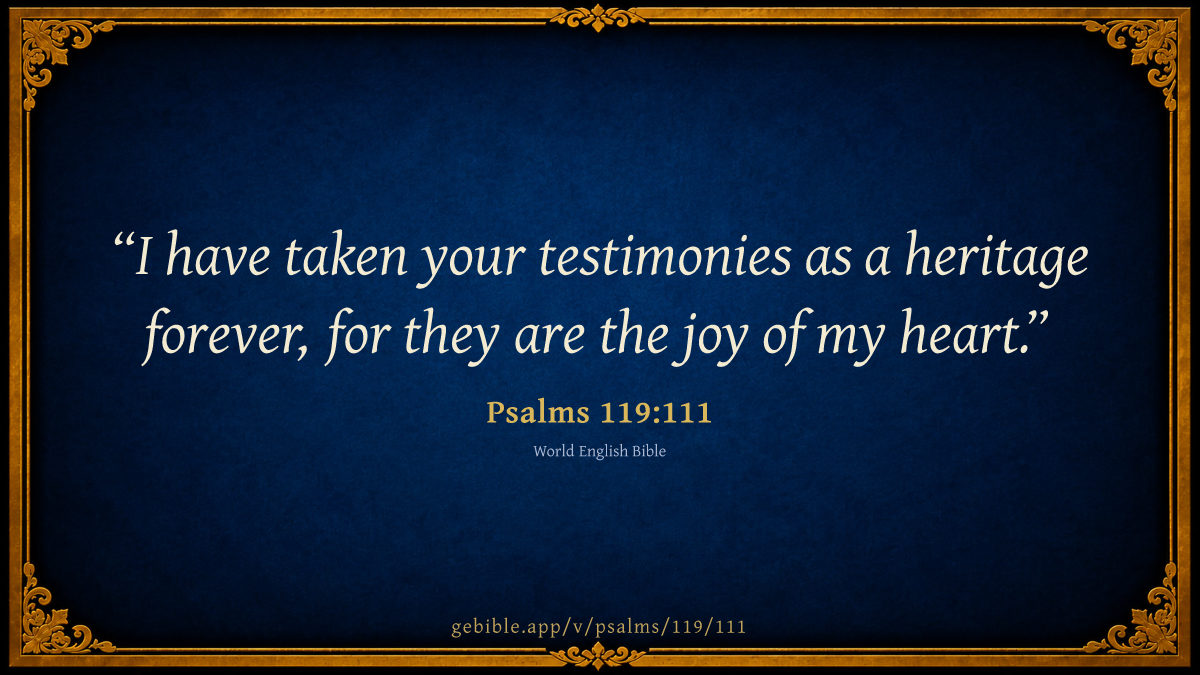
I have taken your testimonies as a heritage forever, for they are the joy of my heart.
Parallel Translations
-
I have taken your testimonies as a heritage forever, for they are the joy of my heart.
-
Thy testimonies have I taken as an heritage for ever: for they are the rejoicing of my heart.
-
Thy testimonies have I taken as a heritage for ever; for they are the rejoicing of my heart.
Cross-references (16)
Passages linked to Psalms 119:111 in the Treasury of Scripture Knowledge, ordered by reader-vote popularity; verse text shown in World English Bible.
- Jeremiah 15:16 Your words were found, and I ate them. Your words were to me a joy and the rejoicing of my heart, for I am called by your name, Yahweh, God of Armies.
- Psalms 16:5 Yahweh assigned my portion and my cup. You made my lot secure.
- Psalms 119:92 Unless your law had been my delight, I would have perished in my affliction.
- Psalms 119:174 I have longed for your salvation, Yahweh. Your law is my delight.
- 1 Peter 1:4 to an incorruptible and undefiled inheritance that doesn’t fade away, reserved in Heaven for you,
- Deuteronomy 33:4 Moses commanded us a law, an inheritance for the assembly of Jacob.
- Psalms 19:8 Yahweh’s precepts are right, rejoicing the heart. Yahweh’s commandment is pure, enlightening the eyes.
- Psalms 119:74 Those who fear you will see me and be glad, because I have put my hope in your word.
- Psalms 119:127 Therefore I love your commandments more than gold, yes, more than pure gold.
- Psalms 119:14 I have rejoiced in the way of your testimonies, as much as in all riches.
- Hebrews 9:15 For this reason he is the mediator of a new covenant, since a death has occurred for the redemption of the transgressions that were under the first covenant, that those who have been called may receive the promise of the eternal inheritance.
- Isaiah 54:17 No weapon that is formed against you will prevail; and you will condemn every tongue that rises against you in judgment. This is the heritage of Yahweh’s servants, and their righteousness is of me,” says Yahweh.
- Psalms 119:162 I rejoice at your word, as one who finds great plunder.
- 1 Peter 1:8 whom, not having known, you love. In him, though now you don’t see him, yet believing, you rejoice greatly with joy that is unspeakable and full of glory,
- Acts 26:18 to open their eyes, that they may turn from darkness to light and from the power of Satan to God, that they may receive remission of sins and an inheritance among those who are sanctified by faith in me.’
- Colossians 1:12 giving thanks to the Father, who made us fit to be partakers of the inheritance of the saints in light,
Cross-references from openbible.info (CC BY 4.0)
Explain this verse (14 sources)
Historical commentary, presented as a primary source — not an endorsement.
Private notes
Saved on this device only — never synced or sent anywhere.
John Calvin 1540 · Public Domain 111. I have thy testimonies as an inheritance for…
111. I have thy testimonies as an inheritance for ever. He again confirms the sentiment, which cannot be too often repeated, That the law of God was more precious to him than all the pleasures, riches, and possessions, of the world. I have said, that it is not in vain that these things are so often repeated; for we see how violently the men of the world boil to gratify their unruly lusts, with what multiplied anxieties they are agitated, while they are unceasingly coveting innumerable objects; and, in the meantime, scarcely one in a hundred is, in a moderate degree, aiming to apply his mind to the study of the Divine law. The prophet, then, to stir us up by his own example, asserts, that he took such pleasure in God’s, testimonies as to esteem nothing more precious. It is love only which leads us to set a value on any object; and, therefore, it is requisite, in order to our observing the Divine law with the reverence due to it, that we begin with this delight in it. It is not wonderful, if God’s testimonies convey to our minds a joy, which, causing us to reject and despise all other things, holds our affections fast bound to them. What can be sweeter than to have heaven opened to us, that we may come freely into the presence of God, when, adopting us to be his children, he pardons our sins? What can be more desirable than to hear that he is so pacified towards us, as to take upon himself the care of our life? This I have thought good to observe briefly, that we might not think it strange to find David rejoicing so greatly in God’s law. The similitude of inheritance is of frequent occurrence in the Scriptures; and we apply the designation of inheritance to that which we hold in the highest estimation, so that we are contented to be deprived of all other things, provided we retain the safe and full possession of that one thing. Accordingly, the prophet intimates, that whatever good things he had obtained he accounted them as adventitious, and that the truths revealed in God’s word alone were to him as an inheritance. Without the Divine word all other things were in his estimation as nothing; so that he could willingly leave to others, riches, honors, comforts, and pleasures, provided he possessed this incomparable treasure. It is not meant to say that he; altogether despised the temporal benefits which God bestows, but his mind was not bound fast to them.
John Calvin's Commentaries (1540-1563) — public domain. Text from the Calvin Translation Society English edition (1840s-50s) via the Christian Classics Ethereal Library (ccel.org). Calvin's coverage is partial (roughly two-thirds of the Bible); uncommented books and verses are honest gaps, never fabricated. The 19th-century editor's footnotes and remarks are omitted so the notes are faithfully Calvin's own voice.
Geneva Bible translators 1599 · Public Domain I esteemed no worldly things, but made thy word…
I esteemed no worldly things, but made thy word mine inheritance.
Geneva Bible (1599) marginal notes — public domain.
John Trapp 1656 · Public Domain Psa 119:111 Thy testimonies have I taken as an…
Psa 119:111 Thy testimonies have I taken as an heritage for ever: for they [are] the rejoicing of my heart.
Ver. 111. Thy testimonies have I taken as an heritage] Perpetui nec unquam alienaudi patrimonii vice, A patrimony that I prize, and will never part with, since I hold it from thee as a child of thy grace.
Read full note →
For they are the rejoicing of mine heart] Other heritages have their troubles. Qui habet tetras, habet querras, saith the lawyer; but the just man’s joy is unmixed.
John Trapp, A Commentary or Exposition upon All the Books of the Old and New Testament (1647–1656) — public domain. Text from a community e-Sword module.
Matthew Poole 1685 · Public Domain I have chosen them for my chief portion, from…
I have chosen them for my chief portion, from which I will never part.
Matthew Poole's English Annotations on the Holy Bible (1683–1685) — public domain. Text from a community e-Sword/MySword module.
Matthew Henry 1710 · Public Domain The psalmist here in a most affectionate manner, like…
The psalmist here in a most affectionate manner, like an Israelite indeed, resolves to stick to the word of God and to live and die by it.
I. He resolves to portion himself in it, and there to seek his happiness, nay, there to enjoy it; "Thy testimonies (the truths, the promises, of thy word) have I taken as a heritage for ever, for they are the rejoicing of my heart." The present delight he took in them was an evidence that the good things contained in them were in his account the best things, and the treasure which he set his heart upon. 1. He expected an eternal happiness in God's testimonies. The covenant God had made with him was an everlasting covenant, and therefore he took it as a heritage for ever. If he could not yet say, "They are my heritage," yet he could say, "I have made choice of them for my heritage; and will never take up with a portion in this life," Psa 17:14, Psa 17:15. God's testimonies are a heritage to all that have received the Spirit of adoption; for, if children, then heirs. They are a heritage for ever, and that no earthly heritage is (Pe1 1:4); all the saints accept them as such, take up with them, live upon them, and can therefore be content with but little of this world. 2. He enjoyed a present satisfaction in them: They are the rejoicing of my heart, because they will be my heritage for ever. It requires the heart of a good man to see his portion in the promise of God and not in the possessions of this world.
Read full note →
II. He resolves to govern himself by it and thence to take his measures: I have inclined my heart to do thy statutes. Those that would have the blessings of God's testimonies must come under the bonds of his statutes. We must look for comfort only in the way of duty, and that duty must be done, 1. With full consent and complacency: "I have, by the grace of God, inclined my heart to it, and conquered the aversion I had to it." A good man brings his heart to his work and then it is done well. A gracious disposition to do the will of God is the acceptable principle of all obedience. 2. With constancy and perseverance. He would perform God's statutes always, in all instances, in the duty of every day, in a constant course of holy walking, and this to the end, without weariness. This is following the Lord fully.
Matthew Henry's Commentary on the Whole Bible (1708–1710) — public domain (CC PDM 1.0). Text via the HelloAO Bible API.
John Gill 1763 · Public Domain Depart from me, ye evildoers,.... The same with the…
Depart from me, ye evildoers,.... The same with the evil thinkers, Psa 119:113; According to Aben Ezra, they that think evil commonly do it; as they devise it, they commit it. This describes such persons whose course of life is, and who make it their constant business to do, iniquity; such the psalmist desires to depart his presence, to keep at a distance from him, as being very disagreeable to him; and who would be a great hinderance to him in keeping the commandments of God, as follows: these same words will be spoken by David's son and antitype, at the great day of account, Mat 7:23;
for I will keep the commandments of my God; of God who has a fight to command, and not of men, especially when opposed to the commands of God; of God, who is the covenant God and Father of his people; and whose covenant, grace, and favour, in choosing, redeeming, regenerating, and adopting them, lay them under greater obligations still to keep his commandments; and whose commandments are not grievous: and though they cannot be perfectly kept by good men, yet they are desirous of keeping them as well as they can, and determine in the strength of divine grace so to do; and which they do out of love to God, and with a view to his glory, without any selfish or mercenary ends. The Syriac version renders it, "that I may keep", &c. to which end he desires to be rid of the company of wicked men; who are both a nuisance to good men, and an hinderance in religious duties.
John Gill's Exposition of the Whole Bible (1746–1763) — public domain (CC PDM 1.0). Text via the HelloAO Bible API.
Adam Clarke 1810 · Public Domain Verse 111. As a heritage] In Ps 119:57 he…
Verse 111. As a heritage] In Ps 119:57 he says, God is my portion, חלקי chelki. In this he says, Thy testimonies have I taken as a heritage, נחל nachal. To these he was heir; he had inherited them from his fathers, and he was determined to leave them to his family for ever. If a man can leave nothing to his child but a Bible, in that he bequeaths him the greatest treasure in the universe.
Adam Clarke's Commentary on the Bible (1810–1826) — public domain. Text from a community e-Sword/MySword module.
Joseph Benson 1811 · Public Domain Psa 119:111-112. Thy testimonies have I taken, &c. —…
Psa 119:111-112. Thy testimonies have I taken, &c. — I have chosen them for my portion, a portion which I will never relinquish. I have inclined my heart — That is, I have complied with the motions of thy Spirit, inclining my heart to perform thy statutes — Though “the inclination of the heart to good, is the work of God, yet man is said to perform it when he listens to the call, and obeys the motions of his grace.”
Joseph Benson's Commentary on the Old and New Testaments (1811–1818) — public domain. Text from a community e-Sword module.
Albert Barnes 1834 · Public Domain Thy testimonies - Thy law; thy revealed will; the…
Thy testimonies - Thy law; thy revealed will; the revelation which thou hast given considered as thy solemn “testimony” as to what is true and right.
Have I taken as an heritage for ever - As my inheritance; as my property; as that which I consider to be of real and permanent value. The Hebrew word used here - נחל nachal - means to receive as a possession; to acquire; to possess as wealth; and then, to inherit. It is usually applied to the possession of the promised land as an inheritance. Here it means that the law of God was to him as such a possession. He regarded it as one does a rich inheritance. He chose it as his portion above all things else.
Read full note →
For they are the rejoicing of my heart - My happiness is in them. I find constant comfort in them. See Psa 119:77, Psa 119:92. Compare the notes at Psa 1:2.
Albert Barnes' Notes on the Bible (1834–1885) — public domain. Text from a community e-Sword/MySword module.
The Cambridge Bible for Schools and Colleges 1878 · Public Domain 111. Israel through its sins had forfeited the land…
111. Israel through its sins had forfeited the land promised to it for an eternal inheritance (Gen_13:15; Exo_32:13), and never wholly recovered it; but the godly Israelite has an eternal inheritance in the law of which no enemy can deprive him.
the rejoicing of my heart] Cp. Jer_15:16.
The Cambridge Bible for Schools and Colleges (gen. ed. J. J. S. Perowne; Cambridge University Press, 1878–1918) — public domain. Text from a community e-Sword module.
The Pulpit Commentary 1880 · Public Domain Thy testimonies have I taken as a heritage forever.…
Thy testimonies have I taken as a heritage forever. I regard thy Law as my best and most valuable inheritance one with which I am resolved never to part. For they are the rejoicing of my heart. My chief joy and delight (comp. vers. 16, 24, 35, 47, etc.).
The Pulpit Commentary (1880–1919), ed. H.D.M. Spence-Jones & Joseph S. Exell — public domain. Text from a community e-Sword module.
Charles H. Spurgeon 1885 · Public Domain Ver. 111. Thy testimonies have I taken as an…
Ver. 111. Thy testimonies have I taken as an heritage for ever. He chose them as his lot, his portion, his estate; and what is more, he laid hold upon them and made them so, taking them into possession and enjoyment. David's choice is our choice. If we might have our desire, we would desire to keep the commands of God perfectly. To know the doctrine, to enjoy the promise, to practise the command, be this a kingdom large enough for me. Here we have an inheritance which cannot fade and cannot be alienated; it is for ever, and ours for ever, if we have so taken it. Sometimes, like Israel at the first coming into Canaan, we have to take our heritage by hard fighting, and, if so, it is worthy of all our labour and suffering; but always it has to be taken by a decided choice of the heart and grip of the will. What God gives we must take.
For they are the rejoicing of my heart. The gladness which had come to him through the word of the Lord had caused him to make an unalterable choice of it. All the parts of Scripture had been pleasing to David, and were so still and therefore he stuck to them, and meant to stick to them for ever. That which rejoices the heart is sure to be chosen and treasured. It is not the head knowledge but the heart experience which brings the joy.
Read full note →
In this verse, which is the seventh of its octave, we have reached the same sweetness as in the last seventh (Ps 119:103): indeed, in several of the adjoining sevenths, delight is evident. How good a thing it is when experience ripens into joy, passing up through sorrow, prayer, conflict, hope, decision, and holy content into rejoicing! Joy fixes the spirit: when once a man's heart rejoices in the divine word, he greatly values it, and is for ever united to it.
Ver. 111. Thy testimonies have I taken, etc. The Scripture is called "testimonies" in respect to God himself, because it doth give a testimony to him, and makes God known to us: it gives a testimony of all those attributes that are himself, of his wisdom, of his power, of his justice, of his goodness, of his truth. The declaration of these, we have them all in the various books of the Scriptures: there is never a book, but there is a testification of these attributes. In the book of Genesis we have a testimony of his power in making the world, of his justice in drowning the world, and of his goodness in saving Noah. In the book of Exodus, we have a testimony of his providence in leading the people of Israel through the Red Sea, in bringing them out of Egypt; we have a testimony of his wisdom in giving them his law. What should I name more? In the New Testament, in the Gospel, all is testimony. As the Old gave testimony to God, so the New to Christ: "To him gave all the prophets witness"; not only the Old, but the New: "These are they that testify of me." Everywhere there is testimony of Christ, of his humility, in taking our nature; of his power, in working miracles; of his wisdom, in the parables that he spoke; of his patience and love, in the torments that he suffered for us. Both Law and Gospel the whole book of Scripture, and every part of it in these regards is fitly called "the testimonies of the Lord." And the holy Psalmist made choice of this name when he was to speak to the honour and glory of it; because it was that name from which he sucked a great deal of comfort, because it was the testimony of God's truth and goodness and wisdom and power to him; thereupon he makes so precious esteem of it as to account it his "heritage." Richard Holdsworth (1590-1649), in "The Valley of Vision."
Ver. 111. Thy testimonies. By "testimonies" is meant the covenant between God and his people; wherein he bindeth himself to them, and them to him. Some think that the excellency of the word is here set out by many names; but we must look to the propriety of every word: as before by "judgments, "so by this word "testimonies, "is meant the covenant: not the commandments, because they cannot be an inheritance, for they cannot comfort us, because we cannot fulfil them, but fail in them, and cannot therefore take comfort in them. It is the gospel that bringeth peace and comfort. "The law, "when it is taken generally, containeth all the word, particularly the commandments; so "the word" generally containeth both law and gospel, but particularly the promises, as Rom. 10. So likewise by the "testimonies, "when they are opposed to the law, is meant the promises of the covenant, as Isaiah 8, and this testimony is confirmed to us by the sacraments, as to them by sacrifices. Richard Greenham.
Ver. 111. As an heritage. Why the divine testimonies should be called by the Psalmist an inheritance; why he brings them within the compass of this notion, may not So easily be understood; for the word of God points out the inheritance, but it is not the inheritance itself. Yes, there is good reason to be given for the expression, were there no more than this, that we consider the inestimable comfort, and heavenly treasure that is to be found in the word of God; it is a rich mine of all celestial treasure, it is a storehouse of all good things, of all saving knowledge. All privileges whatsoever they are that we can expect on earth or heaven, they are all contained in the word of God: here is ground enough why it is called an inheritance; he hath a good heritage that hath all these.
Yet there is a better reason than this; for if it be so that heaven is our inheritance, then the word of God is; because it is the word that points out heaven, that gives the assurance of heaven: we have in the word of God all the evidences of heaven. Whatsoever title any saint hath to heaven, he hath it in and out of the word of God. There are the evidences in the word of God; both the evidence of discovery, it is the holy terrier of the celestial Canaan, and the evidence of assurance, it is as a sacred bond or indenture between God and his creature. St. Gregory said wittily, when he called it God's epistle that he sent to man for the declaration of his will and pleasure, he might as well have called it God's deed of gift, whereby he makes over and conveys to us all those hopes that we look for in heaven. Whatsoever interest we have in God, in Christ, whatsoever hope of bliss and glory, whatsoever comfort of the Spirit, whatsoever proportion of grace, all are made over to us in the promises of the gospel, in the word of God.
Now put this together, look as in human affairs, evidences, though they be not properly the inheritance itself, yet they are called the inheritance, and are the inheritance, though not actually, yet virtually so; because all the title we have to an inheritance is in the deeds and evidences; therefore evidences are precious things. Though it be but a piece of paper, or parchment full of dust and worm eaten, yet it is as much worth sometimes as a county, as much worth as all a man's possessions besides. So likewise it is with the Scriptures; they are not actually and properly the inheritance itself, but they are via, the way to the kingdom. It is called the gospel of the kingdom, nay more, the kingdom itself: "The kingdom of God is come among you, "or "to you". Why the kingdom? Why the inheritance? By the same reason, both, because here we have the conveyance, here we have the deed, here we have the assurance of whatsoever title or claim we make to heaven. Richard Holdsworth.
Ver. 111. They are the rejoicing of my heart. He saith not that God's testimonies bring joy, but that they are joy; there is no other joy but the delight in the law of the Lord. For all other joy, the wise king said of laughter, "thou art mad, "and of joy, "what is it that thou dost?" Ecclesiates 6. True joy is the earnest which we have of heaven, it is the treasure of the soul, and therefore should be laid up in a safe place; and nothing in this world is safe to place it in. And therefore with the spouse we say, "We will be glad in thee, we will remember thy love more than wine." Let others seek their joy in wine, in society, in conversation, in music; for me, thou hast put gladness in my heart, more than in the time that their corn and their wine increased. These indeed are the precious fruits of the earth, but they seal not up special favour; a man may have together with them, an empty, husky, and chaffy soul. And therefore these are not the joys of the saints; they must have God, or else they die for sorrow; his law is their life. Abraham Wright.
Ver. 111.
1. Estate.
2. Entering upon it.
3. Entail upon it.
4. Enjoyment of it.
Ver. 111. Notice,
1. How rich the Psalmist was determined to be: "Thy testimonies have I taken as a heritage." Rich,
(a) In knowledge.
(b) In holiness.
(c) In comfort.
(d) In companionship, for God's company goes with his word.
(e) In hope.
2. How he clung to his wealth: "For ever."
(a) He hurt none by so doing; he could give generously his
portion, and yet not waste.
(b) He was right; for he had the only wealth of which an
everlasting possession is possible.
(c) He was wise.
3. How he rejoiced in his wealth: "They are the rejoicing of my heart."
(a) Here is internal and deep joy; not always possible to
the possession of wealth.
(b) Pure, unalloyed joy; it is never so with other wealth.
(c) Safe joy; other joy is dangerous.
(d) Unloseable joy. J.F.
Psalms 119:112*
Charles H. Spurgeon's The Treasury of David (1869–1885) — public domain. Psalms only. Text from a community e-Sword/MySword module.
The Biblical Illustrator 1887 · Public Domain Thy testimonies have I taken as an heritage for…
Psa_119:111-112
Thy testimonies have I taken as an heritage for ever: for they are the rejoicing of my heart.
Read full note →
--
The Christians privilege, joy, and life
I. The Christians privilege. Thy testimonies. The blessings here offered are--forgiveness of sin; reconciliation with God, and communion with Him; peace of conscience; the guidance of Gods Holy Spirit through life.
II. The Christians joy is the evidence of his privilege: he lays claim to the spiritual blessings of which the Gospel testifies, because they are the very joy of his heart.
III. The Christians life (verse 112). When we speak of claiming Gods testimonies as our heritage, it is evident that we look upon the Bible as a book of promises: when, as in the present case, we speak of fulfilling Gods statutes, then we regard the same book as a book of rules for the conduct of life. Now the servant of God regards it in both these points of view.
1. His diligence and care.
2. His perseverance. Alway, even unto the end. (J. S. Pratt.)
The Bible the book for all time
I. Shown by the past growth. In every century this Book has been assailed by critics of various kinds. The various forms of criticism have often helped men and have helped the Church to a better understanding of their own book. But the critics have gone while the books are here. May we not say of the Bible what was said about the Church to the King of France, when Henry
IV. threatened to persecute the French Protestants? Sire, it is the part of the Church, on whose behalf I speak, to endure blows and not to give them; but let me remind your majesty that the Church is an anvil that has worn out a great many hammers. May we not say of the Bible that it is an anvil that has worn out a great many hammers? and I venture to think it will wear out a great many more.
II. Shows by the future growth. There is nothing in the Bible provincial in tone, merely local in character, and restrictive in its application. There is a Divine system in the Book, just as there is in nature. If you wander through the woods when the wild flowers are out, it seems as if they were growing at random, in no order; yet botanists will tell you that there is among them a Divine order in the class and genera of these flowers that seem so wild. And when you look up to the sky on some starlight night it seems as if there were but points of light scattered at random over the face of the sky, and yet we know that there is such Divine order in the starry firmament that you can predict the times of planets and follow the course of nature with the utmost accuracy. And so there is in this Book a Divine system, but very different from our mechanical system, which men very soon outgrow. We know very well that, though men change and times alter, it will always be true that the pure in heart shall see God: it will always be true that self-sacrifice is a nobler thing than self-indulgence, whether a man lives under a republic or under a limited monarchy; it will always be true that integrity and uprightness are nobler than selfish meanness and trickery. The very qualities upon which this Book lays stress are fundamental to the noblest human nature, and cannot be affected by any change of time which the centuries may bring.
III. Shown by the unalterable fact. The main fact in this Book is one which time cannot alter; it is the great fact of the life and character of Him who is the brightness of the Fathers glory, and the express image of His Person.
IV. Shown by the unchanging need. The tragic quality of life, the burden of weary hearts, the trials of the way--all these continue. Manhood is ennobled by the old virtues, stained with the old sin and burdened with the old sorrows, and so long as that is true they will want some one on whom to loan the weary, burdened heart--some one who can say to them, Son, daughter, be of good cheer; thy sins, which are many, are all forgiven. (John Brown, D. D.)
The believers heritage of joy
I. Make a map of this estate.
1. A heritage of truth in the testimonies of God.
2. Gods covenant is our heritage.
3. The greatest testimony of God in all the world is Jesus Christ; and we are complete in Him, He is all and in all to us.
II. Take possession of the estate.
1. By a deliberate choice.
2. By faith--a personal grip.
3. By holy diligence.
III. Consider the holding.
1. It is a perpetual holding. It is not dependent upon any one life; it is dependent upon three lives, and those three lives are the life of the Father, the life of the Son, and the life of the Holy Ghost; and they are all eternal, and so shall the joy and the wealth of every believer be. We have taken this inheritance for ever.
2. Sometimes we possess certain things which are ours, completely ours, but then they are not ours for ever, because they fade; but our inheritance will never fade or pass away.
3. There is no way of taking this heritage except taking it for ever. That conversion which is not radical and thorough is of no use.
IV. Enjoy the possession. First, David had taken Gods testimonies to be his possession, for they had made him glad; and, secondly, that was the reason why he took them to be his possession, because they made him glad. (C. H. Spurgeon.)
The gate to the heritage
I. An inheritance suggests the past. The heir, as he looks at the bundles of deeds and certificates, as he inspects the various tenements, and walks abroad over the acres of pasture and forest, or examines the vast mining or manufacturing establishments, sees in these the results of a long and laborious past. In like manner the testimonies of God point us back of themselves. A mountain, with its crags, and peaks, and forests, may be a picturesque object to the eye, or a good standpoint for an outlook; but it will have a far deeper interest for us if we know with what throes the strata piled themselves up, what powers of the air cut the peaks into those fantastic shapes, if we can read the stories of earthquake, and fire, and deluge, and iceberg written upon those rocks. So, it is not enough that we receive and enjoy the testimonies of God. We do not truly inherit them if we fail to study them. Their value to us lies largely in their history. If we sit down with the apostles words, all things are yours, and begin to examine our heritage, we shall be led irresistibly back to the past. For instance, what a heritage of years we shall find wrapped up in that sentence; years that have yielded their rich result to the present. How slowly God has suffered our heritage of experience, and tradition, and example to accumulate: how prodigal He has been of time. And, in the growth of these long, weary centuries, what a rich variety of testimonies God has accumulated. How many laws of conduct, for instance, have taken shape in the various situations in which the men of the Bible history have been placed; how many shining examples of distinct virtues--patience in Job, faith in Abraham, etc. And, once more, it is always an affecting thought to an affectionate son, that his fathers estate was accumulated with toil, and self-denial, and suffering. It comes almost with the power of a reproach to his sensitive heart, that he is to inherit in comfort and tranquillity that which recalls so much struggle, and pain, and anxious thought. And this fact attaches in a peculiar sense to Gods heritage of testimony. Beyond any other book, the Bible has evolved itself out of sorrow. That is the reason why it responds to the instincts of the race as no other book does or can. The heritage of Gods testimony in the Word is a veritable battle-ground, its greenest and most fruitful fields moistened with blood, and covering the relics of the slain.
II. But let us look now at this heritage as it stands related to the future. From the associations and memories of the past, the heir turns to study what capacity for development there is in the estate; to examine the investments and to see how they promise. He may be disappointed; he may find that a good part of the estate has become unproductive, and can never be made to yield what it did in his fathers time, or he may find that it contains sources of wealth of which his father never dreamed. The psalmist, in thus inspecting the heritage of Gods testimonies, is evidently well satisfied with the prospect, though he takes the longest possible outlook: Thy testimonies have I taken as an heritage for ever. And we may safely share his satisfaction. The man who chooses the Word of God as his moral inheritance may do so in full confidence that it will amply meet the demands of his whole future, and of the whole future of his race. No one can read the Bible long without seeing that it is prophetic; not only in the sense of occasionally predicting the future, but in that its facts imply other facts H follow; present sockets, into which future facts are to fit. Its utterances are folded in upon themselves like a flower. You see certain petals already exposed to the light; but you see within the circle of these something more which is to unfold in its season. This heritage of the Word grows richer with time. The preacher who thinks he has exhausted a text will find another sermon in it when he goes to it again. The man who goes through his Bible for the fiftieth time finds it richest in fresh treasures. (M. R. Vincent, D. D.)
Hereditary religion
I. The claim asserted by David--Gods testimonies he asserts to be his own heritage. Speaking as a Jew, he declares with feelings of thanksgiving and triumph that he from his birth has had a rightful possession of Gods revelations. Whilst other nations have been left in darkness, some never visited with the light of truth at all, others at best having to become proselytes, they, the Israelites, knew God from their mothers womb. Now, in examining into the cause of Davids thankfulness, we are brought across the broad subject of ancestral religion. How far and on what grounds is it a matter of gratitude to God that we in this kingdom have not had to hear, late in life for the first time, the proclamation of the Name of the Lord, but have been born and bred in the midst and under the influence of Christian institutions? If we had not received it as a heritage we might never have enjoyed it at all. Which of us is certain that if he had met Christ face to face in the valleys of Judah we should not have despised Him?
II. David claims Gods testimonies as his inheritance, not for the brief period of this mortal life, but for ever; as though implying that they would hereafter form the source of his joy and triumph. The Divine Word and testimonies are to remain for an inheritance of delight to the saints. What is this? Why, it is that the knowledge and contemplation of God and His attributes shall form the eternal occupation and pleasure of the blessed in heaven. For ever! aye, when our present tastes and feelings shall have long passed away, and we stand upon the shores of another land whose features we cannot surmise, and hear other sounds whose echo imagination cannot catch; when He that sitteth on the throne shall have made all things new, still, if among the saved, shall we throw ourselves upon the old revelations of God, and cleave to them as the noblest of the things prepared for those that love Him, and so find the words of David, words of earth, still true when earth is no more: Thy testimonies have I claimed as mine heritage for ever. (Bp. Woodford.)
The Divine Word -
I. As an inheritance.
1. It is the most enjoyable.
2. It is the most extensive.
3. It is the most enduring.
II. As an inheritance only personally attained. Earthly inheritances often come to men irrespective of effort or choice. But he who would enjoy this inheritance must choose it and win it by his own struggles under God. (Homilist.)
The Biblical Illustrator, edited by Joseph S. Exell (c. 1880s–1900s) — public domain. Text from a community e-Sword module.
unfoldingWord translationNotes 2017 · CC BY-SA 4.0 I claim your covenant decrees as my heritage forever
I claim your covenant decrees as my heritage forever
The writer always cherishing and obeying God's decrees is spoken of as if the decrees are land or a possession that the writer will inherit. AT: "Your laws will belong to me forever" or "Your covenant decrees are like a heritage I will keep forever" (See: Metaphor)
Read full note →
they are the joy of my heart
Here "heart" represents the whole person. AT: "they make me joyful" or "I delight in them" (See: Synecdoche)
My heart is set on obeying
Here "heart" represents the writer's will. The phrase "heart is set" is an idiom. It is a way of saying the writer is determined. AT: "I am determined to obey" (See: Metonymy and Idiom)
to the very end
Possible meanings are 1) "every one of them" 2) "to the very end of my life" or 3) "to the very end of time"
translationWords
inherit
eternity
joy
heart
obey
statute
unfoldingWord translationNotes — © Distant Shores Media and the Door43 World Missions Community, licensed CC BY-SA 4.0. Source: git.door43.org/Door43/en_tn.