Psalms 19:9(vv142, 144)The fear of Yahweh is clean, enduring forever. Yahweh’s ordinances are true, and righteous altogether.
Job 23:12(v143)I haven’t gone back from the commandment of his lips. I have treasured up the words of his mouth more than my necessary food.
Psalms 19:8(v140)Yahweh’s precepts are right, rejoicing the heart. Yahweh’s commandment is pure, enlightening the eyes.
Psalms 22:6(v141)But I am a worm, and no man; a reproach of men, and despised by the people.
Psalms 119:151(v142)You are near, Yahweh. All your commandments are truth.
Show all 62 cross-references
Proverbs 30:5(v140)“Every word of God is flawless. He is a shield to those who take refuge in him.
John 17:17(v142)Sanctify them in your truth. Your word is truth.
Psalms 12:6(v140)Yahweh’s words are flawless words, as silver refined in a clay furnace, purified seven times.
Psalms 119:107(v143)I am afflicted very much. Revive me, Yahweh, according to your word.
Isaiah 51:8(v142)For the moth will eat them up like a garment, and the worm will eat them like wool; but my righteousness will be forever, and my salvation…
2 Corinthians 8:9(v141)For you know the grace of our Lord Jesus Christ, that though he was rich, yet for your sakes he became poor, that you through his poverty…
2 Peter 1:21(v140)For no prophecy ever came by the will of man: but holy men of God spoke, being moved by the Holy Spirit.
Psalms 119:128(v140)Therefore I consider all of your precepts to be right. I hate every false way.
Psalms 119:169(v144)Let my cry come before you, Yahweh. Give me understanding according to your word.
Isaiah 51:6(v142)Lift up your eyes to the heavens, and look at the earth beneath; for the heavens will vanish away like smoke, and the earth will wear out…
Jeremiah 4:22(v144)“For my people are foolish. They don’t know me. They are foolish children, and they have no understanding. They are skillful in doing evil,…
Daniel 12:10(v144)Many will purify themselves, and make themselves white, and be refined; but the wicked will do wickedly; and none of the wicked will…
Romans 7:12(v140)Therefore the law indeed is holy, and the commandment holy, and righteous, and good.
Romans 7:22(v140)For I delight in God’s law after the inward man,
2 Corinthians 4:6(v144)seeing it is God who said, “Light will shine out of darkness,” who has shone in our hearts to give the light of the knowledge of the glory…
James 2:5(v141)Listen, my beloved brothers. Didn’t God choose those who are poor in this world to be rich in faith, and heirs of the Kingdom which he…
1 Peter 1:23-25(v144)having been born again, not of corruptible seed, but of incorruptible, through the word of God, which lives and remains forever. For, “All…
Psalms 18:30(v140)As for God, his way is perfect. Yahweh’s word is tried. He is a shield to all those who take refuge in him.
Psalms 119:73(v144)Your hands have made me and formed me. Give me understanding, that I may learn your commandments.
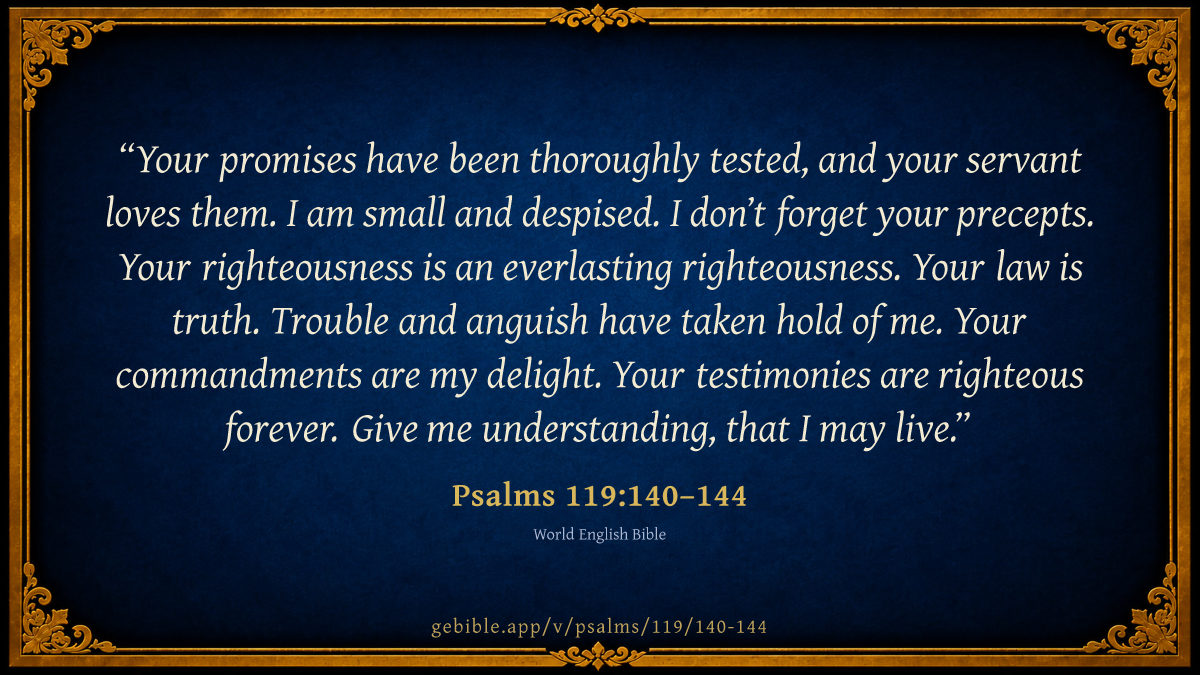
Psalms 119:144(v142)Your testimonies are righteous forever. Give me understanding, that I may live.
Proverbs 10:21(v144)The lips of the righteous feed many, but the foolish die for lack of understanding.
Isaiah 27:11(v144)When its boughs are withered, they will be broken off. The women will come and set them on fire, for they are a people of no understanding.…
Luke 6:20(v141)He lifted up his eyes to his disciples, and said, “Blessed are you who are poor, God’s Kingdom is yours.
Luke 9:58(v141)Jesus said to him, “The foxes have holes, and the birds of the sky have nests, but the Son of Man has no place to lay his head.”
1 Peter 2:2(v140)as newborn babies, long for the pure milk of the Word, that with it you may grow,
1 John 5:20-21(v144)We know that the Son of God has come, and has given us an understanding, that we know him who is true, and we are in him who is true, in…
Psalms 36:6(v142)Your righteousness is like the mountains of God. Your judgments are like a great deep. Yahweh, you preserve man and animal.
Psalms 40:17(v141)But I am poor and needy. May the Lord think about me. You are my help and my deliverer. Don’t delay, my God.
Psalms 119:66(v144)Teach me good judgment and knowledge, for I believe in your commandments.
Psalms 119:109(v141)My soul is continually in my hand, yet I won’t forget your law.
Psalms 119:138(v144)You have commanded your statutes in righteousness. They are fully trustworthy.
Psalms 119:152(v144)Of old I have known from your testimonies, that you have founded them forever.
Proverbs 3:1(v141)My son, don’t forget my teaching; but let your heart keep my commandments:
Proverbs 15:16(v141)Better is little, with the fear of Yahweh, than great treasure with trouble.
Proverbs 16:8(v141)Better is a little with righteousness, than great revenues with injustice.
Isaiah 6:9-10(v144)He said, “Go, and tell this people, ‘You hear indeed, but don’t understand. You see indeed, but don’t perceive.’ Make the heart of this…
Matthew 5:18(v144)For most certainly, I tell you, until heaven and earth pass away, not even one smallest letter or one tiny pen stroke shall in any way pass…
Matthew 13:19(v144)When anyone hears the word of the Kingdom, and doesn’t understand it, the evil one comes, and snatches away that which has been sown in his…
Romans 7:16(v140)But if what I don’t desire, that I do, I consent to the law that it is good.
Ephesians 4:21(v142)if indeed you heard him, and were taught in him, even as truth is in Jesus:
Psalms 18:4-5(v143)The cords of death surrounded me. The floods of ungodliness made me afraid. The cords of Sheol were around me. The snares of death came on…
Psalms 88:3-18(v143)For my soul is full of troubles. My life draws near to Sheol. I am counted among those who go down into the pit. I am like a man who has no…
Psalms 116:3(v143)The cords of death surrounded me, the pains of Sheol got a hold of me. I found trouble and sorrow.
Psalms 119:16(v143)I will delight myself in your statutes. I will not forget your word.
Psalms 119:34(v144)Give me understanding, and I will keep your law. Yes, I will obey it with my whole heart.
Psalms 119:47(v143)I will delight myself in your commandments, because I love them.
Psalms 119:77(v143)Let your tender mercies come to me, that I may live; for your law is my delight.
Psalms 119:176(v141)I have gone astray like a lost sheep. Seek your servant, for I don’t forget your commandments.
Psalms 130:1(v143)Out of the depths I have cried to you, Yahweh.
Proverbs 19:1(v141)Better is the poor who walks in his integrity than he who is perverse in his lips and is a fool.
Isaiah 53:3(v141)He was despised and rejected by men, a man of suffering and acquainted with disease. He was despised as one from whom men hide their face;…
Daniel 9:24(v142)“Seventy weeks are decreed on your people and on your holy city, to finish disobedience, and to make an end of sins, and to make…
Hosea 4:6(v144)My people are destroyed for lack of knowledge. Because you have rejected knowledge, I will also reject you, that you may be no priest to…
Mark 14:33-34(v143)He took with him Peter, James, and John, and began to be greatly troubled and distressed. He said to them, “My soul is exceedingly…
John 17:3(v144)This is eternal life, that they should know you, the only true God, and him whom you sent, Jesus Christ.
2 Thessalonians 1:6-10(v142)Since it is a righteous thing with God to repay affliction to those who afflict you, and to give relief to you who are afflicted with us,…
John 4:34(v143)Jesus said to them, “My food is to do the will of him who sent me and to accomplish his work.
62 distinct cross-references across this passage (63 total citations).
Cross-references from openbible.info (CC BY 4.0)
Explain this passage (17 sources)
Historical commentary, presented as a primary source — not an endorsement.
John Calvin1540 · Public DomainOn vv140, 141, 142, 144140. Thy word is exceedingly refined. In this verse…
140. Thy word is exceedingly refined. In this verse he intimates that the cause of his zeal was the love which he bore to heavenly doctrine. For to be displeased with or severely to condemn the contempt of divine truth, unless we are bound to it by the cords of love, is pure hypocrisy. And he affirms that his love to God’s word was not a rash, or a blind and inconsiderate affection, but that he loved it, because like gold or silver which has been refined, it was pure and free from all dregs and dross. This is the idea contained in the metaphorical term צרופה, tseruphah, translated refined; Dr. Adam Clarke translates צרופה, tseruphah, by purification. This rendering conveys a beautiful idea. God’s word is not only a purified thing, but a thing that purifies. It cleanses from sin every heart with which it comes into contact.
“Now ye are clean,” said Christ, “by the word which I have spoken unto you.” (John 15:3.)
Read full note →
This tendency of the word to impart a measure of its own purity to such as yield to its influence, endears it to all God’s people; and for this reason they make it the subject of their constant meditation.
John Calvin's Commentaries (1540-1563) — public domain. Text from the Calvin Translation Society English edition (1840s-50s) via the Christian Classics Ethereal Library (ccel.org). Calvin's coverage is partial (roughly two-thirds of the Bible); uncommented books and verses are honest gaps, never fabricated. The 19th-century editor's footnotes and remarks are omitted so the notes are faithfully Calvin's own voice.
Geneva Bible translators1599 · Public DomainOn vv140, 141, 144Gold hath need to be fined, but thy word…
Gold hath need to be fined, but thy word is perfection itself.
Geneva Bible (1599) marginal notes — public domain.
John Trapp1656 · Public DomainOn vv140–144Psa 119:140 Thy word [is] very pure: therefore thy…
Psa 119:140 Thy word [is] very pure: therefore thy servant loveth it.
Ver. 140. Thy word is very pure] And calleth for purity. Hence wicked men slight it; but saints the rather embrace it, desirous to be conformed to the heavenly pattern.
John Trapp, A Commentary or Exposition upon All the Books of the Old and New Testament (1647–1656) — public domain. Text from a community e-Sword module.
Matthew Poole1685 · Public DomainOn vv140–144Very pure; without the least mixture of any falsehood…
Very pure; without the least mixture of any falsehood or sin, both which are frequent in the words or precepts of men.
Therefore; because of that exact purity and holiness of it, for which very reason ungodly men either despise or hate it.
Matthew Poole's English Annotations on the Holy Bible (1683–1685) — public domain. Text from a community e-Sword/MySword module.
Matthew Henry1710 · Public DomainOn vv140–143Here is, 1. David's great affection for the word…
Here is, 1. David's great affection for the word of God: Thy servant loves it. Every good man, being a servant of God, loves the word of God, because it lets him know his Master's will and directs him in his Master's work. Wherever there is grace there is a warm attachment to the word of God. 2. The ground and reason of that affection; he saw it to be very pure, and therefore he loved it. Our love to the word of God is then an evidence of our love to God when we love it for the sake of its purity, because it bears the image of God's holiness and is designed to make us partakers of his holiness. It commands purity, and, as it is itself refined from all corrupt mixture, so if we receive it in the light and love of it it will refine us from the dross of worldliness and fleshly-mindedness.
Matthew Henry's Commentary on the Whole Bible (1708–1710) — public domain (CC PDM 1.0). Text via the HelloAO Bible API.
John Gill1763 · Public DomainOn vv140–144The righteousness of thy testimonies is everlasting,.... Or, "for…
The righteousness of thy testimonies is everlasting,.... Or, "for ever" (b). The righteousness which they require, or which they publish; the righteousness revealed in the Gospel, which is the righteousness of Christ; See Gill on Psa 119:142;
give me understanding, and I shall live; an understanding of the testimonies of the Lord, of the word of God, the law of God, and Gospel of Christ; an understanding of divine and spiritual things; a clearer and larger understanding of them, which is the gift of God; both that itself at first, and an increase of it here prayed for, the end, issue, and effect of which is life. Such live spiritually, and by faith; they live cheerfully and comfortably, and "for ever", as Aben Ezra and Kimchi repeat from the former clause: for "this is life eternal know the only true God and Jesus Christ"; or to have spiritual understanding of them, and of those things which relate to spiritual peace and comfort here, and eternal happiness hereafter, Joh 17:3.
Read full note →
(b) "in seculum", Pagninus, Montanus, Junius & Tremellius, Piscator, Cocceius; "in aeternum", V. L.
John Gill's Exposition of the Whole Bible (1746–1763) — public domain (CC PDM 1.0). Text via the HelloAO Bible API.
John Wesley1765 · Public DomainOn vv140, 142, 143Pure - Without the least mixture of falsehood.
Pure - Without the least mixture of falsehood.
John Wesley, Explanatory Notes Upon the Whole Bible (1754–1765) — public domain. Text via the GEBible commentary corpus.
Adam Clarke1810 · Public DomainOn vv140–144Verse 140. Thy word is very pure] צרופה tseruphah,…
Verse 140. Thy word is very pure] צרופה tseruphah, it is purification. It is not a purified thing, but a thing that purifies. "Now ye are clean," said Christ, "by the word I have spoken unto you." God's word is a fire to purify as well as a hammer to break.
Adam Clarke's Commentary on the Bible (1810–1826) — public domain. Text from a community e-Sword/MySword module.
Joseph Benson1811 · Public DomainOn v142Psa 119:142-144. Thy righteousness is an everlasting righteousness —…
Psa 119:142-144. Thy righteousness is an everlasting righteousness — Constant and unchangeable, the same in all ages and places, and to all persons; of eternal truth and justice never to be dispensed with, nor to be made void. And thy law is truth — Nothing but truth, or as true as truth itself. Trouble and anguish have taken hold on me — Outward trouble and anguish of spirit; or great anguish and distress. Yet thy commandments are my delights — My trouble and anguish do not take away my taste for the comforts of thy word: but I can still relish them, and find that peace and pleasure in them, which all the calamities of this present life cannot deprive me of. Indeed, the saints have frequently the sweetest enjoyment of the delights which there are in God’s word, when they are in a state of trouble and distress. Give me understanding, and I shall live — I shall be kept from those sins which bring spiritual death, and expose to eternal death: I shall live a life of grace here, and glory hereafter.
Joseph Benson's Commentary on the Old and New Testaments (1811–1818) — public domain. Text from a community e-Sword module.
Albert Barnes1834 · Public DomainOn vv140–144Thy word is very pure - Margin, “tried or…
Thy word is very pure - Margin, “tried or refined.” See the word explained in the notes at Psa 18:30.
Therefore thy servant loveth it - Therefore I love it. I love it because it is pure, holy, true; not merely because it will save me. Apart from all reference to myself. I love thy truth as truth; I love purity as purity; I love law as law; I love holiness as holiness. This is true religion.
Albert Barnes' Notes on the Bible (1834–1885) — public domain. Text from a community e-Sword/MySword module.
The Cambridge Bible for Schools and Colleges1878 · Public DomainOn vv140–144140. pure] Lit. tried, or, refined: like pure gold…
140. pure] Lit. tried, or, refined: like pure gold without any admixture of dross. Cp. Psa_18:30; Psa_12:6.
The Cambridge Bible for Schools and Colleges (gen. ed. J. J. S. Perowne; Cambridge University Press, 1878–1918) — public domain. Text from a community e-Sword module.
Ellicott's Commentary for English Readers1878 · Public DomainOn vv140–142(140) Pure.—More literally, purged by trial. LXX. and Vulg.,…
(140) Pure.—More literally, purged by trial. LXX. and Vulg., “fired.” It is not only the excellence, but the proved excellence, of the Divine Word, which is the object of love and adoration here.
A Bible Commentary for English Readers, edited by Charles John Ellicott (1878–1897) — public domain. Text from a community e-Sword module.
The Pulpit Commentary1880 · Public DomainOn vv140–144Thy Word is very pure; or, "is purged, assayed,…
Thy Word is very pure; or, "is purged, assayed, tried in the fire." God"s "promises" are especially meant, which the course of events tests. Therefore thy servant loveth it (comp. vers. 97, 113, 119, 127, 159, 163).
The Pulpit Commentary (1880–1919), ed. H.D.M. Spence-Jones & Joseph S. Exell — public domain. Text from a community e-Sword module.
Charles H. Spurgeon1885 · Public DomainOn vv140–144Ver. 140. Thy word is very pure. It is…
Ver. 140. Thy word is very pure. It is truth distilled, holiness in its quintessence. In the word of God there is no admixture of error or sin. It is pure in its sense, pure in its language, pure in its spirit, pure in its influence, and all this to the very highest degree "very pure." "Therefore thy servant loveth it, "which is a proof that he himself was pure in heart, for only those who are pure love God's word because of its purity. His heart was knit to the word because of its glorious holiness and truth. He admired it, delighted in it, sought to practise it, and longed to come under its purifying power.
Ver. 140. Thy word is very pure. In the original, "tried, purified, like gold in the furnace, "absolutely perfect, without the dross vanity and fallibility, which runs through human writings. The more we try the promises, the surer we shall find them. Pure gold is so fixed, Boerhaave, informs us of an ounce of it set in the eye of a glass furnace for two months, without losing a single grain. George Horne.
Read full note →
Ver. 140. Thy word is very pure; therefore, etc. The word of God is not only "pure, "free from all base admixture, but it is a purifier;it cleanses from sin and guilt every heart with which into comes into contact. "Now ye are clean, "said Jesus Christ to his disciples, "by the word which I have spoken unto you": Joh 15:3. It is this its pure quality combined with its tendency to purify every nature that yields to its holy influence, that endears it to every child of God. Here it is that he finds those views of the divine character, those promises, those precepts, those representations of the deformity of sin, of the beauty of holiness, which lead him, above all things, to seek conformity to the divine image. A child of God in his best moments does not wish the word of God brought down to a level with his own imperfect character, but desires rather that his character may be gradually raised to a conformity to that blessed word. Because it is altogether pure, and because it tends to convey to those who make it their constant study a measure of its own purity, the child of God loves it, and delights to meditate in it day and night. John Morison.
Ver. 140. Thy word is very pure. Before I knew the word of God in spirit and in truth, for its great antiquity, its interesting narratives, its impartial biography, its pure morality, its sublime poetry, in a word, for its beautiful and wonderful variety, I preferred it to all other books; but since I have entered into its spirit, like the Psalmist, I love it above all things for its purity; and desire, whatever else I read, it may tend to increase my knowledge of the Bible, and strengthen my affection for its divine and holy truths. Sir William Jones, 1746-1794.
Ver. 140. Thy word. Let us refresh our minds and our memories with some of the Scripture adjuncts connected with "the word, "and realize, in some degree at least, the manifold relations which it bears both to God and our souls. It is called "the word of Christ, " because much of it was given by him, and it all bears testimony to him...It is called "the word of his grace, "because the glorious theme on which it loves to expatiate is grace, and especially grace as it is seen in Christ's dying love for sinful men. It is called ololov tou staurou, "the word of the cross" (1Co 1:18), because in the crucifixion of the divine Redeemer we see eternal mercy in its brightest lustre. It is called "the word of the gospel, "because it brings glad tidings of great joy to all nations. It is called "the word of the kingdom, "because it holds out to all believers the hope of an everlasting kingdom of righteousness and peace. It is called "the word of salvation, "because the purpose for which it was given is the salvation of sinners. It is called "the word of truth, "because, as Chillingworth says, it has God for its author, salvation for its end, and truth without mixture of error for its contents. And we will only add, it is called "the word of life, "because it reveals to a sinful, perishing world the doctrines of life and immortality. IV. Graham, in "A Commentary on the First Epistle of John, "1857.
Ver. 140. Therefore thy servant loveth it. Love in God is the fountain of all his benefits extended to us; and love in man is the fountain of all our service and obedience to God. He loved us first to do us good; and hereof it comes that we have grace to love him next to do him service. Love is such a duty that the want thereof cannot be excused in any; for the poorest both may and should love God: yet without it all the rest thou canst do in his service is nothing; nay, not if thou shouldest give thy goods to the poor, and offer thy body to be burned. Small sacrifices, flowing from faith and love, are welcome to him, where greater without these are but abomination to him. Proofs of both we have in the widow's mite and Cain's rich oblation; whereof the one was rejected, the other received. Happy are we though we cannot say, "We have done as God commands, "if out of a good heart we can say, "We love to do what he commands." William Cowper.
Ver. 140. Therefore thy servant loveth it. Of all our grounds and reasons of love to the word of God, the most noble and excellent is to love the word for its purity. This showeth indeed that we are made partakers of the Divine nature: 2Pe 1:4. For I play you mark, when we hate evil as evil, and love good as good, we have the same love and hatred that God hat Is. When once we come to love things because they are pure, it is a sign that we have the same love that God hath. Thomas Manton.
Ver. 140. Thy servant loveth it. Otherwise, indeed, the Psalmist would not have been the Lord's servant at all. But he glories in the title because he delights in the pure service. John Stephen.
Ver. 140-141. God's own utterance is indeed without spot, and therefore not to be carped at; it is pure, fire proved, noblest metal, therefore he loves it, and does not, though young and lightly esteemed, care for the remonstrances of his proud opponents, who are older and more learned than himself. Franz Delitzsch.
Ver. 140.
1. An awakened sinner adoring the holy law.
2. A saint loving it because the pure love the pure.
3. A saint among sinners loving the law all the more for its contrast.
Ver. 140.
1. The crystal stream.
(a) Flows from under the throne.
(b) Mirrors heaven.
(c) Undefiled through the ages.
(d) Nourishes holiness as it flows.
2. The enraptured pilgrim.
(a) Keeping by its brink.
(b) Delighted with its lucid depths.
3. Pleased with its mirrored revelations self, heaven, God.
4. Cleansed and refreshed by its waters. W.B.H.
Ver. 140.
1. The purity of God's Word.
(a) It proceeds from a perfectly pure source: "Thy word."
(b) It reveals a purity otherwise unknown.
(c) It treats impure subjects with absolute purity.
(d) It inculcates the most perfect purity.
(e) It produces such purity in those who are subject to its
power.
2. The love which its purity inspires in gracious souls.
(a) They love it because, while it reveals their natural
impurity, it shows them how to escape from it.
(b) They love it because it conforms them to its own purity.
(c) They love it because to a pure heart the purity of the
word is one of its chief commendations.
3. The evidences of this love to the pure word.
(a) Desire to possess it in its purity.
(b) Subjection to its spirit and
teachings.
(c) Zeal for its honour and diffusion. W.H.J.P.
Psalms 119:141*
Charles H. Spurgeon's The Treasury of David (1869–1885) — public domain. Psalms only. Text from a community e-Sword/MySword module.
The Biblical Illustrator1887 · Public DomainOn vv140, 141, 144Thy Word is very pure; therefore Thy servant loveth…
Psa_119:140
Thy Word is very pure; therefore Thy servant loveth it.
Read full note →
Religious affections spring from love to Divine things
1. A love to Divine things for the beauty of their moral excellency is the spring of all holy affections.
2. There is given to believers a new, supernatural sense, which perceives the beauty of holiness and is affected thereby. A holy object calls out a holy affection. The beauty and sweetness of holiness as found in God forms the grand object of a spiritual taste and appetite.
3. This moral beauty in God leads to the adoration of God by saint and angel.
Conclusions.
1. By this all may try their affections, their love and their joy. Graceless persons see no beauty in holy things.
2. The natural mind may have a great sense of Gods greatness, wisdom and power: that is, of His natural attributes.
3. This sense of the natural mind may affect men in various ways--fill them with awe and terror, or with joy and praise. Hence too much stress may be placed upon the mere natural discoveries of the natural attributes in God. Man may be overwhelmed by a sense of Gods greatness and majesty, and yet be without a particle of love to Divine things. But to the spiritual mind the natural attributes of God are all the more engaging because they are supplemented by His moral attributes.
4. And so, I may add, what love to Divine things do those possess who seem to be filled with worldliness, and are so fond of operas, theatres and frivolous amusements? (Homiletic Review.)
Gods Word tried to the uttermost
(P. B. Version:--Notice a few of the ways in which the Word of God has been tried and found perfect.
I. By prophecy. Things, and events, and persons have been foretold and described in it with the minutest detail, and they have all in due time been accomplished; as the seed of the woman predicted in Paradise, the deluge, the birth of Isaac, and Abrahams numerous posterity, the respective characters of Jacob and Esau, the future history of the twelve tribes, foretold by Jacob on his death-bed, the prophet like unto Moses, the 430 years of Israels wanderings, the deliverance from Egypt, and possession of Palestine, etc.
II. By miracles. Tried to the uttermost has the Word of God been by miracles of every variety, performed on every element, on the living and the dead, on fire and water, on Satan and his legions, on disease, the brute creation, and especially by the Resurrection and Ascension of our Lord.
III. By persecution. Satan and wicked men have often tried to quench this spirit from Heaven. As Ahab hated Michaiah, and for the same reason, because he told him the truth, men have fettered and silenced and destroyed the Word of God. Jehoiakim was not the only one who cut and burnt the sacred Scriptures. It has been tried to the uttermost in the furnace of persecution, and the result is that it is very pure, proved more manifestly than ever to be from heaven.
IV. By science.
V. By experience. Thousands, millions have proved it to be Gods power unto salvation. It has enlightened, renewed, comforted, and saved them. (John Harding, D. D.)
The Biblical Illustrator, edited by Joseph S. Exell (c. 1880s–1900s) — public domain. Text from a community e-Sword module.
unfoldingWord translationNotes2017 · CC BY-SA 4.0On vv141, 143I am ... despised
I am ... despised
This can be stated in active form. AT: "People despise me" (See: Active or Passive)

John Calvin 1540 · Public Domain On vv140, 141, 142, 144 140. Thy word is exceedingly refined. In this verse…
140. Thy word is exceedingly refined. In this verse he intimates that the cause of his zeal was the love which he bore to heavenly doctrine. For to be displeased with or severely to condemn the contempt of divine truth, unless we are bound to it by the cords of love, is pure hypocrisy. And he affirms that his love to God’s word was not a rash, or a blind and inconsiderate affection, but that he loved it, because like gold or silver which has been refined, it was pure and free from all dregs and dross. This is the idea contained in the metaphorical term צרופה, tseruphah, translated refined; Dr. Adam Clarke translates צרופה, tseruphah, by purification. This rendering conveys a beautiful idea. God’s word is not only a purified thing, but a thing that purifies. It cleanses from sin every heart with which it comes into contact.
“Now ye are clean,” said Christ, “by the word which I have spoken unto you.” (John 15:3.)
Read full note →
This tendency of the word to impart a measure of its own purity to such as yield to its influence, endears it to all God’s people; and for this reason they make it the subject of their constant meditation.
John Calvin's Commentaries (1540-1563) — public domain. Text from the Calvin Translation Society English edition (1840s-50s) via the Christian Classics Ethereal Library (ccel.org). Calvin's coverage is partial (roughly two-thirds of the Bible); uncommented books and verses are honest gaps, never fabricated. The 19th-century editor's footnotes and remarks are omitted so the notes are faithfully Calvin's own voice.
Geneva Bible translators 1599 · Public Domain On vv140, 141, 144 Gold hath need to be fined, but thy word…
Gold hath need to be fined, but thy word is perfection itself.
Geneva Bible (1599) marginal notes — public domain.
John Trapp 1656 · Public Domain On vv140–144 Psa 119:140 Thy word [is] very pure: therefore thy…
Psa 119:140 Thy word [is] very pure: therefore thy servant loveth it.
Ver. 140. Thy word is very pure] And calleth for purity. Hence wicked men slight it; but saints the rather embrace it, desirous to be conformed to the heavenly pattern.
John Trapp, A Commentary or Exposition upon All the Books of the Old and New Testament (1647–1656) — public domain. Text from a community e-Sword module.
Matthew Poole 1685 · Public Domain On vv140–144 Very pure; without the least mixture of any falsehood…
Very pure; without the least mixture of any falsehood or sin, both which are frequent in the words or precepts of men.
Therefore; because of that exact purity and holiness of it, for which very reason ungodly men either despise or hate it.
Matthew Poole's English Annotations on the Holy Bible (1683–1685) — public domain. Text from a community e-Sword/MySword module.
Matthew Henry 1710 · Public Domain On vv140–143 Here is, 1. David's great affection for the word…
Here is, 1. David's great affection for the word of God: Thy servant loves it. Every good man, being a servant of God, loves the word of God, because it lets him know his Master's will and directs him in his Master's work. Wherever there is grace there is a warm attachment to the word of God. 2. The ground and reason of that affection; he saw it to be very pure, and therefore he loved it. Our love to the word of God is then an evidence of our love to God when we love it for the sake of its purity, because it bears the image of God's holiness and is designed to make us partakers of his holiness. It commands purity, and, as it is itself refined from all corrupt mixture, so if we receive it in the light and love of it it will refine us from the dross of worldliness and fleshly-mindedness.
Matthew Henry's Commentary on the Whole Bible (1708–1710) — public domain (CC PDM 1.0). Text via the HelloAO Bible API.
John Gill 1763 · Public Domain On vv140–144 The righteousness of thy testimonies is everlasting,.... Or, "for…
The righteousness of thy testimonies is everlasting,.... Or, "for ever" (b). The righteousness which they require, or which they publish; the righteousness revealed in the Gospel, which is the righteousness of Christ; See Gill on Psa 119:142;
give me understanding, and I shall live; an understanding of the testimonies of the Lord, of the word of God, the law of God, and Gospel of Christ; an understanding of divine and spiritual things; a clearer and larger understanding of them, which is the gift of God; both that itself at first, and an increase of it here prayed for, the end, issue, and effect of which is life. Such live spiritually, and by faith; they live cheerfully and comfortably, and "for ever", as Aben Ezra and Kimchi repeat from the former clause: for "this is life eternal know the only true God and Jesus Christ"; or to have spiritual understanding of them, and of those things which relate to spiritual peace and comfort here, and eternal happiness hereafter, Joh 17:3.
Read full note →
(b) "in seculum", Pagninus, Montanus, Junius & Tremellius, Piscator, Cocceius; "in aeternum", V. L.
John Gill's Exposition of the Whole Bible (1746–1763) — public domain (CC PDM 1.0). Text via the HelloAO Bible API.
John Wesley 1765 · Public Domain On vv140, 142, 143 Pure - Without the least mixture of falsehood.
Pure - Without the least mixture of falsehood.
John Wesley, Explanatory Notes Upon the Whole Bible (1754–1765) — public domain. Text via the GEBible commentary corpus.
Adam Clarke 1810 · Public Domain On vv140–144 Verse 140. Thy word is very pure] צרופה tseruphah,…
Verse 140. Thy word is very pure] צרופה tseruphah, it is purification. It is not a purified thing, but a thing that purifies. "Now ye are clean," said Christ, "by the word I have spoken unto you." God's word is a fire to purify as well as a hammer to break.
Adam Clarke's Commentary on the Bible (1810–1826) — public domain. Text from a community e-Sword/MySword module.
Joseph Benson 1811 · Public Domain On v142 Psa 119:142-144. Thy righteousness is an everlasting righteousness —…
Psa 119:142-144. Thy righteousness is an everlasting righteousness — Constant and unchangeable, the same in all ages and places, and to all persons; of eternal truth and justice never to be dispensed with, nor to be made void. And thy law is truth — Nothing but truth, or as true as truth itself. Trouble and anguish have taken hold on me — Outward trouble and anguish of spirit; or great anguish and distress. Yet thy commandments are my delights — My trouble and anguish do not take away my taste for the comforts of thy word: but I can still relish them, and find that peace and pleasure in them, which all the calamities of this present life cannot deprive me of. Indeed, the saints have frequently the sweetest enjoyment of the delights which there are in God’s word, when they are in a state of trouble and distress. Give me understanding, and I shall live — I shall be kept from those sins which bring spiritual death, and expose to eternal death: I shall live a life of grace here, and glory hereafter.
Joseph Benson's Commentary on the Old and New Testaments (1811–1818) — public domain. Text from a community e-Sword module.
Albert Barnes 1834 · Public Domain On vv140–144 Thy word is very pure - Margin, “tried or…
Thy word is very pure - Margin, “tried or refined.” See the word explained in the notes at Psa 18:30.
Therefore thy servant loveth it - Therefore I love it. I love it because it is pure, holy, true; not merely because it will save me. Apart from all reference to myself. I love thy truth as truth; I love purity as purity; I love law as law; I love holiness as holiness. This is true religion.
Albert Barnes' Notes on the Bible (1834–1885) — public domain. Text from a community e-Sword/MySword module.
The Cambridge Bible for Schools and Colleges 1878 · Public Domain On vv140–144 140. pure] Lit. tried, or, refined: like pure gold…
140. pure] Lit. tried, or, refined: like pure gold without any admixture of dross. Cp. Psa_18:30; Psa_12:6.
The Cambridge Bible for Schools and Colleges (gen. ed. J. J. S. Perowne; Cambridge University Press, 1878–1918) — public domain. Text from a community e-Sword module.
Ellicott's Commentary for English Readers 1878 · Public Domain On vv140–142 (140) Pure.—More literally, purged by trial. LXX. and Vulg.,…
(140) Pure.—More literally, purged by trial. LXX. and Vulg., “fired.” It is not only the excellence, but the proved excellence, of the Divine Word, which is the object of love and adoration here.
A Bible Commentary for English Readers, edited by Charles John Ellicott (1878–1897) — public domain. Text from a community e-Sword module.
The Pulpit Commentary 1880 · Public Domain On vv140–144 Thy Word is very pure; or, "is purged, assayed,…
Thy Word is very pure; or, "is purged, assayed, tried in the fire." God"s "promises" are especially meant, which the course of events tests. Therefore thy servant loveth it (comp. vers. 97, 113, 119, 127, 159, 163).
The Pulpit Commentary (1880–1919), ed. H.D.M. Spence-Jones & Joseph S. Exell — public domain. Text from a community e-Sword module.
Charles H. Spurgeon 1885 · Public Domain On vv140–144 Ver. 140. Thy word is very pure. It is…
Ver. 140. Thy word is very pure. It is truth distilled, holiness in its quintessence. In the word of God there is no admixture of error or sin. It is pure in its sense, pure in its language, pure in its spirit, pure in its influence, and all this to the very highest degree "very pure." "Therefore thy servant loveth it, "which is a proof that he himself was pure in heart, for only those who are pure love God's word because of its purity. His heart was knit to the word because of its glorious holiness and truth. He admired it, delighted in it, sought to practise it, and longed to come under its purifying power.
Ver. 140. Thy word is very pure. In the original, "tried, purified, like gold in the furnace, "absolutely perfect, without the dross vanity and fallibility, which runs through human writings. The more we try the promises, the surer we shall find them. Pure gold is so fixed, Boerhaave, informs us of an ounce of it set in the eye of a glass furnace for two months, without losing a single grain. George Horne.
Read full note →
Ver. 140. Thy word is very pure; therefore, etc. The word of God is not only "pure, "free from all base admixture, but it is a purifier;it cleanses from sin and guilt every heart with which into comes into contact. "Now ye are clean, "said Jesus Christ to his disciples, "by the word which I have spoken unto you": Joh 15:3. It is this its pure quality combined with its tendency to purify every nature that yields to its holy influence, that endears it to every child of God. Here it is that he finds those views of the divine character, those promises, those precepts, those representations of the deformity of sin, of the beauty of holiness, which lead him, above all things, to seek conformity to the divine image. A child of God in his best moments does not wish the word of God brought down to a level with his own imperfect character, but desires rather that his character may be gradually raised to a conformity to that blessed word. Because it is altogether pure, and because it tends to convey to those who make it their constant study a measure of its own purity, the child of God loves it, and delights to meditate in it day and night. John Morison.
Ver. 140. Thy word is very pure. Before I knew the word of God in spirit and in truth, for its great antiquity, its interesting narratives, its impartial biography, its pure morality, its sublime poetry, in a word, for its beautiful and wonderful variety, I preferred it to all other books; but since I have entered into its spirit, like the Psalmist, I love it above all things for its purity; and desire, whatever else I read, it may tend to increase my knowledge of the Bible, and strengthen my affection for its divine and holy truths. Sir William Jones, 1746-1794.
Ver. 140. Thy word. Let us refresh our minds and our memories with some of the Scripture adjuncts connected with "the word, "and realize, in some degree at least, the manifold relations which it bears both to God and our souls. It is called "the word of Christ, " because much of it was given by him, and it all bears testimony to him...It is called "the word of his grace, "because the glorious theme on which it loves to expatiate is grace, and especially grace as it is seen in Christ's dying love for sinful men. It is called ololov tou staurou, "the word of the cross" (1Co 1:18), because in the crucifixion of the divine Redeemer we see eternal mercy in its brightest lustre. It is called "the word of the gospel, "because it brings glad tidings of great joy to all nations. It is called "the word of the kingdom, "because it holds out to all believers the hope of an everlasting kingdom of righteousness and peace. It is called "the word of salvation, "because the purpose for which it was given is the salvation of sinners. It is called "the word of truth, "because, as Chillingworth says, it has God for its author, salvation for its end, and truth without mixture of error for its contents. And we will only add, it is called "the word of life, "because it reveals to a sinful, perishing world the doctrines of life and immortality. IV. Graham, in "A Commentary on the First Epistle of John, "1857.
Ver. 140. Therefore thy servant loveth it. Love in God is the fountain of all his benefits extended to us; and love in man is the fountain of all our service and obedience to God. He loved us first to do us good; and hereof it comes that we have grace to love him next to do him service. Love is such a duty that the want thereof cannot be excused in any; for the poorest both may and should love God: yet without it all the rest thou canst do in his service is nothing; nay, not if thou shouldest give thy goods to the poor, and offer thy body to be burned. Small sacrifices, flowing from faith and love, are welcome to him, where greater without these are but abomination to him. Proofs of both we have in the widow's mite and Cain's rich oblation; whereof the one was rejected, the other received. Happy are we though we cannot say, "We have done as God commands, "if out of a good heart we can say, "We love to do what he commands." William Cowper.
Ver. 140. Therefore thy servant loveth it. Of all our grounds and reasons of love to the word of God, the most noble and excellent is to love the word for its purity. This showeth indeed that we are made partakers of the Divine nature: 2Pe 1:4. For I play you mark, when we hate evil as evil, and love good as good, we have the same love and hatred that God hat Is. When once we come to love things because they are pure, it is a sign that we have the same love that God hath. Thomas Manton.
Ver. 140. Thy servant loveth it. Otherwise, indeed, the Psalmist would not have been the Lord's servant at all. But he glories in the title because he delights in the pure service. John Stephen.
Ver. 140-141. God's own utterance is indeed without spot, and therefore not to be carped at; it is pure, fire proved, noblest metal, therefore he loves it, and does not, though young and lightly esteemed, care for the remonstrances of his proud opponents, who are older and more learned than himself. Franz Delitzsch.
Ver. 140.
1. An awakened sinner adoring the holy law.
2. A saint loving it because the pure love the pure.
3. A saint among sinners loving the law all the more for its contrast.
Ver. 140.
1. The crystal stream.
(a) Flows from under the throne.
(b) Mirrors heaven.
(c) Undefiled through the ages.
(d) Nourishes holiness as it flows.
2. The enraptured pilgrim.
(a) Keeping by its brink.
(b) Delighted with its lucid depths.
3. Pleased with its mirrored revelations self, heaven, God.
4. Cleansed and refreshed by its waters. W.B.H.
Ver. 140.
1. The purity of God's Word.
(a) It proceeds from a perfectly pure source: "Thy word."
(b) It reveals a purity otherwise unknown.
(c) It treats impure subjects with absolute purity.
(d) It inculcates the most perfect purity.
(e) It produces such purity in those who are subject to its
power.
2. The love which its purity inspires in gracious souls.
(a) They love it because, while it reveals their natural
impurity, it shows them how to escape from it.
(b) They love it because it conforms them to its own purity.
(c) They love it because to a pure heart the purity of the
word is one of its chief commendations.
3. The evidences of this love to the pure word.
(a) Desire to possess it in its purity.
(b) Subjection to its spirit and
teachings.
(c) Zeal for its honour and diffusion. W.H.J.P.
Psalms 119:141*
Charles H. Spurgeon's The Treasury of David (1869–1885) — public domain. Psalms only. Text from a community e-Sword/MySword module.
The Biblical Illustrator 1887 · Public Domain On vv140, 141, 144 Thy Word is very pure; therefore Thy servant loveth…
Psa_119:140
Thy Word is very pure; therefore Thy servant loveth it.
Read full note →
Religious affections spring from love to Divine things
1. A love to Divine things for the beauty of their moral excellency is the spring of all holy affections.
2. There is given to believers a new, supernatural sense, which perceives the beauty of holiness and is affected thereby. A holy object calls out a holy affection. The beauty and sweetness of holiness as found in God forms the grand object of a spiritual taste and appetite.
3. This moral beauty in God leads to the adoration of God by saint and angel.
Conclusions.
1. By this all may try their affections, their love and their joy. Graceless persons see no beauty in holy things.
2. The natural mind may have a great sense of Gods greatness, wisdom and power: that is, of His natural attributes.
3. This sense of the natural mind may affect men in various ways--fill them with awe and terror, or with joy and praise. Hence too much stress may be placed upon the mere natural discoveries of the natural attributes in God. Man may be overwhelmed by a sense of Gods greatness and majesty, and yet be without a particle of love to Divine things. But to the spiritual mind the natural attributes of God are all the more engaging because they are supplemented by His moral attributes.
4. And so, I may add, what love to Divine things do those possess who seem to be filled with worldliness, and are so fond of operas, theatres and frivolous amusements? (Homiletic Review.)
Gods Word tried to the uttermost
(P. B. Version:--Notice a few of the ways in which the Word of God has been tried and found perfect.
I. By prophecy. Things, and events, and persons have been foretold and described in it with the minutest detail, and they have all in due time been accomplished; as the seed of the woman predicted in Paradise, the deluge, the birth of Isaac, and Abrahams numerous posterity, the respective characters of Jacob and Esau, the future history of the twelve tribes, foretold by Jacob on his death-bed, the prophet like unto Moses, the 430 years of Israels wanderings, the deliverance from Egypt, and possession of Palestine, etc.
II. By miracles. Tried to the uttermost has the Word of God been by miracles of every variety, performed on every element, on the living and the dead, on fire and water, on Satan and his legions, on disease, the brute creation, and especially by the Resurrection and Ascension of our Lord.
III. By persecution. Satan and wicked men have often tried to quench this spirit from Heaven. As Ahab hated Michaiah, and for the same reason, because he told him the truth, men have fettered and silenced and destroyed the Word of God. Jehoiakim was not the only one who cut and burnt the sacred Scriptures. It has been tried to the uttermost in the furnace of persecution, and the result is that it is very pure, proved more manifestly than ever to be from heaven.
IV. By science.
V. By experience. Thousands, millions have proved it to be Gods power unto salvation. It has enlightened, renewed, comforted, and saved them. (John Harding, D. D.)
The Biblical Illustrator, edited by Joseph S. Exell (c. 1880s–1900s) — public domain. Text from a community e-Sword module.
unfoldingWord translationNotes 2017 · CC BY-SA 4.0 On vv141, 143 I am ... despised
I am ... despised
This can be stated in active form. AT: "People despise me" (See: Active or Passive)
Read full note →
translationWords
just
eternity
law
trust
unfoldingWord translationNotes — © Distant Shores Media and the Door43 World Missions Community, licensed CC BY-SA 4.0. Source: git.door43.org/Door43/en_tn.
Tyndale Open Study Notes 2022 · CC BY-SA 4.0 On v141 119:141 The psalmist is greatly troubled by his oppressors…
119:141 The psalmist is greatly troubled by his oppressors (see 119:143; cp. Isa 53).
Tyndale Open Study Notes — © Tyndale Open Resources, licensed CC BY-SA 4.0. Text via the HelloAO Bible API.