Deuteronomy 30:6(v25)Yahweh your God will circumcise your heart, and the heart of your offspring, to love Yahweh your God with all your heart and with all your…
Psalms 71:20(v25)You, who have shown us many and bitter troubles, you will let me live. You will bring us up again from the depths of the earth.
Psalms 119:159(v25)Consider how I love your precepts. Revive me, Yahweh, according to your loving kindness.
Colossians 3:2(v25)Set your mind on the things that are above, not on the things that are on the earth.
Psalms 44:25(v25)For our soul is bowed down to the dust. Our body clings to the earth.
Show all 42 cross-references
Psalms 119:92(v24)Unless your law had been my delight, I would have perished in my affliction.
Psalms 143:11(v25)Revive me, Yahweh, for your name’s sake. In your righteousness, bring my soul out of trouble.
Romans 7:22-24(v25)For I delight in God’s law after the inward man, but I see a different law in my members, warring against the law of my mind, and bringing…
2 Timothy 3:15-17(v24)From infancy, you have known the holy Scriptures which are able to make you wise for salvation through faith, which is in Christ Jesus.…
Psalms 119:40(v25)Behold, I long for your precepts! Revive me in your righteousness.
Psalms 119:88(v25)Preserve my life according to your loving kindness, so I will obey the statutes of your mouth.
Psalms 119:93(v25)I will never forget your precepts, for with them, you have revived me.
Psalms 119:156(v25)Great are your tender mercies, Yahweh. Revive me according to your ordinances.
Colossians 3:16(v24)Let the word of Christ dwell in you richly; in all wisdom teaching and admonishing one another with psalms, hymns, and spiritual songs,…
Psalms 2:1-2(v23)Why do the nations rage, and the peoples plot a vain thing? The kings of the earth take a stand, and the rulers take counsel together,…
Psalms 80:18(v25)So we will not turn away from you. Revive us, and we will call on your name.
Psalms 119:16(v24)I will delight myself in your statutes. I will not forget your word.
Psalms 119:37(v25)Turn my eyes away from looking at worthless things. Revive me in your ways.
Joshua 1:8(v24)This book of the law shall not depart from your mouth, but you shall meditate on it day and night, that you may observe to do according to…
Psalms 119:107(v25)I am afflicted very much. Revive me, Yahweh, according to your word.
Psalms 119:149(v25)Hear my voice according to your loving kindness. Revive me, Yahweh, according to your ordinances.
Philippians 3:19(v25)whose end is destruction, whose god is the belly, and whose glory is in their shame, who think about earthly things.
2 Samuel 7:27-29(v25)For you, Yahweh of Armies, the God of Israel, have revealed to your servant, saying, ‘I will build you a house.’ Therefore your servant has…
Psalms 19:11(v24)Moreover your servant is warned by them. In keeping them there is great reward.
Psalms 119:97-100(v24)How I love your law! It is my meditation all day. Your commandments make me wiser than my enemies, for your commandments are always with…
Proverbs 6:20-23(v24)My son, keep your father’s commandment, and don’t forsake your mother’s teaching. Bind them continually on your heart. Tie them around your…
Isaiah 65:25(v25)The wolf and the lamb will feed together. The lion will eat straw like the ox. Dust will be the serpent’s food. They will not hurt nor…
Psalms 22:15(v25)My strength is dried up like a potsherd. My tongue sticks to the roof of my mouth. You have brought me into the dust of death.
Psalms 119:77(v24)Let your tender mercies come to me, that I may live; for your law is my delight.
Psalms 119:104-105(v24)Through your precepts, I get understanding; therefore I hate every false way. Your word is a lamp to my feet, and a light for my path.
Psalms 119:143(v24)Trouble and anguish have taken hold of me. Your commandments are my delight.
Psalms 119:162(v24)I rejoice at your word, as one who finds great plunder.
Romans 8:2-3(v25)For the law of the Spirit of life in Christ Jesus made me free from the law of sin and of death. For what the law couldn’t do, in that it…
Deuteronomy 17:18-20(v24)It shall be, when he sits on the throne of his kingdom, that he shall write himself a copy of this law in a book, out of that which is…
1 Samuel 22:7-13(v23)Saul said to his servants who stood around him, “Hear now, you Benjamites! Will the son of Jesse give everyone of you fields and vineyards?…
Job 27:10(v24)Will he delight himself in the Almighty, and call on God at all times?
Isaiah 8:20(v24)Turn to the law and to the covenant! If they don’t speak according to this word, surely there is no morning for them.
Jeremiah 6:10(v24)To whom should I speak and testify, that they may hear? Behold, their ear is uncircumcised, and they can’t listen. Behold, Yahweh’s word…
Luke 23:10-11(v23)The chief priests and the scribes stood, vehemently accusing him. Herod with his soldiers humiliated him and mocked him. Dressing him in…
1 Samuel 20:31(v23)For as long as the son of Jesse lives on the earth, you will not be established, nor will your kingdom. Therefore now send and bring him to…
Matthew 16:23(v25)But he turned, and said to Peter, “Get behind me, Satan! You are a stumbling block to me, for you are not setting your mind on the things…
Luke 22:66(v23)As soon as it was day, the assembly of the elders of the people were gathered together, both chief priests and scribes, and they led him…
Cross-references from openbible.info (CC BY 4.0)
Explain this passage (19 sources)
Historical commentary, presented as a primary source — not an endorsement.
John Calvin1540 · Public DomainOn vv24–2524. Also thy testimonies are my delight The particle…
24. Also thy testimonies are my delight The particle גם, gam, connects this with the preceding verse. To adhere unflinchingly to our purpose, when the world takes up an unjust opinion of us, and, at the same time, constantly to mediate on God’s law, is an example of Christian fortitude seldom to be met with. The prophet now informs us how he overcame this temptation. Thy testimonies, says he, are my delight: “Although the cruel injustice of men, in charging me falsely, grieves and annoys me, yet the pleasurable delight which I take in thy law is a sufficient recompense for it all.” He adds, that God’s testimonies are his counselors, by which we are to understand he did not rely on his own judgment simply, but took counsel from the word of God. This point ought to be carefully considered, inasmuch as we see how blind affection predominates in directing the lives of men. Whence does the avaricious man ask council, but from the erroneous principle which he has assumed, that riches are superior to every thing? Why does the ambitious man aspire after nothing so much as power, but because he regards nothing equal to the holding of honorable rank in the world? It is not surprising, therefore, that men are so grievously misled, seeing they give themselves up to the direction of such evil counselors. Guided by the word of God, and prudently yielding obedience to its dictates, there will then be no inlet to the deceits of our flesh, and to the delusions of the world, and we will stand invincible against all the assaults of temptation.
John Calvin's Commentaries (1540-1563) — public domain. Text from the Calvin Translation Society English edition (1840s-50s) via the Christian Classics Ethereal Library (ccel.org). Calvin's coverage is partial (roughly two-thirds of the Bible); uncommented books and verses are honest gaps, never fabricated. The 19th-century editor's footnotes and remarks are omitted so the notes are faithfully Calvin's own voice.
Geneva Bible translators1599 · Public DomainOn vv23, 25When the powers of the world gave false sentence…
When the powers of the world gave false sentence against me, thy word was a guide and counselor to teach me what to do, and to comfort me.
Geneva Bible (1599) marginal notes — public domain.
John Trapp1656 · Public DomainOn vv23–25Psa 119:23 Princes also did sit [and] speak against…
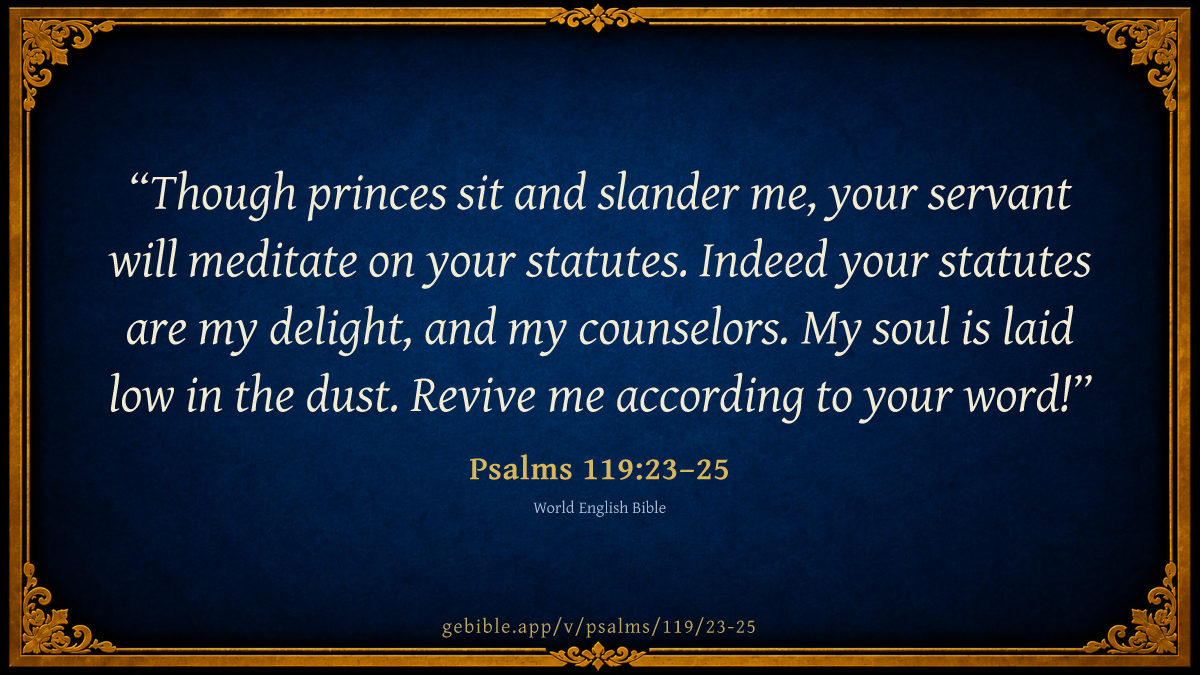
Psa 119:23 Princes also did sit [and] speak against me: [but] thy servant did meditate in thy statutes.
Ver. 23. Princes also did sit, &c.] By public invectives; such as were those of our Henry VIII, and of Lewis, king of Hungary and Bohemia (two very potent princes), against Luther. ωρβδν Denotat continuum clamorem (Kimchi).
John Trapp, A Commentary or Exposition upon All the Books of the Old and New Testament (1647–1656) — public domain. Text from a community e-Sword module.
Matthew Poole1685 · Public DomainOn vv23–25Did sit and speak; did speak against me continually,…
Did sit and speak; did speak against me continually, (for sitting notes continuance,) and when they sat upon their seats of judicature, and when they sat together in companies, entertaining one another with discourses.
Did meditate in thy statutes; all their contumelies and reproaches did not discourage nor divert me from the study, belief, and practice of thy word.
Matthew Poole's English Annotations on the Holy Bible (1683–1685) — public domain. Text from a community e-Sword/MySword module.
Matthew Henry1710 · Public DomainOn vv23–25See here, 1. How David was abused even by…
See here, 1. How David was abused even by great men, who should have known better his character and his case, and have been more generous: Princes did sit, sit in council, sit in judgment, and speak against me. What even princes say is not always right; but it is sad when judgment is thus turned to wormwood, when those that should be the protectors of the innocent are their betrayers. Herein David was a type of Christ, for they were the princes of this world that vilified and crucified the Lord of glory, Co1 2:8. 2. What method he took to make himself easy under these abuses: he meditated in God's statutes, went on in his duty, and did not regard them; as a deaf man, he heard not. When they spoke against him, he found that in the word of God which spoke for him, and spoke comfort to him, and then none of these things moved him. Those that have pleasure in communion with God may easily despise the censures of men, even of princes.
Matthew Henry's Commentary on the Whole Bible (1708–1710) — public domain (CC PDM 1.0). Text via the HelloAO Bible API.
John Gill1763 · Public DomainOn vv23–25DALETH.--The Fourth Part.
DALETH.--The Fourth Part.
DALETH. My soul cleaveth unto the dust,.... Either to the dust of death, having the sentence of it; being almost in despair of life, upon the brink of the grave seemingly, and free among the dead: or in a very low estate of mind, in great dejection and humiliation, rolling himself in the dust, and putting his mouth in it; if there might be any hope of deliverance; but despairing of it, unless the Lord appeared; or finding a proneness in him to the corruption of nature, the body of sin and death, which was very powerful and prevalent, ensnaring and captivating; and particularly to worldly things, comparable to dust, for their lightness, emptiness, and unprofitableness; which often have an undue influence on good men, and to which their affections are too much glued; and which greatly affect the exercise of grace and religious duties, and bring a deadness upon the soul, and make the following: petition necessary:
Read full note →
quicken thou me according to thy word; such who are quickened together with Christ, and who are quickened by his Spirit and grace, when they were dead in trespasses and sins, have often need to be quickened again, and to have the work of grace revived in them; which is done when grace is drawn forth into lively exercise, and which is necessary to the performance of duty; and this is done both by means of the word of God, which, as it is used for the quickening dead sinners, so for the reviving of drooping saints; see Psa 119:50. And according to his word of promise, who has promised never to leave his people, nor forsake the work of his hand, but perform it until the day of Christ; Jarchi and Kimchi think reference is had to the promise in Sa2 12:13; and Aben Ezra to Deu 32:39.
John Gill's Exposition of the Whole Bible (1746–1763) — public domain (CC PDM 1.0). Text via the HelloAO Bible API.
John Wesley1765 · Public DomainOn v25The dust - I am in danger of present…
The dust - I am in danger of present death: I am like one laid in the grave. Quicken - Preserve my life, or raise me out of the dust. Word - According to thy promise.
John Wesley, Explanatory Notes Upon the Whole Bible (1754–1765) — public domain. Text via the GEBible commentary corpus.
Adam Clarke1810 · Public DomainOn vv23–25Verse 23. Princes also did sit] It is very…
Verse 23. Princes also did sit] It is very likely that the nobles of Babylon did often, by wicked misrepresentations, render the minds of the kings of the empire evil affected towards the Jews.
Adam Clarke's Commentary on the Bible (1810–1826) — public domain. Text from a community e-Sword/MySword module.
Joseph Benson1811 · Public DomainOn v25Psa 119:25. My soul cleaveth unto the dust —…
DALETH.
Psa 119:25. My soul cleaveth unto the dust — That is, as some understand it, I am in danger of present death: I am like one laid in the grave; so this phrase is used Psa 22:15. Quicken thou me — Preserve my life, or raise me out of the dust; according to thy word — According to thy promise. But the psalmist, probably, rather complains in these words of his affections being apt to cleave to worldly objects, which are but dust, and prays for quickening and purifying grace to render him more spiritually minded. And every one whose affections are set on things below has reason to make a similar confession, and to pray, as he did, for quickening and regenerating grace, to raise him to those things which are above, where Christ sitteth at the right hand of God.
Joseph Benson's Commentary on the Old and New Testaments (1811–1818) — public domain. Text from a community e-Sword module.
Albert Barnes1834 · Public DomainOn vv23–25Princes also did sit and speak against me -…
Princes also did sit and speak against me - This would have been applicable to David many times in his life, but it was also applicable to many others, and there is nothing in the language which would limit it to David. It is evident that the author of the psalm had been subject to reproach from those who were of exalted rank; it is clear also that he felt this keenly. It is natural, whether proper or not, that we should feel the reproach and contempt of those in elevated life - the rich, the honored, the learned - more than of those in humbler life. Their good opinion can be of value only as they may be better qualified than others to judge of what constitutes true excellence, or as they may have it in their power to do us more harm, or to do more to aid us in doing good, than others have; but truth and principle are never to be sacrificed that we may secure their favor; and if, in the faithful discharge of our duty, and the zealous adherence to the principles of our religion, we incur their frowns, we are to bear it - as the great Lord and Saviour of his people did. Heb 13:13.
But thy servant did meditate in thy statutes - I was engaged in this; I continued to do it; I was not deterred from it by their opposition; I found comfort in it, when they sat and talked against me. This would seem to have reference to some occasion when they were together - in public business, or in the social circle. They, the princes and nobles engaged in the ordinary topics of conversation, or in conversation connected with revelry, frivolity, or sin. Unwilling to participate in this - having different tastes - feeling that it was improper to be one of their companions in such a mode of spending time, or in such subjects of conversation, “he” withdrew, he turned his thoughts on the law of God, he sought comfort in meditation on that law and on God. He became, therefore, the subject of remark - perhaps of their jests - “because” he thus refused to mingle with them, or because he put on what seemed to be hypocritical seriousness, and was (what they deemed) stern, sour, unsocial, as if he thus publicly, though tacitly, meant to rebuke them. Nothing will be more “likely” to subject one to taunting remarks, to rebuke, to contempt, than to manifest a religious spirit, and to introduce religion in any way in the circles of the worldly and the frivolous.
Albert Barnes' Notes on the Bible (1834–1885) — public domain. Text from a community e-Sword/MySword module.
Daniel D. Whedon1874 · Public DomainOn v25ד, Daleth.
ד, Daleth.
25-32. My soul cleaveth unto the dust—Now is presented a soul in deep affliction, as if the trial in the previous division had gone against him; as if he had suffered the loss of all things, and worse was yet to follow.
Read full note →
The way of lying—In trouble one is strongly drawn to hold untruthful views of providence, of his persecutors, and of his own merits. This can but aggravate his case. Sentiments of truth and justice are then peculiarly salutary. They help one to “rise o’er fear, and doubt, and care.”
Daniel D. Whedon (gen. ed.), Commentary on the Old and New Testaments (1874–1909) — public domain. Text from a community e-Sword module.
The Cambridge Bible for Schools and Colleges1878 · Public DomainOn vv23–2523. A further proof of his fidelity. Though those…
23. A further proof of his fidelity. Though those in authority sit in council and devise plans for his ruin, he continues to meditate on Jehovah’s statutes. Cp. Dan_6:4 ff. It has been maintained that foreign princes must be meant, and consequently that the Psalmist must be speaking in the name of the nation, and not as an individual. But princes was the title commonly given to the Israelite nobles in post-exilic times, and the Psalmist was evidently persecuted by wealthy and powerful countrymen. Cp. Psa_119:161, and see above, p. 702.
The Cambridge Bible for Schools and Colleges (gen. ed. J. J. S. Perowne; Cambridge University Press, 1878–1918) — public domain. Text from a community e-Sword module.
Ellicott's Commentary for English Readers1878 · Public DomainOn vv23–25(23) Speak.—Comp. Psa_50:20 for the same implied sense in…
(23) Speak.—Comp. Psa_50:20 for the same implied sense in this verb. This verse reads as if Israel, and not a mere individual, were the subject of the psalms.
A Bible Commentary for English Readers, edited by Charles John Ellicott (1878–1897) — public domain. Text from a community e-Sword module.
The Pulpit Commentary1880 · Public DomainOn vv23–25Princes also did sit and speak against me. The…
Princes also did sit and speak against me. The great of the earth too often take part against the righteous, and join in persecuting them and calumniating them (comp. ver. 161). But thy servant did meditate in thy statutes ; i.e. I took no heed of their calumnies they did not trouble me. I gave myself to meditation on thy commandments.
The Pulpit Commentary (1880–1919), ed. H.D.M. Spence-Jones & Joseph S. Exell — public domain. Text from a community e-Sword module.
Charles H. Spurgeon1885 · Public DomainOn vv23–25Ver. 23. Princes also did sit and speak against…
Ver. 23. Princes also did sit and speak against me. David was high game, and the great ones of the earth went a hawking after him. Princes saw in him a greatness which they envied, and therefore they abused him. On their thrones they might have found something better to consider and speak about, but they turned the seat of judgment into the seat of the scorner. Most men covet a prince's good word, and to be spoken ill of by a great man is a great discouragement to them, but the Psalmist bore his trial with holy calmness. Many of the lordly ones were his enemies, and made it their business to speak ill of him: they held sittings for scandal, sessions for slander, parliaments of falsehood, and yet he survived all their attempts upon him.
But thy servant did meditate in thy statutes. This was brave indeed. He was God's servant, and therefore he attended to his Master's business; he was God's servant, and therefore felt sure that his Lord would defend him. He gave no heed to his princely slanderers, he did not even allow his thoughts to be disturbed by a knowledge of their plotting in conclave. Who were these malignants that they should rob God of his servant's attention, or deprive the Lord's chosen of a moment's devout communion. The rabble of princes were not worth five minutes' thought, if those five minutes had to be taken from holy meditation. It is very beautiful to see the two sittings: the princes sitting to reproach David, and David sitting with his God and his Bible, answering his traducers by never answering them at all. Those who feed upon the word grow strong and peaceful, and are by God's grace hidden from the strife of tongues.
Read full note →
Note that in the close of the former octave he had said, "I will meditate, "and here he shows how he had redeemed his promise, even under great provocation to forget it. It is a praiseworthy thing when the resolve of our happy hours is duly carried out in our seasons of affliction.
Ver. 23. Princes also did sit, under the shadow of justice, and speak against me. Now this was a great temptation to David, that he was not only mocked and scorned at the taverns and inns, being there blazoned by dissolute jesters and scoffers, and talked of in the streets and market places; but even in the place of justice (which ought to be holy); it could not therefore be chosen but that they also would utterly defame and slander him, and condemn him to be, as it were, a most wicked and cursed man. When David then did see that he was thus unjustly entreated and handled, he makes his complaint unto God, and says, "O Lord, the princes and governors themselves do sit and speak evil against me; and yet for all that I have kept thy testimonies." Here in sum we are to gather out of this place, that if it so fall out, when we have walked uprightly and in a good conscience? that we are falsely slandered, and accused of this and that whereof we never once thought; yet ought we to bear all things patiently; for let us be sure of that, that we are not better than David, whatever great protestation of our integrity and purity we may dare to make. John Calvin.
Ver. 23 But thy servant did meditate in thy statutes. As husbandmen, when their ground is overflowed by waters, make ditches and water furrows to carry it away; so, when our minds and thoughts are overwhelmed with trouble, it is good to divert them to some other matter. But every diversion will not become saints, it must be a holy diversion: "In the multitude of my thoughts within me thy comforts delight my soul" (Ps 94:19). The case was the same with that of the text, when the throne of iniquity frameth mischief by a law; as you shall see here, when he had many perplexed thoughts about the abuse of power against himself. But now where lay his ease in diversion? Would every diversion suit his purpose? No; "Thy comforts, " comforts of God's allowance, of God's providing, comforts proper to saints. Wicked men in trouble run to their pot and pipe, and games and sports, and merry company, and so defeat the providence rather than improve it: but David, who was God's servant, must have God's comforts. So, elsewhere, when his thoughts were troubled about the power of the wicked: "I went into the sanctuary of God; then understood I their end" (Ps 73:17). He goeth to divert his mind by the use of God's ordinances, and so cometh to be settled against the temptation. Thomas Manton.
Ver. 23. But thy servant did meditate in thy statutes. Perceive here the armour by which David fights against his enemy. Arma justi quibus omnes adversariorum repellit impetus, his weapons are the word and player. He renders not injury for injury, reproach for reproach. It is dangerous to fight against Satan or his instruments with their own weapons; for so they shall easily overcome us. Let us fight with the armour of God the exercises of the word and prayer: for a man may peaceably rest in his secret chamber, and in these two see the miserable end of all those who are enemies to God's children for God's sake. William Cowper.
Ver. 23. Thy statutes. It is impossible to live either Christianly or comfortable without the daily use of Scripture. It is absolutely necessary for our direction in all our ways before we begin them, and when we have ended them, for the warrant of our approbation of them, for resolving of our doubts, and comforting us in our griefs. Without it our conscience is a blind guide, and leadeth us in a mist of ignorance, error, and confusion. Therein we hear God speaking to us, declaring his good will to us concerning our salvation, and the way of our obedience to meet him in his good will. What book can we read with such profit and comfort? For matter, it is wisdom: for authority, it is divine and absolute: for majesty, God himself under common words and letters expressing an unspeakable power to stamp our heart. Where shall we find our minds so enlightened, our hearts so deeply affected, our conscience so moved, both for casting us down and raising us up? I cannot find in all the books of the world, such an one speak to me, as in Scripture, with so absolute a conquest of all the powers of my soul.
Contemners of Scripture lack food for their souls, light for their life and weapons for their spiritual warfare; but the lovers of Scripture have all that furniture. Therein we hear the voice of our Beloved, we smell the savour of his ointments, and have daily access unto the art of propitiation. If in our knowledge we desire divinity, excellency, antiquity, and efficiency, we cannot find it, but in God's word alone. It is the extract of heavenly wisdom, which Christ the eternal Word brought out of the bosom of his Father. William Struther, 1633.
Ver. 23-24. The two last verses of this section contain two protestations of David's honest affection to the word. The first is, that albeit he was persecuted and evil spoken of, and that by great and honourable men of the world, such as Saul, and Abner, and Ahithophel; yet did he still meditate in the statutes of God. It is a hard temptation when the godly are troubled by any wicked men; but much harder when they are troubled by men of honour and authority. And that, first, by reason of their place:the greater power they have, the greater peril to encounter with their displeasure; therefore said Solomon, "The wrath of a king is as messengers of death." Next, because authorities and powers are ordained by God, not for the terror of the good, but of the evil: Ro 13:3. And therefore it is no small grief to the godly, when they find them abused to a contrary end: that where a ruler should be to good men like rain to the fields new mown, he becomes a favourer of evil men and a persecutor of the good. Then justice is turned into wormwood; that which should bring comfort to such as fear God, is abused to oppress them. And therefore it should be accounted a great benefit of God, when he gives a people good and religious rulers. William Cowper.
Ver. 23, 51. If the 119th Psalm came from the pen of David, as multitudes believe, then I do not wonder that many have connected its composition with his residence in the school of the prophets of Naioth. The calm in which he then found himself, and the studies which he then prosecuted, might well have led his musings in the direction of that alphabetic code, while there are in it not a few expressions which, to say the least, may have particular reference to the dangers out of which he had so recently escaped, and by which he was still threatened. Such, for example, are the following: "Princes also did sit and speak against me": but thy servant did meditate in thy statutes. "The proud have had me greatly in derision: yet have I not declined from thy law." William M. Taylor, in "David, King of Israel; his Life and its
Lessons." 1880.
Ver. 23. Meditation.
1. Our best employment while others slander.
2. Our best comfort under their falsehood.
3. Our best preservative from a spirit of revenge.
4. Our best mode of showing our superiority to their attacks.
Psalms 119:24*
Charles H. Spurgeon's The Treasury of David (1869–1885) — public domain. Psalms only. Text from a community e-Sword/MySword module.
The Biblical Illustrator1887 · Public DomainOn vv23–25Princes also did sit and speak against me.
Psa_119:23
Princes also did sit and speak against me.
Read full note →
1. It is a hard temptation when the godly are troubled by any wicked men; but much harder when they are troubled by men of honour and authority.
(1) First, by reason of their place: the greater power they have, the greater peril to encounter with their displeasure; therefore saith Solomon, The wrath of a king is the messenger of death.
(2) Next, because authorities and powers are ordained by God, not for the terror of the good, but of the evil. And therefore it is no small grief to the godly, when they find them abused to a contrary end; that where a ruler should be to good men like rain to the fields new mown; on the contrary, he becomes a favourer of evil men, and a persecutor of the good. Then justice is turned into wormwood; that which should bring comfort to such as fear God, is abused to oppress them.
2. And therefore, it should be accounted a great benefit of God, when He gives a people good and religious rulers. The Christians in the primitive Church, being sore troubled by the bloody persecutions of Nero and Domitian, thought it a great benefit unto them, when under Nerva the persecution was relented. Albeit he did not profess Christ with them, yet he did not persecute them. What then should we account of such a king, as is not only a protector of the Church, but a professor himself? so far from persecuting Christian religion; that for professing of it, many times hath his majesty been persecuted to the death, but blessed be the Lord, who hath given many glorious deliverances to His anointed. (Bp. Cowper.)
The Biblical Illustrator, edited by Joseph S. Exell (c. 1880s–1900s) — public domain. Text from a community e-Sword module.
Paul E. Kretzmann1924 · Public DomainOn v25Daleth. The Grace of Being Confirmed in the Truth.…
Daleth. The Grace of Being Confirmed in the Truth. —
v. 25. My soul cleaveth unto the dust, is often in great spiritual depression; quicken Thou me, daily filling him with new life and strength, according to Thy Word, it being the privilege of the believers to remind the Lord of His promises and to demand His assistance at such times of affliction.
Read full note →
v. 26. I have declared my ways, stating that he would follow the paths of God’s Word, and Thou heardest me, accepting his promise as a prayer for assistance; teach me Thy statutes, for it is at such a time that the positive and clear statements of the Word of God uphold the believer’s determination.
v. 27. Make me to understand the way of Thy precepts, to have a clear conception of the directions of God pertaining to man’s conduct in all situations of life; so shall I talk, ponder, always think about, of Thy wondrous works, declaring the miracles of grace and kindness which God performed in his interest, this being the experience of all believers.
v. 28. My soul melteth for heaviness, is dissolved in the heat of affliction; strengthen Thou me according unto Thy Word, setting him upright, so that he may walk with a firm tread and fear no dangers.
v. 29. Remove from me the way of lying, of unfaithfulness, of denial of the truth, and grant me Thy Law graciously, the believer asking this only as a gift of mercy on the part of God, since he knows that he is in no way worthy of it. It is by the grace of God that we still have His Word, and we should appreciate it accordingly.
v. 30. I have chosen the way of truth, of faithfulness to the Lord; Thy judgments have I laid before me, deliberately selecting them to direct his way of conduct in seeking the approval of the Lord.
v. 31. I have stuck unto Thy testimonies, clinging to the revealed truth with all his heart; O Lord, put me not to shame, permitting him to become an object of mockery by withholding His strength and help from the believer in every emergency.
v. 32. I will run the way of Thy commandments, not with slow and lagging steps, but with cheerful eagerness, when Thou shalt enlarge my heart, because God widens and expands the heart of the faithful with such virtues as are well-pleasing to Him, this including also the zeal for His Word and for true sanctification. Constant study and contemplation of God’s Word will result in joyful service of God, in growth in all Christian virtues.
Paul E. Kretzmann, Popular Commentary of the Bible (1921–1924) — public domain. Text from a community e-Sword module.
unfoldingWord translationNotes2017 · CC BY-SA 4.0On vv23, 25Though rulers plot and slander me
Though rulers plot and slander me
"Though rulers make plans to harm me and say bad things about me"
Read full note →
Your covenant decrees are my delight
"Your covenant decrees make me very happy."
they are my counselors
God's decrees are spoken of as if they were people. AT: "they are like wise counselors to me" or "they give me wise counsel" (See: Personification)
 GEBible — Godless Engineer's Bible App
John Calvin 1540 · Public Domain On vv24–25 24. Also thy testimonies are my delight The particle…
24. Also thy testimonies are my delight The particle גם, gam, connects this with the preceding verse. To adhere unflinchingly to our purpose, when the world takes up an unjust opinion of us, and, at the same time, constantly to mediate on God’s law, is an example of Christian fortitude seldom to be met with. The prophet now informs us how he overcame this temptation. Thy testimonies, says he, are my delight: “Although the cruel injustice of men, in charging me falsely, grieves and annoys me, yet the pleasurable delight which I take in thy law is a sufficient recompense for it all.” He adds, that God’s testimonies are his counselors, by which we are to understand he did not rely on his own judgment simply, but took counsel from the word of God. This point ought to be carefully considered, inasmuch as we see how blind affection predominates in directing the lives of men. Whence does the avaricious man ask council, but from the erroneous principle which he has assumed, that riches are superior to every thing? Why does the ambitious man aspire after nothing so much as power, but because he regards nothing equal to the holding of honorable rank in the world? It is not surprising, therefore, that men are so grievously misled, seeing they give themselves up to the direction of such evil counselors. Guided by the word of God, and prudently yielding obedience to its dictates, there will then be no inlet to the deceits of our flesh, and to the delusions of the world, and we will stand invincible against all the assaults of temptation.
John Calvin's Commentaries (1540-1563) — public domain. Text from the Calvin Translation Society English edition (1840s-50s) via the Christian Classics Ethereal Library (ccel.org). Calvin's coverage is partial (roughly two-thirds of the Bible); uncommented books and verses are honest gaps, never fabricated. The 19th-century editor's footnotes and remarks are omitted so the notes are faithfully Calvin's own voice.
Geneva Bible translators 1599 · Public Domain On vv23, 25 When the powers of the world gave false sentence…
When the powers of the world gave false sentence against me, thy word was a guide and counselor to teach me what to do, and to comfort me.
Geneva Bible (1599) marginal notes — public domain.
John Trapp 1656 · Public Domain On vv23–25 Psa 119:23 Princes also did sit [and] speak against…
Psa 119:23 Princes also did sit [and] speak against me: [but] thy servant did meditate in thy statutes.
Ver. 23. Princes also did sit, &c.] By public invectives; such as were those of our Henry VIII, and of Lewis, king of Hungary and Bohemia (two very potent princes), against Luther. ωρβδν Denotat continuum clamorem (Kimchi).
John Trapp, A Commentary or Exposition upon All the Books of the Old and New Testament (1647–1656) — public domain. Text from a community e-Sword module.
Matthew Poole 1685 · Public Domain On vv23–25 Did sit and speak; did speak against me continually,…
Did sit and speak; did speak against me continually, (for sitting notes continuance,) and when they sat upon their seats of judicature, and when they sat together in companies, entertaining one another with discourses.
Did meditate in thy statutes; all their contumelies and reproaches did not discourage nor divert me from the study, belief, and practice of thy word.
Matthew Poole's English Annotations on the Holy Bible (1683–1685) — public domain. Text from a community e-Sword/MySword module.
Matthew Henry 1710 · Public Domain On vv23–25 See here, 1. How David was abused even by…
See here, 1. How David was abused even by great men, who should have known better his character and his case, and have been more generous: Princes did sit, sit in council, sit in judgment, and speak against me. What even princes say is not always right; but it is sad when judgment is thus turned to wormwood, when those that should be the protectors of the innocent are their betrayers. Herein David was a type of Christ, for they were the princes of this world that vilified and crucified the Lord of glory, Co1 2:8. 2. What method he took to make himself easy under these abuses: he meditated in God's statutes, went on in his duty, and did not regard them; as a deaf man, he heard not. When they spoke against him, he found that in the word of God which spoke for him, and spoke comfort to him, and then none of these things moved him. Those that have pleasure in communion with God may easily despise the censures of men, even of princes.
Matthew Henry's Commentary on the Whole Bible (1708–1710) — public domain (CC PDM 1.0). Text via the HelloAO Bible API.
John Gill 1763 · Public Domain On vv23–25 DALETH.--The Fourth Part.
DALETH.--The Fourth Part.
DALETH. My soul cleaveth unto the dust,.... Either to the dust of death, having the sentence of it; being almost in despair of life, upon the brink of the grave seemingly, and free among the dead: or in a very low estate of mind, in great dejection and humiliation, rolling himself in the dust, and putting his mouth in it; if there might be any hope of deliverance; but despairing of it, unless the Lord appeared; or finding a proneness in him to the corruption of nature, the body of sin and death, which was very powerful and prevalent, ensnaring and captivating; and particularly to worldly things, comparable to dust, for their lightness, emptiness, and unprofitableness; which often have an undue influence on good men, and to which their affections are too much glued; and which greatly affect the exercise of grace and religious duties, and bring a deadness upon the soul, and make the following: petition necessary:
Read full note →
quicken thou me according to thy word; such who are quickened together with Christ, and who are quickened by his Spirit and grace, when they were dead in trespasses and sins, have often need to be quickened again, and to have the work of grace revived in them; which is done when grace is drawn forth into lively exercise, and which is necessary to the performance of duty; and this is done both by means of the word of God, which, as it is used for the quickening dead sinners, so for the reviving of drooping saints; see Psa 119:50. And according to his word of promise, who has promised never to leave his people, nor forsake the work of his hand, but perform it until the day of Christ; Jarchi and Kimchi think reference is had to the promise in Sa2 12:13; and Aben Ezra to Deu 32:39.
John Gill's Exposition of the Whole Bible (1746–1763) — public domain (CC PDM 1.0). Text via the HelloAO Bible API.
John Wesley 1765 · Public Domain On v25 The dust - I am in danger of present…
The dust - I am in danger of present death: I am like one laid in the grave. Quicken - Preserve my life, or raise me out of the dust. Word - According to thy promise.
John Wesley, Explanatory Notes Upon the Whole Bible (1754–1765) — public domain. Text via the GEBible commentary corpus.
Adam Clarke 1810 · Public Domain On vv23–25 Verse 23. Princes also did sit] It is very…
Verse 23. Princes also did sit] It is very likely that the nobles of Babylon did often, by wicked misrepresentations, render the minds of the kings of the empire evil affected towards the Jews.
Adam Clarke's Commentary on the Bible (1810–1826) — public domain. Text from a community e-Sword/MySword module.
Joseph Benson 1811 · Public Domain On v25 Psa 119:25. My soul cleaveth unto the dust —…
DALETH.
Psa 119:25. My soul cleaveth unto the dust — That is, as some understand it, I am in danger of present death: I am like one laid in the grave; so this phrase is used Psa 22:15. Quicken thou me — Preserve my life, or raise me out of the dust; according to thy word — According to thy promise. But the psalmist, probably, rather complains in these words of his affections being apt to cleave to worldly objects, which are but dust, and prays for quickening and purifying grace to render him more spiritually minded. And every one whose affections are set on things below has reason to make a similar confession, and to pray, as he did, for quickening and regenerating grace, to raise him to those things which are above, where Christ sitteth at the right hand of God.
Joseph Benson's Commentary on the Old and New Testaments (1811–1818) — public domain. Text from a community e-Sword module.
Albert Barnes 1834 · Public Domain On vv23–25 Princes also did sit and speak against me -…
Princes also did sit and speak against me - This would have been applicable to David many times in his life, but it was also applicable to many others, and there is nothing in the language which would limit it to David. It is evident that the author of the psalm had been subject to reproach from those who were of exalted rank; it is clear also that he felt this keenly. It is natural, whether proper or not, that we should feel the reproach and contempt of those in elevated life - the rich, the honored, the learned - more than of those in humbler life. Their good opinion can be of value only as they may be better qualified than others to judge of what constitutes true excellence, or as they may have it in their power to do us more harm, or to do more to aid us in doing good, than others have; but truth and principle are never to be sacrificed that we may secure their favor; and if, in the faithful discharge of our duty, and the zealous adherence to the principles of our religion, we incur their frowns, we are to bear it - as the great Lord and Saviour of his people did. Heb 13:13.
But thy servant did meditate in thy statutes - I was engaged in this; I continued to do it; I was not deterred from it by their opposition; I found comfort in it, when they sat and talked against me. This would seem to have reference to some occasion when they were together - in public business, or in the social circle. They, the princes and nobles engaged in the ordinary topics of conversation, or in conversation connected with revelry, frivolity, or sin. Unwilling to participate in this - having different tastes - feeling that it was improper to be one of their companions in such a mode of spending time, or in such subjects of conversation, “he” withdrew, he turned his thoughts on the law of God, he sought comfort in meditation on that law and on God. He became, therefore, the subject of remark - perhaps of their jests - “because” he thus refused to mingle with them, or because he put on what seemed to be hypocritical seriousness, and was (what they deemed) stern, sour, unsocial, as if he thus publicly, though tacitly, meant to rebuke them. Nothing will be more “likely” to subject one to taunting remarks, to rebuke, to contempt, than to manifest a religious spirit, and to introduce religion in any way in the circles of the worldly and the frivolous.
Albert Barnes' Notes on the Bible (1834–1885) — public domain. Text from a community e-Sword/MySword module.
Daniel D. Whedon 1874 · Public Domain On v25 ד, Daleth.
ד, Daleth.
25-32. My soul cleaveth unto the dust—Now is presented a soul in deep affliction, as if the trial in the previous division had gone against him; as if he had suffered the loss of all things, and worse was yet to follow.
Read full note →
The way of lying—In trouble one is strongly drawn to hold untruthful views of providence, of his persecutors, and of his own merits. This can but aggravate his case. Sentiments of truth and justice are then peculiarly salutary. They help one to “rise o’er fear, and doubt, and care.”
Daniel D. Whedon (gen. ed.), Commentary on the Old and New Testaments (1874–1909) — public domain. Text from a community e-Sword module.
The Cambridge Bible for Schools and Colleges 1878 · Public Domain On vv23–25 23. A further proof of his fidelity. Though those…
23. A further proof of his fidelity. Though those in authority sit in council and devise plans for his ruin, he continues to meditate on Jehovah’s statutes. Cp. Dan_6:4 ff. It has been maintained that foreign princes must be meant, and consequently that the Psalmist must be speaking in the name of the nation, and not as an individual. But princes was the title commonly given to the Israelite nobles in post-exilic times, and the Psalmist was evidently persecuted by wealthy and powerful countrymen. Cp. Psa_119:161, and see above, p. 702.
The Cambridge Bible for Schools and Colleges (gen. ed. J. J. S. Perowne; Cambridge University Press, 1878–1918) — public domain. Text from a community e-Sword module.
Ellicott's Commentary for English Readers 1878 · Public Domain On vv23–25 (23) Speak.—Comp. Psa_50:20 for the same implied sense in…
(23) Speak.—Comp. Psa_50:20 for the same implied sense in this verb. This verse reads as if Israel, and not a mere individual, were the subject of the psalms.
A Bible Commentary for English Readers, edited by Charles John Ellicott (1878–1897) — public domain. Text from a community e-Sword module.
The Pulpit Commentary 1880 · Public Domain On vv23–25 Princes also did sit and speak against me. The…
Princes also did sit and speak against me. The great of the earth too often take part against the righteous, and join in persecuting them and calumniating them (comp. ver. 161). But thy servant did meditate in thy statutes ; i.e. I took no heed of their calumnies they did not trouble me. I gave myself to meditation on thy commandments.
The Pulpit Commentary (1880–1919), ed. H.D.M. Spence-Jones & Joseph S. Exell — public domain. Text from a community e-Sword module.
Charles H. Spurgeon 1885 · Public Domain On vv23–25 Ver. 23. Princes also did sit and speak against…
Ver. 23. Princes also did sit and speak against me. David was high game, and the great ones of the earth went a hawking after him. Princes saw in him a greatness which they envied, and therefore they abused him. On their thrones they might have found something better to consider and speak about, but they turned the seat of judgment into the seat of the scorner. Most men covet a prince's good word, and to be spoken ill of by a great man is a great discouragement to them, but the Psalmist bore his trial with holy calmness. Many of the lordly ones were his enemies, and made it their business to speak ill of him: they held sittings for scandal, sessions for slander, parliaments of falsehood, and yet he survived all their attempts upon him.
But thy servant did meditate in thy statutes. This was brave indeed. He was God's servant, and therefore he attended to his Master's business; he was God's servant, and therefore felt sure that his Lord would defend him. He gave no heed to his princely slanderers, he did not even allow his thoughts to be disturbed by a knowledge of their plotting in conclave. Who were these malignants that they should rob God of his servant's attention, or deprive the Lord's chosen of a moment's devout communion. The rabble of princes were not worth five minutes' thought, if those five minutes had to be taken from holy meditation. It is very beautiful to see the two sittings: the princes sitting to reproach David, and David sitting with his God and his Bible, answering his traducers by never answering them at all. Those who feed upon the word grow strong and peaceful, and are by God's grace hidden from the strife of tongues.
Read full note →
Note that in the close of the former octave he had said, "I will meditate, "and here he shows how he had redeemed his promise, even under great provocation to forget it. It is a praiseworthy thing when the resolve of our happy hours is duly carried out in our seasons of affliction.
Ver. 23. Princes also did sit, under the shadow of justice, and speak against me. Now this was a great temptation to David, that he was not only mocked and scorned at the taverns and inns, being there blazoned by dissolute jesters and scoffers, and talked of in the streets and market places; but even in the place of justice (which ought to be holy); it could not therefore be chosen but that they also would utterly defame and slander him, and condemn him to be, as it were, a most wicked and cursed man. When David then did see that he was thus unjustly entreated and handled, he makes his complaint unto God, and says, "O Lord, the princes and governors themselves do sit and speak evil against me; and yet for all that I have kept thy testimonies." Here in sum we are to gather out of this place, that if it so fall out, when we have walked uprightly and in a good conscience? that we are falsely slandered, and accused of this and that whereof we never once thought; yet ought we to bear all things patiently; for let us be sure of that, that we are not better than David, whatever great protestation of our integrity and purity we may dare to make. John Calvin.
Ver. 23 But thy servant did meditate in thy statutes. As husbandmen, when their ground is overflowed by waters, make ditches and water furrows to carry it away; so, when our minds and thoughts are overwhelmed with trouble, it is good to divert them to some other matter. But every diversion will not become saints, it must be a holy diversion: "In the multitude of my thoughts within me thy comforts delight my soul" (Ps 94:19). The case was the same with that of the text, when the throne of iniquity frameth mischief by a law; as you shall see here, when he had many perplexed thoughts about the abuse of power against himself. But now where lay his ease in diversion? Would every diversion suit his purpose? No; "Thy comforts, " comforts of God's allowance, of God's providing, comforts proper to saints. Wicked men in trouble run to their pot and pipe, and games and sports, and merry company, and so defeat the providence rather than improve it: but David, who was God's servant, must have God's comforts. So, elsewhere, when his thoughts were troubled about the power of the wicked: "I went into the sanctuary of God; then understood I their end" (Ps 73:17). He goeth to divert his mind by the use of God's ordinances, and so cometh to be settled against the temptation. Thomas Manton.
Ver. 23. But thy servant did meditate in thy statutes. Perceive here the armour by which David fights against his enemy. Arma justi quibus omnes adversariorum repellit impetus, his weapons are the word and player. He renders not injury for injury, reproach for reproach. It is dangerous to fight against Satan or his instruments with their own weapons; for so they shall easily overcome us. Let us fight with the armour of God the exercises of the word and prayer: for a man may peaceably rest in his secret chamber, and in these two see the miserable end of all those who are enemies to God's children for God's sake. William Cowper.
Ver. 23. Thy statutes. It is impossible to live either Christianly or comfortable without the daily use of Scripture. It is absolutely necessary for our direction in all our ways before we begin them, and when we have ended them, for the warrant of our approbation of them, for resolving of our doubts, and comforting us in our griefs. Without it our conscience is a blind guide, and leadeth us in a mist of ignorance, error, and confusion. Therein we hear God speaking to us, declaring his good will to us concerning our salvation, and the way of our obedience to meet him in his good will. What book can we read with such profit and comfort? For matter, it is wisdom: for authority, it is divine and absolute: for majesty, God himself under common words and letters expressing an unspeakable power to stamp our heart. Where shall we find our minds so enlightened, our hearts so deeply affected, our conscience so moved, both for casting us down and raising us up? I cannot find in all the books of the world, such an one speak to me, as in Scripture, with so absolute a conquest of all the powers of my soul.
Contemners of Scripture lack food for their souls, light for their life and weapons for their spiritual warfare; but the lovers of Scripture have all that furniture. Therein we hear the voice of our Beloved, we smell the savour of his ointments, and have daily access unto the art of propitiation. If in our knowledge we desire divinity, excellency, antiquity, and efficiency, we cannot find it, but in God's word alone. It is the extract of heavenly wisdom, which Christ the eternal Word brought out of the bosom of his Father. William Struther, 1633.
Ver. 23-24. The two last verses of this section contain two protestations of David's honest affection to the word. The first is, that albeit he was persecuted and evil spoken of, and that by great and honourable men of the world, such as Saul, and Abner, and Ahithophel; yet did he still meditate in the statutes of God. It is a hard temptation when the godly are troubled by any wicked men; but much harder when they are troubled by men of honour and authority. And that, first, by reason of their place:the greater power they have, the greater peril to encounter with their displeasure; therefore said Solomon, "The wrath of a king is as messengers of death." Next, because authorities and powers are ordained by God, not for the terror of the good, but of the evil: Ro 13:3. And therefore it is no small grief to the godly, when they find them abused to a contrary end: that where a ruler should be to good men like rain to the fields new mown, he becomes a favourer of evil men and a persecutor of the good. Then justice is turned into wormwood; that which should bring comfort to such as fear God, is abused to oppress them. And therefore it should be accounted a great benefit of God, when he gives a people good and religious rulers. William Cowper.
Ver. 23, 51. If the 119th Psalm came from the pen of David, as multitudes believe, then I do not wonder that many have connected its composition with his residence in the school of the prophets of Naioth. The calm in which he then found himself, and the studies which he then prosecuted, might well have led his musings in the direction of that alphabetic code, while there are in it not a few expressions which, to say the least, may have particular reference to the dangers out of which he had so recently escaped, and by which he was still threatened. Such, for example, are the following: "Princes also did sit and speak against me": but thy servant did meditate in thy statutes. "The proud have had me greatly in derision: yet have I not declined from thy law." William M. Taylor, in "David, King of Israel; his Life and its
Lessons." 1880.
Ver. 23. Meditation.
1. Our best employment while others slander.
2. Our best comfort under their falsehood.
3. Our best preservative from a spirit of revenge.
4. Our best mode of showing our superiority to their attacks.
Psalms 119:24*
Charles H. Spurgeon's The Treasury of David (1869–1885) — public domain. Psalms only. Text from a community e-Sword/MySword module.
The Biblical Illustrator 1887 · Public Domain On vv23–25 Princes also did sit and speak against me.
Psa_119:23
Princes also did sit and speak against me.
Read full note →
1. It is a hard temptation when the godly are troubled by any wicked men; but much harder when they are troubled by men of honour and authority.
(1) First, by reason of their place: the greater power they have, the greater peril to encounter with their displeasure; therefore saith Solomon, The wrath of a king is the messenger of death.
(2) Next, because authorities and powers are ordained by God, not for the terror of the good, but of the evil. And therefore it is no small grief to the godly, when they find them abused to a contrary end; that where a ruler should be to good men like rain to the fields new mown; on the contrary, he becomes a favourer of evil men, and a persecutor of the good. Then justice is turned into wormwood; that which should bring comfort to such as fear God, is abused to oppress them.
2. And therefore, it should be accounted a great benefit of God, when He gives a people good and religious rulers. The Christians in the primitive Church, being sore troubled by the bloody persecutions of Nero and Domitian, thought it a great benefit unto them, when under Nerva the persecution was relented. Albeit he did not profess Christ with them, yet he did not persecute them. What then should we account of such a king, as is not only a protector of the Church, but a professor himself? so far from persecuting Christian religion; that for professing of it, many times hath his majesty been persecuted to the death, but blessed be the Lord, who hath given many glorious deliverances to His anointed. (Bp. Cowper.)
The Biblical Illustrator, edited by Joseph S. Exell (c. 1880s–1900s) — public domain. Text from a community e-Sword module.
Paul E. Kretzmann 1924 · Public Domain On v25 Daleth. The Grace of Being Confirmed in the Truth.…
Daleth. The Grace of Being Confirmed in the Truth. —
v. 25. My soul cleaveth unto the dust, is often in great spiritual depression; quicken Thou me, daily filling him with new life and strength, according to Thy Word, it being the privilege of the believers to remind the Lord of His promises and to demand His assistance at such times of affliction.
Read full note →
v. 26. I have declared my ways, stating that he would follow the paths of God’s Word, and Thou heardest me, accepting his promise as a prayer for assistance; teach me Thy statutes, for it is at such a time that the positive and clear statements of the Word of God uphold the believer’s determination.
v. 27. Make me to understand the way of Thy precepts, to have a clear conception of the directions of God pertaining to man’s conduct in all situations of life; so shall I talk, ponder, always think about, of Thy wondrous works, declaring the miracles of grace and kindness which God performed in his interest, this being the experience of all believers.
v. 28. My soul melteth for heaviness, is dissolved in the heat of affliction; strengthen Thou me according unto Thy Word, setting him upright, so that he may walk with a firm tread and fear no dangers.
v. 29. Remove from me the way of lying, of unfaithfulness, of denial of the truth, and grant me Thy Law graciously, the believer asking this only as a gift of mercy on the part of God, since he knows that he is in no way worthy of it. It is by the grace of God that we still have His Word, and we should appreciate it accordingly.
v. 30. I have chosen the way of truth, of faithfulness to the Lord; Thy judgments have I laid before me, deliberately selecting them to direct his way of conduct in seeking the approval of the Lord.
v. 31. I have stuck unto Thy testimonies, clinging to the revealed truth with all his heart; O Lord, put me not to shame, permitting him to become an object of mockery by withholding His strength and help from the believer in every emergency.
v. 32. I will run the way of Thy commandments, not with slow and lagging steps, but with cheerful eagerness, when Thou shalt enlarge my heart, because God widens and expands the heart of the faithful with such virtues as are well-pleasing to Him, this including also the zeal for His Word and for true sanctification. Constant study and contemplation of God’s Word will result in joyful service of God, in growth in all Christian virtues.
Paul E. Kretzmann, Popular Commentary of the Bible (1921–1924) — public domain. Text from a community e-Sword module.
unfoldingWord translationNotes 2017 · CC BY-SA 4.0 On vv23, 25 Though rulers plot and slander me
Though rulers plot and slander me
"Though rulers make plans to harm me and say bad things about me"
Read full note →
Your covenant decrees are my delight
"Your covenant decrees make me very happy."
they are my counselors
God's decrees are spoken of as if they were people. AT: "they are like wise counselors to me" or "they give me wise counsel" (See: Personification)
translationWords
rule
slander
servant
meditate
statute
delight
advice
unfoldingWord translationNotes — © Distant Shores Media and the Door43 World Missions Community, licensed CC BY-SA 4.0. Source: git.door43.org/Door43/en_tn.
Tyndale Open Study Notes 2022 · CC BY-SA 4.0 On vv23, 25 119:23-24 Those who meditate on God’s instructions receive wise…
119:23-24 Those who meditate on God’s instructions receive wise advice from them.
Tyndale Open Study Notes — © Tyndale Open Resources, licensed CC BY-SA 4.0. Text via the HelloAO Bible API.