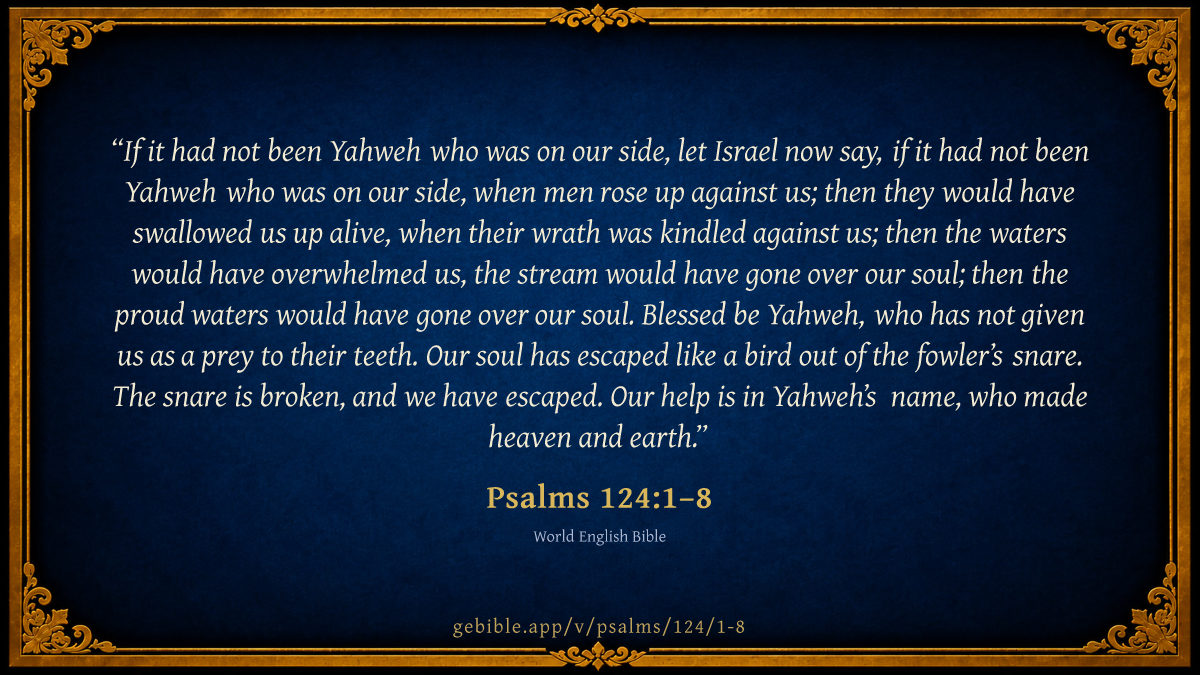
Romans 8:31(v1)What then shall we say about these things? If God is for us, who can be against us?
Psalms 56:9(v1)Then my enemies shall turn back in the day that I call. I know this: that God is for me.
Psalms 91:3(v7)For he will deliver you from the snare of the fowler, and from the deadly pestilence.
Psalms 54:4(v1)Behold, God is my helper. The Lord is the one who sustains my soul.
Psalms 120:1(v1)In my distress, I cried to Yahweh. He answered me.
Show all 91 cross-references
Hebrews 13:5-6(v1)Be free from the love of money, content with such things as you have, for he has said, “I will in no way leave you, neither will I in any…
Psalms 94:17(v1)Unless Yahweh had been my help, my soul would have soon lived in silence.
Psalms 118:6-7(v1)Yahweh is on my side. I will not be afraid. What can man do to me? Yahweh is on my side among those who help me. Therefore I will look in…
Psalms 121:1(v1)I will lift up my eyes to the hills. Where does my help come from?
Proverbs 6:5(v7)Free yourself, like a gazelle from the hand of the hunter, like a bird from the snare of the fowler.
Isaiah 8:9-10(v1)Make an uproar, you peoples, and be broken in pieces! Listen, all you from far countries: dress for battle, and be shattered! Dress for…
Psalms 125:1(v1)Those who trust in Yahweh are as Mount Zion, which can’t be moved, but remains forever.
Psalms 27:1(v1)Yahweh is my light and my salvation. Whom shall I fear? Yahweh is the strength of my life. Of whom shall I be afraid?
Psalms 46:7(v1)Yahweh of Armies is with us. The God of Jacob is our refuge.
Psalms 121:2(v8)My help comes from Yahweh, who made heaven and earth.
2 Timothy 2:26(v7)and they may recover themselves out of the devil’s snare, having been taken captive by him to his will.
1 Samuel 25:29(v7)Though men may rise up to pursue you, and to seek your soul, yet the soul of my lord will be bound in the bundle of life with Yahweh your…
Psalms 25:15(v7)My eyes are ever on Yahweh, for he will pluck my feet out of the net.
Psalms 127:1(v1)Unless Yahweh builds the house, they who build it labor in vain. Unless Yahweh watches over the city, the watchman guards it in vain.
1 Samuel 23:26-27(v7)Saul went on this side of the mountain, and David and his men on that side of the mountain; and David hurried to get away for fear of Saul;…
Psalms 128:1(v1)Blessed is everyone who fears Yahweh, who walks in his ways.
Acts 4:24(v8)When they heard it, they lifted up their voice to God with one accord, and said, “O Lord, you are God, who made the heaven, the earth, the…
2 Samuel 17:21-22(v7)After they had departed, they came up out of the well, and went and told king David; and they said to David, “Arise and pass quickly over…
Psalms 130:1(v1)Out of the depths I have cried to you, Yahweh.
Psalms 118:13(v6)You pushed me back hard, to make me fall, but Yahweh helped me.
Psalms 129:1(v1)Many times they have afflicted me from my youth up. Let Israel now say,
Psalms 146:5-6(v8)Happy is he who has the God of Jacob for his help, whose hope is in Yahweh, his God: who made heaven and earth, the sea, and all that is in…
Exodus 15:1(v1)Then Moses and the children of Israel sang this song to Yahweh, and said, “I will sing to Yahweh, for he has triumphed gloriously. He has…
Exodus 15:9-10(v6)The enemy said, ‘I will pursue. I will overtake. I will divide the plunder. My desire will be satisfied on them. I will draw my sword. My…
Psalms 126:1(v1)When Yahweh brought back those who returned to Zion, we were like those who dream.
Psalms 133:1(v1)See how good and how pleasant it is for brothers to live together in unity!
Psalms 145:5-6(v6)I will meditate on the glorious majesty of your honor, on your wondrous works. Men will speak of the might of your awesome acts. I will…
Jeremiah 18:22(v7)Let a cry be heard from their houses when you bring a troop suddenly on them; for they have dug a pit to take me and hidden snares for my…
Jeremiah 32:17(v8)“Ah Lord Yahweh! Behold, you have made the heavens and the earth by your great power and by your outstretched arm. There is nothing too…
Genesis 1:1(v8)In the beginning, God created the heavens and the earth.
Psalms 134:3(v8)May Yahweh bless you from Zion, even he who made heaven and earth.
Isaiah 10:14-19(v6)My hand has found the riches of the peoples like a nest, and like one gathers eggs that are abandoned, I have gathered all the earth. There…
1 Samuel 24:14-15(v7)Against whom has the king of Israel come out? Whom do you pursue? A dead dog? A flea? May Yahweh therefore be judge, and give sentence…
2 Samuel 17:2(v7)I will come on him while he is weary and exhausted, and will make him afraid. All the people who are with him will flee. I will strike the…
Psalms 17:9(v6)from the wicked who oppress me, my deadly enemies, who surround me.
Psalms 22:12-13(v2)Many bulls have surrounded me. Strong bulls of Bashan have encircled me. They open their mouths wide against me, lions tearing prey and…
Psalms 46:11(v1)Yahweh of Armies is with us. The God of Jacob is our refuge.
Psalms 69:15(v4)Don’t let the flood waters overwhelm me, neither let the deep swallow me up. Don’t let the pit shut its mouth on me.
Psalms 115:15(v8)Blessed are you by Yahweh, who made heaven and earth.
Psalms 123:1(v1)I lift up my eyes to you, you who sit in the heavens.
Psalms 132:1(v1)Yahweh, remember David and all his affliction,
Psalms 134:1(v1)Look! Praise Yahweh, all you servants of Yahweh, who stand by night in Yahweh’s house!
Jeremiah 5:26(v7)For wicked men are found among my people. They watch, as fowlers lie in wait. They set a trap. They catch men.
Revelation 17:15(v4)He said to me, “The waters which you saw, where the prostitute sits, are peoples, multitudes, nations, and languages.
Numbers 16:30-34(v3)But if Yahweh makes a new thing, and the ground opens its mouth, and swallows them up with all that belong to them, and they go down alive…
1 Samuel 26:20(v6)Now therefore, don’t let my blood fall to the earth away from the presence of Yahweh; for the king of Israel has come out to seek a flea,…
Esther 3:12-13(v3)Then the king’s scribes were called in on the first month, on the thirteenth day of the month; and all that Haman commanded was written to…
Psalms 22:16(v2)For dogs have surrounded me. A company of evildoers have enclosed me. They have pierced my hands and feet.
Psalms 35:25(v3)Don’t let them say in their heart, “Aha! That’s the way we want it!” Don’t let them say, “We have swallowed him up!”
Psalms 37:32(v2)The wicked watch the righteous, and seek to kill him.
Psalms 57:3(v3)He will send from heaven, and save me, he rebukes the one who is pursuing me. God will send out his loving kindness and his truth.
Psalms 122:1(v1)I was glad when they said to me, “Let’s go to Yahweh’s house!”
Psalms 131:1(v1)Yahweh, my heart isn’t arrogant, nor my eyes lofty; nor do I concern myself with great matters, or things too wonderful for me.
Isaiah 37:16-20(v8)“Yahweh of Armies, the God of Israel, who is enthroned among the cherubim, you are the God, even you alone, of all the kingdoms of the…
Matthew 2:16(v3)Then Herod, when he saw that he was mocked by the wise men, was exceedingly angry, and sent out, and killed all the male children who were…
Acts 9:2(v3)and asked for letters from him to the synagogues of Damascus, that if he found any who were of the Way, whether men or women, he might…
Revelation 12:15-16(v4)The serpent spewed water out of his mouth after the woman like a river, that he might cause her to be carried away by the stream. The earth…
Judges 5:30-31(v6)‘Have they not found, have they not divided the plunder? A lady, two ladies to every man; to Sisera a plunder of dyed garments, a plunder…
Job 38:11(v5)and said, ‘You may come here, but no further. Your proud waves shall be stopped here?’
Psalms 3:1(v2)Yahweh, how my adversaries have increased! Many are those who rise up against me.
Psalms 21:1-2(v2)The king rejoices in your strength, Yahweh! How greatly he rejoices in your salvation! You have given him his heart’s desire, and have not…
Psalms 27:2(v3)When evildoers came at me to eat up my flesh, even my adversaries and my foes, they stumbled and fell.
Psalms 32:6(v4)For this, let everyone who is godly pray to you in a time when you may be found. Surely when the great waters overflow, they shall not…
Psalms 69:2(v4)I sink in deep mire, where there is no foothold. I have come into deep waters, where the floods overflow me.
Isaiah 8:7-8(v4)now therefore, behold, the Lord brings upon them the mighty flood waters of the River: the king of Assyria and all his glory. It will come…
Isaiah 59:19(v4)So they will fear Yahweh’s name from the west, and his glory from the rising of the sun; for he will come as a rushing stream, which…
Jeremiah 5:22(v5)Don’t you fear me?’ says Yahweh ‘Won’t you tremble at my presence, who have placed the sand for the bound of the sea, by a perpetual…
Jeremiah 46:7-8(v4)“Who is this who rises up like the Nile, whose waters toss themselves like the rivers? Egypt rises up like the Nile, and his waters toss…
Daniel 3:19(v3)Then Nebuchadnezzar was full of fury, and the form of his appearance was changed against Shadrach, Meshach, and Abednego. He spoke, and…
Numbers 16:2-3(v2)They rose up before Moses, with some of the children of Israel, two hundred fifty princes of the congregation, called to the assembly, men…
1 Samuel 20:30-33(v3)Then Saul’s anger burned against Jonathan, and he said to him, “You son of a perverse rebellious woman, don’t I know that you have chosen…
Esther 3:6(v3)But he scorned the thought of laying hands on Mordecai alone, for they had made known to him Mordecai’s people. Therefore Haman sought to…
Job 22:11(v4)or darkness, so that you can not see, and floods of waters cover you.
Psalms 18:4(v4)The cords of death surrounded me. The floods of ungodliness made me afraid.
Psalms 42:7(v4)Deep calls to deep at the noise of your waterfalls. All your waves and your billows have swept over me.
Psalms 56:1-2(v3)Be merciful to me, God, for man wants to swallow me up. All day long, he attacks and oppresses me. My enemies want to swallow me up all day…
Psalms 74:8(v3)They said in their heart, “We will crush them completely.” They have burned up all the places in the land where God was worshiped.
Psalms 76:10(v3)Surely the wrath of man praises you. The survivors of your wrath are restrained.
Psalms 83:4(v3)“Come,” they say, “let’s destroy them as a nation, that the name of Israel may be remembered no more.”
Psalms 93:3-4(v5)The floods have lifted up, Yahweh, the floods have lifted up their voice. The floods lift up their waves. Above the voices of many waters,…
Proverbs 1:12(v3)Let’s swallow them up alive like Sheol, and whole, like those who go down into the pit.
Isaiah 28:2(v4)Behold, the Lord has a mighty and strong one. Like a storm of hail, a destroying storm, and like a storm of mighty waters overflowing, he…
Jeremiah 51:34(v3)“Nebuchadnezzar the king of Babylon has devoured me. He has crushed me. He has made me an empty vessel. He has, like a monster, swallowed…
Daniel 9:26(v4)After the sixty-two weeks the Anointed One will be cut off, and will have nothing. The people of the prince who come will destroy the city…
Revelation 17:1(v4)One of the seven angels who had the seven bowls came and spoke with me, saying, “Come here. I will show you the judgment of the great…
Jonah 1:17(v3)Yahweh prepared a great fish to swallow up Jonah, and Jonah was in the belly of the fish three days and three nights.
Cross-references from openbible.info (CC BY 4.0)
Explain this passage (25 sources)
Historical commentary, presented as a primary source — not an endorsement.
John Calvin1540 · Public DomainOn vv1, 2, 3, 4, 6, 81. But for Jehovah, who was on our side.…
1. But for Jehovah, who was on our side. Some expositors think that this Psalm describes the very sad and calamitous condition of the Church when the, residue of the people were carried away into Babylon. This opinion is, however, without any good foundation for the complaints made, apply with equal propriety to the persecutions which the Church suffered under the tyranny of Antiochus Epiphanes. It is another objection to this interpretation, that the Psalm bears in its inscription the name of David, and historically recounts the deliverance which the people had obtained from extreme danger by the power of God. To get quit of this difficulty they observe, that what had not yet come to pass is described prophetically; but this is a forced conjecture, for the Prophets usually speak of things to come in a different manner. It is more probable that David here sets forth a known history, and exhorts the faithful to reflect upon the divine succor which they had already actually experienced. I dare not, however, limit what is here spoken to David’s time. It is indeed true that the heathen nations often waged war against the people of God, armed with such power as to come rushing upon them with the impetuosity of a deluge; but as David does not specify any particular instance, he is not, I conceive, to be understood as celebrating only some one deliverance, but in general all the instances in which God had succoured his Church. The heathen at many different times, as is well known, rose up against the Church, with such mighty hosts, that she was brought almost to the verge of destruction. David then represents as in a mirror the uncertain and changeable condition of the Church, just such as it had been from the beginning, to teach the faithful that its stability had not been owing to its own intrinsic strength, but that it had been preserved by the wonderful grace of God; and to habituate them to call upon God in the midst of dangers.
John Calvin's Commentaries (1540-1563) — public domain. Text from the Calvin Translation Society English edition (1840s-50s) via the Christian Classics Ethereal Library (ccel.org). Calvin's coverage is partial (roughly two-thirds of the Bible); uncommented books and verses are honest gaps, never fabricated. The 19th-century editor's footnotes and remarks are omitted so the notes are faithfully Calvin's own voice.
Geneva Bible translators1599 · Public DomainOn vv1, 3, 4, 7He showeth that God was ready to help at…
He showeth that God was ready to help at need, and that there was none other way to be saved, but by his only means.
Geneva Bible (1599) marginal notes — public domain.
John Trapp1656 · Public DomainOn vv1–8Psa 124:1 « A Song of degrees of David.…
Psa 124:1 « A Song of degrees of David. » If [it had not been] the LORD who was on our side, now may Israel say;
Ver. 1. If it had not been the Lord, &c.] God may far better say than our Henry VIII, Cui adhaereo, praeest, He whose part I take is sure to prevail. But Christ hath ever been the Church’s champion, and hence she is insuperable. The Chaptain of the Lord’s hosts is Captain of our salvation, Jos 5:14 Heb 2:10.
John Trapp, A Commentary or Exposition upon All the Books of the Old and New Testament (1647–1656) — public domain. Text from a community e-Sword module.
Matthew Poole1685 · Public DomainOn vv3, 5, 6They had swallowed us up quick; they had speedily…
They had swallowed us up quick; they had speedily and utterly destroyed us, as Korah, &c. were, Num 16.
Matthew Poole's English Annotations on the Holy Bible (1683–1685) — public domain. Text from a community e-Sword/MySword module.
Matthew Henry1710 · Public DomainOn vv1, 6The people of God, being here called upon to…
The people of God, being here called upon to praise God for their deliverance, are to take notice,
I. Of the malice of men, by which they were reduced to the very brink of ruin. Let Israel say that there was but a step between them and death: the more desperate the disease appears to have been the more does the skill of the Physician appear in the cure. Observe, 1. Whence the threatening danger came: Men rose up against us, creatures of our own kind, and yet bent upon our ruin. Homo homini lupus - Man is a wolf to man. No marvel that the red dragon, the roaring lion, should seek to swallow us up; but that men should thirst after the blood of men, Absalom after the blood of his own father, that a woman should be drunk with the blood of saints, is what, with St. John, we may wonder at with great admiration. From men we may expect humanity, yet there are those whose tender mercies are cruel. But what was the matter with these men? Why their wrath was kindled against us (Psa 124:3); something or other they were angry at, and then no less would serve than the destruction of those they had conceived a displeasure against. Wrath is cruel and anger is outrageous. Their wrath was kindled as fire ready to consume us. They were proud; and the wicked in his pride doth persecute the poor. They were daring in their attempt; they rose up against us, rose in rebellion, with a resolution to swallow us up alive. 2. How far it went, and how fatal it would have been if it had gone a little further: "We should have been devoured as a lamb by a lion, not only slain, but swallowed up, so that there would have been no relics of us remaining, swallowed up with so much haste, ere we were aware, that we should have gone down alive to the pit. We should have been deluged as the low grounds by a land-flood or the sands by a high spring-tide." This similitude he dwells upon, with the ascents which bespeak this a song of degrees, or risings, like the rest. The waters had overwhelmed us. What of us? Why the stream had gone over our souls, our lives, our comforts, all that is dear to us. What waters? Why the proud waters. God suffers the enemies of his people sometimes to prevail very far against them, that his own power may appear the more illustrious in their deliverance.
Read full note →
II. Of the goodness of God, by which they were rescued from the very brink of ruin: "The Lord was on our side; and, if he had not been so, we should have been undone." 1. "God was on our side; he took our part, espoused our cause, and appeared for us. He was our helper, and a very present help, a help on our side, nigh at hand. He was with us, not only for us, but among us, and commander-in-chief of our forces." 2. That God was Jehovah; there the emphasis lies. "If it had not been Jehovah himself, a God of infinite power and perfection, that had undertaken our deliverance, our enemies would have overpowered us." Happy the people, therefore, whose God is Jehovah, a God all-sufficient. Let Israel say this, to his honour, and resolve never to forsake him.
Matthew Henry's Commentary on the Whole Bible (1708–1710) — public domain (CC PDM 1.0). Text via the HelloAO Bible API.
John Gill1763 · Public DomainOn vv1–7If it had not been the Lord who was…
If it had not been the Lord who was on our side,.... Or, "was for us" (h). The Syriac version is, "that rose up for us"; against their enemies, that rose up against them, as in Psa 123:2, or, "was with us", as Kimchi and Ben Melech; to help and assist, support and supply, strengthen and defend: or, "was among us", as the Arabic version; as their King, Protector, and Saviour. This implies that he was on their side; was for them, with them, and among them, and took their part against their enemies; see Psa 118:6; which if he had not done, their case would have been miserable and deplorable; or if any other had took their part, and not he, let them be who they would, angels or men. If God is on the side of us, it matters not who is against us; but if he is not on our side, or against us, it signifies nothing who is for us; see Rom 8:31. It suggests that the case of Israel now was so very forlorn and distressed, that none but the Lord himself could help them. Jehovah is on the side of his people in a spiritual sense, or otherwise it would be bad for them: God the Father is on their side; his love and relation to them engage him to be so; hence all those good things that are provided for them, and bestowed on them; nor will he suffer any to do them hurt, they being as dear to him as the apple of his eye; hence he grants them his gracious presence, supports them under all their trials and exercises, supplies all their wants, and keeps them by his power, and preserves them from all their enemies; so that they have nothing to fear from any quarter: Christ is on their side; he is the surety for them, the Saviour of them; has took their part against all their spiritual enemies, sin, Satan, the world, and death; has engaged with them, and conquered them; he is the Captain of their salvation, their King at the head of them, that protects and defends them here, and is their friend in the court of heaven; their Advocate and interceding High Priest there, who pleads their cause against Satan, and obtains every blessing for them: the Spirit of Jehovah is on their side, to carry on his own work in them; to assist them in their prayers and supplications; to secure them from Satan's temptations; to set up a standard for them, when the enemy comes in like a flood upon them; and to comfort them under all their castings down; and to work them up for, and bring them safe to, heaven: but were not this the case, what would become of them?
now may Israel say; this was a public case the psalmist here records, in which all Israel were concerned; and whom he calls upon to take notice of it, and directs them what to say on this occasion.
Read full note →
(h) "pro nobis", Vatablus.
John Gill's Exposition of the Whole Bible (1746–1763) — public domain (CC PDM 1.0). Text via the HelloAO Bible API.
John Wesley1765 · Public DomainOn vv1, 5David describes the danger he and his people had…
David describes the danger he and his people had been in, ver. 1-5. Blesses God for delivering them, ver. 6-8. A song of degrees of David.
John Wesley, Explanatory Notes Upon the Whole Bible (1754–1765) — public domain. Text via the GEBible commentary corpus.
Adam Clarke1810 · Public DomainOn vv1, 5, 7, 8A thanksgiving of the godly for extraordinary deliverances, 1-4.
PSALM CXXIV
A thanksgiving of the godly for extraordinary deliverances, 1-4.
Read full note →
The great danger they were in, 7.
Their confidence in God, 8.
NOTES ON PSALM CXXIV
In our present Hebrew copies this Psalm is attributed to David, לדוד ledavid; but this inscription is wanting in three of Kennicott's and De Rossi's MSS., as also in the Septuagint, Syriac, Vulgate, AEthiopic, and Arabic; and in most of the ancient fathers, Greek and Latin, who found no other inscription in their copies of the text than A Psalm of degrees. It was composed long after David's days; and appears to be either a thanksgiving for their deliverance from the Babylonish captivity, or for a remarkable deliverance from some potent and insidious enemy after their return to Judea. Or, what appears to be more likely, it is a thanksgiving of the Jews for their escape from the general massacre intended by Haman, prime minister of Ahasuerus, king of Persia. See the whole Book of Esther.
Verse 1. If it had not been the Lord] If God had not, in a very especial manner, supported and defended us, we had all been swallowed up alive, and destroyed by a sudden destruction, so that not one would have been left. This might refer to the plot against the whole nation of the Jews by Haman, in the days of Mordecai and Esther; when by his treacherous schemes the Jews, wheresoever dispersed in the provinces of Babylon, were all to have been put to death in one day. This may here be represented under the figure of an earthquake, when a chasm is formed, and a whole city and its inhabitants are in a moment swallowed up alive.
Adam Clarke's Commentary on the Bible (1810–1826) — public domain. Text from a community e-Sword/MySword module.
Joseph Benson1811 · Public DomainOn vv3, 7Psa 124:3-6. They had swallowed us up quick —…
Psa 124:3-6. They had swallowed us up quick — They had speedily and utterly destroyed us, as Korah and his company were, Numbers 16. The proud waters had gone over, &c. — Our enemies, compared to proud waters for their great multitude, swelling rage, and mighty force. The Lord hath not given us a prey to their teeth — A metaphor taken from wild beasts, which tear and devour their prey with their teeth. It is here intimated that the enemies of God’s people have no power whatever against them, but what is given them from above. God, however, sometimes suffers them to prevail very far against them, that his own power may appear the more illustrious in their deliverance.
Joseph Benson's Commentary on the Old and New Testaments (1811–1818) — public domain. Text from a community e-Sword module.
Albert Barnes1834 · Public DomainOn vv1–8If it had not been the Lord who was…
If it had not been the Lord who was on our side - Unless it was Yahweh who was with us. The idea is, that someone had been with them, and had delivered them, and that such was the nature of the interposition that it could be ascribed to no one but Yahweh. It bore unmistakeable evidence that it was his work. The deliverance was of such a kind that it could have been accomplished by him only. Such things often occur in life, when the intervention in our behalf is so remarkable that we can ascribe it to no one else but God.
Now may Israel say - May well and truly say. The danger was so great, their helplessness was so manifest, and the deliverance was so clearly the work of God, that it was proper to say that if this had not occurred, ruin would have been inevitable and entire.
Albert Barnes' Notes on the Bible (1834–1885) — public domain. Text from a community e-Sword/MySword module.
Lange's Commentary on the Holy Scriptures1864 · Public DomainOn v1Psalms 124
Psalms 124
A Song of degrees of David
Read full note →
If it had not been the Lord who was on our side,
Now may Israel say;
2 If it had not been the Lord who was on our side,
When men rose up against us:
3 Then they had swallowed us up quick,
When their wrath was kindled against us:
4 Then the waters had overwhelmed us,
The stream had gone over our soul:
5 Then the proud waters
Had gone over our soul.
6 Blessed be the Lord, who hath not given us
As a prey to their teeth.
7 Our soul is escaped as a bird
Out of the snare of the fowlers:
The snare is broken,
And we are escaped.
8 Our help is in the name of the Lord,
Who made heaven and earth.
EXEGETICAL AND CRITICAL
Contents and Composition: Great dangers, by which the Israelitish people were threatened and in which they would have perished if it had not been for the help of God, for which He is now gratefully praised, are here described by the figures of overflowing floods of water and the snare of the hunter. The mention of David in the superscription is not found in any of the ancient versions except the Chald., but the images remind one strongly of expressions employed by David, as also does the “lofty theological spirit of faith” (Luther). The contents also are suited to dangers of the war with Syria and Edom (Hengstenberg). The supposition of Aramaic word-forms is disputed even by Hupfeld, who, however, as do most of the recent commentators, finds the condition of the people after the return from exile, referred to. Delitzsch also assigns the poem to the same period, but regards it as one composed after the manner of David, while Hitzig refers it to the sudden deliverance from extreme danger (1Ma_13:20 f.), when Tryphon withdrew his forces and returned to his own country.
[The conjecture of Delitzsch that the words “by David” were inserted in the title on account of the resemblances to passages in the Davidic Psalms, is improbable. Such an insertion would at all events have been quite superfluous, for the cotemporaries of the supposed author were certainly sufficiently versed in the psalmodic literature to perceive the allusions, and his object could not have been to mislead them. In spite of the conclusion of recent critics,1 with whom Perowne also, among the English commentators, agrees, it is best to remain with Hengst., by the statement of the superscription.—J. F. M.].
Psa_124:1-3. The explanation of שׁ before היה (Psa_124:1), is doubtful, whether it is to be construed as a conjunction that, or as a relative who, or whether it is to be regarded as a pleonasm of later times (Hupfeld, et al.), or as a pregnant construction with a contraction of the two clauses.2 But the sense remains unaffected by any of these variations.—The form אוי for או is not a later but an ancient and poetical one. The expression Psa_124:3 a is based upon Num_16:32, comp. Psa_55:16; Pro_1:12.3
Psa_124:4-5. The water as a figurative representation of enemies (Ps. 23:17; 144:7). In Psa_124:4 b occurs the fuller form נַחֲלָה and not the accusative: to the stream, as in Num_34:5, comp. Böttcher, Ausführliche Sprachlehre § 615,—the form זידונים (Psa_124:5) for זידיםPsa_86:14; Psa_119:51; Psa_119:78, is found also in Psa_54:5, and is not an unhebraic form, although only found in the Chaldee as the usual term.
[Psa_124:8. Delitzsch: “The help of Israel is in the name of Jehovah, the Creator of the world, i.e. in His name revealed and perpetually attested as Jehovah. If the power of the world would seek to assimilate to itself, or to annihilate, the Church of Jehovah, it is not the denial of her God that will deliver her, but faithful confession, steadfast even unto death.-J. F. M.].
HOMILETICAL AND PRACTICAL
It is often only after deliverance that we realize the extent of the danger we have escaped. But does our gratitude correspond to this knowledge, and does our rejoicing continue?—God is not merely the only but also the efficient Deliverer of His people. To Him alone the honor is due (Psa_28:6; Psa_31:22), with the unreserved trust of the Church (Psa_56:12).—Communion with God our only but certain deliverance from ruin; let us therefore draw nigh unto Him, as he has drawn nigh unto us.—Let the whole world be against us, if God be for us.—The world is less mighty, but more harmful, than many suppose.
Starke: When God is present in mercy, there can not only no evil harm us, but we also cannot want any good thing,—It is not to be ascribed to the clemency of the enemies of the Church that she is not destroyed, as though they could be so merciful; but to the defence and protection of God.—It must be a cold winter when wolves devour one another; but men are much more wicked, and are inflamed with such cruel mutual rage, that they fall upon one another like wild beasts.—The faith which clings simply and alone to God, obtains supernatural help from Him, from His omnipotence and compassion.—That which is built upon human strength stands upon the yielding sand, and must fall to the ground; but that which is built upon God’s word and power, stands firmly, and can neither fail nor fall.
Rieger: David presents two considerations to the little band of God’s people: first, from how much danger God preserves them, and then, the trust which they should repose in Him for such mercy.—Frisch: Let men be angry; if only God is not angry with thee, their anger cannot harm thee.—Tholuck: A confession and a vow that He, to whom all things must minister, as He has made them all, shall be Israel’s only Help and Consolation.—Schaubach: Blessed be the Lord, to whom alone we owe it, that we remain unharmed in body and soul even unto this hour.—Richter: If the world cannot always rage against believers as it would like to do, give to the Lord who restrains it all the glory.—Many cherish the delusion that the world is not so very hostile, and give it the honor instead of God; follow thou in all things the Holy Scriptures.—Let the redeemed be as swift to praise as God is ready to help; and as the need and help were great, so let the thanks be abundant and hearty.—Diedrich: As it is with the whole of the Church, so also with each individual believing soul; it must ever keep toiling like the swimmer in the water; for the world, the flesh, and the devil keep up their attacks upon it.—Taube: Two marks indicate perpetually the deeply engraved trace of the guidance of Israel: trouble below, help from above.—Israel’s thanksgiving and expectation take refreshing rest in the name of the Lord.
[Matt. Henry: It is a comfort to all that lay the cause of God’s Israel next their hearts, that Israel’s God is the same that made the world, and therefore will have a Church in the world, and can secure that Church in the times of the greatest danger and distress. In Him, therefore, let the Church’s friends put their confidence, and they shall not be put to confusion.—Bp. Horne: The redeemed are astonished upon looking back at the greatness of the danger to which they had been exposed.—Happy they who are taken from the evil to come, and have passed from the miseries of earth to the felicities of heaven, where they are neither tempted nor molested more.—Barnes (Psa_124:8): Often in life, when delivered from danger, we may feel this: we always may feel this, and should feel this, when we think of the redemption of our souls.—J. F. M.]
Footnotes:
[1][The treatment, by many modern critics, of the title of this Psalm, furnishes an example of the capricious criticism that would reject the superscription generally. The title is shown to be spurious chiefly from the following considerations: The Psalm stands between two others whose authors are not named in their superscriptions, but which, from their contents, are supposed to be connected with the Captivity and the Restoration. It also must belong to the same period. It contains expressions which occur in some of David’s Psalms; this led the collector to think that David was the author, and he recorded this conjecture as a fact. The first plea assumes that those Psalms which belong to the same period must have been placed together in the same group (here in the Degree Psalms). But this principle, though occasionally followed in the Psalter, is manifestly not the one adopted in the Degree Psalms. This collection was probably arranged on the principle that those Psalms which bore a mutual resemblance in general subject, mental posture, or external situation, should be grouped together. So Psalms 123-126 are found as one series. Psalms 127, 128 are strikingly similar, as also a resemblance is clearly discernible between Psalms 130, 131. This sufficiently accounts for the insertion of a Degree-Psalm of David between others of a later date. The second argument would assume that David was very unlikely ever to repeat himself. It is remarkable that these points of coincidence have been adduced by other commentators with equal plausibility, as additional evidence of a Davidic composition, which they fortify by the citation of cases incontestably parallel.—J. F. M.]
[2][The last named construction, adopted in E. V., is the more common as well as the more regular one. Psa_94:17 is a real parallel, in spite of Hupfeld’s objection to the contrary. For the relative clause here is equivalent to, or rather is, a real predicate, such as is found in that passage. Pleonasms should only be assumed under absolute necessity.—J. F. M.]
[3][In E. V. notice the use of the word quick, in its antiquated sense alive.—J. F. M.]
Lange's Commentary on the Holy Scriptures (Critical, Doctrinal, and Homiletical), ed. John Peter Lange, English translation edited by Philip Schaff (1864–1880) — public domain. Text from a community e-Sword module.
Daniel D. Whedon1874 · Public DomainOn vv1, 2, 3, 4, 7, 81. If it had not been—The Hebrew is abrupt…
1. If it had not been—The Hebrew is abrupt and elliptical, If not, or unless, Jehovah was for us. Alexander proposes, as tantamount, “What if the Lord had not been for us?” leaving the answer to the imagination of the reader.
Now may Israel say—The particle נא, (nah,) is intensive of the imperative, as, Israel, say I pray. It is an urgent call to confession of Jehovah’s timely aid.
Daniel D. Whedon (gen. ed.), Commentary on the Old and New Testaments (1874–1909) — public domain. Text from a community e-Sword module.
The Cambridge Bible for Schools and Colleges1878 · Public DomainOn vv1–81. If it had not been Jehovah that was…
1. If it had not been Jehovah that was for us,
Let Israel now say.
Read full note →
Cp. Jacob’s words in Gen_31:42; Neh_4:20, “our God shall fight for us”; and Psa_94:17; Psa_56:9; Psa_108:6. The structure of the first two verses resembles that of Psa_129:1-2.
1–5. Unless Jehovah had taken our part, we should have been destroyed by our enemies.
The Cambridge Bible for Schools and Colleges (gen. ed. J. J. S. Perowne; Cambridge University Press, 1878–1918) — public domain. Text from a community e-Sword module.
Ellicott's Commentary for English Readers1878 · Public DomainOn vv2, 3, 4, 5, 7, 8(2) If it had not been.—For this motto of…
(2) If it had not been.—For this motto of the covenant, see Psa_94:17.
Men.—Better, man. In this use of the general term, we must, as Reuss points out, see an indication of the time of composition of the psalm. One who could so speak of the whole world as separated into two parts (Jews and heathen), discloses a sense of isolation and exclusiveness which brings us far down from the time of the prophets. They, indeed, spoke of it as the ideal of the future. This psalmist regards it as an accomplished fact.
A Bible Commentary for English Readers, edited by Charles John Ellicott (1878–1897) — public domain. Text from a community e-Sword module.
The Pulpit Commentary1880 · Public DomainOn vv1–8"A FRESH, bright lyric" (Cheyne), composed of two stanzas…
"A FRESH, bright lyric" (Cheyne), composed of two stanzas the first part (vers. 1-5) recounting a danger and a deliverance; the second (vers. 6-8), praising God for the latter. This is another of the psalms in this "Little Psalter," ascribed by its title to David. There is nothing in the style, or in the contents, that is inconsistent with the ascription.
If it had not been the Lord who was on our side, now may Israel say; rather, now let Israel say (Kay, Cheyne, Revised Version).
Read full note →
Vers. 1-8. Divine deliverance.
The spirit which breathes in this psalm is one of keen thankfulness. Nothing calls out so deep and strong a sense of indebtedness to God (or to man) as a consciousness that we owe to him an escape from a great calamity. We bless the Lord with the most fervent gratitude as we realize that he has healed our disease and redeemed our life from destruction. (Psa_103:1-4) We ought to be mindful of all his benefits, and accept them as they come, one after another, as gifts from his gracious hand. We should cherish a still stronger and profounder sense of his mercy to us in the one supreme kindness shown us in the redemption of the world by Jesus Christ, in which we have our share. But that which most vividly impresses us is the deliverance which, in different ways and at various times, he has wrought for us saving our life, preserving our character, restoring our freedom.
I TWO GREAT EVILS FROM WHICH WE MAY NEED, AND MAY HAVE, DELIVERANCE.
1. Oppression. Such as Israel endured under Pharaoh; such as Judah was threatened with when Sennacherib came up against Jerusalem; such as the Jews suffered under Antiochus; such as England faced and feared when the Armada left the shores of Spain; such as, in our own individual life, we may experience at the hand of some one who has us at his mercy and is disposed to play the tyrant. A human spirit is sometimes exposed to a veritable storm of cruelty; there are "overwhelming waters" of suffering to pass under; the stream goes over the soul (ver. 4). Then nothing but Divine succor avails to save from complete collapse; except the Lord show himself to be on our side by manifestations of his power, by the exercise of his goodness and his grace, we must break down utterly. But God is on our side. He will not forsake his children in the time of their distress.
(1) He will rescue us, in his own time, from the power that oppresses us, and set us free, placing "our feet in a large room;" or,
(2) he will so effectually sustain us that we shall hold up our head in the midst of all our afflictions. (see Isa_43:2)
2. Temptation. The psalmist speaks of snares (ver. 7) and of escaping from the fowler"s hand. As we pass through life there are many of these that have to be avoided; and it may be that in our unwisdom we permit ourselves to be partially ensnared; we may allow our foot to be taken in the toils of unbelief, or of intemperance, or of impurity, or of covetousness, or of pride, or of vanity, or of extravagance and dishonesty. We may be in very serious danger of losing everything that is most precious- of parting, not only with our reputation, but with the very life of our life, with our moral and spiritual integrity. But God, in his abounding grace, interposes on our behalf. Directly or indirectly, by the immediate action of his Spirit on our spirit, or through some instrumentality, he arouses us, shows us the peril in which we stand, breaks the snare in which our foot is taken, and sets us free. Then comes
II DEEP THANKFULNESS OF HEART. For, however great was the first gift of life, and however great the gift of the new life in Christ Jesus, this Divine deliverance is a mercy that may well be compared with these, and may well fill our mouth with song and our life with praise. Then, too, must come
III WATCHFULNESS UNTO PRAYER, constantly and carefully maintained.
HOMILIES BY S. CONWAY Vers. 1-8. But for the Lord.
The psalm is a contemplation of the distress that must have come upon God"s people but for the Lord"s timely help.
I IT IS THE LANGUAGE OF ISRAEL"S GRATITUDE. We cannot tell what were the exact circumstances which are referred to; but many times in Israel"s history had there been the threatening of overwhelming calamity. In the old times, in Egypt, in the wilderness, in Judah and Jerusalem, as during the invasion of Sennacherib, when they were carried off to captivity, and during that captivity (see the Book of Esther), Israel had abundant cause for such grateful acknowledgments as we find here. But the special circumstances we do not and cannot know; and this is well, for now we are left free to make application of them to any out of the many like circumstances which from time to time recur in the histories of nations, Churches, and individual souls.
II IT IS THAT OF REDEEMED HUMANITY. Mankind everywhere, as well as the redeemed in heaven, might well render praise like this. For the whole human race was in dire peril. When men turned out so ill, as they did and still do, so that the Lord repented that he had made man, wherefore should God have preserved any of them alive? Their guilt, their wickedness, their subjection to the spirit of evil, these were ready to swallow the race of man up quick. The might and malice of the devil were eager for the work. Why should it not have been? And the alone answer is the love of God. (Joh_3:16) And still today we often all but despair of humanity; the whole world, save a minute fraction, yet lieth in wickedness, dead in trespasses and sins, rushing ruinwards with headlong speed. But yet the race is spared, for the Lord is on our side. This is the gospel of man. God would not have created us had it not been true.
III IT MAY WELL BE THAT OF THE CHURCH OF GOD. For often and often in her history has it seemed as if there were but a step betwixt her and death. See that boat on the Lake of Galilee in the midnight storm: it contains the whole of the disciples and Jesus, and he asleep. One wave more, and they would all go to the bottom, swallowed up quick, the proud waters had gone over their soul (ver. 3). But that wave never came. And so has it been again and again with the Church of God. Persecution for three long centuries did its worst; false doctrine has many times, from the earlier centuries down to the present, threatened to submerge the faith we held; worse still, corruption, vile and loathsome, has fastened on the life of the Church, so that religion has been hateful in men"s esteem, as it was in the pre-Reformation ages. But the heart of the Church has remained sound amid all; the Lord was on her side, and so she has escaped as a bird, etc. (ver. 7).
IV NATIONS, TOO, MAY ADOPT THIS LANGUAGE. See the times of the Armada: how fearful the peril seemed then! And so in the days of the French Revolution, when the colossal power of Napoleon threatened the life of every independent nation.
V AND HOW OFTEN INDIVIDUAL BELIEVERS HAVE HAD CAUSE THUS TO SPEAK! In regard to the power of temptation, they have been all but gone, their feet well-nigh slipped. But the Lord was on their side. So in regard to the malice of enemies, and the cruel power of disaster and distress.
CONCLUSION. If the Lord has been thus on our side as he has we will, by his grace, be evermore on his. S.C.
HOMILIES BY R. TUCK Ver. 1. Jehovah for us.
"The Lord who was on our side." It is well to bear in mind that, usually, in the Old Testament, the term "the Lord" would be better rendered "Jehovah," the covenant name for God. Many passages in which the term occurs gain new force when distinctly associated with the Israelite covenant. The tone of this psalm is altogether different from that of the preceding one. The historical association is uncertain. Taking the psalm as a whole, it would seem to be a rejoicing of the exiles in Babylon when the proclamation of Cyrus permitted them to return to their native land. But this association does not easily explain the precise figure of the snare in ver. 7. It is better to keep the psalms of degrees associated with the life of the returned exiles in Jerusalem, and to find the suggestion of the figures in their particular experiences.
I THE KEY-NOTE OF THE ISRAELITE HISTORY. "The Lord is on our side." Another psalmist gives it thus: "The Lord of hosts is with us, the God of Jacob is our Refuge." The names of God imply the appropriation of God to themselves by Israel, "Jehovah-Jireh," "Jehovah of hosts,.... Jehovah Tsidkenu," etc. (compare Ebenezer). Note the one supreme lesson learned by the successes and failures of their wilderness-experiences. They were strong when God was with them. Failure came when God hid his face from them; woe came when they hid their faces from God. The symbol of the presence was the Shechinah-glory in the holy of holies; but we should not fail to see that the tabernacle and temple did but represent the people; and God"s glory in them did but represent his abiding presence with his people. But it should further be noticed that throughout the Israelite history it is Jehovah, the covenant Cod, who is with them; and that his keeping with them must be seen as his faithfulness to his covenant-pledge. It is a faithfulness which should inspire faithfulness.
II THE KEY-NOTE OF THE ISRAELITE HOPE. The national life had always been in the special Divine care, and it always would. The one holy God, who could only be served in righteousness, whose uniqueness is gathered up into the term "Jehovah," had chosen this people for his inheritance. Would, then, the nation abide even through what seemed an overwhelming discipline? Was there a certain future for the nation, though now it lay low under the shadows? The answer is this Lord is on its side. R.T.
HOMILIES BY C. SHORT Vers. 1-8. The believer"s safeguard.
"If Jehovah had not been on our side," etc. The last psalm was the sigh of an exile in Babylon waiting upon God for deliverance. This psalm is the joyful acknowledgment that the deliverance has been accomplished. The next (125) describes the safety of the exiles restored to their native land, and girt round by the protection of Jehovah.
I GOD IS ON OUR SIDE WHEN HE SEEMS MOST AGAINST US. As he was on the side of the Israelites both in delivering them over to the Captivity and in breaking their bonds. Punishment and pardon have the same end in view the redemption of the sinner.
II GOD IS ON OUR SIDE WHEN MEN ARE MOST AGAINST US. When the angry and destructive passions of men most threaten to overwhelm us (vers. 2-5). He takes our side always inwardly, if not always outwardly. God is always on the side of the weakest, to help them to become strong.
III GOD HELPS US TO ESCAPE FROM THE SUBTLEST SNARES WHICH CIRCUMSTANCES HAVE WOVEN AROUND us if we are the victims and not the constructors of those snares. God will have no deceit in saint or sinner.
IV BUT THOUGH GOD IS THE CREATOR OF ALL THINGS, HE IS THE HELP, AND NOT THE SUBSTITUTE, OF MEN. (Ver. 8) The psalmists and prophets saw the Divine side of the moral work done in the world, but saw the human side also. S.
The Pulpit Commentary (1880–1919), ed. H.D.M. Spence-Jones & Joseph S. Exell — public domain. Text from a community e-Sword module.
Charles H. Spurgeon1885 · Public DomainOn vv1–8A Song of degrees of David. Of course the…
A Song of degrees of David. Of course the superfine critics have pounced upon this title as inaccurate, but we are at liberty to believe as much or as little of their assertions as we may please. They declare that there are certain ornaments of language in this little ode which were unknown in the Davidic period. It may be so; but in their superlative wisdom they have ventured upon so many other questionable statements that we are not bound to receive this dictum. Assuredly the manner of the song is very like to David's, and we are unable to see why he should be excluded from the authorship. Whether it be his composition or no, it breathes the same spirit as that which animates the unchallenged songs of the royal composer.
This short Psalm contains an acknowledgement of favour received by way of special deliverance (1-5), then a grateful act of worship in blessing Jehovah (6, 7), and, lastly, a declaration of confidence in the Lord for all future time of trial. May our experience lead us to the same conclusion as the saints of David's time. From all confidence in man may we be rescued by a holy reliance upon our God.
Read full note →
Ver. 1. If it had not been the Lord who was on our side, now may Israel say. The opening sentence is abrupt, and remains a fragment. By such a commencement attention was aroused as well as feeling expressed: and this is ever the way of poetic fireto break forth in uncontrollable flame. The many words in italics in our authorized version will show the reader that the translators did their best to patch up the passage, which, perhaps, had better have been left in its broken grandeur, and it would then have run thus:
"Had it not been Jehovah! He was for us, oh let Israel say! Had it not been Jehovah! He who was for us when men rose against us."
The glorious Lord became our ally; he took our part, and entered into treaty with us. If Jehovah were not our protector where should we be Nothing but his power and wisdom could have guarded us from the cunning and malice of our adversaries; therefore, let all his people say so, and openly give him the honour of his preserving goodness. Here are two "ifs, "and yet there is no "if" in the matter. The Lord was on our side, and is still our defender, and will be so from henceforth, even for ever. Let us with holy confidence exult in this joyful fact: We are far too slow in declaring our gratitude, hence the exclamation which should be rendered, "O let Israel say." We murmur without being stirred up to it, but our thanksgiving needs a spur, and it is well when some warm hearted friend bids us say what we feel. Imagine what would have happened if the Lord had left us, and then see what has happened because he has been faithful to us. Are not all the materials of a song spread before us? Let us sing unto the Lord.
Title. The title informs us that this sacred march was composed by king David; and we learn very clearly from the subject, that the progression referred to was the triumphant return of the king and his loyal army to Jerusalem, upon the overthrow of the dangerous rebellion to which the great mass of the people had been excited by Absalom and his powerful band of confederates. John Mason Good.
Whole Psalm. This psalm is ascribed to David. No reference is made to any specific danger and deliverance. There is a delightful universality in the language, which suits it admirably for an anthem of the redeemed, in every age and in every clime. The people of God still live in a hostile territory. Traitors are in the camp, and there are numerous foes without. And the church would soon be exterminated, if the malice and might of her adversaries were not restrained and defeated by a higher power. Hence this ode of praise has never become obsolete. How frequently have its strains of adoring gratitude floated on the breeze! What land is there, in which its outbursting gladness has not been heard! It has been sung upon the banks of the Jordan and the Nile, the Euphrates and the Tigris. It has been sung upon the banks of the Tiber and the Rhine, the Thames and the Forth. It has been sung upon the banks of the Ganges and the Indus, the Mississippi and the Irrawady. And we anticipate a period when the church, surmounting all her difficulties, and victory waving over her banners, shall sing this psalm of praise in every island and continent of our globe. The year of God's redeemed must come. The salvation of Christ shall extend to the utmost extremities of earth. And when this final emancipation takes place, the nations will shout for joy, and praise their Deliverer in psalms, and hymns, and spiritual songs. N. McMichael.
Whole Psalm. In the year 1582, this psalm was sung on a remarkable occasion in Edinburgh. An imprisoned minister, John Durie, had been set free, and was met and welcomed on entering the town by two hundred of his friends. The number increased till he found himself in the midst of a company of two thousand, who began to sing as they moved up the long High Street, "Now Israel may say, "etc. They sang in four parts with deep solemnity, all joining in the well known tune and psalm. They were much moved themselves, and so were all who heard; and one of the chief persecutors is said to have been more alarmed at this sight and song than at anything he had seen in Scotland. Andrew A. Bonar, in "Christ and His Church in the Book of Psalms", 1859.
Ver. 1. The Lord...on our side. Jehovah is on the side of his people in a spiritual sense, or otherwise it would be bad for them. God the Father is on their side; his love and relation to them engage him to be so; hence all those good things that are provided for them and bestowed on them; nor will he suffer any to do them hurt, they being as dear to him as the apple of his eye; hence he grants them his gracious presence, supports them under all their trials and exercises, supplies all their wants, and keeps them by his power, and preserves them from all their enemies; so that they have nothing to fear from any quarter. Christ is on their side; he is the Surety for them, the Saviour of them; has taken their part against all their spiritual enemies, sin, Satan, the world, and death; has engaged with them and conquered them: he is the Captain of their salvation, their King at the head of them, that protects and defends them here, and is their friend in the court of heaven; their Advocate and interceding High priest there, who pleads their cause against Satan, and obtains every blessing for them. The Spirit of Jehovah is on their side, to carry on his work in them; to assist them in their prayers and supplications; to secure them from Satan's temptations; to set up a standard for them when the enemy comes in like a flood upon them; and to comfort them in all their castings down; and to work them up for, and bring them safe to heaven: but were this not the case, what would become of them! John Gill.
Ver. 1. Israel. The "Israel" spoken of in this psalm may be Israel in the house of Laban, in whose person the Midrash Tehillim imagines the Psalm to be said. There are certainly some of its phrases which acquire an appropriate meaning from being interpreted in this connection. H.T. Armfield.
Ver. 1-4. Such abrupt and unfinished expressions in the beginning of the psalm indicate the great joy and exultation that will not suffer the speaker to finish his sentences. Robert Bellarmine.
Ver. 1-2. The somewhat paraphrastic rendering of these verses (with the unnecessary interpolation of the words in italics in the Authorised Version) greatly weaken their force and obscure their meaning. There is far more meant and expressed than simply that God gave the Israelites the victory over their enemies. The psalm is typico prophetic. It sets forth the condition of the church in this world, surrounded by enemies, implacable in their hatred, maddened by rage, and bent on her destruction. It gives assurance of her preservation, and continuous triumph, because Jehovah is her God. It foretells the future, full, and final destruction of all her enemies. It reechoes the song sung on the shores of the Red Sea. In it are heard the notes of the New Song before the great white throne. The praise and thanksgiving are to hwhy, the revealed oyhla, whose "eternal power and Godhead are understood by the things that are made:" to, hwhy, the revealed ydvla, whom the fathers knew as the Almighty, from the great things which he did for them: to hwhy, the God who has made a covenant with his people, the Redeemer. It is ladvy, the chosen people of God, the holy nation, the peculiar treasure to him above all peoples, and thus become, as the Rabbins say, "Odium generis gumant, "against whom oda (not men, but man collectively) rose up and sought to destroy. It is ladvy, God's chosen, the people of the covenant, that with the full delight of a personal "my, "joy in God and sings, "But that Jehovah, was zgl, ours!" Tame and frigid is the rendering"was on our side." Jehovah was theirs; that, their safety: that, their blessedness: that, their joy. Edward Thomas Gibson, 1818-1880.
Ver. 1,2.
1. God was on our side; he took our part, espoused our cause, and appeared for us. He was our helper, and a very present help, a help on our side, nigh at hand. He was with us; not only for us, but among us, and commander-in-chief of our forces.
2. That God was Jehovah; there the emphasis lies. If it had not been Jehovah himself, a God of infinite power and perfection, that had undertaken our deliverance, our enemies would have overpowered us. Happy the people therefore whose God is Jehovah, a God all sufficient. Let Israel say this to his honour, and resolve never to forsake him.
Matthew Henry.
Ver. 1,2,8. These three things will I bear on my heart, O Lord: "The Lord was on our side, "this for the past: "The snare is broken, " for the present; "Our help is in the name of the Lord, "this for the future. I will not and I cannot be fainthearted, whether in my contest with Satan, in my intercourse with the world, or in the upheavings of my wicked heart, so long as I hold this "threefold cord" in my hand, or rather, am held by it. Alfred Edersheim.
Ver. 1. The LORD who was on our side. Who is he? Why on our side? How does he prove it? What are we bound to do?
Ver. 1-3. Regard the text,
1. From the life of Jacob or Israel.
2. From the history of the nation.
3. From the annals of the church.
4. From our personal biography.
Ver. 1-5.
1. What might have been.
2. Why it has not been.
Ver. 1-5.
1. What the people of God would have been if the Lord had not been on their side.
(a) What if left to their enemies? Ps 124:2, 3.
Israel left to Pharaoh and his host in the time of
Moses: left to the Caananites in the time of Joshua:
to the Midianites in the time of Gideon: Judah to
the Assyrians in the time of Hezekiah: "Then they
had swallowed us up, "etc.
(b) What if left to themselves? "The stream had gone
over our soul": Ps 124:4, 5.
2. What the people of God are with the Lord on their side.
(a) All the designs of their enemies against them are
frustrated.
(b) Their inward sorrow is turned into joy.
(c) Both their inward and then outward troubles work
together for their good.
G. R.
Psalms 124:2*
Charles H. Spurgeon's The Treasury of David (1869–1885) — public domain. Psalms only. Text from a community e-Sword/MySword module.
The Biblical Illustrator1887 · Public DomainOn vv1, 6, 7, 8If it had not been the Lord who was…
Psa_124:1-8
If it had not been the Lord who was on our side.
Read full note →
God in the troubles of the good
I. Acknowledged as the Deliverer from great troubles (Psa_124:1-5).
1. The words represent the great troubles from which the Almighty wrought deliverance, as springing out of the hostility of man.
2. The hostility of man is represented by two figures--
(1) As the rage of wild beasts (verse 3).
(2) As the rage of rushing waters (verses 4, 5).
II. Praised as the Deliverer from great troubles (verses 6, 7).
1. Temporal. Israel in Babylonian exile.
2. Spiritual. Without figure, the unregenerate soul is in thraldom, and the Gospel alone can deliver it.
III. Trusted as the Deliverer from great troubles (verse 8). This trust is founded--
1. On His past goodness.
2. On His glorious name.
3. On His unbounded resources. (Homilist.)
The Church in various aspects
I. The Church rightly estimating her danger (verses 3-5, 7).
II. The Church rightly recognizing her Deliverer (verses 1, 2, 8).
III. The Church rightly expressing her gratitude (verse 6). This psalm abounds with striking figures, which, intelligently explained, may be forcefully applied. (J. O. Keen, D. D.)
Ifs and thens
To this writer the nations life had been full of ifs and thens--its saddening possibilities with their dreary consequences. If we had stood alone, if God had not been round about us, if unerring wisdom had not thought for us and worked for us when the calamity threatened,--then had we been as the bird in the snare of the fowler, then had we been overwhelmed! Ifs and thens,--possibilities and their consequences.
I. Human possibilities may be under Divine control. Whenever God calls a life into existence, He fills it to the brim with ifs and thens, with possibilities and their consequences. Take the first recorded scene in human life, remembering that it is highly symbolic. And the Lord God took the man, and put him into the Garden of Eden, to dress it, and to keep it; that was a life of far-reaching possibilities, which God made still clearer by laying down His if and then: if man obeyed, then all would be well; if he disobeyed, then all would be ill. God has treated every life since upon the same broad, universal Scale; and we need to bear in mind constantly, earnestly, that our life is arranged in the same fashion.
II. Divine deliverance follows Divine control. God has filled each life with its possibilities that there may ever be the supreme need for His guidance. God has not stereotyped life for us. Each sets up his lifes story from founts of movable type; it may be in this way, it may be in that, as we set the type. This makes life so magnificent, so awful. But when God is on our side, when we have chosen Him for our controller, when we set the type of life as He directs, then the printed page comes forth at last fair and clear upon imperishable parchment; and God shall read its record before assembled worlds, and pronounce it well done, for it will be His work done by us under His superintendence and by His strength. Let the life be under Divine control, and it must be crowned with Divine deliverance as surely as sunrising brings the light. (G. Davies.)
Why Gods people are afflicted
Why should believers need to be rescued from the teeth of the wild beast: why not prevent the wild beast from laying hold of them? Why should they need to be delivered from the snare of the fowler: why not prevent the snare from being set? Why should they need to be snatched from the swiftly rushing torrent, which is just about to overwhelm them: why not keep back the floods of waters, and bid their proud waves be still? Afflictions are sent by God.
I. To promote our spiritual improvement. The branches are pruned, and they bring forth more fruit: the flowers are crushed, and they yield their precious perfumes: the gem is cut deeper, and it sparkles with new lustre: the gold is thrown into the crucible, and, purified from the dross, it shines with greater splendour than ever. Once, in company with a clerical friend in a rural district, I paid a visit to a member of his church, whose affliction had been severe and protracted. He was a stone-mason. His sufferings had evidently been sanctified; and, some remarks being made in connection with this, he said, I must have been a very hard stone, sir; for I have needed a great deal of hewing.
II. To test our sincerity. Not on a review day can the brave man be distinguished from the coward. Amidst brilliant uniforms, and waving banners, and the sounds of martial music, and applauding spectators, you cannot discriminate the true man from the counterfeit. But the real character is known, when comes the tug of war, and the enemy is before you, and friends and companions are falling thick around you. So it is in the Christian warfare. Far more moral courage is demanded for a sick-bed than for a field of battle, where men are urged on to the work of mutual destruction. And who can tell what a hallowed influence may proceed from afflictions, when endured in an uncomplaining and cheerful spirit! (N. McMichael.)
The Lord on our side
1. The figures employed describe the situation of Gods people in any place or age, when they suddenly find themselves overtaken by calamity, when sorrow bursts upon them like the mountainous wave on a ship, when floods of ungodly men make them afraid, when they seem to feel in their flesh the teeth Of slander and malice, when they are unexpectedly entangled in perplexities and difficulties like the bird in the snare. So the early believers in the Messiah were troubled by Jewish and Roman persecutors, saints in many lands have been worried by Papal wolves, the evangelists of the last century were mobbed by worldly men, and the Christians in Madagascar and British India were more recently assailed by heathen foes. So the man of business is smitten by misfortune, disease springs upon its unsuspecting victim, and a family is diminished by death. So the convicted sinner is stricken by the terrors of Gods law, the convert has to fight against the world, the flesh and the devil, and the righteous soul is in heaviness through manifold temptations. All the cry is, what can be dons? How may we escape? Who will help us?
2. If Christians, we can profitably call to mind many escapes from evil.
3. It becomes us carefully to trace blessings to their source. The poet is less particular to describe the danger and the escape than to proclaim and praise the great Deliverer. We did not save ourselves. It was not the stamp of our foot that quieted the earthquake, not the sound of our voice that stilled the tempest, not the might of our arm that slew the lion, not the power of our hand that rent the network. It was lint any creature except as sent by God, armed with a portion of His strength, and for the sake of Jesus Christ, that in any degree accomplished our salvation. (E. J. Robinson.)
The Biblical Illustrator, edited by Joseph S. Exell (c. 1880s–1900s) — public domain. Text from a community e-Sword module.
The Expositor's Bible1887 · Public DomainOn v1Psalms 124
Psalms 124
A SEQUENCE may be traced connecting this with the two adjacent psalms. In Psalms 123, patient resignation sighed for deliverance, which here has been received and has changed the singers note into jubilant and wondering praise; while, in the next little lyric, we have the escaped Israel established in Jerusalem, and drawing omens of Divine guardianship from its impregnable position, on a mountain girt by mountains. This psalm is an outgush of the first rapture of astonishment and joy for deliverance so sudden and complete. It is most naturally taken as the expression of the feelings of the exiles on their restoration from Babylon. One thought runs through it all, that the sole actor in their deliverance has been Jehovah. No human arm has been bared for them; no created might could have rescued them from the rush of the swelling deluge. Like a bird in a net panting with fear and helplessness, they waited the fowlers grasp; but, lo, by an unseen Power the net was broken, and they are free to wing their flight to their nest. So. triumphantly they ring out at last the Name which has been their help, abjuring any share in their own rescue, and content to owe it all to Him.
Read full note →
The step-like structure is very obvious in this psalm. As Delitzsch puts it, "In order to take a step forward, it always goes back half a step." But the repetitions are not mere artistic embellishments; they beautifully correspond to the feelings expressed. A heart running over with thankful surprise at its own new security and freedom cannot but reiterate the occasion of its joy. It is quite as much devotion as art which says twice over that Jehovah was on the singers side. which twice recalls how nearly they had been submerged in the raging torrent, and twice remembers their escape from the closely wrapping but miraculously broken snare. A suppliant is not guilty of vain repetitions though he asks often for the same blessing, and thanksgiving for answered petitions should be as persistent as the petitions were. That must be a shallow gratitude which can be all poured out at one gush.
The psalmists metaphors for Israels danger are familiar ones. "They had swallowed us alive" may refer to the open jaws of Sheol, as in other psalms, but more probably is simply a figure drawn from beasts of prey, as in Psa_124:6. The other image of a furious swollen torrent sweeping over the heads (or, as here, over the soul) recalls the grand contrast drawn by Isaiah between the gently flowing "waters of Siloam" and the devastating rush of the "river," symbolising the King of Assyria, which, like some winter torrent swollen by the rains, suddenly rises and bears on its tawny bosom to the sea the ruins of mens works and the corpses of the workers.
The word rendered "proud" is a rare word, coming from a root meaning to boil over, and may be used here in its literal sense, but is more probably to be taken in its metaphorical meaning of haughty, and applied rather to the persons signified by the waters than to the flood itself. Psa_124:6 and Psa_124:7 are an advance on the preceding inasmuch as those described rather the imminence of danger, and these magnify the completeness of Jehovahs delivering mercy. The comparison of the soul to a bird is beautiful. {Psa_11:1} It hints at tremors and feebleness, at alternations of feeling like the flutter of some weak-winged songster, at the utter helplessness of the panting creature in the toils. One hand only could break the snare, and then the bruised wings were swiftly spread for flight once more, and up into the blue went the ransomed joy, with a song instead of harsh notes of alarm. "We-we are escaped." That is enough: we are out of the net. Whither the flight may be directed does not concern the singer in the first bliss of recovered freedom. All blessedness is contained in the one word "escaped," which therefore he reiterates, and with which the song closes, but for that final ascription of the glory of the escape to the mighty Name of Him who made heaven and earth.
William Robertson Nicoll, ed., The Expositor's Bible (London: Hodder & Stoughton, 1887–1910) — public domain. 65 of 66 books (1 Corinthians is not separately keyed, as that volume carries no machine-parseable verse references); section-level commentary keyed to the opening verse. Introductory and overview sections not keyed to a specific passage are excluded.
The Preacher's Complete Homiletical Commentary1892 · Public DomainOn v1This jubilant song speaks of a sudden peril and…
INTRODUCTION
This jubilant song speaks of a sudden peril and narrow escape, and praises God for the great deliverance. We take it to be, according to its title, a Psalm of David, not a hymn founded upon his character, writings, and history. It is full of his force and fire, suits not a few situations in which he shared the lot of Israel as herein described, and contains expressions parallel with words occurring in compositions of which he is the undoubted author. The figures employed describe the situation of God’s people in any place or age, when they suddenly find themselves overtaken by calamity as if in the earthquake’s jaws, when sorrow bursts upon them like the mountainous waves on a ship, when floods of ungodly men make them afraid, when they seem to feel in their flesh the teeth of slander and malice, when they are unexpectedly entangled in perplexities and difficulties, like the bird in the snare.—The Caravan and Temple.
Read full note →
THE INSATIABLE VORACITY OF THE WICKED
(Psa_124:1-6)
I. That the wicked are ever ready to devour the righteous. “They had swallowed us up quick” (Psa_124:3). “The Lord hath not given us as a prey to their teeth” (Psa_124:6).
1. The righteous are assailed with the anger of the wicked. “Men rose up against us; their wrath was kindled against us” (Psa_124:2-3). The sight of virtue, however modest and inoffensive, will inflame the anger of the wicked. It is said of a certain lady that when the mirror revealed the wrinkles in her face she dashed it to the ground in a fury. So is it with the wicked; they are enraged with the transparency of a character in which they see reflected the moral deformities of their own. The anger of the wicked is unreasonable. It springs from the basest passions, and scorns all attempts to control it. It is like a rudderless vessel tossed about in a tempestuous sea. The anger of the wicked recoils upon themselves. Says the proverb, “Anger is like ashes which fly back in the face of him who throws them.” Pope pithily observes, “To be angry is to revenge others’ faults upon ourselves.”
2. The anger of the wicked is insatiable. “Then the waters had overwhelmed us, the stream had gone over our soul: then the proud waters had gone over our soul” (Psa_124:4-5). As the advancing tide carries everything before it, and sucks it back again into the capacious throat of the stormy sea, so the wicked pour out their anger like a flood, and would fain swallow up the righteous, on whom their fury is spent. But the anger of the wicked, though insatiable, is impotent to destroy the good. It is limited by power Divine, and may be made to minister to the Divine praise (Psa_76:10).
II. That the Lord is the Deliverer of the righteous. “The Lord was on our side” (Psa_124:1-2). More than ordinary help was needed on this occasion. The enemies were too fierce and too formidable for any human power to withstand. Jehovah champions the cause of the helpless; and when the last moment of extremity is come, He strikes in for victory. There is a waste of power with Him. When the sinner sinks down in despair, and gives up all for lost, then the Lord stretches forth His hand and saves. In this way He demonstrates the salvation to be Divine.
III. That thanksgiving should be offered to the Lord for His delivering power. “Blessed be the Lord, who hath not given us as a prey” (Psa_124:6). This is the leading sentiment of the Psalm. Let God have all the glory. He only is the Deliverer, and His help is all-sufficient. The grateful heart rejoices in rendering its praise to God; and in proportion to the depth of distress from which we are lifted up will be the reality and fervour of our thankfulness.
LESSONS:—
1. If the wicked had their way, every vestige of righteousness would be utterly destroyed.
2. The power of the wicked is divinely restricted.
3. The righteous have always some cause for grateful praise.
THE SOUL’S ESCAPE FROM DANGER
(Psa_124:7-8)
I. That the soul is surrounded by many dangers. “As a bird, the snare of the fowlers” (Psa_124:7).
1. It is ensnared by worldliness. One of the most gigantic dangers against which God’s people have specially to guard—an enemy to all spirituality of thought and feeling.
2. It is ensnared by selfishness—a foe to all simple-hearted charity, to all expansive generosity and Christian philanthropy.
3. It is ensnared by unbelief—the enemy of prayer, of ingenuous confidence, of all personal Christian effort. These are not imaginary dangers. We meet them in every-day life. They threaten us at every point, and often have we to lament over the havoc they make in our hearts.
II. That the dangers surrounding the soul are not invincible. “The snare is broken, and we are escaped” (Psa_124:7).
1. May be overcome by watchfulness.
2. By prayer.
3. By obedience. And yet all our endeavours will fail, if we depend on them rather than on God. We cannot boast of our natural powers. “What pride has a bird in its wings and feathers when once caught in the silken thread, or fast in the golden wire? However splendid their endowments, only God can deliver souls from evil, and keep them free.”
III. That a way is divinely provided for the escape of the soul from all danger. “Our help is in the name of the Lord, who made heaven and earth” (Psa_124:8). Here we learn that the name of Jehovah is the source of help, and that this help is omnipotent. He “who made heaven and earth” is infinite in resources: all the forces of the universe are within His view, and obedient to His nod. “We may not see any peril, when our safety is to let our Saviour see for us. We only see beautiful shrubs and shadowy trees. He who is on our side sees the foe behind them in ambush. We only see the pleasing bait on a bosom of shining grass and showy flowers. Our constant Friend sees there the hidden trap. We only see the smooth turf inviting our feet, tired of ruts and stones. He who is yet for us sees the pit artfully concealed. We only see the glancing water and the smiling sky. Our Keeper sees the hurrying squall, and cries, “Beware! take in sail” (The Caravan and Temple). As we look back upon the past, we see that our help in extremity has come from Jehovah. In Him, therefore, may we place implicit confidence for the future.
LESSONS:—
1. Our greatest dangers are those we least suspect.
2. The utmost vigilance does not always avail.
3. The only reliable help is from God.
The Preacher's Complete Homiletical Commentary (gen. ed. Joseph S. Exell; Funk & Wagnalls, c. 1892) — public domain (pre-1929). A full-Bible homiletical/sermon-outline anthology covering 65 of 66 books (2 John is absent from the source module). Text from a community e-Sword module.
F. W. Grant1903 · Public DomainOn v1The deliverance.
The deliverance.
A song of the ascents: of David.
Read full note →
The deliverance is here already come, and it is an escape out of the extremest peril. They are conscious that only Jehovah could have accomplished it: else they would have been overwhelmed, as they nearly had been. Deceit had been at work too, as wherever our enemy is concerned it will be: there was a snare, which is now broken. Jehovah’s Name -all that He is -is, however, engaged for them; as it is for all His people. He has pledged it to us. How peaceful, then; at all times, should our confidence be!
F. W. Grant, The Numerical Bible (4th ed., 1903) — public domain. Text from a community e-Sword module.
J. R. Dummelow1909 · Public DomainOn v1This Ps. is sung at the Feast of Purim…
This Ps. is sung at the Feast of Purim to commemorate the deliverance from Haman. It is a gladsome lyric, thanking Jehovah for escape from heathen destruction, and may well have been composed under the impulse of deliverance from the Babylonian exile. In its formation it illustrates a particular rhythmic effect, viz. the ascending scale of a series of phrases.
1. Now may Israel say] what Israel says is Psa_124:1-5.
Read full note →
3. Quick] RV 'alive,' as Assyria and Babylon did to many nations.
4. Stream] better, 'torrent,' the winter torrent familiar in Palestine. Over our soul] overwhelming the very life of the nation.
J. R. Dummelow, A Commentary on the Holy Bible (Macmillan, 1909) — public domain. Text from a community e-Sword module.
C. I. Scofield1917 · Public DomainOn v1A Song of degrees of David
A Song of degrees of David
(See Scofield "Psa 120:1").
The Scofield Reference Bible (1917 edition), notes by C. I. Scofield — public domain. Text from a community e-Sword module.
Paul E. Kretzmann1924 · Public DomainOn v1The Lord the Deliverer of His Church.
The Lord the Deliverer of His Church.
A song of degrees of David, setting forth the assistance and deliverance of Jehovah in the midst of great dangers.
Read full note →
v. 1. If it had not been the Lord who was on our side, if it had not been for His merciful and almighty protection, now may Israel say, that is, all believers, as constituting together the spiritual Israel;
v. 2. if it had not been the Lord who was on our side when men rose up against us, as they will time and again in the interest of unbelief,
v. 3. then they had swallowed us up quick, gulping the believers down while they were still alive, when their wrath was kindled against us, flaming up in ferocious hatred;
v. 4. then the waters had overwhelmed us, the stream had gone over our soul, the result being a quick drowning;
v. 5. then the proud waters had gone over our soul, that is, the insolent enemies would have accomplished their destruction; for the situation was such as to place them beyond all human help; it was an extremity in which only the assistance of the Lord sustained them.
v. 6. Blessed be the Lord, to Him alone all praise and glory, who hath not given us as a prey to their teeth, not permitting the enemies to carry out their evil designs.
v. 7. Our soul is escaped as a bird out of the snare of the fowlers; the snare is broken, by the merciful providence of the Lord, and we are escaped. Both figures, that of rapacious wild beasts eager to sing their teeth into their prey and that of fowlers placing their snares for unwary birds, show, on the one hand, the greatness of the danger, on the other, however, the miracle of God’s deliverance. Therefore the psalmist concludes:
v. 8. Our help is in the name of the Lord, in reliance upon His glorious essence and all His attributes, as they are revealed and proclaimed in His Word, who made heaven and earth, for the almighty Sovereign of the universe is, at the same time, our merciful Father in Jesus, our Redeemer, whose deliverance and assistance we enjoy.
Paul E. Kretzmann, Popular Commentary of the Bible (1921–1924) — public domain. Text from a community e-Sword module.
Parallelism is common in Hebrew poetry. (See: Poetry and Parallelism)
Read full note →
song of ascents
Possible meanings are 1) "song people sang while going up to Jerusalem for a celebration" or 2) "song people sang while going up the steps into the temple" or 3) "song whose words are like steps." See how you translated this in Psalms 120:1
If Yahweh had not been on our side ... then they would have swallowed us up alive
This is a hypothetical statement that describes a result that did not happen, because Yahweh was actually on their side. AT: "Yahweh was on our side ... so they were not able to swallow us up alive" (See: Hypothetical Situations)
If Yahweh had not been on our side ... if it had not been Yahweh who was on our side
These two phrases mean the same thing. AT: "Without Yahweh's help ... without Yahweh's help" (See: Parallelism)
swallowed us up alive
This metaphor describes how the Israelites could have died to how a fierce animal would attack a smaller animal to eat. AT: "killed us" (See: Metaphor)
their anger raged against us
Here "their anger" refers to the enemies who were angry. AT: "they were very angry with us" (See: Metonymy)
John Calvin 1540 · Public Domain On vv1, 2, 3, 4, 6, 8 1. But for Jehovah, who was on our side.…
1. But for Jehovah, who was on our side. Some expositors think that this Psalm describes the very sad and calamitous condition of the Church when the, residue of the people were carried away into Babylon. This opinion is, however, without any good foundation for the complaints made, apply with equal propriety to the persecutions which the Church suffered under the tyranny of Antiochus Epiphanes. It is another objection to this interpretation, that the Psalm bears in its inscription the name of David, and historically recounts the deliverance which the people had obtained from extreme danger by the power of God. To get quit of this difficulty they observe, that what had not yet come to pass is described prophetically; but this is a forced conjecture, for the Prophets usually speak of things to come in a different manner. It is more probable that David here sets forth a known history, and exhorts the faithful to reflect upon the divine succor which they had already actually experienced. I dare not, however, limit what is here spoken to David’s time. It is indeed true that the heathen nations often waged war against the people of God, armed with such power as to come rushing upon them with the impetuosity of a deluge; but as David does not specify any particular instance, he is not, I conceive, to be understood as celebrating only some one deliverance, but in general all the instances in which God had succoured his Church. The heathen at many different times, as is well known, rose up against the Church, with such mighty hosts, that she was brought almost to the verge of destruction. David then represents as in a mirror the uncertain and changeable condition of the Church, just such as it had been from the beginning, to teach the faithful that its stability had not been owing to its own intrinsic strength, but that it had been preserved by the wonderful grace of God; and to habituate them to call upon God in the midst of dangers.
John Calvin's Commentaries (1540-1563) — public domain. Text from the Calvin Translation Society English edition (1840s-50s) via the Christian Classics Ethereal Library (ccel.org). Calvin's coverage is partial (roughly two-thirds of the Bible); uncommented books and verses are honest gaps, never fabricated. The 19th-century editor's footnotes and remarks are omitted so the notes are faithfully Calvin's own voice.
Geneva Bible translators 1599 · Public Domain On vv1, 3, 4, 7 He showeth that God was ready to help at…
He showeth that God was ready to help at need, and that there was none other way to be saved, but by his only means.
Geneva Bible (1599) marginal notes — public domain.
John Trapp 1656 · Public Domain On vv1–8 Psa 124:1 « A Song of degrees of David.…
Psa 124:1 « A Song of degrees of David. » If [it had not been] the LORD who was on our side, now may Israel say;
Ver. 1. If it had not been the Lord, &c.] God may far better say than our Henry VIII, Cui adhaereo, praeest, He whose part I take is sure to prevail. But Christ hath ever been the Church’s champion, and hence she is insuperable. The Chaptain of the Lord’s hosts is Captain of our salvation, Jos 5:14 Heb 2:10.
John Trapp, A Commentary or Exposition upon All the Books of the Old and New Testament (1647–1656) — public domain. Text from a community e-Sword module.
Matthew Poole 1685 · Public Domain On vv3, 5, 6 They had swallowed us up quick; they had speedily…
They had swallowed us up quick; they had speedily and utterly destroyed us, as Korah, &c. were, Num 16.
Matthew Poole's English Annotations on the Holy Bible (1683–1685) — public domain. Text from a community e-Sword/MySword module.
Matthew Henry 1710 · Public Domain On vv1, 6 The people of God, being here called upon to…
The people of God, being here called upon to praise God for their deliverance, are to take notice,
I. Of the malice of men, by which they were reduced to the very brink of ruin. Let Israel say that there was but a step between them and death: the more desperate the disease appears to have been the more does the skill of the Physician appear in the cure. Observe, 1. Whence the threatening danger came: Men rose up against us, creatures of our own kind, and yet bent upon our ruin. Homo homini lupus - Man is a wolf to man. No marvel that the red dragon, the roaring lion, should seek to swallow us up; but that men should thirst after the blood of men, Absalom after the blood of his own father, that a woman should be drunk with the blood of saints, is what, with St. John, we may wonder at with great admiration. From men we may expect humanity, yet there are those whose tender mercies are cruel. But what was the matter with these men? Why their wrath was kindled against us (Psa 124:3); something or other they were angry at, and then no less would serve than the destruction of those they had conceived a displeasure against. Wrath is cruel and anger is outrageous. Their wrath was kindled as fire ready to consume us. They were proud; and the wicked in his pride doth persecute the poor. They were daring in their attempt; they rose up against us, rose in rebellion, with a resolution to swallow us up alive. 2. How far it went, and how fatal it would have been if it had gone a little further: "We should have been devoured as a lamb by a lion, not only slain, but swallowed up, so that there would have been no relics of us remaining, swallowed up with so much haste, ere we were aware, that we should have gone down alive to the pit. We should have been deluged as the low grounds by a land-flood or the sands by a high spring-tide." This similitude he dwells upon, with the ascents which bespeak this a song of degrees, or risings, like the rest. The waters had overwhelmed us. What of us? Why the stream had gone over our souls, our lives, our comforts, all that is dear to us. What waters? Why the proud waters. God suffers the enemies of his people sometimes to prevail very far against them, that his own power may appear the more illustrious in their deliverance.
Read full note →
II. Of the goodness of God, by which they were rescued from the very brink of ruin: "The Lord was on our side; and, if he had not been so, we should have been undone." 1. "God was on our side; he took our part, espoused our cause, and appeared for us. He was our helper, and a very present help, a help on our side, nigh at hand. He was with us, not only for us, but among us, and commander-in-chief of our forces." 2. That God was Jehovah; there the emphasis lies. "If it had not been Jehovah himself, a God of infinite power and perfection, that had undertaken our deliverance, our enemies would have overpowered us." Happy the people, therefore, whose God is Jehovah, a God all-sufficient. Let Israel say this, to his honour, and resolve never to forsake him.
Matthew Henry's Commentary on the Whole Bible (1708–1710) — public domain (CC PDM 1.0). Text via the HelloAO Bible API.
John Gill 1763 · Public Domain On vv1–7 If it had not been the Lord who was…
If it had not been the Lord who was on our side,.... Or, "was for us" (h). The Syriac version is, "that rose up for us"; against their enemies, that rose up against them, as in Psa 123:2, or, "was with us", as Kimchi and Ben Melech; to help and assist, support and supply, strengthen and defend: or, "was among us", as the Arabic version; as their King, Protector, and Saviour. This implies that he was on their side; was for them, with them, and among them, and took their part against their enemies; see Psa 118:6; which if he had not done, their case would have been miserable and deplorable; or if any other had took their part, and not he, let them be who they would, angels or men. If God is on the side of us, it matters not who is against us; but if he is not on our side, or against us, it signifies nothing who is for us; see Rom 8:31. It suggests that the case of Israel now was so very forlorn and distressed, that none but the Lord himself could help them. Jehovah is on the side of his people in a spiritual sense, or otherwise it would be bad for them: God the Father is on their side; his love and relation to them engage him to be so; hence all those good things that are provided for them, and bestowed on them; nor will he suffer any to do them hurt, they being as dear to him as the apple of his eye; hence he grants them his gracious presence, supports them under all their trials and exercises, supplies all their wants, and keeps them by his power, and preserves them from all their enemies; so that they have nothing to fear from any quarter: Christ is on their side; he is the surety for them, the Saviour of them; has took their part against all their spiritual enemies, sin, Satan, the world, and death; has engaged with them, and conquered them; he is the Captain of their salvation, their King at the head of them, that protects and defends them here, and is their friend in the court of heaven; their Advocate and interceding High Priest there, who pleads their cause against Satan, and obtains every blessing for them: the Spirit of Jehovah is on their side, to carry on his own work in them; to assist them in their prayers and supplications; to secure them from Satan's temptations; to set up a standard for them, when the enemy comes in like a flood upon them; and to comfort them under all their castings down; and to work them up for, and bring them safe to, heaven: but were not this the case, what would become of them?
now may Israel say; this was a public case the psalmist here records, in which all Israel were concerned; and whom he calls upon to take notice of it, and directs them what to say on this occasion.
Read full note →
(h) "pro nobis", Vatablus.
John Gill's Exposition of the Whole Bible (1746–1763) — public domain (CC PDM 1.0). Text via the HelloAO Bible API.
John Wesley 1765 · Public Domain On vv1, 5 David describes the danger he and his people had…
David describes the danger he and his people had been in, ver. 1-5. Blesses God for delivering them, ver. 6-8. A song of degrees of David.
John Wesley, Explanatory Notes Upon the Whole Bible (1754–1765) — public domain. Text via the GEBible commentary corpus.
Adam Clarke 1810 · Public Domain On vv1, 5, 7, 8 A thanksgiving of the godly for extraordinary deliverances, 1-4.
PSALM CXXIV
A thanksgiving of the godly for extraordinary deliverances, 1-4.
Read full note →
The great danger they were in, 7.
Their confidence in God, 8.
NOTES ON PSALM CXXIV
In our present Hebrew copies this Psalm is attributed to David, לדוד ledavid; but this inscription is wanting in three of Kennicott's and De Rossi's MSS., as also in the Septuagint, Syriac, Vulgate, AEthiopic, and Arabic; and in most of the ancient fathers, Greek and Latin, who found no other inscription in their copies of the text than A Psalm of degrees. It was composed long after David's days; and appears to be either a thanksgiving for their deliverance from the Babylonish captivity, or for a remarkable deliverance from some potent and insidious enemy after their return to Judea. Or, what appears to be more likely, it is a thanksgiving of the Jews for their escape from the general massacre intended by Haman, prime minister of Ahasuerus, king of Persia. See the whole Book of Esther.
Verse 1. If it had not been the Lord] If God had not, in a very especial manner, supported and defended us, we had all been swallowed up alive, and destroyed by a sudden destruction, so that not one would have been left. This might refer to the plot against the whole nation of the Jews by Haman, in the days of Mordecai and Esther; when by his treacherous schemes the Jews, wheresoever dispersed in the provinces of Babylon, were all to have been put to death in one day. This may here be represented under the figure of an earthquake, when a chasm is formed, and a whole city and its inhabitants are in a moment swallowed up alive.
Adam Clarke's Commentary on the Bible (1810–1826) — public domain. Text from a community e-Sword/MySword module.
Joseph Benson 1811 · Public Domain On vv3, 7 Psa 124:3-6. They had swallowed us up quick —…
Psa 124:3-6. They had swallowed us up quick — They had speedily and utterly destroyed us, as Korah and his company were, Numbers 16. The proud waters had gone over, &c. — Our enemies, compared to proud waters for their great multitude, swelling rage, and mighty force. The Lord hath not given us a prey to their teeth — A metaphor taken from wild beasts, which tear and devour their prey with their teeth. It is here intimated that the enemies of God’s people have no power whatever against them, but what is given them from above. God, however, sometimes suffers them to prevail very far against them, that his own power may appear the more illustrious in their deliverance.
Joseph Benson's Commentary on the Old and New Testaments (1811–1818) — public domain. Text from a community e-Sword module.
Albert Barnes 1834 · Public Domain On vv1–8 If it had not been the Lord who was…
If it had not been the Lord who was on our side - Unless it was Yahweh who was with us. The idea is, that someone had been with them, and had delivered them, and that such was the nature of the interposition that it could be ascribed to no one but Yahweh. It bore unmistakeable evidence that it was his work. The deliverance was of such a kind that it could have been accomplished by him only. Such things often occur in life, when the intervention in our behalf is so remarkable that we can ascribe it to no one else but God.
Now may Israel say - May well and truly say. The danger was so great, their helplessness was so manifest, and the deliverance was so clearly the work of God, that it was proper to say that if this had not occurred, ruin would have been inevitable and entire.
Albert Barnes' Notes on the Bible (1834–1885) — public domain. Text from a community e-Sword/MySword module.
Lange's Commentary on the Holy Scriptures 1864 · Public Domain On v1 Psalms 124
Psalms 124
A Song of degrees of David
Read full note →
If it had not been the Lord who was on our side,
Now may Israel say;
2 If it had not been the Lord who was on our side,
When men rose up against us:
3 Then they had swallowed us up quick,
When their wrath was kindled against us:
4 Then the waters had overwhelmed us,
The stream had gone over our soul:
5 Then the proud waters
Had gone over our soul.
6 Blessed be the Lord, who hath not given us
As a prey to their teeth.
7 Our soul is escaped as a bird
Out of the snare of the fowlers:
The snare is broken,
And we are escaped.
8 Our help is in the name of the Lord,
Who made heaven and earth.
EXEGETICAL AND CRITICAL
Contents and Composition: Great dangers, by which the Israelitish people were threatened and in which they would have perished if it had not been for the help of God, for which He is now gratefully praised, are here described by the figures of overflowing floods of water and the snare of the hunter. The mention of David in the superscription is not found in any of the ancient versions except the Chald., but the images remind one strongly of expressions employed by David, as also does the “lofty theological spirit of faith” (Luther). The contents also are suited to dangers of the war with Syria and Edom (Hengstenberg). The supposition of Aramaic word-forms is disputed even by Hupfeld, who, however, as do most of the recent commentators, finds the condition of the people after the return from exile, referred to. Delitzsch also assigns the poem to the same period, but regards it as one composed after the manner of David, while Hitzig refers it to the sudden deliverance from extreme danger (1Ma_13:20 f.), when Tryphon withdrew his forces and returned to his own country.
[The conjecture of Delitzsch that the words “by David” were inserted in the title on account of the resemblances to passages in the Davidic Psalms, is improbable. Such an insertion would at all events have been quite superfluous, for the cotemporaries of the supposed author were certainly sufficiently versed in the psalmodic literature to perceive the allusions, and his object could not have been to mislead them. In spite of the conclusion of recent critics,1 with whom Perowne also, among the English commentators, agrees, it is best to remain with Hengst., by the statement of the superscription.—J. F. M.].
Psa_124:1-3. The explanation of שׁ before היה (Psa_124:1), is doubtful, whether it is to be construed as a conjunction that, or as a relative who, or whether it is to be regarded as a pleonasm of later times (Hupfeld, et al.), or as a pregnant construction with a contraction of the two clauses.2 But the sense remains unaffected by any of these variations.—The form אוי for או is not a later but an ancient and poetical one. The expression Psa_124:3 a is based upon Num_16:32, comp. Psa_55:16; Pro_1:12.3
Psa_124:4-5. The water as a figurative representation of enemies (Ps. 23:17; 144:7). In Psa_124:4 b occurs the fuller form נַחֲלָה and not the accusative: to the stream, as in Num_34:5, comp. Böttcher, Ausführliche Sprachlehre § 615,—the form זידונים (Psa_124:5) for זידיםPsa_86:14; Psa_119:51; Psa_119:78, is found also in Psa_54:5, and is not an unhebraic form, although only found in the Chaldee as the usual term.
[Psa_124:8. Delitzsch: “The help of Israel is in the name of Jehovah, the Creator of the world, i.e. in His name revealed and perpetually attested as Jehovah. If the power of the world would seek to assimilate to itself, or to annihilate, the Church of Jehovah, it is not the denial of her God that will deliver her, but faithful confession, steadfast even unto death.-J. F. M.].
HOMILETICAL AND PRACTICAL
It is often only after deliverance that we realize the extent of the danger we have escaped. But does our gratitude correspond to this knowledge, and does our rejoicing continue?—God is not merely the only but also the efficient Deliverer of His people. To Him alone the honor is due (Psa_28:6; Psa_31:22), with the unreserved trust of the Church (Psa_56:12).—Communion with God our only but certain deliverance from ruin; let us therefore draw nigh unto Him, as he has drawn nigh unto us.—Let the whole world be against us, if God be for us.—The world is less mighty, but more harmful, than many suppose.
Starke: When God is present in mercy, there can not only no evil harm us, but we also cannot want any good thing,—It is not to be ascribed to the clemency of the enemies of the Church that she is not destroyed, as though they could be so merciful; but to the defence and protection of God.—It must be a cold winter when wolves devour one another; but men are much more wicked, and are inflamed with such cruel mutual rage, that they fall upon one another like wild beasts.—The faith which clings simply and alone to God, obtains supernatural help from Him, from His omnipotence and compassion.—That which is built upon human strength stands upon the yielding sand, and must fall to the ground; but that which is built upon God’s word and power, stands firmly, and can neither fail nor fall.
Rieger: David presents two considerations to the little band of God’s people: first, from how much danger God preserves them, and then, the trust which they should repose in Him for such mercy.—Frisch: Let men be angry; if only God is not angry with thee, their anger cannot harm thee.—Tholuck: A confession and a vow that He, to whom all things must minister, as He has made them all, shall be Israel’s only Help and Consolation.—Schaubach: Blessed be the Lord, to whom alone we owe it, that we remain unharmed in body and soul even unto this hour.—Richter: If the world cannot always rage against believers as it would like to do, give to the Lord who restrains it all the glory.—Many cherish the delusion that the world is not so very hostile, and give it the honor instead of God; follow thou in all things the Holy Scriptures.—Let the redeemed be as swift to praise as God is ready to help; and as the need and help were great, so let the thanks be abundant and hearty.—Diedrich: As it is with the whole of the Church, so also with each individual believing soul; it must ever keep toiling like the swimmer in the water; for the world, the flesh, and the devil keep up their attacks upon it.—Taube: Two marks indicate perpetually the deeply engraved trace of the guidance of Israel: trouble below, help from above.—Israel’s thanksgiving and expectation take refreshing rest in the name of the Lord.
[Matt. Henry: It is a comfort to all that lay the cause of God’s Israel next their hearts, that Israel’s God is the same that made the world, and therefore will have a Church in the world, and can secure that Church in the times of the greatest danger and distress. In Him, therefore, let the Church’s friends put their confidence, and they shall not be put to confusion.—Bp. Horne: The redeemed are astonished upon looking back at the greatness of the danger to which they had been exposed.—Happy they who are taken from the evil to come, and have passed from the miseries of earth to the felicities of heaven, where they are neither tempted nor molested more.—Barnes (Psa_124:8): Often in life, when delivered from danger, we may feel this: we always may feel this, and should feel this, when we think of the redemption of our souls.—J. F. M.]
Footnotes:
[1][The treatment, by many modern critics, of the title of this Psalm, furnishes an example of the capricious criticism that would reject the superscription generally. The title is shown to be spurious chiefly from the following considerations: The Psalm stands between two others whose authors are not named in their superscriptions, but which, from their contents, are supposed to be connected with the Captivity and the Restoration. It also must belong to the same period. It contains expressions which occur in some of David’s Psalms; this led the collector to think that David was the author, and he recorded this conjecture as a fact. The first plea assumes that those Psalms which belong to the same period must have been placed together in the same group (here in the Degree Psalms). But this principle, though occasionally followed in the Psalter, is manifestly not the one adopted in the Degree Psalms. This collection was probably arranged on the principle that those Psalms which bore a mutual resemblance in general subject, mental posture, or external situation, should be grouped together. So Psalms 123-126 are found as one series. Psalms 127, 128 are strikingly similar, as also a resemblance is clearly discernible between Psalms 130, 131. This sufficiently accounts for the insertion of a Degree-Psalm of David between others of a later date. The second argument would assume that David was very unlikely ever to repeat himself. It is remarkable that these points of coincidence have been adduced by other commentators with equal plausibility, as additional evidence of a Davidic composition, which they fortify by the citation of cases incontestably parallel.—J. F. M.]
[2][The last named construction, adopted in E. V., is the more common as well as the more regular one. Psa_94:17 is a real parallel, in spite of Hupfeld’s objection to the contrary. For the relative clause here is equivalent to, or rather is, a real predicate, such as is found in that passage. Pleonasms should only be assumed under absolute necessity.—J. F. M.]
[3][In E. V. notice the use of the word quick, in its antiquated sense alive.—J. F. M.]
Lange's Commentary on the Holy Scriptures (Critical, Doctrinal, and Homiletical), ed. John Peter Lange, English translation edited by Philip Schaff (1864–1880) — public domain. Text from a community e-Sword module.
Daniel D. Whedon 1874 · Public Domain On vv1, 2, 3, 4, 7, 8 1. If it had not been—The Hebrew is abrupt…
1. If it had not been—The Hebrew is abrupt and elliptical, If not, or unless, Jehovah was for us. Alexander proposes, as tantamount, “What if the Lord had not been for us?” leaving the answer to the imagination of the reader.
Now may Israel say—The particle נא, (nah,) is intensive of the imperative, as, Israel, say I pray. It is an urgent call to confession of Jehovah’s timely aid.
Daniel D. Whedon (gen. ed.), Commentary on the Old and New Testaments (1874–1909) — public domain. Text from a community e-Sword module.
The Cambridge Bible for Schools and Colleges 1878 · Public Domain On vv1–8 1. If it had not been Jehovah that was…
1. If it had not been Jehovah that was for us,
Let Israel now say.
Read full note →
Cp. Jacob’s words in Gen_31:42; Neh_4:20, “our God shall fight for us”; and Psa_94:17; Psa_56:9; Psa_108:6. The structure of the first two verses resembles that of Psa_129:1-2.
1–5. Unless Jehovah had taken our part, we should have been destroyed by our enemies.
The Cambridge Bible for Schools and Colleges (gen. ed. J. J. S. Perowne; Cambridge University Press, 1878–1918) — public domain. Text from a community e-Sword module.
Ellicott's Commentary for English Readers 1878 · Public Domain On vv2, 3, 4, 5, 7, 8 (2) If it had not been.—For this motto of…
(2) If it had not been.—For this motto of the covenant, see Psa_94:17.
Men.—Better, man. In this use of the general term, we must, as Reuss points out, see an indication of the time of composition of the psalm. One who could so speak of the whole world as separated into two parts (Jews and heathen), discloses a sense of isolation and exclusiveness which brings us far down from the time of the prophets. They, indeed, spoke of it as the ideal of the future. This psalmist regards it as an accomplished fact.
A Bible Commentary for English Readers, edited by Charles John Ellicott (1878–1897) — public domain. Text from a community e-Sword module.
The Pulpit Commentary 1880 · Public Domain On vv1–8 "A FRESH, bright lyric" (Cheyne), composed of two stanzas…
"A FRESH, bright lyric" (Cheyne), composed of two stanzas the first part (vers. 1-5) recounting a danger and a deliverance; the second (vers. 6-8), praising God for the latter. This is another of the psalms in this "Little Psalter," ascribed by its title to David. There is nothing in the style, or in the contents, that is inconsistent with the ascription.
If it had not been the Lord who was on our side, now may Israel say; rather, now let Israel say (Kay, Cheyne, Revised Version).
Read full note →
Vers. 1-8. Divine deliverance.
The spirit which breathes in this psalm is one of keen thankfulness. Nothing calls out so deep and strong a sense of indebtedness to God (or to man) as a consciousness that we owe to him an escape from a great calamity. We bless the Lord with the most fervent gratitude as we realize that he has healed our disease and redeemed our life from destruction. (Psa_103:1-4) We ought to be mindful of all his benefits, and accept them as they come, one after another, as gifts from his gracious hand. We should cherish a still stronger and profounder sense of his mercy to us in the one supreme kindness shown us in the redemption of the world by Jesus Christ, in which we have our share. But that which most vividly impresses us is the deliverance which, in different ways and at various times, he has wrought for us saving our life, preserving our character, restoring our freedom.
I TWO GREAT EVILS FROM WHICH WE MAY NEED, AND MAY HAVE, DELIVERANCE.
1. Oppression. Such as Israel endured under Pharaoh; such as Judah was threatened with when Sennacherib came up against Jerusalem; such as the Jews suffered under Antiochus; such as England faced and feared when the Armada left the shores of Spain; such as, in our own individual life, we may experience at the hand of some one who has us at his mercy and is disposed to play the tyrant. A human spirit is sometimes exposed to a veritable storm of cruelty; there are "overwhelming waters" of suffering to pass under; the stream goes over the soul (ver. 4). Then nothing but Divine succor avails to save from complete collapse; except the Lord show himself to be on our side by manifestations of his power, by the exercise of his goodness and his grace, we must break down utterly. But God is on our side. He will not forsake his children in the time of their distress.
(1) He will rescue us, in his own time, from the power that oppresses us, and set us free, placing "our feet in a large room;" or,
(2) he will so effectually sustain us that we shall hold up our head in the midst of all our afflictions. (see Isa_43:2)
2. Temptation. The psalmist speaks of snares (ver. 7) and of escaping from the fowler"s hand. As we pass through life there are many of these that have to be avoided; and it may be that in our unwisdom we permit ourselves to be partially ensnared; we may allow our foot to be taken in the toils of unbelief, or of intemperance, or of impurity, or of covetousness, or of pride, or of vanity, or of extravagance and dishonesty. We may be in very serious danger of losing everything that is most precious- of parting, not only with our reputation, but with the very life of our life, with our moral and spiritual integrity. But God, in his abounding grace, interposes on our behalf. Directly or indirectly, by the immediate action of his Spirit on our spirit, or through some instrumentality, he arouses us, shows us the peril in which we stand, breaks the snare in which our foot is taken, and sets us free. Then comes
II DEEP THANKFULNESS OF HEART. For, however great was the first gift of life, and however great the gift of the new life in Christ Jesus, this Divine deliverance is a mercy that may well be compared with these, and may well fill our mouth with song and our life with praise. Then, too, must come
III WATCHFULNESS UNTO PRAYER, constantly and carefully maintained.
HOMILIES BY S. CONWAY Vers. 1-8. But for the Lord.
The psalm is a contemplation of the distress that must have come upon God"s people but for the Lord"s timely help.
I IT IS THE LANGUAGE OF ISRAEL"S GRATITUDE. We cannot tell what were the exact circumstances which are referred to; but many times in Israel"s history had there been the threatening of overwhelming calamity. In the old times, in Egypt, in the wilderness, in Judah and Jerusalem, as during the invasion of Sennacherib, when they were carried off to captivity, and during that captivity (see the Book of Esther), Israel had abundant cause for such grateful acknowledgments as we find here. But the special circumstances we do not and cannot know; and this is well, for now we are left free to make application of them to any out of the many like circumstances which from time to time recur in the histories of nations, Churches, and individual souls.
II IT IS THAT OF REDEEMED HUMANITY. Mankind everywhere, as well as the redeemed in heaven, might well render praise like this. For the whole human race was in dire peril. When men turned out so ill, as they did and still do, so that the Lord repented that he had made man, wherefore should God have preserved any of them alive? Their guilt, their wickedness, their subjection to the spirit of evil, these were ready to swallow the race of man up quick. The might and malice of the devil were eager for the work. Why should it not have been? And the alone answer is the love of God. (Joh_3:16) And still today we often all but despair of humanity; the whole world, save a minute fraction, yet lieth in wickedness, dead in trespasses and sins, rushing ruinwards with headlong speed. But yet the race is spared, for the Lord is on our side. This is the gospel of man. God would not have created us had it not been true.
III IT MAY WELL BE THAT OF THE CHURCH OF GOD. For often and often in her history has it seemed as if there were but a step betwixt her and death. See that boat on the Lake of Galilee in the midnight storm: it contains the whole of the disciples and Jesus, and he asleep. One wave more, and they would all go to the bottom, swallowed up quick, the proud waters had gone over their soul (ver. 3). But that wave never came. And so has it been again and again with the Church of God. Persecution for three long centuries did its worst; false doctrine has many times, from the earlier centuries down to the present, threatened to submerge the faith we held; worse still, corruption, vile and loathsome, has fastened on the life of the Church, so that religion has been hateful in men"s esteem, as it was in the pre-Reformation ages. But the heart of the Church has remained sound amid all; the Lord was on her side, and so she has escaped as a bird, etc. (ver. 7).
IV NATIONS, TOO, MAY ADOPT THIS LANGUAGE. See the times of the Armada: how fearful the peril seemed then! And so in the days of the French Revolution, when the colossal power of Napoleon threatened the life of every independent nation.
V AND HOW OFTEN INDIVIDUAL BELIEVERS HAVE HAD CAUSE THUS TO SPEAK! In regard to the power of temptation, they have been all but gone, their feet well-nigh slipped. But the Lord was on their side. So in regard to the malice of enemies, and the cruel power of disaster and distress.
CONCLUSION. If the Lord has been thus on our side as he has we will, by his grace, be evermore on his. S.C.
HOMILIES BY R. TUCK Ver. 1. Jehovah for us.
"The Lord who was on our side." It is well to bear in mind that, usually, in the Old Testament, the term "the Lord" would be better rendered "Jehovah," the covenant name for God. Many passages in which the term occurs gain new force when distinctly associated with the Israelite covenant. The tone of this psalm is altogether different from that of the preceding one. The historical association is uncertain. Taking the psalm as a whole, it would seem to be a rejoicing of the exiles in Babylon when the proclamation of Cyrus permitted them to return to their native land. But this association does not easily explain the precise figure of the snare in ver. 7. It is better to keep the psalms of degrees associated with the life of the returned exiles in Jerusalem, and to find the suggestion of the figures in their particular experiences.
I THE KEY-NOTE OF THE ISRAELITE HISTORY. "The Lord is on our side." Another psalmist gives it thus: "The Lord of hosts is with us, the God of Jacob is our Refuge." The names of God imply the appropriation of God to themselves by Israel, "Jehovah-Jireh," "Jehovah of hosts,.... Jehovah Tsidkenu," etc. (compare Ebenezer). Note the one supreme lesson learned by the successes and failures of their wilderness-experiences. They were strong when God was with them. Failure came when God hid his face from them; woe came when they hid their faces from God. The symbol of the presence was the Shechinah-glory in the holy of holies; but we should not fail to see that the tabernacle and temple did but represent the people; and God"s glory in them did but represent his abiding presence with his people. But it should further be noticed that throughout the Israelite history it is Jehovah, the covenant Cod, who is with them; and that his keeping with them must be seen as his faithfulness to his covenant-pledge. It is a faithfulness which should inspire faithfulness.
II THE KEY-NOTE OF THE ISRAELITE HOPE. The national life had always been in the special Divine care, and it always would. The one holy God, who could only be served in righteousness, whose uniqueness is gathered up into the term "Jehovah," had chosen this people for his inheritance. Would, then, the nation abide even through what seemed an overwhelming discipline? Was there a certain future for the nation, though now it lay low under the shadows? The answer is this Lord is on its side. R.T.
HOMILIES BY C. SHORT Vers. 1-8. The believer"s safeguard.
"If Jehovah had not been on our side," etc. The last psalm was the sigh of an exile in Babylon waiting upon God for deliverance. This psalm is the joyful acknowledgment that the deliverance has been accomplished. The next (125) describes the safety of the exiles restored to their native land, and girt round by the protection of Jehovah.
I GOD IS ON OUR SIDE WHEN HE SEEMS MOST AGAINST US. As he was on the side of the Israelites both in delivering them over to the Captivity and in breaking their bonds. Punishment and pardon have the same end in view the redemption of the sinner.
II GOD IS ON OUR SIDE WHEN MEN ARE MOST AGAINST US. When the angry and destructive passions of men most threaten to overwhelm us (vers. 2-5). He takes our side always inwardly, if not always outwardly. God is always on the side of the weakest, to help them to become strong.
III GOD HELPS US TO ESCAPE FROM THE SUBTLEST SNARES WHICH CIRCUMSTANCES HAVE WOVEN AROUND us if we are the victims and not the constructors of those snares. God will have no deceit in saint or sinner.
IV BUT THOUGH GOD IS THE CREATOR OF ALL THINGS, HE IS THE HELP, AND NOT THE SUBSTITUTE, OF MEN. (Ver. 8) The psalmists and prophets saw the Divine side of the moral work done in the world, but saw the human side also. S.
The Pulpit Commentary (1880–1919), ed. H.D.M. Spence-Jones & Joseph S. Exell — public domain. Text from a community e-Sword module.
Charles H. Spurgeon 1885 · Public Domain On vv1–8 A Song of degrees of David. Of course the…
A Song of degrees of David. Of course the superfine critics have pounced upon this title as inaccurate, but we are at liberty to believe as much or as little of their assertions as we may please. They declare that there are certain ornaments of language in this little ode which were unknown in the Davidic period. It may be so; but in their superlative wisdom they have ventured upon so many other questionable statements that we are not bound to receive this dictum. Assuredly the manner of the song is very like to David's, and we are unable to see why he should be excluded from the authorship. Whether it be his composition or no, it breathes the same spirit as that which animates the unchallenged songs of the royal composer.
This short Psalm contains an acknowledgement of favour received by way of special deliverance (1-5), then a grateful act of worship in blessing Jehovah (6, 7), and, lastly, a declaration of confidence in the Lord for all future time of trial. May our experience lead us to the same conclusion as the saints of David's time. From all confidence in man may we be rescued by a holy reliance upon our God.
Read full note →
Ver. 1. If it had not been the Lord who was on our side, now may Israel say. The opening sentence is abrupt, and remains a fragment. By such a commencement attention was aroused as well as feeling expressed: and this is ever the way of poetic fireto break forth in uncontrollable flame. The many words in italics in our authorized version will show the reader that the translators did their best to patch up the passage, which, perhaps, had better have been left in its broken grandeur, and it would then have run thus:
"Had it not been Jehovah! He was for us, oh let Israel say! Had it not been Jehovah! He who was for us when men rose against us."
The glorious Lord became our ally; he took our part, and entered into treaty with us. If Jehovah were not our protector where should we be Nothing but his power and wisdom could have guarded us from the cunning and malice of our adversaries; therefore, let all his people say so, and openly give him the honour of his preserving goodness. Here are two "ifs, "and yet there is no "if" in the matter. The Lord was on our side, and is still our defender, and will be so from henceforth, even for ever. Let us with holy confidence exult in this joyful fact: We are far too slow in declaring our gratitude, hence the exclamation which should be rendered, "O let Israel say." We murmur without being stirred up to it, but our thanksgiving needs a spur, and it is well when some warm hearted friend bids us say what we feel. Imagine what would have happened if the Lord had left us, and then see what has happened because he has been faithful to us. Are not all the materials of a song spread before us? Let us sing unto the Lord.
Title. The title informs us that this sacred march was composed by king David; and we learn very clearly from the subject, that the progression referred to was the triumphant return of the king and his loyal army to Jerusalem, upon the overthrow of the dangerous rebellion to which the great mass of the people had been excited by Absalom and his powerful band of confederates. John Mason Good.
Whole Psalm. This psalm is ascribed to David. No reference is made to any specific danger and deliverance. There is a delightful universality in the language, which suits it admirably for an anthem of the redeemed, in every age and in every clime. The people of God still live in a hostile territory. Traitors are in the camp, and there are numerous foes without. And the church would soon be exterminated, if the malice and might of her adversaries were not restrained and defeated by a higher power. Hence this ode of praise has never become obsolete. How frequently have its strains of adoring gratitude floated on the breeze! What land is there, in which its outbursting gladness has not been heard! It has been sung upon the banks of the Jordan and the Nile, the Euphrates and the Tigris. It has been sung upon the banks of the Tiber and the Rhine, the Thames and the Forth. It has been sung upon the banks of the Ganges and the Indus, the Mississippi and the Irrawady. And we anticipate a period when the church, surmounting all her difficulties, and victory waving over her banners, shall sing this psalm of praise in every island and continent of our globe. The year of God's redeemed must come. The salvation of Christ shall extend to the utmost extremities of earth. And when this final emancipation takes place, the nations will shout for joy, and praise their Deliverer in psalms, and hymns, and spiritual songs. N. McMichael.
Whole Psalm. In the year 1582, this psalm was sung on a remarkable occasion in Edinburgh. An imprisoned minister, John Durie, had been set free, and was met and welcomed on entering the town by two hundred of his friends. The number increased till he found himself in the midst of a company of two thousand, who began to sing as they moved up the long High Street, "Now Israel may say, "etc. They sang in four parts with deep solemnity, all joining in the well known tune and psalm. They were much moved themselves, and so were all who heard; and one of the chief persecutors is said to have been more alarmed at this sight and song than at anything he had seen in Scotland. Andrew A. Bonar, in "Christ and His Church in the Book of Psalms", 1859.
Ver. 1. The Lord...on our side. Jehovah is on the side of his people in a spiritual sense, or otherwise it would be bad for them. God the Father is on their side; his love and relation to them engage him to be so; hence all those good things that are provided for them and bestowed on them; nor will he suffer any to do them hurt, they being as dear to him as the apple of his eye; hence he grants them his gracious presence, supports them under all their trials and exercises, supplies all their wants, and keeps them by his power, and preserves them from all their enemies; so that they have nothing to fear from any quarter. Christ is on their side; he is the Surety for them, the Saviour of them; has taken their part against all their spiritual enemies, sin, Satan, the world, and death; has engaged with them and conquered them: he is the Captain of their salvation, their King at the head of them, that protects and defends them here, and is their friend in the court of heaven; their Advocate and interceding High priest there, who pleads their cause against Satan, and obtains every blessing for them. The Spirit of Jehovah is on their side, to carry on his work in them; to assist them in their prayers and supplications; to secure them from Satan's temptations; to set up a standard for them when the enemy comes in like a flood upon them; and to comfort them in all their castings down; and to work them up for, and bring them safe to heaven: but were this not the case, what would become of them! John Gill.
Ver. 1. Israel. The "Israel" spoken of in this psalm may be Israel in the house of Laban, in whose person the Midrash Tehillim imagines the Psalm to be said. There are certainly some of its phrases which acquire an appropriate meaning from being interpreted in this connection. H.T. Armfield.
Ver. 1-4. Such abrupt and unfinished expressions in the beginning of the psalm indicate the great joy and exultation that will not suffer the speaker to finish his sentences. Robert Bellarmine.
Ver. 1-2. The somewhat paraphrastic rendering of these verses (with the unnecessary interpolation of the words in italics in the Authorised Version) greatly weaken their force and obscure their meaning. There is far more meant and expressed than simply that God gave the Israelites the victory over their enemies. The psalm is typico prophetic. It sets forth the condition of the church in this world, surrounded by enemies, implacable in their hatred, maddened by rage, and bent on her destruction. It gives assurance of her preservation, and continuous triumph, because Jehovah is her God. It foretells the future, full, and final destruction of all her enemies. It reechoes the song sung on the shores of the Red Sea. In it are heard the notes of the New Song before the great white throne. The praise and thanksgiving are to hwhy, the revealed oyhla, whose "eternal power and Godhead are understood by the things that are made:" to, hwhy, the revealed ydvla, whom the fathers knew as the Almighty, from the great things which he did for them: to hwhy, the God who has made a covenant with his people, the Redeemer. It is ladvy, the chosen people of God, the holy nation, the peculiar treasure to him above all peoples, and thus become, as the Rabbins say, "Odium generis gumant, "against whom oda (not men, but man collectively) rose up and sought to destroy. It is ladvy, God's chosen, the people of the covenant, that with the full delight of a personal "my, "joy in God and sings, "But that Jehovah, was zgl, ours!" Tame and frigid is the rendering"was on our side." Jehovah was theirs; that, their safety: that, their blessedness: that, their joy. Edward Thomas Gibson, 1818-1880.
Ver. 1,2.
1. God was on our side; he took our part, espoused our cause, and appeared for us. He was our helper, and a very present help, a help on our side, nigh at hand. He was with us; not only for us, but among us, and commander-in-chief of our forces.
2. That God was Jehovah; there the emphasis lies. If it had not been Jehovah himself, a God of infinite power and perfection, that had undertaken our deliverance, our enemies would have overpowered us. Happy the people therefore whose God is Jehovah, a God all sufficient. Let Israel say this to his honour, and resolve never to forsake him.
Matthew Henry.
Ver. 1,2,8. These three things will I bear on my heart, O Lord: "The Lord was on our side, "this for the past: "The snare is broken, " for the present; "Our help is in the name of the Lord, "this for the future. I will not and I cannot be fainthearted, whether in my contest with Satan, in my intercourse with the world, or in the upheavings of my wicked heart, so long as I hold this "threefold cord" in my hand, or rather, am held by it. Alfred Edersheim.
Ver. 1. The LORD who was on our side. Who is he? Why on our side? How does he prove it? What are we bound to do?
Ver. 1-3. Regard the text,
1. From the life of Jacob or Israel.
2. From the history of the nation.
3. From the annals of the church.
4. From our personal biography.
Ver. 1-5.
1. What might have been.
2. Why it has not been.
Ver. 1-5.
1. What the people of God would have been if the Lord had not been on their side.
(a) What if left to their enemies? Ps 124:2, 3.
Israel left to Pharaoh and his host in the time of
Moses: left to the Caananites in the time of Joshua:
to the Midianites in the time of Gideon: Judah to
the Assyrians in the time of Hezekiah: "Then they
had swallowed us up, "etc.
(b) What if left to themselves? "The stream had gone
over our soul": Ps 124:4, 5.
2. What the people of God are with the Lord on their side.
(a) All the designs of their enemies against them are
frustrated.
(b) Their inward sorrow is turned into joy.
(c) Both their inward and then outward troubles work
together for their good.
G. R.
Psalms 124:2*
Charles H. Spurgeon's The Treasury of David (1869–1885) — public domain. Psalms only. Text from a community e-Sword/MySword module.
The Biblical Illustrator 1887 · Public Domain On vv1, 6, 7, 8 If it had not been the Lord who was…
Psa_124:1-8
If it had not been the Lord who was on our side.
Read full note →
God in the troubles of the good
I. Acknowledged as the Deliverer from great troubles (Psa_124:1-5).
1. The words represent the great troubles from which the Almighty wrought deliverance, as springing out of the hostility of man.
2. The hostility of man is represented by two figures--
(1) As the rage of wild beasts (verse 3).
(2) As the rage of rushing waters (verses 4, 5).
II. Praised as the Deliverer from great troubles (verses 6, 7).
1. Temporal. Israel in Babylonian exile.
2. Spiritual. Without figure, the unregenerate soul is in thraldom, and the Gospel alone can deliver it.
III. Trusted as the Deliverer from great troubles (verse 8). This trust is founded--
1. On His past goodness.
2. On His glorious name.
3. On His unbounded resources. (Homilist.)
The Church in various aspects
I. The Church rightly estimating her danger (verses 3-5, 7).
II. The Church rightly recognizing her Deliverer (verses 1, 2, 8).
III. The Church rightly expressing her gratitude (verse 6). This psalm abounds with striking figures, which, intelligently explained, may be forcefully applied. (J. O. Keen, D. D.)
Ifs and thens
To this writer the nations life had been full of ifs and thens--its saddening possibilities with their dreary consequences. If we had stood alone, if God had not been round about us, if unerring wisdom had not thought for us and worked for us when the calamity threatened,--then had we been as the bird in the snare of the fowler, then had we been overwhelmed! Ifs and thens,--possibilities and their consequences.
I. Human possibilities may be under Divine control. Whenever God calls a life into existence, He fills it to the brim with ifs and thens, with possibilities and their consequences. Take the first recorded scene in human life, remembering that it is highly symbolic. And the Lord God took the man, and put him into the Garden of Eden, to dress it, and to keep it; that was a life of far-reaching possibilities, which God made still clearer by laying down His if and then: if man obeyed, then all would be well; if he disobeyed, then all would be ill. God has treated every life since upon the same broad, universal Scale; and we need to bear in mind constantly, earnestly, that our life is arranged in the same fashion.
II. Divine deliverance follows Divine control. God has filled each life with its possibilities that there may ever be the supreme need for His guidance. God has not stereotyped life for us. Each sets up his lifes story from founts of movable type; it may be in this way, it may be in that, as we set the type. This makes life so magnificent, so awful. But when God is on our side, when we have chosen Him for our controller, when we set the type of life as He directs, then the printed page comes forth at last fair and clear upon imperishable parchment; and God shall read its record before assembled worlds, and pronounce it well done, for it will be His work done by us under His superintendence and by His strength. Let the life be under Divine control, and it must be crowned with Divine deliverance as surely as sunrising brings the light. (G. Davies.)
Why Gods people are afflicted
Why should believers need to be rescued from the teeth of the wild beast: why not prevent the wild beast from laying hold of them? Why should they need to be delivered from the snare of the fowler: why not prevent the snare from being set? Why should they need to be snatched from the swiftly rushing torrent, which is just about to overwhelm them: why not keep back the floods of waters, and bid their proud waves be still? Afflictions are sent by God.
I. To promote our spiritual improvement. The branches are pruned, and they bring forth more fruit: the flowers are crushed, and they yield their precious perfumes: the gem is cut deeper, and it sparkles with new lustre: the gold is thrown into the crucible, and, purified from the dross, it shines with greater splendour than ever. Once, in company with a clerical friend in a rural district, I paid a visit to a member of his church, whose affliction had been severe and protracted. He was a stone-mason. His sufferings had evidently been sanctified; and, some remarks being made in connection with this, he said, I must have been a very hard stone, sir; for I have needed a great deal of hewing.
II. To test our sincerity. Not on a review day can the brave man be distinguished from the coward. Amidst brilliant uniforms, and waving banners, and the sounds of martial music, and applauding spectators, you cannot discriminate the true man from the counterfeit. But the real character is known, when comes the tug of war, and the enemy is before you, and friends and companions are falling thick around you. So it is in the Christian warfare. Far more moral courage is demanded for a sick-bed than for a field of battle, where men are urged on to the work of mutual destruction. And who can tell what a hallowed influence may proceed from afflictions, when endured in an uncomplaining and cheerful spirit! (N. McMichael.)
The Lord on our side
1. The figures employed describe the situation of Gods people in any place or age, when they suddenly find themselves overtaken by calamity, when sorrow bursts upon them like the mountainous wave on a ship, when floods of ungodly men make them afraid, when they seem to feel in their flesh the teeth Of slander and malice, when they are unexpectedly entangled in perplexities and difficulties like the bird in the snare. So the early believers in the Messiah were troubled by Jewish and Roman persecutors, saints in many lands have been worried by Papal wolves, the evangelists of the last century were mobbed by worldly men, and the Christians in Madagascar and British India were more recently assailed by heathen foes. So the man of business is smitten by misfortune, disease springs upon its unsuspecting victim, and a family is diminished by death. So the convicted sinner is stricken by the terrors of Gods law, the convert has to fight against the world, the flesh and the devil, and the righteous soul is in heaviness through manifold temptations. All the cry is, what can be dons? How may we escape? Who will help us?
2. If Christians, we can profitably call to mind many escapes from evil.
3. It becomes us carefully to trace blessings to their source. The poet is less particular to describe the danger and the escape than to proclaim and praise the great Deliverer. We did not save ourselves. It was not the stamp of our foot that quieted the earthquake, not the sound of our voice that stilled the tempest, not the might of our arm that slew the lion, not the power of our hand that rent the network. It was lint any creature except as sent by God, armed with a portion of His strength, and for the sake of Jesus Christ, that in any degree accomplished our salvation. (E. J. Robinson.)
The Biblical Illustrator, edited by Joseph S. Exell (c. 1880s–1900s) — public domain. Text from a community e-Sword module.
The Expositor's Bible 1887 · Public Domain On v1 Psalms 124
Psalms 124
A SEQUENCE may be traced connecting this with the two adjacent psalms. In Psalms 123, patient resignation sighed for deliverance, which here has been received and has changed the singers note into jubilant and wondering praise; while, in the next little lyric, we have the escaped Israel established in Jerusalem, and drawing omens of Divine guardianship from its impregnable position, on a mountain girt by mountains. This psalm is an outgush of the first rapture of astonishment and joy for deliverance so sudden and complete. It is most naturally taken as the expression of the feelings of the exiles on their restoration from Babylon. One thought runs through it all, that the sole actor in their deliverance has been Jehovah. No human arm has been bared for them; no created might could have rescued them from the rush of the swelling deluge. Like a bird in a net panting with fear and helplessness, they waited the fowlers grasp; but, lo, by an unseen Power the net was broken, and they are free to wing their flight to their nest. So. triumphantly they ring out at last the Name which has been their help, abjuring any share in their own rescue, and content to owe it all to Him.
Read full note →
The step-like structure is very obvious in this psalm. As Delitzsch puts it, "In order to take a step forward, it always goes back half a step." But the repetitions are not mere artistic embellishments; they beautifully correspond to the feelings expressed. A heart running over with thankful surprise at its own new security and freedom cannot but reiterate the occasion of its joy. It is quite as much devotion as art which says twice over that Jehovah was on the singers side. which twice recalls how nearly they had been submerged in the raging torrent, and twice remembers their escape from the closely wrapping but miraculously broken snare. A suppliant is not guilty of vain repetitions though he asks often for the same blessing, and thanksgiving for answered petitions should be as persistent as the petitions were. That must be a shallow gratitude which can be all poured out at one gush.
The psalmists metaphors for Israels danger are familiar ones. "They had swallowed us alive" may refer to the open jaws of Sheol, as in other psalms, but more probably is simply a figure drawn from beasts of prey, as in Psa_124:6. The other image of a furious swollen torrent sweeping over the heads (or, as here, over the soul) recalls the grand contrast drawn by Isaiah between the gently flowing "waters of Siloam" and the devastating rush of the "river," symbolising the King of Assyria, which, like some winter torrent swollen by the rains, suddenly rises and bears on its tawny bosom to the sea the ruins of mens works and the corpses of the workers.
The word rendered "proud" is a rare word, coming from a root meaning to boil over, and may be used here in its literal sense, but is more probably to be taken in its metaphorical meaning of haughty, and applied rather to the persons signified by the waters than to the flood itself. Psa_124:6 and Psa_124:7 are an advance on the preceding inasmuch as those described rather the imminence of danger, and these magnify the completeness of Jehovahs delivering mercy. The comparison of the soul to a bird is beautiful. {Psa_11:1} It hints at tremors and feebleness, at alternations of feeling like the flutter of some weak-winged songster, at the utter helplessness of the panting creature in the toils. One hand only could break the snare, and then the bruised wings were swiftly spread for flight once more, and up into the blue went the ransomed joy, with a song instead of harsh notes of alarm. "We-we are escaped." That is enough: we are out of the net. Whither the flight may be directed does not concern the singer in the first bliss of recovered freedom. All blessedness is contained in the one word "escaped," which therefore he reiterates, and with which the song closes, but for that final ascription of the glory of the escape to the mighty Name of Him who made heaven and earth.
William Robertson Nicoll, ed., The Expositor's Bible (London: Hodder & Stoughton, 1887–1910) — public domain. 65 of 66 books (1 Corinthians is not separately keyed, as that volume carries no machine-parseable verse references); section-level commentary keyed to the opening verse. Introductory and overview sections not keyed to a specific passage are excluded.
The Preacher's Complete Homiletical Commentary 1892 · Public Domain On v1 This jubilant song speaks of a sudden peril and…
INTRODUCTION
This jubilant song speaks of a sudden peril and narrow escape, and praises God for the great deliverance. We take it to be, according to its title, a Psalm of David, not a hymn founded upon his character, writings, and history. It is full of his force and fire, suits not a few situations in which he shared the lot of Israel as herein described, and contains expressions parallel with words occurring in compositions of which he is the undoubted author. The figures employed describe the situation of God’s people in any place or age, when they suddenly find themselves overtaken by calamity as if in the earthquake’s jaws, when sorrow bursts upon them like the mountainous waves on a ship, when floods of ungodly men make them afraid, when they seem to feel in their flesh the teeth of slander and malice, when they are unexpectedly entangled in perplexities and difficulties, like the bird in the snare.—The Caravan and Temple.
Read full note →
THE INSATIABLE VORACITY OF THE WICKED
(Psa_124:1-6)
I. That the wicked are ever ready to devour the righteous. “They had swallowed us up quick” (Psa_124:3). “The Lord hath not given us as a prey to their teeth” (Psa_124:6).
1. The righteous are assailed with the anger of the wicked. “Men rose up against us; their wrath was kindled against us” (Psa_124:2-3). The sight of virtue, however modest and inoffensive, will inflame the anger of the wicked. It is said of a certain lady that when the mirror revealed the wrinkles in her face she dashed it to the ground in a fury. So is it with the wicked; they are enraged with the transparency of a character in which they see reflected the moral deformities of their own. The anger of the wicked is unreasonable. It springs from the basest passions, and scorns all attempts to control it. It is like a rudderless vessel tossed about in a tempestuous sea. The anger of the wicked recoils upon themselves. Says the proverb, “Anger is like ashes which fly back in the face of him who throws them.” Pope pithily observes, “To be angry is to revenge others’ faults upon ourselves.”
2. The anger of the wicked is insatiable. “Then the waters had overwhelmed us, the stream had gone over our soul: then the proud waters had gone over our soul” (Psa_124:4-5). As the advancing tide carries everything before it, and sucks it back again into the capacious throat of the stormy sea, so the wicked pour out their anger like a flood, and would fain swallow up the righteous, on whom their fury is spent. But the anger of the wicked, though insatiable, is impotent to destroy the good. It is limited by power Divine, and may be made to minister to the Divine praise (Psa_76:10).
II. That the Lord is the Deliverer of the righteous. “The Lord was on our side” (Psa_124:1-2). More than ordinary help was needed on this occasion. The enemies were too fierce and too formidable for any human power to withstand. Jehovah champions the cause of the helpless; and when the last moment of extremity is come, He strikes in for victory. There is a waste of power with Him. When the sinner sinks down in despair, and gives up all for lost, then the Lord stretches forth His hand and saves. In this way He demonstrates the salvation to be Divine.
III. That thanksgiving should be offered to the Lord for His delivering power. “Blessed be the Lord, who hath not given us as a prey” (Psa_124:6). This is the leading sentiment of the Psalm. Let God have all the glory. He only is the Deliverer, and His help is all-sufficient. The grateful heart rejoices in rendering its praise to God; and in proportion to the depth of distress from which we are lifted up will be the reality and fervour of our thankfulness.
LESSONS:—
1. If the wicked had their way, every vestige of righteousness would be utterly destroyed.
2. The power of the wicked is divinely restricted.
3. The righteous have always some cause for grateful praise.
THE SOUL’S ESCAPE FROM DANGER
(Psa_124:7-8)
I. That the soul is surrounded by many dangers. “As a bird, the snare of the fowlers” (Psa_124:7).
1. It is ensnared by worldliness. One of the most gigantic dangers against which God’s people have specially to guard—an enemy to all spirituality of thought and feeling.
2. It is ensnared by selfishness—a foe to all simple-hearted charity, to all expansive generosity and Christian philanthropy.
3. It is ensnared by unbelief—the enemy of prayer, of ingenuous confidence, of all personal Christian effort. These are not imaginary dangers. We meet them in every-day life. They threaten us at every point, and often have we to lament over the havoc they make in our hearts.
II. That the dangers surrounding the soul are not invincible. “The snare is broken, and we are escaped” (Psa_124:7).
1. May be overcome by watchfulness.
2. By prayer.
3. By obedience. And yet all our endeavours will fail, if we depend on them rather than on God. We cannot boast of our natural powers. “What pride has a bird in its wings and feathers when once caught in the silken thread, or fast in the golden wire? However splendid their endowments, only God can deliver souls from evil, and keep them free.”
III. That a way is divinely provided for the escape of the soul from all danger. “Our help is in the name of the Lord, who made heaven and earth” (Psa_124:8). Here we learn that the name of Jehovah is the source of help, and that this help is omnipotent. He “who made heaven and earth” is infinite in resources: all the forces of the universe are within His view, and obedient to His nod. “We may not see any peril, when our safety is to let our Saviour see for us. We only see beautiful shrubs and shadowy trees. He who is on our side sees the foe behind them in ambush. We only see the pleasing bait on a bosom of shining grass and showy flowers. Our constant Friend sees there the hidden trap. We only see the smooth turf inviting our feet, tired of ruts and stones. He who is yet for us sees the pit artfully concealed. We only see the glancing water and the smiling sky. Our Keeper sees the hurrying squall, and cries, “Beware! take in sail” (The Caravan and Temple). As we look back upon the past, we see that our help in extremity has come from Jehovah. In Him, therefore, may we place implicit confidence for the future.
LESSONS:—
1. Our greatest dangers are those we least suspect.
2. The utmost vigilance does not always avail.
3. The only reliable help is from God.
The Preacher's Complete Homiletical Commentary (gen. ed. Joseph S. Exell; Funk & Wagnalls, c. 1892) — public domain (pre-1929). A full-Bible homiletical/sermon-outline anthology covering 65 of 66 books (2 John is absent from the source module). Text from a community e-Sword module.
F. W. Grant 1903 · Public Domain On v1 The deliverance.
The deliverance.
A song of the ascents: of David.
Read full note →
The deliverance is here already come, and it is an escape out of the extremest peril. They are conscious that only Jehovah could have accomplished it: else they would have been overwhelmed, as they nearly had been. Deceit had been at work too, as wherever our enemy is concerned it will be: there was a snare, which is now broken. Jehovah’s Name -all that He is -is, however, engaged for them; as it is for all His people. He has pledged it to us. How peaceful, then; at all times, should our confidence be!
F. W. Grant, The Numerical Bible (4th ed., 1903) — public domain. Text from a community e-Sword module.
J. R. Dummelow 1909 · Public Domain On v1 This Ps. is sung at the Feast of Purim…
This Ps. is sung at the Feast of Purim to commemorate the deliverance from Haman. It is a gladsome lyric, thanking Jehovah for escape from heathen destruction, and may well have been composed under the impulse of deliverance from the Babylonian exile. In its formation it illustrates a particular rhythmic effect, viz. the ascending scale of a series of phrases.
1. Now may Israel say] what Israel says is Psa_124:1-5.
Read full note →
3. Quick] RV 'alive,' as Assyria and Babylon did to many nations.
4. Stream] better, 'torrent,' the winter torrent familiar in Palestine. Over our soul] overwhelming the very life of the nation.
J. R. Dummelow, A Commentary on the Holy Bible (Macmillan, 1909) — public domain. Text from a community e-Sword module.
C. I. Scofield 1917 · Public Domain On v1 A Song of degrees of David
A Song of degrees of David
(See Scofield "Psa 120:1").
The Scofield Reference Bible (1917 edition), notes by C. I. Scofield — public domain. Text from a community e-Sword module.
Paul E. Kretzmann 1924 · Public Domain On v1 The Lord the Deliverer of His Church.
The Lord the Deliverer of His Church.
A song of degrees of David, setting forth the assistance and deliverance of Jehovah in the midst of great dangers.
Read full note →
v. 1. If it had not been the Lord who was on our side, if it had not been for His merciful and almighty protection, now may Israel say, that is, all believers, as constituting together the spiritual Israel;
v. 2. if it had not been the Lord who was on our side when men rose up against us, as they will time and again in the interest of unbelief,
v. 3. then they had swallowed us up quick, gulping the believers down while they were still alive, when their wrath was kindled against us, flaming up in ferocious hatred;
v. 4. then the waters had overwhelmed us, the stream had gone over our soul, the result being a quick drowning;
v. 5. then the proud waters had gone over our soul, that is, the insolent enemies would have accomplished their destruction; for the situation was such as to place them beyond all human help; it was an extremity in which only the assistance of the Lord sustained them.
v. 6. Blessed be the Lord, to Him alone all praise and glory, who hath not given us as a prey to their teeth, not permitting the enemies to carry out their evil designs.
v. 7. Our soul is escaped as a bird out of the snare of the fowlers; the snare is broken, by the merciful providence of the Lord, and we are escaped. Both figures, that of rapacious wild beasts eager to sing their teeth into their prey and that of fowlers placing their snares for unwary birds, show, on the one hand, the greatness of the danger, on the other, however, the miracle of God’s deliverance. Therefore the psalmist concludes:
v. 8. Our help is in the name of the Lord, in reliance upon His glorious essence and all His attributes, as they are revealed and proclaimed in His Word, who made heaven and earth, for the almighty Sovereign of the universe is, at the same time, our merciful Father in Jesus, our Redeemer, whose deliverance and assistance we enjoy.
Paul E. Kretzmann, Popular Commentary of the Bible (1921–1924) — public domain. Text from a community e-Sword module.
unfoldingWord translationNotes 2017 · CC BY-SA 4.0 On vv1, 4, 6, 8 General Information:
General Information:
Parallelism is common in Hebrew poetry. (See: Poetry and Parallelism)
Read full note →
song of ascents
Possible meanings are 1) "song people sang while going up to Jerusalem for a celebration" or 2) "song people sang while going up the steps into the temple" or 3) "song whose words are like steps." See how you translated this in Psalms 120:1
If Yahweh had not been on our side ... then they would have swallowed us up alive
This is a hypothetical statement that describes a result that did not happen, because Yahweh was actually on their side. AT: "Yahweh was on our side ... so they were not able to swallow us up alive" (See: Hypothetical Situations)
If Yahweh had not been on our side ... if it had not been Yahweh who was on our side
These two phrases mean the same thing. AT: "Without Yahweh's help ... without Yahweh's help" (See: Parallelism)
swallowed us up alive
This metaphor describes how the Israelites could have died to how a fierce animal would attack a smaller animal to eat. AT: "killed us" (See: Metaphor)
their anger raged against us
Here "their anger" refers to the enemies who were angry. AT: "they were very angry with us" (See: Metonymy)
translationWords
David
Yahweh
Israel
raise
life
anger
rage
unfoldingWord translationNotes — © Distant Shores Media and the Door43 World Missions Community, licensed CC BY-SA 4.0. Source: git.door43.org/Door43/en_tn.
Tyndale Open Study Notes 2022 · CC BY-SA 4.0 On vv1, 4, 6 Ps 124 This thanksgiving song describes what might happen…
Ps 124 This thanksgiving song describes what might happen if the Lord were not present with his people.
124:1-2 The negative rhetorical questions emphasize the positive idea that the Lord was indeed on their side.
Tyndale Open Study Notes — © Tyndale Open Resources, licensed CC BY-SA 4.0. Text via the HelloAO Bible API.