Job 42:16(v6)After this Job lived one hundred forty years, and saw his sons, and his sons’ sons, to four generations.
Ezekiel 19:10(v3)“ ‘Your mother was like a vine in your blood, planted by the waters. It was fruitful and full of branches by reason of many waters.
Genesis 50:23(v6)Joseph saw Ephraim’s children to the third generation. The children also of Machir, the son of Manasseh, were born on Joseph’s knees.
Psalms 52:8(v3)But as for me, I am like a green olive tree in God’s house. I trust in God’s loving kindness forever and ever.
Genesis 49:22(v3)“Joseph is a fruitful vine, a fruitful vine by a spring. His branches run over the wall.
Show all 23 cross-references
Proverbs 5:15-18(v3)Drink water out of your own cistern, running water out of your own well. Should your springs overflow in the streets, streams of water in…
Isaiah 66:12(v6)For Yahweh says, “Behold, I will extend peace to her like a river, and the glory of the nations like an overflowing stream; and you will…
Romans 11:24(v3)For if you were cut out of that which is by nature a wild olive tree, and were grafted contrary to nature into a good olive tree, how much…
Psalms 125:5(v6)But as for those who turn away to their crooked ways, Yahweh will lead them away with the workers of iniquity. Peace be on Israel.
Proverbs 17:6(v6)Children’s children are the crown of old men; the glory of children are their parents.
Jeremiah 11:16(v3)Yahweh called your name, “A green olive tree, beautiful with goodly fruit.” With the noise of a great roar he has kindled fire on it, and…
Psalms 20:2(v5)send you help from the sanctuary, grant you support from Zion,
Psalms 134:3(v5)May Yahweh bless you from Zion, even he who made heaven and earth.
Psalms 144:12(v3)Then our sons will be like well-nurtured plants, our daughters like pillars carved to adorn a palace.
Hosea 14:6-7(v3)His branches will spread, and his beauty will be like the olive tree, and his fragrance like Lebanon. Men will dwell in his shade. They…
Galatians 1:16(v6)to reveal his Son in me, that I might preach him among the Gentiles, I didn’t immediately confer with flesh and blood,
Psalms 127:5(v3)Happy is the man who has his quiver full of them. They won’t be disappointed when they speak with their enemies in the gate.
Psalms 118:26(v5)Blessed is he who comes in Yahweh’s name! We have blessed you out of Yahweh’s house.
Psalms 122:6(v5)Pray for the peace of Jerusalem. Those who love you will prosper.
Isaiah 33:20(v5)Look at Zion, the city of our appointed festivals. Your eyes will see Jerusalem, a quiet habitation, a tent that won’t be removed. Its…
Ephesians 1:3(v5)Blessed be the God and Father of our Lord Jesus Christ, who has blessed us with every spiritual blessing in the heavenly places in Christ,
Isaiah 2:3(v5)Many peoples shall go and say, “Come, let’s go up to the mountain of Yahweh, to the house of the God of Jacob; and he will teach us of his…
Psalms 135:21(v5)Blessed be Yahweh from Zion, who dwells at Jerusalem. Praise Yah!
Cross-references from openbible.info (CC BY 4.0)
Explain this passage (17 sources)
Historical commentary, presented as a primary source — not an endorsement.
John Calvin1540 · Public DomainOn vv3–53 Thy wife shall be as a fruitful vine…
3 Thy wife shall be as a fruitful vine on the sides of thy house. Here again it is promised, as in the preceding Psalm, that God will make those who honor him fruitful in a numerous offspring. The majority of mankind indeed desire to have issue, and this desire may be said to be implanted in them by nature; but many, when they have obtained children, soon become cloyed therewith. Again it is often more grateful to want children than to leave a number of them in circumstances of destitution. But although the world is carried away by irregular desires after various objects, between which it is perpetually fluctuating in its choice, God gives this his own blessing, the preference to all riches, and therefore we ought to hold it in high estimation. If a man has a wife of amiable manners as the companion of his life, let him set no less value upon this blessing than Solomon did, who, in Proverbs 19:14, affirms that it is God alone who gives a good wife. In like manner, if a man be a father of a numerous offspring, let him receive that goodly boon with a thankful heart. If it is objected that the Prophet in speaking thus, detains the faithful on the earth by the allurements of the flesh, and hinders them from aspiring towards heaven with free and unencumbered minds, I answer, that it is not surprising to find him offering to the Jews under the law a taste of God’s grace and paternal favor, when we consider that they were like children. He has, however, so tempered, or mixed it, as that by it; they might rise in their contemplations to the heavenly life. Even at the present day God, though in a more sparing manner, testifies his favor by temporal benefits, agreeably to that passage in Paul’s first Epistle to Timothy just now quoted, (1 Timothy 4:8,)
“Godliness is profitable unto all things, having promise of the life that now is, and of that which is to come.”
Read full note →
But by this he does not cast any hindrance or impediment in our way to keep us from elevating our minds to heaven, but ladders are by this means rather erected to enable us to mount up thither step by step. The Prophet, therefore, very properly reminds the faithful that they already receive some fruit of their integrity, when God gives them their food, makes them happy in their wives and children, and condescends to take care of their life. But his design in commending the present goodness of God is to animate them to hasten forward with alacrity on the path which leads to their eternal inheritance. If the earthly felicity described in this Psalm may not always be the lot of the godly, but should it sometimes happen that their wife is a termagant, or proud, or of depraved morals, or that their children are dissolute and vagabonds, and even bring disgrace upon their father’s house, let them know that their being deprived of God’s blessing is owing to their having repulsed it by their own fault. And surely if each duly considers his own vices he will acknowledge that God’s earthly benefits have been justly withheld from him.
John Calvin's Commentaries (1540-1563) — public domain. Text from the Calvin Translation Society English edition (1840s-50s) via the Christian Classics Ethereal Library (ccel.org). Calvin's coverage is partial (roughly two-thirds of the Bible); uncommented books and verses are honest gaps, never fabricated. The 19th-century editor's footnotes and remarks are omitted so the notes are faithfully Calvin's own voice.
Geneva Bible translators1599 · Public DomainOn vv3, 5Because God’s favor appeareth in none outward thing, more…
Because God’s favor appeareth in none outward thing, more than in increase of children, he promiseth to enrich the faithful with this gift.
Geneva Bible (1599) marginal notes — public domain.
John Trapp1656 · Public DomainOn vv3–6Psa 128:3 Thy wife [shall be] as a fruitful…
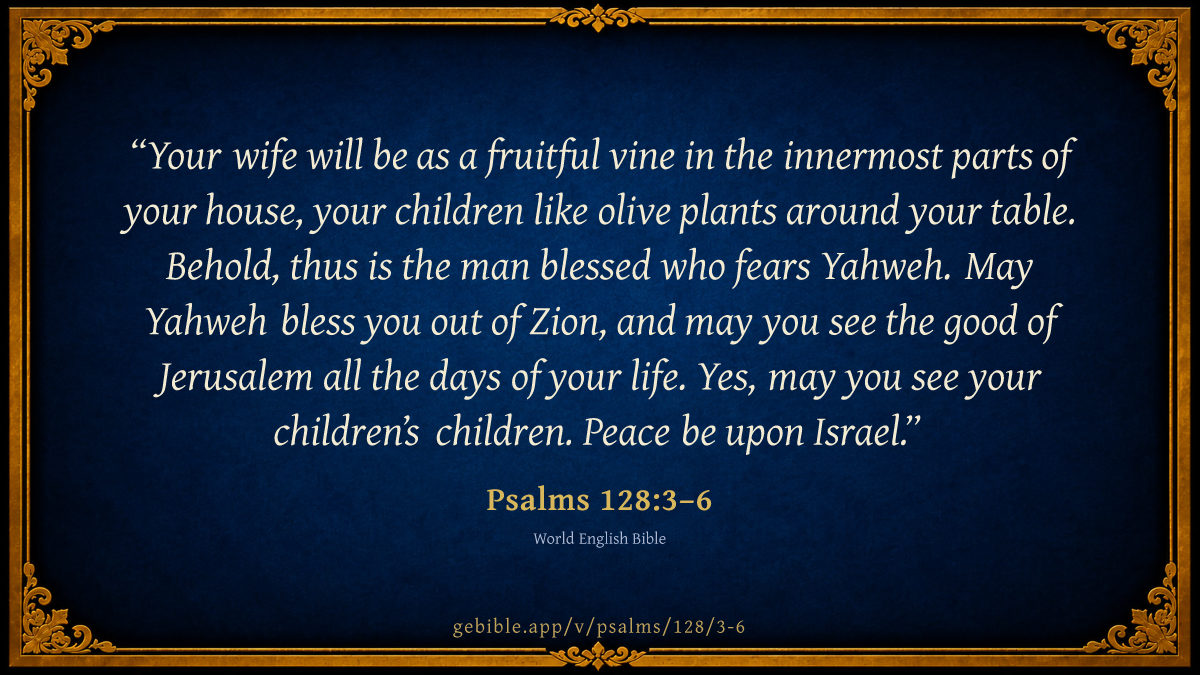
Psa 128:3 Thy wife [shall be] as a fruitful vine by the sides of thine house: thy children like olive plants round about thy table.
Ver. 3. Thy wife shall be as a fruitful vine] Full of bunches and clusters of rich ripe grapes; so she of children, and those virtuous; the little ones hanging on her breasts, as grapes on the vine; the elder as olive plants, straight, green, fresh, and flourishing, Psa 52:8, legitimate also; as the olive admitteth no other graft. Indeed, the olive set into the vine yieldeth both grapes and olives, whereby is represented the natural affection that is between the mother and her children. The vine and the olive are two of the best fruits; the one for cheering the heart, the other for clearing the face, Psa 104:15; the one for sweetness, the other for fatness, Jdg 9:13, both together implying that a great part of a man’s temporal happiness consisteth in having a good wife and children. It is said of Sulla that he had been happy had he never been so married, Si non habuissem uxorem; and Augustus’ wish was (but all too late), Utinam aut caelebs vixissem, aut orbus periissem, Oh that I had either lived single or died childless (Suetonius).
Read full note →
By the sides of thine house] Where vines are usually planted, that they may have the benefit of the sun. The modest wife is domiporta, found at home, as Sarah in the tent; not so the harlot, Pro 7:12.
Thy children like olive plants] See the note before on this verse.
Round about thy table] Making a most delectable enclosure.
John Trapp, A Commentary or Exposition upon All the Books of the Old and New Testament (1647–1656) — public domain. Text from a community e-Sword module.
Matthew Poole1685 · Public DomainOn vv3, 5, 6As a fruitful vine; like the vine for fruitfulness;…
As a fruitful vine; like the vine for fruitfulness; or like that sort of vines known by this name for its eminent fruitfulness, as some trees amongst us are for the same reason called the great bearers. By the sides of thine house, where the vines are commonly planted for support and other advantages; which being applied to the wife, may signify either,
1. The wife’s duty to abide at home, Tit 2:5, as the harlot is deciphered by her gadding abroad, Pro 7:11,12. Or rather,
Read full note →
2. The legitimateness of the children, which are begotten at home by the husband, and not abroad by strangers.
Like olive plants, numerous, growing and flourishing, good both for ornament and manifold uses, as olive trees are.
Round about thy table; where they shall sit at meat with thee, for thy comfort and safety.
Matthew Poole's English Annotations on the Holy Bible (1683–1685) — public domain. Text from a community e-Sword/MySword module.
John Gill1763 · Public DomainOn vv3–5Thy wife shall be as a fruitful vine by…
Thy wife shall be as a fruitful vine by the sides of thine house,.... The vine being a weak and tender tree, which needs propping and supporting; and often is fastened to the sides of a house, to which the allusion here is; whereunto it cleaves, and on which it runs up, and bears very agreeable fruit; it is properly used to express the weakness and tenderness of the female sex, their fruitfulness in bearing children, and their care of domestic affairs, being keepers at home; see Pe1 3:7. Kimchi observes, that the vine is the only tree men plant within doors; which, when it is grown up, they bring out at a hole or window of the house without, to have the sun and air; and so its root is within the house, and the branches without: and he observes, that a modest woman is within the house, and does not go without, and is only seen by her husband; but her children, like the branches of the vine, go out to work. This may be applied to Christ and his church; to him the other characters agree: he, as man, is one that feared the Lord; the grace of fear was in him; the spirit of fear rested on him; and he was in the exercise of it, and walked in all the ways of the Lord, Isa 11:1; he now sees and enjoys the travail or labour of his soul to satisfaction, and is made most blessed for evermore, Isa 53:11. The church is the bride, the Lamb's wife, the spouse of Christ; and may be compared to a vine for her weakness in herself, her fruitfulness in grace and good works, and in bringing forth souls to Christ, through the ministry of the word; all which is pleasant and grateful to him; see Psa 80:14;
thy children like olive plants round about thy table; a numerous offspring was always accounted a very great blessing; and it must be very pleasant to a parent to see his children round about his table, placed in their proper order according to their age, partaking of what it is furnished with: Job, in his time of prosperity, had many children; and, next to the presence of the Almighty with him, he mentions this of his children being about him; see Job 1:2. This may be applied to the spiritual seed and offspring of Christ, which are like to olive trees or olive plants; to which David is compared, Psa 52:8; the two anointed ones in Zac 4:11; the two witnesses in Rev 11:4; and all true believers in Christ may; because of their excellency, these being choice plants; because of their fruitfulness and beauty; because of their fatness, and having oil in them; and because of their perpetuity, being ever green; see Jer 11:16. Now Christ has a table, which he has well furnished, at which he himself sits, and places these his children all around; and whom he welcomes to the entertainment he makes, and takes delight and pleasure in them, Sol 1:12. Kimchi observes, the olive trees do not admit of a graft from other trees; see Rom 11:24; and so this denotes the legitimacy of those children, being free from all suspicion of being spurious, being born of such a wife as before described; and being green and moist all the year long, denotes their continuance in good works.
John Gill's Exposition of the Whole Bible (1746–1763) — public domain (CC PDM 1.0). Text via the HelloAO Bible API.
John Wesley1765 · Public DomainOn v3Olive-plants - Numerous, growing and flourishing.
Olive-plants - Numerous, growing and flourishing.
John Wesley, Explanatory Notes Upon the Whole Bible (1754–1765) — public domain. Text via the GEBible commentary corpus.
Adam Clarke1810 · Public DomainOn vv4–6Verse 4. Thus shall the man be blessed that…
Verse 4. Thus shall the man be blessed that feareth the Lord.] A great price for a small consideration. Fear God, and thou shalt have as much domestic good as may be useful to thee.
Adam Clarke's Commentary on the Bible (1810–1826) — public domain. Text from a community e-Sword/MySword module.
Joseph Benson1811 · Public DomainOn vv3, 5Psa 128:3. Thy wife shall be as a fruitful…
Psa 128:3. Thy wife shall be as a fruitful vine — “He will bless thee also in thy wife, and make her as fruitful as the vine, which spreads itself, laden with full clusters, over all the sides of thy house; and in thy hopeful children too, who shall grow up and flourish like the young olive-plants that are set in thy arbour, round about thy table.” Thus Bishop Patrick interprets the verse, and certainly the text, in its most obvious and literal sense, seems to countenance his interpretation. Mr. Harmer, however, in his Observations on Divers Passages of Scripture, questions the propriety of it, remarking that it does not appear, from the accounts of any travellers, that it was ever the custom of the Jews to conduct vines along the sides of their houses, and that we find no such arbours in the Levant as the bishop supposes, composed of young olive-plants, in the midst of which tables were set. He therefore understands the words thus: “Thy wife shall be in the sides, or private apartments of thy house, fruitful as a thriving vine:” considering the sides of the house as referring to the wife, not to the vine; and the table, in the other clause, to the children only, not to the olives. Cocceius, however, and Rabbi Kimchi, agree with Bishop Patrick, as does Dr. Hammond also, whose words are, “Vines, it seems, were then planted on the sides of houses, as now they are among us, and not only in vineyards, and to that the psalmist here refers. So likewise of olive-plants it is observable, not only that tables were dressed up with the boughs of them, ramis felicis olivæ, but that, in the eastern countries, they were usually planted, as in arbours, to shade the table, entertainments being made without doors, in gardens, under that umbrage, which gave all the liberty of the cool winds and refreshing blasts. An image whereof we have Gen 18:4, Wash your feet, and rest yourselves under the tree; and a full expression Est 1:5, The king made a feast in the court of the garden of the king’s palace.” Dr. Horne also, after weighing what Mr. Harmer had advanced against it, adopts this interpretation, observing that Mr. Merrick, in his Annotations, produces some very good arguments in favour of it. The doctor’s comment is, “The vine, a lowly plant, raised with tender care, becoming, by its luxuriance, its beauty, its fragrance, and its clusters, the ornament and glory of the house to which it is joined, and by which it is supported, forms the finest imaginable emblem of a fair, virtuous, and fruitful wife. The olive-trees planted by the inhabitants of the eastern countries around their tables, or banqueting-places in their gardens, to cheer the eye by their verdure, and to refresh the body by their cooling shade, do no less aptly and significantly set forth the pleasure which parents feel at the side of a numerous and flourishing offspring.”
Joseph Benson's Commentary on the Old and New Testaments (1811–1818) — public domain. Text from a community e-Sword module.
Albert Barnes1834 · Public DomainOn vv3–6Thy wife shall be as a fruitful vine by…
Thy wife shall be as a fruitful vine by the sides of thine house - It is not uncommon in the East, as elsewhere, to train a vine along the sides of a house - partly to save ground; partly because it is a good exposure for fruit; partly as an ornament; and partly to protect it from thieves. Such a vine, in its beauty, and in the abundant clusters upon it, becomes a beautiful emblem of the mother of a numerous household. One of the blessings most desired and most valued in the East was a numerous posterity, and this, in the case of Abraham, Isaac, and Jacob, was among the chief blessings which God promised to them - a posterity that should resemble in number the sands of the sea or the stars of heaven. Compare Gen 15:5; Gen 22:17; Gen 32:12. These two things - the right to the avails of one’s labor Psa 128:2, and a numerous family - are the blessings which are first specified as constituting the happiness of a pious household.
Thy children like olive plants round about thy table - Compare the notes at Psa 52:8. Beautiful; producing abundance; sending up young plants to take the place of the old when they decay and die. The following extract and preceding cut from “The land and Book,” vol. i., pp. 76, 77, will furnish a good illustration of this passage: “To what particular circumstance does David refer in the 128th Psalm, where he says, Thy children shall be like oliveplants round about thy table? Follow me into the grove, and I will show you what may have suggested the comparison. Here we have lilt upon a beautiful illustration. This aged and decayed tree is surrounded, as you see, by several young and thrifty shoots, which spring from the root of the venerable parent. They seem to uphold, protect, and embrace it. We may even fancy that they now bear that lead of fruit which would otherwise be demanded of the feeble parent. Thus do good and affectionate children gather round the table of the righteous. Each contributes something to the common wealth and welfare of the whole - a beautiful sight, with which may God refresh the eyes of every friend of mine.”
Albert Barnes' Notes on the Bible (1834–1885) — public domain. Text from a community e-Sword/MySword module.
Daniel D. Whedon1874 · Public DomainOn vv3–63. By the sides of thine house—Literally. In the…
3. By the sides of thine house—Literally. In the sides; supposed to denote “the background, or privacy of the house, where the housewife, who is not to be seen much out of doors, leads a quiet life, entirely devoted to her family,” (Delitzsch;) in contrast with the harlot, who wanders the street. Pro_7:11-12. This requires us to refer the word “sides” not to vine, but to wife, as it is not the vine on the side of the “house,” but the wife on the inside of the “house,” thus: “Thy wife in the sides of thy house shall be as a fruitful vine; thy children around thy table like olive settings.” This last figure seems borrowed from the young olives springing from the roots of the parent tree, and perpetuating its beauty and fruitfulness.
Daniel D. Whedon (gen. ed.), Commentary on the Old and New Testaments (1874–1909) — public domain. Text from a community e-Sword module.
The Cambridge Bible for Schools and Colleges1878 · Public DomainOn vv3–63. as a fruitful vine] The fruitfulness, gracefulness, and…
3. as a fruitful vine] The fruitfulness, gracefulness, and preciousness of the vine are obvious points of comparison: its dependence and need of support may also be alluded to.
by the sides of thine house] Rather, in the innermost chambers of thy house (Jer. in penetralibus domus tuae), to be connected with thy wife, as in the next line round about thy table obviously belongs to thy children. The women’s apartments were at the back of the tent or house, furthest from the entrance.
Read full note →
thy sons like olive plants] The picture is that of the young olive trees springing up round the parent stem, fresh and full of promise. Cp. Thomson, Land and Book, p. 57. The evergreen olive is an emblem of vitality and vigour (Psa_52:8; Jer_11:16, &c.).
round about thy table] Cp. 1Sa_16:11, “We will not sit round till he come hither.”
The Cambridge Bible for Schools and Colleges (gen. ed. J. J. S. Perowne; Cambridge University Press, 1878–1918) — public domain. Text from a community e-Sword module.
Ellicott's Commentary for English Readers1878 · Public DomainOn vv3–6(3) By the sides—No doubt the inner part of…
(3) By the sides—No doubt the inner part of the house is meant (see Psa_48:2)—the gynecœum or woman’s quarter—or perhaps the sides of the inner court or quadrangle. This is no more out of keeping with the figure of the vine than the table is with that of olive plants. Though the Hebrews had not yet developed the fatal habit of secluding their women, as later Orientals have done, still there was a strict custom which allotted a more private tent (Gen_18:9) or part of a house to them. And doubtless we are here also to think of the good housewife who is engaged within at the household duties, and is not like the idle gossip, sitting “at the door of her house on a seat in the high places of the city” (Pro_9:14). The vine and olive are in Hebrew poetry frequent symbols of fruitfulness and of a happy, flourishing state. (See Psa_52:8; Jer_11:16.) The comparison of children to the healthy young shoots of a tree is, of course, common to all poetry, being indeed latent in such expressions as “scion of a noble house.” (Comp. Euripides, Medea 1,098: “a sweet young shoot of children.”)
A Bible Commentary for English Readers, edited by Charles John Ellicott (1878–1897) — public domain. Text from a community e-Sword module.
The Pulpit Commentary1880 · Public DomainOn vv3–6Thy wife shall be as a fruitful vine by…
Thy wife shall be as a fruitful vine by the sides (rather, in the inner chambers) of thine house. The second point of blessedness is a fruitful wife, content to dwell in the female apartments of the house, to keep at home (Tit_2:5) and guide the household. Thy children like olive plants; or, "olive shoots the vigorous offsets from an aged olive tree, which spring up around it, ready to take its place. Round about thy table. Clustering around thy board, at once a source of cheerfulness and strength. (see Psa_127:5) This is the third point of blessedness.
Vers. 3-6. "Home, sweet home!
Read full note →
Apart from the plain teachings of Holy Scripture
I THE MIND OF GOD IS EVIDENT IN REGARD TO FAMILY LIFE FROM THE NUMERICAL EQUALITY OF MEN AND WOMEN. It is not alone that God, in the beginning, gave one woman to be the wife of one man; but his will is still expressed by the equality which seems perpetual and universal in the numbers of each sex that are born. The histories of patriarchs and kings who departed from this monogamic law are recorded, not for imitation, but for warning. No blessing ever resulted from it, but everywhere and always misery, discord, and strife. So it always has been, and so it ever must be. Family life, in the true sense of the term, was impossible in the crowded harems of men like David, Solomon, and so many more. It is possible only where God"s primeval law is obeyed.
II FROM THE FACT OF PARENTAL LOVE, ESPECIALLY THE DEEP SELF-SACRIFICING MOTHER-LOVE, into which it is God"s will that children should be born. This is to be the beautiful and wholesome atmosphere of the home as it generally is. The children bring the love for them along with them.
III THE PRESERVATION OF THE FAMILY INSTITUTION. What other institution, civil, ecclesiastical, political, has not had its day and disappeared? But not this.
IV THE TREMENDOUS INFLUENCE OF THE HOME UPON THE CHILDREN. It is not alone their physical existence that they owe to their parents; but their mental, moral, and spiritual characteristics are, though not absolutely, yet almost entirely, dependent upon their parents. No child can escape the influence of its home.
V HOW BLESSED ARE, AS A RULE, THE RESULTS OF THIS DIVINE ARRANGEMENT! What a vast proportion of the whole sum of human happiness springs from it! The very word "home" has a magic power in the hearts of most men. It summons up memories of delight. Our Lord himself portrays heaven itself to us as "my Father"s house his home.
VI ITS SUPREME PURPOSE. (Mal_2:15) Can any one conceive of a more effectual and more beneficent and gracious method whereby the kingdom of God should be set up in the world? The Divine wisdom and love are conspicuous therein. S.C.
Family joys.
This psalm is the picture of a God-fearing father, blessed with wealth and offspring, and with long life to see God"s blessing upon Jerusalem. Dr. Barry renders this verse," Thy wife, in the inner chamber, is like the fruitful vine." Vines in the East are not usually trained over houses, or on walls. The vine is an emblem chiefly of fruitfulness, but perhaps also of dependence, as needing support; the olive of vigorous, healthy, joyous life. "We see the father of the family, working hard no doubt, but recompensed for all his pains by an honorable competence, and the mother, instead of seeking distraction outside her home, finding all her pleasures in the happiness of her numerous children, who, fresh and healthy as young saplings, gather round the simple but ample board." "Olive plants" are illustrated thus: "This aged and decayed tree is surrounded, as you see, by several young and thrifty shoots, which spring from the root of the venerable parent. They seem to uphold, protect, and embrace it. We may even fancy that they now bear that load of fruit which would otherwise be demanded of the feeble parent.
I FAMILY JOYS COME OUT OF FAMILY TOIL. One idler in a family spoils the family joy. Each member must have his or her sphere, and love work. The self-indulgent member, the ne"er-do-well, the spendthrift, is the household anxiety. In common and united labor is found the family satisfaction.
II FAMILY JOYS COME OUT OF RELATIVITY. Each member is an individual with marked individuality. A puzzle-shaped piece. There is trouble when the pieces do not fit to one another. The secret of family joy is each one getting shaped to the other, so that individuality is perfected in relationship.
III FAMILY JOYS COME OUT OF AFFECTION. There is a peculiar feeling toward each other cherished by members of one family. We call it family affection. Illustrate by the joy of times of family reunion; and show how that affection helps family relations and sanctifies family fellowship.
IV FAMILY JOYS COME OUT OF PIETY. Which is the recognition of another and all-hallowing family life. For piety is no other than a realization of our family life with God. And the more worthily we respond to that, the more skillfully and successfully we meet the obligations of the family life on earth. R.T.
The Pulpit Commentary (1880–1919), ed. H.D.M. Spence-Jones & Joseph S. Exell — public domain. Text from a community e-Sword module.
Charles H. Spurgeon1885 · Public DomainOn vv3–6Ver. 3. Thy wife. To reach the full of…
Ver. 3. Thy wife. To reach the full of earthly felicity a man must not be alone. A helpmeet was needed in Paradise, and assuredly she is not less necessary out of it. He that findeth a wife findeth a good thing. It is not every man that feareth the Load who has a wife; but if he has, she shall share in his blessedness and increase it.
Shall be as a fruitful vine. To complete domestic bliss children are sent. They come as the lawful fruit of marriage, even as clusters appear upon the vine. For the grapes the vine was planted; for children was the wife provided. It is generally well with any creature when it fulfils its purpose, and it is so far well with married people when the great design of their union is brought about. They must not look upon fruitfulness as a burden, but as a blessing. Good wives are also fruitful in kindness, thrift, helpfulness, and affection: if they bear no children, they are by no means barren if they yield us the wine of consolation and the clusters of comfort. Truly blessed is the man whose wife is fruitful in those good works which are suitable to her near and dear position.
Read full note →
By the sides of thine house. She keeps to the house: she is a home bird. Some imagine that she is like a vine which is nailed up to the house wall; but they have no such custom in Palestine, neither is it pleasant to think of a wife as growing up by a wall, and as bound to the very bricks and mortar of her husband's dwelling. No, she is a fruitful vine, and a faithful housekeeper; if you wish to find her, she is within the house: she is to be found both inside and outside the home, but her chief usefulness is in the inner side of the dwelling, which she adorns. Eastern houses usually have an open square in the centre, and the various rooms are ranged around the sides, there shall the wife be found, busy in one room or another, as the hour of the day demands. She keeps at home, and so keeps the home. It is her husband's house, and she is her husband's; us the text puts it "thy wife", and "thy house"; but by her loving care her husband is made so happy that he is glad to own her as an equal proprietor with himself, for he is hers, and the house is hers too.
Thy children like olive plants round about thy table. Hundreds of times have I seen the young olive plants springing up around the parent stem, and it has always made mc think of this verse. The Psalmist never intended to suggest the idea of olive plants round a table, but of young people springing up around their parents, even as olive plants surround the fine, well rooted tree. The figure is very striking, and would be sure to present itself to the mind of every observer in the olive country. How beautiful to see the gnarled olive, still bearing abundant fruit, surrounded with a little band of sturdy successors, any one of which would be able to take its place should the central olive be blown down, or removed in any other way. The notion of a table in a bower may suit a cockney in a tea garden, but would never occur to an oriental poet; it is not the olive plants, but the children, that are round about the table. Moreover, note that it is not olive branches, but plants, a very different thing. Our children gather around our table to be fed, and this involves expenses: how much better is this than to see them pining upon beds of sickness, unable to come for their meals! What a blessing to have sufficient to put upon the table! Let us for this benefit praise the bounty of the Lord. The wife is busy all over the house, but the youngsters are busiest at meal times; and if the blessing of the Lord rest upon the family, no sight can be more delightful. Here we have the vine and the olive blendedjoy from the fruitful wife, and solid comfort from the growing family; these are the choicest products earth can yield: our families are gardens of the Lord. It may help us to value the privileges of our home if we consider where we should be if they were withdrawn. What if the dear partner of our life were removed from the sides of our house to the recesses of the sepulchre? What is the trouble of children compared with the sorrow of their loss? Think, dear father, what would be your grief if you had to cry with Job, "Oh that I were as in months past, as in the days when God preserved me; when my children were about me."
Ver. 3. Thy wife shall be as a fruitful vine, etc. The comparison would perhaps be brought out more clearly by arranging the verse as follows:
"Thy wife shall be in the inner part of thy house
Like a fruitful vine;
Thy children round about thy table
Like the shoots of the olive."
In the inner part, literally, "the sides of thy house", as in Am 6:10, i.e., the women's apartments, as marking the proper sphere of the wife engaged in her domestic duties, and also to some extent her seclusion, though this was far less amongst the Jews than amongst other Orientals.
The "vine" is an emblem chiefly of fruitfulness, but perhaps also of dependence, as needing support; the "olive", of vigorous, healthy, joyous life. The same figure is employed by Euripides, Herc. Fur., 839. Med. 109S. J. J. Stewart Perowne.
Ver. 3. Thy wife shall be as a fruitful vine, etc. We do not remember to have met with a single instance, in the East, of vines trained against the walls of a house, or of olives near or about a house. Neither have we read of such instances. The passage doubtless derives its figures from the fertility of the vine, and from the appearance of the olive, or the order in which olive trees are planted. The construction would then be: "Thy wife, in the sides (interior apartments) of thy house, shall be as the fruitful vine, and thy children round about thy table, like olive plants." John Kitto (1504-1854), in "The Pictorial Bible."
Ver. 3. Thy wife shall be as a fruitful vine by the sides of thine house. The wife is likened not to thorns or briers, nor even to oaks or to other fruits and trees, but to the vine; and also to a vine neither in a vineyard nor in a garden, but set by the walls of the house; also not barren, but fertile and fruit bearing. This admonishes husbands as well as wives of their duties. For as the walls support the vine, and defend it against the force of winds and tempests, so ought husbands, as far as is in their power, to defend their wives by their godly conversation and wholesome teachings and institutions against the pestilential wind of the old serpent; also against the injuries of evil disposed men. "He that loveth his wife loveth himself. For no man ever yet hated his own flesh; but nourisheth and cherisheth it, even as the Lord the Church": Eph 5:28-29.
Further, the vine is exceedingly fragile wood, and not meet for any work, Eze 15:4. Husbands, therefore, should remember that they ought to behave towards their wives patiently and prudently, as with the weaker vessel; not keeping in mind the fragility of the wood, but the abundance and sweetness of the fruit. If husbands observe this, that will happen to them which Scripture says concerning the peaceful time of Solomon, "And Judah and Israel dwelt safely, every man under his vine and under his fig tree": 1Ki 4:25. Such was the married life of Abraham with Sarah, Isaac with Rebecca, Jacob with, Leah and Rachel. Solomon Gesner.
Ver. 3. A fruitful vine by the sides of thine house. It does not say on the sides of the house, but by the sides. The passage probably refers to the trellissed, bowers which often lead up to the houses, and are covered with vines, the grapes, hanging over head. Sitting in these bowers is sitting under our own vines: Mic 4:4. I have seen in Constantinople grapes hanging over the people's heads in the principal streets, the vines being trained from one side of the street to the other. John Gadsby, in "My Wanderings", 1860.
Ver. 3. By the sides of thine house. Not on the roof, nor on the floor; the one is too high, she is no ruler; the other too low, she is no slave: but in the sides, an equal place between both. Thomas Adams.
Ver. 3. By the sides of thine house. The house is her proper place, for she is "the beauty of the house"; there her business lies, there she is safe. The ancients painting them with a snail under their feet, and the Egyptians denying their women shoes, and the Scythians burning the bride's chariot axle tree at her door, when she was brought to her husband's house, and the angel's asking Abraham where Sarah was (though he knew well enough), that it might be observed, she was "in the tent", do all intimate, that, by the law of nature, and by the rules of religion, the wife ought to keep at home, unless urgent necessity do call her abroad. Richard Steele (1692), in "The Morning Exercises."
Ver. 3. As it is visible that the good man's sons being "like olive plants round about his table", means not that they should be like the olive plants which grew round his table, it being, I presume, a thought in Bishop Patrick that will not be defended, that the Psalmist refers to a table spread in an arbour composed of young olive trees, for we find no such arbours in the Levant, nor is the tree very proper for such a purpose; so in like manner the first clause must signify, thy wife shall be in the sides, or private apartments, of thy house, fruitful as a thriving vine: the place here mentioned (the sides of the house) referring to the wife, not to the vine; as the other (the table) refers to the children, not to the olives. Nor is this a new thought, it is a remark that Musculus and other interpreters have made.
The Hebrew word, translated sides, is very well known to signify the more private apartments of a house, as they have also remarked; and he that reads Dr. Shaw's description of an Eastern house, must immediately see the propriety of calling the private apartments its sides. Such a house consists of a square court, which the doctor observes, is called the midst of the house: and private apartments round it, which may as properly be called its sides in consequence: into this middle of the house, or this quadrangle, company, he tells us, are sometimes received, in which other authors tell us their wives remain concealed at such times. Thomas Harmer, 1719-1788.
Ver. 3. Thy children like olive plants, etc. Follow me into the grove, and I will show you what may have suggested the comparison. Here we have hit upon a beautiful illustration. This aged and decayed tree is surrounded, as you see, by several young and thrifty shoots, which spring from the root of the venerable parent. They seem to uphold, protect, and embrace it, we may even fancy that they now bear that load of fruit which would otherwise be demanded of the feeble parent. Thus do good and affectionate children gather round the table of the righteous. Each contributes something to the common wealth and welfare of the wholea beautiful sight, with which may God refresh the eyes of every friend of mine. W. M. Thomson.
Ver. 3. Man by nature, uninfluenced by grace, is "a wild olive tree"; and the object of most parents is merely to cultivate this wild olive tree. What anxiety is there about accomplishments which, how attractive soever, are but the dying blossoms of this wild olive tree! Richard Cecil, 1748-1810.
Ver. 3. Although the world is carried away by irregular desires after various objects, between which it is perpetually fluctuating in its choice, God gives us in this Psalm a description of what lie considers to be a blessing beyond all riches, and therefore we ought to hold it in high estimation. If a man has a wife of amiable manners as the companion of his life, let him set no less value upon this blessing than Solomon did, who, in Pr 19:14, affirms that it is God alone who gives a good wife. In like manner, if a man be a father of a numerous offspring, let him receive that goodly boon with a thankful heart. John Calvin.
Ver. 3. Before the fall Paradise was man's home; since the fall home has been his Paradise. Augustus William Hare (1792-1834), and Julius Charles Hare (1795-1855), in "Guesses at Truth."
Ver. 3. The blessing of children.
1. They are round our tableexpense, anxiety, responsibility, pleasure.
2. They are like olive plantsstrong, planted in order, coming on to succeed us, fruitful for Godas the olive provided oil for the lamp.
Ver. 3. A complete family picture. Here are the husband, the wife, the children, the house, the rooms in the side, the table. We should ask a blessing upon each, bless God for each, and use each in a blessed manner.
Psalms 128:4*
Charles H. Spurgeon's The Treasury of David (1869–1885) — public domain. Psalms only. Text from a community e-Sword/MySword module.
The Biblical Illustrator1887 · Public DomainOn vv3, 5Thy wife shall be as a fruitful vine.
Psa_128:3-4
Thy wife shall be as a fruitful vine.
Read full note →
A pattern wife
There are trailing slatterns, like brambles and nettles, who leave conspicuous in a dwelling what they should conceal, and choke with unsightliness and discomfort what ought to be kept clear; who cause what would be attractive to offend, render what is repulsive more so, and, themselves the most forbidding objects, drive their toil-worn husbands to the seat of the scornful and the bower of sin. The woman pictured in the song is not to be seen lounging at the door, an idle gossip, with something to say to every passer-by, but attends to her duties in the interior of the dwelling, and, like her husband, fears the Lord (Pro_9:13-14; Amo_6:10). The clinging vine is a symbol of attachment, grace, and fruitfulness, dressing the props and walls to which its curling tendrils hold, with leaves that shade the verandah and cool the house, and enriching them with clusters of juicy fruit that maketh glad the heart of man (Psa_104:15). The pious and loving wife, the screen, the adornment, and crown of the God-fearing husband who is her support and strength, so spreads the table that, however plain, it is a feast; so pours the water that it turns to wine; so smiles that all the room shines with comfort and pleasure; so speaks that the house is full of charming music; so lives that the master is happy everywhere because most happy when at home. (E. J. Robinson.)
Wedded happiness
Dr. Cuyler, who has just celebrated his golden wedding, says he has made up his mind that there is no place like home. At a meeting he said, I have just returned from my delightful golden wedding trip. And I have no desire to depart. In fact, I have the fullest sympathy for that eccentric, eloquent preacher who, during his last hours, tossed about in uneasy pain, and then summoned his family, who said to him, Dont be troubled. You will soon be among the angels. What do I care about that? he answered; I am satisfied with the good woman, who is better than any angel I have ever read of.
The Biblical Illustrator, edited by Joseph S. Exell (c. 1880s–1900s) — public domain. Text from a community e-Sword module.
unfoldingWord translationNotes2017 · CC BY-SA 4.0On v3like a fruitful vine in your house
like a fruitful vine in your house
The wife is spoke of as a vine producing a lot of fruit. This implies that children are like fruit and the wife will have many children. AT: "very productive and give you many children" (See: Simile)
Read full note →
your children will be like olive plants
Children are compared to olive plants because of the way they grow to surround something. Children will surround the table and make it full. AT: "you will have many children who will grow and prosper" (See: Simile)
around your table
This refers to the place where a family gathers to eat. Often, all those who eat a man's table are under his authority or control.
the man will be blessed who honors Yahweh
This can be stated as an active verb. "Yahweh will bless the man who honors him" (See: Active or Passive)
Tyndale Open Study Notes2022 · CC BY-SA 4.0On vv3–4128:3 Like vigorous young olive trees, children are saplings…
128:3 Like vigorous young olive trees, children are saplings filled with potential. Olive oil symbolizes God’s blessing (104:15; Num 18:12; Jer 31:12; Hag 2:19).

John Calvin 1540 · Public Domain On vv3–5 3 Thy wife shall be as a fruitful vine…
3 Thy wife shall be as a fruitful vine on the sides of thy house. Here again it is promised, as in the preceding Psalm, that God will make those who honor him fruitful in a numerous offspring. The majority of mankind indeed desire to have issue, and this desire may be said to be implanted in them by nature; but many, when they have obtained children, soon become cloyed therewith. Again it is often more grateful to want children than to leave a number of them in circumstances of destitution. But although the world is carried away by irregular desires after various objects, between which it is perpetually fluctuating in its choice, God gives this his own blessing, the preference to all riches, and therefore we ought to hold it in high estimation. If a man has a wife of amiable manners as the companion of his life, let him set no less value upon this blessing than Solomon did, who, in Proverbs 19:14, affirms that it is God alone who gives a good wife. In like manner, if a man be a father of a numerous offspring, let him receive that goodly boon with a thankful heart. If it is objected that the Prophet in speaking thus, detains the faithful on the earth by the allurements of the flesh, and hinders them from aspiring towards heaven with free and unencumbered minds, I answer, that it is not surprising to find him offering to the Jews under the law a taste of God’s grace and paternal favor, when we consider that they were like children. He has, however, so tempered, or mixed it, as that by it; they might rise in their contemplations to the heavenly life. Even at the present day God, though in a more sparing manner, testifies his favor by temporal benefits, agreeably to that passage in Paul’s first Epistle to Timothy just now quoted, (1 Timothy 4:8,)
“Godliness is profitable unto all things, having promise of the life that now is, and of that which is to come.”
Read full note →
But by this he does not cast any hindrance or impediment in our way to keep us from elevating our minds to heaven, but ladders are by this means rather erected to enable us to mount up thither step by step. The Prophet, therefore, very properly reminds the faithful that they already receive some fruit of their integrity, when God gives them their food, makes them happy in their wives and children, and condescends to take care of their life. But his design in commending the present goodness of God is to animate them to hasten forward with alacrity on the path which leads to their eternal inheritance. If the earthly felicity described in this Psalm may not always be the lot of the godly, but should it sometimes happen that their wife is a termagant, or proud, or of depraved morals, or that their children are dissolute and vagabonds, and even bring disgrace upon their father’s house, let them know that their being deprived of God’s blessing is owing to their having repulsed it by their own fault. And surely if each duly considers his own vices he will acknowledge that God’s earthly benefits have been justly withheld from him.
John Calvin's Commentaries (1540-1563) — public domain. Text from the Calvin Translation Society English edition (1840s-50s) via the Christian Classics Ethereal Library (ccel.org). Calvin's coverage is partial (roughly two-thirds of the Bible); uncommented books and verses are honest gaps, never fabricated. The 19th-century editor's footnotes and remarks are omitted so the notes are faithfully Calvin's own voice.
Geneva Bible translators 1599 · Public Domain On vv3, 5 Because God’s favor appeareth in none outward thing, more…
Because God’s favor appeareth in none outward thing, more than in increase of children, he promiseth to enrich the faithful with this gift.
Geneva Bible (1599) marginal notes — public domain.
John Trapp 1656 · Public Domain On vv3–6 Psa 128:3 Thy wife [shall be] as a fruitful…
Psa 128:3 Thy wife [shall be] as a fruitful vine by the sides of thine house: thy children like olive plants round about thy table.
Ver. 3. Thy wife shall be as a fruitful vine] Full of bunches and clusters of rich ripe grapes; so she of children, and those virtuous; the little ones hanging on her breasts, as grapes on the vine; the elder as olive plants, straight, green, fresh, and flourishing, Psa 52:8, legitimate also; as the olive admitteth no other graft. Indeed, the olive set into the vine yieldeth both grapes and olives, whereby is represented the natural affection that is between the mother and her children. The vine and the olive are two of the best fruits; the one for cheering the heart, the other for clearing the face, Psa 104:15; the one for sweetness, the other for fatness, Jdg 9:13, both together implying that a great part of a man’s temporal happiness consisteth in having a good wife and children. It is said of Sulla that he had been happy had he never been so married, Si non habuissem uxorem; and Augustus’ wish was (but all too late), Utinam aut caelebs vixissem, aut orbus periissem, Oh that I had either lived single or died childless (Suetonius).
Read full note →
By the sides of thine house] Where vines are usually planted, that they may have the benefit of the sun. The modest wife is domiporta, found at home, as Sarah in the tent; not so the harlot, Pro 7:12.
Thy children like olive plants] See the note before on this verse.
Round about thy table] Making a most delectable enclosure.
John Trapp, A Commentary or Exposition upon All the Books of the Old and New Testament (1647–1656) — public domain. Text from a community e-Sword module.
Matthew Poole 1685 · Public Domain On vv3, 5, 6 As a fruitful vine; like the vine for fruitfulness;…
As a fruitful vine; like the vine for fruitfulness; or like that sort of vines known by this name for its eminent fruitfulness, as some trees amongst us are for the same reason called the great bearers. By the sides of thine house, where the vines are commonly planted for support and other advantages; which being applied to the wife, may signify either,
1. The wife’s duty to abide at home, Tit 2:5, as the harlot is deciphered by her gadding abroad, Pro 7:11,12. Or rather,
Read full note →
2. The legitimateness of the children, which are begotten at home by the husband, and not abroad by strangers.
Like olive plants, numerous, growing and flourishing, good both for ornament and manifold uses, as olive trees are.
Round about thy table; where they shall sit at meat with thee, for thy comfort and safety.
Matthew Poole's English Annotations on the Holy Bible (1683–1685) — public domain. Text from a community e-Sword/MySword module.
John Gill 1763 · Public Domain On vv3–5 Thy wife shall be as a fruitful vine by…
Thy wife shall be as a fruitful vine by the sides of thine house,.... The vine being a weak and tender tree, which needs propping and supporting; and often is fastened to the sides of a house, to which the allusion here is; whereunto it cleaves, and on which it runs up, and bears very agreeable fruit; it is properly used to express the weakness and tenderness of the female sex, their fruitfulness in bearing children, and their care of domestic affairs, being keepers at home; see Pe1 3:7. Kimchi observes, that the vine is the only tree men plant within doors; which, when it is grown up, they bring out at a hole or window of the house without, to have the sun and air; and so its root is within the house, and the branches without: and he observes, that a modest woman is within the house, and does not go without, and is only seen by her husband; but her children, like the branches of the vine, go out to work. This may be applied to Christ and his church; to him the other characters agree: he, as man, is one that feared the Lord; the grace of fear was in him; the spirit of fear rested on him; and he was in the exercise of it, and walked in all the ways of the Lord, Isa 11:1; he now sees and enjoys the travail or labour of his soul to satisfaction, and is made most blessed for evermore, Isa 53:11. The church is the bride, the Lamb's wife, the spouse of Christ; and may be compared to a vine for her weakness in herself, her fruitfulness in grace and good works, and in bringing forth souls to Christ, through the ministry of the word; all which is pleasant and grateful to him; see Psa 80:14;
thy children like olive plants round about thy table; a numerous offspring was always accounted a very great blessing; and it must be very pleasant to a parent to see his children round about his table, placed in their proper order according to their age, partaking of what it is furnished with: Job, in his time of prosperity, had many children; and, next to the presence of the Almighty with him, he mentions this of his children being about him; see Job 1:2. This may be applied to the spiritual seed and offspring of Christ, which are like to olive trees or olive plants; to which David is compared, Psa 52:8; the two anointed ones in Zac 4:11; the two witnesses in Rev 11:4; and all true believers in Christ may; because of their excellency, these being choice plants; because of their fruitfulness and beauty; because of their fatness, and having oil in them; and because of their perpetuity, being ever green; see Jer 11:16. Now Christ has a table, which he has well furnished, at which he himself sits, and places these his children all around; and whom he welcomes to the entertainment he makes, and takes delight and pleasure in them, Sol 1:12. Kimchi observes, the olive trees do not admit of a graft from other trees; see Rom 11:24; and so this denotes the legitimacy of those children, being free from all suspicion of being spurious, being born of such a wife as before described; and being green and moist all the year long, denotes their continuance in good works.
John Gill's Exposition of the Whole Bible (1746–1763) — public domain (CC PDM 1.0). Text via the HelloAO Bible API.
John Wesley 1765 · Public Domain On v3 Olive-plants - Numerous, growing and flourishing.
Olive-plants - Numerous, growing and flourishing.
John Wesley, Explanatory Notes Upon the Whole Bible (1754–1765) — public domain. Text via the GEBible commentary corpus.
Adam Clarke 1810 · Public Domain On vv4–6 Verse 4. Thus shall the man be blessed that…
Verse 4. Thus shall the man be blessed that feareth the Lord.] A great price for a small consideration. Fear God, and thou shalt have as much domestic good as may be useful to thee.
Adam Clarke's Commentary on the Bible (1810–1826) — public domain. Text from a community e-Sword/MySword module.
Joseph Benson 1811 · Public Domain On vv3, 5 Psa 128:3. Thy wife shall be as a fruitful…
Psa 128:3. Thy wife shall be as a fruitful vine — “He will bless thee also in thy wife, and make her as fruitful as the vine, which spreads itself, laden with full clusters, over all the sides of thy house; and in thy hopeful children too, who shall grow up and flourish like the young olive-plants that are set in thy arbour, round about thy table.” Thus Bishop Patrick interprets the verse, and certainly the text, in its most obvious and literal sense, seems to countenance his interpretation. Mr. Harmer, however, in his Observations on Divers Passages of Scripture, questions the propriety of it, remarking that it does not appear, from the accounts of any travellers, that it was ever the custom of the Jews to conduct vines along the sides of their houses, and that we find no such arbours in the Levant as the bishop supposes, composed of young olive-plants, in the midst of which tables were set. He therefore understands the words thus: “Thy wife shall be in the sides, or private apartments of thy house, fruitful as a thriving vine:” considering the sides of the house as referring to the wife, not to the vine; and the table, in the other clause, to the children only, not to the olives. Cocceius, however, and Rabbi Kimchi, agree with Bishop Patrick, as does Dr. Hammond also, whose words are, “Vines, it seems, were then planted on the sides of houses, as now they are among us, and not only in vineyards, and to that the psalmist here refers. So likewise of olive-plants it is observable, not only that tables were dressed up with the boughs of them, ramis felicis olivæ, but that, in the eastern countries, they were usually planted, as in arbours, to shade the table, entertainments being made without doors, in gardens, under that umbrage, which gave all the liberty of the cool winds and refreshing blasts. An image whereof we have Gen 18:4, Wash your feet, and rest yourselves under the tree; and a full expression Est 1:5, The king made a feast in the court of the garden of the king’s palace.” Dr. Horne also, after weighing what Mr. Harmer had advanced against it, adopts this interpretation, observing that Mr. Merrick, in his Annotations, produces some very good arguments in favour of it. The doctor’s comment is, “The vine, a lowly plant, raised with tender care, becoming, by its luxuriance, its beauty, its fragrance, and its clusters, the ornament and glory of the house to which it is joined, and by which it is supported, forms the finest imaginable emblem of a fair, virtuous, and fruitful wife. The olive-trees planted by the inhabitants of the eastern countries around their tables, or banqueting-places in their gardens, to cheer the eye by their verdure, and to refresh the body by their cooling shade, do no less aptly and significantly set forth the pleasure which parents feel at the side of a numerous and flourishing offspring.”
Joseph Benson's Commentary on the Old and New Testaments (1811–1818) — public domain. Text from a community e-Sword module.
Albert Barnes 1834 · Public Domain On vv3–6 Thy wife shall be as a fruitful vine by…
Thy wife shall be as a fruitful vine by the sides of thine house - It is not uncommon in the East, as elsewhere, to train a vine along the sides of a house - partly to save ground; partly because it is a good exposure for fruit; partly as an ornament; and partly to protect it from thieves. Such a vine, in its beauty, and in the abundant clusters upon it, becomes a beautiful emblem of the mother of a numerous household. One of the blessings most desired and most valued in the East was a numerous posterity, and this, in the case of Abraham, Isaac, and Jacob, was among the chief blessings which God promised to them - a posterity that should resemble in number the sands of the sea or the stars of heaven. Compare Gen 15:5; Gen 22:17; Gen 32:12. These two things - the right to the avails of one’s labor Psa 128:2, and a numerous family - are the blessings which are first specified as constituting the happiness of a pious household.
Thy children like olive plants round about thy table - Compare the notes at Psa 52:8. Beautiful; producing abundance; sending up young plants to take the place of the old when they decay and die. The following extract and preceding cut from “The land and Book,” vol. i., pp. 76, 77, will furnish a good illustration of this passage: “To what particular circumstance does David refer in the 128th Psalm, where he says, Thy children shall be like oliveplants round about thy table? Follow me into the grove, and I will show you what may have suggested the comparison. Here we have lilt upon a beautiful illustration. This aged and decayed tree is surrounded, as you see, by several young and thrifty shoots, which spring from the root of the venerable parent. They seem to uphold, protect, and embrace it. We may even fancy that they now bear that lead of fruit which would otherwise be demanded of the feeble parent. Thus do good and affectionate children gather round the table of the righteous. Each contributes something to the common wealth and welfare of the whole - a beautiful sight, with which may God refresh the eyes of every friend of mine.”
Albert Barnes' Notes on the Bible (1834–1885) — public domain. Text from a community e-Sword/MySword module.
Daniel D. Whedon 1874 · Public Domain On vv3–6 3. By the sides of thine house—Literally. In the…
3. By the sides of thine house—Literally. In the sides; supposed to denote “the background, or privacy of the house, where the housewife, who is not to be seen much out of doors, leads a quiet life, entirely devoted to her family,” (Delitzsch;) in contrast with the harlot, who wanders the street. Pro_7:11-12. This requires us to refer the word “sides” not to vine, but to wife, as it is not the vine on the side of the “house,” but the wife on the inside of the “house,” thus: “Thy wife in the sides of thy house shall be as a fruitful vine; thy children around thy table like olive settings.” This last figure seems borrowed from the young olives springing from the roots of the parent tree, and perpetuating its beauty and fruitfulness.
Daniel D. Whedon (gen. ed.), Commentary on the Old and New Testaments (1874–1909) — public domain. Text from a community e-Sword module.
The Cambridge Bible for Schools and Colleges 1878 · Public Domain On vv3–6 3. as a fruitful vine] The fruitfulness, gracefulness, and…
3. as a fruitful vine] The fruitfulness, gracefulness, and preciousness of the vine are obvious points of comparison: its dependence and need of support may also be alluded to.
by the sides of thine house] Rather, in the innermost chambers of thy house (Jer. in penetralibus domus tuae), to be connected with thy wife, as in the next line round about thy table obviously belongs to thy children. The women’s apartments were at the back of the tent or house, furthest from the entrance.
Read full note →
thy sons like olive plants] The picture is that of the young olive trees springing up round the parent stem, fresh and full of promise. Cp. Thomson, Land and Book, p. 57. The evergreen olive is an emblem of vitality and vigour (Psa_52:8; Jer_11:16, &c.).
round about thy table] Cp. 1Sa_16:11, “We will not sit round till he come hither.”
The Cambridge Bible for Schools and Colleges (gen. ed. J. J. S. Perowne; Cambridge University Press, 1878–1918) — public domain. Text from a community e-Sword module.
Ellicott's Commentary for English Readers 1878 · Public Domain On vv3–6 (3) By the sides—No doubt the inner part of…
(3) By the sides—No doubt the inner part of the house is meant (see Psa_48:2)—the gynecœum or woman’s quarter—or perhaps the sides of the inner court or quadrangle. This is no more out of keeping with the figure of the vine than the table is with that of olive plants. Though the Hebrews had not yet developed the fatal habit of secluding their women, as later Orientals have done, still there was a strict custom which allotted a more private tent (Gen_18:9) or part of a house to them. And doubtless we are here also to think of the good housewife who is engaged within at the household duties, and is not like the idle gossip, sitting “at the door of her house on a seat in the high places of the city” (Pro_9:14). The vine and olive are in Hebrew poetry frequent symbols of fruitfulness and of a happy, flourishing state. (See Psa_52:8; Jer_11:16.) The comparison of children to the healthy young shoots of a tree is, of course, common to all poetry, being indeed latent in such expressions as “scion of a noble house.” (Comp. Euripides, Medea 1,098: “a sweet young shoot of children.”)
A Bible Commentary for English Readers, edited by Charles John Ellicott (1878–1897) — public domain. Text from a community e-Sword module.
The Pulpit Commentary 1880 · Public Domain On vv3–6 Thy wife shall be as a fruitful vine by…
Thy wife shall be as a fruitful vine by the sides (rather, in the inner chambers) of thine house. The second point of blessedness is a fruitful wife, content to dwell in the female apartments of the house, to keep at home (Tit_2:5) and guide the household. Thy children like olive plants; or, "olive shoots the vigorous offsets from an aged olive tree, which spring up around it, ready to take its place. Round about thy table. Clustering around thy board, at once a source of cheerfulness and strength. (see Psa_127:5) This is the third point of blessedness.
Vers. 3-6. "Home, sweet home!
Read full note →
Apart from the plain teachings of Holy Scripture
I THE MIND OF GOD IS EVIDENT IN REGARD TO FAMILY LIFE FROM THE NUMERICAL EQUALITY OF MEN AND WOMEN. It is not alone that God, in the beginning, gave one woman to be the wife of one man; but his will is still expressed by the equality which seems perpetual and universal in the numbers of each sex that are born. The histories of patriarchs and kings who departed from this monogamic law are recorded, not for imitation, but for warning. No blessing ever resulted from it, but everywhere and always misery, discord, and strife. So it always has been, and so it ever must be. Family life, in the true sense of the term, was impossible in the crowded harems of men like David, Solomon, and so many more. It is possible only where God"s primeval law is obeyed.
II FROM THE FACT OF PARENTAL LOVE, ESPECIALLY THE DEEP SELF-SACRIFICING MOTHER-LOVE, into which it is God"s will that children should be born. This is to be the beautiful and wholesome atmosphere of the home as it generally is. The children bring the love for them along with them.
III THE PRESERVATION OF THE FAMILY INSTITUTION. What other institution, civil, ecclesiastical, political, has not had its day and disappeared? But not this.
IV THE TREMENDOUS INFLUENCE OF THE HOME UPON THE CHILDREN. It is not alone their physical existence that they owe to their parents; but their mental, moral, and spiritual characteristics are, though not absolutely, yet almost entirely, dependent upon their parents. No child can escape the influence of its home.
V HOW BLESSED ARE, AS A RULE, THE RESULTS OF THIS DIVINE ARRANGEMENT! What a vast proportion of the whole sum of human happiness springs from it! The very word "home" has a magic power in the hearts of most men. It summons up memories of delight. Our Lord himself portrays heaven itself to us as "my Father"s house his home.
VI ITS SUPREME PURPOSE. (Mal_2:15) Can any one conceive of a more effectual and more beneficent and gracious method whereby the kingdom of God should be set up in the world? The Divine wisdom and love are conspicuous therein. S.C.
Family joys.
This psalm is the picture of a God-fearing father, blessed with wealth and offspring, and with long life to see God"s blessing upon Jerusalem. Dr. Barry renders this verse," Thy wife, in the inner chamber, is like the fruitful vine." Vines in the East are not usually trained over houses, or on walls. The vine is an emblem chiefly of fruitfulness, but perhaps also of dependence, as needing support; the olive of vigorous, healthy, joyous life. "We see the father of the family, working hard no doubt, but recompensed for all his pains by an honorable competence, and the mother, instead of seeking distraction outside her home, finding all her pleasures in the happiness of her numerous children, who, fresh and healthy as young saplings, gather round the simple but ample board." "Olive plants" are illustrated thus: "This aged and decayed tree is surrounded, as you see, by several young and thrifty shoots, which spring from the root of the venerable parent. They seem to uphold, protect, and embrace it. We may even fancy that they now bear that load of fruit which would otherwise be demanded of the feeble parent.
I FAMILY JOYS COME OUT OF FAMILY TOIL. One idler in a family spoils the family joy. Each member must have his or her sphere, and love work. The self-indulgent member, the ne"er-do-well, the spendthrift, is the household anxiety. In common and united labor is found the family satisfaction.
II FAMILY JOYS COME OUT OF RELATIVITY. Each member is an individual with marked individuality. A puzzle-shaped piece. There is trouble when the pieces do not fit to one another. The secret of family joy is each one getting shaped to the other, so that individuality is perfected in relationship.
III FAMILY JOYS COME OUT OF AFFECTION. There is a peculiar feeling toward each other cherished by members of one family. We call it family affection. Illustrate by the joy of times of family reunion; and show how that affection helps family relations and sanctifies family fellowship.
IV FAMILY JOYS COME OUT OF PIETY. Which is the recognition of another and all-hallowing family life. For piety is no other than a realization of our family life with God. And the more worthily we respond to that, the more skillfully and successfully we meet the obligations of the family life on earth. R.T.
The Pulpit Commentary (1880–1919), ed. H.D.M. Spence-Jones & Joseph S. Exell — public domain. Text from a community e-Sword module.
Charles H. Spurgeon 1885 · Public Domain On vv3–6 Ver. 3. Thy wife. To reach the full of…
Ver. 3. Thy wife. To reach the full of earthly felicity a man must not be alone. A helpmeet was needed in Paradise, and assuredly she is not less necessary out of it. He that findeth a wife findeth a good thing. It is not every man that feareth the Load who has a wife; but if he has, she shall share in his blessedness and increase it.
Shall be as a fruitful vine. To complete domestic bliss children are sent. They come as the lawful fruit of marriage, even as clusters appear upon the vine. For the grapes the vine was planted; for children was the wife provided. It is generally well with any creature when it fulfils its purpose, and it is so far well with married people when the great design of their union is brought about. They must not look upon fruitfulness as a burden, but as a blessing. Good wives are also fruitful in kindness, thrift, helpfulness, and affection: if they bear no children, they are by no means barren if they yield us the wine of consolation and the clusters of comfort. Truly blessed is the man whose wife is fruitful in those good works which are suitable to her near and dear position.
Read full note →
By the sides of thine house. She keeps to the house: she is a home bird. Some imagine that she is like a vine which is nailed up to the house wall; but they have no such custom in Palestine, neither is it pleasant to think of a wife as growing up by a wall, and as bound to the very bricks and mortar of her husband's dwelling. No, she is a fruitful vine, and a faithful housekeeper; if you wish to find her, she is within the house: she is to be found both inside and outside the home, but her chief usefulness is in the inner side of the dwelling, which she adorns. Eastern houses usually have an open square in the centre, and the various rooms are ranged around the sides, there shall the wife be found, busy in one room or another, as the hour of the day demands. She keeps at home, and so keeps the home. It is her husband's house, and she is her husband's; us the text puts it "thy wife", and "thy house"; but by her loving care her husband is made so happy that he is glad to own her as an equal proprietor with himself, for he is hers, and the house is hers too.
Thy children like olive plants round about thy table. Hundreds of times have I seen the young olive plants springing up around the parent stem, and it has always made mc think of this verse. The Psalmist never intended to suggest the idea of olive plants round a table, but of young people springing up around their parents, even as olive plants surround the fine, well rooted tree. The figure is very striking, and would be sure to present itself to the mind of every observer in the olive country. How beautiful to see the gnarled olive, still bearing abundant fruit, surrounded with a little band of sturdy successors, any one of which would be able to take its place should the central olive be blown down, or removed in any other way. The notion of a table in a bower may suit a cockney in a tea garden, but would never occur to an oriental poet; it is not the olive plants, but the children, that are round about the table. Moreover, note that it is not olive branches, but plants, a very different thing. Our children gather around our table to be fed, and this involves expenses: how much better is this than to see them pining upon beds of sickness, unable to come for their meals! What a blessing to have sufficient to put upon the table! Let us for this benefit praise the bounty of the Lord. The wife is busy all over the house, but the youngsters are busiest at meal times; and if the blessing of the Lord rest upon the family, no sight can be more delightful. Here we have the vine and the olive blendedjoy from the fruitful wife, and solid comfort from the growing family; these are the choicest products earth can yield: our families are gardens of the Lord. It may help us to value the privileges of our home if we consider where we should be if they were withdrawn. What if the dear partner of our life were removed from the sides of our house to the recesses of the sepulchre? What is the trouble of children compared with the sorrow of their loss? Think, dear father, what would be your grief if you had to cry with Job, "Oh that I were as in months past, as in the days when God preserved me; when my children were about me."
Ver. 3. Thy wife shall be as a fruitful vine, etc. The comparison would perhaps be brought out more clearly by arranging the verse as follows:
"Thy wife shall be in the inner part of thy house
Like a fruitful vine;
Thy children round about thy table
Like the shoots of the olive."
In the inner part, literally, "the sides of thy house", as in Am 6:10, i.e., the women's apartments, as marking the proper sphere of the wife engaged in her domestic duties, and also to some extent her seclusion, though this was far less amongst the Jews than amongst other Orientals.
The "vine" is an emblem chiefly of fruitfulness, but perhaps also of dependence, as needing support; the "olive", of vigorous, healthy, joyous life. The same figure is employed by Euripides, Herc. Fur., 839. Med. 109S. J. J. Stewart Perowne.
Ver. 3. Thy wife shall be as a fruitful vine, etc. We do not remember to have met with a single instance, in the East, of vines trained against the walls of a house, or of olives near or about a house. Neither have we read of such instances. The passage doubtless derives its figures from the fertility of the vine, and from the appearance of the olive, or the order in which olive trees are planted. The construction would then be: "Thy wife, in the sides (interior apartments) of thy house, shall be as the fruitful vine, and thy children round about thy table, like olive plants." John Kitto (1504-1854), in "The Pictorial Bible."
Ver. 3. Thy wife shall be as a fruitful vine by the sides of thine house. The wife is likened not to thorns or briers, nor even to oaks or to other fruits and trees, but to the vine; and also to a vine neither in a vineyard nor in a garden, but set by the walls of the house; also not barren, but fertile and fruit bearing. This admonishes husbands as well as wives of their duties. For as the walls support the vine, and defend it against the force of winds and tempests, so ought husbands, as far as is in their power, to defend their wives by their godly conversation and wholesome teachings and institutions against the pestilential wind of the old serpent; also against the injuries of evil disposed men. "He that loveth his wife loveth himself. For no man ever yet hated his own flesh; but nourisheth and cherisheth it, even as the Lord the Church": Eph 5:28-29.
Further, the vine is exceedingly fragile wood, and not meet for any work, Eze 15:4. Husbands, therefore, should remember that they ought to behave towards their wives patiently and prudently, as with the weaker vessel; not keeping in mind the fragility of the wood, but the abundance and sweetness of the fruit. If husbands observe this, that will happen to them which Scripture says concerning the peaceful time of Solomon, "And Judah and Israel dwelt safely, every man under his vine and under his fig tree": 1Ki 4:25. Such was the married life of Abraham with Sarah, Isaac with Rebecca, Jacob with, Leah and Rachel. Solomon Gesner.
Ver. 3. A fruitful vine by the sides of thine house. It does not say on the sides of the house, but by the sides. The passage probably refers to the trellissed, bowers which often lead up to the houses, and are covered with vines, the grapes, hanging over head. Sitting in these bowers is sitting under our own vines: Mic 4:4. I have seen in Constantinople grapes hanging over the people's heads in the principal streets, the vines being trained from one side of the street to the other. John Gadsby, in "My Wanderings", 1860.
Ver. 3. By the sides of thine house. Not on the roof, nor on the floor; the one is too high, she is no ruler; the other too low, she is no slave: but in the sides, an equal place between both. Thomas Adams.
Ver. 3. By the sides of thine house. The house is her proper place, for she is "the beauty of the house"; there her business lies, there she is safe. The ancients painting them with a snail under their feet, and the Egyptians denying their women shoes, and the Scythians burning the bride's chariot axle tree at her door, when she was brought to her husband's house, and the angel's asking Abraham where Sarah was (though he knew well enough), that it might be observed, she was "in the tent", do all intimate, that, by the law of nature, and by the rules of religion, the wife ought to keep at home, unless urgent necessity do call her abroad. Richard Steele (1692), in "The Morning Exercises."
Ver. 3. As it is visible that the good man's sons being "like olive plants round about his table", means not that they should be like the olive plants which grew round his table, it being, I presume, a thought in Bishop Patrick that will not be defended, that the Psalmist refers to a table spread in an arbour composed of young olive trees, for we find no such arbours in the Levant, nor is the tree very proper for such a purpose; so in like manner the first clause must signify, thy wife shall be in the sides, or private apartments, of thy house, fruitful as a thriving vine: the place here mentioned (the sides of the house) referring to the wife, not to the vine; as the other (the table) refers to the children, not to the olives. Nor is this a new thought, it is a remark that Musculus and other interpreters have made.
The Hebrew word, translated sides, is very well known to signify the more private apartments of a house, as they have also remarked; and he that reads Dr. Shaw's description of an Eastern house, must immediately see the propriety of calling the private apartments its sides. Such a house consists of a square court, which the doctor observes, is called the midst of the house: and private apartments round it, which may as properly be called its sides in consequence: into this middle of the house, or this quadrangle, company, he tells us, are sometimes received, in which other authors tell us their wives remain concealed at such times. Thomas Harmer, 1719-1788.
Ver. 3. Thy children like olive plants, etc. Follow me into the grove, and I will show you what may have suggested the comparison. Here we have hit upon a beautiful illustration. This aged and decayed tree is surrounded, as you see, by several young and thrifty shoots, which spring from the root of the venerable parent. They seem to uphold, protect, and embrace it, we may even fancy that they now bear that load of fruit which would otherwise be demanded of the feeble parent. Thus do good and affectionate children gather round the table of the righteous. Each contributes something to the common wealth and welfare of the wholea beautiful sight, with which may God refresh the eyes of every friend of mine. W. M. Thomson.
Ver. 3. Man by nature, uninfluenced by grace, is "a wild olive tree"; and the object of most parents is merely to cultivate this wild olive tree. What anxiety is there about accomplishments which, how attractive soever, are but the dying blossoms of this wild olive tree! Richard Cecil, 1748-1810.
Ver. 3. Although the world is carried away by irregular desires after various objects, between which it is perpetually fluctuating in its choice, God gives us in this Psalm a description of what lie considers to be a blessing beyond all riches, and therefore we ought to hold it in high estimation. If a man has a wife of amiable manners as the companion of his life, let him set no less value upon this blessing than Solomon did, who, in Pr 19:14, affirms that it is God alone who gives a good wife. In like manner, if a man be a father of a numerous offspring, let him receive that goodly boon with a thankful heart. John Calvin.
Ver. 3. Before the fall Paradise was man's home; since the fall home has been his Paradise. Augustus William Hare (1792-1834), and Julius Charles Hare (1795-1855), in "Guesses at Truth."
Ver. 3. The blessing of children.
1. They are round our tableexpense, anxiety, responsibility, pleasure.
2. They are like olive plantsstrong, planted in order, coming on to succeed us, fruitful for Godas the olive provided oil for the lamp.
Ver. 3. A complete family picture. Here are the husband, the wife, the children, the house, the rooms in the side, the table. We should ask a blessing upon each, bless God for each, and use each in a blessed manner.
Psalms 128:4*
Charles H. Spurgeon's The Treasury of David (1869–1885) — public domain. Psalms only. Text from a community e-Sword/MySword module.
The Biblical Illustrator 1887 · Public Domain On vv3, 5 Thy wife shall be as a fruitful vine.
Psa_128:3-4
Thy wife shall be as a fruitful vine.
Read full note →
A pattern wife
There are trailing slatterns, like brambles and nettles, who leave conspicuous in a dwelling what they should conceal, and choke with unsightliness and discomfort what ought to be kept clear; who cause what would be attractive to offend, render what is repulsive more so, and, themselves the most forbidding objects, drive their toil-worn husbands to the seat of the scornful and the bower of sin. The woman pictured in the song is not to be seen lounging at the door, an idle gossip, with something to say to every passer-by, but attends to her duties in the interior of the dwelling, and, like her husband, fears the Lord (Pro_9:13-14; Amo_6:10). The clinging vine is a symbol of attachment, grace, and fruitfulness, dressing the props and walls to which its curling tendrils hold, with leaves that shade the verandah and cool the house, and enriching them with clusters of juicy fruit that maketh glad the heart of man (Psa_104:15). The pious and loving wife, the screen, the adornment, and crown of the God-fearing husband who is her support and strength, so spreads the table that, however plain, it is a feast; so pours the water that it turns to wine; so smiles that all the room shines with comfort and pleasure; so speaks that the house is full of charming music; so lives that the master is happy everywhere because most happy when at home. (E. J. Robinson.)
Wedded happiness
Dr. Cuyler, who has just celebrated his golden wedding, says he has made up his mind that there is no place like home. At a meeting he said, I have just returned from my delightful golden wedding trip. And I have no desire to depart. In fact, I have the fullest sympathy for that eccentric, eloquent preacher who, during his last hours, tossed about in uneasy pain, and then summoned his family, who said to him, Dont be troubled. You will soon be among the angels. What do I care about that? he answered; I am satisfied with the good woman, who is better than any angel I have ever read of.
The Biblical Illustrator, edited by Joseph S. Exell (c. 1880s–1900s) — public domain. Text from a community e-Sword module.
unfoldingWord translationNotes 2017 · CC BY-SA 4.0 On v3 like a fruitful vine in your house
like a fruitful vine in your house
The wife is spoke of as a vine producing a lot of fruit. This implies that children are like fruit and the wife will have many children. AT: "very productive and give you many children" (See: Simile)
Read full note →
your children will be like olive plants
Children are compared to olive plants because of the way they grow to surround something. Children will surround the table and make it full. AT: "you will have many children who will grow and prosper" (See: Simile)
around your table
This refers to the place where a family gathers to eat. Often, all those who eat a man's table are under his authority or control.
the man will be blessed who honors Yahweh
This can be stated as an active verb. "Yahweh will bless the man who honors him" (See: Active or Passive)
all the days of your life
"throughout your lifetime"
May peace be on Israel
"May Israel have peace"
translationWords
fruit
vine
house
olive
honor
Zion
Jerusalem
life
peace
Israel
unfoldingWord translationNotes — © Distant Shores Media and the Door43 World Missions Community, licensed CC BY-SA 4.0. Source: git.door43.org/Door43/en_tn.
Tyndale Open Study Notes 2022 · CC BY-SA 4.0 On vv3–4 128:3 Like vigorous young olive trees, children are saplings…
128:3 Like vigorous young olive trees, children are saplings filled with potential. Olive oil symbolizes God’s blessing (104:15; Num 18:12; Jer 31:12; Hag 2:19).
Tyndale Open Study Notes — © Tyndale Open Resources, licensed CC BY-SA 4.0. Text via the HelloAO Bible API.