Genesis 1:1(v5)In the beginning, God created the heavens and the earth.
Psalms 24:2(v6)For he has founded it on the seas, and established it on the floods.
Jeremiah 10:12(vv5–6)God has made the earth by his power. He has established the world by his wisdom, and by his understanding has he stretched out the heavens.
Genesis 1:9(v6)God said, “Let the waters under the sky be gathered together to one place, and let the dry land appear;” and it was so.
Job 26:7(v6)He stretches out the north over empty space, and hangs the earth on nothing.
Show all 28 cross-references
Psalms 104:2-3(v6)He covers himself with light as with a garment. He stretches out the heavens like a curtain. He lays the beams of his rooms in the waters.…
Psalms 104:24(v5)Yahweh, how many are your works! In wisdom, you have made them all. The earth is full of your riches.
Isaiah 42:5(v6)God Yahweh, he who created the heavens and stretched them out, he who spread out the earth and that which comes out of it, he who gives…
Isaiah 44:24(v6)Yahweh, your Redeemer, and he who formed you from the womb says: “I am Yahweh, who makes all things; who alone stretches out the heavens;…
Psalms 33:6(v5)By Yahweh’s word, the heavens were made: all their army by the breath of his mouth.
Jeremiah 51:15(v5)“He has made the earth by his power. He has established the world by his wisdom. By his understanding he has stretched out the heavens.
Zechariah 12:1(v6)A revelation, Yahweh’s word concerning Israel. Yahweh, who stretches out the heavens, and lays the foundation of the earth, and forms the…
Psalms 148:3(v8)Praise him, sun and moon! Praise him, all you shining stars!
Proverbs 3:19-20(v5)By wisdom Yahweh founded the earth. By understanding, he established the heavens. By his knowledge, the depths were broken up, and the…
Proverbs 8:22-29(v5)“Yahweh possessed me in the beginning of his work, before his deeds of old. I was set up from everlasting, from the beginning, before the…
2 Peter 3:5-7(v6)For this they willfully forget that there were heavens from of old, and an earth formed out of water and amid water by the word of God, by…
Genesis 1:14-19(v7)God said, “Let there be lights in the expanse of the sky to divide the day from the night; and let them be for signs to mark seasons, days,…
Genesis 1:16(v8)God made the two great lights: the greater light to rule the day, and the lesser light to rule the night. He also made the stars.
Deuteronomy 4:19(v7)and lest you lift up your eyes to the sky, and when you see the sun and the moon and the stars, even all the army of the sky, you are drawn…
Job 31:26(v9)if I have seen the sun when it shined, or the moon moving in splendor,
Job 37:18(v6)Can you, with him, spread out the sky, which is strong as a cast metal mirror?
Psalms 8:3(v9)When I consider your heavens, the work of your fingers, the moon and the stars, which you have ordained;
Psalms 74:16-17(v7)The day is yours, the night is also yours. You have prepared the light and the sun. You have set all the boundaries of the earth. You have…
Psalms 89:36-37(v9)His offspring will endure forever, his throne like the sun before me. It will be established forever like the moon, the faithful witness in…
Psalms 104:19(v7)He appointed the moon for seasons. The sun knows when to set.
Isaiah 40:22(v6)It is he who sits above the circle of the earth, and its inhabitants are like grasshoppers; who stretches out the heavens like a curtain,…
Jeremiah 31:35(v8)Yahweh, who gives the sun for a light by day, and the ordinances of the moon and of the stars for a light by night, who stirs up the sea,…
Matthew 5:45(v8)that you may be children of your Father who is in heaven. For he makes his sun to rise on the evil and the good, and sends rain on the just…
28 distinct cross-references across this passage (29 total citations).
Cross-references from openbible.info (CC BY 4.0)
Explain this passage (14 sources)
Historical commentary, presented as a primary source — not an endorsement.
John Calvin1540 · Public DomainOn v77. Who made the great lights, etc. — Moses…
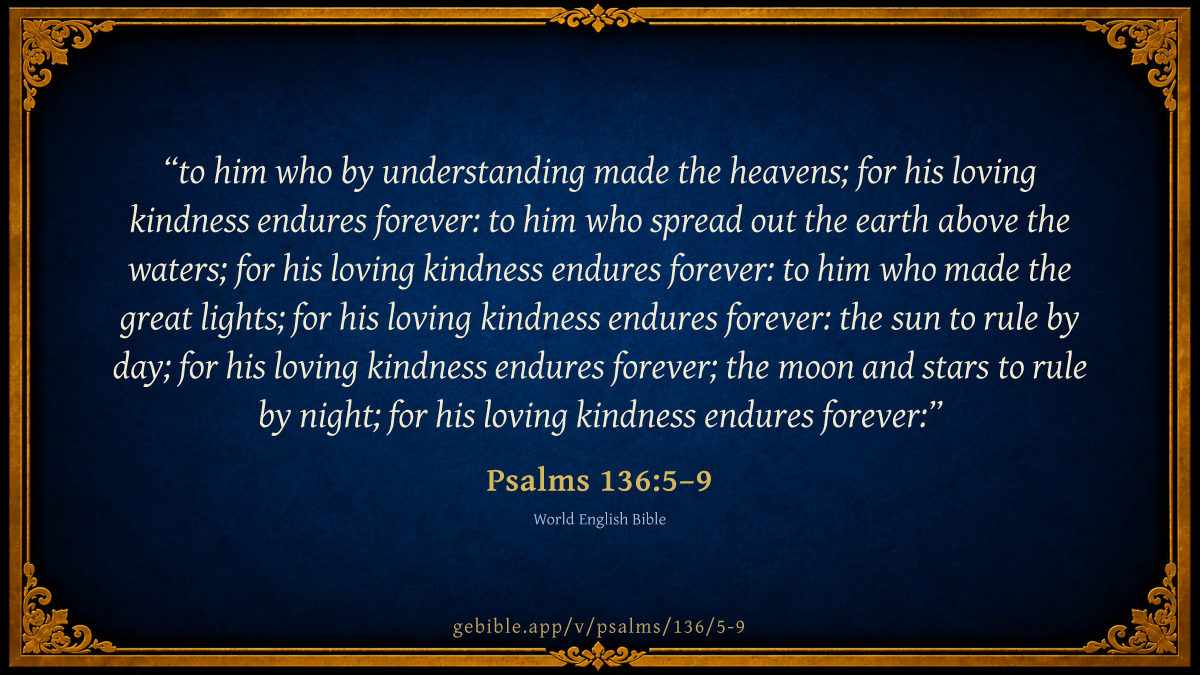
7. Who made the great lights, etc. — Moses calls the sun and moon the two great lights, and there is little doubt that the Psalmist here borrows the same phraseology. What is immediately added about the stars, is, as it were, accessory to the others. It is true, that the other planets are larger than the moon, but it is stated as second in order on account of its visible effects. The Holy Spirit had no intention to teach astronomy; and, in proposing instruction meant to be common to the simplest and most uneducated persons, he made use by Moses and the other Prophets of popular language, that none might shelter himself under the pretext of obscurity, as we will see men sometimes very readily pretended an incapacity to understand, when anything deep or recondite is submitted to their notice. Accordingly, as Saturn though bigger than the moon is not so to the eye owing to his greater distance, the Holy Spirit would rather speak childishly than unintelligibly to the humble and unlearned. The same remark may be made upon what the Psalmist adds regarding God’s having assigned the sun and moon their respective parts, making the one to rule the day, and the other to rule the night, by which we are not to understand that they exercise any government, but that the administrative power of God is very manifest in this distribution. The sun in illuminating the earth through the day, and the, moon and stars by night, may be said to yield a reverential homage to God.
John Calvin's Commentaries (1540-1563) — public domain. Text from the Calvin Translation Society English edition (1840s-50s) via the Christian Classics Ethereal Library (ccel.org). Calvin's coverage is partial (roughly two-thirds of the Bible); uncommented books and verses are honest gaps, never fabricated. The 19th-century editor's footnotes and remarks are omitted so the notes are faithfully Calvin's own voice.
Geneva Bible translators1599 · Public DomainOn v6This was a common kind of thanksgiving, which the…
This was a common kind of thanksgiving, which the whole people used, when they had received any benefit of God, as 2 Chron. 7:6 and 20:21, meaning, that God was not only merciful to their fathers, but also continued the same to their posterity.
Geneva Bible (1599) marginal notes — public domain.
John Trapp1656 · Public DomainOn vv5–9Psa 136:5 To him that by wisdom made the…
Psa 136:5 To him that by wisdom made the heavens: for his mercy [endureth] for ever.
Ver. 5. To him that by wisdom, &c.] Singulari ingenio et summa industria, yet without tool or toil. See Heb 11:10. {See Trapp on "Heb 11:10"}
John Trapp, A Commentary or Exposition upon All the Books of the Old and New Testament (1647–1656) — public domain. Text from a community e-Sword module.
Matthew Poole1685 · Public DomainOn vv5, 6, 8By wisdom, to wit, by eminent and admirable wisdom,…
By wisdom, to wit, by eminent and admirable wisdom, far exceeding the capacity of all human or angelical creatures.
Matthew Poole's English Annotations on the Holy Bible (1683–1685) — public domain. Text from a community e-Sword/MySword module.
John Gill1763 · Public DomainOn vv5–9To him that by wisdom made the heavens,.... In…
To him that by wisdom made the heavens,.... In such a curious manner, in such a proper and delightful situation, with such furniture, and for such uses, Pro 3:19;
for his mercy endureth for ever; which appears in the continued influences of the heaven; the dew, rain, and snow, that descend from it on the earth to water and make it fruitful, and to produce those rich and valuable blessings called the "precious things of heaven", Deu 33:13; and which are of the utmost importance for the service of man and beast: and, besides, God has of his infinite mercy, which continues, provided an inheritance in the heavens, a house eternal in the heavens, mansions of bliss and glory there, which Christ is now preparing for his saints, that they may dwell with him in them for evermore.
John Gill's Exposition of the Whole Bible (1746–1763) — public domain (CC PDM 1.0). Text via the HelloAO Bible API.
Adam Clarke1810 · Public DomainOn vv5–7Verse 5. By wisdom made the heavens] In the…
Verse 5. By wisdom made the heavens] In the contrivance of the celestial bodies, in their relations, connexions, influences on each other, revolutions, &c., the wisdom of God particularly appears.
Adam Clarke's Commentary on the Bible (1810–1826) — public domain. Text from a community e-Sword/MySword module.
Joseph Benson1811 · Public DomainOn vv5, 7Psa 136:5-6. To him that by wisdom — Namely,…
Psa 136:5-6. To him that by wisdom — Namely, by eminent and admirable wisdom, far exceeding the capacity of all creatures, whether human or angelical; made the heavens, that stretched out the earth — “The heavens above, and the earth beneath, declare the wisdom of their great Maker, and proclaim aloud, to an intelligent ear, the divinity of the hand that formed them. The heavens display the love of God to man; the earth teaches the duty of man to God. Heaven is glorious and gracious, earth verdant and fruitful. The bright and ample circumference of heaven, the variegated surface of the earth, and the profusion of good things that distinguish the seasons, contaminated as they all have been by man’s transgression, even now yield a prospect which annihilates all human grandeur. What idea, then, are we to frame of those new heavens and earth from which sin and corruption are excluded, and where righteousness hath fixed her eternal throne.” — Horne.
Joseph Benson's Commentary on the Old and New Testaments (1811–1818) — public domain. Text from a community e-Sword module.
Albert Barnes1834 · Public DomainOn vv5–9To him that by wisdom made the heavens -…
To him that by wisdom made the heavens - Made them in so wise a manner; where so much wisdom was manifested. See Pro 3:19; Pro 8:24-31.
For his mercy ... - The making of the heavens was a manifestation of mercy and goodness as furnishing an abode for unfallen and holy beings; as a dwelling-place for redeemed sinners when they shall be removed there from the earth; and as, by their order, their beauty, their harmony, and their happy influences, tending to promote the happiness of man on earth.
Albert Barnes' Notes on the Bible (1834–1885) — public domain. Text from a community e-Sword/MySword module.
Daniel D. Whedon1874 · Public DomainOn v66. Stretched out the earth above the waters—Another instance…
6. Stretched out the earth above the waters—Another instance wherein external nature is described, not scientifically, but popularly, as it appears to the senses. So the scriptures speak of the sun’s rising and going down; and so philosophers themselves still speak, despite the philosophical absurdity of the expression. Psa_136:6-9 follow the record of Gen_1:8.
Daniel D. Whedon (gen. ed.), Commentary on the Old and New Testaments (1874–1909) — public domain. Text from a community e-Sword module.
The Cambridge Bible for Schools and Colleges1878 · Public DomainOn vv5–95. O give thanks unto the redeemer of Israel…
5. O give thanks unto the redeemer of Israel (Isa_49:7), for &c.
5. by wisdom] By understanding, as Pro_3:19; Jer_10:12.
The Cambridge Bible for Schools and Colleges (gen. ed. J. J. S. Perowne; Cambridge University Press, 1878–1918) — public domain. Text from a community e-Sword module.
Ellicott's Commentary for English Readers1878 · Public DomainOn vv5–7(5) By wisdom.—From Psa_104:24, Pro_3:19, or Jer_10:12.
(5) By wisdom.—From Psa_104:24, Pro_3:19, or Jer_10:12.
A Bible Commentary for English Readers, edited by Charles John Ellicott (1878–1897) — public domain. Text from a community e-Sword module.
The Pulpit Commentary1880 · Public DomainOn vv5–9To him that by wisdom made the heavens. Creation…
To him that by wisdom made the heavens. Creation is the work, not only of God"s power, bat of his wisdom also. Things were made as they are by the exertion of his forethought and understanding. (comp. Pro_3:19 Eph_1:11) For his mercy, etc.
The Pulpit Commentary (1880–1919), ed. H.D.M. Spence-Jones & Joseph S. Exell — public domain. Text from a community e-Sword module.
Charles H. Spurgeon1885 · Public DomainOn vv5–9Ver. 5. To him that by wisdom made the…
Ver. 5. To him that by wisdom made the heavens. His goodness appears in creating the upper regions. He set his wisdom to the task of fashioning a firmament, or an atmosphere suitable for a world upon which mortal men should dwell. What a mass of wisdom lies hidden in this one creating act! The discoveries of our keenest observers have never searched out all the evidences of design which are crowded together in this work of God's hands. The lives of plants, animals, and men are dependent upon the fashioning of our heavens: had the skies been other than they are we had not been here to praise God. Divine foresight planned the air and the clouds, with a view to the human race.
For his mercy endureth for ever. The Psalmist's details of mercy begin in the loftiest regions, and gradually descend from the heavens to "our low estate" (Ps 134:23); and this is an ascent, for mercy becomes greater as its objects become less worthy. Mercy is far reaching, long enduring, all encompassing. Nothing is too high for its reach, as nothing is beneath its stoop.
Read full note →
High as heaven his wisdom reigns,
Mercy on the throne remains.
Ver. 5. To him that by wisdom made the heavens. We find that God has built the heavens in wisdom, to declare his glory, and to show forth his handiwork. There are no iron tracks, with bars and bolts, to hold the planets in their orbits. Freely in space they move, ever changing, but never changed; poised and balancing; swaying and swayed; disturbing and disturbed, onward they fly, fulfilling with unerring certainty their mighty cycles. The entire system forms one grand complicated piece of celestial machinery; circle within circle, wheel within wheel, cycle within cycle; revolutions go swift as to be completed in a few hours; movements so slow, that their mighty periods are only counted by millions of years. From "The Orbs of Heaven", 1859.
Ver. 5. To him that by wisdom made the heavens. Not only the firmament, but the third heavens, too, where all is felicity, where is the throne of glory. Then, I infer, that if the mercy which visits earth is from the same Jehovah who built that heaven and filled it with glory, there must be in his mercy something of the same "understanding" or "wisdom." It is wise, prudent mercy; not rashly given forth; and it is the mercy of him whose love has filled that heaven with bliss. The same architect, the same skill, the same love! Andrew A. Bonar.
Psalms 136:6*
Charles H. Spurgeon's The Treasury of David (1869–1885) — public domain. Psalms only. Text from a community e-Sword/MySword module.
unfoldingWord translationNotes2017 · CC BY-SA 4.0On vv6, 8spread out the earth above the waters
spread out the earth above the waters
The ancient Israelites thought that the earth's dry land was on top of the sea. AT: "placed the earth over the waters"
Read full note →
for his covenant faithfulness endures forever
The abstract noun "faithfulness" can be translated with an adjective. See how you translated this in Psalms 136:1. AT: "because he remains faithful to his covenant forever" (See: Abstract Nouns)
great lights
This is a reference to the sources of light for the earth, especially the sun and the moon. AT: "the sun and the moon and the stars"

John Calvin 1540 · Public Domain On v7 7. Who made the great lights, etc. — Moses…
7. Who made the great lights, etc. — Moses calls the sun and moon the two great lights, and there is little doubt that the Psalmist here borrows the same phraseology. What is immediately added about the stars, is, as it were, accessory to the others. It is true, that the other planets are larger than the moon, but it is stated as second in order on account of its visible effects. The Holy Spirit had no intention to teach astronomy; and, in proposing instruction meant to be common to the simplest and most uneducated persons, he made use by Moses and the other Prophets of popular language, that none might shelter himself under the pretext of obscurity, as we will see men sometimes very readily pretended an incapacity to understand, when anything deep or recondite is submitted to their notice. Accordingly, as Saturn though bigger than the moon is not so to the eye owing to his greater distance, the Holy Spirit would rather speak childishly than unintelligibly to the humble and unlearned. The same remark may be made upon what the Psalmist adds regarding God’s having assigned the sun and moon their respective parts, making the one to rule the day, and the other to rule the night, by which we are not to understand that they exercise any government, but that the administrative power of God is very manifest in this distribution. The sun in illuminating the earth through the day, and the, moon and stars by night, may be said to yield a reverential homage to God.
John Calvin's Commentaries (1540-1563) — public domain. Text from the Calvin Translation Society English edition (1840s-50s) via the Christian Classics Ethereal Library (ccel.org). Calvin's coverage is partial (roughly two-thirds of the Bible); uncommented books and verses are honest gaps, never fabricated. The 19th-century editor's footnotes and remarks are omitted so the notes are faithfully Calvin's own voice.
Geneva Bible translators 1599 · Public Domain On v6 This was a common kind of thanksgiving, which the…
This was a common kind of thanksgiving, which the whole people used, when they had received any benefit of God, as 2 Chron. 7:6 and 20:21, meaning, that God was not only merciful to their fathers, but also continued the same to their posterity.
Geneva Bible (1599) marginal notes — public domain.
John Trapp 1656 · Public Domain On vv5–9 Psa 136:5 To him that by wisdom made the…
Psa 136:5 To him that by wisdom made the heavens: for his mercy [endureth] for ever.
Ver. 5. To him that by wisdom, &c.] Singulari ingenio et summa industria, yet without tool or toil. See Heb 11:10. {See Trapp on "Heb 11:10"}
John Trapp, A Commentary or Exposition upon All the Books of the Old and New Testament (1647–1656) — public domain. Text from a community e-Sword module.
Matthew Poole 1685 · Public Domain On vv5, 6, 8 By wisdom, to wit, by eminent and admirable wisdom,…
By wisdom, to wit, by eminent and admirable wisdom, far exceeding the capacity of all human or angelical creatures.
Matthew Poole's English Annotations on the Holy Bible (1683–1685) — public domain. Text from a community e-Sword/MySword module.
John Gill 1763 · Public Domain On vv5–9 To him that by wisdom made the heavens,.... In…
To him that by wisdom made the heavens,.... In such a curious manner, in such a proper and delightful situation, with such furniture, and for such uses, Pro 3:19;
for his mercy endureth for ever; which appears in the continued influences of the heaven; the dew, rain, and snow, that descend from it on the earth to water and make it fruitful, and to produce those rich and valuable blessings called the "precious things of heaven", Deu 33:13; and which are of the utmost importance for the service of man and beast: and, besides, God has of his infinite mercy, which continues, provided an inheritance in the heavens, a house eternal in the heavens, mansions of bliss and glory there, which Christ is now preparing for his saints, that they may dwell with him in them for evermore.
John Gill's Exposition of the Whole Bible (1746–1763) — public domain (CC PDM 1.0). Text via the HelloAO Bible API.
Adam Clarke 1810 · Public Domain On vv5–7 Verse 5. By wisdom made the heavens] In the…
Verse 5. By wisdom made the heavens] In the contrivance of the celestial bodies, in their relations, connexions, influences on each other, revolutions, &c., the wisdom of God particularly appears.
Adam Clarke's Commentary on the Bible (1810–1826) — public domain. Text from a community e-Sword/MySword module.
Joseph Benson 1811 · Public Domain On vv5, 7 Psa 136:5-6. To him that by wisdom — Namely,…
Psa 136:5-6. To him that by wisdom — Namely, by eminent and admirable wisdom, far exceeding the capacity of all creatures, whether human or angelical; made the heavens, that stretched out the earth — “The heavens above, and the earth beneath, declare the wisdom of their great Maker, and proclaim aloud, to an intelligent ear, the divinity of the hand that formed them. The heavens display the love of God to man; the earth teaches the duty of man to God. Heaven is glorious and gracious, earth verdant and fruitful. The bright and ample circumference of heaven, the variegated surface of the earth, and the profusion of good things that distinguish the seasons, contaminated as they all have been by man’s transgression, even now yield a prospect which annihilates all human grandeur. What idea, then, are we to frame of those new heavens and earth from which sin and corruption are excluded, and where righteousness hath fixed her eternal throne.” — Horne.
Joseph Benson's Commentary on the Old and New Testaments (1811–1818) — public domain. Text from a community e-Sword module.
Albert Barnes 1834 · Public Domain On vv5–9 To him that by wisdom made the heavens -…
To him that by wisdom made the heavens - Made them in so wise a manner; where so much wisdom was manifested. See Pro 3:19; Pro 8:24-31.
For his mercy ... - The making of the heavens was a manifestation of mercy and goodness as furnishing an abode for unfallen and holy beings; as a dwelling-place for redeemed sinners when they shall be removed there from the earth; and as, by their order, their beauty, their harmony, and their happy influences, tending to promote the happiness of man on earth.
Albert Barnes' Notes on the Bible (1834–1885) — public domain. Text from a community e-Sword/MySword module.
Daniel D. Whedon 1874 · Public Domain On v6 6. Stretched out the earth above the waters—Another instance…
6. Stretched out the earth above the waters—Another instance wherein external nature is described, not scientifically, but popularly, as it appears to the senses. So the scriptures speak of the sun’s rising and going down; and so philosophers themselves still speak, despite the philosophical absurdity of the expression. Psa_136:6-9 follow the record of Gen_1:8.
Daniel D. Whedon (gen. ed.), Commentary on the Old and New Testaments (1874–1909) — public domain. Text from a community e-Sword module.
The Cambridge Bible for Schools and Colleges 1878 · Public Domain On vv5–9 5. O give thanks unto the redeemer of Israel…
5. O give thanks unto the redeemer of Israel (Isa_49:7), for &c.
5. by wisdom] By understanding, as Pro_3:19; Jer_10:12.
The Cambridge Bible for Schools and Colleges (gen. ed. J. J. S. Perowne; Cambridge University Press, 1878–1918) — public domain. Text from a community e-Sword module.
Ellicott's Commentary for English Readers 1878 · Public Domain On vv5–7 (5) By wisdom.—From Psa_104:24, Pro_3:19, or Jer_10:12.
(5) By wisdom.—From Psa_104:24, Pro_3:19, or Jer_10:12.
A Bible Commentary for English Readers, edited by Charles John Ellicott (1878–1897) — public domain. Text from a community e-Sword module.
The Pulpit Commentary 1880 · Public Domain On vv5–9 To him that by wisdom made the heavens. Creation…
To him that by wisdom made the heavens. Creation is the work, not only of God"s power, bat of his wisdom also. Things were made as they are by the exertion of his forethought and understanding. (comp. Pro_3:19 Eph_1:11) For his mercy, etc.
The Pulpit Commentary (1880–1919), ed. H.D.M. Spence-Jones & Joseph S. Exell — public domain. Text from a community e-Sword module.
Charles H. Spurgeon 1885 · Public Domain On vv5–9 Ver. 5. To him that by wisdom made the…
Ver. 5. To him that by wisdom made the heavens. His goodness appears in creating the upper regions. He set his wisdom to the task of fashioning a firmament, or an atmosphere suitable for a world upon which mortal men should dwell. What a mass of wisdom lies hidden in this one creating act! The discoveries of our keenest observers have never searched out all the evidences of design which are crowded together in this work of God's hands. The lives of plants, animals, and men are dependent upon the fashioning of our heavens: had the skies been other than they are we had not been here to praise God. Divine foresight planned the air and the clouds, with a view to the human race.
For his mercy endureth for ever. The Psalmist's details of mercy begin in the loftiest regions, and gradually descend from the heavens to "our low estate" (Ps 134:23); and this is an ascent, for mercy becomes greater as its objects become less worthy. Mercy is far reaching, long enduring, all encompassing. Nothing is too high for its reach, as nothing is beneath its stoop.
Read full note →
High as heaven his wisdom reigns,
Mercy on the throne remains.
Ver. 5. To him that by wisdom made the heavens. We find that God has built the heavens in wisdom, to declare his glory, and to show forth his handiwork. There are no iron tracks, with bars and bolts, to hold the planets in their orbits. Freely in space they move, ever changing, but never changed; poised and balancing; swaying and swayed; disturbing and disturbed, onward they fly, fulfilling with unerring certainty their mighty cycles. The entire system forms one grand complicated piece of celestial machinery; circle within circle, wheel within wheel, cycle within cycle; revolutions go swift as to be completed in a few hours; movements so slow, that their mighty periods are only counted by millions of years. From "The Orbs of Heaven", 1859.
Ver. 5. To him that by wisdom made the heavens. Not only the firmament, but the third heavens, too, where all is felicity, where is the throne of glory. Then, I infer, that if the mercy which visits earth is from the same Jehovah who built that heaven and filled it with glory, there must be in his mercy something of the same "understanding" or "wisdom." It is wise, prudent mercy; not rashly given forth; and it is the mercy of him whose love has filled that heaven with bliss. The same architect, the same skill, the same love! Andrew A. Bonar.
Psalms 136:6*
Charles H. Spurgeon's The Treasury of David (1869–1885) — public domain. Psalms only. Text from a community e-Sword/MySword module.
unfoldingWord translationNotes 2017 · CC BY-SA 4.0 On vv6, 8 spread out the earth above the waters
spread out the earth above the waters
The ancient Israelites thought that the earth's dry land was on top of the sea. AT: "placed the earth over the waters"
Read full note →
for his covenant faithfulness endures forever
The abstract noun "faithfulness" can be translated with an adjective. See how you translated this in Psalms 136:1. AT: "because he remains faithful to his covenant forever" (See: Abstract Nouns)
great lights
This is a reference to the sources of light for the earth, especially the sun and the moon. AT: "the sun and the moon and the stars"
translationWords
earth
water
light
unfoldingWord translationNotes — © Distant Shores Media and the Door43 World Missions Community, licensed CC BY-SA 4.0. Source: git.door43.org/Door43/en_tn.