Psalms 148:3(v8)Praise him, sun and moon! Praise him, all you shining stars!
Genesis 1:14-19(v7)God said, “Let there be lights in the expanse of the sky to divide the day from the night; and let them be for signs to mark seasons, days,…
Genesis 1:16(v8)God made the two great lights: the greater light to rule the day, and the lesser light to rule the night. He also made the stars.
Deuteronomy 4:19(v7)and lest you lift up your eyes to the sky, and when you see the sun and the moon and the stars, even all the army of the sky, you are drawn…
Job 31:26(v9)if I have seen the sun when it shined, or the moon moving in splendor,
Show all 11 cross-references
Psalms 8:3(v9)When I consider your heavens, the work of your fingers, the moon and the stars, which you have ordained;
Psalms 74:16-17(v7)The day is yours, the night is also yours. You have prepared the light and the sun. You have set all the boundaries of the earth. You have…
Psalms 89:36-37(v9)His offspring will endure forever, his throne like the sun before me. It will be established forever like the moon, the faithful witness in…
Psalms 104:19(v7)He appointed the moon for seasons. The sun knows when to set.
Jeremiah 31:35(v8)Yahweh, who gives the sun for a light by day, and the ordinances of the moon and of the stars for a light by night, who stirs up the sea,…
Matthew 5:45(v8)that you may be children of your Father who is in heaven. For he makes his sun to rise on the evil and the good, and sends rain on the just…
Cross-references from openbible.info (CC BY 4.0)
Explain this passage (12 sources)
Historical commentary, presented as a primary source — not an endorsement.
John Calvin1540 · Public DomainOn v77. Who made the great lights, etc. — Moses…
7. Who made the great lights, etc. — Moses calls the sun and moon the two great lights, and there is little doubt that the Psalmist here borrows the same phraseology. What is immediately added about the stars, is, as it were, accessory to the others. It is true, that the other planets are larger than the moon, but it is stated as second in order on account of its visible effects. The Holy Spirit had no intention to teach astronomy; and, in proposing instruction meant to be common to the simplest and most uneducated persons, he made use by Moses and the other Prophets of popular language, that none might shelter himself under the pretext of obscurity, as we will see men sometimes very readily pretended an incapacity to understand, when anything deep or recondite is submitted to their notice. Accordingly, as Saturn though bigger than the moon is not so to the eye owing to his greater distance, the Holy Spirit would rather speak childishly than unintelligibly to the humble and unlearned. The same remark may be made upon what the Psalmist adds regarding God’s having assigned the sun and moon their respective parts, making the one to rule the day, and the other to rule the night, by which we are not to understand that they exercise any government, but that the administrative power of God is very manifest in this distribution. The sun in illuminating the earth through the day, and the, moon and stars by night, may be said to yield a reverential homage to God.
John Calvin's Commentaries (1540-1563) — public domain. Text from the Calvin Translation Society English edition (1840s-50s) via the Christian Classics Ethereal Library (ccel.org). Calvin's coverage is partial (roughly two-thirds of the Bible); uncommented books and verses are honest gaps, never fabricated. The 19th-century editor's footnotes and remarks are omitted so the notes are faithfully Calvin's own voice.
John Trapp1656 · Public DomainOn vv7–9Psa 136:7 To him that made great lights: for…
Psa 136:7 To him that made great lights: for his mercy [endureth] for ever:
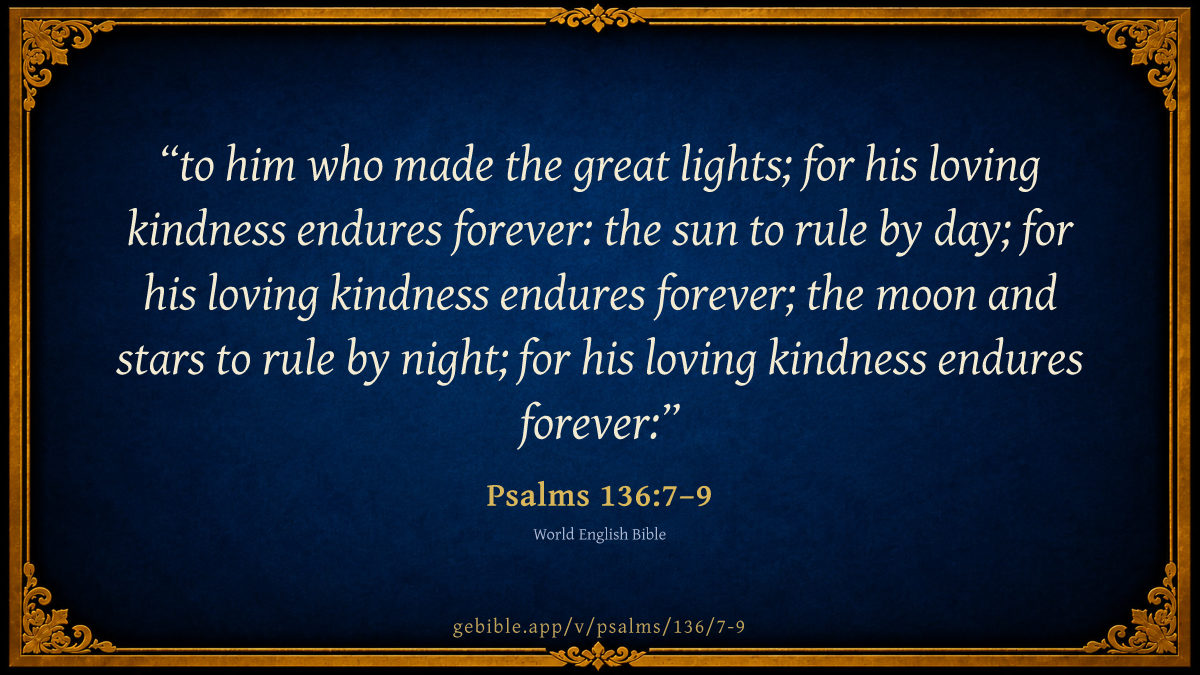
Ver. 7. To him that made great lights] Without which we should have no more comfort of the air we breathe in than the Egyptians had in that three days’ darkness. Now the sun and moon are called great luminaries, not great stars or bodies (for the sun is less than some stars, and the moon is least of all), first, for the excellence of light which these two do more abundantly impart to the earth; and, secondly, for the effects they work; the sun by his access making all green and flourishing, and the contrary by his recess; the moon by its various aspect causing humours and marrows to increase or decrease, &c.
John Trapp, A Commentary or Exposition upon All the Books of the Old and New Testament (1647–1656) — public domain. Text from a community e-Sword module.
Matthew Poole1685 · Public DomainOn v8The sun to rule by day; of which phrase…
The sun to rule by day; of which phrase and the like in the next verse, See Poole "Gen 1:16".
Matthew Poole's English Annotations on the Holy Bible (1683–1685) — public domain. Text from a community e-Sword/MySword module.
John Gill1763 · Public DomainOn vv7–9To him that made great lights,.... For the inhabitants…
To him that made great lights,.... For the inhabitants of the world to walk and work by, to do all the business of life in a comfortable manner; and which is an instance of mercy and goodness; see Gen 1:14;
for his mercy endureth for ever; these lights continuing for the benefit of mankind.
John Gill's Exposition of the Whole Bible (1746–1763) — public domain (CC PDM 1.0). Text via the HelloAO Bible API.
Adam Clarke1810 · Public DomainOn v7Verse 7. Great lights] See the notes on the…
Verse 7. Great lights] See the notes on the parallel passages in Genesis, &c. Ge 1:14-18
Adam Clarke's Commentary on the Bible (1810–1826) — public domain. Text from a community e-Sword/MySword module.
Joseph Benson1811 · Public DomainOn v7Psa 136:7-9. To him that made great lights, &c.…
Psa 136:7-9. To him that made great lights, &c. — Great luminaries, placed in the firmament of heaven, to shed their light and influences upon the earth: see notes on Gen 1:14-16. “Light is the life and soul of the universe, the noblest emblem of the power and glory of God, who, even in the night season, leaves not himself without witness, but gives us some portion of that light reflected, which by day we behold flowing from its great fountain in the heart of heaven.”
Joseph Benson's Commentary on the Old and New Testaments (1811–1818) — public domain. Text from a community e-Sword module.
Albert Barnes1834 · Public DomainOn vv7–9To him that made great lights - Gen 1:14.…
To him that made great lights - Gen 1:14. The sun and the moon are here particularly referred to.
For his mercy ... - As manifested in all that has followed from the creation and diffusion of light - (all the beauty in the universe as seen; all the life, beauty, and vigor in the vegetable and animal world; all that there is of life and happiness in the universe - for there could be neither if darkness reigned everywhere); light, the emblem of happiness; the source of joy; the producer, in a great measure, of the beauties of the universe, and the revealer of those beauties everywhere. How can a man think of light and not praise its Author?
Albert Barnes' Notes on the Bible (1834–1885) — public domain. Text from a community e-Sword/MySword module.
The Cambridge Bible for Schools and Colleges1878 · Public DomainOn vv7–97. O give thanks unto him that buildeth his…
7. O give thanks unto him that buildeth his city and his sanctuary (Psa_147:2 a), for &c.
7–9. Cp. Gen_1:14-16.
The Cambridge Bible for Schools and Colleges (gen. ed. J. J. S. Perowne; Cambridge University Press, 1878–1918) — public domain. Text from a community e-Sword module.
Ellicott's Commentary for English Readers1878 · Public DomainOn v7(7) Lights.—An unusual word, meaning light itself, and not…
(7) Lights.—An unusual word, meaning light itself, and not luminaries. But possibly the poet wished in one phrase to combine Gen_1:3; Gen_1:14-15.
A Bible Commentary for English Readers, edited by Charles John Ellicott (1878–1897) — public domain. Text from a community e-Sword module.
The Pulpit Commentary1880 · Public DomainOn vv7–9To him that made great lights. (see Gen_1:14-16) For…
To him that made great lights. (see Gen_1:14-16) For his mercy, etc.
The Pulpit Commentary (1880–1919), ed. H.D.M. Spence-Jones & Joseph S. Exell — public domain. Text from a community e-Sword module.
Charles H. Spurgeon1885 · Public DomainOn vv7–9Ver. 7. To him that made great lights. This…
Ver. 7. To him that made great lights. This also is a creating miracle worthy of our loudest thanks. What could men have done without light? Though they had the heavens above them, and dry land to move upon, yet what could they see, and where could they go without light? Thanks be to the Lord, who has not consigned us to darkness. In great mercy he has not left us to an uncertain, indistinct light, floating about fitfully, and without order; but he has concentrated light upon two grand luminaries, which, as far as we are concerned, are to us "great lights." The Psalmist is making a song for common people, not for your critical savans, and so he sings of the sun and moon as they appear to us, the greatest of lights. These the Lord created in the beginning; and for the present age of man made or constituted them light bearers for the world.
For his mercy endureth for ever. Mercy gleams in every ray of light, and it is most clearly seen in the arrangement by which it is distributed with order and regularity from the sun and moon.
Read full note →
Lamps he lit in heaven's heights,
For in mercy he delights.
Ver. 7. Great lights. The luminaries of heaven are unspeakable blessings to the children of men. The sun, in the greatness of his strength, measures their day, and exerts an influence over animal and vegetable life, which surrounds them with innumerable comforts; and the moon and stars walking forth in their brightness, give direction to them amidst the sable hours of night, and both by land and sea proclaim the wisdom, and benignity, and gracious arrangement of the adorable Creator. By these luminaries, day and night, heat and cold, summer and winter are continually regulated: so that God's covenant with the earth is maintained through their medium. How truly, then, may we exclaim, "His mercy endureth for ever!" John Morison.
Ver. 7. To him that made great lights. Light is the life and soul of the universe, the noblest emblem of the power and glory of God, who, in the night season, leaves not himself without witness, but gives us some portion of that light reflected, which by day we behold flowing from its great fountain in the heart of heaven. Thy church and thy saints, O Lord, "are the moon and the stars", which, by the communication of doctrine, and the splendour of example, guide our feet, while we travel on in the night that hath overtaken us, waiting for the dawn of everlasting day. Then we shall behold thy glory, and see thee as thou art. George Horne.
Ver. 7. The mercy which dwells in the creation and distribution of light.
Ver. 7-9.
1. The constancy of rule.
2. The association of light with rule.
3. The perpetuity of mercy in this matter.
Psalms 136:8*
Charles H. Spurgeon's The Treasury of David (1869–1885) — public domain. Psalms only. Text from a community e-Sword/MySword module.
unfoldingWord translationNotes2017 · CC BY-SA 4.0On v8to rule by day ... to rule by night
to rule by day ... to rule by night
The sun, moon, and stars are spoken of as if they were kings. AT: "to mark the time of day ... to mark the time of night" (See: Metaphor and Personification)
Read full note →
for his covenant faithfulness endures forever
The abstract noun "faithfulness" can be translated with an adjective. See how you translated this in Psalms 136:1. AT: "because he remains faithful to his covenant forever" (See: Abstract Nouns)
 GEBible — Godless Engineer's Bible App
John Calvin 1540 · Public Domain On v7 7. Who made the great lights, etc. — Moses…
7. Who made the great lights, etc. — Moses calls the sun and moon the two great lights, and there is little doubt that the Psalmist here borrows the same phraseology. What is immediately added about the stars, is, as it were, accessory to the others. It is true, that the other planets are larger than the moon, but it is stated as second in order on account of its visible effects. The Holy Spirit had no intention to teach astronomy; and, in proposing instruction meant to be common to the simplest and most uneducated persons, he made use by Moses and the other Prophets of popular language, that none might shelter himself under the pretext of obscurity, as we will see men sometimes very readily pretended an incapacity to understand, when anything deep or recondite is submitted to their notice. Accordingly, as Saturn though bigger than the moon is not so to the eye owing to his greater distance, the Holy Spirit would rather speak childishly than unintelligibly to the humble and unlearned. The same remark may be made upon what the Psalmist adds regarding God’s having assigned the sun and moon their respective parts, making the one to rule the day, and the other to rule the night, by which we are not to understand that they exercise any government, but that the administrative power of God is very manifest in this distribution. The sun in illuminating the earth through the day, and the, moon and stars by night, may be said to yield a reverential homage to God.
John Calvin's Commentaries (1540-1563) — public domain. Text from the Calvin Translation Society English edition (1840s-50s) via the Christian Classics Ethereal Library (ccel.org). Calvin's coverage is partial (roughly two-thirds of the Bible); uncommented books and verses are honest gaps, never fabricated. The 19th-century editor's footnotes and remarks are omitted so the notes are faithfully Calvin's own voice.
John Trapp 1656 · Public Domain On vv7–9 Psa 136:7 To him that made great lights: for…
Psa 136:7 To him that made great lights: for his mercy [endureth] for ever:
Ver. 7. To him that made great lights] Without which we should have no more comfort of the air we breathe in than the Egyptians had in that three days’ darkness. Now the sun and moon are called great luminaries, not great stars or bodies (for the sun is less than some stars, and the moon is least of all), first, for the excellence of light which these two do more abundantly impart to the earth; and, secondly, for the effects they work; the sun by his access making all green and flourishing, and the contrary by his recess; the moon by its various aspect causing humours and marrows to increase or decrease, &c.
John Trapp, A Commentary or Exposition upon All the Books of the Old and New Testament (1647–1656) — public domain. Text from a community e-Sword module.
Matthew Poole 1685 · Public Domain On v8 The sun to rule by day; of which phrase…
The sun to rule by day; of which phrase and the like in the next verse, See Poole "Gen 1:16".
Matthew Poole's English Annotations on the Holy Bible (1683–1685) — public domain. Text from a community e-Sword/MySword module.
John Gill 1763 · Public Domain On vv7–9 To him that made great lights,.... For the inhabitants…
To him that made great lights,.... For the inhabitants of the world to walk and work by, to do all the business of life in a comfortable manner; and which is an instance of mercy and goodness; see Gen 1:14;
for his mercy endureth for ever; these lights continuing for the benefit of mankind.
John Gill's Exposition of the Whole Bible (1746–1763) — public domain (CC PDM 1.0). Text via the HelloAO Bible API.
Adam Clarke 1810 · Public Domain On v7 Verse 7. Great lights] See the notes on the…
Verse 7. Great lights] See the notes on the parallel passages in Genesis, &c. Ge 1:14-18
Adam Clarke's Commentary on the Bible (1810–1826) — public domain. Text from a community e-Sword/MySword module.
Joseph Benson 1811 · Public Domain On v7 Psa 136:7-9. To him that made great lights, &c.…
Psa 136:7-9. To him that made great lights, &c. — Great luminaries, placed in the firmament of heaven, to shed their light and influences upon the earth: see notes on Gen 1:14-16. “Light is the life and soul of the universe, the noblest emblem of the power and glory of God, who, even in the night season, leaves not himself without witness, but gives us some portion of that light reflected, which by day we behold flowing from its great fountain in the heart of heaven.”
Joseph Benson's Commentary on the Old and New Testaments (1811–1818) — public domain. Text from a community e-Sword module.
Albert Barnes 1834 · Public Domain On vv7–9 To him that made great lights - Gen 1:14.…
To him that made great lights - Gen 1:14. The sun and the moon are here particularly referred to.
For his mercy ... - As manifested in all that has followed from the creation and diffusion of light - (all the beauty in the universe as seen; all the life, beauty, and vigor in the vegetable and animal world; all that there is of life and happiness in the universe - for there could be neither if darkness reigned everywhere); light, the emblem of happiness; the source of joy; the producer, in a great measure, of the beauties of the universe, and the revealer of those beauties everywhere. How can a man think of light and not praise its Author?
Albert Barnes' Notes on the Bible (1834–1885) — public domain. Text from a community e-Sword/MySword module.
The Cambridge Bible for Schools and Colleges 1878 · Public Domain On vv7–9 7. O give thanks unto him that buildeth his…
7. O give thanks unto him that buildeth his city and his sanctuary (Psa_147:2 a), for &c.
7–9. Cp. Gen_1:14-16.
The Cambridge Bible for Schools and Colleges (gen. ed. J. J. S. Perowne; Cambridge University Press, 1878–1918) — public domain. Text from a community e-Sword module.
Ellicott's Commentary for English Readers 1878 · Public Domain On v7 (7) Lights.—An unusual word, meaning light itself, and not…
(7) Lights.—An unusual word, meaning light itself, and not luminaries. But possibly the poet wished in one phrase to combine Gen_1:3; Gen_1:14-15.
A Bible Commentary for English Readers, edited by Charles John Ellicott (1878–1897) — public domain. Text from a community e-Sword module.
The Pulpit Commentary 1880 · Public Domain On vv7–9 To him that made great lights. (see Gen_1:14-16) For…
To him that made great lights. (see Gen_1:14-16) For his mercy, etc.
The Pulpit Commentary (1880–1919), ed. H.D.M. Spence-Jones & Joseph S. Exell — public domain. Text from a community e-Sword module.
Charles H. Spurgeon 1885 · Public Domain On vv7–9 Ver. 7. To him that made great lights. This…
Ver. 7. To him that made great lights. This also is a creating miracle worthy of our loudest thanks. What could men have done without light? Though they had the heavens above them, and dry land to move upon, yet what could they see, and where could they go without light? Thanks be to the Lord, who has not consigned us to darkness. In great mercy he has not left us to an uncertain, indistinct light, floating about fitfully, and without order; but he has concentrated light upon two grand luminaries, which, as far as we are concerned, are to us "great lights." The Psalmist is making a song for common people, not for your critical savans, and so he sings of the sun and moon as they appear to us, the greatest of lights. These the Lord created in the beginning; and for the present age of man made or constituted them light bearers for the world.
For his mercy endureth for ever. Mercy gleams in every ray of light, and it is most clearly seen in the arrangement by which it is distributed with order and regularity from the sun and moon.
Read full note →
Lamps he lit in heaven's heights,
For in mercy he delights.
Ver. 7. Great lights. The luminaries of heaven are unspeakable blessings to the children of men. The sun, in the greatness of his strength, measures their day, and exerts an influence over animal and vegetable life, which surrounds them with innumerable comforts; and the moon and stars walking forth in their brightness, give direction to them amidst the sable hours of night, and both by land and sea proclaim the wisdom, and benignity, and gracious arrangement of the adorable Creator. By these luminaries, day and night, heat and cold, summer and winter are continually regulated: so that God's covenant with the earth is maintained through their medium. How truly, then, may we exclaim, "His mercy endureth for ever!" John Morison.
Ver. 7. To him that made great lights. Light is the life and soul of the universe, the noblest emblem of the power and glory of God, who, in the night season, leaves not himself without witness, but gives us some portion of that light reflected, which by day we behold flowing from its great fountain in the heart of heaven. Thy church and thy saints, O Lord, "are the moon and the stars", which, by the communication of doctrine, and the splendour of example, guide our feet, while we travel on in the night that hath overtaken us, waiting for the dawn of everlasting day. Then we shall behold thy glory, and see thee as thou art. George Horne.
Ver. 7. The mercy which dwells in the creation and distribution of light.
Ver. 7-9.
1. The constancy of rule.
2. The association of light with rule.
3. The perpetuity of mercy in this matter.
Psalms 136:8*
Charles H. Spurgeon's The Treasury of David (1869–1885) — public domain. Psalms only. Text from a community e-Sword/MySword module.
unfoldingWord translationNotes 2017 · CC BY-SA 4.0 On v8 to rule by day ... to rule by night
to rule by day ... to rule by night
The sun, moon, and stars are spoken of as if they were kings. AT: "to mark the time of day ... to mark the time of night" (See: Metaphor and Personification)
Read full note →
for his covenant faithfulness endures forever
The abstract noun "faithfulness" can be translated with an adjective. See how you translated this in Psalms 136:1. AT: "because he remains faithful to his covenant forever" (See: Abstract Nouns)
translationWords
covenant faithfulness
eternity
unfoldingWord translationNotes — © Distant Shores Media and the Door43 World Missions Community, licensed CC BY-SA 4.0. Source: git.door43.org/Door43/en_tn.