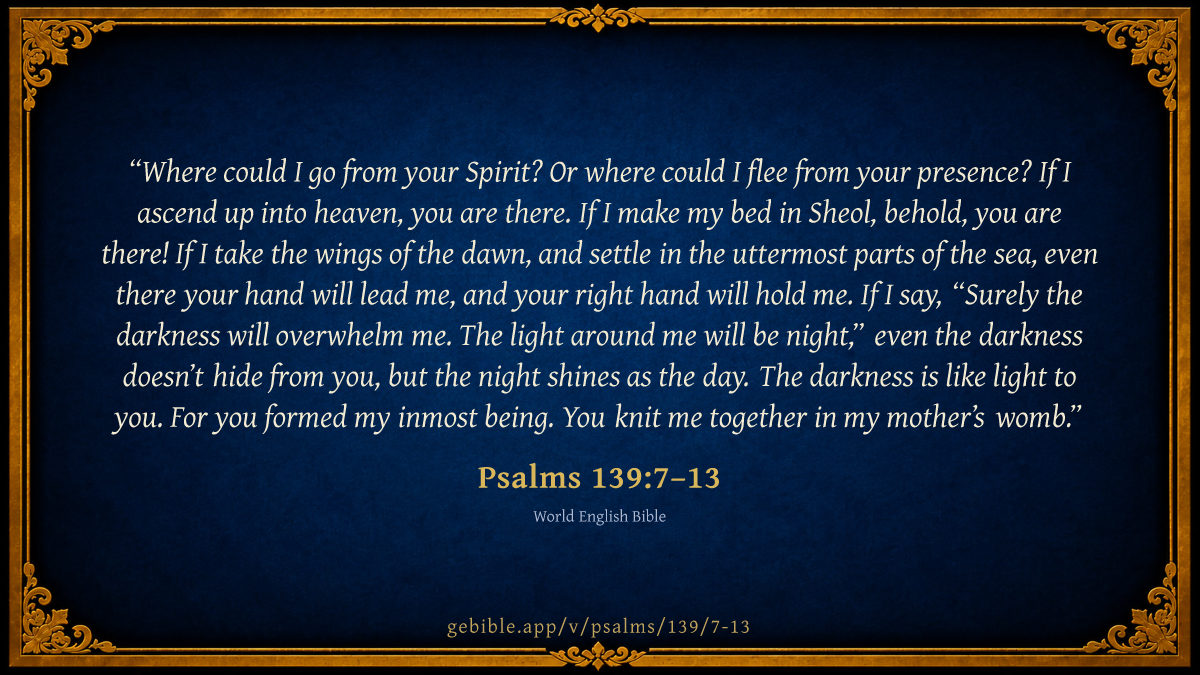
Jeremiah 1:5(v13)“Before I formed you in the womb, I knew you. Before you were born, I sanctified you. I have appointed you a prophet to the nations.”
Psalms 119:73(v13)Your hands have made me and formed me. Give me understanding, that I may learn your commandments.
Isaiah 44:2(v13)This is what Yahweh who made you, and formed you from the womb, who will help you says: “Don’t be afraid, Jacob my servant; and you,…
Psalms 23:3(v10)He restores my soul. He guides me in the paths of righteousness for his name’s sake.
Job 31:15(v13)Didn’t he who made me in the womb make him? Didn’t one fashion us in the womb?
Show all 36 cross-references
Jeremiah 23:23-24(v7)“Am I a God at hand,” says Yahweh, “and not a God afar off? Can anyone hide himself in secret places so that I can’t see him?” says Yahweh.…
Job 10:9-12(v13)Remember, I beg you, that you have fashioned me as clay. Will you bring me into dust again? Haven’t you poured me out like milk, and…
Psalms 71:6(v13)I have relied on you from the womb. You are he who took me out of my mother’s womb. I will always praise you.
Psalms 22:9-10(v13)But you brought me out of the womb. You made me trust while at my mother’s breasts. I was thrown on you from my mother’s womb. You are my…
Isaiah 46:3(v13)“Listen to me, house of Jacob, and all the remnant of the house of Israel, that have been carried from their birth, that have been carried…
Isaiah 41:13(v10)For I, Yahweh your God, will hold your right hand, saying to you, ‘Don’t be afraid. I will help you.’
Psalms 73:23(v10)Nevertheless, I am continually with you. You have held my right hand.
Psalms 63:8(v10)My soul stays close to you. Your right hand holds me up.
Jonah 1:3(v7)But Jonah rose up to flee to Tarshish from the presence of Yahweh. He went down to Joppa, and found a ship going to Tarshish; so he paid…
Daniel 2:22(v12)He reveals the deep and secret things. He knows what is in the darkness, and the light dwells with him.
Amos 9:2-4(v8)Though they dig into Sheol, there my hand will take them; and though they climb up to heaven, there I will bring them down. Though they…
Job 12:22(v11)He uncovers deep things out of darkness, and brings out to light the shadow of death.
Psalms 143:9-10(v10)Deliver me, Yahweh, from my enemies. I flee to you to hide me. Teach me to do your will, for you are my God. Your Spirit is good. Lead me…
Jeremiah 23:24(v11)Can anyone hide himself in secret places so that I can’t see him?” says Yahweh. “Don’t I fill heaven and earth?” says Yahweh.
Job 34:21-22(v8)“For his eyes are on the ways of a man. He sees all his goings. There is no darkness, nor thick gloom, where the workers of iniquity may…
Jonah 1:10(v7)Then the men were exceedingly afraid, and said to him, “What have you done?” For the men knew that he was fleeing from the presence of…
Jonah 2:2(v8)He said, “I called because of my affliction to Yahweh. He answered me. Out of the belly of Sheol I cried. You heard my voice.
Job 34:22(v12)There is no darkness, nor thick gloom, where the workers of iniquity may hide themselves.
Psalms 94:7(v11)They say, “Yah will not see, neither will Jacob’s God consider.”
Proverbs 15:11(v8)Sheol and Abaddon are before Yahweh— how much more then the hearts of the children of men!
Obadiah 1:4(v8)Though you mount on high as the eagle, and though your nest is set among the stars, I will bring you down from there,” says Yahweh.
Job 26:6(vv8, 12)Sheol is naked before God, and Abaddon has no covering.
Job 22:12-14(v11)“Isn’t God in the heights of heaven? See the height of the stars, how high they are! You say, ‘What does God know? Can he judge through the…
Psalms 10:11-13(v11)He says in his heart, “God has forgotten. He hides his face. He will never see it.” Arise, Yahweh! God, lift up your hand! Don’t forget the…
Psalms 19:6(v9)His going out is from the end of the heavens, his circuit to its ends. There is nothing hidden from its heat.
Exodus 20:21(v12)The people stayed at a distance, and Moses came near to the thick darkness where God was.
Hebrews 4:13(v12)There is no creature that is hidden from his sight, but all things are naked and laid open before the eyes of him to whom we must give an…
Psalms 74:16-17(v9)The day is yours, the night is also yours. You have prepared the light and the sun. You have set all the boundaries of the earth. You have…
Isaiah 29:15(v11)Woe to those who deeply hide their counsel from Yahweh, and whose deeds are in the dark, and who say, “Who sees us?” and “Who knows us?”
Malachi 4:2(v9)But to you who fear my name shall the sun of righteousness arise with healing in its wings. You will go out, and leap like calves of the…
Exodus 14:20(v12)It came between the camp of Egypt and the camp of Israel. There was the cloud and the darkness, yet gave it light by night. One didn’t come…
36 distinct cross-references across this passage (37 total citations).
Cross-references from openbible.info (CC BY 4.0)
Explain this passage (20 sources)
Historical commentary, presented as a primary source — not an endorsement.
John Calvin1540 · Public DomainOn vv7, 11, 137. Whither shall I go from thy Spirit? I…
7. Whither shall I go from thy Spirit? I consider that David prosecutes the same idea of its being’ impossible that men by any subterfuge should elude the eye of God. By the Spirit of God we are not here, as in several other parts of Scripture, to conceive of his power merely, but his understanding and knowledge. Some commentators suppose the third person of the Trinity to be here referred to.
Or “of the dawn of the morning.” שחר, shachar, the word employed, “is the light which is seen in the clouds before the rising of the sun, and it is like as if it; had wings to fly with haste; for in a moment the dawn of the morning is spread over the horizon, from the end of the east to that of the west.” — Mendlessohn’s Beor.
Read full note →
Dathe understands thy hand of God’s gracious presence to defend the Psalmist; and such may be the meaning of the words. But whether we take them in this sense, or according to Calvin, as expressing man’s being under the power of God, in whatever part of the world he may be, they illustrate the divine omniscience, which Calvin regards as the chief design of the inspired writer.
John Calvin's Commentaries (1540-1563) — public domain. Text from the Calvin Translation Society English edition (1840s-50s) via the Christian Classics Ethereal Library (ccel.org). Calvin's coverage is partial (roughly two-thirds of the Bible); uncommented books and verses are honest gaps, never fabricated. The 19th-century editor's footnotes and remarks are omitted so the notes are faithfully Calvin's own voice.
Geneva Bible translators1599 · Public DomainOn vv7, 10, 11, 13From thy power and knowledge?
From thy power and knowledge?
Geneva Bible (1599) marginal notes — public domain.
John Trapp1656 · Public DomainOn vv7–13Psa 139:7 Whither shall I go from thy spirit?…
Psa 139:7 Whither shall I go from thy spirit? or whither shall I flee from thy presence?
Ver. 7. Whither shall I go from thy spirit?] Here he argueth God’s omniscience from his omnipresence; and this the heathens also had heard of, as appeareth by their Iovis omnia plena; and - quascunque accesseris oras,
Read full note →
Sub Iove semper eris, &c.
Empedocles could say that God is a circle, whose centre is everywhere, whose circumference is nowhere. They could tell us that God is the soul of the world; and that as the soul is tota in tota, et tota in qualibet parte, so is he; that his eye is in every corner, &c.; to which purpose they so portrayed their goddess Minerva, that which way soever one cast his eye she always beheld him. But these divine notions they might have by tradition from the patriarchs; and whether they believed themselves in these and the like sayings is much to be doubted.
Or whither shall I flee from thy presence?] Surely no whither; they that attempt it do but as the fish which swimmeth to the length of the line with a hook in the mouth.
John Trapp, A Commentary or Exposition upon All the Books of the Old and New Testament (1647–1656) — public domain. Text from a community e-Sword module.
Matthew Poole1685 · Public DomainOn vv7–13From thy spirit; either,
From thy spirit; either,
1. From the Holy Ghost, the third person in the Trinity: or,
Read full note →
2. From thee, who art a Spirit, and therefore canst penetrate into the most secret parts: or,
3. From thy mind or understanding, of which he is here speaking, as this word seems to be taken, Isa 40:13, compared with Rom 11:34; for what there is called the spirit of the Lord, is here called the mind of the Lord. And as the Spirit of God is oft used in Scripture for its gifts and graces, so the spirit of God in this place may be put for that knowledge which is an attribute or action of God.
From thy presence; a man can go to no place which is out of thy sight.
Matthew Poole's English Annotations on the Holy Bible (1683–1685) — public domain. Text from a community e-Sword/MySword module.
Matthew Henry1710 · Public DomainOn v7It is of great use to us to know…
It is of great use to us to know the certainty of the things wherein we have been instructed, that we may not only believe them, but be able to tell why we believe them, and to give a reason of the hope that is in us. David is sure that God perfectly knows him and all his ways,
I. Because he is always under his eye. If God is omnipresent, he must needs be omniscient; but he is omnipresent; this supposes the infinite and immensity of his being, from which follows the ubiquity of his presence; heaven and earth include the whole creation, and the Creator fills both (Jer 23:24); he not only knows both, and governs both, but he fills both. Every part of the creation is under God's intuition and influence. David here acknowledges this also with application and sees himself thus open before God.
Read full note →
1. No flight can remove us out of God's presence: "Whither shall I go from thy Spirit, from thy presence, that is, from thy spiritual presence, from thyself, who art a Spirit?" God is a Spirit, and therefore it is folly to think that because we cannot see him he cannot see us: Whither shall I flee from thy presence? Not that he desired to go away from God; no, he desired nothing more than to be near him; but he only puts the case, "Suppose I should be so foolish as to think of getting out of thy sight, that I might shake off the awe of thee, suppose I should think of revolting from my obedience to thee, or of disowning a dependence on thee and of shifting for myself, alas! whither can I go?" A heathen could say, Quocunque te flexeris, ibi Deum videbis occurrentem tibi - Whithersoever thou turnest thyself, thou wilt see God meeting thee. Seneca. He specifies the most remote and distant places, and counts upon meeting God in them. (1.) In heaven: "If I ascend thither, as I hope to do shortly, thou art there, and it will be my eternal bliss to be with thee there." Heaven is a vast large place, replenished with an innumerable company, and yet there is no escaping God's eye there, in any corner, or in any crowd. The inhabitants of that world have as necessary a dependence upon God, and lie as open to his strict scrutiny, as the inhabitants of this. (2.) In hell - in Sheol, which may be understood of the depth of the earth, the very centre of it. Should we dig as deep as we can under ground, and think to hide ourselves there, we should be mistaken; God knows that path which the vulture's eye never saw, and to him the earth is all surface. Or it may be understood of the state of the dead. When we are removed out of the sight of all living, yet not out of the sight of the living God; from his eye we cannot hide ourselves in the grave. Or it maybe understood of the place of the damned: If I make my bed in hell (an uncomfortable place to make a bed in, where there is no rest day or night, yet thousands will make their bed for ever in those flames), behold, thou art there, in thy power and justice. God's wrath is the fire which will there burn everlastingly, Rev 14:10. (3.) In the remotest corners of this world: "If I take the wings of the morning, the rays of the morning-light (called the wings of the sun, Mal 4:2), than which nothing more swift, and flee upon them to the uttermost parts of the sea, or of the earth (Job 38:12, Job 38:13), should I flee to the most distant and obscure islands (the ultima Thule, the Terra incognita), I should find thee there; there shall thy hand lead me, as far as I go, and thy right hand hold me, that I can go no further, that I cannot go out of thy reach." God soon arrested Jonah when he fled to Tarshish from the presence of the Lord.
2. No veil can hide us from God's eye, no, not that of the thickest darkness, Psa 139:11, Psa 139:12. "If I say, Yet the darkness shall cover me, when nothing else will, alas! I find myself deceived; the curtains of the evening will stand me in no more stead than the wings of the morning; even the night shall be light about me. That which often favours the escape of a pursued criminal, and the retreat of a beaten army, will do me no kindness in fleeing from them." When God divided between the light and darkness it was with a reservation of this prerogative, that to himself the darkness and the light should still be both alike. "The darkness darkeneth not from thee, for there is no darkness nor shadow of death where the workers of iniquity may hide themselves." No hypocritical mask or disguise, how specious soever, can save any person or action from appearing in a true light before God. Secret haunts of sin are as open before God as the most open and barefaced villanies.
II. Because he is the work of his hands. He that framed the engine knows all the motions of it. God made us, and therefore no doubt he knows us; he saw us when we were in the forming, and can we be hidden from him now that we are formed? This argument he insists upon (Psa 139:13-16): "Thou hast possessed my reins; thou art Master of my most secret thoughts and intentions, and the innermost recesses of my soul; thou not only knowest, but governest, them, as we do that which we have possession of; and the possession thou hast of my reins is a rightful possession, for thou coveredst me in my mother's womb, that is, thou madest me (Job 10:11), thou madest me in secret. The soul is concealed form all about us. Who knows the things of a man, save the spirit of a man?" Co1 2:11. Hence we read of the hidden man of the heart. But it was God himself that thus covered us, and therefore he can, when he pleases, discover us; when he hid us from all the world he did not intend to hide us from himself. Concerning the formation of man, of each of us,
1. The glory of it is here given to God, entirely to him; for it is he that has made us and not we ourselves. "I will praise thee, the author of my being; my parents were only the instruments of it." It was done, (1.) Under the divine inspection: My substance, when hid in the womb, nay, when it was yet but in fieri - in the forming, an unshapen embryo, was not hidden from thee; thy eyes did see my substance. (2.) By the divine operation. As the eye of God saw us then, so his hand wrought us; we were his work. (3.) According to the divine model: In thy book all my members were written. Eternal wisdom formed the plan, and by that almighty power raised the noble structure.
2. Glorious things are here said concerning it. The generation of man is to be considered with the same pious veneration as his creation at first. Consider it, (1.) As a great marvel, a great miracle we might call it, but that it is done in the ordinary course of nature. We are fearfully and wonderfully made; we may justly be astonished at the admirable contrivance of these living temples, the composition of every part, and the harmony of all together. (2.) As a great mystery, a mystery of nature: My soul knows right well that it is marvellous, but how to describe it for any one else I know not; for I was made in secret, and curiously wrought in the womb as in the lowest parts of the earth, so privately, and so far out of sight. (3.) As a great mercy, that all our members in continuance were fashioned, according as they were written in the book of God's wise counsel, when as yet there was none of them; or, as some read it, and none of them was left out. If any of our members had been wanting in God's book, they would have been wanting in our bodies, but, through his goodness, we have all our limbs and sense, the want of any of which might have made us burdens to ourselves. See what reason we have then to praise God for our creation, and to conclude that he who saw our substance when it was unfashioned sees it now that it is fashioned.
Matthew Henry's Commentary on the Whole Bible (1708–1710) — public domain (CC PDM 1.0). Text via the HelloAO Bible API.
John Gill1763 · Public DomainOn vv7–13If I ascend up into heaven, thou art there,....…
If I ascend up into heaven, thou art there,.... No man hath ascended or can ascend to heaven of himself; it is an hyperbolical expression, as are those that follow; none but Christ has ascended to heaven by his own power, who descended from it; saints hope to go there at death, and, when they do, they find God there; that is his habitation, his throne is there, yea, that is his throne; here he keeps court and has his attendants, and here he will be seen and enjoyed by his people to all eternity;
if I make my bed in hell, behold, thou art there; which, if understood of the place of the damned, is a place of torment, and a very unfit one to make a bed in, being a lake burning with fire and brimstone; and where the smoke of their torment ascends for ever, and they have no rest day nor night; their worm never dies, and their fire is not quenched; and even here God is: hell is not only naked before him, and all its inhabitants in his view; but he is here in his powerful presence, keeping the devils in chains of darkness; turning wicked men daily into it, pouring out his wrath upon them, placing and continuing an unpassable gulf between them and happy souls: though rather this is to be understood of the grave, in which sense the word is often used; and so Kimchi, Aben Ezra, and Arama, interpret it of the lowest parts of the earth, as opposed to heaven; the grave is a bed to the saints, where they lie down and rest, and sleep till the resurrection morn, Job 14:12; and here the Lord is watching over and keeping their dust, and will raise it up again at the last day. The Targum is,
Read full note →
"there is thy Word.''
John Gill's Exposition of the Whole Bible (1746–1763) — public domain (CC PDM 1.0). Text via the HelloAO Bible API.
John Wesley1765 · Public DomainOn vv8–9Hell - If I could hide myself in the…
Hell - If I could hide myself in the lowest parts of the earth.
John Wesley, Explanatory Notes Upon the Whole Bible (1754–1765) — public domain. Text via the GEBible commentary corpus.
Adam Clarke1810 · Public DomainOn vv7, 8, 11, 12, 13Verse 7. Whither shall I go from thy Spirit?]…
Verse 7. Whither shall I go from thy Spirit?] Surely רוח ruach in this sense must be taken personally, it certainly cannot mean either breath or wind; to render it so would make the passage ridiculous.
From thy presence?] מפניך mippaneycha, "from thy faces." Why do we meet with this word so frequently in the plural number, when applied to God? And why have we his Spirit, and his appearances or faces, both here? A Trinitarian would at once say, "The plurality of persons in the Godhead is intended;" and who can prove that he is mistaken?
Adam Clarke's Commentary on the Bible (1810–1826) — public domain. Text from a community e-Sword/MySword module.
Joseph Benson1811 · Public DomainOn vv7, 13Psa 139:7-12. Whither shall I go from thy Spirit?…
Psa 139:7-12. Whither shall I go from thy Spirit? — From thy knowledge and observation; or, from thee who art a Spirit? Whither shall I flee from thy presence? — I can go nowhere but thou art there, observing and judging, approving or disapproving: nor are there any means imaginable by which I can escape the reach of thy all-penetrating eye, or withdraw myself from thy universal and unbounded presence: neither can an ascent to heaven, nor a descent to the state of the dead, secure me from thine inspection, or divide me from thee. Nay, though I were able, with the swiftness of the rays of the rising sun, in an instant to shoot myself to the remotest parts of the earth or sea, even there should thy hand lead me — I should still exist in thee: thy presence would be diffused all around me; and thine enlivening power would support my frame. If I say, Surely the darkness, &c.; the darkness and the light are both alike to thee —
“Equally conspicuous am I, and all my circumstances, all my actions, under the thickest and most impenetrable shades of night, as in the brightest splendours of the noon-day sun.” Dr. Horne, who very properly applies this doctrine of the divine omniscience and omnipresence to practical purposes, very justly observes here, We can never sin with security, but in a place where the eye of God cannot behold us; and, he asks, “Where is that place? Had we a mind to escape his inspection, whither should we go! Heaven is the seat of his glory, creation the scene of his providence, and the grave itself will be the theatre of his power; so that our efforts will be equally vain whether we ascend or descend, or fly abroad upon the wings of the morning light, which diffuseth itself with such velocity over the globe, from east to west. The arm of the Almighty will still, at pleasure, prevent and be ready to arrest the fugitives in their progress. Darkness may indeed conceal us and our deeds from the sight of men; but the divine presence, like that of the sun, turns night into day, and makes all things manifest before God. The same consideration which should restrain us from sin, should also encourage as to work righteousness, and comfort us under all our sorrows; namely, the thought that we are never out of the sight and protection of our Maker. The piety and the charity which are practised in cottages, the labour and pain which are patiently endured in the field, and on the bed of sickness; the misery and torment inflicted by persecution in the mines, the galleys, and the dungeons; all are under the inspection of Jehovah, and are noted down by him against the day of recompense. He sees, and he will reward all we do, and all we suffer, as becometh Christians.”
Joseph Benson's Commentary on the Old and New Testaments (1811–1818) — public domain. Text from a community e-Sword module.
Albert Barnes1834 · Public DomainOn vv7–13Whither shall I go from thy spirit? - Where…
Whither shall I go from thy spirit? - Where shall I go where thy spirit is not; that is, where thou art not; where there is no God. The word “spirit” here does not refer particularly to the Holy Spirit, but to God “as” a spirit. “Whither shall I go from the all-pervading Spirit - from God, considered as a spirit?” This is a clear statement that God is a “Spirit” (compare Joh 4:24); and that, as a spirit, he is Omnipresent.
Or whither shall I flee from thy presence? - Hebrew, From his face; that is, where he will not be, and will not see me. I cannot find a place - a spot in the universe, where there is not a God, and the same God. Fearful thought to those that hate him - that, much as they may wish or desire it, they can never find a place where there is not a holy God! Comforting to those that love him - that they will never be where they may not find a God - their God; that nowhere, at home or abroad, on land or on the ocean, on earth or above the stars, they will ever reach a world where they will not be in the presence of that God - that gracious Father - who can defend, comfort, guide, and sustain them.
Albert Barnes' Notes on the Bible (1834–1885) — public domain. Text from a community e-Sword/MySword module.
Daniel D. Whedon1874 · Public DomainOn vv7, 8, 9, 10, 11, 137. Whither shall I go—That is, I can go…
7. Whither shall I go—That is, I can go no whither from thy spirit— neither from thy power nor presence.
Daniel D. Whedon (gen. ed.), Commentary on the Old and New Testaments (1874–1909) — public domain. Text from a community e-Sword module.
The Cambridge Bible for Schools and Colleges1878 · Public DomainOn vv7, 8, 9, 10, 11, 137. The power and presence of God are universal.…
7. The power and presence of God are universal. The Psalmist’s question does not imply that he wishes to escape from God, but that escape would be impossible if he wished it. The ‘spirit of Jehovah’ in the O.T. is “the living energy of a personal God” (see Swete in Hastings’ Bible Dict. ii. p. 404): His ‘presence’ (lit. countenance) is His personal manifestation of Himself in relation to men. See Oehler, Theology of O.T. i. § 57. Cp. Exo_33:14-15; Jon_1:3; Jon_1:10; Isa_63:9-10; Wis_1:7 ff.
7–12. God is everywhere present: man cannot escape or hide himself.
The Cambridge Bible for Schools and Colleges (gen. ed. J. J. S. Perowne; Cambridge University Press, 1878–1918) — public domain. Text from a community e-Sword module.
Ellicott's Commentary for English Readers1878 · Public DomainOn vv7–13(7) Spirit.—If this clause stood alone we should naturally…
(7) Spirit.—If this clause stood alone we should naturally understand by God’s Spirit His creative and providential power, from which nothing can escape (comp. Psa_104:30). But taken in parallelism with presence in the next clause the expression leads on to a thought towards which the theology of the Old Testament was dimly feeling, which it nearly reached in the Book of Wisdom. “The Spirit of the Lord filleth the world,” but which found its perfect expression in our Saviour’s announcement to the woman of Samaria.
A Bible Commentary for English Readers, edited by Charles John Ellicott (1878–1897) — public domain. Text from a community e-Sword module.
The Pulpit Commentary1880 · Public DomainOn vv7, 8, 9, 11, 13Whither shall I go from thy spirit? or whither…
Whither shall I go from thy spirit? or whither shall I flee from thy presence? The transition is now made from God"s omniscience to God"s omnipresence, ver. 5 having paved the way for it. God"s presence is not to be escaped; his spirit is everywhere. "In him we live, and move, and have our being". (Act_17:28) When Jonah sought to flee from his presence, he only found himself brought more absolutely and more perceptibly into his presence. (comp. Jer 23 Jer 24)
Vers. 7-16. The domain of God.
Read full note →
The main thought of these noble words is
I THE BOUNDLESSNESS OF GOD"S DOMAIN. Wherever we are, whithersoever we go, we are always within his charge. Could we reach the highest heavens, he is there; or the lowest depths of Hades, he is there; and could we wing our way to the far horizon, where sea and sky meet, he is there. In vain should we seek the shelter of the darkness, for darkness and light are alike to him. Even before the light of life shone upon us, when our members were unformed, everything about us and before us was within his knowledge. There is absolutely no remotest or darkest corner of this wide world which is not included in God"s realm the realm of his presence, his observation, his action. Everywhere his hand leads us; everywhere his right hand of power upholds and restrains us. Since God is everywhere, we infer
II THE FOLLY OF OBDURACY. The psalmist is not the man who wishes to escape from the presence and the power of God, but his words bring out very forcibly the impossibility of so doing. There are too many souls who would gladly "flee from his presence" if they could.
1. Many try to escape from the consciousness of it by immersing themselves in some form of activity, or burying themselves in excitement, but they are very partially and only temporarily successful. Beneath all and after all that they do rises up the unextinguishable thought, "Surely God is in this place!
2. Many try to escape the remorse of a rebuking conscience by taking their own life, but they only pass from one part of God"s domain to another. Whithersoever they go, "his right hand holds them." If it be possible, they only enter his nearer presence, and come into closer contact with his power than ever. The one wise thing to do is to draw near to God in penitential prayer, to seek and find reconciliation to him by faith in the Divine Savior, that there may be no need and no desire to hide from his face, to shun his voice, to fear the touch of his hand.
III THE CONFIDENCE OF CHRISTIAN SONSHIP. "Chat thought which is a terror to the guilty is a comfort and a security to the good. It is a strong assurance to the heart to feel that whithersoever its path may lie it must be where the Father is at hand to guide and bless. "I know not where his islands lift Their fronded palms in air; I only know I cannot drift Beyond his love and care.
It must be well with us; for we shall be with God, we shall be with Christ, in whatever part of the universe we may be. Anywhere, everywhere, his hand will be laid upon us, his arm will be around us.
Vers. 7-10. Omnipresence a fear and a satisfaction.
Calvin says, "The word "Spirit" is not put here simply for the power of God, as commonly in the Scriptures, but for his mind and understanding." Milton, as a young man, traveled much abroad. Years afterwards he thus expressed himself: I again take God to witness that in all places where so many things are considered lawful, I lived sound and untouched from all profligacy and vice, having this thought perpetually with me that though I might escape the eyes of men, I certainly could not the eyes of God.
I OMNIPRESENCE A FEAR. This term is not here used in a sense that applies to the ungodly man. Indeed, such a man will in no way apprehend or encourage the idea of God"s omnipresence; it has no practical reality to him. The omnipresence of God is a religious man"s idea, and we have to think of its influence upon him. It fills him with a holy fear, which is a mingling of awe and reverence and anxiety. That presence brings the perpetual call to worship; it keeps before us the claims of obedience; and it shows us continually the model of righteousness. "Be ye therefore perfect, even as your Father in heaven is perfect." It has been said that a "Christian should go nowhere if he cannot take God with him;" but that presence would make him afraid to go to many places where he does go; and it is a weakness of Christian life that the holy fear of the sense of God"s presence is not more worthily realized. The fear to offend or grieve is a holy force working for righteousness.
II OMNIPRESENCE A SATISFACTION. When we really love a person, and are quite sure of their response to our love, we want to be always with them. Separation is pain; presence is rest and satisfaction. And it is in the fullest sense thus with God. "We love him because he first loved us." And since there is this responsive love, we cannot be happy away from him; and we are permitted to think that he cannot be happy away from us. And so the psalmist says, "I will dwell in the house of the Lord for ever, to behold the beauty of the Lord." And the Lord Jesus satisfies the longing of his people with his promise, "Lo, I am with you all the days. R.T.
Vers. 7-10. God everywhere.
"Whither shall I go from thy Spirit? or whither shall I flee from thy presence? If I ascend up into heaven, thou art there; if I make my bed in bell, behold, thou art there," etc.
I GOD IS PRESENT EVERYWHERE. Let us try to fill ourselves with this great thought.
1. God is in heaven. There have been atheists on earth fools who have said in their hearts that there is no God. Let me tell you what an atheist is like. He is like a man going to hear an oratorio the "Messiah" or the "Elijah performed by a hundred musicians, and who says that all those wonderful harmonies that intoxicate the soul were not previously arranged and designed by Handel or Mendelssohn, but were the accidental result of those hundred men playing at random upon a hundred instruments. But if an atheist could be taken to heaven, he would be an atheist no longer. He would be overpowered with the proofs, not only of God"s existence, but with the tokens of his presence. What and to whom are those mighty hymns the angels sing? Who commands those mighty works which they perform? Not a God whose existence is argued out or doubtfully apprehended. Why has the city no need of the sun or of the moon to shine on it? Because the glory of God lightens it, and the Lamb is the Light thereof. Why is there no temple? Because the Lord God Almighty and the Lamb are the Temple of it. The throne of God and of the Lamb is in it; and his servants serve him, and they see his face, and his Name is in their foreheads.
2. God is in hell Sheol, Hades. The devils believe in God, and tremble. There are no atheists in hell. God will be felt in the consciences of lost spirits. This is one of the most powerful ways of feeling God"s presence. Hell is the carrying out of the Divine law. The Law-giver is known in the carrying out of his law. As in a jail the power of the state is felt.
3. God is in every part of this world. The meaning of the text is that God is in the most distant, even the uninhabited, places of the earth. The thought of the psalmist was that God could be found amongst the solitudes of nature. And it is not in crowded cities that we can most strongly feel the presence of God. On the sea, on the mountain-top, down in deep glens and valleys, in the morning or at midnight, studying the smallest or sublimest of God"s works. But God is to be found amongst men, only so often face to face with the devil. Go on the Exchange, into the street, into the gin-palace, and there the world seems without a God, or without a God that cares for it. But go into that sick-room where the Christian is dying, or into that closet where the saint is wrestling with God, or where a sorrowing mother is pouring out a broken heart before God over a profligate son or daughter, or into that family where there is a daily altar before which all devoutly kneel, or glance into the dark cell of the prisoner, and you exclaim, "The darkness hideth not from thee.
II THE RELATION OF THIS TRUTH TO SEVERAL CLASSES OF MEN.
1. To those who wish to escape from God. "Though they dig into hell, thence shall mine hand take them; though they climb up to heaven, thence will I bring them down." In no part of any world can you fly from him. If, therefore, you cannot fly from him, there are two things which you may try to do either to make yourself blind and deaf and dead to his presence; or to awake up more intensely to him, and welcome his presence. The former you cannot do forever; the latter you might do.
2. To those who depend upon God for support. "If I take the wings of the morning... even there shall thy hand lead me, and thy right hand shall hold me." God is present everywhere, not only to judge the wicked, but to reward the righteous. The Bible tells me I have begun a very long journey; that I shall often become footsore and weary, often miss my way; but also that God will be with me; that as my day is so my strength shall be; that "they that wait upon the Lord," etc. It tells me that I shall die; that I must go into a far-distant country which eye hath not seen.
3. To those who are seeking the everlasting way. There are many ways leading to honor, pleasure, wealth, but none of them is the everlasting way. We are guided in them and to them by false lights which will go out and leave us in darkness. But God is always present, and he can light us and guide us into the one everlasting way. He is a Lamp and a Guide. "Nearer, my God, to thee!... E"en though it be a cross That raiseth me; Still all my song shall be, Nearer, my God, to thee, Nearer to thee. If God could or would come to me only at times, what should I often do? S.
The Pulpit Commentary (1880–1919), ed. H.D.M. Spence-Jones & Joseph S. Exell — public domain. Text from a community e-Sword module.
Charles H. Spurgeon1885 · Public DomainOn vv7–13Ver. 7. Here omnipresence is the theme, a truth…
Ver. 7. Here omnipresence is the theme, a truth to which omniscience naturally leads up.
Whither shall I go from thy spirit? Not that the Psalmist wished to go from God, or to avoid the power of the divine life; but he asks this question to set forth the fact that no one can escape from the all pervading being and observation of the Great Invisible Spirit. Observe how the writer makes the matter personal to himself "Whither shall I go?" It were well if we all thus applied truth to our own cases. It were wise for each one to sayThe spirit of the Lord is ever around me: Jehovah is omnipresent to me.
Read full note →
Or whither spirit I flee from thy presence? If, full of dread, I hastened to escape from that nearness of God which had become my terror, which way could I turn? "Whither?" "Whither?" He repeats his cry. No answer comes back to him. The reply to his first "Whither?" is its echo, a second "Whither?" From the sight of God he cannot be hidden, but that is not all, from the immediate, actual, constant presence of God he cannot be withdrawn. We must be, whether we will it or not, as near to God as our soul is to our body. This makes it dreadful work to sin; for we offend the Almighty to his face, and commit acts of treason at the very foot of his throne. Go from him, or flee from him we cannot: neither by patient travel nor by hasty flight can we withdraw from the all surrounding Deity. His mind is in our mind; himself within ourselves. His spirit is over our spirit; our presence is ever in his presence.
Ver. 7. Wither shall I go from thy spirit? By the "spirit of God" we are not here, as in several other parts of Scripture, to conceive of his power merely, but his understanding and knowledge. In man the spirit is the seat of intelligence, and so it is here in reference to God, as is plain from the second part of the sentence, where by "the face of God" is meant his knowledge or inspection. John Calvin.
Ver. 7. Whither shall I go from thy spirit? That is, either from thee, who art a spirit, and so canst pierce and penetrate me; be as truly and essentially in the very bowels and marrow of my soul, as my soul is intimately and essentially in my body: "from thy spirit"; that is, from thy knowledge and thy power; thy knowledge to detect and observe me, thy power to uphold or crush me. Ezekiel Hopkins, 1633-1690.
Ver. 7. We may elude the vigilance of a human enemy and place ourselves beyond his reach. God fills all spacethere is not a spot in which his piercing eye is not on us, and his uplifted hand cannot find us out. Man must strike soon if he would strike at all; for opportunities pass away from him, and his victim may escape his vengeance by death. There is no passing of opportunity with God, and it is this which makes his long suffering a solemn thing. God can wait, for he has a whole eternity before him in which he may strike. "All things are open and naked to him with whom we have to do." Frederick William Robertson, 1816-1853.
Ver. 7. Whither shall I go, etc. A heathen philosopher once asked, "Where is God?" The Christian answered, "Let me first ask you, Where is he not?" John Arrowsmith, 1602-1659.
Ver. 7. Whither shall I flee from thy presence? That exile would be strange that could separate us from God. I speak not of those poor and common comforts, that in all lands and coasts it is his sun that shines, his elements of earth or water that bear us, his air we breathe; but of that special privilege, that his gracious presence is ever with us; that no sea is so broad as to divide us from his favour; that wheresoever we feed, he is our host; wheresoever we rest, the wings of his blessed providence are stretched over us. Let my soul be sure of this, though the whole world be traitors to me. Thomas Adams.
Ver. 7. Whither shall I flee? etc. Surely no whither: they that attempt it, do but as the fish which swimmeth to the length of the line, with a hook in the mouth. John Trapp.
Ver. 7. Thy presence. The presence of God's glory is in heaven; the presence of his power on earth; the presence of his justice in hell; and the presence of his grace with his people. If he deny us his powerful presence, we fall into nothing; if he deny us his gracious presence, we fall into sin; if he deny us his merciful presence, we fall into hell. John Mason.
Ver. 7. Thy presence. The celebrated Linnaeus testified in his conversation, writings, and actions, the greatest sense of God's presence. So strongly indeed was he impressed with the idea, that he wrote over the door of his library: "Innocue vivite, Numen adest Live innocently: God is present." George Seaton Bowes, in "Information and Illustration, "1884.
Ver. 7-11. You will never be neglected by the Deity, though you were so small as to sink into the depths of the earth, or so lofty as to fly up to heaven; but you will suffer from the gods the punishment due to you, whether you abide here, or depart to Hades, or are carried to a place still more wild than these. Plato.
Ver. 7-12. The Psalm was not written by a Pantheist. The Psalmist speaks of God as a Person everywhere present in creation, yet distinct from creation. In these verses he says, "Thy spirit...thy presence...thou art there...thy hand...thy right hand...darkness hideth not from thee." God is everywhere, but he is not everything. William Jones, in "A Homiletic Commentary on the Book of Psalms", 1879.
Ver. 7-10.
1. God is wherever I am. I fill but a small part of space; he fills all space.
2. He is wherever I shall be. He does not move with me, but I move in him. "In him we live, and move", etc.
3. God is wherever I could be. "If I ascend to heaven", etc. "If I descend to Sheol", etc. If I travel with the sunbeams to the most distant part of the earth, or heavens, or the sea, I shall be in thy hand. No mention is here made of annihilation, as though that were possible; which would be the only escape from the Divine Presence; for he is not the God of the dead, of the annihilated, in the Sadducean meaning of the word, but of the living. Man is always somewhere, and God is always everywhere.
G.R.
Psalms 139:8*
Charles H. Spurgeon's The Treasury of David (1869–1885) — public domain. Psalms only. Text from a community e-Sword/MySword module.
The Biblical Illustrator1887 · Public DomainOn vv7, 8, 9, 12, 13Whither shall I go from Thy Spirit?
Psa_139:7-10
Whither shall I go from Thy Spirit?
Read full note →
The omnipresence of God
I. Lay down some positions.
1. God is intimately and essentially in all parts and places of the world. One of the heathen, being asked to give a description of what God was, tells us most admirably, God is a sphere, whose centre is every-where, and whose circumference is nowhere: a raised apprehension of the Divine nature in a heathen! And another, being demanded what God was, made answer, that God is an Infinite Point; than which nothing can be said more (almost) or truer, to declare this omnipresence of God. It is reported of Heraclitus the philosopher, when his friend came to visit him, being in an old rotten hovel, Come in, come in, saith he, for God is here. God is in the meanest cottage as well as in the stateliest palace; for God is everywhere present and sees all things.
2. God is not only present in the world, but He is infinitely existent also without the world, and beyond all things but Himself (1Ki_8:27; Isa_66:1-2).
3. As God exists everywhere, so all and whole God exists everywhere, because God is indivisible.
II. Rational demonstrations.
1. God is present everywhere.
(1) From His unchangeableness.
(2) From His preservation of all things in their beings.
2. But God exists not only in the world, but infinitely beyond the world also.
(1) From the infiniteness of His nature and essence.
(2) From the infiniteness of His perfections.
(3) From His almighty power.
(4) From His eternity.
III. Answer some objections.
1. These places which speak of going to, and departing from, places, seem to oppose Gods ubiquity, because motion is inconsistent with Gods omnipresence (Gen_18:21; Hab_3:3). I answer: These and the like Scriptures are not to be taken literally, but as accommodate to cur capacity and conception, even as parents, when they speak to their little children, will sometimes lisp and babble in their language; so God oftentimes condescends to us in speaking our language for the declaring of those things which are far above cur reach.
2. The Scripture tells us that hereafter in heaven we shall see God as He is: but is not that impossible? I answer, Such Scriptures are not to be understood as if the capacities of angels, much less of men, are, or ever shall be, wide and capacious enough to contain the infinite greatness of God. No, His omnipresence is not comprehended by angels themselves, nor shall be by man for ever; but it must be understood comparatively. Our vision and sight of God here is but through a glass darkly; but in heaven it shall be with so much more brightness and clearness that, in comparison of the obscure and glimmering way whereby we know God here, it may be called a seeing of Him face to face, and knowing Him as we are known by Him.
3. It may seem no small disparagement to God to be everywhere present. What! for the glorious majesty of God to be present in such vile and filthy places as are here upon earth? To this I answer--
(1) God doth not think it any disparagement to Him, nor think it unworthy of Him, to know and make all these which we call vile and filthy places; why, then, should we think it unworthy of Him to be present there?
(2) God is a Spirit, and is not capable of any pollution or defilement from any vile or filthy things. The sunbeams are no more tainted by shining on a dunghill than they are by shining on a bed of spices.
(3) The vilest things that are have still a being that is good in their own kind, and as well pleasing to God as those things which we put a greater value and esteem upon.
(4) It reflects no more dishonour upon God to be present with the vilest creatures than to be present with the noblest and highest, because the angels are at an infinite distance from God. There is a greater disproportion between God and the angels than there is between the vilest worm and an angel; all are at an infinite distance to His glory and majesty.
IV. Application.
1. Is God thus infinitely present everywhere, and thus in and with all His creatures, then what an encouragement is here unto prayer. The voice in prayer is necessary--
(1) As it is that which God requires should be employed in His service, for this is the great end why our tongues were given to us, that by them we might bless and serve God (Jam_3:9).
(2) When in private it may be a help and means to raise up our own affections and devotions, then the voice is requisite, keeping it still within the bounds of decency or privacy.
(3) In our joining also with others, it is a help likewise to raise and quicken their affections; otherwise, were it not for these three reasons, the voice is no more necessary to make known our wants to God than it is to make them known to our own hearts; for God is always in us and with us, and knows what we have need of before we ask it.
2. As the consideration of Gods omnipresence should encourage us in prayer, as knowing that God certainly hears us, so it should affect us with a holy awe and reverence of God in all our prayers and duties, and in the whole course of our lives and conversations. Certainly it is an excellent meditation to prepare our hearts to duty, and to compose them in duty, to be much pondering the omnipresence of God, to think that I am with God, He is present in the room with me, even in the congregation with me, and likewise in my closet, and in all my converse and dealings in the world. How can it be possible for that man to be frothy and vain that keeps this thought alive in his heart? (Bishop Hopkins.)
Omnipresence of God
I. The important truth which is here set forth.
II. The striking and emphatic manner in which this great truth is here presented (verse 7).
III. The effects which the contemplation of this sublime theme should produce.
1. Let the believer draw from it the consolation which it is so peculiarly adapted to impart. Fear not, for I am with you.
2. The omnipresence of God is adapted also to admonish.
3. This subject is full of terror to the ungodly. (Expository Outlines.)
The encompassing, all-pervading God
This psalm is as near an approach to Pantheism as the Bible ever gets; yet it is wholly distinct from Pantheism. It does not make everything a part of God, but insists that God is in everything and every place. The writer feels Him in every movement of the circling air, and hears Him in every sound. God is here, and there, and everywhere, in the heights and in the depths, in the darkness and the light, filling all star-lit spaces and searching each human heart.
I. The spirit and presence which no man can escape. It is a bit of his own story. He had not always found peace and joy in the overshadowing of Divine love. There had been a load upon his conscience, and torturing guilt in his heart. He had endeavoured to run away from the wrath which his sin had provoked, from the unsleeping justice which pursued him, from the witness of God in his own reproaching conscience. He had tried to silence the rebuking voice, to quiet the disturbing fears, to forget his own thoughts and hide himself from himself. And the effort had been vain, impotent, impossible. Everywhere he heard the still small voice, and felt the Unseen Presence. Everywhere God makes Himself felt by men, in kindness, if possible, and if not, then in wrath. Men must believe in Him; they cannot help it. Kill their religion a hundred times, and it has a hundred resurrections. It is in all men. It is the fire which never goes quite out. Atheism is never more than a wave on the sea of humanity, which rises, falls, and quickly disappears. God will not let Himself be denied and forgotten. He speaks in too many voices for that; through nature and conscience, sins, penalties, and guilty terrors; through lifes changes, uncertainties, sorrows, and misfortunes; through pain, and death, and human gladness, and human mystery; through returning seasons and unerring laws; through the works of righteousness and the wages of iniquity, He is ever about us. His presence is in every heart, and He laughs at the folly which thinks to escape Him.
II. Rest and confidence and joy which His Spirit and presence give to those who recognize Him every-where, and walk in His light and love. If a man aspires after goodness, he will wish to be always near the one Source of goodness. If he is making a brave fight against his sins, he will always want to feel the mighty hand upon him from which alone comes victory; and if he is worn and worried with the dark problems and mysteries of life, nothing will satisfy him but the thought that Divine light and wisdom are moving and working in all that darkness. Get to feel that His light and wisdom are everywhere, that His love, pity, and forbearance are everywhere, that His providential care is everywhere, that His ear is everywhere open to your prayers, and His mercy is everywhere on the wing to bring you answers, and then your remotest thought will be how you can escape Him. Your every-day cry will be, Come nearer, make Thyself felt. Compass me about, hold me fast. It is the all-pervading presence of God that makes life bearable to him, and the one thing which makes the Christian life possible. If God were not in your place of business your hearts would grow hard as nails. If God were not in your homes your sweetest affections would become stale and sour. If God were not in your places of temptation you would never enter them without falling. If the Spirit of God did not visit you in the thronging streets and the giddy world you would degenerate into coarse worldliness. If He were not everywhere, painting Himself afresh on your hearts and minds, you would lose all sense of His beauty. If He were absent from your scenes of sorrow, if you did not feel His hand holding yours in hours of pain, and by the death-bed side, you would be overcome with fear or die of heart-break. We live because He lives everywhere. We hope because He revives His promises in us everywhere. (J. O. Greenhough, M. A.)
The cry of the sage, the sinner, and the saint
Look at this language as used--
I. By the sage The philosopher has asked a thousand times, is God everywhere? Or is there a district in immensity where He is not? Taking the language as his question, he assumes--
1. That He has a presence, a personal existence: that He is as distinct from the universe as the musician from his music, as the painter from his pictures, as the soul from the body.
2. That His presence is detected as far as his observations extend. He discovers Him far up as the most powerful telescope can reach, and down in the most infinitesimal forms of life: and he concludes that He is present where the eye has never reached, and where the imagination has never travelled.
II. By the sinner. In the mouth of the sinner this language means--
1. Thy presence is an evil. His presence makes the hell of the damned. The rays of His effulgent purity are the flames in which corrupt spirits burn and writhe.
2. Escape from Thy presence is an impossibility.
III. By the saint. In the impossibility of escape I rejoice; for In Thy presence there is fulness of joy, etc. (Homilist.)
The omnipresent God
I. God in all modes of personal existence. These are all covered by the contrast between heaven and hell, than which no words would suggest a completer contrast to every thoughtful Hebrew. Heaven was the scene of the highest personal activity; it was the abode of Him with whom was the fountain of life; there dwelt cherubim and seraphim, angels and archangels, all rejoicing in the highest exercise of thought and the noblest powers of service. Hell--or the grave, the place of the dead--was the end of thought, the cessation of employment, the abode of silence and corruption. And yet, dark and lonesome as was the thought of dying, there was this one ray of comfort in the prospect--that death was of Gods appointment; as much as the heaven of His own abode, it was beneath the rule of God. There are times when to us, too, there is unspeakable rest in the assurance that God is in the appointment of death as truly, though not as clearly, as He is in His own heaven. How many who dreaded the desolation of bereavement have found that God is there. They are not alone, for the Father, the Saviour, the Comforter, is with them; the discipline of bereavement is as Divine as the sweeter training of companionship. Did we but see what noble issues have been wrought for men by death; how it has refined affection and chastened passion, and given scope to patience, and cultured hope; how it has surrounded mens pathway with angels, and breathed a saintlier spirit into common lives; we should gain a nobler vision than before of the presence and meaning of God in death.
II. God in the yet untrodden ways of human history. The ninth verse gives us an image of the psalmist, standing by the sea-shore, watching as the rising sun broadens the horizon, and brings into view an islet here and there, which, by catching the sight, serves but to lengthen still more the indefinite expanse beyond. The fancy is suggested, half of longing, half of dread, what would it be to fly until he reached the point where now the farthest ray is resting, to gaze upon a sea still shoreless, or to land in an unknown region and find himself a solitary there? But he is not daunted by the vision; one presence would still be with him. Vast as the world may be, it is contained within the vaster God; his fancy cannot wander where he would be unguarded and unled. He still could worship; he still could rest. How wonderfully history confirms faith. The lands towards which the psalmist strained his wondering vision have come at length into the record of civilization. Even while he was musing God was preparing the countries in which, in due time, the Gospel was to develop, and the races by whom it should be spread. Could he now take the wings of the morning, and dwell in the uttermost parts of the sea, he would find God here, revealed in the progress of Christendom, and the force of Western civilization. When Christ sent the apostles on their untrodden way He gave them a blank page on which to write their history. He did not reveal to them the times and the seasons; He only assured them that wherever they went He was with them. All was obscure except their faith that, as seed will grow, and leaven will spread, so the kingdom of God should advance. The presence of God in human history meant the reign of Christ in human history; where have the faithful gone and not found their God?
III. God in the perplexities of our experience. Most men probably look on spiritual conflict at first as a necessary evil; something which it were well if we could avoid, but which, since we cannot avoid it, we must go through with what heart we may; and they look to God to keep, and, in due time, to deliver them. But when, in the review of their struggles, they perceive what progress they have made by reason of it; how it has enriched their character, not only strengthening their piety, but also enlarging its scope and adding to their graces; when they find what a wise and benignant influence it has enabled them to exercise; what power of comfort it has given them, they begin to see that the conflict itself was of Divine appointment, and to cherish a larger, nobler view of Gods purpose and of mans discipline. They perceive that the obscurity, equally with the clearness, of a spiritual experience is ordained of God. (A. Mackennal, D. D.)
The present God
There was something almost to be envied in the simple, easy, undoubting faith in the ever-present Spirit of God that breathes in the devotional portions of the Old Testament. Science had not begun to be. Men saw and felt circumambient force on every side, and with the instinctive wisdom of their ignorance this force was to them the varied yet immutable God, Himself unchanged, yet in manifestation ever new. We think ourselves, in point of intelligence, at a heaven-wide distance in advance of them. But has not our ignorance grown faster than our knowledge--as every new field that we explore in part abuts upon regions which we cannot explore, and every solved problem starts others which cannot be solved? If science has ever been antagonistic to faith, it has not been by superseding it, or even by interfering with it, but simply because the new knowledge of nature that has flashed with such suddenness and rapidity upon our generation has so filled and tasked the minds of not a few, that they have ignored for the time the regions where light still fails and faith is the only guide. But there are among the grand generalizations of recent science those that help our faith, and furnish analogies that are almost demonstrations for some of the most sacred truths of religion. Among these truths is that suggested by our text--the presence of the Divine Spirit with and in the human soul. Now, to the soul of man, bathed in this omnipresence, receiving all thought and knowledge through its mediation, living, moving, and having its being in it, what can be more easily conceivable than that there should also be conveyed to it thoughts, impressions, intimations, that flow directly from the Father of our spirits? It has been virtually the faith of great and good men in all time. They have felt and owned a prompting, a motive power, from beyond their own souls, and from above the ranks of their fellow-men. Inspiration has been a universal idea under every form of culture, has been believed, sought, recognized, obeyed. At all other points there has been divergence; as to this, but one mind and one voice. You could translate the language of Socrates concerning his demon into the most orthodox Christian phraseology without adding or omitting a single trait, and not even St. Paul was more confident than he of being led by the Spirit. But there is no need of citing authorities. Who of us is there that has not had thoughts borne in upon him which he could not trace to any association or influence on his own plane, seedling thoughts, perhaps, which have yielded harvest for the angel-reapers, strength equal to the day in the conflict with temptation, comfort in sorrow, visions of heaven lifted for the moment above the horizon like a mirage in the desert? These experiences have been multiplied in proportion to our receptivity. As the message on the wires is lost if there be none to watch or listen at the terminus, so at the terminus of the spirit-wire there must be the listening soul, the inward voice, Speak, Lord, for Thy servant heareth. But while we thus acknowledge God in the depths of our own consciousness, can we not equally feel His presence in the glory, beauty, joy-giving ministry of His works? Are they net richer to our eyes every year? Has it not happened to us, over and over again, to say, Spring, or summer, was never so beautiful before? This is true every year to the recipient soul. Not that there is any added physical charm or visible glory; but it is the Spirit of our Father that glows and beams upon us, that pours itself into our souls; and if we have grown by His nurture, there is in us more and more of spiritual life that can be irradiated, gladdened, lifted in praise and love, with every recurring phase of the outward world. Is not this ordained, that the vision of Him in whom are all the archetypes of beauty, and whose embodied thought is in its every phase, may be kept ever fresh and vivid--that there may be over new stimulants to adoration and praise--that with the changing garb of nature the soul may renew her garment of grateful joy, her singing robes of thanksgiving to Him who has made everything beautiful in its time? But God is still nearer to us than in the world around us. In Him we live, and move, and have our being. When I reflect on the mysteries of my own being, on the complex organism, not one of whose numberless members or processes can be deranged without suffering or peril; when I consider my own confessed powerlessness as to the greater part of this earthly tabernacle in which I dwell, and the narrow limits of my seeming power as to the part of it which I can control; when I see the gates and pitfalls of death by and over which I am daily led in safety; when I resign all charge of myself every night, and no earthly watch is kept over my unconscious repose--oh, I know that omnipotence alone can be my keeper, that the unslumbering Shepherd guides my waking and guards my sleeping hours--that His life feeds mine, courses in my veins, renews my wasting strength, rolls back the death-shadows as day by day they gather over me. Equally, in the exercise of thought and emotion, must I own His presence and providence. (A. P. Peabody, D. D.)
Universal presence of God
The laws and forms of nature are only the methods of Gods agency, the habits of His existence and the turns of His thought. Each dewdrop holds an oracle, each bud a revelation, and everything we see is a signal of His presence, present but out of sight. Every colour of the dawning or the dying light; every aspect of the changing seasons and all the mysteries of electricity make us feel the eternal presence of God. Shores, says one, on which man has never yet landed lie paved with shells; fields never trod are carpeted with flowers; seas where man has never dived are inlaid with pearls; caverns never mined are radiant with gems of finest forms and purest lustre. But still God is there, (R. Venting.)
The Biblical Illustrator, edited by Joseph S. Exell (c. 1880s–1900s) — public domain. Text from a community e-Sword module.
C. I. Scofield1917 · Public DomainOn v8Heb. "Sheol," (See Scofield "Hab 2:5").
hell
Heb. "Sheol," (See Scofield "Hab 2:5").
The Scofield Reference Bible (1917 edition), notes by C. I. Scofield — public domain. Text from a community e-Sword module.
Paul E. Kretzmann1924 · Public DomainOn vv7, 13David next sets forth the omnipresence of God, vv.…
David next sets forth the omnipresence of God, vv. 7-12.
v. 7. Whither shall I go from Thy Spirit? the Spirit of God and God Himself being identified in all their acts. Or whither shall I flee from Thy presence? in a strenuous effort to escape from the Lord after some act challenging the vengeance of the Lord. Is it possible to find a place where His presence is not found, to which His arm does not extend?
Read full note →
v. 8. If I ascend up into heaven, Thou art there, for there is the throne of His majesty; if I make my bed in hell, the realm of the dead, behold, Thou art there. Cf Amo 9:2; Job 26:6.
v. 9. If I take the wings of the morning, or, "of the dawn," as it rises upward with the speed of wings and spreads over the eastern heaven, and dwell in the uttermost parts of the sea, in the most remote part of the universe,
v. 10. even there shall Thy hand lead me, with the guiding power of omnipresent providence, and Thy right hand shall hold me, for God is everywhere.
v. 11. If I say, as criminals are wont to do, since vice and crime seek the cover of night, Surely the darkness shall cover me, making him invisible to the eyes of the Lord, even the night shall be light about me, for with God, who Himself is the Source of light, there is no distinction between day and night, His eye pierces the darkness of created night as though it were the brightest noonday.
v. 12. Yea, the darkness hideth not from Thee, it cannot produce a darkness which His eye cannot penetrate; but the night shineth as the day, emitting light at His command; the darkness and the light are both alike to Thee, literally, "as is darkness, so is light," it makes no difference to Him whose omnipresence is aided by His omniscience, before whom nothing in all the universe is hidden.
Paul E. Kretzmann, Popular Commentary of the Bible (1921–1924) — public domain. Text from a community e-Sword module.
unfoldingWord translationNotes2017 · CC BY-SA 4.0On vv7, 9, 11, 13Where can I go from your Spirit? ... Where…
Where can I go from your Spirit? ... Where can I flee from your presence?
These two questions are in parallel. The psalmist says that he cannot go away from God's presence. AT: "I cannot escape from your Spirit." (See: Rhetorical Question and Parallelism)
Read full note →
if I make my bed in Sheol
"Making one's bed" refers to staying somewhere. AT: "even if I stay in Sheol" (See: Metaphor)
John Calvin 1540 · Public Domain On vv7, 11, 13 7. Whither shall I go from thy Spirit? I…
7. Whither shall I go from thy Spirit? I consider that David prosecutes the same idea of its being’ impossible that men by any subterfuge should elude the eye of God. By the Spirit of God we are not here, as in several other parts of Scripture, to conceive of his power merely, but his understanding and knowledge. Some commentators suppose the third person of the Trinity to be here referred to.
Or “of the dawn of the morning.” שחר, shachar, the word employed, “is the light which is seen in the clouds before the rising of the sun, and it is like as if it; had wings to fly with haste; for in a moment the dawn of the morning is spread over the horizon, from the end of the east to that of the west.” — Mendlessohn’s Beor.
Read full note →
Dathe understands thy hand of God’s gracious presence to defend the Psalmist; and such may be the meaning of the words. But whether we take them in this sense, or according to Calvin, as expressing man’s being under the power of God, in whatever part of the world he may be, they illustrate the divine omniscience, which Calvin regards as the chief design of the inspired writer.
John Calvin's Commentaries (1540-1563) — public domain. Text from the Calvin Translation Society English edition (1840s-50s) via the Christian Classics Ethereal Library (ccel.org). Calvin's coverage is partial (roughly two-thirds of the Bible); uncommented books and verses are honest gaps, never fabricated. The 19th-century editor's footnotes and remarks are omitted so the notes are faithfully Calvin's own voice.
Geneva Bible translators 1599 · Public Domain On vv7, 10, 11, 13 From thy power and knowledge?
From thy power and knowledge?
Geneva Bible (1599) marginal notes — public domain.
John Trapp 1656 · Public Domain On vv7–13 Psa 139:7 Whither shall I go from thy spirit?…
Psa 139:7 Whither shall I go from thy spirit? or whither shall I flee from thy presence?
Ver. 7. Whither shall I go from thy spirit?] Here he argueth God’s omniscience from his omnipresence; and this the heathens also had heard of, as appeareth by their Iovis omnia plena; and - quascunque accesseris oras,
Read full note →
Sub Iove semper eris, &c.
Empedocles could say that God is a circle, whose centre is everywhere, whose circumference is nowhere. They could tell us that God is the soul of the world; and that as the soul is tota in tota, et tota in qualibet parte, so is he; that his eye is in every corner, &c.; to which purpose they so portrayed their goddess Minerva, that which way soever one cast his eye she always beheld him. But these divine notions they might have by tradition from the patriarchs; and whether they believed themselves in these and the like sayings is much to be doubted.
Or whither shall I flee from thy presence?] Surely no whither; they that attempt it do but as the fish which swimmeth to the length of the line with a hook in the mouth.
John Trapp, A Commentary or Exposition upon All the Books of the Old and New Testament (1647–1656) — public domain. Text from a community e-Sword module.
Matthew Poole 1685 · Public Domain On vv7–13 From thy spirit; either,
From thy spirit; either,
1. From the Holy Ghost, the third person in the Trinity: or,
Read full note →
2. From thee, who art a Spirit, and therefore canst penetrate into the most secret parts: or,
3. From thy mind or understanding, of which he is here speaking, as this word seems to be taken, Isa 40:13, compared with Rom 11:34; for what there is called the spirit of the Lord, is here called the mind of the Lord. And as the Spirit of God is oft used in Scripture for its gifts and graces, so the spirit of God in this place may be put for that knowledge which is an attribute or action of God.
From thy presence; a man can go to no place which is out of thy sight.
Matthew Poole's English Annotations on the Holy Bible (1683–1685) — public domain. Text from a community e-Sword/MySword module.
Matthew Henry 1710 · Public Domain On v7 It is of great use to us to know…
It is of great use to us to know the certainty of the things wherein we have been instructed, that we may not only believe them, but be able to tell why we believe them, and to give a reason of the hope that is in us. David is sure that God perfectly knows him and all his ways,
I. Because he is always under his eye. If God is omnipresent, he must needs be omniscient; but he is omnipresent; this supposes the infinite and immensity of his being, from which follows the ubiquity of his presence; heaven and earth include the whole creation, and the Creator fills both (Jer 23:24); he not only knows both, and governs both, but he fills both. Every part of the creation is under God's intuition and influence. David here acknowledges this also with application and sees himself thus open before God.
Read full note →
1. No flight can remove us out of God's presence: "Whither shall I go from thy Spirit, from thy presence, that is, from thy spiritual presence, from thyself, who art a Spirit?" God is a Spirit, and therefore it is folly to think that because we cannot see him he cannot see us: Whither shall I flee from thy presence? Not that he desired to go away from God; no, he desired nothing more than to be near him; but he only puts the case, "Suppose I should be so foolish as to think of getting out of thy sight, that I might shake off the awe of thee, suppose I should think of revolting from my obedience to thee, or of disowning a dependence on thee and of shifting for myself, alas! whither can I go?" A heathen could say, Quocunque te flexeris, ibi Deum videbis occurrentem tibi - Whithersoever thou turnest thyself, thou wilt see God meeting thee. Seneca. He specifies the most remote and distant places, and counts upon meeting God in them. (1.) In heaven: "If I ascend thither, as I hope to do shortly, thou art there, and it will be my eternal bliss to be with thee there." Heaven is a vast large place, replenished with an innumerable company, and yet there is no escaping God's eye there, in any corner, or in any crowd. The inhabitants of that world have as necessary a dependence upon God, and lie as open to his strict scrutiny, as the inhabitants of this. (2.) In hell - in Sheol, which may be understood of the depth of the earth, the very centre of it. Should we dig as deep as we can under ground, and think to hide ourselves there, we should be mistaken; God knows that path which the vulture's eye never saw, and to him the earth is all surface. Or it may be understood of the state of the dead. When we are removed out of the sight of all living, yet not out of the sight of the living God; from his eye we cannot hide ourselves in the grave. Or it maybe understood of the place of the damned: If I make my bed in hell (an uncomfortable place to make a bed in, where there is no rest day or night, yet thousands will make their bed for ever in those flames), behold, thou art there, in thy power and justice. God's wrath is the fire which will there burn everlastingly, Rev 14:10. (3.) In the remotest corners of this world: "If I take the wings of the morning, the rays of the morning-light (called the wings of the sun, Mal 4:2), than which nothing more swift, and flee upon them to the uttermost parts of the sea, or of the earth (Job 38:12, Job 38:13), should I flee to the most distant and obscure islands (the ultima Thule, the Terra incognita), I should find thee there; there shall thy hand lead me, as far as I go, and thy right hand hold me, that I can go no further, that I cannot go out of thy reach." God soon arrested Jonah when he fled to Tarshish from the presence of the Lord.
2. No veil can hide us from God's eye, no, not that of the thickest darkness, Psa 139:11, Psa 139:12. "If I say, Yet the darkness shall cover me, when nothing else will, alas! I find myself deceived; the curtains of the evening will stand me in no more stead than the wings of the morning; even the night shall be light about me. That which often favours the escape of a pursued criminal, and the retreat of a beaten army, will do me no kindness in fleeing from them." When God divided between the light and darkness it was with a reservation of this prerogative, that to himself the darkness and the light should still be both alike. "The darkness darkeneth not from thee, for there is no darkness nor shadow of death where the workers of iniquity may hide themselves." No hypocritical mask or disguise, how specious soever, can save any person or action from appearing in a true light before God. Secret haunts of sin are as open before God as the most open and barefaced villanies.
II. Because he is the work of his hands. He that framed the engine knows all the motions of it. God made us, and therefore no doubt he knows us; he saw us when we were in the forming, and can we be hidden from him now that we are formed? This argument he insists upon (Psa 139:13-16): "Thou hast possessed my reins; thou art Master of my most secret thoughts and intentions, and the innermost recesses of my soul; thou not only knowest, but governest, them, as we do that which we have possession of; and the possession thou hast of my reins is a rightful possession, for thou coveredst me in my mother's womb, that is, thou madest me (Job 10:11), thou madest me in secret. The soul is concealed form all about us. Who knows the things of a man, save the spirit of a man?" Co1 2:11. Hence we read of the hidden man of the heart. But it was God himself that thus covered us, and therefore he can, when he pleases, discover us; when he hid us from all the world he did not intend to hide us from himself. Concerning the formation of man, of each of us,
1. The glory of it is here given to God, entirely to him; for it is he that has made us and not we ourselves. "I will praise thee, the author of my being; my parents were only the instruments of it." It was done, (1.) Under the divine inspection: My substance, when hid in the womb, nay, when it was yet but in fieri - in the forming, an unshapen embryo, was not hidden from thee; thy eyes did see my substance. (2.) By the divine operation. As the eye of God saw us then, so his hand wrought us; we were his work. (3.) According to the divine model: In thy book all my members were written. Eternal wisdom formed the plan, and by that almighty power raised the noble structure.
2. Glorious things are here said concerning it. The generation of man is to be considered with the same pious veneration as his creation at first. Consider it, (1.) As a great marvel, a great miracle we might call it, but that it is done in the ordinary course of nature. We are fearfully and wonderfully made; we may justly be astonished at the admirable contrivance of these living temples, the composition of every part, and the harmony of all together. (2.) As a great mystery, a mystery of nature: My soul knows right well that it is marvellous, but how to describe it for any one else I know not; for I was made in secret, and curiously wrought in the womb as in the lowest parts of the earth, so privately, and so far out of sight. (3.) As a great mercy, that all our members in continuance were fashioned, according as they were written in the book of God's wise counsel, when as yet there was none of them; or, as some read it, and none of them was left out. If any of our members had been wanting in God's book, they would have been wanting in our bodies, but, through his goodness, we have all our limbs and sense, the want of any of which might have made us burdens to ourselves. See what reason we have then to praise God for our creation, and to conclude that he who saw our substance when it was unfashioned sees it now that it is fashioned.
Matthew Henry's Commentary on the Whole Bible (1708–1710) — public domain (CC PDM 1.0). Text via the HelloAO Bible API.
John Gill 1763 · Public Domain On vv7–13 If I ascend up into heaven, thou art there,....…
If I ascend up into heaven, thou art there,.... No man hath ascended or can ascend to heaven of himself; it is an hyperbolical expression, as are those that follow; none but Christ has ascended to heaven by his own power, who descended from it; saints hope to go there at death, and, when they do, they find God there; that is his habitation, his throne is there, yea, that is his throne; here he keeps court and has his attendants, and here he will be seen and enjoyed by his people to all eternity;
if I make my bed in hell, behold, thou art there; which, if understood of the place of the damned, is a place of torment, and a very unfit one to make a bed in, being a lake burning with fire and brimstone; and where the smoke of their torment ascends for ever, and they have no rest day nor night; their worm never dies, and their fire is not quenched; and even here God is: hell is not only naked before him, and all its inhabitants in his view; but he is here in his powerful presence, keeping the devils in chains of darkness; turning wicked men daily into it, pouring out his wrath upon them, placing and continuing an unpassable gulf between them and happy souls: though rather this is to be understood of the grave, in which sense the word is often used; and so Kimchi, Aben Ezra, and Arama, interpret it of the lowest parts of the earth, as opposed to heaven; the grave is a bed to the saints, where they lie down and rest, and sleep till the resurrection morn, Job 14:12; and here the Lord is watching over and keeping their dust, and will raise it up again at the last day. The Targum is,
Read full note →
"there is thy Word.''
John Gill's Exposition of the Whole Bible (1746–1763) — public domain (CC PDM 1.0). Text via the HelloAO Bible API.
John Wesley 1765 · Public Domain On vv8–9 Hell - If I could hide myself in the…
Hell - If I could hide myself in the lowest parts of the earth.
John Wesley, Explanatory Notes Upon the Whole Bible (1754–1765) — public domain. Text via the GEBible commentary corpus.
Adam Clarke 1810 · Public Domain On vv7, 8, 11, 12, 13 Verse 7. Whither shall I go from thy Spirit?]…
Verse 7. Whither shall I go from thy Spirit?] Surely רוח ruach in this sense must be taken personally, it certainly cannot mean either breath or wind; to render it so would make the passage ridiculous.
From thy presence?] מפניך mippaneycha, "from thy faces." Why do we meet with this word so frequently in the plural number, when applied to God? And why have we his Spirit, and his appearances or faces, both here? A Trinitarian would at once say, "The plurality of persons in the Godhead is intended;" and who can prove that he is mistaken?
Adam Clarke's Commentary on the Bible (1810–1826) — public domain. Text from a community e-Sword/MySword module.
Joseph Benson 1811 · Public Domain On vv7, 13 Psa 139:7-12. Whither shall I go from thy Spirit?…
Psa 139:7-12. Whither shall I go from thy Spirit? — From thy knowledge and observation; or, from thee who art a Spirit? Whither shall I flee from thy presence? — I can go nowhere but thou art there, observing and judging, approving or disapproving: nor are there any means imaginable by which I can escape the reach of thy all-penetrating eye, or withdraw myself from thy universal and unbounded presence: neither can an ascent to heaven, nor a descent to the state of the dead, secure me from thine inspection, or divide me from thee. Nay, though I were able, with the swiftness of the rays of the rising sun, in an instant to shoot myself to the remotest parts of the earth or sea, even there should thy hand lead me — I should still exist in thee: thy presence would be diffused all around me; and thine enlivening power would support my frame. If I say, Surely the darkness, &c.; the darkness and the light are both alike to thee —
“Equally conspicuous am I, and all my circumstances, all my actions, under the thickest and most impenetrable shades of night, as in the brightest splendours of the noon-day sun.” Dr. Horne, who very properly applies this doctrine of the divine omniscience and omnipresence to practical purposes, very justly observes here, We can never sin with security, but in a place where the eye of God cannot behold us; and, he asks, “Where is that place? Had we a mind to escape his inspection, whither should we go! Heaven is the seat of his glory, creation the scene of his providence, and the grave itself will be the theatre of his power; so that our efforts will be equally vain whether we ascend or descend, or fly abroad upon the wings of the morning light, which diffuseth itself with such velocity over the globe, from east to west. The arm of the Almighty will still, at pleasure, prevent and be ready to arrest the fugitives in their progress. Darkness may indeed conceal us and our deeds from the sight of men; but the divine presence, like that of the sun, turns night into day, and makes all things manifest before God. The same consideration which should restrain us from sin, should also encourage as to work righteousness, and comfort us under all our sorrows; namely, the thought that we are never out of the sight and protection of our Maker. The piety and the charity which are practised in cottages, the labour and pain which are patiently endured in the field, and on the bed of sickness; the misery and torment inflicted by persecution in the mines, the galleys, and the dungeons; all are under the inspection of Jehovah, and are noted down by him against the day of recompense. He sees, and he will reward all we do, and all we suffer, as becometh Christians.”
Joseph Benson's Commentary on the Old and New Testaments (1811–1818) — public domain. Text from a community e-Sword module.
Albert Barnes 1834 · Public Domain On vv7–13 Whither shall I go from thy spirit? - Where…
Whither shall I go from thy spirit? - Where shall I go where thy spirit is not; that is, where thou art not; where there is no God. The word “spirit” here does not refer particularly to the Holy Spirit, but to God “as” a spirit. “Whither shall I go from the all-pervading Spirit - from God, considered as a spirit?” This is a clear statement that God is a “Spirit” (compare Joh 4:24); and that, as a spirit, he is Omnipresent.
Or whither shall I flee from thy presence? - Hebrew, From his face; that is, where he will not be, and will not see me. I cannot find a place - a spot in the universe, where there is not a God, and the same God. Fearful thought to those that hate him - that, much as they may wish or desire it, they can never find a place where there is not a holy God! Comforting to those that love him - that they will never be where they may not find a God - their God; that nowhere, at home or abroad, on land or on the ocean, on earth or above the stars, they will ever reach a world where they will not be in the presence of that God - that gracious Father - who can defend, comfort, guide, and sustain them.
Albert Barnes' Notes on the Bible (1834–1885) — public domain. Text from a community e-Sword/MySword module.
Daniel D. Whedon 1874 · Public Domain On vv7, 8, 9, 10, 11, 13 7. Whither shall I go—That is, I can go…
7. Whither shall I go—That is, I can go no whither from thy spirit— neither from thy power nor presence.
Daniel D. Whedon (gen. ed.), Commentary on the Old and New Testaments (1874–1909) — public domain. Text from a community e-Sword module.
The Cambridge Bible for Schools and Colleges 1878 · Public Domain On vv7, 8, 9, 10, 11, 13 7. The power and presence of God are universal.…
7. The power and presence of God are universal. The Psalmist’s question does not imply that he wishes to escape from God, but that escape would be impossible if he wished it. The ‘spirit of Jehovah’ in the O.T. is “the living energy of a personal God” (see Swete in Hastings’ Bible Dict. ii. p. 404): His ‘presence’ (lit. countenance) is His personal manifestation of Himself in relation to men. See Oehler, Theology of O.T. i. § 57. Cp. Exo_33:14-15; Jon_1:3; Jon_1:10; Isa_63:9-10; Wis_1:7 ff.
7–12. God is everywhere present: man cannot escape or hide himself.
The Cambridge Bible for Schools and Colleges (gen. ed. J. J. S. Perowne; Cambridge University Press, 1878–1918) — public domain. Text from a community e-Sword module.
Ellicott's Commentary for English Readers 1878 · Public Domain On vv7–13 (7) Spirit.—If this clause stood alone we should naturally…
(7) Spirit.—If this clause stood alone we should naturally understand by God’s Spirit His creative and providential power, from which nothing can escape (comp. Psa_104:30). But taken in parallelism with presence in the next clause the expression leads on to a thought towards which the theology of the Old Testament was dimly feeling, which it nearly reached in the Book of Wisdom. “The Spirit of the Lord filleth the world,” but which found its perfect expression in our Saviour’s announcement to the woman of Samaria.
A Bible Commentary for English Readers, edited by Charles John Ellicott (1878–1897) — public domain. Text from a community e-Sword module.
The Pulpit Commentary 1880 · Public Domain On vv7, 8, 9, 11, 13 Whither shall I go from thy spirit? or whither…
Whither shall I go from thy spirit? or whither shall I flee from thy presence? The transition is now made from God"s omniscience to God"s omnipresence, ver. 5 having paved the way for it. God"s presence is not to be escaped; his spirit is everywhere. "In him we live, and move, and have our being". (Act_17:28) When Jonah sought to flee from his presence, he only found himself brought more absolutely and more perceptibly into his presence. (comp. Jer 23 Jer 24)
Vers. 7-16. The domain of God.
Read full note →
The main thought of these noble words is
I THE BOUNDLESSNESS OF GOD"S DOMAIN. Wherever we are, whithersoever we go, we are always within his charge. Could we reach the highest heavens, he is there; or the lowest depths of Hades, he is there; and could we wing our way to the far horizon, where sea and sky meet, he is there. In vain should we seek the shelter of the darkness, for darkness and light are alike to him. Even before the light of life shone upon us, when our members were unformed, everything about us and before us was within his knowledge. There is absolutely no remotest or darkest corner of this wide world which is not included in God"s realm the realm of his presence, his observation, his action. Everywhere his hand leads us; everywhere his right hand of power upholds and restrains us. Since God is everywhere, we infer
II THE FOLLY OF OBDURACY. The psalmist is not the man who wishes to escape from the presence and the power of God, but his words bring out very forcibly the impossibility of so doing. There are too many souls who would gladly "flee from his presence" if they could.
1. Many try to escape from the consciousness of it by immersing themselves in some form of activity, or burying themselves in excitement, but they are very partially and only temporarily successful. Beneath all and after all that they do rises up the unextinguishable thought, "Surely God is in this place!
2. Many try to escape the remorse of a rebuking conscience by taking their own life, but they only pass from one part of God"s domain to another. Whithersoever they go, "his right hand holds them." If it be possible, they only enter his nearer presence, and come into closer contact with his power than ever. The one wise thing to do is to draw near to God in penitential prayer, to seek and find reconciliation to him by faith in the Divine Savior, that there may be no need and no desire to hide from his face, to shun his voice, to fear the touch of his hand.
III THE CONFIDENCE OF CHRISTIAN SONSHIP. "Chat thought which is a terror to the guilty is a comfort and a security to the good. It is a strong assurance to the heart to feel that whithersoever its path may lie it must be where the Father is at hand to guide and bless. "I know not where his islands lift Their fronded palms in air; I only know I cannot drift Beyond his love and care.
It must be well with us; for we shall be with God, we shall be with Christ, in whatever part of the universe we may be. Anywhere, everywhere, his hand will be laid upon us, his arm will be around us.
Vers. 7-10. Omnipresence a fear and a satisfaction.
Calvin says, "The word "Spirit" is not put here simply for the power of God, as commonly in the Scriptures, but for his mind and understanding." Milton, as a young man, traveled much abroad. Years afterwards he thus expressed himself: I again take God to witness that in all places where so many things are considered lawful, I lived sound and untouched from all profligacy and vice, having this thought perpetually with me that though I might escape the eyes of men, I certainly could not the eyes of God.
I OMNIPRESENCE A FEAR. This term is not here used in a sense that applies to the ungodly man. Indeed, such a man will in no way apprehend or encourage the idea of God"s omnipresence; it has no practical reality to him. The omnipresence of God is a religious man"s idea, and we have to think of its influence upon him. It fills him with a holy fear, which is a mingling of awe and reverence and anxiety. That presence brings the perpetual call to worship; it keeps before us the claims of obedience; and it shows us continually the model of righteousness. "Be ye therefore perfect, even as your Father in heaven is perfect." It has been said that a "Christian should go nowhere if he cannot take God with him;" but that presence would make him afraid to go to many places where he does go; and it is a weakness of Christian life that the holy fear of the sense of God"s presence is not more worthily realized. The fear to offend or grieve is a holy force working for righteousness.
II OMNIPRESENCE A SATISFACTION. When we really love a person, and are quite sure of their response to our love, we want to be always with them. Separation is pain; presence is rest and satisfaction. And it is in the fullest sense thus with God. "We love him because he first loved us." And since there is this responsive love, we cannot be happy away from him; and we are permitted to think that he cannot be happy away from us. And so the psalmist says, "I will dwell in the house of the Lord for ever, to behold the beauty of the Lord." And the Lord Jesus satisfies the longing of his people with his promise, "Lo, I am with you all the days. R.T.
Vers. 7-10. God everywhere.
"Whither shall I go from thy Spirit? or whither shall I flee from thy presence? If I ascend up into heaven, thou art there; if I make my bed in bell, behold, thou art there," etc.
I GOD IS PRESENT EVERYWHERE. Let us try to fill ourselves with this great thought.
1. God is in heaven. There have been atheists on earth fools who have said in their hearts that there is no God. Let me tell you what an atheist is like. He is like a man going to hear an oratorio the "Messiah" or the "Elijah performed by a hundred musicians, and who says that all those wonderful harmonies that intoxicate the soul were not previously arranged and designed by Handel or Mendelssohn, but were the accidental result of those hundred men playing at random upon a hundred instruments. But if an atheist could be taken to heaven, he would be an atheist no longer. He would be overpowered with the proofs, not only of God"s existence, but with the tokens of his presence. What and to whom are those mighty hymns the angels sing? Who commands those mighty works which they perform? Not a God whose existence is argued out or doubtfully apprehended. Why has the city no need of the sun or of the moon to shine on it? Because the glory of God lightens it, and the Lamb is the Light thereof. Why is there no temple? Because the Lord God Almighty and the Lamb are the Temple of it. The throne of God and of the Lamb is in it; and his servants serve him, and they see his face, and his Name is in their foreheads.
2. God is in hell Sheol, Hades. The devils believe in God, and tremble. There are no atheists in hell. God will be felt in the consciences of lost spirits. This is one of the most powerful ways of feeling God"s presence. Hell is the carrying out of the Divine law. The Law-giver is known in the carrying out of his law. As in a jail the power of the state is felt.
3. God is in every part of this world. The meaning of the text is that God is in the most distant, even the uninhabited, places of the earth. The thought of the psalmist was that God could be found amongst the solitudes of nature. And it is not in crowded cities that we can most strongly feel the presence of God. On the sea, on the mountain-top, down in deep glens and valleys, in the morning or at midnight, studying the smallest or sublimest of God"s works. But God is to be found amongst men, only so often face to face with the devil. Go on the Exchange, into the street, into the gin-palace, and there the world seems without a God, or without a God that cares for it. But go into that sick-room where the Christian is dying, or into that closet where the saint is wrestling with God, or where a sorrowing mother is pouring out a broken heart before God over a profligate son or daughter, or into that family where there is a daily altar before which all devoutly kneel, or glance into the dark cell of the prisoner, and you exclaim, "The darkness hideth not from thee.
II THE RELATION OF THIS TRUTH TO SEVERAL CLASSES OF MEN.
1. To those who wish to escape from God. "Though they dig into hell, thence shall mine hand take them; though they climb up to heaven, thence will I bring them down." In no part of any world can you fly from him. If, therefore, you cannot fly from him, there are two things which you may try to do either to make yourself blind and deaf and dead to his presence; or to awake up more intensely to him, and welcome his presence. The former you cannot do forever; the latter you might do.
2. To those who depend upon God for support. "If I take the wings of the morning... even there shall thy hand lead me, and thy right hand shall hold me." God is present everywhere, not only to judge the wicked, but to reward the righteous. The Bible tells me I have begun a very long journey; that I shall often become footsore and weary, often miss my way; but also that God will be with me; that as my day is so my strength shall be; that "they that wait upon the Lord," etc. It tells me that I shall die; that I must go into a far-distant country which eye hath not seen.
3. To those who are seeking the everlasting way. There are many ways leading to honor, pleasure, wealth, but none of them is the everlasting way. We are guided in them and to them by false lights which will go out and leave us in darkness. But God is always present, and he can light us and guide us into the one everlasting way. He is a Lamp and a Guide. "Nearer, my God, to thee!... E"en though it be a cross That raiseth me; Still all my song shall be, Nearer, my God, to thee, Nearer to thee. If God could or would come to me only at times, what should I often do? S.
The Pulpit Commentary (1880–1919), ed. H.D.M. Spence-Jones & Joseph S. Exell — public domain. Text from a community e-Sword module.
Charles H. Spurgeon 1885 · Public Domain On vv7–13 Ver. 7. Here omnipresence is the theme, a truth…
Ver. 7. Here omnipresence is the theme, a truth to which omniscience naturally leads up.
Whither shall I go from thy spirit? Not that the Psalmist wished to go from God, or to avoid the power of the divine life; but he asks this question to set forth the fact that no one can escape from the all pervading being and observation of the Great Invisible Spirit. Observe how the writer makes the matter personal to himself "Whither shall I go?" It were well if we all thus applied truth to our own cases. It were wise for each one to sayThe spirit of the Lord is ever around me: Jehovah is omnipresent to me.
Read full note →
Or whither spirit I flee from thy presence? If, full of dread, I hastened to escape from that nearness of God which had become my terror, which way could I turn? "Whither?" "Whither?" He repeats his cry. No answer comes back to him. The reply to his first "Whither?" is its echo, a second "Whither?" From the sight of God he cannot be hidden, but that is not all, from the immediate, actual, constant presence of God he cannot be withdrawn. We must be, whether we will it or not, as near to God as our soul is to our body. This makes it dreadful work to sin; for we offend the Almighty to his face, and commit acts of treason at the very foot of his throne. Go from him, or flee from him we cannot: neither by patient travel nor by hasty flight can we withdraw from the all surrounding Deity. His mind is in our mind; himself within ourselves. His spirit is over our spirit; our presence is ever in his presence.
Ver. 7. Wither shall I go from thy spirit? By the "spirit of God" we are not here, as in several other parts of Scripture, to conceive of his power merely, but his understanding and knowledge. In man the spirit is the seat of intelligence, and so it is here in reference to God, as is plain from the second part of the sentence, where by "the face of God" is meant his knowledge or inspection. John Calvin.
Ver. 7. Whither shall I go from thy spirit? That is, either from thee, who art a spirit, and so canst pierce and penetrate me; be as truly and essentially in the very bowels and marrow of my soul, as my soul is intimately and essentially in my body: "from thy spirit"; that is, from thy knowledge and thy power; thy knowledge to detect and observe me, thy power to uphold or crush me. Ezekiel Hopkins, 1633-1690.
Ver. 7. We may elude the vigilance of a human enemy and place ourselves beyond his reach. God fills all spacethere is not a spot in which his piercing eye is not on us, and his uplifted hand cannot find us out. Man must strike soon if he would strike at all; for opportunities pass away from him, and his victim may escape his vengeance by death. There is no passing of opportunity with God, and it is this which makes his long suffering a solemn thing. God can wait, for he has a whole eternity before him in which he may strike. "All things are open and naked to him with whom we have to do." Frederick William Robertson, 1816-1853.
Ver. 7. Whither shall I go, etc. A heathen philosopher once asked, "Where is God?" The Christian answered, "Let me first ask you, Where is he not?" John Arrowsmith, 1602-1659.
Ver. 7. Whither shall I flee from thy presence? That exile would be strange that could separate us from God. I speak not of those poor and common comforts, that in all lands and coasts it is his sun that shines, his elements of earth or water that bear us, his air we breathe; but of that special privilege, that his gracious presence is ever with us; that no sea is so broad as to divide us from his favour; that wheresoever we feed, he is our host; wheresoever we rest, the wings of his blessed providence are stretched over us. Let my soul be sure of this, though the whole world be traitors to me. Thomas Adams.
Ver. 7. Whither shall I flee? etc. Surely no whither: they that attempt it, do but as the fish which swimmeth to the length of the line, with a hook in the mouth. John Trapp.
Ver. 7. Thy presence. The presence of God's glory is in heaven; the presence of his power on earth; the presence of his justice in hell; and the presence of his grace with his people. If he deny us his powerful presence, we fall into nothing; if he deny us his gracious presence, we fall into sin; if he deny us his merciful presence, we fall into hell. John Mason.
Ver. 7. Thy presence. The celebrated Linnaeus testified in his conversation, writings, and actions, the greatest sense of God's presence. So strongly indeed was he impressed with the idea, that he wrote over the door of his library: "Innocue vivite, Numen adest Live innocently: God is present." George Seaton Bowes, in "Information and Illustration, "1884.
Ver. 7-11. You will never be neglected by the Deity, though you were so small as to sink into the depths of the earth, or so lofty as to fly up to heaven; but you will suffer from the gods the punishment due to you, whether you abide here, or depart to Hades, or are carried to a place still more wild than these. Plato.
Ver. 7-12. The Psalm was not written by a Pantheist. The Psalmist speaks of God as a Person everywhere present in creation, yet distinct from creation. In these verses he says, "Thy spirit...thy presence...thou art there...thy hand...thy right hand...darkness hideth not from thee." God is everywhere, but he is not everything. William Jones, in "A Homiletic Commentary on the Book of Psalms", 1879.
Ver. 7-10.
1. God is wherever I am. I fill but a small part of space; he fills all space.
2. He is wherever I shall be. He does not move with me, but I move in him. "In him we live, and move", etc.
3. God is wherever I could be. "If I ascend to heaven", etc. "If I descend to Sheol", etc. If I travel with the sunbeams to the most distant part of the earth, or heavens, or the sea, I shall be in thy hand. No mention is here made of annihilation, as though that were possible; which would be the only escape from the Divine Presence; for he is not the God of the dead, of the annihilated, in the Sadducean meaning of the word, but of the living. Man is always somewhere, and God is always everywhere.
G.R.
Psalms 139:8*
Charles H. Spurgeon's The Treasury of David (1869–1885) — public domain. Psalms only. Text from a community e-Sword/MySword module.
The Biblical Illustrator 1887 · Public Domain On vv7, 8, 9, 12, 13 Whither shall I go from Thy Spirit?
Psa_139:7-10
Whither shall I go from Thy Spirit?
Read full note →
The omnipresence of God
I. Lay down some positions.
1. God is intimately and essentially in all parts and places of the world. One of the heathen, being asked to give a description of what God was, tells us most admirably, God is a sphere, whose centre is every-where, and whose circumference is nowhere: a raised apprehension of the Divine nature in a heathen! And another, being demanded what God was, made answer, that God is an Infinite Point; than which nothing can be said more (almost) or truer, to declare this omnipresence of God. It is reported of Heraclitus the philosopher, when his friend came to visit him, being in an old rotten hovel, Come in, come in, saith he, for God is here. God is in the meanest cottage as well as in the stateliest palace; for God is everywhere present and sees all things.
2. God is not only present in the world, but He is infinitely existent also without the world, and beyond all things but Himself (1Ki_8:27; Isa_66:1-2).
3. As God exists everywhere, so all and whole God exists everywhere, because God is indivisible.
II. Rational demonstrations.
1. God is present everywhere.
(1) From His unchangeableness.
(2) From His preservation of all things in their beings.
2. But God exists not only in the world, but infinitely beyond the world also.
(1) From the infiniteness of His nature and essence.
(2) From the infiniteness of His perfections.
(3) From His almighty power.
(4) From His eternity.
III. Answer some objections.
1. These places which speak of going to, and departing from, places, seem to oppose Gods ubiquity, because motion is inconsistent with Gods omnipresence (Gen_18:21; Hab_3:3). I answer: These and the like Scriptures are not to be taken literally, but as accommodate to cur capacity and conception, even as parents, when they speak to their little children, will sometimes lisp and babble in their language; so God oftentimes condescends to us in speaking our language for the declaring of those things which are far above cur reach.
2. The Scripture tells us that hereafter in heaven we shall see God as He is: but is not that impossible? I answer, Such Scriptures are not to be understood as if the capacities of angels, much less of men, are, or ever shall be, wide and capacious enough to contain the infinite greatness of God. No, His omnipresence is not comprehended by angels themselves, nor shall be by man for ever; but it must be understood comparatively. Our vision and sight of God here is but through a glass darkly; but in heaven it shall be with so much more brightness and clearness that, in comparison of the obscure and glimmering way whereby we know God here, it may be called a seeing of Him face to face, and knowing Him as we are known by Him.
3. It may seem no small disparagement to God to be everywhere present. What! for the glorious majesty of God to be present in such vile and filthy places as are here upon earth? To this I answer--
(1) God doth not think it any disparagement to Him, nor think it unworthy of Him, to know and make all these which we call vile and filthy places; why, then, should we think it unworthy of Him to be present there?
(2) God is a Spirit, and is not capable of any pollution or defilement from any vile or filthy things. The sunbeams are no more tainted by shining on a dunghill than they are by shining on a bed of spices.
(3) The vilest things that are have still a being that is good in their own kind, and as well pleasing to God as those things which we put a greater value and esteem upon.
(4) It reflects no more dishonour upon God to be present with the vilest creatures than to be present with the noblest and highest, because the angels are at an infinite distance from God. There is a greater disproportion between God and the angels than there is between the vilest worm and an angel; all are at an infinite distance to His glory and majesty.
IV. Application.
1. Is God thus infinitely present everywhere, and thus in and with all His creatures, then what an encouragement is here unto prayer. The voice in prayer is necessary--
(1) As it is that which God requires should be employed in His service, for this is the great end why our tongues were given to us, that by them we might bless and serve God (Jam_3:9).
(2) When in private it may be a help and means to raise up our own affections and devotions, then the voice is requisite, keeping it still within the bounds of decency or privacy.
(3) In our joining also with others, it is a help likewise to raise and quicken their affections; otherwise, were it not for these three reasons, the voice is no more necessary to make known our wants to God than it is to make them known to our own hearts; for God is always in us and with us, and knows what we have need of before we ask it.
2. As the consideration of Gods omnipresence should encourage us in prayer, as knowing that God certainly hears us, so it should affect us with a holy awe and reverence of God in all our prayers and duties, and in the whole course of our lives and conversations. Certainly it is an excellent meditation to prepare our hearts to duty, and to compose them in duty, to be much pondering the omnipresence of God, to think that I am with God, He is present in the room with me, even in the congregation with me, and likewise in my closet, and in all my converse and dealings in the world. How can it be possible for that man to be frothy and vain that keeps this thought alive in his heart? (Bishop Hopkins.)
Omnipresence of God
I. The important truth which is here set forth.
II. The striking and emphatic manner in which this great truth is here presented (verse 7).
III. The effects which the contemplation of this sublime theme should produce.
1. Let the believer draw from it the consolation which it is so peculiarly adapted to impart. Fear not, for I am with you.
2. The omnipresence of God is adapted also to admonish.
3. This subject is full of terror to the ungodly. (Expository Outlines.)
The encompassing, all-pervading God
This psalm is as near an approach to Pantheism as the Bible ever gets; yet it is wholly distinct from Pantheism. It does not make everything a part of God, but insists that God is in everything and every place. The writer feels Him in every movement of the circling air, and hears Him in every sound. God is here, and there, and everywhere, in the heights and in the depths, in the darkness and the light, filling all star-lit spaces and searching each human heart.
I. The spirit and presence which no man can escape. It is a bit of his own story. He had not always found peace and joy in the overshadowing of Divine love. There had been a load upon his conscience, and torturing guilt in his heart. He had endeavoured to run away from the wrath which his sin had provoked, from the unsleeping justice which pursued him, from the witness of God in his own reproaching conscience. He had tried to silence the rebuking voice, to quiet the disturbing fears, to forget his own thoughts and hide himself from himself. And the effort had been vain, impotent, impossible. Everywhere he heard the still small voice, and felt the Unseen Presence. Everywhere God makes Himself felt by men, in kindness, if possible, and if not, then in wrath. Men must believe in Him; they cannot help it. Kill their religion a hundred times, and it has a hundred resurrections. It is in all men. It is the fire which never goes quite out. Atheism is never more than a wave on the sea of humanity, which rises, falls, and quickly disappears. God will not let Himself be denied and forgotten. He speaks in too many voices for that; through nature and conscience, sins, penalties, and guilty terrors; through lifes changes, uncertainties, sorrows, and misfortunes; through pain, and death, and human gladness, and human mystery; through returning seasons and unerring laws; through the works of righteousness and the wages of iniquity, He is ever about us. His presence is in every heart, and He laughs at the folly which thinks to escape Him.
II. Rest and confidence and joy which His Spirit and presence give to those who recognize Him every-where, and walk in His light and love. If a man aspires after goodness, he will wish to be always near the one Source of goodness. If he is making a brave fight against his sins, he will always want to feel the mighty hand upon him from which alone comes victory; and if he is worn and worried with the dark problems and mysteries of life, nothing will satisfy him but the thought that Divine light and wisdom are moving and working in all that darkness. Get to feel that His light and wisdom are everywhere, that His love, pity, and forbearance are everywhere, that His providential care is everywhere, that His ear is everywhere open to your prayers, and His mercy is everywhere on the wing to bring you answers, and then your remotest thought will be how you can escape Him. Your every-day cry will be, Come nearer, make Thyself felt. Compass me about, hold me fast. It is the all-pervading presence of God that makes life bearable to him, and the one thing which makes the Christian life possible. If God were not in your place of business your hearts would grow hard as nails. If God were not in your homes your sweetest affections would become stale and sour. If God were not in your places of temptation you would never enter them without falling. If the Spirit of God did not visit you in the thronging streets and the giddy world you would degenerate into coarse worldliness. If He were not everywhere, painting Himself afresh on your hearts and minds, you would lose all sense of His beauty. If He were absent from your scenes of sorrow, if you did not feel His hand holding yours in hours of pain, and by the death-bed side, you would be overcome with fear or die of heart-break. We live because He lives everywhere. We hope because He revives His promises in us everywhere. (J. O. Greenhough, M. A.)
The cry of the sage, the sinner, and the saint
Look at this language as used--
I. By the sage The philosopher has asked a thousand times, is God everywhere? Or is there a district in immensity where He is not? Taking the language as his question, he assumes--
1. That He has a presence, a personal existence: that He is as distinct from the universe as the musician from his music, as the painter from his pictures, as the soul from the body.
2. That His presence is detected as far as his observations extend. He discovers Him far up as the most powerful telescope can reach, and down in the most infinitesimal forms of life: and he concludes that He is present where the eye has never reached, and where the imagination has never travelled.
II. By the sinner. In the mouth of the sinner this language means--
1. Thy presence is an evil. His presence makes the hell of the damned. The rays of His effulgent purity are the flames in which corrupt spirits burn and writhe.
2. Escape from Thy presence is an impossibility.
III. By the saint. In the impossibility of escape I rejoice; for In Thy presence there is fulness of joy, etc. (Homilist.)
The omnipresent God
I. God in all modes of personal existence. These are all covered by the contrast between heaven and hell, than which no words would suggest a completer contrast to every thoughtful Hebrew. Heaven was the scene of the highest personal activity; it was the abode of Him with whom was the fountain of life; there dwelt cherubim and seraphim, angels and archangels, all rejoicing in the highest exercise of thought and the noblest powers of service. Hell--or the grave, the place of the dead--was the end of thought, the cessation of employment, the abode of silence and corruption. And yet, dark and lonesome as was the thought of dying, there was this one ray of comfort in the prospect--that death was of Gods appointment; as much as the heaven of His own abode, it was beneath the rule of God. There are times when to us, too, there is unspeakable rest in the assurance that God is in the appointment of death as truly, though not as clearly, as He is in His own heaven. How many who dreaded the desolation of bereavement have found that God is there. They are not alone, for the Father, the Saviour, the Comforter, is with them; the discipline of bereavement is as Divine as the sweeter training of companionship. Did we but see what noble issues have been wrought for men by death; how it has refined affection and chastened passion, and given scope to patience, and cultured hope; how it has surrounded mens pathway with angels, and breathed a saintlier spirit into common lives; we should gain a nobler vision than before of the presence and meaning of God in death.
II. God in the yet untrodden ways of human history. The ninth verse gives us an image of the psalmist, standing by the sea-shore, watching as the rising sun broadens the horizon, and brings into view an islet here and there, which, by catching the sight, serves but to lengthen still more the indefinite expanse beyond. The fancy is suggested, half of longing, half of dread, what would it be to fly until he reached the point where now the farthest ray is resting, to gaze upon a sea still shoreless, or to land in an unknown region and find himself a solitary there? But he is not daunted by the vision; one presence would still be with him. Vast as the world may be, it is contained within the vaster God; his fancy cannot wander where he would be unguarded and unled. He still could worship; he still could rest. How wonderfully history confirms faith. The lands towards which the psalmist strained his wondering vision have come at length into the record of civilization. Even while he was musing God was preparing the countries in which, in due time, the Gospel was to develop, and the races by whom it should be spread. Could he now take the wings of the morning, and dwell in the uttermost parts of the sea, he would find God here, revealed in the progress of Christendom, and the force of Western civilization. When Christ sent the apostles on their untrodden way He gave them a blank page on which to write their history. He did not reveal to them the times and the seasons; He only assured them that wherever they went He was with them. All was obscure except their faith that, as seed will grow, and leaven will spread, so the kingdom of God should advance. The presence of God in human history meant the reign of Christ in human history; where have the faithful gone and not found their God?
III. God in the perplexities of our experience. Most men probably look on spiritual conflict at first as a necessary evil; something which it were well if we could avoid, but which, since we cannot avoid it, we must go through with what heart we may; and they look to God to keep, and, in due time, to deliver them. But when, in the review of their struggles, they perceive what progress they have made by reason of it; how it has enriched their character, not only strengthening their piety, but also enlarging its scope and adding to their graces; when they find what a wise and benignant influence it has enabled them to exercise; what power of comfort it has given them, they begin to see that the conflict itself was of Divine appointment, and to cherish a larger, nobler view of Gods purpose and of mans discipline. They perceive that the obscurity, equally with the clearness, of a spiritual experience is ordained of God. (A. Mackennal, D. D.)
The present God
There was something almost to be envied in the simple, easy, undoubting faith in the ever-present Spirit of God that breathes in the devotional portions of the Old Testament. Science had not begun to be. Men saw and felt circumambient force on every side, and with the instinctive wisdom of their ignorance this force was to them the varied yet immutable God, Himself unchanged, yet in manifestation ever new. We think ourselves, in point of intelligence, at a heaven-wide distance in advance of them. But has not our ignorance grown faster than our knowledge--as every new field that we explore in part abuts upon regions which we cannot explore, and every solved problem starts others which cannot be solved? If science has ever been antagonistic to faith, it has not been by superseding it, or even by interfering with it, but simply because the new knowledge of nature that has flashed with such suddenness and rapidity upon our generation has so filled and tasked the minds of not a few, that they have ignored for the time the regions where light still fails and faith is the only guide. But there are among the grand generalizations of recent science those that help our faith, and furnish analogies that are almost demonstrations for some of the most sacred truths of religion. Among these truths is that suggested by our text--the presence of the Divine Spirit with and in the human soul. Now, to the soul of man, bathed in this omnipresence, receiving all thought and knowledge through its mediation, living, moving, and having its being in it, what can be more easily conceivable than that there should also be conveyed to it thoughts, impressions, intimations, that flow directly from the Father of our spirits? It has been virtually the faith of great and good men in all time. They have felt and owned a prompting, a motive power, from beyond their own souls, and from above the ranks of their fellow-men. Inspiration has been a universal idea under every form of culture, has been believed, sought, recognized, obeyed. At all other points there has been divergence; as to this, but one mind and one voice. You could translate the language of Socrates concerning his demon into the most orthodox Christian phraseology without adding or omitting a single trait, and not even St. Paul was more confident than he of being led by the Spirit. But there is no need of citing authorities. Who of us is there that has not had thoughts borne in upon him which he could not trace to any association or influence on his own plane, seedling thoughts, perhaps, which have yielded harvest for the angel-reapers, strength equal to the day in the conflict with temptation, comfort in sorrow, visions of heaven lifted for the moment above the horizon like a mirage in the desert? These experiences have been multiplied in proportion to our receptivity. As the message on the wires is lost if there be none to watch or listen at the terminus, so at the terminus of the spirit-wire there must be the listening soul, the inward voice, Speak, Lord, for Thy servant heareth. But while we thus acknowledge God in the depths of our own consciousness, can we not equally feel His presence in the glory, beauty, joy-giving ministry of His works? Are they net richer to our eyes every year? Has it not happened to us, over and over again, to say, Spring, or summer, was never so beautiful before? This is true every year to the recipient soul. Not that there is any added physical charm or visible glory; but it is the Spirit of our Father that glows and beams upon us, that pours itself into our souls; and if we have grown by His nurture, there is in us more and more of spiritual life that can be irradiated, gladdened, lifted in praise and love, with every recurring phase of the outward world. Is not this ordained, that the vision of Him in whom are all the archetypes of beauty, and whose embodied thought is in its every phase, may be kept ever fresh and vivid--that there may be over new stimulants to adoration and praise--that with the changing garb of nature the soul may renew her garment of grateful joy, her singing robes of thanksgiving to Him who has made everything beautiful in its time? But God is still nearer to us than in the world around us. In Him we live, and move, and have our being. When I reflect on the mysteries of my own being, on the complex organism, not one of whose numberless members or processes can be deranged without suffering or peril; when I consider my own confessed powerlessness as to the greater part of this earthly tabernacle in which I dwell, and the narrow limits of my seeming power as to the part of it which I can control; when I see the gates and pitfalls of death by and over which I am daily led in safety; when I resign all charge of myself every night, and no earthly watch is kept over my unconscious repose--oh, I know that omnipotence alone can be my keeper, that the unslumbering Shepherd guides my waking and guards my sleeping hours--that His life feeds mine, courses in my veins, renews my wasting strength, rolls back the death-shadows as day by day they gather over me. Equally, in the exercise of thought and emotion, must I own His presence and providence. (A. P. Peabody, D. D.)
Universal presence of God
The laws and forms of nature are only the methods of Gods agency, the habits of His existence and the turns of His thought. Each dewdrop holds an oracle, each bud a revelation, and everything we see is a signal of His presence, present but out of sight. Every colour of the dawning or the dying light; every aspect of the changing seasons and all the mysteries of electricity make us feel the eternal presence of God. Shores, says one, on which man has never yet landed lie paved with shells; fields never trod are carpeted with flowers; seas where man has never dived are inlaid with pearls; caverns never mined are radiant with gems of finest forms and purest lustre. But still God is there, (R. Venting.)
The Biblical Illustrator, edited by Joseph S. Exell (c. 1880s–1900s) — public domain. Text from a community e-Sword module.
C. I. Scofield 1917 · Public Domain On v8 Heb. "Sheol," (See Scofield "Hab 2:5").
hell
Heb. "Sheol," (See Scofield "Hab 2:5").
The Scofield Reference Bible (1917 edition), notes by C. I. Scofield — public domain. Text from a community e-Sword module.
Paul E. Kretzmann 1924 · Public Domain On vv7, 13 David next sets forth the omnipresence of God, vv.…
David next sets forth the omnipresence of God, vv. 7-12.
v. 7. Whither shall I go from Thy Spirit? the Spirit of God and God Himself being identified in all their acts. Or whither shall I flee from Thy presence? in a strenuous effort to escape from the Lord after some act challenging the vengeance of the Lord. Is it possible to find a place where His presence is not found, to which His arm does not extend?
Read full note →
v. 8. If I ascend up into heaven, Thou art there, for there is the throne of His majesty; if I make my bed in hell, the realm of the dead, behold, Thou art there. Cf Amo 9:2; Job 26:6.
v. 9. If I take the wings of the morning, or, "of the dawn," as it rises upward with the speed of wings and spreads over the eastern heaven, and dwell in the uttermost parts of the sea, in the most remote part of the universe,
v. 10. even there shall Thy hand lead me, with the guiding power of omnipresent providence, and Thy right hand shall hold me, for God is everywhere.
v. 11. If I say, as criminals are wont to do, since vice and crime seek the cover of night, Surely the darkness shall cover me, making him invisible to the eyes of the Lord, even the night shall be light about me, for with God, who Himself is the Source of light, there is no distinction between day and night, His eye pierces the darkness of created night as though it were the brightest noonday.
v. 12. Yea, the darkness hideth not from Thee, it cannot produce a darkness which His eye cannot penetrate; but the night shineth as the day, emitting light at His command; the darkness and the light are both alike to Thee, literally, "as is darkness, so is light," it makes no difference to Him whose omnipresence is aided by His omniscience, before whom nothing in all the universe is hidden.
Paul E. Kretzmann, Popular Commentary of the Bible (1921–1924) — public domain. Text from a community e-Sword module.
unfoldingWord translationNotes 2017 · CC BY-SA 4.0 On vv7, 9, 11, 13 Where can I go from your Spirit? ... Where…
Where can I go from your Spirit? ... Where can I flee from your presence?
These two questions are in parallel. The psalmist says that he cannot go away from God's presence. AT: "I cannot escape from your Spirit." (See: Rhetorical Question and Parallelism)
Read full note →
if I make my bed in Sheol
"Making one's bed" refers to staying somewhere. AT: "even if I stay in Sheol" (See: Metaphor)
translationWords
Holy Spirit
heaven
Hades
unfoldingWord translationNotes — © Distant Shores Media and the Door43 World Missions Community, licensed CC BY-SA 4.0. Source: git.door43.org/Door43/en_tn.
Tyndale Open Study Notes 2022 · CC BY-SA 4.0 On vv7, 8, 9, 13 139:7-12 The psalmist expresses his awe at the Lord’s…
139:7-12 The psalmist expresses his awe at the Lord’s omnipresence.
Tyndale Open Study Notes — © Tyndale Open Resources, licensed CC BY-SA 4.0. Text via the HelloAO Bible API.