1 The fool has said in his heart, “There is no God.” They are corrupt. They have done abominable deeds. There is no one who does good.
2 Yahweh looked down from heaven on the children of men, to see if there were any who understood, who sought after God.
3 They have all gone aside. They have together become corrupt. There is no one who does good, no, not one.
KJVKing James Version
1 The fool hath said in his heart, There is no God. They are corrupt, they have done abominable works, there is none that doeth good.
2 The LORD looked down from heaven upon the children of men, to see if there were any that did understand, and seek God.
3 They are all gone aside, they are all together become filthy: there is none that doeth good, no, not one.
Show all 3 translations
JPSJPS Tanakh (1917)
1 For the Leader. A Psalm of David. The fool hath said in his heart: 'There is no God'; they have dealt corruptly, they have done abominably; there is none that doeth good.
2 The LORD looked forth from heaven upon the children of men, to see if there were any man of understanding, that did seek after God.
3 They are all corrupt, they are together become impure; there is none that doeth good, no, not one.
Questions where the Bible appears to say two different things, with the passages on each side set together.
Is it OK to call someone a fool?Psalm 14:1 and 53:1 — same text, double-edited — open with "the fool has said in his heart, there is no God." Calling someone a fool there is fine; the Psalmis…
Does anyone ever do anything good?Psalm 14:3, Psalm 53:3, and Paul quoting them at Romans 3:12 say absolutely no one does good — not one.
Romans 3:10-12(vv1, 3)As it is written, “There is no one righteous; no, not one. There is no one who understands. There is no one who seeks after God. They have…
Isaiah 53:6(v3)All we like sheep have gone astray. Everyone has turned to his own way; and Yahweh has laid on him the iniquity of us all.
Isaiah 64:6(v3)For we have all become like one who is unclean, and all our righteousness is like a polluted garment. We all fade like a leaf; and our…
Romans 3:23(v3)for all have sinned, and fall short of the glory of God;
Psalms 14:1(v3)The fool has said in his heart, “There is no God.” They are corrupt. They have done abominable deeds. There is no one who does good.
Show all 74 cross-references
Isaiah 59:13-15(v3)transgressing and denying Yahweh, and turning away from following our God, speaking oppression and revolt, conceiving and uttering from the…
Isaiah 59:7-8(v3)Their feet run to evil, and they hurry to shed innocent blood. Their thoughts are thoughts of iniquity. Desolation and destruction are in…
Job 14:4(v3)Who can bring a clean thing out of an unclean? Not one.
Psalms 10:4(v1)The wicked, in the pride of his face, has no room in his thoughts for God.
Psalms 58:3(v3)The wicked go astray from the womb. They are wayward as soon as they are born, speaking lies.
Psalms 143:2(v3)Don’t enter into judgment with your servant, for in your sight no man living is righteous.
Ephesians 2:3(v3)We also all once lived among them in the lusts of our flesh, doing the desires of the flesh and of the mind, and were by nature children of…
Ezekiel 36:25(v3)I will sprinkle clean water on you, and you will be clean. I will cleanse you from all your filthiness, and from all your idols.
2 Peter 2:13-15(v3)receiving the wages of unrighteousness; people who count it pleasure to revel in the daytime, spots and defects, reveling in their deceit…
Jeremiah 2:13(v3)“For my people have committed two evils: they have forsaken me, the spring of living waters, and cut out cisterns for themselves: broken…
Psalms 53:1(v1)The fool has said in his heart, “There is no God.” They are corrupt, and have done abominable iniquity. There is no one who does good.
2 Corinthians 7:1(v3)Having therefore these promises, beloved, let’s cleanse ourselves from all defilement of flesh and spirit, perfecting holiness in the fear…
Psalms 119:176(v3)I have gone astray like a lost sheep. Seek your servant, for I don’t forget your commandments.
Psalms 38:5(v3)My wounds are loathsome and corrupt because of my foolishness.
Ecclesiastes 7:29(v3)Behold, I have only found this: that God made man upright; but they search for many schemes.”
Romans 3:11(v2)There is no one who understands. There is no one who seeks after God.
Psalms 33:13-14(v2)Yahweh looks from heaven. He sees all the sons of men. From the place of his habitation he looks out on all the inhabitants of the earth,
Hebrews 11:6(v2)Without faith it is impossible to be well pleasing to him, for he who comes to God must believe that he exists, and that he is a rewarder…
Deuteronomy 1:35(v3)“Surely not one of these men of this evil generation shall see the good land which I swore to give to your fathers,
Romans 1:21-32(v1)Because knowing God, they didn’t glorify him as God, and didn’t give thanks, but became vain in their reasoning, and their senseless heart…
Psalms 102:19-20(v2)For he has looked down from the height of his sanctuary. From heaven, Yahweh saw the earth; to hear the groans of the prisoner; to free…
Genesis 6:12(v2)God saw the earth, and saw that it was corrupt, for all flesh had corrupted their way on the earth.
Job 15:16(v3)how much less one who is abominable and corrupt, a man who drinks iniquity like water!
1 Corinthians 6:5(v3)I say this to move you to shame. Isn’t there even one wise man among you who would be able to decide between his brothers?
Psalms 92:6(vv1–2)A senseless man doesn’t know, neither does a fool understand this:
Ephesians 2:1-3(v1)You were made alive when you were dead in transgressions and sins, in which you once walked according to the course of this world,…
Matthew 13:15(v2)for this people’s heart has grown callous, their ears are dull of hearing, they have closed their eyes; or else perhaps they might perceive…
Genesis 6:5(v1)Yahweh saw that the wickedness of man was great in the earth, and that every imagination of the thoughts of man’s heart was continually…
2 Chronicles 19:3(v2)Nevertheless there are good things found in you, in that you have put away the Asheroth out of the land, and have set your heart to seek…
Proverbs 1:7(v1)The fear of Yahweh is the beginning of knowledge; but the foolish despise wisdom and instruction.
Daniel 12:10(v2)Many will purify themselves, and make themselves white, and be refined; but the wicked will do wickedly; and none of the wicked will…
Matthew 12:34(v1)You offspring of vipers, how can you, being evil, speak good things? For out of the abundance of the heart, the mouth speaks.
Psalms 82:5(v2)They don’t know, neither do they understand. They walk back and forth in darkness. All the foundations of the earth are shaken.
Isaiah 55:6(v2)Seek Yahweh while he may be found. Call on him while he is near.
Luke 12:20(v1)“But God said to him, ‘You foolish one, tonight your soul is required of you. The things which you have prepared—whose will they be?’
Exodus 12:30(v3)Pharaoh rose up in the night, he, and all his servants, and all the Egyptians; and there was a great cry in Egypt, for there was not a…
Psalms 94:4-8(v1)They pour out arrogant words. All the evildoers boast. They break your people in pieces, Yahweh, and afflict your heritage. They kill the…
Proverbs 2:9(v2)Then you will understand righteousness and justice, equity and every good path.
Proverbs 9:16(v2)“Whoever is simple, let him turn in here.” as for him who is void of understanding, she says to him,
Isaiah 27:11(v2)When its boughs are withered, they will be broken off. The women will come and set them on fire, for they are a people of no understanding.…
Isaiah 63:15(v2)Look down from heaven, and see from the habitation of your holiness and of your glory. Where are your zeal and your mighty acts? The…
Jeremiah 4:22(v2)“For my people are foolish. They don’t know me. They are foolish children, and they have no understanding. They are skillful in doing evil,…
Matthew 15:19(v1)For out of the heart come evil thoughts, murders, adulteries, sexual sins, thefts, false testimony, and blasphemies.
Genesis 6:11-12(v1)The earth was corrupt before God, and the earth was filled with violence. God saw the earth, and saw that it was corrupt, for all flesh had…
Genesis 18:21(v2)I will go down now, and see whether their deeds are as bad as the reports which have come to me. If not, I will know.”
Psalms 107:43(v2)Whoever is wise will pay attention to these things. They will consider the loving kindnesses of Yahweh.
Proverbs 8:5(v2)You simple, understand prudence! You fools, be of an understanding heart!
Proverbs 13:19(v1)Longing fulfilled is sweet to the soul, but fools detest turning from evil.
Proverbs 27:22(v1)Though you grind a fool in a mortar with a pestle along with grain, yet his foolishness will not be removed from him.
Isaiah 8:19(v2)When they tell you, “Consult with those who have familiar spirits and with the wizards, who chirp and who mutter,” shouldn’t a people…
John 3:19-20(v1)This is the judgment, that the light has come into the world, and men loved the darkness rather than the light; for their works were evil.…
Titus 3:3(v1)For we were also once foolish, disobedient, deceived, serving various lusts and pleasures, living in malice and envy, hateful, and hating…
Genesis 11:5(v2)Yahweh came down to see the city and the tower, which the children of men built.
1 Samuel 25:25(v1)Please don’t let my lord pay attention to this worthless fellow, Nabal; for as his name is, so is he. Nabal is his name, and folly is with…
2 Chronicles 30:19(v2)who sets his heart to seek God, Yahweh, the God of his fathers, even if they aren’t clean according to the purification of the sanctuary.”
Psalms 36:1-4(v1)A revelation is within my heart about the disobedience of the wicked: “There is no fear of God before his eyes.” For he flatters himself in…
Psalms 69:32(v2)The humble have seen it, and are glad. You who seek after God, let your heart live.
Psalms 107:17(v1)Fools are afflicted because of their disobedience, and because of their iniquities.
Proverbs 9:4(v2)“Whoever is simple, let him turn in here!” As for him who is void of understanding, she says to him,
Isaiah 1:4(v1)Ah sinful nation, a people loaded with iniquity, offspring of evildoers, children who deal corruptly! They have forsaken Yahweh. They have…
Ephesians 2:12(v1)that you were at that time separate from Christ, alienated from the commonwealth of Israel, and strangers from the covenants of the…
Titus 1:16(v1)They profess that they know God, but by their deeds they deny him, being abominable, disobedient, and unfit for any good work.
Exodus 8:31(v3)Yahweh did according to the word of Moses, and he removed the swarms of flies from Pharaoh, from his servants, and from his people. There…
Job 22:13(v1)You say, ‘What does God know? Can he judge through the thick darkness?
Psalms 52:1-6(v1)Why do you boast of mischief, mighty man? God’s loving kindness endures continually. Your tongue plots destruction, like a sharp razor,…
Proverbs 1:22(v1)“How long, you simple ones, will you love simplicity? How long will mockers delight themselves in mockery, and fools hate knowledge?
Isaiah 64:1(v2)Oh that you would tear the heavens, that you would come down, that the mountains might quake at your presence.
Revelation 21:8(v1)But for the cowardly, unbelieving, sinners, abominable, murderers, sexually immoral, sorcerers, idolaters, and all liars, their part is in…
74 distinct cross-references across this passage (76 total citations).
Cross-references from openbible.info (CC BY 4.0)
Explain this passage (26 sources)
Historical commentary, presented as a primary source — not an endorsement.
John Calvin1540 · Public DomainOn vv1–3Many of the Jews are of opinion that in…
Many of the Jews are of opinion that in this psalm there is given forth a prediction concerning the future oppression of their nation: as if David, by the revelation of the Holy Spirit, bewailed the afflicted condition of the Church of God under the tyranny of the Gentiles. They therefore refer what is here spoken to the dispersed condition in which we see them at the present day, as if they were that precious heritage of God which the wild beasts devour. But it is very apparent, that in wishing to cover the disgrace of their nation, they wrest and apply to the Gentiles, without any just ground, what is said concerning the perverse children of Abraham. “Ce qui est dit de ceux qui, fausses enseignes serenomment enfans d’Abraham vivans autrement qu’il n’appartient.” — Fr. “What is said of those who, according to false marks, call themselves the children of Abraham, while living a different life from what they ought.”
The fool hath said. As the Hebrew word נבל, nabal, signifies not only a fool, but also a perverse, vile, and contemptible person, it would not have been unsuitable to have translated it so in this place; yet I am content to follow the more generally received interpretation, which is, that all profane persons, who have cast off all fear of God and abandoned themselves to iniquity, are convicted of madness. David does not bring against his enemies the charge of common foolishness, but rather inveighs against the folly and insane hardihood of those whom the world accounts eminent for their wisdom. We commonly see that those who, in the estimation both of themselves and of others, highly excel in sagacity and wisdom, employ their cunning in laying snares, and exercise the ingenuity of their minds in despising and mocking God. It is therefore important for us, in the first place, to know, that however much the world applaud these crafty and scoffing characters, who allow themselves to indulge to any extent in wickedness, yet the Holy Spirit condemns them as being fools; for there is no stupidity more brutish than forgetfulness of God. We ought, however, at the same time, carefully to mark the evidence on which the Psalmist comes to the conclusion that they have cast off all sense of religion, and it is this: that they have overthrown all order, so that they no longer make any distinction between right and wrong, and have no regard for honesty, nor love of humanity. David, therefore, does not speak of the hidden affection of the heart of the wicked, except in so far as they discover themselves by their external actions. The import of his language is, How does it come to pass, that these men indulge themselves in their lusts so boldly and so outrageously, that they pay no regard to righteousness or equity; in short, that they madly rush into every kind of wickedness, if it is not because they have shaken off all sense of religion, and extinguished, as far as they can, all remembrance of God from their minds? When persons retain in their heart any sense of religion, they must necessarily have some modesty, and be in some measure restrained and prevented from entirely disregarding the dictates of their conscience. From this it follows, that when the ungodly allow themselves to follow their own inclinations, so obstinately and audaciously as they are here represented as doing, without any sense of shame, it is an evidence that they have cast off all fear of God.
Read full note →
The Psalmist says that they speak in their heart They may not utter this detestable blasphemy, There is no God, with their mouths; but the unbridled licentiousness of their life loudly and distinctly declares that in their hearts, which are destitute of all godliness, they soothingly sing to themselves this song. Not that they maintain, by drawn out arguments or formal syllogisms, as they term them, that there is no God, (for to render them so much the more inexcusable, God from time to time causes even the most wicked of men to feel secret pangs of conscience, that they may be compelled to acknowledge his majesty and sovereign power;) but whatever right knowledge God instils into them they partly stifle it by their malice against him, and partly corrupt it, until religion in them becomes torpid, and at last dead. They may not plainly deny the existence of a God, but they imagine him to be shut up in heaven, and divested of his righteousness and power; and this is just to fashion an idol in the room of God. As if the time would never come when they will have to appear before him in judgment, Some critics observe, that as יהוה, Yehovah, the name which denotes the infinite, self-existent essence of God, is not the word here employed, but אלוהס, a name which they regard as referring to God as judge and governor of the world, the meaning of the first verse is not that the fool denies the existence of God, but only his providence and government of the world; that he persuades himself God has no concern about the actions of men, and that there will be no judgment to come; and, therefore, goes on in sin, in the hope of escaping with impunity. — See Poole’s Synopsis Criticorum. The Targum paraphrases the words, “There is no God,” thus, “There is no אלוהס government of God in the earth.”
“Et abolir de leurs esprits toute apprehension de sa majeste.” — Fr.
John Calvin's Commentaries (1540-1563) — public domain. Text from the Calvin Translation Society English edition (1840s-50s) via the Christian Classics Ethereal Library (ccel.org). Calvin's coverage is partial (roughly two-thirds of the Bible); uncommented books and verses are honest gaps, never fabricated. The 19th-century editor's footnotes and remarks are omitted so the notes are faithfully Calvin's own voice.
Geneva Bible translators1599 · Public DomainOn vv1, 3He showeth that the cause of all wickedness is…
He showeth that the cause of all wickedness is to forget God.
There is nothing but disorder and wickedness among them.
Geneva Bible (1599) marginal notes — public domain.
John Trapp1656 · Public DomainOn vv1–3Psa 14:1 « To the chief Musician, [A Psalm]…
Psa 14:1 « To the chief Musician, [A Psalm] of David. » The fool hath said in his heart, [There is] no God. They are corrupt, they have done abominable works, [there is] none that doeth good.
Ver. 1. The fool] That sapless fellow, that carcase of a man, that walking sepulchre of himself, in whom all religion and right reason is withered and wasted, dried up and decayed. Nabal, a fool or a churl; Nebalah, a carcase, Lev 11:40. That apostate, in whom natural principles are extinct, and from whom God is departed; as when the prince is removing hangings are taken down. That mere animal, that hath no more than a reasonable soul, and for little other purpose than as salt, to keep his body from putrefying, φυχικος, 1Co 2:14. That wicked man, hereafter described, that studieth atheism,
Read full note →
Hath said in his heart] As David proves afterward by his practice; for there are practical atheists as well as dogmatic. See a like passage, Psa 36:1, "The transgression of the wicked saith within my heart" (that is, my mind gives me, and I am strongly persuaded) "that there is no fear of God before his eyes." This is the charge; but what proof is there? proof good enough, Psa 14:2-4, "For he flattereth himself," &c. So here; he is a flat atheist; for corrupt he is, and become abominable, &c. That which Cicero (De Nat. Deor.) saith of Epicurus, that lest he should offend the Athenians, verbis reliquit deos, re sustulit, in words he affirmed there were Gods, but in deed he denied a Deity, is found true in many even to this day; for all places are full of them, and so is hell too. Lucian is their Old Testament, and Machiavel their New. Worse they are than Agrippa, who was almost a Christian; worse than Protagoras with his De diis utrum sint, non ausim affirmare. For in their hearts and lives there is heard this hellish language,
There is no God] Oh horrible! Not that atheism can ever find a perfect and continual assent in man’s heart; for there is no nation under heaven so barbarous but yields that there is a God. When man fell from God this truth stood; as when cities and great buildings are overthrown by war some towers, some pinnacles, survive the violence. They lie, saith Seneca, who say that they hold there is no God; for though to thee they say so by day, yet to themselves and by night they doubt it, at least. And when they come to die they sometimes cry out they are damned; as did Thomas Blaverus, chief counsellor sometime to the king of Scots; and one Arthur Miller, a professed atheist; and, before them both, a certain desperate dean of Paul’s (Sword against Swearers).
Corrupt are they, and become abominable] Or loathsome; how should they be better, that have laid hands upon all the principles in their heads, and made a clean riddance of them, that they may run riot in sin without restraint or control? which, while others see, they also are ready to say, with that poet,
Sollicitor nullos esse putare Deus.
I have read of a woman who, living in professed doubt of the Godhead, after better illumination and repentance, did often protest that the vicious life of a great scholar in that town did conjure up those damnable doubtings in her soul (Mr Ward’s Happ. of Parad.).
There is none that doeth good] i.e. None to speak of, no considerable number,
Apparent rari nantes in gurgite vasto.
John Trapp, A Commentary or Exposition upon All the Books of the Old and New Testament (1647–1656) — public domain. Text from a community e-Sword module.
Matthew Poole1685 · Public DomainOn vv1–3The fool, i.e. the wicked man; for such are…
The fool, i.e. the wicked man; for such are commonly and justly called fools every where in Scripture, and that purposely to meet with their false, yet, common, conceit of themselves, as if they were the only wise men, and all others were fools.
In his heart, i.e. in his secret thoughts, or within himself, being afraid and ashamed to utter it with his mouth. Not that it was his fixed and constant opinion and judgment, but this he saith by construction, because he heartily wisheth there were no God, and lives as if there were none. So this text may be explained by comparing it with Psa 36:1; Tit 1:16. There is no God: he denies not God’s being or existence, but only his providence. He saith not, There is no Jehovah, which name of God notes his being; but no Elohim, which expresseth God as the Judge and Governor of the world, who observes and recompenseth all the actions of all men according to their several qualities.
Read full note →
They are corrupt, Heb. they have corrupted, to wit, themselves, or their ways, as this word commonly signifies. Their great and wilful wickedness is alleged as a ground of their atheism or infidelity.
There is none, to wit, of the fools here described,
that doeth good; none of their actions are really and thoroughly good or pleasing to God; for if some of them be materially good, as when they do an act of justice or charity, yet they are poisoned with bad principles or ends, not being performed by them out of a good conscience, and serious care to please God, for then they would do one good action as well as another, but in hypocrisy, or with vain-glory, or some sinister and unworthy design.
Matthew Poole's English Annotations on the Holy Bible (1683–1685) — public domain. Text from a community e-Sword/MySword module.
Matthew Henry1710 · Public DomainOn v1If we apply our hearts as Solomon did (Ecc…
If we apply our hearts as Solomon did (Ecc 7:25) to search out the wickedness of folly, even of foolishness and madness, these verses will assist us in the search and will show us that sin is exceedingly sinful. Sin is the disease of mankind, and it appears here to be malignant and epidemic.
1. See how malignant it is (Psa 14:1) in two things: -
Read full note →
(1.) The contempt it puts upon the honour of God: for there is something of practical atheism at the bottom of all sin. The fool hath said in his heart, There is no God. We are sometimes tempted to think, "Surely there never was so much atheism and profaneness as there is in our days;" but we see the former days were no better; even in David's time there were those who had arrived at such a height of impiety as to deny the very being of a God and the first and self-evident principles of religion. Observe, [1.] The sinner here described. He is one that saith in his heart, There is no God; he is an atheist. "There is no Elohim, no Judge or governor of the world, no providence presiding over the affairs of men." They cannot doubt of the being of God, but will question his dominion. He says this in his heart; it is not his judgment, but his imagination. He cannot satisfy himself that there is none, but he wishes there were none, and pleases himself with the fancy that it is possible there may be none. He cannot be sure there is one, and therefore he is willing to think there is none. He dares not speak it out, lest he be confuted, and so undeceived, but he whispers it secretly in his heart, for the silencing of the clamours of his conscience and the emboldening of himself in his evil ways. [2.] The character of this sinner. He is a fool; he is simple and unwise, and this is an evidence of it; he is wicked and profane, and this is the cause of it. Note, Atheistical thoughts are very foolish wicked thoughts, and they are at the bottom of a great deal of the wickedness that is in this world. The word of God is a discerner of these thoughts, and puts a just brand on him that harbours them. Nabal is his name, and folly is with him; for he thinks against the clearest light, against his own knowledge and convictions, and the common sentiments of all the wise and sober part of mankind. No man will say, There is no God till he is so hardened in sin that it has become his interest that there should be none to call him to an account.
(2.) The disgrace and debasement it puts upon the nature of man. Sinners are corrupt, quite degenerated from what man was in his innocent estate: They have become filthy (Psa 14:3), putrid. All their faculties are so disordered that they have become odious to their Maker and utterly incapable of answering the ends of their creation. They are corrupt indeed; for, [1.] They do no good, but are the unprofitable burdens of the earth; they do God no service, bring him no honour, nor do themselves any real kindness. [2.] They do a great deal of hurt. They have done abominable works, for such all sinful works are. Sin is an abomination to God; it is that abominable thing which he hates (Jer 44:4), and, sooner or later, it will be so to the sinner; it will be found to be hateful (Psa 36:2), an abomination of desolation, that is, making desolate, Mat 24:15. This follows upon their saying, There is no God; for those that profess they know God, but in works deny him, are abominable, and to every good work reprobate, Tit 1:16.
2. See how epidemic this disease is; it has infected the whole race of mankind. To prove this, God himself is here brought in for a witness, and he is an eye-witness, Psa 14:2, Psa 14:3. Observe, (1.) His enquiry: The Lord looked down from heaven, a place of prospect, which commands this lower world; thence, with an all-seeing eye, he took a view of all the children of men, and the question was, Whether there were any among them that did understand themselves aright, their duty and interests, and did seek God and set him before them. He that made this search was not only one that could find out a good man if he was to be found, though ever so obscure, but one that would be glad to find out one, and would be sure to take notice of him, as of Noah in the old world. (2.) The result of this enquiry, Psa 14:3. Upon search, upon his search, it appeared, They have all gone aside, the apostasy is universal, there is none that doeth good, no, not one, till the free and mighty grace of God has wrought a change. Whatever good is in any of the children of men, or is done by them, it is not of themselves; it is God's work in them. When God had made the world he looked upon his own work, and all was very good (Gen 1:31); but, some time after, he looked upon man's work, and, behold, all was very bad (Gen 6:5), every operation of the thought of man's heart was evil, only evil, and that continually. They have gone aside from the right of their duty, the way that leads to happiness, and have turned into the paths of the destroyer.
In singing this let us lament the corruption of our own nature, and see what need we have of the grace of God; and, since that which is born of the flesh is flesh, let us not marvel that we are told we must be born again.
Matthew Henry's Commentary on the Whole Bible (1708–1710) — public domain (CC PDM 1.0). Text via the HelloAO Bible API.
John Gill1763 · Public DomainOn vv1–3The fool hath said in his heart,.... This is…
The fool hath said in his heart,.... This is to be understood not of a single individual person, as Nabal, which is the word here used; nor of some Gentile king, as Sennacherib, or Rabshakeh his general, as Theodoret; nor of Nebuchadnezzar, nor of Titus, as some Jewish writers (y) interpret it, making one to be here intended, and the other in the fifty third psalm: the same with this; but of a body, a set of men, who justly bear this character; and design not such who are idiots, persons void of common sense and understanding; but such who are fools in their morals, without understanding in spiritual things; wicked profligate wretches, apostates from God, alienated from the life of God; and whose hearts are full of blindness and ignorance, and whose conversations are vile and impure, and they enemies of righteousness, though full of all wicked subtlety and mischief: these say in their hearts, which are desperately wicked, and out of which evil thoughts proceed, pregnant with atheism and impiety; these endeavour to work themselves into such a belief, and inwardly to conclude, at least to wish,
there is no God; though they do not express it with their mouths, yet they would fain persuade their hearts to deny the being of God; that so having no superior to whom they are accountable, they may go on in sin with impunity; however, to consider him as altogether such an one as themselves, and to remove such perfections from him, as may render him unworthy to be regarded by them; such as omniscience, omnipresence, &c. and to conceive of him as entirely negligent of and unconcerned about affairs of this lower world, having nothing to do with the government of it: and thus to deny his perfections and providence, is all one as to deny his existence, or that there is a God: accordingly the Targum paraphrases it,
Read full note →
"there is no "government" of God in the earth;''
so Kimchi interprets it,
"there is no governor, nor judge in the world, to render to man according to his works;''
they are corrupt; that is, everyone of these fools; and it is owing to the corruption of their hearts they say such things: they are corrupt in themselves; they have corrupt natures, they are born in sin, and of the flesh, and must be carnal and corrupt: or "they do corrupt", or "have corrupted" (z): they corrupt themselves by their atheistic thoughts and wicked practices, Jde 1:10; or their works, as the Chaldee paraphrase adds; or their ways, their manner and course of life, Gen 6:12; and they corrupt others with their evil communications, their bad principles and practices, their ill examples and wicked lives;
they have done abominable works: every sinful action is abominable in the sight of God; but there are some sins more abominable than others; there are abominable idolatries, and abominable lusts, such as were committed in Sodom; and it may be these are pointed at here, and which are usually committed by such who like not to retain God in their knowledge; see Rom 1:24;
there is none that doeth good; anyone good work in a spiritual manner; not in faith, from love, in the name and strength of Christ, and with a view to the glory of God: nor can any man do a good work without the grace of God, and strength from Christ, and the assistance of the Spirit of God: hence, whatsoever a wicked man does, whether in a civil or in a religious way, is sin; see Pro 21:4. Arama takes these to be the words of the fool, or atheist, saying, there is no God that does good, like those in Zep 1:12.
John Gill's Exposition of the Whole Bible (1746–1763) — public domain (CC PDM 1.0). Text via the HelloAO Bible API.
John Wesley1765 · Public DomainOn vv1–3The atheism and corruption of mankind, ver. 1-3. An…
The atheism and corruption of mankind, ver. 1-3. An expostulation with sinners, ver. 4-6. A prayer for the salvation of God, ver. 7. To the chief musician, A psalm of David.
The fool - The wicked man. Good - That is, actions really good or pleasing to God.
John Wesley, Explanatory Notes Upon the Whole Bible (1754–1765) — public domain. Text via the GEBible commentary corpus.
Adam Clarke1810 · Public DomainOn vv1–3The sentiments of atheists and deists, who deny the…
PSALM XIV
The sentiments of atheists and deists, who deny the doctrine
Read full note →
of a Divine providence. Their character: they are corrupt,
foolish, abominable, and cruel, 1-4.
God fills them with terror, 5;
reproaches them for their oppression of the poor, 6.
The psalmist prays for the restoration of Israel, 7.
NOTES ON PSALM XIV
There is nothing particular in the title; only it is probable that the word לדוד ledavid, of David, is improperly prefixed, as it is sufficiently evident, from the construction of the Psalm, that it speaks of the Babylonish captivity. The author, whoever he was, (some say Haggai, others Daniel, c.,) probably lived beyond the Euphrates. He describes here, in fervid colours, the iniquity of the Chaldeans. He predicts their terror and destruction he consoles himself with the prospect of a speedy return from his exile; and hopes soon to witness the reunion of the tribes of Israel and Judah. It may be applied to unbelievers in general.
Verse 1. The fool hath said in his heart, There is no God.] נבל nabal, which we render fool, signifies an empty fellow, a contemptible person, a villain. One who has a muddy head and an unclean heart; and, in his darkness and folly, says in his heart, "There is no God." "And none," says one, "but a fool would say so." The word is not to be taken in the strict sense in which we use the term atheist, that is, one who denies the being of a God, or confounds him with matter.
1. There have been some, not many, who have denied the existence of God.
2. There are others who, without absolutely denying the Divine existence, deny his providence; that is, they acknowledge a Being of infinite power, c., but give him nothing to do, and no world to govern.
3. There are others, and they are very numerous, who, while they profess to acknowledge both, deny them in their heart, and live as if they were persuaded there was no God either to punish or reward.
They are corrupt] They are in a state of putrescency and they have done abominable works - the corruption of their hearts extends itself through all the actions of their lives. They are a plague of the most deadly kind; propagate nothing but destruction; and, like their father the devil, spread far and wide the contagion of sin and death. Not one of them does good. He cannot, for he has no Divine influence, and he denies that such can be received.
Adam Clarke's Commentary on the Bible (1810–1826) — public domain. Text from a community e-Sword/MySword module.
Joseph Benson1811 · Public DomainOn vv1–3Psa 14:1. The fool hath said in his heart…
Psa 14:1. The fool hath said in his heart — In his secret thoughts, or within himself, what he is afraid or ashamed to utter with his lips; There is no God — Or none that concerns himself with the affairs of mankind, none that governs the world, and observes and recompenses men’s actions according to their quality. And a fool indeed he must be who says or thinks so, for, in so doing, he speaks or thinks against the clearest light, against his own knowledge and convictions, and the common sentiments of the wise and sober part of mankind. Indeed, no man will say, There is no God, till he is so hardened in sin that it is become his interest there should be none to call him to an account. What St. Paul says of idolaters is equally true of atheists. Their foolish heart is darkened. Professing themselves to be wise, they show that they are become fools, utterly destitute of true wisdom, as devoid of reason as of grace. They are corrupt — In practice as well as principle. “Infidelity is the beginning of sin, folly the foundation of infidelity, and the heart the seat of both.” — Horne. There is none — None of the fools here spoken of, and none of mankind by nature, none without supernatural grace; that doeth good — From a right principle, to a right end, and in a right spirit. None of their actions are really and thoroughly good and pleasing to God. For if some of them be good, as to the matter of them, as when they do an act of justice or charity; yet those actions are corrupt in their principles or ends, not being performed out of love to God, and a conscientious desire and care to please him, or with a view to his glory, for then they would do other good actions as well as these: but in hypocrisy, or vain glory, or for some other sinister and unworthy design.
Joseph Benson's Commentary on the Old and New Testaments (1811–1818) — public domain. Text from a community e-Sword module.
Albert Barnes1834 · Public DomainOn vv1–3The fool - The word “fool” is often used…
The fool - The word “fool” is often used in the Scriptures to denote a wicked man - as sin is the essence of folly. Compare Job 2:10; Psa 74:18; Gen 34:7; Deu 22:21. The Hebrew word is rendered “vile person” in Isa 32:5-6. Elsewhere it is rendered “fool, foolish,” and “foolish man.” It is designed to convey the idea that wickedness or impiety is essential folly, or to use a term in describing the wicked which will, perhaps, more than any other, make the mind averse to the sin - for there is many a man who would see more in the word “fool” to be hated than in the word “wicked;” who would rather be called a “sinner” than a “fool.”
Hath said - That is, has “thought,” for the reference is to what is passing in his mind.
Read full note →
In his heart - See the note at Psa 10:11. He may not have said this to others; he may not have taken the position openly before the world that there is no God, but such a thought has passed through his mind, and he has cherished it; and such a thought, either as a matter of belief or of desire, is at the foundation of his conduct. He “acts” as if such were his belief or his wish.
There is no God - The words “there is” are not in the original. The literal rendering would be either “no God,” “nothing of God,” or “God is not.” The idea is that, in his apprehension, there is no such thing as God, or no such being as God. The more correct idea in the passage is, that this was the belief of him who is here called a “fool;” and it is doubtful whether the language would convey the idea of desire - or of a wish that this might be so; but still there can be no doubt that such is the wish or desire of the wicked, and that they listen eagerly to any suggestions or arguments which, in their apprehension, would go to demonstrate that there is no such being as God. The exact state of mind, however, indicated by the languaqe here, undoubtedly is that such was the opinion or the belief of him who is here called a fool. If this is the true interpretation, then the passage would prove that there have been people who were atheists. The passage would prove, also, in its connection, that such a belief was closely linked, either as a cause or a consequent, with a corrupt life, for this statement immediately follows in regard to the character of those who are represented as saying that there is no God. As a matter of fact, the belief that there is no God is commonly founded on the desire to lead a wicked life; or, the opinion that there is no God is embraced by those who in fact lead such a life, with a desire to sustain themselves in their depravity, and to avoid the fear of future retribution. A man who wishes to lead an upright life, desires to find evidence that there is a God, and to such a man nothing would be more dark and distressing than anything which would compel him to doubt the fact of God’s existence. It is only a wicked man who finds pleasure in an argument to prove that there is no God, and the wish that there were no God springs up only in a bad heart.
They are corrupt - That is, they have done corruptly; or, their conduct is corrupt. “They have done abominable works.” They have done that which is to be abominated or abhorred; that which is to be detested, and which is fitted to fill the mind with horror.
There is none that doeth good - Depravity is universal. All have fallen into sin; all fail to do good. None are found who are disposed to worship their Maker, and to keep his laws. This was originally spoken, undoubtedly, with reference to the age in which the psalmist lived; but it is applied by the apostle Paul, Rom 3:10 (see the note at that passage), as an argument for the universal depravity of mankind.
Albert Barnes' Notes on the Bible (1834–1885) — public domain. Text from a community e-Sword/MySword module.
Lange's Commentary on the Holy Scriptures1864 · Public DomainOn v1Psalms 14
Psalms 14
To the chief Musician, A Psalm of David
Read full note →
1 The fool hath said in his heart, There is no God.
They are corrupt, they have done abominable works,
There is none that doeth good.
2 The Lord looked down from heaven upon the children of men,
To see if there were any that did understand,
And seek God.
3 They are all gone aside, they are all together become filthy:
There is none that doeth good,
No, not one.
4 Have all the workers of iniquity no knowledge?
Who eat up my people as they eat bread,
And call not upon the Lord.
5 There were they in great fear:
For God is in the generation of the righteous.
6 Ye have shamed the counsel of the poor,
Because the Lord is his refuge.
7 Oh that the salvation of Israel were come out of Zion!
When the Lord bringeth back the captivity of his people,
Jacob shall rejoice, and Israel shall be glad.
EXEGETICAL AND CRITICAL
Its Character and Composition.—The previous Psalm gave expression to a vow of thankful, heartfelt joy on account of the deliverance from the danger to his life which he had entreated. In Psa_14:7 of this Psalm all the people are summoned, with the assurance of compliance (the future is used as a jussive), to rejoice over future deliverance from threatening ruin, anxiously longed for; and this springs from a description of the religious decline and moral corruption prevailing among men. In this respect this Psalm has a similar subject to Psalm 12.9 Of course we cannot derive from this fact, that these Psalms were surely composed by the same author, and Psa_14:7 might seem to imply a later time. Most recent interpreters since Venema actually refer to the captivity at Babylon, Hitzig, at the same time, to the prophet Jeremiah as the author; Olsh. descends to the Maccabean period, whilst Paulus (Clavis) refers Psa_14:5 to Sennacherib, and with Theodoret regards Isaiah as the author. The interpretation will show that Psa_14:7 b is not decisive against David, but rather in connection with other statements in the Psalm, confirms its prophetic and didactic character, which in the wider sense may be called Messianic. Psalms 53 is likewise in favor of a more ancient time, as it deviates from this Psalm in a few, yet very significant, turns of thought.10
It is uncertain whether all of the seven strophes were originally of three members (Delitzsch) and Psa_14:5-6 have been mutilated; yet this is probable. [Perowne: “In form the ode is dramatic, or quasi-dramatic. A great tragedy is enacting before the eyes of the poet. Sin is lifting itself up in Titanic madness against God, and God looks down upon its doings as once upon the builders of Babel. He sees utter apostasy (Psa_14:3); He speaks from heaven (Psa_14:4), and the evil-doers are confounded at the word of His mouth (Psa_14:5). ‘It would scarcely be possible,’ says Ewald, ‘for a great truth to be sketched in fewer or more striking outlines.’ ”—C. A. B.]
Str. I. Psa_14:1. Fool.—The etymology of nabal leads to the idea of withered and without sap; usage, to spiritual dullness, barrenness and worthlessness (Isa_32:5-6) in contrast with the religious freshness and moral ability of the truly wise man. The expression does not refer to intellectual weakness.11 The perfects in the first five verses do not force us to a purely historical interpretation (Baur, Hitzig, et al.), whether we leave the person undetermined or think of Nebuchadnezzar, Sennacherib and the Assyrians, or find here the proper name Nabal (the husband of Abigail). They are clauses expressing experience, which present the thoughts of the fool, how he manifests himself constantly and everywhere. [The A. V. needs correction here, it should read not; the fool hath said; but the fool saith in his heart. Hupf., “It is the secret thought and delusion of his heart.—It is likewise not exactly a fixed theory or an understood and conscious opinion, but a disposition which put itself in practice and is inferred therefrom, even if it does not say any thing: an Atheism of heart and life.”—C. A. B.]—Corrupt, abominable, they make their doings.—The two verbs placed alongside of one another, without a connecting particle, intensify the idea of badness which is not necessarily contained in the noun. The plural shows that the author, from the beginning, had in mind, not an individual fool, who was to be regarded as an exception; but he first gives the characteristics of the class, then describes the conduct of individuals belonging to it. The first verb awakens a sad remembrance to those acquainted with the Scriptures; for the same word appears first in Gen_6:5; Gen_6:12, in the description of the corruption which preceded the flood, and is frequently used in the Scriptures to designate the apostasies of the Israelites from the living God and the sacred ordinances of His covenant which so frequently occur (Exo_32:7; Deu_31:29; Deu_32:5; Jdg_2:19). The transition is thus prepared in the soul for that which follows.
Str. II. Psa_14:2. Looked down.—Literally bowed Himself over; indicating zealous and intense looking in order to a closer examination, 2Ki_9:10; often used of God, for the first time Gen_11:5; Gen_18:21, in the history of the tower of Babel. These as well as the references to early history previously mentioned, which Grotius already observed, need not mislead us to limit the expressions used here to these particular events. But they turn our thoughts in this direction: that we need not trouble ourselves with the refutation of fools, for God has practically provided for this long ago. This retrospect of history with its disclosure of human corruption and Divine judgments sets before our eyes the follies of the present, partly in their connection with universal sin, partly with the assurance of Divine condemnation. The former point of view is not properly estimated, if with Delitzsch we merely accept the perfect sense in so far as the result of God’s looking about recognizes this looking about itself as an act which has already transpired; the latter point of view is obscured, if this looking about is regarded as a poetical figure, by which the Psalmist impresses upon his own judgment the seal of Divine approval; both points of view vanish together, if the contents of the judgment passed in consequence of this Divine examination which is mentioned, are essentially weakened as well with reference to their meaning as their credibility by accepting a hyperbolic form of expression (Hupf., following Gataker).
Children of men.—Literally, sons of Adam. This expression does not designate the ungodly as such (Knapp et al. with reference to Gen_6:2), or the heathen (De Wette), or the fools previously mentioned, as a specially profligate class of men (Gataker), or the same in their general character as men and subject to the consideration of God (Hupf.); but men as a body, as the posterity of Adam, yet not as fools (Geier), but in their character as members of a fallen race (Calv., J. H. Mich., Stier).
Str. III. Psa_14:3. All.—The totality as well as the universality of human corruption is stated in the strongest language, and first of all, as having gone aside from the right way, and then it is defined by a word which originally was used for physical corruption, especially of the souring of milk in the Arabic, but likewise of moral corruption, Job_15:16.—If with Maurer we regard the ה which begins the clause as a particle of interrogation, as Psa_14:2; Psa_14:4, to which likewise G. Baur is inclined, then it would be advisable, with Ewald, to have the words of Jehovah begin here, which Hitzig, Delitzsch, et al. regard as beginning with Psa_14:4. But without regard to the fact that it is not at all necessary to regard Jehovah as speaking, this supposition would not give us an expression of the judgment of the Omniscient God, but would merely continue the figure of speech, in accordance with which He has made an investigation. The ה is therefore to be regarded as an article=the all, the totality, as Psa_49:17; Dan_11:2; comp. Ewald (Lehrbuch, § 286 a).
It is noteworthy that there is not here a statement of a doctrine, but the mention of a fact, that this moreover makes the moral condemnation of the entire world as an actual result of God’s looking about. The Sept. has already regarded this result not as a solitary fact, limited to a certain period, but has taken up into the text passages with similar subjects from Psa_5:9; Psa_10:7; Psa_36:1; Psa_140:4; Isa_59:7-8 (in the margin of the Cod. Vatic.), which reappear in the citation Rom_3:10-12, and have found their way into the Arab. and Vulg. translations of our Psalm. [Likewise in the English Prayer-book version.—C. A. B.]. In the Hebrew this addition is found only in codd. 649, apparently as a translation back into Hebrew by a Christian who would justify the citation of the Apostle (De Rossi and Rosenm. against Kimchi, who maintains its authenticity). The Church has sufficient biblical support for its doctrine of human corruption by connecting several other passages of the Bible with this. However, the interpreters of former times have not sufficiently distinguished from the facts mentioned here, the conclusions drawn therefrom and their dogmatic use.
Str. IV. Psa_14:4. Have all the workers of iniquity no experience? [A. V., “knowledge”].—Hitzig, who previously translated it: “are they out of their wits?” now advocates the translation of the Sept., Vulg., Jerome, as future. This presupposes the pointing of the imperf., which is found in some codd., and gives an admissible sense, if it is regarded as the threatening of the judgment in which the workers of iniquity are to be actually assured of the reality and of the activity of the God whom they have denied and disregarded. But the perfect of the present text is much more suitable to the connection of the discourse (Hupf.), as it refers back to the judgment which God has already constantly and impartially executed in history upon the persons of all evil-doers. But the character of the question as threatening and warning, is weakened into a tone of involuntary astonishment at the blindness and security of evil-doers, if, with Geier, Hengst., et al. [A. V.], we explain: know=do not reflect upon it. Moreover the all does not agree with this. The reference cannot be at all to correct knowledge (Clauss). However, it is admissible to connect the verb with the negative into one idea=are then without understanding? (Ewald), unreasonable? (Delitzsch). But with our interpretation the advance in thought is clearer. For after mentioning that God looks about and examines critically we would expect a reference to the Divine judgment, and indeed not to human opinions or feelings respecting this judgment, but to what it had already accomplished in history. The context, moreover, leads to a statement of Divine acts and not of human actions. Since now the form of the question with הלא does not show any uncertainty at all, or lead to something that is yet to be inquired after, but on the contrary expresses in the strongest terms the utmost certainty, the question thus gains together with its threatening and warning character at the same time a triumphant tone, and then forms a suitable transition to that which follows.
Eat up my people.—It follows from Mic_3:3; Isa_3:12, that the mention of My does not necessarily imply the words of Jehovah. [However, it is more natural and better, with Ewald, Delitzsch, et al., to regard Jehovah as speaking. It is more in keeping with the dramatic character of the entire Psalm.—C. A. B.]. There has been no previous reference to foreign enemies, or to wars in which the Israelites were consumed, or to any external events at all, but to moral and religious relations, yet such as occur in history and in Israel. The ancient translations and most interpreters find stated here by the comparison, the manner of eating up the people, as they eat bread. The ungodly regard it as their natural business to eat up the people. This interpretation is not without grammatical objections, so that Hitzig takes refuge in the supposition of a transposition of letters, which is recommended indeed by analogies, and reads אכוֹל instead of אכלוּ. But the figure is favored by the frequency of its use in the prophets, where it is still further carried out, and by the difficulty of finding any other acceptable sense. For the interpretation of Luther which has been revived by Clauss, does not at all suit the construction of the clause, in accordance with which the devouring of the people affords the means of support for the ungodly. Moreover, to eat bread cannot mean to live well (J. H. Mich.); also not to live unpunished (Cocc.); but generally to support themselves. Now if this is in contrast with what follows, the reference might be to a neglect of prayer at the table (Chald., L. de Dieu). This, however, is not suitable here. So, likewise, hardly the idea of living securely therein, as an animal (Hupf.) in which the physical life would be nourished, but the spiritual life remain without nourishment. Though this thought is appropriate it has very little support in the words as such.
Str. V. Psa_14:5. There.—This does not mean the same place where the crime is committed and the condemnation is received (Aben Ezra, Kimchi), or where they should recognize God and call upon Him (Clauss), so also not the place of future judgment (Flamin., Calvin, Hengst., Stier), although שׁם is properly a designation of place, for it can likewise be used for a space of time (Psa_66:6; Pro_6:27), and even of the future (Zep_1:14; Job_23:7), with which reference the prophetic perfects would then show the certainty of punishment (Psa_36:12; Psa_132:17, Hos_2:17). Still less are we to think of a place of judgment within man, of the conscience (Geier), although פחד means as well the anxiety before possible disaster, as terror on account of real disaster, and indeed both, in so far as they are made by God to impend over them as punishment for sin. The context demands the latter interpretation. The juxtaposition of the same word as noun and verb (so also Isa_24:7)=frighten a fright, is so much the more picturesque as this word, Prov. 2:26, 3:25; comp. Pro_6:15, has the secondary idea of suddenly and unexpectedly. The Psalmist refers to the Divine punishment historically fulfilled (Hupf., only too narrowly to the occurrence at the Exodus from Egypt) in the closest connection with the description Psa_14:2 sq., especially Psa_14:4. שׁם is used with a similar general reference Job_35:12. Delitzsch translates: “There they shudder shuddering,” and explains: then when God will speak to them in His wrath, as Psa_14:4 is adduced as from His mouth, then His word, which never fails of effect, thunders down upon that inhuman person who is without knowledge and conscience.
For God is in the generation of the righteous.—This gives the reason of the terrors of judgment which break in upon those who oppress and devour the people of God The contrast, that God is not with the ungodly (Clauss), is a matter of course, yet it is not here expressed. Moreover, the clause does not, as is generally supposed, make the historical fact prominent, that Jehovah dwelleth in the midst of His people, protects and governs them and brings about their complete victory over their enemies. In contrast with the thoughts of the fool, ver 1, he expresses the religious truth, that Elohim declares Himself on earth, in the generation of the righteous. The latter is likewise not a historical but an ethical idea, and does not coincide entirely with that of the people of Israel, among whom the righteous were present only as individuals (Gen_7:1) by their generations (Gen_6:9), yet who hinder the ruin of the whole and are the means of saving the people.
Str. VI. Psa_14:6. You may shame the counsel of the oppressed; [in vain]—For Jehovah is his refuge.—The counsel, that is all the counsel which he had agreed upon with himself. Most interpreters think particularly of the plan proposed by him to deliver himself from his oppressors. The contents of his counsel might be given in the following members of the verse with “that” [A. V because] (Aben Ezra, Calvin, Stier, Hitzig). However, the translation “but” (Luther et al.) is inadmissible. But the preceding verb does not agree with this, whether we regard the imperfect as present or future, or, as is often the case, imperative. For כוֹש does not mean in the Hiphil, “to scoff” (the ancient interpreters), but “to cause to blush,” or actively “to disgrace.” If, therefore, we must translate “for,” it is necessary at the same time to suppose that the clause which states the cause has fallen out, and thus the former tristich has been shortened, or we must supply a short clause something like: to no purpose; or, in vain (Hupf., De Wette, Hengst., Delitzsch). Ewald translates: the design against the afflicted you will see to be in vain; previously he translated in your design with reference to the afflicted will you blush because, etc.
Str. VII. Psa_14:7. Who will give out of Zion [A. V., O that—were come out of Zion]—What a contrast this expression makes with Psa_14:2! And how clearly he shows that he does not refer to help against external violence of foreign enemies, by the Divine power, but to deliverance by demonstrations of grace in connection with the historical institutions of salvation. The question in the anxious prayer of the oppressed, containing the desire for redemption, presupposes that Jehovah dwells in Zion, and that His sanctuary is standing in Jerusalem, but at the same time it explains its approach with reference to a hindrance which is still to be set aside. Such a hindrance is not the external distance of the Psalmist from Jerusalem, say, during the rebellion of Absalom (Grotius), but his sins which were not yet entirely expiated. The shining forth of the Messianic thought in this passage is overlooked, for this reason especially, that, in the usual form of resolving the question in the optative: “O that He were come,” which is certainly possible (Psa_55:7, Jer_9:1), the person acting retires to the background before the deliverance which is desired and the time when it is longed for This is in direct contradiction to the text.
The universality and partial indefiniteness and breadth of the Messianic hope which is active here, leads to that former time, to which the other expression of the verse likewise refers. For Zion was indeed for all periods the consecrated place for the hope of Israel, whither believers, wherever they might be, turned their faces in prayer, according to 2 Kings 8:29, 44 This is likewise mentioned with emphasis Dan_6:10, as a characteristic of the true faith of this prophet residing at Babylon. But no prophet ever expected or prayed for help from destroyed Zion. The prophets describe rather the gracious turning again of Jehovah to His penitent people in exile, His going with them and before them in leading them back to Jerusalem and the rebuilding of the city and temple under His protection. The question before us, however, does not in the least resemble this. And what is there that compels us to think of the return from the captivity at Babylon? At least not the expression שׁוּב שְׁבוּת in itself or because it became afterwards the standing expression for this deliverance? This would be a pure petitio principii. For the same expression occurs already in Joe_3:1; Amo_9:14; Hos_6:11 (Psa_7:1).12 Then it were much more natural to think of the time of the Assyrian calamity which fell upon the kingdom of Israel, on account of the deliverance out of Zion which is prayed for But this is prevented by the closing clause, in which Jacob=Israel is called upon to rejoice, but not Judah and Israel. But this expression does not at all mean merely: turning back from captivity in war, which then leads to the meaning of: bringing back prisoners of war, but it is used figuratively for the turning of an unhappy condition into a restoration to former prosperity in general, Eze_16:53, even in private affairs, Job_42:10. With the frequent use in the New Testament of the expressions: bonds, imprisonment, etc., in a figurative sense, the assertion that the figurative use of the above formula leads necessarily to a later origin, is so much the more arbitrary and unreasonable, as the abode in Egypt with its experience fell under the same point of view, Deu_30:3 (Clauss, Stier). Already the more ancient interpreters have therefore, after the Rabbins, partly explained this passage as Messianic, partly understood it directly of the spiritual deliverance of the people of God, which then was applied to the deliverance of the Church from its Babylon or from its servitude in Egypt (Calv.). Even Hitzig refers the expression, which occurs likewise figuratively Jer_30:18, at least to the turning away of misfortune. Hengst. finds expressed by the language, God’s gracious turning to the distress of His people, whilst he maintains the intransitive meaning of שׁוּב, as being the only allowable meaning (Beitr. II. 104). But the transitive meaning is made certain by Psa_85:5; Neh_2:2; beyond question by Eze_47:7. Hengst. has very properly taken back his previous view (Beitr. I. 142), that the closing verse is a later liturgical addition (Rosenm.). [Alexander: “The whole may be paraphrased as follows: ‘O that Jehovah, from His throne in Zion, would grant salvation to His people, by revisiting them in their captive, forsaken state, and that occasion of rejoicing might be thus afforded to the Church!’ ”—C. A. B.]
DOCTRINAL AND ETHICAL
1. The doctrine of the corruption of the human race and the help for it. This is the title given by Meyer after Luther, who gives it an appropriate periphrase in the song: Es spricht der Unweisen mund wohl. The denial of God does not always come upon the lips; yet it declares itself as an irreligious disposition in the corruption and worthlessness of a conduct which is worthy of abhorrence. It is not merely an idle or harmless play of thought, or a scientific investigation of the evidences proposed by scholars for the being of God. It is indeed a movement of thought, but that of a heart which has become foolish by turning away from God, Rom_1:21; and it has to do not so much with the theoretical as with the practical reason. Therefore it makes the entire man unfit for good, and it is least of all an evidence of a sound and strong spirit.
2. Men of this kind may indeed regard themselves as wise, praise one another, and feel strong and safe in the world; but God knows, condemns, and rejects them and their doings, and He has long since declared to those who wait upon Him, how it stands with them, Rom_1:22.They are condemned already, before they are cast out as reprobates.
3. Moreover God troubles Himself with those who do not trouble themselves about Him; He inquires after those who make no inquiry for Him; He is the invisible witness (Gen_31:50) and the Judge, who cannot be bribed, of all their doings as well as the sins and thoughts of their hearts. But He brings forward the evidence of His being and His work, not theoretically, but practically as Judge, Avenger, and Saviour. His speaking is likewise an act; His revelation is history.
4. No man, however, should feel secure or raised above others. For by the history of revelation, that light has come into the world, which condemns the world (Joh_3:19), and discloses the individual as well as the whole race according to the Divine judgment, as lying in common corruption in consequence of their nature as children of Adam, in accordance with which that which is born of the flesh, bears in itself all the characters of the σάρξ (Joh_3:6).
5. The same light shows likewise that there is a righteous generation on earth. The recognition of this fact does not contradict the statement of the total corruption of the children of Adam, embracing all without exception. For the righteous generation consists not of a little band of men who have remained exempt from sin and its corruption, whom God somehow has overlooked, when He looked about, because they stood in a corner, or because they are not brought into consideration on account of their small number in comparison with the awful corruption of the masses. To this class belong rather those men in the midst of the generation of the children of Adam, who have been born again as children of God of incorruptible seed, who by this change of their inborn nature form a peculiar class in the midst of the generation of men, and afford the seed of regeneration for the entire people.
6. It is one and the same God, the holy God of revelation, who has made known from heaven, by the mouth of His prophets, the actual result of His investigation of the children of men, as a warning, and has called our attention by them, with so much earnestness to the actual answer which He gives by His life and work, in the generation of the righteous on earth, to the ungodly, who as fools do not trouble themselves with His works and deny His being and life.
7. There is moreover no reason here to diminish by any limitation the weight of the declaration respecting the extent, depth, and punishableness of human corruption. “He says at first all, then together, thirdly, there is likewise ‘not a single’ one.” Luther. The judgment respecting the condition of man is not an exaggeration, which easily escapes from the bitterness of the lamentation and feelings; and as a poetical figure to be reckoned to the account of the poet. The poet, who speaks here, is not fanciful, he is not so much a poet as a prophet. Therefore his description is not the gloomy reflection of a gloomy disposition, the night idea of a darkened contemplation of the world, but it has the value of a declaration of revelation, whether it bases itself on previous testimonies of Scripture, or is to be directly referred to the enlightenment by the Spirit of God.
8. All fools are indeed sinners, but all sinners are not such fools that they deny the being of God. His judgment and revelation, or regard them as of no account. And many who previously did this, have repented when they experienced what this all meant. They have first been terrified when they have not expected it. There is however not only a terror unto death under the storms of Divine wrath, so also not only the impending terror of the last judgment; there is likewise a terror unto repentance, by which the sinner is awakened unto life. This happens particularly, when the ungodly, who previously have not cared for the Divine agency, are surprised by the victorious word, and the overpowering act coming forth from the generation of the righteous.
9. The ungodly as such eat up the people of God. They use them as far as they can to make room for themselves in the world. Whatever does not readily applaud them, is regarded as a booty given over to them. For they do not inquire after God, and the destruction of His people is as natural to them, as much in accordance with their wishes, and as much a matter of course, as the eating of their daily bread. It is true that there is in history a provision for the people of God; but where does such an one exist, which is able to realize its Divine destiny of being a holy people? Therefore evil doers think that they are justified and entitled to carry on their work of destruction. But so long as the members of the “generation of the righteous,” be they few or many, are in one people, the Lord does not suffer it to be destroyed, but brings His terror over the enemies of Himself and His children.
10. But all those who are oppressed must take refuge with the Lord if they would attain salvation. For the resolutions, projects, plans, and devices of the individual, even the best of them, may be brought to shame by the violence of evil doers; not so God’s resolutions and undertakings. He who trusts, hopes, and waits on these will not be ashamed. The world moreover can no more prevent the prayer from pressing up into the heart of God, than it can prevent the flow of Divine consolations and refreshment into the soul of the oppressed, if these truly turn from the world to God.
11. But the relation between God and the soul may be very different from this. And the last to forget it is the prayerful sufferer, whose lips have testified respecting the universal corruption of the children of men, and have confessed the communion of God with the generation of the righteous. He is able to rejoice that his people before all others has received the historical call to be the people of God, and that there are sanctuaries and Divine services in the congregation; but his soul is troubled, because even among his people no generation has ever fulfilled its destiny so as to be a righteous generation; and that the history of His people is rather a constant witness of its apostasy from God, who turned towards them ever with new revelations, and that this repeated itself in every generation. And although he may sigh, that his people have fallen into afflictions and trouble through Divine judgment, yet he experiences the severest affliction in the burden of guilt, and the worst servitude under the dominion of sin.
12. Moreover true deliverance cannot consist in a change of external relations. Therefore a turning to the institutions of salvation established by God, and the desire for the means of grace ordained by God is the sign of the beginning of a turning towards salvation. But salvation itself comes only when the Saviour comes, who brings the acceptable time of the gracious turning of God to redemption. Before His coming there is nothing but inquiry, sighing, longing, and among believers, hope in the gospel and its joys.
HOMILETICAL AND PRACTICAL
Denial of God is a folly, but of a dangerous character.—Whatever fills the heart expresses itself in the life even without words.—God Himself conducts the actual proof of His own being by acts of judgment and demonstrations of grace which run through the whole of history to warn and to comfort.—Inborn corruption and inherited guilt do not excuse the sinner, but rather set in a dreadful light the consequences of apostasy from God.—He who does not believe in God cares not for men.—In the corrupt world there are many people who are lost, yet there is likewise a righteous generation, in which God lives, works, and condemns the workers of iniquity.—At times those who deny God and the workers of iniquity are greatly frightened when they perceive the revelations of the Divine life in the generation of the righteous, but they seldom change their disposition or improve their conduct, no more than they do after the experience of the mighty deeds and judgments of the Almighty.—There is a salutary and a wicked terror on account of the Divine revelations of judgment; the former leads to desire for deliverance from the servitude of sin; the latter begets stubbornness towards Divine and human justice.—The deliverance of the race of man, fallen in Adam, from universal and entire ruin, is prepared by the institutions of grace which God has established in Israel, but even in the people of Israel it is expected in the future.
Starke: Human corruption is so deep and unfathomable that many believe in no God or deny His providence and government.—He who does not inquire after God from the heart, as the only source of all good, still remains in the old nature, and lies under the curse and wrath of God. For to be wise and to inquire after God are here together.—Behold thyself in this mirror, O man, as often as pharisaical pride attacks thee; but what does it matter, the proud peacock’s feathers will soon bend to the earth.—The blessed fruit of redemption is spiritual, heavenly, and eternal joy; here in foretaste, there in perfection.
Osiander: This is the difference among men that although we are all sinners by nature, yet some are justified by faith and endowed with the Holy Spirit, and serve God in faith, whilst others remain ungodly.—Franke: We must observe principally two things: firstly, our misery, in which we all lie by nature; secondly, the grace which is bestowed upon us in Christ Jesus our Saviour.—Frisch: The reason of all evil is natural blindness and folly; thence arises doubt of the Divine government and providence; and then man falls into security, so that he lives therein, as if there were no God in heaven.—God must be sought as the highest good which has been lost by sin.—If the heart has departed from God it has departed from blessing, and lies under the curse; it has departed from light and lies in darkness; it has departed from life and lies in death; it has departed from heaven and belongs in hell.—Stiller: Sin not only passes upon all men, but likewise passes through the entire man.—Diedrich: If we live in God, we look upon all things from God’s point of view, and, looking from Him, regard this world as entirely different from what it usually appears.
[Matth. Henry: If we apply our hearts as Solomon did, Ecc_7:26, “to search out the wickedness of folly, even of foolishness and madness,” these verses will assist us in the search, and will show us sin exceeding sinful. Sin is the disease of mankind, and it appears here to be malignant and epidemical.—Those that banter religion and religious people, will find to their cost, it is ill jesting with edged tools, and dangerous persecuting those that make God their refuge.—Barnes: As a matter of fact, the belief that there is no God is commonly founded on the desire to lead a wicked life; or, the opinion that there is no God is embraced by those who in fact lead such a life, with a desire to sustain themselves in their depravity, and to avoid the fear of future retribution,—Spurgeon: The Atheist is the fool pre-eminently, and a fool universally. He would not deny God if he were not a fool by nature, and having denied God it is no marvel that he becomes a fool in practice. Sin is always folly, and as it is the height of sin to attack the very existence of the Most High, so is it also the greatest imaginable folly. To say there is no God is to belie the plainest evidence, which is obstinacy; to oppose the common consent of mankind, which is stupidity; to stifle consciousness, which is wickedness.—C. A. B.]
Footnotes:
[9][Perowne: “The singer, keenly alive to the evils of his time, sees everything in the blackest colors. The apostasy is so wide-spread that all are involved in it, except the small remnant (implied in Psa_14:4); and the world seems again ripe for judgment as in the days of Noah (Psa_14:2). Both in this Psalm and in Psalms 12 the complaint is made that the wicked oppress and devour the righteous. In both, corruption has risen to its most gigantic height, but here the doings of bad men, there their words, form the chief subject of complaint.”—C. A. B.]
[10][That there should be two Psalms in the collection so similar as Psalms 14, 53 is in itself remarkable. The deviations, few though they are, are likewise remarkable. Were it not for Psa_14:7 of Psalms 14 the Davidic authorship would be unquestionable. And it seems more natural to apply this expression to the longing of the exiles at Babylon (Ewald, De Wette, Hupf., et al.). It might be a later liturgical addition, so far as Psalms 14 is concerned, or rather the original Psa_14:1-6 was, by a few alterations and additions, adapted to the circumstances of the exile, and given as Psalms 53, and very naturally at a later period, Psalms 14 was assimilated by the addition of Psa_14:7. The Psalm is complete in itself certainly without Psa_14:7. This would account for the title of both Psalms, ascribed to David, and used in the temple worship; and at the same time for the occurrence of the same Psalm twice in the collection.”—C. A. B.]
[11][Perowne: “They are those whose understanding is darkened; who, professing themselves to be wise, became fools. Such men, who make a boast of their reason, and would fain walk by the light of their reason, prove how little their reason is worth. The epithet is the more cutting, because persons of this kind generally lay claim to more than ordinary discernment.” Barnes: “It is designed to convey the idea that wickedness or impiety is essentially folly, or to use a term in describing the wicked which will, perhaps more than any other, make the mind averse to the sin—for there is many a man who would see more in the word fool to be hated than in the word wicked; who would rather be called a sinner than a fool.”—C. A. B.]
[12][In each of these passages, however, the reference is to the exile foretold by these prophets, a return from which was conditioned on repentance.—C. A. B.]
Lange's Commentary on the Holy Scriptures (Critical, Doctrinal, and Homiletical), ed. John Peter Lange, English translation edited by Philip Schaff (1864–1880) — public domain. Text from a community e-Sword module.
Robert Jamieson, A. R. Fausset & David Brown1871 · Public DomainOn vv2–3looked--in earnest enquiry.
looked--in earnest enquiry.
understand--as opposed to "fool" [Psa 14:1].
Jamieson, Fausset & Brown — Commentary Critical and Explanatory on the Whole Bible (1871) — public domain (CC PDM 1.0). Text via the HelloAO Bible API.
Daniel D. Whedon1874 · Public DomainOn vv1–21. Fool—The word never means idiot, or one deficient…
1. Fool—The word never means idiot, or one deficient in natural ability, but always one who has cast off the fear of God, and acts from pride, selfish passions, and self-conceit.
Said in his heart— “Heart,” here, as often in the Scriptures, denotes the centre of the sympathetic system, the seat of the desires and affections, as distinct from the cerebral or intellective faculty. This atheism, hence, was not founded in reason, but in impure and selfish desires.
Read full note →
Corrupt… abominable—This gives the moral cause and fruit of atheism, and defines nabal, or fool.
Daniel D. Whedon (gen. ed.), Commentary on the Old and New Testaments (1874–1909) — public domain. Text from a community e-Sword module.
The Cambridge Bible for Schools and Colleges1878 · Public DomainOn vv1–31. The fool] A class of men, not a…
1. The fool] A class of men, not a particular individual. The word nâbâl here used for fool denotes moral perversity, not mere ignorance or weakness of reason. ‘Folly’ is the opposite of ‘wisdom’ in its highest sense. It may be predicated of forgetfulness of God or impious opposition to His will (Deu_32:6; Deu_32:21; Job_2:10; Job_42:8; Psa_74:18; Psa_74:22): of gross offences against morality (2Sa_13:12-13): of sacrilege (Jos_7:15): of ungenerous churlishness (1Sa_25:25). For a description of the ‘fool’ in his ‘folly’ see Isa_32:5-6 (A.V. vile person, villainy).
hath said in his heart] It is his deliberate conclusion, upon which he acts. Cp. Psa_10:6; Psa_10:11; Psa_10:13.
Read full note →
There is no God] Cp. Psa_10:4. This is hardly to be understood of a speculative denial of the existence of God; but rather of a practical disbelief in His moral government. Cp. Psa_73:11; Jer_5:12; Zep_1:12; Rom_1:28 ff.
They are corrupt &c.] More emphatically the original: They corrupted their doings, they made them abominable, there was none doing good. Mankind in general are the subject of the sentence. Abandoning belief in God, they depraved their nature, and gave themselves up to practices which God ‘abhors’ (Psa_14:6). ‘Corrupted’ describes the self-degradation of their better nature; ‘made abominable’ the character of their conduct in the sight of God. Such was the condition of the world before the Flood. See Gen_6:11-12; and with the last line of this verse, cp. Gen_6:5. P.B.V. follows LXX and Vulg. in adding no not one as in Psa_14:5. For doings Psalms 53 has iniquity:—‘they did abominable iniquity.’
1–3. The universal depravity of mankind, and its cause.
The Cambridge Bible for Schools and Colleges (gen. ed. J. J. S. Perowne; Cambridge University Press, 1878–1918) — public domain. Text from a community e-Sword module.
Ellicott's Commentary for English Readers1878 · Public DomainOn vv1–3(1) Fool.—Heb., nabal, from a root meaning “to wither;”…
(1) Fool.—Heb., nabal, from a root meaning “to wither;” hence flat, insipid (insipiens). But this is not therefore speculative atheism, but practical—a denial of the moral government of God—so that fool and wicked become almost synonymous.
They have done abominable works.—Literally, they have made to be abhorred their works. The LXX. and Vulg. have caught the sense, “They have become abominable in their practices.” Instead of works, Psalms 53 has “iniquity.”
A Bible Commentary for English Readers, edited by Charles John Ellicott (1878–1897) — public domain. Text from a community e-Sword module.
The Pulpit Commentary1880 · Public DomainOn vv1–3IT has been strongly argued, from the mention of…
IT has been strongly argued, from the mention of the "captivity" of God"s people in ver. 7, that this psalm was written during the sojourn in Babylon, and therefore not by David (De Wette). But "captivity" is often used metaphorically in Scripture; (Job_42:10 Eze_16:53 Rom_7:23 2Co_10:5 Eph_4:8, etc.) and to "return to the captivity which is the expression used in ver. 7 is simply to visit and relieve those who are oppressed. There is nothing, therefore, to prevent the psalm from being David"s, as it is said to be in the title. With respect to the time in David"s life whereto it is to be referred, Dr Kay"s conjecture, which assigns it to the period of the flight from Absalom, may be accepted. The psalm is composed of two stanzas, one setting forth the wickedness of the ungodly (vers. 1-3), the other announcing their coming discomfiture, and the relief and consequent joy of the oppressed (vers. 4-7). (On the resemblance and differences between this psalm and Ps 53, see the comment on Ps 53)
The fool hath said in his heart, There is no God. An atheism is here depicted which goes beyond even that of Psalm 10. There the existence of God was not so much denied as his providence. Here his existence is not only denied, but denied in the very depths of the man"s heart. He has contrived to convince himself of what he so much wishes. The psalmist regards such a state of mind as indicative of that utter perversity and folly which is implied in the term nabal (lbn). They are corrupt; literally, they have corrupted themselves. (comp. Gen_6:12 Jud_1:2:19) Their atheism is accompanied by deep moral corruption. We have no right to say that this is always so; but the tendency of atheism to relax moral restraints is indisputable. They have done abominable works (comp. vers. 3 and 4). There is none that doeth good; i.e. none among them. The psalmist does not intend his words to apply to the whole human race. He has in his mind a, "righteous generation" (ver. 5), "God"s people" (ver. 4), whom he sets over against the wicked, both in this psalm and elsewhere universally. (see Psa_1:1-3 Psa_2:12 Psa_3:8:4:3, etc.)
Read full note →
The fool"s creed, and its consequences.
"The fool hath said," etc. This is very plain speaking. Bible writers are not wont to wrap their meaning in soft phrases. They utter truth in words clear as sunbeams, keen as lightning. This word "fool" refers to character rather than understanding. The psalmist has in his eye one blinded by worldliness or besotted with vice, who can see no charm in virtue, no beauty in holiness, no loveliness, grandeur, attractiveness, in Divine truth. "The fool"s creed," as it has been called, is not the conclusion of his reason, but the practical language of a lawless, selfish life. On this very account it is objected that this is not only a harsh, ]out an unjust judgment, if it be taken to mean that none but fools say, "There is no God." Wise men, it is affirmed, are to be found saying the same thing.
I THIS CLAIM REQUIRES OUR CAREFUL CONSIDERATION. For our first duty is to be just. An unjust Christian is a living contradiction.
1. Now, it is at all events clear that any one who should affirm positively, as a truth men may be certain of, that "there is no God," would be guilty of stupendous folly. Whether the evidence that God exists be adequate and convincing or no, there can be no contrary evidence. To be entitled to assert that God does not exist, a man must possess at least one attribute of Deity omniscience.
2. Therefore thoughtful sceptics in our own day do not venture on this tremendous assertion. They disclaim the name "atheists," and call themselves "agnostics;" q.d. persons who do not pretend to assert or deny the Divine existence, but simply maintain that the Cause of all things is altogether unknown and unknowable. Let us be honest, and not confuse things with a mist of words. Practically, agnosticism and atheism (differ as they may philosophically) come to the same result. "The ungodly," in Scripture language, are not merely the openly vicious or violently wicked; they are those who do not fear, love, trust, obey God; who do not know God. (1Jn_4:8) Practically, therefore, the agnostic, who may be wise in all worldly wisdom; cultured, virtuous, benevolent; takes sides in the great warfare and journey of life, with the fool. If the agnostic be right, Moses, David, Isaiah, and all the ancient prophets; St. Paul, St. John, and all the apostles; St. Stephen and all the martyrs; with the greatest champions of justice and benevolence in all ages, followed cunningly devised fables; Jesus Christ founded his religion and his Church on an illusion. The fool has in his blindness stumbled on the truth hid from the best and wisest in all ages: "There is no God!
II Supposing this ghastly denial to be, not the fool"s, but the wise man"s creed the nearest approach to truth we can make on the greatest of all questions: let us reflect a little on the consequences. Truth, it may be said, is truth, whatever be the consequences. That is so. But consequences may be a test of truth. Unless truth leads to happiness and goodness, life is aimless wandering, and human nature a lie.
1. "No God!" Then Divine providence is a fiction. No wise plan or gracious purpose lives through each life, or through the history of the race. No eye watches over us with unsleeping care. No hand is on the helm of human affairs. We thought that the steps of a good man were ordered by the Lord; that he was the Ruler of nations, King of kings, and Friend of the widow and fatherless. These ideas must be given up as idle dreams. Law a meaningless word, if there be no Supreme Will or Organizing Mind; and chance the jumble of misconnected causes rule all.
2. "No God!" Then prayer must be an illusion. We thought that when the poor man cried, the Lord heard him; that when we east our care on him, he cared for us; that it was as easy for him to grant his children"s requests, without any interference with the laws of his universe, as for a mother to give her child bread. All the laws of the universe went to the making of the loaf not to disable, but to enable her to grant her child"s prayer. If there be no God, or none we can know, prayer is of all delusions the most vain.
3. "No God! Then there is no pardon for sin. Conscience must bear its awful burden: the heart"s deepest wound must bleed without balm; the tears of repentance must be frozen at their source by the terrible thought there is no forgiveness!
4. "No God!" Then human life is degraded inexpressibly. It has no supreme purpose no aim beyond or above itself. Human reason can draw no light or strength from wisdom higher than its own. History has no goal.
5. "No God!" Then sorrow is comfortless, No voice has a right to say," Come unto me, and I will give you rest." You must bear your burden in your own strength. Death and darkness close all.
6. "No God!" Then there is as wisdom higher than mans; no strength stronger; no love deeper. No communion with an unseen, ever-present Friend and Helper, to lift our life above this world. No fountain of hope, purity, wisdom, for humanity. No common object of trust or centre of unity for mankind. Is it reasonable to think that it is truth which leads us into this pathless, sunless desert of despair? Is it falsehood that has inspired the teaching of apostles and prophets, nerved the courage of martyrs, sanctified the genius and learning of some of the noblest intellects, inspired the purest and most loving and lovely lives; that is the salt of goodness in daily life, the lamp of home, the victory" over death, the comfort of bereaved hearts? Or is it the truest as well as highest instinct in our nature that answers to the voice? (Isa_41:10, 13 43:11, 13, 25)
HOMILIES BY C. CLEMANCE Vers. 1-7. The depravity of a godless world, viewed by God.
This psalm is given us twice as the fourteenth and the fifty-third. It is one of those which assumes a revelation of God as a redeeming God, and also the existence of a redeemed people of God. And by way of consequence it assumes the necessity of a Divine redemption in order to bring about "the generation of the righteous." This could only have come about by Divine grace and by Divine power. Hence the very manifest distinction noted in the psalm between "the children of men" (ver. 2) and the people of God (ver. 4). The central part of the third chapter of the Epistle to the Romans is a commentary on this psalm by one of the most richly inspired penmen. When God saw, as with his all-piercing gaze he looked down from heaven, that among "the children. of men" there was absolutely not one righteous, no, not one manifestly, a "generation of the righteous" could never have existed save for a gracious redemption and regeneration from above. And while the Apostle Paul develops from this description of the world, man"s absolute need of a Divine interposition, we, in expounding the psalm itself, must work distinctly on its own lines, showing the state of things in the world on which the eye of God rested, and also how far that state of things exists in it still. The expositor must also take up the Christian standpoint, and show when and for what purpose the Lord looked down on such a sight.
I A FEARFUL SIGHT ON WHICH "THE LORD LOOKED DOWN? To what precise period of time the psalm refers, we have no means of knowing; nor at what exact period it was written. This, however, is of no consequence. Every point specified here can. be verified now.
1. The depravity of man had vented itself in the most egregious folly, even in the denial, of God. There is ample room for the Christian teacher to expose the folly of such denial quite irrespectively of his theory of creation, be it the evolutionary one or no. Either way, the
(1) teleological,
(2) cosmological, and
(3) ontological proofs remain the same; in fact, the teleological proof is receiving abundant and amazing illustrations in modern discovery; so much so that its power again and again "overwhelmed" Mr. Darwin himself. The argument in Paley"s "Natural. Theology " may need resetting, but in substance has lost none of its force. While Mr. Herbert Spencer"s statement, that we know with undoubting certainty that there is "an infinite and eternal Energy from which everything proceeds" is one of which the Christian advocate may make large and effective use. That there is a God all Nature cries aloud in all her works. And not till a man is a "nabal," "a fool," a withered, sapless being, does he come to deny the Divine existence. Such denial has, however, not yet ceased. On the contrary, it has assumed in our days a boldness not even contemplated by the psalmist himself. There is
(1) practical atheism, where men profess to know God, while in works they deny him;
(2) agnosticism;
(3) theoretical atheism, and even anti-theism;
(4) and in some of the works of positivists, it is even reckoned as a virtue for men to have no fear of God before their eyes I
2. Such atheism is the most striking and grievous folly.
(1) It is irrational.
(2) It is corrupting.
(3) It breaks out into abominable acts.
(4) In the course of its evolution, it makes aggressions on and even mocks at theology, religion, and religions people.
(5) It will gradually dry up entirely the springs of social virtue. It may not do this in the first generation, if the denier of God has first been cast by early Christian teaching in the mould of social morality and goodness; but let generation after generation of atheists arise, and it will be seen that when the ties are snapped which bind men to their God, the ties which bind man to man are cut asunder as well!
3. Such atheism is fearfully widespread among the children of men. " "None that did understand, that did seek God." It is common among
(1) the irreligious;
(2) the free-thinkers;
(3) philosophers, under the guise of philosophy;
(4) scientific men, under the guise of science. The fact is, atheism is of the heart, not of the head. "The heart is deceitful above all things, and desperately wicked," and turns the very arguments which prove the Divine existence into an excuse for denying it! Its cry is, "Let us break their bands asunder, and cast away their cords from us!" How grievous and terrible a sight is a world like this! How loathsome to infinite purity, when men are altogether become unprofitable, when there is "not one that doeth good, no, not one." Every expression in the psalm should be critically examined: they are all gone aside;" they are all together become "filthy," "stinking," "corrupt," etc. There is a marvellous variety of words in the Hebrew for moral corruption. Nowhere in the whole world was the sense of sin, as sin, so deep as among the Hebrews. How was this? It will be seen how it was when we study our second question.
II WHEN AND FOR WHAT PURPOSE DID THE LORD LOOK DOWN ON THIS MASS OF EVIL? The meaning of the psalmist could not go beyond the range of his inspiration and enlightenment. We live in a later age; the light is brighter now than then; and therefore the preacher will fall short alike of his privileges and of his mission, if he does not open up from this point more truth than it was possible for the psalmist to know.
1. In an early stage of the world, God looked down on it to punish its iniquity. The Deluge. Sodom and Gomorrah. The desolations which have come on Egypt, Babylon, Tyro, Edom, Ammon, Moab, Philistia, Jerusalem. And when great calamities come, the most irreligious men become the greatest cowards. "There were they in great fear, where no fear was.
2. God looked on the wickedness of the sons of men, and resolved to call out therefrom a people for himself. (Cf. Isa_51:1, Isa_51:2, Hebrew) God called Abraham; and how his people became a family, a tribe, and a nation, the roll of sacred history records. And it is owing to this that the psalmist refers to "the generation of the righteous" (ver. 5), in distinction from "the children of men" (ver. 2). Hence it is and has ever been the case, that, however prevalent the depravity of men may have become, there have ever been some trusting hearts who have found their refuge in God.
3. God instituted a priesthood and sacrifices to instruct his people in the dread evil of sin. The whole Levitical institute means this, and nothing less than this. The Law was a "child-guide," which took men to school, and taught them that nothing was right with men till they were right with God.
4. God established a prophetic order, which should declaim against sin. (See Isa_59:1-20, specially the fifteenth verse) The mission of all the prophets was to speak for God, and uphold his claims before the people. And as they prophesied, God"s treatment of the world"s sin was being unfolded, as we see in the chapter from Isaiah to which we have just referred.
5. In the fulness of the times, God sent forth his Son, who by his death should atone for sin, and who by his Spirit should conquer sin. This, then, is like a God. We might have expected, from the psalmist"s words, that God would take vengeance on the sinner and crush him. But no. He is a just God and a Saviour; condemning sin and saving the sinner. (Ro 3)
6. God has created in the hearts of his own a yearning after salvation and righteousness, which is in itself a prophecy of God"s ultimate triumph over sin, and of a time when the anguish of his people shall give place to joy (ver. 7)! These desires of the holy are prophetic germs. The aspiration in the closing verse of the psalmis one the fulfilment of which has been going on ever since, and will, till the Redeemer who has come out of Zion shall have completed his saving work. C.
HOMILIES BY W. FORSYTH Vers. 1-7. Right views of God"s government.
I In considering God"s moral government of the world, we should be careful to TAKE THE RIGHT STANDPOINT. Much depends on the way we look at things. We may be too near or too far off; we may lean too much to the one side or to the other. Here the standpoint is not earth, but "heaven." This is the perfect state. Here we take our place by the side of God, and look at things in the light of his truth. If we have the Spirit of Christ, the true Son of man, then, though on earth, we shall yet be "in heaven". (Joh_3:13)
II Another thing is that we should have regard to the TRUE STANDARD OF JUDGMENT. (Ver. 2) Much is being done to find out about the people who lived in the ages that are past; but we have to do more with the present day. Wise governments make inquiry as to population and the condition of the people materially, intellectually, and socially. Here God is represented as holding inquest, and the chief concern is as to the moral condition of men. Religion is put first. If men are fight with God, then all is right. The standard by which things are measured is the Law of God. How do men stand to God? Do they believe in God? What is the state of their mind and affections with reference to God? "To see if there be any that understand, and seek God." It is not what other men think of us, nor is it what we think of ourselves, that is of importance, but the supreme thing is what God thinks of us.
III We are thus led to apprehend THE JUST RETRIBUTION IMPENDING. (Vers. 2-6) Life presents a varied aspect. But when we look at it in the light of God, society divides itself into two great parties the wicked and the righteous.
1. There is marked diversity of character. Contrasted with the righteous people," as God calls them in his love and grace there are the multitude who have gone aside, and who have waxed worse and worse, in their corruption and ungodly deeds. In this psalm there is something like a climax. In Psalm 10 we have the ungodly, or fool, hugging himself in his fancied security, and saying, "I shall not be moved." Then in Psalm 11 there is an advance to a bold denial of God"s omniscience and justice: "The foundations are destroyed." Then in Psalm 12 there is a further and still more fearful stride, in daring defiance of God: "Our lips are our own: who is Lord over us?" From this it is but a step to sit down "in the seat of the scornful," and to cry out in derision, "There is no God!
2. But as there is diversity of character, so there will also be diversity of retribution. Judgment will be according to righteousness. Reason is appealed to (ver. 4). In wonder and pity, the question is asked, "Are they so senseless as not to see the consequences of their own wrong-doing?" But their stupidity and stubbornness will not stop the progress of events. Conscience is also appealed to (ver. 5). The term "there" brings the scene before us with the vividness of a picture. We see these wicked men "there" in their places; "there," in the midst of their works and their pleasures; "there," where they are priding themselves on their strength and their conquests; and "there" the hand of God seizes them, and they are stricken with terror. (Lev_26:36) And what conscience confesses, experience confirms (ver. 6). The uneasy sense, that, after all, God is on the side of the righteous, causes fear, and events are continually occurring which go to prove that the fear is well-grounded. The nearer we come to God, the fuller our sympathy with God, the more complete our trust in God, the better shall we be able to judge as to God"s doings. In God"s light we shall see light. God"s interest in man will be clear; God"s holy grief because of the folly and wickedness of man, will be evident; and bright and enlivening as the outshining of the sun from the midst of clouds and darkness will be the love of God for his people, and his tender and abiding care of them through all the vicissitudes of their earthly life. The wicked dishonour God by their distrust and their scorn. Let us honour God by our faith in his eternal love and goodness, and by our unceasing prayer that his salvation may come to all nations. "Alleluia! Salvation, and glory, and honour, and power unto the Lord our God! W.F.
HOMILIES BY C. SHORT Vers. 1-7. Conflict between God and the wicked.
The psalmist beans by lamenting the extent and the power of the atheism which reigns among men (vers. 1-3). But the righteous who have to suffer much on account of it, must not therefore despair; fools shall certainly bring destruction upon themselves (vers. 4-6). He closes with the prayer that God would send deliverance to his people (ver. 7).
I ATHEISM. (Vers. 1-3)
1. Atheism in the thought and in the desires. (Ver. 1) The "heart" in the Old Testament is not only the seat of desire, but of thought also. But it is more easy for a bad man to wish there were no God, than honestly to think it.
2. Atheism in conduct. This is described under a positive and negative aspect. Corrupt conduct they are gone away from the right path into every wrong way; especially they prey upon the righteous as they would eat bread; i.e. it is as natural for them to be cruel and unjust towards them as it is to eat bread. They have tried to defeat the counsels of the poor. The negative aspect is that not any of them did good, nor did they seek God or call upon the Lord. God was wholly shut out of their lives and thoughts.
II THE INCREDIBLE IGNORANCE OF ATHEISM. The "fool" hath said. "The fool" expresses the climax of imbecility. "Have all the workers of iniquity no knowledge," etc. ?
1. He is ignorant of Gods all-seeing scrutiny of the human race. (Ver. 2) In Gen_11:5 it is said, "The Lord came down from heaven, to see the city and the tower," etc. Men from a very early period have had this thought of God"s perfect knowledge of human affairs.
2. They have had experiences which filled them with great fear. (Ver. 5) God was in the righteous generation; where they thought themselves safe, there they began suddenly to be afraid. The discourse here is of Divine judgments actually inflicted.
3. They have been frustrated in their best-laid plans. (Ver. 6) "Whatsoever the pious man plans to do for the glory of God, the children of the world seek to frustrate; but in the final issue their attempt is futile; for Jehovah is his Refuge." This is the meaning; and their defeat should have taught them who was on the side of the righteous.
III THE PRAYER SPRINGING OUT OF THIS CONFLICT BETWEEN GOD AND THE WICKED. (Ver. 7) Prayer for the speedy deliverance of God"s people. This is the perpetual cry of the Church. S.
The Pulpit Commentary (1880–1919), ed. H.D.M. Spence-Jones & Joseph S. Exell — public domain. Text from a community e-Sword module.
Charles H. Spurgeon1885 · Public DomainOn vv1–3This admirable ode is simply headed, "To the Chief…
This admirable ode is simply headed, "To the Chief Musician, by David." The dedication to the Chief Musician stands at the head of fifty-three of the Psalms, and clearly indicates that such psalms were intended, not merely for the private use of believers, but to be sung in the great assemblies by the appointed choir at whose head was the overseer, or superintendent, called in our version, "the Chief Musician, "and by Ainsworth, "the Master of the Music." Several of these psalms have little or no praise in them, and were not addressed directly to the Most High, and yet were to be sung in public worship; which is a clear indication that the theory of Augustine lately revived by certain hymn book makers, that nothing but praise should be sung, is far more plausible than scriptural. Not only did the ancient Church chant hallowed doctrine and offer prayer amid her spiritual songs, but even the wailing notes of complaint were put into her mouth by the sweet singer of Israel who was inspired of God. Some persons grasp at any nicety which has a gloss of apparent correctness upon it, and are pleased with being more fancifully precise than others; nevertheless it will ever be the way of plain men, not only to magnify the Lord in sacred canticles, but also, according to Paul's precept, to teach and admonish one another in psalms and hymns and spiritual songs, singing with grace in their hearts unto the Lord. As no distinguishing title is given to this Psalm, we would suggest as an assistance to the memory, the headingCONCERNING PRACTICAL ATHEISM. The many conjectures as to the occasion upon which it was written are so completely without foundation, that it would be a waste of time to mention them at length. The apostle Paul, in Ro 3:1-31, has shown incidentally that the drift of the inspired writer is to show that both Jews and Gentiles are all under sin; there was, therefore, no reason for fixing upon any particular historical occasion, when all of history reeks with terrible evidence of human corruption. With instructive alterations, David has given us in Ps 53:1-6 a second edition of this humiliating psalm, being moved of the Holy Ghost thus doubly to declare a truth which is ever distasteful to carnal minds.
The world's foolish creed (Ps 14:1); its practical influence in corrupting morals, Ps 14:1-3. The persecuting tendencies of sinners, Ps 14:4; their alarms, Ps 14:5; their ridicule of the godly, Ps 14:6; and a prayer for the manifestation of the Lord to his people's joy.
Read full note →
Ver. 1. The fool. The Atheist is the fool preeminently, and a fool universally. He would not deny God if he were not a fool by nature, and having denied God it is no marvel that he becomes a fool in practice. Sin is always folly, and as it is the height of sin to attack the very existence of the Most High, so it is also the greatest imaginable folly. To say there is no God is to belie the plainest evidence, which is obstinacy; to oppose the common consent of mankind, which is stupidity; to stifle consciousness, which is madness. If the sinner could by his atheism destroy the God whom he hates there were some sense, although much wickedness, in his infidelity; but as denying the existence of fire does not prevent its burning a man who is in it, so doubting the existence of God will not stop the Judge of all the earth from destroying the rebel who breaks his laws; nay, this atheism is a crime which much provokes heaven, and will bring down terrible vengeance on the fool who indulges it. The proverb says, "A fool's tongue cuts his own throat, "and in this instance it kills both soul and body for ever: would to God the mischief stopped even there, but alas! one fool makes hundreds, and a noisy blasphemer spreads his horrible doctrines as lepers spread the plague. Ainsworth, in his "Annotations, "tells us that the word here used is Nabal, which has the signification of fading, dying, or falling away, as a withered leaf or flower; it is a title given to the foolish man as having lost the juice and sap of wisdom, reason, honesty, and godliness. Trapp hits the mark when he calls him "that sapless fellow, that carcase of a man, that walking sepulchre of himself, in whom all religion and right reason is withered and wasted, dried up and decayed". Some translate it the apostate, and others the wretch. With what earnestness should we shun the appearance of doubt as to the presence, activity, power and love of God, for all such mistrust is of the nature of folly, and who among us would wish to be ranked with the fool in the text? Yet let us never forget that all unregenerate men are more or less such fools. The fool
hath said in his heart. May a man with his mouth profess to believe, and yet in heart say the reverse? Had he hardly become audacious enough to utter his folly with his tongue? Did the Lord look upon his thoughts as being in the nature of words to Him though not to man? Is this where man first becomes an unbeliever? in his heart, not in his head? And when he talks atheistically, is it a foolish heart speaking, and endeavouring to clamour down the voice of conscience? We think so. If the affections were set upon truth and righteousness, the understanding would have no difficulty in settling the question of a present personal Deity, but as the heart dislikes the good and the right, it is no wonder that it desires to be rid of that Elohim, who is the great moral Governor, the Patron of rectitude and the Punisher of iniquity. While men's hearts remain what they are, we must not be surprised at the prevalence of scepticism; a corrupt tree will bring forth corrupt fruit. "Every man, "says Dickson, "so long as he lieth unrenewed and unreconciled to God is nothing in effect but a madman." What wonder then if he raves? Such fools as those we are now dealing with are common to all time, and all countries; they grow without watering, and are found all the world over. The spread of mere intellectual enlightenment will not diminish their number, for since it is an affair of the heart, this folly and great learning will often dwell together. To answer sceptical cavillings will be labour lost until grace enters to make the mind willing to believe; fools can raise more objections in an hour than wise men can answer in seven years, indeed it is their mirth to set stools for wise men to stumble over. Let the preacher aim at the heart, and preach the all conquering love of Jesus, and he will by God's grace win more doubters to the faith of the gospel than any hundred of the best reasoners who only direct their arguments to the head. "The fool hath said in his heart, there is no God, "or
no God. So monstrous is the assertion, that the man hardly dared to put it as a positive statement, but went very near to doing so. Calvin seems to regard this saying, "no God, "as hardly amounting to a syllogism, scarcely reaching to a positive, dogmatical declaration; but Dr. Alexander clearly shows that it does. It is not merely the wish of the sinner's corrupt nature, and the hope of his rebellious heart, but he manages after a fashion to bring himself to assert it, and at certain seasons he thinks that he believes it. It is a solemn reflection that some who worship God with their lips may in their hearts be saying, "no God." It is worthy of observation that he does not say there is no Jehovah, but there is no Elohim; Deity in the abstract is not so much the object of attack, as the covenant, personal, ruling and governing presence of God in the world. God as ruler, lawgiver, worker, Saviour, is the butt at which the arrows of human wrath are shot. How impotent the malice! How mad the rage which raves and foams against Him in whom we live and move and have our being! How horrible the insanity which leads a man who owes his all to God to cry out, "No God"! How terrible the depravity which makes the whole race adopt this as their hearts desire, "no God!"
They are corrupt. This refers to all men, and we have the warrant of the Holy Ghost for so saying; see the third chapter of the epistle to the Romans. Where there is enmity to God, there is deep, inward depravity of mind. The words are rendered by eminent critics in an active sense, "they have done corruptly:" this may serve to remind us that sin is not only in our nature passively as the source of evil, but we ourselves actively fan the flame and corrupt ourselves, making that blacker still which was black as darkness itself already. We rivet our own chains by habit and continuance.
They have done abominable works. When men begin with renouncing the Most High God, who shall tell where they will end? When the Master's eyes are put out, what will not the servants do? Observe the state of the world before the flood, as pourtrayed in Ge 6:12, and remember that human nature is unchanged. He who would see a terrible photograph of the world without God must read that most painful of all inspired Scriptures, the first chapter of the epistle to the Romans. Learned Hindus have confessed that the description is literally correct in Hindustan at the present moment; and were it not for the restraining grace of God, it would be so in England. Alas! it is even here but too correct a picture of things which are done of men in secret. Things loathsome to God and man are sweet to some palates.
There is none that doeth good. Sins of omission must abound where transgressions are rife. Those who do the things which they ought not to have done, are sure to leave undone those things which they ought to have done. What a picture of our race is this! Save only where grace reigns, there is none that doeth good; humanity, fallen and debased, is a desert without an oasis, a night without a star, a dunghill without a jewel, a hell without a bottom.
Whole Psalm. There is a peculiar mark put upon this Psalm, in that it is twice in the Book of psalms. The fourteenth Psalm and the fifty-third Psalm are the same, with the alteration of one or two expressions at most. And there is another mark put upon it, that the apostle transcribes a great part of it. Ro 3:10-12.
It contains a description of a most deplorable state of things in the worldaye, in Israel; a most deplorable state, by reason of the general corruption that was befallen all sorts of men, in their principles, and in their practices, and in their opinions.
First, it was a time when there was a mighty prevalent principle of atheism got into the world, got among the great men of the world. Saith he, "That is their principle, they say in their hearts, `There is no God.'" It is true, they did not absolutely profess it; but it was the principle whereby all their actings were regulated, and which they conformed unto. The fool, saith he, hath said in his heart, There is no God. Not this or that particular man, but the fool that is, those foolish men; for in the next word he tells you, They are corrupt; and Ps 14:3, They are all gone aside. "The fool" is taken indefinitely for the great company and society of foolish men, to intimate that whatsoever they were divided about else, they were all agreed in this. "They are all a company of atheists, " saith he, "practical atheists."
Secondly, their affections were suitable to this principle, as all men's affections and actions are suitable to their principles. What are you to expect from men whose principle is, that there is no God? Why, saith he, for their affections, "They are corrupt; "which he expresses again (Ps 14:3), "They are all gone aside, they are altogether become filthy." "All gone aside." The word in the original is, "They are all grown sour; "as drink, that hath been formerly of some use, but when grown vapidlost all its spirits and lifeit is an insipid thing, good for nothing. And, saith he, They are altogether become filthy "become stinking, "as the margin hath it. They have corrupt affections, that have left them no life, no savour; but stinking, corrupt lusts prevail in them universally. They say, "There is no God; "and they are filled with stinking, corrupt lusts.
Thirdly, if this be their principle and these their affections, let us look after their actions, to see if they be any better. But consider their actions. They be of two sorts; 1. How they act in the world, 2. How they act toward the people of God.
1. How do they act in the world? Why, consider that, as to their duties which they omit, and as to the wickednesses which they perform. What good do they do? Nay, saith he, None of them doeth good. Yea, some of them. No, not one. Saith he, Ps 14:1, 3, "There is none that doeth good, no, not one." If there was any one among them that did attend to what was really good, and useful in the world, there was some hope. "No, "saith he, "their principle is atheism, their affections are corrupt; and for good, there is not one of them doeth any goodthey omit all duties."
What do they do for evil? Why, saith he, They have done abominable works "works, "saith he, "not to be named, not to be spoken ofworks which God abhors, which all good men abhor." "Abominable works, "saith he, "such as the very light of nature would abhor; "and give me leave to use the expression of the psalmist"stinking, filthy works." So he doth describe the state and condition of things under the reign of Saul, when he wrote this Psalm.
2. "If thus it be with them, and if thus it be with their own ways, yet they let the people of God alone; they will not add that to the rest of their sins." Nay, it is quite otherwise, saith he, They eat up my people as they eat bread. "Those workers of iniquity have no knowledge, who eat up my people as they eat bread, and call not upon the Lord." What is the reason why he brings it in in that manner? Why could he not say, "They have no knowledge that do such abominable things; "but brings it in thus, "They have no knowledge who eat up my people as they eat bread?" It is strange, that after all my dealings with them and declaration of my will, they should be so brutish as not to know this would be their ruin. Don't they know this will devour them, destroy them, and be called over again in a particular manner? In the midst of all the sins, and greatest and highest provocations that are in the world, God lays a special weight upon the eating of his people. They may feed upon their own lusts what they will; but, "Have they no knowledge, that they eat up my people as they eat bread?"
There are very many things that might be observed from all this; but I aim to give but a few hints from the Psalms.
Well, what is the state of things now? You see what it was with them. How was it with the providence of God in reference unto them? Which is strange, and a man would scarce believe it in such a course as this is, he tells you (Ps 14:5), notwithstanding all this, they were in great fear. There were they in great fear, saith he. May be so, for they saw some evil coming upon them. No, there was nothing but the hand of God in it; for in Ps 53:5, where these words are repeated, it is, "There were they in great fear, where no fear was" no visible cause of fear yet they were in great fear.
God by his providence seldom gives an absolute, universal security unto men in their height of sin, and oppression, and sensuality, and lusts; but he will secretly put them in fear where no fear is: and though there be nothing seen that should cause them to have any fear, they shall act like men at their wits' end with fear.
But whence should this fear arise? Saith he, it ariseth from hence, For God is in the generation of the righteous. Plainly they see their work doth not go on; their meat doth not digest with them; their bread doth not go well down. "They were eating and devouring my people, and when they came to devour them, they found God was among them (they could not digest their bread); and this put them in fear; quite surprised them." They came, and thought to have found them a sweet morsel: when engaged, God was there filling their mouth and teeth with gravel; and he began to break out the jawbone of the terrible ones when they came to feed upon them. Saith he, "God was there." (Ps 14:5)
The Holy Ghost gives an account of the state of things that was between those two sorts of people he had describedbetween the fool and the people of Godthem that were devouring, and them that had been utterly devoured, had not God been among them. Both were in fearthey that were to be devoured, and those that did devour. And they took several ways for their relief; and he showeth what those ways were, and what judgment they made upon the ways of one another. Saith he, Ye have shamed the counsel of the poor, because the Lord is his refuge.
There are the persons spoken ofthey are "the poor; "and that is those who are described in the verses foregoing, the people that were ready to be eaten up and devoured. And there is the hope and refuge that these poor had in such a time as this, when all things were in fear; and that was "the LORD." The poor maketh the Lord his refuge. And you may observe here, that as he did describe all the wicked as one man, "the fool, "so he describes all his own people as one man, "the poor" that is, the poor man: "Because the LORD is his refuge." He keeps it in the singular number. Whatsoever the people of God may differ in, they are all as one man in this business. And there is the way whereby these poor make God their refuge. They do it by "counsel, " saith he. It is not a thing they do by chance, but they look upon it as their wisdom. They do it upon consideration, upon advice. It is a thing of great wisdom. Well, what thoughts have the others concerning this acting of theirs? The poor make God their refuge; and they do it by counsel. What judgment, now, doth the world make of this counsel of theirs? Why, they "shame it; "that is, they cast shame upon it, contemn it as a very foolish thing, to make the Lord their refuge. "Truly, if they could make this or that great man their refuge, it were something; but to make the Lord their refuge, this is the most foolish thing in the world, "say they. To shame men's counsel, to despise their counsel as foolish, is as great contempt as they can lay upon them. Here you see the state of things as they are represented in this Psalm, and spread before the Lord: which being laid down, the psalmist showeth what our duty is upon such a state of thingswhat is the duty of the people of God, things thus being stated. Saith he, "Their way is to go to prayer:" Ps 14:7, O that the salvation of Israel were come out of Zion! when the Lord bringeth back the captivity of his people, Jacob shall rejoice, and Israel shall be glad. If things are thus stated, then cry, then pray, "O that the salvation of Israel were come out of Zion, "etc. There shall a revenue of praise come to God out of Zion, to the rejoicing of his people. John Owen.
Ver. 1. The fool. That sapless fellow, that carcase of a man, that walking sepulchre of himself, in whom all religion and right reason is withered and wasted, dried up and decayed. That apostate in whom natural principles are extinct, and from whom God is departed, as when the prince is departed, hangings are taken down. That mere animal that hath no more than a reasonable soul, and for little other purpose than as salt, to keep his body from putrefying. That wicked man hereafter described, that studieth atheism. John Trapp.
Ver. 1. The fool, etc. The world we live in is a world of fools. The far greater part of mankind act a part entirely irrational. So great is their infatuation, that they prefer time to eternity, momentary enjoyments to those that shall never have an end, and listen to the testimony of Satan in preference to that of God. Of all folly, that is the greatest, which relates to eternal objects, because it is the most fatal, and when persisted in through life, entirely remediless. A mistake in the management of temporal concerns may be afterwards rectified. At any rate, it is comparatively of little importance. But an error in spiritual and eternal matters, as it is in itself of the greatest moment, if carried through life, can never be remedied; because after death there is no redemption. The greatest folly that any creature is capable of, is that of denying or entertaining unjust apprehensions of the being and perfections of the great Creator. Therefore in a way of eminence, the appellation of fool is given by the Spirit of God, to him who is chargeable with this guilt. The fool hath said in his heart, There is no God. John Jamieson, M.A., 1789.
Ver. 1. The fool, a term in Scripture signifying a wicked man, used also by the heathen philosophers to signify a vicious person, (lbn) as coming from (lbn) signifies the extinction of life in men, animals, and plants; so the word (lbn) is taken Isa 40:7, (Uyu lbn) "the flower fadeth" (Isa 28:1), a plant that hath lost all that juice that made it lovely and useful. So, a fool is one that hath lost his wisdom and right notion of God and divine things, which were communicated to man by creation; one dead in sin, yet one not so much void of rational faculties, as of grace in those faculties; not one that wants a reason, but abuses his reason. Stephen Charnock.
Ver. 1. The fool hath said, etc. This folly is bound up in every heart. It is bound, but it is not tongue tied; it speaks blasphemous things against God, it says there is no God. There is a difference indeed in the language: gross sins speak this louder, there are crying sins; but though less sins speak it not so loud, they whisper it. But the Lord can hear the language of the heart, the whisperings of its motions, as plainly as we hear one another in our ordinary discourse. Oh, how heinous is the least sin, which is so injurious to the very being of the great God! David Clarkson.
Ver. 1. The fool hath said in his heart, There is no God. If you will turn over some few leaves, as far as Ps 53:1-6, you shall not only find my text, but this whole Psalm, without any alteration, save only in Ps 53:5, and that not at all in the sense neither. What shall we say? Took the Holy Spirit of God such especial particular notice of the sayings and deeds of a fool, that one expression of them would not serve the turn? Or, does that babbling and madness of a fool so much concern us, as that we need to have them urged upon us once and again, and a third time in the third of the Romans? Surely not any one of us present here, is this fool! Nay, if one of us could but tell where to find such a fool as this, that would offer to say, though in his heart, "There is no God, "he should not rest in quiet, he should soon perceive we were not of his faction. We that are able to tell David an article or two of faith more than ever he was acquainted with! Nay, more; can we with any imaginable ground of reason be supposed liable to any suspicion of atheism, that are able to read to David a lecture out of his own Psalms, and explain the meaning of his own prophecies much clearer than himself which held the pen to the Holy Spirit of God? Though we cannot deny but that in other things there may be found some spice of folly and imperfection in us, but it cannot be imagined that we, who are almost cloyed with heavenly manna of God's word, that can instruct our teachers, and are able to maintain opinions and tenets, the scruples whereof not both the universities in this land, nor the whole clergy are able to resolve, that it should be possible for us ever to come to that perfection and excellency of folly and madness, as to entertain thought that there is no God: nay, we are not so uncharitable as to charge a Turk or an infidel with such a horrible imputation as this.
Beloved Christians, be not wise in your own conceits: if you will seriously examine the third of Romans (which I mentioned before), you shall find that Paul, out of this Psalm, and the like words of Isaiah, doth conclude the whole posterity of Adam (Christ only excepted), under sin and the curse of God; which inference of his were weak and inconcluding, unless every man of his own nature were such a one as the prophet here describes; and the same apostle in another place expresses, "Even altogether without God in the world, "i.e., not maintaining it as an opinion which they would undertake by force of argument to confirm. That there is no God: for we read not of above three or four among the heathens, that were of any fashion, which went this far; but such as though in their discourse and serious thoughts they do not question a deity, but would abhor any man that would not liberally allow unto God all his glorious attributes, yet in their hearts and affections they deny him; they live as if there was no God, having no respect at all to him in all their projects, and therefore, indeed and in God's esteem, become formally, and in strict propriety of speech, very atheists. William Chillingworth, 1602-1643.
Note continued on See Psalms on "Job 42:8".
Psalms 14:2*
Charles H. Spurgeon's The Treasury of David (1869–1885) — public domain. Psalms only. Text from a community e-Sword/MySword module.
The Biblical Illustrator1887 · Public DomainOn vv1, 3The fool hath said in his heart, There is…
Psa_14:1-7
The fool hath said in his heart, There is no God.
Read full note →
The practical denial of God the root of all evil
The heavy fact of widespread corruption presses on the Psalmist, and starts a train of thought which begins with a sad picture of the deluge of evil, rises to a vision of Gods judgment of and on it, triumphs in the prospect of the sudden panic which shall shake the souls of all the workers of iniquity, when they see that God is with the righteous, and ends with a sigh for the coming of that time. The staple of the poem is but the familiar contrast of a corrupt world and a righteous judge who judges, but it is cast in very dramatic and vivid form here. We listen first to the Psalmists judgment of his generation. Eras of great culture and material prosperity may have a very seamy side, which eyes accustomed to the light of God cannot fail to see. The root of the evil lay, as the Psalmist believed, in a practical dental of God, and whoever thus denied Him was a fool. Practical denial or neglect, of His working in the world, rather than a creed of negation, is in the Psalmists mind. The biblical conception of folly is moral perversity rather than intellectual feebleness, and whoever is morally and religiously wrong cannot be in reality intellectually right. The practical denial of God lies at the root of two forms of evil. Positively, they have made their doings corrupt and abominable--rotten ill themselves and sickening and loathsome to pure hearts and to God. Negatively, they do no good things. The next wave of thought (Psa_14:2) brings into his consciousness the solemn contrast between the godless noise and activity of earth and the silent gaze of God that marks it all. The purpose of the Divine Guest is set forth with deep insight as being the finding of even one good, devout man. Other Scriptures present the gaze of God as for other reasons, this one in the midst of its solemnity is gracious with revelation of Divine desires. What is to be the issue of the strongly contrasted situation in these two verses: beneath, a world full of godless lawlessness; above, a fixed eye piercing to the discernment of the inmost nature of actions and characters? Verse 3 answers. The Psalmists sad estimate is repeated as the result of the Divine search. But it is also increased in emphasis and in compass. This stern indictment is quoted by St. Paul in Romans, as confirmation of his thesis of universal sinfulness. But this baffled quest cannot be the end. If Jehovah seeks in vain for goodness on earth, earth cannot go on forever in godless riot. Therefore, with eloquent abruptness the voice from heaven crashes in upon the fools in the full career of their folly. The thunder rolls from a clear sky . . . Finally, the whole course of thought gathers itself up in the prayer that the salvation of Israel--the true Israel, apparently--were come out of Zion, Gods dwelling, from which He comes forth in His delivering power. The voice of the oppressed handful of good men in an evil generation is heard in this closing prayer. It is encouraged by the visions which have passed before the Psalmist. The assurance that God will intervene is the very life breath of the cry to Him that He would. Because we know that He will deliver, therefore we find it in our hearts to pray that He would deliver. (A. Maclaren, D. D.)
The practical atheist
Thus the Bible ever speaks of those who have cast off the fear of God. They are those whose understanding is darkened, who, professing themselves to be wise, become fools. Such men, who make a boast of their reason, and would fain walk by the light of their reason, prove how little their reason is worth. The epithet is the more cutting because persons of this kind generally lay claim to more than ordinary discernment. There is here rather a practical than a theoretical atheism; not so much a denial of the being of a God as a denial of His moral government of the world (cf. 10:5)
; and this evinced in their actions rather than in their words. Their lives show what the thought of their hearts is. The fool is not the philosophic atheist with his arguments (subducta ratione vel formatis syllogismis--Calvin); but the man who by the practice of wickedness so stifles and corrupts within him the knowledge of God that he virtually acknowledges no God. South, in his sermon on this verse, lays a stress on these words, as implying that the atheist dare not avow his atheism, lint only cherishes it within. But the occurrence of the phrase elsewhere--e.g. 10:6, 10, 13--does not justify this stress. (J. J. Stewart Perowne, B. D.)
The character reasonings, and folly of the fool
I. The character The fool in Scripture is the man who makes a wrong choice of good; who, when two objects are placed before him, one a lesser good and one a greater good, chooses the lesser in preference to the greater. Preferring the future life to the present is wisdom, preferring the present life to the future is folly. Why must the poor fool say in his heart--No God. I wish there were no God? The reason is, that when a man makes the wrong choice, his heart is miserable within him. The world cannot make him happy. The soul is immortal, and nothing short of immortality can content it. The soul is spiritual, and nothing but a spiritual God can bless it. The soul is sinful, and nothing but a Saviour can give it peace. The fool knows all this, yet will not come to God that he may have peace. So he says in his heart, Oh, that there were no God to judge me!
II. The reasonings. The reasonings of the spiritual fool! Alas! there can be none. There is no infidelity in the world but that which proceeds from ignorance or from sin. If you are the character described you have no reasonings by which to justify yourself; and I cannot therefore waste your time by attempting to refute what does not exist.
III. Folly. The wish which you form in your heart--the wish that all religion were false, the wish that there were no God to judge you at the last--is utterly and totally impossible. Is it not wisdom to put away your foolish hope, that God will not call you to judgment, and to turn to God, and to thank Him that He has promised forgiveness of sins to all those who, with a true penitent heart and lively faith, turn to Him? (George Townsend, M. A.)
The folly and wretchedness of an atheistical inclination
All nature so clearly points out, and so loudly proclaims, a Creator of infinite power, wisdom, and goodness, that whoever hears not its voice and sees not its proofs may well be thought wilfully deaf and obstinately blind. Every faculty, every object of every faculty, demonstrates a Deity. Can a man possibly conceive that such wonderful order and perfect beauty should be ever formed by the fortuitous operations of unconscious, unactive particles of matter? The expression in the text may denote, not the mans real opinion or persuasion, but his inclination and desire. He secretly wishes that there were no God, and endeavours to draw his belief that way as much as he can! To wish against the being of a God is to wish mankind the greatest mischief and distress that can possibly be conceived. Were there no awe of a supreme Being, no terrors of a future judgment to restrain us, what government on earth would be able to maintain itself, or find protection for its subjects? What wise man would choose, or dare to live in a community of atheists, if such a one could be found? Consider how the minds and conditions of private persons would be affected by the supposition of a forlorn and fatherless world. Under the tuition and government of infinite wisdom and goodness everything appears with a comfortable aspect. Men never need to want the purest comforts and most perfect satisfactions while God is their portion. On this account, whether the world frown or smile, the wise man is neither highly transported nor deeply dejected. Whatever be his lot, the peace of his mind is secured, and his heart is at rest. For his hopes are founded on a rock, and his treasure fixed where nothing can touch it. Without a God, a providence, and a future state there could be no such thing as prosperity, no satisfaction, no real enjoyment for rational beings; nor even any true peace or tranquillity of mind. What dismal effects atheism would produce in adversity. How inexcusably foolish and criminal are those men who believe and acknowledge a God, and yet live as if there were none! (J. Balguy.)
The withered heart
The word fool has been traced to a term which signifies the act of withering. The sense would be represented by the expression--the withered heart hath said there is no God. Though in the Scriptures the term heart is often employed as signifying the mind or judgment, yet in this case, judging by the consequences that are detailed, the reference is evidently to the moral nature. A distinction is indeed made in the Old Testament between mind and heart, as in the instance of the first and greatest commandment. The point to be observed then is, that the heart or moral nature has in this instance withered; affection is blighted, moral instinct is perverted, the natural and noblest aspirations of life are utterly extinct. A difference is to be marked between a purely intellectual scepticism and a corrupt moral aversion. There are speculative agnostics whose outward life may be unquestionable as to honour and faithfulness; but there are also deniers of the existence of God whose object is to get rid of responsibility and judgment It is not transgressing the lines of fact and observation to say that it is the heart which first and most truly believes in God. Where the heart or moral purpose is simple and constant, intellectual aberrations will certainly be rectified or rendered spiritually harmless. Everything of a religious nature depends upon the purpose and faithfulness of the moral nature. The heart feels after God. The heart is first conscious of the Divine absence. The heart soon becomes a medium of accusation through which the whole nature is assailed with just and destructive reproach. (Joseph Parker, D. D.)
A fool indeed
What does he say? There is no God. Why, everything he sees, hears, touches, contradicts him. The very worm he treads on, yea, every blade of grass, affirms There is a God. We are all ready to admit that he who denies this is a fool. But stop; observe in what way he says it. Not with his lips, but in his heart. How many things are said there but never spoken out, God and ourselves only know. And it is not the mind or the understanding which says it, but the heart, the affections. His understanding may not deny, but his heart does. In his affections, his desires, his thoughts, his life, his conduct are all as if there were no God. If the life be taken as proof, how many of these fools there are. For they never pray, they never regard God as the orderer of their lives. They speak of chance, accident, but put God out of the question. And they never think of asking His direction in any of their actions; His book they throw on one side, and scarce ever look at it. They deem themselves quite able to direct their own steps. And they say the same who secretly sin, and think none seeth them, or that their sin will never find them out. If they escape human punishment they fear no other. In fact, what are all men saying who live after the flesh, or who neglect the gospel of Christ--but that there is no God? The fool told of here, then, is not so uncommon a person as might be thought. And is he not a fool? Let us each ask ourselves the solemn question the text suggests, Are we or are we not amongst those foolish men who say in their hearts There is no God? If we are, may He turn us from darkness to light. (A. Roberts, M. A.)
The folly of the fool
The first great principle of the Christian religion, and the first announced fact of Divine revelation, is the being of God. We have, in the text, the solution of all practical atheism in the world. Infidelity is the root form of sin.
I. The bold assertion. No God. Such a denial involves tremendous difficulties. There are physical mysteries to be accounted for. There are intellectual phenomena to be explained. There are moral intuitions, soul out-reachings, spiritual instincts and aspirations to be satisfactorily interpreted. The universe evidencing marks of intelligent design, traces of omnipotent power, infinite skill, beauty, and beneficence must be the effect of an adequate cause--the work of a self-existent, independent, infinitely wise God. What shall we say of man--physically, mentally, morally? Can such marvellous beings have been raised out of nothingness by the revolving wheel of time, until its revolution shall crush them into nothingness again? This bold assertion is also in direct antagonism with the teachings of revelation. In the beginning God created. Blot out God from your creed, and the Bible becomes at once a useless volume. It cannot be interpreted. The evidence of the genuineness of Divine revelation is overwhelming. It rests on four grand arguments, namely, the miracles it records, the prophecies it contains, the goodness of the doctrine, and the moral character of the penman.
II. The region in which this assertion is made. In his heart. Mans great defect is a corrupt heart. It is the fruitful source of all evil, the centre of all impiety, and the seat of foolishness and infidelity. The atheism of the times, and of all times, has been and still is the sad effect of heart derangement rather than brain disorder. The intellect has often been blamed when it should have been the heart. It better suits the promptings and desires of the carnal nature to negative the existence of a Divine Ruler than to admit it. Let man be set right at heart, and the philosophy of fools would vanish into thin air. (J. O. Keen, D. D.)
The fools denial of Gods existence
The folly of atheism is undeniable when we remember--
I. That the thing so ardently wished for is absolutely impossible. The all-seeing God can no more shut His eyes to the conduct of mortals than He can cease to exist. As His superintending care is necessary for the preservation of the universe, so is the constant exercise of His moral government required for the vindication of His own honour. It is told that a Frenchman once visited a castle in Germany where dwelt a nobleman who had a good and devoted son, his comfort and his pride. In the course of conversation the Frenchman spoke in such unbecoming terms of God that the baron said, Are you not afraid of offending God by speaking in this way! The foreigner announced, with cool indifference, that he knew nothing about God, for he had never seen Him. The next morning the baron pointed out to his visitor a beautiful picture on the wall, and said, My son painted that. He must be a very clever youth, courteously replied the Frenchman. Later on the baron took his visitor over his gardens, which were of rare beauty and contained many choicest plants. On being asked who managed the garden, he replied, My son, and he knows almost every plant, from the cedar to the hyssop. What a happy man you must be, said the Frenchman, to have such a son! How do you know I have a son? asked the baron, with a grave face. Why, because I have seen his works; and I am sure he must be both clever and good, or he never could have done all you have shown me. But you have never seen him! returned the baron. No, but I already know him very well, because I can form a just estimate of him from his works. Well, then, if you are able to judge of my sons good character by seeing his various works, how does it happen that you can form no estimate of Gods goodness by witnessing such proofs of His handiwork? If the fool could have his way, and banish the Almighty One from His own dominions, it would--
II. Be an unspeakable damage to all even in this world. If men would put an end to the beneficent rule of our heavenly Father, what would they offer as compensation for so irreparable a loss? Should any have reached this extreme point in foolishness that they have wished there were no God, let them ponder these thoughts.
1. Before you are again drawn so far within the dreary region of unbelief, ask this question: Have I a sincere desire to know the truth? I put the matter in this shape, because thousands have really hated the truth, when they fancied that they loved it.
2. In order to strengthen your feeble faith, make diligent use of the light which you already possess.
3. Be willing to ask God, in humble prayer, to give you light, and to guide you into all truth. One of the fiercest of the French revolutionists said to a simple peasant, I will have all your church steeples pulled down, that you may no longer have any object to remind you of your old superstitions. But, returned the peasant, with an air of triumph, you cannot help leaving us the stars. Instead of the blank, cheerless lot of such as would fain believe that there is no God, the wise in heart will rather be disposed to adopt the language of the great philosopher, Sir Humphrey Davy, as their own, I envy no qualities of the mind in others--nor genius, nor power, wit, nor fancy; but if I could choose what would be most useful to me, I should prefer a firm religious belief to every other blessing. (John N. Norton.)
The folly and impiety of infidelity
Consider the text--
I. As an impious wish. This is what he would desire: it would gratify and gladden his heart if it were so.
II. as a bold declaration. This goes much further. He has come to this pitch of daring, to affirm There is no God. Not believing in God, he does not believe he has a soul and a hereafter. No wonder that he becomes abominable. True, all do not go to such lengths. Some would only say, There is no such a God as people who believe the Bible say there is. There is some God, but He either takes no notice, or He is far too good to punish men for their little deviations from virtue here. This is deism. And there is yet another kind of infidelity. Men who will not go so far as either the deist, and certainly not as the atheist, yet they deny that God interferes with the affairs of men, or that He has given us in the Bible a guide for our conduct and a measure for our expectations. At the judgment, for they believe there will be a judgment, they say that mens good actions will be found to outnumber their bad ones, and so they hope to escape. Nor does infidelity stop even here. It stalks abroad under the guise of liberality of sentiment, or the dominion of rationalism. Truth to them is but the handmaid of reason, and no one is bound to believe what he cannot understand. They say a man is no more accountable for his faith than he is for the colour of his skin and the shape of his body. Let a man do the best he can, let him live up to the light of nature, and let him never fear any hereafter. These are the most dangerous people of all, for whilst many would shun an atheist or deist or Socinian, the theologian can spread his sentiments, like a deadly poison, unchecked. This is why the Gospel is so scorned and neglected. Men are taught that they can do without the Gospel, they do not want a Saviour.
III. But the Word of God calls all these men fools. Think of their unutterable folly. For see the evidence of creation--heavens, earth, man in body and mind. Does not reason bid them believe? And if there be no God to whom we must answer, whence the curse that is upon the world? How came the certain fact of the universal deluge? What is the meaning of conscience? Why must all die? He strikes, too, at the very root of the honour of God. The controversy is not as to whether there be any God, but who shall He be? Who is Lord over me? is the principle of infidelity. The man wishes to be his own lord. It is the very spirit of devilism. Reflect, then, what a horrible creature man is. How needful it is that man should learn humility. How just will be the judgment of God upon all atheistical and unbelieving sinners. How cheering and consoling to the true Christian are the very truths which infidels ridicule and scorners deny. (R. Shittler.)
The heart speech of a fool
The Christian faith, like the Christian man, has to pass through many a conflict. In every age of its existence it has had to fight, not only for its final developments, but also for its first principles. The Bible is not passive in this conflict. It strikes as well as bears--assails as well as defends. And when scepticism has run its usual course to atheism, and the man who began with doubting Revelation goes on to deny the Revealer, it comes forth with the lofty sarcasm--The fool hath said in his heart, There is no God. Observe the scope of the utterance.
I. As to its matter. The Bible all through tells us of God. In the beginning God. And it tells of Him as a Personal Being of the highest attributes. But the fool denies it.
II. The manner of the utterance. It is private rather than public; he saith in his heart, that is, when alone. It may lie the breathing of a wish rather than a conviction.
III. The causes of the utterance. We shall find them in our hearts.
1. We do not like the mystery of God. It is so humbling to us to believe in a being whom we are utterly unable to understand.
2. We do not like the authority of God. Now we come nearer home. We could bear with the mystery if it had nothing to do with us. But the claims of God upon us are infinite and endless. His hand is ever upon us. It is as much as I can do to submit to the ordinary laws of social life; but a law that pursues me everywhere and always, and sends its mandates into the secrecy of my mind and heart--that is more than I can bear. I wish there were no such law.
3. We do not like the prospect of meeting Him. To most men it is most unwelcome.
IV. The character of such an utterance. It is the fool that says it. See how gross his folly. (F. Tucker, B. A.)
Atheism
The Bible never attempts to prove the existence of God. Atheism, which is the denial of Him, is either practical or spiritual. The former has always and everywhere been. But speculative atheists are fewer in number. I had rather, says Lord Bacon, believe all the fables in the Legend, and the Talmud, and the Alcoran, than that this universal frame was without a mind. The burden of proof rests with the atheist.
I. His folly may be seen by glancing at the unanswerable argument from existing objects. See all the phenomena of nature. And there is the moral evidence.
II. By its unwarrantable assumptions. How can a man know that there is no God?
III. By its injurious character. No atheist, as such, can be a true friend, an affectionate friend, or a loyal subject. See what came of it in the French Revolution.
IV. By its inadequacy to encounter the hours of trial and of death. In an Alpine village is the peaceful grave of one who died upon the Riffel-horn: over his grave is the significant inscription, It is I, be not afraid. The good man, and only he, is not afraid. (J. H. Hitchens. D. D.)
The being of a God
I. General evidences for the being of a God, independent of Scripture.
1. That it has been acknowledged by all nations in all ages. Polytheism does not deny but confirm the truth. Only individuals, never nations, have denied it. And the lives and the end of these men show that their opinion has often been shaken. Hobbes, one of the chief of them, said that be could not bear to be left for a moment in the dark; and just before he died he told the spectators that he was about to take a leap in the dark! So it was indeed. A few such individuals, rejecting an important doctrine, can form no argument against the doctrine itself. And even of these, some have, at particular seasons, confessed their folly. Thus Volney, in a storm at sea, called upon the very God whose existence he had denied. Thus Voltaire, when dying, confessed the Christian religion to be true, and had the audacity to partake of the Christian sacrament as a sort of passport to heaven.
2. All creatures manifest and declare it. Look at their production, their preservation, their adaptation. Look at the nature of man also, body and soul.
3. The extraordinary occurrences that have taken place.
II. The scripture name of those who deny this truth.
III. Practical improvements of the doctrine. But we must know God in the heart. (T. Mortimer.)
The folly of atheism
That any should say this, is not easy to imagine were we not forced to believe it possible. History tells us of such, and we have no cause to have so much better opinion of the modern age as to doubt that it has those who are ready enough to vent the same impiety.
I. The assertion made. There is no God. By which--l. We may understand absolute denial of His existence or a denial of Gods providence. Epicurus was of this opinion. He confessed there was a God, but as for His interposing and concerning Himself in our affairs, this he utterly denied; and the reason he gave was that such superintendence would interfere with the Divine ease and felicity. We take the text in both these senses.
2. The manner of the assertion, said in his heart. It wears the badge of guilt, privacy, and darkness; and as if it were sensible of the treason it carries in its own bonds. The atheist will not speak out, but in his heart he can and does say what he likes.
3. What is implied in this saying. An inward wish that there were no God. His seeking out arguments to persuade himself it is true. A readiness to acquiesce in such arguments. It is a sign that a man is falling when he catches at straws. For why should there not be spiritual substances? And if there be disorder and seeming chance now, do we not look for a day of retribution? The mans placing his trust and dependence for his good on other things than God. This is a loud denial of God. It may not be a verbal denial, but it is no less real.
II. The author of this assertion. The fool. For--
1. He contradicts the general judgment of mankind. The notion of God is one that a man is not catechised but born into; his mothers womb was the school he learned it in. Now it is morally impossible for any falsity to be universally received and blessed, both as to all times and places.
2. He lays aside a principle that is reasonable, for one strange, harsh, and, at best, highly improbable.
3. His motives show his folly. These are, great impiety and great ignorance.
4. From their instability. They will not stand to them in tithe of great danger, or when death draws near. Affectation expires upon the death bed. It is not in any mans power to extinguish the witness for God in himself. But they may do so for a while. Great and crying sins such as waste the conscience--sensuality and discontent with Gods providence--lead to this. Therefore, beware of them. (R. South, D. D.)
The existence of God
The Psalm describes the deplorable corruption of universal human nature. It begins by declaring that the faculties of the soul are corrupt. The fool hath said in his heart, and then it goes on to show the evil streams thence issuing--abominable works. The fool signifies a vicious person, a wicked man. The speaking in the heart means his thoughts. There is no God does not so much deny His existence, though it amounts to that, as deny that there is any living ruler and governor of the world. This is to strip God of all His glory. And the motive of them who make the denial is evil--that they may be the more free to sin. Now, it is a great folly to deny the existence of God. For he denies what is attested on every hand, and what is made clearly known. Of old, men had many gods, now they say there is none. But the existence of God is the foundation of all religion. And it is well to be able to give reason for our belief, and to put down that secret atheism which lurks in us all, and to confirm in the faith those that love God. But, more particularly, note the atheists folly.
I. He denies the sentiment of all nations both in their judgment and practice.
1. No nation has been without this belief. Idolatry, the worship of many gods, does not weaken this argument, but rather confirms it. The existence of God was never disputed, though nearly all things else were.
2. And it hath been a constant and uninterrupted consent; for--
(i) In all the changes and vicissitudes of governments, states, and modes of worship this has been maintained.
(ii) Mens fears and anxieties would have led them to destroy it if possible; there has been no want of will to do so.
(iii) The devil deems it impossible to destroy it. When he tempted Adam, it was not to deny God but to become as God.
3. Such sentiment is natural and innate. For--
(i) It could not be by mere tradition. For then we should have had told us not only the existence of God, but the right mode in which to worship Him. Why have men remembered this if it were tradition, and forgotten all the rest? But even if it were, it was not an invention of the first man. If it had been, his posterity would soon have found it out. And why should he have invented it?
(ii) Neither was it by agreement and consent amongst the rulers of men. Why should they do so? How could they so long maintain the imposture?
(iii) Nor was it mans fear that first introduced it. His fear did not create God, but God was the cause of his fear.
II. He denies that which all things in the world manifest. The Scriptures assert this (Rom_1:19-20). St. Paul does not say are believed, but are clearly seen. The world is like a large mirror which reflects the image of God (Psa_8:1; Psa_19:1; Psa_91:2), etc. Now, the world does manifest God.
1. In the production of the creatures it contains (Isa_40:12-19). They could never have been their own cause. The world and every creature had a beginning (Heb_11:3). The matter of the world cannot be eternal Nor time; for all motion hath beginning, therefore the revolutions of our earth. Nor the generations of men and other creatures; for no creature can make itself. Nothing can act before it be. That which doth not understand itself nor order itself could not make itself. If the first man made himself, why did he not make himself better? why is he so limited and faulty? If we made ourselves we can preserve ourselves, which we know we cannot. And why did not man create himself earlier, if he did so at all? Therefore we accept the Scripture as giving us the most rational account of the matter. Then, further, no creature could make the world, no creature can create another. For if it create of nothing, then it is omnipotent and not a creature. If of matter, who formed the matter? We are compelled to go back to a first Great Cause. Man cannot create man. If he could he would understand him, which he does not. There is, therefore, a first cause of things, which we call God. And this first cause must necessarily exist, and be infinitely perfect.
III. He denies that which mans own nature attests.
1. His bodily nature does. For see the order, fitness, and usefulness of every part--heart and mouth and brain, car and eye and tongue. And see, too, the admirable differences in the features of men. No two are Mike. What vast advantage comes from this?
2. His soul does. For consider the vastness of its capacity, the quickness of its motions, its union with the body, and the operations of conscience. But all this proves the existence of God. The vastness of the desires in man is in evidence. For the desires of other creatures are fulfilled. They are filled with good. Then shall man not be?
IV. They deny what is witnessed by extraordinary occurrences.
1. Judgments (Psa_9:16; Act_12:21), which occurrence Josephus also relates.
2. Miracles (Psa_72:11; Psa_72:18). Who only doeth wondrous things. The truth of the Scriptures stands or falls with the miracles of which it tells. They must have been, or else the records are a pack of lies.
3. Accomplishment of prophecies (Isa_41:23; Isa_46:10).
V. Uses of above argument.
1. If atheism be a folly it is a pernicious one; for it would root out the foundations of all government and introduce all evil and villainy. The two ever go together (Jer_3:21; Eze_22:12). To the atheist himself (Job_18:7 to the end).
2. How lamentable that atheism should be so common. But since all are tempted to it, let them remember--
(i) It is impossible to prove that there is no God.
(ii) Whosoever doubts of it makes himself a mark against which all creatures fight. All things condemn him.
(iii) Atheists have been sometimes much afraid they were wrong.
(iv) The motives of atheism are bad and vicious.
(v) How unreasonable to run such risk.
(vi) Have we done all we can to attain to the knowledge of God?
3. Let it be our wisdom to be settled in this truth. Therefore study God in His creatures as well as in His Word, and view Him in your own experience of Him.
4. If we believe, then worship Him and often think of Him. (S. Charnock, B. D.)
Practical atheism
Unfold the conception which you have formed of the existence and attributes of God.
1. We all involve in our conception of God the idea of personality.
2. To this Infinite Being we involuntarily ascribe self-existence.
3. Both reason and revelation teach us to ascribe eternity; to the Deity.
4. We ascribe to Him infinite and absolute power.
5. And omniscient wisdom.
6. And every moral attribute in infinite perfection.
7. He is revealed as the Father of the creatures He has made. The most astonishing manifestation of the goodness of God is made to us in the remedial dispensation. Evidently the existence of God, and especially of such a God as the Scriptures reveal, is by far the most practical truth of which we can possibly conceive. What, then, must be the condition of a man who believes in the existence of such a God, and yet suffers not this belief to exert any practical influence upon his conduct? (F. Wayland.)
Practical atheism
This is natural to man in his depraved state. Not natural to him as created, but as corrupt. And it is universal (Psa_58:2; Rom_3:9-12). For the proof that atheism is natural to man we note--
I. That man would set himself up as his own rule instead of God. For--
1. He naturally disowns the rule God sets him. Every man naturally is a son of Belial. He would be without any law. Hence he desires not to know Gods law. The purity of the Divine rule renders it nauseous to him; so impure is mans heart, and therefore atheistic likewise. Hence he neglects the means of knowledge, or endeavours to shake off as much as he has (Rom_1:28). Or if he cannot do this he will not think of it, and his heart rises against God both inwardly and in outward art (Psa_14:4). What knowledge they seek for they desire only from impure motives. What they have they hold very loosely. One day it is Hosannah, the next Crucify Him. Some try to wrest their knowledge of Gods truth to encourage their sin (2Pe_3:16). But all this dislike to Gods truth is a disowning of God as our rule. Gods law cast against a hard heart is like a bail thrown against a stone wall, by reason of the resistance bounding farther from it. They show their contempt by their presumptuous transgression of the law, by their natural aversion to the declaration of Gods will. That will they dislike and turn from. And this the more His will tends to His honour.
2. Man naturally owns any other rule rather than that of God. They are lovers of pleasure rather than lovers of God (2Ti_3:4). They will prefer the rule of Satan. Or of the world, for this is evident from their regarding more the dictates of men than of God; and what regard they have for Gods will, it is only because it is the worlds will also, which they ever put before the will of God. But especially they prefer their own self-will. Self is the great opponent of God, the great Antichrist.
3. Man would make himself the rule for God, and give God law. We are willing He should be our Benefactor, but not our Ruler. This mind is seen in our striving against His law. In our disapproving the methods of His government. In impatience in regard to our own particular concerns. Because Job did not do this he is commended (1:22). In envying the gifts and prosperities of others. In praying importunately for things which we do not know will please God (Pro_7:14), or which we do know are contrary to His declared will. As when men pray to be saved, but neglect the means of salvation. Or when we try to bend God to our own will. In all these ways, and yet others, man shows that he would have God take rule from him, and not he from God.
II. As man would be a law to himself, so also would he be his own end and happiness.
1. For proof see his frequent self-applause (Rom_12:3-4). His ascribing to himself the glory of every success. His desire to have self-pleasing doctrines. His concern if he is injured, but not if God is wronged. His self-trust. All this is a usurping of Gods prerogatives, and a vilifying of God and destroying Him so far as man can.
2. Man would make anything his end rather than God.
3. Man would make himself the end of all creatures (Eze_38:2).
4. Man would make himself the end of God. He does so when he loves God only because God sends him good things, but would not if God sent him evil things. When he abstains from sin for his own sake, not because of God. When he renders duties for a mere selfish interest (Gen_34:21-22), which is evident from his reluctance to religion when self is not concerned (Job_21:15; Job_35:3). And mans practical atheism is further shown in his unworthy imaginations of God, from which spring all idolatry, superstition, and presumption. And in his desire to be distant from God. Naturally we have no desire either to remember, converse with, return to, or imitate God.
5. The uses of the foregoing truths. They are--
(i) For information, for they give us occasion to admire Gods mercy, and justify His vengeance; they show our need of a new nature, how difficult conversion is. Also, the cause of unbelief in the Author of all grace; that there can be no justification by works, and the excellence of the Gospel.
(ii) Exhortation: to labour, to be sensible of this lurking atheism, and watch against it. (S. Charnock, B. D.)
Theoretical atheism
The denial of the existence of God may be either theoretical or practical. It is theoretical when we affirm that no such being as God exists. It is practical when, professing to believe that He exists, we act in all respects as though we believed that He does not exist. Theoretical folly may manifest itself in two forms, either in that of absurd credulity, or of absurd incredulity.
1. It is an evidence of absurd credulity to believe an assertion, respecting any subject whatever, when no evidence is brought forward to sustain it, and when, from the nature of the case, the evidence, if it did exist, is beyond the reach of the human understanding. Anyone who reflects upon the fewness and feebleness of the faculties of man, and then upon the boundlessness of the universe, must be convinced that the assertion that God does not exist involves within itself all the elements of the most revolting absurdity.
2. Atheism is equally absurd in its unbelief. It disbelieves a proposition of which the evidence is interwoven with the very structure of the human understanding.
(1) The idea of power, of cause and effect, is the universal and spontaneous suggestion of the human intelligence. It springs tip unbidden and irrepressible from the first perception of a change.
(2) The mind not only asks for a cause, but for a sufficient cause.
(3) If we arrive at the notion of underived causation, may not several independent causes originate the changes which are taking place around us? Everything that we behold is manifestly a part of one universal whole. The cause of causes is everywhere one and the same.
(4) When we reflect upon human conduct we find that we always connect the outward act with the spiritual disposition, or intention, from which it proceeds. In every action we perceive the quality of right or virtue, or of its opposite, wrong or wee. As the characteristics are universally the same there must be a single and universal standard. We see the perpetual acting of the Almighty and learn the moral attributes that compose His character. (F. Wayland.)
Belief in the being of God
A belief in God as a self-existent, intelligent, and infinitely perfect Being is the basis of all religion. In what manner and through what means do we come by this conviction? Some have maintained the idea of God to be innate. Others assert the Divine existence to be an intuition--an immediate perception of the reason, independently of any suggestion, argument, or evidence. By others it has been attempted to establish it by the rigid steps of mathematical demonstration. Kant, and those who follow him, insist that the moral nature of man--his conscience and sense of moral obligation--affords conclusive proof of the being and moral government of God. We believe the true statement of the matter to be this: That the human mind is constitutionally fitted to know God, so that the notion of Him and a persuasion of His existence necessarily arise within the soul whenever the faculties are in any good degree developed; and that in its own moral consciousness and in the great variety of facts and phenomena external to itself it finds, on reflection, proofs that He does exist, proofs of a moral nature, yet sufficient to establish the fact as an absolute certainty, in the view of the understanding.
1. It is a well-known fact that the idea of God and of spiritual existence is, and always has been, nearly or quite universal among mankind.
2. A belief in the existence of a God has always been found exceedingly difficult to be eradicated.
3. The more thoughtful, and especially the more virtuous, men are, the more, as a general rule, they are disposed to cherish the idea of a Supreme Being.
4. The atheistical idea, when fully and distinctly placed before the mind, is abhorrent to the moral feelings of the soul.
5. A belief in the existence of one supreme and perfect God is in a high degree elevating and happy in the influence which it exerts on the mind and heart of man, while the views of atheism have tended only to demoralisation and debasement. There is a God; it is only the fool who denies it in his heart. (R. Palmer, D. D.)
Practical atheism
This is Gods world, and yet how godless. God made it and the men in it, and yet in all their thoughts God is not. The origin of this alienation is in the heart, and the subject of it is pronounced a fool. His heart is just what it would be were there no God. Inquire--
I. To whom this charge may be applied.
1. To the avowed atheist. He who sees the proofs of God in creation and can yet deny Him, can neither love nor fear Him.
2. To those who entertain false views of His character. They deny that He is the righteous Governor of the moral world. But this is much the same as to say, There is no God.
3. To those who deny or disregard the providential government of God. He lives without God in the world.
4. To those who supremely love the world. Is this treating God as He ought to be treated?
5. Who have no delight in the worship of God. They act the part of atheism.
6. Or who live in disobedience to God. They act upon a principle which subverts the sovereignty of God.
7. All who reject the Gospel. By his unbelief the man makes God a liar. What more could the avowed atheist do? And there are yet other characteristics. But note--
II. The folly of these men. This appears--
1. From the fact that there may be a God. No man, unless he himself is omnipresent and omniscient, can know that there is not somewhere some other being to whom these attributes belong. If there be no God, the believer suffers no loss; but if there be, then the atheist is undone.
2. His belief is contrary to the fullest evidence. He shuts his eyes and stops his ears.
3. They deprive themselves of all real good. For without faith in God there can be no rational enjoyment of the world. Nor can there be true excellence of character. For be places himself beyond the reach of every motive which ennobles character and elevates man to the end of his being. Without God there is no rule of action, no accountability, no futurity, no retribution, no influence to operate on man for his spiritual good. And he must become supremely selfish. The spirit may be concealed in its true nature and tendency. But take off the garb, let the real selfish heart be uncovered, let it be seen in its true character, and we abhor it. And he has no support under affliction or support on the bed of death. But believe in God and how altered affliction and death become. A man may have lived an infidel, but for the most part he dies a terrified believer. How must he feel, when death comes, who admits that there is a God, and yet that he has lived as if there were none? Beware of that eternity which is opening on you. (N. W. Taylor, D. D.)
Religion and materialism
In Davids time it was the fool who said there was no God; in ours, it is the philosopher who proclaims it upon the housetop, and invites us all to bask in the mild light of the science which has made this as its last and highest discovery. Some may think it out of our way to advert to discussions which touch the very foundations of our faith and of all religious belief whatsoever, because we feel our faith to be too firmly fixed that we should be perplexed by any such questions. But we can never tell how near us these questions may come, or in what shape we may find them meeting us. You may have seen a coat and hat which at their beginning were articles of handsome clothing, and were worn on Sundays and in good society, descending through various vicissitudes, until at last, perched on a stick in a turnip field, they performed the disingenuous function of a scarecrow; and just so an opinion or a theory which was at first started on a solemn occasion, and by a philosopher, may filter down through minds of less intelligence until, half understood and misapplied, it serves only to mislead, and fulfils purposes altogether different from those which it served originally. I have found far down in the ranks of society such distortions of opinions and speculations which were safe enough in learned hands, but full of practical mischief in those that are unlearned. Now it is religion that is at stake in this question of modern materialism; religion not only as a faith but as a morality. If it be true, all religions are mere impostures. Note its theory of the origin of life. You know the theory the Bible teaches, that God is the Lord and giver of life. And it would not be essentially contradicted even were the theory of development fully proved, as it is not yet. Suppose that man is developed from a baboon, and differs from it not in kind but only in degree. Yet you could not mark the stage at which the spirit of God was inbreathed. But that makes all the difference. There may have been inferior types before mans outward organism was complete, before God said, Let us make man. Development does not deny Scripture truth. But the new theory is different. It ascribes all to matter, affirms that it contains within itself the promise and the potency of all life, and that it is eternal; that there is, in fact, no such thing as an eternal mind but that which we call matter, which we can see, handle, weigh, analyse, is that and that only which is from everlasting to everlasting, and is Divine if anything is to be so called. They who say all this set aside Scripture as incredible and irrelevant, for they do not believe in God and a spiritual world; nor in anything which their scales cannot weigh, their process analyse, their figures calculate. But, we ask, why is eternal matter more credible than an eternal mind? Both cannot be, but why should we be shut up to the materialists creed? We find it easier and better to believe in an eternal and Holy Spirit which devised all the forms and laws of life than in an eternity of senseless atoms, without spirit, without intelligence, without life, coming together somehow, and somehow forming this world and all things we see. And it and it only provides a basis for religious life. Materialism is the death of morality. For it gets rid of the idea of God, and so of His judgment to which I am accountable, of conscience and my spiritual nature by which I was in some sense a law to myself. Farewell to all dreams of a higher life, to all aspirations after the Divine. Let us eat and drink, for, etc. This the natural conclusion. All our Christian ideas are fictions, the baseless fabric of a vision which ought to and which will fade utterly away. It is easy for a man, a man possibly of dull spiritual perceptions, standing amid all the light of revelation and on the safe and serene height of Christian civilisation, to follow out physical investigations to the point to which his knowledge can conduct him, and then to turn round and say, I have tracked life almost within sight of its very source, and I see no hand of any God in it, and no indication of any spirit; but let us pursue our researches in a pure and just temper, and let us strive to elevate our life and to live nobly; but he forgets that, but for the revelation of that God whose existence he denies, purity and justice would be as little known among men as among the lion and the tiger, and the higher life as impossible an idea to a human creature as to an ostrich or an ape. But the history of man shows that the elevating power has been the spiritual, and that his belief in the unseen has been the parent of the noblest achievements of his life. Take these away and he sinks at once. Ponder, therefore, much ere you abandon the Bible for the teachings of this new science. (R. N. Storey, D. D.)
The creed of atheism
The creed is one of the briefest ever penned--No God. Its practical result is the saddest ever recorded--No hope (Eph_2:10). Deprive us of a personal God and you render life an enigma, begun without an author, pursued without a motive, and ending without a hope. Are there any who hold such a gloomy creed? Arrange them into four classes--
1. The heathen, who are ignorant of God. They acknowledge not one God, but many. To them every department of nature has its presiding deity, to whom homage is paid. They have not been enlightened by the beams of revelation. How far are the heathen to blame for continuing in their ignorance? How far are the works of creation a guide to men in finding out God? There is wrapped up in nature a Divine revelation, which mankind may read by exercising their faculties.
2. Atheists, who deny the existence of God. They assume towards Divine things an attitude of active antagonism. Not liking to retain God in their knowledge, they wilfully give themselves over to conduct in defiance of His laws. Their conduct springs from wish rather than conviction. You may shut your eyes to the sunlight, but the sun still shines; you may deny Gods existence, but God remains. It may be doubted whether there is such a person as a positive denier of God, an atheist from intellectual conviction. To say There is no God necessitates a claim too sweeping for a reasonable man to make, for it implies that he who makes it has himself been in every corner of the universe at one and the same time, and failed to discover the Divine Being. Is anyone prepared to make such a claim?
3. Agnostics, who say we have no knowledge of God. A numerous class. Their creed is a negative one. They differ from atheists in this, that while the creed of pure atheism is positive denial of God, agnosticism consists, roughly speaking, in making no assertion, positive or negative, respecting the Divine existence, but merely in taking up a position of passive intellectual indifference. He simply does not know; God has not made Himself known with sufficient clearness. The agnostic creed resolves itself into an attempt to trace everything to natural causes, and thus dispense with the supernatural, and that is virtually to banish God from the universe. The senses are proposed as the test of truth. But to say that all our knowledge comes through the senses is not sound philosophy. Is there no such thing as intuitive knowledge, knowledge that comes to us neither through experience nor through proof? It is idle for the sceptic to talk of the inadequacy of evidence. What he wants is the disposition to weigh the evidence he has got.
4. Nominal Christians, who disregard the claims of God. A sound creed is no sure guarantee for upright conduct. There are sham professors. Among professing Christians there is an alarming amount of practical atheism. A mans denial of God may assume a variety of forms. Application, applying equally to the four classes.
(1) They have no guide in life.
(2) They have no hope in death. We decline to accept a gospel of despair. (D. Merson, M. A.)
Atheisms and atheisms
This text is much misunderstood; but some people take a wilful delight in using it. To tell everyone who does not believe in God that he is a fool is charming, it saves all argument; after that assertion argument is useless. But there are atheisms and atheisms. They differ widely in character, and the atheism of one man may be better than the theism of another. Belief in what men have called God, and enthusiasm for what men have called religion, have more embittered the human heart, have caused more bloodshed, and have damned more hopes than all the atheisms the world has seen. The atheistical tree has grown no more folly than the papistical tree. Do you think there is any other atheism than the one of which you and I are constantly guilty--the atheism of living without God in the world? Is it a thing to be angry at that a brother has lost the hope and love and faith which are so sweet to us? Should we not grieve for such a man according to the largeness of the faith we hold? The very fulness of our blessing should be the measure of our pity. I can find no scorn for him who has lost the basis of faith, the occasion of hope, the consolation of sorrow. Another gracious theological business is to tell every man who says he does not believe in God that he wants no God, that he elects to live in darkness rather than light because his deeds are evil. I need not go abroad to learn that evil living dims faith; but to say that it is not possible for any man to come to this conclusion without being an evil liver is to tell a simple lie. Cannot you see the unspeakable difficulty of reconciling all we see and know with theological belief? The man who thinks may never fail to find the grief which underlies all things, but may sadly fail to find the master hand that guides the whole. Without faith what can man do in such a world? The God our theologians show us is fearful, incomprehensible, and only to be wondered at. (George Dawson, M. A.)
Is there a God
I. God is provable by nature. The very commonness of nature causes us to regard it as a thing of course, rather than a thing of God. Nature, no doubt, is a great mystery; and man, even when developed into a philosopher, is a very small affair. But we are so constituted that we cannot help believing nature to be an outflow and effect of a Divine cause, whatever opinion we may hold of the design argument. Our instincts are stronger than our logic, and our intuitions than our metaphysics. Let the heart say there is no God, and the head will give it the lie; or let the head say there is no God, and in wrath the heart stands up and says, There is.
II. God is provable from history. Do not nations know, do not individuals know, do not you and I know, that man proposes, but God disposes? Whilst the world was drowning, and Noah was floating, was a God not ruling? A God, you may seek Him among the stars, but you will find Him best among the incidents of your own life. Circumstances reign, but God rules.
III. God is provable from the soul. A world long lacking its man would not be a Gods world. God has moved, a soul has been created, an image has been stamped, and there is a man. Mind only could produce mind--a living God only could produce a living man. Therefore, having man and his attributes before us, we must admit a God. Man shows forth God. A soul without aged is an impossibility.
IV. God is provable from conscience. The wonderful moral faculty of the soul. It is a marvellous thing to see a Newton soaring among the stars; but it is a more marvellous thing to see a wayfaring man tremble under a sense of sin. Conscience makes cowards of us all by morally demonstrating that there is a God to punish and a hell to be punished in.
V. God is provable from revelation. Amid the variety of circumstances which tell us of a God, revelation stands out in marked prominence as a more excellent way. From other sources we get, as it were, the pure white light of Deity; but from the revelation source we get the bright rays themselves. (W. R. Graham.)
On the atheism of the heart
The term fool is not to be confined to one who is really deprived of the exercise of reason. We must understand it of the sinner; not merely of him who is addicted to the habits of vice and to a life of gross impiety, but of everyone who is under the power of the natural wickedness of his heart, under the dominion of sin, or in an unrenewed state, although his life should be externally sober and blameless. It is declared of the spiritual fool that he hath said in his heart There is no God. These words do not express the persuasion of the sinner, but his affection and desire. He is not convinced that there is no God, but he wishes that there were none.
I. Some general observations on the subject. There cannot be a speculative atheist in the world. By a speculative atheist is meant one who is firmly convinced in his mind that there is no God. The works of creation contain so powerful a demonstration of the existence of the Supreme Being that a man must wilfully shut his eyes ere he can presume to deny it. This truth is further demonstrated by the tendency of all earthly things to destruction. The dictates of conscience afford the same testimony. There have been, and there are, many heart atheists; those who, although they do not in their judgments disbelieve this fundamental doctrine, yet ardently wish in their hearts that they had no ground to believe it. There are many practical atheists; men who, although they believe the being of God, live as if there was none. Their life is a practical denial of His being, because it is a life of impiety. Every man is naturally an atheist in heart. The natural atheism of the heart is greatly confirmed and increased by continuance in sin. There is even atheism in the heart of every believer.
II. Every natural man is under the power of heart atheism.
1. This appears from his neglect of religions duties.
2. The power of heart atheism appears by hypocrisy.
3. This corruption of the heart breaks out in the profanity and sensuality of the life.
4. By perjury.
5. Sinners discover the atheism of their hearts by the false apprehensions they entertain of the justice and mercy of God.
6. And by not being influenced in their conduct by an impression of the Divine omnipresence and omniscience.
7. By their disregard of Gods threatening law.
8. By their rejection of the Gospel.
9. By their contempt of the godly.
III. The consequences of heart atheism. It tends--
1. To apostasy front the true faith. The ground of faith in the doctrines of Holy Scripture, in opposition to those of error, must be the authority and faithfulness of God speaking in His Word.
2. To produce an apprehension that there is no truth in Divine revelation, and that all religion is a human device.
3. To give loose rein to all manner of iniquity.
4. To produce unreasonable and ill-grounded fears.
5. To drive to despair. It is the atheism of the heart, taken in one point of view, that makes the sinner imagine there is no mercy for him.
6. To hurry men into eternal perdition. Exhort
(1) those who are freed from the dominion of this corruption to pray earnestly for deliverance from its remaining power.
(2) Strive to resist atheistical thoughts.
(3) Beware of indulging secret sins.
(4) Implore a continued sense of the presence of God on your mind. (J. Jamieson, M. A.)
The unreasonableness and mischief of atheism
Whether a man be convinced or not of the being of a God, of a Providence, and future judgment, yet not to believe them with the heart so as to practise and live according to such a belief, is a very great folly.
1. It is a great folly not to believe practically in the things above specified.
2. It is a great folly to say there are no such things, and to endeavour to persuade others so. (W. Talbot, D. D.)
Infidelity illogical
If you meet with an atheist, says Dr. Farrar, do not let him entangle you into the discussion of side issues. As to many points which he raises you must make the Rabbis answer, I do not know. But ask him these seven questions--
1. Ask him, what did matter come from? Can a dead thing create itself?
2. Ask him, where (lid motion come from?
3. Ask him, where life came from save the finger tips of Omnipotence?
4. Ask him, whence came the exquisite order and design in nature? If one told you that millions of printers types should fortuitously shape themselves into the Divine comedy of Dante or the plays of Shakespeare, would you think him a madman?
5. Ask him, whence came consciousness?
6. Ask him, who gave you free will?
7. Ask him, whence came conscience? He who says there is no God in the face of these questions talks simply stupendous nonsense. This, then, is one of the things which cannot be shaken, and remain. From this belief in God follow the belief in Gods providence, the belief that we are His people, the sheep of His pasture. (The Young Man.)
An infidel silenced
A London clergyman met with all infidel who wished all the churches were swept from the land, beginning with Spurgeons. Then which of your infidels will be the first to take upon himself the responsibility of Mr. Spurgeons orphanage? was the clergymans reply. The silence following the question was very expressive. (A. T. Pierson, D. D.)
They are corrupt.--
The moral condition of mankind
I. As lamentably depraved.
1. A negative description of depravity. It is godless. All sinners are practical atheists. Practical atheism is a thousand times worse than theoretical. It is worthless. The essence of a good work lies in its motive; where God is not there is not, there cannot be, any virtuous motive. It is thoughtless. They do not think of the right subjects in the right way. It is prayerless. How should they call upon Him whose existence they practically deny? True prayer is a soul habitude, and thus the wicked never pray.
2. A positive description of it--Foolish. Sin and folly are convertible terms; what is morally wrong in principle must always be inexpedient in action. Widespread. The prevalence, but not absolute universality of depravity is implied. Undoubtedly real. Depravity is not a theological fiction, not a mere hypothesis, but a fact attested by Omniscience. Transgression. The depraved are called workers of iniquity. They work at it habitually. Putrescent. The sinner is frequently represented in the Bible as dead.
II. As prospectively hopeful. Deliverance was to come. There is a deliverance planned for the world. It will be--
1. Like an emancipation.
2. This deliverance is intensely desired.
3. It comes from God.
4. It will be the occasion of universal joy. (Homilist.)
The Biblical Illustrator, edited by Joseph S. Exell (c. 1880s–1900s) — public domain. Text from a community e-Sword module.
The Expositor's Bible1887 · Public DomainOn v1Psalms 14
Psalms 14
THIS psalm springs from the same situation as Psalms 10 and 12. It has several points of likeness to both. It resembles the former in its attribution to "the fool" of the heart speech, "There is no God," and the latter in its use of the phrases "sons of men" and "generation" as ethical terms and in its thought of a Divine interference as the source of safety for the righteous. We have thus three psalms closely connected, but separated from each other by Psalms 11 and 13. Now it is observable that these three have no personal references, and that the two which part them have. It would appear that the five are arranged on the principle of alternating a general complaint of the evil of the times with a more personal pleading of an individual sufferer. It is also noticeable that these five psalms-a little group of wailing and sighs-are marked off from the cognate Psalms 3-7, and 16, 17, by two (Psalms 8 and 15) in an entirely different tone. A second recast of this psalm appears in the Elohistic Book, {Psalms 53} the characteristics of which will be dealt with there. This is probably the original.
Read full note →
The structure of the psalm is simple, but is not carried out completely. It should consist of seven verses each having three clauses, and so having stamped on it the sacred numbers 3 and 7, but Psa_14:5 and Psa_14:6 each want a clause, and are the more vehement from their brevity.
The heavy fact of widespread corruption presses on the psalmist, and starts a train of thought which begins with a sad picture of the deluge of evil, rises to a vision of Gods judgment of and on it, triumphs in the prospect of the sudden panic which shall shake the souls of the "workers of iniquity" when they see that God is with the righteous, and ends with a sigh for the coming of that time. The staple of the poem is but the familiar contrast of a corrupt world and a righteous God who judges, but it is cast into very dramatic and vivid form here.
We listen first (Psa_14:1) to the psalmists judgment of his generation. Probably it was very unlike the rosy hues in which a heart less in contact with God and the unseen would have painted the condition of things. Eras of great culture and material prosperity may have a very seamy side, which eyes accustomed to the light of God cannot fail to see. The root of the evil lay, as the psalmist believed, in a practical denial of God; and whoever thus denied Him was "a fool." It does not need formulated atheism in order to say in ones heart, "There is no God." Practical denial or neglect of His working in the world, rather than a creed of negation, is in the psalmists mind. In effect, we say that there is no God when we shut Him up in a far-off heaven, and never think of Him as concerned in our affairs. To strip Him of His justice and rob Him of His control is the part of a fool. For the Biblical conception of folly is moral perversity rather than intellectual feebleness, and whoever is morally and religiously wrong cannot be in reality intellectually right.
The practical denial of God lies at the root of two forms of evil. Positively, "they have made their doings corrupt and abominable"-rotten in themselves and sickening and loathsome to pure hearts and to God. Negatively, they do no good things. That is the dreary estimate of his contemporaries forced on this sad-hearted singer, because he himself had so thrillingly felt Gods touch and had therefore been smitten with loathing of mens low ways and with a passion for goodness. "Sursum corda" is the only consolation for such hearts.
So the next wave of thought (Psa_14:2) brings into his consciousness the solemn contrast between the godless noise and activity of earth and the silent gaze of God, that marks it all. The strong anthropomorphism of the vivid picture recalls the stories of the Deluge, of Babel, and of Sodom, and casts an emotional hue over the abstract thought of the Divine omniscience and observance. The purpose of the Divine quest is set forth with deep insight, as being the finding of even one good, devout man. It is the anticipation of Christs tender word to the Samaritan that "the Father seeketh such to worship Him." Gods heart yearns to find hearts that turn to Him; He seeks those who seek Him; they who seek Him, and only they, are "wise." Other Scriptures present other reasons for that gaze of God from heaven, but this one in the midst of its solemnity is gracious with revelation of Divine desires.
What is to be the issue of the strongly contrasted situation in these two verses: beneath, a world full of godless lawlessness; above, a fixed eye piercing to the discernment of the inmost nature of actions and characters? Psa_14:3 answers. We may almost venture to say that it shows a disappointed God, so sharply does it put the difference between what He desired to see and what He did see. The psalmists sad estimate is repeated as the result of the Divine search. But it is also increased in emphasis and in compass. For "the whole" (race) is the subject. Universality is insisted on in each clause; "all," "together," "not one," and strong metaphors are used to describe the condition of humanity. It is "turned aside," i.e., from the way of Jehovah; it is become putrid, like a rotting carcase, is rank, and smells to heaven. There is a sad cadence in that "no, not one," as of a hope long cherished and reluctantly abandoned, not without some tinge of wonder at the barren results of such a search. This stern indictment is quoted by St. Paul in Romans as confirmation of his thesis of universal sinfulness; and, however the psalmist had the wickedness of Israel in the foreground of his consciousness, his language is studiously wide and meant to include all "the sons of men."
But this baffled quest cannot be the end. If Jehovah seeks in vain for goodness on earth, earth cannot go on forever in godless riot. Therefore, with eloquent abruptness, the voice from heaven crashes in upon the "fools" in the full career of their folly. The thunder rolls from a clear sky. God speaks in Psa_14:4. The three clauses of the Divine rebuke roughly correspond with those of Psa_14:1 in so far as the first points to ignorance as the root of wrong doing, the second charges positive sin, and the third refers to negative evil. "Have all the workers of iniquity no knowledge?" The question has almost a tone of surprise, as if even Omniscience found matter of wonder in mens mysterious love of evil. Jesus "marvelled" at some mens "unbelief"; and certainly sin is the most inexplicable thing in the world, and might almost astonish God as well as heaven and earth. The meaning of the word "know" here is best learned from Psa_14:1. "Not to know" is the same thing as to be "a fool." That ignorance, which is moral perversity as well as intellectual blindness, needs not to have a special object stated. Its thick veil hides all real knowledge of God, duty, and consequences from men. It makes evil doing possible. If the evildoer could have flashed before him the realities of things, his hand would stay its crime. It is not true that all sin can be resolved into ignorance, but it is true that criminal ignorance is necessary to make sin possible. A bull shuts its eyes when it charges. Men who do wrong are blind in one eye at least, for, if they saw at the moment what they probably know well enough, sin would be impossible.
This explanation of the words seems more congruous with Psa_14:1 than that of others, "made to know," i.e. by experience to rue.
Psa_14:4 b is obscure from its compressed brevity. "Eating my people, they eat bread." The A.V and R.V take their introduction of the "as" of comparison from the old translations. The Hebrew has no term of comparison, but it is not unusual to omit the formal term in rapid and emotional speech, and the picture of the appetite with which a hungry man devours his food may well stand for the relish with which the oppressors swallowed up the innocent. There seems no need for the ingenuities which have been applied to the interpretation of the clause, nor for departing, with Cheyne, from the division of the verse according to the accents. The positive sins of the oppressors, of which we have heard so much in the connected psalms, are here concentrated in their cruel plundering of "my people," by which the whole strain of the psalm leads us to understand the devout kernel of Israel, in contrast with the mass of "men of the earth" in the nation, and not the nation as a whole in contrast with heathen enemies.
The Divine indictment is completed by "They call not on Jehovah." Practical atheism is, of course, prayerless. That negation makes a dreary silence in the noisiest life, and is in one aspect the crown, and in another the foundation, of all evil doing.
The thunder peal of the Divine voice strikes a sudden panic into the hosts of evil. "There they feared a fear." The psalmist conceives the scene and its locality. He does not say, "there" when he means "then," but he pictures the terror seizing the oppressors where they stood when the Divine thunder rolled above their heads; and with him, as with us, "on the spot" implies "at the moment." The epoch of such panic is left vague. Whensoever in any mans experience that solemn voice sounds, conscience wakes fear. The revelation by any means of a God who sees evil and judges it makes cowards of us all. Probably the psalmist thought of some speedily impending act of judgment; but his juxtaposition of the two facts, the audible voice of God and the swift terror that shakes the heart, contains an eternal truth, which men who whisper in their hearts, "There is no God," need to ponder.
This verse (Psa_14:5) is the first of the two shorter verses of our psalm, containing only two clauses instead of the regular three; but it does not therefore follow that anything has dropped out. Rather the framework is sufficiently elastic to allow of such variation according to the contents, and the shorter verse is not without a certain increase of vigour, derived from the sharp opposition of its two clauses. On the one hand is the terror of the sinner occasioned by and contrasted with the discovery which stands on the other that God is in the righteous generation. The psalmist sets before himself and us the two camps: the panic stricken and confused mass of enemies ready to break into flight and the little flock of the "righteous generation" at peace in the midst of trouble and foes because God is in the midst of them. No added clause could heighten the effect of that contrast, which is like that of a host of Israel walking in light and safety on one side of the fiery pillar and the army of Pharaoh groping in darkness and dread on the other. The permanent relations of God to the two sorts of men who are found in every generation and community are set forth in that strongly marked contrast.
In Psa_14:6 the psalmist himself addresses the oppressors, with triumphant confidence born of his previous contemplations. The first clause might be a question, but is more probably a taunting affirmation: "You would frustrate the plans of the afflicted"-and you could not-"for Jehovah is his refuge." Here again the briefer sentence brings out the eloquent contrast. The malicious foe seeking to thwart the poor mans plans is thwarted. His desire is unaccomplished; and there is but one explanation of the impotence of the mighty and the powerfulness of the weak, namely that Jehovah is the stronghold of His saints. Not by reason of his own wit or power does the afflicted baffle the oppressor, but by reason of the strength and inaccessibleness of his hiding place. "The conies are a feeble folk, but they make their houses in the rocks," where nothing that has wings can get at them.
So, finally, the whole course of thought gathers itself up in the prayer that the salvation of Israel-the true Israel apparently-were come out of Zion, Gods dwelling, from which He comes forth in His delivering power. The salvation longed for is that just described. The voice of the oppressed handful of good men in an evil generation is heard in this closing prayer. It is encouraged by the visions which have passed before the psalmist. The assurance that God will intervene is the very life breath of the cry to Him that he would. Because we know that He will deliver, therefore we find it in our hearts to pray that He would deliver. The revelation of His gracious purposes animates the longings for their realisation. Such a sigh of desire has no sadness in its longing and no doubt in its expectation. It basks in the light of an unrisen sun, and feels beforehand the gladness of the future joys "when the Lord shall bring again the captivity of His people."
This last verse is by some regarded as a liturgical addition to the psalm; but Psa_14:6 cannot be the original close, and it is scarcely probable that some other ending has been put aside to make room for this. Besides, the prayer of Psa_14:7 coheres very naturally with the rest of the psalm, if only we take that phrase "turns the captivity" in the sense which it admittedly bears in Job_42:10 and Eze_16:53, namely that of deliverance from misfortune. Thus almost all modern interpreters understand the words, and even those who most strongly hold the late date of the psalm do not find here any reference to the historical bondage. The devout kernel of the nation is suffering from oppressors, and that may well be called a captivity. For a good man the present condition of society is bondage, as many a devout soul has felt since the psalmist did. But there is a dawning hope of a better day of freedom, the liberty of the glory of the children of God; and the gladness of the ransomed captives may be in some degree anticipated even now. The psalmist was thinking only of some intervention oil the field of history, and we are not to read loftier hopes into his song. But it is as impossible for Christians not to entertain, as it was for him to grasp firmly, the last, mightiest hope of a last, utter deliverance from all evil and of an eternal and perfect joy.
William Robertson Nicoll, ed., The Expositor's Bible (London: Hodder & Stoughton, 1887–1910) — public domain. 65 of 66 books (1 Corinthians is not separately keyed, as that volume carries no machine-parseable verse references); section-level commentary keyed to the opening verse. Introductory and overview sections not keyed to a specific passage are excluded.
The Preacher's Complete Homiletical Commentary1892 · Public DomainOn v1“It does not appear upon what occasion David composed…
INTRODUCTION
“It does not appear upon what occasion David composed this psalm. The revolt of Israel in Absalom’s rebellion is by most writers pitched upon as the subject of it. But be this as it may, the expressions are general, and evidently designed to extend beyond a private interpretation. And accordingly, the apostle (Rom_3:10, &c.) produces some passages from it to evince the apostasy of both Jews and Gentiles from their King and their God, and to prove them to be all under sin. In this light, therefore, we are to consider it, as characterising the principles and practices of those who oppose the Gospel of Christ in all ages.”—Horns.
Read full note →
THE IMMORALITY OF ATHEISM
(Psa_14:1-3.)
I. It is immoral in its principle.
It is the denial of the existence, an ignoring of the rights, of the Absolute and Eternal King. Sceptics often talk of the rights of man; but they end with the essential immorality of denying the crown rights of God. He made us; He made the world, and all that is in it; and to deny His existence and to ignore His government is profoundest immorality. “Sin, if unchecked, would go to the extinction of all being, and of God Himself. There is no doubt that all sin designs deicide. All sin is directed against universal being. It is primarily against God, inferentially against all being. All transgression is ambitious, and, if it could succeed, it would scale the universe and dethrone its Monarch.”—Duncan. Atheism is the essence of ingratitude, injustice, lying, pride, hatred, and selfishness.
II. It is immoral in its origin.
“They are corrupt.” It does not spring from a pure and honest intellect, which finds itself perplexed by a problem too great for it, but from a proud and corrupt heart. “Passion, not reason, generates atheism. Sin suggests a dislike of Providence, and reason is then marshalled to drive Him out of our view.”—Rylands. “Their foolish heart was darkened” (Rom_1:21). The child recognises God, but, giving place for long years to worldliness and sin, the man sinks into practical atheism. He lives so long without God in the world, that at last he ventures to think that there is no God. And so a nation as it increases in wealth, and luxury, and power, becomes self-sufficient; and the outcome of this is a general prevalence of speculative and practical atheism. We wrong God, and then we forget Him; we forget Him, and then we deny Him.
III. It is immoral in its consequences.
Sin leads to scepticism, and scepticism to sin. With the denial of God we lose the principle of moral life and beauty.
1. Personally we become “corrupt.” Belief in God is the salt of human nature, and when that has gone the whole man rapidly corrupts.
2. And our works become “abominable.” He who has smothered in his heart the knowledge of God, has lost the vital principle of health, beauty, life, and usefulness. “The fool, is a term in Scripture signifying a wicked man; the word signifies the extinction of life in men, animals, and plants; so the word is taken Isa_40:7, ‘The flower fadeth;’ a plant that hath lost all that juice that made it lovely and useful. So a fool is one that hath lost his wisdom and right notion of God and divine things, which were communicated to man by creation; one dead in sin.”—Charnock. Atheism cannot create a noble manhood. It creates a fool. Religion and right reason gone, natural principles extinct, what can you have but a distorted and ignoble humanity? Atheism cannot create a noble nation. Without God, man rots; without God, society rots. Atheism is the greatest immorality. “Folly is a term employed in Hebrew to signify the greatest possible degree of guilt.”—French. “The Psalmist makes this prominent as the very extreme and depth of human depravity, that there can be among men those who deny the existence of a God.”—Delitzsch. It is the source of all immoralities; and God will punish it with great retribution (Psa_14:5).
THE BANE AND THE ANTIDOTE
(Psa_14:1-7.)
Observe:
I. The corruption of the race.
Mark:
1. This corruption is universal (Psa_14:2). God is represented, in the history of the Flood, as looking down from the windows of heaven upon mankind to see if there were any who sought Him. And what is the result of this search? We have it in the 3d verse. “Every one hath turned away; or, more emphatically, the whole universe hath turned away.”—Phillips. “The universality of corruption is expressed in as strong terms as possible; what the Psalmist says applies primarily to Israel, his immediate neighbours, but at the same time to the heathen, as is self-evident. What is lamented is neither the pseudo-Israelitish corruption in particular, nor that of the heathen, but the universal corruption of man, which prevails not less in Israel than in the heathen world.”—Delitzsch. “Total and universal corruption could not be more clearly expressed than by this accumulation of the strongest terms, in which, as Luther well observes, the Psalmist, not content with saying all, adds together, and then negatively, no not one. It is plain that he had no limitation or exception in his mind, but intended to describe the natural condition of all men, in the widest and most unrestricted sense. The whole, not merely all the individuals as such, but the entire race as a totality or ideal person.”—Alexander. It is true that in the 5th verse the Psalmist speaks of “the generation of the righteous,” but this is not to be regarded as any limitation of his dark judgment of the condition of man. “The recognition of a righteous generation on earth does not contradict the statement of the total corruption of the children of Adam, embracing all without exception. For the righteous generation consists not of a little band of men who have remained exempt from sin and its corruption, whom God has somehow overlooked, when He looked about, because they stood in a corner, or because they are not brought into consideration on account of their small number in comparison with the awful corruption of the masses. To this class belong rather those men in the midst of the generation of the children of Adam who have been born again as children of God of incorruptible seed, who by this change of their inborn nature form a peculiar class in the midst of the generation of men, and afford the seed of regeneration for the entire people.”—Moll. The Psalmist pictures all men everywhere as corrupt, and thus the apostle interprets him (Rom_3:10-12).
Mark:
2. This corruption is thorough. Not only are all corrupt, but all are entirely so. “They are altogether filthy.” The nature is depraved. “They are corrupt.” The “heart,” the inmost personality, is corrupt, and thus all the powers and faculties of the man are defiled. “The source of all his movements, the affections and heart, are polluted; the waters are poisoned at the spring.”—Rylands. The life is depraved.
(1.) Many have done “abominable works.” “When men begin with renouncing the Most High God, who shall tell where they will end? Observe the state of the world before the Flood, as portrayed in Gen_6:12, and remember that human nature is unchanged. He who would see a terrible photograph of the world without God must read that most painful of all inspired Scriptures, the first chapter of the Epistle to the Romans. Things loathsome to God and man are sweet to some palates.”—Spurgeon.
(2.) And if men have not done “abominable works,” there is “none that doeth good.” “Do any object that, beyond the circle of the righteous, there is much virtue to be found, much civil righteousness, much beautiful natural affection? The natural virtues that still adorn the world and claim the admiration of men are vitated before God by this, that there is no regard in them to His will.”—Binnie. They “come short of the glory of God.”
3. This corruption is profound. It is not a taint, but a deep disease. It is deeply “corrupted,” i.e., become putrid. It is a deep malignity of nature. In Psalms 8, we have the picture of the ideal man, the original man, the possible man; here, alas! we have a sorrowful picture of the actual man. The Bible recognises our intrinsic grandeur, it recognises our deep degradation.
Observe:
II. The Deliverer of the race.
Psa_14:7. “The prayer is, in a subordinate sense, that God would raise up a reformer. But the true and ultimate spirit of the prayer is for the speedy advent of Christ (Isa_59:20; Rom_11:26; Jer_14:8). To whom could, the prophets appeal in the time of trouble but to the only Hope of Zion? (Psalms 53.).”—Sutcliffe.
1. The world cannot be renewed by philosophy. “Philosophy may adorn, but it is impotent to regenerate human nature.”—Lecky.
2. Nor by education. The fault is in the heart, not the head; it is moral, not intellectual. “The word chosen by David in the 1st verse, nabal, fool, means imbecile, a vapid, worn-out fool, one whose heart and understanding are degraded, incapable of seeing truth. It is a word never used of mere natural obtuseness, but of spiritual corruption.”—Speaker’s Com.
3. Nor by institutions. No change of external relations will bring true deliverance. Politics, commerce, manners, whatever springs from man, is itself imperfect and tainted; and to attempt to make a perfect man by human institutions is like a man attempting to clean his face with a dirty duster.
4. Nor is there any restorative principle in human nature. “At last man will be healed, for human nature has the power to recover from its wounds by means of a certain inward power.”—Goethe. This is not true: there is no such power. The hope of the world is in the Church of Christ. Out of Zion comes the Deliverer; out of the Christian Church come those blessings which shall make society pure and free. And oh! what joy shall there be everywhere when Christ breaks the tyranny of sin, and gives to the world the freedom and pleasures of righteousness!
CONSCIENCE
(Psa_14:4-6.)
We have here:
I. Conscience informed.
“Have all the workers of iniquity no knowledge?” (Psa_14:4). “Have they no conscience.”—Delitzsch. “Have they no experience.”—Moll. Now it is quite true that the workers of iniquity seem like brute beasts, as if they had no common sense, no conscience; but they had these gifts, and it is this fact which renders their conduct so dark.
I. We sin against understanding. Our reason protests against sin.
2. We sin against conscience. Our moral sense echoes the words and thunders of Sinai, and protests against transgression.
3. We sin against experience. Our history shows how all that is desirable and honourable lies in the path of obedience, and how paths of transgression are paths of misery and shame. This constitutes the enormity of sin: we know our duty to God and man. We have moral ideas and sensibilities. Sin is not a mistake, not a misfortune, but a crime.
II. Conscience asleep.
1. Asleep as to men. “Who eat up My people as they eat bread” (Psa_14:4). That is, they commit the greatest excesses and injustice without the smallest compunction. In wronging the weak, the good, the poor, “they think that they are not doing anything more sinful,—indeed, rather what is justifiable, irreproachable, and lawful to them,—than when they are eating bread.”—Hengstenberg. “The light that is in them is darkness.”
2. Asleep as to God. “And call not upon the Lord” (Psa_14:4). They have forgotten God. Practically they say, “There is no God.” Thus men stifle their moral sense and live neither fearing God nor regarding man.
III. Conscience aroused (Psa_14:5). “When Jehovah thus bursts forth in scorn, His word, which never fails in its working, smites down these brutish men, who are without knowledge and conscience.”—Delitzsch. “When God’s long-suffering changes into wrath, terror at His judgment seizes them, and they tremble through and through.”—Delitzsch. “Suddenly, while they were in complete security (Psa_53:6), terror lays hold on them.”—Kay. As Psa_14:6 intimates, the sceptical worldlings had laughed at the piety of the meek. “You pour contempt on the poor man’s resolve, because the Lord is his refuge, you must needs deride this as arrant folly,—to trust in an unseen God!”—Kay. But they awake to find that “God is in the generation of the righteous;” all is true that the righteous held, and the angry God is ready to avenge Himself on the proud sinner. Let us fly to the great Deliverer of Zion. He can give the guilty conscience peace, and wash away its stains.
The Preacher's Complete Homiletical Commentary (gen. ed. Joseph S. Exell; Funk & Wagnalls, c. 1892) — public domain (pre-1929). A full-Bible homiletical/sermon-outline anthology covering 65 of 66 books (2 John is absent from the source module). Text from a community e-Sword module.
F. W. Grant1903 · Public DomainOn v1The universality of evil and its folly: God’s experience…
The universality of evil and its folly: God’s experience of man.
To the chief musician, [a psalm] of David.
Read full note →
The distress is over: it does not revive. Is it not always true that of what is thoroughly gone through with God, the result abides: true victories are permanent ones? And good reason: for the victory is really found in the judgment and elimination of that confidence in false trusts which leaves us instead with God our confidence, with a strength that the hour of need but justifies and manifests. Faith, faith, faith: that is the lesson of lessons; that is the effectual worker, and in every part of the Christian life and walk.
The soul can now, in peace as to itself, contemplate its surroundings; the enemy, once so formidable, becomes now as weak and foolish as once he seemed strong and prosperous. Jehovah has appeared, is seen to be with the generation of the righteous. and that at once changes everything with regard to their persecutor, who is only dashing himself against the rock. A terrible scene indeed it is to contemplate, and man is seen with the "madness in his heart" of which the preacher speaks. The floods are abroad. and the "floods lift up their waves," but in vain necessarily: they break themselves against the limit God has affixed. God Himself has taken man’s measure, and what is he? But a fool, that knows not His maker.
There are seven verses, a real septenary of 4 + 3; the first four being the testing of man; the last three the manifestation of God, -and this very plainly marked. The estimate is complete, as it is brief. The verdict is easily reached, soon uttered. It is a judgment from which no appeal is possible.
( 1) These are emphatically the evil days, and the moral unity of the mass, already seen in the twelfth psalm, is still more solemnly asserted. The fool who says in his heart there is no God, is not an exception to the rest, though it be true that there will be a great leader in this direction, one who "opposeth and exalteth himself above all that is called God, or that is worshiped." (2Th 2:4.) But here the "fool" of the first sentence becomes a multitude in the very next, who "have corrupted themselves, have done abominable works, there is none that doeth good." This is, indeed, what man away from God naturally comes to; for God is the true life of man; and, as the body apart from the soul which is its life, corrupts, so does the soul, if it be apart from God. There cannot be exception here; no law is surer than is this: "there is none that doeth good."
(2) But Jehovah Himself will give His testimony. Knowing perfectly all hearts beforehand, He is yet not content to pronounce, save from actual experience. Looking down from heaven, He considers every soul of man among the children of Adam, to see if there is any one who truly understands, -who, aroused by the want and misery of his condition, seeks after Him whom men’s sins have shut off from them.
(3) Alas, no! they have not sought nor cared: they have turned aside; they have gone after their lusts; none doeth good, no, not one. This the apostle long afterwards applies as a general truth, condemning absolutely the whole world. What the grace of God does is another matter. Apart from this there is a monotony of evil, one generation following another, only to add their own sins to their fathers’. This is the result then, God Himself being witness, certifying it from actual inspection of every individual among men.
We may gather this comfort, even from so terrible a condition, that if there be one who does understand enough even to seek after God, God’s grace has wrought, He Himself has been the first seeker; and what an encouragement this for him who yet has not found, but only "seeketh." We can realize then how it must be that, as the Lord has said, "every one that seeketh findeth." Even amid the darkness, One to whom there is no darkness is on the way to find him whom by need and famine He has sought before.
(4) But the workers of vanity, have they no knowledge, then? They would eat up God’s people just as they eat bread: in every respect like beasts, for these, too, call not on Jehovah." It is man’s privilege to know God; not knowing Him, he has no right human "knowledge." "Workers of vanity," therefore, they assuredly will be. The whole description is of a piece: the whole thing goes together. But the human beast here shows his fallen condition by his antipathies: he is against God and His people, as we see; he is such a beast as the serpent was when the devil got into him. Alas, that is really the case, that he has admitted the devil.
(5) With the fifth verse, as already said, God Himself comes into the scene; and man is with Him, "God is with the generation of the righteous." That is the real fear that comes upon the persecutor, the shadow of his approaching doom. These weak, despised people, how often have they, just by the light that shone out of them and around them, thrown a panic into the host of their adversaries! It is in effect what Peter says of the Christian: "If ye be reproached for the name of Christ, happy are ye; for the Spirit of glory and of God resteth upon you." (1Pe 4:14. ) When Jehovah looked out from the fleeing Israelites upon the ranks of the pursuing Egyptians, He troubled the host of the Egyptians; and from the Red Sea down through the long march of history, this has been many times repeated. Without weapon lifted or hostile array, the people of God have forced upon the mightiest the conviction, "The Lord fighteth for them." Well may they be afraid then! "They that be with us are more than they that be with them." (2Ki 6:16.)
(6) Here, then, is the enemy’s limit. "Ye would put to shame the counsel of the humble; but Jehovah is his refuge." "As the mountains are round about Jerusalem, so the Lord is round about His people." (Psa 125:2.) Blessed security! He who gave His life for the flock is with them, now "in the power of an endless life." And He says Himself, "Because I live, ye shall live also." (Joh 14:19.)
(7) But the psalm ends with the salvation of Israel only in sight. It comes out of Zion, by the Deliverer there to come, the King once rejected, then to be greeted with the homage of a willing people. Suddenly this will be accomplished, and then their captivity will be turned as in a moment! "Jacob shall exult, Israel shall be glad."
F. W. Grant, The Numerical Bible (4th ed., 1903) — public domain. Text from a community e-Sword module.
J. R. Dummelow1909 · Public DomainOn v1This Ps., like Psalms 12, gives a picture of…
This Ps., like Psalms 12, gives a picture of a corrupt state of society in which God is ignored, and His people are oppressed. David's authorship is not absolutely disproved by Psa_14:7, which some have regarded as a later addition, and where, in any case, 'bring back the captivity' may only mean 'restore the fortunes.' Though God is denied (Psa_14:1), He really sees (Psa_14:2), speaks (Psa_14:3), and acts (Psa_14:4). The Ps. reappears with some variations as Psalms 53. Psa_14:1-3 are quoted in Rom_3:10-12.
1. The fool is a character who in Scripture is marked by wickedness as well as by what we call folly. His defect is moral as well as mental. In his heart] His denial is a practical one, and he really acts upon it, whatever he may say or think that he believes. There is no God] cp. Psa_12:4; Psalms 11; Psalms 13.
Read full note →
2. The lord looked down] cp. Gen_6:5; Gen_11:5; Gen_18:21, where similar figures describe God's perception of the wickedness of men in the primitive world.
3. Gone aside] from the true path.
4. God speaks in surprise at the folly of the wicked. Eat up my people as they eat bread] conduct at once rapacious and unconcerned.
Call not upon the lord] Such wickedness is naturally prayerless.
The Septuagint (LXX), Vulgate, and Syriac versions insert between Psa_14:4 and Psa_14:5 four verses which are retained in the PBV q.v. They were probably inserted first as a marginal note in some codices, being quoted from Rom_3:10-18 as an illustration of this passage, and so ultimately found their way into the text of some MSS.
5. There were they in great fear] a sudden mention of God's interference. Some historical event, like the destruction of Pharaoh's host, seems to be in the writer's mind.
6. RM 'Ye put to shame the counsel (i.e. the righteous thoughts) of the poor, but the Lord is his refuge.' 'The poor' are the afflicted righteous: see Psa_9:12.
7. Out of Zion] Zion is regarded as God's dwelling-place, from which He sends forth His help: see Psa_3:4; Bringeth back the captivity] The phrase may have the general sense of 'restoring prosperity to,' and need not refer to the Babylonian exile: see Job_42:10. Jacob, like 'Israel,' is a name for the nation
J. R. Dummelow, A Commentary on the Holy Bible (Macmillan, 1909) — public domain. Text from a community e-Sword module.
Arno C. Gaebelein1922 · Public DomainOn v1Psalm 14
Psalm 14
1. The days of Noah repeated (Psa 14:1-6)
Read full note →
2. Salvation and glory (Psa 14:7)
Psa 14:1-6. As it was in the days of Noah so shall it be when the Son of Man cometh. Here we have a prophetic forecast of these coming days of corruption and violence. Iniquity abounds, wickedness is on all sides. None doeth good, none seeketh after God. While all this is used by the Spirit of God in the Epistle to the Romans to describe the condition of the race at large, here dispensationally it describes the moral conditions in the end of the age.
Psa 14:7. Will this end? Is there to be a better day than violence and wickedness? When will that day come? It comes when the salvation comes out of Zion (Rom 11:26), when the Lord bringeth back the captivity of His people, when Israel is restored. That will be when the Lord returns.
Arno C. Gaebelein, The Annotated Bible (1913–1922) — public domain. Text from a community e-Sword module.
Paul E. Kretzmann1924 · Public DomainOn v1Of the Corruption of Natural Man and the Lord’s…
Of the Corruption of Natural Man and the Lord’s Salvation.
This psalm may well have been composed at the time when David was specially impressed with the wickedness of men, when he felt the oppression of persecution, or experienced the dangers of rebellion. He saw the great and apparently universal depravity of men, against which there is only one remedy, namely, the salvation of the Lord, whose delivering power is able to lift even the most besotted sinner to the plane of redemption. To the chief musician, a psalm of David.
Read full note →
v. 1. The fool, the spiritually worthless, the madman in things pertaining to his soul’s salvation, hath said in his heart, it is his steady secret thought and delusion, There is no God. A person who denies the existence of God is truly foolish, filled with madness; he denies the evidences of his own senses, he deliberately silences the voice of his own conscience. They, all those who give way to foolishness in this manner, are corrupt, they have done abominable works, the idea of badness being emphasized by the whole structure of the text. There is none that doeth good, the inherited wickedness of the human heart is intensified in the case of those who deliberately give way to godlessness.
v. 2. The Lord looked down from heaven, bowing forward for the purpose of examining very closely, upon the children of men, to see if there were any that did understand, if any of the sons of Adam, any member of the human race, had an insight into divine things, and seek God, acknowledging Him and His fellowship as the highest good. The result of this careful examination is now stated.
v. 3. They are all gone aside, turning away from the path of righteousness and holiness which the divine will has set forth for them to walk, they are all together become filthy, tainted, filled with corruption, so that their stench rises to the nostrils of God; there is none that doeth good, no, not one, the universality of human depravity being stated in the most emphatic terms. But this corruption shows itself most strongly in the children of wickedness, as the question of the psalmist shows.
v. 4. Have all the workers of iniquity no knowledge? Are they so utterly stupid, devoid of all sense? Has the judgment upon them so stultified their minds that they believe their hypocrisy undiscovered by God? Who eat up my people as they eat bread, not only supporting themselves by devouring the substance of the godly, but also considering their oppression of the righteous altogether self-evident and justified, and call not upon the Lord. They are not in prayerful communion with Jehovah, hence they act like beasts of prey.
v. 5. There were they in great fear, namely, at the time when the thunder of Jehovah’s wrath hurls them down, they cringe and cower in terror when His judgment approaches; for God is in the generation of the righteous, He protects and governs His children and brings about their complete victory over their enemies. The attitude of the unbelievers at such a time is the same as that of the Egyptians when the Lord troubled them, Exo 14:24-25.
v. 6. Ye have shamed the counsel of the poor, the wicked may do so, but in vain, the Lord cries out to them through the poet, because the Lord is his Refuge, Jehovah is his Stronghold, his Defense and Protection. But in view of these conditions the psalmist is constrained to call to the Lord for deliverance.
v. 7. Oh, that the salvation of Israel were come out of Zion! Mount Zion, the place where the Ark of the Covenant had found its resting-place, was the place of the presence of God in the midst of His people. It was here that David looked for deliverance upon his poor people, the true believers, suffering under the oppression of the wicked. When the Lord bringeth back the captivity of His people, delivering them from the oppression of this great evil which was now besetting them, Jacob shall rejoice and Israel shall be glad, these two names, Jacob and Israel, being designations of the Church of God, not only in the Old Testament, but at all times. It is, in reality; a Messianic call: Oh, that Jehovah, from His throne in Zion, would grant salvation to His people by revisiting them in their captive, forsaken state, by sending the Messiah to bring them deliverance, thus giving occasion of the greatest rejoicing to the Church of all times! This was fulfilled when the Son of God became man and delivered all mankind from the oppression of all enemies; then it was that salvation of the right kind came upon Israel.
Paul E. Kretzmann, Popular Commentary of the Bible (1921–1924) — public domain. Text from a community e-Sword module.
unfoldingWord translationNotes2017 · CC BY-SA 4.0On vv1–2General Information:
General Information:
Parallelism is common in Hebrew poetry. (See: Poetry and Parallelism)
Read full note →
For the chief musician
"This is for the director of music to use in worship."
A psalm of David
Possible meanings are 1) David wrote the psalm or 2) the psalm is about David or 3) the psalm is in the style of David's psalms.
A fool says in his heart
This is an idiom that means to say to oneself or to think to oneself. AT: "A foolish person says to himself" (See: Idiom)
They are corrupt
The word "they" refers to all foolish human beings who say there is no God.
Tyndale Open Study Notes2022 · CC BY-SA 4.0On vv1–2Ps 14 This wisdom psalm contains some characteristics of…
Ps 14 This wisdom psalm contains some characteristics of lament and prophetic speech. The ideals of Ps 8 have run aground on the reality of foolish human attitudes and sinful actions. With the exception of vv 5-6, this psalm parallels Ps 53.
14:1-3 Paul uses phrases from the Greek translation of this passage in his description of the depravity of all people (Rom 3:10-12).
Read full note →
14:1 Also known as fools, the wicked speak to themselves, think, scheme (10:4, 6, 11), and make claims; however, because they do not heed God’s revelation, they possess no understanding (14:1; 39:8; 53:1; 74:18, 22).

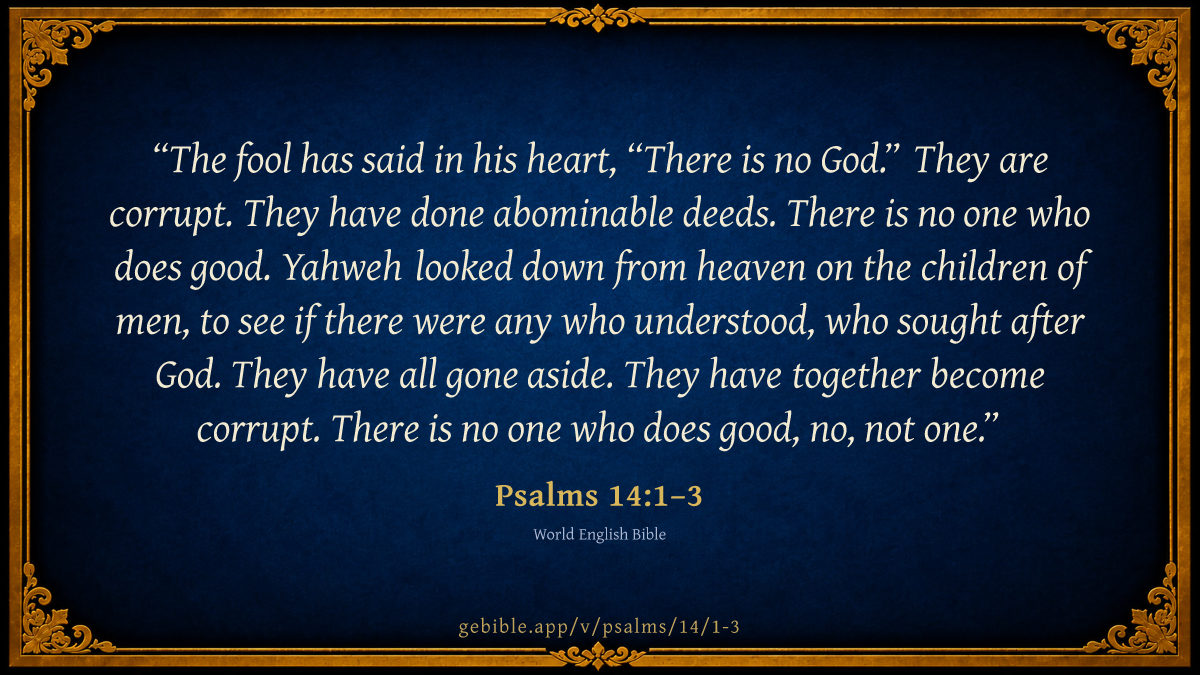
John Calvin 1540 · Public Domain On vv1–3 Many of the Jews are of opinion that in…
Many of the Jews are of opinion that in this psalm there is given forth a prediction concerning the future oppression of their nation: as if David, by the revelation of the Holy Spirit, bewailed the afflicted condition of the Church of God under the tyranny of the Gentiles. They therefore refer what is here spoken to the dispersed condition in which we see them at the present day, as if they were that precious heritage of God which the wild beasts devour. But it is very apparent, that in wishing to cover the disgrace of their nation, they wrest and apply to the Gentiles, without any just ground, what is said concerning the perverse children of Abraham. “Ce qui est dit de ceux qui, fausses enseignes serenomment enfans d’Abraham vivans autrement qu’il n’appartient.” — Fr. “What is said of those who, according to false marks, call themselves the children of Abraham, while living a different life from what they ought.”
The fool hath said. As the Hebrew word נבל, nabal, signifies not only a fool, but also a perverse, vile, and contemptible person, it would not have been unsuitable to have translated it so in this place; yet I am content to follow the more generally received interpretation, which is, that all profane persons, who have cast off all fear of God and abandoned themselves to iniquity, are convicted of madness. David does not bring against his enemies the charge of common foolishness, but rather inveighs against the folly and insane hardihood of those whom the world accounts eminent for their wisdom. We commonly see that those who, in the estimation both of themselves and of others, highly excel in sagacity and wisdom, employ their cunning in laying snares, and exercise the ingenuity of their minds in despising and mocking God. It is therefore important for us, in the first place, to know, that however much the world applaud these crafty and scoffing characters, who allow themselves to indulge to any extent in wickedness, yet the Holy Spirit condemns them as being fools; for there is no stupidity more brutish than forgetfulness of God. We ought, however, at the same time, carefully to mark the evidence on which the Psalmist comes to the conclusion that they have cast off all sense of religion, and it is this: that they have overthrown all order, so that they no longer make any distinction between right and wrong, and have no regard for honesty, nor love of humanity. David, therefore, does not speak of the hidden affection of the heart of the wicked, except in so far as they discover themselves by their external actions. The import of his language is, How does it come to pass, that these men indulge themselves in their lusts so boldly and so outrageously, that they pay no regard to righteousness or equity; in short, that they madly rush into every kind of wickedness, if it is not because they have shaken off all sense of religion, and extinguished, as far as they can, all remembrance of God from their minds? When persons retain in their heart any sense of religion, they must necessarily have some modesty, and be in some measure restrained and prevented from entirely disregarding the dictates of their conscience. From this it follows, that when the ungodly allow themselves to follow their own inclinations, so obstinately and audaciously as they are here represented as doing, without any sense of shame, it is an evidence that they have cast off all fear of God.
Read full note →
The Psalmist says that they speak in their heart They may not utter this detestable blasphemy, There is no God, with their mouths; but the unbridled licentiousness of their life loudly and distinctly declares that in their hearts, which are destitute of all godliness, they soothingly sing to themselves this song. Not that they maintain, by drawn out arguments or formal syllogisms, as they term them, that there is no God, (for to render them so much the more inexcusable, God from time to time causes even the most wicked of men to feel secret pangs of conscience, that they may be compelled to acknowledge his majesty and sovereign power;) but whatever right knowledge God instils into them they partly stifle it by their malice against him, and partly corrupt it, until religion in them becomes torpid, and at last dead. They may not plainly deny the existence of a God, but they imagine him to be shut up in heaven, and divested of his righteousness and power; and this is just to fashion an idol in the room of God. As if the time would never come when they will have to appear before him in judgment, Some critics observe, that as יהוה, Yehovah, the name which denotes the infinite, self-existent essence of God, is not the word here employed, but אלוהס, a name which they regard as referring to God as judge and governor of the world, the meaning of the first verse is not that the fool denies the existence of God, but only his providence and government of the world; that he persuades himself God has no concern about the actions of men, and that there will be no judgment to come; and, therefore, goes on in sin, in the hope of escaping with impunity. — See Poole’s Synopsis Criticorum. The Targum paraphrases the words, “There is no God,” thus, “There is no אלוהס government of God in the earth.”
“Et abolir de leurs esprits toute apprehension de sa majeste.” — Fr.
John Calvin's Commentaries (1540-1563) — public domain. Text from the Calvin Translation Society English edition (1840s-50s) via the Christian Classics Ethereal Library (ccel.org). Calvin's coverage is partial (roughly two-thirds of the Bible); uncommented books and verses are honest gaps, never fabricated. The 19th-century editor's footnotes and remarks are omitted so the notes are faithfully Calvin's own voice.
Geneva Bible translators 1599 · Public Domain On vv1, 3 He showeth that the cause of all wickedness is…
He showeth that the cause of all wickedness is to forget God.
There is nothing but disorder and wickedness among them.
Geneva Bible (1599) marginal notes — public domain.
John Trapp 1656 · Public Domain On vv1–3 Psa 14:1 « To the chief Musician, [A Psalm]…
Psa 14:1 « To the chief Musician, [A Psalm] of David. » The fool hath said in his heart, [There is] no God. They are corrupt, they have done abominable works, [there is] none that doeth good.
Ver. 1. The fool] That sapless fellow, that carcase of a man, that walking sepulchre of himself, in whom all religion and right reason is withered and wasted, dried up and decayed. Nabal, a fool or a churl; Nebalah, a carcase, Lev 11:40. That apostate, in whom natural principles are extinct, and from whom God is departed; as when the prince is removing hangings are taken down. That mere animal, that hath no more than a reasonable soul, and for little other purpose than as salt, to keep his body from putrefying, φυχικος, 1Co 2:14. That wicked man, hereafter described, that studieth atheism,
Read full note →
Hath said in his heart] As David proves afterward by his practice; for there are practical atheists as well as dogmatic. See a like passage, Psa 36:1, "The transgression of the wicked saith within my heart" (that is, my mind gives me, and I am strongly persuaded) "that there is no fear of God before his eyes." This is the charge; but what proof is there? proof good enough, Psa 14:2-4, "For he flattereth himself," &c. So here; he is a flat atheist; for corrupt he is, and become abominable, &c. That which Cicero (De Nat. Deor.) saith of Epicurus, that lest he should offend the Athenians, verbis reliquit deos, re sustulit, in words he affirmed there were Gods, but in deed he denied a Deity, is found true in many even to this day; for all places are full of them, and so is hell too. Lucian is their Old Testament, and Machiavel their New. Worse they are than Agrippa, who was almost a Christian; worse than Protagoras with his De diis utrum sint, non ausim affirmare. For in their hearts and lives there is heard this hellish language,
There is no God] Oh horrible! Not that atheism can ever find a perfect and continual assent in man’s heart; for there is no nation under heaven so barbarous but yields that there is a God. When man fell from God this truth stood; as when cities and great buildings are overthrown by war some towers, some pinnacles, survive the violence. They lie, saith Seneca, who say that they hold there is no God; for though to thee they say so by day, yet to themselves and by night they doubt it, at least. And when they come to die they sometimes cry out they are damned; as did Thomas Blaverus, chief counsellor sometime to the king of Scots; and one Arthur Miller, a professed atheist; and, before them both, a certain desperate dean of Paul’s (Sword against Swearers).
Corrupt are they, and become abominable] Or loathsome; how should they be better, that have laid hands upon all the principles in their heads, and made a clean riddance of them, that they may run riot in sin without restraint or control? which, while others see, they also are ready to say, with that poet,
Sollicitor nullos esse putare Deus.
I have read of a woman who, living in professed doubt of the Godhead, after better illumination and repentance, did often protest that the vicious life of a great scholar in that town did conjure up those damnable doubtings in her soul (Mr Ward’s Happ. of Parad.).
There is none that doeth good] i.e. None to speak of, no considerable number,
Apparent rari nantes in gurgite vasto.
John Trapp, A Commentary or Exposition upon All the Books of the Old and New Testament (1647–1656) — public domain. Text from a community e-Sword module.
Matthew Poole 1685 · Public Domain On vv1–3 The fool, i.e. the wicked man; for such are…
The fool, i.e. the wicked man; for such are commonly and justly called fools every where in Scripture, and that purposely to meet with their false, yet, common, conceit of themselves, as if they were the only wise men, and all others were fools.
In his heart, i.e. in his secret thoughts, or within himself, being afraid and ashamed to utter it with his mouth. Not that it was his fixed and constant opinion and judgment, but this he saith by construction, because he heartily wisheth there were no God, and lives as if there were none. So this text may be explained by comparing it with Psa 36:1; Tit 1:16. There is no God: he denies not God’s being or existence, but only his providence. He saith not, There is no Jehovah, which name of God notes his being; but no Elohim, which expresseth God as the Judge and Governor of the world, who observes and recompenseth all the actions of all men according to their several qualities.
Read full note →
They are corrupt, Heb. they have corrupted, to wit, themselves, or their ways, as this word commonly signifies. Their great and wilful wickedness is alleged as a ground of their atheism or infidelity.
There is none, to wit, of the fools here described,
that doeth good; none of their actions are really and thoroughly good or pleasing to God; for if some of them be materially good, as when they do an act of justice or charity, yet they are poisoned with bad principles or ends, not being performed by them out of a good conscience, and serious care to please God, for then they would do one good action as well as another, but in hypocrisy, or with vain-glory, or some sinister and unworthy design.
Matthew Poole's English Annotations on the Holy Bible (1683–1685) — public domain. Text from a community e-Sword/MySword module.
Matthew Henry 1710 · Public Domain On v1 If we apply our hearts as Solomon did (Ecc…
If we apply our hearts as Solomon did (Ecc 7:25) to search out the wickedness of folly, even of foolishness and madness, these verses will assist us in the search and will show us that sin is exceedingly sinful. Sin is the disease of mankind, and it appears here to be malignant and epidemic.
1. See how malignant it is (Psa 14:1) in two things: -
Read full note →
(1.) The contempt it puts upon the honour of God: for there is something of practical atheism at the bottom of all sin. The fool hath said in his heart, There is no God. We are sometimes tempted to think, "Surely there never was so much atheism and profaneness as there is in our days;" but we see the former days were no better; even in David's time there were those who had arrived at such a height of impiety as to deny the very being of a God and the first and self-evident principles of religion. Observe, [1.] The sinner here described. He is one that saith in his heart, There is no God; he is an atheist. "There is no Elohim, no Judge or governor of the world, no providence presiding over the affairs of men." They cannot doubt of the being of God, but will question his dominion. He says this in his heart; it is not his judgment, but his imagination. He cannot satisfy himself that there is none, but he wishes there were none, and pleases himself with the fancy that it is possible there may be none. He cannot be sure there is one, and therefore he is willing to think there is none. He dares not speak it out, lest he be confuted, and so undeceived, but he whispers it secretly in his heart, for the silencing of the clamours of his conscience and the emboldening of himself in his evil ways. [2.] The character of this sinner. He is a fool; he is simple and unwise, and this is an evidence of it; he is wicked and profane, and this is the cause of it. Note, Atheistical thoughts are very foolish wicked thoughts, and they are at the bottom of a great deal of the wickedness that is in this world. The word of God is a discerner of these thoughts, and puts a just brand on him that harbours them. Nabal is his name, and folly is with him; for he thinks against the clearest light, against his own knowledge and convictions, and the common sentiments of all the wise and sober part of mankind. No man will say, There is no God till he is so hardened in sin that it has become his interest that there should be none to call him to an account.
(2.) The disgrace and debasement it puts upon the nature of man. Sinners are corrupt, quite degenerated from what man was in his innocent estate: They have become filthy (Psa 14:3), putrid. All their faculties are so disordered that they have become odious to their Maker and utterly incapable of answering the ends of their creation. They are corrupt indeed; for, [1.] They do no good, but are the unprofitable burdens of the earth; they do God no service, bring him no honour, nor do themselves any real kindness. [2.] They do a great deal of hurt. They have done abominable works, for such all sinful works are. Sin is an abomination to God; it is that abominable thing which he hates (Jer 44:4), and, sooner or later, it will be so to the sinner; it will be found to be hateful (Psa 36:2), an abomination of desolation, that is, making desolate, Mat 24:15. This follows upon their saying, There is no God; for those that profess they know God, but in works deny him, are abominable, and to every good work reprobate, Tit 1:16.
2. See how epidemic this disease is; it has infected the whole race of mankind. To prove this, God himself is here brought in for a witness, and he is an eye-witness, Psa 14:2, Psa 14:3. Observe, (1.) His enquiry: The Lord looked down from heaven, a place of prospect, which commands this lower world; thence, with an all-seeing eye, he took a view of all the children of men, and the question was, Whether there were any among them that did understand themselves aright, their duty and interests, and did seek God and set him before them. He that made this search was not only one that could find out a good man if he was to be found, though ever so obscure, but one that would be glad to find out one, and would be sure to take notice of him, as of Noah in the old world. (2.) The result of this enquiry, Psa 14:3. Upon search, upon his search, it appeared, They have all gone aside, the apostasy is universal, there is none that doeth good, no, not one, till the free and mighty grace of God has wrought a change. Whatever good is in any of the children of men, or is done by them, it is not of themselves; it is God's work in them. When God had made the world he looked upon his own work, and all was very good (Gen 1:31); but, some time after, he looked upon man's work, and, behold, all was very bad (Gen 6:5), every operation of the thought of man's heart was evil, only evil, and that continually. They have gone aside from the right of their duty, the way that leads to happiness, and have turned into the paths of the destroyer.
In singing this let us lament the corruption of our own nature, and see what need we have of the grace of God; and, since that which is born of the flesh is flesh, let us not marvel that we are told we must be born again.
Matthew Henry's Commentary on the Whole Bible (1708–1710) — public domain (CC PDM 1.0). Text via the HelloAO Bible API.
John Gill 1763 · Public Domain On vv1–3 The fool hath said in his heart,.... This is…
The fool hath said in his heart,.... This is to be understood not of a single individual person, as Nabal, which is the word here used; nor of some Gentile king, as Sennacherib, or Rabshakeh his general, as Theodoret; nor of Nebuchadnezzar, nor of Titus, as some Jewish writers (y) interpret it, making one to be here intended, and the other in the fifty third psalm: the same with this; but of a body, a set of men, who justly bear this character; and design not such who are idiots, persons void of common sense and understanding; but such who are fools in their morals, without understanding in spiritual things; wicked profligate wretches, apostates from God, alienated from the life of God; and whose hearts are full of blindness and ignorance, and whose conversations are vile and impure, and they enemies of righteousness, though full of all wicked subtlety and mischief: these say in their hearts, which are desperately wicked, and out of which evil thoughts proceed, pregnant with atheism and impiety; these endeavour to work themselves into such a belief, and inwardly to conclude, at least to wish,
there is no God; though they do not express it with their mouths, yet they would fain persuade their hearts to deny the being of God; that so having no superior to whom they are accountable, they may go on in sin with impunity; however, to consider him as altogether such an one as themselves, and to remove such perfections from him, as may render him unworthy to be regarded by them; such as omniscience, omnipresence, &c. and to conceive of him as entirely negligent of and unconcerned about affairs of this lower world, having nothing to do with the government of it: and thus to deny his perfections and providence, is all one as to deny his existence, or that there is a God: accordingly the Targum paraphrases it,
Read full note →
"there is no "government" of God in the earth;''
so Kimchi interprets it,
"there is no governor, nor judge in the world, to render to man according to his works;''
they are corrupt; that is, everyone of these fools; and it is owing to the corruption of their hearts they say such things: they are corrupt in themselves; they have corrupt natures, they are born in sin, and of the flesh, and must be carnal and corrupt: or "they do corrupt", or "have corrupted" (z): they corrupt themselves by their atheistic thoughts and wicked practices, Jde 1:10; or their works, as the Chaldee paraphrase adds; or their ways, their manner and course of life, Gen 6:12; and they corrupt others with their evil communications, their bad principles and practices, their ill examples and wicked lives;
they have done abominable works: every sinful action is abominable in the sight of God; but there are some sins more abominable than others; there are abominable idolatries, and abominable lusts, such as were committed in Sodom; and it may be these are pointed at here, and which are usually committed by such who like not to retain God in their knowledge; see Rom 1:24;
there is none that doeth good; anyone good work in a spiritual manner; not in faith, from love, in the name and strength of Christ, and with a view to the glory of God: nor can any man do a good work without the grace of God, and strength from Christ, and the assistance of the Spirit of God: hence, whatsoever a wicked man does, whether in a civil or in a religious way, is sin; see Pro 21:4. Arama takes these to be the words of the fool, or atheist, saying, there is no God that does good, like those in Zep 1:12.
(y) Vid. Jarchi, Kimchi & Ben Melech in loc. (z) "corruperunt", Pagninus, Montanus, Vatablus, Gejerus; "corrumpunt", Junius & Tremellius; "corrumpunt se", Piscator.
John Gill's Exposition of the Whole Bible (1746–1763) — public domain (CC PDM 1.0). Text via the HelloAO Bible API.
John Wesley 1765 · Public Domain On vv1–3 The atheism and corruption of mankind, ver. 1-3. An…
The atheism and corruption of mankind, ver. 1-3. An expostulation with sinners, ver. 4-6. A prayer for the salvation of God, ver. 7. To the chief musician, A psalm of David.
The fool - The wicked man. Good - That is, actions really good or pleasing to God.
John Wesley, Explanatory Notes Upon the Whole Bible (1754–1765) — public domain. Text via the GEBible commentary corpus.
Adam Clarke 1810 · Public Domain On vv1–3 The sentiments of atheists and deists, who deny the…
PSALM XIV
The sentiments of atheists and deists, who deny the doctrine
Read full note →
of a Divine providence. Their character: they are corrupt,
foolish, abominable, and cruel, 1-4.
God fills them with terror, 5;
reproaches them for their oppression of the poor, 6.
The psalmist prays for the restoration of Israel, 7.
NOTES ON PSALM XIV
There is nothing particular in the title; only it is probable that the word לדוד ledavid, of David, is improperly prefixed, as it is sufficiently evident, from the construction of the Psalm, that it speaks of the Babylonish captivity. The author, whoever he was, (some say Haggai, others Daniel, c.,) probably lived beyond the Euphrates. He describes here, in fervid colours, the iniquity of the Chaldeans. He predicts their terror and destruction he consoles himself with the prospect of a speedy return from his exile; and hopes soon to witness the reunion of the tribes of Israel and Judah. It may be applied to unbelievers in general.
Verse 1. The fool hath said in his heart, There is no God.] נבל nabal, which we render fool, signifies an empty fellow, a contemptible person, a villain. One who has a muddy head and an unclean heart; and, in his darkness and folly, says in his heart, "There is no God." "And none," says one, "but a fool would say so." The word is not to be taken in the strict sense in which we use the term atheist, that is, one who denies the being of a God, or confounds him with matter.
1. There have been some, not many, who have denied the existence of God.
2. There are others who, without absolutely denying the Divine existence, deny his providence; that is, they acknowledge a Being of infinite power, c., but give him nothing to do, and no world to govern.
3. There are others, and they are very numerous, who, while they profess to acknowledge both, deny them in their heart, and live as if they were persuaded there was no God either to punish or reward.
They are corrupt] They are in a state of putrescency and they have done abominable works - the corruption of their hearts extends itself through all the actions of their lives. They are a plague of the most deadly kind; propagate nothing but destruction; and, like their father the devil, spread far and wide the contagion of sin and death. Not one of them does good. He cannot, for he has no Divine influence, and he denies that such can be received.
Adam Clarke's Commentary on the Bible (1810–1826) — public domain. Text from a community e-Sword/MySword module.
Joseph Benson 1811 · Public Domain On vv1–3 Psa 14:1. The fool hath said in his heart…
Psa 14:1. The fool hath said in his heart — In his secret thoughts, or within himself, what he is afraid or ashamed to utter with his lips; There is no God — Or none that concerns himself with the affairs of mankind, none that governs the world, and observes and recompenses men’s actions according to their quality. And a fool indeed he must be who says or thinks so, for, in so doing, he speaks or thinks against the clearest light, against his own knowledge and convictions, and the common sentiments of the wise and sober part of mankind. Indeed, no man will say, There is no God, till he is so hardened in sin that it is become his interest there should be none to call him to an account. What St. Paul says of idolaters is equally true of atheists. Their foolish heart is darkened. Professing themselves to be wise, they show that they are become fools, utterly destitute of true wisdom, as devoid of reason as of grace. They are corrupt — In practice as well as principle. “Infidelity is the beginning of sin, folly the foundation of infidelity, and the heart the seat of both.” — Horne. There is none — None of the fools here spoken of, and none of mankind by nature, none without supernatural grace; that doeth good — From a right principle, to a right end, and in a right spirit. None of their actions are really and thoroughly good and pleasing to God. For if some of them be good, as to the matter of them, as when they do an act of justice or charity; yet those actions are corrupt in their principles or ends, not being performed out of love to God, and a conscientious desire and care to please him, or with a view to his glory, for then they would do other good actions as well as these: but in hypocrisy, or vain glory, or for some other sinister and unworthy design.
Joseph Benson's Commentary on the Old and New Testaments (1811–1818) — public domain. Text from a community e-Sword module.
Albert Barnes 1834 · Public Domain On vv1–3 The fool - The word “fool” is often used…
The fool - The word “fool” is often used in the Scriptures to denote a wicked man - as sin is the essence of folly. Compare Job 2:10; Psa 74:18; Gen 34:7; Deu 22:21. The Hebrew word is rendered “vile person” in Isa 32:5-6. Elsewhere it is rendered “fool, foolish,” and “foolish man.” It is designed to convey the idea that wickedness or impiety is essential folly, or to use a term in describing the wicked which will, perhaps, more than any other, make the mind averse to the sin - for there is many a man who would see more in the word “fool” to be hated than in the word “wicked;” who would rather be called a “sinner” than a “fool.”
Hath said - That is, has “thought,” for the reference is to what is passing in his mind.
Read full note →
In his heart - See the note at Psa 10:11. He may not have said this to others; he may not have taken the position openly before the world that there is no God, but such a thought has passed through his mind, and he has cherished it; and such a thought, either as a matter of belief or of desire, is at the foundation of his conduct. He “acts” as if such were his belief or his wish.
There is no God - The words “there is” are not in the original. The literal rendering would be either “no God,” “nothing of God,” or “God is not.” The idea is that, in his apprehension, there is no such thing as God, or no such being as God. The more correct idea in the passage is, that this was the belief of him who is here called a “fool;” and it is doubtful whether the language would convey the idea of desire - or of a wish that this might be so; but still there can be no doubt that such is the wish or desire of the wicked, and that they listen eagerly to any suggestions or arguments which, in their apprehension, would go to demonstrate that there is no such being as God. The exact state of mind, however, indicated by the languaqe here, undoubtedly is that such was the opinion or the belief of him who is here called a fool. If this is the true interpretation, then the passage would prove that there have been people who were atheists. The passage would prove, also, in its connection, that such a belief was closely linked, either as a cause or a consequent, with a corrupt life, for this statement immediately follows in regard to the character of those who are represented as saying that there is no God. As a matter of fact, the belief that there is no God is commonly founded on the desire to lead a wicked life; or, the opinion that there is no God is embraced by those who in fact lead such a life, with a desire to sustain themselves in their depravity, and to avoid the fear of future retribution. A man who wishes to lead an upright life, desires to find evidence that there is a God, and to such a man nothing would be more dark and distressing than anything which would compel him to doubt the fact of God’s existence. It is only a wicked man who finds pleasure in an argument to prove that there is no God, and the wish that there were no God springs up only in a bad heart.
They are corrupt - That is, they have done corruptly; or, their conduct is corrupt. “They have done abominable works.” They have done that which is to be abominated or abhorred; that which is to be detested, and which is fitted to fill the mind with horror.
There is none that doeth good - Depravity is universal. All have fallen into sin; all fail to do good. None are found who are disposed to worship their Maker, and to keep his laws. This was originally spoken, undoubtedly, with reference to the age in which the psalmist lived; but it is applied by the apostle Paul, Rom 3:10 (see the note at that passage), as an argument for the universal depravity of mankind.
Albert Barnes' Notes on the Bible (1834–1885) — public domain. Text from a community e-Sword/MySword module.
Lange's Commentary on the Holy Scriptures 1864 · Public Domain On v1 Psalms 14
Psalms 14
To the chief Musician, A Psalm of David
Read full note →
1 The fool hath said in his heart, There is no God.
They are corrupt, they have done abominable works,
There is none that doeth good.
2 The Lord looked down from heaven upon the children of men,
To see if there were any that did understand,
And seek God.
3 They are all gone aside, they are all together become filthy:
There is none that doeth good,
No, not one.
4 Have all the workers of iniquity no knowledge?
Who eat up my people as they eat bread,
And call not upon the Lord.
5 There were they in great fear:
For God is in the generation of the righteous.
6 Ye have shamed the counsel of the poor,
Because the Lord is his refuge.
7 Oh that the salvation of Israel were come out of Zion!
When the Lord bringeth back the captivity of his people,
Jacob shall rejoice, and Israel shall be glad.
EXEGETICAL AND CRITICAL
Its Character and Composition.—The previous Psalm gave expression to a vow of thankful, heartfelt joy on account of the deliverance from the danger to his life which he had entreated. In Psa_14:7 of this Psalm all the people are summoned, with the assurance of compliance (the future is used as a jussive), to rejoice over future deliverance from threatening ruin, anxiously longed for; and this springs from a description of the religious decline and moral corruption prevailing among men. In this respect this Psalm has a similar subject to Psalm 12.9 Of course we cannot derive from this fact, that these Psalms were surely composed by the same author, and Psa_14:7 might seem to imply a later time. Most recent interpreters since Venema actually refer to the captivity at Babylon, Hitzig, at the same time, to the prophet Jeremiah as the author; Olsh. descends to the Maccabean period, whilst Paulus (Clavis) refers Psa_14:5 to Sennacherib, and with Theodoret regards Isaiah as the author. The interpretation will show that Psa_14:7 b is not decisive against David, but rather in connection with other statements in the Psalm, confirms its prophetic and didactic character, which in the wider sense may be called Messianic. Psalms 53 is likewise in favor of a more ancient time, as it deviates from this Psalm in a few, yet very significant, turns of thought.10
It is uncertain whether all of the seven strophes were originally of three members (Delitzsch) and Psa_14:5-6 have been mutilated; yet this is probable. [Perowne: “In form the ode is dramatic, or quasi-dramatic. A great tragedy is enacting before the eyes of the poet. Sin is lifting itself up in Titanic madness against God, and God looks down upon its doings as once upon the builders of Babel. He sees utter apostasy (Psa_14:3); He speaks from heaven (Psa_14:4), and the evil-doers are confounded at the word of His mouth (Psa_14:5). ‘It would scarcely be possible,’ says Ewald, ‘for a great truth to be sketched in fewer or more striking outlines.’ ”—C. A. B.]
Str. I. Psa_14:1. Fool.—The etymology of nabal leads to the idea of withered and without sap; usage, to spiritual dullness, barrenness and worthlessness (Isa_32:5-6) in contrast with the religious freshness and moral ability of the truly wise man. The expression does not refer to intellectual weakness.11 The perfects in the first five verses do not force us to a purely historical interpretation (Baur, Hitzig, et al.), whether we leave the person undetermined or think of Nebuchadnezzar, Sennacherib and the Assyrians, or find here the proper name Nabal (the husband of Abigail). They are clauses expressing experience, which present the thoughts of the fool, how he manifests himself constantly and everywhere. [The A. V. needs correction here, it should read not; the fool hath said; but the fool saith in his heart. Hupf., “It is the secret thought and delusion of his heart.—It is likewise not exactly a fixed theory or an understood and conscious opinion, but a disposition which put itself in practice and is inferred therefrom, even if it does not say any thing: an Atheism of heart and life.”—C. A. B.]—Corrupt, abominable, they make their doings.—The two verbs placed alongside of one another, without a connecting particle, intensify the idea of badness which is not necessarily contained in the noun. The plural shows that the author, from the beginning, had in mind, not an individual fool, who was to be regarded as an exception; but he first gives the characteristics of the class, then describes the conduct of individuals belonging to it. The first verb awakens a sad remembrance to those acquainted with the Scriptures; for the same word appears first in Gen_6:5; Gen_6:12, in the description of the corruption which preceded the flood, and is frequently used in the Scriptures to designate the apostasies of the Israelites from the living God and the sacred ordinances of His covenant which so frequently occur (Exo_32:7; Deu_31:29; Deu_32:5; Jdg_2:19). The transition is thus prepared in the soul for that which follows.
Str. II. Psa_14:2. Looked down.—Literally bowed Himself over; indicating zealous and intense looking in order to a closer examination, 2Ki_9:10; often used of God, for the first time Gen_11:5; Gen_18:21, in the history of the tower of Babel. These as well as the references to early history previously mentioned, which Grotius already observed, need not mislead us to limit the expressions used here to these particular events. But they turn our thoughts in this direction: that we need not trouble ourselves with the refutation of fools, for God has practically provided for this long ago. This retrospect of history with its disclosure of human corruption and Divine judgments sets before our eyes the follies of the present, partly in their connection with universal sin, partly with the assurance of Divine condemnation. The former point of view is not properly estimated, if with Delitzsch we merely accept the perfect sense in so far as the result of God’s looking about recognizes this looking about itself as an act which has already transpired; the latter point of view is obscured, if this looking about is regarded as a poetical figure, by which the Psalmist impresses upon his own judgment the seal of Divine approval; both points of view vanish together, if the contents of the judgment passed in consequence of this Divine examination which is mentioned, are essentially weakened as well with reference to their meaning as their credibility by accepting a hyperbolic form of expression (Hupf., following Gataker).
Children of men.—Literally, sons of Adam. This expression does not designate the ungodly as such (Knapp et al. with reference to Gen_6:2), or the heathen (De Wette), or the fools previously mentioned, as a specially profligate class of men (Gataker), or the same in their general character as men and subject to the consideration of God (Hupf.); but men as a body, as the posterity of Adam, yet not as fools (Geier), but in their character as members of a fallen race (Calv., J. H. Mich., Stier).
Str. III. Psa_14:3. All.—The totality as well as the universality of human corruption is stated in the strongest language, and first of all, as having gone aside from the right way, and then it is defined by a word which originally was used for physical corruption, especially of the souring of milk in the Arabic, but likewise of moral corruption, Job_15:16.—If with Maurer we regard the ה which begins the clause as a particle of interrogation, as Psa_14:2; Psa_14:4, to which likewise G. Baur is inclined, then it would be advisable, with Ewald, to have the words of Jehovah begin here, which Hitzig, Delitzsch, et al. regard as beginning with Psa_14:4. But without regard to the fact that it is not at all necessary to regard Jehovah as speaking, this supposition would not give us an expression of the judgment of the Omniscient God, but would merely continue the figure of speech, in accordance with which He has made an investigation. The ה is therefore to be regarded as an article=the all, the totality, as Psa_49:17; Dan_11:2; comp. Ewald (Lehrbuch, § 286 a).
It is noteworthy that there is not here a statement of a doctrine, but the mention of a fact, that this moreover makes the moral condemnation of the entire world as an actual result of God’s looking about. The Sept. has already regarded this result not as a solitary fact, limited to a certain period, but has taken up into the text passages with similar subjects from Psa_5:9; Psa_10:7; Psa_36:1; Psa_140:4; Isa_59:7-8 (in the margin of the Cod. Vatic.), which reappear in the citation Rom_3:10-12, and have found their way into the Arab. and Vulg. translations of our Psalm. [Likewise in the English Prayer-book version.—C. A. B.]. In the Hebrew this addition is found only in codd. 649, apparently as a translation back into Hebrew by a Christian who would justify the citation of the Apostle (De Rossi and Rosenm. against Kimchi, who maintains its authenticity). The Church has sufficient biblical support for its doctrine of human corruption by connecting several other passages of the Bible with this. However, the interpreters of former times have not sufficiently distinguished from the facts mentioned here, the conclusions drawn therefrom and their dogmatic use.
Str. IV. Psa_14:4. Have all the workers of iniquity no experience? [A. V., “knowledge”].—Hitzig, who previously translated it: “are they out of their wits?” now advocates the translation of the Sept., Vulg., Jerome, as future. This presupposes the pointing of the imperf., which is found in some codd., and gives an admissible sense, if it is regarded as the threatening of the judgment in which the workers of iniquity are to be actually assured of the reality and of the activity of the God whom they have denied and disregarded. But the perfect of the present text is much more suitable to the connection of the discourse (Hupf.), as it refers back to the judgment which God has already constantly and impartially executed in history upon the persons of all evil-doers. But the character of the question as threatening and warning, is weakened into a tone of involuntary astonishment at the blindness and security of evil-doers, if, with Geier, Hengst., et al. [A. V.], we explain: know=do not reflect upon it. Moreover the all does not agree with this. The reference cannot be at all to correct knowledge (Clauss). However, it is admissible to connect the verb with the negative into one idea=are then without understanding? (Ewald), unreasonable? (Delitzsch). But with our interpretation the advance in thought is clearer. For after mentioning that God looks about and examines critically we would expect a reference to the Divine judgment, and indeed not to human opinions or feelings respecting this judgment, but to what it had already accomplished in history. The context, moreover, leads to a statement of Divine acts and not of human actions. Since now the form of the question with הלא does not show any uncertainty at all, or lead to something that is yet to be inquired after, but on the contrary expresses in the strongest terms the utmost certainty, the question thus gains together with its threatening and warning character at the same time a triumphant tone, and then forms a suitable transition to that which follows.
Eat up my people.—It follows from Mic_3:3; Isa_3:12, that the mention of My does not necessarily imply the words of Jehovah. [However, it is more natural and better, with Ewald, Delitzsch, et al., to regard Jehovah as speaking. It is more in keeping with the dramatic character of the entire Psalm.—C. A. B.]. There has been no previous reference to foreign enemies, or to wars in which the Israelites were consumed, or to any external events at all, but to moral and religious relations, yet such as occur in history and in Israel. The ancient translations and most interpreters find stated here by the comparison, the manner of eating up the people, as they eat bread. The ungodly regard it as their natural business to eat up the people. This interpretation is not without grammatical objections, so that Hitzig takes refuge in the supposition of a transposition of letters, which is recommended indeed by analogies, and reads אכוֹל instead of אכלוּ. But the figure is favored by the frequency of its use in the prophets, where it is still further carried out, and by the difficulty of finding any other acceptable sense. For the interpretation of Luther which has been revived by Clauss, does not at all suit the construction of the clause, in accordance with which the devouring of the people affords the means of support for the ungodly. Moreover, to eat bread cannot mean to live well (J. H. Mich.); also not to live unpunished (Cocc.); but generally to support themselves. Now if this is in contrast with what follows, the reference might be to a neglect of prayer at the table (Chald., L. de Dieu). This, however, is not suitable here. So, likewise, hardly the idea of living securely therein, as an animal (Hupf.) in which the physical life would be nourished, but the spiritual life remain without nourishment. Though this thought is appropriate it has very little support in the words as such.
Str. V. Psa_14:5. There.—This does not mean the same place where the crime is committed and the condemnation is received (Aben Ezra, Kimchi), or where they should recognize God and call upon Him (Clauss), so also not the place of future judgment (Flamin., Calvin, Hengst., Stier), although שׁם is properly a designation of place, for it can likewise be used for a space of time (Psa_66:6; Pro_6:27), and even of the future (Zep_1:14; Job_23:7), with which reference the prophetic perfects would then show the certainty of punishment (Psa_36:12; Psa_132:17, Hos_2:17). Still less are we to think of a place of judgment within man, of the conscience (Geier), although פחד means as well the anxiety before possible disaster, as terror on account of real disaster, and indeed both, in so far as they are made by God to impend over them as punishment for sin. The context demands the latter interpretation. The juxtaposition of the same word as noun and verb (so also Isa_24:7)=frighten a fright, is so much the more picturesque as this word, Prov. 2:26, 3:25; comp. Pro_6:15, has the secondary idea of suddenly and unexpectedly. The Psalmist refers to the Divine punishment historically fulfilled (Hupf., only too narrowly to the occurrence at the Exodus from Egypt) in the closest connection with the description Psa_14:2 sq., especially Psa_14:4. שׁם is used with a similar general reference Job_35:12. Delitzsch translates: “There they shudder shuddering,” and explains: then when God will speak to them in His wrath, as Psa_14:4 is adduced as from His mouth, then His word, which never fails of effect, thunders down upon that inhuman person who is without knowledge and conscience.
For God is in the generation of the righteous.—This gives the reason of the terrors of judgment which break in upon those who oppress and devour the people of God The contrast, that God is not with the ungodly (Clauss), is a matter of course, yet it is not here expressed. Moreover, the clause does not, as is generally supposed, make the historical fact prominent, that Jehovah dwelleth in the midst of His people, protects and governs them and brings about their complete victory over their enemies. In contrast with the thoughts of the fool, ver 1, he expresses the religious truth, that Elohim declares Himself on earth, in the generation of the righteous. The latter is likewise not a historical but an ethical idea, and does not coincide entirely with that of the people of Israel, among whom the righteous were present only as individuals (Gen_7:1) by their generations (Gen_6:9), yet who hinder the ruin of the whole and are the means of saving the people.
Str. VI. Psa_14:6. You may shame the counsel of the oppressed; [in vain]—For Jehovah is his refuge.—The counsel, that is all the counsel which he had agreed upon with himself. Most interpreters think particularly of the plan proposed by him to deliver himself from his oppressors. The contents of his counsel might be given in the following members of the verse with “that” [A. V because] (Aben Ezra, Calvin, Stier, Hitzig). However, the translation “but” (Luther et al.) is inadmissible. But the preceding verb does not agree with this, whether we regard the imperfect as present or future, or, as is often the case, imperative. For כוֹש does not mean in the Hiphil, “to scoff” (the ancient interpreters), but “to cause to blush,” or actively “to disgrace.” If, therefore, we must translate “for,” it is necessary at the same time to suppose that the clause which states the cause has fallen out, and thus the former tristich has been shortened, or we must supply a short clause something like: to no purpose; or, in vain (Hupf., De Wette, Hengst., Delitzsch). Ewald translates: the design against the afflicted you will see to be in vain; previously he translated in your design with reference to the afflicted will you blush because, etc.
Str. VII. Psa_14:7. Who will give out of Zion [A. V., O that—were come out of Zion]—What a contrast this expression makes with Psa_14:2! And how clearly he shows that he does not refer to help against external violence of foreign enemies, by the Divine power, but to deliverance by demonstrations of grace in connection with the historical institutions of salvation. The question in the anxious prayer of the oppressed, containing the desire for redemption, presupposes that Jehovah dwells in Zion, and that His sanctuary is standing in Jerusalem, but at the same time it explains its approach with reference to a hindrance which is still to be set aside. Such a hindrance is not the external distance of the Psalmist from Jerusalem, say, during the rebellion of Absalom (Grotius), but his sins which were not yet entirely expiated. The shining forth of the Messianic thought in this passage is overlooked, for this reason especially, that, in the usual form of resolving the question in the optative: “O that He were come,” which is certainly possible (Psa_55:7, Jer_9:1), the person acting retires to the background before the deliverance which is desired and the time when it is longed for This is in direct contradiction to the text.
The universality and partial indefiniteness and breadth of the Messianic hope which is active here, leads to that former time, to which the other expression of the verse likewise refers. For Zion was indeed for all periods the consecrated place for the hope of Israel, whither believers, wherever they might be, turned their faces in prayer, according to 2 Kings 8:29, 44 This is likewise mentioned with emphasis Dan_6:10, as a characteristic of the true faith of this prophet residing at Babylon. But no prophet ever expected or prayed for help from destroyed Zion. The prophets describe rather the gracious turning again of Jehovah to His penitent people in exile, His going with them and before them in leading them back to Jerusalem and the rebuilding of the city and temple under His protection. The question before us, however, does not in the least resemble this. And what is there that compels us to think of the return from the captivity at Babylon? At least not the expression שׁוּב שְׁבוּת in itself or because it became afterwards the standing expression for this deliverance? This would be a pure petitio principii. For the same expression occurs already in Joe_3:1; Amo_9:14; Hos_6:11 (Psa_7:1).12 Then it were much more natural to think of the time of the Assyrian calamity which fell upon the kingdom of Israel, on account of the deliverance out of Zion which is prayed for But this is prevented by the closing clause, in which Jacob=Israel is called upon to rejoice, but not Judah and Israel. But this expression does not at all mean merely: turning back from captivity in war, which then leads to the meaning of: bringing back prisoners of war, but it is used figuratively for the turning of an unhappy condition into a restoration to former prosperity in general, Eze_16:53, even in private affairs, Job_42:10. With the frequent use in the New Testament of the expressions: bonds, imprisonment, etc., in a figurative sense, the assertion that the figurative use of the above formula leads necessarily to a later origin, is so much the more arbitrary and unreasonable, as the abode in Egypt with its experience fell under the same point of view, Deu_30:3 (Clauss, Stier). Already the more ancient interpreters have therefore, after the Rabbins, partly explained this passage as Messianic, partly understood it directly of the spiritual deliverance of the people of God, which then was applied to the deliverance of the Church from its Babylon or from its servitude in Egypt (Calv.). Even Hitzig refers the expression, which occurs likewise figuratively Jer_30:18, at least to the turning away of misfortune. Hengst. finds expressed by the language, God’s gracious turning to the distress of His people, whilst he maintains the intransitive meaning of שׁוּב, as being the only allowable meaning (Beitr. II. 104). But the transitive meaning is made certain by Psa_85:5; Neh_2:2; beyond question by Eze_47:7. Hengst. has very properly taken back his previous view (Beitr. I. 142), that the closing verse is a later liturgical addition (Rosenm.). [Alexander: “The whole may be paraphrased as follows: ‘O that Jehovah, from His throne in Zion, would grant salvation to His people, by revisiting them in their captive, forsaken state, and that occasion of rejoicing might be thus afforded to the Church!’ ”—C. A. B.]
DOCTRINAL AND ETHICAL
1. The doctrine of the corruption of the human race and the help for it. This is the title given by Meyer after Luther, who gives it an appropriate periphrase in the song: Es spricht der Unweisen mund wohl. The denial of God does not always come upon the lips; yet it declares itself as an irreligious disposition in the corruption and worthlessness of a conduct which is worthy of abhorrence. It is not merely an idle or harmless play of thought, or a scientific investigation of the evidences proposed by scholars for the being of God. It is indeed a movement of thought, but that of a heart which has become foolish by turning away from God, Rom_1:21; and it has to do not so much with the theoretical as with the practical reason. Therefore it makes the entire man unfit for good, and it is least of all an evidence of a sound and strong spirit.
2. Men of this kind may indeed regard themselves as wise, praise one another, and feel strong and safe in the world; but God knows, condemns, and rejects them and their doings, and He has long since declared to those who wait upon Him, how it stands with them, Rom_1:22.They are condemned already, before they are cast out as reprobates.
3. Moreover God troubles Himself with those who do not trouble themselves about Him; He inquires after those who make no inquiry for Him; He is the invisible witness (Gen_31:50) and the Judge, who cannot be bribed, of all their doings as well as the sins and thoughts of their hearts. But He brings forward the evidence of His being and His work, not theoretically, but practically as Judge, Avenger, and Saviour. His speaking is likewise an act; His revelation is history.
4. No man, however, should feel secure or raised above others. For by the history of revelation, that light has come into the world, which condemns the world (Joh_3:19), and discloses the individual as well as the whole race according to the Divine judgment, as lying in common corruption in consequence of their nature as children of Adam, in accordance with which that which is born of the flesh, bears in itself all the characters of the σάρξ (Joh_3:6).
5. The same light shows likewise that there is a righteous generation on earth. The recognition of this fact does not contradict the statement of the total corruption of the children of Adam, embracing all without exception. For the righteous generation consists not of a little band of men who have remained exempt from sin and its corruption, whom God somehow has overlooked, when He looked about, because they stood in a corner, or because they are not brought into consideration on account of their small number in comparison with the awful corruption of the masses. To this class belong rather those men in the midst of the generation of the children of Adam, who have been born again as children of God of incorruptible seed, who by this change of their inborn nature form a peculiar class in the midst of the generation of men, and afford the seed of regeneration for the entire people.
6. It is one and the same God, the holy God of revelation, who has made known from heaven, by the mouth of His prophets, the actual result of His investigation of the children of men, as a warning, and has called our attention by them, with so much earnestness to the actual answer which He gives by His life and work, in the generation of the righteous on earth, to the ungodly, who as fools do not trouble themselves with His works and deny His being and life.
7. There is moreover no reason here to diminish by any limitation the weight of the declaration respecting the extent, depth, and punishableness of human corruption. “He says at first all, then together, thirdly, there is likewise ‘not a single’ one.” Luther. The judgment respecting the condition of man is not an exaggeration, which easily escapes from the bitterness of the lamentation and feelings; and as a poetical figure to be reckoned to the account of the poet. The poet, who speaks here, is not fanciful, he is not so much a poet as a prophet. Therefore his description is not the gloomy reflection of a gloomy disposition, the night idea of a darkened contemplation of the world, but it has the value of a declaration of revelation, whether it bases itself on previous testimonies of Scripture, or is to be directly referred to the enlightenment by the Spirit of God.
8. All fools are indeed sinners, but all sinners are not such fools that they deny the being of God. His judgment and revelation, or regard them as of no account. And many who previously did this, have repented when they experienced what this all meant. They have first been terrified when they have not expected it. There is however not only a terror unto death under the storms of Divine wrath, so also not only the impending terror of the last judgment; there is likewise a terror unto repentance, by which the sinner is awakened unto life. This happens particularly, when the ungodly, who previously have not cared for the Divine agency, are surprised by the victorious word, and the overpowering act coming forth from the generation of the righteous.
9. The ungodly as such eat up the people of God. They use them as far as they can to make room for themselves in the world. Whatever does not readily applaud them, is regarded as a booty given over to them. For they do not inquire after God, and the destruction of His people is as natural to them, as much in accordance with their wishes, and as much a matter of course, as the eating of their daily bread. It is true that there is in history a provision for the people of God; but where does such an one exist, which is able to realize its Divine destiny of being a holy people? Therefore evil doers think that they are justified and entitled to carry on their work of destruction. But so long as the members of the “generation of the righteous,” be they few or many, are in one people, the Lord does not suffer it to be destroyed, but brings His terror over the enemies of Himself and His children.
10. But all those who are oppressed must take refuge with the Lord if they would attain salvation. For the resolutions, projects, plans, and devices of the individual, even the best of them, may be brought to shame by the violence of evil doers; not so God’s resolutions and undertakings. He who trusts, hopes, and waits on these will not be ashamed. The world moreover can no more prevent the prayer from pressing up into the heart of God, than it can prevent the flow of Divine consolations and refreshment into the soul of the oppressed, if these truly turn from the world to God.
11. But the relation between God and the soul may be very different from this. And the last to forget it is the prayerful sufferer, whose lips have testified respecting the universal corruption of the children of men, and have confessed the communion of God with the generation of the righteous. He is able to rejoice that his people before all others has received the historical call to be the people of God, and that there are sanctuaries and Divine services in the congregation; but his soul is troubled, because even among his people no generation has ever fulfilled its destiny so as to be a righteous generation; and that the history of His people is rather a constant witness of its apostasy from God, who turned towards them ever with new revelations, and that this repeated itself in every generation. And although he may sigh, that his people have fallen into afflictions and trouble through Divine judgment, yet he experiences the severest affliction in the burden of guilt, and the worst servitude under the dominion of sin.
12. Moreover true deliverance cannot consist in a change of external relations. Therefore a turning to the institutions of salvation established by God, and the desire for the means of grace ordained by God is the sign of the beginning of a turning towards salvation. But salvation itself comes only when the Saviour comes, who brings the acceptable time of the gracious turning of God to redemption. Before His coming there is nothing but inquiry, sighing, longing, and among believers, hope in the gospel and its joys.
HOMILETICAL AND PRACTICAL
Denial of God is a folly, but of a dangerous character.—Whatever fills the heart expresses itself in the life even without words.—God Himself conducts the actual proof of His own being by acts of judgment and demonstrations of grace which run through the whole of history to warn and to comfort.—Inborn corruption and inherited guilt do not excuse the sinner, but rather set in a dreadful light the consequences of apostasy from God.—He who does not believe in God cares not for men.—In the corrupt world there are many people who are lost, yet there is likewise a righteous generation, in which God lives, works, and condemns the workers of iniquity.—At times those who deny God and the workers of iniquity are greatly frightened when they perceive the revelations of the Divine life in the generation of the righteous, but they seldom change their disposition or improve their conduct, no more than they do after the experience of the mighty deeds and judgments of the Almighty.—There is a salutary and a wicked terror on account of the Divine revelations of judgment; the former leads to desire for deliverance from the servitude of sin; the latter begets stubbornness towards Divine and human justice.—The deliverance of the race of man, fallen in Adam, from universal and entire ruin, is prepared by the institutions of grace which God has established in Israel, but even in the people of Israel it is expected in the future.
Starke: Human corruption is so deep and unfathomable that many believe in no God or deny His providence and government.—He who does not inquire after God from the heart, as the only source of all good, still remains in the old nature, and lies under the curse and wrath of God. For to be wise and to inquire after God are here together.—Behold thyself in this mirror, O man, as often as pharisaical pride attacks thee; but what does it matter, the proud peacock’s feathers will soon bend to the earth.—The blessed fruit of redemption is spiritual, heavenly, and eternal joy; here in foretaste, there in perfection.
Osiander: This is the difference among men that although we are all sinners by nature, yet some are justified by faith and endowed with the Holy Spirit, and serve God in faith, whilst others remain ungodly.—Franke: We must observe principally two things: firstly, our misery, in which we all lie by nature; secondly, the grace which is bestowed upon us in Christ Jesus our Saviour.—Frisch: The reason of all evil is natural blindness and folly; thence arises doubt of the Divine government and providence; and then man falls into security, so that he lives therein, as if there were no God in heaven.—God must be sought as the highest good which has been lost by sin.—If the heart has departed from God it has departed from blessing, and lies under the curse; it has departed from light and lies in darkness; it has departed from life and lies in death; it has departed from heaven and belongs in hell.—Stiller: Sin not only passes upon all men, but likewise passes through the entire man.—Diedrich: If we live in God, we look upon all things from God’s point of view, and, looking from Him, regard this world as entirely different from what it usually appears.
[Matth. Henry: If we apply our hearts as Solomon did, Ecc_7:26, “to search out the wickedness of folly, even of foolishness and madness,” these verses will assist us in the search, and will show us sin exceeding sinful. Sin is the disease of mankind, and it appears here to be malignant and epidemical.—Those that banter religion and religious people, will find to their cost, it is ill jesting with edged tools, and dangerous persecuting those that make God their refuge.—Barnes: As a matter of fact, the belief that there is no God is commonly founded on the desire to lead a wicked life; or, the opinion that there is no God is embraced by those who in fact lead such a life, with a desire to sustain themselves in their depravity, and to avoid the fear of future retribution,—Spurgeon: The Atheist is the fool pre-eminently, and a fool universally. He would not deny God if he were not a fool by nature, and having denied God it is no marvel that he becomes a fool in practice. Sin is always folly, and as it is the height of sin to attack the very existence of the Most High, so is it also the greatest imaginable folly. To say there is no God is to belie the plainest evidence, which is obstinacy; to oppose the common consent of mankind, which is stupidity; to stifle consciousness, which is wickedness.—C. A. B.]
Footnotes:
[9][Perowne: “The singer, keenly alive to the evils of his time, sees everything in the blackest colors. The apostasy is so wide-spread that all are involved in it, except the small remnant (implied in Psa_14:4); and the world seems again ripe for judgment as in the days of Noah (Psa_14:2). Both in this Psalm and in Psalms 12 the complaint is made that the wicked oppress and devour the righteous. In both, corruption has risen to its most gigantic height, but here the doings of bad men, there their words, form the chief subject of complaint.”—C. A. B.]
[10][That there should be two Psalms in the collection so similar as Psalms 14, 53 is in itself remarkable. The deviations, few though they are, are likewise remarkable. Were it not for Psa_14:7 of Psalms 14 the Davidic authorship would be unquestionable. And it seems more natural to apply this expression to the longing of the exiles at Babylon (Ewald, De Wette, Hupf., et al.). It might be a later liturgical addition, so far as Psalms 14 is concerned, or rather the original Psa_14:1-6 was, by a few alterations and additions, adapted to the circumstances of the exile, and given as Psalms 53, and very naturally at a later period, Psalms 14 was assimilated by the addition of Psa_14:7. The Psalm is complete in itself certainly without Psa_14:7. This would account for the title of both Psalms, ascribed to David, and used in the temple worship; and at the same time for the occurrence of the same Psalm twice in the collection.”—C. A. B.]
[11][Perowne: “They are those whose understanding is darkened; who, professing themselves to be wise, became fools. Such men, who make a boast of their reason, and would fain walk by the light of their reason, prove how little their reason is worth. The epithet is the more cutting, because persons of this kind generally lay claim to more than ordinary discernment.” Barnes: “It is designed to convey the idea that wickedness or impiety is essentially folly, or to use a term in describing the wicked which will, perhaps more than any other, make the mind averse to the sin—for there is many a man who would see more in the word fool to be hated than in the word wicked; who would rather be called a sinner than a fool.”—C. A. B.]
[12][In each of these passages, however, the reference is to the exile foretold by these prophets, a return from which was conditioned on repentance.—C. A. B.]
Lange's Commentary on the Holy Scriptures (Critical, Doctrinal, and Homiletical), ed. John Peter Lange, English translation edited by Philip Schaff (1864–1880) — public domain. Text from a community e-Sword module.
Robert Jamieson, A. R. Fausset & David Brown 1871 · Public Domain On vv2–3 looked--in earnest enquiry.
looked--in earnest enquiry.
understand--as opposed to "fool" [Psa 14:1].
Jamieson, Fausset & Brown — Commentary Critical and Explanatory on the Whole Bible (1871) — public domain (CC PDM 1.0). Text via the HelloAO Bible API.
Daniel D. Whedon 1874 · Public Domain On vv1–2 1. Fool—The word never means idiot, or one deficient…
1. Fool—The word never means idiot, or one deficient in natural ability, but always one who has cast off the fear of God, and acts from pride, selfish passions, and self-conceit.
Said in his heart— “Heart,” here, as often in the Scriptures, denotes the centre of the sympathetic system, the seat of the desires and affections, as distinct from the cerebral or intellective faculty. This atheism, hence, was not founded in reason, but in impure and selfish desires.
Read full note →
Corrupt… abominable—This gives the moral cause and fruit of atheism, and defines nabal, or fool.
Daniel D. Whedon (gen. ed.), Commentary on the Old and New Testaments (1874–1909) — public domain. Text from a community e-Sword module.
The Cambridge Bible for Schools and Colleges 1878 · Public Domain On vv1–3 1. The fool] A class of men, not a…
1. The fool] A class of men, not a particular individual. The word nâbâl here used for fool denotes moral perversity, not mere ignorance or weakness of reason. ‘Folly’ is the opposite of ‘wisdom’ in its highest sense. It may be predicated of forgetfulness of God or impious opposition to His will (Deu_32:6; Deu_32:21; Job_2:10; Job_42:8; Psa_74:18; Psa_74:22): of gross offences against morality (2Sa_13:12-13): of sacrilege (Jos_7:15): of ungenerous churlishness (1Sa_25:25). For a description of the ‘fool’ in his ‘folly’ see Isa_32:5-6 (A.V. vile person, villainy).
hath said in his heart] It is his deliberate conclusion, upon which he acts. Cp. Psa_10:6; Psa_10:11; Psa_10:13.
Read full note →
There is no God] Cp. Psa_10:4. This is hardly to be understood of a speculative denial of the existence of God; but rather of a practical disbelief in His moral government. Cp. Psa_73:11; Jer_5:12; Zep_1:12; Rom_1:28 ff.
They are corrupt &c.] More emphatically the original: They corrupted their doings, they made them abominable, there was none doing good. Mankind in general are the subject of the sentence. Abandoning belief in God, they depraved their nature, and gave themselves up to practices which God ‘abhors’ (Psa_14:6). ‘Corrupted’ describes the self-degradation of their better nature; ‘made abominable’ the character of their conduct in the sight of God. Such was the condition of the world before the Flood. See Gen_6:11-12; and with the last line of this verse, cp. Gen_6:5. P.B.V. follows LXX and Vulg. in adding no not one as in Psa_14:5. For doings Psalms 53 has iniquity:—‘they did abominable iniquity.’
1–3. The universal depravity of mankind, and its cause.
The Cambridge Bible for Schools and Colleges (gen. ed. J. J. S. Perowne; Cambridge University Press, 1878–1918) — public domain. Text from a community e-Sword module.
Ellicott's Commentary for English Readers 1878 · Public Domain On vv1–3 (1) Fool.—Heb., nabal, from a root meaning “to wither;”…
(1) Fool.—Heb., nabal, from a root meaning “to wither;” hence flat, insipid (insipiens). But this is not therefore speculative atheism, but practical—a denial of the moral government of God—so that fool and wicked become almost synonymous.
They have done abominable works.—Literally, they have made to be abhorred their works. The LXX. and Vulg. have caught the sense, “They have become abominable in their practices.” Instead of works, Psalms 53 has “iniquity.”
A Bible Commentary for English Readers, edited by Charles John Ellicott (1878–1897) — public domain. Text from a community e-Sword module.
The Pulpit Commentary 1880 · Public Domain On vv1–3 IT has been strongly argued, from the mention of…
IT has been strongly argued, from the mention of the "captivity" of God"s people in ver. 7, that this psalm was written during the sojourn in Babylon, and therefore not by David (De Wette). But "captivity" is often used metaphorically in Scripture; (Job_42:10 Eze_16:53 Rom_7:23 2Co_10:5 Eph_4:8, etc.) and to "return to the captivity which is the expression used in ver. 7 is simply to visit and relieve those who are oppressed. There is nothing, therefore, to prevent the psalm from being David"s, as it is said to be in the title. With respect to the time in David"s life whereto it is to be referred, Dr Kay"s conjecture, which assigns it to the period of the flight from Absalom, may be accepted. The psalm is composed of two stanzas, one setting forth the wickedness of the ungodly (vers. 1-3), the other announcing their coming discomfiture, and the relief and consequent joy of the oppressed (vers. 4-7). (On the resemblance and differences between this psalm and Ps 53, see the comment on Ps 53)
The fool hath said in his heart, There is no God. An atheism is here depicted which goes beyond even that of Psalm 10. There the existence of God was not so much denied as his providence. Here his existence is not only denied, but denied in the very depths of the man"s heart. He has contrived to convince himself of what he so much wishes. The psalmist regards such a state of mind as indicative of that utter perversity and folly which is implied in the term nabal (lbn). They are corrupt; literally, they have corrupted themselves. (comp. Gen_6:12 Jud_1:2:19) Their atheism is accompanied by deep moral corruption. We have no right to say that this is always so; but the tendency of atheism to relax moral restraints is indisputable. They have done abominable works (comp. vers. 3 and 4). There is none that doeth good; i.e. none among them. The psalmist does not intend his words to apply to the whole human race. He has in his mind a, "righteous generation" (ver. 5), "God"s people" (ver. 4), whom he sets over against the wicked, both in this psalm and elsewhere universally. (see Psa_1:1-3 Psa_2:12 Psa_3:8:4:3, etc.)
Read full note →
The fool"s creed, and its consequences.
"The fool hath said," etc. This is very plain speaking. Bible writers are not wont to wrap their meaning in soft phrases. They utter truth in words clear as sunbeams, keen as lightning. This word "fool" refers to character rather than understanding. The psalmist has in his eye one blinded by worldliness or besotted with vice, who can see no charm in virtue, no beauty in holiness, no loveliness, grandeur, attractiveness, in Divine truth. "The fool"s creed," as it has been called, is not the conclusion of his reason, but the practical language of a lawless, selfish life. On this very account it is objected that this is not only a harsh, ]out an unjust judgment, if it be taken to mean that none but fools say, "There is no God." Wise men, it is affirmed, are to be found saying the same thing.
I THIS CLAIM REQUIRES OUR CAREFUL CONSIDERATION. For our first duty is to be just. An unjust Christian is a living contradiction.
1. Now, it is at all events clear that any one who should affirm positively, as a truth men may be certain of, that "there is no God," would be guilty of stupendous folly. Whether the evidence that God exists be adequate and convincing or no, there can be no contrary evidence. To be entitled to assert that God does not exist, a man must possess at least one attribute of Deity omniscience.
2. Therefore thoughtful sceptics in our own day do not venture on this tremendous assertion. They disclaim the name "atheists," and call themselves "agnostics;" q.d. persons who do not pretend to assert or deny the Divine existence, but simply maintain that the Cause of all things is altogether unknown and unknowable. Let us be honest, and not confuse things with a mist of words. Practically, agnosticism and atheism (differ as they may philosophically) come to the same result. "The ungodly," in Scripture language, are not merely the openly vicious or violently wicked; they are those who do not fear, love, trust, obey God; who do not know God. (1Jn_4:8) Practically, therefore, the agnostic, who may be wise in all worldly wisdom; cultured, virtuous, benevolent; takes sides in the great warfare and journey of life, with the fool. If the agnostic be right, Moses, David, Isaiah, and all the ancient prophets; St. Paul, St. John, and all the apostles; St. Stephen and all the martyrs; with the greatest champions of justice and benevolence in all ages, followed cunningly devised fables; Jesus Christ founded his religion and his Church on an illusion. The fool has in his blindness stumbled on the truth hid from the best and wisest in all ages: "There is no God!
II Supposing this ghastly denial to be, not the fool"s, but the wise man"s creed the nearest approach to truth we can make on the greatest of all questions: let us reflect a little on the consequences. Truth, it may be said, is truth, whatever be the consequences. That is so. But consequences may be a test of truth. Unless truth leads to happiness and goodness, life is aimless wandering, and human nature a lie.
1. "No God!" Then Divine providence is a fiction. No wise plan or gracious purpose lives through each life, or through the history of the race. No eye watches over us with unsleeping care. No hand is on the helm of human affairs. We thought that the steps of a good man were ordered by the Lord; that he was the Ruler of nations, King of kings, and Friend of the widow and fatherless. These ideas must be given up as idle dreams. Law a meaningless word, if there be no Supreme Will or Organizing Mind; and chance the jumble of misconnected causes rule all.
2. "No God!" Then prayer must be an illusion. We thought that when the poor man cried, the Lord heard him; that when we east our care on him, he cared for us; that it was as easy for him to grant his children"s requests, without any interference with the laws of his universe, as for a mother to give her child bread. All the laws of the universe went to the making of the loaf not to disable, but to enable her to grant her child"s prayer. If there be no God, or none we can know, prayer is of all delusions the most vain.
3. "No God! Then there is no pardon for sin. Conscience must bear its awful burden: the heart"s deepest wound must bleed without balm; the tears of repentance must be frozen at their source by the terrible thought there is no forgiveness!
4. "No God!" Then human life is degraded inexpressibly. It has no supreme purpose no aim beyond or above itself. Human reason can draw no light or strength from wisdom higher than its own. History has no goal.
5. "No God!" Then sorrow is comfortless, No voice has a right to say," Come unto me, and I will give you rest." You must bear your burden in your own strength. Death and darkness close all.
6. "No God!" Then there is as wisdom higher than mans; no strength stronger; no love deeper. No communion with an unseen, ever-present Friend and Helper, to lift our life above this world. No fountain of hope, purity, wisdom, for humanity. No common object of trust or centre of unity for mankind. Is it reasonable to think that it is truth which leads us into this pathless, sunless desert of despair? Is it falsehood that has inspired the teaching of apostles and prophets, nerved the courage of martyrs, sanctified the genius and learning of some of the noblest intellects, inspired the purest and most loving and lovely lives; that is the salt of goodness in daily life, the lamp of home, the victory" over death, the comfort of bereaved hearts? Or is it the truest as well as highest instinct in our nature that answers to the voice? (Isa_41:10, 13 43:11, 13, 25)
HOMILIES BY C. CLEMANCE Vers. 1-7. The depravity of a godless world, viewed by God.
This psalm is given us twice as the fourteenth and the fifty-third. It is one of those which assumes a revelation of God as a redeeming God, and also the existence of a redeemed people of God. And by way of consequence it assumes the necessity of a Divine redemption in order to bring about "the generation of the righteous." This could only have come about by Divine grace and by Divine power. Hence the very manifest distinction noted in the psalm between "the children of men" (ver. 2) and the people of God (ver. 4). The central part of the third chapter of the Epistle to the Romans is a commentary on this psalm by one of the most richly inspired penmen. When God saw, as with his all-piercing gaze he looked down from heaven, that among "the children. of men" there was absolutely not one righteous, no, not one manifestly, a "generation of the righteous" could never have existed save for a gracious redemption and regeneration from above. And while the Apostle Paul develops from this description of the world, man"s absolute need of a Divine interposition, we, in expounding the psalm itself, must work distinctly on its own lines, showing the state of things in the world on which the eye of God rested, and also how far that state of things exists in it still. The expositor must also take up the Christian standpoint, and show when and for what purpose the Lord looked down on such a sight.
I A FEARFUL SIGHT ON WHICH "THE LORD LOOKED DOWN? To what precise period of time the psalm refers, we have no means of knowing; nor at what exact period it was written. This, however, is of no consequence. Every point specified here can. be verified now.
1. The depravity of man had vented itself in the most egregious folly, even in the denial, of God. There is ample room for the Christian teacher to expose the folly of such denial quite irrespectively of his theory of creation, be it the evolutionary one or no. Either way, the
(1) teleological,
(2) cosmological, and
(3) ontological proofs remain the same; in fact, the teleological proof is receiving abundant and amazing illustrations in modern discovery; so much so that its power again and again "overwhelmed" Mr. Darwin himself. The argument in Paley"s "Natural. Theology " may need resetting, but in substance has lost none of its force. While Mr. Herbert Spencer"s statement, that we know with undoubting certainty that there is "an infinite and eternal Energy from which everything proceeds" is one of which the Christian advocate may make large and effective use. That there is a God all Nature cries aloud in all her works. And not till a man is a "nabal," "a fool," a withered, sapless being, does he come to deny the Divine existence. Such denial has, however, not yet ceased. On the contrary, it has assumed in our days a boldness not even contemplated by the psalmist himself. There is
(1) practical atheism, where men profess to know God, while in works they deny him;
(2) agnosticism;
(3) theoretical atheism, and even anti-theism;
(4) and in some of the works of positivists, it is even reckoned as a virtue for men to have no fear of God before their eyes I
2. Such atheism is the most striking and grievous folly.
(1) It is irrational.
(2) It is corrupting.
(3) It breaks out into abominable acts.
(4) In the course of its evolution, it makes aggressions on and even mocks at theology, religion, and religions people.
(5) It will gradually dry up entirely the springs of social virtue. It may not do this in the first generation, if the denier of God has first been cast by early Christian teaching in the mould of social morality and goodness; but let generation after generation of atheists arise, and it will be seen that when the ties are snapped which bind men to their God, the ties which bind man to man are cut asunder as well!
3. Such atheism is fearfully widespread among the children of men. " "None that did understand, that did seek God." It is common among
(1) the irreligious;
(2) the free-thinkers;
(3) philosophers, under the guise of philosophy;
(4) scientific men, under the guise of science. The fact is, atheism is of the heart, not of the head. "The heart is deceitful above all things, and desperately wicked," and turns the very arguments which prove the Divine existence into an excuse for denying it! Its cry is, "Let us break their bands asunder, and cast away their cords from us!" How grievous and terrible a sight is a world like this! How loathsome to infinite purity, when men are altogether become unprofitable, when there is "not one that doeth good, no, not one." Every expression in the psalm should be critically examined: they are all gone aside;" they are all together become "filthy," "stinking," "corrupt," etc. There is a marvellous variety of words in the Hebrew for moral corruption. Nowhere in the whole world was the sense of sin, as sin, so deep as among the Hebrews. How was this? It will be seen how it was when we study our second question.
II WHEN AND FOR WHAT PURPOSE DID THE LORD LOOK DOWN ON THIS MASS OF EVIL? The meaning of the psalmist could not go beyond the range of his inspiration and enlightenment. We live in a later age; the light is brighter now than then; and therefore the preacher will fall short alike of his privileges and of his mission, if he does not open up from this point more truth than it was possible for the psalmist to know.
1. In an early stage of the world, God looked down on it to punish its iniquity. The Deluge. Sodom and Gomorrah. The desolations which have come on Egypt, Babylon, Tyro, Edom, Ammon, Moab, Philistia, Jerusalem. And when great calamities come, the most irreligious men become the greatest cowards. "There were they in great fear, where no fear was.
2. God looked on the wickedness of the sons of men, and resolved to call out therefrom a people for himself. (Cf. Isa_51:1, Isa_51:2, Hebrew) God called Abraham; and how his people became a family, a tribe, and a nation, the roll of sacred history records. And it is owing to this that the psalmist refers to "the generation of the righteous" (ver. 5), in distinction from "the children of men" (ver. 2). Hence it is and has ever been the case, that, however prevalent the depravity of men may have become, there have ever been some trusting hearts who have found their refuge in God.
3. God instituted a priesthood and sacrifices to instruct his people in the dread evil of sin. The whole Levitical institute means this, and nothing less than this. The Law was a "child-guide," which took men to school, and taught them that nothing was right with men till they were right with God.
4. God established a prophetic order, which should declaim against sin. (See Isa_59:1-20, specially the fifteenth verse) The mission of all the prophets was to speak for God, and uphold his claims before the people. And as they prophesied, God"s treatment of the world"s sin was being unfolded, as we see in the chapter from Isaiah to which we have just referred.
5. In the fulness of the times, God sent forth his Son, who by his death should atone for sin, and who by his Spirit should conquer sin. This, then, is like a God. We might have expected, from the psalmist"s words, that God would take vengeance on the sinner and crush him. But no. He is a just God and a Saviour; condemning sin and saving the sinner. (Ro 3)
6. God has created in the hearts of his own a yearning after salvation and righteousness, which is in itself a prophecy of God"s ultimate triumph over sin, and of a time when the anguish of his people shall give place to joy (ver. 7)! These desires of the holy are prophetic germs. The aspiration in the closing verse of the psalmis one the fulfilment of which has been going on ever since, and will, till the Redeemer who has come out of Zion shall have completed his saving work. C.
HOMILIES BY W. FORSYTH Vers. 1-7. Right views of God"s government.
I In considering God"s moral government of the world, we should be careful to TAKE THE RIGHT STANDPOINT. Much depends on the way we look at things. We may be too near or too far off; we may lean too much to the one side or to the other. Here the standpoint is not earth, but "heaven." This is the perfect state. Here we take our place by the side of God, and look at things in the light of his truth. If we have the Spirit of Christ, the true Son of man, then, though on earth, we shall yet be "in heaven". (Joh_3:13)
II Another thing is that we should have regard to the TRUE STANDARD OF JUDGMENT. (Ver. 2) Much is being done to find out about the people who lived in the ages that are past; but we have to do more with the present day. Wise governments make inquiry as to population and the condition of the people materially, intellectually, and socially. Here God is represented as holding inquest, and the chief concern is as to the moral condition of men. Religion is put first. If men are fight with God, then all is right. The standard by which things are measured is the Law of God. How do men stand to God? Do they believe in God? What is the state of their mind and affections with reference to God? "To see if there be any that understand, and seek God." It is not what other men think of us, nor is it what we think of ourselves, that is of importance, but the supreme thing is what God thinks of us.
III We are thus led to apprehend THE JUST RETRIBUTION IMPENDING. (Vers. 2-6) Life presents a varied aspect. But when we look at it in the light of God, society divides itself into two great parties the wicked and the righteous.
1. There is marked diversity of character. Contrasted with the righteous people," as God calls them in his love and grace there are the multitude who have gone aside, and who have waxed worse and worse, in their corruption and ungodly deeds. In this psalm there is something like a climax. In Psalm 10 we have the ungodly, or fool, hugging himself in his fancied security, and saying, "I shall not be moved." Then in Psalm 11 there is an advance to a bold denial of God"s omniscience and justice: "The foundations are destroyed." Then in Psalm 12 there is a further and still more fearful stride, in daring defiance of God: "Our lips are our own: who is Lord over us?" From this it is but a step to sit down "in the seat of the scornful," and to cry out in derision, "There is no God!
2. But as there is diversity of character, so there will also be diversity of retribution. Judgment will be according to righteousness. Reason is appealed to (ver. 4). In wonder and pity, the question is asked, "Are they so senseless as not to see the consequences of their own wrong-doing?" But their stupidity and stubbornness will not stop the progress of events. Conscience is also appealed to (ver. 5). The term "there" brings the scene before us with the vividness of a picture. We see these wicked men "there" in their places; "there," in the midst of their works and their pleasures; "there," where they are priding themselves on their strength and their conquests; and "there" the hand of God seizes them, and they are stricken with terror. (Lev_26:36) And what conscience confesses, experience confirms (ver. 6). The uneasy sense, that, after all, God is on the side of the righteous, causes fear, and events are continually occurring which go to prove that the fear is well-grounded. The nearer we come to God, the fuller our sympathy with God, the more complete our trust in God, the better shall we be able to judge as to God"s doings. In God"s light we shall see light. God"s interest in man will be clear; God"s holy grief because of the folly and wickedness of man, will be evident; and bright and enlivening as the outshining of the sun from the midst of clouds and darkness will be the love of God for his people, and his tender and abiding care of them through all the vicissitudes of their earthly life. The wicked dishonour God by their distrust and their scorn. Let us honour God by our faith in his eternal love and goodness, and by our unceasing prayer that his salvation may come to all nations. "Alleluia! Salvation, and glory, and honour, and power unto the Lord our God! W.F.
HOMILIES BY C. SHORT Vers. 1-7. Conflict between God and the wicked.
The psalmist beans by lamenting the extent and the power of the atheism which reigns among men (vers. 1-3). But the righteous who have to suffer much on account of it, must not therefore despair; fools shall certainly bring destruction upon themselves (vers. 4-6). He closes with the prayer that God would send deliverance to his people (ver. 7).
I ATHEISM. (Vers. 1-3)
1. Atheism in the thought and in the desires. (Ver. 1) The "heart" in the Old Testament is not only the seat of desire, but of thought also. But it is more easy for a bad man to wish there were no God, than honestly to think it.
2. Atheism in conduct. This is described under a positive and negative aspect. Corrupt conduct they are gone away from the right path into every wrong way; especially they prey upon the righteous as they would eat bread; i.e. it is as natural for them to be cruel and unjust towards them as it is to eat bread. They have tried to defeat the counsels of the poor. The negative aspect is that not any of them did good, nor did they seek God or call upon the Lord. God was wholly shut out of their lives and thoughts.
II THE INCREDIBLE IGNORANCE OF ATHEISM. The "fool" hath said. "The fool" expresses the climax of imbecility. "Have all the workers of iniquity no knowledge," etc. ?
1. He is ignorant of Gods all-seeing scrutiny of the human race. (Ver. 2) In Gen_11:5 it is said, "The Lord came down from heaven, to see the city and the tower," etc. Men from a very early period have had this thought of God"s perfect knowledge of human affairs.
2. They have had experiences which filled them with great fear. (Ver. 5) God was in the righteous generation; where they thought themselves safe, there they began suddenly to be afraid. The discourse here is of Divine judgments actually inflicted.
3. They have been frustrated in their best-laid plans. (Ver. 6) "Whatsoever the pious man plans to do for the glory of God, the children of the world seek to frustrate; but in the final issue their attempt is futile; for Jehovah is his Refuge." This is the meaning; and their defeat should have taught them who was on the side of the righteous.
III THE PRAYER SPRINGING OUT OF THIS CONFLICT BETWEEN GOD AND THE WICKED. (Ver. 7) Prayer for the speedy deliverance of God"s people. This is the perpetual cry of the Church. S.
The Pulpit Commentary (1880–1919), ed. H.D.M. Spence-Jones & Joseph S. Exell — public domain. Text from a community e-Sword module.
Charles H. Spurgeon 1885 · Public Domain On vv1–3 This admirable ode is simply headed, "To the Chief…
This admirable ode is simply headed, "To the Chief Musician, by David." The dedication to the Chief Musician stands at the head of fifty-three of the Psalms, and clearly indicates that such psalms were intended, not merely for the private use of believers, but to be sung in the great assemblies by the appointed choir at whose head was the overseer, or superintendent, called in our version, "the Chief Musician, "and by Ainsworth, "the Master of the Music." Several of these psalms have little or no praise in them, and were not addressed directly to the Most High, and yet were to be sung in public worship; which is a clear indication that the theory of Augustine lately revived by certain hymn book makers, that nothing but praise should be sung, is far more plausible than scriptural. Not only did the ancient Church chant hallowed doctrine and offer prayer amid her spiritual songs, but even the wailing notes of complaint were put into her mouth by the sweet singer of Israel who was inspired of God. Some persons grasp at any nicety which has a gloss of apparent correctness upon it, and are pleased with being more fancifully precise than others; nevertheless it will ever be the way of plain men, not only to magnify the Lord in sacred canticles, but also, according to Paul's precept, to teach and admonish one another in psalms and hymns and spiritual songs, singing with grace in their hearts unto the Lord. As no distinguishing title is given to this Psalm, we would suggest as an assistance to the memory, the headingCONCERNING PRACTICAL ATHEISM. The many conjectures as to the occasion upon which it was written are so completely without foundation, that it would be a waste of time to mention them at length. The apostle Paul, in Ro 3:1-31, has shown incidentally that the drift of the inspired writer is to show that both Jews and Gentiles are all under sin; there was, therefore, no reason for fixing upon any particular historical occasion, when all of history reeks with terrible evidence of human corruption. With instructive alterations, David has given us in Ps 53:1-6 a second edition of this humiliating psalm, being moved of the Holy Ghost thus doubly to declare a truth which is ever distasteful to carnal minds.
The world's foolish creed (Ps 14:1); its practical influence in corrupting morals, Ps 14:1-3. The persecuting tendencies of sinners, Ps 14:4; their alarms, Ps 14:5; their ridicule of the godly, Ps 14:6; and a prayer for the manifestation of the Lord to his people's joy.
Read full note →
Ver. 1. The fool. The Atheist is the fool preeminently, and a fool universally. He would not deny God if he were not a fool by nature, and having denied God it is no marvel that he becomes a fool in practice. Sin is always folly, and as it is the height of sin to attack the very existence of the Most High, so it is also the greatest imaginable folly. To say there is no God is to belie the plainest evidence, which is obstinacy; to oppose the common consent of mankind, which is stupidity; to stifle consciousness, which is madness. If the sinner could by his atheism destroy the God whom he hates there were some sense, although much wickedness, in his infidelity; but as denying the existence of fire does not prevent its burning a man who is in it, so doubting the existence of God will not stop the Judge of all the earth from destroying the rebel who breaks his laws; nay, this atheism is a crime which much provokes heaven, and will bring down terrible vengeance on the fool who indulges it. The proverb says, "A fool's tongue cuts his own throat, "and in this instance it kills both soul and body for ever: would to God the mischief stopped even there, but alas! one fool makes hundreds, and a noisy blasphemer spreads his horrible doctrines as lepers spread the plague. Ainsworth, in his "Annotations, "tells us that the word here used is Nabal, which has the signification of fading, dying, or falling away, as a withered leaf or flower; it is a title given to the foolish man as having lost the juice and sap of wisdom, reason, honesty, and godliness. Trapp hits the mark when he calls him "that sapless fellow, that carcase of a man, that walking sepulchre of himself, in whom all religion and right reason is withered and wasted, dried up and decayed". Some translate it the apostate, and others the wretch. With what earnestness should we shun the appearance of doubt as to the presence, activity, power and love of God, for all such mistrust is of the nature of folly, and who among us would wish to be ranked with the fool in the text? Yet let us never forget that all unregenerate men are more or less such fools. The fool
hath said in his heart. May a man with his mouth profess to believe, and yet in heart say the reverse? Had he hardly become audacious enough to utter his folly with his tongue? Did the Lord look upon his thoughts as being in the nature of words to Him though not to man? Is this where man first becomes an unbeliever? in his heart, not in his head? And when he talks atheistically, is it a foolish heart speaking, and endeavouring to clamour down the voice of conscience? We think so. If the affections were set upon truth and righteousness, the understanding would have no difficulty in settling the question of a present personal Deity, but as the heart dislikes the good and the right, it is no wonder that it desires to be rid of that Elohim, who is the great moral Governor, the Patron of rectitude and the Punisher of iniquity. While men's hearts remain what they are, we must not be surprised at the prevalence of scepticism; a corrupt tree will bring forth corrupt fruit. "Every man, "says Dickson, "so long as he lieth unrenewed and unreconciled to God is nothing in effect but a madman." What wonder then if he raves? Such fools as those we are now dealing with are common to all time, and all countries; they grow without watering, and are found all the world over. The spread of mere intellectual enlightenment will not diminish their number, for since it is an affair of the heart, this folly and great learning will often dwell together. To answer sceptical cavillings will be labour lost until grace enters to make the mind willing to believe; fools can raise more objections in an hour than wise men can answer in seven years, indeed it is their mirth to set stools for wise men to stumble over. Let the preacher aim at the heart, and preach the all conquering love of Jesus, and he will by God's grace win more doubters to the faith of the gospel than any hundred of the best reasoners who only direct their arguments to the head. "The fool hath said in his heart, there is no God, "or
no God. So monstrous is the assertion, that the man hardly dared to put it as a positive statement, but went very near to doing so. Calvin seems to regard this saying, "no God, "as hardly amounting to a syllogism, scarcely reaching to a positive, dogmatical declaration; but Dr. Alexander clearly shows that it does. It is not merely the wish of the sinner's corrupt nature, and the hope of his rebellious heart, but he manages after a fashion to bring himself to assert it, and at certain seasons he thinks that he believes it. It is a solemn reflection that some who worship God with their lips may in their hearts be saying, "no God." It is worthy of observation that he does not say there is no Jehovah, but there is no Elohim; Deity in the abstract is not so much the object of attack, as the covenant, personal, ruling and governing presence of God in the world. God as ruler, lawgiver, worker, Saviour, is the butt at which the arrows of human wrath are shot. How impotent the malice! How mad the rage which raves and foams against Him in whom we live and move and have our being! How horrible the insanity which leads a man who owes his all to God to cry out, "No God"! How terrible the depravity which makes the whole race adopt this as their hearts desire, "no God!"
They are corrupt. This refers to all men, and we have the warrant of the Holy Ghost for so saying; see the third chapter of the epistle to the Romans. Where there is enmity to God, there is deep, inward depravity of mind. The words are rendered by eminent critics in an active sense, "they have done corruptly:" this may serve to remind us that sin is not only in our nature passively as the source of evil, but we ourselves actively fan the flame and corrupt ourselves, making that blacker still which was black as darkness itself already. We rivet our own chains by habit and continuance.
They have done abominable works. When men begin with renouncing the Most High God, who shall tell where they will end? When the Master's eyes are put out, what will not the servants do? Observe the state of the world before the flood, as pourtrayed in Ge 6:12, and remember that human nature is unchanged. He who would see a terrible photograph of the world without God must read that most painful of all inspired Scriptures, the first chapter of the epistle to the Romans. Learned Hindus have confessed that the description is literally correct in Hindustan at the present moment; and were it not for the restraining grace of God, it would be so in England. Alas! it is even here but too correct a picture of things which are done of men in secret. Things loathsome to God and man are sweet to some palates.
There is none that doeth good. Sins of omission must abound where transgressions are rife. Those who do the things which they ought not to have done, are sure to leave undone those things which they ought to have done. What a picture of our race is this! Save only where grace reigns, there is none that doeth good; humanity, fallen and debased, is a desert without an oasis, a night without a star, a dunghill without a jewel, a hell without a bottom.
Whole Psalm. There is a peculiar mark put upon this Psalm, in that it is twice in the Book of psalms. The fourteenth Psalm and the fifty-third Psalm are the same, with the alteration of one or two expressions at most. And there is another mark put upon it, that the apostle transcribes a great part of it. Ro 3:10-12.
It contains a description of a most deplorable state of things in the worldaye, in Israel; a most deplorable state, by reason of the general corruption that was befallen all sorts of men, in their principles, and in their practices, and in their opinions.
First, it was a time when there was a mighty prevalent principle of atheism got into the world, got among the great men of the world. Saith he, "That is their principle, they say in their hearts, `There is no God.'" It is true, they did not absolutely profess it; but it was the principle whereby all their actings were regulated, and which they conformed unto. The fool, saith he, hath said in his heart, There is no God. Not this or that particular man, but the fool that is, those foolish men; for in the next word he tells you, They are corrupt; and Ps 14:3, They are all gone aside. "The fool" is taken indefinitely for the great company and society of foolish men, to intimate that whatsoever they were divided about else, they were all agreed in this. "They are all a company of atheists, " saith he, "practical atheists."
Secondly, their affections were suitable to this principle, as all men's affections and actions are suitable to their principles. What are you to expect from men whose principle is, that there is no God? Why, saith he, for their affections, "They are corrupt; "which he expresses again (Ps 14:3), "They are all gone aside, they are altogether become filthy." "All gone aside." The word in the original is, "They are all grown sour; "as drink, that hath been formerly of some use, but when grown vapidlost all its spirits and lifeit is an insipid thing, good for nothing. And, saith he, They are altogether become filthy "become stinking, "as the margin hath it. They have corrupt affections, that have left them no life, no savour; but stinking, corrupt lusts prevail in them universally. They say, "There is no God; "and they are filled with stinking, corrupt lusts.
Thirdly, if this be their principle and these their affections, let us look after their actions, to see if they be any better. But consider their actions. They be of two sorts; 1. How they act in the world, 2. How they act toward the people of God.
1. How do they act in the world? Why, consider that, as to their duties which they omit, and as to the wickednesses which they perform. What good do they do? Nay, saith he, None of them doeth good. Yea, some of them. No, not one. Saith he, Ps 14:1, 3, "There is none that doeth good, no, not one." If there was any one among them that did attend to what was really good, and useful in the world, there was some hope. "No, "saith he, "their principle is atheism, their affections are corrupt; and for good, there is not one of them doeth any goodthey omit all duties."
What do they do for evil? Why, saith he, They have done abominable works "works, "saith he, "not to be named, not to be spoken ofworks which God abhors, which all good men abhor." "Abominable works, "saith he, "such as the very light of nature would abhor; "and give me leave to use the expression of the psalmist"stinking, filthy works." So he doth describe the state and condition of things under the reign of Saul, when he wrote this Psalm.
2. "If thus it be with them, and if thus it be with their own ways, yet they let the people of God alone; they will not add that to the rest of their sins." Nay, it is quite otherwise, saith he, They eat up my people as they eat bread. "Those workers of iniquity have no knowledge, who eat up my people as they eat bread, and call not upon the Lord." What is the reason why he brings it in in that manner? Why could he not say, "They have no knowledge that do such abominable things; "but brings it in thus, "They have no knowledge who eat up my people as they eat bread?" It is strange, that after all my dealings with them and declaration of my will, they should be so brutish as not to know this would be their ruin. Don't they know this will devour them, destroy them, and be called over again in a particular manner? In the midst of all the sins, and greatest and highest provocations that are in the world, God lays a special weight upon the eating of his people. They may feed upon their own lusts what they will; but, "Have they no knowledge, that they eat up my people as they eat bread?"
There are very many things that might be observed from all this; but I aim to give but a few hints from the Psalms.
Well, what is the state of things now? You see what it was with them. How was it with the providence of God in reference unto them? Which is strange, and a man would scarce believe it in such a course as this is, he tells you (Ps 14:5), notwithstanding all this, they were in great fear. There were they in great fear, saith he. May be so, for they saw some evil coming upon them. No, there was nothing but the hand of God in it; for in Ps 53:5, where these words are repeated, it is, "There were they in great fear, where no fear was" no visible cause of fear yet they were in great fear.
God by his providence seldom gives an absolute, universal security unto men in their height of sin, and oppression, and sensuality, and lusts; but he will secretly put them in fear where no fear is: and though there be nothing seen that should cause them to have any fear, they shall act like men at their wits' end with fear.
But whence should this fear arise? Saith he, it ariseth from hence, For God is in the generation of the righteous. Plainly they see their work doth not go on; their meat doth not digest with them; their bread doth not go well down. "They were eating and devouring my people, and when they came to devour them, they found God was among them (they could not digest their bread); and this put them in fear; quite surprised them." They came, and thought to have found them a sweet morsel: when engaged, God was there filling their mouth and teeth with gravel; and he began to break out the jawbone of the terrible ones when they came to feed upon them. Saith he, "God was there." (Ps 14:5)
The Holy Ghost gives an account of the state of things that was between those two sorts of people he had describedbetween the fool and the people of Godthem that were devouring, and them that had been utterly devoured, had not God been among them. Both were in fearthey that were to be devoured, and those that did devour. And they took several ways for their relief; and he showeth what those ways were, and what judgment they made upon the ways of one another. Saith he, Ye have shamed the counsel of the poor, because the Lord is his refuge.
There are the persons spoken ofthey are "the poor; "and that is those who are described in the verses foregoing, the people that were ready to be eaten up and devoured. And there is the hope and refuge that these poor had in such a time as this, when all things were in fear; and that was "the LORD." The poor maketh the Lord his refuge. And you may observe here, that as he did describe all the wicked as one man, "the fool, "so he describes all his own people as one man, "the poor" that is, the poor man: "Because the LORD is his refuge." He keeps it in the singular number. Whatsoever the people of God may differ in, they are all as one man in this business. And there is the way whereby these poor make God their refuge. They do it by "counsel, " saith he. It is not a thing they do by chance, but they look upon it as their wisdom. They do it upon consideration, upon advice. It is a thing of great wisdom. Well, what thoughts have the others concerning this acting of theirs? The poor make God their refuge; and they do it by counsel. What judgment, now, doth the world make of this counsel of theirs? Why, they "shame it; "that is, they cast shame upon it, contemn it as a very foolish thing, to make the Lord their refuge. "Truly, if they could make this or that great man their refuge, it were something; but to make the Lord their refuge, this is the most foolish thing in the world, "say they. To shame men's counsel, to despise their counsel as foolish, is as great contempt as they can lay upon them. Here you see the state of things as they are represented in this Psalm, and spread before the Lord: which being laid down, the psalmist showeth what our duty is upon such a state of thingswhat is the duty of the people of God, things thus being stated. Saith he, "Their way is to go to prayer:" Ps 14:7, O that the salvation of Israel were come out of Zion! when the Lord bringeth back the captivity of his people, Jacob shall rejoice, and Israel shall be glad. If things are thus stated, then cry, then pray, "O that the salvation of Israel were come out of Zion, "etc. There shall a revenue of praise come to God out of Zion, to the rejoicing of his people. John Owen.
Ver. 1. The fool. That sapless fellow, that carcase of a man, that walking sepulchre of himself, in whom all religion and right reason is withered and wasted, dried up and decayed. That apostate in whom natural principles are extinct, and from whom God is departed, as when the prince is departed, hangings are taken down. That mere animal that hath no more than a reasonable soul, and for little other purpose than as salt, to keep his body from putrefying. That wicked man hereafter described, that studieth atheism. John Trapp.
Ver. 1. The fool, etc. The world we live in is a world of fools. The far greater part of mankind act a part entirely irrational. So great is their infatuation, that they prefer time to eternity, momentary enjoyments to those that shall never have an end, and listen to the testimony of Satan in preference to that of God. Of all folly, that is the greatest, which relates to eternal objects, because it is the most fatal, and when persisted in through life, entirely remediless. A mistake in the management of temporal concerns may be afterwards rectified. At any rate, it is comparatively of little importance. But an error in spiritual and eternal matters, as it is in itself of the greatest moment, if carried through life, can never be remedied; because after death there is no redemption. The greatest folly that any creature is capable of, is that of denying or entertaining unjust apprehensions of the being and perfections of the great Creator. Therefore in a way of eminence, the appellation of fool is given by the Spirit of God, to him who is chargeable with this guilt. The fool hath said in his heart, There is no God. John Jamieson, M.A., 1789.
Ver. 1. The fool, a term in Scripture signifying a wicked man, used also by the heathen philosophers to signify a vicious person, (lbn) as coming from (lbn) signifies the extinction of life in men, animals, and plants; so the word (lbn) is taken Isa 40:7, (Uyu lbn) "the flower fadeth" (Isa 28:1), a plant that hath lost all that juice that made it lovely and useful. So, a fool is one that hath lost his wisdom and right notion of God and divine things, which were communicated to man by creation; one dead in sin, yet one not so much void of rational faculties, as of grace in those faculties; not one that wants a reason, but abuses his reason. Stephen Charnock.
Ver. 1. The fool hath said, etc. This folly is bound up in every heart. It is bound, but it is not tongue tied; it speaks blasphemous things against God, it says there is no God. There is a difference indeed in the language: gross sins speak this louder, there are crying sins; but though less sins speak it not so loud, they whisper it. But the Lord can hear the language of the heart, the whisperings of its motions, as plainly as we hear one another in our ordinary discourse. Oh, how heinous is the least sin, which is so injurious to the very being of the great God! David Clarkson.
Ver. 1. The fool hath said in his heart, There is no God. If you will turn over some few leaves, as far as Ps 53:1-6, you shall not only find my text, but this whole Psalm, without any alteration, save only in Ps 53:5, and that not at all in the sense neither. What shall we say? Took the Holy Spirit of God such especial particular notice of the sayings and deeds of a fool, that one expression of them would not serve the turn? Or, does that babbling and madness of a fool so much concern us, as that we need to have them urged upon us once and again, and a third time in the third of the Romans? Surely not any one of us present here, is this fool! Nay, if one of us could but tell where to find such a fool as this, that would offer to say, though in his heart, "There is no God, "he should not rest in quiet, he should soon perceive we were not of his faction. We that are able to tell David an article or two of faith more than ever he was acquainted with! Nay, more; can we with any imaginable ground of reason be supposed liable to any suspicion of atheism, that are able to read to David a lecture out of his own Psalms, and explain the meaning of his own prophecies much clearer than himself which held the pen to the Holy Spirit of God? Though we cannot deny but that in other things there may be found some spice of folly and imperfection in us, but it cannot be imagined that we, who are almost cloyed with heavenly manna of God's word, that can instruct our teachers, and are able to maintain opinions and tenets, the scruples whereof not both the universities in this land, nor the whole clergy are able to resolve, that it should be possible for us ever to come to that perfection and excellency of folly and madness, as to entertain thought that there is no God: nay, we are not so uncharitable as to charge a Turk or an infidel with such a horrible imputation as this.
Beloved Christians, be not wise in your own conceits: if you will seriously examine the third of Romans (which I mentioned before), you shall find that Paul, out of this Psalm, and the like words of Isaiah, doth conclude the whole posterity of Adam (Christ only excepted), under sin and the curse of God; which inference of his were weak and inconcluding, unless every man of his own nature were such a one as the prophet here describes; and the same apostle in another place expresses, "Even altogether without God in the world, "i.e., not maintaining it as an opinion which they would undertake by force of argument to confirm. That there is no God: for we read not of above three or four among the heathens, that were of any fashion, which went this far; but such as though in their discourse and serious thoughts they do not question a deity, but would abhor any man that would not liberally allow unto God all his glorious attributes, yet in their hearts and affections they deny him; they live as if there was no God, having no respect at all to him in all their projects, and therefore, indeed and in God's esteem, become formally, and in strict propriety of speech, very atheists. William Chillingworth, 1602-1643.
Note continued on See Psalms on "Job 42:8".
Psalms 14:2*
Charles H. Spurgeon's The Treasury of David (1869–1885) — public domain. Psalms only. Text from a community e-Sword/MySword module.
The Biblical Illustrator 1887 · Public Domain On vv1, 3 The fool hath said in his heart, There is…
Psa_14:1-7
The fool hath said in his heart, There is no God.
Read full note →
The practical denial of God the root of all evil
The heavy fact of widespread corruption presses on the Psalmist, and starts a train of thought which begins with a sad picture of the deluge of evil, rises to a vision of Gods judgment of and on it, triumphs in the prospect of the sudden panic which shall shake the souls of all the workers of iniquity, when they see that God is with the righteous, and ends with a sigh for the coming of that time. The staple of the poem is but the familiar contrast of a corrupt world and a righteous judge who judges, but it is cast in very dramatic and vivid form here. We listen first to the Psalmists judgment of his generation. Eras of great culture and material prosperity may have a very seamy side, which eyes accustomed to the light of God cannot fail to see. The root of the evil lay, as the Psalmist believed, in a practical dental of God, and whoever thus denied Him was a fool. Practical denial or neglect, of His working in the world, rather than a creed of negation, is in the Psalmists mind. The biblical conception of folly is moral perversity rather than intellectual feebleness, and whoever is morally and religiously wrong cannot be in reality intellectually right. The practical denial of God lies at the root of two forms of evil. Positively, they have made their doings corrupt and abominable--rotten ill themselves and sickening and loathsome to pure hearts and to God. Negatively, they do no good things. The next wave of thought (Psa_14:2) brings into his consciousness the solemn contrast between the godless noise and activity of earth and the silent gaze of God that marks it all. The purpose of the Divine Guest is set forth with deep insight as being the finding of even one good, devout man. Other Scriptures present the gaze of God as for other reasons, this one in the midst of its solemnity is gracious with revelation of Divine desires. What is to be the issue of the strongly contrasted situation in these two verses: beneath, a world full of godless lawlessness; above, a fixed eye piercing to the discernment of the inmost nature of actions and characters? Verse 3 answers. The Psalmists sad estimate is repeated as the result of the Divine search. But it is also increased in emphasis and in compass. This stern indictment is quoted by St. Paul in Romans, as confirmation of his thesis of universal sinfulness. But this baffled quest cannot be the end. If Jehovah seeks in vain for goodness on earth, earth cannot go on forever in godless riot. Therefore, with eloquent abruptness the voice from heaven crashes in upon the fools in the full career of their folly. The thunder rolls from a clear sky . . . Finally, the whole course of thought gathers itself up in the prayer that the salvation of Israel--the true Israel, apparently--were come out of Zion, Gods dwelling, from which He comes forth in His delivering power. The voice of the oppressed handful of good men in an evil generation is heard in this closing prayer. It is encouraged by the visions which have passed before the Psalmist. The assurance that God will intervene is the very life breath of the cry to Him that He would. Because we know that He will deliver, therefore we find it in our hearts to pray that He would deliver. (A. Maclaren, D. D.)
The practical atheist
Thus the Bible ever speaks of those who have cast off the fear of God. They are those whose understanding is darkened, who, professing themselves to be wise, become fools. Such men, who make a boast of their reason, and would fain walk by the light of their reason, prove how little their reason is worth. The epithet is the more cutting because persons of this kind generally lay claim to more than ordinary discernment. There is here rather a practical than a theoretical atheism; not so much a denial of the being of a God as a denial of His moral government of the world (cf. 10:5)
; and this evinced in their actions rather than in their words. Their lives show what the thought of their hearts is. The fool is not the philosophic atheist with his arguments (subducta ratione vel formatis syllogismis--Calvin); but the man who by the practice of wickedness so stifles and corrupts within him the knowledge of God that he virtually acknowledges no God. South, in his sermon on this verse, lays a stress on these words, as implying that the atheist dare not avow his atheism, lint only cherishes it within. But the occurrence of the phrase elsewhere--e.g. 10:6, 10, 13--does not justify this stress. (J. J. Stewart Perowne, B. D.)
The character reasonings, and folly of the fool
I. The character The fool in Scripture is the man who makes a wrong choice of good; who, when two objects are placed before him, one a lesser good and one a greater good, chooses the lesser in preference to the greater. Preferring the future life to the present is wisdom, preferring the present life to the future is folly. Why must the poor fool say in his heart--No God. I wish there were no God? The reason is, that when a man makes the wrong choice, his heart is miserable within him. The world cannot make him happy. The soul is immortal, and nothing short of immortality can content it. The soul is spiritual, and nothing but a spiritual God can bless it. The soul is sinful, and nothing but a Saviour can give it peace. The fool knows all this, yet will not come to God that he may have peace. So he says in his heart, Oh, that there were no God to judge me!
II. The reasonings. The reasonings of the spiritual fool! Alas! there can be none. There is no infidelity in the world but that which proceeds from ignorance or from sin. If you are the character described you have no reasonings by which to justify yourself; and I cannot therefore waste your time by attempting to refute what does not exist.
III. Folly. The wish which you form in your heart--the wish that all religion were false, the wish that there were no God to judge you at the last--is utterly and totally impossible. Is it not wisdom to put away your foolish hope, that God will not call you to judgment, and to turn to God, and to thank Him that He has promised forgiveness of sins to all those who, with a true penitent heart and lively faith, turn to Him? (George Townsend, M. A.)
The folly and wretchedness of an atheistical inclination
All nature so clearly points out, and so loudly proclaims, a Creator of infinite power, wisdom, and goodness, that whoever hears not its voice and sees not its proofs may well be thought wilfully deaf and obstinately blind. Every faculty, every object of every faculty, demonstrates a Deity. Can a man possibly conceive that such wonderful order and perfect beauty should be ever formed by the fortuitous operations of unconscious, unactive particles of matter? The expression in the text may denote, not the mans real opinion or persuasion, but his inclination and desire. He secretly wishes that there were no God, and endeavours to draw his belief that way as much as he can! To wish against the being of a God is to wish mankind the greatest mischief and distress that can possibly be conceived. Were there no awe of a supreme Being, no terrors of a future judgment to restrain us, what government on earth would be able to maintain itself, or find protection for its subjects? What wise man would choose, or dare to live in a community of atheists, if such a one could be found? Consider how the minds and conditions of private persons would be affected by the supposition of a forlorn and fatherless world. Under the tuition and government of infinite wisdom and goodness everything appears with a comfortable aspect. Men never need to want the purest comforts and most perfect satisfactions while God is their portion. On this account, whether the world frown or smile, the wise man is neither highly transported nor deeply dejected. Whatever be his lot, the peace of his mind is secured, and his heart is at rest. For his hopes are founded on a rock, and his treasure fixed where nothing can touch it. Without a God, a providence, and a future state there could be no such thing as prosperity, no satisfaction, no real enjoyment for rational beings; nor even any true peace or tranquillity of mind. What dismal effects atheism would produce in adversity. How inexcusably foolish and criminal are those men who believe and acknowledge a God, and yet live as if there were none! (J. Balguy.)
The withered heart
The word fool has been traced to a term which signifies the act of withering. The sense would be represented by the expression--the withered heart hath said there is no God. Though in the Scriptures the term heart is often employed as signifying the mind or judgment, yet in this case, judging by the consequences that are detailed, the reference is evidently to the moral nature. A distinction is indeed made in the Old Testament between mind and heart, as in the instance of the first and greatest commandment. The point to be observed then is, that the heart or moral nature has in this instance withered; affection is blighted, moral instinct is perverted, the natural and noblest aspirations of life are utterly extinct. A difference is to be marked between a purely intellectual scepticism and a corrupt moral aversion. There are speculative agnostics whose outward life may be unquestionable as to honour and faithfulness; but there are also deniers of the existence of God whose object is to get rid of responsibility and judgment It is not transgressing the lines of fact and observation to say that it is the heart which first and most truly believes in God. Where the heart or moral purpose is simple and constant, intellectual aberrations will certainly be rectified or rendered spiritually harmless. Everything of a religious nature depends upon the purpose and faithfulness of the moral nature. The heart feels after God. The heart is first conscious of the Divine absence. The heart soon becomes a medium of accusation through which the whole nature is assailed with just and destructive reproach. (Joseph Parker, D. D.)
A fool indeed
What does he say? There is no God. Why, everything he sees, hears, touches, contradicts him. The very worm he treads on, yea, every blade of grass, affirms There is a God. We are all ready to admit that he who denies this is a fool. But stop; observe in what way he says it. Not with his lips, but in his heart. How many things are said there but never spoken out, God and ourselves only know. And it is not the mind or the understanding which says it, but the heart, the affections. His understanding may not deny, but his heart does. In his affections, his desires, his thoughts, his life, his conduct are all as if there were no God. If the life be taken as proof, how many of these fools there are. For they never pray, they never regard God as the orderer of their lives. They speak of chance, accident, but put God out of the question. And they never think of asking His direction in any of their actions; His book they throw on one side, and scarce ever look at it. They deem themselves quite able to direct their own steps. And they say the same who secretly sin, and think none seeth them, or that their sin will never find them out. If they escape human punishment they fear no other. In fact, what are all men saying who live after the flesh, or who neglect the gospel of Christ--but that there is no God? The fool told of here, then, is not so uncommon a person as might be thought. And is he not a fool? Let us each ask ourselves the solemn question the text suggests, Are we or are we not amongst those foolish men who say in their hearts There is no God? If we are, may He turn us from darkness to light. (A. Roberts, M. A.)
The folly of the fool
The first great principle of the Christian religion, and the first announced fact of Divine revelation, is the being of God. We have, in the text, the solution of all practical atheism in the world. Infidelity is the root form of sin.
I. The bold assertion. No God. Such a denial involves tremendous difficulties. There are physical mysteries to be accounted for. There are intellectual phenomena to be explained. There are moral intuitions, soul out-reachings, spiritual instincts and aspirations to be satisfactorily interpreted. The universe evidencing marks of intelligent design, traces of omnipotent power, infinite skill, beauty, and beneficence must be the effect of an adequate cause--the work of a self-existent, independent, infinitely wise God. What shall we say of man--physically, mentally, morally? Can such marvellous beings have been raised out of nothingness by the revolving wheel of time, until its revolution shall crush them into nothingness again? This bold assertion is also in direct antagonism with the teachings of revelation. In the beginning God created. Blot out God from your creed, and the Bible becomes at once a useless volume. It cannot be interpreted. The evidence of the genuineness of Divine revelation is overwhelming. It rests on four grand arguments, namely, the miracles it records, the prophecies it contains, the goodness of the doctrine, and the moral character of the penman.
II. The region in which this assertion is made. In his heart. Mans great defect is a corrupt heart. It is the fruitful source of all evil, the centre of all impiety, and the seat of foolishness and infidelity. The atheism of the times, and of all times, has been and still is the sad effect of heart derangement rather than brain disorder. The intellect has often been blamed when it should have been the heart. It better suits the promptings and desires of the carnal nature to negative the existence of a Divine Ruler than to admit it. Let man be set right at heart, and the philosophy of fools would vanish into thin air. (J. O. Keen, D. D.)
The fools denial of Gods existence
The folly of atheism is undeniable when we remember--
I. That the thing so ardently wished for is absolutely impossible. The all-seeing God can no more shut His eyes to the conduct of mortals than He can cease to exist. As His superintending care is necessary for the preservation of the universe, so is the constant exercise of His moral government required for the vindication of His own honour. It is told that a Frenchman once visited a castle in Germany where dwelt a nobleman who had a good and devoted son, his comfort and his pride. In the course of conversation the Frenchman spoke in such unbecoming terms of God that the baron said, Are you not afraid of offending God by speaking in this way! The foreigner announced, with cool indifference, that he knew nothing about God, for he had never seen Him. The next morning the baron pointed out to his visitor a beautiful picture on the wall, and said, My son painted that. He must be a very clever youth, courteously replied the Frenchman. Later on the baron took his visitor over his gardens, which were of rare beauty and contained many choicest plants. On being asked who managed the garden, he replied, My son, and he knows almost every plant, from the cedar to the hyssop. What a happy man you must be, said the Frenchman, to have such a son! How do you know I have a son? asked the baron, with a grave face. Why, because I have seen his works; and I am sure he must be both clever and good, or he never could have done all you have shown me. But you have never seen him! returned the baron. No, but I already know him very well, because I can form a just estimate of him from his works. Well, then, if you are able to judge of my sons good character by seeing his various works, how does it happen that you can form no estimate of Gods goodness by witnessing such proofs of His handiwork? If the fool could have his way, and banish the Almighty One from His own dominions, it would--
II. Be an unspeakable damage to all even in this world. If men would put an end to the beneficent rule of our heavenly Father, what would they offer as compensation for so irreparable a loss? Should any have reached this extreme point in foolishness that they have wished there were no God, let them ponder these thoughts.
1. Before you are again drawn so far within the dreary region of unbelief, ask this question: Have I a sincere desire to know the truth? I put the matter in this shape, because thousands have really hated the truth, when they fancied that they loved it.
2. In order to strengthen your feeble faith, make diligent use of the light which you already possess.
3. Be willing to ask God, in humble prayer, to give you light, and to guide you into all truth. One of the fiercest of the French revolutionists said to a simple peasant, I will have all your church steeples pulled down, that you may no longer have any object to remind you of your old superstitions. But, returned the peasant, with an air of triumph, you cannot help leaving us the stars. Instead of the blank, cheerless lot of such as would fain believe that there is no God, the wise in heart will rather be disposed to adopt the language of the great philosopher, Sir Humphrey Davy, as their own, I envy no qualities of the mind in others--nor genius, nor power, wit, nor fancy; but if I could choose what would be most useful to me, I should prefer a firm religious belief to every other blessing. (John N. Norton.)
The folly and impiety of infidelity
Consider the text--
I. As an impious wish. This is what he would desire: it would gratify and gladden his heart if it were so.
II. as a bold declaration. This goes much further. He has come to this pitch of daring, to affirm There is no God. Not believing in God, he does not believe he has a soul and a hereafter. No wonder that he becomes abominable. True, all do not go to such lengths. Some would only say, There is no such a God as people who believe the Bible say there is. There is some God, but He either takes no notice, or He is far too good to punish men for their little deviations from virtue here. This is deism. And there is yet another kind of infidelity. Men who will not go so far as either the deist, and certainly not as the atheist, yet they deny that God interferes with the affairs of men, or that He has given us in the Bible a guide for our conduct and a measure for our expectations. At the judgment, for they believe there will be a judgment, they say that mens good actions will be found to outnumber their bad ones, and so they hope to escape. Nor does infidelity stop even here. It stalks abroad under the guise of liberality of sentiment, or the dominion of rationalism. Truth to them is but the handmaid of reason, and no one is bound to believe what he cannot understand. They say a man is no more accountable for his faith than he is for the colour of his skin and the shape of his body. Let a man do the best he can, let him live up to the light of nature, and let him never fear any hereafter. These are the most dangerous people of all, for whilst many would shun an atheist or deist or Socinian, the theologian can spread his sentiments, like a deadly poison, unchecked. This is why the Gospel is so scorned and neglected. Men are taught that they can do without the Gospel, they do not want a Saviour.
III. But the Word of God calls all these men fools. Think of their unutterable folly. For see the evidence of creation--heavens, earth, man in body and mind. Does not reason bid them believe? And if there be no God to whom we must answer, whence the curse that is upon the world? How came the certain fact of the universal deluge? What is the meaning of conscience? Why must all die? He strikes, too, at the very root of the honour of God. The controversy is not as to whether there be any God, but who shall He be? Who is Lord over me? is the principle of infidelity. The man wishes to be his own lord. It is the very spirit of devilism. Reflect, then, what a horrible creature man is. How needful it is that man should learn humility. How just will be the judgment of God upon all atheistical and unbelieving sinners. How cheering and consoling to the true Christian are the very truths which infidels ridicule and scorners deny. (R. Shittler.)
The heart speech of a fool
The Christian faith, like the Christian man, has to pass through many a conflict. In every age of its existence it has had to fight, not only for its final developments, but also for its first principles. The Bible is not passive in this conflict. It strikes as well as bears--assails as well as defends. And when scepticism has run its usual course to atheism, and the man who began with doubting Revelation goes on to deny the Revealer, it comes forth with the lofty sarcasm--The fool hath said in his heart, There is no God. Observe the scope of the utterance.
I. As to its matter. The Bible all through tells us of God. In the beginning God. And it tells of Him as a Personal Being of the highest attributes. But the fool denies it.
II. The manner of the utterance. It is private rather than public; he saith in his heart, that is, when alone. It may lie the breathing of a wish rather than a conviction.
III. The causes of the utterance. We shall find them in our hearts.
1. We do not like the mystery of God. It is so humbling to us to believe in a being whom we are utterly unable to understand.
2. We do not like the authority of God. Now we come nearer home. We could bear with the mystery if it had nothing to do with us. But the claims of God upon us are infinite and endless. His hand is ever upon us. It is as much as I can do to submit to the ordinary laws of social life; but a law that pursues me everywhere and always, and sends its mandates into the secrecy of my mind and heart--that is more than I can bear. I wish there were no such law.
3. We do not like the prospect of meeting Him. To most men it is most unwelcome.
IV. The character of such an utterance. It is the fool that says it. See how gross his folly. (F. Tucker, B. A.)
Atheism
The Bible never attempts to prove the existence of God. Atheism, which is the denial of Him, is either practical or spiritual. The former has always and everywhere been. But speculative atheists are fewer in number. I had rather, says Lord Bacon, believe all the fables in the Legend, and the Talmud, and the Alcoran, than that this universal frame was without a mind. The burden of proof rests with the atheist.
I. His folly may be seen by glancing at the unanswerable argument from existing objects. See all the phenomena of nature. And there is the moral evidence.
II. By its unwarrantable assumptions. How can a man know that there is no God?
III. By its injurious character. No atheist, as such, can be a true friend, an affectionate friend, or a loyal subject. See what came of it in the French Revolution.
IV. By its inadequacy to encounter the hours of trial and of death. In an Alpine village is the peaceful grave of one who died upon the Riffel-horn: over his grave is the significant inscription, It is I, be not afraid. The good man, and only he, is not afraid. (J. H. Hitchens. D. D.)
The being of a God
I. General evidences for the being of a God, independent of Scripture.
1. That it has been acknowledged by all nations in all ages. Polytheism does not deny but confirm the truth. Only individuals, never nations, have denied it. And the lives and the end of these men show that their opinion has often been shaken. Hobbes, one of the chief of them, said that be could not bear to be left for a moment in the dark; and just before he died he told the spectators that he was about to take a leap in the dark! So it was indeed. A few such individuals, rejecting an important doctrine, can form no argument against the doctrine itself. And even of these, some have, at particular seasons, confessed their folly. Thus Volney, in a storm at sea, called upon the very God whose existence he had denied. Thus Voltaire, when dying, confessed the Christian religion to be true, and had the audacity to partake of the Christian sacrament as a sort of passport to heaven.
2. All creatures manifest and declare it. Look at their production, their preservation, their adaptation. Look at the nature of man also, body and soul.
3. The extraordinary occurrences that have taken place.
II. The scripture name of those who deny this truth.
III. Practical improvements of the doctrine. But we must know God in the heart. (T. Mortimer.)
The folly of atheism
That any should say this, is not easy to imagine were we not forced to believe it possible. History tells us of such, and we have no cause to have so much better opinion of the modern age as to doubt that it has those who are ready enough to vent the same impiety.
I. The assertion made. There is no God. By which--l. We may understand absolute denial of His existence or a denial of Gods providence. Epicurus was of this opinion. He confessed there was a God, but as for His interposing and concerning Himself in our affairs, this he utterly denied; and the reason he gave was that such superintendence would interfere with the Divine ease and felicity. We take the text in both these senses.
2. The manner of the assertion, said in his heart. It wears the badge of guilt, privacy, and darkness; and as if it were sensible of the treason it carries in its own bonds. The atheist will not speak out, but in his heart he can and does say what he likes.
3. What is implied in this saying. An inward wish that there were no God. His seeking out arguments to persuade himself it is true. A readiness to acquiesce in such arguments. It is a sign that a man is falling when he catches at straws. For why should there not be spiritual substances? And if there be disorder and seeming chance now, do we not look for a day of retribution? The mans placing his trust and dependence for his good on other things than God. This is a loud denial of God. It may not be a verbal denial, but it is no less real.
II. The author of this assertion. The fool. For--
1. He contradicts the general judgment of mankind. The notion of God is one that a man is not catechised but born into; his mothers womb was the school he learned it in. Now it is morally impossible for any falsity to be universally received and blessed, both as to all times and places.
2. He lays aside a principle that is reasonable, for one strange, harsh, and, at best, highly improbable.
3. His motives show his folly. These are, great impiety and great ignorance.
4. From their instability. They will not stand to them in tithe of great danger, or when death draws near. Affectation expires upon the death bed. It is not in any mans power to extinguish the witness for God in himself. But they may do so for a while. Great and crying sins such as waste the conscience--sensuality and discontent with Gods providence--lead to this. Therefore, beware of them. (R. South, D. D.)
The existence of God
The Psalm describes the deplorable corruption of universal human nature. It begins by declaring that the faculties of the soul are corrupt. The fool hath said in his heart, and then it goes on to show the evil streams thence issuing--abominable works. The fool signifies a vicious person, a wicked man. The speaking in the heart means his thoughts. There is no God does not so much deny His existence, though it amounts to that, as deny that there is any living ruler and governor of the world. This is to strip God of all His glory. And the motive of them who make the denial is evil--that they may be the more free to sin. Now, it is a great folly to deny the existence of God. For he denies what is attested on every hand, and what is made clearly known. Of old, men had many gods, now they say there is none. But the existence of God is the foundation of all religion. And it is well to be able to give reason for our belief, and to put down that secret atheism which lurks in us all, and to confirm in the faith those that love God. But, more particularly, note the atheists folly.
I. He denies the sentiment of all nations both in their judgment and practice.
1. No nation has been without this belief. Idolatry, the worship of many gods, does not weaken this argument, but rather confirms it. The existence of God was never disputed, though nearly all things else were.
2. And it hath been a constant and uninterrupted consent; for--
(i) In all the changes and vicissitudes of governments, states, and modes of worship this has been maintained.
(ii) Mens fears and anxieties would have led them to destroy it if possible; there has been no want of will to do so.
(iii) The devil deems it impossible to destroy it. When he tempted Adam, it was not to deny God but to become as God.
3. Such sentiment is natural and innate. For--
(i) It could not be by mere tradition. For then we should have had told us not only the existence of God, but the right mode in which to worship Him. Why have men remembered this if it were tradition, and forgotten all the rest? But even if it were, it was not an invention of the first man. If it had been, his posterity would soon have found it out. And why should he have invented it?
(ii) Neither was it by agreement and consent amongst the rulers of men. Why should they do so? How could they so long maintain the imposture?
(iii) Nor was it mans fear that first introduced it. His fear did not create God, but God was the cause of his fear.
II. He denies that which all things in the world manifest. The Scriptures assert this (Rom_1:19-20). St. Paul does not say are believed, but are clearly seen. The world is like a large mirror which reflects the image of God (Psa_8:1; Psa_19:1; Psa_91:2), etc. Now, the world does manifest God.
1. In the production of the creatures it contains (Isa_40:12-19). They could never have been their own cause. The world and every creature had a beginning (Heb_11:3). The matter of the world cannot be eternal Nor time; for all motion hath beginning, therefore the revolutions of our earth. Nor the generations of men and other creatures; for no creature can make itself. Nothing can act before it be. That which doth not understand itself nor order itself could not make itself. If the first man made himself, why did he not make himself better? why is he so limited and faulty? If we made ourselves we can preserve ourselves, which we know we cannot. And why did not man create himself earlier, if he did so at all? Therefore we accept the Scripture as giving us the most rational account of the matter. Then, further, no creature could make the world, no creature can create another. For if it create of nothing, then it is omnipotent and not a creature. If of matter, who formed the matter? We are compelled to go back to a first Great Cause. Man cannot create man. If he could he would understand him, which he does not. There is, therefore, a first cause of things, which we call God. And this first cause must necessarily exist, and be infinitely perfect.
III. He denies that which mans own nature attests.
1. His bodily nature does. For see the order, fitness, and usefulness of every part--heart and mouth and brain, car and eye and tongue. And see, too, the admirable differences in the features of men. No two are Mike. What vast advantage comes from this?
2. His soul does. For consider the vastness of its capacity, the quickness of its motions, its union with the body, and the operations of conscience. But all this proves the existence of God. The vastness of the desires in man is in evidence. For the desires of other creatures are fulfilled. They are filled with good. Then shall man not be?
IV. They deny what is witnessed by extraordinary occurrences.
1. Judgments (Psa_9:16; Act_12:21), which occurrence Josephus also relates.
2. Miracles (Psa_72:11; Psa_72:18). Who only doeth wondrous things. The truth of the Scriptures stands or falls with the miracles of which it tells. They must have been, or else the records are a pack of lies.
3. Accomplishment of prophecies (Isa_41:23; Isa_46:10).
V. Uses of above argument.
1. If atheism be a folly it is a pernicious one; for it would root out the foundations of all government and introduce all evil and villainy. The two ever go together (Jer_3:21; Eze_22:12). To the atheist himself (Job_18:7 to the end).
2. How lamentable that atheism should be so common. But since all are tempted to it, let them remember--
(i) It is impossible to prove that there is no God.
(ii) Whosoever doubts of it makes himself a mark against which all creatures fight. All things condemn him.
(iii) Atheists have been sometimes much afraid they were wrong.
(iv) The motives of atheism are bad and vicious.
(v) How unreasonable to run such risk.
(vi) Have we done all we can to attain to the knowledge of God?
3. Let it be our wisdom to be settled in this truth. Therefore study God in His creatures as well as in His Word, and view Him in your own experience of Him.
4. If we believe, then worship Him and often think of Him. (S. Charnock, B. D.)
Practical atheism
Unfold the conception which you have formed of the existence and attributes of God.
1. We all involve in our conception of God the idea of personality.
2. To this Infinite Being we involuntarily ascribe self-existence.
3. Both reason and revelation teach us to ascribe eternity; to the Deity.
4. We ascribe to Him infinite and absolute power.
5. And omniscient wisdom.
6. And every moral attribute in infinite perfection.
7. He is revealed as the Father of the creatures He has made. The most astonishing manifestation of the goodness of God is made to us in the remedial dispensation. Evidently the existence of God, and especially of such a God as the Scriptures reveal, is by far the most practical truth of which we can possibly conceive. What, then, must be the condition of a man who believes in the existence of such a God, and yet suffers not this belief to exert any practical influence upon his conduct? (F. Wayland.)
Practical atheism
This is natural to man in his depraved state. Not natural to him as created, but as corrupt. And it is universal (Psa_58:2; Rom_3:9-12). For the proof that atheism is natural to man we note--
I. That man would set himself up as his own rule instead of God. For--
1. He naturally disowns the rule God sets him. Every man naturally is a son of Belial. He would be without any law. Hence he desires not to know Gods law. The purity of the Divine rule renders it nauseous to him; so impure is mans heart, and therefore atheistic likewise. Hence he neglects the means of knowledge, or endeavours to shake off as much as he has (Rom_1:28). Or if he cannot do this he will not think of it, and his heart rises against God both inwardly and in outward art (Psa_14:4). What knowledge they seek for they desire only from impure motives. What they have they hold very loosely. One day it is Hosannah, the next Crucify Him. Some try to wrest their knowledge of Gods truth to encourage their sin (2Pe_3:16). But all this dislike to Gods truth is a disowning of God as our rule. Gods law cast against a hard heart is like a bail thrown against a stone wall, by reason of the resistance bounding farther from it. They show their contempt by their presumptuous transgression of the law, by their natural aversion to the declaration of Gods will. That will they dislike and turn from. And this the more His will tends to His honour.
2. Man naturally owns any other rule rather than that of God. They are lovers of pleasure rather than lovers of God (2Ti_3:4). They will prefer the rule of Satan. Or of the world, for this is evident from their regarding more the dictates of men than of God; and what regard they have for Gods will, it is only because it is the worlds will also, which they ever put before the will of God. But especially they prefer their own self-will. Self is the great opponent of God, the great Antichrist.
3. Man would make himself the rule for God, and give God law. We are willing He should be our Benefactor, but not our Ruler. This mind is seen in our striving against His law. In our disapproving the methods of His government. In impatience in regard to our own particular concerns. Because Job did not do this he is commended (1:22). In envying the gifts and prosperities of others. In praying importunately for things which we do not know will please God (Pro_7:14), or which we do know are contrary to His declared will. As when men pray to be saved, but neglect the means of salvation. Or when we try to bend God to our own will. In all these ways, and yet others, man shows that he would have God take rule from him, and not he from God.
II. As man would be a law to himself, so also would he be his own end and happiness.
1. For proof see his frequent self-applause (Rom_12:3-4). His ascribing to himself the glory of every success. His desire to have self-pleasing doctrines. His concern if he is injured, but not if God is wronged. His self-trust. All this is a usurping of Gods prerogatives, and a vilifying of God and destroying Him so far as man can.
2. Man would make anything his end rather than God.
3. Man would make himself the end of all creatures (Eze_38:2).
4. Man would make himself the end of God. He does so when he loves God only because God sends him good things, but would not if God sent him evil things. When he abstains from sin for his own sake, not because of God. When he renders duties for a mere selfish interest (Gen_34:21-22), which is evident from his reluctance to religion when self is not concerned (Job_21:15; Job_35:3). And mans practical atheism is further shown in his unworthy imaginations of God, from which spring all idolatry, superstition, and presumption. And in his desire to be distant from God. Naturally we have no desire either to remember, converse with, return to, or imitate God.
5. The uses of the foregoing truths. They are--
(i) For information, for they give us occasion to admire Gods mercy, and justify His vengeance; they show our need of a new nature, how difficult conversion is. Also, the cause of unbelief in the Author of all grace; that there can be no justification by works, and the excellence of the Gospel.
(ii) Exhortation: to labour, to be sensible of this lurking atheism, and watch against it. (S. Charnock, B. D.)
Theoretical atheism
The denial of the existence of God may be either theoretical or practical. It is theoretical when we affirm that no such being as God exists. It is practical when, professing to believe that He exists, we act in all respects as though we believed that He does not exist. Theoretical folly may manifest itself in two forms, either in that of absurd credulity, or of absurd incredulity.
1. It is an evidence of absurd credulity to believe an assertion, respecting any subject whatever, when no evidence is brought forward to sustain it, and when, from the nature of the case, the evidence, if it did exist, is beyond the reach of the human understanding. Anyone who reflects upon the fewness and feebleness of the faculties of man, and then upon the boundlessness of the universe, must be convinced that the assertion that God does not exist involves within itself all the elements of the most revolting absurdity.
2. Atheism is equally absurd in its unbelief. It disbelieves a proposition of which the evidence is interwoven with the very structure of the human understanding.
(1) The idea of power, of cause and effect, is the universal and spontaneous suggestion of the human intelligence. It springs tip unbidden and irrepressible from the first perception of a change.
(2) The mind not only asks for a cause, but for a sufficient cause.
(3) If we arrive at the notion of underived causation, may not several independent causes originate the changes which are taking place around us? Everything that we behold is manifestly a part of one universal whole. The cause of causes is everywhere one and the same.
(4) When we reflect upon human conduct we find that we always connect the outward act with the spiritual disposition, or intention, from which it proceeds. In every action we perceive the quality of right or virtue, or of its opposite, wrong or wee. As the characteristics are universally the same there must be a single and universal standard. We see the perpetual acting of the Almighty and learn the moral attributes that compose His character. (F. Wayland.)
Belief in the being of God
A belief in God as a self-existent, intelligent, and infinitely perfect Being is the basis of all religion. In what manner and through what means do we come by this conviction? Some have maintained the idea of God to be innate. Others assert the Divine existence to be an intuition--an immediate perception of the reason, independently of any suggestion, argument, or evidence. By others it has been attempted to establish it by the rigid steps of mathematical demonstration. Kant, and those who follow him, insist that the moral nature of man--his conscience and sense of moral obligation--affords conclusive proof of the being and moral government of God. We believe the true statement of the matter to be this: That the human mind is constitutionally fitted to know God, so that the notion of Him and a persuasion of His existence necessarily arise within the soul whenever the faculties are in any good degree developed; and that in its own moral consciousness and in the great variety of facts and phenomena external to itself it finds, on reflection, proofs that He does exist, proofs of a moral nature, yet sufficient to establish the fact as an absolute certainty, in the view of the understanding.
1. It is a well-known fact that the idea of God and of spiritual existence is, and always has been, nearly or quite universal among mankind.
2. A belief in the existence of a God has always been found exceedingly difficult to be eradicated.
3. The more thoughtful, and especially the more virtuous, men are, the more, as a general rule, they are disposed to cherish the idea of a Supreme Being.
4. The atheistical idea, when fully and distinctly placed before the mind, is abhorrent to the moral feelings of the soul.
5. A belief in the existence of one supreme and perfect God is in a high degree elevating and happy in the influence which it exerts on the mind and heart of man, while the views of atheism have tended only to demoralisation and debasement. There is a God; it is only the fool who denies it in his heart. (R. Palmer, D. D.)
Practical atheism
This is Gods world, and yet how godless. God made it and the men in it, and yet in all their thoughts God is not. The origin of this alienation is in the heart, and the subject of it is pronounced a fool. His heart is just what it would be were there no God. Inquire--
I. To whom this charge may be applied.
1. To the avowed atheist. He who sees the proofs of God in creation and can yet deny Him, can neither love nor fear Him.
2. To those who entertain false views of His character. They deny that He is the righteous Governor of the moral world. But this is much the same as to say, There is no God.
3. To those who deny or disregard the providential government of God. He lives without God in the world.
4. To those who supremely love the world. Is this treating God as He ought to be treated?
5. Who have no delight in the worship of God. They act the part of atheism.
6. Or who live in disobedience to God. They act upon a principle which subverts the sovereignty of God.
7. All who reject the Gospel. By his unbelief the man makes God a liar. What more could the avowed atheist do? And there are yet other characteristics. But note--
II. The folly of these men. This appears--
1. From the fact that there may be a God. No man, unless he himself is omnipresent and omniscient, can know that there is not somewhere some other being to whom these attributes belong. If there be no God, the believer suffers no loss; but if there be, then the atheist is undone.
2. His belief is contrary to the fullest evidence. He shuts his eyes and stops his ears.
3. They deprive themselves of all real good. For without faith in God there can be no rational enjoyment of the world. Nor can there be true excellence of character. For be places himself beyond the reach of every motive which ennobles character and elevates man to the end of his being. Without God there is no rule of action, no accountability, no futurity, no retribution, no influence to operate on man for his spiritual good. And he must become supremely selfish. The spirit may be concealed in its true nature and tendency. But take off the garb, let the real selfish heart be uncovered, let it be seen in its true character, and we abhor it. And he has no support under affliction or support on the bed of death. But believe in God and how altered affliction and death become. A man may have lived an infidel, but for the most part he dies a terrified believer. How must he feel, when death comes, who admits that there is a God, and yet that he has lived as if there were none? Beware of that eternity which is opening on you. (N. W. Taylor, D. D.)
Religion and materialism
In Davids time it was the fool who said there was no God; in ours, it is the philosopher who proclaims it upon the housetop, and invites us all to bask in the mild light of the science which has made this as its last and highest discovery. Some may think it out of our way to advert to discussions which touch the very foundations of our faith and of all religious belief whatsoever, because we feel our faith to be too firmly fixed that we should be perplexed by any such questions. But we can never tell how near us these questions may come, or in what shape we may find them meeting us. You may have seen a coat and hat which at their beginning were articles of handsome clothing, and were worn on Sundays and in good society, descending through various vicissitudes, until at last, perched on a stick in a turnip field, they performed the disingenuous function of a scarecrow; and just so an opinion or a theory which was at first started on a solemn occasion, and by a philosopher, may filter down through minds of less intelligence until, half understood and misapplied, it serves only to mislead, and fulfils purposes altogether different from those which it served originally. I have found far down in the ranks of society such distortions of opinions and speculations which were safe enough in learned hands, but full of practical mischief in those that are unlearned. Now it is religion that is at stake in this question of modern materialism; religion not only as a faith but as a morality. If it be true, all religions are mere impostures. Note its theory of the origin of life. You know the theory the Bible teaches, that God is the Lord and giver of life. And it would not be essentially contradicted even were the theory of development fully proved, as it is not yet. Suppose that man is developed from a baboon, and differs from it not in kind but only in degree. Yet you could not mark the stage at which the spirit of God was inbreathed. But that makes all the difference. There may have been inferior types before mans outward organism was complete, before God said, Let us make man. Development does not deny Scripture truth. But the new theory is different. It ascribes all to matter, affirms that it contains within itself the promise and the potency of all life, and that it is eternal; that there is, in fact, no such thing as an eternal mind but that which we call matter, which we can see, handle, weigh, analyse, is that and that only which is from everlasting to everlasting, and is Divine if anything is to be so called. They who say all this set aside Scripture as incredible and irrelevant, for they do not believe in God and a spiritual world; nor in anything which their scales cannot weigh, their process analyse, their figures calculate. But, we ask, why is eternal matter more credible than an eternal mind? Both cannot be, but why should we be shut up to the materialists creed? We find it easier and better to believe in an eternal and Holy Spirit which devised all the forms and laws of life than in an eternity of senseless atoms, without spirit, without intelligence, without life, coming together somehow, and somehow forming this world and all things we see. And it and it only provides a basis for religious life. Materialism is the death of morality. For it gets rid of the idea of God, and so of His judgment to which I am accountable, of conscience and my spiritual nature by which I was in some sense a law to myself. Farewell to all dreams of a higher life, to all aspirations after the Divine. Let us eat and drink, for, etc. This the natural conclusion. All our Christian ideas are fictions, the baseless fabric of a vision which ought to and which will fade utterly away. It is easy for a man, a man possibly of dull spiritual perceptions, standing amid all the light of revelation and on the safe and serene height of Christian civilisation, to follow out physical investigations to the point to which his knowledge can conduct him, and then to turn round and say, I have tracked life almost within sight of its very source, and I see no hand of any God in it, and no indication of any spirit; but let us pursue our researches in a pure and just temper, and let us strive to elevate our life and to live nobly; but he forgets that, but for the revelation of that God whose existence he denies, purity and justice would be as little known among men as among the lion and the tiger, and the higher life as impossible an idea to a human creature as to an ostrich or an ape. But the history of man shows that the elevating power has been the spiritual, and that his belief in the unseen has been the parent of the noblest achievements of his life. Take these away and he sinks at once. Ponder, therefore, much ere you abandon the Bible for the teachings of this new science. (R. N. Storey, D. D.)
The creed of atheism
The creed is one of the briefest ever penned--No God. Its practical result is the saddest ever recorded--No hope (Eph_2:10). Deprive us of a personal God and you render life an enigma, begun without an author, pursued without a motive, and ending without a hope. Are there any who hold such a gloomy creed? Arrange them into four classes--
1. The heathen, who are ignorant of God. They acknowledge not one God, but many. To them every department of nature has its presiding deity, to whom homage is paid. They have not been enlightened by the beams of revelation. How far are the heathen to blame for continuing in their ignorance? How far are the works of creation a guide to men in finding out God? There is wrapped up in nature a Divine revelation, which mankind may read by exercising their faculties.
2. Atheists, who deny the existence of God. They assume towards Divine things an attitude of active antagonism. Not liking to retain God in their knowledge, they wilfully give themselves over to conduct in defiance of His laws. Their conduct springs from wish rather than conviction. You may shut your eyes to the sunlight, but the sun still shines; you may deny Gods existence, but God remains. It may be doubted whether there is such a person as a positive denier of God, an atheist from intellectual conviction. To say There is no God necessitates a claim too sweeping for a reasonable man to make, for it implies that he who makes it has himself been in every corner of the universe at one and the same time, and failed to discover the Divine Being. Is anyone prepared to make such a claim?
3. Agnostics, who say we have no knowledge of God. A numerous class. Their creed is a negative one. They differ from atheists in this, that while the creed of pure atheism is positive denial of God, agnosticism consists, roughly speaking, in making no assertion, positive or negative, respecting the Divine existence, but merely in taking up a position of passive intellectual indifference. He simply does not know; God has not made Himself known with sufficient clearness. The agnostic creed resolves itself into an attempt to trace everything to natural causes, and thus dispense with the supernatural, and that is virtually to banish God from the universe. The senses are proposed as the test of truth. But to say that all our knowledge comes through the senses is not sound philosophy. Is there no such thing as intuitive knowledge, knowledge that comes to us neither through experience nor through proof? It is idle for the sceptic to talk of the inadequacy of evidence. What he wants is the disposition to weigh the evidence he has got.
4. Nominal Christians, who disregard the claims of God. A sound creed is no sure guarantee for upright conduct. There are sham professors. Among professing Christians there is an alarming amount of practical atheism. A mans denial of God may assume a variety of forms. Application, applying equally to the four classes.
(1) They have no guide in life.
(2) They have no hope in death. We decline to accept a gospel of despair. (D. Merson, M. A.)
Atheisms and atheisms
This text is much misunderstood; but some people take a wilful delight in using it. To tell everyone who does not believe in God that he is a fool is charming, it saves all argument; after that assertion argument is useless. But there are atheisms and atheisms. They differ widely in character, and the atheism of one man may be better than the theism of another. Belief in what men have called God, and enthusiasm for what men have called religion, have more embittered the human heart, have caused more bloodshed, and have damned more hopes than all the atheisms the world has seen. The atheistical tree has grown no more folly than the papistical tree. Do you think there is any other atheism than the one of which you and I are constantly guilty--the atheism of living without God in the world? Is it a thing to be angry at that a brother has lost the hope and love and faith which are so sweet to us? Should we not grieve for such a man according to the largeness of the faith we hold? The very fulness of our blessing should be the measure of our pity. I can find no scorn for him who has lost the basis of faith, the occasion of hope, the consolation of sorrow. Another gracious theological business is to tell every man who says he does not believe in God that he wants no God, that he elects to live in darkness rather than light because his deeds are evil. I need not go abroad to learn that evil living dims faith; but to say that it is not possible for any man to come to this conclusion without being an evil liver is to tell a simple lie. Cannot you see the unspeakable difficulty of reconciling all we see and know with theological belief? The man who thinks may never fail to find the grief which underlies all things, but may sadly fail to find the master hand that guides the whole. Without faith what can man do in such a world? The God our theologians show us is fearful, incomprehensible, and only to be wondered at. (George Dawson, M. A.)
Is there a God
I. God is provable by nature. The very commonness of nature causes us to regard it as a thing of course, rather than a thing of God. Nature, no doubt, is a great mystery; and man, even when developed into a philosopher, is a very small affair. But we are so constituted that we cannot help believing nature to be an outflow and effect of a Divine cause, whatever opinion we may hold of the design argument. Our instincts are stronger than our logic, and our intuitions than our metaphysics. Let the heart say there is no God, and the head will give it the lie; or let the head say there is no God, and in wrath the heart stands up and says, There is.
II. God is provable from history. Do not nations know, do not individuals know, do not you and I know, that man proposes, but God disposes? Whilst the world was drowning, and Noah was floating, was a God not ruling? A God, you may seek Him among the stars, but you will find Him best among the incidents of your own life. Circumstances reign, but God rules.
III. God is provable from the soul. A world long lacking its man would not be a Gods world. God has moved, a soul has been created, an image has been stamped, and there is a man. Mind only could produce mind--a living God only could produce a living man. Therefore, having man and his attributes before us, we must admit a God. Man shows forth God. A soul without aged is an impossibility.
IV. God is provable from conscience. The wonderful moral faculty of the soul. It is a marvellous thing to see a Newton soaring among the stars; but it is a more marvellous thing to see a wayfaring man tremble under a sense of sin. Conscience makes cowards of us all by morally demonstrating that there is a God to punish and a hell to be punished in.
V. God is provable from revelation. Amid the variety of circumstances which tell us of a God, revelation stands out in marked prominence as a more excellent way. From other sources we get, as it were, the pure white light of Deity; but from the revelation source we get the bright rays themselves. (W. R. Graham.)
On the atheism of the heart
The term fool is not to be confined to one who is really deprived of the exercise of reason. We must understand it of the sinner; not merely of him who is addicted to the habits of vice and to a life of gross impiety, but of everyone who is under the power of the natural wickedness of his heart, under the dominion of sin, or in an unrenewed state, although his life should be externally sober and blameless. It is declared of the spiritual fool that he hath said in his heart There is no God. These words do not express the persuasion of the sinner, but his affection and desire. He is not convinced that there is no God, but he wishes that there were none.
I. Some general observations on the subject. There cannot be a speculative atheist in the world. By a speculative atheist is meant one who is firmly convinced in his mind that there is no God. The works of creation contain so powerful a demonstration of the existence of the Supreme Being that a man must wilfully shut his eyes ere he can presume to deny it. This truth is further demonstrated by the tendency of all earthly things to destruction. The dictates of conscience afford the same testimony. There have been, and there are, many heart atheists; those who, although they do not in their judgments disbelieve this fundamental doctrine, yet ardently wish in their hearts that they had no ground to believe it. There are many practical atheists; men who, although they believe the being of God, live as if there was none. Their life is a practical denial of His being, because it is a life of impiety. Every man is naturally an atheist in heart. The natural atheism of the heart is greatly confirmed and increased by continuance in sin. There is even atheism in the heart of every believer.
II. Every natural man is under the power of heart atheism.
1. This appears from his neglect of religions duties.
2. The power of heart atheism appears by hypocrisy.
3. This corruption of the heart breaks out in the profanity and sensuality of the life.
4. By perjury.
5. Sinners discover the atheism of their hearts by the false apprehensions they entertain of the justice and mercy of God.
6. And by not being influenced in their conduct by an impression of the Divine omnipresence and omniscience.
7. By their disregard of Gods threatening law.
8. By their rejection of the Gospel.
9. By their contempt of the godly.
III. The consequences of heart atheism. It tends--
1. To apostasy front the true faith. The ground of faith in the doctrines of Holy Scripture, in opposition to those of error, must be the authority and faithfulness of God speaking in His Word.
2. To produce an apprehension that there is no truth in Divine revelation, and that all religion is a human device.
3. To give loose rein to all manner of iniquity.
4. To produce unreasonable and ill-grounded fears.
5. To drive to despair. It is the atheism of the heart, taken in one point of view, that makes the sinner imagine there is no mercy for him.
6. To hurry men into eternal perdition. Exhort
(1) those who are freed from the dominion of this corruption to pray earnestly for deliverance from its remaining power.
(2) Strive to resist atheistical thoughts.
(3) Beware of indulging secret sins.
(4) Implore a continued sense of the presence of God on your mind. (J. Jamieson, M. A.)
The unreasonableness and mischief of atheism
Whether a man be convinced or not of the being of a God, of a Providence, and future judgment, yet not to believe them with the heart so as to practise and live according to such a belief, is a very great folly.
1. It is a great folly not to believe practically in the things above specified.
2. It is a great folly to say there are no such things, and to endeavour to persuade others so. (W. Talbot, D. D.)
Infidelity illogical
If you meet with an atheist, says Dr. Farrar, do not let him entangle you into the discussion of side issues. As to many points which he raises you must make the Rabbis answer, I do not know. But ask him these seven questions--
1. Ask him, what did matter come from? Can a dead thing create itself?
2. Ask him, where (lid motion come from?
3. Ask him, where life came from save the finger tips of Omnipotence?
4. Ask him, whence came the exquisite order and design in nature? If one told you that millions of printers types should fortuitously shape themselves into the Divine comedy of Dante or the plays of Shakespeare, would you think him a madman?
5. Ask him, whence came consciousness?
6. Ask him, who gave you free will?
7. Ask him, whence came conscience? He who says there is no God in the face of these questions talks simply stupendous nonsense. This, then, is one of the things which cannot be shaken, and remain. From this belief in God follow the belief in Gods providence, the belief that we are His people, the sheep of His pasture. (The Young Man.)
An infidel silenced
A London clergyman met with all infidel who wished all the churches were swept from the land, beginning with Spurgeons. Then which of your infidels will be the first to take upon himself the responsibility of Mr. Spurgeons orphanage? was the clergymans reply. The silence following the question was very expressive. (A. T. Pierson, D. D.)
They are corrupt.--
The moral condition of mankind
I. As lamentably depraved.
1. A negative description of depravity. It is godless. All sinners are practical atheists. Practical atheism is a thousand times worse than theoretical. It is worthless. The essence of a good work lies in its motive; where God is not there is not, there cannot be, any virtuous motive. It is thoughtless. They do not think of the right subjects in the right way. It is prayerless. How should they call upon Him whose existence they practically deny? True prayer is a soul habitude, and thus the wicked never pray.
2. A positive description of it--Foolish. Sin and folly are convertible terms; what is morally wrong in principle must always be inexpedient in action. Widespread. The prevalence, but not absolute universality of depravity is implied. Undoubtedly real. Depravity is not a theological fiction, not a mere hypothesis, but a fact attested by Omniscience. Transgression. The depraved are called workers of iniquity. They work at it habitually. Putrescent. The sinner is frequently represented in the Bible as dead.
II. As prospectively hopeful. Deliverance was to come. There is a deliverance planned for the world. It will be--
1. Like an emancipation.
2. This deliverance is intensely desired.
3. It comes from God.
4. It will be the occasion of universal joy. (Homilist.)
The Biblical Illustrator, edited by Joseph S. Exell (c. 1880s–1900s) — public domain. Text from a community e-Sword module.
The Expositor's Bible 1887 · Public Domain On v1 Psalms 14
Psalms 14
THIS psalm springs from the same situation as Psalms 10 and 12. It has several points of likeness to both. It resembles the former in its attribution to "the fool" of the heart speech, "There is no God," and the latter in its use of the phrases "sons of men" and "generation" as ethical terms and in its thought of a Divine interference as the source of safety for the righteous. We have thus three psalms closely connected, but separated from each other by Psalms 11 and 13. Now it is observable that these three have no personal references, and that the two which part them have. It would appear that the five are arranged on the principle of alternating a general complaint of the evil of the times with a more personal pleading of an individual sufferer. It is also noticeable that these five psalms-a little group of wailing and sighs-are marked off from the cognate Psalms 3-7, and 16, 17, by two (Psalms 8 and 15) in an entirely different tone. A second recast of this psalm appears in the Elohistic Book, {Psalms 53} the characteristics of which will be dealt with there. This is probably the original.
Read full note →
The structure of the psalm is simple, but is not carried out completely. It should consist of seven verses each having three clauses, and so having stamped on it the sacred numbers 3 and 7, but Psa_14:5 and Psa_14:6 each want a clause, and are the more vehement from their brevity.
The heavy fact of widespread corruption presses on the psalmist, and starts a train of thought which begins with a sad picture of the deluge of evil, rises to a vision of Gods judgment of and on it, triumphs in the prospect of the sudden panic which shall shake the souls of the "workers of iniquity" when they see that God is with the righteous, and ends with a sigh for the coming of that time. The staple of the poem is but the familiar contrast of a corrupt world and a righteous God who judges, but it is cast into very dramatic and vivid form here.
We listen first (Psa_14:1) to the psalmists judgment of his generation. Probably it was very unlike the rosy hues in which a heart less in contact with God and the unseen would have painted the condition of things. Eras of great culture and material prosperity may have a very seamy side, which eyes accustomed to the light of God cannot fail to see. The root of the evil lay, as the psalmist believed, in a practical denial of God; and whoever thus denied Him was "a fool." It does not need formulated atheism in order to say in ones heart, "There is no God." Practical denial or neglect of His working in the world, rather than a creed of negation, is in the psalmists mind. In effect, we say that there is no God when we shut Him up in a far-off heaven, and never think of Him as concerned in our affairs. To strip Him of His justice and rob Him of His control is the part of a fool. For the Biblical conception of folly is moral perversity rather than intellectual feebleness, and whoever is morally and religiously wrong cannot be in reality intellectually right.
The practical denial of God lies at the root of two forms of evil. Positively, "they have made their doings corrupt and abominable"-rotten in themselves and sickening and loathsome to pure hearts and to God. Negatively, they do no good things. That is the dreary estimate of his contemporaries forced on this sad-hearted singer, because he himself had so thrillingly felt Gods touch and had therefore been smitten with loathing of mens low ways and with a passion for goodness. "Sursum corda" is the only consolation for such hearts.
So the next wave of thought (Psa_14:2) brings into his consciousness the solemn contrast between the godless noise and activity of earth and the silent gaze of God, that marks it all. The strong anthropomorphism of the vivid picture recalls the stories of the Deluge, of Babel, and of Sodom, and casts an emotional hue over the abstract thought of the Divine omniscience and observance. The purpose of the Divine quest is set forth with deep insight, as being the finding of even one good, devout man. It is the anticipation of Christs tender word to the Samaritan that "the Father seeketh such to worship Him." Gods heart yearns to find hearts that turn to Him; He seeks those who seek Him; they who seek Him, and only they, are "wise." Other Scriptures present other reasons for that gaze of God from heaven, but this one in the midst of its solemnity is gracious with revelation of Divine desires.
What is to be the issue of the strongly contrasted situation in these two verses: beneath, a world full of godless lawlessness; above, a fixed eye piercing to the discernment of the inmost nature of actions and characters? Psa_14:3 answers. We may almost venture to say that it shows a disappointed God, so sharply does it put the difference between what He desired to see and what He did see. The psalmists sad estimate is repeated as the result of the Divine search. But it is also increased in emphasis and in compass. For "the whole" (race) is the subject. Universality is insisted on in each clause; "all," "together," "not one," and strong metaphors are used to describe the condition of humanity. It is "turned aside," i.e., from the way of Jehovah; it is become putrid, like a rotting carcase, is rank, and smells to heaven. There is a sad cadence in that "no, not one," as of a hope long cherished and reluctantly abandoned, not without some tinge of wonder at the barren results of such a search. This stern indictment is quoted by St. Paul in Romans as confirmation of his thesis of universal sinfulness; and, however the psalmist had the wickedness of Israel in the foreground of his consciousness, his language is studiously wide and meant to include all "the sons of men."
But this baffled quest cannot be the end. If Jehovah seeks in vain for goodness on earth, earth cannot go on forever in godless riot. Therefore, with eloquent abruptness, the voice from heaven crashes in upon the "fools" in the full career of their folly. The thunder rolls from a clear sky. God speaks in Psa_14:4. The three clauses of the Divine rebuke roughly correspond with those of Psa_14:1 in so far as the first points to ignorance as the root of wrong doing, the second charges positive sin, and the third refers to negative evil. "Have all the workers of iniquity no knowledge?" The question has almost a tone of surprise, as if even Omniscience found matter of wonder in mens mysterious love of evil. Jesus "marvelled" at some mens "unbelief"; and certainly sin is the most inexplicable thing in the world, and might almost astonish God as well as heaven and earth. The meaning of the word "know" here is best learned from Psa_14:1. "Not to know" is the same thing as to be "a fool." That ignorance, which is moral perversity as well as intellectual blindness, needs not to have a special object stated. Its thick veil hides all real knowledge of God, duty, and consequences from men. It makes evil doing possible. If the evildoer could have flashed before him the realities of things, his hand would stay its crime. It is not true that all sin can be resolved into ignorance, but it is true that criminal ignorance is necessary to make sin possible. A bull shuts its eyes when it charges. Men who do wrong are blind in one eye at least, for, if they saw at the moment what they probably know well enough, sin would be impossible.
This explanation of the words seems more congruous with Psa_14:1 than that of others, "made to know," i.e. by experience to rue.
Psa_14:4 b is obscure from its compressed brevity. "Eating my people, they eat bread." The A.V and R.V take their introduction of the "as" of comparison from the old translations. The Hebrew has no term of comparison, but it is not unusual to omit the formal term in rapid and emotional speech, and the picture of the appetite with which a hungry man devours his food may well stand for the relish with which the oppressors swallowed up the innocent. There seems no need for the ingenuities which have been applied to the interpretation of the clause, nor for departing, with Cheyne, from the division of the verse according to the accents. The positive sins of the oppressors, of which we have heard so much in the connected psalms, are here concentrated in their cruel plundering of "my people," by which the whole strain of the psalm leads us to understand the devout kernel of Israel, in contrast with the mass of "men of the earth" in the nation, and not the nation as a whole in contrast with heathen enemies.
The Divine indictment is completed by "They call not on Jehovah." Practical atheism is, of course, prayerless. That negation makes a dreary silence in the noisiest life, and is in one aspect the crown, and in another the foundation, of all evil doing.
The thunder peal of the Divine voice strikes a sudden panic into the hosts of evil. "There they feared a fear." The psalmist conceives the scene and its locality. He does not say, "there" when he means "then," but he pictures the terror seizing the oppressors where they stood when the Divine thunder rolled above their heads; and with him, as with us, "on the spot" implies "at the moment." The epoch of such panic is left vague. Whensoever in any mans experience that solemn voice sounds, conscience wakes fear. The revelation by any means of a God who sees evil and judges it makes cowards of us all. Probably the psalmist thought of some speedily impending act of judgment; but his juxtaposition of the two facts, the audible voice of God and the swift terror that shakes the heart, contains an eternal truth, which men who whisper in their hearts, "There is no God," need to ponder.
This verse (Psa_14:5) is the first of the two shorter verses of our psalm, containing only two clauses instead of the regular three; but it does not therefore follow that anything has dropped out. Rather the framework is sufficiently elastic to allow of such variation according to the contents, and the shorter verse is not without a certain increase of vigour, derived from the sharp opposition of its two clauses. On the one hand is the terror of the sinner occasioned by and contrasted with the discovery which stands on the other that God is in the righteous generation. The psalmist sets before himself and us the two camps: the panic stricken and confused mass of enemies ready to break into flight and the little flock of the "righteous generation" at peace in the midst of trouble and foes because God is in the midst of them. No added clause could heighten the effect of that contrast, which is like that of a host of Israel walking in light and safety on one side of the fiery pillar and the army of Pharaoh groping in darkness and dread on the other. The permanent relations of God to the two sorts of men who are found in every generation and community are set forth in that strongly marked contrast.
In Psa_14:6 the psalmist himself addresses the oppressors, with triumphant confidence born of his previous contemplations. The first clause might be a question, but is more probably a taunting affirmation: "You would frustrate the plans of the afflicted"-and you could not-"for Jehovah is his refuge." Here again the briefer sentence brings out the eloquent contrast. The malicious foe seeking to thwart the poor mans plans is thwarted. His desire is unaccomplished; and there is but one explanation of the impotence of the mighty and the powerfulness of the weak, namely that Jehovah is the stronghold of His saints. Not by reason of his own wit or power does the afflicted baffle the oppressor, but by reason of the strength and inaccessibleness of his hiding place. "The conies are a feeble folk, but they make their houses in the rocks," where nothing that has wings can get at them.
So, finally, the whole course of thought gathers itself up in the prayer that the salvation of Israel-the true Israel apparently-were come out of Zion, Gods dwelling, from which He comes forth in His delivering power. The salvation longed for is that just described. The voice of the oppressed handful of good men in an evil generation is heard in this closing prayer. It is encouraged by the visions which have passed before the psalmist. The assurance that God will intervene is the very life breath of the cry to Him that he would. Because we know that He will deliver, therefore we find it in our hearts to pray that He would deliver. The revelation of His gracious purposes animates the longings for their realisation. Such a sigh of desire has no sadness in its longing and no doubt in its expectation. It basks in the light of an unrisen sun, and feels beforehand the gladness of the future joys "when the Lord shall bring again the captivity of His people."
This last verse is by some regarded as a liturgical addition to the psalm; but Psa_14:6 cannot be the original close, and it is scarcely probable that some other ending has been put aside to make room for this. Besides, the prayer of Psa_14:7 coheres very naturally with the rest of the psalm, if only we take that phrase "turns the captivity" in the sense which it admittedly bears in Job_42:10 and Eze_16:53, namely that of deliverance from misfortune. Thus almost all modern interpreters understand the words, and even those who most strongly hold the late date of the psalm do not find here any reference to the historical bondage. The devout kernel of the nation is suffering from oppressors, and that may well be called a captivity. For a good man the present condition of society is bondage, as many a devout soul has felt since the psalmist did. But there is a dawning hope of a better day of freedom, the liberty of the glory of the children of God; and the gladness of the ransomed captives may be in some degree anticipated even now. The psalmist was thinking only of some intervention oil the field of history, and we are not to read loftier hopes into his song. But it is as impossible for Christians not to entertain, as it was for him to grasp firmly, the last, mightiest hope of a last, utter deliverance from all evil and of an eternal and perfect joy.
William Robertson Nicoll, ed., The Expositor's Bible (London: Hodder & Stoughton, 1887–1910) — public domain. 65 of 66 books (1 Corinthians is not separately keyed, as that volume carries no machine-parseable verse references); section-level commentary keyed to the opening verse. Introductory and overview sections not keyed to a specific passage are excluded.
The Preacher's Complete Homiletical Commentary 1892 · Public Domain On v1 “It does not appear upon what occasion David composed…
INTRODUCTION
“It does not appear upon what occasion David composed this psalm. The revolt of Israel in Absalom’s rebellion is by most writers pitched upon as the subject of it. But be this as it may, the expressions are general, and evidently designed to extend beyond a private interpretation. And accordingly, the apostle (Rom_3:10, &c.) produces some passages from it to evince the apostasy of both Jews and Gentiles from their King and their God, and to prove them to be all under sin. In this light, therefore, we are to consider it, as characterising the principles and practices of those who oppose the Gospel of Christ in all ages.”—Horns.
Read full note →
THE IMMORALITY OF ATHEISM
(Psa_14:1-3.)
I. It is immoral in its principle.
It is the denial of the existence, an ignoring of the rights, of the Absolute and Eternal King. Sceptics often talk of the rights of man; but they end with the essential immorality of denying the crown rights of God. He made us; He made the world, and all that is in it; and to deny His existence and to ignore His government is profoundest immorality. “Sin, if unchecked, would go to the extinction of all being, and of God Himself. There is no doubt that all sin designs deicide. All sin is directed against universal being. It is primarily against God, inferentially against all being. All transgression is ambitious, and, if it could succeed, it would scale the universe and dethrone its Monarch.”—Duncan. Atheism is the essence of ingratitude, injustice, lying, pride, hatred, and selfishness.
II. It is immoral in its origin.
“They are corrupt.” It does not spring from a pure and honest intellect, which finds itself perplexed by a problem too great for it, but from a proud and corrupt heart. “Passion, not reason, generates atheism. Sin suggests a dislike of Providence, and reason is then marshalled to drive Him out of our view.”—Rylands. “Their foolish heart was darkened” (Rom_1:21). The child recognises God, but, giving place for long years to worldliness and sin, the man sinks into practical atheism. He lives so long without God in the world, that at last he ventures to think that there is no God. And so a nation as it increases in wealth, and luxury, and power, becomes self-sufficient; and the outcome of this is a general prevalence of speculative and practical atheism. We wrong God, and then we forget Him; we forget Him, and then we deny Him.
III. It is immoral in its consequences.
Sin leads to scepticism, and scepticism to sin. With the denial of God we lose the principle of moral life and beauty.
1. Personally we become “corrupt.” Belief in God is the salt of human nature, and when that has gone the whole man rapidly corrupts.
2. And our works become “abominable.” He who has smothered in his heart the knowledge of God, has lost the vital principle of health, beauty, life, and usefulness. “The fool, is a term in Scripture signifying a wicked man; the word signifies the extinction of life in men, animals, and plants; so the word is taken Isa_40:7, ‘The flower fadeth;’ a plant that hath lost all that juice that made it lovely and useful. So a fool is one that hath lost his wisdom and right notion of God and divine things, which were communicated to man by creation; one dead in sin.”—Charnock. Atheism cannot create a noble manhood. It creates a fool. Religion and right reason gone, natural principles extinct, what can you have but a distorted and ignoble humanity? Atheism cannot create a noble nation. Without God, man rots; without God, society rots. Atheism is the greatest immorality. “Folly is a term employed in Hebrew to signify the greatest possible degree of guilt.”—French. “The Psalmist makes this prominent as the very extreme and depth of human depravity, that there can be among men those who deny the existence of a God.”—Delitzsch. It is the source of all immoralities; and God will punish it with great retribution (Psa_14:5).
THE BANE AND THE ANTIDOTE
(Psa_14:1-7.)
Observe:
I. The corruption of the race.
Mark:
1. This corruption is universal (Psa_14:2). God is represented, in the history of the Flood, as looking down from the windows of heaven upon mankind to see if there were any who sought Him. And what is the result of this search? We have it in the 3d verse. “Every one hath turned away; or, more emphatically, the whole universe hath turned away.”—Phillips. “The universality of corruption is expressed in as strong terms as possible; what the Psalmist says applies primarily to Israel, his immediate neighbours, but at the same time to the heathen, as is self-evident. What is lamented is neither the pseudo-Israelitish corruption in particular, nor that of the heathen, but the universal corruption of man, which prevails not less in Israel than in the heathen world.”—Delitzsch. “Total and universal corruption could not be more clearly expressed than by this accumulation of the strongest terms, in which, as Luther well observes, the Psalmist, not content with saying all, adds together, and then negatively, no not one. It is plain that he had no limitation or exception in his mind, but intended to describe the natural condition of all men, in the widest and most unrestricted sense. The whole, not merely all the individuals as such, but the entire race as a totality or ideal person.”—Alexander. It is true that in the 5th verse the Psalmist speaks of “the generation of the righteous,” but this is not to be regarded as any limitation of his dark judgment of the condition of man. “The recognition of a righteous generation on earth does not contradict the statement of the total corruption of the children of Adam, embracing all without exception. For the righteous generation consists not of a little band of men who have remained exempt from sin and its corruption, whom God has somehow overlooked, when He looked about, because they stood in a corner, or because they are not brought into consideration on account of their small number in comparison with the awful corruption of the masses. To this class belong rather those men in the midst of the generation of the children of Adam who have been born again as children of God of incorruptible seed, who by this change of their inborn nature form a peculiar class in the midst of the generation of men, and afford the seed of regeneration for the entire people.”—Moll. The Psalmist pictures all men everywhere as corrupt, and thus the apostle interprets him (Rom_3:10-12).
Mark:
2. This corruption is thorough. Not only are all corrupt, but all are entirely so. “They are altogether filthy.” The nature is depraved. “They are corrupt.” The “heart,” the inmost personality, is corrupt, and thus all the powers and faculties of the man are defiled. “The source of all his movements, the affections and heart, are polluted; the waters are poisoned at the spring.”—Rylands. The life is depraved.
(1.) Many have done “abominable works.” “When men begin with renouncing the Most High God, who shall tell where they will end? Observe the state of the world before the Flood, as portrayed in Gen_6:12, and remember that human nature is unchanged. He who would see a terrible photograph of the world without God must read that most painful of all inspired Scriptures, the first chapter of the Epistle to the Romans. Things loathsome to God and man are sweet to some palates.”—Spurgeon.
(2.) And if men have not done “abominable works,” there is “none that doeth good.” “Do any object that, beyond the circle of the righteous, there is much virtue to be found, much civil righteousness, much beautiful natural affection? The natural virtues that still adorn the world and claim the admiration of men are vitated before God by this, that there is no regard in them to His will.”—Binnie. They “come short of the glory of God.”
3. This corruption is profound. It is not a taint, but a deep disease. It is deeply “corrupted,” i.e., become putrid. It is a deep malignity of nature. In Psalms 8, we have the picture of the ideal man, the original man, the possible man; here, alas! we have a sorrowful picture of the actual man. The Bible recognises our intrinsic grandeur, it recognises our deep degradation.
Observe:
II. The Deliverer of the race.
Psa_14:7. “The prayer is, in a subordinate sense, that God would raise up a reformer. But the true and ultimate spirit of the prayer is for the speedy advent of Christ (Isa_59:20; Rom_11:26; Jer_14:8). To whom could, the prophets appeal in the time of trouble but to the only Hope of Zion? (Psalms 53.).”—Sutcliffe.
1. The world cannot be renewed by philosophy. “Philosophy may adorn, but it is impotent to regenerate human nature.”—Lecky.
2. Nor by education. The fault is in the heart, not the head; it is moral, not intellectual. “The word chosen by David in the 1st verse, nabal, fool, means imbecile, a vapid, worn-out fool, one whose heart and understanding are degraded, incapable of seeing truth. It is a word never used of mere natural obtuseness, but of spiritual corruption.”—Speaker’s Com.
3. Nor by institutions. No change of external relations will bring true deliverance. Politics, commerce, manners, whatever springs from man, is itself imperfect and tainted; and to attempt to make a perfect man by human institutions is like a man attempting to clean his face with a dirty duster.
4. Nor is there any restorative principle in human nature. “At last man will be healed, for human nature has the power to recover from its wounds by means of a certain inward power.”—Goethe. This is not true: there is no such power. The hope of the world is in the Church of Christ. Out of Zion comes the Deliverer; out of the Christian Church come those blessings which shall make society pure and free. And oh! what joy shall there be everywhere when Christ breaks the tyranny of sin, and gives to the world the freedom and pleasures of righteousness!
CONSCIENCE
(Psa_14:4-6.)
We have here:
I. Conscience informed.
“Have all the workers of iniquity no knowledge?” (Psa_14:4). “Have they no conscience.”—Delitzsch. “Have they no experience.”—Moll. Now it is quite true that the workers of iniquity seem like brute beasts, as if they had no common sense, no conscience; but they had these gifts, and it is this fact which renders their conduct so dark.
I. We sin against understanding. Our reason protests against sin.
2. We sin against conscience. Our moral sense echoes the words and thunders of Sinai, and protests against transgression.
3. We sin against experience. Our history shows how all that is desirable and honourable lies in the path of obedience, and how paths of transgression are paths of misery and shame. This constitutes the enormity of sin: we know our duty to God and man. We have moral ideas and sensibilities. Sin is not a mistake, not a misfortune, but a crime.
II. Conscience asleep.
1. Asleep as to men. “Who eat up My people as they eat bread” (Psa_14:4). That is, they commit the greatest excesses and injustice without the smallest compunction. In wronging the weak, the good, the poor, “they think that they are not doing anything more sinful,—indeed, rather what is justifiable, irreproachable, and lawful to them,—than when they are eating bread.”—Hengstenberg. “The light that is in them is darkness.”
2. Asleep as to God. “And call not upon the Lord” (Psa_14:4). They have forgotten God. Practically they say, “There is no God.” Thus men stifle their moral sense and live neither fearing God nor regarding man.
III. Conscience aroused (Psa_14:5). “When Jehovah thus bursts forth in scorn, His word, which never fails in its working, smites down these brutish men, who are without knowledge and conscience.”—Delitzsch. “When God’s long-suffering changes into wrath, terror at His judgment seizes them, and they tremble through and through.”—Delitzsch. “Suddenly, while they were in complete security (Psa_53:6), terror lays hold on them.”—Kay. As Psa_14:6 intimates, the sceptical worldlings had laughed at the piety of the meek. “You pour contempt on the poor man’s resolve, because the Lord is his refuge, you must needs deride this as arrant folly,—to trust in an unseen God!”—Kay. But they awake to find that “God is in the generation of the righteous;” all is true that the righteous held, and the angry God is ready to avenge Himself on the proud sinner. Let us fly to the great Deliverer of Zion. He can give the guilty conscience peace, and wash away its stains.
The Preacher's Complete Homiletical Commentary (gen. ed. Joseph S. Exell; Funk & Wagnalls, c. 1892) — public domain (pre-1929). A full-Bible homiletical/sermon-outline anthology covering 65 of 66 books (2 John is absent from the source module). Text from a community e-Sword module.
F. W. Grant 1903 · Public Domain On v1 The universality of evil and its folly: God’s experience…
The universality of evil and its folly: God’s experience of man.
To the chief musician, [a psalm] of David.
Read full note →
The distress is over: it does not revive. Is it not always true that of what is thoroughly gone through with God, the result abides: true victories are permanent ones? And good reason: for the victory is really found in the judgment and elimination of that confidence in false trusts which leaves us instead with God our confidence, with a strength that the hour of need but justifies and manifests. Faith, faith, faith: that is the lesson of lessons; that is the effectual worker, and in every part of the Christian life and walk.
The soul can now, in peace as to itself, contemplate its surroundings; the enemy, once so formidable, becomes now as weak and foolish as once he seemed strong and prosperous. Jehovah has appeared, is seen to be with the generation of the righteous. and that at once changes everything with regard to their persecutor, who is only dashing himself against the rock. A terrible scene indeed it is to contemplate, and man is seen with the "madness in his heart" of which the preacher speaks. The floods are abroad. and the "floods lift up their waves," but in vain necessarily: they break themselves against the limit God has affixed. God Himself has taken man’s measure, and what is he? But a fool, that knows not His maker.
There are seven verses, a real septenary of 4 + 3; the first four being the testing of man; the last three the manifestation of God, -and this very plainly marked. The estimate is complete, as it is brief. The verdict is easily reached, soon uttered. It is a judgment from which no appeal is possible.
( 1) These are emphatically the evil days, and the moral unity of the mass, already seen in the twelfth psalm, is still more solemnly asserted. The fool who says in his heart there is no God, is not an exception to the rest, though it be true that there will be a great leader in this direction, one who "opposeth and exalteth himself above all that is called God, or that is worshiped." (2Th 2:4.) But here the "fool" of the first sentence becomes a multitude in the very next, who "have corrupted themselves, have done abominable works, there is none that doeth good." This is, indeed, what man away from God naturally comes to; for God is the true life of man; and, as the body apart from the soul which is its life, corrupts, so does the soul, if it be apart from God. There cannot be exception here; no law is surer than is this: "there is none that doeth good."
(2) But Jehovah Himself will give His testimony. Knowing perfectly all hearts beforehand, He is yet not content to pronounce, save from actual experience. Looking down from heaven, He considers every soul of man among the children of Adam, to see if there is any one who truly understands, -who, aroused by the want and misery of his condition, seeks after Him whom men’s sins have shut off from them.
(3) Alas, no! they have not sought nor cared: they have turned aside; they have gone after their lusts; none doeth good, no, not one. This the apostle long afterwards applies as a general truth, condemning absolutely the whole world. What the grace of God does is another matter. Apart from this there is a monotony of evil, one generation following another, only to add their own sins to their fathers’. This is the result then, God Himself being witness, certifying it from actual inspection of every individual among men.
We may gather this comfort, even from so terrible a condition, that if there be one who does understand enough even to seek after God, God’s grace has wrought, He Himself has been the first seeker; and what an encouragement this for him who yet has not found, but only "seeketh." We can realize then how it must be that, as the Lord has said, "every one that seeketh findeth." Even amid the darkness, One to whom there is no darkness is on the way to find him whom by need and famine He has sought before.
(4) But the workers of vanity, have they no knowledge, then? They would eat up God’s people just as they eat bread: in every respect like beasts, for these, too, call not on Jehovah." It is man’s privilege to know God; not knowing Him, he has no right human "knowledge." "Workers of vanity," therefore, they assuredly will be. The whole description is of a piece: the whole thing goes together. But the human beast here shows his fallen condition by his antipathies: he is against God and His people, as we see; he is such a beast as the serpent was when the devil got into him. Alas, that is really the case, that he has admitted the devil.
(5) With the fifth verse, as already said, God Himself comes into the scene; and man is with Him, "God is with the generation of the righteous." That is the real fear that comes upon the persecutor, the shadow of his approaching doom. These weak, despised people, how often have they, just by the light that shone out of them and around them, thrown a panic into the host of their adversaries! It is in effect what Peter says of the Christian: "If ye be reproached for the name of Christ, happy are ye; for the Spirit of glory and of God resteth upon you." (1Pe 4:14. ) When Jehovah looked out from the fleeing Israelites upon the ranks of the pursuing Egyptians, He troubled the host of the Egyptians; and from the Red Sea down through the long march of history, this has been many times repeated. Without weapon lifted or hostile array, the people of God have forced upon the mightiest the conviction, "The Lord fighteth for them." Well may they be afraid then! "They that be with us are more than they that be with them." (2Ki 6:16.)
(6) Here, then, is the enemy’s limit. "Ye would put to shame the counsel of the humble; but Jehovah is his refuge." "As the mountains are round about Jerusalem, so the Lord is round about His people." (Psa 125:2.) Blessed security! He who gave His life for the flock is with them, now "in the power of an endless life." And He says Himself, "Because I live, ye shall live also." (Joh 14:19.)
(7) But the psalm ends with the salvation of Israel only in sight. It comes out of Zion, by the Deliverer there to come, the King once rejected, then to be greeted with the homage of a willing people. Suddenly this will be accomplished, and then their captivity will be turned as in a moment! "Jacob shall exult, Israel shall be glad."
F. W. Grant, The Numerical Bible (4th ed., 1903) — public domain. Text from a community e-Sword module.
J. R. Dummelow 1909 · Public Domain On v1 This Ps., like Psalms 12, gives a picture of…
This Ps., like Psalms 12, gives a picture of a corrupt state of society in which God is ignored, and His people are oppressed. David's authorship is not absolutely disproved by Psa_14:7, which some have regarded as a later addition, and where, in any case, 'bring back the captivity' may only mean 'restore the fortunes.' Though God is denied (Psa_14:1), He really sees (Psa_14:2), speaks (Psa_14:3), and acts (Psa_14:4). The Ps. reappears with some variations as Psalms 53. Psa_14:1-3 are quoted in Rom_3:10-12.
1. The fool is a character who in Scripture is marked by wickedness as well as by what we call folly. His defect is moral as well as mental. In his heart] His denial is a practical one, and he really acts upon it, whatever he may say or think that he believes. There is no God] cp. Psa_12:4; Psalms 11; Psalms 13.
Read full note →
2. The lord looked down] cp. Gen_6:5; Gen_11:5; Gen_18:21, where similar figures describe God's perception of the wickedness of men in the primitive world.
3. Gone aside] from the true path.
4. God speaks in surprise at the folly of the wicked. Eat up my people as they eat bread] conduct at once rapacious and unconcerned.
Call not upon the lord] Such wickedness is naturally prayerless.
The Septuagint (LXX), Vulgate, and Syriac versions insert between Psa_14:4 and Psa_14:5 four verses which are retained in the PBV q.v. They were probably inserted first as a marginal note in some codices, being quoted from Rom_3:10-18 as an illustration of this passage, and so ultimately found their way into the text of some MSS.
5. There were they in great fear] a sudden mention of God's interference. Some historical event, like the destruction of Pharaoh's host, seems to be in the writer's mind.
6. RM 'Ye put to shame the counsel (i.e. the righteous thoughts) of the poor, but the Lord is his refuge.' 'The poor' are the afflicted righteous: see Psa_9:12.
7. Out of Zion] Zion is regarded as God's dwelling-place, from which He sends forth His help: see Psa_3:4; Bringeth back the captivity] The phrase may have the general sense of 'restoring prosperity to,' and need not refer to the Babylonian exile: see Job_42:10. Jacob, like 'Israel,' is a name for the nation
J. R. Dummelow, A Commentary on the Holy Bible (Macmillan, 1909) — public domain. Text from a community e-Sword module.
Arno C. Gaebelein 1922 · Public Domain On v1 Psalm 14
Psalm 14
1. The days of Noah repeated (Psa 14:1-6)
Read full note →
2. Salvation and glory (Psa 14:7)
Psa 14:1-6. As it was in the days of Noah so shall it be when the Son of Man cometh. Here we have a prophetic forecast of these coming days of corruption and violence. Iniquity abounds, wickedness is on all sides. None doeth good, none seeketh after God. While all this is used by the Spirit of God in the Epistle to the Romans to describe the condition of the race at large, here dispensationally it describes the moral conditions in the end of the age.
Psa 14:7. Will this end? Is there to be a better day than violence and wickedness? When will that day come? It comes when the salvation comes out of Zion (Rom 11:26), when the Lord bringeth back the captivity of His people, when Israel is restored. That will be when the Lord returns.
Arno C. Gaebelein, The Annotated Bible (1913–1922) — public domain. Text from a community e-Sword module.
Paul E. Kretzmann 1924 · Public Domain On v1 Of the Corruption of Natural Man and the Lord’s…
Of the Corruption of Natural Man and the Lord’s Salvation.
This psalm may well have been composed at the time when David was specially impressed with the wickedness of men, when he felt the oppression of persecution, or experienced the dangers of rebellion. He saw the great and apparently universal depravity of men, against which there is only one remedy, namely, the salvation of the Lord, whose delivering power is able to lift even the most besotted sinner to the plane of redemption. To the chief musician, a psalm of David.
Read full note →
v. 1. The fool, the spiritually worthless, the madman in things pertaining to his soul’s salvation, hath said in his heart, it is his steady secret thought and delusion, There is no God. A person who denies the existence of God is truly foolish, filled with madness; he denies the evidences of his own senses, he deliberately silences the voice of his own conscience. They, all those who give way to foolishness in this manner, are corrupt, they have done abominable works, the idea of badness being emphasized by the whole structure of the text. There is none that doeth good, the inherited wickedness of the human heart is intensified in the case of those who deliberately give way to godlessness.
v. 2. The Lord looked down from heaven, bowing forward for the purpose of examining very closely, upon the children of men, to see if there were any that did understand, if any of the sons of Adam, any member of the human race, had an insight into divine things, and seek God, acknowledging Him and His fellowship as the highest good. The result of this careful examination is now stated.
v. 3. They are all gone aside, turning away from the path of righteousness and holiness which the divine will has set forth for them to walk, they are all together become filthy, tainted, filled with corruption, so that their stench rises to the nostrils of God; there is none that doeth good, no, not one, the universality of human depravity being stated in the most emphatic terms. But this corruption shows itself most strongly in the children of wickedness, as the question of the psalmist shows.
v. 4. Have all the workers of iniquity no knowledge? Are they so utterly stupid, devoid of all sense? Has the judgment upon them so stultified their minds that they believe their hypocrisy undiscovered by God? Who eat up my people as they eat bread, not only supporting themselves by devouring the substance of the godly, but also considering their oppression of the righteous altogether self-evident and justified, and call not upon the Lord. They are not in prayerful communion with Jehovah, hence they act like beasts of prey.
v. 5. There were they in great fear, namely, at the time when the thunder of Jehovah’s wrath hurls them down, they cringe and cower in terror when His judgment approaches; for God is in the generation of the righteous, He protects and governs His children and brings about their complete victory over their enemies. The attitude of the unbelievers at such a time is the same as that of the Egyptians when the Lord troubled them, Exo 14:24-25.
v. 6. Ye have shamed the counsel of the poor, the wicked may do so, but in vain, the Lord cries out to them through the poet, because the Lord is his Refuge, Jehovah is his Stronghold, his Defense and Protection. But in view of these conditions the psalmist is constrained to call to the Lord for deliverance.
v. 7. Oh, that the salvation of Israel were come out of Zion! Mount Zion, the place where the Ark of the Covenant had found its resting-place, was the place of the presence of God in the midst of His people. It was here that David looked for deliverance upon his poor people, the true believers, suffering under the oppression of the wicked. When the Lord bringeth back the captivity of His people, delivering them from the oppression of this great evil which was now besetting them, Jacob shall rejoice and Israel shall be glad, these two names, Jacob and Israel, being designations of the Church of God, not only in the Old Testament, but at all times. It is, in reality; a Messianic call: Oh, that Jehovah, from His throne in Zion, would grant salvation to His people by revisiting them in their captive, forsaken state, by sending the Messiah to bring them deliverance, thus giving occasion of the greatest rejoicing to the Church of all times! This was fulfilled when the Son of God became man and delivered all mankind from the oppression of all enemies; then it was that salvation of the right kind came upon Israel.
Paul E. Kretzmann, Popular Commentary of the Bible (1921–1924) — public domain. Text from a community e-Sword module.
unfoldingWord translationNotes 2017 · CC BY-SA 4.0 On vv1–2 General Information:
General Information:
Parallelism is common in Hebrew poetry. (See: Poetry and Parallelism)
Read full note →
For the chief musician
"This is for the director of music to use in worship."
A psalm of David
Possible meanings are 1) David wrote the psalm or 2) the psalm is about David or 3) the psalm is in the style of David's psalms.
A fool says in his heart
This is an idiom that means to say to oneself or to think to oneself. AT: "A foolish person says to himself" (See: Idiom)
They are corrupt
The word "they" refers to all foolish human beings who say there is no God.
translationWords
psalm
David
fool
heart
God
corrupt
abomination
iniquity
unfoldingWord translationNotes — © Distant Shores Media and the Door43 World Missions Community, licensed CC BY-SA 4.0. Source: git.door43.org/Door43/en_tn.
Tyndale Open Study Notes 2022 · CC BY-SA 4.0 On vv1–2 Ps 14 This wisdom psalm contains some characteristics of…
Ps 14 This wisdom psalm contains some characteristics of lament and prophetic speech. The ideals of Ps 8 have run aground on the reality of foolish human attitudes and sinful actions. With the exception of vv 5-6, this psalm parallels Ps 53.
14:1-3 Paul uses phrases from the Greek translation of this passage in his description of the depravity of all people (Rom 3:10-12).
Read full note →
14:1 Also known as fools, the wicked speak to themselves, think, scheme (10:4, 6, 11), and make claims; however, because they do not heed God’s revelation, they possess no understanding (14:1; 39:8; 53:1; 74:18, 22).
Tyndale Open Study Notes — © Tyndale Open Resources, licensed CC BY-SA 4.0. Text via the HelloAO Bible API.