
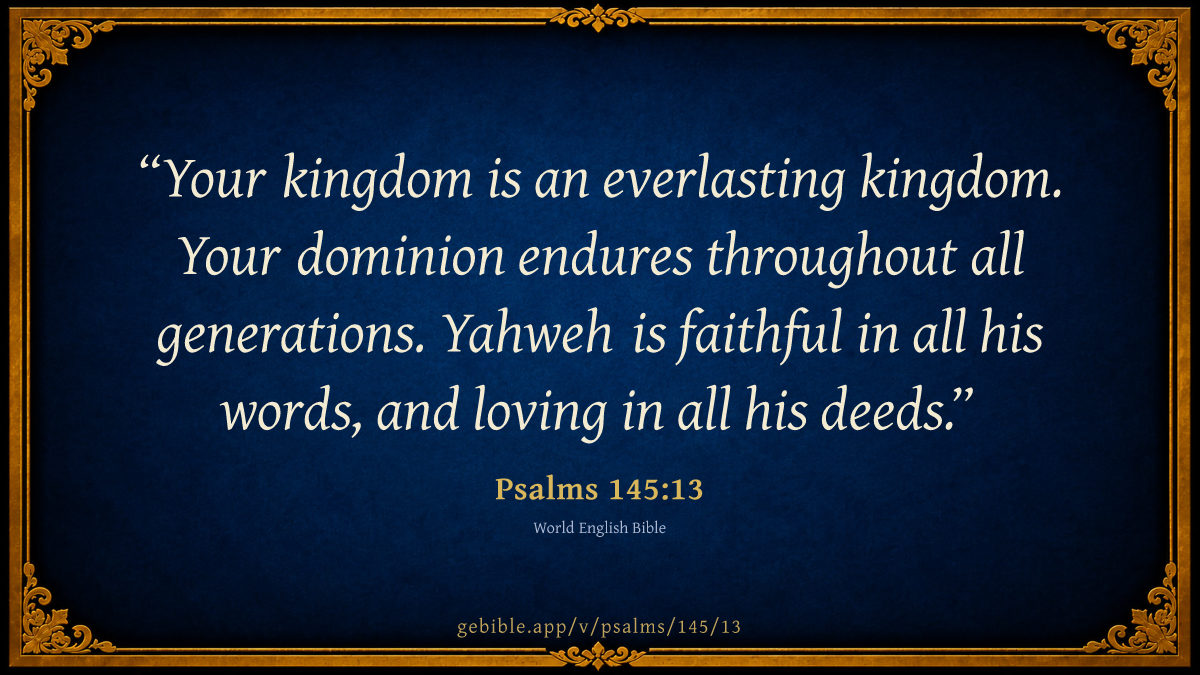
Your kingdom is an everlasting kingdom. Your dominion endures throughout all generations. Yahweh is faithful in all his words, and loving in all his deeds.
Parallel Translations
-
Your kingdom is an everlasting kingdom. Your dominion endures throughout all generations. Yahweh is faithful in all his words, and loving in all his deeds.
-
Thy kingdom is an everlasting kingdom, and thy dominion endureth throughout all generations.
-
Thy kingdom is a kingdom for all ages, and Thy dominion endureth throughout all generations.
Cross-references (10)
Passages linked to Psalms 145:13 in the Treasury of Scripture Knowledge, ordered by reader-vote popularity; verse text shown in World English Bible.
- 1 Timothy 1:17 Now to the King eternal, immortal, invisible, to God who alone is wise, be honor and glory forever and ever. Amen.
- Daniel 7:14 Dominion was given him, and glory, and a kingdom, that all the peoples, nations, and languages should serve him. His dominion is an everlasting dominion, which will not pass away, and his kingdom that which will not be destroyed.
- Psalms 10:16 Yahweh is King forever and ever! The nations will perish out of his land.
- Isaiah 9:7 Of the increase of his government and of peace there shall be no end, on David’s throne, and on his kingdom, to establish it, and to uphold it with justice and with righteousness from that time on, even forever. The zeal of Yahweh of Armies will perform this.
- Revelation 11:15 The seventh angel sounded, and great voices in heaven followed, saying, “The kingdom of the world has become the Kingdom of our Lord, and of his Christ. He will reign forever and ever!”
- Daniel 2:44 “In the days of those kings the God of heaven will set up a kingdom which will never be destroyed, nor will its sovereignty be left to another people; but it will break in pieces and consume all these kingdoms, and it will stand forever.
- Psalms 146:10 Yahweh will reign forever; your God, O Zion, to all generations. Praise Yah!
- Daniel 7:27 The kingdom and the dominion, and the greatness of the kingdoms under the whole sky, will be given to the people of the saints of the Most High. His kingdom is an everlasting kingdom, and all dominions will serve and obey him.’
- 1 Corinthians 15:21-28 For since death came by man, the resurrection of the dead also came by man. For as in Adam all die, so also in Christ all will be made alive. But each in his own order: Christ the first fruits, then those who are Christ’s, at his coming. Then the end comes, when he will deliver up the Kingdom to God, even the Father, when he will have abolished all rule and all authority and power. For he must reign until he has put all his enemies under his feet. The last enemy that will be abolished is death. For, “He put all things in subjection under his feet.” But when he says, “All things are put in subjection”, it is evident that he is excepted who subjected all things to him. When all things have been subjected to him, then the Son will also himself be subjected to him who subjected all things to him, that God may be all in all.
- 2 Peter 1:11 For thus you will be richly supplied with the entrance into the eternal Kingdom of our Lord and Savior, Jesus Christ.
Cross-references from openbible.info (CC BY 4.0)
Explain this verse (12 sources)
Historical commentary, presented as a primary source — not an endorsement.
Private notes
Saved on this device only — never synced or sent anywhere.
John Trapp 1656 · Public Domain Psa 145:13 Thy kingdom [is] an everlasting kingdom, and…
Psa 145:13 Thy kingdom [is] an everlasting kingdom, and thy dominion [endureth] throughout all generations.
Ver. 13. Thy kingdom is an everlasting kingdom] It cannot be overturned (that is comfortable to all Christ’s subjects), as other flourishing kingdoms are, which have their times and their turns, their rise and their ruin. Alexander’s kingdom continued but twelve years only, and fell with him; so did Tamerlane’s greatness.
John Trapp, A Commentary or Exposition upon All the Books of the Old and New Testament (1647–1656) — public domain. Text from a community e-Sword module.
John Gill 1763 · Public Domain Thy kingdom is an everlasting kingdom,.... So it is…
Thy kingdom is an everlasting kingdom,.... So it is opposed to all other kingdoms and monarchies, which have had or will have an end; as the Babylonian, Persian, Grecian, and Roman; with all other states which will be on the spot when this kingdom is set up in its glory, and will continue for ever, Dan 2:44; and the King of it is opposed to all other kings, who die, and their kingdoms are no more to them; but he never dies, he lives for evermore; he is the living God, and so an everlasting King: nor will his kingdom cease at the end of the thousand years, nor when delivered to the Father; only it shall be in a different place and form, and shall remain for ever; for his saints will reign for ever and ever, and he with them. Or it may be rendered, "a kingdom of all worlds" (e), or "ages"; Christ's kingdom reaching to all worlds; heaven, earth, and hell: or which, according to Arama, takes in the world above, below, and middle; and regards all times past, present, and to come:
and thy dominion endureth throughout all generations: in this world, and that to come; there is no end of it, Isa 9:7. This psalm is written alphabetically, as is observed on the title of it; but the letter "nun" is here wanting, the reason of which Kimchi professes his ignorance of: but Jarchi gives a reason for it, such an one as it is, which he has from the Talmud (f); because David, by a spirit of prophecy, foresaw the grievous fall of the people of Israel, the prophecy of which begins with this letter, Amo 5:2. Nor is the order always strictly observed in alphabetical psalms; in the thirty-seventh psalm the letter "ain" is wanting, and three in the twenty-fifth psalm. The Septuagint, Vulgate Latin, Syriac, Arabic, and Ethiopic versions, supply this defect here, by inserting these words, "the Lord is faithful in all his words, and holy in all his works", as if they were begun with the word but they seem to be taken from Psa 145:17, with a little alteration.
Read full note →
(e) "reguum omnium seculorum", V. L. Pagninus, Montanus, Vatablus, Musculus, Junius & Tremellius, Piscator, Cocceius. (f) T. Bab. Beracot, fol. 4. 2.
John Gill's Exposition of the Whole Bible (1746–1763) — public domain (CC PDM 1.0). Text via the HelloAO Bible API.
Adam Clarke 1810 · Public Domain Verse 13. Thy dominion endureth] There is neither age…
Verse 13. Thy dominion endureth] There is neither age nor people in and over which God does not manifest his benignly ruling power. As the above verse begins with the letter מ mem, the next in the order of the alphabet should begin with נ nun: but that verse is totally wanting. To say it never was in, is false, because the alphabet is not complete without it; and it is an unanswerable argument to prove the careless manner in which the Jews have preserved the Divine records. Though the Syriac, Septuagint, Vulgate, AEthiopic, Arabic, and Anglo-Saxon, have a verse, not in the Hebrew text, that answers to the נ nun, which is found in no printed copy of the Hebrew Bible; yet one MS., now in Trinity College, Dublin, has it thus, I suppose by correction, in the bottom of the page:-
נאמן יהוה בכל דבריו וחסיד בכל מעשיו
Read full note →
Neeman Yehovah bechol debaraiv; vechasid bechol maasaiv.
"The Lord is faithful in all his words; and merciful in all his works."
Πιστος Κυριος εν τοις λογοις αυτου· και ὁσιος εν πασι τιος εργοις αυτου. - SEPTUAGINT.
Fidelis Dominus in omnibus verbis suis: et sanctus in omnibus operibus suis. - VULGATE.
These two Versions, the Septuagint and Vulgate, are the same with the Hebrew given above. The Anglo-Saxon is the same:-
[Anglo-Saxon]. "True Lord in all words his, and holy in all works his."
The Latin text in my old Psalter is the same with the present printed Vulgate: "Fidelis Dominus in omnibus verbis suis, et sanctus in omnibus operibus suis." Thus translated in the same MSS.: Lorde true in all his words: and holy in al his workes.
It is remarkable that the whole verse is wanting in the Vulgate, as published in the Complutensian Polyglot, as also the Antwerp and Paris Polyglots, which were taken from it. It is wanting also in the Polyglot Psalter of Porus, because he did not find it in the Hebrew text.
Adam Clarke's Commentary on the Bible (1810–1826) — public domain. Text from a community e-Sword/MySword module.
Albert Barnes 1834 · Public Domain Thy kingdom is an everlasting kingdom ... - See…
Thy kingdom is an everlasting kingdom ... - See Psa 10:16, note; Dan 4:34, note. The meaning is, that the reign of God will continue forever and ever. It will never pass away as other dominions do; it will not change as dynasties do among people; it will not be overthrown as they are; its great principles will stand firm forever and ever. Compare the notes at Psa 72:17.
Albert Barnes' Notes on the Bible (1834–1885) — public domain. Text from a community e-Sword/MySword module.
Robert Jamieson, A. R. Fausset & David Brown 1871 · Public Domain (Compare Dan 4:3, Dan 4:34).
(Compare Dan 4:3, Dan 4:34).
Jamieson, Fausset & Brown — Commentary Critical and Explanatory on the Whole Bible (1871) — public domain (CC PDM 1.0). Text via the HelloAO Bible API.
Daniel D. Whedon 1874 · Public Domain 13. Everlasting kingdom— “Kingdom” might better be kingly office,…
13. Everlasting kingdom— “Kingdom” might better be kingly office, or majesty. David’s tenure of kingship now ceases; Solomon’s soon will cease; the monarchs of old have passed away; but the divine majesty neither fails nor changes. Twelve hundred years ago a Christian church at Damascus was changed into a Mohammedan mosque, but on its outside wall is still inscribed, in Greek letters, “Thy kingdom, O Christ, is a kingdom of all ages;” which shows in what sense the earlier Christians applied this verse.
Daniel D. Whedon (gen. ed.), Commentary on the Old and New Testaments (1874–1909) — public domain. Text from a community e-Sword module.
The Cambridge Bible for Schools and Colleges 1878 · Public Domain 13. This verse is found also, in Aramaic, in…
13. This verse is found also, in Aramaic, in Dan_4:3, cp. 34 (Aram. Dan. 3:33, Dan_4:31).
an everlasting kingdom] Lit. a kingdom of all the ages, past alike and future. With the LXX βασιλεία πάντων τῶν αἰωνων, cp. 1Ti_1:17 τῷ βασιλεῖ τῶν αἰώνων, ‘unto the king of the ages.’ See also Psa_10:16; Psa_29:10; Exo_15:18; Jer_10:10.
Read full note →
throughout all generations] In (or over) generation and generation, each successive generation.
The verse beginning with Nûn, which is missing in the Hebrew text, is thus supplied in the LXX and Versions dependent on it, and in the Syr.;
Faithful Is the Lord in [all] his words,
And holy in all his works[86].
[86] πιστὸς Κύριος ἐν [πᾶσιν, אc.a RT] τοῖς λόγοις αὐτοῦ, καὶ ὅσιος ἐν πᾶσι τοῖς ἔργοις αὐτοῦ.
The Heb. found in the lower margin of one late Heb. MS נֶאֱמָן יְהֹוָה בְּכָל־דְּבָוָיו וְחָסִיד בְּל־מַעֲשָׂיו is probably only a re-translation from the LXX.
If this verse is genuine, it must have been lost at an early date, for it is not found in any of the later versions[87]. Against its genuineness it is argued that the first line is suggested by the occurrence of the word for ‘faithful’ (nĕ’emân) in the same position in Psa_111:7 b, and by the language of Deu_7:9, and that the second line is simply taken from Psa_145:17. It may however be genuine. It is not likely that the Nûn verse was originally omitted: it was not necessary for the LXX to supply it: and the Psalm contains many imitations and is not free from repetitions.
[87] The verse is given in Lagarde’s ed. of Jerome’s Version; but it is not found in some good MSS and is obelised in others, and is probably an interpolation from the Vulg. with which it agrees exactly.
The Cambridge Bible for Schools and Colleges (gen. ed. J. J. S. Perowne; Cambridge University Press, 1878–1918) — public domain. Text from a community e-Sword module.
Ellicott's Commentary for English Readers 1878 · Public Domain (13) See margin, and comp. Dan_4:3; Dan_4:34. But it…
(13) See margin, and comp. Dan_4:3; Dan_4:34. But it is not necessary to see any dependence between the passages because of the recurrence of phrases which must have been of daily use in the theocracy.
The nun stanza, which should come after Psa_145:13, has most probably dropped away. The LXX. and Vulg., Syriac, and Ethiopic have here a variation of Psa_145:17, which would, in Hebrew, give a verse beginning with the required letter; but it is unknown to the other ancient versions, is rejected by the Jewish writers, and, though found in one Hebrew MS., is apparently suspicious there. But these arguments can hardly weigh against the improbability that, in an artificial composition, one letter (and that an easy one for the purpose) should have been either purposely or accidentally omitted in the original draft, especially when we reflect how extremely unlikely it was that the LXX. should trouble themselves to supply a verse in order to keep up an arrangement of which they took no other notice, perhaps even hardly observed it.
A Bible Commentary for English Readers, edited by Charles John Ellicott (1878–1897) — public domain. Text from a community e-Sword module.
The Pulpit Commentary 1880 · Public Domain Thy kingdom is an everlasting kingdom. (comp. Dan_4:3, Dan_4:34)…
Thy kingdom is an everlasting kingdom. (comp. Dan_4:3, Dan_4:34) It is inconceivable that God"s kingdom should come to an end. He cannot will it to cease, and so dethrone himself. Much less can any other, and necessarily inferior, power overthrow it. And thy dominion endureth throughout all generations. This is rather an anti-climax, since the generations of men will one day cease; but it was a customary phrase, (Psa_33:11 Psa_45:17 Psa_49:11 Psa_61:6 Psa_62:5, etc.) and brought home to men the thought that his special "dominion" was over them.
God"s everlasting kingdom.
Read full note →
"What is infinite in greatness must be infinite in duration." "Thy kingdom is a kingdom of all eternities." On the door of the old mosque in Damascus, which was once a Christian church, but for twelve centuries has ranked among the holiest of the Mohammedan sanctuaries, are inscribed these memorable words: "Thy kingdom, O Christ, is an everlasting kingdom, and thy dominion endureth throughout all generations." It is evident that the psalmist is endeavoring to find the most comprehensive and expressive of all terms to associate with God"s kingdom and we must therefore notice the all-inclusiveness of this term, "everlasting.
I GOD"S KINGDOM IS SPIRITUAL. It is not the kingdom of things, created things, of which the psalmist writes. It is God"s kingdom of men, and man is essentially a spiritual being. The glory of an earthly king is not material possessions, but the loving service of free-willed peoples. God"s kingdom is the rule of God"s will over men"s wills. And so we pray, "Thy kingdom come; thy will be done." It is a sublime thought of God that he is the spiritual Being ruling over spiritual beings. "King of saints, the holy.
II GOD"S KINGDOM IS ALL-HALLOWING. It can never be identified with any earthly kingdom. It covers and includes them all. It is as absolutely universal as the spiritual being man; and is consistent with, but independent of, all the varieties of forms in which men organize themselves into nations, and arrange governmental conditions. God"s kingdom must not be confused with his Church, unless we make the Church coextensive with the kingdom. Every man, being a spiritual man, is a member of God"s spiritual kingdom. Everything for him depends on what sort of a member he is.
III GOD"S KINGDOM IS PERMANENT. It belongs to all generations, because the generations repeat spiritual beings, and God rules such, as long as, and wherever, they exist. The permanence of the kingdom is simply the necessity of it. It is not possible for us to conceive of any disintegrating forces that can possibly affect it. R.T.
The Pulpit Commentary (1880–1919), ed. H.D.M. Spence-Jones & Joseph S. Exell — public domain. Text from a community e-Sword module.
Charles H. Spurgeon 1885 · Public Domain Ver. 13. Thy kingdom is an everlasting kingdom. His…
Ver. 13. Thy kingdom is an everlasting kingdom. His meditation has brought him near to God, and God near to him: he speaks to him in adoration, changing the pronoun from "his" to "thy." He sees the great King, and prostrates himself before him. It is well when our devotion opens the gate of heaven, and enters within the portal, to speak with God face to face, as a man speaketh with his friend. The point upon which the Psalmist's mind rests is the eternity of the divine throne, "thy reign is a reign of all eternities." The Lord's kingdom is without beginning, without break, without bound, and without end. He never abdicates his throne, neither does he call in a second to share his empire. None can overthrow his power, or break away from his rule. Neither this age, nor the age to come, nor ages of ages shall cause his sovereignty to fail. Herein is rest for faith. "The Lord sitteth King for ever." And thy dominion endureth throughout all generations. Men come and go like shadows on the wall, but God reigneth eternally. We distinguish kings as they succeed each other by calling them first and second; but this King is Jehovah, the First and the Last. Adam in his generation knew his Creator to be King, and the last of his race shall know the same. All hail, Great God I Thou art ever Lord of lords!
These three verses are a reverent hymn concerning "the kingdom of God": they will be best appreciated by those who are in that kingdom in the fullest sense, and are most truly loyal to the Lord. It is, according to these verses, a kingdom of glory and power; a kingdom of light which men are to know, and of might which men are to feel; it is full of majesty and eternity; it is the benediction of every generation. We are to speak of it, talk of it, and make it known, and then we are to acknowledge it in the homage directed distinctly to the Lord himselfas in Ps 145:13.
Read full note →
In these three verses Jehovah is adored for his gracious providence towards men and all other creatures; this fitly follows the proclamation of his royalty, for we here see how he rules his kingdom, and provides for his subjects.
Ver. 13. The Kingdom of God is his government of the world. The glory of it becomes especially conspicuous in this, that he raises the dominion of his anointed over all the kingdoms of the world: comp. Ps 89:27. "Thy kingdom is a kingdom of all eternities" (Ps 145:13), and so must also the kingdom of thine anointed be an eternal one, and will survive all the transitory kingdoms of this world, however highly they may puff themselves up. D. W. Hengstenberg.
Ver. 13. On the door of the old mosque in Damascus, which was once a Christian church, but for twelve centuries has ranked among the holiest of the Mahomedan sanctuaries, are inscribed these memorable words: "Thy kingdom, O Christ, is an everlasting kingdom, and thy dominion endureth throughout all generations." Though the name of Christ has been regularly blasphemed, and the disciples of Christ regularly cursed for twelve hundred years within it, the inscription has, nevertheless, remained unimpaired by time, and undisturbed by man. It was unknown during the long reign of Mahomedan intolerance and oppression; but when religious liberty was partially restored, and the missionaries were enabled to establish a Christian church in that city, it was again brought to light, encouraging them in their work of faith and labour of love. From John Bate's "Cyclopoedia of Illustrations", 1865.
Ver. 13-14. What we admire in these verses, is their combining the magnificence of unlimited power with the assiduity of unlimited tenderness. It is this combination which men are apt to regard as well nigh incredible, supposing that a Being so great as God can never concern himself with beings so inconsiderable as themselves. Tell them that God lifteth up those that be bowed down, and they cannot imagine that his kingdom and dominion are unbounded; or tell them, on the other hand, of the greatness of his empire, and they think it impossible that he should uphold all that fall. Henry Melvill.
Psalms 145:14*
Charles H. Spurgeon's The Treasury of David (1869–1885) — public domain. Psalms only. Text from a community e-Sword/MySword module.
The Biblical Illustrator 1887 · Public Domain Thy kingdom is an everlasting kingdom.
Psa_145:13-14
Thy kingdom is an everlasting kingdom.
Read full note →
The greatness and condescension of God
What we admire in these verses is their combining the magnificence of unlimited power with the assiduity of unlimited tenderness. It is of great importance that men be taught to view in God this combination of properties. It is certain that the greatness of God is often turned into an argument by which men would bring doubt on the truths of Redemption and Providence. The unmeasured inferiority of man to his Maker is used in proof that so costly a work as that of Redemption can never have been executed on our behalf; and that so unwearied a watchfulness as that of Providence can never be engaged in our service. Whereas, no reason whatever can be derived from our confessed insignificance, against our being the objects whether of Redemption or of Providence--seeing it is equally characteristic of Deity to attend to the inconsiderable and to the great to extend His dominion throughout all generations, and to lift up those that be bowed down. No one can survey the works of ,Nature and not perceive that God has some regard for the children of men, however fallen and polluted they may be. And if God manifest a regard for us in temporal things, it must be far from incredible that He would do the same in spiritual. There can be nothing fairer than the expectation that He would provide for our well-being as moral and accountable creatures with a care at least equal to that exhibited towards us in our natural capacity. So that it is perfectly credible that God would do something on behalf of the fallen; and then the question is, whether anything less than redemption through Christ would be of worth and of efficacy? But it is in regard to the doctrine of a universal Providence that men are most ready to raise objections, from the greatness of God as contrasted with their own insignificance. They cannot believe that He who is so mighty as to rule the Heavenly Hosts can condescend to notice the wants of the meanest of His creatures; and thus they deny to Him the combination of properties asserted in our text, that, whilst possessed of unlimited empire, He sustains the feeble and raises the prostrate. What would be thought of that mans estimate of greatness who should reckon it derogatory to the statesman that he thus combined attention to the inconsiderable with attention to the stupendous; and who should count it inconsistent with the loftiness of his station that, amid duties as arduous as faithfully discharged, he had an ear for the prattle of his children, and an eye for the interests of the friendless, and a heart for the sufferings of the destitute? Would there not be a feeling mounting almost to veneration towards the ruler who should prove himself equal to the superintending every concern of an empire, and who could yet give a personal attention to the wants of many of the poorest of its families; and who, whilst gathering within the compass of an ample intelligence every question of foreign and home policy, protecting the commerce, maintaining the honour, and fostering the institutions of the State, could minister tenderly at the bedside of sickness, and hearken patiently to the tale of calamity, and be as active for the widow and the orphan as though his whole business were to lighten the pressure of domestic affliction? And if we should rise in our admiration and applause of a statesman in proportion as he showed himself capable of attending to things comparatively petty and insignificant without neglecting the grand and momentous, certainly we are bound to apply the same principle to our Maker--to own it, that is, essential to His greatness that, whilst marshalling planets and ordering the motions of all worlds throughout the sweep of immensity, He should yet feed the young ravens that call upon Him, and number the very hairs of our heads: essential, in short, that, whilst His kingdom is an everlasting kingdom, and His dominion endureth throughout all generations, He should uphold all that fall, and raise up those that are bowed down. We would add to this, that objections against the doctrine of Gods providence are virtually objections against the great truths of creation. Are we to suppose that this or that ephemeral thing, the tiny tenant of a leaf or a bubble, is too insignificant to be observed by God; and that it is absurd to think that the animated point, whose existence is a second, occupies any portion of those inspections which have to spread themselves over the revolutions of planets and the movements of angels? Then to what authorship are we to refer this ephemeral thing? What it was not unworthy of God to form, it cannot be unworthy of God to preserve. But up to this point we have been rather engaged with removing objections against the doctrine of Gods providence than with examining that doctrine as it may be derived from our text. In regard to the doctrine itself, it is evident that nothing can happen in any spot of the universe which is not known to Him who is emphatically the Omniscient. But it is far more than the inspection of an ever vigilant observer which God throws over the concerns of creation. It is not merely that nothing can occur without the knowledge of our Maker; it is that nothing can occur but by either His appointment or permission. We say either His appointment or permission--for we know that, whilst He ordereth all things, both in heaven and earth, there is much which He allows to be done, but which cannot be referred directly to His authorship. It is in this sense that His providence has to do with what is evil, overruling it so that it becomes subservient to the march of His purposes. Oh! it were to take from God all that is most encouraging in His attributes and prerogatives if you could throw doubt on this doctrine of His universal providence. It is an august contemplation, that of the Almighty as the Architect of creation, filling the vast void with magnificent structures. We are presently confounded when bidden to meditate on the eternity of the Most High: for it is an overwhelming truth that He who gave beginning to all besides could have had no beginning Himself. And there are other characteristics and properties of Deity whose very mention excites awe, and on which the best eloquence is silence. But whilst She universal providence of God is to the full as incomprehensible as aught else which appertains to Divinity, there is nothing in it but what commends itself to the warmest feeling of our nature. And we seem to have drawn a picture which is calculated equally to raise astonishment and delight, to produce the deepest reverence and yet fullest confidence when we have represented God as superintending whatever occurs in His infinite domain--guiding the roll of every planet, and the rush of every cataract, and the gathering of every cloud, and the motion of every will--and when, in order that the delineation may have all that exquisiteness which is only to be obtained from those home touches which assure us that we have ourselves an interest in what is so splendid and surprising, we add that He is with the sick man on his pallet, and with the seaman in his danger, and with the widow in her agony. And what, after all, is this combination but that presented by our text? If I would exhibit God as so attending to what is mighty as not to overlook what is mean, what better can I do than declare Him mustering around Him the vast army of suns and constellations, and all the while hearkening to every cry which goes up from an afflicted creation--and is not this the very picture sketched by the psalmist when, after the sublime ascription, Thy kingdom is an everlasting kingdom, and Thy dominion endureth throughout all generations, he adds the comforting words, the Lord upholdeth all that fall, and lifteth up all those that be bowed down? (H. Melvill, B. D.)
Christs kingdom everlasting
Bishop Galloway, in his book on Missions, gives this significant illustration: In the published accounts of the burning of the famous mosque at Damascus a few years ago, there was a suggestive coincidence, if not a striking prophecy. It was built on the sacred spot where once stood the old Byzantine church, dedicated to St. John the Baptist. In building this Moslem temple one of the Roman arches was blended in the superstructure, on which was a Greek inscription from the Holy Scriptures. After the great fire the arch was found in place, bending over the ruins, bearing these words: Thy kingdom, O Christ, and Thy dominion endureth throughout all ages. (The Advertiser.)
The Biblical Illustrator, edited by Joseph S. Exell (c. 1880s–1900s) — public domain. Text from a community e-Sword module.
unfoldingWord translationNotes 2017 · CC BY-SA 4.0 endures throughout all generations
endures throughout all generations
"remains forever"
Read full note →
translationWords
eternity
dominion
endure
generation
unfoldingWord translationNotes — © Distant Shores Media and the Door43 World Missions Community, licensed CC BY-SA 4.0. Source: git.door43.org/Door43/en_tn.