Acts 2:28(v6)You made known to me the ways of life. You will make me full of gladness with your presence.’
Psalms 45:7(v6)You have loved righteousness, and hated wickedness. Therefore God, your God, has anointed you with the oil of gladness above your fellows.
Psalms 16:11(v6)You will show me the path of life. In your presence is fullness of joy. In your right hand there are pleasures forever more.
Psalms 16:8(v7)I have set Yahweh always before me. Because he is at my right hand, I shall not be moved.
Psalms 91:2(v7)I will say of Yahweh, “He is my refuge and my fortress; my God, in whom I trust.”
Show all 50 cross-references
Galatians 3:9(v6)So then, those who are of faith are blessed with the faithful Abraham.
Luke 2:10-11(v6)The angel said to them, “Don’t be afraid, for behold, I bring you good news of great joy which will be to all the people. For there is born…
Acts 3:26(v6)God, having raised up his servant Jesus, sent him to you first to bless you, in turning away every one of you from your wickedness.”
Genesis 12:2(v6)I will make of you a great nation. I will bless you and make your name great. You will be a blessing.
Psalms 9:2(v7)I will be glad and rejoice in you. I will sing praise to your name, O Most High.
Psalms 18:2(v7)Yahweh is my rock, my fortress, and my deliverer; my God, my rock, in whom I take refuge; my shield, and the horn of my salvation, my high…
Psalms 20:7-8(v7)Some trust in chariots, and some in horses, but we trust in the name of Yahweh our God. They are bowed down and fallen, but we rise up, and…
Psalms 26:1(v7)Judge me, Yahweh, for I have walked in my integrity. I have trusted also in Yahweh without wavering.
Daniel 7:14(v7)Dominion was given him, and glory, and a kingdom, that all the peoples, nations, and languages should serve him. His dominion is an…
Ephesians 1:3(v6)Blessed be the God and Father of our Lord Jesus Christ, who has blessed us with every spiritual blessing in the heavenly places in Christ,
1 Samuel 30:6(v7)David was greatly distressed; for the people spoke of stoning him, because the souls of all the people were grieved, every man for his sons…
Psalms 43:4(v6)Then I will go to the altar of God, to God, my exceeding joy. I will praise you on the harp, God, my God.
Psalms 63:2-5(v6)So I have seen you in the sanctuary, watching your power and your glory. Because your loving kindness is better than life, my lips shall…
Luke 2:30-32(v6)for my eyes have seen your salvation, which you have prepared before the face of all peoples; a light for revelation to the nations, and…
Galatians 3:14(v6)that the blessing of Abraham might come on the Gentiles through Christ Jesus, that we might receive the promise of the Spirit through faith.
Hebrews 2:13(v7)Again, “I will put my trust in him.” Again, “Behold, here I am with the children whom God has given me.”
1 Peter 3:22(v5)who is at the right hand of God, having gone into heaven, angels and authorities and powers being made subject to him.
1 Chronicles 17:27(vv5–6)Now it has pleased you to bless the house of your servant, that it may continue forever before you; for you, Yahweh, have blessed, and it…
Deuteronomy 32:8-9(v7)When the Most High gave to the nations their inheritance, when he separated the children of men, he set the bounds of the peoples according…
Psalms 4:6-7(v6)Many say, “Who will show us any good?” Yahweh, let the light of your face shine on us. You have put gladness in my heart, more than when…
Psalms 13:5(v7)But I trust in your loving kindness. My heart rejoices in your salvation.
Psalms 61:4(v7)I will dwell in your tent forever. I will take refuge in the shelter of your wings.
Psalms 61:6-7(v7)You will prolong the king’s life. His years will be for generations. He shall be enthroned in God’s presence forever. Appoint your loving…
Psalms 72:17-19(v6)His name endures forever. His name continues as long as the sun. Men shall be blessed by him. All nations will call him blessed. Praise be…
Psalms 91:9-10(v7)Because you have made Yahweh your refuge, and the Most High your dwelling place, no evil shall happen to you, neither shall any plague come…
Matthew 27:43(v7)He trusts in God. Let God deliver him now, if he wants him; for he said, ‘I am the Son of God.’ ”
John 17:22(v5)The glory which you have given me, I have given to them; that they may be one, even as we are one;
Ephesians 1:20-22(v5)which he worked in Christ, when he raised him from the dead and made him to sit at his right hand in the heavenly places, far above all…
Hebrews 8:1(v5)Now in the things which we are saying, the main point is this. We have such a high priest, who sat down on the right hand of the throne of…
Revelation 5:8-13(v5)Now when he had taken the book, the four living creatures and the twenty-four elders fell down before the Lamb, each one having a harp, and…
2 Samuel 7:8-9(v5)Now therefore tell my servant David this, ‘Yahweh of Armies says, “I took you from the sheep pen, from following the sheep, to be prince…
2 Samuel 7:19(v5)This was yet a small thing in your eyes, Lord Yahweh; but you have spoken also of your servant’s house for a great while to come; and this…
1 Chronicles 17:11-15(v5)It will happen, when your days are fulfilled that you must go to be with your fathers, that I will set up your offspring after you, who…
Psalms 3:3(v5)But you, Yahweh, are a shield around me, my glory, and the one who lifts up my head.
Psalms 8:5(v5)For you have made him a little lower than the angels, and crowned him with glory and honor.
Psalms 62:7(v5)My salvation and my honor is with God. The rock of my strength, and my refuge, is in God.
Psalms 96:6(v5)Honor and majesty are before him. Strength and beauty are in his sanctuary.
Psalms 110:1(v5)Yahweh says to my Lord, “Sit at my right hand, until I make your enemies your footstool for your feet.”
Isaiah 49:5-7(v5)Now Yahweh, he who formed me from the womb to be his servant, says to bring Jacob again to him, and to gather Israel to him, for I am…
Isaiah 63:1(v5)Who is this who comes from Edom, with dyed garments from Bozrah? Who is this who is glorious in his clothing, marching in the greatness of…
Matthew 28:18(v5)Jesus came to them and spoke to them, saying, “All authority has been given to me in heaven and on earth.
John 17:1(v5)Jesus said these things, then lifting up his eyes to heaven, he said, “Father, the time has come. Glorify your Son, that your Son may also…
John 17:5(v5)Now, Father, glorify me with your own self with the glory which I had with you before the world existed.
John 13:31-32(v5)When he had gone out, Jesus said, “Now the Son of Man has been glorified, and God has been glorified in him. If God has been glorified in…
Philippians 2:9-11(v5)Therefore God also highly exalted him, and gave to him the name which is above every name, that at the name of Jesus every knee should bow,…
50 distinct cross-references across this passage (51 total citations).
Cross-references from openbible.info (CC BY 4.0)
Explain this passage (20 sources)
Historical commentary, presented as a primary source — not an endorsement.
John Calvin1540 · Public DomainOn vv5–75. His glory is great. By these words the…
5. His glory is great. By these words the people intimate that their king, through the protection which God afforded him, and the deliverances which he wrought for him, would become more renowned than if he had reigned in peace with the applause of all men, or had been defended by human wealth and human strength, or, finally, had continued invincible by his own power and policy; for thereby it appeared the more clearly that he had only attained to the royal dignity by the favor, conduct, and commandment of God. The believing Israelites, therefore, leave it to heathen kings to ennoble themselves by their own achievements, and to acquire fame by their own valor; and they set more value upon this, that God graciously showed himself favorable towards their king, “Que la grace de Dieu se monstre favorable envers leur Roy.” — Fr.
John Calvin's Commentaries (1540-1563) — public domain. Text from the Calvin Translation Society English edition (1840s-50s) via the Christian Classics Ethereal Library (ccel.org). Calvin's coverage is partial (roughly two-thirds of the Bible); uncommented books and verses are honest gaps, never fabricated. The 19th-century editor's footnotes and remarks are omitted so the notes are faithfully Calvin's own voice.
Geneva Bible translators1599 · Public DomainOn v6Thou hast made him thy blessings to others, and…
Thou hast made him thy blessings to others, and a perpetual example of thy favor forever.
Geneva Bible (1599) marginal notes — public domain.
John Trapp1656 · Public DomainOn vv5–7Psa 21:5 His glory [is] great in thy salvation:…
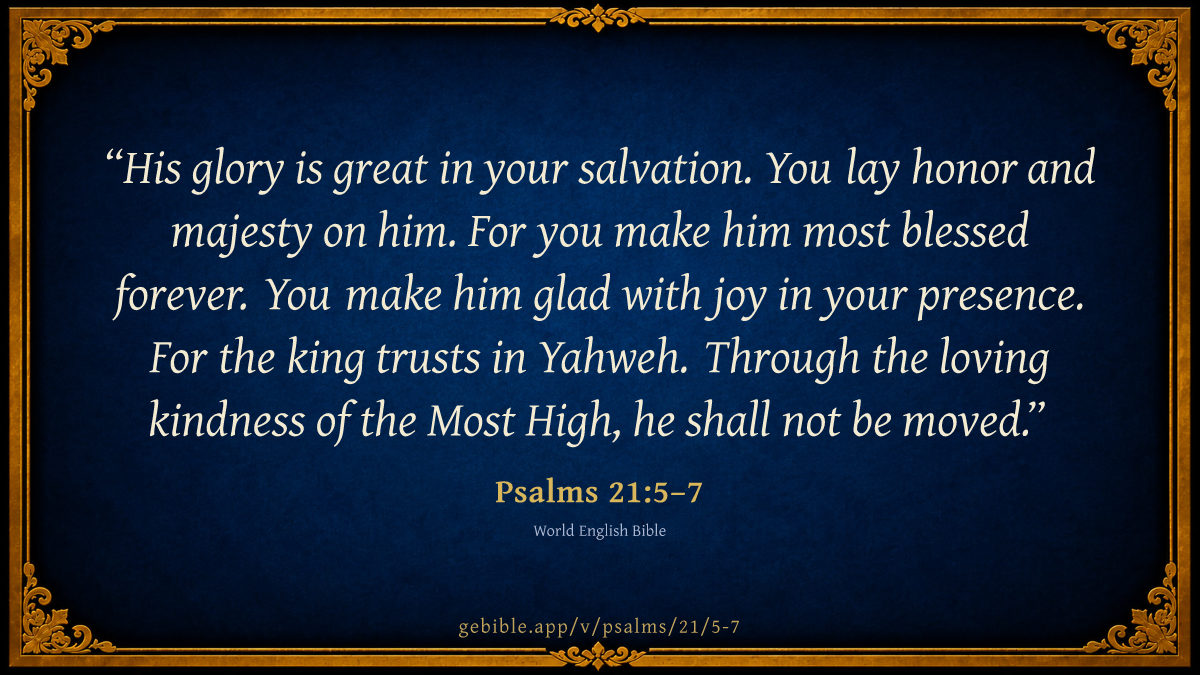
Psa 21:5 His glory [is] great in thy salvation: honour and majesty hast thou laid upon him.
Ver. 5. His glory is great in thy salvation] He was at first slighted, even by his own, as a petty prince; and the Philistines came up to seek him, that they might suppress him before he grew too strong for them; insomuch as he, for fear of them, went down to the hold, 2Sa 5:17, but soon after he became formidable to them and the rest of the neigbbouring nations, whom he subdued and reigned over. The like hereunto befell our Queen Elizabeth, who, how low soever at first, became at length, as her enemies confessed, the most glorious woman that ever swayed sceptre, because posuit Deum adiutorem suum.
Read full note →
Honour and majesty hast thou laid upon him] A growing weight of glory, a load of it, even before man. The saints, when they come to heaven, shall have an exceeding, excessive, eternal weight of glory, 2Co 4:17, such as if the body were not upheld by the mighty power of God it were impossible it should ever bear it.
John Trapp, A Commentary or Exposition upon All the Books of the Old and New Testament (1647–1656) — public domain. Text from a community e-Sword module.
Matthew Poole1685 · Public DomainOn vv5–7His glory; his fame or renown in the world.…
His glory; his fame or renown in the world. In thy salvation; by reason of those great and glorious deliverances which thou hast wrought both for him and by him.
Hast thou laid upon him; or, fitted to him, or upon him, as the Hebrew verb signifies; or, made it adequate to him. Thou hast given him a large and noble soul, very capable of and fit for that high and honourable estate to which thou hast advanced him, and thou hast given him honour and power suitable to so excellent a person, and to such rich endowments.
Matthew Poole's English Annotations on the Holy Bible (1683–1685) — public domain. Text from a community e-Sword/MySword module.
Matthew Henry1710 · Public DomainOn v7The psalmist, having taught his people to look back…
The psalmist, having taught his people to look back with joy and praise on what God had done for him and them, here teaches them to look forward with faith, and hope, and prayer, upon what God would further do for them: The king rejoices in God (Psa 21:1), and therefore we will be thankful; the king trusteth in God (Psa 21:7), therefore will we be encouraged. The joy and confidence of Christ our King is the ground of all our joy and confidence.
I. They are confident of the stability of David's kingdom. Through the mercy of the Most High, and not through his own merit or strength, he shall not be moved. His prosperous state shall not be disturbed; his faith and hope in God, which are the stay of his spirit, shall not be shaken. The mercy of the Most High (the divine goodness, power, and dominion) is enough to secure our happiness, and therefore our trust in that mercy should be enough to silence all our fears. God being at Christ's right hand in his sufferings (Psa 16:8) and he being at God's right hand in his glory, we may be sure he shall not, he cannot, be moved, but continues ever.
Read full note →
II. They are confident of the destruction of all the impenitent implacable enemies of David's kingdom. The success with which God had blessed David's arms hitherto was an earnest of the rest which God would give him from all his enemies round about, and a type of the total overthrow of all Christ's enemies who would not have him to reign over them. Observe, 1. The description of his enemies. They are such as hate him, Psa 21:8. They hated David because God had set him apart for himself, hated Christ because they hated the light; but both were hated without any just cause, and in both God was hated, Joh 15:23, Joh 15:25. 2. The designs of his enemies (Psa 21:11): They intended evil against thee, and imagined a mischievous device; they pretended to fight against David only, but their enmity was against God himself. Those that aimed to un-king David aimed, in effect, to un-God Jehovah. What is devised and designed against religion, and against the instruments God raises up to support and advance it, is very evil and mischievous, and God takes it as devised and designed against himself and will so reckon for it. (3.) The disappointment of them: "They devise what they are not able to perform," Psa 21:11. Their malice is impotent, and they imagine a vain thing, Psa 2:1. (4.) The discovery of them (Psa 21:8): "Thy hand shall find them out. Though ever so artfully disguised by the pretences and professions of friendship, though mingled with the faithful subjects of this kingdom and hardly to be distinguished from them, though flying from justice and absconding in their close places, yet thy hand shall find them out wherever they are." There is no escaping God's avenging eye, no going out of the reach of his hand; rocks and mountains will be no better shelter at last than fig-leaves were at first. (5.) The destruction of them; it will be an utter destruction (Luk 19:27); they shall be swallowed up and devoured, Psa 21:9. Hell, the portion of all Christ's enemies, is the complete misery both of body and soul. Their fruit and their seed shall be destroyed, Psa 21:10. The enemies of God's kingdom, in every age, shall fall under the same doom, and the whole generation of them will at last be rooted out, and all opposing rule, principality, and power, shall be put down. The arrows of God's wrath shall confound them and put them to flight, being levelled at the face of them, Psa 21:12. That will be the lot of daring enemies that face God. The fire of God's wrath will consume them (Psa 21:9); they shall not only be cast into a furnace of fire (Mat 13:42), but he shall make them themselves as a fiery oven or furnace; they shall be their own tormentors; the reflections and terrors of their own consciences will be their hell. Those that might have had Christ to rule and save them, but rejected him and fought against him, shall find that even the remembrance of that will be enough to make them, to eternity, a fiery oven to themselves: it is the worm that dies not.
III. In this confidence they beg of God that he would still appear for his anointed (Psa 21:13), that he would act for him in his own strength, by the immediate operations of his power as Lord of hosts and Father of spirits, making little use of means and instruments. And, 1. Hereby he would exalt himself and glorify his own name. "We have but little strength, and are not so active for thee as we should be, which is our shame; Lord, take the work into thy own hands, do it, without us, and it will be thy glory." 2. Hereupon they would exalt him: "So will we sing, and praise thy power, the more triumphantly." The less God has of our service when a deliverance is in the working the more he must have of our praises when it is wrought without us.
Matthew Henry's Commentary on the Whole Bible (1708–1710) — public domain (CC PDM 1.0). Text via the HelloAO Bible API.
John Gill1763 · Public DomainOn vv5–7His glory is great in thy salvation,.... That is,…
His glory is great in thy salvation,.... That is, the glory of the King Messiah is great in the Lord's salvation of him; delivering him from all his troubles and sorrows, and out of the hands of all his enemies, when he was raised from the dead, and was set at the right hand of God, and crowned with glory and honour: or the sense is, that his glory is great in the salvation of his people by him; it was his glory as Mediator to be appointed to be the Lord's salvation to them; and it being effected by him declares the glory and greatness of his person; and the nature of it is such as cannot fast of bringing glory to him; and such is the sense his people have of it, that it obliges them to ascribe the glory of it alone to him;
honour and majesty hast thou laid upon him; which is to be understood not of the honour and majesty of his divine nature, which are essential to him, and not laid upon him by any; nor of the glory which the saints attribute to him on account of their salvation by him; but of that which his Father has put upon him, and lies in the introduction of him into his glory after his sufferings and death, and resurrection from the dead; in exalting him at his right hand above all creatures and things; in giving him all power in heaven and in earth; in putting all the gifts of the Spirit into his hands, which he receiving gave to men, and in ordaining him Judge of quick and dead.
John Gill's Exposition of the Whole Bible (1746–1763) — public domain (CC PDM 1.0). Text via the HelloAO Bible API.
John Wesley1765 · Public DomainOn vv5–6Glory - His fame or renown. Salvation - By…
Glory - His fame or renown. Salvation - By reason of those great and glorious deliverances which thou hast wrought both for him, and by him.
John Wesley, Explanatory Notes Upon the Whole Bible (1754–1765) — public domain. Text via the GEBible commentary corpus.
Adam Clarke1810 · Public DomainOn vv5–7Verse 5. His glory is great] But great as…
Verse 5. His glory is great] But great as his glory was, it had its greatness from God's salvation. There is no true nobility but of the soul, and the soul has none but what it receives from the grace and salvation of God.
Adam Clarke's Commentary on the Bible (1810–1826) — public domain. Text from a community e-Sword/MySword module.
Joseph Benson1811 · Public DomainOn vv5–7Psa 21:5. His glory — His fame or renown,…
Psa 21:5. His glory — His fame or renown, is great in thy salvation — By reason of those great and glorious deliverances which thou hast wrought both for him and by him. Honour and majesty hast thou laid upon him — Or, fitted to him, or upon him, or made adequate to him, as the word תשׁוה, teshav-veh, signifies. Thou hast given him honour and power suitable to his glorious person and high endowments. “What tongue,” says Dr. Horne, “can express the ‘glory, honour, and majesty,’ with which the King of righteousness and peace was invested upon his ascension, when he took possession of the throne prepared for him, and received the homage of heaven and earth! The sacred imagery in St. John’s Revelation sets them before our eyes in such a manner, that no one can read the description whose heart will not burn within him, through impatient desire to behold them.” See Revelation, chapters 4., 7., 19., 21., 22.
Joseph Benson's Commentary on the Old and New Testaments (1811–1818) — public domain. Text from a community e-Sword module.
Albert Barnes1834 · Public DomainOn vv5–7His glory is great in thy salvation - Not…
His glory is great in thy salvation - Not in himself; not in anything that he has done, but in what thou hast done. The fact that thou hast saved him, and the manner in which it has been done, has put upon him great honor. He felt indeed that his condition as king, and as to the prospects before him, was one of great “glory” or honor; but he felt at the same time that it was not in “himself,” or for anything that he had done: it was only in the ““salvation”” which “God” had conferred upon him. Every child of God, in like manner, has great “glory” conferred upon him, and his “glory” will be great forever; but it is not in himself, or in virtue of anything that he has done. It is “great” in the “salvation” of God:
(a) in the “fact” that God has interposed to save him; and
Read full note →
(b) in the “manner” in which it has been done.
The highest honor that can be put upon man is in the fact that God will save him.
Honour and majesty hast thou laid upon him -
(a) In making him a king;
(b) in the victories and triumphs which thou hast now given him, placing on his head, as it were, a brighter crown;
(c) in the promised perpetuity of his reign.
So we may say of the ransomed sinner - the child of God - now. Honour and majesty have been laid on him:
(a) in the fact that God has redeemed him;
(b) in the manner in which this has been accomplished;
(c) in his adoption into the family of God;
(d) in the rank and dignity which he occupies as a child of God;
(e) in the hope of immortal blessedness beyond the grave.
Albert Barnes' Notes on the Bible (1834–1885) — public domain. Text from a community e-Sword/MySword module.
Robert Jamieson, A. R. Fausset & David Brown1871 · Public DomainOn vv6–7made him most blessed--or set him "to be blessings,"…
made him most blessed--or set him "to be blessings," as Abraham (Gen 12:2).
with thy countenance--by sight of thee (Psa 16:11), or by Thy favor expressed by the light of Thy countenance (Num 6:25), or both.
Jamieson, Fausset & Brown — Commentary Critical and Explanatory on the Whole Bible (1871) — public domain (CC PDM 1.0). Text via the HelloAO Bible API.
Daniel D. Whedon1874 · Public DomainOn vv6–76. Thou hast made him most blessed for ever—Thou…
6. Thou hast made him most blessed for ever—Thou hast constituted him blessings for ever. Compare “And thou shalt be a blessing.” Gen_12:2; Gen_28:4; Gal_3:3-14.
Exceeding glad with thy countenance—The parallel passage, almost verbatim, is Psa_16:11, where “fulness of joy” is said to be in the divine presence: quoted by Peter, (Act_2:28,) and applied to Christ.
Daniel D. Whedon (gen. ed.), Commentary on the Old and New Testaments (1874–1909) — public domain. Text from a community e-Sword module.
The Cambridge Bible for Schools and Colleges1878 · Public DomainOn vv5–75. Glory, honour, majesty, are Divine attributes (Psa_8:1; Psa_8:5;…
5. Glory, honour, majesty, are Divine attributes (Psa_8:1; Psa_8:5; Psa_104:1); and the victorious king shines with a reflection of them.
hast thou laid] Rather as R.V., dost thou lay. Cp. Psa_89:19 for the same word used of Divine endowment.
The Cambridge Bible for Schools and Colleges (gen. ed. J. J. S. Perowne; Cambridge University Press, 1878–1918) — public domain. Text from a community e-Sword module.
Ellicott's Commentary for English Readers1878 · Public DomainOn v6(6) Most blessed.—Literally, blessings. The idiom is similar to…
(6) Most blessed.—Literally, blessings. The idiom is similar to that in Psa_1:1.
With thy countenance.—Rather, In thy presence. (Comp. Psa_16:11.)
A Bible Commentary for English Readers, edited by Charles John Ellicott (1878–1897) — public domain. Text from a community e-Sword module.
The Pulpit Commentary1880 · Public DomainOn vv5–7His glory is great in thy salvation. David"s glory…
His glory is great in thy salvation. David"s glory exceeds that of all other living men, through the "salvation" which God vouchsafes him. That salvation is partly temporal, consisting in deliverance from his foes; partly of an unearthly and spiritual character, arising out of his relationship to the coming Messiah. It is from the latter point of view, rather than the former, that it is said, Honour and majesty hast thou laid upon him.
The Pulpit Commentary (1880–1919), ed. H.D.M. Spence-Jones & Joseph S. Exell — public domain. Text from a community e-Sword module.
Charles H. Spurgeon1885 · Public DomainOn vv5–7Ver. 5. His glory is great in thy salvation.…
Ver. 5. His glory is great in thy salvation. Immanuel bears the palm; he once bore the cross. The Father has glorified the Son, so that there is no glory like unto that which surrounds him. See his person as it is described by John in the Revelation; see his dominion as it stretches from sea to sea; see his splendour as he is revealed in flaming fire. Lord, who is like unto thee? Solomon in all his glory could not be compared with thee, thou once despised Man of Nazareth! Mark, reader: salvation is ascribed to God; and thus the Son, as our Saviour, magnifies his Father; but the Son's glory is also greatly seen, for the Father glorifies his Son.
Honour and majesty hast thou laid upon him. Parkhurst reads, "splendour and beauty." These are put upon Jesus as chains of gold, and stars and tokens of honour are placed upon princes and great men. As the wood of the tabernacle was overlaid with pure gold, so is Jesus covered with glory and honour. If there be a far more exceeding and eternal weight of glory for his humble followers, what must there be for our Lord himself? The whole weight of sin was laid upon him; it is but meet that the full measure of the glory of bearing it away should be laid upon the same beloved person. A glory commensurate with his shame he must and will receive, for well has he earned it. It is not possible for us to honour Jesus too much; what our God delights to do, we may certainly do to our utmost. Oh for new crowns for the lofty brow which once was marred with thorns!
Read full note →
"Let him be crowned with majesty
Who bowed his head to death, And be his honours sounded high
By all things that have breath."
Ver. 5. His glory is great in thy salvation. I remember one dying, and hearing some discourse of Jesus Christ; "Oh, "said she, "speak more of thislet me hear more of thisbe not weary of telling his praise; I long to see him, how should I but long to hear of him?" Surely I cannot say too much of Jesus Christ. On this blessed subject no man can possibly hyperbolise. Had I the tongues of men and angels, I could never fully set forth Christ. It involves an eternal contradiction, that the creature can see to the bottom of the Creator. Suppose all the sands on the seashore, all the flowers, herbs, leaves, twigs of trees in woods and forests, all the stars of heaven, were all rational creatures; and had they that wisdom and tongues of angels to speak of the loveliness, beauty, glory, and excellency of Christ, as gone to heaven, and sitting at the right hand of his Father, they would, in all their expressions, stay millions of miles on this side Jesus Christ. Oh, the loveliness, beauty, and glory of his countenance! Can I speak, or you hear of such a Christ? And are we not all in a burning love, in a seraphical love, or at least in a conjugal love? O my heart, how is it thou art not love sick? How is it thou dost not charge the daughters of Jerusalem as the spouse did: "I charge you, O daughters of Jerusalem, if ye find my beloved, that ye shall tell him, that I am sick of love." So 5:8. Isaac Ambrose.
Ver. 5. Honour and majesty hast thou laid upon him. If it be demanded whether Christ were exalted unto his glory and dignity, according to both his natures, both his Godhead and his manhood, I answer, according to both. According to his Godhead, not as it is considered in itself, but inasmuch as his Godhead, which from his birth unto his death did little show itself, after his resurrection was made manifest in his manhood; for, as the apostle saith (Ro 1:4), "He was declared mightily to be the Son of God by the resurrection from the dead, "even by the resurrection and after his resurrection from the dead, he which was thought only to be man, was most plainly manifested likewise to be God. Now, as touching his manhood, he was therein exalted unto highest majesty in the heavenly places, not only shaking off all infirmities of man's nature, but also being beautified and adorned with all qualities of glory, both in his soul and in his body, yet so that he still retaineth the properties of a true body, for even as he was man, he was set at the right hand of the Father, to rule and reign over all, till all his enemies be destroyed, and put under his feet. To knit up all in a word, Christ, God and man, after his resurrection, was crowned with glory and honour, even such as plainly showed him to be God, and was set on the throne of God, there to rule and reign as sovereign Lord and King, till he come in the clouds to judge both quick and dead. Here, then, is both matter of comfort and consolation unto the godly, and likewise for fear and astonishment unto the wicked and ungodly.
Henry Airway, 1560-1616.
Ver. 5. (last clause). Christ was "a man of sorrows" on earth, but he is full of joy in heaven. He that "wipes away all tears from the eyes of his people, "surely has none in his own. There was a joy set before him before he suffered, and doubtless it was given him, when he sat down at God's right hand. We may take the latter to be an actual donation of the former; the joy he had in prospect when he suffered he had in possession when he came to his throne. This is the time of his receiving the Father's public approbation, and the tokens of his love, before the whole heavenly assembly, which must be matter of great joy to him who so much valued and delighted in his Father's love. John Hurrion, 1675-1731.
Ver. 5. Happy he who hath a bone, or an arm, to put the crown upon the head of our highest King, whose chariot is paved with love. Were there ten thousand millions of heavens created above these highest heavens, and again as many above them, and as many above them, till angels were wearied with counting, it were but too low a seat to fix the princely throne of that Lord Jesus (whose ye are) above them all. Samuel Rutherford.
Ver. 5. The glory of the Mediator.
Psalms 21:6*
Charles H. Spurgeon's The Treasury of David (1869–1885) — public domain. Psalms only. Text from a community e-Sword/MySword module.
The Biblical Illustrator1887 · Public DomainOn vv5–6His glory is great in Thy salvation.
Psa_21:5
His glory is great in Thy salvation.
Read full note →
The glory of God
In this Psalm the poet is giving thanks for victory. The soldiers are returning from war, and are met by a chorus of maidens shouting praise to the delivering God. The poetry is not equal to the moral enthusiasm of the occasion. We are called upon to contemplate Gods glory as being great in human salvation. We thus enjoy the basis and the application of the thought. It would seem to be beneath Almighty God to care for a world so small and foolish as ours. It is not for us to estimate even our own worth. It does not become us to say that the world is insignificant, mean, or worthless; it is the work of God. What God has thought it worth His while to make, He may well think it worth His while to redeem. We do not see the whole world, nor do we comprehend all the issues of its discipline and nurture. When Jesus sees the travail of His soul He shall be satisfied. To save one soul is glory enough for any mortal man. What must it be to save the souls of all men, the souls of the ages and centuries incomputable? It is the delight of God to save, to redeem, to construct; the function of the enemy is to overthrow, to weaken, to debase, and to bring all life into dishonour. The course which the enemy has taken is the easier, since it is always easier to destroy than to construct. We glorify God by our goodness. God does not exist to be glorified in any sense of being merely hailed and saluted by songs and rapturous applause. When we are most quiet we are most really glorifying God. By meekness, by pureness, by gentleness, by quiet spiritual wisdom, by accepting the lot of life in a spirit of self-sacrifice, we may be bringing true glory to God. Do not think of the glory of God in any merely magnificent sense. We must change our definition of magnificence. In the sight of heaven it may be magnificent to be poor in spirit, gentle, and meek; and it may be mean and contemptible to own estates and crowns and sceptres. It is upon moral emotion, aspiration, and service that God sets His seal of blessing. (Joseph Parker, D. D.)
The Biblical Illustrator, edited by Joseph S. Exell (c. 1880s–1900s) — public domain. Text from a community e-Sword module.
C. I. Scofield1917 · Public DomainOn v7trusteth (See Scofield "Psa 2:12").
trusteth (See Scofield "Psa 2:12").
The Scofield Reference Bible (1917 edition), notes by C. I. Scofield — public domain. Text from a community e-Sword module.
unfoldingWord translationNotes2017 · CC BY-SA 4.0On vv5, 7His glory
His glory
"The king's honor" or "The king's fame"
Read full note →
you have bestowed on him splendor and majesty
"you have placed on him splendor and majesty." Causing the king to be wealthy and powerful is spoken of as if splendor and majesty are objects that are placed on him. AT: "you have made him wealthy and powerful" (See: Metaphor)
you grant him
"you allow him to have" or "you agree to give him"
lasting blessings
"a blessings that will last" or "a blessings that will stay"
the joy of your presence
"the joy of being in your presence" or "the joy that comes from you being near to you"

John Calvin 1540 · Public Domain On vv5–7 5. His glory is great. By these words the…
5. His glory is great. By these words the people intimate that their king, through the protection which God afforded him, and the deliverances which he wrought for him, would become more renowned than if he had reigned in peace with the applause of all men, or had been defended by human wealth and human strength, or, finally, had continued invincible by his own power and policy; for thereby it appeared the more clearly that he had only attained to the royal dignity by the favor, conduct, and commandment of God. The believing Israelites, therefore, leave it to heathen kings to ennoble themselves by their own achievements, and to acquire fame by their own valor; and they set more value upon this, that God graciously showed himself favorable towards their king, “Que la grace de Dieu se monstre favorable envers leur Roy.” — Fr.
John Calvin's Commentaries (1540-1563) — public domain. Text from the Calvin Translation Society English edition (1840s-50s) via the Christian Classics Ethereal Library (ccel.org). Calvin's coverage is partial (roughly two-thirds of the Bible); uncommented books and verses are honest gaps, never fabricated. The 19th-century editor's footnotes and remarks are omitted so the notes are faithfully Calvin's own voice.
Geneva Bible translators 1599 · Public Domain On v6 Thou hast made him thy blessings to others, and…
Thou hast made him thy blessings to others, and a perpetual example of thy favor forever.
Geneva Bible (1599) marginal notes — public domain.
John Trapp 1656 · Public Domain On vv5–7 Psa 21:5 His glory [is] great in thy salvation:…
Psa 21:5 His glory [is] great in thy salvation: honour and majesty hast thou laid upon him.
Ver. 5. His glory is great in thy salvation] He was at first slighted, even by his own, as a petty prince; and the Philistines came up to seek him, that they might suppress him before he grew too strong for them; insomuch as he, for fear of them, went down to the hold, 2Sa 5:17, but soon after he became formidable to them and the rest of the neigbbouring nations, whom he subdued and reigned over. The like hereunto befell our Queen Elizabeth, who, how low soever at first, became at length, as her enemies confessed, the most glorious woman that ever swayed sceptre, because posuit Deum adiutorem suum.
Read full note →
Honour and majesty hast thou laid upon him] A growing weight of glory, a load of it, even before man. The saints, when they come to heaven, shall have an exceeding, excessive, eternal weight of glory, 2Co 4:17, such as if the body were not upheld by the mighty power of God it were impossible it should ever bear it.
John Trapp, A Commentary or Exposition upon All the Books of the Old and New Testament (1647–1656) — public domain. Text from a community e-Sword module.
Matthew Poole 1685 · Public Domain On vv5–7 His glory; his fame or renown in the world.…
His glory; his fame or renown in the world. In thy salvation; by reason of those great and glorious deliverances which thou hast wrought both for him and by him.
Hast thou laid upon him; or, fitted to him, or upon him, as the Hebrew verb signifies; or, made it adequate to him. Thou hast given him a large and noble soul, very capable of and fit for that high and honourable estate to which thou hast advanced him, and thou hast given him honour and power suitable to so excellent a person, and to such rich endowments.
Matthew Poole's English Annotations on the Holy Bible (1683–1685) — public domain. Text from a community e-Sword/MySword module.
Matthew Henry 1710 · Public Domain On v7 The psalmist, having taught his people to look back…
The psalmist, having taught his people to look back with joy and praise on what God had done for him and them, here teaches them to look forward with faith, and hope, and prayer, upon what God would further do for them: The king rejoices in God (Psa 21:1), and therefore we will be thankful; the king trusteth in God (Psa 21:7), therefore will we be encouraged. The joy and confidence of Christ our King is the ground of all our joy and confidence.
I. They are confident of the stability of David's kingdom. Through the mercy of the Most High, and not through his own merit or strength, he shall not be moved. His prosperous state shall not be disturbed; his faith and hope in God, which are the stay of his spirit, shall not be shaken. The mercy of the Most High (the divine goodness, power, and dominion) is enough to secure our happiness, and therefore our trust in that mercy should be enough to silence all our fears. God being at Christ's right hand in his sufferings (Psa 16:8) and he being at God's right hand in his glory, we may be sure he shall not, he cannot, be moved, but continues ever.
Read full note →
II. They are confident of the destruction of all the impenitent implacable enemies of David's kingdom. The success with which God had blessed David's arms hitherto was an earnest of the rest which God would give him from all his enemies round about, and a type of the total overthrow of all Christ's enemies who would not have him to reign over them. Observe, 1. The description of his enemies. They are such as hate him, Psa 21:8. They hated David because God had set him apart for himself, hated Christ because they hated the light; but both were hated without any just cause, and in both God was hated, Joh 15:23, Joh 15:25. 2. The designs of his enemies (Psa 21:11): They intended evil against thee, and imagined a mischievous device; they pretended to fight against David only, but their enmity was against God himself. Those that aimed to un-king David aimed, in effect, to un-God Jehovah. What is devised and designed against religion, and against the instruments God raises up to support and advance it, is very evil and mischievous, and God takes it as devised and designed against himself and will so reckon for it. (3.) The disappointment of them: "They devise what they are not able to perform," Psa 21:11. Their malice is impotent, and they imagine a vain thing, Psa 2:1. (4.) The discovery of them (Psa 21:8): "Thy hand shall find them out. Though ever so artfully disguised by the pretences and professions of friendship, though mingled with the faithful subjects of this kingdom and hardly to be distinguished from them, though flying from justice and absconding in their close places, yet thy hand shall find them out wherever they are." There is no escaping God's avenging eye, no going out of the reach of his hand; rocks and mountains will be no better shelter at last than fig-leaves were at first. (5.) The destruction of them; it will be an utter destruction (Luk 19:27); they shall be swallowed up and devoured, Psa 21:9. Hell, the portion of all Christ's enemies, is the complete misery both of body and soul. Their fruit and their seed shall be destroyed, Psa 21:10. The enemies of God's kingdom, in every age, shall fall under the same doom, and the whole generation of them will at last be rooted out, and all opposing rule, principality, and power, shall be put down. The arrows of God's wrath shall confound them and put them to flight, being levelled at the face of them, Psa 21:12. That will be the lot of daring enemies that face God. The fire of God's wrath will consume them (Psa 21:9); they shall not only be cast into a furnace of fire (Mat 13:42), but he shall make them themselves as a fiery oven or furnace; they shall be their own tormentors; the reflections and terrors of their own consciences will be their hell. Those that might have had Christ to rule and save them, but rejected him and fought against him, shall find that even the remembrance of that will be enough to make them, to eternity, a fiery oven to themselves: it is the worm that dies not.
III. In this confidence they beg of God that he would still appear for his anointed (Psa 21:13), that he would act for him in his own strength, by the immediate operations of his power as Lord of hosts and Father of spirits, making little use of means and instruments. And, 1. Hereby he would exalt himself and glorify his own name. "We have but little strength, and are not so active for thee as we should be, which is our shame; Lord, take the work into thy own hands, do it, without us, and it will be thy glory." 2. Hereupon they would exalt him: "So will we sing, and praise thy power, the more triumphantly." The less God has of our service when a deliverance is in the working the more he must have of our praises when it is wrought without us.
Matthew Henry's Commentary on the Whole Bible (1708–1710) — public domain (CC PDM 1.0). Text via the HelloAO Bible API.
John Gill 1763 · Public Domain On vv5–7 His glory is great in thy salvation,.... That is,…
His glory is great in thy salvation,.... That is, the glory of the King Messiah is great in the Lord's salvation of him; delivering him from all his troubles and sorrows, and out of the hands of all his enemies, when he was raised from the dead, and was set at the right hand of God, and crowned with glory and honour: or the sense is, that his glory is great in the salvation of his people by him; it was his glory as Mediator to be appointed to be the Lord's salvation to them; and it being effected by him declares the glory and greatness of his person; and the nature of it is such as cannot fast of bringing glory to him; and such is the sense his people have of it, that it obliges them to ascribe the glory of it alone to him;
honour and majesty hast thou laid upon him; which is to be understood not of the honour and majesty of his divine nature, which are essential to him, and not laid upon him by any; nor of the glory which the saints attribute to him on account of their salvation by him; but of that which his Father has put upon him, and lies in the introduction of him into his glory after his sufferings and death, and resurrection from the dead; in exalting him at his right hand above all creatures and things; in giving him all power in heaven and in earth; in putting all the gifts of the Spirit into his hands, which he receiving gave to men, and in ordaining him Judge of quick and dead.
John Gill's Exposition of the Whole Bible (1746–1763) — public domain (CC PDM 1.0). Text via the HelloAO Bible API.
John Wesley 1765 · Public Domain On vv5–6 Glory - His fame or renown. Salvation - By…
Glory - His fame or renown. Salvation - By reason of those great and glorious deliverances which thou hast wrought both for him, and by him.
John Wesley, Explanatory Notes Upon the Whole Bible (1754–1765) — public domain. Text via the GEBible commentary corpus.
Adam Clarke 1810 · Public Domain On vv5–7 Verse 5. His glory is great] But great as…
Verse 5. His glory is great] But great as his glory was, it had its greatness from God's salvation. There is no true nobility but of the soul, and the soul has none but what it receives from the grace and salvation of God.
Adam Clarke's Commentary on the Bible (1810–1826) — public domain. Text from a community e-Sword/MySword module.
Joseph Benson 1811 · Public Domain On vv5–7 Psa 21:5. His glory — His fame or renown,…
Psa 21:5. His glory — His fame or renown, is great in thy salvation — By reason of those great and glorious deliverances which thou hast wrought both for him and by him. Honour and majesty hast thou laid upon him — Or, fitted to him, or upon him, or made adequate to him, as the word תשׁוה, teshav-veh, signifies. Thou hast given him honour and power suitable to his glorious person and high endowments. “What tongue,” says Dr. Horne, “can express the ‘glory, honour, and majesty,’ with which the King of righteousness and peace was invested upon his ascension, when he took possession of the throne prepared for him, and received the homage of heaven and earth! The sacred imagery in St. John’s Revelation sets them before our eyes in such a manner, that no one can read the description whose heart will not burn within him, through impatient desire to behold them.” See Revelation, chapters 4., 7., 19., 21., 22.
Joseph Benson's Commentary on the Old and New Testaments (1811–1818) — public domain. Text from a community e-Sword module.
Albert Barnes 1834 · Public Domain On vv5–7 His glory is great in thy salvation - Not…
His glory is great in thy salvation - Not in himself; not in anything that he has done, but in what thou hast done. The fact that thou hast saved him, and the manner in which it has been done, has put upon him great honor. He felt indeed that his condition as king, and as to the prospects before him, was one of great “glory” or honor; but he felt at the same time that it was not in “himself,” or for anything that he had done: it was only in the ““salvation”” which “God” had conferred upon him. Every child of God, in like manner, has great “glory” conferred upon him, and his “glory” will be great forever; but it is not in himself, or in virtue of anything that he has done. It is “great” in the “salvation” of God:
(a) in the “fact” that God has interposed to save him; and
Read full note →
(b) in the “manner” in which it has been done.
The highest honor that can be put upon man is in the fact that God will save him.
Honour and majesty hast thou laid upon him -
(a) In making him a king;
(b) in the victories and triumphs which thou hast now given him, placing on his head, as it were, a brighter crown;
(c) in the promised perpetuity of his reign.
So we may say of the ransomed sinner - the child of God - now. Honour and majesty have been laid on him:
(a) in the fact that God has redeemed him;
(b) in the manner in which this has been accomplished;
(c) in his adoption into the family of God;
(d) in the rank and dignity which he occupies as a child of God;
(e) in the hope of immortal blessedness beyond the grave.
Albert Barnes' Notes on the Bible (1834–1885) — public domain. Text from a community e-Sword/MySword module.
Robert Jamieson, A. R. Fausset & David Brown 1871 · Public Domain On vv6–7 made him most blessed--or set him "to be blessings,"…
made him most blessed--or set him "to be blessings," as Abraham (Gen 12:2).
with thy countenance--by sight of thee (Psa 16:11), or by Thy favor expressed by the light of Thy countenance (Num 6:25), or both.
Jamieson, Fausset & Brown — Commentary Critical and Explanatory on the Whole Bible (1871) — public domain (CC PDM 1.0). Text via the HelloAO Bible API.
Daniel D. Whedon 1874 · Public Domain On vv6–7 6. Thou hast made him most blessed for ever—Thou…
6. Thou hast made him most blessed for ever—Thou hast constituted him blessings for ever. Compare “And thou shalt be a blessing.” Gen_12:2; Gen_28:4; Gal_3:3-14.
Exceeding glad with thy countenance—The parallel passage, almost verbatim, is Psa_16:11, where “fulness of joy” is said to be in the divine presence: quoted by Peter, (Act_2:28,) and applied to Christ.
Daniel D. Whedon (gen. ed.), Commentary on the Old and New Testaments (1874–1909) — public domain. Text from a community e-Sword module.
The Cambridge Bible for Schools and Colleges 1878 · Public Domain On vv5–7 5. Glory, honour, majesty, are Divine attributes (Psa_8:1; Psa_8:5;…
5. Glory, honour, majesty, are Divine attributes (Psa_8:1; Psa_8:5; Psa_104:1); and the victorious king shines with a reflection of them.
hast thou laid] Rather as R.V., dost thou lay. Cp. Psa_89:19 for the same word used of Divine endowment.
The Cambridge Bible for Schools and Colleges (gen. ed. J. J. S. Perowne; Cambridge University Press, 1878–1918) — public domain. Text from a community e-Sword module.
Ellicott's Commentary for English Readers 1878 · Public Domain On v6 (6) Most blessed.—Literally, blessings. The idiom is similar to…
(6) Most blessed.—Literally, blessings. The idiom is similar to that in Psa_1:1.
With thy countenance.—Rather, In thy presence. (Comp. Psa_16:11.)
A Bible Commentary for English Readers, edited by Charles John Ellicott (1878–1897) — public domain. Text from a community e-Sword module.
The Pulpit Commentary 1880 · Public Domain On vv5–7 His glory is great in thy salvation. David"s glory…
His glory is great in thy salvation. David"s glory exceeds that of all other living men, through the "salvation" which God vouchsafes him. That salvation is partly temporal, consisting in deliverance from his foes; partly of an unearthly and spiritual character, arising out of his relationship to the coming Messiah. It is from the latter point of view, rather than the former, that it is said, Honour and majesty hast thou laid upon him.
The Pulpit Commentary (1880–1919), ed. H.D.M. Spence-Jones & Joseph S. Exell — public domain. Text from a community e-Sword module.
Charles H. Spurgeon 1885 · Public Domain On vv5–7 Ver. 5. His glory is great in thy salvation.…
Ver. 5. His glory is great in thy salvation. Immanuel bears the palm; he once bore the cross. The Father has glorified the Son, so that there is no glory like unto that which surrounds him. See his person as it is described by John in the Revelation; see his dominion as it stretches from sea to sea; see his splendour as he is revealed in flaming fire. Lord, who is like unto thee? Solomon in all his glory could not be compared with thee, thou once despised Man of Nazareth! Mark, reader: salvation is ascribed to God; and thus the Son, as our Saviour, magnifies his Father; but the Son's glory is also greatly seen, for the Father glorifies his Son.
Honour and majesty hast thou laid upon him. Parkhurst reads, "splendour and beauty." These are put upon Jesus as chains of gold, and stars and tokens of honour are placed upon princes and great men. As the wood of the tabernacle was overlaid with pure gold, so is Jesus covered with glory and honour. If there be a far more exceeding and eternal weight of glory for his humble followers, what must there be for our Lord himself? The whole weight of sin was laid upon him; it is but meet that the full measure of the glory of bearing it away should be laid upon the same beloved person. A glory commensurate with his shame he must and will receive, for well has he earned it. It is not possible for us to honour Jesus too much; what our God delights to do, we may certainly do to our utmost. Oh for new crowns for the lofty brow which once was marred with thorns!
Read full note →
"Let him be crowned with majesty
Who bowed his head to death, And be his honours sounded high
By all things that have breath."
Ver. 5. His glory is great in thy salvation. I remember one dying, and hearing some discourse of Jesus Christ; "Oh, "said she, "speak more of thislet me hear more of thisbe not weary of telling his praise; I long to see him, how should I but long to hear of him?" Surely I cannot say too much of Jesus Christ. On this blessed subject no man can possibly hyperbolise. Had I the tongues of men and angels, I could never fully set forth Christ. It involves an eternal contradiction, that the creature can see to the bottom of the Creator. Suppose all the sands on the seashore, all the flowers, herbs, leaves, twigs of trees in woods and forests, all the stars of heaven, were all rational creatures; and had they that wisdom and tongues of angels to speak of the loveliness, beauty, glory, and excellency of Christ, as gone to heaven, and sitting at the right hand of his Father, they would, in all their expressions, stay millions of miles on this side Jesus Christ. Oh, the loveliness, beauty, and glory of his countenance! Can I speak, or you hear of such a Christ? And are we not all in a burning love, in a seraphical love, or at least in a conjugal love? O my heart, how is it thou art not love sick? How is it thou dost not charge the daughters of Jerusalem as the spouse did: "I charge you, O daughters of Jerusalem, if ye find my beloved, that ye shall tell him, that I am sick of love." So 5:8. Isaac Ambrose.
Ver. 5. Honour and majesty hast thou laid upon him. If it be demanded whether Christ were exalted unto his glory and dignity, according to both his natures, both his Godhead and his manhood, I answer, according to both. According to his Godhead, not as it is considered in itself, but inasmuch as his Godhead, which from his birth unto his death did little show itself, after his resurrection was made manifest in his manhood; for, as the apostle saith (Ro 1:4), "He was declared mightily to be the Son of God by the resurrection from the dead, "even by the resurrection and after his resurrection from the dead, he which was thought only to be man, was most plainly manifested likewise to be God. Now, as touching his manhood, he was therein exalted unto highest majesty in the heavenly places, not only shaking off all infirmities of man's nature, but also being beautified and adorned with all qualities of glory, both in his soul and in his body, yet so that he still retaineth the properties of a true body, for even as he was man, he was set at the right hand of the Father, to rule and reign over all, till all his enemies be destroyed, and put under his feet. To knit up all in a word, Christ, God and man, after his resurrection, was crowned with glory and honour, even such as plainly showed him to be God, and was set on the throne of God, there to rule and reign as sovereign Lord and King, till he come in the clouds to judge both quick and dead. Here, then, is both matter of comfort and consolation unto the godly, and likewise for fear and astonishment unto the wicked and ungodly.
Henry Airway, 1560-1616.
Ver. 5. (last clause). Christ was "a man of sorrows" on earth, but he is full of joy in heaven. He that "wipes away all tears from the eyes of his people, "surely has none in his own. There was a joy set before him before he suffered, and doubtless it was given him, when he sat down at God's right hand. We may take the latter to be an actual donation of the former; the joy he had in prospect when he suffered he had in possession when he came to his throne. This is the time of his receiving the Father's public approbation, and the tokens of his love, before the whole heavenly assembly, which must be matter of great joy to him who so much valued and delighted in his Father's love. John Hurrion, 1675-1731.
Ver. 5. Happy he who hath a bone, or an arm, to put the crown upon the head of our highest King, whose chariot is paved with love. Were there ten thousand millions of heavens created above these highest heavens, and again as many above them, and as many above them, till angels were wearied with counting, it were but too low a seat to fix the princely throne of that Lord Jesus (whose ye are) above them all. Samuel Rutherford.
Ver. 5. The glory of the Mediator.
Psalms 21:6*
Charles H. Spurgeon's The Treasury of David (1869–1885) — public domain. Psalms only. Text from a community e-Sword/MySword module.
The Biblical Illustrator 1887 · Public Domain On vv5–6 His glory is great in Thy salvation.
Psa_21:5
His glory is great in Thy salvation.
Read full note →
The glory of God
In this Psalm the poet is giving thanks for victory. The soldiers are returning from war, and are met by a chorus of maidens shouting praise to the delivering God. The poetry is not equal to the moral enthusiasm of the occasion. We are called upon to contemplate Gods glory as being great in human salvation. We thus enjoy the basis and the application of the thought. It would seem to be beneath Almighty God to care for a world so small and foolish as ours. It is not for us to estimate even our own worth. It does not become us to say that the world is insignificant, mean, or worthless; it is the work of God. What God has thought it worth His while to make, He may well think it worth His while to redeem. We do not see the whole world, nor do we comprehend all the issues of its discipline and nurture. When Jesus sees the travail of His soul He shall be satisfied. To save one soul is glory enough for any mortal man. What must it be to save the souls of all men, the souls of the ages and centuries incomputable? It is the delight of God to save, to redeem, to construct; the function of the enemy is to overthrow, to weaken, to debase, and to bring all life into dishonour. The course which the enemy has taken is the easier, since it is always easier to destroy than to construct. We glorify God by our goodness. God does not exist to be glorified in any sense of being merely hailed and saluted by songs and rapturous applause. When we are most quiet we are most really glorifying God. By meekness, by pureness, by gentleness, by quiet spiritual wisdom, by accepting the lot of life in a spirit of self-sacrifice, we may be bringing true glory to God. Do not think of the glory of God in any merely magnificent sense. We must change our definition of magnificence. In the sight of heaven it may be magnificent to be poor in spirit, gentle, and meek; and it may be mean and contemptible to own estates and crowns and sceptres. It is upon moral emotion, aspiration, and service that God sets His seal of blessing. (Joseph Parker, D. D.)
The Biblical Illustrator, edited by Joseph S. Exell (c. 1880s–1900s) — public domain. Text from a community e-Sword module.
C. I. Scofield 1917 · Public Domain On v7 trusteth (See Scofield "Psa 2:12").
trusteth (See Scofield "Psa 2:12").
The Scofield Reference Bible (1917 edition), notes by C. I. Scofield — public domain. Text from a community e-Sword module.
unfoldingWord translationNotes 2017 · CC BY-SA 4.0 On vv5, 7 His glory
His glory
"The king's honor" or "The king's fame"
Read full note →
you have bestowed on him splendor and majesty
"you have placed on him splendor and majesty." Causing the king to be wealthy and powerful is spoken of as if splendor and majesty are objects that are placed on him. AT: "you have made him wealthy and powerful" (See: Metaphor)
you grant him
"you allow him to have" or "you agree to give him"
lasting blessings
"a blessings that will last" or "a blessings that will stay"
the joy of your presence
"the joy of being in your presence" or "the joy that comes from you being near to you"
translationWords
glory
splendor
majesty
bless
joy
unfoldingWord translationNotes — © Distant Shores Media and the Door43 World Missions Community, licensed CC BY-SA 4.0. Source: git.door43.org/Door43/en_tn.
Tyndale Open Study Notes 2022 · CC BY-SA 4.0 On vv6–7 21:6 God’s eternal blessings also bring fullness of life…
21:6 God’s eternal blessings also bring fullness of life in the present (see Ps 133).
Tyndale Open Study Notes — © Tyndale Open Resources, licensed CC BY-SA 4.0. Text via the HelloAO Bible API.