Philippians 4:19(v1)My God will supply every need of yours according to his riches in glory in Christ Jesus.
John 10:11(v1)I am the good shepherd. The good shepherd lays down his life for the sheep.
Isaiah 40:11(v1)He will feed his flock like a shepherd. He will gather the lambs in his arm, and carry them in his bosom. He will gently lead those who…
John 10:27-30(v1)My sheep hear my voice, and I know them, and they follow me. I give eternal life to them. They will never perish, and no one will snatch…
John 10:14(v1)I am the good shepherd. I know my own, and I’m known by my own;
Show all 100 cross-references
Revelation 7:17(vv1–2)for the Lamb who is in the middle of the throne shepherds them and leads them to springs of life-giving waters. And God will wipe away…
Isaiah 41:10(v4)Don’t you be afraid, for I am with you. Don’t be dismayed, for I am your God. I will strengthen you. Yes, I will help you. Yes, I will…
Matthew 6:33(v1)But seek first God’s Kingdom, and his righteousness; and all these things will be given to you as well.
Psalms 118:6(v4)Yahweh is on my side. I will not be afraid. What can man do to me?
1 Peter 2:25(v1)For you were going astray like sheep; but now you have returned to the Shepherd and Overseer of your souls.
Ezekiel 34:11-12(v1)“ ‘For the Lord Yahweh says: “Behold, I myself, even I, will search for my sheep, and will seek them out. As a shepherd seeks out his flock…
Psalms 138:7(v4)Though I walk in the middle of trouble, you will revive me. You will stretch out your hand against the wrath of my enemies. Your right hand…
Hebrews 13:5-6(v1)Be free from the love of money, content with such things as you have, for he has said, “I will in no way leave you, neither will I in any…
Psalms 34:9-10(v1)Oh fear Yahweh, you his saints, for there is no lack with those who fear him. The young lions do lack, and suffer hunger, but those who…
1 Peter 5:4(v1)When the chief Shepherd is revealed, you will receive the crown of glory that doesn’t fade away.
Ezekiel 34:23-24(v1)I will set up one shepherd over them, and he will feed them, even my servant David. He will feed them, and he will be their shepherd. I,…
Psalms 84:11(v1)For Yahweh God is a sun and a shield. Yahweh will give grace and glory. He withholds no good thing from those who walk blamelessly.
Isaiah 43:1-2(v4)But now Yahweh who created you, Jacob, and he who formed you, Israel, says: “Don’t be afraid, for I have redeemed you. I have called you by…
Romans 8:32(v1)He who didn’t spare his own Son, but delivered him up for us all, how would he not also with him freely give us all things?
Psalms 27:4(v6)One thing I have asked of Yahweh, that I will seek after: that I may dwell in Yahweh’s house all the days of my life, to see Yahweh’s…
Isaiah 42:16(v3)I will bring the blind by a way that they don’t know. I will lead them in paths that they don’t know. I will make darkness light before…
Luke 12:30-32(v1)For the nations of the world seek after all of these things, but your Father knows that you need these things. But seek God’s Kingdom, and…
Psalms 3:6(v4)I will not be afraid of tens of thousands of people who have set themselves against me on every side.
Ephesians 3:20(v5)Now to him who is able to do exceedingly abundantly above all that we ask or think, according to the power that works in us,
Hebrews 13:20(v1)Now may the God of peace, who brought again from the dead the great shepherd of the sheep with the blood of an eternal covenant, our Lord…
Micah 5:4(v1)He shall stand, and shall shepherd in the strength of Yahweh, in the majesty of the name of Yahweh his God: and they will live, for then he…
2 Timothy 4:18(v6)And the Lord will deliver me from every evil work, and will preserve me for his heavenly Kingdom. To him be the glory forever and ever.…
Psalms 31:3(v3)For you are my rock and my fortress, therefore for your name’s sake lead me and guide me.
Psalms 78:52(v1)But he led out his own people like sheep, and guided them in the wilderness like a flock.
Psalms 46:1-3(v4)God is our refuge and strength, a very present help in trouble. Therefore we won’t be afraid, though the earth changes, though the…
Jeremiah 23:3-4(v1)“I will gather the remnant of my flock out of all the countries where I have driven them, and will bring them again to their folds; and…
Luke 1:79(v4)to shine on those who sit in darkness and the shadow of death; to guide our feet into the way of peace.”
Psalms 92:10(v5)But you have exalted my horn like that of the wild ox. I am anointed with fresh oil.
Jeremiah 31:10(v1)“Hear Yahweh’s word, you nations, and declare it in the distant islands. Say, ‘He who scattered Israel will gather him, and keep him, as a…
Revelation 22:1(v2)He showed me a river of water of life, clear as crystal, proceeding out of the throne of God and of the Lamb,
Psalms 45:7(v5)You have loved righteousness, and hated wickedness. Therefore God, your God, has anointed you with the oil of gladness above your fellows.
1 Corinthians 15:55-57(v4)“Death, where is your sting? Hades, where is your victory?” The sting of death is sin, and the power of sin is the law. But thanks be to…
2 Corinthians 5:1(v6)For we know that if the earthly house of our tent is dissolved, we have a building from God, a house not made with hands, eternal, in the…
Psalms 79:13–80:1(v1)So we, your people and sheep of your pasture, will give you thanks forever. We will praise you forever, to all generations. Hear us,…
Psalms 16:5(v5)Yahweh assigned my portion and my cup. You made my lot secure.
Psalms 36:7-10(v6)How precious is your loving kindness, God! The children of men take refuge under the shadow of your wings. They shall be abundantly…
Psalms 19:7(v3)Yahweh’s law is perfect, restoring the soul. Yahweh’s covenant is sure, making wise the simple.
Psalms 27:1-4(v4)Yahweh is my light and my salvation. Whom shall I fear? Yahweh is the strength of my life. Of whom shall I be afraid? When evildoers came…
Micah 7:14(v4)Shepherd your people with your staff, the flock of your heritage, who dwell by themselves in a forest, in the middle of fertile pasture…
Psalms 16:11(v6)You will show me the path of life. In your presence is fullness of joy. In your right hand there are pleasures forever more.
Psalms 51:10(v3)Create in me a clean heart, O God. Renew a right spirit within me.
Acts 18:9-10(v4)The Lord said to Paul in the night by a vision, “Don’t be afraid, but speak and don’t be silent; for I am with you, and no one will attack…
Psalms 73:24-26(v6)You will guide me with your counsel, and afterward receive me to glory. Whom do I have in heaven? There is no one on earth whom I desire…
Psalms 143:8-10(v3)Cause me to hear your loving kindness in the morning, for I trust in you. Cause me to know the way in which I should walk, for I lift up my…
1 John 2:20(v5)You have an anointing from the Holy One, and you all have knowledge.
Ezekiel 34:13-14(v2)I will bring them out from the peoples, and gather them from the countries, and will bring them into their own land. I will feed them on…
Psalms 31:19-20(v5)Oh how great is your goodness, which you have laid up for those who fear you, which you have worked for those who take refuge in you,…
Psalms 46:11(v4)Yahweh of Armies is with us. The God of Jacob is our refuge.
Psalms 103:17(v6)But Yahweh’s loving kindness is from everlasting to everlasting with those who fear him, his righteousness to children’s children,
2 Corinthians 1:10(v6)who delivered us out of so great a death, and does deliver; on whom we have set our hope that he will also still deliver us;
Psalms 5:8(v3)Lead me, Yahweh, in your righteousness because of my enemies. Make your way straight before my face.
Micah 5:2(v1)But you, Bethlehem Ephrathah, being small among the clans of Judah, out of you one will come out to me that is to be ruler in Israel; whose…
Matthew 28:20(v4)teaching them to observe all things that I commanded you. Behold, I am with you always, even to the end of the age.” Amen.
Job 36:16(v5)Yes, he would have allured you out of distress, into a wide place, where there is no restriction. That which is set on your table would be…
Matthew 1:23(v4)“Behold, the virgin shall be with child, and shall give birth to a son. They shall call his name Immanuel;” which is, being interpreted,…
Psalms 51:12(v3)Restore to me the joy of your salvation. Uphold me with a willing spirit.
Psalms 46:4(v2)There is a river, the streams of which make the city of God glad, the holy place of the tents of the Most High.
Psalms 30:11-12(v6)You have turned my mourning into dancing for me. You have removed my sackcloth, and clothed me with gladness, to the end that my heart may…
1 John 2:27(v5)As for you, the anointing which you received from him remains in you, and you don’t need for anyone to teach you. But as his anointing…
Revelation 21:6(v2)He said to me, “I have become the Alpha and the Omega, the Beginning and the End. I will give freely to him who is thirsty from the spring…
Job 33:30(v3)to bring back his soul from the pit, that he may be enlightened with the light of the living.
Psalms 17:15(v6)As for me, I shall see your face in righteousness. I shall be satisfied, when I awake, with seeing your form.
2 Corinthians 1:21(v5)Now he who establishes us with you in Christ and anointed us is God,
Proverbs 8:20(v3)I walk in the way of righteousness, in the middle of the paths of justice,
Isaiah 25:6(v5)In this mountain, Yahweh of Armies will make all peoples a feast of choice meat, a feast of choice wines, of choice meat full of marrow, of…
Philippians 1:23(v6)But I am hard pressed between the two, having the desire to depart and be with Christ, which is far better.
2 Timothy 4:22(v4)The Lord Jesus Christ be with your spirit. Grace be with you. Amen.
Isaiah 49:9-10(v2)saying to those who are bound, ‘Come out!’; to those who are in darkness, ‘Show yourselves!’ “They shall feed along the paths, and their…
1 Corinthians 10:16(v5)The cup of blessing which we bless, isn’t it a sharing of the blood of Christ? The bread which we break, isn’t it a sharing of the body of…
Revelation 22:17(v2)The Spirit and the bride say, “Come!” He who hears, let him say, “Come!” He who is thirsty, let him come. He who desires, let him take the…
Isaiah 30:23(v2)He will give the rain for your seed, with which you will sow the ground; and bread of the increase of the ground will be rich and…
Revelation 3:19(v3)As many as I love, I reprove and chasten. Be zealous therefore, and repent.
Job 10:21-22(v4)before I go where I will not return from, to the land of darkness and of the shadow of death; the land dark as midnight, of the shadow of…
Psalms 21:4(v6)He asked life of you and you gave it to him, even length of days forever and ever.
Psalms 22:26(v5)The humble shall eat and be satisfied. They shall praise Yahweh who seek after him. Let your hearts live forever.
Proverbs 4:11(v3)I have taught you in the way of wisdom. I have led you in straight paths.
John 10:9-10(v5)I am the door. If anyone enters in by me, he will be saved, and will go in and go out, and will find pasture. The thief only comes to…
John 16:22(v5)Therefore you now have sorrow, but I will see you again, and your heart will rejoice, and no one will take your joy away from you.
Psalms 14:5(v4)There they were in great fear, for God is in the generation of the righteous.
Psalms 44:19(v4)though you have crushed us in the haunt of jackals, and covered us with the shadow of death.
Psalms 79:9(v3)Help us, God of our salvation, for the glory of your name. Deliver us, and forgive our sins, for your name’s sake.
Psalms 116:13(v5)I will take the cup of salvation, and call on Yahweh’s name.
Psalms 78:19(v5)Yes, they spoke against God. They said, “Can God prepare a table in the wilderness?
Psalms 104:15(v5)wine that makes the heart of man glad, oil to make his face to shine, and bread that strengthens man’s heart.
Jeremiah 2:6(v4)They didn’t say, ‘Where is Yahweh who brought us up out of the land of Egypt, who led us through the wilderness, through a land of deserts…
Micah 7:18-19(v3)Who is a God like you, who pardons iniquity, and passes over the disobedience of the remnant of his heritage? He doesn’t retain his anger…
Zechariah 11:10(v4)I took my staff Favor, and cut it apart, that I might break my covenant that I had made with all the peoples.
Job 3:5(v4)Let darkness and the shadow of death claim it for their own. Let a cloud dwell on it. Let all that makes black the day terrify it.
Psalms 85:13(v3)Righteousness goes before him, And prepares the way for his steps.
Psalms 110:2(v4)Yahweh will send out the rod of your strength out of Zion. Rule among your enemies.
John 6:53-56(v5)Jesus therefore said to them, “Most certainly I tell you, unless you eat the flesh of the Son of Man and drink his blood, you don’t have…
Job 24:17(v4)For the morning is to all of them like thick darkness, for they know the terrors of the thick darkness.
Psalms 85:4-7(v3)Turn us, God of our salvation, and cause your indignation toward us to cease. Will you be angry with us forever? Will you draw out your…
Psalms 119:176(v3)I have gone astray like a lost sheep. Seek your servant, for I don’t forget your commandments.
Isaiah 8:9-10(v4)Make an uproar, you peoples, and be broken in pieces! Listen, all you from far countries: dress for battle, and be shattered! Dress for…
100 distinct cross-references across this passage (116 total citations).
Cross-references from openbible.info (CC BY 4.0)
Explain this passage (28 sources)
Historical commentary, presented as a primary source — not an endorsement.
John Calvin1540 · Public DomainOn vv1–61. Jehovah is my shepherd. Although God, by his…
1. Jehovah is my shepherd. Although God, by his benefits, gently allures us to himself, as it were by a taste of his fatherly sweetness, yet there is nothing into which we more easily fall than into a forgetfulness of him, when we are in the enjoyment of peace and comfort. Yea, prosperity not only so intoxicates many, as to carry them beyond all bounds in their mirth, but it also engenders insolence, which makes them proudly rise up and break forth against God. Accordingly, there is scarcely a hundredth part of those who enjoy in abundance the good things of God, who keep themselves in his fear, and live in the exercise of humility and temperance, which would be so becoming. “Qui se contiene en la crainte de Dieu se selon la modestie et temperance qui seroit requise.” — Fr.
“Mais rememorant les benefices qu’il repoit de luy.” — Fr.
Read full note →
Under the similitude of a shepherd, he commends the care which God, in his providence, had exercised towards him. His language implies that God had no less care of him than a shepherd has of the sheep who are committed to his charge. God, in the Scripture, frequently takes to himself the name, and puts on the character of a shepherd, and this is no mean token of his tender love towards us. As this is a lowly and homely manner of speaking, He who does not disdain to stoop so low for our sake, must bear a singularly strong affection towards us. It is therefore wonderful, that when he invites us to himself with such gentleness and familiarity, we are not drawn or allured to him, that we may rest in safety and peace under his guardianship. But it should be observed, that God is a shepherd only to those who, touched with a sense of their own weakness and poverty, feel their need of his protection, and who willingly abide in his sheepfold, and surrender themselves to be governed by him. David, who excelled both in power and riches, nevertheless frankly confessed himself to be a poor sheep, that he might have God for his shepherd. Who is there, then, amongst us, who would exempt himself from this necessity, seeing our own weakness sufficiently shows that we are more than miserable if we do not live under the protection of this shepherd? We ought to bear in mind, that our happiness consists in this, that his hand is stretched forth to govern us, that we live under his shadow, and that his providence keeps watch and ward over our welfare. Although, therefore, we have abundance of all temporal good things, yet let us be assured that we cannot be truly happy unless God vouchsafe to reckon us among the number of his flock. Besides, we then only attribute to God the office of a Shepherd with due and rightful honor, when we are persuaded that his providence alone is sufficient to supply all our necessities. “Que sa seule providence est suffisante pour nous administrer toutes nos necessitez.” — Fr.
John Calvin's Commentaries (1540-1563) — public domain. Text from the Calvin Translation Society English edition (1840s-50s) via the Christian Classics Ethereal Library (ccel.org). Calvin's coverage is partial (roughly two-thirds of the Bible); uncommented books and verses are honest gaps, never fabricated. The 19th-century editor's footnotes and remarks are omitted so the notes are faithfully Calvin's own voice.
Geneva Bible translators1599 · Public DomainOn vv1, 3, 4, 5, 6He hath care over me and ministereth unto me…
He hath care over me and ministereth unto me all things.
Geneva Bible (1599) marginal notes — public domain.
John Trapp1656 · Public DomainOn vv1–6Psa 23:1 « A Psalm of David. » The…
Psa 23:1 « A Psalm of David. » The LORD [is] my shepherd; I shall not want.
Ver. 1. The Lord is my shepherd] This psalm may well be called David’s Bucolicon, or pastoral; so daintily hath he struck upon the whole string, through the whole hymn. Est Psalmus honorahilis, saith Aben Ezra; it is a noble psalm written and sung by David; not when he fled into the forest of Hareth, 1Sa 22:5, as some Hebrews will have it (R. Kimchi, R. Solom.); but when, as having overcome all his enemies and settled his kingdom, he enjoyed great peace and quiet, and had one foot as it were upon the battlements of heaven. The Jews at this day use for the most part to repeat this psalm after they are set down to meat (Leo. Modena). God is often in Scripture called the Shepherd of his people, Psa 80:1 Eze 34:12; Eze 34:14-15 Isa 40:11 Joh 10:11 1Pe 2:25, although non est ofiicium magis contemptibile quam opilionis, saith R. Jos. Bar. Haman, there is not a more contemptible office than that of a shepherd. Every shepherd was an abomination to the Egyptians. But God disdaineth not to feed his flock, to guide, to govern, to defend them, to handle and heal them, to tend and take care of them; and all this he hath tied himself by covenant to do, Eze 34:25 : well therefore might David confidently conclude,
Read full note →
I shall not want] Non deficiam, iudigebo, destituar. The wicked in the fulness of his sufficiency is in straits, Job 20:22. Tantalus-like, he is ever wanting; content he hath none. Contrarily, true piety brings true plenty, and a saint is never to seek of well contenting sufficiency, 1Ti 6:6, for to him, Parva seges satis est. A small crop is enough, And he saith,
Discite quam parvo liceat producers vitam,
Et quantum natura petat, &c.
(Lucan. Pharsi. l. 4).
John Trapp, A Commentary or Exposition upon All the Books of the Old and New Testament (1647–1656) — public domain. Text from a community e-Sword module.
Matthew Poole1685 · Public DomainOn vv1–6He hath showed himself to be so by his…
He hath showed himself to be so by his gracious providences towards me and for me; and he hath taken upon him that office and relation to me by his entering into covenant with me, whereby he hath engaged himself to rule, and feed, and preserve, and heal me, and do all which shepherds do, or are obliged to do, to their flocks; which David very well understood, and had doubtless carefully performed his duty to his sheep; and therefore he strengthens his faith by this consideration, that God was his Shepherd; and as God was a much better Shepherd than he or any man could he, so he might confidently expect more than ordinary benefits from his conduct. I shall not want, to wit, any thing which is really necessary for me, either for this life or for the next. But foolish man may think many things to be necessary for him, which the all-wise God knoweth to be not only unnecessary, but hurtful, and therefore mercifully denies what men ignorantly desire to their hurt.
Matthew Poole's English Annotations on the Holy Bible (1683–1685) — public domain. Text from a community e-Sword/MySword module.
Matthew Henry1710 · Public DomainOn v1From three very comfortable premises David, in this psalm,…
From three very comfortable premises David, in this psalm, draws three very comfortable conclusions, and teaches us to do so too. We are saved by hope, and that hope will not make us ashamed, because it is well grounded. It is the duty of Christians to encourage themselves in the Lord their God; and we are here directed to take that encouragement both from the relation wherein he stands to us and from the experience we have had of his goodness according to that relation.
I. From God's being his shepherd he infers that he shall not want anything that is good for him, Psa 23:1. See here, 1. The great care that God takes of believers. He is their shepherd, and they may call him so. Time was when David was himself a shepherd; he was taken from following the ewes great with young (Psa 78:70, Psa 78:71), and so he knew by experience the cares and tender affections of a good shepherd towards his flock. He remembered what need they had of a shepherd, and what a kindness it was to them to have one that was skilful and faithful; he once ventured his life to rescue a lamb. By this therefore he illustrates God's care of his people; and to this our Saviour seems to refer when he says, I am the shepherd of the sheep; the good shepherd, Joh 10:11. He that is the shepherd of Israel, of the whole church in general (Psa 80:1), is the shepherd of every particular believer; the meanest is not below his cognizance, Isa 40:11. He takes them into his fold, and then takes care of them, protects them, and provides for them, with more care and constancy than a shepherd can, that makes it his business to keep the flock. If God be as a shepherd to us, we must be as sheep, inoffensive, meek, and quiet, silent before the shearers, nay, and before the butcher too, useful and sociable; we must know the shepherd's voice, and follow him. 2. The great confidence which believers have in God: "If the Lord is my shepherd, my feeder, I may conclude I shall not want any thing that is really necessary and good for me." If David penned this psalm before his coming to the crown, though destined to it, he had as much reason to fear wanting as any man. Once he sent his men a begging for him to Nabal, and another time went himself a begging to Ahimelech; and yet, when he considers that God is his shepherd, he can boldly say, I shall not want. Let not those fear starving that are at God's finding and have him for their feeder. More is implied than is expressed, not only, I shall not want, but, "I shall be supplied with whatever I need; and, if I have not every thing I desire, I may conclude it is either not fit for me or not good for me or I shall have it in due time."
Read full note →
II. From his performing the office of a good shepherd to him he infers that he needs not fear any evil in the greatest dangers and difficulties he could be in, Psa 23:2-4. He experiences the benefit of God's presence with him and care of him now, and therefore expects the benefit of them when he most needs it. See here,
1. The comforts of a living saint. God is his shepherd and his God - a God all-sufficient to all intents and purposes. David found him so, and so have we. See the happiness of the saints as the sheep of God's pasture. (1.) They are well placed, well laid: He maketh me to lie down in green pastures. We have the supports and comforts of this life from God's good hand, our daily bread from him as our Father. The greatest abundance is but a dry pasture to a wicked man, who relishes that only in it which pleases the senses; but to a godly man, who tastes the goodness of God in all his enjoyments, and by faith relishes that, though he has but little of the world, it is a green pasture, Psa 37:16; Pro 15:16, Pro 15:17. God's ordinances are the green pastures in which food is provided for all believers; the word of life is the nourishment of the new man. It is milk for babes, pasture for sheep, never barren, never eaten bare, never parched, but always a green pasture for faith to feed in. God makes his saints to lie down; he gives them quiet and contentment in their own minds, what ever their lot is; their souls dwell at ease in him, and that makes every pasture green. Are we blessed with the green pastures of the ordinances? Let us not think it enough to pass through them, but let us lie down in them, abide in them; this is my rest for ever. It is by a constancy of the means of grace that the soul is fed. (2.) They are well guided, well led. The shepherd of Israel guides Joseph like a flock; and every believer is under the same guidance: He leadeth me beside the still waters. Those that feed on God's goodness must follow his direction; he leads them by his providence, by his word, by his Spirit, disposes of their affairs for the best, according to his counsel, disposes their affections and actions according to his command, directs their eye, their way, and their heart, into his love. The still waters by which he leads them yield them, not only a pleasant prospect, but many a cooling draught, many a reviving cordial, when they are thirsty and weary. God provides for his people not only food and rest, but refreshment also and pleasure. The consolations of God, the joys of the Holy Ghost, are these still waters, by which the saints are led, streams which flow from the fountain of living waters and make glad the city of our God. God leads his people, not to the standing waters which corrupt and gather filth, not to the troubled sea, nor to the rapid rolling floods, but to the silent purling waters; for the still but running waters agree best with those spirits that flow out towards God and yet do it silently. The divine guidance they are under is stripped of its metaphor (Psa 23:3): He leadeth me in the paths of righteousness, in the way of my duty; in that he instructs me by his word and directs me by conscience and providence. Theses are the paths in which all the saints desire to be led and kept, and never to turn aside out of them. And those only are led by the still waters of comfort that walk in the paths of righteousness. The way of duty is the truly pleasant way. It is the work of righteousness that is peace. In these paths we cannot walk unless God both lead us into them and lead us in them. (3.) They are well helped when any thing ails them: He restoreth my soul. [1.] "He restores me when I wander." No creature will lose itself sooner than a sheep, so apt is it to go astray, and then so unapt to find the way back. The best saints are sensible of their proneness to go astray like lost sheep (Psa 119:176); they miss their way, and turn aside into by-paths; but when God shows them their error, gives them repentance, and brings them back to their duty again, he restores the soul; and, if he did not do so, they would wander endlessly and be undone. When, after one sin, David's heart smote him, and, after another, Nathan was sent to tell him, Thou art the man, God restored his soul. Though God may suffer his people to fall into sin, he will not suffer them to lie still in it. [2.] "He recovers me when I am sick, and revives me when I am faint, and so restores the soul which was ready to depart." He is the Lord our God that heals us, Exo 15:26. Many a time we should have fainted unless we had believed; and it was the good shepherd that kept us from fainting.
2. See here the courage of a dying saint (Psa 23:4): "Having had such experience of God's goodness to me all my days, in six troubles and in seven, I will never distrust him, no, not in the last extremity; the rather because all he has done for me hitherto was not for any merit or desert of mine, but purely for his name's sake, in pursuance of his word, in performance of his promise, and for the glory of his own attributes and relations to his people. That name therefore shall still be my strong tower, and shall assure me that he who has led me, and fed me, all my life long, will not leave me at last." Here is,
(1.) Imminent danger supposed: "Though I walk through the valley of the shadow of death, that is, though I am in peril of death, though in the midst of dangers, deep as a valley, dark as a shadow, and dreadful as death itself," or rather, "though I am under the arrests of death, have received the sentence of death within myself, and have all the reason in the world to look upon myself as a dying man, yet I am easy." Those that are sick, those that are old, have reason to look upon themselves as in the valley of the shadow of death. Here is one word indeed which sounds terrible; it is death, which we must all count upon; there is no discharge in that war. But, even in the supposition of the distress, there are four words which lessen the terror: - It is death indeed that is before us; but, [1.] It is but the shadow of death; there is no substantial evil in it; the shadow of a serpent will not sting nor the shadow of a sword kill. [2.] It is the valley of the shadow, deep indeed, and dark, and dirty; but the valleys are fruitful, and so is death itself fruitful of comforts to God's people. [3.] It is but a walk in this valley, a gentle pleasant walk. The wicked are chased out of the world, and their souls are required; but the saints take a walk to another world as cheerfully as they take their leave of this. [4.] It is a walk through it; they shall not be lost in this valley, but get safely to the mountain of spices on the other side of it.
(2.) This danger made light of, and triumphed over, upon good grounds. Death is a king of terrors, but not to the sheep of Christ; they tremble at it no more than sheep do that are appointed for the slaughter. "Even in the valley of the shadow of death I will fear no evil. None of these things move me." Note, A child of God may meet the messengers of death, and receive its summons with a holy security and serenity of mind. The sucking child may play upon the hole of this asp; and the weaned child, that, through grace, is weaned from this world, may put his hand upon this cockatrice's den, bidding a holy defiance to death, as Paul, O death! where is thy sting? And there is ground enough for this confidence, [1.] Because there is no evil in it to a child of God; death cannot separate us from the love of God, and therefore it can do us no real harm; it kills the body, but cannot touch the soul. Why should it be dreadful when there is nothing in it hurtful? [2.] Because the saints have God's gracious presence with them in their dying moments; he is then at their right hand, and therefore why should they be moved? The good shepherd will not only conduct, but convoy, his sheep through the valley, where they are in danger of being set upon by the beasts of prey, the ravening wolves; he will not only convoy them, but comfort then when they most need comfort. His presence shall comfort them: Thou art with me. His word and Spirit shall comfort them - his rod and staff, alluding to the shepherd's crook, or the rod under which the sheep passed when they were counted (Lev 27:32), or the staff with which the shepherds drove away the dogs that would scatter or worry the sheep. It is a comfort to the saints, when they come to die, that God takes cognizance of them (he knows those that are his), that he will rebuke the enemy, that he will guide them with his rod and sustain them with his staff. The gospel is called the rod of Christ's strength (Psa 110:2), and there is enough in that to comfort the saints when they come to die, and underneath them are the everlasting arms.
III. From the good gifts of God's bounty to him now he infers the constancy and perpetuity of his mercy, Psa 23:5, Psa 23:6. Here we may observe,
1. How highly he magnifies God's gracious vouchsafements to him (Psa 23:5): "Thou preparest a table before me; thou hast provided for me all things pertaining both to life and godliness, all things requisite both for body and soul, for time and eternity:" such a bountiful benefactor is God to all his people; and it becomes them abundantly to utter his great goodness, as David here, who acknowledges, (1.) That he had food convenient, a table spread, a cup filled, meat for his hunger, drink for his thirst. (2.) That he had it carefully and readily provided for him. His table was not spread with any thing that came next to hand, but prepared, and prepared before him. (3.) That he was not stinted, was not straitened, but had abundance: "My cup runs over, enough for myself and my friends too." (4.) That he had not only for necessity, but for ornament and delight: Thou anointest my head with oil. Samuel anointed him king, which was a certain pledge of further favor; but this is rather an instance of the plenty with which God had blessed him, or an allusion to the extraordinary entertainment of special friends, whose heads they anointed with oil, Luk 7:46. Nay, some think he still looks upon himself as a sheep, but such a one as the poor man's ewe-lamb (Sa2 12:3), that did eat of his own meat, and drank of his own cup, and lay in his bosom; not only thus nobly, but thus tenderly, are the children of God looked after. Plentiful provision is made for their bodies, for their souls, for the life that now is and for that which is to come. If Providence do not bestow upon us thus plentifully for our natural life, it is our own fault if it be not made up to us in spiritual blessings.
2. How confidently he counts upon the continuance of God's favours, Psa 23:6. He had said (Psa 23:1), I shall not want; but now he speaks more positively, more comprehensively: Surely goodness and mercy shall follow me all the days of my life. His hope rises, and his faith is strengthened, by being exercised. Observe, (1.) What he promises himself - goodness and mercy, all the streams of mercy flowing from the fountain, pardoning mercy, protecting mercy, sustaining mercy, supplying mercy. (2.) The manner of the conveyance of it: It shall follow me, as the water out of the rock followed the camp of Israel through the wilderness; it shall follow into all places and all conditions, shall be always ready. (3.) The continuance of it: It shall follow me all my life long, even to the last; for whom God loves he loves to the end. (4.) The constancy of it: All the days of my life, as duly as the day comes; it shall be new every morning (Lam 3:22, Lam 3:23) like the manna that was given to the Israelites daily. (5.) The certainty of it: Surely it shall. It is as sure as the promise of the God of truth can make it; and we know whom we have believed. (6.) Here is a prospect of the perfection of bliss in the future state. So some take the latter clause: "Goodness and mercy having followed me all the days of my life on this earth, when that is ended I shall remove to a better world, to dwell in the house of the Lord for ever, in our Father's house above, where there are many mansions. With what I have I am pleased much; with what I hope for I am pleased more." All this, and heaven too! Then we serve a good Master.
3. How resolutely he determines to cleave to God and to his duty. We read the last clause as David's covenant with God: "I will dwell in the house of the Lord for ever (as long as I live), and I will praise him while I have any being." We must dwell in his house as servants, that desired to have their ears bored to the door-post, to serve him for ever. If God's goodness to us be like the morning light, which shines more and more to the perfect day, let not ours to him be like the morning cloud and the early dew that passeth away. Those that would be satisfied with the fatness of God's house must keep close to the duties of it.
Matthew Henry's Commentary on the Whole Bible (1708–1710) — public domain (CC PDM 1.0). Text via the HelloAO Bible API.
John Gill1763 · Public DomainOn vv1–6The Lord is my shepherd,.... This is to be…
The Lord is my shepherd,.... This is to be understood not of Jehovah the Father, and of his feeding the people of Israel in the wilderness, as the Targum paraphrases it, though the character of a shepherd is sometimes given to him, Psa 77:20; but of Jehovah the Son, to whom it is most frequently ascribed, Gen 49:24. This office he was called and appointed to by his Father, and which through his condescending grace he undertook to execute, and for which he is abundantly qualified; being omniscient, and so knows all his sheep and their maladies, where to find them, what is their case, and what is to be done for them; and being omnipotent, he can do everything proper for them; and having all power in heaven and in earth, can protect, defend, and save them; and all the treasures of wisdom and knowledge being in him, he can guide and direct them in the best manner; wherefore he is called the great shepherd, and the chief shepherd, and the good shepherd. David calls him "my shepherd"; Christ having a right unto him, as he has to all the sheep of God, by virtue of his Father's gift, his own purchase, and the power of his grace; and as owning him as such, and yielding subjection to him, following him as the sheep of Christ do wheresoever he goes; and also as expressing his faith of interest in him, affection for him, and joy because of him: and from thence comfortably concludes,
I shall not want; not anything, as the Targum and Aben Ezra interpret it; not any temporal good thing, as none of Christ's sheep do, that he in his wisdom sees proper and convenient for them; nor any spiritual good things, since a fulness of them is in him, out of which all their wants are supplied; they cannot want food, for by him they go in and out and find pasture; in him their bread is given them, where they have enough and to spare, and their waters are sure unto them; nor clothing, for he is the Lord their righteousness, and they are clothed with the robe of his righteousness; nor rest, for he is their resting place, in whom they find rest for their souls, and are by him led to waters of rest, as in Psa 23:2, the words may be rendered, "I shall not fail", or "come short" (s); that is, of eternal glory and happiness; for Christ's sheep are in his hands, out of which none can pluck them, and therefore shall not perish, but have everlasting life, Joh 10:27.
Read full note →
(s) "non deficiam", Pagninus, Montanus.
John Gill's Exposition of the Whole Bible (1746–1763) — public domain (CC PDM 1.0). Text via the HelloAO Bible API.
John Wesley1765 · Public DomainOn vv1–5David extolls the goodness of God as his shepherd,…
David extolls the goodness of God as his shepherd, and expresses his confidence in him, ver. 1-6. A psalm of David.
John Wesley, Explanatory Notes Upon the Whole Bible (1754–1765) — public domain. Text via the GEBible commentary corpus.
Adam Clarke1810 · Public DomainOn vv1–6The Lord is the Pastor of his people; therefore…
PSALM XXIII
The Lord is the Pastor of his people; therefore it may be
Read full note →
inferred that they shall not want, 1.
How he guides, feeds, and protects them, 2, 3.
Even in the greatest dangers they may be confident of his
support, 4.
His abundant provision for them, 5.
The confidence they may have of his continual mercy, and their
eternal happiness, 6.
NOTES ON PSALM XXIII
There is nothing particular in the title; it is simply attributed to David; but as it appears to be a thanksgiving of the Israelites for their redemption from the Bablylonish captivity, it cannot with propriety be attributed to David. Some think it was written by David in his exile, which is not likely; others, that he penned it when he was finally delivered from the persecution of Saul. I rather incline to the opinion that it was written after the captivity. The Chaldee seems to suppose that it was written to celebrate the goodness of God to the Israelites in the desert. It is a truly beautiful Psalm. Supposing it to have been written after the captivity, we see,
1. The redeemed captives giving thanks to God for their liberty.
2. Acknowledging that God had brought back their lives from the grave.
3. They represent themselves in Judea as a flock in an excellent pasture.
4. They declare that from the dangers they have passed through, and from which God had delivered them, they can have no fear of any enemy.
5. They conclude, from what God has done for them, that his goodness and mercy shall follow them all their days. And,
6. That they shall no more be deprived of God's worship, but shall all their days have access to his temple.
Verse 1. The Lord is my shepherd] There are two allegories in this Psalm which are admirably well adapted to the purpose for which they are produced, and supported both with art and elegance. The first is that of a shepherd; the second, that of a great feast, set out by a host the most kind and the most liberal As a flock, they have the most excellent pasture; as guests, they have the most nutritive and abundant fare. God condescends to call himself the Shepherd of his people, and his followers are considered as a flock under his guidance and direction.
1. He leads them out and in, so that they find pasture and safety.
2. He knows where to feed them, and in the course of his grace and providence leads them in the way in which they should go.
3. He watches over them and keeps them from being destroyed by ravenous beasts.
4. If any have strayed, he brings them back.
5. He brings them to the shade in times of scorching heat; in times of persecution and affliction, he finds out an asylum for them.
6. He takes care that they shall lack no manner of thing that is good.
But who are his flock? All real penitents, all true believers; all who obediently follow his example, abstaining from every appearance of evil, and in a holy life and conversation showing forth the virtues of Him who called them from darkness into his marvellous light. "My sheep hear my voice, and follow me."
But who are not his flock! Neither the backslider in heart, nor the vile Antinomian, who thinks the more he sins, the more the grace of God shall be magnified in saving him; nor those who fondly suppose they are covered with the righteousness of Christ while living in sin; nor the crowd of the indifferent and the careless, nor the immense herd of Laodicean loiterers; nor the fiery bigots who would exclude all from heaven but themselves, and the party who believe as they do. These the Scripture resembles to swine, dogs, wandering stars, foxes, lions, wells without water, c., c. Let not any of these come forward to feed on this pasture, or take of the children's bread. Jesus Christ is the good Shepherd the Shepherd who, to save his flock, laid down his own life.
I shall not want.] How can they? He who is their Shepherd has all power in heaven and earth therefore he can protect them. The silver and gold are his, and the cattle on a thousand hills; and therefore he can sustain them. He has all that they need, and his heart is full of love to mankind; and therefore he will withhold from them no manner of thing that is good. The old Psalter both translates and paraphrases this clause well: Lord governs me, and nathing sal want to me. In stede of pastour thare he me sett. "The voice of a rightwis man: Lord Crist es my kyng, and for thi (therefore) nathyng sal me want: that es, in hym I sal be siker, and suffisand, for I hope in hymn gastly gude and endles. And he ledes me in stede of pastoure, that es, understandyng of his worde, and delyte in his luf. Qwar I am siker to be fild, thar in that stede (place) he sett me, to be nurysht til perfectioun." Who can say more, who need say less, than this?
Adam Clarke's Commentary on the Bible (1810–1826) — public domain. Text from a community e-Sword/MySword module.
Joseph Benson1811 · Public DomainOn vv1–6Psa 23:1. The Lord is my shepherd — He…
Psa 23:1. The Lord is my shepherd — He hath showed himself to be so by his gracious providences toward me; and he hath kindly taken upon himself that office, and condescended to stand in that relation to me, having entered into covenant with me, and thereby engaged to rule, feed, and preserve, and heal me, and do all for me that shepherds do, or are under an obligation of doing for their flocks. David himself had been a shepherd, and, doubtless, well understood, and had carefully performed his duty, as such, to his flock. He knew by experience the cares and tender affections of a good shepherd toward his sheep, and was not unmindful what need they had of a shepherd, and what advantage it was to them to have one that was skilful and faithful. By this, therefore, he illustrates God’s care of his people, and by this he strengthens his own faith and confidence in him, and assists the faith and confidence of every pious reader. For he that is the Shepherd of Israel, of the whole church in general, Psa 80:1, is the shepherd of every particular believer; the meanest is not below his cognizance. He gathers even the lambs with his arm, Isa 40:11; nay, and carries them in his bosom. He takes them into the fold of his church, and then takes care of them: he protects and provides for them with more care and constancy than any shepherd can his sheep. If God be to us a shepherd, we must be to him as sheep, inoffensive, meek, and quiet, silent before the shearers; “nay,” says Henry, “before the butcher too;” useful and sociable, we must know the shepherd’s voice, and follow him. I shall not want — Namely, any thing that is really necessary for me, either for this life, or for the next. But foolish men may think many things to be necessary for them, which the all-wise God knows to be, not only unnecessary, but hurtful, and therefore mercifully denies what men ignorantly desire to their hurt.
Joseph Benson's Commentary on the Old and New Testaments (1811–1818) — public domain. Text from a community e-Sword module.
Albert Barnes1834 · Public DomainOn vv1–6The Lord is my shepherd - Compare Gen 49:24,…
The Lord is my shepherd - Compare Gen 49:24, “From thence is the shepherd, the stone of Israel;” Psa 80:1, “Give ear, O Shepherd of Israel.” See also the notes at Joh 10:1-14. The comparison of the care which God extends over his people to that of a shepherd for his flock is one that would naturally occur to those who were accustomed to pastoral life. It would be natural that it should suggest itself to Jacob Gen 49:24, and to David, for both of them had been shepherds. David, in advanced years, would naturally remember the occupations of his early life; and the remembrance of the care of God over him would naturally recall the care which he had, in earlier years, extended over his flocks. The idea which the language suggests is that of tender care; protection; particular attention to the young and the feeble (compare Isa 40:11); and providing for their wants. All these things are found eminently in God in reference to his people.
I shall not want - This is the main idea in the psalm, and this idea is derived from the fact that God is a shepherd. The meaning is, that, as a shepherd, he would make all needful provision for his flock, and evince all proper care for it. The words shall not want, as applied to the psalmist, would embrace everything that could be a proper object of desire, whether temporal or spiritual; whether pertaining to the body or the soul; whether having reference to time or to eternity. There is no reason for supposing that David limited this to his temporal necessities, or to the present life, but the idea manifestly is that God would provide all that was needful for him always. Compare Psa 34:9, “There is no want to them that fear him.” This idea enters essentially into the conception of God as the shepherd of his people, that all their real wants shall be supplied.
Albert Barnes' Notes on the Bible (1834–1885) — public domain. Text from a community e-Sword/MySword module.
Lange's Commentary on the Holy Scriptures1864 · Public DomainOn v1Psalms 23
Psalms 23
A Psalm of David
Read full note →
1 The Lord is my shepherd;
I shall not want.
2 He maketh me to lie down in green pastures:
He leadeth me beside the still waters.
3 He restoreth my soul:
He leadeth me in the paths of righteousness
For his name’s sake.
4 Yea, though I walk through the valley of the shadow of death,
I will fear no evil: for thou art with me;
Thy rod and thy staff they comfort me.
5 Thou preparest a table before me
In the presence of mine enemies:
Thou anointest my head with oil;
My cup runneth over.
6 Surely goodness and mercy shall follow me all the days of my life:
And I will dwell in the house of the Lord for ever.
EXEGETICAL AND CRITICAL
Its Contents and Origin.—Under the figures of the shepherd, Psa_23:1, and the host, Psa_23:5, which were familiar to all Israelites, which are connected with that of the guide, Psa_23:3, the Psalmist describes, in clear and flowing language corresponding throughout with his calm, confident, hopeful feelings, the comprehensive and more than sufficient care of God for him, who describes his present and future condition under the corresponding figures of member of the flock, Psa_23:2, wanderer, Psa_23:4, and guest, Psa_23:6. These figures are so natural to the national life, that we cannot conclude from them that David sung this Psalm, if not in the times of his shepherd life, at least in a time when the recollection of those days was still fresh (Tholuck), or that the feast contains a reference to the meal in the house of David’s father after he was anointed, 1 Samuel 16. (Muntinghe). But we have no more reason to look away from every historical reference and from every particular reason for the use of these figures, and since there is no evidence of a prophecy of Christ (many ancient interpreters), or that it was directly meant for the congregation, to suppose that it was a free expression of feelings rejoicing in God, whether of an unknown poet (Hupfeld), or David in the latter peaceful and prosperous period of his government (Calvin and most interpreters). For the enemies, Psa_23:5, seem not to belong to the past but to the present, and are mentioned in a connection, from which we may conclude that there was destitution, yet not a destitution among the enemies whilst the Israelites, under the Maccabean leaders besieged in the fortress at Jerusalem, had plenty (Olshausen), but with the Psalmist, who must certainly be regarded as remote from the house of God (Psa_23:6). If this is recognized likewise as a historical feature, it is easy to find the occasion for the preceding descriptions in a sojourn of the Psalmist in the wilderness, but not to think of an allegorical reference to the return of the people from exile (Kimchi), or a reference back to the Divine guidance of Israel from Egypt through the wilderness (Chald.), but to abide by David in accordance with tradition, and put this Psalm in the period of the rebellion of Absalom (Ruding., J. D. Mich., Ewald, Maurer, Delitzsch). Only we must not refer to 2Sa_18:26, for the tone and sentiment do not agree with it. But we may indeed think of 2Sa_17:27 sq., and compare with Psa_3:6; Psa_4:7. The resemblances to Pss. 27. and 63., are of an entirely different kind from those to Psa_25:21; Psa_37:4, as it is then too bold to refer to Jeremiah, on account of the style and the sentiment. Respecting the house of Jehovah vid. remarks upon Psa_5:7.
Str. I. Psa_23:1. My shepherd.—God is thus named already by Jacob, Gen_48:15; Gen_49:24. This figure is afterwards frequently used (Psa_80:1; Psa_78:52; Mic_7:14; Isa_63:13 sq.). It is likewise applied to theocratic rulers, Jer_3:15; Jer_23:1, and is used with reference to the Messiah, Isa_40:11; Ezekiel 34.; compare Zec_11:4 sq., and hence is applied to Jesus in the New Testament, Joh_10:1-16; Heb_13:20; 1Pe_2:25; 1Pe_5:4. In accordance with this the people are called His flock or the sheep of His pasture, Psa_74:1; Psa_79:13; Psa_95:7; Psa_100:3; Jer_23:1. The expressions which follow are taken from the life of the shepherd and correspond with the figure. The oasis of the wilderness is not merely a station of rest for the tired flocks at the time of the noonday heat (Son_1:7), but at the same time a place of refreshment by means of the green meadows and the waters, which are mentioned either as flowing quietly and therefore without danger in contrast to the wild mountain brooks and rushing streams (Calvin, Geier, De Wette, Hitzig [Alexander, Barnes]), or as the indispensable condition of refreshment for the pleasant resting-place where the flocks lie down for recreation (Sept., Stier, Hengst., Hupfeld [Perowne]).19 The imperfects are not to be regarded as futures (Hengst., et al.), or indeed as referring to the past (Sept., Chald.), but denote actions continuing and repeated in the present.
Str. II. Psa_23:3. He restoreth my soul.—This does not mean conversion (the ancient translations), but the refreshment of the soul under the figure of leading back him who was about to flee away, comp. Psa_19:7.—[He leadeth me.—The oriental shepherd does not drive the flock before him but goes before the flock and leads them, vid. Thomson’s The Land and the Book, p. 202 sq.; Smith’s Dict, of the Bible, Article, Shepherd.—C. A. B.].—In right paths.—In the figurative language of this Psalm it is evident that the “right paths” are not to be regarded as in similar passages, excluding the figure, as ways of righteousness (Hengst. [A. V.]) in the moral sense, or passing over the intermediate member, as ways of salvation (De Wette, Ewald, Hitzig), but as straight and even paths, excluding error and stumbling, direct and leading certainly to their end (most interpreters after the Rabbins), which are then really paths of righteousness and salvation.
Psa_23:4. Even when [A. V., Yea, though] = even then when.—The contrary of Psa_23:2 is supposed as an objective possibility; but only with reference to the external condition in life and circumstances threatening with peril of death.—Valley of the shadow of death.—In order to explain this figure De Wette cites from Morier’s second journey to Persia, p. Psa 179: “In the vicinity of Ispahan is a remarkable valley, barren, gloomy and destitute of water, which is called the valley of the angel of death.” [It is unnecessary to go beyond the Holy Land itself. The Psalmist refers to those deep wadies or wild and gloomy ravines, which abound in the mountains of Palestine, the rocky sides of which are filled with caves and caverns, the abodes of wild beasts of prey. It is often necessary for the shepherd to lead his flocks through these wadies and across these ravines, and it is always perilous even to the shepherd himself. There is no reference here to death itself, but to the peril of death go often experienced in life.—C. A. B.].—Thy rod and Thy staff, they comfort me.—The soul when thinking of the possible danger, is quieted and comforted by the assurance of the faithfulness of the Divine Shepherd. The shepherd not only leads the flock, but defends it, hence the mention of two staves; so likewise Zec_11:7, upon which an especial emphasis is put by the pronoun. It follows from this that this verse is not a general description of the rest of trust (De Wette, Hengst.), nor has a poetical and rhetorical fulness of meaning, nor indeed that one of the staves was given by the guide to the wanderer, the other retained by himself.20
Str. III. Psa_23:5. [Perowne: “God is even more than a shepherd who provides for the wants of his sheep. He is a King who lavishes His bounty in rich provision for His guests.” Although the figure of sheep and shepherd pass over into that of guest and host the ideas are the same, though in different forms. There is a beautiful correspondence throughout. As the sheep lie down satisfied with the rich provision of the shepherd, in the green pastures and by the refreshing waters, so the guest sits down satisfied with the rich provisions of the table of the Lord.—In the presence of mine enemies.—As the wild beasts surrounded the sheep in the gloomy wady and they were comforted by the shepherd’s rod, so the enemies surround the guest, and he is comforted by the table of the monarch. In the Orient the host was obligated not only to entertain the guest but to protect him from his enemies, and when once the meal of hospitality had been partaken all the power and strength of the host became assured to the guest. He was now safe and secure, and his enemies were powerless to injure him, for from this time forth he was the guest and friend of the host and would be protected and defended by him. Thus the idea is not of a hasty meal upon a battle-field, after which the fight was to be renewed, but of a calm and secure repose at the table of the host, with the assurance that all danger was past and the enemieswere no longer to be regarded or feared.—C. A. B.]
After that Thou hast anointed my head with oil.—Anointed, literally made fat, as a perfect subordinate to the imperfect, refers to the sprinkling of the beard, hair, etc., with sweet-smelling essences, which in ancient times preceded the festival meal, hence the figurative use, Psa_45:7; Psa_104:15.21—My cup runneth over.—The ancient translators have instead of this, drunkenness, which meaning, however, is admissible only in the Aramaic, but not in the Hebrew. The Sept. has connected the first words of the following verse with this clause and translated, ῶς κράτιστον.22
Psa_23:6. Only.—Instead of “only,” as Psa_39:6; Psa_39:12; Psa_139:11, it may be rendered, “yes!” as Psa_73:13; Psa_85:9; Gen_44:28. [The rendering of the A. V., “surely”, is better.—C. A. B.].—Happiness and grace will pursue me.—“Pursue” is used not only in the sense of follow or accompany (Olsh.). as an inversion of the usual figurative phrase used of men: pursue something sectari=aspire after (Hupfeld), but is used in contrast with the pursuit of the enemies. [His enemies had pursued him even to the presence of his host, henceforth grace and joy will pursue him and load him with blessings.—C. A. B.].—And returned shall I dwell in the house of Jehovah to length of days.—The closing word does not mean: lifelong (Hupfeld), but in contrast with the short affliction (Delitzsch), opens a prospect of an indefinitely long time, Psa_21:4, and indeed of communion with God and the enjoyment of His grace, Psalms 27., which is afforded by the use of the religious institutions of grace. Many ancient translations have, after the Sept., “my dwelling,” etc. They have likewise regarded the infinitive with the suffix as from yashab. So likewise Geier, Rosenm., De Wette, Hengst. But then we must read shibthî, as Psa_27:4. But our text has shabthî, which vocalization the Masoretic Punctators could only have fixed in accordance wish tradition. Now some have regarded this form after De Muis as a perfect of yashab, supposing that the first syllable has fallen away. But the possibility of such an aphæresis is disputed by Olsh. and Hupfeld as ungrammatical. The examples cited in its favor are explained by the former as mutilations of the text, and are regarded by Delitzsch partly as a corruption, as Jer_42:10, partly as only belonging to the vulgar tongue, as 2Sa_22:41. Hitzig, however, again appeals particularly to Jdg_19:11, together with Jer_42:10. In any case the matter is very doubtful, and therefore the derivation from shûb (=return) is preferable, yet it cannot be translated: I return to the house (Knapp, et al.), for it is followed by the preposition בְ and not אֵל and duration is expressed. This leads to the acceptance of a pregnant construction (Delitzsch). The idea of dwelling is not expressed in words, but is indicated as a consequence of the return, by the nature of the closing word, as already mentioned. The perfect with the vav consec. after the imperfect has likewise the meaning of a future. Misericordia Dei præcedit, comitatur et subsequitur nos (Augustine). [Alexander: “Dwelling in the house of Jehovah does not mean frequenting His sanctuary, but being a member of His household and an inmate of His family, enjoying His protection, holding communion with Him, and subsisting on His bounty.”—C. A. B.].23
DOCTRINAL AND ETHICAL
1. Every member of the congregation of God may appropriate in faith the promises which God has given to the people of the covenant, but he must likewise make earnest use of the privileges graciously bestowed upon the congregation, and have, hold, and confess the God of the covenant as his own God, in order to have in himself the evidence and experimental sense of the all-embracing and all-sufficient care of God, which is always comforting and refreshing in every circumstance of life. Comp. P. Gerhardt’s hymn which has grown out of this Psalm: Der Herr, der alter Enden.
2. He who would truly experience in himself that love, power, and faithfulness of God, whereby believers are called, sustained, preserved and entirely furnished in this world as a flock of the good shepherd, must likewise, in the constant sense of his need and weakness and at the same time in unshaken faith in the willingness and the power of God to help him, lay hold of for himself and use the means of grace and salvation prepared and offered to him; he must likewise truly let himself be led, refreshed, protected, cared for and saved by God, and meet the condescension of God with the resignation of himself to God. “Although this confidence in the care of God does not exclude provision for the body, yet we are to think chiefly of the supply of all our spiritual need, which comes down from above” (Umbreit).
3. Trust in God and resignation to His will is essentially facilitated by the fact that we have to do, not with an unknown and hidden God, but with the God of historical revelation, who has made known His name by His word and His works, and has declared therein what we have to think and expect of Him. On this fact we should base ourselves in the changeable fortunes which meet us in this world, and should hold fast to it amidst the changing feelings and dispositions of the heart: for that is “the golden art, to hold on to God’s word and promise, decide according to it and not according to the feelings of our hearts; thus help and consolation will surely follow and we shall not lack anything at all” (Luther).—“But now when God has revealed Himself as the Shepherd in the person of His only begotten Son, much more clearly and more gloriously than formerly to the fathers under the law, we do not sufficiently honor His keeping, unless we tread under foot all fear and danger by fixing our eyes upon Him” (Calvin).—“For David here prescribes one common rule for all Christians, that there is no other means or expedient on earth of escaping from all kinds of trouble, than for a man to cast all his cares on God, apprehend Him by His word of grace, hold fast to it and let it in no wise be taken from him. He who does this can be satisfied, whether it fares well with him or ill, whether he lives or dies, and can likewise finally endure, and must prosper in spite of all the devils, the world and misfortune” (Luther).
4. The best consolation in trouble is the certainty of the nearness of God, as this is the strongest reminder of our duty when successful. But we have these, not that “we may make of His benefits a ladder by which we may ever ascend nearer to Him” (Calvin), but we have them on the ground of His condescension to us, in virtue of His dwelling among us and in consequence of our reception into His house and to His table, where He has Himself prepared what serves for our sustenance and complete satisfaction, and where He likewise anoints those who partake of these blessings, good things and joys, that is, He festively prepares, distinguishes, and adorns them. This advances by many stages from the typical to the fulfilment, from the Old Testament to the New, from time into eternity. For a time is coming when wandering will cease and the shepherd as the host will not allow His guests again to leave His house. But first of all we must abide by this. “This presence of the Lord is not to be perceived with the five senses; faith alone sees it, which is sure of the fact, that the Lord is nearer to us than our own-selves” (Luther).
HOMILETICAL AND PRACTICAL
The glad spirit of a Christian in life and in death: 1) how it shows itself; 2) whence it springs; 3) whither it moves and leads.—The happiness of those who can confess: the Lord is my shepherd: 1) in what it consists; 2) how it is attained; 3) how it is preserved.—Who goes most successfully through the world? 1) The wanderer in God’s flock; 2) the guest at God’s table; 3) the child in God’s house.—He who lets himself be led by God will likewise be kept and provided for by God.—Even pious people are not spared the walk in the dark valley; but they have a threefold comfort: 1) that the Lord leads them in; 2) that the Lord remains with them; 3) that the Lord in time helps them out.—The certainty that the Lord is with us: 1) on what it is based; 2) what its effects; 3) what supports it.—We will attain that happiness and grace will step in the place of our persecutors when we resign ourselves entirely to the guidance, care and training of God with willing obedience, humble desire and hearty trust.
Starke: The ungodly man may call Jesus a shepherd, but not his shepherd, which is only for those who appropriate Him.—It often seems as if the little flock of Christ lacked many things in this world; yet these words of Christ must remain true for all time with respect, to spiritual things (Joh_10:11), and with respect to bodily things they may be satisfied with the loving provision of the Great Shepherd.—Believers find in the pastures of the Gospel not only complete satisfaction, but likewise gentle rest.—The many who do not experience refreshment of heart from the Gospel have only themselves to blame.—The ungodly grudge believers a piece of bread; their Good Shepherd, however, gives them not only this, but likewise the heavenly manna.—That which seems to be needful, pleasant and good, is not good unless it is a gift of the mercy of God (Jam_1:17).—It is well for him who has his portion in the house of his heavenly Father; there are many mansions there; but the most joyous thing is that their possession endures to all eternity.—Renschel: Christ carries the rod woe and the staff mild.
[Matth. Henry: If God be as a shepherd to us, we must be as sheep, inoffensive, meek and quiet, silent before the shearers, nay, and before the butcher too, useful and sociable; we must know the shepherd’s voice, and follow Him.—Let those not fear starving that are at God’s finding, and have Him for their feeder.—Those who would be satisfied with the fatness of God’s house must keep close to the duties of it.—F. W. Robertson: Beneath the burning skies and the clear starry nights of Palestine there grew up between the shepherd and his flock a union of attachment and tenderness. It is the country where at any moment sheep are liable to be swept away by some mountain torrent, or carried off by hill-robbers, or torn by wolves. At any moment their protector may have to save them by personal hazard. …And thus there grows up between the man and the dumb creatures he protects a kind of friendship. …You love those for whom you risk and they love you; therefore it is that, not as here where the flock is driven, the shepherd goes before and the sheep follow him. They follow in perfect trust, even though he should be leading them away from a green pasture, by a rocky road, to another pasture which they cannot yet see. He knows them all—their separate histories, their ailments, their characters. … Alone in those vast solitudes, with no human being near, the shepherd and the sheep feel a life in common. Differences disappear; the vast interval between the man and the brute, the single point of union is felt strongly. One is the love of the protector: the other the love of the grateful life; and so between lives so distant there is woven, by night and day, by summer suns and winter frosts, a living network of sympathy. The greater and the less mingle their being together: they feel each other. “The shepherd knows his sheep, and is known of them.”. Try to feel, by imagining what the lonely Syrian shepherd must feel towards the helpless things which are the companions of his daily life, for whose safety he stands in jeopardy every hour, and whose value is measurable to him not by price, but by his own jeopardy, and then we have reached some notion of the love which Jesus meant to represent, that eternal tenderness which bends over us—infinitely lower though we be in nature—and knows the name of each and the trials of each, and thinks for each with a separate solicitude, and gave itself for each with a sacrifice as special and a love as personal, as if in the whole world’s wilderness there were none other but that one.”—Spurgeon: Sweet and full are the doctrines of the Gospel; fit food for souls, as tender grass is natural nutriment for sheep.—These twin guardian angels (goodness and mercy) will always be with me at my back and my beck. Just as when great princes go abroad they must not go unattended, so it is with the believer. Goodness and mercy follow him always—the black days as well as the bright days, the days of fasting as well as the days of feasting, the dreary days of winter as well as the bright days of summer. Goodness supplies our needs and mercy blots out our sins.—C. A. B.]
Footnotes:
[19][It is better to translate this latter clause with Ewald and Hupfeld: To waters of refreshment He leadeth me. The idea is not of a flock grazing in a rich meadow land on the banks of a quiet stream, but that of a flock led by the shepherd to their resting-place and watering-place. In this place they lie down satisfied, in the midst of the richest abundance of pasture and refreshing water, all their wants being supplied. It is not necessary to think of a stream, since in the Orient flocks are fed from wells or fountains in troughs, Gen_29:10-11; Exo_2:16-21. Vid. Tristram, Natural History of the Bible, p. 142.—C. A. B.]
[20][The reference is still to the shepherd guide. The rod and staff are synonymes, expressing the twofold use of the crook in ruling and defending. The crook is essential to the shepherd’s business. He uses it as a walking stick in ascending and descending the mountains; he uses it to punish the rebellious and stubborn sheep. It has a curve on one end with which he catches the sheep by their hind legs and urges them on. It is likewise a weapon to beat the dogs and ward off the beasts of the wilderness. Then finally he uses it when he puts the sheep into the fold, causing them to pass under the rod as he tallies them off to see that none are missing. Thus the crook is the symbol of his power and authority, and at the same time of his love, care, and protection. When the flocks are led through the gloomy wadies they crowd close together, and the rod and staff in the shepherd’s hands reassures them and gives them a sense of comfort and security, though the wild beasts roar and growl about them.—C. A. B.]
[21][The entertainment was royal, the guest was received with the highest honors. Oil was used at the feasts of the wealthy to do honor to their guests. It was used to anoint the head as a symbol of the grace of God which the host would have his guest enjoy. It is not unusual at the present day n the Orient to sprinkle the guests with perfumes and to burn incense in the festival rooms, diffusing delightful odors. Vid. Lane’s Modern Egyptians, p. 203. Vid. Amo_6:6; also Luk_7:46, where Jesus contrasts the devotion of the woman with the neglect of the host who did not honor Him with the basin of water, the kiss of friendship and the anointing oil.—C. A. B.]
[22][For the meaning of the cup vid. Psa_16:5. It is full and satisfying and more than abundant. As the oil was the symbol of grace and favor, so the cup is the symbol of joy and gladness.—C. A. B.]
[23][Wordsworth: “David, the shepherd of Bethlehem, could speak from personal experience of what the shepherd feels for his sheep. He had led his flock through the dark defiles of the rocky fastnesses of Judah, which presented an image of the gloomy valley of the shadow of death, and he experienced in his exile the loving care of hospitable friends, like Barzillai, who spread for him a table in the wilderness, when he fled from Absalom his son (2Sa_17:27-29), and his eyes were raised upward from them and their affectionate care, to a loving contemplation of his home and Father in heaven.”—C. A. B.]
Lange's Commentary on the Holy Scriptures (Critical, Doctrinal, and Homiletical), ed. John Peter Lange, English translation edited by Philip Schaff (1864–1880) — public domain. Text from a community e-Sword module.
Robert Jamieson, A. R. Fausset & David Brown1871 · Public DomainOn vv2–5green pastures--or, "pastures of tender grass," are mentioned, not…
green pastures--or, "pastures of tender grass," are mentioned, not in respect to food, but as places of cool and refreshing rest.
the still waters--are, literally, "waters of "stillness," whose quiet flow invites to repose. They are contrasted with boisterous streams on the one hand, and stagnant, offensive pools on the other.
Jamieson, Fausset & Brown — Commentary Critical and Explanatory on the Whole Bible (1871) — public domain (CC PDM 1.0). Text via the HelloAO Bible API.
Daniel D. Whedon1874 · Public DomainOn vv1–61. The Lord is my shepherd—One of the most…
1. The Lord is my shepherd—One of the most endearing and comprehensive titles known to an Asiatic nomad. Our Saviour enumerates the duties of a shepherd to be “feeding the little lambs,” “tending, or taking care of the flock,” and “feeding the sheep.” See notes on John 10 and Joh_21:15-17.
I shall not want—The shepherd anticipates and cares for every need. “The phrase comprehends not only a negation of penury, but an abundance of all things.”—Phillips.
Daniel D. Whedon (gen. ed.), Commentary on the Old and New Testaments (1874–1909) — public domain. Text from a community e-Sword module.
The Cambridge Bible for Schools and Colleges1878 · Public DomainOn vv1–61. The Lord is my shepherd] How natural a…
1. The Lord is my shepherd] How natural a figure in a pastoral country, and for the shepherd-king, if the Psalm is his! Jehovah is often spoken of as the Shepherd of Israel, and Israel as His flock, especially in the Psalms of Asaph. See Psa_74:1, Psa_77:20, Psa_78:52; Psa_78:70 ff.; Psa_79:13; Psa_80:1, and cp. Psa_95:7, Psa_100:3; Mic_7:14; and the exquisite description of Jehovah’s care for the returning exiles in Isa_40:11. Jacob speaks of “the God who shepherded me” (Gen_48:15, cp. Gen_49:24). The title of shepherd is also applied to rulers; and in particular to David (2Sa_5:2; 2Sa_7:7); and to the future king of whom David was a type (Mic_5:4; Eze_34:23); and so Christ appropriates it to Himself (Joh_10:1; cp. Heb_13:20; 1Pe_2:25).
I shall not want] The language, partly of experience in the present, partly of confidence for the future. So of Israel, looking back on the wandering in the wilderness, “thou hast lacked nothing” (Deu_2:7); and looking forward to the Land of Promise, “thou shalt not lack anything in it” (Deu_8:9). Cp. Psa_34:10; Psa_84:11.
The Cambridge Bible for Schools and Colleges (gen. ed. J. J. S. Perowne; Cambridge University Press, 1878–1918) — public domain. Text from a community e-Sword module.
Ellicott's Commentary for English Readers1878 · Public DomainOn vv1–6(1) Shepherd.—This image, as applied to God, appears in…
(1) Shepherd.—This image, as applied to God, appears in Hebrew literature first (Gen_48:15; Gen_49:24) of his relation to the individual (comp. Psa_119:176); as the shepherd of His people the image is much more frequent (Psa_78:52; Psa_80:1; Isa_40:11; Isa_63:11; Ezekiel 34; Mic_7:14).
A Bible Commentary for English Readers, edited by Charles John Ellicott (1878–1897) — public domain. Text from a community e-Sword module.
The Pulpit Commentary1880 · Public DomainOn vv1–6THIS little psalm is an idyll of great beauty,…
THIS little psalm is an idyll of great beauty, describing the peace and calm delight which dwell with one whose trust is wholly in God. David"s authorship, asserted in the title, is highly probable; but we cannot fix the poem to any special period in his lifetime; we can only say that he is beyond the days of boyhood, having already enemies (ver. 5), and that he has known what it is to be in danger of death (ver. 4). But, when he writes, he is experiencing a time of rest and refreshment (vers. 1-3), nay, of prosperity and abundance (ver. 5). His thoughts are happy thoughts he lacks nothing; he has no fear; God"s mercy and goodness are with him; and he feels assured that they will continue with him all the days of his life (ver. 6); he has but one desire for the future, viz. to dwell in the house of God i.e. in the presence of God, for ever.
The Lord is my Shepherd. This metaphor, so frequent in the later Scriptures, (Isa_40:11 Isa_49:9, 10 Jer_31:10 Eze_34:6-19 Joh_10:11-19, 26-28 Heb_13:20 1Pe_2:25 1Pe_5:4 Rev_7:17) is perhaps implied in Gen_48:15, but first appears, plainly and openly, in the Davidical psalms (see, besides the present passage, Psa_74:1 Psa_77:20 Psa_78:53 Psa_79:1-4 Psa_80:1 psalms which, if not David"s, belong to the time, and were written under the influence, of David). It is a metaphor specially consecrated to us by our Lord"s employment and endorsement of it. (Joh_10:11-16) I shall not want. The Prayer-book Version brings out the full sense, "Therefore can I lack nothing". (comp. Deu_2:7 Deu_8:9; and Mat_6:31-33)
Read full note →
Human experience and Divine inspiration.
"The Lord is my Shepherd." The few verses which compose this psalm would leave but a small blank on the page, if blotted out; but suppose all translations which have been made of them into all languages, all references to them in literature, all remembrance of them in human hearts, could be effaced, who can measure the blank, the void, the loss? To have written this short psalm is one of the highest honours ever put upon man. What libraries have these few lines survived? Yet they arc as fresh as if written yesterday. They make themselves at home in every language. They touch, inspire, comfort us. not as an echo from three thousand years ago, but as the voice of a living friend. The child, repeats them at his mother"s knee; the scholar expends on them his choicest learning; the plain Christian loves them for their simplicity as much as for their beauty; the Church lifts them to heaven in the many-voiced chorus; they fall like music on the sick man"s ear and heart; the dying Christian says, "That is my psalm" and cheers himself with its words of faith and courage as he enters the dark valley. Mere poetic beauty could not confer or explain this marvellous power. The secret of it is twofold. These words are the language
(1) of human experience, and
(2) of Divine inspiration.
I HUMAN EXPERIENCE. This is the utterance of weakness and of trust. In the Bible, as in the Person of our Saviour, the human and the Divine are found, not apart, but in closest union. God spake not merely by the lips or pens of the prophets, but by the men themselves. (2Pe_1:21) Were an angel to say, "The Lord is my Shepherd," this would bring no assurance to a frail, sinful human heart. A voice from heaven might declare, "The Lord is a Shepherd," or as promise, "The Lord is your Shepherd;" but only the voice of a brother man, weak and needy as ourselves, can speak this word, the key-note of the whole psalm, "my Shepherd." God could have given us a Bible written, like the tables of the Law, "with the finger of God;" but he has spoken through the minds and hearts and personal experience of men of like passions with ourselves, making their faith, penitence, sorrow, joy, prayer, thanksgiving, the mirror and pattern of our own. This is the voice of personal experience. David is better known to us than any Bible hero except St. Paul. This psalm leads back our thoughts to his youth; but it is no youthful composition it bears the stamp of deep experience. The young shepherd might have sung of the famous past, or of the glorious future; but the veteran king, looking back to his youth, sees in it a meaning he could not have seen then, and a light shining all along his path.
II INSPIRED WORDS. Sweet and deep as are these echoes from the depth of the past, they would never have reached us had they been no more than the words of a man, though a hero, a poet, a king; they arc the voice of God"s Spirit in him. Hence, with that continuity which is one principal note of the inspiration of Scripture, we find this image taken up again and again, especially in five passages of signal importance two in the Old Testament, three in the New.
1. In Ezekiel 34. God is seen as the Shepherd of his people the nation and Church of Israel. Hence the similitude passes on to the New Testament. Christ is the chief Shepherd, who employs under-shepherds to feed his flock. (Joh_21:15-17 1Pe_5:2-4)
2. In Psa_40:11 (as in the psalm) Christ"s tender care of individuals, even the youngest, is represented.
3 and 4. In Luk_15:3-7 and Joh_10:1-16 our Saviour appropriates this similitude to himself, as seeking and saving the lost, ruling and feeding each one who follows him, laying down his life for the flock, gathering "other sheep" into "one flock.
5 Rev_7:16, 17 we see the Divine Shepherd gathering his whole flock in the safety, rest, and joy of heaven.
CONCLUSION. Can you say, "The Lord is my Shepherd"? If not, the gospel has not yet fulfilled its mission in your heart and life. Observe, the warrant is not in yourself, but in your Saviour; not, "I am one of Christ"s flock," but, "He is my Shepherd." If you can say this, then you may fearlessly cast all your care on him, and finish the verse, "I shall not want.". (1Pe_5:7,mt 1Pe 6:25, 1Pe 6:26)
Vers. 1-4. "The Shepherd of Israel.
To a countryman of David, an ancient Israelite, the shepherd with his flock was no poetical figure, but a most familiar object. From Carmel to Gilead, from Hermon to the pastures of the wilderness of Paran, the green hills of Canaan were covered with flocks. On these same hills and plains the forefathers of the nation Abraham, Isaac, Israel had pitched their camps and fed their flocks, when as yet they could not call a rood of land their own. With us the shepherd"s trade is a very humble calling. The shepherd, though he may tend the sheep as faithfully as if they were his own, is a hired servant, "whose own the sheep are not." We must dismiss all such associations if we would understand either the poetry or the parables of Scripture. Abraham and his descendants were not the only wealthy chiefs who fed their own flocks and herds. In Homer"s poetry, princes and princesses are seen tending their flocks, and kings and rulers are called, as in Scripture, "shepherds of the people." Rightly understood, it is an image of as great dignity as tenderness by which the Lord is spoken of as "the Shepherd of Israel;" and each believer is encouraged to say, with David, "The Lord is my Shepherd.
I DIVINE OWNERSHIP. (Psa_100:3, Revised Version.) This is a sublime contemplation, full of comfort, but also of awe. "I belong to God." God is the only absolute Owner. "The earth;" etc. (Psa_24:1 Psa_95:5 Psa_115:16) We talk largely about our possessionsMy money, business, home; my time, labour, life." All well enough for he "giveth us all," etc. (1Ti_6:17) if only we never forget that all is his, that we belong to him. "Despotism q.d. absolute, unlimited, lordship is a word of terror and degradation among men, because of the cruel, selfish, tyrannical use men have made of it. Doubtful if there lives a man who could safely be trusted with it. But in Divine lordship is no shadow of terror, except for the wilfully, wickedly disobedient, no taint of degradation, no suggestion of tyranny or arbitrary caprice. It would be absurd to suppose there can be a right to do wrong with God any more than with man. God"s wisdom, love, righteousness, are a law to himself. That he is Lord of all is our safety, glory, joy. God must cease to be himself before he can inflict the lightest wrong on the weakest or unworthiest of his creatures.
II DIVINE GOODNESS, COMPASSION, TENDER AND WATCHFUL CARE. Religion, worthy of the name, cannot subsist on the bare relation of Creator and creature, any more than flowers and fruit on granite; it must be "rooted and grounded in love." The assurance that God cannot possibly inflict wrong might free us from the slavery of fear, which otherwise the thought of his absolute ownership might bring with it, but would not suffice to fill our life with Brightness and joy, our heart with trust and courage. To feel in any measure the force and beauty of the similitude, and get into sympathy, with the soul of the psalmist, we must get rid of all that is mean, hard, mercenary in our modern English notions, and dress our thoughts in the bright colours of Eastern life; we must see the shepherd opening the well-guarded fold and walking at the head of his own flock, calling now one, now another, by its name, while the sheep willingly follow, for they know and love their shepherd"s voice; see him in dewy morning choosing their pasture, at hot noon leading them to some tranquil pool or hidden well, ever on the watch; ready, like David, to do battle with lion, bear, or wolf, in their defence; rather laying down his life than leaving them to perish. (Joh_10:11) "The Lord is my Shepherd," etc. (vers. 1, 2). In vers. 3, 4 the spiritual meaning shines through the figure, as in vers. 5, 6 it is laid aside altogether; yet still the psalmist speaks of the "rod and staff." "Rod," the shepherd"s crook, the received emblem of authority, guidance, and discipline. "Staff," that on which one leans, emblem of Divine strength and support. (Only one word would be used of a real shepherd; the two are employed for the full spiritual meaning) All is not ease and brightness in the lives which God has in his wisest, tenderest care. Divine shepherding means more than green pastures and still waters; it sometimes means "the valley of the shadow of death." "Paths of righteousness" may be taken to include both the way of duty and the leading of God"s providence. In both, the right path must be, in the highest sense, the safe path, but it may be the path of deadly peril and anguish. (Psa_34:19) Oar blessed Lord"s own path led through Gethsemane to Calvary. "The valley of the shadow of death" must not be limited to mean only the actual approach and experience of death; it may stand for any crisis of danger, suffering, or weakness, bodily or spiritual Travellers tell of a desolate gorge near Ispahan, "the valley of the angel of death." Through such a ravine, trackless, waterless, gloomy with overhanging precipices, where in every cleft wild beasts or robbers may lurk, the psalmist imagines himself led. But the Divine Shepherd is with him: this forbids fear. In Bunyan"s glorious dream the valley is placed midway in Christian"s pilgrimage the image of fierce spiritual conflict. (Psa_18:5) The hardest trial that can befall the believer is, when tempted to doubt God"s goodness, to deem himself forsaken. The answer to all doubt is, "Thou art with me". (Isa_50:10) The same trials are not appointed for all God"s children. Faithful, whom martyrdom awaited in Vanity Fair, had sunshine all through the valley. But there is a point to which all paths converge. If we must not limit the figure, still less must we exclude that one application common to all, that experience in which we must he absolutely alone, unless we can say, "Thou art with me." Death. Here, again, experience wonderfully varies. To some the approach of death is a valley of sunshine, not shadow, or only such as falls from a summer cloud; to some, a momentary passage through before they know it; to some, dark and rough with long suffering; to a few (even real Christians), gloomy with spiritual conflict. Here, then, above all, we need (both for ourselves and others) that highest application of this comforting image taught by our Lord himself. (Joh_10:1-18, Joh_10:26-29)
III THE SAVIOUR"S CONSTANT PRESENCE AND REDEEMING GRACE. (comp. vers. 1, 2 with Joh_10:9 Joh_7:37) It is his to restore the soul, to reclaim the lost sheep, (Luk_15:3-7) raise the fallen, refresh the weak, to lead in the path of duty. (Joh_8:12) But especially in times of urgent need is his presence to Be claimed and felt. With Paul and his companions it was a veritable valley of the shadow of death, when "all hope... was taken away" (see Act_27:20, Act_27:23; again 2Ti_4:16, 2Ti_4:17). Above all, in the hour and moment of death he has passed through it; he has "the keys;" he alone can be with us. Gentle and tranquil often is the actual approach of death; weakness and unconsciousness prevent fear; but take away the gospel, take away Christ, and who in health and strength can calmly face death, and say, "I will fear no evil"? You may be an unbeliever. Suppose the gospel not true, it does not follow there is nothing beyond death. But the believer has a right to say this knows what is beyond. (Joh_14:2-4 Rev_7:15-17)
HOMILIES BY C. CLEMANCE Vers. 1-6. The good Shepherd and his flock.
This is one of the sweetest of all the psalms. That it was written by him who was raised from having care of a flock to be the king on Israel"s throne, there is no reason for doubting, spite of all that destructive critics may say. No amount of Hebrew scholarship can possibly let any one into the deep meaning of this psalm. No attainments in English literature will ever initiate any student into the mysteries of a mother"s love, and no attainments in Oriental learning will help any one to learn the secret of the Lord which is here disclosed. There is nothing to equal it in the sacred books of the East; for none but the Hebrews have ever had such a disclosure of God as that in which the writer of this psalm rejoices. Every clause in this psalm is suggestive enough to be the basis of a separate discourse; but in accordance with our plan in this section of the "Pulpit Commentary," we deal with it as a unity, indicating the wealth of material for perpetual use therein contained. We have presented to usFour aspects of the Shepherd-care of God.
I GOD"S SHEPHERD-CARE DISCLOSED IN REVELATION. For the Scripture doctrine of God"s relation to his people as their Shepherd, the student may with advantage study and compare the following: Psa_74:1 Psa_77:20 Psa_79:13 Psa_80:1 Psa_95:7 Psa_100:3 Psa_119:176 Isa_40:11 Isa_53:6 Jer_31:10 Jer_23:1-3 Eze 34 Mic_7:14 Zec_11:16 Zec_13:7 Mat_10:6 Mat_15:24 Mat_18:12 Luk_15:4-6 Joh_10:1-16, 26-29 21:16 Act_20:28 Heb_13:20 1Pe_2:25 1Pe_5:4. These passages summarize Bible teaching on this theme for us. We may set it forth under the following heads:
1. God is related to men as their Shepherd. A purely absolute Being out of relation does not exist. To whatever God has made he stands in the relation of Maker. And when he has made man in his own image, after his likeness, he stands to such a one in a relation corresponding thereto; and of the many names he bears to express that relation, few more tenderly illustrate his watchful care than this word "shepherd.
2. This relation is manifested in Jesus Christ. (Joh_10:1-16) He claims to be emphatically "the good Shepherd." The apostle speaks of him as "the Shepherd and Bishop of... souls.
3. As the Shepherd, Jesus came to seek and save the lost. His mission on earth was emphatically for this. He regards men as his wealth, in which he rejoices; and if they ace not under his loving care he misses them he is conscious of something lacking. (Luk_15:4-6)
4. He has risen and ascendent up on high as the great Shepherd of the sheep. (Heb_13:20)
5. He now appoints under-shepherds to care for the flock. (Act_20:28)
6. As the chief Shepherd, he will again appear. Then he will gather in and gather home all the flock. (1Pe_5:4)
7. Only as he gathers men to himself as their Shepherd, do they find safety and rest. (1Pe_2:25) Till then they are homeless wanderers, perpetually in danger of stumbling "over the dark mountains.
8. When men return to him they find all they need in his Shepherd-care. (Ps 23)
9. This Shepherd-care is for each as well as for all. Each one may say, He loved me, and gave himself up for me;" "The Lord is my Shepherd." Let us not forget to note the Shepherd"s individualizing care.
II GOD"S SHEPHERD-CARE EXERCISED IN ACT. The points of detail are set forth in this psalm with exquisite tenderness and beauty.
1. Repose. "He maketh me to lie down in green pastures." In such a restless age as this, there is no thought which a believer has greater need to appropriate than this. (see Mar_6:31) As physically we must find time for sleep, however severe the pressure of work, so spiritually we must find time for repose. And God"s gracious arrangements are planned with a view to this. "He maketh me," etc. The good Shepherd says, "I will give you rest." When he gets back the wandering sheep he lays it on his own shoulders (Greek, see Luk_15:5). The Master never expects his servants to be always on the stretch. He tells them to "rest awhile;" and if they are heedless of this kind monition, he will himself call them out of the rush into the hush of life. It would be well if some Christians thought more of rest in Christ; their work would be richer in quality even if less in quantity.
2. Refreshment. "Still waters;" literally, "waters of rest," or refreshment. The believer has no craving thirst: he can ever drink of the living stream, and therewith be refreshed. (see Joh_4:10 Rev_7:17) Dropping the figure, the truth here conveyed is that there shall be a constant supply of the grace of Christ, and of the Spirit of Christ. (cf. Joh_7:37-39)
3. Restoration. (Ver. 3) This may either mean renewing the strength when worn down, or bringing back after wandering. We need not omit either thought, though the latter seems principally intended.
4. Leadership. (Ver. 3) "Paths of righteousness," i.e. straight paths. This follows on the restoration. Having recalled him from "by-paths," the good Shepherd will lead him in the right way. The sheep can wander wide easily enough, but if they are to be kept in the right way that can be only through the Shepherd s care. God guides by
a. his Word;
b. his providence;
c. his Spirit.
Sometimes, indeed, the way may be dark, even as death itself; still it is the right way. (Psa_107:7 Ezr_8:21-23)
1. A living presence. "Thou art with me" (ver. 4). This means, "Thou art continually with me," not merely with me in the darkness, but with me always. The sunshine of the living presence of a Guide, Help, Friend, Saviour, is always on the believer"s path; and if the mingling of unbelief with faith did not dim the eyesight, he would always rejoice in it.
2. Discipline. (Ver. 4) The rod and staff are special emblems of the Shepherd"s care in tending and ruling the flock. The Shepherd chides us when we rove, and uses sometimes sharp measures ere he recalls us. And this comforts us! Even so. The disciplinary dealings of our God are among our greatest mercies.
3. Ample provision. (Ver. 5) The riches of God"s love and life are the provisions on which we feed, and on which souls can grow and thrive; and these supplies are ministered to the soul through the invisible channels of God"s grace, even while enemies prowl around. Yea, we are entertained as guests at the Father"s board. The anointing oil is the token of the right royal welcome which the Host delights to give! So rich, so abundant, are the mercies and joys which are vouchsafed, that our "cup runneth over"!
III THIS SHEPHERD-CARE OF GOD IS ACCEPTED, AND IN IT THE NEEDY ONE GLORIES. We can but hint.
1. Here is appropriation. "My Shepherd". (see Joh_10:11, Joh_10:27, Joh_10:28)
2. Here is satisfaction. "I shall not want.
3. Here is loyalty. The psalmist not only consents to but delights in this Divine care, and has no wish but to follow where the Shepherd leads.
4. Here is joy. This thought is (perhaps Intently, but really) in the expression, Thou art with me." The presence of God is life"s exceeding joy.
5. Here is fearlessness. "I will fear no evil." Not even the darkest shade can make him fear, for God is with him there.
6. Here is recognition of the infinite grace of the Shepherd. (Ver. 3) "For his Name"s sake." Not for our sakes, but for his own; having undertaken to be the Shepherd, he will for his own glory"s sake do all that a shepherd"s care demands.
IV THE SHEPHERD-CARE OF GOD IS CELEBRATED IN SONG. The song has a threefold significance.
1. It is a song of gratitude. "Goodness and mercy" mark every feature of the Divine treatment, and they will, to life"s end.
2. It is a song of hope. The psalmist looks forward, without a moment"s fear of the Shepherd ever leaving him (ver. 6).
3. It is a song and vow of consecration. "I will dwell in the house of the Lord for ever." To what extent David thought of a future state when he wrote these words, we cannot say. Yet his meaning is to some extent clear. The house of God was the place where God made his home and manifested himself to his people. (see Psa_132:13-16) And the writer says, "Where God makes his home, there shall be mine. He and I will never part company". (see Psa_61:4 Psa_48:14 Psa_73:24-26) It was not the house of God, but the God of the house, that was to be David"s home and the home of all the saintsfor ever and for ever!
There is a picture by Sir Noel Paten, which is a marvellous illustration of this psalm. It is entitled, "The Valley of the Shadow of Death." It is worthy of prolonged study. In the foreground is a dismal and dark valley, through which a blasting wind has swept, laying low alike the warrior and the king; the helmet of the one and the crown of the other lie useless on the ground. In the centre of the picture is the Lord Jesus, with a halo of glory over his head, a crown of thorns around his brow, and in one hand a shepherd"s staff. On the left is a young maiden, whose face bears traces of the terror she has felt in coming through the valley, and yet of radiant hope as she now sees the good Shepherd there. She grasps his hand; he holds hers; his feet stand on a gravestone, beneath which lie the remains of the fallen; but where the Shepherd sets his feet, the tombstone is luminous with the words, "Death is swallowed up in victory!" The very sight of that glorious picture weaned one from the vanities of the world, and drew her to Jesus; and in the case of "an old disciple" it completely abolished the fear of death! May we all, by faith, catch a glimpse of our Shepherd, and every fear will vanish quite away! C.
HOMILIES BY W. FORSYTH Vers. 1-6. The good Shepherd.
Dr. Arnold said that "amongst Christians, all looking upon the Scriptures as their rule of faith and life, there are particular passages which will most suit the wants of particular minds, and appear to them therefore full of an extraordinary measure of comfort and of wisdom." This is true. Most people have their favourite passages of Scripture. But it may be said of this psalm that it holds a peculiar position. It has for more than three thousand years been one of the most precious possessions of the Church. Jews and Christians alike hold it dear, and there are few, if they were asked, but would thankfully confess that of all the psalms, it was to them the sweetest and most precious. It is among the psalms what Daniel was, compared with other men, "greatly beloved." Why is this? Much, no doubt, depends upon association; but apart from this there are reasons, in the psalm itself, to account for the high place which it holds in all hearts. Three may be mentioned.
I BECAUSE IT BRINGS GOD BEFORE US IN SO ENDEARING A CHARACTER. He is here represented as a Shepherd and a Host. The better we understand what this meaneth, the more will our hearts go forth to him in love and trust. He is all, and in all. Yea, each of us may say, "He is mine.
II BECAUSE IT GIVES US SUCH A BEAUTIFUL PICTURE OF THE BLESSEDNESS OF GOD"S PEOPLE. They are the sheep of his pasture, and the guests of his table. Here in this world they are ever under his good and gentle keeping, and when they depart hence, it shall be to dwell in his house for ever. "The psalmist describes himself as one of Jehovah"s flock, safe under his care, absolved from all anxieties by the sense of his protection, and gaining from this confidence of safety the leisure to enjoy, without satiety, all the simple pleasures which make up life the freshness of the meadow, the coolness of the stream. It is the most complete picture of happiness that ever was or can be drawn. It represents that state of mind for which all alike sigh, and the want of which makes life a failure to most; it represents that heaven, which is everywhere, if we could but enter it, and yet almost nowhere, because so few of us can" ("Ecce Homo").
III BECAUSE IT IS ASSOCIATED SO CLOSELY WITH OUR RELIGIOUS LIFE. Though much of Scripture may be neglected, and almost unknown, this psalm is known and loved by all. We learnt it at our mother"s knee, and we have cherished it fondly ever since. To young and old, to the rich and poor, to the people of various lands and tongues, it is equally dear. At home and in the sanctuary it is in constant use. In the time of our joy it has been the vehicle of our gladness, and in days of darkness it has brought us comfort. When weary it gives us rest; when lonely it gives us company; when oppressed with sin and care it leads us to him who can restore our souls, and guide us safely through all difficulties and dangers, onward to the bright future. In itself it is exceedingly precious, but in the light of the gospel, and as interpreted by our dear Lord and Saviour, its value is infinitely enhanced. Jesus "the Good Shepherd" is here, and his sheep hear his voice, and follow him to glory, honour, and immortality. W.F.
Vers. 1-6. The power of reflection.
The psalmist looks back over his life, and sings with grateful heart of God"s love and care. We may use the psalm as bringing before us some of the changes and contrasts of life.
I YOUTH AND AGE. This psalm breathes the air of youth. It is the echo of the shepherd-life among the hills of Judah. But the psalmist was now old. Still, he cleaves to God. Happy are they who have sought God early, and whose days from youth to age are linked together by natural piety!
II HELPLESSNESS AND SECURITY. What creatures are, when left to themselves, more weak and silly than sheep? But under the shepherd"s care they are safe. So it is of the soul. Christ is the good Shepherd, and cares for his sheep. From first to last, and through all changes and dangers, they are safe under his loving guardianship.
III SORROW AND JOY. How sweet the picture of the flock feeding in "the green pastures," and by the "still waters"! But there is another scene brought before us the dark and terrible "valley of the shadow of death." So there are alternations in the Christian life. If there are lights, there are also shadows. If there are times of sweet rest and comfort, there are also times of struggling and of fear. Mark the order God does not at once call us to face the dark valley. It comes not at the beginning, but near the end of the Christian"s course. Christ"s disciples who have been with him in "the green pastures," and whose souls have been "restored," when they have fallen into sin, by his gracious discipline, are the better fitted for meeting with trial, and for treading with fearless step even the dark valley itself.
IV WANT AND SATISFACTION. Always there is want on our part, and always there is supply with God. He who has God, the Possessor of all things, has everything. God is not only our Shepherd, but our Host, and the supplies of his table never fail.
V TRANSITORINESS AND IMMORTALITY. All things here are fading. Sheep and shepherds pass away. Joys and sorrows come to an end. Our life is hut as a vapour. But we look to the things that are unseen and eternal. God"s two angels, "goodness and mercy," not only abide with us here, but will bring us to the everlasting habitation. We shall dwell in the house of the Lord for ever. W.F.
HOMILIES BY C. SHORT Vers. 1-4. God"s providential care.
"The Lord is my Shepherd; I shall not want" etc. God"s care and providence over man are denoted by the following things.
I HE GIVES REST TO THE WEARY. "Maketh me to lie down in green pastures." Man is a combatant; he has a fight to maintain, a work to do; and he shall have seasons to rest from his exhaustion. He is a pilgrim-traveller. He has rest from bodily toil. So also rest from spiritual work. But the rest is spiritual in its kind. Not mental inactivity. But a clearer perception of those grand truths which afford the truest relief from the distraction of the conflict. Composure amidst distractions. The blessed end we aim at, and the certain issue of it.
II HE RENEWS THE EXHAUSTED STRENGTH OF MAN. (Vers. 2, 3) Religious strength consists in the power to do and the power to suffer or courage and fortitude. This power to do to conquer sin in ourselves and in the world is strengthened by unshaken faith in Gods truth, and by the power of self-denial. These are God"s gifts, not by any direct act of his, but as the consequence of striving to do his will.
III GOD WILL AFFORD PROTECTION IN THE DARKEST AND MOST DIFFICULT TIMES. (Ver. 4) Death is not always dark or difficult to good men. But the general tendency is to view death as dark and evil, and to fear it on those accounts. Darkness creates a feeling of uncertainty and a desire for guidance. God has removed the uncertainty and affords us guidance. The evil of death is the sense of guilt. Christ gives us the victory over that evil by proclaiming the forgiveness of the Father, and the removal of our sin. All who submit to God"s guidance may claim him for their Shepherd. Jesus Christ fulfils the character of man"s true Shepherd. S.
The Pulpit Commentary (1880–1919), ed. H.D.M. Spence-Jones & Joseph S. Exell — public domain. Text from a community e-Sword module.
Charles H. Spurgeon1885 · Public DomainOn vv1–6There is no inspired title to this psalm, and…
There is no inspired title to this psalm, and none is needed, for it records no special event, and needs no other key than that which every Christian may find in his own bosom. It is David's Heavenly Pastoral; a surpassing ode, which none of the daughters of music can excel. The clarion of war here gives place to the pipe of peace, and he who so lately bewailed the woes of the Shepherd tunefully rehearses the joys of the flock. Sitting under a spreading tree, with his flock around him, like Bunyan's shepherd boy in the Valley of Humiliation, we picture David singing this unrivalled pastoral with a heart as full of gladness as it could hold; or, if the psalm be the product of his after years, we are sure that his soul returned in contemplation to the lonely water brooks which rippled among the pastures of the wilderness, where in early days she had been wont to dwell. This is the pearl of psalms whose soft and pure radiance delights every eye; a pearl of which Helicon need not be ashamed, though Jordan claims it. Of this delightful song it may be affirmed that its piety and its poetry are equal, its sweetness and its spirituality are unsurpassed.
The position of this psalm is worthy of notice. It follows the twenty-second, which is peculiarly the Psalm of the Cross. There are no green pastures, no still waters on the other side of the twenty-second psalm. It is only after we have read, "My God, my God, why hast thou forsaken me?" that we come to "The Lord is my Shepherd." We must by experience know the value of blood shedding, and see the sword awakened against the Shepherd, before we shall be able truly to know the Sweetness of the good Shepherd's care.
Read full note →
It has been said that what the nightingale is among birds, that is this divine ode among the psalms, for it has sung sweetly in the ear of many a mourner in his night of weeping, and has bidden him hope for a morning of joy. I will venture to compare it also to the lark, which sings as it mounts, and mounts as it sings, until it is out of sight, and even then is not out of hearing. Note the last words of the psalm"I will dwell in the house of the Lord for ever; "these are celestial notes, more fitted for the eternal mansions than for these dwelling places below the clouds. Oh that we may enter into the spirit of the psalm as we read it, and then we shall experience the days of heaven upon the earth!
Ver. 1. The Lord is my shepherd. What condescension is this, that the infinite Lord assumes towards his people the office and character of a Shepherd! It should be the subject of grateful admiration that the great God allows himself to be compared to anything which will set forth his great love and care for his own people. David had himself been a keeper of sheep, and understood both the needs of the sheep and the many cares of a shepherd. He compares himself to a creature weak, defenceless, and foolish, and he takes God to be his Provider, Preserver, Director, and, indeed, his everything. No man has a right to consider himself the Lord's sheep unless his nature has been renewed for the scriptural description of unconverted men does not picture them as sheep, but as wolves or goats. A sheep is an object of property, not a wild animal; its owner sets great store by it, and frequently it is bought with a great price. It is well to know, as certainly David did, that we belong to the Lord. There is a noble tone of confidence about this sentence. There is no "if" nor "but", nor even "I hope so"; but he says, "The Lord is my shepherd." We must cultivate the spirit of assured dependence upon our heavenly Father. The sweetest word of the whole is that monosyllable, "My." He does not say, "The Lord is the shepherd of the world at large, and leadeth forth the multitude as his flock", but "The Lord is my shepherd; "if he be a Shepherd to no one else, he is a Shepherd to me; he cares for me, watches over me, and preserves me. The words are in the present tense. Whatever be the believer's position, he is even now under the pastoral care of Jehovah.
The next words are a sort of inference from the first statementthey are sententious and positiveI shall not want. I might want otherwise, but when the Lord is my Shepherd he is able to supply my needs, and he is certainly willing to do so, for his heart is full of love, and therefore "I shall not want." I shall not lack for temporal things. Does he not feed the ravens, and cause the lilies to grow? How, then, can he leave his children to starve? I shall not want for spirituals, I know that his grace will be sufficient for me. Resting in him he will say to me, "As thy day so shall thy strength be." I may not possess all that I wish for, but "I shall not want." Others, far wealthier and wiser than I, may want, but "I shall not." "The young lions do lack, and suffer hunger: but they that seek the Lord shall not want any good thing." It is not only "I do not want, "but "I shall not want." Come what may, if famine should devastate the land, or calamity destroy the city, "I shall not want." Old age with its feebleness shall not bring me any lack, and even death with its gloom shall not find me destitute. I have all things and abound; not because I have a good store of money in the bank, not because I have skill and wit with which to win my bread, but because "The Lord is my shepherd." The wicked always want, but the righteous never; a sinner's heart is far from satisfaction, but a gracious spirit dwells in the palace of content.
Whole Psalm. David has left no sweeter Psalm than the short twenty-third (Ps 23:1-6). It is but a moment's opening of his soul; but, as when one, walking the winter street sees the door opened for some one to enter, and the red light streams a moment forth, and the forms of gay children are running to greet the comer, and genial music sounds, though the door shuts and leaves the night black, yet it cannot shut back again all that the eyes, the ear, the heart, and the imagination have seenso in this Psalm, though it is but a moment's opening of the soul, are emitted truths of peace and consolation that will never be absent from the world. The twenty-third Psalm is the nightingale of the Psalms. It is small, of a homely feather, singing shyly out of obscurity; but, oh! it has filled the air of the whole world with melodious joy, greater than the heart can conceive. Blessed be the day on which that Psalm was born! What would you say of a pilgrim commissioned of God to travel up and down the earth singing a strange melody, which, when one heard, caused him to forget whatever sorrows he had? And so the singing angel goes on his way through all lands, singing in the language of every nation, driving away trouble by the pulses of the air which his tongue moves with divine power. Behold just such an one! This pilgrim God has sent to speak in every language on the globe. It has charmed more griefs to rest than all the philosophy of the world. It has remanded to their dungeon more felon thoughts, more black doubts, more thieving sorrows, than there are sands on the seashore. It has comforted the noble host of the poor. It has sung courage to the army of the disappointed. It has poured balm and consolation into the heart of the sick, of captives in dungeons, of widows in their pinching griefs, of orphans in their loneliness. Dying soldiers have died easier as it was read to them; ghastly hospitals have been illuminated; it has visited the prisoner, and broken his chains, and, like Peter's angel, led him forth in imagination, and sung him back to his home again. It has made the dying Christian slave freer than his master, and consoled those whom, dying, he left behind mourning, not so much that he was gone, as because they were left behind, and could not go too. Nor is its work done. It will go singing to your children and my children, and to their children, through all the generations of time; nor will it fold its wings till the last pilgrim is safe, and time ended; and then it shall fly back to the bosom of God, whence it issued, and sound on, mingled with all those sounds of celestial joy which make heaven musical for ever. Henry Ward Beecher, in "Life Thoughts."
Whole Psalm. This Psalm may well be called David's bucolicon, or pastoral, so daintily hath he struck upon the whole string, through the whole hymn. Est Psalmis honorabilis, saith Aben-ezra; it is a noble Psalm, written and sung by David, not when he fled into the forest of Hareth (1Sa 22:5), as some Hebrews will have it; but when as having overcome all his enemies, and settled his kingdom, he enjoyed great peace and quiet, and had one foot, as it were, upon the battlements of heaven. The Jews at this day use for most part to repeat this Psalm after they are sat down to meat. John Trapp.
Whole Psalm. Augustine is said to have beheld, in a dream, the one hundred and nineteenth Psalm rising before him as a tree of life in the midst of the paradise of God. This twenty-third may be compared to the fairest flowers that grew around it. The former has even been likened to the sun amidst the starssurely this is like the richest of the constellations, even the Pleiades themselves! John Stoughton, in "The Songs of Christ's Flock", 1860.
Whole Psalm. Some pious souls are troubled because they cannot at all times, or often, use, in its joyous import, the language of this Psalm. Such should remember that David, though he lived long, never wrote but one twenty-third Psalm. Some of his odes do indeed express as lively a faith as this, and faith can walk in darkness. But where else do we find a whole Psalm expressive of personal confidence, joy, and triumph, from beginning to end? God's people have their seasons of darkness and their times of rejoicing. William S. Plumer.
Ver. 1. The Lord is my shepherd; I shall not want. Let them say that will, "My lands shall keep me, I shall have no want, my merchandise shall be my help, I shall have no want; "let the soldier trust unto his weapons, and the husbandman unto his labour; let the artificer say unto his art, and the tradesman unto his trade, and the scholar unto his books, "These shall maintain me, I shall not want." Let us say with the church, as we both say and sing, "The Lord is my keeper, I shall not want." He that can truly say so, condemns the rest, and he that desires more than God, cannot truly say, the Lord is his, the Lord is this shepherd, governor and commander, and therefore I shall not want. John Hull, B.D., in "Lectures on Lamentations", 1617.
Ver. 1. The Lord is my shepherd; I want nothing: thus it may be equally well rendered, though in our version it is in the future tense. J. R. Macduff, D.D., in "The Shepherd and his Flock", 1866.
Ver. 1. The Lord is my shepherd. We may learn in general from the metaphor, that it is the property of a gracious heart to draw some spiritual use or other from his former condition. David himself having sometimes been a shepherd, as himself confesseth when he saith, "he took David from the sheepfold from following the sheep, "etc., himself having been a shepherd, he beholds the Lord the same to him. Whatsoever David was to his flockwatchful over them, careful to defend them from the lion and the bear, and whatsoever thing else might annoy them, careful of their pasturage and watering, etc., the same and much more he beholds the Lord to himself. So Paul: "I was a persecutor, and an oppressor: but the Lord had mercy on me." This we may see in good old Jacob: "With this staff, "saith he, "I passed over Jordan; "and that now God had blessed him and multiplied him exceedingly. The doctrine is plain; the reasons are, first, because true grace makes no object amiss to gather some gracious instruction: it skills not what the object be, so that the heart be gracious; for that never wants matter to work upon. And secondly, it must needs be so, for such are guided by God's Spirit, and therefore are directed to a spiritual use of all things. Samuel Smith's "Chiefe Shepheard", 1625.
Ver. 1. Shepherd. May this sweet title persuade Japhet to dwell in the tents of Shem: my meaning is, that those who as yet never knew what it was to be enfolded in the bosom of Jesus, who as yet were never lambs nor ewes in Christ's fold, consider the sweetness of this Shepherd, and come in to him. Satan deals seemingly sweet, that he may draw you into sin, but in the end he will be really bitter to you. Christ, indeed, is seemingly bitter to keep you from sin, hedging up your way with thorns. But he will be really sweet if you come into his flock, even notwithstanding your sins. Thou lookest into Christ's fold, and thou seest it hedged and fenced all about to keep you in from sin, and this keeps thee from entering; but, oh! let it not. Christ, indeed, is unwilling that any of his should wander, and if they be unwilling too, it's well. And if they wander he will fetch them in, it may be with his shepherd's dog (some affliction); but he will not be, as we say, dogged himself. No, he is and will be sweet. It may be, Satan smiles, and is pleasant to you while you sin; but know, he will be bitter in the end. He that sings serene like now, will devour lion like at last. He will torment you and vex you, and be burning and bitterness to you. O come in therefore to Jesus Christ; let him be now the shepherd of thy soul. And know then, he will be sweet in endeavouring to keep thee from sin before thou commit it; and he will be sweet in delivering thee from sin after thou hast committed it. O that this thoughtthat Jesus Christ is sweet in his carriage unto all his members, unto all his flock, especially the sinning ones, might persuade the hearts of some sinners to come in unto his fold. John Durant, 1652.
Ver. 1. (first clause). Feedeth me, or is my feeder, my pastor. The word comprehends all duties of a good herd, as together feeding, guiding, governing, and defending his flock. Henry Ainsworth.
Ver. 1. The Lord is my shepherd. Now the reasons of this resemblance I take to be these: First, one property of a good shepherd is, skill to know and judge aright of his sheep, and hence is it that it is a usual thing to set mark upon sheep, to the end that if they go astray (as of all creatures they are most subject to wander), the shepherd may seek them up and bring them home again. The same thing is affirmed of Christ, or rather indeed Christ affirms the same thing of himself, "I know them, and they follow me." Joh 10:27. Yea, doubtless, he that hath numbered the stars, and calleth them all by their names, yea, the very hairs of our head, taketh special notice of his own children, "the sheep of his pasture", that they may be provided for and protected from all danger. Secondly, a good shepherd must have skill in the pasturing of his sheep, and in bringing them into such fruitful ground, as they may battle and thrive upon: a good shepherd will not suffer his sheep to feed upon rotten soil, but in wholesome pastures... Thirdly, a good shepherd, knowing the straying nature of his sheep, is so much the more diligent to watch over them, and if at any time they go astray, he brings them back again. This is the Lord's merciful dealing towards poor wandering souls... Fourthly, a good shepherd must have will to feed his sheep according to his skill: the Lord of all others is most willing to provide for his sheep. How earnest is Christ with Peter, to "feed his sheep, "urging him unto it three several times! Fifthly, a good shepherd is provided to defend his flock... The Lord is every way provided for the safety and defence of his sheep, as David confesseth in Ps 23:4, Thy rod and thy staff they comfort me. And again, "I took unto me two staves" (saith the Lord), "the one I called Beauty, and the other I called Bands; and I fed the flock." Zec 11:7. Sixthly, it is the property of a good shepherd, that if any of his sheep be weak and feeble, or his lambs young, for their safety and recovery he will bear them in his arms. The Lord is not wanting to us herein. Isa 40:11. And lastly, it is the property of a good shepherd to rejoice when the strayed sheep is brought home. The Lord doth thus rejoice at the conversion of a sinner. Lu 15:7. Samuel Smith.
Ver. 1. The Lord is my shepherd. I notice that some of the flock keep near the shepherd, and follow whithersoever he goes without the least hesitation, while others stray about on either side, or loiter far behind; and he often turns round and scolds them in a sharp, stern cry, or sends a stone after them. I saw him lame one just now. Not altogether unlike the good Shepherd. Indeed I never ride over these hills, clothed with flocks, without meditating upon this delightful theme. Our Saviour says that the good shepherd, when he putteth forth his own sheep, goeth before them, and they follow. Joh 10:4. This is true to the letter. They are so tame and so trained that they follow their keeper with the utmost docility. He leads them forth from the fold, or from their houses in the villages, just where he pleases. As there are many flocks in such a place as this, each one takes a different path, and it is his business to find pasture for them. It is necessary, therefore, that they should be taught to follow, and not to stray away into the unfenced fields of corn which lie so temptingly on either side. Any one that thus wanders is sure to get into trouble. The shepherd calls sharply from time to time to remind them of his presence. They know his voice, and follow on; but, if a stranger call, they stop short, lift up their heads in alarm, and, if it is repeated, they turn and flee, because they know not the voice of a stranger. This is not the fanciful costume of a parable, it is simple fact. I have made the experiment repeatedly. The shepherd goes before, not merely to point out the way, but to see that it is practicable and safe. He is armed in order to defend his charge, and in this he is very courageous. Many adventures with wild beasts occur, not unlike that recounted by David (1Sa 17:34-36), and in these very mountains; for though there are now no lions here, there are wolves in abundance; and leopards and panthers, exceeding fierce, prowl about the wild wadies. They not infrequently attack the flock in the very presence of the shepherd, and he must be ready to do battle at a moment's warning. I have listened with intense interest to their graphic descriptions of downright and desperate fights with these savage beasts. And when the thief and the robber come (and come they do), the faithful shepherd has often to put his life in his hand to defend his flock. I have known more than one case in which he had literally to lay it down in the contest. A poor faithful fellow last spring, between Tiberias and Tabor, instead of fleeing, actually fought three Bedouin robbers until he was hacked to pieces with their khanjars, and died among the sheep he was defending. Some sheep always keep near the shepherd, and are his special favourites. Each of them has a name, to which it answers joyfully, and the kind shepherd is ever distributing to such, choice portions which he gathers for that purpose. These are the contented and happy ones. They are in no danger of getting lost or into mischief, nor do wild beasts or thieves come near them. The great body, however, are mere worldlings, intent upon their mere pleasures or selfish interests. They run from bush to bush, searching for variety or delicacies, and only now and then lift their heads to see where the shepherd is, or, rather where the general flock is, lest they get so far away as to occasion a remark in their little community, or rebuke from their keeper. Others, again, are restless and discontented, jumping into everybody's field, climbing into bushes, and even into leaning trees, whence they often fall and break their limbs. These cost the good shepherd incessant trouble. W. M. Thomson, D.D., in "The Land and the Book."
Ver. 1. Shepherd. As we sat the silent hill sides around us were in a moment filled with life and sound. The shepherds led their flocks forth from the gates of the city. They were in full view, and we watched them and listened to them with no little interest. Thousands of sheep and goats were there, grouped in dense, confused masses. The shepherds stood together until all came out. Then they separated, each shepherd taking a different path, and uttering as he advanced a shrill peculiar call. The sheep heard them. At first the masses swayed and moved, as if shaken by some internal convulsion; then points struck out in the direction taken by the shepherds; these became longer and longer until the confused masses were resolved into long, living streams, flowing after their leaders. Such a sight was not new to me, still it had lost none of its interest. It was perhaps one of the most vivid illustrations which human eyes could witness of that beautiful discourse of our Lord recorded by John, "And the sheep hear the shepherd's voice: and he calleth his own sheep by name, and leadeth them out. And when he putteth forth his own sheep, he goeth before them, and the sheep follow him: for they know his voice. And a stranger will they not follow, but will flee from him: for they know not the voice of strangers", Joh 10:3-5. The shepherds themselves had none of that peaceful and placid aspect which is generally associated with pastoral life and habits. They looked more like warriors marching to the battle-fielda long gun slung from the shoulder, a dagger and heavy pistols in the belt, a light battle axe or iron headed club in the hand. Such were the equipments; and their fierce flashing eyes and scowling countenances showed but too plainly that they were prepared to use their weapons at any moment. J. L. Porter, A.M., in "The Giant Cities of Bashan", 1867.
Ver. 1. I shall not want. You must distinguish between absence, and between indigence. Absence is when something is not present; indigence or want, is when a needful good is not present. If a man were to walk, and had not a staff, here were something absent. If a man were to walk, and had but one leg, here were something whereof he were indigent. It is confessed that there are many good things which are absent from a good person, but no good thing which he wants or is indigent of. If the good be absent and I need it not, this is no want; he that walks without his cloak, walks well enough, for he needs it not. As long as I can walk carefully and cheerfully in my general or particular calling, though I have not such a load of accessories as other men have, yet I want nothing, for my little is enough and serves the turn...Our corruptions are still craving, and they are always inordinate, they can find more wants than God needs to supply. As they say of fools, they can propose more questions than twenty wise men need to answer. They in Jas 4:3, did ask, but received not; and he gives two reasons for it: 1. This asking was but a lusting: "ye lust and have not" (Ps 23:4): another, they did ask to consume it upon their lusts (Ps 23:3). God will see that his people shall not want; but withal, he will never engage himself to the satisfying of their corruptions, though he doth to the supply of their conditions. It is one thing what the sick man wants, another what his disease wants. Your ignorance, your discontents, your pride, your unthankful hearts, may make you to believe that you dwell in a barren land, far from mercies (as melancholy makes a person to imagine that he is drowning, or killing, etc.); whereas if God did open your eyes as he did Hagar's, you might see fountains and streams, mercies and blessings sufficient; though not many, yet enough, though not so rich, yet proper, and every way convenient for your good and comfort; and thus you have the genuine sense, so far as I can judge of David's assertion, I shall not want.
Obadiah Sedgwick.
Ver. 1. I shall not want. Only he that can want does not want; and he that cannot, does. You tell me that a godly man wants these and these things, which the wicked man hath; but I tell you he can no more be said to "want" them than a butcher may be said to want Homer, or such another thing, because his disposition is such, that he makes no use of those things which you usually mean. It is but only necessary things that he cares for, and those are not many. But one thing is necessary, and that he hath chosen, namely, the better part. And therefore if he have nothing at all of all other things, he does not want, neither is there anything wanting which might make him rich enough, or by absence whereof, his riches should be said to be deficient. A body is not maimed unless it have lost a principal part: only privative defects discommend a thing, and not those that are negative. When we say, there is nothing wanting to such and such a creature or thing that a man hath made, we mean that it hath all that belongs necessarily to it. We speak not of such things as may be added for compliments or ornaments or the like, such as are those things usually wherein wicked men excel the godly. Even so it is when we say that a godly man wanteth nothing. For though in regard of unnecessary goods he be "as having nothing", yet in regard of others he is as if he possessed all things. He wants nothing that is necessary either for his glorifying of God (being able to do that best in and by his afflictions), or for God's glorifying of him, and making him happy, having God himself for his portion and supply of his wants, who is abundantly sufficient at all times, for all persons, in all conditions. Zachary Bogan.
Note continued on See Psalms on "Job 42:9".
Psalms 23:2*
Ver. 1-4. See Psalms on "Ps 23:1" for further information.
Ver. 1-4. See Psalms on "Ps 23:1" for further information.
Ver. 1-4. See Psalms on "Ps 23:1" for further information.
Charles H. Spurgeon's The Treasury of David (1869–1885) — public domain. Psalms only. Text from a community e-Sword/MySword module.
The Biblical Illustrator1887 · Public DomainOn vv1–6The Lord is my Shepherd.
Psa_23:1-6
The Lord is my Shepherd.
Read full note →
Exegesis of the Psalm
This Psalm, so personal and tender in its tone, may be called a lyric; and its reference to shepherd life makes it a pastoral; and being such, it becomes by its brevity and finish an idyll--an idyll excelling in naturalness and truth any that Theocritus, the father of idylls, ever wrote. But in its simplicity it sets forth the weightiest theme. Feeble man may have constant companionship with the mighty and everlasting God, may cast all his anxiety upon Him, for He careth for each one of us. The Psalmist was not unacquainted with the shepherds office; for he had fed his fathers sheep in the mountains about Bethlehem, and often in solitude shut up to their lowly and loving companionship, by sympathising in their wants, he had loved them much, and for their sake had struggled hard with lion and bear. Verse 1. The Lord Jehovah; from derivation, the Everlasting One--the One that is. Verse 2. Lie down--Applies to animals that lie upon the breast with the limbs gathered under them. Pastures--The place where one settles down. It can stand for the dwellings of men, for dens of wild beasts, for encampment of flocks. Green--Implying grass in its early growth. Still waters--or waters of rest. Verse 3. Soul--or spirit; used of animals as well as men. They and we lose spirit by exhaustion. We lose spirituality by sin. Paths of righteousness--Not only a right course, but one which ends in righteousness or safety. Verse 4. Valley--Not death, but a deep ravine overhung with rocks or trees, and full of gloom, even at midday. Rod and staff--In the Himalayas the shepherd has been seen using his crook to draw a straying sheep from the brink of a precipice. Verse 5. Preparest--We set a table, putting all upon it in fit order. Runneth over--Literally, my cup (is) abundance. Original of abundance is used of draught that satisfies for quantity. Verse 6. Follow--Its original is often used of the eager pursuit of enemies and persecutors. (T. H. Rich, D. D.)
The Psalm of faith
This has sometimes been called the Psalm of faith, and certainly with great reason. It breathes in every line the air of serene and happy confidence undisturbed by a single doubt. Nowhere else is the absence of misgiving or anxiety so remarkable. Yet equally noteworthy is the connection of this state of safety, rest, and peace with the statement made in the opening words; for the fact that Jehovah condescended to be the writers shepherd was the underlying basis of the whole experience. The representation of God as a shepherd is found first in Jacobs blessing of Joseph (Gen_48:15), the God which fed me,--literally, who was my shepherd. It was afterwards often used in reference to Israel as a people, and in the New Testament is applied to our Lord both by Himself and by His disciples. The whole tone of the lyric is personal, and this it is that makes it so precious. Jehovah cares for the flock just because He cares for each member of it. The believer is never lost in a crowd. I shall not want. The expression is absolute and unlimited. Neither food, nor protection, nor guidance, nor loving care and sympathy shall be lacking. The believer is sure not only of repose, restoration, and guidance, but also of protection and deliverance even in the most trying circumstances . . . The last verse of the Psalm summarises what went before, with the additional thought of its continuance. Only goodness and loving kindness means that the favour bestowed on the believer is unmixed, or that the exceptions are so few as to be unworthy of consideration. Goodness supplies our needs, and mercy blots out our sins. (Talbot W. Chambers, D. D.)
A Psalm of personal trust in God
The world could spare many a large book better than this sunny little Psalm. It has dried many tears, and supplied the mould into which many hearts have poured their peaceful faith. To suppose that the speaker is the personified nation chills the whole. The tone is too intense not to be the outcome of personal experience, however admissible the application to the nation may be as secondary. No doubt Jehovah is the Shepherd of Israel in several Asaphite Psalms and in Jeremiah; but notwithstanding great authorities, I cannot persuade myself that the voice which comes so straight to the heart did not come from the heart of a brother, speaking across the centuries his own personal emotions, which are universal because they are individual. It is the pure utterance of personal trust in Jehovah, darkened by no fears or complaints, and so perfectly at rest that it has nothing more to ask. For the time desire is stilled in satisfaction. One tone, and that the most blessed that can be heard in a life, is heard through the whole. It is the Psalm of quiet trust, undisturbed even by its joy, which is quiet too. The fire glows, but does not flame or crackle. The one thought is expanded in two kindred images, that of the shepherd and that of the host. The same ideas are substantially repeated under both forms. The lovely series of vivid pictures, each but a clause long, but clear cut in that small compass like the fine work incised on a gem, combines, with the depth and simplicity of the religious emotion expressed, to lay this sweet Psalm on all hearts. (A. Maclaren, D. D.)
Serenity of soul
Is there anything in the religious life outside of Christianity that shows such trust in God as this Psalm? There are psalms of the pantheistic religions in which the soul seems to lose itself in the great current of the Divine Being, and become but one drop in the ocean of universal existence. They have the idea of rest and repose and freedom from disturbance and trouble. But in this Psalm there is something different. There is indeed the individual consciousness of love resting on the soul, that still has its own right to live and to know its past. Every religion bears its testimony to us of God dwelling in human nature. I do not know of a religious yearning of mankind in any part of his spiritual history which has not sought to see beyond the clouds the peace of God resting on the human soul. That is the great mission of religion in the human soul. There are times in our experience when we are inclined to overstate the necessity for turmoil in the soul. The soul at times needs to be disturbed and broken hearted; but always in anticipation and preparation for the calm that lies beyond. The ultimate condition of the human soul is repose, such as fills the sweet rich verses of this Psalm of David. It is a man who has been through great experiences who thus lifts up his voice and sings to God in absolute trust in the Divine goodness and strength. This Psalm is an outpouring of the soul to God, never matched in all the riches of the Christian day. It is the utterance of a soul absolutely unshaken and perfectly serene. In the New Testament many of the expressions of deepest faith have their origin in this Psalm. Jesus said, I am the good Shepherd,. . .I shall not want. There are two ways of not lacking a thing in this world. He lacks nothing who has everything. The better way is for a man to look up, and bring his desires down to that which God sees fit to give him. This applies emphatically to things of faith . . . There are two ways by which we come to green pastures and still waters. God had led David into sweet and beautiful circumstances, where it was easy for him to walk. But a place is not simply a thing of the outward life. It is a thing of the inward life. To go with calm soul, because it calmly trusts in God in the midst of tempests and tumults, and say, I am at peace and rest,--that is the triumph of the Christian state. First of all comes a peaceful condition within the soul, and by and by comes the kingdom of heaven with all its scenery . . . For His names sake. The poor soul loves to think that God is taking care of him for his own sake, because it is precious to Himself. Many a time the soul has to flee from the sense of its own little value to the thought that God values it because it is dear and precious to Him In the presence of mine enemies. This does not mean separation from our enemies, nor driving them away. God gives us peaceful moments in the midst of the distress and struggle of our lives Let your souls rest in peace on God. Only, be sure it is really He on whom you rest. He is continually caring for your souls, and will not let you rest in absolute torpor. You cannot rest too peacefully, too tenderly on the love of God, if only it is really Gods love. (Phillips Brooks, D. D.)
Religious conceptions coloured by secular vocation
This Psalm does not provoke our thinking: it touches us away down below our philosophy and our theology; comes to us rather like a covert from the heat, a refuge from weariness, a shelter from the rain, and folds as unthinkingly into the creases of our souls as water adapts itself to the thirsty. The longings of the human spirit have their own beatitude, and better than any other interpreters make clear the meaning of the Holy Word. Round this oasis of truth, this 23rd Psalm, tired, hungry, erring, and anxious men and women have gathered, and found green pasturage, still waters, recovery from their wanderings, and gentle light to guide them through the valley of the death-shadow. This Psalm brings us not only near to God and our own souls, but also near to one another. It is a great, roomy catholic Psalm. The things which the Gospel has to supply are the great, deep, common wants of all human souls. We can all stand up in front of this Psalm, and feel ourselves so far perfectly brothered in each other. David must have written this Psalm when he was a good deal more than a youth. It is not dated, yet its quality is its own date, as the wine tester finds the age of the wine in the flavour of the wine. Time is a factor in the arithmetic of all life and growth. Experience and discernment ripen much in the same way as corn and wheat ripen. Ripeness is not to be extemporised, nor is it transferable. Time is one factor, suffering is another. The two together and the product sanctified is Christian maturity. This writer had learned the lesson of weariness; he had passed under the discipline of sin. He had learned to know himself by sinning, and learned to know God by enjoying the Divine deliverance and recovery from sin. He had tested God, and found Him faithful, and tested Him so many times that he knew He would always be faithful. The imagery of the Psalm suggests to us as a passing lesson that every man paints religious truth in the colours furnished by his own character of life and mode of occupation. Objects and relations that are familiar to us furnish us with a vocabulary whose terms even the Holy Ghost Himself will have to use if He is going to make to us any revelation. A shepherd, familiar only with pastoral relations, can apprehend the bearing of God toward us only under the figure of a shepherd. He thinks in that way. The one impression that flows from off this entire Psalm is that of a man who has come now where he is able and glad simply to trust and let himself be taken care of; and that, too, is a long and very slow lesson. Faith is distilled from unquiet experience. We have to learn to trust. (Charles H. Parkhurst, D. D.)
Sufficiency in God
I. The great name--Jehovah. In Egypt thousands of gods, but no Jehovah.
II. A great faith--My Shepherd.
III. A great sufficiency--I shall not want. The insatiable character of man. Life a hunger and thirst, intellectual, social, emotional. Davids contentment arose from finding sufficiency was in God. The Lord was more to him than the manna, or the stream in the wilderness. He is sufficing beyond all thought, feeling, hope. To whom is He thus? To the weary, troubled, perplexed, and penitent. (G. S. Reaney.)
The shepherd God
But let us notice the result in us.
1. First, there is the banishment of want. David says, I shall not want.
2. The Good Shepherd banishes fear. David says, I will fear no evil. Perhaps there is no blessing so great for the happiness of the soul as the driving away of fear, which God does for those who give their hearts to Him. He rescues us from the fear of punishment. He takes away the fear of the judgment. The man who has received a pardon from the President of the United States has no longer any fear of punishment for his crime. What a blessed relief that is! God takes from us also the fear of death. How many have been held slaves to the fear of death. Many people are so afraid of death that they will not attend a funeral service.
3. Finally, what a beautiful and glorious hope the shepherd God holds out to us of the future life, toward which He is willing to lead us through all our lifes journey. I will dwell in the house of the Lord forever. Our Good Shepherd said to His friends just before He went away, In My Fathers house there are many mansions. I go to prepare a place for you. (L. A. Banks, D. D.)
Personal relationship with God
My Shepherd. Every believer is not only permitted to say, but has that within him which constrains him to say, O God, Thou art my God. It should be to us a source of unfailing comfort to know that His nature undergoes no change or modification when it is directed towards us and the exigencies of our condition. The wisdom, the power, the goodness with which He controls the affairs of the universe are in their measure available for our individual needs. And as the shepherd knows each sheep of the flock, and calleth it by its name, so God knoweth each of us, and gives Himself to us with the whole energy and affectionateness of His being.. There exists between God and ourselves a distinct personal relation. He recognises the individuality of every human soul, and ascribes to it a separate worth. Bound as we are by innumerable ties to the great brotherhood of men, we are, in the deepest centre of our life, isolated from them, and stand before God alone. Under many current systems of thought this individuality is endangered. Beyond the ken of an omnipresent spirit and the power of an almighty friend we cannot go. He is about our path and our bed, and the secret thoughts and desires and needs of all hearts are open to Him. We may be weak, obscure, despised, but He thinks of us with as special a care and as devoted a love as if we alone, in all the vast universe of men, were dependent upon Him and claimed His gracious aid. (James Stuart.)
Confidence in the Shepherd
It is not as a literary gem, rich and rare though it be in that respect, that its chief attraction lies. What renders it so exceedingly precious to the experimental believer are the blessedness of its truths and the sublimity of its sentiments--the delightful spirit it breathes and the hallowed impressions it produces. By it the faith of Gods people in every age has been confirmed, their hearts have been gladdened, their hopes elevated, and their strength renewed. The Lord is My Shepherd. Our faith is greatly lacking as respects three things--
1. It is not sufficiently confiding.
2. It is not sufficiently realising. Faith is the substance of things hoped for.
3. It is not sufficiently appropriating. (Anon.)
A deep consciousness of God
I. The deep consciousness of God that pervades the Psalm. Its great outstanding thought is God. And God, too, present to the mind and heart of the writer: a living, personal agent, who touches his life at every point, and with whom he holds conscious and happy intercourse. Here we have a man evidently walking not by sight but by faith. This consciousness of God manifested itself in two ways.
1. He found in his own humble employment as a shepherd a representation of God, and a means of fellowship with Him. By the thoughtfulness, tenderness, sympathy, and care he exercised in his shepherd calling he learned and realised the heart and character of God.
2. His daily employment was to him a symbol of God, and of Gods relation to him.
II. The relation of God to the individual life. Nowhere is God presented in such close relations with individual life and experience as in the Psalms of David. We have here the precious scriptural doctrine of a special providence. It is objected to this doctrine, that it is derogatory to the greatness of God that He should be thought of as concerning Himself with the minutiae of life. But great and little are only relative terms. It enhances His greatness that He can comprehend at once the vast and the minute.
III. The happiness of the man whose God is the Lord. One characteristic of the Psalm is its repose, its serene enjoyment.
IV. The man whose God is the Lord can look hopefully into the future. In order to do this he must be reconciled to God, and regenerated and renewed in the spirit of His mind. (Alexander Field.)
The God of the world as seen by the good
He appears as a Shepherd to the good. Those who follow this Shepherd are truly blest.
1. They are blest with deliverance from the fear of want. I shall not want, or as some render it, I do not want. The fear of want is one of the most disturbing fiends of the human soul. Men are everywhere fearing that they shall lack a something which they regard as vital to their interests, Godliness expels this fear from the human heart by inspiring unbounded confidence in the bountihood of heaven.
2. They are blest with the enjoyment of satisfying good. He maketh me to lie down in green pastures. He has allayed my appetite, dispelled my anxieties, satisfied my nature, and caused me to lie down amidst the affluence of His love.
3. They are blest in being calmly led along the river of life. He leadeth me beside the still waters.
4. They are blest with the reinvigoration of soul. He restoreth my soul. There is a wear and tear of soul as well as of body. The holiest and the strongest angel would soon get exhausted were it left to depend upon itself. God is the strength of all finite intelligences, however pure and strong.
5. They are blest with being divinely conducted into the paths of rectitude. He leadeth me in the paths of righteousness. There are as many paths of life as there are men. As every star has its own orbit, so every man has his own particular path. No two men can walk in exactly the same way, from the diversity of their faculty and their training. All human paths are of two descriptions, the morally right and the morally wrong; The good mans path, whether it be that of a labourer, mechanic, artist, poet, philosopher, statesman, king, or preacher, is a path of righteousness.
6. They are blest with the moral heroism in their march to eternity. Yea, though I walk through the valley of the shadow of death I will fear no evil. (Homilist.)
The life of faith
I. Faiths recognition (Psa_23:1). The Lord is my Shepherd. A spiritual recognition made through the medium of His surroundings, Faith makes the same recognition today. It is an old recognition. It is a comforting recognition. Recognising God as our Shepherd, what an infinitude of tenderness, watchfulness, love, and carefulness that recognition involves! I shall not want. This is no guarantee against poverty; because poverty may be, in the Divine estimation, better for us than riches. It is no arrant for indolence or thriftlessness. Work and diligence in it are again and again commended. No want would be universal were it not for these two widespread evils!
II. Faiths experience (Psa_23:2-3; Psa_23:5). Verse 2 expresses repose rather than feeding. Repose in pastures of tender grass, hard by the waters of quietness. It is also expressive of satisfaction. To lie down. Sheep stand to eat, but lie when filled. Life only finds satisfaction in God; the world is too small to fill the soul. The fulness of the Godhead alone can meet this moral necessity. Verse 3 sets forth restoration and guidance. Leadeth, not driveth. Law drives, love leads. Example is more forceful than command. Eternal footprints He has left on the pathway of virtue, patience, purity, self-sacrifice, benevolence, obedience, that we may plant our feet in them and be as He was in this world. Verse 5 suggests plenty and protection. God gives banquets in unlikely places and at unexpected times.
III. Faiths prospect (Psa_23:4; Psa_23:6).
1. Celestial attendants all the days of life.
2. Companionship in the shadowed valley. Inspiring confidence and courage; and preventing unrest and disquietude. (J. O. Keen, D. D.)
What the Lord is to the believer
What the Lord is to the believer is here set forth in a poem peculiarly Oriental in imagery. Two figures are employed, the Shepherd and the Host. The one is expressed, the other is implied. Two figures are employed because either alone is inadequate. Each is complemental to the other. The second uniformly is an advance upon the first. Seven suggestions are very prominent.
1. All wants are met in God.
2. All energy and joy are supplied in God.
3. All needed guidance.
4. All blessed companionship.
5. All security.
6. All comfort in sorrow.
7. An abiding place for homeless souls.
All this depends on our faith, whether we can appropriate god and truly say, my shepherd. it is curious to notice how the second figure is left to be inferred. Why did not David, in introducing the second part, say, Jehovah is my Host? Perhaps because the feelings of this relationship waited to be revealed (Joh_1:11-12). God is in Christ more than host, and we are more than guests. He is our Father, and we are His sons and daughters. Hence our welcome home, and our dwelling place there. He is ours and we are His, and all that is His is ours, To the Jew He was Shepherd, to the Christian believer He is Father. (Arthur T. Pierson D. D.)
The Shepherd figure for Jesus
Shepherd. That precious word for God was uttered first by Jacob--himself once a shepherd--as he lay a-dying in his hieroglyphed chamber; and with the long thoughts of old age went back to the imagery of his early life, speaking of God as having shepherded him all his life long. All through the Bible the golden thread runs, until in its closing pages we read of the Lamb who leads His flock to the rivers of the waters of life. The Eastern shepherd occupied quite a unique position towards his flock; and a friendship sprang up between him and the dumb creatures of his care to which there is no counterpart among ourselves. He can do almost as he wills with any of them, going freely in and out amongst them, without exciting the slightest symptom of alarm. Now, all this is true of the Lord Jesus, that Great Shepherd of the sheep.
1. He has a shepherds heart, beating with pure and generous love that counted not His life-blood too dear a price to pay down as our ransom.
2. He has a shepherds eye, that takes in the whole flock, and misses not even the poor sheep wandering away on the mountains cold.
3. He has a shepherds faithfulness, which will never fail nor forsake, nor leave us comfortless, nor flee when He seeth the wolf coming. He has a shepherds strength, so that He is well able to deliver us from the jaw of the lion or the paw of the bear.
4. He has a shepherds tenderness; no lamb so tiny that He will not carry it, no saint so weak that He will not gently lead, no soul so faint that He will not give it rest. He pities as a father. He comforts as a mother. His gentleness makes great, he covers us with His feathers, soft, warm, and downy, and under His wings do we trust. (F. B. Meyer, B. A.)
The pasture gate
If Davids shepherd life had furnished nothing else than the materials for this wonderful pastoral ode we should all be inclined to say that no period of Davids history would have compensated the Church for the loss of his shepherd life. Yet the Psalm is not the utterance of the shepherd days, though it perpetuates their memory. This peaceful idyll is a voice out of the maturer life of the Psalmist; a voice that tells that peace and rest of heart depend not upon the absence of lifes burdens, nor on the presence of natures tranquillising scenes, but solely upon the shepherding of God. The keynote of the whole song is--Gods servant finds his all in God. He wants nothing. All needs are met for him by that one fact--the Lord is my Shepherd. The problem of life is thus reduced to its very simplest statement. But one thing is needful. The possession of all gifts is included in possessing the Father. Then the true end of every mans life is to become one of Gods flock. And here the figure, while it magnifies the wisdom and tenderness of God, correspondingly depreciates the wisdom of man. The dependence of man upon God must be just as absolute as that of the sheep upon the shepherd. The guidance of the life cannot be shared between God and man, any more than between the shepherd and the sheep. There is a comforting assurance in the comparison of man to a sheep. A sheep is not a wild animal. He is a property. And man is Gods valuable property. The Spirit leads us forth into the pastures.
1. Provision is made for two sides of mans life in his new relation to God. A godly life, if it be healthful, must be both an active and a contemplative life.
2. Provision is made for restoration. He restoreth my soul. Here we see restoration under three phases.
(1) Forgiveness.
(2) Rest and refreshment.
(3) Righteousness or rightness. (Marvin R. Vincent, D. D.)
The Lord a Shepherd
I. God gives His people nourishment. One of the first duties of an Eastern shepherd was to provide ample pasture for the flock, to lead them hither and thither that plenty might be found. The Lord, as Davids Shepherd, would make provision for his necessities. And not for David only, but for all His people the Lord will provide. We have here--
1. A repudiation of naturalism. The advocates of this system maintain that though God made the world and its noblest inhabitant--man, He now feels no interest in the work of His hands. He is so great, say they, that it would be beneath Him to notice the little things of earth or the concerns of man. The love, compassion, and Fatherly goodness of God are here ignored. A meagre view of the Divine character is this. God is a Shepherd, and will never neglect His flock.
2. A truth to which God has pledged Himself God cares for less important creatures than man: the blade of grass, the lily, the sparrow (Mat_6:24-34).
II. That God gives His people protection. It was as really the duty of the shepherd to protect his flock from harm, as to supply them with food. He would even expose himself to danger for the safety of his flock. David did when he grappled with the lion and the bear. God protects His people.
1. The good have enemies--
(1) Numerous.
(2) Cunning.
(3) Powerful.
2. The Great Shepherd is engaged to protect them.
(1) He protects their bodies. He gives His angels charge, etc.
(2) He gives spiritual protection. He is--to change the figure--a Shield, a wall of fire, etc. God is more than all who are against His people.
III. That God gives His people rest. God, as a Shepherd, will give His followers rest.
1. Here. From storm within, and from oppression, etc., without.
2. Hereafter. He will take His own to be in His presence forever.
Learn--
1. The importance of being the sheep of His pasture. Only those who are such have any claim to this provision, protection, and rest.
2. The value of trust in Him who has condescended to sustain to us these gracious relationships. (John Hill.)
The Lord our Shepherd
I. How He reveals Himself to the sheep.
1. AS the good Shepherd Love (Joh_10:11)--His death.
2. As the great Shepherd Power (Heb_13:20)--His Resurrection.
3. As the chief Shepherd Glory (1Pe_5:4) Second Advent.
II. What he does for the sheep. Gives His life for them and to them (Zec_13:7; Mat_26:31; Joh_10:11; Joh_10:15; Joh_10:28). Seeks them out and brings them home (Eze_34:12; Luk_15:4-5). Gathers them and heals them (Isa_40:11; Eze_34:4). Guides and feeds them (Psa_23:1-3; Joh_10:3-4; Joh_10:9). Protects and preserves them (Job_31:10; Joh_10:28).
III. What He expects from the sheep. That they should--
1. Hear His voice (Joh_10:3).
2. Follow His leading (Joh_10:4; Mat_9:9; Joh_21:22).
3. Rest under His protection (Psa_23:1-2). (E. H. Hopkins.)
The song of the flock,
View it--
I. As expressing thankfulness for the past. Jehovah, all-sufficient, has been my Shepherd. Many there are who can see no better law or principle regulating the allotments of their daily life than accident and capricious fortune. They see the shuttles of apparent chance darting hither and thither in the loom of existence. They do not see that the shuttle is in the hands of the Great Artificer. Life is not a mere kaleidoscope.
II. As implying confidence in the present. Jesus, all-sufficient, is my Shepherd. How blessed thus to repose our present in God, and to say, Undertake Thou for me. He does not consult our short-sighted wisdom in what He does. A necessary result of this confidence in the wisdom of Gods shepherd dealings will be contentment with our lot, whatever it is. And if we thus confide in God He will confide in us.
III. As expressing trust for the future. Jehovah, all-sufficient, shall be my Shepherd. That dark future. How many are speaking of it as such. It is in the Shepherds keeping, and we may well leave it there. Let us banish all unholy distrust of the future. (J. R. Macduff, D. D.)
The shepherd king of Israel
We do not know at what period of Davids life this Psalm was written, but it sounds as if it were the work of his later years It is very beautiful to see the old king looking back with such vivid and loving remembrance to his childhoods occupation, and bringing up again to memory in his palace the green valleys, the gentle streams, the dark glens where he had led his flocks in the old days. The faith which looks back and says, It is all very good, is not less than that which looks forward and says, Surely goodness and mercy shall follow me all the days of my life. The train of thought in the Psalm is clear and obvious. The Psalm falls into two halves.
I. The divine shepherd and his leading of His flock. The various methods of Gods leading of His flock, or rather, we should say, the various regions into which He leads them, are described in order. These are rest, work, sorrow.
1. God leads His sheep into rest. The Psalm puts the rest and refreshment first, as being the most marked characteristic of Gods dealings. It is so. The years are years of unbroken continuity of outward blessings. The reign of afflictions is ordinarily measured by days. But it is not mainly of outward blessings that the Psalmist is thinking. They are precious chiefly as emblems of the better spiritual gifts. The image describes the sweet rest of the soul in communion with God, in whom alone the hungry heart finds food that satisfies. This rest and refreshment has for its consequence the restoration of the soul, which includes in it both the invigoration of the natural life by the outward sort of blessings, and the quickening and restoration of the spiritual life by the inward feeding upon God, and repose in Him.
2. God guides us into work. The quiet mercies are not in themselves the end of our Shepherds guidance; they are means to an end, and that is--work. Life is not a fold for the sheep to lie down in, but a road for them to walk on. Rest is to fit for work, work is to sweeten rest. All this is emphatically true of the spiritual life. It is not well that our chief object should be to enjoy the consolations of religion; it is better to seek first to do the duties enjoined by religion. Joy in God is the strength of work for God, Rut work for God is the perpetuation of joy in God. Here is the figurative expression of the great evangelical principle, that works of righteousness must follow, not precede, the restoration of the soul. We are justified, not by works, but for works. The basis of obedience is the sense of salvation.
3. God leads His people through sorrow. The valley of the shadow means any and every gloomy valley of weeping through which we have to pass. Such sunless gorges as we have all to traverse at some time or other. It is never given to the human heart to meditate of the future without some foreboding. Some evils may come; some will probably come; one at least is sure to come. So there is never pure hope in any heart that wisely considers the future. But to the Christian heart there may be this, the conviction that sorrow, when it comes, will not be evil, because God will be with us. Strange as it may sound, the presence of Him who sends the sorrow is the best help to bear it.
II. God as the Host, and us as the guests at His table and the dwellers in His house. All is here intensified.
1. God supplies our wants in the very midst of strife. The mercy is more strikingly portrayed as being granted not only before toil, but in warfare. Life is a sore fight; but to the Christian man, in spite of all the tumult, life is a festal banquet. Always the foe; always the table. This is the form under which experience of the past is presented in the second portion--joy in conflict, rest and food even in the strife. Upon that there is built a hope which transcends that in the previous portion of the Psalm. As to this life, goodness and mercy shall follow us. Higher than all rises the confidence of the closing words,--I shall dwell in the house of the Lord forever. This should be at once the crown of all our hopes for the future, and the one great lesson taught us by all the vicissitudes of life. Yonder we sit down with the Shepherd, the Master of the house, at His table in His kingdom. Far off, and lost to sight, are all the enemies. We fear no change; we go no more out. (A. Maclaren, D. D.)
The Shepherd King of men
I. Knowledge of God. David believed that all the attributes of the shepherd relation and service belonged to God.
1. Gods intimate acquaintance with us.
2. Intense practical sympathy. Once a clergyman told the wife of a besotted drunkard that the Lord had abandoned her husband to his evil habits. Said she, Do you say that God has abandoned my husband to his sin? Then it is high time I should stand up for him, and see him through. I will be God for him if God is of your mind. It was a noble speech from a noble-hearted woman.
3. Disinterestedness. He giveth His life for the sheep. What will not a mother do for her child? At its service she puts the whole store of her being. Carry this thought up, as Christ taught us, into the sphere of the infinite, and you will have gained some conception of the disinterested tenderness and unselfish love of God.
II. Relationship to God. My Shepherd. He appropriates God. Learn to use this syllable of endearment, and the blessedness and power of Davids Psalm are at once felt.
III. Confidence in God. I shall not want. If we believe that God is the Shepherd of His people, we must conclude that He will supply all their wants. If we have learnt to call Him My Shepherd, then we shall confidently add, I shall not want. (George Bainton.)
The Divine Shepherd
What with post and rail fences, and our pride in Southdown, Astrakhan, and Flemish varieties of sheep, there is no use now of the old-time shepherd. Such an one had abundance of opportunity of becoming a poet, being out of doors twelve hours the day, and ofttimes waking up in the night on the hills. If the stars, or the torrents, or the sun, or the flowers, had anything to say, he was very apt to hear it. The Ettrick Shepherd of Scotland, who afterwards took his seat in the brilliant circle of Wilson and Lockhart, got his wonderful poetic inspiration in the ten years in which he was watching the flocks of Mr. Laidlaw. There is often a sweet poetry in the rugged prose of the Scotch shepherd. One of these Scotch shepherds lost his only son, and he knelt down in prayer, and was overheard to say, O Lord, it has seemed good in Thy providence to take from me the staff of my right hand at the time when to us sand-blind mortals I seemed to be most in need of it; and how I shall climb up the hill of sorrow and auld age without it Thou mayst ken, but I dinna.
I. Of the shepherds plaid. No splendid apparel, but rough strong apparel fit for his hard work. The Lord our Shepherd coming out to hunt the lost sheep, puts on no regal robe, but the plain garment of humanity. No; in the wardrobe of heaven He left the sandals of light, the girdles of beauty, the robes of power, and put on our besoiled and tattered raiment. The work of saving this world was rough work, rugged work, hard work; and Jesus put on the raiment, the plain raiment, of our flesh. The storms were to beat Him, the crowds were to jostle Him, the dust was to sprinkle Him, the mobs were to pursue Him. O, Shepherd of Israel! leave at home Thy bright array. For Thee, what streams to ford, what nights all unsheltered!
II. The shepherds crook. This was a rod with a curve at the end which, when a sheep was going astray, was thrown over its neck; and in that way it was pulled back. There is no animal that struggles more violently than a sheep when you corner it and catch hold of it. Down the glen I see a group of men around a lost sheep. A ploughman comes along and seizes the sheep, and tries to pacify it; but it is more frightened than ever. A miller comes along, puts down his grist, and caresses the sheep, and it seems as if it would die of fright. After a while someone breaks through the thicket. He says, Let me have the poor thing. He comes up and lays his arms around the sheep, and it is immediately quiet. Who is the last man that comes? It is the shepherd. Ah, be not afraid of the Shepherds crook. It is never used on you, save in mercy, to pull you back. The hard cold iceberg of trouble will melt in the warm Gulf Stream of Divine sympathy.
III. The shepherds dogs. They watch the straying sheep, and drive them back again. Every shepherd has his dog--from the nomads of the Bible times, down to the Scotch herdsman watching his flocks on the Grampian Hills. Our Shepherd employs the criticisms and persecutions of the world as His dogs. There are those, you know, whose whole work it is to watch the inconsistences of Christians, and bark at them. If one of Gods sheep gets astray, the world howls. It ought to do us good to know that we are thus watched. It ought to put us on our guard. They cannot bite us if we stay near the Shepherd. The more dogs take after you, the quicker you will get to the gate. The bloody muzzle of the papacy hounded fifty million Protestants into glory.
IV. The shepherd pasture grounds. The old shepherds used to take the sheep upon the mountains in the summer, and dwell in the valleys in the winter. It was well for the sheep to be out of doors. Wells were dug for them, and the shepherd led his flock wherever he would: nobody disputed his right. So the Lord our Shepherd has a large pasture ground. He takes us in the summer to the mountains, and in the winter to the valleys. Warm days of prosperity come, and we stand on sun-gilt Sabbaths, and on hills of transfiguration; and we are so high up we can catch a glimpse of the pinnacles of the heavenly city. Then cold wintry days of trouble come, and we go down into the valley of sickness, want, and bereavement, and we say, Is there any sorrow like unto my sorrow? But, blessed be God, the Lords sheep can find pasture anywhere.
V. The shepherds fold. At shearing time--a very joyful time to all the country round--the sheep were put in a walled enclosure, where they could easily be counted, and any wanting would at once be missed. This was the sheep fold. (T. De Wilt Talmage.)
Jesus as my Shepherd
Some time ago a gentleman taking holiday in a rural district came across a little boy minding sheep. The stranger entered into conversation with the lad, and asked him if he knew the 23rd Psalm. The little fellow answered No. Then let me teach you the first sentence, said, the gentleman. Say these words after me, The--Lord--is--my--Shepherd! The boy repeated the words; Now repeat each word again, and count a finger as you do so; in this way. And he told off a finger at each of the words. And when you come to that word my, grip your fourth finger tightly with your other hand, and never forget, my lad, that the Lord is not only a Shepherd but your Shepherd. The stranger went his way, and the boy told his parents at night of the strange gentleman and his lesson. During the following winter the snow fell heavily in that district. One day the boy and his sheep were missed. They were discovered in a deep drift. After the sheep had been dug out, the search party came upon the dead body of the boy--his left fourth finger tightly grasped in his right hand. Now the sequel. A distinguished Baptist minister was quite recently preaching Sunday school anniversary sermons in a northern town. Not far from the chapel lived the M.P. for the district. He was rich toward man, but not rich toward God. He had a great fondness for hearing childrens voices; and when he heard of the anniversary services he decided to attend the afternoon meeting for the children. The preacher told the simple story given above and presently the service ended. During the following days the rich man was taken ill, and died somewhat suddenly. When the doctors came to examine him, they found him already dead, and clasping his left fourth finger with his right hand. Not in vain did the stranger teach the shepherd lad; not in vain did the preacher tell the simple childs, story; not in vain is the sequel, now printed. Let every, one who reads this remember as he goes through life that The Lord is my Shepherd.
Jehovah
This name Jehovah is, as I may so speak, the most eminent of all the names of God; it carries that in it which is all in all, and, as it were, above all; namely, the verity or fidelity of God, making good all His goodness to us. The Hebrews make it to be an invariable and ineffable name, and it hath no pronouns affixed unto it, nor doth it admit any demonstrating article before it, and it wants the number of multitude; it is a name singular and proper to God. (O. Sedgwick, B. D.)
The properties of a good shepherd
1. One is science: I am the Good Shepherd, and know My sheep, saith Christ (Joh_10:14). A skilful knowledge, by which he must understand how to handle them or deal with them.
2. A second is providence. The good shepherd provideth pasture and water for the sheep, and always that which is wholesome, lest the sheep rot and die; as he is not negligent that the sheep want feeding, so he is diligent that they have wholesome feeding (Eze_34:13). The Lord will provide sufficient pasture, and the best too.
3. A third is guidance, He doth not leave them to the misguidance of sin or Satan, or the world, or their own hearts.
4. A fourth is vigilance. The sheep are weaponless, weak, unarmed creatures, and they have many and strong enemies, as the lion and the wolf and the dog. Jacob watched night and day (Gen_31:40). Such a Shepherd is God over His people; His eye is ever over them (1Pe_3:12).
5. To which, as a part, may be added defence. He is my defence, saith David (Psa_59:9). The Prophet Zachary calls Him a wall of fire round about His people (Zec_2:5).
6. The good shepherd does not only provide pasture but coverture also for the sheep: he hath his shady places from the sun, and retiring places from the storms, to refresh, as well as to flesh the sheep (Psa_121:5).
7. A seventh property of a good shepherd is tender prudence, for in a flock of sheep there is great diversity: one part may be strong sheep, and they are driven; another part may be weak lambs, and they are sometimes carried by the shepherd. Some of the sheep may be sound and well, others may be diseased; some keep in better, others are more apt to stray (Isa_40:11).
8. Lastly, diligence and care, lest any one sheep be lost and perish. The good shepherd would not lose any of the least of all the flock. (O. Sedgwick, B. D.)
Choice properties of sheep
1. One property in them (which the Scripture doth express) is obedience (Joh_10:4).
2. Another property of sheep is meekness and patience.
3. A third property of sheep is usefulness.
4. A fourth property of sheep is unity and peaceableness. (O. Sedgwick, B. D.)
The chiefest Shepherd to be yours
But more particularly thus, you have--
(1) A most wise Shepherd.
(2) You have a most tender Shepherd; and as He is tender in corrections, so in His directions (Gen_33:13).
(3) You have a most faithful Shepherd; One who will never intermit His care over you.
(4) You have the most loving Shepherd; He loves you with the highest degrees of love in all kinds.
(5) Lastly, you have the most rewardful Shepherd. Have you such a Shepherd as Jehovah? Then be counselled in a few particulars.
1. Be contented with His pasture. God is pleased to feed us sometimes in the valleys with much plenty, variety, ease, delight; and sometimes, again, He is pleased to drive us to the mountains, to a shorter, sharper condition of life; if we be His sheep, we must be still contented with His pasture.
2. Carefully regard His voice.
3. Thrive under His feedings.
4. Cleave together as the flock of one shepherd. The wolf, it is his property to scatter the flock, and then to make a prey of one after another.
5. Lastly, if God be your Shepherd, then be not disquieted at His dealings with you. (O. Sedgwick, B. D.)
I shall not want.--
A trustful confidence
The confidence was well grounded.
1. You shall not want a guardian; I will protect you.
2. You shall not want a justifying righteousness, by which you may have a good right and title to a place in My kingdom.
3. You shall not want a meetness for the kingdom of glory. I will make you free from the accursed bonds of sin.
4. You shall not want persevering grace. I, who have begun a good work in you, will perform it.
5. You shall not want spiritual refreshment.
6. You shall not want needful support. The world shall not overcome you. You shall gain the victory over its smiles and frowns. The Great Shepherd will crown you with His loving kindness forever. (J. Jennings.)
The Divine supply of human want
Then the useful application of all this unto ourselves.
I. In what sense the assertion is to be understood.
1. There are two sorts of things: some which do conduce to make the condition good and happy; others which do serve to make the condition smooth and delightful. As about an house there are pillars and rafters, etc., which are the bones, as it were, and absolute ingredients; and there are the varnishings and paintings which do set forth the house. Or, as in a garden, there are profitable fruits, and there are pleasant flowers only to look on and smell. So it is with us: there are some things which make our hearts truly good, and tend to our everlasting salvation; there are other things which do only serve to cheer and refresh us in our passage. Now, when David saith, I shall not want, they conjecture this to be the sense: Nothing shall be wanting to me which concerns the making of my estate truly happy; though delightfuls may be wanting, yet principals shall not.
2. Some things are
(1) redundant,
(2) necessary.
Those things are redundant without which a man may well pass over his condition of life. As a man may well serve God, though he have not an estate of riches or honour comparable to another, or always equal to itself. Those things are necessary without which a person cannot well serve God, as our daily bread, for which Christ would have us to pray: our bodies cannot be fitted to duty without these external necessary supplies of food and raiment. Even a good man, a David, may want superfluities; his table may not he variously furnished, nor his garments gaudily embroidered, nor his coffers excessively stuffed and piled. But yet he shall not want necessaries, though he be not sure of plenty, yet of enough (Isa_33:16). He doth not say his wines are sure, but his waters; and he doth not say his feast, but his bread shall not fail. Though he hath not always what he needs not, yet he shall have always what is needful. Though he hath not the lace, yet he hath the garment; though he hath not the sauce, yet he hath the meat; though he hath not the palace, yet he hath the chamber; though he hath not the softness, yet he hath the bed; though he hath not what he may spare, yet he hath what he may use,
3. Of necessary things, some are desirable, and some seasonable. Those things are desirable which have any kind of good in them; those things are seasonable which have a kind of conveniency or fitness in them. It is granted that there are many desirable goods which a good man hath not many times. Yet no seasonable good shall he want: When health is good for him, Hezekiah shall recover; when liberty is good for him, Joseph shall be loosed; when favour and dignity are good for him, then David shall return and be settled. It is good for me, saith David, that I was afflicted. A good man may want this thing and that thing, but he shall not want anything that is good, nor when it may be good for him.
4. Again, divines say that good things may be had two ways, either explicitly: when a person enjoyeth the individual or particular things (suppose health, strength, liberty, friends, and other comforts); interpretatively, when a person enjoyeth that which is equivalent to those things (a citizen may not have a garden, a farm, sheep or oxen, yet he hath thousands in his purse which are equivalent to all these). Thus do they say of a good man, that either he enjoyeth the very particular good things which he needs, or else those things which are equivalent to them, nay, far exceeding of them. Though he cannot have much lands, yet he hath many graces; though he cannot have the countenance of men, yet he hath the favour of God; though he cannot enjoy quiet abroad, yet he settleth peace within his conscience. He that hath but one diamond may have far more than he who hath a thousand stones digged out of the quarry.
5. You must distinguish twixt absence and twixt indigence. Absence is when something is not present; indigence or want is when a needful good is not present. If a man were to walk, and had not a staff, here were something absent; if a man were to walk, and had but one leg, here were something whereof he were indigent. It is confessed that there are many good things which are absent from a good person, but no good thing which he wants or is indigent of. If the good be absent, and I need it not, this is not want; he that walks without his cloak walks well enough, for he needs it not.
6. There are two sorts of wants: in some part of the condition, in the heart and affection; as a man may abound in his condition, and yet want in that of his affection. He may have abundance in honour, in estate, in wealth, and yet through an endless covetousness and vain discontent he may be in want, still complaining, murmuring, craving. So a man may want something in his external condition, and yet abound and not want in that of his inward affection. Though he hath not the outward thing, yet he wants it not, for he is contented with the absence of it.
7. Lastly, you must distinguish twixt real wants and imaginary wants,--a want to the person and a want to the corruption: a child is sometimes clamorous for a knife, and sometimes he cries for bread; when he cries for bread his father ariseth and fetcheth the loaf, the child shall not want bread; but when he cries for the knife this he shall not have, the father will not satisfy his wantonness, though he will supply his wants. Our corruptions are still craving, and they are always inordinate; they can fled more wants than God needs to supply. God will see that His people shall not want, but withal He will never engage Himself to the satisfying of their corruptions, though He doth to the supply of their conditions. It is one thing what the sick man wants, another what his disease wants. Your ignorance, your discontents, your pride, your unthankful hearts may make you to believe that you dwell in a barren land, far from mercies (as melancholy makes a person to imagine that he is drowning, or killing, etc.), whereas if God did open your eyes as He did Hagars, you might see fountains and streams, mercies and blessings sufficient; though not many, yet enough; though not so rich, yet proper and every way convenient for your good and comfort.
How far the verity of this assertion extends, whether to soul and body, to spirituals and temporals. I answer briefly, it holds firm of both; both soul and body are the object of Divine providence and of Divine love, and both of them are serviceable to Divine glory.
1. That the soul shall not want, the Scriptures are abundant. It shall have grace and glory: there is redemption for it, righteousness for it, sanctification for it, and salvation; there is the Word to help it, the Sacraments to help it, afflictions to help it, and the Spirit of God still to help it--
(1) to justifying grace,
(2) to sanctifying grace,
(3) to strengthening and assisting grace,
(4) to comforting and refreshing grace: you shall never want proper comforts, nor seasonable.
2. That the body shall not want in respect of temporals; take them in any kind, and as suitable, and necessary, and seasonable. How it may appear that the people of God shall not want, and why.
(1) It may appear by a series of experimental instances.
(2) It may appear by the wonderful supplies of God unto His people rather than they should want; sometimes God hath created helps unto them--manna in the wilderness.
(3) Shall not heaven and earth pass away before any one word of God doth fail?
(4) Fourthly, consider His present donations.
(5) His special affection to His people.
(6) His singular relations. The Lord is to His people as a father to his children (2Co_6:18).
(7) Lastly, take the acquaintances and acknowledgments of all the servants of God that they have made unto the Lord and delivered under their own hands (Gen_32:1).
But now it is objected against all this, that there are no people in the world that are in such want as the people of God for outward things. You know that all these outward things are promised not peremptorily, but
(1) with condition, if good for them;
(2) with exception of the Cross.
Now I come to the application of this point to ourselves. Shall not the flock or people of God want? Then you who take yourselves to be the people of His pasture, give ear and hearken this day unto two things.
1. Your sins: That you suffer your hearts so to be cracked with fears, and your minds to be filled with cares. Thou hast no reason at all to conclude that thou shalt want. Consider, what hath God been unto thee already? What is the nature of God for the present: Is He like man, that He should change? Was He God all-sufficient? is He not so still? thy loving and compassionate God? is He not so still? thy almighty God? is He not so still? Is He deceitful? or is His band shortened? Doth He cease to be God, or to be thy God? If the fountain still lives and runs, why shouldest thou imagine to die by thirst? If the sun still shines, why shouldest thou fancy nothing but darkness? What is the promise of God for the future? Thou hast all the reason in the world to conclude that thou shalt not want, when thou considerest that fulness, infinite fulness which is in God. But Divine goodness is such a common as cannot be overlaid: though there be not water enough for a few ships in the river, yet there is water and room enough for all the ships in the world on the sea. That great God who feeds a whole world every day, He is able enough to sustain thee all thy days. That willingness that is in God to do thee good.
2. Your duty: To be humbled for vexatious cares and fears, and then to cast your care on God. The motives, which shall be drawn--From the evil inconveniences of not trusting on the Lord your Shepherd to supply your wants. They are very many. It is a dishonourable thing not to cast your care on the Lord.
(1) You do dishonour to God.
(2) Your holy profession: how apt are people to fasten all miscarriages of godly men upon godliness itself.
(3) It is an unpeaceable thing: you lose all your peace until ye can rest upon God by faith for your supplies.
(4) It is a prejudicial thing.
(5) It is a very sinful thing: of all sins unbelief is one of the greatest, and a causeless unbelief is the greatest of all.
There are three things in God, whereof if a man be ignorant he will be much in cares and fears of want.
1. One is Gods fulness. If he apprehends not a fulness in all and every of Gods attributes, his soul will fear and care. If I conceive that God is fully able to supply one want, and not many, or many of my wants, but not all, or all my personal wants, but not my domestical wants; all my wants heretofore when I was a single person, but not all now, when my charge increaseth and multiplies by children and servants. He who thus conceives of God, no more than of a half God, of a God of the valleys and not of the mountains, one who can supply low and mean, but not high and great wants; few and not many wants, former wants, but not present, present but not future wants, extremely mistakes the fountain of supplies, and must necessarily be tossed and crucified with perpetual waves and darts of rolling fears and cutting cares.
2. Gods affectionateness.
3. Gods immutability or unchangeableness. David reasoneth so in this place. Jehovah is my Shepherd, I shall not want. The Lord is my God, He hath undertaken for me all my life, therefore I am not solicitous. Christians are exceeding faulty in this, to make sure of God, and yet it is the way to make sure all His mercies. The mathematicians must have some principles granted unto them, and if once you assent unto those truths they will thence infer many infallible and undeniable conclusions. Among Christians this should be a principle made firm that God is their God, and then they may quietly sit down, and confidently conclude all comforts for soul and body. Be diligent in your callings. He who eats the bread of idleness, may well resolve to drink the waters of carefulness. (O. Sedgwick, B. D.)
The Lord our Shepherd
The relations subsisting between man and the lower animals play no insignificant part in the formation of human character and the discipline of human life. No relations appeal to heart and imagination more than those of shepherd and sheep. The emblem is dear to us yet, even to the dwellers in town and city. The emblem is dearer still, because it has been confirmed and hallowed by the lips of One greater than David.
I. We want nourishment. Body, mind, spirit, each need this.
II. We want refreshment. The shepherd brings his flock to the waters. As pasturage is an emblem of that which nourishes, so water is an emblem of all that refreshes. The difference between the pleasures which the devil gives and those which the Lord gives, is just this--the former intoxicate, but these exhilarate. Think of all the pleasure of simple, innocent recreation--of nature, music, poetry, and art; of friendship and the pure affections of the home. Let us never forget that the rapids and the cataract are sometimes only farther down in the very same stream, beside the still waters of which the Lord is leading His people. There is a boundary beyond which lawful pleasure passes into lawless.
III. We want rest. The shepherd makes the flock lie down in some cool, shady place. So every night the Lord maketh us to lie down. And He provides rest for the soul also. There is too little repose in the life of most of us. Too much bustle, too much impatience.
IV. We want guidance. Often we are perplexed as to what is our right path; and when we have found it we are liable to go astray.
V. We want restoration. From sickness and from wilfulness. He restores when we are weak and weary.
VI. We want the comfort of protection. Through the hilly gorge--even through death. (T. Campbell Finlayson.)
Davids confidence in the prospect of the future
The grounds of Davids freedom from anxiety are--
I. The relation in which the Lord stands to him. It is not the mere utterance of a promise, but his recollection of the fact that the Lord is his Shepherd. Now, in order to see God sustaining such gracious character towards us, we need--
1. A view of God as a gracious God; One who is gracious to sinners. This we can only know as we see Him in Christ.
2. And we must know this gracious God to be err God.
II. Gods presence with him. Thou art with me. We ]nay think little of this presence, but the godly man thinks much, and has habitually this recollection in his mind.
III. Gods present mercies. Probably David was thinking more of spiritual mercies than of temporal. He notices--
1. Their abundance.
2. The safety with which he enjoys them.
3. The strange circumstances under which these mercies were enjoyed, in the presence of mine enemies.
4. The honour which the Lord puts on him while blessing him, Thou anointest my head with oil. After having reviewed these mercies which he enjoys, he ends by making the inference that all his (lays goodness and mercy shall follow him. My Shepherd will be with me on earth, and take me at last to heaven. (C. Bradley, M. A.)
The Biblical Illustrator, edited by Joseph S. Exell (c. 1880s–1900s) — public domain. Text from a community e-Sword module.
The Expositor's Bible1887 · Public DomainOn v1Psalms 23
Psalms 23
THE world could spare many a large book better than this sunny little psalm. It has dried many tears and supplied the mould into which many hearts have poured their peaceful faith. To suppose that the speaker is the personified nation chills the whole. The tone is too intense not to be the outcome of personal experience, however admissible the application to the nation may be as secondary. No doubt Jehovah is the Shepherd of Israel in several Asaphite psalms and in Jeremiah; but, notwithstanding great authorities, I cannot persuade myself that the voice which comes so straight to the heart did not come from the heart of a brother speaking across the centuries his own personal emotions, which are universal just because they are individual. It is the pure utterance of personal trust in Jehovah, darkened by no fears or complaints and so perfectly at rest that it has nothing more to ask. For the time desire is stilled in satisfaction. One tone, and that the most blessed which can sound in a life, is heard through the whole. psalm of quiet trust, undisturbed even by its Joy, which is quiet too. The fire glows, not flame or crackle. The one thought is expanded in two kindred images: that of the shepherd and that of the host. The same ideas are substantially repeated under both forms. The lovely series of vivid pictures, each but a clause long, but clear cut in that small compass, like the fine work incised on a gem, combines with the depth and simplicity of the religious emotion expressed, to lay this sweet psalm on all hearts.
Read full note →
Psa_23:1-4 present the realities of the devout life under the image of the Divine Shepherd and His lamb.
The comparison of rulers to shepherds is familiar to many tongues, and could scarcely fail to occur to a pastoral people hike the Jews, nor is the application to Jehovahs relation to the people so recondite that we need to relegate the psalms in which it occurs to a late era in the national history. The psalmist lovingly, lingers on the image, and draws out the various aspects of the shepherds care and of the flocks travels, with a ripeness and calmness which suggests that we listen to a much-experienced man. The sequence in which the successive pictures occur is noteworthy. Guidance to refreshment comes first, and is described in Psa_23:2, in words which fall as softly as the gentle streams of which they speak. The noontide is fierce, and the land lies baking in the sun blaze; but deep down in some wady runs a brook, and along its course the herbage is bright with perpetual moisture, and among the lush grass are cool lairs where the footsore, panting flock may couch. The shepherds tenderness is beautifully hinted at in the two verbs: he "leads," not drives, but in Eastern wise precedes and so draws the trustful sheep; he "makes me to lie down," taking care that the sheep shall stretch weary limbs in full enjoyment of repose. God thus guides to rest and lays to rest the soul that follows Him. Why does the psalmist begin with this aspect of life? Because it is fittest to express the shepherds care, and because it is, after all, the predominant aspect to the devout heart. Life is full of trial and effort, but it is an unusually rainy region where rain falls on more than half the days of the year. We live so much more vividly and fully in the moments of agony or crisis that they seem to fill more space than they really do. But they are only moments, and the periods of continued peaceful possession of blessings are measured by years. But the sweet words of the psalm are not to be confined to material good. The psalmist does not tell us whether he is thinking more of the outer or of the inner life, but both are in his mind, and while his confidence is only partially warranted by the facts of the former, it is unlimitedly true in regard to the latter. In that application of the words the significance of the priority given to the pastures of fresh springing grass and the waters of repose is plain, for there the rest of trust and the drinking of living water must precede all walking in paths of righteousness.
Food and drink and rest refresh fainting powers, and this reinvigoration is meant by "restoring my soul" or life.
But the midday or nightly rest is intended to fit for effort, and so a second little picture follows in Psa_23:3, presenting another aspect of the shepherds care and of the sheeps course. Out again on to the road, in spite of heat and dust, the flock goes. "Paths of righteousness," is perhaps best taken as "straight paths," as that rendering keeps within the bounds of the metaphor; but since the sheep are men, straight paths for them must needs be paths of righteousness. That guidance is "for His names sake." God has regard to His revealed character in shepherding His lamb, and will give direction because He is what He is, and in order that He may be known to be what He has declared himself. The psalmist had learned the purpose of repose and refreshment which, in all regions of life, are intended to prepare for tasks and marches. We are to "drink for strength, and not for drunkenness." A man may lie in a bath till strength is diminished, or may take his plunge and come from it braced for work. In the religious life it is possible to commit an analogous error, and to prize so unwisely peaceful hours of communion, as. to waive imperative duty for the sake of them; like Peter with his "Let us make here three tabernacles," while there were devil-ridden sufferers waiting to be healed down on the plain. Moments of devotion, which do not prepare for hours of practical righteousness, are very untrustworthy. But, on the other hand, the paths of righteousness will not be trodden by those who have known nothing of the green pastures and waters where the wearied can rest.
But life has another aspect than these two-rest and toil; and the guidance into danger and sorrow is as tender as its other forms are. The singular word rendered "shadow of death" should probably simply be "gloomy darkness," such, for instance, as in the shaft of a mine. {Job_28:3} But even if the former rendering is retained, it is not to be interpreted as meaning actual death. No wise forward look can ignore the possibility of many sorrows and the certainty of some. Hope has ever something of dread in her eyes. The road will not be always bright and smooth, but will sometimes plunge down into grim cations, where no sunbeams reach. But even that anticipation may be calm. "Thou art with me" is enough. He who guides into the gorge will guide through it. It is not a cul de sac, shut in with precipices, at the far end; but it opens out on shining tablelands, where there is greener pasture. The rod and staff seem to be two names for one instrument, which was used both to beat off predatory animals and to direct the sheep. The two synonyms and the appended pronoun express by their redundancy the full confidence of the psalmist. He will not fear, though there are grounds enough for terror, in the dark valley; and though sense prompts him to dread, he conquers fear because he trusts. "Comfort" suggests a struggle, or, as Calvin says, "Quorsum enim consolatio ipsa, nisi quia metus eum solicitat?"
The second image of the Divine Host and His guest is expanded in Psa_23:5-6. The ideas are substantially the same as in the first part. Repose and provision, danger and change, again fill the foreground; and again there is forecast of a more remote future. But all is intensified, the need and the supply being painted in stronger colours and the hope being brighter. The devout man is Gods guest while he marches through foes, and travels towards perpetual repose in the house of Jehovah.
Jehovah supplies his servants wants in the midst of conflict. The table spread in the sight of the enemy is a more signal token of care and power than the green pastures are. Life is not only journey and effort, but conflict; and it is possible not only to have seasons of refreshment interspersed in the weary march, but to find a sudden table spread by the same unseen hand which holds back the foes, who look on with grim eyes, powerless to intercept the sustenance or disturb the guests. This is the condition of Gods servant-always conflict, but always a spread table. Joy snatched in the face of danger is specially poignant. The flowers that bloom on the brink of a cataract are bright, and their tremulous motion adds a charm. Special experiences of Gods sufficiency are wont to come in seasons of special difficulty, as many a true heart knows. It is no scanty meal that waits Gods soldier under such circumstances, but a banquet accompanied with signs of festivity, viz., the head anointed with oil and the cup which is "fulness." Gods supplies are wont to surpass the narrow limits of need and even to transcend capacity, having a something over which as set we are unable to take in, but which is not disproportioned or wasted, since it widens desire and thereby increases receptivity.
In the last verse we seem to pass to pure anticipation. Memory melts into hope, and that brighter than the forecast which closed the first part. There the psalmists trust simply refused to yield to fear, while keenly conscious of evil which might warrant it; but here be has risen higher. and the alchemy of his happy faith and experience has converted evil into something fairer. "Only good and mercy shall follow me." There is no evil for the heart wedded to Jehovah; there are no foes to pursue, but two bright-faced angels walk behind him as his rear guard. It is much when the retrospect of life can, like Jacob on his death bed, see "the Angel which redeemed me from all evil"; but it is perhaps more when the else fearful heart can look forward and say that not only will it fear no evil, but that nothing but blessings, the outcome of Gods mercy, will ever reach it.
The closing hope of dwelling in the house of Jehovah to length of days rises above even the former verse. The singer knew himself a guest of Gods at the table spread before the foe, but that was, as it were, refreshment on the march, while this is continual abiding in the home. Such an unbroken continuity of abode in the house of Jehovah is a familiar aspiration in other psalms, and is always regarded as possible even while hands are engaged in ordinary duties and cares. The psalms which conceive of the religious life under this image are marked by a peculiar depth and inwardness. They are wholesomely mystical. The hope of this guest of Gods is that, by the might of fixed faith and continual communion, he may have his life so hid in God that wherever he goes he may still be in His house, and whatever he does he may still be "inquiring in His temple." The hope is here confined to the earthly present, but the Christian reading of the psalm can scarcely fail to transfer the words to a future. God will bring those whom He has fed and guided in journeying and conflict to an unchanging mansion in a home beyond the stars. Here we eat at a table spread with pilgrims food, manna from heaven and water from the rock. We eat in haste and with an eye on the foe, but we may hope to sit down at another table in the perfected kingdom. The end of the fray is the beginning of the feast. "We shall go no more out."
William Robertson Nicoll, ed., The Expositor's Bible (London: Hodder & Stoughton, 1887–1910) — public domain. 65 of 66 books (1 Corinthians is not separately keyed, as that volume carries no machine-parseable verse references); section-level commentary keyed to the opening verse. Introductory and overview sections not keyed to a specific passage are excluded.
The Preacher's Complete Homiletical Commentary1892 · Public DomainOn v1“The king who had been the shepherd-boy, and had…
INTRODUCTION
“The king who had been the shepherd-boy, and had been taken from the quiet sheepcotes to rule over Israel, sings this little psalm of Him who is the true Shepherd and King of men. We do not know at what period of David’s life it was written, but it sounds as if it were the work of his later years. There is a fulness of experience about it, and a tone of subdued, quiet confidence which speaks of a heart mellowed by years, and of a faith made sober by many a trial. A young man would not write so calmly, and a life which was just opening would not afford material for such a record of God’s guardianship in all changing circumstances. If we think of the psalm as the work of David’s later years, is it not very beautiful to see the old king looking back with such vivid and loving remembrance to his childhood’s occupation, and bringing up again to memory in his palace the green valleys, the gentle streams, the dark glens where he had led his flocks in the old days; very beautiful to see him traversing all the stormy years of warfare and rebellion, of crime and sorrow, which lay between, and finding in all God’s guardian presence and gracious guidance? There is nothing difficult of understanding in the psalm. The train of thought is clear and obvious. The experiences which it details are common, the emotions it expresses simple and familiar. The tears that have been dried, the fears that have been dissipated, by this old song; the love and thankfulness which have found in them their best expression, prove the worth of its simple words. It lives in most our memories. The psalm falls into two halves, in both of which the same general thought of God’s guardian care is presented, though under different illustrations, and with some variety of detail. The first half sets Him forth as a Shepherd, and us as the sheep of His pasture; the second gives Him as the Host, and us as the guests at His table and the dwellers in His house.”—A. Maclaren.
Read full note →
THE DIVINE SHEPHERD AND HIS FLOCK
(Psa_23:1-4.)
I. The Divine Shepherd supplies every want. “The Lord is my shepherd, I shall not want” (Psa_23:1). The shepherd is, literally, one who feeds. It is an image that would be specially suggestive to a nation of shepherds. Most beautifully does it symbolise the character of Jehovah as the provider, protector, guide, and unfailing companion of His people. To appreciate the force of the image, it is necessary to understand the difference between the modern shepherd and the Oriental shepherd of olden times. “Beneath the burning skies and the clear starry night of Palestine,” says Robertson, “there grows up between the shepherd and his flock a union of attachment and tenderness. It is the country where, at any moment, sheep are liable to be swept away by some mountain torrent, or carried off by hill-robbers, or torn by wolves. At any moment their protector may have to save them by personal hazard. Alone in those vast solitudes, with no human being near, the shepherd and the sheep feel a life in common Differences disappear, the vast interval between the man and the brute: the single point of union is felt strongly. One is the love of the protector, the other the love of the grateful life; and so between lives so distant, there is woven by night and day, by summer suns and winter frosts, a living network of sympathy.” Between the Good Shepherd and His people there exist the tenderest relations—on the one side of unfathomable affection, on the other of calm unlimited confidence. “I shall not want”—I want nothing. With Jehovah for my shepherd and guardian, whose hand rests on all the sources of supply, I can lack no temporal or spiritual good. When the holy John Fletcher, of Madeley, was asked by George III. if he would accept preferment in the Church as an acknowledgment for an able and timely paper he had written on American affairs, he returned the respectful but characteristic reply—“Sire, I want nothing, but more grace.”
II. The Divine Shepherd affords tranquillising rest to the weary. “He maketh me to lie down in green pastures, and leadeth me beside the still-waters,” or, waters of rest (Psa_23:2). “It is the hot noon-tide, and the desert lies baking in the awful glare, and every stone on the hills of Judea burns the foot that touches it. But in that panting breathless hour, here is a little green glen, with a quiet brooklet, and a moist lush herbage all along its course, and great stones that fling a black shadow over the dewy grass at their base; and there would the shepherd lead his flock, while the ‘sunbeams, like swords,’ are piercing everything beyond that hidden covert. Sweet silence broods there. The sheep feed and drink, and couch in cool lairs till he calls them forth again. So God leads His children.”—Maclaren. With all the haste and worry and toil of life, there is much of quiet, pleasant restfulness. Seasons of repose are necessary to recover and fit the jaded worker for the ever-pressing and imperative duties of active life. The soul must rest peacefully in God’s favour and in placid, hallowed communion with Him, in order to satisfy its keenest hunger and slake its fiercest thirst.
III. The Divine Shepherd prepares the soul for the loftiest service. “He restoreth my soul: He leadeth me in the paths of righteousness for His name’s sake” (Psa_23:3.) The designed result of rest and refreshment is the accession of new vigour to both mind and body. The weeks spent in purposeless loitering on the shining sands of the summer sea, or in rambling among the huge, silent hills, or on the banks of the brawling trout stream, with its tree-shaded nooks, its rustling sedges and glittering weirs, tend to refresh and invigorate the whole man, and prepare for the stern, tugging warfare of life and for nobler enterprise. So is it in the spiritual life. He restoreth my soul. “When the soul grows sorrowful, He revives it: when it is sinful, He sanctifies it: when it is weak, He strengthens it:” when it wanders, He brings it back. God blesses not simply to impart happiness; but to fit the soul for holier service and more extensive usefulness. He leadeth me in the paths of righteousness. “Life is not a fold for the sheep to lie down in, but a road for them to walk on. We get blessings, not to let them pass away like waste steam puffed into empty air, but that we may use them to drive the wheels of life. The waters of happiness are not for a luxurious bath where a man may lie, till, like flax steeped too long, the very fibre be rotted out of him; a quick plunge will brace him, and he will come out refreshed for work. Rest is to fit for work, work is to sweeten rest. There is nothing more evanescent in its nature than a mere emotion, even though it be that of joy in God, unless it be turned into a spring of action for God. Such emotions, like photographs, vanish from the heart unless they be fixed. Work for God is the way to fix them”—Maclaren.
IV. The Divine Shepherd provides protection and consolation in the darkest peril “Yea, though I walk through the valley of the shadow of death, I will fear no evil, for Thou art with me; Thy rod and Thy staff they comfort me” (Psa_23:4). The soul fears not to enter the “sunless gulfs” of sorrow when assured of the supporting presence and protecting care of the Good Shepherd. The darkness of death is but a shadow after all. The trusting soul enters the gloomy gorge only to emerge into the brighter day of immortality. “Some evils may come; some will probably come,—one at least is sure to come. However bright may be the path, somewhere on it, perhaps just round that turning, ‘sits the shadow feared of man.’ But to the Christian heart there is the conviction that the hand which guides us into the dark valley, will guide us through it and up out of it. Yes, strange as it may sound, the presence of Him who sends the sorrow is the best help to bear it. The assurance that the hand which strikes is the hand which binds up, makes the stroke a blessing,—sucks the poison out of the wound of sorrow, and turns the rod which smites into the staff to lean on.” When Dr. Guthrie, the celebrated and eloquent Divine, felt himself treading the deep, dark valley, he exclaimed. “Death is mining away here, slowly but surely, in the dark. Blessed Jesus! what would I do now but for Thee?”
LESSONS:
1. The sheep of Jehovah are saved from poverty.
2. From wandering.
3. From uselessness.
4. From fear.
5. From sorrow.
A ROYAL BANQUET
(Psa_23:5-6.)
The image is changed, but we have substantially the same ideas as those given in the earlier portion of the psalm. There are, as before, the food, the guardianship, the peril, the journey. Jehovah is here regarded as a Bountiful Host and His people as guests at His banqueting table. The verses illustrate certain striking features in the Royal Banquet.
I. This banquet is provided in the midst of conflict. “Thou preparest a table before me in the presence of mine enemies” (Psa_23:5). Life not only involves work, but also conflict. Our enemies are numerous, powerful and cruel. The fight is fierce, prolonged and exhausting. Yet, spread by invisible hands is the table in the wilderness, in the presence of our grim-visaged enemies who, while looking on, are restrained by some irresistible spell from harming. Unlike the soldier on the battle-field, who, if he eats at all, snatches a hasty meal and, wearied and but half refreshed, hurries again to the fight, the Christian warrior pauses to rest and feast. There is no hurry, no confusion, no fear, though the eyes of his enemies flash upon him with vindictive glare, the presence of the Divine host is an impenetrable shield about him. So is it ever in the progress of spiritual life. There is always the conflict, always the foe; always the guardian, always the banquet.
II. This banquet is promotive of abundant joy. “Thou anointest my head with oil; my cup runneth over” (Psa_23:5). The allusion is to the custom in the East of anointing with oil on festal occasions as a means of refreshment, and as indicating prosperity and rejoicing. The words also point out the lavish outflow of the Divine beneficence, and the limitation of the human capacity which trembles with joy under the overflowing current. My cup runneth over. “He had not only a fulness of abundance, but of redundance. Those that have this happiness must carry their cup upright, aud see that it overflows into their poor brethren’s emptier vessels.”—Trapp. “Drink the cup of gladness as men do when their foe is at their side, looking askance over the rim, and with one hand on the sword, ready, aye ready, against treachery and surprise. But the presence of the danger should make the feast more enjoyable too, by the moderation it enforces and by the contrast it affords—as to sailors on shore or soldiers in a truce. Joy may grow on the very face of danger, as a slender rose-bush flings its bright sprays and fragrant blossoms over the lip of a cataract.”—Maclaren.
III. This banquet will satisfy all the wants of a lifetime. “Surely, goodness and mercy shall follow me all the days of my life” (Psa_23:6). Goodness and mercy are the staple viands of the feast, and give a flavour and virtue to all the rest. Man needs goodness to supply all his wants, and mercy to cancel all his sins. The words are expressive of simple and unbounded confidence in God as to every event in our earthly future. “Shall follow me all the days of my life.” Through all its changes, its shade and sunshine, its perils and deliverances, its sorrows and joys, to its close. “His enemies had pursued him even to the presence of his host, henceforth grace and joy will pursue him and load him with blessings.” New tokens of His pity and love shall shine upon us, before us, and behind us, on our right hand and on our left, throughout the whole of our earthly pilgrimage. The most indigent are rich indeed when encompassed with the Divine loving-kindness. “What, all this, and Jesus, too!” said a poor cottager, as she broke a piece of bread and filled a glass with cold water.
IV. This banquet is the type and pledge of the everlasting feast in the heavenly banqueting hall. “And I will dwell in the house of the Lord for ever” (Psa_23:6). Suggestive of the closest intimacy with God and the ceaseless enjoyment of His favour. I will dwell there, “where, without a veil, irradiation from the Eternal Three shall dart unutterable joys into my glorified spirit, transformed into the image of the God whom I behold; and near His throne, high and lifted up, where bright angelic hosts, His train, fill the vast temple with His glory. His love my all-sufficient portion, and my happy labour, everlasting praise.” In these words, as if reluctant to dismiss the thought, the psalmist returns to the image of the Good Shepherd, who, at length, conducts His flock to a place of safety and undisturbed repose. “The sheep are led by many a way, sometimes through sweet meadows, sometimes limping along sharp-flinted, dusty highways, sometimes high up over rough, rocky mountain-passes, sometimes down through deep gorges, with no sunshine in their gloom; but they are ever being led to one place, and when the hot day is over, they are gathered into one fold, and the sinking sun sees them safe, where no wolf can come, nor any robber climb up any more, but all shall rest for ever under the shepherd’s eye.”—Maclaren. Very quaint but expressive is the paraphrase on these two verses by an old Elizabethan poet. (Francis Davison)—
“Thou my board with messes large
Dost surcharge;
My bowles full of wine Thou pow’rest,
And before myne enemies’
Envious eies
Balme upon my head Thou show’rest.
Neither dures Thy bounteous grace
For a space;
But it knowes nor bound nor measure.
So my daies to my life’s end
I shall spend
In Thy courtes with heavenly pleasure.”
The Preacher's Complete Homiletical Commentary (gen. ed. Joseph S. Exell; Funk & Wagnalls, c. 1892) — public domain (pre-1929). A full-Bible homiletical/sermon-outline anthology covering 65 of 66 books (2 John is absent from the source module). Text from a community e-Sword module.
The Sermon Bible1900 · Public DomainOn v1I. The beauty and power of this verse lie…
Psa 23:1
I. The beauty and power of this verse lie very much in its composure. There is a calmness in it which almost reproduces itself in the mind whenever we say it. The calmness lies in the assurance. It is a fact, and a conclusion which springs out of that fact by a mathematical consequence; that is, it is a child’s faith, and that is assurance.
Read full note →
II. In this calm confidence there is wrapped up the sense of devolved responsibility. Devolved responsibility may be abused. But the abuse of a thing is no argument against it. Was ever any man made idle or presumptuous by leaning too much upon God? Lean we must; every man leans somewhere; the strongest-minded always lean the most. And the reason why leaning has come to be thought a foolish thing and wrong is because so few lean on the Rock and so many lean on the reed, where they have found only a fracture or a thorn.
III. David brought together here the grandeur of God and the minuteness of God, His Deity and His care for little things, the God of the heaven of heavens and the God of our everyday, common life.
IV. The most telling word of the whole passage is the little word "my." For what would it benefit me to say, "The Lord is a Shepherd"? It would mock me. Should not I rather feel my own destitution and desolation the more if I felt that He was a Shepherd to others, and not to me, and that I could not put the seal of property on it and say, "my Shepherd"?
V. "I shall not want"—for food, for drink, for grace and beauty, for quietness, for companionship, for guidance, for a welcome back again when I have wandered. Want is the excess of the desire beyond the possession. But he whose heart is right with God, as David’s was, will not desire what it is not in God’s providence that he shall possess.
J. Vaughan, Fifty Sermons, 7th series, p. 111.
I. This verse states a fact in David’s experience: "The Lord is my Shepherd." In studying this statement, we must (1) endeavour to identify the personage it sets forth. Two titles are included in his appellative: "Lord" and "Shepherd." Who is He? Let us enter "the house of the Interpreter" and ask Jesus Christ. If we do, we shall hear Him say, "I am the good Shepherd, and I know My sheep, and am known of Mine." Only when we know God in Christ do we know Him as at once Lord and Shepherd. (2) Notice the mediatorial office which this statement sets in view. Jesus has saved the life of His sheep. By His representative obedience, by His death and by His life, by His sacrifice consummated on earth and by His eternal ministry in heaven, by His work as the Saviour from death and His work as the Preserver of the life which He saves, feeding it and guiding it until brought from the perils of the wilderness and folded amidst the felicities of Paradise, Jesus has achieved the right to the title of "Shepherd." (3) Mark the language of appropriation conveyed in this statement. "The Lord is my Shepherd." Distinguish between the knowledge and the appro priation of a fact. In religion the difference between mere power to use the language of theory and the power to use language of immediate proprietary application is an infinite difference; it makes all the difference between the saved and the lost.
II. This sentence not only records a fact, but the inference drawn from it. "The Lord is my Shepherd." What then? "I shall not want." (1) With regard to this inference, you are requested to study its argumentative value. Not as a believer only, but as a reasoner, does the Psalmist speak; and his language is that of fair logical induction. (2) Notice the special application of this argument to the facts of actual life. If you can use David’s words, you mean to say, (a) I shall not want for appropriate food; (b) I shall not want for needful rest; (c) I shall not want for restorative mercy; (d) I shall not want for guidance in the right paths; (e) I shall not want for consolation in the valley of the shadow of death.
C. Stanford, Symbols of Christ, p. 119.
References: Psa 23:1.—Homiletic Magazine, vol. vii., p. 146; J. Budgen, Parochial Sermons, vol. ii., p. 195; G. Bainton, Christian World Pulpit, vol. xi., p. 401; G. H. Hepworth, American Pulpit of the Day, p. 23; Bishop Thorold, The Presence of Christ: Lectures on Psalm XXIII., p. 3; J. M. Neale, Sermons on Passages of the Psalms, p. 21.
Psa 23:1-3
The whole sentiment and scenery of this poem seems to prove, by accumulative evidence, that it was written at the time when the forty-second Psalm was written: when David had taken refuge from Absalom among the wide uplands which lie around the city of Mahanaim.
I. This poem is impregnated with one feeling: the feeling of trust in God. The illustration of this trust is taken from pastoral life. The case of the Oriental shepherd and the trustfulness of the sheep furnish a symbol to David of the mutual relations between himself and God. (1) In the first verse we find two of the activities of faith. First, it appropriates God. "The Lord is my Shepherd." (2) It sees the invisible in the visible. For other men the scenery and life which moved round Mahanaim was merely scenery and life, and no more; to David the whole was a parable of which God was the interpretation. The veil of the phenomenal was lifted up, and he beheld the spiritual. (3) We find in this Psalm the childlike simplicity of faith. One of the most remarkable effects of intense grief is that it brings back to us the simplicity of childhood. By sorrow such as this, David had been made in feeling a child again. So it happened that the expression of his grief was soft and sweet rather than sublime. I have been through the valley of the shadow of death, yet the Lord is my Shepherd. That was all childlike sorrow, childlike trust.
II. We can account still further for the simplicity of this Psalm because David had really returned, through the power of association, to his childhood. He saw himself leading his sheep with staff and rod through the gloomy gorges of the hills to shelter them at noon and water them at even; and now, with the faith of the man and the child combined, he represented to himself in simple words a like relation between himself and God. Through this retrospective faith David learned three things. (1) Me learned that the intervals of rest in trial are the kindness of God. God concentrates joy for the weary of heart. That which is spread for the happy over a large surface is poured by God in its quintessence into a day or an hour for the suffering. (2) It is not only keen joy which God gives us in trial; it is also strength. "He restoreth my soul;" i.e., He gives me back my vitality, my force of life. (3) God is teaching us in trial to walk after Him in a straighter path. In my sorrow, by my sorrow, He is leading me into paths of righteousness. "Before I was chastened I went wrong, but now have I kept Thy word."
S. A. Brooke, Sermons, p. 73.
References: Psa 23:1-4.—J. F. Haynes, Christian World Pulpit, vol. xxi., p. 387. Psa 23:1-6.—J. Wells, Bible Echoes, p. 247.
Psa 23:2
We have now to do only with Christ in waters of quietness, those which He makes for us, which He chooses for us, and to which He—only He—guides us.
I. You have had to do with painful changes. Faces have altered; many are gone. There have been strange removals. There have been reversals of fortune. Everything has been shaken. You can scarcely be sure of anything. Let Jesus take you up and make you to converse a little while with the grandnesses of the unchangeable and the undying; with the eternities of truth; with the calmnesses of the invisible; with Himself.
II. Or you have had a great joy, and it is too much for you. Even the tideway of your happiness is too high. You feel oppressed with your mercies. Let Him add composure to your delight, and make the rivers of rapture what they ought to be, "waters of quietness," for a quiet mind is essential to the pureness of the joy. A future of great expectation may be almost as disquieting to the mind as a future of fear, unless He mingle His peace with the full flow of the incoming life. Many waters sparkle, but only His waters are always still.
III. Notice one or two ways by which you may cultivate a quiet mind. (1) Do not seek quietness. Do not seek peace. But seek Christ. (2) Follow Christ wherever He takes you. He is leading you to quietness, and you will only get to it by following Him implicitly. (3) Yield yourself to His leadings. (4) As you go, realise yourself undertaken for in everything, both spiritually and temporally. (5) Christ is peace. You have become partakers of His nature. Your being identifies itself with His. And you are peace simply because He is peace.
J. Vaughan, Sermons, 10th series, p. 29.
References: Psa 23:2.—Bishop Thorold, The Presence of Christ, p. 39; M. G. Pearse, Some Aspects of the Blessed Life, p. 213. Psa 23:2, Psa 23:3.—G. Matheson, Moments on the Mount, p. 67; G. Bainton, Christian World Pulpit, vol. xii., p. 5.
Psa 23:3
It is very pleasant to walk on the bank of the still waters. But still waters have their dangers. He who wrote this Psalm had found one "in an evening tide." Therefore no one need be surprised at that otherwise strange order of thought. "He leadeth me by the still waters; He restoreth my soul."
I. It is a true and high name of Jesus—the Restorer. When this earth became the wandering one of the flock of worlds, it was He who travelled after it so far, and went so deeply into all its wretchedness, and brought it back into the favour and the smile of its Creator.
II. The life of the Christian is made up of restorations. It is always straying and coming back. Much that is called conversion is restoration. When God restores, He puts us back to a better point than the one from which we had fallen. Restored life is sweeter than life which has never been clouded.
III. God’s children could tell of very various methods by which He restores souls. Very often it is by thorns planted just outside the hurdles, for this very end, that the sheep may feel their hard points and be glad to run back. All afflictions are restorative processes, and very few indeed retrace their steps without afflictions. Some are brought back by the word. Or an inward voice will do it, as Elijah found it in the desert. When the whole map is laid out, you will be astonished to see how providence worked with grace, and grace worked with providence, all ranging to one end—to correct your strayings, and bring you at last safe home.
IV. What shall the restored do? Rest, and not doubt. Love Jesus dearly. Like Him, be a restorer of the lost. Be every wanderer’s friend.
J. Vaughan, Sermons, 10th series, p. 37.
References: Psa 23:3.—Spurgeon, Sermons, vol. xix., No. 1149; Bishop Thorold, The Presence of Christ, p. 83; J. H. Evans, Thursday Penny Pulpit, vol. xvi., p. 185.
Psa 23:4
I. The place where the words come in the Psalm would of itself be sufficient to refute that interpretation. The Psalm is a series of pictures of a believer’s life and confidences, and after "the valley of the shadow of death" come the prepared table, and the anointed head, and the mantling cup, and goodness and mercy following to the end, and then the death, or rather no death at all, for it is leapt over, or left out as almost a thing which is not. "Surely goodness and mercy shall follow me all the days of my life;" and then, without one break, "I will dwell in the house of the Lord for ever." These greatly misunderstood and too limited words mean times of mental suffering and spiritual dread, and so they rightly fit in with the resolution not to fear.
II. Hope is the right attitude of a Christian’s mind. And the difference between fear and hope is this: fear looks at circumstances; hope looks at the God of the circumstances: fear deals with the visible, hope with the invisible: fear at the best gives only the obedience of a slave; hope is the animation of the heart of a child of God.
III. We are indebted to David for the suggestion of the greatest, the only real, preservative from fear—the realisation of a Presence. "I will fear no evil: for Thou art with me." "Presence" in the Old Testament was "God for us." In the Gospels it is "God with us." In the Acts of the Apostles and in the Epistles it is "God in us." Thus our whole life is hid with Christ in God.
J. Vaughan, Sermons, 15th series, p. 13.
I. Mark with what exquisite simplicity the anticipation of the valley is introduced. It is part of the Psalmist’s religious forecast and provision. The godly man never forgets that the course of life leads that way. But the anticipation, while it does full justice to the gloom and horror of the coming change, is not one that discomforts or even troubles the soul. This thought will give to life a certain solemnity and pathos which nothing else will give. It disenchants earthly life of its illusions, and aids the soul’s detachment from all created things. It teaches every period, from youth to extreme age, its one lesson: to "remember the days of darkness."
II. The singer sings his way into the valley that he had predicated for himself. The language of his poetry blends wonderfully the future and the present. "I will fear no evil: for Thou art with me." (1) Notice, first, that the pilgrim is guided into the valley by the Shepherd Himself. The blessedness of all our religion, whether in life or death, is union with Jesus. (2) The Pastor’s crook, the Shepherd’s rod, is no other than the Redeemer’s mediatorial sceptre swayed over one special region of His vast empire: that which is under the shadow of death. He extends His jurisdiction in a special manner over all the accesses, preparations, and circumstances of the final hour of His saints. If we live under His sceptre as the Lord of the living, we shall enter the mystical and sacred region of death under His sceptre as the Lord of the dead and dying. (3) The Redeemer’s presence in the valley is also the pledge of the last sanctification for heaven of the pilgrim-spirit. "Thou anointest mine head with oil." The emancipated soul is sealed for the day of redemption, when the body will be restored, and goes on its heavenly way rejoicing with this oil of gladness of its head.
III. And now our hymn suddenly and abruptly leaves the valley. There is a blank, a pause, an omitted verse, then suddenly "I will dwell in the house of the Lord for ever." The resting-place of the pilgrim is the eternal temple. To dwell in the temple of God, to go no more out—that is the highest strain of the Christian hope.
W. B. Pope, Sermons, Addresses, and Charges, p. 36.
References: Psa 23:4.—W. Lindsay Alexander, Christian Thought and Work, p. 289; Spurgeon, Sermons, vol. xxvii., No. 1595; Ibid., Evening by Evening, p. 99; Congregationalist, vol. viii., p. 227; S. Baring-Gould, One Hundred Sermon Sketches, p. 25; T. Birkett Dover, A Lent Manual, p. 36; A. C. Tait, Lessons for School Life, p. 161; R. Collyer, Christian World Pulpit, vol. iv., p. 206; G. Bainton, Ibid., vol. xii., p. 21; Bishop Thorold, The Presence of Christ, p. 129; J. Service, Sermons, p. 243.
Psa 23:4-6
I. David’s refuge in the valley of the shadow of death was faith in God, the ever-near. David had entered the valley of the shadow of death of the heart. He had been betrayed, insulted, exiled, by the one whom he had loved best. It was enough to make him disbelieve in Divine goodness and human tenderness, enough to harden his heart into steel against God, into cruelty against man. In noble faith he escaped from that ruin of the soul and threw himself upon God: "I will fear no evil, for Thou art with me." This verse sprang from the heart of a Hebrew king. It has found an echo in the heart of all humanity.
II. The next verse, on the supposition that the Psalm was written at the time when David was at Mahanaim, is at once comprehensible. It is a thanksgiving to God for the blessings of friendship which were given him in his exile. One of the sad comforts of trial is that it is the touchstone of friendship. We realise then who are true gold. We often lose in trial what is calculable; we often gain what is incalculable. Precisely the same principle holds good in the spiritual world. The blessing of all trial is that it disperses the vain shows of life on which we rested, and makes Christ, the eternal certainty, more deeply known, more deeply ours as the Friend who loveth at all times.
III. The last verse combines the retrospect and the prospect of faith. David glances over his whole life, and declares that it has been very good: "Surely goodness and mercy have followed me all the days of my life." That is the expression, not of a youthful shepherd’s, but of a man’s, experience, and it is an expression of triumphant faith.
S. A. Brooke, Sermons, p. 71.
Psa 23:5
I. The table here comes in after the valley of sadness. Is there not a preparation even in that fact? When do we so want the table as when we have just been through severe experiences? It is true spiritually, as it is physically, and it is the law of God’s government, "If any man do not work, neither let him eat." The table follows the valley.
II. What is the prepared table? I should by no means exclude from the answer the ordinary supply of our daily meals. There is the anticipatory mind of the Infinite everywhere. It is well to forget the material callings, the buying, and the ordering, and the preparing, to see nothing but a prearranged, and complicated, and accurate gift of God, and to feel only, "Thou preparest a table for me."
III. The whole of the twenty-third Psalm, however, is essentially spiritual, and David’s prepared table was certainly a holy one. And to this every child of God will set his seal and add his witness, that God does most surely and most strangely provide spiritual food for us, just what, and just when, and just where we need. One day you may have felt a more than usual emptiness of heart and a craving after you knew not what, only it was an unsatisfied sense that something was wanting. Your soul was hungry. That very hunger was a part of a great preparation. It was that day that you opened your Bible, and it is astonishing what a power it carried, a thing hardly to be accounted for. It fitted into your thoughts; it suggested the ideas that you wanted. Was not that a table prepared?
IV. There is another table yet to be, when a prepared people shall meet at a prepared banquet and the appointed ones gather round their appointed King.
J. Vaughan, Sermons, 6th series, p. 133.
References: Psa 23:5.—Spurgeon, Sermons, vol. xxi., No. 1222, and vol. xv., No. 874; Clergyman’s Magazine, vol. xx., p. 13; Bishop Thorold, The Presence of Christ, p. 167. Psa 23:5, Psa 23:6.—T. Hammond, Christian World Pulpit, vol. xx., p. 123; J. F. Haynes, Ibid., vol. xxi., p. 409.
Psa 23:6
(with Isa 52:12)
These two passages are the expression by different men, in different ages, of the same religious confidence, namely, confidence in an unseen Presence shielding from harm and ensuring blessing, in an unseen Presence encompassing the weak during their exposure to danger and that might be depended upon for protection and support, whatever threatened, from whatever quarter, in an unseen Presence covering unguarded points and accompanying unguarded moments.
I. Notice the ugly things that are lying in wait for us sometimes when we are wholly at rest and quiet, like ambuscades towards which, all blindly, gay troopers ride, carolling love ditties or exchanging jests, and are suddenly cut down. How sometimes ugly things have lurked in our path, big with sorrow for us, that could so easily have been avoided, and would have been had we only known. We little dream of the number of instances in which we have run carelessly along the edge of dark pits within an ace of engulfment, of the terrible pursuers that have been at times at our heels and on the point of seizing us.
II. Again, may we not say that goodness and mercy are frequently following us to our salvation from threatening mischief in the truer thoughts, the better feelings, that start up behind our frequent false inclinings and prevail against them, in the wiser mind that presently awakes to arrest and scatter the foolish, in the wholesome heart that rises to check the unhealthy? St. John of the Apocalypse beheld a door opened in heaven, and heard a voice inviting him to ascend. Have we not on occasions beheld in our own breast a door opened in hell and then suddenly shut to, as by an angel’s hand?
III. True as it is that every day bears upon it the fruit of yesterday’s sowing, that we are constantly inheriting, whether for good or evil, what we have been, and have been doing—true as this is, yet are we not often conscious that we are spared reaping the full harvest of a foolish or unworthy past, that there is a withholding in part of what we might have suffered from it, of what it might have inflicted upon us? It must have seemed to us all at times that goodness and mercy were following our transgressions in some mitigation of their consequences, that we were not receiving from them all the stripes that we might have looked to receive.
S. A. Tipple, Sunday Mornings at Norwood, p. 233.
Psa 23:6
I. Look, first, at these companions of our life: Divine kindness and Divine grace. These companions accompany us. It is Jehovah’s goodness and Jehovah’s mercy that are with us. These companions are Divine, pleasant, useful, sympathetic, everlasting, unchangeable, and familiar.
II. Notice the period of this companionship: "all the days of my life." Life is made up of days—not so much of years as of days. (1) Goodness and mercy have been our companions through past days. Their hands held us up in childhood; they have been the guardians of our youth; they have been ministering angels in our manhood; they have been a refuge and strength in old age. (2) Goodness and mercy are our companions today. To-day we walk with them and talk with them; today we receive their benediction. (3) And to-morrow goodness and mercy will accompany us. There is nothing in any day or days of life to separate us from goodness and mercy. The day is not too long, the day is not too dark, the day is not too stormy, the days are not too many, for these Divine companions. Jesus Christ, our Lord and Saviour, sends us these good angels, and secures for us their services. He would have us continually rejoice in their presence. He would have us "be quiet from fear of evil."
S. Martin, Comfort in Trouble, p. 170.
Psa 23:6
The earthly and the heavenly sanctuary.
I. Exactly in proportion as we recognise the worth of the institution of the Sabbath, we shall recognise the necessity that there is for a public provision for its right use and improvement. A Sabbath in a land without churches would be a day, in all likelihood, of open licentiousness rather than even the appearance of devotion. Preaching is the appointed ordinance of God, by and through which He gathers in His people. The solemn setting apart of places for Divine worship is not of human device, but possesses all the sanctions which can be derived from the known will of our Creator.
II. The words of David may be regarded as referring to a future life as well as to a present. The Evangelist saw no temple therein, for he adds, "The Lord God Almighty and the Lamb are the temple of it." Observe then what a change must have passed on our present condition ere churches can be swept away without injury, nay rather with benefit, to vital religion. (1) If a man could safely dispense with churches as being able safely to dispense with Sabbaths, then must he be where everything around him breathed of Deity, where every creature with whom he held converse served and loved the Redeemer, where there was no exposure to temptation, and where nothing that defileth could ever gain entrance. (2) The words of John also tell us that in heaven we shall be free from every remainder of corruption, that we shall no longer need external ordinances to remind us of our allegiance and strengthen us for conflict, but that, "made equal to the angels," we shall serve God without wavering and worship God without weariness. (3) It shall not be needful, in order to advance in acquaintance with God, that the saints gather themselves into a material sanctuary; they can go to the fountain-head, and therefore require not those channels through which living streams were before transmitted. Present with the Lord, they need no emblem of His presence.
H. Melvill, Penny Pulpit, No. 1848.
References: Psa 23:6.—G. Bainton, Christian World Pulpit, vol. xii., p. 85; Bishop Thorold, The Presence of Christ, p. 217; W. Cunningham, Sermons, p. 1; T. T. Munger, The Appeal to Life, p. 67.
Psalm 23
This Psalm falls into two halves, in both of which the same general thought of God’s guardian care is presented, though under different illustrations, and with some variety of detail. The first half sets Him forth as a Shepherd, and us as the sheep of His pasture. The second gives Him as the Host and us as the guests at His table and the dwellers in His house.
I. First, consider that picture of the Divine Shepherd and His leading of His flock. It occupies the first four verses of the Psalm. There is a double progress of thought in it. It rises from memories of the past and experiences of the present care of God to hope for the future. Then, besides this progress from what was and is to what will be, there is another string, so to speak, on which the gems are threaded. The various methods of God’s leading of His flock, or rather, we should say, the various regions into which He leads them, are described in order. These are rest, work, sorrow; and this series is so combined with the order of time already adverted to, as that the past and the present are considered as the regions of rest and of work, while the future is anticipated as having in it the valley of the shadow of death.
II. Consider God as the Host and us as the guests at His table and the dwellers in His house. (1) God supplies our wants in the very midst of strife. Before it was food and rest first, work afterwards. Now it is more than work—it is conflict. And the mercy is more strikingly portrayed, as being granted, not only before toil, but in warfare. Life is a sore fight; but to the Christian man, in spite of all the tumult, life is a festal banquet. (2) Upon the experience of the past is built a hope which transcends that in the previous portion of the Psalm. As to this life, "goodness and mercy shall follow us." This is more than "I will fear no evil." That said, Sorrow is not evil if God be with us. This says, Sorrow is mercy. Higher than all rises the confidence of the closing words; "I shall dwell in the house of the Lord for ever." This should be at once the crown of all our hopes for the future and the one great lesson taught us by all the vicissitudes of life.
A. Maclaren, Sermons Preached in Manchester, p. 341.
I. The keynote of this song is, God’s servant finds his all in God.
II. The true end of every man’s life is to become one of God’s flock.
III. Knowing generally that God’s sheep shall not want, the Spirit leads us into the pastures to note some of the supplies. (1) Provision is made both for the active and contemplative side of man’s life. (2) Provision is "made for restoration. Here we see restoration under three phases: (a) forgiveness; (b) rest and refreshment; (c) care in times of sorrow. (3) "He leadeth me in the paths of righteousness for His name’s sake." God seeks to make His children right for their own good, but primarily for His glory; for their highest good is involved in His being glorified. (4) Where He most needs Him, God’s child finds the Shepherd with His rod and staff (ver. 4). (5) The relation of the Shepherd settles every minor relation (ver. 5). (6) The future is no less secure than the present. "Surely goodness and mercy shall follow me all the days of my life."
M. R. Vincent, Gates into the Psalm Country, p. 53.
References: Psalm 23—A. Maclaren, Life of David, p. 37; Preacher’s Monthly, vol. ii., p. 419; I. Williams, The Psalms Interpreted of Christ, p. 421. Psa 24:1.—Clergyman’s Magazine, vol. xiv., p. 84.
The Sermon Bible, ed. William Robertson Nicoll (1888–1900) — public domain. Text from a community e-Sword module.
F. W. Grant1903 · Public DomainOn v1Salvation in progress.
Salvation in progress.
A psalm of David.
Read full note →
The apostle prays for the Hebrew Christians to whom he writes, that "the God of peace, who brought again from the dead our Lord Jesus, that great Shepherd of the sheep, through the blood of the everlasting covenant, may make" them "perfect in every good work to do His will." (Heb 13:20-21.) Coming after the story of atonement, -the blood of the everlasting covenant, -we have no difficulty in recognizing Christ, brought again from the dead, as the Divine Shepherd of His people now.
Like the latter part of the previous psalm, the present speaks of salvation as the fruit of the Cross. There it was its extensive value, reaching out to the ends of the earth, and from generation to generation upon the earth. Here its value is intensive, affecting the individual life, -comforting, renewing, fortifying the believing soul, -leading it on from present communion with its Saviour-Lord, even amid opposition and hostility, to dwell in Jehovah’s house where no power of the enemy can penetrate, no distracting voice can mar the sabbatic rest.
Yet even in this spiritual idyll, of which Christian sentiment has so completely possessed itself, there is sufficient witness that its primary application is not Christian; and this is seen, of course, most plainly just where the end is contemplated, even though that end be Jehovah’s house. For this -interpreted for us as it is in the psalm following, is not a heavenly but an earthly portion, and quite distinct from that "Father’s house" which the Lord has left to be the hope of His people now, even though, and most clearly because, the one is the type of the other.
It is plain that even in the gospel of John itself (Joh 2:16) the temple is spoken of by the Lord as His "Father’s house." That house, though for the time destroyed, is to exist again and to continue on through those millennial times, beyond which the book of the Psalms never carries us. The same prophetic scriptures which anticipated that desolation, now so long realized, look on to the glorious restoration of what is always regarded as the same house. (Mic 3:12; Mic 4:2.) But these were but "patterns of things in the heavens," and "figures of the true" (Heb 9:23-24), and it is in this way the Lord uses them in those memorable words which have shone ever since for the hearts of pilgrims, bright with the glory of that other sphere.
"In my Father’s house are many mansions: if it were not so, I would have told you; I go to prepare a place for you." (Joh 14:2.)
In the earthly house there were chambers of small size for the priests and Levites (1Ch 28:11-13) as they came up to serve in their courses; and to these, but by way of contrast, the word translated "mansions" refers. It is a noun derived from the verb "to abide,"* much used in the gospel, which emphasizes the eternal and divine; itself only once used besides, where it is said, "We will come unto him, and make Our abode with him" (Joh 14:23). The chambers of the temple were only for temporary use; the mansions are abodes for eternity. The first are earthly; the latter heavenly. These are "where," He says, "I AM": His eternal dwelling-place; and therefore He comes to receive us there.
{* mone, from meno, unhappily disguised by various renderings in our common version: "abide, dwell, continue, remain, endure."}
The prior application of this psalm to an Israelitish remnant does not, of course, in the least deprive us of our own right in it, to whom belong the antitypes of Israel’s earthly inheritance, and who rightly read in it for ourselves the fuller and higher blessings. This method of interpretation of the psalms, as of the Old Testament at large, only enhances their preciousness; while it neither takes from God’s ancient people what is theirs, nor confounds the dispensations by attributing to one the characteristics of the other.
1. As with the first psalm, the six verses divide into two sections of three verses each; the first of which dwells upon the unchanging care of the Unchanging God, Jehovah, the Shepherd, of His people, to us made known in the tender intimacy of manhood. To know Him aright in this relationship He has taken toward us is to be at rest: "Jehovah is my Shepherd: I shall not want." To prophesy here is easy and safe. Here can be no lack of power, of wisdom, or of love. Anxiety is only unbelief: faith is happiness, in exact proportion to its simplicity. It is no question of what we are, of our ability to meet anything that may arise: confidence in ourselves is only that which robs Him of His glory, who is Saviour to the uttermost, and has pledged to us that word by which heaven and earth are sustained in being. The terms of the new covenant admit no intrusion of creature assurance among the glorious "I wills" of a covenant God.
But there is the experience which surely follows to him who walks with God. "I am the Door: by Me if any man enter in he shall be saved, and shall go in and out, and find pasture." Here is the soul’s answer to that: "He maketh me lie down in green pastures; He leadeth me beside quiet waters." The words picture peaceful enjoyment of that which the Spirit of God ministers in unfailing freshness to the soul. The sheep, like other ruminants, -the clean animals of the law, -does not simply swallow its food and make an end of it. Lying down at rest, the gathered food is brought up again and deliberately and perfectly triturated and reduced. How much this process counts for with God, the Mosaic law bears emphatic testimony. The spiritual reality it is, of course, that counts. The lying down is not mere rest, but has to do with the assimilation of that which these "green pastures’’ indicate, and to which the "quiet waters" add how greatly! Restful employment with the soul-satisfying treasures of God’s word, divinely provided, divinely ministered, -how little does it characterize even the people of God in the present day! And how little "clean" are their ways and thoughts, by reason of this!
But then, too, "He restoreth my soul," -not simply He refreshes or renews it, but brings it back from wandering, as the parallelism seems to assure us: for "He leadeth me in the paths of righteousness for His Name’s sake." These last words give us the principle of these tender and holy ways, -a principle which guarantees their consistency absolutely. He does this "for His Name’s sake." His Name is that by which we know Him; it is the manifestation of what He is. God desires to be known by us: known, that we may trust Him; known, that we may delight ourselves in Him. This knowledge of God is that which is all power and blessing for our lives here, -that which awakes and sustains the worship of eternity. If He who is light and love is acting thus in us to make us the vessels of this display of Himself, how gladly should we yield ourselves up to Him for it! How perfectly confident may we be as to the result!
The "restoration" of the soul, as connected with His leading us in righteous paths, would naturally be, therefore, correction by His grace of that continual tendency to wander, which the more we "hunger and thirst after righteousness" the more we shall discover and confess to be in us. How greatly we are His debtors for this "keeping" grace of His, eternity alone will tell. Our resource is that tender ministry of His which He invites us to receive, not simply when we are conscious of straying, but when we may be still unconscious. The dust of evil settles easily, and without giving alarm, in a world in which Satan is "the prince of the power of the air"; and the mirror of conscience becomes quickly dimmed. Thus our constant need of recourse to Him who, girded and ready, desires to use the water and the towel on our behalf, and whose word is, "Except
I wash thee, thou hast no part with Me." Was it because they knew the need? or because He knew it? And the words with which we come to Him are not, "Lord, I have searched and tried myself, and I have seen," but rather, "Search me, O Lord, and try me; and see if there be any wicked way in me; and lead me in the way everlasting." (Psa 139:23-24.)
Does any one imagine this is legality, to affirm the constant need we have of Him? No; this continual recourse to Him is perfect happiness. To be kept in His presence, to be made to realize this perfect and holy love, is a precious necessity. If we feel it humbling, all the more do we need it. The life which we have in Him is in all its practical manifestations a life of dependence; and in dependence is it nurtured and sustained. "And when He has found it, He layeth it upon His shoulders, rejoicing." This is a text upon the care of the good Shepherd indited from the lips of the Shepherd Himself. Shall we do less than rejoice, that we are to be kept thus by His grace and power, -always the burden upon His heart and arm?
2. We have in the second part of the psalm the difficulties of the way before us, though fully met, and in the end leaving not a mote in the summer sunshine of the soul. Yea, though I walk through the valley of death-shade, I will fear no evil." The valley of death-shade is the world as darkened with that which is the sentence upon man universally, and of which the law of necessity rather deepened the shadow than removed it. We have heard already (Psa 6:5) the apprehension of saints in Israel in view of death; very different indeed from the assurance expressed here: and by this we may better appreciate the change which the knowledge of atonement has brought in. There is absolute contrast between the former "in death there is no remembrance of thee," and the thankful acknowledgment now, "Thou art ever with me." Yes, there is remembrance, and more than remembrance: there is the presence, and not the mere memory, of the Beloved of the heart. This shall never be lacking. The sun that permits not darkness shall never go down. The Good Shepherd will not leave to itself the sheep that He has recovered, and whose recovery has caused Him such delight of love.
It is not, however, to be understood as if death alone were in question here. This may well stand rather as the concrete expression for all that which stamps the world as fallen away from God. Death is that which speaks God’s necessary dissatisfaction with it, while yet He lingers over it in patient love. And the Cross is the fullest confirmation of both these things: at once His judgment of it and His salvation for it. The sin and its attendant misery have indeed brought out this love in completest utterance, so as to make the song of the redeemed in response the highest and the fullest praise of all.
The humanity of Christ is the assurance of the truth from man’s lips here, "Thou art ever with me"; and in what follows -"Thy rod and Thy staff, they comfort me" -while the original figure of the shepherd suggests the language, it would seem as if the full truth had burst through this envelope, and we were made to feel the human tenderness which sought its objects among the sons of men. The rod, it is true, is still the symbol of authority; but the "staff" is, according to the derivation, "what one leans upon," and can hardly apply to the Shepherd in this way, though it be still His staff. It is His word which is thus the stay of the soul; that which, going with us into the furnace of trial, is proved by the same furnace as we ourselves are. Every believer’s experience is full of assurance as to this.
But the "rod" is no less a comfort: to be "under authority," and taking the road marked out by Him: knowing that the "sea" will part its waters at His bidding, and Amalek will be defeated as He stretches it forth; knowing also that the discipline of it is the tenderness of His love, and that the lion and the bear have fallen under it already. Who would be without that rod which is the necessary accompaniment of His presence, who is Master in every place in which He is found, and over every circumstance of the varying path?
The figure changes once again, and the Shepherd-Lord becomes the Host. How many figures must be used to "set the Saviour forth"! "Thou spreadest a table for me in the presence of mine enemies." There is quiet satisfaction and communion which the foes may look upon, dumb and without ability to disturb it. "Thou anointest my head with oil" -as was done for the banquet; "my cup runneth over:" no element is lacking to make the joy complete: it is the anticipation of the eternal blessedness when there shall be enemies no longer. Already they are as if they were not. In the East, when any one has assumed in this way the place of the host, he has by this fact assumed at the same time the protection of his guest; and this is what is implied in the words here. How precious and ample the assurance thus given by communion with the King of kings! Anointed with the Spirit of God, sharing the fullness of the divine store with Him whose love has opened all its blessing to me, surely my cup will overflow, and lips and life hear testimony to the grace that has done this for me! It is the pledge as well as the anticipation of the joy to come; and so we are taught to argue: —
"Surely goodness and mercy shall follow me all the days of my life; and I will dwell in Jehovah’s house to length of days."
This introduces the subject of the following psalm, and closes the present with the foretaste of the fullest bliss conceivable by the soul. For us the blessing is, as already said, to be enjoyed in a higher sphere than could be known by the Israelite. "The Father’s house"! what does it mean for us? All that we know of joy already must go into the conception; then to be expanded on every side, -all limits and all that would seem contradictory taken away; leaving then the consciousness that but a shadow of the substance has been reached, a knowledge which, face to face with the reality, will be accounted none. Yea, "he that thinketh that he knoweth anything, knoweth nothing yet as he ought to know."
F. W. Grant, The Numerical Bible (4th ed., 1903) — public domain. Text from a community e-Sword module.
Alexander MacLaren1905 · Public DomainOn v1Psa 23:1 - Psa 23:6.
Psalms
THE SHEPHERD KING OF ISRAEL
Read full note →
Psa 23:1 - Psa 23:6.
The king who had been the shepherd-boy, and had been taken from the quiet sheep-cotes to rule over Israel, sings this little psalm of Him who is the true Shepherd and King of men. We do not know at what period of David’s life it was written, but it sounds as if it were the work of his later years. There is a fulness of experience about it, and a tone of subdued, quiet confidence which speaks of a heart mellowed by years, and of a faith made sober by many a trial. A young man would not write so calmly, and a life which was just opening would not afford material for such a record of God’s guardianship in all changing circumstances.
If, then, we think of the psalm as the work of David’s later years, is it not very beautiful to see the old king looking back with such vivid and loving remembrance to his childhood’s occupation, and bringing up again to memory in his palace the green valleys, the gentle streams, the dark glens where he had led his flocks in the old days; very beautiful to see him traversing all the stormy years of warfare and rebellion, of crime and sorrow, which lay between, and finding in all God’s guardian presence and gracious guidance? The faith which looks back and says, ‘It is all very good,’ is not less than that which looks forward and says, ‘Surely goodness and mercy shall follow me all the days of my life.’
There is nothing difficult of understanding in the psalm. The train of thought is clear and obvious. The experiences which it details are common, the emotions it expresses simple and familiar. The tears that have been dried, the fears that have been dissipated, by this old song; the love and thankfulness which have found in them their best expression, prove the worth of its simple words. It lives in most of our memories. Let us try to vivify it in our hearts, by pondering it for a little while together now.
The psalm falls into two halves, in both of which the same general thought of God’s guardian care is presented, though under different illustrations, and with some variety of detail. The first half sets Him forth as a shepherd, and us as the sheep of His pasture. The second gives Him as the Host, and us as the guests at His table, and the dwellers in His house.
First, then, consider that picture of the divine Shepherd and His leading of His flock.
It occupies the first four verses of the psalm. There is a double progress of thought in it. It rises, from memories of the past, and experiences of the present care of God, to hope for the future. ‘The Lord is my Shepherd’-’I will fear no evil.’ Then besides this progress from what was and is, to what will be, there is another string, so to speak, on which the gems are threaded. The various methods of God’s leading of His flock, or rather, we should say, the various regions into which He leads them, are described in order. These are Rest, Work, Sorrow-and this series is so combined with the order of time already adverted to, as that the past and the present are considered as the regions of rest and of work, while the future is anticipated as having in it the valley of the shadow of death.
First, God leads His sheep into rest. ‘He maketh me to lie down in green pastures, He leadeth me beside the still waters.’ It is the hot noontide, and the desert lies baking in the awful glare, and every stone on the hills of Judaea burns the foot that touches it. But in that panting, breathless hour, here is a little green glen, with a quiet brooklet, and moist lush herb-age all along its course, and great stones that fling a black shadow over the dewy grass at their base; and there would the shepherd lead his flock, while the sunbeams, like swords,’ are piercing everything beyond that hidden covert. Sweet silence broods there, The sheep feed and drink, and couch in cool lairs till he calls them forth again. So God leads His children.
The psalm puts the rest and refreshment first, as being the most marked characteristic of God’s dealings. After all, it is so. The years are years of unbroken continuity of outward blessings. The reign of afflictions is ordinarily measured by days. ‘Weeping endures for a night.’ It is a rainy climate where half the days have rain in them; and that is an unusually troubled life of which it can with any truth be affirmed that there has been as much darkness as sunshine in it.
But it is not mainly of outward blessings that the Psalmist is thinking. They are precious chiefly as emblems of the better spiritual gifts; and it is not an accommodation of his words, but is the appreciation of their truest spirit, when we look upon them, as the instinct of devout hearts has ever done, as expressing both God’s gift of temporal mercies, and His gift of spiritual good, of which higher gift all the lower are meant to be significant and symbolic. Thus regarded, the image describes the sweet rest of the soul in communion with God, in whom alone the hungry heart finds food that satisfies, and from whom alone the thirsty soul drinks draughts deep and limpid enough.
This rest and refreshment has for its consequence the restoration of the soul, which includes in it both the invigoration of the natural life by the outward sort of these blessings, and the quickening and restoration of the spiritual life by the inward feeding upon God and repose in Him.
The soul thus restored is then led on another stage; ‘He leadeth me in the paths of righteousness for His name’s sake,’-that is to say, God guides us into work.
The quiet mercies of the preceding verse are not in themselves the end of our Shepherd’s guidance; they are means to an end, and that is-work. Life is not a fold for the sheep to lie down in, but a road for them to walk on. All our blessings of every sort are indeed given us for our delight. They will never fit us for the duties for which they are intended to prepare us, unless they first be thoroughly enjoyed. The highest good they yield is only reached through the lower one. But, then, when joy fills the heart, and life is bounding in the veins, we have to learn that these are granted, not for pleasure only, but for pleasure in order to power. We get them, not to let them pass away like waste steam puffed into empty air, but that we may use them to drive the wheels of life. The waters of happiness are not for a luxurious bath where a man may lie, till, like flax steeped too long, the very fibre be rotted out of him; a quick plunge will brace him, and he will come out refreshed for work. Rest is to fit for work, work is to sweeten rest.
All this is emphatically true of the spiritual life. Its seasons of communion, its hours on the mount, are to prepare for the sore sad work in the plain; and he is not the wisest disciple who tries to make the Mount of Transfiguration the abiding place for himself and his Lord.
It is not well that our chief object should be to enjoy the consolations of religion; it is better to seek first to do the duties enjoined by religion. Our first question should be, not, How may I enjoy God? but, How may I glorify Him? ‘A single eye to His glory’ means that even our comfort and joy in religious exercises shall be subordinated, and {if need were} postponed, to the doing of His will. While, on the one hand, there is no more certain means of enjoying Him than that of humbly seeking to walk in the ways of His commandments, on the other hand, there is nothing more evanescent in its nature than a mere emotion, even though it be that of joy in God, unless it be turned into a spring of action for God. Such emotions, like photographs, vanish from the heart unless they be fixed. Work for God is the way to fix them. Joy in God is the strength of work for God, but work for God is the perpetuation of joy in God.
Here is the figurative expression of the great evangelical principle, that works of righteousness must follow, not precede, the restoration of the soul. We are justified not by works, but for works, or, as the Apostle puts it in a passage which sounds like an echo of this psalm, we are ‘created in Christ Jesus unto good works, which God hath before ordained that we should walk in them.’ The basis of obedience is the sense of salvation. We work not for the assurance of acceptance and forgiveness, but from it. First the restored soul, then the paths of righteousness for His name’s sake who has restored me, and restored me that I may be like Him.
But there is yet another region through which the varied experience of the Christian carries him, besides those of rest and of work. God leads His people through sorrow. ‘Yea, though I walk through the valley of the shadow of death, I will fear no evil.’
The ‘valley of the shadow of death’ does not only mean the dark approach to the dark dissolution of soul and body, but any and every gloomy valley of weeping through which we have to pass. Such sunless gorges we have all to traverse at some time or other. It is striking that the Psalmist puts the sorrow, which is as certainly characteristic of our lot as the rest or the work, into the future. Looking back he sees none. Memory has softened down all the past into one uniform tone, as the mellowing distance wraps in one solemn purple the mountains which, when close to them, have many a barren rock and gloomy rift, All behind is good. And, building on this hope, he looks forward with calmness, and feels that no evil shall befall.
But it is never given to human heart to meditate of the future without some foreboding. And when ‘Hope enchanted smiles,’ with the light of the future in her blue eyes, there is ever something awful in their depths, as if they saw some dark visions behind the beauty. Some evils may come; some will probably come; one at least is sure to come. However bright may be the path, somewhere on it, perhaps just round that turning, sits the ‘shadow feared of man.’ So there is never hope only in any heart that wisely considers the future. But to the Christian heart there may be this-the conviction that sorrow, when it comes, will not harm, because God will be with us; and the conviction that the Hand which guides us into the dark valley, will guide us through it and up out of it. Yes, strange as it may sound, the presence of Him who sends the sorrow is the best help to bear it. The assurance that the Hand which strikes is the Hand which binds up, makes the stroke a blessing, sucks the poison out of the wound of sorrow, and turns the rod which smites into the staff to lean on.
The second portion of this psalm gives us substantially the same thoughts under a different image. It considers God as the host, and us as the guests at His table and the dwellers in His house.
In this illustration, which includes the remaining verses, we have, as before, the food and rest, the journey and the suffering. We have also, as before, memory and present experience issuing in hope. But it is all intensified. The necessity and the mercy are alike presented in brighter colours; the want is greater, the supply greater, the hope for the future on earth brighter; and, above all, while the former set of images stopped at the side of the grave, and simply refused to fear, here the vision goes on beyond the earthly end; and as the hope comes brightly out, that all the weary wanderings will end in the peace of the Father’s house, the absence of fear is changed into the presence of triumphant confidence, and the resignation which, at the most, simply bore to look unfaltering into the depth of the narrow house, becomes the faith which plainly sees the open gate of the everlasting home.
God supplies our wants in the very midst of strife. ‘Thou preparest a table before me in the presence of mine enemies. Thou anointest my head with oil. My cup runneth over.’ Before, it was food and rest first, work afterwards. Now it Is more than work-it is conflict. And the mercy is more strikingly portrayed, as being granted not only before toil, but in warfare. Life is a sore fight; but to the Christian man, in spite of all the tumult, life is a festal banquet. There stand the enemies, ringing him round with cruel eyes, waiting to be let slip upon him like eager dogs round the poor beast of the chase. But for all that, here is spread a table in the wilderness, made ready by invisible hands; and the grim-eyed foe is held back in the leash till the servant of God has fed and been strengthened. This is our condition-always the foe, always the table.
What sort of a meal should that be? The soldiers who eat and drink, and are drunken in the presence of the enemy, like the Saxons before Hastings, what will become of them? Drink the cup of gladness, as men do when their foe is at their side, looking askance over the rim, and with one hand on the sword, ‘ready, aye ready,’ against treachery and surprise. But the presence of the danger should make the feast more enjoyable too, by the moderation it enforces, and by the contrast it affords-as to sailors on shore, or soldiers in a truce. Joy may grow on the very face of danger, as a slender rose-bush flings its bright sprays and fragrant blossoms over the lip of a cataract; and that not the wild mirth of men in a pestilence, with their ‘Let us eat and drink, for to-morrow we die,’ but the simple-hearted gladness of those who have preserved the invaluable childhood gift of living in the present moment, because they know that to-morrow will bring God, whatever it brings, and not take away His care and love, whatever it takes away.
This, then, is the form under which the experience of the past is presented in the second portion,-joy in conflict, rest and food even in the strife. Upon that there is built a hope which transcends that in the previous portion of the psalm. As to this life, ‘Goodness and mercy shall follow us.’ This is more than ‘I will fear no evil.’ That said, sorrow is not evil if God be with us. This says, sorrow is mercy. The one is hope looking mainly at outward circumstances, the other is hope learning the spirit and meaning of them all. These two angels of God-Goodness and Mercy-shall follow and encamp around the pilgrim. The enemies whom God held back while he feasted, may pursue, but will not overtake him. They will be distanced sooner or later; but the white wings of these messengers of the covenant will never be far away from the journeying child, and the air will often be filled with the music of their comings, and their celestial weapons will glance around him in all the fight, and their soft arms will bear him up over all the rough ways, and up higher at last to the throne.
So much for the earthly future. But higher than all that rises the confidence of the closing words, ‘I shall dwell in the house of the Lord for ever.’ This should be at once the crown of all our hopes for the future, and the one great lesson taught us by all the vicissitudes of life. The sorrows and the joys, the journeying and the rest, the temporary repose and the frequent struggles, all these should make us sure that there is an end which will interpret them all, to which they all point, for which they may all prepare. We get the table in the wilderness here. It is as when the son of some great king comes back from foreign soil to his father’s dominions, and is welcomed at every stage in his journey to the capital with pomp of festival, and messengers from the throne, until he enters at last his palace home, where the travel-stained robe is laid aside, and he sits down with his father at his table. God provides for us here in the presence of our enemies; it is wilderness food we get, manna from heaven, and water from the rock. We eat in haste, staff in hand, and standing round the meal. But yonder we sit down with the Shepherd, the Master of the house, at His table in His kingdom. We put off the pilgrim-dress, and put on the royal robe; we lay aside the sword, and clasp the palm. Far off, and lost to sight, are all the enemies. We fear no change. We ‘go no more out.’
The sheep are led by many a way, sometimes through sweet meadows, sometimes limping along sharp-flinted, dusty highways, sometimes high up over rough, rocky mountain-passes, sometimes down through deep gorges, with no sunshine in their gloom; but they are ever being led to one place, and when the hot day is over they are gathered into one fold, and the sinking sun sees them safe, where no wolf can come, nor any robber climb up any more, but all shall rest for ever under the Shepherd’s eye.
Brethren! can you take this psalm for yours? Have you returned unto Christ, the Shepherd and Bishop of your souls? Oh! let Him, the Shepherd of Israel, and the Lamb of God, one of the fold and yet the Guide and Defender of it, human and divine, bear you away from the dreary wilderness whither He has come seeking you. He will carry you rejoicing to the fold, if only you will trust yourselves to His gentle arm. He will restore your soul. He will lead you and keep you from all dangers, guard you from every sin, strengthen you when you come to die, and bring you to the fair plains beyond that narrow gorge of frowning rock. Then this sweet psalm shall receive its highest fulfilment, for then ‘they shall hunger no more, neither shall they thirst any more, neither shall the sun light on them, nor any heat, for the Lamb which is in the midst of the Throne shall feed them, and shall lead them unto living fountains of waters, and God shall wipe all tears from their eyes.’
Alexander MacLaren, Expositions of Holy Scripture (1904–1910) — public domain. Text from a community e-Sword module.
J. R. Dummelow1909 · Public DomainOn v1This is a Ps. of simple and unclouded confidence…
This is a Ps. of simple and unclouded confidence in God, who is described first as a shepherd (Psa_23:1-4) and next as an host (Psa_23:5-6). The beautiful imagery of the first part would be natural on the lips of the king who was a shepherd in his youth. The reference to 'the house of the Lord' in Psa_23:6 may be a continuation of the figure of the host, and need not indicate a date after the building of the Temple.
3. Leadeth] RV 'guideth.' An Eastern shepherd goes before his flock. For his name's sake] in consistency with the character which He has already made known.
Read full note →
4. Shadow of death] rather, 'deep darkness': see Jer_13:16; Amo_5:8. The rod was a short oaken club for defence; the staff a longer pole for use in climbing, or for leaning upon. An Eastern shepherd still carries both.
5. In the presence of mine enemies] as when David enjoyed the hospitality of Barzillai (2Sa_17:27-29). Anointest] RV 'hast anointed,' as a host anoints an honoured guest: see Luk_7:46. Runneth over] God's hospitality is lavish and generous.
6. Goodness and mercy, like two angels, 'pursue' the Psalmist, determined, as it were, to run him down. For ever] lit. 'for length of days,' referring to prolonged earthly life rather than to life beyond the grave.
J. R. Dummelow, A Commentary on the Holy Bible (Macmillan, 1909) — public domain. Text from a community e-Sword module.
Arno C. Gaebelein1922 · Public DomainOn v1Psalm 23
Psalm 23
Christ, the Great Shepherd
Read full note →
1. Assurance (Psa 23:1-3)
2. Comfort (Psa 23:4-6)
Psa 1:1-6; Psa 2:1-12; Psa 3:1-8. Well has it been said “without Psa 22:1-31, there could be no Twenty-third Psalm.” While the former Psalm reveals Christ as the good Shepherd, who gives His life for the sheep, this Psalm makes Him known as the great Shepherd of the sheep, whom the God of Peace hath brought again from the dead, through the blood of the everlasting covenant (Heb 13:20). And all who deny the atoning work of Christ have no claim whatever upon the assurance and comfort of this Psalm.
But we must not overlook the fact that the first application of the Twenty-third Psalm must be made in connection with that godly remnant of Israel of a future day. While He is individually the Shepherd of all who trust in Him, He is also nationally the Shepherd of Israel. The Patriarch Jacob spoke of this when he said, “the God which fed me,” or, literally, “my Shepherd.” In Psa 53:1 the Lord is spoken of as being the Shepherd of Israel nationally, while in another Psalm the pious in Israel declare “we are the people of His pasture, and the sheep of His hands.” In Isa 40:11 we have record of another national promise made to His people Israel--”He shall feed His flock like a Shepherd” and Micah calls Israel “the flock of Thine inheritance” (Mic 7:14). The entire thirty-fourth chapter of Ezekiel reveals Him as the Shepherd and His future work when He will gather graciously the scattered sheep of Israel and lead them back to their own land. This Psalm has therefore a wider national application, especially in connection with the already mentioned godly remnant who look forward during the time of Jacob’s trouble, the great tribulation, to His visible manifestation. It will be their comfort, when they walk through the valley of the shadow of death, when their enemies arise threateningly on all sides. Then they will say, “I will fear no evil, for Thou art with me” and again “Thou preparest a table before me in the presence of mine enemies.” Their hope is expressed in holy anticipation as dwelling finally in the house of the Lord forever, that is the hope of sharing the blessings and glories of the millennial reign.
Much has been written devotionally on this Psalm. Hundreds of books have been published, but it has never been exhausted nor ever will be. The assurance of the first three verses belong to every believer on the Lord Jesus. He is individually the Shepherd and each child of God can say, “Jehovah is my Shepherd, the Shepherd who never fails, who never changeth, the Jehovah-jireh--the LORD who provides. He gives pasture, peace and rest, with the never failing waters, the supply of His Spirit. Then He restoreth after failure and leads in paths of righteousness for His Name’s sake.
Psa 4:1-8; Psa 5:1-12; Psa 6:1-10. And here is the comfort for all earthly circumstances, no matter where the path may be. Goodness and mercy are in store for all His sheep and the blessed goal to be with Him, not in an earthly house, where yet His glory is to dwell visibly, but in the Father’s house with its many mansions.
A good way to read this Psalm is by asking the question, “What shall I not want?”
I shall not want-- Rest--for He makes me to lie down in green pastures. Drink--for He leadeth me beside the still waters. Forgiveness--for He restoreth my soul. Guidance--for He leadeth me in the paths of righteousness. Companionship--for Thou art with me. Comfort--for Thy rod and Thy staff comfort me. Food--for Thou preparest a table before me. Victory--in the presence of mine enemies. Joy--Thou anointest my head with oil. Overrunning joy--for my cup runneth over. Everything in time--for goodness and mercy shall follow me. Everything in eternity--for I shall dwell in the house of the LORD forever.
Arno C. Gaebelein, The Annotated Bible (1913–1922) — public domain. Text from a community e-Sword module.
Paul E. Kretzmann1924 · Public DomainOn v1Jehovah the Good Shepherd.
Jehovah the Good Shepherd.
A psalm of David, a hymn written by David by the inspiration of the Holy Ghost, an expression not only of David’s personal faith and trust, but of the confidence which all believers have in the goodness, love, and grace of God and of their Savior Jesus Christ, brought out all the more strongly since it is spoken in the name of each individual Christian.
Read full note →
v. 1. The Lord, Jehovah, the God of grace and faithfulness, the Redeemer of mankind, not only God the Father, Gen 48:15; Gen 49:24, but also God the Son, Jesus Christ in particular, is my Shepherd, to whom every believer stands in the relation of the most intimate fellowship, by whom and in whom he lives, through whose mighty power the life of his soul is sustained; I shall not want, being supplied with all gifts and blessings for this world and for the world to come.
v. 2. He maketh me to lie down in green pastures, where the meadows are lush with young, vigorous grass, where the best spiritual food is found in rich abundance; He leadeth me beside the still waters, where the refreshing streams of His grace flow softly and gently, not with the boisterous threats of the Law, but with the coaxing beauty of the Gospel. The Good Shepherd gives food and drink, rest and peace, the fullness of His gifts of love, both for this world and for the world to come.
v. 3. He restoreth my soul, reviving, quickening, relieving it, when the spirits droop with weariness on account of the misery of sin and the afflictions of this world; He leadeth me in the paths of righteousness, walking ahead after the manner of Oriental shepherds and choosing such roads as are straight and even, where there is no danger of stumbling and falling, even if they often seem strange to the sheep themselves, for His name’s sake, to reveal and make known His faithfulness and mercy, not because of any merit or worthiness in us. These wonderful blessings of the Lord awaken and nourish the true confidence of faith in the hearts of the believers, as the next words show.
v. 4. Yea, even when conditions are not so favorable, though I walk through the valley of the shadow of death, where darkness and terror surround the believer, where the cry of wild beasts from the mountain caverns tends to take the confidence out of the heart of the sheep, when misfortune and trouble harass them, I will fear no evil, said in the proper defiance of faith, the believer trusting not in his own power, but in that of the upholding might of Jehovah’s strength. For Thou art with me, even in the darkest night of tribulation, even in the peril of death; Thy rod and Thy staff, the protecting and sustaining power of Jehovah’s mercy in the means of grace, they comfort me, offering the right consolation in every trouble affecting both body and soul. That is the second great fact upon which the believer places his trust.
v. 5. Thou preparest a table before me, a joyful and rich festival meal, in the presence of mine enemies, not a bulwark or fort, for they were helpless in the presence of the almighty Shepherd and the full power of Jehovah is assured in the protection of His believers, the idea of full security in spite of all adversaries, of refreshing and satisfying joys after all afflictions. Thou anointest my head with oil, this act preceding the festival meal of old and assuring the guest of the most cordial welcome on the part of the host; my cup runneth over, with more than a full measure of spiritual blessings and joys.
v. 6. Surely goodness and mercy, the greatest good fortune in the possession of the grace of Jehovah, shall follow me all the days of my life, in everything pertaining to both body and soul the way of the Lord is always gracious and merciful, is always the best; and I will dwell in the house of the Lord, in the midst of the church of Jehovah, as a member of the congregation of saints, forever, here in time, in the Kingdom of Grace, and hereafter in eternity, in the Kingdom of Glory; for the home of everlasting glory awaits all true believers above, Joh 14:2; Rev 21:1-5. It is theirs even now, by faith.
Paul E. Kretzmann, Popular Commentary of the Bible (1921–1924) — public domain. Text from a community e-Sword module.
Parallelism is common in Hebrew poetry. (See: Poetry and Parallelism)
Read full note →
General Information:
In much of this psalm, David writes as if he were a sheep and the Lord were his shepherd. (See: Extended Metaphor)
A psalm of David
Possible meanings are 1) David wrote the psalm or 2) the psalm is about David or 3) the psalm is in the style of David's psalms.
Yahweh is my shepherd
The writer speaks about Yahweh as if he were a shepherd. This emphasizes how God cares for people as a shepherd cares for his sheep. AT: "Yahweh is like a shepherd to me" or "Yahweh cares for me as a shepherd cares for his sheep" (See: Metaphor)
I will lack nothing
This can be stated in positive form. AT: "I have everything that I need" (See: Litotes)
He makes me to lie down in green pastures
The writer speaks about himself as if he were a sheep, and he speaks about Yahweh as if he were a shepherd. AT: He gives me rest like a shepherd who leads his sheep to lie down in green pastures" (See: Metaphor)
he leads me beside tranquil water
The writer speaks about himself as if he were a sheep, and he speaks about Yahweh as if he were a shepherd. AT: "he provides what I need like a shepherd who leads his sheep beside tranquil water" (See: Metaphor)
tranquil water
"calm water" or "water that flows gently." This water is safe to drink.
Tyndale Open Study Notes2022 · CC BY-SA 4.0On vv1–6Pss 23–28 These psalms develop the importance of integrity…
Pss 23–28 These psalms develop the importance of integrity (25:4-7, 12-14, 21; 26:6, 11; 27:7-12), God’s shepherding care (23:1; 28:9), God’s guidance (23:2-3; 25:5; 27:11), God’s goodness (23:6; 25:7-8; 27:13), and living in his house (23:6; 26:8; 27:4, 8).
Ps 23 This psalm of trust and confidence in the Lord has been a favorite of God’s people for generations. It expresses assurance of God’s presence in the midst of adversity. It evokes images of the Good Shepherd (23:1-3; see Ezek 34:12; John 10:11) and of the messianic banquet (Ps 23:5-6; see Isa 25:6; Rev 19:9).
Read full note →
23:1-3 People in the ancient Near East commonly viewed their rulers as shepherds.
23:1 The Lord promises to take care of his children (34:9-10; Isa 51:14). He demonstrated this ability to Israel in the wilderness (Deut 2:7) and in the Promised Land (Deut 8:9).

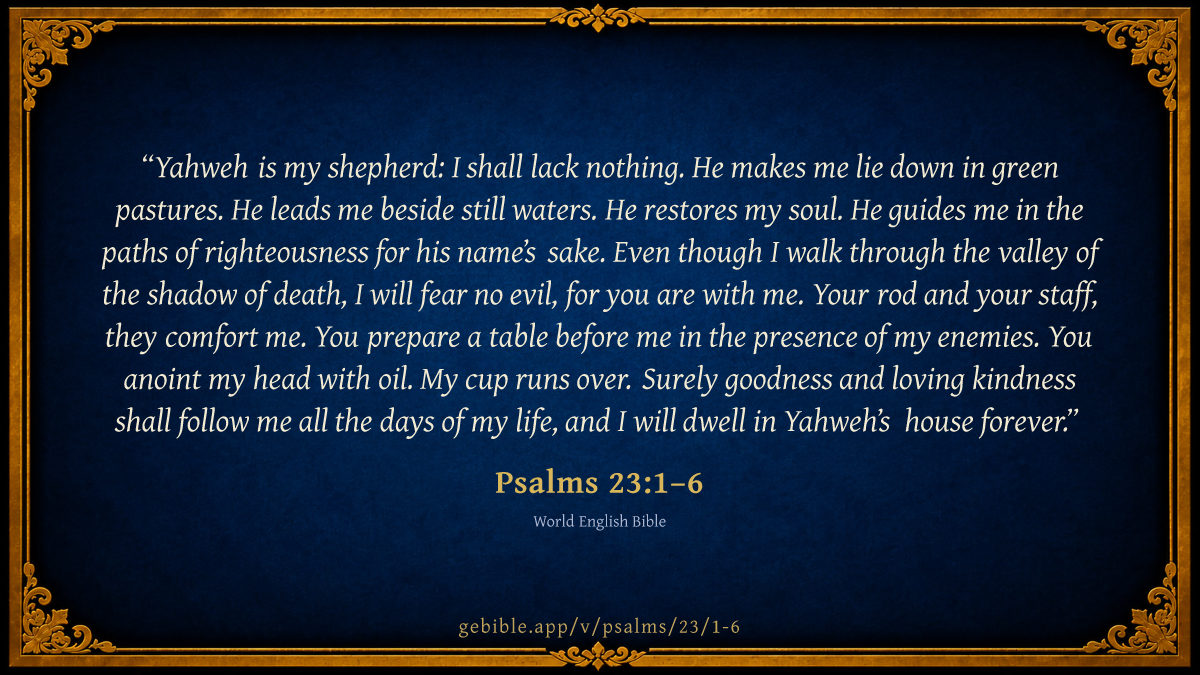
John Calvin 1540 · Public Domain On vv1–6 1. Jehovah is my shepherd. Although God, by his…
1. Jehovah is my shepherd. Although God, by his benefits, gently allures us to himself, as it were by a taste of his fatherly sweetness, yet there is nothing into which we more easily fall than into a forgetfulness of him, when we are in the enjoyment of peace and comfort. Yea, prosperity not only so intoxicates many, as to carry them beyond all bounds in their mirth, but it also engenders insolence, which makes them proudly rise up and break forth against God. Accordingly, there is scarcely a hundredth part of those who enjoy in abundance the good things of God, who keep themselves in his fear, and live in the exercise of humility and temperance, which would be so becoming. “Qui se contiene en la crainte de Dieu se selon la modestie et temperance qui seroit requise.” — Fr.
“Mais rememorant les benefices qu’il repoit de luy.” — Fr.
Read full note →
Under the similitude of a shepherd, he commends the care which God, in his providence, had exercised towards him. His language implies that God had no less care of him than a shepherd has of the sheep who are committed to his charge. God, in the Scripture, frequently takes to himself the name, and puts on the character of a shepherd, and this is no mean token of his tender love towards us. As this is a lowly and homely manner of speaking, He who does not disdain to stoop so low for our sake, must bear a singularly strong affection towards us. It is therefore wonderful, that when he invites us to himself with such gentleness and familiarity, we are not drawn or allured to him, that we may rest in safety and peace under his guardianship. But it should be observed, that God is a shepherd only to those who, touched with a sense of their own weakness and poverty, feel their need of his protection, and who willingly abide in his sheepfold, and surrender themselves to be governed by him. David, who excelled both in power and riches, nevertheless frankly confessed himself to be a poor sheep, that he might have God for his shepherd. Who is there, then, amongst us, who would exempt himself from this necessity, seeing our own weakness sufficiently shows that we are more than miserable if we do not live under the protection of this shepherd? We ought to bear in mind, that our happiness consists in this, that his hand is stretched forth to govern us, that we live under his shadow, and that his providence keeps watch and ward over our welfare. Although, therefore, we have abundance of all temporal good things, yet let us be assured that we cannot be truly happy unless God vouchsafe to reckon us among the number of his flock. Besides, we then only attribute to God the office of a Shepherd with due and rightful honor, when we are persuaded that his providence alone is sufficient to supply all our necessities. “Que sa seule providence est suffisante pour nous administrer toutes nos necessitez.” — Fr.
John Calvin's Commentaries (1540-1563) — public domain. Text from the Calvin Translation Society English edition (1840s-50s) via the Christian Classics Ethereal Library (ccel.org). Calvin's coverage is partial (roughly two-thirds of the Bible); uncommented books and verses are honest gaps, never fabricated. The 19th-century editor's footnotes and remarks are omitted so the notes are faithfully Calvin's own voice.
Geneva Bible translators 1599 · Public Domain On vv1, 3, 4, 5, 6 He hath care over me and ministereth unto me…
He hath care over me and ministereth unto me all things.
Geneva Bible (1599) marginal notes — public domain.
John Trapp 1656 · Public Domain On vv1–6 Psa 23:1 « A Psalm of David. » The…
Psa 23:1 « A Psalm of David. » The LORD [is] my shepherd; I shall not want.
Ver. 1. The Lord is my shepherd] This psalm may well be called David’s Bucolicon, or pastoral; so daintily hath he struck upon the whole string, through the whole hymn. Est Psalmus honorahilis, saith Aben Ezra; it is a noble psalm written and sung by David; not when he fled into the forest of Hareth, 1Sa 22:5, as some Hebrews will have it (R. Kimchi, R. Solom.); but when, as having overcome all his enemies and settled his kingdom, he enjoyed great peace and quiet, and had one foot as it were upon the battlements of heaven. The Jews at this day use for the most part to repeat this psalm after they are set down to meat (Leo. Modena). God is often in Scripture called the Shepherd of his people, Psa 80:1 Eze 34:12; Eze 34:14-15 Isa 40:11 Joh 10:11 1Pe 2:25, although non est ofiicium magis contemptibile quam opilionis, saith R. Jos. Bar. Haman, there is not a more contemptible office than that of a shepherd. Every shepherd was an abomination to the Egyptians. But God disdaineth not to feed his flock, to guide, to govern, to defend them, to handle and heal them, to tend and take care of them; and all this he hath tied himself by covenant to do, Eze 34:25 : well therefore might David confidently conclude,
Read full note →
I shall not want] Non deficiam, iudigebo, destituar. The wicked in the fulness of his sufficiency is in straits, Job 20:22. Tantalus-like, he is ever wanting; content he hath none. Contrarily, true piety brings true plenty, and a saint is never to seek of well contenting sufficiency, 1Ti 6:6, for to him, Parva seges satis est. A small crop is enough, And he saith,
Discite quam parvo liceat producers vitam,
Et quantum natura petat, &c.
(Lucan. Pharsi. l. 4).
John Trapp, A Commentary or Exposition upon All the Books of the Old and New Testament (1647–1656) — public domain. Text from a community e-Sword module.
Matthew Poole 1685 · Public Domain On vv1–6 He hath showed himself to be so by his…
He hath showed himself to be so by his gracious providences towards me and for me; and he hath taken upon him that office and relation to me by his entering into covenant with me, whereby he hath engaged himself to rule, and feed, and preserve, and heal me, and do all which shepherds do, or are obliged to do, to their flocks; which David very well understood, and had doubtless carefully performed his duty to his sheep; and therefore he strengthens his faith by this consideration, that God was his Shepherd; and as God was a much better Shepherd than he or any man could he, so he might confidently expect more than ordinary benefits from his conduct. I shall not want, to wit, any thing which is really necessary for me, either for this life or for the next. But foolish man may think many things to be necessary for him, which the all-wise God knoweth to be not only unnecessary, but hurtful, and therefore mercifully denies what men ignorantly desire to their hurt.
Matthew Poole's English Annotations on the Holy Bible (1683–1685) — public domain. Text from a community e-Sword/MySword module.
Matthew Henry 1710 · Public Domain On v1 From three very comfortable premises David, in this psalm,…
From three very comfortable premises David, in this psalm, draws three very comfortable conclusions, and teaches us to do so too. We are saved by hope, and that hope will not make us ashamed, because it is well grounded. It is the duty of Christians to encourage themselves in the Lord their God; and we are here directed to take that encouragement both from the relation wherein he stands to us and from the experience we have had of his goodness according to that relation.
I. From God's being his shepherd he infers that he shall not want anything that is good for him, Psa 23:1. See here, 1. The great care that God takes of believers. He is their shepherd, and they may call him so. Time was when David was himself a shepherd; he was taken from following the ewes great with young (Psa 78:70, Psa 78:71), and so he knew by experience the cares and tender affections of a good shepherd towards his flock. He remembered what need they had of a shepherd, and what a kindness it was to them to have one that was skilful and faithful; he once ventured his life to rescue a lamb. By this therefore he illustrates God's care of his people; and to this our Saviour seems to refer when he says, I am the shepherd of the sheep; the good shepherd, Joh 10:11. He that is the shepherd of Israel, of the whole church in general (Psa 80:1), is the shepherd of every particular believer; the meanest is not below his cognizance, Isa 40:11. He takes them into his fold, and then takes care of them, protects them, and provides for them, with more care and constancy than a shepherd can, that makes it his business to keep the flock. If God be as a shepherd to us, we must be as sheep, inoffensive, meek, and quiet, silent before the shearers, nay, and before the butcher too, useful and sociable; we must know the shepherd's voice, and follow him. 2. The great confidence which believers have in God: "If the Lord is my shepherd, my feeder, I may conclude I shall not want any thing that is really necessary and good for me." If David penned this psalm before his coming to the crown, though destined to it, he had as much reason to fear wanting as any man. Once he sent his men a begging for him to Nabal, and another time went himself a begging to Ahimelech; and yet, when he considers that God is his shepherd, he can boldly say, I shall not want. Let not those fear starving that are at God's finding and have him for their feeder. More is implied than is expressed, not only, I shall not want, but, "I shall be supplied with whatever I need; and, if I have not every thing I desire, I may conclude it is either not fit for me or not good for me or I shall have it in due time."
Read full note →
II. From his performing the office of a good shepherd to him he infers that he needs not fear any evil in the greatest dangers and difficulties he could be in, Psa 23:2-4. He experiences the benefit of God's presence with him and care of him now, and therefore expects the benefit of them when he most needs it. See here,
1. The comforts of a living saint. God is his shepherd and his God - a God all-sufficient to all intents and purposes. David found him so, and so have we. See the happiness of the saints as the sheep of God's pasture. (1.) They are well placed, well laid: He maketh me to lie down in green pastures. We have the supports and comforts of this life from God's good hand, our daily bread from him as our Father. The greatest abundance is but a dry pasture to a wicked man, who relishes that only in it which pleases the senses; but to a godly man, who tastes the goodness of God in all his enjoyments, and by faith relishes that, though he has but little of the world, it is a green pasture, Psa 37:16; Pro 15:16, Pro 15:17. God's ordinances are the green pastures in which food is provided for all believers; the word of life is the nourishment of the new man. It is milk for babes, pasture for sheep, never barren, never eaten bare, never parched, but always a green pasture for faith to feed in. God makes his saints to lie down; he gives them quiet and contentment in their own minds, what ever their lot is; their souls dwell at ease in him, and that makes every pasture green. Are we blessed with the green pastures of the ordinances? Let us not think it enough to pass through them, but let us lie down in them, abide in them; this is my rest for ever. It is by a constancy of the means of grace that the soul is fed. (2.) They are well guided, well led. The shepherd of Israel guides Joseph like a flock; and every believer is under the same guidance: He leadeth me beside the still waters. Those that feed on God's goodness must follow his direction; he leads them by his providence, by his word, by his Spirit, disposes of their affairs for the best, according to his counsel, disposes their affections and actions according to his command, directs their eye, their way, and their heart, into his love. The still waters by which he leads them yield them, not only a pleasant prospect, but many a cooling draught, many a reviving cordial, when they are thirsty and weary. God provides for his people not only food and rest, but refreshment also and pleasure. The consolations of God, the joys of the Holy Ghost, are these still waters, by which the saints are led, streams which flow from the fountain of living waters and make glad the city of our God. God leads his people, not to the standing waters which corrupt and gather filth, not to the troubled sea, nor to the rapid rolling floods, but to the silent purling waters; for the still but running waters agree best with those spirits that flow out towards God and yet do it silently. The divine guidance they are under is stripped of its metaphor (Psa 23:3): He leadeth me in the paths of righteousness, in the way of my duty; in that he instructs me by his word and directs me by conscience and providence. Theses are the paths in which all the saints desire to be led and kept, and never to turn aside out of them. And those only are led by the still waters of comfort that walk in the paths of righteousness. The way of duty is the truly pleasant way. It is the work of righteousness that is peace. In these paths we cannot walk unless God both lead us into them and lead us in them. (3.) They are well helped when any thing ails them: He restoreth my soul. [1.] "He restores me when I wander." No creature will lose itself sooner than a sheep, so apt is it to go astray, and then so unapt to find the way back. The best saints are sensible of their proneness to go astray like lost sheep (Psa 119:176); they miss their way, and turn aside into by-paths; but when God shows them their error, gives them repentance, and brings them back to their duty again, he restores the soul; and, if he did not do so, they would wander endlessly and be undone. When, after one sin, David's heart smote him, and, after another, Nathan was sent to tell him, Thou art the man, God restored his soul. Though God may suffer his people to fall into sin, he will not suffer them to lie still in it. [2.] "He recovers me when I am sick, and revives me when I am faint, and so restores the soul which was ready to depart." He is the Lord our God that heals us, Exo 15:26. Many a time we should have fainted unless we had believed; and it was the good shepherd that kept us from fainting.
2. See here the courage of a dying saint (Psa 23:4): "Having had such experience of God's goodness to me all my days, in six troubles and in seven, I will never distrust him, no, not in the last extremity; the rather because all he has done for me hitherto was not for any merit or desert of mine, but purely for his name's sake, in pursuance of his word, in performance of his promise, and for the glory of his own attributes and relations to his people. That name therefore shall still be my strong tower, and shall assure me that he who has led me, and fed me, all my life long, will not leave me at last." Here is,
(1.) Imminent danger supposed: "Though I walk through the valley of the shadow of death, that is, though I am in peril of death, though in the midst of dangers, deep as a valley, dark as a shadow, and dreadful as death itself," or rather, "though I am under the arrests of death, have received the sentence of death within myself, and have all the reason in the world to look upon myself as a dying man, yet I am easy." Those that are sick, those that are old, have reason to look upon themselves as in the valley of the shadow of death. Here is one word indeed which sounds terrible; it is death, which we must all count upon; there is no discharge in that war. But, even in the supposition of the distress, there are four words which lessen the terror: - It is death indeed that is before us; but, [1.] It is but the shadow of death; there is no substantial evil in it; the shadow of a serpent will not sting nor the shadow of a sword kill. [2.] It is the valley of the shadow, deep indeed, and dark, and dirty; but the valleys are fruitful, and so is death itself fruitful of comforts to God's people. [3.] It is but a walk in this valley, a gentle pleasant walk. The wicked are chased out of the world, and their souls are required; but the saints take a walk to another world as cheerfully as they take their leave of this. [4.] It is a walk through it; they shall not be lost in this valley, but get safely to the mountain of spices on the other side of it.
(2.) This danger made light of, and triumphed over, upon good grounds. Death is a king of terrors, but not to the sheep of Christ; they tremble at it no more than sheep do that are appointed for the slaughter. "Even in the valley of the shadow of death I will fear no evil. None of these things move me." Note, A child of God may meet the messengers of death, and receive its summons with a holy security and serenity of mind. The sucking child may play upon the hole of this asp; and the weaned child, that, through grace, is weaned from this world, may put his hand upon this cockatrice's den, bidding a holy defiance to death, as Paul, O death! where is thy sting? And there is ground enough for this confidence, [1.] Because there is no evil in it to a child of God; death cannot separate us from the love of God, and therefore it can do us no real harm; it kills the body, but cannot touch the soul. Why should it be dreadful when there is nothing in it hurtful? [2.] Because the saints have God's gracious presence with them in their dying moments; he is then at their right hand, and therefore why should they be moved? The good shepherd will not only conduct, but convoy, his sheep through the valley, where they are in danger of being set upon by the beasts of prey, the ravening wolves; he will not only convoy them, but comfort then when they most need comfort. His presence shall comfort them: Thou art with me. His word and Spirit shall comfort them - his rod and staff, alluding to the shepherd's crook, or the rod under which the sheep passed when they were counted (Lev 27:32), or the staff with which the shepherds drove away the dogs that would scatter or worry the sheep. It is a comfort to the saints, when they come to die, that God takes cognizance of them (he knows those that are his), that he will rebuke the enemy, that he will guide them with his rod and sustain them with his staff. The gospel is called the rod of Christ's strength (Psa 110:2), and there is enough in that to comfort the saints when they come to die, and underneath them are the everlasting arms.
III. From the good gifts of God's bounty to him now he infers the constancy and perpetuity of his mercy, Psa 23:5, Psa 23:6. Here we may observe,
1. How highly he magnifies God's gracious vouchsafements to him (Psa 23:5): "Thou preparest a table before me; thou hast provided for me all things pertaining both to life and godliness, all things requisite both for body and soul, for time and eternity:" such a bountiful benefactor is God to all his people; and it becomes them abundantly to utter his great goodness, as David here, who acknowledges, (1.) That he had food convenient, a table spread, a cup filled, meat for his hunger, drink for his thirst. (2.) That he had it carefully and readily provided for him. His table was not spread with any thing that came next to hand, but prepared, and prepared before him. (3.) That he was not stinted, was not straitened, but had abundance: "My cup runs over, enough for myself and my friends too." (4.) That he had not only for necessity, but for ornament and delight: Thou anointest my head with oil. Samuel anointed him king, which was a certain pledge of further favor; but this is rather an instance of the plenty with which God had blessed him, or an allusion to the extraordinary entertainment of special friends, whose heads they anointed with oil, Luk 7:46. Nay, some think he still looks upon himself as a sheep, but such a one as the poor man's ewe-lamb (Sa2 12:3), that did eat of his own meat, and drank of his own cup, and lay in his bosom; not only thus nobly, but thus tenderly, are the children of God looked after. Plentiful provision is made for their bodies, for their souls, for the life that now is and for that which is to come. If Providence do not bestow upon us thus plentifully for our natural life, it is our own fault if it be not made up to us in spiritual blessings.
2. How confidently he counts upon the continuance of God's favours, Psa 23:6. He had said (Psa 23:1), I shall not want; but now he speaks more positively, more comprehensively: Surely goodness and mercy shall follow me all the days of my life. His hope rises, and his faith is strengthened, by being exercised. Observe, (1.) What he promises himself - goodness and mercy, all the streams of mercy flowing from the fountain, pardoning mercy, protecting mercy, sustaining mercy, supplying mercy. (2.) The manner of the conveyance of it: It shall follow me, as the water out of the rock followed the camp of Israel through the wilderness; it shall follow into all places and all conditions, shall be always ready. (3.) The continuance of it: It shall follow me all my life long, even to the last; for whom God loves he loves to the end. (4.) The constancy of it: All the days of my life, as duly as the day comes; it shall be new every morning (Lam 3:22, Lam 3:23) like the manna that was given to the Israelites daily. (5.) The certainty of it: Surely it shall. It is as sure as the promise of the God of truth can make it; and we know whom we have believed. (6.) Here is a prospect of the perfection of bliss in the future state. So some take the latter clause: "Goodness and mercy having followed me all the days of my life on this earth, when that is ended I shall remove to a better world, to dwell in the house of the Lord for ever, in our Father's house above, where there are many mansions. With what I have I am pleased much; with what I hope for I am pleased more." All this, and heaven too! Then we serve a good Master.
3. How resolutely he determines to cleave to God and to his duty. We read the last clause as David's covenant with God: "I will dwell in the house of the Lord for ever (as long as I live), and I will praise him while I have any being." We must dwell in his house as servants, that desired to have their ears bored to the door-post, to serve him for ever. If God's goodness to us be like the morning light, which shines more and more to the perfect day, let not ours to him be like the morning cloud and the early dew that passeth away. Those that would be satisfied with the fatness of God's house must keep close to the duties of it.
Matthew Henry's Commentary on the Whole Bible (1708–1710) — public domain (CC PDM 1.0). Text via the HelloAO Bible API.
John Gill 1763 · Public Domain On vv1–6 The Lord is my shepherd,.... This is to be…
The Lord is my shepherd,.... This is to be understood not of Jehovah the Father, and of his feeding the people of Israel in the wilderness, as the Targum paraphrases it, though the character of a shepherd is sometimes given to him, Psa 77:20; but of Jehovah the Son, to whom it is most frequently ascribed, Gen 49:24. This office he was called and appointed to by his Father, and which through his condescending grace he undertook to execute, and for which he is abundantly qualified; being omniscient, and so knows all his sheep and their maladies, where to find them, what is their case, and what is to be done for them; and being omnipotent, he can do everything proper for them; and having all power in heaven and in earth, can protect, defend, and save them; and all the treasures of wisdom and knowledge being in him, he can guide and direct them in the best manner; wherefore he is called the great shepherd, and the chief shepherd, and the good shepherd. David calls him "my shepherd"; Christ having a right unto him, as he has to all the sheep of God, by virtue of his Father's gift, his own purchase, and the power of his grace; and as owning him as such, and yielding subjection to him, following him as the sheep of Christ do wheresoever he goes; and also as expressing his faith of interest in him, affection for him, and joy because of him: and from thence comfortably concludes,
I shall not want; not anything, as the Targum and Aben Ezra interpret it; not any temporal good thing, as none of Christ's sheep do, that he in his wisdom sees proper and convenient for them; nor any spiritual good things, since a fulness of them is in him, out of which all their wants are supplied; they cannot want food, for by him they go in and out and find pasture; in him their bread is given them, where they have enough and to spare, and their waters are sure unto them; nor clothing, for he is the Lord their righteousness, and they are clothed with the robe of his righteousness; nor rest, for he is their resting place, in whom they find rest for their souls, and are by him led to waters of rest, as in Psa 23:2, the words may be rendered, "I shall not fail", or "come short" (s); that is, of eternal glory and happiness; for Christ's sheep are in his hands, out of which none can pluck them, and therefore shall not perish, but have everlasting life, Joh 10:27.
Read full note →
(s) "non deficiam", Pagninus, Montanus.
John Gill's Exposition of the Whole Bible (1746–1763) — public domain (CC PDM 1.0). Text via the HelloAO Bible API.
John Wesley 1765 · Public Domain On vv1–5 David extolls the goodness of God as his shepherd,…
David extolls the goodness of God as his shepherd, and expresses his confidence in him, ver. 1-6. A psalm of David.
John Wesley, Explanatory Notes Upon the Whole Bible (1754–1765) — public domain. Text via the GEBible commentary corpus.
Adam Clarke 1810 · Public Domain On vv1–6 The Lord is the Pastor of his people; therefore…
PSALM XXIII
The Lord is the Pastor of his people; therefore it may be
Read full note →
inferred that they shall not want, 1.
How he guides, feeds, and protects them, 2, 3.
Even in the greatest dangers they may be confident of his
support, 4.
His abundant provision for them, 5.
The confidence they may have of his continual mercy, and their
eternal happiness, 6.
NOTES ON PSALM XXIII
There is nothing particular in the title; it is simply attributed to David; but as it appears to be a thanksgiving of the Israelites for their redemption from the Bablylonish captivity, it cannot with propriety be attributed to David. Some think it was written by David in his exile, which is not likely; others, that he penned it when he was finally delivered from the persecution of Saul. I rather incline to the opinion that it was written after the captivity. The Chaldee seems to suppose that it was written to celebrate the goodness of God to the Israelites in the desert. It is a truly beautiful Psalm. Supposing it to have been written after the captivity, we see,
1. The redeemed captives giving thanks to God for their liberty.
2. Acknowledging that God had brought back their lives from the grave.
3. They represent themselves in Judea as a flock in an excellent pasture.
4. They declare that from the dangers they have passed through, and from which God had delivered them, they can have no fear of any enemy.
5. They conclude, from what God has done for them, that his goodness and mercy shall follow them all their days. And,
6. That they shall no more be deprived of God's worship, but shall all their days have access to his temple.
Verse 1. The Lord is my shepherd] There are two allegories in this Psalm which are admirably well adapted to the purpose for which they are produced, and supported both with art and elegance. The first is that of a shepherd; the second, that of a great feast, set out by a host the most kind and the most liberal As a flock, they have the most excellent pasture; as guests, they have the most nutritive and abundant fare. God condescends to call himself the Shepherd of his people, and his followers are considered as a flock under his guidance and direction.
1. He leads them out and in, so that they find pasture and safety.
2. He knows where to feed them, and in the course of his grace and providence leads them in the way in which they should go.
3. He watches over them and keeps them from being destroyed by ravenous beasts.
4. If any have strayed, he brings them back.
5. He brings them to the shade in times of scorching heat; in times of persecution and affliction, he finds out an asylum for them.
6. He takes care that they shall lack no manner of thing that is good.
But who are his flock? All real penitents, all true believers; all who obediently follow his example, abstaining from every appearance of evil, and in a holy life and conversation showing forth the virtues of Him who called them from darkness into his marvellous light. "My sheep hear my voice, and follow me."
But who are not his flock! Neither the backslider in heart, nor the vile Antinomian, who thinks the more he sins, the more the grace of God shall be magnified in saving him; nor those who fondly suppose they are covered with the righteousness of Christ while living in sin; nor the crowd of the indifferent and the careless, nor the immense herd of Laodicean loiterers; nor the fiery bigots who would exclude all from heaven but themselves, and the party who believe as they do. These the Scripture resembles to swine, dogs, wandering stars, foxes, lions, wells without water, c., c. Let not any of these come forward to feed on this pasture, or take of the children's bread. Jesus Christ is the good Shepherd the Shepherd who, to save his flock, laid down his own life.
I shall not want.] How can they? He who is their Shepherd has all power in heaven and earth therefore he can protect them. The silver and gold are his, and the cattle on a thousand hills; and therefore he can sustain them. He has all that they need, and his heart is full of love to mankind; and therefore he will withhold from them no manner of thing that is good. The old Psalter both translates and paraphrases this clause well: Lord governs me, and nathing sal want to me. In stede of pastour thare he me sett. "The voice of a rightwis man: Lord Crist es my kyng, and for thi (therefore) nathyng sal me want: that es, in hym I sal be siker, and suffisand, for I hope in hymn gastly gude and endles. And he ledes me in stede of pastoure, that es, understandyng of his worde, and delyte in his luf. Qwar I am siker to be fild, thar in that stede (place) he sett me, to be nurysht til perfectioun." Who can say more, who need say less, than this?
Adam Clarke's Commentary on the Bible (1810–1826) — public domain. Text from a community e-Sword/MySword module.
Joseph Benson 1811 · Public Domain On vv1–6 Psa 23:1. The Lord is my shepherd — He…
Psa 23:1. The Lord is my shepherd — He hath showed himself to be so by his gracious providences toward me; and he hath kindly taken upon himself that office, and condescended to stand in that relation to me, having entered into covenant with me, and thereby engaged to rule, feed, and preserve, and heal me, and do all for me that shepherds do, or are under an obligation of doing for their flocks. David himself had been a shepherd, and, doubtless, well understood, and had carefully performed his duty, as such, to his flock. He knew by experience the cares and tender affections of a good shepherd toward his sheep, and was not unmindful what need they had of a shepherd, and what advantage it was to them to have one that was skilful and faithful. By this, therefore, he illustrates God’s care of his people, and by this he strengthens his own faith and confidence in him, and assists the faith and confidence of every pious reader. For he that is the Shepherd of Israel, of the whole church in general, Psa 80:1, is the shepherd of every particular believer; the meanest is not below his cognizance. He gathers even the lambs with his arm, Isa 40:11; nay, and carries them in his bosom. He takes them into the fold of his church, and then takes care of them: he protects and provides for them with more care and constancy than any shepherd can his sheep. If God be to us a shepherd, we must be to him as sheep, inoffensive, meek, and quiet, silent before the shearers; “nay,” says Henry, “before the butcher too;” useful and sociable, we must know the shepherd’s voice, and follow him. I shall not want — Namely, any thing that is really necessary for me, either for this life, or for the next. But foolish men may think many things to be necessary for them, which the all-wise God knows to be, not only unnecessary, but hurtful, and therefore mercifully denies what men ignorantly desire to their hurt.
Joseph Benson's Commentary on the Old and New Testaments (1811–1818) — public domain. Text from a community e-Sword module.
Albert Barnes 1834 · Public Domain On vv1–6 The Lord is my shepherd - Compare Gen 49:24,…
The Lord is my shepherd - Compare Gen 49:24, “From thence is the shepherd, the stone of Israel;” Psa 80:1, “Give ear, O Shepherd of Israel.” See also the notes at Joh 10:1-14. The comparison of the care which God extends over his people to that of a shepherd for his flock is one that would naturally occur to those who were accustomed to pastoral life. It would be natural that it should suggest itself to Jacob Gen 49:24, and to David, for both of them had been shepherds. David, in advanced years, would naturally remember the occupations of his early life; and the remembrance of the care of God over him would naturally recall the care which he had, in earlier years, extended over his flocks. The idea which the language suggests is that of tender care; protection; particular attention to the young and the feeble (compare Isa 40:11); and providing for their wants. All these things are found eminently in God in reference to his people.
I shall not want - This is the main idea in the psalm, and this idea is derived from the fact that God is a shepherd. The meaning is, that, as a shepherd, he would make all needful provision for his flock, and evince all proper care for it. The words shall not want, as applied to the psalmist, would embrace everything that could be a proper object of desire, whether temporal or spiritual; whether pertaining to the body or the soul; whether having reference to time or to eternity. There is no reason for supposing that David limited this to his temporal necessities, or to the present life, but the idea manifestly is that God would provide all that was needful for him always. Compare Psa 34:9, “There is no want to them that fear him.” This idea enters essentially into the conception of God as the shepherd of his people, that all their real wants shall be supplied.
Albert Barnes' Notes on the Bible (1834–1885) — public domain. Text from a community e-Sword/MySword module.
Lange's Commentary on the Holy Scriptures 1864 · Public Domain On v1 Psalms 23
Psalms 23
A Psalm of David
Read full note →
1 The Lord is my shepherd;
I shall not want.
2 He maketh me to lie down in green pastures:
He leadeth me beside the still waters.
3 He restoreth my soul:
He leadeth me in the paths of righteousness
For his name’s sake.
4 Yea, though I walk through the valley of the shadow of death,
I will fear no evil: for thou art with me;
Thy rod and thy staff they comfort me.
5 Thou preparest a table before me
In the presence of mine enemies:
Thou anointest my head with oil;
My cup runneth over.
6 Surely goodness and mercy shall follow me all the days of my life:
And I will dwell in the house of the Lord for ever.
EXEGETICAL AND CRITICAL
Its Contents and Origin.—Under the figures of the shepherd, Psa_23:1, and the host, Psa_23:5, which were familiar to all Israelites, which are connected with that of the guide, Psa_23:3, the Psalmist describes, in clear and flowing language corresponding throughout with his calm, confident, hopeful feelings, the comprehensive and more than sufficient care of God for him, who describes his present and future condition under the corresponding figures of member of the flock, Psa_23:2, wanderer, Psa_23:4, and guest, Psa_23:6. These figures are so natural to the national life, that we cannot conclude from them that David sung this Psalm, if not in the times of his shepherd life, at least in a time when the recollection of those days was still fresh (Tholuck), or that the feast contains a reference to the meal in the house of David’s father after he was anointed, 1 Samuel 16. (Muntinghe). But we have no more reason to look away from every historical reference and from every particular reason for the use of these figures, and since there is no evidence of a prophecy of Christ (many ancient interpreters), or that it was directly meant for the congregation, to suppose that it was a free expression of feelings rejoicing in God, whether of an unknown poet (Hupfeld), or David in the latter peaceful and prosperous period of his government (Calvin and most interpreters). For the enemies, Psa_23:5, seem not to belong to the past but to the present, and are mentioned in a connection, from which we may conclude that there was destitution, yet not a destitution among the enemies whilst the Israelites, under the Maccabean leaders besieged in the fortress at Jerusalem, had plenty (Olshausen), but with the Psalmist, who must certainly be regarded as remote from the house of God (Psa_23:6). If this is recognized likewise as a historical feature, it is easy to find the occasion for the preceding descriptions in a sojourn of the Psalmist in the wilderness, but not to think of an allegorical reference to the return of the people from exile (Kimchi), or a reference back to the Divine guidance of Israel from Egypt through the wilderness (Chald.), but to abide by David in accordance with tradition, and put this Psalm in the period of the rebellion of Absalom (Ruding., J. D. Mich., Ewald, Maurer, Delitzsch). Only we must not refer to 2Sa_18:26, for the tone and sentiment do not agree with it. But we may indeed think of 2Sa_17:27 sq., and compare with Psa_3:6; Psa_4:7. The resemblances to Pss. 27. and 63., are of an entirely different kind from those to Psa_25:21; Psa_37:4, as it is then too bold to refer to Jeremiah, on account of the style and the sentiment. Respecting the house of Jehovah vid. remarks upon Psa_5:7.
Str. I. Psa_23:1. My shepherd.—God is thus named already by Jacob, Gen_48:15; Gen_49:24. This figure is afterwards frequently used (Psa_80:1; Psa_78:52; Mic_7:14; Isa_63:13 sq.). It is likewise applied to theocratic rulers, Jer_3:15; Jer_23:1, and is used with reference to the Messiah, Isa_40:11; Ezekiel 34.; compare Zec_11:4 sq., and hence is applied to Jesus in the New Testament, Joh_10:1-16; Heb_13:20; 1Pe_2:25; 1Pe_5:4. In accordance with this the people are called His flock or the sheep of His pasture, Psa_74:1; Psa_79:13; Psa_95:7; Psa_100:3; Jer_23:1. The expressions which follow are taken from the life of the shepherd and correspond with the figure. The oasis of the wilderness is not merely a station of rest for the tired flocks at the time of the noonday heat (Son_1:7), but at the same time a place of refreshment by means of the green meadows and the waters, which are mentioned either as flowing quietly and therefore without danger in contrast to the wild mountain brooks and rushing streams (Calvin, Geier, De Wette, Hitzig [Alexander, Barnes]), or as the indispensable condition of refreshment for the pleasant resting-place where the flocks lie down for recreation (Sept., Stier, Hengst., Hupfeld [Perowne]).19 The imperfects are not to be regarded as futures (Hengst., et al.), or indeed as referring to the past (Sept., Chald.), but denote actions continuing and repeated in the present.
Str. II. Psa_23:3. He restoreth my soul.—This does not mean conversion (the ancient translations), but the refreshment of the soul under the figure of leading back him who was about to flee away, comp. Psa_19:7.—[He leadeth me.—The oriental shepherd does not drive the flock before him but goes before the flock and leads them, vid. Thomson’s The Land and the Book, p. 202 sq.; Smith’s Dict, of the Bible, Article, Shepherd.—C. A. B.].—In right paths.—In the figurative language of this Psalm it is evident that the “right paths” are not to be regarded as in similar passages, excluding the figure, as ways of righteousness (Hengst. [A. V.]) in the moral sense, or passing over the intermediate member, as ways of salvation (De Wette, Ewald, Hitzig), but as straight and even paths, excluding error and stumbling, direct and leading certainly to their end (most interpreters after the Rabbins), which are then really paths of righteousness and salvation.
Psa_23:4. Even when [A. V., Yea, though] = even then when.—The contrary of Psa_23:2 is supposed as an objective possibility; but only with reference to the external condition in life and circumstances threatening with peril of death.—Valley of the shadow of death.—In order to explain this figure De Wette cites from Morier’s second journey to Persia, p. Psa 179: “In the vicinity of Ispahan is a remarkable valley, barren, gloomy and destitute of water, which is called the valley of the angel of death.” [It is unnecessary to go beyond the Holy Land itself. The Psalmist refers to those deep wadies or wild and gloomy ravines, which abound in the mountains of Palestine, the rocky sides of which are filled with caves and caverns, the abodes of wild beasts of prey. It is often necessary for the shepherd to lead his flocks through these wadies and across these ravines, and it is always perilous even to the shepherd himself. There is no reference here to death itself, but to the peril of death go often experienced in life.—C. A. B.].—Thy rod and Thy staff, they comfort me.—The soul when thinking of the possible danger, is quieted and comforted by the assurance of the faithfulness of the Divine Shepherd. The shepherd not only leads the flock, but defends it, hence the mention of two staves; so likewise Zec_11:7, upon which an especial emphasis is put by the pronoun. It follows from this that this verse is not a general description of the rest of trust (De Wette, Hengst.), nor has a poetical and rhetorical fulness of meaning, nor indeed that one of the staves was given by the guide to the wanderer, the other retained by himself.20
Str. III. Psa_23:5. [Perowne: “God is even more than a shepherd who provides for the wants of his sheep. He is a King who lavishes His bounty in rich provision for His guests.” Although the figure of sheep and shepherd pass over into that of guest and host the ideas are the same, though in different forms. There is a beautiful correspondence throughout. As the sheep lie down satisfied with the rich provision of the shepherd, in the green pastures and by the refreshing waters, so the guest sits down satisfied with the rich provisions of the table of the Lord.—In the presence of mine enemies.—As the wild beasts surrounded the sheep in the gloomy wady and they were comforted by the shepherd’s rod, so the enemies surround the guest, and he is comforted by the table of the monarch. In the Orient the host was obligated not only to entertain the guest but to protect him from his enemies, and when once the meal of hospitality had been partaken all the power and strength of the host became assured to the guest. He was now safe and secure, and his enemies were powerless to injure him, for from this time forth he was the guest and friend of the host and would be protected and defended by him. Thus the idea is not of a hasty meal upon a battle-field, after which the fight was to be renewed, but of a calm and secure repose at the table of the host, with the assurance that all danger was past and the enemieswere no longer to be regarded or feared.—C. A. B.]
After that Thou hast anointed my head with oil.—Anointed, literally made fat, as a perfect subordinate to the imperfect, refers to the sprinkling of the beard, hair, etc., with sweet-smelling essences, which in ancient times preceded the festival meal, hence the figurative use, Psa_45:7; Psa_104:15.21—My cup runneth over.—The ancient translators have instead of this, drunkenness, which meaning, however, is admissible only in the Aramaic, but not in the Hebrew. The Sept. has connected the first words of the following verse with this clause and translated, ῶς κράτιστον.22
Psa_23:6. Only.—Instead of “only,” as Psa_39:6; Psa_39:12; Psa_139:11, it may be rendered, “yes!” as Psa_73:13; Psa_85:9; Gen_44:28. [The rendering of the A. V., “surely”, is better.—C. A. B.].—Happiness and grace will pursue me.—“Pursue” is used not only in the sense of follow or accompany (Olsh.). as an inversion of the usual figurative phrase used of men: pursue something sectari=aspire after (Hupfeld), but is used in contrast with the pursuit of the enemies. [His enemies had pursued him even to the presence of his host, henceforth grace and joy will pursue him and load him with blessings.—C. A. B.].—And returned shall I dwell in the house of Jehovah to length of days.—The closing word does not mean: lifelong (Hupfeld), but in contrast with the short affliction (Delitzsch), opens a prospect of an indefinitely long time, Psa_21:4, and indeed of communion with God and the enjoyment of His grace, Psalms 27., which is afforded by the use of the religious institutions of grace. Many ancient translations have, after the Sept., “my dwelling,” etc. They have likewise regarded the infinitive with the suffix as from yashab. So likewise Geier, Rosenm., De Wette, Hengst. But then we must read shibthî, as Psa_27:4. But our text has shabthî, which vocalization the Masoretic Punctators could only have fixed in accordance wish tradition. Now some have regarded this form after De Muis as a perfect of yashab, supposing that the first syllable has fallen away. But the possibility of such an aphæresis is disputed by Olsh. and Hupfeld as ungrammatical. The examples cited in its favor are explained by the former as mutilations of the text, and are regarded by Delitzsch partly as a corruption, as Jer_42:10, partly as only belonging to the vulgar tongue, as 2Sa_22:41. Hitzig, however, again appeals particularly to Jdg_19:11, together with Jer_42:10. In any case the matter is very doubtful, and therefore the derivation from shûb (=return) is preferable, yet it cannot be translated: I return to the house (Knapp, et al.), for it is followed by the preposition בְ and not אֵל and duration is expressed. This leads to the acceptance of a pregnant construction (Delitzsch). The idea of dwelling is not expressed in words, but is indicated as a consequence of the return, by the nature of the closing word, as already mentioned. The perfect with the vav consec. after the imperfect has likewise the meaning of a future. Misericordia Dei præcedit, comitatur et subsequitur nos (Augustine). [Alexander: “Dwelling in the house of Jehovah does not mean frequenting His sanctuary, but being a member of His household and an inmate of His family, enjoying His protection, holding communion with Him, and subsisting on His bounty.”—C. A. B.].23
DOCTRINAL AND ETHICAL
1. Every member of the congregation of God may appropriate in faith the promises which God has given to the people of the covenant, but he must likewise make earnest use of the privileges graciously bestowed upon the congregation, and have, hold, and confess the God of the covenant as his own God, in order to have in himself the evidence and experimental sense of the all-embracing and all-sufficient care of God, which is always comforting and refreshing in every circumstance of life. Comp. P. Gerhardt’s hymn which has grown out of this Psalm: Der Herr, der alter Enden.
2. He who would truly experience in himself that love, power, and faithfulness of God, whereby believers are called, sustained, preserved and entirely furnished in this world as a flock of the good shepherd, must likewise, in the constant sense of his need and weakness and at the same time in unshaken faith in the willingness and the power of God to help him, lay hold of for himself and use the means of grace and salvation prepared and offered to him; he must likewise truly let himself be led, refreshed, protected, cared for and saved by God, and meet the condescension of God with the resignation of himself to God. “Although this confidence in the care of God does not exclude provision for the body, yet we are to think chiefly of the supply of all our spiritual need, which comes down from above” (Umbreit).
3. Trust in God and resignation to His will is essentially facilitated by the fact that we have to do, not with an unknown and hidden God, but with the God of historical revelation, who has made known His name by His word and His works, and has declared therein what we have to think and expect of Him. On this fact we should base ourselves in the changeable fortunes which meet us in this world, and should hold fast to it amidst the changing feelings and dispositions of the heart: for that is “the golden art, to hold on to God’s word and promise, decide according to it and not according to the feelings of our hearts; thus help and consolation will surely follow and we shall not lack anything at all” (Luther).—“But now when God has revealed Himself as the Shepherd in the person of His only begotten Son, much more clearly and more gloriously than formerly to the fathers under the law, we do not sufficiently honor His keeping, unless we tread under foot all fear and danger by fixing our eyes upon Him” (Calvin).—“For David here prescribes one common rule for all Christians, that there is no other means or expedient on earth of escaping from all kinds of trouble, than for a man to cast all his cares on God, apprehend Him by His word of grace, hold fast to it and let it in no wise be taken from him. He who does this can be satisfied, whether it fares well with him or ill, whether he lives or dies, and can likewise finally endure, and must prosper in spite of all the devils, the world and misfortune” (Luther).
4. The best consolation in trouble is the certainty of the nearness of God, as this is the strongest reminder of our duty when successful. But we have these, not that “we may make of His benefits a ladder by which we may ever ascend nearer to Him” (Calvin), but we have them on the ground of His condescension to us, in virtue of His dwelling among us and in consequence of our reception into His house and to His table, where He has Himself prepared what serves for our sustenance and complete satisfaction, and where He likewise anoints those who partake of these blessings, good things and joys, that is, He festively prepares, distinguishes, and adorns them. This advances by many stages from the typical to the fulfilment, from the Old Testament to the New, from time into eternity. For a time is coming when wandering will cease and the shepherd as the host will not allow His guests again to leave His house. But first of all we must abide by this. “This presence of the Lord is not to be perceived with the five senses; faith alone sees it, which is sure of the fact, that the Lord is nearer to us than our own-selves” (Luther).
HOMILETICAL AND PRACTICAL
The glad spirit of a Christian in life and in death: 1) how it shows itself; 2) whence it springs; 3) whither it moves and leads.—The happiness of those who can confess: the Lord is my shepherd: 1) in what it consists; 2) how it is attained; 3) how it is preserved.—Who goes most successfully through the world? 1) The wanderer in God’s flock; 2) the guest at God’s table; 3) the child in God’s house.—He who lets himself be led by God will likewise be kept and provided for by God.—Even pious people are not spared the walk in the dark valley; but they have a threefold comfort: 1) that the Lord leads them in; 2) that the Lord remains with them; 3) that the Lord in time helps them out.—The certainty that the Lord is with us: 1) on what it is based; 2) what its effects; 3) what supports it.—We will attain that happiness and grace will step in the place of our persecutors when we resign ourselves entirely to the guidance, care and training of God with willing obedience, humble desire and hearty trust.
Starke: The ungodly man may call Jesus a shepherd, but not his shepherd, which is only for those who appropriate Him.—It often seems as if the little flock of Christ lacked many things in this world; yet these words of Christ must remain true for all time with respect, to spiritual things (Joh_10:11), and with respect to bodily things they may be satisfied with the loving provision of the Great Shepherd.—Believers find in the pastures of the Gospel not only complete satisfaction, but likewise gentle rest.—The many who do not experience refreshment of heart from the Gospel have only themselves to blame.—The ungodly grudge believers a piece of bread; their Good Shepherd, however, gives them not only this, but likewise the heavenly manna.—That which seems to be needful, pleasant and good, is not good unless it is a gift of the mercy of God (Jam_1:17).—It is well for him who has his portion in the house of his heavenly Father; there are many mansions there; but the most joyous thing is that their possession endures to all eternity.—Renschel: Christ carries the rod woe and the staff mild.
[Matth. Henry: If God be as a shepherd to us, we must be as sheep, inoffensive, meek and quiet, silent before the shearers, nay, and before the butcher too, useful and sociable; we must know the shepherd’s voice, and follow Him.—Let those not fear starving that are at God’s finding, and have Him for their feeder.—Those who would be satisfied with the fatness of God’s house must keep close to the duties of it.—F. W. Robertson: Beneath the burning skies and the clear starry nights of Palestine there grew up between the shepherd and his flock a union of attachment and tenderness. It is the country where at any moment sheep are liable to be swept away by some mountain torrent, or carried off by hill-robbers, or torn by wolves. At any moment their protector may have to save them by personal hazard. …And thus there grows up between the man and the dumb creatures he protects a kind of friendship. …You love those for whom you risk and they love you; therefore it is that, not as here where the flock is driven, the shepherd goes before and the sheep follow him. They follow in perfect trust, even though he should be leading them away from a green pasture, by a rocky road, to another pasture which they cannot yet see. He knows them all—their separate histories, their ailments, their characters. … Alone in those vast solitudes, with no human being near, the shepherd and the sheep feel a life in common. Differences disappear; the vast interval between the man and the brute, the single point of union is felt strongly. One is the love of the protector: the other the love of the grateful life; and so between lives so distant there is woven, by night and day, by summer suns and winter frosts, a living network of sympathy. The greater and the less mingle their being together: they feel each other. “The shepherd knows his sheep, and is known of them.”. Try to feel, by imagining what the lonely Syrian shepherd must feel towards the helpless things which are the companions of his daily life, for whose safety he stands in jeopardy every hour, and whose value is measurable to him not by price, but by his own jeopardy, and then we have reached some notion of the love which Jesus meant to represent, that eternal tenderness which bends over us—infinitely lower though we be in nature—and knows the name of each and the trials of each, and thinks for each with a separate solicitude, and gave itself for each with a sacrifice as special and a love as personal, as if in the whole world’s wilderness there were none other but that one.”—Spurgeon: Sweet and full are the doctrines of the Gospel; fit food for souls, as tender grass is natural nutriment for sheep.—These twin guardian angels (goodness and mercy) will always be with me at my back and my beck. Just as when great princes go abroad they must not go unattended, so it is with the believer. Goodness and mercy follow him always—the black days as well as the bright days, the days of fasting as well as the days of feasting, the dreary days of winter as well as the bright days of summer. Goodness supplies our needs and mercy blots out our sins.—C. A. B.]
Footnotes:
[19][It is better to translate this latter clause with Ewald and Hupfeld: To waters of refreshment He leadeth me. The idea is not of a flock grazing in a rich meadow land on the banks of a quiet stream, but that of a flock led by the shepherd to their resting-place and watering-place. In this place they lie down satisfied, in the midst of the richest abundance of pasture and refreshing water, all their wants being supplied. It is not necessary to think of a stream, since in the Orient flocks are fed from wells or fountains in troughs, Gen_29:10-11; Exo_2:16-21. Vid. Tristram, Natural History of the Bible, p. 142.—C. A. B.]
[20][The reference is still to the shepherd guide. The rod and staff are synonymes, expressing the twofold use of the crook in ruling and defending. The crook is essential to the shepherd’s business. He uses it as a walking stick in ascending and descending the mountains; he uses it to punish the rebellious and stubborn sheep. It has a curve on one end with which he catches the sheep by their hind legs and urges them on. It is likewise a weapon to beat the dogs and ward off the beasts of the wilderness. Then finally he uses it when he puts the sheep into the fold, causing them to pass under the rod as he tallies them off to see that none are missing. Thus the crook is the symbol of his power and authority, and at the same time of his love, care, and protection. When the flocks are led through the gloomy wadies they crowd close together, and the rod and staff in the shepherd’s hands reassures them and gives them a sense of comfort and security, though the wild beasts roar and growl about them.—C. A. B.]
[21][The entertainment was royal, the guest was received with the highest honors. Oil was used at the feasts of the wealthy to do honor to their guests. It was used to anoint the head as a symbol of the grace of God which the host would have his guest enjoy. It is not unusual at the present day n the Orient to sprinkle the guests with perfumes and to burn incense in the festival rooms, diffusing delightful odors. Vid. Lane’s Modern Egyptians, p. 203. Vid. Amo_6:6; also Luk_7:46, where Jesus contrasts the devotion of the woman with the neglect of the host who did not honor Him with the basin of water, the kiss of friendship and the anointing oil.—C. A. B.]
[22][For the meaning of the cup vid. Psa_16:5. It is full and satisfying and more than abundant. As the oil was the symbol of grace and favor, so the cup is the symbol of joy and gladness.—C. A. B.]
[23][Wordsworth: “David, the shepherd of Bethlehem, could speak from personal experience of what the shepherd feels for his sheep. He had led his flock through the dark defiles of the rocky fastnesses of Judah, which presented an image of the gloomy valley of the shadow of death, and he experienced in his exile the loving care of hospitable friends, like Barzillai, who spread for him a table in the wilderness, when he fled from Absalom his son (2Sa_17:27-29), and his eyes were raised upward from them and their affectionate care, to a loving contemplation of his home and Father in heaven.”—C. A. B.]
Lange's Commentary on the Holy Scriptures (Critical, Doctrinal, and Homiletical), ed. John Peter Lange, English translation edited by Philip Schaff (1864–1880) — public domain. Text from a community e-Sword module.
Robert Jamieson, A. R. Fausset & David Brown 1871 · Public Domain On vv2–5 green pastures--or, "pastures of tender grass," are mentioned, not…
green pastures--or, "pastures of tender grass," are mentioned, not in respect to food, but as places of cool and refreshing rest.
the still waters--are, literally, "waters of "stillness," whose quiet flow invites to repose. They are contrasted with boisterous streams on the one hand, and stagnant, offensive pools on the other.
Jamieson, Fausset & Brown — Commentary Critical and Explanatory on the Whole Bible (1871) — public domain (CC PDM 1.0). Text via the HelloAO Bible API.
Daniel D. Whedon 1874 · Public Domain On vv1–6 1. The Lord is my shepherd—One of the most…
1. The Lord is my shepherd—One of the most endearing and comprehensive titles known to an Asiatic nomad. Our Saviour enumerates the duties of a shepherd to be “feeding the little lambs,” “tending, or taking care of the flock,” and “feeding the sheep.” See notes on John 10 and Joh_21:15-17.
I shall not want—The shepherd anticipates and cares for every need. “The phrase comprehends not only a negation of penury, but an abundance of all things.”—Phillips.
Daniel D. Whedon (gen. ed.), Commentary on the Old and New Testaments (1874–1909) — public domain. Text from a community e-Sword module.
The Cambridge Bible for Schools and Colleges 1878 · Public Domain On vv1–6 1. The Lord is my shepherd] How natural a…
1. The Lord is my shepherd] How natural a figure in a pastoral country, and for the shepherd-king, if the Psalm is his! Jehovah is often spoken of as the Shepherd of Israel, and Israel as His flock, especially in the Psalms of Asaph. See Psa_74:1, Psa_77:20, Psa_78:52; Psa_78:70 ff.; Psa_79:13; Psa_80:1, and cp. Psa_95:7, Psa_100:3; Mic_7:14; and the exquisite description of Jehovah’s care for the returning exiles in Isa_40:11. Jacob speaks of “the God who shepherded me” (Gen_48:15, cp. Gen_49:24). The title of shepherd is also applied to rulers; and in particular to David (2Sa_5:2; 2Sa_7:7); and to the future king of whom David was a type (Mic_5:4; Eze_34:23); and so Christ appropriates it to Himself (Joh_10:1; cp. Heb_13:20; 1Pe_2:25).
I shall not want] The language, partly of experience in the present, partly of confidence for the future. So of Israel, looking back on the wandering in the wilderness, “thou hast lacked nothing” (Deu_2:7); and looking forward to the Land of Promise, “thou shalt not lack anything in it” (Deu_8:9). Cp. Psa_34:10; Psa_84:11.
The Cambridge Bible for Schools and Colleges (gen. ed. J. J. S. Perowne; Cambridge University Press, 1878–1918) — public domain. Text from a community e-Sword module.
Ellicott's Commentary for English Readers 1878 · Public Domain On vv1–6 (1) Shepherd.—This image, as applied to God, appears in…
(1) Shepherd.—This image, as applied to God, appears in Hebrew literature first (Gen_48:15; Gen_49:24) of his relation to the individual (comp. Psa_119:176); as the shepherd of His people the image is much more frequent (Psa_78:52; Psa_80:1; Isa_40:11; Isa_63:11; Ezekiel 34; Mic_7:14).
A Bible Commentary for English Readers, edited by Charles John Ellicott (1878–1897) — public domain. Text from a community e-Sword module.
The Pulpit Commentary 1880 · Public Domain On vv1–6 THIS little psalm is an idyll of great beauty,…
THIS little psalm is an idyll of great beauty, describing the peace and calm delight which dwell with one whose trust is wholly in God. David"s authorship, asserted in the title, is highly probable; but we cannot fix the poem to any special period in his lifetime; we can only say that he is beyond the days of boyhood, having already enemies (ver. 5), and that he has known what it is to be in danger of death (ver. 4). But, when he writes, he is experiencing a time of rest and refreshment (vers. 1-3), nay, of prosperity and abundance (ver. 5). His thoughts are happy thoughts he lacks nothing; he has no fear; God"s mercy and goodness are with him; and he feels assured that they will continue with him all the days of his life (ver. 6); he has but one desire for the future, viz. to dwell in the house of God i.e. in the presence of God, for ever.
The Lord is my Shepherd. This metaphor, so frequent in the later Scriptures, (Isa_40:11 Isa_49:9, 10 Jer_31:10 Eze_34:6-19 Joh_10:11-19, 26-28 Heb_13:20 1Pe_2:25 1Pe_5:4 Rev_7:17) is perhaps implied in Gen_48:15, but first appears, plainly and openly, in the Davidical psalms (see, besides the present passage, Psa_74:1 Psa_77:20 Psa_78:53 Psa_79:1-4 Psa_80:1 psalms which, if not David"s, belong to the time, and were written under the influence, of David). It is a metaphor specially consecrated to us by our Lord"s employment and endorsement of it. (Joh_10:11-16) I shall not want. The Prayer-book Version brings out the full sense, "Therefore can I lack nothing". (comp. Deu_2:7 Deu_8:9; and Mat_6:31-33)
Read full note →
Human experience and Divine inspiration.
"The Lord is my Shepherd." The few verses which compose this psalm would leave but a small blank on the page, if blotted out; but suppose all translations which have been made of them into all languages, all references to them in literature, all remembrance of them in human hearts, could be effaced, who can measure the blank, the void, the loss? To have written this short psalm is one of the highest honours ever put upon man. What libraries have these few lines survived? Yet they arc as fresh as if written yesterday. They make themselves at home in every language. They touch, inspire, comfort us. not as an echo from three thousand years ago, but as the voice of a living friend. The child, repeats them at his mother"s knee; the scholar expends on them his choicest learning; the plain Christian loves them for their simplicity as much as for their beauty; the Church lifts them to heaven in the many-voiced chorus; they fall like music on the sick man"s ear and heart; the dying Christian says, "That is my psalm" and cheers himself with its words of faith and courage as he enters the dark valley. Mere poetic beauty could not confer or explain this marvellous power. The secret of it is twofold. These words are the language
(1) of human experience, and
(2) of Divine inspiration.
I HUMAN EXPERIENCE. This is the utterance of weakness and of trust. In the Bible, as in the Person of our Saviour, the human and the Divine are found, not apart, but in closest union. God spake not merely by the lips or pens of the prophets, but by the men themselves. (2Pe_1:21) Were an angel to say, "The Lord is my Shepherd," this would bring no assurance to a frail, sinful human heart. A voice from heaven might declare, "The Lord is a Shepherd," or as promise, "The Lord is your Shepherd;" but only the voice of a brother man, weak and needy as ourselves, can speak this word, the key-note of the whole psalm, "my Shepherd." God could have given us a Bible written, like the tables of the Law, "with the finger of God;" but he has spoken through the minds and hearts and personal experience of men of like passions with ourselves, making their faith, penitence, sorrow, joy, prayer, thanksgiving, the mirror and pattern of our own. This is the voice of personal experience. David is better known to us than any Bible hero except St. Paul. This psalm leads back our thoughts to his youth; but it is no youthful composition it bears the stamp of deep experience. The young shepherd might have sung of the famous past, or of the glorious future; but the veteran king, looking back to his youth, sees in it a meaning he could not have seen then, and a light shining all along his path.
II INSPIRED WORDS. Sweet and deep as are these echoes from the depth of the past, they would never have reached us had they been no more than the words of a man, though a hero, a poet, a king; they arc the voice of God"s Spirit in him. Hence, with that continuity which is one principal note of the inspiration of Scripture, we find this image taken up again and again, especially in five passages of signal importance two in the Old Testament, three in the New.
1. In Ezekiel 34. God is seen as the Shepherd of his people the nation and Church of Israel. Hence the similitude passes on to the New Testament. Christ is the chief Shepherd, who employs under-shepherds to feed his flock. (Joh_21:15-17 1Pe_5:2-4)
2. In Psa_40:11 (as in the psalm) Christ"s tender care of individuals, even the youngest, is represented.
3 and 4. In Luk_15:3-7 and Joh_10:1-16 our Saviour appropriates this similitude to himself, as seeking and saving the lost, ruling and feeding each one who follows him, laying down his life for the flock, gathering "other sheep" into "one flock.
5 Rev_7:16, 17 we see the Divine Shepherd gathering his whole flock in the safety, rest, and joy of heaven.
CONCLUSION. Can you say, "The Lord is my Shepherd"? If not, the gospel has not yet fulfilled its mission in your heart and life. Observe, the warrant is not in yourself, but in your Saviour; not, "I am one of Christ"s flock," but, "He is my Shepherd." If you can say this, then you may fearlessly cast all your care on him, and finish the verse, "I shall not want.". (1Pe_5:7,mt 1Pe 6:25, 1Pe 6:26)
Vers. 1-4. "The Shepherd of Israel.
To a countryman of David, an ancient Israelite, the shepherd with his flock was no poetical figure, but a most familiar object. From Carmel to Gilead, from Hermon to the pastures of the wilderness of Paran, the green hills of Canaan were covered with flocks. On these same hills and plains the forefathers of the nation Abraham, Isaac, Israel had pitched their camps and fed their flocks, when as yet they could not call a rood of land their own. With us the shepherd"s trade is a very humble calling. The shepherd, though he may tend the sheep as faithfully as if they were his own, is a hired servant, "whose own the sheep are not." We must dismiss all such associations if we would understand either the poetry or the parables of Scripture. Abraham and his descendants were not the only wealthy chiefs who fed their own flocks and herds. In Homer"s poetry, princes and princesses are seen tending their flocks, and kings and rulers are called, as in Scripture, "shepherds of the people." Rightly understood, it is an image of as great dignity as tenderness by which the Lord is spoken of as "the Shepherd of Israel;" and each believer is encouraged to say, with David, "The Lord is my Shepherd.
I DIVINE OWNERSHIP. (Psa_100:3, Revised Version.) This is a sublime contemplation, full of comfort, but also of awe. "I belong to God." God is the only absolute Owner. "The earth;" etc. (Psa_24:1 Psa_95:5 Psa_115:16) We talk largely about our possessionsMy money, business, home; my time, labour, life." All well enough for he "giveth us all," etc. (1Ti_6:17) if only we never forget that all is his, that we belong to him. "Despotism q.d. absolute, unlimited, lordship is a word of terror and degradation among men, because of the cruel, selfish, tyrannical use men have made of it. Doubtful if there lives a man who could safely be trusted with it. But in Divine lordship is no shadow of terror, except for the wilfully, wickedly disobedient, no taint of degradation, no suggestion of tyranny or arbitrary caprice. It would be absurd to suppose there can be a right to do wrong with God any more than with man. God"s wisdom, love, righteousness, are a law to himself. That he is Lord of all is our safety, glory, joy. God must cease to be himself before he can inflict the lightest wrong on the weakest or unworthiest of his creatures.
II DIVINE GOODNESS, COMPASSION, TENDER AND WATCHFUL CARE. Religion, worthy of the name, cannot subsist on the bare relation of Creator and creature, any more than flowers and fruit on granite; it must be "rooted and grounded in love." The assurance that God cannot possibly inflict wrong might free us from the slavery of fear, which otherwise the thought of his absolute ownership might bring with it, but would not suffice to fill our life with Brightness and joy, our heart with trust and courage. To feel in any measure the force and beauty of the similitude, and get into sympathy, with the soul of the psalmist, we must get rid of all that is mean, hard, mercenary in our modern English notions, and dress our thoughts in the bright colours of Eastern life; we must see the shepherd opening the well-guarded fold and walking at the head of his own flock, calling now one, now another, by its name, while the sheep willingly follow, for they know and love their shepherd"s voice; see him in dewy morning choosing their pasture, at hot noon leading them to some tranquil pool or hidden well, ever on the watch; ready, like David, to do battle with lion, bear, or wolf, in their defence; rather laying down his life than leaving them to perish. (Joh_10:11) "The Lord is my Shepherd," etc. (vers. 1, 2). In vers. 3, 4 the spiritual meaning shines through the figure, as in vers. 5, 6 it is laid aside altogether; yet still the psalmist speaks of the "rod and staff." "Rod," the shepherd"s crook, the received emblem of authority, guidance, and discipline. "Staff," that on which one leans, emblem of Divine strength and support. (Only one word would be used of a real shepherd; the two are employed for the full spiritual meaning) All is not ease and brightness in the lives which God has in his wisest, tenderest care. Divine shepherding means more than green pastures and still waters; it sometimes means "the valley of the shadow of death." "Paths of righteousness" may be taken to include both the way of duty and the leading of God"s providence. In both, the right path must be, in the highest sense, the safe path, but it may be the path of deadly peril and anguish. (Psa_34:19) Oar blessed Lord"s own path led through Gethsemane to Calvary. "The valley of the shadow of death" must not be limited to mean only the actual approach and experience of death; it may stand for any crisis of danger, suffering, or weakness, bodily or spiritual Travellers tell of a desolate gorge near Ispahan, "the valley of the angel of death." Through such a ravine, trackless, waterless, gloomy with overhanging precipices, where in every cleft wild beasts or robbers may lurk, the psalmist imagines himself led. But the Divine Shepherd is with him: this forbids fear. In Bunyan"s glorious dream the valley is placed midway in Christian"s pilgrimage the image of fierce spiritual conflict. (Psa_18:5) The hardest trial that can befall the believer is, when tempted to doubt God"s goodness, to deem himself forsaken. The answer to all doubt is, "Thou art with me". (Isa_50:10) The same trials are not appointed for all God"s children. Faithful, whom martyrdom awaited in Vanity Fair, had sunshine all through the valley. But there is a point to which all paths converge. If we must not limit the figure, still less must we exclude that one application common to all, that experience in which we must he absolutely alone, unless we can say, "Thou art with me." Death. Here, again, experience wonderfully varies. To some the approach of death is a valley of sunshine, not shadow, or only such as falls from a summer cloud; to some, a momentary passage through before they know it; to some, dark and rough with long suffering; to a few (even real Christians), gloomy with spiritual conflict. Here, then, above all, we need (both for ourselves and others) that highest application of this comforting image taught by our Lord himself. (Joh_10:1-18, Joh_10:26-29)
III THE SAVIOUR"S CONSTANT PRESENCE AND REDEEMING GRACE. (comp. vers. 1, 2 with Joh_10:9 Joh_7:37) It is his to restore the soul, to reclaim the lost sheep, (Luk_15:3-7) raise the fallen, refresh the weak, to lead in the path of duty. (Joh_8:12) But especially in times of urgent need is his presence to Be claimed and felt. With Paul and his companions it was a veritable valley of the shadow of death, when "all hope... was taken away" (see Act_27:20, Act_27:23; again 2Ti_4:16, 2Ti_4:17). Above all, in the hour and moment of death he has passed through it; he has "the keys;" he alone can be with us. Gentle and tranquil often is the actual approach of death; weakness and unconsciousness prevent fear; but take away the gospel, take away Christ, and who in health and strength can calmly face death, and say, "I will fear no evil"? You may be an unbeliever. Suppose the gospel not true, it does not follow there is nothing beyond death. But the believer has a right to say this knows what is beyond. (Joh_14:2-4 Rev_7:15-17)
HOMILIES BY C. CLEMANCE Vers. 1-6. The good Shepherd and his flock.
This is one of the sweetest of all the psalms. That it was written by him who was raised from having care of a flock to be the king on Israel"s throne, there is no reason for doubting, spite of all that destructive critics may say. No amount of Hebrew scholarship can possibly let any one into the deep meaning of this psalm. No attainments in English literature will ever initiate any student into the mysteries of a mother"s love, and no attainments in Oriental learning will help any one to learn the secret of the Lord which is here disclosed. There is nothing to equal it in the sacred books of the East; for none but the Hebrews have ever had such a disclosure of God as that in which the writer of this psalm rejoices. Every clause in this psalm is suggestive enough to be the basis of a separate discourse; but in accordance with our plan in this section of the "Pulpit Commentary," we deal with it as a unity, indicating the wealth of material for perpetual use therein contained. We have presented to usFour aspects of the Shepherd-care of God.
I GOD"S SHEPHERD-CARE DISCLOSED IN REVELATION. For the Scripture doctrine of God"s relation to his people as their Shepherd, the student may with advantage study and compare the following: Psa_74:1 Psa_77:20 Psa_79:13 Psa_80:1 Psa_95:7 Psa_100:3 Psa_119:176 Isa_40:11 Isa_53:6 Jer_31:10 Jer_23:1-3 Eze 34 Mic_7:14 Zec_11:16 Zec_13:7 Mat_10:6 Mat_15:24 Mat_18:12 Luk_15:4-6 Joh_10:1-16, 26-29 21:16 Act_20:28 Heb_13:20 1Pe_2:25 1Pe_5:4. These passages summarize Bible teaching on this theme for us. We may set it forth under the following heads:
1. God is related to men as their Shepherd. A purely absolute Being out of relation does not exist. To whatever God has made he stands in the relation of Maker. And when he has made man in his own image, after his likeness, he stands to such a one in a relation corresponding thereto; and of the many names he bears to express that relation, few more tenderly illustrate his watchful care than this word "shepherd.
2. This relation is manifested in Jesus Christ. (Joh_10:1-16) He claims to be emphatically "the good Shepherd." The apostle speaks of him as "the Shepherd and Bishop of... souls.
3. As the Shepherd, Jesus came to seek and save the lost. His mission on earth was emphatically for this. He regards men as his wealth, in which he rejoices; and if they ace not under his loving care he misses them he is conscious of something lacking. (Luk_15:4-6)
4. He has risen and ascendent up on high as the great Shepherd of the sheep. (Heb_13:20)
5. He now appoints under-shepherds to care for the flock. (Act_20:28)
6. As the chief Shepherd, he will again appear. Then he will gather in and gather home all the flock. (1Pe_5:4)
7. Only as he gathers men to himself as their Shepherd, do they find safety and rest. (1Pe_2:25) Till then they are homeless wanderers, perpetually in danger of stumbling "over the dark mountains.
8. When men return to him they find all they need in his Shepherd-care. (Ps 23)
9. This Shepherd-care is for each as well as for all. Each one may say, He loved me, and gave himself up for me;" "The Lord is my Shepherd." Let us not forget to note the Shepherd"s individualizing care.
II GOD"S SHEPHERD-CARE EXERCISED IN ACT. The points of detail are set forth in this psalm with exquisite tenderness and beauty.
1. Repose. "He maketh me to lie down in green pastures." In such a restless age as this, there is no thought which a believer has greater need to appropriate than this. (see Mar_6:31) As physically we must find time for sleep, however severe the pressure of work, so spiritually we must find time for repose. And God"s gracious arrangements are planned with a view to this. "He maketh me," etc. The good Shepherd says, "I will give you rest." When he gets back the wandering sheep he lays it on his own shoulders (Greek, see Luk_15:5). The Master never expects his servants to be always on the stretch. He tells them to "rest awhile;" and if they are heedless of this kind monition, he will himself call them out of the rush into the hush of life. It would be well if some Christians thought more of rest in Christ; their work would be richer in quality even if less in quantity.
2. Refreshment. "Still waters;" literally, "waters of rest," or refreshment. The believer has no craving thirst: he can ever drink of the living stream, and therewith be refreshed. (see Joh_4:10 Rev_7:17) Dropping the figure, the truth here conveyed is that there shall be a constant supply of the grace of Christ, and of the Spirit of Christ. (cf. Joh_7:37-39)
3. Restoration. (Ver. 3) This may either mean renewing the strength when worn down, or bringing back after wandering. We need not omit either thought, though the latter seems principally intended.
4. Leadership. (Ver. 3) "Paths of righteousness," i.e. straight paths. This follows on the restoration. Having recalled him from "by-paths," the good Shepherd will lead him in the right way. The sheep can wander wide easily enough, but if they are to be kept in the right way that can be only through the Shepherd s care. God guides by
a. his Word;
b. his providence;
c. his Spirit.
Sometimes, indeed, the way may be dark, even as death itself; still it is the right way. (Psa_107:7 Ezr_8:21-23)
1. A living presence. "Thou art with me" (ver. 4). This means, "Thou art continually with me," not merely with me in the darkness, but with me always. The sunshine of the living presence of a Guide, Help, Friend, Saviour, is always on the believer"s path; and if the mingling of unbelief with faith did not dim the eyesight, he would always rejoice in it.
2. Discipline. (Ver. 4) The rod and staff are special emblems of the Shepherd"s care in tending and ruling the flock. The Shepherd chides us when we rove, and uses sometimes sharp measures ere he recalls us. And this comforts us! Even so. The disciplinary dealings of our God are among our greatest mercies.
3. Ample provision. (Ver. 5) The riches of God"s love and life are the provisions on which we feed, and on which souls can grow and thrive; and these supplies are ministered to the soul through the invisible channels of God"s grace, even while enemies prowl around. Yea, we are entertained as guests at the Father"s board. The anointing oil is the token of the right royal welcome which the Host delights to give! So rich, so abundant, are the mercies and joys which are vouchsafed, that our "cup runneth over"!
III THIS SHEPHERD-CARE OF GOD IS ACCEPTED, AND IN IT THE NEEDY ONE GLORIES. We can but hint.
1. Here is appropriation. "My Shepherd". (see Joh_10:11, Joh_10:27, Joh_10:28)
2. Here is satisfaction. "I shall not want.
3. Here is loyalty. The psalmist not only consents to but delights in this Divine care, and has no wish but to follow where the Shepherd leads.
4. Here is joy. This thought is (perhaps Intently, but really) in the expression, Thou art with me." The presence of God is life"s exceeding joy.
5. Here is fearlessness. "I will fear no evil." Not even the darkest shade can make him fear, for God is with him there.
6. Here is recognition of the infinite grace of the Shepherd. (Ver. 3) "For his Name"s sake." Not for our sakes, but for his own; having undertaken to be the Shepherd, he will for his own glory"s sake do all that a shepherd"s care demands.
IV THE SHEPHERD-CARE OF GOD IS CELEBRATED IN SONG. The song has a threefold significance.
1. It is a song of gratitude. "Goodness and mercy" mark every feature of the Divine treatment, and they will, to life"s end.
2. It is a song of hope. The psalmist looks forward, without a moment"s fear of the Shepherd ever leaving him (ver. 6).
3. It is a song and vow of consecration. "I will dwell in the house of the Lord for ever." To what extent David thought of a future state when he wrote these words, we cannot say. Yet his meaning is to some extent clear. The house of God was the place where God made his home and manifested himself to his people. (see Psa_132:13-16) And the writer says, "Where God makes his home, there shall be mine. He and I will never part company". (see Psa_61:4 Psa_48:14 Psa_73:24-26) It was not the house of God, but the God of the house, that was to be David"s home and the home of all the saintsfor ever and for ever!
There is a picture by Sir Noel Paten, which is a marvellous illustration of this psalm. It is entitled, "The Valley of the Shadow of Death." It is worthy of prolonged study. In the foreground is a dismal and dark valley, through which a blasting wind has swept, laying low alike the warrior and the king; the helmet of the one and the crown of the other lie useless on the ground. In the centre of the picture is the Lord Jesus, with a halo of glory over his head, a crown of thorns around his brow, and in one hand a shepherd"s staff. On the left is a young maiden, whose face bears traces of the terror she has felt in coming through the valley, and yet of radiant hope as she now sees the good Shepherd there. She grasps his hand; he holds hers; his feet stand on a gravestone, beneath which lie the remains of the fallen; but where the Shepherd sets his feet, the tombstone is luminous with the words, "Death is swallowed up in victory!" The very sight of that glorious picture weaned one from the vanities of the world, and drew her to Jesus; and in the case of "an old disciple" it completely abolished the fear of death! May we all, by faith, catch a glimpse of our Shepherd, and every fear will vanish quite away! C.
HOMILIES BY W. FORSYTH Vers. 1-6. The good Shepherd.
Dr. Arnold said that "amongst Christians, all looking upon the Scriptures as their rule of faith and life, there are particular passages which will most suit the wants of particular minds, and appear to them therefore full of an extraordinary measure of comfort and of wisdom." This is true. Most people have their favourite passages of Scripture. But it may be said of this psalm that it holds a peculiar position. It has for more than three thousand years been one of the most precious possessions of the Church. Jews and Christians alike hold it dear, and there are few, if they were asked, but would thankfully confess that of all the psalms, it was to them the sweetest and most precious. It is among the psalms what Daniel was, compared with other men, "greatly beloved." Why is this? Much, no doubt, depends upon association; but apart from this there are reasons, in the psalm itself, to account for the high place which it holds in all hearts. Three may be mentioned.
I BECAUSE IT BRINGS GOD BEFORE US IN SO ENDEARING A CHARACTER. He is here represented as a Shepherd and a Host. The better we understand what this meaneth, the more will our hearts go forth to him in love and trust. He is all, and in all. Yea, each of us may say, "He is mine.
II BECAUSE IT GIVES US SUCH A BEAUTIFUL PICTURE OF THE BLESSEDNESS OF GOD"S PEOPLE. They are the sheep of his pasture, and the guests of his table. Here in this world they are ever under his good and gentle keeping, and when they depart hence, it shall be to dwell in his house for ever. "The psalmist describes himself as one of Jehovah"s flock, safe under his care, absolved from all anxieties by the sense of his protection, and gaining from this confidence of safety the leisure to enjoy, without satiety, all the simple pleasures which make up life the freshness of the meadow, the coolness of the stream. It is the most complete picture of happiness that ever was or can be drawn. It represents that state of mind for which all alike sigh, and the want of which makes life a failure to most; it represents that heaven, which is everywhere, if we could but enter it, and yet almost nowhere, because so few of us can" ("Ecce Homo").
III BECAUSE IT IS ASSOCIATED SO CLOSELY WITH OUR RELIGIOUS LIFE. Though much of Scripture may be neglected, and almost unknown, this psalm is known and loved by all. We learnt it at our mother"s knee, and we have cherished it fondly ever since. To young and old, to the rich and poor, to the people of various lands and tongues, it is equally dear. At home and in the sanctuary it is in constant use. In the time of our joy it has been the vehicle of our gladness, and in days of darkness it has brought us comfort. When weary it gives us rest; when lonely it gives us company; when oppressed with sin and care it leads us to him who can restore our souls, and guide us safely through all difficulties and dangers, onward to the bright future. In itself it is exceedingly precious, but in the light of the gospel, and as interpreted by our dear Lord and Saviour, its value is infinitely enhanced. Jesus "the Good Shepherd" is here, and his sheep hear his voice, and follow him to glory, honour, and immortality. W.F.
Vers. 1-6. The power of reflection.
The psalmist looks back over his life, and sings with grateful heart of God"s love and care. We may use the psalm as bringing before us some of the changes and contrasts of life.
I YOUTH AND AGE. This psalm breathes the air of youth. It is the echo of the shepherd-life among the hills of Judah. But the psalmist was now old. Still, he cleaves to God. Happy are they who have sought God early, and whose days from youth to age are linked together by natural piety!
II HELPLESSNESS AND SECURITY. What creatures are, when left to themselves, more weak and silly than sheep? But under the shepherd"s care they are safe. So it is of the soul. Christ is the good Shepherd, and cares for his sheep. From first to last, and through all changes and dangers, they are safe under his loving guardianship.
III SORROW AND JOY. How sweet the picture of the flock feeding in "the green pastures," and by the "still waters"! But there is another scene brought before us the dark and terrible "valley of the shadow of death." So there are alternations in the Christian life. If there are lights, there are also shadows. If there are times of sweet rest and comfort, there are also times of struggling and of fear. Mark the order God does not at once call us to face the dark valley. It comes not at the beginning, but near the end of the Christian"s course. Christ"s disciples who have been with him in "the green pastures," and whose souls have been "restored," when they have fallen into sin, by his gracious discipline, are the better fitted for meeting with trial, and for treading with fearless step even the dark valley itself.
IV WANT AND SATISFACTION. Always there is want on our part, and always there is supply with God. He who has God, the Possessor of all things, has everything. God is not only our Shepherd, but our Host, and the supplies of his table never fail.
V TRANSITORINESS AND IMMORTALITY. All things here are fading. Sheep and shepherds pass away. Joys and sorrows come to an end. Our life is hut as a vapour. But we look to the things that are unseen and eternal. God"s two angels, "goodness and mercy," not only abide with us here, but will bring us to the everlasting habitation. We shall dwell in the house of the Lord for ever. W.F.
HOMILIES BY C. SHORT Vers. 1-4. God"s providential care.
"The Lord is my Shepherd; I shall not want" etc. God"s care and providence over man are denoted by the following things.
I HE GIVES REST TO THE WEARY. "Maketh me to lie down in green pastures." Man is a combatant; he has a fight to maintain, a work to do; and he shall have seasons to rest from his exhaustion. He is a pilgrim-traveller. He has rest from bodily toil. So also rest from spiritual work. But the rest is spiritual in its kind. Not mental inactivity. But a clearer perception of those grand truths which afford the truest relief from the distraction of the conflict. Composure amidst distractions. The blessed end we aim at, and the certain issue of it.
II HE RENEWS THE EXHAUSTED STRENGTH OF MAN. (Vers. 2, 3) Religious strength consists in the power to do and the power to suffer or courage and fortitude. This power to do to conquer sin in ourselves and in the world is strengthened by unshaken faith in Gods truth, and by the power of self-denial. These are God"s gifts, not by any direct act of his, but as the consequence of striving to do his will.
III GOD WILL AFFORD PROTECTION IN THE DARKEST AND MOST DIFFICULT TIMES. (Ver. 4) Death is not always dark or difficult to good men. But the general tendency is to view death as dark and evil, and to fear it on those accounts. Darkness creates a feeling of uncertainty and a desire for guidance. God has removed the uncertainty and affords us guidance. The evil of death is the sense of guilt. Christ gives us the victory over that evil by proclaiming the forgiveness of the Father, and the removal of our sin. All who submit to God"s guidance may claim him for their Shepherd. Jesus Christ fulfils the character of man"s true Shepherd. S.
The Pulpit Commentary (1880–1919), ed. H.D.M. Spence-Jones & Joseph S. Exell — public domain. Text from a community e-Sword module.
Charles H. Spurgeon 1885 · Public Domain On vv1–6 There is no inspired title to this psalm, and…
There is no inspired title to this psalm, and none is needed, for it records no special event, and needs no other key than that which every Christian may find in his own bosom. It is David's Heavenly Pastoral; a surpassing ode, which none of the daughters of music can excel. The clarion of war here gives place to the pipe of peace, and he who so lately bewailed the woes of the Shepherd tunefully rehearses the joys of the flock. Sitting under a spreading tree, with his flock around him, like Bunyan's shepherd boy in the Valley of Humiliation, we picture David singing this unrivalled pastoral with a heart as full of gladness as it could hold; or, if the psalm be the product of his after years, we are sure that his soul returned in contemplation to the lonely water brooks which rippled among the pastures of the wilderness, where in early days she had been wont to dwell. This is the pearl of psalms whose soft and pure radiance delights every eye; a pearl of which Helicon need not be ashamed, though Jordan claims it. Of this delightful song it may be affirmed that its piety and its poetry are equal, its sweetness and its spirituality are unsurpassed.
The position of this psalm is worthy of notice. It follows the twenty-second, which is peculiarly the Psalm of the Cross. There are no green pastures, no still waters on the other side of the twenty-second psalm. It is only after we have read, "My God, my God, why hast thou forsaken me?" that we come to "The Lord is my Shepherd." We must by experience know the value of blood shedding, and see the sword awakened against the Shepherd, before we shall be able truly to know the Sweetness of the good Shepherd's care.
Read full note →
It has been said that what the nightingale is among birds, that is this divine ode among the psalms, for it has sung sweetly in the ear of many a mourner in his night of weeping, and has bidden him hope for a morning of joy. I will venture to compare it also to the lark, which sings as it mounts, and mounts as it sings, until it is out of sight, and even then is not out of hearing. Note the last words of the psalm"I will dwell in the house of the Lord for ever; "these are celestial notes, more fitted for the eternal mansions than for these dwelling places below the clouds. Oh that we may enter into the spirit of the psalm as we read it, and then we shall experience the days of heaven upon the earth!
Ver. 1. The Lord is my shepherd. What condescension is this, that the infinite Lord assumes towards his people the office and character of a Shepherd! It should be the subject of grateful admiration that the great God allows himself to be compared to anything which will set forth his great love and care for his own people. David had himself been a keeper of sheep, and understood both the needs of the sheep and the many cares of a shepherd. He compares himself to a creature weak, defenceless, and foolish, and he takes God to be his Provider, Preserver, Director, and, indeed, his everything. No man has a right to consider himself the Lord's sheep unless his nature has been renewed for the scriptural description of unconverted men does not picture them as sheep, but as wolves or goats. A sheep is an object of property, not a wild animal; its owner sets great store by it, and frequently it is bought with a great price. It is well to know, as certainly David did, that we belong to the Lord. There is a noble tone of confidence about this sentence. There is no "if" nor "but", nor even "I hope so"; but he says, "The Lord is my shepherd." We must cultivate the spirit of assured dependence upon our heavenly Father. The sweetest word of the whole is that monosyllable, "My." He does not say, "The Lord is the shepherd of the world at large, and leadeth forth the multitude as his flock", but "The Lord is my shepherd; "if he be a Shepherd to no one else, he is a Shepherd to me; he cares for me, watches over me, and preserves me. The words are in the present tense. Whatever be the believer's position, he is even now under the pastoral care of Jehovah.
The next words are a sort of inference from the first statementthey are sententious and positiveI shall not want. I might want otherwise, but when the Lord is my Shepherd he is able to supply my needs, and he is certainly willing to do so, for his heart is full of love, and therefore "I shall not want." I shall not lack for temporal things. Does he not feed the ravens, and cause the lilies to grow? How, then, can he leave his children to starve? I shall not want for spirituals, I know that his grace will be sufficient for me. Resting in him he will say to me, "As thy day so shall thy strength be." I may not possess all that I wish for, but "I shall not want." Others, far wealthier and wiser than I, may want, but "I shall not." "The young lions do lack, and suffer hunger: but they that seek the Lord shall not want any good thing." It is not only "I do not want, "but "I shall not want." Come what may, if famine should devastate the land, or calamity destroy the city, "I shall not want." Old age with its feebleness shall not bring me any lack, and even death with its gloom shall not find me destitute. I have all things and abound; not because I have a good store of money in the bank, not because I have skill and wit with which to win my bread, but because "The Lord is my shepherd." The wicked always want, but the righteous never; a sinner's heart is far from satisfaction, but a gracious spirit dwells in the palace of content.
Whole Psalm. David has left no sweeter Psalm than the short twenty-third (Ps 23:1-6). It is but a moment's opening of his soul; but, as when one, walking the winter street sees the door opened for some one to enter, and the red light streams a moment forth, and the forms of gay children are running to greet the comer, and genial music sounds, though the door shuts and leaves the night black, yet it cannot shut back again all that the eyes, the ear, the heart, and the imagination have seenso in this Psalm, though it is but a moment's opening of the soul, are emitted truths of peace and consolation that will never be absent from the world. The twenty-third Psalm is the nightingale of the Psalms. It is small, of a homely feather, singing shyly out of obscurity; but, oh! it has filled the air of the whole world with melodious joy, greater than the heart can conceive. Blessed be the day on which that Psalm was born! What would you say of a pilgrim commissioned of God to travel up and down the earth singing a strange melody, which, when one heard, caused him to forget whatever sorrows he had? And so the singing angel goes on his way through all lands, singing in the language of every nation, driving away trouble by the pulses of the air which his tongue moves with divine power. Behold just such an one! This pilgrim God has sent to speak in every language on the globe. It has charmed more griefs to rest than all the philosophy of the world. It has remanded to their dungeon more felon thoughts, more black doubts, more thieving sorrows, than there are sands on the seashore. It has comforted the noble host of the poor. It has sung courage to the army of the disappointed. It has poured balm and consolation into the heart of the sick, of captives in dungeons, of widows in their pinching griefs, of orphans in their loneliness. Dying soldiers have died easier as it was read to them; ghastly hospitals have been illuminated; it has visited the prisoner, and broken his chains, and, like Peter's angel, led him forth in imagination, and sung him back to his home again. It has made the dying Christian slave freer than his master, and consoled those whom, dying, he left behind mourning, not so much that he was gone, as because they were left behind, and could not go too. Nor is its work done. It will go singing to your children and my children, and to their children, through all the generations of time; nor will it fold its wings till the last pilgrim is safe, and time ended; and then it shall fly back to the bosom of God, whence it issued, and sound on, mingled with all those sounds of celestial joy which make heaven musical for ever. Henry Ward Beecher, in "Life Thoughts."
Whole Psalm. This Psalm may well be called David's bucolicon, or pastoral, so daintily hath he struck upon the whole string, through the whole hymn. Est Psalmis honorabilis, saith Aben-ezra; it is a noble Psalm, written and sung by David, not when he fled into the forest of Hareth (1Sa 22:5), as some Hebrews will have it; but when as having overcome all his enemies, and settled his kingdom, he enjoyed great peace and quiet, and had one foot, as it were, upon the battlements of heaven. The Jews at this day use for most part to repeat this Psalm after they are sat down to meat. John Trapp.
Whole Psalm. Augustine is said to have beheld, in a dream, the one hundred and nineteenth Psalm rising before him as a tree of life in the midst of the paradise of God. This twenty-third may be compared to the fairest flowers that grew around it. The former has even been likened to the sun amidst the starssurely this is like the richest of the constellations, even the Pleiades themselves! John Stoughton, in "The Songs of Christ's Flock", 1860.
Whole Psalm. Some pious souls are troubled because they cannot at all times, or often, use, in its joyous import, the language of this Psalm. Such should remember that David, though he lived long, never wrote but one twenty-third Psalm. Some of his odes do indeed express as lively a faith as this, and faith can walk in darkness. But where else do we find a whole Psalm expressive of personal confidence, joy, and triumph, from beginning to end? God's people have their seasons of darkness and their times of rejoicing. William S. Plumer.
Ver. 1. The Lord is my shepherd; I shall not want. Let them say that will, "My lands shall keep me, I shall have no want, my merchandise shall be my help, I shall have no want; "let the soldier trust unto his weapons, and the husbandman unto his labour; let the artificer say unto his art, and the tradesman unto his trade, and the scholar unto his books, "These shall maintain me, I shall not want." Let us say with the church, as we both say and sing, "The Lord is my keeper, I shall not want." He that can truly say so, condemns the rest, and he that desires more than God, cannot truly say, the Lord is his, the Lord is this shepherd, governor and commander, and therefore I shall not want. John Hull, B.D., in "Lectures on Lamentations", 1617.
Ver. 1. The Lord is my shepherd; I want nothing: thus it may be equally well rendered, though in our version it is in the future tense. J. R. Macduff, D.D., in "The Shepherd and his Flock", 1866.
Ver. 1. The Lord is my shepherd. We may learn in general from the metaphor, that it is the property of a gracious heart to draw some spiritual use or other from his former condition. David himself having sometimes been a shepherd, as himself confesseth when he saith, "he took David from the sheepfold from following the sheep, "etc., himself having been a shepherd, he beholds the Lord the same to him. Whatsoever David was to his flockwatchful over them, careful to defend them from the lion and the bear, and whatsoever thing else might annoy them, careful of their pasturage and watering, etc., the same and much more he beholds the Lord to himself. So Paul: "I was a persecutor, and an oppressor: but the Lord had mercy on me." This we may see in good old Jacob: "With this staff, "saith he, "I passed over Jordan; "and that now God had blessed him and multiplied him exceedingly. The doctrine is plain; the reasons are, first, because true grace makes no object amiss to gather some gracious instruction: it skills not what the object be, so that the heart be gracious; for that never wants matter to work upon. And secondly, it must needs be so, for such are guided by God's Spirit, and therefore are directed to a spiritual use of all things. Samuel Smith's "Chiefe Shepheard", 1625.
Ver. 1. Shepherd. May this sweet title persuade Japhet to dwell in the tents of Shem: my meaning is, that those who as yet never knew what it was to be enfolded in the bosom of Jesus, who as yet were never lambs nor ewes in Christ's fold, consider the sweetness of this Shepherd, and come in to him. Satan deals seemingly sweet, that he may draw you into sin, but in the end he will be really bitter to you. Christ, indeed, is seemingly bitter to keep you from sin, hedging up your way with thorns. But he will be really sweet if you come into his flock, even notwithstanding your sins. Thou lookest into Christ's fold, and thou seest it hedged and fenced all about to keep you in from sin, and this keeps thee from entering; but, oh! let it not. Christ, indeed, is unwilling that any of his should wander, and if they be unwilling too, it's well. And if they wander he will fetch them in, it may be with his shepherd's dog (some affliction); but he will not be, as we say, dogged himself. No, he is and will be sweet. It may be, Satan smiles, and is pleasant to you while you sin; but know, he will be bitter in the end. He that sings serene like now, will devour lion like at last. He will torment you and vex you, and be burning and bitterness to you. O come in therefore to Jesus Christ; let him be now the shepherd of thy soul. And know then, he will be sweet in endeavouring to keep thee from sin before thou commit it; and he will be sweet in delivering thee from sin after thou hast committed it. O that this thoughtthat Jesus Christ is sweet in his carriage unto all his members, unto all his flock, especially the sinning ones, might persuade the hearts of some sinners to come in unto his fold. John Durant, 1652.
Ver. 1. (first clause). Feedeth me, or is my feeder, my pastor. The word comprehends all duties of a good herd, as together feeding, guiding, governing, and defending his flock. Henry Ainsworth.
Ver. 1. The Lord is my shepherd. Now the reasons of this resemblance I take to be these: First, one property of a good shepherd is, skill to know and judge aright of his sheep, and hence is it that it is a usual thing to set mark upon sheep, to the end that if they go astray (as of all creatures they are most subject to wander), the shepherd may seek them up and bring them home again. The same thing is affirmed of Christ, or rather indeed Christ affirms the same thing of himself, "I know them, and they follow me." Joh 10:27. Yea, doubtless, he that hath numbered the stars, and calleth them all by their names, yea, the very hairs of our head, taketh special notice of his own children, "the sheep of his pasture", that they may be provided for and protected from all danger. Secondly, a good shepherd must have skill in the pasturing of his sheep, and in bringing them into such fruitful ground, as they may battle and thrive upon: a good shepherd will not suffer his sheep to feed upon rotten soil, but in wholesome pastures... Thirdly, a good shepherd, knowing the straying nature of his sheep, is so much the more diligent to watch over them, and if at any time they go astray, he brings them back again. This is the Lord's merciful dealing towards poor wandering souls... Fourthly, a good shepherd must have will to feed his sheep according to his skill: the Lord of all others is most willing to provide for his sheep. How earnest is Christ with Peter, to "feed his sheep, "urging him unto it three several times! Fifthly, a good shepherd is provided to defend his flock... The Lord is every way provided for the safety and defence of his sheep, as David confesseth in Ps 23:4, Thy rod and thy staff they comfort me. And again, "I took unto me two staves" (saith the Lord), "the one I called Beauty, and the other I called Bands; and I fed the flock." Zec 11:7. Sixthly, it is the property of a good shepherd, that if any of his sheep be weak and feeble, or his lambs young, for their safety and recovery he will bear them in his arms. The Lord is not wanting to us herein. Isa 40:11. And lastly, it is the property of a good shepherd to rejoice when the strayed sheep is brought home. The Lord doth thus rejoice at the conversion of a sinner. Lu 15:7. Samuel Smith.
Ver. 1. The Lord is my shepherd. I notice that some of the flock keep near the shepherd, and follow whithersoever he goes without the least hesitation, while others stray about on either side, or loiter far behind; and he often turns round and scolds them in a sharp, stern cry, or sends a stone after them. I saw him lame one just now. Not altogether unlike the good Shepherd. Indeed I never ride over these hills, clothed with flocks, without meditating upon this delightful theme. Our Saviour says that the good shepherd, when he putteth forth his own sheep, goeth before them, and they follow. Joh 10:4. This is true to the letter. They are so tame and so trained that they follow their keeper with the utmost docility. He leads them forth from the fold, or from their houses in the villages, just where he pleases. As there are many flocks in such a place as this, each one takes a different path, and it is his business to find pasture for them. It is necessary, therefore, that they should be taught to follow, and not to stray away into the unfenced fields of corn which lie so temptingly on either side. Any one that thus wanders is sure to get into trouble. The shepherd calls sharply from time to time to remind them of his presence. They know his voice, and follow on; but, if a stranger call, they stop short, lift up their heads in alarm, and, if it is repeated, they turn and flee, because they know not the voice of a stranger. This is not the fanciful costume of a parable, it is simple fact. I have made the experiment repeatedly. The shepherd goes before, not merely to point out the way, but to see that it is practicable and safe. He is armed in order to defend his charge, and in this he is very courageous. Many adventures with wild beasts occur, not unlike that recounted by David (1Sa 17:34-36), and in these very mountains; for though there are now no lions here, there are wolves in abundance; and leopards and panthers, exceeding fierce, prowl about the wild wadies. They not infrequently attack the flock in the very presence of the shepherd, and he must be ready to do battle at a moment's warning. I have listened with intense interest to their graphic descriptions of downright and desperate fights with these savage beasts. And when the thief and the robber come (and come they do), the faithful shepherd has often to put his life in his hand to defend his flock. I have known more than one case in which he had literally to lay it down in the contest. A poor faithful fellow last spring, between Tiberias and Tabor, instead of fleeing, actually fought three Bedouin robbers until he was hacked to pieces with their khanjars, and died among the sheep he was defending. Some sheep always keep near the shepherd, and are his special favourites. Each of them has a name, to which it answers joyfully, and the kind shepherd is ever distributing to such, choice portions which he gathers for that purpose. These are the contented and happy ones. They are in no danger of getting lost or into mischief, nor do wild beasts or thieves come near them. The great body, however, are mere worldlings, intent upon their mere pleasures or selfish interests. They run from bush to bush, searching for variety or delicacies, and only now and then lift their heads to see where the shepherd is, or, rather where the general flock is, lest they get so far away as to occasion a remark in their little community, or rebuke from their keeper. Others, again, are restless and discontented, jumping into everybody's field, climbing into bushes, and even into leaning trees, whence they often fall and break their limbs. These cost the good shepherd incessant trouble. W. M. Thomson, D.D., in "The Land and the Book."
Ver. 1. Shepherd. As we sat the silent hill sides around us were in a moment filled with life and sound. The shepherds led their flocks forth from the gates of the city. They were in full view, and we watched them and listened to them with no little interest. Thousands of sheep and goats were there, grouped in dense, confused masses. The shepherds stood together until all came out. Then they separated, each shepherd taking a different path, and uttering as he advanced a shrill peculiar call. The sheep heard them. At first the masses swayed and moved, as if shaken by some internal convulsion; then points struck out in the direction taken by the shepherds; these became longer and longer until the confused masses were resolved into long, living streams, flowing after their leaders. Such a sight was not new to me, still it had lost none of its interest. It was perhaps one of the most vivid illustrations which human eyes could witness of that beautiful discourse of our Lord recorded by John, "And the sheep hear the shepherd's voice: and he calleth his own sheep by name, and leadeth them out. And when he putteth forth his own sheep, he goeth before them, and the sheep follow him: for they know his voice. And a stranger will they not follow, but will flee from him: for they know not the voice of strangers", Joh 10:3-5. The shepherds themselves had none of that peaceful and placid aspect which is generally associated with pastoral life and habits. They looked more like warriors marching to the battle-fielda long gun slung from the shoulder, a dagger and heavy pistols in the belt, a light battle axe or iron headed club in the hand. Such were the equipments; and their fierce flashing eyes and scowling countenances showed but too plainly that they were prepared to use their weapons at any moment. J. L. Porter, A.M., in "The Giant Cities of Bashan", 1867.
Ver. 1. I shall not want. You must distinguish between absence, and between indigence. Absence is when something is not present; indigence or want, is when a needful good is not present. If a man were to walk, and had not a staff, here were something absent. If a man were to walk, and had but one leg, here were something whereof he were indigent. It is confessed that there are many good things which are absent from a good person, but no good thing which he wants or is indigent of. If the good be absent and I need it not, this is no want; he that walks without his cloak, walks well enough, for he needs it not. As long as I can walk carefully and cheerfully in my general or particular calling, though I have not such a load of accessories as other men have, yet I want nothing, for my little is enough and serves the turn...Our corruptions are still craving, and they are always inordinate, they can find more wants than God needs to supply. As they say of fools, they can propose more questions than twenty wise men need to answer. They in Jas 4:3, did ask, but received not; and he gives two reasons for it: 1. This asking was but a lusting: "ye lust and have not" (Ps 23:4): another, they did ask to consume it upon their lusts (Ps 23:3). God will see that his people shall not want; but withal, he will never engage himself to the satisfying of their corruptions, though he doth to the supply of their conditions. It is one thing what the sick man wants, another what his disease wants. Your ignorance, your discontents, your pride, your unthankful hearts, may make you to believe that you dwell in a barren land, far from mercies (as melancholy makes a person to imagine that he is drowning, or killing, etc.); whereas if God did open your eyes as he did Hagar's, you might see fountains and streams, mercies and blessings sufficient; though not many, yet enough, though not so rich, yet proper, and every way convenient for your good and comfort; and thus you have the genuine sense, so far as I can judge of David's assertion, I shall not want.
Obadiah Sedgwick.
Ver. 1. I shall not want. Only he that can want does not want; and he that cannot, does. You tell me that a godly man wants these and these things, which the wicked man hath; but I tell you he can no more be said to "want" them than a butcher may be said to want Homer, or such another thing, because his disposition is such, that he makes no use of those things which you usually mean. It is but only necessary things that he cares for, and those are not many. But one thing is necessary, and that he hath chosen, namely, the better part. And therefore if he have nothing at all of all other things, he does not want, neither is there anything wanting which might make him rich enough, or by absence whereof, his riches should be said to be deficient. A body is not maimed unless it have lost a principal part: only privative defects discommend a thing, and not those that are negative. When we say, there is nothing wanting to such and such a creature or thing that a man hath made, we mean that it hath all that belongs necessarily to it. We speak not of such things as may be added for compliments or ornaments or the like, such as are those things usually wherein wicked men excel the godly. Even so it is when we say that a godly man wanteth nothing. For though in regard of unnecessary goods he be "as having nothing", yet in regard of others he is as if he possessed all things. He wants nothing that is necessary either for his glorifying of God (being able to do that best in and by his afflictions), or for God's glorifying of him, and making him happy, having God himself for his portion and supply of his wants, who is abundantly sufficient at all times, for all persons, in all conditions. Zachary Bogan.
Note continued on See Psalms on "Job 42:9".
Psalms 23:2*
Ver. 1-4. See Psalms on "Ps 23:1" for further information.
Ver. 1-4. See Psalms on "Ps 23:1" for further information.
Ver. 1-4. See Psalms on "Ps 23:1" for further information.
Charles H. Spurgeon's The Treasury of David (1869–1885) — public domain. Psalms only. Text from a community e-Sword/MySword module.
The Biblical Illustrator 1887 · Public Domain On vv1–6 The Lord is my Shepherd.
Psa_23:1-6
The Lord is my Shepherd.
Read full note →
Exegesis of the Psalm
This Psalm, so personal and tender in its tone, may be called a lyric; and its reference to shepherd life makes it a pastoral; and being such, it becomes by its brevity and finish an idyll--an idyll excelling in naturalness and truth any that Theocritus, the father of idylls, ever wrote. But in its simplicity it sets forth the weightiest theme. Feeble man may have constant companionship with the mighty and everlasting God, may cast all his anxiety upon Him, for He careth for each one of us. The Psalmist was not unacquainted with the shepherds office; for he had fed his fathers sheep in the mountains about Bethlehem, and often in solitude shut up to their lowly and loving companionship, by sympathising in their wants, he had loved them much, and for their sake had struggled hard with lion and bear. Verse 1. The Lord Jehovah; from derivation, the Everlasting One--the One that is. Verse 2. Lie down--Applies to animals that lie upon the breast with the limbs gathered under them. Pastures--The place where one settles down. It can stand for the dwellings of men, for dens of wild beasts, for encampment of flocks. Green--Implying grass in its early growth. Still waters--or waters of rest. Verse 3. Soul--or spirit; used of animals as well as men. They and we lose spirit by exhaustion. We lose spirituality by sin. Paths of righteousness--Not only a right course, but one which ends in righteousness or safety. Verse 4. Valley--Not death, but a deep ravine overhung with rocks or trees, and full of gloom, even at midday. Rod and staff--In the Himalayas the shepherd has been seen using his crook to draw a straying sheep from the brink of a precipice. Verse 5. Preparest--We set a table, putting all upon it in fit order. Runneth over--Literally, my cup (is) abundance. Original of abundance is used of draught that satisfies for quantity. Verse 6. Follow--Its original is often used of the eager pursuit of enemies and persecutors. (T. H. Rich, D. D.)
The Psalm of faith
This has sometimes been called the Psalm of faith, and certainly with great reason. It breathes in every line the air of serene and happy confidence undisturbed by a single doubt. Nowhere else is the absence of misgiving or anxiety so remarkable. Yet equally noteworthy is the connection of this state of safety, rest, and peace with the statement made in the opening words; for the fact that Jehovah condescended to be the writers shepherd was the underlying basis of the whole experience. The representation of God as a shepherd is found first in Jacobs blessing of Joseph (Gen_48:15), the God which fed me,--literally, who was my shepherd. It was afterwards often used in reference to Israel as a people, and in the New Testament is applied to our Lord both by Himself and by His disciples. The whole tone of the lyric is personal, and this it is that makes it so precious. Jehovah cares for the flock just because He cares for each member of it. The believer is never lost in a crowd. I shall not want. The expression is absolute and unlimited. Neither food, nor protection, nor guidance, nor loving care and sympathy shall be lacking. The believer is sure not only of repose, restoration, and guidance, but also of protection and deliverance even in the most trying circumstances . . . The last verse of the Psalm summarises what went before, with the additional thought of its continuance. Only goodness and loving kindness means that the favour bestowed on the believer is unmixed, or that the exceptions are so few as to be unworthy of consideration. Goodness supplies our needs, and mercy blots out our sins. (Talbot W. Chambers, D. D.)
A Psalm of personal trust in God
The world could spare many a large book better than this sunny little Psalm. It has dried many tears, and supplied the mould into which many hearts have poured their peaceful faith. To suppose that the speaker is the personified nation chills the whole. The tone is too intense not to be the outcome of personal experience, however admissible the application to the nation may be as secondary. No doubt Jehovah is the Shepherd of Israel in several Asaphite Psalms and in Jeremiah; but notwithstanding great authorities, I cannot persuade myself that the voice which comes so straight to the heart did not come from the heart of a brother, speaking across the centuries his own personal emotions, which are universal because they are individual. It is the pure utterance of personal trust in Jehovah, darkened by no fears or complaints, and so perfectly at rest that it has nothing more to ask. For the time desire is stilled in satisfaction. One tone, and that the most blessed that can be heard in a life, is heard through the whole. It is the Psalm of quiet trust, undisturbed even by its joy, which is quiet too. The fire glows, but does not flame or crackle. The one thought is expanded in two kindred images, that of the shepherd and that of the host. The same ideas are substantially repeated under both forms. The lovely series of vivid pictures, each but a clause long, but clear cut in that small compass like the fine work incised on a gem, combines, with the depth and simplicity of the religious emotion expressed, to lay this sweet Psalm on all hearts. (A. Maclaren, D. D.)
Serenity of soul
Is there anything in the religious life outside of Christianity that shows such trust in God as this Psalm? There are psalms of the pantheistic religions in which the soul seems to lose itself in the great current of the Divine Being, and become but one drop in the ocean of universal existence. They have the idea of rest and repose and freedom from disturbance and trouble. But in this Psalm there is something different. There is indeed the individual consciousness of love resting on the soul, that still has its own right to live and to know its past. Every religion bears its testimony to us of God dwelling in human nature. I do not know of a religious yearning of mankind in any part of his spiritual history which has not sought to see beyond the clouds the peace of God resting on the human soul. That is the great mission of religion in the human soul. There are times in our experience when we are inclined to overstate the necessity for turmoil in the soul. The soul at times needs to be disturbed and broken hearted; but always in anticipation and preparation for the calm that lies beyond. The ultimate condition of the human soul is repose, such as fills the sweet rich verses of this Psalm of David. It is a man who has been through great experiences who thus lifts up his voice and sings to God in absolute trust in the Divine goodness and strength. This Psalm is an outpouring of the soul to God, never matched in all the riches of the Christian day. It is the utterance of a soul absolutely unshaken and perfectly serene. In the New Testament many of the expressions of deepest faith have their origin in this Psalm. Jesus said, I am the good Shepherd,. . .I shall not want. There are two ways of not lacking a thing in this world. He lacks nothing who has everything. The better way is for a man to look up, and bring his desires down to that which God sees fit to give him. This applies emphatically to things of faith . . . There are two ways by which we come to green pastures and still waters. God had led David into sweet and beautiful circumstances, where it was easy for him to walk. But a place is not simply a thing of the outward life. It is a thing of the inward life. To go with calm soul, because it calmly trusts in God in the midst of tempests and tumults, and say, I am at peace and rest,--that is the triumph of the Christian state. First of all comes a peaceful condition within the soul, and by and by comes the kingdom of heaven with all its scenery . . . For His names sake. The poor soul loves to think that God is taking care of him for his own sake, because it is precious to Himself. Many a time the soul has to flee from the sense of its own little value to the thought that God values it because it is dear and precious to Him In the presence of mine enemies. This does not mean separation from our enemies, nor driving them away. God gives us peaceful moments in the midst of the distress and struggle of our lives Let your souls rest in peace on God. Only, be sure it is really He on whom you rest. He is continually caring for your souls, and will not let you rest in absolute torpor. You cannot rest too peacefully, too tenderly on the love of God, if only it is really Gods love. (Phillips Brooks, D. D.)
Religious conceptions coloured by secular vocation
This Psalm does not provoke our thinking: it touches us away down below our philosophy and our theology; comes to us rather like a covert from the heat, a refuge from weariness, a shelter from the rain, and folds as unthinkingly into the creases of our souls as water adapts itself to the thirsty. The longings of the human spirit have their own beatitude, and better than any other interpreters make clear the meaning of the Holy Word. Round this oasis of truth, this 23rd Psalm, tired, hungry, erring, and anxious men and women have gathered, and found green pasturage, still waters, recovery from their wanderings, and gentle light to guide them through the valley of the death-shadow. This Psalm brings us not only near to God and our own souls, but also near to one another. It is a great, roomy catholic Psalm. The things which the Gospel has to supply are the great, deep, common wants of all human souls. We can all stand up in front of this Psalm, and feel ourselves so far perfectly brothered in each other. David must have written this Psalm when he was a good deal more than a youth. It is not dated, yet its quality is its own date, as the wine tester finds the age of the wine in the flavour of the wine. Time is a factor in the arithmetic of all life and growth. Experience and discernment ripen much in the same way as corn and wheat ripen. Ripeness is not to be extemporised, nor is it transferable. Time is one factor, suffering is another. The two together and the product sanctified is Christian maturity. This writer had learned the lesson of weariness; he had passed under the discipline of sin. He had learned to know himself by sinning, and learned to know God by enjoying the Divine deliverance and recovery from sin. He had tested God, and found Him faithful, and tested Him so many times that he knew He would always be faithful. The imagery of the Psalm suggests to us as a passing lesson that every man paints religious truth in the colours furnished by his own character of life and mode of occupation. Objects and relations that are familiar to us furnish us with a vocabulary whose terms even the Holy Ghost Himself will have to use if He is going to make to us any revelation. A shepherd, familiar only with pastoral relations, can apprehend the bearing of God toward us only under the figure of a shepherd. He thinks in that way. The one impression that flows from off this entire Psalm is that of a man who has come now where he is able and glad simply to trust and let himself be taken care of; and that, too, is a long and very slow lesson. Faith is distilled from unquiet experience. We have to learn to trust. (Charles H. Parkhurst, D. D.)
Sufficiency in God
I. The great name--Jehovah. In Egypt thousands of gods, but no Jehovah.
II. A great faith--My Shepherd.
III. A great sufficiency--I shall not want. The insatiable character of man. Life a hunger and thirst, intellectual, social, emotional. Davids contentment arose from finding sufficiency was in God. The Lord was more to him than the manna, or the stream in the wilderness. He is sufficing beyond all thought, feeling, hope. To whom is He thus? To the weary, troubled, perplexed, and penitent. (G. S. Reaney.)
The shepherd God
But let us notice the result in us.
1. First, there is the banishment of want. David says, I shall not want.
2. The Good Shepherd banishes fear. David says, I will fear no evil. Perhaps there is no blessing so great for the happiness of the soul as the driving away of fear, which God does for those who give their hearts to Him. He rescues us from the fear of punishment. He takes away the fear of the judgment. The man who has received a pardon from the President of the United States has no longer any fear of punishment for his crime. What a blessed relief that is! God takes from us also the fear of death. How many have been held slaves to the fear of death. Many people are so afraid of death that they will not attend a funeral service.
3. Finally, what a beautiful and glorious hope the shepherd God holds out to us of the future life, toward which He is willing to lead us through all our lifes journey. I will dwell in the house of the Lord forever. Our Good Shepherd said to His friends just before He went away, In My Fathers house there are many mansions. I go to prepare a place for you. (L. A. Banks, D. D.)
Personal relationship with God
My Shepherd. Every believer is not only permitted to say, but has that within him which constrains him to say, O God, Thou art my God. It should be to us a source of unfailing comfort to know that His nature undergoes no change or modification when it is directed towards us and the exigencies of our condition. The wisdom, the power, the goodness with which He controls the affairs of the universe are in their measure available for our individual needs. And as the shepherd knows each sheep of the flock, and calleth it by its name, so God knoweth each of us, and gives Himself to us with the whole energy and affectionateness of His being.. There exists between God and ourselves a distinct personal relation. He recognises the individuality of every human soul, and ascribes to it a separate worth. Bound as we are by innumerable ties to the great brotherhood of men, we are, in the deepest centre of our life, isolated from them, and stand before God alone. Under many current systems of thought this individuality is endangered. Beyond the ken of an omnipresent spirit and the power of an almighty friend we cannot go. He is about our path and our bed, and the secret thoughts and desires and needs of all hearts are open to Him. We may be weak, obscure, despised, but He thinks of us with as special a care and as devoted a love as if we alone, in all the vast universe of men, were dependent upon Him and claimed His gracious aid. (James Stuart.)
Confidence in the Shepherd
It is not as a literary gem, rich and rare though it be in that respect, that its chief attraction lies. What renders it so exceedingly precious to the experimental believer are the blessedness of its truths and the sublimity of its sentiments--the delightful spirit it breathes and the hallowed impressions it produces. By it the faith of Gods people in every age has been confirmed, their hearts have been gladdened, their hopes elevated, and their strength renewed. The Lord is My Shepherd. Our faith is greatly lacking as respects three things--
1. It is not sufficiently confiding.
2. It is not sufficiently realising. Faith is the substance of things hoped for.
3. It is not sufficiently appropriating. (Anon.)
A deep consciousness of God
I. The deep consciousness of God that pervades the Psalm. Its great outstanding thought is God. And God, too, present to the mind and heart of the writer: a living, personal agent, who touches his life at every point, and with whom he holds conscious and happy intercourse. Here we have a man evidently walking not by sight but by faith. This consciousness of God manifested itself in two ways.
1. He found in his own humble employment as a shepherd a representation of God, and a means of fellowship with Him. By the thoughtfulness, tenderness, sympathy, and care he exercised in his shepherd calling he learned and realised the heart and character of God.
2. His daily employment was to him a symbol of God, and of Gods relation to him.
II. The relation of God to the individual life. Nowhere is God presented in such close relations with individual life and experience as in the Psalms of David. We have here the precious scriptural doctrine of a special providence. It is objected to this doctrine, that it is derogatory to the greatness of God that He should be thought of as concerning Himself with the minutiae of life. But great and little are only relative terms. It enhances His greatness that He can comprehend at once the vast and the minute.
III. The happiness of the man whose God is the Lord. One characteristic of the Psalm is its repose, its serene enjoyment.
IV. The man whose God is the Lord can look hopefully into the future. In order to do this he must be reconciled to God, and regenerated and renewed in the spirit of His mind. (Alexander Field.)
The God of the world as seen by the good
He appears as a Shepherd to the good. Those who follow this Shepherd are truly blest.
1. They are blest with deliverance from the fear of want. I shall not want, or as some render it, I do not want. The fear of want is one of the most disturbing fiends of the human soul. Men are everywhere fearing that they shall lack a something which they regard as vital to their interests, Godliness expels this fear from the human heart by inspiring unbounded confidence in the bountihood of heaven.
2. They are blest with the enjoyment of satisfying good. He maketh me to lie down in green pastures. He has allayed my appetite, dispelled my anxieties, satisfied my nature, and caused me to lie down amidst the affluence of His love.
3. They are blest in being calmly led along the river of life. He leadeth me beside the still waters.
4. They are blest with the reinvigoration of soul. He restoreth my soul. There is a wear and tear of soul as well as of body. The holiest and the strongest angel would soon get exhausted were it left to depend upon itself. God is the strength of all finite intelligences, however pure and strong.
5. They are blest with being divinely conducted into the paths of rectitude. He leadeth me in the paths of righteousness. There are as many paths of life as there are men. As every star has its own orbit, so every man has his own particular path. No two men can walk in exactly the same way, from the diversity of their faculty and their training. All human paths are of two descriptions, the morally right and the morally wrong; The good mans path, whether it be that of a labourer, mechanic, artist, poet, philosopher, statesman, king, or preacher, is a path of righteousness.
6. They are blest with the moral heroism in their march to eternity. Yea, though I walk through the valley of the shadow of death I will fear no evil. (Homilist.)
The life of faith
I. Faiths recognition (Psa_23:1). The Lord is my Shepherd. A spiritual recognition made through the medium of His surroundings, Faith makes the same recognition today. It is an old recognition. It is a comforting recognition. Recognising God as our Shepherd, what an infinitude of tenderness, watchfulness, love, and carefulness that recognition involves! I shall not want. This is no guarantee against poverty; because poverty may be, in the Divine estimation, better for us than riches. It is no arrant for indolence or thriftlessness. Work and diligence in it are again and again commended. No want would be universal were it not for these two widespread evils!
II. Faiths experience (Psa_23:2-3; Psa_23:5). Verse 2 expresses repose rather than feeding. Repose in pastures of tender grass, hard by the waters of quietness. It is also expressive of satisfaction. To lie down. Sheep stand to eat, but lie when filled. Life only finds satisfaction in God; the world is too small to fill the soul. The fulness of the Godhead alone can meet this moral necessity. Verse 3 sets forth restoration and guidance. Leadeth, not driveth. Law drives, love leads. Example is more forceful than command. Eternal footprints He has left on the pathway of virtue, patience, purity, self-sacrifice, benevolence, obedience, that we may plant our feet in them and be as He was in this world. Verse 5 suggests plenty and protection. God gives banquets in unlikely places and at unexpected times.
III. Faiths prospect (Psa_23:4; Psa_23:6).
1. Celestial attendants all the days of life.
2. Companionship in the shadowed valley. Inspiring confidence and courage; and preventing unrest and disquietude. (J. O. Keen, D. D.)
What the Lord is to the believer
What the Lord is to the believer is here set forth in a poem peculiarly Oriental in imagery. Two figures are employed, the Shepherd and the Host. The one is expressed, the other is implied. Two figures are employed because either alone is inadequate. Each is complemental to the other. The second uniformly is an advance upon the first. Seven suggestions are very prominent.
1. All wants are met in God.
2. All energy and joy are supplied in God.
3. All needed guidance.
4. All blessed companionship.
5. All security.
6. All comfort in sorrow.
7. An abiding place for homeless souls.
All this depends on our faith, whether we can appropriate god and truly say, my shepherd. it is curious to notice how the second figure is left to be inferred. Why did not David, in introducing the second part, say, Jehovah is my Host? Perhaps because the feelings of this relationship waited to be revealed (Joh_1:11-12). God is in Christ more than host, and we are more than guests. He is our Father, and we are His sons and daughters. Hence our welcome home, and our dwelling place there. He is ours and we are His, and all that is His is ours, To the Jew He was Shepherd, to the Christian believer He is Father. (Arthur T. Pierson D. D.)
The Shepherd figure for Jesus
Shepherd. That precious word for God was uttered first by Jacob--himself once a shepherd--as he lay a-dying in his hieroglyphed chamber; and with the long thoughts of old age went back to the imagery of his early life, speaking of God as having shepherded him all his life long. All through the Bible the golden thread runs, until in its closing pages we read of the Lamb who leads His flock to the rivers of the waters of life. The Eastern shepherd occupied quite a unique position towards his flock; and a friendship sprang up between him and the dumb creatures of his care to which there is no counterpart among ourselves. He can do almost as he wills with any of them, going freely in and out amongst them, without exciting the slightest symptom of alarm. Now, all this is true of the Lord Jesus, that Great Shepherd of the sheep.
1. He has a shepherds heart, beating with pure and generous love that counted not His life-blood too dear a price to pay down as our ransom.
2. He has a shepherds eye, that takes in the whole flock, and misses not even the poor sheep wandering away on the mountains cold.
3. He has a shepherds faithfulness, which will never fail nor forsake, nor leave us comfortless, nor flee when He seeth the wolf coming. He has a shepherds strength, so that He is well able to deliver us from the jaw of the lion or the paw of the bear.
4. He has a shepherds tenderness; no lamb so tiny that He will not carry it, no saint so weak that He will not gently lead, no soul so faint that He will not give it rest. He pities as a father. He comforts as a mother. His gentleness makes great, he covers us with His feathers, soft, warm, and downy, and under His wings do we trust. (F. B. Meyer, B. A.)
The pasture gate
If Davids shepherd life had furnished nothing else than the materials for this wonderful pastoral ode we should all be inclined to say that no period of Davids history would have compensated the Church for the loss of his shepherd life. Yet the Psalm is not the utterance of the shepherd days, though it perpetuates their memory. This peaceful idyll is a voice out of the maturer life of the Psalmist; a voice that tells that peace and rest of heart depend not upon the absence of lifes burdens, nor on the presence of natures tranquillising scenes, but solely upon the shepherding of God. The keynote of the whole song is--Gods servant finds his all in God. He wants nothing. All needs are met for him by that one fact--the Lord is my Shepherd. The problem of life is thus reduced to its very simplest statement. But one thing is needful. The possession of all gifts is included in possessing the Father. Then the true end of every mans life is to become one of Gods flock. And here the figure, while it magnifies the wisdom and tenderness of God, correspondingly depreciates the wisdom of man. The dependence of man upon God must be just as absolute as that of the sheep upon the shepherd. The guidance of the life cannot be shared between God and man, any more than between the shepherd and the sheep. There is a comforting assurance in the comparison of man to a sheep. A sheep is not a wild animal. He is a property. And man is Gods valuable property. The Spirit leads us forth into the pastures.
1. Provision is made for two sides of mans life in his new relation to God. A godly life, if it be healthful, must be both an active and a contemplative life.
2. Provision is made for restoration. He restoreth my soul. Here we see restoration under three phases.
(1) Forgiveness.
(2) Rest and refreshment.
(3) Righteousness or rightness. (Marvin R. Vincent, D. D.)
The Lord a Shepherd
I. God gives His people nourishment. One of the first duties of an Eastern shepherd was to provide ample pasture for the flock, to lead them hither and thither that plenty might be found. The Lord, as Davids Shepherd, would make provision for his necessities. And not for David only, but for all His people the Lord will provide. We have here--
1. A repudiation of naturalism. The advocates of this system maintain that though God made the world and its noblest inhabitant--man, He now feels no interest in the work of His hands. He is so great, say they, that it would be beneath Him to notice the little things of earth or the concerns of man. The love, compassion, and Fatherly goodness of God are here ignored. A meagre view of the Divine character is this. God is a Shepherd, and will never neglect His flock.
2. A truth to which God has pledged Himself God cares for less important creatures than man: the blade of grass, the lily, the sparrow (Mat_6:24-34).
II. That God gives His people protection. It was as really the duty of the shepherd to protect his flock from harm, as to supply them with food. He would even expose himself to danger for the safety of his flock. David did when he grappled with the lion and the bear. God protects His people.
1. The good have enemies--
(1) Numerous.
(2) Cunning.
(3) Powerful.
2. The Great Shepherd is engaged to protect them.
(1) He protects their bodies. He gives His angels charge, etc.
(2) He gives spiritual protection. He is--to change the figure--a Shield, a wall of fire, etc. God is more than all who are against His people.
III. That God gives His people rest. God, as a Shepherd, will give His followers rest.
1. Here. From storm within, and from oppression, etc., without.
2. Hereafter. He will take His own to be in His presence forever.
Learn--
1. The importance of being the sheep of His pasture. Only those who are such have any claim to this provision, protection, and rest.
2. The value of trust in Him who has condescended to sustain to us these gracious relationships. (John Hill.)
The Lord our Shepherd
I. How He reveals Himself to the sheep.
1. AS the good Shepherd Love (Joh_10:11)--His death.
2. As the great Shepherd Power (Heb_13:20)--His Resurrection.
3. As the chief Shepherd Glory (1Pe_5:4) Second Advent.
II. What he does for the sheep. Gives His life for them and to them (Zec_13:7; Mat_26:31; Joh_10:11; Joh_10:15; Joh_10:28). Seeks them out and brings them home (Eze_34:12; Luk_15:4-5). Gathers them and heals them (Isa_40:11; Eze_34:4). Guides and feeds them (Psa_23:1-3; Joh_10:3-4; Joh_10:9). Protects and preserves them (Job_31:10; Joh_10:28).
III. What He expects from the sheep. That they should--
1. Hear His voice (Joh_10:3).
2. Follow His leading (Joh_10:4; Mat_9:9; Joh_21:22).
3. Rest under His protection (Psa_23:1-2). (E. H. Hopkins.)
The song of the flock,
View it--
I. As expressing thankfulness for the past. Jehovah, all-sufficient, has been my Shepherd. Many there are who can see no better law or principle regulating the allotments of their daily life than accident and capricious fortune. They see the shuttles of apparent chance darting hither and thither in the loom of existence. They do not see that the shuttle is in the hands of the Great Artificer. Life is not a mere kaleidoscope.
II. As implying confidence in the present. Jesus, all-sufficient, is my Shepherd. How blessed thus to repose our present in God, and to say, Undertake Thou for me. He does not consult our short-sighted wisdom in what He does. A necessary result of this confidence in the wisdom of Gods shepherd dealings will be contentment with our lot, whatever it is. And if we thus confide in God He will confide in us.
III. As expressing trust for the future. Jehovah, all-sufficient, shall be my Shepherd. That dark future. How many are speaking of it as such. It is in the Shepherds keeping, and we may well leave it there. Let us banish all unholy distrust of the future. (J. R. Macduff, D. D.)
The shepherd king of Israel
We do not know at what period of Davids life this Psalm was written, but it sounds as if it were the work of his later years It is very beautiful to see the old king looking back with such vivid and loving remembrance to his childhoods occupation, and bringing up again to memory in his palace the green valleys, the gentle streams, the dark glens where he had led his flocks in the old days. The faith which looks back and says, It is all very good, is not less than that which looks forward and says, Surely goodness and mercy shall follow me all the days of my life. The train of thought in the Psalm is clear and obvious. The Psalm falls into two halves.
I. The divine shepherd and his leading of His flock. The various methods of Gods leading of His flock, or rather, we should say, the various regions into which He leads them, are described in order. These are rest, work, sorrow.
1. God leads His sheep into rest. The Psalm puts the rest and refreshment first, as being the most marked characteristic of Gods dealings. It is so. The years are years of unbroken continuity of outward blessings. The reign of afflictions is ordinarily measured by days. But it is not mainly of outward blessings that the Psalmist is thinking. They are precious chiefly as emblems of the better spiritual gifts. The image describes the sweet rest of the soul in communion with God, in whom alone the hungry heart finds food that satisfies. This rest and refreshment has for its consequence the restoration of the soul, which includes in it both the invigoration of the natural life by the outward sort of blessings, and the quickening and restoration of the spiritual life by the inward feeding upon God, and repose in Him.
2. God guides us into work. The quiet mercies are not in themselves the end of our Shepherds guidance; they are means to an end, and that is--work. Life is not a fold for the sheep to lie down in, but a road for them to walk on. Rest is to fit for work, work is to sweeten rest. All this is emphatically true of the spiritual life. It is not well that our chief object should be to enjoy the consolations of religion; it is better to seek first to do the duties enjoined by religion. Joy in God is the strength of work for God, Rut work for God is the perpetuation of joy in God. Here is the figurative expression of the great evangelical principle, that works of righteousness must follow, not precede, the restoration of the soul. We are justified, not by works, but for works. The basis of obedience is the sense of salvation.
3. God leads His people through sorrow. The valley of the shadow means any and every gloomy valley of weeping through which we have to pass. Such sunless gorges as we have all to traverse at some time or other. It is never given to the human heart to meditate of the future without some foreboding. Some evils may come; some will probably come; one at least is sure to come. So there is never pure hope in any heart that wisely considers the future. But to the Christian heart there may be this, the conviction that sorrow, when it comes, will not be evil, because God will be with us. Strange as it may sound, the presence of Him who sends the sorrow is the best help to bear it.
II. God as the Host, and us as the guests at His table and the dwellers in His house. All is here intensified.
1. God supplies our wants in the very midst of strife. The mercy is more strikingly portrayed as being granted not only before toil, but in warfare. Life is a sore fight; but to the Christian man, in spite of all the tumult, life is a festal banquet. Always the foe; always the table. This is the form under which experience of the past is presented in the second portion--joy in conflict, rest and food even in the strife. Upon that there is built a hope which transcends that in the previous portion of the Psalm. As to this life, goodness and mercy shall follow us. Higher than all rises the confidence of the closing words,--I shall dwell in the house of the Lord forever. This should be at once the crown of all our hopes for the future, and the one great lesson taught us by all the vicissitudes of life. Yonder we sit down with the Shepherd, the Master of the house, at His table in His kingdom. Far off, and lost to sight, are all the enemies. We fear no change; we go no more out. (A. Maclaren, D. D.)
The Shepherd King of men
I. Knowledge of God. David believed that all the attributes of the shepherd relation and service belonged to God.
1. Gods intimate acquaintance with us.
2. Intense practical sympathy. Once a clergyman told the wife of a besotted drunkard that the Lord had abandoned her husband to his evil habits. Said she, Do you say that God has abandoned my husband to his sin? Then it is high time I should stand up for him, and see him through. I will be God for him if God is of your mind. It was a noble speech from a noble-hearted woman.
3. Disinterestedness. He giveth His life for the sheep. What will not a mother do for her child? At its service she puts the whole store of her being. Carry this thought up, as Christ taught us, into the sphere of the infinite, and you will have gained some conception of the disinterested tenderness and unselfish love of God.
II. Relationship to God. My Shepherd. He appropriates God. Learn to use this syllable of endearment, and the blessedness and power of Davids Psalm are at once felt.
III. Confidence in God. I shall not want. If we believe that God is the Shepherd of His people, we must conclude that He will supply all their wants. If we have learnt to call Him My Shepherd, then we shall confidently add, I shall not want. (George Bainton.)
The Divine Shepherd
What with post and rail fences, and our pride in Southdown, Astrakhan, and Flemish varieties of sheep, there is no use now of the old-time shepherd. Such an one had abundance of opportunity of becoming a poet, being out of doors twelve hours the day, and ofttimes waking up in the night on the hills. If the stars, or the torrents, or the sun, or the flowers, had anything to say, he was very apt to hear it. The Ettrick Shepherd of Scotland, who afterwards took his seat in the brilliant circle of Wilson and Lockhart, got his wonderful poetic inspiration in the ten years in which he was watching the flocks of Mr. Laidlaw. There is often a sweet poetry in the rugged prose of the Scotch shepherd. One of these Scotch shepherds lost his only son, and he knelt down in prayer, and was overheard to say, O Lord, it has seemed good in Thy providence to take from me the staff of my right hand at the time when to us sand-blind mortals I seemed to be most in need of it; and how I shall climb up the hill of sorrow and auld age without it Thou mayst ken, but I dinna.
I. Of the shepherds plaid. No splendid apparel, but rough strong apparel fit for his hard work. The Lord our Shepherd coming out to hunt the lost sheep, puts on no regal robe, but the plain garment of humanity. No; in the wardrobe of heaven He left the sandals of light, the girdles of beauty, the robes of power, and put on our besoiled and tattered raiment. The work of saving this world was rough work, rugged work, hard work; and Jesus put on the raiment, the plain raiment, of our flesh. The storms were to beat Him, the crowds were to jostle Him, the dust was to sprinkle Him, the mobs were to pursue Him. O, Shepherd of Israel! leave at home Thy bright array. For Thee, what streams to ford, what nights all unsheltered!
II. The shepherds crook. This was a rod with a curve at the end which, when a sheep was going astray, was thrown over its neck; and in that way it was pulled back. There is no animal that struggles more violently than a sheep when you corner it and catch hold of it. Down the glen I see a group of men around a lost sheep. A ploughman comes along and seizes the sheep, and tries to pacify it; but it is more frightened than ever. A miller comes along, puts down his grist, and caresses the sheep, and it seems as if it would die of fright. After a while someone breaks through the thicket. He says, Let me have the poor thing. He comes up and lays his arms around the sheep, and it is immediately quiet. Who is the last man that comes? It is the shepherd. Ah, be not afraid of the Shepherds crook. It is never used on you, save in mercy, to pull you back. The hard cold iceberg of trouble will melt in the warm Gulf Stream of Divine sympathy.
III. The shepherds dogs. They watch the straying sheep, and drive them back again. Every shepherd has his dog--from the nomads of the Bible times, down to the Scotch herdsman watching his flocks on the Grampian Hills. Our Shepherd employs the criticisms and persecutions of the world as His dogs. There are those, you know, whose whole work it is to watch the inconsistences of Christians, and bark at them. If one of Gods sheep gets astray, the world howls. It ought to do us good to know that we are thus watched. It ought to put us on our guard. They cannot bite us if we stay near the Shepherd. The more dogs take after you, the quicker you will get to the gate. The bloody muzzle of the papacy hounded fifty million Protestants into glory.
IV. The shepherd pasture grounds. The old shepherds used to take the sheep upon the mountains in the summer, and dwell in the valleys in the winter. It was well for the sheep to be out of doors. Wells were dug for them, and the shepherd led his flock wherever he would: nobody disputed his right. So the Lord our Shepherd has a large pasture ground. He takes us in the summer to the mountains, and in the winter to the valleys. Warm days of prosperity come, and we stand on sun-gilt Sabbaths, and on hills of transfiguration; and we are so high up we can catch a glimpse of the pinnacles of the heavenly city. Then cold wintry days of trouble come, and we go down into the valley of sickness, want, and bereavement, and we say, Is there any sorrow like unto my sorrow? But, blessed be God, the Lords sheep can find pasture anywhere.
V. The shepherds fold. At shearing time--a very joyful time to all the country round--the sheep were put in a walled enclosure, where they could easily be counted, and any wanting would at once be missed. This was the sheep fold. (T. De Wilt Talmage.)
Jesus as my Shepherd
Some time ago a gentleman taking holiday in a rural district came across a little boy minding sheep. The stranger entered into conversation with the lad, and asked him if he knew the 23rd Psalm. The little fellow answered No. Then let me teach you the first sentence, said, the gentleman. Say these words after me, The--Lord--is--my--Shepherd! The boy repeated the words; Now repeat each word again, and count a finger as you do so; in this way. And he told off a finger at each of the words. And when you come to that word my, grip your fourth finger tightly with your other hand, and never forget, my lad, that the Lord is not only a Shepherd but your Shepherd. The stranger went his way, and the boy told his parents at night of the strange gentleman and his lesson. During the following winter the snow fell heavily in that district. One day the boy and his sheep were missed. They were discovered in a deep drift. After the sheep had been dug out, the search party came upon the dead body of the boy--his left fourth finger tightly grasped in his right hand. Now the sequel. A distinguished Baptist minister was quite recently preaching Sunday school anniversary sermons in a northern town. Not far from the chapel lived the M.P. for the district. He was rich toward man, but not rich toward God. He had a great fondness for hearing childrens voices; and when he heard of the anniversary services he decided to attend the afternoon meeting for the children. The preacher told the simple story given above and presently the service ended. During the following days the rich man was taken ill, and died somewhat suddenly. When the doctors came to examine him, they found him already dead, and clasping his left fourth finger with his right hand. Not in vain did the stranger teach the shepherd lad; not in vain did the preacher tell the simple childs, story; not in vain is the sequel, now printed. Let every, one who reads this remember as he goes through life that The Lord is my Shepherd.
Jehovah
This name Jehovah is, as I may so speak, the most eminent of all the names of God; it carries that in it which is all in all, and, as it were, above all; namely, the verity or fidelity of God, making good all His goodness to us. The Hebrews make it to be an invariable and ineffable name, and it hath no pronouns affixed unto it, nor doth it admit any demonstrating article before it, and it wants the number of multitude; it is a name singular and proper to God. (O. Sedgwick, B. D.)
The properties of a good shepherd
1. One is science: I am the Good Shepherd, and know My sheep, saith Christ (Joh_10:14). A skilful knowledge, by which he must understand how to handle them or deal with them.
2. A second is providence. The good shepherd provideth pasture and water for the sheep, and always that which is wholesome, lest the sheep rot and die; as he is not negligent that the sheep want feeding, so he is diligent that they have wholesome feeding (Eze_34:13). The Lord will provide sufficient pasture, and the best too.
3. A third is guidance, He doth not leave them to the misguidance of sin or Satan, or the world, or their own hearts.
4. A fourth is vigilance. The sheep are weaponless, weak, unarmed creatures, and they have many and strong enemies, as the lion and the wolf and the dog. Jacob watched night and day (Gen_31:40). Such a Shepherd is God over His people; His eye is ever over them (1Pe_3:12).
5. To which, as a part, may be added defence. He is my defence, saith David (Psa_59:9). The Prophet Zachary calls Him a wall of fire round about His people (Zec_2:5).
6. The good shepherd does not only provide pasture but coverture also for the sheep: he hath his shady places from the sun, and retiring places from the storms, to refresh, as well as to flesh the sheep (Psa_121:5).
7. A seventh property of a good shepherd is tender prudence, for in a flock of sheep there is great diversity: one part may be strong sheep, and they are driven; another part may be weak lambs, and they are sometimes carried by the shepherd. Some of the sheep may be sound and well, others may be diseased; some keep in better, others are more apt to stray (Isa_40:11).
8. Lastly, diligence and care, lest any one sheep be lost and perish. The good shepherd would not lose any of the least of all the flock. (O. Sedgwick, B. D.)
Choice properties of sheep
1. One property in them (which the Scripture doth express) is obedience (Joh_10:4).
2. Another property of sheep is meekness and patience.
3. A third property of sheep is usefulness.
4. A fourth property of sheep is unity and peaceableness. (O. Sedgwick, B. D.)
The chiefest Shepherd to be yours
But more particularly thus, you have--
(1) A most wise Shepherd.
(2) You have a most tender Shepherd; and as He is tender in corrections, so in His directions (Gen_33:13).
(3) You have a most faithful Shepherd; One who will never intermit His care over you.
(4) You have the most loving Shepherd; He loves you with the highest degrees of love in all kinds.
(5) Lastly, you have the most rewardful Shepherd. Have you such a Shepherd as Jehovah? Then be counselled in a few particulars.
1. Be contented with His pasture. God is pleased to feed us sometimes in the valleys with much plenty, variety, ease, delight; and sometimes, again, He is pleased to drive us to the mountains, to a shorter, sharper condition of life; if we be His sheep, we must be still contented with His pasture.
2. Carefully regard His voice.
3. Thrive under His feedings.
4. Cleave together as the flock of one shepherd. The wolf, it is his property to scatter the flock, and then to make a prey of one after another.
5. Lastly, if God be your Shepherd, then be not disquieted at His dealings with you. (O. Sedgwick, B. D.)
I shall not want.--
A trustful confidence
The confidence was well grounded.
1. You shall not want a guardian; I will protect you.
2. You shall not want a justifying righteousness, by which you may have a good right and title to a place in My kingdom.
3. You shall not want a meetness for the kingdom of glory. I will make you free from the accursed bonds of sin.
4. You shall not want persevering grace. I, who have begun a good work in you, will perform it.
5. You shall not want spiritual refreshment.
6. You shall not want needful support. The world shall not overcome you. You shall gain the victory over its smiles and frowns. The Great Shepherd will crown you with His loving kindness forever. (J. Jennings.)
The Divine supply of human want
Then the useful application of all this unto ourselves.
I. In what sense the assertion is to be understood.
1. There are two sorts of things: some which do conduce to make the condition good and happy; others which do serve to make the condition smooth and delightful. As about an house there are pillars and rafters, etc., which are the bones, as it were, and absolute ingredients; and there are the varnishings and paintings which do set forth the house. Or, as in a garden, there are profitable fruits, and there are pleasant flowers only to look on and smell. So it is with us: there are some things which make our hearts truly good, and tend to our everlasting salvation; there are other things which do only serve to cheer and refresh us in our passage. Now, when David saith, I shall not want, they conjecture this to be the sense: Nothing shall be wanting to me which concerns the making of my estate truly happy; though delightfuls may be wanting, yet principals shall not.
2. Some things are
(1) redundant,
(2) necessary.
Those things are redundant without which a man may well pass over his condition of life. As a man may well serve God, though he have not an estate of riches or honour comparable to another, or always equal to itself. Those things are necessary without which a person cannot well serve God, as our daily bread, for which Christ would have us to pray: our bodies cannot be fitted to duty without these external necessary supplies of food and raiment. Even a good man, a David, may want superfluities; his table may not he variously furnished, nor his garments gaudily embroidered, nor his coffers excessively stuffed and piled. But yet he shall not want necessaries, though he be not sure of plenty, yet of enough (Isa_33:16). He doth not say his wines are sure, but his waters; and he doth not say his feast, but his bread shall not fail. Though he hath not always what he needs not, yet he shall have always what is needful. Though he hath not the lace, yet he hath the garment; though he hath not the sauce, yet he hath the meat; though he hath not the palace, yet he hath the chamber; though he hath not the softness, yet he hath the bed; though he hath not what he may spare, yet he hath what he may use,
3. Of necessary things, some are desirable, and some seasonable. Those things are desirable which have any kind of good in them; those things are seasonable which have a kind of conveniency or fitness in them. It is granted that there are many desirable goods which a good man hath not many times. Yet no seasonable good shall he want: When health is good for him, Hezekiah shall recover; when liberty is good for him, Joseph shall be loosed; when favour and dignity are good for him, then David shall return and be settled. It is good for me, saith David, that I was afflicted. A good man may want this thing and that thing, but he shall not want anything that is good, nor when it may be good for him.
4. Again, divines say that good things may be had two ways, either explicitly: when a person enjoyeth the individual or particular things (suppose health, strength, liberty, friends, and other comforts); interpretatively, when a person enjoyeth that which is equivalent to those things (a citizen may not have a garden, a farm, sheep or oxen, yet he hath thousands in his purse which are equivalent to all these). Thus do they say of a good man, that either he enjoyeth the very particular good things which he needs, or else those things which are equivalent to them, nay, far exceeding of them. Though he cannot have much lands, yet he hath many graces; though he cannot have the countenance of men, yet he hath the favour of God; though he cannot enjoy quiet abroad, yet he settleth peace within his conscience. He that hath but one diamond may have far more than he who hath a thousand stones digged out of the quarry.
5. You must distinguish twixt absence and twixt indigence. Absence is when something is not present; indigence or want is when a needful good is not present. If a man were to walk, and had not a staff, here were something absent; if a man were to walk, and had but one leg, here were something whereof he were indigent. It is confessed that there are many good things which are absent from a good person, but no good thing which he wants or is indigent of. If the good be absent, and I need it not, this is not want; he that walks without his cloak walks well enough, for he needs it not.
6. There are two sorts of wants: in some part of the condition, in the heart and affection; as a man may abound in his condition, and yet want in that of his affection. He may have abundance in honour, in estate, in wealth, and yet through an endless covetousness and vain discontent he may be in want, still complaining, murmuring, craving. So a man may want something in his external condition, and yet abound and not want in that of his inward affection. Though he hath not the outward thing, yet he wants it not, for he is contented with the absence of it.
7. Lastly, you must distinguish twixt real wants and imaginary wants,--a want to the person and a want to the corruption: a child is sometimes clamorous for a knife, and sometimes he cries for bread; when he cries for bread his father ariseth and fetcheth the loaf, the child shall not want bread; but when he cries for the knife this he shall not have, the father will not satisfy his wantonness, though he will supply his wants. Our corruptions are still craving, and they are always inordinate; they can fled more wants than God needs to supply. God will see that His people shall not want, but withal He will never engage Himself to the satisfying of their corruptions, though He doth to the supply of their conditions. It is one thing what the sick man wants, another what his disease wants. Your ignorance, your discontents, your pride, your unthankful hearts may make you to believe that you dwell in a barren land, far from mercies (as melancholy makes a person to imagine that he is drowning, or killing, etc.), whereas if God did open your eyes as He did Hagars, you might see fountains and streams, mercies and blessings sufficient; though not many, yet enough; though not so rich, yet proper and every way convenient for your good and comfort.
How far the verity of this assertion extends, whether to soul and body, to spirituals and temporals. I answer briefly, it holds firm of both; both soul and body are the object of Divine providence and of Divine love, and both of them are serviceable to Divine glory.
1. That the soul shall not want, the Scriptures are abundant. It shall have grace and glory: there is redemption for it, righteousness for it, sanctification for it, and salvation; there is the Word to help it, the Sacraments to help it, afflictions to help it, and the Spirit of God still to help it--
(1) to justifying grace,
(2) to sanctifying grace,
(3) to strengthening and assisting grace,
(4) to comforting and refreshing grace: you shall never want proper comforts, nor seasonable.
2. That the body shall not want in respect of temporals; take them in any kind, and as suitable, and necessary, and seasonable. How it may appear that the people of God shall not want, and why.
(1) It may appear by a series of experimental instances.
(2) It may appear by the wonderful supplies of God unto His people rather than they should want; sometimes God hath created helps unto them--manna in the wilderness.
(3) Shall not heaven and earth pass away before any one word of God doth fail?
(4) Fourthly, consider His present donations.
(5) His special affection to His people.
(6) His singular relations. The Lord is to His people as a father to his children (2Co_6:18).
(7) Lastly, take the acquaintances and acknowledgments of all the servants of God that they have made unto the Lord and delivered under their own hands (Gen_32:1).
But now it is objected against all this, that there are no people in the world that are in such want as the people of God for outward things. You know that all these outward things are promised not peremptorily, but
(1) with condition, if good for them;
(2) with exception of the Cross.
Now I come to the application of this point to ourselves. Shall not the flock or people of God want? Then you who take yourselves to be the people of His pasture, give ear and hearken this day unto two things.
1. Your sins: That you suffer your hearts so to be cracked with fears, and your minds to be filled with cares. Thou hast no reason at all to conclude that thou shalt want. Consider, what hath God been unto thee already? What is the nature of God for the present: Is He like man, that He should change? Was He God all-sufficient? is He not so still? thy loving and compassionate God? is He not so still? thy almighty God? is He not so still? Is He deceitful? or is His band shortened? Doth He cease to be God, or to be thy God? If the fountain still lives and runs, why shouldest thou imagine to die by thirst? If the sun still shines, why shouldest thou fancy nothing but darkness? What is the promise of God for the future? Thou hast all the reason in the world to conclude that thou shalt not want, when thou considerest that fulness, infinite fulness which is in God. But Divine goodness is such a common as cannot be overlaid: though there be not water enough for a few ships in the river, yet there is water and room enough for all the ships in the world on the sea. That great God who feeds a whole world every day, He is able enough to sustain thee all thy days. That willingness that is in God to do thee good.
2. Your duty: To be humbled for vexatious cares and fears, and then to cast your care on God. The motives, which shall be drawn--From the evil inconveniences of not trusting on the Lord your Shepherd to supply your wants. They are very many. It is a dishonourable thing not to cast your care on the Lord.
(1) You do dishonour to God.
(2) Your holy profession: how apt are people to fasten all miscarriages of godly men upon godliness itself.
(3) It is an unpeaceable thing: you lose all your peace until ye can rest upon God by faith for your supplies.
(4) It is a prejudicial thing.
(5) It is a very sinful thing: of all sins unbelief is one of the greatest, and a causeless unbelief is the greatest of all.
There are three things in God, whereof if a man be ignorant he will be much in cares and fears of want.
1. One is Gods fulness. If he apprehends not a fulness in all and every of Gods attributes, his soul will fear and care. If I conceive that God is fully able to supply one want, and not many, or many of my wants, but not all, or all my personal wants, but not my domestical wants; all my wants heretofore when I was a single person, but not all now, when my charge increaseth and multiplies by children and servants. He who thus conceives of God, no more than of a half God, of a God of the valleys and not of the mountains, one who can supply low and mean, but not high and great wants; few and not many wants, former wants, but not present, present but not future wants, extremely mistakes the fountain of supplies, and must necessarily be tossed and crucified with perpetual waves and darts of rolling fears and cutting cares.
2. Gods affectionateness.
3. Gods immutability or unchangeableness. David reasoneth so in this place. Jehovah is my Shepherd, I shall not want. The Lord is my God, He hath undertaken for me all my life, therefore I am not solicitous. Christians are exceeding faulty in this, to make sure of God, and yet it is the way to make sure all His mercies. The mathematicians must have some principles granted unto them, and if once you assent unto those truths they will thence infer many infallible and undeniable conclusions. Among Christians this should be a principle made firm that God is their God, and then they may quietly sit down, and confidently conclude all comforts for soul and body. Be diligent in your callings. He who eats the bread of idleness, may well resolve to drink the waters of carefulness. (O. Sedgwick, B. D.)
The Lord our Shepherd
The relations subsisting between man and the lower animals play no insignificant part in the formation of human character and the discipline of human life. No relations appeal to heart and imagination more than those of shepherd and sheep. The emblem is dear to us yet, even to the dwellers in town and city. The emblem is dearer still, because it has been confirmed and hallowed by the lips of One greater than David.
I. We want nourishment. Body, mind, spirit, each need this.
II. We want refreshment. The shepherd brings his flock to the waters. As pasturage is an emblem of that which nourishes, so water is an emblem of all that refreshes. The difference between the pleasures which the devil gives and those which the Lord gives, is just this--the former intoxicate, but these exhilarate. Think of all the pleasure of simple, innocent recreation--of nature, music, poetry, and art; of friendship and the pure affections of the home. Let us never forget that the rapids and the cataract are sometimes only farther down in the very same stream, beside the still waters of which the Lord is leading His people. There is a boundary beyond which lawful pleasure passes into lawless.
III. We want rest. The shepherd makes the flock lie down in some cool, shady place. So every night the Lord maketh us to lie down. And He provides rest for the soul also. There is too little repose in the life of most of us. Too much bustle, too much impatience.
IV. We want guidance. Often we are perplexed as to what is our right path; and when we have found it we are liable to go astray.
V. We want restoration. From sickness and from wilfulness. He restores when we are weak and weary.
VI. We want the comfort of protection. Through the hilly gorge--even through death. (T. Campbell Finlayson.)
Davids confidence in the prospect of the future
The grounds of Davids freedom from anxiety are--
I. The relation in which the Lord stands to him. It is not the mere utterance of a promise, but his recollection of the fact that the Lord is his Shepherd. Now, in order to see God sustaining such gracious character towards us, we need--
1. A view of God as a gracious God; One who is gracious to sinners. This we can only know as we see Him in Christ.
2. And we must know this gracious God to be err God.
II. Gods presence with him. Thou art with me. We ]nay think little of this presence, but the godly man thinks much, and has habitually this recollection in his mind.
III. Gods present mercies. Probably David was thinking more of spiritual mercies than of temporal. He notices--
1. Their abundance.
2. The safety with which he enjoys them.
3. The strange circumstances under which these mercies were enjoyed, in the presence of mine enemies.
4. The honour which the Lord puts on him while blessing him, Thou anointest my head with oil. After having reviewed these mercies which he enjoys, he ends by making the inference that all his (lays goodness and mercy shall follow him. My Shepherd will be with me on earth, and take me at last to heaven. (C. Bradley, M. A.)
The Biblical Illustrator, edited by Joseph S. Exell (c. 1880s–1900s) — public domain. Text from a community e-Sword module.
The Expositor's Bible 1887 · Public Domain On v1 Psalms 23
Psalms 23
THE world could spare many a large book better than this sunny little psalm. It has dried many tears and supplied the mould into which many hearts have poured their peaceful faith. To suppose that the speaker is the personified nation chills the whole. The tone is too intense not to be the outcome of personal experience, however admissible the application to the nation may be as secondary. No doubt Jehovah is the Shepherd of Israel in several Asaphite psalms and in Jeremiah; but, notwithstanding great authorities, I cannot persuade myself that the voice which comes so straight to the heart did not come from the heart of a brother speaking across the centuries his own personal emotions, which are universal just because they are individual. It is the pure utterance of personal trust in Jehovah, darkened by no fears or complaints and so perfectly at rest that it has nothing more to ask. For the time desire is stilled in satisfaction. One tone, and that the most blessed which can sound in a life, is heard through the whole. psalm of quiet trust, undisturbed even by its Joy, which is quiet too. The fire glows, not flame or crackle. The one thought is expanded in two kindred images: that of the shepherd and that of the host. The same ideas are substantially repeated under both forms. The lovely series of vivid pictures, each but a clause long, but clear cut in that small compass, like the fine work incised on a gem, combines with the depth and simplicity of the religious emotion expressed, to lay this sweet psalm on all hearts.
Read full note →
Psa_23:1-4 present the realities of the devout life under the image of the Divine Shepherd and His lamb.
The comparison of rulers to shepherds is familiar to many tongues, and could scarcely fail to occur to a pastoral people hike the Jews, nor is the application to Jehovahs relation to the people so recondite that we need to relegate the psalms in which it occurs to a late era in the national history. The psalmist lovingly, lingers on the image, and draws out the various aspects of the shepherds care and of the flocks travels, with a ripeness and calmness which suggests that we listen to a much-experienced man. The sequence in which the successive pictures occur is noteworthy. Guidance to refreshment comes first, and is described in Psa_23:2, in words which fall as softly as the gentle streams of which they speak. The noontide is fierce, and the land lies baking in the sun blaze; but deep down in some wady runs a brook, and along its course the herbage is bright with perpetual moisture, and among the lush grass are cool lairs where the footsore, panting flock may couch. The shepherds tenderness is beautifully hinted at in the two verbs: he "leads," not drives, but in Eastern wise precedes and so draws the trustful sheep; he "makes me to lie down," taking care that the sheep shall stretch weary limbs in full enjoyment of repose. God thus guides to rest and lays to rest the soul that follows Him. Why does the psalmist begin with this aspect of life? Because it is fittest to express the shepherds care, and because it is, after all, the predominant aspect to the devout heart. Life is full of trial and effort, but it is an unusually rainy region where rain falls on more than half the days of the year. We live so much more vividly and fully in the moments of agony or crisis that they seem to fill more space than they really do. But they are only moments, and the periods of continued peaceful possession of blessings are measured by years. But the sweet words of the psalm are not to be confined to material good. The psalmist does not tell us whether he is thinking more of the outer or of the inner life, but both are in his mind, and while his confidence is only partially warranted by the facts of the former, it is unlimitedly true in regard to the latter. In that application of the words the significance of the priority given to the pastures of fresh springing grass and the waters of repose is plain, for there the rest of trust and the drinking of living water must precede all walking in paths of righteousness.
Food and drink and rest refresh fainting powers, and this reinvigoration is meant by "restoring my soul" or life.
But the midday or nightly rest is intended to fit for effort, and so a second little picture follows in Psa_23:3, presenting another aspect of the shepherds care and of the sheeps course. Out again on to the road, in spite of heat and dust, the flock goes. "Paths of righteousness," is perhaps best taken as "straight paths," as that rendering keeps within the bounds of the metaphor; but since the sheep are men, straight paths for them must needs be paths of righteousness. That guidance is "for His names sake." God has regard to His revealed character in shepherding His lamb, and will give direction because He is what He is, and in order that He may be known to be what He has declared himself. The psalmist had learned the purpose of repose and refreshment which, in all regions of life, are intended to prepare for tasks and marches. We are to "drink for strength, and not for drunkenness." A man may lie in a bath till strength is diminished, or may take his plunge and come from it braced for work. In the religious life it is possible to commit an analogous error, and to prize so unwisely peaceful hours of communion, as. to waive imperative duty for the sake of them; like Peter with his "Let us make here three tabernacles," while there were devil-ridden sufferers waiting to be healed down on the plain. Moments of devotion, which do not prepare for hours of practical righteousness, are very untrustworthy. But, on the other hand, the paths of righteousness will not be trodden by those who have known nothing of the green pastures and waters where the wearied can rest.
But life has another aspect than these two-rest and toil; and the guidance into danger and sorrow is as tender as its other forms are. The singular word rendered "shadow of death" should probably simply be "gloomy darkness," such, for instance, as in the shaft of a mine. {Job_28:3} But even if the former rendering is retained, it is not to be interpreted as meaning actual death. No wise forward look can ignore the possibility of many sorrows and the certainty of some. Hope has ever something of dread in her eyes. The road will not be always bright and smooth, but will sometimes plunge down into grim cations, where no sunbeams reach. But even that anticipation may be calm. "Thou art with me" is enough. He who guides into the gorge will guide through it. It is not a cul de sac, shut in with precipices, at the far end; but it opens out on shining tablelands, where there is greener pasture. The rod and staff seem to be two names for one instrument, which was used both to beat off predatory animals and to direct the sheep. The two synonyms and the appended pronoun express by their redundancy the full confidence of the psalmist. He will not fear, though there are grounds enough for terror, in the dark valley; and though sense prompts him to dread, he conquers fear because he trusts. "Comfort" suggests a struggle, or, as Calvin says, "Quorsum enim consolatio ipsa, nisi quia metus eum solicitat?"
The second image of the Divine Host and His guest is expanded in Psa_23:5-6. The ideas are substantially the same as in the first part. Repose and provision, danger and change, again fill the foreground; and again there is forecast of a more remote future. But all is intensified, the need and the supply being painted in stronger colours and the hope being brighter. The devout man is Gods guest while he marches through foes, and travels towards perpetual repose in the house of Jehovah.
Jehovah supplies his servants wants in the midst of conflict. The table spread in the sight of the enemy is a more signal token of care and power than the green pastures are. Life is not only journey and effort, but conflict; and it is possible not only to have seasons of refreshment interspersed in the weary march, but to find a sudden table spread by the same unseen hand which holds back the foes, who look on with grim eyes, powerless to intercept the sustenance or disturb the guests. This is the condition of Gods servant-always conflict, but always a spread table. Joy snatched in the face of danger is specially poignant. The flowers that bloom on the brink of a cataract are bright, and their tremulous motion adds a charm. Special experiences of Gods sufficiency are wont to come in seasons of special difficulty, as many a true heart knows. It is no scanty meal that waits Gods soldier under such circumstances, but a banquet accompanied with signs of festivity, viz., the head anointed with oil and the cup which is "fulness." Gods supplies are wont to surpass the narrow limits of need and even to transcend capacity, having a something over which as set we are unable to take in, but which is not disproportioned or wasted, since it widens desire and thereby increases receptivity.
In the last verse we seem to pass to pure anticipation. Memory melts into hope, and that brighter than the forecast which closed the first part. There the psalmists trust simply refused to yield to fear, while keenly conscious of evil which might warrant it; but here be has risen higher. and the alchemy of his happy faith and experience has converted evil into something fairer. "Only good and mercy shall follow me." There is no evil for the heart wedded to Jehovah; there are no foes to pursue, but two bright-faced angels walk behind him as his rear guard. It is much when the retrospect of life can, like Jacob on his death bed, see "the Angel which redeemed me from all evil"; but it is perhaps more when the else fearful heart can look forward and say that not only will it fear no evil, but that nothing but blessings, the outcome of Gods mercy, will ever reach it.
The closing hope of dwelling in the house of Jehovah to length of days rises above even the former verse. The singer knew himself a guest of Gods at the table spread before the foe, but that was, as it were, refreshment on the march, while this is continual abiding in the home. Such an unbroken continuity of abode in the house of Jehovah is a familiar aspiration in other psalms, and is always regarded as possible even while hands are engaged in ordinary duties and cares. The psalms which conceive of the religious life under this image are marked by a peculiar depth and inwardness. They are wholesomely mystical. The hope of this guest of Gods is that, by the might of fixed faith and continual communion, he may have his life so hid in God that wherever he goes he may still be in His house, and whatever he does he may still be "inquiring in His temple." The hope is here confined to the earthly present, but the Christian reading of the psalm can scarcely fail to transfer the words to a future. God will bring those whom He has fed and guided in journeying and conflict to an unchanging mansion in a home beyond the stars. Here we eat at a table spread with pilgrims food, manna from heaven and water from the rock. We eat in haste and with an eye on the foe, but we may hope to sit down at another table in the perfected kingdom. The end of the fray is the beginning of the feast. "We shall go no more out."
William Robertson Nicoll, ed., The Expositor's Bible (London: Hodder & Stoughton, 1887–1910) — public domain. 65 of 66 books (1 Corinthians is not separately keyed, as that volume carries no machine-parseable verse references); section-level commentary keyed to the opening verse. Introductory and overview sections not keyed to a specific passage are excluded.
The Preacher's Complete Homiletical Commentary 1892 · Public Domain On v1 “The king who had been the shepherd-boy, and had…
INTRODUCTION
“The king who had been the shepherd-boy, and had been taken from the quiet sheepcotes to rule over Israel, sings this little psalm of Him who is the true Shepherd and King of men. We do not know at what period of David’s life it was written, but it sounds as if it were the work of his later years. There is a fulness of experience about it, and a tone of subdued, quiet confidence which speaks of a heart mellowed by years, and of a faith made sober by many a trial. A young man would not write so calmly, and a life which was just opening would not afford material for such a record of God’s guardianship in all changing circumstances. If we think of the psalm as the work of David’s later years, is it not very beautiful to see the old king looking back with such vivid and loving remembrance to his childhood’s occupation, and bringing up again to memory in his palace the green valleys, the gentle streams, the dark glens where he had led his flocks in the old days; very beautiful to see him traversing all the stormy years of warfare and rebellion, of crime and sorrow, which lay between, and finding in all God’s guardian presence and gracious guidance? There is nothing difficult of understanding in the psalm. The train of thought is clear and obvious. The experiences which it details are common, the emotions it expresses simple and familiar. The tears that have been dried, the fears that have been dissipated, by this old song; the love and thankfulness which have found in them their best expression, prove the worth of its simple words. It lives in most our memories. The psalm falls into two halves, in both of which the same general thought of God’s guardian care is presented, though under different illustrations, and with some variety of detail. The first half sets Him forth as a Shepherd, and us as the sheep of His pasture; the second gives Him as the Host, and us as the guests at His table and the dwellers in His house.”—A. Maclaren.
Read full note →
THE DIVINE SHEPHERD AND HIS FLOCK
(Psa_23:1-4.)
I. The Divine Shepherd supplies every want. “The Lord is my shepherd, I shall not want” (Psa_23:1). The shepherd is, literally, one who feeds. It is an image that would be specially suggestive to a nation of shepherds. Most beautifully does it symbolise the character of Jehovah as the provider, protector, guide, and unfailing companion of His people. To appreciate the force of the image, it is necessary to understand the difference between the modern shepherd and the Oriental shepherd of olden times. “Beneath the burning skies and the clear starry night of Palestine,” says Robertson, “there grows up between the shepherd and his flock a union of attachment and tenderness. It is the country where, at any moment, sheep are liable to be swept away by some mountain torrent, or carried off by hill-robbers, or torn by wolves. At any moment their protector may have to save them by personal hazard. Alone in those vast solitudes, with no human being near, the shepherd and the sheep feel a life in common Differences disappear, the vast interval between the man and the brute: the single point of union is felt strongly. One is the love of the protector, the other the love of the grateful life; and so between lives so distant, there is woven by night and day, by summer suns and winter frosts, a living network of sympathy.” Between the Good Shepherd and His people there exist the tenderest relations—on the one side of unfathomable affection, on the other of calm unlimited confidence. “I shall not want”—I want nothing. With Jehovah for my shepherd and guardian, whose hand rests on all the sources of supply, I can lack no temporal or spiritual good. When the holy John Fletcher, of Madeley, was asked by George III. if he would accept preferment in the Church as an acknowledgment for an able and timely paper he had written on American affairs, he returned the respectful but characteristic reply—“Sire, I want nothing, but more grace.”
II. The Divine Shepherd affords tranquillising rest to the weary. “He maketh me to lie down in green pastures, and leadeth me beside the still-waters,” or, waters of rest (Psa_23:2). “It is the hot noon-tide, and the desert lies baking in the awful glare, and every stone on the hills of Judea burns the foot that touches it. But in that panting breathless hour, here is a little green glen, with a quiet brooklet, and a moist lush herbage all along its course, and great stones that fling a black shadow over the dewy grass at their base; and there would the shepherd lead his flock, while the ‘sunbeams, like swords,’ are piercing everything beyond that hidden covert. Sweet silence broods there. The sheep feed and drink, and couch in cool lairs till he calls them forth again. So God leads His children.”—Maclaren. With all the haste and worry and toil of life, there is much of quiet, pleasant restfulness. Seasons of repose are necessary to recover and fit the jaded worker for the ever-pressing and imperative duties of active life. The soul must rest peacefully in God’s favour and in placid, hallowed communion with Him, in order to satisfy its keenest hunger and slake its fiercest thirst.
III. The Divine Shepherd prepares the soul for the loftiest service. “He restoreth my soul: He leadeth me in the paths of righteousness for His name’s sake” (Psa_23:3.) The designed result of rest and refreshment is the accession of new vigour to both mind and body. The weeks spent in purposeless loitering on the shining sands of the summer sea, or in rambling among the huge, silent hills, or on the banks of the brawling trout stream, with its tree-shaded nooks, its rustling sedges and glittering weirs, tend to refresh and invigorate the whole man, and prepare for the stern, tugging warfare of life and for nobler enterprise. So is it in the spiritual life. He restoreth my soul. “When the soul grows sorrowful, He revives it: when it is sinful, He sanctifies it: when it is weak, He strengthens it:” when it wanders, He brings it back. God blesses not simply to impart happiness; but to fit the soul for holier service and more extensive usefulness. He leadeth me in the paths of righteousness. “Life is not a fold for the sheep to lie down in, but a road for them to walk on. We get blessings, not to let them pass away like waste steam puffed into empty air, but that we may use them to drive the wheels of life. The waters of happiness are not for a luxurious bath where a man may lie, till, like flax steeped too long, the very fibre be rotted out of him; a quick plunge will brace him, and he will come out refreshed for work. Rest is to fit for work, work is to sweeten rest. There is nothing more evanescent in its nature than a mere emotion, even though it be that of joy in God, unless it be turned into a spring of action for God. Such emotions, like photographs, vanish from the heart unless they be fixed. Work for God is the way to fix them”—Maclaren.
IV. The Divine Shepherd provides protection and consolation in the darkest peril “Yea, though I walk through the valley of the shadow of death, I will fear no evil, for Thou art with me; Thy rod and Thy staff they comfort me” (Psa_23:4). The soul fears not to enter the “sunless gulfs” of sorrow when assured of the supporting presence and protecting care of the Good Shepherd. The darkness of death is but a shadow after all. The trusting soul enters the gloomy gorge only to emerge into the brighter day of immortality. “Some evils may come; some will probably come,—one at least is sure to come. However bright may be the path, somewhere on it, perhaps just round that turning, ‘sits the shadow feared of man.’ But to the Christian heart there is the conviction that the hand which guides us into the dark valley, will guide us through it and up out of it. Yes, strange as it may sound, the presence of Him who sends the sorrow is the best help to bear it. The assurance that the hand which strikes is the hand which binds up, makes the stroke a blessing,—sucks the poison out of the wound of sorrow, and turns the rod which smites into the staff to lean on.” When Dr. Guthrie, the celebrated and eloquent Divine, felt himself treading the deep, dark valley, he exclaimed. “Death is mining away here, slowly but surely, in the dark. Blessed Jesus! what would I do now but for Thee?”
LESSONS:
1. The sheep of Jehovah are saved from poverty.
2. From wandering.
3. From uselessness.
4. From fear.
5. From sorrow.
A ROYAL BANQUET
(Psa_23:5-6.)
The image is changed, but we have substantially the same ideas as those given in the earlier portion of the psalm. There are, as before, the food, the guardianship, the peril, the journey. Jehovah is here regarded as a Bountiful Host and His people as guests at His banqueting table. The verses illustrate certain striking features in the Royal Banquet.
I. This banquet is provided in the midst of conflict. “Thou preparest a table before me in the presence of mine enemies” (Psa_23:5). Life not only involves work, but also conflict. Our enemies are numerous, powerful and cruel. The fight is fierce, prolonged and exhausting. Yet, spread by invisible hands is the table in the wilderness, in the presence of our grim-visaged enemies who, while looking on, are restrained by some irresistible spell from harming. Unlike the soldier on the battle-field, who, if he eats at all, snatches a hasty meal and, wearied and but half refreshed, hurries again to the fight, the Christian warrior pauses to rest and feast. There is no hurry, no confusion, no fear, though the eyes of his enemies flash upon him with vindictive glare, the presence of the Divine host is an impenetrable shield about him. So is it ever in the progress of spiritual life. There is always the conflict, always the foe; always the guardian, always the banquet.
II. This banquet is promotive of abundant joy. “Thou anointest my head with oil; my cup runneth over” (Psa_23:5). The allusion is to the custom in the East of anointing with oil on festal occasions as a means of refreshment, and as indicating prosperity and rejoicing. The words also point out the lavish outflow of the Divine beneficence, and the limitation of the human capacity which trembles with joy under the overflowing current. My cup runneth over. “He had not only a fulness of abundance, but of redundance. Those that have this happiness must carry their cup upright, aud see that it overflows into their poor brethren’s emptier vessels.”—Trapp. “Drink the cup of gladness as men do when their foe is at their side, looking askance over the rim, and with one hand on the sword, ready, aye ready, against treachery and surprise. But the presence of the danger should make the feast more enjoyable too, by the moderation it enforces and by the contrast it affords—as to sailors on shore or soldiers in a truce. Joy may grow on the very face of danger, as a slender rose-bush flings its bright sprays and fragrant blossoms over the lip of a cataract.”—Maclaren.
III. This banquet will satisfy all the wants of a lifetime. “Surely, goodness and mercy shall follow me all the days of my life” (Psa_23:6). Goodness and mercy are the staple viands of the feast, and give a flavour and virtue to all the rest. Man needs goodness to supply all his wants, and mercy to cancel all his sins. The words are expressive of simple and unbounded confidence in God as to every event in our earthly future. “Shall follow me all the days of my life.” Through all its changes, its shade and sunshine, its perils and deliverances, its sorrows and joys, to its close. “His enemies had pursued him even to the presence of his host, henceforth grace and joy will pursue him and load him with blessings.” New tokens of His pity and love shall shine upon us, before us, and behind us, on our right hand and on our left, throughout the whole of our earthly pilgrimage. The most indigent are rich indeed when encompassed with the Divine loving-kindness. “What, all this, and Jesus, too!” said a poor cottager, as she broke a piece of bread and filled a glass with cold water.
IV. This banquet is the type and pledge of the everlasting feast in the heavenly banqueting hall. “And I will dwell in the house of the Lord for ever” (Psa_23:6). Suggestive of the closest intimacy with God and the ceaseless enjoyment of His favour. I will dwell there, “where, without a veil, irradiation from the Eternal Three shall dart unutterable joys into my glorified spirit, transformed into the image of the God whom I behold; and near His throne, high and lifted up, where bright angelic hosts, His train, fill the vast temple with His glory. His love my all-sufficient portion, and my happy labour, everlasting praise.” In these words, as if reluctant to dismiss the thought, the psalmist returns to the image of the Good Shepherd, who, at length, conducts His flock to a place of safety and undisturbed repose. “The sheep are led by many a way, sometimes through sweet meadows, sometimes limping along sharp-flinted, dusty highways, sometimes high up over rough, rocky mountain-passes, sometimes down through deep gorges, with no sunshine in their gloom; but they are ever being led to one place, and when the hot day is over, they are gathered into one fold, and the sinking sun sees them safe, where no wolf can come, nor any robber climb up any more, but all shall rest for ever under the shepherd’s eye.”—Maclaren. Very quaint but expressive is the paraphrase on these two verses by an old Elizabethan poet. (Francis Davison)—
“Thou my board with messes large
Dost surcharge;
My bowles full of wine Thou pow’rest,
And before myne enemies’
Envious eies
Balme upon my head Thou show’rest.
Neither dures Thy bounteous grace
For a space;
But it knowes nor bound nor measure.
So my daies to my life’s end
I shall spend
In Thy courtes with heavenly pleasure.”
The Preacher's Complete Homiletical Commentary (gen. ed. Joseph S. Exell; Funk & Wagnalls, c. 1892) — public domain (pre-1929). A full-Bible homiletical/sermon-outline anthology covering 65 of 66 books (2 John is absent from the source module). Text from a community e-Sword module.
The Sermon Bible 1900 · Public Domain On v1 I. The beauty and power of this verse lie…
Psa 23:1
I. The beauty and power of this verse lie very much in its composure. There is a calmness in it which almost reproduces itself in the mind whenever we say it. The calmness lies in the assurance. It is a fact, and a conclusion which springs out of that fact by a mathematical consequence; that is, it is a child’s faith, and that is assurance.
Read full note →
II. In this calm confidence there is wrapped up the sense of devolved responsibility. Devolved responsibility may be abused. But the abuse of a thing is no argument against it. Was ever any man made idle or presumptuous by leaning too much upon God? Lean we must; every man leans somewhere; the strongest-minded always lean the most. And the reason why leaning has come to be thought a foolish thing and wrong is because so few lean on the Rock and so many lean on the reed, where they have found only a fracture or a thorn.
III. David brought together here the grandeur of God and the minuteness of God, His Deity and His care for little things, the God of the heaven of heavens and the God of our everyday, common life.
IV. The most telling word of the whole passage is the little word "my." For what would it benefit me to say, "The Lord is a Shepherd"? It would mock me. Should not I rather feel my own destitution and desolation the more if I felt that He was a Shepherd to others, and not to me, and that I could not put the seal of property on it and say, "my Shepherd"?
V. "I shall not want"—for food, for drink, for grace and beauty, for quietness, for companionship, for guidance, for a welcome back again when I have wandered. Want is the excess of the desire beyond the possession. But he whose heart is right with God, as David’s was, will not desire what it is not in God’s providence that he shall possess.
J. Vaughan, Fifty Sermons, 7th series, p. 111.
I. This verse states a fact in David’s experience: "The Lord is my Shepherd." In studying this statement, we must (1) endeavour to identify the personage it sets forth. Two titles are included in his appellative: "Lord" and "Shepherd." Who is He? Let us enter "the house of the Interpreter" and ask Jesus Christ. If we do, we shall hear Him say, "I am the good Shepherd, and I know My sheep, and am known of Mine." Only when we know God in Christ do we know Him as at once Lord and Shepherd. (2) Notice the mediatorial office which this statement sets in view. Jesus has saved the life of His sheep. By His representative obedience, by His death and by His life, by His sacrifice consummated on earth and by His eternal ministry in heaven, by His work as the Saviour from death and His work as the Preserver of the life which He saves, feeding it and guiding it until brought from the perils of the wilderness and folded amidst the felicities of Paradise, Jesus has achieved the right to the title of "Shepherd." (3) Mark the language of appropriation conveyed in this statement. "The Lord is my Shepherd." Distinguish between the knowledge and the appro priation of a fact. In religion the difference between mere power to use the language of theory and the power to use language of immediate proprietary application is an infinite difference; it makes all the difference between the saved and the lost.
II. This sentence not only records a fact, but the inference drawn from it. "The Lord is my Shepherd." What then? "I shall not want." (1) With regard to this inference, you are requested to study its argumentative value. Not as a believer only, but as a reasoner, does the Psalmist speak; and his language is that of fair logical induction. (2) Notice the special application of this argument to the facts of actual life. If you can use David’s words, you mean to say, (a) I shall not want for appropriate food; (b) I shall not want for needful rest; (c) I shall not want for restorative mercy; (d) I shall not want for guidance in the right paths; (e) I shall not want for consolation in the valley of the shadow of death.
C. Stanford, Symbols of Christ, p. 119.
References: Psa 23:1.—Homiletic Magazine, vol. vii., p. 146; J. Budgen, Parochial Sermons, vol. ii., p. 195; G. Bainton, Christian World Pulpit, vol. xi., p. 401; G. H. Hepworth, American Pulpit of the Day, p. 23; Bishop Thorold, The Presence of Christ: Lectures on Psalm XXIII., p. 3; J. M. Neale, Sermons on Passages of the Psalms, p. 21.
Psa 23:1-3
The whole sentiment and scenery of this poem seems to prove, by accumulative evidence, that it was written at the time when the forty-second Psalm was written: when David had taken refuge from Absalom among the wide uplands which lie around the city of Mahanaim.
I. This poem is impregnated with one feeling: the feeling of trust in God. The illustration of this trust is taken from pastoral life. The case of the Oriental shepherd and the trustfulness of the sheep furnish a symbol to David of the mutual relations between himself and God. (1) In the first verse we find two of the activities of faith. First, it appropriates God. "The Lord is my Shepherd." (2) It sees the invisible in the visible. For other men the scenery and life which moved round Mahanaim was merely scenery and life, and no more; to David the whole was a parable of which God was the interpretation. The veil of the phenomenal was lifted up, and he beheld the spiritual. (3) We find in this Psalm the childlike simplicity of faith. One of the most remarkable effects of intense grief is that it brings back to us the simplicity of childhood. By sorrow such as this, David had been made in feeling a child again. So it happened that the expression of his grief was soft and sweet rather than sublime. I have been through the valley of the shadow of death, yet the Lord is my Shepherd. That was all childlike sorrow, childlike trust.
II. We can account still further for the simplicity of this Psalm because David had really returned, through the power of association, to his childhood. He saw himself leading his sheep with staff and rod through the gloomy gorges of the hills to shelter them at noon and water them at even; and now, with the faith of the man and the child combined, he represented to himself in simple words a like relation between himself and God. Through this retrospective faith David learned three things. (1) Me learned that the intervals of rest in trial are the kindness of God. God concentrates joy for the weary of heart. That which is spread for the happy over a large surface is poured by God in its quintessence into a day or an hour for the suffering. (2) It is not only keen joy which God gives us in trial; it is also strength. "He restoreth my soul;" i.e., He gives me back my vitality, my force of life. (3) God is teaching us in trial to walk after Him in a straighter path. In my sorrow, by my sorrow, He is leading me into paths of righteousness. "Before I was chastened I went wrong, but now have I kept Thy word."
S. A. Brooke, Sermons, p. 73.
References: Psa 23:1-4.—J. F. Haynes, Christian World Pulpit, vol. xxi., p. 387. Psa 23:1-6.—J. Wells, Bible Echoes, p. 247.
Psa 23:2
We have now to do only with Christ in waters of quietness, those which He makes for us, which He chooses for us, and to which He—only He—guides us.
I. You have had to do with painful changes. Faces have altered; many are gone. There have been strange removals. There have been reversals of fortune. Everything has been shaken. You can scarcely be sure of anything. Let Jesus take you up and make you to converse a little while with the grandnesses of the unchangeable and the undying; with the eternities of truth; with the calmnesses of the invisible; with Himself.
II. Or you have had a great joy, and it is too much for you. Even the tideway of your happiness is too high. You feel oppressed with your mercies. Let Him add composure to your delight, and make the rivers of rapture what they ought to be, "waters of quietness," for a quiet mind is essential to the pureness of the joy. A future of great expectation may be almost as disquieting to the mind as a future of fear, unless He mingle His peace with the full flow of the incoming life. Many waters sparkle, but only His waters are always still.
III. Notice one or two ways by which you may cultivate a quiet mind. (1) Do not seek quietness. Do not seek peace. But seek Christ. (2) Follow Christ wherever He takes you. He is leading you to quietness, and you will only get to it by following Him implicitly. (3) Yield yourself to His leadings. (4) As you go, realise yourself undertaken for in everything, both spiritually and temporally. (5) Christ is peace. You have become partakers of His nature. Your being identifies itself with His. And you are peace simply because He is peace.
J. Vaughan, Sermons, 10th series, p. 29.
References: Psa 23:2.—Bishop Thorold, The Presence of Christ, p. 39; M. G. Pearse, Some Aspects of the Blessed Life, p. 213. Psa 23:2, Psa 23:3.—G. Matheson, Moments on the Mount, p. 67; G. Bainton, Christian World Pulpit, vol. xii., p. 5.
Psa 23:3
It is very pleasant to walk on the bank of the still waters. But still waters have their dangers. He who wrote this Psalm had found one "in an evening tide." Therefore no one need be surprised at that otherwise strange order of thought. "He leadeth me by the still waters; He restoreth my soul."
I. It is a true and high name of Jesus—the Restorer. When this earth became the wandering one of the flock of worlds, it was He who travelled after it so far, and went so deeply into all its wretchedness, and brought it back into the favour and the smile of its Creator.
II. The life of the Christian is made up of restorations. It is always straying and coming back. Much that is called conversion is restoration. When God restores, He puts us back to a better point than the one from which we had fallen. Restored life is sweeter than life which has never been clouded.
III. God’s children could tell of very various methods by which He restores souls. Very often it is by thorns planted just outside the hurdles, for this very end, that the sheep may feel their hard points and be glad to run back. All afflictions are restorative processes, and very few indeed retrace their steps without afflictions. Some are brought back by the word. Or an inward voice will do it, as Elijah found it in the desert. When the whole map is laid out, you will be astonished to see how providence worked with grace, and grace worked with providence, all ranging to one end—to correct your strayings, and bring you at last safe home.
IV. What shall the restored do? Rest, and not doubt. Love Jesus dearly. Like Him, be a restorer of the lost. Be every wanderer’s friend.
J. Vaughan, Sermons, 10th series, p. 37.
References: Psa 23:3.—Spurgeon, Sermons, vol. xix., No. 1149; Bishop Thorold, The Presence of Christ, p. 83; J. H. Evans, Thursday Penny Pulpit, vol. xvi., p. 185.
Psa 23:4
I. The place where the words come in the Psalm would of itself be sufficient to refute that interpretation. The Psalm is a series of pictures of a believer’s life and confidences, and after "the valley of the shadow of death" come the prepared table, and the anointed head, and the mantling cup, and goodness and mercy following to the end, and then the death, or rather no death at all, for it is leapt over, or left out as almost a thing which is not. "Surely goodness and mercy shall follow me all the days of my life;" and then, without one break, "I will dwell in the house of the Lord for ever." These greatly misunderstood and too limited words mean times of mental suffering and spiritual dread, and so they rightly fit in with the resolution not to fear.
II. Hope is the right attitude of a Christian’s mind. And the difference between fear and hope is this: fear looks at circumstances; hope looks at the God of the circumstances: fear deals with the visible, hope with the invisible: fear at the best gives only the obedience of a slave; hope is the animation of the heart of a child of God.
III. We are indebted to David for the suggestion of the greatest, the only real, preservative from fear—the realisation of a Presence. "I will fear no evil: for Thou art with me." "Presence" in the Old Testament was "God for us." In the Gospels it is "God with us." In the Acts of the Apostles and in the Epistles it is "God in us." Thus our whole life is hid with Christ in God.
J. Vaughan, Sermons, 15th series, p. 13.
I. Mark with what exquisite simplicity the anticipation of the valley is introduced. It is part of the Psalmist’s religious forecast and provision. The godly man never forgets that the course of life leads that way. But the anticipation, while it does full justice to the gloom and horror of the coming change, is not one that discomforts or even troubles the soul. This thought will give to life a certain solemnity and pathos which nothing else will give. It disenchants earthly life of its illusions, and aids the soul’s detachment from all created things. It teaches every period, from youth to extreme age, its one lesson: to "remember the days of darkness."
II. The singer sings his way into the valley that he had predicated for himself. The language of his poetry blends wonderfully the future and the present. "I will fear no evil: for Thou art with me." (1) Notice, first, that the pilgrim is guided into the valley by the Shepherd Himself. The blessedness of all our religion, whether in life or death, is union with Jesus. (2) The Pastor’s crook, the Shepherd’s rod, is no other than the Redeemer’s mediatorial sceptre swayed over one special region of His vast empire: that which is under the shadow of death. He extends His jurisdiction in a special manner over all the accesses, preparations, and circumstances of the final hour of His saints. If we live under His sceptre as the Lord of the living, we shall enter the mystical and sacred region of death under His sceptre as the Lord of the dead and dying. (3) The Redeemer’s presence in the valley is also the pledge of the last sanctification for heaven of the pilgrim-spirit. "Thou anointest mine head with oil." The emancipated soul is sealed for the day of redemption, when the body will be restored, and goes on its heavenly way rejoicing with this oil of gladness of its head.
III. And now our hymn suddenly and abruptly leaves the valley. There is a blank, a pause, an omitted verse, then suddenly "I will dwell in the house of the Lord for ever." The resting-place of the pilgrim is the eternal temple. To dwell in the temple of God, to go no more out—that is the highest strain of the Christian hope.
W. B. Pope, Sermons, Addresses, and Charges, p. 36.
References: Psa 23:4.—W. Lindsay Alexander, Christian Thought and Work, p. 289; Spurgeon, Sermons, vol. xxvii., No. 1595; Ibid., Evening by Evening, p. 99; Congregationalist, vol. viii., p. 227; S. Baring-Gould, One Hundred Sermon Sketches, p. 25; T. Birkett Dover, A Lent Manual, p. 36; A. C. Tait, Lessons for School Life, p. 161; R. Collyer, Christian World Pulpit, vol. iv., p. 206; G. Bainton, Ibid., vol. xii., p. 21; Bishop Thorold, The Presence of Christ, p. 129; J. Service, Sermons, p. 243.
Psa 23:4-6
I. David’s refuge in the valley of the shadow of death was faith in God, the ever-near. David had entered the valley of the shadow of death of the heart. He had been betrayed, insulted, exiled, by the one whom he had loved best. It was enough to make him disbelieve in Divine goodness and human tenderness, enough to harden his heart into steel against God, into cruelty against man. In noble faith he escaped from that ruin of the soul and threw himself upon God: "I will fear no evil, for Thou art with me." This verse sprang from the heart of a Hebrew king. It has found an echo in the heart of all humanity.
II. The next verse, on the supposition that the Psalm was written at the time when David was at Mahanaim, is at once comprehensible. It is a thanksgiving to God for the blessings of friendship which were given him in his exile. One of the sad comforts of trial is that it is the touchstone of friendship. We realise then who are true gold. We often lose in trial what is calculable; we often gain what is incalculable. Precisely the same principle holds good in the spiritual world. The blessing of all trial is that it disperses the vain shows of life on which we rested, and makes Christ, the eternal certainty, more deeply known, more deeply ours as the Friend who loveth at all times.
III. The last verse combines the retrospect and the prospect of faith. David glances over his whole life, and declares that it has been very good: "Surely goodness and mercy have followed me all the days of my life." That is the expression, not of a youthful shepherd’s, but of a man’s, experience, and it is an expression of triumphant faith.
S. A. Brooke, Sermons, p. 71.
Psa 23:5
I. The table here comes in after the valley of sadness. Is there not a preparation even in that fact? When do we so want the table as when we have just been through severe experiences? It is true spiritually, as it is physically, and it is the law of God’s government, "If any man do not work, neither let him eat." The table follows the valley.
II. What is the prepared table? I should by no means exclude from the answer the ordinary supply of our daily meals. There is the anticipatory mind of the Infinite everywhere. It is well to forget the material callings, the buying, and the ordering, and the preparing, to see nothing but a prearranged, and complicated, and accurate gift of God, and to feel only, "Thou preparest a table for me."
III. The whole of the twenty-third Psalm, however, is essentially spiritual, and David’s prepared table was certainly a holy one. And to this every child of God will set his seal and add his witness, that God does most surely and most strangely provide spiritual food for us, just what, and just when, and just where we need. One day you may have felt a more than usual emptiness of heart and a craving after you knew not what, only it was an unsatisfied sense that something was wanting. Your soul was hungry. That very hunger was a part of a great preparation. It was that day that you opened your Bible, and it is astonishing what a power it carried, a thing hardly to be accounted for. It fitted into your thoughts; it suggested the ideas that you wanted. Was not that a table prepared?
IV. There is another table yet to be, when a prepared people shall meet at a prepared banquet and the appointed ones gather round their appointed King.
J. Vaughan, Sermons, 6th series, p. 133.
References: Psa 23:5.—Spurgeon, Sermons, vol. xxi., No. 1222, and vol. xv., No. 874; Clergyman’s Magazine, vol. xx., p. 13; Bishop Thorold, The Presence of Christ, p. 167. Psa 23:5, Psa 23:6.—T. Hammond, Christian World Pulpit, vol. xx., p. 123; J. F. Haynes, Ibid., vol. xxi., p. 409.
Psa 23:6
(with Isa 52:12)
These two passages are the expression by different men, in different ages, of the same religious confidence, namely, confidence in an unseen Presence shielding from harm and ensuring blessing, in an unseen Presence encompassing the weak during their exposure to danger and that might be depended upon for protection and support, whatever threatened, from whatever quarter, in an unseen Presence covering unguarded points and accompanying unguarded moments.
I. Notice the ugly things that are lying in wait for us sometimes when we are wholly at rest and quiet, like ambuscades towards which, all blindly, gay troopers ride, carolling love ditties or exchanging jests, and are suddenly cut down. How sometimes ugly things have lurked in our path, big with sorrow for us, that could so easily have been avoided, and would have been had we only known. We little dream of the number of instances in which we have run carelessly along the edge of dark pits within an ace of engulfment, of the terrible pursuers that have been at times at our heels and on the point of seizing us.
II. Again, may we not say that goodness and mercy are frequently following us to our salvation from threatening mischief in the truer thoughts, the better feelings, that start up behind our frequent false inclinings and prevail against them, in the wiser mind that presently awakes to arrest and scatter the foolish, in the wholesome heart that rises to check the unhealthy? St. John of the Apocalypse beheld a door opened in heaven, and heard a voice inviting him to ascend. Have we not on occasions beheld in our own breast a door opened in hell and then suddenly shut to, as by an angel’s hand?
III. True as it is that every day bears upon it the fruit of yesterday’s sowing, that we are constantly inheriting, whether for good or evil, what we have been, and have been doing—true as this is, yet are we not often conscious that we are spared reaping the full harvest of a foolish or unworthy past, that there is a withholding in part of what we might have suffered from it, of what it might have inflicted upon us? It must have seemed to us all at times that goodness and mercy were following our transgressions in some mitigation of their consequences, that we were not receiving from them all the stripes that we might have looked to receive.
S. A. Tipple, Sunday Mornings at Norwood, p. 233.
Psa 23:6
I. Look, first, at these companions of our life: Divine kindness and Divine grace. These companions accompany us. It is Jehovah’s goodness and Jehovah’s mercy that are with us. These companions are Divine, pleasant, useful, sympathetic, everlasting, unchangeable, and familiar.
II. Notice the period of this companionship: "all the days of my life." Life is made up of days—not so much of years as of days. (1) Goodness and mercy have been our companions through past days. Their hands held us up in childhood; they have been the guardians of our youth; they have been ministering angels in our manhood; they have been a refuge and strength in old age. (2) Goodness and mercy are our companions today. To-day we walk with them and talk with them; today we receive their benediction. (3) And to-morrow goodness and mercy will accompany us. There is nothing in any day or days of life to separate us from goodness and mercy. The day is not too long, the day is not too dark, the day is not too stormy, the days are not too many, for these Divine companions. Jesus Christ, our Lord and Saviour, sends us these good angels, and secures for us their services. He would have us continually rejoice in their presence. He would have us "be quiet from fear of evil."
S. Martin, Comfort in Trouble, p. 170.
Psa 23:6
The earthly and the heavenly sanctuary.
I. Exactly in proportion as we recognise the worth of the institution of the Sabbath, we shall recognise the necessity that there is for a public provision for its right use and improvement. A Sabbath in a land without churches would be a day, in all likelihood, of open licentiousness rather than even the appearance of devotion. Preaching is the appointed ordinance of God, by and through which He gathers in His people. The solemn setting apart of places for Divine worship is not of human device, but possesses all the sanctions which can be derived from the known will of our Creator.
II. The words of David may be regarded as referring to a future life as well as to a present. The Evangelist saw no temple therein, for he adds, "The Lord God Almighty and the Lamb are the temple of it." Observe then what a change must have passed on our present condition ere churches can be swept away without injury, nay rather with benefit, to vital religion. (1) If a man could safely dispense with churches as being able safely to dispense with Sabbaths, then must he be where everything around him breathed of Deity, where every creature with whom he held converse served and loved the Redeemer, where there was no exposure to temptation, and where nothing that defileth could ever gain entrance. (2) The words of John also tell us that in heaven we shall be free from every remainder of corruption, that we shall no longer need external ordinances to remind us of our allegiance and strengthen us for conflict, but that, "made equal to the angels," we shall serve God without wavering and worship God without weariness. (3) It shall not be needful, in order to advance in acquaintance with God, that the saints gather themselves into a material sanctuary; they can go to the fountain-head, and therefore require not those channels through which living streams were before transmitted. Present with the Lord, they need no emblem of His presence.
H. Melvill, Penny Pulpit, No. 1848.
References: Psa 23:6.—G. Bainton, Christian World Pulpit, vol. xii., p. 85; Bishop Thorold, The Presence of Christ, p. 217; W. Cunningham, Sermons, p. 1; T. T. Munger, The Appeal to Life, p. 67.
Psalm 23
This Psalm falls into two halves, in both of which the same general thought of God’s guardian care is presented, though under different illustrations, and with some variety of detail. The first half sets Him forth as a Shepherd, and us as the sheep of His pasture. The second gives Him as the Host and us as the guests at His table and the dwellers in His house.
I. First, consider that picture of the Divine Shepherd and His leading of His flock. It occupies the first four verses of the Psalm. There is a double progress of thought in it. It rises from memories of the past and experiences of the present care of God to hope for the future. Then, besides this progress from what was and is to what will be, there is another string, so to speak, on which the gems are threaded. The various methods of God’s leading of His flock, or rather, we should say, the various regions into which He leads them, are described in order. These are rest, work, sorrow; and this series is so combined with the order of time already adverted to, as that the past and the present are considered as the regions of rest and of work, while the future is anticipated as having in it the valley of the shadow of death.
II. Consider God as the Host and us as the guests at His table and the dwellers in His house. (1) God supplies our wants in the very midst of strife. Before it was food and rest first, work afterwards. Now it is more than work—it is conflict. And the mercy is more strikingly portrayed, as being granted, not only before toil, but in warfare. Life is a sore fight; but to the Christian man, in spite of all the tumult, life is a festal banquet. (2) Upon the experience of the past is built a hope which transcends that in the previous portion of the Psalm. As to this life, "goodness and mercy shall follow us." This is more than "I will fear no evil." That said, Sorrow is not evil if God be with us. This says, Sorrow is mercy. Higher than all rises the confidence of the closing words; "I shall dwell in the house of the Lord for ever." This should be at once the crown of all our hopes for the future and the one great lesson taught us by all the vicissitudes of life.
A. Maclaren, Sermons Preached in Manchester, p. 341.
I. The keynote of this song is, God’s servant finds his all in God.
II. The true end of every man’s life is to become one of God’s flock.
III. Knowing generally that God’s sheep shall not want, the Spirit leads us into the pastures to note some of the supplies. (1) Provision is made both for the active and contemplative side of man’s life. (2) Provision is "made for restoration. Here we see restoration under three phases: (a) forgiveness; (b) rest and refreshment; (c) care in times of sorrow. (3) "He leadeth me in the paths of righteousness for His name’s sake." God seeks to make His children right for their own good, but primarily for His glory; for their highest good is involved in His being glorified. (4) Where He most needs Him, God’s child finds the Shepherd with His rod and staff (ver. 4). (5) The relation of the Shepherd settles every minor relation (ver. 5). (6) The future is no less secure than the present. "Surely goodness and mercy shall follow me all the days of my life."
M. R. Vincent, Gates into the Psalm Country, p. 53.
References: Psalm 23—A. Maclaren, Life of David, p. 37; Preacher’s Monthly, vol. ii., p. 419; I. Williams, The Psalms Interpreted of Christ, p. 421. Psa 24:1.—Clergyman’s Magazine, vol. xiv., p. 84.
The Sermon Bible, ed. William Robertson Nicoll (1888–1900) — public domain. Text from a community e-Sword module.
F. W. Grant 1903 · Public Domain On v1 Salvation in progress.
Salvation in progress.
A psalm of David.
Read full note →
The apostle prays for the Hebrew Christians to whom he writes, that "the God of peace, who brought again from the dead our Lord Jesus, that great Shepherd of the sheep, through the blood of the everlasting covenant, may make" them "perfect in every good work to do His will." (Heb 13:20-21.) Coming after the story of atonement, -the blood of the everlasting covenant, -we have no difficulty in recognizing Christ, brought again from the dead, as the Divine Shepherd of His people now.
Like the latter part of the previous psalm, the present speaks of salvation as the fruit of the Cross. There it was its extensive value, reaching out to the ends of the earth, and from generation to generation upon the earth. Here its value is intensive, affecting the individual life, -comforting, renewing, fortifying the believing soul, -leading it on from present communion with its Saviour-Lord, even amid opposition and hostility, to dwell in Jehovah’s house where no power of the enemy can penetrate, no distracting voice can mar the sabbatic rest.
Yet even in this spiritual idyll, of which Christian sentiment has so completely possessed itself, there is sufficient witness that its primary application is not Christian; and this is seen, of course, most plainly just where the end is contemplated, even though that end be Jehovah’s house. For this -interpreted for us as it is in the psalm following, is not a heavenly but an earthly portion, and quite distinct from that "Father’s house" which the Lord has left to be the hope of His people now, even though, and most clearly because, the one is the type of the other.
It is plain that even in the gospel of John itself (Joh 2:16) the temple is spoken of by the Lord as His "Father’s house." That house, though for the time destroyed, is to exist again and to continue on through those millennial times, beyond which the book of the Psalms never carries us. The same prophetic scriptures which anticipated that desolation, now so long realized, look on to the glorious restoration of what is always regarded as the same house. (Mic 3:12; Mic 4:2.) But these were but "patterns of things in the heavens," and "figures of the true" (Heb 9:23-24), and it is in this way the Lord uses them in those memorable words which have shone ever since for the hearts of pilgrims, bright with the glory of that other sphere.
"In my Father’s house are many mansions: if it were not so, I would have told you; I go to prepare a place for you." (Joh 14:2.)
In the earthly house there were chambers of small size for the priests and Levites (1Ch 28:11-13) as they came up to serve in their courses; and to these, but by way of contrast, the word translated "mansions" refers. It is a noun derived from the verb "to abide,"* much used in the gospel, which emphasizes the eternal and divine; itself only once used besides, where it is said, "We will come unto him, and make Our abode with him" (Joh 14:23). The chambers of the temple were only for temporary use; the mansions are abodes for eternity. The first are earthly; the latter heavenly. These are "where," He says, "I AM": His eternal dwelling-place; and therefore He comes to receive us there.
{* mone, from meno, unhappily disguised by various renderings in our common version: "abide, dwell, continue, remain, endure."}
The prior application of this psalm to an Israelitish remnant does not, of course, in the least deprive us of our own right in it, to whom belong the antitypes of Israel’s earthly inheritance, and who rightly read in it for ourselves the fuller and higher blessings. This method of interpretation of the psalms, as of the Old Testament at large, only enhances their preciousness; while it neither takes from God’s ancient people what is theirs, nor confounds the dispensations by attributing to one the characteristics of the other.
1. As with the first psalm, the six verses divide into two sections of three verses each; the first of which dwells upon the unchanging care of the Unchanging God, Jehovah, the Shepherd, of His people, to us made known in the tender intimacy of manhood. To know Him aright in this relationship He has taken toward us is to be at rest: "Jehovah is my Shepherd: I shall not want." To prophesy here is easy and safe. Here can be no lack of power, of wisdom, or of love. Anxiety is only unbelief: faith is happiness, in exact proportion to its simplicity. It is no question of what we are, of our ability to meet anything that may arise: confidence in ourselves is only that which robs Him of His glory, who is Saviour to the uttermost, and has pledged to us that word by which heaven and earth are sustained in being. The terms of the new covenant admit no intrusion of creature assurance among the glorious "I wills" of a covenant God.
But there is the experience which surely follows to him who walks with God. "I am the Door: by Me if any man enter in he shall be saved, and shall go in and out, and find pasture." Here is the soul’s answer to that: "He maketh me lie down in green pastures; He leadeth me beside quiet waters." The words picture peaceful enjoyment of that which the Spirit of God ministers in unfailing freshness to the soul. The sheep, like other ruminants, -the clean animals of the law, -does not simply swallow its food and make an end of it. Lying down at rest, the gathered food is brought up again and deliberately and perfectly triturated and reduced. How much this process counts for with God, the Mosaic law bears emphatic testimony. The spiritual reality it is, of course, that counts. The lying down is not mere rest, but has to do with the assimilation of that which these "green pastures’’ indicate, and to which the "quiet waters" add how greatly! Restful employment with the soul-satisfying treasures of God’s word, divinely provided, divinely ministered, -how little does it characterize even the people of God in the present day! And how little "clean" are their ways and thoughts, by reason of this!
But then, too, "He restoreth my soul," -not simply He refreshes or renews it, but brings it back from wandering, as the parallelism seems to assure us: for "He leadeth me in the paths of righteousness for His Name’s sake." These last words give us the principle of these tender and holy ways, -a principle which guarantees their consistency absolutely. He does this "for His Name’s sake." His Name is that by which we know Him; it is the manifestation of what He is. God desires to be known by us: known, that we may trust Him; known, that we may delight ourselves in Him. This knowledge of God is that which is all power and blessing for our lives here, -that which awakes and sustains the worship of eternity. If He who is light and love is acting thus in us to make us the vessels of this display of Himself, how gladly should we yield ourselves up to Him for it! How perfectly confident may we be as to the result!
The "restoration" of the soul, as connected with His leading us in righteous paths, would naturally be, therefore, correction by His grace of that continual tendency to wander, which the more we "hunger and thirst after righteousness" the more we shall discover and confess to be in us. How greatly we are His debtors for this "keeping" grace of His, eternity alone will tell. Our resource is that tender ministry of His which He invites us to receive, not simply when we are conscious of straying, but when we may be still unconscious. The dust of evil settles easily, and without giving alarm, in a world in which Satan is "the prince of the power of the air"; and the mirror of conscience becomes quickly dimmed. Thus our constant need of recourse to Him who, girded and ready, desires to use the water and the towel on our behalf, and whose word is, "Except
I wash thee, thou hast no part with Me." Was it because they knew the need? or because He knew it? And the words with which we come to Him are not, "Lord, I have searched and tried myself, and I have seen," but rather, "Search me, O Lord, and try me; and see if there be any wicked way in me; and lead me in the way everlasting." (Psa 139:23-24.)
Does any one imagine this is legality, to affirm the constant need we have of Him? No; this continual recourse to Him is perfect happiness. To be kept in His presence, to be made to realize this perfect and holy love, is a precious necessity. If we feel it humbling, all the more do we need it. The life which we have in Him is in all its practical manifestations a life of dependence; and in dependence is it nurtured and sustained. "And when He has found it, He layeth it upon His shoulders, rejoicing." This is a text upon the care of the good Shepherd indited from the lips of the Shepherd Himself. Shall we do less than rejoice, that we are to be kept thus by His grace and power, -always the burden upon His heart and arm?
2. We have in the second part of the psalm the difficulties of the way before us, though fully met, and in the end leaving not a mote in the summer sunshine of the soul. Yea, though I walk through the valley of death-shade, I will fear no evil." The valley of death-shade is the world as darkened with that which is the sentence upon man universally, and of which the law of necessity rather deepened the shadow than removed it. We have heard already (Psa 6:5) the apprehension of saints in Israel in view of death; very different indeed from the assurance expressed here: and by this we may better appreciate the change which the knowledge of atonement has brought in. There is absolute contrast between the former "in death there is no remembrance of thee," and the thankful acknowledgment now, "Thou art ever with me." Yes, there is remembrance, and more than remembrance: there is the presence, and not the mere memory, of the Beloved of the heart. This shall never be lacking. The sun that permits not darkness shall never go down. The Good Shepherd will not leave to itself the sheep that He has recovered, and whose recovery has caused Him such delight of love.
It is not, however, to be understood as if death alone were in question here. This may well stand rather as the concrete expression for all that which stamps the world as fallen away from God. Death is that which speaks God’s necessary dissatisfaction with it, while yet He lingers over it in patient love. And the Cross is the fullest confirmation of both these things: at once His judgment of it and His salvation for it. The sin and its attendant misery have indeed brought out this love in completest utterance, so as to make the song of the redeemed in response the highest and the fullest praise of all.
The humanity of Christ is the assurance of the truth from man’s lips here, "Thou art ever with me"; and in what follows -"Thy rod and Thy staff, they comfort me" -while the original figure of the shepherd suggests the language, it would seem as if the full truth had burst through this envelope, and we were made to feel the human tenderness which sought its objects among the sons of men. The rod, it is true, is still the symbol of authority; but the "staff" is, according to the derivation, "what one leans upon," and can hardly apply to the Shepherd in this way, though it be still His staff. It is His word which is thus the stay of the soul; that which, going with us into the furnace of trial, is proved by the same furnace as we ourselves are. Every believer’s experience is full of assurance as to this.
But the "rod" is no less a comfort: to be "under authority," and taking the road marked out by Him: knowing that the "sea" will part its waters at His bidding, and Amalek will be defeated as He stretches it forth; knowing also that the discipline of it is the tenderness of His love, and that the lion and the bear have fallen under it already. Who would be without that rod which is the necessary accompaniment of His presence, who is Master in every place in which He is found, and over every circumstance of the varying path?
The figure changes once again, and the Shepherd-Lord becomes the Host. How many figures must be used to "set the Saviour forth"! "Thou spreadest a table for me in the presence of mine enemies." There is quiet satisfaction and communion which the foes may look upon, dumb and without ability to disturb it. "Thou anointest my head with oil" -as was done for the banquet; "my cup runneth over:" no element is lacking to make the joy complete: it is the anticipation of the eternal blessedness when there shall be enemies no longer. Already they are as if they were not. In the East, when any one has assumed in this way the place of the host, he has by this fact assumed at the same time the protection of his guest; and this is what is implied in the words here. How precious and ample the assurance thus given by communion with the King of kings! Anointed with the Spirit of God, sharing the fullness of the divine store with Him whose love has opened all its blessing to me, surely my cup will overflow, and lips and life hear testimony to the grace that has done this for me! It is the pledge as well as the anticipation of the joy to come; and so we are taught to argue: —
"Surely goodness and mercy shall follow me all the days of my life; and I will dwell in Jehovah’s house to length of days."
This introduces the subject of the following psalm, and closes the present with the foretaste of the fullest bliss conceivable by the soul. For us the blessing is, as already said, to be enjoyed in a higher sphere than could be known by the Israelite. "The Father’s house"! what does it mean for us? All that we know of joy already must go into the conception; then to be expanded on every side, -all limits and all that would seem contradictory taken away; leaving then the consciousness that but a shadow of the substance has been reached, a knowledge which, face to face with the reality, will be accounted none. Yea, "he that thinketh that he knoweth anything, knoweth nothing yet as he ought to know."
F. W. Grant, The Numerical Bible (4th ed., 1903) — public domain. Text from a community e-Sword module.
Alexander MacLaren 1905 · Public Domain On v1 Psa 23:1 - Psa 23:6.
Psalms
THE SHEPHERD KING OF ISRAEL
Read full note →
Psa 23:1 - Psa 23:6.
The king who had been the shepherd-boy, and had been taken from the quiet sheep-cotes to rule over Israel, sings this little psalm of Him who is the true Shepherd and King of men. We do not know at what period of David’s life it was written, but it sounds as if it were the work of his later years. There is a fulness of experience about it, and a tone of subdued, quiet confidence which speaks of a heart mellowed by years, and of a faith made sober by many a trial. A young man would not write so calmly, and a life which was just opening would not afford material for such a record of God’s guardianship in all changing circumstances.
If, then, we think of the psalm as the work of David’s later years, is it not very beautiful to see the old king looking back with such vivid and loving remembrance to his childhood’s occupation, and bringing up again to memory in his palace the green valleys, the gentle streams, the dark glens where he had led his flocks in the old days; very beautiful to see him traversing all the stormy years of warfare and rebellion, of crime and sorrow, which lay between, and finding in all God’s guardian presence and gracious guidance? The faith which looks back and says, ‘It is all very good,’ is not less than that which looks forward and says, ‘Surely goodness and mercy shall follow me all the days of my life.’
There is nothing difficult of understanding in the psalm. The train of thought is clear and obvious. The experiences which it details are common, the emotions it expresses simple and familiar. The tears that have been dried, the fears that have been dissipated, by this old song; the love and thankfulness which have found in them their best expression, prove the worth of its simple words. It lives in most of our memories. Let us try to vivify it in our hearts, by pondering it for a little while together now.
The psalm falls into two halves, in both of which the same general thought of God’s guardian care is presented, though under different illustrations, and with some variety of detail. The first half sets Him forth as a shepherd, and us as the sheep of His pasture. The second gives Him as the Host, and us as the guests at His table, and the dwellers in His house.
First, then, consider that picture of the divine Shepherd and His leading of His flock.
It occupies the first four verses of the psalm. There is a double progress of thought in it. It rises, from memories of the past, and experiences of the present care of God, to hope for the future. ‘The Lord is my Shepherd’-’I will fear no evil.’ Then besides this progress from what was and is, to what will be, there is another string, so to speak, on which the gems are threaded. The various methods of God’s leading of His flock, or rather, we should say, the various regions into which He leads them, are described in order. These are Rest, Work, Sorrow-and this series is so combined with the order of time already adverted to, as that the past and the present are considered as the regions of rest and of work, while the future is anticipated as having in it the valley of the shadow of death.
First, God leads His sheep into rest. ‘He maketh me to lie down in green pastures, He leadeth me beside the still waters.’ It is the hot noontide, and the desert lies baking in the awful glare, and every stone on the hills of Judaea burns the foot that touches it. But in that panting, breathless hour, here is a little green glen, with a quiet brooklet, and moist lush herb-age all along its course, and great stones that fling a black shadow over the dewy grass at their base; and there would the shepherd lead his flock, while the sunbeams, like swords,’ are piercing everything beyond that hidden covert. Sweet silence broods there, The sheep feed and drink, and couch in cool lairs till he calls them forth again. So God leads His children.
The psalm puts the rest and refreshment first, as being the most marked characteristic of God’s dealings. After all, it is so. The years are years of unbroken continuity of outward blessings. The reign of afflictions is ordinarily measured by days. ‘Weeping endures for a night.’ It is a rainy climate where half the days have rain in them; and that is an unusually troubled life of which it can with any truth be affirmed that there has been as much darkness as sunshine in it.
But it is not mainly of outward blessings that the Psalmist is thinking. They are precious chiefly as emblems of the better spiritual gifts; and it is not an accommodation of his words, but is the appreciation of their truest spirit, when we look upon them, as the instinct of devout hearts has ever done, as expressing both God’s gift of temporal mercies, and His gift of spiritual good, of which higher gift all the lower are meant to be significant and symbolic. Thus regarded, the image describes the sweet rest of the soul in communion with God, in whom alone the hungry heart finds food that satisfies, and from whom alone the thirsty soul drinks draughts deep and limpid enough.
This rest and refreshment has for its consequence the restoration of the soul, which includes in it both the invigoration of the natural life by the outward sort of these blessings, and the quickening and restoration of the spiritual life by the inward feeding upon God and repose in Him.
The soul thus restored is then led on another stage; ‘He leadeth me in the paths of righteousness for His name’s sake,’-that is to say, God guides us into work.
The quiet mercies of the preceding verse are not in themselves the end of our Shepherd’s guidance; they are means to an end, and that is-work. Life is not a fold for the sheep to lie down in, but a road for them to walk on. All our blessings of every sort are indeed given us for our delight. They will never fit us for the duties for which they are intended to prepare us, unless they first be thoroughly enjoyed. The highest good they yield is only reached through the lower one. But, then, when joy fills the heart, and life is bounding in the veins, we have to learn that these are granted, not for pleasure only, but for pleasure in order to power. We get them, not to let them pass away like waste steam puffed into empty air, but that we may use them to drive the wheels of life. The waters of happiness are not for a luxurious bath where a man may lie, till, like flax steeped too long, the very fibre be rotted out of him; a quick plunge will brace him, and he will come out refreshed for work. Rest is to fit for work, work is to sweeten rest.
All this is emphatically true of the spiritual life. Its seasons of communion, its hours on the mount, are to prepare for the sore sad work in the plain; and he is not the wisest disciple who tries to make the Mount of Transfiguration the abiding place for himself and his Lord.
It is not well that our chief object should be to enjoy the consolations of religion; it is better to seek first to do the duties enjoined by religion. Our first question should be, not, How may I enjoy God? but, How may I glorify Him? ‘A single eye to His glory’ means that even our comfort and joy in religious exercises shall be subordinated, and {if need were} postponed, to the doing of His will. While, on the one hand, there is no more certain means of enjoying Him than that of humbly seeking to walk in the ways of His commandments, on the other hand, there is nothing more evanescent in its nature than a mere emotion, even though it be that of joy in God, unless it be turned into a spring of action for God. Such emotions, like photographs, vanish from the heart unless they be fixed. Work for God is the way to fix them. Joy in God is the strength of work for God, but work for God is the perpetuation of joy in God.
Here is the figurative expression of the great evangelical principle, that works of righteousness must follow, not precede, the restoration of the soul. We are justified not by works, but for works, or, as the Apostle puts it in a passage which sounds like an echo of this psalm, we are ‘created in Christ Jesus unto good works, which God hath before ordained that we should walk in them.’ The basis of obedience is the sense of salvation. We work not for the assurance of acceptance and forgiveness, but from it. First the restored soul, then the paths of righteousness for His name’s sake who has restored me, and restored me that I may be like Him.
But there is yet another region through which the varied experience of the Christian carries him, besides those of rest and of work. God leads His people through sorrow. ‘Yea, though I walk through the valley of the shadow of death, I will fear no evil.’
The ‘valley of the shadow of death’ does not only mean the dark approach to the dark dissolution of soul and body, but any and every gloomy valley of weeping through which we have to pass. Such sunless gorges we have all to traverse at some time or other. It is striking that the Psalmist puts the sorrow, which is as certainly characteristic of our lot as the rest or the work, into the future. Looking back he sees none. Memory has softened down all the past into one uniform tone, as the mellowing distance wraps in one solemn purple the mountains which, when close to them, have many a barren rock and gloomy rift, All behind is good. And, building on this hope, he looks forward with calmness, and feels that no evil shall befall.
But it is never given to human heart to meditate of the future without some foreboding. And when ‘Hope enchanted smiles,’ with the light of the future in her blue eyes, there is ever something awful in their depths, as if they saw some dark visions behind the beauty. Some evils may come; some will probably come; one at least is sure to come. However bright may be the path, somewhere on it, perhaps just round that turning, sits the ‘shadow feared of man.’ So there is never hope only in any heart that wisely considers the future. But to the Christian heart there may be this-the conviction that sorrow, when it comes, will not harm, because God will be with us; and the conviction that the Hand which guides us into the dark valley, will guide us through it and up out of it. Yes, strange as it may sound, the presence of Him who sends the sorrow is the best help to bear it. The assurance that the Hand which strikes is the Hand which binds up, makes the stroke a blessing, sucks the poison out of the wound of sorrow, and turns the rod which smites into the staff to lean on.
The second portion of this psalm gives us substantially the same thoughts under a different image. It considers God as the host, and us as the guests at His table and the dwellers in His house.
In this illustration, which includes the remaining verses, we have, as before, the food and rest, the journey and the suffering. We have also, as before, memory and present experience issuing in hope. But it is all intensified. The necessity and the mercy are alike presented in brighter colours; the want is greater, the supply greater, the hope for the future on earth brighter; and, above all, while the former set of images stopped at the side of the grave, and simply refused to fear, here the vision goes on beyond the earthly end; and as the hope comes brightly out, that all the weary wanderings will end in the peace of the Father’s house, the absence of fear is changed into the presence of triumphant confidence, and the resignation which, at the most, simply bore to look unfaltering into the depth of the narrow house, becomes the faith which plainly sees the open gate of the everlasting home.
God supplies our wants in the very midst of strife. ‘Thou preparest a table before me in the presence of mine enemies. Thou anointest my head with oil. My cup runneth over.’ Before, it was food and rest first, work afterwards. Now it Is more than work-it is conflict. And the mercy is more strikingly portrayed, as being granted not only before toil, but in warfare. Life is a sore fight; but to the Christian man, in spite of all the tumult, life is a festal banquet. There stand the enemies, ringing him round with cruel eyes, waiting to be let slip upon him like eager dogs round the poor beast of the chase. But for all that, here is spread a table in the wilderness, made ready by invisible hands; and the grim-eyed foe is held back in the leash till the servant of God has fed and been strengthened. This is our condition-always the foe, always the table.
What sort of a meal should that be? The soldiers who eat and drink, and are drunken in the presence of the enemy, like the Saxons before Hastings, what will become of them? Drink the cup of gladness, as men do when their foe is at their side, looking askance over the rim, and with one hand on the sword, ‘ready, aye ready,’ against treachery and surprise. But the presence of the danger should make the feast more enjoyable too, by the moderation it enforces, and by the contrast it affords-as to sailors on shore, or soldiers in a truce. Joy may grow on the very face of danger, as a slender rose-bush flings its bright sprays and fragrant blossoms over the lip of a cataract; and that not the wild mirth of men in a pestilence, with their ‘Let us eat and drink, for to-morrow we die,’ but the simple-hearted gladness of those who have preserved the invaluable childhood gift of living in the present moment, because they know that to-morrow will bring God, whatever it brings, and not take away His care and love, whatever it takes away.
This, then, is the form under which the experience of the past is presented in the second portion,-joy in conflict, rest and food even in the strife. Upon that there is built a hope which transcends that in the previous portion of the psalm. As to this life, ‘Goodness and mercy shall follow us.’ This is more than ‘I will fear no evil.’ That said, sorrow is not evil if God be with us. This says, sorrow is mercy. The one is hope looking mainly at outward circumstances, the other is hope learning the spirit and meaning of them all. These two angels of God-Goodness and Mercy-shall follow and encamp around the pilgrim. The enemies whom God held back while he feasted, may pursue, but will not overtake him. They will be distanced sooner or later; but the white wings of these messengers of the covenant will never be far away from the journeying child, and the air will often be filled with the music of their comings, and their celestial weapons will glance around him in all the fight, and their soft arms will bear him up over all the rough ways, and up higher at last to the throne.
So much for the earthly future. But higher than all that rises the confidence of the closing words, ‘I shall dwell in the house of the Lord for ever.’ This should be at once the crown of all our hopes for the future, and the one great lesson taught us by all the vicissitudes of life. The sorrows and the joys, the journeying and the rest, the temporary repose and the frequent struggles, all these should make us sure that there is an end which will interpret them all, to which they all point, for which they may all prepare. We get the table in the wilderness here. It is as when the son of some great king comes back from foreign soil to his father’s dominions, and is welcomed at every stage in his journey to the capital with pomp of festival, and messengers from the throne, until he enters at last his palace home, where the travel-stained robe is laid aside, and he sits down with his father at his table. God provides for us here in the presence of our enemies; it is wilderness food we get, manna from heaven, and water from the rock. We eat in haste, staff in hand, and standing round the meal. But yonder we sit down with the Shepherd, the Master of the house, at His table in His kingdom. We put off the pilgrim-dress, and put on the royal robe; we lay aside the sword, and clasp the palm. Far off, and lost to sight, are all the enemies. We fear no change. We ‘go no more out.’
The sheep are led by many a way, sometimes through sweet meadows, sometimes limping along sharp-flinted, dusty highways, sometimes high up over rough, rocky mountain-passes, sometimes down through deep gorges, with no sunshine in their gloom; but they are ever being led to one place, and when the hot day is over they are gathered into one fold, and the sinking sun sees them safe, where no wolf can come, nor any robber climb up any more, but all shall rest for ever under the Shepherd’s eye.
Brethren! can you take this psalm for yours? Have you returned unto Christ, the Shepherd and Bishop of your souls? Oh! let Him, the Shepherd of Israel, and the Lamb of God, one of the fold and yet the Guide and Defender of it, human and divine, bear you away from the dreary wilderness whither He has come seeking you. He will carry you rejoicing to the fold, if only you will trust yourselves to His gentle arm. He will restore your soul. He will lead you and keep you from all dangers, guard you from every sin, strengthen you when you come to die, and bring you to the fair plains beyond that narrow gorge of frowning rock. Then this sweet psalm shall receive its highest fulfilment, for then ‘they shall hunger no more, neither shall they thirst any more, neither shall the sun light on them, nor any heat, for the Lamb which is in the midst of the Throne shall feed them, and shall lead them unto living fountains of waters, and God shall wipe all tears from their eyes.’
Alexander MacLaren, Expositions of Holy Scripture (1904–1910) — public domain. Text from a community e-Sword module.
J. R. Dummelow 1909 · Public Domain On v1 This is a Ps. of simple and unclouded confidence…
This is a Ps. of simple and unclouded confidence in God, who is described first as a shepherd (Psa_23:1-4) and next as an host (Psa_23:5-6). The beautiful imagery of the first part would be natural on the lips of the king who was a shepherd in his youth. The reference to 'the house of the Lord' in Psa_23:6 may be a continuation of the figure of the host, and need not indicate a date after the building of the Temple.
3. Leadeth] RV 'guideth.' An Eastern shepherd goes before his flock. For his name's sake] in consistency with the character which He has already made known.
Read full note →
4. Shadow of death] rather, 'deep darkness': see Jer_13:16; Amo_5:8. The rod was a short oaken club for defence; the staff a longer pole for use in climbing, or for leaning upon. An Eastern shepherd still carries both.
5. In the presence of mine enemies] as when David enjoyed the hospitality of Barzillai (2Sa_17:27-29). Anointest] RV 'hast anointed,' as a host anoints an honoured guest: see Luk_7:46. Runneth over] God's hospitality is lavish and generous.
6. Goodness and mercy, like two angels, 'pursue' the Psalmist, determined, as it were, to run him down. For ever] lit. 'for length of days,' referring to prolonged earthly life rather than to life beyond the grave.
J. R. Dummelow, A Commentary on the Holy Bible (Macmillan, 1909) — public domain. Text from a community e-Sword module.
Arno C. Gaebelein 1922 · Public Domain On v1 Psalm 23
Psalm 23
Christ, the Great Shepherd
Read full note →
1. Assurance (Psa 23:1-3)
2. Comfort (Psa 23:4-6)
Psa 1:1-6; Psa 2:1-12; Psa 3:1-8. Well has it been said “without Psa 22:1-31, there could be no Twenty-third Psalm.” While the former Psalm reveals Christ as the good Shepherd, who gives His life for the sheep, this Psalm makes Him known as the great Shepherd of the sheep, whom the God of Peace hath brought again from the dead, through the blood of the everlasting covenant (Heb 13:20). And all who deny the atoning work of Christ have no claim whatever upon the assurance and comfort of this Psalm.
But we must not overlook the fact that the first application of the Twenty-third Psalm must be made in connection with that godly remnant of Israel of a future day. While He is individually the Shepherd of all who trust in Him, He is also nationally the Shepherd of Israel. The Patriarch Jacob spoke of this when he said, “the God which fed me,” or, literally, “my Shepherd.” In Psa 53:1 the Lord is spoken of as being the Shepherd of Israel nationally, while in another Psalm the pious in Israel declare “we are the people of His pasture, and the sheep of His hands.” In Isa 40:11 we have record of another national promise made to His people Israel--”He shall feed His flock like a Shepherd” and Micah calls Israel “the flock of Thine inheritance” (Mic 7:14). The entire thirty-fourth chapter of Ezekiel reveals Him as the Shepherd and His future work when He will gather graciously the scattered sheep of Israel and lead them back to their own land. This Psalm has therefore a wider national application, especially in connection with the already mentioned godly remnant who look forward during the time of Jacob’s trouble, the great tribulation, to His visible manifestation. It will be their comfort, when they walk through the valley of the shadow of death, when their enemies arise threateningly on all sides. Then they will say, “I will fear no evil, for Thou art with me” and again “Thou preparest a table before me in the presence of mine enemies.” Their hope is expressed in holy anticipation as dwelling finally in the house of the Lord forever, that is the hope of sharing the blessings and glories of the millennial reign.
Much has been written devotionally on this Psalm. Hundreds of books have been published, but it has never been exhausted nor ever will be. The assurance of the first three verses belong to every believer on the Lord Jesus. He is individually the Shepherd and each child of God can say, “Jehovah is my Shepherd, the Shepherd who never fails, who never changeth, the Jehovah-jireh--the LORD who provides. He gives pasture, peace and rest, with the never failing waters, the supply of His Spirit. Then He restoreth after failure and leads in paths of righteousness for His Name’s sake.
Psa 4:1-8; Psa 5:1-12; Psa 6:1-10. And here is the comfort for all earthly circumstances, no matter where the path may be. Goodness and mercy are in store for all His sheep and the blessed goal to be with Him, not in an earthly house, where yet His glory is to dwell visibly, but in the Father’s house with its many mansions.
A good way to read this Psalm is by asking the question, “What shall I not want?”
I shall not want-- Rest--for He makes me to lie down in green pastures. Drink--for He leadeth me beside the still waters. Forgiveness--for He restoreth my soul. Guidance--for He leadeth me in the paths of righteousness. Companionship--for Thou art with me. Comfort--for Thy rod and Thy staff comfort me. Food--for Thou preparest a table before me. Victory--in the presence of mine enemies. Joy--Thou anointest my head with oil. Overrunning joy--for my cup runneth over. Everything in time--for goodness and mercy shall follow me. Everything in eternity--for I shall dwell in the house of the LORD forever.
Arno C. Gaebelein, The Annotated Bible (1913–1922) — public domain. Text from a community e-Sword module.
Paul E. Kretzmann 1924 · Public Domain On v1 Jehovah the Good Shepherd.
Jehovah the Good Shepherd.
A psalm of David, a hymn written by David by the inspiration of the Holy Ghost, an expression not only of David’s personal faith and trust, but of the confidence which all believers have in the goodness, love, and grace of God and of their Savior Jesus Christ, brought out all the more strongly since it is spoken in the name of each individual Christian.
Read full note →
v. 1. The Lord, Jehovah, the God of grace and faithfulness, the Redeemer of mankind, not only God the Father, Gen 48:15; Gen 49:24, but also God the Son, Jesus Christ in particular, is my Shepherd, to whom every believer stands in the relation of the most intimate fellowship, by whom and in whom he lives, through whose mighty power the life of his soul is sustained; I shall not want, being supplied with all gifts and blessings for this world and for the world to come.
v. 2. He maketh me to lie down in green pastures, where the meadows are lush with young, vigorous grass, where the best spiritual food is found in rich abundance; He leadeth me beside the still waters, where the refreshing streams of His grace flow softly and gently, not with the boisterous threats of the Law, but with the coaxing beauty of the Gospel. The Good Shepherd gives food and drink, rest and peace, the fullness of His gifts of love, both for this world and for the world to come.
v. 3. He restoreth my soul, reviving, quickening, relieving it, when the spirits droop with weariness on account of the misery of sin and the afflictions of this world; He leadeth me in the paths of righteousness, walking ahead after the manner of Oriental shepherds and choosing such roads as are straight and even, where there is no danger of stumbling and falling, even if they often seem strange to the sheep themselves, for His name’s sake, to reveal and make known His faithfulness and mercy, not because of any merit or worthiness in us. These wonderful blessings of the Lord awaken and nourish the true confidence of faith in the hearts of the believers, as the next words show.
v. 4. Yea, even when conditions are not so favorable, though I walk through the valley of the shadow of death, where darkness and terror surround the believer, where the cry of wild beasts from the mountain caverns tends to take the confidence out of the heart of the sheep, when misfortune and trouble harass them, I will fear no evil, said in the proper defiance of faith, the believer trusting not in his own power, but in that of the upholding might of Jehovah’s strength. For Thou art with me, even in the darkest night of tribulation, even in the peril of death; Thy rod and Thy staff, the protecting and sustaining power of Jehovah’s mercy in the means of grace, they comfort me, offering the right consolation in every trouble affecting both body and soul. That is the second great fact upon which the believer places his trust.
v. 5. Thou preparest a table before me, a joyful and rich festival meal, in the presence of mine enemies, not a bulwark or fort, for they were helpless in the presence of the almighty Shepherd and the full power of Jehovah is assured in the protection of His believers, the idea of full security in spite of all adversaries, of refreshing and satisfying joys after all afflictions. Thou anointest my head with oil, this act preceding the festival meal of old and assuring the guest of the most cordial welcome on the part of the host; my cup runneth over, with more than a full measure of spiritual blessings and joys.
v. 6. Surely goodness and mercy, the greatest good fortune in the possession of the grace of Jehovah, shall follow me all the days of my life, in everything pertaining to both body and soul the way of the Lord is always gracious and merciful, is always the best; and I will dwell in the house of the Lord, in the midst of the church of Jehovah, as a member of the congregation of saints, forever, here in time, in the Kingdom of Grace, and hereafter in eternity, in the Kingdom of Glory; for the home of everlasting glory awaits all true believers above, Joh 14:2; Rev 21:1-5. It is theirs even now, by faith.
Paul E. Kretzmann, Popular Commentary of the Bible (1921–1924) — public domain. Text from a community e-Sword module.
unfoldingWord translationNotes 2017 · CC BY-SA 4.0 On vv1, 3, 4, 5, 6 General Information:
General Information:
Parallelism is common in Hebrew poetry. (See: Poetry and Parallelism)
Read full note →
General Information:
In much of this psalm, David writes as if he were a sheep and the Lord were his shepherd. (See: Extended Metaphor)
A psalm of David
Possible meanings are 1) David wrote the psalm or 2) the psalm is about David or 3) the psalm is in the style of David's psalms.
Yahweh is my shepherd
The writer speaks about Yahweh as if he were a shepherd. This emphasizes how God cares for people as a shepherd cares for his sheep. AT: "Yahweh is like a shepherd to me" or "Yahweh cares for me as a shepherd cares for his sheep" (See: Metaphor)
I will lack nothing
This can be stated in positive form. AT: "I have everything that I need" (See: Litotes)
He makes me to lie down in green pastures
The writer speaks about himself as if he were a sheep, and he speaks about Yahweh as if he were a shepherd. AT: He gives me rest like a shepherd who leads his sheep to lie down in green pastures" (See: Metaphor)
he leads me beside tranquil water
The writer speaks about himself as if he were a sheep, and he speaks about Yahweh as if he were a shepherd. AT: "he provides what I need like a shepherd who leads his sheep beside tranquil water" (See: Metaphor)
tranquil water
"calm water" or "water that flows gently." This water is safe to drink.
translationWords
psalm
David
Yahweh
shepherd
water
unfoldingWord translationNotes — © Distant Shores Media and the Door43 World Missions Community, licensed CC BY-SA 4.0. Source: git.door43.org/Door43/en_tn.
Tyndale Open Study Notes 2022 · CC BY-SA 4.0 On vv1–6 Pss 23–28 These psalms develop the importance of integrity…
Pss 23–28 These psalms develop the importance of integrity (25:4-7, 12-14, 21; 26:6, 11; 27:7-12), God’s shepherding care (23:1; 28:9), God’s guidance (23:2-3; 25:5; 27:11), God’s goodness (23:6; 25:7-8; 27:13), and living in his house (23:6; 26:8; 27:4, 8).
Ps 23 This psalm of trust and confidence in the Lord has been a favorite of God’s people for generations. It expresses assurance of God’s presence in the midst of adversity. It evokes images of the Good Shepherd (23:1-3; see Ezek 34:12; John 10:11) and of the messianic banquet (Ps 23:5-6; see Isa 25:6; Rev 19:9).
Read full note →
23:1-3 People in the ancient Near East commonly viewed their rulers as shepherds.
23:1 The Lord promises to take care of his children (34:9-10; Isa 51:14). He demonstrated this ability to Israel in the wilderness (Deut 2:7) and in the Promised Land (Deut 8:9).
Tyndale Open Study Notes — © Tyndale Open Resources, licensed CC BY-SA 4.0. Text via the HelloAO Bible API.