2 Samuel 16:12(v18)It may be that Yahweh will look on the wrong done to me, and that Yahweh will repay me good for the cursing of me today.”
Psalms 86:16(v16)Turn to me, and have mercy on me! Give your strength to your servant. Save the son of your servant.
Psalms 107:6(v17)Then they cried to Yahweh in their trouble, and he delivered them out of their distresses,
Psalms 34:19(v17)Many are the afflictions of the righteous, but Yahweh delivers him out of them all.
2 Corinthians 4:8-9(v17)We are pressed on every side, yet not crushed; perplexed, yet not to despair; pursued, yet not forsaken; struck down, yet not destroyed;
Show all 45 cross-references
Psalms 119:132(v18)Turn to me, and have mercy on me, as you always do to those who love your name.
Daniel 9:17(v16)“Now therefore, our God, listen to the prayer of your servant, and to his petitions, and cause your face to shine on your sanctuary that is…
Micah 7:19(v16)He will again have compassion on us. He will tread our iniquities under foot; and you will cast all their sins into the depths of the sea.
Psalms 3:1-2(v19)Yahweh, how my adversaries have increased! Many are those who rise up against me. Many there are who say of my soul, “There is no help for…
Psalms 27:12(v19)Don’t deliver me over to the desire of my adversaries, for false witnesses have risen up against me, such as breathe out cruelty.
Psalms 38:19(v19)But my enemies are vigorous and many. Those who hate me without reason are numerous.
Psalms 52:2(v19)Your tongue plots destruction, like a sharp razor, working deceitfully.
Psalms 56:2(v19)My enemies want to swallow me up all day long, for they are many who fight proudly against me.
Psalms 57:4(v19)My soul is among lions. I lie among those who are set on fire, even the sons of men, whose teeth are spears and arrows, and their tongue a…
Psalms 69:14-20(v16)Deliver me out of the mire, and don’t let me sink. Let me be delivered from those who hate me, and out of the deep waters. Don’t let the…
Psalms 86:14(v19)God, the proud have risen up against me. A company of violent men have sought after my soul, and they don’t hold regard for you before them.
Psalms 140:1(v19)Deliver me, Yahweh, from the evil man. Preserve me from the violent man:
Psalms 140:4(v19)Yahweh, keep me from the hands of the wicked. Preserve me from the violent men who have determined to trip my feet.
Psalms 140:11(v19)An evil speaker won’t be established in the earth. Evil will hunt the violent man to overthrow him.
Psalms 143:3(v19)For the enemy pursues my soul. He has struck my life down to the ground. He has made me live in dark places, as those who have been long…
Psalms 143:4(v16)Therefore my spirit is overwhelmed within me. My heart within me is desolate.
Luke 22:2(v19)The chief priests and the scribes sought how they might put him to death, for they feared the people.
Luke 23:5(v19)But they insisted, saying, “He stirs up the people, teaching throughout all Judea, beginning from Galilee even to this place.”
1 Samuel 1:11(v18)She vowed a vow, and said, “Yahweh of Armies, if you will indeed look at the affliction of your servant and remember me, and not forget…
2 Samuel 16:11(v19)David said to Abishai, and to all his servants, “Behold, my son, who came out of my bowels, seeks my life. How much more this Benjamite,…
2 Samuel 17:2-4(v19)I will come on him while he is weary and exhausted, and will make him afraid. All the people who are with him will flee. I will strike the…
Psalms 11:5(v19)Yahweh examines the righteous, but his soul hates the wicked and him who loves violence.
Psalms 18:48(v19)He rescues me from my enemies. Yes, you lift me up above those who rise up against me. You deliver me from the violent man.
Psalms 27:2(v19)When evildoers came at me to eat up my flesh, even my adversaries and my foes, they stumbled and fell.
Psalms 32:1-5(v18)Blessed is he whose disobedience is forgiven, whose sin is covered. Blessed is the man to whom Yahweh doesn’t impute iniquity, in whose…
Psalms 38:1-8(v17)Yahweh, don’t rebuke me in your wrath, neither chasten me in your hot displeasure. For your arrows have pierced me, your hand presses hard…
Psalms 42:7(v17)Deep calls to deep at the noise of your waterfalls. All your waves and your billows have swept over me.
Psalms 51:8-9(v18)Let me hear joy and gladness, that the bones which you have broken may rejoice. Hide your face from my sins, and blot out all of my…
Psalms 60:1(v16)God, you have rejected us. You have broken us down. You have been angry. Restore us, again.
Psalms 77:2-4(v17)In the day of my trouble I sought the Lord. My hand was stretched out in the night, and didn’t get tired. My soul refused to be comforted.…
Psalms 88:15-18(v16)I am afflicted and ready to die from my youth up. While I suffer your terrors, I am distracted. Your fierce wrath has gone over me. Your…
Psalms 138:7(v19)Though I walk in the middle of trouble, you will revive me. You will stretch out your hand against the wrath of my enemies. Your right hand…
Lamentations 5:1(v18)Remember, Yahweh, what has come on us. Look, and see our reproach.
Habakkuk 3:17-19(v17)For though the fig tree doesn’t flourish, nor fruit be in the vines; the labor of the olive fails, the fields yield no food; the flocks are…
Matthew 9:2(v18)Behold, they brought to him a man who was paralyzed, lying on a bed. Jesus, seeing their faith, said to the paralytic, “Son, cheer up! Your…
Mark 15:33-35(v16)When the sixth hour had come, there was darkness over the whole land until the ninth hour. At the ninth hour Jesus cried with a loud voice,…
Luke 23:21-23(v19)but they shouted, saying, “Crucify! Crucify him!” He said to them the third time, “Why? What evil has this man done? I have found no…
1 Corinthians 4:11-13(v17)Even to this present hour we hunger, thirst, are naked, are beaten, and have no certain dwelling place. We toil, working with our own…
Psalms 119:153(v18)Consider my affliction, and deliver me, for I don’t forget your law.
Luke 1:25(v18)“Thus has the Lord done to me in the days in which he looked at me, to take away my reproach among men.”
Cross-references from openbible.info (CC BY 4.0)
Explain this passage (16 sources)
Historical commentary, presented as a primary source — not an endorsement.
John Calvin1540 · Public DomainOn vv16–1916. Have respect unto me. As the flesh is…
16. Have respect unto me. As the flesh is ever ready to suggest to our minds that God has forgotten us, when he ceases to manifest his power in aiding us, David here follows the order which nature dictates, in asking God to have respect unto him, as if he had altogether neglected him before. Now, it appears to me that the words might be explained thus: Have respect unto me, in order to pity me. He accounts it at once the cause and the source of his salvation to be regarded of God; and then he adds the effect of it: for as soon as God, of his own good pleasure, shall vouchsafe to regard us, his hand also will be ready to help us. Again, in order to excite the compassion of God, he sets forth his own misery, expressly stating that he is alone, that is to say, solitary; The Hebrew word here used is יחיד, yachid, unus, one, which is not infrequently put, as in this place, for a solitary and desolate person. David was now deserted, desolate, and destitute of all help. The word is used in the same sense in Psalm 22:20, and 35:17
John Calvin's Commentaries (1540-1563) — public domain. Text from the Calvin Translation Society English edition (1840s-50s) via the Christian Classics Ethereal Library (ccel.org). Calvin's coverage is partial (roughly two-thirds of the Bible); uncommented books and verses are honest gaps, never fabricated. The 19th-century editor's footnotes and remarks are omitted so the notes are faithfully Calvin's own voice.
Geneva Bible translators1599 · Public DomainOn vv17, 19My grief is increased because of mine enemies’ cruelty.
My grief is increased because of mine enemies’ cruelty.
Geneva Bible (1599) marginal notes — public domain.
John Trapp1656 · Public DomainOn vv16–19Psa 25:16 Turn thee unto me, and have mercy…
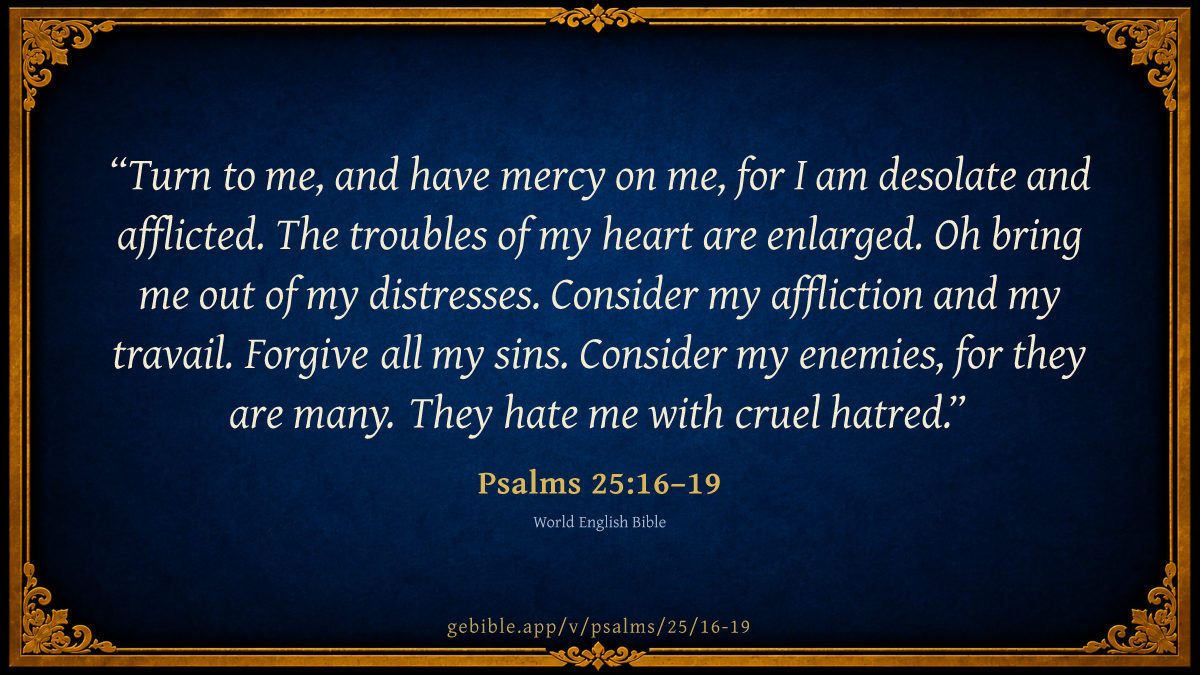
Psa 25:16 Turn thee unto me, and have mercy upon me; for I [am] desolate and afflicted.
Ver. 16. Turn thee unto me] Heb. Face about towards me.
Read full note →
And have mercy upon me] There being no such mercy as to have thy favour. This is a voluminous mercy.
For I am desolate and afflicted] As all creatures flag and hang the head when the sun is eclipsed. Misery is an object of mercy; as it was to the compassionate Samaritan.
John Trapp, A Commentary or Exposition upon All the Books of the Old and New Testament (1647–1656) — public domain. Text from a community e-Sword module.
Matthew Poole1685 · Public DomainOn vv16–19Turn thee unto me; turn thy face and favour…
Turn thee unto me; turn thy face and favour to me, O thou who now hast turned thy back upon me, and forsaken me.
I am desolate; destitute of all other hopes and succours; persecuted by mine enemies, and forsaken by the most of my friends; as he was in Absalom’s rebellion.
Matthew Poole's English Annotations on the Holy Bible (1683–1685) — public domain. Text from a community e-Sword/MySword module.
John Gill1763 · Public DomainOn vv16–19Turn thee unto me, and have mercy upon me,....…
Turn thee unto me, and have mercy upon me,.... Or "look unto me", or "upon me" (f); which suggests that the Lord had turned himself, and hid his face from him; and expresses a desire that he would look upon him with a look of love and mercy, and arise to help and deliver him out of the hands of his enemies; he pleads no merits nor works of righteousness of his, but casts himself upon the mercy of God;
for I am desolate and afflicted; or "alone and poor" (g); not that he was quite alone, and had none with him; for though he was obliged to quit his palace, and the city of Jerusalem, yet he was accompanied by his servants, and a large number of his people; and could not be poor, in a literal sense, being king of Israel; yet he put no trust in men, nor in riches, but wholly depended on the Lord, as if he had none with him, nor anything to subsist with: and his case was indeed very deplorable, and called for pity and assistance; his own son was risen up against him, and the hearts of the men of Israel went after him; and he was obliged to flee from the city, and leave his house and family.
Read full note →
(f) "respice ad me", Montanus, Musculus, Junius & Tremellius, &c. (g) "solitarius et pauper", Junius & Tremellius; "et miser", Gejerus, Michaelis; so Ainsworth.
John Gill's Exposition of the Whole Bible (1746–1763) — public domain (CC PDM 1.0). Text via the HelloAO Bible API.
Adam Clarke1810 · Public DomainOn vv16–19Verse 16. Turn thee unto me] Probably the prayer…
Verse 16. Turn thee unto me] Probably the prayer of the poor captives in Babylon, which is continued through this and the remaining verses.
Adam Clarke's Commentary on the Bible (1810–1826) — public domain. Text from a community e-Sword/MySword module.
Joseph Benson1811 · Public DomainOn v17Psa 25:17-20. The troubles of my heart are enlarged…
Psa 25:17-20. The troubles of my heart are enlarged — My outward troubles are accompanied with grievous distresses of my mind and heart for my sins, which have procured them, and for thy great displeasure manifested in them. Look upon mine affliction — With compassion, as Exo 3:7-8; Psa 31:7; Psa 106:44. And forgive all my sins — The procuring and continuing causes of my trouble. “David joins this petition to the foregoing one, because he considered, whatever afflictions and crosses were brought upon him, how just soever they might be, with respect to his enemies, who were the apparent causes of them; yet that, according to God’s appointment, or permission, they might be the effects and punishment of his sins.” — Dodd. O keep my soul — Myself, or my life, as that word is commonly taken: for his soul was out of his enemies’ reach, who could only kill his body, Luk 12:4.
Joseph Benson's Commentary on the Old and New Testaments (1811–1818) — public domain. Text from a community e-Sword module.
Albert Barnes1834 · Public DomainOn vv16–19Turn thee unto me - Rather, the Hebrew means:…
Turn thee unto me - Rather, the Hebrew means: “look upon me.” The idea, however, is that the face of God was, as it were, turned in another direction, or that He was not attentive to him; and he prays that He would turn and behold him; that He would see him in his trouble.
And have mercy upon me - The psalmist seems to have felt that if God would look upon him he would pity him. He would see his case to be so sad that He would show him compassion - as, when we see an object of distress, “the eye affects the heart.”
Read full note →
For I am desolate - The word here rendered “desolate” - יחיד yâchı̂yd - means properly “one alone, only;” and then, one who “is alone,” or who is solitary, forsaken, wretched. There is no deeper sadness that ever comes over the mind than the idea that we are alone in the world; that we do not have a friend; that no one cares for us; that no one is concerned about anything that might happen to us; that no one would care if we were to die; that no one would shed a tear over our grave.
And afflicted - In what way we do not know. David, however, was very often in circumstances when he could use this language. The other parts of the psalm show that the “affliction” to which he here refers was that which arose from the recollection of the sins of his early life, and from the designs and purposes of his enemies.
Albert Barnes' Notes on the Bible (1834–1885) — public domain. Text from a community e-Sword/MySword module.
Robert Jamieson, A. R. Fausset & David Brown1871 · Public DomainOn v16A series of earnest appeals for aid because God…
A series of earnest appeals for aid because God had seemed to desert him (compare Psa 13:1; Psa 17:13, &c.), his sins oppressed him, his enemies had enlarged his troubles and were multiplied, increasing in hate and violence (Psa 9:8; Psa 18:48).
Jamieson, Fausset & Brown — Commentary Critical and Explanatory on the Whole Bible (1871) — public domain (CC PDM 1.0). Text via the HelloAO Bible API.
The Cambridge Bible for Schools and Colleges1878 · Public DomainOn vv16–1916. Turn thee] Or, look: the opposite of ‘hiding…
16. Turn thee] Or, look: the opposite of ‘hiding the face’ (Psa_22:24). Cp. Psa_86:16; Psa_119:132.
have mercy upon me] Be gracious unto me. See Psa_4:1, note.
Read full note →
desolate] Solitary; without other friend or helper.
The Cambridge Bible for Schools and Colleges (gen. ed. J. J. S. Perowne; Cambridge University Press, 1878–1918) — public domain. Text from a community e-Sword module.
Ellicott's Commentary for English Readers1878 · Public DomainOn v17(17) The troubles.—The consensus of commentators is for a…
(17) The troubles.—The consensus of commentators is for a different division of the Hebrew words.
. . . “Relieve my sore heart,
Read full note →
And release me from my distress.”
A Bible Commentary for English Readers, edited by Charles John Ellicott (1878–1897) — public domain. Text from a community e-Sword module.
The Pulpit Commentary1880 · Public DomainOn vv16, 17, 19Turn thee unto me, and have mercy upon me.…
Turn thee unto me, and have mercy upon me. The approach of peril is regarded as a sign that God has "turned away his face." He is besought, therefore, to turn towards one who needs his aid. For I am desolate and afflicted (comp. vers. 17, 18). The affliction evidently comes from enemies, either foreign or domestic (vers. 2, 19); but its nature is not further indicated.
The Pulpit Commentary (1880–1919), ed. H.D.M. Spence-Jones & Joseph S. Exell — public domain. Text from a community e-Sword module.
Charles H. Spurgeon1885 · Public DomainOn vv16–19Ver. 16. His own eyes were fixed upon God,…
Ver. 16. His own eyes were fixed upon God, but he feared that the Lord had averted his face from him in anger. Oftentimes unbelief suggests that God has turned his back upon us. If we know that we turn to God we need not fear that he will turn from us, but may boldly cry, Turn thee unto me. The ground of quarrel is always in ourselves, and when that is removed there is nothing to prevent our full enjoyment of communion with God. Have mercy upon me. Saints still must stand upon the footing of mercy; notwithstanding all their experience they cannot get beyond the publican's prayer, "Have mercy upon me." For I am desolate and afflicted. He was lonely and bowed down. Jesus was in the days of his flesh in just such a condition; none could enter into the secret depths of his sorrows, he trod the winepress alone, and hence he is able to succour in the fullest sense those who tread the solitary path.
"Christ leads me through no darker rooms
Read full note →
Than he went through before; He that into God's kingdom comes,
Must enter by this door."
None.
Ver. 16. A desolate soul seeking heavenly company, and an afflicted spirit crying for divine mercy. Our God the balm of all our wounds.
Ver. 16-18. David is a petitioner as well as a sufferer; and those sorrows will never injure us that bring us near to God. Three things he prays for:
1. Deliverance. This we are called to desire, consistently with resignation to the divine will.
2. Notice. A kind look from God is desirable at any time in any circumstances; but in affliction and pain, it is like life from the dead.
3. Pardon. Trials are apt to revive a sense of guilt. William Jay.
Psalms 25:17*
Ver. 16-18. David is a petitioner as well as a sufferer; and those sorrows will never injure us that bring us near to God. Three things he prays for:
1. Deliverance. This we are called to desire, consistently with resignation to the divine will.
2. Notice. A kind look from God is desirable at any time in any circumstances; but in affliction and pain, it is like life from the dead.
3. Pardon. Trials are apt to revive a sense of guilt. William Jay.
Ver. 16-18. David is a petitioner as well as a sufferer; and those sorrows will never injure us that bring us near to God. Three things he prays for:
1. Deliverance. This we are called to desire, consistently with resignation to the divine will.
2. Notice. A kind look from God is desirable at any time in any circumstances; but in affliction and pain, it is like life from the dead.
3. Pardon. Trials are apt to revive a sense of guilt. William Jay.
Charles H. Spurgeon's The Treasury of David (1869–1885) — public domain. Psalms only. Text from a community e-Sword/MySword module.
The Biblical Illustrator1887 · Public DomainOn vv16, 18Turn Thee unto me, and have mercy upon me;…
Psa_25:16-18
Turn Thee unto me, and have mercy upon me; for I am desolate and afflicted.
Read full note →
A sufferers prayer
How tender is this language, and how instructive too. David was a sufferer as well as a king. But he is a petitioner also, He prays for--
I. Deliverance.
II. A kind look from God is desirable at any time, but in affliction and pain it is like life from the dead. Therefore he says, Look upon mine affliction and pain.
III. Pardon. Forgive all my sins. This was his meaning; let it be ours. (W. Jay.)
The cry of the afflicted
Look at Loch Lomond. A hundred feet of water, deep and dark and deadly; the waves that slumber yonder at the foot of the Ben will drown you. Yes, but when God sent out His frost, when from the caves of the north there crept the congealing influence, lo! the waves slumbered and slept, and you walked and skimmed on your ringing steels across the congealed billows. The same lake, but so transformed that you could skim across its surface. Some of you know what it is to be almost overwhelmed with the billows of trouble. They roll over you again and again, and recede but to Come on with redoubled power, until at last you cry out, Lord, save me, or I perish. Then there comes a great calm, and you just skim across the billows of your daily toil, because Christ your Saviour has told the troubles and difficulties and monotony to sleep. Oh, what a glorious thing the grace of Christ is! (John Robertson.)
Davids prayer
I wonder if they are able to say of us in the time of sorrow and bereavement and trouble, Behold, he prayeth. Those travellers, as they pass, are suddenly arrested by a sound that is strange to them, and they ask what it is. It is David at his prayers. Ah, he is all right! Pray on, David; do not be ashamed of your voice--let it sound out. It is nobler thus to pray, than with loud, uplifted voice to give the command to thine armies to fall in to the front: and Davids voice had done that for many a day. A ringing, clarion peal the warrior had given in his time: Fall in to the front. They loved to ear it in Israel. When the king spake, it reminded them of the old days when the right arm of the young warrior did valiant things for Jehovah; and they liked to hear his voice rise above the din of battle: but it is nobler, kinglier, and far more grand to hear the old king with his quavering voice lifted up in prayer.
A godly mans appeal
I. On behalf of self.
1. For deliverance from suffering (Psa_25:16). The road to heaven, says an old writer, is soaked with the tears and blood of the saints.
2. For forgiveness (Psa_25:18). He traced his sufferings to his sins. Sin is the gall in the cup of life; the root of the pestiferous tree of all natural evil. From suffering we infer sin. He believed that his sins had to do with God. Wrong in any form or department of life is sin against Him. Against Thee, Thee only, have I sinned. He knew that Gods forgiveness was necessary to his deliverance.
3. For preservation of life, of confidence, of character (Psa_25:21).
II. On behalf of society (Psa_25:22). There is nothing selfish in genuine piety. The man who prays and struggles only for his own salvation is utterly destitute of genuine religion. His creed may be correct, and all his religious observances, but he has not the root of the matter in him. (D. Thomas, D. D.)
The Biblical Illustrator, edited by Joseph S. Exell (c. 1880s–1900s) — public domain. Text from a community e-Sword module.
unfoldingWord translationNotes2017 · CC BY-SA 4.0On v17The troubles of my heart are enlarged
The troubles of my heart are enlarged
Here "heart" represents a person's emotions. AT: "I feel more and more troubled" (See: Metonymy)
Read full note →
draw me out from my distress
"bring me out of my distress." This speaks of distress as if it were a place that a person can be brought out of. AT: "rescue me from my distress" or "relieve me of my distress" (See: Metaphor)
my distress
The word "distress" is an abstract noun. AT: "the things that distress me" or "the things that cause me to be afraid" (See: Abstract Nouns)
See my affliction
"Notice my affliction"
my affliction
The abstract noun "affliction" can be stated as a verb. AT: "the things that afflict me" or "how afflicted I am" (See: Abstract Nouns)
my toils
The word "toils" is an abstract noun. AT: "the things that trouble me" (See: Abstract Nouns)
Tyndale Open Study Notes2022 · CC BY-SA 4.0On vv17, 1925:17-18 The psalmist can find no relief (see 4:1;…
25:17-18 The psalmist can find no relief (see 4:1; 13:1-2) as his problems go from bad to worse. He associates his anguish with sin, but he does not elaborate on the nature of his sin (see 25:7, 11).

John Calvin 1540 · Public Domain On vv16–19 16. Have respect unto me. As the flesh is…
16. Have respect unto me. As the flesh is ever ready to suggest to our minds that God has forgotten us, when he ceases to manifest his power in aiding us, David here follows the order which nature dictates, in asking God to have respect unto him, as if he had altogether neglected him before. Now, it appears to me that the words might be explained thus: Have respect unto me, in order to pity me. He accounts it at once the cause and the source of his salvation to be regarded of God; and then he adds the effect of it: for as soon as God, of his own good pleasure, shall vouchsafe to regard us, his hand also will be ready to help us. Again, in order to excite the compassion of God, he sets forth his own misery, expressly stating that he is alone, that is to say, solitary; The Hebrew word here used is יחיד, yachid, unus, one, which is not infrequently put, as in this place, for a solitary and desolate person. David was now deserted, desolate, and destitute of all help. The word is used in the same sense in Psalm 22:20, and 35:17
John Calvin's Commentaries (1540-1563) — public domain. Text from the Calvin Translation Society English edition (1840s-50s) via the Christian Classics Ethereal Library (ccel.org). Calvin's coverage is partial (roughly two-thirds of the Bible); uncommented books and verses are honest gaps, never fabricated. The 19th-century editor's footnotes and remarks are omitted so the notes are faithfully Calvin's own voice.
Geneva Bible translators 1599 · Public Domain On vv17, 19 My grief is increased because of mine enemies’ cruelty.
My grief is increased because of mine enemies’ cruelty.
Geneva Bible (1599) marginal notes — public domain.
John Trapp 1656 · Public Domain On vv16–19 Psa 25:16 Turn thee unto me, and have mercy…
Psa 25:16 Turn thee unto me, and have mercy upon me; for I [am] desolate and afflicted.
Ver. 16. Turn thee unto me] Heb. Face about towards me.
Read full note →
And have mercy upon me] There being no such mercy as to have thy favour. This is a voluminous mercy.
For I am desolate and afflicted] As all creatures flag and hang the head when the sun is eclipsed. Misery is an object of mercy; as it was to the compassionate Samaritan.
John Trapp, A Commentary or Exposition upon All the Books of the Old and New Testament (1647–1656) — public domain. Text from a community e-Sword module.
Matthew Poole 1685 · Public Domain On vv16–19 Turn thee unto me; turn thy face and favour…
Turn thee unto me; turn thy face and favour to me, O thou who now hast turned thy back upon me, and forsaken me.
I am desolate; destitute of all other hopes and succours; persecuted by mine enemies, and forsaken by the most of my friends; as he was in Absalom’s rebellion.
Matthew Poole's English Annotations on the Holy Bible (1683–1685) — public domain. Text from a community e-Sword/MySword module.
John Gill 1763 · Public Domain On vv16–19 Turn thee unto me, and have mercy upon me,....…
Turn thee unto me, and have mercy upon me,.... Or "look unto me", or "upon me" (f); which suggests that the Lord had turned himself, and hid his face from him; and expresses a desire that he would look upon him with a look of love and mercy, and arise to help and deliver him out of the hands of his enemies; he pleads no merits nor works of righteousness of his, but casts himself upon the mercy of God;
for I am desolate and afflicted; or "alone and poor" (g); not that he was quite alone, and had none with him; for though he was obliged to quit his palace, and the city of Jerusalem, yet he was accompanied by his servants, and a large number of his people; and could not be poor, in a literal sense, being king of Israel; yet he put no trust in men, nor in riches, but wholly depended on the Lord, as if he had none with him, nor anything to subsist with: and his case was indeed very deplorable, and called for pity and assistance; his own son was risen up against him, and the hearts of the men of Israel went after him; and he was obliged to flee from the city, and leave his house and family.
Read full note →
(f) "respice ad me", Montanus, Musculus, Junius & Tremellius, &c. (g) "solitarius et pauper", Junius & Tremellius; "et miser", Gejerus, Michaelis; so Ainsworth.
John Gill's Exposition of the Whole Bible (1746–1763) — public domain (CC PDM 1.0). Text via the HelloAO Bible API.
Adam Clarke 1810 · Public Domain On vv16–19 Verse 16. Turn thee unto me] Probably the prayer…
Verse 16. Turn thee unto me] Probably the prayer of the poor captives in Babylon, which is continued through this and the remaining verses.
Adam Clarke's Commentary on the Bible (1810–1826) — public domain. Text from a community e-Sword/MySword module.
Joseph Benson 1811 · Public Domain On v17 Psa 25:17-20. The troubles of my heart are enlarged…
Psa 25:17-20. The troubles of my heart are enlarged — My outward troubles are accompanied with grievous distresses of my mind and heart for my sins, which have procured them, and for thy great displeasure manifested in them. Look upon mine affliction — With compassion, as Exo 3:7-8; Psa 31:7; Psa 106:44. And forgive all my sins — The procuring and continuing causes of my trouble. “David joins this petition to the foregoing one, because he considered, whatever afflictions and crosses were brought upon him, how just soever they might be, with respect to his enemies, who were the apparent causes of them; yet that, according to God’s appointment, or permission, they might be the effects and punishment of his sins.” — Dodd. O keep my soul — Myself, or my life, as that word is commonly taken: for his soul was out of his enemies’ reach, who could only kill his body, Luk 12:4.
Joseph Benson's Commentary on the Old and New Testaments (1811–1818) — public domain. Text from a community e-Sword module.
Albert Barnes 1834 · Public Domain On vv16–19 Turn thee unto me - Rather, the Hebrew means:…
Turn thee unto me - Rather, the Hebrew means: “look upon me.” The idea, however, is that the face of God was, as it were, turned in another direction, or that He was not attentive to him; and he prays that He would turn and behold him; that He would see him in his trouble.
And have mercy upon me - The psalmist seems to have felt that if God would look upon him he would pity him. He would see his case to be so sad that He would show him compassion - as, when we see an object of distress, “the eye affects the heart.”
Read full note →
For I am desolate - The word here rendered “desolate” - יחיד yâchı̂yd - means properly “one alone, only;” and then, one who “is alone,” or who is solitary, forsaken, wretched. There is no deeper sadness that ever comes over the mind than the idea that we are alone in the world; that we do not have a friend; that no one cares for us; that no one is concerned about anything that might happen to us; that no one would care if we were to die; that no one would shed a tear over our grave.
And afflicted - In what way we do not know. David, however, was very often in circumstances when he could use this language. The other parts of the psalm show that the “affliction” to which he here refers was that which arose from the recollection of the sins of his early life, and from the designs and purposes of his enemies.
Albert Barnes' Notes on the Bible (1834–1885) — public domain. Text from a community e-Sword/MySword module.
Robert Jamieson, A. R. Fausset & David Brown 1871 · Public Domain On v16 A series of earnest appeals for aid because God…
A series of earnest appeals for aid because God had seemed to desert him (compare Psa 13:1; Psa 17:13, &c.), his sins oppressed him, his enemies had enlarged his troubles and were multiplied, increasing in hate and violence (Psa 9:8; Psa 18:48).
Jamieson, Fausset & Brown — Commentary Critical and Explanatory on the Whole Bible (1871) — public domain (CC PDM 1.0). Text via the HelloAO Bible API.
The Cambridge Bible for Schools and Colleges 1878 · Public Domain On vv16–19 16. Turn thee] Or, look: the opposite of ‘hiding…
16. Turn thee] Or, look: the opposite of ‘hiding the face’ (Psa_22:24). Cp. Psa_86:16; Psa_119:132.
have mercy upon me] Be gracious unto me. See Psa_4:1, note.
Read full note →
desolate] Solitary; without other friend or helper.
The Cambridge Bible for Schools and Colleges (gen. ed. J. J. S. Perowne; Cambridge University Press, 1878–1918) — public domain. Text from a community e-Sword module.
Ellicott's Commentary for English Readers 1878 · Public Domain On v17 (17) The troubles.—The consensus of commentators is for a…
(17) The troubles.—The consensus of commentators is for a different division of the Hebrew words.
. . . “Relieve my sore heart,
Read full note →
And release me from my distress.”
A Bible Commentary for English Readers, edited by Charles John Ellicott (1878–1897) — public domain. Text from a community e-Sword module.
The Pulpit Commentary 1880 · Public Domain On vv16, 17, 19 Turn thee unto me, and have mercy upon me.…
Turn thee unto me, and have mercy upon me. The approach of peril is regarded as a sign that God has "turned away his face." He is besought, therefore, to turn towards one who needs his aid. For I am desolate and afflicted (comp. vers. 17, 18). The affliction evidently comes from enemies, either foreign or domestic (vers. 2, 19); but its nature is not further indicated.
The Pulpit Commentary (1880–1919), ed. H.D.M. Spence-Jones & Joseph S. Exell — public domain. Text from a community e-Sword module.
Charles H. Spurgeon 1885 · Public Domain On vv16–19 Ver. 16. His own eyes were fixed upon God,…
Ver. 16. His own eyes were fixed upon God, but he feared that the Lord had averted his face from him in anger. Oftentimes unbelief suggests that God has turned his back upon us. If we know that we turn to God we need not fear that he will turn from us, but may boldly cry, Turn thee unto me. The ground of quarrel is always in ourselves, and when that is removed there is nothing to prevent our full enjoyment of communion with God. Have mercy upon me. Saints still must stand upon the footing of mercy; notwithstanding all their experience they cannot get beyond the publican's prayer, "Have mercy upon me." For I am desolate and afflicted. He was lonely and bowed down. Jesus was in the days of his flesh in just such a condition; none could enter into the secret depths of his sorrows, he trod the winepress alone, and hence he is able to succour in the fullest sense those who tread the solitary path.
"Christ leads me through no darker rooms
Read full note →
Than he went through before; He that into God's kingdom comes,
Must enter by this door."
None.
Ver. 16. A desolate soul seeking heavenly company, and an afflicted spirit crying for divine mercy. Our God the balm of all our wounds.
Ver. 16-18. David is a petitioner as well as a sufferer; and those sorrows will never injure us that bring us near to God. Three things he prays for:
1. Deliverance. This we are called to desire, consistently with resignation to the divine will.
2. Notice. A kind look from God is desirable at any time in any circumstances; but in affliction and pain, it is like life from the dead.
3. Pardon. Trials are apt to revive a sense of guilt. William Jay.
Psalms 25:17*
Ver. 16-18. David is a petitioner as well as a sufferer; and those sorrows will never injure us that bring us near to God. Three things he prays for:
1. Deliverance. This we are called to desire, consistently with resignation to the divine will.
2. Notice. A kind look from God is desirable at any time in any circumstances; but in affliction and pain, it is like life from the dead.
3. Pardon. Trials are apt to revive a sense of guilt. William Jay.
Ver. 16-18. David is a petitioner as well as a sufferer; and those sorrows will never injure us that bring us near to God. Three things he prays for:
1. Deliverance. This we are called to desire, consistently with resignation to the divine will.
2. Notice. A kind look from God is desirable at any time in any circumstances; but in affliction and pain, it is like life from the dead.
3. Pardon. Trials are apt to revive a sense of guilt. William Jay.
Charles H. Spurgeon's The Treasury of David (1869–1885) — public domain. Psalms only. Text from a community e-Sword/MySword module.
The Biblical Illustrator 1887 · Public Domain On vv16, 18 Turn Thee unto me, and have mercy upon me;…
Psa_25:16-18
Turn Thee unto me, and have mercy upon me; for I am desolate and afflicted.
Read full note →
A sufferers prayer
How tender is this language, and how instructive too. David was a sufferer as well as a king. But he is a petitioner also, He prays for--
I. Deliverance.
II. A kind look from God is desirable at any time, but in affliction and pain it is like life from the dead. Therefore he says, Look upon mine affliction and pain.
III. Pardon. Forgive all my sins. This was his meaning; let it be ours. (W. Jay.)
The cry of the afflicted
Look at Loch Lomond. A hundred feet of water, deep and dark and deadly; the waves that slumber yonder at the foot of the Ben will drown you. Yes, but when God sent out His frost, when from the caves of the north there crept the congealing influence, lo! the waves slumbered and slept, and you walked and skimmed on your ringing steels across the congealed billows. The same lake, but so transformed that you could skim across its surface. Some of you know what it is to be almost overwhelmed with the billows of trouble. They roll over you again and again, and recede but to Come on with redoubled power, until at last you cry out, Lord, save me, or I perish. Then there comes a great calm, and you just skim across the billows of your daily toil, because Christ your Saviour has told the troubles and difficulties and monotony to sleep. Oh, what a glorious thing the grace of Christ is! (John Robertson.)
Davids prayer
I wonder if they are able to say of us in the time of sorrow and bereavement and trouble, Behold, he prayeth. Those travellers, as they pass, are suddenly arrested by a sound that is strange to them, and they ask what it is. It is David at his prayers. Ah, he is all right! Pray on, David; do not be ashamed of your voice--let it sound out. It is nobler thus to pray, than with loud, uplifted voice to give the command to thine armies to fall in to the front: and Davids voice had done that for many a day. A ringing, clarion peal the warrior had given in his time: Fall in to the front. They loved to ear it in Israel. When the king spake, it reminded them of the old days when the right arm of the young warrior did valiant things for Jehovah; and they liked to hear his voice rise above the din of battle: but it is nobler, kinglier, and far more grand to hear the old king with his quavering voice lifted up in prayer.
A godly mans appeal
I. On behalf of self.
1. For deliverance from suffering (Psa_25:16). The road to heaven, says an old writer, is soaked with the tears and blood of the saints.
2. For forgiveness (Psa_25:18). He traced his sufferings to his sins. Sin is the gall in the cup of life; the root of the pestiferous tree of all natural evil. From suffering we infer sin. He believed that his sins had to do with God. Wrong in any form or department of life is sin against Him. Against Thee, Thee only, have I sinned. He knew that Gods forgiveness was necessary to his deliverance.
3. For preservation of life, of confidence, of character (Psa_25:21).
II. On behalf of society (Psa_25:22). There is nothing selfish in genuine piety. The man who prays and struggles only for his own salvation is utterly destitute of genuine religion. His creed may be correct, and all his religious observances, but he has not the root of the matter in him. (D. Thomas, D. D.)
The Biblical Illustrator, edited by Joseph S. Exell (c. 1880s–1900s) — public domain. Text from a community e-Sword module.
unfoldingWord translationNotes 2017 · CC BY-SA 4.0 On v17 The troubles of my heart are enlarged
The troubles of my heart are enlarged
Here "heart" represents a person's emotions. AT: "I feel more and more troubled" (See: Metonymy)
Read full note →
draw me out from my distress
"bring me out of my distress." This speaks of distress as if it were a place that a person can be brought out of. AT: "rescue me from my distress" or "relieve me of my distress" (See: Metaphor)
my distress
The word "distress" is an abstract noun. AT: "the things that distress me" or "the things that cause me to be afraid" (See: Abstract Nouns)
See my affliction
"Notice my affliction"
my affliction
The abstract noun "affliction" can be stated as a verb. AT: "the things that afflict me" or "how afflicted I am" (See: Abstract Nouns)
my toils
The word "toils" is an abstract noun. AT: "the things that trouble me" (See: Abstract Nouns)
they hate me with cruel hatred
"they hate me cruelly" or "they hate me fiercely"
translationWords
heart
forgive
sin
unfoldingWord translationNotes — © Distant Shores Media and the Door43 World Missions Community, licensed CC BY-SA 4.0. Source: git.door43.org/Door43/en_tn.
Tyndale Open Study Notes 2022 · CC BY-SA 4.0 On vv17, 19 25:17-18 The psalmist can find no relief (see 4:1;…
25:17-18 The psalmist can find no relief (see 4:1; 13:1-2) as his problems go from bad to worse. He associates his anguish with sin, but he does not elaborate on the nature of his sin (see 25:7, 11).
Tyndale Open Study Notes — © Tyndale Open Resources, licensed CC BY-SA 4.0. Text via the HelloAO Bible API.