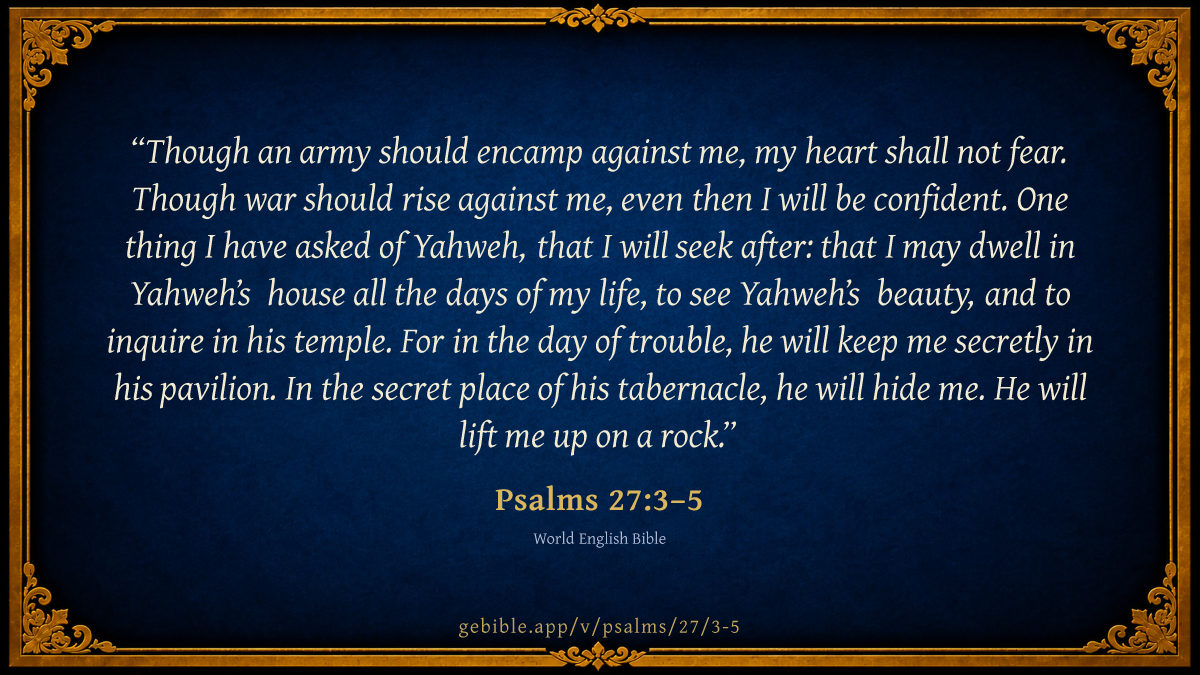
3Though an army should encamp against me, my heart shall not fear. Though war should rise against me, even then I will be confident.
4One thing I have asked of Yahweh, that I will seek after: that I may dwell in Yahweh’s house all the days of my life, to see Yahweh’s beauty, and to inquire in his temple.
5For in the day of trouble, he will keep me secretly in his pavilion. In the secret place of his tabernacle, he will hide me. He will lift me up on a rock.
3 Though an army should encamp against me, my heart shall not fear. Though war should rise against me, even then I will be confident.
4 One thing I have asked of Yahweh, that I will seek after: that I may dwell in Yahweh’s house all the days of my life, to see Yahweh’s beauty, and to inquire in his temple.
5 For in the day of trouble, he will keep me secretly in his pavilion. In the secret place of his tabernacle, he will hide me. He will lift me up on a rock.
KJVKing James Version
3 Though an host should encamp against me, my heart shall not fear: though war should rise against me, in this will I be confident.
4 One thing have I desired of the LORD, that will I seek after; that I may dwell in the house of the LORD all the days of my life, to behold the beauty of the LORD, and to enquire in his temple.
5 For in the time of trouble he shall hide me in his pavilion: in the secret of his tabernacle shall he hide me; he shall set me up upon a rock.
Show all 3 translations
JPSJPS Tanakh (1917)
3 Though a host should encamp against me, my heart shall not fear; though war should rise up against me, even then will I be confident.
4 One thing have I asked of the LORD, that will I seek after: that I may dwell in the house of the LORD all the days of my life, to behold the graciousness of the LORD, and to visit early in His temple.
5 For He concealeth me in His pavilion in the day of evil; He hideth me in the covert of His tent; He lifteth me up upon a rock.
Psalms 26:8(v4)Yahweh, I love the habitation of your house, the place where your glory dwells.
Psalms 23:6(v4)Surely goodness and loving kindness shall follow me all the days of my life, and I will dwell in Yahweh’s house forever.
Psalms 65:4(v4)Blessed is the one whom you choose and cause to come near, that he may live in your courts. We will be filled with the goodness of your…
Psalms 84:4(v4)Blessed are those who dwell in your house. They are always praising you.
Psalms 84:10(v4)For a day in your courts is better than a thousand. I would rather be a doorkeeper in the house of my God, than to dwell in the tents of…
Show all 73 cross-references
Luke 10:42(v4)but one thing is needed. Mary has chosen the good part, which will not be taken away from her.”
Proverbs 18:10(v5)Yahweh’s name is a strong tower: the righteous run to him, and are safe.
Psalms 63:2-5(v4)So I have seen you in the sanctuary, watching your power and your glory. Because your loving kindness is better than life, my lips shall…
Psalms 27:8(v4)When you said, “Seek my face,” my heart said to you, “I will seek your face, Yahweh.”
Jeremiah 29:13(v4)You shall seek me, and find me, when you search for me with all your heart.
Psalms 31:20(v5)In the shelter of your presence you will hide them from the plotting of man. You will keep them secretly in a dwelling away from the strife…
Matthew 6:33(v4)But seek first God’s Kingdom, and his righteousness; and all these things will be given to you as well.
Psalms 138:7(v5)Though I walk in the middle of trouble, you will revive me. You will stretch out your hand against the wrath of my enemies. Your right hand…
Psalms 91:1(v5)He who dwells in the secret place of the Most High will rest in the shadow of the Almighty.
Psalms 50:15(v5)Call on me in the day of trouble. I will deliver you, and you will honor me.”
Psalms 119:114(v5)You are my hiding place and my shield. I hope in your word.
Psalms 40:2(v5)He brought me up also out of a horrible pit, out of the miry clay. He set my feet on a rock, and gave me a firm place to stand.
Philippians 3:13(v4)Brothers, I don’t regard myself as yet having taken hold, but one thing I do: forgetting the things which are behind, and stretching…
Hebrews 11:6(v4)Without faith it is impossible to be well pleasing to him, for he who comes to God must believe that he exists, and that he is a rewarder…
Psalms 3:6(v3)I will not be afraid of tens of thousands of people who have set themselves against me on every side.
Colossians 3:3(v5)For you died, and your life is hidden with Christ in God.
Psalms 90:17(v4)Let the favor of the Lord our God be on us. Establish the work of our hands for us. Yes, establish the work of our hands.
Psalms 17:8(v5)Keep me as the apple of your eye. Hide me under the shadow of your wings,
Luke 2:37(v4)and she had been a widow for about eighty-four years), who didn’t depart from the temple, worshiping with fastings and petitions night and…
2 Corinthians 3:18(v4)But we all, with unveiled face seeing the glory of the Lord as in a mirror, are transformed into the same image from glory to glory, even…
1 Peter 3:14(v3)But even if you should suffer for righteousness’ sake, you are blessed. “Don’t fear what they fear, neither be troubled.”
Matthew 7:7-8(v4)“Ask, and it will be given you. Seek, and you will find. Knock, and it will be opened for you. For everyone who asks receives. He who seeks…
Matthew 7:24-25(v5)“Everyone therefore who hears these words of mine, and does them, I will liken him to a wise man, who built his house on a rock. The rain…
Psalms 46:1(v5)God is our refuge and strength, a very present help in trouble.
Psalms 50:2(v4)Out of Zion, the perfection of beauty, God shines out.
Psalms 91:15(v5)He will call on me, and I will answer him. I will be with him in trouble. I will deliver him, and honor him.
Daniel 9:3(v4)I set my face to the Lord God, to seek by prayer and petitions, with fasting and sackcloth and ashes.
Isaiah 26:20(v5)Come, my people, enter into your rooms, and shut your doors behind you. Hide yourself for a little moment, until the indignation is past.
Romans 8:35-37(v3)Who shall separate us from the love of Christ? Could oppression, or anguish, or persecution, or famine, or nakedness, or peril, or sword?…
Psalms 57:1(v5)Be merciful to me, God, be merciful to me, for my soul takes refuge in you. Yes, in the shadow of your wings, I will take refuge, until…
Isaiah 32:2(v5)A man shall be as a hiding place from the wind, and a covert from the storm, as streams of water in a dry place, as the shade of a large…
Luke 18:1(v4)He also spoke a parable to them that they must always pray, and not give up,
Psalms 61:2(v5)From the end of the earth, I will call to you when my heart is overwhelmed. Lead me to the rock that is higher than I.
Luke 11:9-10(v4)“I tell you, keep asking, and it will be given you. Keep seeking, and you will find. Keep knocking, and it will be opened to you. For…
Luke 13:24(v4)“Strive to enter in by the narrow door, for many, I tell you, will seek to enter in and will not be able.
2 Corinthians 4:6(v4)seeing it is God who said, “Light will shine out of darkness,” who has shone in our hearts to give the light of the knowledge of the glory…
Philippians 1:28(v3)and in nothing frightened by the adversaries, which is for them a proof of destruction, but to you of salvation, and that from God.
Psalms 32:6-7(v5)For this, let everyone who is godly pray to you in a time when you may be found. Surely when the great waters overflow, they shall not…
Proverbs 1:24-28(v5)Because I have called, and you have refused; I have stretched out my hand, and no one has paid attention; but you have ignored all my…
Psalms 18:33(v5)He makes my feet like deer’s feet, and sets me on my high places.
Isaiah 4:5-6(v5)Yahweh will create over the whole habitation of Mount Zion and over her assemblies, a cloud and smoke by day, and the shining of a flaming…
Zechariah 9:9(v4)Rejoice greatly, daughter of Zion! Shout, daughter of Jerusalem! Behold, your King comes to you! He is righteous, and having salvation;…
2 Corinthians 5:6-8(v3)Therefore we are always confident and know that while we are at home in the body, we are absent from the Lord; for we walk by faith, not by…
1 Chronicles 10:13-14(v4)So Saul died for his trespass which he committed against Yahweh, because of Yahweh’s word, which he didn’t keep; and also because he asked…
Nehemiah 6:10-11(v5)I went to the house of Shemaiah the son of Delaiah the son of Mehetabel, who was shut in at his home; and he said, “Let us meet together in…
Psalms 77:2(v5)In the day of my trouble I sought the Lord. My hand was stretched out in the night, and didn’t get tired. My soul refused to be comforted.
Psalms 83:3(v5)They conspire with cunning against your people. They plot against your cherished ones.
Isaiah 54:16-17(v3)“Behold, I have created the blacksmith who fans the coals into flame, and forges a weapon for his work; and I have created the destroyer to…
Habakkuk 3:18-19(v5)yet I will rejoice in Yahweh. I will be joyful in the God of my salvation! Yahweh, the Lord, is my strength. He makes my feet like deer’s…
Revelation 2:10(v3)Don’t be afraid of the things which you are about to suffer. Behold, the devil is about to throw some of you into prison, that you may be…
1 Samuel 1:11(v4)She vowed a vow, and said, “Yahweh of Armies, if you will indeed look at the affliction of your servant and remember me, and not forget…
2 Kings 6:15-17(v3)When the servant of the man of God had risen early, and gone out, behold, an army with horses and chariots was around the city. His servant…
Psalms 10:1(v5)Why do you stand far off, Yahweh? Why do you hide yourself in times of trouble?
Isaiah 26:16(v5)Yahweh, in trouble they have visited you. They poured out a prayer when your chastening was on them.
Isaiah 41:11-12(v3)Behold, all those who are incensed against you will be disappointed and confounded. Those who strive with you will be like nothing, and…
1 Samuel 28:15-16(v3)Samuel said to Saul, “Why have you disturbed me, to bring me up?” Saul answered, “I am very distressed; for the Philistines make war…
2 Chronicles 20:15(v3)and he said, “Listen, all Judah, and you inhabitants of Jerusalem, and you, king Jehoshaphat. Yahweh says to you, ‘Don’t be afraid, and…
2 Chronicles 22:12(v5)He was with them hidden in God’s house six years while Athaliah reigned over the land.
Job 4:6(v3)Isn’t your piety your confidence? Isn’t the integrity of your ways your hope?
Psalms 52:6(v3)The righteous also will see it, and fear, and laugh at him, saying,
Jeremiah 2:27-28(v5)who tell wood, ‘You are my father,’ and a stone, ‘You have given birth to me,’ for they have turned their back to me, and not their face;…
Matthew 16:16-18(v5)Simon Peter answered, “You are the Christ, the Son of the living God.” Jesus answered him, “Blessed are you, Simon Bar Jonah, for flesh and…
Matthew 23:37(v5)“Jerusalem, Jerusalem, who kills the prophets, and stones those who are sent to her! How often I would have gathered your children…
1 Timothy 5:5(v4)Now she who is a widow indeed and desolate, has her hope set on God, and continues in petitions and prayers night and day.
Revelation 12:7-11(v3)There was war in the sky. Michael and his angels made war on the dragon. The dragon and his angels made war. They didn’t prevail. No place…
Psalms 26:6(v4)I will wash my hands in innocence, so I will go about your altar, Yahweh,
1 Samuel 22:10(v4)He inquired of Yahweh for him, gave him food, and gave him the sword of Goliath the Philistine.”
2 Samuel 21:1(v4)There was a famine in the days of David for three years, year after year; and David sought the face of Yahweh. Yahweh said, “It is for…
Cross-references from openbible.info (CC BY 4.0)
Explain this passage (19 sources)
Historical commentary, presented as a primary source — not an endorsement.
John Calvin1540 · Public DomainOn vv3–53. Though armies should encamp. He infers from his…
3. Though armies should encamp. He infers from his former experience, as I have already mentioned, that whatever adversity may befall him, he ought to hope well, and to have no misgivings about the divine protection, which had been so effectually vouchsafed to him in his former need. He had asserted this, indeed, in the first verse, but now, upon farther proof of it, he repeats it. Under the terms, camps and armies, he includes whatever is most formidable in the world: as if he had said, Although all men should conspire for my destruction, I will disregard their violence, because the power of God, which I know is on my side, is far above theirs. But when he declares, My heart shall not fear, this does not imply that he would be entirely devoid of fear, — for that would have been more worthy of the name of insensibility than of virtue; but lest his heart should faint under the terrors which he had to encounter, he opposed to them the shield of faith. Some transfer the word translated in this to the following verse, meaning that he was confident that he would dwell in God’s house; but I am of opinion that it belongs rather to the preceding doctrine. For then does faith bring forth its fruit in due season, when we remain firm and fearless in the midst of dangers. David, therefore, intimates, that when the trial comes, his faith will prove invincible, because it relies on the power of God.
John Calvin's Commentaries (1540-1563) — public domain. Text from the Calvin Translation Society English edition (1840s-50s) via the Christian Classics Ethereal Library (ccel.org). Calvin's coverage is partial (roughly two-thirds of the Bible); uncommented books and verses are honest gaps, never fabricated. The 19th-century editor's footnotes and remarks are omitted so the notes are faithfully Calvin's own voice.
Geneva Bible translators1599 · Public DomainOn vv3–4That God will deliver me and give my faith…
That God will deliver me and give my faith the victory.
Geneva Bible (1599) marginal notes — public domain.
John Trapp1656 · Public DomainOn vv3–5Psa 27:3 Though an host should encamp against me,…
Psa 27:3 Though an host should encamp against me, my heart shall not fear: though war should rise against me, in this [will] I [be] confident.
Ver. 3. Though an host should encamp against me] See Psa 3:6, {See Trapp on "Psa 3:6"} We should propound the worst to ourselves (the best will bring with it, as we say), especially if we find our faith to be in heart and vigour, as here David’s was.
Read full note →
Though war should rise against me] War is a complex evil, and is, therefore, called so by a specialty: Isa 45:7, "I make peace, and create evil," that is, war. Sin, Satan, and war have all one name, saith a learned divine; evil is the best of them: the best of sin is deformity; of Satan, enmity; of war, misery.
In this will I be confident] In this? In what? In this one ensuing petition, saith Aben Ezra; or, in this that I have said before, "The Lord is my light and my salvation"; in this confident gloriation of mine, which is such as an unbeliever is a perfect stranger unto.
John Trapp, A Commentary or Exposition upon All the Books of the Old and New Testament (1647–1656) — public domain. Text from a community e-Sword module.
Matthew Poole1685 · Public DomainOn vv3–5In that which I have now said, that God…
In that which I have now said, that God is my light, &c., Psa 27:1, and in the experience of his favour and protection, Psa 27:2.
Matthew Poole's English Annotations on the Holy Bible (1683–1685) — public domain. Text from a community e-Sword/MySword module.
John Gill1763 · Public DomainOn vv3–5Though an host should encamp against me,.... An host…
Though an host should encamp against me,.... An host of the ungodly, as the Targum; though ever so many of them, even ten thousands of them, as in Psa 3:6; should beset him on every side;
my heart shall not fear; for not only the angels of the Lord encamped about him, as they do about all that fear the Lord; but salvation was appointed for walls and bulwarks about him; yea, the Lord himself was a wall of fire around him, and he was kept as in a garrison by the power of God;
Read full note →
though war should rise against me: in all its terrible shapes:
in this will I be confident; either in this war, in the midst of it; or in this that he had expressed, Psa 27:1; that the Lord was his light, his salvation, and the strength of his life; so the Jewish writers (e): or as others (f), in this one thing, desired in Psa 27:4; but either of the former senses is best, especially the latter of them. Saints need not be afraid, though there is a war within them between the flesh and spirit; and though without are fightings with Satan and his principalities and powers; since they may be confident of victory, and that they are more than conquerors, through Christ that has loved them.
(e) Jarchi, Kimchi, & Aben Ezra in loc. (f) Some in Aben Ezra in loc.
John Gill's Exposition of the Whole Bible (1746–1763) — public domain (CC PDM 1.0). Text via the HelloAO Bible API.
John Wesley1765 · Public DomainOn vv3–5In this - That God is my light.
In this - That God is my light.
John Wesley, Explanatory Notes Upon the Whole Bible (1754–1765) — public domain. Text via the GEBible commentary corpus.
Adam Clarke1810 · Public DomainOn vv3–5Verse 3. Though a host should encamp against me]…
Verse 3. Though a host should encamp against me] I am so confident of the Almighty's protection, that were I alone, and encompassed by a host, I would not fear. I am in the hand of God; and while in that hand, I am safe.
Adam Clarke's Commentary on the Bible (1810–1826) — public domain. Text from a community e-Sword/MySword module.
Joseph Benson1811 · Public DomainOn vv4–5Psa 27:4. One thing have I desired of the…
Psa 27:4. One thing have I desired of the Lord — It greatly encouraged David’s confidence in God, that he was conscious to himself of an entire affection to him and his ordinances, and that he was in his element when he was in the way of his duty, and in the way of increasing his acquaintance with God. If our hearts can witness for us, that we delight in God above any creature, we may from thence take encouragement to depend upon him; for it is a proof that we are of those whom he protects as his own. That I may dwell in the house of the Lord — That I may have opportunity of duly and constantly attending on God in the public service of his house, with other faithful Israelites, as the duty of every day may require; all the days of my life — That I may not hereafter be disturbed in, or driven away from God’s sanctuary and worship, as I have been; to behold the beauty of the Lord — That there I may delight myself in the contemplation of his amiable and glorious majesty, and of his infinite wisdom, holiness, justice, truth, grace, and mercy, and other perfections, which, though concealed, in a great measure, from the world, are clearly manifested in his church and ordinances. To inquire in his temple — That is, in his tabernacle, which he here and elsewhere calls his temple; because his ordinances were there administered, as they were afterward to be in the temple. The word לבקר, lebakker, here rendered to inquire, properly signifies to search, or seek diligently, namely, to know the mind and will of God and his own duty; or, to behold the Lord’s beauty, last mentioned, and the light of his countenance, which is discovered more or less, as men are more or less diligent or negligent, in seeking or inquiring into it. When, with an eye of faith and holy love, we behold this beauty; when, with fixedness of thought, and a holy flame of devout affections, we contemplate the divine excellences, and entertain ourselves with the tokens of his peculiar favour to us, we observe in a still higher degree how infinitely amiable and admirable they are, till our hearts are ravished therewith, and we are lost in wonder, love, and praise.
Joseph Benson's Commentary on the Old and New Testaments (1811–1818) — public domain. Text from a community e-Sword module.
Albert Barnes1834 · Public DomainOn vv3–5Though an host - Though an “army;” that is,…
Though an host - Though an “army;” that is, any army, or any number of men in battle array. The past interposition of God in similar times of trouble and danger was to him a sufficient security that he had nothing to fear.
Should encamp against me - In battle array, or prepared for battle.
Read full note →
My heart shall not fear - He would not tremble; he would not feel that there was anything of which to be afraid. God had shown Himself superior to the power of hostile armies, and the psalmist felt assured that he might confide in Him.
Though war should rise against me - Though it should be proclaimed, and though all preparation should be made for it, I will not be afraid.
In this will I be confident - In such a case, in such an extremity or emergency, I would calmly trust in God. He would apprehend no danger, for he had seen that the Lord could deliver him.
Albert Barnes' Notes on the Bible (1834–1885) — public domain. Text from a community e-Sword/MySword module.
Robert Jamieson, A. R. Fausset & David Brown1871 · Public DomainOn vv3–4In the greatest dangers.
In the greatest dangers.
in this--that is, then, in such extremity.
Jamieson, Fausset & Brown — Commentary Critical and Explanatory on the Whole Bible (1871) — public domain (CC PDM 1.0). Text via the HelloAO Bible API.
Daniel D. Whedon1874 · Public DomainOn vv3–53. Though a host—See Psa_3:6, on same occasion.
3. Though a host—See Psa_3:6, on same occasion.
In this will I be confident—In spite of this, or for all this, I will trust. These first three verses are an outbreathing of the courage of faith.
Daniel D. Whedon (gen. ed.), Commentary on the Old and New Testaments (1874–1909) — public domain. Text from a community e-Sword module.
The Cambridge Bible for Schools and Colleges1878 · Public DomainOn vv3–53. The language may be figurative, but is more…
3. The language may be figurative, but is more natural, if the writer was, like David, actually exposed to war’s alarms. Cp. Psa_3:6.
in this] In the truth of Psa_27:1. But it is better to render with R.V., even then, in spite of opposing armies.
The Cambridge Bible for Schools and Colleges (gen. ed. J. J. S. Perowne; Cambridge University Press, 1878–1918) — public domain. Text from a community e-Sword module.
Ellicott's Commentary for English Readers1878 · Public DomainOn vv3–5(3) Though an host.—Literally, Though a camp should encamp.
(3) Though an host.—Literally, Though a camp should encamp.
In this.—Either in this circumstance or in spite of this. (Comp. Psa_78:32.) The LXX. ἐν ταύτῃ, followed by μίαν in the next clause, seems to refer it to the hope about to be expressed. The Rabbinical commentators (e.g., Aben Ezra and Rashi) refer back to the beginning of the psalm. “In this”—viz., that Jehovah is my light—“do I trust.” Rosenmiiller refers it to “the battle” just mentioned, in ipsa pugna.
A Bible Commentary for English Readers, edited by Charles John Ellicott (1878–1897) — public domain. Text from a community e-Sword module.
The Pulpit Commentary1880 · Public DomainOn vv3–5Though a host should encamp against me, my heart…
Though a host should encamp against me, my heart shall not fear. In the first burst of joy at his recent victory, the "host" which remains unconquered seems of light account let them advance let them "encamp against him his heart will not be afraid; but when the joy has had full vent, there is a reaction; the enemies then appear more formidable, and God"s aid is besought against them (see vers. 9-12). Though war should rise against me, in this will I be confident . "In this" may be either "in the fact that the Lord is my Light and my Salvation" (ver. 1), or "in case of such an event as war and attack on the part of the enemy."
The Pulpit Commentary (1880–1919), ed. H.D.M. Spence-Jones & Joseph S. Exell — public domain. Text from a community e-Sword module.
Charles H. Spurgeon1885 · Public DomainOn vv3–5Ver. 3-4. The favourite grows great by the many…
Ver. 3-4. The favourite grows great by the many favours, gifts, jewels, offices, the prince bestows upon him. The Christian grows rich in experiences, which he wears as bracelets, and keeps as his richest jewels. He calls one Ebenezer "hitherto God hath helped; "and other Naphtali "I have wrestled with God and prevailed; "another Gershom "I was a stranger; "another Joseph "God will yet add more; "and another, Peniel "I have seen the face of God." 1Sa 7:12 Ge 30:8 Ex 2:22 Ge 30:24 Ge 32:30. I have been delivered from the lion, therefore shall be from the bear; from lion and bear, therefore from the Philistine; from the Philistine, therefore from Saul; from Saul, therefore God will deliver me from every evil work, and preserve me blameless to his heavenly kingdom. John Sheffield.
Ver. 3 Christian peace.
Read full note →
1. Exhibited in the calm foresight of trouble.
2. Displayed in the confident endurance of affliction.
3. Sustained by divine help and past experience Ps 27:1-2.
4. Producing the richest results, glory to God, etc.
Psalms 27:4*
Ver. 3-4. See Psalms on "Ps 27:3" for further information.
Charles H. Spurgeon's The Treasury of David (1869–1885) — public domain. Psalms only. Text from a community e-Sword/MySword module.
The Biblical Illustrator1887 · Public DomainOn vv3–5My heart shall not fear.
Psa_27:3
My heart shall not fear.
Read full note →
A stout heart
These are the words of a veteran, not of a raw recruit in the battle of life. A first disaster brings consternation; a ripened experience alone can take calamity calmly. God educates His servants by hard discipline, in conflict with the forces of evil; and He educates the world by calling it to watch the contest.
I. in the strife between good and evil, the good seems to be fearfully overmatched. The host of Midian were as grasshoppers for multitude, but the Israelitish army consisted of three hundred picked men. The Christians in workshops are but a feeble minority. Temples of vice are more crowded and longer open than Christian churches. The Devils recruits far outnumber those of the Prince of Peace.
II. evil ever appears to be hanging over the heads of the godly. To take a Christian stand is to expose oneself to ridicule and to danger. The struggle seems to be a hopeless one, both against the evil without and the evil within. Many an earnest Christian is fearful at times, lest the evil within should finally overmaster him. There seem to be times when the spirit of the lotos-eaters takes possession of us, and we feel that we must take a rest, and let sin sweep over us. Were it not better to make peace with powerful evils rather than contend longer against them?
III. but the threat of disaster is worse than the reality. The Devils bark is more frequent than his bite. Many a dark cloud passes without bursting with the threatening storm. The darkest hour is often that before the dawn. In any case, to treat a threatening evil as an actual one is to suffer needlessly. The coward dies a thousand deaths before he dies once. Courage! Do not yield to evil because the siege is a strait one.
IV. apparent odds are no test of ultimate victory. He who has not lost courage is master of the future. It is not true to say that God is on the side of the biggest battalions. What of Gideons three hundred, and the ten thousand Greeks at Marathon? What, too, of the immense hosts of the Spanish Armada? Gods greatest victories have been won by the smallest and apparently most feeble forces.
V. the suffering of apparent defeat in the cause of right is but sharing the burden of God. The hermit who stopped the gladiatorial contests at the cost of his own life, chose a nobler lot than they did who occupied seats of honour in the amphitheatre; and we all see it now, though few saw it then. We may do more for Gods cause by our suffering than we could by our prosperity. How can man die better?
VI. the calm endurance of calamity brings its own blessings. A regiment is of but little use in battle until it has been shot over. The tried man is the blessed man. By such endurance we bring a nobler ideal nearer to men. And we secure the sympathy of the noblest souls for truth and righteousness. (R. C. Ford, M. A.)
Fortitude
Fortitude is opposed to timidity, irresolution, a feeble and wavering spirit. It is placed, like other virtues, between two extremes: at an equal distance from rashness on the one hand, and pusillanimity on the other.
I. the high importance of fortitude.
1. Without some degree of fortitude, there can be no happiness; because, amidst the thousand uncertainties of life, there can be no enjoyment of tranquillity. The man of feeble and timorous spirit lives under perpetual alarms. On the first shock of adversity he desponds. On the other hand, firmness of mind is the parent of tranquillity. It enables one to enjoy the present without disturbance; and to look calmly on dangers that approach, or evils that threaten in future. It suggests good hopes. It supplies resources. It allows a man to retain the full possession of himself, in every situation of fortune.
2. If fortitude be thus essential to the enjoyment of life, it is equally so to the proper discharge of all its most important duties. He who is of a cowardly mind is, and must be, a slave to the world. He fashions his whole conduct according to its hopes and fears. He smiles, and fawns, and betrays, from abject considerations of personal safety. He can neither stand the clamour of the multitude, nor the frowns of the mighty. The wind of popular favour, or the threats of power, are sufficient to shake his most determined purpose.
3. Without this temper of mind, no man can be a thorough Christian. For his profession, as such, requires him to be superior to that fear of man which bringeth a snare; enjoins him, for the sake of a good conscience, to encounter every danger; and to be prepared, if called, even to lay down his life in the cause of religion and truth.
II. the proper foundations of fortitude.
1. A good conscience. There can be no true courage, no regular persevering constancy, but what is connected with principle, and founded on a consciousness of rectitude of intention. This, and this only, erects that brazen wall which we can oppose to every hostile attack. It clothes us with an armour, on which fortune will spend its shafts in vain. What has he to fear, who not only acts on a plan which his conscience approves, but who knows that every good man, nay, the whole unbiassed world, if they could trace his intentions, would justify and approve his conduct?
2. He knows, at the same time, that he is acting under the immediate eye and protection of the Almighty. The consciousness of such an illustrious spectator invigorates and animates him. He trusts that the eternal Lover of righteousness not only beholds and approves, but will strengthen and assist; will not suffer him to be unjustly oppressed, and will reward his constancy in the end, with glory, honor, and immortality.
III. considerations which may prove auxiliary to the exercise of virtuous fortitude in the midst of dangers.
1. It is of high importance to every one, who wishes to act his part with becoming resolution, to cultivate a religious principle, and to be inspired with trust in God. The more firmly this belief is rooted in the heart, its influence will be more powerful in surmounting the fears which arise from a sense of our own weakness or danger. The records of all nations afford a thousand remarkable instances of the effect of this principle, both on individuals and on bodies of men. Animated by the strong belief of a just cause, and a protecting God, the feeble have waxed strong, and despised dangers, sufferings, death.
2. Let him who would preserve fortitude in difficult situations, fill his mind with a sense of what constitutes the true honour of man. It consists not in the multitude of riches, or the elevation of rank; for experience shows that these may be possessed by the worthless, as well as by the deserving. It consists in being deterred by no danger when duty calls us forth; in fulfilling our allotted part, whatever it may be, with faithfulness, bravery, and constancy of mind. These qualities never fail to stamp distinction on the character.
3. But in order to acquire habits of fortitude, what is of the highest consequence is to have formed a just estimate of the goods and evils of life, and of the value of life itself. For here lies the chief source of our weakness and pusillanimity. We over-value the advantages of fortune; rank and riches, ease and safety. (H. Blair, D. D.)
Dauntless courage
A Dutch fleet once drew near to Chatham. Fearing it might effect a landing, the Duke of Albemarle determined to prevent it, and endeavoured to inspire his men with his own dauntless spirit. Calmly he took his position in the front, thus exposing himself to the hottest fire from the hostile ships. An affectionate but over-cautious friend, seeing him in such danger, darted forward, seized him by the arm, and exclaimed, Retire, I beseech you, from this fierce shower of bullets, or you will be a dead man! The Duke, releasing himself from his grasp, turned coldly on the man who would tempt him to cowardice in the hour of his countrys need, and replied, Sir, if I had been afraid of bullets I should have given up the profession of a soldier long ago. (Quiver.)
The Biblical Illustrator, edited by Joseph S. Exell (c. 1880s–1900s) — public domain. Text from a community e-Sword module.
Alexander MacLaren1905 · Public DomainOn v4
Psalms
GOD’S GUESTS
Read full note →
Psa 27:4.
We shall do great injustice to this mystical aspiration of the Psalmist, if we degrade it to be the mere expression of a desire for unbroken residence in a material Temple. He was no sickly, sentimental seeker after cloistered seclusion. He knew the necessities and duties of life far better than in a cowardly way to wish to shirk them, in order that he might loiter in the temple, idle under the pretence of worship. Nor would the saying fit into the facts of the case if we gave it that low meaning, for no person had his residence in the temple. And what follows in the next verse would, on that hypothesis, be entirely inappropriate. ‘In the secret of His tabernacle shall He hide me.’ No one went into the secret place of the Most High, in the visible, material structure, except the high priest once a year. But this singer expects that his abode will be there always; and that, in the time of trouble, he can find refuge there.
Apart altogether from any wider considerations as to the relation between form and spirit under the Old Covenant, I think that such observations compel us to see in these words a desire a great deal nobler and deeper than any such wish.
I. Let us, then, note the true meaning of this aspiration of the Psalmist.
Its fulfilment depends not on where we are, but on what we think and feel; for every place is God’s house, and what the Psalmist desires is that he should be able to keep up unbroken consciousness of being in God’s presence and should be always in touch with Him.
That seems hard, and people say, ‘Impossible! how can I get above my daily work, and be perpetually thinking of God and His will, and consciously realising communion with Him?’ But there is such a thing as having an undercurrent of consciousness running all through a man’s life and mind; such a thing as having a melody sounding in our ears perpetually, ‘so sweet we know not we are listening to it’ until it stops, and then, by the poverty of the naked and silent atmosphere, we know how musical were the sounds that we scarcely knew that we heard, and yet did hear so well high above all the din of earth’s noises.
Every man that has ever cherished such an aspiration as this knows the difficulties all too well. And yet, without entering upon thorny and unprofitable questions as to whether the absolute, unbroken continuity of consciousness of being in God’s presence is possible for men here below, let us look at the question, which has a great deal more bearing upon our present condition-viz. whether a greater continuity of that consciousness is not possible than we attain to to-day. It does seem to me to be a foolish and miserable waste of time and temper and energy for good people to be quarrelling about whether they can come to the absolute realisation of this desire in this world, when there is not one of them who is not leagues below the possible realisation of it, and knows that he is. At all events, whether or not the line can be drawn without a break at all, the breaks might be a great deal shorter and a great deal less frequent than they are. An unbroken line of conscious communion with God is the ideal; and that is what this singer desired and worked for. How many of my feelings and thoughts to-day, or of the things that I have said or done since I woke this morning, would have been done and said and felt exactly the same, if there were not a God at all, or if it did not matter in the least whether I ever came into touch with Him or not? Oh, dear friends! it is no vain effort to bring our lives a little nearer that unbroken continuity of communion with Him of which this text speaks. And God knows, and we each for ourselves know, how much and how sore our need is of such a union. ‘One thing have I desired, that will I seek after; that I, in my study; I, in my shop; I, in my parlour, kitchen, or nursery; I, in my studio; I, in my lecture-hall-’may dwell in the house of the Lord all the days of my life.’ In our ‘Father’s house are many mansions.’ The room that we spend most of our lives in, each of us, at our tasks or our work-tables may be in our Father’s house, too; and it is only we that can secure that it shall be.
The inmost meaning of this Psalmist’s desire is that the consciousness of God shall be diffused throughout the whole of a man’s days, instead of being coagulated here and there at points. The Australian rivers in a drought present a picture of the Christian life of far too many of us-a stagnant, stinking pool here, a stretch of blinding gravel there; another little drop of water a mile away, then a long line of foul-smelling mud, and then another shallow pond. Why! it ought to run in a clear stream that has a scour in it and that will take all filth off the surface.
The Psalmist longed to break down the distinction between sacred and secular; to consecrate work, of whatsoever sort it was. He had learned what so many of us need to learn far more thoroughly, that if our religion does not drive the wheels of our daily business, it is of little use; and that if the field in which our religion has power to control and impel is not that of the trivialities and secularities of our ordinary life, there is no field for it at all.
‘All the days of my life.’ Not only on Wednesday nights, while Tuesday and Thursday are given to the world and self; not only on Sundays; not for five minutes in the morning, when I am eager to get to my daily work, and less than five minutes at night, when I am half asleep, but through the long day, doing this, that, and the other thing for God and by God and with God, and making Him the motive and the power of my course, and my Companion to heaven. And if we have, in our lives, things over which we cannot make the sign of the cross, the sooner we get rid of them the better; and if there is anything in our daily work, or in our characters, about which we are doubtful, here is a good test: does it seem to check our continual communion with God, as a ligature round the wrist might do the continual flow of the blood, or does it help us to realise His presence? If the former, let us have no more to do with it; if the latter, let us seek to increase it.
II. And now let me say a word about the Psalmist’s reason for this aspiration.
The word which he employs carries with it a picture which is even more vividly given us by a synonymous word employed in the same connection in some of the other psalms. ‘That I may dwell in the house of the Lord’-now, that is an allusion, not only, as I think, to the Temple, but also to the Oriental habit of giving a man who took refuge in the tent of the sheikh, guest-rites of protection and provision and friendship. The habit exists to this day, and travellers among the Bedouins tell us lovely stories of how even an enemy with the blood of the closest relative of the owner of the tent on his hands, if he can once get in there and partake of the salt of the host, is safe, and the first obligation of the owner of the tent is to watch over the life of the fugitive as over his own. So the Psalmist says, ‘I desire to have guest-rites in Thy tent; to lift up its fold, and shelter there from the heat of the desert. And although I be dark and stained with many evils and transgressions against Thee, yet I come to claim the hospitality and provision and protection and friendship which the laws of the house do bestow upon a guest.’ Carrying out substantially the same idea, Paul tells the Ephesians, as if it were the very highest privilege that the Gospel brought to the Gentiles: ‘Ye are no more strangers, but fellow-citizens with the saints, and of the household of God’; incorporated into His family, and dwelling safely in His pavilion as their home.
That is to say, the blessedness of keeping up such a continual consciousness of touch with God is, first and foremost, the certainty of infallible protection. Oh! how it minimises all trouble and brightens all joys, and calms amidst all distractions, and steadies and sobers in all circumstances, to feel ever the hand of God upon us! He who goes through life, finding that, when he has trouble to meet, it throws him back on God, and that when bright mornings of joy drive away nights of weeping, these wake morning songs of praise, and are brightest because they shine with the light of a Father’s love, will never be unduly moved by any vicissitudes of fortune. Like some inland and sheltered valley, with great mountains shutting it in, that ‘heareth not the loud winds when they call’ beyond the barriers that enclose it, our lives may be tranquilly free from distraction, and may be full of peace, of nobleness, and of strength, on condition of our keeping in God’s house all the days of our lives.
There is another blessing that will come to the dweller in God’s house, and that not a small one. It is that, by the power of this one satisfied longing, driven like an iron rod through all the tortuosities of my life, there will come into it a unity which otherwise few lives are ever able to attain, and the want of which is no small cause of the misery that is great upon men. Most of us seem, to our own consciousness, to live amidst endless distractions all our days, and our lives to be a heap of links parted from each other rather than a chain. But if we have that one constant thought with us, and if we are, through all the variety of occupations, true to the one purpose of serving and keeping near God, then we have a charm against the frittering away of our lives in distractions, and the misery of multiplicity; and we enter into the blessedness of unity and singleness of purpose; and our lives become, like the starry heavens in all the variety of their motions, obedient to one impulse. For unity in a life does not depend upon the monotony of its tasks, but upon the simplicity of the motive which impels to all varieties of work. So it is possible for a man harassed by multitudinous avocations, and drawn hither and thither by sometimes apparently conflicting and always bewildering, rapidly-following duties, to say, ‘This one thing I do,’ if all his doings are equally acts of obedience to God.
III. So, lastly, note the method by which this desire is realised.
‘One thing have I desired, . . . that will I seek after’ There are two points to be kept in view to that end. A great many people say, ‘One thing have I desired,’ and fail in persistent continuousness of the desire. No man gets rights of residence in God’s house for a longer time than he continues to seek for them. The most advanced of us, and those that have longest been like Anna, who ‘departed not from the Temple,’ day nor night, will certainly eject ourselves unless, like the Psalmist, we use the verbs in both tenses, and say, ‘One thing have I desired . . . that will I seek after.’ John Bunyan saw that there was a back door to the lower regions close by the gates of the Celestial City. There may be men who have long lived beneath the shadow of the sanctuary, and at the last will be found outside the gates.
But the words of the text not only suggest, by the two tenses of the verbs, the continuity of the desire which is destined to be granted, but also by the two verbs themselves-desire and seek after-the necessity of uniting prayer and work. Many desires are unsatisfied because conduct does not correspond to desires. Many a prayer remains unanswered because its pray-ers never do anything to fulfil their prayers. I do not say they are hypocrites; certainly they are not consciously so, but I do say that there is a large measure of conventionality that means nothing, in the prayers of average Christian people for more holiness and likeness to Jesus Christ.
Dear friends! if we truly wish this desire of dwelling in the house of the Lord to be fulfilled, the day’s work must run in the same direction as the morning’s petition, and we must, like the Psalmist, say, ‘I have desired it of the Lord, so I, for my part, will seek after it.’ Then, whether or not we reach absolutely to the standard, which is none the less to be aimed at, though it seems beyond reach, we shall arrive nearer and nearer to it; and, God helping our weakness and increasing our strength, quickening us to ‘desire,’ and upholding us to ‘seek after,’ we may hope that, when the days of our life are past, we shall but remove into an upper chamber, more open to the sunrise and flooded with light; and shall go no more out, but ‘dwell in the house of the Lord for ever.’
Alexander MacLaren, Expositions of Holy Scripture (1904–1910) — public domain. Text from a community e-Sword module.
unfoldingWord translationNotes2017 · CC BY-SA 4.0On vv4–5have I asked of Yahweh
have I asked of Yahweh
"I have asked Yahweh to let me do"
Read full note →
I will seek that
A person really wanting something and continually asking God for it is spoken of as if he were seeking to find something. (See: Metaphor)
to see the beauty of Yahweh
The wonderful character of God is spoken of as if it were physical beauty. AT: "to see how wonderful Yahweh is" (See: Metaphor)
to meditate in his temple
Possible meanings are 1) "to ask God what he wants me to do" or 2) "to think carefully about God in his temple."

John Calvin 1540 · Public Domain On vv3–5 3. Though armies should encamp. He infers from his…
3. Though armies should encamp. He infers from his former experience, as I have already mentioned, that whatever adversity may befall him, he ought to hope well, and to have no misgivings about the divine protection, which had been so effectually vouchsafed to him in his former need. He had asserted this, indeed, in the first verse, but now, upon farther proof of it, he repeats it. Under the terms, camps and armies, he includes whatever is most formidable in the world: as if he had said, Although all men should conspire for my destruction, I will disregard their violence, because the power of God, which I know is on my side, is far above theirs. But when he declares, My heart shall not fear, this does not imply that he would be entirely devoid of fear, — for that would have been more worthy of the name of insensibility than of virtue; but lest his heart should faint under the terrors which he had to encounter, he opposed to them the shield of faith. Some transfer the word translated in this to the following verse, meaning that he was confident that he would dwell in God’s house; but I am of opinion that it belongs rather to the preceding doctrine. For then does faith bring forth its fruit in due season, when we remain firm and fearless in the midst of dangers. David, therefore, intimates, that when the trial comes, his faith will prove invincible, because it relies on the power of God.
John Calvin's Commentaries (1540-1563) — public domain. Text from the Calvin Translation Society English edition (1840s-50s) via the Christian Classics Ethereal Library (ccel.org). Calvin's coverage is partial (roughly two-thirds of the Bible); uncommented books and verses are honest gaps, never fabricated. The 19th-century editor's footnotes and remarks are omitted so the notes are faithfully Calvin's own voice.
Geneva Bible translators 1599 · Public Domain On vv3–4 That God will deliver me and give my faith…
That God will deliver me and give my faith the victory.
Geneva Bible (1599) marginal notes — public domain.
John Trapp 1656 · Public Domain On vv3–5 Psa 27:3 Though an host should encamp against me,…
Psa 27:3 Though an host should encamp against me, my heart shall not fear: though war should rise against me, in this [will] I [be] confident.
Ver. 3. Though an host should encamp against me] See Psa 3:6, {See Trapp on "Psa 3:6"} We should propound the worst to ourselves (the best will bring with it, as we say), especially if we find our faith to be in heart and vigour, as here David’s was.
Read full note →
Though war should rise against me] War is a complex evil, and is, therefore, called so by a specialty: Isa 45:7, "I make peace, and create evil," that is, war. Sin, Satan, and war have all one name, saith a learned divine; evil is the best of them: the best of sin is deformity; of Satan, enmity; of war, misery.
In this will I be confident] In this? In what? In this one ensuing petition, saith Aben Ezra; or, in this that I have said before, "The Lord is my light and my salvation"; in this confident gloriation of mine, which is such as an unbeliever is a perfect stranger unto.
John Trapp, A Commentary or Exposition upon All the Books of the Old and New Testament (1647–1656) — public domain. Text from a community e-Sword module.
Matthew Poole 1685 · Public Domain On vv3–5 In that which I have now said, that God…
In that which I have now said, that God is my light, &c., Psa 27:1, and in the experience of his favour and protection, Psa 27:2.
Matthew Poole's English Annotations on the Holy Bible (1683–1685) — public domain. Text from a community e-Sword/MySword module.
John Gill 1763 · Public Domain On vv3–5 Though an host should encamp against me,.... An host…
Though an host should encamp against me,.... An host of the ungodly, as the Targum; though ever so many of them, even ten thousands of them, as in Psa 3:6; should beset him on every side;
my heart shall not fear; for not only the angels of the Lord encamped about him, as they do about all that fear the Lord; but salvation was appointed for walls and bulwarks about him; yea, the Lord himself was a wall of fire around him, and he was kept as in a garrison by the power of God;
Read full note →
though war should rise against me: in all its terrible shapes:
in this will I be confident; either in this war, in the midst of it; or in this that he had expressed, Psa 27:1; that the Lord was his light, his salvation, and the strength of his life; so the Jewish writers (e): or as others (f), in this one thing, desired in Psa 27:4; but either of the former senses is best, especially the latter of them. Saints need not be afraid, though there is a war within them between the flesh and spirit; and though without are fightings with Satan and his principalities and powers; since they may be confident of victory, and that they are more than conquerors, through Christ that has loved them.
(e) Jarchi, Kimchi, & Aben Ezra in loc. (f) Some in Aben Ezra in loc.
John Gill's Exposition of the Whole Bible (1746–1763) — public domain (CC PDM 1.0). Text via the HelloAO Bible API.
John Wesley 1765 · Public Domain On vv3–5 In this - That God is my light.
In this - That God is my light.
John Wesley, Explanatory Notes Upon the Whole Bible (1754–1765) — public domain. Text via the GEBible commentary corpus.
Adam Clarke 1810 · Public Domain On vv3–5 Verse 3. Though a host should encamp against me]…
Verse 3. Though a host should encamp against me] I am so confident of the Almighty's protection, that were I alone, and encompassed by a host, I would not fear. I am in the hand of God; and while in that hand, I am safe.
Adam Clarke's Commentary on the Bible (1810–1826) — public domain. Text from a community e-Sword/MySword module.
Joseph Benson 1811 · Public Domain On vv4–5 Psa 27:4. One thing have I desired of the…
Psa 27:4. One thing have I desired of the Lord — It greatly encouraged David’s confidence in God, that he was conscious to himself of an entire affection to him and his ordinances, and that he was in his element when he was in the way of his duty, and in the way of increasing his acquaintance with God. If our hearts can witness for us, that we delight in God above any creature, we may from thence take encouragement to depend upon him; for it is a proof that we are of those whom he protects as his own. That I may dwell in the house of the Lord — That I may have opportunity of duly and constantly attending on God in the public service of his house, with other faithful Israelites, as the duty of every day may require; all the days of my life — That I may not hereafter be disturbed in, or driven away from God’s sanctuary and worship, as I have been; to behold the beauty of the Lord — That there I may delight myself in the contemplation of his amiable and glorious majesty, and of his infinite wisdom, holiness, justice, truth, grace, and mercy, and other perfections, which, though concealed, in a great measure, from the world, are clearly manifested in his church and ordinances. To inquire in his temple — That is, in his tabernacle, which he here and elsewhere calls his temple; because his ordinances were there administered, as they were afterward to be in the temple. The word לבקר, lebakker, here rendered to inquire, properly signifies to search, or seek diligently, namely, to know the mind and will of God and his own duty; or, to behold the Lord’s beauty, last mentioned, and the light of his countenance, which is discovered more or less, as men are more or less diligent or negligent, in seeking or inquiring into it. When, with an eye of faith and holy love, we behold this beauty; when, with fixedness of thought, and a holy flame of devout affections, we contemplate the divine excellences, and entertain ourselves with the tokens of his peculiar favour to us, we observe in a still higher degree how infinitely amiable and admirable they are, till our hearts are ravished therewith, and we are lost in wonder, love, and praise.
Joseph Benson's Commentary on the Old and New Testaments (1811–1818) — public domain. Text from a community e-Sword module.
Albert Barnes 1834 · Public Domain On vv3–5 Though an host - Though an “army;” that is,…
Though an host - Though an “army;” that is, any army, or any number of men in battle array. The past interposition of God in similar times of trouble and danger was to him a sufficient security that he had nothing to fear.
Should encamp against me - In battle array, or prepared for battle.
Read full note →
My heart shall not fear - He would not tremble; he would not feel that there was anything of which to be afraid. God had shown Himself superior to the power of hostile armies, and the psalmist felt assured that he might confide in Him.
Though war should rise against me - Though it should be proclaimed, and though all preparation should be made for it, I will not be afraid.
In this will I be confident - In such a case, in such an extremity or emergency, I would calmly trust in God. He would apprehend no danger, for he had seen that the Lord could deliver him.
Albert Barnes' Notes on the Bible (1834–1885) — public domain. Text from a community e-Sword/MySword module.
Robert Jamieson, A. R. Fausset & David Brown 1871 · Public Domain On vv3–4 In the greatest dangers.
In the greatest dangers.
in this--that is, then, in such extremity.
Jamieson, Fausset & Brown — Commentary Critical and Explanatory on the Whole Bible (1871) — public domain (CC PDM 1.0). Text via the HelloAO Bible API.
Daniel D. Whedon 1874 · Public Domain On vv3–5 3. Though a host—See Psa_3:6, on same occasion.
3. Though a host—See Psa_3:6, on same occasion.
In this will I be confident—In spite of this, or for all this, I will trust. These first three verses are an outbreathing of the courage of faith.
Daniel D. Whedon (gen. ed.), Commentary on the Old and New Testaments (1874–1909) — public domain. Text from a community e-Sword module.
The Cambridge Bible for Schools and Colleges 1878 · Public Domain On vv3–5 3. The language may be figurative, but is more…
3. The language may be figurative, but is more natural, if the writer was, like David, actually exposed to war’s alarms. Cp. Psa_3:6.
in this] In the truth of Psa_27:1. But it is better to render with R.V., even then, in spite of opposing armies.
The Cambridge Bible for Schools and Colleges (gen. ed. J. J. S. Perowne; Cambridge University Press, 1878–1918) — public domain. Text from a community e-Sword module.
Ellicott's Commentary for English Readers 1878 · Public Domain On vv3–5 (3) Though an host.—Literally, Though a camp should encamp.
(3) Though an host.—Literally, Though a camp should encamp.
In this.—Either in this circumstance or in spite of this. (Comp. Psa_78:32.) The LXX. ἐν ταύτῃ, followed by μίαν in the next clause, seems to refer it to the hope about to be expressed. The Rabbinical commentators (e.g., Aben Ezra and Rashi) refer back to the beginning of the psalm. “In this”—viz., that Jehovah is my light—“do I trust.” Rosenmiiller refers it to “the battle” just mentioned, in ipsa pugna.
A Bible Commentary for English Readers, edited by Charles John Ellicott (1878–1897) — public domain. Text from a community e-Sword module.
The Pulpit Commentary 1880 · Public Domain On vv3–5 Though a host should encamp against me, my heart…
Though a host should encamp against me, my heart shall not fear. In the first burst of joy at his recent victory, the "host" which remains unconquered seems of light account let them advance let them "encamp against him his heart will not be afraid; but when the joy has had full vent, there is a reaction; the enemies then appear more formidable, and God"s aid is besought against them (see vers. 9-12). Though war should rise against me, in this will I be confident . "In this" may be either "in the fact that the Lord is my Light and my Salvation" (ver. 1), or "in case of such an event as war and attack on the part of the enemy."
The Pulpit Commentary (1880–1919), ed. H.D.M. Spence-Jones & Joseph S. Exell — public domain. Text from a community e-Sword module.
Charles H. Spurgeon 1885 · Public Domain On vv3–5 Ver. 3-4. The favourite grows great by the many…
Ver. 3-4. The favourite grows great by the many favours, gifts, jewels, offices, the prince bestows upon him. The Christian grows rich in experiences, which he wears as bracelets, and keeps as his richest jewels. He calls one Ebenezer "hitherto God hath helped; "and other Naphtali "I have wrestled with God and prevailed; "another Gershom "I was a stranger; "another Joseph "God will yet add more; "and another, Peniel "I have seen the face of God." 1Sa 7:12 Ge 30:8 Ex 2:22 Ge 30:24 Ge 32:30. I have been delivered from the lion, therefore shall be from the bear; from lion and bear, therefore from the Philistine; from the Philistine, therefore from Saul; from Saul, therefore God will deliver me from every evil work, and preserve me blameless to his heavenly kingdom. John Sheffield.
Ver. 3 Christian peace.
Read full note →
1. Exhibited in the calm foresight of trouble.
2. Displayed in the confident endurance of affliction.
3. Sustained by divine help and past experience Ps 27:1-2.
4. Producing the richest results, glory to God, etc.
Psalms 27:4*
Ver. 3-4. See Psalms on "Ps 27:3" for further information.
Charles H. Spurgeon's The Treasury of David (1869–1885) — public domain. Psalms only. Text from a community e-Sword/MySword module.
The Biblical Illustrator 1887 · Public Domain On vv3–5 My heart shall not fear.
Psa_27:3
My heart shall not fear.
Read full note →
A stout heart
These are the words of a veteran, not of a raw recruit in the battle of life. A first disaster brings consternation; a ripened experience alone can take calamity calmly. God educates His servants by hard discipline, in conflict with the forces of evil; and He educates the world by calling it to watch the contest.
I. in the strife between good and evil, the good seems to be fearfully overmatched. The host of Midian were as grasshoppers for multitude, but the Israelitish army consisted of three hundred picked men. The Christians in workshops are but a feeble minority. Temples of vice are more crowded and longer open than Christian churches. The Devils recruits far outnumber those of the Prince of Peace.
II. evil ever appears to be hanging over the heads of the godly. To take a Christian stand is to expose oneself to ridicule and to danger. The struggle seems to be a hopeless one, both against the evil without and the evil within. Many an earnest Christian is fearful at times, lest the evil within should finally overmaster him. There seem to be times when the spirit of the lotos-eaters takes possession of us, and we feel that we must take a rest, and let sin sweep over us. Were it not better to make peace with powerful evils rather than contend longer against them?
III. but the threat of disaster is worse than the reality. The Devils bark is more frequent than his bite. Many a dark cloud passes without bursting with the threatening storm. The darkest hour is often that before the dawn. In any case, to treat a threatening evil as an actual one is to suffer needlessly. The coward dies a thousand deaths before he dies once. Courage! Do not yield to evil because the siege is a strait one.
IV. apparent odds are no test of ultimate victory. He who has not lost courage is master of the future. It is not true to say that God is on the side of the biggest battalions. What of Gideons three hundred, and the ten thousand Greeks at Marathon? What, too, of the immense hosts of the Spanish Armada? Gods greatest victories have been won by the smallest and apparently most feeble forces.
V. the suffering of apparent defeat in the cause of right is but sharing the burden of God. The hermit who stopped the gladiatorial contests at the cost of his own life, chose a nobler lot than they did who occupied seats of honour in the amphitheatre; and we all see it now, though few saw it then. We may do more for Gods cause by our suffering than we could by our prosperity. How can man die better?
VI. the calm endurance of calamity brings its own blessings. A regiment is of but little use in battle until it has been shot over. The tried man is the blessed man. By such endurance we bring a nobler ideal nearer to men. And we secure the sympathy of the noblest souls for truth and righteousness. (R. C. Ford, M. A.)
Fortitude
Fortitude is opposed to timidity, irresolution, a feeble and wavering spirit. It is placed, like other virtues, between two extremes: at an equal distance from rashness on the one hand, and pusillanimity on the other.
I. the high importance of fortitude.
1. Without some degree of fortitude, there can be no happiness; because, amidst the thousand uncertainties of life, there can be no enjoyment of tranquillity. The man of feeble and timorous spirit lives under perpetual alarms. On the first shock of adversity he desponds. On the other hand, firmness of mind is the parent of tranquillity. It enables one to enjoy the present without disturbance; and to look calmly on dangers that approach, or evils that threaten in future. It suggests good hopes. It supplies resources. It allows a man to retain the full possession of himself, in every situation of fortune.
2. If fortitude be thus essential to the enjoyment of life, it is equally so to the proper discharge of all its most important duties. He who is of a cowardly mind is, and must be, a slave to the world. He fashions his whole conduct according to its hopes and fears. He smiles, and fawns, and betrays, from abject considerations of personal safety. He can neither stand the clamour of the multitude, nor the frowns of the mighty. The wind of popular favour, or the threats of power, are sufficient to shake his most determined purpose.
3. Without this temper of mind, no man can be a thorough Christian. For his profession, as such, requires him to be superior to that fear of man which bringeth a snare; enjoins him, for the sake of a good conscience, to encounter every danger; and to be prepared, if called, even to lay down his life in the cause of religion and truth.
II. the proper foundations of fortitude.
1. A good conscience. There can be no true courage, no regular persevering constancy, but what is connected with principle, and founded on a consciousness of rectitude of intention. This, and this only, erects that brazen wall which we can oppose to every hostile attack. It clothes us with an armour, on which fortune will spend its shafts in vain. What has he to fear, who not only acts on a plan which his conscience approves, but who knows that every good man, nay, the whole unbiassed world, if they could trace his intentions, would justify and approve his conduct?
2. He knows, at the same time, that he is acting under the immediate eye and protection of the Almighty. The consciousness of such an illustrious spectator invigorates and animates him. He trusts that the eternal Lover of righteousness not only beholds and approves, but will strengthen and assist; will not suffer him to be unjustly oppressed, and will reward his constancy in the end, with glory, honor, and immortality.
III. considerations which may prove auxiliary to the exercise of virtuous fortitude in the midst of dangers.
1. It is of high importance to every one, who wishes to act his part with becoming resolution, to cultivate a religious principle, and to be inspired with trust in God. The more firmly this belief is rooted in the heart, its influence will be more powerful in surmounting the fears which arise from a sense of our own weakness or danger. The records of all nations afford a thousand remarkable instances of the effect of this principle, both on individuals and on bodies of men. Animated by the strong belief of a just cause, and a protecting God, the feeble have waxed strong, and despised dangers, sufferings, death.
2. Let him who would preserve fortitude in difficult situations, fill his mind with a sense of what constitutes the true honour of man. It consists not in the multitude of riches, or the elevation of rank; for experience shows that these may be possessed by the worthless, as well as by the deserving. It consists in being deterred by no danger when duty calls us forth; in fulfilling our allotted part, whatever it may be, with faithfulness, bravery, and constancy of mind. These qualities never fail to stamp distinction on the character.
3. But in order to acquire habits of fortitude, what is of the highest consequence is to have formed a just estimate of the goods and evils of life, and of the value of life itself. For here lies the chief source of our weakness and pusillanimity. We over-value the advantages of fortune; rank and riches, ease and safety. (H. Blair, D. D.)
Dauntless courage
A Dutch fleet once drew near to Chatham. Fearing it might effect a landing, the Duke of Albemarle determined to prevent it, and endeavoured to inspire his men with his own dauntless spirit. Calmly he took his position in the front, thus exposing himself to the hottest fire from the hostile ships. An affectionate but over-cautious friend, seeing him in such danger, darted forward, seized him by the arm, and exclaimed, Retire, I beseech you, from this fierce shower of bullets, or you will be a dead man! The Duke, releasing himself from his grasp, turned coldly on the man who would tempt him to cowardice in the hour of his countrys need, and replied, Sir, if I had been afraid of bullets I should have given up the profession of a soldier long ago. (Quiver.)
The Biblical Illustrator, edited by Joseph S. Exell (c. 1880s–1900s) — public domain. Text from a community e-Sword module.
Alexander MacLaren 1905 · Public Domain On v4
Psalms
GOD’S GUESTS
Read full note →
Psa 27:4.
We shall do great injustice to this mystical aspiration of the Psalmist, if we degrade it to be the mere expression of a desire for unbroken residence in a material Temple. He was no sickly, sentimental seeker after cloistered seclusion. He knew the necessities and duties of life far better than in a cowardly way to wish to shirk them, in order that he might loiter in the temple, idle under the pretence of worship. Nor would the saying fit into the facts of the case if we gave it that low meaning, for no person had his residence in the temple. And what follows in the next verse would, on that hypothesis, be entirely inappropriate. ‘In the secret of His tabernacle shall He hide me.’ No one went into the secret place of the Most High, in the visible, material structure, except the high priest once a year. But this singer expects that his abode will be there always; and that, in the time of trouble, he can find refuge there.
Apart altogether from any wider considerations as to the relation between form and spirit under the Old Covenant, I think that such observations compel us to see in these words a desire a great deal nobler and deeper than any such wish.
I. Let us, then, note the true meaning of this aspiration of the Psalmist.
Its fulfilment depends not on where we are, but on what we think and feel; for every place is God’s house, and what the Psalmist desires is that he should be able to keep up unbroken consciousness of being in God’s presence and should be always in touch with Him.
That seems hard, and people say, ‘Impossible! how can I get above my daily work, and be perpetually thinking of God and His will, and consciously realising communion with Him?’ But there is such a thing as having an undercurrent of consciousness running all through a man’s life and mind; such a thing as having a melody sounding in our ears perpetually, ‘so sweet we know not we are listening to it’ until it stops, and then, by the poverty of the naked and silent atmosphere, we know how musical were the sounds that we scarcely knew that we heard, and yet did hear so well high above all the din of earth’s noises.
Every man that has ever cherished such an aspiration as this knows the difficulties all too well. And yet, without entering upon thorny and unprofitable questions as to whether the absolute, unbroken continuity of consciousness of being in God’s presence is possible for men here below, let us look at the question, which has a great deal more bearing upon our present condition-viz. whether a greater continuity of that consciousness is not possible than we attain to to-day. It does seem to me to be a foolish and miserable waste of time and temper and energy for good people to be quarrelling about whether they can come to the absolute realisation of this desire in this world, when there is not one of them who is not leagues below the possible realisation of it, and knows that he is. At all events, whether or not the line can be drawn without a break at all, the breaks might be a great deal shorter and a great deal less frequent than they are. An unbroken line of conscious communion with God is the ideal; and that is what this singer desired and worked for. How many of my feelings and thoughts to-day, or of the things that I have said or done since I woke this morning, would have been done and said and felt exactly the same, if there were not a God at all, or if it did not matter in the least whether I ever came into touch with Him or not? Oh, dear friends! it is no vain effort to bring our lives a little nearer that unbroken continuity of communion with Him of which this text speaks. And God knows, and we each for ourselves know, how much and how sore our need is of such a union. ‘One thing have I desired, that will I seek after; that I, in my study; I, in my shop; I, in my parlour, kitchen, or nursery; I, in my studio; I, in my lecture-hall-’may dwell in the house of the Lord all the days of my life.’ In our ‘Father’s house are many mansions.’ The room that we spend most of our lives in, each of us, at our tasks or our work-tables may be in our Father’s house, too; and it is only we that can secure that it shall be.
The inmost meaning of this Psalmist’s desire is that the consciousness of God shall be diffused throughout the whole of a man’s days, instead of being coagulated here and there at points. The Australian rivers in a drought present a picture of the Christian life of far too many of us-a stagnant, stinking pool here, a stretch of blinding gravel there; another little drop of water a mile away, then a long line of foul-smelling mud, and then another shallow pond. Why! it ought to run in a clear stream that has a scour in it and that will take all filth off the surface.
The Psalmist longed to break down the distinction between sacred and secular; to consecrate work, of whatsoever sort it was. He had learned what so many of us need to learn far more thoroughly, that if our religion does not drive the wheels of our daily business, it is of little use; and that if the field in which our religion has power to control and impel is not that of the trivialities and secularities of our ordinary life, there is no field for it at all.
‘All the days of my life.’ Not only on Wednesday nights, while Tuesday and Thursday are given to the world and self; not only on Sundays; not for five minutes in the morning, when I am eager to get to my daily work, and less than five minutes at night, when I am half asleep, but through the long day, doing this, that, and the other thing for God and by God and with God, and making Him the motive and the power of my course, and my Companion to heaven. And if we have, in our lives, things over which we cannot make the sign of the cross, the sooner we get rid of them the better; and if there is anything in our daily work, or in our characters, about which we are doubtful, here is a good test: does it seem to check our continual communion with God, as a ligature round the wrist might do the continual flow of the blood, or does it help us to realise His presence? If the former, let us have no more to do with it; if the latter, let us seek to increase it.
II. And now let me say a word about the Psalmist’s reason for this aspiration.
The word which he employs carries with it a picture which is even more vividly given us by a synonymous word employed in the same connection in some of the other psalms. ‘That I may dwell in the house of the Lord’-now, that is an allusion, not only, as I think, to the Temple, but also to the Oriental habit of giving a man who took refuge in the tent of the sheikh, guest-rites of protection and provision and friendship. The habit exists to this day, and travellers among the Bedouins tell us lovely stories of how even an enemy with the blood of the closest relative of the owner of the tent on his hands, if he can once get in there and partake of the salt of the host, is safe, and the first obligation of the owner of the tent is to watch over the life of the fugitive as over his own. So the Psalmist says, ‘I desire to have guest-rites in Thy tent; to lift up its fold, and shelter there from the heat of the desert. And although I be dark and stained with many evils and transgressions against Thee, yet I come to claim the hospitality and provision and protection and friendship which the laws of the house do bestow upon a guest.’ Carrying out substantially the same idea, Paul tells the Ephesians, as if it were the very highest privilege that the Gospel brought to the Gentiles: ‘Ye are no more strangers, but fellow-citizens with the saints, and of the household of God’; incorporated into His family, and dwelling safely in His pavilion as their home.
That is to say, the blessedness of keeping up such a continual consciousness of touch with God is, first and foremost, the certainty of infallible protection. Oh! how it minimises all trouble and brightens all joys, and calms amidst all distractions, and steadies and sobers in all circumstances, to feel ever the hand of God upon us! He who goes through life, finding that, when he has trouble to meet, it throws him back on God, and that when bright mornings of joy drive away nights of weeping, these wake morning songs of praise, and are brightest because they shine with the light of a Father’s love, will never be unduly moved by any vicissitudes of fortune. Like some inland and sheltered valley, with great mountains shutting it in, that ‘heareth not the loud winds when they call’ beyond the barriers that enclose it, our lives may be tranquilly free from distraction, and may be full of peace, of nobleness, and of strength, on condition of our keeping in God’s house all the days of our lives.
There is another blessing that will come to the dweller in God’s house, and that not a small one. It is that, by the power of this one satisfied longing, driven like an iron rod through all the tortuosities of my life, there will come into it a unity which otherwise few lives are ever able to attain, and the want of which is no small cause of the misery that is great upon men. Most of us seem, to our own consciousness, to live amidst endless distractions all our days, and our lives to be a heap of links parted from each other rather than a chain. But if we have that one constant thought with us, and if we are, through all the variety of occupations, true to the one purpose of serving and keeping near God, then we have a charm against the frittering away of our lives in distractions, and the misery of multiplicity; and we enter into the blessedness of unity and singleness of purpose; and our lives become, like the starry heavens in all the variety of their motions, obedient to one impulse. For unity in a life does not depend upon the monotony of its tasks, but upon the simplicity of the motive which impels to all varieties of work. So it is possible for a man harassed by multitudinous avocations, and drawn hither and thither by sometimes apparently conflicting and always bewildering, rapidly-following duties, to say, ‘This one thing I do,’ if all his doings are equally acts of obedience to God.
III. So, lastly, note the method by which this desire is realised.
‘One thing have I desired, . . . that will I seek after’ There are two points to be kept in view to that end. A great many people say, ‘One thing have I desired,’ and fail in persistent continuousness of the desire. No man gets rights of residence in God’s house for a longer time than he continues to seek for them. The most advanced of us, and those that have longest been like Anna, who ‘departed not from the Temple,’ day nor night, will certainly eject ourselves unless, like the Psalmist, we use the verbs in both tenses, and say, ‘One thing have I desired . . . that will I seek after.’ John Bunyan saw that there was a back door to the lower regions close by the gates of the Celestial City. There may be men who have long lived beneath the shadow of the sanctuary, and at the last will be found outside the gates.
But the words of the text not only suggest, by the two tenses of the verbs, the continuity of the desire which is destined to be granted, but also by the two verbs themselves-desire and seek after-the necessity of uniting prayer and work. Many desires are unsatisfied because conduct does not correspond to desires. Many a prayer remains unanswered because its pray-ers never do anything to fulfil their prayers. I do not say they are hypocrites; certainly they are not consciously so, but I do say that there is a large measure of conventionality that means nothing, in the prayers of average Christian people for more holiness and likeness to Jesus Christ.
Dear friends! if we truly wish this desire of dwelling in the house of the Lord to be fulfilled, the day’s work must run in the same direction as the morning’s petition, and we must, like the Psalmist, say, ‘I have desired it of the Lord, so I, for my part, will seek after it.’ Then, whether or not we reach absolutely to the standard, which is none the less to be aimed at, though it seems beyond reach, we shall arrive nearer and nearer to it; and, God helping our weakness and increasing our strength, quickening us to ‘desire,’ and upholding us to ‘seek after,’ we may hope that, when the days of our life are past, we shall but remove into an upper chamber, more open to the sunrise and flooded with light; and shall go no more out, but ‘dwell in the house of the Lord for ever.’
Alexander MacLaren, Expositions of Holy Scripture (1904–1910) — public domain. Text from a community e-Sword module.
unfoldingWord translationNotes 2017 · CC BY-SA 4.0 On vv4–5 have I asked of Yahweh
have I asked of Yahweh
"I have asked Yahweh to let me do"
Read full note →
I will seek that
A person really wanting something and continually asking God for it is spoken of as if he were seeking to find something. (See: Metaphor)
to see the beauty of Yahweh
The wonderful character of God is spoken of as if it were physical beauty. AT: "to see how wonderful Yahweh is" (See: Metaphor)
to meditate in his temple
Possible meanings are 1) "to ask God what he wants me to do" or 2) "to think carefully about God in his temple."
translationWords
house of God
meditate
temple
unfoldingWord translationNotes — © Distant Shores Media and the Door43 World Missions Community, licensed CC BY-SA 4.0. Source: git.door43.org/Door43/en_tn.
Tyndale Open Study Notes 2022 · CC BY-SA 4.0 On vv3–5 27:3 remain confident: See 25:2; 26:1.
27:3 remain confident: See 25:2; 26:1.
Tyndale Open Study Notes — © Tyndale Open Resources, licensed CC BY-SA 4.0. Text via the HelloAO Bible API.