Psalms 96:8-9(v2)Ascribe to Yahweh the glory due to his name. Bring an offering, and come into his courts. Worship Yahweh in holy array. Tremble before him,…
1 Chronicles 16:28-29(v2)Ascribe to Yahweh, you relatives of the peoples, ascribe to Yahweh glory and strength! Ascribe to Yahweh the glory due to his name. Bring…
Psalms 110:3(v2)Your people offer themselves willingly in the day of your power, in holy array. Out of the womb of the morning, you have the dew of your…
2 Chronicles 20:21(v2)When he had taken counsel with the people, he appointed those who were to sing to Yahweh, and give praise in holy array, as they go out…
Psalms 27:4(v2)One thing I have asked of Yahweh, that I will seek after: that I may dwell in Yahweh’s house all the days of my life, to see Yahweh’s…
Show all 37 cross-references
Psalms 97:9(v2)For you, Yahweh, are most high above all the earth. You are exalted far above all gods.
Job 37:2-5(v3)Hear, oh, hear the noise of his voice, the sound that goes out of his mouth. He sends it out under the whole sky, and his lightning to the…
Psalms 113:3-6(v2)From the rising of the sun to its going down, Yahweh’s name is to be praised. Yahweh is high above all nations, his glory above the…
Psalms 145:3-7(v2)Great is Yahweh, and greatly to be praised! His greatness is unsearchable. One generation will commend your works to another, and will…
Psalms 90:17(v2)Let the favor of the Lord our God be on us. Establish the work of our hands for us. Yes, establish the work of our hands.
Psalms 93:3-4(v3)The floods have lifted up, Yahweh, the floods have lifted up their voice. The floods lift up their waves. Above the voices of many waters,…
Ezekiel 10:5(v4)The sound of the wings of the cherubim was heard even to the outer court, as the voice of God Almighty when he speaks.
Psalms 96:6(v2)Honor and majesty are before him. Strength and beauty are in his sanctuary.
Psalms 33:9(v4)For he spoke, and it was done. He commanded, and it stood firm.
Exodus 9:33(v3)Moses went out of the city from Pharaoh, and spread out his hands to Yahweh; and the thunders and hail ceased, and the rain was not poured…
Psalms 68:33(v4)To him who rides on the heaven of heavens, which are of old; behold, he utters his voice, a mighty voice.
Jeremiah 51:15-16(v4)“He has made the earth by his power. He has established the world by his wisdom. By his understanding he has stretched out the heavens.…
Luke 4:36(v4)Amazement came on all, and they spoke together, one with another, saying, “What is this word? For with authority and power he commands the…
Exodus 9:28(v3)Pray to Yahweh; for there has been enough of mighty thunderings and hail. I will let you go, and you shall stay no longer.”
Exodus 19:16(v3)On the third day, when it was morning, there were thunders and lightnings, and a thick cloud on the mountain, and the sound of an…
Psalms 18:13-15(v3)Yahweh also thundered in the sky. The Most High uttered his voice: hailstones and coals of fire. He sent out his arrows, and scattered…
Psalms 77:16-19(v3)The waters saw you, God. The waters saw you, and they writhed. The depths also convulsed. The clouds poured out water. The skies resounded…
Matthew 8:26-27(v3)He said to them, “Why are you fearful, O you of little faith?” Then he got up, rebuked the wind and the sea, and there was a great calm.…
1 Samuel 7:10(v3)As Samuel was offering up the burnt offering, the Philistines came near to battle against Israel; but Yahweh thundered with a great thunder…
Psalms 104:3(v3)He lays the beams of his rooms in the waters. He makes the clouds his chariot. He walks on the wings of the wind.
Isaiah 66:6(v4)A voice of tumult from the city, a voice from the temple, a voice of Yahweh that repays his enemies what they deserve.
John 12:29(v3)Therefore the multitude who stood by and heard it said that it had thundered. Others said, “An angel has spoken to him.”
Revelation 4:5(v3)Out of the throne proceed lightnings, sounds, and thunders. There were seven lamps of fire burning before his throne, which are the seven…
Revelation 8:5(v3)The angel took the censer, and he filled it with the fire of the altar, then threw it on the earth. Thunders, sounds, lightnings, and an…
Revelation 11:19(v3)God’s temple that is in heaven was opened, and the ark of the Lord’s covenant was seen in his temple. Lightnings, sounds, thunders, an…
Revelation 16:18(v3)There were lightnings, sounds, and thunders; and there was a great earthquake, such as has not happened since there were men on the earth,…
Revelation 19:6(v3)I heard something like the voice of a great multitude, and like the voice of many waters, and like the voice of mighty thunders, saying,…
Psalms 24:7-10(v3)Lift up your heads, you gates! Be lifted up, you everlasting doors, and the King of glory will come in. Who is the King of glory? Yahweh…
Luke 8:25(v4)He said to them, “Where is your faith?” Being afraid they marveled, saying to one another, “Who is this then, that he commands even the…
Acts 7:2(v3)He said, “Brothers and fathers, listen. The God of glory appeared to our father Abraham when he was in Mesopotamia, before he lived in…
Revelation 17:14-15(v3)These will war against the Lamb, and the Lamb will overcome them, for he is Lord of lords, and King of kings, and those who are with him…
Job 40:9-12(v4)Or do you have an arm like God? Can you thunder with a voice like him? “Now deck yourself with excellency and dignity. Array yourself with…
Cross-references from openbible.info (CC BY 4.0)
Explain this passage (18 sources)
Historical commentary, presented as a primary source — not an endorsement.
John Calvin1540 · Public DomainOn v33. The voice of Jehovah is upon the waters.…
3. The voice of Jehovah is upon the waters. David now rehearses the wonders of nature which I have previously referred to; and well indeed does he celebrate the power of God as well as his goodness, in his works. As there is nothing in the ordinary course of nature, throughout the whole frame of heaven and earth, which does not invite us to the contemplation of God, he might have brought forward, as in Psalm 19:1, the sun and the stars, and the whole host of heaven, and the earth with its riches; but he selects only those works of God which prove not only that the world was at first created by him, and is governed by his power, but which also awaken the torpid, and drag them, as it were, in spite of themselves, humbly to adore him; as even Horace was compelled, though he was not only a heathen poet, but an Epicurean, and a vile contemner of Deity, to say of himself in one of his Odes, — (Lib. I. Ode 34.)
“A fugitive from heaven and prayer, I mocked at all religious fear, Deep scienced in the mazy lore Of mad philosophy; but now Hoist sail, and back my voyage plough To that blest harbour which I left before.
Read full note →
“For, lo! that awful heavenly Sire, Who frequent cleaves the clouds with fire, Parent of day, immortal Jove; Late through the floating fields of air, The face of heaven serene and fair, His thund’ring steeds, and winged chariot drove,” etc. Dr Francis’ Translation of Horace.
Experience, too, tells us that those who are most daring in their contempt of God are most afraid of thunderings, storms, and such like violent commotions. With great propriety, therefore, does the prophet invite our attention to these instances which strike the rude and insensible with some sense of the existence of a God, “Qui contraignent les barbares et gens esbestez sentir qu’il y a un Dieu.” — Fr. “Which constrain the rude and insensible to feel that there is a God.”
John Calvin's Commentaries (1540-1563) — public domain. Text from the Calvin Translation Society English edition (1840s-50s) via the Christian Classics Ethereal Library (ccel.org). Calvin's coverage is partial (roughly two-thirds of the Bible); uncommented books and verses are honest gaps, never fabricated. The 19th-century editor's footnotes and remarks are omitted so the notes are faithfully Calvin's own voice.
Geneva Bible translators1599 · Public DomainOn v3The thunder claps that are heard out of the…
The thunder claps that are heard out of the clouds, ought to make the wicked to tremble for fear of God’s anger.
Geneva Bible (1599) marginal notes — public domain.
John Trapp1656 · Public DomainOn vv2–4Psa 29:2 Give unto the LORD the glory due…
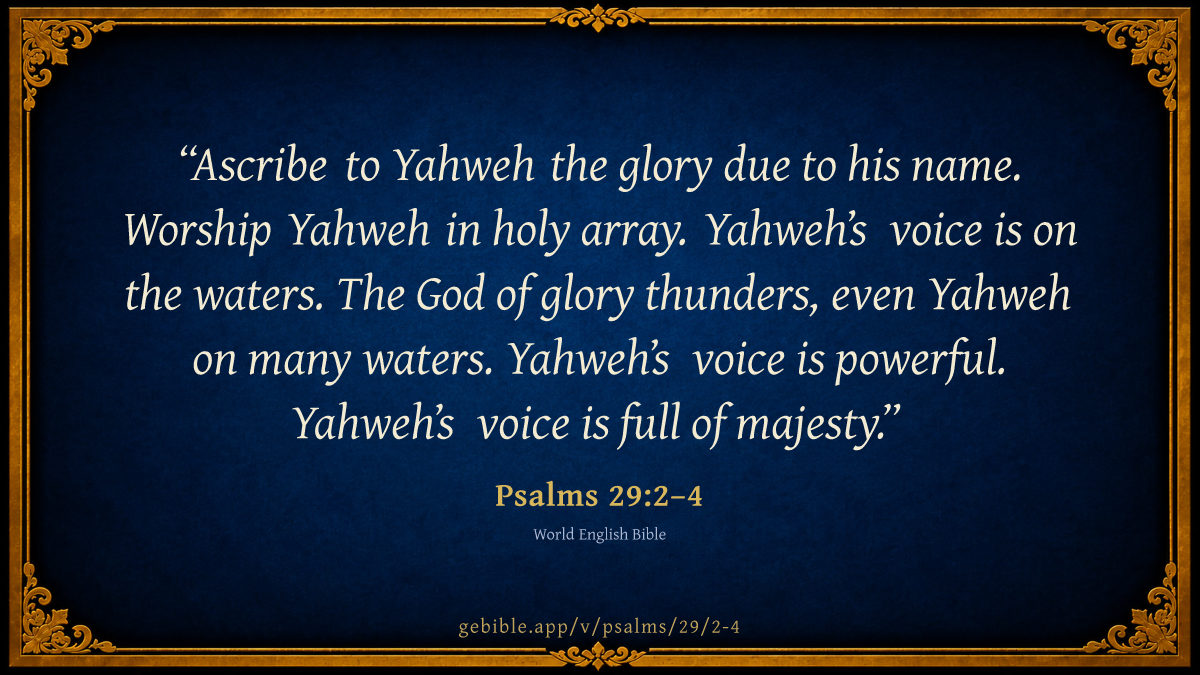
Psa 29:2 Give unto the LORD the glory due unto his name; worship the LORD in the beauty of holiness.
Ver. 2. Give unto the Lord the glory due unto his name] Which yet you cannot do, for his name is above all praise, Nominatissimam et celeberrimam (Jan.), Psa 148:13, but you must aim at it. The Rabbis observe that God’s holy name is mentioned eighteen different times in this psalm; that great men especially may give him the honour of his name, that they may stand in awe and not sin, that they may bring presents to him who ought to be feared, and those also the very best of the best, since he is a great King, and standeth much upon his seniority, Mal 1:14.
Read full note →
Worship the Lord in the beauty of holiness] Or, in his glorious sanctuary; therefore glorious, because there they might see God’s face, and hear his voice in his ordinances. Away, therefore, with your superstitions and will worships, and bring your gifts to his beautiful sanctuary; for nowhere else will he receive them. Send a lamb to this ruler of the earth, Isa 16:1, as a homage penny.
John Trapp, A Commentary or Exposition upon All the Books of the Old and New Testament (1647–1656) — public domain. Text from a community e-Sword module.
Matthew Poole1685 · Public DomainOn vv2–4The glory due unto his name, i.e. the honour…
The glory due unto his name, i.e. the honour which he deserves; which is to prefer him before all other gods, and to forsake all others, and to own him as the Almighty, and the only true God.
In the beauty of holiness; or, of the sanctuary, which is commonly called by this name; in his holy and beautiful house, as it is called, Isa 64:11, the only place where he will receive worship. So he exhorts them to turn proselytes to the Jewish religion; which was their duty and interest.
Matthew Poole's English Annotations on the Holy Bible (1683–1685) — public domain. Text from a community e-Sword/MySword module.
John Gill1763 · Public DomainOn vv2–4Give unto the Lord the glory due to his…
Give unto the Lord the glory due to his name,.... Or "the glory of his name" (x): which is suitable to his nature, agreeable to his perfections, and which belongs unto him on account of his works;
worship the Lord in the beauty of holiness; the Lord is only to be worshipped, and not any creature, angels or men; not Jehovah the Father only, who is to be worshipped in spirit and in truth; but the Son of God, and the Holy Ghost also, being of the same nature, and possessed of the same perfections; and that with both internal and external worship; and in true holiness, in which there is a real beauty: holiness is the beauty of God himself, he is glorious in it; it is the beauty of angels, it makes them so glorious as they are; and it is the beauty of saints, it is what makes them like unto Christ, and by which they are partakers of the divine nature; and in the exercise of holy graces, and in the discharge of holy duties, should they worship the Lord; unless this is to be understood of the place of worship, the sanctuary, or holy place in the tabernacle; or rather the church of God, which holiness becomes; but the former sense seems best.
John Gill's Exposition of the Whole Bible (1746–1763) — public domain (CC PDM 1.0). Text via the HelloAO Bible API.
John Wesley1765 · Public DomainOn vv2–3Give, &c. - The honour which he deserves: own…
Give, &c. - The honour which he deserves: own him as the Almighty, and the only true God. Holiness - Or, in his holy and beautiful house.
John Wesley, Explanatory Notes Upon the Whole Bible (1754–1765) — public domain. Text via the GEBible commentary corpus.
Adam Clarke1810 · Public DomainOn vv2–4Verse 2. The glory due unto his name] Rather,…
Verse 2. The glory due unto his name] Rather, the glory of his name. His name is Mercy; his nature is love. Ascribe mercy, love, power, and wisdom to him. All these are implied in the name Jehovah.
In the beauty of holiness.] בהדרת קדש behadrath kodesh, "the beautiful garments of holiness." Let the priests and Levites put on their best and cleanest apparel; and let the whole service be conducted in such a way as to be no dishonour to the Divine Majesty. The Vulgate and others read, In the palace of his holiness. Let all go to the temple, and return thanks to God for their preservation during this dreadful storm. See on Ps 29:9.
Adam Clarke's Commentary on the Bible (1810–1826) — public domain. Text from a community e-Sword/MySword module.
Joseph Benson1811 · Public DomainOn vv3–4Psa 29:3. The voice of the Lord — That…
Psa 29:3. The voice of the Lord — That is, thunder, frequently so called; is upon the waters — Upon the seas, where its noise spreads far and wide, and is very terrible; or rather above the clouds, which are sometimes called waters, as Gen 1:7; Psa 18:11, because they are of a watery substance, and frequently much water is contained in them. And this circumstance is noticed here as being of considerable importance to magnify the divine power, which displays itself in these superior regions, which are far above the reach of all earthly potentates, and from whence he can easily and unavoidably smite all that dwell upon the earth, and will not submit to him. The Lord is upon many waters — Upon the clouds, in which there are sometimes vast treasures of water, and upon which God is said to sit and ride, Psa 18:10-11; Psa 104:3.
Joseph Benson's Commentary on the Old and New Testaments (1811–1818) — public domain. Text from a community e-Sword module.
Albert Barnes1834 · Public DomainOn vv2–4Give unto the Lord the glory due unto his…
Give unto the Lord the glory due unto his name - Margin: “the honor of his name.” The honor of His name is that which is due to it, or which properly belongs to it. The “name” is put here, as it often is, for God Himself; and the meaning is, “Ascribe to God the honor that is properly his due.” This is a claim addressed to the angels; it is a claim certainly not less binding on people. It is practically a call upon all creatures in the universe to ascribe due honor to God.
Worship the Lord - This exhortation is made particularly in view of the manifestations of His power in the storm. The idea is, that one who is capable of putting forth such power as is displayed in a tempest, has a claim to adoration and praise.
Read full note →
In the beauty of holiness - Margin, “in his glorious sanctuary.” The Hebrew phrase would properly mean “holy beauty.” Some have supposed that it means “in holy adorning,” or in such consecrated vestments as were worn by priests in the sacred services of the sanctuary, or when they came into the presence of Yahweh. So DeWette understands it. But the more probable interpretation is that which refers it to the state of the heart - the “internal” ornament - with which we should approach God - to a holy and pure state of mind - that beauty or appropriateness of the soul which consists in holiness or purity. Of this the external clothing of the priesthood was itself but an emblem, and this is that which God desires in those who approach Him in an act of worship. It may be added that there is no “beauty” like this; that there is no external comeliness, no charm of person or complexion, no adorning of costly robes, that can be compared with this. It is this which God seeks, and with this He will be pleased, whether under a less or more attractive external form; whether under rich and costly raiment, or under the plain and decent clothing of poverty.
Albert Barnes' Notes on the Bible (1834–1885) — public domain. Text from a community e-Sword/MySword module.
Robert Jamieson, A. R. Fausset & David Brown1871 · Public DomainOn vv2–4name--as (Psa 5:11; Psa 8:1).
name--as (Psa 5:11; Psa 8:1).
beauty of holiness--the loveliness of a spiritual worship, of which the perceptible beauty of the sanctuary worship was but a type.
Jamieson, Fausset & Brown — Commentary Critical and Explanatory on the Whole Bible (1871) — public domain (CC PDM 1.0). Text via the HelloAO Bible API.
Daniel D. Whedon1874 · Public DomainOn v33. The voice of the Lord—This poetic name for…
3. The voice of the Lord—This poetic name for thunder (Job_37:4; Job_40:9) has a sevenfold repetition, and is probably the type and basis of the apocalyptic “seven thunders,” (Rev_10:3-4,) as the allegoric imagery of that book is almost wholly borrowed from the Old Testament.
Upon the waters—Either the “great waters”—that is, the sea, as in third line of the verse—or dark water clouds, as Psa_18:11. Thunder upon the ocean has a peculiarly deep and solemn sound, which is probably referred to here.
Daniel D. Whedon (gen. ed.), Commentary on the Old and New Testaments (1874–1909) — public domain. Text from a community e-Sword module.
The Cambridge Bible for Schools and Colleges1878 · Public DomainOn vv2–42. the glory due unto his name] Lit. the…
2. the glory due unto his name] Lit. the glory of his name, particularising the general idea of glory in Psa_29:1. The glory of his name is His glory as He reveals Himself in the world (Psa_5:11 note); here, as the context shews, especially in Nature.
in the beauty of holiness] Suggestive as this rendering is, it can hardly be right; and the true sense is that given in R.V. marg., in holy array. Cp. Psa_96:9 (= 1Ch_16:29); 2Ch_20:21 (R.V. marg.); Psa_110:3. The ideas of earth are transferred to heaven. As the priests in the earthly temple were clothed in “holy garments for glory and for beauty” (Exo_28:2), so even the ministrants in the heavenly temple must be arrayed befittingly.
The Cambridge Bible for Schools and Colleges (gen. ed. J. J. S. Perowne; Cambridge University Press, 1878–1918) — public domain. Text from a community e-Sword module.
Ellicott's Commentary for English Readers1878 · Public DomainOn vv2–4(2) In the beauty of holiness.—Better, in holy attire;…
(2) In the beauty of holiness.—Better, in holy attire; an image borrowed from the splendid vestments of the priests and Levites (2Ch_20:21; Psa_110:3). So the presences that attend the courts of heaven are bidden to be robed in their most magnificent attire, as for a high and sacred ceremony.
A Bible Commentary for English Readers, edited by Charles John Ellicott (1878–1897) — public domain. Text from a community e-Sword module.
The Pulpit Commentary1880 · Public DomainOn vv2–4Give unto the Lord the glory due unto his…
Give unto the Lord the glory due unto his Name; (comp. Psa_96:8) literally, the glory of his Name; i.e. the glory properly belonging to it. Worship the Lord in the beauty of holiness . (comp. Psa_96:9) This is generally explained as an exhortation to worship God in beautiful vestments, or with all the accessories of a beautiful ceremonial; but Dr. Alexander rightly questions whether the Beauty inherent in holiness itself is not meant. The apostle speaks of "the ornament of a meek and quiet spirit". (1Pe_3:4) And in goodness and holiness of every kind there is a sweetness and grace which may well be called "beauty," seeing that it has a close analogy with the beautiful in external nature and in art. The Greeks expressed physical beauty and moral perfection by one and the same term to kalon .
"The beauty of holiness.
Read full note →
To every devout Israelite Jerusalem was "the perfection of beauty," "the joy of the whole earth"; (Psa_48:2) because the temple of the Lord was there. Its gorgeous ritual, white-robed priests and Levites, choral psalms, clangour of trumpets, harps, cymbals, all seemed the highest ideal of worship, the very visible "beauty of holiness." To all this we may well see an allusion in these words. Hence the Revisers put in the margin, "holy array;" and some even render, "holy vestments." But the Hebrew word is not "vestments," but "splendour" or "majestic adornment." And it is not to priests and Levites these words are spoken, but to angels; (ver. 1 Psa_89:6) and in Psa_96:9 to the "kindreds of the people" (Revised Version), q.d. all the families of mankind. Therefore we recognize a higher, more spiritual meaning, of which all the glory of temple-worship was a faint shadow. To perceive "the beauty of holiness," we must first know what holiness really means.
I WHAT IS HOLINESS? The Bible gives a triple answer three steps, from the lowest to the loftiest views, from ritual to spiritual, from spiritual to Divine. Holiness is
(1) consecration to God;
(2) likeness to God;
(3) God"s own nature.
1. Consecration dedication, or devotion to God. In this sense, things, places, times, ceremonies, as well as persons, are continually spoken of in the Old Testament as "holy to the Lord." The ground round the burning bush was holy, (Exo_3:5) as long as God"s presence was manifested there. So was the place where, for the time, the tabernacle was pitched. When the bush ceased to burn; when the cloud rose from the tabernacle, and Israel marched to a new resting-place, the wild creatures roamed over those spots as common ground. The notion of indelible sanctity communicated by ceremonies is foreign to the Bible; things, places, etc., were holy because actually employed in God"s service. No pains were spared to impress the idea that nothing is too pure or good to give to God. The victims must be without blemish; vessels, of precious material and perfect workmanship; bread, unleavened; altar, built of whole stones; priests, free from all bodily defect; the very clothes of worshippers washed clean. Yet upon the tabernacle, the vessels, the priests, the people, must be sprinkled the blood of atonement. The lesson was that even our holiness is stained with sin in God"s all-searching eyes. (Heb_9:14, 23 10:19 1Jn_1:7-9)
2. Likeness to God is the higher, deeper view of holiness, to which all these forms of outward holiness were designed to lead. Before a single rite was enacted, or Aaron consecrated, the people were told to be "a kingdom of priests, a holy nation". (Exo_19:6) Again and again, like a trumpet-peal or a minster bell, sounds out the great command, "Be ye holy; for I am holy." The teaching of the New Testament cannot go beyond this. (1Pe_1:16) There are those who tell us that the Old Testament ideas of holiness were not moral or spiritual, but ritual and external. This text confutes them. Could any Israelite be so dull as not to see that all this outward ceremonial was meant to inspire deep reverence, profound worship, in thinking and speaking of God, and drawing men to him; but that God"s holiness which he was bidden to imitate, must be personal purity, righteousness, goodness; and that to be truly holy, we must be like God? (comp. Isa_6:1-6)
3. Therefore our highest idea of holiness is thisIt is God"s own character. Thought cannot soar above this. Uninspired human thought has never risen so high. The Bible idea of Divine holiness perfect moral and spiritual excellence as much excels all heathen religious teaching as noontide, twilight. It is summed up in 1Jn_1:5 1Jn_3:8.
II THE BEAUTY OF HOLINESS MUST, LIKE TRUE HOLINESS ITSELF, BE SPIRITUAL, INWARD. Yet also manifest; for beauty is something we can behold, if not with the eyes, with the mind. Not a beauty we confer, by clothing, adorning, materializing the spiritual; but a beauty it confers on us, by purifying and exalting. If the heart be consecrated, the life that flows from it will be beautiful. All the outward beauty of God"s works is a parable of loveliness of character and soul. Sunbeams are not so bright as loving smiles; the rose and the lily are less lair than modesty and innocence; the gorgeous sunset less grandly beautiful than the calm evening of a holy life.
REMARKS.
1. The perfect "beauty of holiness" is seen in the Lord Jesus; at once the Revelation and the Reflection of God"s character in human nature
2. This beauty can be truly seen only by those whose eyes are opened. (Joh_1:14 contrasted with Isa_53:2-7)
3. The life of every Christian ought to be beautiful. (Mat_5:16)
The Pulpit Commentary (1880–1919), ed. H.D.M. Spence-Jones & Joseph S. Exell — public domain. Text from a community e-Sword module.
Charles H. Spurgeon1885 · Public DomainOn vv2–4Ver. 2. Give unto the Lord the glory due…
Ver. 2. Give unto the Lord the glory due unto his name. A third time the admonition is given, for men are backward in glorifying God, and especially great men, who are often too much swollen with their own glory to spare time to give God his rightful praise, although nothing more is asked of them than is most just and right. Surely men should not need so much pressing to give what is due, especially when the payment is so pleasant. Unbelief and distrust, complaining and murmuring, rob God of his honour; in this respect, even the saints fail to give due glory to their King. Worship the Lord, bow before him with devout homage and sacred awe, and let your worship be such as he appoints. Of old, worship was cumbered with ceremonial, and men gathered around one dedicated building, whose solemn pomp was emblematic of the beauty of holiness; but now our worship is spiritual, and the architecture of the house and the garments of the worshippers are matters of no importance; the spiritual beauty of inward purity and outward holiness being far more precious in the eyes of our thrice holy God. O for grace ever to worship with holy motives and in a holy manner, as becometh saints! The call to worship in these two verses chimes in with the loud pealing thunder, which is the church bell of the universe ringing kings and angels, and all the sons of earth to their devotions.
Ver. 2. Give unto the Lord the glory due unto his name. Which yet you cannot do, for his name is above all praise! Ps 148:13; but you must aim at it. The Rabbins observe that God's holy name is mentioned eighteen several times in this Psalm; that great men especially may give him the honour of his name, that they may stand in awe and not sin, that they may bring presents to him who ought to be feared, and those also the very best of the best, since he is a great king, and standeth much upon his seniority. Mal 1:14. John Trapp.
Read full note →
Ver. 2. Worship the Lord. If any should ask, Why is the Lord to be worshipped? Why must he have such high honours from those that are high? What doth he in the world that calls for such adoration? David answereth meteorologically as well as theologically, he answers from the clouds Ps 29:3-4, "The voice of the Lord is upon the waters: the God of glory thundereth: the Lord is upon many waters. The voice of the Lord is powerful; the voice of the Lord is full of majesty; "as if he had said, Although the Lord Jesus Christ will not set up an outward, pompous, political kingdom, such as that of Cyrus, Alexander, etc., yet by the ministry of the gospel he will erect a spiritual kingdom, and gather to himself a church that shall abide for ever, out of all the nations of the earth; for the gospel shall be carried and preached, to not only the people of Israel, the Jews, but to the Gentiles, all the world over, that the minds of men may be enlightened, awakened, and moved with that unheard of doctrine of salvation by Christ, which had been hid from ages and generations. Joseph Caryl.
Ver. 2. (first clause). Royal dues, the royal treasury, loyal subjects paying their dues, the king receiving them. Smugglers and preventive men.
Ver. 2. (second clause). Inspired ritualism. What to do? Worship. Whom? The Lord. How? In the beauty of holiness. Absence of all allusions to place, time, order, words, form, vestments, etc.
Psalms 29:3*
Charles H. Spurgeon's The Treasury of David (1869–1885) — public domain. Psalms only. Text from a community e-Sword/MySword module.
The Biblical Illustrator1887 · Public DomainOn vv2–3Worship the Lord in the beauty of holiness.
Psa_29:2
Worship the Lord in the beauty of holiness.
Read full note →
The worship of holiness
Worship meant at first worth-ship, or the condition of being worthy, as friendship is the condition of being friendly. The best worship is not merely to thank God for what He has done for us, but to show ourselves worthy of this. It is very clear that this is the best kind of worship for us; for it results not in mere words, but in character. We are better for our religion, which cannot always be said of the outward kind; and surely it must be more acceptable to God. You would rather have your boy thank you for what you give him, and recognize your kindness, than not. But you would rather even than this have him use what you give him wisely. As between the boy who thanked you very profusely, and even sincerely, and then spent your money in some degrading way, and the boy who took your money carelessly and without a word, but spent it in a way that made you proud of him, you would surely choose the latter. But what is it that makes us worthy? It is the beauty of holiness. And what is holiness? Here we have another word that has lost its first and best meaning. Our dictionary tells us that holy is the same word, essentially, as heal, hale, whale. A man is physically holy when he is healed, or in health, when he is hale, when he is whole. Holiness is wholeness. No man is holy who is not a whole man; and, to be a whole man, he must care for his body as well as for his soul. What we shall be it doth not yet appear; but it is very certain that while we are here, the body is part of the man. Holiness is wholeness; and wholeness means a sound body and a sound soul together. But it means more than that: it means sound judgment, common sense. Good people are the salt of the earth. But it is possible to have too much salt in proportion to your porridge. It would be hard to say that anybody is too good; but it is very certain that many a mans goodness would be worth a great deal more if only he had a little practical judgment to direct it. The world needs its dreamers, its men and women of enthusiasm and ideals; but it needs also the calm, steady balance and ballast of the men and women of common sense. There are other things that one needs to be a whole man, as a warm heart and a strong will, without which he does not fulfil the Divine ideal, and so does not render back the worship that God loves. These are enough to show what is meant, so far, by the worship of wholeness. But we have yet to see that mere individual wholeness is not possible unless the individual recognizes larger wholes than himself, of which he is a part. In the first place, in so far as a man is a body, he is a part of the great whole of matter, or the universe. The man who does not realize that he is so far a part of the world cannot be a whole, cannot be holy. The farmer must put his work into line with the material laws of soil and season; the engineer must put his work into line with the laws of steam, and the physician with the laws of the human frame. If either tries to do otherwise, to set up a world of his own invention or imagination, the great universe calmly sweeps over it and him, as the sea sweeps over the childs house of sand on the beach. Let a man in any way separate himself from this great universe, and he suffers. As a man faints when he shuts himself into a room, away from the atmosphere that clothes the world, so he faints if he shut himself into his own life and interests. Just as the value of his land grows, though he may do absolutely nothing to it himself, simply because other people come and settle near him, and make a city about him, so his life grows, though he may not try to cultivate it at all, simply because other people are about him, and with him day by day. There are things that a man can do better in solitude than in society. There are necessities that sometimes drive individuals away from their fellows. There are circumstances that sometimes compel men and women to live destitute of the companionship which makes life rich and deep for others. But, though there may be a gain on one side, there is loss on others. There is about the recluse something less than human. The great currents of thought and emotion that sweep through society and keep hearts and minds fresh, as the breezes keep the air fresh, are lost by the recluse. It is a great mistake for those who are in grief or misfortune to shut themselves away either from the fresh air of nature or the fresh air of human companionship. Health is wholeness with nature and with man. To-day, human sympathies are broadening out with the spread of commerce; and, as it slowly dawns upon us that the good of the world is the good of every nation, so into our hearts comes a thrill of pity and desire to help, when we hear of the suffering of any part of this variegated human race. This is the beauty of holiness that is the best worship. In old days, when the sacrifice was not of the soul, but of the body, it was counted an unworthy thing to bring to the altar of God a bullock that had spot or blemish. To-day, it is not a one-sided any more than a stained manhood that makes a man worthy of the Divine love. It must be a whole man, body, mind, heart, will, and soul, all rounded and complete, at one with the world of nature and the world of man,--that is the acceptable offering. (W. H. Lyon)
In holy attire
Do we really worship God?
I. We worship God in the beauty of holiness when worship is characterized by reality. We should act with the same propriety, feel as much awe, dread of vulgarity, entering the old meeting house, as into the court and presence of an earthly king. As much? Yea, how much morel
II. We worship God in the beauty of holiness when our worship is characterized by recollection. Let the soul withdraw its faculties from men and time and affairs, come face to face with God and His righteousness, His truth, and His love. Bring by the process of recollection, as Miss Havergal says, your sins for cleansing, your uninterpretable heart, the cares from which you cannot flee, griefs you cannot utter, the joys of love, and the life you would no longer know as your own.
III. We worship God in the beauty of holiness when our worship is characterized by receptivity. The open souls are not sent empty away.
IV. We worship God in the beauty of holiness when our worship is characterized by responsiveness. I mean, carrying the ideals, impressions, determinations of the sanctuary back into the world and allowing them to mould our temper, habits and sentiments in the labours and recreations of life. If worship be true, character shall grow in strength and gentleness, and influences shall stream from us, bearing no tardy fruits, to our fellow-men. (D. B. Williams.)
The Biblical Illustrator, edited by Joseph S. Exell (c. 1880s–1900s) — public domain. Text from a community e-Sword module.
unfoldingWord translationNotes2017 · CC BY-SA 4.0On v3General Information:
General Information:
The psalm shows Yahweh's power and glory.
Read full note →
The voice of Yahweh is heard over the waters
God's voice is louder and clearer than all other sounds and noises. It can be heard over other loud sounds such as the sound of the waters. This can be stated in active form. AT: "When Yahweh speaks his voice is louder than the sound of the sea" or "Yahweh shouts louder than the sound of the waters" (See: Active or Passive)
over the waters
This refers to the seas or the oceans. These waters make a very loud noise as the waves rise and fall.
The voice of Yahweh
All occurrences of "voice" here represent Yahweh speaking. The writer is emphasizing that when Yahweh speaks, the sound is so loud it is heard over the waters, and it is so powerful it can destroy the largest trees. AT: "When Yahweh speaks, his voice" (See: Metonymy)
the God of glory thunders
This speaks about God speaking as if it were the sound of thunder. Just like the sound of thunder, Yahweh's voice can be heard over large distances. AT: "The voice of the glorious God is loud like thunder" or "When the glorious God speaks it rumbles like thunder" (See: Metaphor)
Tyndale Open Study Notes2022 · CC BY-SA 4.0On v329:3-9 The word translated voice (Hebrew qol) can also…
29:3-9 The word translated voice (Hebrew qol) can also mean “noise” (1 Kgs 1:45) or “thunder” (Joel 3:16). The Lord’s voice is awe-inspiring, and it dominates whatever rumblings people might attribute to other deities.
 GEBible — Godless Engineer's Bible App
John Calvin 1540 · Public Domain On v3 3. The voice of Jehovah is upon the waters.…
3. The voice of Jehovah is upon the waters. David now rehearses the wonders of nature which I have previously referred to; and well indeed does he celebrate the power of God as well as his goodness, in his works. As there is nothing in the ordinary course of nature, throughout the whole frame of heaven and earth, which does not invite us to the contemplation of God, he might have brought forward, as in Psalm 19:1, the sun and the stars, and the whole host of heaven, and the earth with its riches; but he selects only those works of God which prove not only that the world was at first created by him, and is governed by his power, but which also awaken the torpid, and drag them, as it were, in spite of themselves, humbly to adore him; as even Horace was compelled, though he was not only a heathen poet, but an Epicurean, and a vile contemner of Deity, to say of himself in one of his Odes, — (Lib. I. Ode 34.)
“A fugitive from heaven and prayer, I mocked at all religious fear, Deep scienced in the mazy lore Of mad philosophy; but now Hoist sail, and back my voyage plough To that blest harbour which I left before.
Read full note →
“For, lo! that awful heavenly Sire, Who frequent cleaves the clouds with fire, Parent of day, immortal Jove; Late through the floating fields of air, The face of heaven serene and fair, His thund’ring steeds, and winged chariot drove,” etc. Dr Francis’ Translation of Horace.
Experience, too, tells us that those who are most daring in their contempt of God are most afraid of thunderings, storms, and such like violent commotions. With great propriety, therefore, does the prophet invite our attention to these instances which strike the rude and insensible with some sense of the existence of a God, “Qui contraignent les barbares et gens esbestez sentir qu’il y a un Dieu.” — Fr. “Which constrain the rude and insensible to feel that there is a God.”
John Calvin's Commentaries (1540-1563) — public domain. Text from the Calvin Translation Society English edition (1840s-50s) via the Christian Classics Ethereal Library (ccel.org). Calvin's coverage is partial (roughly two-thirds of the Bible); uncommented books and verses are honest gaps, never fabricated. The 19th-century editor's footnotes and remarks are omitted so the notes are faithfully Calvin's own voice.
Geneva Bible translators 1599 · Public Domain On v3 The thunder claps that are heard out of the…
The thunder claps that are heard out of the clouds, ought to make the wicked to tremble for fear of God’s anger.
Geneva Bible (1599) marginal notes — public domain.
John Trapp 1656 · Public Domain On vv2–4 Psa 29:2 Give unto the LORD the glory due…
Psa 29:2 Give unto the LORD the glory due unto his name; worship the LORD in the beauty of holiness.
Ver. 2. Give unto the Lord the glory due unto his name] Which yet you cannot do, for his name is above all praise, Nominatissimam et celeberrimam (Jan.), Psa 148:13, but you must aim at it. The Rabbis observe that God’s holy name is mentioned eighteen different times in this psalm; that great men especially may give him the honour of his name, that they may stand in awe and not sin, that they may bring presents to him who ought to be feared, and those also the very best of the best, since he is a great King, and standeth much upon his seniority, Mal 1:14.
Read full note →
Worship the Lord in the beauty of holiness] Or, in his glorious sanctuary; therefore glorious, because there they might see God’s face, and hear his voice in his ordinances. Away, therefore, with your superstitions and will worships, and bring your gifts to his beautiful sanctuary; for nowhere else will he receive them. Send a lamb to this ruler of the earth, Isa 16:1, as a homage penny.
John Trapp, A Commentary or Exposition upon All the Books of the Old and New Testament (1647–1656) — public domain. Text from a community e-Sword module.
Matthew Poole 1685 · Public Domain On vv2–4 The glory due unto his name, i.e. the honour…
The glory due unto his name, i.e. the honour which he deserves; which is to prefer him before all other gods, and to forsake all others, and to own him as the Almighty, and the only true God.
In the beauty of holiness; or, of the sanctuary, which is commonly called by this name; in his holy and beautiful house, as it is called, Isa 64:11, the only place where he will receive worship. So he exhorts them to turn proselytes to the Jewish religion; which was their duty and interest.
Matthew Poole's English Annotations on the Holy Bible (1683–1685) — public domain. Text from a community e-Sword/MySword module.
John Gill 1763 · Public Domain On vv2–4 Give unto the Lord the glory due to his…
Give unto the Lord the glory due to his name,.... Or "the glory of his name" (x): which is suitable to his nature, agreeable to his perfections, and which belongs unto him on account of his works;
worship the Lord in the beauty of holiness; the Lord is only to be worshipped, and not any creature, angels or men; not Jehovah the Father only, who is to be worshipped in spirit and in truth; but the Son of God, and the Holy Ghost also, being of the same nature, and possessed of the same perfections; and that with both internal and external worship; and in true holiness, in which there is a real beauty: holiness is the beauty of God himself, he is glorious in it; it is the beauty of angels, it makes them so glorious as they are; and it is the beauty of saints, it is what makes them like unto Christ, and by which they are partakers of the divine nature; and in the exercise of holy graces, and in the discharge of holy duties, should they worship the Lord; unless this is to be understood of the place of worship, the sanctuary, or holy place in the tabernacle; or rather the church of God, which holiness becomes; but the former sense seems best.
Read full note →
(x) "gloriam nominis ejus", Pagninus, Montanus, Junius & Tremellius, Piscator, Cocceius, Michaelis.
John Gill's Exposition of the Whole Bible (1746–1763) — public domain (CC PDM 1.0). Text via the HelloAO Bible API.
John Wesley 1765 · Public Domain On vv2–3 Give, &c. - The honour which he deserves: own…
Give, &c. - The honour which he deserves: own him as the Almighty, and the only true God. Holiness - Or, in his holy and beautiful house.
John Wesley, Explanatory Notes Upon the Whole Bible (1754–1765) — public domain. Text via the GEBible commentary corpus.
Adam Clarke 1810 · Public Domain On vv2–4 Verse 2. The glory due unto his name] Rather,…
Verse 2. The glory due unto his name] Rather, the glory of his name. His name is Mercy; his nature is love. Ascribe mercy, love, power, and wisdom to him. All these are implied in the name Jehovah.
In the beauty of holiness.] בהדרת קדש behadrath kodesh, "the beautiful garments of holiness." Let the priests and Levites put on their best and cleanest apparel; and let the whole service be conducted in such a way as to be no dishonour to the Divine Majesty. The Vulgate and others read, In the palace of his holiness. Let all go to the temple, and return thanks to God for their preservation during this dreadful storm. See on Ps 29:9.
Adam Clarke's Commentary on the Bible (1810–1826) — public domain. Text from a community e-Sword/MySword module.
Joseph Benson 1811 · Public Domain On vv3–4 Psa 29:3. The voice of the Lord — That…
Psa 29:3. The voice of the Lord — That is, thunder, frequently so called; is upon the waters — Upon the seas, where its noise spreads far and wide, and is very terrible; or rather above the clouds, which are sometimes called waters, as Gen 1:7; Psa 18:11, because they are of a watery substance, and frequently much water is contained in them. And this circumstance is noticed here as being of considerable importance to magnify the divine power, which displays itself in these superior regions, which are far above the reach of all earthly potentates, and from whence he can easily and unavoidably smite all that dwell upon the earth, and will not submit to him. The Lord is upon many waters — Upon the clouds, in which there are sometimes vast treasures of water, and upon which God is said to sit and ride, Psa 18:10-11; Psa 104:3.
Joseph Benson's Commentary on the Old and New Testaments (1811–1818) — public domain. Text from a community e-Sword module.
Albert Barnes 1834 · Public Domain On vv2–4 Give unto the Lord the glory due unto his…
Give unto the Lord the glory due unto his name - Margin: “the honor of his name.” The honor of His name is that which is due to it, or which properly belongs to it. The “name” is put here, as it often is, for God Himself; and the meaning is, “Ascribe to God the honor that is properly his due.” This is a claim addressed to the angels; it is a claim certainly not less binding on people. It is practically a call upon all creatures in the universe to ascribe due honor to God.
Worship the Lord - This exhortation is made particularly in view of the manifestations of His power in the storm. The idea is, that one who is capable of putting forth such power as is displayed in a tempest, has a claim to adoration and praise.
Read full note →
In the beauty of holiness - Margin, “in his glorious sanctuary.” The Hebrew phrase would properly mean “holy beauty.” Some have supposed that it means “in holy adorning,” or in such consecrated vestments as were worn by priests in the sacred services of the sanctuary, or when they came into the presence of Yahweh. So DeWette understands it. But the more probable interpretation is that which refers it to the state of the heart - the “internal” ornament - with which we should approach God - to a holy and pure state of mind - that beauty or appropriateness of the soul which consists in holiness or purity. Of this the external clothing of the priesthood was itself but an emblem, and this is that which God desires in those who approach Him in an act of worship. It may be added that there is no “beauty” like this; that there is no external comeliness, no charm of person or complexion, no adorning of costly robes, that can be compared with this. It is this which God seeks, and with this He will be pleased, whether under a less or more attractive external form; whether under rich and costly raiment, or under the plain and decent clothing of poverty.
Albert Barnes' Notes on the Bible (1834–1885) — public domain. Text from a community e-Sword/MySword module.
Robert Jamieson, A. R. Fausset & David Brown 1871 · Public Domain On vv2–4 name--as (Psa 5:11; Psa 8:1).
name--as (Psa 5:11; Psa 8:1).
beauty of holiness--the loveliness of a spiritual worship, of which the perceptible beauty of the sanctuary worship was but a type.
Jamieson, Fausset & Brown — Commentary Critical and Explanatory on the Whole Bible (1871) — public domain (CC PDM 1.0). Text via the HelloAO Bible API.
Daniel D. Whedon 1874 · Public Domain On v3 3. The voice of the Lord—This poetic name for…
3. The voice of the Lord—This poetic name for thunder (Job_37:4; Job_40:9) has a sevenfold repetition, and is probably the type and basis of the apocalyptic “seven thunders,” (Rev_10:3-4,) as the allegoric imagery of that book is almost wholly borrowed from the Old Testament.
Upon the waters—Either the “great waters”—that is, the sea, as in third line of the verse—or dark water clouds, as Psa_18:11. Thunder upon the ocean has a peculiarly deep and solemn sound, which is probably referred to here.
Daniel D. Whedon (gen. ed.), Commentary on the Old and New Testaments (1874–1909) — public domain. Text from a community e-Sword module.
The Cambridge Bible for Schools and Colleges 1878 · Public Domain On vv2–4 2. the glory due unto his name] Lit. the…
2. the glory due unto his name] Lit. the glory of his name, particularising the general idea of glory in Psa_29:1. The glory of his name is His glory as He reveals Himself in the world (Psa_5:11 note); here, as the context shews, especially in Nature.
in the beauty of holiness] Suggestive as this rendering is, it can hardly be right; and the true sense is that given in R.V. marg., in holy array. Cp. Psa_96:9 (= 1Ch_16:29); 2Ch_20:21 (R.V. marg.); Psa_110:3. The ideas of earth are transferred to heaven. As the priests in the earthly temple were clothed in “holy garments for glory and for beauty” (Exo_28:2), so even the ministrants in the heavenly temple must be arrayed befittingly.
The Cambridge Bible for Schools and Colleges (gen. ed. J. J. S. Perowne; Cambridge University Press, 1878–1918) — public domain. Text from a community e-Sword module.
Ellicott's Commentary for English Readers 1878 · Public Domain On vv2–4 (2) In the beauty of holiness.—Better, in holy attire;…
(2) In the beauty of holiness.—Better, in holy attire; an image borrowed from the splendid vestments of the priests and Levites (2Ch_20:21; Psa_110:3). So the presences that attend the courts of heaven are bidden to be robed in their most magnificent attire, as for a high and sacred ceremony.
A Bible Commentary for English Readers, edited by Charles John Ellicott (1878–1897) — public domain. Text from a community e-Sword module.
The Pulpit Commentary 1880 · Public Domain On vv2–4 Give unto the Lord the glory due unto his…
Give unto the Lord the glory due unto his Name; (comp. Psa_96:8) literally, the glory of his Name; i.e. the glory properly belonging to it. Worship the Lord in the beauty of holiness . (comp. Psa_96:9) This is generally explained as an exhortation to worship God in beautiful vestments, or with all the accessories of a beautiful ceremonial; but Dr. Alexander rightly questions whether the Beauty inherent in holiness itself is not meant. The apostle speaks of "the ornament of a meek and quiet spirit". (1Pe_3:4) And in goodness and holiness of every kind there is a sweetness and grace which may well be called "beauty," seeing that it has a close analogy with the beautiful in external nature and in art. The Greeks expressed physical beauty and moral perfection by one and the same term to kalon .
"The beauty of holiness.
Read full note →
To every devout Israelite Jerusalem was "the perfection of beauty," "the joy of the whole earth"; (Psa_48:2) because the temple of the Lord was there. Its gorgeous ritual, white-robed priests and Levites, choral psalms, clangour of trumpets, harps, cymbals, all seemed the highest ideal of worship, the very visible "beauty of holiness." To all this we may well see an allusion in these words. Hence the Revisers put in the margin, "holy array;" and some even render, "holy vestments." But the Hebrew word is not "vestments," but "splendour" or "majestic adornment." And it is not to priests and Levites these words are spoken, but to angels; (ver. 1 Psa_89:6) and in Psa_96:9 to the "kindreds of the people" (Revised Version), q.d. all the families of mankind. Therefore we recognize a higher, more spiritual meaning, of which all the glory of temple-worship was a faint shadow. To perceive "the beauty of holiness," we must first know what holiness really means.
I WHAT IS HOLINESS? The Bible gives a triple answer three steps, from the lowest to the loftiest views, from ritual to spiritual, from spiritual to Divine. Holiness is
(1) consecration to God;
(2) likeness to God;
(3) God"s own nature.
1. Consecration dedication, or devotion to God. In this sense, things, places, times, ceremonies, as well as persons, are continually spoken of in the Old Testament as "holy to the Lord." The ground round the burning bush was holy, (Exo_3:5) as long as God"s presence was manifested there. So was the place where, for the time, the tabernacle was pitched. When the bush ceased to burn; when the cloud rose from the tabernacle, and Israel marched to a new resting-place, the wild creatures roamed over those spots as common ground. The notion of indelible sanctity communicated by ceremonies is foreign to the Bible; things, places, etc., were holy because actually employed in God"s service. No pains were spared to impress the idea that nothing is too pure or good to give to God. The victims must be without blemish; vessels, of precious material and perfect workmanship; bread, unleavened; altar, built of whole stones; priests, free from all bodily defect; the very clothes of worshippers washed clean. Yet upon the tabernacle, the vessels, the priests, the people, must be sprinkled the blood of atonement. The lesson was that even our holiness is stained with sin in God"s all-searching eyes. (Heb_9:14, 23 10:19 1Jn_1:7-9)
2. Likeness to God is the higher, deeper view of holiness, to which all these forms of outward holiness were designed to lead. Before a single rite was enacted, or Aaron consecrated, the people were told to be "a kingdom of priests, a holy nation". (Exo_19:6) Again and again, like a trumpet-peal or a minster bell, sounds out the great command, "Be ye holy; for I am holy." The teaching of the New Testament cannot go beyond this. (1Pe_1:16) There are those who tell us that the Old Testament ideas of holiness were not moral or spiritual, but ritual and external. This text confutes them. Could any Israelite be so dull as not to see that all this outward ceremonial was meant to inspire deep reverence, profound worship, in thinking and speaking of God, and drawing men to him; but that God"s holiness which he was bidden to imitate, must be personal purity, righteousness, goodness; and that to be truly holy, we must be like God? (comp. Isa_6:1-6)
3. Therefore our highest idea of holiness is thisIt is God"s own character. Thought cannot soar above this. Uninspired human thought has never risen so high. The Bible idea of Divine holiness perfect moral and spiritual excellence as much excels all heathen religious teaching as noontide, twilight. It is summed up in 1Jn_1:5 1Jn_3:8.
II THE BEAUTY OF HOLINESS MUST, LIKE TRUE HOLINESS ITSELF, BE SPIRITUAL, INWARD. Yet also manifest; for beauty is something we can behold, if not with the eyes, with the mind. Not a beauty we confer, by clothing, adorning, materializing the spiritual; but a beauty it confers on us, by purifying and exalting. If the heart be consecrated, the life that flows from it will be beautiful. All the outward beauty of God"s works is a parable of loveliness of character and soul. Sunbeams are not so bright as loving smiles; the rose and the lily are less lair than modesty and innocence; the gorgeous sunset less grandly beautiful than the calm evening of a holy life.
REMARKS.
1. The perfect "beauty of holiness" is seen in the Lord Jesus; at once the Revelation and the Reflection of God"s character in human nature
2. This beauty can be truly seen only by those whose eyes are opened. (Joh_1:14 contrasted with Isa_53:2-7)
3. The life of every Christian ought to be beautiful. (Mat_5:16)
The Pulpit Commentary (1880–1919), ed. H.D.M. Spence-Jones & Joseph S. Exell — public domain. Text from a community e-Sword module.
Charles H. Spurgeon 1885 · Public Domain On vv2–4 Ver. 2. Give unto the Lord the glory due…
Ver. 2. Give unto the Lord the glory due unto his name. A third time the admonition is given, for men are backward in glorifying God, and especially great men, who are often too much swollen with their own glory to spare time to give God his rightful praise, although nothing more is asked of them than is most just and right. Surely men should not need so much pressing to give what is due, especially when the payment is so pleasant. Unbelief and distrust, complaining and murmuring, rob God of his honour; in this respect, even the saints fail to give due glory to their King. Worship the Lord, bow before him with devout homage and sacred awe, and let your worship be such as he appoints. Of old, worship was cumbered with ceremonial, and men gathered around one dedicated building, whose solemn pomp was emblematic of the beauty of holiness; but now our worship is spiritual, and the architecture of the house and the garments of the worshippers are matters of no importance; the spiritual beauty of inward purity and outward holiness being far more precious in the eyes of our thrice holy God. O for grace ever to worship with holy motives and in a holy manner, as becometh saints! The call to worship in these two verses chimes in with the loud pealing thunder, which is the church bell of the universe ringing kings and angels, and all the sons of earth to their devotions.
Ver. 2. Give unto the Lord the glory due unto his name. Which yet you cannot do, for his name is above all praise! Ps 148:13; but you must aim at it. The Rabbins observe that God's holy name is mentioned eighteen several times in this Psalm; that great men especially may give him the honour of his name, that they may stand in awe and not sin, that they may bring presents to him who ought to be feared, and those also the very best of the best, since he is a great king, and standeth much upon his seniority. Mal 1:14. John Trapp.
Read full note →
Ver. 2. Worship the Lord. If any should ask, Why is the Lord to be worshipped? Why must he have such high honours from those that are high? What doth he in the world that calls for such adoration? David answereth meteorologically as well as theologically, he answers from the clouds Ps 29:3-4, "The voice of the Lord is upon the waters: the God of glory thundereth: the Lord is upon many waters. The voice of the Lord is powerful; the voice of the Lord is full of majesty; "as if he had said, Although the Lord Jesus Christ will not set up an outward, pompous, political kingdom, such as that of Cyrus, Alexander, etc., yet by the ministry of the gospel he will erect a spiritual kingdom, and gather to himself a church that shall abide for ever, out of all the nations of the earth; for the gospel shall be carried and preached, to not only the people of Israel, the Jews, but to the Gentiles, all the world over, that the minds of men may be enlightened, awakened, and moved with that unheard of doctrine of salvation by Christ, which had been hid from ages and generations. Joseph Caryl.
Ver. 2. (first clause). Royal dues, the royal treasury, loyal subjects paying their dues, the king receiving them. Smugglers and preventive men.
Ver. 2. (second clause). Inspired ritualism. What to do? Worship. Whom? The Lord. How? In the beauty of holiness. Absence of all allusions to place, time, order, words, form, vestments, etc.
Psalms 29:3*
Charles H. Spurgeon's The Treasury of David (1869–1885) — public domain. Psalms only. Text from a community e-Sword/MySword module.
The Biblical Illustrator 1887 · Public Domain On vv2–3 Worship the Lord in the beauty of holiness.
Psa_29:2
Worship the Lord in the beauty of holiness.
Read full note →
The worship of holiness
Worship meant at first worth-ship, or the condition of being worthy, as friendship is the condition of being friendly. The best worship is not merely to thank God for what He has done for us, but to show ourselves worthy of this. It is very clear that this is the best kind of worship for us; for it results not in mere words, but in character. We are better for our religion, which cannot always be said of the outward kind; and surely it must be more acceptable to God. You would rather have your boy thank you for what you give him, and recognize your kindness, than not. But you would rather even than this have him use what you give him wisely. As between the boy who thanked you very profusely, and even sincerely, and then spent your money in some degrading way, and the boy who took your money carelessly and without a word, but spent it in a way that made you proud of him, you would surely choose the latter. But what is it that makes us worthy? It is the beauty of holiness. And what is holiness? Here we have another word that has lost its first and best meaning. Our dictionary tells us that holy is the same word, essentially, as heal, hale, whale. A man is physically holy when he is healed, or in health, when he is hale, when he is whole. Holiness is wholeness. No man is holy who is not a whole man; and, to be a whole man, he must care for his body as well as for his soul. What we shall be it doth not yet appear; but it is very certain that while we are here, the body is part of the man. Holiness is wholeness; and wholeness means a sound body and a sound soul together. But it means more than that: it means sound judgment, common sense. Good people are the salt of the earth. But it is possible to have too much salt in proportion to your porridge. It would be hard to say that anybody is too good; but it is very certain that many a mans goodness would be worth a great deal more if only he had a little practical judgment to direct it. The world needs its dreamers, its men and women of enthusiasm and ideals; but it needs also the calm, steady balance and ballast of the men and women of common sense. There are other things that one needs to be a whole man, as a warm heart and a strong will, without which he does not fulfil the Divine ideal, and so does not render back the worship that God loves. These are enough to show what is meant, so far, by the worship of wholeness. But we have yet to see that mere individual wholeness is not possible unless the individual recognizes larger wholes than himself, of which he is a part. In the first place, in so far as a man is a body, he is a part of the great whole of matter, or the universe. The man who does not realize that he is so far a part of the world cannot be a whole, cannot be holy. The farmer must put his work into line with the material laws of soil and season; the engineer must put his work into line with the laws of steam, and the physician with the laws of the human frame. If either tries to do otherwise, to set up a world of his own invention or imagination, the great universe calmly sweeps over it and him, as the sea sweeps over the childs house of sand on the beach. Let a man in any way separate himself from this great universe, and he suffers. As a man faints when he shuts himself into a room, away from the atmosphere that clothes the world, so he faints if he shut himself into his own life and interests. Just as the value of his land grows, though he may do absolutely nothing to it himself, simply because other people come and settle near him, and make a city about him, so his life grows, though he may not try to cultivate it at all, simply because other people are about him, and with him day by day. There are things that a man can do better in solitude than in society. There are necessities that sometimes drive individuals away from their fellows. There are circumstances that sometimes compel men and women to live destitute of the companionship which makes life rich and deep for others. But, though there may be a gain on one side, there is loss on others. There is about the recluse something less than human. The great currents of thought and emotion that sweep through society and keep hearts and minds fresh, as the breezes keep the air fresh, are lost by the recluse. It is a great mistake for those who are in grief or misfortune to shut themselves away either from the fresh air of nature or the fresh air of human companionship. Health is wholeness with nature and with man. To-day, human sympathies are broadening out with the spread of commerce; and, as it slowly dawns upon us that the good of the world is the good of every nation, so into our hearts comes a thrill of pity and desire to help, when we hear of the suffering of any part of this variegated human race. This is the beauty of holiness that is the best worship. In old days, when the sacrifice was not of the soul, but of the body, it was counted an unworthy thing to bring to the altar of God a bullock that had spot or blemish. To-day, it is not a one-sided any more than a stained manhood that makes a man worthy of the Divine love. It must be a whole man, body, mind, heart, will, and soul, all rounded and complete, at one with the world of nature and the world of man,--that is the acceptable offering. (W. H. Lyon)
In holy attire
Do we really worship God?
I. We worship God in the beauty of holiness when worship is characterized by reality. We should act with the same propriety, feel as much awe, dread of vulgarity, entering the old meeting house, as into the court and presence of an earthly king. As much? Yea, how much morel
II. We worship God in the beauty of holiness when our worship is characterized by recollection. Let the soul withdraw its faculties from men and time and affairs, come face to face with God and His righteousness, His truth, and His love. Bring by the process of recollection, as Miss Havergal says, your sins for cleansing, your uninterpretable heart, the cares from which you cannot flee, griefs you cannot utter, the joys of love, and the life you would no longer know as your own.
III. We worship God in the beauty of holiness when our worship is characterized by receptivity. The open souls are not sent empty away.
IV. We worship God in the beauty of holiness when our worship is characterized by responsiveness. I mean, carrying the ideals, impressions, determinations of the sanctuary back into the world and allowing them to mould our temper, habits and sentiments in the labours and recreations of life. If worship be true, character shall grow in strength and gentleness, and influences shall stream from us, bearing no tardy fruits, to our fellow-men. (D. B. Williams.)
The Biblical Illustrator, edited by Joseph S. Exell (c. 1880s–1900s) — public domain. Text from a community e-Sword module.
unfoldingWord translationNotes 2017 · CC BY-SA 4.0 On v3 General Information:
General Information:
The psalm shows Yahweh's power and glory.
Read full note →
The voice of Yahweh is heard over the waters
God's voice is louder and clearer than all other sounds and noises. It can be heard over other loud sounds such as the sound of the waters. This can be stated in active form. AT: "When Yahweh speaks his voice is louder than the sound of the sea" or "Yahweh shouts louder than the sound of the waters" (See: Active or Passive)
over the waters
This refers to the seas or the oceans. These waters make a very loud noise as the waves rise and fall.
The voice of Yahweh
All occurrences of "voice" here represent Yahweh speaking. The writer is emphasizing that when Yahweh speaks, the sound is so loud it is heard over the waters, and it is so powerful it can destroy the largest trees. AT: "When Yahweh speaks, his voice" (See: Metonymy)
the God of glory thunders
This speaks about God speaking as if it were the sound of thunder. Just like the sound of thunder, Yahweh's voice can be heard over large distances. AT: "The voice of the glorious God is loud like thunder" or "When the glorious God speaks it rumbles like thunder" (See: Metaphor)
over many waters
"over the large bodies of water"
translationWords
voice
water
God
power
majesty
cedar
Lebanon
unfoldingWord translationNotes — © Distant Shores Media and the Door43 World Missions Community, licensed CC BY-SA 4.0. Source: git.door43.org/Door43/en_tn.
Tyndale Open Study Notes 2022 · CC BY-SA 4.0 On v3 29:3-9 The word translated voice (Hebrew qol) can also…
29:3-9 The word translated voice (Hebrew qol) can also mean “noise” (1 Kgs 1:45) or “thunder” (Joel 3:16). The Lord’s voice is awe-inspiring, and it dominates whatever rumblings people might attribute to other deities.
Tyndale Open Study Notes — © Tyndale Open Resources, licensed CC BY-SA 4.0. Text via the HelloAO Bible API.