
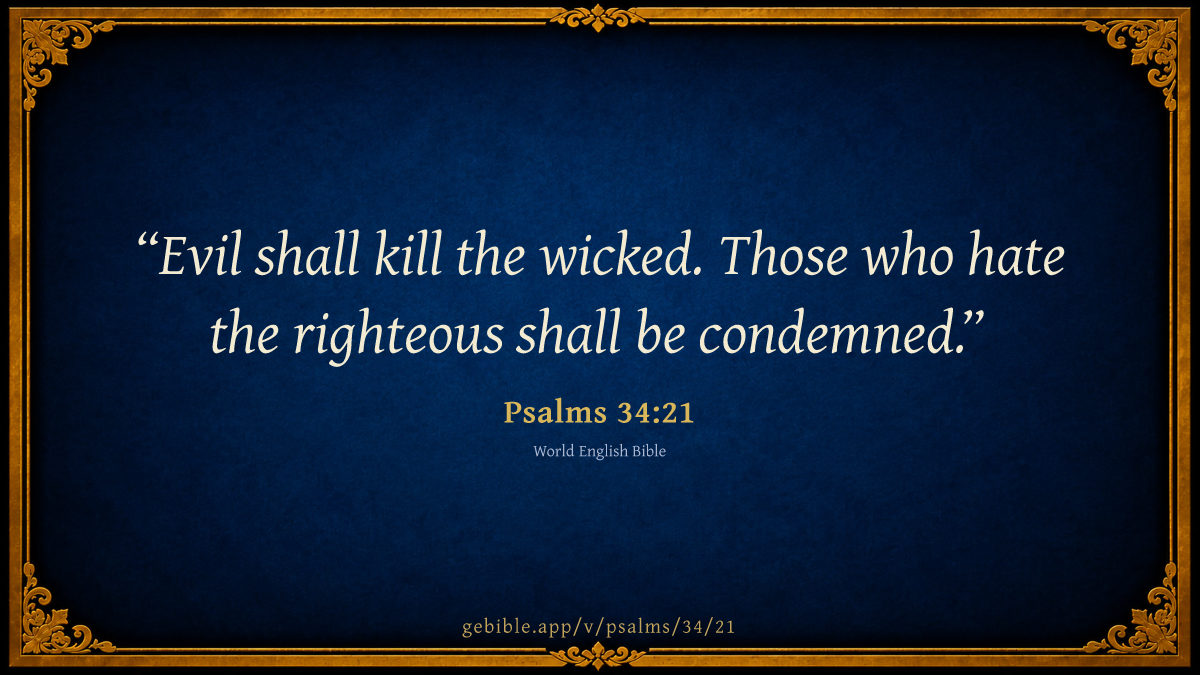
Evil shall kill the wicked. Those who hate the righteous shall be condemned.
Parallel Translations
-
Evil shall kill the wicked. Those who hate the righteous shall be condemned.
-
Evil shall slay the wicked: and they that hate the righteous shall be desolate.
-
(34-22) Evil shall kill the wicked; and they that hate the righteous shall be held guilty.
Examined in Scripture Analysis
Contradictions (2)
Questions where the Bible appears to say two different things, with the passages on each side set together.
Cross-references (20)
Passages linked to Psalms 34:21 in the Treasury of Scripture Knowledge, ordered by reader-vote popularity; verse text shown in World English Bible.
- Psalms 94:23 He has brought on them their own iniquity, and will cut them off in their own wickedness. Yahweh, our God, will cut them off.
- Isaiah 3:11 Woe to the wicked! Disaster is upon them; for the deeds of his hands will be paid back to him.
- Proverbs 24:16 for a righteous man falls seven times and rises up again; but the wicked are overthrown by calamity.
- Psalms 37:12-15 The wicked plots against the just, and gnashes at him with his teeth. The Lord will laugh at him, for he sees that his day is coming. The wicked have drawn out the sword, and have bent their bow, to cast down the poor and needy, to kill those who are upright on the path. Their sword shall enter into their own heart. Their bows shall be broken.
- Psalms 89:23 I will beat down his adversaries before him, and strike those who hate him.
- 2 Thessalonians 1:9 who will pay the penalty: eternal destruction from the face of the Lord and from the glory of his might,
- Luke 19:14 But his citizens hated him, and sent an envoy after him, saying, ‘We don’t want this man to reign over us.’
- 1 Samuel 19:4-5 Jonathan spoke good of David to Saul his father, and said to him, “Don’t let the king sin against his servant, against David; because he has not sinned against you, and because his works have been very good toward you; for he put his life in his hand, and struck the Philistine, and Yahweh worked a great victory for all Israel. You saw it, and rejoiced. Why then will you sin against innocent blood, to kill David without a cause?”
- Psalms 37:30-40 The mouth of the righteous talks of wisdom. His tongue speaks justice. The law of his God is in his heart. None of his steps shall slide. The wicked watch the righteous, and seek to kill him. Yahweh will not leave him in his hand, nor condemn him when he is judged. Wait for Yahweh, and keep his way, and he will exalt you to inherit the land. When the wicked are cut off, you shall see it. I have seen the wicked in great power, spreading himself like a green tree in its native soil. But he passed away, and behold, he was not. Yes, I sought him, but he could not be found. Mark the perfect man, and see the upright, for there is a future for the man of peace. As for transgressors, they shall be destroyed together. The future of the wicked shall be cut off. But the salvation of the righteous is from Yahweh. He is their stronghold in the time of trouble. Yahweh helps them and rescues them. He rescues them from the wicked and saves them, because they have taken refuge in him.
- Psalms 40:15 Let them be desolate by reason of their shame that tell me, “Aha! Aha!”
- Luke 19:27 But bring those enemies of mine who didn’t want me to reign over them here, and kill them before me.’ ”
- 1 Thessalonians 2:15-16 who killed both the Lord Jesus and their own prophets, and drove us out, and don’t please God, and are contrary to all men, forbidding us to speak to the Gentiles that they may be saved, to fill up their sins always. But wrath has come on them to the uttermost.
- 2 Thessalonians 1:6 Since it is a righteous thing with God to repay affliction to those who afflict you,
- Exodus 20:7 “You shall not misuse the name of Yahweh your God, for Yahweh will not hold him guiltless who misuses his name.
- 1 Samuel 31:4 Then Saul said to his armor bearer, “Draw your sword, and thrust me through with it, lest these uncircumcised come and thrust me through, and abuse me!” But his armor bearer would not; for he was terrified. Therefore Saul took his sword, and fell on it.
- 1 Kings 22:8 The king of Israel said to Jehoshaphat, “There is yet one man by whom we may inquire of Yahweh, Micaiah the son of Imlah; but I hate him, for he does not prophesy good concerning me, but evil.” Jehoshaphat said, “Don’t let the king say so.”
- 1 Kings 22:37 So the king died, and was brought to Samaria; and they buried the king in Samaria.
- John 7:7 The world can’t hate you, but it hates me, because I testify about it, that its works are evil.
- John 15:18-23 If the world hates you, you know that it has hated me before it hated you. If you were of the world, the world would love its own. But because you are not of the world, since I chose you out of the world, therefore the world hates you. Remember the word that I said to you: ‘A servant is not greater than his lord.’ If they persecuted me, they will also persecute you. If they kept my word, they will also keep yours. But they will do all these things to you for my name’s sake, because they don’t know him who sent me. If I had not come and spoken to them, they would not have had sin; but now they have no excuse for their sin. He who hates me, hates my Father also.
- Luke 19:41-44 When he came near, he saw the city and wept over it, saying, “If you, even you, had known today the things which belong to your peace! But now, they are hidden from your eyes. For the days will come on you, when your enemies will throw up a barricade against you, surround you, hem you in on every side, and will dash you and your children within you to the ground. They will not leave in you one stone on another, because you didn’t know the time of your visitation.”
Cross-references from openbible.info (CC BY 4.0)
Explain this verse (15 sources)
Historical commentary, presented as a primary source — not an endorsement.
Private notes
Saved on this device only — never synced or sent anywhere.
John Calvin 1540 · Public Domain 21. But malice shall slay the wicked. The Hebrew…
21. But malice shall slay the wicked. The Hebrew word רעה, raäh, which I have translated malice, some would rather render misery, so that the meaning would be, that the ungodly shall perish miserably, because in the end they shall be overwhelmed with calamities. The other translation, however, is more expressive, namely, that their wickedness, with which they think themselves fortified, shall fall upon their own heads. As David therefore taught before, that there was no defense better than a just and blameless life, so now he declares, that all the wicked enterprises of the wicked, even though no one should in any thing oppose them, shall turn to their own destruction. In the second clause of the verse he states, that it is for the sake of the righteous that it is ordered, that the ungodly are themselves the cause and instruments of their own destruction. Those, says he, who hate the righteous shall be destroyed Let this, therefore, be to us as a wall of brass and sure defense; that however numerous the enemies which beset us may be, we should not be afraid, because they are already devoted to destruction. The same thing David confirms in the last verse, in which he says, that Jehovah redeems the soul of his servants How could they be preserved in safety, even for a moment, among so many dangers, unless God interposed his power for their defense? But by the word redeem there is expressed a kind of preservation which is repugnant to the flesh. For it is necessary that we should first be adjudged or doomed to death, before God should appear as our redeemer. From this it follows, that those who hurry forward too precipitately, and are unable to realize God’s power unless he appear speedily, working deliverance for them, intercept the communication of his grace. Moreover, that none might form their judgment of the servants of God by moral or philosophic virtue only, as it is called, David specifies this as a principal mark by which they may be known, that they trust in God, on whom also their salvation depends.
John Calvin's Commentaries (1540-1563) — public domain. Text from the Calvin Translation Society English edition (1840s-50s) via the Christian Classics Ethereal Library (ccel.org). Calvin's coverage is partial (roughly two-thirds of the Bible); uncommented books and verses are honest gaps, never fabricated. The 19th-century editor's footnotes and remarks are omitted so the notes are faithfully Calvin's own voice.
Geneva Bible translators 1599 · Public Domain Their wicked enterprises shall turn to their own destruction.
Their wicked enterprises shall turn to their own destruction.
Geneva Bible (1599) marginal notes — public domain.
John Trapp 1656 · Public Domain Psa 34:21 Evil shall slay the wicked: and they…
Psa 34:21 Evil shall slay the wicked: and they that hate the righteous shall be desolate.
Ver. 21. Evil shall slay the wicked] For lack of such deliverance, as Psa 34:19, malum iugular authorem mali Their malice shall prove their mischief. The Arabic hath it (but not right), mors impii pessima. Aben Ezra better senseth it thus, One affliction killeth the wicked; when out of many God delivereth the righteous.
John Trapp, A Commentary or Exposition upon All the Books of the Old and New Testament (1647–1656) — public domain. Text from a community e-Sword module.
Matthew Poole 1685 · Public Domain Evil; either,
Evil; either,
1. The evil of sin. His own wickedness, though designed against others, shall destroy himself. Or,
Read full note →
2. The evil of misery. When the afflictions of good men shall have a happy issue, theirs shall end in their total and final destruction.
That hate the righteous; that persecute them, and plot their ruin; which is an evidence that they hate them, whatsoever they may pretend to the contrary.
Matthew Poole's English Annotations on the Holy Bible (1683–1685) — public domain. Text from a community e-Sword/MySword module.
John Gill 1763 · Public Domain The Lord redeemeth the soul of his servants,.... Who…
The Lord redeemeth the soul of his servants,.... Who are made so by his grace in the day of his power, and are willing to serve him, and to serve him with their minds, readily and cheerfully; and the soul of these, which is the more noble part of them, and is of more worth than a world, the redemption of which is precious, and requires a great price, the Lord redeems; not that their bodies are neglected, and not redeemed; but this is mentioned as the principal part, and for the whole; and this redemption is by the Lord, who only is able to effect it, and which he has obtained through his precious blood; and here it seems to denote the application of it in its effects; that is, the forgiveness of sin, justification, and sanctification, since it respects something that is continually doing;
and none of them that trust in him shall be desolate; or "be guilty" (o), or "condemned", or "damned"; because they are justified from all the sins they have been guilty of, through the redemption that is in Christ Jesus; and having believed in him, they shall not be damned, according to Mar 16:16; and they shall be far from being desolate, and alone, and miserable; they shall stand at Christ's right hand, be received into his kingdom and glory, and be for ever with him.
Read full note →
(o) "non rei fiunt", Cocceius; "non punientur", Gejerus; "shall not be condemned as guilty", Ainsworth.
Next: Psalms Chapter 35
John Gill's Exposition of the Whole Bible (1746–1763) — public domain (CC PDM 1.0). Text via the HelloAO Bible API.
Adam Clarke 1810 · Public Domain Verse 21. Evil shall slay the wicked] The very…
Verse 21. Evil shall slay the wicked] The very thing in which they delight shall become their bane and their ruin.
They that hate the righteous] All persecutors of God's people shall be followed by the chilling blast of God's displeasure in this world; and if they repent not, shall perish everlastingly.
Adam Clarke's Commentary on the Bible (1810–1826) — public domain. Text from a community e-Sword/MySword module.
Joseph Benson 1811 · Public Domain Psa 34:21. Evil shall slay the wicked — Either,…
Psa 34:21. Evil shall slay the wicked — Either, 1st, The evil of sin: his own wickedness, though designed against others, shall destroy himself. Or, 2d, The evil of misery. While the afflictions of good men shall have a happy issue, theirs shall end in their total and final destruction. They that hate the righteous shall be desolate — That persecute them and plot their ruin, which is an evidence they hate them, whatsoever they may pretend to the contrary. Dr. Kennicott translates this latter clause, The haters of the Just One, Jehovah shall make desolate; a prediction awfully fulfilled in the punishment of the persecutors of the Messiah, one of whose proper titles this was, Act 3:14.
Joseph Benson's Commentary on the Old and New Testaments (1811–1818) — public domain. Text from a community e-Sword module.
Albert Barnes 1834 · Public Domain Evil shall slay the wicked - That is, his…
Evil shall slay the wicked - That is, his own wicked conduct will be the cause of his destruction. His ruin is not arbitrary, or the mere result of a divine appointment; it is caused by sin, and is the regular and natural consequence of guilt. In the destruction of the sinner, there will not be any one thing which cannot be explained by the supposition that it is the regular effect of sin, or what sin is, in its own nature, suited to produce. The one will measure the other; guilt will be the measure of all that there is in the punishment.
And they that hate the righteous - Another term for the wicked, or a term designating the character of the wicked in one aspect or view. It is true of all the wicked that they must hate the righteous in their hearts, or that they are so opposed to the character of the righteous that it is proper to designate this feeling as “hatred.”
Read full note →
Shall be desolate - Margin, “shall be guilty.” Prof. Alexander and Hengstenberg render this, as in the margin, “shall be guilty.” DeWette, “shall repent.” Rosenmuller, “shall be condemned.” The original word - אשׁם 'âsham - means properly to fail in duty, to transgress, to be guilty. The primary idea, says Gesenius (Lexicon), is that of “negligence,” especially in going, or in gait, as of a camel that is slow or faltering. Then the word means to be held or treated as faulty or guilty; and then, to bear the consequences of guilt, or to be punished. This seems to be the idea here. The word is sometimes synonymous with another Hebrew word - ישׁם yâsham - meaning to be desolate; to be destroyed; to be laid waste: Eze 6:6; Joe 1:18; Psa 5:10. But the usual meaning of the word is undoubtedly retained here, as signifying that, in the dealings of Providence, or in the administering of divine government, such men will be held to be guilty, and will be treated accordingly; that is, that they will be punished.
Albert Barnes' Notes on the Bible (1834–1885) — public domain. Text from a community e-Sword/MySword module.
Robert Jamieson, A. R. Fausset & David Brown 1871 · Public Domain Contrast in the destiny of righteous and wicked; the…
Contrast in the destiny of righteous and wicked; the former shall be delivered and never come into condemnation (Joh 5:24; Rom 8:1); the latter are left under condemnation and desolate.
Next: Psalms Chapter 35
Jamieson, Fausset & Brown — Commentary Critical and Explanatory on the Whole Bible (1871) — public domain (CC PDM 1.0). Text via the HelloAO Bible API.
The Cambridge Bible for Schools and Colleges 1878 · Public Domain 21. While the righteous is rescued out of all…
21. While the righteous is rescued out of all evils (Psa_34:19), evil brings the wicked to his death. His evil ways work out their own punishment, and divine retribution overtakes him. (Rom_6:21; Rom_6:23.)
21, 22. shall be desolate] R.V. shall be condemned; or, marg., held guilty. Cp. Psa_5:10.
The Cambridge Bible for Schools and Colleges (gen. ed. J. J. S. Perowne; Cambridge University Press, 1878–1918) — public domain. Text from a community e-Sword module.
Ellicott's Commentary for English Readers 1878 · Public Domain (21) Desolate.—Better (as in margin), shall be found guilty,…
(21) Desolate.—Better (as in margin), shall be found guilty, or condemned.
A Bible Commentary for English Readers, edited by Charles John Ellicott (1878–1897) — public domain. Text from a community e-Sword module.
The Pulpit Commentary 1880 · Public Domain Evil shall slay the wicked. His own misconduct shall…
Evil shall slay the wicked. His own misconduct shall bring destruction upon the wicked man-destruction of the body in many eases, (Psa_7:15, Psa_7:16) in all, if he persists in his wickedness, destruction of the soul. And they that hate the righteous shall be desolate; rather, shall be held guilty. (comp. Psa_5:10, and the comment ad loc. )
The Pulpit Commentary (1880–1919), ed. H.D.M. Spence-Jones & Joseph S. Exell — public domain. Text from a community e-Sword module.
Charles H. Spurgeon 1885 · Public Domain Ver. 21. Evil shall slay the wicked. Their adversaries…
Ver. 21. Evil shall slay the wicked. Their adversaries shall be killing; they are not medicine, but poison. Ungodly men only need rope enough and they will hang themselves; their own iniquities shall be their punishment. Hell itself is but evil fully developed, torturing those in whom it dwells. Oh! happy they who have fled to Jesus to find refuge from their former sins, such, and such only will escape. And they that hate the righteous shall be desolate. They hated the best of company, and they shall have none; they shall be forsaken, despoiled, wretched, despairing. God makes the viper poison itself. What desolation of heart do the damned feel, and how richly have they deserved it!
Ver. 21. Evil. Afflictions though in the plural, prove not ruinous to the righteous, for the Lord delivers him out of them all, whereas evil in the singular slays the wicked, to signify the difference of God's economy towards righteous and wicked men. The former is permitted to fall into many pressures, the latter is not so frequently exercised with them, yet the many that befall the one do no hurt, but work good for him, whereas the few that befall the wicked, or perhaps the one singular affliction of his life is the utter ruin of him. Henry Hammond.
Read full note →
Ver. 21. --
Conscience self the culprit tortures, gnawing him with pangs unknown; For that now amendment's season is for ever past and gone, And that late repentance findeth pardon none for all her moan.
S. Peter Damiano, 988-1072.
Ver. 21. Shall be desolate. In the margin it is, shall be guilty. And this is the proper meaning of the original word, (wmvay). They are guilty, and liable to punishment. Thus the word is frequently rendered in our version (see Le 4:13, 22); and generally includes it in the idea of guilt, and the punishment incurred by it. Samuel Chandler, D.D.
Ver. 21. Wickedness, its own executioner, illustrated by scriptural cases, by history, by the lost in hell. Lessons from the solemn fact.
The forlorn condition of a man of malicious spirit.
Ver. 21-22. Who shall and who shall not be desolate.
Psalms 34:22*
Ver. 21-22. Who shall and who shall not be desolate.
Charles H. Spurgeon's The Treasury of David (1869–1885) — public domain. Psalms only. Text from a community e-Sword/MySword module.
The Biblical Illustrator 1887 · Public Domain Evil shall slay the wicked.
Psa_34:21
Evil shall slay the wicked.
Read full note →
Sin the slayer
Evil shall slay the wicked. When? Now. The judgment is in process of execution to-day. Evil slays men to-day. Righteousness delivers men to-day.
I. evil shall slay the wicked. Have you ever known that to happen? Have you ever known evil to slay a man--I dont mean the mans body, but the man? It is a daily commonplace. When we see a man who is the victim of some sin, we do not speak of him as dying or as being slain. We speak of him as one taking the bad way, going down the hill, going to ruin, as one who is becoming a wreck. The victims of evil are dying, dying from the effects of evil, and eventually they are slain. Now, there is no form of evil which does not make for destruction, for moral and spiritual death. The soul that sinneth shall die. The soul begins to die at once. The poison begins to act immediately. My text does not specialize any particular evil--drunkenness, or sensualism, or gambling, or falsehood, or deceit. It speaks of them all as one, generalizes them, heaps them together and says, Evil shall slay the wicked! Anything that is destroying a womans womanhood is slaying the woman. Anything that is destroying a mans manhood is slaying the man.
1. What makes a man? What are the supreme and characteristic glories of a true man? A good conscience, a sound heart; and a vigorous will. A healthy man has a conscience by which he knows the right. He has a heart by which he loves the right. He has a will by which he does the right. Take away any of those three from a man and the man is maimed. You do not use the title man of one who has no conscience. You do not use it to describe one who has no heart. You do not use it of manhood which is destitute of will. Instinctively you feel that manhood which lacks these attributes is not; worthy of the name. When these three are destroyed, the man is slain. Now, how does evil affect these primary glories of manhood?
(1) How does evil affect the will? Will, in the relationship in which I speak of it, is moral muscle. Will-power is resolution of purpose, power of determination, power of aggression or resistance. How, then, does evil affect the will? Poison weakens the body; moral poison weakens the will. Every time we give way to deceit, to temper, to passion, to lust, we make it harder to walk in the path of rectitude and truth. Every time we have dealings with evil we impair and diminish our moral resources. Evil slays the wicked man, and it begins by slaying his will.
(2) How does evil affect the heart? Have you marked what often happens when some dark evil has stolen into a Christian mans life? Prayer is forgotten. Work is neglected. The Sanctuary is forsaken. His ardour cools, and he no longer loves the truth. His love has become perverted. How is it? When men love darkness it is because evil has injured their hearts. The heart is given us to love the truth, but evil injures the heart, abuses the heart, destroys its pure affection, and makes it the instrument of darkness. If we take evil into our life we shall lose the power to love the right; we shall be unmanned, evil which slays the wicked will destroy the heart.
(3) How does evil affect the conscience? Here is my lamp. My lamp says, I will give light conditionally. I will give light if you will give oil. My conscience, the lamp of my soul, says, I will give light conditionally. I will give light if you will give oil. If a man refuses to obey his conscience, he refuses to give it oil, and it will burn dimmer and dimmer until at last it will become a confusion of smoke. It is possible for a conscience to lose its brightness, its clear, decisive indication; nay, it is not only possible, it is inevitable if we pursue towards it a course of disobedience.
2. Well, now, here is what evil can do. It weakens my power to do the right. It destroys my love of right. It obscures my knowledge of right. It paralyzes my will. It clouds my conscience. It perverts my heart. If evil can do all these things, does it not slay? Does it not destroy the strength and beauty of human life? It takes our manhood and womanhood and by cutting down all their glories reduces them to be a mere collection of attributes of the flesh.
II. But there is another side to all this: if evil slays the wicked, righteousness delivers from death. If evil degrades our life by taking away the crown of manhood, and the beauty of womanhood, righteousness enlarges the life by nourishing it from glory to glory. Evil throws about us an atmosphere which induces death. Righteousness throws about it an atmosphere which ministers to life. What is the fruit of righteousness? Not only some heaven that is to be. Not only some great reward awaiting us in remote futurity. The fruit of righteousness is to be a tree of life. The righteous man, here and now, is to be like a grand, roomy, living tree, full of healthy sap, and exulting in the fulness of its strength. Every part of him is to be alive. That is the tendency of righteousness, of right living, of right doing and being; it makes for life, abundant life. (J. H. Jowett, M. A.)
The Biblical Illustrator, edited by Joseph S. Exell (c. 1880s–1900s) — public domain. Text from a community e-Sword module.
unfoldingWord translationNotes 2017 · CC BY-SA 4.0 Evil will kill the wicked
Evil will kill the wicked
Evil is described as if it were a man who can kill people. AT: "The evil deeds of wicked people will kill them" (See: Personification)
Read full note →
the wicked
This refers to wicked people. (See: Nominal Adjectives)
Those who hate the righteous will be condemned
This can be stated in active form. AT: "Yahweh will condemn those who hate the righteous" (See: Active or Passive)
the righteous
This refers to righteous people. (See: Nominal Adjectives)
None of those who take refuge in him will be condemned
This can be stated in active form. It can also be stated in positive form. AT: "Yahweh will forgive everyone who takes refuge in him" (See: Active or Passive and Litotes)
take refuge in him
Going to Yahweh for protection is spoken of as taking refuge in him. AT: "go to him for protection" (See: Metaphor)
translationWords
evil
condemn
servant
refuge
unfoldingWord translationNotes — © Distant Shores Media and the Door43 World Missions Community, licensed CC BY-SA 4.0. Source: git.door43.org/Door43/en_tn.