2He brought me up also out of a horrible pit, out of the miry clay. He set my feet on a rock, and gave me a firm place to stand.
3He has put a new song in my mouth, even praise to our God. Many shall see it, and fear, and shall trust in Yahweh.
4Blessed is the man who makes Yahweh his trust, and doesn’t respect the proud, nor such as turn away to lies.
5Many, Yahweh, my God, are the wonderful works which you have done, and your thoughts which are toward us. They can’t be declared back to you. If I would declare and speak of them, they are more than can be counted.
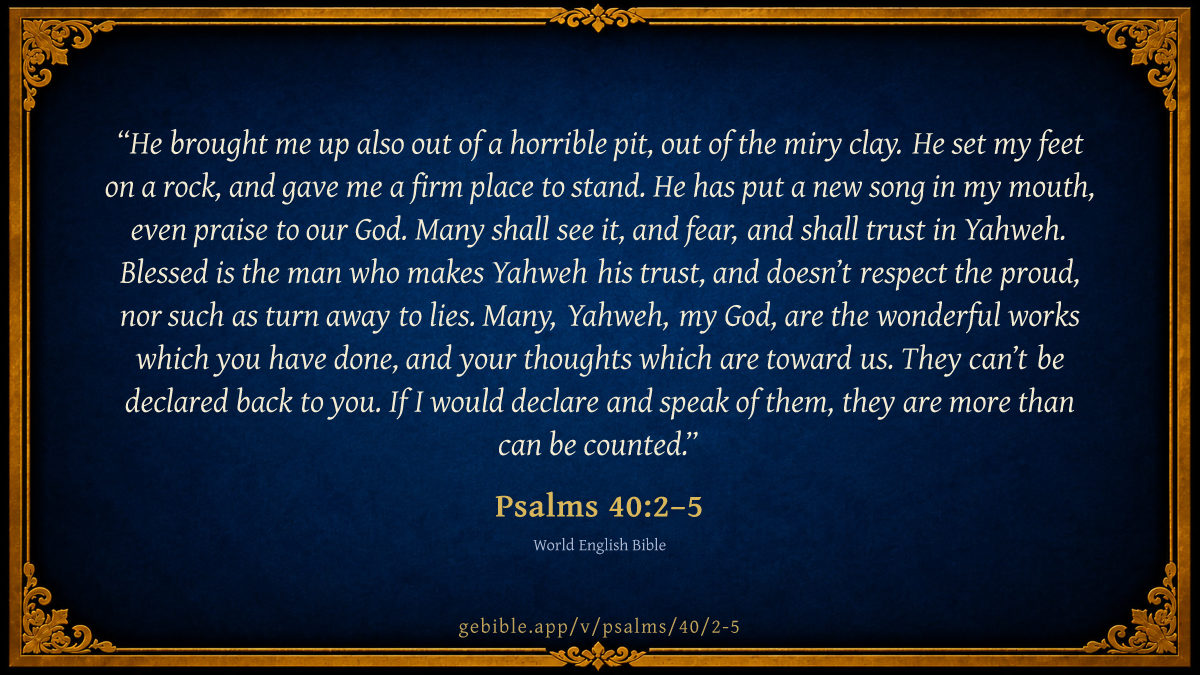
2 He brought me up also out of a horrible pit, out of the miry clay. He set my feet on a rock, and gave me a firm place to stand.
3 He has put a new song in my mouth, even praise to our God. Many shall see it, and fear, and shall trust in Yahweh.
4 Blessed is the man who makes Yahweh his trust, and doesn’t respect the proud, nor such as turn away to lies.
5 Many, Yahweh, my God, are the wonderful works which you have done, and your thoughts which are toward us. They can’t be declared back to you. If I would declare and speak of them, they are more than can be counted.
KJVKing James Version
2 He brought me up also out of an horrible pit, out of the miry clay, and set my feet upon a rock, and established my goings.
3 And he hath put a new song in my mouth, even praise unto our God: many shall see it, and fear, and shall trust in the LORD.
4 Blessed is that man that maketh the LORD his trust, and respecteth not the proud, nor such as turn aside to lies.
5 Many, O LORD my God, are thy wonderful works which thou hast done, and thy thoughts which are to us-ward: they cannot be reckoned up in order unto thee: if I would declare and speak of them, they are more than can be numbered.
Show all 3 translations
JPSJPS Tanakh (1917)
2 (40-3) He brought me up also out of the tumultuous pit, out of the miry clay; and He set my feet upon a rock, He established my goings.
3 (40-4) And He hath put a new song in my mouth, even praise unto our God; many shall see, and fear, and shall trust in the LORD.
4 (40-5) Happy is the man that hath made the LORD his trust, and hath not turned unto the arrogant, nor unto such as fall away treacherously.
5 (40-6) Many things hast Thou done, O LORD my God, even Thy wonderful works, and Thy thoughts toward us; there is none to be compared unto Thee! If I would declare and speak of them, they are more than can be told.
Jeremiah 29:11(v5)For I know the thoughts that I think toward you,” says Yahweh, “thoughts of peace, and not of evil, to give you hope and a future.
Psalms 37:23(v2)A man’s steps are established by Yahweh. He delights in his way.
Jeremiah 17:7-8(v4)“Blessed is the man who trusts in Yahweh, and whose confidence is in Yahweh. For he will be as a tree planted by the waters, who spreads…
Psalms 119:133(v2)Establish my footsteps in your word. Don’t let any iniquity have dominion over me.
Psalms 139:17-18(v5)How precious to me are your thoughts, God! How vast is their sum! If I would count them, they are more in number than the sand. When I wake…
Show all 64 cross-references
Exodus 15:11(v5)Who is like you, Yahweh, among the gods? Who is like you, glorious in holiness, fearful in praises, doing wonders?
Psalms 27:5(v2)For in the day of trouble, he will keep me secretly in his pavilion. In the secret place of his tabernacle, he will hide me. He will lift…
Psalms 71:15(v5)My mouth will tell about your righteousness, and of your salvation all day, though I don’t know its full measure.
Psalms 61:2(v2)From the end of the earth, I will call to you when my heart is overwhelmed. Lead me to the rock that is higher than I.
Psalms 92:5(v5)How great are your works, Yahweh! Your thoughts are very deep.
Matthew 7:24-25(v2)“Everyone therefore who hears these words of mine, and does them, I will liken him to a wise man, who built his house on a rock. The rain…
Psalms 33:3(v3)Sing to him a new song. Play skillfully with a shout of joy!
Psalms 71:20(v2)You, who have shown us many and bitter troubles, you will let me live. You will bring us up again from the depths of the earth.
Psalms 136:4(v5)to him who alone does great wonders; for his loving kindness endures forever:
Psalms 139:6(v5)This knowledge is beyond me. It’s lofty. I can’t attain it.
Isaiah 55:8-9(v5)“For my thoughts are not your thoughts, and your ways are not my ways,” says Yahweh. “For as the heavens are higher than the earth, so are…
Job 9:10(v5)He does great things past finding out; yes, marvelous things without number.
Psalms 103:1-5(v3)Praise Yahweh, my soul! All that is within me, praise his holy name! Praise Yahweh, my soul, and don’t forget all his benefits, who…
Jonah 2:5-6(v2)The waters surrounded me, even to the soul. The deep was around me. The weeds were wrapped around my head. I went down to the bottoms of…
Psalms 69:2(v2)I sink in deep mire, where there is no foothold. I have come into deep waters, where the floods overflow me.
Psalms 86:13(v2)For your loving kindness is great toward me. You have delivered my soul from the lowest Sheol.
Psalms 69:14-15(v2)Deliver me out of the mire, and don’t let me sink. Let me be delivered from those who hate me, and out of the deep waters. Don’t let the…
Zechariah 9:11(v2)As for you also, because of the blood of your covenant, I have set free your prisoners from the pit in which is no water.
Job 5:9(v5)who does great things that can’t be fathomed, marvelous things without number;
Psalms 18:36(v2)You have enlarged my steps under me, My feet have not slipped.
Psalms 34:1-6(v3)I will bless Yahweh at all times. His praise will always be in my mouth. My soul shall boast in Yahweh. The humble shall hear of it and be…
Psalms 84:11-12(v4)For Yahweh God is a sun and a shield. Yahweh will give grace and glory. He withholds no good thing from those who walk blamelessly. Yahweh…
Acts 2:24(v2)whom God raised up, having freed him from the agony of death, because it was not possible that he should be held by it.
Jeremiah 38:6-12(v2)Then they took Jeremiah and threw him into the dungeon of Malchijah the king’s son, that was in the court of the guard. They let down…
Job 26:14(v5)Behold, these are but the outskirts of his ways. How small a whisper do we hear of him! But the thunder of his power who can understand?”
Psalms 17:5(v2)My steps have held fast to your paths. My feet have not slipped.
Psalms 18:16-17(v2)He sent from on high. He took me. He drew me out of many waters. He delivered me from my strong enemy, from those who hated me; for they…
Psalms 52:6(v3)The righteous also will see it, and fear, and laugh at him, saying,
Psalms 142:6-7(v2)Listen to my cry, for I am in desperate need. Deliver me from my persecutors, for they are too strong for me. Bring my soul out of prison,…
Psalms 143:3(v2)For the enemy pursues my soul. He has struck my life down to the ground. He has made me live in dark places, as those who have been long…
Psalms 34:8(v4)Oh taste and see that Yahweh is good. Blessed is the man who takes refuge in him.
Psalms 125:5(v4)But as for those who turn away to their crooked ways, Yahweh will lead them away with the workers of iniquity. Peace be on Israel.
Revelation 5:9-10(v3)They sang a new song, saying, “You are worthy to take the book and to open its seals: for you were killed, and bought us for God with your…
Psalms 35:27(v3)Let those who favor my righteous cause shout for joy and be glad. Yes, let them say continually, “May Yahweh be magnified, who has pleasure…
Psalms 116:3(v2)The cords of death surrounded me, the pains of Sheol got a hold of me. I found trouble and sorrow.
Psalms 118:8-9(v4)It is better to take refuge in Yahweh, than to put confidence in man. It is better to take refuge in Yahweh, than to put confidence in…
Psalms 144:9(v3)I will sing a new song to you, God. On a ten-stringed lyre, I will sing praises to you.
Isaiah 12:1-4(v3)In that day you will say, “I will give thanks to you, Yahweh; for though you were angry with me, your anger has turned away and you comfort…
Revelation 14:3(v3)They sing a new song before the throne, and before the four living creatures and the elders. No one could learn the song except the one…
Psalms 2:12(v4)Give sincere homage to the Son, lest he be angry, and you perish on the way, for his wrath will soon be kindled. Blessed are all those who…
Psalms 142:7(v3)Bring my soul out of prison, that I may give thanks to your name. The righteous will surround me, for you will be good to me.
Romans 15:12-13(v4)Again, Isaiah says, “There will be the root of Jesse, he who arises to rule over the Gentiles; in him the Gentiles will hope.” Now may the…
Job 37:19-20(v5)Teach us what we will tell him, for we can’t make our case by reason of darkness. Will it be told him that I would speak? Or should a man…
Psalms 15:4(v4)in whose eyes a vile man is despised, but who honors those who fear Yahweh; he who keeps an oath even when it hurts, and doesn’t change;
Psalms 64:9-10(v3)All mankind shall be afraid. They shall declare the work of God, and shall wisely ponder what he has done. The righteous shall be glad in…
Jeremiah 10:14-15(v4)Every man has become brutish and without knowledge. Every goldsmith is disappointed by his engraved image; for his molten image is…
Lamentations 3:53-55(v2)They have cut off my life in the dungeon, and have cast a stone on me. Waters flowed over my head. I said, “I am cut off.” I called on your…
Hosea 3:5(v3)Afterward the children of Israel shall return, and seek Yahweh their God, and David their king, and shall come with trembling to Yahweh and…
Jonah 2:8(v4)Those who regard lying vanities forsake their own mercy.
Acts 2:27-31(v2)because you will not leave my soul in Hades, neither will you allow your Holy One to see decay. You made known to me the ways of life. You…
2 Thessalonians 2:9-11(v4)even he whose coming is according to the working of Satan with all power and signs and lying wonders, and with all deception of wickedness…
Exodus 11:8(v5)All these servants of yours will come down to me, and bow down themselves to me, saying, “Get out, with all the people who follow you;” and…
Psalms 101:3-7(v4)I will set no vile thing before my eyes. I hate the deeds of faithless men. They will not cling to me. A perverse heart will be far from…
Psalms 119:21(v4)You have rebuked the proud who are cursed, who wander from your commandments.
Isaiah 44:18-20(v4)They don’t know, neither do they consider: for he has shut their eyes, that they can’t see; and their hearts, that they can’t understand.…
Acts 2:31-41(v3)he foreseeing this spoke about the resurrection of the Christ, that his soul wasn’t left in Hades, and his flesh didn’t see decay. This…
Acts 4:4(v3)But many of those who heard the word believed, and the number of the men came to be about five thousand.
Matthew 13:50(v2)and will cast them into the furnace of fire. There will be the weeping and the gnashing of teeth.”
Isaiah 24:22(v2)They will be gathered together, as prisoners are gathered in the pit, and will be shut up in the prison; and after many days they will be…
Cross-references from openbible.info (CC BY 4.0)
Explain this passage (18 sources)
Historical commentary, presented as a primary source — not an endorsement.
John Calvin1540 · Public DomainOn vv2–52. And he drew me out of the roaring…
2. And he drew me out of the roaring pit. Some translate, from the pit of desolation, because the verb שאה, shaah, from which the noun שאום, shaon, is derived, signifies to destroy or to waste, as well as to resound or echo. But it is more appropriate to consider that there is here an allusion to the deep gulfs, where the waters gush with a tumultuous force. By this similitude he shows that he was placed in as imminent peril of death as if he had been cast into a deep pit, roaring with the impetuous rage of waters. To the same purpose also is the similitude of the miry clay, by which he intimates that he had been so nearly overwhelmed by the weight of his calamities, that it was no easy matter to extricate him from them. Next, there follows a sudden and incredible change, by which he makes manifest to all the greatness of the grace which had been bestowed upon him. He declares that his feet were set upon a rock, whereas formerly he had been overwhelmed with water; and that his steps were established or upheld, whereas before they were not only unsteady and slippery, but were also stuck fast in the mire.
John Calvin's Commentaries (1540-1563) — public domain. Text from the Calvin Translation Society English edition (1840s-50s) via the Christian Classics Ethereal Library (ccel.org). Calvin's coverage is partial (roughly two-thirds of the Bible); uncommented books and verses are honest gaps, never fabricated. The 19th-century editor's footnotes and remarks are omitted so the notes are faithfully Calvin's own voice.
Geneva Bible translators1599 · Public DomainOn vv2–5He hath delivered me from most great dangers.
He hath delivered me from most great dangers.
Geneva Bible (1599) marginal notes — public domain.
John Trapp1656 · Public DomainOn vv2–5Psa 40:2 He brought me up also out of…
Psa 40:2 He brought me up also out of an horrible pit, out of the miry clay, and set my feet upon a rock, [and] established my goings.
Ver. 2. He brought me up also out of a horrible pit] E puteo sonitus, ut Isa 51:14, out of a noiseful pit, where there is a continual hurry by the great tall of waters into it: he meaneth out of dreadful dangers, out of a desperate disease, saith R. Obadiah; who also by rock here understandeth perfect health, Sanitatem in corpore, sanctitatem in corde.
Read full note →
Out of the miry clay] E luto, luto, saith Kimchi, for here are two words used of one and the same sense; to show that, as a bemired beast, he was in a perishing condition till God pulled him out, and set him on firm ground.
And established my goings] That I might not relapse into the same or fall into another malady or mischief.
John Trapp, A Commentary or Exposition upon All the Books of the Old and New Testament (1647–1656) — public domain. Text from a community e-Sword module.
Matthew Poole1685 · Public DomainOn vv2–5Out of an horrible pit; or, out of a…
Out of an horrible pit; or, out of a sounding pit so called either from the clamours of men or beasts falling into it; or from the many waters which fall down into it, not without a great noise. I was not only upon the brink, but in the very bottom of the pit, i.e. in desperate dangers and calamities, as this phrase signifies, Psa 18:16; 69:1,2.
Out of the miry clay; in which my feet stuck fast.
Read full note →
Upon a rock; a place of strength and safety.
My goings, or, my steps, i.e. kept me from stumbling or falling into mischief.
Matthew Poole's English Annotations on the Holy Bible (1683–1685) — public domain. Text from a community e-Sword/MySword module.
John Gill1763 · Public DomainOn vv2–5He brought me up also out of an horrible…
He brought me up also out of an horrible pit,.... Which, with the following phrase,
out of the miry clay, expresses the state and condition Christ was in at the time of his bloody sweat, his crucifixion, and his lying in "sheol", the pit or grave, sometimes rendered hell, which these figurative phrases fitly signify; when it is observed, that he was made sin, and had the sins of all his people on him; and, as the type of Joshua, was clothed with their filthy garments; he might be truly said to be in the miry clay; and also that he was made a curse for them, and bore the wrath of God in their room and stead; and was forsaken by his God and Father, and so endured both the punishment of loss and sense, and what was tantamount to the sufferings of the damned in hell; see Psa 69:1; to which may be added the noisy insults of malignant men, and the infernal fiends, who surrounded him on the cross; when he was in an horrible, or "noisy pit", as the words may be rendered (k), the allusion being to subterraneous caverns or pits, in which the falls of water make so horrible a noise as is intolerable; or to deep pits, into which anything cast makes a great sound: and the issue of all this was, that he was laid in the pit of the grave, and held under the power and with the cords of death; from all which he was delivered when he was raised from the dead, justified in the Spirit, and glorified in the human nature by his God and Father;
Read full note →
and set my feet upon a rock; on Mount Zion in heaven, whither he was carried up after his resurrection; where he will remain until his second coming, being set down at the right hand of God, in a most stable, firm, and unalterable state, as well as an honourable one; for he will die no more, and death shall no more have dominion over him;
and established my goings; in treading the path of life, which was shown him at his resurrection; in passing through the air, the territory of Satan, at his ascension; and in his entrance into his glory, and making his way to his Father's right hand and throne.
(k) "e cisterna sonitus", Pagninus, Montanus; "strepitus", Vatablus, the Targum & Kimchi; and to the same purpose Musculus, Cocceius, Junius & Tremellius, Piscator; "out of the pit of sounding calamity", Ainsworth.
John Gill's Exposition of the Whole Bible (1746–1763) — public domain (CC PDM 1.0). Text via the HelloAO Bible API.
John Wesley1765 · Public DomainOn vv2–5Pit - Desperate dangers and calamities. Rock - A…
Pit - Desperate dangers and calamities. Rock - A place of strength and safety. Established - Kept me from falling into mischief.
John Wesley, Explanatory Notes Upon the Whole Bible (1754–1765) — public domain. Text via the GEBible commentary corpus.
Adam Clarke1810 · Public DomainOn vv2–5Verse 2. A horrible pit] Literally, the sounding pit;…
Verse 2. A horrible pit] Literally, the sounding pit; where nothing was heard except the howlings of wild beasts, or the hollow sounds of winds reverberated and broken from the craggy sides and roof.
The miry clay] Where the longer I stayed the deeper I sank, and was utterly unable to save myself. The Syriac and Arabic translate "The pit of perdition, and the mud of corruption." These are figurative expressions to point out the dreary, dismal, ruinous state of sin and guilt, and the utter inability of a condemned sinner to save himself either from the guilt of his conscience, or the corruption of his heart.
Read full note →
Set my feet upon a rock] Thou hast changed my state from guilt to pardon; from corruption to holiness; in consequence of which my goings are established. I have now power over all sin, and can walk steadily in the way that leads to God's kingdom.
Adam Clarke's Commentary on the Bible (1810–1826) — public domain. Text from a community e-Sword/MySword module.
Joseph Benson1811 · Public DomainOn vv3–5Psa 40:3. He hath put a new song into…
Psa 40:3. He hath put a new song into my mouth — Both by giving me new matter for a song, and by inspiring me with the very words of it. Many shall see it — Shall observe God’s wonderful mercies vouchsafed to me; and fear — Shall stand in awe of that God, whom they see to have so great power, either to save or to destroy; and shall trust in the Lord — Their fear shall not drive them from God, but draw them to him, and be attended with trusting in him.
Joseph Benson's Commentary on the Old and New Testaments (1811–1818) — public domain. Text from a community e-Sword module.
Albert Barnes1834 · Public DomainOn vv2–5He brought me up also out of an horrible…
He brought me up also out of an horrible pit - Margin: “A pit of noise.” The word used here means a pit; a cistern; a prison; a dungeon; a grave. This last signification of the word is found in Psa 28:1; Psa 30:4; Psa 88:4; Isa 38:18; Isa 14:19. It may refer to any calamity - or to trouble, like being in a pit - or it may refer to the grave. The word rendered “horrible” - שׁאון shâ'ôn - means properly “noise, uproar, tumult,” as of waters; of a crowd of men; of war. Then it seems to be used in the sense of “desolation” or “destruction,” as applicable to the grave. DeWette understands it here of a pit, a cavern, or an abyss that roars or is tumultuous; that is, that is impassable. Perhaps this is the idea - a cavern, deep and dark, where the waters roar, and which seems to be filled with horrors. So Rosenmuller understands it. The Septuagint renders it: ἐκ λάκκου ταλαιπωρίας ek lakkou talaipōrias, “a lake of misery.” It is a deep and horrid cavern, where there is no hope of being rescued, or where it would seem that there would be certain destruction.
Out of the miry clay - At the bottom of the pit. Where there was no solid ground - no rock on which to stand. See Jer 38:6; Psa 69:2, Psa 69:14.
Read full note →
And set my feet upon a rock - Where there was firm standing.
And established my goings - Or, fixed my steps. That is, he enabled me to walk as on solid ground; he conducted me along safely, where there was no danger of descending to the pit again or of sinking in the mire. If we understand this of the Redeemer, it refers to that time when, his sorrows ended, and his work of atonement done, it became certain that he would never be exposed again to such dangers, or sink into such a depth of woes, but that his course ever onward would be one of safety and of glory.
Albert Barnes' Notes on the Bible (1834–1885) — public domain. Text from a community e-Sword/MySword module.
Robert Jamieson, A. R. Fausset & David Brown1871 · Public DomainOn vv3–5a new song--(See on Psa 33:3).
a new song--(See on Psa 33:3).
fear, and . . . trust--revere with love and faith.
Jamieson, Fausset & Brown — Commentary Critical and Explanatory on the Whole Bible (1871) — public domain (CC PDM 1.0). Text via the HelloAO Bible API.
Daniel D. Whedon1874 · Public DomainOn vv2–52. Horrible pit—The first word may be translated noise,…
2. Horrible pit—The first word may be translated noise, in which sense we get the idea of a deep “pit” which resounds at the least noise; or it may be rendered desolation, a “pit” of desolation. The latter is the probable idea.
Miry clay—Or, clay of the mire, Psa_69:2 gives the idea of thick mud. The “pit” itself is a description of a prison, into which the felon might have been lowered by cords, as in Jer_38:6; Isa_24:22—a condition which the prisoner could not long survive.
Read full note →
Feet upon a rock—The most perfect contrast to the “miry clay.”
Established my goings—Gave me a firm and sure footing, as opposed to the “miry” bottom of the “pit.” The figure denotes safety and prosperity. Psa_37:31; Psa_73:2; Pro_14:15
Daniel D. Whedon (gen. ed.), Commentary on the Old and New Testaments (1874–1909) — public domain. Text from a community e-Sword module.
The Cambridge Bible for Schools and Colleges1878 · Public DomainOn vv2–52. And brought me up out of a pit…
2. And brought me up out of a pit of destruction, out of the miry slough:
And set my feet upon a rock, made firm my steps.
Read full note →
A literal reference to Jeremiah’s imprisonment in the dungeon can hardly be intended. The second line, set … rock, makes it plain that the whole verse is to be understood figuratively. He compares his plight to that of a prisoner in a dungeon (Lam_3:53; Lam_3:55), or even a dead man in the grave (Psa_28:1; Psa_88:4; Psa_88:6); to that of a traveller floundering in a morass, or quicksand. Quagmires, ‘treacherous to the last degree,’ are common in Palestine. Thomson’s Land and the Book, p. 360. Now he has been given firm footing (Psa_27:5), and the possibility of secure advance (Psa_17:5; Psa_37:31).
The Cambridge Bible for Schools and Colleges (gen. ed. J. J. S. Perowne; Cambridge University Press, 1878–1918) — public domain. Text from a community e-Sword module.
Ellicott's Commentary for English Readers1878 · Public DomainOn vv2–5(2) Horrible pit.—The rendering of the margin, “pit of…
(2) Horrible pit.—The rendering of the margin, “pit of noise,” takes shaôn in its primary sense, as in Isa_17:12, Psa_65:7, and the idea of a noise of rushing water suits this passage. Most commentators, however, take it here in the sense the cognate bears in Psa_35:8, “destruction.” The LXX. and Vulg. have “misery.”
Miry clay.—The word translated “clay” (comp. Psa_69:2) is from a root meaning to boil up, or ferment. (One of its derivatives means “wine.”) Hence “froth,” or “slime.” LXX., ilus; Vulg., fœx. A verse of R. Browning’s perhaps expresses the poet’s image:—
Read full note →
“It frothed by,
A black eddy, bespate with flakes and fumes.”
Rock.—The common image of security (Psa_18:2; Psa_27:5), the occurrence of which makes it probable that the “pit” and “clay” are also not realities, but emblems of confusion and danger.
A Bible Commentary for English Readers, edited by Charles John Ellicott (1878–1897) — public domain. Text from a community e-Sword module.
The Pulpit Commentary1880 · Public DomainOn vv2–5He brought me up also out of a horrible…
He brought me up also out of a horrible pit; literally, a pit of tumult or uproar, which is variously explained. Some imagine a pit with rushing water at the bottom of it, but such pits are scarcely known in Palestine. Others a pit which is filled with noise as a warrior, with crash of arms and amid the shouts of enemies, falls into it. But pits, though used in hunting, were not employed in warfare. The explanation that wav here is to be taken in the secondary sense of "destruction" or "misery," seems to me preferable (see the Septuagint, ek lakkou talaipwriav ). Out of the miry clay. (comp. Psa_69:2, Psa_69:14) Such "clay "would be frequently found at the bottom of disused cisterns. And set my feet upon a rock; i.e. upon solid ground, where I had a firm footing. And established my goings; literally, and make my steps firm. (comp. Psa_17:5 Psa_18:36 Psa_94:18)
The Pulpit Commentary (1880–1919), ed. H.D.M. Spence-Jones & Joseph S. Exell — public domain. Text from a community e-Sword module.
Charles H. Spurgeon1885 · Public DomainOn vv2–5Ver. 2. He brought me up also out of…
Ver. 2. He brought me up also out of an horrible pit. When our Lord bore in his own person the terrible curse which was due to sin, he was so cast down as to be like a prisoner in a deep, dark, fearful dungeon, amid whose horrible glooms the captive heard a noise as of rushing torrents, while overhead resounded the tramp of furious foes. Our Lord in his anguish was like a captive in the oubliettes, forgotten of all mankind, immured amid horror, darkness, and desolation. Yet the Lord Jehovah made him to ascend from all his abasement; he retraced his steps from that deep hell of anguish into which he had been cast as our substitute. He who thus delivered our surety in extremis, will not fail to liberate us from our far lighter griefs. Out of the miry clay. The sufferer was as one who cannot find a foothold, but slips and sinks. The figure indicates not only positive misery as in the former figure, but the absence of solid comfort by which sorrow might have been rendered supportable. Once give man a good foothold, and a burden is greatly lightened, but to be loaded and to be placed on slimy, slippery clay, is to be tried doubly. Reader, with humble gratitude, adore the dear Redeemer who, for thy sake, was deprived of all consolation while surrounded with every form of misery; remark his gratitude at being born up amid his arduous labours and sufferings, and if thou too hast experienced the divine help, be sure to join thy Lord in this song. And set my feet upon a rock, and established my goings. The Redeemer's work is done. He reposes on the firm ground of his accomplished engagements; he can never suffer again; for ever does he reign in glory. What a comfort to know that Jesus our Lord and Saviour stands on a sure foundation in all that he is and does for us, and his goings forth in love are not liable to be cut short by failure in years to come, for God has fixed him firmly. He is for ever and eternally able to save unto the uttermost them that come unto God by him, seeing that in the highest heavens he ever liveth to make intercession for them. Jesus is the true Joseph taken from the pit to be Lord of all. It is something more than a "sip of sweetness" to remember that if we are cast like our Lord into the lowest pit of shame and sorrow, we shall by faith rise to stand on the same elevated, sure, and everlasting rock of divine favour and faithfulness.
Ver. 2. An horrible pit. Some of the pits referred to in the Bible were prisons, one such I saw at Athens, and another at Rome. To these there were no openings, except a hole at the top, which served for both door and window. The bottoms of these pits were necessarily in a filthy and revolting state, and sometimes deep in mud. He brought me up also out of an horrible pit, out of the miry clay; one of these filthy prisons being in the psalmist's view, in Isa 38:17, called "the pit of corruption, "or putrefaction and filth. John Gadsby.
Read full note →
Ver. 2. An horrible pit; or, as it is in the Hebrew, a pit of noise; so called because of waters that falling into it with great violence, make a roaring dreadful noise; or because of the strugglings and outcries they make that are in it; or because when anything is cast into deep pits, it will always make a great noise; and where he stuck fast in miry clay, without seeming possibility of getting out. And some refer this to the greatness of Christ's terrors and sufferings, and his deliverance from them both. Arthur Jackson.
Ver. 2. Three things are stated in verse two. First, resurrection as the act of God, He brought me up, etc. Secondly, the justification of the name and title of the Sufferer, and set my feet upon a rock. Jesus is set up, as alive from the dead, upon the basis of accomplished truth. Thirdly, there is his ascension, He establisheth my goings. The Son of God having trodden, in gracious and self renouncing obedience the passage to the grave, now enters finally as Man the path of life. "He is gone into heaven, "says the Spirit. And again, "He ascended on high, and led captivity captive." Arthur Pridham in "Notes and Reflections on the Psalms, "1869.
Ver. 2.
1. The depth of God's goodness to his people. It finds them often in a horrible pit and miry clay. There is a certain spider which forms a pit in sand, and lies concealed at the bottom, in order to seize upon other insects that fall into it. Thus David's enemies tried to bring him into a pit.
2. The height of his goodness. He brought me out and set my feet upon a rock. That rock is Christ. Those feet are faith and hope.
3. The breadth of his goodness establisheth my goings, restored me to my former place in his love, showing me still to have been his during my low estate. He was the same to me, though I felt not the same to him. My goings refer both to the past and the future.
4. The strength of his goodness established my goings, making me stand firmer after every fall.
George Rogers.
Ver. 2-3. The sinner's position by nature, and his rescue by grace.
Ver. 2-3. By one and the same act the Lord works our salvation, our enemies' confusion, and the church's edification. J. P. Lange's Commentary.
Psalms 40:3*
Ver. 2-3. The sinner's position by nature, and his rescue by grace.
Ver. 2-3. By one and the same act the Lord works our salvation, our enemies' confusion, and the church's edification. J. P. Lange's Commentary.
Charles H. Spurgeon's The Treasury of David (1869–1885) — public domain. Psalms only. Text from a community e-Sword/MySword module.
The Biblical Illustrator1887 · Public DomainOn vv2–5He brought me up also out of an horrible…
Psa_40:2
He brought me up also out of an horrible pit, out of the miry clay.
Read full note →
Out of the pit
I. His condition.
1. He was sunk in deep and dark depression. He was what we describe as down, brought very low, plunged into great despondency and despair. We very well know what brings men into the pit. Grief can do it, and failure, and a multiplicity of tasks. But, above all, sin takes the lift and buoyancy out of life, and makes it the victim of an appalling gravitation which sucks it into abysmal depths of helplessness and darkness and despair. This is the horrible pit in which we have all been sunk.
2. A second element in the condition of the psalmist is interpreted by the descriptive word horrible, the horrible pit, or, as the margin gives it, the pit of noise. And is not this the modern experience? When a man is in the pit he is addressed by confused and confusing voices. One man calls to us and tells us that our depression is purely imaginary, we are the victims of our own thoughts and dreams. Another declares that we are a little out of sorts, and that the doctor will put us right in a week. A third avers that more need we the Divine than the physician. It is a pit of noise and confusion.
3. A third element in the suppliants depression is described in the phrase, the miry clay. Surely we know the experience in our own life! The ground slips from under our feet. We have no foothold. There is nothing solid, nothing dependable.
II. His resources. I waited patiently. His being was collected, and all fixed in intense expectancy on God.
1. He inclined unto me. The figure is exquisitely helpful. He stretched right out and down to me. His arm was long enough to reach me, even when I was in the deepest pit.
2. And beard my cry. Just as the mother, when the house is filled with company, hears the cry of her babe in the chamber above. Or just as a shepherd hears the faint lone cry of the lost lamb in some ravine on the open moor.
III. His deliverance. He brought me out. That is to say, He lifts me out of my captivity. We cannot struggle out. Struggling will only aggravate our bondage. When we are in the Slough of Despond One comes to us called Help. He set my feet upon a rock. Hitherto I have been in the miry clay, the victim of uncertainties, despondencies and doubts. But now He has enlarged my steps under me, and I find myself upon the highway of the Lord. And He hath established my goings. Thus He not only lifts and confirms me, but He vitalizes my soul. We all know the ease that comes to the feet when we have been trudging through heavy mire and we find ourselves upon a well-made turnpike road. As soon as we come to the good road we say to one another, Now we shall be able to step out. That is the suggestion in the psalmists phrase, and hath established my goings. We are able to step out, nay, to go as those who are marching to Zion! (J. H. Jowett, M. A.)
The supreme change
I. What the grace of God delivers from.
1. A position of degradation--A pit.
2. A position of misery--A horrible pit.
3. A position of danger--The miry clay.
(1) Insecurity.
(2) Helplessness.
(3) Death (Jer_38:9).
II. What the grace of God brings men to.
1. A condition of spiritual elevation--up.
2. A condition of spiritual stability--And set my feet upon a rock.
3. A condition of spiritual advancement--And established my goings.
4. A condition of religious happiness--And He hath put a new song, etc.
III. In effecting this change the divine being and the sinner have their distinct provinces to occupy.
1. The sinner prays--evidencing--
(1) Deep sense of need.
(2) Deep consciousness of helplessness.
(3) Trust in the mercy and power of God.
2. The sinner waits--
(1) In earnest expectation.
(2) In the assurance of help being granted.
3. The Lord inclines His ear and hears the cry.
4. The Lord puts forth His saving power--He brought me up.
IV. Lessons.
1. To believers.
(1) Spiritual elevation no cause for boasting.
(2) Spiritual stability no cause for self-confidence.
(3) Spiritual advancement to be carefully maintained.
(4) Religious happiness to be continued and increased.
2. To unbelievers.
(1) Yours a position of degradation, misery and danger.
(2) This position gradually becoming worse.
(3) Escape is possible by penitential application to God (Hos_13:9). What a future sinners must have if they remain in the pit! What a future sinners may have if they turn to Christi (Julius Brigg.)
Brought up from the horrible pit
This passage has been very frequently, and rightly, used as telling the experience of Gods people. Yet I am not certain that the first verse could be rightly uttered by all of us. Could we say, I waited patiently for the Lord? Might it not be more truthfully said of us, I waited impatiently for the Lord? Alas, patience is still a scarce virtue upon the earth. Therefore, though we may regard the psalm as in a secondary sense belonging to David, in the first instance a greater than David is here. For the first person who uttered these words was the Messiah. Our text, therefore, belongs primarily to Him. Note, then--
I. Our Lords behaviour as here set forth.
1. He waited upon the Lord. He did so all His life, but this waiting became more conspicuous in His passion and death.
2. And patiently. His atonement had not been complete had it been otherwise. No expiation could have been made by an impatient Saviour.
3. And prayerfully. Let Gethsemane tell. Jabbok is outdone by Kidron. See, then, our pattern. Have we waited, and waited thus?
II. Our Lords deliverance.
1. It is represented as a bringing up out of a horrible pit. I have been in the dungeon at Rome in which, according to tradition, Peter and Paul were confined. It was, indeed, a horrible pit, for originally it had no entrance but a round hole in the rock above; and when that was blocked neither light nor fresh air could enter. No being has ever been so cruel to man as man. Man is the worst of monsters to his kind, and his cruel inventions are many. Now, our Lord was like a man put into a pit. Hence he was quite alone. Thus it happened to our Saviour. All His disciples forsook Him and fled. And in total darkness. Midnight brooded over His spirit. And full of distress. The grief and sorrow which He felt can never be described. He felt care upon care, night blackening night. But He was brought up out of all this; at that moment when He said, It is finished; and at the resurrection and by His ascension to the right hand of God. Now His sorrow is ended.
2. A second figure is used to tell of His grief. Out of the miry clay. In such horrible pits the imprisoned wretch often found himself sinking in the mire. And our blessed Lord found when He was suffering for us that everything appeared to give way beneath Him. But He was brought up like Jonah was from the deeps. And He was set on a rock. He stands on a firm foundation in all that He does for us. Judgment and truth confirm His ways. When He saves He has a right to save. And His goings are established for continuance, certainty, victory. Best of all, there is a new song in His mouth, In the midst of the church will I sing praise unto Thee. The song of heaven is the song of Moses and the Lamb.
III. The Lords reward. Many--not all, but many--shall see it and fear, etc. They shall, for He hath the key of all hearts. They shall see; see Him as their Saviour, and shall fear. It makes men fear to see a bleeding Christ. And best of all, they shall trust in the Lord.
IV. The Lords likeness in his people. All this may be repeated in them. Like sorrow, but let there be like waiting, and there shall be like deliverance. Sinner sinking in guilt, He can deliver you. (C. H. Spurgeon.)
History of the souls salvation
I. The believers safety.
1. The author of it. The Lord (Psa_25:5).
2. The nature of it. On a rock (Psa_27:5).
3. The individual realization of it. My feet (Psa_31:8; 2Ti_1:12).
II. The believers walk.
1. A firm footing. Feet on a rock. Wherein we stand (Rom_5:2).
2. Steady progress (Psa_37:23; Psa_16:11). Established my goings.
3. Safe keeping (1Sa_2:9; Jud_1:24).
III. The believers sons.
1. The song of reconciliation (Isa_12:1).
2. The song of deliverance (Exo_15:1-19).
3. The song of victory (2Ch_20:17-26).
IV. The believers influence.
1. Many shall see it (Mat_5:16).
2. Many shall fear (Act_2:37; Act_2:43).
3. Many shall trust in the Lord (Act_2:41). (E. H. Hopkins)
The pit of destruction
It is possible that the reference may be to a mode of hunting, anciently practised in the East, and still practised in some parts of the East, in the interior of Africa, and in some of the Polynesian Islands. When a dangerous wild animal was to be captured, a largo hole was dug in the ground. At the bottom of the pit thus dug a goat was placed as bait, and the opening of the pit was covered with light branches and foliage. The wild animal, attracted by the bleating of the goat, made a spring in the dark for the goat, fell through the branches, and was securely trapped. From this point of view David had fallen, or been tempted into, a pit of sin; and had been plucked by the mercy of God from the clinging mire of its bottom and the slippery clay of its sides, and placed upon the sure foothold of a rock.
And set my feet upon a rock and established my goings.--
Fixity and progress
What a strange contradiction--rest and movement, fixedness and pliability, stedfastness and variation. How can a man be made to run by his fixedness? How can his power of motion be increased by that which is supposed to rivet him to the spot? In all things of the spirit, is it not ever so? Is not the rapidity of my movement always in proportion to the rootedness of my conviction? The firmer is my rock, the more established are my goings. It is the resting soul which flies. I have no wings until I have a fixed heart. The dove that descends upon the Jordan must first light upon the Son of Man. Is it not written (Isa_40:31)? What is that but to say that the rock makes the outgoing? I never do such work as when I am at rest. It is the calm within makes the power without. The soul whose works have followed it is the spirit of the man who has rested from his labours. (G. Matheson, D. D.)
The Biblical Illustrator, edited by Joseph S. Exell (c. 1880s–1900s) — public domain. Text from a community e-Sword module.
C. I. Scofield1917 · Public DomainOn vv3–4(See Scofield "Psa 19:9").
fear
(See Scofield "Psa 19:9").
The Scofield Reference Bible (1917 edition), notes by C. I. Scofield — public domain. Text from a community e-Sword module.
unfoldingWord translationNotes2017 · CC BY-SA 4.0On vv3, 5He has put a new song in my mouth
He has put a new song in my mouth
Possible meanings are 1) "He has taught me the words to a new song" or 2) "He has given me a new reason to sing."
Read full note →
in my mouth
Here "my mouth" refers to the writer. AT: "in me" (See: Synecdoche)
praise to our God
The noun "praise" can be stated as a verb. AT: "a song to praise our God" (See: Abstract Nouns)
Many will see it
Here "see it" refers to hearing the writer sing his song about what God has done for him. AT: "Many people will hear me tell what Yahweh has done" (See: Metonymy)
Blessed is the man who makes Yahweh his trust
"Blessed is the man who trusts in Yahweh" or "Those who trust in Yahweh are blessed"
the proud
This refers to the people who are proud. AT: "proud people" (See: Nominal Adjectives)
to lies
The Hebrew word is unclear. Possible meanings are 1) "lies" or 2) "false gods."
John Calvin 1540 · Public Domain On vv2–5 2. And he drew me out of the roaring…
2. And he drew me out of the roaring pit. Some translate, from the pit of desolation, because the verb שאה, shaah, from which the noun שאום, shaon, is derived, signifies to destroy or to waste, as well as to resound or echo. But it is more appropriate to consider that there is here an allusion to the deep gulfs, where the waters gush with a tumultuous force. By this similitude he shows that he was placed in as imminent peril of death as if he had been cast into a deep pit, roaring with the impetuous rage of waters. To the same purpose also is the similitude of the miry clay, by which he intimates that he had been so nearly overwhelmed by the weight of his calamities, that it was no easy matter to extricate him from them. Next, there follows a sudden and incredible change, by which he makes manifest to all the greatness of the grace which had been bestowed upon him. He declares that his feet were set upon a rock, whereas formerly he had been overwhelmed with water; and that his steps were established or upheld, whereas before they were not only unsteady and slippery, but were also stuck fast in the mire.
John Calvin's Commentaries (1540-1563) — public domain. Text from the Calvin Translation Society English edition (1840s-50s) via the Christian Classics Ethereal Library (ccel.org). Calvin's coverage is partial (roughly two-thirds of the Bible); uncommented books and verses are honest gaps, never fabricated. The 19th-century editor's footnotes and remarks are omitted so the notes are faithfully Calvin's own voice.
Geneva Bible translators 1599 · Public Domain On vv2–5 He hath delivered me from most great dangers.
He hath delivered me from most great dangers.
Geneva Bible (1599) marginal notes — public domain.
John Trapp 1656 · Public Domain On vv2–5 Psa 40:2 He brought me up also out of…
Psa 40:2 He brought me up also out of an horrible pit, out of the miry clay, and set my feet upon a rock, [and] established my goings.
Ver. 2. He brought me up also out of a horrible pit] E puteo sonitus, ut Isa 51:14, out of a noiseful pit, where there is a continual hurry by the great tall of waters into it: he meaneth out of dreadful dangers, out of a desperate disease, saith R. Obadiah; who also by rock here understandeth perfect health, Sanitatem in corpore, sanctitatem in corde.
Read full note →
Out of the miry clay] E luto, luto, saith Kimchi, for here are two words used of one and the same sense; to show that, as a bemired beast, he was in a perishing condition till God pulled him out, and set him on firm ground.
And established my goings] That I might not relapse into the same or fall into another malady or mischief.
John Trapp, A Commentary or Exposition upon All the Books of the Old and New Testament (1647–1656) — public domain. Text from a community e-Sword module.
Matthew Poole 1685 · Public Domain On vv2–5 Out of an horrible pit; or, out of a…
Out of an horrible pit; or, out of a sounding pit so called either from the clamours of men or beasts falling into it; or from the many waters which fall down into it, not without a great noise. I was not only upon the brink, but in the very bottom of the pit, i.e. in desperate dangers and calamities, as this phrase signifies, Psa 18:16; 69:1,2.
Out of the miry clay; in which my feet stuck fast.
Read full note →
Upon a rock; a place of strength and safety.
My goings, or, my steps, i.e. kept me from stumbling or falling into mischief.
Matthew Poole's English Annotations on the Holy Bible (1683–1685) — public domain. Text from a community e-Sword/MySword module.
John Gill 1763 · Public Domain On vv2–5 He brought me up also out of an horrible…
He brought me up also out of an horrible pit,.... Which, with the following phrase,
out of the miry clay, expresses the state and condition Christ was in at the time of his bloody sweat, his crucifixion, and his lying in "sheol", the pit or grave, sometimes rendered hell, which these figurative phrases fitly signify; when it is observed, that he was made sin, and had the sins of all his people on him; and, as the type of Joshua, was clothed with their filthy garments; he might be truly said to be in the miry clay; and also that he was made a curse for them, and bore the wrath of God in their room and stead; and was forsaken by his God and Father, and so endured both the punishment of loss and sense, and what was tantamount to the sufferings of the damned in hell; see Psa 69:1; to which may be added the noisy insults of malignant men, and the infernal fiends, who surrounded him on the cross; when he was in an horrible, or "noisy pit", as the words may be rendered (k), the allusion being to subterraneous caverns or pits, in which the falls of water make so horrible a noise as is intolerable; or to deep pits, into which anything cast makes a great sound: and the issue of all this was, that he was laid in the pit of the grave, and held under the power and with the cords of death; from all which he was delivered when he was raised from the dead, justified in the Spirit, and glorified in the human nature by his God and Father;
Read full note →
and set my feet upon a rock; on Mount Zion in heaven, whither he was carried up after his resurrection; where he will remain until his second coming, being set down at the right hand of God, in a most stable, firm, and unalterable state, as well as an honourable one; for he will die no more, and death shall no more have dominion over him;
and established my goings; in treading the path of life, which was shown him at his resurrection; in passing through the air, the territory of Satan, at his ascension; and in his entrance into his glory, and making his way to his Father's right hand and throne.
(k) "e cisterna sonitus", Pagninus, Montanus; "strepitus", Vatablus, the Targum & Kimchi; and to the same purpose Musculus, Cocceius, Junius & Tremellius, Piscator; "out of the pit of sounding calamity", Ainsworth.
John Gill's Exposition of the Whole Bible (1746–1763) — public domain (CC PDM 1.0). Text via the HelloAO Bible API.
John Wesley 1765 · Public Domain On vv2–5 Pit - Desperate dangers and calamities. Rock - A…
Pit - Desperate dangers and calamities. Rock - A place of strength and safety. Established - Kept me from falling into mischief.
John Wesley, Explanatory Notes Upon the Whole Bible (1754–1765) — public domain. Text via the GEBible commentary corpus.
Adam Clarke 1810 · Public Domain On vv2–5 Verse 2. A horrible pit] Literally, the sounding pit;…
Verse 2. A horrible pit] Literally, the sounding pit; where nothing was heard except the howlings of wild beasts, or the hollow sounds of winds reverberated and broken from the craggy sides and roof.
The miry clay] Where the longer I stayed the deeper I sank, and was utterly unable to save myself. The Syriac and Arabic translate "The pit of perdition, and the mud of corruption." These are figurative expressions to point out the dreary, dismal, ruinous state of sin and guilt, and the utter inability of a condemned sinner to save himself either from the guilt of his conscience, or the corruption of his heart.
Read full note →
Set my feet upon a rock] Thou hast changed my state from guilt to pardon; from corruption to holiness; in consequence of which my goings are established. I have now power over all sin, and can walk steadily in the way that leads to God's kingdom.
Adam Clarke's Commentary on the Bible (1810–1826) — public domain. Text from a community e-Sword/MySword module.
Joseph Benson 1811 · Public Domain On vv3–5 Psa 40:3. He hath put a new song into…
Psa 40:3. He hath put a new song into my mouth — Both by giving me new matter for a song, and by inspiring me with the very words of it. Many shall see it — Shall observe God’s wonderful mercies vouchsafed to me; and fear — Shall stand in awe of that God, whom they see to have so great power, either to save or to destroy; and shall trust in the Lord — Their fear shall not drive them from God, but draw them to him, and be attended with trusting in him.
Joseph Benson's Commentary on the Old and New Testaments (1811–1818) — public domain. Text from a community e-Sword module.
Albert Barnes 1834 · Public Domain On vv2–5 He brought me up also out of an horrible…
He brought me up also out of an horrible pit - Margin: “A pit of noise.” The word used here means a pit; a cistern; a prison; a dungeon; a grave. This last signification of the word is found in Psa 28:1; Psa 30:4; Psa 88:4; Isa 38:18; Isa 14:19. It may refer to any calamity - or to trouble, like being in a pit - or it may refer to the grave. The word rendered “horrible” - שׁאון shâ'ôn - means properly “noise, uproar, tumult,” as of waters; of a crowd of men; of war. Then it seems to be used in the sense of “desolation” or “destruction,” as applicable to the grave. DeWette understands it here of a pit, a cavern, or an abyss that roars or is tumultuous; that is, that is impassable. Perhaps this is the idea - a cavern, deep and dark, where the waters roar, and which seems to be filled with horrors. So Rosenmuller understands it. The Septuagint renders it: ἐκ λάκκου ταλαιπωρίας ek lakkou talaipōrias, “a lake of misery.” It is a deep and horrid cavern, where there is no hope of being rescued, or where it would seem that there would be certain destruction.
Out of the miry clay - At the bottom of the pit. Where there was no solid ground - no rock on which to stand. See Jer 38:6; Psa 69:2, Psa 69:14.
Read full note →
And set my feet upon a rock - Where there was firm standing.
And established my goings - Or, fixed my steps. That is, he enabled me to walk as on solid ground; he conducted me along safely, where there was no danger of descending to the pit again or of sinking in the mire. If we understand this of the Redeemer, it refers to that time when, his sorrows ended, and his work of atonement done, it became certain that he would never be exposed again to such dangers, or sink into such a depth of woes, but that his course ever onward would be one of safety and of glory.
Albert Barnes' Notes on the Bible (1834–1885) — public domain. Text from a community e-Sword/MySword module.
Robert Jamieson, A. R. Fausset & David Brown 1871 · Public Domain On vv3–5 a new song--(See on Psa 33:3).
a new song--(See on Psa 33:3).
fear, and . . . trust--revere with love and faith.
Jamieson, Fausset & Brown — Commentary Critical and Explanatory on the Whole Bible (1871) — public domain (CC PDM 1.0). Text via the HelloAO Bible API.
Daniel D. Whedon 1874 · Public Domain On vv2–5 2. Horrible pit—The first word may be translated noise,…
2. Horrible pit—The first word may be translated noise, in which sense we get the idea of a deep “pit” which resounds at the least noise; or it may be rendered desolation, a “pit” of desolation. The latter is the probable idea.
Miry clay—Or, clay of the mire, Psa_69:2 gives the idea of thick mud. The “pit” itself is a description of a prison, into which the felon might have been lowered by cords, as in Jer_38:6; Isa_24:22—a condition which the prisoner could not long survive.
Read full note →
Feet upon a rock—The most perfect contrast to the “miry clay.”
Established my goings—Gave me a firm and sure footing, as opposed to the “miry” bottom of the “pit.” The figure denotes safety and prosperity. Psa_37:31; Psa_73:2; Pro_14:15
Daniel D. Whedon (gen. ed.), Commentary on the Old and New Testaments (1874–1909) — public domain. Text from a community e-Sword module.
The Cambridge Bible for Schools and Colleges 1878 · Public Domain On vv2–5 2. And brought me up out of a pit…
2. And brought me up out of a pit of destruction, out of the miry slough:
And set my feet upon a rock, made firm my steps.
Read full note →
A literal reference to Jeremiah’s imprisonment in the dungeon can hardly be intended. The second line, set … rock, makes it plain that the whole verse is to be understood figuratively. He compares his plight to that of a prisoner in a dungeon (Lam_3:53; Lam_3:55), or even a dead man in the grave (Psa_28:1; Psa_88:4; Psa_88:6); to that of a traveller floundering in a morass, or quicksand. Quagmires, ‘treacherous to the last degree,’ are common in Palestine. Thomson’s Land and the Book, p. 360. Now he has been given firm footing (Psa_27:5), and the possibility of secure advance (Psa_17:5; Psa_37:31).
The Cambridge Bible for Schools and Colleges (gen. ed. J. J. S. Perowne; Cambridge University Press, 1878–1918) — public domain. Text from a community e-Sword module.
Ellicott's Commentary for English Readers 1878 · Public Domain On vv2–5 (2) Horrible pit.—The rendering of the margin, “pit of…
(2) Horrible pit.—The rendering of the margin, “pit of noise,” takes shaôn in its primary sense, as in Isa_17:12, Psa_65:7, and the idea of a noise of rushing water suits this passage. Most commentators, however, take it here in the sense the cognate bears in Psa_35:8, “destruction.” The LXX. and Vulg. have “misery.”
Miry clay.—The word translated “clay” (comp. Psa_69:2) is from a root meaning to boil up, or ferment. (One of its derivatives means “wine.”) Hence “froth,” or “slime.” LXX., ilus; Vulg., fœx. A verse of R. Browning’s perhaps expresses the poet’s image:—
Read full note →
“It frothed by,
A black eddy, bespate with flakes and fumes.”
Rock.—The common image of security (Psa_18:2; Psa_27:5), the occurrence of which makes it probable that the “pit” and “clay” are also not realities, but emblems of confusion and danger.
A Bible Commentary for English Readers, edited by Charles John Ellicott (1878–1897) — public domain. Text from a community e-Sword module.
The Pulpit Commentary 1880 · Public Domain On vv2–5 He brought me up also out of a horrible…
He brought me up also out of a horrible pit; literally, a pit of tumult or uproar, which is variously explained. Some imagine a pit with rushing water at the bottom of it, but such pits are scarcely known in Palestine. Others a pit which is filled with noise as a warrior, with crash of arms and amid the shouts of enemies, falls into it. But pits, though used in hunting, were not employed in warfare. The explanation that wav here is to be taken in the secondary sense of "destruction" or "misery," seems to me preferable (see the Septuagint, ek lakkou talaipwriav ). Out of the miry clay. (comp. Psa_69:2, Psa_69:14) Such "clay "would be frequently found at the bottom of disused cisterns. And set my feet upon a rock; i.e. upon solid ground, where I had a firm footing. And established my goings; literally, and make my steps firm. (comp. Psa_17:5 Psa_18:36 Psa_94:18)
The Pulpit Commentary (1880–1919), ed. H.D.M. Spence-Jones & Joseph S. Exell — public domain. Text from a community e-Sword module.
Charles H. Spurgeon 1885 · Public Domain On vv2–5 Ver. 2. He brought me up also out of…
Ver. 2. He brought me up also out of an horrible pit. When our Lord bore in his own person the terrible curse which was due to sin, he was so cast down as to be like a prisoner in a deep, dark, fearful dungeon, amid whose horrible glooms the captive heard a noise as of rushing torrents, while overhead resounded the tramp of furious foes. Our Lord in his anguish was like a captive in the oubliettes, forgotten of all mankind, immured amid horror, darkness, and desolation. Yet the Lord Jehovah made him to ascend from all his abasement; he retraced his steps from that deep hell of anguish into which he had been cast as our substitute. He who thus delivered our surety in extremis, will not fail to liberate us from our far lighter griefs. Out of the miry clay. The sufferer was as one who cannot find a foothold, but slips and sinks. The figure indicates not only positive misery as in the former figure, but the absence of solid comfort by which sorrow might have been rendered supportable. Once give man a good foothold, and a burden is greatly lightened, but to be loaded and to be placed on slimy, slippery clay, is to be tried doubly. Reader, with humble gratitude, adore the dear Redeemer who, for thy sake, was deprived of all consolation while surrounded with every form of misery; remark his gratitude at being born up amid his arduous labours and sufferings, and if thou too hast experienced the divine help, be sure to join thy Lord in this song. And set my feet upon a rock, and established my goings. The Redeemer's work is done. He reposes on the firm ground of his accomplished engagements; he can never suffer again; for ever does he reign in glory. What a comfort to know that Jesus our Lord and Saviour stands on a sure foundation in all that he is and does for us, and his goings forth in love are not liable to be cut short by failure in years to come, for God has fixed him firmly. He is for ever and eternally able to save unto the uttermost them that come unto God by him, seeing that in the highest heavens he ever liveth to make intercession for them. Jesus is the true Joseph taken from the pit to be Lord of all. It is something more than a "sip of sweetness" to remember that if we are cast like our Lord into the lowest pit of shame and sorrow, we shall by faith rise to stand on the same elevated, sure, and everlasting rock of divine favour and faithfulness.
Ver. 2. An horrible pit. Some of the pits referred to in the Bible were prisons, one such I saw at Athens, and another at Rome. To these there were no openings, except a hole at the top, which served for both door and window. The bottoms of these pits were necessarily in a filthy and revolting state, and sometimes deep in mud. He brought me up also out of an horrible pit, out of the miry clay; one of these filthy prisons being in the psalmist's view, in Isa 38:17, called "the pit of corruption, "or putrefaction and filth. John Gadsby.
Read full note →
Ver. 2. An horrible pit; or, as it is in the Hebrew, a pit of noise; so called because of waters that falling into it with great violence, make a roaring dreadful noise; or because of the strugglings and outcries they make that are in it; or because when anything is cast into deep pits, it will always make a great noise; and where he stuck fast in miry clay, without seeming possibility of getting out. And some refer this to the greatness of Christ's terrors and sufferings, and his deliverance from them both. Arthur Jackson.
Ver. 2. Three things are stated in verse two. First, resurrection as the act of God, He brought me up, etc. Secondly, the justification of the name and title of the Sufferer, and set my feet upon a rock. Jesus is set up, as alive from the dead, upon the basis of accomplished truth. Thirdly, there is his ascension, He establisheth my goings. The Son of God having trodden, in gracious and self renouncing obedience the passage to the grave, now enters finally as Man the path of life. "He is gone into heaven, "says the Spirit. And again, "He ascended on high, and led captivity captive." Arthur Pridham in "Notes and Reflections on the Psalms, "1869.
Ver. 2.
1. The depth of God's goodness to his people. It finds them often in a horrible pit and miry clay. There is a certain spider which forms a pit in sand, and lies concealed at the bottom, in order to seize upon other insects that fall into it. Thus David's enemies tried to bring him into a pit.
2. The height of his goodness. He brought me out and set my feet upon a rock. That rock is Christ. Those feet are faith and hope.
3. The breadth of his goodness establisheth my goings, restored me to my former place in his love, showing me still to have been his during my low estate. He was the same to me, though I felt not the same to him. My goings refer both to the past and the future.
4. The strength of his goodness established my goings, making me stand firmer after every fall.
George Rogers.
Ver. 2-3. The sinner's position by nature, and his rescue by grace.
Ver. 2-3. By one and the same act the Lord works our salvation, our enemies' confusion, and the church's edification. J. P. Lange's Commentary.
Psalms 40:3*
Ver. 2-3. The sinner's position by nature, and his rescue by grace.
Ver. 2-3. By one and the same act the Lord works our salvation, our enemies' confusion, and the church's edification. J. P. Lange's Commentary.
Charles H. Spurgeon's The Treasury of David (1869–1885) — public domain. Psalms only. Text from a community e-Sword/MySword module.
The Biblical Illustrator 1887 · Public Domain On vv2–5 He brought me up also out of an horrible…
Psa_40:2
He brought me up also out of an horrible pit, out of the miry clay.
Read full note →
Out of the pit
I. His condition.
1. He was sunk in deep and dark depression. He was what we describe as down, brought very low, plunged into great despondency and despair. We very well know what brings men into the pit. Grief can do it, and failure, and a multiplicity of tasks. But, above all, sin takes the lift and buoyancy out of life, and makes it the victim of an appalling gravitation which sucks it into abysmal depths of helplessness and darkness and despair. This is the horrible pit in which we have all been sunk.
2. A second element in the condition of the psalmist is interpreted by the descriptive word horrible, the horrible pit, or, as the margin gives it, the pit of noise. And is not this the modern experience? When a man is in the pit he is addressed by confused and confusing voices. One man calls to us and tells us that our depression is purely imaginary, we are the victims of our own thoughts and dreams. Another declares that we are a little out of sorts, and that the doctor will put us right in a week. A third avers that more need we the Divine than the physician. It is a pit of noise and confusion.
3. A third element in the suppliants depression is described in the phrase, the miry clay. Surely we know the experience in our own life! The ground slips from under our feet. We have no foothold. There is nothing solid, nothing dependable.
II. His resources. I waited patiently. His being was collected, and all fixed in intense expectancy on God.
1. He inclined unto me. The figure is exquisitely helpful. He stretched right out and down to me. His arm was long enough to reach me, even when I was in the deepest pit.
2. And beard my cry. Just as the mother, when the house is filled with company, hears the cry of her babe in the chamber above. Or just as a shepherd hears the faint lone cry of the lost lamb in some ravine on the open moor.
III. His deliverance. He brought me out. That is to say, He lifts me out of my captivity. We cannot struggle out. Struggling will only aggravate our bondage. When we are in the Slough of Despond One comes to us called Help. He set my feet upon a rock. Hitherto I have been in the miry clay, the victim of uncertainties, despondencies and doubts. But now He has enlarged my steps under me, and I find myself upon the highway of the Lord. And He hath established my goings. Thus He not only lifts and confirms me, but He vitalizes my soul. We all know the ease that comes to the feet when we have been trudging through heavy mire and we find ourselves upon a well-made turnpike road. As soon as we come to the good road we say to one another, Now we shall be able to step out. That is the suggestion in the psalmists phrase, and hath established my goings. We are able to step out, nay, to go as those who are marching to Zion! (J. H. Jowett, M. A.)
The supreme change
I. What the grace of God delivers from.
1. A position of degradation--A pit.
2. A position of misery--A horrible pit.
3. A position of danger--The miry clay.
(1) Insecurity.
(2) Helplessness.
(3) Death (Jer_38:9).
II. What the grace of God brings men to.
1. A condition of spiritual elevation--up.
2. A condition of spiritual stability--And set my feet upon a rock.
3. A condition of spiritual advancement--And established my goings.
4. A condition of religious happiness--And He hath put a new song, etc.
III. In effecting this change the divine being and the sinner have their distinct provinces to occupy.
1. The sinner prays--evidencing--
(1) Deep sense of need.
(2) Deep consciousness of helplessness.
(3) Trust in the mercy and power of God.
2. The sinner waits--
(1) In earnest expectation.
(2) In the assurance of help being granted.
3. The Lord inclines His ear and hears the cry.
4. The Lord puts forth His saving power--He brought me up.
IV. Lessons.
1. To believers.
(1) Spiritual elevation no cause for boasting.
(2) Spiritual stability no cause for self-confidence.
(3) Spiritual advancement to be carefully maintained.
(4) Religious happiness to be continued and increased.
2. To unbelievers.
(1) Yours a position of degradation, misery and danger.
(2) This position gradually becoming worse.
(3) Escape is possible by penitential application to God (Hos_13:9). What a future sinners must have if they remain in the pit! What a future sinners may have if they turn to Christi (Julius Brigg.)
Brought up from the horrible pit
This passage has been very frequently, and rightly, used as telling the experience of Gods people. Yet I am not certain that the first verse could be rightly uttered by all of us. Could we say, I waited patiently for the Lord? Might it not be more truthfully said of us, I waited impatiently for the Lord? Alas, patience is still a scarce virtue upon the earth. Therefore, though we may regard the psalm as in a secondary sense belonging to David, in the first instance a greater than David is here. For the first person who uttered these words was the Messiah. Our text, therefore, belongs primarily to Him. Note, then--
I. Our Lords behaviour as here set forth.
1. He waited upon the Lord. He did so all His life, but this waiting became more conspicuous in His passion and death.
2. And patiently. His atonement had not been complete had it been otherwise. No expiation could have been made by an impatient Saviour.
3. And prayerfully. Let Gethsemane tell. Jabbok is outdone by Kidron. See, then, our pattern. Have we waited, and waited thus?
II. Our Lords deliverance.
1. It is represented as a bringing up out of a horrible pit. I have been in the dungeon at Rome in which, according to tradition, Peter and Paul were confined. It was, indeed, a horrible pit, for originally it had no entrance but a round hole in the rock above; and when that was blocked neither light nor fresh air could enter. No being has ever been so cruel to man as man. Man is the worst of monsters to his kind, and his cruel inventions are many. Now, our Lord was like a man put into a pit. Hence he was quite alone. Thus it happened to our Saviour. All His disciples forsook Him and fled. And in total darkness. Midnight brooded over His spirit. And full of distress. The grief and sorrow which He felt can never be described. He felt care upon care, night blackening night. But He was brought up out of all this; at that moment when He said, It is finished; and at the resurrection and by His ascension to the right hand of God. Now His sorrow is ended.
2. A second figure is used to tell of His grief. Out of the miry clay. In such horrible pits the imprisoned wretch often found himself sinking in the mire. And our blessed Lord found when He was suffering for us that everything appeared to give way beneath Him. But He was brought up like Jonah was from the deeps. And He was set on a rock. He stands on a firm foundation in all that He does for us. Judgment and truth confirm His ways. When He saves He has a right to save. And His goings are established for continuance, certainty, victory. Best of all, there is a new song in His mouth, In the midst of the church will I sing praise unto Thee. The song of heaven is the song of Moses and the Lamb.
III. The Lords reward. Many--not all, but many--shall see it and fear, etc. They shall, for He hath the key of all hearts. They shall see; see Him as their Saviour, and shall fear. It makes men fear to see a bleeding Christ. And best of all, they shall trust in the Lord.
IV. The Lords likeness in his people. All this may be repeated in them. Like sorrow, but let there be like waiting, and there shall be like deliverance. Sinner sinking in guilt, He can deliver you. (C. H. Spurgeon.)
History of the souls salvation
I. The believers safety.
1. The author of it. The Lord (Psa_25:5).
2. The nature of it. On a rock (Psa_27:5).
3. The individual realization of it. My feet (Psa_31:8; 2Ti_1:12).
II. The believers walk.
1. A firm footing. Feet on a rock. Wherein we stand (Rom_5:2).
2. Steady progress (Psa_37:23; Psa_16:11). Established my goings.
3. Safe keeping (1Sa_2:9; Jud_1:24).
III. The believers sons.
1. The song of reconciliation (Isa_12:1).
2. The song of deliverance (Exo_15:1-19).
3. The song of victory (2Ch_20:17-26).
IV. The believers influence.
1. Many shall see it (Mat_5:16).
2. Many shall fear (Act_2:37; Act_2:43).
3. Many shall trust in the Lord (Act_2:41). (E. H. Hopkins)
The pit of destruction
It is possible that the reference may be to a mode of hunting, anciently practised in the East, and still practised in some parts of the East, in the interior of Africa, and in some of the Polynesian Islands. When a dangerous wild animal was to be captured, a largo hole was dug in the ground. At the bottom of the pit thus dug a goat was placed as bait, and the opening of the pit was covered with light branches and foliage. The wild animal, attracted by the bleating of the goat, made a spring in the dark for the goat, fell through the branches, and was securely trapped. From this point of view David had fallen, or been tempted into, a pit of sin; and had been plucked by the mercy of God from the clinging mire of its bottom and the slippery clay of its sides, and placed upon the sure foothold of a rock.
And set my feet upon a rock and established my goings.--
Fixity and progress
What a strange contradiction--rest and movement, fixedness and pliability, stedfastness and variation. How can a man be made to run by his fixedness? How can his power of motion be increased by that which is supposed to rivet him to the spot? In all things of the spirit, is it not ever so? Is not the rapidity of my movement always in proportion to the rootedness of my conviction? The firmer is my rock, the more established are my goings. It is the resting soul which flies. I have no wings until I have a fixed heart. The dove that descends upon the Jordan must first light upon the Son of Man. Is it not written (Isa_40:31)? What is that but to say that the rock makes the outgoing? I never do such work as when I am at rest. It is the calm within makes the power without. The soul whose works have followed it is the spirit of the man who has rested from his labours. (G. Matheson, D. D.)
The Biblical Illustrator, edited by Joseph S. Exell (c. 1880s–1900s) — public domain. Text from a community e-Sword module.
C. I. Scofield 1917 · Public Domain On vv3–4 (See Scofield "Psa 19:9").
fear
(See Scofield "Psa 19:9").
The Scofield Reference Bible (1917 edition), notes by C. I. Scofield — public domain. Text from a community e-Sword module.
unfoldingWord translationNotes 2017 · CC BY-SA 4.0 On vv3, 5 He has put a new song in my mouth
He has put a new song in my mouth
Possible meanings are 1) "He has taught me the words to a new song" or 2) "He has given me a new reason to sing."
Read full note →
in my mouth
Here "my mouth" refers to the writer. AT: "in me" (See: Synecdoche)
praise to our God
The noun "praise" can be stated as a verb. AT: "a song to praise our God" (See: Abstract Nouns)
Many will see it
Here "see it" refers to hearing the writer sing his song about what God has done for him. AT: "Many people will hear me tell what Yahweh has done" (See: Metonymy)
Blessed is the man who makes Yahweh his trust
"Blessed is the man who trusts in Yahweh" or "Those who trust in Yahweh are blessed"
the proud
This refers to the people who are proud. AT: "proud people" (See: Nominal Adjectives)
to lies
The Hebrew word is unclear. Possible meanings are 1) "lies" or 2) "false gods."
translationWords
praise
God
honor
trust
bless
proud
turn
unfoldingWord translationNotes — © Distant Shores Media and the Door43 World Missions Community, licensed CC BY-SA 4.0. Source: git.door43.org/Door43/en_tn.