Psalms 119:51(v18)The arrogant mock me excessively, but I don’t swerve from your law.
Psalms 23:4(v19)Even though I walk through the valley of the shadow of death, I will fear no evil, for you are with me. Your rod and your staff, they…
Psalms 119:157(v18)Many are my persecutors and my adversaries. I haven’t swerved from your testimonies.
Psalms 78:57(vv17–18)but turned back, and dealt treacherously like their fathers. They were twisted like a deceitful bow.
Job 3:5(v19)Let darkness and the shadow of death claim it for their own. Let a cloud dwell on it. Let all that makes black the day terrify it.
Show all 50 cross-references
Job 23:11-12(v18)My foot has held fast to his steps. I have kept his way, and not turned away. I haven’t gone back from the commandment of his lips. I have…
Psalms 81:9(v20)There shall be no strange god in you, neither shall you worship any foreign god.
Daniel 9:13(v17)As it is written in the law of Moses, all this evil has come on us. Yet we have not entreated the favor of Yahweh our God, that we should…
Zephaniah 1:6(v18)those who have turned back from following Yahweh, and those who haven’t sought Yahweh nor inquired after him.
1 Kings 15:5(v18)because David did that which was right in Yahweh’s eyes, and didn’t turn away from anything that he commanded him all the days of his life,…
Job 11:13(v20)“If you set your heart aright, stretch out your hands toward him.
Job 34:27(v18)because they turned away from following him, and wouldn’t pay attention to any of his ways,
Psalms 125:5(v18)But as for those who turn away to their crooked ways, Yahweh will lead them away with the workers of iniquity. Peace be on Israel.
Jeremiah 11:10(v18)They have turned back to the iniquities of their forefathers, who refused to hear my words. They have gone after other gods to serve them.…
1 Corinthians 15:58(v18)Therefore, my beloved brothers, be steadfast, immovable, always abounding in the Lord’s work, because you know that your labor is not in…
Deuteronomy 6:12(v17)then beware lest you forget Yahweh, who brought you out of the land of Egypt, out of the house of bondage.
Deuteronomy 6:14(v20)You shall not go after other gods, of the gods of the peoples who are around you,
Deuteronomy 8:14(v17)then your heart might be lifted up, and you forget Yahweh your God, who brought you out of the land of Egypt, out of the house of bondage;
Job 30:29(v19)I am a brother to jackals, and a companion to ostriches.
Job 31:5-40(v20)“If I have walked with falsehood, and my foot has hurried to deceit (let me be weighed in an even balance, that God may know my integrity);…
Psalms 7:3-5(v20)Yahweh, my God, if I have done this, if there is iniquity in my hands, if I have rewarded evil to him who was at peace with me (yes, I have…
Psalms 51:8(v19)Let me hear joy and gladness, that the bones which you have broken may rejoice.
Psalms 68:31(v20)Princes shall come out of Egypt. Ethiopia shall hurry to stretch out her hands to God.
Isaiah 34:13-14(v19)Thorns will come up in its palaces, nettles and thistles in its fortresses; and it will be a habitation of jackals, a court for ostriches.…
Jeremiah 14:17(v19)“You shall say this word to them: “ ‘Let my eyes run down with tears night and day, and let them not cease; for the virgin daughter of my…
Exodus 9:29(v20)Moses said to him, “As soon as I have gone out of the city, I will spread out my hands to Yahweh. The thunders shall cease, and there will…
1 Kings 8:22(v20)Solomon stood before Yahweh’s altar in the presence of all the assembly of Israel, and spread out his hands toward heaven;
Psalms 9:17(v17)The wicked shall be turned back to Sheol, even all the nations that forget God.
Psalms 38:8(v19)I am faint and severely bruised. I have groaned by reason of the anguish of my heart.
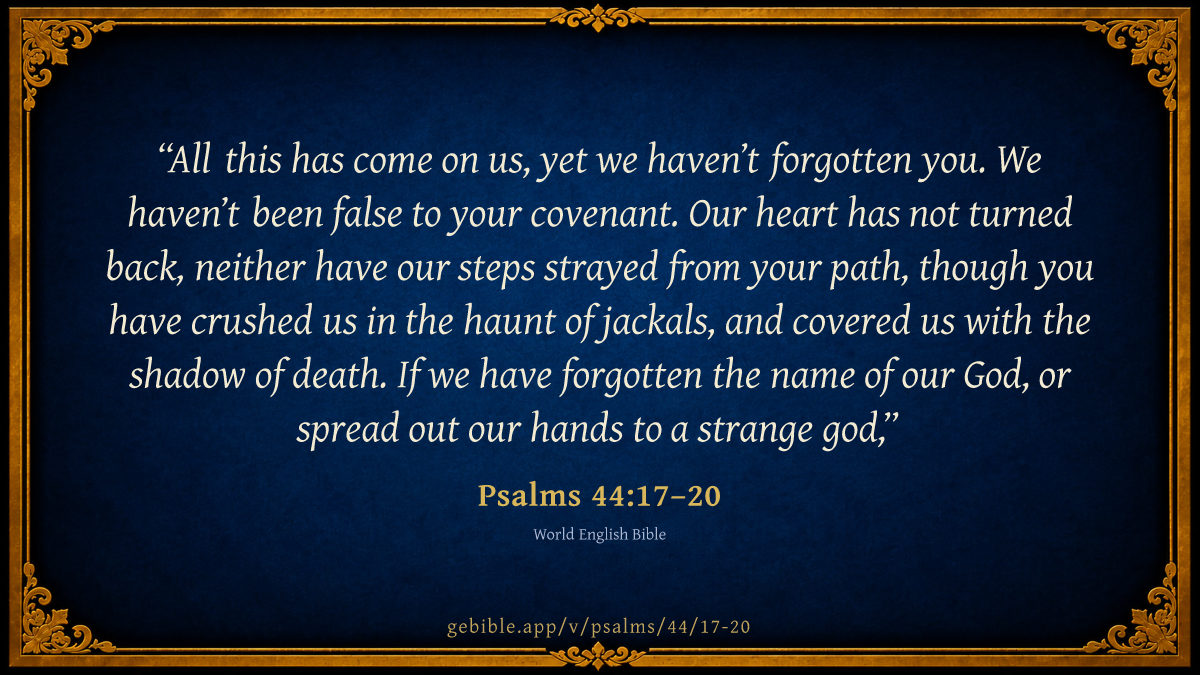
Psalms 44:17(v20)All this has come on us, yet we haven’t forgotten you. We haven’t been false to your covenant.
Psalms 44:20(v17)If we have forgotten the name of our God, or spread out our hands to a strange god,
Psalms 60:1-3(v19)God, you have rejected us. You have broken us down. You have been angry. Restore us, again. You have made the land tremble. You have torn…
Psalms 74:13-14(v19)You divided the sea by your strength. You broke the heads of the sea monsters in the waters. You broke the heads of Leviathan in pieces.…
Psalms 78:7(v17)that they might set their hope in God, and not forget God’s deeds, but keep his commandments,
Psalms 78:11(v20)They forgot his doings, his wondrous deeds that he had shown them.
Isaiah 17:10(v17)For you have forgotten the God of your salvation, and have not remembered the rock of your strength. Therefore you plant pleasant plants,…
Isaiah 27:1(v19)In that day, Yahweh with his hard and great and strong sword will punish leviathan, the fleeing serpent, and leviathan the twisted serpent;…
Isaiah 35:7(v19)The burning sand will become a pool, and the thirsty ground springs of water. Grass with reeds and rushes will be in the habitation of…
Jeremiah 2:32(v17)“Can a virgin forget her ornaments, or a bride her attire? Yet my people have forgotten me for days without number.
Jeremiah 31:32(v17)not according to the covenant that I made with their fathers in the day that I took them by the hand to bring them out of the land of…
Ezekiel 16:59(v17)“ ‘For the Lord Yahweh says: “I will also deal with you as you have done, who have despised the oath in breaking the covenant.
Ezekiel 20:37(v17)“I will cause you to pass under the rod, and I will bring you into the bond of the covenant.
Ezekiel 29:3(v19)Speak and say, ‘The Lord Yahweh says: “Behold, I am against you, Pharaoh king of Egypt, the great monster that lies in the middle of his…
Matthew 4:16(v19)the people who sat in darkness saw a great light, to those who sat in the region and shadow of death, to them light has dawned.”
Revelation 12:9(v19)The great dragon was thrown down, the old serpent, he who is called the devil and Satan, the deceiver of the whole world. He was thrown…
Revelation 13:2(v19)The beast which I saw was like a leopard, and his feet were like those of a bear, and his mouth like the mouth of a lion. The dragon gave…
Revelation 13:11-13(v19)I saw another beast coming up out of the earth. He had two horns like a lamb, and he spoke like a dragon. He exercises all the authority of…
Revelation 16:10(v19)The fifth poured out his bowl on the throne of the beast, and his kingdom was darkened. They gnawed their tongues because of the pain,
Job 10:21-22(v19)before I go where I will not return from, to the land of darkness and of the shadow of death; the land dark as midnight, of the shadow of…
50 distinct cross-references across this passage (51 total citations).
Cross-references from openbible.info (CC BY 4.0)
Explain this passage (17 sources)
Historical commentary, presented as a primary source — not an endorsement.
John Calvin1540 · Public DomainOn vv17, 1917 All this has come upon us, etc. As…
17 All this has come upon us, etc. As they have already attributed to God all the afflictions which they endured, if they should now say that they were undeservedly afflicted, it would be the same thing as to accuse God of injustice; and thus what is here spoken would no longer be a holy prayer, but rather an impious blasphemy. It is, however, to be observed, that the faithful, although in their adversities they do not perceive any obvious reason for being so dealt with, yet they rest assured of this, and regard it as a fixed principle, that God has some good reasons for treating them so severely. At the same time, it is proper to observe, that the godly do not speak in this place of the time past, but rather allege their patient endurance, which was no small token of their piety, since, in the most humble manner, they thus bowed their neck to the yoke of God. We see how the great majority of men murmur and obstinately fret against God, like refractory horses which rage furiously against their masters, and strike them with their feet. And, therefore, we know that the man who, in affliction, imposes a holy restraint upon himself, that he may not by any impatience be carried away from the path of duty, has made no inconsiderable attainments in the fear of God. It is an easy matter even for hypocrites to bless God in the time of their prosperity; but as soon as he begins to deal hardly with them, they break forth into a rage against him. Accordingly, the faithful declare that, although so many afflictions as they endured tended to turn them aside from the right path, they did not forget God, but always served him, even when he did not show himself favorable and merciful towards them. They do not, therefore, proclaim their virtues in a former and distant period of their history, but only allege, that even in the midst of afflictions they steadfastly kept the covenant of God It is well known, that long before the persecution of Antiochus, there were many abuses and corruptions which provoked the vengeance of God against them, so that, in respect of that period, they had no ground to boast of such integrity as is here described. True it is that, as we shall very soon see, God spared them, thus showing that they had been afflicted more for his name’s sake than for their own sins; but the forbearance which God exercised towards them in this respect was not sufficient to warrant them to plead exemption from guilt. We must, therefore, consider that in this place they do nothing more than allege their own patience, in that, amidst such grievous and hard temptations, they had not turned aside from the service of God. In the first place, they affirm, We have not forgotten thee: for, indeed, afflictions are, as it were, like so many clouds which conceal heaven from our view, so that God might then readily slip from our remembrance, as if we were far removed from him. They add, secondly, We have not dealt falsely in thy covenant: for, as I have said, the wickedness of men discovers itself more especially when they are tried more severely than they had anticipated. Thirdly, they declare that their heart had not turned back And, lastly, that their footsteps declined not from the paths of God. As God is daily inviting us, so our hearts must be always ready to proceed in the paths into which he calls us. Hence follows the direction of our ways; for by our outward works, and by our whole life, we testify that our heart is unfeignedly devoted to God. Instead of the translation, Nor have our steps declined, which I have given, some suggest another reading, which is not without some degree of plausibility, namely, Thou hast made our steps to decline; for, in the first place, the term תט, tet, may be so rendered; and, secondly, according to the arrangement of the words, there is no negative in this clause. As to the meaning, however, I am not at all of their opinion; for they connect this passage with that in Isaiah 63:17,
“O Lord, why hast thou made us to err from thy ways?”
Read full note →
The complaint which is here made amounts rather to this, That the faithful are like poor wretched creatures wandering in desert places, seeing God had withdrawn his hand from them. The expression, The paths of God, does not always refer to doctrine, but sometimes to prosperous and desirable events.
John Calvin's Commentaries (1540-1563) — public domain. Text from the Calvin Translation Society English edition (1840s-50s) via the Christian Classics Ethereal Library (ccel.org). Calvin's coverage is partial (roughly two-thirds of the Bible); uncommented books and verses are honest gaps, never fabricated. The 19th-century editor's footnotes and remarks are omitted so the notes are faithfully Calvin's own voice.
Geneva Bible translators1599 · Public DomainOn vv17, 19, 20They boast not of their virtues, but declare that…
They boast not of their virtues, but declare that they rest upon God in the midst of their afflictions: who punished not now their sins, but by hard afflictions called them to the consideration of the heavenly joys.
Geneva Bible (1599) marginal notes — public domain.
John Trapp1656 · Public DomainOn vv17–20Psa 44:17 All this is come upon us; yet…
Psa 44:17 All this is come upon us; yet have we not forgotten thee, neither have we dealt falsely in thy covenant.
Ver. 17. All this is come upon us; yet] This they allege, viz. their constance as an arguent of their sincerity, and a motive to pity. Apply this, with Jerome, to Christians, and then it is the voice of martyrs.
Read full note →
Neither have we dealt falsely in thy covenant] ie. We have not relinquished the true religion, or revolted to dumb idols; but held us close to thy sincere service. And, therefore, if that heathen emperor going against his enemy could say, Non sic Deos coluimus ut ille nor vinceret, We have not so served the gods that they should serve us no better than to suffer us to be worsted (Antonin. Philosoph.); how much more may God’s faithful servants be confident of his help, and say, "All people will walk every one in the name of his god, and we will walk in the name of the Lord our God for ever and ever?" Mic 4:5.
John Trapp, A Commentary or Exposition upon All the Books of the Old and New Testament (1647–1656) — public domain. Text from a community e-Sword module.
Matthew Poole1685 · Public DomainOn vv17, 18, 20Although we cannot excuse ourselves from many other sins…
Although we cannot excuse ourselves from many other sins for which thou hast justly punished us, yet this we must say for ourselves, that through thy grace we have kept ourselves from apostacy and idolatry, notwithstanding all the examples and provocations, rewards proposed and promised, or punishments threatened to induce us thereunto; which we hope thou wilt graciously consider, and not suffer us to be tempted above what we are able to bear.
Matthew Poole's English Annotations on the Holy Bible (1683–1685) — public domain. Text from a community e-Sword/MySword module.
Matthew Henry1710 · Public DomainOn v17The people of God, being greatly afflicted and oppressed,…
The people of God, being greatly afflicted and oppressed, here apply to him; whither else should they go?
I. By way of appeal, concerning their integrity, which he only is an infallible judge of, and which he will certainly be the rewarder of. Two things they call God to witness to: -
Read full note →
1. That, though they suffered these hard things, yet they kept close to God and to their duty (Psa 44:17): "All this has come upon us, and it is as bad perhaps as bad can be, yet have we not forgotten thee, neither cast off the thoughts of thee nor deserted the worship of thee; for, though we cannot deny but that we have dealt foolishly, yet we have not dealt falsely in thy covenant, so as to cast thee off and take to other gods. Though idolaters were our conquerors, we did not therefore entertain any more favourable thoughts of their idols and idolatries; though thou hast seemed to forsake us and withdraw from us, yet we have not therefore forsaken thee." The trouble they had been long in was very great: "We have been sorely broken in the place of dragons, among men as fierce, and furious, and cruel, as dragons. We have been covered with the shadow of death, that is, we have been under deep melancholy and apprehensive of nothing short of death. We have been wrapped up in obscurity, and buried alive; and thou hast thus broken us, thou hast thus covered us (Psa 44:19), yet we have not harboured any hard thoughts of thee, nor meditated a retreat from thy service. Though thou hast slain us, we have continued to trust in thee: Our heart has not turned back; we have not secretly withdrawn our affections from thee, neither have our steps, either in our religious worship or in our conversation, declined from they way (Psa 44:18), the way which thou hast appointed us to walk in." When the heart turns back the steps will soon decline; for it is the evil heart of unbelief that inclines to depart from God. Note, We may the better bear our troubles, how pressing soever, if in them we still hold fast our integrity. While our troubles do not drive us from our duty to God we should not suffer them to drive us from our comfort in God; for he will not leave us if we do not leave him. For the proof of their integrity they take God's omniscience to witness, which is as much the comfort of the upright in heart as it is the terror of hypocrites (Psa 44:20, Psa 44:21): "If we have forgotten the name of our God, under pretence that he had forgotten us, or in our distress have stretched out our hands to a strange god, as more likely to help us, shall not God search this out? Shall he not know it more fully and distinctly than we know that which we have with the greatest care and diligence searched out? Shall he not judge it, and call us to an account for it?" Forgetting God was a heart-sin, and stretching our the hand to a strange god was often a secret sin, Eze 8:12. But heart-sins and secret sins are known to God, and must be reckoned for; for he knows the secrets of the heart, and therefore is a infallible judge of the words and actions.
2. That they suffered these hard things because they kept close to God and to their duty (Psa 44:22): "It is for thy sake that we are killed all the day long, because we stand related to thee, are called by thy name, call upon thy name, and will not worship other gods." In this the Spirit of prophecy had reference to those who suffered even unto death for the testimony of Christ, to whom it is applied, Rom 8:36. So many were killed, and put to such lingering deaths, that they were in the killing all the day long; so universally was this practised that when a man became a Christian he reckoned himself as a sheep appointed for the slaughter.
II. By way of petition, with reference to their present distress, that God would, in his own due time, work deliverance for them. 1. Their request is very importunate: Awake, arise, Psa 44:23. Arise for our help; redeem us (Psa 44:26); come speedily and powerfully to our relief, Psa 80:2. Stir up thy strength, and come and save us. They had complained (Psa 44:12) that God had sold them; here they pray (Psa 44:26) that God would redeem them; for there is no appealing from God, but by appealing to him. If he sell us, it is not any one else that can redeem us; the same hand that tears must heal, that smites must bind up, Hos 6:1. They had complained (Psa 44:9), Thou hast cast us off; but here they pray (Psa 44:23), "Cast us not off forever; let us not be finally forsaken of God." 2. The expostulations are very moving: Why sleepest thou? Psa 44:23. He that keeps Israel neither slumbers nor sleeps; but, when he does not immediately appear for the deliverance of his people, they are tempted to think he sleeps. The expression is figurative (as Psa 78:65, Then the Lord awaked as one out of sleep); but it was applicable to Christ in the letter (Mat 8:24); he was asleep when his disciples were in a storm, and they awoke him, saying, Lord, save us, we perish. "Wherefore hidest thou thy face, that we may not see thee and the light of thy countenance?" Or, "that thou mayest not see us and our distresses? Thou forgettest our affliction and our oppression, for it still continues, and we see no way open for our deliverance." And, 3. The pleas are very proper, not their own merit and righteousness, though they had the testimony of their consciences concerning their integrity, but they plead the poor sinner's pleas. (1.) Their own misery, which made them the proper objects of the divine compassion (Psa 44:25): "Our soul is bowed down to the dust under prevailing grief and fear. We have become as creeping things, the most despicable animals: Our belly cleaves unto the earth; we cannot lift up ourselves, neither revive our own drooping spirits nor recover ourselves out of our low and sad condition, and we lie exposed to be trodden on by every insulting foe." 2. God's mercy: "O redeem us for they mercies' sake; we depend upon the goodness of thy nature, which is the glory of thy name (Exo 34:6), and upon those sure mercies of David which are conveyed by the covenant to all his spiritual seed."
Matthew Henry's Commentary on the Whole Bible (1708–1710) — public domain (CC PDM 1.0). Text via the HelloAO Bible API.
John Gill1763 · Public DomainOn vv17–20All this is come upon us,.... Not by chance,…
All this is come upon us,.... Not by chance, but according to the purpose and counsel of God; not for sin, and as a punishment of it, but for Christ's sake and his Gospel; for a profession of faith in him, and for the trial of it;
yet have we not forgotten thee; not the being and perfections of God, on which they often meditated, especially as displayed in the affair of salvation by Jesus Christ; nor the works of God, which were remembered to encourage faith and hope in their present circumstances, Psa 44:1; nor the benefits and favours bestowed upon them by him; nor his word, worship, and ordinances; their reproach, afflictions, and persecutions, did not move them from the hope of the Gospel, and the service of God;
Read full note →
neither have we dealt falsely in thy covenant; by disbelieving their interest in God as their covenant God; by disregarding or not coming to and making use of Christ the Mediator of it; and by calling in question their interest in the blessings and promises of the covenant; for nothing can be more called dealing falsely in or with respect to the covenant of grace than unbelief about it; which remains firm and sure notwithstanding all the afflictions that may come on such who are interested in it: moreover, as this may respect the formal exhibition of the covenant under the Gospel dispensation, by the ministry of the word, and the administration of ordinances, the sense may be, that though the church and her members met with so much reproach and persecution from men, yet did not drop nor deny any of the truths of the Gospel, nor corrupt the ordinances of Christ, nor neglect an attendance on them; but were virgins, pure and incorrupt in doctrine and practice, and followed the Lamb whithersoever he went.
John Gill's Exposition of the Whole Bible (1746–1763) — public domain (CC PDM 1.0). Text via the HelloAO Bible API.
John Wesley1765 · Public DomainOn vv17–19Yet - Although we cannot excuse ourselves from many…
Yet - Although we cannot excuse ourselves from many other sins, yet through thy grace we have kept ourselves from apostacy and idolatry, notwithstanding all examples and provocations.
John Wesley, Explanatory Notes Upon the Whole Bible (1754–1765) — public domain. Text via the GEBible commentary corpus.
Adam Clarke1810 · Public DomainOn vv17, 19, 20Verse 17. Yet have we not forgotten thee] These…
Verse 17. Yet have we not forgotten thee] These are bold words; but they must be understood in a qualified sense. We have not apostatized from thee, we have not fallen into idolatry. And this was strictly true: the charge of idolatry could never be brought against the Jewish nation from the time of the captivity, with sufficient evidence to support it.
Adam Clarke's Commentary on the Bible (1810–1826) — public domain. Text from a community e-Sword/MySword module.
Joseph Benson1811 · Public DomainOn vv17, 19Psa 44:17-18. All this is come upon us —…
Psa 44:17-18. All this is come upon us — All the evils before mentioned, and certainly we have deserved them all; yet have we not forgotten thee — Although we cannot excuse ourselves from many other sins, for which thou hast justly punished us, yet, through thy grace, we have kept ourselves from apostacy and idolatry, notwithstanding all examples and provocations. Our heart is not turned back — Namely, from thee, or thy worship and service, unto idols, as it follows, Psa 44:20. But we still adhere to thy religion, although both it and we be thus vilified and persecuted.
Joseph Benson's Commentary on the Old and New Testaments (1811–1818) — public domain. Text from a community e-Sword module.
Albert Barnes1834 · Public DomainOn vv17–20All this is come upon us - All these…
All this is come upon us - All these calamities. The connecting thought here is, that although all these things had come upon them, yet they could not be traced to their own infidelity or unfaithfulness to God. There was nothing in the national character, there were no circumstances at that time existing, there was no special unfaithfulness among the people, there was no such general forgetfulness of God, and no such general prevalence of idolatry as would account for what had occurred, or as would explain it. The nation was not then more deeply depraved than it had been at other times; but, on the contrary, there was among the people a prevalent regard for God and for his service. It was, therefore, a mystery to the author of the psalm, that these calamities had been suffered to come upon them at that time; it was an event the cause of which he desired to search out, Psa 44:21.
Yet have we not forgotten thee - As a nation. That is, there was nothing special in the circumstances of the nation at that time which would call down the divine displeasure. We cannot suppose that the psalmist means to claim for the nation entire perfection, but only to affirm that the nation at that time was not characterized by any special forgetfulness of God, or prevalence of wickedness. All that is here said was true at the time when, as I have supposed, the psalm was written - the closing part of the reign of Josiah, or the period immeditely following.
Read full note →
Neither have we dealt falsely in thy covenant - We have not been unfaithful to thy covenant; to the covenant which thou didst make with our fathers; to the commandments which thou hast given us. This can only mean that there was no such prevailing departure from the principles of that covenant as could account for this. The psalmist could not connect the existing state of things - the awful and unique discomfitures and calamities which had come upon the nation - with anything special in the character of the people, or in the religious condition of the nation.
Albert Barnes' Notes on the Bible (1834–1885) — public domain. Text from a community e-Sword/MySword module.
Robert Jamieson, A. R. Fausset & David Brown1871 · Public DomainOn vv17–20They had not apostatized totally--were still God's people.
They had not apostatized totally--were still God's people.
Jamieson, Fausset & Brown — Commentary Critical and Explanatory on the Whole Bible (1871) — public domain (CC PDM 1.0). Text via the HelloAO Bible API.
Daniel D. Whedon1874 · Public DomainOn vv17, 19, 2017. All this is come—All mentioned in Psa_44:9-16.
17. All this is come—All mentioned in Psa_44:9-16.
Yet have we not forgotten thee—Psa_44:17-22 contain the assertion of the kingdom of Judah’s fidelity to God, emphatically during Hezekiah’s reign, which was more closely modelled after David’s example, and more uniformly pious, than that of any other king of Judah, except the brief reign of Josiah.
Daniel D. Whedon (gen. ed.), Commentary on the Old and New Testaments (1874–1909) — public domain. Text from a community e-Sword module.
The Cambridge Bible for Schools and Colleges1878 · Public DomainOn vv17, 19, 2017. All this &c.] Cp. Jdg_6:13.
17. All this &c.] Cp. Jdg_6:13.
yet have we not &c.] Although we have not forgotten Thee, as our fathers did so often. Cp. Psa_78:7; Psa_78:11; Psa_106:13; Psa_106:21; Jdg_3:7; Hos_2:13; Hos_4:6; Hos_8:14; Hos_13:6; Jer_2:32.
Read full note →
neither &c.] Neither have we been false to thy covenant. Cp. Psa_89:33; “Neither will I be false to my faithfulness.” God’s covenant with Abraham to be a God to him and to his seed after him (Gen_17:7) was confirmed to the nation at Sinai (Exo_19:5; Exo_24:7-8). Its sacrament was circumcision (Gen_17:2 ff): its outward symbol was the Ark of the Covenant (Num_10:33): and its fundamental charter was the Ten Words inscribed on the Tables of the Covenant (Deu_9:9).
17–22. The calamity is unmerited. No unfaithfulness to God’s covenant has called for punishment. Nay it is for His sake that His people are suffering.
The Cambridge Bible for Schools and Colleges (gen. ed. J. J. S. Perowne; Cambridge University Press, 1878–1918) — public domain. Text from a community e-Sword module.
Ellicott's Commentary for English Readers1878 · Public DomainOn v19(19) In the place of dragons.—This expression evidently means…
(19) In the place of dragons.—This expression evidently means a wild desert place, from comparison with Jer_9:11; Jer_10:22; Jer_49:33. So Aquila has “an uninhabitable place.” The rendering dragons for tannim arose from its resemblance to tannîn (sea monster). The tan must be a wild beast, since it is connected with ostriches (Isa_34:13) and wild asses, whom it resembles in snuffing up the wind (Jer_14:6), and is described as uttering a mournful howl (Isa_43:20; Mic_1:8; Job_30:29). The jackal is the animal that best answers these requirements. The LXX. and Vulg., which give various different renderings for the word, have here, “in the place of affliction.”
Shadow of death.—See Note, Psa_23:4.
A Bible Commentary for English Readers, edited by Charles John Ellicott (1878–1897) — public domain. Text from a community e-Sword module.
The Pulpit Commentary1880 · Public DomainOn vv17–20Vers. 17-22. In this third stanza the psalmist strongly…
Vers. 17-22. In this third stanza the psalmist strongly emphasizes his complaint by maintaining that the calamities from which they are suffering have not come upon the people through any fault of their own, or been in any way provoked or deserved He is, perhaps, over-confident; but we cannot doubt that he is sincere in the belief, which he expresses, that the people, both before and during their calamities, have been obedient and faithful to God, wholly free from idolatry, and exemplary in their conduct and life. There are not many periods of Israelite history at which such a description could have been given without manifest untruth, and the time of David is certainly more suitable for it than almost any other.
All this is come upon us; yet have we not forgotten thee, neither have we dealt falsely in thy covenant. Israel had neither put aside the thought of religion, and given herself up to wordliness, nor yet, while still professedly religious, transgressed habitually God"s commandments. She maintained "thorough sincerity in religion, and consistent integrity of life." Yet "all this all that has been described in vers. 9-16 had come upon her.
The Pulpit Commentary (1880–1919), ed. H.D.M. Spence-Jones & Joseph S. Exell — public domain. Text from a community e-Sword module.
Charles H. Spurgeon1885 · Public DomainOn vv17–20Ver. 17. All this is come upon us; yet…
Ver. 17. All this is come upon us; yet have we not forgotten thee. Here the psalmist urges that Israel had not turned away from her allegiance to Jehovah. When in the midst of many griefs we can still cling to God in loving obedience, it must be well with us. True fidelity can endure rough usage. Those who follow God for what they get, will leave him when persecution is stirred up, but not so the sincere believer; he will not forget his God, even though the worst come to the worst. Neither have we dealt falsely in thy covenant. No idol was set up, the ordained worship was not relinquished, God was still nationally acknowledged, and therefore the psalmist is more earnest that the Lord should interpose. This and the succeeding verses are suitable for the lips of martyrs, indeed the entire psalm might be called the martyr's complaint. Not for sin but for righteousness did the saints suffer, not for falsehood but for truth, not for forsaking the Lord, but for following hard after him. Sufferings of such a sort may be very terrible, but they are exceedingly honourable, and the comforts of the Lord shall sustain those who are accounted worthy to suffer for Christ's sake.
Ver. 17. Eusebius, narrating the cruelties inflicted upon the Christians by the Eastern tyrant, Maximinus, says: "He prevailed against all sorts of people, the Christians only excepted, who contemned death and despised his tyranny. The men endured burning, beheading, crucifying, ravenous devouring of beasts, drowning in the sea, maiming and broiling of the members, goring and digging out of the eyes, mangling of the whole body; moreover, famine and imprisonment: to be short, they suffered every kind of torment for the service of God rather than they would leave the worship of God, and embrace the adoration of idols. Women also, not inferior to men through the power of the word of God, put on a manly courage, whereof some suffered the torments with men, some attained unto the like masteries of virtue." From "The Ecclesiastical History of Eusebius Pamphilus."
Read full note →
Ver. 17. Yet have we not forgotten thee, neither have we dealt falsely in thy covenant. Although we cannot excuse ourselves from many other sins for which thou hast justly punished us, yet this we must say for ourselves, that through thy grace we have kept ourselves from apostasy and idolatry, notwithstanding all the examples and provocations, rewards proposed and promised, or punishments threatened to induce us thereunto; which we hope thou wilt graciously consider, and not suffer us to be tempted above what we are able to bear. Matthew Poole.
Ver. 17. If any of you would abide by Jesus Christ in this storm, try how ye have covenanted with him, and how ye have closed the bargain with him, and upon what terms. But I trow there are many of you in this age that are like young wanton folk, that run fast together and marry, but never take any account of how they will keep house, but presently go to poverty and beggary. I trow it falls out so with many of you that are professors in this generation. Ye take up your religion, and ye wot not how, and ye cannot give an account how ye came by it. I will tell you, sirs; ye will abide no longer by Christ than till a storm blow, and then ye will quit him and deny his cause. Ye have need to take heed to this, for it will ruin your souls in the end of the day. But I shall tell you, sirs, the right way of covenanting with God. It is when Christ and the believer meet. Our Lord gives him his laws, statutes, and commands, and he charges him not to quit a hoof of them. No; though he should be torn into a thousand pieces; and the right covenanter says, Amen. Alexander Peden's Sermon, 1682.
Ver. 17-19. Neither the persecuting hand of men, nor the chastising hand of God, relaxed ancient singular saints. Believers resemble the moon, which emerges from her eclipse by keeping her motion, and ceases not to shine because the dogs bark at her. Shall we cease to be professors because others will not cease to be persecutors? William Secker.
Ver. 17-19. The church having reported her great troubles, speaks it as an argument of much sincerity towards God, and strength of grace received from him: All this has come upon us (that is, all these common calamities and afflictions), yet have we not forgotten thee, neither have we dealt falsely in thy covenant. Our heart is not turned back, neither have our steps declined from thy way; as if she had said, These afflictions have been strong temptations upon us to cause us to decline from thy ways, but through grace we have kept our ground and remained constant in thy covenant, yea, though thou hast sore broken us in the place of dragons, and covered us with the shadow of death. As many, yea, most of the saints have improved under the cross, so there have been some, who either through their present unbelief, or forgetfulness of "the exhortation which" (as the apostle saith, Heb 12:5); "speaketh unto them as unto children, " have had their faintings or declinings under it. Joseph Caryl.
Ver. 17. The trial, truth, and triumph of the godly.
Ver. 17. The faithful soul holding fast his integrity.
Ver. 17. What it is to be false to our covenant with God.
Psalms 44:18*
Ver. 17-19. See Psalms on "Ps 44:17" for further information.
Ver. 17-19. See Psalms on "Ps 44:17" for further information.
Ver. 17-19. See Psalms on "Ps 44:17" for further information.
Ver. 17-19. See Psalms on "Ps 44:17" for further information.
Charles H. Spurgeon's The Treasury of David (1869–1885) — public domain. Psalms only. Text from a community e-Sword/MySword module.
unfoldingWord translationNotes2017 · CC BY-SA 4.0On v18Our heart has not turned back ... have not…
Our heart has not turned back ... have not gone from your way
These two phrases are parallel. The writer speaks of loyalty to God as if it were following him, and disloyalty as if it were turning away from him. (See: Parallelism and Metaphor)
Read full note →
Our heart has not turned back
Here the word "heart" refers to the emotions, and specifically to loyalty and devotion. AT: "We have not stopped being loyal to you" (See: Metonymy)
you have severely broken us
The writer speaks of God's punishment as if it were breaking a fragile object. AT: "you have punished us severely" (See: Metaphor)
in the place of jackals
The writer speaks of Israel after God's punishment as if it were a wild, uninhabitable place. AT: "and made our land like a place where jackals live" (See: Metaphor)
jackals
a type of wild dog
covered us with the shadow of death
The writer speaks of death as if it is an object that casts a shadow over those who are about to die. AT: "made us so that we are about to die" (See: Metaphor)
If we have forgotten the name of our God
Here the word "name" refers to God, himself. To forget God is to stop worshiping him. This is something that did not happen. AT: "If we had forgotten our God" or "If we had stopped worshiping our God" (See: Metonymy and Hypothetical Situations)
spread out our hands to a strange god
Spreading out the hands is a gesture that people used to worship and pray to a god. AT: "worshiped a strange god" or "prayed to a strange god" (See: Symbolic Action)
would not God search this out?
The writer uses this question to express that God would know if they worshiped another god. AT: "God would certainly find out" (See: Rhetorical Question)
he knows the secrets of the heart
Here the word "heart" refers to the mind and thoughts. AT: "he knows what a person secretly thinks" (See: Metonymy)
we are being killed all day long
The phrase "all day long" is an exaggeration to emphasize that their people are being killed frequently. This can be stated in active form. AT: "we are always in danger of people killing us" (See: Hyperbole and Generalization and Active or Passive)
we are considered to be sheep for the slaughter
This can be stated in active form. AT: "people consider us to be sheep for the slaughter" (See: Active or Passive)
sheep for the slaughter
The writer compares the Israelites to sheep that people kill and eat. As sheep are helpless before those who kill them, so the Israelites are helpless before their enemies. (See: Metaphor)

John Calvin 1540 · Public Domain On vv17, 19 17 All this has come upon us, etc. As…
17 All this has come upon us, etc. As they have already attributed to God all the afflictions which they endured, if they should now say that they were undeservedly afflicted, it would be the same thing as to accuse God of injustice; and thus what is here spoken would no longer be a holy prayer, but rather an impious blasphemy. It is, however, to be observed, that the faithful, although in their adversities they do not perceive any obvious reason for being so dealt with, yet they rest assured of this, and regard it as a fixed principle, that God has some good reasons for treating them so severely. At the same time, it is proper to observe, that the godly do not speak in this place of the time past, but rather allege their patient endurance, which was no small token of their piety, since, in the most humble manner, they thus bowed their neck to the yoke of God. We see how the great majority of men murmur and obstinately fret against God, like refractory horses which rage furiously against their masters, and strike them with their feet. And, therefore, we know that the man who, in affliction, imposes a holy restraint upon himself, that he may not by any impatience be carried away from the path of duty, has made no inconsiderable attainments in the fear of God. It is an easy matter even for hypocrites to bless God in the time of their prosperity; but as soon as he begins to deal hardly with them, they break forth into a rage against him. Accordingly, the faithful declare that, although so many afflictions as they endured tended to turn them aside from the right path, they did not forget God, but always served him, even when he did not show himself favorable and merciful towards them. They do not, therefore, proclaim their virtues in a former and distant period of their history, but only allege, that even in the midst of afflictions they steadfastly kept the covenant of God It is well known, that long before the persecution of Antiochus, there were many abuses and corruptions which provoked the vengeance of God against them, so that, in respect of that period, they had no ground to boast of such integrity as is here described. True it is that, as we shall very soon see, God spared them, thus showing that they had been afflicted more for his name’s sake than for their own sins; but the forbearance which God exercised towards them in this respect was not sufficient to warrant them to plead exemption from guilt. We must, therefore, consider that in this place they do nothing more than allege their own patience, in that, amidst such grievous and hard temptations, they had not turned aside from the service of God. In the first place, they affirm, We have not forgotten thee: for, indeed, afflictions are, as it were, like so many clouds which conceal heaven from our view, so that God might then readily slip from our remembrance, as if we were far removed from him. They add, secondly, We have not dealt falsely in thy covenant: for, as I have said, the wickedness of men discovers itself more especially when they are tried more severely than they had anticipated. Thirdly, they declare that their heart had not turned back And, lastly, that their footsteps declined not from the paths of God. As God is daily inviting us, so our hearts must be always ready to proceed in the paths into which he calls us. Hence follows the direction of our ways; for by our outward works, and by our whole life, we testify that our heart is unfeignedly devoted to God. Instead of the translation, Nor have our steps declined, which I have given, some suggest another reading, which is not without some degree of plausibility, namely, Thou hast made our steps to decline; for, in the first place, the term תט, tet, may be so rendered; and, secondly, according to the arrangement of the words, there is no negative in this clause. As to the meaning, however, I am not at all of their opinion; for they connect this passage with that in Isaiah 63:17,
“O Lord, why hast thou made us to err from thy ways?”
Read full note →
The complaint which is here made amounts rather to this, That the faithful are like poor wretched creatures wandering in desert places, seeing God had withdrawn his hand from them. The expression, The paths of God, does not always refer to doctrine, but sometimes to prosperous and desirable events.
John Calvin's Commentaries (1540-1563) — public domain. Text from the Calvin Translation Society English edition (1840s-50s) via the Christian Classics Ethereal Library (ccel.org). Calvin's coverage is partial (roughly two-thirds of the Bible); uncommented books and verses are honest gaps, never fabricated. The 19th-century editor's footnotes and remarks are omitted so the notes are faithfully Calvin's own voice.
Geneva Bible translators 1599 · Public Domain On vv17, 19, 20 They boast not of their virtues, but declare that…
They boast not of their virtues, but declare that they rest upon God in the midst of their afflictions: who punished not now their sins, but by hard afflictions called them to the consideration of the heavenly joys.
Geneva Bible (1599) marginal notes — public domain.
John Trapp 1656 · Public Domain On vv17–20 Psa 44:17 All this is come upon us; yet…
Psa 44:17 All this is come upon us; yet have we not forgotten thee, neither have we dealt falsely in thy covenant.
Ver. 17. All this is come upon us; yet] This they allege, viz. their constance as an arguent of their sincerity, and a motive to pity. Apply this, with Jerome, to Christians, and then it is the voice of martyrs.
Read full note →
Neither have we dealt falsely in thy covenant] ie. We have not relinquished the true religion, or revolted to dumb idols; but held us close to thy sincere service. And, therefore, if that heathen emperor going against his enemy could say, Non sic Deos coluimus ut ille nor vinceret, We have not so served the gods that they should serve us no better than to suffer us to be worsted (Antonin. Philosoph.); how much more may God’s faithful servants be confident of his help, and say, "All people will walk every one in the name of his god, and we will walk in the name of the Lord our God for ever and ever?" Mic 4:5.
John Trapp, A Commentary or Exposition upon All the Books of the Old and New Testament (1647–1656) — public domain. Text from a community e-Sword module.
Matthew Poole 1685 · Public Domain On vv17, 18, 20 Although we cannot excuse ourselves from many other sins…
Although we cannot excuse ourselves from many other sins for which thou hast justly punished us, yet this we must say for ourselves, that through thy grace we have kept ourselves from apostacy and idolatry, notwithstanding all the examples and provocations, rewards proposed and promised, or punishments threatened to induce us thereunto; which we hope thou wilt graciously consider, and not suffer us to be tempted above what we are able to bear.
Matthew Poole's English Annotations on the Holy Bible (1683–1685) — public domain. Text from a community e-Sword/MySword module.
Matthew Henry 1710 · Public Domain On v17 The people of God, being greatly afflicted and oppressed,…
The people of God, being greatly afflicted and oppressed, here apply to him; whither else should they go?
I. By way of appeal, concerning their integrity, which he only is an infallible judge of, and which he will certainly be the rewarder of. Two things they call God to witness to: -
Read full note →
1. That, though they suffered these hard things, yet they kept close to God and to their duty (Psa 44:17): "All this has come upon us, and it is as bad perhaps as bad can be, yet have we not forgotten thee, neither cast off the thoughts of thee nor deserted the worship of thee; for, though we cannot deny but that we have dealt foolishly, yet we have not dealt falsely in thy covenant, so as to cast thee off and take to other gods. Though idolaters were our conquerors, we did not therefore entertain any more favourable thoughts of their idols and idolatries; though thou hast seemed to forsake us and withdraw from us, yet we have not therefore forsaken thee." The trouble they had been long in was very great: "We have been sorely broken in the place of dragons, among men as fierce, and furious, and cruel, as dragons. We have been covered with the shadow of death, that is, we have been under deep melancholy and apprehensive of nothing short of death. We have been wrapped up in obscurity, and buried alive; and thou hast thus broken us, thou hast thus covered us (Psa 44:19), yet we have not harboured any hard thoughts of thee, nor meditated a retreat from thy service. Though thou hast slain us, we have continued to trust in thee: Our heart has not turned back; we have not secretly withdrawn our affections from thee, neither have our steps, either in our religious worship or in our conversation, declined from they way (Psa 44:18), the way which thou hast appointed us to walk in." When the heart turns back the steps will soon decline; for it is the evil heart of unbelief that inclines to depart from God. Note, We may the better bear our troubles, how pressing soever, if in them we still hold fast our integrity. While our troubles do not drive us from our duty to God we should not suffer them to drive us from our comfort in God; for he will not leave us if we do not leave him. For the proof of their integrity they take God's omniscience to witness, which is as much the comfort of the upright in heart as it is the terror of hypocrites (Psa 44:20, Psa 44:21): "If we have forgotten the name of our God, under pretence that he had forgotten us, or in our distress have stretched out our hands to a strange god, as more likely to help us, shall not God search this out? Shall he not know it more fully and distinctly than we know that which we have with the greatest care and diligence searched out? Shall he not judge it, and call us to an account for it?" Forgetting God was a heart-sin, and stretching our the hand to a strange god was often a secret sin, Eze 8:12. But heart-sins and secret sins are known to God, and must be reckoned for; for he knows the secrets of the heart, and therefore is a infallible judge of the words and actions.
2. That they suffered these hard things because they kept close to God and to their duty (Psa 44:22): "It is for thy sake that we are killed all the day long, because we stand related to thee, are called by thy name, call upon thy name, and will not worship other gods." In this the Spirit of prophecy had reference to those who suffered even unto death for the testimony of Christ, to whom it is applied, Rom 8:36. So many were killed, and put to such lingering deaths, that they were in the killing all the day long; so universally was this practised that when a man became a Christian he reckoned himself as a sheep appointed for the slaughter.
II. By way of petition, with reference to their present distress, that God would, in his own due time, work deliverance for them. 1. Their request is very importunate: Awake, arise, Psa 44:23. Arise for our help; redeem us (Psa 44:26); come speedily and powerfully to our relief, Psa 80:2. Stir up thy strength, and come and save us. They had complained (Psa 44:12) that God had sold them; here they pray (Psa 44:26) that God would redeem them; for there is no appealing from God, but by appealing to him. If he sell us, it is not any one else that can redeem us; the same hand that tears must heal, that smites must bind up, Hos 6:1. They had complained (Psa 44:9), Thou hast cast us off; but here they pray (Psa 44:23), "Cast us not off forever; let us not be finally forsaken of God." 2. The expostulations are very moving: Why sleepest thou? Psa 44:23. He that keeps Israel neither slumbers nor sleeps; but, when he does not immediately appear for the deliverance of his people, they are tempted to think he sleeps. The expression is figurative (as Psa 78:65, Then the Lord awaked as one out of sleep); but it was applicable to Christ in the letter (Mat 8:24); he was asleep when his disciples were in a storm, and they awoke him, saying, Lord, save us, we perish. "Wherefore hidest thou thy face, that we may not see thee and the light of thy countenance?" Or, "that thou mayest not see us and our distresses? Thou forgettest our affliction and our oppression, for it still continues, and we see no way open for our deliverance." And, 3. The pleas are very proper, not their own merit and righteousness, though they had the testimony of their consciences concerning their integrity, but they plead the poor sinner's pleas. (1.) Their own misery, which made them the proper objects of the divine compassion (Psa 44:25): "Our soul is bowed down to the dust under prevailing grief and fear. We have become as creeping things, the most despicable animals: Our belly cleaves unto the earth; we cannot lift up ourselves, neither revive our own drooping spirits nor recover ourselves out of our low and sad condition, and we lie exposed to be trodden on by every insulting foe." 2. God's mercy: "O redeem us for they mercies' sake; we depend upon the goodness of thy nature, which is the glory of thy name (Exo 34:6), and upon those sure mercies of David which are conveyed by the covenant to all his spiritual seed."
Matthew Henry's Commentary on the Whole Bible (1708–1710) — public domain (CC PDM 1.0). Text via the HelloAO Bible API.
John Gill 1763 · Public Domain On vv17–20 All this is come upon us,.... Not by chance,…
All this is come upon us,.... Not by chance, but according to the purpose and counsel of God; not for sin, and as a punishment of it, but for Christ's sake and his Gospel; for a profession of faith in him, and for the trial of it;
yet have we not forgotten thee; not the being and perfections of God, on which they often meditated, especially as displayed in the affair of salvation by Jesus Christ; nor the works of God, which were remembered to encourage faith and hope in their present circumstances, Psa 44:1; nor the benefits and favours bestowed upon them by him; nor his word, worship, and ordinances; their reproach, afflictions, and persecutions, did not move them from the hope of the Gospel, and the service of God;
Read full note →
neither have we dealt falsely in thy covenant; by disbelieving their interest in God as their covenant God; by disregarding or not coming to and making use of Christ the Mediator of it; and by calling in question their interest in the blessings and promises of the covenant; for nothing can be more called dealing falsely in or with respect to the covenant of grace than unbelief about it; which remains firm and sure notwithstanding all the afflictions that may come on such who are interested in it: moreover, as this may respect the formal exhibition of the covenant under the Gospel dispensation, by the ministry of the word, and the administration of ordinances, the sense may be, that though the church and her members met with so much reproach and persecution from men, yet did not drop nor deny any of the truths of the Gospel, nor corrupt the ordinances of Christ, nor neglect an attendance on them; but were virgins, pure and incorrupt in doctrine and practice, and followed the Lamb whithersoever he went.
John Gill's Exposition of the Whole Bible (1746–1763) — public domain (CC PDM 1.0). Text via the HelloAO Bible API.
John Wesley 1765 · Public Domain On vv17–19 Yet - Although we cannot excuse ourselves from many…
Yet - Although we cannot excuse ourselves from many other sins, yet through thy grace we have kept ourselves from apostacy and idolatry, notwithstanding all examples and provocations.
John Wesley, Explanatory Notes Upon the Whole Bible (1754–1765) — public domain. Text via the GEBible commentary corpus.
Adam Clarke 1810 · Public Domain On vv17, 19, 20 Verse 17. Yet have we not forgotten thee] These…
Verse 17. Yet have we not forgotten thee] These are bold words; but they must be understood in a qualified sense. We have not apostatized from thee, we have not fallen into idolatry. And this was strictly true: the charge of idolatry could never be brought against the Jewish nation from the time of the captivity, with sufficient evidence to support it.
Adam Clarke's Commentary on the Bible (1810–1826) — public domain. Text from a community e-Sword/MySword module.
Joseph Benson 1811 · Public Domain On vv17, 19 Psa 44:17-18. All this is come upon us —…
Psa 44:17-18. All this is come upon us — All the evils before mentioned, and certainly we have deserved them all; yet have we not forgotten thee — Although we cannot excuse ourselves from many other sins, for which thou hast justly punished us, yet, through thy grace, we have kept ourselves from apostacy and idolatry, notwithstanding all examples and provocations. Our heart is not turned back — Namely, from thee, or thy worship and service, unto idols, as it follows, Psa 44:20. But we still adhere to thy religion, although both it and we be thus vilified and persecuted.
Joseph Benson's Commentary on the Old and New Testaments (1811–1818) — public domain. Text from a community e-Sword module.
Albert Barnes 1834 · Public Domain On vv17–20 All this is come upon us - All these…
All this is come upon us - All these calamities. The connecting thought here is, that although all these things had come upon them, yet they could not be traced to their own infidelity or unfaithfulness to God. There was nothing in the national character, there were no circumstances at that time existing, there was no special unfaithfulness among the people, there was no such general forgetfulness of God, and no such general prevalence of idolatry as would account for what had occurred, or as would explain it. The nation was not then more deeply depraved than it had been at other times; but, on the contrary, there was among the people a prevalent regard for God and for his service. It was, therefore, a mystery to the author of the psalm, that these calamities had been suffered to come upon them at that time; it was an event the cause of which he desired to search out, Psa 44:21.
Yet have we not forgotten thee - As a nation. That is, there was nothing special in the circumstances of the nation at that time which would call down the divine displeasure. We cannot suppose that the psalmist means to claim for the nation entire perfection, but only to affirm that the nation at that time was not characterized by any special forgetfulness of God, or prevalence of wickedness. All that is here said was true at the time when, as I have supposed, the psalm was written - the closing part of the reign of Josiah, or the period immeditely following.
Read full note →
Neither have we dealt falsely in thy covenant - We have not been unfaithful to thy covenant; to the covenant which thou didst make with our fathers; to the commandments which thou hast given us. This can only mean that there was no such prevailing departure from the principles of that covenant as could account for this. The psalmist could not connect the existing state of things - the awful and unique discomfitures and calamities which had come upon the nation - with anything special in the character of the people, or in the religious condition of the nation.
Albert Barnes' Notes on the Bible (1834–1885) — public domain. Text from a community e-Sword/MySword module.
Robert Jamieson, A. R. Fausset & David Brown 1871 · Public Domain On vv17–20 They had not apostatized totally--were still God's people.
They had not apostatized totally--were still God's people.
Jamieson, Fausset & Brown — Commentary Critical and Explanatory on the Whole Bible (1871) — public domain (CC PDM 1.0). Text via the HelloAO Bible API.
Daniel D. Whedon 1874 · Public Domain On vv17, 19, 20 17. All this is come—All mentioned in Psa_44:9-16.
17. All this is come—All mentioned in Psa_44:9-16.
Yet have we not forgotten thee—Psa_44:17-22 contain the assertion of the kingdom of Judah’s fidelity to God, emphatically during Hezekiah’s reign, which was more closely modelled after David’s example, and more uniformly pious, than that of any other king of Judah, except the brief reign of Josiah.
Daniel D. Whedon (gen. ed.), Commentary on the Old and New Testaments (1874–1909) — public domain. Text from a community e-Sword module.
The Cambridge Bible for Schools and Colleges 1878 · Public Domain On vv17, 19, 20 17. All this &c.] Cp. Jdg_6:13.
17. All this &c.] Cp. Jdg_6:13.
yet have we not &c.] Although we have not forgotten Thee, as our fathers did so often. Cp. Psa_78:7; Psa_78:11; Psa_106:13; Psa_106:21; Jdg_3:7; Hos_2:13; Hos_4:6; Hos_8:14; Hos_13:6; Jer_2:32.
Read full note →
neither &c.] Neither have we been false to thy covenant. Cp. Psa_89:33; “Neither will I be false to my faithfulness.” God’s covenant with Abraham to be a God to him and to his seed after him (Gen_17:7) was confirmed to the nation at Sinai (Exo_19:5; Exo_24:7-8). Its sacrament was circumcision (Gen_17:2 ff): its outward symbol was the Ark of the Covenant (Num_10:33): and its fundamental charter was the Ten Words inscribed on the Tables of the Covenant (Deu_9:9).
17–22. The calamity is unmerited. No unfaithfulness to God’s covenant has called for punishment. Nay it is for His sake that His people are suffering.
The Cambridge Bible for Schools and Colleges (gen. ed. J. J. S. Perowne; Cambridge University Press, 1878–1918) — public domain. Text from a community e-Sword module.
Ellicott's Commentary for English Readers 1878 · Public Domain On v19 (19) In the place of dragons.—This expression evidently means…
(19) In the place of dragons.—This expression evidently means a wild desert place, from comparison with Jer_9:11; Jer_10:22; Jer_49:33. So Aquila has “an uninhabitable place.” The rendering dragons for tannim arose from its resemblance to tannîn (sea monster). The tan must be a wild beast, since it is connected with ostriches (Isa_34:13) and wild asses, whom it resembles in snuffing up the wind (Jer_14:6), and is described as uttering a mournful howl (Isa_43:20; Mic_1:8; Job_30:29). The jackal is the animal that best answers these requirements. The LXX. and Vulg., which give various different renderings for the word, have here, “in the place of affliction.”
Shadow of death.—See Note, Psa_23:4.
A Bible Commentary for English Readers, edited by Charles John Ellicott (1878–1897) — public domain. Text from a community e-Sword module.
The Pulpit Commentary 1880 · Public Domain On vv17–20 Vers. 17-22. In this third stanza the psalmist strongly…
Vers. 17-22. In this third stanza the psalmist strongly emphasizes his complaint by maintaining that the calamities from which they are suffering have not come upon the people through any fault of their own, or been in any way provoked or deserved He is, perhaps, over-confident; but we cannot doubt that he is sincere in the belief, which he expresses, that the people, both before and during their calamities, have been obedient and faithful to God, wholly free from idolatry, and exemplary in their conduct and life. There are not many periods of Israelite history at which such a description could have been given without manifest untruth, and the time of David is certainly more suitable for it than almost any other.
All this is come upon us; yet have we not forgotten thee, neither have we dealt falsely in thy covenant. Israel had neither put aside the thought of religion, and given herself up to wordliness, nor yet, while still professedly religious, transgressed habitually God"s commandments. She maintained "thorough sincerity in religion, and consistent integrity of life." Yet "all this all that has been described in vers. 9-16 had come upon her.
The Pulpit Commentary (1880–1919), ed. H.D.M. Spence-Jones & Joseph S. Exell — public domain. Text from a community e-Sword module.
Charles H. Spurgeon 1885 · Public Domain On vv17–20 Ver. 17. All this is come upon us; yet…
Ver. 17. All this is come upon us; yet have we not forgotten thee. Here the psalmist urges that Israel had not turned away from her allegiance to Jehovah. When in the midst of many griefs we can still cling to God in loving obedience, it must be well with us. True fidelity can endure rough usage. Those who follow God for what they get, will leave him when persecution is stirred up, but not so the sincere believer; he will not forget his God, even though the worst come to the worst. Neither have we dealt falsely in thy covenant. No idol was set up, the ordained worship was not relinquished, God was still nationally acknowledged, and therefore the psalmist is more earnest that the Lord should interpose. This and the succeeding verses are suitable for the lips of martyrs, indeed the entire psalm might be called the martyr's complaint. Not for sin but for righteousness did the saints suffer, not for falsehood but for truth, not for forsaking the Lord, but for following hard after him. Sufferings of such a sort may be very terrible, but they are exceedingly honourable, and the comforts of the Lord shall sustain those who are accounted worthy to suffer for Christ's sake.
Ver. 17. Eusebius, narrating the cruelties inflicted upon the Christians by the Eastern tyrant, Maximinus, says: "He prevailed against all sorts of people, the Christians only excepted, who contemned death and despised his tyranny. The men endured burning, beheading, crucifying, ravenous devouring of beasts, drowning in the sea, maiming and broiling of the members, goring and digging out of the eyes, mangling of the whole body; moreover, famine and imprisonment: to be short, they suffered every kind of torment for the service of God rather than they would leave the worship of God, and embrace the adoration of idols. Women also, not inferior to men through the power of the word of God, put on a manly courage, whereof some suffered the torments with men, some attained unto the like masteries of virtue." From "The Ecclesiastical History of Eusebius Pamphilus."
Read full note →
Ver. 17. Yet have we not forgotten thee, neither have we dealt falsely in thy covenant. Although we cannot excuse ourselves from many other sins for which thou hast justly punished us, yet this we must say for ourselves, that through thy grace we have kept ourselves from apostasy and idolatry, notwithstanding all the examples and provocations, rewards proposed and promised, or punishments threatened to induce us thereunto; which we hope thou wilt graciously consider, and not suffer us to be tempted above what we are able to bear. Matthew Poole.
Ver. 17. If any of you would abide by Jesus Christ in this storm, try how ye have covenanted with him, and how ye have closed the bargain with him, and upon what terms. But I trow there are many of you in this age that are like young wanton folk, that run fast together and marry, but never take any account of how they will keep house, but presently go to poverty and beggary. I trow it falls out so with many of you that are professors in this generation. Ye take up your religion, and ye wot not how, and ye cannot give an account how ye came by it. I will tell you, sirs; ye will abide no longer by Christ than till a storm blow, and then ye will quit him and deny his cause. Ye have need to take heed to this, for it will ruin your souls in the end of the day. But I shall tell you, sirs, the right way of covenanting with God. It is when Christ and the believer meet. Our Lord gives him his laws, statutes, and commands, and he charges him not to quit a hoof of them. No; though he should be torn into a thousand pieces; and the right covenanter says, Amen. Alexander Peden's Sermon, 1682.
Ver. 17-19. Neither the persecuting hand of men, nor the chastising hand of God, relaxed ancient singular saints. Believers resemble the moon, which emerges from her eclipse by keeping her motion, and ceases not to shine because the dogs bark at her. Shall we cease to be professors because others will not cease to be persecutors? William Secker.
Ver. 17-19. The church having reported her great troubles, speaks it as an argument of much sincerity towards God, and strength of grace received from him: All this has come upon us (that is, all these common calamities and afflictions), yet have we not forgotten thee, neither have we dealt falsely in thy covenant. Our heart is not turned back, neither have our steps declined from thy way; as if she had said, These afflictions have been strong temptations upon us to cause us to decline from thy ways, but through grace we have kept our ground and remained constant in thy covenant, yea, though thou hast sore broken us in the place of dragons, and covered us with the shadow of death. As many, yea, most of the saints have improved under the cross, so there have been some, who either through their present unbelief, or forgetfulness of "the exhortation which" (as the apostle saith, Heb 12:5); "speaketh unto them as unto children, " have had their faintings or declinings under it. Joseph Caryl.
Ver. 17. The trial, truth, and triumph of the godly.
Ver. 17. The faithful soul holding fast his integrity.
Ver. 17. What it is to be false to our covenant with God.
Psalms 44:18*
Ver. 17-19. See Psalms on "Ps 44:17" for further information.
Ver. 17-19. See Psalms on "Ps 44:17" for further information.
Ver. 17-19. See Psalms on "Ps 44:17" for further information.
Ver. 17-19. See Psalms on "Ps 44:17" for further information.
Charles H. Spurgeon's The Treasury of David (1869–1885) — public domain. Psalms only. Text from a community e-Sword/MySword module.
unfoldingWord translationNotes 2017 · CC BY-SA 4.0 On v18 Our heart has not turned back ... have not…
Our heart has not turned back ... have not gone from your way
These two phrases are parallel. The writer speaks of loyalty to God as if it were following him, and disloyalty as if it were turning away from him. (See: Parallelism and Metaphor)
Read full note →
Our heart has not turned back
Here the word "heart" refers to the emotions, and specifically to loyalty and devotion. AT: "We have not stopped being loyal to you" (See: Metonymy)
you have severely broken us
The writer speaks of God's punishment as if it were breaking a fragile object. AT: "you have punished us severely" (See: Metaphor)
in the place of jackals
The writer speaks of Israel after God's punishment as if it were a wild, uninhabitable place. AT: "and made our land like a place where jackals live" (See: Metaphor)
jackals
a type of wild dog
covered us with the shadow of death
The writer speaks of death as if it is an object that casts a shadow over those who are about to die. AT: "made us so that we are about to die" (See: Metaphor)
If we have forgotten the name of our God
Here the word "name" refers to God, himself. To forget God is to stop worshiping him. This is something that did not happen. AT: "If we had forgotten our God" or "If we had stopped worshiping our God" (See: Metonymy and Hypothetical Situations)
spread out our hands to a strange god
Spreading out the hands is a gesture that people used to worship and pray to a god. AT: "worshiped a strange god" or "prayed to a strange god" (See: Symbolic Action)
would not God search this out?
The writer uses this question to express that God would know if they worshiped another god. AT: "God would certainly find out" (See: Rhetorical Question)
he knows the secrets of the heart
Here the word "heart" refers to the mind and thoughts. AT: "he knows what a person secretly thinks" (See: Metonymy)
we are being killed all day long
The phrase "all day long" is an exaggeration to emphasize that their people are being killed frequently. This can be stated in active form. AT: "we are always in danger of people killing us" (See: Hyperbole and Generalization and Active or Passive)
we are considered to be sheep for the slaughter
This can be stated in active form. AT: "people consider us to be sheep for the slaughter" (See: Active or Passive)
sheep for the slaughter
The writer compares the Israelites to sheep that people kill and eat. As sheep are helpless before those who kill them, so the Israelites are helpless before their enemies. (See: Metaphor)
translationWords
heart
turn
shadow
die
name
false god
ewe
slaughter
unfoldingWord translationNotes — © Distant Shores Media and the Door43 World Missions Community, licensed CC BY-SA 4.0. Source: git.door43.org/Door43/en_tn.