
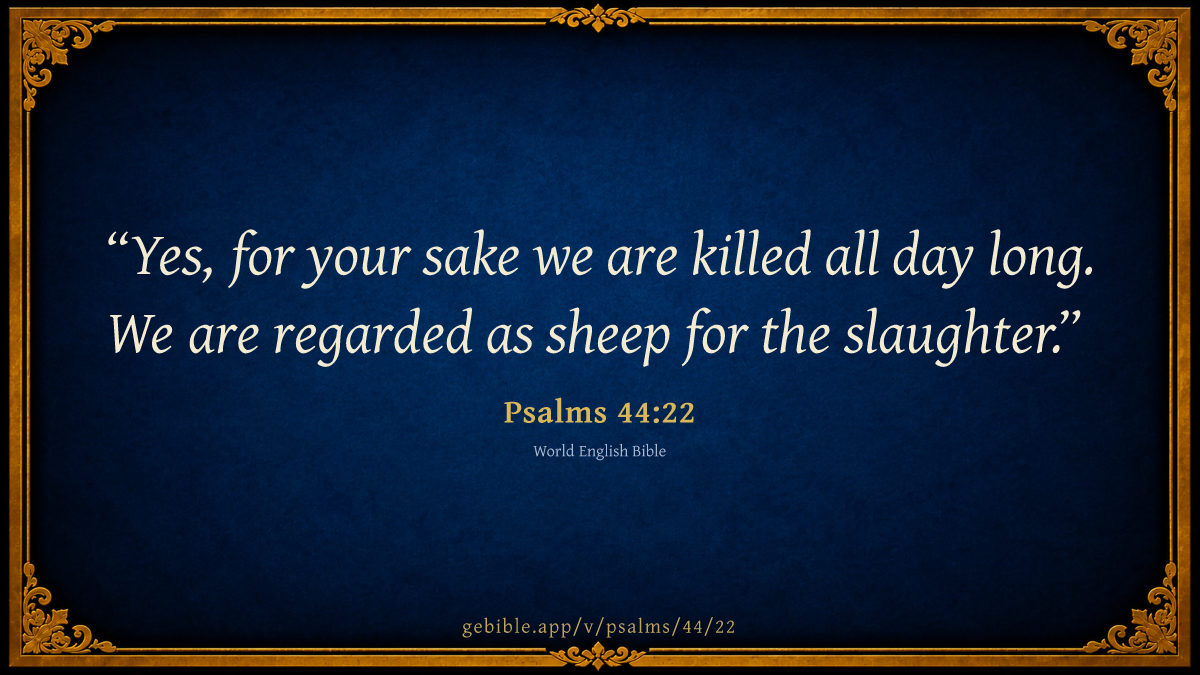
Yes, for your sake we are killed all day long. We are regarded as sheep for the slaughter.
Parallel Translations
-
Yes, for your sake we are killed all day long. We are regarded as sheep for the slaughter.
-
Yea, for thy sake are we killed all the day long; we are counted as sheep for the slaughter.
-
(44-23) Nay, but for Thy sake are we killed all the day; we are accounted as sheep for the slaughter.
Cross-references (13)
Passages linked to Psalms 44:22 in the Treasury of Scripture Knowledge, ordered by reader-vote popularity; verse text shown in World English Bible.
- Romans 8:36 Even as it is written, “For your sake we are killed all day long. We were accounted as sheep for the slaughter.”
- Isaiah 53:7 He was oppressed, yet when he was afflicted he didn’t open his mouth. As a lamb that is led to the slaughter, and as a sheep that before its shearers is silent, so he didn’t open his mouth.
- Psalms 44:11 You have made us like sheep for food, and have scattered us among the nations.
- John 15:21 But they will do all these things to you for my name’s sake, because they don’t know him who sent me.
- John 16:2-3 They will put you out of the synagogues. Yes, the time comes that whoever kills you will think that he offers service to God. They will do these things because they have not known the Father, nor me.
- 1 Corinthians 4:9 For, I think that God has displayed us, the apostles, last of all, like men sentenced to death. For we are made a spectacle to the world, both to angels and men.
- Matthew 5:10-12 Blessed are those who have been persecuted for righteousness’ sake, for theirs is the Kingdom of Heaven. “Blessed are you when people reproach you, persecute you, and say all kinds of evil against you falsely, for my sake. Rejoice, and be exceedingly glad, for great is your reward in heaven. For that is how they persecuted the prophets who were before you.
- 1 Corinthians 15:30-31 Why do we also stand in jeopardy every hour? I affirm, by the boasting in you which I have in Christ Jesus our Lord, I die daily.
- 1 Samuel 22:17-19 The king said to the guard who stood about him, “Turn, and kill the priests of Yahweh; because their hand also is with David, and because they knew that he fled, and didn’t disclose it to me.” But the servants of the king wouldn’t put out their hand to fall on the priests of Yahweh. The king said to Doeg, “Turn and attack the priests!” Doeg the Edomite turned, and he attacked the priests, and he killed on that day eighty-five people who wore a linen ephod. He struck Nob, the city of the priests, with the edge of the sword, both men and women, children and nursing babies, and cattle and donkeys and sheep, with the edge of the sword.
- 1 Kings 19:10 He said, “I have been very jealous for Yahweh, the God of Armies; for the children of Israel have forsaken your covenant, thrown down your altars, and killed your prophets with the sword. I, even I only, am left; and they seek my life, to take it away.”
- Psalms 79:2-3 They have given the dead bodies of your servants to be food for the birds of the sky, the flesh of your saints to the animals of the earth. They have shed their blood like water around Jerusalem. There was no one to bury them.
- Revelation 11:3-9 I will give power to my two witnesses, and they will prophesy one thousand two hundred sixty days, clothed in sackcloth.” These are the two olive trees and the two lamp stands, standing before the Lord of the earth. If anyone desires to harm them, fire proceeds out of their mouth and devours their enemies. If anyone desires to harm them, he must be killed in this way. These have the power to shut up the sky, that it may not rain during the days of their prophecy. They have power over the waters, to turn them into blood, and to strike the earth with every plague, as often as they desire. When they have finished their testimony, the beast that comes up out of the abyss will make war with them, and overcome them, and kill them. Their dead bodies will be in the street of the great city, which spiritually is called Sodom and Egypt, where also their Lord was crucified. From among the peoples, tribes, languages, and nations, people will look at their dead bodies for three and a half days, and will not allow their dead bodies to be laid in a tomb.
- Revelation 17:6 I saw the woman drunken with the blood of the saints, and with the blood of the martyrs of Jesus. When I saw her, I wondered with great amazement.
Cross-references from openbible.info (CC BY 4.0)
Explain this verse (16 sources)
Historical commentary, presented as a primary source — not an endorsement.
Private notes
Saved on this device only — never synced or sent anywhere.
John Calvin 1540 · Public Domain 22 Surely for thy sake we are killed all…
22 Surely for thy sake we are killed all the day. Here the faithful urge another reason why God should show mercy to them, namely, that they are subjected to sufferings not on account of crimes committed by themselves, but simply because the ungodly, from hatred to the name of God, are opposed to them. “This,” it may be said, “seems at first sight a foolish complaint, for the answer which Socrates gave to his wife was apparently more to the purpose, when, upon her lamenting that he was about to die wrongfully, he reproved her saying, That it was better for him to die innocently than from any fault of his own. And even the consolation which Christ sets forth
‘Blessed are they which are persecuted for righteousness’ sake,’ Matthew 5:10,
Read full note →
seems to differ widely from the language here expressed by the people of God. It seems also opposed to what Peter says,
‘Yet if any man suffer as a Christian, let him not be ashamed; but let him glorify God on this behalf.’ —1 Peter 4:16,
“To this I answer, That although it is the greatest alleviation of our sorrow that the cause for which we suffer is common to us with Christ himself, yet it is neither in vain nor out of place that the faithful here plead with God that they suffer wrongfully for his sake, in order that he may the more vigorously set himself for their defense. It is right that he should have respect to the maintenance of his glory, which the wicked endeavor to overthrow, when they insolently persecute those who serve him. And from this it appears the more clearly that this psalm was composed when the people languished in captivity, or else when Antiochus laid waste the Church, because religion was at that time the cause of suffering. The Babylonians were enraged by the constancy of the people, when they perceived that the whole body of the Jews, vanquished and routed as they were, ceased not on that account to condemn the superstitions of the country; and the rage of Antiochus was wholly bent upon extinguishing entirely the name of God. Moreover, what made the thing appear more strange and difficult to bear was, that God, so far from repressing the insolence and the wrongs inflicted by the wicked, left them, on the contrary, to continue in their cruelty, and gave them, as it were, loose reins. Accordingly, the godly declare that they are killed all the day long, and that they are counted of no more value than sheep for slaughter It is, however, proper always to bear in mind, what I have already remarked, that they were not so free from all blame as that God, in afflicting them, might not justly chastise them for their sins. But whilst in his incomparable goodness he fully pardons all our sins, he yet allows us to be exposed to unmerited persecutions, that we may with greater alacrity glory in bearing the cross with Christ, and thereby become partakers with him in his blessed resurrection. We have already said, that there was no other reason why the rage of the enemy was so inflamed against them, but that the people would not revolt from the law, and renounce the worship of the true God. It now remains for us to apply this doctrine to our own circumstances; and, first, let us consider that it becomes us, after the example of the fathers, patiently to submit to the afflictions by which it is necessary to seal the confession of our faith; and, secondly, that even in the deepest afflictions we must continue to call upon the name of God and abide in his fear. Paul, however, in his Epistle to the Romans, chapter 8:36, proceeds still farther; for he quotes this not only by way of example, but also affirms that the condition of the Church in all ages is here portrayed. Thus, then, we ought to regard it as a settled point, that a state of continual warfare in bearing the cross is enjoined upon us by divine appointment. Sometimes, it is true, a truce or respite may be granted us; for God, has compassion upon our infirmity: but although the sword of persecution is not always unsheathed against us, yet, as we are the members of Christ, it behoves us always to be ready to bear the cross with him. Lest, therefore, the severity of the cross should dismay us, let us always have present to our view this condition of the Church, that as we are adopted in Christ, we are appointed to the slaughter. If we neglect to do this, the same thing will befall us which happens to many apostates; for as it is in their judgment too severe and wretched a state, even while they live, to be continually dying, to be exposed to the mockery of others, and not to have one moment free from fear, — to rid themselves of that necessity they shamefully forsake and deny Christ. In order, therefore, that weariness, or dread of the cross, may not root up from our hearts true godliness, let us continually reflect upon this, that it behoves us to drink the cup which God puts into our hands, and that no one can be a Christian who does not dedicate himself to God.
John Calvin's Commentaries (1540-1563) — public domain. Text from the Calvin Translation Society English edition (1840s-50s) via the Christian Classics Ethereal Library (ccel.org). Calvin's coverage is partial (roughly two-thirds of the Bible); uncommented books and verses are honest gaps, never fabricated. The 19th-century editor's footnotes and remarks are omitted so the notes are faithfully Calvin's own voice.
Geneva Bible translators 1599 · Public Domain The faithful make this their comfort, that the wicked…
The faithful make this their comfort, that the wicked punish them not for their sins, but for God’s cause, Matt. 5:10; 1 Pet. 4:14.
Geneva Bible (1599) marginal notes — public domain.
John Trapp 1656 · Public Domain Psa 44:22 Yea, for thy sake are we killed…
Psa 44:22 Yea, for thy sake are we killed all the day long; we are counted as sheep for the slaughter.
Ver. 22. Yea, for thy sake are we killed, &c.] q.d. Thou knowest that for thy sake, and not for vain glory, or out of pertinace, &c., we are killed. It is the cause, and not the punishment, that maketh the martyr. Some suffer as malefactors rather, Potes videre hominem morte affici, quare mortificetur nescis (Aug.).
Read full note →
We are counted as sheep for the slaughter] As those Christians in Calabria, A. D. 1560, thrust up in one house together, as in a sheepfold, and butchered individually; {Rom 8:36} besides those many, whose names being written in red letters of blood in the Church’s calendar, are written in golden letters in Christ’s register in the book of life, as Prudentius hath it.
John Trapp, A Commentary or Exposition upon All the Books of the Old and New Testament (1647–1656) — public domain. Text from a community e-Sword module.
Matthew Poole 1685 · Public Domain Yea; or, but. We do not suffer for our…
Yea; or, but. We do not suffer for our apostacy, but because we will not apostatize from thee.
For thy sake; because we are thy people, and continue constantly and resolutely in the profession and practice of thy worship, which they abhor, and from which they seek to draw or drive us.
Matthew Poole's English Annotations on the Holy Bible (1683–1685) — public domain. Text from a community e-Sword/MySword module.
John Gill 1763 · Public Domain Yea, for thy sake are we killed all the…
Yea, for thy sake are we killed all the day long,.... These words are cited by the Apostle Paul in Rom 8:36; and are applied to his times, showing the then close attachment of the saints to Christ, and their strong love and affection for him; and they have the same sense here, being an instance and proof of the church's integrity and faithfulness in the cause of God, amidst the sorest afflictions and persecutions; for the truth of which she appeals to the searcher of hearts; and had their accomplishment in the ten persecutions under the Heathen emperors, and under the Papal tyranny; and may be understood of their being threatened with death, being in danger of it, and exposed unto it continually, Co1 15:31; or of their being in such troubles and afflictions, which may be called death, Co2 1:8; or of the actual slaying them: and what was done to many of the members of the church she attributes to herself, because of the union between them; and for the sake of the worship of the true God, because they would not worship the gods of the Heathens, nor the image of the beast, multitudes of them were put to death; and that all the day long, and every day, and that for a long series and course of time, or continually; and indeed, ever since the Gospel day or dispensation began, this killing work has been more or less; and it will continue during the reign of antichrist, until the measure of his iniquity is filled up, and the afflictions of the saints are accomplished;
we are counted as sheep for the slaughter; or "as sheep of slaughter" (q); see Zac 11:4; that is, either as sheep to be slaughtered for food, their enemies delighting to eat their flesh and drink their blood; See Gill on Psa 44:11, or for sacrifice, they reckoning it doing God good service to take away their lives, as though they sacrificed a lamb or a sheep unto him; and which, like sheep, they have patiently endured: this is the account made of them, not by the Lord, in whose sight their death is precious; nor by the saints, with whom their memory is dear; but by their furious persecutors, among whom they are as sheep among wolves; see Co1 4:13.
Read full note →
(q) "ut pecus mactationis", Montanus, Vatablus; so Musculus, Cocceius, Gejerus, Michaelis, Ainsworth.
John Gill's Exposition of the Whole Bible (1746–1763) — public domain (CC PDM 1.0). Text via the HelloAO Bible API.
John Wesley 1765 · Public Domain Yea - Because we are constant in thy worship,…
Yea - Because we are constant in thy worship, which they abhor.
John Wesley, Explanatory Notes Upon the Whole Bible (1754–1765) — public domain. Text via the GEBible commentary corpus.
Adam Clarke 1810 · Public Domain Verse 22. For thy sake are we killed all…
Verse 22. For thy sake are we killed all the day long] Because of our attachment to thee and to thy religion, we are exposed to continual death; and some of us fail a daily sacrifice to the persecuting spirit of our enemies, and we all carry our lives continually in our hands. In the same state were the primitive Christians; and St. Paul applies these words to their case, Ro 8:36.
Adam Clarke's Commentary on the Bible (1810–1826) — public domain. Text from a community e-Sword/MySword module.
Joseph Benson 1811 · Public Domain Psa 44:22. Yea, or but, for thy sake we…
Psa 44:22. Yea, or but, for thy sake we are killed all the day — We do not suffer for our apostacy, but because we will not apostatize from thee. We are persecuted and put to death because we are thy people, and continue constantly and resolutely in the profession and practice of thy worship, which they abhor, and from which they seek to draw or drive us. It is well known that the Jews were exposed to a variety of evils from their conquerors, on account of their strict adherence to the Mosaic law. And it is well observed by a learned writer, “that as this and the like passages of this Psalm may be applied primarily to the persecuted Jews; so do they, in a secondary sense, refer to suffering Christians, and their persecutions from heathen and unbelieving adversaries; and, accordingly, St. Paul so accommodates the present verse, Rom 8:36.”
Joseph Benson's Commentary on the Old and New Testaments (1811–1818) — public domain. Text from a community e-Sword module.
Albert Barnes 1834 · Public Domain Yea, for thy sake are we killed all the…
Yea, for thy sake are we killed all the day long - That is, we are continually or constantly subjected to these calamities. It is not a single defeat, but it is a continued slaughter. This verse contains, in the apprehension of the psalmist, the true cause of the calamities which had come upon the nation. The emphasis in the passage lies in the phrase “for thy sake.” The meaning is, It is on thy account; it is in thy cause; it is because we are thy friends, and because we worship thee. It is not on account of our national sins; it is not because there is any prevalent idolatry, but it is because we are the worshippers of the true God, and we are, therefore, martyrs. All these calamities have come upon us in consequence of our attachment to thee. There is no evidence that there was any self-glorying in this, or any intention to blame God as if he were unjust or severe, but it is the feeling of martyrs as suffering in the cause of religion. This passage is applied by the apostle Paul to Christians in his time, as fitly describing their sufferings, and the cause of the calamities which came upon them. See the notes at Rom 8:36.
We are counted as sheep for the slaughter - We are reckoned like sheep designed for the slaughter. That is, It is not because we are guilty, but we are regarded and treated as innocent sheep who are driven to be slaughtered. See the notes at Rom 8:36. Their attachment to the true religion - their devotion to Yahweh as the true God - was the secret cause of all the calamities which had come upon them. As a nation they were his friends, and as such they were opposed by the worshippers of other gods.
Albert Barnes' Notes on the Bible (1834–1885) — public domain. Text from a community e-Sword/MySword module.
Robert Jamieson, A. R. Fausset & David Brown 1871 · Public Domain Their protracted sufferings as God's people attests the constancy.…
Their protracted sufferings as God's people attests the constancy. Paul (Rom 8:36) uses this to describe Christian steadfastness in persecution.
Jamieson, Fausset & Brown — Commentary Critical and Explanatory on the Whole Bible (1871) — public domain (CC PDM 1.0). Text via the HelloAO Bible API.
Daniel D. Whedon 1874 · Public Domain 22. For thy sake—Because of thee we are killed.…
22. For thy sake—Because of thee we are killed. The issue was a religious one, and the cause was Jehovah’s. The war had come upon Hezekiah because he had renounced allegiance to the king of Assyria, which Ahaz, his father, had impiously tendered for political ends, having first declined the offered help of the Lord. See 2Ki_16:7; Isaiah 7; Isaiah 8; 2Ki_18:7. In this Hezekiah had acted in the integrity of a theocratic king, but it drew down upon him the wrath of Sennacherib.
Counted as sheep for the slaughter—That is, counted out of, and set apart from, the flock for slaughter. See on Psa_44:11
Daniel D. Whedon (gen. ed.), Commentary on the Old and New Testaments (1874–1909) — public domain. Text from a community e-Sword module.
The Cambridge Bible for Schools and Colleges 1878 · Public Domain 22. Yea, for thy sake] Or, Nay, but for…
22. Yea, for thy sake] Or, Nay, but for thy sake. Not only have we not been unfaithful to Thee, but we are actually suffering as martyrs for Thy sake. Such a protest was no doubt particularly true in the persecution of Antiochus, but not in that period only. Cp. the complaints of Psa_69:7; Jer_15:15.
This verse is quoted by St Paul in Rom_8:36, to encourage his converts in view of the possibility that they might have to face even death for Christ’s sake. If the saints of old time had to suffer persecution even to the death, they need not be surprised if a like fate should befall them. And the quotation is doubtless intended (as so often) to carry with it the thought of its context, and to remind them of the steadfastness of the Old Testament saints under the sharpest trial of their faith.
The Cambridge Bible for Schools and Colleges (gen. ed. J. J. S. Perowne; Cambridge University Press, 1878–1918) — public domain. Text from a community e-Sword module.
Ellicott's Commentary for English Readers 1878 · Public Domain (22) For thy sake.—For St. Paul’s quotation of this…
(22) For thy sake.—For St. Paul’s quotation of this verse (Rom_8:36), see Note, N. Test. Commentary.
A Bible Commentary for English Readers, edited by Charles John Ellicott (1878–1897) — public domain. Text from a community e-Sword module.
The Pulpit Commentary 1880 · Public Domain Yea, for thy sake are we killed all the…
Yea, for thy sake are we killed all the day long; or, continually, as the phrase is often translated. Not only are the Israelites not suffering on account of any previous desertion of God, or other misconduct, but they are suffering for their fidelity to God. The heathen hate them, and make war upon them, as worshippers of one exclusive God, Jehovah, and condemners of their many gods, whom they hold to be "no-gods." They are martyrs, like the Christians of the early Church. (see Rom_8:36) We are counted as sheep for the slaughter (comp. ver. 11).
HOMILIES BY C. CLEMANCE Ver. 22 and Rom_8:36. Martyr Churches, Hebrew and Christian: a contrast.
Read full note →
There is something marvellously touching about this psalm. It is the voice of a martyr Church, which has to witness for God amid persecution, flame, and sword. It divides itself into four parts. In the first there is a glowing retrospect (vers. 1-8); in the second, a mournful plaint (vers. 9-17 and 22); in the third, a solemn appeal to the Church"s King and Lord (vers. 18-21); in the fourth, an earnest prayer (vers. 23-26). As an historical document, which (as it has come down to us) is without date, we cannot but ask To what period of Hebrew history can it apply? Another question suggests itself, viz. Is the whole of the psalm justifiable? We will deal with these two questions as briefly as possible consistently with clearness, that we may "open up" the theme which the answers thereto will set before us. In order to ascertain the period of Israel"s history to which the psalm refers, we must note the data presented to us therein. According to the psalmist"s statements;
(1) Israel had been scattered (ver. 11).
(2) The people had been defeated in arms (ver. 10).
(3) They were a reproach and a byword among the nations (vers. 13, 14).
(4) They were sold into slavery (ver. 12).
(5) They were "counted as sheep for the slaughter" (vers. 11, 22).
(6) All this had happened to them, although they had not departed from their God; and although this had happened, still they were not departing from him (vers. 17, 18).
(7) So far from this, they were even slain for their fidelity to truth and to God. "For thy sake we are killed all the day long" (ver. 22). It is not easy to find a period in the national life when the whole of these seven, data can be verified. By one consideration or other, we are almost driven forward to the time of the Maccabees, between B.C. 200 and B.C. 160. (RAPC 2Ma 5:11-23) Mr. Walford says, "That fierce and idolatrous prince Antiochus Epiphanes, the King of Syria, was actuated by an inveterate hatred to the laws and religion of the Jews; and he employed the utmost efforts of his policy and power to induce them to apostatize. Under the severest penalties, he prohibited the worship of Jehovah, the celebration of the sabbath, and other religious festivals, the practice of circumcision, and the whole of the precepts of the Mosaic Law. Notwithstanding this dreadful persecution, the greater part of the people steadily adhered to the Divine institutions, and refused to comply with the idolatrous acts to which their tormentors would have compelled them, though they suffered the most dreadful tortures for their noncompliance with the injunctions of their formidable adversaries." To this period alone do we feel warranted in referring this psalm. There are two objections which have been made thereto. One, that the canon of Old Testament Scripture was finally closed long before. But such does not appear to have been the case. Another, that at the time of the Maccabees the hope of a resurrection buoyed up the sufferers to an extent of which this psalm gives no trace whatever. (RAPC 2Ma 7:6-17) But though this may have some weight, yet we must be careful not to lay too much stress on what the psalm does not contain. In all probability the survivors were more broken in spirit than such as were appointed unto death. Anyway, it is fairly clear that in the period to which we now refer, each one of the seven data above named can be verified with tolerable ease. But this cannot be said of either of the other periods to which the plaint of this psalm has been assigned. These are:
1. The time of David. (So Hengstenberg, Delitzsch, Moll, Fausset, et al.) But in David"s time we cannot verify either the first, second, third, or seventh of the above data. As Calvin remarks, the Church and nation, as a whole, were prosperous and victorious in David"s time.
2. Other periods assigned have been the time of the Exile (Geikie); the times of Jchoiachin and Zedekiah (Baur, De Wette, and Tholuck); the times of Josiah and Jehoiakim (Barnes); the last days of the Persian dynasty (Ewald); but of one and all of these it may be said that they fail to meet the conditions of data 6 and 7. For the Chronicler expressly declares that the troubles of those periods came upon Israel in consequence of the peoples" unfaithfulness to their covenant and their God.Consequently, until further light is thrown on the subject, we adhere to the Maccabean period as that which most nearly fulfils the conditions to which reference is made. Another question is this Is the Church"s strong assertion of national integrity to God justifiable? Some say, Yes (so Moll, Delitzsch). Some, No (so Perowne). But it is only fair to the writer to suppose him to refer simply to the occasion that drew forth the complaint; he cannot mean that all the nation had been always and uniformly faithful. His intention evidently is this that there was at that time no defection from God on the part of the people to account for the specific persecution over which he mourns. And since this is the case, he feels he may appeal to God to fulfil his own promise, and to save them for his mercies" sake. We are not prepared to question the propriety of this. All depends on the spirit in which it was said. We well remember that, in the late American War, a noted and eloquent abolitionist went so far as to maintain that the North must win, because God was God! At the same time, there is no doubt that the complaint, the appeal, and the whole tone of the psalm bear traces of a partial revelation, and consequently of an imperfectly developed faith. We have but to pass over the line that divides the two dispensations, to plant ourselves in the middle of the first Christian century, and there we find that Christians were having, and were likely to have, a struggle as hard and fierce as that of the Hebrews of old. So much so that one of their number adopts as his own the most touching words in the whole psalm, "For thy sake we are killed all the day long; we are counted as sheep for the slaughter." And yet there is neither moan nor sigh, no, not a tear; rather, a song of gladness, "In all these things we are more than conquerors through him that loved us!". (Rom_8:36, Rom_8:37) Whence the contrast between the Hebrews" sigh and the Christians" song whilst in the midst of persecution and death!
I IN THE HEBREW DISPENSATION GOD SPAKE THROUGH PROPHETS; IN THE CHRISTIAN GOD HAS SPOKEN IN HIS SON. (Heb_1:1) The great Transfiguration scene sets this forth in marvellous clearness. Moses and Elias vanish from sight, and the favoured three are left with Jesus only; in him believers saw the incarnate Son of God, the Father"s express Image, who brought with him, in peerless union, the tenderness and sympathy of the brother-man, with the majesty and might of the infinite and eternal God. Hence the figure in the background of Hebrew thought was vastly different from that in the background of Christian thought; the former commanded reverential heed, as a Messenger from heaven; the latter, unbounded love and entire consecration, as Saviour and Lord of all!
II THE STORY OF THE REDEMPTION WITH WHICH ISRAEL"S NATIONAL LIFE OPENED IS FAR OUTDONE BY THE HISTORY OF THE REDEMPTION BROUGHT IN BY JESUS CHRIST. It was with a glow of pride and thankfulness that the Hebrew singer recounted the deliverance from Egypt, and the entrance to Canaan"s land. (see also Ps 78 Ps 105 Ps 106 Ps 107) But how vastly is all this surpassed both in tenderness and in grandeur, by such words as these! loved me, and gave himself for me"; (Gal_2:20) "Having spoiled principalities and powers, he made a show of them openly, triumphing over them in it." The words fell with force and beauty on the ears of Old Testament saints, "I gave Egypt for thy ransom; Ethiopia and Seba for thee;" but how much greater the charm on Christian ears of the words, "He gave himself"! (Isa_43:3, 4 Gal_2:20) God, in the Person of his Son, Has all his mightiest works outdone.
III THE HEBREW CHURCH, TERRITORIAL AND NATIONAL, HAS GIVEN PLACE TO THE CHURCH OF GOD, made up of men gathered from every nation, and kindred, and people, and tongue. The Church"s "land" now can never be invaded. We can never sigh, "The heathen are come into thine inheritance." That is impossible. The entrance into Christ"s Church is not decided by rites nor by birth, save by the new birth of the Holy Ghost. Neither features nor racial marks form any sign of this new brotherhood. "In Christ Jesus neither circumcision availeth anything, nor uncircumcision, but a new creature". (Gal_6:15)
IV THE HATRED OF THE JEW BY THE GENTILE IS SUCCEEDED BY THE WORLD"S HATRED OF THE CHURCH. Where religion is or has been regarded as a piece of statecraft, whether among pagans, Papists, or Protestants, divergence from the rites appointed by state or Church has been punished with fire and sword. And the Antiochian persecution in the time of the Maccabees had its parallel in the Diocletian persecution in the Christian era. And although in our own land such treatment is not permitted, yet there is, though largely unseen to the public eye, a fierce hatred by the ungodly of pure and undefiled religion; and many and many a faithful soldier of the cross has to endure petty insult, abuse, and scorn, to an extent known only to himself and his Lord.
V THE HATRED OF THE WORLD, WHICH WAS THE HEBREWS" DREAD, IS NOW THE CHRISTIAN"S BADGE OF HONOUR. It was SO with the apostles. (Act_5:41 Gal_6:17) It was so with private Christians in apostolic times. (1Pe_4:13-16) In enduring persecution in the early Christian centuries, believers so regarded it. And even now we have to remember the Master"s words in words, Joh_15:18-21. The ancient Hebrews could not bear the scorn of their foes; Christians regard it as "the fellowship of Christ"s sufferings," and delighted in the 2Co_4:10, 2Co_4:11.
VI IN THE MIDST OF FIERCEST PERSECUTION, CHRISTIANS HAVE REALIZED THE CHANGELESSNESS OF DIVINE LOVE; even when they were "counted as sheep for the slaughter." Where we have from the Hebrews a groan, we have from the Christians a song. (Rom_8:35, Rom_8:36; Stephen, Act_6:15 and Act_7:55-60 Mat_5:12 Rom_5:3 2Co_12:10 Php_1:29 Heb_10:3, 4 Jam_1:2 1Pe_4:13, 1Pe_4:16) Believers knew that nothing could ever separate them from Divine love; and that the stroke that closed the life below set them free for the higher life "with Christ, which was very far better.
VII HENCE CHRISTIANS SAW, WITH A CLEARNESS TO WHICH HEBREW SAINTS COULD NOT ATTAIN, THAT THE CHURCH EXISTS IN TWO WORLDS. So our Lord has taught in Mat_16:18 (Revised Version); Rev_1:18. And the disclosure of this became even clearer through the visions granted to the seer in Patmos, when (Re 7) he saw one part of the Church, below, sealed in the great tribulation, and another part of the Church, above, caught up out of it. Knowing this, as the early Christians did, they knew also that the rage and hate of the enemy could in no wise really harm the Church, since their Lord was building it up in the realm above by the incoming of saints passing up from below. Hence even the slaughter of the people of God was but as a chariot of fire conducting them to the region where "they cannot die any more.
VIII THU, INSTEAD OF AN AGONIZING CRY TO GOD TO INTERPOSE, THERE IS A PEAL OF TRIUMPH THAT NO INTERPOSITION IS NEEDED. "In all these things we are more than conquerors through him that loved us." More than conquerors ! What a grand and noble defiance of the enemy is there here! And how richly glorious is this proof of the development of the Divine intent to reveal his love more fully as the ages rolled on! Note : If an expositor unfolds Psalm 44 historically only, he must transfer himself to the ancient times; but if he will deal with that psalm from a Christian standpoint, he will have a glorious field for expansion in contrasting the piteous wail of Psa_44:22 with the gladsomeness with which the very same words are quoted and applied in the eighth chapter of the Epistle to the Romans. Blessed be God that we live in the days of Christ"s fulness of light and life! Amen. C.
HOMILIES BY C. CLEMANCE Ver. 22 and Rom_8:36. Martyr Churches, Hebrew and Christian: a contrast.
There is something marvellously touching about this psalm. It is the voice of a martyr Church, which has to witness for God amid persecution, flame, and sword. It divides itself into four parts. In the first there is a glowing retrospect (vers. 1-8); in the second, a mournful plaint (vers. 9-17 and 22); in the third, a solemn appeal to the Church"s King and Lord (vers. 18-21); in the fourth, an earnest prayer (vers. 23-26). As an historical document, which (as it has come down to us) is without date, we cannot but ask To what period of Hebrew history can it apply? Another question suggests itself, viz. Is the whole of the psalm justifiable? We will deal with these two questions as briefly as possible consistently with clearness, that we may "open up" the theme which the answers thereto will set before us. In order to ascertain the period of Israel"s history to which the psalm refers, we must note the data presented to us therein. According to the psalmist"s statements;
(1) Israel had been scattered (ver. 11).
(2) The people had been defeated in arms (ver. 10).
(3) They were a reproach and a byword among the nations (vers. 13, 14).
(4) They were sold into slavery (ver. 12).
(5) They were "counted as sheep for the slaughter" (vers. 11, 22).
(6) All this had happened to them, although they had not departed from their God; and although this had happened, still they were not departing from him (vers. 17, 18).
(7) So far from this, they were even slain for their fidelity to truth and to God. "For thy sake we are killed all the day long" (ver. 22). It is not easy to find a period in the national life when the whole of these seven, data can be verified. By one consideration or other, we are almost driven forward to the time of the Maccabees, between B.C. 200 and B.C. 160. (RAPC 2Ma 5:11-23) Mr. Walford says, "That fierce and idolatrous prince Antiochus Epiphanes, the King of Syria, was actuated by an inveterate hatred to the laws and religion of the Jews; and he employed the utmost efforts of his policy and power to induce them to apostatize. Under the severest penalties, he prohibited the worship of Jehovah, the celebration of the sabbath, and other religious festivals, the practice of circumcision, and the whole of the precepts of the Mosaic Law. Notwithstanding this dreadful persecution, the greater part of the people steadily adhered to the Divine institutions, and refused to comply with the idolatrous acts to which their tormentors would have compelled them, though they suffered the most dreadful tortures for their noncompliance with the injunctions of their formidable adversaries." To this period alone do we feel warranted in referring this psalm. There are two objections which have been made thereto. One, that the canon of Old Testament Scripture was finally closed long before. But such does not appear to have been the case. Another, that at the time of the Maccabees the hope of a resurrection buoyed up the sufferers to an extent of which this psalm gives no trace whatever. (RAPC 2Ma 7:6-17) But though this may have some weight, yet we must be careful not to lay too much stress on what the psalm does not contain. In all probability the survivors were more broken in spirit than such as were appointed unto death. Anyway, it is fairly clear that in the period to which we now refer, each one of the seven data above named can be verified with tolerable ease. But this cannot be said of either of the other periods to which the plaint of this psalm has been assigned. These are:
1. The time of David. (So Hengstenberg, Delitzsch, Moll, Fausset, et al.) But in David"s time we cannot verify either the first, second, third, or seventh of the above data. As Calvin remarks, the Church and nation, as a whole, were prosperous and victorious in David"s time.
2. Other periods assigned have been the time of the Exile (Geikie); the times of Jchoiachin and Zedekiah (Baur, De Wette, and Tholuck); the times of Josiah and Jehoiakim (Barnes); the last days of the Persian dynasty (Ewald); but of one and all of these it may be said that they fail to meet the conditions of data 6 and 7. For the Chronicler expressly declares that the troubles of those periods came upon Israel in consequence of the peoples" unfaithfulness to their covenant and their God.Consequently, until further light is thrown on the subject, we adhere to the Maccabean period as that which most nearly fulfils the conditions to which reference is made. Another question is this Is the Church"s strong assertion of national integrity to God justifiable? Some say, Yes (so Moll, Delitzsch). Some, No (so Perowne). But it is only fair to the writer to suppose him to refer simply to the occasion that drew forth the complaint; he cannot mean that all the nation had been always and uniformly faithful. His intention evidently is this that there was at that time no defection from God on the part of the people to account for the specific persecution over which he mourns. And since this is the case, he feels he may appeal to God to fulfil his own promise, and to save them for his mercies" sake. We are not prepared to question the propriety of this. All depends on the spirit in which it was said. We well remember that, in the late American War, a noted and eloquent abolitionist went so far as to maintain that the North must win, because God was God! At the same time, there is no doubt that the complaint, the appeal, and the whole tone of the psalm bear traces of a partial revelation, and consequently of an imperfectly developed faith. We have but to pass over the line that divides the two dispensations, to plant ourselves in the middle of the first Christian century, and there we find that Christians were having, and were likely to have, a struggle as hard and fierce as that of the Hebrews of old. So much so that one of their number adopts as his own the most touching words in the whole psalm, "For thy sake we are killed all the day long; we are counted as sheep for the slaughter." And yet there is neither moan nor sigh, no, not a tear; rather, a song of gladness, "In all these things we are more than conquerors through him that loved us!". (Rom_8:36, Rom_8:37) Whence the contrast between the Hebrews" sigh and the Christians" song whilst in the midst of persecution and death!
I IN THE HEBREW DISPENSATION GOD SPAKE THROUGH PROPHETS; IN THE CHRISTIAN GOD HAS SPOKEN IN HIS SON. (Heb_1:1) The great Transfiguration scene sets this forth in marvellous clearness. Moses and Elias vanish from sight, and the favoured three are left with Jesus only; in him believers saw the incarnate Son of God, the Father"s express Image, who brought with him, in peerless union, the tenderness and sympathy of the brother-man, with the majesty and might of the infinite and eternal God. Hence the figure in the background of Hebrew thought was vastly different from that in the background of Christian thought; the former commanded reverential heed, as a Messenger from heaven; the latter, unbounded love and entire consecration, as Saviour and Lord of all!
II THE STORY OF THE REDEMPTION WITH WHICH ISRAEL"S NATIONAL LIFE OPENED IS FAR OUTDONE BY THE HISTORY OF THE REDEMPTION BROUGHT IN BY JESUS CHRIST. It was with a glow of pride and thankfulness that the Hebrew singer recounted the deliverance from Egypt, and the entrance to Canaan"s land. (see also Ps 78 Ps 105 Ps 106 Ps 107) But how vastly is all this surpassed both in tenderness and in grandeur, by such words as these! loved me, and gave himself for me"; (Gal_2:20) "Having spoiled principalities and powers, he made a show of them openly, triumphing over them in it." The words fell with force and beauty on the ears of Old Testament saints, "I gave Egypt for thy ransom; Ethiopia and Seba for thee;" but how much greater the charm on Christian ears of the words, "He gave himself"! (Isa_43:3, 4 Gal_2:20) God, in the Person of his Son, Has all his mightiest works outdone.
III THE HEBREW CHURCH, TERRITORIAL AND NATIONAL, HAS GIVEN PLACE TO THE CHURCH OF GOD, made up of men gathered from every nation, and kindred, and people, and tongue. The Church"s "land" now can never be invaded. We can never sigh, "The heathen are come into thine inheritance." That is impossible. The entrance into Christ"s Church is not decided by rites nor by birth, save by the new birth of the Holy Ghost. Neither features nor racial marks form any sign of this new brotherhood. "In Christ Jesus neither circumcision availeth anything, nor uncircumcision, but a new creature". (Gal_6:15)
IV THE HATRED OF THE JEW BY THE GENTILE IS SUCCEEDED BY THE WORLD"S HATRED OF THE CHURCH. Where religion is or has been regarded as a piece of statecraft, whether among pagans, Papists, or Protestants, divergence from the rites appointed by state or Church has been punished with fire and sword. And the Antiochian persecution in the time of the Maccabees had its parallel in the Diocletian persecution in the Christian era. And although in our own land such treatment is not permitted, yet there is, though largely unseen to the public eye, a fierce hatred by the ungodly of pure and undefiled religion; and many and many a faithful soldier of the cross has to endure petty insult, abuse, and scorn, to an extent known only to himself and his Lord.
V THE HATRED OF THE WORLD, WHICH WAS THE HEBREWS" DREAD, IS NOW THE CHRISTIAN"S BADGE OF HONOUR. It was SO with the apostles. (Act_5:41 Gal_6:17) It was so with private Christians in apostolic times. (1Pe_4:13-16) In enduring persecution in the early Christian centuries, believers so regarded it. And even now we have to remember the Master"s words in words, Joh_15:18-21. The ancient Hebrews could not bear the scorn of their foes; Christians regard it as "the fellowship of Christ"s sufferings," and delighted in the 2Co_4:10, 2Co_4:11.
VI IN THE MIDST OF FIERCEST PERSECUTION, CHRISTIANS HAVE REALIZED THE CHANGELESSNESS OF DIVINE LOVE; even when they were "counted as sheep for the slaughter." Where we have from the Hebrews a groan, we have from the Christians a song. (Rom_8:35, Rom_8:36; Stephen, Act_6:15 and Act_7:55-60 Mat_5:12 Rom_5:3 2Co_12:10 Php_1:29 Heb_10:3, 4 Jam_1:2 1Pe_4:13, 1Pe_4:16) Believers knew that nothing could ever separate them from Divine love; and that the stroke that closed the life below set them free for the higher life "with Christ, which was very far better.
VII HENCE CHRISTIANS SAW, WITH A CLEARNESS TO WHICH HEBREW SAINTS COULD NOT ATTAIN, THAT THE CHURCH EXISTS IN TWO WORLDS. So our Lord has taught in Mat_16:18 (Revised Version); Rev_1:18. And the disclosure of this became even clearer through the visions granted to the seer in Patmos, when (Re 7) he saw one part of the Church, below, sealed in the great tribulation, and another part of the Church, above, caught up out of it. Knowing this, as the early Christians did, they knew also that the rage and hate of the enemy could in no wise really harm the Church, since their Lord was building it up in the realm above by the incoming of saints passing up from below. Hence even the slaughter of the people of God was but as a chariot of fire conducting them to the region where "they cannot die any more.
VIII THU, INSTEAD OF AN AGONIZING CRY TO GOD TO INTERPOSE, THERE IS A PEAL OF TRIUMPH THAT NO INTERPOSITION IS NEEDED. "In all these things we are more than conquerors through him that loved us." More than conquerors ! What a grand and noble defiance of the enemy is there here! And how richly glorious is this proof of the development of the Divine intent to reveal his love more fully as the ages rolled on! Note : If an expositor unfolds Psalm 44 historically only, he must transfer himself to the ancient times; but if he will deal with that psalm from a Christian standpoint, he will have a glorious field for expansion in contrasting the piteous wail of Psa_44:22 with the gladsomeness with which the very same words are quoted and applied in the eighth chapter of the Epistle to the Romans. Blessed be God that we live in the days of Christ"s fulness of light and life! Amen. C.
The Pulpit Commentary (1880–1919), ed. H.D.M. Spence-Jones & Joseph S. Exell — public domain. Text from a community e-Sword module.
Charles H. Spurgeon 1885 · Public Domain Ver. 22. Yea, i.e., assuredly, certainly, for thy sake,…
Ver. 22. Yea, i.e., assuredly, certainly, for thy sake, not for our offences, but for obeying thee; the trials of these suppliants came upon them because they were loyal to their God. Are we killed all the day long. Persecution never ceased to hound them to the death, they had no respite and found no door of escape; and all in God's behalf, because they would not forsake their covenant God and King. We are counted as sheep for the slaughter; as if we were only meant to be killed, and made on purpose to be victims; as if it were as easy and as innocent a thing to slay us as to slaughter sheep. In this and following verses we clearly hear the martyr's cry. From Piedmont and Smithfield, from St. Bartholomew's massacre and the dragoonades of Claverhouse, this appeal goes up to heaven, while the souls under the altar continue their solemn cry for vengeance. Not long shall the church plead in this fashion, her shame shall be recompensed, her triumph shall dawn.
Ver. 22. Yea, for thy sake are we killed all the day long, etc. Leonard Schoener left, amongst other papers, the following admonition, to comfort all who were suffering for Christ's name:
Read full note →
"We pray thee, O eternal God, to bow down thy gracious ear. Lord of Sabaoth, thou Lord of hosts, hear our complaint, for great affliction and persecution have prevailed. Pride has entered thine inheritance, and many supposed to be Christians, have united themselves therewith, and have thus brought in the abomination of desolation. They waste and destroy the Christian sanctuary. They have trodden the same under foot, and the abomination of desolation is worshipped as God. They have troubled thy holy city, thrown down thy holy altar, and slain her servants when they could lay their hands upon them. And now that we as a little flock are left, they have driven us into all thy lands with contempt and reproach. We are scattered as sheep having no shepherd. We have been compelled to forsake house and home. We are as night ravens which abide in the rocks; our chambers are in holes and crags. They watch for us as fowls that fly in the air. We wander in the woods, they hunt us with dogs. They lead us away, seized and bound, as lambs that open not their mouths. They cry out against us as seditious persons and heretics. We are brought like sheep to the slaughter. Many sit oppressed, and in bonds which even decay their bodies. Some have sunk under their sufferings, and died without fault. Here is the patience of the saints in the earth. We must be tried by suffering here. The faithful have they hanged on trees, strangled, hewn in pieces, secretly and openly drowned. Not only men, but likewise women, and maidens have borne witness to the truth, that Jesus Christ is the truth, the only way to eternal life. The world still rages, and rests not; it raves as if mad. They invent lies against us. They cease not their fires and murders. They make the world too narrow for us. O Lord, how long wilt thou be silent? How long wilt thou not judge the blood of thy saints? Let it come up before thy throne. How precious in thine eyes is the blood of thy holy ones! Therefore have we comfort in all our need, a refuge in thee alone, and in none besides; but neither comfort, nor rest, nor peace on this earth. But he who hopeth in thee shall never be confounded. O Lord, there is no sorrow so great that can separate us from thee; therefore, without ceasing we call upon thee, through Christ thy Son our Lord, whom thou of thy free grace hast given us for our comfort. He hath prepared and made known to us the straight path, and the way to eternal life. Everlasting glory and triumph, honour and praise, be given unto thee, both now and to eternity, and let thy righteousness remain for ever. Let all the people bless thy holy name, through Christ the righteous Judge, who cometh to judge the whole world. Amen." From "A Martyrology of the Churches of Christ, commonly called Baptists. Edited by E. B. Underhill, " 1850.
Ver. 22. For thy sake are we killed. It is mercy to us, that when God might punish us for our sins, he doth make our correction honourable, and our troubles to be for a good cause. For thy sake, etc. David Dickson.
Ver. 22. For thy sake. This passage is cited by St. Paul, Ro 8:36, apparently from the LXX, in illustration of the fact that the church of God has in all ages been a persecuted church. But there is this remarkable difference between the tone of the psalmist and the tone of the apostle: the former cannot understand the chastening, and complains that God's heavy hand has been laid without cause upon his people; the latter can rejoice in persecutions also, and exclaim, "Nay, in all these things we are more than conquerors, through him that loved us." J. J. Stewart Perowne.
Ver. 22. Killed. The word here used is not from (ljq), but from (grh), which means to strangle: this is the rendering given in "Lange's Bibelwerk."
Ver. 22.
1. Innocence in the midst of suffering, sheep.
2. Honour in the midst of shame, for thy sake. G. Rogers.
Psalms 44:23*
Charles H. Spurgeon's The Treasury of David (1869–1885) — public domain. Psalms only. Text from a community e-Sword/MySword module.
Tyndale Open Study Notes 2022 · CC BY-SA 4.0 44:22 Paul quotes this verse as a parenthetical aside…
44:22 Paul quotes this verse as a parenthetical aside in his list of things that cannot separate us from Christ’s love (Rom 8:36).
Tyndale Open Study Notes — © Tyndale Open Resources, licensed CC BY-SA 4.0. Text via the HelloAO Bible API.