Questions where the Bible appears to say two different things, with the passages on each side set together.
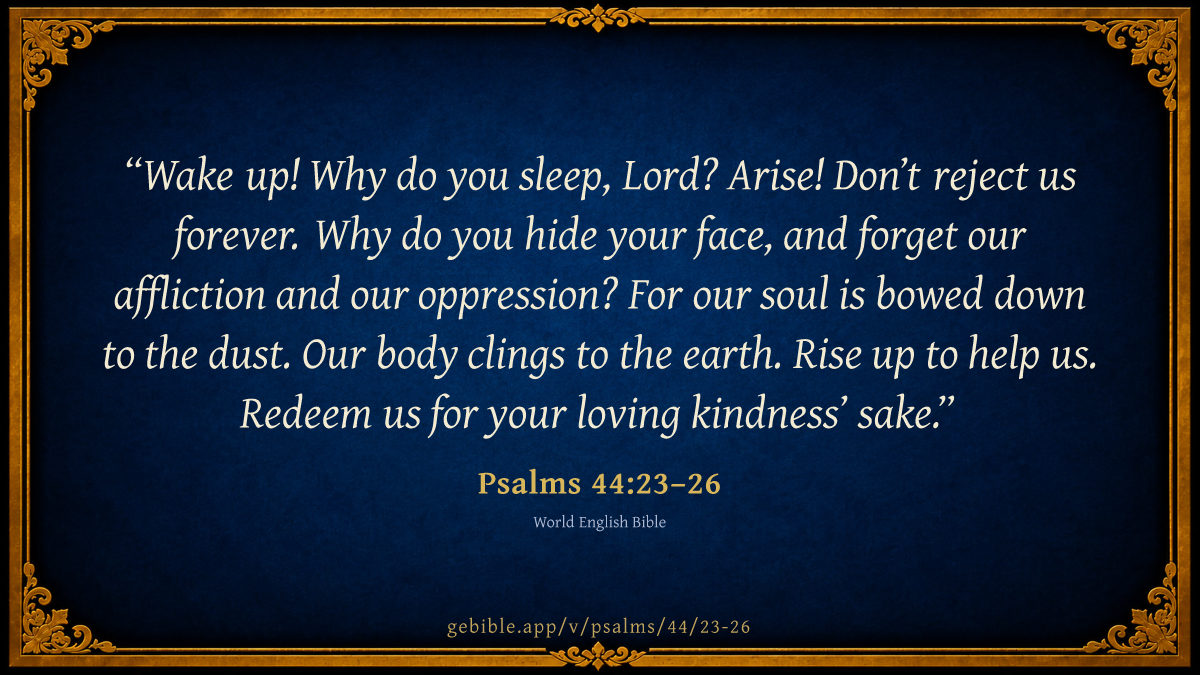
Does God sleep?Psalm 121:3-4 flatly declares that the keeper of Israel will neither slumber nor sleep — a doctrinal claim about Yahweh's perpetual vigilance.
Psalms 130:7-8(v26)Israel, hope in Yahweh, for there is loving kindness with Yahweh. Abundant redemption is with him. He will redeem Israel from all their…
Psalms 25:22(v26)Redeem Israel, God, out of all his troubles.
Job 13:24(v24)Why do you hide your face, and consider me your enemy?
Psalms 119:25(v25)My soul is laid low in the dust. Revive me according to your word!
Psalms 26:11(v26)But as for me, I will walk in my integrity. Redeem me, and be merciful to me.
Show all 31 cross-references
Psalms 35:2(v26)Take hold of shield and buckler, and stand up for my help.
Deuteronomy 32:20(v24)He said, “I will hide my face from them. I will see what their end will be; for they are a very perverse generation, children in whom is no…
Psalms 7:6(v23)Arise, Yahweh, in your anger. Lift up yourself against the rage of my adversaries. Awake for me. You have commanded judgment.
Psalms 78:65(v23)Then the Lord awakened as one out of sleep, like a mighty man who shouts by reason of wine.
Psalms 35:23(v23)Wake up! Rise up to defend me, my God! My Lord, contend for me!
Psalms 42:9(v24)I will ask God, my rock, “Why have you forgotten me? Why do I go mourning because of the oppression of the enemy?”
Psalms 66:11-12(v25)You brought us into prison. You laid a burden on our backs. You allowed men to ride over our heads. We went through fire and through water,…
Psalms 74:1(v23)God, why have you rejected us forever? Why does your anger smolder against the sheep of your pasture?
Psalms 77:7(v23)“Will the Lord reject us forever? Will he be favorable no more?
Psalms 88:14(v23)Yahweh, why do you reject my soul? Why do you hide your face from me?
Isaiah 51:23(v25)I will put it into the hand of those who afflict you, who have said to your soul, ‘Bow down, that we may walk over you;’ and you have laid…
Lamentations 4:5(v25)Those who ate delicacies are desolate in the streets. Those who were brought up in purple embrace dunghills.
Exodus 2:23-24(v24)In the course of those many days, the king of Egypt died, and the children of Israel sighed because of the bondage, and they cried, and…
Psalms 10:1(v24)Why do you stand far off, Yahweh? Why do you hide yourself in times of trouble?
Psalms 10:11(v24)He says in his heart, “God has forgotten. He hides his face. He will never see it.”
Psalms 12:5(v23)“Because of the oppression of the weak and because of the groaning of the needy, I will now arise,” says Yahweh; “I will set him in safety…
Psalms 13:1(v24)How long, Yahweh? Will you forget me forever? How long will you hide your face from me?
Psalms 43:1-4(v24)Vindicate me, God, and plead my cause against an ungodly nation. Oh, deliver me from deceitful and wicked men. For you are the God of my…
Psalms 44:9(v23)But now you rejected us, and brought us to dishonor, and don’t go out with our armies.
Psalms 59:4-5(v23)I have done no wrong, yet they are ready to attack me. Rise up, behold, and help me! You, Yahweh God of Armies, the God of Israel, rouse…
Psalms 74:23(v24)Don’t forget the voice of your adversaries. The tumult of those who rise up against you ascends continually.
Isaiah 51:9(v23)Awake, awake, put on strength, arm of Yahweh! Awake, as in the days of old, the generations of ancient times. Isn’t it you who cut Rahab in…
Mark 4:38(v23)He himself was in the stern, asleep on the cushion, and they woke him up, and told him, “Teacher, don’t you care that we are dying?”
Psalms 74:19(v24)Don’t deliver the soul of your dove to wild beasts. Don’t forget the life of your poor forever.
Isaiah 40:27-28(v24)Why do you say, Jacob, and speak, Israel, “My way is hidden from Yahweh, and the justice due me is disregarded by my God?” Haven’t you…
Revelation 6:9-10(v24)When he opened the fifth seal, I saw underneath the altar the souls of those who had been killed for the Word of God, and for the testimony…
Cross-references from openbible.info (CC BY 4.0)
Explain this passage (18 sources)
Historical commentary, presented as a primary source — not an endorsement.
John Calvin1540 · Public DomainOn vv23, 2523 Arise, O Lord! why sleepest thou? Here the…
23 Arise, O Lord! why sleepest thou? Here the saints desire that God, having pity upon them, would at length send them help and deliverance. Although God allows the saints to plead with him in this babbling manner, when in their prayers they desire him to rise up or awake; yet it is necessary that they should be fully persuaded that he keeps watch for their safety and defense. We must guard against the notion of Epicurus, who framed to himself a god who, having his abode in heaven, delighted only in idleness and pleasure. But as the insensibility of our nature is so great, that we do not at once comprehend the care which God has of us, the godly here request that he would be pleased to give some evidence that he was neither forgetful of them nor slow to help them. We must, indeed, firmly believe that God ceases not to regard us, although he appears not to do so; yet as such an assurance is of faith, and not of the flesh, that is to say, is not natural to us, the faithful familiarly give utterance before God to this contrary sentiment, which they conceive from the state of things as it is presented to their view; and in doing so, they discharge from their breasts those morbid affections which belong to the corruption of our nature, in consequence of which faith then shines forth in its pure and native character. If it is objected, that prayer, than which nothing is more holy, is defiled, when some froward imagination of the flesh is mingled with it, I confess that this is true; but in using this freedom, which the Lord vouchsafes to us, let us consider that, in his goodness and mercy, by which he sustains us, he wipes away this fault, that our prayers may not be defiled by it.
John Calvin's Commentaries (1540-1563) — public domain. Text from the Calvin Translation Society English edition (1840s-50s) via the Christian Classics Ethereal Library (ccel.org). Calvin's coverage is partial (roughly two-thirds of the Bible); uncommented books and verses are honest gaps, never fabricated. The 19th-century editor's footnotes and remarks are omitted so the notes are faithfully Calvin's own voice.
Geneva Bible translators1599 · Public DomainOn vv25–26There is no hope of recovery, except thou put…
There is no hope of recovery, except thou put to thine hand and raise us up.
Geneva Bible (1599) marginal notes — public domain.
John Trapp1656 · Public DomainOn vv23–26Psa 44:23 Awake, why sleepest thou, O Lord? arise,…
Psa 44:23 Awake, why sleepest thou, O Lord? arise, cast [us] not off for ever.
Ver. 23. Awake, why sleepest thou?] Considering all the premises, stir up thyself, and come and save us? carest thou not that we perish?
John Trapp, A Commentary or Exposition upon All the Books of the Old and New Testament (1647–1656) — public domain. Text from a community e-Sword module.
Matthew Poole1685 · Public DomainOn vv24–26Hidest thou thy face, i.e. dost not regard our…
Hidest thou thy face, i.e. dost not regard our miseries, nor affordest us any pity or help.
Forgettest our affliction and our oppression, when we have not forgotten thee. This seems not well to become thy faithfulness and goodness.
Matthew Poole's English Annotations on the Holy Bible (1683–1685) — public domain. Text from a community e-Sword/MySword module.
John Gill1763 · Public DomainOn vv23–26Awake, why sleepest thou, O Lord?.... Not that sleep…
Awake, why sleepest thou, O Lord?.... Not that sleep properly falls upon God: the Keeper of Israel neither slumbers nor sleeps; his eyes are always upon his people; he never withdraws them from them, and he watches over them night and day: but sometimes he seems and is thought to be asleep; as when wicked men flourish and triumph over the righteous, and go on in sin with impunity; when their judgment seems to linger, and their damnation to slumber, though it does not; and when the saints are under sore afflictions, and the Lord seems to disregard them, and does not appear for their deliverance; and when things are as when the disciples were in a storm, and Christ was asleep, to whom they said, "carest thou not that we perish?" and the Lord may be said to awake, and it is what is here prayed for, when he stirs up himself and takes vengeance on his enemies, as he will before long on antichrist and his followers; and when he takes in hand the cause and judgment of his people, and pleads it thoroughly, and delivers them out of the hands of all their oppressors, and gives them the dominion and kingdom under the whole heaven; see Isa 2:9;
arise; to revenge the blood of his people, and to have mercy on his Zion;
Read full note →
cast us not off for ever; as he might seem to do, by suffering their enemies to triumph over them; but in reality he does not; much less with loathing and abhorrence, as the word (r) used signifies, since his church is his Hephzibah, in whom he delights, Isa 62:4; and still less for ever, since his love to them is from everlasting to everlasting, and they shall be for ever with him; See Gill on Psa 43:2.
(r) "ne abjicias cum fastidio", Gejerus.
John Gill's Exposition of the Whole Bible (1746–1763) — public domain (CC PDM 1.0). Text via the HelloAO Bible API.
John Wesley1765 · Public DomainOn v25Our soul - Our persons. Our belly - We…
Our soul - Our persons. Our belly - We are not only thrown down to the earth, but we lie there like dead carcases.
John Wesley, Explanatory Notes Upon the Whole Bible (1754–1765) — public domain. Text via the GEBible commentary corpus.
Adam Clarke1810 · Public DomainOn vv23–26Verse 23. Awake, why sleepest thou, O Lord?] That…
Verse 23. Awake, why sleepest thou, O Lord?] That is, Why dost thou appear as one asleep, who is regardless of the safety of his friends. This is a freedom of speech which can only be allowed to inspired men; and in their mouths it is always to be figuratively understood.
Adam Clarke's Commentary on the Bible (1810–1826) — public domain. Text from a community e-Sword/MySword module.
Joseph Benson1811 · Public DomainOn vv24, 26Psa 44:24-25. Wherefore hidest thou thy face? — Dost…
Psa 44:24-25. Wherefore hidest thou thy face? — Dost not regard our miseries, nor afford us any pity or help? and forgettest our affliction — Actest as if thou didst forget, or overlook it, when we have not forgotten thee? Does this become thy faithfulness and goodness? For our soul is bowed down to the dust — Under prevailing grief and fear. We lie prostrate at our enemies’ feet. Our belly cleaveth unto the earth — We are not only thrown down to the earth, but we lie there. We cannot lift up ourselves, neither revive our own drooping spirits, nor recover ourselves out of our low and sad condition. And we lie exposed to be trodden on by every insulting foe.
Joseph Benson's Commentary on the Old and New Testaments (1811–1818) — public domain. Text from a community e-Sword module.
Albert Barnes1834 · Public DomainOn vv23–26Awake, why sleepest thou? - This is a solemn…
Awake, why sleepest thou? - This is a solemn and earnest appeal to God to interpose in their behalf, as if he were “asleep,” or were regardless of their sufferings. Compare Psa 3:7, note; Psa 7:6, note; Psa 35:23, note.
Arise, cast us not off for ever - Do not forsake us always. Compare Psa 44:9. He had seemed to have cast them off; to have forgotten them; to have forsaken them utterly, and the psalmist, in the name of the people, calls on him not entirely to abandon them.
Albert Barnes' Notes on the Bible (1834–1885) — public domain. Text from a community e-Sword/MySword module.
Robert Jamieson, A. R. Fausset & David Brown1871 · Public DomainOn v23This style of addressing God, as indifferent, is frequent…
This style of addressing God, as indifferent, is frequent (Psa 3:7; Psa 9:19; Psa 13:1, &c.). However low their condition, God is appealed to, on the ground, and for the honor, of His mercy.
Next: Psalms Chapter 45
Jamieson, Fausset & Brown — Commentary Critical and Explanatory on the Whole Bible (1871) — public domain (CC PDM 1.0). Text via the HelloAO Bible API.
Daniel D. Whedon1874 · Public DomainOn v2323. Awake—An anthropomorphism. God appears to sleep when he…
23. Awake—An anthropomorphism. God appears to sleep when he withholds answer to prayer, and help from the distressed. The same impassioned language is used in Psa_44:24. Psa_44:23-26 are an earnest cry for help.
Daniel D. Whedon (gen. ed.), Commentary on the Old and New Testaments (1874–1909) — public domain. Text from a community e-Sword module.
The Cambridge Bible for Schools and Colleges1878 · Public DomainOn vv23–2623. Awake … arise] Bestir thyself … awake. Cp.…
23. Awake … arise] Bestir thyself … awake. Cp. Psa_7:6, and many similar invocations. But nowhere else do we find so bold an expostulation as why sleepest thou? The nearest parallel is in Psa_78:65. The Psalmists do not shrink from using human language in reference to God, though they well knew that the Watchman of Israel was one who neither slumbered nor slept (Psa_121:3-4).
It is recorded in the Talmud that in the time of the high-priest John Hyrcanus (b.c. 135–107) certain Levites, called ‘Awakeners,’ daily ascended the pulpit in the Temple and cried, “Awake, why sleepest thou, O Lord”? He put a stop to the practice, saying, “Does Deity sleep? Has not the Scripture said, ‘Behold he that keepeth Israel neither slumbereth nor sleepeth?’ ”
Read full note →
cast us not off for ever] Cp. Psa_74:1; Psa_77:7; Lam_3:31.
23–26. An urgent appeal for immediate help.
The Cambridge Bible for Schools and Colleges (gen. ed. J. J. S. Perowne; Cambridge University Press, 1878–1918) — public domain. Text from a community e-Sword module.
Ellicott's Commentary for English Readers1878 · Public DomainOn v23(23) Why sleepest.—Comp. Psa_7:6, and see refs.
(23) Why sleepest.—Comp. Psa_7:6, and see refs.
A Bible Commentary for English Readers, edited by Charles John Ellicott (1878–1897) — public domain. Text from a community e-Sword module.
The Pulpit Commentary1880 · Public DomainOn vv23–26Vers. 23-26. The appeal to God is now made,…
Vers. 23-26. The appeal to God is now made, after the case has been fully represented. God has always hitherto maintained the cause of his people, and given them victory over their enemies, unless they had fallen away from him (vers. 1-8). Now he has acted otherwise he has allowed their enemies to triumph (vers. 9-16). And they have given him no reason for his desertion of them (vers. 17-22). Surely, if they call upon him, and plead their cause before him, he will relent, and come to their aid. The appeal, therefore, is made briefly, but in the most moving terms.
Awake, why sleepest thou, O Lord? The psalmist does not really believe that Jehovah "sleeps." The heathen might so imagine of their gods, (1Ki_18:27) but not an Israelite. An Israelite would be sure that "he that keepeth Israel neither slumbers nor sleeps". (Psa_121:4) The writer consciously uses an anthropomorphism, really intending only to call on God to rouse himself from his inaction, and lay it aside, and come to Israel"s aid. Arise. (see Psa_7:6 Psa_9:19 Psa_10:12, etc.) Cast us not off for ever (comp. ver. 9). Under the existing peril, for God to cast off his people will be to cast them off for ever. They had no strength of their own that could save them.
The Pulpit Commentary (1880–1919), ed. H.D.M. Spence-Jones & Joseph S. Exell — public domain. Text from a community e-Sword module.
Charles H. Spurgeon1885 · Public DomainOn vv23–26Ver. 23. Awake, why sleepest thou, O Lord. God…
Ver. 23. Awake, why sleepest thou, O Lord. God sleepeth not, but the psalmist puts it so, as if on no other theory he could explain the divine inaction. He would fain see the great Judge ending oppression and giving peace to the holy, therefore does he cry "Awake; "he cannot understand why the reign of tyranny and the oppression of virtue are permitted, and therefore he enquires "Why sleepest thou?" Arise. This is all thou needest to do, one move of thine will save us. Cast us not off for ever. Long enough hast thou deserted us; the terrible effects of thine absence are destroying us; end thou our calamities, and let thine anger be appeased. In persecuting times men are apt to cry, Where is the God of Israel? At the thought of what the saints have endured from their haughty enemies, we join our voices in the great martyr cry and sing with the bard of Paradise:
"Avenge, O Lord, thy slaughtered saints, whose bones
Read full note →
Lie scattered on the Alpine mountains cold;
Even those who kept thy truth so pure of old,
When all our fathers worshipped stocks and stones,
Forget not: in thy book record their groans
Who were thy sheep."
Ver. 23. Awake, why sleepest thou, O Lord? and Ps 121:4, "Behold, he that keepeth Israel shall neither slumber nor sleep." If God at no time sleep, why doth the church call on him so often to awake? If he must be awakened from sleep, why doth the psalmist say he never sleeps? Are not these places contradictory?
ANSWER: It is one thing what the afflicted church cries in the heat of her sufferings, another thing what the Spirit of truth speaks for the comfort of the saints. It is ordinary for the best of saints and martyrs, during the storm, to go to God as Peter did to Christ at sea (sleeping in the stern of the ship), with such importunity in prayer as if the Lord were no more sensible of their agony than Jonah was of the mariners' misery, ready to perish in the turbulent ocean, and he cried out, What meanest thou, O sleeper? Arise! Saints are so familiar with God in prayer, as if they were at his bedside. THE SOUL'S APPLICATION. O thou never slumbering Watchman of the house of Israel, carest not thou that we perish? Awake, awake! put on strength, gird thyself, O thou arm of God! I know thou art up, but what am I the better except thou help me up? I know thou sleepest not as man doth, but what advantage hath my soul by that, except thou show thyself, that I may know thou art waking? Oh, it is I that am asleep! You seem to sleep only to awaken me. O that I could watch with thee one hour, as you bid me; I should soon perceive that thy vigilance over me for ever. William Streat in "The Dividing of the Hoof." 1654.
Ver. 23. Awake, why sleepest thou, O Lord? etc. The weakness of our faith is open to the temptation of supposing that God regards not the situation of his people in the world; and the Spirit, who knows our infirmities, provides a petition suited to this trial, which expresses at the same time an expectation that God will arise to claim his people as his own. W. Wilson.
Ver. 23. The cry of a church in sad circumstances. The complaint of a deserted soul.
Psalms 44:24*
Charles H. Spurgeon's The Treasury of David (1869–1885) — public domain. Psalms only. Text from a community e-Sword/MySword module.
C. I. Scofield1917 · Public DomainOn v26(See Scofield "Isa 59:20") See Scofield "Exo 14:30"
redeem
(See Scofield "Isa 59:20") See Scofield "Exo 14:30"
The Scofield Reference Bible (1917 edition), notes by C. I. Scofield — public domain. Text from a community e-Sword module.
unfoldingWord translationNotes2017 · CC BY-SA 4.0On vv23, 25Awake, why do you sleep, Lord?
Awake, why do you sleep, Lord?
This does not mean that God is actually asleep. The writer speaks of God's seeming inactivity as if God is sleeping. He asks the question to rebuke God for appearing not to be concerned about their troubles. AT: "Wake up! I feel like you are sleeping, Lord!" (See: Rhetorical Question and Metaphor)
Read full note →
do not throw us off
The writer speaks of God's rejection of Israel as if he were discarding an unwanted piece of clothing. See how you translated a similar phrase in Psalms 44:9. AT: "do not reject us" (See: Metaphor)
Why do you hide your face ... our oppression?
The writer uses this question to complain that God appears to be ignoring them. AT: "Do not hide your face ... our oppression." (See: Rhetorical Question)
hide your face
The writer speaks of God ignoring them as if God were hiding his face so that he could not see them. AT: "ignore us" (See: Metaphor)
forget our affliction and our oppression
The words "affliction" and "oppression" mean basically the same thing and emphasize the severity of their affliction. These words may also be translated as verbs. AT: "forget that people afflict us and oppress us" or "forget that people greatly afflict us" (See: Abstract Nouns and Doublet)
Tyndale Open Study Notes2022 · CC BY-SA 4.0On v2344:23-26 In the end, God’s people can turn to…
44:23-26 In the end, God’s people can turn to the Lord and trust him for rescue. Their petition for God to remedy their situation is as strong as their lament about God’s rejection.
44:23 Wake up: Biblical authors often call for God’s attention in a crisis (35:23; 44:23; 73:20; 80:2; Mark 4:38).

John Calvin 1540 · Public Domain On vv23, 25 23 Arise, O Lord! why sleepest thou? Here the…
23 Arise, O Lord! why sleepest thou? Here the saints desire that God, having pity upon them, would at length send them help and deliverance. Although God allows the saints to plead with him in this babbling manner, when in their prayers they desire him to rise up or awake; yet it is necessary that they should be fully persuaded that he keeps watch for their safety and defense. We must guard against the notion of Epicurus, who framed to himself a god who, having his abode in heaven, delighted only in idleness and pleasure. But as the insensibility of our nature is so great, that we do not at once comprehend the care which God has of us, the godly here request that he would be pleased to give some evidence that he was neither forgetful of them nor slow to help them. We must, indeed, firmly believe that God ceases not to regard us, although he appears not to do so; yet as such an assurance is of faith, and not of the flesh, that is to say, is not natural to us, the faithful familiarly give utterance before God to this contrary sentiment, which they conceive from the state of things as it is presented to their view; and in doing so, they discharge from their breasts those morbid affections which belong to the corruption of our nature, in consequence of which faith then shines forth in its pure and native character. If it is objected, that prayer, than which nothing is more holy, is defiled, when some froward imagination of the flesh is mingled with it, I confess that this is true; but in using this freedom, which the Lord vouchsafes to us, let us consider that, in his goodness and mercy, by which he sustains us, he wipes away this fault, that our prayers may not be defiled by it.
John Calvin's Commentaries (1540-1563) — public domain. Text from the Calvin Translation Society English edition (1840s-50s) via the Christian Classics Ethereal Library (ccel.org). Calvin's coverage is partial (roughly two-thirds of the Bible); uncommented books and verses are honest gaps, never fabricated. The 19th-century editor's footnotes and remarks are omitted so the notes are faithfully Calvin's own voice.
Geneva Bible translators 1599 · Public Domain On vv25–26 There is no hope of recovery, except thou put…
There is no hope of recovery, except thou put to thine hand and raise us up.
Geneva Bible (1599) marginal notes — public domain.
John Trapp 1656 · Public Domain On vv23–26 Psa 44:23 Awake, why sleepest thou, O Lord? arise,…
Psa 44:23 Awake, why sleepest thou, O Lord? arise, cast [us] not off for ever.
Ver. 23. Awake, why sleepest thou?] Considering all the premises, stir up thyself, and come and save us? carest thou not that we perish?
John Trapp, A Commentary or Exposition upon All the Books of the Old and New Testament (1647–1656) — public domain. Text from a community e-Sword module.
Matthew Poole 1685 · Public Domain On vv24–26 Hidest thou thy face, i.e. dost not regard our…
Hidest thou thy face, i.e. dost not regard our miseries, nor affordest us any pity or help.
Forgettest our affliction and our oppression, when we have not forgotten thee. This seems not well to become thy faithfulness and goodness.
Matthew Poole's English Annotations on the Holy Bible (1683–1685) — public domain. Text from a community e-Sword/MySword module.
John Gill 1763 · Public Domain On vv23–26 Awake, why sleepest thou, O Lord?.... Not that sleep…
Awake, why sleepest thou, O Lord?.... Not that sleep properly falls upon God: the Keeper of Israel neither slumbers nor sleeps; his eyes are always upon his people; he never withdraws them from them, and he watches over them night and day: but sometimes he seems and is thought to be asleep; as when wicked men flourish and triumph over the righteous, and go on in sin with impunity; when their judgment seems to linger, and their damnation to slumber, though it does not; and when the saints are under sore afflictions, and the Lord seems to disregard them, and does not appear for their deliverance; and when things are as when the disciples were in a storm, and Christ was asleep, to whom they said, "carest thou not that we perish?" and the Lord may be said to awake, and it is what is here prayed for, when he stirs up himself and takes vengeance on his enemies, as he will before long on antichrist and his followers; and when he takes in hand the cause and judgment of his people, and pleads it thoroughly, and delivers them out of the hands of all their oppressors, and gives them the dominion and kingdom under the whole heaven; see Isa 2:9;
arise; to revenge the blood of his people, and to have mercy on his Zion;
Read full note →
cast us not off for ever; as he might seem to do, by suffering their enemies to triumph over them; but in reality he does not; much less with loathing and abhorrence, as the word (r) used signifies, since his church is his Hephzibah, in whom he delights, Isa 62:4; and still less for ever, since his love to them is from everlasting to everlasting, and they shall be for ever with him; See Gill on Psa 43:2.
(r) "ne abjicias cum fastidio", Gejerus.
John Gill's Exposition of the Whole Bible (1746–1763) — public domain (CC PDM 1.0). Text via the HelloAO Bible API.
John Wesley 1765 · Public Domain On v25 Our soul - Our persons. Our belly - We…
Our soul - Our persons. Our belly - We are not only thrown down to the earth, but we lie there like dead carcases.
John Wesley, Explanatory Notes Upon the Whole Bible (1754–1765) — public domain. Text via the GEBible commentary corpus.
Adam Clarke 1810 · Public Domain On vv23–26 Verse 23. Awake, why sleepest thou, O Lord?] That…
Verse 23. Awake, why sleepest thou, O Lord?] That is, Why dost thou appear as one asleep, who is regardless of the safety of his friends. This is a freedom of speech which can only be allowed to inspired men; and in their mouths it is always to be figuratively understood.
Adam Clarke's Commentary on the Bible (1810–1826) — public domain. Text from a community e-Sword/MySword module.
Joseph Benson 1811 · Public Domain On vv24, 26 Psa 44:24-25. Wherefore hidest thou thy face? — Dost…
Psa 44:24-25. Wherefore hidest thou thy face? — Dost not regard our miseries, nor afford us any pity or help? and forgettest our affliction — Actest as if thou didst forget, or overlook it, when we have not forgotten thee? Does this become thy faithfulness and goodness? For our soul is bowed down to the dust — Under prevailing grief and fear. We lie prostrate at our enemies’ feet. Our belly cleaveth unto the earth — We are not only thrown down to the earth, but we lie there. We cannot lift up ourselves, neither revive our own drooping spirits, nor recover ourselves out of our low and sad condition. And we lie exposed to be trodden on by every insulting foe.
Joseph Benson's Commentary on the Old and New Testaments (1811–1818) — public domain. Text from a community e-Sword module.
Albert Barnes 1834 · Public Domain On vv23–26 Awake, why sleepest thou? - This is a solemn…
Awake, why sleepest thou? - This is a solemn and earnest appeal to God to interpose in their behalf, as if he were “asleep,” or were regardless of their sufferings. Compare Psa 3:7, note; Psa 7:6, note; Psa 35:23, note.
Arise, cast us not off for ever - Do not forsake us always. Compare Psa 44:9. He had seemed to have cast them off; to have forgotten them; to have forsaken them utterly, and the psalmist, in the name of the people, calls on him not entirely to abandon them.
Albert Barnes' Notes on the Bible (1834–1885) — public domain. Text from a community e-Sword/MySword module.
Robert Jamieson, A. R. Fausset & David Brown 1871 · Public Domain On v23 This style of addressing God, as indifferent, is frequent…
This style of addressing God, as indifferent, is frequent (Psa 3:7; Psa 9:19; Psa 13:1, &c.). However low their condition, God is appealed to, on the ground, and for the honor, of His mercy.
Next: Psalms Chapter 45
Jamieson, Fausset & Brown — Commentary Critical and Explanatory on the Whole Bible (1871) — public domain (CC PDM 1.0). Text via the HelloAO Bible API.
Daniel D. Whedon 1874 · Public Domain On v23 23. Awake—An anthropomorphism. God appears to sleep when he…
23. Awake—An anthropomorphism. God appears to sleep when he withholds answer to prayer, and help from the distressed. The same impassioned language is used in Psa_44:24. Psa_44:23-26 are an earnest cry for help.
Daniel D. Whedon (gen. ed.), Commentary on the Old and New Testaments (1874–1909) — public domain. Text from a community e-Sword module.
The Cambridge Bible for Schools and Colleges 1878 · Public Domain On vv23–26 23. Awake … arise] Bestir thyself … awake. Cp.…
23. Awake … arise] Bestir thyself … awake. Cp. Psa_7:6, and many similar invocations. But nowhere else do we find so bold an expostulation as why sleepest thou? The nearest parallel is in Psa_78:65. The Psalmists do not shrink from using human language in reference to God, though they well knew that the Watchman of Israel was one who neither slumbered nor slept (Psa_121:3-4).
It is recorded in the Talmud that in the time of the high-priest John Hyrcanus (b.c. 135–107) certain Levites, called ‘Awakeners,’ daily ascended the pulpit in the Temple and cried, “Awake, why sleepest thou, O Lord”? He put a stop to the practice, saying, “Does Deity sleep? Has not the Scripture said, ‘Behold he that keepeth Israel neither slumbereth nor sleepeth?’ ”
Read full note →
cast us not off for ever] Cp. Psa_74:1; Psa_77:7; Lam_3:31.
23–26. An urgent appeal for immediate help.
The Cambridge Bible for Schools and Colleges (gen. ed. J. J. S. Perowne; Cambridge University Press, 1878–1918) — public domain. Text from a community e-Sword module.
Ellicott's Commentary for English Readers 1878 · Public Domain On v23 (23) Why sleepest.—Comp. Psa_7:6, and see refs.
(23) Why sleepest.—Comp. Psa_7:6, and see refs.
A Bible Commentary for English Readers, edited by Charles John Ellicott (1878–1897) — public domain. Text from a community e-Sword module.
The Pulpit Commentary 1880 · Public Domain On vv23–26 Vers. 23-26. The appeal to God is now made,…
Vers. 23-26. The appeal to God is now made, after the case has been fully represented. God has always hitherto maintained the cause of his people, and given them victory over their enemies, unless they had fallen away from him (vers. 1-8). Now he has acted otherwise he has allowed their enemies to triumph (vers. 9-16). And they have given him no reason for his desertion of them (vers. 17-22). Surely, if they call upon him, and plead their cause before him, he will relent, and come to their aid. The appeal, therefore, is made briefly, but in the most moving terms.
Awake, why sleepest thou, O Lord? The psalmist does not really believe that Jehovah "sleeps." The heathen might so imagine of their gods, (1Ki_18:27) but not an Israelite. An Israelite would be sure that "he that keepeth Israel neither slumbers nor sleeps". (Psa_121:4) The writer consciously uses an anthropomorphism, really intending only to call on God to rouse himself from his inaction, and lay it aside, and come to Israel"s aid. Arise. (see Psa_7:6 Psa_9:19 Psa_10:12, etc.) Cast us not off for ever (comp. ver. 9). Under the existing peril, for God to cast off his people will be to cast them off for ever. They had no strength of their own that could save them.
The Pulpit Commentary (1880–1919), ed. H.D.M. Spence-Jones & Joseph S. Exell — public domain. Text from a community e-Sword module.
Charles H. Spurgeon 1885 · Public Domain On vv23–26 Ver. 23. Awake, why sleepest thou, O Lord. God…
Ver. 23. Awake, why sleepest thou, O Lord. God sleepeth not, but the psalmist puts it so, as if on no other theory he could explain the divine inaction. He would fain see the great Judge ending oppression and giving peace to the holy, therefore does he cry "Awake; "he cannot understand why the reign of tyranny and the oppression of virtue are permitted, and therefore he enquires "Why sleepest thou?" Arise. This is all thou needest to do, one move of thine will save us. Cast us not off for ever. Long enough hast thou deserted us; the terrible effects of thine absence are destroying us; end thou our calamities, and let thine anger be appeased. In persecuting times men are apt to cry, Where is the God of Israel? At the thought of what the saints have endured from their haughty enemies, we join our voices in the great martyr cry and sing with the bard of Paradise:
"Avenge, O Lord, thy slaughtered saints, whose bones
Read full note →
Lie scattered on the Alpine mountains cold;
Even those who kept thy truth so pure of old,
When all our fathers worshipped stocks and stones,
Forget not: in thy book record their groans
Who were thy sheep."
Ver. 23. Awake, why sleepest thou, O Lord? and Ps 121:4, "Behold, he that keepeth Israel shall neither slumber nor sleep." If God at no time sleep, why doth the church call on him so often to awake? If he must be awakened from sleep, why doth the psalmist say he never sleeps? Are not these places contradictory?
ANSWER: It is one thing what the afflicted church cries in the heat of her sufferings, another thing what the Spirit of truth speaks for the comfort of the saints. It is ordinary for the best of saints and martyrs, during the storm, to go to God as Peter did to Christ at sea (sleeping in the stern of the ship), with such importunity in prayer as if the Lord were no more sensible of their agony than Jonah was of the mariners' misery, ready to perish in the turbulent ocean, and he cried out, What meanest thou, O sleeper? Arise! Saints are so familiar with God in prayer, as if they were at his bedside. THE SOUL'S APPLICATION. O thou never slumbering Watchman of the house of Israel, carest not thou that we perish? Awake, awake! put on strength, gird thyself, O thou arm of God! I know thou art up, but what am I the better except thou help me up? I know thou sleepest not as man doth, but what advantage hath my soul by that, except thou show thyself, that I may know thou art waking? Oh, it is I that am asleep! You seem to sleep only to awaken me. O that I could watch with thee one hour, as you bid me; I should soon perceive that thy vigilance over me for ever. William Streat in "The Dividing of the Hoof." 1654.
Ver. 23. Awake, why sleepest thou, O Lord? etc. The weakness of our faith is open to the temptation of supposing that God regards not the situation of his people in the world; and the Spirit, who knows our infirmities, provides a petition suited to this trial, which expresses at the same time an expectation that God will arise to claim his people as his own. W. Wilson.
Ver. 23. The cry of a church in sad circumstances. The complaint of a deserted soul.
Psalms 44:24*
Charles H. Spurgeon's The Treasury of David (1869–1885) — public domain. Psalms only. Text from a community e-Sword/MySword module.
C. I. Scofield 1917 · Public Domain On v26 (See Scofield "Isa 59:20") See Scofield "Exo 14:30"
redeem
(See Scofield "Isa 59:20") See Scofield "Exo 14:30"
The Scofield Reference Bible (1917 edition), notes by C. I. Scofield — public domain. Text from a community e-Sword module.
unfoldingWord translationNotes 2017 · CC BY-SA 4.0 On vv23, 25 Awake, why do you sleep, Lord?
Awake, why do you sleep, Lord?
This does not mean that God is actually asleep. The writer speaks of God's seeming inactivity as if God is sleeping. He asks the question to rebuke God for appearing not to be concerned about their troubles. AT: "Wake up! I feel like you are sleeping, Lord!" (See: Rhetorical Question and Metaphor)
Read full note →
do not throw us off
The writer speaks of God's rejection of Israel as if he were discarding an unwanted piece of clothing. See how you translated a similar phrase in Psalms 44:9. AT: "do not reject us" (See: Metaphor)
Why do you hide your face ... our oppression?
The writer uses this question to complain that God appears to be ignoring them. AT: "Do not hide your face ... our oppression." (See: Rhetorical Question)
hide your face
The writer speaks of God ignoring them as if God were hiding his face so that he could not see them. AT: "ignore us" (See: Metaphor)
forget our affliction and our oppression
The words "affliction" and "oppression" mean basically the same thing and emphasize the severity of their affliction. These words may also be translated as verbs. AT: "forget that people afflict us and oppress us" or "forget that people greatly afflict us" (See: Abstract Nouns and Doublet)
translationWords
asleep
lord
face
afflicted
oppress
unfoldingWord translationNotes — © Distant Shores Media and the Door43 World Missions Community, licensed CC BY-SA 4.0. Source: git.door43.org/Door43/en_tn.
Tyndale Open Study Notes 2022 · CC BY-SA 4.0 On v23 44:23-26 In the end, God’s people can turn to…
44:23-26 In the end, God’s people can turn to the Lord and trust him for rescue. Their petition for God to remedy their situation is as strong as their lament about God’s rejection.
44:23 Wake up: Biblical authors often call for God’s attention in a crisis (35:23; 44:23; 73:20; 80:2; Mark 4:38).
Tyndale Open Study Notes — © Tyndale Open Resources, licensed CC BY-SA 4.0. Text via the HelloAO Bible API.