
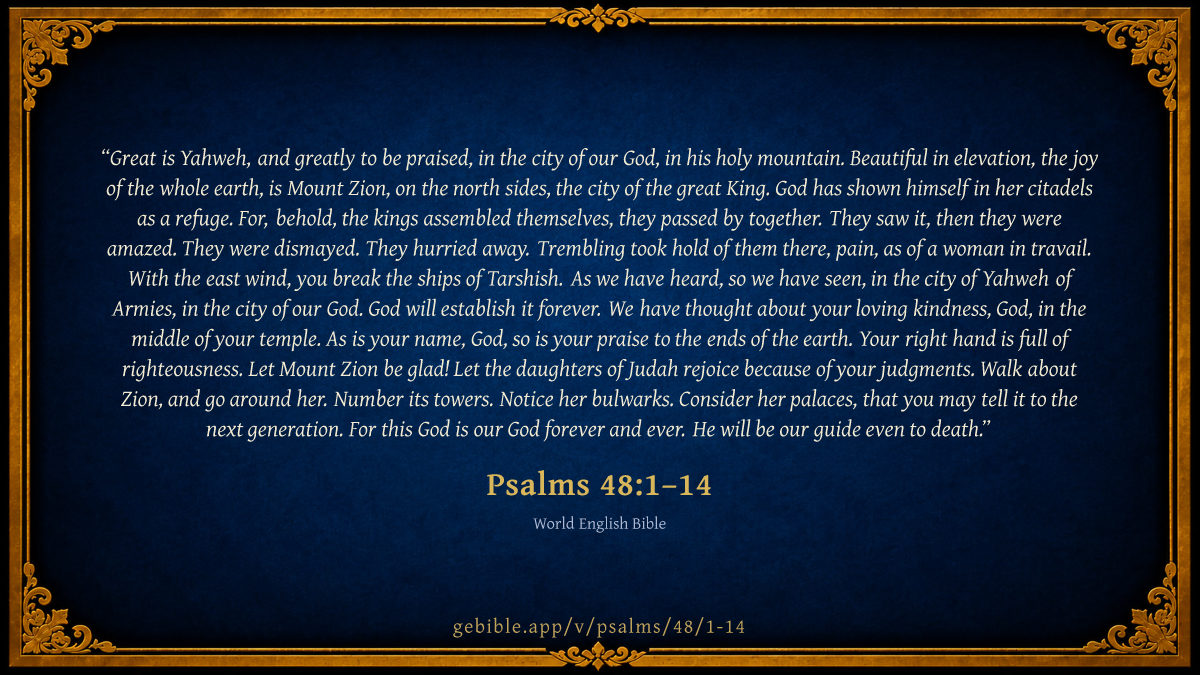
Great is Yahweh, and greatly to be praised, in the city of our God, in his holy mountain.
Beautiful in elevation, the joy of the whole earth, is Mount Zion, on the north sides, the city of the great King.
God has shown himself in her citadels as a refuge.
For, behold, the kings assembled themselves, they passed by together.
They saw it, then they were amazed. They were dismayed. They hurried away.
Trembling took hold of them there, pain, as of a woman in travail.
With the east wind, you break the ships of Tarshish.
As we have heard, so we have seen, in the city of Yahweh of Armies, in the city of our God. God will establish it forever.
We have thought about your loving kindness, God, in the middle of your temple.
As is your name, God, so is your praise to the ends of the earth. Your right hand is full of righteousness.
Let Mount Zion be glad! Let the daughters of Judah rejoice because of your judgments.
Walk about Zion, and go around her. Number its towers.
Notice her bulwarks. Consider her palaces, that you may tell it to the next generation.
For this God is our God forever and ever. He will be our guide even to death.
John Calvin 1540 · Public Domain On vv1, 2, 3, 4, 7, 8, 9, 10, 11, 12, 14 1. Great is Jehovah, and greatly to be praised.…
1. Great is Jehovah, and greatly to be praised. The prophet, before proceeding to make mention of that special example of the favor of God towards them, to which I have adverted, teaches in general that the city of Jerusalem was happy and prosperous, because God had been graciously pleased to take upon him the charge of defending and preserving it. In this way he separates and distinguishes the Church of God from all the rest of the world; and when God selects from amongst the whole human race a small number whom he embraces with his fatherly love, this is an invaluable blessing which he bestows upon them. His wonderful goodness and righteousness shine forth in the government of the whole world, so that there is no part of it void of his praise, but we are everywhere furnished with abundant matter for praising him. Here, however, the inspired poet celebrates the glory of God which is manifested in the protection of the Church. He states, that Jehovah is great, and greatly to be praised in the holy city. But is he not so also in the whole world? Undoubtedly he is. As I have said, there is not a corner so hidden, into which his wisdom, righteousness, and goodness, do not penetrate; but it being his will that they should be manifested chiefly and in a particular manner in his Church, the prophet very properly sets before our eyes this mirror, in which God gives a more clear and vivid representation of his character. By calling Jerusalem the holy mountain, he teaches us in one word, by what right and means it came to be in a peculiar manner the city of God. It was so because the ark of the covenant had been placed there by divine appointment. The import of the expression is this: If Jerusalem is, as it were, a beautiful and magnificent theater on which God would have the greatness of his majesty to be beheld, it is not owing to any merits of its own, but because the ark of the covenant was established there by the commandment of God as a token or symbol of his peculiar favor.
John Calvin's Commentaries (1540-1563) — public domain. Text from the Calvin Translation Society English edition (1840s-50s) via the Christian Classics Ethereal Library (ccel.org). Calvin's coverage is partial (roughly two-thirds of the Bible); uncommented books and verses are honest gaps, never fabricated. The 19th-century editor's footnotes and remarks are omitted so the notes are faithfully Calvin's own voice.
Geneva Bible translators 1599 · Public Domain On vv1, 2, 3, 4, 5, 7, 8, 10, 11, 12 Some put this difference between a song and Psalm,…
Some put this difference between a song and Psalm, saying that it is called a song, when there is no instrument, but the voice: and the Psalm, the contrary. The song of the Psalm is when the instruments begin, and the voice followeth. The Psalm of the song the contrary.
Albeit God shows his wonders through all the world, yet he will be chiefly praised in his Church.
Geneva Bible (1599) marginal notes — public domain.
John Trapp 1656 · Public Domain On vv1–14 Psa 48:1 « A Song [and] Psalm for the…
Psa 48:1 « A Song [and] Psalm for the sons of Korah. » Great [is] the LORD, and greatly to be praised in the city of our God, [in] the mountain of his holiness.
A Psalm and Song for the sons of Korah] When and by whom compiled we certainly know not. If by David, probably it was upon occasion of the Philistines coming up to seek him, but were sent away back with shame and loss, 2Sa 5:7; 2Sa 5:9. If upon the slaughter of Sennacherib’s army by an angel, Isaiah or some other prophet of those times (as there were many) might be the penman. It seemeth to be of the same time and occasion with Psa 76:1-12
Read full note →
Ver. 1. Great is the Lord] Greater, Job 33:12, greatest of all, Psa 95:3, greatness itself, Psa 145:3. A degree he is above the superlative.
And greatly to be praised] No mean praises can be meet for so great a majesty. It must be modus sine modo (Bern.).
In the city of our God] i.e. In the Church; for others will not, cannot do it to divine acceptation. Galen (lib. 3, de usu part.), amazed at the wonderful frame of man’s body, sang a hymn to the Maker thereof, but yet he lived and died a Pagan.
John Trapp, A Commentary or Exposition upon All the Books of the Old and New Testament (1647–1656) — public domain. Text from a community e-Sword module.
Matthew Poole 1685 · Public Domain On vv1–14 In the city of our God; in Jerusalem, which…
In the city of our God; in Jerusalem, which he hath chosen for his dwelling-place.
In the mountain of his holiness, i.e. in his holy mountain; either Zion, where the ark and tabernacle was; or rather Moriah, where the temple now was. Although both of them are supposed by some to be but one mountain, having two tops; and it is certain that both are frequently called by one name, to wit, Zion.
Matthew Poole's English Annotations on the Holy Bible (1683–1685) — public domain. Text from a community e-Sword/MySword module.
Matthew Henry 1710 · Public Domain On vv1, 8 The psalmist is designing to praise Jerusalem and to…
The psalmist is designing to praise Jerusalem and to set forth the grandeur of that city; but he begins with the praises of God and his greatness (Psa 48:1), and ends with the praises of God and his goodness, Psa 48:14. For, whatever is the subject of our praises, God must be both the Alpha and Omega of them. And, particularly, whatever is said to the honour of the church must redound to the honour of the church's God.
What is here said to the honour of Jerusalem is,
Read full note →
I. That the King of heaven owns it: it is the city of our God (Psa 48:1), which he chose out of all the cities of Israel to put his name there. Of Zion he said kinder things than ever he said of place upon earth. This is my rest for ever; here will I dwell, for I have desired it, Psa 132:13, Psa 132:14. It is the city of the great King (Psa 48:2), the King of all the earth, who is pleased to declare himself in a special manner present there. This our Saviour quotes to prove that to swear by Jerusalem is profanely to swear by God himself (Mat 5:35), for it is the city of the great King, who has chosen it for the special residence of his grace, as heaven is of his glory. 1. It is enlightened with the knowledge of God. In Judah God is known, and his name is great, but especially in Jerusalem, the head-quarters of the priests, whose lips were to keep this knowledge. In Jerusalem God is great (Psa 48:1) who in other places was made little of, was made nothing of. Happy the kingdom, the city, the family, the heart, in which God is great, in which he is uppermost, in which he is all. There God is known (Psa 48:3) and where he is known he will be great; none contemn God but those that are ignorant of him. 2. It is devoted to the honour of God. It is therefore called the mountain of his holiness, for holiness to the Lord is written upon it and all the furniture of it, Zac 14:20, Zac 14:21. This is the privilege of the church of Christ, that it is a holy nation, a peculiar people; Jerusalem, the type of it, is called the holy city, bad as it was (Mat 27:53), till that was set up, but never after. 3. It is the place appointed for the solemn service and worship of God; there he is greatly praised, and greatly to be praised, Psa 48:1. Note, The clearer discoveries are made to us of God and his greatness the more it is expected that we should abound in his praises. Those that from all parts of the country brought their offerings to Jerusalem had reason to be thankful that God would not only permit them thus to attend him, but promise to accept them, and meet them with a blessing, and reckon himself praised and honoured by their services. Herein Jerusalem typified the gospel church; for what little tribute of praise God has from this earth arises from that church upon earth, which is therefore his tabernacle among men. 4. It is taken under his special protection (Psa 48:3): He is known for a refuge; that is, he has approved himself such a one, and as such a one he is there applied to by his worshippers. Those that know him will trust in him, and seek to him, Psa 9:10. God was known, not only in the streets, but even in the palaces of Jerusalem, for a refuge; the great men had recourse to God and acquaintance with him. And then religion was likely to flourish in the city when it reigned in the palaces. 5. Upon all these accounts, Jerusalem, and especially Mount Zion, on which the temple was built, were universally beloved and admired - beautiful for situation, and the joy of the whole earth, Psa 48:2. The situation must needs be every way agreeable, when Infinite Wisdom chose it for the place of the sanctuary; and that which made it beautiful was that it was the mountain of holiness, for there is a beauty in holiness. This earth is, by sin, covered with deformity, and therefore justly might that spot of ground which was thus beautified with holiness he called the joy of the whole earth, that is, what the whole earth had reason to rejoice in, that God would thus in very deed dwell with man upon the earth. Mount Zion was on the north side of Jerusalem, and so was a shelter to the city from the cold and bleak winds that blew from that quarter; or, if fair weather was expected out of the north, they were thus directed to look Zion-ward for it.
II. That the kings of the earth were afraid of it. That God was known in their palaces for a refuge they had had a late instance, and a very remarkable one. Whatever it was, 1. They had had but too much occasion to fear their enemies; for the kings were assembled, Psa 48:4. The neighbouring princes were confederate against Jerusalem; their heads and horns, their policies and powers, were combined for its ruin; they were assembled with all their forces; they passed, advanced, and marched on together, not doubting but they should soon make themselves masters of that city which should have been the joy, but was the envy of the whole earth. 2. God made their enemies to fear them. The very sight of Jerusalem struck them into a consternation and gave check to their fury, as the sight of the tents of Jacob frightened Balaam from his purpose to curse Israel (Num 24:2): They saw it and marvelled, and hasted away, Psa 48:5. Not Veni, vidi, vici - I came, I saw, I conquered; but, on the contrary, Veni vidi victus sum - I came, I saw, I was defeated. Not that there was any thing to be seen in Jerusalem that was so very formidable; but the sight of it brought to mind what they had heard concerning the special presence of God in that city and the divine protection it was under, and God impressed such terrors on their minds thereby as made them retire with precipitation. Though they were kings, though they were many in confederacy, yet they knew themselves an unequal match for Omnipotence, and therefore fear came upon them, and pain, Psa 48:6. Note, God can dispirit the stoutest of his church's enemies, and soon put those in pain that live at ease. The fright they were in upon the sight of Jerusalem is here compared to the throes of a woman in travail, which are sharp and grievous, which sometimes come suddenly (Th1 5:3), which cannot be avoided, and which are effects of sin and the curse. The defeat hereby given to their designs upon Jerusalem is compared to the dreadful work made with a fleet of ships by a violent storm, when some are split, others shattered, all dispersed (Psa 48:7): Thou breakest the ships of Tarshish with an east wind; effects at sea lie thus exposed. The terrors of God are compared to an east wind (Job 27:20, Job 27:21); these shall put them into confusion, and break all their measures. Who knows the power of God's anger?
Matthew Henry's Commentary on the Whole Bible (1708–1710) — public domain (CC PDM 1.0). Text via the HelloAO Bible API.
John Gill 1763 · Public Domain On vv1–12 Great is the Lord,.... The same that in the…
Great is the Lord,.... The same that in the foregoing psalm is said to be gone, up to heaven with a shout, to sit on the throne of his holiness, to reign over the Heathen, and to be King over all the earth; who is great, and the Son of the Highest; the great God and our Saviour; great in his person as God-man, God manifest in the flesh, his Father's fellow and equal; and in the perfections of his nature, being of great power, and of great wisdom, and of great faithfulness, and of strict holiness and justice, and of wonderful grace and goodness; great in his works of creation and providence; in his miraculous operations when on earth, and in the work of man's redemption and salvation; great is he in all his offices, a great Prophet risen in Israel, a great High Priest over thee house of God, a Saviour, and a great one, and the great Shepherd of the sheep;
and greatly to be praised in the city of our God; the city of Jerusalem, the city of solemnities, where was the worship of God, and where the tribes went up to worship, and God was present with his people; and where the great Lord of all showed himself to be great; here Christ the great Saviour appeared, even in the temple, when a child, where Simeon and Anna saw him, and spoke great things of him; where he at twelve years of age disputed with the doctors, and showed his great wisdom; here when grown up he wrought many of his great miracles, and taught his doctrines; here he entered in great triumph, attended with the shouts, acclamations, and hosannas of the people; here he ate his last passover with his disciples; and in a garden near it was he taken and brought before the sanhedrim, assembled at the high priest's palace at Jerusalem; and then tried and condemned at the bar of Pilate; when being led a little way out of the city he was crucified on Mount Calvary; and on another mount, the mount of Olives, about a mile from it, he ascended to heaven; and here in this city he poured forth the Spirit in an extraordinary manner on his disciples at the day of Pentecost, as an evidence of his ascension; and from hence his Gospel went forth into all the world; and therefore was greatly to be praised here, as he was by his disciples, church, and people, Act 2:46. Jerusalem is a figure of the Gospel church, which is often compared to a city, Isa 26:1; of which saints are citizens and fellow citizens of each other; this is a city built on Christ the foundation; is full of inhabitants, when together and considered by themselves; is governed by wholesome laws, enacted by Christ its King, who has appointed officers under him to explain and enforce them, and see that they are put in execution; and has many privileges and immunities belonging to it; and this is the city of God, of his building and of his defending, and where he dwells; it is, as in Psa 48:2; "the city of the great King", the King Messiah, and where he displays his greatness; here he appears great and glorious, shows his power and his glory; is seen in the galleries and through the lattices of ordinances, in his beauty and splendour; here he grants his gracious presence, and bestows his favours and blessings; and is therefore greatly to be praised here, as he is by all his people on the above accounts, Even
Read full note →
in the mountain of his holiness; as Mount Zion is called on account of the temple built upon it, and the worship of God in it; and a fit emblem it was of the church of Christ, which, as that is, is chosen and, loved of God, and is his habitation, is impregnable and immovable, and consists of persons sanctified by God the Father, in the Son, and through the Spirit.
John Gill's Exposition of the Whole Bible (1746–1763) — public domain (CC PDM 1.0). Text via the HelloAO Bible API.
John Wesley 1765 · Public Domain On vv1–13 The glory and excellency of the church, ver. 1-3.…
The glory and excellency of the church, ver. 1-3. Which God preserves from her enemies, ver. 4-8. God is praised for this, ver. 9, 10. Who effectually provides for its safety, ver. 11-14 A song and psalm for the sons of Korah.
The city - In Jerusalem. Mountain - In his holy mountain.
John Wesley, Explanatory Notes Upon the Whole Bible (1754–1765) — public domain. Text via the GEBible commentary corpus.
Adam Clarke 1810 · Public Domain On vv1, 2, 3, 4, 7, 8, 9, 10, 11, 12, 13, 14 The ornaments and the privileges of the Church, 1-8.
PSALM XLVIII
The ornaments and the privileges of the Church, 1-8.
Read full note →
The duty of God's people, 9-14.
NOTES ON PSALM XLVIII
The title: A Song and Psalm for the sons of Korah. To which the Vulgate, Septuagint, AEthiopic, and Arabic add, for the second day of the week; for which I believe it would be difficult to find a meaning. It is evidently of the same complexion with the two preceding, and refers to the Jews returned from captivity; and perhaps was sung at the dedication of the second temple, in order to return thanks to the Lord for the restoration of their political state, and the reestablishment of their worship.
Verse 1. Great is the Lord] This verse should be joined to the last verse of the preceding Psalm, as it is a continuation of the same subject; and indeed in some of Kennicott's MSS. it is written as a part of the foregoing. That concluded with He is greatly exalted; this begins with Great is the Lord, and greatly to be praised; i.e., He should be praised according to his greatness; no common praise is suited to the nature and dignity of the Supreme God.
In the city of our God] That is, in the temple; or in Jerusalem, where the temple was situated.
The mountain of his holiness.] Mount Moriah, on which the temple was built. The ancient city of Jerusalem, which David took from the Jebusites, was on the south of Mount Zion, on which the temple was built, though it might be said to be more properly on Mount Moriah, which is one of the hills of which Mount Zion is composed. The temple therefore was to the north of the city, as the psalmist here states, Ps 48:2: "Beautiful for situation, the joy of the whole earth, is Mount Zion, on the sides of the north, the city of the great King." But some think that it is the city that is said to be on the north, and Reland contends that the temple was on the south of the city.
Adam Clarke's Commentary on the Bible (1810–1826) — public domain. Text from a community e-Sword/MySword module.
Joseph Benson 1811 · Public Domain On vv1, 2, 3, 4, 7, 8, 10, 11, 12, 14 Psa 48:1. Great is the Lord, &c. — Great…
Psa 48:1. Great is the Lord, &c. — Great is the majesty and the power of Jehovah; who is therefore to be celebrated with the highest praises; in the city of our God — Especially in his own city Jerusalem, and by the inhabitants of it; in the mountain of his holiness — In that mountain which he hath long ago set apart for the place of his worship, and hath now so marvellously defended.
Joseph Benson's Commentary on the Old and New Testaments (1811–1818) — public domain. Text from a community e-Sword module.
Albert Barnes 1834 · Public Domain On vv1–14 Great is the Lord - That is, he is…
Great is the Lord - That is, he is high and exalted; he is a Being of great power and glory. He is not weak and feeble, like the idols worshipped by other nations. He is able to defend his people; he has shown his great power in overthrowing the mighty forces that were gathered together against the city where he dwells.
And greatly to be praised - Worthy to be praised. In his own nature, he is worthy of adoration; in interposing to save the city from its foes, he has shown that he is worthy of exalted praise.
Read full note →
In the city of our God - Jerusalem. In the city which he has chosen for his abode, and where his worship is celebrated. See the notes at Psa 46:4. This praise was especially appropriate there:
(a) because it was a place set apart for his worship;
(b) because he had now interposed to save it from threatened ruin.
In the mountain of his holiness - His holy mountain; either Mount Zion, if the psalm was composed before the building of the temple - or more probably here Mount Moriah, on which the temple was reared. The names Zion, and Mount Zion, however, were sometimes given to the entire city. Compare the notes at Isa 2:2-3.
Albert Barnes' Notes on the Bible (1834–1885) — public domain. Text from a community e-Sword/MySword module.
Lange's Commentary on the Holy Scriptures 1864 · Public Domain On v1 Psalms 48
Psalms 48
A Song and Psalm for the sons of Korah
Read full note →
Great is the Lord, and greatly to be praised
In the city of our God, in the mountain of his holiness.
2 Beautiful for situation, the joy of the whole earth,
Is mount Zion, on the sides of the north,
The city of the great King.
3 God is known
In her palaces for a refuge.
4 For, lo, the kings were assembled,
They passed by together.
5 They saw it, and so they marvelled;
They were troubled, and hasted away.
6 Fear took hold upon them there,
And pain, as of a woman in travail.
7 Thou breakest the ships of Tarshish
With an east wind.
8 As we have heard, so have we seen
In the city of the Lord of hosts, in the city of our God:
God will establish it for ever. Selah.
9 We have thought of thy lovingkindness, O God,
In the midst of thy temple.
10 According to thy name, O God, so is thy praise
Unto the ends of the earth:
Thy right hand is full of righteousness.
11 Let mount Zion rejoice,
Let the daughters of Judah be glad,
Because of thy judgments.
12 Walk about Zion, and go round about her:
Tell the towers thereof!
13 Mark ye well her bulwarks,
Consider her palaces;
That ye may tell it to the generation following.
14 For this God is our God for ever and ever:
He will be our guide even unto death.
EXEGETICAL AND CRITICAL
Contents and Composition.—The introduction, in which the great God and His glorious city are praised (Psa_48:1-2), is followed (Psa_48:3-8) by a description of the deliverances of the city from threatened danger, effected by Jehovah, who disperses its terrified enemies. Psa_48:9-10 contain the expressions of gratitude for this interposition, while in Psa_48:11-14 the people are exhorted to guard all parts of the city, so that its safety may be manifest to all, and thus the glory of God be revealed to coming generations, to confirm their faith in His guidance. There are many points of resemblance between these verses and Is. 22:29–33, but they do not warrant our supposing the Psalm to have been written by that Prophet. Still less can we imagine that the author belonged to the party in opposition (i.e. to the delivered city), and that the occasion of it was the siege of Jerusalem by the allied forces of Israel and Syria, which was frustrated by Tiglath Pileser, (Credner, G. Baur). We are uncertain whether the occasion of it was the siege by Sennacherib, in the time of Hezekiah, (Calvin, De Wette, Hitzig, Ewald, Hupf.), or the victory gained by Jehosaphat over the allied kings named in 2 Chronicles 20, (Rosen., Hengst., Del.). The older Christian expositors apply the Psalm to the eternal glory of the spiritual Zion, while the Rabbins take it to be descriptive of Jerusalem in the Messianic times, after the victory over Gog and Magog.
Psa_48:2-3. Beautiful for situation (in elevation.) The terms “perfection of beauty,” “the joy of the whole earth,” are taken as a single cumulative one in Lam_2:15, perhaps with reference to this passage, and Psa_50:2; Isa_60:15; Eze_16:14; Eze_24:25. The word נוֹף was misunderstood by the ancients, and is wrongly rendered by Luther, (after the Chald. and Jerome), “Zweiglein”=little branch. That it has the sense of “elevation” is established by a comparison with the Arabic. That a geographical elevation is not meant is obvious from Psa_68:17, where the high hills of Bashan are said to envy the hill of Zion on account of its superior loftiness. (Comp. also Isa_2:2; Eze_40:2; Rev_21:10). So too “the sides of the north,” translated by Hitzig “the corner of the north,” and by Hengstenberg and Hupfeld “the extreme north,” must be understood not in a topographic but a religious sense; as in Isa_14:13, where the mountain of God lies on the sides of the north. This mythologic idea in the last named passage comes from the lips of the Chaldean king, and cannot be at once transferred to the Biblical writers. Nor does Eze_5:5 accord with it, for here Jerusalem is placed in the midst of the nations and countries round about her. So in Eze_38:6; Eze_38:15; Eze_39:2 the extreme north is the residence of Gog and Magog. Now Mount Zion is not here compared to the supposed mountain homes of the gods of the Asiatic nations in the far north, nor is it presented as realizing that of which the heathen dreamed, (Hengst., Ewald, Hitzig and others). Both the phrase and the context suggest a definite locality. It cannot, however, be the “north side of the city,” (Aben Ezra, Kimchi, Calvin, etc.), since Mount Zion is its most southerly hill; nor can the meaning be “on the north side lies the city,” (Luther, Rosen., etc.), for this does not agree with the order of the words. These are in opposition, not with “joy,” as if Zion were the joy of the remote north, i.e. the most distant nations (Gesen., De Wette), but with “Zion.” The temple hill is thus designated as being the northeastern corner, or northern angle (Delitzsch, Schegg,) of Mount Zion, and so giving a reason for the name of the city itself. This explanation is plainer than that of “in the extreme north the city of the Great King,” (Hupfeld). Since Zion is thus contrasted with another mountain in the south, on which God appeared, viz., Sinai, to strike out the words that are obscure, as Olshausen proposes, is not admissible.
[Stanley:Beautiful in elevation. To the traveller approaching Jerusalem from the west or east, it must have always presented the appearance, beyond any other capital of the then known world—we may add, beyond any important city that has ever existed on the earth—of a mountain city; breathing, as compared with the sultry plains of the Jordan or of the coast, a mountain air; enthroned, as compared with Jericho, or Damascus, Gaza or Tyre, on a mountain fastness.—Perowne:The sides of the north. The question is to what particular part of it the words refer. (1) Now Jerusalem itself did not lie on the north, but on the south side of the elevated table land. But the Temple did lie north, i.e., northeast of the city; and as the Temple was, in a peculiar sense, the dwelling-place of God, the Psalmist may have designated this when he spoke of the “sides of the north,” the expression being sufficiently accurate for the purpose of poetry. Hence we have the Holy City regarded from three different points of view, viz.: “the Mount Zion,” (the city of David), “the sides of the north,” (Mount Moriah and the Temple), “the city of the Great King,” (Jerusalem proper). Compare Mat_5:35. (2) If, however, Zion be the peak now leveled on the north of the Temple mount, as Furguson and Thrupp suppose, “the Mount Zion (on) the sides of the north” may be the true rendering here. And this, too, might peculiarly be called “beautiful for situation,” as it was the highest point of the whole plateau, and that which would most readily strike the eye. (3) Another reason may be suggested why the north should be especially mentioned, because an enemy approaching like the Assyrians, would obtain their first view of the city on that side.—J. F.]
Psa_48:4-8. They passed by together.—The enemies, designated by the article as the well-known kings who had assembled according to agreement at a certain place (comp. Jos_11:5; Psa_83:4) passed by all at once, over the boundary, Jdg_11:29; 2Ki_8:21; Isa_8:9, (Ancient Versions, Rabbins, Köster, Ewald, Hitzig, Del.). It is grammatically admissible to take עבר in the sense of disappear, (Calvin, Rosen., De Wette, Hengst., Hupf.), but this rendering presents, instead of a fitting picture, immediately the result of an unsuccessful enterprise, the details of which are then given. If the reference be to the attack in the time of Jehosaphat, we must suppose that the allies were encamped about three miles from Jerusalem, in the desert of Tekoah, whence they had a view of the holy city, and where God caused a great terror to fall upon them (1Sa_14:15). The annihilation in Psa_48:8 is not alarm (Rosen.), nor flight (De Wette), but the figure expressing it must have been suggested by the remembrance of the foundering of the commercial fleet sent out by Jehosaphat in union with Ahaz, (1Ki_22:49; 2Ch_20:36). But it is by no means necessary to adopt this view, for ships are elsewhere used as symbols of worldly powers. The ships of Tarshish, as the largest and strongest of their class, are figures of mighty powers, Isa_33:21; Isa_33:23. The east wind (Job_27:21) illustrates the power of God in overthrowing His enemies (Jer_18:17), because it so frequently scattered the strongest ships, (Isa_27:8; Eze_27:26; Amo_4:9; Jon_4:5). Hence there seems to be no special reason for supposing that there is an allusion to the destruction of an actual hostile fleet (Köster, Hitzig), but only that there is here a well-known illustration of the omnipotence of God. As the sentence is not joined to the preceding one by a particle of comparison, we need not take the verb as a third person feminine=“like as by an east wind which destroys,” (Kimchi, Rosen., De Wette). It is better to regard it as a second person masculine, making God the subject of it, (the Ancient Versions, Calvin, Geier, and most others). In this case it would be proper to place here the beginning of a strophe, which, comprising all that has been thus far said, would make, in contents and structure, a good transition to the section in which God is directly addressed.
[Perowne:As we have heard, Psa_48:8.—This marvellous deliverance is but a fresh proof, in our own experience, of that wonder-working Love, which in the days of old had so often manifested itself in Israel. The things which our fathers have told us, we have now witnessed with our own eyes, (compare Psa_44:1). And therefore, also, the present is regarded as a pledge of the future.—J. F.]
Psa_48:9-14. We have thought.—The idea here is that of contemplation, reflecting, and comparing, rather than that of hopeful expectation, (Sept., Syr., Sym., Jerome). The Rabbins are divided on this point. The Temple is named as being the place in which God had revealed His grace (Calvin, Hupfeld), or rather, as the place in which the Church commemorated that grace, by songs of praise (Hengst. Ewald), or by the solemn services which preceded the marching forth to battle, mentioned in 2 Chronicles 20. The “daughters of Judah” are not virgins who take part in the festive dance (De Wette, Ols.), but other outlying cities and villages, (Psa_69:36; Jos_15:45; Isa_40:9). The exhortation carefully to consider and look about the city, which has remained inviolate, is not addressed ironically to the enemies (Geier, Sachs., Hitz.), but seriously to the inhabitants. The reading לֻחִילַהּ (on the bulwarks), found in many old editions, ancient versions, and in 18 Codd. of De Rossi, also occurs in Zec_9:4. If Mappik be omitted, we must insert a softened suffix, (Ewald, Gram. § 247). There is no proof that פִסֵג has the sense of “to elevate,” (Luther, following Jewish tradition); nor is it quite certain that its meaning is “to regard a thing part by part, to consider attentively,” (De Wette, Hengst., Ewald, Hitz.). The sense “to walk through,” derived from that of “to intersect,” (viz.: a vineyard in which there is no way), is based on a passage in the Talmud. The demonstrative pronoun is occasionally though rarely placed before the noun, (Ewald, Gram. § 293). It is not necessary, therefore, to translate Psa_48:14 “that here is God” (Hupf.); nor “for this is God,” (De Wette, Ols., Bött., Ewald, Hitz.). In this case “this” must be taken in the sense of “such,” since the allusion was not to God, but to the city (Camp.). The concluding phrase, עַל־מֵוּת, might be rendered “the point of death” (Ges., Hengst.); or “until death” (Hupfeld, Kimchi, and most others). But the latter expression would be unusual, and is liable to misconception, whilst the former would be more appropriate. For the reference is not to persons, but a community, and the allusion is not to dying, but the deliverance of the city, and the joy caused by it to the whole earth, as well as the renewed trust in the Divine guidance. We should look for something to indicate the duration of that guidance, which forever secured the stability of the people. The rendering, therefore, should not be “beyond death,” (Syriac, Mendelssohn, Stier), which would give the idea of personal immortality—αθανασία (Aquila), but away past death, i.e. destruction (Campb.). It cannot be denied, however, that the idea which Hengstenberg finds here, viz.: that God delivers from the danger of death (Hab_1:12; Psa_49:16; Psa_68:21; Psa_85:7), and saves His people from destruction, would be unusual and obscure. The same may be said of the rendering “in the eternities,” (Sept., Chald., Symm., Aben Ezra, J. H. Mich., Ewald). This sense would suit, but it supposes the reading to be עַֹלמוֹת, (found in ו Cod. Kenn.), which occurs only in later and non-biblical Hebrew. It is, however, not impossible that this form of the word may stand in place of עִוֹלָמִים. But Luther’s version, derived from the Chald., “like the youth,” or “like the virgins,” or “in youthfulness,” is objectionable, partly because it is foreign to the context, and partly because it would require the particle כ or ב to be supplied. The reading עלֻמזת, found in many ancient Codd. and early editions, must be very old, because most of the earliest versions, in the main, express the same idea. Under these circumstances we may suppose that these words, like those in Psalms 9. are a mark (Hitzig) to indicate the kind of music to be used, here as in Hab_3:19 placed exceptionally at the end instead of the beginning of the hymn (Del.); or as indicating the sort of verse (Böttcher). The rythm implies that nothing (Hitzig), rather than that something (Del.) has been omitted.
DOCTRINAL AND ETHICAL
1. God protects not only His people, but the city in which they dwell. He guards the very house in which they call upon Him. But He means that they should recognise this, should trust His watchfulness and power, should be grateful for His help and goodness to them, and by proclaiming what He has done, induce others, especially their descendants, to exercise a like faith. For God is the same, yesterday, to-day, and forever. This God is our God.
2. The glory of the hill of Zion where God revealed Himself, and the beauty of Jerusalem, as God’s city, symbolized the glory of the Church. God’s promise of protection to Jerusalem, the display of His power and goodness in regard to her and the whole land, and the solemn commemorative festivals of which she was the theatre, may all be regarded as types. In the physical elevation, the Psalmist sees an image of the spiritual, and so far only has it any significance to him. Only when Jerusalem is contemplated with the spiritual eye, does she appear so lovely that she ought to be a joy to the whole earth, Eze_16:14. What the heathen dreamed about a mountain of gods, is only true of the hill of Zion. Its roots are on the earth, but its summit is in heaven (Hengst.).
3. From the beginning, God’s works have made known His name and His praise over all the earth, but Zion is the place where His glory has been specially manifested. This is the central point of His historical revelations. And from this spot the triumphal proclamation of His name shall go forth throughout the world; so that not only in the Promised Land but to the ends of the earth, the latest generation shall praise that God who hears prayer, who exercises justice to the joy of His people, who is their guide, helper, and protector.
HOMILETICAL AND PRACTICAL
Where God’s name is known, His help will be experienced and His praise proclaimed.—What does God do for His people, and what gratitude does He receive?—Zion’s beauty is a symbol and a type.—The contemplation of God’s doings should lead us and others to proclaim His glory, and should strengthen our faith.—What we have heard of God we may ourselves experience, for He remains ever the same.—Protected by God, we can resist all attacks; guided by Him, we can never perish.—How, and by what means does God eternally preserve His city?—Is the joy produced by God’s help as great as the fear of His chastisement?—The gradual development of the praises of God from generation to generation.—The protection and eternal maintenance of the city of God though His power, and watchfulness, and grace.
Calvin: There is no nook so hidden that the wisdom, justice, and goodness of God are not displayed in it.—But as He means to make His perfections specially visible to His Church, the Psalmist holds up before our eyes the mirror in which His image is seen.
Starke: We should magnify and praise the Great God by a proper confession of His grace, and reverence for His holy name.—The greatest ornament to any place, and the source of its purest joy, is to have a church and to maintain divine service.—How many earthly palaces are to-day the holy places of the Most High?—How many lords recognize Him as their Supreme Lord?—When the promises of God’s word are fulfilled in our experience, then our faith in that word is gloriously confirmed.—The Christian’s best thoughts are those arising from the view of God’s goodness, for then his heart becomes a holy temple of the Lord.—Why should not believers rejoice over God’s judgments?—Are they not all designed to glorify God, to comfort His people, to weaken and destroy His enemies?—Osiander: Though faith is founded on God’s word, and not on our experience, yet this faith is strengthened when our experience actually agrees with the promises of that word.—Franke: The predictions of the Old Testament concerning Zion and Jerusalem are fulfilled in you who believe in Him who is established the true King on Mount Zion.—Renschel: God is the shield of His Church.—Frisch: In the Church of God we are safe, not only because He is her protector, but because her members possess the most excellent gifts.—Burk: As Thy name is so is Thy praise.—Vaihinger: The great deliverance should be made known to posterity, as a testimony to the everlasting covenant.—Tholuck: When God’s grace mightily interposes in our temporal affairs, our faith will become all the stronger in a blessed eternity.—Guenther; God leads us not into, but through and beyond death.—Diedrich: We are His people only because we accept Him as our protector; whoever looks for another protector, has already separated himself from His people.—Our true courage consists in allowing ourselves truly to be helped by God, and in genuine trust in Him, who alone can do that by which His kingdom on earth is organized and preserved.—Taube: The city of God under the guardianship of her protector! a joy of the whole earth! a terror for her enemies! an everlasting remembrance to His people! Come and see! this is the way—through experience to knowledge.
[Henry: The clearer discoveries are made to us of God and His greatness, the more it is expected we should abound in His praises.—God can dispirit the stoutest of His Church’s enemies, and soon put them in pain who live at ease.—God’s latter appearances for His people, against His and their enemies, are consonant to His former appearances, and should put us in mind of them.—In the great things that God has done, and is doing, for His Church, it is good to take notice of the fulfilling of the Scriptures, and this would help us the better to understand both the providence itself, and the Scripture that is fulfilled in it.—All the streams of mercy that flow down to us must be run up to the fountain of God’s loving-kindness.—1. If God be our God, He is ours forever, not only through all the ages of time, but to eternity; for it is the everlasting blessedness of glorified saints that God Himself will be with them, and will be their God.—2. If He be our God, He will be our Guide, our faithful, constant Guide, to show us our way, and to lead us in it; He will be so even unto death, which will be the period of our way, and will bring us to our rest. He will be our Guide above death, so some. He will so guide us as to be above the reach of death, so that it shall not be able to do us any real hurt. He will be our Guide beyond death, so others. He will conduct us safe to a happiness on the other side of death, to a life in which there shall be no more death. If we take the Lord for our God, He will conduct and convey us safe to death, through death, and beyond death; down to death, and up again to glory.—J. F.]
Lange's Commentary on the Holy Scriptures (Critical, Doctrinal, and Homiletical), ed. John Peter Lange, English translation edited by Philip Schaff (1864–1880) — public domain. Text from a community e-Sword module.
Robert Jamieson, A. R. Fausset & David Brown 1871 · Public Domain On vv2, 3, 4, 7, 8, 9, 10, 11, 12 situation--literally, "elevation."
situation--literally, "elevation."
joy of, &c.--source of joy.
Read full note →
sides of the north--poetically for eminent, lofty, distinguished, as the ancients believed the north to be the highest part of the earth (compare Isa 14:13).
Jamieson, Fausset & Brown — Commentary Critical and Explanatory on the Whole Bible (1871) — public domain (CC PDM 1.0). Text via the HelloAO Bible API.
Daniel D. Whedon 1874 · Public Domain On vv1, 4, 9, 12, 14 1-3. These verses declare the glory of God in…
1-3. These verses declare the glory of God in Zion, and the glory of Zion in the whole earth, first, for her strength and beauty, but chiefly as the abode and city of God. Thus the glory of God and of his Church is shown to be inseparable.
Joy of the whole earth—The strength of Jerusalem was the admiration of the nations, but probably “joy of the whole earth” should read, “joy of the” whole land, namely, of Palestine. To the Hebrew only it could be a “joy.”
Read full note →
The sides of the north—The hill Zion was cut on the north, northeast, and east by the deep Tyropeon valley. If we take ירכתי, (yarkethe,) dual, for the “two sides of the north,”—that is, north and northeast of Zion,—the description answers literally to the central strength and glory of Jerusalem in her earlier history, especially as beyond the Tyropeon, on the east and north, lay the rocky prominences of Ophel and Moriah, with their inaccessible fortifications, crowned with the palace of Solomon and the temple. It is wonderful that at this present time the excavations of Jerusalem are developing the amazing strength of the ancient walls and substructures in this same locality. But this strength of Zion is only a type of the imperishable defences and stability of the true Church. Mat_16:18; Isa_26:1.
God is known in her palaces—This was her crowning glory. It was “the city of the great King.”
Daniel D. Whedon (gen. ed.), Commentary on the Old and New Testaments (1874–1909) — public domain. Text from a community e-Sword module.
The Cambridge Bible for Schools and Colleges 1878 · Public Domain On vv1, 2, 3, 4, 5, 6, 7, 8, 9, 10, 11, 13, 14 1. greatly to be praised] The R.V. returns to…
1. greatly to be praised] The R.V. returns to Coverdale’s rendering (P.B.V.), highly to be praised. The same emphatic adverb occurs in each of the two preceding Pss. God has proved Himself to be an exceedingly present help in trouble (Psa_46:1); by His triumph over the nations He is exceedingly exalted (Psa_47:9); and therefore He is exceedingly worthy to be praised. Jehovah is the one object of Israel’s praise (Deu_10:21): Israel’s praises are as it were the throne upon which He sits (Psa_22:3): the keynote of worship is Hallelujah, ‘praise ye Jah’; and the Hebrew title of the Psalter is Tehillim, i.e. Praises, Psa_48:1 a recurs in Psa_96:4 a, Psa_145:3 a.
in the city of our God] Cp. Psa_48:8; Psa_46:4, note.
Read full note →
in the mountain of his holiness] R.V., in his holy mountain; i.e. Zion, which here and throughout the Psalm (Psa_48:2; Psa_48:11-12) denotes the whole city, not merely one of the hills on which it was built. Cp. Psa_2:6, note. For another possible translation see note on Psa_48:2.
1, 2. The theme of the Psalm: the greatness of Jehovah and the glory of His city.
The Cambridge Bible for Schools and Colleges (gen. ed. J. J. S. Perowne; Cambridge University Press, 1878–1918) — public domain. Text from a community e-Sword module.
Ellicott's Commentary for English Readers 1878 · Public Domain On vv1, 2, 3, 4, 5, 7, 8, 9, 10, 11, 12, 13, 14 (1) To be praised.—See Psa_18:3, Note.
(1) To be praised.—See Psa_18:3, Note.
A Bible Commentary for English Readers, edited by Charles John Ellicott (1878–1897) — public domain. Text from a community e-Sword module.
The Pulpit Commentary 1880 · Public Domain On vv1–14 HERE we have another psalm of thanksgiving for a…
HERE we have another psalm of thanksgiving for a deliverance, but not apparently for the same deliverance as gave occasion for either of the two preceding psalms. Israel had now been delivered from a confederacy of kings (ver. 4), who had come within sight of the city, but had then been seized with panic, and retreated, without making an attack (ver. 5). After this, pain had come upon them, and they had been "broken," like "ships of Tarshish with an east wind" (vers. 6, 7). The deliverance had been celebrated by a thanksgiving service held in the temple (ver. 9). These details accord remarkably with the account given in 2Ch_20:1-28 of an expedition against Jerusalem, made by the Moabites, Ammonites, and children of Seir, in the reign of Jehoshaphat, who advanced as far as Tekoa, whence Jerusalem is visible (Delitzsch), but there quarrelled among themselves, and began a retreat, in the course of which they came to blows, and destroyed one another. The imagery of "ships of Tarshish broken by the east wind" is naturally used at this period, when Jehoshaphat"s fleet of "ships of Tarshish" (2Ki_22:4-8) was, by a Divine judgment, "broken at Ezion-geber.
The psalm consists of two strophes, nearly of equal length, divided at the end of ver. 8 by the pause-mark, "Selah.
Read full note →
Great is the Lord, and greatly to be praised; rather, great is the Lord, and greatly is he praised. The psalmist speaks of what is, not of what ought to be. Jehoshaphat had solemnly praised God for the deliverance from the Moabites and Ammonites, both in the valley of Berachah, when he came upon the bodies of the slain, (2Ch_20:26) and in the temple after his return to Jerusalem. (2Ch_20:28) In the city of our God. (comp. Psa_46:4 Psa_101:8) In the mountain of his holiness. The "holy hill of Zion", (Psa_2:6) on which the temple and a great part of the city stood.
HOMILIES BY C. CLEMANCE Vers. 1-14. God"s own Church the object of his special care.
In this psalm, which is both song and psalm, and is one of those "for the sons of Korah," there is a general theme, illustrated by a reference to some historic event. The general theme is the loving-kindness and care of God over his Church. The specific historic illustration it is not possible to fix with certainty, although the preponderance of opinion, and also the largest amount of probability, seems to incline towards the wondrous repulse of Edom, Ammon, Moab, and ethers, in answer to Jehoshaphat"s prayer, without Israel having to fight in the battle. (see 2Ch 20) We see from the narrative of the Chronicles that the children of the Korahites sang a song of praise on the occasion of that signal interposition of God, although it is not likely that the song then sang was the forty-eighth psalm; for the reference in ver. 7 is against that; and at first it is not easy to see how "ships of Tarshish" should come to be mentioned in this song, if prepared with reference to the event of which we have made mention. Ezekiel (Eze_27:25, Eze_27:26) makes mention of ships of Tarshish which belonged to Tyro, being "broken" by the east wind; and it is possible that the psalm may have an allusion thereto. But, singularly enough, the chapter that records Jehoshaphat"s prayer and deliverance records also his defection and its punishment; and we are told that his ships were broken so that they were not able to go to Tarshish. (2Ch_20:35-37) If this be the reference in the song before us, its significance would be very striking; in that case, it would mean that Jehovah, Israel"s God, who put the heathen to flight for Israel"s sake, put even Israel to shame when her people or her kings left the straight path of reliance on and obedience to God alone; and that this was among the "judgments" of him whose right hand is full of righteousness; showing us that God"s care for his Church is just as marked when he rebukes her for her sins as when he delivers her from her foes; and that both for his faithful chastisement as for his mighty interposition, his loving-kindness is rehearsed in his temple with gratitude and song. And there is a holy pride in rehearsing the privileges of Zion as far outweighing those of the nations around a pride, however, which refers all the honour and glory of Zion to God, and to God alone. Interesting, however, as these historic allusions are to the student, the higher spiritual bearing of the psalm is far more interesting, and far more important, as it sets before us this theme the privilege and honour of the Church of God. We need not here argue the point that the Christian Church is the successor to the honours and privileges of the Jewish Church. A comparison of Exo_19:6 with 1Pe_2:9 will show this. The Christian Church, in its largest sense, is made up of all believers in our Lord Jesus Christ. The organization of distinct and definite communities as Churches is a necessity for the time now present, but no such organizations include all believers; many believers, moreover, are in no such organization at all; only "the Lord knoweth them that are his;" and over all such his care is exercised: in their totality as including all regenerated souls, they make up the Church of God. Of this Church as a unity we have now to speak.
I GOD"S DWELLING-PLACE IS IN HIS CHURCH, (Vers. 1, 2) It is quite possible that, after what we have just said about the Church in its entirety and vastness, and about the impossibility of its being scanned by any human eye, that it may be said, "But if the Church is thus undefinable by us as to its limits, we cannot conceive of it as a dwelling-place." This we can easily understand. But the demur has, in reality, no force. For it is quite clear from the New Testament that as there is "the Church" in the highest spiritual sense, so there are local and organized Churches in the geographical sense. Of this the epistles to the seven Churches of Asia are immediate and sufficient proof. And wherever a Church is faithful to its Lord, since whatever is true of the whole Church is true of any part of it, the believers in Jesus who belong to any local and faithful Church may apply to themselves that which Paul declared of the Ephesian converts when he wrote, "Ye also are builded together for a habitation of God through the Spirit." Thus no Christian need hesitate to apply the words to the fellowship of believers to which he belongs; he may say," God is known in our palaces for a Refuge. This Church is a city of the great King. And the real presence of a living Saviour among us is our honour, our joy, our life. (Mat_18:20 Mat_28:20)
II GOD HIMSELF IS THE REFUGE OF THE CHURCH. (Ver. 3) It is the privilege of the individual believer, in all times of trial, sorrow, and care, to betake himself to his God and Saviour as to an unfailing Friend. But this privilege rises to sublimity when a whole company of believers, encompassed with peril and threatened by foes from without, can all rush to their Saviour in faith and prayer, as to a Refuge from the gathering storm!
III GOD"S LOVING-KINDNESS IS THE THEME OF THE CHURCH. (Ver. 9) How much fuller and sweeter is this theme for meditation now than of old! Then it was gained through prophets; now from him before whose presence lawgiver and prophet retire, as stars are concealed in the brightness of the sun! How incomparably does Romans 8. surpass aught in the Old Testament! And what was there in the olden time so tender as Luke 15? Verily such a theme lifts the soul heavenward, tunes the lips to song, and speeds the feet to run the race set before us.
IV GOD"S DELIVERANCES MARK THE HISTORY OF THE CHURCH. (Vers. 4-8) The effect of this vivid description is pictorial. We can almost see the kings eyeing Jerusalem with envy, plotting her capture, seized with panic and hurrying away as for very life. The psalmist says that he had heard of such deliverances in times past, and now had seen them. And any student of Church history who has been withal for fifty years a close observer of Church life, can say the same. That God is the perpetual Deliverer of his Church is the story of the past and the testimony of the present. Nor may we forget the double kind of deliverance:
(1) from foes without;
(2) from mischief within.
If the view given above of ver. 7 is correct, the verse suggests that the Church owes quite as much to God"s chastening love in correcting her for her sins, as to his rescuing power in spoiling her foes. That he will do this is part of the covenant. (Psa_89:28-33)
V THE HONOUR OF GOD"S NAME IS HIS OWN PLEDGE TO THE CHURCH. (Vers. 10, 11) In the attribute of God"s righteousness is the Church"s repose and glory. Through the redemption which is in Christ Jesus, faithfulness, justice, righteousness, can be the supports of sinful men. This is the supreme wonder of redeeming grace. Think of it! Sinful people rejoicing that Gods right hand is full of righteousness!
VI GOD"S GRACIOUS RELATIONS ARE THE GUARANTEE OF THE PERPETUITY OF THE CHURCH. (Vers. 12-14) We omit the italic it" in ver. 13 (Authorized Version), and translate the first word in ver. 14 "that." The psalmist incites to a study of Zion"s towers, bulwarks, palaces, privileges, that it may be declared to the generation following, that "this God is our God for ever and ever." And when we study the redemption in Christ which has founded the Church, the spiritual power which is building up the Church, the watchful providence which has for eighteen centuries guarded the Church, the story which we have to hand down to the coming generation is the same, but told with vaster emphasis, surer faith, and more rapturous joy. "This God is our God for ever and ever; he will be our Guide above death, and beyond it!" "Happy is the people that is in such a case! yea, happy is that people whose God is the Lord! C.
HOMILIES BY W. FORSYTH Vers. 1-14. The Church and her Head.
This psalm may teach us something of
I THE GLORY OF THE CHURCH. The outward is the symbol of the inward. The glory of the Church is not material, but moral. Mind is of all things the greatest. One soul is infinitely more precious than the richest domains. Think of some great man Newton, Bacon, or Shakespeare. If all the wealth in that one mind could be yours, would you not choose it rather than the grandest of earthly inheritances? And how rich is the Church in mind! "The glorious company of the apostles, the goodly fellowship of the prophets, the noble army of martyrs," are here; and here also are thousands and tens of thousands whose names have been unknown on earth, but are written in heaven. The Church, like Jerusalem, is set on high, but. her beauty is not in "situation," but in character; her "elevation" is not in outward advantages, but in nearness to God. She has the "righteousness which exalteth.
1. The glory of the Church is not limited, but universal. Jerusalem was for a single people, but the Church is for all nations and kindreds and tongues. The light that dwells in her is to shine forth to all lands. The moral power that centres in her is to radiate its gracious influences to the ends of the earth. Jerusalem had her daughters in the towns and villages of Judah; but the Church"s daughters are to be found in every land under the sun.
2. The glory of the Church is not transitory, but eternal. It is not like the passing shows of earthly kings; nor is it short-lived and disappointing, like the glory of Jerusalem. It derives its being from God, and will endure while God endureth. Love and goodness can never die. Much of the glory of the Church is as yet hidden. There were mysteries in the days of Paul, and there are mysteries still. But the light will shine more and more to the perfect day. The past we have heard," the present we have seen," alike bear witness, and combine to raise our hopes of the coming glory.
II THE GREATNESS OF THE CHURCH"S HEAD. "Great." (Ver. 1) The measure of the glory of the Church is the greatness of the Church"s Head. The certainty of the glory of the Church in all its transcendent developments, is to be found in the greatness of the Church"s Head. (Eph_1:17-23)
1. In the might of his power. His enemies shall lick the dust (vers. 4-8). Sooner or later, either with the joy of love or the torments of fear, the confession must be made that "he is Lord". (Php_2:10, 11)
2. In the sweetness of his loving-kindness. (Ver. 9) There is a fitness of place ("temple") and a fitness of method ("wait"). As we keep our ears open, truth will come to us. As we bend our minds in eager thought upon Divine things, more and more of the Lord"s goodness will be revealed to us. It is the "loving-kindness" of God that has blessed the past, and it will, in like manner, but in larger measure, bless the future. God"s loving-kindness culminated in the cross. There could be nothing higher. And the cross is the best help to our faith, and the surest guarantee of our hopes. (Rom_5:8-10)
3. In the righteousness of his judgments. (Vers. 10-13) The heathen fabled that Jove"s hands were full of thunderbolts; but our God"s "right hand is full of righteousness." Let us praise God for freedom. There were terrors, but they have passed. We have the glad sense of escape. We are free. It is God who has done it. Let us give thanks for Divine protection. Jerusalem had her towers and bulwarks. Round about her stood the everlasting hills. She seemed impregnable. But in the evil day of unbelief she fell. But the defences of God"s people are better far, and can never be overthrown. Our "bulwarks" are not rampart and tower, but God"s love and faithfulness. There will be assaults in the future as in the past, but the foundation standeth sure. There will be many a sore fight and struggle, but the powers against us can never prevail over the omnipotence of God. Let us rejoice in the everlasting love of God (vers. 13, 14). We should think of others as well as ourselves. We have a duty to our children and those who come after us. Musing on what God has done for us, our hearts will burn within us, and we shall be able to "tell" the generation following "the wonderful works of God." It is with exulting faith that we claim this God" as our God," and commend his love and his truth to others. What he has been to us he can be to them, and more. For ourselves we "know whom we have believed." He will keep us all our days. Our Guide into death, he will be our Portion and our Joy for ever. W.F.
HOMILIES BY C. SHORT Vers. 1-14. The eternal city of God.
A patriotic hymn, to be sung in the temple service in celebration of a signal deliverance of Jerusalem from an invading army. Commentators are not agreed as to what army. Let it be taken as suggesting some things which may be said of the true eternal city of God, what it is, and what it will become through everlasting ages, exhibiting the greatest glory of man and the highest glory of God.
I SOCIETY FOUNDED AND BUILT UP IN HOLINESS. (Ver. 1) Nothing unclean can permanently dwell in it. The heavenly Jerusalem.
II FILLED THROUGHOUT WITH DIVINE JOY. (Ver. 2) "God shall wipe away all tears." No permanent sorrow.
III ETERNALLY SAFE FROM DANGER OF OVERTHROW. (Ver. 3) Often threatened during her earthly history by the combined forces of evil which have been arrayed against her.
IV GOD HAS EXPENDED THE GRANDEST POWERS OF HIS NATURE IN BUILDING IT UP.
1. Moral omnipotence. (Vers. 4-8) The history of past times and personal experience testify to this. He breaks the forces of evil as he broke the ships of Tarshish with an east wind.
2. It has been and is the theatre for the display of the infinite love. (Ver. 9) God is in Christ reconciling the world unto himself.
3. Also for the fullest display of the Divine righteousness. (Vers. 10, 11) "Righteousness and judgment are the habitation of his throne.
4. He is the everlasting Guide and Light of the city. (Ver. 14) Because he is its King and Father and Lawgiver. Here is a theme for grateful thanksgiving and joy and worship. S.
The Pulpit Commentary (1880–1919), ed. H.D.M. Spence-Jones & Joseph S. Exell — public domain. Text from a community e-Sword module.
Charles H. Spurgeon 1885 · Public Domain On vv1–14 Title. A Song and Psalm for the Sons of…
Title. A Song and Psalm for the Sons of Korah. A song for joyfulness and a Psalm for reverence. Alas! every song is not a Psalm, for poets are not all heaven born, and every Psalm is not a song, for in coming before God we have to utter mournful confessions as well as exulting praises. The Sons of Korah were happy in having so large a selection of song; the worship where such a variety of music was used could not become monotonous, but must have given widest scope for all the sacred passions of gracious souls.
Subject and Division. It would be idle dogmatically to attribute this song to any one event of Jewish history. Its author and date are unknown. It records the withdrawal of certain confederate kings from Jerusalem, their courage failing them before striking a blow. The mention of the ships of Tarshish may allow us to conjecture that the Psalm was written in connection with the overthrow of Ammon, Moab, and Edom in the reign of Jehoshaphat; and if the reader will turn to 2 Chronicles 20, and note especially 2Ch 20:19, 25, 36, he will probably accept the suggestion. Ps 48:1-3, are in honour of the Lord and the city dedicated to his worship. From Ps 48:4-8 the song records the confusion of Zion's foes, ascribing all the praise to God; Ps 48:9-11 extolling Zion, and avowing Jehovah to be her God for evermore.
Read full note →
Ver. 1. Great is the Lord. How great Jehovah is essentially none can conceive; but we can all see that he is great in the deliverance of his people, great in their esteem who are delivered, and great in the hearts of those enemies whom he scatters by their own fears. Instead of the mad cry of Ephesus, "Great is Diana, "we bear the reasonable, demonstrable, self evident testimony, "Great is Jehovah." There is none great in the church but the Lord. Jesus is "the great Shepherd, "he is "a Saviour, and a great one, "our great God and Saviour, our great High Priest; his Father has divided him a portion with the great, and his name shall be great unto the ends of the earth. And greatly to be praised. According to his nature should his worship be; it cannot be too constant, too laudatory, too earnest, too reverential, too sublime. In the city of our God. He is great there, and should be greatly praised there. If all the world beside renounced Jehovah's worship, the chosen people in his favoured city should continue to adore him, for in their midst and on their behalf his glorious power has been so manifestly revealed. In the church the Lord is to be extolled though all the nations rage against him. Jerusalem was the peculiar abode of the God of Israel, the seat of the theocratic government, and the centre of prescribed worship, and even thus is the church the place of divine manifestation. In the mountain of his holiness. Where his holy temple, his holy priests, and his holy sacrifices might continually be seen. Zion was a mount, and as it was the most renowned part of the city, it is mentioned as a synonym for the city itself. The church of God is a mount for elevation and for conspicuousness, and it should be adorned with holiness, her sons being partakers of the holiness of God. Only by holy men can the Lord be fittingly praised, and they should be incessantly occupied with his worship.
Title. A Song and Psalm. Wherein both voice and instrument were used; the voice began first and the instrument after: and where the inscription is a Psalm and Song, there likely the instrument began and the voice followed. John Richardson.
Whole Psalm. According to Dr. Lightfoot, the constant and ordinary Psalm for the second day of the week was the forty-eighth.
Ver. 1. Great is the Lord, and greatly to be praised in the city of our God, etc. The prophet, being about to praise a certain edifice, commences by praising the architect, and says that in the holy city the wonderful skill and wisdom of God, who built it, is truly displayed. Great is the Lord and greatly to be praised; and so he is, whether we look at his essence, his power, his wisdom, his justice, or his mercy, for all are infinite, everlasting, and incomprehensible; and thus, so much is God greatly to be praised, that all the angels, all men, even all his own works would not suffice thereto; but of all things revealed, there is no one thing can give us a greater idea of his greatness, or for which were should praise and thank him more, than the establishment of his church; and therefore, the prophet adds, in the city of our God, in the mountain of his holiness; that is to say, the greatness of God, and for which he deserves so much praise, is conspicuous in the foundation and construction of his church. Robert Bellarmine (Cardinal).
Ver. 1. Great is the Lord. Greater, Job 33:12. Greatest of all, Ps 95:3. Greatness itself, Ps 145:3. A degree he is above the superlative. John Trapp.
Ver. 1. Mountain of his holiness. The religion in it holy, the people in it a holy people. William Nicholson.
All the suggestions under this Psalm except those otherwise designated, are by our beloved friend, Rev. George Rogers, Tutor of the Pastor's College.
Ver. 1.
1. What the church is to God.
1. His "city:" not a lawless rabble, but a well organised community.
2. A mountain of holiness, for the display of justifying righteousness, of sanctifying grace.
2. What God is to the church.
1. Its inhabitant. It is his city, his mountain. There he is great. There was no room for the whole of God in Paradise, there is no room for him in his law, no room for him in the heaven of angels: in the church only is there room for all his perfections, for a triune Jehovah. Great everywhere, he is peculiarly great here.
2. The object of its praises. As he is greatest here, so are his praises, and through the universe on this account.
Psalms 48:2*
Charles H. Spurgeon's The Treasury of David (1869–1885) — public domain. Psalms only. Text from a community e-Sword/MySword module.
The Biblical Illustrator 1887 · Public Domain On vv1, 2, 3, 8, 9, 10, 12, 14 Great is the Lord, and greatly to be praised.
Psa_48:1-14
Great is the Lord, and greatly to be praised.
Read full note →
A song of deliverance
The psalm has manifestly some historical basis. What is it? The psalm gives these points--a formidable muster before Jerusalem of hostile people under confederate kings with the purpose of laying siege to the city--some mysterious cheek which arrests them before a sword is drawn, as if some panic fear had shot from its towers and shaken their hearts--and a flight in wild confusion from the impregnable dwelling-place of the Lord of hosts. Now, there is only one event in Jewish history which corresponds, point for point, to these details--the crushing destruction of the Assyrian army under Sennacherib. The psalm falls into three portions.
I. There is the glory of Zion (Psa_48:1-2). Those words are something more than merely patriotic feeling. The Jews glory in Jerusalem was a different thing altogether from the Romans pride in Rome. For, to the devout Jew, there was one thing, and one thing only, that made Zion glorious--that in it God abode. The name even of that earthly Zion was Jehovah-Shammah, the Lord is there. They celebrate concerning it that it is His city, the mountain of His holiness. This is its glory. And it is no spiritualizing or forcing a New Testament meaning into these words when we see in them the eternal truth, that the living God abides, and energizes by His Spirit and by His Son in the souls of them that believe upon Him. It is that presence which makes His Church fair as it is, that presence which keeps her safe. It is God in her, not anything of her own, that constitutes her the joy of the whole earth.
II. The deliverance of Zion. The psalm recounts with wonderful power and vigour the process of this deliverance (Psa_48:4-8). Mark the dramatic vigour of the description of the deliverance. There is, first, the mustering of the armies. The kings were assembled--we see them gathering their far-reaching and motley army, mustered from all corners of that gigantic empire. They advance together against the rocky fortress that towers above its girdling valleys. They saw it, they marvelled--in wonder, perhaps, at its beauty, as they first catch sight of its glittering whiteness from some hill crest on their march--or, perhaps, stricken by some strange amazement, as if, basilisk-like, its beauty were deadly, and a beam from the Shechinah had shot a nameless awe into their souls--they were troubled, they hasted away. The abruptness of the language in this powerful description reminds us of the well-known words, I came, I saw, I conquered, only that here we have to do with swift defeat--they came, they saw, they were conquered. In their scornful emphasis of triumph they are like Isaiahs description of the end of Sennacheribs invasion, So Sennacherib, King of Assyria, departed, and went and returned, and dwelt at Nineveh.
The trumpet spake not the armed throng,
But kings sat still, with awful eye,
As if they surely knew their sovereign Lord was by.
One image is all that is given to explain the whole process of the deliverance, Thou breakest the ships of Tarshish with an east wind. The metaphor is that of a ship like a great unwieldy galleon caught in a tempest--compare the destruction of the Spanish Armada. However strong for fight, it is not fit for sailing. And so this huge assailant of Israel, this great galley with oars, washing about there in the trough of the sea, as it were--God broke it in two with the tempest which is His breath. You remember how on the medal that commemorated the destruction of the Spanish Armada--our English deliverance--there were written the words of Scripture: God blew upon them and they were scattered. What was there true, literally, is here true in figure. And then mark how from this drastic description there rises a loftier thought still. The deliverance thus described links the present with the past. As we have heard, so have we seen in the city of the Lord of hosts, in the city of our God. And with all the future--God will establish it for ever. God will establish Zion; or, as the word might be translated, God will hold it erect, as if with a strong hand grasping some pole or banner-staff that else would totter and fall--He will keep it up, standing there firm and stedfast. If it had been possible to destroy the Church of the living God it had been gone long, long ago. Its own weakness and sin, the ever-new corruptions of its belief and paring of its creed, the imperfections of its life and the worldliness of its heart, the abounding evils that lie around it and the actual hostility of many that look upon it and say, Raze it, even to the ground, would have smitten it to the dust long since. It lives, it has lived in spite of all, and therefore it shall live. God will establish it for ever. In almost every land there is some fortress or other which the pride of the inhabitants calls the maiden fortress, and whereof the legend is that it has never been taken, and is inexpugnable by any foe. It is true about the tower of the flock, the stronghold of the daughter of Zion. The grand words of Isaiah about this very Assyrian invader are our answer to all fears within and foes without, Say unto him, the virgin, the daughter of Zion, hath despised thee, and laughed thee to scorn.
III. Zions consequent grateful praise and glad trust. The deliverance deepens their glad meditation on Gods favour and defence. We have thought of Thy lovingkindness in the midst of Thy temple. And it spreads Gods fame throughout the world (verse 10). (A. Maclaren, D. D.)
The Biblical Illustrator, edited by Joseph S. Exell (c. 1880s–1900s) — public domain. Text from a community e-Sword module.
The Expositor's Bible 1887 · Public Domain On v1 Psalms 48
Psalms 48
THE situation seems the same as in Psalms 46, with which this psalm has many points of contact. In both we have the same triumph, the same proud affection for the holy city and sanctuary, the same confidence in Gods dwelling there, the same vivid picturing of the mustering of enemies and their rapid dispersion, the same swift movement of style in describing that overthrow, the same thought of the diffusion of Gods praise in the world as its consequence, the same closing summons to look upon the tokens of deliverance, with the difference that, in the former psalm, these are the shattered weapons of the defeated foe, and in this the unharmed battlements and palaces of the delivered city. The emphatic word of the refrain in Psalms 46 also reappears here in Psa_48:3. The psalm falls into three parts, of which the first (Psa_48:1-2) is introductory, celebrating the glory of Zion as the city of God; the second (Psa_48:3-8) recounts in glowing words the deliverance of Zion; and the third tells of the consequent praise and trust of the inhabitants of Zion (Psa_48:9-14).
Read full note →
The general sense of the first part is plain, but Psa_48:2 is difficult. "Mount Zion" is obviously subject, and "lovely in loftiness" and "joy of all the earth" predicates; but the grammatical connection of the two last clauses is obscure. Further, the meaning of "the sides of the north" has not been satisfactorily ascertained. The supposition that there is an allusion in the phrase to the mythological mountain of the gods, with which Zion is compared, is surely most unnatural. Would a Hebrew psalmist be likely to introduce such a parallel, even in order to assert the superiority of Zion? Nor is the grammatical objection to the supposition less serious. It requires a good deal. of stretching and inserting to twist the two words "the sides of the north" into a comparison. It is more probable that the clause is topographical, describing some part of the city, but what part is far from clear. The accents make all the verse after "earth" the subject of the two preceding predicates, and place a minor division at "north," implying that "the sides of the north" is more closely connected with "Mount Zion" than with the "city of the great King," or than that last clause is.
Following these indications, Stier renders "Mount Zion [and] the northern side (i.e., the lower city, on the north of Zion), which together make the city," etc. Others see here "the Holy City regarded from three points of view"-viz., "the Mount Zion" (the city of David), "the sides of the north" (Mount Moriah and the Temple), "the city of the great King" (Jerusalem proper). So Perowne and others. Delitzsch takes Zion to be the Temple hill, and "the sides of the north" to be in apposition. "The Temple hill, or Zion, in the narrower sense, actually formed the northeastern corner of ancient Jerusalem," says he, and thus regards the subject of the whole sentence as really twofold, not threefold, as appears at first-Zion on the north, which is the palace temple, and Jerusalem at its feet, which is "the city of the great King." But it must be admitted that no interpretation runs quite smoothly, though the summary ejection of the troublesome words "the sides of the north" from the text is too violent a remedy.
But the main thought of this first part is independent of such minute difficulties. It is that the one thing which made Zion-Jerusalem glorious was Gods presence in it. It was beautiful in its elevation; it was safely isolated from invaders by precipitous ravines, inclosing the angle of the plateau on which it stood. But it was because God dwelt there and manifested Himself there that it was "a joy for all the earth." The name by which even the earthly Zion is called is "Jehovah-Shammah, The Lord is there." We are not forcing New Testament ideas into Old Testament words when we see in the psalm an eternal truth. An idea is one thing; the fact which more or less perfectly embodies it is another. The idea of Gods dwelling with men had its less perfect embodiment in the presence of the Shechinah in the Temple, its more perfect in the dwelling of God in the Church, and will have its complete when the city "having the glory of God" shall appear, and He will dwell with men and be their God. God in her, not anything of her own, makes Zion lovely and gladdening. "Thy beauty was perfect through My comeliness which I had put upon thee, saith the Lord."
The second part pictures Zions deliverance with picturesque vigour (Psa_48:3-8). Psa_48:3 sums up the whole as the act of God, by which He has made Himself known as that which the refrain of Psalms 46 declared Him to be-a refuge, or, literally, a high tower. Then follows the muster of the hosts. "The kings were assembled." That phrase need not be called exaggeration, nor throw doubt on the reference to Sennacheribs army, if we remember the policy of Eastern conquerors in raising their armies from their conquests, and the boast which Isaiah puts into the mouth of the Assyrian: "Are not my princes altogether kings?" They advance against the city. "They saw,"-no need to say what. Immediately they "were amazed." The sight of the city broke on them from some hillcrest on their march. Basilisk-like, its beauty was paralysing, and shot a nameless awe into their hearts. "They were terror-struck: they fled." As in Psa_46:6, the clauses, piled up without cement of connecting particles convey an impression of hurry, culminating in the rush of panic-struck fugitives. As has been often noticed, they recall Caesars Veni, vidi, vici; but these kings came, saw, were conquered. No cause for the rout is named. No weapons were drawn in the city. An unseen hand "smites once, and smites no more"; for once is enough. The process of deliverance is not told; for a hymn of victory is not a chronicle. One image explains it all, and signalises the Divine breath as the sole agent. "Thou breakest the ships of Tarshish with an east wind" is not history, but metaphor. The unwieldy, huge vessel, however strong for fight, is unfit for storms, and, caught in a gale, rolls heavily in the trough of the sea, and is driven on a lee shore and ground to pieces on its rocks. "God blew upon them, and they were scattered," as the medal struck on the defeat of the Armada had it. In the companion psalm Gods uttered voice did all. Here the breath of the tempest, which is the breath of His lips, is the sole agent.
The past, of which the nation had heard from its fathers, lives again in their own history; and that verification of traditional belief by experience is to a devout soul the chief blessing of its deliverances. There is rapture in the thought that "As we have heard, so have we seen." The present ever seems commonplace. The sky is farthest from earth right overhead, but touches the ground on the horizon behind and before. Miracles were in the past; God will be manifestly in the far-off future, but the present is apt to seem empty of Him. But if we rightly mark His dealings with us, we shall learn that nothing in His past has so passed that it is not present. As the companion psalm says, The God of Jacob is our refuge," this exclaims, "As we have heard, so have we seen."
But not only does the deliverance link the present with the past, but it flings a steady light into the future. "God shall establish her forever." The city is truly "the eternal city," because God dwells in it. The psalmist was thinking of the duration of the actual Jerusalem, the imperfect embodiment of a great idea. But whatever may be its fate, the heart of his confidence is no false vision; for Gods city will outlast the world. Like the "maiden fortresses," of which there is one in almost every land, fondly believed never to have been taken by enemies, that city is inexpugnable, and the confident answer to every threatening assailant is, "The virgin, the daughter of Zion, hath despised thee, and laughed thee to scorn; the daughter of Jerusalem hath shaken her head at thee." "God will establish her forever." The pledges of that stability are the deliverances of the past and present.
The third part (Psa_48:9-14) deals with the praise and trust of the inhabitants of Zion. Deliverance leads to thankful meditation on the lovingkindness which it so signally displayed, and the ransomed people first gather in the Temple, which was the scene of Gods manifestation of His grace, and therefore is the fitting place for them to ponder it. The world wide consequences of the great act of lovingkindness almost shut out of sight for the moment its bearing on the worshippers. It is a lofty height to which the song climbs, when it regards national deliverance chiefly as an occasion for wider diffusion of Gods praise. His "name" is the manifestation of His character in act. The psalmist is sure that wherever that character is declared praise will follow, because he is sure that that character is perfectly and purely good, and that God cannot act but in such a way as to magnify Himself. That great sea will cast up nothing but pearls. The words carry also a lesson for recipients of Divine lovingkindness, teaching them that they misapprehend the purpose of their blessings, if they confine these to their own well-being and lose sight of the higher object-that men may learn to know and love Him. But the deliverance not only produces grateful meditation and widespread praise; it sets the mother city and her daughter villages astir, like Miriam and her maidens, with timbrel and dance, and ringing songs which celebrate "Thy judgments," terrible as they were. That dead host was an awful sight, and hymns of praise seem heartless for its dirge. But it is not savage glee nor fierce hatred which underlies the psalmists summons, and still less is it selfish joy. "Thy judgments" are to be hymned when they smite some giant evil; and when systems and their upholders that array themselves against God are drowned in some Red Sea, it is fitting that on its banks should echo, "Sing ye to Jehovah, for He hath triumphed gloriously."
The close of this part may be slightly separated from Psa_48:9-11. The citizens who have been cooped up by the siege are bidden to come forth, and, free from fear, to compass the city without and pass between its palaces within, and so see how untouched they are. The towers and bulwark or rampart remain unharmed, with not a Stone smitten from its place. Within, the palaces stand without a trace of damage to their beauty. Whatever perishes in any assaults, that which is of God will abide; and, after all musterings of the enemy, the uncaptured walls will rise in undiminished strength, and the fair palaces which they guard glitter in untarnished splendour. And this complete exemption from harm is to be told to the generation following, that they may learn what a God this God is, and how safely and well He will guide all generations.
The last word in the Hebrew text, which the A.V. and R.V. render "even unto death," can scarcely have that meaning. Many attempts have been made to find a signification appropriate to the close of such a triumphal hymn as this, but the simplest and most probable course is to regard the words as a musical note, which is either attached abnormally to the close of the psalm, or has strayed hither from the superscription of Psalms 49. It is found in the superscription of Psalms 9 ("Al-Muth") as a musical direction, and has in all likelihood the same meaning here. If it is removed, the psalm ends abruptly, but a slight transposition of words and change of the main division of the verse remove that difficulty by bringing "forever and aye" from the first half. The change improves both halves, laying the stress of the first exclusively on the thought that this God is such a God (or, by another rendering, "is here," i.e., in the city), without bringing in reference to the eternity of His protection, and completing the second half worthily, with the thought of His eternal guidance of the people among whom He dwells.
William Robertson Nicoll, ed., The Expositor's Bible (London: Hodder & Stoughton, 1887–1910) — public domain. 65 of 66 books (1 Corinthians is not separately keyed, as that volume carries no machine-parseable verse references); section-level commentary keyed to the opening verse. Introductory and overview sections not keyed to a specific passage are excluded.
The Preacher's Complete Homiletical Commentary 1892 · Public Domain On v1 Superscription. “A Song and Psalm.” “It is not easy,”…
INTRODUCTION
Superscription. “A Song and Psalm.” “It is not easy,” says Barnes, “to account for this double appellation, or to distinguish between the meaning of these words, though probably the real distinction is that the word Psalm refers to that to which it is applied, considered merely as a poem or composition; Song is applied with reference to its being sung in public worship.” “It embraced what was usually understood by the word Psalm, and it was intended also specifically to be sung.”
Read full note →
“For the sons of Korah.” See Introduction to Psalms 42. The author of the psalm is unknown. Professor Alexander, Hengstenberg, and others suppose that this psalm has reference to the same event as the previous one, a supposition which seems to us very probable. They suggest that that was sung on the field of battle (2Ch_20:26), and this on the triumphant return to Jerusalem and to the temple (2Ch_20:28). Homiletically we regard the psalm as presenting, A Striking Illustration of the Glory of the Church (Psa_48:1-7); and an Instructive Illustration of the Glory of the Church (Psa_48:8-14). Or we may express the subjects thus, The Glory of the Church as manifested by God’s doings on her behalf; and, The Improvement to be made by the Church of God’s doings on her behalf.
A STRIKING ILLUSTRATION OF THE GLORY OF THE CHURCH
(Psa_48:1-7.)
The remarkable victory wrought on behalf of Jehoshaphat and his people leads the poet to celebrate the praises of God and of the holy city which He had protected. That holy city represents the Church of God. The poet sets forth the glory of the Church in three main aspects—
I. As the city of God. “The city of our God; … the city of the great King.” Two characteristics are brought forward to distinguish it as “the city of God.”
1. God manifests His greatness and glory there. “Great is the Lord, and exceedingly glorious in the city of our God.” His greatness He had displayed in overthrowing the mighty and combined enemies of His people; and His glory was manifested in the temple with its solemn and stately services, its multitudes of devout worshippers, its revelation of Himself in the law and in the sacrifices, and especially in the mysterious and ever-radiant Shekinah. “The Lord hath chosen Zion, He hath desired it for His habitation,” &c. So, in this Christian dispensation, it is in the Church that the glory of God is most clearly and brightly manifested. I see much of His glory in nature. “The heavens declare the glory of God,” &c. But I see more in the conversion of sinners, in the spiritual education of Christian believers, in the holy lives and self-sacrificing labours of the followers of Christ, &c. Christ is the highest and fullest revelation of God; and He specially dwells in the Church. “Where two or three are gathered together in My name,” &c.
2. It is hallowed by His presence. “The mountain of His holiness.” P. B. V.: “Upon His holy hill.” Hengstenberg: “Upon the holy mountain.” Mount Zion was regarded as holy because the temple of God was built upon it. It was hallowed by its sacred uses and associations. The Church of Christ is described by St. Paul as “an holy temple” (Eph_2:21). Again, he writes, “The temple of God is holy, which temple ye are.” The glory of the Church is in the realisation of the presence of God in the hearts, and its manifestation in the lives of its members. The only glorious Church is the God-inspired, Christ-like Church.
II. As exalted before men. “Beautiful for situation, the joy of the whole earth is Mount Zion,” &c. (Psa_48:2). “What is there,” says Dr. Thomson, “or was there about Zion to justify the high eulogium of the Psalmist? The situation is, indeed, eminently adapted to be the platform of a magnificent citadel. Rising high above the deep valley of Gihon and Hinnom on the west and south, and the scarcely less deep one of the Cheesemongers on the east, it could only be assailed from the north-west; and then, ‘on the sides of the north,’ it was magnificently beautiful, and fortified by walls, towers, and bulwarks, the wonder and terror of the nations.” And Dean Stanley says: “As in Judah no rival city ever rose till the time of the Herods, the whole splendour of the southern monarchy was concentrated in Jerusalem, and contributed to that magnificence which has before been described as probably excelling any sight of the kind within the Holy Land.” “The joy of the whole earth is Mount Zion.” “From the time of Constantine to the present day, this name has been applied to the western hill, on which the city of Jerusalem now stands, and in fact always stood. Notwithstanding this, it seems equally certain that, up to the time of the destruction of the city by Titus, the name was applied exclusively to the eastern hill, or that on which the temple stood.”—Smith’s Dict. of the Bible, art. Jerus. But we must not fix our attention solely or even chiefly on the material situation. As Hengsten berg says: “The key for the exposition of Psa_48:2 is found in the remark that the Psalmist describes not the external but the internal glory of Jerusalem, views it not with fleshly eyes but with the eye of faith,—speaks not as a geographer but as a divine.” By “the whole earth,” the Psalmist probably meant the whole land of Palestine. By its celebrations of the worship of God, by the great assemblies of the people at the great religious feasts, and by the recent victory over the foes of Judah, Jerusalem was conspicuously exalted before men. The Church of Christ, when animated by the Spirit of her Lord, and arrayed in the beauties of holiness, is distinguished and honoured before men. “Ye are the light of the world. A city that is set on an hill cannot be hid. Let your light so shine before men, that they may see your good works, and glorify your Father which is in heaven.” When the Church reveals God to the world, the whole earth has reason to rejoice because of her.
III. As victorious over enemies. “For, lo, the kings were assembled,” &c. (Psa_48:4-7). Notice—
1. The gathering of the foes. The kings which gathered themselves together against Jehoshaphat were those of Ammon, Moab, and Mount Seir, and perhaps others who are not specified. They “were gathered together against Jerusalem. They came into the immediate neighbourhood of the city, into the wilderness of Tekoa, which is certainly not further than a journey of three hours from Jerusalem, which commands an extensive prospect, and in particular of the environs of Jerusalem.” What foes are gathered against the Church of Christ to-day? Superstition, in Roman Catholicism, Sacramentarianism, Ritualism, &c. Scepticism, which is to a great extent the product of superstition. Worldliness, the insatiable craving for increase of material wealth, the slavish obedience to custom and fashion as though they were of supreme authority, &c. Sensuous self-indulgence. These and other foes are gathered together against the Christian Church of our day.
2. The dispersion of the foes. “They passed by together. They saw, so they marveled,” &c. Consider
(1) The manner in which the dispersion was effected. It was marked by (a) Suddenness. “They passed by together.” Hengstenberg: “They vanished altogether.” They “hasted away.” Their overthrow was so sudden that they, as it were, vanished from sight. (b) Alarm. “Fear took bold upon them there.” Hengstenberg: “They saw, so they were astonished, were frightened, fled away; Trembling took hold on them there.” They came within sight of the city; but, before they could strike a blow, terror seized upon them, they were filled with consternation. (c) Distress. “Pain as of a woman in travail.” This comparison is used here, as elsewhere in Scripture, to denote the severest kind of pain. Julius Cæsar announced to the senate his victory over Pharnaces in the following brief despatch.—“Veni, vidi, vici.” But the general of the forces that had gathered together against Jerusalem might well have summed up the history of their expedition thus.—“Veni, vidi, victus sum.”
(2) The agent by whom the dispersion was effected. “God is known in her palaces for a refuge.… Thou breakest the ships of Tarshish with an east wind.” God had scattered the forces that had gathered together against Jerusalem. Jehoshaphat and his army struck not a single blow in the warfare (2Ch_20:22-24). The breaking of the ships of Tarshish is mentioned here as an illustration of the almighty power of God. “The occasion,” says Hengstenberg, “that gave rise to this comparison is recorded in 1Ki_22:48; 2Ch_20:36-37. Jehoshaphat had united with Ahaziah in getting ships of merchandise, but the ships were wrecked. The internal connection between the two events was the greater, as in that annihilation of the ships of Tarshish, there was discerned, according to 2 Chron., a judgment of God.” So as regards the enemies of His Church God Himself will scatter them. The more God is realised “in her palaces for a refuge,” the more completely and gloriously victorious will the Church be over all her enemies. Superstition and scepticism shall be conquered by the truth of God. Worldliness and self-indulgence shall be vanquished by the cross of the Lord Jesus Christ.
Herein, then, is the true glory of the Church. Not in her splendid edifices, or social prestige, or immense endowments, or gorgeous ritual, or eloquent ministry. But in the manifest presence of God in her midst,—manifest in holy living, and self-denying working, in the sublime victories of faith and love over her foes, and in unfaltering loyalty to her king and God.
AN INSTRUCTIVE ILLUSTRATION OF THE GLORY OF THE CHURCH
(Psa_48:8-14.)
In these verses the Psalmist points out the use and improvement which the Church should make of the doings of God on her behalf. Those doings not only displayed the glory of the Church, but were rich in instruction for the Church. The Psalmist exhibits them,—
I. As a confirmation of faith. “As we have heard, so have we seen in the city of the Lord of hosts, in the city of our God: God will establish it for ever.” The event which they had witnessed had vindicated their former trust in God, and encouraged them to trust Him for the future. But as for Jerusalem, her towers have long since fallen to the ground, her bulwarks have been overthrown, her palaces have crumbled to dust, her holy and beautiful temple has been utterly demolished. But these things are only an apparent contradiction of the assurance, “God will establish it for ever.” “The Jerusalem that has been laid in ruins is not that which the Psalmist means; it is only its lifeless corpse.” The Church of Christ is founded upon the rock, “and the gates of hell shall not prevail against it.” Every additional illustration that we have of the faithfulness of God, whether to us individually or to the Church, should encourage us to continued and increased confidence in Him.
II. As an incentive to meditation on the grace of God. “We have thought of Thy loving kindness, O God, in the midst of Thy temple.” We have here—
1. An excellent theme for meditation. “Thy loving-kindness.” It had been very fully manifested in the victory which He had achieved for Judah. But to us God has given still brighter displays thereof. God’s loving-kindness is the source of all our blessings.
2. A suitable place for meditation. “In the midst of Thy temple.” “It is evident that the psalm was sung as a song of thanks in the temple.” “When we enjoy the benefit of public ordinances undisturbed, when we meet in His temple and there is none to make us afraid, we should take occasion thence to think of His loving-kindness.”—M. Henry. I is both our interest and our duty to meditate upon God’s gracious dealings with us. Gratitude urges us to ponder every fresh proof of His goodness to us. And as it is necessary to digest our food for it to nourish and strengthen our bodies, so God’s mercies must be spiritually digested by means of meditation, if they are to prove helpful to the spiritual life. By meditation we realise their greatness and their significance; we feel our obligation to God, and are encouraged to trust Him by reason of them.
III. As a stimulus to praise God.
1. In the Church. “Let Mount Zion rejoice,” &c. (Psa_48:11). This is a call to all the cities of Judah to joyous praise. The manifestation of the favour of God should always rejoice the hearts of His people.
2. Beyond the Church. “According to Thy name, O God, so is Thy praise unto the ends of the earth. “The idea of the Psalmist seems to be that whereever the doings they were celebrating were known, men would be so impressed with the “name” or character of God that they would praise Him. The best commentary on the words of the Psalmist is the result on the nations of the victory achieved on behalf of Jehoshaphat. “The fear of God was on all the kingdoms of the countries when they had heard that the Lord fought against the enemies of Israel. So the realm of Jehoshaphat was quiet, for his God gave him rest round about” (2Ch_20:29-30). It is noteworthy that in the praise of God, both in the Church and beyond the Church, the righteousness of His doings is recognised. The chosen people were “glad because of His judgments.” And in His praise among the nations it is observed that His “right hand is full of righteousness.” Just and true are all His ways. All His doings are in complete accord with eternal and immutable righteousness.
IV. As a reason for considering the security and beauty of the Church. “Walk about Zion, and go round about her,” &c. (Psa_48:12-13).
1. The survey to which the Psalmist exhorts the people. The “towers” were for observation and defence; the “bulwarks” were the outermost circumference of the city, and in this place they are in contrast to the palaces in the interior. The exhortation of the Psalmist is to a thorough survey of the city, that the people may see how entirely free from injury it was, and how capable of resisting the attacks of foes.
2. The design of the survey. “That ye may tell it to the generation following.” “One generation shall praise Thy works to another, and shall declare Thy mighty acts.” By this means the generation following may be encouraged to put their trust in the Lord. In this way one generation may render valuable service to another. So the testimony to the goodness and faithfulness of God grows more voluminous and convincing with every generation. Let us survey the Church of Christ, and mark its beauty and security. “What precious ordinances are its palaces, what precious promises are its bulwarks” and towers! Its foundations are immovably and eternally secure. It is guarded by the incessant vigilance and almighty power of God, and need not fear the gates of hell. Let us tell to the generation following our impressions and experiences of the Church of Christ, that they may be led heartily to seek citizenship therein.
V. As an encouragement to triumph in God. “This God is our God for ever and ever; He will be our guide even unto death.” Here are two reasons for triumph in God.
1. His relations to us personally. “Our God, … our guide.” He guides us (a) by the counsels of His word; (b) by the influences of His Spirit; (c) by His providential interpositions; (d) by special help in special trials; (e) by shedding light upon our path when in perplexity and doubt; and (f) by support and direction when we tread that dark and, to us, unknown way which conducts to the grave.”—Barnes.
2 His relations to us permanently. “For ever and ever; … unto death.” His love to us and care for us are constant and unchangeable. He will guide and protect us even to the last.
CONCLUSION.—
1. Let the citizens of Zion rejoice in their privileges.
2. Let her enemies submit themselves to her King.
The Preacher's Complete Homiletical Commentary (gen. ed. Joseph S. Exell; Funk & Wagnalls, c. 1892) — public domain (pre-1929). A full-Bible homiletical/sermon-outline anthology covering 65 of 66 books (2 John is absent from the source module). Text from a community e-Sword module.
The Sermon Bible 1900 · Public Domain On v1 I. God. The first germ of religion is the…
Psa 48:3
I. God. The first germ of religion is the conception of God. God is a Spirit, and only spiritual natures can worship. Even false worship argues a constitutional capacity for the true. The beasts that perish never fall into idolatry.
Read full note →
II. God is. This is the first proposition in the inspired confession of faith, "He that cometh to God must believe that He is" (Heb 11:6). This is the pillar and ground of truth. Our idea of God depends on His existence, not His existence on our idea.
III. God is known. God is, and He may be, known, for He puts Himself in our way at every turn of our path. Not only out of his own mouth, but out of his own frame, the atheist will be condemned. In the organisation of his body, and the capacity of his mind, and the things of his conscience he might have known God if he would.
IV. God is known in her. "God is known" may be taken as the motto of natural, "God is known in her" as the motto of revealed, religion. Jerusalem occupied the very centre of God’s work and ways. In her the word was deposited that from her it might spread; in her God was known that by her He might be made known to the nations of the earth.
V. God is known in her palaces. The Psalm commemorates a revival in high places. With God there is no respect of persons. The rich are as precious in His sight as the poor, and no more.
VI. God is known in her palaces for a refuge. On this last point all that has gone before absolutely depends. The idea, the existence, the knowledge, of God, whether among rich or poor, become for us all or nothing according as we recognise Him as our refuge or fear Him as our foe. Whether they flee from God or to Him is the article of a standing or a falling Church, a living or a dying soul. They who do not know God as a refuge do not know Him at all.
W. Arnot, The Anchor of the Soul, and Other Sermons, p. 138.
Psa 48:8
I. First, "we have heard" of the honour of the Church as included in that testimony of Jesus which is the spirit of prophecy, the very groundwork of the Psalter. We hear our Lord’s own predictions about His Church, His accomplishment of His own prophetic psalms—those psalms in which ages beforehand He prepared men to realise what the Church of Christ should be and how it should fill up His sufferings and share His glory.
II. "Like as we have heard, so have we seen." This frequent teaching about the Church is not a thrice-told tale, not only a prophetic vision or an Apostolic instruction. It is something for us to realise ourselves. The "fair place" is our heritage. The kingdom of God is within us. The Divine presence is granted to us if we will but open the eyes of our mind, the temple of our hearts, every day.
III. The past and the present alike cheer us on in our hopes for the future of the Church of Christ. In this present time we see, and not only with the eye of faith, the fulfilment of those ancient promises and predictions in the marvellous preservation and enlargement of the Church.
IV. Notice one or two reflections as to our own duty in the Church into which we have been baptized. (1) Take on trust the doctrine of the Church’s life, even if you can only hear of it at present. (2) Abide in the Church. We must not try to stand outside the Church or above it, but where Christ is, in it. (3) Though faith tarry, wait for it. Fulness of conviction, like consummate knowledge, can only gradually be won. Study then humbly the holy doctrines delivered unto you, and most of all that priceless word which proves them.
V. Let us all remember that holiness is the great mark of the Church—the holiness which is God’s gift of mercy through the merits of His Son, granted to the lowliest and most degraded if truly penitent and faithful.
J. E. Jelf, Oxford Review, May 3rd, 1883.
Psa 48:8
These words of the prophet and psalmist seem to contain a short and plain account of the temper and behaviour of the friends and Apostles of our Lord during those days of hope and patience which came to an end on the morning of the first Whit-Sunday.
I. They waited patiently for the Lord. They had taken it on His word, however unaccountable it might sound, that it was expedient for them His going away; and they were prepared to trust Him still further and to abide in faith and quietness any length of time during which the Comforter might delay His coming.
II. Observe the place where they waited. The prophecy had described God’s people as waiting in the Temple. Our Lord ordered His Apostles to tarry in the city of Jerusalem, and they were continually in the Temple.
III. This teaches, first, that patient waiting is the strength of God’s people, that they greatly err if they pretend to fix His times or to take His matters into their own hands; and, secondly, that they are to take things as they find them and set out on God’s work in their social callings from the present moment and the present state of things, whenever and whatever it be.
IV. There can be no such encouragement to serious repentance, to serious improvement, to patient continuance in welldoing, as the answer which God gave to those prayers in which our Lord’s disciples and His mother continued during the ten days from His ascension to Pentecost. The return of these prayers was the Holy Ghost sent down from heaven, Jesus Christ coming by His Spirit to save us one by one from the power of sin for the future, as He had before come in His own person to offer Himself an all-sufficient sacrifice for us, and save us one and all from the punishment of sins past.
V. If the disciples were to wait for the Comforter in Jerusalem, in or near the visible Temple, much more ought we to take care how we wander in any way, even in thought, beyond the bounds of the spiritual temple, the Church of the living God, the pillar and ground of the truth. Let us so long and strive for these mercies, as never to forget the sort of persons to whom they are promised.
Plain Sermons by Contributors to "Tracts for the Times" vol. vii., p. 127.
References: Psa 48:8.—J. Keble, Sermons from Ascension Day to Trinity, p. 151. Psa 48:9.—J. C. Gallaway, Christian World Pulpit, vol. xiii., p. 275.
Psa 48:11-13
I. There are times when heart and brain fail and are weary beneath the weight of the years that have been and the thought of those that are yet to be, times when the whole being sinks back overwhelmed by the endless range of life and creation, appalled at the springing up and dying away of creatures innumerable, and we amongst them, generation after generation rising, living, dying, passing out of sight, whether they be man, the seeming lord of this earth, or the worm, his seeming subject. Then this soul of man, with its strong, active life-power, refuses to believe that this short perishing of its seventy or eighty years is its boundary, determines to grasp a greater inheritance, will hold fast and make the ages its own, and by abiding works, by deeds that live, conquer the coming years and bid them do its commands. It is part of our immortality to feel this.
II. It was needful in the childhood of the world to have a strong city and a glorious temple as the rallying place and visible fortress of the people of God. The strong walls and the glorious temple, telling as they did of many a past year of holy trial and holy victory, and speaking in their strength of years unnumbered yet to come, satisfied the craving for an enduring record, and became a home that could be seen of national honour, a home to Israel for Israel’s God upon earth.
E. Thring, Uppingham Sermons, vol. i., p. 86. Three thoughts are most conspicuous in the verses of the text.
I. Loyal, patriotic pride.
II. Consideration for posterity: "that ye may tell them that come after."
III. An ascription of all past blessings to God and a resolution to remain faithful to Him for ever.
H. M. Butler, Harrow Sermons, 1st series, p. 133.
Reference: Psa 48:13.—H. M. Butler, Harrow Sermons, 2nd series, p. 176.
Psa 48:14
I. We believe, first, in God the Father, who made us and all mankind, who created all things, and for whose pleasure they are and were created. God has not left Himself without witness among us. In volume after volume He has spoken to us. In voice after voice He has made known His will—by His works which are all around us in the universe wherein we live; by His word which He inspired into holy men of old; by that conscience which is the lamp lit by the Spirit in every soul of man; by history, which is the record of His dealing with nations; by His experience, which is the pattern woven by His own hand in the web of our little lives. By these we all may know Him. They teach us that He is perfect, awful, holy; that He is of purer eyes than to behold iniquity. But when we think of God only as the Creator, there is something in this thought which inevitably appals us. Thank God, His revelations of Himself do not stop here.
II. When, in our utter littleness, we feel ourselves annihilated by the supreme and infinite completeness of God, then, pointing us to Christ, our elder Brother in the great family of man, God reveals to us the mystery of our redemption, and teaches us that we are greater than we know. For us there is no longer a God in the rushing fire, or destroying earthquake, or roaring wind; but the Divine temple of God was the human body of His Son, and even for rebels and for sinners "God is in Christ, reconciling the world unto Himself, not imputing their trespasses unto them."
III. There is the third, the last and highest, stage of God’s revelation of Himself. Christ told His disciples, and He tells us, that it is good for us that He should go away. The spiritual presence of the Comforter was nearer, more powerful, more blessed, than even the physical presence. God had been with them, but it was better for them that He should be in them. The Father, who made, the Son, who redeemed, the Holy Ghost, who sanctified and who liveth in the temple of our hearts—"this God is our God for ever and ever; He shall be our Guide unto death."
F. W. Farrar, Penny Pulpit, No. 1042.
Piety is not unfavourable to patriotism; rather does it enlarge and hallow it. In this Psalm you have the most fervent piety in combination with the most fervid patriotism. Two chief thoughts are presented to us in this verse.
I. Who is this God that is emphatically designated and claimed as our God? (1) He is a known God. We are not left to frame a God for ourselves; we have revealed to us in the Bible, and especially in the person and work of Jesus Christ, God, not only as our Creator, but as our loving Father and our Saviour and Sanctifier. (2) Our God is a covenant God. This was peculiarly true of Jehovah in relation to His ancient people. We live under a new and better covenant. The two great provisions of this covenant are: (a) that God will write His laws in our hearts, and that He will put them within us; (b) "Your sins and iniquities will I remember no more." (3) This God, called "our God," is a tried God. During all the ages of the world’s and the Church’s history, He has been put to the test by countless multitudes of those who have trusted in Him, and not one of them has ever been confounded.
II. God is called our Guide. (1) He is our Guide into the truth. "When the Spirit of truth is come, He shall guide you into all the truth." And if you ask in one word what is meant by "the truth," Christ Himself answers, "I am the Truth." (2) God is our Guide in making our way clear before our face. Seek His blessing, and He will guide you even unto that hour to which this text refers you—the last. "Thou shalt guide me with Thy counsel and afterward receive me to glory."
J. C. Miller, Penny Pulpit, No. 980.
Psalm 48
There is one event, and only one, in Jewish history which corresponds point for point to the details of this Psalm—the crushing destruction of the Assyrian army under Sennacherib. We may, with considerable probability, regard it as the hymn of triumph over the baffled Assyrian and the marvellous deliverance of Israel by the arm of God. The Psalm falls into three portions. There is the glory of Zion, the deliverance of Zion, and the consequent grateful praise and glad trust of Zion.
I. The glory of Zion. The Jew’s pride in Jerusalem was a different thing altogether from the Roman’s pride in Rome. The one thing that gave it glory was that in it God abode. The name even of the earthly Zion was "Jehovah-Shammah"—"The Lord is there." We are not spiritualising or forcing a New Testament meaning into these words when we see in them an eternal truth. Zion is where hearts love, and trust, and follow Christ. The "city of the great King" is a permanent reality in a partial form upon earth, and that partial form is itself a prophecy of the perfection of the heavens.
II. The deliverance of Zion. (1) Mark the dramatic vigour of the description of the deliverance. The abruptness of the language, huddled together, as it were, without connecting particles, conveys the impression of hurry and confusion, culminating in the rush of fugitives fleeing under the influence of panic terror. (2) Mark the eloquent silence as to the cause of the panic and the flight. There is no appearance of armed resistance. An unseen hand smites once; and when the morning dawned, "they were all dead corpses." The impression of terror produced by such a blow is increased by the veiled allusion to it here. The silence magnifies the deliverance. (3) Mark how from this dramatic description there rises a loftier thought still. The deliverance thus described links the present with the past. "As we have heard, so have we seen in the city of the Lord of hosts, in the city of our God." (4) The deliverance also links the present for our confidence with all the future. "God will establish it for ever."
III. The grateful praise and glad trust of Zion. (1) The deliverance deepens the glad meditation on God’s favour and defence. (2) It spreads His fame throughout the world. (3) It produces in Zion, the mother city, and her daughter villages, a triumph of rapture and gladness. The last verses set forth the height and perfectness of the confidence which the manifold mercies of God ought to produce in men’s hearts.
A. Maclaren, Sermons Preached in Manchester, 3rd series, p. 163.
The Sermon Bible, ed. William Robertson Nicoll (1888–1900) — public domain. Text from a community e-Sword module.
F. W. Grant 1903 · Public Domain On v1 The victory over the last confederacy.
The victory over the last confederacy.
A Song: a psalm of the sons of Korah.
Read full note →
We have now the celebration of the final victory over the enemies of Israel, which leaves them in peace and gladness to realize the goodness of God, according to all that they had heard from their fathers of His works of old. The victory is plainly that of Eze 38:1-23, and not the deliverance of Zec 14:1-21, which precedes it. In the one case the city is in the extreme of distress, already partly in the enemy’s hands, and on the brink of ruin, when the Lord interferes. Clearly it is not yet the glorious city of God, of which this psalm speaks, but in the misery which is the result of sin and departure from Him. It is saved by the appearing of Christ from heaven, the triumph of the enemy turned into defeat and overthrow. We should naturally conclude that this would be the end of all attempts of this kind; but our conclusions are often mistaken, even when we think them quite secure. The attack of Gog as prophesied in Ezekiel is against the "land that is brought back from the sword and gathered out of many people, against the mountains of Israel which have been constantly" -not "always" "waste, but is brought forth out of the nations; and they dwell safely, all of them." Here the state of things is quite different from that pictured in Zechariah; and correspondingly there is no hint of any disaster to the people of God, but the contrary: when he comes up against the land of Israel, the Lord says, "my fury shall come up in my face, . . . and I will call for a sword against him through all my mountains." So in the psalm here: the glorious city of God, strong in the might of Him who dwells in her; laughs the invader to scorn. The kings see, and marvel, and are smitten with fear and overthrown. All the circumstances are in this way different.
1. The first section here therefore begins with the celebration of the city of God, the place where He dwells, His holy mountain. The numerical structure indicates What I doubt not, the blessed unity which the city, indwelt of God; manifests. What a contrast to the strife and corruption hitherto found in her at the best of times! Now she is the home of peace and concord; man fitted to man in the realization of that sweet mutual dependence and ministry of each to each which God has ordained to His creatures for their blessing and comfort and moral invigoration. So in the heavens the home of the redeemed is again a city; the new Jerusalem; "Jerusalem which is above," the "city which hath foundations," -those glorious foundations of light-jewels, Urim and Thummim, the Lights and Perfections of God Himself; and which abides therefore as surely as He abides.
Where He is, there is unity, -intelligent subjection to Him in love; whereby each being occupies his own place in ceaseless activity of service without weariness. And great is Jehovah here, and greatly to be praised. No wonder that this city, beautiful in its elevation, spiritually as physically, should be the joy of the whole earth. It is Mount Zion, the "fixed" place of Jehovah’s rest (see 2Sa 5:7, notes). There shall be no more alienation from Him, no more Jebusite treading down of holy places forever. Who shall disturb the place of His rest?
"On the sides of the north," adds to this great significance. There is no need to quarrel with any topographical reference that may be suggested, for the typical meaning never displaces the literal and external, but shines through it, and gives it beauty and enforcement. We must not make matter the enemy; but the servant and shrine of the Spirit. Let Mount Zion be actually and literally on the sides of the north; this is the beautiful symbol of a deeper reality. The north -tzaphon -is "what is hidden;" because the north side of anything is the dark; the hidden side. The north therefore is the place of mystery; and of opposition to the light; and "God is light." From the mysterious in nature; the mysteries of God’s providence, the clouds and darkness which are round about His throne, -full as all these must be of His wisdom and goodness really; -infidelity derives its arguments, and with these makes its attacks upon the truth of God. In the sides of the north therefore it is that the Babylonian scoffer means to sit (Isa 14:13) in defiance of the Most High. But here now Mount Zion stands, God’s bulwark against the foe; who is (let us note) a northern foe. God opposes to him the grace of His promise, His immutable word; Himself; in short; as that against which the wave of national madness must first break; and break itself to pieces.
And how grandly Mount Zion rises "on the sides of the north," the answer at last to all the mystery of God’s dealings with His people; the fulfillment of promise, the sign of peace for the earth itself; God;s ways now to be open; in the sight of men; day having succeeded to night, sight (in some sense) to faith; Jerusalem now the city of the great King, for whom the expectant ages have been looking. Yes; God is known in her palaces as a high place; -Zion itself His symbol.
2. Now the brief passage of the storm-cloud is recited; -how the kings assembled; how in their collective might they passed and were gone! They but looked and marveled, and in the haste of fear started to flee. Fear seized upon them; the pangs of a woman in travail; and then sudden shipwreck, as of vessels broken with an east wind.
3. Zion emerges in her beauty from under this passing cloud. She is untouched. And now they realize in the present what they had in faith received from their fathers as to the days of old. As they had heard; so now they have seen; in the city of Jehovah of hosts as it truly is: God establishes it forever. In the sanctuary of His presence restored to them; they think upon His love. His praise is now; even to the ends of the earth, in accordance with His Name, -that is, with the revelation of Himself. Power has acted in righteousness so as to declare what His right hand is. Experience may well exhort them to exultant joy.
4. The next verses; while easy to understand on the whole; are difficult to particularize. They are urged to make full proof of this city of strength: survey her as a whole, I take it, -consider her points, -to tell it to the generations afterwards. For the God who has taken all this abundant care for His people, such as He has shown Himself in it, is their God forever, -the guide of His flock forever. This is the glorious portion of His people, a portion which, after all measurements; remains unmeasured.
{Verse 14 ’until death’ or ’ever more’. A difference only of pointing from the common reading, as to which MSS. more or less differ, and expositors decidedly. That given is found in the LXX., and is one of three suggested in the Jerusalem Talmud.}
F. W. Grant, The Numerical Bible (4th ed., 1903) — public domain. Text from a community e-Sword module.
Alexander MacLaren 1905 · Public Domain On v1 Psa 48:1 - Psa 48:14.
Psalms
A SONG OF DELIVERANCE
Read full note →
Psa 48:1 - Psa 48:14.
The enthusiastic triumph which throbs in this psalm, and the specific details of a great act of deliverance from a great peril which it contains, sufficiently indicate that it must have had some historical event as its basis. Can we identify the fact which is here embalmed?
The psalm gives these points-a formidable muster before Jerusalem of hostile people under confederate kings, with the purpose of laying siege to the city; some mysterious check which arrests them before a sword is drawn, as if some panic fear had shot from its towers and shaken their hearts; and a flight in wild confusion from the impregnable dwelling-place of the Lord of hosts. The occasion of the terror is vaguely hinted at, as if some solemn mystery brooded over it. All that is clear about it is that it was purely the work of the divine hand-’Thou breakest the ships of Tarshish with an east wind’; and that in this deliverance, in their own time, the Levite minstrels recognised the working of the same protecting grace which, from of old, had ‘commanded deliverances for Jacob.’
Now there is one event, and only one, in Jewish history, which corresponds, point for point, to these details-the crushing destruction of the Assyrian army under Sennacherib. There, there was the same mustering of various nations, compelled by the conqueror to march in his train, and headed by their tributary kings. There, there was the same arrest before an arrow had been shot, or a mound raised against the city. There, there was the same purely divine agency coming in to destroy the invading army.
I think, then, that from the correspondence of the history with the requirements of the psalm, as well as from several similarities of expression and allusion between the latter and the prophecies of Isaiah, who has recorded that destruction of the invader, we may, with considerable probability, regard this psalm as the hymn of triumph over the baffled Assyrian, and the marvellous deliverance of Israel by the arm of God.
Whatever may be thought, however, of that allocation of it to a place in the history, the great truths that it contains depend upon no such identification. They are truths for all time; gladness and consolation for all generations. Let us read it over together now, if, perchance, some echo of the confidence and praise that is found in it may be called forth from our hearts! If you will look at your Bibles you will find that it falls into three portions. There is the glory of Zion, the deliverance of Zion, and the consequent grateful praise and glad trust of Zion.
I. There is the glory of Zion.
Hearken with what triumph the Psalmist breaks out: ‘Great is the Lord, and greatly to be praised in the city of our God, in the mountain of His holiness. Beautiful for situation {or rather elevation}, the joy of the whole earth, is mount Zion, on the sides of the north, the city of the great King.’ Now these words are something more than mere patriotic feeling. The Jew’s glory in Jerusalem was a different thing altogether from the Roman’s pride in Rome. To the devout men amongst them, of whom the writer of this psalm was one, there was one thing, and one only, that made Zion glorious. It was beautiful indeed in its elevation, lifted high upon its rocky mountain. It was safe indeed, isolated from the invader by the precipitous ravines which enclosed and guarded the angle of the mountain plateau on which it stood; but the one thing that gave it glory was that in it God abode. The name even of that earthly Zion was ‘Jehovah-Shammah, the Lord is there.’ And the emphasis of these words is entirely pointed in that direction. What they celebrate concerning Him is not merely the general thought that the Lord is great, but that the Lord is great in Zion. What they celebrate concerning it is that it is His city, the mountain of His holiness, where He dwells, where He manifests Himself. Because there is His self-manifestation, therefore He is there greatly to be praised. And because the clear voice of His praise rings out from Zion, therefore is she ‘the joy of the whole earth.’ The glory of Zion, then, is that it is the dwelling-place of God.
Now, remember, that when the Old Testament Scripture speaks about God abiding in Jerusalem, it means no heathenish or material localising of the Deity, nor does it imply any depriving of the rest of the earth of the sanctity of His presence. The very psalm which most distinctly embodies the thought of God’s abode protests against that narrowness, for it begins, ‘The earth is the Lord’s and the fulness thereof: the world and they that dwell therein.’ The very ark which was the symbol of His presence, protests by its name against all such localising, for the name of it was ‘the ark of the covenant of the God of the whole earth.’ When the Bible speaks of Zion as the dwelling-place of God, it is but the expression of the fact that there, between the cherubim, was the visible sign of His presence-that there, in the Temple, as from the centre of the whole land, He ruled, and ‘out of Zion, the perfection of beauty, God shone.’
We are, then, not ‘spiritualising,’ or forcing a New Testament meaning into these words, when we see in them an Eternal Truth. We are but following in the steps of history and prophecy, and of Christ and His Apostles, and of that last vision of the Apocalypse. We are but distinguishing between an idea and the fact which more or less perfectly embodies it. An idea may have many garments, may transmigrate into many different material forms. The idea of the dwelling of God with men had its less perfect embodiment, has its more perfect embodiment, will have its absolutely perfect embodiment. It had its less perfect in that ancient time. It has its real but partial embodiment in this present time, when, in the midst of the whole community of believing and loving souls, which stretches wider than any society that calls itself a Church, the living God abides and energises by His Spirit and by His Son in the souls of them that believe upon Him. ‘Ye are come unto Mount Zion and unto the city of the living God.’ And we wait for the time when, filling all the air with its light, there shall come down from God a perfect and permanent form of that dwelling; and that great city, the New Jerusalem, ‘having the glory of God,’ shall appear, and He will dwell with men and be their God.
But in all these stages of the embodiment of that great truth the glory of Zion rests in this, that in it God abides, that from it He flames in the greatness of His manifestations, which are ‘His praise in all the earth.’ It is that presence which makes her fair, as it is that presence which keeps her safe. It is that light shining within her palaces-not their own opaque darkness, which streams out far into the waste night with ruddy glow of hospitable invitation. It is God in her, not anything of her own, that constitutes her ‘the joy of the whole earth.’ ‘Thy beauty was perfect, through My comeliness, which I had put upon thee, saith the Lord.’ Zion is where hearts love and trust and follow Christ. The ‘city of the great King’ is a permanent reality in a partial form upon earth-and that partial form is itself a prophecy of the perfection of the heavens.
II. Still further, there is a second portion of this psalm which, passing beyond these introductory thoughts of the glory of Zion, recounts with wonderful power and vigour the process of the deliverance of Zion.
It extends from the fourth to the eighth verses. Mark the dramatic vigour of the description of the deliverance. There is, first, the mustering of the armies-’The kings were assembled.’ Some light is thrown upon that phrase by the proud boast which the prophet Isaiah puts into the lips of the Assyrian invader, ‘Are not my princes altogether kings?’ The subject-monarchs of the subdued nationalities that were gathered round the tyrant’s standard were used, with the wicked craft of conquerors in all ages, to bring still other lands under the same iron dominion. ‘The kings were assembled’-we see them gathering their far-reaching and motley army, mustered from all corners of that gigantic empire. They advance together against the rocky fortress that towers above its girdling valleys. ‘They saw it, they marvelled’-in wonder, perhaps, at its beauty, as they first catch sight of its glittering whiteness from some hill crest on their march; or, perhaps, stricken by some strange amazement, as if, basilisk-like, its beauty were deadly, and a beam from the Shechinah had shot a nameless awe into their souls-’they were troubled, they hasted away.’
I need not dilate on the power of this description, nor do more than notice how the abruptness of the language, huddled together, as it were, without connecting particles, conveys the impression of hurry and confusion, culminating in the rush of fugitives fleeing under the influence of panic-terror. They are like the well-known words, ‘I came, I saw, I conquered,’ only that here we have to do with swift defeat-they came, they saw, they were conquered. They are, in regard to vivid picturesqueness, arising from the broken construction, singularly like other words which refer to the same event in the forty-sixth psalm, ‘The heathen raged, the kingdoms were moved; He uttered His voice, the earth melted.’ In their scornful emphasis of triumph they remind us of Isaiah’s description of the end of the same invasion-’So Sennacherib, king of Assyria, departed, and went and returned, and dwelt at Nineveh.’
Mark, still further, the eloquent silence as to the cause of the panic and the flight. There is no appearance of armed resistance. This is no ‘battle of the warrior with garments rolled in blood,’ and the shock of contending hosts. But an unseen Hand smites once-’and when the morning dawned they were all dead corpses.’ The impression of terror produced by such a blow is increased by the veiled allusion to it here. The silence magnifies the deliverance. If we might apply the grand words of Milton to that night of fear-
‘The trumpet spake not to the armed throng,
But kings sat still, with awful eye,
As if they surely knew their sovereign Lord was by.’
The process of the deliverance is not told here, as there was no need it should be in a hymn which is not history, but the lyrical echo of what is told in history; one image explains it all-’Thou breakest the ships of Tarshish with an east wind.’ The metaphor-one that does not need expansion here-is that of a ship like a great unwieldy galleon, caught in a tempest. However strong for fight, it is not fit for sailing. It is like some of those turret ships of ours, if they venture out from the coast and get into a storm, their very strength is their destruction, their armour wherein they trusted ensures that they shall sink. And so, this huge assailant of Israel, this great ‘galley with oars,’ washing about there in the trough of the sea, as it were-God broke it in two with the tempest, which is His breath. You remember how on the medal that commemorated the destruction of the Spanish Armada-our English deliverance-there were written the words of Scripture: ‘God blew upon them and they were scattered.’ What was there true, literally, is here true in figure. The Psalmist is not thinking of any actual scattering of hostile fleets-from which Jerusalem was never in danger; but is using the shipwreck of ‘the ship of Tarshish’ as a picture of the utter, swift, God-inflicted destruction which ground that invading army to pieces, as the savage rocks and wild seas will do the strongest craft that is mangled between them.
And then, mark how from this dramatic description there rises a loftier thought still. The deliverance thus described links the present with the past. ‘As we have heard so have we seen in the city of the Lord of hosts, in the city of our God.’ Yes, brethren! God’s merciful manifestation for ourselves, as for those Israelitish people of old, has this blessed effect, that it changes hearsay and tradition into living experience;-this blessed effect, that it teaches us, or ought to teach us, the inexhaustibleness of the divine power, the constant repetition in every age of the same works of love. Taught by it, we learn that all these old narratives of His grace and help are ever new, not past and gone, but ready to be reproduced in their essential characteristics in our lives too. ‘We have heard with our ears, O Lord, our fathers have told us what work Thou didst in their days.’ But is the record only a melancholy contrast with our own experience? Nay, truly. ‘As we have heard so have we seen.’ We are ever tempted to think of the present as commonplace. The sky right above our heads is always farthest from earth. It is at the horizon behind and the horizon in front, where earth and heaven seem to blend. We think of miracles in the past, we think of a manifest presence of God in the future, but the present ever seems to our sense-bound understandings as beggared and empty of Him, devoid of His light. But this verse suggests to us how, if we mark the daily dealings of that loving Hand with us, we have every occasion to say, Thy loving-kindness of old lives still. Still, as of old, the hosts of the Lord encamp round about them that fear Him to deliver them. Still, as of old, the voice of guidance comes from between the cherubim. Still, as of old, the pillar of cloud and fire moves before us. Still, as of old, angels walk with men. Still, as of old, His hand is stretched forth, to bless, to feed, to guard. Nothing in the past of God’s dealings with men has passed away. The eternal present embraces what we call the past, present, and future. They that went before do not prevent us on whom the ends of the ages are come. The table that was spread for them is as fully furnished for the latest guests. The light, which was so magical and lustrous in the morning beauty, for us has not faded away into the light of common day. The river which flowed in these past ages has not been drunk up by the thirsty sands. The fire that once blazed so clear has not died down into grey ashes. ‘The God of Jacob is our refuge.’ ‘As we have heard so have we seen.’
And then, still further, the deliverance here is suggested as not only linking most blessedly the present with the past, but also linking it for our confidence with all the future. ‘God will establish it for ever.’
‘Old experience doth attain
To something of prophetic strain.’
In the strength of what that moment had taught of God and His power, the singer looks onward, and whatever may be the future he knows that the divine arm will be outstretched. God will establish Zion; or, as the word might be translated, God will hold it erect, as if with a strong hand grasping some pole or banner-staff that else would totter and fall-He will keep it up, standing there firm and steadfast.
It would lead us too far to discuss the bearing of such a prophecy upon the future history and restoration of Israel, but the bearing of it upon the security and perpetuity of the Church is unquestionable. The city is immortal because God dwells in it. For the individual and for the community, for the great society and for each of the single souls that make it up, the history of the past may seal the pledge which He gives for the future. If it had been possible to destroy the Church of the living God, it had been gone long, long ago. Its own weakness and sin, the ever-new corruptions of its belief and paring of its creed, the imperfections of its life and the worldliness of its heart, the abounding evils that lie around it and the actual hostility of many that look upon it and say, Raze it, even to the ground, would have smitten it to the dust long since. It lives, it has lived in spite of all, and therefore it shall live. ‘God will establish it for ever.’
In almost every land there is some fortress or other, which the pride of the inhabitants calls ‘the maiden fortress,’ and whereof the legend is, that it has never been taken, and is inexpugnable by any foe. It is true about the tower of the flock, the stronghold of the daughter of Zion. The grand words of Isaiah about this very Assyrian invader are our answer to all fears within and foes without: ‘Say unto him, the virgin, the daughter of Zion, hath despised thee, and laughed thee to scorn; the daughter of Jerusalem hath shaken her head at thee. . . . I will defend this city to save it for My own sake, and for My servant David’s sake.’ ‘God will establish it for ever,’ and the pledges of that eternal stability are the deliverances of the past and of the present.
III. Then, finally, there is still another section of this psalm to be looked at for a moment, which deals with the consequent grateful praise and glad trust of Zion.
I must condense what few things I have to say about these closing verses. The deliverance, first of all, deepens the glad meditation on God’s favour and defence. ‘We have thought,’ say the ransomed people, as with a sigh of rejoicing, ‘we have thought of Thy loving-kindness in the midst of Thy temple.’ The scene of the manifestation of His power is the scene of their thankfulness, and the first issue of His mercy is His servants’ praise.
Then, the deliverance spreads His fame throughout the world. ‘According to Thy name, O God! so is Thy praise unto the ends of the earth. Thy right hand is full of righteousness.’ The name of God is God’s own making known of His character, and the thought of these words is double. They most beautifully express the profoundest trust in that blessed name that it only needs to be known in order to be loved. There is nothing wanted but His manifestation of Himself for His praise and glory to spread. Why is the Psalmist so sure that according to the revelation of His character will be the revenue of His praise? Because the Psalmist is so sure that that character is purely, perfectly, simply good-nothing else but good and blessing-and that He cannot act but in such a way as to magnify Himself. That great sea will cast up nothing on the shores of the world but pearls and precious things. He is all ‘light, and in Him is no darkness at all.’ There needs but the shining forth in order that the light of His character shall bring gladness and joy, and the song of birds, and opening flowers wheresoever it falls.
Still further, there is the other truth in the words, that we misapprehend the purpose of our own deliverances, and the purpose of God’s mercy to Zion, if we confine these to any personal objects or lose sight of the loftier end of them all-that men may learn to know and love Him. Brethren! we neither rightly thank Him for His gifts to us nor rightly apprehend the meaning of His dealings, unless the sweetest thought to us, even in the midst of our own personal joy for deliverance, is not ‘we are saved,’ but ‘God is exalted.’
And then, beyond that, the deliverance produces in Zion, the mother city and her daughter villages, a triumph of rapture and gladness. ‘Let mount Zion rejoice, let the daughters of Judah be glad because of Thy judgments.’ Yes, even though an hundred and four score and five thousand dead men lay there, they were to be glad. Solemn and awful as is the baring of His righteous sword, it is an occasion for praise. It is right to be glad when men and systems that hinder and fight against God are swept away as with the besom of destruction. ‘When the wicked perish there is shouting,’ and the fitting epitaph for the oppressors to whom the surges of the Red Sea are shroud and gravestone is, ‘Sing ye to the Lord, for He hath triumphed gloriously.’
The last verses set forth, more fully than even the preceding ones, the height and perfectness of the confidence which the manifold mercies of God ought to produce in men’s hearts. The citizens who have been cooped up during the invasion, and who, in the temple, as we have seen, have been rendering the tribute of their meditation and thankful gratitude to God for His loving-kindness, are now called upon to come forth from the enclosure of the besieged city, and free from all fear of the invading army, to ‘walk about Zion, and go round about her and tell the towers,’ and ‘mark her bulwarks and palaces.’
They look first at the defences, on which no trace of assault appears, and then at the palaces guarded by them, that stand shining and unharmed. The deliverance has been so complete that there is not a sign of the peril or the danger left. It is not like a city besieged, and the siege raised when the thing over which contending hosts have been quarrelling has become a ruin, but not one stone has been smitten from the walls, nor one agate chipped in the windows of the palaces. It is unharmed as well as uncaptured.
Thus, we may say, no matter what tempests assail us, the wind will but sweep the rotten branches out of the tree. Though war should arise, nothing will be touched that belongs to Thee. We have a city which cannot be moved; and the removal of the things which can be shaken but makes more manifest its impregnable security, its inexpugnable peace. As in war they will clear away the houses and the flower gardens that have been allowed to come and cluster about the walls and fill up the moat, yet the walls will stand; so in all the conflicts that befall God’s church and God’s truth, the calming thought ought to be ours that if anything perishes it is a sign that it is not His, but man’s excrescence on His building. Whatever is His will stand for ever.
And then, with wonderful tenderness and beauty, the psalm in its last words drops, as one might say, in one aspect, and in another, rises from its contemplations of the immortal city and the community to the thought of the individuals that make it up: ‘For this God is our God for ever and ever; He will be our guide even unto death.’ Prosaic commentators have often said that these last two words are an interpolation, that they do not fit into the strain of the psalm, and have troubled themselves to find out what meaning to attach to them, because it seemed to them so unlikely that, in a hymn that had only to do with the community, we should find this expression of individual confidence in anticipation of that most purely personal of all evils. That seems to me the very reason for holding fast by the words as being a genuine part of the psalm, because they express a truth, without which the confident hope of the psalm, grand as it is, is but poor consolation for each heart. It is not enough for passing, perishing men to say, ‘Never mind your own individual fate: the society, the community, will stand fast and firm.’
I want something more than to know that God will establish Zion for ever. What about me, my own individual self? And these last words answer that question. Not merely the city abides, but ‘He will be our guide even unto death.’ And surely, if so-if His loving hand will lead the citizens of His eternal kingdom even to the edge of that great darkness-He will not lose them even in its gloom. Surely there is here the veiled hope that if the city be eternal and the gates of the grave cannot prevail against it, the community cannot be eternal unless the individuals be immortal.
Such a hope is vindicated by the blessed words of a newer revelation: ‘God is not ashamed to be called their God, for He hath prepared for them a city.’
Dear brethren! remember the last words, or all but the last words of Scripture which, in their true text and reading, tell us how, instead of aliens from the commonwealth of Israel, we may become fellow-citizens with the saints. ‘Blessed are they that wash their robes that they may have a right to the tree of life, and may enter in through the gate into the city!’
Alexander MacLaren, Expositions of Holy Scripture (1904–1910) — public domain. Text from a community e-Sword module.
J. R. Dummelow 1909 · Public Domain On v1 This Ps. celebrates the safety and glory of Jerusalem,…
This Ps. celebrates the safety and glory of Jerusalem, and the praise of her divine King. The deliverance He has wrought is vividly portrayed, and we can hardly fail to recognise that the overthrow of Sennacherib is in view. The Ps. is used on Whitsunday.
2. For situation] RV 'in elevation.' On the sides of the north] An obscure clause. 'The sides of the north' may mean the Temple hill, as distinguished from the rest of the city: or, as some think, there may be a comparison of Mt. Zion to the sacred mountain in the remote north on which Assyrian mythology placed the home of the gods: see Isa_14:18; Eze_38:6; Eze_39:2 (RV).
Read full note →
3. Is known] RV 'hath made himself known.'
4. Kings] The vassal kings of Sennacherib (Isa_10:8). They gather and march in order till they see Jerusalem. Then they are amazed, and forced to turn back in confusion.
7. Ships of Tarshish] a general phrase for large sea-going vessels. Tarshish was somewhere in the western Mediterranean, perhaps in Spain. Sennacherib's army was like a wrecked navy.
8. As we have heard, so have we seen] History has repeated itself.
10. RV 'As is thy name.. so is thy praise.' God's name is His revealed character, which now receives due recognition and response from the whole world.
14. Probably the last v. originally ran: 'For such is Jehovah our God: He it is that shall guide us for ever and ever.'
J. R. Dummelow, A Commentary on the Holy Bible (Macmillan, 1909) — public domain. Text from a community e-Sword module.
Arno C. Gaebelein 1922 · Public Domain On v1 Psalm 48
Psalm 48
The Judgment of the Nations and the Millennium
Read full note →
1. Jerusalem the city of the King (Psa 48:1-3)
2. The confederated nations scattered (Psa 48:4-7)
3. The millennium (Psa 48:8-14)
Jerusalem is now seen as the city of the great King. His glorious throne will there be established, and Mount Zion becomes the joy of the whole earth. Psa 48:4-7 show what preceded the coming of the King. The nations had come against Jerusalem (Zec 14:1-21), a mighty confederacy was assembled. He came and scattered them by His judgments. Then Jerusalem is established forever; His millennial reign begins.
Arno C. Gaebelein, The Annotated Bible (1913–1922) — public domain. Text from a community e-Sword module.
Paul E. Kretzmann 1924 · Public Domain On v1 Zion as a Type of the Christian Church.
Zion as a Type of the Christian Church.
A song and psalm for the sons of Korah, written by one of their number to set forth the privileges and blessings of God’s dominion in His Church.
Read full note →
v. 1. Great is the Lord and greatly to be praised, in setting forth His fame in psalms of thanksgiving, in the city of our God, where the Tabernacle and afterward the Temple stood, in the mountain of His holiness, where He dwells in the glory of His holiness.
v. 2. Beautiful for situation, elevated for the sake of bringing out the beauty of its location on the hill, the joy of the whole earth, as it deserves to be according to the opinion of the spiritual Israel living there, is Mount Zion, on the sides of the north, where Moriah proper lifted its summit, the city of the great King. The entire description, though taken from the picture of Jerusalem, the location of which is singularly beautiful and impressive, is evidently typical of the holy Christian Church; for the name Zion or daughter of Zion, the city of God, is applied by the Holy Spirit to the congregation of believers of all times, as in Psalms 46.
v. 3. God is known in her palaces for a refuge, having given evidence of His gracious protection and deliverance in so many troubles; the citadels of the spiritual Jerusalem are upheld by His divine power.
v. 4. For, lo, the kings, the same enemies of Zion which are mentioned in Psalms 2, were assembled, they passed by together, in a confederacy to attack the city of God.
v. 5. They saw it, after passing the boundary of the country and encamping against the Church, they became aware of the fact that Jehovah is its mighty Protector, and so they marveled, they were greatly astonished; they were troubled and hasted away, filled with terror at the revelation of God’s omnipotence.
v. 6. Fear took hold upon them there, trembling and quaking, and pain, as of a woman in travail.
v. 7. Thou breakest the ships of Tarshish, the largest and most valuable merchant ships of those days, with an east wind, and so the mightiest enemies have no chance of overcoming him, they cannot cope with His almighty power.
v. 8. As we have heard, in reports brought to them concerning former deliverances, so have we seen in the city of the Lord of hosts, who has all the heavenly armies under His command, in the city of our God; God will establish it forever, the gates of hell shall not prevail against the Church of Christ, Mat 16:18. Selah. The believers therefore, in congregation assembled, draw their conclusions to the strengthening of their faith in Jehovah.
v. 9. We have thought of, by reflecting upon this deliverance and other manifestations of God’s mercy, Thy loving-kindness, O God, in the midst of Thy temple, the grace and goodness revealed in His Church.
v. 10. According to Thy name, O God, as it is proclaimed and glorified by the preaching of the Word, by setting forth the nature and the attributes of God, so is Thy praise unto the ends of the earth, wherever believers are gained by the preaching of the Gospel; Thy right hand, symbol of His dealings with His Church, is full of righteousness, which the Lord deals out and imputes to the believers, as they accept the redemption gained by the Savior, Jesus Christ.
v. 11. Let Mount Zion, the spiritual Israel, rejoice, let the daughters of Judah, the congregation of believers, the children of the spiritual Judah, be glad because of Thy judgments, the decisions and acts of His just government in their favor.
v. 12. Walk about Zion, taking the opportunity of examining the Church closely, both in its appearance and in its work, and go round about her; tell the towers thereof, counting the many means of defense which the Lord has given her in His Word.
v. 13. Mark ye well her bulwarks, setting their hearts upon the fortifications of the Church, consider her palaces, the many fine congregations in which the Word and the Sacraments are in use in their original purity, that ye may tell it to the generation following, using all diligence that the faith of the fathers may be transmitted inviolate to the children, and that the hearts of the Christians may truly remain habitations of God through the Spirit.
v. 14. For this God, who has revealed Himself to His Church in His Word, is our God forever and ever; He will be our Guide even unto death, or, in eternal youthfulness, to a world where there is no death, where all believers will be with Him in everlasting, deathless bliss.
Paul E. Kretzmann, Popular Commentary of the Bible (1921–1924) — public domain. Text from a community e-Sword module.
unfoldingWord translationNotes 2017 · CC BY-SA 4.0 On vv1, 4, 7, 9, 11, 12, 14 General Information:
General Information:
This psalm is a song about Jerusalem being God's dwelling place.
Read full note →
General Information:
Parallelism is common in Hebrew poetry. (See: Poetry and Parallelism)
a psalm of the sons of Korah
"this is a psalm that the sons of Korah wrote"
greatly to be praised
This can be stated in active from. AT: "people are to praise him greatly" (See: Active or Passive)
the city of our God on his holy mountain
This is a reference to Jerusalem, which was built on Mount Zion.
the city of our God
Possible meanings are 1) "the city where our God lives" or 2) "the city that belongs to our God"
Beautiful in elevation
"Beautiful and high." The word "elevation" refers to how high mount Zion is.
the joy of the whole earth, is Mount Zion
Here the word "earth" refers to everyone living on the earth. The word "joy" may be translated as a verb. AT: "Mount Zion gives joy to everyone on earth" or "everyone on earth rejoices because of Mount Zion" (See: Metonymy and Abstract Nouns)
on the sides of the north
Possible meanings are that this phrase 1) refers to the direction of the north or 2) is another name for Mount Zion meaning "the mountain of God."
God has made himself known in her palaces as a refuge
The writer speaks of God as if he were a place where people can go for safety. AT: "God has made himself known as one who gives safety to the people in Mount Zion's palaces" (See: Metaphor)
translationWords
psalm
son
Korah
Yahweh
praise
God
holy
joy
earth
Zion
king
know
palace
refuge
unfoldingWord translationNotes — © Distant Shores Media and the Door43 World Missions Community, licensed CC BY-SA 4.0. Source: git.door43.org/Door43/en_tn.
Tyndale Open Study Notes 2022 · CC BY-SA 4.0 On vv1, 3, 7, 9, 12, 14 Ps 48 This song of Zion (see also Pss…
Ps 48 This song of Zion (see also Pss 46, 76, 87, 122) explicitly views Jerusalem (Zion) as the city of the Great King where the godly find protection (48:1-3). God rules from Zion in faithfulness, righteousness, and justice, and he inspires his subjects with confidence and joy (48:9-11). They commit themselves to seeing the glory of Zion for themselves so that they can tell the next generation about it (48:8, 12-14).
Tyndale Open Study Notes — © Tyndale Open Resources, licensed CC BY-SA 4.0. Text via the HelloAO Bible API.