Jeremiah 18:17(v7)I will scatter them as with an east wind before the enemy. I will show them the back, and not the face, in the day of their calamity.
1 Kings 22:48(v7)Jehoshaphat made ships of Tarshish to go to Ophir for gold, but they didn’t go; for the ships wrecked at Ezion Geber.
Ezekiel 27:25-26(v7)“ ‘ “The ships of Tarshish were your caravans for your merchandise. You were replenished and made very glorious in the heart of the seas.…
Exodus 14:25(v5)He took off their chariot wheels, and they drove them heavily; so that the Egyptians said, “Let’s flee from the face of Israel, for Yahweh…
2 Samuel 10:6-19(v4)When the children of Ammon saw that they had become odious to David, the children of Ammon sent and hired the Syrians of Beth Rehob, and…
Show all 23 cross-references
Isaiah 13:6-8(v6)Wail, for Yahweh’s day is at hand! It will come as destruction from the Almighty. Therefore all hands will be feeble, and everyone’s heart…
Hosea 13:13(v6)The sorrows of a travailing woman will come on him. He is an unwise son; for when it is time, he doesn’t come to the opening of the womb.
Revelation 17:12-14(v4)The ten horns that you saw are ten kings who have received no kingdom as yet, but they receive authority as kings with the beast for one…
Revelation 20:8-9(v4)and he will come out to deceive the nations which are in the four corners of the earth, Gog and Magog, to gather them together to the war;…
Exodus 15:15-16(v6)Then the chiefs of Edom were dismayed. Trembling takes hold of the mighty men of Moab. All the inhabitants of Canaan have melted away.…
1 Kings 10:22(v7)For the king had a fleet of Tarshish at sea with Hiram’s fleet. Once every three years the fleet of Tarshish came, bringing gold, silver,…
2 Kings 7:6-7(v5)For the Lord had made the army of the Syrians to hear the sound of chariots, and the sound of horses, even the noise of a great army; and…
2 Kings 19:35-37(v5)That night, Yahweh’s angel went out, and struck one hundred eighty-five thousand in the camp of the Assyrians. When men arose early in the…
Psalms 83:2-8(v4)For, behold, your enemies are stirred up. Those who hate you have lifted up their heads. They conspire with cunning against your people.…
Isaiah 2:16(v7)for all the ships of Tarshish, and for all pleasant imagery.
Isaiah 7:1(v4)In the days of Ahaz the son of Jotham, the son of Uzziah, king of Judah, Rezin the king of Syria, and Pekah the son of Remaliah, king of…
Isaiah 8:8-10(v4)It will sweep onward into Judah. It will overflow and pass through. It will reach even to the neck. The stretching out of its wings will…
Isaiah 10:8(v4)For he says, “Aren’t all of my princes kings?
Isaiah 21:3(v6)Therefore my thighs are filled with anguish. Pains have seized me, like the pains of a woman in labor. I am in so much pain that I can’t…
Isaiah 29:5-8(v4)But the multitude of your foes will be like fine dust, and the multitude of the ruthless ones like chaff that blows away. Yes, it will be…
Jeremiah 30:6-7(v6)Ask now, and see whether a man travails with child. Why do I see every man with his hands on his waist, as a woman in travail, and all…
Daniel 5:6(v6)Then the king’s face was changed in him, and his thoughts troubled him; and the joints of his thighs were loosened, and his knees struck…
Revelation 19:20(v4)The beast was taken, and with him the false prophet who worked the signs in his sight, with which he deceived those who had received the…
Cross-references from openbible.info (CC BY 4.0)
Explain this passage (17 sources)
Historical commentary, presented as a primary source — not an endorsement.
John Calvin1540 · Public DomainOn vv4, 74 For, behold! the kings assembled Here that special…
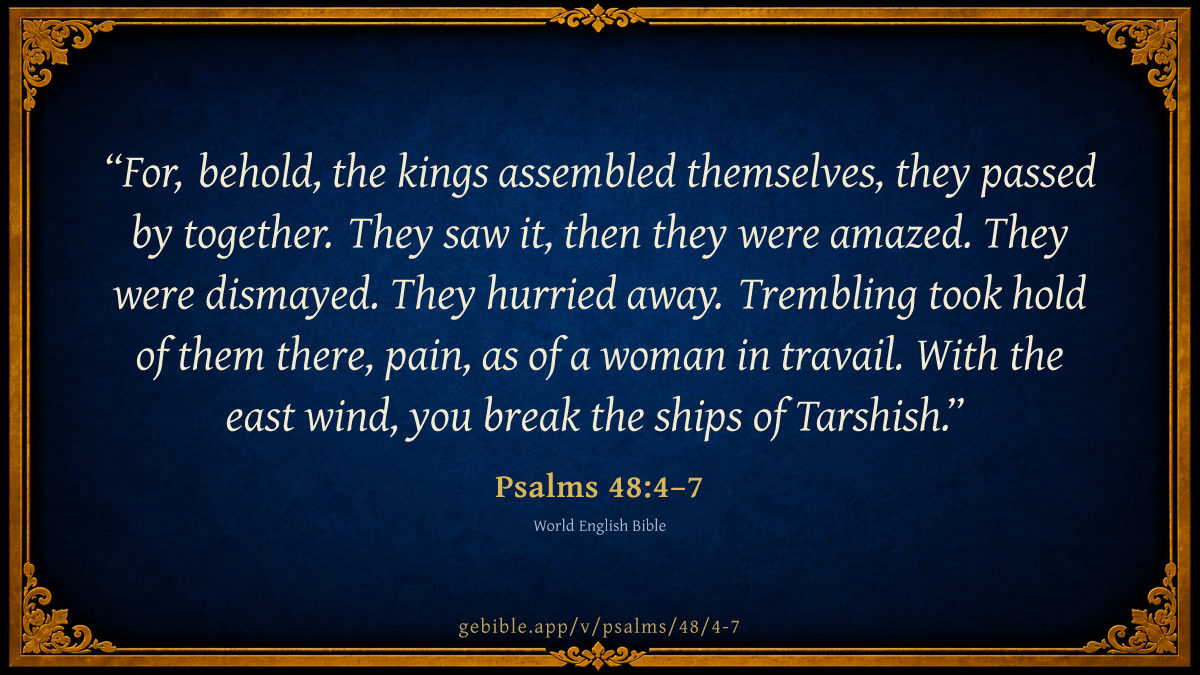
4 For, behold! the kings assembled Here that special deliverance of which I have spoken is touched upon. The prophet relates how, when the kings were assembled together to destroy Jerusalem, their efforts passed away without producing any effect, even as clouds in the atmosphere vanish away; yea, he tells us, that by a simple look at the city, they were defeated and undone, and that not after an ordinary manner, but like a woman who, when the hour of child-birth has come upon her, finds herself suddenly afflicted with pain and sorrow. We cannot affirm with certainty what particular part of Jewish history the prophet here speaks of; but the statements made suit very well both the time of Ahaz, and that of Hezekiah or Asa. It was indeed a wonderful work of God, when two very powerful kings — the king of Syria and the king of Israel, accompanied with an immense army — had smitten the city with such terror, that the king and his people were brought to the brink of despair, to see this formidable host suddenly routed and disappointed of the certain expectation which they entertained of making themselves masters of the city. Hence the prophet Isaiah 7:4 ironically calls them “smoking firebrands,” because they were, so to speak, burning torches to kindle and consume by fire the whole country of Judea. Nor was the destruction of the countless host of Sennacherib in one night by an angel, without the intervention of man’s agency, a less stupendous miracle, (2 Kings 19:35; Isaiah 37:36.) In like manner, when the king of Ethiopia gathered together an army of ten hundred thousand men, and came to besiege Jerusalem, the overthrow of so great a host was a memorable instance of the power of God, (2 Chronicles 14:9.) But whatever was the occasion on which this psalm was composed, the sacred writer informs us that the Jews found from manifest experience that God was the guardian and protector of the holy city, when he opposed himself to the invincible power of their enemies. He first declares that the kings assembled By these words he intimates that they had confederated and conspired together to destroy the Church. The expression, passed away together, may be explained in two ways; either as meaning that the armies when they had gathered themselves together were reduced to nothing, or that they undertook together, and with one consent, the expedition, as it were marshalled in battle array.
This second sense seems to me the most suitable to the scope of the passage; for it follows immediately after in the fifth verse, that they stood stricken with astonishment whenever they saw the city; and yet there will be no impropriety in understanding this verse as added by way of amplification. But as it affects very little the substance of the passage which of these two interpretations is adopted, I leave the reader to choose that which he considers the most appropriate. When the Psalmist says that upon beholding the city they marvelled — were frightened — fled precipitately — and were seized with sorrow, like the pangs of a woman in travail — he heaps together as many and varied expressions as possible, in order to set forth the greatness of the miracle which God had wrought in the overthrow of such a vast and formidable host. The language should be resolved thus: As soon as they saw the city they marvelled. It is related of Caesar in ancient times, that when speaking of the ease with which he subdued Egypt, he made use of the laconic saying, “I came, I saw, I conquered;” but the prophet here states, on the contrary, that the ungodly were struck with amazement at the mere sight of the city, as if God had dazzled their eyes with the splendor of his glory. The particle כן, ken, so, is put as it were to show the thing by pointing to it with the finger. In the verse which immediately follows, the adverb שם, sham, there, is used in the same sense. The comparison of a woman in travail is intended to express the sudden change which came upon the enemies of Israel. It afforded a more bright and illustrious manifestation of the grace of God, that they were seized with a fear which they had not anticipated, lost their courage all at once, and from the height of secure and presumptuous pride, instantly fell into such a state of terror, and were so confounded, that they precipitately betook themselves to flight. From this passage we are taught that it is no uncommon thing, if in our day the Church is assailed by powerful adversaries, and has to sustain dreadful assaults; for it has been God’s usual way from the beginning thus to humble his own people, in order to give more irrefragable and striking proofs of his wonderful power. At the same time, let us remember that a nod alone on the part of God is sufficient to deliver us; and that, although our enemies may be ready to fall upon us on every side to overwhelm us, it is in his power, whenever he pleases, to strike them with amazement of spirit, and thus to make their hearts fail in a moment in the very midst of their efforts against us. Let this reflection serve as a bridle to keep our minds from being drawn away, to look in all directions for human aid.
John Calvin's Commentaries (1540-1563) — public domain. Text from the Calvin Translation Society English edition (1840s-50s) via the Christian Classics Ethereal Library (ccel.org). Calvin's coverage is partial (roughly two-thirds of the Bible); uncommented books and verses are honest gaps, never fabricated. The 19th-century editor's footnotes and remarks are omitted so the notes are faithfully Calvin's own voice.
Geneva Bible translators1599 · Public DomainOn vv4, 5, 7They conspired and went against God’s people.
They conspired and went against God’s people.
Geneva Bible (1599) marginal notes — public domain.
John Trapp1656 · Public DomainOn vv4–7Psa 48:4 For, lo, the kings were assembled, they…
Psa 48:4 For, lo, the kings were assembled, they passed by together.
Ver. 4. For, lo, the kings were assembled] The princes of the Philistines, 2Sa 5:5. Or, Sennacherib’s princes, which were all kings, Isa 10:8. Oecolampadius, upon Isa 13:19, saith, that there were twenty and two kingdoms in Assyria; these all came with combined forces to lay Jerusalem desolate, but could not effect it.
Read full note →
They passed by together] They could do this city (dear to God, and secured by him, the Athenians boasted that they were θεοφιλεις, beloved of God, the Hierosolymitans were surely so) no more harm than as if they had been so many wayfaring men that had passed by it with their staves in their hands.
John Trapp, A Commentary or Exposition upon All the Books of the Old and New Testament (1647–1656) — public domain. Text from a community e-Sword module.
Matthew Poole1685 · Public DomainOn vv4–7Either those kings confederate against Jehoshaphat, 2Ch 20; or…
Either those kings confederate against Jehoshaphat, 2Ch 20; or the Assyrian princes, whom they vain-gloriously called
kings, Isa 10:8.
Read full note →
They passed by, in their march towards Jerusalem. Or, they passed away, i.e. departed without the success which they desired and confidently expected.
Matthew Poole's English Annotations on the Holy Bible (1683–1685) — public domain. Text from a community e-Sword/MySword module.
John Gill1763 · Public DomainOn vv4–7They saw it,.... Either the city or the power…
They saw it,.... Either the city or the power of God, as Aben Ezra; or, as Jarchi, God himself going forth to fight against the nations. This refers to the power Christ will take to himself, and show forth, by reigning in his church, and protecting it, which will not only be visible to the saints, but to the nations of the world; and to the brightness of Christ's coming in his spiritual reign, with the lustre of which antichrist will be destroyed, Rev 11:17; and to the glorious state of the church, signified by the rising of the witnesses, and their standing on their feet, and ascending to heaven, which will be seen by their enemies, Rev 11:11; and to the destruction of Rome, the smoke of whose burning, the kings of the earth, that have committed fornication with her, will see and lament, Rev 18:8;
and so their marvelled: at the glory of the church, the security of it, the power of Christ in it and over it, and at the destruction of mystical Babylon; see Isa 52:14;
Read full note →
they were troubled: as Herod and all Jerusalem were, upon hearing of the birth of Christ, Mat 2:3; so these kings will be, upon seeing the coming and power of Christ in the latter day, the invincibleness of his church, and their own immediate and utter ruin: this will be the time or the howling of the shepherds, both civil and ecclesiastical, when all hands will be faint, and every man's heart will melt, Zac 11:2;
and hasted away: fled for fear of the great King at the head of his armies, in the defence of his church and people: and as the kings of the earth also at the destruction of Rome will flee and stand afar off, for fear of her torment, Rev 18:10.
John Gill's Exposition of the Whole Bible (1746–1763) — public domain (CC PDM 1.0). Text via the HelloAO Bible API.
John Wesley1765 · Public DomainOn vv4–7The kings - Either those kings confederate against Jehoshaphat,…
The kings - Either those kings confederate against Jehoshaphat, 2 Chron. xx, 1, or the Assyrian princes; whom they vain- gloriously called kings, Isaiah x, 8. Passed - In their march towards Jerusalem.
John Wesley, Explanatory Notes Upon the Whole Bible (1754–1765) — public domain. Text via the GEBible commentary corpus.
Adam Clarke1810 · Public DomainOn vv4, 7Verse 4. For, lo, the kings were assembled] Many…
Verse 4. For, lo, the kings were assembled] Many of the neighbouring potentates, at different times, envied the prosperity of the Jewish nation, and coveted the riches of the temple; but they had no power against it till the cup of Jewish transgression was full. In vain did they assemble - confederate, and invade the land. Saw it - reconnoitered the place; marvelled at its excellence and strength, for they were troubled - struck with fear; hasted away for fear of destruction, for fear took hold on them as pains seize on a woman in travail. Those who came to destroy were glad to make their own escape.
Adam Clarke's Commentary on the Bible (1810–1826) — public domain. Text from a community e-Sword/MySword module.
Joseph Benson1811 · Public DomainOn vv4, 7Psa 48:4-6. For lo, the kings were assembled —…
Psa 48:4-6. For lo, the kings were assembled — The neighbouring princes confederate against Jerusalem: see the contents. They passed by — In their march toward Jerusalem. They advanced, and marched on, not doubting but they should presently make themselves masters of the city. Or, they passed away together — Departed without the success which they desired and expected. They saw it — They only looked upon it, but did not enter it, nor shoot an arrow there, nor cast a bank against it, as was said upon this or the like occasion, 2Ki 19:32. They marvelled — Not so much at the structure or strength of the city, as at the wonderful works wrought by God on its behalf. They were troubled, and hasted away — God impressed such terrors upon their minds as made them retire with precipitation. If he refer to the invasion by Sennacherib, he may allude to the fear he and his army were put into by tidings of Tirhakah’s coming against them; or to that terrible slaughter of them, mentioned 2Ki 19:35. Thus “the potentates of the world saw the miracles of the apostles, the courage and constancy of the martyrs, and the daily increase of the church, notwithstanding all their persecutions; they beheld, with astonishment, the rapid progress of the faith through the Roman empire; they called upon their gods, but their gods could not help themselves. Idolatry expired at the foot of the victorious cross, and the power which supported it became Christian.” — Horne.
Joseph Benson's Commentary on the Old and New Testaments (1811–1818) — public domain. Text from a community e-Sword module.
Albert Barnes1834 · Public DomainOn vv4–7For, lo, the kings were assembled - There is…
For, lo, the kings were assembled - There is evidently allusion here to some fact that had occurred; some gathering together of kings and their armies, with a view to besiege or attack Jerusalem. The kings referred to, if the allusion here is, as is supposed, to the time of Jehoshaphat, were the kings of Ammon and of Moab, and of Mount Seir, and perhaps others, not particularly mentioned, who came up against Jehoshaphat, 2Ch 20:1, 2Ch 20:10.
They passed by together - That is, they were smitten with consternation; they were so impressed with the beauty, the majesty, the strength of the city, that they passed along without venturing to attack it. Or, perhaps, the meaning may be, that they were discomfited and overthrown as suddenly “as if” the mere sight of the city had filled their minds with dread, and had made them desist from their intended assault. Compare 2Ch 20:22-25.
Albert Barnes' Notes on the Bible (1834–1885) — public domain. Text from a community e-Sword/MySword module.
Robert Jamieson, A. R. Fausset & David Brown1871 · Public DomainOn vv4, 7For--The reason is given. Though the kings (perhaps of…
For--The reason is given. Though the kings (perhaps of Moab and Ammon, compare Psa 83:3-5) combined, a conviction of God's presence with His people, evinced by the unusual courage with which the prophets (compare Ch2 20:12-20) had inspired them, seized on their minds, and smitten with sudden and intense alarm, they fled astonished.
Jamieson, Fausset & Brown — Commentary Critical and Explanatory on the Whole Bible (1871) — public domain (CC PDM 1.0). Text via the HelloAO Bible API.
Daniel D. Whedon1874 · Public DomainOn v44-8. In this division is noted the destruction of…
4-8. In this division is noted the destruction of the people’s enemies.
The kings were assembled—Pointing to a confederate army and a war council of the chiefs. This does not suit the Assyrian army, in which one ruling spirit, Sennacherib, held absolute sway. 2 Chronicles 32. See notes on Psalms 46. The definite article, “the kings,” indicates a specific number, perhaps known to the writer. So also the verb נועדו, (noa’doo,) were met, denotes an appointed meeting. It was a council to settle the plan of attacking Jerusalem, and here, evidently, the division and quarrel among themselves began, which on the morrow culminated in their overthrow.
Read full note →
They marvelled… troubled… hasted away—The several steps leading to their ruin. They met in formal council, but broke up in confusion and fled in terror.
Fear took hold upon them—They now saw they had committed themselves to an impossible enterprise, and being divided in counsel, and having no common bond but that of hatred to the Hebrew and love of plunder, mutual hate and jealousy soon predominated over all considerations of prudence and valour, and fear and disappointment soon rose to universal panic and frenzy. Meanwhile a supernatural dread of the God of Israel had seized upon them. To this must be added the alarm of the ambushments already noticed. 2Ch_20:22.
Thou breakest the ships of Tarshish—This figure occurs nowhere prior to Jehoshaphat, but aptly coincides with his reign; (1Ki_22:48; 2Ch_20:35-37;) and corroborates the date we have assigned to the psalm.
“Ships of Tarshish” are ships built for the voyage to Tarshish, and hence proverbial for great and strong ships, and figuratively of “worldly powers” with formidable war preparations. See Isa_2:16; Isa_23:1. But where Tarshish was is not certain.
Daniel D. Whedon (gen. ed.), Commentary on the Old and New Testaments (1874–1909) — public domain. Text from a community e-Sword module.
The Cambridge Bible for Schools and Colleges1878 · Public DomainOn vv4–74. For, lo, the kings assembled themselves (R.V.): Sennacherib’s…
4. For, lo, the kings assembled themselves (R.V.): Sennacherib’s vassal kings (Isa_10:8) met at their rendezvous (cp. Psa_2:2): they passed over together; uniting their forces they crossed the frontier and entered the land of Judah. Cp. Isa_8:7-8; Isa_28:15. The rendering passed away (R.V. marg.) is possible but unsuitable, for (1) assembled themselves needs some further explanation, and (2) it interrupts the order of the description: it is not until they have seen Jerusalem (Psa_48:5) that they disperse in confusion. P.B.V. kings of the earth is from the Vulg. Cp. Psa_76:12.
The Cambridge Bible for Schools and Colleges (gen. ed. J. J. S. Perowne; Cambridge University Press, 1878–1918) — public domain. Text from a community e-Sword module.
Ellicott's Commentary for English Readers1878 · Public DomainOn vv4, 5, 7(4) The kings.—With the striking picture of the advance…
(4) The kings.—With the striking picture of the advance and sudden collapse of a hostile expedition that follows, comp. Isa_10:28-34; possibly of the very same event.
The kings.—Evidently known to the writer, but, alas! matter of merest conjecture to us. Some suppose the kings of Ammon, Moab, and Edom, who attacked Jehoshaphat (2Ch_20:25); others, the tributary princes of Sennacherib. In his annals, as lately deciphered, this monarch speaks of setting up tributary kings or viceroys in Chaldæa, Phoenicia, and Philistia, after conquering these countries. (See Assyrian Discoveries, by George Smith, p. 303.) Others again, referring the psalm to the time of Ahaz, understand Pekah and Rezin (2Ki_15:37). The touches, vivid as they are, of the picture, are not so historically defined as to allow a settlement of the question.
Read full note →
Assembled.—Used of the muster of confederate forces (Jos_11:5).
Passed by—i.e., marched by. So, according to the time reading, the LXX. A frequent military term (Jdg_11:29; 2Ki_8:21; Isa_8:8). Others, “passed away,” but it is doubtful if the verb can have this meaning.
Together.—Notice the parallelism, they came together, they passed by together.
A Bible Commentary for English Readers, edited by Charles John Ellicott (1878–1897) — public domain. Text from a community e-Sword module.
The Pulpit Commentary1880 · Public DomainOn vv4–7For lo, the kings were assembled; they passed by…
For lo, the kings were assembled; they passed by together. Some see in these "kings" Sennacherib"s princes, who, according to him, (Isa_10:8) were "altogether kings." But actual monarchs, each leading his own army, seem rather to be intended.
The Pulpit Commentary (1880–1919), ed. H.D.M. Spence-Jones & Joseph S. Exell — public domain. Text from a community e-Sword module.
Charles H. Spurgeon1885 · Public DomainOn vv4–7Ver. 4. The kings were assembled, they passed by…
Ver. 4. The kings were assembled, they passed by together. They came and they went. No sooner together than scattered. They came one way and fled twenty ways. Boastful the gathering hosts with their royal leaders, despairing the fugitive bands with their astonished captains. They came like foam on the angry sea, like foam they melted away. This was so remarkable that the psalmist puts in a note of exclamation, Lo! What! have they so suddenly fled! Even thus shall the haters of the church vanish from the field. Papists, Ritualists, Arians, Sceptics, they shall each have their day, and shall pass on to the limbo of forgetfulness.
Ver. 4. They were many and powerful: kings and a plurality of them. They were confederate kings. The kings were assembled. Forces united are the more powerful. But all the endeavours of these confederate kings came to nothing. They passed by together together they came, and together they vanished. William Nicholson.
Read full note →
Ver. 4-7.
1. The opposition of worldly powers to the church. "The kings, "etc.
2. The manner in which they are subduedby their own fears; conscience has persecuted those who have persecuted the church of God. They who have seized the ark of God have been glad to return it with an offering.
3. The completeness of their overthrow, As a fleet of ships of Tarshish, dispersed, broken, and engulfed by the east wind.
Psalms 48:5*
Ver. 4-7.
1. The opposition of worldly powers to the church. "The kings, "etc.
2. The manner in which they are subduedby their own fears; conscience has persecuted those who have persecuted the church of God. They who have seized the ark of God have been glad to return it with an offering.
3. The completeness of their overthrow, As a fleet of ships of Tarshish, dispersed, broken, and engulfed by the east wind.
Psalms 48:6*
Ver. 4-7.
1. The opposition of worldly powers to the church. "The kings, "etc.
2. The manner in which they are subduedby their own fears; conscience has persecuted those who have persecuted the church of God. They who have seized the ark of God have been glad to return it with an offering.
3. The completeness of their overthrow, As a fleet of ships of Tarshish, dispersed, broken, and engulfed by the east wind.
Psalms 48:7*
Ver. 4-7.
1. The opposition of worldly powers to the church. "The kings, "etc.
2. The manner in which they are subduedby their own fears; conscience has persecuted those who have persecuted the church of God. They who have seized the ark of God have been glad to return it with an offering.
3. The completeness of their overthrow, As a fleet of ships of Tarshish, dispersed, broken, and engulfed by the east wind.
Psalms 48:8*
Charles H. Spurgeon's The Treasury of David (1869–1885) — public domain. Psalms only. Text from a community e-Sword/MySword module.
unfoldingWord translationNotes2017 · CC BY-SA 4.0On vv4, 7The word "see" here alerts us to pay attention…
see
The word "see" here alerts us to pay attention to the surprising information that follows.
Read full note →
assembled themselves
Here the kings represent their armies. AT: "assembled their armies" (See: Metonymy)
they passed by together
"together they passed by Jerusalem"
They saw it
"They saw Jerusalem"
dismayed
greatly troubled
Trembling took hold of them there
The writer speaks of the kings' fear as if it were a person who caused the kings and their armies to tremble. AT: "There they trembled with fear" (See: Personification)
pain as when a woman is in labor
The writer speaks of the kings' fear as if it were the pain that a woman experiences in childbirth and speaks of that pain as if it were a person. The verb may be supplied from the previous clause. AT: "pain took hold of them, as when a woman is in labor" or "they became afraid, like a woman is afraid of experiencing labor pains" (See: Metaphor and Personification and Ellipsis)
Tyndale Open Study Notes2022 · CC BY-SA 4.0On v748:7 The ships of Tarshish, built for long voyages,…
48:7 The ships of Tarshish, built for long voyages, represent human accomplishment (see also 2 Chr 9:21; Isa 2:16). Their destruction might be the event mentioned in 1 Kgs 22:48.

John Calvin 1540 · Public Domain On vv4, 7 4 For, behold! the kings assembled Here that special…
4 For, behold! the kings assembled Here that special deliverance of which I have spoken is touched upon. The prophet relates how, when the kings were assembled together to destroy Jerusalem, their efforts passed away without producing any effect, even as clouds in the atmosphere vanish away; yea, he tells us, that by a simple look at the city, they were defeated and undone, and that not after an ordinary manner, but like a woman who, when the hour of child-birth has come upon her, finds herself suddenly afflicted with pain and sorrow. We cannot affirm with certainty what particular part of Jewish history the prophet here speaks of; but the statements made suit very well both the time of Ahaz, and that of Hezekiah or Asa. It was indeed a wonderful work of God, when two very powerful kings — the king of Syria and the king of Israel, accompanied with an immense army — had smitten the city with such terror, that the king and his people were brought to the brink of despair, to see this formidable host suddenly routed and disappointed of the certain expectation which they entertained of making themselves masters of the city. Hence the prophet Isaiah 7:4 ironically calls them “smoking firebrands,” because they were, so to speak, burning torches to kindle and consume by fire the whole country of Judea. Nor was the destruction of the countless host of Sennacherib in one night by an angel, without the intervention of man’s agency, a less stupendous miracle, (2 Kings 19:35; Isaiah 37:36.) In like manner, when the king of Ethiopia gathered together an army of ten hundred thousand men, and came to besiege Jerusalem, the overthrow of so great a host was a memorable instance of the power of God, (2 Chronicles 14:9.) But whatever was the occasion on which this psalm was composed, the sacred writer informs us that the Jews found from manifest experience that God was the guardian and protector of the holy city, when he opposed himself to the invincible power of their enemies. He first declares that the kings assembled By these words he intimates that they had confederated and conspired together to destroy the Church. The expression, passed away together, may be explained in two ways; either as meaning that the armies when they had gathered themselves together were reduced to nothing, or that they undertook together, and with one consent, the expedition, as it were marshalled in battle array.
This second sense seems to me the most suitable to the scope of the passage; for it follows immediately after in the fifth verse, that they stood stricken with astonishment whenever they saw the city; and yet there will be no impropriety in understanding this verse as added by way of amplification. But as it affects very little the substance of the passage which of these two interpretations is adopted, I leave the reader to choose that which he considers the most appropriate. When the Psalmist says that upon beholding the city they marvelled — were frightened — fled precipitately — and were seized with sorrow, like the pangs of a woman in travail — he heaps together as many and varied expressions as possible, in order to set forth the greatness of the miracle which God had wrought in the overthrow of such a vast and formidable host. The language should be resolved thus: As soon as they saw the city they marvelled. It is related of Caesar in ancient times, that when speaking of the ease with which he subdued Egypt, he made use of the laconic saying, “I came, I saw, I conquered;” but the prophet here states, on the contrary, that the ungodly were struck with amazement at the mere sight of the city, as if God had dazzled their eyes with the splendor of his glory. The particle כן, ken, so, is put as it were to show the thing by pointing to it with the finger. In the verse which immediately follows, the adverb שם, sham, there, is used in the same sense. The comparison of a woman in travail is intended to express the sudden change which came upon the enemies of Israel. It afforded a more bright and illustrious manifestation of the grace of God, that they were seized with a fear which they had not anticipated, lost their courage all at once, and from the height of secure and presumptuous pride, instantly fell into such a state of terror, and were so confounded, that they precipitately betook themselves to flight. From this passage we are taught that it is no uncommon thing, if in our day the Church is assailed by powerful adversaries, and has to sustain dreadful assaults; for it has been God’s usual way from the beginning thus to humble his own people, in order to give more irrefragable and striking proofs of his wonderful power. At the same time, let us remember that a nod alone on the part of God is sufficient to deliver us; and that, although our enemies may be ready to fall upon us on every side to overwhelm us, it is in his power, whenever he pleases, to strike them with amazement of spirit, and thus to make their hearts fail in a moment in the very midst of their efforts against us. Let this reflection serve as a bridle to keep our minds from being drawn away, to look in all directions for human aid.
John Calvin's Commentaries (1540-1563) — public domain. Text from the Calvin Translation Society English edition (1840s-50s) via the Christian Classics Ethereal Library (ccel.org). Calvin's coverage is partial (roughly two-thirds of the Bible); uncommented books and verses are honest gaps, never fabricated. The 19th-century editor's footnotes and remarks are omitted so the notes are faithfully Calvin's own voice.
Geneva Bible translators 1599 · Public Domain On vv4, 5, 7 They conspired and went against God’s people.
They conspired and went against God’s people.
Geneva Bible (1599) marginal notes — public domain.
John Trapp 1656 · Public Domain On vv4–7 Psa 48:4 For, lo, the kings were assembled, they…
Psa 48:4 For, lo, the kings were assembled, they passed by together.
Ver. 4. For, lo, the kings were assembled] The princes of the Philistines, 2Sa 5:5. Or, Sennacherib’s princes, which were all kings, Isa 10:8. Oecolampadius, upon Isa 13:19, saith, that there were twenty and two kingdoms in Assyria; these all came with combined forces to lay Jerusalem desolate, but could not effect it.
Read full note →
They passed by together] They could do this city (dear to God, and secured by him, the Athenians boasted that they were θεοφιλεις, beloved of God, the Hierosolymitans were surely so) no more harm than as if they had been so many wayfaring men that had passed by it with their staves in their hands.
John Trapp, A Commentary or Exposition upon All the Books of the Old and New Testament (1647–1656) — public domain. Text from a community e-Sword module.
Matthew Poole 1685 · Public Domain On vv4–7 Either those kings confederate against Jehoshaphat, 2Ch 20; or…
Either those kings confederate against Jehoshaphat, 2Ch 20; or the Assyrian princes, whom they vain-gloriously called
kings, Isa 10:8.
Read full note →
They passed by, in their march towards Jerusalem. Or, they passed away, i.e. departed without the success which they desired and confidently expected.
Matthew Poole's English Annotations on the Holy Bible (1683–1685) — public domain. Text from a community e-Sword/MySword module.
John Gill 1763 · Public Domain On vv4–7 They saw it,.... Either the city or the power…
They saw it,.... Either the city or the power of God, as Aben Ezra; or, as Jarchi, God himself going forth to fight against the nations. This refers to the power Christ will take to himself, and show forth, by reigning in his church, and protecting it, which will not only be visible to the saints, but to the nations of the world; and to the brightness of Christ's coming in his spiritual reign, with the lustre of which antichrist will be destroyed, Rev 11:17; and to the glorious state of the church, signified by the rising of the witnesses, and their standing on their feet, and ascending to heaven, which will be seen by their enemies, Rev 11:11; and to the destruction of Rome, the smoke of whose burning, the kings of the earth, that have committed fornication with her, will see and lament, Rev 18:8;
and so their marvelled: at the glory of the church, the security of it, the power of Christ in it and over it, and at the destruction of mystical Babylon; see Isa 52:14;
Read full note →
they were troubled: as Herod and all Jerusalem were, upon hearing of the birth of Christ, Mat 2:3; so these kings will be, upon seeing the coming and power of Christ in the latter day, the invincibleness of his church, and their own immediate and utter ruin: this will be the time or the howling of the shepherds, both civil and ecclesiastical, when all hands will be faint, and every man's heart will melt, Zac 11:2;
and hasted away: fled for fear of the great King at the head of his armies, in the defence of his church and people: and as the kings of the earth also at the destruction of Rome will flee and stand afar off, for fear of her torment, Rev 18:10.
John Gill's Exposition of the Whole Bible (1746–1763) — public domain (CC PDM 1.0). Text via the HelloAO Bible API.
John Wesley 1765 · Public Domain On vv4–7 The kings - Either those kings confederate against Jehoshaphat,…
The kings - Either those kings confederate against Jehoshaphat, 2 Chron. xx, 1, or the Assyrian princes; whom they vain- gloriously called kings, Isaiah x, 8. Passed - In their march towards Jerusalem.
John Wesley, Explanatory Notes Upon the Whole Bible (1754–1765) — public domain. Text via the GEBible commentary corpus.
Adam Clarke 1810 · Public Domain On vv4, 7 Verse 4. For, lo, the kings were assembled] Many…
Verse 4. For, lo, the kings were assembled] Many of the neighbouring potentates, at different times, envied the prosperity of the Jewish nation, and coveted the riches of the temple; but they had no power against it till the cup of Jewish transgression was full. In vain did they assemble - confederate, and invade the land. Saw it - reconnoitered the place; marvelled at its excellence and strength, for they were troubled - struck with fear; hasted away for fear of destruction, for fear took hold on them as pains seize on a woman in travail. Those who came to destroy were glad to make their own escape.
Adam Clarke's Commentary on the Bible (1810–1826) — public domain. Text from a community e-Sword/MySword module.
Joseph Benson 1811 · Public Domain On vv4, 7 Psa 48:4-6. For lo, the kings were assembled —…
Psa 48:4-6. For lo, the kings were assembled — The neighbouring princes confederate against Jerusalem: see the contents. They passed by — In their march toward Jerusalem. They advanced, and marched on, not doubting but they should presently make themselves masters of the city. Or, they passed away together — Departed without the success which they desired and expected. They saw it — They only looked upon it, but did not enter it, nor shoot an arrow there, nor cast a bank against it, as was said upon this or the like occasion, 2Ki 19:32. They marvelled — Not so much at the structure or strength of the city, as at the wonderful works wrought by God on its behalf. They were troubled, and hasted away — God impressed such terrors upon their minds as made them retire with precipitation. If he refer to the invasion by Sennacherib, he may allude to the fear he and his army were put into by tidings of Tirhakah’s coming against them; or to that terrible slaughter of them, mentioned 2Ki 19:35. Thus “the potentates of the world saw the miracles of the apostles, the courage and constancy of the martyrs, and the daily increase of the church, notwithstanding all their persecutions; they beheld, with astonishment, the rapid progress of the faith through the Roman empire; they called upon their gods, but their gods could not help themselves. Idolatry expired at the foot of the victorious cross, and the power which supported it became Christian.” — Horne.
Joseph Benson's Commentary on the Old and New Testaments (1811–1818) — public domain. Text from a community e-Sword module.
Albert Barnes 1834 · Public Domain On vv4–7 For, lo, the kings were assembled - There is…
For, lo, the kings were assembled - There is evidently allusion here to some fact that had occurred; some gathering together of kings and their armies, with a view to besiege or attack Jerusalem. The kings referred to, if the allusion here is, as is supposed, to the time of Jehoshaphat, were the kings of Ammon and of Moab, and of Mount Seir, and perhaps others, not particularly mentioned, who came up against Jehoshaphat, 2Ch 20:1, 2Ch 20:10.
They passed by together - That is, they were smitten with consternation; they were so impressed with the beauty, the majesty, the strength of the city, that they passed along without venturing to attack it. Or, perhaps, the meaning may be, that they were discomfited and overthrown as suddenly “as if” the mere sight of the city had filled their minds with dread, and had made them desist from their intended assault. Compare 2Ch 20:22-25.
Albert Barnes' Notes on the Bible (1834–1885) — public domain. Text from a community e-Sword/MySword module.
Robert Jamieson, A. R. Fausset & David Brown 1871 · Public Domain On vv4, 7 For--The reason is given. Though the kings (perhaps of…
For--The reason is given. Though the kings (perhaps of Moab and Ammon, compare Psa 83:3-5) combined, a conviction of God's presence with His people, evinced by the unusual courage with which the prophets (compare Ch2 20:12-20) had inspired them, seized on their minds, and smitten with sudden and intense alarm, they fled astonished.
Jamieson, Fausset & Brown — Commentary Critical and Explanatory on the Whole Bible (1871) — public domain (CC PDM 1.0). Text via the HelloAO Bible API.
Daniel D. Whedon 1874 · Public Domain On v4 4-8. In this division is noted the destruction of…
4-8. In this division is noted the destruction of the people’s enemies.
The kings were assembled—Pointing to a confederate army and a war council of the chiefs. This does not suit the Assyrian army, in which one ruling spirit, Sennacherib, held absolute sway. 2 Chronicles 32. See notes on Psalms 46. The definite article, “the kings,” indicates a specific number, perhaps known to the writer. So also the verb נועדו, (noa’doo,) were met, denotes an appointed meeting. It was a council to settle the plan of attacking Jerusalem, and here, evidently, the division and quarrel among themselves began, which on the morrow culminated in their overthrow.
Read full note →
They marvelled… troubled… hasted away—The several steps leading to their ruin. They met in formal council, but broke up in confusion and fled in terror.
Fear took hold upon them—They now saw they had committed themselves to an impossible enterprise, and being divided in counsel, and having no common bond but that of hatred to the Hebrew and love of plunder, mutual hate and jealousy soon predominated over all considerations of prudence and valour, and fear and disappointment soon rose to universal panic and frenzy. Meanwhile a supernatural dread of the God of Israel had seized upon them. To this must be added the alarm of the ambushments already noticed. 2Ch_20:22.
Thou breakest the ships of Tarshish—This figure occurs nowhere prior to Jehoshaphat, but aptly coincides with his reign; (1Ki_22:48; 2Ch_20:35-37;) and corroborates the date we have assigned to the psalm.
“Ships of Tarshish” are ships built for the voyage to Tarshish, and hence proverbial for great and strong ships, and figuratively of “worldly powers” with formidable war preparations. See Isa_2:16; Isa_23:1. But where Tarshish was is not certain.
Daniel D. Whedon (gen. ed.), Commentary on the Old and New Testaments (1874–1909) — public domain. Text from a community e-Sword module.
The Cambridge Bible for Schools and Colleges 1878 · Public Domain On vv4–7 4. For, lo, the kings assembled themselves (R.V.): Sennacherib’s…
4. For, lo, the kings assembled themselves (R.V.): Sennacherib’s vassal kings (Isa_10:8) met at their rendezvous (cp. Psa_2:2): they passed over together; uniting their forces they crossed the frontier and entered the land of Judah. Cp. Isa_8:7-8; Isa_28:15. The rendering passed away (R.V. marg.) is possible but unsuitable, for (1) assembled themselves needs some further explanation, and (2) it interrupts the order of the description: it is not until they have seen Jerusalem (Psa_48:5) that they disperse in confusion. P.B.V. kings of the earth is from the Vulg. Cp. Psa_76:12.
The Cambridge Bible for Schools and Colleges (gen. ed. J. J. S. Perowne; Cambridge University Press, 1878–1918) — public domain. Text from a community e-Sword module.
Ellicott's Commentary for English Readers 1878 · Public Domain On vv4, 5, 7 (4) The kings.—With the striking picture of the advance…
(4) The kings.—With the striking picture of the advance and sudden collapse of a hostile expedition that follows, comp. Isa_10:28-34; possibly of the very same event.
The kings.—Evidently known to the writer, but, alas! matter of merest conjecture to us. Some suppose the kings of Ammon, Moab, and Edom, who attacked Jehoshaphat (2Ch_20:25); others, the tributary princes of Sennacherib. In his annals, as lately deciphered, this monarch speaks of setting up tributary kings or viceroys in Chaldæa, Phoenicia, and Philistia, after conquering these countries. (See Assyrian Discoveries, by George Smith, p. 303.) Others again, referring the psalm to the time of Ahaz, understand Pekah and Rezin (2Ki_15:37). The touches, vivid as they are, of the picture, are not so historically defined as to allow a settlement of the question.
Read full note →
Assembled.—Used of the muster of confederate forces (Jos_11:5).
Passed by—i.e., marched by. So, according to the time reading, the LXX. A frequent military term (Jdg_11:29; 2Ki_8:21; Isa_8:8). Others, “passed away,” but it is doubtful if the verb can have this meaning.
Together.—Notice the parallelism, they came together, they passed by together.
A Bible Commentary for English Readers, edited by Charles John Ellicott (1878–1897) — public domain. Text from a community e-Sword module.
The Pulpit Commentary 1880 · Public Domain On vv4–7 For lo, the kings were assembled; they passed by…
For lo, the kings were assembled; they passed by together. Some see in these "kings" Sennacherib"s princes, who, according to him, (Isa_10:8) were "altogether kings." But actual monarchs, each leading his own army, seem rather to be intended.
The Pulpit Commentary (1880–1919), ed. H.D.M. Spence-Jones & Joseph S. Exell — public domain. Text from a community e-Sword module.
Charles H. Spurgeon 1885 · Public Domain On vv4–7 Ver. 4. The kings were assembled, they passed by…
Ver. 4. The kings were assembled, they passed by together. They came and they went. No sooner together than scattered. They came one way and fled twenty ways. Boastful the gathering hosts with their royal leaders, despairing the fugitive bands with their astonished captains. They came like foam on the angry sea, like foam they melted away. This was so remarkable that the psalmist puts in a note of exclamation, Lo! What! have they so suddenly fled! Even thus shall the haters of the church vanish from the field. Papists, Ritualists, Arians, Sceptics, they shall each have their day, and shall pass on to the limbo of forgetfulness.
Ver. 4. They were many and powerful: kings and a plurality of them. They were confederate kings. The kings were assembled. Forces united are the more powerful. But all the endeavours of these confederate kings came to nothing. They passed by together together they came, and together they vanished. William Nicholson.
Read full note →
Ver. 4-7.
1. The opposition of worldly powers to the church. "The kings, "etc.
2. The manner in which they are subduedby their own fears; conscience has persecuted those who have persecuted the church of God. They who have seized the ark of God have been glad to return it with an offering.
3. The completeness of their overthrow, As a fleet of ships of Tarshish, dispersed, broken, and engulfed by the east wind.
Psalms 48:5*
Ver. 4-7.
1. The opposition of worldly powers to the church. "The kings, "etc.
2. The manner in which they are subduedby their own fears; conscience has persecuted those who have persecuted the church of God. They who have seized the ark of God have been glad to return it with an offering.
3. The completeness of their overthrow, As a fleet of ships of Tarshish, dispersed, broken, and engulfed by the east wind.
Psalms 48:6*
Ver. 4-7.
1. The opposition of worldly powers to the church. "The kings, "etc.
2. The manner in which they are subduedby their own fears; conscience has persecuted those who have persecuted the church of God. They who have seized the ark of God have been glad to return it with an offering.
3. The completeness of their overthrow, As a fleet of ships of Tarshish, dispersed, broken, and engulfed by the east wind.
Psalms 48:7*
Ver. 4-7.
1. The opposition of worldly powers to the church. "The kings, "etc.
2. The manner in which they are subduedby their own fears; conscience has persecuted those who have persecuted the church of God. They who have seized the ark of God have been glad to return it with an offering.
3. The completeness of their overthrow, As a fleet of ships of Tarshish, dispersed, broken, and engulfed by the east wind.
Psalms 48:8*
Charles H. Spurgeon's The Treasury of David (1869–1885) — public domain. Psalms only. Text from a community e-Sword/MySword module.
unfoldingWord translationNotes 2017 · CC BY-SA 4.0 On vv4, 7 The word "see" here alerts us to pay attention…
see
The word "see" here alerts us to pay attention to the surprising information that follows.
Read full note →
assembled themselves
Here the kings represent their armies. AT: "assembled their armies" (See: Metonymy)
they passed by together
"together they passed by Jerusalem"
They saw it
"They saw Jerusalem"
dismayed
greatly troubled
Trembling took hold of them there
The writer speaks of the kings' fear as if it were a person who caused the kings and their armies to tremble. AT: "There they trembled with fear" (See: Personification)
pain as when a woman is in labor
The writer speaks of the kings' fear as if it were the pain that a woman experiences in childbirth and speaks of that pain as if it were a person. The verb may be supplied from the previous clause. AT: "pain took hold of them, as when a woman is in labor" or "they became afraid, like a woman is afraid of experiencing labor pains" (See: Metaphor and Personification and Ellipsis)
translationWords
king
amazed
tremble
labor pains
unfoldingWord translationNotes — © Distant Shores Media and the Door43 World Missions Community, licensed CC BY-SA 4.0. Source: git.door43.org/Door43/en_tn.
Tyndale Open Study Notes 2022 · CC BY-SA 4.0 On v7 48:7 The ships of Tarshish, built for long voyages,…
48:7 The ships of Tarshish, built for long voyages, represent human accomplishment (see also 2 Chr 9:21; Isa 2:16). Their destruction might be the event mentioned in 1 Kgs 22:48.
Tyndale Open Study Notes — © Tyndale Open Resources, licensed CC BY-SA 4.0. Text via the HelloAO Bible API.