Questions where the Bible appears to say two different things, with the passages on each side set together.
Is God the creator of evil?Isaiah 45:7, Lamentations 3:38, Amos 3:6, and a stack of prophetic passages including Jeremiah 4:6, 18:11 and 2 Kings 6:33 explicitly attribute the creation or…
Does God love everyone?John 3:16 says God so loved the world, and 1 John 4:8 and 4:16 declare God is love.
Is it good to be foolish?Paul in 1 Corinthians 1:21, 3:18, and 4:10 actively recommends becoming a fool — God saves through the foolishness of preaching, and Paul calls himself and his…
Psalms 11:5(vv4–5)Yahweh examines the righteous, but his soul hates the wicked and him who loves violence.
Psalms 1:5(v5)Therefore the wicked shall not stand in the judgment, nor sinners in the congregation of the righteous.
Hosea 9:15(v5)“All their wickedness is in Gilgal; for there I hated them. Because of the wickedness of their deeds I will drive them out of my house! I…
Proverbs 6:16-19(v5)There are six things which Yahweh hates; yes, seven which are an abomination to him: arrogant eyes, a lying tongue, hands that shed…
Hebrews 12:14(v4)Follow after peace with all men, and the sanctification without which no man will see the Lord,
Show all 43 cross-references
Leviticus 20:23(v5)You shall not walk in the customs of the nation which I am casting out before you; for they did all these things, and therefore I abhorred…
Psalms 55:23(v6)But you, God, will bring them down into the pit of destruction. Bloodthirsty and deceitful men shall not live out half their days, but I…
Malachi 2:17(v4)You have wearied Yahweh with your words. Yet you say, ‘How have we wearied him?’ In that you say, ‘Everyone who does evil is good in…
Matthew 25:41(v5)Then he will say also to those on the left hand, ‘Depart from me, you cursed, into the eternal fire which is prepared for the devil and his…
Revelation 21:8(v6)But for the cowardly, unbelieving, sinners, abominable, murderers, sexually immoral, sorcerers, idolaters, and all liars, their part is in…
Psalms 50:21(v4)You have done these things, and I kept silent. You thought that I was just like you. I will rebuke you, and accuse you in front of your…
Proverbs 1:7(v5)The fear of Yahweh is the beginning of knowledge; but the foolish despise wisdom and instruction.
Revelation 21:27(v4)There will in no way enter into it anything profane, or one who causes an abomination or a lie, but only those who are written in the…
Habakkuk 1:13(vv4–5)You who have purer eyes than to see evil, and who cannot look on perversity, why do you tolerate those who deal treacherously, and keep…
Psalms 92:15(v4)to show that Yahweh is upright. He is my rock, and there is no unrighteousness in him.
Psalms 101:7(v4)He who practices deceit won’t dwell within my house. He who speaks falsehood won’t be established before my eyes.
Psalms 140:13(v4)Surely the righteous will give thanks to your name. The upright will dwell in your presence.
Proverbs 8:5(v5)You simple, understand prudence! You fools, be of an understanding heart!
Matthew 7:23(v5)Then I will tell them, ‘I never knew you. Depart from me, you who work iniquity.’
2 Peter 3:13(v4)But, according to his promise, we look for new heavens and a new earth, in which righteousness dwells.
Revelation 22:15(v6)Outside are the dogs, the sorcerers, the sexually immoral, the murderers, the idolaters, and everyone who loves and practices falsehood.
Psalms 75:4(v5)I said to the arrogant, “Don’t boast!” I said to the wicked, “Don’t lift up the horn.
Psalms 94:20(v4)Shall the throne of wickedness have fellowship with you, which brings about mischief by statute?
Proverbs 1:22(v5)“How long, you simple ones, will you love simplicity? How long will mockers delight themselves in mockery, and fools hate knowledge?
Ecclesiastes 5:4(v5)When you vow a vow to God, don’t defer to pay it; for he has no pleasure in fools. Pay that which you vow.
Isaiah 26:21(v6)For, behold, Yahweh comes out of his place to punish the inhabitants of the earth for their iniquity. The earth also will disclose her…
Zechariah 11:8(v5)I cut off the three shepherds in one month; for my soul was weary of them, and their soul also loathed me.
John 14:23(v4)Jesus answered him, “If a man loves me, he will keep my word. My Father will love him, and we will come to him, and make our home with him.
Revelation 21:23(v4)The city has no need for the sun or moon to shine, for the very glory of God illuminated it, and its lamp is the Lamb.
Genesis 34:25-26(v6)On the third day, when they were sore, two of Jacob’s sons, Simeon and Levi, Dinah’s brothers, each took his sword, came upon the…
1 Chronicles 29:17(v4)I know also, my God, that you try the heart, and have pleasure in uprightness. As for me, in the uprightness of my heart I have willingly…
Psalms 4:2(v6)You sons of men, how long shall my glory be turned into dishonor? Will you love vanity and seek after falsehood?
Psalms 14:1(v5)The fool has said in his heart, “There is no God.” They are corrupt. They have done abominable deeds. There is no one who does good.
Psalms 92:6(v5)A senseless man doesn’t know, neither does a fool understand this:
Psalms 94:8(v5)Consider, you senseless among the people; you fools, when will you be wise?
Psalms 130:3(v5)If you, Yah, kept a record of sins, Lord, who could stand?
2 Samuel 16:8(v6)Yahweh has returned on you all the blood of Saul’s house, in whose place you have reigned! Yahweh has delivered the kingdom into the hand…
2 Samuel 20:1(v6)There happened to be there a wicked fellow, whose name was Sheba, the son of Bichri, a Benjamite; and he blew the trumpet, and said, “We…
Psalms 26:8-10(v6)Yahweh, I love the habitation of your house, the place where your glory dwells. Don’t gather my soul with sinners, nor my life with…
Psalms 43:1(v6)Vindicate me, God, and plead my cause against an ungodly nation. Oh, deliver me from deceitful and wicked men.
Psalms 73:3(v5)For I was envious of the arrogant, when I saw the prosperity of the wicked.
Romans 1:29(v6)being filled with all unrighteousness, sexual immorality, wickedness, covetousness, malice; full of envy, murder, strife, deceit, evil…
Genesis 34:14(v6)and said to them, “We can’t do this thing, to give our sister to one who is uncircumcised; for that is a reproach to us.
43 distinct cross-references across this passage (45 total citations).
Cross-references from openbible.info (CC BY 4.0)
Explain this passage (18 sources)
Historical commentary, presented as a primary source — not an endorsement.
John Calvin1540 · Public DomainOn v4Here David makes the malice and wickedness of his…
Here David makes the malice and wickedness of his enemies an argument to enforce his prayer for the divine favor towards him. The language is indeed abrupt, as the saints in prayer will often stammer; but this stammering is more acceptable to God than all the figures of rhetoric, be they ever so fine and glittering. Besides, the great object which David has in view, is to show, that since the cruelty and treachery of his enemies had reached their utmost height, it was impossible but that God would soon arrest them in their course. His reasoning is grounded upon the nature of God. Since righteousness and upright dealing are pleasing to him, David, from this, concludes that he will take vengeance on all the unjust and wicked. And how is it possible for them to escape from his hand unpunished, seeing he is the judge of the world? The passage is worthy of our most special attention. For we know how greatly we are discouraged by the unbounded insolence of the wicked. If God does not immediately restrain it, we are either stupified and dismayed, or cast down into despair. But David, from this, rather finds matter of encouragement and confi-dence. The greater the lawlessness with which his enemies proceeded against him, the more earnestly did he supplicate preservation from God, whose office it is to destroy all the wicked, because he hates all wickedness. Let all the godly, therefore, learn, as often as they have to contend against violence, deceit, and injustice, to raise their thoughts to God in order to encourage themselves in the certain hope of deliverance, according as Paul also exhorts them in 2 Thessalonians 1:5, “Which is,” says he, “a manifest token of the righteous judgment of God, that ye may be counted worthy of the kingdom of God, for which ye also suffer: seeing it is a righteous thing with God to recompense tribulation to them that trouble you; and to you who are troubled, rest with us.” And assuredly he would not be the judge of the world if there were not laid up in store with him a recompense for all the ungodly. One use, then, which may be made of this doctrine is this, — when we see the wicked indulging themselves in their lusts, and when, in consequence, doubts steal into our minds as to whether God takes any care of us, we should learn to satisfy ourselves with the consideration that God, who hates and abhors all iniquity, will not permit them to pass unpunished, and although he bear with them for a time, he will at length ascend into the judgment-seat, and show himself an avenger, as he is the protector and defender of his people. “Comme il est protecteur et defenseur des siens.” — Fr.
In the 4th verse some take רע, ra, in the masculine gender, for a wicked man; but I understand it rather of wickedness itself David declares simply, that there is no agreement between God and unrighteousness. He immediately after proceeds to speak of the men themselves, saying, the foolish shall not stand in thy sight; and it is a very just inference from this, that iniquity its hateful to God, and that, therefore, he will execute just punishment upon all the wicked. He calls those fools, according to a frequent use of the term in Scripture, who, impelled by blind passion, rush headlong into sin. Nothing is more foolish, than for the ungodly to cast away the fear of God, and suffer the desire of doing mischief to be their ruling principle; yea, there is no madness worse than the contempt of God, under the influence of which men pervert all right. David sets this truth before himself for his own comfort; but we also may draw from it doctrine very useful in training us to the fear of God; for the Holy Spirit, by declaring God to be the avenger of wickedness, puts a bridle upon us, to restrain us from committing sin, in the vain hope of escaping with impunity.
John Calvin's Commentaries (1540-1563) — public domain. Text from the Calvin Translation Society English edition (1840s-50s) via the Christian Classics Ethereal Library (ccel.org). Calvin's coverage is partial (roughly two-thirds of the Bible); uncommented books and verses are honest gaps, never fabricated. The 19th-century editor's footnotes and remarks are omitted so the notes are faithfully Calvin's own voice.
Geneva Bible translators1599 · Public DomainOn vv4–5Seeing that God of nature hateth wickedness, he must…
Seeing that God of nature hateth wickedness, he must needs punish the wicked, and save the godly.
Geneva Bible (1599) marginal notes — public domain.
John Trapp1656 · Public DomainOn vv4–6Psa 5:4 For thou [art] not a God that…
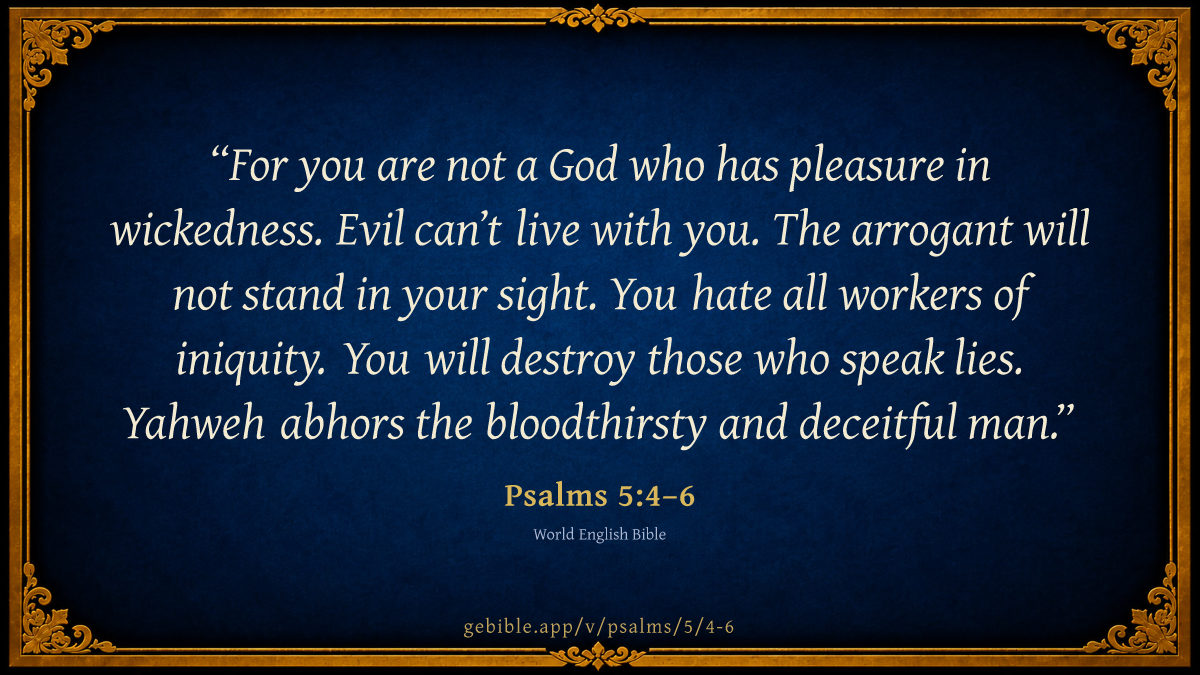
Psa 5:4 For thou [art] not a God that hath pleasure in wickedness: neither shall evil dwell with thee.
Ver. 4. For thou art not a God that hath pleasure in wickedness] As the kings of the earth have, saith R. Solomon. Alexander the Great, promising a crown of one hundred and eighty pounds to those of his guests that drank most, caused forty one to kill themselves with drinking for that crown. King Charles IX of France gave one Albertus Tudius, a huckster’s son, six hundred thousand crowns to teach him to swear with a grace (Camera. Med. Histor.). But God perfectly hateth wickedness and wicked persons. There were more remarkable expressions of God’s anger upon man’s sin, in the dead body of a man, than of a beast, Num 11:31-34. The one made unclean but till the evening, the other seven days. God hateth sin worse than he doth the devil, for he hateth the devil for sin’s sake, and not sin for the devil’s sake. He hateth sin naturally in whomsoever, like as we hate poison, whether it be in a toad or in a prince’s cabinet. We read of antipathies in nature between the elephant and the boar, the lion and the cock, the horse and the stone taraxippe, &c., but nothing so great as between God, the chiefest good, and sin, the utmost evil. Let us be like affected to our heavenly Father, as dear children, abhorring that which is evil, Rom 12:9, hating it as we do hell itself, so the Greek word there signifieth, abandoning it, and abstaining from all appearance of it, as it is offensivum Dei, et aversivum a Deo, an offence against God, and a breach of his law.
Read full note →
Neither shall evil dwell with thee] Heb. sojourn with thee, or be harboured as a guest, much less as a home dweller. Peter Martyr, out of Nathan’s parable, observeth, that lust was but a stranger to David, that lodged with him for a night only, 2Sa 12:4. Though corruption may intrude upon us, and enter, yet it may not be harboured, and dwell with us; lest the traveller become the man of the house.
John Trapp, A Commentary or Exposition upon All the Books of the Old and New Testament (1647–1656) — public domain. Text from a community e-Sword module.
Matthew Poole1685 · Public DomainOn vv4–6For; or, but; or, surely.
For; or, but; or, surely.
In wickedness; or, in wicked men. Thou dost not approve of nor delight in them, or in their prayers, but dost hate and wilt destroy them, as it here follows: compare Pro 17:15. And this he saith partly for the conviction and discouragement of his enemies, who were such; and partly for his own vindication, to show that he was not such a wicked man as they falsely and maliciously represented him.
Read full note →
Dwell with thee, i.e. have any friendship, or fellowship, or quiet abode with thee, as those that dwell together usually have one with another.
Matthew Poole's English Annotations on the Holy Bible (1683–1685) — public domain. Text from a community e-Sword/MySword module.
John Gill1763 · Public DomainOn vv4–6For thou art not a God that hath pleasure…
For thou art not a God that hath pleasure in wickedness,.... Sin, ungodliness; it is contrary to his nature, who is holy, just, and good; and to his will revealed in his law, which is the same with his nature; and sin is a transgression of it. God is so far from taking pleasure in sin, that it is the abominable thing which his righteous soul hates; though this hinders not his voluntary permission of sin, or his decree of it; which he has willed, though he does not delight in it, in order to magnify the riches of his grace and mercy in the salvation of his people: nor is this contrary to the delight and pleasure which he takes in the persons of his elect in Christ, though they are sinners in themselves, and were so when he so loved them as to give his Son for them, and who died for them while they were yet sinners; and when he sends his Spirit to regenerate and sanctify them, and are after conversion guilty of many sins: for, though he delights in their persons, he has no pleasure in their sins; nor is it consistent with the holiness of his nature to take pleasure in wickedness, let it be committed by whomsoever;
neither shall evil dwell with thee; that is, the evil man, who continues in a course of wickedness, and lives and dies in his sins. He has no communion with God here, nor shall he dwell with him hereafter; but shall be bid to depart from him, whether he be a profane sinner openly, or secretly a wicked professor of religion. The sense of the psalmist is, that since they were evil and wicked men, that were risen up against him, and gave him trouble, he entertained a strong confidence that God would hear him, for himself and his friends, whose cause was righteous; and appear against his enemies, who were wicked and ungodly men; and this he grounded upon the purity and holiness of God.
John Gill's Exposition of the Whole Bible (1746–1763) — public domain (CC PDM 1.0). Text via the HelloAO Bible API.
John Wesley1765 · Public DomainOn v4Surely - Thou dost not approve of, nor delight…
Surely - Thou dost not approve of, nor delight in them, or in their prayers. Dwelt - Have any fellowship with thee.
John Wesley, Explanatory Notes Upon the Whole Bible (1754–1765) — public domain. Text via the GEBible commentary corpus.
Adam Clarke1810 · Public DomainOn vv4–6Verse 4. Neither shall evil dwell with thee.] As…
Verse 4. Neither shall evil dwell with thee.] As thou art holy, so thou hast pleasure only in holiness; and as to evil men, they shall never enter into thy glory; לא יגרך רע lo yegurecha ra, "the evil man shall not even sojourn with thee."
Adam Clarke's Commentary on the Bible (1810–1826) — public domain. Text from a community e-Sword/MySword module.
Joseph Benson1811 · Public DomainOn v5Psa 5:5-6. The foolish shall not stand in thy…
Psa 5:5-6. The foolish shall not stand in thy sight — Literally, The mad shall not stand before thine eyes; shall not be admitted to attend upon thee, nor shall they be acquitted at the judgment of the great day. The word הוללים, holelim, here rendered the foolish, properly signifies the madmen, as the learned reader may see by consulting Ecc 2:2; Ecc 2:12; Ecc 7:7; Ecc 10:13; Isa 44:25. Wicked men are intended, as the next clause explains it; who are indeed morally and really madmen, in that they oppose and fight against Omnipotence, and voluntarily expose themselves to such dreadful miseries as are implied in everlasting banishment from God, for such mean and momentary gains or pleasures as are found in sin. Thou shalt destroy — With an everlasting destruction from thy presence, and the glory of thy power, them that speak leasing — Or falsehood, that continue so to do, and will not be reformed: that are void of integrity and veracity, or who suffer themselves to be employed by the father of lies in spreading calumnies and slanders. The Lord will abhor the bloody man also — That is, the passionate, the malicious, the implacable. For inhumanity, cruelty, and revenge are no less contrary, no less hateful to the God of mercy, than deceit, lies, and slanders are to the God of truth.
Joseph Benson's Commentary on the Old and New Testaments (1811–1818) — public domain. Text from a community e-Sword module.
Albert Barnes1834 · Public DomainOn vv4–6For thou art not a God that hath pleasure…
For thou art not a God that hath pleasure in wickedness - The psalmist here refers to a well-known and well-understood characteristic of the Divine Being, that he was holy and pure, and that he could not have any pleasure in furthering the designs of wicked men. This is said with reference to his enemies, who were thus wicked; and the idea is that God would not, and could not, consistently with his nature, further their designs. This is the ground of encouragement which he had to pray - that he was conscious that his own aims were right, and that his cause was just, and that God could not favor the cause of the ungodly. This is still, and always will be, a ground of encouragement in prayer. If we know that our cause is right, we may look to God to favor it; if a cause is wrong, we cannot look to him to interpose to advance it. Good men, therefore, pray; wicked men do not.
Neither shall evil dwell with thee - The same idea is here expressed in another form. If God should show favor to the wicked, it would seem as if he admitted them to his habitation, as we do our friends and those in whom we delight. But as God would not do this, the psalmist feels that it was proper for him to call upon Him to deliver him from wicked people.
Albert Barnes' Notes on the Bible (1834–1885) — public domain. Text from a community e-Sword/MySword module.
Robert Jamieson, A. R. Fausset & David Brown1871 · Public DomainOn vv4–6For, &c.--God only regards sincere worshippers.
For, &c.--God only regards sincere worshippers.
evil--or, "the evil man."
Read full note →
dwell--lodge, remain under protection.
Jamieson, Fausset & Brown — Commentary Critical and Explanatory on the Whole Bible (1871) — public domain (CC PDM 1.0). Text via the HelloAO Bible API.
Daniel D. Whedon1874 · Public DomainOn vv4–64. For—Because. He now states the ground or cause…
4. For—Because. He now states the ground or cause of his trusting in prayer, which he gives in Psa_5:4-6, namely, the fact that God cannot approve or allow wickedness, and that he is “my God and my King,” (Psa_5:2.)
Neither shall evil dwell with thee—Shall not inhabit or abide with thee. Evil men shall not live with God in the same house, (Psa_15:1,) nor in any relations of favour or friendliness. In Psa_5:4-6 seven designations are given to the wicked, all abhorrent to God. In the wicked God does not delight. There is no agreeableness in them. The evil man shall not dwell with him.
Daniel D. Whedon (gen. ed.), Commentary on the Old and New Testaments (1874–1909) — public domain. Text from a community e-Sword module.
The Cambridge Bible for Schools and Colleges1878 · Public DomainOn vv4–54. a God] El, not Elohim. If the fundamental…
4. a God] El, not Elohim. If the fundamental idea of this name for God is that of power[3], its use here is significant. Power without goodness is the fetishistic conception of deity, to which human nature is prone (Psa_50:21).
[3] Attractive but questionable is Lagarde’s explanation of the name El as ‘the Being to Whom man turns,’ the aim and end of all human longing and effort.
Read full note →
neither shall evil dwell with thee] Rather, as R.V. marg., with the LXX, Vulg. and Jerome, The evil man shall not sojourn with thee. He cannot be (so to speak) God’s guest, and enjoy the hospitality and protection which Oriental custom prescribes. See on Psa_15:1, and cp. Psa_61:4. To sinners the divine holiness is a consuming fire which they cannot endure (Isa_33:14).
4–6. The ground of the Psalmist’s confident expectation of an answer is the holiness of God, who will tolerate no evil. Comp. the ideal of an earthly king’s court in Psalms 101.
The Cambridge Bible for Schools and Colleges (gen. ed. J. J. S. Perowne; Cambridge University Press, 1878–1918) — public domain. Text from a community e-Sword module.
Ellicott's Commentary for English Readers1878 · Public DomainOn vv4–6(4) Neither shall evil.—Better, the wicked man is not…
(4) Neither shall evil.—Better, the wicked man is not thy guest. For the same thought, see Psalms 15; and for the opposite, of God coming to dwell with the godly, Isa_57:15.
A Bible Commentary for English Readers, edited by Charles John Ellicott (1878–1897) — public domain. Text from a community e-Sword module.
The Pulpit Commentary1880 · Public DomainOn vv4–6For thou art not a God that hath pleasure…
For thou art not a God that hath pleasure in wickedness. Thou wilt listen to the prayer of a righteous man, (Psa_4:1) since thou dost not delight in wickedness, but in goodness. Neither shall evil dwell with thee. Light has no fellowship with darkness. Evil men can obtain no support from thee, who art All-holy. They will scarcely venture to ask thy aid.
Vers. 4, 5. God"s hatred of sin.
Read full note →
"Thou art not a God that hath pleasure in wickedness," etc. It needs courage to preach the severe side of Bible truth. Time was when preaching could not be too severe. Men loved to hear the thunder and see the fire of Sinai. Now it cannot be too flattering and soothing. A view of Divine love is current, not to say fashionable, which tends to reduce it to an easy-going apathetic tolerance, taking little account of the difference between moral good and evil. We need reminding that in God"s judgment the opposition is irreconcilable, infinite, eternal. These verses strongly set forth God"s hatred of sin.
I GOD"S HATRED OF SIN IS INSEPARABLE FROM HIS HOLINESS. Having "no pleasure in wickedness" stands here for abhorrence, unchangeable opposition. Were it possible to conceive "a God that hath pleasure in wickedness," this would be the most terrible, hateful, and hideous of all imaginations an Omnipotent Fiend I Even a wicked man must see that such a thought is monstrous. But if all sympathy with evil is thus abhorrent to the Divine character, the very thought revolting, it follows that sin must be infinitely hateful to God. Not to hate sin is characteristic of a bad man; (Psa_36:4) he finds in himself no standard by which to test and hate it. "Ye that love the Lord, hate evil!". (Psa_97:10)
II GOD"S HATRED OF SIN DOES NOT CONTRADICT HIS LOVE, but is inseparable from it. Because "God is love," he must desire the happiness of his creatures. But men are created to be happy through holiness. Sin poisons the very source of human happiness; fills the world with strife, injustice, cruelty, vice, disease, want, pain, tears, death. Where would Divine love be if our Maker calm]y looked upon the destruction of all that is best in his creatures, and the wholesale wreck of human happiness? Again, because "God is love," he must desire the love of his children. Love asks love. Sin robs God of his children"s love; robs them of the very power of loving him, and of all the joy that can spring only from his love. Because "God is love," he must desire men to know him and converse with him; and in this communion grow up to their true spiritual stature. (Eph_4:13) Sin tends to banish the knowledge of God from earth; to dry and choke the channel of communion with God. (Joh_17:3 Rom_1:20, Rom_1:21, 28 Eph_4:18)
III How CAN HATRED OF EVIL BE RECONCILED WITH LOVE TO THE WRONG-DOER? How separate sin from sinners the sinner from his sins? The gospel is the answer. By the atonement of the Son of God, and by the renewing power of the Holy Ghost. (Rom_5:8 Tit_3:5, 6 1Co_6:11) The Old Testament Scriptures contain abundant promises of pardon to the penitent; and one wonderful example in King Manasseh. (Exo_34:6, 7 Ps 32 2Ch_33:12, 2Ch_33:13) But Law, and fear of punishment, were necessarily predominant till "grace and truth came by Jesus Christ." On the other hand, never forget that if the sinner will not and cannot separated from his sin, the New Testament is fully as severe as the Old. (Mat_7:23 Mat_13:49, 50 Rom_2:8, Rom_2:9) The cross, which reveals God"s love to sinners, is at the same time the most tremendous of all witnesses against sin. (Rom_8:3, Rom_8:4)
The Pulpit Commentary (1880–1919), ed. H.D.M. Spence-Jones & Joseph S. Exell — public domain. Text from a community e-Sword module.
Charles H. Spurgeon1885 · Public DomainOn vv5–6Ver. 5. What an astonishing thing is sin, which…
Ver. 5. What an astonishing thing is sin, which maketh the God of love and Father of mercies an enemy to his creatures, and which could only be purged by the blood of the Son of God! Though all must believe this who believe the Bible, yet the exceeding sinfulness of sin is but weakly apprehended by those who have the deepest sense of it, and will never be fully known in this world. Thomas Adam's Private Thoughts, 1701-1784.
Ver. 5. (last clause). Thou hatest all workers of iniquity. For what God thinks of sin, see #De 7:22; Pr 6:16; Re 2:6, 15; where he expresseth his detestation and hatred of it, from which hatred proceeds all those direful plagues and judgments thundered from the fiery mouth of his most holy law against it; nay, not only the work, but worker also of iniquity becomes the object of his hatred. William Gurnall.
Read full note →
Ver. 5. (last clause). Thou hatest all workers of iniquity. If God's hatred be against the workers of iniquity, how great is it against iniquity itself! If a man hates a poisonous creature, he hates poison much more. The strength of God's hatred is against sin, and so should we hate sin, and hate it with strength; it is an abomination unto God, let it be so unto us. #Pr 6:16-19, "These six things doth the Lord hate; yea, seven are an abomination unto him; a proud look, a lying tongue, and hands that shed innocent blood, an heart that deviseth wicked imaginations, feet that be swift to mischief, a false witness that speaketh lies, and he that soweth discord among brethren." William Greenhill.
Ver. 5. (last clause). Those whom the Lord hates must perish. But he hates impenitent sinners, Thou hatest all workers of iniquity. Now, who are so properly workers of iniquity as those who are so eager at it that they will not leave this work, though they be in danger to perish for it? Christ puts it out of doubt. The workers of iniquity must perish. #Lu 13:27. Those whom the Lord will tear in his wrath must perish with a witness; but those whom he hates, he tears, &c. #Job 16:8. What more due to such impenitent sinners than hatred? What more proper than wrath, since they treasure up wrath? #Ro 2:5. Will he entertain those in the bosom of love whom his soul hates? No; destruction is their portion. #Pr 21:15. If all the curses of the law, all the threatenings of the gospel, all judgments in earth or in hell, will be the ruin of him, he must perish. If the Lord's arm be strong enough to wound him dead, he must die. #Ps 68:21... Avoid all that Christ hates. If you love, approve, entertain that which is hateful to Christ, how can he love you? What is that which Christ hates? The psalmist (#Ps 45:7) tells us, making it one of Christ's attributes, to hate wickedness ... As Christ hates iniquity, so the "workers of iniquity." You must not love them, so as to be intimate with them, delight in the company of evil doers, openly profane, scorners of godliness, obstructors of the power of it. #2Co 6:14-18. If you love so near relations to wicked men, Christ will have no relation to you. If you would have communion with Christ in sweet acts of love, you must have no fellowship with the unfruitful works of darkness, nor those that act them. David Clarkson, B.D., 1621-1686.
Ver. 5. "The foolish." Show why sinners are justly called fools.
Ver. 6. Observe, that evil speakers must be punished as well as evil workers, for thou shalt destroy them that speak leasing. All liars shall have their portion in the lake which burneth with fire and brimstone. A man may lie without danger of the law of man, but he will not escape the law of God. Liars have short wings, their flight shall soon be over, and they shall fall into the fiery floods of destruction.
The Lord will abhor the bloody and deceitful man. Bloody men shall be made drunk with their own blood, and they who began by deceiving others shall end with being deceived themselves. Our old proverb saith, "Bloody and deceitful men dig their own graves." The voice of the people is in this instance the voice of God. How forcible is the word abhor! Does it not show us how powerful and deep-seated is the hatred of the Lord against the workers of iniquity?
Ver. 4-6. Here the Lord's alienation from the wicked is set forth gradually, and seems to rise by six steps. First, he hath no pleasure in them; secondly, they shall not dwell with him; thirdly, he casteth them forth, they shall not stand in his sight; fourthly, his heart turns from them, thou hatest all the workers of iniquity; fifthly, his hand is turned upon them, thou shalt destroy them that speak leasing; sixthly, his spirit rises against them, and is alienated from them, the Lord will abhor the bloody man. This estrangement is indeed a strange (yet a certain) punishment to the workers of iniquity. These words, "the workers of iniquity," may be considered two ways. First, as intending (not all degrees of sinners, or sinners of every degree, but) the highest degree of sinners, great, and gross sinners, resolved and wilful sinners. Such as sin industriously, and, as it were, artificially, with skill and care to get themselves a name, as if they had an ambition to be accounted workmen that need not to be ashamed of doing that whereof all ought to be ashamed; these, in strictness of Scripture sense, are "workers of iniquity." Hence note, notorious sinners make sin their business, or trade. Though every sin be a work of iniquity, yet only some sinners are "workers of iniquity;" and they who are called so, make their calling to sin. We read of some who love and make a lie. #Re 22:15. A lie may be told by those who neither love nor make it; but there are lie-makers, and they, sure enough, are lovers of a lie. Such craftsmen in sinning are also described in #Ps 58:2"Yea, in heart ye work wickedness; ye weigh the violence of your hands in the earth." The psalmist doth not say, they had wickedness in their heart, but they did work it there; the heart is a shop within, an underground shop; there they did closely contrive, forge, and hammer out their wicked purposes, and fit them into actions. Joseph Caryl.
Charles H. Spurgeon's The Treasury of David (1869–1885) — public domain. Psalms only. Text from a community e-Sword/MySword module.
The Biblical Illustrator1887 · Public DomainOn v4Thou art not a God that hath pleasure in…
Psa_5:4-5
Thou art not a God that hath pleasure in wickedness.
Read full note →
The great matters of religion
If we inquire how it comes to pass that man is fallen under Gods displeasure, the text resolves it all into wickedness. This is that which makes all the breach between God and us. This is that which bath wrought all the mischief and disorder that ever hath been in the creation of God from the beginning. This is that which hath so sunk and debased the nature of man, and made it so unlike the Divine nature. Whosoever is in love with evil, cannot be in love with the ways of goodness and righteousness. Whosoever consents to iniquity, does voluntarily part with God, and God leaves him. Atheists make the prosperity of wicked men an argument against Divine Providence. To make a man a wicked person in the sense of Scripture, there must be either gross carelessness and neglect of God and religion: voluntary consent to known iniquity, known hypocrisy, or great apostasy, in matters of doctrine, or in matters of practice. Those that are wicked cannot have to do with God; they stand at a great distance from Him, and are banished from His throne. We best know God by imitation and resemblance of Him. We cannot build upon any report concerning God, which a bad man makes; for if he should speak right of God, he would condemn himself. Goodness, which is Gods perfection, and wickedness, which is mans acquisition, can no more consist together than light and darkness, health and sickness, soundness and rottenness. Persons of naughty minds have no true thoughts either of God or man. What, then, are the great matters of religion, and what are those things that will consist with it? To reverence and acknowledge the Deity. To live in love, and bear goodwill towards one another. To deal justly, equally, and fairly in all our transactions and dealings each with other. To use moderation and government of ourselves, in the respect of the necessaries and conveniences of this state. The following things are matters of offence, and of the creatures ruin. Things contrary to the due respect and regard which we ought to bear towards God. Things that are contrary to the general love and goodwill which ought to run through the whole creation of God. Things contrary to that fairness, justice, righteousness, and equal dealing which ought to be among fellow servants, among fellow creatures. Things contrary to the sobriety, chastity, temperance, and due moderation of ourselves Two things concerning repentance.
1. It doth alter the very temper of the sinner.
2. It is a motive with God, and doth affect Him. It doth procure atonement in respect of God. (B. Whichcote, D. D.)
Gods hatred of sin
1. Some of the grounds of that displeasure which God cherishes towards sin. The justice of God must lead Him to view with displeasure that evil and abominable thing. The love--the service which God requires, is love and obedience. To withhold this service is to act unjustly towards Him. The benevolence of God must ever lead Him to regard sin with abhorrence. What is sin but a soul going away from its Maker, from the great Fountain of living waters? As the great Lawgiver of the universe, God must look with deep displeasure on sin. The law is holy, and just and good. When we act in opposition to this law, we, in fact, lift up our testimony against the law. Further, God is the Author of all our mercies, and as such must look with deep displeasure on the workers of iniquity. How great is the debt and obligation under which we are laid to Him by the load of His providential bounty! There has not been a moment of our lives in which the God who made us has not been doing something for us. What must He think of that evil thing which leads to such ingratitude for these blessings? And God must look with displeasure on sin, because it is opposed to all those great schemes, all these grand schemes, which we read in the Scriptures, of Jehovah having imparted; such as creation, providence, redemption.
2. Manifestations of the existence and the extent of that hatred of iniquity which God habitually cherishes. We find many such manifestations. Illustration--Angels that lost their first estate. Loss of Eden. Story of Sodom, etc. (James Marshall, A. M.)
Thou hatest all workers of iniquity.
Gods hatred of sinners
Here is a plain declaration.
I. That God does hate the persons of impenitent sinners. It is often said that God hates sin, but not sinners. The point now to prove is, that God hates sinners themselves, as vile and odious creatures. It is allowed that God loves all that love Him, and it is equally true that He hates those who hate Him. The Old Testament abounds with passages in which God expresses His displeasure, His wrath, and His indignation towards sinners.
II. Why does God hate the persons of sinners? Many consider sin in the abstract, and God as hating it in the abstract. But who can conceive of sin without a sinner? Or of sin that no person ever committed? Every sin is a transgression of the law, and renders the transgressor both criminal and hateful. The transgression cannot be separated from the transgressor, any more than his reason, or conscience, or any other property or quality of his mind can be separated from him. The apostle represents sin as corrupting all the powers and faculties of sinners. This moral corruption of sinners he represents as rendering them vile and hateful, even in their own sight. Their evil hearts render their persons morally evil and hateful in the sight of God. It is holiness of heart that makes saints lovely, and the reverse is equally true of sinners.
III. How Gods hating the persons of sinners is consistent with His loving them. Some have attempted to evade this difficulty by supposing that all the Scripture says about the displeasure, the hatred, the wrath and anger of God, is to be understood figuratively; and that no such exercises or emotions of heart can exist in the mind of an absolutely perfect and immutable being. But to suppose that God does not really hate sinners is evading rather than solving the difficulty. Others say that God loves sinners themselves, and only hates their sins. But it is abundantly evident from Scripture that God does really and literally love and hate sinners at the same time. What kind of love does God exercise towards sinners? They are not proper objects of approbation or complacence, but of disapprobation and hatred. It is only the love of benevolence that God exercises towards totally depraved sinners. He loves all His creatures, whether rational or irrational. If He loves them with the love of benevolence, He cannot love them with the love of complacence. Benevolence hates selfish and sinful creatures, as much as it loves holy and virtuous creatures. Holiness in the Deity produces love to the holy, and hatred to the unholy. There are two things in sinners which render them objects of both love and hatred. Their capacity to enjoy happiness and suffer misery renders them proper objects of benevolence, and their sinful character renders them proper objects of displeasure, disapprobation, and hatred. God views them in both lights. His love towards them is benevolent love, and His hatred towards them is benevolent hatred. Improvement.
1. If Gods hatred of impenitent sinners is consistent with His love of benevolence towards them, then it is consistent with His benevolence to hate them as long as they continue impenitent.
2. If God loves and hates sinners in this world at all, then He loves and hates them more than any other being does in the universe.
3. If impenitent sinners themselves are as much the objects of Gods hatred as of His love, then it is very important that they should be made sensible of it.
4. If it be consistent with the benevolence of God towards sinners to hate them, then it is consistent with His benevolence to express His hatred towards them.
5. If Gods hatred of impenitent sinners flows from His benevolence, then His punishing them must flow from His benevolence.
6. If it be the benevolence of God that disposes Him to hate and punish impenitent sinners forever, then it is extremely absurd and dangerous for sinners to rely on His mere benevolence to save them in the eleventh and dying hour. This subject calls on all to inquire and determine whether they are saints or sinners. (N. Emmons, D. D)
The relation of the righteous God to wicked men
In the second century, Celsus, a celebrated adversary of Christianity, distorting our Lords words, complained, Jesus Christ came into the world to make the most horrible and dreadful society; for He calls sinners and not the righteous; so that the body He came to assemble is a body of profligates, separated from good men, among whom they before were mixed. He has rejected all the good and collected all the bad. True, said Origen in reply, our Jesus came to call sinners--but--to repentance. He assembled wicked--but to convert them into new men, or rather to change them into angels. We come to Him covetous, He makes us liberal; lascivious, He makes us chaste; violent, He makes us meek; impious, He makes us religious.
The Biblical Illustrator, edited by Joseph S. Exell (c. 1880s–1900s) — public domain. Text from a community e-Sword module.
unfoldingWord translationNotes2017 · CC BY-SA 4.0On v4Yahweh despises violent and deceitful men
Yahweh despises violent and deceitful men
Since David is speaking to God in this psalm, this sentence can be stated with the word "you." AT: "Yahweh, you despise violent and deceitful men" or "Yahweh, you hate men who do violent acts and deceive others" (See: First, Second, or Third Person)
Tyndale Open Study Notes2022 · CC BY-SA 4.0On v55:5 the proud: Mockers (see study note on 1:1),…
5:5 the proud: Mockers (see study note on 1:1), the wicked (73:3; 75:4), and the arrogant (10:2) use their mouths to twist truth and challenge the faith of the godly. • The Lord allows only the godly into his presence (see 1:5). His holiness and justice do not tolerate oppression or those who do evil. • you hate: The Lord rejects proud sinners (see also 11:5).
 GEBible — Godless Engineer's Bible App
John Calvin 1540 · Public Domain On v4 Here David makes the malice and wickedness of his…
Here David makes the malice and wickedness of his enemies an argument to enforce his prayer for the divine favor towards him. The language is indeed abrupt, as the saints in prayer will often stammer; but this stammering is more acceptable to God than all the figures of rhetoric, be they ever so fine and glittering. Besides, the great object which David has in view, is to show, that since the cruelty and treachery of his enemies had reached their utmost height, it was impossible but that God would soon arrest them in their course. His reasoning is grounded upon the nature of God. Since righteousness and upright dealing are pleasing to him, David, from this, concludes that he will take vengeance on all the unjust and wicked. And how is it possible for them to escape from his hand unpunished, seeing he is the judge of the world? The passage is worthy of our most special attention. For we know how greatly we are discouraged by the unbounded insolence of the wicked. If God does not immediately restrain it, we are either stupified and dismayed, or cast down into despair. But David, from this, rather finds matter of encouragement and confi-dence. The greater the lawlessness with which his enemies proceeded against him, the more earnestly did he supplicate preservation from God, whose office it is to destroy all the wicked, because he hates all wickedness. Let all the godly, therefore, learn, as often as they have to contend against violence, deceit, and injustice, to raise their thoughts to God in order to encourage themselves in the certain hope of deliverance, according as Paul also exhorts them in 2 Thessalonians 1:5, “Which is,” says he, “a manifest token of the righteous judgment of God, that ye may be counted worthy of the kingdom of God, for which ye also suffer: seeing it is a righteous thing with God to recompense tribulation to them that trouble you; and to you who are troubled, rest with us.” And assuredly he would not be the judge of the world if there were not laid up in store with him a recompense for all the ungodly. One use, then, which may be made of this doctrine is this, — when we see the wicked indulging themselves in their lusts, and when, in consequence, doubts steal into our minds as to whether God takes any care of us, we should learn to satisfy ourselves with the consideration that God, who hates and abhors all iniquity, will not permit them to pass unpunished, and although he bear with them for a time, he will at length ascend into the judgment-seat, and show himself an avenger, as he is the protector and defender of his people. “Comme il est protecteur et defenseur des siens.” — Fr.
In the 4th verse some take רע, ra, in the masculine gender, for a wicked man; but I understand it rather of wickedness itself David declares simply, that there is no agreement between God and unrighteousness. He immediately after proceeds to speak of the men themselves, saying, the foolish shall not stand in thy sight; and it is a very just inference from this, that iniquity its hateful to God, and that, therefore, he will execute just punishment upon all the wicked. He calls those fools, according to a frequent use of the term in Scripture, who, impelled by blind passion, rush headlong into sin. Nothing is more foolish, than for the ungodly to cast away the fear of God, and suffer the desire of doing mischief to be their ruling principle; yea, there is no madness worse than the contempt of God, under the influence of which men pervert all right. David sets this truth before himself for his own comfort; but we also may draw from it doctrine very useful in training us to the fear of God; for the Holy Spirit, by declaring God to be the avenger of wickedness, puts a bridle upon us, to restrain us from committing sin, in the vain hope of escaping with impunity.
John Calvin's Commentaries (1540-1563) — public domain. Text from the Calvin Translation Society English edition (1840s-50s) via the Christian Classics Ethereal Library (ccel.org). Calvin's coverage is partial (roughly two-thirds of the Bible); uncommented books and verses are honest gaps, never fabricated. The 19th-century editor's footnotes and remarks are omitted so the notes are faithfully Calvin's own voice.
Geneva Bible translators 1599 · Public Domain On vv4–5 Seeing that God of nature hateth wickedness, he must…
Seeing that God of nature hateth wickedness, he must needs punish the wicked, and save the godly.
Geneva Bible (1599) marginal notes — public domain.
John Trapp 1656 · Public Domain On vv4–6 Psa 5:4 For thou [art] not a God that…
Psa 5:4 For thou [art] not a God that hath pleasure in wickedness: neither shall evil dwell with thee.
Ver. 4. For thou art not a God that hath pleasure in wickedness] As the kings of the earth have, saith R. Solomon. Alexander the Great, promising a crown of one hundred and eighty pounds to those of his guests that drank most, caused forty one to kill themselves with drinking for that crown. King Charles IX of France gave one Albertus Tudius, a huckster’s son, six hundred thousand crowns to teach him to swear with a grace (Camera. Med. Histor.). But God perfectly hateth wickedness and wicked persons. There were more remarkable expressions of God’s anger upon man’s sin, in the dead body of a man, than of a beast, Num 11:31-34. The one made unclean but till the evening, the other seven days. God hateth sin worse than he doth the devil, for he hateth the devil for sin’s sake, and not sin for the devil’s sake. He hateth sin naturally in whomsoever, like as we hate poison, whether it be in a toad or in a prince’s cabinet. We read of antipathies in nature between the elephant and the boar, the lion and the cock, the horse and the stone taraxippe, &c., but nothing so great as between God, the chiefest good, and sin, the utmost evil. Let us be like affected to our heavenly Father, as dear children, abhorring that which is evil, Rom 12:9, hating it as we do hell itself, so the Greek word there signifieth, abandoning it, and abstaining from all appearance of it, as it is offensivum Dei, et aversivum a Deo, an offence against God, and a breach of his law.
Read full note →
Neither shall evil dwell with thee] Heb. sojourn with thee, or be harboured as a guest, much less as a home dweller. Peter Martyr, out of Nathan’s parable, observeth, that lust was but a stranger to David, that lodged with him for a night only, 2Sa 12:4. Though corruption may intrude upon us, and enter, yet it may not be harboured, and dwell with us; lest the traveller become the man of the house.
John Trapp, A Commentary or Exposition upon All the Books of the Old and New Testament (1647–1656) — public domain. Text from a community e-Sword module.
Matthew Poole 1685 · Public Domain On vv4–6 For; or, but; or, surely.
For; or, but; or, surely.
In wickedness; or, in wicked men. Thou dost not approve of nor delight in them, or in their prayers, but dost hate and wilt destroy them, as it here follows: compare Pro 17:15. And this he saith partly for the conviction and discouragement of his enemies, who were such; and partly for his own vindication, to show that he was not such a wicked man as they falsely and maliciously represented him.
Read full note →
Dwell with thee, i.e. have any friendship, or fellowship, or quiet abode with thee, as those that dwell together usually have one with another.
Matthew Poole's English Annotations on the Holy Bible (1683–1685) — public domain. Text from a community e-Sword/MySword module.
John Gill 1763 · Public Domain On vv4–6 For thou art not a God that hath pleasure…
For thou art not a God that hath pleasure in wickedness,.... Sin, ungodliness; it is contrary to his nature, who is holy, just, and good; and to his will revealed in his law, which is the same with his nature; and sin is a transgression of it. God is so far from taking pleasure in sin, that it is the abominable thing which his righteous soul hates; though this hinders not his voluntary permission of sin, or his decree of it; which he has willed, though he does not delight in it, in order to magnify the riches of his grace and mercy in the salvation of his people: nor is this contrary to the delight and pleasure which he takes in the persons of his elect in Christ, though they are sinners in themselves, and were so when he so loved them as to give his Son for them, and who died for them while they were yet sinners; and when he sends his Spirit to regenerate and sanctify them, and are after conversion guilty of many sins: for, though he delights in their persons, he has no pleasure in their sins; nor is it consistent with the holiness of his nature to take pleasure in wickedness, let it be committed by whomsoever;
neither shall evil dwell with thee; that is, the evil man, who continues in a course of wickedness, and lives and dies in his sins. He has no communion with God here, nor shall he dwell with him hereafter; but shall be bid to depart from him, whether he be a profane sinner openly, or secretly a wicked professor of religion. The sense of the psalmist is, that since they were evil and wicked men, that were risen up against him, and gave him trouble, he entertained a strong confidence that God would hear him, for himself and his friends, whose cause was righteous; and appear against his enemies, who were wicked and ungodly men; and this he grounded upon the purity and holiness of God.
John Gill's Exposition of the Whole Bible (1746–1763) — public domain (CC PDM 1.0). Text via the HelloAO Bible API.
John Wesley 1765 · Public Domain On v4 Surely - Thou dost not approve of, nor delight…
Surely - Thou dost not approve of, nor delight in them, or in their prayers. Dwelt - Have any fellowship with thee.
John Wesley, Explanatory Notes Upon the Whole Bible (1754–1765) — public domain. Text via the GEBible commentary corpus.
Adam Clarke 1810 · Public Domain On vv4–6 Verse 4. Neither shall evil dwell with thee.] As…
Verse 4. Neither shall evil dwell with thee.] As thou art holy, so thou hast pleasure only in holiness; and as to evil men, they shall never enter into thy glory; לא יגרך רע lo yegurecha ra, "the evil man shall not even sojourn with thee."
Adam Clarke's Commentary on the Bible (1810–1826) — public domain. Text from a community e-Sword/MySword module.
Joseph Benson 1811 · Public Domain On v5 Psa 5:5-6. The foolish shall not stand in thy…
Psa 5:5-6. The foolish shall not stand in thy sight — Literally, The mad shall not stand before thine eyes; shall not be admitted to attend upon thee, nor shall they be acquitted at the judgment of the great day. The word הוללים, holelim, here rendered the foolish, properly signifies the madmen, as the learned reader may see by consulting Ecc 2:2; Ecc 2:12; Ecc 7:7; Ecc 10:13; Isa 44:25. Wicked men are intended, as the next clause explains it; who are indeed morally and really madmen, in that they oppose and fight against Omnipotence, and voluntarily expose themselves to such dreadful miseries as are implied in everlasting banishment from God, for such mean and momentary gains or pleasures as are found in sin. Thou shalt destroy — With an everlasting destruction from thy presence, and the glory of thy power, them that speak leasing — Or falsehood, that continue so to do, and will not be reformed: that are void of integrity and veracity, or who suffer themselves to be employed by the father of lies in spreading calumnies and slanders. The Lord will abhor the bloody man also — That is, the passionate, the malicious, the implacable. For inhumanity, cruelty, and revenge are no less contrary, no less hateful to the God of mercy, than deceit, lies, and slanders are to the God of truth.
Joseph Benson's Commentary on the Old and New Testaments (1811–1818) — public domain. Text from a community e-Sword module.
Albert Barnes 1834 · Public Domain On vv4–6 For thou art not a God that hath pleasure…
For thou art not a God that hath pleasure in wickedness - The psalmist here refers to a well-known and well-understood characteristic of the Divine Being, that he was holy and pure, and that he could not have any pleasure in furthering the designs of wicked men. This is said with reference to his enemies, who were thus wicked; and the idea is that God would not, and could not, consistently with his nature, further their designs. This is the ground of encouragement which he had to pray - that he was conscious that his own aims were right, and that his cause was just, and that God could not favor the cause of the ungodly. This is still, and always will be, a ground of encouragement in prayer. If we know that our cause is right, we may look to God to favor it; if a cause is wrong, we cannot look to him to interpose to advance it. Good men, therefore, pray; wicked men do not.
Neither shall evil dwell with thee - The same idea is here expressed in another form. If God should show favor to the wicked, it would seem as if he admitted them to his habitation, as we do our friends and those in whom we delight. But as God would not do this, the psalmist feels that it was proper for him to call upon Him to deliver him from wicked people.
Albert Barnes' Notes on the Bible (1834–1885) — public domain. Text from a community e-Sword/MySword module.
Robert Jamieson, A. R. Fausset & David Brown 1871 · Public Domain On vv4–6 For, &c.--God only regards sincere worshippers.
For, &c.--God only regards sincere worshippers.
evil--or, "the evil man."
Read full note →
dwell--lodge, remain under protection.
Jamieson, Fausset & Brown — Commentary Critical and Explanatory on the Whole Bible (1871) — public domain (CC PDM 1.0). Text via the HelloAO Bible API.
Daniel D. Whedon 1874 · Public Domain On vv4–6 4. For—Because. He now states the ground or cause…
4. For—Because. He now states the ground or cause of his trusting in prayer, which he gives in Psa_5:4-6, namely, the fact that God cannot approve or allow wickedness, and that he is “my God and my King,” (Psa_5:2.)
Neither shall evil dwell with thee—Shall not inhabit or abide with thee. Evil men shall not live with God in the same house, (Psa_15:1,) nor in any relations of favour or friendliness. In Psa_5:4-6 seven designations are given to the wicked, all abhorrent to God. In the wicked God does not delight. There is no agreeableness in them. The evil man shall not dwell with him.
Daniel D. Whedon (gen. ed.), Commentary on the Old and New Testaments (1874–1909) — public domain. Text from a community e-Sword module.
The Cambridge Bible for Schools and Colleges 1878 · Public Domain On vv4–5 4. a God] El, not Elohim. If the fundamental…
4. a God] El, not Elohim. If the fundamental idea of this name for God is that of power[3], its use here is significant. Power without goodness is the fetishistic conception of deity, to which human nature is prone (Psa_50:21).
[3] Attractive but questionable is Lagarde’s explanation of the name El as ‘the Being to Whom man turns,’ the aim and end of all human longing and effort.
Read full note →
neither shall evil dwell with thee] Rather, as R.V. marg., with the LXX, Vulg. and Jerome, The evil man shall not sojourn with thee. He cannot be (so to speak) God’s guest, and enjoy the hospitality and protection which Oriental custom prescribes. See on Psa_15:1, and cp. Psa_61:4. To sinners the divine holiness is a consuming fire which they cannot endure (Isa_33:14).
4–6. The ground of the Psalmist’s confident expectation of an answer is the holiness of God, who will tolerate no evil. Comp. the ideal of an earthly king’s court in Psalms 101.
The Cambridge Bible for Schools and Colleges (gen. ed. J. J. S. Perowne; Cambridge University Press, 1878–1918) — public domain. Text from a community e-Sword module.
Ellicott's Commentary for English Readers 1878 · Public Domain On vv4–6 (4) Neither shall evil.—Better, the wicked man is not…
(4) Neither shall evil.—Better, the wicked man is not thy guest. For the same thought, see Psalms 15; and for the opposite, of God coming to dwell with the godly, Isa_57:15.
A Bible Commentary for English Readers, edited by Charles John Ellicott (1878–1897) — public domain. Text from a community e-Sword module.
The Pulpit Commentary 1880 · Public Domain On vv4–6 For thou art not a God that hath pleasure…
For thou art not a God that hath pleasure in wickedness. Thou wilt listen to the prayer of a righteous man, (Psa_4:1) since thou dost not delight in wickedness, but in goodness. Neither shall evil dwell with thee. Light has no fellowship with darkness. Evil men can obtain no support from thee, who art All-holy. They will scarcely venture to ask thy aid.
Vers. 4, 5. God"s hatred of sin.
Read full note →
"Thou art not a God that hath pleasure in wickedness," etc. It needs courage to preach the severe side of Bible truth. Time was when preaching could not be too severe. Men loved to hear the thunder and see the fire of Sinai. Now it cannot be too flattering and soothing. A view of Divine love is current, not to say fashionable, which tends to reduce it to an easy-going apathetic tolerance, taking little account of the difference between moral good and evil. We need reminding that in God"s judgment the opposition is irreconcilable, infinite, eternal. These verses strongly set forth God"s hatred of sin.
I GOD"S HATRED OF SIN IS INSEPARABLE FROM HIS HOLINESS. Having "no pleasure in wickedness" stands here for abhorrence, unchangeable opposition. Were it possible to conceive "a God that hath pleasure in wickedness," this would be the most terrible, hateful, and hideous of all imaginations an Omnipotent Fiend I Even a wicked man must see that such a thought is monstrous. But if all sympathy with evil is thus abhorrent to the Divine character, the very thought revolting, it follows that sin must be infinitely hateful to God. Not to hate sin is characteristic of a bad man; (Psa_36:4) he finds in himself no standard by which to test and hate it. "Ye that love the Lord, hate evil!". (Psa_97:10)
II GOD"S HATRED OF SIN DOES NOT CONTRADICT HIS LOVE, but is inseparable from it. Because "God is love," he must desire the happiness of his creatures. But men are created to be happy through holiness. Sin poisons the very source of human happiness; fills the world with strife, injustice, cruelty, vice, disease, want, pain, tears, death. Where would Divine love be if our Maker calm]y looked upon the destruction of all that is best in his creatures, and the wholesale wreck of human happiness? Again, because "God is love," he must desire the love of his children. Love asks love. Sin robs God of his children"s love; robs them of the very power of loving him, and of all the joy that can spring only from his love. Because "God is love," he must desire men to know him and converse with him; and in this communion grow up to their true spiritual stature. (Eph_4:13) Sin tends to banish the knowledge of God from earth; to dry and choke the channel of communion with God. (Joh_17:3 Rom_1:20, Rom_1:21, 28 Eph_4:18)
III How CAN HATRED OF EVIL BE RECONCILED WITH LOVE TO THE WRONG-DOER? How separate sin from sinners the sinner from his sins? The gospel is the answer. By the atonement of the Son of God, and by the renewing power of the Holy Ghost. (Rom_5:8 Tit_3:5, 6 1Co_6:11) The Old Testament Scriptures contain abundant promises of pardon to the penitent; and one wonderful example in King Manasseh. (Exo_34:6, 7 Ps 32 2Ch_33:12, 2Ch_33:13) But Law, and fear of punishment, were necessarily predominant till "grace and truth came by Jesus Christ." On the other hand, never forget that if the sinner will not and cannot separated from his sin, the New Testament is fully as severe as the Old. (Mat_7:23 Mat_13:49, 50 Rom_2:8, Rom_2:9) The cross, which reveals God"s love to sinners, is at the same time the most tremendous of all witnesses against sin. (Rom_8:3, Rom_8:4)
The Pulpit Commentary (1880–1919), ed. H.D.M. Spence-Jones & Joseph S. Exell — public domain. Text from a community e-Sword module.
Charles H. Spurgeon 1885 · Public Domain On vv5–6 Ver. 5. What an astonishing thing is sin, which…
Ver. 5. What an astonishing thing is sin, which maketh the God of love and Father of mercies an enemy to his creatures, and which could only be purged by the blood of the Son of God! Though all must believe this who believe the Bible, yet the exceeding sinfulness of sin is but weakly apprehended by those who have the deepest sense of it, and will never be fully known in this world. Thomas Adam's Private Thoughts, 1701-1784.
Ver. 5. (last clause). Thou hatest all workers of iniquity. For what God thinks of sin, see #De 7:22; Pr 6:16; Re 2:6, 15; where he expresseth his detestation and hatred of it, from which hatred proceeds all those direful plagues and judgments thundered from the fiery mouth of his most holy law against it; nay, not only the work, but worker also of iniquity becomes the object of his hatred. William Gurnall.
Read full note →
Ver. 5. (last clause). Thou hatest all workers of iniquity. If God's hatred be against the workers of iniquity, how great is it against iniquity itself! If a man hates a poisonous creature, he hates poison much more. The strength of God's hatred is against sin, and so should we hate sin, and hate it with strength; it is an abomination unto God, let it be so unto us. #Pr 6:16-19, "These six things doth the Lord hate; yea, seven are an abomination unto him; a proud look, a lying tongue, and hands that shed innocent blood, an heart that deviseth wicked imaginations, feet that be swift to mischief, a false witness that speaketh lies, and he that soweth discord among brethren." William Greenhill.
Ver. 5. (last clause). Those whom the Lord hates must perish. But he hates impenitent sinners, Thou hatest all workers of iniquity. Now, who are so properly workers of iniquity as those who are so eager at it that they will not leave this work, though they be in danger to perish for it? Christ puts it out of doubt. The workers of iniquity must perish. #Lu 13:27. Those whom the Lord will tear in his wrath must perish with a witness; but those whom he hates, he tears, &c. #Job 16:8. What more due to such impenitent sinners than hatred? What more proper than wrath, since they treasure up wrath? #Ro 2:5. Will he entertain those in the bosom of love whom his soul hates? No; destruction is their portion. #Pr 21:15. If all the curses of the law, all the threatenings of the gospel, all judgments in earth or in hell, will be the ruin of him, he must perish. If the Lord's arm be strong enough to wound him dead, he must die. #Ps 68:21... Avoid all that Christ hates. If you love, approve, entertain that which is hateful to Christ, how can he love you? What is that which Christ hates? The psalmist (#Ps 45:7) tells us, making it one of Christ's attributes, to hate wickedness ... As Christ hates iniquity, so the "workers of iniquity." You must not love them, so as to be intimate with them, delight in the company of evil doers, openly profane, scorners of godliness, obstructors of the power of it. #2Co 6:14-18. If you love so near relations to wicked men, Christ will have no relation to you. If you would have communion with Christ in sweet acts of love, you must have no fellowship with the unfruitful works of darkness, nor those that act them. David Clarkson, B.D., 1621-1686.
Ver. 5. "The foolish." Show why sinners are justly called fools.
Ver. 6. Observe, that evil speakers must be punished as well as evil workers, for thou shalt destroy them that speak leasing. All liars shall have their portion in the lake which burneth with fire and brimstone. A man may lie without danger of the law of man, but he will not escape the law of God. Liars have short wings, their flight shall soon be over, and they shall fall into the fiery floods of destruction.
The Lord will abhor the bloody and deceitful man. Bloody men shall be made drunk with their own blood, and they who began by deceiving others shall end with being deceived themselves. Our old proverb saith, "Bloody and deceitful men dig their own graves." The voice of the people is in this instance the voice of God. How forcible is the word abhor! Does it not show us how powerful and deep-seated is the hatred of the Lord against the workers of iniquity?
Ver. 4-6. Here the Lord's alienation from the wicked is set forth gradually, and seems to rise by six steps. First, he hath no pleasure in them; secondly, they shall not dwell with him; thirdly, he casteth them forth, they shall not stand in his sight; fourthly, his heart turns from them, thou hatest all the workers of iniquity; fifthly, his hand is turned upon them, thou shalt destroy them that speak leasing; sixthly, his spirit rises against them, and is alienated from them, the Lord will abhor the bloody man. This estrangement is indeed a strange (yet a certain) punishment to the workers of iniquity. These words, "the workers of iniquity," may be considered two ways. First, as intending (not all degrees of sinners, or sinners of every degree, but) the highest degree of sinners, great, and gross sinners, resolved and wilful sinners. Such as sin industriously, and, as it were, artificially, with skill and care to get themselves a name, as if they had an ambition to be accounted workmen that need not to be ashamed of doing that whereof all ought to be ashamed; these, in strictness of Scripture sense, are "workers of iniquity." Hence note, notorious sinners make sin their business, or trade. Though every sin be a work of iniquity, yet only some sinners are "workers of iniquity;" and they who are called so, make their calling to sin. We read of some who love and make a lie. #Re 22:15. A lie may be told by those who neither love nor make it; but there are lie-makers, and they, sure enough, are lovers of a lie. Such craftsmen in sinning are also described in #Ps 58:2"Yea, in heart ye work wickedness; ye weigh the violence of your hands in the earth." The psalmist doth not say, they had wickedness in their heart, but they did work it there; the heart is a shop within, an underground shop; there they did closely contrive, forge, and hammer out their wicked purposes, and fit them into actions. Joseph Caryl.
Charles H. Spurgeon's The Treasury of David (1869–1885) — public domain. Psalms only. Text from a community e-Sword/MySword module.
The Biblical Illustrator 1887 · Public Domain On v4 Thou art not a God that hath pleasure in…
Psa_5:4-5
Thou art not a God that hath pleasure in wickedness.
Read full note →
The great matters of religion
If we inquire how it comes to pass that man is fallen under Gods displeasure, the text resolves it all into wickedness. This is that which makes all the breach between God and us. This is that which bath wrought all the mischief and disorder that ever hath been in the creation of God from the beginning. This is that which hath so sunk and debased the nature of man, and made it so unlike the Divine nature. Whosoever is in love with evil, cannot be in love with the ways of goodness and righteousness. Whosoever consents to iniquity, does voluntarily part with God, and God leaves him. Atheists make the prosperity of wicked men an argument against Divine Providence. To make a man a wicked person in the sense of Scripture, there must be either gross carelessness and neglect of God and religion: voluntary consent to known iniquity, known hypocrisy, or great apostasy, in matters of doctrine, or in matters of practice. Those that are wicked cannot have to do with God; they stand at a great distance from Him, and are banished from His throne. We best know God by imitation and resemblance of Him. We cannot build upon any report concerning God, which a bad man makes; for if he should speak right of God, he would condemn himself. Goodness, which is Gods perfection, and wickedness, which is mans acquisition, can no more consist together than light and darkness, health and sickness, soundness and rottenness. Persons of naughty minds have no true thoughts either of God or man. What, then, are the great matters of religion, and what are those things that will consist with it? To reverence and acknowledge the Deity. To live in love, and bear goodwill towards one another. To deal justly, equally, and fairly in all our transactions and dealings each with other. To use moderation and government of ourselves, in the respect of the necessaries and conveniences of this state. The following things are matters of offence, and of the creatures ruin. Things contrary to the due respect and regard which we ought to bear towards God. Things that are contrary to the general love and goodwill which ought to run through the whole creation of God. Things contrary to that fairness, justice, righteousness, and equal dealing which ought to be among fellow servants, among fellow creatures. Things contrary to the sobriety, chastity, temperance, and due moderation of ourselves Two things concerning repentance.
1. It doth alter the very temper of the sinner.
2. It is a motive with God, and doth affect Him. It doth procure atonement in respect of God. (B. Whichcote, D. D.)
Gods hatred of sin
1. Some of the grounds of that displeasure which God cherishes towards sin. The justice of God must lead Him to view with displeasure that evil and abominable thing. The love--the service which God requires, is love and obedience. To withhold this service is to act unjustly towards Him. The benevolence of God must ever lead Him to regard sin with abhorrence. What is sin but a soul going away from its Maker, from the great Fountain of living waters? As the great Lawgiver of the universe, God must look with deep displeasure on sin. The law is holy, and just and good. When we act in opposition to this law, we, in fact, lift up our testimony against the law. Further, God is the Author of all our mercies, and as such must look with deep displeasure on the workers of iniquity. How great is the debt and obligation under which we are laid to Him by the load of His providential bounty! There has not been a moment of our lives in which the God who made us has not been doing something for us. What must He think of that evil thing which leads to such ingratitude for these blessings? And God must look with displeasure on sin, because it is opposed to all those great schemes, all these grand schemes, which we read in the Scriptures, of Jehovah having imparted; such as creation, providence, redemption.
2. Manifestations of the existence and the extent of that hatred of iniquity which God habitually cherishes. We find many such manifestations. Illustration--Angels that lost their first estate. Loss of Eden. Story of Sodom, etc. (James Marshall, A. M.)
Thou hatest all workers of iniquity.
Gods hatred of sinners
Here is a plain declaration.
I. That God does hate the persons of impenitent sinners. It is often said that God hates sin, but not sinners. The point now to prove is, that God hates sinners themselves, as vile and odious creatures. It is allowed that God loves all that love Him, and it is equally true that He hates those who hate Him. The Old Testament abounds with passages in which God expresses His displeasure, His wrath, and His indignation towards sinners.
II. Why does God hate the persons of sinners? Many consider sin in the abstract, and God as hating it in the abstract. But who can conceive of sin without a sinner? Or of sin that no person ever committed? Every sin is a transgression of the law, and renders the transgressor both criminal and hateful. The transgression cannot be separated from the transgressor, any more than his reason, or conscience, or any other property or quality of his mind can be separated from him. The apostle represents sin as corrupting all the powers and faculties of sinners. This moral corruption of sinners he represents as rendering them vile and hateful, even in their own sight. Their evil hearts render their persons morally evil and hateful in the sight of God. It is holiness of heart that makes saints lovely, and the reverse is equally true of sinners.
III. How Gods hating the persons of sinners is consistent with His loving them. Some have attempted to evade this difficulty by supposing that all the Scripture says about the displeasure, the hatred, the wrath and anger of God, is to be understood figuratively; and that no such exercises or emotions of heart can exist in the mind of an absolutely perfect and immutable being. But to suppose that God does not really hate sinners is evading rather than solving the difficulty. Others say that God loves sinners themselves, and only hates their sins. But it is abundantly evident from Scripture that God does really and literally love and hate sinners at the same time. What kind of love does God exercise towards sinners? They are not proper objects of approbation or complacence, but of disapprobation and hatred. It is only the love of benevolence that God exercises towards totally depraved sinners. He loves all His creatures, whether rational or irrational. If He loves them with the love of benevolence, He cannot love them with the love of complacence. Benevolence hates selfish and sinful creatures, as much as it loves holy and virtuous creatures. Holiness in the Deity produces love to the holy, and hatred to the unholy. There are two things in sinners which render them objects of both love and hatred. Their capacity to enjoy happiness and suffer misery renders them proper objects of benevolence, and their sinful character renders them proper objects of displeasure, disapprobation, and hatred. God views them in both lights. His love towards them is benevolent love, and His hatred towards them is benevolent hatred. Improvement.
1. If Gods hatred of impenitent sinners is consistent with His love of benevolence towards them, then it is consistent with His benevolence to hate them as long as they continue impenitent.
2. If God loves and hates sinners in this world at all, then He loves and hates them more than any other being does in the universe.
3. If impenitent sinners themselves are as much the objects of Gods hatred as of His love, then it is very important that they should be made sensible of it.
4. If it be consistent with the benevolence of God towards sinners to hate them, then it is consistent with His benevolence to express His hatred towards them.
5. If Gods hatred of impenitent sinners flows from His benevolence, then His punishing them must flow from His benevolence.
6. If it be the benevolence of God that disposes Him to hate and punish impenitent sinners forever, then it is extremely absurd and dangerous for sinners to rely on His mere benevolence to save them in the eleventh and dying hour. This subject calls on all to inquire and determine whether they are saints or sinners. (N. Emmons, D. D)
The relation of the righteous God to wicked men
In the second century, Celsus, a celebrated adversary of Christianity, distorting our Lords words, complained, Jesus Christ came into the world to make the most horrible and dreadful society; for He calls sinners and not the righteous; so that the body He came to assemble is a body of profligates, separated from good men, among whom they before were mixed. He has rejected all the good and collected all the bad. True, said Origen in reply, our Jesus came to call sinners--but--to repentance. He assembled wicked--but to convert them into new men, or rather to change them into angels. We come to Him covetous, He makes us liberal; lascivious, He makes us chaste; violent, He makes us meek; impious, He makes us religious.
The Biblical Illustrator, edited by Joseph S. Exell (c. 1880s–1900s) — public domain. Text from a community e-Sword module.
unfoldingWord translationNotes 2017 · CC BY-SA 4.0 On v4 Yahweh despises violent and deceitful men
Yahweh despises violent and deceitful men
Since David is speaking to God in this psalm, this sentence can be stated with the word "you." AT: "Yahweh, you despise violent and deceitful men" or "Yahweh, you hate men who do violent acts and deceive others" (See: First, Second, or Third Person)
Read full note →
translationWords
evil
arrogant
deceive
unfoldingWord translationNotes — © Distant Shores Media and the Door43 World Missions Community, licensed CC BY-SA 4.0. Source: git.door43.org/Door43/en_tn.
Tyndale Open Study Notes 2022 · CC BY-SA 4.0 On v5 5:5 the proud: Mockers (see study note on 1:1),…
5:5 the proud: Mockers (see study note on 1:1), the wicked (73:3; 75:4), and the arrogant (10:2) use their mouths to twist truth and challenge the faith of the godly. • The Lord allows only the godly into his presence (see 1:5). His holiness and justice do not tolerate oppression or those who do evil. • you hate: The Lord rejects proud sinners (see also 11:5).
Tyndale Open Study Notes — © Tyndale Open Resources, licensed CC BY-SA 4.0. Text via the HelloAO Bible API.