Questions where the Bible appears to say two different things, with the passages on each side set together.
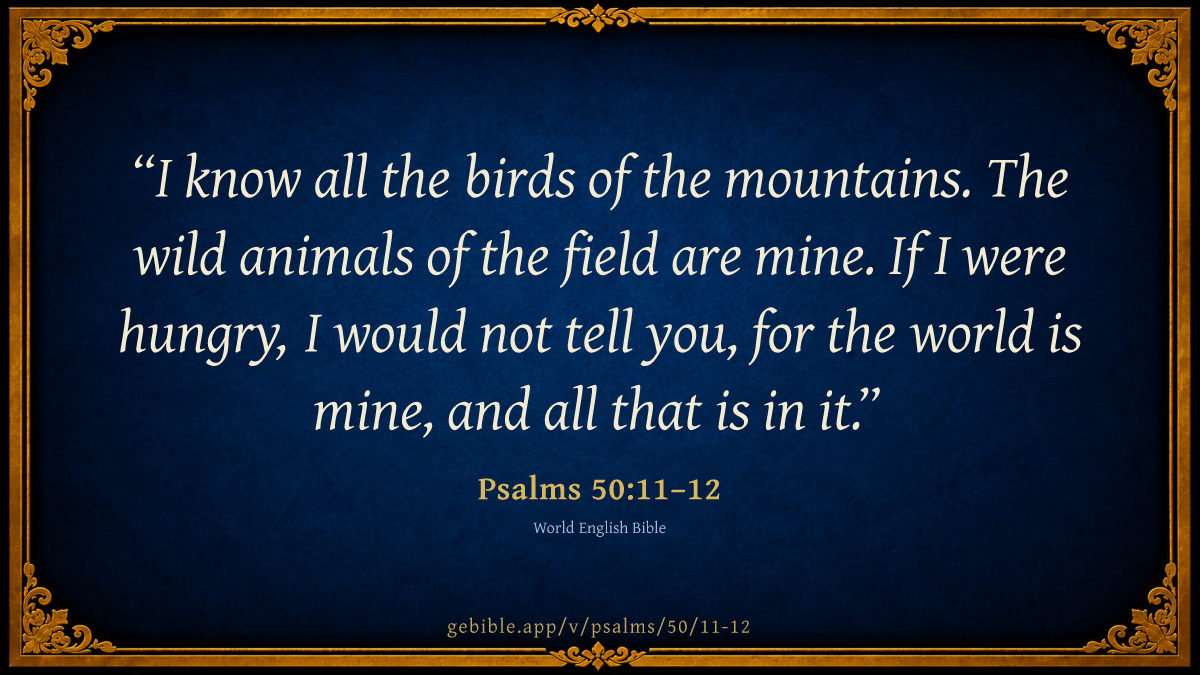
Who owns the earth?A wide set of passages (Gen 14:19, 22; Exod 9:29; 19:5; Deut 10:14; Ps 24:1; 50:12; 89:11; 1 Cor 10:26) affirm that God owns the earth absolutely.
Exodus 19:5(v12)Now therefore, if you will indeed obey my voice, and keep my covenant, then you shall be my own possession from among all peoples; for all…
Deuteronomy 10:14(v12)Behold, to Yahweh your God belongs heaven, the heaven of heavens, and the earth, with all that is therein.
Psalms 24:1-2(v12)The earth is Yahweh’s, with its fullness; the world, and those who dwell in it. For he has founded it on the seas, and established it on…
1 Corinthians 10:26-28(v12)for “the earth is the Lord’s, and its fullness.” But if one of those who don’t believe invites you to a meal, and you are inclined to go,…
Job 41:11(v12)Who has first given to me, that I should repay him? Everything under the heavens is mine.
Show all 21 cross-references
Psalms 115:15-16(v12)Blessed are you by Yahweh, who made heaven and earth. The heavens are Yahweh’s heavens, but he has given the earth to the children of men.
Matthew 6:26(v11)See the birds of the sky, that they don’t sow, neither do they reap, nor gather into barns. Your heavenly Father feeds them. Aren’t you of…
Genesis 1:20-22(v11)God said, “Let the waters abound with living creatures, and let birds fly above the earth in the open expanse of the sky.” God created the…
Genesis 1:28-30(v12)God blessed them. God said to them, “Be fruitful, multiply, fill the earth, and subdue it. Have dominion over the fish of the sea, over the…
Genesis 8:17(v12)Bring out with you every living thing that is with you of all flesh, including birds, livestock, and every creeping thing that creeps on…
Job 39:26-30(v11)“Is it by your wisdom that the hawk soars, and stretches her wings toward the south? Is it at your command that the eagle mounts up, and…
Psalms 145:15-16(v12)The eyes of all wait for you. You give them their food in due season. You open your hand, and satisfy the desire of every living thing.
Luke 12:24(v11)Consider the ravens: they don’t sow, they don’t reap, they have no warehouse or barn, and God feeds them. How much more valuable are you…
Genesis 1:11-12(v12)God said, “Let the earth yield grass, herbs yielding seeds, and fruit trees bearing fruit after their kind, with their seeds in it, on the…
Job 39:13-18(v11)“The wings of the ostrich wave proudly; but are they the feathers and plumage of love? For she leaves her eggs on the earth, warms them in…
Psalms 104:12(v11)The birds of the sky nest by them. They sing among the branches.
Psalms 104:24(v12)Yahweh, how many are your works! In wisdom, you have made them all. The earth is full of your riches.
Psalms 147:9(v11)He provides food for the livestock, and for the young ravens when they call.
Isaiah 56:9(v11)All you animals of the field, come to devour, all you animals in the forest.
Ezekiel 14:15-16(v11)“If I cause evil animals to pass through the land, and they ravage it, and it is made desolate, so that no man may pass through because of…
Matthew 10:29-31(v11)“Aren’t two sparrows sold for an assarion coin? Not one of them falls on the ground apart from your Father’s will, but the very hairs of…
Cross-references from openbible.info (CC BY 4.0)
Explain this passage (12 sources)
Historical commentary, presented as a primary source — not an endorsement.
John Trapp1656 · Public DomainOn vv11–12Psa 50:11 I know all the fowls of the…
Psa 50:11 I know all the fowls of the mountains: and the wild beasts of the field [are] mine.
Ver. 11. I know all the fowls of the mountains] i.e. In numerato habeo, saith Vatablus, they are always before me ready at my service.
Read full note →
And the wild beasts of the field] R. Solomon interpreteth it reptiles, the creeping things of the field; others, copiam volucrum in vallibus, the abundance of birds that are up and down the fields and valleys.
John Trapp, A Commentary or Exposition upon All the Books of the Old and New Testament (1647–1656) — public domain. Text from a community e-Sword module.
Matthew Poole1685 · Public DomainOn vv11–12I know where they are, and whence I can…
I know where they are, and whence I can easily fetch them when I think good.
The fowls of the mountains; not only tame and domestic fowls, but even such as are wild and fly up and down upon mountains; which though out of man’s reach, are at God’s command.
Matthew Poole's English Annotations on the Holy Bible (1683–1685) — public domain. Text from a community e-Sword/MySword module.
John Gill1763 · Public DomainOn vv11–12I know all the fowls of the mountains,.... God…
I know all the fowls of the mountains,.... God not only knows them, but takes care of them; not a sparrow fails to the ground without his knowledge, and all the fowls of the air are fed by him, Mat 10:29; and therefore needed not their turtledoves and young pigeons, which were the only fowls used in sacrifice;
and the wild beasts of the field are mine; which are mentioned in opposition to domestic ones, such as they had in their houses or folds, Psa 50:9.
John Gill's Exposition of the Whole Bible (1746–1763) — public domain (CC PDM 1.0). Text via the HelloAO Bible API.
John Wesley1765 · Public DomainOn v11The fowls - Such as are wild and fly…
The fowls - Such as are wild and fly up and down upon mountains.
John Wesley, Explanatory Notes Upon the Whole Bible (1754–1765) — public domain. Text via the GEBible commentary corpus.
Adam Clarke1810 · Public DomainOn v12Verse 12. The world is mine, and the fulness…
Verse 12. The world is mine, and the fulness thereof.] Ye cannot, therefore, give me any thing that is not my own.
Adam Clarke's Commentary on the Bible (1810–1826) — public domain. Text from a community e-Sword/MySword module.
Albert Barnes1834 · Public DomainOn vv11–12I know all the fowls of the mountains -…
I know all the fowls of the mountains - That is, I am fully acquainted with their numbers; their nature; their habits; their residence. I have such a knowledge of them that I could appropriate them to my own use if I were in need of them. I am not, therefore, dependent on people to offer them, for I can use them as I please.
And the wild beasts of the field are mine - Margin, “with me.” That is, they are before me. They are never out of my presence. At any time, therefore, I could use them as I might need them. The word rendered “wild beasts” - זיז zı̂yz - means any moving thing; and the idea here is, whatever moves in the field, or roams abroad. Everything is his - whether on the mountains, in the forest, or in the cultivated field.
Albert Barnes' Notes on the Bible (1834–1885) — public domain. Text from a community e-Sword/MySword module.
The Cambridge Bible for Schools and Colleges1878 · Public DomainOn vv11–1211. The wild beasts of the field] A peculiar…
11. The wild beasts of the field] A peculiar phrase, found only in another Asaphite Psalm (Psa_80:13), meaning probably all that moveth in the field, including the ‘creeping thing’ (Gen_1:24 f).
are mine] Lit., are with me, i.e. are in my sight (P.B.V.), or, in my mind (R.V. marg.).
Read full note →
12f. If God had need of sustenance, He would not be dependent upon man for it: but a spiritual Being needs no material support.
The Cambridge Bible for Schools and Colleges (gen. ed. J. J. S. Perowne; Cambridge University Press, 1878–1918) — public domain. Text from a community e-Sword module.
Ellicott's Commentary for English Readers1878 · Public DomainOn v11(11) Wild beasts.—Literally, that which moveth. (Comp. Psa_80:13.)
(11) Wild beasts.—Literally, that which moveth. (Comp. Psa_80:13.)
A Bible Commentary for English Readers, edited by Charles John Ellicott (1878–1897) — public domain. Text from a community e-Sword module.
The Pulpit Commentary1880 · Public DomainOn vv11–12I know all the fowls of the mountains, and…
I know all the fowls of the mountains, and the wild beasts of the field are mine; literally, are with me. All creation is God"s, known to him, and owned by him, to be dealt with at his pleasure. How, then, should he need gifts from men?
The Pulpit Commentary (1880–1919), ed. H.D.M. Spence-Jones & Joseph S. Exell — public domain. Text from a community e-Sword module.
Charles H. Spurgeon1885 · Public DomainOn vv11–12Ver. 11. I know all the fowls of the…
Ver. 11. I know all the fowls of the mountain. All the winged creatures are under my inspection and near my hand; what then can be the value of your pairs of turtledoves, and your two young pigeons? The great Lord not only feeds all his creatures, but is well acquainted with each one; how wondrous is this knowledge! And the wild beasts of the fields are mine. The whole population moving over the plain belongs to me; why then should I seek you beeves and rams? In me all things live and move; how mad are you to suppose that I desire your living things! A spiritual God demands other life than that which is seen in animals; he looks for spiritual sacrifice; for the love, the trust, the praise, the life of your hearts.
Ver. 11-12. We show our scorn of God's sufficiency, by secret thoughts of meriting from him by any religious act, as though God could be indebted to us, and obliged by us. As though our devotions could bring a blessedness to God more than he essentially hath; when indeed "our goodness extends not to him." Ps 16:2. Our services to God are rather services to ourselves, and bring a happiness to us, not to God. This secret opinion of merit (though disputed among the Papists, yet) is natural to man; and this secret self pleasing, when we have performed any duty, and upon that account expect some fair compensation from God, as having been profitable to him; God intimates this: "The wild beasts of the field are mine. If I were hungry, I would not tell thee; for the world is mine, and the fulness thereof." He implies, that they wronged his infinite fulness, by thinking that he stood in need of their sacrifices and services, and that he was beholden to them for their adoration of him. All merit implies a moral or natural insufficiency in the person of whom we merit, and our doing something for him, which he could not, or at least so well do for himself. It is implied in our murmuring at God's dealing with us as a course of cross providences, wherein men think they have deserved better at the hands of God by their service, than to be cast aside and degraded by him. In our prosperity we are apt to have secret thoughts that our enjoyments were the debts God owes us, rather than gifts freely bestowed upon us. Hence it is that men are more unwilling to part with their righteousness than with their sins, and are apt to challenge salvation as a due, rather than beg it as an act of grace. Stephen Charnock.
Read full note →
Ver. 11-12. See Psalms on "Ps 50:11" for further information.
Charles H. Spurgeon's The Treasury of David (1869–1885) — public domain. Psalms only. Text from a community e-Sword/MySword module.
The Biblical Illustrator1887 · Public DomainOn v12If I were hungry, I would not tell thee:…
Psa_50:12
If I were hungry, I would not tell thee: for the world is Mine, and the fulness thereof.
Read full note →
The owner of the world
I. There must be a growing knowledge of God amongst men. Men once thought that God could be hungry, and that offerings of wheat, goats, etc., would appease His appetite: but when this psalm was written they had advanced far beyond this in their knowledge of God. And we now have no such idea. Science, learning, and the study of the life of Jesus, have classified and enlarged our ideas of God and Gods workings. Then we ought not to be afraid to say, The teachings of our fathers, the associations of the old theology of creeds must be modified. We must not allow our spiritual life to be controlled by leading strings held in dead hands. We must be ready to stand in the light of the revealed character of God, and accept our impulses and conclusions from that.
II. A statement of the rights of God over the world promotes that knowledge, How many of those who read inscribed on the portico of the Royal Exchange, The earth is the Lords and the fulness thereof, ever ponder the large meaning of these words. All natural things are His. How we prize that which is ours--from our first childrens toys to our possessions now that we are come to mature age. And because this feeling of ownership is in us we know that it is in God. And not only the things, but the energies in them, are His. And all things that men produce, for they come out of the fulness of Gods world. What, then, can He wish for from us but that we come to know Him and to love and honour Him as we should? Therefore remember--
(1) All property is held from God. We are but His stewards.
(2) Everything in the world is a witness to God.
(3) God is the sustainer of all things. (D. O. Watt, M. A.)
The Biblical Illustrator, edited by Joseph S. Exell (c. 1880s–1900s) — public domain. Text from a community e-Sword module.
unfoldingWord translationNotes2017 · CC BY-SA 4.0On v12If I were hungry
If I were hungry
This describes something that could not happen, since God does not get hungry. (See: Hypothetical Situations)
Read full note →
Will I eat the flesh of bulls or drink the blood of goats?
God asks this rhetorical question to emphasize that he does not do these things and so has no need for their sacrifices. AT: "I do not eat the flesh of bulls or drink the blood of goats." (See: Rhetorical Question)
 GEBible — Godless Engineer's Bible App
John Trapp 1656 · Public Domain On vv11–12 Psa 50:11 I know all the fowls of the…
Psa 50:11 I know all the fowls of the mountains: and the wild beasts of the field [are] mine.
Ver. 11. I know all the fowls of the mountains] i.e. In numerato habeo, saith Vatablus, they are always before me ready at my service.
Read full note →
And the wild beasts of the field] R. Solomon interpreteth it reptiles, the creeping things of the field; others, copiam volucrum in vallibus, the abundance of birds that are up and down the fields and valleys.
John Trapp, A Commentary or Exposition upon All the Books of the Old and New Testament (1647–1656) — public domain. Text from a community e-Sword module.
Matthew Poole 1685 · Public Domain On vv11–12 I know where they are, and whence I can…
I know where they are, and whence I can easily fetch them when I think good.
The fowls of the mountains; not only tame and domestic fowls, but even such as are wild and fly up and down upon mountains; which though out of man’s reach, are at God’s command.
Matthew Poole's English Annotations on the Holy Bible (1683–1685) — public domain. Text from a community e-Sword/MySword module.
John Gill 1763 · Public Domain On vv11–12 I know all the fowls of the mountains,.... God…
I know all the fowls of the mountains,.... God not only knows them, but takes care of them; not a sparrow fails to the ground without his knowledge, and all the fowls of the air are fed by him, Mat 10:29; and therefore needed not their turtledoves and young pigeons, which were the only fowls used in sacrifice;
and the wild beasts of the field are mine; which are mentioned in opposition to domestic ones, such as they had in their houses or folds, Psa 50:9.
John Gill's Exposition of the Whole Bible (1746–1763) — public domain (CC PDM 1.0). Text via the HelloAO Bible API.
John Wesley 1765 · Public Domain On v11 The fowls - Such as are wild and fly…
The fowls - Such as are wild and fly up and down upon mountains.
John Wesley, Explanatory Notes Upon the Whole Bible (1754–1765) — public domain. Text via the GEBible commentary corpus.
Adam Clarke 1810 · Public Domain On v12 Verse 12. The world is mine, and the fulness…
Verse 12. The world is mine, and the fulness thereof.] Ye cannot, therefore, give me any thing that is not my own.
Adam Clarke's Commentary on the Bible (1810–1826) — public domain. Text from a community e-Sword/MySword module.
Albert Barnes 1834 · Public Domain On vv11–12 I know all the fowls of the mountains -…
I know all the fowls of the mountains - That is, I am fully acquainted with their numbers; their nature; their habits; their residence. I have such a knowledge of them that I could appropriate them to my own use if I were in need of them. I am not, therefore, dependent on people to offer them, for I can use them as I please.
And the wild beasts of the field are mine - Margin, “with me.” That is, they are before me. They are never out of my presence. At any time, therefore, I could use them as I might need them. The word rendered “wild beasts” - זיז zı̂yz - means any moving thing; and the idea here is, whatever moves in the field, or roams abroad. Everything is his - whether on the mountains, in the forest, or in the cultivated field.
Albert Barnes' Notes on the Bible (1834–1885) — public domain. Text from a community e-Sword/MySword module.
The Cambridge Bible for Schools and Colleges 1878 · Public Domain On vv11–12 11. The wild beasts of the field] A peculiar…
11. The wild beasts of the field] A peculiar phrase, found only in another Asaphite Psalm (Psa_80:13), meaning probably all that moveth in the field, including the ‘creeping thing’ (Gen_1:24 f).
are mine] Lit., are with me, i.e. are in my sight (P.B.V.), or, in my mind (R.V. marg.).
Read full note →
12f. If God had need of sustenance, He would not be dependent upon man for it: but a spiritual Being needs no material support.
The Cambridge Bible for Schools and Colleges (gen. ed. J. J. S. Perowne; Cambridge University Press, 1878–1918) — public domain. Text from a community e-Sword module.
Ellicott's Commentary for English Readers 1878 · Public Domain On v11 (11) Wild beasts.—Literally, that which moveth. (Comp. Psa_80:13.)
(11) Wild beasts.—Literally, that which moveth. (Comp. Psa_80:13.)
A Bible Commentary for English Readers, edited by Charles John Ellicott (1878–1897) — public domain. Text from a community e-Sword module.
The Pulpit Commentary 1880 · Public Domain On vv11–12 I know all the fowls of the mountains, and…
I know all the fowls of the mountains, and the wild beasts of the field are mine; literally, are with me. All creation is God"s, known to him, and owned by him, to be dealt with at his pleasure. How, then, should he need gifts from men?
The Pulpit Commentary (1880–1919), ed. H.D.M. Spence-Jones & Joseph S. Exell — public domain. Text from a community e-Sword module.
Charles H. Spurgeon 1885 · Public Domain On vv11–12 Ver. 11. I know all the fowls of the…
Ver. 11. I know all the fowls of the mountain. All the winged creatures are under my inspection and near my hand; what then can be the value of your pairs of turtledoves, and your two young pigeons? The great Lord not only feeds all his creatures, but is well acquainted with each one; how wondrous is this knowledge! And the wild beasts of the fields are mine. The whole population moving over the plain belongs to me; why then should I seek you beeves and rams? In me all things live and move; how mad are you to suppose that I desire your living things! A spiritual God demands other life than that which is seen in animals; he looks for spiritual sacrifice; for the love, the trust, the praise, the life of your hearts.
Ver. 11-12. We show our scorn of God's sufficiency, by secret thoughts of meriting from him by any religious act, as though God could be indebted to us, and obliged by us. As though our devotions could bring a blessedness to God more than he essentially hath; when indeed "our goodness extends not to him." Ps 16:2. Our services to God are rather services to ourselves, and bring a happiness to us, not to God. This secret opinion of merit (though disputed among the Papists, yet) is natural to man; and this secret self pleasing, when we have performed any duty, and upon that account expect some fair compensation from God, as having been profitable to him; God intimates this: "The wild beasts of the field are mine. If I were hungry, I would not tell thee; for the world is mine, and the fulness thereof." He implies, that they wronged his infinite fulness, by thinking that he stood in need of their sacrifices and services, and that he was beholden to them for their adoration of him. All merit implies a moral or natural insufficiency in the person of whom we merit, and our doing something for him, which he could not, or at least so well do for himself. It is implied in our murmuring at God's dealing with us as a course of cross providences, wherein men think they have deserved better at the hands of God by their service, than to be cast aside and degraded by him. In our prosperity we are apt to have secret thoughts that our enjoyments were the debts God owes us, rather than gifts freely bestowed upon us. Hence it is that men are more unwilling to part with their righteousness than with their sins, and are apt to challenge salvation as a due, rather than beg it as an act of grace. Stephen Charnock.
Read full note →
Ver. 11-12. See Psalms on "Ps 50:11" for further information.
Charles H. Spurgeon's The Treasury of David (1869–1885) — public domain. Psalms only. Text from a community e-Sword/MySword module.
The Biblical Illustrator 1887 · Public Domain On v12 If I were hungry, I would not tell thee:…
Psa_50:12
If I were hungry, I would not tell thee: for the world is Mine, and the fulness thereof.
Read full note →
The owner of the world
I. There must be a growing knowledge of God amongst men. Men once thought that God could be hungry, and that offerings of wheat, goats, etc., would appease His appetite: but when this psalm was written they had advanced far beyond this in their knowledge of God. And we now have no such idea. Science, learning, and the study of the life of Jesus, have classified and enlarged our ideas of God and Gods workings. Then we ought not to be afraid to say, The teachings of our fathers, the associations of the old theology of creeds must be modified. We must not allow our spiritual life to be controlled by leading strings held in dead hands. We must be ready to stand in the light of the revealed character of God, and accept our impulses and conclusions from that.
II. A statement of the rights of God over the world promotes that knowledge, How many of those who read inscribed on the portico of the Royal Exchange, The earth is the Lords and the fulness thereof, ever ponder the large meaning of these words. All natural things are His. How we prize that which is ours--from our first childrens toys to our possessions now that we are come to mature age. And because this feeling of ownership is in us we know that it is in God. And not only the things, but the energies in them, are His. And all things that men produce, for they come out of the fulness of Gods world. What, then, can He wish for from us but that we come to know Him and to love and honour Him as we should? Therefore remember--
(1) All property is held from God. We are but His stewards.
(2) Everything in the world is a witness to God.
(3) God is the sustainer of all things. (D. O. Watt, M. A.)
The Biblical Illustrator, edited by Joseph S. Exell (c. 1880s–1900s) — public domain. Text from a community e-Sword module.
unfoldingWord translationNotes 2017 · CC BY-SA 4.0 On v12 If I were hungry
If I were hungry
This describes something that could not happen, since God does not get hungry. (See: Hypothetical Situations)
Read full note →
Will I eat the flesh of bulls or drink the blood of goats?
God asks this rhetorical question to emphasize that he does not do these things and so has no need for their sacrifices. AT: "I do not eat the flesh of bulls or drink the blood of goats." (See: Rhetorical Question)
translationWords
world
flesh
cow
blood
goat
unfoldingWord translationNotes — © Distant Shores Media and the Door43 World Missions Community, licensed CC BY-SA 4.0. Source: git.door43.org/Door43/en_tn.