Questions where the Bible appears to say two different things, with the passages on each side set together.
Who owns the earth?A wide set of passages (Gen 14:19, 22; Exod 9:29; 19:5; Deut 10:14; Ps 24:1; 50:12; 89:11; 1 Cor 10:26) affirm that God owns the earth absolutely.
Does God desire animal sacrifices?The Priestly source and the Genesis narrative have Yahweh approving Abel's animal sacrifice and later filling Leviticus with hundreds of verses of mandatory bl…
Exodus 19:5(v12)Now therefore, if you will indeed obey my voice, and keep my covenant, then you shall be my own possession from among all peoples; for all…
Deuteronomy 10:14(v12)Behold, to Yahweh your God belongs heaven, the heaven of heavens, and the earth, with all that is therein.
Psalms 24:1-2(v12)The earth is Yahweh’s, with its fullness; the world, and those who dwell in it. For he has founded it on the seas, and established it on…
1 Corinthians 10:26-28(v12)for “the earth is the Lord’s, and its fullness.” But if one of those who don’t believe invites you to a meal, and you are inclined to go,…
Job 41:11(v12)Who has first given to me, that I should repay him? Everything under the heavens is mine.
Show all 11 cross-references
Psalms 115:15-16(v12)Blessed are you by Yahweh, who made heaven and earth. The heavens are Yahweh’s heavens, but he has given the earth to the children of men.
Genesis 1:28-30(v12)God blessed them. God said to them, “Be fruitful, multiply, fill the earth, and subdue it. Have dominion over the fish of the sea, over the…
Genesis 8:17(v12)Bring out with you every living thing that is with you of all flesh, including birds, livestock, and every creeping thing that creeps on…
Psalms 145:15-16(v12)The eyes of all wait for you. You give them their food in due season. You open your hand, and satisfy the desire of every living thing.
Genesis 1:11-12(v12)God said, “Let the earth yield grass, herbs yielding seeds, and fruit trees bearing fruit after their kind, with their seeds in it, on the…
Psalms 104:24(v12)Yahweh, how many are your works! In wisdom, you have made them all. The earth is full of your riches.
Cross-references from openbible.info (CC BY 4.0)
Explain this passage (12 sources)
Historical commentary, presented as a primary source — not an endorsement.
Geneva Bible translators1599 · Public DomainOn v13Though man’s life for the infirmity thereof hath need…
Though man’s life for the infirmity thereof hath need of food, yet God whose life quickeneth all the world, hath no need of such means.
Geneva Bible (1599) marginal notes — public domain.
John Trapp1656 · Public DomainOn vv12–13Psa 50:12 If I were hungry, I would not…
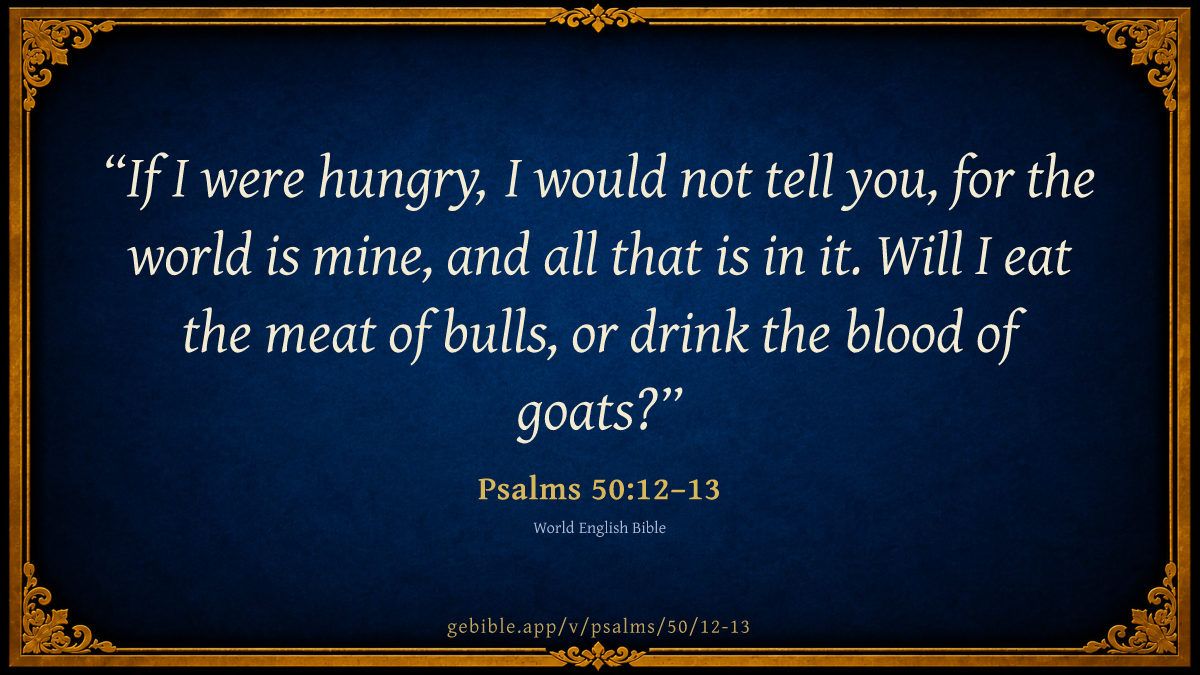
Psa 50:12 If I were hungry, I would not tell thee: for the world [is] mine, and the fulness thereof.
Ver. 12. If I were hungry, I would not tell thee] I would not employ thee to cater or purvey for me. But it befalls not God to be hungry, as not only heathens held, and, therefore, said that their Jove was gone into Ethiopia to be feasted, but some carnal Jews also, who conceived that a fat sacrifice was as acceptable to God as a fat dinner was to themselves (Homer. Lucian).
Read full note →
For the world is mine, and the fulness thereof] Quicquid avium volitat, quicquid piscium natat, quicquid ferarum discurrit, as Seneca hath it; all is the Lord’s, he made all, maintaineth all, and may, therefore, at his pleasure make use of any; he needeth not be beholden; but the truth is, he needeth not any such broken supports. See Psa 24:7.
John Trapp, A Commentary or Exposition upon All the Books of the Old and New Testament (1647–1656) — public domain. Text from a community e-Sword module.
Matthew Poole1685 · Public DomainOn vv12–13If I wanted or desired any thing, as I…
If I wanted or desired any thing, as I do not, being the all-sufficient God,
I would not tell thee, that thou mightest supply my wants.
Read full note →
The fulness thereof, i.e. all those creatures wherewith it is replenished.
Matthew Poole's English Annotations on the Holy Bible (1683–1685) — public domain. Text from a community e-Sword/MySword module.
John Gill1763 · Public DomainOn vv12–13If I were hungry, I would not tell thee,....…
If I were hungry, I would not tell thee,.... Or "say to thee" (w); ask for anything
for the world is mine, and the fulness thereof; with which, was the former his case, he could satisfy himself; see Psa 24:1.
Read full note →
(w) "non dicam tibi", V. L. Pagninus, Montanus, Musculus; "non dicerem tibi", Junius & Tremellius, Piscator, Cocceius, Michaelis.
John Gill's Exposition of the Whole Bible (1746–1763) — public domain (CC PDM 1.0). Text via the HelloAO Bible API.
Adam Clarke1810 · Public DomainOn vv12–13Verse 12. The world is mine, and the fulness…
Verse 12. The world is mine, and the fulness thereof.] Ye cannot, therefore, give me any thing that is not my own.
Adam Clarke's Commentary on the Bible (1810–1826) — public domain. Text from a community e-Sword/MySword module.
Albert Barnes1834 · Public DomainOn vv12–13If I were hungry, I would not tell thee…
If I were hungry, I would not tell thee - I should not have occasion to apply to you; I should not be dependent on you.
For the world is mine - The earth; all that has been created.
Read full note →
And the fulness thereof - All that fills the world; all that exists upon it. The whole is at his disposal; to all that the earth produces he has a right. This language is used to show the absurdity of the supposition that he was in any way dependent on man, or that the offering of sacrifice could be supposed in any way to lay him under obligation.
Albert Barnes' Notes on the Bible (1834–1885) — public domain. Text from a community e-Sword/MySword module.
Daniel D. Whedon1874 · Public DomainOn v1313. Will I eat the flesh of bulls—Such gross…
13. Will I eat the flesh of bulls—Such gross ideas of worship as linger in the mere forms, as if God delighted in them, arise from gross ideas of God, and this is the source of corruption in all heathenism and false religions.
Daniel D. Whedon (gen. ed.), Commentary on the Old and New Testaments (1874–1909) — public domain. Text from a community e-Sword module.
The Cambridge Bible for Schools and Colleges1878 · Public DomainOn vv12–1312. the world is mine &c.] Cp. Psa_24:1; Psa_89:11;…
12. the world is mine &c.] Cp. Psa_24:1; Psa_89:11; Exo_19:5; Deu_10:14; Job_41:11; 1Co_10:26.
The Cambridge Bible for Schools and Colleges (gen. ed. J. J. S. Perowne; Cambridge University Press, 1878–1918) — public domain. Text from a community e-Sword module.
The Pulpit Commentary1880 · Public DomainOn vv12–13If I were hungry, I would not tell thee;…
If I were hungry, I would not tell thee; i.e. suppose it possible that I could be hungry, I should not have recourse to man; for the world is mine, and the fulness thereof and I should have recourse to it.
The Pulpit Commentary (1880–1919), ed. H.D.M. Spence-Jones & Joseph S. Exell — public domain. Text from a community e-Sword module.
Charles H. Spurgeon1885 · Public DomainOn vv12–13Ver. 12. If I were hungry, I would not…
Ver. 12. If I were hungry, I would not tell thee. Strange conception, a hungry God! Yet if such an absurd ideal could be truth, and if the Lord hungered for meat, he would not ask it of men. He could provide for himself out of his own possessions; he would not turn suppliant to his own creatures. Even under the grossest ideal of God, faith in outward ceremonies is ridiculous. Do men fancy that the Lord needs banners, and music, and incense, and fine linen? If he did, the stars would emblazon his standard, the winds and the waves become his orchestra, ten thousand times ten thousand flowers would breathe forth perfume, the snow should be his alb, the rainbow his girdle, the clouds of light his mantle. O fools and slow of heart, ye worship ye know not what! For the world is mine, and the fulness thereof. What can he need who is owner of all things and able to create as he wills? Thus overwhelmingly does the Lord pour forth his arguments upon formalists.
Ver. 12. If I were hungry, etc. Pagan sacrifices were considered as feasts of the gods. Daniel Cresswell.
Charles H. Spurgeon's The Treasury of David (1869–1885) — public domain. Psalms only. Text from a community e-Sword/MySword module.
The Biblical Illustrator1887 · Public DomainOn v12If I were hungry, I would not tell thee:…
Psa_50:12
If I were hungry, I would not tell thee: for the world is Mine, and the fulness thereof.
Read full note →
The owner of the world
I. There must be a growing knowledge of God amongst men. Men once thought that God could be hungry, and that offerings of wheat, goats, etc., would appease His appetite: but when this psalm was written they had advanced far beyond this in their knowledge of God. And we now have no such idea. Science, learning, and the study of the life of Jesus, have classified and enlarged our ideas of God and Gods workings. Then we ought not to be afraid to say, The teachings of our fathers, the associations of the old theology of creeds must be modified. We must not allow our spiritual life to be controlled by leading strings held in dead hands. We must be ready to stand in the light of the revealed character of God, and accept our impulses and conclusions from that.
II. A statement of the rights of God over the world promotes that knowledge, How many of those who read inscribed on the portico of the Royal Exchange, The earth is the Lords and the fulness thereof, ever ponder the large meaning of these words. All natural things are His. How we prize that which is ours--from our first childrens toys to our possessions now that we are come to mature age. And because this feeling of ownership is in us we know that it is in God. And not only the things, but the energies in them, are His. And all things that men produce, for they come out of the fulness of Gods world. What, then, can He wish for from us but that we come to know Him and to love and honour Him as we should? Therefore remember--
(1) All property is held from God. We are but His stewards.
(2) Everything in the world is a witness to God.
(3) God is the sustainer of all things. (D. O. Watt, M. A.)
The Biblical Illustrator, edited by Joseph S. Exell (c. 1880s–1900s) — public domain. Text from a community e-Sword module.
unfoldingWord translationNotes2017 · CC BY-SA 4.0On v12If I were hungry
If I were hungry
This describes something that could not happen, since God does not get hungry. (See: Hypothetical Situations)
Read full note →
Will I eat the flesh of bulls or drink the blood of goats?
God asks this rhetorical question to emphasize that he does not do these things and so has no need for their sacrifices. AT: "I do not eat the flesh of bulls or drink the blood of goats." (See: Rhetorical Question)
 GEBible — Godless Engineer's Bible App
Geneva Bible translators 1599 · Public Domain On v13 Though man’s life for the infirmity thereof hath need…
Though man’s life for the infirmity thereof hath need of food, yet God whose life quickeneth all the world, hath no need of such means.
Geneva Bible (1599) marginal notes — public domain.
John Trapp 1656 · Public Domain On vv12–13 Psa 50:12 If I were hungry, I would not…
Psa 50:12 If I were hungry, I would not tell thee: for the world [is] mine, and the fulness thereof.
Ver. 12. If I were hungry, I would not tell thee] I would not employ thee to cater or purvey for me. But it befalls not God to be hungry, as not only heathens held, and, therefore, said that their Jove was gone into Ethiopia to be feasted, but some carnal Jews also, who conceived that a fat sacrifice was as acceptable to God as a fat dinner was to themselves (Homer. Lucian).
Read full note →
For the world is mine, and the fulness thereof] Quicquid avium volitat, quicquid piscium natat, quicquid ferarum discurrit, as Seneca hath it; all is the Lord’s, he made all, maintaineth all, and may, therefore, at his pleasure make use of any; he needeth not be beholden; but the truth is, he needeth not any such broken supports. See Psa 24:7.
John Trapp, A Commentary or Exposition upon All the Books of the Old and New Testament (1647–1656) — public domain. Text from a community e-Sword module.
Matthew Poole 1685 · Public Domain On vv12–13 If I wanted or desired any thing, as I…
If I wanted or desired any thing, as I do not, being the all-sufficient God,
I would not tell thee, that thou mightest supply my wants.
Read full note →
The fulness thereof, i.e. all those creatures wherewith it is replenished.
Matthew Poole's English Annotations on the Holy Bible (1683–1685) — public domain. Text from a community e-Sword/MySword module.
John Gill 1763 · Public Domain On vv12–13 If I were hungry, I would not tell thee,....…
If I were hungry, I would not tell thee,.... Or "say to thee" (w); ask for anything
for the world is mine, and the fulness thereof; with which, was the former his case, he could satisfy himself; see Psa 24:1.
Read full note →
(w) "non dicam tibi", V. L. Pagninus, Montanus, Musculus; "non dicerem tibi", Junius & Tremellius, Piscator, Cocceius, Michaelis.
John Gill's Exposition of the Whole Bible (1746–1763) — public domain (CC PDM 1.0). Text via the HelloAO Bible API.
Adam Clarke 1810 · Public Domain On vv12–13 Verse 12. The world is mine, and the fulness…
Verse 12. The world is mine, and the fulness thereof.] Ye cannot, therefore, give me any thing that is not my own.
Adam Clarke's Commentary on the Bible (1810–1826) — public domain. Text from a community e-Sword/MySword module.
Albert Barnes 1834 · Public Domain On vv12–13 If I were hungry, I would not tell thee…
If I were hungry, I would not tell thee - I should not have occasion to apply to you; I should not be dependent on you.
For the world is mine - The earth; all that has been created.
Read full note →
And the fulness thereof - All that fills the world; all that exists upon it. The whole is at his disposal; to all that the earth produces he has a right. This language is used to show the absurdity of the supposition that he was in any way dependent on man, or that the offering of sacrifice could be supposed in any way to lay him under obligation.
Albert Barnes' Notes on the Bible (1834–1885) — public domain. Text from a community e-Sword/MySword module.
Daniel D. Whedon 1874 · Public Domain On v13 13. Will I eat the flesh of bulls—Such gross…
13. Will I eat the flesh of bulls—Such gross ideas of worship as linger in the mere forms, as if God delighted in them, arise from gross ideas of God, and this is the source of corruption in all heathenism and false religions.
Daniel D. Whedon (gen. ed.), Commentary on the Old and New Testaments (1874–1909) — public domain. Text from a community e-Sword module.
The Cambridge Bible for Schools and Colleges 1878 · Public Domain On vv12–13 12. the world is mine &c.] Cp. Psa_24:1; Psa_89:11;…
12. the world is mine &c.] Cp. Psa_24:1; Psa_89:11; Exo_19:5; Deu_10:14; Job_41:11; 1Co_10:26.
The Cambridge Bible for Schools and Colleges (gen. ed. J. J. S. Perowne; Cambridge University Press, 1878–1918) — public domain. Text from a community e-Sword module.
The Pulpit Commentary 1880 · Public Domain On vv12–13 If I were hungry, I would not tell thee;…
If I were hungry, I would not tell thee; i.e. suppose it possible that I could be hungry, I should not have recourse to man; for the world is mine, and the fulness thereof and I should have recourse to it.
The Pulpit Commentary (1880–1919), ed. H.D.M. Spence-Jones & Joseph S. Exell — public domain. Text from a community e-Sword module.
Charles H. Spurgeon 1885 · Public Domain On vv12–13 Ver. 12. If I were hungry, I would not…
Ver. 12. If I were hungry, I would not tell thee. Strange conception, a hungry God! Yet if such an absurd ideal could be truth, and if the Lord hungered for meat, he would not ask it of men. He could provide for himself out of his own possessions; he would not turn suppliant to his own creatures. Even under the grossest ideal of God, faith in outward ceremonies is ridiculous. Do men fancy that the Lord needs banners, and music, and incense, and fine linen? If he did, the stars would emblazon his standard, the winds and the waves become his orchestra, ten thousand times ten thousand flowers would breathe forth perfume, the snow should be his alb, the rainbow his girdle, the clouds of light his mantle. O fools and slow of heart, ye worship ye know not what! For the world is mine, and the fulness thereof. What can he need who is owner of all things and able to create as he wills? Thus overwhelmingly does the Lord pour forth his arguments upon formalists.
Ver. 12. If I were hungry, etc. Pagan sacrifices were considered as feasts of the gods. Daniel Cresswell.
Charles H. Spurgeon's The Treasury of David (1869–1885) — public domain. Psalms only. Text from a community e-Sword/MySword module.
The Biblical Illustrator 1887 · Public Domain On v12 If I were hungry, I would not tell thee:…
Psa_50:12
If I were hungry, I would not tell thee: for the world is Mine, and the fulness thereof.
Read full note →
The owner of the world
I. There must be a growing knowledge of God amongst men. Men once thought that God could be hungry, and that offerings of wheat, goats, etc., would appease His appetite: but when this psalm was written they had advanced far beyond this in their knowledge of God. And we now have no such idea. Science, learning, and the study of the life of Jesus, have classified and enlarged our ideas of God and Gods workings. Then we ought not to be afraid to say, The teachings of our fathers, the associations of the old theology of creeds must be modified. We must not allow our spiritual life to be controlled by leading strings held in dead hands. We must be ready to stand in the light of the revealed character of God, and accept our impulses and conclusions from that.
II. A statement of the rights of God over the world promotes that knowledge, How many of those who read inscribed on the portico of the Royal Exchange, The earth is the Lords and the fulness thereof, ever ponder the large meaning of these words. All natural things are His. How we prize that which is ours--from our first childrens toys to our possessions now that we are come to mature age. And because this feeling of ownership is in us we know that it is in God. And not only the things, but the energies in them, are His. And all things that men produce, for they come out of the fulness of Gods world. What, then, can He wish for from us but that we come to know Him and to love and honour Him as we should? Therefore remember--
(1) All property is held from God. We are but His stewards.
(2) Everything in the world is a witness to God.
(3) God is the sustainer of all things. (D. O. Watt, M. A.)
The Biblical Illustrator, edited by Joseph S. Exell (c. 1880s–1900s) — public domain. Text from a community e-Sword module.
unfoldingWord translationNotes 2017 · CC BY-SA 4.0 On v12 If I were hungry
If I were hungry
This describes something that could not happen, since God does not get hungry. (See: Hypothetical Situations)
Read full note →
Will I eat the flesh of bulls or drink the blood of goats?
God asks this rhetorical question to emphasize that he does not do these things and so has no need for their sacrifices. AT: "I do not eat the flesh of bulls or drink the blood of goats." (See: Rhetorical Question)
translationWords
world
flesh
cow
blood
goat
unfoldingWord translationNotes — © Distant Shores Media and the Door43 World Missions Community, licensed CC BY-SA 4.0. Source: git.door43.org/Door43/en_tn.