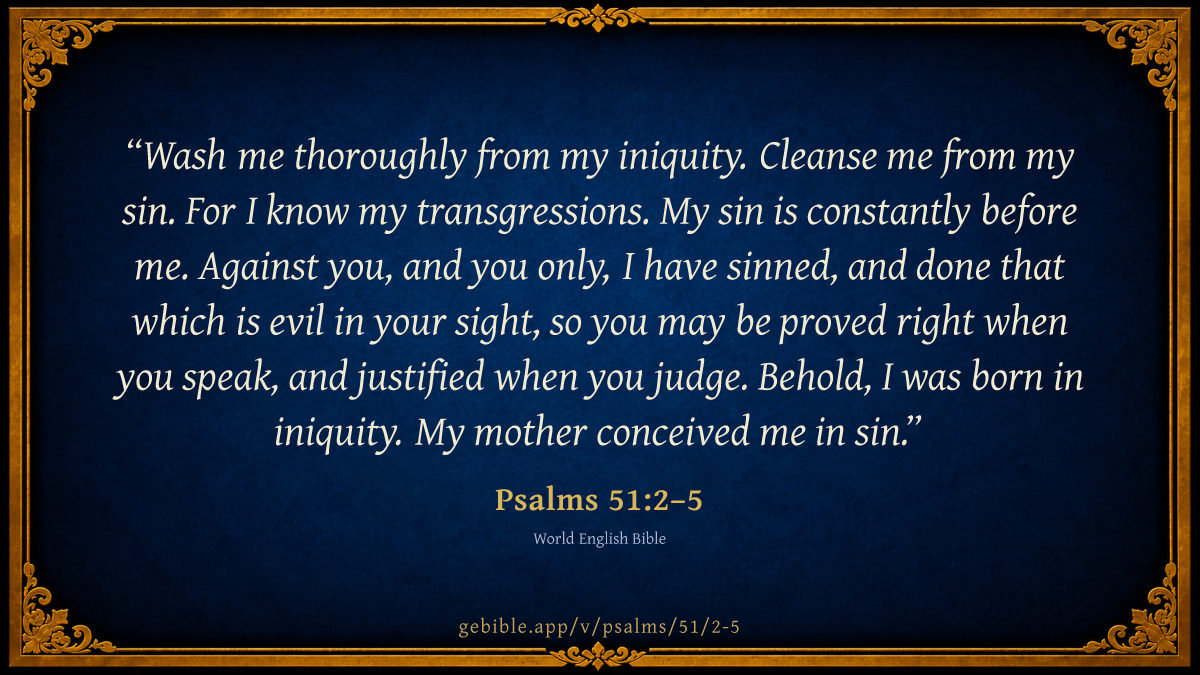
2Wash me thoroughly from my iniquity. Cleanse me from my sin.
3For I know my transgressions. My sin is constantly before me.
4Against you, and you only, I have sinned, and done that which is evil in your sight, so you may be proved right when you speak, and justified when you judge.
5Behold, I was born in iniquity. My mother conceived me in sin.
2 Wash me thoroughly from my iniquity. Cleanse me from my sin.
3 For I know my transgressions. My sin is constantly before me.
4 Against you, and you only, I have sinned, and done that which is evil in your sight, so you may be proved right when you speak, and justified when you judge.
5 Behold, I was born in iniquity. My mother conceived me in sin.
KJVKing James Version
2 Wash me throughly from mine iniquity, and cleanse me from my sin.
3 For I acknowledge my transgressions: and my sin is ever before me.
4 Against thee, thee only, have I sinned, and done this evil in thy sight: that thou mightest be justified when thou speakest, and be clear when thou judgest.
5 Behold, I was shapen in iniquity; and in sin did my mother conceive me.
Show all 3 translations
JPSJPS Tanakh (1917)
2 (51-4) Wash me thoroughly from mine iniquity, and cleanse me from my sin.
3 (51-5) For I know my transgressions; and my sin is ever before me.
4 (51-6) Against Thee, Thee only, have I sinned, and done that which is evil in Thy sight; that Thou mayest be justified when Thou speakest, and be in the right when Thou judgest.
5 (51-7) Behold, I was brought forth in iniquity, and in sin did my mother conceive me.
Romans 5:12(v5)Therefore as sin entered into the world through one man, and death through sin; so death passed to all men, because all sinned.
Job 14:4(v5)Who can bring a clean thing out of an unclean? Not one.
Psalms 58:3(v5)The wicked go astray from the womb. They are wayward as soon as they are born, speaking lies.
Job 15:14-16(v5)What is man, that he should be clean? What is he who is born of a woman, that he should be righteous? Behold, he puts no trust in his holy…
Ephesians 2:3(v5)We also all once lived among them in the lusts of our flesh, doing the desires of the flesh and of the mind, and were by nature children of…
Show all 53 cross-references
1 John 1:7-9(v2)But if we walk in the light, as he is in the light, we have fellowship with one another, and the blood of Jesus Christ, his Son, cleanses…
John 3:6(v5)That which is born of the flesh is flesh. That which is born of the Spirit is spirit.
Hebrews 10:21-22(v2)and having a great priest over God’s house, let’s draw near with a true heart in fullness of faith, having our hearts sprinkled from an…
Proverbs 28:13(v3)He who conceals his sins doesn’t prosper, but whoever confesses and renounces them finds mercy.
Ezekiel 36:25(v2)I will sprinkle clean water on you, and you will be clean. I will cleanse you from all your filthiness, and from all your idols.
Genesis 5:3(v5)Adam lived one hundred thirty years, and became the father of a son in his own likeness, after his image, and named him Seth.
2 Samuel 12:13-14(v4)David said to Nathan, “I have sinned against Yahweh.” Nathan said to David, “Yahweh also has put away your sin. You will not die. However,…
Psalms 51:7(v2)Purify me with hyssop, and I will be clean. Wash me, and I will be whiter than snow.
Jeremiah 4:14(v2)Jerusalem, wash your heart from wickedness, that you may be saved. How long will your evil thoughts lodge within you?
Isaiah 1:16(v2)Wash yourselves. Make yourself clean. Put away the evil of your doings from before my eyes. Cease to do evil.
Isaiah 59:12(v3)For our transgressions are multiplied before you, and our sins testify against us; for our transgressions are with us, and as for our…
Revelation 1:5(v2)and from Jesus Christ, the faithful witness, the firstborn of the dead, and the ruler of the kings of the earth. To him who loves us, and…
Psalms 38:18(v3)For I will declare my iniquity. I will be sorry for my sin.
Luke 15:21(v4)The son said to him, ‘Father, I have sinned against heaven and in your sight. I am no longer worthy to be called your son.’
Genesis 8:21(v5)Yahweh smelled the pleasant aroma. Yahweh said in his heart, “I will not again curse the ground any more for man’s sake because the…
Psalms 32:5(v3)I acknowledged my sin to you. I didn’t hide my iniquity. I said, I will confess my transgressions to Yahweh, and you forgave the iniquity…
Genesis 20:6(v4)God said to him in the dream, “Yes, I know that in the integrity of your heart you have done this, and I also withheld you from sinning…
Genesis 39:9(v4)No one is greater in this house than I am, and he has not kept back anything from me but you, because you are his wife. How then can I do…
Acts 22:16(v2)Now why do you wait? Arise, be baptized, and wash away your sins, calling on the name of the Lord.’
1 Corinthians 6:11(v2)Some of you were such, but you were washed. But you were sanctified. But you were justified in the name of the Lord Jesus, and in the…
Romans 3:4(v4)May it never be! Yes, let God be found true, but every man a liar. As it is written, “that you might be justified in your words, and might…
Revelation 7:14(v2)I told him, “My lord, you know.” He said to me, “These are those who came out of the great suffering.They washed their robes, and made them…
Genesis 9:6(v4)Whoever sheds man’s blood, his blood will be shed by man, for God made man in his own image.
Leviticus 6:2-7(v4)“If anyone sins, and commits a trespass against Yahweh, and deals falsely with his neighbor in a matter of deposit, or of bargain, or of…
Leviticus 26:40-41(v3)“ ‘If they confess their iniquity and the iniquity of their fathers, in their trespass which they trespassed against me; and also that…
Psalms 50:6(v4)The heavens shall declare his righteousness, for God himself is judge.
Zechariah 13:1(v2)“In that day there will be a spring opened to David’s house and to the inhabitants of Jerusalem, for sin and for uncleanness.
Luke 15:18-21(v3)I will get up and go to my father, and will tell him, “Father, I have sinned against heaven, and in your sight. I am no more worthy to be…
Acts 17:31(v4)because he has appointed a day in which he will judge the world in righteousness by the man whom he has ordained; of which he has given…
Romans 2:5(v4)But according to your hardness and unrepentant heart you are treasuring up for yourself wrath in the day of wrath, revelation, and of the…
Revelation 16:5(v4)I heard the angel of the waters saying, “You are righteous, who are and who were, O Holy One, because you have judged these things.
Leviticus 5:19(v4)It is a trespass offering. He is certainly guilty before Yahweh.”
2 Kings 17:17(v4)They caused their sons and their daughters to pass through the fire, used divination and enchantments, and sold themselves to do that which…
2 Kings 21:6(v4)He made his son to pass through the fire, practiced sorcery, used enchantments, and dealt with those who had familiar spirits, and with…
Psalms 19:12(v2)Who can discern his errors? Forgive me from hidden errors.
Psalms 50:4(v4)He calls to the heavens above, to the earth, that he may judge his people:
Jeremiah 3:25(v3)Let us lie down in our shame, and let our confusion cover us; for we have sinned against Yahweh our God, we and our fathers, from our youth…
Luke 7:29(v4)When all the people and the tax collectors heard this, they declared God to be just, having been baptized with John’s baptism.
Hebrews 9:13-14(v2)For if the blood of goats and bulls, and the ashes of a heifer sprinkling those who have been defiled, sanctify to the cleanness of the…
James 2:9(v4)But if you show partiality, you commit sin, being convicted by the law as transgressors.
Genesis 38:7(v4)Er, Judah’s firstborn, was wicked in Yahweh’s sight. So Yahweh killed him.
2 Samuel 12:9-10(v4)Why have you despised Yahweh’s word, to do that which is evil in his sight? You have struck Uriah the Hittite with the sword, and have…
Job 33:27(v3)He sings before men, and says, ‘I have sinned, and perverted that which was right, and it didn’t profit me.
Psalms 40:12(v3)For innumerable evils have surrounded me. My iniquities have overtaken me, so that I am not able to look up. They are more than the hairs…
James 2:11(v4)For he who said, “Do not commit adultery,” also said, “Do not commit murder.” Now if you do not commit adultery, but murder, you have…
Revelation 15:3-4(v4)They sang the song of Moses, the servant of God, and the song of the Lamb, saying, “Great and marvelous are your works, Lord God, the…
Revelation 19:11(v4)I saw the heaven opened, and behold, a white horse, and he who sat on it is called Faithful and True. In righteousness he judges and makes…
Nehemiah 9:2(v3)The offspring of Israel separated themselves from all foreigners and stood and confessed their sins and the iniquities of their fathers.
Cross-references from openbible.info (CC BY 4.0)
Explain this passage (18 sources)
Historical commentary, presented as a primary source — not an endorsement.
John Calvin1540 · Public DomainOn vv3–53. For I know my sins He now discovers…
3. For I know my sins He now discovers his reason for imploring pardon with so much vehemency, and this was the painful disquietude which his sins caused him, and which could only be relieved by his obtaining reconciliation with God. This proves that his prayer did not proceed from dissimulation, as many will be found commending the grace of God in high terms, although, in reality, they care little about it, having never felt the bitterness of being exposed to his displeasure. David, on the contrary, declares that he is subjected by his sin to constant anguish of mind, and that it is this which imparts such an earnestness to his supplications. From his example we may learn who they are that can alone be said to seek reconciliation with God in a proper manner. They are such as have had their consciences wounded with a sense of sin, and who can find no rest until they have obtained assurance of his mercy. We will never seriously apply to God for pardon, until we have obtained such a view of our sins as inspires us with fear. The more easily satisfied we are under our sins, the more do we provoke God to punish them with severity, and if we really desire absolution from his hand, we must do more than confess our guilt in words; we must institute a rigid and formidable scrutiny into the character of our transgressions. David does not simply say that he will confess his sins to man, but declares that he has a deep inward feeling of them, such a feeling of them as filled him with the keenest anguish. His was a very different spirit from that of the hypocrite, who displays a complete indifference upon this subject, or when it intrudes upon him, endeavors to bury the recollection of it. He speaks of his sins in the plural number. His transgression, although it sprung from one root, was complicated, including, besides adultery, treachery and cruelty; nor was it one man only whom he had betrayed, but the whole army which had been summoned to the field in defense of the Church of God. He accordingly recognises many particular sins as wrapt up in it.
John Calvin's Commentaries (1540-1563) — public domain. Text from the Calvin Translation Society English edition (1840s-50s) via the Christian Classics Ethereal Library (ccel.org). Calvin's coverage is partial (roughly two-thirds of the Bible); uncommented books and verses are honest gaps, never fabricated. The 19th-century editor's footnotes and remarks are omitted so the notes are faithfully Calvin's own voice.
Geneva Bible translators1599 · Public DomainOn vv2–4My sins strike so fast in me, that I…
My sins strike so fast in me, that I have need of some singular kind of washing.
Geneva Bible (1599) marginal notes — public domain.
John Trapp1656 · Public DomainOn vv2–5Psa 51:2 Wash me throughly from mine iniquity, and…
Psa 51:2 Wash me throughly from mine iniquity, and cleanse me from my sin.
Ver. 2. Wash me throughly from mine iniquity] Heb. Multiply, wash me; so Isa 55:7. God is said to multiply pardon as much as we multiply sin. David apprehended his sin so exceeding sinful, his stain so inveterate, so engrained, that it would hardly be ever gotten out till the cloth were almost rubbed to pieces; that God himself would have somewhat to do to do it. He had been in a deep ditch, Pro 23:27, and was pitifully defiled; he therefore begs hard to be thoroughly rinsed, to be bathed in that blessed fountain of Christ’s blood, that is opened for sins and for uncleanness, Zec 13:1; to be cleansed not only from outward defilements, but from his swinish nature; for though a swine be washed never so clean, if she retain her nature, she will be ready to wallow in the next guzzle. The time of our being here is αιων λουτροφορος, as Nazianzen calleth it, i.e. our washing time. Wash thy heart, O Jerusalem, that thou mayest be clean, Jer 4:14, not by thinking to set off with God, and to make amends by thy good deeds for thy bad; this is but lutum luto purgare, to wash off one filth with another; but by the practice of mortification, and by faith in Christ’s meritorious passion; for he hath washed us from our sins in his own blood, Rev 1:5. Other blood defileth, but this purifieth from all pollutions of flesh and spirit, 1Jn 1:7.
Read full note →
And cleanse me from my sin] In like manner as the leper under the law was cleansed. Leprosy, frenzy, heresy, and jealousy, are by men counted incurable; Sed omnipotenti medico nullus insanabilis occurrit morbus, saith Isidore, to an Almighty physician no disease is incurable. There is indeed a natural Novatianism in the timorous consciences of convinced sinners, to doubt and question pardon for sins of apostasy, and falling after repentance; but there need be no such doubting, since God, who hath bidden us to forgive a repenting brother seventy times seven times in one day, will himself much more. All sins and blasphemies shall be forgiven to the sons of men, &c., Mat 12:31.
John Trapp, A Commentary or Exposition upon All the Books of the Old and New Testament (1647–1656) — public domain. Text from a community e-Sword module.
Matthew Poole1685 · Public DomainOn vv2–5Wash me throughly, Heb. multiply to wash me; by…
Wash me throughly, Heb. multiply to wash me; by which phrase he implies the greatness of his guilt, and the insufficiency of all legal washings, and the absolute necessity of some other and better thing to wash him, even of God’s grace, and the blood of Christ; which as Abraham saw by faith, Joh 8:56, so did David, as is sufficiently evident (allowing for the darkness of the dispensation and expressions of the Old Testament) from divers passages of the Psalms, of which I have spoken in their proper places; and his earnest and passionate desire of pardon, which he desires above all other things; wherein he showeth himself to be a true penitent, because his chief care and desire was to obtain God’s favour, and the forgiveness of his sins, and not the prevention of those external sore judgments which God by Nathan threatened to bring upon him and his house, 2Sa 12:10,11, about which here is not one word in this Psalm; whereas the cares and desires of hypocrites chiefly are bent towards worldly things, as we see in Cain, Gen 4:13,16,17, and Saul, 1Sa 15:30, and others, Hos 7:14.
Matthew Poole's English Annotations on the Holy Bible (1683–1685) — public domain. Text from a community e-Sword/MySword module.
John Gill1763 · Public DomainOn vv2–5Wash me thoroughly from mine iniquity,.... Which supposes defilement…
Wash me thoroughly from mine iniquity,.... Which supposes defilement by sin, and that very great, and such as none can remove but the Lord himself; who, when he takes it in hand, does it effectually and thoroughly; see Eze 36:25. David's sin had long lain upon him, the faith of it had as it were eaten into him, and spread itself over him, and therefore he needed much washing: "wash me much", all over, and thoroughly:
and cleanse me from my sin: which only the blood of Christ can do, Jo1 1:7. The psalmist makes use of three words to express his sin by, in this verse Psa 51:1; which signifies "rebellion", as all sin has in it rebellion against God the lawgiver, and a contempt of his commandments; "perverseness", "crookedness", sin being a going out of the plain way of God's righteous law; and "a missing the mark"; going besides it or not coming up to it: and these he makes rise of to set forth the malignity of sin, and the deep sense he had of the exceeding sinfulness of it; and these are the three words used by the Lord in Exo 34:7; when he declares himself to be a sin forgiving God; so that David's sin came within the reach of pardoning mercy.
John Gill's Exposition of the Whole Bible (1746–1763) — public domain (CC PDM 1.0). Text via the HelloAO Bible API.
John Wesley1765 · Public DomainOn vv4–5Thee only - Which is not to be, understood…
Thee only - Which is not to be, understood absolutely, because he had sinned against Bathsheba and Uriah, and many others; but comparatively. So the sense is, though I have sinned against my own conscience, and against others; yet nothing is more grievous to me, than that I have sinned against thee. Thy sight - With gross contempt of thee, whom I knew to be a spectator of my most secret actions. Justified - This will be the fruit of my sin, that whatsoever severities thou shalt use towards me, it will be no blemish to thy righteousness, but thy justice will be glorified by all men. Speakest - Hebrew. in thy words, in all thy threatenings denounced against me. Judgest - When thou dost execute thy sentence upon me.
John Wesley, Explanatory Notes Upon the Whole Bible (1754–1765) — public domain. Text via the GEBible commentary corpus.
Adam Clarke1810 · Public DomainOn vv2–5Verse 2. Wash me throughly] הרבה כבסני harbeh cabbeseni,…
Verse 2. Wash me throughly] הרבה כבסני harbeh cabbeseni, "Wash me again and again, - cause my washings to be multiplied." My stain is deep; ordinary purgation will not be sufficient.
Adam Clarke's Commentary on the Bible (1810–1826) — public domain. Text from a community e-Sword/MySword module.
Joseph Benson1811 · Public DomainOn vv2–5Psa 51:2. Wash me thoroughly from mine iniquity, &c.…
Psa 51:2. Wash me thoroughly from mine iniquity, &c. — “I have made myself exceeding loathsome by my repeated and heinous acts of wickedness, which, like a stain that hath long stuck to a garment, is not easily purged away; but do not, therefore, I beseech thee, abhor me, but rather magnify thy mercy in purifying me perfectly, and cleansing me so thoroughly, that there may be no spot remaining in me.” — Bishop Patrick. Hebrew, הרבה כבסני, harbeh chabbeseeni, is literally, multiplica, lava me, multiply, wash me: that is, Wash me very much. By which phrase he implies the greatness of his guilt, the insufficiency of all legal washing, and the absolute necessity of some other and better means of cleansing him from it, even God’s grace and the atoning blood of Christ; which as Abraham saw by faith, Joh 8:56, so did David, as is sufficiently evident (allowance being made for the darkness of the Old Testament dispensation) from divers passages of his Psalms. Observe, reader, sin defiles us, renders us odious in the sight of the holy God, and uneasy to ourselves; it unfits us for communion with God, in grace or glory. But when God pardons sin, he cleanses us from it, so that we become acceptable to him, easy to ourselves, and have liberty of access to him. Nathan had assured David, upon his first profession of repentance, that his sin was pardoned. The Lord has taken away thy sin, thou shalt not die, 2Sa 12:13 : yet he prays, Wash me, cleanse me, blot out my transgressions; for God will be sought unto, even for that which he has promised; and those whose sins are pardoned, must pray that the pardon may be more and more evidenced to them. God had forgiven him, but he could not forgive himself, and therefore he is thus importunate for pardon as one that thought himself unworthy of it.
Joseph Benson's Commentary on the Old and New Testaments (1811–1818) — public domain. Text from a community e-Sword module.
Albert Barnes1834 · Public DomainOn vv2–5Wash me throughly from mine iniquity - literally, “Multiply…
Wash me throughly from mine iniquity - literally, “Multiply to wash me.” The word rendered “throughly” is a verb, either in the infinitive or imperative mood, and suggests the idea of “multiplying” or “increasing.” The reference is to that which might need constant or repeated washings in order to remove a stain adverbially to denote intensity, or thoroughness. On the word wash as applicable to sin, see the notes at Isa 1:16.
And cleanse me from my sin - Remove it entirely. Make me wholly pure. See the notes at Isa 1:16. In what manner he hoped that this would be done is shown in the following portions of the psalm. It was -
Read full note →
(a) by forgiveness of the past, Psa 51:9; and
(b) by making the heart pure and holy through the renewing and sanctifying influences of the Holy Spirit, Psa 51:10-11.
Albert Barnes' Notes on the Bible (1834–1885) — public domain. Text from a community e-Sword/MySword module.
Robert Jamieson, A. R. Fausset & David Brown1871 · Public DomainOn vv2–5Wash me--Purity as well as pardon is desired by…
Wash me--Purity as well as pardon is desired by true penitents.
Jamieson, Fausset & Brown — Commentary Critical and Explanatory on the Whole Bible (1871) — public domain (CC PDM 1.0). Text via the HelloAO Bible API.
Daniel D. Whedon1874 · Public DomainOn vv2–52. Wash me thoroughly—Literally, multiply to wash, or wash…
2. Wash me thoroughly—Literally, multiply to wash, or wash me much, or many times. The word belongs to the fuller’s art of cleansing by treading with the feet, or scouring, and is intensive of thorough work, because of the difficulty of cleansing on account of deep stains.
Daniel D. Whedon (gen. ed.), Commentary on the Old and New Testaments (1874–1909) — public domain. Text from a community e-Sword module.
The Cambridge Bible for Schools and Colleges1878 · Public DomainOn vv3–53. For I acknowledge] Lit., I know. The pronoun…
3. For I acknowledge] Lit., I know. The pronoun is emphatic. His sins have all along been known to God. They are before His eyes (Psa_90:8). But now he has come to know them himself; they are unceasingly present to his conscience. Such consciousness of sin is the first step towards the repentance and confession which are the indispensable conditions of forgiveness. David refused to acknowledge his sin to himself and to God—yet not, apparently, without sharp pangs of remorse, see Psa_32:3-4—until Nathan’s message awoke his conscience. Cp. the confession of the nation in Isa_59:12.
The Cambridge Bible for Schools and Colleges (gen. ed. J. J. S. Perowne; Cambridge University Press, 1878–1918) — public domain. Text from a community e-Sword module.
Ellicott's Commentary for English Readers1878 · Public DomainOn vv2–5(2) Wash me thoroughly.—Literally, Wash me much, whether we…
(2) Wash me thoroughly.—Literally, Wash me much, whether we follow the Hebrew text or the Hebrew margin. The two clauses of the verse are not merely antithetic. The terms wash and cleanse seem to imply respectively the actual and the ceremonial purification, the former meaning literally to tread, describing the process of washing clothes (as blankets are washed to this day in Scotland) by trampling them with the feet, the latter used of the formal declaration of cleanliness by the priest in the case of leprosy (Lev_13:6-34). (For the iniquity and sin, see Psa_32:1.)
A Bible Commentary for English Readers, edited by Charles John Ellicott (1878–1897) — public domain. Text from a community e-Sword module.
The Pulpit Commentary1880 · Public DomainOn vv2–5Wash me throughly from mine iniquity. Wash me, as…
Wash me throughly from mine iniquity. Wash me, as a fuller washes a fouled garment (plunon , LXX, not uiqon ), not as a man washes his skin. And cleanse me from my sin. "Transgressions," "iniquity," "sin," cover every form of moral evil, and, united together, imply the deepest guilt (comp. vers. 3, 5, 9, 14).
The Pulpit Commentary (1880–1919), ed. H.D.M. Spence-Jones & Joseph S. Exell — public domain. Text from a community e-Sword module.
Charles H. Spurgeon1885 · Public DomainOn vv2–5Ver. 2. Wash me throughly. It is not enough…
Ver. 2. Wash me throughly. It is not enough to blot out the sin; his person is defiled, and he fain would be purified. He would have God himself cleanse him, for none but he could do it effectually. The washing must be thorough, it must be repeated, therefore he cries, "Multiply to wash me." The dye is in itself immovable, and I, the sinner, have lain long in it, till the crimson is ingrained; but, Lord, wash, and wash, and wash again, till the last stain is gone, and not a trace of my defilement is left. The hypocrite is content if his garments be washed, but the true suppliant cries, "wash me." The careless soul is content with a nominal cleansing, but the truly awakened conscience desires a real and practical washing, and that of a most complete and efficient kind. Wash me throughly from mine iniquity. It is viewed as one great pollution, polluting the entire nature, and as all his own; as if nothing were so much his own as his sin. The one sin against Bathsheba, served to show the psalmist the whole mountain of his iniquity, of which that foul deed was but one falling stone. He desires to be rid of the whole mass of his filthiness, which though once so little observed, had then become a hideous and haunting terror to his mind. And cleanse me from my sin. This is a more general expression; as if the psalmist said, "Lord, if washing will not do, try some other process; if water avails not, let fire, let anything be tried, so that I may but be purified. Rid me of my sin by some means, by any means, by every means, only do purify me completely, and leave no guilt upon my soul." It is not the punishment he cries out against, but the sin. Many a murderer is more alarmed at the gallows than at the murder which brought him to it. The thief loves the plunder, though he fears the prison. Not so David: he is sick of sin as sin; his loudest outcries are against the evil of his transgression, and not against the painful consequences of it. When we deal seriously with our sin, God will deal gently with us. When we hate what the Lord hates, he will soon make an end of it, to our joy and peace.
Ver. 2. Wash me. David prays that the Lord would wash him; therefore sin defiles, and he was made foul and filthy by his sin; and to wash him much, and to rinse and bathe him, to show that sin had exceedingly defiled him and stained him both in soul and body, and made him loathsome, and therefore he desireth to be washed, and cleansed, and purged from the pollution of sin. Hence we may learn what a vile, filthy and miserable thing sin is in the sight of God: it stains a man's body, it stains a man's soul, it makes him more vile than the vilest creature that lives: no toad is so vile and loathsome in the sight of man, as a sinner, stained and defiled with sin, is in the sight of God, till he be cleansed and washed from it in the blood of Christ. Samuel Smith.
Read full note →
Ver. 2. Wash me, etc. (Mbk) is peculiarly applied to the washing and cleansing of garments, as fullers wash and cleanse their cloths. 2Ki 18:7 Ex 19:10 Le 17:15. Samuel Chandler.
Ver. 2. Wash me throughly from mine iniquity. No other washing will do but lava tu, wash thou; so foul as it will need his washing throughly. Samuel Page, in "David's Broken Heart, "1646.
Ver. 2. Was me throughly. Hebrew multiply to wash me; by which phrase he implies the greatness of his guilt, and the insufficiency of all legal washings, and the absolute necessity of some other and better thing to wash him, even of God's grace, and the blood of Christ. Matthew Poole.
Ver. 2. Wash me...cleanse me. But why should David speak so superfluously? use two words when one would serve? For if we be cleansed, what matter is it whether it be by washing or no? Yet David had great reason for using both words; for he requires not that God would cleanse him by miracle, but by the ordinary way of cleansing, and this was washing; he names therefore washing as the means, and cleansing as the end: he names washing as the work a doing, and cleansing as the work done; he names washing as considering the agent, and cleansing as applying it to the patient; and indeed, as in the figure of the law there was not, so in the verity of the gospel there is not any ordinary means of cleansing, but only by washing; and therefore out of Christ our Saviour's side there flowed water and blood. Sir Richard Baker.
Ver. 2. Cleanse me from my sin. Observe, it is from the guilt, and not from the punishment, that he thus asked deliverance. That the sword should never depart from his house; that the sin, begun, not only secretly even in its full accomplishment, but far more secretly in the recesses of David's heart, should be punished before all Israel and before the sun; that the child so dear to David should be made one great punishment of his offence; these things, so far as this Psalm is concerned, might, or might not be. It is of the offence against God; of the defiling, although it were not then so expressly declared, God's temple by impurity, that David speaks. Ambrose, in J. M. Neale's Commentary.
Ver. 2. Sin. The original word signifies to miss an aim, as an archer does who shoots short of his mark, beyond, or beside it. It is also used for treading aside, or tripping, in the act of walking. In a spiritual sense it denotes deviation from a rule, whether by omission or commission. Thomas T. Biddulph, A.M., in Lectures on the Fifty-first Psalm, 1835.
Ver. 2. Sin is filthy to think of, filthy to speak of, filthy to hear of, filthy to do; in a word, there is nothing in it but vileness. Archibald Symson.
None.
Psalms 51:3*
Charles H. Spurgeon's The Treasury of David (1869–1885) — public domain. Psalms only. Text from a community e-Sword/MySword module.
The Biblical Illustrator1887 · Public DomainOn vv2, 4, 5Wash me throughly from mine iniquity and cleanse me…
Psa_51:2
Wash me throughly from mine iniquity and cleanse me from my sin.
Read full note →
Davids cry for pardon
I. How David thought of his sin. The repetition of these petitions show his earnestness of soul. In like manner he asks for the gifts of Gods Spirit.
1. He speaks of transgressions, the individual acts of sin; and then--
2. Of the iniquity which is the centre and root of them all. Further, in all the petitions we see that the idea of his own single responsibility for the whole thing is uppermost in Davids mind. It is my transgression, it is mine iniquity and my sin. He has not learned to say with Adam of old, and with some so-called wise thinkers to-day, I was tempted, and I could not help it. He does not talk about circumstances, and say that they share the blame with him. He takes it all to himself. The three words which the psalmist employs for sin give prominence to different aspects of it. Transgression is not the same as iniquity, and iniquity is not the same as sin. Transgression literally means rebellion, a breaking away from and setting oneself against lawful authority. Iniquity literally means that which is twisted, bent. Sin literally means missing a mark, an aim. Think how profound and living is the consciousness of sin which lies in calling it rebellion. It is not merely, then, that we go against some abstract propriety, or break some impersonal law of nature when we do wrong, but that we rebel against a rightful Sovereign. Not less profound and suggestive is that other name for sin, that which is twisted, or bent, mine iniquity. It is the same metaphor which lies in our own word wrong, that which is wrung or warped from the straight line of right. David had the pattern before him, and by its side his unsteady purpose, his passionate lust had traced this wretched scrawl. Another very solemn and terrible thought of what sin is lies in that final word for it, which means missing an aim. How strikingly that puts a truth which we are for ever tempted to deny. Every sin is a blunder as well as a crime. Sin ever misses its aim. It is a temptress that seems so fair, and when he reaches her side, and lifts her veil, eager to embrace the tempter, a hideous skeleton grins and gibbers at him. Yes! every sin is a mistake, and the epitaph for the sinner is Thou fool.
II. How he thinks of forgiveness. As the words for sin expressed a threefold view of the burden from which the psalmist seeks deliverance, so the triple prayer, in like manner, shows that it is not merely pardon for which he asks. Forgiveness and cleansing run into each other in his prayer as they do in our own experience, for they are inseparable one from the other. The first petition regards the Divine dealing with sin as being the erasure of a writing, perhaps of an indictment. Our past is a blurred manuscript, full of false things and bad things. And we want God to blot them out. Ah! some people tell us that the past is irrevocable, that the thing once dens can never be undone, that the lifes diary written by our own hands can never be cancelled. Thank God, we know better than that. We know who blots out the handwriting that is against us, nailing it to His cross. We know that of Gods great mercy our future may copy fair our past, and the past may be all obliterated and removed. Then there is another idea in the second of these prayers for forgiveness, Wash me throughly from mine iniquity. The word expresses the antique way of cleansing garments by treading and beating. He is not praying for a mere declaration of pardon, he is not asking only for the one complete, instantaneous act of forgiveness, but he is asking for a process of purifying which will be long and hard. I am ready, says he in effect, to submit to any sort of discipline, if only I may be clean. Wash me, beat me, tread me down, hammer me with mallets, dash me against stones, rub me with smarting soap and caustic nitre--do anything, anything with me, if only those foul spots melt away from the texture of my soul. A solemn prayer, if we pray it aright, which will be answered by many a sharp application of Gods Spirit, by many a sorrow, by much very painful work, both within our own souls and in our outward lives, but which will be fulfilled at last in our being clothed like our Lord in garments which shine as the light. The deliverance from sin is still further expressed by that third supplication, Cleanse me from my sin. He thinks of it as if it were a leprosy, incurable, fatal, and capable of being cleansed only by the great High Priest, and by His finger being laid upon it.
III. Whence comes the confidence for such a prayer. His whole hope rests upon Gods character as revealed in the multitude of His tender mercies. This is the blessedness of all true penitence, that the more profoundly it feels our own sore need and great sinfulness, in that very proportion does it recognize the yet greater mercy and all-sufficient grace of Our loving God, and from the lowest depths beholds the stars in the sky, which they who dwell amid the surface-brightness of the noonday cannot discern. (A. Maclaren, D. D.)
The repentance of David
I. The means which won him to it. It was the preachers voice. How wretched, how fearful, how nigh unto reprobation was his state ere Nathan came to him. And now he breaks down like the snow wreath when the sun looks full upon it.
II. The signs which mark his sincerity. They are--
1. That the one thought which fills his soul is, I have sinned against the Lord. True, he had sinned against man as well as God, yet, because the aspect of his sin as committed against God was so much more terrible and awful to him that it filled up the whole field of his view, and he could see nothing else.
2. And he sees his sin in all its hugeness and vileness. There is no diminishing or excusing it, no paring it down.
3. He takes willingly the disgrace of his sin; and--
4. Its punishment. But whilst he asks not deliverance frets these, there is a cry--
5. The cry for cleansing. Create in me a clean heart, etc.
6. He turns straight to God, clinging to Him, even in this hour of shame.
7. His one terror is test he be cast away from Gods presence.
8. There is the devotion of all his after life to Gods service.
III. Conclusion.
1. Have you ever trembled under the word of God?
2. Are these marks of true repentance visible in you? Go over them one by one.
3. Seek the blessing of true repentance by prayer to God for it; it is His gift. It is the work at that tree Spirit which is Christs special gift. Until that heavenly dew falls upon thy soul, it will be, must be, dry and cold, and bare. Thou cannot work thyself into penitence. But when that gracious shower is poured upon the heart, all is done. Then the voice of the turtle is heard. Then the heart mourns apart, It is like the breaking up of some mighty northern frost, which has bound the so, ailing sea fast beneath its iron band, when the western gale has breathed upon it, and the hard, thick-ribbed ice-crest has broken up as a cobweb under the grasp of a giant. And then all is changed; on the oceans breast the mighty currents wake again into life, bearing on and on to the frozen north the life-giving streams of southern waters; and as the warm gales breathe on the snowy plains of the neighbouring shore, the long-banished verdure flashes again into colour and beauty, and the sweet spring comes on apace, the birds begin their songs, the fountains awake; and every blade and leaf, with all the tribes of life around them, rejoice before God in the blessed sunlight. And yet, what is all this to the breaking up of the ice-crest which has bound down a living soul for which Christ died? And
2. Remember thy sins.
3. Revenge thy fault (2Co_7:11).
4. As thou gazest upon thy sin, gaze more earnestly upon the face of thy Lord who, by His cross, delivers thee from thy sin. (Bishop S. Wilberforoe.)
A specific plea for pardon
I. The kinds of sin are laid down in a variety of expressions: transgression, iniquity, sin. All of them together, for the nature of them, are here exhibited as polluting and defiling. This point sets a price upon the blood of Christ, which cleanseth us from all sin.
II. The desire and endeavour of a gracious heart; and that is, to be freed and delivered from this defilement.
1. The object specified. Mine iniquity and my sin.
2. The act propounded, Wash me, etc. This washing it may be conceived of two sorts. Either first, in reference to justification, Wash me, that is, free me from the guilt of it; or else secondly, in reference to sanctification, Wash me from the defilement.
3. The intention of the act. Throughly. It was not any slight kind of sprinkling which would serve Davids turn; no, but he would be washed to purpose; he would have this work complete in him. And here we have still a further property in the true servants of God, which is considerable in them; and that is, to have the work both of forgiveness, and likewise of holiness perfected to them. A good Christian would have nothing left impure or unsanctified in him, but would be sanctified throughout; in his understanding, will, affections, outward man, and where he is any way failing; he would have all corruption cleansed from him, he would be generally and universally good as much as may be; and he sets upon reformation of particulars by reforming in general. The reason of it is this--
(1) Because one sin draws on another, in the nature of the thing itself; sins seldom go alone, but have more at the heels of them.
(2) Because the heart of man, being polluted and defiled with sin, is now ready and prone to more; so long as theres any corruption left at the bottom in us, we are never secure from the actings of it at one time or other; and if it chance not to break out now, yet at another time we are sure to hear of it.
4. The vehemency of the affection. Wash me . . . and cleanse me. We should be importunate with God in such petitions, and not easily be put off from them.
III. The manner and practice of God as to forgiveness and holiness. And that is, to go through with them.
1. Forgiveness is an utter abolition of all kinds of guilt (Psa_32:1-2; Isa_44:22; Isa_38:17; Jer_31:34; Mic_7:18-19).
2. So as to sanctification; God is also complete in this work, He works throughly.
(1) He works in His Servants a thorough fight of that evil which is in their hearts, the general corruption of their whole nature.
(2) He works in them also a thorough hatred and detestation of all sin, so as to allow of no evil at all in themselves.
(3) He gives sin its mortal wound and death-blow in them; from whence, though it be not absolutely dead, yet it is dying still in them.
(4) He will also one day, and at the last, wholly and absolutely free them from sin. (Thomas Horton, D. D.)
Deliverance from iniquity and sin sought
I. The evils from which a true penitent implores deliverance. Sin is imputed, it is communicated, and it is committed.
II. The nature of the deliverance which the penitent implores. The blessing of purification from the love and power of sin always accompanies deliverance from its guilt; and as these blessings are never separated, the one from the other, in a communication of grace, so are desires after them always united in the experience and prayers of penitent sinners. Is it not wisdom to submit to the means which are necessary for restoration to health, though those means may be, for a time, painful and distressing? (T. Biddulph, M. A.)
The Biblical Illustrator, edited by Joseph S. Exell (c. 1880s–1900s) — public domain. Text from a community e-Sword module.
unfoldingWord translationNotes2017 · CC BY-SA 4.0On vv3, 5my sin is always before me
my sin is always before me
Not being able to forget his sins is spoken of as if they were always in front of him where he can see them. AT: "I am always aware of my sins" or "I cannot forget my sins" (See: Metaphor)
Read full note →
what is evil in your sight
The word "sight" here represents judgment. Yahweh saw and did not approve of David's actions. AT: "what you judge to be evil" or "what you consider to be evil" (See: Metaphor)

John Calvin 1540 · Public Domain On vv3–5 3. For I know my sins He now discovers…
3. For I know my sins He now discovers his reason for imploring pardon with so much vehemency, and this was the painful disquietude which his sins caused him, and which could only be relieved by his obtaining reconciliation with God. This proves that his prayer did not proceed from dissimulation, as many will be found commending the grace of God in high terms, although, in reality, they care little about it, having never felt the bitterness of being exposed to his displeasure. David, on the contrary, declares that he is subjected by his sin to constant anguish of mind, and that it is this which imparts such an earnestness to his supplications. From his example we may learn who they are that can alone be said to seek reconciliation with God in a proper manner. They are such as have had their consciences wounded with a sense of sin, and who can find no rest until they have obtained assurance of his mercy. We will never seriously apply to God for pardon, until we have obtained such a view of our sins as inspires us with fear. The more easily satisfied we are under our sins, the more do we provoke God to punish them with severity, and if we really desire absolution from his hand, we must do more than confess our guilt in words; we must institute a rigid and formidable scrutiny into the character of our transgressions. David does not simply say that he will confess his sins to man, but declares that he has a deep inward feeling of them, such a feeling of them as filled him with the keenest anguish. His was a very different spirit from that of the hypocrite, who displays a complete indifference upon this subject, or when it intrudes upon him, endeavors to bury the recollection of it. He speaks of his sins in the plural number. His transgression, although it sprung from one root, was complicated, including, besides adultery, treachery and cruelty; nor was it one man only whom he had betrayed, but the whole army which had been summoned to the field in defense of the Church of God. He accordingly recognises many particular sins as wrapt up in it.
John Calvin's Commentaries (1540-1563) — public domain. Text from the Calvin Translation Society English edition (1840s-50s) via the Christian Classics Ethereal Library (ccel.org). Calvin's coverage is partial (roughly two-thirds of the Bible); uncommented books and verses are honest gaps, never fabricated. The 19th-century editor's footnotes and remarks are omitted so the notes are faithfully Calvin's own voice.
Geneva Bible translators 1599 · Public Domain On vv2–4 My sins strike so fast in me, that I…
My sins strike so fast in me, that I have need of some singular kind of washing.
Geneva Bible (1599) marginal notes — public domain.
John Trapp 1656 · Public Domain On vv2–5 Psa 51:2 Wash me throughly from mine iniquity, and…
Psa 51:2 Wash me throughly from mine iniquity, and cleanse me from my sin.
Ver. 2. Wash me throughly from mine iniquity] Heb. Multiply, wash me; so Isa 55:7. God is said to multiply pardon as much as we multiply sin. David apprehended his sin so exceeding sinful, his stain so inveterate, so engrained, that it would hardly be ever gotten out till the cloth were almost rubbed to pieces; that God himself would have somewhat to do to do it. He had been in a deep ditch, Pro 23:27, and was pitifully defiled; he therefore begs hard to be thoroughly rinsed, to be bathed in that blessed fountain of Christ’s blood, that is opened for sins and for uncleanness, Zec 13:1; to be cleansed not only from outward defilements, but from his swinish nature; for though a swine be washed never so clean, if she retain her nature, she will be ready to wallow in the next guzzle. The time of our being here is αιων λουτροφορος, as Nazianzen calleth it, i.e. our washing time. Wash thy heart, O Jerusalem, that thou mayest be clean, Jer 4:14, not by thinking to set off with God, and to make amends by thy good deeds for thy bad; this is but lutum luto purgare, to wash off one filth with another; but by the practice of mortification, and by faith in Christ’s meritorious passion; for he hath washed us from our sins in his own blood, Rev 1:5. Other blood defileth, but this purifieth from all pollutions of flesh and spirit, 1Jn 1:7.
Read full note →
And cleanse me from my sin] In like manner as the leper under the law was cleansed. Leprosy, frenzy, heresy, and jealousy, are by men counted incurable; Sed omnipotenti medico nullus insanabilis occurrit morbus, saith Isidore, to an Almighty physician no disease is incurable. There is indeed a natural Novatianism in the timorous consciences of convinced sinners, to doubt and question pardon for sins of apostasy, and falling after repentance; but there need be no such doubting, since God, who hath bidden us to forgive a repenting brother seventy times seven times in one day, will himself much more. All sins and blasphemies shall be forgiven to the sons of men, &c., Mat 12:31.
John Trapp, A Commentary or Exposition upon All the Books of the Old and New Testament (1647–1656) — public domain. Text from a community e-Sword module.
Matthew Poole 1685 · Public Domain On vv2–5 Wash me throughly, Heb. multiply to wash me; by…
Wash me throughly, Heb. multiply to wash me; by which phrase he implies the greatness of his guilt, and the insufficiency of all legal washings, and the absolute necessity of some other and better thing to wash him, even of God’s grace, and the blood of Christ; which as Abraham saw by faith, Joh 8:56, so did David, as is sufficiently evident (allowing for the darkness of the dispensation and expressions of the Old Testament) from divers passages of the Psalms, of which I have spoken in their proper places; and his earnest and passionate desire of pardon, which he desires above all other things; wherein he showeth himself to be a true penitent, because his chief care and desire was to obtain God’s favour, and the forgiveness of his sins, and not the prevention of those external sore judgments which God by Nathan threatened to bring upon him and his house, 2Sa 12:10,11, about which here is not one word in this Psalm; whereas the cares and desires of hypocrites chiefly are bent towards worldly things, as we see in Cain, Gen 4:13,16,17, and Saul, 1Sa 15:30, and others, Hos 7:14.
Matthew Poole's English Annotations on the Holy Bible (1683–1685) — public domain. Text from a community e-Sword/MySword module.
John Gill 1763 · Public Domain On vv2–5 Wash me thoroughly from mine iniquity,.... Which supposes defilement…
Wash me thoroughly from mine iniquity,.... Which supposes defilement by sin, and that very great, and such as none can remove but the Lord himself; who, when he takes it in hand, does it effectually and thoroughly; see Eze 36:25. David's sin had long lain upon him, the faith of it had as it were eaten into him, and spread itself over him, and therefore he needed much washing: "wash me much", all over, and thoroughly:
and cleanse me from my sin: which only the blood of Christ can do, Jo1 1:7. The psalmist makes use of three words to express his sin by, in this verse Psa 51:1; which signifies "rebellion", as all sin has in it rebellion against God the lawgiver, and a contempt of his commandments; "perverseness", "crookedness", sin being a going out of the plain way of God's righteous law; and "a missing the mark"; going besides it or not coming up to it: and these he makes rise of to set forth the malignity of sin, and the deep sense he had of the exceeding sinfulness of it; and these are the three words used by the Lord in Exo 34:7; when he declares himself to be a sin forgiving God; so that David's sin came within the reach of pardoning mercy.
John Gill's Exposition of the Whole Bible (1746–1763) — public domain (CC PDM 1.0). Text via the HelloAO Bible API.
John Wesley 1765 · Public Domain On vv4–5 Thee only - Which is not to be, understood…
Thee only - Which is not to be, understood absolutely, because he had sinned against Bathsheba and Uriah, and many others; but comparatively. So the sense is, though I have sinned against my own conscience, and against others; yet nothing is more grievous to me, than that I have sinned against thee. Thy sight - With gross contempt of thee, whom I knew to be a spectator of my most secret actions. Justified - This will be the fruit of my sin, that whatsoever severities thou shalt use towards me, it will be no blemish to thy righteousness, but thy justice will be glorified by all men. Speakest - Hebrew. in thy words, in all thy threatenings denounced against me. Judgest - When thou dost execute thy sentence upon me.
John Wesley, Explanatory Notes Upon the Whole Bible (1754–1765) — public domain. Text via the GEBible commentary corpus.
Adam Clarke 1810 · Public Domain On vv2–5 Verse 2. Wash me throughly] הרבה כבסני harbeh cabbeseni,…
Verse 2. Wash me throughly] הרבה כבסני harbeh cabbeseni, "Wash me again and again, - cause my washings to be multiplied." My stain is deep; ordinary purgation will not be sufficient.
Adam Clarke's Commentary on the Bible (1810–1826) — public domain. Text from a community e-Sword/MySword module.
Joseph Benson 1811 · Public Domain On vv2–5 Psa 51:2. Wash me thoroughly from mine iniquity, &c.…
Psa 51:2. Wash me thoroughly from mine iniquity, &c. — “I have made myself exceeding loathsome by my repeated and heinous acts of wickedness, which, like a stain that hath long stuck to a garment, is not easily purged away; but do not, therefore, I beseech thee, abhor me, but rather magnify thy mercy in purifying me perfectly, and cleansing me so thoroughly, that there may be no spot remaining in me.” — Bishop Patrick. Hebrew, הרבה כבסני, harbeh chabbeseeni, is literally, multiplica, lava me, multiply, wash me: that is, Wash me very much. By which phrase he implies the greatness of his guilt, the insufficiency of all legal washing, and the absolute necessity of some other and better means of cleansing him from it, even God’s grace and the atoning blood of Christ; which as Abraham saw by faith, Joh 8:56, so did David, as is sufficiently evident (allowance being made for the darkness of the Old Testament dispensation) from divers passages of his Psalms. Observe, reader, sin defiles us, renders us odious in the sight of the holy God, and uneasy to ourselves; it unfits us for communion with God, in grace or glory. But when God pardons sin, he cleanses us from it, so that we become acceptable to him, easy to ourselves, and have liberty of access to him. Nathan had assured David, upon his first profession of repentance, that his sin was pardoned. The Lord has taken away thy sin, thou shalt not die, 2Sa 12:13 : yet he prays, Wash me, cleanse me, blot out my transgressions; for God will be sought unto, even for that which he has promised; and those whose sins are pardoned, must pray that the pardon may be more and more evidenced to them. God had forgiven him, but he could not forgive himself, and therefore he is thus importunate for pardon as one that thought himself unworthy of it.
Joseph Benson's Commentary on the Old and New Testaments (1811–1818) — public domain. Text from a community e-Sword module.
Albert Barnes 1834 · Public Domain On vv2–5 Wash me throughly from mine iniquity - literally, “Multiply…
Wash me throughly from mine iniquity - literally, “Multiply to wash me.” The word rendered “throughly” is a verb, either in the infinitive or imperative mood, and suggests the idea of “multiplying” or “increasing.” The reference is to that which might need constant or repeated washings in order to remove a stain adverbially to denote intensity, or thoroughness. On the word wash as applicable to sin, see the notes at Isa 1:16.
And cleanse me from my sin - Remove it entirely. Make me wholly pure. See the notes at Isa 1:16. In what manner he hoped that this would be done is shown in the following portions of the psalm. It was -
Read full note →
(a) by forgiveness of the past, Psa 51:9; and
(b) by making the heart pure and holy through the renewing and sanctifying influences of the Holy Spirit, Psa 51:10-11.
Albert Barnes' Notes on the Bible (1834–1885) — public domain. Text from a community e-Sword/MySword module.
Robert Jamieson, A. R. Fausset & David Brown 1871 · Public Domain On vv2–5 Wash me--Purity as well as pardon is desired by…
Wash me--Purity as well as pardon is desired by true penitents.
Jamieson, Fausset & Brown — Commentary Critical and Explanatory on the Whole Bible (1871) — public domain (CC PDM 1.0). Text via the HelloAO Bible API.
Daniel D. Whedon 1874 · Public Domain On vv2–5 2. Wash me thoroughly—Literally, multiply to wash, or wash…
2. Wash me thoroughly—Literally, multiply to wash, or wash me much, or many times. The word belongs to the fuller’s art of cleansing by treading with the feet, or scouring, and is intensive of thorough work, because of the difficulty of cleansing on account of deep stains.
Daniel D. Whedon (gen. ed.), Commentary on the Old and New Testaments (1874–1909) — public domain. Text from a community e-Sword module.
The Cambridge Bible for Schools and Colleges 1878 · Public Domain On vv3–5 3. For I acknowledge] Lit., I know. The pronoun…
3. For I acknowledge] Lit., I know. The pronoun is emphatic. His sins have all along been known to God. They are before His eyes (Psa_90:8). But now he has come to know them himself; they are unceasingly present to his conscience. Such consciousness of sin is the first step towards the repentance and confession which are the indispensable conditions of forgiveness. David refused to acknowledge his sin to himself and to God—yet not, apparently, without sharp pangs of remorse, see Psa_32:3-4—until Nathan’s message awoke his conscience. Cp. the confession of the nation in Isa_59:12.
The Cambridge Bible for Schools and Colleges (gen. ed. J. J. S. Perowne; Cambridge University Press, 1878–1918) — public domain. Text from a community e-Sword module.
Ellicott's Commentary for English Readers 1878 · Public Domain On vv2–5 (2) Wash me thoroughly.—Literally, Wash me much, whether we…
(2) Wash me thoroughly.—Literally, Wash me much, whether we follow the Hebrew text or the Hebrew margin. The two clauses of the verse are not merely antithetic. The terms wash and cleanse seem to imply respectively the actual and the ceremonial purification, the former meaning literally to tread, describing the process of washing clothes (as blankets are washed to this day in Scotland) by trampling them with the feet, the latter used of the formal declaration of cleanliness by the priest in the case of leprosy (Lev_13:6-34). (For the iniquity and sin, see Psa_32:1.)
A Bible Commentary for English Readers, edited by Charles John Ellicott (1878–1897) — public domain. Text from a community e-Sword module.
The Pulpit Commentary 1880 · Public Domain On vv2–5 Wash me throughly from mine iniquity. Wash me, as…
Wash me throughly from mine iniquity. Wash me, as a fuller washes a fouled garment (plunon , LXX, not uiqon ), not as a man washes his skin. And cleanse me from my sin. "Transgressions," "iniquity," "sin," cover every form of moral evil, and, united together, imply the deepest guilt (comp. vers. 3, 5, 9, 14).
The Pulpit Commentary (1880–1919), ed. H.D.M. Spence-Jones & Joseph S. Exell — public domain. Text from a community e-Sword module.
Charles H. Spurgeon 1885 · Public Domain On vv2–5 Ver. 2. Wash me throughly. It is not enough…
Ver. 2. Wash me throughly. It is not enough to blot out the sin; his person is defiled, and he fain would be purified. He would have God himself cleanse him, for none but he could do it effectually. The washing must be thorough, it must be repeated, therefore he cries, "Multiply to wash me." The dye is in itself immovable, and I, the sinner, have lain long in it, till the crimson is ingrained; but, Lord, wash, and wash, and wash again, till the last stain is gone, and not a trace of my defilement is left. The hypocrite is content if his garments be washed, but the true suppliant cries, "wash me." The careless soul is content with a nominal cleansing, but the truly awakened conscience desires a real and practical washing, and that of a most complete and efficient kind. Wash me throughly from mine iniquity. It is viewed as one great pollution, polluting the entire nature, and as all his own; as if nothing were so much his own as his sin. The one sin against Bathsheba, served to show the psalmist the whole mountain of his iniquity, of which that foul deed was but one falling stone. He desires to be rid of the whole mass of his filthiness, which though once so little observed, had then become a hideous and haunting terror to his mind. And cleanse me from my sin. This is a more general expression; as if the psalmist said, "Lord, if washing will not do, try some other process; if water avails not, let fire, let anything be tried, so that I may but be purified. Rid me of my sin by some means, by any means, by every means, only do purify me completely, and leave no guilt upon my soul." It is not the punishment he cries out against, but the sin. Many a murderer is more alarmed at the gallows than at the murder which brought him to it. The thief loves the plunder, though he fears the prison. Not so David: he is sick of sin as sin; his loudest outcries are against the evil of his transgression, and not against the painful consequences of it. When we deal seriously with our sin, God will deal gently with us. When we hate what the Lord hates, he will soon make an end of it, to our joy and peace.
Ver. 2. Wash me. David prays that the Lord would wash him; therefore sin defiles, and he was made foul and filthy by his sin; and to wash him much, and to rinse and bathe him, to show that sin had exceedingly defiled him and stained him both in soul and body, and made him loathsome, and therefore he desireth to be washed, and cleansed, and purged from the pollution of sin. Hence we may learn what a vile, filthy and miserable thing sin is in the sight of God: it stains a man's body, it stains a man's soul, it makes him more vile than the vilest creature that lives: no toad is so vile and loathsome in the sight of man, as a sinner, stained and defiled with sin, is in the sight of God, till he be cleansed and washed from it in the blood of Christ. Samuel Smith.
Read full note →
Ver. 2. Wash me, etc. (Mbk) is peculiarly applied to the washing and cleansing of garments, as fullers wash and cleanse their cloths. 2Ki 18:7 Ex 19:10 Le 17:15. Samuel Chandler.
Ver. 2. Wash me throughly from mine iniquity. No other washing will do but lava tu, wash thou; so foul as it will need his washing throughly. Samuel Page, in "David's Broken Heart, "1646.
Ver. 2. Was me throughly. Hebrew multiply to wash me; by which phrase he implies the greatness of his guilt, and the insufficiency of all legal washings, and the absolute necessity of some other and better thing to wash him, even of God's grace, and the blood of Christ. Matthew Poole.
Ver. 2. Wash me...cleanse me. But why should David speak so superfluously? use two words when one would serve? For if we be cleansed, what matter is it whether it be by washing or no? Yet David had great reason for using both words; for he requires not that God would cleanse him by miracle, but by the ordinary way of cleansing, and this was washing; he names therefore washing as the means, and cleansing as the end: he names washing as the work a doing, and cleansing as the work done; he names washing as considering the agent, and cleansing as applying it to the patient; and indeed, as in the figure of the law there was not, so in the verity of the gospel there is not any ordinary means of cleansing, but only by washing; and therefore out of Christ our Saviour's side there flowed water and blood. Sir Richard Baker.
Ver. 2. Cleanse me from my sin. Observe, it is from the guilt, and not from the punishment, that he thus asked deliverance. That the sword should never depart from his house; that the sin, begun, not only secretly even in its full accomplishment, but far more secretly in the recesses of David's heart, should be punished before all Israel and before the sun; that the child so dear to David should be made one great punishment of his offence; these things, so far as this Psalm is concerned, might, or might not be. It is of the offence against God; of the defiling, although it were not then so expressly declared, God's temple by impurity, that David speaks. Ambrose, in J. M. Neale's Commentary.
Ver. 2. Sin. The original word signifies to miss an aim, as an archer does who shoots short of his mark, beyond, or beside it. It is also used for treading aside, or tripping, in the act of walking. In a spiritual sense it denotes deviation from a rule, whether by omission or commission. Thomas T. Biddulph, A.M., in Lectures on the Fifty-first Psalm, 1835.
Ver. 2. Sin is filthy to think of, filthy to speak of, filthy to hear of, filthy to do; in a word, there is nothing in it but vileness. Archibald Symson.
None.
Psalms 51:3*
Charles H. Spurgeon's The Treasury of David (1869–1885) — public domain. Psalms only. Text from a community e-Sword/MySword module.
The Biblical Illustrator 1887 · Public Domain On vv2, 4, 5 Wash me throughly from mine iniquity and cleanse me…
Psa_51:2
Wash me throughly from mine iniquity and cleanse me from my sin.
Read full note →
Davids cry for pardon
I. How David thought of his sin. The repetition of these petitions show his earnestness of soul. In like manner he asks for the gifts of Gods Spirit.
1. He speaks of transgressions, the individual acts of sin; and then--
2. Of the iniquity which is the centre and root of them all. Further, in all the petitions we see that the idea of his own single responsibility for the whole thing is uppermost in Davids mind. It is my transgression, it is mine iniquity and my sin. He has not learned to say with Adam of old, and with some so-called wise thinkers to-day, I was tempted, and I could not help it. He does not talk about circumstances, and say that they share the blame with him. He takes it all to himself. The three words which the psalmist employs for sin give prominence to different aspects of it. Transgression is not the same as iniquity, and iniquity is not the same as sin. Transgression literally means rebellion, a breaking away from and setting oneself against lawful authority. Iniquity literally means that which is twisted, bent. Sin literally means missing a mark, an aim. Think how profound and living is the consciousness of sin which lies in calling it rebellion. It is not merely, then, that we go against some abstract propriety, or break some impersonal law of nature when we do wrong, but that we rebel against a rightful Sovereign. Not less profound and suggestive is that other name for sin, that which is twisted, or bent, mine iniquity. It is the same metaphor which lies in our own word wrong, that which is wrung or warped from the straight line of right. David had the pattern before him, and by its side his unsteady purpose, his passionate lust had traced this wretched scrawl. Another very solemn and terrible thought of what sin is lies in that final word for it, which means missing an aim. How strikingly that puts a truth which we are for ever tempted to deny. Every sin is a blunder as well as a crime. Sin ever misses its aim. It is a temptress that seems so fair, and when he reaches her side, and lifts her veil, eager to embrace the tempter, a hideous skeleton grins and gibbers at him. Yes! every sin is a mistake, and the epitaph for the sinner is Thou fool.
II. How he thinks of forgiveness. As the words for sin expressed a threefold view of the burden from which the psalmist seeks deliverance, so the triple prayer, in like manner, shows that it is not merely pardon for which he asks. Forgiveness and cleansing run into each other in his prayer as they do in our own experience, for they are inseparable one from the other. The first petition regards the Divine dealing with sin as being the erasure of a writing, perhaps of an indictment. Our past is a blurred manuscript, full of false things and bad things. And we want God to blot them out. Ah! some people tell us that the past is irrevocable, that the thing once dens can never be undone, that the lifes diary written by our own hands can never be cancelled. Thank God, we know better than that. We know who blots out the handwriting that is against us, nailing it to His cross. We know that of Gods great mercy our future may copy fair our past, and the past may be all obliterated and removed. Then there is another idea in the second of these prayers for forgiveness, Wash me throughly from mine iniquity. The word expresses the antique way of cleansing garments by treading and beating. He is not praying for a mere declaration of pardon, he is not asking only for the one complete, instantaneous act of forgiveness, but he is asking for a process of purifying which will be long and hard. I am ready, says he in effect, to submit to any sort of discipline, if only I may be clean. Wash me, beat me, tread me down, hammer me with mallets, dash me against stones, rub me with smarting soap and caustic nitre--do anything, anything with me, if only those foul spots melt away from the texture of my soul. A solemn prayer, if we pray it aright, which will be answered by many a sharp application of Gods Spirit, by many a sorrow, by much very painful work, both within our own souls and in our outward lives, but which will be fulfilled at last in our being clothed like our Lord in garments which shine as the light. The deliverance from sin is still further expressed by that third supplication, Cleanse me from my sin. He thinks of it as if it were a leprosy, incurable, fatal, and capable of being cleansed only by the great High Priest, and by His finger being laid upon it.
III. Whence comes the confidence for such a prayer. His whole hope rests upon Gods character as revealed in the multitude of His tender mercies. This is the blessedness of all true penitence, that the more profoundly it feels our own sore need and great sinfulness, in that very proportion does it recognize the yet greater mercy and all-sufficient grace of Our loving God, and from the lowest depths beholds the stars in the sky, which they who dwell amid the surface-brightness of the noonday cannot discern. (A. Maclaren, D. D.)
The repentance of David
I. The means which won him to it. It was the preachers voice. How wretched, how fearful, how nigh unto reprobation was his state ere Nathan came to him. And now he breaks down like the snow wreath when the sun looks full upon it.
II. The signs which mark his sincerity. They are--
1. That the one thought which fills his soul is, I have sinned against the Lord. True, he had sinned against man as well as God, yet, because the aspect of his sin as committed against God was so much more terrible and awful to him that it filled up the whole field of his view, and he could see nothing else.
2. And he sees his sin in all its hugeness and vileness. There is no diminishing or excusing it, no paring it down.
3. He takes willingly the disgrace of his sin; and--
4. Its punishment. But whilst he asks not deliverance frets these, there is a cry--
5. The cry for cleansing. Create in me a clean heart, etc.
6. He turns straight to God, clinging to Him, even in this hour of shame.
7. His one terror is test he be cast away from Gods presence.
8. There is the devotion of all his after life to Gods service.
III. Conclusion.
1. Have you ever trembled under the word of God?
2. Are these marks of true repentance visible in you? Go over them one by one.
3. Seek the blessing of true repentance by prayer to God for it; it is His gift. It is the work at that tree Spirit which is Christs special gift. Until that heavenly dew falls upon thy soul, it will be, must be, dry and cold, and bare. Thou cannot work thyself into penitence. But when that gracious shower is poured upon the heart, all is done. Then the voice of the turtle is heard. Then the heart mourns apart, It is like the breaking up of some mighty northern frost, which has bound the so, ailing sea fast beneath its iron band, when the western gale has breathed upon it, and the hard, thick-ribbed ice-crest has broken up as a cobweb under the grasp of a giant. And then all is changed; on the oceans breast the mighty currents wake again into life, bearing on and on to the frozen north the life-giving streams of southern waters; and as the warm gales breathe on the snowy plains of the neighbouring shore, the long-banished verdure flashes again into colour and beauty, and the sweet spring comes on apace, the birds begin their songs, the fountains awake; and every blade and leaf, with all the tribes of life around them, rejoice before God in the blessed sunlight. And yet, what is all this to the breaking up of the ice-crest which has bound down a living soul for which Christ died? And
2. Remember thy sins.
3. Revenge thy fault (2Co_7:11).
4. As thou gazest upon thy sin, gaze more earnestly upon the face of thy Lord who, by His cross, delivers thee from thy sin. (Bishop S. Wilberforoe.)
A specific plea for pardon
I. The kinds of sin are laid down in a variety of expressions: transgression, iniquity, sin. All of them together, for the nature of them, are here exhibited as polluting and defiling. This point sets a price upon the blood of Christ, which cleanseth us from all sin.
II. The desire and endeavour of a gracious heart; and that is, to be freed and delivered from this defilement.
1. The object specified. Mine iniquity and my sin.
2. The act propounded, Wash me, etc. This washing it may be conceived of two sorts. Either first, in reference to justification, Wash me, that is, free me from the guilt of it; or else secondly, in reference to sanctification, Wash me from the defilement.
3. The intention of the act. Throughly. It was not any slight kind of sprinkling which would serve Davids turn; no, but he would be washed to purpose; he would have this work complete in him. And here we have still a further property in the true servants of God, which is considerable in them; and that is, to have the work both of forgiveness, and likewise of holiness perfected to them. A good Christian would have nothing left impure or unsanctified in him, but would be sanctified throughout; in his understanding, will, affections, outward man, and where he is any way failing; he would have all corruption cleansed from him, he would be generally and universally good as much as may be; and he sets upon reformation of particulars by reforming in general. The reason of it is this--
(1) Because one sin draws on another, in the nature of the thing itself; sins seldom go alone, but have more at the heels of them.
(2) Because the heart of man, being polluted and defiled with sin, is now ready and prone to more; so long as theres any corruption left at the bottom in us, we are never secure from the actings of it at one time or other; and if it chance not to break out now, yet at another time we are sure to hear of it.
4. The vehemency of the affection. Wash me . . . and cleanse me. We should be importunate with God in such petitions, and not easily be put off from them.
III. The manner and practice of God as to forgiveness and holiness. And that is, to go through with them.
1. Forgiveness is an utter abolition of all kinds of guilt (Psa_32:1-2; Isa_44:22; Isa_38:17; Jer_31:34; Mic_7:18-19).
2. So as to sanctification; God is also complete in this work, He works throughly.
(1) He works in His Servants a thorough fight of that evil which is in their hearts, the general corruption of their whole nature.
(2) He works in them also a thorough hatred and detestation of all sin, so as to allow of no evil at all in themselves.
(3) He gives sin its mortal wound and death-blow in them; from whence, though it be not absolutely dead, yet it is dying still in them.
(4) He will also one day, and at the last, wholly and absolutely free them from sin. (Thomas Horton, D. D.)
Deliverance from iniquity and sin sought
I. The evils from which a true penitent implores deliverance. Sin is imputed, it is communicated, and it is committed.
II. The nature of the deliverance which the penitent implores. The blessing of purification from the love and power of sin always accompanies deliverance from its guilt; and as these blessings are never separated, the one from the other, in a communication of grace, so are desires after them always united in the experience and prayers of penitent sinners. Is it not wisdom to submit to the means which are necessary for restoration to health, though those means may be, for a time, painful and distressing? (T. Biddulph, M. A.)
The Biblical Illustrator, edited by Joseph S. Exell (c. 1880s–1900s) — public domain. Text from a community e-Sword module.
unfoldingWord translationNotes 2017 · CC BY-SA 4.0 On vv3, 5 my sin is always before me
my sin is always before me
Not being able to forget his sins is spoken of as if they were always in front of him where he can see them. AT: "I am always aware of my sins" or "I cannot forget my sins" (See: Metaphor)
Read full note →
what is evil in your sight
The word "sight" here represents judgment. Yahweh saw and did not approve of David's actions. AT: "what you judge to be evil" or "what you consider to be evil" (See: Metaphor)
translationWords
transgress
sin
evil
judge
unfoldingWord translationNotes — © Distant Shores Media and the Door43 World Missions Community, licensed CC BY-SA 4.0. Source: git.door43.org/Door43/en_tn.
Tyndale Open Study Notes 2022 · CC BY-SA 4.0 On vv2–5 51:2 Wash me . . . Purify me: The…
51:2 Wash me . . . Purify me: The psalmist prays for cleansing and release from the guilt of his sin (51:7; see 26:6; Isa 1:16, 18; 4:4).
Tyndale Open Study Notes — © Tyndale Open Resources, licensed CC BY-SA 4.0. Text via the HelloAO Bible API.