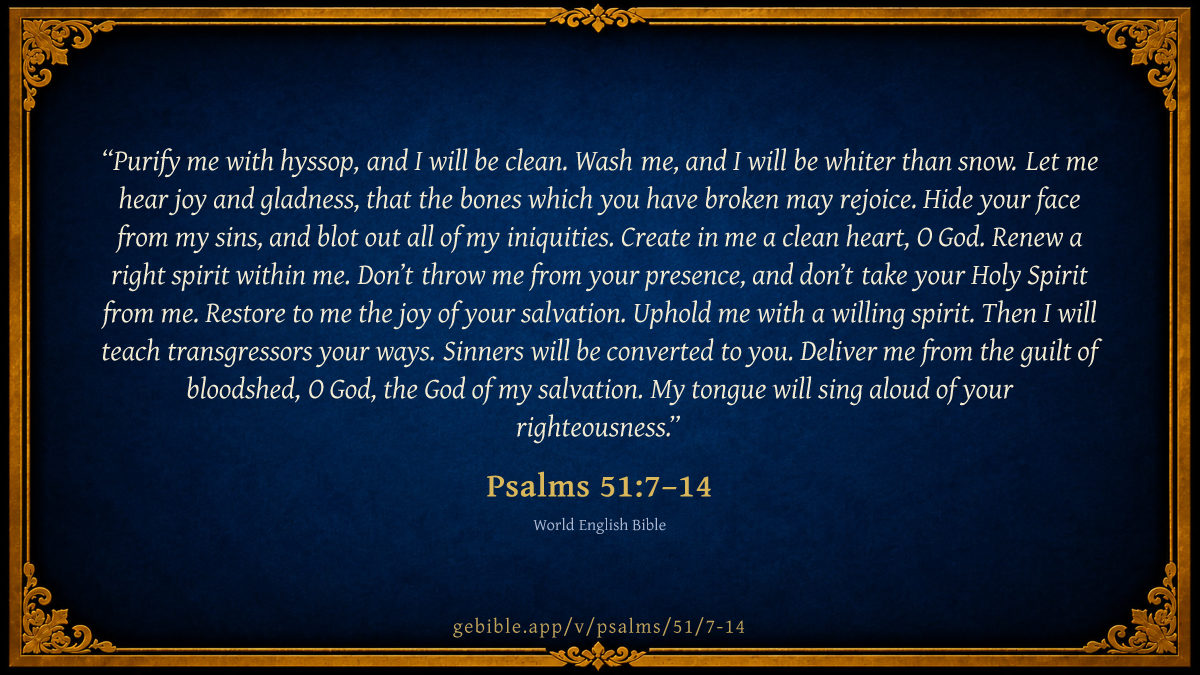
Ezekiel 11:19(v10)I will give them one heart, and I will put a new spirit within you. I will take the stony heart out of their flesh, and will give them a…
2 Corinthians 5:17(v10)Therefore if anyone is in Christ, he is a new creation. The old things have passed away. Behold, all things have become new.
Ephesians 4:22-24(v10)that you put away, as concerning your former way of life, the old man that grows corrupt after the lusts of deceit, and that you be renewed…
Matthew 5:8(v10)Blessed are the pure in heart, for they shall see God.
Ezekiel 18:31(v10)Cast away from you all your transgressions, in which you have transgressed; and make yourself a new heart and a new spirit: for why will…
Show all 100 cross-references
Romans 12:2(v10)Don’t be conformed to this world, but be transformed by the renewing of your mind, so that you may prove what is the good, well-pleasing,…
Ezekiel 36:25-27(v10)I will sprinkle clean water on you, and you will be clean. I will cleanse you from all your filthiness, and from all your idols. I will…
Acts 15:9(v10)He made no distinction between us and them, cleansing their hearts by faith.
Titus 3:5(v10)not by works of righteousness which we did ourselves, but according to his mercy, he saved us through the washing of regeneration and…
1 Peter 1:22(v10)Seeing you have purified your souls in your obedience to the truth through the Spirit in sincere brotherly affection, love one another from…
Jeremiah 32:39(v10)I will give them one heart and one way, that they may fear me forever, for their good, and the good of their children after them.
Psalms 24:4(v10)He who has clean hands and a pure heart; who has not lifted up his soul to falsehood, and has not sworn deceitfully.
Proverbs 20:9(v10)Who can say, “I have made my heart pure. I am clean and without sin?”
Ephesians 2:10(v10)For we are his workmanship, created in Christ Jesus for good works, which God prepared before that we would walk in them.
1 Corinthians 15:58(v10)Therefore, my beloved brothers, be steadfast, immovable, always abounding in the Lord’s work, because you know that your labor is not in…
Colossians 3:10(v10)and have put on the new man, who is being renewed in knowledge after the image of his Creator,
Psalms 73:1(v10)Surely God is good to Israel, to those who are pure in heart.
James 1:8(v10)He is a double-minded man, unstable in all his ways.
Psalms 78:8(v10)and might not be as their fathers, a stubborn and rebellious generation, a generation that didn’t make their hearts loyal, whose spirit was…
Psalms 78:37(v10)For their heart was not right with him, neither were they faithful in his covenant.
Isaiah 41:10(v12)Don’t you be afraid, for I am with you. Don’t be dismayed, for I am your God. I will strengthen you. Yes, I will help you. Yes, I will…
1 Kings 15:3-5(v10)He walked in all the sins of his father, which he had done before him; and his heart was not perfect with Yahweh his God, as the heart of…
Jeremiah 13:27(v10)I have seen your abominations, even your adulteries, and your neighing, the lewdness of your prostitution, on the hills in the field. Woe…
Acts 11:23(v10)who, when he had come, and had seen the grace of God, was glad. He exhorted them all, that with purpose of heart they should remain near to…
Joshua 14:14(v10)Therefore Hebron became the inheritance of Caleb the son of Jephunneh the Kenizzite to this day, because he followed Yahweh, the God of…
Psalms 13:5(vv8, 12)But I trust in your loving kindness. My heart rejoices in your salvation.
Ezekiel 36:37(v10)“ ‘The Lord Yahweh says: “For this, moreover, I will be inquired of by the house of Israel, to do it for them: I will increase them with…
Isaiah 61:10(v12)I will greatly rejoice in Yahweh! My soul will be joyful in my God, for he has clothed me with the garments of salvation. He has covered me…
Ephesians 4:30(v11)Don’t grieve the Holy Spirit of God, in whom you were sealed for the day of redemption.
1 John 1:7(v7)But if we walk in the light, as he is in the light, we have fellowship with one another, and the blood of Jesus Christ, his Son, cleanses…
Luke 1:47(v12)My spirit has rejoiced in God my Savior,
2 Corinthians 3:17(v12)Now the Lord is the Spirit and where the Spirit of the Lord is, there is liberty.
Jude 1:24(v12)Now to him who is able to keep them from stumbling, and to present you faultless before the presence of his glory in great joy,
Psalms 119:116-117(v12)Uphold me according to your word, that I may live. Let me not be ashamed of my hope. Hold me up, and I will be safe, and will have respect…
Isaiah 1:18(v7)“Come now, and let’s reason together,” says Yahweh: “Though your sins are as scarlet, they shall be as white as snow. Though they are red…
2 Kings 13:23(v11)But Yahweh was gracious to them, and had compassion on them, and had respect for them, because of his covenant with Abraham, Isaac, and…
Psalms 35:9(v12)My soul shall be joyful in Yahweh. It shall rejoice in his salvation.
Hebrews 9:13-14(v7)For if the blood of goats and bulls, and the ashes of a heifer sprinkling those who have been defiled, sanctify to the cleanness of the…
Isaiah 63:10-11(v11)But they rebelled and grieved his Holy Spirit. Therefore he turned and became their enemy, and he himself fought against them. Then he…
Numbers 19:18-20(v7)A clean person shall take hyssop, dip it in the water, and sprinkle it on the tent, on all the vessels, on the persons who were there, and…
Jeremiah 31:9-14(v12)They will come with weeping. I will lead them with petitions. I will cause them to walk by rivers of waters, in a straight way in which…
Romans 8:9(v11)But you are not in the flesh but in the Spirit, if it is so that the Spirit of God dwells in you. But if any man doesn’t have the Spirit of…
Job 5:17-18(v8)“Behold, happy is the man whom God corrects. Therefore do not despise the chastening of the Almighty. For he wounds and binds up. He…
Psalms 119:133(v12)Establish my footsteps in your word. Don’t let any iniquity have dominion over me.
Isaiah 57:17-18(v12)I was angry because of the iniquity of his covetousness and struck him. I hid myself and was angry; and he went on backsliding in the way…
Hosea 6:1-2(v8)“Come! Let’s return to Yahweh; for he has torn us to pieces, and he will heal us; he has injured us, and he will bind up our wounds. After…
Matthew 5:4(v8)Blessed are those who mourn, for they shall be comforted.
Hebrews 9:19(v7)For when every commandment had been spoken by Moses to all the people according to the law, he took the blood of the calves and the goats,…
Psalms 6:2-3(v8)Have mercy on me, Yahweh, for I am faint. Yahweh, heal me, for my bones are troubled. My soul is also in great anguish. But you, Yahweh—how…
Psalms 85:6-8(v12)Won’t you revive us again, that your people may rejoice in you? Show us your loving kindness, Yahweh. Grant us your salvation. I will hear…
Romans 8:15(v12)For you didn’t receive the spirit of bondage again to fear, but you received the Spirit of adoption, by whom we cry, “Abba! Father!”
1 Peter 1:5(v12)who by the power of God are guarded through faith for a salvation ready to be revealed in the last time.
Revelation 1:5(v7)and from Jesus Christ, the faithful witness, the firstborn of the dead, and the ruler of the kings of the earth. To him who loves us, and…
Genesis 6:3(v11)Yahweh said, “My Spirit will not strive with man forever, because he also is flesh; so his days will be one hundred twenty years.”
Job 29:2-3(v12)“Oh that I were as in the months of old, as in the days when God watched over me; when his lamp shone on my head, and by his light I walked…
Jeremiah 10:23(v12)Yahweh, I know that the way of man is not in himself. It is not in man who walks to direct his steps.
Jeremiah 16:17(v9)For my eyes are on all their ways. They are not hidden from my face. Their iniquity isn’t concealed from my eyes.
Romans 5:2-11(v12)through whom we also have our access by faith into this grace in which we stand. We rejoice in hope of the glory of God. Not only this, but…
Galatians 4:6-7(v12)And because you are children, God sent out the Spirit of his Son into your hearts, crying, “Abba, Father!” So you are no longer a…
Exodus 12:22(v7)You shall take a bunch of hyssop, and dip it in the blood that is in the basin, and strike the lintel and the two door posts with the blood…
Psalms 21:1(v12)The king rejoices in your strength, Yahweh! How greatly he rejoices in your salvation!
Psalms 119:81-82(v8)My soul faints for your salvation. I hope in your word. My eyes fail for your word. I say, “When will you comfort me?”
Luke 22:32(v13)but I prayed for you, that your faith wouldn’t fail. You, when once you have turned again, establish your brothers.”
John 14:26(v11)But the Counselor, the Holy Spirit, whom the Father will send in my name, will teach you all things, and will remind you of all that I said…
Ephesians 5:26-27(v7)that he might sanctify it, having cleansed it by the washing of water with the word, that he might present the assembly to himself…
Psalms 17:5(v12)My steps have held fast to your paths. My feet have not slipped.
Psalms 19:13(v12)Keep back your servant also from presumptuous sins. Let them not have dominion over me. Then I will be upright. I will be blameless and…
Psalms 71:18(v11)Yes, even when I am old and gray-haired, God, don’t forsake me, until I have declared your strength to the next generation, your might to…
Psalms 126:5-6(v8)Those who sow in tears will reap in joy. He who goes out weeping, carrying seed for sowing, will certainly come again with joy, carrying…
Luke 11:13(v11)If you then, being evil, know how to give good gifts to your children, how much more will your heavenly Father give the Holy Spirit to…
Romans 14:4(v12)Who are you who judge another’s servant? To his own lord he stands or falls. Yes, he will be made to stand, for God has power to make him…
1 Samuel 10:10(v11)When they came there to the hill, behold, a band of prophets met him; and the Spirit of God came mightily on him, and he prophesied among…
1 Samuel 16:14(v11)Now Yahweh’s Spirit departed from Saul, and an evil spirit from Yahweh troubled him.
Psalms 30:11(v8)You have turned my mourning into dancing for me. You have removed my sackcloth, and clothed me with gladness,
Psalms 35:10(v8)All my bones shall say, “Yahweh, who is like you, who delivers the poor from him who is too strong for him; yes, the poor and the needy…
Psalms 38:3(v8)There is no soundness in my flesh because of your indignation, neither is there any health in my bones because of my sin.
Isaiah 49:13(v12)Sing, heavens, and be joyful, earth! Break out into singing, mountains, for Yahweh has comforted his people, and will have compassion on…
Micah 7:18-19(v9)Who is a God like you, who pardons iniquity, and passes over the disobedience of the remnant of his heritage? He doesn’t retain his anger…
Luke 4:18(v8)“The Spirit of the Lord is on me, because he has anointed me to preach good news to the poor. He has sent me to heal the broken hearted, to…
Revelation 7:13-14(v7)One of the elders answered, saying to me, “These who are arrayed in the white robes, who are they, and where did they come from?” I told…
Judges 16:20(v11)She said, “The Philistines are upon you, Samson!” He awoke out of his sleep, and said, “I will go out as at other times, and shake myself…
Psalms 71:9(v11)Don’t reject me in my old age. Don’t forsake me when my strength fails.
Isaiah 57:15-18(v8)For the high and lofty One who inhabits eternity, whose name is Holy, says: “I dwell in the high and holy place, with him also who is of a…
Acts 2:37-41(v8)Now when they heard this, they were cut to the heart, and said to Peter and the rest of the apostles, “Brothers, what shall we do?” Peter…
2 Samuel 12:9(v14)Why have you despised Yahweh’s word, to do that which is evil in his sight? You have struck Uriah the Hittite with the sword, and have…
Psalms 35:28(v14)My tongue shall talk about your righteousness and about your praise all day long.
Isaiah 35:10(v8)Then Yahweh’s ransomed ones will return, and come with singing to Zion; and everlasting joy will be on their heads. They will obtain…
2 Thessalonians 1:9(v11)who will pay the penalty: eternal destruction from the face of the Lord and from the glory of his might,
James 5:19-20(v13)Brothers, if any among you wanders from the truth and someone turns him back, let him know that he who turns a sinner from the error of his…
Leviticus 14:49-52(v7)To cleanse the house he shall take two birds, cedar wood, scarlet, and hyssop. He shall kill one of the birds in an earthen vessel over…
Judges 15:14(v11)When he came to Lehi, the Philistines shouted as they met him. Then Yahweh’s Spirit came mightily on him, and the ropes that were on his…
2 Samuel 7:15(v11)but my loving kindness will not depart from him, as I took it from Saul, whom I put away before you.
2 Kings 24:20(v11)For through the anger of Yahweh, this happened in Jerusalem and Judah, until he had cast them out from his presence. Then Zedekiah rebelled…
Psalms 43:2(v11)For you are the God of my strength. Why have you rejected me? Why do I go mourning because of the oppression of the enemy?
Psalms 51:1(v9)Have mercy on me, God, according to your loving kindness. According to the multitude of your tender mercies, blot out my transgressions.
Isaiah 38:17(v9)Behold, for peace I had great anguish, but you have in love for my soul delivered it from the pit of corruption; for you have cast all my…
Acts 3:19(v13)“Repent therefore, and turn again, that your sins may be blotted out, so that there may come times of refreshing from the presence of the…
Acts 26:18-20(v13)to open their eyes, that they may turn from darkness to light and from the power of Satan to God, that they may receive remission of sins…
Colossians 2:14(v9)wiping out the handwriting in ordinances which was against us. He has taken it out of the way, nailing it to the cross.
Genesis 4:14(v11)Behold, you have driven me out today from the surface of the ground. I will be hidden from your face, and I will be a fugitive and a…
100 distinct cross-references across this passage (150 total citations).
Cross-references from openbible.info (CC BY 4.0)
Explain this passage (22 sources)
Historical commentary, presented as a primary source — not an endorsement.
John Calvin1540 · Public DomainOn vv7, 10, 12, 13, 147. Thou shalt purge me with hyssop He still…
7. Thou shalt purge me with hyssop He still follows out the same strain of supplication; and the repetition of his requests for pardon proves how earnestly he desired it. He speaks of hyssop , in allusion to the ceremonies of the law; and though he was far from putting his trust in the mere outward symbol of purification, he knew that, like every other legal rite, it was instituted for an important end. The sacrifices were seals of the grace of God. In them, therefore, he was anxious to find assurance of his reconciliation; and it is highly proper that, when our faith is disposed at any time to waver, we should confirm it by improving such means of divine support. All which David here prays for is, that God would effectually accomplish, in his experience, what he had signified to his Church and people by these outward rites; and in this he has set us a good example for our imitation. It is no doubt to the blood of Christ alone that we must look for the atonement of our sins; but we are creatures of sense, who must see with our eyes, and handle with our hands; and it is only by improving the outward symbols of propitiation that we can arrive at a full and assured persuasion of it. What we have said of the hyssop applies also to the washings referred to in this verse, and which were commonly practiced under the Law. They figuratively represented our being purged from all iniquity, in order to our reception into the divine favor. I need not say that it is the peculiar work of the Holy Spirit to sprinkle our consciences inwardly with the blood of Christ, and, by removing the sense of guilt, to secure our access into the presence of God.
In the two verses which follow, the Psalmist prays that God would be pacified towards him. Those put too confined a meaning upon the words who have suggested that, in praying to hear the voice of joy and gladness, he requests some prophet to be sent, who might assure him of pardon. He prays, in general, for testimonies of the divine favor. When he speaks of his bones as having been broken, he alludes to the extreme grief and overwhelming distress to which he had been reduced. The joy of the Lord would reanimate his soul; and this joy he describes as to be obtained by hearing; for it is the word of God alone which can first and effectually cheer the heart of any sinner. There is no true or solid peace to be enjoyed in the world except in the way of reposing upon the promises of God. Those who do not resort to them may succeed for a time in hushing or evading the terrors of conscience, but they must ever be strangers to true inward comfort. And, granting that they may attain to the peace of insensibility, this is not a state which could satisfy any man who has seriously felt the fear of the Lord. The joy which he desires is that which flows from hearing the word of God, in which he promises to pardon our guilt, and readmit us into his favor. It is this alone which supports the believer amidst all the fears, dangers, and distresses of his earthly pilgrimage; for the joy of the Spirit is inseparable from faith. When God is said, in the 9th verse, to hide his face from our sins, this signifies his pardoning them, as is explained in the clause immediately annexed — Blot out all my sins. This represents our justification as consisting in a voluntary act of God, by which he condescends to forget all our iniquities; and it represents our cleansing to consist in the reception of a gratuitous pardon. We repeat the remark which has been already made, that David, in thus reiterating his one request for the mercy of God, evinces the depth of that anxiety which he felt for a favor which his conduct had rendered difficult of attainment. The man who prays for pardon in a mere formal manner, is proved to be a stranger to the dreadful desert of sin. “Happy is the man,” said Solomon, “that feareth alway,” (Proverbs 28:14.)
Read full note →
But here it may be asked why David needed to pray so earnestly for the joy of remission, when he had already received assurance from the lips of Nathan that his sin was pardoned? (2 Samuel 12:13.) Why did he not embrace this absolution? and was he not chargeable with dishonoring God by disbelieving the word of his prophet? We cannot expect that God will send us angels in order to announce the pardon which we require. Was it not said by Christ, that whatever his disciples remitted on earth would be remitted in heaven? (John 20:23.) And does not the apostle declare that ministers of the gospel are ambassadors to reconcile men to God? (2 Corinthians 5:20.) From this it might appear to have argued unbelief in David, that, notwithstanding the announcement of Nathan, he should evince a remaining perplexity or uncertainty regarding his forgiveness. There is a twofold explanation which may be given of the difficulty. We may hold that Nathan did not immediately make him aware of the fact that God was willing to be reconciled to him. In Scripture, it is well known, things are not always stated according to the strict order of time in which they occurred. It is quite conceivable that, having thrown him into this situation of distress, God might keep him in it for a considerable interval, for his deeper humiliation; and that David expresses in these verses the dreadful anguish which he endured when challenged with his crime, and not yet informed of the divine determination to pardon it. Let us take the other supposition, however, and it by no means follows that a person may not be assured of the favor of God, and yet show great earnestness and importunity in praying for pardon. David might be much relieved by the announcement of the prophet, and yet be visited occasionally with fresh convictions, influencing him to have recourse to the throne of grace. However rich and liberal the offers of mercy may be which God extends to us, it is highly proper on our part that we should reflect upon the grievous dishonor which we have done to his name, and be filled with due sorrow on account of it. Then our faith is weak, and we cannot at once apprehend the full extent of the divine mercy; so that there is no reason to be surprised that David should have once and again renewed his prayers for pardon, the more to confirm his belief in it. The truth is, that we cannot properly pray for the pardon of sin until we have come to a persuasion that God will be reconciled to us. Who can venture to open his mouth in God’s presence unless he be assured of his fatherly favor? And pardon being the first thing we should pray for, it is plain that there is no inconsistency in having a persuasion of the grace of God, and yet proceeding to supplicate his forgiveness. In proof of this, I might refer to the Lord’s Prayer, in which we are taught to begin by addressing God as our Father, and yet afterwards to pray for the remission of our sins. God’s pardon is full and complete; but our faith cannot take in his overflowing goodness, and it is necessary that it should distil to us drop by drop. It is owing to this infirmity of our faith, that we are often found repeating and repeating again the same petition, not with the view surely of gradually softening the heart of God to compassion, but because we advance by slow and difficult steps to the requisite fullness of assurance. The mention which is here made of purging with hyssop, and of washing or sprinkling, teaches us, in all our prayers for the pardon of sin, to have our thoughts directed to the great sacrifice by which Christ has reconciled us to God. “Without shedding of blood,” says Paul, “is no remissions” (Hebrews 9:22;) and this, which was intimated by God to the ancient Church under figures, has been fully made known by the coming of Christ. The sinner, if he would find mercy, must look to the sacrifice of Christ, which expiated the sins of the world, glancing, at the same time, for the confirmation of his faith, to Baptism and the Lord’s Supper; for it were vain to imagine that God, the Judge of the world, would receive us again into his favor in any other way than through a satisfaction made to his justice.
John Calvin's Commentaries (1540-1563) — public domain. Text from the Calvin Translation Society English edition (1840s-50s) via the Christian Classics Ethereal Library (ccel.org). Calvin's coverage is partial (roughly two-thirds of the Bible); uncommented books and verses are honest gaps, never fabricated. The 19th-century editor's footnotes and remarks are omitted so the notes are faithfully Calvin's own voice.
Geneva Bible translators1599 · Public DomainOn vv8, 10, 12, 13, 14By the bones he understandeth all strength of soul…
By the bones he understandeth all strength of soul and body, which by cares and mourning are consumed.
He meaneth God’s comfortable mercies toward repentant sinners.
Geneva Bible (1599) marginal notes — public domain.
John Trapp1656 · Public DomainOn vv7–14Psa 51:7 Purge me with hyssop, and I shall…
Psa 51:7 Purge me with hyssop, and I shall be clean: wash me, and I shall be whiter than snow.
Ver. 7. Purge me with hyssop, and I shall be clean] Sprinkle me with the blood of Christ by the hyssop bunch of faith, not only taking away thereby the sting and stink of sin, but conferring upon me the sweet savour of Christ’s righteousness imputed unto me. See Heb 9:13-14; Heb 9:19, where he calleth it hyssop; of which see Dioscorides, lib. 3, chap. xxvi., xxviii. David multiplieth his suit for pardon, not only in plain terms, but by many metaphors.
Read full note →
Wash me, and I shall be whiter than snow] So we cannot be by any washings of our own, though with snow water, Isa 1:16. The bride’s garments are made white in the Lamb’s blood, Rev 1:14; the foulest sinners washed in this fountain become white as the snow in Salmon, Isa 1:18 1Co 6:11 Eph 5:27. Peccata non redeunt.
John Trapp, A Commentary or Exposition upon All the Books of the Old and New Testament (1647–1656) — public domain. Text from a community e-Sword module.
Matthew Poole1685 · Public DomainOn vv7–14With hyssop; or, as with hyssop; the note of…
With hyssop; or, as with hyssop; the note of similitude being frequently understood. As lepers and other unclean persons are by thy appointment purified by the use of hyssop and other things, Lev 14:6; Num 19:6; so do thou cleanse me, a most leprous and polluted creature, by thy grace, and by the virtue of that blood of Christ, which is signified by those ceremonial usages.
Matthew Poole's English Annotations on the Holy Bible (1683–1685) — public domain. Text from a community e-Sword/MySword module.
Matthew Henry1710 · Public DomainOn vv7, 14I. See here what David prays for. Many excellent…
I. See here what David prays for. Many excellent petitions he here puts up, to which if we do but add, "for Christ's sake," they are as evangelical as any other.
1. He prays that God would cleanse him from his sins and the defilement he had contracted by them (Psa 51:7): "Purge me with hyssop; that is, pardon my sins, and let me know that they are pardoned, that I may be restored to those privileges which by sin I have forfeited and lost." The expression here alludes to a ceremonial distinction, that of cleansing the leper, or those that were unclean by the touch of a body by sprinkling water, or blood, or both upon them with a bunch of hyssop, by which they were, at length, discharged from the restraints they were laid under by their pollution. "Lord, let me be as well assured of my restoration to thy favour, and to the privilege of communion with thee, as they were thereby assured of their re-admission to their former privileges." But it is founded upon gospel-grace: Purge me with hyssop, that is, with the blood of Christ applied to my soul by a lively faith, as water of purification was sprinkled with a bunch of hyssop. It is the blood of Christ (which is therefore called the blood of sprinkling, Heb 12:24), that purges the conscience from dead works, from that guilt of sin and dread of God which shut us out of communion with him, as the touch of a dead body, under the law, shut a man out from the courts of God's house. If this blood of Christ, which cleanses from all sin, cleanse us from our sin, then we shall be clean indeed, Heb 10:2. If we be washed in this fountain opened, we shall be whiter than snow, not only acquitted but accepted; so those are that are justified. Isa 1:18, Though your sins have been as scarlet, they shall be white as snow.
Read full note →
2. He prays that, his sins being pardoned, he might have the comfort of that pardon. He asks not to be comforted till first he is cleansed; but if sin, the bitter root of sorrow, be taken away, he can pray in faith, "Make me to hear joy and gladness (Psa 51:8), that is, let me have a well-grounded peace, of thy creating, thy speaking, so that the bones which thou hast broken by convictions and threatenings may rejoice, may not only be set again, and eased from the pain, but may be sensibly comforted, and, as the prophet speaks, may flourish as a herb." Note, (1.) The pain of a heart truly broken for sin may well be compared to that of a broken bone; and it is the same Spirit who as a Spirit of bondage smites and wounds and as a Spirit of adoption heals and binds up. (2.) The comfort and joy that arise from a sealed pardon to a penitent sinner are as refreshing as perfect ease from the most exquisite pain. (3.) It is God's work, not only to speak this joy and gladness, but to make us hear it and take the comfort of it. He earnestly desires that God would lift up the light of his countenance upon him, and so put gladness into his heart, that he would not only be reconciled to him, but, which is a further act of grace, let him know that he was so.
3. He prays for a complete and effectual pardon. This is that which he is most earnest for as the foundation of his comfort (Psa 51:9): "Hide thy face from my sins, that is, be not provoked by them to deal with me as I deserve; they are ever before me, let them be cast behind thy back. Blot out all my iniquities out of the book of thy account; blot them out, as a cloud is blotted out and dispelled by the beams of the sun," Isa 44:22.
4. He prays for sanctifying grace; and this every true penitent is as earnest for as for pardon and peace, Psa 51:10. He does not pray, "Lord, preserve me my reputation," as Saul, I have sinned, yet honour me before this people. No; his great concern is to get his corrupt nature changed: the sin he had been guilty of was, (1.) An evidence of its impurity, and therefore he prays, Create in me a clean heart, O God! He now saw, more than ever, what an unclean heart he had, and sadly laments it, but sees it is not in his own power to amend it, and therefore begs of God (whose prerogative it is to create) that he would create in him a clean heart. He only that made the heart can new-make it; and to his power nothing is impossible. He created the world by the word of his power as the God of nature, and it is by the word of his power as the God of grace that we are clean (Joh 15:3), that we are sanctified, Joh 17:17. (2.) It was the cause of its disorder, and undid much of the good work that had been wrought in him; and therefore he prays, "Lord, renew a right spirit within me; repair the decays of spiritual strength which this sin has been the cause of, and set me to rights again." Renew a constant spirit within me, so some. He had, in this matter, discovered much inconstancy and inconsistency with himself, and therefore he prays, "Lord, fix me for the time to come, that I may never in like manner depart from thee."
5. He prays for the continuance of God's good-will towards him and the progress of his good work in him, Psa 51:11. (1.) That he might never be shut out from God's favour: "Cast me not away from thy presence, as one whom thou abhorrest and canst not endure to look upon." He prays that he might not be thrown out of God's protection, but that wherever he went, he might have the divine presence with him, might be under the guidance of his wisdom and in the custody of his power, and that he might not be forbidden communion with God: "Let me not be banished thy courts, but always have liberty of access to thee by prayer." He does not deprecate the temporal judgments which God by Nathan had threatened to bring upon him. "God's will be done; but, Lord, rebuke me no in thy wrath. If the sword come into my house never to depart from it, yet let me have a God to go to in my distresses, and all shall be well." (2.) That he might never be deprived of God's grace: Take not thy Holy Spirit from me. He knew he had by his sin grieved the Spirit and provoked him to with draw, and that because he also was flesh God might justly have said that his Spirit should no more strive with him nor work upon him, Gen 6:3. This he dreads more than any thing. We are undone if God take his Holy Spirit from us. Saul was a sad instance of this. How exceedingly sinful, how exceedingly miserable, was he, when the Spirit of the Lord had departed from him! David knew it, and therefore begs thus earnestly: "Lord, whatever thou take from me, my children, my crown, my life, yet take not thy Holy Spirit from me" (see Sa2 7:15), "but continue thy Holy Spirit with me, to perfect the work of my repentance, to prevent my relapse into sin, and to enable me to discharge my duty both as a prince and as a psalmist."
6. He prays for the restoration of divine comforts and the perpetual communications of divine grace, Psa 51:12. David finds two ill effects of his sin: - (1.) It had made him sad, and therefore he prays, Restore unto me the joy of thy salvation. A child of God knows no true nor solid joy but the joy of God's salvation, joy in God his Saviour and in the hope of eternal life. By wilful sin we forfeit this joy and deprive ourselves of it; our evidences cannot but be clouded and our hopes shaken. When we give ourselves so much cause to doubt of our interest in the salvation, how can we expect the joy of it? But, when we truly repent, we may pray and hope that God will restore to us those joys. Those that sow in penitential tears shall reap in the joys of God's salvation when the times of refreshing shall come. (2.) It had made him weak, and therefore he prays, "Uphold me with the free Spirit: I am ready to fall, either into sin or into despair; Lord, sustain me; my own spirit" (though the spirit of a man will go far towards the sustaining of his infirmity) "is not sufficient; if I be left to myself, I shall certainly sink; therefore uphold me with thy Spirit, let him counterwork the evil spirit that would cast me down from my excellency. Thy Spirit is a free spirit, a free gent himself, working freely" (and that makes those free whom he works upon, for where the Spirit of the Lord is there is liberty) - "thy ingenuous princely Spirit." He was conscious to himself of having acted, in the matter of Uriah, very disingenuously and unlike a prince; his behaviour was base and paltry: "Lord," says he, "let thy Spirit inspire my soul with noble and generous principles, that I may always act as becomes me." A free spirit will be a firm and fixed spirit, and will uphold us. The more cheerful we are in our duty the more constant we shall be to it.
II. See what David here promises, Psa 51:13. Observe,
1. What good work he promises to do: I will teach transgressors thy ways. David had been himself a transgressor, and therefore could speak experimentally to transgressors, and resolves, having himself found mercy with God in the way of repentance, to teach others God's ways, that is, (1.) Our way to God by repentance; he would teach others that had sinned to take the same course that he had taken, to humble themselves, to confess their sins, and seek God's face; and, (2.) God's way towards us in pardoning mercy; how ready he is to receive those that return to him. He taught the former by his own example, for the direction of sinners in repenting; he taught the latter by his own experience, for their encouragement. By this psalm he is, and will be to the world's end, teaching transgressors, telling them what God had done for his soul. Note, Penitents should be preachers. Solomon was so, and blessed Paul.
2. What good effect he promises himself from his doing this: "Sinners shall be converted unto thee, and shall neither persist in their wanderings from thee, nor despair of finding mercy in their returns to thee." The great thing to be aimed at in teaching transgressors is their conversion to God; that is a happy point gained, and happy are those that are instrumental to contribute towards it, Jam 5:20.
Matthew Henry's Commentary on the Whole Bible (1708–1710) — public domain (CC PDM 1.0). Text via the HelloAO Bible API.
John Gill1763 · Public DomainOn vv7–14Purge me with hyssop,.... Or "thou shalt purge me…
Purge me with hyssop,.... Or "thou shalt purge me with hyssop" (f); or "expiate me"; which was used in sprinkling the blood of the paschal lamb on the door posts of the Israelites in Egypt, that the destroying angel might pass over them, Exo 12:22; and in the cleansing of the leper, Lev 14:4; and in the purification of one that was unclean by the touch of a dead body, &c. Num 19:6; which the Targum on the text has respect to; and this petition of the psalmist shows that he saw himself a guilty creature, and in danger of the destroying angel, and a filthy creature like the leper, and deserving to be excluded from the society of the saints, and the house of God; and that he had respect not hereby to ceremonial sprinklings and purifications, for them he would have applied to a priest; but to the sprinkling of the blood of Christ, typified thereby; and therefore he applies to God to purge his conscience with it; and, as Suidas (g) from Theodoret observes, hyssop did not procure remission of sins, but has a mystical signification, and refers to what was meant by the sprinkling of the blood of the passover; and then he says,
and I shall be clean; thoroughly clean; for the blood sprinkled on the heart by the spirit clears it from an evil conscience, purges the conscience from dead works, and cleanses from all sin;
Read full note →
wash me; or "thou shall wash me" (h); alluding to the washing at the cleansing of a leper, and the purification of an unclean person, Lev 14:8; but had in view the fountain of Christ's blood, in which believers are washed from all their sins, Zac 13:1;
and I shall be whiter than snow; who was black with original corruption, and actual transgressions; but the blood of Christ makes not only the conversation garments white that are washed in it; but even crimson and scarlet sins as white as wool, as white as snow, and the persons of the saints without spot or blemish, Rev 7:14, Eph 5:25; "whiter than the snow" is a phrase used by Homer (i), and others, to describe what is exceeding white.
(f) "purificabis me", Pagninus, Montanus; "exiabis me", Vatablus, Musculus, Cocceius, Gejerus. (g) In voce (h) "lavabis me", V. L. Pagninus, Montanus, Vatablus, Musculus, Cocceius. (i) Iliad. 10. v. 437. So Martial. l. 7. Epigr. 27. Ovid. Amor. l. 3. Eleg. 6.
John Gill's Exposition of the Whole Bible (1746–1763) — public domain (CC PDM 1.0). Text via the HelloAO Bible API.
John Wesley1765 · Public DomainOn vv7, 8, 10, 12, 14Hyssop - As lepers, are by thy appointment purified…
Hyssop - As lepers, are by thy appointment purified by the use of hyssop and other things, so do thou cleanse me a leprous and polluted creature, by thy grace, and by that blood of Christ, which is signified by those ceremonial usages.
John Wesley, Explanatory Notes Upon the Whole Bible (1754–1765) — public domain. Text via the GEBible commentary corpus.
Adam Clarke1810 · Public DomainOn vv7–14Verse 7. Purge me with hyssop] תחטאני techatteeni, "thou…
Verse 7. Purge me with hyssop] תחטאני techatteeni, "thou shalt make a sin-offering for me;" probably alluding to the cleansing of the leper: Le 14:1, c. The priest took two clean birds, cedar-wood, scarlet, and hyssop one of the birds was killed; and the living bird, with the scarlet, cedar, and hyssop, dipped in the blood of the bird that had been killed, and then sprinkled over the person who had been infected. But it is worthy of remark that this ceremony was not performed till the plague of the leprosy had been healed in the leper; (Le 14:3;) and the ceremony above mentioned was for the purpose of declaring to the people that the man was healed, that he might be restored to his place in society, having been healed of a disease that the finger of God alone could remove. This David seems to have full in view; hence he requests the Lord to make the sin-offering for him, and to show to the people that he had accepted him, and cleansed him from his sin.
Adam Clarke's Commentary on the Bible (1810–1826) — public domain. Text from a community e-Sword/MySword module.
Joseph Benson1811 · Public DomainOn vv7, 8, 9, 11, 13, 14Psa 51:7. Purge me with hyssop — Or, as…
Psa 51:7. Purge me with hyssop — Or, as with hyssop; the note of similitude being frequently understood. As lepers, and other unclean persons, are by thy appointment purified by the use of hyssop and other things, Lev 14:6; Num 19:6; so do thou cleanse me, a most leprous and polluted creature, by thy grace, and by the virtue of that blood of Christ, which is signified by those ceremonial usages. The word
תחשׂאני, techatteeni, here rendered purge me, properly means, expiate my sin. “The psalmist well knew that his sins were too great to be expiated by any legal purifications, and therefore prays that God would himself expiate them, and restore him; that is,” not only remove their guilt, but “make him as free from those criminal propensities to sin, and from all the bad effects of his aggravated crimes, as though he had been purified from a leprosy, by the water of cleansing, sprinkled on him by a branch of hyssop; and that he might be, if possible, clearer from all the defilement and guilt of sin than the new fallen snow. I think both these senses are included in the expiation which the psalmist prays for; as the person whose leprosy was expiated was wholly cured of his disease, and freed from all the incapacities attending it.” — Dodd.
Joseph Benson's Commentary on the Old and New Testaments (1811–1818) — public domain. Text from a community e-Sword module.
Albert Barnes1834 · Public DomainOn vv7–14Purge me with hyssop, and I shall be clean…
Purge me with hyssop, and I shall be clean - On the word hyssop, see the notes at Joh 19:29; notes at Heb 9:19. The plant or herb was much used by the Hebrews in their sacred purifications and sprinklings: Exo 12:22; Lev 14:4, Lev 14:6,Lev 14:49, Lev 14:51; 1Ki 4:33. Under this name the Hebrews seem to have comprised not only the common “hyssop” of the shops, but also other aromatic plants, as mint, wild marjoram, etc. - Gesenius, “Lexicon” The idea of the psalmist here evidently is not that the mere sprinkling with hyssop would make him clean; but he prays for that cleansing of which the sprinkling with hyssop was an emblem, or which was designed to be represented by that. The whole structure of the psalm implies that he was seeking an “internal” change, and that he did not depend on any mere outward ordinance or rite. The word rendered “purge” is from the word חטא châṭâ' - which means “to sin.” In the Piel form it means to bear the blame (or “loss”) for anything; and then to “atone for, to make atonement, to expiate:” Gen 31:39; Lev 6:26; Num 19:19. Here it conveys the notion of cleansing from sin “by” a sacred rite, or by that which was signified by a sacred rite. The idea was that the sin was to be removed or taken away, so that he might be free from it, or that “that” might be accomplished which was represented by the sprinkling with hyssop, and that the soul might be made pure. Luther has rendered it with great force - Entsundige mich mit Ysop - “Unsin me with hyssop.”
Wash me - That is, cleanse me. Sin is represented as “defiling,” and the idea of “washing” it away is often employed in the Scriptures. See the notes at Isa 1:16.
Read full note →
And I shall be whiter than snow - See the notes at Isa 1:18. The prayer is, that he might be made “entirely” clean; that there might be no remaining pollution in his soul.
Albert Barnes' Notes on the Bible (1834–1885) — public domain. Text from a community e-Sword/MySword module.
Robert Jamieson, A. R. Fausset & David Brown1871 · Public DomainOn vv7, 8, 9, 10, 12, 13, 14A series of prayers for forgiveness and purifying.
A series of prayers for forgiveness and purifying.
Purge . . . hyssop--The use of this plant in the ritual (Exo 12:22; Num 19:6, Num 19:18) suggests the idea of atonement as prominent here; "purge" refers to vicarious satisfaction (Num 19:17-20).
Jamieson, Fausset & Brown — Commentary Critical and Explanatory on the Whole Bible (1871) — public domain (CC PDM 1.0). Text via the HelloAO Bible API.
Daniel D. Whedon1874 · Public DomainOn vv7, 8, 10, 11, 12, 13, 147. Purge me with hyssop—The allusion is to the…
7. Purge me with hyssop—The allusion is to the purification from death-corruption, as recorded Numbers 19; Num_31:19, the substance and ritualistic form of which were the strongest and most imposing known to the Mosaic law. Both the sprinkling and washing are referred to: “Sprinkle me with hyssop; wash me,” etc. See Num_19:19. The pollution by the touch of a dead body was considered as the infection of death, and the purifying element, which must be correspondingly strong, was the essence of the blood and flesh of the “red heifer,” with the alkali from the ashes of the “cedar wood” mixed with living water, partaking at once of the nature of a sin offering and a holocaust, or burnt offering; that is, of an expiation, and a complete surrender to God. The idea of purification from the corruption of in-reigning death as the penalty of sin, was fundamental to the institution.
Whiter than snow—Compare Isa_1:18
Daniel D. Whedon (gen. ed.), Commentary on the Old and New Testaments (1874–1909) — public domain. Text from a community e-Sword module.
The Cambridge Bible for Schools and Colleges1878 · Public DomainOn vv7, 9, 10, 11, 12, 13, 147, 8. The verbs in these verses may be…
7, 8. The verbs in these verses may be regarded as optatives (mayest thou purge me), but it is preferable to render them as futures: Thou shalt purge me … thou shalt wash me … thou shalt make me hear. They thus give utterance to the Psalmist’s faith that God can and will cleanse and restore him. In Psa_51:9 ff direct prayer is resumed by the imperative, as in Psa_51:1-2.
The figurative language is borrowed from the ceremonial of the law. A bunch of hyssop, some common herb which grew upon walls (Tristram, Nat. Hist. of the Bible, p. 455), was used as a sprinkler, especially in the rites for cleansing the leper and purifying the unclean. (Exo_12:22; Lev_14:4 ff; Num_19:6 ff, Num_19:18 ff; Heb_9:19.) Washing of the person and clothes regularly formed part of the rites of purification. The Psalmist is of course thinking of the inward and spiritual cleansing of which those outward rites were the symbol. He appeals to God Himself to perform the office of the priest and cleanse him from his defilement.
Read full note →
whiter than snow] Cp. Isa_1:18, where this natural emblem of purity is contrasted with the scarlet of sin, suggested by the stains of blood upon the hands (Psa_51:15). Terms usually applied to garments (Psa_51:2 note) are transferred to the person. Cp. Rev_3:4-5; Rev_4:4; &c.
It is unnecessary to follow the Syr. in reading thou shalt satisfy me with joy (Psa_90:14) for thou shalt make me hear joy, though the change would be a simple one. The language is still borrowed from the law. As the purification of the unclean was the prelude to his readmission to the gladness of the worship of the sanctuary (Psa_42:4), so the cleansing of the Psalmist’s heart will be the prelude to his restoration to that ‘joy of God’s salvation’ (Psa_51:12), which he desires.
the bones which thou hast broken] For the sense of God’s displeasure had as it were crushed and shattered his whole frame. See note on Psa_42:10, and cp. Psa_32:3.
The Cambridge Bible for Schools and Colleges (gen. ed. J. J. S. Perowne; Cambridge University Press, 1878–1918) — public domain. Text from a community e-Sword module.
Ellicott's Commentary for English Readers1878 · Public DomainOn vv7–14(7) Hyssop.—The mention of this connects this verse with…
(7) Hyssop.—The mention of this connects this verse with the priestly ordinances concerning leprosy and contact with a dead body (Leviticus 14; Numbers 19); but generally it is a repetition of the former prayer to have the breach made in the covenant - relationship healed. (Comp. Isa_1:18.)
A Bible Commentary for English Readers, edited by Charles John Ellicott (1878–1897) — public domain. Text from a community e-Sword module.
The Pulpit Commentary1880 · Public DomainOn vv7–14Purge me with hyssop, and I shall be clean.…
Purge me with hyssop, and I shall be clean. "Hyssop" alone could by the Levitical Law cleanse from contact with a corpse (Num_19:18) or from the defilement of leprosy. (Lev_14:4) David recognizes that his impurity is of the extremest kind, and needs the remedy which has the greatest purifying power. Legally, this was the hyssop, with its "blood of sprinkling"; (Lev_14:6, Lev_14:7) spiritually, it was the blood of Christ, which was thus symbolized. Wash me, and I shall be whiter than snow. Again the word is used which corresponds to the Greek plunon . "Wash me as garments are washed by the fuller" (see the comment on ver. 2).
"Whiter than snow.
Read full note →
Snow is remarkable for whiteness. As it glistens on the mountains, or lies in virgin purity on the fields, what can compare with it? And yet David speaks of something whiter. Where? Not in nature, but in the kingdom of grace. Of whom? Not Christ, not the holy angels, not the saints in glory, but, strange to say, of himself. Like Paul, he was "the chief of sinners," and he was, therefore, the fitter ensample of the marvellous kindness and grace of God. In his prayer we find
I THE RECOIL OF THE SOUL FROM SIN. Many find pleasure in sin; but when once the soul is quickened, there is an end to this. Sin is felt to be vile and loathsome. Its touch is defilement; its presence is abhorrent; its effects are dreaded as the most terrible.
II THE YEARNING OF THE SOUL FOR PURITY. All things around us that retain their freshness and their purity condemn us and put us to shame. They show what we have lost; they intensify our pains and our sorrows. At the same time, they help to keep alive our hopes. While they testify that we are fallen, they testify also that sin is not of our true nature that it is not something that rightly belongs to us, but that it should be abjured and abhorred. The more we compare ourselves with God"s Law, and the more truly we realize God"s will concerning us, the more earnestly shall we cry for deliverance.
III THE SUPREME TRUST OF THE SOUL IN GOD. There is the cry, "Wash me!" This implies weakness and submission. We cannot "wash" ourselves. Our tears and prayers, our penitences and endeavours, are in vain. We cast ourselves implicitly upon God. Let God, who is holy and good, do this great thing for us, and do it in his own way. It is not the priest, it is not the saints; God only can save. There is also the glad faith. "And I shall be whiter than snow." The lost purity will be restored. What God does, he does perfectly. What joy in being "whiter than snow"! not only pardoned, (Isa_1:18) but cleansed. (1Jn_1:7 Rev_7:14) It is heaven begun. W.F.
The Pulpit Commentary (1880–1919), ed. H.D.M. Spence-Jones & Joseph S. Exell — public domain. Text from a community e-Sword module.
Charles H. Spurgeon1885 · Public DomainOn vv7–14Ver. 7. Purge me with hyssop. Sprinkle the atoning…
Ver. 7. Purge me with hyssop. Sprinkle the atoning blood upon me with the appointed means. Give me the reality which legal ceremonies symbolise. Nothing but blood can take away my blood stains, nothing but the strongest purification can avail to cleanse me. Let the sin offering purge my sin. Let him who was appointed to atone, execute his sacred office on me; for none can need it more than I. The passage may be read as the voice of faith as well as a prayer, and so it runs--"Thou wilt purge me with hyssop, and I shall be clean." Foul as I am, there is such power in the divine propitiation, that my sin shall vanish quite away. Like the leper upon whom the priest has performed the cleansing rites, I shall again be admitted into the assembly of thy people and allowed to share in the privileges of the true Israel; while in thy sight also, through Jesus my Lord, I shall be accepted. Wash me. Let it not merely be in type that I am clean, but by a real spiritual purification, which shall remove the pollution of my nature. Let the sanctifying as well as the pardoning process be perfected in me. Save me from the evils which my sin has created and nourished in me. And I shall be whiter than snow. None but thyself can whiten me, but thou canst in grace outdo nature itself in its purest state. Snow soon gathers smoke and dust, it melts and disappears; thou canst give me an enduring purity. Though snow is white below as well as on the outer surface, thou canst work the like inward purity in me, and make me so clean that only an hyperbole can set forth my immaculate condition. Lord, do this; my faith believes thou wilt, and well she knows thou canst. Scarcely does Holy Scripture contain a verse more full of faith than this. Considering the nature of the sin, and the deep sense the psalmist had of it, it is a glorious faith to be able to see in the blood sufficient, nay, all sufficient merit entirely to purge it away. Considering also the deep natural inbred corruption which David saw and experienced within, it is a miracle of faith that he could rejoice in the hope of perfect purity in his inward parts. Yet, be it added, the faith is no more than the word warrants, than the blood of atonement encourages, than the promise of God deserves. O that some reader may take heart, even now while smarting under sin, to do the Lord the honour to rely thus confidently on the finished sacrifice of Calvary and the infinite mercy there revealed.
Ver. 7. Purge me with hyssop. Do I well to prescribe to God with what he shall purge me, as though I knew all God's medicines as well as himself and which is worse, I to prescribe and he to administer? But excuse me, O my soul, it is not I that prescribe it to God, it is God that prescribes it to me; for hyssop is his own receipt, and one of the ingredients prescribed by himself to make the water of separation for curing the leprosy...I must confess I was glad at heart when I first heard hyssop spoken of; to think I should be purged so gently, and with a thing that may so easily be had, for hyssop grows in every garden; and then I thought I might go fetch it thence and purge myself, but now I perceive this is not the hyssop of which Solomon writ when he writ from the cedar to the hyssop; but this hyssop is rather the herb grace, which never grew in garden but in that of Paradise, and which none can fetch thence unless God himself deliver it. The truth is, this hyssop was sometimes a cedar; the highest of all trees because the lowest of all shrubs, only to be made this hyssop for us: for Christ indeed is the true hyssop, and his blood the juice of hyssop that only can purge away my sins. Sir Richard Baker.
Read full note →
Ver. 7. Purge me with hyssop. (ynajxt) Properly, expiate my sin with hyssop. The Psalmist alludes to the purification from the leprosy Le 14:52, or from the touch of a dead body Nu 19:19, both of which were to be done by the sprinkling of water and other things with hyssop. Samuel Chandler.
Ver. 7. Hyssop. The lasaf or asaf, the caper plant, the bright green creeper which climbs out of the fissures of the rocks in the Sinaitic valleys, has been identified on grounds of great probability with the "hyssop" or ezob of Scripture; and thus explains whence came the green branches used, even in the desert, for sprinkling the water over the tents of the Israelites. Arthur Penrhyn Stanley, in "Sinai and Palestine." 1864.
Ver. 7. Hyssop. Between twenty and thirty different plants have been proposed, but no one of them comes so near the above requirements as the caper plant (Capparis spinosa). It grows "out of the wall; " its stalks supply both bunch and rod admirably fitted for the ends indicated; and it has ever been esteemed in the East as possessing cleansing properties. John Duns, D.D., in "Biblica; Natural Science."
Ver. 7. Hyssop. What a pity that Solomon's botany is lost, in which he spoke of trees, from the cedar that is in Lebanon to the hyssop that springeth out of the wall! The cedar we know, but what is the hyssop of the royal botanist? Mr. B---, French consul of this city (Sidon), and an enthusiastic botanist, exhibited to me two varieties of hyssop; one, called zátar by the Arabs, having the fragrance of thyme, with a hot, pungent taste, and long, slender stems. A bunch of these would answer very well for sprinkling the paschal and sacrificial blood on the lintel and posts of the doors, and over the persons and houses cleansed from the leprosy. Mr. B---, however, thinks that a very small green plant, like a moss which covers old walls in damp places, is the hyssop of Solomon. This I doubt. The other kind also springs out of walls, those of the garden especially, and was much more likely to attract the attention of the royal student. W. M. Thomson, D.D., in "The Land and the Book."
Ver. 7. The paraphrase of this verse in the Chaldee is: "Thou wilt sprinkle me like the priest, which sprinkleth the unclean with the purifying waters, with hyssop, with the ashes of an heifer, and I shall be clean." John Morison.
Ver. 7. I shall be whiter than snow. But how is this possible? All the dyers on earth cannot dye a red into a white; and how, then, is it possible that my sins which are as red as scarlet should ever be made as white as snow? Indeed such retrogradation is no work of human art; it must be only his doing who brought the sun ten degrees back in the dial of Ahaz: for God hath a nitre of grace that can bring not only the redness of scarlet sins, but even the blackness of deadly sins, into its native purity and whiteness again. But say it be possible, yet what need is there of so great a whiteness, as to be "whiter than snow"? seeing snow is not as paries dealbatus, a painted wall, white without and foul within; but it is white, intus et in cute, within and without, throughout and all over; and what eye so curious but such a whiteness may content? Yet such a whiteness will not serve, for I may be as white as snow and yet a leper still; as it is said of Gehazi that "he went from Elisha a leper as white as snow:" it must be therefore whiter than snow. And such a whiteness it is that God's washing works upon us, makes within us; for no snow is so white in the eyes of men as a soul cleansed from sin is in the sight of God. And yet, a whiter whiteness than this too; for being purged from sin we shall, induere stolam album, put on the whiter robe; and this is a whiteness as much whiter than snow as angelical whiteness is more than elemental. Sir Richard Baker.
Ver. 7. In the Hebrew language there are two words to express the different kinds of washing, and they are always used with the strictest propriety; the one, to signify that kind of washing which pervades the substance of the thing washed, and cleanses it thoroughly; and the other to express that kind of washing which only cleanses the surface of a substance which the water cannot penetrate. The former is applied to the washing of clothes; the latter is used for washing some part of the body. By a beautiful and strong metaphor, David uses the former word in this and in Ps 51:2: "Wash me thoroughly from mine iniquity, and cleanse me from my sin; "wash me and I shall be whiter than snow. So in Jer 4:14, the same word is applied to the heart. Richard Mant.
Ver. 7. Here is,
1. Faith in the act of an atonement for sin. "I shall be clean."
2. Faith in the method of its application. "Purge me, "etc. Sprinkled as the blood of sacrifices.
3. Faith in its efficacy. "I shall be whiter, "etc.
Psalms 51:8*
Charles H. Spurgeon's The Treasury of David (1869–1885) — public domain. Psalms only. Text from a community e-Sword/MySword module.
The Biblical Illustrator1887 · Public DomainOn vv7, 8, 9, 10, 11, 12, 14Purge me with hyssop, and I shall be clean.
Psa_51:7
Purge me with hyssop, and I shall be clean.
Read full note →
Prayer an index of the heart
Mens prayers are this. And they show, also, how far men agree with one another, for if we sincerely unite in the prayers of other men, whether living or dead, this shows that we feel as they did and believe what they believed. But it is better to follow the prayers of the Bible, for they are free from the infirmity and error to which merely human prayers are liable. And to provide us with such true patterns of prayer is one reason why the Bible contains so many prayers. If we adopt them we cannot err. And this is especially true of this fifty-first psalm: it teaches the penitent sinner how to pray. Let us take the one petition contained in the text as showing this.
I. It implies conscious defilement. There is the consciousness of sin.
II. An intense desire for cleansing. This does not always co-exist with thee sense of defilement, Many men love their sin too well to give it up, and hence could not pray this prayer.
III. The consciousness that cleansing must come from other hands than his own. It is a confession of inability on the sinners part to cleanse himself. Else he would not come thus to God.
IV. Belief that God can cleanse him. Purge me and I shall be clean, wash me, etc. And he believes that the cleansing will be complete. Many men are willing to be partially cleansed, but not wholly. But this man not only desires perfect cleansing, but believes that God can thus cleanse him. He says, I shall be whiter than snow.
V. This prayer implies faith in the atonement of our Lord Jesus Christ. Some amongst the heathen, and yet others, have desired entire deliverance from sin, but have not known how it is to be accomplished. But this prayer points to that which was the type of Christs Atonement--the blood sprinkled with hyssop. Now, unless we accept these teachings, which are all plainly implied in this prayer, we can never make it our own: but if we do, then be sure our prayer shall not long be left unanswered. (J. Addison Alexander, D. D.)
Davids prayer for cleansing
I. The request, or petition, which he makes to God in behalf of himself. Purge me with hyssop . . . wash me.
1. He makes use of hyssop, and so has a regard to the outward observation; which shows us what is to be done also in the analogy and proportion by us which are Christians. We are to honour the ordinance of God, and those moans which now under the Gospel God hath appointed as helps of our faith; though in themselves, and in outward appearance, never so mean. There is the same general reason, which holds now, that held then, though the things themselves be abolished; and those which are good Christians will accordingly have respect hereunto, even to be as careful of those performances which now lie upon us, as they were of what lay before them. The baptismal water is in its own nature but common and ordinary, but the use and improvement of it supernatural; the Eucharistical bread and wine in themselves the same with others, but resemblances of higher things. The preaching of the Word in appearance but as other kind of speaking, yet according to Divine appointment and institution, even the power of God to salvation to them that believe. Thus those things which simply considered are but mean and contemptible, yet Gods ordinance sets a high price and reckoning upon them, for which cause they should be esteemed so by us.
2. The second is his improvement of it, while he rests not in the outward ceremony, but is carried further to the inward grace, which is signified by it. In every ordinance which is used by us there are two things considerable, somewhat which is done on our part, and somewhat which is done on Gods; ours is the external performance, His is the inward blessing, and gives power and virtue to the performance; now, this latter is that which David begs here of God, and so should also be done by us.
II. The special good and benefit which he promises to himself from this purging; and that is in two expressions more: first, in the positive, I shall be clean; and, secondly, in the comparative, I shall be whiter than snow. First, we see here in general how David was rightly opinionated of the means of grace; he was sound in this article of justification and reconcilement by Christ. And we see further of what use it was to him in the condition in which he now was, as thereby to hold up his spirit, and keep him from despair, which otherwise he might have fallen into. These words here are not a motive or argument which he uses to God for which He should purge him; but only a comfort and encouragement to himself, when he considers with himself what effect would follow hereupon of His purging of him. As a sick and diseased person, who is repairing to some skilful physician, and, while he goes to him, thinks of that health and recovery which he should obtain by him, so does David here in this place. But then for the particular words themselves: I shall be clean, and I shall be whiter than snow. It is doubled for the certainty of the thing, and also to show the largeness of Davids affection to it. But we must know what is meant by them, and what they refer unto. Now, for this there is a double whiteness or purity of the saints; the one is in point of justification from righteousness imputed, and the other is in point of sanctification from righteousness inherent. Now, it is not the latter, but the former, which is hero intended: our sanctification in this life is imperfect, and the whiteness which we have from that is not so transcendent. But David in this text speaks of his whiteness from being washed in the blood of the Lamb, and having this blood sprinkled upon him in justification and remission of his sins for Christs sake; and so there is in it, That that person which is justified by Christ, and hath His blood sprinkled upon him, he is perfectly free from all guilt in the sight of God, and is in Gods account as if no sin had been committed by him. When we say that a justified person is thus perfectly clean and white, as to the pardon and forgiveness of his sins, we mean it in these two respects especially: first, as to the discharge of him from punishment and condemnation; God will not exact any penalty of him for them: He may chastise His servants (as He did David) after pardon, in a way of discipline; but He does not punish them in a way of satisfaction. Secondly, in regard of Gods love and affection. He is now as perfectly friends with him as He was before, though perhaps He may not express Himself so lovingly towards him; as it is thought also He did not now to David, who lost much of his former sweetness in God. The ground and reason of all is, the sufficiency of Christs satisfaction and obedience which he hath exhibited to Gods law for ourselves, both passive and active (Eze_16:14). Now therefore because the righteousness of Christ is such as is whiter than the snow, therefore are we so upon His account. (Thomas Horton, D. D.)
The complete acceptance of the penitent
The imagery of the acceptance, the details, so to speak, of the pardon, are taken from the ceremonies employed in purifying the sufferer from that most loathsome, most deadly disease, leprosy, whose lingering corruption has been called a very sacrament of sin. God is treating us for leprosy.
I. The cleansing of the leper, which David here refers to, is full of significance. The two birds to be taken speak of Him who is of two natures, human and Divine. The cedar-wood speaks of the fragrant wood of the cross. The hyssop, the lowly plant used for purifying, sets forth the personal application of Christs pardon to the soul. The scarlet is the royal robe of Him who reigns from the tree. And these are all bound to the living bird, typical of the Divine nature in Christ, from whom all ordinances derive their significance. Arid then there is the sprinkling of the blood and water on the penitent, and the living bird carries away the taint, as it were, with him, in his escape to the open field. Truly as we gaze upon the Cross, shining more and more clearly through the symbols, we see His figure bending towards us; we hear Him saying, This is He that came by water and blood.
II. thou shalt purge me with hyssop. Do we quite believe it? That the hyssop is bound to the scarlet robe of the King, and tied to the cedar of the cross, and dipped in the blood and water, and bound up with the living bird--the Divine nature of Jesus Christ? Do we quite believe it, that we can have something more to help us, beyond the strong resolution, so often broken; more than the effort of our own will--the grace of the blood of Jesus Christ Himself, to help us to overcome the old sin.
III. whiter than snow. More than cleansed: white--whiter than snow; that is, something to be afraid of defiling; something to fear falling away from; not a mere pall of whiteness, hiding corruption beneath, to be trodden down by the busy traffic of life, but in itself white and pure, attracting the rays of heavenly love. In the days of the martyrdoms, it is said that a Christian the night before his sufferings fell asleep in his prison, and dreamed a dream of Paradise. He was walking in a garden of delight, where all was made of the purest transparent glass, clear as crystal. The trees glanced and flashed as they waved their boughs, the ground sparkled and shone; and the people themselves, who moved up and down there, they were of glass too; but as he went along his way, he noticed that hands were pointed at him in amazement. Men shrank from him in horror, and he looked. He was of glass as well; and on his breast was a dark spot, a shadow amidst all this light. In an agony of shame he clasped his hands over the place. In vain! they also were of glass, and the defilement shone through them. And he remembered that he was not in charity with a fellow-Christian; some trifling difference he had thought it, but it was a dark spot in Paradise, and a strange spectacle among the blessed, lie sent for him, he asked his pardon; he was called to Paradise. If a Christian could feel thus of an act or thought simply wanting in charity, what of our whiteness; what of our hearts?
IV. That the bones which thou hast broken may rejoice. The broken bones of our life may yet be sources of icy. Selfishness may be so completely crushed out as to leave us the real virtue of self-respect. Cowardice, which shrunk from danger, may lead us, still feeling the danger, to be the first to meet it. Faults of temper, want of self-control, undisciplined life, indolence--in all these points, where we sink back beaten, we may yet rejoice. Is not this something for us to do this Lent? (Canon Newbolt.)
Forgiveness of sins
I. The meaning of the Psalmists prayer.
1. A deep sense of sin.
(1) Sin is a disease odious in its nature. It is contrary to the nature of God, and defiling to the soul of man.
(2) Sin, like leprosy, is contagious in its influence. All ranks and orders of men are pervaded with it.
(3) Sin, like leprosy, is fatal in its effects. If it be not speedily cured, it will issue in death, an everlasting separation of soul and body from God.
(4) Sin, like leprosy, is incurable by any remedy of our own prescription. It bids defiance to every hand but Gods.
2. A believing discovery of the only effectual way of deliverance from sin.
(1) The blood of Christ is of value sufficient to cleanse from all sin.
(2) In order to enjoy its virtue, it must be applied.
(3) Wherever it is thus applied, its transcendent efficacy will be made apparent.
II. Improvement.
(1) The encouragement which the Gospel affords to awakened sinners, and to drooping saints.
2. The character of those who will be welcome guests at the table of the Lord. (T. Chalmers, D. D.)
Human sin and Divine cleansing
I. The deep conviction of sin in an awakened sinner.
II. The power of God to cleanse from sin. Purge me with hyssop, etc.
1. Sin and its stains may be removed from the soul. The blood of Jesus Christ is but another word for the love of God, which found its supreme expression in Christs death for us.
2. The cleansing power of the Word of Christ is more than sufficient for the removal of the stains of sin, whiter than snow.
III. The way by which the exercise of this power is secured. Some men are cleansed from sin, yet not all men. What is the reason?
1. To be personally effective, this cleansing power must be personally realized. Water is abundant, but only those who apply it to their bodies are cleansed by it.
2. To be personally realized, it must be personally solicited. Asking is the condition of receiving. (William Jones.)
Hyssop an emblem of Christ
The hyssop hath many things wherein it representeth Christ very nigh.
1. It is obscure, humble and abject; so that Solomon is said to have written of all trees, from the cedar the highest tree, opposed to the hyssop springing out of the wall, that is to the basest and most common: growing amongst stones, not through mans industry planted, as other trees are. So Christ in whom we believe was contemptible, in Him was no beauty, with Him no riches or earthly honours, which make men come in credit and account.
2. Hyssop is bitter and sour, not pleasant to the drinkers: so the cross of Christ, by which our affections are mortified, is very odious to the flesh, and agreeth not with its taste. His cross is therefore a stumbling-block to the Jews, and folly to the Gentiles.
3. Albeit it be sour, yet it is most wholesome: so albeit the doctrine of repentance (wherein we are taught to run out of ourselves and to take hold on Christ) be irksome and unsavoury to the flesh, yet it is wholesome to the soul. Natural men esteem this doctrine to be an enemy to them, which would slay their corruptions and lusts. Medicine, which at first seemeth bitter, afterwards becometh more comfortable: so the doctrine which is salted with salt and hyssop, is fitter for us than that which is sweetened with honey; for honey was never appointed to be used in the Lords sacrifices, but salt. (A. Symson.)
Whiter than snow
I. Here is a prayer which is universal, and yet personal. Like some great battle-plain at nightfall, where the wild hosts have contended, leaving the shade to cover the dying and the dead, the whole world is vocal with wailings and desperation and pain and hopeless agony. Pierced and bleeding, souls suffer and cry, and each one says me and my with a dreadful sense of ownership, and yet all seem to say the same.
II. This prayer is intensely special, and yet thoroughly inclusive.
III. This is a prayer which is characterized by utter desperation, coupled with a supremely confident hope. When the guilt-burdened penitent prays, Wash me, he is certain that he has reached a point at which he cannot wash himself. He lets go of all dependences he had previously tried to lean upon, precisely as Naaman did when he gave up his pleading for the rivers of Damascus, and started for the Jordan, commanded to bathe there and be clean. He accepts help on the helpers terms.
IV. This prayer is unusually extravagant in utterance, and yet entirely legitimate in its meaning. (C. S. Robinson, D. D.)
Whiter than snow
Whiter than snow! What can be whiter than newly fallen snow? You have seen it in the first early light of the morning, before it has been stained by the world, and it has been so dazzlingly pure that it has made your weak eyes smart with the brilliance. It stretches out before you clean and white as an angels wing. Then the city awakes. Its fires are lighted. Its chimneys pour out continuous streams of smoke. The atmosphere becomes thick and heavy, and dirty. A thousand impurities pass over the white snow-robes, and leave the black impressions of their unclean feet. It loses all its radiance. It becomes more and more impure, until at last it becomes the uncleanest of all things, dirty snow. Now, the whiteness of the snow is our type and symbol of innocence. We speak and think of the little ones as innocent, and when we wish to express their purity, we use the figure of natures purity, and declare them white as snow. But the snow is soon soiled. Innocence is soon lost. The foul air of worldliness is breathed upon it, and its white lustre is gone. Well, now, placed in that atmosphere, what does the Lord expect of us? Does He expect us to retain our whiteness? Yea, we have to keep our garments undefiled. His purpose is that we should pass through temptation, and yet stand before Him at last not having spot or wrinkle or any such thing. The demand of our religion is that we keep ourselves unspotted from the world. Our Master prayed that we might be in the world, and yet not of it; in the world but not worldly; not merely walking in innocence, but in the more perfect whiteness of holiness. Now, can that be realized? Take the life of a business man in these days when there is such a terrible strain in the procuring of daily bread. There is, in business circles to-day, an immense quantity of defiling pitch. Can any man keep himself white and unspotted? Again and again I have heard the answer, No, it is impracticable and impossible. A man must be spotted; he cannot keep himself white, and if he is wise he will go into the world with garments that will show spots as little as possible, garments as near the worlds colour as he is able to procure. So much for the business mans life. Now, take a ministers life. A minister can sell his honour to gain the bread of applause. He can be besmirched by flattery. He can be lured by a false ambition. He is beset by innumerable temptations to worldliness. Can the Masters ideal be realized? Can he keep his garments white? Can we appeal to experience both for the minister and the business man? I do not believe in that sweeping condemnation of business men, which proclaims them all to be a spotted flock. There are men who in their business life keep their hands as clean and their hearts as tender as when they pray, or as when they talk to their little child. Social life with all its uncleanness is illumined by souls who walk in spotless white. The ministry is adorned by many men whose hands and hearts are undefiled. There are souls who wear the white flower of a blameless life. But even if we had no such examples of.pure and spotless lives, to which we could make appeal, we have still before us the Word of God, with its clear demand for spotless purity. The Bible never makes a compromise. It never lowers its standard. Jesus of Nazareth passed through our world unspotted, with garments whiter than snow. He lived our common life. He experienced our infirmities. He was beset with temptations, hedged about by worldliness. He felt the kingdoms of the world and the glory of them. I ask, how was it accomplished, that in a corrupt and sinful world He kept Himself unspotted from the world? I turn to the simple record of His life, and there is one outstanding feature which impresses me deeply from beginning to end. I am impressed with Jesus overwhelming sense of the reality of Gods immediate and continual presence. He carried about His own atmosphere. So did Paul. So do all true followers of Christ. We must carry about with us the atmosphere of heaven if we are to escape defilement from the atmosphere of earth. (J. H. Jowett, M. A.)
Whiter than snow
What could be blacker than this man as he lay in his sins? His soul was stained with the most horrid and revulsive sins. Yet he seeks to be washed, and knows that, when washed, he will we clean, whiter than the driven snow. Ah, that virgin flake is very white, as it spreads its delicate network on the withered leaf: but there is one thing whiter still. Who are these in white robes, and whence came they? These are they that came out of great tribulation; out of dark pits of sin and death. Some were thieves, and some were murderers: and some were adulterers and murderers combined, as David was. Manasseh is there, who filled the streets of Jerusalem with innocent blood; and Mary Magdalene, out of whom Christ cast seven devils; and thousands more, once vile as they: but now there is not a stain on their garments; they have all been washed in the blood of the Lamb, and they are all whiter than snow, without spot or wrinkle, or any such thing. (T. Alexander.)
Whiter than snow
The Prince of Wales (now King Edward) once heard an unexpected sermon from a little girl, and it came about in this way. A nobleman, a widower, had a little daughter under ten years of age. He was very fond of his daughter, though his engagements prevented him seeing very much of her. The child was, therefore, mostly in the society of her governess, or in the nursery. Now, her nurse was an earnest Christian woman. She felt for her motherless little charge, and early stored the childs mind with Scriptural truths. The father used sometimes to amuse his little daughter by asking riddles; and one night, when she came in after dinner for dessert, she said to her father, who was not a Christian, Father, do you know what is whiter than snow? No, said he, somewhat puzzled; I do not. Well, replied the child, a soul washed in the blood of Jesus is whiter than snow. The nobleman was surprised, and asked, Who told you that? Nurse, was the reply. The father did not discuss the point, and conversation changed to other topics; but he afterwards privately requested the nurse, whose opinions he respected, not to mention these matters to his daughter, as at her tender age he feared she might take too gloomy a view of life. The incident was accordingly forgotten; but not long after the Prince of Wales was visiting the house, and the little girl was allowed to be present. The Prince, with his usual affability, noticed the child, and, thus encouraged, she said, Sir do you know what is whiter than snow? The Prince, not seeing the drift of the question, smiled as he answered, No. Well, she answered, a soul washed in the blood of Jesus Christ is whiter than snow. The remark was overheard by the father; his little girls words, heard by him a second time, were used to carry conviction to his heart; he became an earnest and devoted Christian, and thousands will hereafter rise up and call him blessed.
God Almightys White
The Rev. F. B. Meyer, in the course of his visitation, saw a woman hanging out clothes which impressed him as being unusually white, for which he commended her. After spending a short time with her in the house, and coming to the door, he found a flurry of snow had whitened the ground. Ah, said Mr. Meyer, the clothes do not look so white as they did. Oh, sir, cried the woman, the clothes are right; but what can stand against God Almightys white?
The Biblical Illustrator, edited by Joseph S. Exell (c. 1880s–1900s) — public domain. Text from a community e-Sword module.
Alexander MacLaren1905 · Public DomainOn v10Psa 51:10 - Psa 51:12.
Psalms
DAVID’S CRY FOR PURITY
Read full note →
Psa 51:10 - Psa 51:12.
We ought to be very thankful that the Bible never conceals the faults of its noblest men. David stands high among the highest of these. His words have been for ages the chosen expression for the devotions of the holiest souls; and whoever has wished to speak longings after purity, lowly trust in God, the aspirations of love, or the raptures of devotion, has found no words of his own more natural than those of the poet-king of Israel. And this man sins, black, grievous sin. Self-indulgent, he stays at home while his army is in the field. His moral nature, relaxed by this shrinking from duty, is tempted, and easily conquered. The sensitive poet nature, to which all delights of eye and sense appeal so strongly, is for a time too strong for the devout soul. One sin drags on another. As self-indulgence opened the door for lust, so lust, which dwells hard by hate, draws after it murder. The king is a traitor to his subjects, the soldier untrue to the chivalry of arms, the friend the betrayer of the friend. Nothing can be blacker than the whole story, and the Bible tells the shameful history in all its naked ugliness.
Many a precious lesson is contained in it. For instance, It is not innocence which makes men good. ‘This is your man after God’s own heart, is it?’ runs the common, shallow sneer. Yes; not that God thought little of his foul sin, nor that ‘saints’ make up for adultery and murder by making or singing psalms; not that ‘righteousness’ as a standard of conduct is lower than ‘morality’; but that, having fallen, he learned to abhor his sin, and with deepened trust in God’s mercy, and many tears, struggled out of the mire, and with unconquered resolve and strength drawn from a divine source, sought still to press towards the mark. It is not the attainment of purity, not the absence of sin, but the presence and operation, though it be partial, of an energy which is at war with all impurity, that makes a man righteous. That is a lesson worth learning.
Again, David was not a hypocrite because of this fall of his. All sin is inconsistent with a religious character. But it is not for us to say what sin is incompatible with a religious character.
Again, the worst sin is not some outburst of gross transgression, forming an exception to the ordinary tenor of a life, bad and dismal as such a sin is; but the worst and most fatal are the small continuous vices, which root underground and honeycomb the soul. Many a man who thinks himself a Christian, is in more danger from the daily commission, for example, of small pieces of sharp practice in his business, than ever was David at his worst. White ants pick a carcase clean sooner than a lion will.
Most precious of all is the lesson as to the possibility of all sin being effaced, and of the high hopes which even a man sunk in transgression has a right to cherish, as to the purity and beauty of character to which he may come. What a prayer these clauses contain to be offered by one who has so sinned! What a marvellous faith in God’s pardoning love, and what a boldness of hope in his own future, they disclose! They set forth a profound ideal of a noble character; they make of that ideal a prayer; they are the prayer of a great transgressor, who is also a true penitent. In all these aspects they are very remarkable, and lead to valuable lessons. Let us look at them from these points of view successively.
I. Observe that here is a remarkable outline of a holy character.
It is to be observed that of these three gifts-a right spirit, Thy Holy Spirit, a free spirit-the central one alone is in the original spoken of as God’s; the ‘Thy’ of the last clause of the English Bible being an unnecessary supplement. And I suppose that this central petition stands in the middle, because the gift which it asks is the essential and fundamental one, from which there flow, and as it were, diverge on the right hand and on the left, the other two. God’s Holy Spirit given to a man makes the human spirit holy, and then makes it ‘right’ and ‘free.’ Look then at the petitions, not in the order in which they stand in the text, but in the order which the text indicates as the natural one.
Now as to that fundamental petition, ‘Take not Thy Holy Spirit from me,’ one thing to notice is that David regards himself as possessing that Spirit. We are not to read into this psalm the fully developed New Testament teaching of a personal Paraclete, the Spirit whom Christ reveals and sends. To do that would be a gross anachronism. But we are to remember that it is an anointed king who speaks, on whose head there has been poured the oil that designated him to his office, and in its gentle flow and sweet fragrance, symbolised from of old the inspiration of a divine influence that accompanied every divine call. We are to remember, too, how it had fared with David’s predecessor. Saul had been chosen by God; had been for a while guided and upheld by God. But he fell into sin, and-not because he fell into it, but because he continued in it; not because he did wrong, but because he did not repent-the solemn words are recorded concerning him, that ‘the Spirit of the Lord departed from Saul, and an evil spirit from the Lord troubled him.’ The divine influence which came on the towering head of the son of Kish, through the anointing oil that Samuel poured upon his raven hair, left him, and he stood God-forsaken because he stood God-forsaking. And so David looks back from the ‘horrible pit and miry clay’ into which he had fallen, where, stained with blood and lust, he lies, to that sad gigantic figure, remembered so well and loved by him so truly-the great king who sinned away his soul, and bled out his life on the heights of Gilboa. He sees in that blasted pine-tree, towering above the forest but dead at the top, and barked and scathed all down the sides by the lightning scars of passion, the picture of what he himself will come to, if the blessing that was laid upon his ruddy locks and his young head by the aged Samuel’s anointing should pass from him too as it had done from his predecessor. God had departed from Saul, because Saul had refused His counsel and departed from Him; and Saul’s successor, trembling as he remembers the fate of the founder of the monarchy, and of his vanished dynasty, prays with peculiar emphasis of meaning, ‘Take not Thy Holy Spirit from me!’
That Holy Spirit, the Spirit of God, had descended upon him when he was anointed king, but it was no mere official consecration which he had thereby received. He had been fitted for regal functions by personal cleansing and spiritual gifts. And it is the man as well as the king, the sinful man much rather than the faulty king, that here wrestles with God, and stays the heavenly Visitant whom his sin has made to seem as if He would depart. What he desires most earnestly, next to that pardon which he has already sought and found, is that his spirit should be made holy by God’s Spirit. That is, as I have said, the central petition of his threefold prayer, from which the others come as natural consequences.
And what is this ‘holiness’ which David so earnestly desires? Without attempting any lengthened analysis of the various shades of meaning in the word, our purpose will be served if I point out that in all probability the primary idea in it is that of separation. God is holy-that is, separated by all the glory of His perfect nature from His creatures. Things are holy-that is, separated from common uses, and appropriated to God’s service. Whatever He laid His hand on and claimed in any especial manner for His, became thereby holy, whether it were a ceremony, or a place, or a tool. Men are holy when they are set apart for God’s service, whether they be officially consecrated for certain offices, or have yielded themselves by an inward devotion based on love to be His.
The ethical signification which is predominant in our use of the word and has made it little more than a synonym for moral purity is certainly not the original meaning, as is sufficiently clear from the fact that the word is applied to material things which could have no moral qualities, and sometimes to persons who were not pure, but who were in some sense or other set apart for God’s service. But gradually that meaning becomes more and more completely attached to the word, and ‘holiness’ is not only separation for God, but separation from sin. That is what David longs for in this prayer; and the connection of these two meanings of the word is worth pointing out in a sermon, for the sake of the great truth which it suggests, that the basis of all rightness and righteousness in a human spirit is its conscious and glad devotion to God’s service and uses. A reference to God must underlie all that is good in men, and on the other hand, that consecration to God is a delusion or a deception which does not issue in separation from evil.
‘Holiness’ is a loftier and a truer word than ‘morality,’ ‘virtue,’ or the like; it differs from these in that it proclaims that surrender to God is the very essence of all good, while they seek to construct a standard for human conduct, and to lay a foundation for human goodness, without regard to Him. Hence, irreligious moralists dislike the very word, and fall back upon pale, colourless phrases rather than employ it. But these are inadequate for the purpose. Man’s duties can never be summed up in any expression which omits man’s relation to God. How do I stand to Him? Do I belong to Him by joyous yielding of myself to be His instrument? That, my friends! is the question, the answer to which determines everything about me. Rightly answered, there will come all fruits of grace and beauty in the character as a natural consequence; ‘whatsoever things are lovely and of good report,’ every virtue and every praise grow from the root of consecration to God. Wrongly answered, there will come only fruits of selfishness and evil, which may simulate virtue, but the blossom shall go up in dust, and the root in stubble. Do you seek purity, nobleness, strength, and beauty of soul? Learn that all these inhere in and flow from the one act of giving up yourself to God, and in their truest perfection are found only in the spirit that is His. Holiness considered as moral excellence is the result of holiness considered as devotion to God. And learn too that holiness in both aspects comes from the operation and indwelling in our spirits of a divine Spirit, who draws away our love from self to fix it on Him, which changes our blindness into sight, and makes us by degrees like Himself, ‘holy, harmless, undefiled, separate from sinners.’ The Spirit of the Lord is the energy which produces all righteousness and purity in human spirits.
Therefore, all our desires after what is good and true should shape themselves into the desire for that Spirit. Our prayer should be, ‘Make me separate from evil, and that I may be so, claim and keep me for Thine own. As Thou hast done with the Sabbath amongst the days, with the bare summit of the hill of the Lord’s house among the mountains, with Israel amidst the nations, so do with me; lay Thine hand upon me for Thine own. Let my spirit, O God! know its destination for Thee, its union with Thee. Then being Thine, it will be clean. Dwell in me, that I may know myself Thine. Seal me with that gracious influence which is the proof that Thou possessest me, and the pledge that I possess Thee. “Take not Thy Holy Spirit from me.”‘ So much for the chief of these petitions, which gives the ideal character in its deepest relations. There follow two other elements in the character, which on either side flow from the central source. The holy spirit in a man will be a right spirit and a free spirit. Consider these further thoughts in turn.
‘A right spirit.’ You will observe that our translators have given an alternative rendering in the margin, and as is not seldom the case, it is a better one than that adopted in the text. ‘A constant or firm spirit’ is the Psalmist’s meaning. He sees that a spirit which is conscious of its relation to God, and set free from the perturbations of sin, will be a spirit firm and settled, established and immovable in its obedience and its faith. For Him, the root of all steadfastness is in consecration to God.
And so this collocation of ideas opens the way for us to important considerations bearing upon the practical ordering of our natures and of our lives. For instance, there is no stability and settled persistency of righteous purpose possible for us, unless we are made strong because we lay hold on God’s strength, and stand firm because we are rooted in Him. Without that hold-fast, we shall be swept away by storms of calamity or by gusts of passion. Without that to steady us, our own boiling lusts and desires will make every fibre of our being quiver and tremble. Without that armour, there will not be solidity enough in our character to bear without breaking the steady pressure of the world’s weight, still less the fierce hammering of special temptation. To stand erect, and in that sense to have a right spirit-one that is upright and unbent-we must have sure footing in God, and have His energy infused into our shrinking limbs. If we are to be stable amidst earthquakes and storms, we must be built on the rock, and build rock-like upon it. Build thy strength upon God. Let His Holy Spirit be the foundation of thy life, and then thy tremulous and vagrant soul will be braced and fixed. The building will become like the foundation, and will grow into ‘a tower of strength that stands four-square to every wind.’ Rooted in God, thou shalt be unmoved by ‘the loud winds when they call’; or if still the tremulous leaves are huddled together before the blast, and the swaying branches creak and groan, the bole will stand firm and the gnarled roots will not part from their anchorage, though the storm-giant drag at them with a hundred hands. The spirit of holiness will be a firm spirit.
But there is another phase of connection between these two points of the ideal character-if my spirit is to be holy and to preserve its holiness, it must be firm. That is to say, you can only get and keep purity by resistance. A man who has not learned to say ‘No!’-who is not resolved that he will take God’s way in spite of every dog that can bay or bark at him, in spite of every silvery voice that woos him aside-will be a weak and a wretched man till he dies. In such a world as this, with such hearts as ours, weakness is wickedness in the long run. Whoever lets himself be shaped and guided by anything lower than an inflexible will, fixed in obedience to God, will in the end be shaped into a deformity and guided to wreck and ruin. Dreams however rapturous, contemplations however devout, emotions however deep and sacred, make no man pure and good without hard effort, and that to a large extent in the direction of resistance. Righteousness is not a mere negative idea, and Scripture morality is something much deeper than prohibitions. But there is no law for us without prohibitions, and no righteousness without casting out evil that is strong in us, and fighting against evil that is attractive around us. Therefore we need firmness to guard holiness, to be the hard shell in which the rich fruit matures. We need a wholesome obstinacy in the right that will neither be bribed nor coaxed nor bullied, nor anyhow persuaded out of the road in which we know that we should walk. ‘Add to your faith manly vigour.’ Learn that an indispensable requisite of holiness is prescribed in that command, ‘Whom resist, steadfast in the faith.’ And remember that the ground of all successful resistance and the need for it are alike taught in that series of petitions, which makes a holy spirit the foundation of a constant spirit, and a constant spirit the guard of a holy spirit.
Then consider, for a moment, the third element in the character which David longs to possess-a free spirit. He who is holy because full of God’s Spirit, and constant in his holiness, will likewise be ‘free.’ That is the same word which is in other places translated ‘willing’-and the scope of the Psalmist’s desire is, ‘Let my spirit be emancipated from sin by willing obedience.’ This goes very deep into the heart of all true godliness. The only obedience which God accepts is that which gladly, and almost as by an instinctive inward impulse, harmonises the human will with the divine. ‘Lo! I come: in the volume of the book it is written of me, I delight to do Thy will, and Thy law is within my heart.’ That is a blessed thought, that we may come to do Him service not because we must, but because we like; not as serfs, but as sons; not thinking of His law as a slave-driver that cracks his whip over our heads, but as a friend that lets us know how we may please Him whom it is our delight to obey. And so the Psalmist prays, ‘Let my obedience be so willing that I had rather do what Thou wilt than anything besides.’
‘Then,’ he thinks, ‘I shall be free.’ Of course-for the correlative of freedom is lawful authority, and the definition of freedom is willing submission. If for us duty is joy, and all our soul’s desires flow with an equable motion parallel to the will of God, then there is no sense of restraint in keeping within the limits beyond which we do not seek to go. The willing spirit sets us free, free from the ‘ancient solitary reign’ of the despot Self, free from the mob rule of passions and appetites, free from the incubus of evil habits, free from the authority of men’s voices and examples. Obedience is freedom to them that have learned to love the lips that command. We are set free that we may serve: ‘O Lord! truly I am Thy servant; Thou hast loosed my bonds.’ We are set free in serving: ‘I will walk at liberty, for I keep Thy precepts.’ Let a willing, free spirit uphold me.
II. Observe, too, that desires for holiness should become prayers.
David does not merely long for certain spiritual excellences; he goes to God for them. And his reasons for doing so are plain. If you will look at the former verses of this psalm, you will see that he had found out two things about his sin, both of which make him sure that he can only be what he should be by God’s help. He had learned what his crimes were in relation to God, and he had further learned what they indicated about himself. The teaching of his bitter experience as to the former of these two matters lies in that saying which some people have thought strange. ‘Against Thee only have I sinned.’ What! Had he not committed a crime against human law? had he not harmed Uriah and Bathsheba? were not his deeds an offence to his whole kingdom? Yes, he knew all that; but he felt that over and above all that was black in his deed, considered in its bearing upon men, it was still blacker when it was referred to God; and a sadder word than ‘crime’ or ‘fault’ had to be used about it. I have done wrong as against my fellows, but worse than that, I have sinned against God. The notion of sin implies the notion of God. Sin is wilful transgression of the law of God. An atheist can have no conception of sin. But bring God into human affairs, and men’s faults immediately assume the darker tint, and become men’s sins. Therefore the need of prayer if these evils are to be blotted out. If I had done crime against man only, I should not need to ask God for pardon or cleansing; but I have sinned against Him, and done this evil in His sight, therefore my desires for deliverance address themselves to Him, and my longings for purity must needs break into the cry of entreaty to that God with whom are forgiveness and redemption from all iniquity.
And still further, looking at the one deed, he sees in it something more than an isolated act. It leads him down to its motive; that motive carries him to the state of mind in which it could have power; that state of mind, in which the motive could have power, carries him still deeper to the bias of his nature as he had received it from his parents. And thinking of how he had fallen, how upon his terraced palace roof there the eye had inflamed the heart, and the heart had yielded so quickly to the temptations of the eye, he finds no profounder explanation of the disastrous eclipse of goodness than this: ‘Behold! I was shapen in iniquity.’
Is that a confession or a palliation, do you think? Is he trying to shuffle off guilt from his own shoulders? By no means, for these words are the motive for the prayer, ‘Purge me, and I shall be clean.’ That is to say, he has learned that isolated acts of sin inhere in a common root, and that root a disposition inherited from generation to generation to which evil is familiar and easy, to which good, alas! is but too alien and unwelcome. None the less is the evil done his deed. None the less has he to wail in full consciousness of his individual responsibility: ‘Against Thee have I sinned.’ But the effect of this second discovery, that sin has become so intertwisted with his being that he cannot shake off the venomous beast into the fire and feel no harm, is the same as that of the former-to drive him to God, who alone can heal the nature and separate the poison from his blood.
Dear friends! there are some of you who are wasting your lives in paroxysms of fierce struggle with the evil that you have partially discovered in yourselves, alternating with long languor, fits of collapse and apathy, and who make no solid advance, just because you will not lay to heart these two convictions-your sin has to do with God, and your sins come from a sinful nature. Because of the one fact, you must go to God for pardon; because of the other, you must go to God for cleansing. There, in your heart, like some black well-head in a dismal bog, is the source of all the swampy corruption that fills your life. You cannot stanch it, you cannot drain it, you cannot sweeten it. Ask Him, who is above your nature and without it, to change it by His own new life infused into your spirit. He will heal the bitter waters. He alone can. Sin is against God; sin comes from an evil heart; therefore, if your longings for that ideal perfectness are ever to be fulfilled, you must make prayers of them, and cry to Him who hears, ‘Create in me a clean heart, O God! take not Thy Holy Spirit from me.’
III. Finally, observe that prayers for perfect cleansing are permitted to the lips of the greatest sinners.
Such longings as these might seem audacious, when the atrocity of the crime is remembered, and by man’s standard they are so. Let the criminal be thankful for escape, and go hide himself, say men’s pardons. But here is a man, with the evil savour of his debauchery still tainting him, daring to ask for no mere impunity, but for God’s choicest gifts. Think of his crime, think of its aggravations from God’s mercies to him, from his official position, from his past devotion. Remember that this cruel voluptuary is the sweet singer of Israel, who had taught men songs of purer piety and subtler emotion than the ruder harps of older singers had ever flung from their wires. And this man, so placed, so gifted, set up on high to be the guiding light of the nation, has plunged into the filth of these sins, and quenched all his light there. When he comes back penitent, what will he dare to ask? Everything that God can give to bless and gladden a soul. He asks for God’s Spirit, for His presence, for the joy of His salvation; to be made once again, as he had been, the instrument that shall show forth His praise, and teach transgressors God’s ways. Ought he to have had more humble desires? Does this great boldness show that he is leaping very lightly over his sin? Is he presumptuous in such prayers? God be thanked-no! But, knowing all his guilt, and broken and contrite in heart {crushed and ground to powder, as the words mean}, utterly loathing himself, aware of all the darkness of his deserts, he yet cherishes unconquerable confidence in the pitying love of God, and believes that in spite of all his sin, he may yet be pure as the angels of heaven-ay, even holy as God is holy.
Thank God we have such an example for our heartening! Lay it to heart, brethren! You cannot believe too much in God’s mercy. You cannot expect too much at His hands. He is ‘able to do exceeding abundantly above all that we ask or think.’ No sin is so great but that, coming straight from it, a repentant sinner may hope and believe that all God’s love will be lavished upon him, and the richest of God’s gifts be granted to his desires. Even if our transgression is aggravated by a previous life of godliness, and have given the enemies great occasion to blaspheme, as David’s did, yet David’s penitence may in our souls lead on to David’s hope, and the answer will not fail us. Let no sin, however dark, however repeated, drive us to despair of ourselves, because it hides from us our loving Saviour. Though beaten back again and again by the surge of our passions and sins, like some poor shipwrecked sailor sucked back with every retreating wave and tossed about in the angry surf, yet keep your face towards the beach, where there is safety, and you will struggle through it all, and though it were but on some floating boards and broken pieces of the ship, will come safe to land. He will uphold you with His Spirit, and take away the weight of sin that would sink you, by His forgiving mercy, and bring you out of all the weltering waste of waters to the solid shore.
So whatever thy evil behaviour, come with it all, and cast thyself before Him, with whom is plenteous redemption. Embrace in one act the two truths, of thine own sin and of God’s infinite mercy in Jesus Christ. Let not the one blind you to the other; let not the one lead you to a morbid despondency, which is blind to Christ, nor the other to a superficial estimate of the deadliness of sin, which is blind to thine own self. Let the Cross teach thee what sin is, and let the dark background of thy sin bring into clear prominence the Cross that bringeth salvation. Know that thou art utterly black and sinful. Believe that God is eternally, utterly, inconceivably, merciful. Learn both, in Him who is the Standard by which we can estimate our sin, and the Proof and Medium of God’s mercy. Trust thyself and all thy foulness to Jesus Christ; and, so doing, look up from whatsoever horrible pit and miry clay thou mayest have fallen into, with this prayer, ‘Create in me a clean heart, O God! and renew a right spirit within me, take not Thy Holy Spirit from me, and uphold me with Thy free Spirit.’ Then the answer shall come to you from Him who ever puts the best robe upon His returning prodigals, and gives His highest gifts to sinners who repent. ‘From all your filthiness will I cleanse you, a new heart also will I give you, and a new spirit will I put within you, and I will put My Spirit within you, and cause you to walk in My statutes.’
Alexander MacLaren, Expositions of Holy Scripture (1904–1910) — public domain. Text from a community e-Sword module.
C. I. Scofield1917 · Public DomainOn vv7, 11Hyssop was the little shrub 1Ki 4:33 with which…
Hyssop
Hyssop was the little shrub 1Ki 4:33 with which the blood and water of purification were applied.; Lev 14:1-7; Num 19:1-19. Cleansing in Scripture is twofold:
Read full note →
(1) Of a sinner from the guilt of sin; the blood ("hyssop") aspect;
(2) of a saint from the defilement of sin--the water ("wash me") aspect;
(3) Under grace the sinner is purged by blood when he believes Mat 26:28; Heb 1:3; Heb 9:12; Heb 10:14. Both aspects of cleansing, by blood and by water, are brought out in; Joh 13:10; Eph 5:25; Eph 5:26.
"He that is bathed needeth not save to wash his feet"; "Christ loved the church and gave Himself for it redemption by "blood, "hyssop," the "bath"] that He might sanctify and cleanse "it with the washing by the word": answering to the "wash me" of Psa 51:7.
The Scofield Reference Bible (1917 edition), notes by C. I. Scofield — public domain. Text from a community e-Sword module.
Paul E. Kretzmann1924 · Public DomainOn v10New Obedience as a Fruit of Faith
New Obedience as a Fruit of Faith
v. 10. Create in me a clean heart, O God, the believer’s heart having been created anew in conversion, and renew a right spirit within me, establishing his heart and soul so that he was sure of his salvation, and that his mind would be centered upon God’s Word, upon the performance of His will.
Read full note →
v. 11. Cast me not away from Thy presence, for he had once felt the excruciating agony of being excluded from the mercy of God and feared a repetition of the experience, and take not Thy Holy Spirit from me, so that he would slip back into the impenitent condition of that one terrible year, persist in his opposition to God’s gracious influence, and thus be lost. Every believer prays to the Lord to be preserved against the hardening of his heart which leads to rejection of the Gospel-message and to final destruction.
v. 12. Restore unto me the joy of Thy salvation, for that is the height of the believer’s happiness, if the Lord turns to him in grace, and uphold me with Thy free spirit, rather, the spirit of willingness will uphold me, namely, in the renewal of his whole life, in working true sanctification in him.
v. 13. Then will I teach transgressors Thy ways, making known to them what God had done for him in delivering him from the misery of his sinful condition; and sinners shall be converted unto Thee, by reason of this open confession and instruction by the mouth of David, to which his gratitude for the mercy experienced would prompt him.
v. 14. Deliver me from blood-guiltiness, not only that which was resting upon him on account of his murder of Uriah, but that of all severe transgressions, which are like enemies that try to oppress and enslave, O God, Thou God of my salvation, the mighty Lord of heaven being the only one who could help and deliver in such straits; and my tongue shall sing aloud of Thy righteousness, namely, that imputed to him by the grace of God in the Redeemer.
v. 15. O Lord, open Thou my lips, God Himself giving him the necessary skill and ability to express his thanks in the proper manner, and my mouth shall show forth Thy praise, in an open and joyful song of praise for the grace vouchsafed him.
v. 16. For Thou desirest not sacrifice, namely, as a mere external, mechanical act of worship, else would I give it; Thou delightest not in burnt offering, such as is brought in a mere outward compliance with the letter of the Law, much as God is otherwise pleased to have the true faith of the heart shown in outward acts of worship.
v. 17. The sacrifices of God are a broken spirit, one that is crushed by the consciousness of one’s sinfulness; a broken and a contrite heart, one from which all self-righteousness has been removed by the realization of guilt, as shown in the demands of the Law, O God, Thou wilt not despise, in such a one, rather, He takes pleasure, with that He is delighted. Such sacrifices of the heart are then revealed in the corresponding sacrifices of the lips, in praises to God for the wonderful mercy vouchsafed in the forgiveness of sins. In conclusion, David includes himself with the entire congregation of believers.
v. 18. Do good in Thy good pleasure unto Zion, showing His favor to the congregation of believers named after the Temple-mount; build Thou the walls of Jerusalem, namely, the spiritual walls of His Church, of the true people of God, the underlying thought being that the Lord would not permit the offense of David’s transgression to take faith from the heart of any weak believer.
v. 19. Then shalt Thou be pleased with the sacrifices of righteousness, with burnt offering and whole burnt offering, David being ready, in the consciousness of the righteousness imputed to him and in the eagerness to make known his change of heart, to bring sacrifices of every kind to expiate for his sins; then shall they offer bullocks upon Thine altar, as an act of thanksgiving for the mercy which he had received. A truly penitent person will offer to the Lord the sacrifices of his heart, of his lips, and of his hands, and the Lord will take pleasure in such offerings, if only the offense of heinous transgressions has first been removed.
Paul E. Kretzmann, Popular Commentary of the Bible (1921–1924) — public domain. Text from a community e-Sword module.
unfoldingWord translationNotes2017 · CC BY-SA 4.0On vv7, 10, 12, 14Purify me ... I will be clean ... wash…
Purify me ... I will be clean ... wash me ... I will be whiter than snow
Being acceptable to God is spoken of as being clean or white. God makes people acceptable by forgiving their sins. (See: Metaphor)
Read full note →
Purify me with hyssop
The writer speaks of God as if God were a priest who would sprinkle water on him to make him acceptable to God. AT: "Make me acceptable by sprinkling water on me with hyssop" or "Forgive me for my sins so that I will be acceptable to you" (See: Metaphor)
hyssop
This is a plant that the priests used to sprinkle water or blood on people or things to make them ceremonially clean, that is, acceptable to God. (See: Translate Unknowns)
whiter than snow
Not having sin is spoken of as being white. AT: "very, very white" (See: Simile)
joy and gladness
These two words mean basically the same thing and emphasize his desire to hear joyful things. (See: Doublet)
so that the bones that you have broken may rejoice
Feeling terrible sadness is spoken of as if his bones were broken. AT: "for you have caused me terrible sadness in my inner being. Let me rejoice again" (See: Metaphor)
Hide your face from my sins
Thinking about someone's sins is spoken of as seeing them. Forgiving or refusing to think about the sins is spoken of as choosing not to see them. AT: "Do not look at my sins" or "Do not remember my sins" (See: Metaphor)
blot out all my iniquities
Forgiving or refusing to think about someone's sins is spoken of as either 1) blotting them out or 2) erasing a written record of the sins. AT: 1) "forgive my sins like someone wiping something away" or "forget my sins like someone who erases a record of sins" (See: Metaphor)
Tyndale Open Study Notes2022 · CC BY-SA 4.0On vv7, 8, 10, 11, 13, 1451:7 Purify me from my sins (literally Purify me…
51:7 Purify me from my sins (literally Purify me with the hyssop branch; see Exod 12:22; Lev 14:4; John 19:29; Heb 9:19): The psalmist depends on God to purify and renew him (see Isa 1:18).
John Calvin 1540 · Public Domain On vv7, 10, 12, 13, 14 7. Thou shalt purge me with hyssop He still…
7. Thou shalt purge me with hyssop He still follows out the same strain of supplication; and the repetition of his requests for pardon proves how earnestly he desired it. He speaks of hyssop , in allusion to the ceremonies of the law; and though he was far from putting his trust in the mere outward symbol of purification, he knew that, like every other legal rite, it was instituted for an important end. The sacrifices were seals of the grace of God. In them, therefore, he was anxious to find assurance of his reconciliation; and it is highly proper that, when our faith is disposed at any time to waver, we should confirm it by improving such means of divine support. All which David here prays for is, that God would effectually accomplish, in his experience, what he had signified to his Church and people by these outward rites; and in this he has set us a good example for our imitation. It is no doubt to the blood of Christ alone that we must look for the atonement of our sins; but we are creatures of sense, who must see with our eyes, and handle with our hands; and it is only by improving the outward symbols of propitiation that we can arrive at a full and assured persuasion of it. What we have said of the hyssop applies also to the washings referred to in this verse, and which were commonly practiced under the Law. They figuratively represented our being purged from all iniquity, in order to our reception into the divine favor. I need not say that it is the peculiar work of the Holy Spirit to sprinkle our consciences inwardly with the blood of Christ, and, by removing the sense of guilt, to secure our access into the presence of God.
In the two verses which follow, the Psalmist prays that God would be pacified towards him. Those put too confined a meaning upon the words who have suggested that, in praying to hear the voice of joy and gladness, he requests some prophet to be sent, who might assure him of pardon. He prays, in general, for testimonies of the divine favor. When he speaks of his bones as having been broken, he alludes to the extreme grief and overwhelming distress to which he had been reduced. The joy of the Lord would reanimate his soul; and this joy he describes as to be obtained by hearing; for it is the word of God alone which can first and effectually cheer the heart of any sinner. There is no true or solid peace to be enjoyed in the world except in the way of reposing upon the promises of God. Those who do not resort to them may succeed for a time in hushing or evading the terrors of conscience, but they must ever be strangers to true inward comfort. And, granting that they may attain to the peace of insensibility, this is not a state which could satisfy any man who has seriously felt the fear of the Lord. The joy which he desires is that which flows from hearing the word of God, in which he promises to pardon our guilt, and readmit us into his favor. It is this alone which supports the believer amidst all the fears, dangers, and distresses of his earthly pilgrimage; for the joy of the Spirit is inseparable from faith. When God is said, in the 9th verse, to hide his face from our sins, this signifies his pardoning them, as is explained in the clause immediately annexed — Blot out all my sins. This represents our justification as consisting in a voluntary act of God, by which he condescends to forget all our iniquities; and it represents our cleansing to consist in the reception of a gratuitous pardon. We repeat the remark which has been already made, that David, in thus reiterating his one request for the mercy of God, evinces the depth of that anxiety which he felt for a favor which his conduct had rendered difficult of attainment. The man who prays for pardon in a mere formal manner, is proved to be a stranger to the dreadful desert of sin. “Happy is the man,” said Solomon, “that feareth alway,” (Proverbs 28:14.)
Read full note →
But here it may be asked why David needed to pray so earnestly for the joy of remission, when he had already received assurance from the lips of Nathan that his sin was pardoned? (2 Samuel 12:13.) Why did he not embrace this absolution? and was he not chargeable with dishonoring God by disbelieving the word of his prophet? We cannot expect that God will send us angels in order to announce the pardon which we require. Was it not said by Christ, that whatever his disciples remitted on earth would be remitted in heaven? (John 20:23.) And does not the apostle declare that ministers of the gospel are ambassadors to reconcile men to God? (2 Corinthians 5:20.) From this it might appear to have argued unbelief in David, that, notwithstanding the announcement of Nathan, he should evince a remaining perplexity or uncertainty regarding his forgiveness. There is a twofold explanation which may be given of the difficulty. We may hold that Nathan did not immediately make him aware of the fact that God was willing to be reconciled to him. In Scripture, it is well known, things are not always stated according to the strict order of time in which they occurred. It is quite conceivable that, having thrown him into this situation of distress, God might keep him in it for a considerable interval, for his deeper humiliation; and that David expresses in these verses the dreadful anguish which he endured when challenged with his crime, and not yet informed of the divine determination to pardon it. Let us take the other supposition, however, and it by no means follows that a person may not be assured of the favor of God, and yet show great earnestness and importunity in praying for pardon. David might be much relieved by the announcement of the prophet, and yet be visited occasionally with fresh convictions, influencing him to have recourse to the throne of grace. However rich and liberal the offers of mercy may be which God extends to us, it is highly proper on our part that we should reflect upon the grievous dishonor which we have done to his name, and be filled with due sorrow on account of it. Then our faith is weak, and we cannot at once apprehend the full extent of the divine mercy; so that there is no reason to be surprised that David should have once and again renewed his prayers for pardon, the more to confirm his belief in it. The truth is, that we cannot properly pray for the pardon of sin until we have come to a persuasion that God will be reconciled to us. Who can venture to open his mouth in God’s presence unless he be assured of his fatherly favor? And pardon being the first thing we should pray for, it is plain that there is no inconsistency in having a persuasion of the grace of God, and yet proceeding to supplicate his forgiveness. In proof of this, I might refer to the Lord’s Prayer, in which we are taught to begin by addressing God as our Father, and yet afterwards to pray for the remission of our sins. God’s pardon is full and complete; but our faith cannot take in his overflowing goodness, and it is necessary that it should distil to us drop by drop. It is owing to this infirmity of our faith, that we are often found repeating and repeating again the same petition, not with the view surely of gradually softening the heart of God to compassion, but because we advance by slow and difficult steps to the requisite fullness of assurance. The mention which is here made of purging with hyssop, and of washing or sprinkling, teaches us, in all our prayers for the pardon of sin, to have our thoughts directed to the great sacrifice by which Christ has reconciled us to God. “Without shedding of blood,” says Paul, “is no remissions” (Hebrews 9:22;) and this, which was intimated by God to the ancient Church under figures, has been fully made known by the coming of Christ. The sinner, if he would find mercy, must look to the sacrifice of Christ, which expiated the sins of the world, glancing, at the same time, for the confirmation of his faith, to Baptism and the Lord’s Supper; for it were vain to imagine that God, the Judge of the world, would receive us again into his favor in any other way than through a satisfaction made to his justice.
John Calvin's Commentaries (1540-1563) — public domain. Text from the Calvin Translation Society English edition (1840s-50s) via the Christian Classics Ethereal Library (ccel.org). Calvin's coverage is partial (roughly two-thirds of the Bible); uncommented books and verses are honest gaps, never fabricated. The 19th-century editor's footnotes and remarks are omitted so the notes are faithfully Calvin's own voice.
Geneva Bible translators 1599 · Public Domain On vv8, 10, 12, 13, 14 By the bones he understandeth all strength of soul…
By the bones he understandeth all strength of soul and body, which by cares and mourning are consumed.
He meaneth God’s comfortable mercies toward repentant sinners.
Geneva Bible (1599) marginal notes — public domain.
John Trapp 1656 · Public Domain On vv7–14 Psa 51:7 Purge me with hyssop, and I shall…
Psa 51:7 Purge me with hyssop, and I shall be clean: wash me, and I shall be whiter than snow.
Ver. 7. Purge me with hyssop, and I shall be clean] Sprinkle me with the blood of Christ by the hyssop bunch of faith, not only taking away thereby the sting and stink of sin, but conferring upon me the sweet savour of Christ’s righteousness imputed unto me. See Heb 9:13-14; Heb 9:19, where he calleth it hyssop; of which see Dioscorides, lib. 3, chap. xxvi., xxviii. David multiplieth his suit for pardon, not only in plain terms, but by many metaphors.
Read full note →
Wash me, and I shall be whiter than snow] So we cannot be by any washings of our own, though with snow water, Isa 1:16. The bride’s garments are made white in the Lamb’s blood, Rev 1:14; the foulest sinners washed in this fountain become white as the snow in Salmon, Isa 1:18 1Co 6:11 Eph 5:27. Peccata non redeunt.
John Trapp, A Commentary or Exposition upon All the Books of the Old and New Testament (1647–1656) — public domain. Text from a community e-Sword module.
Matthew Poole 1685 · Public Domain On vv7–14 With hyssop; or, as with hyssop; the note of…
With hyssop; or, as with hyssop; the note of similitude being frequently understood. As lepers and other unclean persons are by thy appointment purified by the use of hyssop and other things, Lev 14:6; Num 19:6; so do thou cleanse me, a most leprous and polluted creature, by thy grace, and by the virtue of that blood of Christ, which is signified by those ceremonial usages.
Matthew Poole's English Annotations on the Holy Bible (1683–1685) — public domain. Text from a community e-Sword/MySword module.
Matthew Henry 1710 · Public Domain On vv7, 14 I. See here what David prays for. Many excellent…
I. See here what David prays for. Many excellent petitions he here puts up, to which if we do but add, "for Christ's sake," they are as evangelical as any other.
1. He prays that God would cleanse him from his sins and the defilement he had contracted by them (Psa 51:7): "Purge me with hyssop; that is, pardon my sins, and let me know that they are pardoned, that I may be restored to those privileges which by sin I have forfeited and lost." The expression here alludes to a ceremonial distinction, that of cleansing the leper, or those that were unclean by the touch of a body by sprinkling water, or blood, or both upon them with a bunch of hyssop, by which they were, at length, discharged from the restraints they were laid under by their pollution. "Lord, let me be as well assured of my restoration to thy favour, and to the privilege of communion with thee, as they were thereby assured of their re-admission to their former privileges." But it is founded upon gospel-grace: Purge me with hyssop, that is, with the blood of Christ applied to my soul by a lively faith, as water of purification was sprinkled with a bunch of hyssop. It is the blood of Christ (which is therefore called the blood of sprinkling, Heb 12:24), that purges the conscience from dead works, from that guilt of sin and dread of God which shut us out of communion with him, as the touch of a dead body, under the law, shut a man out from the courts of God's house. If this blood of Christ, which cleanses from all sin, cleanse us from our sin, then we shall be clean indeed, Heb 10:2. If we be washed in this fountain opened, we shall be whiter than snow, not only acquitted but accepted; so those are that are justified. Isa 1:18, Though your sins have been as scarlet, they shall be white as snow.
Read full note →
2. He prays that, his sins being pardoned, he might have the comfort of that pardon. He asks not to be comforted till first he is cleansed; but if sin, the bitter root of sorrow, be taken away, he can pray in faith, "Make me to hear joy and gladness (Psa 51:8), that is, let me have a well-grounded peace, of thy creating, thy speaking, so that the bones which thou hast broken by convictions and threatenings may rejoice, may not only be set again, and eased from the pain, but may be sensibly comforted, and, as the prophet speaks, may flourish as a herb." Note, (1.) The pain of a heart truly broken for sin may well be compared to that of a broken bone; and it is the same Spirit who as a Spirit of bondage smites and wounds and as a Spirit of adoption heals and binds up. (2.) The comfort and joy that arise from a sealed pardon to a penitent sinner are as refreshing as perfect ease from the most exquisite pain. (3.) It is God's work, not only to speak this joy and gladness, but to make us hear it and take the comfort of it. He earnestly desires that God would lift up the light of his countenance upon him, and so put gladness into his heart, that he would not only be reconciled to him, but, which is a further act of grace, let him know that he was so.
3. He prays for a complete and effectual pardon. This is that which he is most earnest for as the foundation of his comfort (Psa 51:9): "Hide thy face from my sins, that is, be not provoked by them to deal with me as I deserve; they are ever before me, let them be cast behind thy back. Blot out all my iniquities out of the book of thy account; blot them out, as a cloud is blotted out and dispelled by the beams of the sun," Isa 44:22.
4. He prays for sanctifying grace; and this every true penitent is as earnest for as for pardon and peace, Psa 51:10. He does not pray, "Lord, preserve me my reputation," as Saul, I have sinned, yet honour me before this people. No; his great concern is to get his corrupt nature changed: the sin he had been guilty of was, (1.) An evidence of its impurity, and therefore he prays, Create in me a clean heart, O God! He now saw, more than ever, what an unclean heart he had, and sadly laments it, but sees it is not in his own power to amend it, and therefore begs of God (whose prerogative it is to create) that he would create in him a clean heart. He only that made the heart can new-make it; and to his power nothing is impossible. He created the world by the word of his power as the God of nature, and it is by the word of his power as the God of grace that we are clean (Joh 15:3), that we are sanctified, Joh 17:17. (2.) It was the cause of its disorder, and undid much of the good work that had been wrought in him; and therefore he prays, "Lord, renew a right spirit within me; repair the decays of spiritual strength which this sin has been the cause of, and set me to rights again." Renew a constant spirit within me, so some. He had, in this matter, discovered much inconstancy and inconsistency with himself, and therefore he prays, "Lord, fix me for the time to come, that I may never in like manner depart from thee."
5. He prays for the continuance of God's good-will towards him and the progress of his good work in him, Psa 51:11. (1.) That he might never be shut out from God's favour: "Cast me not away from thy presence, as one whom thou abhorrest and canst not endure to look upon." He prays that he might not be thrown out of God's protection, but that wherever he went, he might have the divine presence with him, might be under the guidance of his wisdom and in the custody of his power, and that he might not be forbidden communion with God: "Let me not be banished thy courts, but always have liberty of access to thee by prayer." He does not deprecate the temporal judgments which God by Nathan had threatened to bring upon him. "God's will be done; but, Lord, rebuke me no in thy wrath. If the sword come into my house never to depart from it, yet let me have a God to go to in my distresses, and all shall be well." (2.) That he might never be deprived of God's grace: Take not thy Holy Spirit from me. He knew he had by his sin grieved the Spirit and provoked him to with draw, and that because he also was flesh God might justly have said that his Spirit should no more strive with him nor work upon him, Gen 6:3. This he dreads more than any thing. We are undone if God take his Holy Spirit from us. Saul was a sad instance of this. How exceedingly sinful, how exceedingly miserable, was he, when the Spirit of the Lord had departed from him! David knew it, and therefore begs thus earnestly: "Lord, whatever thou take from me, my children, my crown, my life, yet take not thy Holy Spirit from me" (see Sa2 7:15), "but continue thy Holy Spirit with me, to perfect the work of my repentance, to prevent my relapse into sin, and to enable me to discharge my duty both as a prince and as a psalmist."
6. He prays for the restoration of divine comforts and the perpetual communications of divine grace, Psa 51:12. David finds two ill effects of his sin: - (1.) It had made him sad, and therefore he prays, Restore unto me the joy of thy salvation. A child of God knows no true nor solid joy but the joy of God's salvation, joy in God his Saviour and in the hope of eternal life. By wilful sin we forfeit this joy and deprive ourselves of it; our evidences cannot but be clouded and our hopes shaken. When we give ourselves so much cause to doubt of our interest in the salvation, how can we expect the joy of it? But, when we truly repent, we may pray and hope that God will restore to us those joys. Those that sow in penitential tears shall reap in the joys of God's salvation when the times of refreshing shall come. (2.) It had made him weak, and therefore he prays, "Uphold me with the free Spirit: I am ready to fall, either into sin or into despair; Lord, sustain me; my own spirit" (though the spirit of a man will go far towards the sustaining of his infirmity) "is not sufficient; if I be left to myself, I shall certainly sink; therefore uphold me with thy Spirit, let him counterwork the evil spirit that would cast me down from my excellency. Thy Spirit is a free spirit, a free gent himself, working freely" (and that makes those free whom he works upon, for where the Spirit of the Lord is there is liberty) - "thy ingenuous princely Spirit." He was conscious to himself of having acted, in the matter of Uriah, very disingenuously and unlike a prince; his behaviour was base and paltry: "Lord," says he, "let thy Spirit inspire my soul with noble and generous principles, that I may always act as becomes me." A free spirit will be a firm and fixed spirit, and will uphold us. The more cheerful we are in our duty the more constant we shall be to it.
II. See what David here promises, Psa 51:13. Observe,
1. What good work he promises to do: I will teach transgressors thy ways. David had been himself a transgressor, and therefore could speak experimentally to transgressors, and resolves, having himself found mercy with God in the way of repentance, to teach others God's ways, that is, (1.) Our way to God by repentance; he would teach others that had sinned to take the same course that he had taken, to humble themselves, to confess their sins, and seek God's face; and, (2.) God's way towards us in pardoning mercy; how ready he is to receive those that return to him. He taught the former by his own example, for the direction of sinners in repenting; he taught the latter by his own experience, for their encouragement. By this psalm he is, and will be to the world's end, teaching transgressors, telling them what God had done for his soul. Note, Penitents should be preachers. Solomon was so, and blessed Paul.
2. What good effect he promises himself from his doing this: "Sinners shall be converted unto thee, and shall neither persist in their wanderings from thee, nor despair of finding mercy in their returns to thee." The great thing to be aimed at in teaching transgressors is their conversion to God; that is a happy point gained, and happy are those that are instrumental to contribute towards it, Jam 5:20.
Matthew Henry's Commentary on the Whole Bible (1708–1710) — public domain (CC PDM 1.0). Text via the HelloAO Bible API.
John Gill 1763 · Public Domain On vv7–14 Purge me with hyssop,.... Or "thou shalt purge me…
Purge me with hyssop,.... Or "thou shalt purge me with hyssop" (f); or "expiate me"; which was used in sprinkling the blood of the paschal lamb on the door posts of the Israelites in Egypt, that the destroying angel might pass over them, Exo 12:22; and in the cleansing of the leper, Lev 14:4; and in the purification of one that was unclean by the touch of a dead body, &c. Num 19:6; which the Targum on the text has respect to; and this petition of the psalmist shows that he saw himself a guilty creature, and in danger of the destroying angel, and a filthy creature like the leper, and deserving to be excluded from the society of the saints, and the house of God; and that he had respect not hereby to ceremonial sprinklings and purifications, for them he would have applied to a priest; but to the sprinkling of the blood of Christ, typified thereby; and therefore he applies to God to purge his conscience with it; and, as Suidas (g) from Theodoret observes, hyssop did not procure remission of sins, but has a mystical signification, and refers to what was meant by the sprinkling of the blood of the passover; and then he says,
and I shall be clean; thoroughly clean; for the blood sprinkled on the heart by the spirit clears it from an evil conscience, purges the conscience from dead works, and cleanses from all sin;
Read full note →
wash me; or "thou shall wash me" (h); alluding to the washing at the cleansing of a leper, and the purification of an unclean person, Lev 14:8; but had in view the fountain of Christ's blood, in which believers are washed from all their sins, Zac 13:1;
and I shall be whiter than snow; who was black with original corruption, and actual transgressions; but the blood of Christ makes not only the conversation garments white that are washed in it; but even crimson and scarlet sins as white as wool, as white as snow, and the persons of the saints without spot or blemish, Rev 7:14, Eph 5:25; "whiter than the snow" is a phrase used by Homer (i), and others, to describe what is exceeding white.
(f) "purificabis me", Pagninus, Montanus; "exiabis me", Vatablus, Musculus, Cocceius, Gejerus. (g) In voce (h) "lavabis me", V. L. Pagninus, Montanus, Vatablus, Musculus, Cocceius. (i) Iliad. 10. v. 437. So Martial. l. 7. Epigr. 27. Ovid. Amor. l. 3. Eleg. 6.
John Gill's Exposition of the Whole Bible (1746–1763) — public domain (CC PDM 1.0). Text via the HelloAO Bible API.
John Wesley 1765 · Public Domain On vv7, 8, 10, 12, 14 Hyssop - As lepers, are by thy appointment purified…
Hyssop - As lepers, are by thy appointment purified by the use of hyssop and other things, so do thou cleanse me a leprous and polluted creature, by thy grace, and by that blood of Christ, which is signified by those ceremonial usages.
John Wesley, Explanatory Notes Upon the Whole Bible (1754–1765) — public domain. Text via the GEBible commentary corpus.
Adam Clarke 1810 · Public Domain On vv7–14 Verse 7. Purge me with hyssop] תחטאני techatteeni, "thou…
Verse 7. Purge me with hyssop] תחטאני techatteeni, "thou shalt make a sin-offering for me;" probably alluding to the cleansing of the leper: Le 14:1, c. The priest took two clean birds, cedar-wood, scarlet, and hyssop one of the birds was killed; and the living bird, with the scarlet, cedar, and hyssop, dipped in the blood of the bird that had been killed, and then sprinkled over the person who had been infected. But it is worthy of remark that this ceremony was not performed till the plague of the leprosy had been healed in the leper; (Le 14:3;) and the ceremony above mentioned was for the purpose of declaring to the people that the man was healed, that he might be restored to his place in society, having been healed of a disease that the finger of God alone could remove. This David seems to have full in view; hence he requests the Lord to make the sin-offering for him, and to show to the people that he had accepted him, and cleansed him from his sin.
Adam Clarke's Commentary on the Bible (1810–1826) — public domain. Text from a community e-Sword/MySword module.
Joseph Benson 1811 · Public Domain On vv7, 8, 9, 11, 13, 14 Psa 51:7. Purge me with hyssop — Or, as…
Psa 51:7. Purge me with hyssop — Or, as with hyssop; the note of similitude being frequently understood. As lepers, and other unclean persons, are by thy appointment purified by the use of hyssop and other things, Lev 14:6; Num 19:6; so do thou cleanse me, a most leprous and polluted creature, by thy grace, and by the virtue of that blood of Christ, which is signified by those ceremonial usages. The word
תחשׂאני, techatteeni, here rendered purge me, properly means, expiate my sin. “The psalmist well knew that his sins were too great to be expiated by any legal purifications, and therefore prays that God would himself expiate them, and restore him; that is,” not only remove their guilt, but “make him as free from those criminal propensities to sin, and from all the bad effects of his aggravated crimes, as though he had been purified from a leprosy, by the water of cleansing, sprinkled on him by a branch of hyssop; and that he might be, if possible, clearer from all the defilement and guilt of sin than the new fallen snow. I think both these senses are included in the expiation which the psalmist prays for; as the person whose leprosy was expiated was wholly cured of his disease, and freed from all the incapacities attending it.” — Dodd.
Joseph Benson's Commentary on the Old and New Testaments (1811–1818) — public domain. Text from a community e-Sword module.
Albert Barnes 1834 · Public Domain On vv7–14 Purge me with hyssop, and I shall be clean…
Purge me with hyssop, and I shall be clean - On the word hyssop, see the notes at Joh 19:29; notes at Heb 9:19. The plant or herb was much used by the Hebrews in their sacred purifications and sprinklings: Exo 12:22; Lev 14:4, Lev 14:6,Lev 14:49, Lev 14:51; 1Ki 4:33. Under this name the Hebrews seem to have comprised not only the common “hyssop” of the shops, but also other aromatic plants, as mint, wild marjoram, etc. - Gesenius, “Lexicon” The idea of the psalmist here evidently is not that the mere sprinkling with hyssop would make him clean; but he prays for that cleansing of which the sprinkling with hyssop was an emblem, or which was designed to be represented by that. The whole structure of the psalm implies that he was seeking an “internal” change, and that he did not depend on any mere outward ordinance or rite. The word rendered “purge” is from the word חטא châṭâ' - which means “to sin.” In the Piel form it means to bear the blame (or “loss”) for anything; and then to “atone for, to make atonement, to expiate:” Gen 31:39; Lev 6:26; Num 19:19. Here it conveys the notion of cleansing from sin “by” a sacred rite, or by that which was signified by a sacred rite. The idea was that the sin was to be removed or taken away, so that he might be free from it, or that “that” might be accomplished which was represented by the sprinkling with hyssop, and that the soul might be made pure. Luther has rendered it with great force - Entsundige mich mit Ysop - “Unsin me with hyssop.”
Wash me - That is, cleanse me. Sin is represented as “defiling,” and the idea of “washing” it away is often employed in the Scriptures. See the notes at Isa 1:16.
Read full note →
And I shall be whiter than snow - See the notes at Isa 1:18. The prayer is, that he might be made “entirely” clean; that there might be no remaining pollution in his soul.
Albert Barnes' Notes on the Bible (1834–1885) — public domain. Text from a community e-Sword/MySword module.
Robert Jamieson, A. R. Fausset & David Brown 1871 · Public Domain On vv7, 8, 9, 10, 12, 13, 14 A series of prayers for forgiveness and purifying.
A series of prayers for forgiveness and purifying.
Purge . . . hyssop--The use of this plant in the ritual (Exo 12:22; Num 19:6, Num 19:18) suggests the idea of atonement as prominent here; "purge" refers to vicarious satisfaction (Num 19:17-20).
Jamieson, Fausset & Brown — Commentary Critical and Explanatory on the Whole Bible (1871) — public domain (CC PDM 1.0). Text via the HelloAO Bible API.
Daniel D. Whedon 1874 · Public Domain On vv7, 8, 10, 11, 12, 13, 14 7. Purge me with hyssop—The allusion is to the…
7. Purge me with hyssop—The allusion is to the purification from death-corruption, as recorded Numbers 19; Num_31:19, the substance and ritualistic form of which were the strongest and most imposing known to the Mosaic law. Both the sprinkling and washing are referred to: “Sprinkle me with hyssop; wash me,” etc. See Num_19:19. The pollution by the touch of a dead body was considered as the infection of death, and the purifying element, which must be correspondingly strong, was the essence of the blood and flesh of the “red heifer,” with the alkali from the ashes of the “cedar wood” mixed with living water, partaking at once of the nature of a sin offering and a holocaust, or burnt offering; that is, of an expiation, and a complete surrender to God. The idea of purification from the corruption of in-reigning death as the penalty of sin, was fundamental to the institution.
Whiter than snow—Compare Isa_1:18
Daniel D. Whedon (gen. ed.), Commentary on the Old and New Testaments (1874–1909) — public domain. Text from a community e-Sword module.
The Cambridge Bible for Schools and Colleges 1878 · Public Domain On vv7, 9, 10, 11, 12, 13, 14 7, 8. The verbs in these verses may be…
7, 8. The verbs in these verses may be regarded as optatives (mayest thou purge me), but it is preferable to render them as futures: Thou shalt purge me … thou shalt wash me … thou shalt make me hear. They thus give utterance to the Psalmist’s faith that God can and will cleanse and restore him. In Psa_51:9 ff direct prayer is resumed by the imperative, as in Psa_51:1-2.
The figurative language is borrowed from the ceremonial of the law. A bunch of hyssop, some common herb which grew upon walls (Tristram, Nat. Hist. of the Bible, p. 455), was used as a sprinkler, especially in the rites for cleansing the leper and purifying the unclean. (Exo_12:22; Lev_14:4 ff; Num_19:6 ff, Num_19:18 ff; Heb_9:19.) Washing of the person and clothes regularly formed part of the rites of purification. The Psalmist is of course thinking of the inward and spiritual cleansing of which those outward rites were the symbol. He appeals to God Himself to perform the office of the priest and cleanse him from his defilement.
Read full note →
whiter than snow] Cp. Isa_1:18, where this natural emblem of purity is contrasted with the scarlet of sin, suggested by the stains of blood upon the hands (Psa_51:15). Terms usually applied to garments (Psa_51:2 note) are transferred to the person. Cp. Rev_3:4-5; Rev_4:4; &c.
It is unnecessary to follow the Syr. in reading thou shalt satisfy me with joy (Psa_90:14) for thou shalt make me hear joy, though the change would be a simple one. The language is still borrowed from the law. As the purification of the unclean was the prelude to his readmission to the gladness of the worship of the sanctuary (Psa_42:4), so the cleansing of the Psalmist’s heart will be the prelude to his restoration to that ‘joy of God’s salvation’ (Psa_51:12), which he desires.
the bones which thou hast broken] For the sense of God’s displeasure had as it were crushed and shattered his whole frame. See note on Psa_42:10, and cp. Psa_32:3.
The Cambridge Bible for Schools and Colleges (gen. ed. J. J. S. Perowne; Cambridge University Press, 1878–1918) — public domain. Text from a community e-Sword module.
Ellicott's Commentary for English Readers 1878 · Public Domain On vv7–14 (7) Hyssop.—The mention of this connects this verse with…
(7) Hyssop.—The mention of this connects this verse with the priestly ordinances concerning leprosy and contact with a dead body (Leviticus 14; Numbers 19); but generally it is a repetition of the former prayer to have the breach made in the covenant - relationship healed. (Comp. Isa_1:18.)
A Bible Commentary for English Readers, edited by Charles John Ellicott (1878–1897) — public domain. Text from a community e-Sword module.
The Pulpit Commentary 1880 · Public Domain On vv7–14 Purge me with hyssop, and I shall be clean.…
Purge me with hyssop, and I shall be clean. "Hyssop" alone could by the Levitical Law cleanse from contact with a corpse (Num_19:18) or from the defilement of leprosy. (Lev_14:4) David recognizes that his impurity is of the extremest kind, and needs the remedy which has the greatest purifying power. Legally, this was the hyssop, with its "blood of sprinkling"; (Lev_14:6, Lev_14:7) spiritually, it was the blood of Christ, which was thus symbolized. Wash me, and I shall be whiter than snow. Again the word is used which corresponds to the Greek plunon . "Wash me as garments are washed by the fuller" (see the comment on ver. 2).
"Whiter than snow.
Read full note →
Snow is remarkable for whiteness. As it glistens on the mountains, or lies in virgin purity on the fields, what can compare with it? And yet David speaks of something whiter. Where? Not in nature, but in the kingdom of grace. Of whom? Not Christ, not the holy angels, not the saints in glory, but, strange to say, of himself. Like Paul, he was "the chief of sinners," and he was, therefore, the fitter ensample of the marvellous kindness and grace of God. In his prayer we find
I THE RECOIL OF THE SOUL FROM SIN. Many find pleasure in sin; but when once the soul is quickened, there is an end to this. Sin is felt to be vile and loathsome. Its touch is defilement; its presence is abhorrent; its effects are dreaded as the most terrible.
II THE YEARNING OF THE SOUL FOR PURITY. All things around us that retain their freshness and their purity condemn us and put us to shame. They show what we have lost; they intensify our pains and our sorrows. At the same time, they help to keep alive our hopes. While they testify that we are fallen, they testify also that sin is not of our true nature that it is not something that rightly belongs to us, but that it should be abjured and abhorred. The more we compare ourselves with God"s Law, and the more truly we realize God"s will concerning us, the more earnestly shall we cry for deliverance.
III THE SUPREME TRUST OF THE SOUL IN GOD. There is the cry, "Wash me!" This implies weakness and submission. We cannot "wash" ourselves. Our tears and prayers, our penitences and endeavours, are in vain. We cast ourselves implicitly upon God. Let God, who is holy and good, do this great thing for us, and do it in his own way. It is not the priest, it is not the saints; God only can save. There is also the glad faith. "And I shall be whiter than snow." The lost purity will be restored. What God does, he does perfectly. What joy in being "whiter than snow"! not only pardoned, (Isa_1:18) but cleansed. (1Jn_1:7 Rev_7:14) It is heaven begun. W.F.
The Pulpit Commentary (1880–1919), ed. H.D.M. Spence-Jones & Joseph S. Exell — public domain. Text from a community e-Sword module.
Charles H. Spurgeon 1885 · Public Domain On vv7–14 Ver. 7. Purge me with hyssop. Sprinkle the atoning…
Ver. 7. Purge me with hyssop. Sprinkle the atoning blood upon me with the appointed means. Give me the reality which legal ceremonies symbolise. Nothing but blood can take away my blood stains, nothing but the strongest purification can avail to cleanse me. Let the sin offering purge my sin. Let him who was appointed to atone, execute his sacred office on me; for none can need it more than I. The passage may be read as the voice of faith as well as a prayer, and so it runs--"Thou wilt purge me with hyssop, and I shall be clean." Foul as I am, there is such power in the divine propitiation, that my sin shall vanish quite away. Like the leper upon whom the priest has performed the cleansing rites, I shall again be admitted into the assembly of thy people and allowed to share in the privileges of the true Israel; while in thy sight also, through Jesus my Lord, I shall be accepted. Wash me. Let it not merely be in type that I am clean, but by a real spiritual purification, which shall remove the pollution of my nature. Let the sanctifying as well as the pardoning process be perfected in me. Save me from the evils which my sin has created and nourished in me. And I shall be whiter than snow. None but thyself can whiten me, but thou canst in grace outdo nature itself in its purest state. Snow soon gathers smoke and dust, it melts and disappears; thou canst give me an enduring purity. Though snow is white below as well as on the outer surface, thou canst work the like inward purity in me, and make me so clean that only an hyperbole can set forth my immaculate condition. Lord, do this; my faith believes thou wilt, and well she knows thou canst. Scarcely does Holy Scripture contain a verse more full of faith than this. Considering the nature of the sin, and the deep sense the psalmist had of it, it is a glorious faith to be able to see in the blood sufficient, nay, all sufficient merit entirely to purge it away. Considering also the deep natural inbred corruption which David saw and experienced within, it is a miracle of faith that he could rejoice in the hope of perfect purity in his inward parts. Yet, be it added, the faith is no more than the word warrants, than the blood of atonement encourages, than the promise of God deserves. O that some reader may take heart, even now while smarting under sin, to do the Lord the honour to rely thus confidently on the finished sacrifice of Calvary and the infinite mercy there revealed.
Ver. 7. Purge me with hyssop. Do I well to prescribe to God with what he shall purge me, as though I knew all God's medicines as well as himself and which is worse, I to prescribe and he to administer? But excuse me, O my soul, it is not I that prescribe it to God, it is God that prescribes it to me; for hyssop is his own receipt, and one of the ingredients prescribed by himself to make the water of separation for curing the leprosy...I must confess I was glad at heart when I first heard hyssop spoken of; to think I should be purged so gently, and with a thing that may so easily be had, for hyssop grows in every garden; and then I thought I might go fetch it thence and purge myself, but now I perceive this is not the hyssop of which Solomon writ when he writ from the cedar to the hyssop; but this hyssop is rather the herb grace, which never grew in garden but in that of Paradise, and which none can fetch thence unless God himself deliver it. The truth is, this hyssop was sometimes a cedar; the highest of all trees because the lowest of all shrubs, only to be made this hyssop for us: for Christ indeed is the true hyssop, and his blood the juice of hyssop that only can purge away my sins. Sir Richard Baker.
Read full note →
Ver. 7. Purge me with hyssop. (ynajxt) Properly, expiate my sin with hyssop. The Psalmist alludes to the purification from the leprosy Le 14:52, or from the touch of a dead body Nu 19:19, both of which were to be done by the sprinkling of water and other things with hyssop. Samuel Chandler.
Ver. 7. Hyssop. The lasaf or asaf, the caper plant, the bright green creeper which climbs out of the fissures of the rocks in the Sinaitic valleys, has been identified on grounds of great probability with the "hyssop" or ezob of Scripture; and thus explains whence came the green branches used, even in the desert, for sprinkling the water over the tents of the Israelites. Arthur Penrhyn Stanley, in "Sinai and Palestine." 1864.
Ver. 7. Hyssop. Between twenty and thirty different plants have been proposed, but no one of them comes so near the above requirements as the caper plant (Capparis spinosa). It grows "out of the wall; " its stalks supply both bunch and rod admirably fitted for the ends indicated; and it has ever been esteemed in the East as possessing cleansing properties. John Duns, D.D., in "Biblica; Natural Science."
Ver. 7. Hyssop. What a pity that Solomon's botany is lost, in which he spoke of trees, from the cedar that is in Lebanon to the hyssop that springeth out of the wall! The cedar we know, but what is the hyssop of the royal botanist? Mr. B---, French consul of this city (Sidon), and an enthusiastic botanist, exhibited to me two varieties of hyssop; one, called zátar by the Arabs, having the fragrance of thyme, with a hot, pungent taste, and long, slender stems. A bunch of these would answer very well for sprinkling the paschal and sacrificial blood on the lintel and posts of the doors, and over the persons and houses cleansed from the leprosy. Mr. B---, however, thinks that a very small green plant, like a moss which covers old walls in damp places, is the hyssop of Solomon. This I doubt. The other kind also springs out of walls, those of the garden especially, and was much more likely to attract the attention of the royal student. W. M. Thomson, D.D., in "The Land and the Book."
Ver. 7. The paraphrase of this verse in the Chaldee is: "Thou wilt sprinkle me like the priest, which sprinkleth the unclean with the purifying waters, with hyssop, with the ashes of an heifer, and I shall be clean." John Morison.
Ver. 7. I shall be whiter than snow. But how is this possible? All the dyers on earth cannot dye a red into a white; and how, then, is it possible that my sins which are as red as scarlet should ever be made as white as snow? Indeed such retrogradation is no work of human art; it must be only his doing who brought the sun ten degrees back in the dial of Ahaz: for God hath a nitre of grace that can bring not only the redness of scarlet sins, but even the blackness of deadly sins, into its native purity and whiteness again. But say it be possible, yet what need is there of so great a whiteness, as to be "whiter than snow"? seeing snow is not as paries dealbatus, a painted wall, white without and foul within; but it is white, intus et in cute, within and without, throughout and all over; and what eye so curious but such a whiteness may content? Yet such a whiteness will not serve, for I may be as white as snow and yet a leper still; as it is said of Gehazi that "he went from Elisha a leper as white as snow:" it must be therefore whiter than snow. And such a whiteness it is that God's washing works upon us, makes within us; for no snow is so white in the eyes of men as a soul cleansed from sin is in the sight of God. And yet, a whiter whiteness than this too; for being purged from sin we shall, induere stolam album, put on the whiter robe; and this is a whiteness as much whiter than snow as angelical whiteness is more than elemental. Sir Richard Baker.
Ver. 7. In the Hebrew language there are two words to express the different kinds of washing, and they are always used with the strictest propriety; the one, to signify that kind of washing which pervades the substance of the thing washed, and cleanses it thoroughly; and the other to express that kind of washing which only cleanses the surface of a substance which the water cannot penetrate. The former is applied to the washing of clothes; the latter is used for washing some part of the body. By a beautiful and strong metaphor, David uses the former word in this and in Ps 51:2: "Wash me thoroughly from mine iniquity, and cleanse me from my sin; "wash me and I shall be whiter than snow. So in Jer 4:14, the same word is applied to the heart. Richard Mant.
Ver. 7. Here is,
1. Faith in the act of an atonement for sin. "I shall be clean."
2. Faith in the method of its application. "Purge me, "etc. Sprinkled as the blood of sacrifices.
3. Faith in its efficacy. "I shall be whiter, "etc.
Psalms 51:8*
Charles H. Spurgeon's The Treasury of David (1869–1885) — public domain. Psalms only. Text from a community e-Sword/MySword module.
The Biblical Illustrator 1887 · Public Domain On vv7, 8, 9, 10, 11, 12, 14 Purge me with hyssop, and I shall be clean.
Psa_51:7
Purge me with hyssop, and I shall be clean.
Read full note →
Prayer an index of the heart
Mens prayers are this. And they show, also, how far men agree with one another, for if we sincerely unite in the prayers of other men, whether living or dead, this shows that we feel as they did and believe what they believed. But it is better to follow the prayers of the Bible, for they are free from the infirmity and error to which merely human prayers are liable. And to provide us with such true patterns of prayer is one reason why the Bible contains so many prayers. If we adopt them we cannot err. And this is especially true of this fifty-first psalm: it teaches the penitent sinner how to pray. Let us take the one petition contained in the text as showing this.
I. It implies conscious defilement. There is the consciousness of sin.
II. An intense desire for cleansing. This does not always co-exist with thee sense of defilement, Many men love their sin too well to give it up, and hence could not pray this prayer.
III. The consciousness that cleansing must come from other hands than his own. It is a confession of inability on the sinners part to cleanse himself. Else he would not come thus to God.
IV. Belief that God can cleanse him. Purge me and I shall be clean, wash me, etc. And he believes that the cleansing will be complete. Many men are willing to be partially cleansed, but not wholly. But this man not only desires perfect cleansing, but believes that God can thus cleanse him. He says, I shall be whiter than snow.
V. This prayer implies faith in the atonement of our Lord Jesus Christ. Some amongst the heathen, and yet others, have desired entire deliverance from sin, but have not known how it is to be accomplished. But this prayer points to that which was the type of Christs Atonement--the blood sprinkled with hyssop. Now, unless we accept these teachings, which are all plainly implied in this prayer, we can never make it our own: but if we do, then be sure our prayer shall not long be left unanswered. (J. Addison Alexander, D. D.)
Davids prayer for cleansing
I. The request, or petition, which he makes to God in behalf of himself. Purge me with hyssop . . . wash me.
1. He makes use of hyssop, and so has a regard to the outward observation; which shows us what is to be done also in the analogy and proportion by us which are Christians. We are to honour the ordinance of God, and those moans which now under the Gospel God hath appointed as helps of our faith; though in themselves, and in outward appearance, never so mean. There is the same general reason, which holds now, that held then, though the things themselves be abolished; and those which are good Christians will accordingly have respect hereunto, even to be as careful of those performances which now lie upon us, as they were of what lay before them. The baptismal water is in its own nature but common and ordinary, but the use and improvement of it supernatural; the Eucharistical bread and wine in themselves the same with others, but resemblances of higher things. The preaching of the Word in appearance but as other kind of speaking, yet according to Divine appointment and institution, even the power of God to salvation to them that believe. Thus those things which simply considered are but mean and contemptible, yet Gods ordinance sets a high price and reckoning upon them, for which cause they should be esteemed so by us.
2. The second is his improvement of it, while he rests not in the outward ceremony, but is carried further to the inward grace, which is signified by it. In every ordinance which is used by us there are two things considerable, somewhat which is done on our part, and somewhat which is done on Gods; ours is the external performance, His is the inward blessing, and gives power and virtue to the performance; now, this latter is that which David begs here of God, and so should also be done by us.
II. The special good and benefit which he promises to himself from this purging; and that is in two expressions more: first, in the positive, I shall be clean; and, secondly, in the comparative, I shall be whiter than snow. First, we see here in general how David was rightly opinionated of the means of grace; he was sound in this article of justification and reconcilement by Christ. And we see further of what use it was to him in the condition in which he now was, as thereby to hold up his spirit, and keep him from despair, which otherwise he might have fallen into. These words here are not a motive or argument which he uses to God for which He should purge him; but only a comfort and encouragement to himself, when he considers with himself what effect would follow hereupon of His purging of him. As a sick and diseased person, who is repairing to some skilful physician, and, while he goes to him, thinks of that health and recovery which he should obtain by him, so does David here in this place. But then for the particular words themselves: I shall be clean, and I shall be whiter than snow. It is doubled for the certainty of the thing, and also to show the largeness of Davids affection to it. But we must know what is meant by them, and what they refer unto. Now, for this there is a double whiteness or purity of the saints; the one is in point of justification from righteousness imputed, and the other is in point of sanctification from righteousness inherent. Now, it is not the latter, but the former, which is hero intended: our sanctification in this life is imperfect, and the whiteness which we have from that is not so transcendent. But David in this text speaks of his whiteness from being washed in the blood of the Lamb, and having this blood sprinkled upon him in justification and remission of his sins for Christs sake; and so there is in it, That that person which is justified by Christ, and hath His blood sprinkled upon him, he is perfectly free from all guilt in the sight of God, and is in Gods account as if no sin had been committed by him. When we say that a justified person is thus perfectly clean and white, as to the pardon and forgiveness of his sins, we mean it in these two respects especially: first, as to the discharge of him from punishment and condemnation; God will not exact any penalty of him for them: He may chastise His servants (as He did David) after pardon, in a way of discipline; but He does not punish them in a way of satisfaction. Secondly, in regard of Gods love and affection. He is now as perfectly friends with him as He was before, though perhaps He may not express Himself so lovingly towards him; as it is thought also He did not now to David, who lost much of his former sweetness in God. The ground and reason of all is, the sufficiency of Christs satisfaction and obedience which he hath exhibited to Gods law for ourselves, both passive and active (Eze_16:14). Now therefore because the righteousness of Christ is such as is whiter than the snow, therefore are we so upon His account. (Thomas Horton, D. D.)
The complete acceptance of the penitent
The imagery of the acceptance, the details, so to speak, of the pardon, are taken from the ceremonies employed in purifying the sufferer from that most loathsome, most deadly disease, leprosy, whose lingering corruption has been called a very sacrament of sin. God is treating us for leprosy.
I. The cleansing of the leper, which David here refers to, is full of significance. The two birds to be taken speak of Him who is of two natures, human and Divine. The cedar-wood speaks of the fragrant wood of the cross. The hyssop, the lowly plant used for purifying, sets forth the personal application of Christs pardon to the soul. The scarlet is the royal robe of Him who reigns from the tree. And these are all bound to the living bird, typical of the Divine nature in Christ, from whom all ordinances derive their significance. Arid then there is the sprinkling of the blood and water on the penitent, and the living bird carries away the taint, as it were, with him, in his escape to the open field. Truly as we gaze upon the Cross, shining more and more clearly through the symbols, we see His figure bending towards us; we hear Him saying, This is He that came by water and blood.
II. thou shalt purge me with hyssop. Do we quite believe it? That the hyssop is bound to the scarlet robe of the King, and tied to the cedar of the cross, and dipped in the blood and water, and bound up with the living bird--the Divine nature of Jesus Christ? Do we quite believe it, that we can have something more to help us, beyond the strong resolution, so often broken; more than the effort of our own will--the grace of the blood of Jesus Christ Himself, to help us to overcome the old sin.
III. whiter than snow. More than cleansed: white--whiter than snow; that is, something to be afraid of defiling; something to fear falling away from; not a mere pall of whiteness, hiding corruption beneath, to be trodden down by the busy traffic of life, but in itself white and pure, attracting the rays of heavenly love. In the days of the martyrdoms, it is said that a Christian the night before his sufferings fell asleep in his prison, and dreamed a dream of Paradise. He was walking in a garden of delight, where all was made of the purest transparent glass, clear as crystal. The trees glanced and flashed as they waved their boughs, the ground sparkled and shone; and the people themselves, who moved up and down there, they were of glass too; but as he went along his way, he noticed that hands were pointed at him in amazement. Men shrank from him in horror, and he looked. He was of glass as well; and on his breast was a dark spot, a shadow amidst all this light. In an agony of shame he clasped his hands over the place. In vain! they also were of glass, and the defilement shone through them. And he remembered that he was not in charity with a fellow-Christian; some trifling difference he had thought it, but it was a dark spot in Paradise, and a strange spectacle among the blessed, lie sent for him, he asked his pardon; he was called to Paradise. If a Christian could feel thus of an act or thought simply wanting in charity, what of our whiteness; what of our hearts?
IV. That the bones which thou hast broken may rejoice. The broken bones of our life may yet be sources of icy. Selfishness may be so completely crushed out as to leave us the real virtue of self-respect. Cowardice, which shrunk from danger, may lead us, still feeling the danger, to be the first to meet it. Faults of temper, want of self-control, undisciplined life, indolence--in all these points, where we sink back beaten, we may yet rejoice. Is not this something for us to do this Lent? (Canon Newbolt.)
Forgiveness of sins
I. The meaning of the Psalmists prayer.
1. A deep sense of sin.
(1) Sin is a disease odious in its nature. It is contrary to the nature of God, and defiling to the soul of man.
(2) Sin, like leprosy, is contagious in its influence. All ranks and orders of men are pervaded with it.
(3) Sin, like leprosy, is fatal in its effects. If it be not speedily cured, it will issue in death, an everlasting separation of soul and body from God.
(4) Sin, like leprosy, is incurable by any remedy of our own prescription. It bids defiance to every hand but Gods.
2. A believing discovery of the only effectual way of deliverance from sin.
(1) The blood of Christ is of value sufficient to cleanse from all sin.
(2) In order to enjoy its virtue, it must be applied.
(3) Wherever it is thus applied, its transcendent efficacy will be made apparent.
II. Improvement.
(1) The encouragement which the Gospel affords to awakened sinners, and to drooping saints.
2. The character of those who will be welcome guests at the table of the Lord. (T. Chalmers, D. D.)
Human sin and Divine cleansing
I. The deep conviction of sin in an awakened sinner.
II. The power of God to cleanse from sin. Purge me with hyssop, etc.
1. Sin and its stains may be removed from the soul. The blood of Jesus Christ is but another word for the love of God, which found its supreme expression in Christs death for us.
2. The cleansing power of the Word of Christ is more than sufficient for the removal of the stains of sin, whiter than snow.
III. The way by which the exercise of this power is secured. Some men are cleansed from sin, yet not all men. What is the reason?
1. To be personally effective, this cleansing power must be personally realized. Water is abundant, but only those who apply it to their bodies are cleansed by it.
2. To be personally realized, it must be personally solicited. Asking is the condition of receiving. (William Jones.)
Hyssop an emblem of Christ
The hyssop hath many things wherein it representeth Christ very nigh.
1. It is obscure, humble and abject; so that Solomon is said to have written of all trees, from the cedar the highest tree, opposed to the hyssop springing out of the wall, that is to the basest and most common: growing amongst stones, not through mans industry planted, as other trees are. So Christ in whom we believe was contemptible, in Him was no beauty, with Him no riches or earthly honours, which make men come in credit and account.
2. Hyssop is bitter and sour, not pleasant to the drinkers: so the cross of Christ, by which our affections are mortified, is very odious to the flesh, and agreeth not with its taste. His cross is therefore a stumbling-block to the Jews, and folly to the Gentiles.
3. Albeit it be sour, yet it is most wholesome: so albeit the doctrine of repentance (wherein we are taught to run out of ourselves and to take hold on Christ) be irksome and unsavoury to the flesh, yet it is wholesome to the soul. Natural men esteem this doctrine to be an enemy to them, which would slay their corruptions and lusts. Medicine, which at first seemeth bitter, afterwards becometh more comfortable: so the doctrine which is salted with salt and hyssop, is fitter for us than that which is sweetened with honey; for honey was never appointed to be used in the Lords sacrifices, but salt. (A. Symson.)
Whiter than snow
I. Here is a prayer which is universal, and yet personal. Like some great battle-plain at nightfall, where the wild hosts have contended, leaving the shade to cover the dying and the dead, the whole world is vocal with wailings and desperation and pain and hopeless agony. Pierced and bleeding, souls suffer and cry, and each one says me and my with a dreadful sense of ownership, and yet all seem to say the same.
II. This prayer is intensely special, and yet thoroughly inclusive.
III. This is a prayer which is characterized by utter desperation, coupled with a supremely confident hope. When the guilt-burdened penitent prays, Wash me, he is certain that he has reached a point at which he cannot wash himself. He lets go of all dependences he had previously tried to lean upon, precisely as Naaman did when he gave up his pleading for the rivers of Damascus, and started for the Jordan, commanded to bathe there and be clean. He accepts help on the helpers terms.
IV. This prayer is unusually extravagant in utterance, and yet entirely legitimate in its meaning. (C. S. Robinson, D. D.)
Whiter than snow
Whiter than snow! What can be whiter than newly fallen snow? You have seen it in the first early light of the morning, before it has been stained by the world, and it has been so dazzlingly pure that it has made your weak eyes smart with the brilliance. It stretches out before you clean and white as an angels wing. Then the city awakes. Its fires are lighted. Its chimneys pour out continuous streams of smoke. The atmosphere becomes thick and heavy, and dirty. A thousand impurities pass over the white snow-robes, and leave the black impressions of their unclean feet. It loses all its radiance. It becomes more and more impure, until at last it becomes the uncleanest of all things, dirty snow. Now, the whiteness of the snow is our type and symbol of innocence. We speak and think of the little ones as innocent, and when we wish to express their purity, we use the figure of natures purity, and declare them white as snow. But the snow is soon soiled. Innocence is soon lost. The foul air of worldliness is breathed upon it, and its white lustre is gone. Well, now, placed in that atmosphere, what does the Lord expect of us? Does He expect us to retain our whiteness? Yea, we have to keep our garments undefiled. His purpose is that we should pass through temptation, and yet stand before Him at last not having spot or wrinkle or any such thing. The demand of our religion is that we keep ourselves unspotted from the world. Our Master prayed that we might be in the world, and yet not of it; in the world but not worldly; not merely walking in innocence, but in the more perfect whiteness of holiness. Now, can that be realized? Take the life of a business man in these days when there is such a terrible strain in the procuring of daily bread. There is, in business circles to-day, an immense quantity of defiling pitch. Can any man keep himself white and unspotted? Again and again I have heard the answer, No, it is impracticable and impossible. A man must be spotted; he cannot keep himself white, and if he is wise he will go into the world with garments that will show spots as little as possible, garments as near the worlds colour as he is able to procure. So much for the business mans life. Now, take a ministers life. A minister can sell his honour to gain the bread of applause. He can be besmirched by flattery. He can be lured by a false ambition. He is beset by innumerable temptations to worldliness. Can the Masters ideal be realized? Can he keep his garments white? Can we appeal to experience both for the minister and the business man? I do not believe in that sweeping condemnation of business men, which proclaims them all to be a spotted flock. There are men who in their business life keep their hands as clean and their hearts as tender as when they pray, or as when they talk to their little child. Social life with all its uncleanness is illumined by souls who walk in spotless white. The ministry is adorned by many men whose hands and hearts are undefiled. There are souls who wear the white flower of a blameless life. But even if we had no such examples of.pure and spotless lives, to which we could make appeal, we have still before us the Word of God, with its clear demand for spotless purity. The Bible never makes a compromise. It never lowers its standard. Jesus of Nazareth passed through our world unspotted, with garments whiter than snow. He lived our common life. He experienced our infirmities. He was beset with temptations, hedged about by worldliness. He felt the kingdoms of the world and the glory of them. I ask, how was it accomplished, that in a corrupt and sinful world He kept Himself unspotted from the world? I turn to the simple record of His life, and there is one outstanding feature which impresses me deeply from beginning to end. I am impressed with Jesus overwhelming sense of the reality of Gods immediate and continual presence. He carried about His own atmosphere. So did Paul. So do all true followers of Christ. We must carry about with us the atmosphere of heaven if we are to escape defilement from the atmosphere of earth. (J. H. Jowett, M. A.)
Whiter than snow
What could be blacker than this man as he lay in his sins? His soul was stained with the most horrid and revulsive sins. Yet he seeks to be washed, and knows that, when washed, he will we clean, whiter than the driven snow. Ah, that virgin flake is very white, as it spreads its delicate network on the withered leaf: but there is one thing whiter still. Who are these in white robes, and whence came they? These are they that came out of great tribulation; out of dark pits of sin and death. Some were thieves, and some were murderers: and some were adulterers and murderers combined, as David was. Manasseh is there, who filled the streets of Jerusalem with innocent blood; and Mary Magdalene, out of whom Christ cast seven devils; and thousands more, once vile as they: but now there is not a stain on their garments; they have all been washed in the blood of the Lamb, and they are all whiter than snow, without spot or wrinkle, or any such thing. (T. Alexander.)
Whiter than snow
The Prince of Wales (now King Edward) once heard an unexpected sermon from a little girl, and it came about in this way. A nobleman, a widower, had a little daughter under ten years of age. He was very fond of his daughter, though his engagements prevented him seeing very much of her. The child was, therefore, mostly in the society of her governess, or in the nursery. Now, her nurse was an earnest Christian woman. She felt for her motherless little charge, and early stored the childs mind with Scriptural truths. The father used sometimes to amuse his little daughter by asking riddles; and one night, when she came in after dinner for dessert, she said to her father, who was not a Christian, Father, do you know what is whiter than snow? No, said he, somewhat puzzled; I do not. Well, replied the child, a soul washed in the blood of Jesus is whiter than snow. The nobleman was surprised, and asked, Who told you that? Nurse, was the reply. The father did not discuss the point, and conversation changed to other topics; but he afterwards privately requested the nurse, whose opinions he respected, not to mention these matters to his daughter, as at her tender age he feared she might take too gloomy a view of life. The incident was accordingly forgotten; but not long after the Prince of Wales was visiting the house, and the little girl was allowed to be present. The Prince, with his usual affability, noticed the child, and, thus encouraged, she said, Sir do you know what is whiter than snow? The Prince, not seeing the drift of the question, smiled as he answered, No. Well, she answered, a soul washed in the blood of Jesus Christ is whiter than snow. The remark was overheard by the father; his little girls words, heard by him a second time, were used to carry conviction to his heart; he became an earnest and devoted Christian, and thousands will hereafter rise up and call him blessed.
God Almightys White
The Rev. F. B. Meyer, in the course of his visitation, saw a woman hanging out clothes which impressed him as being unusually white, for which he commended her. After spending a short time with her in the house, and coming to the door, he found a flurry of snow had whitened the ground. Ah, said Mr. Meyer, the clothes do not look so white as they did. Oh, sir, cried the woman, the clothes are right; but what can stand against God Almightys white?
The Biblical Illustrator, edited by Joseph S. Exell (c. 1880s–1900s) — public domain. Text from a community e-Sword module.
Alexander MacLaren 1905 · Public Domain On v10 Psa 51:10 - Psa 51:12.
Psalms
DAVID’S CRY FOR PURITY
Read full note →
Psa 51:10 - Psa 51:12.
We ought to be very thankful that the Bible never conceals the faults of its noblest men. David stands high among the highest of these. His words have been for ages the chosen expression for the devotions of the holiest souls; and whoever has wished to speak longings after purity, lowly trust in God, the aspirations of love, or the raptures of devotion, has found no words of his own more natural than those of the poet-king of Israel. And this man sins, black, grievous sin. Self-indulgent, he stays at home while his army is in the field. His moral nature, relaxed by this shrinking from duty, is tempted, and easily conquered. The sensitive poet nature, to which all delights of eye and sense appeal so strongly, is for a time too strong for the devout soul. One sin drags on another. As self-indulgence opened the door for lust, so lust, which dwells hard by hate, draws after it murder. The king is a traitor to his subjects, the soldier untrue to the chivalry of arms, the friend the betrayer of the friend. Nothing can be blacker than the whole story, and the Bible tells the shameful history in all its naked ugliness.
Many a precious lesson is contained in it. For instance, It is not innocence which makes men good. ‘This is your man after God’s own heart, is it?’ runs the common, shallow sneer. Yes; not that God thought little of his foul sin, nor that ‘saints’ make up for adultery and murder by making or singing psalms; not that ‘righteousness’ as a standard of conduct is lower than ‘morality’; but that, having fallen, he learned to abhor his sin, and with deepened trust in God’s mercy, and many tears, struggled out of the mire, and with unconquered resolve and strength drawn from a divine source, sought still to press towards the mark. It is not the attainment of purity, not the absence of sin, but the presence and operation, though it be partial, of an energy which is at war with all impurity, that makes a man righteous. That is a lesson worth learning.
Again, David was not a hypocrite because of this fall of his. All sin is inconsistent with a religious character. But it is not for us to say what sin is incompatible with a religious character.
Again, the worst sin is not some outburst of gross transgression, forming an exception to the ordinary tenor of a life, bad and dismal as such a sin is; but the worst and most fatal are the small continuous vices, which root underground and honeycomb the soul. Many a man who thinks himself a Christian, is in more danger from the daily commission, for example, of small pieces of sharp practice in his business, than ever was David at his worst. White ants pick a carcase clean sooner than a lion will.
Most precious of all is the lesson as to the possibility of all sin being effaced, and of the high hopes which even a man sunk in transgression has a right to cherish, as to the purity and beauty of character to which he may come. What a prayer these clauses contain to be offered by one who has so sinned! What a marvellous faith in God’s pardoning love, and what a boldness of hope in his own future, they disclose! They set forth a profound ideal of a noble character; they make of that ideal a prayer; they are the prayer of a great transgressor, who is also a true penitent. In all these aspects they are very remarkable, and lead to valuable lessons. Let us look at them from these points of view successively.
I. Observe that here is a remarkable outline of a holy character.
It is to be observed that of these three gifts-a right spirit, Thy Holy Spirit, a free spirit-the central one alone is in the original spoken of as God’s; the ‘Thy’ of the last clause of the English Bible being an unnecessary supplement. And I suppose that this central petition stands in the middle, because the gift which it asks is the essential and fundamental one, from which there flow, and as it were, diverge on the right hand and on the left, the other two. God’s Holy Spirit given to a man makes the human spirit holy, and then makes it ‘right’ and ‘free.’ Look then at the petitions, not in the order in which they stand in the text, but in the order which the text indicates as the natural one.
Now as to that fundamental petition, ‘Take not Thy Holy Spirit from me,’ one thing to notice is that David regards himself as possessing that Spirit. We are not to read into this psalm the fully developed New Testament teaching of a personal Paraclete, the Spirit whom Christ reveals and sends. To do that would be a gross anachronism. But we are to remember that it is an anointed king who speaks, on whose head there has been poured the oil that designated him to his office, and in its gentle flow and sweet fragrance, symbolised from of old the inspiration of a divine influence that accompanied every divine call. We are to remember, too, how it had fared with David’s predecessor. Saul had been chosen by God; had been for a while guided and upheld by God. But he fell into sin, and-not because he fell into it, but because he continued in it; not because he did wrong, but because he did not repent-the solemn words are recorded concerning him, that ‘the Spirit of the Lord departed from Saul, and an evil spirit from the Lord troubled him.’ The divine influence which came on the towering head of the son of Kish, through the anointing oil that Samuel poured upon his raven hair, left him, and he stood God-forsaken because he stood God-forsaking. And so David looks back from the ‘horrible pit and miry clay’ into which he had fallen, where, stained with blood and lust, he lies, to that sad gigantic figure, remembered so well and loved by him so truly-the great king who sinned away his soul, and bled out his life on the heights of Gilboa. He sees in that blasted pine-tree, towering above the forest but dead at the top, and barked and scathed all down the sides by the lightning scars of passion, the picture of what he himself will come to, if the blessing that was laid upon his ruddy locks and his young head by the aged Samuel’s anointing should pass from him too as it had done from his predecessor. God had departed from Saul, because Saul had refused His counsel and departed from Him; and Saul’s successor, trembling as he remembers the fate of the founder of the monarchy, and of his vanished dynasty, prays with peculiar emphasis of meaning, ‘Take not Thy Holy Spirit from me!’
That Holy Spirit, the Spirit of God, had descended upon him when he was anointed king, but it was no mere official consecration which he had thereby received. He had been fitted for regal functions by personal cleansing and spiritual gifts. And it is the man as well as the king, the sinful man much rather than the faulty king, that here wrestles with God, and stays the heavenly Visitant whom his sin has made to seem as if He would depart. What he desires most earnestly, next to that pardon which he has already sought and found, is that his spirit should be made holy by God’s Spirit. That is, as I have said, the central petition of his threefold prayer, from which the others come as natural consequences.
And what is this ‘holiness’ which David so earnestly desires? Without attempting any lengthened analysis of the various shades of meaning in the word, our purpose will be served if I point out that in all probability the primary idea in it is that of separation. God is holy-that is, separated by all the glory of His perfect nature from His creatures. Things are holy-that is, separated from common uses, and appropriated to God’s service. Whatever He laid His hand on and claimed in any especial manner for His, became thereby holy, whether it were a ceremony, or a place, or a tool. Men are holy when they are set apart for God’s service, whether they be officially consecrated for certain offices, or have yielded themselves by an inward devotion based on love to be His.
The ethical signification which is predominant in our use of the word and has made it little more than a synonym for moral purity is certainly not the original meaning, as is sufficiently clear from the fact that the word is applied to material things which could have no moral qualities, and sometimes to persons who were not pure, but who were in some sense or other set apart for God’s service. But gradually that meaning becomes more and more completely attached to the word, and ‘holiness’ is not only separation for God, but separation from sin. That is what David longs for in this prayer; and the connection of these two meanings of the word is worth pointing out in a sermon, for the sake of the great truth which it suggests, that the basis of all rightness and righteousness in a human spirit is its conscious and glad devotion to God’s service and uses. A reference to God must underlie all that is good in men, and on the other hand, that consecration to God is a delusion or a deception which does not issue in separation from evil.
‘Holiness’ is a loftier and a truer word than ‘morality,’ ‘virtue,’ or the like; it differs from these in that it proclaims that surrender to God is the very essence of all good, while they seek to construct a standard for human conduct, and to lay a foundation for human goodness, without regard to Him. Hence, irreligious moralists dislike the very word, and fall back upon pale, colourless phrases rather than employ it. But these are inadequate for the purpose. Man’s duties can never be summed up in any expression which omits man’s relation to God. How do I stand to Him? Do I belong to Him by joyous yielding of myself to be His instrument? That, my friends! is the question, the answer to which determines everything about me. Rightly answered, there will come all fruits of grace and beauty in the character as a natural consequence; ‘whatsoever things are lovely and of good report,’ every virtue and every praise grow from the root of consecration to God. Wrongly answered, there will come only fruits of selfishness and evil, which may simulate virtue, but the blossom shall go up in dust, and the root in stubble. Do you seek purity, nobleness, strength, and beauty of soul? Learn that all these inhere in and flow from the one act of giving up yourself to God, and in their truest perfection are found only in the spirit that is His. Holiness considered as moral excellence is the result of holiness considered as devotion to God. And learn too that holiness in both aspects comes from the operation and indwelling in our spirits of a divine Spirit, who draws away our love from self to fix it on Him, which changes our blindness into sight, and makes us by degrees like Himself, ‘holy, harmless, undefiled, separate from sinners.’ The Spirit of the Lord is the energy which produces all righteousness and purity in human spirits.
Therefore, all our desires after what is good and true should shape themselves into the desire for that Spirit. Our prayer should be, ‘Make me separate from evil, and that I may be so, claim and keep me for Thine own. As Thou hast done with the Sabbath amongst the days, with the bare summit of the hill of the Lord’s house among the mountains, with Israel amidst the nations, so do with me; lay Thine hand upon me for Thine own. Let my spirit, O God! know its destination for Thee, its union with Thee. Then being Thine, it will be clean. Dwell in me, that I may know myself Thine. Seal me with that gracious influence which is the proof that Thou possessest me, and the pledge that I possess Thee. “Take not Thy Holy Spirit from me.”‘ So much for the chief of these petitions, which gives the ideal character in its deepest relations. There follow two other elements in the character, which on either side flow from the central source. The holy spirit in a man will be a right spirit and a free spirit. Consider these further thoughts in turn.
‘A right spirit.’ You will observe that our translators have given an alternative rendering in the margin, and as is not seldom the case, it is a better one than that adopted in the text. ‘A constant or firm spirit’ is the Psalmist’s meaning. He sees that a spirit which is conscious of its relation to God, and set free from the perturbations of sin, will be a spirit firm and settled, established and immovable in its obedience and its faith. For Him, the root of all steadfastness is in consecration to God.
And so this collocation of ideas opens the way for us to important considerations bearing upon the practical ordering of our natures and of our lives. For instance, there is no stability and settled persistency of righteous purpose possible for us, unless we are made strong because we lay hold on God’s strength, and stand firm because we are rooted in Him. Without that hold-fast, we shall be swept away by storms of calamity or by gusts of passion. Without that to steady us, our own boiling lusts and desires will make every fibre of our being quiver and tremble. Without that armour, there will not be solidity enough in our character to bear without breaking the steady pressure of the world’s weight, still less the fierce hammering of special temptation. To stand erect, and in that sense to have a right spirit-one that is upright and unbent-we must have sure footing in God, and have His energy infused into our shrinking limbs. If we are to be stable amidst earthquakes and storms, we must be built on the rock, and build rock-like upon it. Build thy strength upon God. Let His Holy Spirit be the foundation of thy life, and then thy tremulous and vagrant soul will be braced and fixed. The building will become like the foundation, and will grow into ‘a tower of strength that stands four-square to every wind.’ Rooted in God, thou shalt be unmoved by ‘the loud winds when they call’; or if still the tremulous leaves are huddled together before the blast, and the swaying branches creak and groan, the bole will stand firm and the gnarled roots will not part from their anchorage, though the storm-giant drag at them with a hundred hands. The spirit of holiness will be a firm spirit.
But there is another phase of connection between these two points of the ideal character-if my spirit is to be holy and to preserve its holiness, it must be firm. That is to say, you can only get and keep purity by resistance. A man who has not learned to say ‘No!’-who is not resolved that he will take God’s way in spite of every dog that can bay or bark at him, in spite of every silvery voice that woos him aside-will be a weak and a wretched man till he dies. In such a world as this, with such hearts as ours, weakness is wickedness in the long run. Whoever lets himself be shaped and guided by anything lower than an inflexible will, fixed in obedience to God, will in the end be shaped into a deformity and guided to wreck and ruin. Dreams however rapturous, contemplations however devout, emotions however deep and sacred, make no man pure and good without hard effort, and that to a large extent in the direction of resistance. Righteousness is not a mere negative idea, and Scripture morality is something much deeper than prohibitions. But there is no law for us without prohibitions, and no righteousness without casting out evil that is strong in us, and fighting against evil that is attractive around us. Therefore we need firmness to guard holiness, to be the hard shell in which the rich fruit matures. We need a wholesome obstinacy in the right that will neither be bribed nor coaxed nor bullied, nor anyhow persuaded out of the road in which we know that we should walk. ‘Add to your faith manly vigour.’ Learn that an indispensable requisite of holiness is prescribed in that command, ‘Whom resist, steadfast in the faith.’ And remember that the ground of all successful resistance and the need for it are alike taught in that series of petitions, which makes a holy spirit the foundation of a constant spirit, and a constant spirit the guard of a holy spirit.
Then consider, for a moment, the third element in the character which David longs to possess-a free spirit. He who is holy because full of God’s Spirit, and constant in his holiness, will likewise be ‘free.’ That is the same word which is in other places translated ‘willing’-and the scope of the Psalmist’s desire is, ‘Let my spirit be emancipated from sin by willing obedience.’ This goes very deep into the heart of all true godliness. The only obedience which God accepts is that which gladly, and almost as by an instinctive inward impulse, harmonises the human will with the divine. ‘Lo! I come: in the volume of the book it is written of me, I delight to do Thy will, and Thy law is within my heart.’ That is a blessed thought, that we may come to do Him service not because we must, but because we like; not as serfs, but as sons; not thinking of His law as a slave-driver that cracks his whip over our heads, but as a friend that lets us know how we may please Him whom it is our delight to obey. And so the Psalmist prays, ‘Let my obedience be so willing that I had rather do what Thou wilt than anything besides.’
‘Then,’ he thinks, ‘I shall be free.’ Of course-for the correlative of freedom is lawful authority, and the definition of freedom is willing submission. If for us duty is joy, and all our soul’s desires flow with an equable motion parallel to the will of God, then there is no sense of restraint in keeping within the limits beyond which we do not seek to go. The willing spirit sets us free, free from the ‘ancient solitary reign’ of the despot Self, free from the mob rule of passions and appetites, free from the incubus of evil habits, free from the authority of men’s voices and examples. Obedience is freedom to them that have learned to love the lips that command. We are set free that we may serve: ‘O Lord! truly I am Thy servant; Thou hast loosed my bonds.’ We are set free in serving: ‘I will walk at liberty, for I keep Thy precepts.’ Let a willing, free spirit uphold me.
II. Observe, too, that desires for holiness should become prayers.
David does not merely long for certain spiritual excellences; he goes to God for them. And his reasons for doing so are plain. If you will look at the former verses of this psalm, you will see that he had found out two things about his sin, both of which make him sure that he can only be what he should be by God’s help. He had learned what his crimes were in relation to God, and he had further learned what they indicated about himself. The teaching of his bitter experience as to the former of these two matters lies in that saying which some people have thought strange. ‘Against Thee only have I sinned.’ What! Had he not committed a crime against human law? had he not harmed Uriah and Bathsheba? were not his deeds an offence to his whole kingdom? Yes, he knew all that; but he felt that over and above all that was black in his deed, considered in its bearing upon men, it was still blacker when it was referred to God; and a sadder word than ‘crime’ or ‘fault’ had to be used about it. I have done wrong as against my fellows, but worse than that, I have sinned against God. The notion of sin implies the notion of God. Sin is wilful transgression of the law of God. An atheist can have no conception of sin. But bring God into human affairs, and men’s faults immediately assume the darker tint, and become men’s sins. Therefore the need of prayer if these evils are to be blotted out. If I had done crime against man only, I should not need to ask God for pardon or cleansing; but I have sinned against Him, and done this evil in His sight, therefore my desires for deliverance address themselves to Him, and my longings for purity must needs break into the cry of entreaty to that God with whom are forgiveness and redemption from all iniquity.
And still further, looking at the one deed, he sees in it something more than an isolated act. It leads him down to its motive; that motive carries him to the state of mind in which it could have power; that state of mind, in which the motive could have power, carries him still deeper to the bias of his nature as he had received it from his parents. And thinking of how he had fallen, how upon his terraced palace roof there the eye had inflamed the heart, and the heart had yielded so quickly to the temptations of the eye, he finds no profounder explanation of the disastrous eclipse of goodness than this: ‘Behold! I was shapen in iniquity.’
Is that a confession or a palliation, do you think? Is he trying to shuffle off guilt from his own shoulders? By no means, for these words are the motive for the prayer, ‘Purge me, and I shall be clean.’ That is to say, he has learned that isolated acts of sin inhere in a common root, and that root a disposition inherited from generation to generation to which evil is familiar and easy, to which good, alas! is but too alien and unwelcome. None the less is the evil done his deed. None the less has he to wail in full consciousness of his individual responsibility: ‘Against Thee have I sinned.’ But the effect of this second discovery, that sin has become so intertwisted with his being that he cannot shake off the venomous beast into the fire and feel no harm, is the same as that of the former-to drive him to God, who alone can heal the nature and separate the poison from his blood.
Dear friends! there are some of you who are wasting your lives in paroxysms of fierce struggle with the evil that you have partially discovered in yourselves, alternating with long languor, fits of collapse and apathy, and who make no solid advance, just because you will not lay to heart these two convictions-your sin has to do with God, and your sins come from a sinful nature. Because of the one fact, you must go to God for pardon; because of the other, you must go to God for cleansing. There, in your heart, like some black well-head in a dismal bog, is the source of all the swampy corruption that fills your life. You cannot stanch it, you cannot drain it, you cannot sweeten it. Ask Him, who is above your nature and without it, to change it by His own new life infused into your spirit. He will heal the bitter waters. He alone can. Sin is against God; sin comes from an evil heart; therefore, if your longings for that ideal perfectness are ever to be fulfilled, you must make prayers of them, and cry to Him who hears, ‘Create in me a clean heart, O God! take not Thy Holy Spirit from me.’
III. Finally, observe that prayers for perfect cleansing are permitted to the lips of the greatest sinners.
Such longings as these might seem audacious, when the atrocity of the crime is remembered, and by man’s standard they are so. Let the criminal be thankful for escape, and go hide himself, say men’s pardons. But here is a man, with the evil savour of his debauchery still tainting him, daring to ask for no mere impunity, but for God’s choicest gifts. Think of his crime, think of its aggravations from God’s mercies to him, from his official position, from his past devotion. Remember that this cruel voluptuary is the sweet singer of Israel, who had taught men songs of purer piety and subtler emotion than the ruder harps of older singers had ever flung from their wires. And this man, so placed, so gifted, set up on high to be the guiding light of the nation, has plunged into the filth of these sins, and quenched all his light there. When he comes back penitent, what will he dare to ask? Everything that God can give to bless and gladden a soul. He asks for God’s Spirit, for His presence, for the joy of His salvation; to be made once again, as he had been, the instrument that shall show forth His praise, and teach transgressors God’s ways. Ought he to have had more humble desires? Does this great boldness show that he is leaping very lightly over his sin? Is he presumptuous in such prayers? God be thanked-no! But, knowing all his guilt, and broken and contrite in heart {crushed and ground to powder, as the words mean}, utterly loathing himself, aware of all the darkness of his deserts, he yet cherishes unconquerable confidence in the pitying love of God, and believes that in spite of all his sin, he may yet be pure as the angels of heaven-ay, even holy as God is holy.
Thank God we have such an example for our heartening! Lay it to heart, brethren! You cannot believe too much in God’s mercy. You cannot expect too much at His hands. He is ‘able to do exceeding abundantly above all that we ask or think.’ No sin is so great but that, coming straight from it, a repentant sinner may hope and believe that all God’s love will be lavished upon him, and the richest of God’s gifts be granted to his desires. Even if our transgression is aggravated by a previous life of godliness, and have given the enemies great occasion to blaspheme, as David’s did, yet David’s penitence may in our souls lead on to David’s hope, and the answer will not fail us. Let no sin, however dark, however repeated, drive us to despair of ourselves, because it hides from us our loving Saviour. Though beaten back again and again by the surge of our passions and sins, like some poor shipwrecked sailor sucked back with every retreating wave and tossed about in the angry surf, yet keep your face towards the beach, where there is safety, and you will struggle through it all, and though it were but on some floating boards and broken pieces of the ship, will come safe to land. He will uphold you with His Spirit, and take away the weight of sin that would sink you, by His forgiving mercy, and bring you out of all the weltering waste of waters to the solid shore.
So whatever thy evil behaviour, come with it all, and cast thyself before Him, with whom is plenteous redemption. Embrace in one act the two truths, of thine own sin and of God’s infinite mercy in Jesus Christ. Let not the one blind you to the other; let not the one lead you to a morbid despondency, which is blind to Christ, nor the other to a superficial estimate of the deadliness of sin, which is blind to thine own self. Let the Cross teach thee what sin is, and let the dark background of thy sin bring into clear prominence the Cross that bringeth salvation. Know that thou art utterly black and sinful. Believe that God is eternally, utterly, inconceivably, merciful. Learn both, in Him who is the Standard by which we can estimate our sin, and the Proof and Medium of God’s mercy. Trust thyself and all thy foulness to Jesus Christ; and, so doing, look up from whatsoever horrible pit and miry clay thou mayest have fallen into, with this prayer, ‘Create in me a clean heart, O God! and renew a right spirit within me, take not Thy Holy Spirit from me, and uphold me with Thy free Spirit.’ Then the answer shall come to you from Him who ever puts the best robe upon His returning prodigals, and gives His highest gifts to sinners who repent. ‘From all your filthiness will I cleanse you, a new heart also will I give you, and a new spirit will I put within you, and I will put My Spirit within you, and cause you to walk in My statutes.’
Alexander MacLaren, Expositions of Holy Scripture (1904–1910) — public domain. Text from a community e-Sword module.
C. I. Scofield 1917 · Public Domain On vv7, 11 Hyssop was the little shrub 1Ki 4:33 with which…
Hyssop
Hyssop was the little shrub 1Ki 4:33 with which the blood and water of purification were applied.; Lev 14:1-7; Num 19:1-19. Cleansing in Scripture is twofold:
Read full note →
(1) Of a sinner from the guilt of sin; the blood ("hyssop") aspect;
(2) of a saint from the defilement of sin--the water ("wash me") aspect;
(3) Under grace the sinner is purged by blood when he believes Mat 26:28; Heb 1:3; Heb 9:12; Heb 10:14. Both aspects of cleansing, by blood and by water, are brought out in; Joh 13:10; Eph 5:25; Eph 5:26.
"He that is bathed needeth not save to wash his feet"; "Christ loved the church and gave Himself for it redemption by "blood, "hyssop," the "bath"] that He might sanctify and cleanse "it with the washing by the word": answering to the "wash me" of Psa 51:7.
The Scofield Reference Bible (1917 edition), notes by C. I. Scofield — public domain. Text from a community e-Sword module.
Paul E. Kretzmann 1924 · Public Domain On v10 New Obedience as a Fruit of Faith
New Obedience as a Fruit of Faith
v. 10. Create in me a clean heart, O God, the believer’s heart having been created anew in conversion, and renew a right spirit within me, establishing his heart and soul so that he was sure of his salvation, and that his mind would be centered upon God’s Word, upon the performance of His will.
Read full note →
v. 11. Cast me not away from Thy presence, for he had once felt the excruciating agony of being excluded from the mercy of God and feared a repetition of the experience, and take not Thy Holy Spirit from me, so that he would slip back into the impenitent condition of that one terrible year, persist in his opposition to God’s gracious influence, and thus be lost. Every believer prays to the Lord to be preserved against the hardening of his heart which leads to rejection of the Gospel-message and to final destruction.
v. 12. Restore unto me the joy of Thy salvation, for that is the height of the believer’s happiness, if the Lord turns to him in grace, and uphold me with Thy free spirit, rather, the spirit of willingness will uphold me, namely, in the renewal of his whole life, in working true sanctification in him.
v. 13. Then will I teach transgressors Thy ways, making known to them what God had done for him in delivering him from the misery of his sinful condition; and sinners shall be converted unto Thee, by reason of this open confession and instruction by the mouth of David, to which his gratitude for the mercy experienced would prompt him.
v. 14. Deliver me from blood-guiltiness, not only that which was resting upon him on account of his murder of Uriah, but that of all severe transgressions, which are like enemies that try to oppress and enslave, O God, Thou God of my salvation, the mighty Lord of heaven being the only one who could help and deliver in such straits; and my tongue shall sing aloud of Thy righteousness, namely, that imputed to him by the grace of God in the Redeemer.
v. 15. O Lord, open Thou my lips, God Himself giving him the necessary skill and ability to express his thanks in the proper manner, and my mouth shall show forth Thy praise, in an open and joyful song of praise for the grace vouchsafed him.
v. 16. For Thou desirest not sacrifice, namely, as a mere external, mechanical act of worship, else would I give it; Thou delightest not in burnt offering, such as is brought in a mere outward compliance with the letter of the Law, much as God is otherwise pleased to have the true faith of the heart shown in outward acts of worship.
v. 17. The sacrifices of God are a broken spirit, one that is crushed by the consciousness of one’s sinfulness; a broken and a contrite heart, one from which all self-righteousness has been removed by the realization of guilt, as shown in the demands of the Law, O God, Thou wilt not despise, in such a one, rather, He takes pleasure, with that He is delighted. Such sacrifices of the heart are then revealed in the corresponding sacrifices of the lips, in praises to God for the wonderful mercy vouchsafed in the forgiveness of sins. In conclusion, David includes himself with the entire congregation of believers.
v. 18. Do good in Thy good pleasure unto Zion, showing His favor to the congregation of believers named after the Temple-mount; build Thou the walls of Jerusalem, namely, the spiritual walls of His Church, of the true people of God, the underlying thought being that the Lord would not permit the offense of David’s transgression to take faith from the heart of any weak believer.
v. 19. Then shalt Thou be pleased with the sacrifices of righteousness, with burnt offering and whole burnt offering, David being ready, in the consciousness of the righteousness imputed to him and in the eagerness to make known his change of heart, to bring sacrifices of every kind to expiate for his sins; then shall they offer bullocks upon Thine altar, as an act of thanksgiving for the mercy which he had received. A truly penitent person will offer to the Lord the sacrifices of his heart, of his lips, and of his hands, and the Lord will take pleasure in such offerings, if only the offense of heinous transgressions has first been removed.
Paul E. Kretzmann, Popular Commentary of the Bible (1921–1924) — public domain. Text from a community e-Sword module.
unfoldingWord translationNotes 2017 · CC BY-SA 4.0 On vv7, 10, 12, 14 Purify me ... I will be clean ... wash…
Purify me ... I will be clean ... wash me ... I will be whiter than snow
Being acceptable to God is spoken of as being clean or white. God makes people acceptable by forgiving their sins. (See: Metaphor)
Read full note →
Purify me with hyssop
The writer speaks of God as if God were a priest who would sprinkle water on him to make him acceptable to God. AT: "Make me acceptable by sprinkling water on me with hyssop" or "Forgive me for my sins so that I will be acceptable to you" (See: Metaphor)
hyssop
This is a plant that the priests used to sprinkle water or blood on people or things to make them ceremonially clean, that is, acceptable to God. (See: Translate Unknowns)
whiter than snow
Not having sin is spoken of as being white. AT: "very, very white" (See: Simile)
joy and gladness
These two words mean basically the same thing and emphasize his desire to hear joyful things. (See: Doublet)
so that the bones that you have broken may rejoice
Feeling terrible sadness is spoken of as if his bones were broken. AT: "for you have caused me terrible sadness in my inner being. Let me rejoice again" (See: Metaphor)
Hide your face from my sins
Thinking about someone's sins is spoken of as seeing them. Forgiving or refusing to think about the sins is spoken of as choosing not to see them. AT: "Do not look at my sins" or "Do not remember my sins" (See: Metaphor)
blot out all my iniquities
Forgiving or refusing to think about someone's sins is spoken of as either 1) blotting them out or 2) erasing a written record of the sins. AT: 1) "forgive my sins like someone wiping something away" or "forget my sins like someone who erases a record of sins" (See: Metaphor)
translationWords
pure
clean
joy
joy
face
blot out
unfoldingWord translationNotes — © Distant Shores Media and the Door43 World Missions Community, licensed CC BY-SA 4.0. Source: git.door43.org/Door43/en_tn.
Tyndale Open Study Notes 2022 · CC BY-SA 4.0 On vv7, 8, 10, 11, 13, 14 51:7 Purify me from my sins (literally Purify me…
51:7 Purify me from my sins (literally Purify me with the hyssop branch; see Exod 12:22; Lev 14:4; John 19:29; Heb 9:19): The psalmist depends on God to purify and renew him (see Isa 1:18).
Tyndale Open Study Notes — © Tyndale Open Resources, licensed CC BY-SA 4.0. Text via the HelloAO Bible API.