Psalms 120:3(v4)What will be given to you, and what will be done more to you, you deceitful tongue?
James 3:6-9(v4)And the tongue is a fire. The world of iniquity among our members is the tongue, which defiles the whole body, and sets on fire the course…
Proverbs 18:21(v2)Death and life are in the power of the tongue; those who love it will eat its fruit.
Jeremiah 9:3-5(v3)“They bend their tongue, as their bow, for falsehood. They have grown strong in the land, but not for truth; for they proceed from evil to…
John 8:44(v3)You are of your father, the devil, and you want to do the desires of your father. He was a murderer from the beginning, and doesn’t stand…
Show all 32 cross-references
Proverbs 6:16-19(v2)There are six things which Yahweh hates; yes, seven which are an abomination to him: arrogant eyes, a lying tongue, hands that shed…
2 Timothy 3:4(v3)traitors, headstrong, conceited, lovers of pleasure rather than lovers of God,
Psalms 57:4(v2)My soul is among lions. I lie among those who are set on fire, even the sons of men, whose teeth are spears and arrows, and their tongue a…
Proverbs 12:18(v2)There is one who speaks rashly like the piercing of a sword, but the tongue of the wise heals.
Micah 3:2(v3)You who hate the good, and love the evil; who tear off their skin, and their flesh from off their bones;
Revelation 22:15(v3)Outside are the dogs, the sorcerers, the sexually immoral, the murderers, the idolaters, and everyone who loves and practices falsehood.
Psalms 59:7(v2)Behold, they spew with their mouth. Swords are in their lips, “For”, they say, “who hears us?”
Jeremiah 4:22(v3)“For my people are foolish. They don’t know me. They are foolish children, and they have no understanding. They are skillful in doing evil,…
Jeremiah 9:3-4(v2)“They bend their tongue, as their bow, for falsehood. They have grown strong in the land, but not for truth; for they proceed from evil to…
Jeremiah 9:8(v3)Their tongue is a deadly arrow. It speaks deceit. One speaks peaceably to his neighbor with his mouth, but in his heart, he waits to ambush…
Romans 1:25(v3)who exchanged the truth of God for a lie, and worshiped and served the creature rather than the Creator, who is blessed forever. Amen.
Psalms 50:19(v2)“You give your mouth to evil. Your tongue frames deceit.
Psalms 62:4(v3)They fully intend to throw him down from his lofty place. They delight in lies. They bless with their mouth, but they curse inwardly.
Psalms 64:2-6(v2)Hide me from the conspiracy of the wicked, from the noisy crowd of the ones doing evil; who sharpen their tongue like a sword, and aim…
Psalms 109:2(v2)for they have opened the mouth of the wicked and the mouth of deceit against me. They have spoken to me with a lying tongue.
Psalms 120:2(v2)Deliver my soul, Yahweh, from lying lips, from a deceitful tongue.
Psalms 140:2-3(v2)those who devise mischief in their hearts. They continually gather themselves together for war. They have sharpened their tongues like a…
Proverbs 30:14(v2)There is a generation whose teeth are like swords, and their jaws like knives, to devour the poor from the earth, and the needy from among…
Jeremiah 18:18(v2)Then they said, “Come! Let’s devise plans against Jeremiah; for the law won’t perish from the priest, nor counsel from the wise, nor the…
Matthew 26:59(v2)Now the chief priests, the elders, and the whole council sought false testimony against Jesus, that they might put him to death;
Acts 6:11-13(v2)Then they secretly induced men to say, “We have heard him speak blasphemous words against Moses and God.” They stirred up the people, the…
Acts 24:1(v2)After five days, the high priest, Ananias, came down with certain elders and an orator, one Tertullus. They informed the governor against…
Acts 24:5(v2)For we have found this man to be a plague, an instigator of insurrections among all the Jews throughout the world, and a ringleader of the…
2 Corinthians 4:2(v2)But we have renounced the hidden things of shame, not walking in craftiness, nor handling the word of God deceitfully, but by the…
2 Corinthians 11:13(v2)For such men are false apostles, deceitful workers, masquerading as Christ’s apostles.
1 Samuel 22:18-19(v4)The king said to Doeg, “Turn and attack the priests!” Doeg the Edomite turned, and he attacked the priests, and he killed on that day…
Revelation 12:10(v2)I heard a loud voice in heaven, saying, “Now the salvation, the power, and the Kingdom of our God, and the authority of his Christ has…
Cross-references from openbible.info (CC BY 4.0)
Explain this passage (18 sources)
Historical commentary, presented as a primary source — not an endorsement.
John Calvin1540 · Public DomainOn vv2, 42. Thy tongue reckons up mischiefs David is not…
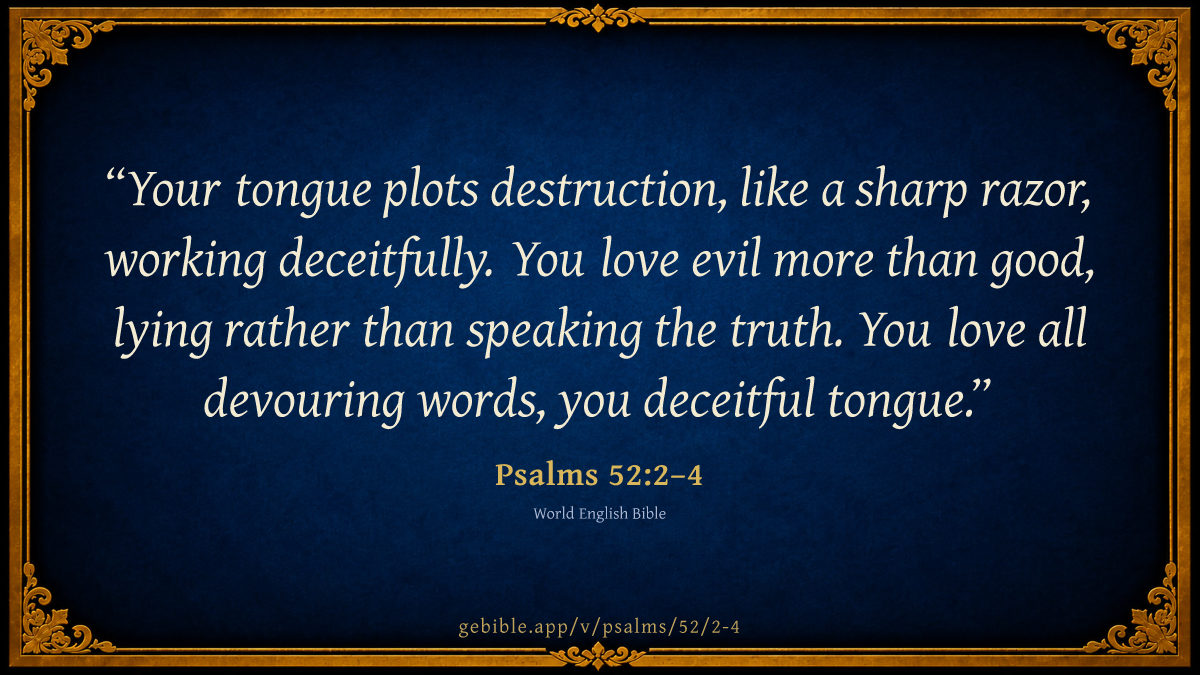
2. Thy tongue reckons up mischiefs David is not to be considered as here venting a flood of reproaches against his adversary, as many who have been unjustly injured are in the habit of doing, merely to gratify a feeling of revenge. He brings these charges against him in the sight of God, with a view to encourage himself in the hopefulness of his own cause: for it is plain that the farther our enemies proceed in the practice of iniquity, they proportionally provoke the anger of the Lord, and are nearer to that destruction which must issue in our deliverance. His object, therefore, is not to blacken the character of Doeg in the estimation of the world, but rather to set before his own eyes the divine punishment which the flagrant offenses he specifies were certain to draw down upon his head. Amongst these he singles out, as more especially worthy of reprobation, the hidden treachery with which he had been chargeable in accomplishing the destruction of the priesthood. Adverting to his secret and malicious information, he likens his tongue to a sharp razor, as elsewhere, Psalm 120:4, the tongues of the wicked are compared to “sharp arrows.” It is added, working deceitfully, which words are considered by some as referring to the razor which cuts subtilely, and not with an open wound like a sword; but perhaps they may be construed with more propriety as applying to the tongue, although there can be no doubt of the reason of the comparison.
John Calvin's Commentaries (1540-1563) — public domain. Text from the Calvin Translation Society English edition (1840s-50s) via the Christian Classics Ethereal Library (ccel.org). Calvin's coverage is partial (roughly two-thirds of the Bible); uncommented books and verses are honest gaps, never fabricated. The 19th-century editor's footnotes and remarks are omitted so the notes are faithfully Calvin's own voice.
Geneva Bible translators1599 · Public DomainOn vv2–3Thy malice moveth thee by crafty flatteries and lies…
Thy malice moveth thee by crafty flatteries and lies to accuse and destroy the innocents.
Geneva Bible (1599) marginal notes — public domain.
John Trapp1656 · Public DomainOn vv2–4Psa 52:2 Thy tongue deviseth mischiefs; like a sharp…
Psa 52:2 Thy tongue deviseth mischiefs; like a sharp razor, working deceitfully.
Ver. 2. Thy tongue deviseth mischiefs] i.e. Venteth the mischievous devices of thy mind, being an interpreter and an instrument fit for such a purpose, Cogitat, id est eructat. Such another Doeg was Nicholas Saunders, priest, the firebrand of Earl Desmond’s rebellion in Ireland, A. D. 1580, a restless and wretched man, whose foul mouth was at length stopped with famine that had been ever open to stir up rebellions against the state; that had uttered so many blasphemies against God and his holy truth, and invented so many loud and lewd lies against men.
Read full note →
Like a sharp razor, working deceitfully] That, instead of shaving the hair, lanceth the flesh, Exscindit carnem cure crinibus (R. Solomon); or, missing the beard, cutteth the throat, Consulto aberrans iugulum petit, when Dionysius the tyrant would not trust any barber (no, not his own daughters) to shave him; but singed off his own hair with hot coals. The slanderer’s tongue, as sharp as a razor or as the quills of a porcupine, slasheth and gasheth the good names of others, and that many ways, viz. both by denying, disguising, lessening, concealing, misconstruing things of good report; and also by forging, increasing, aggravating, or uncharitable spreading things of evil report; not for any love to the truth nor for respect of justice, nor yet for the bettering of the hearer or the delinquent; but only to prejudice the one, and to incense the other. This was Doeg’s sin, and denominateth him a liar, Psa 52:3, though he had spoken only the truth.
John Trapp, A Commentary or Exposition upon All the Books of the Old and New Testament (1647–1656) — public domain. Text from a community e-Sword module.
Matthew Poole1685 · Public DomainOn vv2–4Deviseth i.e. expresseth what thy wicked mind had devised.…
Deviseth i.e. expresseth what thy wicked mind had devised. Thus skilfulness is ascribed to those hands which are governed by a skilful or prudent man, Psa 78:72. This word implies that Doeg’s words were not uttered rashly and unadvisedly, but with premeditated malice, and a mischievous design, which he waited for an opportunity to execute; and therefore he readily took the first occasion which offered itself.
Like a sharp razor, working deceitfully; wherewith a man pretending only to shave off the hair, doth suddenly and unexpectedly cut the throat. So Doeg pretended only to vindicate himself from the imputation of disloyalty, 1Sa 22:8, but really intended to expose the priests, who were friends to David, to the king’s fury and cruelty.
Matthew Poole's English Annotations on the Holy Bible (1683–1685) — public domain. Text from a community e-Sword/MySword module.
John Gill1763 · Public DomainOn vv2–4Thy tongue deviseth mischiefs,.... Abundance of mischiefs, in a…
Thy tongue deviseth mischiefs,.... Abundance of mischiefs, in a variety of ways, against many persons, even all good men. What properly belongs to the heart is here ascribed to the tongue; because, as Aben Ezra observes, it is the interpreter and discoverer of the thoughts of the heart: out of the abundance of that the tongue speaks and declares the mischief it has devised. Doeg intended mischief to David, when he spoke to Saul, Sa1 22:9; so antichrist devises mischiefs against the saints of the most High, to wear them out, and thinks to change times and laws, Dan 7:25;
like a sharp razor, working deceitfully; that is, his tongue was like a razor; the razor is but a small instrument, and the tongue is but a little member: the razor is a sharp and cutting one, and so is the tongue; and therefore compared to a sharp sword, Psa 57:4; see Jer 18:18; the razor takes off the beard cleanly and wholly; Doeg's tongue was the cause of the utter ruin of Ahimelech's family and the city of Nob; and as a razor may be said to "work deceitfully", when it turns aside in the hand of him that useth it, and with the hair takes off more than it should, even skin and flesh, or cuts the man's throat; so in a deceitful and insidious manner did Doeg work the destruction of Ahimelech and the priests of the Lord.
John Gill's Exposition of the Whole Bible (1746–1763) — public domain (CC PDM 1.0). Text via the HelloAO Bible API.
John Wesley1765 · Public DomainOn v2Deviseth - Expresses what thy wicked mind had devised.…
Deviseth - Expresses what thy wicked mind had devised. Deceitfully - Doeg pretended only to vindicate himself from disloyalty, 1 Sam. xxii, 8, but he really intended to expose the priests, to the king's fury.
John Wesley, Explanatory Notes Upon the Whole Bible (1754–1765) — public domain. Text via the GEBible commentary corpus.
Adam Clarke1810 · Public DomainOn vv2–3Verse 2. Deviseth mischiefs] Lies and slanders proceeding from…
Verse 2. Deviseth mischiefs] Lies and slanders proceeding from the tongue argue the desperate wickedness of the heart.
Like a sharp razor, working deceitfully.] Which instead of taking off the beard, cuts and wounds the flesh; or as the operator who, when pretending to trim the beard, cuts the throat.
Adam Clarke's Commentary on the Bible (1810–1826) — public domain. Text from a community e-Sword/MySword module.
Joseph Benson1811 · Public DomainOn vv2, 4Psa 52:2. Thy tongue deviseth mischief — That is,…
Psa 52:2. Thy tongue deviseth mischief — That is, expresses what thy wicked mind had devised. Thus skilfulness is ascribed to those hands which are governed by a skilful man, Psa 78:72. Like a sharp razor, working deceitfully — Wherewith a person, pretending only to shave off the hair, doth suddenly and unexpectedly cut a man’s throat. So Doeg, pretending only to vindicate himself from the imputation of disloyalty, 1Sa 22:8, really intended to expose the priests, who were friends to David, to the king’s fury and cruelty.
Joseph Benson's Commentary on the Old and New Testaments (1811–1818) — public domain. Text from a community e-Sword module.
Albert Barnes1834 · Public DomainOn vv2–4Thy tongue deviseth mischiefs - The word rendered “mischiefs”…
Thy tongue deviseth mischiefs - The word rendered “mischiefs” means
The meaning here is, that he made use of his tongue to ruin others. Compare Psa 50:19. The particular thing referred to here is the fact that Doeg sought the ruin of others by giving “information” in regard to them. He “informed” Saul of what Ahimelech had done; he informed him where David had been, thus giving him, also, information in what way he might be found and apprehended. All this was “designed” to bring ruin upon David and his followers. It “actually” brought ruin on Ahimelech and those associated with him, 1Sa 22:17-19.
Like a sharp razor - See the notes at Isa 7:20. His slanders were like a sharp knife with which one stabs another. So we stay of a slanderer that he “stabs” another in the dark.
Working deceitfully - literally, making deceit. That is, it was by deceit that he accomplished his purpose. There was no open and fair dealing in what he did.
Albert Barnes' Notes on the Bible (1834–1885) — public domain. Text from a community e-Sword/MySword module.
Robert Jamieson, A. R. Fausset & David Brown1871 · Public DomainOn vv2, 4tongue--for self.
tongue--for self.
mischiefs--evil to others (Psa 5:9; Psa 38:12).
Read full note →
working deceitfully-- (Psa 10:7), as a keen, smoothly moving razor, cutting quietly, but deeply.
Jamieson, Fausset & Brown — Commentary Critical and Explanatory on the Whole Bible (1871) — public domain (CC PDM 1.0). Text via the HelloAO Bible API.
Daniel D. Whedon1874 · Public DomainOn vv3–43. Evil more than good—The sense is, evil and…
3. Evil more than good—The sense is, evil and not good, falsehood and not speaking “righteousness.” The good and the true were not loved at all.
Daniel D. Whedon (gen. ed.), Commentary on the Old and New Testaments (1874–1909) — public domain. Text from a community e-Sword module.
The Cambridge Bible for Schools and Colleges1878 · Public DomainOn vv2–42. Thy tongue deviseth] Cp. Psa_35:20. Sins of the…
2. Thy tongue deviseth] Cp. Psa_35:20. Sins of the tongue—falsehood, slander, false witness, and the like—are frequently denounced in the Psalms and by the Prophets. See Psa_5:9; Psa_10:7; Psa_12:2 ff; Mic_6:12; Jer_9:3; &c.
mischiefs] R.V., very wickedness (as in Psa_5:9); or destruction, perhaps not without a reminiscence of the original meaning of the word, a yawning gulf, for his tongue is ready to swallow up (Psa_52:4) the righteous. The plur. denotes mischief or destructiveness of every kind.
Read full note →
like a sharp rasor] Lit., like a whetted rasor, which cuts you before you are aware, as you handle it incautiously. The tongue and its words are elsewhere compared to swords and spears and arrows (Psa_55:21, Psa_57:4, Psa_59:7, Psa_64:3; cp. Pro_26:18). Comp. Shakespeare, Cymbeline, iii.4,
“’Tis slander,
Whose edge is sharper than the sword.”
working deceitfully] The partic. cannot, unless we assume a laxity of construction, be in agreement with thy tongue; nor can it well be referred to the sharp rasor. It is best to take it as a vocative, O thou worker of deceit. Cp. Psa_101:7.
The Cambridge Bible for Schools and Colleges (gen. ed. J. J. S. Perowne; Cambridge University Press, 1878–1918) — public domain. Text from a community e-Sword module.
Ellicott's Commentary for English Readers1878 · Public DomainOn vv2, 4(2) Working deceitfully.—Better, working guile. (For the metaphor, see…
(2) Working deceitfully.—Better, working guile. (For the metaphor, see Psa_55:21; Psa_57:4, &c)
A Bible Commentary for English Readers, edited by Charles John Ellicott (1878–1897) — public domain. Text from a community e-Sword module.
The Pulpit Commentary1880 · Public DomainOn vv2–4Thy tongue deviseth mischiefs; or, malignities evils of the…
Thy tongue deviseth mischiefs; or, malignities evils of the worst kind. It was Doeg"s "tongue" that brought about the entire ghastly massacre. (see 1Sa_22:9, 1Sa_22:10) Like a sharp razor, working deceitfully. Doeg had "worked deceitfully," since he had not told Saul the circumstances that made Ahimelech"s giving aid to David no disloyalty to the king. (1Sa_21:2, 1Sa_21:8) The suppressio veri is a suggestio falsi.
The Pulpit Commentary (1880–1919), ed. H.D.M. Spence-Jones & Joseph S. Exell — public domain. Text from a community e-Sword module.
Charles H. Spurgeon1885 · Public DomainOn vv2–4Ver. 2. Thy tongue deviseth mischiefs. Thou speakest with…
Ver. 2. Thy tongue deviseth mischiefs. Thou speakest with an ulterior design. The information given was for Saul's assistance apparently, but in very deed in his heart the Edomite hated the priests of the God of Jacob. It is a mark of deep depravity, when the evil spoken is craftily intended to promote a yet greater evil. Like a sharp razor, working deceitfully. David represents the false tongue as being effectual for mischief, like a razor which, unawares to the person operated on, is making him bald; so softly and deftly do Oriental barbers perform their work. Or he may mean that as with a razor a man's throat may be cut very speedily, under the pretence of shaving him, even thus keenly, basely, but effectually Doeg destroyed the band of the priests. Whetted by malice, and guided by craft, he did his cruel work with accursed thoroughness.
Ver. 2. Thy tongue deviseth mischiefs, like a sharp razor, working deceitfully. Thus our version. But I do not very well understand the propriety of the tongue's devising mischief, and devising it like a sharp razor. But we may easily avoid this harsh comparison by rendering the words: You contrive mischiefs with thy tongue, as with a sharp razor, O thou dealer in deceit: i.e., you contrive with thy smooth and flattering tongue to wound the reputation and character of others, as though thou wast cutting their throats with a smooth razor. Samuel Chandler.
Read full note →
Ver. 2. Like a sharp razor, that instead of shaving the hair lances the flesh; or missing the beard cutteth the throat. John Trapp.
Ver. 2. The smooth adroit manner of executing a wicked device neither hides not abates its wickedness. Murder with a sharp razor is as wicked as murder with a meat axe or bludgeon. A lie very ingeniously framed and rehearsed in an oily manner, is as great a sin, and in the end will be seen to be as great a folly as the most bungling attempt at deception. William S. Plumer.
None.
Psalms 52:3*
Charles H. Spurgeon's The Treasury of David (1869–1885) — public domain. Psalms only. Text from a community e-Sword/MySword module.
The Biblical Illustrator1887 · Public DomainOn v2Thy tongue deviseth mischiefs; like a sharp razor, working…
Psa_52:2-4
Thy tongue deviseth mischiefs; like a sharp razor, working deceitfully.
Read full note →
Sins of speech
The prominence given to sins of speech is peculiar. We should have expected high-handed violence rather than these. But the psalmist is tracking the deeds to their source; and it is not so much the tyrants words as his love of a certain kind of words which is adduced as proof of his wickedness. These words have two characteristics in addition to boastfulness. They are false and destructive. They are, according to the forcible literal meaning in Psa_52:4, words of swallowing. They are, according to the literal meaning of destructions in Psa_52:2, yawning gulfs. Such words lead to acts which make a tyrant. They flow from perverted preference of evil to good. Thus the deeds of oppression are followed up to their den and birthplace. (A. Maclaren, D. D.)
The Biblical Illustrator, edited by Joseph S. Exell (c. 1880s–1900s) — public domain. Text from a community e-Sword module.
unfoldingWord translationNotes2017 · CC BY-SA 4.0On vv3–4Connecting Statement:
Connecting Statement:
David continues speaking to the "mighty man" of Psalms 5:1
 GEBible — Godless Engineer's Bible App
John Calvin 1540 · Public Domain On vv2, 4 2. Thy tongue reckons up mischiefs David is not…
2. Thy tongue reckons up mischiefs David is not to be considered as here venting a flood of reproaches against his adversary, as many who have been unjustly injured are in the habit of doing, merely to gratify a feeling of revenge. He brings these charges against him in the sight of God, with a view to encourage himself in the hopefulness of his own cause: for it is plain that the farther our enemies proceed in the practice of iniquity, they proportionally provoke the anger of the Lord, and are nearer to that destruction which must issue in our deliverance. His object, therefore, is not to blacken the character of Doeg in the estimation of the world, but rather to set before his own eyes the divine punishment which the flagrant offenses he specifies were certain to draw down upon his head. Amongst these he singles out, as more especially worthy of reprobation, the hidden treachery with which he had been chargeable in accomplishing the destruction of the priesthood. Adverting to his secret and malicious information, he likens his tongue to a sharp razor, as elsewhere, Psalm 120:4, the tongues of the wicked are compared to “sharp arrows.” It is added, working deceitfully, which words are considered by some as referring to the razor which cuts subtilely, and not with an open wound like a sword; but perhaps they may be construed with more propriety as applying to the tongue, although there can be no doubt of the reason of the comparison.
John Calvin's Commentaries (1540-1563) — public domain. Text from the Calvin Translation Society English edition (1840s-50s) via the Christian Classics Ethereal Library (ccel.org). Calvin's coverage is partial (roughly two-thirds of the Bible); uncommented books and verses are honest gaps, never fabricated. The 19th-century editor's footnotes and remarks are omitted so the notes are faithfully Calvin's own voice.
Geneva Bible translators 1599 · Public Domain On vv2–3 Thy malice moveth thee by crafty flatteries and lies…
Thy malice moveth thee by crafty flatteries and lies to accuse and destroy the innocents.
Geneva Bible (1599) marginal notes — public domain.
John Trapp 1656 · Public Domain On vv2–4 Psa 52:2 Thy tongue deviseth mischiefs; like a sharp…
Psa 52:2 Thy tongue deviseth mischiefs; like a sharp razor, working deceitfully.
Ver. 2. Thy tongue deviseth mischiefs] i.e. Venteth the mischievous devices of thy mind, being an interpreter and an instrument fit for such a purpose, Cogitat, id est eructat. Such another Doeg was Nicholas Saunders, priest, the firebrand of Earl Desmond’s rebellion in Ireland, A. D. 1580, a restless and wretched man, whose foul mouth was at length stopped with famine that had been ever open to stir up rebellions against the state; that had uttered so many blasphemies against God and his holy truth, and invented so many loud and lewd lies against men.
Read full note →
Like a sharp razor, working deceitfully] That, instead of shaving the hair, lanceth the flesh, Exscindit carnem cure crinibus (R. Solomon); or, missing the beard, cutteth the throat, Consulto aberrans iugulum petit, when Dionysius the tyrant would not trust any barber (no, not his own daughters) to shave him; but singed off his own hair with hot coals. The slanderer’s tongue, as sharp as a razor or as the quills of a porcupine, slasheth and gasheth the good names of others, and that many ways, viz. both by denying, disguising, lessening, concealing, misconstruing things of good report; and also by forging, increasing, aggravating, or uncharitable spreading things of evil report; not for any love to the truth nor for respect of justice, nor yet for the bettering of the hearer or the delinquent; but only to prejudice the one, and to incense the other. This was Doeg’s sin, and denominateth him a liar, Psa 52:3, though he had spoken only the truth.
John Trapp, A Commentary or Exposition upon All the Books of the Old and New Testament (1647–1656) — public domain. Text from a community e-Sword module.
Matthew Poole 1685 · Public Domain On vv2–4 Deviseth i.e. expresseth what thy wicked mind had devised.…
Deviseth i.e. expresseth what thy wicked mind had devised. Thus skilfulness is ascribed to those hands which are governed by a skilful or prudent man, Psa 78:72. This word implies that Doeg’s words were not uttered rashly and unadvisedly, but with premeditated malice, and a mischievous design, which he waited for an opportunity to execute; and therefore he readily took the first occasion which offered itself.
Like a sharp razor, working deceitfully; wherewith a man pretending only to shave off the hair, doth suddenly and unexpectedly cut the throat. So Doeg pretended only to vindicate himself from the imputation of disloyalty, 1Sa 22:8, but really intended to expose the priests, who were friends to David, to the king’s fury and cruelty.
Matthew Poole's English Annotations on the Holy Bible (1683–1685) — public domain. Text from a community e-Sword/MySword module.
John Gill 1763 · Public Domain On vv2–4 Thy tongue deviseth mischiefs,.... Abundance of mischiefs, in a…
Thy tongue deviseth mischiefs,.... Abundance of mischiefs, in a variety of ways, against many persons, even all good men. What properly belongs to the heart is here ascribed to the tongue; because, as Aben Ezra observes, it is the interpreter and discoverer of the thoughts of the heart: out of the abundance of that the tongue speaks and declares the mischief it has devised. Doeg intended mischief to David, when he spoke to Saul, Sa1 22:9; so antichrist devises mischiefs against the saints of the most High, to wear them out, and thinks to change times and laws, Dan 7:25;
like a sharp razor, working deceitfully; that is, his tongue was like a razor; the razor is but a small instrument, and the tongue is but a little member: the razor is a sharp and cutting one, and so is the tongue; and therefore compared to a sharp sword, Psa 57:4; see Jer 18:18; the razor takes off the beard cleanly and wholly; Doeg's tongue was the cause of the utter ruin of Ahimelech's family and the city of Nob; and as a razor may be said to "work deceitfully", when it turns aside in the hand of him that useth it, and with the hair takes off more than it should, even skin and flesh, or cuts the man's throat; so in a deceitful and insidious manner did Doeg work the destruction of Ahimelech and the priests of the Lord.
John Gill's Exposition of the Whole Bible (1746–1763) — public domain (CC PDM 1.0). Text via the HelloAO Bible API.
John Wesley 1765 · Public Domain On v2 Deviseth - Expresses what thy wicked mind had devised.…
Deviseth - Expresses what thy wicked mind had devised. Deceitfully - Doeg pretended only to vindicate himself from disloyalty, 1 Sam. xxii, 8, but he really intended to expose the priests, to the king's fury.
John Wesley, Explanatory Notes Upon the Whole Bible (1754–1765) — public domain. Text via the GEBible commentary corpus.
Adam Clarke 1810 · Public Domain On vv2–3 Verse 2. Deviseth mischiefs] Lies and slanders proceeding from…
Verse 2. Deviseth mischiefs] Lies and slanders proceeding from the tongue argue the desperate wickedness of the heart.
Like a sharp razor, working deceitfully.] Which instead of taking off the beard, cuts and wounds the flesh; or as the operator who, when pretending to trim the beard, cuts the throat.
Adam Clarke's Commentary on the Bible (1810–1826) — public domain. Text from a community e-Sword/MySword module.
Joseph Benson 1811 · Public Domain On vv2, 4 Psa 52:2. Thy tongue deviseth mischief — That is,…
Psa 52:2. Thy tongue deviseth mischief — That is, expresses what thy wicked mind had devised. Thus skilfulness is ascribed to those hands which are governed by a skilful man, Psa 78:72. Like a sharp razor, working deceitfully — Wherewith a person, pretending only to shave off the hair, doth suddenly and unexpectedly cut a man’s throat. So Doeg, pretending only to vindicate himself from the imputation of disloyalty, 1Sa 22:8, really intended to expose the priests, who were friends to David, to the king’s fury and cruelty.
Joseph Benson's Commentary on the Old and New Testaments (1811–1818) — public domain. Text from a community e-Sword module.
Albert Barnes 1834 · Public Domain On vv2–4 Thy tongue deviseth mischiefs - The word rendered “mischiefs”…
Thy tongue deviseth mischiefs - The word rendered “mischiefs” means
(a) desire, cupidity: Pro 10:3; then
Read full note →
(b) fall, ruin, destruction, wickedness: Psa 5:9; Psa 38:12.
The meaning here is, that he made use of his tongue to ruin others. Compare Psa 50:19. The particular thing referred to here is the fact that Doeg sought the ruin of others by giving “information” in regard to them. He “informed” Saul of what Ahimelech had done; he informed him where David had been, thus giving him, also, information in what way he might be found and apprehended. All this was “designed” to bring ruin upon David and his followers. It “actually” brought ruin on Ahimelech and those associated with him, 1Sa 22:17-19.
Like a sharp razor - See the notes at Isa 7:20. His slanders were like a sharp knife with which one stabs another. So we stay of a slanderer that he “stabs” another in the dark.
Working deceitfully - literally, making deceit. That is, it was by deceit that he accomplished his purpose. There was no open and fair dealing in what he did.
Albert Barnes' Notes on the Bible (1834–1885) — public domain. Text from a community e-Sword/MySword module.
Robert Jamieson, A. R. Fausset & David Brown 1871 · Public Domain On vv2, 4 tongue--for self.
tongue--for self.
mischiefs--evil to others (Psa 5:9; Psa 38:12).
Read full note →
working deceitfully-- (Psa 10:7), as a keen, smoothly moving razor, cutting quietly, but deeply.
Jamieson, Fausset & Brown — Commentary Critical and Explanatory on the Whole Bible (1871) — public domain (CC PDM 1.0). Text via the HelloAO Bible API.
Daniel D. Whedon 1874 · Public Domain On vv3–4 3. Evil more than good—The sense is, evil and…
3. Evil more than good—The sense is, evil and not good, falsehood and not speaking “righteousness.” The good and the true were not loved at all.
Daniel D. Whedon (gen. ed.), Commentary on the Old and New Testaments (1874–1909) — public domain. Text from a community e-Sword module.
The Cambridge Bible for Schools and Colleges 1878 · Public Domain On vv2–4 2. Thy tongue deviseth] Cp. Psa_35:20. Sins of the…
2. Thy tongue deviseth] Cp. Psa_35:20. Sins of the tongue—falsehood, slander, false witness, and the like—are frequently denounced in the Psalms and by the Prophets. See Psa_5:9; Psa_10:7; Psa_12:2 ff; Mic_6:12; Jer_9:3; &c.
mischiefs] R.V., very wickedness (as in Psa_5:9); or destruction, perhaps not without a reminiscence of the original meaning of the word, a yawning gulf, for his tongue is ready to swallow up (Psa_52:4) the righteous. The plur. denotes mischief or destructiveness of every kind.
Read full note →
like a sharp rasor] Lit., like a whetted rasor, which cuts you before you are aware, as you handle it incautiously. The tongue and its words are elsewhere compared to swords and spears and arrows (Psa_55:21, Psa_57:4, Psa_59:7, Psa_64:3; cp. Pro_26:18). Comp. Shakespeare, Cymbeline, iii.4,
“’Tis slander,
Whose edge is sharper than the sword.”
working deceitfully] The partic. cannot, unless we assume a laxity of construction, be in agreement with thy tongue; nor can it well be referred to the sharp rasor. It is best to take it as a vocative, O thou worker of deceit. Cp. Psa_101:7.
The Cambridge Bible for Schools and Colleges (gen. ed. J. J. S. Perowne; Cambridge University Press, 1878–1918) — public domain. Text from a community e-Sword module.
Ellicott's Commentary for English Readers 1878 · Public Domain On vv2, 4 (2) Working deceitfully.—Better, working guile. (For the metaphor, see…
(2) Working deceitfully.—Better, working guile. (For the metaphor, see Psa_55:21; Psa_57:4, &c)
A Bible Commentary for English Readers, edited by Charles John Ellicott (1878–1897) — public domain. Text from a community e-Sword module.
The Pulpit Commentary 1880 · Public Domain On vv2–4 Thy tongue deviseth mischiefs; or, malignities evils of the…
Thy tongue deviseth mischiefs; or, malignities evils of the worst kind. It was Doeg"s "tongue" that brought about the entire ghastly massacre. (see 1Sa_22:9, 1Sa_22:10) Like a sharp razor, working deceitfully. Doeg had "worked deceitfully," since he had not told Saul the circumstances that made Ahimelech"s giving aid to David no disloyalty to the king. (1Sa_21:2, 1Sa_21:8) The suppressio veri is a suggestio falsi.
The Pulpit Commentary (1880–1919), ed. H.D.M. Spence-Jones & Joseph S. Exell — public domain. Text from a community e-Sword module.
Charles H. Spurgeon 1885 · Public Domain On vv2–4 Ver. 2. Thy tongue deviseth mischiefs. Thou speakest with…
Ver. 2. Thy tongue deviseth mischiefs. Thou speakest with an ulterior design. The information given was for Saul's assistance apparently, but in very deed in his heart the Edomite hated the priests of the God of Jacob. It is a mark of deep depravity, when the evil spoken is craftily intended to promote a yet greater evil. Like a sharp razor, working deceitfully. David represents the false tongue as being effectual for mischief, like a razor which, unawares to the person operated on, is making him bald; so softly and deftly do Oriental barbers perform their work. Or he may mean that as with a razor a man's throat may be cut very speedily, under the pretence of shaving him, even thus keenly, basely, but effectually Doeg destroyed the band of the priests. Whetted by malice, and guided by craft, he did his cruel work with accursed thoroughness.
Ver. 2. Thy tongue deviseth mischiefs, like a sharp razor, working deceitfully. Thus our version. But I do not very well understand the propriety of the tongue's devising mischief, and devising it like a sharp razor. But we may easily avoid this harsh comparison by rendering the words: You contrive mischiefs with thy tongue, as with a sharp razor, O thou dealer in deceit: i.e., you contrive with thy smooth and flattering tongue to wound the reputation and character of others, as though thou wast cutting their throats with a smooth razor. Samuel Chandler.
Read full note →
Ver. 2. Like a sharp razor, that instead of shaving the hair lances the flesh; or missing the beard cutteth the throat. John Trapp.
Ver. 2. The smooth adroit manner of executing a wicked device neither hides not abates its wickedness. Murder with a sharp razor is as wicked as murder with a meat axe or bludgeon. A lie very ingeniously framed and rehearsed in an oily manner, is as great a sin, and in the end will be seen to be as great a folly as the most bungling attempt at deception. William S. Plumer.
None.
Psalms 52:3*
Charles H. Spurgeon's The Treasury of David (1869–1885) — public domain. Psalms only. Text from a community e-Sword/MySword module.
The Biblical Illustrator 1887 · Public Domain On v2 Thy tongue deviseth mischiefs; like a sharp razor, working…
Psa_52:2-4
Thy tongue deviseth mischiefs; like a sharp razor, working deceitfully.
Read full note →
Sins of speech
The prominence given to sins of speech is peculiar. We should have expected high-handed violence rather than these. But the psalmist is tracking the deeds to their source; and it is not so much the tyrants words as his love of a certain kind of words which is adduced as proof of his wickedness. These words have two characteristics in addition to boastfulness. They are false and destructive. They are, according to the forcible literal meaning in Psa_52:4, words of swallowing. They are, according to the literal meaning of destructions in Psa_52:2, yawning gulfs. Such words lead to acts which make a tyrant. They flow from perverted preference of evil to good. Thus the deeds of oppression are followed up to their den and birthplace. (A. Maclaren, D. D.)
The Biblical Illustrator, edited by Joseph S. Exell (c. 1880s–1900s) — public domain. Text from a community e-Sword module.
unfoldingWord translationNotes 2017 · CC BY-SA 4.0 On vv3–4 Connecting Statement:
Connecting Statement:
David continues speaking to the "mighty man" of Psalms 5:1
Read full note →
lying rather than speaking righteousness
"you love lying more than speaking what is right"
translationWords
love
righteous
selah
unfoldingWord translationNotes — © Distant Shores Media and the Door43 World Missions Community, licensed CC BY-SA 4.0. Source: git.door43.org/Door43/en_tn.
Tyndale Open Study Notes 2022 · CC BY-SA 4.0 On v3 52:3 Deceptive speech changes one’s character.
52:3 Deceptive speech changes one’s character.
Tyndale Open Study Notes — © Tyndale Open Resources, licensed CC BY-SA 4.0. Text via the HelloAO Bible API.