Isaiah 55:6(v2)Seek Yahweh while he may be found. Call on him while he is near.
2 Chronicles 15:2(v2)and he went out to meet Asa, and said to him, “Hear me, Asa, and all Judah and Benjamin! Yahweh is with you, while you are with him; and if…
Romans 3:12(v3)They have all turned away. They have together become unprofitable. There is no one who does good, no, not so much as one.”
Psalms 27:8(v2)When you said, “Seek my face,” my heart said to you, “I will seek your face, Yahweh.”
Jeremiah 4:22(v4)“For my people are foolish. They don’t know me. They are foolish children, and they have no understanding. They are skillful in doing evil,…
Show all 34 cross-references
Jeremiah 16:17(v2)For my eyes are on all their ways. They are not hidden from my face. Their iniquity isn’t concealed from my eyes.
Psalms 111:10(v2)The fear of Yahweh is the beginning of wisdom. All those who do his work have a good understanding. His praise endures forever!
Isaiah 64:6(v3)For we have all become like one who is unclean, and all our righteousness is like a polluted garment. We all fade like a leaf; and our…
Jeremiah 23:24(v2)Can anyone hide himself in secret places so that I can’t see him?” says Yahweh. “Don’t I fill heaven and earth?” says Yahweh.
2 Chronicles 19:3(v2)Nevertheless there are good things found in you, in that you have put away the Asheroth out of the land, and have set your heart to seek…
Psalms 14:3(v3)They have all gone aside. They have together become corrupt. There is no one who does good, no, not one.
Psalms 33:13-14(v2)Yahweh looks from heaven. He sees all the sons of men. From the place of his habitation he looks out on all the inhabitants of the earth,
Isaiah 53:6(v3)All we like sheep have gone astray. Everyone has turned to his own way; and Yahweh has laid on him the iniquity of us all.
Jeremiah 10:25(v4)Pour out your wrath on the nations that don’t know you, and on the families that don’t call on your name; for they have devoured Jacob.…
Psalms 102:19(v2)For he has looked down from the height of his sanctuary. From heaven, Yahweh saw the earth;
1 Chronicles 28:9(v2)You, Solomon my son, know the God of your father, and serve him with a perfect heart and with a willing mind; for Yahweh searches all…
Job 28:28(v2)To man he said, ‘Behold, the fear of the Lord, that is wisdom. To depart from evil is understanding.’ ”
Psalms 10:4(v2)The wicked, in the pride of his face, has no room in his thoughts for God.
Psalms 11:4(v2)Yahweh is in his holy temple. Yahweh is on his throne in heaven. His eyes observe. His eyes examine the children of men.
Jeremiah 8:5-6(v3)Why then have the people of Jerusalem fallen back by a perpetual backsliding? They cling to deceit. They refuse to return. I listened and…
Deuteronomy 4:6(v2)Keep therefore and do them; for this is your wisdom and your understanding in the sight of the peoples who shall hear all these statutes…
Psalms 27:2(v4)When evildoers came at me to eat up my flesh, even my adversaries and my foes, they stumbled and fell.
Psalms 94:8(v4)Consider, you senseless among the people; you fools, when will you be wise?
Isaiah 27:11(v4)When its boughs are withered, they will be broken off. The women will come and set them on fire, for they are a people of no understanding.…
3 John 1:11(v3)Beloved, don’t imitate that which is evil, but that which is good. He who does good is of God. He who does evil hasn’t seen God.
Matthew 23:17-39(v4)You blind fools! For which is greater, the gold, or the temple that sanctifies the gold? ‘Whoever swears by the altar, it is nothing; but…
Revelation 17:16(v4)The ten horns which you saw, and the beast, these will hate the prostitute, will make her desolate, will strip her naked, will eat her…
2 Samuel 20:2(v3)So all the men of Israel went up from following David, and followed Sheba the son of Bichri; but the men of Judah joined with their king,…
Job 15:16(v3)how much less one who is abominable and corrupt, a man who drinks iniquity like water!
Ezekiel 36:25(v3)I will sprinkle clean water on you, and you will be clean. I will cleanse you from all your filthiness, and from all your idols.
Zephaniah 1:6(v3)those who have turned back from following Yahweh, and those who haven’t sought Yahweh nor inquired after him.
2 Corinthians 7:1(v3)Having therefore these promises, beloved, let’s cleanse ourselves from all defilement of flesh and spirit, perfecting holiness in the fear…
1 John 2:29(v3)If you know that he is righteous, you know that everyone who practices righteousness has been born of him.
Revelation 22:11(v3)He who acts unjustly, let him act unjustly still. He who is filthy, let him be filthy still. He who is righteous, let him do righteousness…
Cross-references from openbible.info (CC BY 4.0)
Explain this passage (12 sources)
Historical commentary, presented as a primary source — not an endorsement.
Geneva Bible translators1599 · Public DomainOn vv2, 4Whereby he condemneth all knowledge and understanding, that tendeth…
Whereby he condemneth all knowledge and understanding, that tendeth not to seek God.
Geneva Bible (1599) marginal notes — public domain.
John Trapp1656 · Public DomainOn vv2–4Psa 53:2 God looked down from heaven upon the…
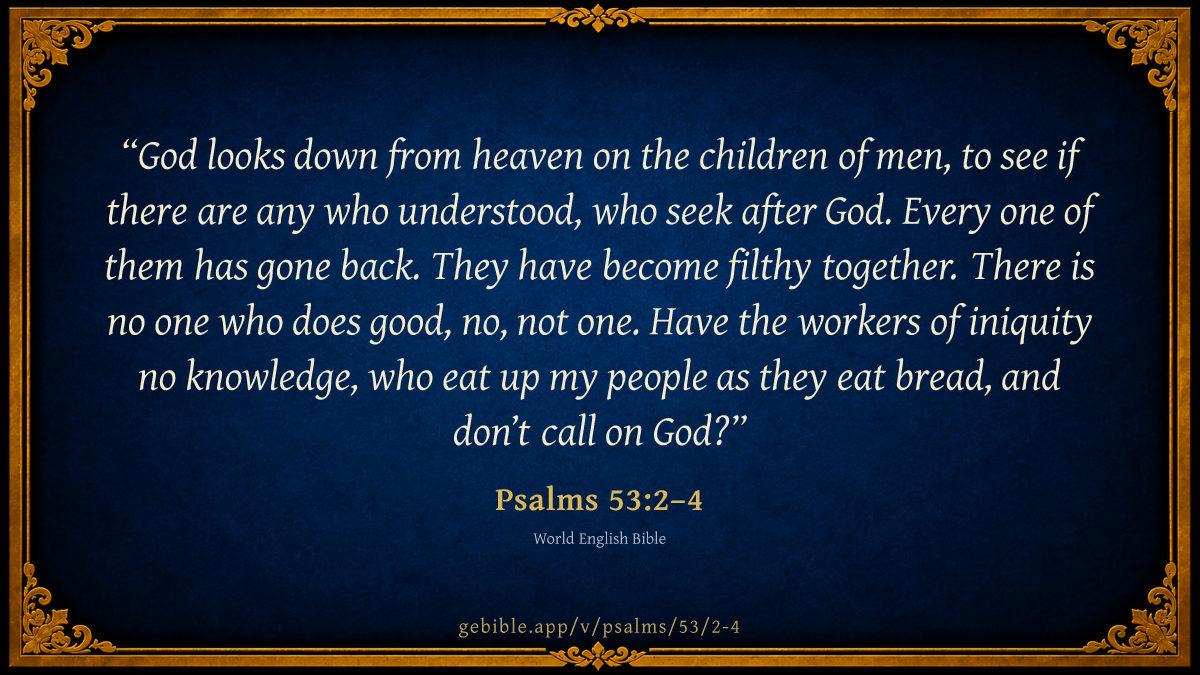
Psa 53:2 God looked down from heaven upon the children of men, to see if there were [any] that did understand, that did seek God.
Ver. 2. God looked down, &c.] {See Trapp on "Psa 14:2"}
John Trapp, A Commentary or Exposition upon All the Books of the Old and New Testament (1647–1656) — public domain. Text from a community e-Sword module.
John Gill1763 · Public DomainOn vv2–4God looked down from heaven upon the children of…
God looked down from heaven upon the children of men,.... In Psa 14:2, it is read, "the Lord" or "Jehovah"; in everything else there is an agreement in this verse; See Gill on Psa 14:2;
to see if there were any that did understand; the Targum is, "that were understanding" in the law; it doubtless means understanding in divine and spiritual things;
Read full note →
that did seek God; the above paraphrase is, "seeking doctrine from before the Lord".
John Gill's Exposition of the Whole Bible (1746–1763) — public domain (CC PDM 1.0). Text via the HelloAO Bible API.
Adam Clarke1810 · Public DomainOn v4Verse 4. Have the workers of iniquity] For פעלי,…
Verse 4. Have the workers of iniquity] For פעלי, poaley, workers seventy-two of Kennicott's and De Rossi's MSS., with several ancient editions, the Chaldee, though not noticed in the Latin translation in the London Polyglot, the Syriac, Vulgate, Septuagint, AEthiopic, and the Arabic, with the Anglo-Saxon, add the word כל col, all, - ALL the workers of iniquity; which is the reading in the parallel place in Ps 14:3-4. It may be necessary to observe, that the Chaldee, in the Antwerp and Paris Polyglots, and in that of Justinianus, has not the word כל col, ALL.
Have not called upon God] אלהים Elohim; but many MSS. have יהוה Jehovah, LORD.
Adam Clarke's Commentary on the Bible (1810–1826) — public domain. Text from a community e-Sword/MySword module.
Albert Barnes1834 · Public DomainOn vv2–4God looked down from heaven ... - See the…
God looked down from heaven ... - See the notes at Psa 14:2. The only change which occurs in this verse is the substitution of the word אלהים 'Elohiym, rendered “God,” for “Yahweh,” rendered Lord, in Psa 14:2. The same change occurs also in Psa 14:4, Psa 14:6. It is to be observed, also, that the word “Yahweh” does not occur in this psalm, but that the term used is uniformly. אלהים 'Elohiym, God. In Psa 14:1-7 both terms are found - the word אלהים 'Elohiym three times Psa 14:1-2, Psa 14:5, and the word יהוה Yahweh four times, Psa 14:2, Psa 14:4,Psa 14:6-7. It is impossible to account for this change. There is nothing in it, however, to indicate anything in regard to the authorship of the psalm or to the time when it was written, for both these words are frequently used by David elsewhere.
Albert Barnes' Notes on the Bible (1834–1885) — public domain. Text from a community e-Sword/MySword module.
Daniel D. Whedon1874 · Public DomainOn v33. Every one of them—The distributive, each one, denoted…
3. Every one of them—The distributive, each one, denoted by the suffix pronoun instead of the collective, the all, the totality, denoted by the prefix article in Psa_14:3. The two passages, taken together, furnish the most literal declaration of universal, total, depravity, that words can give.
Daniel D. Whedon (gen. ed.), Commentary on the Old and New Testaments (1874–1909) — public domain. Text from a community e-Sword module.
The Cambridge Bible for Schools and Colleges1878 · Public DomainOn vv2–42. For a while God as it were overlooked…
2. For a while God as it were overlooked the growing corruption. At length He ‘looked down’ (Psa_33:13-14). So in the yet simpler language of the Pentateuch He is said to have ‘come down to see’ the wickedness of Babel and Sodom (Gen_11:5; Gen_18:21; and note the use of ‘look down’ in the latter narrative though in a different connexion, Psa_18:16). Were not these typical examples of human corruption in the Psalmist’s mind? God (in Psa_14:2 Jehovah) looked down … to see if there were any that did understand (or deal wisely, R.V. marg., for the verb often includes the idea of right action), that did seek after God. Cp. Psa_9:10. The use of God, not Jehovah, in Psalms 14 as well as here, is significant. It is of mankind in general, not of Israel, that the Psalmist is speaking. God made Himself known through the voice of conscience and in the works of creation, but men would not follow the light of conscience or read the book of nature. See Act_14:17; Act_17:27; and especially Rom_1:19 ff.
The Cambridge Bible for Schools and Colleges (gen. ed. J. J. S. Perowne; Cambridge University Press, 1878–1918) — public domain. Text from a community e-Sword module.
Ellicott's Commentary for English Readers1878 · Public DomainOn vv3–4(3) There are two unimportant variations from Psalms 14…
(3) There are two unimportant variations from Psalms 14 here: “every one,” instead of “the whole,” and “gone back” (sag) for “gone aside” (sar).
A Bible Commentary for English Readers, edited by Charles John Ellicott (1878–1897) — public domain. Text from a community e-Sword module.
The Pulpit Commentary1880 · Public DomainOn vv3–4For "they are all gone aside" (rs lKh) in…
For "they are all gone aside" (rs lKh) in Psalm 14, the present psalm has, "every one of them is gone back" (gs wOKL) a difference which may be due to corruption, and which is, at any rate, of no importance.
The Pulpit Commentary (1880–1919), ed. H.D.M. Spence-Jones & Joseph S. Exell — public domain. Text from a community e-Sword module.
Charles H. Spurgeon1885 · Public DomainOn vv2–4Ver. 2. God looked down from heaven upon the…
Ver. 2. God looked down from heaven upon the children of men. He did so in ages past, and he has continued his steadfast gaze from his all surveying observatory.
To see if there were any that did understand, that did seek God. Had there been one understanding man, one true lover of his God, the divine eye would have discovered him. Those pure heathens and admirable savages that men talk so much of, do not appear to have been visible to the eye of Omniscience, the fact being that they live nowhere but in the realm of fiction. The Lord did not look for great grace, but only for sincerity and right desire, but these he found not. He saw all nations, and all men in all nations, and all hearts in all men, and all motions of all hearts, but he saw neither a clear head nor a clean heart among them all. Where God's eyes see no favourable sign we may rest assured there is none.
Read full note →
Ver. 2. That did seek God. Although all things are full of God, yet is he to be sought for of godly men, by reason of the darkness which compasseth our minds through original sin. For both the flesh, and the senses, and earthly affections do hinder us from knowing of him, yea, though he be present. Peter Martyr, 1500-1562.
Ver. 2-3. Their sin is described in gradation. They do not understand, because a true knowledge of things divine forms the basis of proper conduct towards God; they do not ask for God, because they only care for him whose clear and sure insight apprehends him as their highest possession; they are gone aside, because he who cares not for him is sure to get estranged from him, and to deviate from his paths; and they are altogether become filthy (i.e., worthless), because man's proper strength and fitness for virtue must well from the fountain of communion with God. Agustus F. Tholuck.
Ver. 2.
I. God has not left the world to itself.
II. He takes particular notice of all that is in it.
III. The only thing he values in it is the knowledge of
himself. G. R.
Psalms 53:3*
Ver. 2-3. See Psalms on "Ps 53:2" for further information.
Charles H. Spurgeon's The Treasury of David (1869–1885) — public domain. Psalms only. Text from a community e-Sword/MySword module.
The Biblical Illustrator1887 · Public DomainOn v2God looked down from heaven upon the children of…
Psa_53:2-3
God looked down from heaven upon the children of men, to see if there were any that did understand, that did seek God.
Read full note →
Universal corruption of mankind
This is a description of human nature at all times (Rom_3:10-12).
I. Seeking the Lord is here supposed to be the criterion of a good understanding. It includes--
1. Our choosing the best good for our portion. Gods service is its own reward.
2. Repentance for sin.
3. The sacrifice of every earthly good for His sake, and accounting His favour to be better than life.
4. Resting all our hopes of salvation upon the promises of His Word. There is no other door of hope, no other way of acceptance, but what is provided in the promises of the Gospel.
II. All men by nature are corrupt, and utterly destitute of this understanding.
1. The loss of the Divine favour is the greatest of all evils, and yet no one lays it to heart, or is careful to seek after it. To be contented in such a state, and indifferent about the favour of God, is truly dreadful: yet such is the case with all men by nature.
2. God visits men with such afflictions, and brings them into such circumstances, as are directly adapted to make them feel their need of Him: and yet God is not in all their thoughts (Job_33:15).
3. By nature we have no love to God, and therefore do not seek Him.
4. Men are full of pride and self-sufficiency, and hence they do not seek after God (Psa_10:4). Religion is too mean for their notice, and fit only for the attention of the vulgar. Many say in their hearts with Pharaoh, Who is the Lord that I should obey His voice?
III. The lord keeps a strict eye upon the conduct of men towards Him.
1. Though every one of them is gone back, and they are altogether become filthy, yet some are distinguished by grace, and there is a generation of them that seek Thy face, O God of Jacob (Psa_24:6). His eye is upon all such, and He will be found of them in truth; they shall never seek His face in vain (Isa_45:9).
2. The Lord also notices those who do not seek Him, and His eye is upon all their ways. Awful thought, to be under His inspection while utterly regardless of His presence, and sinning against heaven and before Him. (Theological Sketch-book.)
God inspecting man
I. Gods profound interest in humanity. He bows Himself forward; and with zeal and concern examines mans moral state. Why is He so interested?
1. Because of the dignity of mans nature (Gen_1:27).
2. Because of the peculiarity of mans moral condition. By disobedience man entered into the dread knowledge of evil. Unfallen angels are entirely holy. Fallen angels are utterly depraved. In human nature the battle between good and evil is being waged.
3. Because of the capabilities of mans being. Man is capable of rising to the highest, or sinking to the lowest, position in the universe of God.
II. Gods searching scrutiny of humanity. His is the scrutiny of--
1. An all-seeing Being (Psa_139:11-16; Eze_11:5; Heb_4:13).
2. An infinitely holy Being. His dwelling, His ways, His works, His essential nature are all holy (Isa_57:15; Hab_1:12-13; 1Jn_1:5; Rev_4:8).
3. An infinitely merciful Being. If there be in us any sincere efforts after truth and righteousness, He sees and approves them.
III. The supreme concern of humanity. Why does God so earnestly examine man? To see if there were any that did understand, that did seek God. We should seek--
1. Moral intelligence. Understand, or act prudently--the antithesis of the fool in Psa_53:1. Not intellectual attainment, but practical wisdom.
2. Divine aspiration. Where there is any true wisdom, or any spiritual life, it will manifest itself in seeking fellowship and union with God. Only through the mediation of Jesus Christ can this union be obtained. Conclusion.
1. He who now scrutinizes will one day judge man.
2. His judgment of man is infallible. He deliberately, patiently, and thoroughly examines into every case before pronouncing judgment.
3. He is also the merciful Saviour of men.
4. Our supreme interest is to seek to know Him as our Saviour. (W. Jones.)
The Biblical Illustrator, edited by Joseph S. Exell (c. 1880s–1900s) — public domain. Text from a community e-Sword module.
unfoldingWord translationNotes2017 · CC BY-SA 4.0On v4Do those who commit iniquity have no understanding—those ...…
Do those who commit iniquity have no understanding—those ... God?
This question is used to show the shock that the writer feels because the people are so sinful. It can be written as two statements. "Those who commit iniquity act as though they do not know anything. They devour my people as if they were eating bread, and they do not call on God!" (See: Rhetorical Question)
Read full note →
those who devour my people as if they were eating bread
Destroying people is spoken of as devouring them. Doing it as if they were eating bread implies that they did it very easily or without feeling guilty about it. AT: "those who destroy my people as freely as if they were eating bread" (See: Metaphor and Simile)
God will scatter the bones of whoever will camp against you
Scattering people's bones represents killing them and allowing their bones to remain wherever they have died and not be buried properly. "God will completely destroy whoever will camp against you, and their bones will lie scattered on the ground" (See: Metonymy)
whoever will camp against you
Camping against people represents attacking them. Enemy armies would travel and set up camps to live in temporarily near the people they wanted to attack. AT: "whoever will attack you" (See: Metonymy)

Geneva Bible translators 1599 · Public Domain On vv2, 4 Whereby he condemneth all knowledge and understanding, that tendeth…
Whereby he condemneth all knowledge and understanding, that tendeth not to seek God.
Geneva Bible (1599) marginal notes — public domain.
John Trapp 1656 · Public Domain On vv2–4 Psa 53:2 God looked down from heaven upon the…
Psa 53:2 God looked down from heaven upon the children of men, to see if there were [any] that did understand, that did seek God.
Ver. 2. God looked down, &c.] {See Trapp on "Psa 14:2"}
John Trapp, A Commentary or Exposition upon All the Books of the Old and New Testament (1647–1656) — public domain. Text from a community e-Sword module.
John Gill 1763 · Public Domain On vv2–4 God looked down from heaven upon the children of…
God looked down from heaven upon the children of men,.... In Psa 14:2, it is read, "the Lord" or "Jehovah"; in everything else there is an agreement in this verse; See Gill on Psa 14:2;
to see if there were any that did understand; the Targum is, "that were understanding" in the law; it doubtless means understanding in divine and spiritual things;
Read full note →
that did seek God; the above paraphrase is, "seeking doctrine from before the Lord".
John Gill's Exposition of the Whole Bible (1746–1763) — public domain (CC PDM 1.0). Text via the HelloAO Bible API.
Adam Clarke 1810 · Public Domain On v4 Verse 4. Have the workers of iniquity] For פעלי,…
Verse 4. Have the workers of iniquity] For פעלי, poaley, workers seventy-two of Kennicott's and De Rossi's MSS., with several ancient editions, the Chaldee, though not noticed in the Latin translation in the London Polyglot, the Syriac, Vulgate, Septuagint, AEthiopic, and the Arabic, with the Anglo-Saxon, add the word כל col, all, - ALL the workers of iniquity; which is the reading in the parallel place in Ps 14:3-4. It may be necessary to observe, that the Chaldee, in the Antwerp and Paris Polyglots, and in that of Justinianus, has not the word כל col, ALL.
Have not called upon God] אלהים Elohim; but many MSS. have יהוה Jehovah, LORD.
Adam Clarke's Commentary on the Bible (1810–1826) — public domain. Text from a community e-Sword/MySword module.
Albert Barnes 1834 · Public Domain On vv2–4 God looked down from heaven ... - See the…
God looked down from heaven ... - See the notes at Psa 14:2. The only change which occurs in this verse is the substitution of the word אלהים 'Elohiym, rendered “God,” for “Yahweh,” rendered Lord, in Psa 14:2. The same change occurs also in Psa 14:4, Psa 14:6. It is to be observed, also, that the word “Yahweh” does not occur in this psalm, but that the term used is uniformly. אלהים 'Elohiym, God. In Psa 14:1-7 both terms are found - the word אלהים 'Elohiym three times Psa 14:1-2, Psa 14:5, and the word יהוה Yahweh four times, Psa 14:2, Psa 14:4,Psa 14:6-7. It is impossible to account for this change. There is nothing in it, however, to indicate anything in regard to the authorship of the psalm or to the time when it was written, for both these words are frequently used by David elsewhere.
Albert Barnes' Notes on the Bible (1834–1885) — public domain. Text from a community e-Sword/MySword module.
Daniel D. Whedon 1874 · Public Domain On v3 3. Every one of them—The distributive, each one, denoted…
3. Every one of them—The distributive, each one, denoted by the suffix pronoun instead of the collective, the all, the totality, denoted by the prefix article in Psa_14:3. The two passages, taken together, furnish the most literal declaration of universal, total, depravity, that words can give.
Daniel D. Whedon (gen. ed.), Commentary on the Old and New Testaments (1874–1909) — public domain. Text from a community e-Sword module.
The Cambridge Bible for Schools and Colleges 1878 · Public Domain On vv2–4 2. For a while God as it were overlooked…
2. For a while God as it were overlooked the growing corruption. At length He ‘looked down’ (Psa_33:13-14). So in the yet simpler language of the Pentateuch He is said to have ‘come down to see’ the wickedness of Babel and Sodom (Gen_11:5; Gen_18:21; and note the use of ‘look down’ in the latter narrative though in a different connexion, Psa_18:16). Were not these typical examples of human corruption in the Psalmist’s mind? God (in Psa_14:2 Jehovah) looked down … to see if there were any that did understand (or deal wisely, R.V. marg., for the verb often includes the idea of right action), that did seek after God. Cp. Psa_9:10. The use of God, not Jehovah, in Psalms 14 as well as here, is significant. It is of mankind in general, not of Israel, that the Psalmist is speaking. God made Himself known through the voice of conscience and in the works of creation, but men would not follow the light of conscience or read the book of nature. See Act_14:17; Act_17:27; and especially Rom_1:19 ff.
The Cambridge Bible for Schools and Colleges (gen. ed. J. J. S. Perowne; Cambridge University Press, 1878–1918) — public domain. Text from a community e-Sword module.
Ellicott's Commentary for English Readers 1878 · Public Domain On vv3–4 (3) There are two unimportant variations from Psalms 14…
(3) There are two unimportant variations from Psalms 14 here: “every one,” instead of “the whole,” and “gone back” (sag) for “gone aside” (sar).
A Bible Commentary for English Readers, edited by Charles John Ellicott (1878–1897) — public domain. Text from a community e-Sword module.
The Pulpit Commentary 1880 · Public Domain On vv3–4 For "they are all gone aside" (rs lKh) in…
For "they are all gone aside" (rs lKh) in Psalm 14, the present psalm has, "every one of them is gone back" (gs wOKL) a difference which may be due to corruption, and which is, at any rate, of no importance.
The Pulpit Commentary (1880–1919), ed. H.D.M. Spence-Jones & Joseph S. Exell — public domain. Text from a community e-Sword module.
Charles H. Spurgeon 1885 · Public Domain On vv2–4 Ver. 2. God looked down from heaven upon the…
Ver. 2. God looked down from heaven upon the children of men. He did so in ages past, and he has continued his steadfast gaze from his all surveying observatory.
To see if there were any that did understand, that did seek God. Had there been one understanding man, one true lover of his God, the divine eye would have discovered him. Those pure heathens and admirable savages that men talk so much of, do not appear to have been visible to the eye of Omniscience, the fact being that they live nowhere but in the realm of fiction. The Lord did not look for great grace, but only for sincerity and right desire, but these he found not. He saw all nations, and all men in all nations, and all hearts in all men, and all motions of all hearts, but he saw neither a clear head nor a clean heart among them all. Where God's eyes see no favourable sign we may rest assured there is none.
Read full note →
Ver. 2. That did seek God. Although all things are full of God, yet is he to be sought for of godly men, by reason of the darkness which compasseth our minds through original sin. For both the flesh, and the senses, and earthly affections do hinder us from knowing of him, yea, though he be present. Peter Martyr, 1500-1562.
Ver. 2-3. Their sin is described in gradation. They do not understand, because a true knowledge of things divine forms the basis of proper conduct towards God; they do not ask for God, because they only care for him whose clear and sure insight apprehends him as their highest possession; they are gone aside, because he who cares not for him is sure to get estranged from him, and to deviate from his paths; and they are altogether become filthy (i.e., worthless), because man's proper strength and fitness for virtue must well from the fountain of communion with God. Agustus F. Tholuck.
Ver. 2.
I. God has not left the world to itself.
II. He takes particular notice of all that is in it.
III. The only thing he values in it is the knowledge of
himself. G. R.
Psalms 53:3*
Ver. 2-3. See Psalms on "Ps 53:2" for further information.
Charles H. Spurgeon's The Treasury of David (1869–1885) — public domain. Psalms only. Text from a community e-Sword/MySword module.
The Biblical Illustrator 1887 · Public Domain On v2 God looked down from heaven upon the children of…
Psa_53:2-3
God looked down from heaven upon the children of men, to see if there were any that did understand, that did seek God.
Read full note →
Universal corruption of mankind
This is a description of human nature at all times (Rom_3:10-12).
I. Seeking the Lord is here supposed to be the criterion of a good understanding. It includes--
1. Our choosing the best good for our portion. Gods service is its own reward.
2. Repentance for sin.
3. The sacrifice of every earthly good for His sake, and accounting His favour to be better than life.
4. Resting all our hopes of salvation upon the promises of His Word. There is no other door of hope, no other way of acceptance, but what is provided in the promises of the Gospel.
II. All men by nature are corrupt, and utterly destitute of this understanding.
1. The loss of the Divine favour is the greatest of all evils, and yet no one lays it to heart, or is careful to seek after it. To be contented in such a state, and indifferent about the favour of God, is truly dreadful: yet such is the case with all men by nature.
2. God visits men with such afflictions, and brings them into such circumstances, as are directly adapted to make them feel their need of Him: and yet God is not in all their thoughts (Job_33:15).
3. By nature we have no love to God, and therefore do not seek Him.
4. Men are full of pride and self-sufficiency, and hence they do not seek after God (Psa_10:4). Religion is too mean for their notice, and fit only for the attention of the vulgar. Many say in their hearts with Pharaoh, Who is the Lord that I should obey His voice?
III. The lord keeps a strict eye upon the conduct of men towards Him.
1. Though every one of them is gone back, and they are altogether become filthy, yet some are distinguished by grace, and there is a generation of them that seek Thy face, O God of Jacob (Psa_24:6). His eye is upon all such, and He will be found of them in truth; they shall never seek His face in vain (Isa_45:9).
2. The Lord also notices those who do not seek Him, and His eye is upon all their ways. Awful thought, to be under His inspection while utterly regardless of His presence, and sinning against heaven and before Him. (Theological Sketch-book.)
God inspecting man
I. Gods profound interest in humanity. He bows Himself forward; and with zeal and concern examines mans moral state. Why is He so interested?
1. Because of the dignity of mans nature (Gen_1:27).
2. Because of the peculiarity of mans moral condition. By disobedience man entered into the dread knowledge of evil. Unfallen angels are entirely holy. Fallen angels are utterly depraved. In human nature the battle between good and evil is being waged.
3. Because of the capabilities of mans being. Man is capable of rising to the highest, or sinking to the lowest, position in the universe of God.
II. Gods searching scrutiny of humanity. His is the scrutiny of--
1. An all-seeing Being (Psa_139:11-16; Eze_11:5; Heb_4:13).
2. An infinitely holy Being. His dwelling, His ways, His works, His essential nature are all holy (Isa_57:15; Hab_1:12-13; 1Jn_1:5; Rev_4:8).
3. An infinitely merciful Being. If there be in us any sincere efforts after truth and righteousness, He sees and approves them.
III. The supreme concern of humanity. Why does God so earnestly examine man? To see if there were any that did understand, that did seek God. We should seek--
1. Moral intelligence. Understand, or act prudently--the antithesis of the fool in Psa_53:1. Not intellectual attainment, but practical wisdom.
2. Divine aspiration. Where there is any true wisdom, or any spiritual life, it will manifest itself in seeking fellowship and union with God. Only through the mediation of Jesus Christ can this union be obtained. Conclusion.
1. He who now scrutinizes will one day judge man.
2. His judgment of man is infallible. He deliberately, patiently, and thoroughly examines into every case before pronouncing judgment.
3. He is also the merciful Saviour of men.
4. Our supreme interest is to seek to know Him as our Saviour. (W. Jones.)
The Biblical Illustrator, edited by Joseph S. Exell (c. 1880s–1900s) — public domain. Text from a community e-Sword module.
unfoldingWord translationNotes 2017 · CC BY-SA 4.0 On v4 Do those who commit iniquity have no understanding—those ...…
Do those who commit iniquity have no understanding—those ... God?
This question is used to show the shock that the writer feels because the people are so sinful. It can be written as two statements. "Those who commit iniquity act as though they do not know anything. They devour my people as if they were eating bread, and they do not call on God!" (See: Rhetorical Question)
Read full note →
those who devour my people as if they were eating bread
Destroying people is spoken of as devouring them. Doing it as if they were eating bread implies that they did it very easily or without feeling guilty about it. AT: "those who destroy my people as freely as if they were eating bread" (See: Metaphor and Simile)
God will scatter the bones of whoever will camp against you
Scattering people's bones represents killing them and allowing their bones to remain wherever they have died and not be buried properly. "God will completely destroy whoever will camp against you, and their bones will lie scattered on the ground" (See: Metonymy)
whoever will camp against you
Camping against people represents attacking them. Enemy armies would travel and set up camps to live in temporarily near the people they wanted to attack. AT: "whoever will attack you" (See: Metonymy)
translationWords
iniquity
bread
call
fear
shame
reject
unfoldingWord translationNotes — © Distant Shores Media and the Door43 World Missions Community, licensed CC BY-SA 4.0. Source: git.door43.org/Door43/en_tn.