
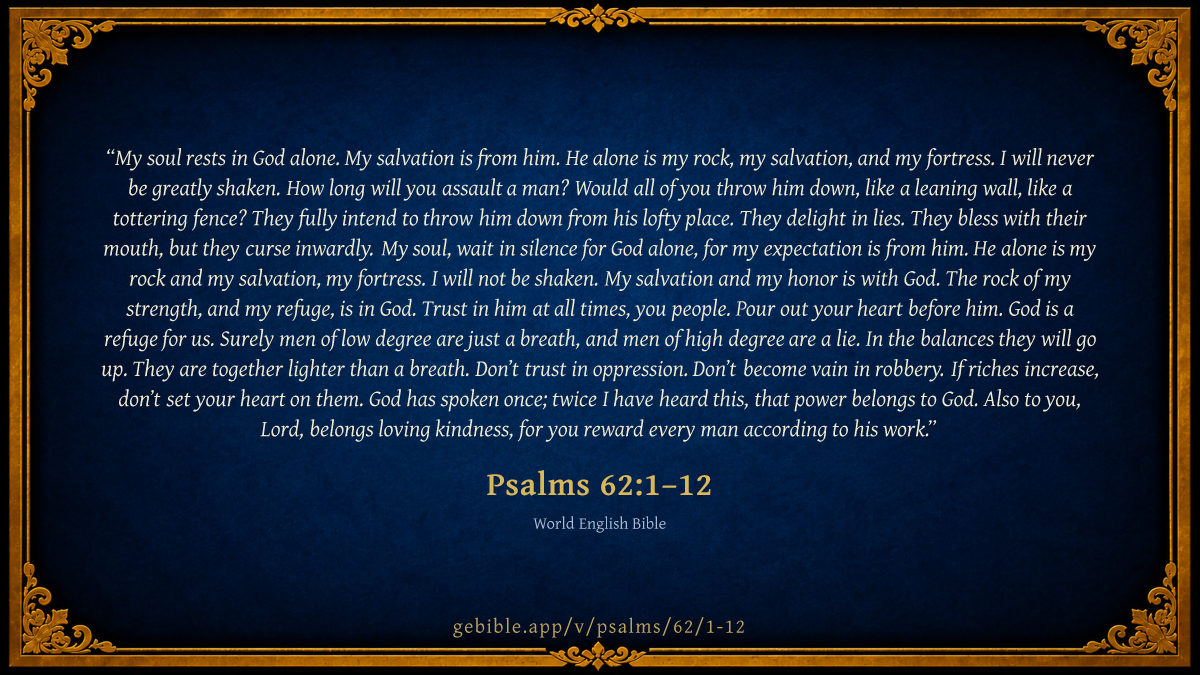
My soul rests in God alone. My salvation is from him.
He alone is my rock, my salvation, and my fortress. I will never be greatly shaken.
How long will you assault a man? Would all of you throw him down, like a leaning wall, like a tottering fence?
They fully intend to throw him down from his lofty place. They delight in lies. They bless with their mouth, but they curse inwardly.
My soul, wait in silence for God alone, for my expectation is from him.
He alone is my rock and my salvation, my fortress. I will not be shaken.
My salvation and my honor is with God. The rock of my strength, and my refuge, is in God.
Trust in him at all times, you people. Pour out your heart before him. God is a refuge for us.
Surely men of low degree are just a breath, and men of high degree are a lie. In the balances they will go up. They are together lighter than a breath.
Don’t trust in oppression. Don’t become vain in robbery. If riches increase, don’t set your heart on them.
God has spoken once; twice I have heard this, that power belongs to God.
Also to you, Lord, belongs loving kindness, for you reward every man according to his work.
John Calvin 1540 · Public Domain On vv1, 2, 3, 4, 5, 7, 9, 10, 11 1. Nevertheless, my soul is silent towards God. Should…
1. Nevertheless, my soul is silent towards God. Should the translation I have followed be adopted, the psalm is to be considered as beginning abruptly, in the usual style of compositions of an impassioned kind. Of this we have an instance in Psalm 73, where the prophet, who had been agitated with doubts, as we shall see more particularly afterwards, suddenly brings his mind to a fixed decision, and, in the way of cutting off all further subject of debate, exclaims, “Yet God is good to Israel.” And so it is, I conceive, in the psalm before us. We know that the Lord’s people cannot always reach such a measure of composure as to be wholly exempt from distraction. They would wish to receive the word of the Lord with submission, and to be dumb under his correcting hand; but inordinate affections will take possession of their minds, and break in upon that peace which they might otherwise attain to in the exercise of faith and resignation. Hence the impatience we find in many; an impatience which they give vent to in the presence of God, and which is an occasion to themselves of much trouble and disquietude. The Hebrew particle אך, ach, is often used in an exclusive sense, and has been rendered by some, only; it is also employed in an affirmative sense, and has been rendered truly, or certainly. But in order to arrive at its full meaning, we must suppose that David felt an inward struggle and opposition, which he found it necessary to check. Satan had raised a tumult in his affections, and wrought a degree of impatience in his mind, which he now curbs; and he expresses his resolution to be silent. The word implies a meek and submissive endurance of the cross. It expresses the opposite of that heat of spirit which would put us into a posture of resistance to God. The silence intended is, in short, that composed submission of the believer, in the exercise of which he acquiesces in the promises of God, gives place to his word, bows to his sovereignty, and suppresses every inward murmur of dissatisfaction. The Hebrew word דומיה, dumiyah, which I have rendered is silent, some consider to be the noun; and it is of little consequence which translation we adopt.
John Calvin's Commentaries (1540-1563) — public domain. Text from the Calvin Translation Society English edition (1840s-50s) via the Christian Classics Ethereal Library (ccel.org). Calvin's coverage is partial (roughly two-thirds of the Bible); uncommented books and verses are honest gaps, never fabricated. The 19th-century editor's footnotes and remarks are omitted so the notes are faithfully Calvin's own voice.
Geneva Bible translators 1599 · Public Domain On vv1, 2, 3, 5, 7, 8, 10, 11, 12 Though Satan tempted him to murmur against God, yet…
Though Satan tempted him to murmur against God, yet he bridled his affections, and resting upon God’s promise.
Geneva Bible (1599) marginal notes — public domain.
John Trapp 1656 · Public Domain On vv1–12 Psa 62:1 « To the chief Musician, to Jeduthun,…
Psa 62:1 « To the chief Musician, to Jeduthun, A Psalm of David. » Truly my soul waiteth upon God: from him [cometh] my salvation.
A Psalm of David] Who being well assured that his prayers in the former psalm were heard, and should be answered, breaketh forth into his triumphant profession of his faith. Lo, here the happy fruit of faithful and fervent prayer.
Read full note →
Ver. 1. Truly my soul waiteth upon God] Waiting is nothing else but hope and trust lengthened; and hereof David giveth us an excellent example in his own person, Idque tanta tamque vegeta cum magnitudine animi, cui ipsae quoque sententiae et voces respondent, and with so good a courage set forth in suitable expressions, that he who hath this psalm by heart, and hath laid it to his heart, cannot but be transformed into the same image from glory to glory, even as by the Spirit of the Lord, 2Co 3:18.
From him cometh my salvation] Take it in the full extent, not only as it signifieth the privative part of man’s happiness, but the positive part also, and preservation therein.
John Trapp, A Commentary or Exposition upon All the Books of the Old and New Testament (1647–1656) — public domain. Text from a community e-Sword module.
Matthew Poole 1685 · Public Domain On vv1, 2, 3, 4, 7, 8, 9, 10, 11, 12 To Jeduthun, a famous musician; of whom see 1Ch…
To Jeduthun, a famous musician; of whom see 1Ch 9:16; 16:42. Heb. upon Jeduthun; which might be the name of a musical instrument or tune, invented by that Jeduthun, and therefore called by his name.
David testifieth his safety and quietness in God, to the discouragement of his enemies, Psa 62:1-7, but to the encouragement of the godly, Psa 62:8. No trust to be put in man, or worldly things; but in God, Psa 62:9,10, to whom power, mercy, and justice belong, Psa 62:11,12.
Read full note →
Truly, or surely. This is my certain and fixed resolution. Or, nevertheless, as this particle is oft rendered. So the beginning of this Psalm is abrupt, as it is in some and hard conflict, which David had within himself, as he often had, what course he should take to get out of his trouble.
Waiteth, Heb. is silent, as it is also Psa 37:7, i.e. silently. quietly, and patiently looks up to God for deliverance, and that in his time and way without murmuring or despair, or using indirect and sinful practices.
From him cometh my salvation; I have no hope hope of deliverance but from and by him.
Matthew Poole's English Annotations on the Holy Bible (1683–1685) — public domain. Text from a community e-Sword/MySword module.
Matthew Henry 1710 · Public Domain On vv1, 8 In these verses we have,
In these verses we have,
I. David's profession of dependence upon God, and upon him only, for all good (Psa 62:1): Truly my soul waiteth upon God. Nevertheless (so some) or "However it be, whatever difficulties or dangers I may meet with, though God frown upon me and I meet with discouragements in my attendance on him, yet still my soul waits upon God" (or is silent to God, as the word is), "Says nothing against what he does, but quietly expects what he will do." We are in the way both of duty and comfort when our souls wait upon God, when we cheerfully refer ourselves, and the disposal of all our affairs, to his will and wisdom, when we acquiesce in and accommodate ourselves to all the dispensations of his providence, and patiently expect a doubtful event, with an entire satisfaction in his righteousness and goodness, however it be. Is not my soul subject go God? So the Septuagint. So it, certainly so it ought to be; our wills must be melted into his will. My soul has respect to God, for from him cometh my salvation. He doubts not but his salvation will come, though now he was threatened and in danger, and he expects it to come from God, and from him only; for in vain is it hoped for from hills and mountains, Jer 3:23; Psa 121:1, Psa 121:2. "From him I know it will come, and therefore on him will I patiently wait till it does come, for his time is the best time." We may apply it to our eternal salvation, which is called the salvation of God (Psa 50:23); from him it comes; he prepared it for us, he prepares us for it, and preserves us to it, and therefore let our souls wait on him, to be conducted through this world to that eternal salvation, in such way as he thinks fit.
Read full note →
II. The ground and reason of this dependence (Psa 62:2): He only is my rock and my salvation; he is my defence. 1. "He has been so many a time; in him I have found shelter, and strength, and succour. He has by his grace supported me and borne me up under my troubles, and by his providence defended me from the insults of my enemies and delivered me out of the troubles into which I was plunged; and therefore I trust he will deliver me," Co2 1:10. 2. "He only can be my rock and my salvation. Creatures are insufficient; they are nothing without him, and therefore I will look above them to him." 3. "He has by covenant undertaken to be so. Even he that is the rock of ages is my rock; he that is the God of salvation is my salvation; he that is the Most High is my high place; and therefore I have all the reason in the world to confide in him."
III. The improvement he makes of his confidence in God.
1. Trusting in God, his heart is fixed. "If God is my strength and mighty delivered, I shall not be greatly moved (that is, I shall not be undone and ruined); I may be shocked, but I shall not be sunk." Or, "I shall not be much disturbed and disquieted in my own breast. I may be put into some fright, but I shall not be afraid with any amazement, nor so as to be put out of the possession of my own soul. I may be perplexed, but not in despair," Co2 4:8. This hope in God will be an anchor of the soul, sure and stedfast.
2. His enemies are slighted, and all their attempts against him looked upon by him with contempt, Psa 62:3, Psa 62:4. If God be for us, we need not fear what man can do against us, though ever so mighty and malicious. He here, (1.) Gives a character of his enemies: They imagine mischief, design it with a great deal of the serpent's venom and contrive it with a great deal of the serpent's subtlety, and this against a man, one of their own kind, against one single man, that is not an equal match for them, for they are many; they continued their malicious persecution though Providence had often defeated their mischievous designs. "How long will you do it? Will you never be convinced of your error? Will your malice never have spent itself?" They are unanimous in their consultations to cast an excellent man down from his excellency, to draw an honest man from his integrity, to entangle him in sin, which is the only thing that can effectually cast us down from our excellency, to thrust a man, whom God has exalted, down from his dignity, and so to fight against God. Envy was at the bottom of their malice; they were grieved at David's advancement, and therefore plotted, by diminishing his character and blackening that (which was casting him down from his excellency) to hinder his preferment. In order to this they calumniate him, and love to hear such bad characters given of him and such bad reports raised and spread concerning him as they themselves know to be false: They delight in lies. And as they make no conscience of lying concerning him, to do him a mischief, so they make no conscience of lying to him, to conceal the mischief they design, and accomplish it the more effectually: They bless with their mouth (they compliment David to his face), but they curse inwardly; in their hearts they wish him all mischief, and privately they are plotting against him and in their cabals carrying on some evil design or other, by which they hope to ruin him. It is dangerous putting our trust in men who are thus false; but God is faithful. (2.) He reads their doom, pronounces a sentence of death upon them, not as a king, but as a prophet: You shall be slain all of you, by the righteous judgments of God. Saul and his servants were slain by the Philistines on Mount Gilboa, according to this prediction. Those who seek the ruin of God's chosen are but preparing ruin for themselves. God's church is built upon a rock which will stand, but those that fight against it, and its patrons and protectors, shall be as a bowing wall and a tottering fence, which, having a rotten foundation, sinks with its own weight, falls of a sudden, and buries those in the ruins of it that put themselves under the shadow and shelter of it. David, having put his confidence in God, thus foresees the overthrow of his enemies, and, in effect, sets them at defiance and bids them do their worst.
3. He is himself encouraged to continue waiting upon God (Psa 62:5-7): My soul, wait thou only upon God. Note, The good we do we should stir up ourselves to continue doing, and to do yet more and more, as those that have, through grace, experienced the comfort and benefit of it. We have found it good to wait upon God, and therefore should charge our souls, and even charm them, into such a constant dependence upon him as may make us always easy. He had said (Psa 62:1), From him cometh my salvation; he says (Psa 62:5), My expectation is from him. His salvation was the principal matter of his expectation; let him have that from God, and he expects no more. His salvation being from God, all his other expectations are from him. "If God will save my soul, as to every thing else let him do what he pleases with me, and I will acquiesce in his disposals, knowing they shall all turn to my salvation," Phi 1:19. He repeats (Psa 62:6) what he had said concerning God (Psa 62:2), as one that was not only assured of it, but greatly pleased with it, and that dwelt much upon it in his thoughts: He only is my rock and my salvation; he is my defence, I know he is; but there he adds, I shall not be greatly moved, here, I shall not be moved at all. Note, The more faith is acted the more active it is. Crescit eundo - It grows by being exercised. The more we meditate upon God's attributes and promises, and our own experience, the more ground we get of our fears, which, like Haman, when they begin to fall, shall fall before us, and we shall be kept in perfect peace, Isa 26:3. And, as David's faith in God advances to an unshaken stayedness, so his joy in God improves itself into a holy triumph (Psa 62:7): In God is my salvation and my glory. Where our salvation is there our glory is; for what is our salvation but the glory to be revealed, the eternal weight of glory? And there our glorying must be. In God let us boast all the day long. "The rock of my strength (that is, my strong rock, on which I build my hopes and stay myself) and my refuge, to which I flee for shelter when I am pursued, is in God, and in him only. I have no other to flee to, no other to trust to; the more I think of it the better satisfied I am in the choice I have made." Thus does he delight himself in the Lord, and then ride upon the high places of the earth, Isa 58:14.
Matthew Henry's Commentary on the Whole Bible (1708–1710) — public domain (CC PDM 1.0). Text via the HelloAO Bible API.
John Gill 1763 · Public Domain On vv1–12 Truly my soul waiteth upon God,.... In the use…
Truly my soul waiteth upon God,.... In the use of means, for answers of prayer, for performance of promises, and for deliverance from enemies, and out of every trouble: or "is silent" (e), as the Targum; not as to prayer, but as to murmuring; patiently and quietly waiting for salvation until the Lord's time come to give it; being "subject" to him, as the Septuagint, Vulgate Latin, Arabic, and Ethiopic versions; resigned to his will, and patient under his afflicting hand: it denotes a quiet, patient, waiting on the Lord, and not merely bodily exercise in outward ordinances; but an inward frame of spirit, a soul waiting on the Lord, and that in truth and reality, in opposition to mere form and show; and with constancy "waiteth", and "only" (f) on him, as the same particle is rendered in Psa 62:2; and so Aben Ezra here;
from him cometh my salvation; both temporal, spiritual, and eternal, and not from any creature; the consideration of which makes the mind quiet and easy under afflictive provide uses: the contrivance of everlasting salvation is from the Father, the impetration of it from the Son, and the application of it from the Spirit.
Read full note →
(e) "silet", Pagninus, Munster, Cocceius; "silens", Montanus, Tigurine version; so the Targum. (f) "tantum", Pagninus, Montanus, Musculus; "tantummodo", Junius & Tremellius, Schmidt.
John Gill's Exposition of the Whole Bible (1746–1763) — public domain (CC PDM 1.0). Text via the HelloAO Bible API.
John Wesley 1765 · Public Domain On vv1, 3, 9, 10, 11, 12 David expresses his confidence in God, ver. 1-7. Excites…
David expresses his confidence in God, ver. 1-7. Excites others to trust in him, ver. 8-12. To the chief musician, to Jeduthun. A psalm of David. Title of the psalm. Jeduthun - A famous musician, 1 Chron. ix, 16.
John Wesley, Explanatory Notes Upon the Whole Bible (1754–1765) — public domain. Text via the GEBible commentary corpus.
Adam Clarke 1810 · Public Domain On vv1, 2, 3, 4, 5, 7, 8, 9, 10, 11 David, in imminent danger, flees to God for help…
PSALM LXII
David, in imminent danger, flees to God for help and safety,
Read full note →
1, 2;
points out the designs of his adversaries, 3, 4;
encourages his soul to wait on God, 5-8;
shows the vanity of trusting in man, and of trusting in riches,
9, 10;
and concludes with asserting that power and mercy belong to
God, and that he will give to every man according to his works,
11, 12.
NOTES ON PSALM LXII
The title, "To the chief Musician, to Jeduthun," may mean that the Psalm was sent to him who was the chief or leader of the band of the family of Jeduthun. It appears that Asaph, Jeduthun, and Heman, were chief singers in the time of David; that they, with their families, presided over different departments of the vocal and instrumental worship in the tabernacle, 1Ch 25:1, c. that they were holy men, full of the Divine Spirit, (a thing very rare among singers and performers in these latter days,) and that they prophesied with harps, with psalteries, and with cymbals; that Jeduthun had six sons thus employed; that himself prophesied with a harp to give thanks and praise to God, 1Ch 25:3; and that the sons of Jeduthun were appointed by lot to the different courses. The eighth course fell to his son Jeshaiah, 1Ch 25:15; the twelfth, to Hashabiah, 1Ch 25:19; and the fourteenth, to Mattithiah, 1Ch 25:21.
Will our modern performers on instruments of music in churches and chapels, pretend to the prophetic influence? If they do not, and cannot, how dare they quote such passages in vindication of their practice, which can be no better than a dulcet noise without its original meaning, and alien from its primary use? Do they indeed prophesy with harps, and psalteries, and cymbals? or with their play-house aggregate of fiddles and flutes, bass-viols and bassoons, clarionets and kettle-drums? Away with such trumpery and pollution from the worship and Church of Christ!
Though it is not very clear from the Psalm itself on what occasion it was composed, yet it is most likely it was during the rebellion of Absalom; and perhaps at the particular time when David was obliged to flee from Jerusalem.
Verse 1. Truly my soul waiteth upon God] I do not think that the original will warrant this translation, אך אל אלהים דומיה נפשי ak el Elohim dumiyah naphshi, "Surely to God only is my soul dumb." I am subject to God Almighty. He has a right to lay on me what he pleases; and what he lays on me is much less than I deserve: therefore am I dumb before God. The Vulgate, and almost all the Versions, have understood it in this sense: Nonne Deo subjecta erit anima mea? Shall not my soul be subject to God? In other words, God alone has a right to dispose of my life as he pleases.
Adam Clarke's Commentary on the Bible (1810–1826) — public domain. Text from a community e-Sword/MySword module.
Joseph Benson 1811 · Public Domain On vv1, 2, 3, 4, 8, 9, 10, 11, 12 Psa 62:1. Truly my soul waiteth upon God —…
Psa 62:1. Truly my soul waiteth upon God — Or, Nevertheless, as some render the Hebrew particle אךְ, ach, or, however it be, whatever difficulties or dangers I may meet with; though God frown upon me, and I meet with discouragements in my attendance on him, yet still my soul waiteth upon God, דומיה, dumijah, is silent toward him, does not object to what he doth, and expects what he will do, silently, quietly, and patiently looking up to him for deliverance, and that in his own time and way, without murmuring or despair, or using indirect or sinful practices. Observe, reader, we are in the way both of duty and comfort, when our souls are waiting upon God; that is, when we cheerfully refer ourselves, and the disposal of all our affairs, to his wisdom; when we acquiesce in, and accommodate ourselves to, all the dispensations of his providence, and patiently expect a doubtful event, with an entire satisfaction in his righteousness and goodness, however it be. The LXX. render this clause, ουχι τω Θεω υποταγησεται η ψυχη μου; shall not my soul be subject to God? Certainly it ought so to be; for, from him cometh my salvation —
I have no hope of deliverance or safety but from and by him.
Joseph Benson's Commentary on the Old and New Testaments (1811–1818) — public domain. Text from a community e-Sword module.
Albert Barnes 1834 · Public Domain On vv1–12 Truly - Indeed; really. The state of mind indicated…
Truly - Indeed; really. The state of mind indicated by this particle is that of one who had been seriously contemplating a subject; who had looked round on his own actual condition; who had taken an estimate of all his resources, and of all his means of reliance, and who had carefully examined his own state of mind to see what was his real trust, and what were his real feelings toward God. Having done all this, he, at last, breaks out with the expression - “My soul does sincerely confide in God; I have no other resource; I have no power to meet my foes, and I am sure - my inmost soul testifies - that my real trust is, where it ought to be, in God; I see nothing in myself on which to rely; I see so much crime, falsehood, treachery in people, that I cannot confide in them; I have had so much painful experience of their insincerity and baseness that I cannot rely on them; but I do see that in God which leads me to trust in him, and I am sure that my heart truly does rely on him.”
My soul waiteth upon God - Margin, is silent. Septuagint, “Is not my soul subject to God?” So the Latin Vulgate. Luther, “My soul is still (calm) in God.” The Hebrew word - דומיה dûmı̂yâh - means “silence, quiet, rest”; and then, a silent expectation or hope. The idea here is, “Truly toward God is the silent waiting of my soul”; that is, “In him alone do I trust; there is calmness of mind; I have no apprehension as to what can happen. My mind is at peace, for I feel that all is in the hands of God, and that lie is worthy of entire trust and confidence.” The feeling is that which exists when we have entrusted all to God; when, having entire confidence in his power, his goodness, his wisdom, his mercy, we commit the whole case to him as if it were no longer our own. Such is the calmness - the peace - the quiet - the silence of the soul - when all is left with God. See the notes at Isa 26:3, and Phi 4:6-7.
Read full note →
From him cometh my salvation - That is, My safety is from him; my security is with him. It is true, also, that all that is ever implied in this word salvation, whether pertaining to this life or the life to come, is derived from God.
Albert Barnes' Notes on the Bible (1834–1885) — public domain. Text from a community e-Sword/MySword module.
Lange's Commentary on the Holy Scriptures 1864 · Public Domain On v1 Psalms 62
Psalms 62
To the chief Musician, to Jeduthun, A Psalm of David
Read full note →
Truly my soul waiteth upon God:
From him cometh my salvation.
2 He only is my rock and my salvation;
He is my defence; I shall not be greatly moved.
3 How long will ye imagine mischief against a man?
Ye shall be slain all of you: as a bowing wall shall ye be, and as a tottering fence.
4 They only consult to cast him down from his excellency: they delight in lies:
They bless with their mouth, but they curse inwardly. Selah.
5 My soul, wait thou only upon God;
For my expectation is from him.
6 He only is my rock and my salvation:
He is my defence; I shall not be moved.
7 In God is my salvation and my glory:
The rock of my strength, and my refuge, is in God.
8 Trust in him at all times; ye people,
Pour out your heart before him:
God is a refuge for us. Selah.
9 Surely men of low degree are vanity, and men of high degree are a lie:
To be laid in the balance, they are altogether lighter than vanity.
10 Trust not in oppression, and become not vain in robbery:
If riches increase, set not your heart upon them.
11 God hath spoken once; twice have I heard this;
That power belongeth unto God.
12 Also unto thee, O Lord, belongeth mercy:
For thou renderest to every man according to his work.
EXEGETICAL AND CRITICAL
Its Contents and Composition.—For the Title comp. Introd. § 12, No. 8. There are no historical statements or decisive references to known events in the life of David; yet the relationships with Psalms 39 on the one side, and with Psalms 4 on the other, point to the time of his persecution by Absalom. This relationship with Psalms 39 makes it advisable to translate the characteristic אַךְ which is repeated [Psa_62:1-2; Psa_62:4-6; Psa_62:9] not by: yea, surely (Flamin., Geier, et al.) but by: only (Kimchi, et al.) In the former sense the subjective side of the assertion is emphasized, in the latter more the objective side. In both cases it bears the emphasis of reliability, whilst the Hebrew word embraces both sides, and the individual passages demand now more this, then more that reference in the narrower sense; but in order to allow the designed repetition of the same word to be clearly manifest in the translation, it is better to retain the translation given above [only] the more as this is appropriate throughout. For the assertion, that only with God is the soul entirely quieted (Psa_62:1), because God only is the rock (Psa_62:2), upon which, when the singer is established, he can designate as vain (Psa_62:3), the attacks of those, who only desire to cast him down from his high place (Psa_62:4);—this assertion is at once the foundation for the exhortation of his soul, to turn to God alone in confident submission (Psa_62:5), because God only is the reliable helper (Psa_62:6). This repetition forms not only the transition to the renewal of the appropriate personal confession (Psa_62:7), but likewise to the exhortation of the people to constant trust in God (Psa_62:8), because men are only breath one and all (Psa_62:9), the trust in temporal possessions, whether goods or powers, is vain (Psa_62:10), but God has spoken the word, which has been frequently heard, and is valid once for all, that the power is His, (Psa_62:11). Therefore the petitioner, moved by the assurance of the government of God, which recompenses justly, turns to the grace of God which is equally essential with His power (Psa_62:12).5
[Str. I Psa_62:1. My soul (is) silence to God.—Some regard דּוּמִיָה as an adjective (Gesenius, Stier, et al.), but most interpreters, as a substantive either as an accus. abs. (Hupfeld) = in silence, in quiet resignation to God, or better as a simple predicate (Delitzsch, Riehm, Perowne, et al.) “It is,” says Calvin, “that settled submission, when the faithful rest in the promises of God, give place to His word, obey His rule, and keep down every murmur of passion in their hearts.”
Psa_62:2. My salvation, etc.—Delitzsch; “His salvation comes from God, yes, God Himself is His salvation, so that, God being his, he possesses already salvation, and by this stands immovably firm.” For the figures which are here heaped up, comp Psa_9:9; Psa_18:2.—I shall not be greatly shaken.—Delitzsch: “What the poet means by רַכַּה is clear from Psa_37:24. He shall not totter greatly, much, especially, that is, not so as to fall or to remain upon the ground.”—C. A. B.]
Str. II. Psa_62:3. Rush again * a man.—This word, which occurs only here, is not to be changed into another similar word (Nah_2:5; Jeremiah 46.) = to rave, storm (Hupf.) or (Psa_102:8) = rage. Nor does it mean: to fall upon (Sept.) pursue (Aquil., Jerome) exhaust one’s-self in vain (Symm.), devise ruin (Rabbin [A.V. imagine mischief]) slander (most recent interpreters), but in accordance with an expression still current in Syria (Delitzsch): to rush upon one with outcry and lifted fist, in order to browbeat.—All of you break (him) down, as a wall inclined, a fence overthrown?—The interpretation of this clause in accordance with the Tiberian reading [followed by the Western Jews]: may ye all be ruined (or likewise = murdered) (Chald., Rabbin, Geier, [similarly A. V.]) is less in accordance with the context than the Babylonian reading, which with the ancient versions and most interpreters, is followed by us in our translation above.6
[Psa_62:5. Only to God, be silent, my soul.—Perowne: “The first strophe opens with the expression of his resignation; this, with the exhortation to resignation. But this is no contradiction. The life of man’s spirit cannot always preserve the same even tenor. The heart of man is like the sea; however calm and smooth it may seem, a light air will ruffle its surface. The resignation, the trust in God, the peace, the rest which have come after long struggle and much prayer, may too easily be broken. And hence when these have been attained, we need to exhort ourselves to them in renewed measure.”—C. A. B.]
Str. III. [Psa_62:7. Upon God (resteth) my salvation,etc.—Comp. Psa_7:10. All depends upon Him, and is founded on Him.—C. A. B.]
Psa_62:8. Trust in Him at all times, O people.—Since a̓m = people, is used in the text, and not a̓mmi = my people, we are not to think of the people of Israel (Chald., Aben Ezra, Calvin), or of men in general (Hupfeld) = dear people (Luther), but of that portion of the people that remained with David, of the retinue which was in his service, Jdg_3:18; 1Ki_19:21; 2Ki_4:42 (Delitzsch).
Psa_62:9. Only a breath are men of low degree,etc.—Respecting the contrast between בְּנֵי־אָדָם and בְנֵי־אִישׁvid.Psa_4:2; Psa_49:2. [There seems to be no other way of rendering this distinction than that of the A. V. The German language distinguishes very nicely between Menschensöhne and Mannessöhne—C. A. B.] —Men of high degree a lie, ascending upon balances—they (are) of breath altogether.—Since the infinitive with ל as the ablative of the gerund, does not precede the principal clause, but always follows (Ewald, § 280 d), the first half of the clause is not to be attached to the second half (most interpreters), but to the preceding clause (Delitzsch) so that the sense is, that the supposed weight of the men of high degree is shown by trial to be a lie. In the second half of this clause it is better to regard the מִן as partitive, than comparative (comp. Isa_40:17; Isa_41:24; Isa_44:11).
Str. IV. Psa_62:11-12. It is not said here that God’s revelation has taken place once, twice, that is to say, often, and has been heard by the Psalmist just as often (De Wette, Hupf.), or that God has spoken a word, which consists of the two things heard by the Psalmist and expressed in the following clauses, that with God is power, and with Him also is grace (Grotius, Delitzsch, Hitzig). The expressions do not agree with the first supposition; against the latter are the change of construction in Psa_62:12, and the mention of the retributive justice of God in the closing clause, which would have been a third member of the word of revelation. It is rather stated as the subject of the word of revelation once spoken; that God is almighty. Even on this account the Psalmist addresses Him directly as adonai, and expresses in an independent clause (Hengst.), yet not in the sense of an explanatory supplement (De Wette, Hupfeld), but moved by his circumstances and feelings, his truthful confession of the grace of the Almighty, which is based upon his experience of the Providence of God recompensing the actions, that is to say the conduct and behaviour of men. The expression is in form entirely in general terms, but in contents it applies to the pious in concreto. This passage is used in this sense by the Apostle Paul, Rom_2:6, after the Sept. It does not follow from this that we are to explain Psa_62:11 a, thus: it is twice that I heard (Ewald), Job_40:5; 2Ki_6:10. The hearing of the one or once spoken word of revelation has been repeated.
DOCTRINAL AND ETHICAL
1. There is a silence which is not that of fright, of pain, of despair, of defiance, but as that of the soul in prayer, and of the heart trusting God, means simply the silence of lamentation, yet in accordance with its nature is the quiet of resignation and the depth of peace in a soul directed towards God, relying upon God and quieted in God. Such a condition of soul, however, arises only from an unconditional, entire, and exclusive submission to God; and this is not only the single act of yielding to God, but the uninterrupted giving of oneself in order to be in entire safety in God. In order to such an experience in life amid manifold temptations, there is necessary on the one side the help of prayer, in order to be more deeply rooted in God, and constantly renewed in submission to Him, on the other side, the comforting, refreshing, warning promises, in order to keep our own souls awake. “For if we put God out of view, and do not turn to prayer, the sea is not so tempestuous in the storm as the human heart and soul,” (Joh. Arndt). He however who truly not only expects and implores his salvation and help from God, but finds and has them with God and in God, feels that he has been delivered as upon a rock, and is lifted up as well above the feeling of his own weakness and frailty, as above fear of the assaults of numerous, powerful, and lying enemies.
2. The man who has resigned himself to God, relies upon God for the deliverance of his life as well as the defence of his honor and the protection of his position. This condition of soul is especially strengthened by emphatically holding before it the portion that it has in God and the constant appropriation of what God says of Himself, and bestows upon them. This strengthens the personal faith, and encourages others to do likewise. The diligent consideration and right use of the word of revelation is of especial importance and influence in this respect; for it testifies that the God whose grace has been so often experienced by the pious in His providence, which recompenses every man justly, is the Almighty, upon whom, as the only true Lord, we should rely alone, and may rely truly, whilst all human devices, powers, undertakings, are as windy, that is to say, powerless and perishable as the riches which have been acquired thereby, and indeed to some extent with deceit and violence.
HOMILETICAL AND PRACTICAL
God alone gives true peace to the soul that trusts in Him, but He gives it really.—Resignation to God is not without the giving up of oneself, but it makes no real loss, but effects true and abiding gain.—Prayer is not opposed to the quiet of a heart resigned to God.—He who resigns himself trustingly to God, will be accepted by God; and he who accepts what God speaks, does, and sends, is established in his resignation to God.—When we feel ourselves to be weak, and our enemies treat us as if we were shaking, God the Almighty remains our strength, as long as we trust in His grace.—God can screen believers against their enemies with as many shields as He has names.—Only God is reliable in all respects, the world in no respect.—He who would rely upon the grace of the Almighty, must not forget, that the Lord recompenses justly.—When men are weighed by God, many are found too light.—Hear often what God has spoken once, but judge yourselves by it, and not by other men to whom you preach it.
Starke: Trust in God never deceives; for even if we are forsaken by the entire world, God remains faithful.—Craft and power are the weapons of the ungodly; if the one is not enough, they seize the other, and not unfrequently make their attacks with both at once.—Riches are to many snares by which they are plunged into ruin.
Osiander: The pious have many assaults, but they are not ruined.—Franke: What God speaks once we should frequently repeat, and always carry it about in our hearts.—Frisch: An honest prayer is nothing but a pouring out of the heart before God.—Tholuck: This is the course of the world, the richer God’s gifts, the more do men trust in the gifts instead of the rich Giver.—Diedrich: God is enough; but He alone.—Guenther: To be silent to God—a precious jewel and a fruit of the Spirit.—Deichert: What it means to follow our Saviour with the cross. 1). He was still as a lamb, be ye likewise; 2) His enemies have not overcome Him, take shelter under His wings; 3) He trusted God, who helped him out, therefore put all your confidence in Him.
[Matt. Henry: The good we do we should stir up ourselves to continue doing, and to do yet more and more, as those that have through grace experienced the comfort and benefit of it.—The more faith is acted, the more active it is. It is a smiling world that is most likely to draw the heart away from God, on whom only it should be set.—Barnes: All these combined—power, mercy, equity—constitute a reason why men should confide in God.—If these things do exist in God, unlimited confidence may be placed in Him as having all needful power to save; as being so merciful that sinful men may trust in Him; and as being so just and equal in His dealings that all may feel that it is right to repose confidence in a Being by whom all the interests of the universe will be secured.—Perowne: Power without Love is brutality, and Love without Power is weakness. Power is the strong foundation of Love, and Love is the beauty and the crown of Power.—Spurgeon: No eloquence in the world is half so full of meaning as the patient silence of a child of God. It is an eminent work of grace to bring down the will and subdue the affections to such a degree, that the whole mind lies before the Lord like the sea beneath the wind, ready to be moved by every breath of His mouth.—We cannot too often hear the toll of that great bell only; let it ring the death knell of all carnal reliances, and lead us to cast ourselves on the bare arm of God.—Our meditative soul should hear the echo of God’s voice again and again. What He speaks once in revelation, we should be always hearing. Creation and Providence are evermore echoing the voice of God—C. A. B.]
Footnotes:
[5][It is better with Hupfeld, et al. to regard this Psalm as composed of three strophes with four verses each. The two first thus have a refrain at the beginning embracing a pair of verses, instead of at the close, as Moll, and besides they conclude with a Selah. The third strophe would then begin with the characteristic אֵךְ and with contents in contrasted parallelism with the two other strophes. Hupfeld translates אךְ each time by ja, but Moll’s translation, only in preferable—C A. B.]
[6][Hupfeld prefers the usual sense of רצח, and translates murder. and regards the metaphors as very much mixed, but It seems better with Ewald, Delitzsch, Moll, Perowne, et al., to translate in accordance with the original meaning: to break down.—C. A. B.]
Lange's Commentary on the Holy Scriptures (Critical, Doctrinal, and Homiletical), ed. John Peter Lange, English translation edited by Philip Schaff (1864–1880) — public domain. Text from a community e-Sword module.
Robert Jamieson, A. R. Fausset & David Brown 1871 · Public Domain On vv2–12 The titles applied to God often occur (Psa 9:9;…
The titles applied to God often occur (Psa 9:9; Psa 18:2).
be greatly moved-- (Psa 10:6). No injury shall be permanent, though devised by enemies.
Jamieson, Fausset & Brown — Commentary Critical and Explanatory on the Whole Bible (1871) — public domain (CC PDM 1.0). Text via the HelloAO Bible API.
Daniel D. Whedon 1874 · Public Domain On vv1, 2, 3, 4, 5, 6, 8, 9, 10, 11 1. Truly—The word occurs six times in this psalm,…
1. Truly—The word occurs six times in this psalm, and is translated truly, Psa_62:1; only, Psa_62:2; Psa_62:4-6; and surely, Psa_62:9. In every instance truly, or verily, would give the sense, and it is better to adhere to a uniform rendering. In this verse, and in Psa_62:2; Psa_62:5-6, it has a kindred significance to amen, verily, in the New Testament, and is the language of faith and solemn asseveration. The psalm must be supposed to have been written immediately before the battle described 2 Samuel 18, and is a specimen throughout of sage counsel and calm faith.
Waiteth—Is still—trusts calmly. It is a description of perfect submission, or soul-rest in God. So Psa_62:5, and Psa_4:4; Psa_37:7. In Psa_131:2, it is rendered quieted myself.
Daniel D. Whedon (gen. ed.), Commentary on the Old and New Testaments (1874–1909) — public domain. Text from a community e-Sword module.
The Cambridge Bible for Schools and Colleges 1878 · Public Domain On vv1–11 1. Truly] The particle ak is characteristic of this…
1. Truly] The particle ak is characteristic of this Ps., in which it occurs six times, and of Psalms 39, in which it occurs four times. It stands at the beginning of Psa_62:1-2; Psa_62:4-6; Psa_62:9. It may be affirmative, ‘truly,’ ‘surely,’ or restrictive, ‘only.’ Either sense will suit, and possibly the shade of meaning may not always be the same; but ‘only’ appears to be preferable throughout. Literally the line means: Only unto God is my soul silence; unto God alone does my soul look in patient calmness, waiting for the deliverance which will surely come, and can come from Him alone. For such ‘silent’ waiting cp. Psa_62:5; Psa_37:7; Psa_39:2; Lam_3:26.
1–4. Patiently the Psalmist awaits God’s help, and remonstrates with his enemies for their malice and hypocrisy.
The Cambridge Bible for Schools and Colleges (gen. ed. J. J. S. Perowne; Cambridge University Press, 1878–1918) — public domain. Text from a community e-Sword module.
Ellicott's Commentary for English Readers 1878 · Public Domain On vv1, 2, 3, 4, 5, 7, 9, 10, 11 (1) Waiteth upon God.—Literally, unto God (is) silence my…
(1) Waiteth upon God.—Literally, unto God (is) silence my soul. (Comp. Psa_22:2; Psa_39:2; Psa_65:1.) The LXX. and Vulg., “shall be in subjection to,” which no doubt gives one side of the feeling; but another may be illustrated by Wordsworth’s—
“The holy time is quiet as a nun
Read full note →
Breathless with adoration.”
A Bible Commentary for English Readers, edited by Charles John Ellicott (1878–1897) — public domain. Text from a community e-Sword module.
The Pulpit Commentary 1880 · Public Domain On vv1–12 THIS psalm, like so many, is the cry of…
THIS psalm, like so many, is the cry of an afflicted one a man of high position, whom his enemies seek to destroy, or, if that be not possible, to thrust down from his dignity (vers. 3, 4). He himself is full of trust in God, and calmly confident that his enemies cannot succeed (vers. 1, 2, 5-7). The confidence which he feels he tries to impart to his people (ver. 8). In conclusion, he warns his enemies that they are likely to provoke God"s powerful anger (vers. 9-11), and encourages his friends by the thought of God"s mercy, and of his goodness in rewarding those who faithfully serve him.
It is evident that the psalm contains nothing but what is suitable to the character of David, to whom the "title" assigns it; and further, that it accords well with his circumstance, when the revolt of Absalom was imminent. In further proof of the Davidical authorship may be urged "the earnestness of thought, the depth and force of religious feeling," and "the vigour and sublimity of the language" (Canon Cook).
Read full note →
The psalm divides into three stanzas, each of four verses, the break between the first and second and between the third and fourth being notified by the usual pause mark, "Selah.
Truly my soul waiteth upon God; rather, my soul waiteth only upon God (Revised Version). The initial word, ak ( which occurs six times in this psalm (vers. 1, 2, 4, 5, 6, 9), is best translated "only" in every instance. It always intensifies the word or phrase to which it is attached upon God he from his excellency vanity." From him cometh my salvation. (comp. Psa_35:3 Psa_37:39 Psa_65:5, etc.)
HOMILIES BY W. FORSYTH Vers. 1-12. This is a psalm of testimony.
It includes two things.
I AN EXPRESSION OF PERSONAL CONFIDENCE IN GOD. Some trust in themselves; others in their fellow men; others, in the laws of nature. All this is so far good. It is well to be self-reliant. It is well to take advantage of the wisdom and help of others. It is well to act in the line of law, and in dependence upon the settled order of things with which we are connected. But there is something higher and better. The true way is to trust in God. Trust in God puts things in their right places; inspires courage and fortitude; ennobles and satisfies our whole being (vers. 5-7).
II AN EARNEST EXHORTATION TO ALL MEN TO PUT THEIR TRUST IN GOD. (Vers. 8-12) All men have their trials. There will come times when they are troubled and perplexed, when they must look out of themselves anxiously for help. They are tempted. They are in danger of putting their trust in objects that are vain and worthless. If disappointed, they are apt to get soured and hardened in sin. The remedy counselled is twofold.
1. Trust. God is the true and only Being worthy of supreme trust. There is everything in him to inspire confidence and hope. "At all times." In the darkness and in the light, in adversity as won as prosperity; when he hides his face as when he makes his countenance to shine upon us.
2. Prayer. We are always free to come to God. We may tell him all that is in our hearts. What a joy in this trust! What a comfort in this unbosoming of ourselves! God will not only hear, but have pity. He will not only answer, but magnify his "power" and his "mercy" in our deliverance. Who so fit to give this counsel as to trust and prayer as the man who is speaking from the depths of his own experience, and from the abiding convictions of his own heart! (2Co_4:13 1Jn_1:1-3) W.F.
Waiting.
"Silent unto God so the word "waiteth" may be interpreted. Take this in connection with the word "only" repeated with such emphasis and meaning, and we may understand the silence as deeply expressive.
I SIGN OF FAITH. The soul says, "I can trust and wait.
II RECORD OF CONFLICT. There has been a struggle. Peace has not been won without a hard fight, and "strong crying and tears." We must sacrifice self before we can say, in the silence of our hearts, "All is well.
III EXPRESSION OF THE SOUL"S COMPLETE ACQUIESCENCE. There may have been disappointments from men, but there is hope in God. He is to be trusted at all times. His will is holy and good, and all our "expectation is from him." Hence there is the stillness of content (vers. 5-8).
IV FORESHADOWING OF VICTORY. "Power belongeth unto God," and that power is pledged in behalf of his people. How God may work we cannot surely tell, but we wait for light. There is a time to "stand still"; (Exo_14:13) and there is a time to "go forward". (Exo_14:15) When we do as the Lord commands, we shall "see the salvation of God. W.F.
HOMILIES BY C. SHORT Vers. 1-12. Danger and safety.
The psalmist, like a mighty eagle, poises himself on the wings of his faith at a great height above the dangers that threatened him, and feels safe. Three things claim consideration.
I DANGER.
1. His kingly dignity was threatened. (Ver. 4) The position of the Christian is in constant danger.
2. His life was in danger. (Ver. 3) His enemies rushed upon him to overthrow him as if he were a bowing wall or a tottering fence. Our spiritual life is in danger from numerous foes.
II SAFETY THE MOST ABSOLUTE.
1. He silently trusts in God as Salvation. Does not pray, but confidently trusts, as a child in his father. Heaps epithet on epithet, denoting the sense of safety. "High Tower, Rock," etc. The perfection of trust in God.
2. He exhorts others to the same perfect trust. "At all times." God is the common Refuge and Salvation for all who will trust him, because he "careth" for all.
III THE REVELATION ON WHICH HIS TRUST WAS GROUNDED. (Vers. 11, 12)
1. That God has universal power. If we need strength, we are to seek it, not in robbery or riches, but in God, who is Almighty.
2. That God is filled also with loving kindness. "Power without love is brutality, and love without power is weakness;" but when both are combined they are the guarantee of righteous rule, and that God will "reward every man according to his work. S.
The Pulpit Commentary (1880–1919), ed. H.D.M. Spence-Jones & Joseph S. Exell — public domain. Text from a community e-Sword module.
Charles H. Spurgeon 1885 · Public Domain On vv1–12 To the Chief Musician, to Jeduthun. This is the…
To the Chief Musician, to Jeduthun. This is the second Psalm which is dedicated to Jeduthun, or Ethan, the former one being the thirty-ninth, a Psalm which is almost a twin with this in many respects, containing in the original the word translated only four times as this does six. We shall meet with two other Psalms similarly appointed for Jeduthun: namely, Psalms 77, and 89. The sons of Jeduthun were porters or doorkeepers, according to 1Ch 16:42. Those who serve well make the best of singers, and those who occupy the highest posts in the choir must not be ashamed to wait at the posts of the doors of the Lord's house. A PSALM OF DAVID. Even had not the signature of the royal poet been here placed, we should have been sure from internal evidence that he alone penned these stanzas; they are truly Davidic. From the sixfold use of the word ac or only, we have been wont to call it THE ONLY PSALM.
The Psalmist has marked his own pauses, by inserting SELAH at the end of Ps 62:4, 8. His true and sole confidence in God laughs to scorn all its enemies. When this Psalm was composed it was not necessary for us to know, since true faith is always in season, and is usually under trial. Moreover, the sentiments here uttered are suitable to occasions which are very frequent in a believer's life, and therefore no one historic incident is needful for their explanation.
Read full note →
Ver. 1. Truly, or verily, or only. The last is probably the most prominent sense here. That faith alone is true which rests on God alone, that confidence which relies but partly on the Lord is vain confidence. If we Anglicized the word by our word verily, as some do, we should have here a striking reminder of our blessed Lord's frequent use of that adverb.
My soul waiteth upon God. My inmost self draws near in reverent obedience to God. I am no hypocrite or mere posture maker. To wait upon God, and for God, is the habitual position of faith; to wait on him truly is sincerity; to wait on him only is spiritual chastity. The original is, "only to God is my soul silence." The presence of God alone could awe his heart into quietude, submission, rest, and acquiescence; but when that was felt, not a rebellious word or thought broke the peaceful silence. The proverb that speech is silver but silence is gold, is more than true in this case. No eloquence in the world is half so full of meaning as the patient silence of a child of God. It is an eminent work of grace to bring down the will and subdue the affections to such a degree, that the whole mind lies before the Lord like the sea beneath the wind, ready to be moved by every breath of his mouth, but free from all inward and self caused emotion, as also from all power to be moved by anything other than the divine will. We should be wax to the Lord, but adamant to every other force.
From him cometh my salvation. The good man will, therefore, in patience possess his soul till deliverance comes: faith can hear the footsteps of coming salvation, because she has learned to be silent. Our salvation in no measure or degree comes to us from any inferior source; let us, therefore, look alone to the true fountain, and avoid the detestable crime of ascribing to the creature what belongs alone to the Creator. If to wait on God be worship, to wait on the creature is idolatry; if to wait on God alone be true faith, to associate an arm of the flesh with him is audacious unbelief.
Psalms 62, and 63 compared. ONLY AND EARLY. There is a sweet and profitable lesson taught us in Psalms 62 and 63. The heart is ever prone to divide its confidence between God and the creature. This will never do. We must "wait only upon God." "He only"must be our "rock, "our "salvation, "and our "defence." Then we are frequently tempted to look to an arm of flesh first, and when that fails us, we look to God. This will never do either. He must be our first as well as our only resource. "O God, thou art my God, early will I seek thee." This is the way in which the heart should ever treat the blessed God. This is the lesson of Psalm 63. When we have learnt the blessedness of seeking God "only, "we shall be sure to seek him "early." Charles Mackintosh, in "Things New and Old, "1858.
Whole Psalm. There is in it throughout not one single word (and this is a rare occurrence), in which the prophet expresses fear or dejection; and there is also no prayer in it, although, on other occasions, when in danger, he never omits to pray... The prophet found himself remarkably well furnished in reference to that part of piety which consists in pleroforia, the full assurance and perfection of faith; and therefore he designed to rear a monument of this his state of mind, for the purpose of stimulating the reader to the same attainment. Moses Amyraut, 1596-1664.
Whole Psalm. Athanasius says of this Psalm: "Against all attempts upon thy body, thy state, thy soul, thy fame, temptations, tribulations, machinations, defamations", say this Psalm. John Donne.
Ver. 1. Only. The particle may be rendered only, as restrictive; or, surely, as affirmative. Our translators have rendered it differently in different verses of this Psalm; Ps 62:1, truly; in Ps 62:2, 4-6, only; in Ps 62:9, surely. If we render only, the meaning will be here that God exclusively is the object of trust; if surely, that this truth, that God is his salvation, has come home to him with a more lively conviction, with a more blessed certainty than ever. The first line of the verse rendered literally is, "Only unto God my soul is silence." J. J. Stewart Perowne.
Ver. 1. Truly my soul waiteth upon God, etc. In the use of means, for answers of prayer, for performance of promises, and for deliverance from enemies, and out of every trouble: or, is silent, as the Targum; not as to prayer, but as to murmuring; patiently and quietly waiting for salvation until the Lord's time come to give it; being subject to him, as the Septuagint, Vulgate, Latin, Arabic, and Ethiopic versions; resigned to his will, and patient under his afflicting hand: it denotes a quiet, patient waiting on the Lord, and not merely bodily exercise in outward ordinances; but an inward frame of spirit, a soul waiting on the Lord, and that in truth and reality, in opposition to mere form and show. John Gill.
Ver. 1. Truly my soul waiteth upon God; or, as the Hebrew, My soul is silent. Indeed, waiting on God for deliverance, in an afflicted state, consists much in a holy silence. It is a great mercy, in an affliction, to have our bodily senses, so as not to lie raving, but still and quiet, much more to have the heart silent and patient; and we find the heart is as soon heated into a distemper as the head. Now what the sponge is to the cannon, when hot with often shooting, hope is to the soul in multiplied afflictions; it cools the spirit and makes it meeker it, so that it doth not break out into distempered thoughts or words against God. (See also Ps 62:5.) William Gurnall.
Ver. 1. Waiteth. Waiting is nothing else but hope and trust lengthened. John Trapp.
Ver. 1. My soul is silent before God. As if he had said: to me as a man God has put in subjection all his creatures; to me as a king he has subjected the whole of Judaea, the Philistines, the Moabites, Syrians, Idumeans, Ammonites, and other tribes; having taken me from the sheep cotes he has adorned me with a crown and sceptre now these thirty years, and extended my kingdom to the sea, and to the great river Euphrates; it is not without reason, then, that I subject myself to God alone in this affliction, wherein Absalom thirsts to crush me, especially since he reveals the deliverance prepared for me, and from him alone can I expect it. Thomas Le Blanc--1669, in Psalmorum Davidicorum Analysis.
Ver. 1. Is silent. The Hebrew word used is hymwd dumijah, that is, silent, resting, expecting, reflecting, solicitous, and observing. For, first, we ought to be subject to God as silent disciples before a master...Whatever God has allowed to happen to me, yet I will be silent before him, and from my heart admire, both enduring his strokes and receiving his teaching... Secondly, we ought to be subject to God as creatures keeping quiet before their Creator... "Woe unto him that striveth with his Maker." Isa 45:9. Thirdly, we ought to be subject to God as clay in the hands of the potter, ready for the form into which he wishes to fashion us... "As clay is in the potter's hand, so are ye in mine hand, O house of Israel." Jer 18:6. Fourthly, we ought to be subject to God, as a maid servant to her master, observing his wish, even in the most menial affairs... Fifthly, we ought to be subject to God, as a wife to her husband (sponsa sponso), who in her love is solicitous and careful to do whatever may be pleasing to him. "My beloved is mine, and I am his." Canticles 2:16. And, "I am my beloved's." Canticles 6:3. Thomas Le Blanc.
Ver. 1. After almost every quiet prayer and holy meditation in the divine presence, we have the consciousness that there was an ear which heard us, and a heart that received our sighs. The effect of a silent colloquy with God is so soothing! There was a time when I used greatly to wonder at these words of Luther: --
"Bear and forbear, and silent be,
Tell no man thy misery;
Yield not in trouble to dismay,
God can deliver any day."
I wondered because we feel the outpouring of grief into the heart of a friend to be so sweet. At the same time, he who talks much of his troubles to men is apt to fall into a way of saying too little of them to God; while, on the other hand, he who has often experienced the blessed alleviation which flows from silent converse with the Eternal, loses much of his desire for the sympathy of his fellows. It appears to me now as if spreading out our distress too largely before men served only to make it broader, and to take away its zest; and hence the proverb, "Talking of trouble makes it double." On the contrary, if when in distress we can contrive to maintain calm composure of mind, and to bear it always as in the sight of God, submissively waiting for succour from him, according to the words of the psalmist, Truly my soul waiteth upon God: from him cometh my salvation; in that case, the distress neither extends in breadth nor sinks in depth. It lies upon the surface of the heart like the morning mist, which the sun as it ascends dissipates into light clouds. Agustus F. Tholuck, in "Hours of Christian Devotion, "1870.
Ver. 1. The natural mind is ever prone to reason, when we ought to believe; to be at work, when we ought to be quiet; to go our own way, when we ought steadily to walk on in God's ways, however trying to nature... And how does it work, when we thus anticipate God, by going our own way? We bring, in many instances, guilt on our conscience; but if not, we certainly weaken faith, instead of increasing it; and each time we work thus a deliverance of our own, we find it more and more difficult to trust in God, till at last we give way entirely to our natural fallen reason, and unbelief prevails. How different if one is enabled to wait God's own time, and to look alone to him for help and deliverance! When at last help comes, after many seasons of prayer it may be, and after much exercise of faith and patience it may be, how sweet it is, and what a present recompense does the soul at once receive for trusting in God, and waiting patiently for his deliverance! Dear Christian reader, if you have never walked in this path of obedience before, do so now, and you will then know experimentally the sweetness of the joy which results from it. George Müller, in "A Narrative of some of the Lord's Dealings, " 1856.
Ver. 1.
I. What he did? Waited upon God. Believed, was
patient, was silent in resignation, was obedient.
II. To whom he did it? To his God, who is true, a
sovereign, gracious, etc.
III. How he did it? With his soul, truly and only.
IV. What came of it? Salvation present, personal,
eternal, etc.
An Exposition upon some Select Psalmes of David. Containing great store of most excellent and comfortable doctrine and instruction for all those that (under the burden of sinne), thirst for comfort in Christ Jesus. Written by that faithful servant of God, M. ROBERT ROLLOK, sometime pastor in the Church of Edinburgh: and translated out of Latin into English, by CHARLES LUMISDEN. Minister of the Gospel of Christ at Dudingstoun... 1600. (Contains an Exposition of Psalm 62.)
Certain Comfortable Expositions of the constant Martyr of Christ, John Hooper, bishop of Gloucester and Worcester... Written in the time of tribulation and imprisonment, upon the Twenty-third, Sixty-second, Seventy-third, and Seventy-seventh Psalms of the prophet David.
Psalms 62:2*
Charles H. Spurgeon's The Treasury of David (1869–1885) — public domain. Psalms only. Text from a community e-Sword/MySword module.
The Biblical Illustrator 1887 · Public Domain On vv1, 2, 5, 8, 10, 11, 12 Truly my soul waiteth upon God: from Him cometh…
Psa_62:1-12
Truly my soul waiteth upon God: from Him cometh my salvation.
Read full note →
A testimony and an exhortation
I. A religious testimony.
1. Concerning self (Psa_62:1-2; Psa_62:6-7). His confidence in God was--
(1) Supreme. He only is my Rock.
(2) Steadfast. I shall not be greatly moved.
(3) Pacific. Truly, or, is silent my soul.
2. Concerning contemporaries.
(1) Malignant (Psa_62:3).
(2) False (Psa_62:4).
Davids testimony concerning his contemporaries is applicable to the men of our age. Read the malignity of our times in the bloody wars, etc. Read the falsehood of our times in the schemings of politicians, the tricks of tradesmen, and the hollow shams in all departments of life.
3. Concerning God (Psa_62:11-12).
(1) His power. All kinds of power belong to Him--physical power, intellectual power, moral power.
(2) His mercy. Gods kindness is even greater than His power, inasmuch as it inspires, directs, and controls. It is kindness that nerves and moves the Omnipotent Arm.
(3) His justice. This testimony of God is sublime and meets our highest ideal.
II. A religious exhortation.
1. To self (Psa_62:5). Man is a duality; in him there are two personalities in one. These often battle with each other, sometimes blame, and sometimes commend each other. Man is constantly exhorting himself, sometimes to be more industrious in business, more accurate in studies, more temperate in habits. Here is a man exhorting himself to wait only on God. This religious exhortation is--
(1) Most available. Every man has a preacher within.
(2) Most efficient. All outward preachers are only available so far as they can rouse the inner preacher, and make him thunder in the great temple of conscience.
2. To others.
(1) Concerning a right object of trust. Trust in Him at all times, etc. Trust Him, not only when the weather of life is calm and sunny, but trust Him amidst the rush of tempest, the roar of thunder, and the convulsions of volcanoes. Trust Him fully; pour out your heart. As all the roots of the tree strike into the soil, so let all the sympathies of your nature strike into God.
(2) Concerning a wrong object of trust. Trust not in oppression, etc.
Men do trust in oppression, not only tyrants, warriors, slaveholders, but unjust masters and mistresses that expect more service from employes than is just: hence the exhortation, Trust not in oppression; If riches increase.
(1) Here is a circumstance which most desire. Some for wrong reasons, some for right reasons.
(2) Here is a possibility which some may possess. If riches increase. In some it is impossible; the poor men often get rich in one or two ways, either with or without their efforts.
(3) Here is a duty which all should discharge. Set not your heart upon them. Why? Because to love them is unworthy of your nature. Because to love them is to injure your nature. Because to love them is to exclude God from your nature. Because to love them is to bring ruin on your nature. (Homilist.)
Faith triumphant
The psalm falls naturally into three parts of four verses each; and in the original each of these begins with the same particle, which unfortunately is either not translated in our versions, or rendered by different words. It means Yes, Surely or Verily, and expresses a conviction freshly acquired. This is the character of the entire psalm: it is a series of maxims hewn straight from life.
I. The silence of faith (verse 1-4). Truly my soul waiteth upon God, literally, is silent unto God. Silence is sometimes very eloquent. When one has suffered a great wrong or is accused of some outrageous baseness, there may be an impressiveness in dignified silence, which the loudest protestations could not equal. In the trial of Jesus there are three or four moments of silence which perhaps bring home to us the height of His moral grandeur as powerfully as anything in His life. So faith has its silence. It is not always silent. On the contrary, it sometimes cries aloud; it groans and complains; it argues and beseeches. Perhaps the faith of the psalmist had passed through these stages before reaching the silent stage, for he tells us (Psa_62:3-4) that he had enemies, who bad pushed their attacks to the verge of murder. In such circumstances, faith may well have cried or groaned or argued; but these stages are past; and now it is silent before God. It lies before Him in perfect peace, confident that His will must overrule all. For (Psa_62:2) He is a rock and a defence; and therefore, says the child of faith, I shall not be greatly moved.
II. Thy instruction of faith (Psa_62:5-8). Having attained to such a height, he is seized with the spirit of a teacher.
1. He begins with instructing himself. My soul, wait thou upon God. When we get up to heights of experience, we ought to mark in the rock how high we have climbed, for we know--
How difficult it is to keep
Heights which the soul is competent to gain.
When we are high up, there are outlooks which we are unable to see at ordinary times; and it is well to record them as is done here. The truths about God which we thus learn in moments of great experience are the most precious portion of all knowledge: they are better than we can learn from books or doctors or sages. Blessed is he who possesses convictions which he has not been taught by men, however wise, but has wrung out of his own experience.
2. He also instructs others (Psa_62:8). It is the natural way of experience to overflow into testimony; and when the soul has attained rest itself, it naturally seeks to assist the struggling. Thereby it not only proves that it has attained, but extends and strengthens its attainments; because we are never safer or healthier than when we have left off thinking of ourselves and are able to care for others.
III. The alternatives to faith (Psa_62:9-12). In this last section the psalmist contrasts faith in God with the other refuges in which he was tempted to put his trust. These were men (Psa_62:9) and money (Psa_62:10). To one in Davids position, it would naturally seem a great thing to have mens alliance; but he had tried them and found them wanting. This is a word for all times: by any one who has a great cause--who is fighting for Christs cause--democracy and aristocracy are alike to be distrusted; God alone is the watchword. The other substitute for God which David was tempted to trust was money, whether obtained by foul means or fair; and here he touches a still more universal chord. In thinking of the future and of the changes and chances of life, we are all tempted to look in this direction. How many are devoting themselves to the pursuit of money, caring little for scruples, but only feeling that, if they had enough of it, all would be well. Others, seeking wealth by honest means, have the same confidence. But the poorest man who has faith in God is safer. This is the testimony of Scripture, and it is the testimony of experience as well. So we come back to the wisdom of the man of God. Once, he says, he has heard, yea, twice--that is, it has been borne in on him again and again as a Divine truth--that power belongeth unto God. This is the end of the whole matter; this is the resource that will avail in every difficulty, which will last through time and through eternity. (J. Stalker, D. D.)
Silence to God
(with Psa_62:5):--My soul is silence unto God. That forcible form of expression describes the completeness of the psalmists unmurmuring submission and quiet faith. His whole being is one of great stillness, broken by no clamorous passions; by no loud-voiced desires; by no remonstrating reluctance. That silence is first a silence of the will. Bridle impatience till God speaks. Take care of running before you are sent. Keep your will in equipoise till Gods hand gives the impulse and direction. We must keep our hearts silent too. The sweet voices of pleading affections, the loud cry of desires and instincts that roar for their food like beasts of prey, the querulous complaints of disappointed hopes, the groans and sobs of black-robed sorrows, the loud hubbub and Babel, like the noise of a great city, that every man carries within, must be stifled and coerced into silence. We have to take the animal in us by the throat, and sternly say, Lie down there and be quiet. We have to silence tastes and inclinations. There must be the silence of the mind, as well as of the heart and will. We must not have our thoughts ever occupied with other things, but must cultivate the habit of detaching them from earth, and keeping our minds still before God, that He may pour His light into them. Alas! how far from this is our daily life! Who among us dares to take these words as the expression of our own experience? Is not the troubled sea which cannot rest, whose waters cast up mire and dirt, a truer emblem of our restless, labouring souls than the calm lake? Put your own selves by the side of this psalmist, and honestly measure the contrast. It is like the difference between some crowded market-place all full of noisy traffickers, ringing with shouts, blazing in sunshine, and the interior of the quiet cathedral that looks down on it all, where are coolness and subdued light, and silence and solitude. This mans profession of utter resignation is perhaps too high for us; but we can make his self-exhortation our own. My soul! wait thou only upon God. Perfect as he ventures to declare his silence towards God, he yet feels that he has to stir himself up to the effort which is needed to preserve it in its purity. Just because he can say, My soul waits, therefore he bids his soul wait. That vigorous effort is expressed here by the very form of the phrase. The same word which began tim first clause begins the second also. As in the former it represented for us, with an emphatic Truly, the struggle through which the psalmist had reached the height of his blessed experience, so here it represents in like manner the earnestness of the self-exhortation which he addresses to himself. He calls forth all his powers to the conflict, which is needed even by the man who has attained to that height of communion, if he would remain where he has climbed. And for us who shrink from taking these former words upon our lips, how much greater the need to use our most strenuous efforts to quiet our souls. If the summit reached can only be held by earnest endeavour, how much more is needed to struggle up from the valleys below. (A. Maclaren, D. D.)
Waiting upon God is the soul casting its anchor
It was the speech of Taulerus, one that Luther prized above all. Says he--Though the mariners may make use of their oars in the time of calm, yet when a storm comes down the mariners leave all and fly to their anchor. So, though at other times we may make use of resolutions and vows, and the like, yet when the storm of temptation comes down, nothing then but fly to the anchor of faith, nothing then like to casting of anchor into the vail. (Bridge.)
The Biblical Illustrator, edited by Joseph S. Exell (c. 1880s–1900s) — public domain. Text from a community e-Sword module.
The Expositor's Bible 1887 · Public Domain On v1 Psalms 62
Psalms 62
THERE are several points of affinity between this psalm and the thirty-ninth-such as the frequent use of the particle of asseveration or restriction ("surely" or "only"); the rare and beautiful word for "silence," as expressing restful, still resignation; and the characterisation of men as "vanity." These resemblances are not proofs of identity of authorship, though establishing a presumption in its favour. Delitzsch accepts the psalm as Davidic, and refers it to the time of Absaloms revolt. The singer is evidently in a position of dignity ("elevation," Psa_62:4), and one whose exhortations come with force to the "people" (Psa_62:8), whether that word is understood as designating the nation or his immediate followers. Cheyne, who relegates the psalm to the Persian period, feels that the recognition of the singer as "a personage who is the Churchs bulwark" is the natural impression on reading the psalm ("Orig. of Psalt.," 227 and 242). If so, Davids position is precisely that which is required. Whoever sang this immortal psalm, rose to the heights of conquering faith, and gave voice to the deepest and most permanent emotions of devout souls.
Read full note →
The psalm is in three strophes of four verses each, the divisions being marked by Selah. The two former have a long refrain at the beginning, instead of, as usually, at the end. In the first the psalmist sets his quiet trust in contrast with the furious assaults of his foes; while, in the second, he stirs himself to renewed exercise of it, and exhorts others to share with him in the security of God as a place of refuge. In the third strophe the nothingness of man is set in strong contrast to the power and lovingkindness of God and the dehortation from trust in material wealth urged as the negative side of the previous exhortation to trust in God.
The noble saying of Psa_62:1 a is hard to translate without weakening. The initial word may have the meanings of "Only" or "Surely." The former seems more appropriate in this psalm, where it occurs six times, in one only of which (Psa_62:4) does the latter seem the more natural rendering, though even there the other is possible. It is, however, to be noticed that its restrictive power is not always directed to the adjacent word; and here it may either present God as the exclusive object of the psalmists waiting trust, or his whole soul as being nothing else but silent resignation. The reference to God is favoured by Psa_62:2, but the other is possible. The psalmists whole being is, as it were, but one stillness of submission. The noises of contending desires, the whispers of earthly hopes, the mutterings of short-sighted fears, the self-asserting accents of an insisting will, are hushed, and all his nature waits mutely for Gods voice. No wonder that a psalm which begins thus should end with "God hath spoken once, twice have I heard this"; for such waiting is never in vain. The soul that cleaves to God is still; and, being still, is capable of hearing the Divine whispers which deepen the silence which they bless. "There is no joy but calm"; and the secret of calm is to turn the current of the being to God. Then it is like a sea at rest.
The psalmists silence finds voice, which does not break it, in saying over to himself what God is to him. His accumulation of epithets reminds us of Psa_18:1-2. Not only does his salvation come from God, but God Himself is the salvation which He sends forth like an angel. The recognition of God as his defence is the ground of "silence"; for if He is "my rock and my salvation," what can be wiser than to keep close to Him, and let Him do as He will? The assurance of personal safety is inseparable from such a thought of God. Nothing which does not shake the rock can shake the frail tent pitched on it. As long as the tower stands, its inhabitant can look down from his inaccessible fastness with equanimity, though assailed by crowds. Thus the psalmist turns swiftly, in the latter pair of verses making up the first strophe, to address remonstrances to his enemies, as engaged in a useless effort, and then drops direct address and speaks of their hostility and treachery. The precise meaning of parts of Psa_62:3 has been misapprehended, by reason of the peculiarities of some of the words and the condensed character of the imagery in b, c. The rendering above is substantially that generally accepted now. It sets in striking contrast the single figure of the psalmist and the multitude of his assailants. "All of you" rush upon a man like a pack of hounds on one defenceless creature, and try to break him down, as men put their shoulders to a wall in order to overthrow it. The partial success of the assault is hinted in the epithets applied to wall and fence, which are painted as beginning to give under pressure. Language of confidence sounds strangely in such circumstances. But the toppling wall, with all these strong men pushing at it, will "not be greatly moved." The assailants might answer the psalmists "How long?" with defiant confidence that a short time only was needed to complete the begun ruin; but he, firm in his faith, though tottering in his fortunes, knows better, and in effect, tells them by his question that, however long they may press against his feebleness, they will never overthrow him. The bulging wall outlasts its would be destroyers. But appeal to them is vain; for they have one settled purpose absorbing them-namely, to cast him down from his height. He is then, probably in some position of distinction, threatened by false friends, who are plotting his deposition, while their words are fair. All these circumstances agree well with the Davidic authorship.
The second strophe reiterates the refrain, with slight but significant variations, and substitutes for the address to and contemplation of the plotters a meditation on the psalmists own security, and an invitation to others to share it. In Psa_62:5 the refrain is changed from a declaration of the psalmists silent waiting to self-exhortation thereto. Cheyne would assimilate the two verses by making both verbs imperatives; but that change destroys the beautiful play of feeling, so true to experience, which passes from consciousness of ones attitude towards God to effort at preserving it. No emotions, however blessed, deep, and real, will last, unless perpetually renewed. Like carbon points in electric lights, they burn away as they burn, and the light dies, unless there is some impulse which presses a fresh surface forward to receive the fiery kiss that changes its blackness into radiance. The "expectation" in Psa_62:5 b is substantially equivalent to the "salvation" in Psa_62:1 b. It means not the emotion (which could not be said to be "from Him"), but the thing expected, just as "hope" is used for the res sperata. The change in expression from "salvation" to "expectation" makes prominent the psalmists attitude. In his silence his wistful eyes look up, watching for the first far-off brightening which tells him that help is on its road from the throne. Salvation will not come unexpected, and expectation will not look for succours in vain.
There may be deep meaning in the slight omission of "greatly" in the second refrain. Confidence has grown. The first hope was that the waiting heart should not be much shaken, that the tottering fence should not be quite thrown down; the second is that it shall not be shaken at all. An access of faith has poured into the singers soul with his song; and now he has no thought of the crowd of assailants, who have faded from his sight because he is gazing on God. Hence the second pair of verses in this strophe (Psa_62:7-8) substitutes for the description of their fierce rush the triumphant reiteration of what God is to the psalmist, and an invitation to others to come with him into that strong refuge. The transition to addressing the "people" is natural, if the psalm is Davids. The phrase would then apply to his immediate followers, who were one with him in peril, and whom he would fain have one with him in trust. But the LXX has another reading, which involves only the insertion of a letter, that may easily have dropped out, in the word rendered "time," and which makes the verse run more smoothly. It reads "all the congregation of the people," in which it is followed by Baethgen, Cheyne, and others. Whoever the psalmist was, he felt the impulse which follows all deep experience of the security that comes from hiding in God-namely, the longing to beckon in others out of the storm into peace. Every man who has learned that God is a refuge for him is thereby assured that He is the same for all men, and thereby moved to beseech them to make the like blessed discovery. The way into that hiding place is trust. "Pour out before Him your heart," says the psalmist. "In everything by prayer and supplication with thanksgiving let your requests be made known unto God," says Paul. They both mean the same thing. We take refuge in our refuge when we set our faith on God, and tell Him all that threatens or troubles us. When we do, we are no longer in the open, defenceless before the rush of enemies, but housed in God, or, as Paul puts it, guarded in Christ Jesus, as in a fortress. No wonder that the psalm pauses for a moment on that thought, and lets the notes of harp and horn impress it on the listeners!
The third strophe sets the emptiness of men in strong contrast to the sufficiency of God. "Vanity" is literally "a breath," and would better be so rendered in Psa_62:9, but for the recurrence of the verb from the same root in Psa_62:10, which requires the rendering "be not vain." It is desirable to preserve identity of translation, so as to retain the play of words. But by doing so Psa_62:9 is somewhat weakened. The eyes that have been looking on God are cleared to see the shadowy nothingness of men of all degrees. The differences of high and low dwindle when seen from that "high tower," as lower lands appear flat when viewed from a mountain top. They are but "breath," so fleeting, unsubstantial are they. They are a "lie" in so far as hopes directed to them are deceived and trust misplaced. The singer is not cynically proclaiming mans worthlessness, but asserting his insufficiency as the object of mans trust. His point of view is different from that of Psalms 39, though his words are the same. The "Only" which begins Psa_62:9 carries us back to the similar beginning of the preceding strophes, and brings out the true force of the following words, by suggesting the contrast between men and the God on whom the psalmists soul waits in silence. That contrast may be further continued in Psa_62:9 b. The lowly and the lofty are in one scale. What is in the other, the solid weight of which sends them aloft as lighter? Is it pressing the metaphor too far to suppose that the psalmist is weighing the whole mass of men against God only? Heap them all together and balance them against Him, and the gathered mass does not weigh as much as an imponderable breath. Who could trust in that emptiness when he has God to trust in? Who would grasp shadows when he may cling to that eternal Substance?
The natural conclusion from Psa_62:9 follows in the exhortation of Psa_62:10, which completes the positive presentation of the true object of trust (Psa_62:8) by the warning against false refuges. The introduction of "oppression" and "robbery" is singular, for it can scarcely be supposed that the assailants of the psalmist are here addressed, and still less that his followers needed to be warned against these crimes. Cheyne, therefore, follows Graetz and others in reading "perverseness" for "oppression," and "crookedness" for "robbery"; but the alteration throws the clause out of harmony with the next clause. It may be that in Psa_62:10 a the psalmist has in view unjust gain and in b justly acquired wealth, and that thus his two dehortations cover the whole ground of material riches, as if he had said, "Whether rightly or wrongly won, they are wrongly used if they are trusted in." The folly and misery of such trust are vigorously set forth by that word "become vain." The curse of misplaced confidence is that it brings down a man to the level of what he trusts in, as the blessing of wisely placed trust is that it lifts him to that level. Trust in vanity is vain, and makes the truster "vanity." Wind is not a nourishing diet. It may inflate, or, as Paul says about knowledge, may "puff up," but not "build up." Men are assimilated to the objects of their trust; and if these are empty, "so is everyone that trusteth in them."
So far the psalmist has spoken. But his silent waiting has been rewarded with a clear voice from heaven, confirming that of his faith. It is most natural to regard the double revelation received by the psalmist as repeated in the following proclamation of the two great aspects of the Divine nature- Power and Lovingkindness. The psalmist has learned that these two are not opposed nor separate, but blend harmoniously in Gods nature, and are confluent in all His works. Power is softened and directed by Lovingkindness. Lovingkindness has as its instrument Omnipotence. The synthesis of these two is in the God whom men are invited to trust; and such trust can never be disappointed; for His Power and His Lovingkindness will cooperate to "render to a man according to his work." The last word of the psalm adds the conception of Righteousness to those of Power and Lovingkindness. But the psalmist seems to have in view mainly one direction in which that rendering "to a man according to his work" is active-namely, in answering the trust which turns away from human power which is weakness, and from human love which may change and must die, to anchor itself on the might and tenderness of God. Such "work of faith" will not be in vain; for these twin attributes of Power and Love are pledged to requite it with security and peace.
William Robertson Nicoll, ed., The Expositor's Bible (London: Hodder & Stoughton, 1887–1910) — public domain. 65 of 66 books (1 Corinthians is not separately keyed, as that volume carries no machine-parseable verse references); section-level commentary keyed to the opening verse. Introductory and overview sections not keyed to a specific passage are excluded.
The Preacher's Complete Homiletical Commentary 1892 · Public Domain On v1 Superscription.—“To the Chief Musician.” See introduction to Psalms 57.…
INTRODUCTION
Superscription.—“To the Chief Musician.” See introduction to Psalms 57. “To Jeduthun.” See introduction to Psalms 39. “A Psalm of David.” “There are no historical statements or decisive references to known events in the life of David,” says Moll; “yet the relationships with Psalms 39. on the one side, and with Psalms 4. on the other, point to the time of his persecution by Absalom. This relation with Psalms 39. makes it desirable to translate the characteristic אַךְ which is repeated (Psa_62:1-2; Psa_62:4-6; Psa_62:9) not by, yea, surely; but by, only.… In order to allow the designed repetition of the same word to be clearly manifest in the translation, it is better to retain the translation only as this is appropriate throughout. For the assertion, that only with God is the soul entirely quieted (Psa_62:1), because God only is the rock (Psa_62:2), upon which, when the singer is established, he can designate as vain (Psa_62:3) the attacks of those who only desire to cast him down from his high place (Psa_62:4);—this assertion is at once the foundation for the exhortation of his soul, to turn to God alone in confident submission (Psa_62:5), because God only is the reliable helper (Psa_62:6). This repetition forms not only the transition to the renewal of the appropriate personal confession (Psa_62:7), but likewise to the exhortation of the people to constant trust in God (Psa_62:8), because men are only breath one and all (Psa_62:9), the trust in temporal possessions, whether goods or powers, is vain (Psa_62:10); but God has spoken the word, which has been frequently heard, and is valid once for all, that the power is His (Psa_62:11). Therefore the petitioner, moved by the assurance of the government of God, which recompenses justly, turns to the grace of God which is equally essential with His power (Psa_62:12).” The psalm is divided into three strophes, each of four verses. Amyraldus calls attention to a peculiar characteristic of this psalm, viz., that it does not contain any expression of “fear or dejection, and there is also no prayer in it, although on other occasions, when in danger, he never omits to pray.” Thus the psalm is the utterance of “the full assurance and perfection of faith.”
Read full note →
Homiletically we shall view the psalm as setting forth, The Trial, Triumph, and Exhortation of faith.
THE TRIAL AND TRIUMPH OF FAITH
(Psa_62:1-7.)
I. The trial of the good man’s faith. The trials of which the Poet speaks in this psalm arose from the assaults of his enemies. Notice—
1. Their design. They aimed at the overthrow of the Psalmist. “They only consult to cast him down from his excellency.” Conant: “They only consult to thrust him from his elevation.” The “excellency,” or “elevation,” points to the high station of David, and it is noteworthy that the word to “cast down,” or “thrust from,” is used in 2Sa_15:14, by David with reference to Absalom. The enemies were envious of David’s dignity, and sought to defame his reputation and to thrust him from his throne. The enemies of the godly seek to drag them down from their spiritual elevation, to overthrow them, by engaging them in sinful practices or pursuits.
2. Their method. They endeavoured to carry out their atrocious design—
(1). By violence. “How long will ye imagine mischief against a man?” &c. We incline to the translation of Conant: “How long will ye rush upon a man, will break him down, all of you, as a wall inclined, as a fence that is thrust down?” Hengstenberg and Hupfield translate רָצַח, murder. But Ewald, Delitzsch, Moll, Perowne, et al., translate: to break down. The enemies of the Psalmist were violent They assaulted him by force. They rose in arms against him to effect his overthrow and to destroy him. There have been times in the history of the Christian Church when bonds and imprisonments, fire and sword, have been used against its members.
(2). By deliberation. “They consult.” They employed subtlety as well as strength to effect their wicked designs. “Craft and power,” says Starke, “are the weapons of the ungodly; if the one is not enough, they seize the other, and not unfrequently make their attacks with both at once.”
(3). By falsehood. “They delight in lies; they bless with their mouth, but they curse inwardly.” These words are literally true of Absalom. By means of fair speeches, when his heart was false and black, he “stole the hearts of the men of Israel.” In falsehood they took delight. “A chief weapon which the world has always employed in its bitter contest with the Church, has been that of lies.” The great leader of the forces of wickedness is the great liar. (Joh_8:44.) Force, subtlety, falsehood are all employed to promote the triumph of evil.
3. Their cowardice in all this. “How long will ye rush upon a man, will break him down, all of you?” Mark the contrast—“all” opposed to “a man.” All against one!
Such was the trial of the Psalmist. Will his faith in God bear the strain, and enable him to rise superior to his troubles? Will he issue from the trial victor, or vanquished? retaining his hold on God, or drifting from Him?
The trial of his faith is an illustration of the trial of the faith of the godly now, both in its design and in its method.
II. The triumph of the good man’s faith. The victory of the Psalmist is manifest,—
1. In his intense realisation of the all-sufficiency of God (Psa_62:2; Psa_62:5-7). He trusted in God as the rock of his strength, his salvation, his defence, his refuge. Here are the ideas of abiding and unchanging strength, a “rock;” secure shelter and protection, a “refuge;” elevation above danger, a “defence,” or “high-place;” and complete deliverance from trials and perils, “my salvation.” Calvin: “The reason why he heaps together so many names of God is, that he may meet and throw back the assaults of Satan, by, as it were, so many shields.” Again: “The epithets which David applies to God, in reference to His power to uphold, are like so many pillars, by which he supports his steadfastness.” Moll: “God can screen believers against their enemies with as many shields as He has names.”
2. In his reliance upon God alone. The only, which is the characteristic mark of the psalm, is used not less than four times of the Psalmist’s trust in God (Psa_62:1-2; Psa_62:5-6). Spurgeon: “We cannot too often hear the toll of that great bell only; let it ring the death-knell of all carnal reliances, and lead us to cast ourselves on the bare arm of God.” In himself alone God is more than sufficient to meet all the needs of His people.
3. In his assurance of safety and stability. In Psa_62:2, he says, “I shall not be greatly moved.” He might be shaken; but would not be overthrown. He might be troubled; but would not be distressed—he might be perplexed; but would not be left in despair, &c. And in Psa_62:6 he exclaims, “I shall not be moved.” His confidence increased as he sang this psalm of faith. “The more faith is acted the more active it is. It grows by being exercised.” How triumphant was the assurance of St. Paul as to the security of believers in Christ Jesus! (Rom_8:31-39.)
4. In his rest in God. “My soul waiteth only upon God.” Margin: “My soul is silent,” &c. Conant: “Only in God is my soul quieted.” Hengstenberg: “Only to God is my soul silent.” The silence “denotes the opposite of that state of tumultuous agitation which prevails in the soul as long as it looks anywhere else for help, when in great trouble, than to God.” (Comp. Psa_42:5; Psa_22:2.) Barnes:—“The feeling is that which exists when we have entrusted all to God; when, having entire confidence in His power, His goodness, His wisdom, His mercy, we commit the whole case to Him as if it were no longer our own. Such is the calmness—the peace—the quiet—the silence of the soul—when all is left with God.” See on this point the beautiful hymn in “The Child’s Christian Year.”
“O Lord, now happy should we be
If we could cast our care on Thee,” &c.
Here then we have faith triumphantly resting in God. Such triumph may be the portion of every godly soul. (Comp. 1Pe_1:3-9.)
THE EXHORTATION OF FAITH
(Psa_62:8-12.)
The Psalmist having expressed his own unfaltering confidence in God, proceeds in these verses to exhort all men to exercise a similar trust in God. In this exhortation let us consider—
I. The trust prohibited. (Psa_62:9-10.) The objects of trust which the Psalmist prohibits are—
1. Man. “Only vanity are men of low degree,” &c. David regards both common men and men of distinction as alike unworthy of confidence:—
(1.) Because of their inability. “Only vanity are men of low degree.” They are empty, unsubstantial creatures—a mere breath—utterly incapable of aiding any one in the great needs of life. In the ordinary and everyday trials of life men can be sympathetic and helpful to each other; but in its great and deep and solemn experiences how powerless are they to help each other!
(2). Because of their unfaithfulness. “Men of high degree are a lie.” Men of exalted rank are not to be regarded as the objects of the soul’s trust. As an object of confidence man may fail by reason of his want of constancy as well as by his want of power. Test men in this respect, and you will find them either feeble, or false, or both. “To be laid in the balance, they are altogether lighter than vanity.” Arndt: “If there were any one among men, immortal, not liable to sin, or to change, whom it were impossible for any one to overcome, but who was strong as an angel, such a one might be something, but inasmuch as every one is a man, a sinner, mortal, weak, liable to sickness and death, exposed to pain and terror, like Pharaoh, even from the most insignificant animals, and liable to so many miseries, that it is impossible to count them, the conclusion must be a valid one: ‘man is nothing.’ ” “Thus saith the Lord, Cursed be the man that trusteth in man,” &c. (Jer_17:5-6)
2. Oppression. “Trust not in oppression.” Let no man hope to render himself safe and strong by oppressing others. The victories of the conqueror may be reversed. The arm of the tyrant may be broken. And then the oppressed may arise and crush the oppressor. He who thinks to “strengthen himself in wickedness” will, sooner or later, find that in so doing he has made an utter mistake. (Comp. Psa_52:7.)
3. Unlawfully acquired wealth. “Become not vain in robbery.” There are, we fear, thousands in this nominally Christian land who are trusting in wealth which has been unrighteously obtained. Men who have made their fortunes by robbing their employes of their fair wages, by adulterating their goods or otherwise defrauding in business, by “sharp practice” in trade and speculation, by deceptive advertisements, &c.;—let not these men pride themselves on their wealth. “Treasures of wickedness profit nothing.” “Go to now, ye rich men, weep and howl for your miseries that shall come upon you;” &c. (Jas_5:1-4.)
4. Lawfully acquired wealth. “If riches increase, set not your heart upon them.” The word “increase,” or “spring up,” is used as the antithesis of “robbery,” to denote wealth obtained by lawful means. Even such wealth is not to be trusted in. See an outline on The folly of Trusting in Riches (Psa_52:7).
None of these things constitute a true ground of trust for man. Neither any one of them nor all of them combined can meet his deepest needs—the needs of his awful soul. He who trusts in them is doomed to disappointment, to misery, and to ruin.
II. The trust prescribed. (Psa_62:8; Psa_62:11-12.)
1. Its nature. The Psalmist represents this trust as comprising
(1) Abiding confidence in God. “Trust in Him at all times.” “We must have an actual confidence in God,” says Matthew Henry, “upon all occasions, trust in Him upon every emergency, to guide us when we are in doubt, to protect us when we are in danger, to supply us when we are in want, to strengthen us for every good word and work.” “At all times,” even in the severest affliction, the extremest danger, &c.
(2) Unreserved communication with God. “Pour out your heart before Him.” Tell Him all its griefs and fears, all its sins and sorrows, all its hopes and desires. We can thus pour out our heart unto God. We cannot unto man; not even to the most trusted amongst men.
“Not e’en the tenderest heart, and next our own,
Known half the reasons why we smile and sigh.”
But unto God we can unfold our most “secret throbbings.” He is wise, considerate, merciful, &c. We may thus pour out our heart unto Him. He will not repulse us; but will kindly and patiently listen to us. We should thus pour out our heart unto Him. It is our duty as well as our privilege to fully unburden the heart to God.
(3) This trust is represented as an exercise for all “people.” Not simply the people of Israel are meant by “ye people,” but all mankind. “All shall be welcome to trust in God, for He is the confidence of all the ends of the earth.”
2. Its ground. “God is a refuge for us.… God hath spoken once,” &c.
(1) God is the Almighty refuge of those who trust in Him. “God hath spoken once; twice have I heard this, that power belongeth unto God.” The power of God is a guarantee of His ability to protect and save those who trust in Him. This truth God had deeply impressed upon the mind and heart of the Psalmist. “God hath spoken once; twice have I heard this,” &c. As he had marked God’s works in creation David had heard this testimony—“Power is God’s.” He found the same great truth in the written Word; and had witnessed confirmations of it in Providence. He “is able to do exceeding abundantly,” &c.
(2) God is the gracious refuge of those who trust in Him. Mere strength is not sufficient to inspire confidence. It may awaken apprehension and alarm. But God is as kind as He is strong. “Also unto Thee, O Lord, belongeth mercy.” Perowne: “Power without love is brutality, and love without power is weakness. Power is the strong foundation of love, and love is the beauty and the crown of power.”
(3) God is the righteous refuge of those who trust in Him. “Thou renderest to every man according to his works.” He never does wrong to any of His creatures. He is the vindicator of the oppressed and injured. Here then we have a broad, immovable, and eternal ground for confidence in God.
CONCLUSION.—How unspeakably important is the object of the soul’s trust! “We may make unsuccessful speculations in business, we may venture all we have on some ruinous enterprise, we may even put our lives in jeopardy and lose them; still all may not be lost:—the soul may be safe. But if we trust the soul to something that will fail us at the day of judgment, then the loss will be tremendous and irreparable.” “Trust in HIM at all times, ye people.” Psa_125:1-2; Jer_18:7-8. “Blessed are all they that put their trust in Him.”
In what, or in whom, are we trusting?
GOD A REFUGE
(Psa_62:8.)
“God is a Refuge for us.”
I. Illustrate the interesting fact here declared.
Consider—
1. The medium through which God is the refuge of His people. The godly among the Israelites believed in the promised Messiah, and to them God was a refuge. It is through the work of Christ and by faith in Him that God is our refuge. Sin had created a breach between God and us. That breach is healed by the work of the Messiah. Through His mediation we have access to God.
2. The perfections of His nature which qualify God to be the refuge of his people. The power of God is engaged on their behalf. To have an Almighty friend for our refuge is an inestimable privilege. Divine wisdom. All our dangers and difficulties, all our enemies and their designs, are known unto God; and He is able to guard us from every danger, to lead us through every difficulty, and to frustrate the designs of all our foes. Infinite goodness. God is ready to afford His aid. Nah_1:7. Faithfulness. On His promises and engagements we may safely rely. Accessibility. God is with us. He is a refuge ever near to us. Immutability. Creatures may be fickle and changeable, but God is unchangeable. Self-existence and independence. Our best earthly friends may die, &c.; but God is an ever-living friend. (Deu_33:27.)
3. This interesting truth it confirmed by historical facts. In all ages God has been the refuge of His people. The preservation of the Church is an illustration of this truth. It has been like a bush burning with fire, yet not consumed.
II. Consider the uses to which the subject may be applied.
1. As connected with the events of Providence. A wise and good and righteous God governs human affairs.
2. As a source of consolation and joy to the Church. The aspect of things may in many respects be such as to awaken our fears; but “God is a refuge for us.”
3. As a comfort to individual believers. In losses, family trials, bereavements, &c., “God is a refuge for us.”
LEARN—
1. The importance of trusting in God. In troubles, difficulties, temptations, afflictions, and in death, trust in Him as your refuge.
2. The importance of religion. If you neglect religion you will have no refuge. But if you believe the Gospel, God will be your refuge. He will guide you by His counsel, and afterward receive you to glory.—Abridged from an unpublished MS.
THE POWER OF GOD
(Psa_62:11.)
Though the truth of God’s power is one of the most simple and elementary, though it is one taught by reason and nature as well as by revelation, it is one which is thoroughly learnt only after much Divine teaching and often many painful experiences.
I. Produce some proofs that men to not generally believe in the power of God.
1. In the fact of sin. By his every sin the sinner proclaims his disbelief of God’s power. He regards all His declarations of it as so many vainglorious boastings. He cannot fulfil His threatenings, &c. Vain imaginations these.
2. In open and avowed infidelity. Miracles are impossible; and as the Gospel is full of miracles it must be rejected. Though God may have power, He has not omnipotent power.
3. In the trust which is reposed in means altogether apart from God. Is it not still true that oppression and robbery and increased riches are regarded as means which will be all-sufficient for the attainment of desired ends? When success comes we worship the instrument; and when distress visits us the last place which we think of, when we are seeking help and deliverance, is Jehovah’s footstool.
4. Distrust is another proof of disbelief in God’s power. All distrust implies not only a doubt of His faithfulness, or a questioning of His omniscience, but also a want of faith in His power. Behold the Israelites, &c., (Num_11:4; Psa_78:19; Num_14:1-4).
5. In the fear of man (Isa_51:12-13). Faith in God’s power would overshadow the fear of man.
6. One more proof is furnished by despair. If despair relates to temporal things, the conclusion to which it has come is, that things have gone too far; &c. Or, if it relates to heavenly hopes, it reasons on similar grounds. These sins are too great for God to pardon; this torrent of corruption is too strong for God to stem.… He may be mighty to save, but not omnipotent to save.
II. Offer some helps to faith in God’s power.
1. That by which David encourages his faith in Psalms 121. “My help cometh from the Lord which made heaven and earth.” Is not He who made heaven and earth sufficient unto you?
2. In the resurrection of Christ. His tombstone was pressed down by the law, sin, death, and hell. Of all the tasks which His power ever had to overtake, this was assuredly the greatest; and if He failed not here, where elsewhere is it possible for Him to fail? Now we may proclaim Him omnipotent to save.
3. The abiding of His grace in the heart of man is a proof of the mighty power of God.
4. And the continued existence of the Church of Christ is one continued miracle, one living, present, impressive proof of the mighty power of God.
CONCLUSION.—Believe in God’s power—
(1) for the pardon of your sins.
(2) For grace to help in time of need. His strength will be made perfect in your weakness.—A. F. Douglas (Abridged from The Christian World.)
The Preacher's Complete Homiletical Commentary (gen. ed. Joseph S. Exell; Funk & Wagnalls, c. 1892) — public domain (pre-1929). A full-Bible homiletical/sermon-outline anthology covering 65 of 66 books (2 John is absent from the source module). Text from a community e-Sword module.
The Sermon Bible 1900 · Public Domain On v1 Psa 62:1, Psa 62:5
Psa 62:1, Psa 62:5
We have here two corresponding clauses, each, beginning a section of the Psalm. The difference is that the one expresses the Psalmist’s patient stillness of submission, and the other is his self-encouragement to that very attitude and disposition which he has just professed to be his.
Read full note →
Notice:—
I. The expression of waiting. That one word "truly" or "only" is the record of conflict and the trophy of victory, the sign of the blessed effect of effort and struggle in a truth more firmly held, and in a submission more perfectly practised. The words literally run, "My soul is silence unto God." That forcible form of expression describes the completeness of the Psalmist’s unmurmuring submission and quiet faith. His whole being is one great stillness, broken by no clamorous passions, by no loud-voiced desires, by no remonstrating reluctance. His silence is (1) a silence of the will. The plain meaning of this phrase is resignation; and resignation is just a silent will. Such a silent will is a strong will. The true secret of strength lies in submission. (2) We must keep our hearts silent too. He cannot say, "My soul is silent unto God," whose whole being is buzzing with vanities and noisy with the din of the market-place. (3) There must be the silence of the mind, as well as of the heart and will. We must cultivate the habit of detaching our thoughts from earth and keeping our minds still before God, that He may pour His light into them.
II. This man’s profession of utter resignation is perhaps too high for us; but we can make his self-exhortation our own. The silence of the soul before God is no mere passiveness. It requires the intensest energy of all our being to keep all our being still and waiting upon Him. So put all your strength into the task, and be sure that your soul is never so intensely alive as when in deepest abnegation it waits hushed before God.
A. Maclaren, Weekday Evening Addresses, p. 151.
References: Psa 62:2.—Spurgeon, Sermons, vol. ii., No. 80. Psa 62:5.—Ibid., Morning by Morning, p. 59. Psa 62:5, Psa 62:6.—C. Stanford, Expository Sermons and Outlines on the Old Testament, p. 237. Psa 62:8.—Spurgeon, Evening by Evening, p. 247. Psa 62:11.—Clergyman’s Magazine, vol. x., p. 218. Psalm 62—A. Maclaren, Life of David, p. 255.
The Sermon Bible, ed. William Robertson Nicoll (1888–1900) — public domain. Text from a community e-Sword module.
F. W. Grant 1903 · Public Domain On v1 God his dependence for deliverance from men, his enemies.
God his dependence for deliverance from men, his enemies.
To the chief musician to Jeduthun: a psalm of David.
Read full note →
The first psalm of the series has already brought us to the end of it; and this is the common way with Scripture introductions: the beginning has in it the final issue; the fruit is in that sense in the seed. God, who sees the end from the beginning, brings it out.
But here, therefore, we go back, and are in very different circumstances. We may infer from the general character of the series that the speaker is the same; but there is nothing apparently to indicate it. As a second psalm it is full of contrast, affirming his dependence on God alone, and the reason of this dependence; which makes him emphasize what man is, whose enmity he is experiencing. The psalm is thus very simple in character, and only bright in its confidence in God. It resembles in its lament over the vanity of man the thirty-ninth psalm; with which it is united by its title; here, however, not "to" but strictly "upon Jeduthun," (the praise-giver); though this is taken as the equivalent of the other. It is indeed one of those "songs in the night" which show God’s mastery over the evil, and which yet men care so little to learn.
The psalm has twelve verses, which divide into four sections; but a verse is taken from each of the first two sections, and added to each of the last two, making the structure quite different from the usual one; the number three entirely dropping out. This, which must have a reason, I am not, however, able to explain.
1. The psalm begins with God, as the only expectation and confidence of the soul; and this is repeated and expanded in the third section. This is indeed the rock-bottom for a foundation; but how much sifting out of abundant sand is there, before we get down fully to it! Trust in Him we may have, and blessed it is to have it; but how long, in general, it takes to learn the power of this "only"! The dealings of God with us have to be therefore very much directed to this end, and how sorrowful are the experiences through which we are brought in this way! Yet we so willingly accept experience as our master, rather than the sure word of truth, which would lead us by a pleasanter and safer path!
2. The hostility of man is seen in the second section, as by and by it will be revealed when the restraint upon it is removed, in those dreadful days which the Jewish remnant will pass through, or as brought out by the Light of the world when in it. How the gospel of John especially reveals this murderous opposition, -the plottings and endeavors to cast Him down from His elevation, who was this Light, and whose personal glory only displayed the darkness of the world through which He passed. It is not changed at all, this world, although it may change its outside demeanor, the more thoroughly to deceive; and alas, our little faithfulness to a crucified Lord permits us an easier path through it.
3. From the contemplation of this the psalmist turns to realize the more his refuge and his joy in God. He re-affirms and expatiates on what God is to him, -what God only is. The words are so simple that they need no commentary: it is the heart-felt satisfaction in them that we may well all covet; and this, as he proceeds to testify, is for all, so that he invites all people to find it where he has found it. How blessed to know, when we have reached this sanctuary-refuge, that the door is not closed behind us, and that we have now a gospel for all men, in the assurance that the door is open!
{Verse 9 ’men of low degree’, literally" "Sons of Adam, sons of Ish."}
4. But this does not relieve the darkness as to man himself, and without respect to differences of which he makes so much. All alike are vanity -breath! emptier, when weighed in truthful balances, than the breath they spend so freely in their boasting and defiance of God. He addresses them, -he with his own sure confidence in God, -upon the vain trusts which deceive so utterly: power, which they use in tyrannic oppression; wealth, which enwraps the heart away from God. In his ears a divine oracle repeats itself, which, though it be so simple, faith after all alone it is that hears, -that power belongs to God alone; and that this God, so mighty, while to Him belongeth loving-kindness too, as has been already witnessed in the door of escape still open, will yet, in the day of judgment which approaches, give to every man according to his works. Thus the psalm closes: the song of the "praise-giver," like the song of Moses, levels all other confidence, to ascribe greatness and goodness to God alone.
F. W. Grant, The Numerical Bible (4th ed., 1903) — public domain. Text from a community e-Sword module.
Alexander MacLaren 1905 · Public Domain On vv1, 5 Psa 62:1, Psa 62:5.
Psalms
SILENCE TO GOD
Read full note →
Psa 62:1, Psa 62:5.
We have here two corresponding clauses, each beginning a section of the psalm. They resemble each other even more closely than appears from the English version, for the ‘truly’ of the first, and the ‘only’ of the second clause, are the same word; and in each case it stands in the same place, namely, at the beginning. So, word for word, the two answer to each other. The difference is, that the one expresses the Psalmist’s patient stillness of submission, and the other is his self-encouragement to that very attitude and disposition which he has just professed to be his. In the one he speaks of, in the other to, his soul. He stirs himself up to renew and continue the faith and resignation which he has, and so he sets before us both the temper which we should have, and the effort which we should make to prolong and deepen it, if it be ours. Let us look at these two points then-the expression of waiting, and the self-exhortation to waiting.
‘Truly my soul waiteth upon God.’ It is difficult to say whether the opening word is better rendered ‘truly,’ as here, or ‘only,’ as in the other clause. Either meaning is allowable and appropriate. If, with our version, we adopt the former, we may compare with this text the opening of another psalm {Psa 73:1.}, ‘Truly God is good to Israel,’ and there, as here, we may see in that vehement affirmation a trace of the struggle through which it had been won. The Psalmist bursts into song with a word, which tells us plainly enough how much had to be quieted in him before he came to that quiet waiting, just as in the other psalm he pours out first the glad, firm certainty which he had reached, and then recounts the weary seas of doubt and bewilderment through which he had waded to reach it. That one word is the record of conflict and the trophy of victory, the sign of the blessed effect of effort and struggle in a truth more firmly held, and in a submission more perfectly practised. It is as if he had said, ‘Yes! in spite of all its waywardness and fears, and self-willed struggles, my soul waits upon God. I have overcome these, and now there is peace within.’
It is to be further observed that literally the words run, ‘My soul is silence unto God.’ That forcible form of expression describes the completeness of the Psalmist’s unmurmuring submission and quiet faith. His whole being is one great stillness, broken by no clamorous passions, by no loud-voiced desires, by no remonstrating reluctance. There is a similar phrase in another psalm {Psa 109:4}, which may help to illustrate this: ‘For my love they are my adversaries, but I am prayer’-his soul is all one supplication. The enemies’ wrath awakens no flush of passion on his cheek, or ripple of vengeance in his heart. He meets it all with prayer. Wrapped in devotion and heedless of their rage, he is like Stephen, when he kneeled down among his yelling murderers, and cried with a loud voice, ‘Lord! lay not this sin to their charge.’ So here we have the strongest expression of the perfect consent of the whole inward nature in submission and quietness of confidence before God.
That silence is first a silence of the will. The plain meaning of this phrase is resignation; and resignation is just a silent will. Before the throne of the Great King, His servants are to stand like those long rows of attendants we see on the walls of Eastern temples, silent, with folded arms, straining their ears to hear, and bracing their muscles to execute his whispered commands, or even his gesture and his glance. A man’s will should be an echo, not a voice; the echo of God, not the voice of self. It should be silent, as some sweet instrument is silent till the owner’s hand touches the keys. Like the boy-prophet in the hush of the sanctuary, below the quivering light of the dying lamps, we should wait till the awful voice calls, and then answer, ‘Speak, Lord! for Thy servant heareth.’ Do not let the loud utterances of your own wills anticipate, nor drown, the still, small voice in which God speaks. Bridle impatience till He does. If you cannot hear His whisper, wait till you do. Take care of running before you are sent. Keep your wills in equipoise till God’s hand gives the impulse and direction.
Such a silent will is a strong will. It is no feeble passiveness, no dead indifference, no impossible abnegation that God requires, when He requires us to put our wills in accord with His. They are not slain, but vivified, by such surrender; and the true secret of strength lies in submission. The secret of blessedness is there, too, for our sorrows come because there is discord between our circumstances and our wills, and the measure in which these are in harmony with God is the measure in which we shall feel that all things are blessings to be received with thanksgiving. But if we will take our own way, and let our own wills speak before God speaks, or otherwise than God speaks, nothing can come of that but what always has come of it-blunders, sins, misery, and manifold ruin.
We must keep our hearts silent too. The sweet voices of pleading affections, the loud cry of desires and instincts that roar for their food like beasts of prey, the querulous complaints of disappointed hopes, the groans and sobs of black-robed sorrows, the loud hubbub and Babel, like the noise of a great city, that every man carries within, must be stifled and coerced into silence. We have to take the animal in us by the throat, and sternly say, ‘Lie down there and be quiet.’ We have to silence tastes and inclinations. We have to stop our ears to the noises around, however sweet the songs, and to close many an avenue through which the world’s music might steal in. He cannot say, ‘My soul is silent unto God,’ whose whole being is buzzing with vanities and noisy with the din of the market-place. Unless we have something, at least, of that great stillness, our hearts will have no peace, and our religion no reality.
There must be the silence of the mind, as well as of the heart and will. We must not have our thoughts ever occupied with other things, but must cultivate the habit of detaching them from earth, and keeping our minds still before God, that He may pour His light into them. Surely if ever any generation needed the preaching-’Be still and let God speak’-we need it. Even religious men are so busy with spreading or defending Christianity, that they have little time, and many of them less inclination, for quiet meditation and still communion with God. Newspapers, and books, and practical philanthropy, and Christian effort, and business, and amusement, so crowd into our lives now, that it needs some resolution and some planning to get a clear space where we can be quiet, and look at God.
But the old law for a noble and devout life is not altered by reason of any new circumstances. It still remains true that a mind silently waiting before God is the condition without which such a life is impossible. As the flowers follow the sun, and silently hold up their petals to be tinted and enlarged by his shining, so must we, if we would know the joy of God, hold our souls, wills, hearts, and minds still before Him, whose voice commands, whose love warms, whose truth makes fair, our whole being. God speaks for the most part in such silence only. If the soul be full of tumult and jangling noises, His voice is little likely to be heard. As in some kinds of deafness, a perpetual noise in the head prevents hearing any other sounds, the rush of our own fevered blood, and the throbbing of our own nerves, hinder our catching His tones. It is the calm lake which mirrors the sun, the least catspaw wrinkling the surface wipes out all the reflected glories of the heavens. If we would mirror God our souls must be calm. If we would hear God our souls must be silence.
Alas, how far from this is our daily life! Who among us dare to take these words as the expression of our own experience? Is not the troubled sea which cannot rest, whose waters cast up mire and dirt, a truer emblem of our restless, labouring souls than the calm lake? Put your own selves by the side of this Psalmist, and honestly measure the contrast. It is like the difference between some crowded market-place all full of noisy traffickers, ringing with shouts, blazing in sunshine, and the interior of the quiet cathedral that looks down on it all, where are coolness and subdued light, and silence and solitude. ‘Come, My people! enter thou into thy chambers, and shut thy doors about thee.’ ‘Commune with your own heart and be still.’ ‘In quietness and confidence shall be your strength.’
This man’s profession of utter resignation is perhaps too high for us; but we can make his self-exhortation our own. ‘My soul! wait thou only upon God.’ Perfect as he ventures to declare his silence towards God, he yet feels that he has to stir himself up to the effort which is needed to preserve it in its purity. Just because he can say, ‘My soul waits,’ therefore he bids his soul wait.
I need not dwell upon that self-stimulating as involving the great mystery of our personality, whereby a man exalts himself above himself, and controls, and guides, and speaks to his soul. But a few words may be given to that thought illustrated here, of the necessity for conscious effort and self-encouragement, in order to the preservation of the highest religious emotion.
We are sometimes apt to forget that no holy thoughts or feelings are in their own nature permanent, and the illusion that they are so, often tends to accelerate their fading. It is no wonder if we in our selectest hours of ‘high communion with the living God’ should feel as if that lofty experience would last by virtue of its own sweetness, and need no effort of ours to retain it. But it is not so. All emotion tends to exhaustion, as surely as a pendulum to rest, or as an Eastern torrent to dry up. All our flames burn to their extinction. There is but one fire that blazes and is not consumed. Action is the destruction of tissue. Life reaches its term in death. Joy and sorrow, and hope and fear, cannot be continuous. They must needs wear themselves out and fade into a grey uniformity like mountain summits when the sun has left them.
Our religious experience too will have its tides, and even those high and pure emotions and dispositions that bind us to God can only be preserved by continual effort. Their existence is no guarantee of their permanence, rather is it a guarantee of their transitoriness, unless we earnestly stir up ourselves to their renewal. Like the emotions kindled by lower objects, they perish while they glow, and there must be a continual recurrence to the one Source of light and heat if the brilliancy is to be preserved.
Nor is it only from within that their continuance is menaced. Outward forces are sure to tell upon them The constant wash of the sea of life undermines the cliffs and wastes the coasts. The tear and wear of external occupations is ever acting upon our religious life. Travellers tell us that the constant friction of the sand on Egyptian hieroglyphs removes every trace of colour, and even effaces the deep-cut characters from basalt rocks. So the unceasing attrition of multitudinous trifles will take all the bloom off your religion, and efface the name of the King cut on the tables of your hearts, if you do not counteract them by constant earnest effort. Our devotion, our faith, our love are only preserved by being constantly renewed.
That vigorous effort is expressed here by the very form of the phrase. The same word which began the first clause begins the second also. As in the former it represented for us, with an emphatic ‘Truly,’ the struggle through which the Psalmist had reached the height of his blessed experience, so here it represents in like manner the earnestness of the self-exhortation which he addresses to himself. He calls forth all his powers to the conflict, which is needed even by the man who has attained to that height of communion, if he would remain where he has climbed. And for us, brethren! who shrink from taking these former words upon our lips, how much greater the need to use our most strenuous efforts to quiet our souls. If the summit reached can only be held by earnest endeavour, how much more is needed to struggle up to it from the valleys below!
The silence of the soul before God is no mere passiveness. It requires the intensest energy of all our being to keep all our being still and waiting upon Him. So put all your strength into the task, and be sure that your soul is never so intensely alive as when in deepest abnegation it waits hushed before God.
Trust no past emotions. Do not wonder if they should fade even when they are brightest. Do not let their evanescence tempt you to doubt their reality. But always when our hearts are fullest of His love, and our spirits stilled with the sweetest sense of His solemn presence, stir yourselves up to keep firm hold of the else passing gleam, and in your consciousness let these two words live in perpetual alternation: ‘Truly my soul waiteth upon God. My soul! wait thou only upon God.’
Alexander MacLaren, Expositions of Holy Scripture (1904–1910) — public domain. Text from a community e-Sword module.
J. R. Dummelow 1909 · Public Domain On v1 This is a Ps. of the strongest faith, in…
This is a Ps. of the strongest faith, in which the experience of hostility (Psa_62:3-4) and the contemplation of life (Psa_62:9-10) only provide the background against which a serene confidence in God displays itself. Its tone is not inconsistent with the character of David, who 'strengthened himself in the Lord his God' (1Sa_30:6 RV). Psa_62:1-2 are practically repeated in Psa_62:5, Psa_62:6.
Title.—Jeduthun] see on Psalms 39.
Read full note →
1. Truly.. waiteth] RV 'my soul waiteth only.' The word rendered 'only' occurs six times in the Ps.
3. Ye shall be slain] RV 'that ye may slay him,' or better still,' battering him,' a figure continued in the next clause.
As a bowing wall shall ye be, etc.] RV 'like a bowing wall and like,' etc. The comparison applies not to the assailants but to the person assailed.
9. While God is all, men are nothing, whether they be high or low. Vanity or breath, and lie or illusion are the most that they can be called. To be laid in the balance] RV 'in the balances they will go up,' because of their lightness. Altogether] RV 'together,' both high and low combined.
11, 12. Power and mercy] the two sides of the full-orbed character of God, both displayed in His unerring judgments of men.
J. R. Dummelow, A Commentary on the Holy Bible (Macmillan, 1909) — public domain. Text from a community e-Sword module.
C. I. Scofield 1917 · Public Domain On vv1, 8 (See Scofield "Psa 39:1").
Jeduthun
(See Scofield "Psa 39:1").
The Scofield Reference Bible (1917 edition), notes by C. I. Scofield — public domain. Text from a community e-Sword module.
Arno C. Gaebelein 1922 · Public Domain On v1 Psalm 62
Psalm 62
Waiting and Trusting
Read full note →
1. He only (Psa 62:1-2)
2. Persecuted (Psa 62:3-4)
3. My expectation from him (Psa 62:5-12)
This Psalm is not difficult to interpret. It has always been food for the saints of God. Faith in God in the midst of adversity and persecution, waiting on Him, expecting salvation, deliverance and defense only from Him is beautifully expressed. Like all these Psalms this one also gives us a prophetic glimpse into the experience of the remnant of Israel. But it has its practical value for us likewise. The first verse literally rendered is, “Only unto God my soul is silence”; that is, hushed in His presence, in confident submission. To expect all from Him, nothing from man, to look away from self and magnify the Lord, is the secret of a life of rest and victory.
Arno C. Gaebelein, The Annotated Bible (1913–1922) — public domain. Text from a community e-Sword module.
Paul E. Kretzmann 1924 · Public Domain On v1 Trust in God in the Face of Great Danger.
Trust in God in the Face of Great Danger.
To the chief musician, to Jeduthun, the special choirmaster being named who should take charge of this hymn for use in public worship, a psalm of David, apparently composed also during the period of great spiritual distress at the time of Absalom’s rebellion.
Read full note →
v. 1. Truly my soul waiteth upon God, literally, "Only silent submission to God my soul," that is, in the midst of the difficulties besetting him he rested in the promises of God, keeping down every murmur of dissatisfaction in his heart; from Him cometh my salvation, his deliverance from every danger.
v. 2. He only is my Rock and my Salvation, a stronger expression than in v. l, denoting the truth that, God being his, he already possesses deliverance from every evil, the certainty of salvation through His promises, wherefore he could stand immovably firm; He is my Defense, his high place of refuge, Psa 9:9; Psa 18:2; Psa 59:9-17; I shall not be greatly moved, not be shaken much or totter greatly, at least not to the extent of being thrown to the ground.
v. 3. How long will ye imagine mischief against a man? rushing, raving, storming upon him with lifted fist, in order to browbeat him. Ye shall be slain, all of you, rather, all of you break him down; as a bowing wall shall ye be and as a tottering fence. The reference is to him whom they wish to ruin, believing him to be like a wall inclined, like a fence overthrown. It is a fitting picture of the activity displayed by the enemies in trying to destroy David and all believers.
v. 4. They only consult to cast him down from his excellency, to deprive him of his elevated office to which God had raised him; they delight in lies, the chief weapon of all detractors; they bless with their mouth, after the manner of hypocrites the world over, but they curse inwardly, counting upon their duplicity to carry the day for them. Selah. There is only one thing for the believer to do in such straits.
v. 5. My soul, wait thou only upon God, being silent in submission to His will, the same figure of cheerful resignation being employed as in v. 1; for my expectation is from Him, in Him he hoped, knowing that His were thoughts only of good and not of evil.
v. 6. He only is my Rock and my Salvation, the thought of v. 2. being repeated with emphasis; He is my Defense; I shall not be moved, his confidence being increased to the point where he knew himself to be altogether safe in the keeping of the Lord.
v. 7. In God is my salvation, in God alone it rested, upon Him alone it depended, and my glory, he was fully satisfied if only God accepted him, this being of greater value than all approbation and praise of mere men; the rock of my strength, his very strongest support, and my refuge is in God, his faith being like an anchor which held so firmly in the rock-bottom of God’s almighty power that he knew no one could harm him. Therefore he also admonishes the believers of all times to join him in this confidence of faith.
v. 8. Trust in Him at all times, ye people, this cry being so general that it seems addressed to all men; pour out your heart before him, a strong figure for bringing all anxieties and troubles to His attention in prayer; God is a Refuge for us. Selah.
v. 9. Surely men of low degree, all the ordinary sons of Adam, are vanity, a mere breath as compared with His almighty power, and men of high degree, the sons of those who are considered nobles on the earth, are a lie, a fraud, nothing real, to be laid in the balance, ascending up in the balances, without weight or value; they are altogether lighter than vanity, according to the standard of real worth they had nothing to commend them in the sight of God. Cf Psa 39:5. Therefore he addresses a concluding warning to men in general.
v. 10. Trust not in oppression, by which men of might hoped to enrich themselves, and become not vain in robbery, placing a foolish confidence in the results of small and great speculations; if riches increase, even by lawful gain, set not your heart upon them, clinging to them with a trust which belongs to God alone.
v. 11. God hath spoken once; twice have I heard this, the number being used in order to give emphasis to his declaration, that power belongeth unto God, with God is almighty power, He is the only One who possesses it absolutely, man’s ideas in this respect being a fatuous delusion.
v. 12. Also unto Thee, O Lord, belongeth mercy, with God is grace, a fact which relieves the idea of His almighty power; for Thou renderest to every man according to his work, by His power He can show both mercy and justice. He who opposes the will of the almighty Lord will feel the power of His anger; he who submits to the will of the Lord will experience the power of His grace, through the Word. Cf Rom 2:6-11; Joh 5:29.
Paul E. Kretzmann, Popular Commentary of the Bible (1921–1924) — public domain. Text from a community e-Sword module.
unfoldingWord translationNotes 2017 · CC BY-SA 4.0 On vv1, 3, 5, 7, 9, 11 General Information:
General Information:
Parallelism is common in Hebrew poetry. (See: Poetry and Parallelism)
Read full note →
General Information:
This psalm is a song about God's faithfulness.
For the chief musician
"This is for the director of music to use in worship"
Jeduthun
One of David's chief musicians had this same name. This may refer to him. See how you translated this in Psalms 39:1. (See: How to Translate Names)
A psalm of David
Possible meanings are 1) David wrote the psalm or 2) the psalm is about David or 3) the psalm is in the style of David's psalms.
my salvation comes from him
"he is the one who rescues me" or "he is the one who saves me"
He alone is my rock and my salvation
The writer speaks of God's ability to protect him as if God were a rock. AT: "He is the only one who can protect and rescue me" (See: Metaphor)
he is my high tower
The writer speaks of God's ability to protect him as if God were a high tower. AT: "he keeps me away from the grasp of my enemies" (See: Metaphor)
I will not be greatly moved
This can be stated in active form. AT: "nothing can ever move me" (See: Active or Passive)
translationWords
psalm
David
God
save
watchtower
unfoldingWord translationNotes — © Distant Shores Media and the Door43 World Missions Community, licensed CC BY-SA 4.0. Source: git.door43.org/Door43/en_tn.
Tyndale Open Study Notes 2022 · CC BY-SA 4.0 On vv1, 3, 4, 5, 9, 10, 11 Ps 62 This psalm expresses confidence in the king…
Ps 62 This psalm expresses confidence in the king and offers prayer for him. The king rests in God despite his difficulties. Although his deceptive and powerful adversaries push hard against him, he remains undaunted. He encourages himself and his people to trust in God and to see their human adversaries from God’s perspective, where they appear frail, fleeting, and deceptive (62:9).
62:title Jeduthun: See 1 Chr 25:1; also in Pss 39 and 77.
Tyndale Open Study Notes — © Tyndale Open Resources, licensed CC BY-SA 4.0. Text via the HelloAO Bible API.