
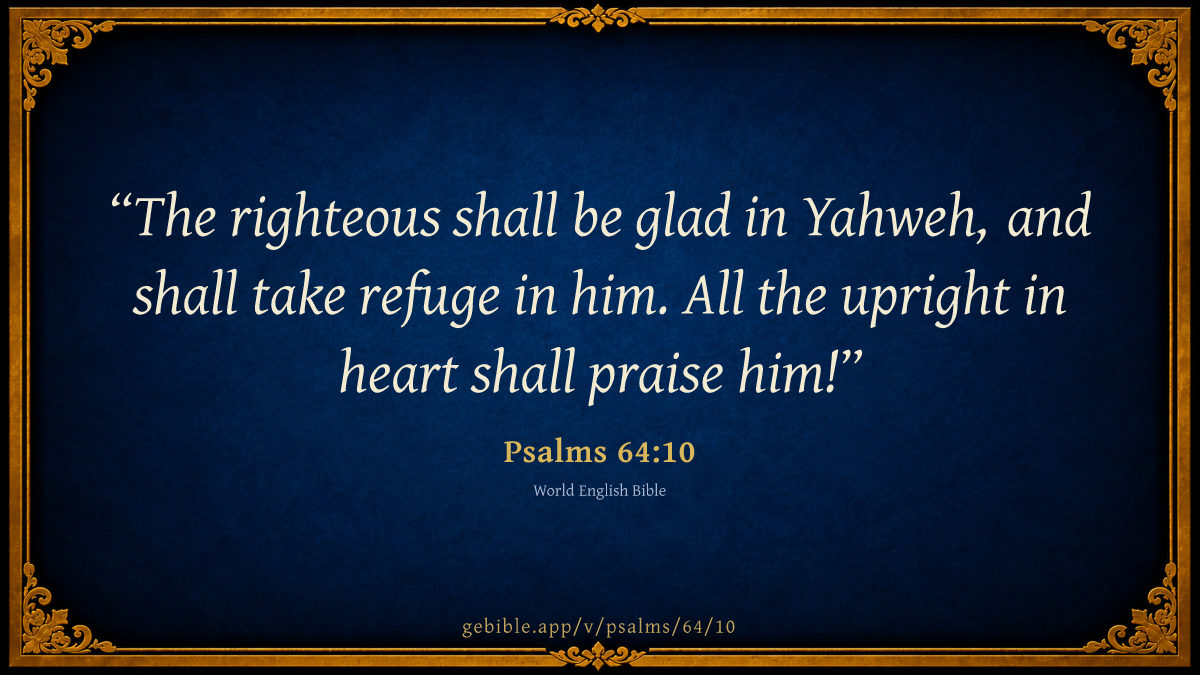
The righteous shall be glad in Yahweh, and shall take refuge in him. All the upright in heart shall praise him!
Parallel Translations
-
The righteous shall be glad in Yahweh, and shall take refuge in him. All the upright in heart shall praise him!
-
The righteous shall be glad in the LORD, and shall trust in him; and all the upright in heart shall glory.
-
(64-11) The righteous shall be glad in the LORD, and shall take refuge in Him; and all the upright in heart shall glory.
Cross-references (12)
Passages linked to Psalms 64:10 in the Treasury of Scripture Knowledge, ordered by reader-vote popularity; verse text shown in World English Bible.
- Psalms 32:11–33:1 Be glad in Yahweh, and rejoice, you righteous! Shout for joy, all you who are upright in heart! Rejoice in Yahweh, you righteous! Praise is fitting for the upright.
- Psalms 40:3 He has put a new song in my mouth, even praise to our God. Many shall see it, and fear, and shall trust in Yahweh.
- 1 Corinthians 1:30-31 Because of him, you are in Christ Jesus, who was made to us wisdom from God, and righteousness and sanctification, and redemption: that, as it is written, “He who boasts, let him boast in the Lord.”
- Psalms 25:20 Oh keep my soul, and deliver me. Let me not be disappointed, for I take refuge in you.
- Psalms 112:2 His offspring will be mighty in the land. The generation of the upright will be blessed.
- Job 22:19 The righteous see it, and are glad. The innocent ridicule them,
- Psalms 68:2-3 As smoke is driven away, so drive them away. As wax melts before the fire, so let the wicked perish at the presence of God. But let the righteous be glad. Let them rejoice before God. Yes, let them rejoice with gladness.
- Psalms 97:11 Light is sown for the righteous, and gladness for the upright in heart.
- Galatians 6:14 But far be it from me to boast, except in the cross of our Lord Jesus Christ, through which the world has been crucified to me, and I to the world.
- Philippians 4:4 Rejoice in the Lord always! Again I will say, “Rejoice!”
- Psalms 58:10 The righteous shall rejoice when he sees the vengeance. He shall wash his feet in the blood of the wicked,
- Psalms 11:1 In Yahweh, I take refuge. How can you say to my soul, “Flee as a bird to your mountain”?
Cross-references from openbible.info (CC BY 4.0)
Explain this verse (14 sources)
Historical commentary, presented as a primary source — not an endorsement.
Private notes
Saved on this device only — never synced or sent anywhere.
Geneva Bible translators 1599 · Public Domain When they shall consider that he will be favorable…
When they shall consider that he will be favorable to them as he was to his servant David.
Geneva Bible (1599) marginal notes — public domain.
John Trapp 1656 · Public Domain Psa 64:10 The righteous shall be glad in the…
Psa 64:10 The righteous shall be glad in the LORD, and shall trust in him; and all the upright in heart shall glory.
Ver. 10. The righteous shall be glad in the Lord] Not myself only, but all the saints shall be comforted, confirmed, and occasioned to make their boast in God with a holy gloriation, Inde arripient sanctae cuiusdam iactantiae argumentum (Beza).
John Trapp, A Commentary or Exposition upon All the Books of the Old and New Testament (1647–1656) — public domain. Text from a community e-Sword module.
Matthew Poole 1685 · Public Domain In the Lord; or, for the Lord, i.e. not…
In the Lord; or, for the Lord, i.e. not out of malice or ill will to the persons of their enemies, but for the honour of God, which by this means is fully vindicated and greatly advanced.
Shall glory, to wit, in God, as their sure Rock and all-sufficient Portion.
Matthew Poole's English Annotations on the Holy Bible (1683–1685) — public domain. Text from a community e-Sword/MySword module.
John Gill 1763 · Public Domain The righteous shall be glad in the Lord,.... They…
The righteous shall be glad in the Lord,.... They rejoice at the vengeance executed on the wicked; but then their joy centres in the Lord: it is not at the ruin of the wicked, simply considered, but because of the glory of God's justice displayed therein, and of his grace and mercy to them. They rejoice in the Lord, because of what he is unto them, and because of what he has done for them; because of his righteousness they are clothed with, from whence they are denominated righteous ones; and because of the salvation he has wrought out for them; and they are the more affected with it when they see the calamities, woes, and destruction of wicked men; See Gill on Psa 32:11;
and shall trust in him; who is known by his judgments he executes on the wicked; and the more he is known, be it in what way it will, the more is he trusted in, Psa 9:10. The Targum paraphrases it,
Read full note →
"and shall trust in his Word;''
either in his word of promise, or rather in his essential Word, Christ;
and all the upright in heart shall glory; not in men, nor in themselves, nor in any creature, or creature enjoyments; nor in their wisdom, strength, riches, nor righteousness; but in Christ, in his wisdom, righteousness, and strength; in whom all the seed of Israel are justified and glory; and in what he is to them, and has done for them; of the upright in heart; see Gill on Psa 32:11.
Next: Psalms Chapter 65
John Gill's Exposition of the Whole Bible (1746–1763) — public domain (CC PDM 1.0). Text via the HelloAO Bible API.
John Wesley 1765 · Public Domain Glad - For the honour of God, which by…
Glad - For the honour of God, which by this means is vindicated.
John Wesley, Explanatory Notes Upon the Whole Bible (1754–1765) — public domain. Text via the GEBible commentary corpus.
Adam Clarke 1810 · Public Domain Verse 10. The righteous shall be glad] They shall…
Verse 10. The righteous shall be glad] They shall see that God does not abandon his followers to the malice of bad men. The rod of the wicked may come into the heritage of the just; but there it shall not rest. Calmet thinks that this is a prediction of the destruction of the Chaldeans, in consequence of which the Jewish people became highly respected by all the surrounding nations. But it may be applied more generally to the enmity of the wicked against the righteous, and how God counterworks their devices, and vindicates and supports his own followers.
ANALYSIS OF THE SIXTY-FOURTH PSALM
Read full note →
I. The psalmist, in danger, commends his cause to God, Ps 64:1-2.
II. Complains of his enemies, who are described by their inward devices, and outward conduct, Ps 64:3-6.
III. He foretells their ruin, and the consequences, Ps 64:7-10.
I. 1. He prays in general: "Hear my voice."
2. Then in special, that his life may be safe: "Hide me from the secret counsel," c., Ps 64:2.
He describes his enemies, generally: -
1. They were wicked men.
2. They were workers of iniquity.
3. They worked secret counsels against him.
4. They acted according to their counsels.
II. After this general character, he particularly describes their villany.
1. They were calumniators no sword sharper than their tongue, no arrow swifter than their accusations.
They were diligent and active to wound his credit; and the evil of their conduct was aggravated by two circumstances: 1. It was in secret: 2. It was against the innocent and upright: "They whet their sword; and bend their bow, to shoot their arrows," c.
2. They were obstinate and confirmed in mischief: - 1. "They encourage themselves in an evil thing." 2. "They commune," lay their heads together how to lay snares, c.
3. They are impudent and atheistical: "They say, Who shall see them?"
4. They are indefatigable - they are carried on with an earnest desire to do mischief they invent all crafty waits to circumvent the righteous.
5. All this they do subtly, craftily: "Both the inward thought and heart of them is deep" it is not easy to find out their snares.
III. Now he foretells, 1. Their punishment; and, 2. The event.
1. Their punishment was to be hasty, sharp, deadly, and very just. 1. "God shall shoot at them with an arrow; suddenly shall they be wounded." 2. Most just. For they shall "make their own tongues fall upon themselves." By their tongues did they mischief; by their tongues shall they fall.
2. The event shall be double: 1. In general, to all; 2. In particular, to the righteous.
1. Universally: "All that see them shall flee away," - fear, desert, forsake them.
2. All men "shall see and declare the work of the Lord, and consider it as his doing."
The effect it shall have on the righteous. They shall acknowledge God's justice; and farther, -
1. They shall be glad in the Lord - in the judgments he has shown.
2. They shall trust in him - that he will always protect and deliver them.
3. They shall glory - make their boast in God, and tell to all the wonders which in his justice and his mercy he has wrought for them.
Adam Clarke's Commentary on the Bible (1810–1826) — public domain. Text from a community e-Sword/MySword module.
Joseph Benson 1811 · Public Domain Psa 64:10. The righteous shall be glad in the…
Psa 64:10. The righteous shall be glad in the Lord — Not glad of the misery and ruin of their fellow-creatures, but glad that God is glorified, and his word fulfilled, and the cause of injured innocence pleaded effectually. And shall trust in him — Their faith shall be hereby encouraged, and they shall commit themselves to him, in the way of duty, and be willing to expose themselves to danger, and to encounter difficulties for him, with an entire confidence in him. And all the upright in heart — That keep a good conscience and approve themselves to God; shall glory — Not in themselves, but in God, in his favour, his righteousness, and goodness, and in their relation to him, and interest in him. Let him that glorieth glory in the Lord.
Joseph Benson's Commentary on the Old and New Testaments (1811–1818) — public domain. Text from a community e-Sword module.
Albert Barnes 1834 · Public Domain The righteous shall be glad in the Lord, and…
The righteous shall be glad in the Lord, and shall trust in him - That is, As the result of his gracious intervention, or as the effect of his judgments on the wicked, the righteous will rejoice on account of their own security, and put their trust in One who has thus shown himself to be the friend of holiness, and the enemy of sin. Whatever tends to reveal the divine character, or to make a proper exhibition of that character, will also lead good people to confide in God, and to feel that they are safe.
And all the upright in heart shall glory - Shall rejoice; shall feel that they have cause for trust and triumph. The good - the pure - the righteous - the godly - will always rejoice in everything which tends to show that God is just, and true, and holy; - for all their own hope of security and salvation rests upon the fact that the God in whom they trust is a righteous God.
Albert Barnes' Notes on the Bible (1834–1885) — public domain. Text from a community e-Sword/MySword module.
Daniel D. Whedon 1874 · Public Domain 10. The righteous shall be glad… trust… glory—On “glory,”…
10. The righteous shall be glad… trust… glory—On “glory,” see Psa_63:11. The effect of the divine judgment in the overthrow of his enemies would cause the wicked to fear and confess God, and the righteous to rejoice, trust, and give praise.
Daniel D. Whedon (gen. ed.), Commentary on the Old and New Testaments (1874–1909) — public domain. Text from a community e-Sword module.
The Cambridge Bible for Schools and Colleges 1878 · Public Domain 10. For the righteous and the upright in heart—the…
10. For the righteous and the upright in heart—the Psalmist and those whom he represents—the judgement is an occasion of joy, supplying a fresh proof that Jehovah governs the world righteously and that in Him they have a sure refuge. Cp. Psa_5:11; Psa_52:6 ff; Psa_58:10 f; Psa_63:11.
and shall trust in him] Rather, take refuge in him (Psa_57:1; Psa_61:4).
Read full note →
the upright in heart] Cp. Psa_11:2, already quoted as a parallel to Psa_64:4.
The Cambridge Bible for Schools and Colleges (gen. ed. J. J. S. Perowne; Cambridge University Press, 1878–1918) — public domain. Text from a community e-Sword module.
Ellicott's Commentary for English Readers 1878 · Public Domain (10) Shall glory.—Or, perhaps, shall shine forth clear, i.e.,…
(10) Shall glory.—Or, perhaps, shall shine forth clear, i.e., shall have their cause acknowledged just. The LXX. and Vulg. seem to have understood it so: “shall be praised.”
A Bible Commentary for English Readers, edited by Charles John Ellicott (1878–1897) — public domain. Text from a community e-Sword module.
The Pulpit Commentary 1880 · Public Domain The righteous shall be glad in the Lord, and…
The righteous shall be glad in the Lord, and shall trust in him. The righteous, delivered from their imminent peril, naturally "rejoice in the Lord," i.e. rejoice in God"s goodness to them, and feel their confidence in him increased. And all the upright in heart shall glory. (comp. Psa_32:11 Psa_58:11) A thrill of joy passes through the whole of God"s people, whether they were involved in the danger escaped or not.
The Pulpit Commentary (1880–1919), ed. H.D.M. Spence-Jones & Joseph S. Exell — public domain. Text from a community e-Sword module.
Charles H. Spurgeon 1885 · Public Domain Ver. 10. The righteous shall be glad in the…
Ver. 10. The righteous shall be glad in the Lord. Admiring his justice and fully acquiescing in its displays, they shall also rejoice at the rescue of injured innocence yet, their joy shall not be selfish or sensual, but altogether in reference to the Lord.
And shall trust in him. Their observation of providence shall increase their faith; since he who fulfils his threatenings will not forget his promises.
Read full note →
And all the upright in heart shall glory. The victory of the oppressed shall be the victory of all upright men; the whole host of the elect shall rejoice in the triumph of virtue. While strangers fear, the children are glad in view of their Father's power and justice. That which alarms the evil, cheers the good. Lord God of mercy, grant to us to be preserved from all our enemies, and saved in thy Son with an everlasting salvation.
Ver. 10. The righteous shall be glad in the Lord, and shall trust in him. That is, if they have failed in their trust heretofore, and not given God honour by confiding in him, yet these wonderful works of God (of which he speaks in the Psalm) work this hope. Joseph Caryl.
Ver. 10. All the upright in heart. The word of this text, jashar, signifies rectitudinem, and planitiem, it signifies a direct way; for the devil's way was circular, compassing the earth; but the angel's way to heaven upon Jacob's ladder was a straight, a direct way. And then it signifies, as a direct and straight, so a plain, a smooth, an even way, a way that hath been beaten into a path before, a way that the fathers and the church have walked in before, and not a discovery made by our curiosity, or our confidence, in venturing from ourselves, or embracing from others, new doctrines and opinions. The persons, then, whom God proposes to be partakers of his retributions, are first, recti (that is, both direct men, and plain men), and then recti corde, this qualification, this straightness and smoothness must be in the heart; all the upright in heart shall have it. Upon this earth, a man cannot possibly make one step in a straight and a direct line. The earth itself being round, every step we make upon it must necessarily be a segment, an arc of a circle. But yet, though no piece of a circle be a straight line, yet if we take any piece, nay, if we take the whole circle, there is no corner, no angle in any place, in any entire circle. A perfect rectitude we cannot have in any way in this world; in every calling there are some inevitable temptations. But, though we cannot make up one circle of a straight line (that is impossible to human frailty), yet we may pass on without angles and corners, that is, without disguises in our religion, and without the love of craft, and falsehood, and circumvention, in our civil actions. A compass is a necessary thing in a ship, and the help of that compass brings the ship home safe, and yet that compass hath some variations, it doth not look directly north; neither is that star which we call the north pole, or by which we know the north pole, the very pole itself; but we call it so, and we make our uses of it, and our conclusions by it, as if it were so, because it is the nearest star to that pole. He that comes as near uprightness as infirmities admit, is an upright man, though he love some obliquities. John Donne.
Ver. 10. All the upright in heart shall glory. The Psalm began in the first person singular, Hear my voice, O God, but it ends by comprehending all the righteous. He who is most anxious about his own salvation will be found to be the man of the truest and widest love to others; while he who talks most of unselfishness in religion is generally the most selfish. We cannot take a more efficient method for benefiting others than by being earnestly prayerful for ourselves that we may be preserved from sin. Our example will in itself be useful, and our godliness, by putting power into our testimony, will increase the value of every rebuke, exhortation, or encouragement we may utter. Our sin is or will be the church's sorrow, and the way to make all the upright rejoice is to be upright ourselves. C. H. S.
Ver. 10. Shall glory. This retribution is expressed in the original in the word halal; and halal, to those translators that made our Book of Common Prayer, presented the signification of gladness, for so it is there: They shall be glad. So it did to the translators that came after, for there it is, They shall rejoice; and to our last translators it seemed to signify glory, They shall glory, say they. But the first translation of all into our language (which was long before any of these three), calls it praise, and puts it into the passive: All men of rightful heart shall be praised. And so truly jithhalelu, in the original, bears it, nay, requires it; which is not of praise which they shall give to God, but of a praise that they shall receive for having served God with an upright heart; not that they shall praise God in doing so, but that godly men shall praise them for having done so. All this shall grow naturally out of the root; for the root of this word is lucere, splendere, to shine out in the eyes of men, and to create in them a holy and a reverential admiration; as it was John Baptist's praise, that he was "A burning and a shining lamp." Properly it is, by a good and a holy exemplary life, to occasion others to set a right value upon holiness, and to give a due respect for holy men... Shall glory. It is so far from diminishing this glory, as that it exalts our consolation that God places this retribution in the future; if they do not yet, certainly they shall glory, and if they do now, that glory shall not go out, still they shall, they shall for ever glory. John Donne.
Ver. 10.
I. The persons.
1. What they are, in distinction from others; the righteous; the justified.
2. What they are in themselves; upright in heart; not perfect, but sincere. II. Their privilege.
1. Amidst all their persecutions to joy in God.
2. Amidst all their dangers to trust in God. G. R.
Charles H. Spurgeon's The Treasury of David (1869–1885) — public domain. Psalms only. Text from a community e-Sword/MySword module.
unfoldingWord translationNotes 2017 · CC BY-SA 4.0 take refuge in him
take refuge in him
Going to Yahweh for protection is spoken of as taking refuge in him. AT: "go to him for protection" (See: Metaphor)
Read full note →
all the upright in heart will take pride in him
Here "upright in heart" is an idiom that means godly or righteous. AT: "all the people who are godly will praise him" (See: Idiom)
translationWords
righteous
Yahweh
refuge
righteous
proud
unfoldingWord translationNotes — © Distant Shores Media and the Door43 World Missions Community, licensed CC BY-SA 4.0. Source: git.door43.org/Door43/en_tn.