
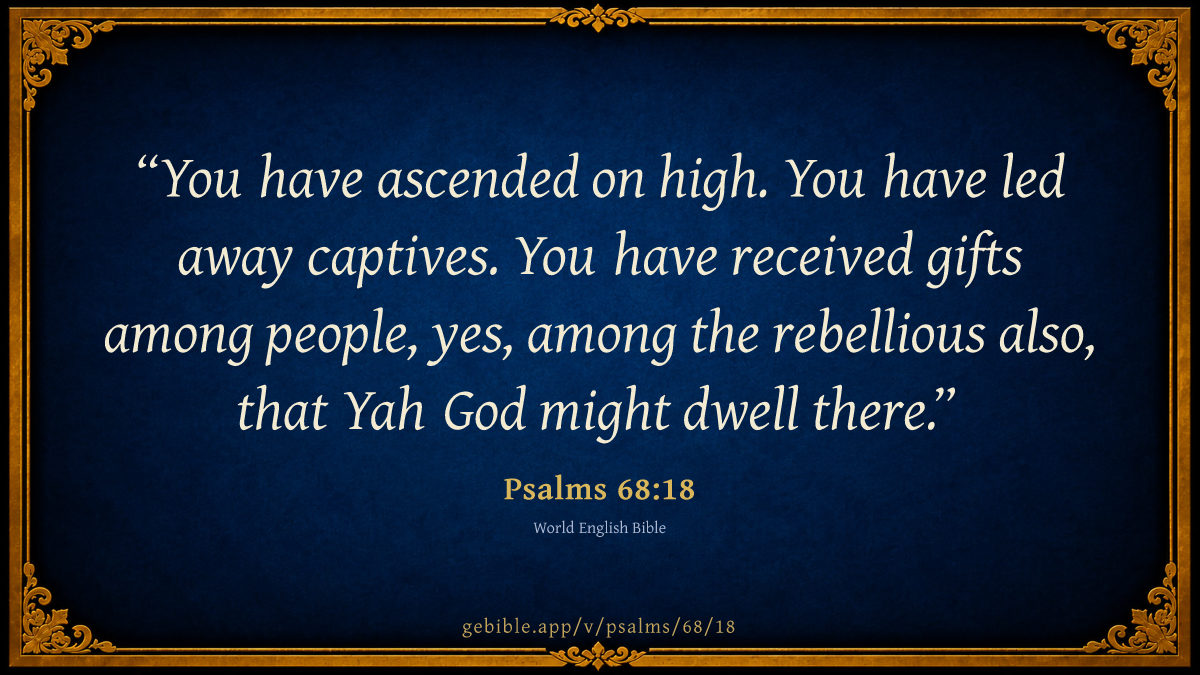
You have ascended on high. You have led away captives. You have received gifts among people, yes, among the rebellious also, that Yah God might dwell there.
Parallel Translations
-
You have ascended on high. You have led away captives. You have received gifts among people, yes, among the rebellious also, that Yah God might dwell there.
-
Thou hast ascended on high, thou hast led captivity captive: thou hast received gifts for men; yea, for the rebellious also, that the LORD God might dwell among them.
-
(68-19) Thou hast ascended on high, Thou hast led captivity captive; Thou hast received gifts among men, yea, among the rebellious also, that the LORD God might dwell there.
Cross-references (44)
Passages linked to Psalms 68:18 in the Treasury of Scripture Knowledge, ordered by reader-vote popularity; verse text shown in World English Bible.
- Ephesians 4:8-10 Therefore he says, “When he ascended on high, he led captivity captive, and gave gifts to people.” Now this, “He ascended”, what is it but that he also first descended into the lower parts of the earth? He who descended is the one who also ascended far above all the heavens, that he might fill all things.
- 2 Corinthians 6:16 What agreement does a temple of God have with idols? For you are a temple of the living God. Even as God said, “I will dwell in them and walk in them. I will be their God and they will be my people.”
- Revelation 21:3 I heard a loud voice out of heaven saying, “Behold, God’s dwelling is with people, and he will dwell with them, and they will be his people, and God himself will be with them as their God.
- 1 Peter 3:22 who is at the right hand of God, having gone into heaven, angels and authorities and powers being made subject to him.
- Psalms 110:1 Yahweh says to my Lord, “Sit at my right hand, until I make your enemies your footstool for your feet.”
- Colossians 1:18-19 He is the head of the body, the assembly, who is the beginning, the firstborn from the dead, that in all things he might have the preeminence. For all the fullness was pleased to dwell in him,
- Judges 5:12 ‘Awake, awake, Deborah! Awake, awake, utter a song! Arise, Barak, and lead away your captives, you son of Abinoam.’
- Psalms 24:3 Who may ascend to Yahweh’s hill? Who may stand in his holy place?
- Psalms 47:5 God has gone up with a shout, Yahweh with the sound of a trumpet.
- John 16:7 Nevertheless I tell you the truth: It is to your advantage that I go away, for if I don’t go away, the Counselor won’t come to you. But if I go, I will send him to you.
- Acts 1:2-9 until the day in which he was received up, after he had given commandment through the Holy Spirit to the apostles whom he had chosen. To these he also showed himself alive after he suffered, by many proofs, appearing to them over a period of forty days, and speaking about God’s Kingdom. Being assembled together with them, he commanded them, “Don’t depart from Jerusalem, but wait for the promise of the Father, which you heard from me. For John indeed baptized in water, but you will be baptized in the Holy Spirit not many days from now.” Therefore when they had come together, they asked him, “Lord, are you now restoring the kingdom to Israel?” He said to them, “It isn’t for you to know times or seasons which the Father has set within his own authority. But you will receive power when the Holy Spirit has come upon you. You will be witnesses to me in Jerusalem, in all Judea and Samaria, and to the uttermost parts of the earth.” When he had said these things, as they were looking, he was taken up, and a cloud received him out of their sight.
- Acts 2:4 They were all filled with the Holy Spirit, and began to speak with other languages, as the Spirit gave them the ability to speak.
- Titus 3:3-7 For we were also once foolish, disobedient, deceived, serving various lusts and pleasures, living in malice and envy, hateful, and hating one another. But when the kindness of God our Savior and his love toward mankind appeared, not by works of righteousness which we did ourselves, but according to his mercy, he saved us through the washing of regeneration and renewing by the Holy Spirit, whom he poured out on us richly, through Jesus Christ our Savior; that being justified by his grace, we might be made heirs according to the hope of eternal life.
- 2 Chronicles 6:18 “But will God indeed dwell with men on the earth? Behold, heaven and the heaven of heavens can’t contain you; how much less this house which I have built!
- Colossians 2:9 For in him all the fullness of the Deity dwells bodily,
- 1 Timothy 1:13-15 although I used to be a blasphemer, a persecutor, and insolent. However, I obtained mercy, because I did it ignorantly in unbelief. The grace of our Lord abounded exceedingly with faith and love which is in Christ Jesus. The saying is faithful and worthy of all acceptance, that Christ Jesus came into the world to save sinners, of whom I am chief.
- Psalms 24:7-10 Lift up your heads, you gates! Be lifted up, you everlasting doors, and the King of glory will come in. Who is the King of glory? Yahweh strong and mighty, Yahweh mighty in battle. Lift up your heads, you gates; yes, lift them up, you everlasting doors, and the King of glory will come in. Who is this King of glory? Yahweh of Armies is the King of glory!
- John 14:23 Jesus answered him, “If a man loves me, he will keep my word. My Father will love him, and we will come to him, and make our home with him.
- Romans 5:8 But God commends his own love toward us, in that while we were yet sinners, Christ died for us.
- Colossians 2:3 in whom all the treasures of wisdom and knowledge are hidden.
- Psalms 7:7 Let the congregation of the peoples surround you. Rule over them on high.
- Psalms 78:60 so that he abandoned the tent of Shiloh, the tent which he placed among men,
- Proverbs 1:22-23 “How long, you simple ones, will you love simplicity? How long will mockers delight themselves in mockery, and fools hate knowledge? Turn at my reproof. Behold, I will pour out my spirit on you. I will make known my words to you.
- Isaiah 57:15 For the high and lofty One who inhabits eternity, whose name is Holy, says: “I dwell in the high and holy place, with him also who is of a contrite and humble spirit, to revive the spirit of the humble, and to revive the heart of the contrite.
- Ezekiel 48:35 “It shall be eighteen thousand reeds around: and the name of the city from that day shall be, ‘Yahweh is there.’
- Mark 16:9 Now when he had risen early on the first day of the week, he appeared first to Mary Magdalene, from whom he had cast out seven demons.
- Luke 24:49 Behold, I send out the promise of my Father on you. But wait in the city of Jerusalem until you are clothed with power from on high.”
- Luke 24:51 While he blessed them, he withdrew from them, and was carried up into heaven.
- John 16:13-15 However when he, the Spirit of truth, has come, he will guide you into all truth, for he will not speak from himself; but whatever he hears, he will speak. He will declare to you things that are coming. He will glorify me, for he will take from what is mine, and will declare it to you. All things that the Father has are mine; therefore I said that he takes of mine and will declare it to you.
- Acts 2:33-41 Being therefore exalted by the right hand of God, and having received from the Father the promise of the Holy Spirit, he has poured out this, which you now see and hear. For David didn’t ascend into the heavens, but he says himself, ‘The Lord said to my Lord, “Sit by my right hand until I make your enemies a footstool for your feet.” ’ “Let all the house of Israel therefore know certainly that God has made him both Lord and Christ, this Jesus whom you crucified.” Now when they heard this, they were cut to the heart, and said to Peter and the rest of the apostles, “Brothers, what shall we do?” Peter said to them, “Repent, and be baptized, every one of you, in the name of Jesus Christ for the forgiveness of sins, and you will receive the gift of the Holy Spirit. For the promise is to you, and to your children, and to all who are far off, even as many as the Lord our God will call to himself.” With many other words he testified, and exhorted them, saying, “Save yourselves from this crooked generation!” Then those who gladly received his word were baptized. There were added that day about three thousand souls.
- 1 Corinthians 6:9-11 Or don’t you know that the unrighteous will not inherit God’s Kingdom? Don’t be deceived. Neither the sexually immoral, nor idolaters, nor adulterers, nor male prostitutes, nor homosexuals, nor thieves, nor covetous, nor drunkards, nor slanderers, nor extortionists, will inherit God’s Kingdom. Some of you were such, but you were washed. But you were sanctified. But you were justified in the name of the Lord Jesus, and in the Spirit of our God.
- Hebrews 6:20 where as a forerunner Jesus entered for us, having become a high priest forever after the order of Melchizedek.
- Revelation 1:20–2:1 The mystery of the seven stars which you saw in my right hand, and the seven golden lamp stands is this: The seven stars are the angels of the seven assemblies. The seven lamp stands are seven assemblies. “To the angel of the assembly in Ephesus write: “He who holds the seven stars in his right hand, he who walks among the seven golden lamp stands says these things:
- 1 Corinthians 15:45-47 So also it is written, “The first man, Adam, became a living soul.” The last Adam became a life-giving spirit. However that which is spiritual isn’t first, but that which is natural, then that which is spiritual. The first man is of the earth, made of dust. The second man is the Lord from heaven.
- Hebrews 4:14 Having then a great high priest who has passed through the heavens, Jesus, the Son of God, let’s hold tightly to our confession.
- Psalms 132:13-14 For Yahweh has chosen Zion. He has desired it for his habitation. “This is my resting place forever. I will live here, for I have desired it.
- Isaiah 55:7 Let the wicked forsake his way, and the unrighteous man his thoughts. Let him return to Yahweh, and he will have mercy on him, to our God, for he will freely pardon.
- Matthew 9:13 But you go and learn what this means: ‘I desire mercy, and not sacrifice,’ for I came not to call the righteous, but sinners to repentance.”
- Luke 24:47 and that repentance and remission of sins should be preached in his name to all the nations, beginning at Jerusalem.
- John 14:16-17 I will pray to the Father, and he will give you another Counselor, that he may be with you forever: the Spirit of truth, whom the world can’t receive; for it doesn’t see him and doesn’t know him. You know him, for he lives with you, and will be in you.
- Acts 2:23 him, being delivered up by the determined counsel and foreknowledge of God, you have taken by the hand of lawless men, crucified and killed;
- Acts 9:17 Ananias departed and entered into the house. Laying his hands on him, he said, “Brother Saul, the Lord, who appeared to you on the road by which you came, has sent me that you may receive your sight and be filled with the Holy Spirit.”
- Hebrews 1:3 His Son is the radiance of his glory, the very image of his substance, and upholding all things by the word of his power, who, when he had by himself purified us of our sins, sat down on the right hand of the Majesty on high,
- Hebrews 8:1 Now in the things which we are saying, the main point is this. We have such a high priest, who sat down on the right hand of the throne of the Majesty in the heavens,
Cross-references from openbible.info (CC BY 4.0)
Explain this verse (18 sources)
Historical commentary, presented as a primary source — not an endorsement.
Private notes
Saved on this device only — never synced or sent anywhere.
John Calvin 1540 · Public Domain 18. Thou hast ascended on high, thou hast led…
18. Thou hast ascended on high, thou hast led captivity captive There can be little doubt that these words are intended to magnify the proofs of Divine favor granted upon the elevation of David to the throne, by contrasting the state of matters with that under Saul. The ascending on high implies the being previously low, and intimates, that under the melancholy confusions which had prevailed in the kingdom, there was no longer the same conspicuous display of the Divine glory as formerly. The government of Saul, which, from the first, had originated in a way that was condemnable, was doomed to fall under the displeasure of God, while his favor, on the other hand, was to be restored under David; and the undeniable appearances of this left no room for doubt that one who began his reign under such auspices was the object of the Divine choice. David, although he had acquitted himself with courage in the battles which were fought, ascribes all the glory of them to God, saying, that it was he who had taken captive the enemy, and forced them to pay tribute, and reduced the more fierce and rebellious to subjection. By the term סוררים sorerim, rebellious, contumacious, or revolters, he would evidently seem to mean a distinct class of persons from the other enemies, whom he mentions as having been taken captive; and it intimates, that while those who did not venture to resist, and who surrendered, had been brought under the yoke, the more proud and unyielding had been forced into submission. The end designed by this is stated in the words which follow, that God might dwell in the midst of his people; and that he might demonstrate himself to be an all-sufficient protector to those who put their trust in him.
As the passage which we have now been considering is applied by Paul in a more spiritual sense to Christ, (Ephesians 4:8,) it may be necessary to show how this agrees with the meaning and scope of the Psalmist. It may be laid down as an incontrovertible truth, that David, in reigning over God’s ancient people, shadowed forth the beginning of Christ’s eternal kingdom. This must appear evident to every one who remembers the promise made to him of a never-failing succession, and which received its verification in the person of Christ. As God illustrated his power in David, by exalting him with the view of delivering his people, so has he magnified his name in his only begotten Son. But let us consider more particularly how the parallel holds. Christ, before he was exalted, emptied himself of his glory, having not merely assumed the form of a servant, but humbled himself to the death of the cross. To show how exactly the figure was fulfilled, Paul notices, that what David had foretold was accomplished in the person of Christ, by his being cast down to the lowest parts of the earth in the reproach and ignominy to which he was subjected, before he ascended to the right hand of his Father, (Psalm 22:7.) That in thinking upon the ascension, we might not confine our views to the body of Christ, our attention is called to the result and fruit of it, in his subjecting heaven and earth to his government. Those who were formerly his inveterate enemies he compelled to submission and made tributary — this being the effect of the word of the Gospel, to lead men to renounce their pride and their obstinacy, to bring down every high thought which exalteth itself, and reduce the senses and the affections of men to obedience unto Christ. As to the devils and reprobate men who are instigated to rebellion and revolt by obstinate malice, he holds them bound by a secret control, and prevents them from executing intended destruction. So far the parallel is complete. Nor when Paul speaks of Christ having given gifts to men, is there any real inconsistency with what is here stated, although he has altered the words, having followed the Greek version in accommodation to the unlearned reader. It was not himself that God enriched with the spoils of the enemy, but his people; and neither did Christ seek or need to seek his own advancement, but made his enemies tributary, that he might adorn his Church with the spoil. From the close union subsisting between the head and members, to say that God manifest in the flesh received gifts from the captives, is one and the same thing with saying that he distributed them to his Church. What is said in the close of the verse is no less applicable to Christ — that he obtained his victories that as God he might dwell among us. Although he departed, it was not that he might remove to a distance from us, but, as Paul says, “that he might fill all things,” (Ephesians 4:10.) By his ascension to heaven, the glory of his divinity has been only more illustriously displayed, and though no longer present with us in the flesh, our souls receive spiritual nourishment from his body and blood, and we find, notwithstanding distance of place, that his flesh is meat indeed, and his blood drink indeed.
John Calvin's Commentaries (1540-1563) — public domain. Text from the Calvin Translation Society English edition (1840s-50s) via the Christian Classics Ethereal Library (ccel.org). Calvin's coverage is partial (roughly two-thirds of the Bible); uncommented books and verses are honest gaps, never fabricated. The 19th-century editor's footnotes and remarks are omitted so the notes are faithfully Calvin's own voice.
Geneva Bible translators 1599 · Public Domain As God overcame the enemies of his Church, took…
As God overcame the enemies of his Church, took them prisoners, and made them tributaries: so Christ, which is God manifested in the flesh, subdued Satan and sin under us, and gave unto his Church most liberal gifts of his Spirit, Eph. 4:8.
Geneva Bible (1599) marginal notes — public domain.
John Trapp 1656 · Public Domain Psa 68:18 Thou hast ascended on high, thou hast…
Psa 68:18 Thou hast ascended on high, thou hast led captivity captive: thou hast received gifts for men; yea, [for] the rebellious also, that the LORD God might dwell [among them].
Ver. 18. Thou hast ascended on high] As a conqueror doth on his triumphal chariot; the Romans ascended up to the Capitol, leading their captives bound behind them, and giving gifts unto the people (Plut. in Æmyl.). They might have this custom from David, and these words might be the people’s acclamation to David, or, as some think, both the kings and people’s acclamation to the ark, that notable type of Christ, to whom St Paul applieth it, Eph 4:8-9, and teacheth us to understand it of his wonderful ascension.
Read full note →
Thou hast led captivity captive] i.e. Thou hast captivated those that once held us in captivity; for so God’s justice required, Isa 33:1, so he had forepromised, Isa 24:22 Rev 13:10, and so Christ hath fulfilled, Col 2:15, saving his people to the uttermost, from sin, death, hell, and the devil, who had taken them alive captive at his pleasure, 2Ti 2:26.
Thou hast received gifts for men] Heb, in man; some render it in Adam, Qualia erant in Adamo, tails dat Christus, saith Eugubinus, Christ gave such gifts to his people (for if he received with one hand, he gave with the other, and the fruits of his victories are all for his subjects) as were in Adam, Sed Beth servilis non praeponitur proprio nomini. True it is, that he repaireth God’s once lost image in them, but the gifts here meant are mentioned by the apostle, Eph 4:11, viz. apostles, prophets, evangelists, pastors, teachers, for the perfecting of the saints, for the work of the ministry, for the edifying of the body of Christ, &c. Lo, these were those gifts that Christ bestowed upon his Church at the day of his coronation, and solemn inauguration into his throne, at the time of his trimnphant ascension. These he received that he might give; and he held it more blessed to give than to receive. A like expression we have Hos 14:2. "Receive us graciously," Heb. Take good, sc. to bestow it upon us, as Act 2:23.
Yea, for the rebellious also] Rebellion at first, till thou hast given them a better heart. See Rom 4:5; Rom 5:6, or, if they continue so, yet they may share in common gifts and external privileges.
That the Lord God might dwell among them] viz. In his religion and true worshippers, for which end he giveth restraining grace to the very rebellions.
John Trapp, A Commentary or Exposition upon All the Books of the Old and New Testament (1647–1656) — public domain. Text from a community e-Sword module.
Matthew Poole 1685 · Public Domain Thou hast ascended on high; having spoken of the…
Thou hast ascended on high; having spoken of the Lord, and of his presence upon earth, he now turneth his speech to him, as is most usual in this book. And the contents of this verse do not agree to the present occasion of carrying the ark to Zion, but have a manifest reference to Christ, and to his ascension into heaven, in whom, and in whom alone, they are literally and fully accomplished, and to whom therefore they are ascribed, Eph 4:8. Although the expressions here used are borrowed from the ancient custom of princes, or generals of armies, who, after some glorious achievements and victories, used to go up into their royal cities in triumphant chariots, being attended by their captive enemies, and afterward to distribute divers gifts to their soldiers and subjects, and sometimes to do some acts of grace and clemency even to their rebels and enemies, and to receive them into the number of his own people.
Captivity; either,
Read full note →
1. Those who did formerly take thy people captives. Or rather,
2. Those whom thou hast taken captive, as this word is most commonly used, as Num 21:1; Deu 21:10; Jdg 5:12, &c. So poverty is put for the poor, 2Ki 24:14. This is meant of death, and sin, and the devil, and all the enemies of Christ and of his people, whom Christ led in triumph, having spoiled them, and making a show of them openly, as it is expressed, Col 2:15.
Thou hast received gifts; though as thou art God thou art uncapable of receiving any thing more than thou hast, yet according to thy manhood thou hast received from God all the treasures of wisdom and knowledge, and all those gifts and graces of the Holy Spirit which are necessary either to the perfection of thy nature, or to the discharge of thine office, or to the service and good of thy church and people. For men: not for thyself, for thou didst not need them, having the fulness of the Godhead dwelling in thee bodily, Col 2:9; but for the sons of men, or which thou mightest give unto men; whence for receiving for men, the apostle justly saith gave unto men, Eph 4:8, because he received them for no other end but to give them, and in such cases receiving or taking is oft put for giving, or for taking and giving, as Exo 25:2; Jdg 14:2; 1Ki 3:24; 17:10, &c.
For the rebellious also: nor didst thou only receive gifts for and give them to thy friends and people, as the manner of other conquerors is, but also to thy most stubborn and rebellious enemies, whether Jews or Gentiles, who resolved to break thy bands asunder, and to cast away thy cords from them as is said, Psa 2:3; and would not have thee to reign over them, Luk 19:14; who crucified him, and put him to open shame; and yet to these, as well as others, thou didst give those saving gifts and graces, as we read, Ac 2, and elsewhere.
That the Lord God might dwell among them; that having received such gifts, and thereby being made fit habitations for God, he who as man is ascended into the highest heavens, might as God come down to them, and dwell with them, not only in and by his ordinances, in which he is present, but also by his Spirit dwelling in their hearts by faith. Or, that they might dwell with the Lord God; the particle with being either understood, as it is in many places, or being contained in the Hebrew verb shacan, which, as some Hebrew critics observe, signifies not only to dwell, but to dwell with another; of which the learned may see many instances in Forsterus’s Hebrew Lexicon. So the sense is, that they who were estranged and at a distance from God, and enemies to him, might draw near to him, and dwell with him both here and in heaven.
Matthew Poole's English Annotations on the Holy Bible (1683–1685) — public domain. Text from a community e-Sword/MySword module.
John Gill 1763 · Public Domain Thou hast ascended on high,.... Which is to be…
Thou hast ascended on high,.... Which is to be understood, not of Moses ascending up to the firmament, as the Targum and Jarchi interpret it, of which we nowhere read; nor of David's going up to the high fortresses, as Aben Ezra; nor of God's ascent from Mount Sinai; but of Christ's ascension to heaven, as the apostle cites and explains it in Eph 4:8; which ascension respects him as man, was not figurative, as in Gen 17:22; but real and local, from earth to heaven, and was certain and visible; he was seen to go up by angels and men; and, because of the certainty of it, it is here expressed in the past tense, though it was then future;
thou hast led captivity captive; meaning either such who had been captives, in which sense the word is used, Psa 126:1; and so may design either those who had been prisoners in the grave, but were set free at Christ's resurrection, and went with him in triumph to heaven; or all his people, whom he redeemed by his blood from that captivity and bondage they were in by nature; or rather those who led them captive are here meant by "captivity"; such as sin, Satan, the world, death, and every spiritual enemy, whom Christ conquered and triumphed over; the allusion may be to public triumphs, when captives were led in chains, even kings and great men, that had captivated others: the words seem to be borrowed out of Jdg 5:12;
Read full note →
thou hast received gifts for men; the gifts of the Holy Spirit, qualifying men for the ministry of the Gospel, as they are interpreted by the Apostle, Eph 4:11; these Christ received from his divine Father in human nature, when he ascended up to heaven, in order to give them to men; and which he did in a very extraordinary manner on the day of Pentecost. The Targum and Syriac version render it, "thou hast given gifts to men"; and the Arabic version, "and he gave gifts to men", as the apostle, Eph 4:8;
yea, for the rebellious also; disobedient and unbelieving (m), as all men are by nature, even God's elect, before conversion, Tit 3:3; who are not only called by grace, and have the blessings of grace bestowed upon them; but some of them have gifts given them, whereby they are fitted to preach the Gospel to others, as Saul, the blasphemer, persecutor, and injurious; and some of those among the Jews, that were concerned in the crucifixion of Christ: though some think the Gentiles are intended, on whom the Holy Spirit was poured forth after our Lord's ascension; and so the Targum interprets it of the rebellious, who become proselytes, and return by repentance;
that the Lord God might dwell among them; that is, that they, by the gifts and graces of the Spirit bestowed on them, might become a fit habitation for God; or that "they", the rebellious, being now partakers of the grace of God and his gifts, "might dwell with the Lord God" (n) in his churches; enjoy his divine presence, and have communion with him in his word and ordinances.
(m) Sept. "non credentes", V. L. (n) "ut habitent cum Jah, Jehovah", Piscator; "cum Deo", Gejerus; "ut habitent pulchritudinem Dei", Cocceius.
John Gill's Exposition of the Whole Bible (1746–1763) — public domain (CC PDM 1.0). Text via the HelloAO Bible API.
John Wesley 1765 · Public Domain Ascended - This has a manifest reference to Christ,…
Ascended - This has a manifest reference to Christ, and his ascension into heaven, in whom alone it is literally accomplished, and to whom therefore it is ascribed, Eph. iv, 8. Although the expressions are borrowed from the ancient custom of princes, who, after some glorious achievements, used to go up into their royal cities in triumphant chariots, being attended by their captive enemies, and afterward to distribute gifts to their soldiers and subjects, and sometimes to do some acts of clemency even to their rebels and enemies. Captivity - Those whom thou hast taken captive; death and sin, and the devil, and all the enemies of Christ, and of his people, whom Christ led in triumph, having spoiled them, and making a shew of them openly, Colossiansii, 15. Received - According to thy manhood thou hast received from God all the treasures of wisdom and knowledge, and all those gifts and graces of the Holy Spirit, which are necessary either to the perfection of thy nature, or to the good of thy church and people. Rebellious - Thy most stubborn and rebellious enemies, whether Jews or Gentiles. Might dwell - That he who as man is ascended into the highest heavens, might, as God, come down to them, and dwell with them, not only in and by his ordinances in which he is present, but also by his spirit dwelling in their hearts.
John Wesley, Explanatory Notes Upon the Whole Bible (1754–1765) — public domain. Text via the GEBible commentary corpus.
Adam Clarke 1810 · Public Domain Verse 18. Thou hast ascended on high] When the…
Verse 18. Thou hast ascended on high] When the ark had reached the top of Sion, and was deposited in the place assigned for it, the singers joined in the following chorus. This seems to be an allusion to a military triumph. The conqueror was placed on a very elevated chariot.
Led captivity captive] The conquered kings and generals were usually tied behind the chariot of the conqueror-bound to it, bound together, and walked after it, to grace the triumph of the victor.
Read full note →
Thou hast received gifts for men] "And gave gifts unto men;" Eph 4:8. At such times the conqueror threw money among the crowd. Thou hast received gifts among men, באדם baadam, IN MAN, in human nature; and God manifest in the flesh dwells among mortals! Thanks be to God for his unspeakable GIFT! By establishing his abode among the rebellious, the prophet may refer to the conquest of the land of Canaan, and the country beyond Jordan.
Yea, for the rebellious also] Even to the rebellious. Those who were his enemies, who traduced his character and operations, and those who fought against him now submit to him, and share his munificence; for it is the property of a hero to be generous.
That the Lord God might dwell among them.] יה אלהים yah Elohim, the self-existing God; see on Ps 68:4. The conqueror now coming to fix his abode among the conquered people to organize them under his laws, to govern and dispense justice among them. The whole of this is very properly applied by St. Paul, Eph 4:5, to the resurrection and glory of Christ; where the reader is requested to consult the note.
Adam Clarke's Commentary on the Bible (1810–1826) — public domain. Text from a community e-Sword/MySword module.
Joseph Benson 1811 · Public Domain Psa 68:18. Thou hast ascended on high — “When…
Psa 68:18. Thou hast ascended on high — “When the ark had ascended mount Zion, and was deposited in the place assigned for it, the singers are supposed, by Dr. Chandler, to gave proceeded with this part of the Psalm, in which (he thinks) they celebrate the ascension of their God and king, by the symbol of his presence, to the heights of Zion, after having subdued their enemies, and enriched his people with the spoil of the vanquished, and the gifts of the tributary nations; of which much was probably employed in the service of the tabernacle, and afterward in building the temple, first designed by David, that the Lord God might dwell and have a fixed habitation among his people.” — Horne. But although David, in composing this Psalm for the occasion, as is supposed, of removing the ark, might probably, in this part of it, refer in some measure to the ascent of that symbol of the divine presence to the top of mount Zion; yet his expressions are evidently too strong and exalted to be confined to that transaction, or even to have been primarily intended of it. He certainly speaks principally of another and much more important event, typified, indeed, by that ascent of the ark, and the advantages resulting therefrom to the people, but far more glorious in itself, and producing effects of infinitely greater consequence, not only to the Jews, but to the whole human race. He speaks of the ascension of the Messiah into heaven, in consequence of his victory over his and our enemies, obtained by his death and resurrection. And, accordingly, as is well known, his words are so applied by the apostle to the Gentiles, Eph 4:8, who, guided as he was, by the Spirit of truth, certainly neither did, not could, mistake the meaning of this divine oracle given forth by the inspiration of the same Spirit. It must, however, be acknowledged, that, having been speaking of victories and conquests in war, he borrows, as it was natural for him to do, his expressions on this subject from the ancient custom of princes and generals of armies, who, after such glorious achievements, were wont to go up into their royal cities in triumphant chariots, being attended by their captive enemies, and afterward to distribute divers gifts to their soldiers and subjects, and sometimes to do some acts of clemency, even to their enemies and rebels, and to receive them into the number of their own people. In allusion to this, he here represents the victorious Captain of our salvation as ascending to his royal city in the heavens, leading his enemies captive, and conferring the most important gifts, privileges, and blessings on his subjects, and even on such as had been rebels against his government. Thou hast led captivity captive — That is, either those who did formerly take thy people captive, or rather, those whom thou hadst taken captive, as this expression is most commonly used. See Deu 21:10; Jdg 5:12. Thus poverty is but for the poor, 2Ki 24:14; see the Hebrew. This is meant of Satan, sin and death, and of all the enemies of Christ and his people, whom he led in triumph, having spoiled them, and making a show of them openly, as is expressed Col 2:15. Thou hast received gifts for men — Hebrew, באדם; εν ανθρωπω, in the man, as the LXX. render it, that is, in the human nature, wherewith thou wast pleased to clothe thyself, that thou mightest be a merciful and faithful High-Priest in things pertaining to God. Not in thy Godhead; but according to thy manhood, thou hast received from God all the treasures of wisdom and knowledge, and all those gifts and graces of the Holy Spirit which are necessary, either to the perfection of thy nature, or the good of thy church and people; or, for men; not for angels; “fallen angels were not to be made saints,” says Henry, “nor standing angels ministers. Not for Jews only, but for all men; whosoever will may reap the benefit of these gifts.” The apostle, in the reference which he makes to these words, names some of these gifts: they were prophets, apostles, evangelists, pastors, teachers; namely, the institution of a gospel ministry, and the qualification of men for it, both which are to be valued as the gifts of God, and the fruits of Christ’s ascension. The apostle reads it, he gave gifts to men. For he received that he might give them. And some of the best critics have observed, that in the Hebrew idiom, to take gifts for another, is the same as to give them to another: see 1Ki 3:24; and Gen 18:5, in the Hebrew. The anointing of the Spirit was poured on his head, that it might descend to the skirts of his garments, to the lowest and meanest members of his mystical body. Yea, for the rebellious also — For those that had been rebellious, who had not only broken his laws, but appeared in arms against him; even for his most stubborn and determined enemies, whether Jews or Gentiles; for those who crucified him and put him to open shame. Even for these, as well as others, he received, and to these he gave those saving gifts and graces; and of such as these, converted by the power of his gospel, he formed and established a holy church; that the Lord God might dwell among them — That having received such gifts and graces, and thereby being made fit habitations for God, he, who as man is ascended into the highest heavens, might, as God, come down to them and abide with them, not only in and by his ordinances, in which he is present, but by his Spirit dwelling in their hearts.
Joseph Benson's Commentary on the Old and New Testaments (1811–1818) — public domain. Text from a community e-Sword module.
Albert Barnes 1834 · Public Domain Thou hast ascended on high - That is, Thou…
Thou hast ascended on high - That is, Thou hast gone up to the high place; to thy throne; to thine abode. The idea is, that God had descended or come down from his dwelling-place in the case referred to in the psalm, and that having now secured a victory by vanquishing his foes, and having given deliverance to his people, he had now returned, or reascended to his seat. This may either mean his throne on earth, or his abode in heaven. It would seem most probable that the latter is the idea.
Thou hast led captivity captive - “Thou hast made captivity captive,” or “Thou hast captured a captivity.” The main idea is, that he had achieved a complete victory; he had led all his foes captive. The language “would” also express the idea that he had made captives for himself of those who were captives to others, or who were in subjection to another. As applied in the Christian sense, this would refer to those who were captives to Satan, and who were held in bondage by him, but who had been rescued by the Redeemer, and brought under another captivity - the yielding of voluntary service to himself. Those once captives to sin were now led by him, captives in a higher sense. See the notes at Eph 4:8.
Read full note →
Thou hast received gifts for men - Margin, “in the man.” That is, “Among men,” or while among them as a conqueror. The idea here most naturally conveyed would be, that he had obtained “gifts,” privileges, advantages, “in” man; that is, that men, considered as captives, constituted the victory which he had achieved - the advantage which he had acquired. It was not so much “for” them as “in” them, and “by” them, to wit, by possessing them as captives or subjects to him. With this victory achieved, he had now ascended on high.
Yea, for the rebellious also - Or, more properly, “even the rebellious.” That is, Those who had been in a state of rebellion he had subdued to himself, and had thus led captivity captive. It was a triumph by which they had become subdued to him.
That the Lord God might dwell among them - literally, “For the dwelling of Jah, God.” The idea is, that he had achieved such a triumph; he had so brought the rebellious under subjection to himself, that he could take up his abode with them, or dwell with them as his people. His rule could be extended over them, and they would acknowledge him as their sovereign. This would be applicable to a people in ancient times that had been subdued by the people of God. It might now be properly applied, also, to sinners who by the power of truth have been so subdued as to submit to God. It is applicable to all who have been conquered by the Gospel - whose enmity has been slain - who have been changed from enemies to friends - so that the Lord may dwell in their hearts, or rule over them. This passage is applied by the apostle Paul in Eph 4:8 to the Messiah, not as having original reference to him, but as suggesting language which would appropriately express the nature of his work, and the glory of his triumph. See the notes at that place.
Albert Barnes' Notes on the Bible (1834–1885) — public domain. Text from a community e-Sword/MySword module.
Robert Jamieson, A. R. Fausset & David Brown 1871 · Public Domain From the scene of conquest He ascends to His…
From the scene of conquest He ascends to His throne, leading--
captivity captive--or, "many captives captive" (Jdg 5:12).
Read full note →
received gifts for men--accepting their homage, even when forced, as that of rebels.
that the Lord God might dwell--or literally, "to dwell, O Lord God" (compare Psa 68:16) --that is, to make this hill, His people or Church, His dwelling. This Psalm typifies the conquests of the Church under her divine leader, Christ. He, indeed, "who was with the Church in the wilderness" (Act 7:38) is the Lord, described in this ideal ascension. Hence Paul (Eph 4:8) applies this language to describe His real ascension, when, having conquered sin, death, and hell, the Lord of glory triumphantly entered heaven, attended by throngs of adoring angels, to sit on the throne and wield the scepter of an eternal dominion. The phrase "received gifts for (or literally, among) men" is by Paul, "gave gifts to men." Both describe the acts of a conqueror, who receives and distributes spoils. The Psalmist uses "receiving" as evincing the success, Paul "gave" as the act, of the conqueror, who, having subdued his enemies, proceeds to reward his friends. The special application of the passage by Paul was in proof of Christ's exaltation. What the Old Testament represents of His descending and ascending corresponds with His history. He who descended is the same who has ascended. As then ascension was an element of His triumph, so is it now; and He, who, in His humiliation, must be recognized as our vicarious sacrifice and the High Priest of our profession, must also be adored as Head of His Church and author of all her spiritual benefits.
Jamieson, Fausset & Brown — Commentary Critical and Explanatory on the Whole Bible (1871) — public domain (CC PDM 1.0). Text via the HelloAO Bible API.
Daniel D. Whedon 1874 · Public Domain 18. Thou hast ascended on high—Literally, Thou hast gone…
18. Thou hast ascended on high—Literally, Thou hast gone up to the height. That this has a typical application to the ascension of Christ is proved by Eph_4:8-9. But it must have had a historical significance in the ascent of the ark to Zion, when “all Israel brought up the ark of the Lord with shouting:” (2Sa_6:15 : compare also Psa_47:5; Jer_31:12; Eze_20:40;) or, if taken as an allusion to the king ascending to the judgment-seat, see on Psa_7:7.
Thou hast led captivity captive—See a similar form of speech Jdg_5:12, also Deu_21:10, where the Hebrew is, “And thou hast led captive thy captivity,” the noun being in the abstract, “captivity,” as in Psa_68:13, not in the concrete for captive, prisoner. To lead “captivity captive” denotes the most perfect triumph. The source and cause of captivity is itself led captive.
Read full note →
Received gifts for men—Literally, Received gifts in men, as if the chief spoils of the victory were the prisoners. But the grand prophetic idea must take the ascendency here. No close rendering, or mere historic application, can give the fullness of the language. All is explained by the apostle. Eph_4:8-12; Col_2:15. Psa_68:19 is a doxology for the great and abundant grace just described.
Daniel D. Whedon (gen. ed.), Commentary on the Old and New Testaments (1874–1909) — public domain. Text from a community e-Sword module.
The Cambridge Bible for Schools and Colleges 1878 · Public Domain 18. Thou hast ascended on high] Lit. thou hast…
18. Thou hast ascended on high] Lit. thou hast gone up to the height. Cp. Psa_147:5. ‘The height’ elsewhere means heaven, though we find such a phrase as ‘the height of Zion’ (Jer_31:12).Probably the poet did not make any sharp distinction between the triumphant return of Jehovah to heaven (as we speak), and the triumphant procession to His earthly abode which was the symbol of it.
thou hast led captivity captive] For the phrase cp. Jdg_5:12. ‘Captivity’ is not, as the English reader might suppose, a personification of the hostile powers which had led Israel captive, but the abstract for the concrete, equivalent to a body of captives. To obviate misunderstanding, R.V. gives ‘thy captivity.’ The captive enemies of Israel are meant, not, as some modern commentators suppose, referring to Isa_24:21 ff., rebellious heavenly powers, nor, as Kay thinks, the Israelites themselves, though 2Co_2:14 (R.V.) would give a good parallel for this meaning.
Read full note →
thou hast received gifts for men] An impossible rendering, influenced probably by the quotation in Eph_4:8. R.V. rightly, among men. The ‘gifts’ offered to the king as Jehovah’s representative and appropriated to the service of the Temple (2Sa_8:2; 2Sa_8:6; 2Sa_8:11; 1Ki_4:21), are regarded as offered to Him as the real Conqueror.
yea, for the rebellious also] R.V., Yea, (among) the rebellious also, that the Lord God might dwell (with them): marg., there. ‘The rebellious’ are commonly understood to be the heathen, who pay homage to Jehovah, and dwell under His protection. But (see note on Psa_68:6) the term is generally applied to the Israelites; and the line may be rendered, Yea, even the stubborn (are content) to dwell with Jah Elohim. Even the successors (in spirit) of the stubborn and rebellious generation of the wilderness are subdued when they see Jehovah’s triumphs, and are content to become His obedient subjects. For construction and thought cp. Psa_5:4; Isa_33:14. Another alternative is to take Jah as the subject of the infin., Yea, even the stubborn (are content) that Jah Elohim should dwell (among them). Cp. Psa_78:60; Exo_25:8; &c. So apparently the LXX.
St Paul quotes this verse in Eph_4:8 in the form, “Wherefore he saith, When he ascended on high, he led captivity captive, and gave gifts unto men,” applying it to the spiritual gifts showered upon the Church by the risen and ascended Christ. How came he to substitute “gave gifts unto men” for “received gifts among men”? The Targum paraphrases the verse thus; “Thou didst ascend to the firmament, O prophet Moses! thou didst lead captivity captive; thou didst teach the words of the law; thou didst give gifts to the sons of men.” Similarly the Syriac, which may have been influenced by Jewish exegesis, has, “Thou didst give gifts to the sons of men.” Now though the Targum in its present form is much later than St Paul’s time, it is not unreasonable to suppose that the oral paraphrase then current already interpreted the verse in this way, and St Paul quotes it in the form familiar to him, without pausing to think whether it was an exact rendering of the original or not. But though the quotation is not verbally exact it is deeply significant. The triumph of Jehovah over the enemies of Israel prefigured the triumph of Christ over the spiritual enemies of the Church: or rather may we not say more truly that they are both parts of the same divine plan of redemption working first in the natural and then in the spiritual order? Christ ascended up to heaven, leading the defeated powers of evil in triumph (Col_2:15). There He performs a yet more royal function than receiving gifts from men, (though of course it would be also true to say that He receives gifts); He bestows them. Spiritual victory corresponds to temporal: the bestowal of gifts of grace to the reception of gifts of homage. For a full discussion of the passage see Driver in The Expositor, 1889, i. pp. 20 ff.
The Cambridge Bible for Schools and Colleges (gen. ed. J. J. S. Perowne; Cambridge University Press, 1878–1918) — public domain. Text from a community e-Sword module.
Ellicott's Commentary for English Readers 1878 · Public Domain (18) Thou hast ascended on high.—Or, to the height,…
(18) Thou hast ascended on high.—Or, to the height, i.e., Mount Zion, as in Psalms 24 (Comp. Jer_31:12; Eze_20:40.)
Captivity captive.—Or, captives into captivity. (See Jdg_5:12, Note.)
Read full note →
For men.—This rendering is inadmissible. Literally, in man, which is equivalent to our of men. Gifts of men are therefore captives or hostages, viz., the rebellious in the next clause, i.e., the heathen, whom the poet describes as subjected to Jehovah, and their land made His dweiling-place. (For St. Paul’s citation of this verse, or its original, see Note, Eph_4:8, New Testament Commentary.)
A Bible Commentary for English Readers, edited by Charles John Ellicott (1878–1897) — public domain. Text from a community e-Sword module.
The Pulpit Commentary 1880 · Public Domain Thou hast ascended on high; i.e. ascended into the…
Thou hast ascended on high; i.e. ascended into the sanctuary, Mount Zion gone up with the ark when it was transferred thither. (see 2Sa_6:12-19 1Ch_15:11-28) Thou hast led captivity captive; i.e. thou hast made many captives or enabled us to take many prisoners. Thou hast received gifts for men; rather, among men. Tribute from Israel"s enemies is probably intended. (see 2Sa_8:2; comp. 1Ki_4:21) Yea, for the rebellious also; literally, yea, rebels also; i.e. enemies, that when reduced have rebelled, and then submitted to pay tribute a second time. That the Lord God (Jah Elohim ) might dwell among them; " That God, after the nations had been subdued and submitted themselves, might rest quietly thenceforth in Zion.
Consider The Ascension in three aspects.
Read full note →
I AS A FACT. "Thou hast ascended." What was shown in figure is now fulfilled. What was a faith is now a fact. (Act_1:2-9 Eph_4:7) While there is much that is strange, there is nothing that is incredible. The marvellous thing was not Christ"s ascent, but his descent. Believe in the Incarnation, and all beside, down to the glorious ascent from Olivet, becomes not only credible, but natural.
II AS A POWER. Christ ascended as a conqueror. His entrance into heaven was a triumph. His power is seen not only in victory over his enemies, but in blessings to his friends. Power over matter is great, but power over mind is greater. Christ"s power is moral and beneficent. The work he did on earth was the earnest of the work he carries on in heaven. His "gifts" are not only kingly, but they are bestowed in the most kingly manner. "The rebellious" are not excluded. There is mercy for the greatest sinner, as there is grace to the uttermost for all the saints. Christ"s "gifts" are not only precious, but permanent. As long as there is need on earth there will be supply from heaven. (Heb_4:14-16)
III AS A PROPHECY. Christ was the first, hut not the last, to ascend, He has "opened the kingdom of heaven to all believers." His ascent is the pledge of his people"s ascent. "Where should the living members be but with their living Head?" His ascent is the sure prophecy of his second coming, and of the everlasting glory of his kingdom. (Act_1:11Co Act_3:4 Heb_9:28) "In his blessed life we see the path, and in his death the price, and in his great ascent the proof supreme of immortality. W.F.
The Pulpit Commentary (1880–1919), ed. H.D.M. Spence-Jones & Joseph S. Exell — public domain. Text from a community e-Sword module.
Charles H. Spurgeon 1885 · Public Domain Ver. 18. Thou hast ascended on high. The ark…
Ver. 18. Thou hast ascended on high. The ark was conducted to the summit of Zion; God himself took possession of the high places of the earth, being extolled and very high. The antitype of the ark, the Lord Jesus, has ascended into the heavens with signal marks of triumph. To do battle with our enemies, the Lord descended and left his throne; but now the fight is finished, he returns to his glory; high above all things is he now exalted.
Thou hast led captivity captive. A multitude of the sons of men are the willing captives of Messiah's power. As great conquerors of old led whole nations into captivity, so Jesus leads forth from the territory of his foe a vast company as the trophies of his mighty grace. From the gracious character of his reign it comes to pass that to be led into captivity by him is for our captivity to cease, or to be itself led captive; a glorious result indeed. The Lord Jesus destroys his foes with their own weapons: he puts death to death, entombs the grave, and leads captivity captive.
Read full note →
Thou hast received gifts for men, or, received gifts among men: they have paid thee tribute, O mighty Conqueror, and shall in every age continue to do so willingly, delighting in thy reign. Paul's rendering is the gospel one: Jesus has "received gifts for men, "of which he makes plentiful distribution, enriching his church with the priceless fruits of his ascension, such as apostles, evangelists, pastors, and teachers, and all their varied endowments. In him, the man who received gifts for man, we are endowed with priceless treasures, and moved with gratitude, we return gifts to him, yea, we give him ourselves, our all.
Yea, for the rebellious also: these gifts the rebels are permitted to share in; subdued by love, they are indulged with the benefits peculiar to the chosen. The original runs, "even the rebellious, "or, "even from the rebellious, "of which the sense is that rebels become captives to the Lord's power, and tributaries to his throne.
"Great King of grace my heart subdue,
I would be led in triumph too;
As willing captive to my Lord,
To own the conquests of his word."
That the Lord God might dwell among them. In the conquered territory, Jah Elohim would dwell as Lord of all, blessing with his condescending nearness those who were once his foes. When Canaan was conquered, and the fort of Zion carried by storm, then was there found a resting place for the ark of God; and so when the weapons of victorious grace have overcome the hearts of men, the Lord God, in all the glory of his name, makes them to be his living temples. Moreover, the ascension of Jesus is the reason for the descent of the Lord God, the Holy Spirit. Because Jesus dwells with God, God dwells with men. Christ on high is the reason for the Spirit below. It was expedient that the Redeemer should rise, that the Comforter should come down.
Ver. 18. Thou hast ascended on high, etc. Some think it refers to God's goings forth on behalf of his people Israel, leading them forth to victory, taking their enemies captive, and enriching them with the spoils. Suppose it be so, we are warranted to consider it as mainly referring to Christ, for so the apostle has applied it. Eph 4:8. The apostle not only applies it to Christ, but proves it applicable. Thus he reasons (Ps 68:9-10), "Now that he ascended, what is it but that he also descended, "etc. The captivity which he led captive was our spiritual enemies who had led us captive-- Satan, death; and, having obtained the victory, he proceeds to divide the spoils. Gifts to men --as David made presents. And hence comes our ordinances, ministers, etc. There was a glorious fulfilment immediately after his ascension, in a rich profusion of gifts and graces to his church, like David's presents. Here it is received; in Ephesians, gave. He received that he might give; received the spoil that he might distribute it. But, as I wish to appropriate the passage to the work allotted me, the whole of that to which I would at this time call your attention will be contained in two things: --
I. The great blessings of the Christian ministry.
1. Ministers are received for, and are given to, you by Christ. As men, and as sinful men, ministers are as nothing, and wish not to make anything of themselves; but, as the gifts of Christ, it becomes you to make much of them. (1.) If you love Christ, you will make much of your minister, on account of his being his gift--a gift designed to supply Christ's absence in a sort. He is gone ("ascended"), but he gives you his servants. By and by you hope to be with him, but as yet you are as sheep in the wilderness. He gives you a shepherd. (2.) If you fear God, you will be afraid of treating your pastor amiss, seeing he is the gift of Christ. God took it ill of Israel for despising Moses. Nu 12:8. He is "my servant."
2. Ministers are not only given to, but received for you, of God the Father, as a covenant blessing, among the spiritual blessings in heavenly places in Christ. In this view, consider that Christ received nothing at his Father's hand but what cost him dear--cost him his life. Or, if the allusion be to the dividing of the spoils, suppose we say, he received them as a conqueror receives the spoils at the hand of the foe. Your minister was one of those who, like yourselves, were brands consuming in the fire. Christ took him from your enemies and gives him to you. Make much of the gift on this account. "This I received of the Amorite."
3. Consider your unworthiness of such a blessing. You are men, mere men, and what is more, rebellious men, who had joined with Satan. And must you share the spoils? It is not usual to divide the spoils amongst rebels... Men that put him to death had these gifts given to them; and we should all have done the same. Some of you, it is likely, have been vile and abandoned characters and yet, etc...
4. The end of it: That the Lord God might dwell among them. "But will God, indeed, dwell with men?" God had not dwelt with the world, nor in it, while sin bore the rule; but Christ's mediation was for the bringing it about. "Will God, indeed, dwell with men?" He will, and how? It is by the means of ordinances and ministers. A church of Christ is God's house; and where any one builds a house, it is a token that he means to dwell there. What a blessing to a village, a country, for God to build a house in it. It is by this that we may hope for a blessing upon the means to the conversion of our children and friends, and for the edification of believers. II. Point out some corresponding duties as answering to these your privileges.
1. Constant and diligent attendance at the house of God. If the house of God be God's dwelling, let it be yours, your home. If God gives you a pastor, do you thankfully receive and prize him. He hath not dealt so with every village.
2. Cheerfully contribute to his support. Christ has given you freely, and you ought to give him freely. Consider it is not as a gift, but as a debt, and not as done to him, but to Christ.
3. Follow those things which make for peace, with which the presence and blessing of God are connected.
4. Shun those things that tend to provoke the Lord to withdraw his gifts, and to cease to dwell among you. Andrew Fuller's Sketch of a Sermon, addressed to the Church at Moulton, on the Ordination of Mr. (since Doctor) Carey, August 1st, 1787.
Ver. 18. But who is he of whom it is written, that he ascended up on high? I confess that the sixty-eighth Psalm, wherein these words are first written, is literally to be understood, not of any triumph, for the slaughter of the host of Sennacherib, which was done in the time of king Hezekiah (as the Jews do most fabulously dream), when the very title of this Psalm, that ascribes it unto David, doth sufficiently confute this vanity; nor yet for any of the victories of David which he obtained against his bordering enemies, the Ammonites, the Moabites, the Idumaeans, and the Philistines (as some would have it); but of that great and glorious pomp which was then done and showed, when king David with great joy and triumph did bring the ark of the covenant into the hill of Sion; and, therefore, these words, Thou art gone up on high, so dignify that the ark, which formerly had lain in an obscure place, and was transported from one place to another, was now ascended and seated in a most illustrious and conspicuous place, even in the kingly palace; and these words. Thou hast led captivity captive, do signify those enemies which formerly had spoiled and wasted divers countries; but now, being vanquished by king David, were led captive in this triumph (for so it was the manner of those times, as Plutarch doth excellently declare in the life of Paulus Amilius); and the other words, thou hast received gifts for men, do signify those spoils that were freely offered for conditions of peace, and were triumphantly carried about in this pompous show, for the greater solemnity of the same; and then (as the manner was among the chieftains when they triumphed, Bellica laudatis dona dedisse viris, to bestow warlike gifts upon worthy men), gifts were bestowed on several men, in several manner, as Sigonius sheweth. Yet I say that, mystically, this Psalm is an epinikion, or a triumphal song, penned by king David upon the foresight of Jesus Christ arising from the dead, and with great joy and triumph ascending up into heaven, and thence sending his Holy Spirit unto his apostles and disciples; and having overcome all his enemies, collecting by the ministry of his preachers, his churches and chosen people together, and so guiding and defending them here in this life, until he doth receive them into eternal glory. Griffith Williams. 1636.
Ver. 18. Thou hast led captivity captive. The expression is emphatic. He has conquered and triumphed over all the powers which held us in captivity, so that captivity itself is taken captive. The spirit and force of it is destroyed; and his people, when released by him, and walking in his ways, have no more to apprehend from those whose captives they were, than a conqueror has to fear from a prisoner in chains. The energy of the phrase is not unlike that of the apostle: "Death is swallowed up in victory." John Newton.
Ver. 18. Thou hast led captivity captive, etc. The ancient prophecy of David is fulfilled here on the foot of mount Olivet. To take "captivity captive, "signifies that Christ conquered the allied principalities and powers, the devil, sin, death, and hell; and that he deprived them of the instruments wherewith they enslaved men. He not only silenced the cannon on the spiritual Gibraltar, but he took rock, fortifications, and all. He not only silenced the horrible and destructive battlements of the powerful and compactly united ghostly enemies, but he threw down the towers, razed the castles, and took away the keys of the dungeons. He is the Master henceforth, and for ever. He did, also, at the same time, save his people. Where, O Jesus, is the army of which thou art the Captain? "Here! all the names are written in pearls on the breastplate which I wear as a high priest." He had no sooner left the grave than he began to distribute his gifts, and did so all along the road on his way to his Father's house; and, especially after he entered the heaven of heavens, did he shower down gifts unto men, as a mighty conqueror loaded with treasures with which to enrich and adorn his followers and people. They were gifts of mercy: gifts to the rebellious; to those who threw down their arms at his feet in penitent submission, that the Lord God may dwell among them. The apostle shows that a portion of these gifts are gifts of ministry. Accordingly, whenever God condescends to dwell among a people and in a country, he gives that people and country this ministry. He sends them his gospel in the mouths of faithful servants. He establishes there his house; the board and the candlestick; and then, in his Spirit, he dwells there and blesses his heritage. Christmas Evans. 1766-1838.
Ver. 18. The apostle (Eph 4:8) does not quote the words of the Psalm literally, but according to the sense. The phrase, Thou hast received gifts, as applied to Christ as his glorification, could only be for the purpose of distribution, and hence the apostle quotes them in this sense, He gave gifts to men. This Hebrew phrase may be rendered either, "Thou hast received gifts in the human nature, "or, "Thou hast received gifts for the sake of man" (see Ge 18:28 2Ki 14:6). The apostle uses the words in the sense of the purpose for which the gifts were received, and there is no contradiction between the psalmist and the apostle. Thus, the difficulties of this quotation vanish when we examine them closely, and the Old and New Testaments are in complete harmony. Rosenmueller expounds Psalm 18, and never mentions the name of Christ; and the neologists in general see no Messiah in the Old Testament. To these, indeed, Eph 4:8, if they had any modesty, would present a formidable obstacle. Paul asserts the Psalm belongs to Christ, and they assert he is mistaken, and that he has perverted (De Wette) and destroyed its meaning. They assert that Lamarom, "on high, "means the heights of Mount Zion, and Paul says it means heaven. Which is right? (see the scriptural usage of the word, Ps 7:7 18:16 93:4 102:19 Jer 25:30 Isa 37:23). These passages connect the word with the heavenly mansions, and justify the application of the apostle. William Graham, in "Lectures on St. Paul's Epistle to the Ephesians."
Ver. 18. No sooner is Christ inaugurated in his throne, but he scatters his coin, and gives gifts. He gives gifts, or the gift of gifts, the gift of the Holy Ghost. "If thou knewest the gift of God, " said Christ to the Samaritan woman (Joh 4:10): that gift was the water of life, and that water of life was the Spirit, as John, who knew best his mind, gave the interpretation, "This spake he of the Spirit." Joh 7:39. O my soul, consider of this princely gift of Christ! Such a gift was never before, but when God gave his Son. "God so loved the world, that he gave his Son; "and Christ so loved the world, that he gave his Spirit. But, O my soul, consider especially to whom this Spirit was given; the application of the gift is the very soul of thy meditation: "unto us a Son is given, "saith the prophet (Isa 9:6); and "unto us the Holy Ghost is given, " saith the apostle (Ro 5:5); and yet above all consider the reasons of this gift in reference to thyself. Was it not to make thee a temple and receptacle of the Holy Ghost? Stand a while on this! Admire, O my soul, at the condescending, glorious, and unspeakable love of Christ in this! It was infinite love to come down into our nature when he was incarnate; but this is more, to come down into thy heart by his Holy Spirit: he came near to us then, but as if that were not near enough, he comes nearer now, for now he unites himself unto thy person, now he comes and dwells in thy soul by his Holy Spirit. Isaac Ambrose. 1592-1674.
Ver. 18. Thou hast received gifts for men. The glorious ascending of God from Mount Sinai, after the giving of the law, was a representation of his "ascending up far above all heavens, that he might fill all things, "as Eph 4:10. And, as God then "led captivity captive" in the destruction of Pharaoh and the Egyptians, who had long held his people in captivity and under cruel bondage; so dealt the Lord Christ now in the destruction and captivity of Satan and all his powers (Col 2:15); only, whereas it is said in the Psalm that he "received gifts for men, "here (Eph 4:8) it is said that "he gave gifts to men, "wherein no small mystery is couched; for, although Christ is God, and is so gloriously represented in the Psalm, yet an intimation is given that he should act what is here mentioned in a condition wherein he was capable to receive from another, as he did in this matter. Ac 2:33. And so the phrase in the original doth more than insinuate: Mdab twgtm txql "Thou hast received gifts in Adam, "--in the man, of human nature. And signifies as well to give as to receive, especially when anything is received to be given. Christ received this gift in the human nature to give it unto others. Now, to what end is this glorious theatre, as it were, prepared, and all this preparation made, all men being called to the preparation of it? It was to set out the greatness of the gift he would bestow, and the glory of the work which he would effect; and this was to furnish the church with ministers, and ministers with gifts for the discharge of their office and duty. And it will one day appear that there is more glory, more excellency, in giving one poor minister unto a congregation, by furnishing him with spiritual gifts for the discharge of his duty, than in the pompous instalment of a thousand popes, cardinals, or metropolitans. The worst of men, in the observance of a few outward rites and ceremonies, can do the latter; Christ only can do the former, and that as he is ascended up on high to that purpose. John Owen.
Ver. 18. As the passage which we have now been considering is applied by Paul in a more spiritual sense to Christ (Eph 4:8), it may be necessary to show how this agrees with the meaning and scope of the psalmist. It may be laid down as an incontrovertible truth, that David, in reigning over God's ancient people, shadowed forth the beginning of Christ's eternal kingdom. This must appear evident to every one who remembers the promise made to him of a never failing succession, and which received its verification in the person of Christ. As God illustrated his power in David, by exalting him with the view of delivering his people, so has he magnified his name in his only begotten Son. But let us consider more particularly how the parallel holds. Christ, before he was exalted, emptied himself of his glory, having not merely assumed the form of a servant, but humbled himself to the death of the cross. To show how exactly the figure was fulfilled, Paul notices, that what David had foretold was accomplished in the person of Christ, by his being cast down to the lowest parts of the earth in the reproach and ignominy to which he was subjected, before he ascended to the right hand of his Father. Ps 22:7. That in thinking upon the ascension, we might not confine our views to the body of Christ, our attention is called to the result and fruit of it, in his subjecting heaven and earth to his government. Those who were formerly his inveterate enemies he compelled to submission and made tributary; this being the effect of the word of the Gospel, to lead men to renounce their pride and their obstinacy, to bring down every high thought which exalteth itself, and reduce the senses and the affections of men to obedience unto Christ. As to the devils and reprobate men who are instigated to rebellion and revolt by obstinate malice, he holds them bound by secret control, and prevents them from executing intended destruction. So far the parallel is complete. Nor, when Paul speaks of Christ having given gifts to men, is there any real inconsistency with what is here stated, although he has altered the words, having followed the Greek version in accommodation to the unlearned reader. It was not himself that God enriched with the spoils of the enemy, but his people; and neither did Christ seek, or need to seek, his advancement, but made his enemies tributary, that he might adorn his Church with the spoil. From the close union subsisting between the head and the members, to say that God manifest in the flesh received gifts from the captives, is one and the same thing with saying that he distributed them to his Church. What is said in the close of the verse is no less applicable to Christ; that he obtained his victories that as God he might dwell among us. Although he departed, it was not that he might remove to a distance from us, but, as Paul says, "that he might fill all things." Eph 4:10. By his ascension to heaven, the glory of his divinity has been only more illustriously displayed; and, though no longer present with us in the flesh, our souls receive spiritual nourishment from his body and blood, and we find, notwithstanding distance of place, that his flesh is meat indeed, and his blood drink indeed. John Calvin.
Ver. 18. Thou hast received gifts for men. Hebrew Mdak, in man; "in human nature", says Dr. Adam Clarke, "and God, manifest in human flesh, dwells among mortals." "The gifts which Jesus Christ distributes to man he has received in man, in and by virtue of his incarnation, and it is in consequence of his being made man that it may be said, `the Lord God dwells among them; 'for Jesus was called Immanuel, `God with us, 'in consequence of his incarnation." Editors note to Calvin in loc.
Ver. 18. Yea, for the rebellious also. I feared, also, that this was the mark that the Lord did set on Cain, even continual fear and trembling under the heavy load of guilt that he had charged upon him for the blood of his brother Abel. Thus did I wind and twine and shrink under the burden that was upon me, which burden also did so oppress me, that I could neither stand, nor go, nor lie, either at rest or quiet. Yet that saying would sometimes come to my mind, He hath received gifts for the rebellious. Ps 68:18. "The rebellious, "thought I; why, surely, they are such as once were under subjection to their prince, even those who, after they have sworn subjection to his government, have taken up arms against him; and this, thought I, is my very condition; once I loved him, feared him, served him; but now I am a rebel; I have sold him. I have said, let him go if he will; but yet he has gifts for rebels, and then why not for me? John Bunyan, in "Grace Abounding."
Ver. 18. (last clause). Thou didst not regard their former disobedience, but, even although seeing them contradicting, thou didst continue to do them good, until thou madest them thine own abode oikhthrion. Theodoret.
Ver. 18. (last clause). The Chaldee has, "Upon the rebellious, who become proselytes and return by repentance, the shechinah of the glory of the Lord God dwelleth."
Ver. 18.
I. Christ's ascension.
II. His victories.
III. The gifts he received for men; and
IV. The great end for which he bestows them. John Newton.
Ver. 18. That the Lord God might dwell among them. It is ground for devout wonder that God should dwell among men, when we contemplate his immensity, loftiness, independence, holiness, and sovereignty; yet he does so--
I. In the coming of Christ into the world.
II. In the residence of his Spirit in the heart.
III. In the presence of God in his churches. William Staughton, D.D. 1770-1829.
Psalms 68:19*
Charles H. Spurgeon's The Treasury of David (1869–1885) — public domain. Psalms only. Text from a community e-Sword/MySword module.
The Biblical Illustrator 1887 · Public Domain Thou hast ascended on high, Thou hast led captivity…
Psa_68:18
Thou hast ascended on high, Thou hast led captivity captive.
Read full note →
Ascension Day
This is the Carmen seculare of the old Hebrew Church, answering to the Te Deum of the Christian Church, and far surpassing it. In martial fervour, and in impassioned intensity of expression, the Hebrew songs excel all other compositions. This song bursts upon us at once. Every note is a nerve, every sentence is sensitive, every verse is a picture full of life, and strength, and victory. The inspired bard watches with enraptured gaze the onward march of the Most High. Mighty kings are scattered by a storm of hail, and the hill of Salmon, in the tribe of Ephraim, is white with sheets of ice. The Lord brings His own again from Bashan; His people from the depths of the sea. There comes a pause in this grand hymn of triumph, as though the singers, still gazing on Gods glory in the clouds, were altogether test in admiration, and too happy to sing any more. And so the hymn dies away with an exclamation of astonished rapture--O God, wonderful art Thou in Thy holy places, even the God of Israel, who giveth strength and power unto His people; blessed be God. The counterpart of all this is related by St. Luke. The evening sun is shining on the marble palaces of Zion. The disciples are standing on the hill of Olivet. They gaze upon the clouds beyond which their Master has disappeared, until the spirit of the old Hebrew song comes upon them, Thou art gone up on high; Thou hast led captivity captive. Let us try to catch the spirit of this wondrous hymn. God, the God-Man, has gone up. We are His children. We must go up too. Wherever you are, ascension is your plain duty. Until you get thoroughly, and heartily, and altogether dissatisfied with the dead level of your life, there is no chance of your doing any good, here or hereafter. If you do not care about following Him, you are not His disciple. Nay, less than that, you are not a man at all, if you will not ascend. To get higher, to get more power, more honour, more authority, more wisdom,--to feel more, to enjoy more--all this is the legitimate instinct of your nature as a man. But there is a false ascension, a wrong way of going up. There may be an elevation of a certain part without any ascension whatever. A man may ascend in this world by meanness, selfishness, and fraud. Even in religion there is often a false ascension. The exaltation is purely imaginary. The man goes up too quickly, and with too much noise. The sham saint goes up, but the Saviour goes not with him. All this is very sad, and makes sad work altogether. The sham saint does so much harm. When you ascend, go carefully, and remember that before you can really go up you must go down. You will enjoy heaven when you get there, not before. You have to carry the cross to the crown. You cannot ascend unless you are humble, and the cross will make you humble. Are we so ascending? (Henry J. Swallow.)
The ascension of Christ
I. His glorious exaltation. The exaltation of our Redeemer is indeed a sufficient ground of thankfulness and praise; for it is an illustrious proof to the universe that God is reconciled; that there is forgiveness with Him and plenteous redemption for all sinners who will implore His mercy.
II. His triumphant victory. He has vanquished all our enemies--sin, Satan, death.
III. His mediatorial grace. He had purchased blessings for us; and He went to receive them at His Fathers hands, that He might impart them to us. But what are these blessings so dearly bought and so freely bestowed?
1. The privilege of prevailing intercession.
2. The gift of universal dominion.
3. The Holy Spirit.
Conclusion:--
1. Let our affections be where He is.
2. Let us cast away every desponding thought.
3. Let us inquire--Are the designs of His mediation, with respect to ourselves, likely to be answered? Are we maintaining continual regard to Him in all His offices, and so persevering in faith and holiness that we may say with humble confidence, When Christ, who is our life, shall appear, then shall we also appear with Him in glory. (R. Davies, M. A.)
The exaltation of the Saviour
I. His ascension. It would seem, then, that the two radiant messengers who appeared to the disciples, as they were gazing after their Master with ardent eyes, formed only a small part of His celestial retinue. It would seem that in His train there were thousands and myriads of the chariots or cavalry of God. And may we not presume, further, that His reception in heaven, imperfect as our ideas of it unavoidably are, would yet be such as was befitting the Divine dignity of His person and the unparalleled glory of His achievements?
II. His victory and triumph. It often happens that the fruits of a victory are very imperfectly perceived at the moment; and that they are more fully manifested in the triumph which commemorates it. Now, what a triumph is to a victory, that the ascension of the Saviour was, to the victory which He achieved at His death over our spiritual foes. The one is the completion or commemoration of the other--the manifestation of its reality, and the proof of its unparalleled magnitude and importance. To the inhabitants of heaven the ascension of Jesus Christ proved conclusively His victory; for when He entered heaven He was seated at the right, hand of the Father, invested with unlimited dominion as Mediator and Saviour, angels and authorities and powers being made subject unto Him. Still further, when He entered into heaven, He entered it in a public capacity, as the forerunner and representative of His people, to take possession of it in their name, and to prepare it for their accommodation.
III. His reception of gifts, and the object for which He received them.
1. What are the gifts here referred to?
(1) Among those gifts may be mentioned first, the extraordinary or miraculous gifts of the Spirit.
(2) At His ascension, the Saviour was empowered to dispense the Holy Spirit not only in His miraculous but in His sanctifying gifts and operations. These latter influences, though less splendid and striking in their nature and effects, are far more valuable than those miraculous gifts. The renewing and purifying influences of the Spirit are inseparably connected with a state of grace and acceptance, and they seal the soul to the day of redemption; for they produce that conformity to the moral image of God which prepares for heaven, and which is the sure presage of admission to it.
(3) At His ascension, the Lord Jesus was empowered to dispense not only the gifts and influences of the Spirit, but all the blessings of salvation. Him hath God exalted with His right hand, to be a Prince and a Saviour, etc.
2. How did He obtain these gifts?
(1) As a donation from the Father.
(2) As a reward due to His previous labours and sufferings.
(3) While this arrangement is most wise and equitable in reference to Him, it is fraught with infinite kindness to us. To whom can we go for whatever we need with such freedom as to Him? And if there be any friend on whose kindness we may calculate with confidence, it must surely be that Friend who died for us on the accursed tree.
3. For whom He received those gifts. It is a custom which has prevailed among almost all nations, that princes when ascending their thrones, and conquerors when celebrating their victories, have sent presents to their friends, and distributed largesses among the multitude. But how poor and worthless are the presents and largesses bestowed by earthly princes and conquerors,--such as gold and silver, and costly apparel, and other spoils taken in war,--compared with the gifts conferred by the Captain of our salvation, when He celebrated His victory, and ascended to His resplendent throne at the right hand of the Majesty on high.
4. What the object is for which the Saviour received gifts for men. That God the Lord might dwell among them.
(1) What is implied in Gods dwelling among men? Dwelling among them as their God and father and friend, maintaining a gracious and hallowed intercourse with them, by imparting to them the influences of His Spirit, honouring them with the tokens of His love, and accepting of the worship and obedience which they render Him.
(2) How did the communication of the gifts committed to the Saviour contribute to the production of the intended result, that is, to Gods dwelling among men? The miraculous gifts conferred on the apostles not only enabled them to proclaim the tidings of reconciliation to heathen tribes and nations, but served farther to attest the Divine authority of their message, and to recommend it to the consideration and belief of those to whom it was proclaimed. The other influences of the Spirit, accompanying the Word, were still more effective: for they aroused the stupid and the ignorant as well as the learned and refined, dispelled their prejudices, opened their understandings, and prevailed on them to admit the truth into their hearts, and to submit their stubborn wills to its humbling proposals and its holy requirements. (R. Balmer, D. D.)
Our Lords triumphant ascension
I. Our Lords triumph was set forth by His ascension. Dwell on the fact that He, the Son of David, who for our sakes came down on earth and lay in the manger, and hung upon a womans breast, has gone up on high, into the glory infinite. He that trod the weary ways of Palestine now reigns as a King in His palace. He that sighed, and hungered, and wept, and bled, and died, is now above all heavens. He that was earths scorn is now heavens wonder.
II. Our Lords triumphal ascent demonstrated the defeat of all our foes. Easily may the sheep follow where the Shepherd breaks the way. We have but to follow those heavenly feet, which once were pierced, and none of our steps shall slide. Move on, O soldiers of Jesus, for your Captain cries, Follow me!
III. Our Lords triumphant ascension was celebrated by gifts.
1. What are these great ascension gifts? I answer that the sum of them is the Holy Spirit. I invite your adoring attention to the sacred Trinity herein manifested to us. Thou hast ascended on high: there is Christ Jesus. Thou hast received gifts for men: there is the Father, bestowing those gifts. The gift itself is the Holy Spirit. This is the great largess of Christs ascension, which He bestowed on His Church at Pentecost. Thus you have Father, Son, and Holy Spirit blessedly co-working for the benediction of men, the conquest of evil, the establishment of righteousness. O my soul, delight thyself in Father, Son, add Holy Spirit.
2. But observe, according to Paul, these gifts which our Lord gave are embodied in men; for the Holy Spirit comes upon men whom He has chosen, and works through them according to His good pleasure. Hence he gave some, apostles, some, evangelists, and some, pastors and teachers. No one may be judged to be given of God to the Church in any of these offices unless as the Spirit dwells upon him.
IV. Our Lords triumph has a very special bearing for the unconverted. Thou hast received gifts for men, not for angels, not for devils, but for men--poor fallen men. Does the text particularly mention saints, or those that have not defiled their garments? No, I do not read of them here. What a strange sovereignty there is about the grace of God! Truly He will have mercy on whom He will have mercy; for in this instance He selects for special mention those that you and I would have passed over without a word. Yea, for the rebellious also.
V. Our Lords triumphant ascension secures the consummation of His whole work. That the Lord God might dwell among them. When our Lord Christ came here at the first He was willing enough to dwell among us; but it could not be. The Word was made flesh and tabernacled among us, like a Bedouin in his tent, but not as a dweller at he, me. He could not dwell here on that occasion. He was but a visitor, and badly treated at that. After He had risen again, He went home, that from this throne He might direct a work by which earth should become s place where God could abide. Again is the temple of God to be with men, and He shall dwell among them. (C. H. Spurgeon.)
Thou hast received gifts for men.
Gifts received and gifts ministered
If giving was the one work of the earthly life of Christ, so is it also of the heavenly. Reflect upon the vastness of the work which our Saviour is now carrying on in heaven. Well might He say, My Father worketh hitherto, and I work. If we believe the word in the Bible, we must feel that what Christ does in any one believing soul would be enough to occupy all the care, as it would far indeed exceed the capacity, of the wisest and the best of men. The cleansing of one heart, the keeping of one life, the adaptation of a Providence, as minute as it is powerful, to the good of one soul, must be a work of thought, of exertion, of time, of patience, far beyond the reach of our very imagination to conceive. But multiply this work by a thousand times ten thousand, spread it through the length and breadth of the earth, protract it through a thousand generations, vary it by the infinite modifications of care and of circumstance, of disposition, race and age,--reflect on all this, and you will understand as never before how the ascended Christ gave gifts unto men. (Dean Vaughan.)
New Testament donations
I. The Holy Spirit.
1. Before Christs victory and exaltation the influences of the Spirit had been confined, for the most part, to the seed of Abraham; but now He is to he a free Spirit in relation to the whole world.
2. Before Christs ascension the influences of grace were given in mere drops; but now in New Testament times God pours out His Spirit in streams and floods. Now that Jesus has really purchased the Spirit, His influences are given copiously and abundantly, as they never were before.
3. Before Christs ascension the truth which the Spirit found available as the basis of His operations was comparatively scanty, and only dimly apprehended, even by good men; but now the Spirit has all the testimony of the historical Christ to work with. Now, His definite work is to glorify Christ, and represent Him in the world and in the Church.
II. A finished redemption. The Gospel of salvation is a finished thing. Its Architect has seen it realized in the complete and glorious pile of the palace of saving truth. Wisdom hath builded her house; she hath also furnished her table. And the magnificent structure and the rich provision is a gift for men.
III. A completed Bible. That man surely wants the seeing eye who looks upon the Bible as a thing of shreds and patches--a mixture of fact and legend--an amalgam of truth and myth. He who is taught by the Spirit recognizes it on its Divine side and in its Divine plan to be the most strictly scientific of all books; and he knows that it is strong enough to bear the shock of criticism on its human side. The Lord Jesus has given us the Bible. His work on earth is the nucleus round which all the books of Scripture crystallize; and He had no sooner ascended on high than He caused the canon to be completed, and gave the Hebrew Scriptures and the Christian Scriptures to all the ends of the earth--a gift for men.
IV. The gospel ministry. The Apostolate was a gift for men. New Testament prophecy was a gift for men. The missionary commission is a gift for men. The pastorate is a gift for men. The ordinance of discipline is a gift for men.
V. All the Christian graces (Eph_4:7). In conclusion, let us ask ourselves, What do we think of these gifts? Do we admire them? Have we made up our minds that they are the best gifts, and do we covet them earnestly? Do we recognize that it is a nail-pierced hand from which they come? Are we holding out our empty hands to receive them? (C. Jordan, M. A.)
The Biblical Illustrator, edited by Joseph S. Exell (c. 1880s–1900s) — public domain. Text from a community e-Sword module.
Paul E. Kretzmann 1924 · Public Domain The Exaltation and Reign of Messiah
The Exaltation and Reign of Messiah
v. 18. Thou hast ascended on high, to the height, referred by Paul to the ascension of Christ, Eph 4:8; for the Champion of His Church, having overcome all His enemies, now gives visible evidence of His victory by ascending in triumph to heaven; Thou hast led captivity captive, Satan and his hosts, who formerly held all mankind captive, now himself being bound with everlasting chains of darkness. Thou hast received gifts for men, among men, consisting of men, the reference being to the fact that the exalted Christ has chosen certain members of the human race as His own, men who are now subject to Him in the obedience of faith; yea, for the rebellious also, for even such as were formerly rebellious, unwilling to submit to the gentle rule of Messiah, are finally overcome by His mercy, that the Lord God might dwell among them, establishing His Church among the Gentiles also. For this establishment of the Messianic kingdom the psalmist now gives praise.
Read full note →
v. 19. Blessed be the Lord, who daily loadeth us with benefits, even the God of our salvation, or, "Are we burdened, He, God, is our Help, He burdens Himself for us," thus helping us to bear the load which often seems too heavy for us. Selah.
v. 20. He that is our God, again the language of trusting faith, is the God of salvation, of the many acts of deliverance which we experience in our lives; and unto God the Lord belong the issues from death, He has outlets, ways of escape, from death, He alone is able to rescue us from eternal death and to grant us the gift of eternal life; that is the privilege, the wonderful, mighty prerogative, of the exalted Christ.
v. 21. But God shall wound the head of His enemies, break it to pieces, utterly destroy them, and the hairy scalp of such an one as goeth on still in his trespasses, whose defiant wildness refuses to bow to the authority of God.
v. 22. The Lord said, I will bring again from Bashan, the wild fastnesses of the mountainous region east of Jordan, I will bring My people, rather, "the enemies," again from the depths of the sea; for whether they were hiding in the mountain forests or in the abysses of the Salt Sea, the Lord would search them out to mete out judgment to them;
v. 23. that thy foot, that of the Church personified as one individual, may be dipped in the blood of thine enemies, which would flow copiously as the Lord struck them down in punishment, and the tongue of thy dogs in the same, the picture being taken from Oriental conditions, where the dogs licked up the blood of the slain, 1Ki 22:38.
v. 24. They, the members of the Church of God, have seen Thy goings, O God, His triumphal march; even the goings of my God, my King, in the Sanctuary, as His procession moves on in holiness.
v. 25. The singers went before, leading the triumphal procession, the players on instruments followed after; among them were the damsels, the virgins, playing with timbrels, moving along on either side, their hymns proclaiming the victory of the Messiah.
v. 26. Bless ye God in the congregations, wherever the believers meet for worship, even the Lord, from the fountain of Israel, all the spiritual descendants of Abraham.
v. 27. There is little Benjamin with their ruler, the conqueror of the enemies mentioned before, the princes of Judah and their council, the band of the leaders in Israel, the princes of Zebulon, and the princes of Naphtali, apparently a motley crowd, a great mass, but all united in the praise of the exalted Messiah; for in the spiritual Israel the high and the lowly, the rich and the poor, unite their voices in exalting the Lord, their King.
v. 28. Thy God hath commanded Thy strength, giving to the Messiah, the exalted Christ, unlimited authority in His kingdom. Strengthen, O God, that which Thou hast wrought for us, so that His Church may have the benefit of His achievements.
v. 29. Because of Thy Temple at Jerusalem shall kings bring presents unto Thee, pledging the Messiah their obedience and allegiance, the prophet here looking forward to the spread of the Messianic kingdom among the Gentiles.
v. 30. Rebuke the company of spearmen, the beast of the reed, the alligator, used as a symbol of Egypt and all heathendom, the multitude of the bulls, with the calves of the people, the entire hosts of enemy forces everywhere, till everyone submit himself with pieces of silver, bringing tribute to the Messiah, unwilling though it may be, Php 2:9-11. Scatter Thou the people that delight in war, their object being to make war on the Church.
v. 31. Princes shall come out of Egypt, magnates submitting themselves to the rule of the Messiah. Ethiopia shall soon stretch out her hands unto God, offering tribute to the King of grace.
v. 32. Sing unto God, ye kingdoms of the earth; O sing praises unto the Lord, the All-powerful, Selah, all nations giving Him the honor due His mighty name;
v. 33. to Him that rideth upon the heavens of heavens, which were of old, the primeval or ancient heaven being thought of as the seat of God’s majesty. Lo, He doth send out His voice, and that a mighty voice, sounding in a revelation of His almighty power.
v. 34. Ascribe ye strength unto God, acknowledging the exalted Messiah as the almighty Ruler; His excellency is over Israel, the glory of His mercy upon His Church, and His strength is in the clouds, far above and beyond any possible interference on the part of puny men.
v. 35. O God, Thou art terrible out of Thy holy places, to be regarded with fear and reverence; the God of Israel is He that giveth strength and power unto His people, to the assembly of believers in Him, to His Church on earth. Blessed be God, all glory due to Him alone for the marvelous revelation of the meaning and the fruit of Christ’s exaltation. It is the Son of Man, elevated to the right hand of the eternal Father, to whom the Church, consisting of members both of Jew and Gentile nations, gives praise and glory as the eternal King of grace and glory.
Paul E. Kretzmann, Popular Commentary of the Bible (1921–1924) — public domain. Text from a community e-Sword module.
Tyndale Open Study Notes 2022 · CC BY-SA 4.0 68:18 When you ascended to the heights: The Most…
68:18 When you ascended to the heights: The Most High established his reign victoriously in Zion. • a crowd of captives . . . gifts: This is an image of a victorious ruler leading the victory march after battle. Paul applied this image to Jesus Christ (Eph 4:8-13).
Tyndale Open Study Notes — © Tyndale Open Resources, licensed CC BY-SA 4.0. Text via the HelloAO Bible API.