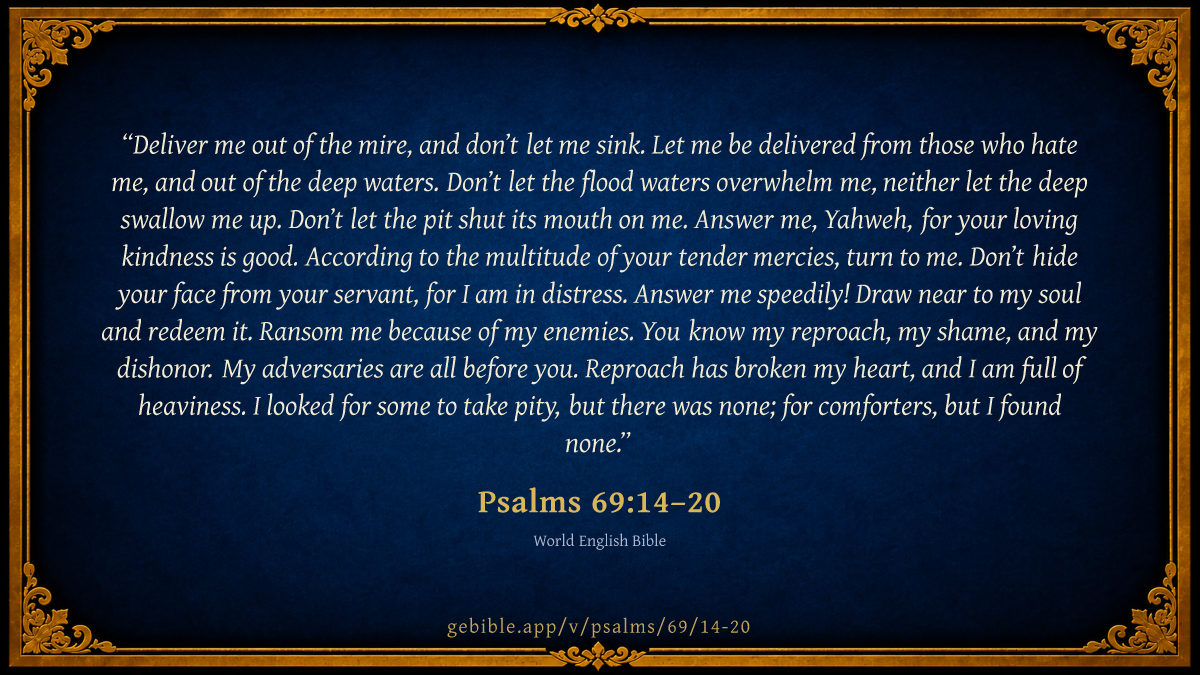
14 Deliver me out of the mire, and don’t let me sink. Let me be delivered from those who hate me, and out of the deep waters.
15 Don’t let the flood waters overwhelm me, neither let the deep swallow me up. Don’t let the pit shut its mouth on me.
16 Answer me, Yahweh, for your loving kindness is good. According to the multitude of your tender mercies, turn to me.
17 Don’t hide your face from your servant, for I am in distress. Answer me speedily!
18 Draw near to my soul and redeem it. Ransom me because of my enemies.
19 You know my reproach, my shame, and my dishonor. My adversaries are all before you.
20 Reproach has broken my heart, and I am full of heaviness. I looked for some to take pity, but there was none; for comforters, but I found none.
KJVKing James Version
14 Deliver me out of the mire, and let me not sink: let me be delivered from them that hate me, and out of the deep waters.
15 Let not the waterflood overflow me, neither let the deep swallow me up, and let not the pit shut her mouth upon me.
16 Hear me, O LORD; for thy lovingkindness is good: turn unto me according to the multitude of thy tender mercies.
17 And hide not thy face from thy servant; for I am in trouble: hear me speedily.
18 Draw nigh unto my soul, and redeem it: deliver me because of mine enemies.
19 Thou hast known my reproach, and my shame, and my dishonour: mine adversaries are all before thee.
20 Reproach hath broken my heart; and I am full of heaviness: and I looked for some to take pity, but there was none; and for comforters, but I found none.
Show all 3 translations
JPSJPS Tanakh (1917)
14 (69-15) Deliver me out of the mire, and let me not sink; let me be delivered from them that hate me, and out of the deep waters.
15 (69-16) Let not the waterflood overwhelm me, neither let the deep swallow me up; and let not the pit shut her mouth upon me.
16 (69-17) Answer me, O LORD, for Thy mercy is good; according to the multitude of Thy compassions turn Thou unto me.
17 (69-18) And hide not Thy face from Thy servant; for I am in distress; answer me speedily.
18 (69-19) Draw nigh unto my soul, and redeem it; ransom me because of mine enemies.
19 (69-20) Thou knowest my reproach, and my shame, and my confusion; mine adversaries are all before Thee.
20 (69-21) Reproach hath broken my heart; and I am sore sick; and I looked for some to show compassion, but there was none; and for comforters, but I found none.
Psalms 109:21(vv14, 16)But deal with me, Yahweh the Lord, for your name’s sake, because your loving kindness is good, deliver me;
Psalms 27:9(v17)Don’t hide your face from me. Don’t put your servant away in anger. You have been my help. Don’t abandon me, neither forsake me, God of my…
Psalms 144:7(v14)Stretch out your hand from above, rescue me, and deliver me out of great waters, out of the hands of foreigners,
Isaiah 63:5(v20)I looked, and there was no one to help; and I wondered that there was no one to uphold. Therefore my own arm brought salvation to me. My…
Job 16:2(v20)“I have heard many such things. You are all miserable comforters!
Show all 83 cross-references
Psalms 25:16(v16)Turn to me, and have mercy on me, for I am desolate and afflicted.
Psalms 102:2(v17)Don’t hide your face from me in the day of my distress. Turn your ear to me. Answer me quickly in the day when I call.
Psalms 142:4(v20)Look on my right, and see; for there is no one who is concerned for me. Refuge has fled from me. No one cares for my soul.
Psalms 63:3(v16)Because your loving kindness is better than life, my lips shall praise you.
Psalms 26:11(v16)But as for me, I will walk in my integrity. Redeem me, and be merciful to me.
Psalms 69:13(v16)But as for me, my prayer is to you, Yahweh, in an acceptable time. God, in the abundance of your loving kindness, answer me in the truth of…
Psalms 106:45(v16)He remembered for them his covenant, and repented according to the multitude of his loving kindnesses.
Isaiah 53:3(v19)He was despised and rejected by men, a man of suffering and acquainted with disease. He was despised as one from whom men hide their face;…
Jeremiah 38:6-13(v14)Then they took Jeremiah and threw him into the dungeon of Malchijah the king’s son, that was in the court of the guard. They let down…
Micah 7:19(v16)He will again have compassion on us. He will tread our iniquities under foot; and you will cast all their sins into the depths of the sea.
Matthew 27:46(v17)About the ninth hour Jesus cried with a loud voice, saying, “Eli, Eli, lima sabachthani?” That is, “My God, my God, why have you forsaken…
Hebrews 12:2(v19)looking to Jesus, the author and perfecter of faith, who for the joy that was set before him endured the cross, despising its shame, and…
Revelation 12:15-16(v15)The serpent spewed water out of his mouth after the woman like a river, that he might cause her to be carried away by the stream. The earth…
Psalms 16:10(v15)For you will not leave my soul in Sheol, neither will you allow your holy one to see corruption.
Psalms 22:1(v18)My God, my God, why have you forsaken me? Why are you so far from helping me, and from the words of my groaning?
Psalms 22:19(v18)But don’t be far off, Yahweh. You are my help. Hurry to help me!
Psalms 51:1(v16)Have mercy on me, God, according to your loving kindness. According to the multitude of your tender mercies, blot out my transgressions.
Psalms 69:1-2(v14)Save me, God, for the waters have come up to my neck! I sink in deep mire, where there is no foothold. I have come into deep waters, where…
Psalms 70:1(v17)Hurry, God, to deliver me. Come quickly to help me, Yahweh.
Psalms 86:15-16(v16)But you, Lord, are a merciful and gracious God, slow to anger, and abundant in loving kindness and truth. Turn to me, and have mercy on me!…
Psalms 111:9(v18)He has sent redemption to his people. He has ordained his covenant forever. His name is holy and awesome!
Psalms 143:9(v17)Deliver me, Yahweh, from my enemies. I flee to you to hide me.
Isaiah 43:1-2(v15)But now Yahweh who created you, Jacob, and he who formed you, Israel, says: “Don’t be afraid, for I have redeemed you. I have called you by…
Jonah 2:2-7(v15)He said, “I called because of my affliction to Yahweh. He answered me. Out of the belly of Sheol I cried. You heard my voice. For you threw…
Matthew 26:56(v20)But all this has happened that the Scriptures of the prophets might be fulfilled.” Then all the disciples left him and fled.
Acts 2:24(v15)whom God raised up, having freed him from the agony of death, because it was not possible that he should be held by it.
1 Peter 2:23(v19)When he was cursed, he didn’t curse back. When he suffered, he didn’t threaten, but committed himself to him who judges righteously.
Psalms 124:4-5(vv14–15)then the waters would have overwhelmed us, the stream would have gone over our soul; then the proud waters would have gone over our soul.
Psalms 2:2-4(v19)The kings of the earth take a stand, and the rulers take counsel together, against Yahweh, and against his Anointed, saying, “Let’s break…
Psalms 13:1(v17)How long, Yahweh? Will you forget me forever? How long will you hide your face from me?
Psalms 25:18-19(v14)Consider my affliction and my travail. Forgive all my sins. Consider my enemies, for they are many. They hate me with cruel hatred.
Psalms 35:19(v14)Don’t let those who are my enemies wrongfully rejoice over me; neither let those who hate me without a cause wink their eyes.
Psalms 38:9(v19)Lord, all my desire is before you. My groaning is not hidden from you.
Psalms 40:1-3(v14)I waited patiently for Yahweh. He turned to me, and heard my cry. He brought me up also out of a horrible pit, out of the miry clay. He set…
Psalms 42:2(v14)My soul thirsts for God, for the living God. When shall I come and appear before God?
Psalms 42:7(v14)Deep calls to deep at the noise of your waterfalls. All your waves and your billows have swept over me.
Psalms 44:24(v17)Why do you hide your face, and forget our affliction and our oppression?
Psalms 49:15(v18)But God will redeem my soul from the power of Sheol, for he will receive me.
Psalms 66:14(v17)which my lips promised, and my mouth spoke, when I was in distress.
Psalms 69:15(v14)Don’t let the flood waters overwhelm me, neither let the deep swallow me up. Don’t let the pit shut its mouth on me.
Psalms 109:3(v14)They have also surrounded me with words of hatred, and fought against me without a cause.
Lamentations 3:55(v14)I called on your name, Yahweh, out of the lowest dungeon.
Mark 14:34-42(v14)He said to them, “My soul is exceedingly sorrowful, even to death. Stay here, and watch.” He went forward a little, and fell on the ground,…
Mark 15:34(v14)At the ninth hour Jesus cried with a loud voice, saying, “Eloi, Eloi, lama sabachthani?” which is, being interpreted, “My God, my God, why…
Luke 19:14(v14)But his citizens hated him, and sent an envoy after him, saying, ‘We don’t want this man to reign over us.’
Luke 19:27(v14)But bring those enemies of mine who didn’t want me to reign over them here, and kill them before me.’ ”
John 12:27(v20)“Now my soul is troubled. What shall I say? ‘Father, save me from this time?’ But I came to this time for this cause.
John 16:32(v20)Behold, the time is coming, yes, and has now come, that you will be scattered, everyone to his own place, and you will leave me alone. Yet…
2 Timothy 4:16-17(v20)At my first defense, no one came to help me, but all left me. May it not be held against them. But the Lord stood by me and strengthened…
Numbers 16:33-34(v15)So they, and all that belonged to them went down alive into Sheol. The earth closed on them, and they perished from among the assembly. All…
Deuteronomy 32:27(v18)were it not that I feared the provocation of the enemy, lest their adversaries should judge wrongly, lest they should say, ‘Our hand is…
Joshua 7:9(v18)For the Canaanites and all the inhabitants of the land will hear of it, and will surround us, and cut off our name from the earth. What…
Job 6:23(v18)or, ‘Deliver me from the adversary’s hand?’ or, ‘Redeem me from the hand of the oppressors?’
Job 19:21-22(v20)“Have pity on me. Have pity on me, you my friends; for the hand of God has touched me. Why do you persecute me as God, and are not…
Psalms 10:1(v18)Why do you stand far off, Yahweh? Why do you hide yourself in times of trouble?
Psalms 22:24(v17)For he has not despised nor abhorred the affliction of the afflicted, Neither has he hidden his face from him; but when he cried to him, he…
Psalms 31:5(v18)Into your hand I commend my spirit. You redeem me, Yahweh, God of truth.
Psalms 36:7(v16)How precious is your loving kindness, God! The children of men take refuge under the shadow of your wings.
Psalms 40:13(v17)Be pleased, Yahweh, to deliver me. Hurry to help me, Yahweh.
Psalms 42:6(v20)My God, my soul is in despair within me. Therefore I remember you from the land of the Jordan, the heights of Hermon, from the hill Mizar.
Psalms 42:10(v20)As with a sword in my bones, my adversaries reproach me, while they continually ask me, “Where is your God?”
Psalms 69:7-9(v19)Because for your sake, I have borne reproach. Shame has covered my face. I have become a stranger to my brothers, an alien to my mother’s…
Psalms 88:4-6(v15)I am counted among those who go down into the pit. I am like a man who has no help, set apart among the dead, like the slain who lie in the…
Psalms 123:4(v20)Our soul is exceedingly filled with the scoffing of those who are at ease, with the contempt of the proud.
Psalms 143:7(v17)Hurry to answer me, Yahweh. My spirit fails. Don’t hide your face from me, so that I don’t become like those who go down into the pit.
Isaiah 63:7(v16)I will tell of the loving kindnesses of Yahweh and the praises of Yahweh, according to all that Yahweh has given to us, and the great…
Jeremiah 14:8(v18)You hope of Israel, its Savior in the time of trouble, why should you be as a foreigner in the land, and as a wayfaring man who turns aside…
Matthew 26:37-38(v20)He took with him Peter and the two sons of Zebedee, and began to be sorrowful and severely troubled. Then he said to them, “My soul is…
Matthew 26:38(v17)Then he said to them, “My soul is exceedingly sorrowful, even to death. Stay here, and watch with me.”
Mark 14:37(v20)He came and found them sleeping, and said to Peter, “Simon, are you sleeping? Couldn’t you watch one hour?
John 8:49(v19)Jesus answered, “I don’t have a demon, but I honor my Father and you dishonor me.
Acts 2:31(v15)he foreseeing this spoke about the resurrection of the Christ, that his soul wasn’t left in Hades, and his flesh didn’t see decay.
Acts 5:30-31(v14)The God of our fathers raised up Jesus, whom you killed, hanging him on a tree. God exalted him with his right hand to be a Prince and a…
Hebrews 11:36(v20)Others were tried by mocking and scourging, yes, moreover by bonds and imprisonment.
Job 7:21(v17)Why do you not pardon my disobedience, and take away my iniquity? For now will I lie down in the dust. You will seek me diligently, but I…
Psalms 22:6-7(v19)But I am a worm, and no man; a reproach of men, and despised by the people. All those who see me mock me. They insult me with their lips.…
Matthew 12:40(v15)For as Jonah was three days and three nights in the belly of the whale, so will the Son of Man be three days and three nights in the heart…
83 distinct cross-references across this passage (85 total citations).
Cross-references from openbible.info (CC BY 4.0)
Explain this passage (18 sources)
Historical commentary, presented as a primary source — not an endorsement.
John Calvin1540 · Public DomainOn vv14, 16, 18, 19, 2014. Deliver me from the mire, that I may…
14. Deliver me from the mire, that I may not sink. The Psalmist repeats the same similitude which he had used before, but in a different manner. He had previously said that he was sunk in the mire, and now he prays that he may not sink in it. In short, he now prays that those things may not now befall him which he had formerly complained of as having befallen him. But it is very easy to reconcile this diversity of statement; for in the opening of the psalm he spake according to his actual feeling and experience; but now, looking to the issue, although living in the midst of death, he cherishes the hope of deliverance. This is expressed still more clearly in the last clause of the 15th verse, where he prays, Let not the pit close its mouth upon me; which is as if he had said, Let not the great multitude and weight of my afflictions overwhelm me, and let not sorrow swallow me up.
John Calvin's Commentaries (1540-1563) — public domain. Text from the Calvin Translation Society English edition (1840s-50s) via the Christian Classics Ethereal Library (ccel.org). Calvin's coverage is partial (roughly two-thirds of the Bible); uncommented books and verses are honest gaps, never fabricated. The 19th-century editor's footnotes and remarks are omitted so the notes are faithfully Calvin's own voice.
Geneva Bible translators1599 · Public DomainOn vv14, 17, 19, 20He showeth a lively faith, in that that he…
He showeth a lively faith, in that that he assureth himself, that God is favorable to him, when he seemeth to be angry: and at hand when he seemeth to be far off.
Geneva Bible (1599) marginal notes — public domain.
John Trapp1656 · Public DomainOn vv14–20Psa 69:14 Deliver me out of the mire, and…
Psa 69:14 Deliver me out of the mire, and let me not sink: let me be delivered from them that hate me, and out of the deep waters.
Ver. 14. Deliver me out of the mire] i.e. De civitate Gehennae, from the state of hell, saith the Hebrew scholiast; {a} out of that deadly danger whereof he had complained, Psa 69:2. Alphonsus, king of Arragon, by a gracious condescension, helped a laden ass out of the mire with his own hand, and is renowned for it in history (Val. Max. Christ. 41). God helpeth his out full oft, and little notice is taken of it.
Read full note →
{a} One who writes explanatory notes upon an author; esp. an ancient commentator upon a classical writer.
John Trapp, A Commentary or Exposition upon All the Books of the Old and New Testament (1647–1656) — public domain. Text from a community e-Sword module.
Matthew Poole1685 · Public DomainOn vv14, 16, 18, 19, 20Them that hate me; whereby he explains his meaning…
Them that hate me; whereby he explains his meaning in these metaphors of mire, and waters, and deep, and pit.
Matthew Poole's English Annotations on the Holy Bible (1683–1685) — public domain. Text from a community e-Sword/MySword module.
John Gill1763 · Public DomainOn vv14–20Deliver me out of the mire, and let me…
Deliver me out of the mire, and let me not sink,.... In which he was sinking, Psa 69:2; and accordingly he was delivered out of it, Psa 11:2; even out of all the mire of sin, the sins of his people that were upon him, from which he was justified when raised from the dead; and so will appear without sin, when he comes a second time:
let me be delivered from them that hate me, and out of the deep waters; these phrases design the same, even the enemies of Christ; such that hated him, compared to deep waters: these are the floods of the ungodly, and the many waters out of which he was drawn and delivered, Psa 18:4.
John Gill's Exposition of the Whole Bible (1746–1763) — public domain (CC PDM 1.0). Text via the HelloAO Bible API.
Adam Clarke1810 · Public DomainOn vv16, 18, 19Verse 16. Thy loving-kindness is good] The word חסד…
Verse 16. Thy loving-kindness is good] The word חסד chesed signifies exuberance of kindness; and the word רחמים rachamim, which we translate tender mercies, signifies such affection as mothers bear to their young: and in God, there is רב rob, a multitude, of such tender mercies towards the children of men!
Adam Clarke's Commentary on the Bible (1810–1826) — public domain. Text from a community e-Sword/MySword module.
Joseph Benson1811 · Public DomainOn vv14, 19Psa 69:14-18. Let me be delivered from them that…
Psa 69:14-18. Let me be delivered from them that hate me — By thus speaking, he explains his meaning in the metaphors here used of mire, waters, deep, and pit. For thy loving-kindness is good — Is eminently and unspeakably good; is gracious, or bountiful; the positive degree being put for the superlative: it is most ready to communicate itself to miserable and indigent creatures: the Hebrew word חסד, chesed, here used, signifying abundance of goodness, or mercifulness. Draw nigh unto my soul — To support and relieve it, O thou who seemest to be departed far away from me. Deliver me because of mine enemies — Because they are enemies to thee as well as to me, and if they succeed, will triumph, not only over me, but in some sort over thee and over religion.
Joseph Benson's Commentary on the Old and New Testaments (1811–1818) — public domain. Text from a community e-Sword module.
Albert Barnes1834 · Public DomainOn vv14–20Deliver me out of the mire - Out of…
Deliver me out of the mire - Out of my troubles and calamities. See Psa 69:1-2.
And let me not sink - As in, mire. Let me not be overwhelmed by my sorrows.
Read full note →
Let me be delivered from them that hate me - All my enemies. Let me be saved from their machinations and devices.
And out of the deep waters - See Psa 69:1-2. From my troubles.
Albert Barnes' Notes on the Bible (1834–1885) — public domain. Text from a community e-Sword/MySword module.
Robert Jamieson, A. R. Fausset & David Brown1871 · Public DomainOn vv16, 19These earnest terms are often used, and the address…
These earnest terms are often used, and the address to God, as indifferent or averse, is found in Psa 3:7; Psa 22:24; Psa 27:9, &c.
Jamieson, Fausset & Brown — Commentary Critical and Explanatory on the Whole Bible (1871) — public domain (CC PDM 1.0). Text via the HelloAO Bible API.
Daniel D. Whedon1874 · Public DomainOn vv15, 16, 19, 2015. The pit shut her mouth upon me—David had…
15. The pit shut her mouth upon me—David had used the figures of deep “waters” and of “mire” without bottom, and now he adds the horror of having the “mouth” of the “pit” into which he had sunk close upon him, thereby shutting out the last ray of hope. The allusion does not appear to be to Num_16:32. באר, (beer,) well, pit, may allude to the dangerous asphaltum pits, (Gen_14:10;) but as in David’s time such pits were rare, and not objects of common dread, we may take the word in its most common signification of well. Stanley says of the numerous vestiges of ancient wells in Palestine, that “they have a broad margin of masonry round the month, and often a stone filling up the orifice.” This covering the well’s mouth when a human person was within was a figure of burying alive, which the psalmist deprecated. See 2Sa_17:18-19
Daniel D. Whedon (gen. ed.), Commentary on the Old and New Testaments (1874–1909) — public domain. Text from a community e-Sword module.
The Cambridge Bible for Schools and Colleges1878 · Public DomainOn vv14, 16, 17, 18, 19, 2014, 15. In his prayer he repeats the words…
14, 15. In his prayer he repeats the words which he had previously used to describe his plight (Psa_69:2; Psa_69:4). It is difficult to see why the R.V. has substituted overwhelm for overflow here and not in Psa_69:2, the Heb. word being the same in both cases.
let not the pit &c.] Either the grave (Psa_55:23), or a dungeon (Lam_3:53; Lam_3:55), may be meant. In the latter case Jeremiah’s experience (ch. Psa_38:6) may have suggested the metaphor; but the words are not to be understood literally of release from Malchiah’s dungeon.
The Cambridge Bible for Schools and Colleges (gen. ed. J. J. S. Perowne; Cambridge University Press, 1878–1918) — public domain. Text from a community e-Sword module.
Ellicott's Commentary for English Readers1878 · Public DomainOn vv15, 20(15) Pit.—Properly, well. A stone usually covered the wells…
(15) Pit.—Properly, well. A stone usually covered the wells (Gen_29:10), which explains the phrase, “shut her mouth.” Is this merely figurative; or have we here a reminiscence of some terrible crime, analogous to that of Cawnpore?
A Bible Commentary for English Readers, edited by Charles John Ellicott (1878–1897) — public domain. Text from a community e-Sword module.
The Pulpit Commentary1880 · Public DomainOn vv14–20Deliver me out of the mire, and let me…
Deliver me out of the mire, and let me not sink (comp. ver. 2, with the comment). Let me be delivered from them that hate me (see ver. 4). And out of the deep waters (comp. vers. 1, 2).
The Pulpit Commentary (1880–1919), ed. H.D.M. Spence-Jones & Joseph S. Exell — public domain. Text from a community e-Sword module.
Charles H. Spurgeon1885 · Public DomainOn vv14–20Ver. 14. Deliver me out of the mire and…
Ver. 14. Deliver me out of the mire and let me not sink. He turns into prayer the very words of his complaint; and it is well, if, when we complain, we neither feel nor say anything which we should fear to utter before the Lord as a prayer. We are allowed to ask for deliverance from trouble as well as for support under it; both petitions are here combined. How strange it seems to hear such language from the Lord of glory. Let me be delivered from them that hate, me, and out of the deep waters. Both from his foes, and the griefs which they caused him, he seeks a rescue. God can help us in all ways, and we may, therefore, put up a variety of requests without fear of exceeding our liberty to ask, or his ability to answer.
None.
Read full note →
Ver. 14-16.
I. The depth from which prayer may rise.
II. The height to which it may ascend. Thus Jonah, when
at the bottom of the sea, says, "My prayer came up, "
etc. G. R.
Psalms 69:15*
Ver. 14-16.
I. The depth from which prayer may rise.
II. The height to which it may ascend. Thus Jonah, when
at the bottom of the sea, says, "My prayer came up, "
etc. G. R.
Ver. 14-16.
I. The depth from which prayer may rise.
II. The height to which it may ascend. Thus Jonah, when
at the bottom of the sea, says, "My prayer came up, "
etc. G. R.
Psalms 69:17*
Charles H. Spurgeon's The Treasury of David (1869–1885) — public domain. Psalms only. Text from a community e-Sword/MySword module.
The Biblical Illustrator1887 · Public DomainOn vv14, 20Deliver me out of the mire, and let me…
Psa_69:14
Deliver me out of the mire, and let me not sink.
Read full note →
The believer sinking in the mire
Many rivers, and especially the Nile, have on their banks deep deposits of black mud, and it is most perilous for any who have the misfortune to fall into it. The more they struggle to get out the deeper they sink. Travellers tell of such incidents. Had David really witnessed such a scene, that speaking of his spiritual sorrows, he said, I sink in deep mire where there is no standing? Now, the prayer of our text suggests--
I. That the true believer may be. In the mire and very near sinking.
1. In the mire of unbelief. Even the firmest in faith lose their foothold at times. All manner of doubts crowd into the mind. They are compelled to pray this prayer.
2. Through lack of full assurance of his own interest in Christ.
3. The mire of temporal trouble.
4. Of inward corruption.
5. Of Satanic temptations.
6. Various are the causes of this sad condition. Sometimes it is through our own sin. It is a chastisement upon us. Sometimes to try our faith; or that we may the better glorify God, or to show the natural weakness of the creature, that no flesh may glory in man; or to make heaven sweeter when we enter its pearly gates. But all the while, these sinking ones are really Gods people, for if they were not, they would have no such trouble. The sinner whose element is sin laughs at the weight by which the believer is borne down. The best of Gods saints have known such trouble. Luther did, and John Knox, and many more.
II. But when in such a state they know that their only help is in God. The Bible cannot help, for unbelief bars you off from all its precious promises. Other believers cannot aid you. God alone can.
III. Prayer is the Christians never-failing resort. When you cannot use your sword, you may take the weapon of all-prayer. That is never forbidden. And it is never futile, it ever has true power. Oh, never let us cease to pray. In asthma you say, I cannot breathe; but you must breathe if you would live. And so in the condition told of here you must, though you think you cannot, pray. But let us walk carefully, lest we fall into the mire. (C. H. Spurgeon.)
The Biblical Illustrator, edited by Joseph S. Exell (c. 1880s–1900s) — public domain. Text from a community e-Sword module.
C. I. Scofield1917 · Public DomainOn v18Heb. goel, Redemp. (Kinsman type). (See Scofield "Isa 59:20").
redeem
Heb. goel, Redemp. (Kinsman type). (See Scofield "Isa 59:20").
The Scofield Reference Bible (1917 edition), notes by C. I. Scofield — public domain. Text from a community e-Sword module.
unfoldingWord translationNotes2017 · CC BY-SA 4.0On vv16, 18, 20your covenant faithfulness is good
your covenant faithfulness is good
The abstract noun "faithfulness" can be translated as an adjective. AT: "you are good and faithful to your covenant" (See: Abstract Nouns)
Read full note →
your mercies for me are many
"you are very merciful to me"
turn to me
The idea of turning towards someone means to pay attention to them or help them. AT: "help me" (See: Metaphor)
Do not hide your face from your servant
To hide one's face means to refuse to hear or help someone. AT: "Please help your servant" or "Please help me" (See: Idiom)
John Calvin 1540 · Public Domain On vv14, 16, 18, 19, 20 14. Deliver me from the mire, that I may…
14. Deliver me from the mire, that I may not sink. The Psalmist repeats the same similitude which he had used before, but in a different manner. He had previously said that he was sunk in the mire, and now he prays that he may not sink in it. In short, he now prays that those things may not now befall him which he had formerly complained of as having befallen him. But it is very easy to reconcile this diversity of statement; for in the opening of the psalm he spake according to his actual feeling and experience; but now, looking to the issue, although living in the midst of death, he cherishes the hope of deliverance. This is expressed still more clearly in the last clause of the 15th verse, where he prays, Let not the pit close its mouth upon me; which is as if he had said, Let not the great multitude and weight of my afflictions overwhelm me, and let not sorrow swallow me up.
John Calvin's Commentaries (1540-1563) — public domain. Text from the Calvin Translation Society English edition (1840s-50s) via the Christian Classics Ethereal Library (ccel.org). Calvin's coverage is partial (roughly two-thirds of the Bible); uncommented books and verses are honest gaps, never fabricated. The 19th-century editor's footnotes and remarks are omitted so the notes are faithfully Calvin's own voice.
Geneva Bible translators 1599 · Public Domain On vv14, 17, 19, 20 He showeth a lively faith, in that that he…
He showeth a lively faith, in that that he assureth himself, that God is favorable to him, when he seemeth to be angry: and at hand when he seemeth to be far off.
Geneva Bible (1599) marginal notes — public domain.
John Trapp 1656 · Public Domain On vv14–20 Psa 69:14 Deliver me out of the mire, and…
Psa 69:14 Deliver me out of the mire, and let me not sink: let me be delivered from them that hate me, and out of the deep waters.
Ver. 14. Deliver me out of the mire] i.e. De civitate Gehennae, from the state of hell, saith the Hebrew scholiast; {a} out of that deadly danger whereof he had complained, Psa 69:2. Alphonsus, king of Arragon, by a gracious condescension, helped a laden ass out of the mire with his own hand, and is renowned for it in history (Val. Max. Christ. 41). God helpeth his out full oft, and little notice is taken of it.
Read full note →
{a} One who writes explanatory notes upon an author; esp. an ancient commentator upon a classical writer.
John Trapp, A Commentary or Exposition upon All the Books of the Old and New Testament (1647–1656) — public domain. Text from a community e-Sword module.
Matthew Poole 1685 · Public Domain On vv14, 16, 18, 19, 20 Them that hate me; whereby he explains his meaning…
Them that hate me; whereby he explains his meaning in these metaphors of mire, and waters, and deep, and pit.
Matthew Poole's English Annotations on the Holy Bible (1683–1685) — public domain. Text from a community e-Sword/MySword module.
John Gill 1763 · Public Domain On vv14–20 Deliver me out of the mire, and let me…
Deliver me out of the mire, and let me not sink,.... In which he was sinking, Psa 69:2; and accordingly he was delivered out of it, Psa 11:2; even out of all the mire of sin, the sins of his people that were upon him, from which he was justified when raised from the dead; and so will appear without sin, when he comes a second time:
let me be delivered from them that hate me, and out of the deep waters; these phrases design the same, even the enemies of Christ; such that hated him, compared to deep waters: these are the floods of the ungodly, and the many waters out of which he was drawn and delivered, Psa 18:4.
John Gill's Exposition of the Whole Bible (1746–1763) — public domain (CC PDM 1.0). Text via the HelloAO Bible API.
Adam Clarke 1810 · Public Domain On vv16, 18, 19 Verse 16. Thy loving-kindness is good] The word חסד…
Verse 16. Thy loving-kindness is good] The word חסד chesed signifies exuberance of kindness; and the word רחמים rachamim, which we translate tender mercies, signifies such affection as mothers bear to their young: and in God, there is רב rob, a multitude, of such tender mercies towards the children of men!
Adam Clarke's Commentary on the Bible (1810–1826) — public domain. Text from a community e-Sword/MySword module.
Joseph Benson 1811 · Public Domain On vv14, 19 Psa 69:14-18. Let me be delivered from them that…
Psa 69:14-18. Let me be delivered from them that hate me — By thus speaking, he explains his meaning in the metaphors here used of mire, waters, deep, and pit. For thy loving-kindness is good — Is eminently and unspeakably good; is gracious, or bountiful; the positive degree being put for the superlative: it is most ready to communicate itself to miserable and indigent creatures: the Hebrew word חסד, chesed, here used, signifying abundance of goodness, or mercifulness. Draw nigh unto my soul — To support and relieve it, O thou who seemest to be departed far away from me. Deliver me because of mine enemies — Because they are enemies to thee as well as to me, and if they succeed, will triumph, not only over me, but in some sort over thee and over religion.
Joseph Benson's Commentary on the Old and New Testaments (1811–1818) — public domain. Text from a community e-Sword module.
Albert Barnes 1834 · Public Domain On vv14–20 Deliver me out of the mire - Out of…
Deliver me out of the mire - Out of my troubles and calamities. See Psa 69:1-2.
And let me not sink - As in, mire. Let me not be overwhelmed by my sorrows.
Read full note →
Let me be delivered from them that hate me - All my enemies. Let me be saved from their machinations and devices.
And out of the deep waters - See Psa 69:1-2. From my troubles.
Albert Barnes' Notes on the Bible (1834–1885) — public domain. Text from a community e-Sword/MySword module.
Robert Jamieson, A. R. Fausset & David Brown 1871 · Public Domain On vv16, 19 These earnest terms are often used, and the address…
These earnest terms are often used, and the address to God, as indifferent or averse, is found in Psa 3:7; Psa 22:24; Psa 27:9, &c.
Jamieson, Fausset & Brown — Commentary Critical and Explanatory on the Whole Bible (1871) — public domain (CC PDM 1.0). Text via the HelloAO Bible API.
Daniel D. Whedon 1874 · Public Domain On vv15, 16, 19, 20 15. The pit shut her mouth upon me—David had…
15. The pit shut her mouth upon me—David had used the figures of deep “waters” and of “mire” without bottom, and now he adds the horror of having the “mouth” of the “pit” into which he had sunk close upon him, thereby shutting out the last ray of hope. The allusion does not appear to be to Num_16:32. באר, (beer,) well, pit, may allude to the dangerous asphaltum pits, (Gen_14:10;) but as in David’s time such pits were rare, and not objects of common dread, we may take the word in its most common signification of well. Stanley says of the numerous vestiges of ancient wells in Palestine, that “they have a broad margin of masonry round the month, and often a stone filling up the orifice.” This covering the well’s mouth when a human person was within was a figure of burying alive, which the psalmist deprecated. See 2Sa_17:18-19
Daniel D. Whedon (gen. ed.), Commentary on the Old and New Testaments (1874–1909) — public domain. Text from a community e-Sword module.
The Cambridge Bible for Schools and Colleges 1878 · Public Domain On vv14, 16, 17, 18, 19, 20 14, 15. In his prayer he repeats the words…
14, 15. In his prayer he repeats the words which he had previously used to describe his plight (Psa_69:2; Psa_69:4). It is difficult to see why the R.V. has substituted overwhelm for overflow here and not in Psa_69:2, the Heb. word being the same in both cases.
let not the pit &c.] Either the grave (Psa_55:23), or a dungeon (Lam_3:53; Lam_3:55), may be meant. In the latter case Jeremiah’s experience (ch. Psa_38:6) may have suggested the metaphor; but the words are not to be understood literally of release from Malchiah’s dungeon.
The Cambridge Bible for Schools and Colleges (gen. ed. J. J. S. Perowne; Cambridge University Press, 1878–1918) — public domain. Text from a community e-Sword module.
Ellicott's Commentary for English Readers 1878 · Public Domain On vv15, 20 (15) Pit.—Properly, well. A stone usually covered the wells…
(15) Pit.—Properly, well. A stone usually covered the wells (Gen_29:10), which explains the phrase, “shut her mouth.” Is this merely figurative; or have we here a reminiscence of some terrible crime, analogous to that of Cawnpore?
A Bible Commentary for English Readers, edited by Charles John Ellicott (1878–1897) — public domain. Text from a community e-Sword module.
The Pulpit Commentary 1880 · Public Domain On vv14–20 Deliver me out of the mire, and let me…
Deliver me out of the mire, and let me not sink (comp. ver. 2, with the comment). Let me be delivered from them that hate me (see ver. 4). And out of the deep waters (comp. vers. 1, 2).
The Pulpit Commentary (1880–1919), ed. H.D.M. Spence-Jones & Joseph S. Exell — public domain. Text from a community e-Sword module.
Charles H. Spurgeon 1885 · Public Domain On vv14–20 Ver. 14. Deliver me out of the mire and…
Ver. 14. Deliver me out of the mire and let me not sink. He turns into prayer the very words of his complaint; and it is well, if, when we complain, we neither feel nor say anything which we should fear to utter before the Lord as a prayer. We are allowed to ask for deliverance from trouble as well as for support under it; both petitions are here combined. How strange it seems to hear such language from the Lord of glory. Let me be delivered from them that hate, me, and out of the deep waters. Both from his foes, and the griefs which they caused him, he seeks a rescue. God can help us in all ways, and we may, therefore, put up a variety of requests without fear of exceeding our liberty to ask, or his ability to answer.
None.
Read full note →
Ver. 14-16.
I. The depth from which prayer may rise.
II. The height to which it may ascend. Thus Jonah, when
at the bottom of the sea, says, "My prayer came up, "
etc. G. R.
Psalms 69:15*
Ver. 14-16.
I. The depth from which prayer may rise.
II. The height to which it may ascend. Thus Jonah, when
at the bottom of the sea, says, "My prayer came up, "
etc. G. R.
Ver. 14-16.
I. The depth from which prayer may rise.
II. The height to which it may ascend. Thus Jonah, when
at the bottom of the sea, says, "My prayer came up, "
etc. G. R.
Psalms 69:17*
Charles H. Spurgeon's The Treasury of David (1869–1885) — public domain. Psalms only. Text from a community e-Sword/MySword module.
The Biblical Illustrator 1887 · Public Domain On vv14, 20 Deliver me out of the mire, and let me…
Psa_69:14
Deliver me out of the mire, and let me not sink.
Read full note →
The believer sinking in the mire
Many rivers, and especially the Nile, have on their banks deep deposits of black mud, and it is most perilous for any who have the misfortune to fall into it. The more they struggle to get out the deeper they sink. Travellers tell of such incidents. Had David really witnessed such a scene, that speaking of his spiritual sorrows, he said, I sink in deep mire where there is no standing? Now, the prayer of our text suggests--
I. That the true believer may be. In the mire and very near sinking.
1. In the mire of unbelief. Even the firmest in faith lose their foothold at times. All manner of doubts crowd into the mind. They are compelled to pray this prayer.
2. Through lack of full assurance of his own interest in Christ.
3. The mire of temporal trouble.
4. Of inward corruption.
5. Of Satanic temptations.
6. Various are the causes of this sad condition. Sometimes it is through our own sin. It is a chastisement upon us. Sometimes to try our faith; or that we may the better glorify God, or to show the natural weakness of the creature, that no flesh may glory in man; or to make heaven sweeter when we enter its pearly gates. But all the while, these sinking ones are really Gods people, for if they were not, they would have no such trouble. The sinner whose element is sin laughs at the weight by which the believer is borne down. The best of Gods saints have known such trouble. Luther did, and John Knox, and many more.
II. But when in such a state they know that their only help is in God. The Bible cannot help, for unbelief bars you off from all its precious promises. Other believers cannot aid you. God alone can.
III. Prayer is the Christians never-failing resort. When you cannot use your sword, you may take the weapon of all-prayer. That is never forbidden. And it is never futile, it ever has true power. Oh, never let us cease to pray. In asthma you say, I cannot breathe; but you must breathe if you would live. And so in the condition told of here you must, though you think you cannot, pray. But let us walk carefully, lest we fall into the mire. (C. H. Spurgeon.)
The Biblical Illustrator, edited by Joseph S. Exell (c. 1880s–1900s) — public domain. Text from a community e-Sword module.
C. I. Scofield 1917 · Public Domain On v18 Heb. goel, Redemp. (Kinsman type). (See Scofield "Isa 59:20").
redeem
Heb. goel, Redemp. (Kinsman type). (See Scofield "Isa 59:20").
The Scofield Reference Bible (1917 edition), notes by C. I. Scofield — public domain. Text from a community e-Sword module.
unfoldingWord translationNotes 2017 · CC BY-SA 4.0 On vv16, 18, 20 your covenant faithfulness is good
your covenant faithfulness is good
The abstract noun "faithfulness" can be translated as an adjective. AT: "you are good and faithful to your covenant" (See: Abstract Nouns)
Read full note →
your mercies for me are many
"you are very merciful to me"
turn to me
The idea of turning towards someone means to pay attention to them or help them. AT: "help me" (See: Metaphor)
Do not hide your face from your servant
To hide one's face means to refuse to hear or help someone. AT: "Please help your servant" or "Please help me" (See: Idiom)
in distress
"in great trouble"
translationWords
Yahweh
covenant faithfulness
good
mercy
turn
face
servant
unfoldingWord translationNotes — © Distant Shores Media and the Door43 World Missions Community, licensed CC BY-SA 4.0. Source: git.door43.org/Door43/en_tn.
Tyndale Open Study Notes 2022 · CC BY-SA 4.0 On v19 69:19-21 Alone and misunderstood, the psalmist confesses that he…
69:19-21 Alone and misunderstood, the psalmist confesses that he cannot bear his doubts. His heart has been broken by his problems.
Tyndale Open Study Notes — © Tyndale Open Resources, licensed CC BY-SA 4.0. Text via the HelloAO Bible API.